

Customer lifecycle management is the operating system that moves a qualified opportunity from first response through sale, onboarding, customer value, retention, recovery, renewal, and referral. Every stage needs a defined outcome, a named owner, a useful record, a response expectation, and an explicit next step. If a lead or customer can sit somewhere with no owner and no deadline, you do not have a lifecycle. You have a database full of people being ignored in an organized fashion.
TL;DR: Stop treating marketing, sales, delivery, support, and customer success as separate buckets that occasionally throw customers at one another. Qualify for fit. Record what was promised. Give every handoff an owner. Define the first useful outcome before onboarding begins. Watch for stalled progress. Intervene while the relationship can still be repaired. Ask for renewal, expansion, a testimonial, or a referral only after credible value exists. More leads will not fix a process that quietly loses the good ones.
In this customer lifecycle management guide
What is customer lifecycle management?
Customer lifecycle management is the deliberate coordination of the relationship from qualified interest through purchase, use, continued value, and advocacy. It connects the records, people, decisions, and communication that move a customer forward.
Salesforce describes customer lifecycle management as managing the stages customers move through while a business acquires, grows, retains, and develops those relationships. That broad definition is useful, but it is easy to make it sound like a software category.
It is not a software category.
A CRM can hold the record. An automation can send the message. A dashboard can display the number. None of those tools can decide whether the opportunity is worth pursuing, what was promised, whether the customer has achieved value, or who is responsible when the relationship stalls. Buying a CRM before defining the lifecycle is just purchasing a nicer drawer for the mess.
A working customer lifecycle answers seven questions at every stage:
- Why is this person or organization here?
- What outcome are they trying to achieve?
- What has the business promised?
- What must happen next?
- Who owns that next step?
- When should it happen?
- What evidence shows progress, risk, success, or a clean exit?
This is why the lifecycle belongs across marketing, sales, operations, support, and customer success. A 2024 study in Industrial Marketing Management found that customer success management depends on alignment among marketing, sales, and IT throughout the customer journey. The researchers developed the COMPLY framework from interviews with matched teams, reinforcing a practical point: post-sale value is not the responsibility of one cheerful person with “success” in a job title. Read the study and its methodology.
Why good leads disappear between handoffs
Businesses often ask for more traffic or more leads when the real problem starts after the form submission.
The website generated an inquiry. The notification went to a shared inbox. Someone assumed someone else replied. The contact was copied into a spreadsheet. A discovery call happened, but the notes stayed in a notebook. The proposal promised a timeline the delivery team never saw. The customer paid, received a generic welcome email, and then waited for somebody to explain what the hell happens next.
Nothing in that chain is dramatic. That is why it is dangerous. The customer does not need a spectacular failure to leave. A sequence of small uncertainty is enough.
Common lifecycle leaks include:
- no named owner for a new inquiry;
- no response expectation by channel or lead type;
- no definition of qualified, unqualified, nurture, or referral;
- incomplete discovery notes;
- proposals that list deliverables but not the business outcome, assumptions, or exclusions;
- promises made during sales that never reach delivery;
- onboarding that starts before access, content, data, payment, or decision-makers are ready;
- unresolved support issues that never influence renewal planning;
- customer “health” based on a mysterious score nobody can explain;
- renewal conversations that begin after the customer has already decided to leave;
- upsell and referral asks triggered by a calendar instead of customer value.
This is also why Scope Design uses a constraint-first website strategy. If the actual constraint is slow response, weak qualification, confused ownership, or a broken onboarding process, purchasing more traffic merely exposes the leak to more people.
The Scope Design CLOSED Loop
The CLOSED Loop is a six-part test for turning disconnected sales and customer activity into an owned system.
C: Capture the right opportunity
Collect enough information to determine fit, urgency, value, authority, constraints, and the correct next step. Do not ask every visitor to complete a mortgage application disguised as a contact form. Do not ask so little that sales has no idea why the person arrived.
L: Log the real problem and the promise
Record the customer’s desired outcome, current condition, decision process, scope, assumptions, exclusions, risks, and promises. If a material commitment exists only in a salesperson’s memory, it is not operational information. It is a future argument.
O: Own every handoff
Every movement between people or stages needs a sender, receiver, required information, due time, and acceptance. “I forwarded the email” is not a handoff. It is an alibi.
S: Start value delivery deliberately
Onboarding should orient the customer, confirm the outcome, collect required inputs, assign responsibilities, and define the first useful milestone. The first objective is not to finish onboarding paperwork. It is to make the relationship capable of producing value.
E: Evaluate outcomes, risk, and economics
Track whether the customer is progressing toward the agreed outcome, where friction is increasing, whether the relationship remains economically sensible, and which intervention is appropriate. A satisfaction score without context is a weather report from a different city.
D: Decide recovery, renewal, expansion, referral, or exit
Do not let the relationship drift. Decide what the evidence supports. Repair a service failure. Renew a healthy agreement. Expand only when more work creates more value. Ask for advocacy after a win. End a bad-fit relationship cleanly when staying together is harmful to both sides.
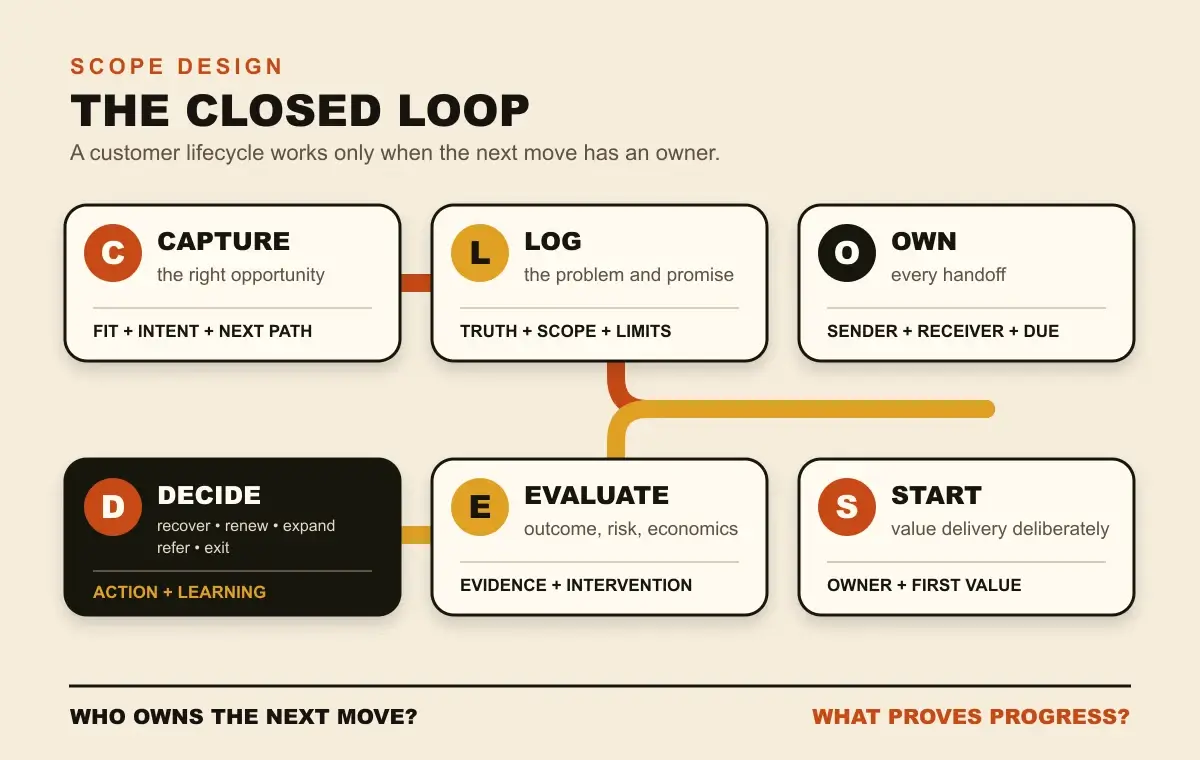
The framework is a loop because the later stages improve the earlier ones. Lost reasons refine qualification. Onboarding friction changes proposal language. Support patterns improve the product. Successful outcomes sharpen the ideal customer profile. Referrals reveal which customers understand the value well enough to explain it.
Customer lifecycle stages and ownership
There is no sacred number of customer lifecycle stages. Google search results are full of four-stage, five-stage, seven-stage, and twelve-stage models because humans enjoy turning a process into a numbered list. Use the smallest number of stages that makes ownership and decisions clear.
| Lifecycle stage | Required outcome | Minimum record | Primary measure |
|---|---|---|---|
| Inquiry | Acknowledged and routed | source, request, contact, owner, due time | response completion |
| Qualification | Fit and next path decided | problem, fit, authority, timing, budget signal, disposition | qualified opportunity rate |
| Discovery | Situation and decision understood | desired outcome, constraints, stakeholders, evidence, risks | discovery-to-proposal rate |
| Proposal and decision | Mutual commitment or clear loss | scope, assumptions, exclusions, investment, decision, loss reason | win rate and sales-cycle length |
| Onboarding | Customer oriented and ready to receive value | responsibilities, access, milestones, blockers, first-value definition | time to first value |
| Delivery and adoption | Agreed value is being produced and used | progress, usage, open issues, outcome evidence | milestone and adoption progress |
| Success and retention | Value remains visible and risks are addressed | health evidence, review notes, interventions, renewal decision | retention and outcome attainment |
| Advocacy or exit | Relationship produces a referral, expansion, learning, or clean close | permission, referral, expansion case, exit reason | qualified advocacy or documented exit |
Microsoft’s current sales-process guidance uses repeatable stages from lead through qualification, opportunity development, proposal, close, fulfillment, and invoice. It also emphasizes maintaining a complete history for future work and support. Your terminology can differ. The important part is that each stage changes the record and makes a decision possible.
Capture the right opportunity
Qualification is not a polite way to ask whether somebody can afford you. It determines whether the problem, buyer, timing, expectations, and delivery model fit.
For Scope Design, a short inquiry should establish:
- what service or outcome the prospect thinks they need;
- the current website, system, or process involved;
- the primary business problem;
- a rough budget or investment range when relevant;
- the desired timing and why it matters;
- who will decide;
- what has already been tried;
- what the prospect expects to contribute.
Deep strategic homework belongs after plausible fit and commitment. Asking an unqualified prospect to spend two hours filling out a discovery workbook wastes their time and yours. Asking only for a name and email creates the opposite problem: a salesperson must reconstruct the entire situation from scratch.
The form should route the inquiry into one of a few explicit paths:
- qualified for a discovery step;
- needs more information before a decision;
- appropriate for a smaller self-service offer;
- better served by a referral partner;
- not a fit;
- spam, vendor solicitation, or unrelated.
Every route needs an owner and a response expectation. There is no universal magic number of minutes that applies to every channel and business model. A high-intent phone inquiry and a downloaded checklist are not the same event. Define the expectation by intent, staffing, operating hours, and customer consequence. Then measure whether the business meets its own promise.
If the business cannot respond responsibly to the opportunities it already receives, the marketing team should know before launching the next campaign. That is not pessimism. It is refusing to pay for a bigger leak.
Log the real problem and the promise
Discovery should make the business situation more precise. It should not become a performance where the seller waits for a pause and fires a rehearsed pitch through it.
Useful discovery records include:
- the problem in the customer’s language;
- the evidence that the problem exists;
- the desired business outcome;
- the cost or consequence of leaving it unresolved;
- decision-makers and influencers;
- timing constraints and external deadlines;
- budget reality and approval process;
- technical, legal, operational, or staffing constraints;
- current tools and system owners;
- prior attempts and why they failed;
- what the customer must provide;
- how success and failure will be recognized.
The proposal then converts those findings into a mutual record. It should state the outcome, scope, responsibilities, assumptions, exclusions, timeline, investment, approval path, and change process. A list of deliverables without those boundaries is not clarity. It is a shopping list waiting to become a scope dispute.
Ethical objection handling belongs here too. An objection may reveal cash-flow limits, uncertainty, timing, trust, missing authority, weak fit, or unclear value. The job is to understand the constraint, not bulldoze the person with a clever comeback.
Scope Design will not invent proof, hide material costs, manufacture urgency, or promise an outcome the delivery system cannot support. A conversion achieved by misleading the buyer is not a sales win. It is a support ticket with delayed billing.
Own every handoff
A sales-to-onboarding handoff should transfer a usable commitment, not a celebratory message that says “great news, we sold something.”
The handoff record should include:
| Handoff field | Why the receiver needs it |
|---|---|
| Customer’s desired outcome | Keeps delivery focused on the reason for the purchase |
| Current condition and baseline | Makes progress measurable |
| Scope and exclusions | Prevents accidental promises and scope drift |
| Stakeholders and decision roles | Shows who approves, influences, uses, and pays |
| Promises and dates | Exposes commitments before they become surprises |
| Assumptions and dependencies | Identifies what must be true for the plan to work |
| Known risks and objections | Preserves context the customer already shared |
| Required customer inputs | Turns vague waiting into assigned work |
| Communication and escalation path | Prevents every issue from becoming an inbox scavenger hunt |
| First-value milestone | Defines the first useful proof that the relationship is working |
| Next owner and due time | Makes the handoff operational |
The receiver should acknowledge the handoff and flag missing information. A handoff is complete when the next owner can act, not when the previous owner has sent something.
This rule applies everywhere:
- marketing to sales;
- sales to paid discovery;
- discovery to proposal;
- sale to onboarding;
- onboarding to delivery;
- delivery to ongoing care;
- support to customer success;
- customer success to account management;
- active relationship to renewal, recovery, referral, or exit.
Automating these transitions can help after the ownership model exists. The Scope Design OWNED Automation Test is useful here: define the outcome, workflow, named owner, exceptions, and data before making the process faster. Automating a missing handoff creates a more efficient way to lose the customer.
Start value delivery deliberately
Onboarding reduces uncertainty and makes value delivery possible.
For a service business, a practical sequence may be:
- Confirm the signed agreement and payment gate.
- Send a welcome guide or client-portal invitation.
- Reconfirm the business outcome, scope, roles, and timeline.
- Collect access, files, content, data, and approvals.
- Assign customer-side and provider-side tasks.
- Identify blockers before production begins.
- Define the first-value milestone.
- Schedule the kickoff when the project is ready enough to start.
The first-value milestone must fit the offer. It might be a completed diagnostic, a working critical path, an approved strategy, a configured account, a migrated dataset, an initial campaign ready for review, or a resolved operational bottleneck.
Do not confuse activity with value. “We held the kickoff” is not customer value. “The customer can now see which forms are failing and who owns each repair” might be.
The welcome experience should also explain how communication works, where files live, how feedback is given, when responses are expected, who can approve changes, and how urgent issues are escalated. Customers become anxious when the process disappears behind the curtain. A clear process is not hand-holding. It is delivery infrastructure.
Customer success, support, and account management
These jobs may belong to the same person in a small business, but they are not the same job.
| Function | Primary job | Typical trigger | Evidence of success |
|---|---|---|---|
| Customer support | Resolve a question, incident, or problem | Customer reports an issue or asks for help | issue resolved correctly and accessibly |
| Customer success | Help the customer achieve the intended outcome and prevent avoidable failure | Lifecycle stage, risk signal, adoption gap, or scheduled value review | outcome progress, adoption, risk reduction, retained value |
| Account management | Manage the commercial relationship | Renewal window, contract change, stakeholder shift, or expansion case | clear agreement, healthy relationship, appropriate renewal or expansion |
Salesforce’s small-business customer-success guide makes the central distinction clearly: support reacts to issues, while customer success proactively helps customers achieve desired outcomes.
That distinction matters because reactive support cannot see every silent failure. A customer may never open a ticket. They may simply stop using the service, delay approvals, disengage from reviews, or decide the relationship is not producing value.
Customer success should therefore have an intervention rule. For each meaningful risk signal, define:
- what changed;
- why it may matter;
- who reviews it;
- when review occurs;
- what evidence is checked;
- which action is appropriate;
- when the issue escalates;
- how the result is recorded.
A health score can summarize evidence, but it should not replace judgment. If nobody can explain why the score is red, yellow, or green, the color is dashboard confetti.
Evaluate outcomes, risk, and economics
Customer success is not the promise that every customer stays forever. Some customers should leave. Some offers should end. Some relationships consume more support, risk, and attention than they can reasonably return.
Evaluation should consider three connected layers.
Customer outcome
- Is the customer progressing toward the agreed result?
- Have they reached the first-value milestone?
- Are they using the delivered system or service?
- Are blockers inside the provider’s control, the customer’s control, or shared?
- Is the outcome still relevant?
Relationship risk
- Are stakeholders engaged?
- Are approvals and inputs arriving?
- Are support issues recurring?
- Has a decision-maker changed?
- Are expectations drifting away from the agreement?
- Is trust improving, stable, or eroding?
Business economics
- Is the work within the expected delivery effort?
- Are support and exception costs growing?
- Is the customer profitable enough to serve responsibly?
- Would expansion improve the outcome or merely increase the invoice?
- Does renewal make sense for both parties, based on actual margin and customer lifetime value rather than wishful arithmetic?
No single survey answers all three. NPS, CSAT, customer effort, ticket volume, usage, renewal, and revenue each describe part of the relationship. The deeper customer-success metrics guide should own definitions and formulas. The pillar’s rule is simpler: measure the last outcome each team can genuinely influence, then connect it to the business result without pretending correlation proves causation.
Decide recovery, renewal, expansion, referral, or exit
Evidence should trigger a decision.
Recovery
A refund request, complaint, or service failure needs a visible process for receipt, acknowledgement, assessment, investigation, decision, action, and learning. ISO 10002 provides complaint-handling guidance for organizations of every size, including a small-business annex, and emphasizes an open, accessible, responsive, accountable, and continually improving process.
The separate Scope Design guide on turning refund requests into service-recovery decisions handles that narrower moment. The goal is not to “save” every refund. It is to understand the cause, meet the agreement, resolve what can be resolved, and learn whether the offer or process needs to change.
Renewal
Renewal should begin before the contract deadline with a review of outcomes, unresolved risks, future needs, scope, economics, and responsibilities. A renewal reminder without value evidence is just an invoice wearing a calendar notification. The email customer-retention strategy guide owns the communication mechanics; this lifecycle decides when those messages are useful and who must act on the response.
Expansion
An upsell is appropriate when an additional product or service advances a real customer outcome and the current relationship is healthy enough to support it. The ethical upsell guide should answer the tactical question. The lifecycle rule is that expansion follows value and fit. It does not replace them.
Loyalty
A loyalty program is one possible mechanism, not the definition of loyalty. Use the customer-loyalty program strategy to test economics, data, ownership, and evidence, then the small-business loyalty-program comparison to choose a model. Do not bolt points onto a low-frequency service and call the resulting administrative pet a retention system.
Referral and advocacy
Ask after a credible win, make the request specific, obtain permission for testimonials or case studies, and record any incentive or material relationship. The FTC’s Consumer Reviews and Testimonials Rule Q&A explains that incentives cannot be conditioned on positive or negative sentiment and may require disclosure.
The customer referral strategy guide should own the referral mechanism. The lifecycle pillar owns the timing: advocacy is earned downstream of value.
Exit
A clean exit records why the relationship ended, fulfills remaining obligations, protects data, revokes access appropriately, handles transition, and sends the learning back into qualification, sales, onboarding, or delivery.
Customer lifecycle metrics that earn their space
Start with one primary business outcome and a few supporting measures that explain movement.
| Lifecycle question | Useful measure | Misleading substitute |
|---|---|---|
| Are the right opportunities arriving? | qualified opportunities by source | raw leads |
| Are opportunities being owned? | response completion against the defined expectation | average response time without intent or operating-hour context |
| Is the sales process working? | stage conversion, loss reason, cycle length, won value | proposals sent |
| Is onboarding producing value? | time to first agreed value and blocker age | tasks completed |
| Are customers progressing? | outcome milestone and adoption evidence | logins without context |
| Are problems being resolved? | resolution quality, recurrence, effort, and root cause | tickets closed |
| Are relationships worth continuing? | retention, gross margin, lifetime value, and fit | renewal count alone |
| Is advocacy credible? | qualified referrals and permissioned evidence | testimonial volume |
Raw volume is easy to celebrate. Quality is where the uncomfortable information lives.
A business can double leads while producing fewer qualified opportunities. It can improve form conversion while overloading staff. It can close more deals by lowering standards and then lose the gains through refunds, churn, support cost, and unhappy people. It can improve NPS while revenue falls because only the happiest customers answered.
Use a hierarchy:
- Primary outcome closest to money or durable customer value.
- Supporting measures that explain where the lifecycle moved.
- Diagnostic measures used only when investigating a stage.
- Guardrails for trust, accessibility, quality, workload, and economics.
The metric should help someone decide what to do. If it cannot change a decision, it is probably reporting decoration.
How small businesses run customer success
A small business does not need separate marketing, sales, onboarding, support, customer-success, and account-management departments. It needs the jobs to be visible even when one person wears several hats.
Start with roles, not titles:
- inquiry owner;
- qualification owner;
- sales decision owner;
- onboarding owner;
- delivery owner;
- support owner;
- customer-outcome owner;
- renewal and commercial owner;
- data and system owner.
One person may hold five of those roles. That is fine. The failure occurs when everybody assumes the role belongs to somebody else.
Use the simplest sufficient system:
- one source of truth for customer records;
- a small number of lifecycle stages;
- required fields only where they support a decision or handoff;
- task ownership and due dates;
- templates for discovery, handoff, onboarding, review, recovery, and exit;
- a weekly lifecycle review;
- automation for acknowledgements, reminders, routing, and data hygiene;
- a human decision for fit, promises, exceptions, risk, and relationship judgment.
Do not buy a customer-success platform because a diagram told you mature companies have one. If the business has twenty active customers and the owner knows every account, a disciplined CRM view and recurring review may be enough. If thousands of customers, complex implementations, changing stakeholders, or regulated data are involved, the system needs more structure.
The tool should match the operating reality. The operating reality should not be rewritten to justify the tool somebody already bought.
A 30-day customer lifecycle implementation plan
Week 1: Map the truth
- List every way an inquiry arrives.
- Follow three recent opportunities from first contact to current state.
- Follow three customers from sale through onboarding and ongoing work.
- Mark every point where ownership, information, timing, or expectations became unclear.
- Collect actual loss, delay, complaint, and churn reasons without polishing them.
Week 2: Define stages and owners
- Choose the smallest useful lifecycle.
- Define entry and exit criteria for every stage.
- Name the role that owns each stage.
- Define the response expectation by intent and channel.
- Decide which information is required before a handoff is accepted.
Week 3: Build the operating records
- Create the short inquiry and qualification record.
- Create the discovery summary.
- Update proposal fields for outcome, assumptions, exclusions, and responsibilities.
- Create the sales-to-onboarding handoff.
- Create the first-value plan.
- Create the risk, intervention, renewal, and exit records.
Week 4: Run, review, and remove nonsense
- Use the system on live work.
- Review stalled records weekly.
- Remove fields nobody uses.
- Fix notifications and routing.
- Compare what the system says with what customers and staff experience.
- Automate only stable, owned steps.
- Set a monthly lifecycle review and a quarterly process review.
The first version will not be perfect. It needs to be visible enough to improve. A lovingly designed workflow nobody follows is still a failure, just with better typography.
Customer lifecycle management FAQ
What are the stages of the customer lifecycle?
There is no universal number. A practical small-business lifecycle includes inquiry, qualification, discovery, proposal and decision, onboarding, delivery and adoption, customer success and retention, then advocacy or exit. Use fewer stages if ownership remains clear; add stages only when they create a real decision.
What is the difference between a sales process and a customer lifecycle?
A sales process covers the repeatable steps that move a lead toward a buying decision. The customer lifecycle includes that process plus onboarding, delivery, use, support, customer success, retention, renewal, advocacy, and exit.
What is a customer success strategy?
A customer success strategy defines the outcomes customers should achieve, the onboarding and adoption path, the signals that show progress or risk, the interventions available, the people responsible, and the way success connects to retention and healthy business economics.
What are the pillars of customer success?
Lists vary, but the useful foundations are clear outcomes, deliberate onboarding, adoption or delivery evidence, proactive communication, risk detection, owned intervention, value review, and an appropriate renewal or exit decision.
What is the difference between customer success and customer support?
Customer support reacts to a question, incident, or problem. Customer success proactively helps the customer achieve the intended outcome and identifies risk before it becomes a support request or cancellation.
What is the difference between customer success and account management?
Customer success owns value realization and risk prevention. Account management owns the commercial relationship, including agreements, stakeholders, renewal timing, and appropriate expansion. One person may perform both jobs, but the decisions remain distinct.
How should sales hand a customer to onboarding?
Sales should transfer the desired outcome, baseline, scope, exclusions, stakeholders, promises, dates, assumptions, risks, customer responsibilities, communication path, first-value milestone, next owner, and due time. The onboarding owner should acknowledge the record and flag missing information.
How fast should a business respond to a lead?
As quickly as the lead’s intent and business consequence reasonably require. Define expectations by channel, operating hours, staffing, urgency, and customer need. Measure whether every qualified inquiry is acknowledged and owned. Do not pretend one universal internet statistic fits a phone call, referral, demo request, and newsletter download equally.
How do you stop leads from falling through the cracks?
Use one source of truth, explicit lead statuses, a named owner, due dates, qualification rules, automated acknowledgement, follow-up tasks, loss reasons, and a recurring review of anything stalled or unassigned.
Is a CRM the same as customer lifecycle management?
No. A CRM stores and coordinates records, interactions, tasks, and stages. Customer lifecycle management is the operating logic that determines which records matter, what each stage means, who acts, what happens next, and how progress is evaluated.
Is NPS enough to measure customer success?
No. NPS captures one kind of stated sentiment from respondents. Customer success also needs evidence of outcome progress, adoption or delivery, unresolved risk, support friction, retention, economics, and the reasons customers renew or leave.
When should a business ask for an upsell?
After the customer has received credible value and the additional offer improves a real outcome. Do not use an upsell to distract from an unresolved problem or force more work onto a relationship that is already struggling.
When should a business ask for a testimonial or referral?
After a meaningful win the customer can describe honestly. Make the request specific, obtain permission, follow review-platform rules, and disclose incentives or material relationships where required.
Can a small business do customer success without a dedicated team?
Yes. Define the customer-success job, assign it to a person, create a review rhythm, track outcome and risk evidence, and document interventions. A dedicated department is optional. Ownership is not.
What should happen when a customer is a bad fit?
Confirm the facts, meet contractual obligations, protect customer data and access, communicate clearly, arrange a responsible transition when appropriate, record the exit reason, and feed the learning back into qualification and sales. Retention at any cost is not customer success.
Close the damn loop
The customer lifecycle is not a funnel that ends when money arrives. It is a chain of promises, decisions, work, evidence, and ownership.
If you want more leads before you can explain who owns the ones you already receive, pause. If sales cannot tell onboarding what was promised, fix the handoff. If customer success cannot define the customer’s outcome, fix the strategy. If renewal is a surprise, fix the review rhythm.
Scope Design maps websites, forms, CRM records, automations, client portals, and delivery workflows around the business process they are supposed to support. Talk with Scope Design when you need the lifecycle diagnosed before another disconnected tool gets purchased and added to the pile.

