Blog

  • How to Sell Services Online: 7 Strategies That Turn Interest Into Clients

    How to Sell Services Online: 7 Strategies That Turn Interest Into Clients

    If you want to know how to sell services online, start with this: do not copy an ecommerce product page and assume the sales process is solved. A professional-service buyer is usually deciding whether to trust a future outcome, whether your process fits their situation, and whether the next step is worth their time.

    That changes the job of your website, marketplace profile, referral page, or campaign. You are not only trying to generate a click. You are trying to make fit, value, proof, process, and the next action clear enough that a qualified buyer can move forward without guessing.

    The Scope Design take: selling services online is an uncertainty-reduction problem before it is a traffic or checkout problem. Traffic before clarity amplifies ambiguity. Lead volume before qualification creates sales labor.

    Selling services online is different from selling products

    A product buyer can often inspect specifications, compare models, read reviews, see a price, and buy the same thing another customer bought. Many services are different. The buyer is evaluating expertise, judgment, communication, scope, process, timing, and the chance that you can produce a useful result in their situation.

    That is especially true for consulting, design, development, marketing, accounting, legal-adjacent professional work, coaching, home services with variable scope, and other expertise-led offers. The buyer cannot put the finished outcome in a shopping cart before the work exists.

    So the strongest online sales path does three things well: it helps the right person recognize themselves, reduces uncertainty with specific evidence, and gives that person a next step that matches the complexity of the service. For a standardized service, that might be direct purchase or booking. For complex work, it may be an estimate, fit form, paid diagnostic, or discovery conversation.

    How to Sell Services Online: The SERVICE Sales System

    We use the SERVICE Sales System as a practical way to organize those decisions. It is a Scope Design editorial framework built from the same offer, qualification, discovery, proposal, and follow-up logic we use to think about professional-service sales.

    StepDecisionWhat the buyer needs
    S — Specific buyerWho is this really for?A fast way to recognize fit, the problem, and the desired outcome.
    E — Explicit offerWhat exactly are you selling?Outcome, scope, process, boundaries, and enough price logic to evaluate seriousness.
    R — Risk reductionWhy should they believe you?Real proof, a credible process, and claims that can be supported.
    V — VisibilityWhere will qualified buyers find you?Useful presence in search, referrals, communities, directories, or marketplaces.
    I — Intent-matched pathWhat should they do next?A next action that fits the complexity and risk of the service.
    C — Consultative saleIs there mutual fit?Qualification, discovery, clear recommendations, and a proposal tied to the goal.
    E — Evidence loopWhat is the process teaching you?Consistent follow-up and a sales process that improves from real objections and stage data.

    1. Specific buyer: make fit obvious

    Weak service marketing often starts with a list of capabilities: strategy, design, SEO, consulting, implementation, support. The seller sees flexibility. The buyer sees homework.

    A stronger starting point is a specific buyer with a specific expensive problem. That does not mean you must serve only one industry forever. It means each offer page should make the intended situation easy to recognize.

    • Who is this service for?
    • What problem or missed opportunity makes them look for help now?
    • What outcome are they trying to reach?
    • What conditions make someone a poor fit?
    • What do they already need to have in place?

    If those answers are fuzzy, solve the audience problem before buying more traffic. Our guide to identifying your target audience and finding them online covers that research job in more depth.

    Good qualification starts before a form. A visitor should be able to read the page and think either, “This sounds like my situation,” or, “This is probably not for me.” Both outcomes are useful.

    2. Explicit offer: sell the outcome, scope, and price logic

    Once fit is clear, make the offer concrete. “Custom solutions” and “tailored service” sound flexible, but they do not tell a buyer what they are actually evaluating.

    An explicit service offer should answer:

    • Outcome: What useful change are you helping create?
    • Scope: What is included, and what is not?
    • Delivery: What happens, in what sequence, and who participates?
    • Timing: What controls the schedule?
    • Price logic: Is this fixed, starting-at, ranged, retainer-based, hourly, value-based, or scoped after diagnosis?
    • Fit boundaries: What has to be true for the engagement to work?

    You do not always need to publish an exact price. You do need to provide enough price logic that a serious buyer can understand the kind of commitment being discussed. Hiding all commercial context can turn discovery into a basic budget-screening call. On the other hand, publishing a fake “package price” for work that genuinely cannot be scoped yet can create a different kind of confusion.

    The useful question is not “Should every service show pricing?” It is “What pricing information lets a qualified buyer decide whether the next step makes sense?”

    3. Risk reduction: put proof and process next to the claim

    Service buyers are buying a future result. Proof reduces the gap between what you say and what they can reasonably believe.

    Use evidence that is specific to the claim: a case example, real client review, before-and-after artifact, process screenshot, work sample, documented result, credential, guarantee with clear conditions, or explanation of how you handle a known risk. “Trusted by businesses” is weaker than evidence that shows why the process is credible.

    Keep the proof honest. The FTC’s small-business advertising guidance emphasizes that advertising claims should be truthful, non-deceptive, and supported by evidence. The FTC’s Consumer Reviews and Testimonials Rule guidance also addresses fake, false, and deceptive reviews and testimonials.

    That is one reason this revision does not preserve the old article’s unsupported conversion percentages. A made-up-looking statistic does not become stronger proof because it has a percent sign.

    A practical rule: put the evidence close to the claim it supports. If you say your process reduces project surprises, show the planning or approval step that does that. If you say clients value responsiveness, use a real review about communication. Do not make the buyer hunt for the reason to believe you.

    4. Visibility: go where qualified buyers already look

    Once the offer can survive scrutiny, distribution matters. Depending on the service, qualified buyers may find you through Google, local search, referrals, industry communities, directories, LinkedIn, partner relationships, email, events, paid campaigns, or service marketplaces.

    The mistake is treating the channel as the strategy. A marketplace can give you access to demand, but it cannot fix a vague offer. SEO can bring visibility, but it cannot make poor-fit leads valuable. Social content can create familiarity, but it cannot rescue a confusing next step.

    If search visibility is the bottleneck, use the Scope Design SEO strategy and analytics framework to work on acquisition and measurement. If you already have visitors but not enough business outcomes, our article on why traffic is not the business goal explains why adding more sessions can be the wrong first move.

    Visibility should feed a sales path that is ready for attention. Otherwise you are paying—in money, time, or reputation—to send more people into ambiguity.

    5. Intent-matched path: choose the right next action

    Not every service should end with “Buy now,” and not every service should force a 30-minute call.

    Service situationGood next actionWhy
    Standardized, low-risk, easy-to-scope serviceBuy or bookThe buyer can understand the deliverable without a high-touch sales step.
    Variable scope with a known estimating processRequest an estimateYou need a few facts before pricing.
    High-consideration professional serviceShort fit form, then discoveryBoth sides need to test fit before prescribing a solution.
    Problem is unclear or implementation could vary widelyDiagnostic or paid discoveryThe first useful product is clarity about the problem and options.
    Buyer is early and not ready to talkGuide, comparison, case study, or email follow-upForcing a sales call can be premature.

    This is where many service sites create accidental friction. A $150 standardized session does not need an enterprise sales process. A $20,000 custom engagement should not necessarily be reduced to a generic checkout button with three vague package names.

    Match the next action to the amount of uncertainty that still has to be resolved.

    6. Consultative sale: qualify before you prescribe

    For high-touch services, the form and sales call should protect both sides from a bad engagement. That means qualification is not a trick for manufacturing scarcity. It is a way to determine whether the problem, budget, timeline, decision process, and delivery model actually fit.

    A short fit form can ask for the service needed, current situation, primary goal, rough timing, budget range when appropriate, and anything that would materially affect scope. Keep it short enough to complete, but useful enough that the conversation does not start from zero.

    During discovery, confirm:

    • What is happening now?
    • What outcome matters, and why now?
    • What constraints could change the solution?
    • Who is involved in the decision?
    • What budget or investment reality applies?
    • What has already been tried?
    • What would make the engagement a poor fit?

    Then make the proposal do a job. It should connect the buyer’s stated goal to the recommended scope, timeline, assumptions, exclusions, responsibilities, and investment. A proposal is not stronger because it is longer. It is stronger when it reduces avoidable uncertainty.

    After the sale, the handoff matters just as much as the close. The larger customer lifecycle management system covers the transition from qualified lead through onboarding, delivery, retention, and referral so good leads do not get lost between owners.

    7. Evidence loop: follow up and learn from every stage

    A service-sales system gets better when you preserve what prospects are telling you. Track why people do not move forward, where they stall, what questions repeat, what proof they ask for, and what happens after a proposal.

    Follow-up should be useful, not needy. Recap the decision, answer the unresolved question, provide the promised evidence, state the next step, and make it easy to say “not now” or “not a fit.” If nothing changes after several sensible follow-ups, close the loop rather than turning the opportunity into permanent CRM clutter.

    Most importantly, diagnose the stage before changing the whole system. If qualified people reach the page but do not understand the offer, that is not automatically an SEO problem. If fit forms arrive but discovery calls are poor, that is not automatically a copy problem. If proposals stall, inspect scope, proof, decision authority, price logic, urgency, and follow-up.

    What a service sales page needs before you drive more traffic

    Before you spend more on traffic, see whether a qualified prospect can answer these questions from the page:

    Buyer questionWhat the page should provide
    Is this for me?Specific buyer, situation, or fit language.
    Do you understand my problem?A precise problem statement in the buyer’s terms.
    What result are we working toward?Outcome language without pretending the result is guaranteed.
    What do I actually get?Scope, deliverables, boundaries, and responsibilities.
    How does this work?A simple process or sequence.
    What does it cost?Exact price, starting point, range, pricing model, or a clear explanation of how price is determined.
    Why should I believe you?Relevant proof and process evidence.
    What would make us a bad fit?Real qualification boundaries.
    What happens next?One primary action that matches buyer intent.

    If the page cannot answer those questions, adding another traffic channel may simply create more confused visitors.

    Website vs. marketplace: where should you sell services online?

    Searches for where to sell services online often assume there is one best platform. There is not. Your best channel depends on how buyers discover the service, how much trust has to be built, how standardized the work is, and how much control you need over qualification and the customer relationship.

    ModelStrengthTradeoffBest fit
    Owned websiteMaximum control over positioning, proof, process, qualification, analytics, and brand.You must create or earn your own demand.Businesses building a durable brand, referral destination, search presence, or higher-consideration sales process.
    MarketplaceAccess to existing demand and familiar transaction mechanics.More direct comparison, platform rules/fees, and less control over presentation or relationship depending on the marketplace.Standardized services, early demand validation, or categories where buyers already shop on the platform.
    HybridUse marketplace demand while building an owned source of truth.Requires consistent positioning and operational discipline across channels.Businesses that benefit from marketplace discovery but do not want their entire sales system dependent on one platform.

    You can also sell services online without a full website at the beginning. A marketplace profile, booking page, referral network, or direct outreach can validate demand. But as the business matures, an owned page becomes increasingly useful as the place where your offer, proof, process, fit criteria, and next step live together.

    What to measure in a service-sales funnel

    You do not need a giant dashboard to improve selling services online. You need enough stage data to find the constraint.

    StageUseful signalIf it is weak, inspect
    Qualified attentionRelevant visitors or referrals reaching the offerChannel fit, search visibility, targeting, referral sources.
    Offer understandingEngagement with service/process/pricing/proof sectionsMessage clarity, buyer fit, page structure, unanswered questions.
    Fit actionQualified forms, estimate requests, bookings, or applicationsCTA fit, form friction, perceived risk, price logic, proof.
    DiscoveryQualified attendance and mutual-fit ratePrequalification, urgency, authority, expectations, meeting structure.
    ProposalProposal-to-decision progressionDiagnosis quality, scope, assumptions, proof, investment logic, decision process.
    Follow-upClear yes/no/not-now outcomesResponse time, unresolved objections, next-step clarity, cadence.

    The key is not to chase a universal benchmark. Compare your own stages over time and segment by service, channel, buyer type, and qualification quality when the volume is high enough to make that useful.

    Common mistakes that make services harder to buy online

    • Selling the toolbox. Buyers care less about your list of methods and software than about the problem, outcome, process, and fit.
    • Offering everything to everyone. Too many unrelated services can make the buyer assemble their own solution.
    • Hiding all price logic. If nobody can estimate the level of commitment, qualification starts too late.
    • Using vague or unsupported proof. Real evidence beats generic percentages and fabricated authority signals.
    • Calling every first step a “free consultation.” Give the interaction a job: fit check, estimate, diagnostic, strategy session, or discovery.
    • Optimizing traffic before the sales path. More visitors do not repair a confusing offer.
    • Sending every lead to a high-touch call. Self-service buyers should not need a call; poor-fit buyers should not consume scarce sales time.
    • Failing to follow up. A proposal with no explicit next step often becomes an open loop for both sides.

    Frequently asked questions about selling services online

    Can you sell services online without a website?

    Yes. You can validate and sell services through referrals, marketplaces, directories, booking tools, social platforms, direct outreach, or partner channels. A website becomes more valuable as you need one controlled place for positioning, proof, process, qualification, analytics, and a durable brand presence.

    Where is the best place to sell services online?

    The best place is where qualified buyers already look and where your service can be represented accurately. A standardized freelance service may fit a marketplace. A local service may depend heavily on local search and referrals. A complex B2B service often benefits from an owned website supported by search, referrals, partnerships, content, and direct relationships.

    Should a service business show prices online?

    Show enough pricing information to help a qualified buyer judge fit. That can be an exact price, starting price, range, retainer level, minimum engagement, or explanation of what determines scope. If price truly depends on diagnosis, say that and explain the estimating process instead of pretending the number is unknowable.

    How do you sell a high-ticket service online without a checkout page?

    Use the website to establish fit, value, process, proof, and price logic, then move qualified buyers into a fit form, discovery process, diagnostic, estimate, or proposal. The site still does sales work; it simply does not pretend a complex engagement can be responsibly scoped with one click.

    What services can you sell online?

    Almost any service with a describable buyer, outcome, process, and next step can use online sales—even if delivery happens offline. Consulting, coaching, design, web development, marketing, accounting, professional advice, repair estimates, appointments, training, creative services, subscriptions, retainers, and productized services can all be marketed or sold online with different levels of qualification.

    How do you qualify leads before a sales call?

    Use a short fit form that captures the problem, desired outcome, timing, relevant constraints, service needed, and budget context when appropriate. Then use discovery to confirm decision authority, urgency, willingness to participate, and delivery fit. The goal is not to interrogate prospects; it is to avoid prescribing before you understand the situation.

    Should consulting, coaching, design, or development services use the same funnel?

    No. The SERVICE principles transfer, but the next action should reflect risk and complexity. A one-hour standardized consultation may use direct booking. A custom development project may need a fit form and discovery. A coaching program may use an application when participation matters. A design audit may be productized and sold directly.

    How do I know whether my problem is traffic, offer, or sales process?

    Look at the stage where qualified prospects stop moving. If the right people never arrive, investigate visibility and targeting. If they arrive but cannot understand the offer, investigate positioning and page clarity. If they inquire but calls are poor-fit, investigate qualification. If good calls produce weak proposal outcomes, inspect diagnosis, scope, proof, decision authority, pricing logic, and follow-up.

    Build a service sales path prospects can understand

    The goal is not to make your service look more like a product than it really is. The goal is to remove avoidable uncertainty.

    Make the buyer specific. Make the offer explicit. Put real proof next to the claim. Get visible in the right places. Match the next action to intent. Qualify before prescribing. Then use what you learn from every stage to improve the system.

    If your service business is getting traffic or referrals but producing vague, inconsistent, or poor-fit inquiries, contact Scope Design. We can help diagnose the offer, service page, qualification path, and measurement together instead of changing one tactic at a time.


  • Pricing Psychology: 15 Strategies That Make Online Prices Easier to Choose

    Pricing Psychology: 15 Strategies That Make Online Prices Easier to Choose

    Pricing psychology is the way price presentation changes how people perceive, compare, and act on an offer. On a website, that includes the reference points you show, how plans are compared, whether the full commitment is clear, where proof appears, and how much work the buyer has to do to understand the decision.

    It is not a substitute for setting a viable price. If you are still deciding what to charge, start with our guide to pricing a product or service without guessing. This article starts one step later: you have a defensible price; now the website has to make that price easier to evaluate.

    That distinction matters because a pricing page can fail in two different ways. The number itself can be wrong, or the presentation can create unnecessary friction. Changing $100 to $99 will not rescue a confusing offer, hidden fees, meaningless packages, or a page that makes buyers hunt for the terms.

    Do not make a bad price look clever. Make a defensible price easier to evaluate.

    The 15 strategies below are built around that rule. Each has a job, a fit condition, and a reason not to use it. Before reaching for any of them, run the page through the CLEAR Pricing Page Test.

    What is pricing psychology?

    Pricing psychology is the study and practical use of how price format, context, comparison, and payment framing influence buyer perception and choice. It can affect what a buyer notices first, which reference price feels relevant, how difficult alternatives are to compare, and how risky the commitment feels.

    It cannot create value that is not there. It cannot repair bad unit economics. It cannot make the wrong audience want the offer. And it should not depend on the buyer misunderstanding the transaction.

    That is why we treat pricing psychology as a branch of conversion design rather than a bag of tricks. The wider principles overlap with ethical psychological marketing, but a pricing page has a narrower job: help a qualified buyer answer What do I get? What will I pay? Which option fits me? What happens next?

    Harvard Business School research commentary on psychological pricing makes a similar point: price presentation helps customers evaluate whether a purchase feels valuable and fair, and transparency can matter as much as the tactic itself. See Harvard Business School Working Knowledge on psychological pricing.

    The ethical line is understanding

    A useful pricing tactic makes a real choice easier to understand. A manipulative one wins because the buyer misses something important. If a crossed-out price never existed, the anchor is not informative. If a “most popular” badge is invented, it is not guidance. If the annual total is hidden behind a small monthly equivalent, the page is not simplifying the decision.

    A good internal test is: Would we still use this presentation if the buyer understood exactly how it works? If the answer is no, do not ship it.

    The CLEAR Pricing Page Test

    Before changing a price ending, adding a badge, or moving a pricing card, inspect the decision itself. CLEAR is Scope Design’s five-part pricing-page diagnostic.

    CLEARQuestionWhat good looks like
    C — ContextDoes the buyer know what the price is for and what makes it meaningful?The offer, buyer, scope, outcome, or useful comparison is obvious before the number has to carry the whole sales argument.
    L — LegibilityCan the buyer understand the full financial commitment?Amount, billing unit, billing timing, meaningful limits, mandatory add-ons, renewal or term, and important price-change triggers are explicit.
    E — EvidenceIs proof placed where price creates doubt?Testimonials, examples, scope, policies, savings math, or performance evidence answer the objection created by the price.
    A — ArchitectureDo the choices map to real buyer decisions?Tiers, anchors, defaults, bundles, and comparisons reflect meaningful differences rather than arbitrary feature withholding.
    R — ReversibilityIs justified risk reduced where the business can support it?Trial, cancellation, downgrade, guarantee, phased engagement, or a clear sales process makes the next step understandable.

    CLEAR is deliberately diagnostic. It does not tell every company to use three tiers, end prices in 9, or add a free trial. It tells you where the uncertainty lives so you can choose the smallest tactic that actually addresses it.

    That follows the same constraint-first logic we use in our broader website strategy and conversion optimization framework: fix the real bottleneck before decorating the page around it.

    Complete price line = amount + billing unit + billing timing + commitment + mandatory add-ons + the condition that changes the price.

    Not every offer needs every field. A $40 one-time product does not need subscription language. A usage-based plan probably does need a unit, reset period, overage rule, and calculator. A custom service may need a starting point or range rather than a fake fixed quote.

    15 pricing psychology strategies for clearer online decisions

    1. Put value context before a naked price

    A price is easier to judge when the buyer knows what the number represents. “$2,500” alone forces the reader to invent a comparison. “Brand identity system for a new multi-location business — starting at $2,500” gives the number a job.

    Use it when: the offer is differentiated by outcome, scope, quality, risk reduction, speed, or expertise. Avoid it when: value copy becomes an excuse to hide a price that buyers are actively looking for.

    Context should precede the number by seconds, not several scrolls. The goal is not to delay price visibility; it is to help buyers understand what they are pricing.

    2. Make the complete price legible

    A visible number is not the same as transparent pricing. Buyers also need to know per what, billed when, committed for how long, and what required charges remain. “$29/month” can mean billed monthly, billed annually at $348, or an introductory rate that changes later.

    Baymard’s ongoing checkout research identifies late extra costs as a major abandonment problem and recommends showing the total or a clear estimate early. See Baymard’s cart and checkout research.

    There is also a narrow U.S. regulatory example worth understanding. The Federal Trade Commission’s Rule on Unfair or Deceptive Fees, effective May 12, 2025, requires upfront total-price presentation for covered live-event tickets and short-term lodging. It is not a universal pricing-page rule for every industry. See the FTC’s official fee-rule FAQ for the actual scope.

    Use it when: always, with the exact fields adapted to the business model. Avoid: mandatory add-ons that look optional, “from” prices that are not realistically available, and a small monthly equivalent that visually buries a larger annual charge.

    3. Use real anchors, not invented list prices

    Buyers rarely evaluate a price in isolation. They compare it with something: the previous price, a competitor, a higher plan, the cost of doing nothing, or the price they expected. That makes anchors useful—but only if the comparison is legitimate.

    Use it when: the reference point is real, relevant, and understandable. Avoid it when: the anchor exists only to manufacture a bargain impression or relies on mismatched scope.

    The best anchor is not always another price. It may be a unit, outcome, or alternative: per user, per location, per project, versus hiring internally, versus buying separate components, or versus a lower-support plan.

    4. Build tiers around different buyer jobs

    Tiered pricing works best when each plan answers a different version of “What kind of buyer is this for?” The differences should map to real usage, support, risk, capacity, or workflow needs.

    There is no scientific rule that every pricing page should have exactly three options. A 2015 meta-analysis of 99 observations (N=7,202) found that choice-overload effects depend on factors including choice-set complexity, decision difficulty, preference uncertainty, and the buyer’s goal. See Chernev, Böckenholt, and Goodman’s choice-overload meta-analysis.

    Use it when: multiple buyer types need materially different versions of the offer. Avoid it when: tiers exist only to fill a three-column layout or buyers need a spreadsheet to discover which plan is safe. The practical target is the fewest choices that cover the meaningful buying decisions.

    5. Recommend a default only when it is truly a best fit

    “Most popular” and “recommended” badges reduce comparison work because they give the buyer a starting point. That is useful if the recommendation is based on something real.

    Use it when: you can state the fit rule in one sentence. If you actually know which plan most customers choose, “Most popular” can be factual. Otherwise use defensible fit language such as “Best for teams of 5–20.” Avoid it when: the badge is simply attached to the plan with the best margin.

    6. Use decoy effects carefully

    The decoy or attraction effect has a long research history. In a classic 1982 Journal of Consumer Research study, Joel Huber, John Payne, and Christopher Puto showed that adding an asymmetrically dominated option could increase the probability of choosing the option that dominated it. See the original decoy-effect research.

    That does not mean your pricing page needs a deliberately bad plan. Use it when: each option has a real customer and the comparison clarifies tradeoffs. Avoid it when: one plan is intentionally absurd or designed solely to push buyers into a target choice.

    Our test: could you confidently sell and support every displayed plan to the right buyer? If not, the architecture needs work.

    7. Treat charm pricing as a test, not a law

    Charm pricing uses just-below numbers such as $9.99, $49, or $199. The mechanism is often explained as a left-digit effect: under certain comparison conditions, $2.99 can be encoded as meaningfully lower than $3.00 because the first digit changes.

    Thomas and Morwitz’s 2005 Journal of Consumer Research paper tested this effect across five experiments. Importantly, the effect was conditional: it was tied to leftmost-digit changes and the numerical or psychological distance between compared prices. See “Penny Wise and Pound Foolish: The Left-Digit Effect in Price Cognition”.

    Use it when: just-below pricing fits the category, brand, and comparison environment. Avoid it when: the brand competes on premium simplicity, procurement buyers expect round budget numbers, or the ending makes the price feel gimmicky.

    8. Show savings math instead of decorative discounts

    If the offer saves money, make the math inspectable. For an annual plan, show the normal monthly total, the annual charge, and the real savings. For a bundle, show the standalone baseline only if those items are actually sold separately at those prices.

    Use it when: the baseline exists and the buyer can reproduce the calculation. Avoid it when: the “regular” price is fictional or the percentage depends on an unrealistic scenario.

    9. Make billing cadence and commitment explicit

    A monthly equivalent and a monthly bill are different financial decisions. If a plan is $20 per month billed annually, the buyer may be charged $240 today. A clearer pattern is: $20/month equivalent — $240 billed annually.

    If the annual plan renews automatically, say when. If the monthly plan has no long-term contract, say that too. If usage resets each month or unused credits expire, put that information where the number is evaluated.

    Use it when: subscriptions, retainers, memberships, usage credits, financing, and any recurring or term-based offer. Avoid: making the smallest mathematical unit look like the payable amount when it is not.

    10. Bundle only when the bundle simplifies a real decision

    Bundles are most useful when buyers already see the components as one job. A website launch package that combines design, development, analytics setup, and launch support may reduce coordination work. The bundle creates value because it removes a decision or operational burden—not because the page can display a bigger crossed-out total.

    Use it when: the components are complementary, commonly bought together, and easier to evaluate as one outcome. Avoid it when: unrelated items are added to inflate perceived value or the bundle makes the core offer harder to compare.

    11. Put relevant proof close to the price

    The pricing area is where broad interest becomes financial doubt. Proof should answer that doubt. A testimonial about “great people” may build warmth but do little to justify a premium plan. A short quote about a reliable launch, fewer support escalations, or a measurable outcome can be more useful if that is what the buyer is worried about.

    Our guide to testimonials that sell goes deeper on matching proof to the claim.

    Use it when: buyers need reassurance about implementation, reliability, support, quality, risk, or the outcome behind the price. Avoid it when: logos imply endorsements you do not have or proof is so far from the price that the buyer has to remember it.

    12. Prevent price surprises at checkout

    A pricing page can be clear and still lose trust one step later. Shipping, taxes, setup charges, processing fees, required add-ons, seat minimums, or trial-to-paid transitions can change the decision after the buyer thinks the math is settled.

    This is where pricing psychology becomes checkout UX. If ecommerce checkout is the actual bottleneck, use our deeper checkout page optimization guide rather than trying to solve the whole problem with pricing-card copy.

    Use it when: there is any step between the displayed price and the final payable amount. Avoid: moving unavoidable charges downstream simply because a smaller first number improves the top-of-funnel click rate. The pricing page and checkout should tell the same financial story.

    13. Reduce justified risk with reversibility

    Sometimes the obstacle is not the amount. It is fear of being stuck. Trials, guarantees, cancellation windows, downgrade paths, pilot engagements, phased projects, or clear change-order rules can make a price easier to accept because they reduce a legitimate risk.

    Use it when: your delivery model can support the promise and the policy reflects how the offer really works. Avoid it when: a guarantee would be misleading, a trial creates expensive implementation work with no realistic recovery, or “cancel anytime” hides notice periods.

    Reversibility does not need to mean “money back.” For a complex service, it may mean a paid diagnostic before a larger project, a milestone-based scope, or an explicit decision point before the next phase.

    14. Segment offers by buyer need, not opaque manipulation

    Different buyers can legitimately need different prices. Usage, service level, geography, support burden, volume, risk, or scope may change the economics. The website should make the segmentation rule understandable enough that a buyer can see why the options differ.

    Use it when: price differences correspond to real cost, value, usage, or service differences. Avoid it when: individualized pricing is secretly based on irrelevant or exploitative signals, or the same offer changes price without an understandable rule.

    15. Test one pricing-page decision at a time

    Pricing pages are high-leverage, which makes them dangerous places to “optimize” five things at once. Start with a hypothesis tied to one friction point.

    • If buyers misunderstand annual commitment, test clearer billing language.
    • If buyers cannot tell which plan fits, test use-case labels before changing prices.
    • If premium buyers doubt implementation quality, test relevant proof near the premium plan.
    • If checkout adds surprise costs, fix cost presentation before testing button copy.

    For sites with enough traffic to experiment, our conversion optimization guide covers how to turn this into a more disciplined testing process.

    Use it when: you can define the change, primary outcome, and guardrail metrics before launch. Avoid: declaring a winner after a handful of visits, changing price and architecture simultaneously without enough traffic to separate the effects, or optimizing CTA clicks while downstream economics get worse.

    How to use pricing psychology for services when there is no fixed price

    Service businesses often use “Contact us for pricing” because every project differs. Sometimes that is unavoidable. Often it is an incomplete answer. The goal is not to invent a fixed price. It is to give the buyer the most specific truthful boundary you can support.

    Standardized service: publish the exact price

    If the deliverable, scope, and process are repeatable, an exact price reduces unnecessary sales friction. Examples include audits, consultations, maintenance plans, workshops, or fixed-scope setup services. Show what is included, the time period, major exclusions, and what triggers extra work.

    Semi-custom service: publish a starting point or range

    If most projects fall into recognizable bands, show a realistic range or “starting at” price and explain what moves the number. A range without price drivers may still leave the buyer guessing whether they are a $5,000 or $50,000 prospect.

    • Starting at $X for one location and one core workflow.
    • Typical projects range from $X–$Y depending on page count, integrations, content migration, and approval complexity.
    • Additional locations or custom integrations are scoped separately.

    Bespoke or enterprise service: publish the decision rule

    Some work genuinely cannot be priced responsibly before discovery. In that case, show the minimum engagement, the variables that affect price, and the quoting process if you can. Instead of “Contact for pricing,” explain what happens next: discovery, diagnostic, requirements review, estimate, proposal, or phased scope.

    This is pricing psychology too. Reducing uncertainty can be more valuable than making a number look smaller.

    A 30-minute pricing-page audit

    You do not need to redesign the page to find the first pricing problem. Run this short audit.

    1. Pick one buyer and one offer. Do not audit the page as a generic visitor.
    2. Trace the full financial path. Follow the price through cart, checkout, sales form, proposal, or signup.
    3. Write down every assumption. Note what the buyer must infer about scope, billing, fees, commitment, fit, support, renewal, cancellation, or next step.
    4. Score CLEAR. Mark Context, Legibility, Evidence, Architecture, and Reversibility as clear, questionable, or missing.
    5. Remove one ambiguity before adding one tactic. Fix a hidden term before adding a badge; fix plan differentiation before testing a decoy.
    6. Choose one measurable hypothesis. State what will change, for whom, and what outcome should improve.

    The audit is intentionally boring. That is a feature. Most pricing-page problems are not solved by finding a cleverer digit; they are solved by making a decision easier.

    What to measure after a pricing-page change

    The right metric depends on the business model. Use the closest downstream outcome you can measure reliably.

    Ecommerce

    Primary outcomes may include completed purchases, revenue per visitor, contribution margin, or purchase conversion rate. Guardrails can include average order value, refund rate, checkout abandonment, support contacts, and discount dependence.

    SaaS or subscriptions

    Primary outcomes may include paid starts, activation, upgrade rate, or revenue per visitor. Guardrails can include trial-to-paid quality, cancellations, downgrades, support burden, and retention.

    Services and B2B

    Primary outcomes may include qualified inquiries, booked calls that meet fit criteria, proposals, wins, or revenue per opportunity. Guardrails can include lead quality, sales-cycle length, close rate, scope mismatch, and delivery margin.

    When recurring revenue matters, connect the experiment to customer quality rather than the first transaction alone. Our guide to customer lifetime value explains why a tactic that wins the first click can still lose the longer business decision.

    If traffic is low, be careful with “winner” language. Use customer questions, sales objections, recordings, checkout behavior, and longer observation windows to find obvious friction, but do not pretend a tiny sample proves a causal lift.

    Business outcome first → buyer-quality guardrails second → page interaction metrics third.

    Clicks, scroll depth, and time on page can help diagnose behavior. They are not the business result.

    Pricing psychology FAQ

    What is pricing psychology?

    Pricing psychology is the study and use of how price format, context, comparisons, and payment framing influence how buyers perceive and choose between offers. On a website, it includes tactics such as anchoring, tiers, charm pricing, billing presentation, proof placement, and risk reduction.

    Does psychological pricing still work online?

    Some underlying effects have research support, but they are conditional. Left-digit research, for example, supports certain just-below comparisons; it does not prove that every price ending in 9 will improve sales. Online performance also depends on the offer, audience, category, page context, trust, and checkout experience. Treat tactics as hypotheses to test, not universal laws.

    Is charm pricing better than round pricing?

    Not universally. Charm pricing may fit categories where buyers expect just-below prices and compare nearby numbers. Round prices can fit premium services, high-consideration B2B purchases, or brands where simplicity matters more. Use the format that fits the decision and test when traffic allows.

    Is decoy pricing unethical?

    The decoy effect describes how choices can shift when an asymmetrically dominated option is added. Ethical use depends on implementation. If every option has a legitimate customer and the comparison clarifies tradeoffs, it can be defensible. If a plan is intentionally useless or misleading solely to push buyers into another plan, it crosses the line we use at Scope Design.

    How many pricing tiers should a page have?

    There is no universal magic number. Use the fewest tiers that cover meaningful buyer needs without forcing distinct customers into the same plan. Three or four can be easy to scan in many layouts, but choice-overload research shows that difficulty depends on context, not simply the count of options.

    Should a service business show prices on its website?

    Show as much pricing information as you can state truthfully. Standardized services can publish exact prices. Semi-custom work can use realistic starting prices or ranges plus the variables that change cost. Bespoke work can publish a minimum engagement, representative range, price drivers, or at least a transparent quoting process.

    Should annual pricing show the full annual total?

    Yes. If a smaller monthly equivalent is useful, show it, but also show the amount actually billed and the commitment. “$20/month equivalent — $240 billed annually” is clearer than a large “$20/mo” with the annual charge hidden in fine print.

    What is the first thing to test on a pricing page?

    Start with the biggest CLEAR failure. If buyers do not understand the offer, improve Context. If they cannot calculate the commitment, fix Legibility. If they doubt the value, add relevant Evidence. If tiers are confusing, fix Architecture. If risk is stopping otherwise-qualified buyers, examine Reversibility. The first test should address the strongest observed friction, not the most fashionable tactic.

    Make the price easier to evaluate before you make it look cheaper

    Pricing psychology works best as decision design. Give buyers a real reference point. Make the complete commitment legible. Let tiers map to actual needs. Put proof where price creates doubt. Reduce legitimate risk. Then test the smallest change that addresses the bottleneck.

    If the page still struggles after that, the problem may not be the pricing card at all. It may be positioning, offer design, proof, checkout UX, lead quality, analytics, or the larger website journey.

    That is the work Scope Design’s website strategy and conversion services are built to diagnose. If you want help figuring out whether pricing presentation is the constraint—or just the visible symptom—contact Scope Design and tell us what you are trying to sell, how buyers currently see the price, and where the decision breaks down.

  • Responsive Web Design: Make Every Business Task Work on Every Screen

    Responsive Web Design: Make Every Business Task Work on Every Screen

    Responsive web design makes one website adapt its layout, content, controls, and media to the space and input method available without losing the task the visitor came to complete. The real test is not whether the homepage becomes narrower on a phone. It is whether a person can still understand the offer, use the navigation, complete the form, compare the options, buy the product, or get help without zooming, guessing, or inventing new profanity.

    TL;DR: A responsive website preserves the task, not just the layout

    • Use flexible layouts, media, and typography instead of shrinking a fixed desktop canvas.
    • Let the content tell you where a breakpoint is needed; do not build the site around this year’s device catalogue.
    • Keep important content and functionality available at every useful width.
    • Test navigation, forms, tables, checkout, booking, search, embedded tools, and business handoffs—not only screenshots.
    • Include zoom, keyboard, touch, slow networks, real devices, and intermediate widths in the test plan.
    • Measure completed business journeys by device and browser. “It looked fine in my laptop simulator” is not a quality-assurance strategy.

    What is responsive web design?

    Responsive web design is an approach in which a page responds to the viewing environment instead of assuming one fixed screen. MDN describes the foundation as fluid grids, fluid images, and media queries, while modern CSS adds flexible layout systems, intrinsic sizing, container queries, and fluid type.

    Google’s current mobile documentation describes responsive design as serving the same HTML on the same URL while allowing the presentation to change with screen size. Google recommends it because it is generally the easiest mobile configuration to implement and maintain. That recommendation is useful, but search is not the entire job. A responsive page also has to work for a person who zooms a desktop browser, rotates a tablet, increases the default font size, uses a keyboard, or opens a narrow window beside another application.

    Responsive design is therefore not a phone feature. It is the discipline of allowing content and functionality to survive changing space, capabilities, and interaction methods.

    Responsive does not mean “everything gets smaller”

    When a desktop layout is simply scaled down, the text becomes tiny, links become difficult to select, controls collide, and the visitor has to scroll sideways. That is a screenshot wearing a mobile costume.

    A responsive layout may stack columns, change spacing, simplify a visual treatment, move supporting information, turn a comparison into a scrollable region, or replace a mouse-dependent interaction with an equivalent control. It may look different because the available space is different. It must not quietly remove the evidence, options, or action the visitor needs.

    Responsive, adaptive, and separate mobile sites are not the same thing

    These terms are often thrown into one bucket, which is convenient right up until somebody has to maintain the damn thing.

    ApproachWhat changesTypical strengthTypical risk
    Responsive designThe same page and content respond fluidly through CSS and layout rulesOne URL and one primary content systemSloppy implementation can create bloated pages or hidden functionality
    Adaptive designThe page selects among several defined layoutsGreater control at chosen rangesGaps between planned layouts and more variants to maintain
    Dynamic servingThe same URL can return different HTML by user agentDevice-specific outputDetection, caching, parity, and testing become more complicated
    Separate mobile siteMobile content lives at another URL, often an m. subdomainCan isolate an old mobile experienceDuplicate systems, redirect errors, missing content, and divided maintenance

    Google supports multiple mobile configurations but recommends responsive web design for new sites. For most small and midsize organizations, one durable page is easier to govern than two versions that gradually disagree about what the company sells.

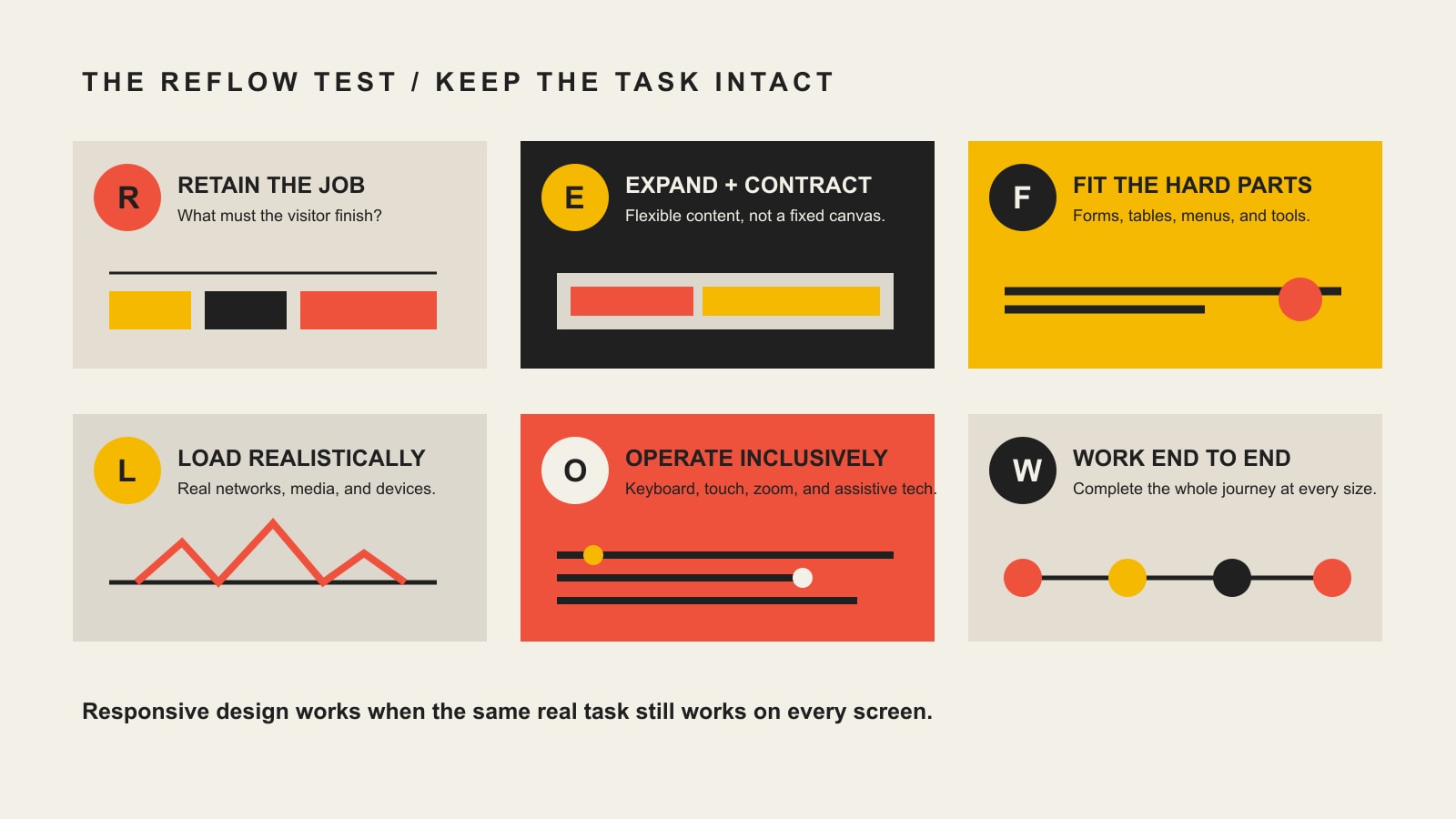
    Use the Scope Design REFLOW test

    At Scope Design, we judge responsive work by task continuity. Our REFLOW test asks whether the page can retain its business job as the context changes.

    TestQuestionEvidence
    R — Retain the jobDoes the same essential task remain available at every supported width?The full journey can be completed without missing content or controls
    E — Expand and contractDoes the layout adapt continuously rather than only at a few showroom widths?No collision, clipping, unreadable line length, or accidental horizontal page scroll
    F — Fit the hard partsDo navigation, forms, tables, media, embeds, and long content still work?Component-level checks with representative content and error states
    L — Load realisticallyDoes the experience remain usable with mobile hardware and imperfect networks?Appropriate assets, performance tests, and real-device checks
    O — Operate inclusivelyCan people use touch, keyboard, zoom, and assistive technology?Reflow, focus, label, target, contrast, and input testing
    W — Work end to endDoes the action reach the business system and human responsible for it?Delivered form record, completed purchase, confirmed booking, or verified handoff
    The REFLOW test: Retain the job, Expand and contract, Fit the hard parts, Load realistically, Operate inclusively, and Work end to end.
    The Scope Design REFLOW test evaluates whether a responsive website preserves the real business task.

    The last letter matters. A contact form that stacks beautifully but sends every submission into a dead mailbox is not responsive. It is well-aligned failure.

    Start with the business task and real content

    The most useful responsive-design question is not “What should the tablet breakpoint be?” It is “What must this person be able to understand and do?”

    List the critical journeys before designing components. A service business might need visitors to understand who the service is for, compare options, see relevant proof, call, and submit a qualified inquiry. An ecommerce site may need product discovery, variant selection, cart review, payment, and confirmation. An internal application may need staff to find a record, edit it, and complete a workflow without losing context.

    Then design with representative content. Use the longest plausible service name, an actual validation error, a real comparison table, an image with a difficult crop, and a navigation menu containing the sections the business truly needs. Placeholder text behaves impeccably because it has no job, no legal name, and no 47-character product option.

    Our business website development guide explains the larger technical foundation. Responsive design owns how each journey survives changing space; the foundation owns whether the whole system keeps working.

    Let content determine responsive breakpoints

    A breakpoint is the point at which a layout needs to change. It is not a memorial plaque for a popular phone model.

    MDN recommends flexible grids and content-driven changes: introduce a breakpoint when the content starts to look bad or a component stops working. A two-column section may collapse when either column becomes too narrow to read. A navigation pattern may change when the labels no longer fit. A row of cards may wrap naturally without any device-specific rule at all.

    Standard widths remain useful as test samples, but they should not define the architecture. Device dimensions change. Browser chrome changes. Split-screen use changes the available viewport. User zoom can activate the same layout pressure on a large monitor that a small screen creates on a phone.

    Mobile-first is a coding direction, not a content amputation plan

    Mobile-first CSS commonly begins with the simplest narrow layout and adds complexity as space becomes available. This can reduce overrides and force useful prioritization. It does not mean the mobile visitor receives the children’s-menu version of the business.

    Google uses the mobile version of content for indexing and ranking, and its mobile-first indexing guidance warns against omitting important content or requiring interaction before primary content loads. More importantly, customers need the facts whether they arrived with a phone or a projector.

    Prioritize presentation. Do not delete the answer.

    Build a flexible technical foundation

    Good responsive behavior usually comes from several layers working together rather than a heroic pile of media queries.

    Use a correct viewport and flexible layout

    The viewport meta element tells mobile browsers how the page should map to the device width. Layouts should then use CSS Grid, Flexbox, percentages, min(), max(), clamp(), minmax(), and intrinsic sizing where appropriate instead of relying on fixed page widths.

    The goal is not to ban pixels. Borders, icons, and minimum target dimensions may reasonably use them. The goal is to stop treating the whole page like a 1,440-pixel poster.

    Make components responsive to their containers

    Viewport queries answer questions about the page. Container queries can answer questions about the space a component actually receives. That distinction matters in modular sites where the same card, form, or callout may appear in a full-width section, a sidebar, or a grid.

    A component should know what it needs, not assume where marketing will drag it next Tuesday.

    Keep type readable without theatrical jumps

    Fluid typography can interpolate between sensible minimum and maximum sizes. Line length, line height, spacing, and user zoom still need testing. A headline that scales beautifully but pushes the call to action four screens down is technically responsive and commercially unhelpful.

    Our website font-size guide covers readable type, fluid sizing, zoom, and line-length decisions in more depth.

    Deliver responsive images, not merely flexible boxes

    CSS can stop an image from overflowing, but it cannot prevent a phone from downloading a giant desktop asset. Use srcset and sizes or the picture element when the browser needs image choices. Preserve explicit dimensions or an aspect ratio to reduce layout movement. Crop art direction intentionally when a narrow view changes what the image communicates.

    Responsive design and performance overlap here, but they are not identical. Our website speed optimization guide covers measurement, Core Web Vitals, server response, scripts, fonts, caching, and the rest of the performance system.

    Make the difficult components survive small screens

    Most responsive failures do not occur in the pleasant three-card section shown in the design review. They occur where the business actually asks someone to do something.

    Keep the primary destinations discoverable. A collapsed menu needs a clear name, keyboard operation, visible focus, a reliable open and close state, and enough space for actual labels. Hover cannot be the only way to reveal essential information because a finger does not hover and neither does a keyboard.

    Do not preserve every desktop navigation gimmick on mobile. Preserve the visitor’s ability to find the next step.

    Forms

    Use visible labels associated with their controls, logical field order, useful input types, autocomplete where appropriate, clear errors, and a submit button that remains reachable when the on-screen keyboard appears. W3C’s form-label guidance notes that labels above fields can reduce horizontal scrolling for mobile users and people with low vision.

    Test the unhappy paths. Long error messages, conditional fields, address lookup, file upload, date selection, payment authentication, and a failed submission can break a form that looked perfect when every field was empty.

    Then verify delivery. Submit the form and confirm the correct person or system receives a usable record. Pixels do not close leads; operational handoffs do.

    Tables and comparisons

    Do not make every data table pretend it is a stack of unrelated cards. Some tables need two-dimensional relationships to remain understandable. The W3C reflow guidance permits necessary two-dimensional content such as data tables to use its own scrollable region while the rest of the page reflows.

    Possible treatments include prioritizing key columns, adding a controlled horizontal scroll with an obvious cue, offering a compact alternative, or restructuring a true list into cards. Choose based on meaning, not a blanket CSS recipe.

    Checkout, booking, maps, chat, and embedded tools

    Third-party interfaces are frequent offenders because their dimensions and behavior are not fully controlled by the page. Test cookie banners, scheduling widgets, payment frames, maps, video players, chat bubbles, consent tools, and CAPTCHA together—not as polite isolated demos.

    Fixed elements can overlap each other, obscure the submit button, or leave six usable pixels of screen after the keyboard opens. Your vendors do not coordinate their floating widgets over lunch. You have to.

    Responsive design is part of accessibility

    Responsive implementation can help people using small screens, enlarged text, browser zoom, alternative input, or assistive technology. It can also create new barriers if information disappears or controls become difficult to operate.

    WCAG 2.2 Success Criterion 1.4.10 requires most vertically scrolling content to work at the equivalent of 320 CSS pixels without loss of information or functionality and without two-dimensional scrolling. This is not simply a phone check; a 1,280-pixel desktop viewport at 400% zoom creates an equivalent width.

    WCAG 2.2’s AA Target Size (Minimum) guidance uses 24 by 24 CSS pixels with defined exceptions and spacing provisions. The enhanced AAA criterion uses 44 by 44. Larger, well-spaced controls are often a sound usability choice, but do not casually call every target under 44 pixels a WCAG AA violation. Accuracy matters, especially when everybody is already anxious about compliance.

    Responsive QA should also cover:

    • text zoom and browser zoom;
    • visible keyboard focus and sensible focus order;
    • controls that do not depend on hover or precise pointing;
    • labels, instructions, errors, and status messages;
    • color contrast in every component state;
    • motion preferences and orientation changes;
    • sticky elements that do not obscure focused content;
    • content parity across layouts.

    Our website accessibility guide explains the broader compliance, testing, and remediation system.

    Responsive design must load under real conditions

    A layout can be responsive and still be miserably slow. Mobile devices may have less processing power, less memory, variable connectivity, and expensive data. Delivering the same enormous media and script bundle to every context defeats much of the point.

    web.dev’s performance-audit guidance recommends testing on mobile as well as desktop, using constrained bandwidth and latency, inspecting responsive-image delivery, and using real hardware when simulation cannot reproduce the behavior.

    Test the critical path on a representative midrange phone and a less-than-perfect connection. Watch for oversized images, third-party scripts, web fonts, video, long tasks, and components that shift while loading. Performance targets should apply to the actual business journey, not only the hero section of an empty page.

    Responsive web design and SEO: what actually matters

    Responsive design is Google’s recommended mobile configuration, not a magical ranking coupon. Google still needs crawlable content, useful pages, sensible internal links, valid metadata, and a site worth showing.

    The SEO advantages are operational:

    • one primary URL for each page;
    • the same core content and metadata across screen contexts;
    • fewer opportunities for mobile redirects, canonicals, or structured data to disagree;
    • a maintainable experience for smartphone crawling and human visitors;
    • less chance that important content is missing from the version Google evaluates.

    Google completed the transition to mobile-first indexing in 2023. That means the mobile rendering cannot be treated as a decorative afterthought. It does not mean “responsive” is a direct guarantee of rankings, traffic, or revenue.

    How should you test a responsive website?

    Use a risk-based matrix, then complete the real journeys.

    1. Drag through the widths between the presets

    Check continuously from narrow to wide. Presets such as 320, 375, 390, 768, 1,024, and 1,440 pixels are useful samples, not the whole universe. Awkward failures often live at the widths nobody put in the presentation.

    2. Test representative browsers and devices

    Start with analytics and audience requirements, then cover the major rendering engines and device classes that matter. Browser emulation is fast and useful. It does not reproduce every keyboard, safe-area inset, browser toolbar, font-rendering difference, memory limit, or touch behavior.

    3. Test zoom, text enlargement, keyboard, touch, and rotation

    Increase browser zoom to 400% on a 1,280-pixel viewport for the reflow check. Enlarge text. Navigate without a mouse. Rotate a phone or tablet. Try coarse touch. Confirm focus is visible and not hidden by sticky elements.

    4. Use representative content and every component state

    Test long labels, empty states, validation errors, success messages, open menus, modals, cookie banners, chat, translations, large data values, and user-generated content. The default happy state is the least demanding version of the interface.

    5. Complete the business journey

    Submit the inquiry, make the test purchase, schedule the appointment, download the file, search the catalogue, or update the record. Confirm the downstream system, email, payment, inventory, or staff handoff. A screenshot cannot prove that.

    LayerExample checksProof
    LayoutReflow, clipping, overlap, line length, safe areasContinuous-width visual review
    InteractionTouch, keyboard, focus, hover alternatives, orientationManual component tests
    ContentSame claims, evidence, options, metadata, and structured dataContent-parity review
    PerformanceAsset selection, loading, interaction, layout stabilityLab and real-user evidence
    CompatibilityBrowsers, operating systems, devices, embedsRisk-based test matrix
    Business pathForm, checkout, booking, search, handoffCompleted end-to-end transaction

    Measure task completion, not mobile vibes

    Segment important journeys by device category and, when volume supports it, browser or operating system. Look for differences in completed forms, purchases, bookings, errors, abandonment steps, and lead quality. A lower mobile conversion rate may indicate responsive friction, but it can also reflect different intent, acquisition sources, or buying behavior. Diagnose before declaring the CSS guilty.

    Record a baseline before a major change. Test the same path afterward. Confirm that tracking fires once, at the correct completion point, and that the business received the outcome. Otherwise the dashboard may be celebrating a button click while the customer is staring at an error.

    Should you retrofit the current site or redesign it?

    Retrofit when the content, information architecture, platform, and core components are sound and the failures are localized. A focused repair may fix a rigid grid, images, typography, forms, navigation, or a handful of embedded tools without rebuilding the business website.

    Redesign or rebuild when responsive problems are symptoms of a deeper system failure: desktop-only templates, duplicated mobile content, inaccessible component patterns, a page builder that cannot support the required behavior, inconsistent components across hundreds of pages, or business journeys that need to be rethought.

    Use our website development process to define requirements, acceptance evidence, launch gates, and ownership before the build begins. A redesign should solve a diagnosed constraint, not merely replace old breakpoints with fashionable new ones.

    Common responsive-design mistakes

    • Choosing breakpoints from device lists instead of component pressure.
    • Hiding essential content on narrow screens to make the page look cleaner.
    • Using fixed widths or heights that clip text and controls.
    • Downloading desktop-sized images while displaying phone-sized pixels.
    • Treating hover as a required interaction.
    • Making navigation compact but undiscoverable or inaccessible.
    • Testing empty forms but not keyboards, errors, autofill, or delivery.
    • Letting tables create horizontal scrolling for the entire page.
    • Stacking cookie, chat, booking, and sticky CTA widgets over one another.
    • Checking three screenshots instead of the widths between them.
    • Calling a page responsive before completing the business task.

    Frequently asked questions about responsive web design

    What are the three basic parts of responsive web design?

    The classic foundation is a fluid grid, flexible media, and media queries. Modern implementations also use Flexbox, Grid, intrinsic sizing, container queries, fluid typography, and responsive image delivery.

    Is responsive web design still necessary?

    Yes. Screen sizes, window sizes, zoom levels, input methods, and device capabilities vary more than ever. Responsive design is now a normal foundation of web development, not a decorative trend.

    What is the difference between responsive and mobile-friendly?

    “Mobile-friendly” describes an outcome: the page is usable on mobile. Responsive design is one implementation approach, usually using the same URL and HTML with presentation that adapts to available space.

    Is mobile-first the same as responsive design?

    No. Mobile-first is a design or CSS workflow that starts with narrow constraints and enhances for larger spaces. A responsive system can be created from another direction, although mobile-first often produces cleaner base rules.

    What breakpoint sizes should a responsive website use?

    Use breakpoints where real content or components need a layout change. Device widths can be testing samples, but content should determine the architecture.

    Can a responsive website use horizontal scrolling?

    The page generally should not require scrolling in two dimensions. A component whose meaning requires two-dimensional layout—such as a data table, map, or diagram—may use a clearly contained horizontal scroll while surrounding content reflows.

    How can I check whether my website is responsive?

    Resize the browser continuously, use responsive developer tools, test representative real devices, zoom and enlarge text, navigate with keyboard and touch, and complete every important business journey. A responsive preview tool is a starting point, not proof.

    Does responsive web design improve SEO?

    It can reduce mobile configuration and content-parity problems, and Google recommends it as an easy pattern to implement and maintain. It does not replace useful content, crawlability, performance, authority, or a sound search strategy.

    Should mobile pages have less content?

    They may present or prioritize content differently, but important information and functionality should remain available. Hiding the evidence needed to decide is not mobile optimization.

    How do responsive images work?

    The browser can choose among image candidates supplied through srcset, sizes, or picture based on layout and device capabilities. CSS then keeps the selected image within its container.

    Are 44-by-44-pixel touch targets required by WCAG?

    Not as a blanket WCAG 2.2 AA rule. The AA Target Size (Minimum) criterion uses 24 by 24 CSS pixels with defined exceptions and spacing provisions; 44 by 44 belongs to the enhanced AAA criterion. Larger targets may still be the better usability decision.

    Can WordPress websites be responsive?

    Yes. The theme, blocks, page-builder templates, plugins, media, custom CSS, and embedded services all affect the result. A theme advertised as responsive does not guarantee that every page, form, table, or plugin interface remains responsive after real content is added.

    How often should responsive behavior be tested?

    Test during component development, content entry, prelaunch QA, and after material changes to themes, plugins, embeds, navigation, forms, or business workflows. Monitor important device and browser segments after launch.

    Do I need to test on real phones if browser tools look correct?

    Yes, for important journeys. Browser tools are efficient for layout exploration, but real devices expose on-screen keyboards, browser chrome, touch behavior, performance limits, safe areas, and vendor-specific quirks that simulation may miss.

    Build for the task, then prove it works

    Responsive web design is successful when the same business journey remains understandable, operable, and complete across relevant screens and interaction methods. If your site passes three device previews but fails the contact form after the keyboard opens, the design did not almost work. The lead is still gone.

    If your website’s mobile experience feels like a desktop page being punished for shrinking, Scope Design can audit the critical journeys, identify the actual responsive failures, and build or repair the components that matter. Explore our website development service to start with requirements and evidence instead of another round of breakpoint roulette.

  • How to Build A Winning Business Marketing Strategy Online: Part V (Final) – Organic Traffic Generation in the AI Era

    How to Build A Winning Business Marketing Strategy Online: Part V (Final) – Organic Traffic Generation in the AI Era

    Organic traffic generation in the AI era is not a contest to produce the most pages or collect the most sessions. It is the work of making your business discoverable when the right buyer has a real question, giving that buyer a useful answer worth trusting, creating more than one route into that answer, and measuring whether the attention turns into a qualified next step.

    Search still matters. So do AI-generated answers, referrals, unpaid social reach, email, partners, communities, video, and people who remember your brand and come back directly. Your analytics may classify those visits into different channels, which is exactly why “organic traffic” can become a sloppy business objective. The better objective is organic acquisition: building unpaid and earned discovery around useful assets you control, then connecting discovery to an outcome the business actually values.

    This is the final installment of our five-part online marketing strategy series. If you need the earlier layers first, start with Part I: the strategy foundation, then continue through Part II, Part III, and Part IV on paid advertising. For the broader system that connects all of those decisions, use our small business marketing strategy guide.

    What organic traffic generation means in the AI era

    In the narrow search-marketing sense, organic traffic is traffic earned from unpaid search results rather than ads. In this guide, I am using organic acquisition as the wider business system around that traffic: search visibility, useful content, earned mentions, internal discovery paths, unpaid distribution, and repeat discovery that does not require buying every visit.

    That distinction matters because a business can improve its organic acquisition system without every gain appearing as “Organic Search” in a dashboard. Someone may discover your company in an AI answer, see you mentioned by a partner, read a useful article later through an email, and return directly when the problem becomes urgent. The path is messier than the channel report. Pretending otherwise makes the report tidy and the strategy stupid.

    AI search changes the shape of discovery, but it does not erase the basics. Google’s current guidance for AI Overviews and AI Mode says the same foundational SEO practices remain relevant and there are no additional technical requirements just to appear in those AI features. A page still needs to be accessible, indexable, eligible to appear with a snippet, relevant to the question, and worth surfacing.

    So the practical question is not, “What secret GEO hack will make the robots love us?” It is, “What useful thing should we become the best available source for, and how do we make sure the right people and systems can find it?”

    The CLEAR Organic Acquisition Loop

    Scope Design uses a constraint-first approach to marketing: Objective → Constraint → Positioning → Strategy → Tactics → Measurement. For organic traffic generation, that logic becomes a more specific five-stage loop:

    1. Constraint: find the real bottleneck before choosing a traffic tactic.
    2. Language: map the buyer’s real question and intent to one clear page or source asset.
    3. Evidence: publish an answer with enough expertise, proof, and usefulness to deserve discovery and citation.
    4. Amplification: connect and distribute the asset so publication is not the end of the job.
    5. Results: measure qualified action and business outcome, then use the evidence to identify the next constraint.

    That is CLEAR: Constraint, Language, Evidence, Amplification, Results. It is deliberately a loop. Organic acquisition is not a campaign you “finish.” You build an asset, observe how discovery and behavior change, improve the weak link, and compound what works.

    C — Constraint: find the bottleneck before choosing a traffic tactic

    A request for “more organic traffic” tells you what somebody wants to see in the dashboard. It does not tell you what is broken.

    Before you commission ten articles, hire a link builder, add a video channel, or sprinkle AI on the problem, identify the constraint. A low-traffic page can be suffering from very different failures: search systems cannot reliably access it; the topic has little relevant demand; the page targets the wrong intent; several pages compete for the same job; the answer is generic; the business has no distribution; the search result earns attention but the page does not move the buyer; or the leads are fine and the failure is actually follow-up.

    The correct tactic depends on which condition is true. If the page is not eligible to appear, writing another article is avoidance. If the right people already arrive but do not act, adding more traffic can simply deliver more people into the same leak. If the market barely searches for the problem, a brilliant SEO plan can still be a bad allocation of capacity.

    This is where the broader SEO strategy and analytics framework belongs. Part V is about organic acquisition execution; the SEO pillar owns the full visibility-to-business-outcome system.

    L — Language: own the buyer question, not a bag of keywords

    Keyword research is useful when it reveals how real people describe a problem, compare options, or look for a solution. It becomes cargo cult SEO when the output is a spreadsheet full of phrases that nobody has assigned to a specific page, buyer stage, or business decision.

    Give each important page one primary search job. A service page may own the commercial decision. A comparison may own “A vs. B.” A guide may own the problem and decision criteria. A case example may own proof. A FAQ section may resolve the objections that naturally belong on that page. You can cover related language, but the page should still have a coherent reason to exist.

    This reduces cannibalization and makes internal linking useful. Instead of five mediocre posts vaguely repeating “small business SEO,” you can build one strong canonical answer and let supporting pages handle distinct sub-decisions. Search systems get a clearer structure. Readers get fewer near-duplicate pages. Your editorial calendar stops behaving like a photocopier with anxiety.

    Language also needs to survive outside the ten-blue-links model. AI-assisted search often begins with longer, conversational questions and follow-ups. That does not mean chopping every article into context-free fragments. It means writing sections with descriptive headings, direct answers, clear entities, useful definitions, and enough surrounding explanation that the answer still makes sense when someone lands in the middle.

    E — Evidence: build a source asset worth finding and citing

    The easiest content to automate is also the easiest content to replace. A generic article that summarizes the same ten tips already ranking has very little reason to be chosen by a search engine, an AI system, a journalist, a partner, a prospect, or a human being with functioning pattern recognition.

    Build source assets instead. A source asset answers the question directly, then adds something defensible: firsthand experience, an original framework, a useful calculation, a process diagram, a before-and-after decision, screenshots, product or service constraints, a comparison, a failure mode, a checklist tied to real work, or a carefully sourced explanation.

    Google’s current guidance on helpful, reliable, people-first content explicitly asks whether a page provides original information or analysis, demonstrates first-hand expertise, makes sourcing and authorship trustworthy, and gives readers substantial value beyond other search results. That is a much more durable standard than “Did we mention the keyword 2.3% of the time?”

    Evidence does not mean turning every article into an academic paper. It means matching proof to the claim. If you make a technical claim, use current primary documentation. If you recommend a process, explain where it works and where it does not. If you claim a result, include the scope, conditions, timeframe, and permission to use it. If the answer is professional judgment, label it as judgment rather than laundering an opinion through a mystery statistic.

    For the full production side of this idea, our content marketing system for small businesses explains how to build durable assets instead of feeding a publishing treadmill.

    A — Amplification: publication is not distribution

    A good article with no route into it is a beautifully stocked store at the end of a road nobody built.

    Design distribution before you publish. Link the asset from pages that naturally establish context or pass readers to the next decision. Reference it from sales follow-up when it answers a recurring objection. Turn the strongest idea into an email, short video, social post, webinar segment, sales deck, or partner resource without pretending that resizing the same paragraph is a strategy. Share it where the intended audience already pays attention.

    Earned distribution matters too. Expert contributions, interviews, useful tools, original data, partnerships, community participation, and legitimate media mentions can create discovery and authority because somebody else decided the source was worth referencing.

    That is different from running a “guest post for backlinks” assembly line. Google’s current spam policies define link spam around links created primarily to manipulate rankings and specifically include paid or optimized links in articles and guest posts among the examples. Guest expertise can be good marketing. Manufacturing articles to smuggle ranking credit is a different job, and it is not one we recommend.

    The point of amplification is not to make every channel report “organic.” The point is to reduce dependence on a single distribution gatekeeper and give a useful asset more chances to meet the right buyer.

    R — Results: measure the qualified outcome

    Organic traffic is useful. It is not the finish line.

    Measure the system in layers. First, can the page be accessed, indexed, and understood? Then, does it appear for relevant questions or earn citations and mentions? Do the right visitors engage with the useful sections? Do they take the intended action? Are those actions from people the business can actually help? Does the outcome show up in pipeline, purchases, booked appointments, retention, saved staff effort, or another business result you chose before the campaign started?

    This hierarchy protects you from vanity reporting. Ten thousand irrelevant visits are not inherently better than five hundred visits from the exact audience evaluating a high-value service. A ranking improvement can be good diagnostic news without being revenue. An AI citation can expand visibility without proving that anyone became a customer. A form submission can be an action while still being a terrible lead.

    Our guide to SEO metrics that matter goes deeper on that measurement ladder. The operating rule here is simpler: use traffic and visibility to diagnose the system; use qualified outcomes to decide whether the system deserves more investment.

    What AI search actually changes—and what it does not

    AI-generated search experiences make it easier for a user to ask complicated questions, refine them conversationally, and sometimes get enough of an answer without following the classic search-result path. That increases the value of content that is clear, specific, well-supported, and easy to retrieve in context.

    What it does not do is create permission to ignore technical SEO, publish machine-written sludge at industrial scale, or install every new file format somebody on LinkedIn names after lunch.

    For Google specifically, the company says the same foundational SEO practices apply to AI features. That means the durable work is familiar: make important content accessible; use descriptive language; keep canonical page ownership clear; provide original value; use structured data only when it truthfully represents visible content; make the page experience usable; and maintain the underlying site well enough that crawlers and people can reach the answer.

    The new emphasis is editorial. A source that can answer a narrow question cleanly, support the answer, explain the exception, and identify who is speaking has more utility than a page that buries the answer under 900 words of throat-clearing. That helps humans even if no AI system ever cites the page.

    If AI-search citation work is a major objective, use our dedicated AI Search Optimization guide. It owns that job in depth. This article keeps AI in its proper place: one discovery surface inside the wider organic acquisition system.

    A practical 90-day organic acquisition plan

    Days 1–15: establish the objective and constraint

    Choose the business outcome first. For a professional service, that may be qualified opportunities. For a local appointment business, booked-and-attended appointments may matter more. For ecommerce, purchases and repeat behavior may be the relevant outcomes.

    Then verify the basics before judging content. Confirm that important pages are accessible and indexable, forms and calls are being recorded, the relevant market actually has demand, and current traffic can be segmented well enough to tell useful attention from noise. Inventory pages that already own important search jobs and identify obvious overlap.

    Days 16–30: repair ownership and buyer language

    Map the recurring buyer questions to the pages that should answer them. Strengthen one canonical owner before creating a new URL. Merge or reposition overlapping content when necessary. Improve titles and headings where they are vague, and make sure internal links connect prerequisites, evidence, comparisons, and next steps.

    Do not change established URLs just because a plugin wishes the keyword appeared in the slug. URL changes are migrations. Make them when the clarity or architecture benefit is worth the risk, not because a score turned orange.

    Days 31–60: build or upgrade one source asset

    Choose a question that matters to the buyer and that the business can answer with real expertise. Create the best available version you can defend: a direct answer, original framework or judgment, useful examples, corroborating primary sources, a visual where it helps, honest limitations, and a clear next action.

    One source asset that sales uses, partners reference, search systems surface, and prospects return to can be worth more than a month of content-calendar confetti.

    Days 61–90: amplify, observe, and choose the next constraint

    Distribute the asset intentionally. Add the relevant internal links. Send it to the audience segment that would actually benefit. Use it in follow-up. Give partners or industry contacts a reason to reference it. Repurpose the core idea when another format helps the audience consume it.

    Then review the measurement chain. If eligibility is weak, fix technical access. If visibility is weak, revisit intent, relevance, evidence, or authority. If traffic arrives but no qualified action follows, investigate the page, offer, next step, and sales handoff. The 90-day plan should end with a better diagnosis, not a victory slide full of arrows pointing up.

    Six organic-traffic habits to stop

    • Stop treating traffic volume as the objective. More of the wrong visitor is just more server logs.
    • Stop publishing generic AI summaries because a keyword has volume. If the page adds no judgment, evidence, or utility, it is competing on commodity supply.
    • Stop buying guest posts as a backlink quota. Pursue real audience access, credible mentions, partnerships, and expertise instead.
    • Stop changing established URLs for cosmetic SEO reasons. Preserve useful history unless the migration benefit is real and verified.
    • Stop calling publication a distribution plan. “We posted it on the blog” describes a location, not a route to an audience.
    • Stop forcing every unpaid touchpoint into one channel story. Search, AI discovery, referral, email, social, direct return, and sales-assisted content can work together without needing the same label in analytics.

    Frequently asked questions about organic traffic generation

    What is organic traffic in simple terms?

    Organic search traffic is website traffic that comes from unpaid search results rather than paid search ads. For business strategy, it is often more useful to think about the broader organic acquisition system: the owned assets and earned or unpaid discovery paths that help the right people find and return to your business without purchasing every visit.

    Is SEO dead now that AI can answer questions directly?

    No. Search behavior and result formats are changing, but Google’s current AI-search guidance says foundational SEO remains relevant to AI Overviews and AI Mode. The more useful adjustment is to make your content clearer, more original, better supported, technically accessible, and focused on the real buyer question instead of treating SEO as a keyword-placement exercise.

    Is organic traffic better than paid traffic?

    Not automatically. Paid media can create controlled reach quickly and is excellent when the economics, targeting, and conversion path support it. Organic acquisition can build durable assets and reduce dependence on paying for every exposure, but it takes expertise, production, maintenance, and time. The right mix depends on the objective and constraint. That is why Part IV covers paid advertising separately rather than pretending one channel wins every argument.

    Is organic traffic free?

    There is no media fee just to appear in an organic Google Search result, but the acquisition system is not free. Research, expert time, writing, design, development, technical maintenance, distribution, measurement, and opportunity cost are real costs. “Free traffic” is usually accounting with several columns hidden.

    How long does it take to increase organic traffic?

    There is no responsible universal timeline. Google notes that the effects of meaningful improvements can show up in days for some changes and take months for others, with no guaranteed ranking outcome. Your timeline also depends on crawlability, competition, demand, current authority, content quality, distribution, brand recognition, and whether the real bottleneck is even traffic. Use review windows and decision rules; do not buy a fixed ranking promise dressed up as a calendar.

    How should a business measure organic traffic?

    Start with eligibility and visibility, then move down the chain to engagement, action, lead or customer quality, and business outcome. Rankings, impressions, citations, sessions, and click-through rates are useful diagnostics. They become misleading when they are reported as if they were revenue, pipeline, retention, or qualified demand.

    Make organic discovery compound

    The durable version of organic traffic generation is not “publish more.” It is a system that makes your expertise easier to discover, easier to trust, easier to share, and easier to connect to a useful next step.

    Start with the constraint. Use the buyer’s language. Create evidence instead of filler. Build distribution into the asset. Measure the qualified outcome. Then run the loop again.

    If you need the broader channel and business framework around this work, return to our small business marketing strategy guide. If the problem is specifically search visibility and measurement, move into our SEO strategy and analytics system. The point is not to collect tactics. It is to fix the constraint that is keeping the right people from finding, trusting, and choosing you.

  • Paid Advertising Strategy: Test, Measure, and Scale Without Burning Budget

    Paid Advertising Strategy: Test, Measure, and Scale Without Burning Budget

    The best paid advertising strategy is not “pick a platform, turn on automation, and hope the dashboard turns green.” Build a measurable conversion chain, run one bounded experiment, and increase spend only when qualified outcomes—not cheap clicks—justify it. Paid ads can buy attention and evidence quickly. They cannot manufacture a good offer, repair a broken landing page, or make bad measurement tell the truth.

    If you still need to decide whether paid media belongs in the mix at all, start with our broader online advertising strategy guide. This article owns the next decision: how to operate a paid campaign so the first dollars buy useful learning and later dollars scale something worth scaling. For the larger system around it, see our small-business marketing strategy.

    TL;DR: Paid Advertising Should Buy Evidence Before It Buys Scale

    • Prepare the conversion chain before buying traffic: buyer, promise, destination, response owner, and operating capacity.
    • Attach trustworthy outcomes so the platform learns from actions the business actually values, not just whatever event is easiest to count.
    • Isolate a bounded test with one useful hypothesis, a spend boundary, and enough stability to learn.
    • Decide from qualified economics: scale, revise the first weak link, or stop.
    • Use automation to optimize a trustworthy signal. Do not ask an algorithm to infer your definition of a good customer from a pile of unqualified form fills.

    Where Part IV Fits in the Marketing Strategy Series

    Paid advertising belongs downstream of basic market and customer understanding. Part III of this series focuses on evidence about the market and the buyer. Once you have a plausible audience, offer, and channel hypothesis, paid media can become a controlled way to test that thinking.

    This Part IV is deliberately not another tour of Google, Meta, Microsoft, LinkedIn, TikTok, and YouTube. Scope already has dedicated owners for channel selection and platform mechanics. Here, the question is operational: what has to be true before a campaign deserves money, what should the campaign learn, and what evidence earns the next dollar?

    The final part of this series covers organic traffic generation and the longer-term assets that can reduce dependence on rented attention.

    Why Paid Ads Often Fail Before the First Click

    A campaign can be technically competent and still be a business failure because the weak link lives somewhere else. The real chain is longer than ad → click:

    • Buyer: Are you reaching a plausible customer in a relevant moment?
    • Promise: Does the ad make a clear, honest claim that matters to that buyer?
    • Destination: Does the landing page continue the promise instead of making the visitor start over?
    • Action: Is the next step appropriate for the buying stage?
    • Response: Does a person or system actually handle the lead, purchase, call, or booking well?
    • Economics: Is the qualified result valuable enough to justify acquisition cost and operating effort?

    If the ad gets the click but the destination loses the promise, that is a conversion-rate optimization problem before it is a bidding problem. If the campaign generates inquiries but nobody follows up quickly or captures source and qualification data, the failure is in the handoff. Our direct response marketing guide goes deeper on building the measurable action path.

    More traffic magnifies both good systems and bad ones with impressive fairness.

    Build a Paid Advertising Strategy With the PAID Learning Loop

    Scope Design uses the PAID Learning Loop to keep paid media from turning into a subscription to expensive confusion. PAID stands for Prepare, Attach, Isolate, Decide. It is a loop because every meaningful result changes what you know and what should be tested next.

    The PAID Learning Loop: Prepare the conversion chain, Attach trustworthy outcomes, Isolate a bounded test, and Decide to scale, revise, or stop.
    The PAID Learning Loop turns ad spend into a controlled cycle of readiness, measurement, testing, and decision-making.

    P — Prepare the Conversion Chain

    Before launch, write down what the campaign is supposed to connect. Name the buyer, the problem or desire, the offer, the promise, the destination, the desired action, the response owner, and the capacity constraint. If one of those fields is “we’ll figure it out after traffic arrives,” you have found a pre-launch risk.

    The landing page does not need to be a twelve-section conversion cathedral. It needs to continue the ad’s promise, provide enough proof for the decision, make the next step obvious, and work on the devices people actually use. If the destination is weak, fix that before increasing reach.

    Claims also need to survive contact with reality. The Federal Trade Commission’s advertising guidance for small businesses says advertising must be truthful and non-deceptive, objective claims need evidence, and ads cannot be unfair. Fake scarcity, invented savings, and claims you cannot substantiate are not “conversion psychology.” They are liabilities wearing marketing pants.

    Finally, separate the campaign budget from the business’s total marketing budget. If you need to decide how much the company can responsibly devote to acquisition across channels, use our small-business marketing budget guide. The campaign budget is a smaller decision inside that constraint.

    A — Attach Trustworthy Outcomes

    Platforms can optimize only toward the signals they receive. That makes measurement part of campaign design, not cleanup work for Friday afternoon.

    Google Ads describes conversion measurement around actions a business considers valuable, including purchases, sign-ups, calls, and other configured actions. Its conversion tracking guidance is a useful reminder to define the valuable action first and then implement the appropriate measurement. A click is evidence that somebody clicked. It is not automatically evidence of a qualified opportunity, profitable order, or good customer.

    Measurement layerUseful questionExamplesWhat it cannot prove alone
    DeliveryDid the platform serve and attract attention?Impressions, reach, clicks, video viewsThat the traffic was qualified or profitable
    ConversionDid the visitor complete the defined action?Form submit, call, booking, purchase, sign-upThat the action had business value
    QualificationWas the action from a plausible customer?Qualified lead, valid order, sales-accepted opportunityThat the customer will close, retain, or be profitable
    EconomicsDid the outcome justify the spend and operating cost?Gross contribution, qualified acquisition cost, tracked revenue, close ratePerfect attribution across every touchpoint

    For lead generation, connect ad-source data to whatever qualifies the lead downstream when practical. For ecommerce, include cancellations, refunds, margins, and repeat behavior where they materially change the answer. If all conversions are reported to the platform as equally valuable, automation has no magical side channel where it learns which customers your sales team quietly hates.

    I — Isolate a Bounded Test

    A good paid test answers a decision. “Let’s run some ads and see what happens” is not a hypothesis; it is a receipt generator.

    Choose one meaningful uncertainty at a time when possible: buyer segment, offer, message, destination, objective, or another major variable. Define the spend or time boundary you are willing to use for learning, the evidence you need, and the conditions that would make you continue, revise, or stop. Then give the campaign enough stability to produce interpretable evidence instead of changing five settings every morning.

    There is no universal learning budget. A $20-per-day search test can be plenty in one low-cost local auction and nearly useless in a category where a single relevant click is expensive. The correct budget is the smallest amount the business can responsibly risk that still gives the test a realistic chance to produce decision-worthy evidence. If the likely spend required to learn is more than the business can afford to lose, that is a valid reason not to run the test.

    The popular “70-20-10” split can be a planning heuristic in some contexts, but it is not a law of paid advertising and it does not override campaign economics. Do not force 70% of the budget into something merely because a tidy ratio looks strategic in a slide deck.

    When the test gets platform-specific, use the specialist owner rather than treating one article as an encyclopedia. For Google Search, our Google Ads Quality Score guide explains relevance diagnostics without worshipping the score. For Meta, our Meta campaign objectives guide explains how objective and performance-goal choices tell the delivery system what behavior to seek.

    D — Decide to Scale, Revise, or Stop

    A paid campaign is not successful because cost per click fell. It is successful when the campaign’s job is being done at economics the business can support. That may mean profitable purchases, qualified appointments, sales opportunities, calls that turn into booked work, or another clearly defined outcome.

    Evidence patternLikely first diagnosisBetter next move
    Relevant clicks, weak landing-page actionPromise/destination frictionFix the destination before buying more traffic
    Many form fills, poor lead qualityTargeting, message, offer, or qualification mismatchTighten who the campaign invites and what the form qualifies
    Qualified leads, weak close rateSales handoff, response, offer, or downstream fitRepair the sales path before blaming the ad platform
    Good qualified outcomes at workable economicsPromising campaign-system fitScale cautiously and keep watching marginal quality and cost
    Tiny sample with no stable patternInsufficient evidenceKeep the test stable if the learning boundary still makes sense
    Boundary reached with no useful signalBad hypothesis or weak systemStop or redesign the test instead of funding sunk-cost theater

    Scaling is not a victory lap. It is another test. More budget can change auction dynamics, audience quality, creative fatigue, response capacity, and the mix of customers you attract. The economics that worked at one spend level are evidence, not a lifetime guarantee.

    Automation Is Powerful After the Signal Is Worth Optimizing

    Google says Smart Bidding uses Google AI at auction time to optimize toward conversions or conversion value, and Google requires conversion tracking to use Smart Bidding. That is exactly why measurement quality matters. Google’s Smart Bidding guidance describes the machinery; your business still has to decide which result deserves to be fed into it.

    Automation can process more auction signals than a human can and can make bidding adjustments continuously. What it cannot do reliably is invent your business definition of a qualified lead, decide whether an unprofitable customer is strategically valuable, repair a slow sales team, or know that a conversion event fires on the wrong page unless the data exposes the problem.

    Platform language also changes. Google documented a June 2026 transition in how some Target CPA and Target ROAS options are labeled while saying the underlying bidding behavior remains the same. That is a useful operational lesson: learn the business logic behind the setting, not just the screenshot from last year’s tutorial.

    Use the Right Paid Advertising Metrics for the Business Model

    There is no universal “good ROAS” or “good conversion rate.” A 4:1 return on ad spend can be excellent for one business and terrible for another depending on gross margin, fulfillment, refunds, sales labor, repeat purchase, and what the revenue number actually includes.

    Use platform metrics for diagnosis and business metrics for decisions:

    • Search and social delivery: impression share, click-through rate, cost per click, reach, frequency, and engagement can help explain what the system is doing.
    • Lead generation: cost per conversion should be paired with qualified-lead rate, sales acceptance, booked appointments, opportunity value, close rate, and response time where available.
    • Ecommerce: tracked revenue and ROAS should be read alongside margin, average order value, refunds, repeat purchase, and acquisition cost.
    • Long sales cycles: use staged outcomes such as qualified opportunity or pipeline movement rather than pretending every click can be assigned a final sale immediately.
    • Capacity-constrained services: include whether the team can actually respond well to the volume being created.

    The point is not to build a spreadsheet with seventy-seven columns. It is to create a short chain from spend to a business result that somebody owns.

    Common Paid Advertising Mistakes That Waste the Learning Budget

    • Optimizing for the friendliest metric. Cheap clicks are not a consolation prize if the business needs qualified leads or sales.
    • Sending every ad to the homepage. The destination should continue the specific promise that earned the click.
    • Changing too many variables at once. Constant tinkering makes it hard to know what actually improved or damaged the result.
    • Turning on automation before validating the event. Fast optimization toward a bad signal is still bad optimization.
    • Calling every form fill a lead. Qualification belongs in the measurement chain.
    • Using platform-reported revenue as the whole business case. Margin, refunds, sales labor, fulfillment, and repeat behavior can change the economics.
    • Scaling past response capacity. More demand can create a worse customer experience if nobody can answer, quote, fulfill, or follow up.
    • Refusing to stop. A sunk cost is not evidence that the next dollar deserves to join it.

    A Practical 30-Day Paid Advertising Operating Sequence

    Thirty days is not a universal verdict window. Use it as an operating cadence for building the system and making the first disciplined review.

    1. Week 1 — Prepare. Confirm the buyer, offer, promise, destination, action, response owner, capacity, and the maximum learning loss the business is willing to accept.
    2. Week 2 — Attach. Implement and test conversion tracking, source capture, phone/form/booking paths, qualification, and downstream ownership. Confirm the event fires where it should.
    3. Week 3 — Isolate. Launch the bounded test, keep major variables stable long enough to learn, review obvious errors, and avoid panic-editing every morning.
    4. Week 4 — Decide. Compare delivery, conversion, qualification, economics, and capacity. Scale only the part that has earned more exposure; otherwise repair the first weak link or stop the test.

    If the campaign is still too small or the buying cycle too long for a confident economics decision after that period, say so. “Not enough evidence yet” is a legitimate conclusion. Invented certainty is not.

    Frequently Asked Questions About Paid Advertising Strategy

    What is a paid advertising strategy?

    A paid advertising strategy is the system for deciding what outcome paid media should produce, which audience and promise to test, where the attention should go, how results will be measured, what budget can be risked for learning, and what evidence will trigger a scale, revise, or stop decision. The platform setup is part of the strategy, not the whole thing.

    How much should a small business spend testing paid ads?

    There is no universal dollar amount. Set a loss boundary the business can responsibly absorb, then ask whether that amount can realistically generate enough relevant traffic or conversions to test the hypothesis in the chosen auction. If the minimum useful learning budget would strain cash flow, do not pretend the campaign is affordable just because the platform accepts a smaller daily budget.

    Is $20 a day good for Google Ads?

    It can be, but the number by itself says almost nothing. In a low-cost local niche, $20 a day might produce enough relevant activity to learn. In a competitive market with expensive clicks, it may produce too little data to judge the offer or campaign. Work backward from auction cost, realistic conversion volume, business economics, and the decision you need the test to answer.

    What does the 70-20-10 rule mean in advertising?

    Several marketing frameworks use a 70-20-10 split for different purposes, usually to separate proven activity, adjacent experimentation, and more speculative tests. It can be a discussion starter, not a law. A paid-advertising budget should follow the business’s risk tolerance, campaign economics, evidence quality, and opportunity set rather than a fixed ratio copied from somebody else’s deck.

    When should a small business scale a paid advertising campaign?

    Scale after the campaign produces enough qualified outcomes to show that the current economics are workable and the business has capacity to handle more. Increase gradually enough to notice whether lead quality, costs, conversion rate, or fulfillment changes. A campaign that works at one spend level has earned a larger test, not infinite budget.

    What should you track before using automated bidding?

    Track the conversion action the business genuinely wants the system to optimize, validate that it fires correctly, and connect that action to qualification or value when possible. For lead generation, that may mean distinguishing a qualified inquiry from any form submission. For ecommerce, it may mean using purchase value accurately and accounting for outcomes that materially change profitability.

    What is a good ROAS for paid advertising?

    A good ROAS is one that works with your actual gross margin, fulfillment cost, refunds, sales cost, repeat behavior, and growth goals. There is no responsible universal target. Treat ROAS as one ratio inside the economics, not as a magic score that makes an unprofitable customer profitable.

    Should a small business use Google Ads or Meta Ads first?

    Start with buyer behavior and the campaign job. Google Search can be strong when people already express high-intent demand. Meta can be strong when creative, audience signals, and demand creation or discovery matter. Neither platform is universally first. Use the broader channel-fit decision in our online advertising guide, then use the platform-specific objective and measurement guidance once the channel has a reason to exist.

    Buy Learning First. Buy More Attention Only When It Earns It.

    Paid advertising is valuable because it gives a business unusual control over audience, message, destination, timing, and spend. That control makes it a powerful testing system. It also makes it painfully easy to spend faster than you learn.

    Use the PAID Learning Loop: prepare the chain, attach trustworthy outcomes, isolate a bounded test, and decide from qualified economics. If the campaign works, scale carefully. If the first weak link is the landing page, sales handoff, offer, tracking, or qualification, fix that. If the evidence says stop, stop.

    If your paid campaigns are producing activity but nobody can clearly explain what deserves more budget, Scope Design can help audit the offer, destination, tracking, campaign structure, and measurement chain. The goal is not to make the ad account busier. It is to make the next dollar easier to justify.

  • How to Build A Winning Business Marketing Strategy Online: Part III

    How to Build A Winning Business Marketing Strategy Online: Part III

    A marketing campaign strategy is the bounded test inside your larger marketing strategy. It should connect one buyer situation to one message, one destination, one meaningful action, and a rule for what you will do with the result. If you cannot describe those decisions before launch, you do not have a campaign strategy yet. You have activity.

    That distinction matters for small businesses because every campaign consumes more than media budget. It consumes attention, production time, sales follow-up, delivery capacity, and management focus. Part III of this series is about turning the customer and market evidence you already have into a campaign you can actually evaluate—without pretending a fictional persona, a pile of clicks, or a dashboard full of green arrows is the same thing as business progress.

    If you still need the broader foundation, start with Part I of the business marketing strategy series and Part II. For the complete system around channels, destinations, response processes, capacity, and qualified outcomes, use our small-business marketing strategy guide.

    What a Marketing Campaign Strategy Actually Decides

    A marketing strategy answers the larger questions: which market matters, what you want to be known for, which buyers you can serve well, how you create value, and how attention becomes a business outcome. A campaign is narrower. It is a time-bounded attempt to move a defined audience toward a defined next step.

    LayerQuestion it answersExample
    Marketing strategyWhere will we compete, for whom, and how will marketing create business value?Become the preferred commercial cleaning partner for multi-site professional offices in our service area.
    Campaign strategyWhat specific buyer situation, message, path, action, and learning rule will we test?Reach facility managers evaluating a vendor change and test a disruption-reduction promise that leads to a site walkthrough request.
    TacticWhat execution will carry part of the campaign?Search ad, email, comparison page, webinar, direct mail piece, or retargeting audience.

    The channel is not the strategy. Neither is the ad creative, landing page, email sequence, or keyword list. Those are parts of the path. A useful campaign strategy tells each part what job it has and tells the business what evidence will change the next decision.

    Start With Evidence, Not a Fictional Avatar

    The legacy version of this article leaned heavily on personas. The useful idea underneath that advice is still worth keeping: your message should reflect a real customer situation. The problem begins when the persona becomes more detailed than the evidence.

    Before a campaign, separate what you know from what you assume. Useful evidence can come from sales calls, CRM notes, won-and-lost reasons, customer interviews, support questions, search behavior, form submissions, referral patterns, service-area data, and repeated objections. An assumption can still be worth testing; it just needs to stay labeled as an assumption.

    Use a buyer attribute only when it changes a decision. Does it change the promise, offer, eligibility, channel, proof, price sensitivity, buying authority, or follow-up? If not, it may be descriptive trivia rather than campaign intelligence. Our complete guide to identifying your target audience and finding them online owns that research job in more depth.

    Campaign rule: never let a polished persona hide a weak evidence base. “Operations Olivia likes podcasts and drives an SUV” is not useful unless one of those facts changes what you will actually do.

    Build the Scope Design Campaign Decision Record

    Our preferred marketing campaign strategy format is a one-page decision record. It forces the team to connect customer evidence to the campaign path before money or production effort starts flowing.

    FieldWrite downWhy it matters
    1. Evidence sourceWhere did this insight come from?Keeps observed behavior separate from assumptions.
    2. Buyer situationWhat is happening when this buyer becomes relevant?Situations usually produce better messages than generic demographics.
    3. Problem or desired changeWhat are they trying to fix, avoid, improve, or accomplish?Gives the campaign a real job.
    4. Message hypothesisWhat promise, angle, or proof do you believe will matter?Makes the idea testable.
    5. Channel jobWhy is this route appropriate for this buyer behavior?Prevents choosing a platform just because it is fashionable.
    6. DestinationWhere does the person go next?Forces continuity between the message and the page or experience.
    7. Meaningful conversion actionWhat online action signals useful progress?Separates the intended action from vanity activity.
    8. Qualification ruleWhat makes that action a useful business opportunity?Prevents easy conversions from masquerading as good leads.
    9. GuardrailWhat budget, margin, service area, response time, capacity, or brand constraint must hold?A campaign that overwhelms delivery can still be a bad decision.
    10. Review and decision ruleWhen will you review, and what would make you scale, revise, or stop?Reduces post-hoc storytelling after the results arrive.

    The point is not paperwork. The point is to make hidden assumptions visible. A six-person company does not need a 70-slide campaign deck if one page can tell the team what is being tested, how the handoff works, and what result changes the next decision.

    A Worked Small-Business Marketing Campaign Example

    Consider a hypothetical commercial cleaning company. Its recent sales notes show a recurring pattern: facility managers are less worried about finding any cleaning vendor than they are about changing vendors without disrupting employees, access schedules, or security procedures.

    Evidence sourceWon/lost notes and sales calls repeatedly mention switching risk, access coordination, and poor response from the current vendor.
    Buyer situationA facility manager is evaluating a vendor change after recurring service or communication problems.
    Message hypothesis“Change cleaning vendors without creating another facilities headache.”
    Channel jobCapture or reach people already showing vendor-evaluation behavior. The exact channel should come from audience evidence, not this example.
    DestinationA focused page explaining transition planning, access/security coordination, scope, proof, service area, and what happens during a walkthrough.
    Meaningful actionRequest a site walkthrough.
    Qualification ruleCommercial facility in the service area, minimum viable scope, appropriate buyer role, and plausible timing.
    GuardrailThe sales/operations team can respond to walkthrough requests promptly and has capacity for additional accounts.
    Review ruleReview the message-to-walkthrough path after enough real activity exists to make a business decision; diagnose attention, conversion, qualification, and follow-up separately.

    Notice what is missing: invented hobbies, arbitrary age brackets, a universal conversion-rate target, and a promise that one channel always works. The record stays close to evidence and to the actual business decision.

    Make the Campaign Message and Destination Agree

    A surprisingly common campaign failure happens after the click. The ad, email, post, referral, or event promises one thing, but the destination resets the conversation.

    If the campaign says “compare managed IT plans for a 25-person office” and the click lands on a generic homepage that says “innovative solutions for your digital future,” the buyer has to reconstruct the connection themselves. That is not a traffic problem. It is a handoff problem.

    • The first screen should confirm the reason the person clicked.
    • The proof should support the specific promise, not merely decorate the page.
    • The primary action should fit the visitor’s readiness.
    • The form should collect what the next owner genuinely needs.
    • The response process should have a real owner.

    Our landing page optimization guide owns the deeper page-design and conversion job. If several tactics hand people from one experience to another, our guide to using marketing tactics in tandem explains how to map the trigger, destination, owner, and evidence for each handoff.

    Define the Online Conversion and the Qualified Outcome Before Launch

    Do not wait until reporting day to decide what success means.

    Google Analytics defines a key event as an event that measures an action particularly important to the success of the business. Google also documents how a business can create an event for a specific lead-form submission and mark it as a key event.

    That is useful—but it is only the online action. A form submission does not automatically tell you whether the inquiry fits your service area, has the right need, comes from a decision-maker, meets minimum scope, has workable timing, or ever became a customer.

    Measurement layerExampleQuestion
    DeliveryImpression, delivered email, served adDid the message have a chance to be seen?
    AttentionVisit, click, engaged sessionDid the message earn a next step?
    Online conversionWalkthrough request, booking, purchase, applicationDid the intended website action occur?
    Qualified outcomeRight-fit opportunityWas the action commercially appropriate?
    Business outcomeSale, retained customer, expansion, contributionDid the campaign help create durable value?

    Do not collapse those layers into one number. A campaign can earn inexpensive clicks and terrible leads. It can produce fewer form submissions and better opportunities. It can also produce strong inquiries that the company mishandles after the form. The diagnosis changes depending on where the chain breaks.

    Use the Learning Loop: Scale, Revise, or Stop

    The best campaign review question is not “Did the dashboard go up?” It is “What did this test teach us about the buyer, message, path, and business system?”

    What you observeLikely questionNext move to consider
    Little relevant attentionWas the audience reachable here? Was the promise strong enough to earn attention?Revisit targeting, channel job, or message before redesigning everything else.
    Relevant attention, weak conversionDid the destination continue the promise? Is the next step appropriate?Inspect message-to-page continuity, proof, friction, and CTA.
    Conversions, poor qualificationDid the campaign attract the wrong situation, or is the offer/form failing to clarify fit?Tighten message, eligibility, proof, offer, or qualification.
    Qualified opportunities, weak sales outcomeIs marketing being blamed for a follow-up, pricing, capacity, or sales-process problem?Audit the downstream handoff before changing acquisition.
    Qualified outcomes within guardrailsCan the business absorb more demand without degrading service or economics?Scale carefully while watching quality and capacity.

    There is no universal “run every campaign for 30 days” rule. A seasonal retail promotion, a six-month B2B sales cycle, and an emergency local service produce evidence at different speeds. Define a review window that fits the volume and buying cycle, then stop sooner if tracking is broken, the customer experience is misleading, or the campaign creates operational harm.

    If the campaign uses paid media, go deeper with our current online advertising strategy for small businesses. That guide owns budget math, platform choice, paid-media economics, and scaling; this Part III stays focused on the campaign decision system that should exist before any channel gets more money.

    A 30-Minute Marketing Campaign Strategy Preflight

    You do not need an enterprise planning ceremony. Before launch, gather the people who own marketing, the website/destination, sales response, and delivery. Work through this list:

    • Evidence: What buyer behavior, conversation, objection, or first-party signal makes this campaign worth testing?
    • Assumptions: What are we still guessing?
    • Buyer situation: What is happening when the person becomes receptive?
    • Campaign job: What one change are we trying to create?
    • Message: What promise or angle will we test?
    • Channel job: Why is this route appropriate for the behavior we observed?
    • Destination: Where does the person go, and does it continue the promise?
    • Action: What meaningful online event counts?
    • Qualification: What makes that action useful to the business?
    • Owner: Who responds, and what is the expected response process?
    • Guardrail: What budget, margin, service-area, capacity, or experience limit must hold?
    • Decision: What evidence would make us scale, revise, or stop?

    If the team cannot answer one of those, that is not a reason to delay forever. It is a reason to label the uncertainty and design the test so you can learn something specific.

    Common Marketing Campaign Strategy Failures

    Starting with the platform

    “We need a TikTok strategy” or “we should run Google Ads” starts with inventory instead of the buyer. Start with the business problem and audience behavior, then give the channel a job.

    Trying to accomplish five primary goals

    A campaign can create secondary effects, but it needs one primary job. Awareness, lead generation, customer feedback, upsell, event registration, and hiring all produce different messages, paths, and measures.

    Measuring the easiest number

    Impressions and clicks are useful diagnostics. They are weak finish lines when the business needs qualified inquiries, bookings, purchases, or another meaningful outcome.

    Changing everything after a weak week

    If you change the audience, offer, ad, page, price, and form at the same time, you may improve the result while learning almost nothing about why. Change the constraint your evidence points to.

    Ignoring delivery capacity

    A campaign can be “successful” in the dashboard and still hurt the business if response time collapses, sales cannot follow up, inventory is unavailable, or service quality drops. Capacity belongs in campaign planning.

    Letting AI invent the evidence

    AI can help organize interview notes, generate variants, summarize patterns, or challenge a campaign brief. It should not quietly turn assumptions into customer facts. Keep the source of every important insight visible.

    Where Part III Fits in the Series

    This article has one job: turn evidence into a campaign you can learn from. It does not need to re-own every adjacent marketing topic.

    The result should be a knowledge group, not five articles trying to answer the same question with slightly different headings.

    Frequently Asked Questions About Marketing Campaign Strategy

    What is a marketing campaign strategy?

    A marketing campaign strategy is a bounded plan for moving a specific buyer situation toward a specific outcome. It should define the evidence behind the campaign, the message hypothesis, the channel’s job, the destination, the intended action, the qualification rule, the guardrails, and what result will lead you to scale, revise, or stop.

    What is the difference between a marketing strategy and a marketing campaign?

    Marketing strategy is the broader system: audience, positioning, offer, channels, customer journey, economics, capacity, and measurement. A marketing campaign is one bounded effort inside that system. A tactic is one execution method inside the campaign.

    How do you create a marketing campaign strategy?

    Start with a verified buyer situation or clearly labeled hypothesis. Define the campaign’s one primary job, message, channel job, destination, meaningful action, qualification rule, guardrails, review window, and decision criteria. Then build the assets needed to carry that path.

    What should a marketing campaign plan include?

    At minimum: evidence source, buyer situation, objective, message hypothesis, channel role, destination, conversion action, qualification, budget/capacity guardrails, owners, timeline, instrumentation, and a clear decision rule. A small business can often fit this on one page.

    How long should you run a marketing campaign before changing it?

    There is no universal number of days. Use a review window that fits your traffic volume, buying cycle, campaign type, and cost of waiting. Do not wait for an arbitrary date if tracking is broken, the campaign is misleading customers, or the business cannot safely handle the demand.

    Can a small business build a campaign strategy without expensive software?

    Yes. The decision record can live in a document or spreadsheet. You need reliable evidence, clear ownership, a working destination, a way to measure the intended action, and a downstream method for assessing lead or customer quality. Software can make collection easier; it does not replace the decisions.

    What is a good small-business marketing campaign example?

    A good example is one where the buyer situation, message, path, conversion, and qualification line up. The commercial-cleaning example above starts from repeated switching-risk evidence, tests a disruption-reduction message, sends the buyer to a focused destination, measures walkthrough requests, and separately qualifies whether each request fits the business.

    Build the Campaign You Can Explain Before You Launch It

    A good marketing campaign strategy makes the team less dependent on optimism after launch. You know what evidence led to the idea, what the message is supposed to change, where the buyer goes next, which action matters, what qualifies as useful business value, and what result changes the plan.

    That is a much stronger foundation than “we posted more” or “the campaign got clicks.” If you want help turning customer evidence, website paths, paid/organic channels, and conversion measurement into one practical plan, talk with Scope Design.

  • How to Build A Winning Business Marketing Strategy Online: Part II

    How to Build A Winning Business Marketing Strategy Online: Part II

    A winning business marketing strategy online is not a list of channels. Before you spend money or staff time on campaigns, one real buyer should be able to move from a real problem to a credible promise, a useful next step, a response owner, and a measurable business outcome. If that path is broken, more traffic usually makes the leak more expensive.

    That is the job of Part II. Part I covers the strategy foundation. This article turns those inputs into a buyer path the business is actually ready to operate. Part III then turns that ready path into a bounded campaign you can learn from.

    TL;DR: Build the path before you build the campaign

    • Problem + proof: Know the buyer situation, alternatives, promise, and evidence well enough to say something specific.
    • Action path: Give the buyer one useful destination and a clear next step.
    • Traffic roles: Give each selected channel a job instead of collecting platforms like refrigerator magnets.
    • Handoff + measurement: Decide who responds, how leads are qualified, and which outcome tells you the path is working.

    Scope Design calls this the PATH Readiness Test. PATH is not a replacement for a complete marketing strategy or marketing plan. It is the readiness check between strategy and campaign execution.

    Where Part II fits in your online marketing strategy

    Marketing language gets blended into beige paste, so the boundary matters. Strategy decides where you will focus and what you will deliberately not do. A plan translates those decisions into assets, channels, owners, resources, and measures. A campaign is a bounded execution package inside that plan.

    If you need the complete digital system, use our digital marketing strategy framework. If you need the full planning architecture, our MAPS internet marketing plan owns that job. Part II stays narrower on purpose: it asks whether the specific buyer path you want to promote is ready for traffic.

    That narrowness is useful. A small business can have a sensible strategy and still launch a lousy campaign because the landing page says one thing, the ad promises another, the form asks for too much, the sales team does not know what the lead saw, and the dashboard celebrates clicks. None of those problems are solved by “doing more marketing.”

    Why more traffic cannot fix a broken buyer path

    Traffic is an amplifier. It can amplify a clear offer and a functioning response process. It can also amplify confusion, weak proof, slow follow-up, poor qualification, and a page nobody trusts.

    This is why channel-first planning is dangerous. “We need LinkedIn,” “we should run Google Ads,” or “we need more social content” are not diagnoses. They are proposed delivery mechanisms. Before choosing one, you need to know what it is supposed to deliver people into.

    The U.S. Small Business Administration’s current market-research and competitive-analysis guidance treats direct and indirect competitors, barriers, strengths and weaknesses, and target-market relevance as evidence for finding an advantage. That is a better starting point than copying a competitor’s homepage, posting frequency, or ad format.

    The PATH Test for a business marketing strategy online

    Before a campaign earns budget, run the path through four questions: Problem + proof, Action path, Traffic roles, and Handoff + measurement. A “no” at any stage is not failure. It is a cheaper place to fix the system than after you buy attention.

    The PATH readiness test checks Problem plus proof, Action path, Traffic roles, and Handoff plus measurement before a campaign sends traffic.
    The Scope Design PATH Readiness Test checks whether the buyer path is ready before a campaign sends traffic into it.

    P — Problem + proof: are you solving a situation buyers actually recognize?

    Start with the situation that causes someone to look for help. Not an invented demographic. Not “small-business owners who value quality.” What happened? What changed? What are they trying to avoid, compare, fix, or achieve?

    Use actual evidence: sales calls, support questions, search queries, customer interviews, reviews, lost-deal reasons, CRM notes, and market research. Our small-business market research guide goes deeper on collecting that evidence, while the target-audience guide focuses on reconstructing behavior and buying situations rather than decorating a fictional persona.

    Then define the proof you can honestly bring to the situation. Proof may be a relevant case study, a demonstration, process evidence, credentials, a comparison, a clear guarantee boundary, customer testimony, or simply an unusually specific explanation of how the work gets done. The point is not to look impressive. The point is to reduce a real reason for doubt.

    PATH failure signal: your message works only after three paragraphs of explanation, your team cannot agree on the buyer’s problem, or the offer depends on adjectives such as “innovative,” “premium,” and “results-driven” instead of evidence.

    A — Action path: where does the buyer go, and what should happen there?

    A campaign needs somewhere useful to send people. That does not automatically mean a new landing page. It means the destination must match the promise, answer the next decision, show enough proof, and make the next action obvious.

    For one path, define one primary action. Request a quote. Book a consultation. Start a trial. Call the office. Buy the product. Download the specification. The business may have several actions across the whole website, but a single campaign path should not make the visitor solve an escape room to figure out what you want them to do.

    Check the handoff from message to page before you buy traffic:

    • Does the page repeat the promise in the language the visitor just saw?
    • Can the visitor tell who the offer is for and who it is not for?
    • Is the proof relevant to this decision rather than generic company praise?
    • Does the form or next step ask only for information the business can use?
    • Does the experience work on the device and context where the channel will reach people?
    • Can a staff member explain what happens immediately after the action?

    PATH failure signal: the team can describe the ad or post in detail but cannot describe the page, action, confirmation, and follow-up with the same confidence.

    T — Traffic roles: give every channel a specific job

    Channels are not interchangeable pipes. Search can capture existing demand. Email can re-engage people who gave you permission to follow up. Social can distribute proof, build familiarity, or start conversations. Paid media can accelerate a path that already has a plausible economic and operational case. The right mix depends on intent, evidence, capacity, and economics.

    Our online marketing channels guide goes deeper on channel jobs and sequencing. The rule here is simpler: if you cannot finish the sentence “this channel’s job is to ___ for this buyer at this stage,” it does not belong in the path yet.

    You do not need to be everywhere. You need enough coverage to solve the current acquisition problem without creating more work than the team can operate. Add a channel when it closes a real gap, not because a platform rep, competitor, or marketing thread made you nervous.

    PATH failure signal: success is defined as “post more,” “get traffic,” or “grow followers,” with no explanation of what those people should do next.

    H — Handoff + measurement: who owns the lead after the click?

    A conversion is not the finish line if the business still has to qualify, respond, sell, schedule, onboard, or deliver. The handoff is part of the marketing path because marketing can create demand the business then quietly wastes.

    Write down the owner and the rule. Who receives the inquiry? What information do they need? What makes it qualified? What happens if the first response fails? Where is the outcome recorded? Which signal will cause you to keep, repair, or stop the path?

    Google Analytics supports recommended lead-generation events such as generate_lead, qualify_lead, working_lead, and close_convert_lead, and its recommended-events guidance can support measurement deeper than a form submission when your implementation and sales process can provide the data. Google also defines a key event as an action especially important to the success of the business.

    That does not mean every small business needs an elaborate analytics architecture tomorrow. It means the deepest reliable outcome should win over vanity metrics. If you can reliably track qualified inquiries, use them. If you can connect customers or revenue, better. If you only have form fills today, record that limitation instead of pretending the form is the sale.

    PATH failure signal: the marketing dashboard is green while sales says the leads are wrong, slow, unqualified, or never followed up.

    Use this PATH readiness table before you launch

    PATH layerReadiness questionEvidence to haveDo not launch yet if…
    Problem + proofDo we know the buyer situation and why our promise is credible?Customer language, alternatives, proof, objectionsThe message is generic or based on assumptions
    Action pathCan the buyer take one useful next step without guessing?Destination, matching offer, CTA, confirmation, friction checkThe destination contradicts the promise or has no clear next step
    Traffic rolesDoes each channel have a job tied to buyer intent?Channel role, audience context, capacity, economicsThe goal is simply more reach, posts, clicks, or followers
    Handoff + measurementWho responds, qualifies, records, and reviews the outcome?Owner, response rule, qualification definition, meaningful eventNobody owns the lead or the scorecard stops at the click

    A “no” is useful. It tells you where the expensive uncertainty is hiding.

    What our audit of this exact article taught us

    We used the same rule on this revision: inspect the path before adding tactics. The old article had a healthy public URL and a valid self-canonical, but it had become a trend-heavy list with unsupported percentages, a bloated keyword set, almost no internal linking, and no distinctive ownership inside a much stronger marketing cluster.

    The performance evidence was tiny. In the 12 complete months we reviewed, GA4 recorded seven landing sessions, all Direct, with no engaged sessions and no key events. Search Console returned no exact-page query rows and currently reports the URL as “Crawled – currently not indexed.” Bing knows the URL but currently reports no clicks or impressions. Ubersuggest returned no exact-page ranking keywords or backlink rows.

    That does not prove the topic has no value, and Scope Design’s current GA4 attribution and key-event setup has known limitations. It does mean the old copy had no demonstrated search or conversion footprint strong enough to justify keeping claims we could not support. The better move was to preserve the established URL, give the page a defensible job, remove the bullshit numbers, and connect it to the articles that already own the broader topics.

    Common ways a business marketing strategy breaks before the campaign

    Starting with the channel

    “We need TikTok” and “we should run paid search” are proposed tactics. Diagnose the buyer problem and the path first. Sometimes the correct next move is a boring service-page repair, a better proof set, or a follow-up process. Boring is allowed to make money.

    Copying competitors instead of studying alternatives

    Competitor research should reveal expectations, gaps, objections, proof standards, and substitutes. If you copy their headline structure, channel mix, and content calendar, you may simply inherit their assumptions with a fresh coat of paint.

    Sending everyone to the same generic page

    A homepage can be the right destination, but “we already have a website” is not a routing strategy. The destination should answer the next decision created by the message that brought the visitor there.

    Measuring the easiest thing instead of the deepest reliable thing

    Impressions and clicks are useful diagnostics. They are terrible substitutes for qualified demand when the business can measure deeper. Build the scorecard around the best reliable business outcome you can actually observe.

    Leaving response ownership vague

    If a lead goes into a shared inbox nobody owns, the campaign did not magically stop at the form. The path includes the human or system responsible for the next move.

    When PATH is ready, build the campaign

    PATH does not tell you which ad creative wins, what bid to use, or which subject line gets the highest response. It tells you whether the business is ready to learn something from campaign activity instead of merely generating activity.

    Once the path is coherent, Part III of this series shows how to turn the evidence into a campaign decision record: one buyer situation, one message, one destination, one meaningful action, and a rule for what you will do with the result.

    For the complete acquisition system that surrounds these decisions, use the Small Business Marketing Strategy pillar. The goal is a connected knowledge system, not five articles yelling the same answer with different headings.

    Frequently asked questions about business marketing strategy

    What are the main parts of a business marketing strategy?

    A useful strategy defines the business problem, audience and buying situations, positioning and offer, proof, owned assets, channel roles, response process, customer lifecycle, measurement, and governance. Different frameworks group those pieces differently; there is no universal magic numbered list. This article focuses only on the readiness path between the strategy and a campaign.

    What is the difference between a marketing strategy, marketing plan, and campaign?

    Strategy decides where to focus and what tradeoffs to make. A marketing plan turns those choices into assets, channels, owners, resources, actions, and measures. A campaign is one bounded execution package inside the plan. If you need the full planning layer, use the MAPS internet marketing plan.

    How many marketing channels should a small business use?

    There is no responsible universal number. Use the smallest set you can operate well enough to cover the current buyer journey and acquisition problem. A channel earns a place because it has a specific job, not because every competitor appears to be using it.

    What should be ready before launching an online marketing campaign?

    You should be able to state the buyer problem, credible promise and proof, destination, primary action, channel job, response owner, qualification rule, and meaningful outcome. If one of those is still vague, fix it before paying to amplify the uncertainty.

    How do you measure whether an online marketing strategy is working?

    Measure the deepest reliable business outcome each part of the system can influence. Traffic and clicks explain what happened upstream. Qualified leads, customers, revenue, retention, or another business-specific outcome tell you whether the attention moved toward value. Do not pretend a deeper metric is reliable if your tracking or sales process cannot support it yet.

    Do you need competitor analysis before marketing online?

    You need enough competitive and alternative evidence to understand what the buyer compares, what claims are overused, what proof standards exist, and where a credible difference may matter. You do not need a surveillance bunker. The goal is a better decision, not a prettier spreadsheet.

    Ready to fix the path?

    If your marketing keeps generating activity but the path from attention to qualified business feels fuzzy, that is the problem to diagnose first. Scope Design can help audit the buyer path, clarify what each channel is supposed to do, and connect the website, response process, and measurement around a result the business can actually use.

    Talk with Scope Design about your marketing path.

  • How to Build a Winning Business Marketing Strategy Online: Part I

    How to Build a Winning Business Marketing Strategy Online: Part I

    Build the strategy before you pick the channels. A winning online marketing strategy defines five things before you spend money or staff time: the business outcome you actually want, the buyer and problem you need to reach, the reason your offer deserves attention, the resources and conversion path you can realistically support, and the evidence that will tell you what to keep, change, or kill. SEO, Google Ads, social media, email, and content are tools. They are not the strategy.

    If your plan begins with “we need to be on TikTok” or “we should do SEO” but nobody can define a qualified result, an accountable owner, or what happens after a prospect clicks, you have selected a tool before naming the job. That is how marketing turns into expensive busywork.

    TL;DR: Build the foundation before you buy attention

    • F — Finish line: choose one qualified business outcome and record the baseline.
    • R — Real buyer: identify the problem, trigger, buying behavior, and evidence instead of inventing a decorative persona.
    • A — Advantage: clarify the offer, proof, positioning, objections, and next action.
    • M — Means: decide what money, time, capacity, skills, owner, and conversion path you can actually support—and what you will not do.
    • E — Evidence loop: choose channels by job, measure meaningful actions, and revise based on qualified outcomes rather than vanity metrics.

    We call this the FRAME Online Marketing Foundation. It treats marketing as a business strategy problem before it becomes a channel problem.

    Why most online marketing plans fail before the first campaign

    The internet makes tactics dangerously easy to start. You can open an ad account, schedule thirty posts, install an email platform, commission a video, or publish an AI-generated article before lunch. None of those actions proves you have a strategy.

    The failure pattern is usually simple: a business sees a channel working for someone else, copies the visible tactic, and skips the invisible decisions underneath it. The company never defines the buyer’s real trigger, the economics of the offer, the response capacity, the destination, the owner, or the business result that would justify more investment.

    That creates tactical hell: more platforms, more dashboards, more activity, and less certainty about what is actually helping. Open Brain material from Scope Design’s own strategy work has used the same strategic filter for years: before adopting a tactic, ask how it supports the objective and what you will stop doing to make room for it.

    Current search results reinforce the temptation. Google and Bing both surface broad “best strategy” guides that quickly become channel lists. Those lists are useful once the business foundation is clear. They are a lousy place to start when the real question is what should this business be trying to accomplish, for whom, with what constraints?

    How to build an online marketing strategy with FRAME

    The familiar pieces of digital marketing—audience, goals, positioning, content, channels, and measurement—only become a strategy when the earlier decisions constrain the later ones. The graphic below shows those connected parts. FRAME turns them into a decision sequence you can actually use.

    The FRAME foundation: Finish line, Real buyer, Advantage, Means, and Evidence loop, in a decision sequence that precedes channel selection.

    F — Finish line: define the qualified business outcome

    “Get more traffic” is not a business finish line. Neither is “post consistently,” “rank higher,” “grow followers,” or “send more email.” Those can be useful diagnostic signals, but they do not tell you whether the marketing created value.

    Start with the business outcome. A service company may care about qualified consultation requests, booked appointments, accepted estimates, or profitable projects. An ecommerce company may care about profitable orders, repeat purchases, or retained customers. A membership organization may care about completed registrations or renewals. Pick the result before you choose the channel.

    Then record the baseline. How many qualified inquiries arrive now? From where? What percentage become customers? Is the business able to respond quickly? What is a good customer worth in contribution margin, capacity, or long-term value? You do not need perfect data to begin, but you do need a starting point or every future chart will float without context.

    This is also where you separate diagnostic metrics from qualified outcomes. Rankings, impressions, clicks, sessions, email opens, and engagement can tell you whether a system is moving. Qualified leads, purchases, booked work, retention, or saved staff effort tell you whether the movement matters.

    R — Real buyer: identify the problem, trigger, and evidence

    A target audience is not “women 25–54 who like quality.” That sentence can describe millions of people with completely different problems, budgets, urgency, and buying behavior.

    Define the buyer by the situation that makes your offer relevant. What happened just before they started looking? What problem are they trying to remove? What would make them delay? What alternatives are they comparing? Who else influences the decision? Where do they look for evidence?

    The U.S. Small Business Administration’s market-research guidance recommends examining demand, market size, location, saturation, pricing, and direct customer research. That is much more useful than decorating a persona slide with a stock photo and naming the fictional customer “Marketing Mary.”

    For a deeper audience process, use Scope Design’s TRACE target-audience method: Trigger, Reality, Attributes, Channels, and Evidence. The important part here is that assumptions remain visibly separate from things you have actually observed.

    A — Advantage: make the offer worth choosing

    Marketing cannot rescue an offer nobody understands. Before you amplify the message, make the offer answer five basic questions: What do you do? For whom? What problem does it solve? Why should the buyer believe you? What should they do next?

    Your advantage does not have to be a revolutionary invention. It may be specialization, speed, a better process, stronger proof, easier implementation, local knowledge, a clearer guarantee, better support, more transparent pricing, or simply fewer annoying steps. What matters is that the difference is relevant to the buyer and can survive scrutiny.

    Also list the objections before the campaign starts. Price, trust, timing, switching cost, implementation risk, lack of proof, and fear of making the wrong choice all create friction. If the sales team answers the same concern every week, the marketing should probably answer it before the prospect has to ask.

    M — Means: plan around money, time, capacity, ownership, and the conversion path

    This is the part most “best marketing strategy” lists skip because it is less exciting than naming platforms. It is also the part that keeps the plan from collapsing in real life.

    Define the resources the strategy can consume: cash, staff hours, specialist skills, creative production, sales follow-up, fulfillment capacity, software, and management attention. Assign one person who owns the plan. Shared participation is useful; shared accountability is how tasks quietly become nobody’s job.

    Then choose one primary conversion path for the first test. That might be a service page and contact form, a booking flow, a product page and checkout, a phone call, or a lead magnet followed by email. It does not have to be fancy. It has to be clear, measurable, and owned.

    Finally, make the uncomfortable tradeoff explicit: what are you not doing? A small team cannot usually launch search ads, publish daily video, rebuild the website, start a weekly newsletter, run three social networks, and create an SEO content program at the same quality level at the same time. If the strategy adds a tactic, something else may need to wait.

    If the capacity question turns into a build-versus-buy decision, our in-house vs. outsourcing framework helps separate work you should own from work that earns outside expertise.

    E — Evidence loop: choose, measure, learn, and revise

    Only now do you choose channels. Pick them because of the job they need to do, not because a platform is fashionable or a competitor posted a screenshot of a good month.

    Before launch, define the valuable action you want to measure. Google Ads’ conversion measurement guidance centers measurement on actions that matter to the business, while Google Analytics defines a key event around an action particularly important to business success. The terminology matters less than the discipline: know what action has value before the campaign starts.

    Then run the smallest useful test that can teach you something. Review the chain, not just the first metric: Was the page accessible and visible? Did the right people arrive? Did they engage with the useful part? Did they take the intended action? Were those actions from people the business can help? Did the outcome produce sales, appointments, retention, or another result you chose at the beginning?

    That is the evidence loop: launch, observe, diagnose, revise. A tactic can earn more budget, a different message, a better destination, more time, or a clean death. Hope is not an analytics strategy.

    FRAME decisionBad shortcutUseful evidenceWhat the evidence changes
    Finish line“More traffic”Qualified leads, sales, appointments, retention, baselineWhat success means
    Real buyerBroad demographicsTriggers, interviews, search behavior, sales conversations, reviewsWho and what the message must address
    Advantage“We offer great service”Proof, objections, alternatives, customer languageOffer and positioning
    Means“Let’s do everything”Budget, staff time, skills, capacity, owner, destinationWhat can actually be executed
    Evidence loopVanity dashboardsChannel diagnostics plus qualified outcomesWhat to keep, change, scale, or stop

    How do you choose marketing channels after the foundation is clear?

    Choose channels by their job in the customer journey and by whether you can execute them well. There is no universally “best” online marketing channel.

    ChannelUseful jobMain tradeoff to plan for
    SEO and organic searchCapture existing questions and search demand with useful, discoverable pagesRequires ongoing technical/content quality and patience; visibility is not the same as a qualified sale
    Paid searchBuy controlled access to people searching for a relevant need nowRequires sound conversion economics, landing-page quality, and disciplined tracking
    Social mediaBuild familiarity, distribute ideas, show proof, and participate where buyers already pay attentionRequires consistent attention and is easy to confuse with popularity
    EmailFollow up with an opted-in audience, nurture decisions, and support retentionDepends on list quality, permission, relevance, and consistent follow-through
    ContentExplain difficult decisions, demonstrate expertise, support search, sales, and other channelsMust solve a real question and be distributed; publishing alone does not create demand

    Our guide to online marketing channels for small business goes deeper on the job each channel can perform. Once those roles are clear, the complete internet marketing plan shows how to connect channels, destinations, follow-up, capacity, and measurement into one operating system.

    How much should a small business spend on online marketing?

    There is no universal percentage that magically becomes correct because it has three numbers and a hyphen. Searchers ask about rules such as 70-20-10 and 40-40-20 because simple allocation formulas are comforting. Treat them as heuristics at most, not laws for your business.

    Your workable budget comes from the business model and the test. Start with what a good customer is worth, the margin or capacity available to acquire one, the number of customers the business can actually serve, the cost of the creative and technology required, the staff time needed to respond, and the amount you can risk learning without harming operations.

    Capacity matters as much as cash. If a campaign generates more inquiries than your team can answer, more traffic can make the customer experience worse. If your average project is valuable but sales follow-up takes three weeks, the bottleneck may not be acquisition at all. Marketing should expose the constraint, not pour gasoline on it.

    A useful starting budget is therefore large enough to run a meaningful test and small enough that you can afford to learn. Increase investment when the complete chain—from attention to qualified outcome—supports it. Reduce or redirect investment when the evidence shows a broken message, audience, destination, response process, or channel fit.

    What our audit of this exact page taught us

    We applied the same evidence rule to this revision instead of protecting old copy because it already existed. The old article had a live URL and several durable ideas, but it also contained fixed budget percentages, fixed channel timelines, an unverified “47%” strategy statistic, an unsupported AI-search projection, and a long channel list that overlapped other pages.

    Signal checkedObservation on August 20, 2026What it actually supports
    GA4, last 12 complete months3 landing sessions, all Direct; 0 engaged sessions; 0 configured key events. The prior 12-month comparison returned no rows.The sample is far too small for behavior or conversion conclusions. There is no measured organic footprint forcing us to preserve unsupported legacy copy.
    Google Search ConsoleNo exact-page query rows in the current or prior 12-month periods. URL Inspection says “Crawled – currently not indexed,” while indexing and robots are allowed and Google/user canonicals match the established URL.The page needs clearer ownership, usefulness, and connections—not a slug migration.
    Bing Webmaster ToolsBing recognizes the URL and retains crawl history; exact-URL traffic reports 0 clicks and 0 impressions.Bing knows the page, but there is no current Bing traffic signal that requires weak claims or structure to survive.
    UbersuggestNo exact-page ranking-keyword data and no URL-level backlinks were returned.Third-party evidence also shows no strong page-level equity that justifies keeping unsupported claims.

    This evidence does not prove the topic is worthless, that visitors disliked the page, or that this revision will rank. Scope Design’s current analytics attribution and configured key-event setup also have known limitations, so zero key events is not proof of zero business impact.

    The conclusion is narrower and more useful: the legacy article did not have a demonstrated search or conversion footprint that required us to defend weak copy, while current query research still shows real demand for online marketing strategy questions. We preserved the established, healthy URL and changed the article’s job instead.

    A practical first 30 days for your online marketing strategy

    Thirty days is enough to build the foundation and launch a bounded learning cycle. It is not a promise that every channel will prove ROI in a month. Long buying cycles, low search demand, complex sales, and organic discovery can require much longer observation.

    Days 1–5: Finish line and baseline

    Choose one primary business outcome, define the valuable action, and document the current baseline. Identify the sales or operational constraint that could make “more leads” useless.

    Days 6–10: Real buyer evidence

    Review search language, customer questions, reviews, sales notes, support conversations, competitor alternatives, and a handful of direct interviews when possible. Write down what you know, what you suspect, and what still needs testing.

    Days 11–15: Advantage and proof

    Clarify the offer, the meaningful difference, the proof you can show, the objections that need answers, and the single next action. Fix obvious message friction before buying traffic.

    Days 16–20: Means, owner, and destination

    Set the test budget and staff-time limit, choose the accountable owner, confirm response capacity, and prepare the primary conversion destination. Name the initiatives that will wait while this test runs.

    Days 21–30: Launch one useful test

    Select the smallest channel mix that reaches the right buyer and can produce evidence. Configure measurement, launch, review the complete response chain, and write down what changed and why. One well-instrumented experiment teaches more than six half-maintained channels fighting for the same Tuesday afternoon.

    Frequently asked questions about online marketing strategy

    What is an online marketing strategy?

    An online marketing strategy is the decision system that connects a business outcome to a defined buyer, offer, resources, digital channels, conversion path, and measurement. A list of SEO, ads, email, social media, and content tactics is not a strategy until those tools have specific jobs and success criteria.

    What is the marketing strategy for a small business?

    A useful small business marketing strategy is intentionally constrained. Define the qualified outcome, the buyer’s real problem, the offer and proof, the budget and staff capacity, the accountable owner, the primary conversion path, and the evidence that will guide the next decision. Then choose the smallest set of channels that can do the required jobs consistently.

    Should I use a 70-20-10 or 40-40-20 marketing rule?

    Use percentage rules only as prompts for discussion, not universal prescriptions. Your allocation should reflect customer value, margins, risk tolerance, staff capacity, channel maturity, and what you need to learn. A neat percentage does not know your sales cycle or whether your team has time to answer the phone.

    Which online marketing channel is best for a small business?

    The best channel is the one that can reach the right buyer at the right moment, perform a useful job in the decision journey, fit your resources, and produce evidence you can act on. Search may fit active demand; social may fit familiarity and proof; email may fit follow-up and retention. The answer depends on the business problem.

    How many marketing channels should I start with?

    Usually fewer than your first brainstorm. Start with the smallest mix that can cover acquisition, conversion, and follow-up without exceeding the team’s capacity. Add a channel when the current system is understood and the new channel has a specific job—not because someone told you every brand needs seven places to post.

    How do I know if my online marketing strategy is working?

    Track the chain from visibility to qualified outcome. Channel metrics such as impressions, clicks, rankings, reach, and email engagement help diagnose what happened. Leads, sales, appointments, retention, and other qualified business outcomes tell you whether the movement was valuable. Compare results with the baseline and revise one known assumption at a time.

    Do I need a website before I start online marketing?

    You need a controlled place where the prospect can understand the offer and take the intended next step. For many service businesses that is a website or focused landing page; for others it may be a product page, booking flow, marketplace listing, or phone call path. The critical requirement is ownership: the destination should explain the offer, provide enough proof, make the next action obvious, and allow you to measure what happened.

    What to do next

    Part I gives you the filter. Part II of the business marketing strategy series turns that foundation into the next layer of planning and execution. If you already have channels running but cannot explain which business decision each one supports, use FRAME first and fix the foundation before adding another tactic.

    If you want an outside partner to help connect strategy, website experience, SEO, content, paid acquisition, measurement, and the ugly operational details between them, Scope Design can help. The goal is not more marketing activity. It is a system that earns the right to keep running.

  • Enterprise Cloud Backup Solutions: A Practical Guide to Business Continuity & Data Protection

    Enterprise Cloud Backup Solutions: A Practical Guide to Business Continuity & Data Protection

    Enterprise cloud backup solutions should be judged by what happens on restore day—not by whether last night’s backup job showed a green checkmark. The right system is the one that can recover the business’s critical workloads within agreed tolerances after deletion, ransomware, administrator error, provider failure, or site loss. That makes cloud backup part technology, part business-continuity planning, and part operational ownership.

    For most organizations, the hard questions are not “Which vendor has the longest feature list?” They are: What must come back first? How much data can we afford to lose? Who controls the backup account and encryption keys? Can an attacker or compromised administrator delete the recovery copies? How long does a real restore take? And has anyone actually tested the full recovery path?

    The short version: choose for recoverability

    • Separate backup from storage and sync. Redundancy keeps systems available; backup gives you a recoverable earlier state.
    • Set RTO and RPO from business impact. Do not borrow arbitrary “mission-critical” numbers from a vendor page.
    • Protect recovery copies from the same failure domain. Identity isolation, deletion protection, immutability, and offline copies can all play a role.
    • Test restores, not just backup jobs. A copy is useful only if applications, permissions, dependencies, and data can be restored when the business needs them.
    • Price the whole recovery system. Storage is only one line item; retention, egress, restore compute, isolated copies, licensing, testing, monitoring, and operator time matter too.
    • Treat compliance as a set of responsibilities. Backup controls can support HIPAA, GDPR, and other obligations, but no backup product makes an organization compliant by itself.

    Cloud backup is not the same as cloud storage, sync, or disaster recovery

    These terms are often sold together, but they solve different problems. Before evaluating enterprise cloud backup solutions, make sure your team agrees on the job each layer is supposed to do. Our primer on cloud storage, sync, and backup fundamentals goes deeper into the storage side of the distinction.

    LayerPrimary jobCommon failure of assumptionsRecovery question
    Cloud storageKeep current data accessible remotelyRedundancy may preserve the same corrupted or unwanted current stateCan I retrieve the version I need?
    SyncPropagate changes across locations and devicesA deletion or encryption event may also propagateCan I roll back before the bad change?
    BackupCreate recoverable copies or recovery pointsA successful copy can still be unusable, inaccessible, or too slow to restoreCan I restore the right data and dependencies within my objective?
    Disaster recoveryRestore service or shift operations after an outageData may exist without an executable plan to restore the full serviceHow does the business resume operations?

    That distinction is why “we already use Microsoft 365,” “the database is replicated,” or “our host snapshots the server” is not a complete backup strategy. Those controls may be useful pieces, but the business still needs point-in-time recovery, ownership, retention, and tested restoration appropriate to its risks.

    Use the RESTORE Test before you compare vendors

    We use a simple framework for turning backup features into recovery evidence. The RESTORE Test forces the architecture conversation to begin with the business outcome rather than a product name.

    The RESTORE Test: Rank critical workloads, Establish RTO and RPO, Separate recovery copies, Test restores, Own access, Retain by policy, and Exercise the runbook.
    StepWhat to decideEvidence you should be able to show
    R — Rank critical workloadsWhich systems, data sets, and dependencies matter most?A business-impact inventory with owners and recovery priority
    E — Establish RTO/RPOHow long can each workload be down, and how much recent data can be lost?Approved recovery objectives tied to business consequences
    S — Separate recovery copiesWhat protects backups from the same account, credential, region, device, or ransomware event?Documented copy locations, identity boundaries, and deletion protections
    T — Test restoresCan you recover usable data and applications—not just download an archive?Restore-test results with elapsed time, gaps, and remediation
    O — Own access and exit pathsWho controls accounts, MFA, keys, billing, support escalation, and exports?Named owners plus break-glass and provider-exit procedures
    R — Retain by policyHow many recovery points and how much history are actually required?Retention rules mapped to operational, legal, and contractual needs
    E — Exercise the runbookCan people execute the recovery under pressure?A practiced runbook covering dependencies, communications, and decisions

    The most important shift is the “T”: a successful backup job is evidence that a copy was created; a successful restore test is evidence that recovery may work. Those are not the same thing.

    Set RTO and RPO from business impact, not internet benchmarks

    Recovery Time Objective (RTO) is the maximum target time for restoring a service after disruption. Recovery Point Objective (RPO) describes how much recent data loss the business can tolerate, expressed as time between the incident and the most recent usable recovery point.

    Neither number should be universal. An order-processing database, a public marketing site, a file archive, and a development environment can have completely different tolerances. Setting every workload to “five minutes” may sound safe, but it can dramatically increase cost and complexity without reflecting what the business actually needs.

    Start with consequences. If losing more than 15 minutes of new orders creates unacceptable reconciliation work, that suggests an RPO of 15 minutes or better for that workload. If the customer portal can be unavailable for two hours before the impact becomes unacceptable, a two-hour RTO may be the planning target. Those are examples of the reasoning process, not universal recommendations.

    Then test the complete path. A database might restore in 20 minutes while DNS, application secrets, identity, certificates, queues, object storage, or third-party integrations add another 90. The measured recovery time should include the dependencies required for the service to function, not just the fastest component.

    Design for ransomware recovery, not just ransomware detection

    Ransomware changes the backup question because the attacker may deliberately target recovery infrastructure. CISA’s ransomware guidance recommends maintaining offline, encrypted backups and regularly testing them. The practical goal is to make it difficult for one compromised credential, account, device, or administrative action to destroy both production data and every usable recovery copy.

    Separate the failure domains

    Separation can be physical, logical, geographic, administrative, or a combination. Depending on the workload, that can mean offline media, a different cloud account or subscription, cross-region copies, separate privileged identities, or a backup service whose deletion controls are not governed by the same credentials used for production.

    Use deletion protection and immutability deliberately

    Major cloud platforms now expose strong controls for making recovery points harder to delete or shorten. AWS Backup Vault Lock can prevent recovery-point deletion and retention changes; its compliance mode becomes immutable after the configured grace period. Azure Backup documents immutable vaults and soft-delete protections, with locked immutability designed to be irreversible. Google Cloud Backup and DR backup vaults use isolated storage and enforced retention, with a retention lock that prevents later shortening.

    Those controls are valuable precisely because they can be hard to undo. That is also the risk: an accidental retention policy can become an operational and storage-cost commitment. Define retention before applying irreversible locks, test the lifecycle in a noncritical scope, and document who is authorized to make retention changes.

    Protect identities and recovery credentials

    Use MFA, least-privilege roles, separate administrative identities where appropriate, and monitored break-glass access. Backups should be encrypted in transit and at rest, but encryption alone is not enough: the organization also needs a recoverable key-management process and a plan for what happens if the normal identity provider is unavailable during the incident.

    How to compare enterprise cloud backup approaches

    There is no single “best” enterprise cloud backup solution for every organization. The strongest fit depends on workload coverage, recovery modes, administrative model, existing skills, and how much operational responsibility the business wants to own.

    ApproachOften fits whenWatch carefully
    Cloud-platform nativeMost critical workloads live in one cloud and the team already operates that platformCoverage outside that platform, cross-account design, SaaS/endpoints, provider concentration, and restore orchestration
    Cross-platform data-protection platformThe environment spans multiple clouds, virtual machines, on-premises systems, databases, or SaaS workloadsLicensing model, architecture complexity, workload-specific recovery depth, and operator skills
    Managed backup serviceThe internal team wants another party to operate monitoring, failures, retention, and recovery proceduresWho owns the account, data, keys, escalation path, exports, and transition if the provider relationship ends

    Products such as AWS Backup, Azure Backup, Google Cloud Backup and DR, Veeam, Cohesity, Rubrik, Druva, and Commvault can all appear in enterprise evaluations, but a useful comparison starts with requirements. Ask each candidate to demonstrate the recovery behavior your workloads need rather than accepting a feature checkbox.

    Questions to put in the evaluation worksheet

    • Which workloads are protected: virtual machines, physical servers, databases, containers, endpoints, SaaS, object storage, file shares, and cloud-native services?
    • What recovery granularity is available: full system, application, database, file, item, point-in-time, or alternate-location recovery?
    • Can copies be kept in a separate account, subscription, region, tenant, or offline medium?
    • What prevents a compromised production administrator from deleting or shortening backup retention?
    • How are MFA, privileged roles, service accounts, API keys, and encryption keys handled?
    • What does a clean-room or isolated restore test require?
    • What telemetry shows failed jobs, unusual deletions, retention changes, or unexpected backup-volume changes?
    • How long do representative restores actually take at your data size and network conditions?
    • Which fees appear during normal protection and during a large-scale restore?
    • How do you export data and metadata if the product or provider changes?

    Calculate total recovery cost, not just storage price

    Published per-gigabyte prices age quickly and can hide the expensive parts of a recovery design. A better comparison is a total-cost model for the recovery objective:

    Total backup and recovery cost = retained storage + workload/licensing fees + isolated/cross-region copies + retrieval/egress + restore compute/network + monitoring + recovery testing + operator time.

    Retention has an especially large effect because immutable or locked policies can prevent early deletion by design. A low storage rate paired with unnecessarily long locked retention may cost more than a higher-rate service with a better-matched policy. Likewise, a cheap archive tier may be a poor fit for a short RTO if retrieval takes too long or creates significant restore charges.

    Cost decisions should therefore follow workload classification. Recent recovery points for high-impact systems may justify faster storage and more frequent copies; long-term records may fit colder tiers when retrieval time does not threaten the business objective.

    Compliance: backup supports controls, but it is not compliance in a box

    Regulated organizations need to map backup design to their actual obligations, contracts, risk analysis, and documented procedures. The safest statement is also the most useful: a backup product can support compliance controls; it does not certify the organization as compliant.

    For healthcare organizations, the contingency-plan provisions in 45 CFR § 164.308 require procedures for retrievable exact copies of electronic protected health information, restoration of lost data, continuation of critical business processes in emergency mode, and periodic testing and revision of contingency plans. That means a HIPAA-oriented evaluation needs more than an “encrypted backup” checkbox: roles, procedures, testing, access, applicable business-associate arrangements, and organizational safeguards still matter.

    For organizations subject to the GDPR, Article 32 includes the ability to restore availability and access to personal data in a timely manner after an incident and a process for regularly testing security measures. The official EUR-Lex text addressing Article 32 reinforces why recoverability and testing are operational controls. Retention, deletion, data location, processing agreements, and other GDPR duties still require separate analysis.

    For any regulated environment, involve the organization’s security, legal, privacy, and compliance owners. Backup architecture is part of the evidence trail, not a substitute for it.

    Implementation roadmap: prove one recovery path at a time

    A backup migration is safer when it is treated as a series of tested recovery paths instead of a large “turn it on everywhere” project.

    1. Inventory workloads and dependencies. Include databases, object stores, SaaS data, DNS, identity, secrets, certificates, external integrations, and configuration—not only server disks.
    2. Rank business impact. Identify owners, recovery order, and what happens financially or operationally when each system is unavailable.
    3. Approve RTO/RPO and retention. Make the tradeoffs explicit before selecting expensive frequency, replication, or retention controls.
    4. Design separation and access. Decide account boundaries, privileged roles, MFA, encryption/key ownership, deletion protection, and emergency access.
    5. Pilot representative restores. Restore into an isolated environment where possible and validate data integrity, permissions, application behavior, and dependencies.
    6. Document the runbook and escalation path. A recovery plan should name the people, credentials, providers, communications, decision points, and fallback options needed during the incident.
    7. Monitor and exercise. Alert on backup failures and destructive changes, retest after major system changes, and run recovery exercises on a schedule appropriate to the workload’s risk.

    NIST’s 2026 OT Backup Quick Start Guide describes effective backup management as including regular backup creation and testing, integration with change management, and review during recovery exercises. Although its audience includes operational technology, the operating principle translates well: recovery readiness decays when systems change but tests do not.

    Ownership is part of the backup architecture

    One of the most common continuity gaps is not technical—it is administrative. A backup can exist while the person who knows the account has left, the billing owner is unclear, MFA goes to the wrong phone, the encryption key is not recoverable, or the hosting provider’s responsibility stops earlier than the business assumed.

    This is why hosting ownership and provider responsibility belong in the same conversation. For every protected workload, document who owns the production account, backup account, domain/DNS access, identity administrator role, billing relationship, encryption material, support contract, export path, and recovery decision.

    At Scope Design, our day-to-day Management work includes website backups, security, uptime, maintenance, hosting, and account operations. That gives us a practical perspective on continuity for websites and managed web infrastructure: the useful backup is the one a responsible person can actually locate, access, restore, and verify. We are not positioning a website-management practice as a substitute for an enterprise data-protection team, security program, or compliance auditor. When specialized enterprise storage, regulated systems, or multi-cloud platforms are involved, those responsibilities should be coordinated with the organization’s IT, security, compliance, and platform teams.

    Frequently asked questions about enterprise cloud backup solutions

    What is an enterprise cloud backup solution?

    An enterprise cloud backup solution is a system for creating, retaining, managing, and restoring recovery copies of business data and workloads using cloud infrastructure or a cloud-delivered service. “Enterprise” usually implies broader workload coverage, centralized policy, stronger identity and audit controls, scalable retention, and recovery features suitable for business operations.

    What is the best cloud backup solution for a business?

    The best choice is the one that covers the required workloads and proves it can meet the organization’s recovery objectives under realistic failure conditions. Compare demonstrated restore behavior, isolation/deletion protection, identity model, retention, observability, total recovery cost, and exit path—not only feature count or storage price.

    What are the main cloud backup methods?

    Common designs include direct-to-cloud backup, cloud-native service backup, backup to a separate cloud account or region, cloud-to-cloud/SaaS backup, and hybrid models that keep both local and cloud recovery copies. The right method depends on the workload, connectivity, recovery time, risk of shared credentials, retention needs, and whether a local fast-recovery copy is valuable.

    Is cloud backup safe from ransomware?

    Cloud backup can materially improve ransomware recovery, but it is not automatically ransomware-proof. If an attacker can use the same identity to delete production and backups, if bad data is backed up for too long, or if nobody can restore the dependencies, the organization can still be stuck. Use separation, strong identity controls, deletion protection or immutability where appropriate, monitoring, and tested clean restores.

    How often should backup restores be tested?

    There is no universal interval. Test frequency should reflect workload criticality, rate of change, regulatory or contractual requirements, and the cost of an unproven recovery path. At minimum, retest after material architecture, identity, application, or provider changes, and schedule periodic exercises so the process does not exist only on paper.

    Are immutable backups enough for compliance?

    No. Immutability can be an important security and retention control, but compliance also depends on governance, access, risk analysis, documentation, contracts, testing, privacy duties, incident procedures, and other controls specific to the applicable framework.

    What is the difference between backup and disaster recovery?

    Backup focuses on creating and restoring data or workload copies. Disaster recovery is the broader process of restoring service and business operation after disruption. A DR plan may use backups, replication, standby infrastructure, DNS changes, identity recovery, communications, and manual or automated runbooks.

    Start with the recovery proof

    If you are evaluating enterprise cloud backup solutions, do not begin with a vendor shortlist. Pick one important workload and answer the RESTORE Test: rank it, set its RTO/RPO, separate the recovery copies, test a real restore, document ownership, set retention intentionally, and exercise the runbook. Once that recovery path is proven, product comparisons become much easier—and much less dependent on marketing claims.

    For websites and managed web infrastructure, Scope Design can help you map the backup, hosting, access, DNS, and recovery responsibilities that are easy to discover only after something breaks. The goal is simple: know who owns recovery and prove the path before you need it.

  • Smart Budget Implementation: How to Launch Your Startup Without Breaking the Bank

    Smart Budget Implementation: How to Launch Your Startup Without Breaking the Bank

    A startup budget should do more than tell you where the money went. It should protect cash while helping you prove what deserves more investment. Start by funding what you must have to sell and deliver safely, spend small amounts to test the assumptions that could make or break the business, delay fixed commitments until demand earns them, and keep part of your cash uncommitted for what you learn next.

    That is the difference between being cheap and being capital-efficient. Cheap founders can underfund the things that matter. Smart founders make the cost of being wrong survivable.

    Startup budget TL;DR

    • Set a hard cash ceiling before you start shopping.
    • Separate one-time startup costs from monthly fixed and variable expenses.
    • Pay first for legal, safety, delivery, and revenue-enabling requirements that truly must exist.
    • Use market research and small tests before committing serious money to unproven demand.
    • Prefer reversible, variable-cost options before leases, full-time hires, long contracts, or complicated software.
    • Know your break-even math and review actual cash weekly while the business is still changing quickly.
    • Keep uncommitted cash based on your downside scenario instead of blindly following a universal percentage rule.

    If you are still deciding whether the underlying opportunity is worth pursuing, start with our guide to finding profitable business ideas worth testing. This article assumes you have an idea and now need to launch it without financing the fantasy version of the company.

    What a business startup budget actually needs to do

    A business startup budget is a plan for the cash required before and during launch. It normally includes one-time startup costs, recurring fixed expenses, variable costs that rise with sales or delivery, and the cash you intentionally leave available for uncertainty.

    The U.S. Small Business Administration recommends calculating startup costs before launch and using those numbers to estimate profitability and funding needs. It also treats market research as a way to confirm or improve the business idea and reduce risk. Those two ideas belong together. A budget is not just an accounting exercise. It is a sequence of decisions about what you need to know before you spend more.

    That is why we do not recommend a universal 50/30/20, 70/10/10/10, or any other tidy percentage split for every startup. A home-based consulting firm, a restaurant, a software company, and a regulated medical practice do not have the same pre-sale requirements. The SBA also notes that startup expenses such as wages, rent or property costs, insurance, utilities, licenses, and fees can vary by location. A percentage that feels scientific can still be complete nonsense for your actual constraint.

    Scope Design uses a broader constraint-first business strategy: define the objective, identify what is actually preventing it, then choose the tactic. Your startup budget should follow the same logic. A requested tactic is not automatically a required expense.

    Use the PROVE Before You Pay startup budget framework

    Before a meaningful expense enters the budget, run it through five questions. We call this PROVE Before You Pay.

    P: Purpose

    What business outcome does this expense enable? “We should have one” is not an outcome. “This license is required before we can legally operate,” “this landing page lets us take deposits,” and “this prototype answers whether customers will pay” are outcomes.

    R: Required now

    Must this exist before you can sell, deliver, stay compliant, protect the customer, or protect the company from a material risk? If the answer is no, the expense may belong later even if it would be nice to have.

    O: Outcome evidence

    What will you learn or measure after spending the money? A good early expense should either enable an essential function or produce evidence that changes the next decision. If you cannot describe the evidence, you may be buying activity instead of progress.

    V: Variable-first

    Can you rent, contract, use a month-to-month plan, perform the process manually, or buy a smaller quantity before creating a fixed commitment? Variable costs are not always cheaper forever. They are often safer while you are still learning.

    E: Exit cost

    What happens if the assumption is wrong? Look beyond the purchase price. Count cancellation fees, unused inventory, implementation time, migration work, training, debt service, severance, lease obligations, and the attention required to unwind the decision.

    The PROVE framework evaluates Purpose, Required now, Outcome evidence, Variable-first options, and Exit cost, then guides decisions to Pay now, Test first, Delay, or Kill.

    The framework produces four useful decisions: Pay Now, Test First, Delay, or Kill. That is far more useful than labeling every item “important” and then wondering why the bank account is empty.

    Put every startup expense into one of four buckets

    Budget bucketUse it whenCommon examplesRelease condition
    Pay NowThe cost is truly required to sell, deliver, operate safely, or meet a material legal or contractual obligation.Required licenses, essential insurance, basic payment processing, must-have delivery equipment.No release gate; verify scope and avoid buying beyond the requirement.
    Test FirstThe expense is meant to prove demand, pricing, acquisition, workflow, or delivery assumptions.Customer interviews, prototype, small ad test, short contractor engagement, simple landing page.Define the result that justifies the next round of spending before the test starts.
    DelayThe expense may become useful, but the current business can operate or learn without it.Office lease, premium software tier, broad rebrand, large inventory order, second vehicle.Move it forward only when capacity, demand, risk, or economics make the need real.
    KillThe cost solves no current constraint, produces no useful evidence, or mainly makes the startup look more established.Vanity subscriptions, duplicate tools, speculative features, “enterprise” upgrades nobody needs.It returns only if a future constraint creates a defensible business case.

    How to build a startup budget in 7 steps

    1. Set the cash ceiling before you build the wish list

    Start with the money you are actually willing and able to put at risk. Do not build the dream launch, total it up, and then reverse-engineer a justification for spending that much. Your cash ceiling forces tradeoffs early, when changing the plan is cheap.

    If outside funding is part of the plan, keep the operating decision separate from the funding source. More available money does not make a weak expense smart. If you need credible funding and support options, our small-business resources guide covers the separate funding question.

    2. List one-time, fixed, and variable startup costs

    Make three lists. One-time costs happen primarily around setup. Fixed costs recur even when sales are zero. Variable costs rise or fall with sales, customers, transactions, or delivery volume.

    • One-time: formation/setup fees, initial equipment, launch deposits, initial design or implementation work.
    • Fixed: rent, base software subscriptions, minimum insurance premiums, salaried payroll, debt payments.
    • Variable: transaction fees, materials, shipping, contractors tied to projects, hourly delivery labor, performance media.

    Do not confuse “monthly” with “necessary.” A recurring subscription is still optional if it solves a problem you do not have.

    3. Identify the true non-negotiables

    Required costs depend on the business. A regulated operation may need professional licensing and specific insurance before opening. A service startup might need little more than the correct business setup, contracts, a way to communicate, a way to accept payment, and the tools required to deliver the work.

    Do not use an internet checklist as legal or tax advice. Confirm requirements with the relevant federal, state, and local authorities and qualified professionals. Your location can materially change fees, wages, insurance, property costs, and licensing obligations.

    4. Spend to validate demand before you spend to scale

    This is where many startup budgets get backward. Founders buy capacity for customers they have not yet proved exist. They commit to inventory, staff, custom software, ad volume, or facilities before the demand assumption has earned that investment.

    Use the smallest credible test that can change your mind. Interview buyers. Ask for the sale. Pre-sell when appropriate. Build a manual version. Run a limited campaign. Deliver the service yourself before automating it. The goal is not to make every experiment microscopic. The goal is to buy enough evidence without making a wrong assumption fatal.

    5. Calculate break-even before calling a budget “affordable”

    A cost is not affordable merely because you can pay the invoice today. You need to understand what the cost requires the business to produce.

    The SBA’s simplified break-even formula in units is fixed costs ÷ (price per unit – variable cost per unit). For example, if monthly fixed costs are $1,800, the average sale is $500, and variable delivery cost is $200, the simplified break-even point is six sales per month: $1,800 ÷ $300 = 6.

    That example is intentionally simple. Real businesses also need to account for taxes, payment timing, owner compensation, debt, mixed products, refunds, and other realities. The important habit is to translate spending into the volume or margin the business must produce.

    The SBA break-even guidance also explains why the calculation is useful for catching missing expenses and setting revenue targets.

    6. Protect uncommitted cash using scenarios, not a magic percentage

    We do not know a universal reserve percentage that is right for every startup, and neither does anyone else without knowing the business model. Build a downside case instead.

    • What if launch takes longer than expected?
    • What if the first acquisition channel does not work?
    • What if the first customers pay later than expected?
    • What if a required cost is 25% higher than quoted?
    • What if you need to change the offer after real customer feedback?

    Then decide how much cash needs to remain uncommitted so those events are inconvenient rather than existential. Runway is not money doing nothing. It buys options.

    7. Give every discretionary expense a release gate

    For every Test First or Delay item, write the condition that unlocks more money. Examples:

    • Increase ad spend after a campaign produces a defined number of qualified leads at an acceptable acquisition cost.
    • Move from a contractor to a full-time hire after consistent workload, margin, and management capacity justify the fixed commitment.
    • Upgrade software when the current process creates a measurable bottleneck that costs more than the upgrade.
    • Lease space when home, shared, mobile, or client-site delivery is materially limiting revenue, compliance, customer experience, or capacity.

    If the evidence does not arrive, the money does not automatically move. Hope is not a release gate.

    A hypothetical $10,000 startup budget example

    Is $10,000 enough to start a business? Sometimes. It can be plenty for a low-overhead service business and nowhere near enough for a business that requires a facility, significant inventory, specialized equipment, heavy regulation, or employees before the first sale.

    Here is a deliberately hypothetical example for a founder launching a simple professional service. It is not a recommended percentage template. It demonstrates sequencing.

    Illustrative useAmountWhy it exists
    Required setup, contracts, licenses/insurance as applicable$1,500Pay Now: satisfy real operating and risk requirements.
    Customer research and offer validation$1,000Test First: prove who buys, why, and at what price.
    Minimum sales infrastructure$1,500Domain, lean website/landing page, email, scheduling/payment tools.
    Delivery tools and first-job materials$1,000Enable actual customer work without buying scale capacity.
    Small marketing experiments$1,000Test a few acquisition assumptions with hard limits and tracking.
    Bookkeeping/admin basics$500Keep records usable from day one.
    Uncommitted cash$3,500Preserve options for slower sales, better opportunities, or corrected assumptions.
    Total$10,000Illustrative only; real requirements come first.

    Notice what is missing: a long office lease, full-time staff, a giant software stack, six months of advertising purchased in advance, and a custom app nobody has asked for. Those expenses may become correct later. They just have to earn their place.

    What should you spend on early, and what can usually wait?

    Legal, insurance, licenses, and safety

    Spend early when the requirement is real. Do not delay a required license, appropriate insurance, safe equipment, or a necessary professional agreement because “lean startup” sounded like permission to wing it. Lean does not mean reckless.

    Research and customer validation

    Usually worth doing early because it can prevent much larger mistakes. Research does not require an enormous study. The job is to reduce uncertainty about customer, problem, alternatives, price, buying process, and demand. Our market research guide goes deeper on methods you can use without turning the project into a six-month academic exercise.

    Website and brand

    Buy enough to sell credibly and complete the job the website needs to do. Do not confuse “minimum” with “bad,” and do not confuse “custom” with “strategic.” A simple site may be exactly right when it clearly explains the offer, provides evidence, supports the sales process, and lets customers take the next step. Our guide to buying the right business website covers that decision in more depth.

    A full identity system, advanced integrations, or custom functionality should earn the extra investment by solving a real positioning, operational, or conversion problem. Otherwise it is expensive theater.

    Marketing

    Start with the channel most consistent with how the customer actually discovers and evaluates the offer. A small paid-search test may make sense when buyers already search for the service. Direct outreach may be better when the market is narrow. Local partnerships may beat broad social content for a local service company.

    Do not set a universal marketing percentage before you know the economics. Once you have evidence about demand and acquisition, use our small-business marketing budget framework to decide how much more investment the channel deserves.

    Software

    Buy software for a proven workflow, not an imagined organization chart. Start with the native or lower-cost capability when it can do the job. Upgrade when time savings, error reduction, customer experience, capacity, security, or reporting creates a measurable business case.

    Office space

    For many service businesses, space can wait. For others, the location is part of the product or a legal requirement. The point is not “never rent an office.” The point is to make the space justify itself through operations, customer experience, compliance, hiring, or revenue rather than status.

    Contractors versus employees

    Flexible capacity can reduce fixed commitments while demand is uncertain, but contractor status is not a magic classification you can choose for convenience. Use the correct legal relationship and weigh cost, control, knowledge, quality, availability, and strategic importance. Our in-house versus outsourcing decision framework covers the broader tradeoff.

    Review cash weekly while the startup is still learning fast

    An early startup changes too quickly for a budget to be a document you admire once a quarter. Run a short weekly cash review:

    1. Cash available today.
    2. Committed payments due before the next review.
    3. Expected receipts and how confident you are in the timing.
    4. Actual spending versus the budget.
    5. New evidence about demand, price, acquisition, delivery, or capacity.
    6. Expenses that should move between Pay Now, Test First, Delay, and Kill.
    7. The single constraint most likely to block the next meaningful business outcome.

    This keeps the budget connected to decisions. If a test disproves the assumption, stop funding it. If customer demand arrives faster than expected, release money into the real bottleneck. If sales are slower, protect runway before adding commitments.

    Common startup budget mistakes

    • Budgeting around the dream org chart. Hiring roles before the workload, margin, and management system exist creates fixed cost faster than capability.
    • Buying annual plans to “save money.” A discount on a tool you do not need is still waste.
    • Treating all marketing as one line item. Separate channel tests so you can tell what earned more investment.
    • Ignoring owner labor. “I will do it myself” may reduce cash expense while still consuming the founder’s most constrained resource.
    • Underestimating implementation cost. Software price is only part of the cost. Setup, migration, training, integration, maintenance, and process change count.
    • Spending the reserve because it is visible. Uncommitted cash is there to preserve options, not to eliminate the discomfort of seeing money sit still.
    • Using optimistic revenue as cash. A proposal, verbal yes, invoice, and cleared payment are four different things.

    Frequently asked questions about startup budgets

    What is a startup budget?

    A startup budget is a plan for the cash needed to get a business operating and survive the early period while revenue is still uncertain. It should separate one-time startup costs, recurring fixed expenses, variable costs, and intentionally uncommitted cash.

    How do I create a budget plan for my startup business?

    Set a cash ceiling, list all one-time and recurring costs, identify true legal and operating requirements, validate demand before scaling capacity, calculate break-even, build a downside scenario, and give discretionary expenses evidence-based release gates. Then compare actual cash to the plan every week during the early launch phase.

    Is $10,000 enough to start a business?

    It can be enough for some low-overhead service businesses, but there is no universal answer. Compare $10,000 with the required pre-sale costs, monthly fixed burn, working-capital needs, regulation, equipment, inventory, and the amount of cash you need to keep uncommitted. If the business requires $40,000 of unavoidable setup before the first customer, motivational budgeting will not turn $10,000 into enough.

    How much cash reserve should a startup keep?

    Use scenario planning instead of a universal percentage. Estimate what happens if launch is delayed, sales ramp more slowly, a required expense rises, or the first acquisition channel fails. Keep enough cash uncommitted that the plausible downside does not force a bad decision immediately.

    Should I hire employees or outsource at launch?

    Keep a capability in-house when it is strategically important, requires constant coordination, depends on deep company context, or has enough steady workload to justify the fixed commitment. Outsourcing can make sense for specialized or variable work while demand is still uncertain. Use the correct legal classification and compare total cost, control, quality, availability, and knowledge retention.

    Should I pay for a website and branding before I have customers?

    Pay for the level needed to sell credibly and complete the buyer’s next step. That may be a focused landing page and simple visual system rather than a large custom build. Add sophistication when evidence shows the current solution is limiting trust, conversion, operations, differentiation, or growth.

    Are startup costs tax deductible?

    Some pre-opening costs receive specific federal tax treatment rather than being handled exactly like ordinary current operating expenses. IRS Publication 583 discusses business startup costs and recordkeeping. Tax treatment depends on the facts, so keep good records and use a qualified tax professional for your situation.

    How often should I update my startup budget?

    Review cash and near-term commitments weekly during a fast-changing launch. Update the underlying assumptions whenever pricing, demand, delivery cost, staffing, regulation, or the sales cycle changes materially. The budget should follow the business, not the calendar.

    A smart startup budget buys evidence and options

    The goal is not to launch with the fewest dollars. The goal is to spend enough on the right things while keeping the cost of a wrong assumption survivable. Pay for genuine requirements. Test the uncertain parts. Delay fixed commitments until demand or capacity earns them. Kill expenses that solve no current constraint.

    That discipline gives you something more valuable than a prettier spreadsheet: the ability to change your mind before a bad decision becomes expensive.

    If the high-leverage question in your plan is what to build, automate, market, or delay, Scope Design can help pressure-test the constraint and implementation path before you commit the budget.