Blog

  • Video Marketing Strategy: 15 Practical Moves That Drive Business Growth

    Video Marketing Strategy: 15 Practical Moves That Drive Business Growth

    A strong video marketing strategy does not start with TikTok, YouTube, a camera, or a production budget. It starts with a business problem and a customer decision. The job of the video is to help the right person understand something, trust something, or do something—and then give that person a useful next step.

    That is the difference between “making video” and using video to support growth. A clip can earn thousands of views and still do nothing for the business. A modest FAQ, demo, testimonial, or sales video can be valuable with a much smaller audience if it removes friction from a real buying decision.

    • Start with the constraint: awareness, understanding, trust, conversion, sales friction, onboarding, or retention.
    • Give each video one job: answer one meaningful buyer question and point to one relevant next step.
    • Measure two layers: one video diagnostic and one business signal.
    • Improve the chain: use what you learn to choose the next test instead of blindly producing more.

    The Video Growth Chain: How Video Earns Business Value

    At Scope Design, we use a simple operating idea for video: Business constraint → Buyer question → Useful video → Next step → Signal → Next test. We call it the Video Growth Chain. Every link matters. If the customer question is vague, the video becomes generic. If the next step is missing, attention has nowhere useful to go. If the signal is wrong, you learn the wrong lesson.
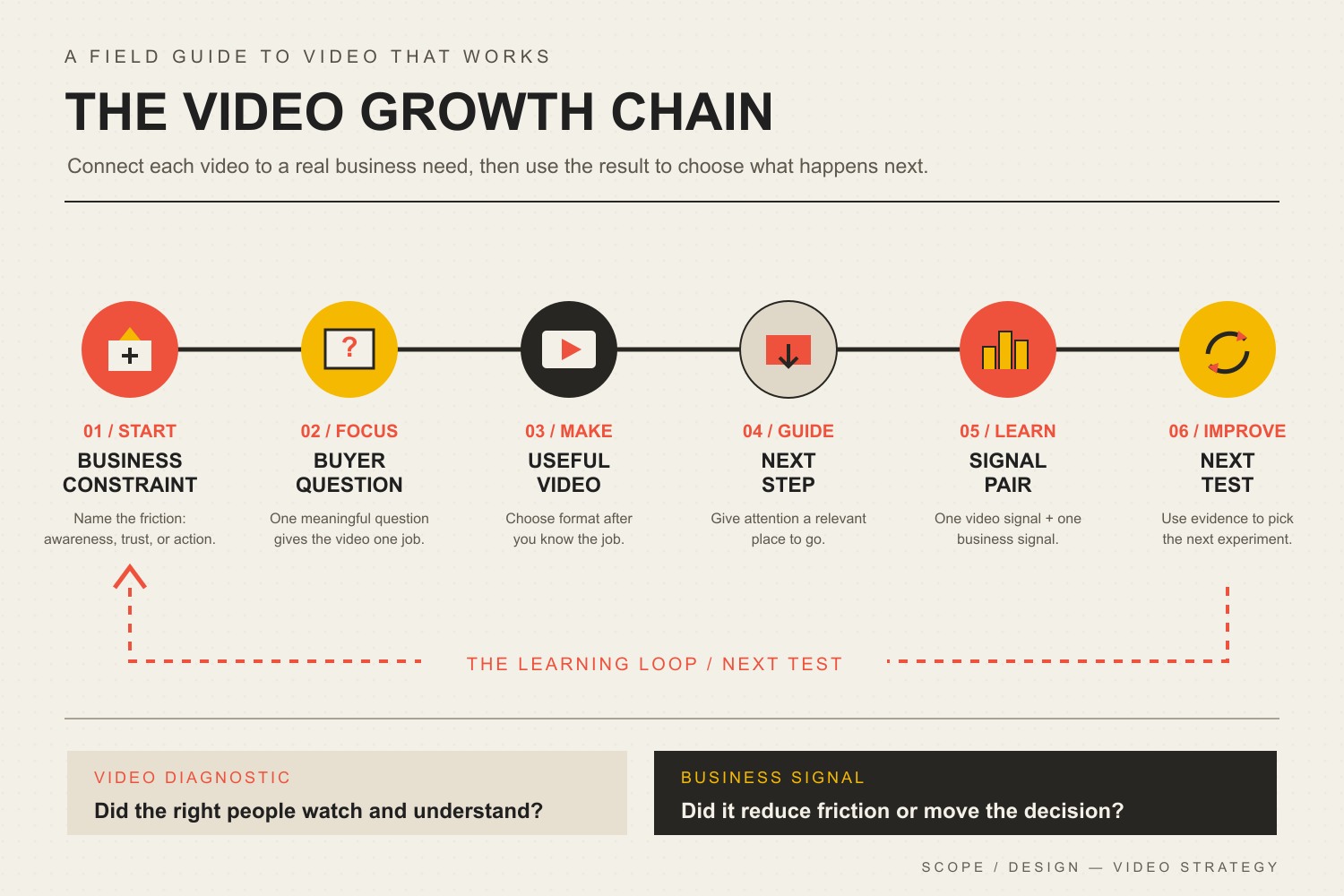
    The Video Growth Chain: business constraint, buyer question, useful video, next step, paired video and business signals, and a next test.
    The Video Growth Chain connects a real business constraint to a buyer question, useful video, next step, measurable signal, and informed next test.

    This framework also prevents a common planning mistake: treating format choice as the strategy. Format matters, but it comes after the job is clear. If you need help deciding between demos, explainers, testimonials, short-form clips, webinars, and other formats, use our guide to video marketing types and when to use them. This article owns the broader operating system.

    15 Video Marketing Moves That Drive Growth

    1. Start With a Business Constraint, Not a Platform

    “We should do more video” is not a strategy. Name the constraint first. Maybe qualified prospects do not know you exist. Maybe they visit the site but cannot understand the offer. Maybe sales calls stall on the same objection. Maybe new customers keep asking the same onboarding question.

    The constraint tells you what the video must change. Awareness work needs qualified attention. Understanding work needs clarity. Trust work needs believable proof. Conversion work needs a clean handoff. This is also consistent with a broader marketing strategy built around the business constraint and conversion path, not a channel chosen in isolation.

    2. Give Each Video One Buyer Question

    Useful videos usually answer a question the customer is already trying to resolve: “How does this work?” “What will this cost?” “Can I trust this company?” “What happens after I sign?” “Will this work for a business like mine?”

    One question creates editorial discipline. It keeps the opening focused, makes examples easier to choose, and helps you know when the video is finished. A five-minute answer to one expensive objection can be more valuable than a broad 20-minute “ultimate guide” that never resolves a decision.

    3. Choose the Format After You Know the Job

    A testimonial is not automatically better than a demo, and a short-form clip is not automatically better than a webinar. Format should follow the behavior you need to change. Need proof? Customer evidence may fit. Need clarity? A demo or screen recording may fit. Need discovery? Short educational clips may fit.

    Do not force one video to carry the whole funnel. A discovery clip can hand off to a deeper explainer. An explainer can hand off to a case study. A case study can hand off to a consultation. That sequence is often more useful than trying to make a single “brand video” do everything.

    4. Open With the Useful Part

    You do not need a universal “three-second rule” to know that slow openings create friction. Skip the long logo animation, biography, and throat-clearing when the viewer came for an answer. State the problem, show the result, ask the relevant question, or demonstrate the useful thing early.

    The right opening depends on the video. A search-driven tutorial can state exactly what it will teach. A product demo can show the outcome before the setup. A testimonial can begin with the customer’s original problem. Optimize for relevance, not a made-up universal timer.

    5. Use Enough Production Quality to Protect Trust

    “Authentic” does not mean careless. Viewers can forgive a phone camera more easily than muddy audio, unreadable screen recordings, confusing edits, or rambling explanations. Prioritize understandable audio, steady framing, useful lighting, legible visuals, and a clear structure before expensive cinematic polish.

    The production level should match the decision. A personalized proposal walkthrough can be intentionally simple. A flagship brand film may justify more polish. The goal is not “low production” or “high production.” The goal is the level of clarity and credibility the situation requires.

    6. Design the Next Step Before You Record

    Do not wait until the edit is finished to ask what the viewer should do next. Define the handoff first. It might be a related guide, pricing page, product page, assessment, consultation, email signup, demo request, or onboarding step.

    Then make sure the destination can finish the job. If the video creates interest but the landing page is confusing, the form is broken, or nobody owns the follow-up, more views simply deliver more people into a weak system. Our website conversion playbook covers that handoff in more depth.

    7. Build Captions and Accessibility Into Production

    Captions are not just a social-media convenience. They are part of making synchronized video understandable to people who cannot hear the audio. WCAG 2.2 requires captions for prerecorded synchronized media at Level A, subject to the standard’s stated exception for media alternatives.

    Build caption review into the workflow instead of treating auto-generated captions as automatically finished. Check names, product terms, numbers, punctuation, and timing. If important information appears only visually, consider whether the surrounding page or an appropriate description makes that information accessible too.

    8. Adapt the Message to the Channel Context

    Republishing can save time, but identical uploads are not a strategy. A prospect watching a search tutorial, scrolling a social feed, reviewing a proposal, or comparing vendors on a landing page has a different level of intent.

    Keep the core idea consistent while adapting the opening, framing, crop, captioning, CTA, and depth to the context. If social traffic is part of the plan, our guide to turning social traffic into business outcomes goes deeper on the path from attention to action.

    9. Give Important Videos a Useful Home on Your Website

    A strategically important video should not exist only as a social post that disappears into a feed. Give evergreen videos a relevant page where the surrounding text, offer, proof, and next step help the viewer act. For search visibility, technical implementation matters too.

    Google’s video SEO documentation emphasizes discoverable video on indexable watch pages, stable thumbnails, crawlable video resources, and consistent metadata/structured data. A clever filename is not a substitute for those fundamentals. For the broader search system, see our SEO and analytics growth guide.

    10. Repurpose From a Source Idea, Not From Random Clips

    Good repurposing starts with a useful source: a customer interview, webinar, demo, founder explanation, FAQ session, or in-depth tutorial. Extract the questions, objections, examples, proof, and decisions inside it. Then adapt those units for the moments where they are useful.

    That produces a coherent system instead of a folder full of disconnected snippets. Our content repurposing guide covers the mechanics of turning one source asset into useful derivative content without merely duplicating it.

    11. Batch the Repeatable Mechanics, Not the Judgment

    Batching works well for outlines, recording setup, thumbnail production, caption cleanup, exports, uploads, and clip extraction. It works poorly when it becomes an excuse to lock in 30 weak topics before you have learned anything.

    Create a repeatable production lane, but keep topic choice and next-test decisions responsive. Record several well-chosen videos in one session if that reduces friction. Then let the evidence from those videos shape the next batch.

    12. Use AI as a Production Assistant, Not a Source of Truth

    AI can accelerate transcript cleanup, rough outlines, clip identification, title variations, caption drafts, shot lists, and editing chores. It can also confidently invent facts, flatten your point of view, or turn a specific customer question into generic marketing language.

    Keep human editorial control over claims, examples, customer context, brand voice, and final decisions. Automate the repetitive work around the insight—not the responsibility for whether the insight is true. The same principle applies to broader AI-powered marketing automation.

    13. Treat Customer Video as Evidence, Not Decoration

    A vague “They were great!” testimonial adds little. Strong customer video describes the starting problem, the decision, what changed, and the result in language a future buyer can recognize. Specificity makes the proof useful.

    It also needs to be honest. FTC guidance on endorsements, influencers, and reviews requires advertising claims to be truthful and not misleading, and material connections may need disclosure. Do not script a customer into a result they did not experience. Our guide to customer testimonials and social proof goes deeper on collecting proof that is specific and credible.

    14. Measure One Video Signal and One Business Signal

    Video platforms provide useful diagnostics: impressions, click-through rate, watch time, average view duration, retention, traffic sources, completion, shares, or saves depending on the channel. Those numbers help diagnose the content. They do not automatically tell you whether the business problem improved.

    Pair one diagnostic with one downstream signal. For a demo, that may be watch engagement plus demo requests. For a testimonial, it may be page engagement plus qualified inquiries or sales feedback. For onboarding, it may be completion plus fewer repeated support questions. For a social educational clip, it may be qualified engagement plus visits to the intended resource.

    Do not force false precision when attribution is messy. Assisted influence is real, but it is not the same as causal proof. Our marketing ROI framework explains how to separate decision metrics from diagnostic metrics when comparing marketing work.

    15. Decide the Next Test Before You Declare a Winner

    A video is not “good” because it beat an arbitrary benchmark. Ask what the signal suggests. Did the right people start watching but leave before the useful proof? Did they finish but ignore the CTA? Did qualified prospects mention the video on sales calls? Did a tutorial reduce repeated questions?

    Turn that observation into one controlled next test: a clearer opening, tighter example, different proof, better destination, stronger distribution, or different buyer question. If you are paying to amplify content, set a budget and stop rule before the campaign begins. Our content promotion strategy guide covers that distribution layer.

    A 30-Day Video Marketing Strategy for a Small Business

    You do not need a studio or a 40-video calendar to start. Use one month to build and test the chain.

    1. Week 1 — Find the constraint. Review sales questions, support tickets, search queries, form friction, and customer conversations. Choose one problem worth improving. Write down the business signal you care about.
    2. Week 2 — Build three useful answers. Choose three buyer questions connected to that constraint. Select the simplest format that can answer each well. Define the next step before recording.
    3. Week 3 — Produce and distribute. Record with clear audio and structure. Add reviewed captions. Publish each video where the intended audience can encounter it, and give important evergreen videos an owned-web destination.
    4. Week 4 — Diagnose and choose the next test. Review one content diagnostic and one business signal per video. Do not average unlike jobs together. Choose the single change most worth testing in the next batch.

    After 30 days, the goal is not to prove that “video works.” The goal is to know more about which customer questions, proof, handoffs, and distribution choices help your specific business move.

    Video Marketing Strategy FAQ

    What is the best video marketing strategy?

    The best strategy is the one tied to a specific business constraint and customer decision. Start with the bottleneck, identify the buyer question, create the simplest useful video, define a relevant next step, measure a diagnostic plus a business signal, and use the result to choose the next test.

    Which video platform should a small business use first?

    Choose the audience and job before the platform. Search-driven educational video may fit YouTube or an owned resource page. Social discovery may fit a platform where your customers already spend attention. Personalized sales video may belong in email or proposals. There is no universal first platform.

    How long should a marketing video be?

    Long enough to complete its job without unnecessary friction. A quick objection answer might take 45 seconds; a technical tutorial may need 12 minutes. Use retention and downstream behavior to diagnose whether the length is serving the task rather than forcing every video into one benchmark.

    How do you measure video marketing ROI?

    Start by defining the economic outcome the video is meant to influence, then pair it with a video-level diagnostic. Compare the value of qualified actions, pipeline, sales efficiency, support reduction, activation, or other relevant outcomes against production and distribution cost. Avoid pretending that every assisted touch can be attributed with causal precision.

    Can AI create a complete video marketing strategy?

    AI can help with research organization, outlines, transcripts, clipping, caption drafts, and production speed. It should not replace first-party customer knowledge, factual verification, brand judgment, or the decision about which business constraint matters. Use AI to accelerate the workflow around the strategy, not to invent the strategy for you.

    Make Video Part of the Business System

    The most durable video marketing strategy is not a list of platform tricks. It is a repeatable way to connect a real buyer problem to a useful explanation, a believable piece of proof, a clear next step, and an outcome you can learn from.

    If your business has plenty of content ideas but no clear path from attention to action, Scope Design can help connect the video plan to the offer, website, search strategy, content system, and measurement that make the handoff work.

  • How to Write a Slogan or Tagline That People Actually Remember

    How to Write a Slogan or Tagline That People Actually Remember

    Quick answer—how to write a slogan or tagline that works: Decide what single idea you want people to associate with your business, express it in language they can understand and repeat, then test whether they remember both the line and the right brand. Short is useful. Clever can be useful. Neither rescues a vague promise your business cannot prove.

    A slogan is not a tiny homepage. It does not need to explain your origin story, list every service, flatter the founder, carry the mission statement, and close the sale before lunch.

    It needs to do one damned job.

    The difficult part is choosing that job before everyone starts throwing “bold,” “better,” “reimagined,” and “solutions” into a word blender.

    In this guide

    What makes a good slogan or tagline?

    A good slogan or tagline is:

    • built around one strategically useful idea;
    • credible enough to survive contact with the actual customer experience;
    • easy to say, hear, scan, and repeat;
    • distinctive enough that it does not sound borrowed from the nearest five competitors; and
    • tested for meaning and brand association, not merely voted “the favorite” in a conference room.

    That last point matters because likability and memorability are not the same outcome.

    A 2023 Journal of Consumer Research paper analyzed more than 800 brand slogans and combined that work with laboratory experiments, eye tracking, and a field study. The researchers found a real tradeoff: linguistic features that made slogans easier to process tended to improve liking but reduce memory, while some less-fluent features improved memory at the cost of liking. Shorter lines, familiar words, and omitted brand names were generally liked more; longer lines, concrete or less-common words, and included brand names were more likely to be remembered.

    That does not mean every slogan should be long, awkward, or stuffed with the company name. It means “make it as short as possible” is not a strategy. First decide whether the line needs to create liking, aid recall, identify the brand, clarify the offer, or support a campaign. Then write for that job.

    If you remember the slogan but credit the wrong company, congratulations: the company bought advertising for its competitors.

    Slogan vs. tagline: what is the difference?

    There is no universally enforced marketing taxonomy. People routinely use slogan and tagline interchangeably. For practical work, this distinction is useful:

    TermPractical jobTypical lifespan
    TaglineCreates a stable association with the overall brandUsually long-term
    SloganMakes a campaign, product, or specific message easier to rememberOften temporary
    MottoStates a belief or guiding principleUsually long-term; may be internal or public
    HeadlineWins attention and communicates the point of one page, ad, email, or assetChanges with the context
    Value propositionExplains why a particular customer should choose the business or offerStable until the market, customer, or offer changes

    The distinction prevents a common mess: asking a tagline to perform the job of a value proposition.

    “Just Do It” works because decades of brand investment supply the missing context. Put an equally vague line under the logo of an unknown accounting firm and nobody knows what the hell it does.

    A small business generally needs a clear brand message before it needs a poetic tagline. The message provides the strategic substance. The tagline compresses one useful part of it into a repeatable cue.

    Do you even need a slogan?

    No. A business is not legally or strategically required to fill the little space under its logo.

    Use a tagline when it helps people:

    • understand an unfamiliar name;
    • remember a distinctive promise or point of view;
    • connect several offers to one brand idea;
    • recognize the business when the visual identity appears in different contexts; or
    • carry a stable association across campaigns.

    Use a campaign slogan when a temporary initiative needs its own repeatable message.

    Skip the line when it merely repeats the business name, says nothing specific, or makes the logo lockup harder to read. White space is cheaper than strategic lint.

    This is why slogans belong inside a broader brand strategy system. The line, visual identity, color system, behavior, proof, and customer experience should reinforce one another. Otherwise, you have six departments playing six songs and calling it harmony.

    Start with the strategic idea, not a rhyming dictionary

    Before writing options, answer five questions in plain language:

    1. Who needs to remember this? “Everyone” is not an audience. It is an avoidance tactic.
    2. What should they remember? Choose one association: speed, specialization, reassurance, rebellion, precision, access, simplicity, or another defensible idea.
    3. What should they understand without extra context? An unfamiliar company may need more explanation than an established brand.
    4. What can the business consistently prove? A tagline can sharpen a promise; it cannot make an operational fantasy true.
    5. Where will the line live? A logo lockup, storefront, radio spot, sales deck, video ending, packaging panel, and search result create different constraints.

    If those answers are fuzzy, pause. You do not have a wording problem yet. You have a positioning and brand-message problem.

    Choose one association

    The best raw material usually comes from evidence already inside the business:

    • language customers use in reviews and sales calls;
    • the objection the company resolves unusually well;
    • a process competitors cannot honestly claim;
    • a specific audience the business understands deeply;
    • an operational promise the team can consistently keep; or
    • a useful tension in the category that the brand is willing to challenge.

    “Quality service you can trust” contains no evidence and no tension. It is beige wallpaper made of words.

    “Emergency bookkeeping for restaurants” is not lyrical, but it identifies an audience, a situation, and a capability. That is valuable raw material. The final line can become more expressive after the strategic idea stops wobbling.

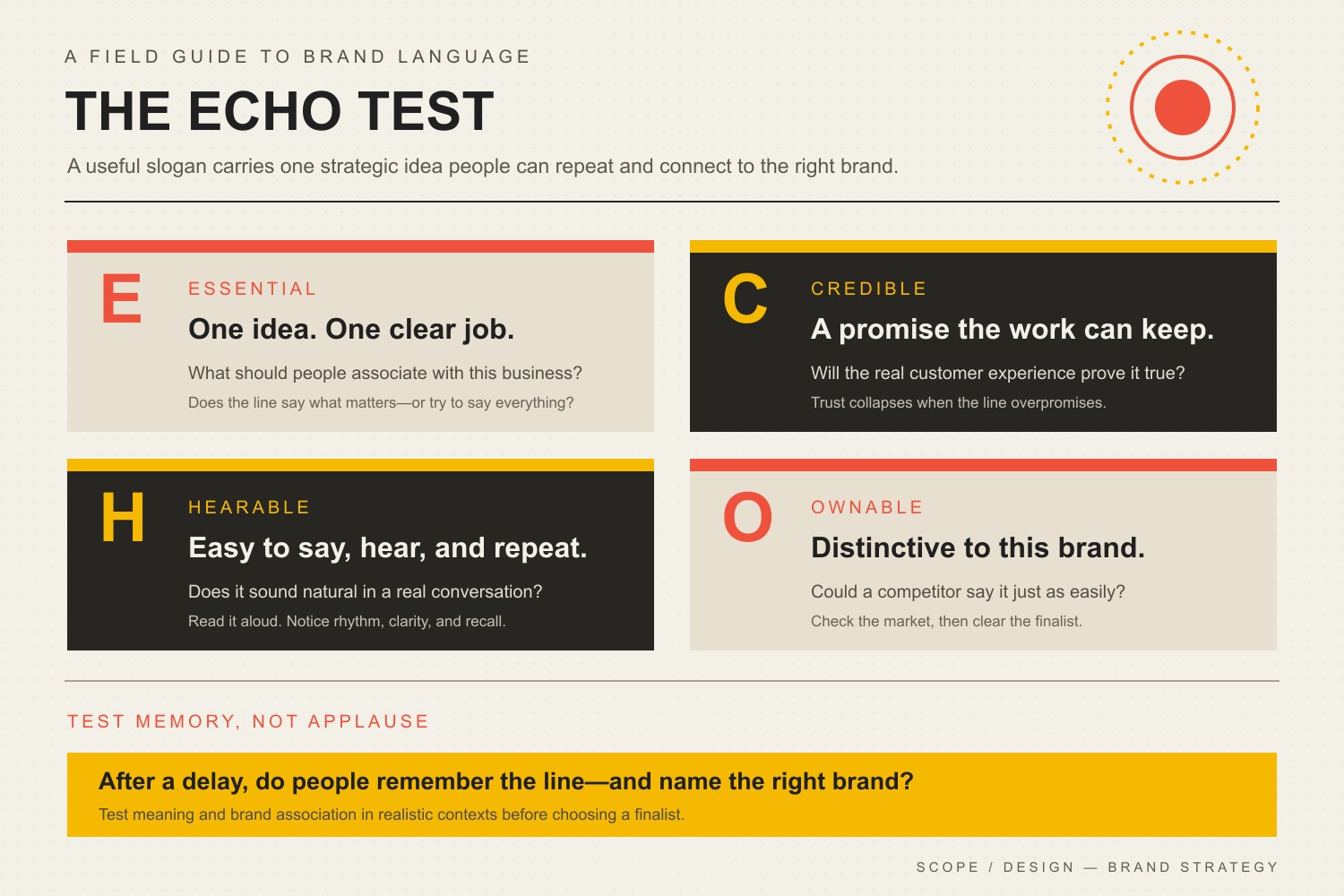
    Use the Scope Design ECHO Test

    We use four filters because “I like it” is not a meaningful brand criterion.

    The ECHO Test: Essential, Credible, Hearable, and Ownable, followed by a memory test that checks whether people recall both the line and the right brand.

    E — Essential

    Does the line carry one essential strategic idea?

    A slogan becomes mush when it tries to communicate quality, speed, innovation, care, heritage, affordability, and world peace in seven words. Pick the association that matters most in this context.

    Ask:

    • What should a customer repeat after seeing it once?
    • Does every word help that association?
    • Could we remove a claim without changing the idea?
    • Are we smuggling an entire mission statement into the line?

    C — Credible

    Can the business support the promise?

    This is both a trust issue and, for objective advertising claims, a substantiation issue. The Federal Trade Commission says advertisers need a reasonable basis for express and implied objective claims before the advertising runs. A happy customer quote does not magically prove a measurable performance claim.

    Ask:

    • What would a reasonable customer think this line promises?
    • Can operations deliver that expectation consistently?
    • What evidence supports any objective claim?
    • Would the line still feel honest after a bad service day?

    “The fastest delivery in Philadelphia” is not harmless enthusiasm. It is a comparative performance claim. Prove it, qualify it, or write something honest.

    H — Hearable

    Does the line survive outside the design file?

    Read it aloud. Say it on the phone. Put it at the end of a 15-second video. Show it without the logo. Ask someone to repeat it later. Check whether punctuation, spelling tricks, or visual styling are doing all the work.

    Hearable does not mean childish or bland. It means the audience can receive the idea without reverse-engineering the copywriter’s ego.

    Useful checks include:

    • natural rhythm without forced rhyme;
    • words that are difficult to mishear;
    • no acronym the audience must decode;
    • no pun that collapses when spoken;
    • no culturally specific joke presented to a market that will not share the reference; and
    • enough context for an unfamiliar listener to connect the line to the right kind of business.

    O — Ownable

    Can the audience connect the line to you, or could any competitor paste it under its logo before breakfast?

    Ownability has two parts:

    1. Strategic distinctiveness: the line reflects a point of view, capability, audience, or promise that fits this business unusually well.
    2. Practical clearance: the organization checks whether similar marks already exist before investing in signs, packaging, campaigns, and merchandise.

    The U.S. Patent and Trademark Office warns that commonly used phrases may fail to identify the source of goods or services. It also notes that a proposed mark can face problems when it is confusingly similar in appearance, sound, or meaning to an existing mark used with related goods or services.

    Searches are a screening step, not a legal opinion. Check the USPTO database, domain and social use, marketplace use, and relevant jurisdictions. For a valuable long-term line, involve a qualified trademark attorney before the expensive rollout—not after the cease-and-desist letter adds some excitement to the week.

    A practical process for writing a business slogan

    1. Write the assignment in one sentence

    Use this structure:

    We need a [tagline or campaign slogan] that helps [specific audience] associate [brand or offer] with [one strategic idea] when they encounter it in [contexts].

    Example:

    We need a brand tagline that helps independent restaurant owners associate our bookkeeping firm with calm, fast financial clarity when they see the website, proposal, or event booth.

    That is a brief. “Make it pop” is a cry for help.

    2. Build a language bank from reality

    Collect customer phrases, proof points, process language, category clichés, competitor lines, objections, sensory details, and words the brand would never use.

    Separate the language into four columns:

    Customer realityBusiness proofCategory clichésProductive tension
    What customers say and fearWhat the business can demonstrateWhat everyone else repeatsWhat the brand believes differently

    The category-cliché column is especially useful. It tells you what to delete before it sneaks into the final round wearing a blazer.

    3. Generate routes, not tiny variations

    Do not write 40 versions of “Better business, better life.” Explore different strategic routes:

    • Outcome: the result the customer values;
    • Audience: a line that signals “this is for people like me”;
    • Point of view: a belief the brand is prepared to defend;
    • Operational promise: a specific experience the company can deliver;
    • Category reframe: a better way to understand the problem; or
    • Brand character: language that expresses a recognizable attitude.

    Write freely during generation. Judge later. Early editing produces five safe lines and one pun everyone regrets.

    4. Eliminate with ECHO

    Score each serious candidate from 1 to 5 on Essential, Credible, Hearable, and Ownable. Add a short note explaining every score.

    Do not average away a fatal flaw. A line with perfect rhythm and zero credibility is still a bad line. A line that is memorable but belongs to a competitor is worse.

    5. Test behavior, not applause

    Do not show ten lines simultaneously and ask, “Which do you like?” That measures preference in an artificial comparison—not performance in the real world.

    Test finalists separately with people who resemble the audience:

    1. Comprehension: What do you think this company offers or stands for?
    2. Expectation: What would you expect the experience to be?
    3. Delayed recall: What line do you remember after a distraction or time gap?
    4. Brand linkage: Which company or category did you connect it to?
    5. Misinterpretation: Could the words imply something unintended, exclusionary, or impossible?
    6. Context: Does it work on the website, spoken aloud, at small size, and beside the actual visual identity?

    Record what people say before explaining what the line was “supposed” to mean. If it requires a presentation, the presentation is doing the work.

    6. Clear and document the finalist

    Document:

    • the intended meaning;
    • approved uses and lockups;
    • capitalization and punctuation;
    • when the brand name must accompany it;
    • translations or regional versions;
    • evidence supporting objective claims;
    • trademark-search notes and legal review; and
    • conditions that should trigger reconsideration.

    This becomes part of the brand identity system, not a sentence trapped inside an old logo file no one can open.

    7. Build memory through consistent use

    A line does not become famous because it won a brainstorm. It becomes familiar through repeated, coherent use alongside a recognizable identity and a customer experience that reinforces it.

    Use it where it has a job. Do not stamp it on every paragraph like a toddler discovering stickers. Coordinate it with the visual identity, including a usable brand color system, and keep the wording stable long enough to learn whether it is building an association.

    Should a slogan be short?

    Usually, but not according to a magic number.

    Short lines are easier to place, repeat, and integrate into visual systems. That is an operational advantage, not a universal law of memory. The 2023 research described earlier found a tradeoff: shorter, more fluent slogans were generally liked more, while longer and more concrete slogans could be remembered better.

    Use the fewest words that preserve the intended idea, brand connection, credibility, and rhythm. If removing a word makes the line generic or confusing, the deletion did not improve it.

    The correct question is not “Can we get this down to three words?” It is “What stops working when we do?”

    Common slogan mistakes

    Using words every competitor owns

    Innovative. Trusted. Quality. Solutions. Excellence. Customer-first.

    These words are not forbidden. They are merely useless without specificity or proof.

    Writing the tagline before the positioning

    Wordplay cannot rescue a business that has not chosen an audience, valuable difference, or defensible promise.

    Confusing a tagline with a homepage headline

    The homepage still needs to tell an unfamiliar visitor what the company does, who it helps, and what to do next. Do not park an ambiguous tagline above the fold and expect visitors to admire the mystery. Your website strategy has commercial work to do.

    Choosing through internal consensus

    Committees tend to reward safe language because nobody hates it. Unfortunately, nobody remembers it either.

    Copying the structure of a famous line

    Famous taglines arrive with decades of media spend, product experience, and cultural repetition. Borrowing their syntax does not transfer their equity. It mostly makes the new line sound like tribute-band branding.

    Treating a generator as strategy

    AI and slogan generators can expand a language bank or produce rough routes. They cannot decide which promise the company can operationally support, what the market already owns, or which association deserves years of investment. Use the tool for divergence. Keep judgment in the building.

    Testing immediate preference only

    The easiest line to like in a list may not be the line people remember later, understand correctly, or connect to the brand. Measure the job.

    How to evaluate slogan examples without copying them

    Famous-slogan lists are entertaining and strategically dangerous. They encourage businesses to copy surface features while ignoring context.

    When studying an example, ask:

    • What job did this line perform when it launched?
    • How familiar was the brand already?
    • Was the brand name present nearby?
    • What media repetition supported recall?
    • Did the product experience prove the promise?
    • Would the words work for an unknown company with no context?
    • Is the line remembered because of language, investment, timing, culture, or all four?

    Study the mechanism, not the costume.

    The business outcome: useful memory

    A tagline should not be judged by whether it sounds clever in a brand presentation. It should help the right people retrieve a useful association when a buying situation appears.

    That can support recognition, comprehension, preference, or campaign recall—but the line is only one part of the system. Proof builds brand authority. Positioning and behavior give the words meaning. Consistent identity makes the cue recognizable. Distribution creates repetition. The customer experience decides whether the promise becomes trusted or mocked.

    The goal is not a memorable sentence floating around the internet without an owner. The goal is a memorable, credible connection to your business.

    If your team is choosing between clever lines without agreeing on the strategic idea underneath them, Scope Design’s Impact Consulting can help diagnose the positioning and messaging problem before you spend money polishing the wrong answer.

    Frequently asked questions about slogans and taglines

    How do you write a slogan?

    Choose one association you want the audience to connect to the business, collect language from customers and proof, generate several strategic routes, filter candidates with the ECHO Test, and test comprehension, delayed recall, brand linkage, and credibility with relevant people.

    What is an example of a business slogan?

    A useful invented example for a restaurant-focused bookkeeping firm could be “Calm books. Busy tables.” It expresses an outcome and audience context without claiming to explain the entire service. Examples should be evaluated in context, not copied as formulas.

    What makes a slogan memorable?

    Memorability can come from concrete or distinctive wording, rhythm, meaningful association, brand-name linkage, repeated exposure, and a consistent experience. Research suggests the wording people like most is not automatically what they remember best, so test delayed recall rather than relying on immediate preference.

    How long should a slogan be?

    There is no universal ideal word count. Use the fewest words that preserve meaning, credibility, brand connection, and rhythm. Shorter lines can be easier to place and like; longer or more concrete lines may sometimes be easier to remember.

    Are a slogan and tagline the same thing?

    People often use the terms interchangeably. A practical distinction is that a tagline usually represents the enduring brand, while a slogan often supports a particular campaign, product, or initiative. There is no universally enforced rule.

    Is a tagline the same as a value proposition?

    No. A value proposition explains why a particular customer should choose the business or offer. A tagline is a compact memory or interpretation cue. An unknown business usually needs a clear value proposition even if it also uses a tagline.

    Does every business need a tagline?

    No. Use one only when it improves understanding, recognition, or recall. A generic line that repeats the name or clutters the visual identity is worse than no tagline.

    Should a slogan include the brand name?

    It depends on the job and context. Including the brand name may strengthen brand linkage and recall, especially when the audience is unfamiliar with the company. Omitting it may produce a smoother or more likable line. Test whether people remember the correct brand, not just the words.

    Can AI write a good business slogan?

    AI can generate options and expose language patterns quickly. It cannot independently verify positioning, operational truth, customer interpretation, competitive ownership, or legal clearance. Use it to expand possibilities, then apply human strategic judgment and real testing.

    How do you test a tagline?

    Show finalists separately and in realistic contexts. Ask what the business appears to do, what the line promises, what the person remembers after a delay, and which brand they associate with it. Record answers before explaining the intended meaning.

    Can a slogan be trademarked?

    A slogan may function as a trademark, but registration depends on factors including distinctiveness, source identification, existing similar marks, and the relevant goods or services. Common phrases may be refused. Search the USPTO database and consult a qualified trademark attorney for legal advice.

    How often should a company change its tagline?

    Do not change it merely because the team is bored. Reconsider it when positioning, audience, offer, market context, legal availability, or customer interpretation materially changes—or when credible testing shows the line is failing its assigned job.

    What is the biggest slogan-writing mistake?

    Trying to sound memorable before deciding what deserves to be remembered. That produces clever language without strategic value, or generic language nobody can connect to the business.

    Sources

  • When to Hire a Copywriter: 5 Situations Where It Makes Sense

    When to Hire a Copywriter: 5 Situations Where It Makes Sense

    If your message is the thing preventing good prospects from understanding, trusting, or acting on your offer, it probably makes sense to hire a copywriter. If the real problem is weak traffic, a weak offer, or a broken user experience, better sentences will not rescue the wrong constraint.

    That distinction matters more now that AI can produce a decent first draft in seconds. The question is no longer, “Can someone write these words?” The better question is, “Does this job require research, message hierarchy, customer perspective, evidence, judgment, and someone willing to own the final message?”

    That is the line this guide is built to find. If you already know you need help and want the companion view on value and process, read our guide to the benefits of hiring a professional copywriter for your website.

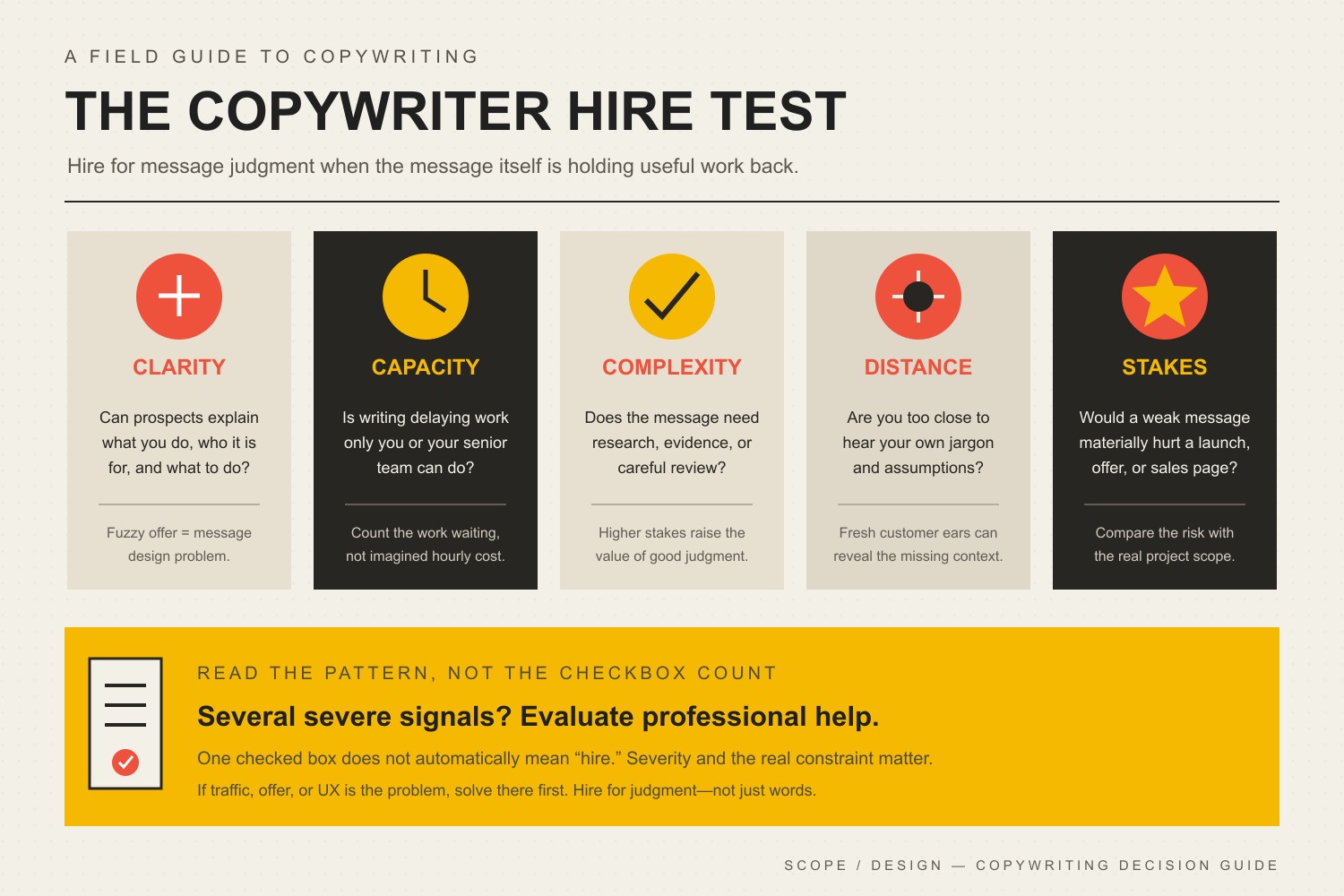
    TL;DR: The Copywriter Hire Test

    • Clarity: Prospects cannot quickly explain what you sell, who it is for, why it matters, or what to do next.
    • Capacity: Writing and rewriting are delaying higher-value work that only you or your senior team can do.
    • Complexity: The message requires customer research, technical accuracy, evidence, multiple reviewers, or careful handling of claims.
    • Distance: You are too close to the business to hear your own jargon, assumptions, and feature-heavy explanations.
    • Stakes: The copy sits on a launch, rebrand, core sales page, or major offer where confusion has a meaningful cost.

    One checked box does not automatically mean “hire someone.” Severity matters. But the more boxes you check, the stronger the case for professional help.

    The Copywriter Hire Test: 5 situations where professional help makes sense

    Five signals for deciding whether to hire a copywriter: Clarity, Capacity, Complexity, Distance, and Stakes. Several severe signals strengthen the case, but a checked box alone does not mean hire.

    1. Clarity: people reach the message but still do not understand the offer

    Clarity problems often hide in plain sight. You know what the company does, so your brain automatically fills in missing context. A new prospect does not have that luxury.

    A simple test is to ask whether a good-fit prospect can answer four questions after a quick read: What is this? Is it for me? Why should I care? What should I do next? If those answers are fuzzy, the problem is not “we need more words.” It is a message-design problem.

    That is where a professional copywriter should start with research rather than adjectives. Customer questions, sales objections, support conversations, competitor language, and actual behavior on the site all provide better raw material than an internal brainstorming session. Current Digital.gov plain-language guidance makes the same audience-first point: learn what users ask and need, then focus the content on what applies to them.

    Hire when: different people on your team explain the offer differently, prospects keep asking basic questions the page should answer, or your copy lists features without creating a clear decision path.

    2. Capacity: writing has become a bottleneck for higher-value work

    Being capable of writing your own copy does not mean you should write every piece of it. The real cost of DIY is not an hourly rate pulled from a calculator. It is what important work stops while the owner, founder, subject-matter expert, or marketing lead goes through another round of “maybe this headline is better.”

    For a low-risk announcement or rough first draft, internal writing or AI may be completely reasonable. But if a website launch is waiting on copy for three weeks, five people are rewriting the same paragraph, or the person with the most valuable expertise is spending half a day fighting a blank page, capacity has become a business constraint.

    Hire when: copy repeatedly misses deadlines, senior people are trapped in revision loops, or getting the message finished is more valuable than proving you can write it yourself.

    3. Complexity: the message needs research, evidence, or careful review

    Some copy is hard because the sentence is hard. More often, it is hard because the business decision behind the sentence is hard.

    Complexity rises when you have a technical offer, several audiences, multiple stakeholders, competing priorities, or claims that need evidence. A copywriter can help translate approved facts into language people can understand, organize the message, and keep reviewers from turning the final page into a committee-written casserole.

    There is an important boundary here: a copywriter is not a substitute for legal, compliance, medical, financial, or other qualified subject-matter review. In the United States, the FTC’s advertising guidance for small businesses says advertising claims must be truthful and non-deceptive and that advertisers need evidence to support express and implied claims. The writer’s job is to make approved truth clear—not invent proof that does not exist.

    Hire when: the work requires interviews, source review, claim substantiation, technical translation, or someone who can keep a complicated review process focused on the reader.

    4. Distance: you are too close to the business to hear your own assumptions

    Business owners usually know too much, not too little. That creates a strange communication problem: you stop noticing what a first-time buyer cannot possibly know.

    Internal shorthand becomes website copy. Features feel self-explanatory. Company history gets more space than the customer’s problem. The page answers the questions your team finds interesting instead of the questions a buyer needs answered.

    A good outside copywriter is useful partly because they are allowed to ask the “obvious” questions: Who is this really for? What changes after they buy? Why should they believe you? What objection is stopping the next step? What does the customer call this problem when nobody from your company is in the room?

    Hire when: your copy sounds accurate to insiders but confusing, generic, or jargon-heavy to everyone else.

    5. Stakes: the downside of a weak message is materially bigger than the cost of getting help

    Not every paragraph deserves a strategy workshop. Your core website, a rebrand, a new offer, a high-value sales page, or a campaign sending meaningful traffic to one decision deserves more care than a routine update.

    High stakes change the economics. If the message will be seen by thousands of prospects, reused across sales materials, or become the language your whole team repeats for the next two years, a cheap first draft can become expensive through repetition. The more durable and consequential the message, the more valuable research, hierarchy, and review become.

    Hire when: the copy will define how the market understands the business, support a major investment in traffic, or sit close to an important buying decision.

    When not to hire a copywriter yet

    This is the part many copywriting pages skip because it is bad for the hard sell and good for the reader: sometimes copy is not the problem.

    What you seeLikely constraintWhat to do first
    Almost no qualified prospects reach the pageTraffic or distributionFix acquisition and targeting before rewriting everything.
    People understand the offer but do not want itOffer or market fitRevisit the product, positioning, price, proof, or audience.
    People want the offer but cannot complete the taskUX or functionalityFix navigation, forms, checkout, mobile issues, or broken flows.
    People arrive, engage, but leave confused about value or next stepMessagingNow copywriting is a credible place to intervene.

    This constraint-first approach is part of our broader small-business marketing strategy: fix the system that is actually limiting growth instead of buying the next fashionable tactic. Our related copywriting guide goes deeper on the message-friction questions to diagnose before you hire.

    AI or a professional copywriter? Split the job, not the ideology

    AI changed the economics of drafting. It did not make every part of copywriting equally automatable.

    TaskAI can helpHuman ownership matters most when…
    Brainstorming angles or headline variantsYesYou need to choose the angle that matches real customer evidence.
    Summarizing approved source materialYes, with verificationAccuracy or nuance is consequential.
    Drafting low-risk routine copyOftenThe draft will represent the brand in an important decision.
    Interviewing customers or subject-matter expertsAssist with prep and synthesisFollow-up questions and interpretation matter.
    Building message hierarchyAssistYou must decide what the reader needs to believe, in what order.
    Choosing and validating proofAssist with organizationClaims require evidence and accountable review.
    Brand-voice governance and final judgmentAssist with consistency checksThe message is durable, high-stakes, or shared across channels.

    Google’s current guidance for generative-AI search makes a useful quality distinction too: it recommends unique, non-commodity content that adds genuine point of view and usefulness, rather than material that simply recycles what a generative model could produce. In practical terms, AI is excellent at accelerating parts of the work. It is a poor excuse for skipping the thinking.

    Formulas can help structure a draft, and AI can generate variations quickly. Our guide to copywriting formulas explains where structure helps and where diagnosis still matters. Use tools. Just do not confuse the tool with the decision-maker.

    What should a professional copywriter do before writing?

    If the process starts with “send me the word count,” you are probably buying typing, not strategic copywriting.

    1. Understand the business and offer. What is being sold, to whom, and what business outcome should the page support?
    2. Learn the audience’s language. Review customer questions, objections, interviews, reviews, support tickets, search behavior, and sales conversations when available.
    3. Decide the job of the page. One page should not try to teach everything, sell everything, and satisfy every stakeholder equally.
    4. Build the message hierarchy. Decide what comes first, what needs proof, what objections need answers, and what can wait.
    5. Gather and validate proof. Testimonials, data, examples, product facts, demonstrations, guarantees, and other evidence should support the claims being made.
    6. Write the full decision path. Headlines, body copy, proof, microcopy, and calls to action should work together rather than as disconnected “clever” lines.
    7. Revise after feedback without losing the reader. Stakeholder comments matter, but the final page still needs one coherent voice and purpose.

    That process is also why project pricing varies so much. The words are the visible output; the research and decisions behind them are most of the job.

    How to hire a copywriter without buying a mystery box

    Portfolios matter, but a polished sample cannot tell you how the work was produced. Before you hire a copywriter, ask questions that expose the process.

    • What do you need from us before you start writing?
    • Will you interview customers, salespeople, founders, or subject-matter experts when the project needs it?
    • How do you identify the main audience, objection, promise, proof, and next step?
    • How do you handle technical or regulated claims and source material?
    • What exactly is included: research, strategy, page copy, SEO considerations, microcopy, revisions, handoff?
    • How many stakeholders can review, and how do you consolidate conflicting feedback?
    • How will you work with the designer, developer, SEO team, or campaign owner?
    • What will we use to judge whether the finished copy is doing its job?

    The strongest answer is usually a process, not a promise that the writer has a secret vocabulary that “converts.”

    How much does it cost to hire a copywriter?

    There is no honest universal rate that tells you what professional copywriting should cost. A five-email sequence with supplied research is a different job from repositioning a technical company, interviewing customers, and rewriting a multi-page website.

    Price usually changes with the depth of research, number and type of deliverables, interviews, strategy work, SEO requirements, evidence and source handling, number of reviewers, revision scope, and how much responsibility the writer owns. Comparing two quotes by “price per word” can make wildly different scopes look falsely equivalent.

    A better comparison is: What thinking, research, deliverables, and revision responsibility am I actually buying? If you want a deeper explanation of that value, see our guide to what a professional website copywriter should actually do.

    Frequently asked questions about hiring a copywriter

    Do people still hire copywriters?

    Yes. The valuable part of the role is shifting away from “someone who can produce words” and toward research, audience understanding, message hierarchy, evidence, brand judgment, editing, and accountability. AI reduces the cost of a first draft; it does not eliminate the need to decide what the message should say or why anyone should believe it.

    Can I use ChatGPT for copywriting?

    Yes. It is useful for brainstorming, outlines, summarizing source material, generating variants, and rough drafts. The higher the stakes, the more important it becomes to verify facts, protect confidential information, validate claims, preserve brand voice, and have a qualified person own the final judgment. Google’s broader people-first content guidance also makes the core point that usefulness, originality, expertise, and trust matter more than whether a tool happened to generate part of the text.

    What exactly does a copywriter do?

    A professional copywriter should do more than write sentences. Depending on the project, the work can include discovery, customer and competitor research, interviews, positioning, message hierarchy, page structure, headlines, body copy, proof, calls to action, microcopy, editing, and revision with stakeholders.

    Is hiring a copywriter worth it?

    It is worth serious consideration when messaging is a meaningful constraint, the project is difficult to produce internally, and the consequence of weak communication is material. If the real bottleneck is traffic, the offer, or broken UX, spend there first.

    What is the 80/20 rule in copywriting?

    People often use “80/20” as shorthand for the idea that a small number of elements—such as the offer, headline, proof, and call to action—can do a disproportionate share of the work. Treat it as a prioritization reminder, not a fixed measurement or guarantee. Which elements matter most depends on the page, audience, and decision.

    When should I not hire a copywriter?

    Do not hire one just because writing is annoying. If almost nobody qualified reaches the page, fix traffic. If buyers understand the offer and still do not want it, fix the offer. If the site is confusing or broken, fix UX. Bring in copywriting when the message itself is a credible reason the right people are not moving forward.

    The decision: hire for judgment, not just words

    The strongest reason to hire a copywriter is not that you dislike writing. It is that the business consequence of a weak message now justifies better research and better judgment.

    Run the five tests: Clarity, Capacity, Complexity, Distance, and Stakes. If several are flashing red, professional help is probably worth evaluating. If none are, keep the work in-house, use AI where it saves time, and spend the budget on the constraint that actually matters.

    If you want help figuring out which problem you have before paying someone to rewrite everything, talk with Scope Design. If copy is the constraint, we can help research, structure, and write it. If it is not, the first useful answer should be to say so.

  • 5 Benefits of Hiring A Professional Copywriter for Your Website

    5 Benefits of Hiring A Professional Copywriter for Your Website

    Hiring a professional copywriter can make your website easier to understand, easier to trust, and easier to act on. The real benefit is not “better words.” It is a clearer path between what your customer needs and what your business can do about it.

    That matters because a website has a job. It needs to explain the problem you solve, show why your approach makes sense, answer the questions standing in the way, and make the next step obvious. A good website copywriter helps turn those jobs into a message a real person can follow.

    Quick answer: a professional copywriter is most useful when the message—not traffic, the offer itself, or site functionality—is slowing a qualified visitor’s path to action. The five practical benefits are clearer positioning, more customer-centered copy, a more consistent brand voice, SEO-aware people-first writing, and clearer next steps.

    There is an important caveat: copy is not magic. If your real constraint is no traffic, a weak offer, a broken checkout, or a slow site, rewriting headlines alone will not fix the business. Professional copywriting is most valuable when unclear messaging is part of the friction.

    Is hiring a professional copywriter worth it?

    It can be—especially when your website is asking prospects to make a meaningful decision. A professional copywriter brings an outside perspective, a repeatable research process, message hierarchy, brand-voice discipline, and experience turning complicated ideas into clear next steps.

    You are not paying someone to sprinkle adjectives over a page. You are paying for the thinking behind the page: Who is this for? What are they trying to accomplish? What is getting in their way? What do they need to understand or believe before they contact you, book, subscribe, or buy?

    1. You get a clearer message before you get clever wording

    Business owners know their companies too well. That expertise is valuable, but it can also make it difficult to see where a new visitor gets lost. Internal shorthand, industry jargon, feature lists, and company history can crowd out the one thing the visitor needs first: a clear explanation of what you can help them do.

    A professional copywriter should pull the message apart before putting sentences together. That means identifying the audience, the problem, the desired outcome, the strongest proof, the objections, and the action the page needs to support. Once those decisions are clear, the writing gets much easier—and usually much shorter.

    This is where outside perspective earns its keep. A copywriter can ask the “obvious” questions your team stopped asking years ago and spot gaps that are invisible from inside the business.

    2. Your website starts with the customer, not the company

    A common website problem is making the company the main character. The page opens with how long the business has existed, how passionate the team is, how many services it offers, and how proud everyone is of the work.

    Those details can matter, but only after the visitor understands why they should care. Strong website copy keeps the customer in the hero role. Your business is the guide: you understand the problem, you have a credible way forward, and you can help the customer reach the outcome they want.

    That shift changes the questions the page answers. Instead of “What do we want to say about ourselves?” the copywriter asks “What does the customer need to know next?” That is a much better organizing principle for a home page, service page, landing page, or sales page.

    3. Your brand sounds consistent from page to page

    Brand voice is not a collection of quirky phrases. It is a consistent way of communicating—how direct you are, how technical you get, how much personality you use, which words fit the brand, and which ones do not.

    Without that discipline, websites often sound like several different companies stitched together. The home page was written by the founder, the service pages by a freelancer, the about page by an employee, and the newest landing page by an AI tool. Each page may be acceptable on its own, but the experience feels uneven.

    A professional copywriter can establish the voice and apply it consistently across the site. Just as important, a useful copy process leaves behind decisions your team can reuse in future emails, proposals, ads, social posts, and sales materials.

    4. SEO and human-readable copy can support each other

    Search optimization and good writing are not competing goals. Google’s guidance emphasizes helpful, reliable, people-first content. That is a useful standard for website copy, too.

    An SEO-aware website copywriter can use search research to understand the language customers use, the questions they ask, and the intent behind a page—then work those ideas into useful copy naturally. The goal is not to repeat a keyword until the page sounds robotic. The goal is to make the page clearer to the person who searched and easier for a search engine to understand.

    That also means knowing when SEO is not the main job. A checkout confirmation page, a short lead form, or a highly targeted campaign landing page may have different priorities than an evergreen service page. Good copy starts with the page’s role instead of forcing the same formula everywhere.

    5. Every page gives visitors a clearer next step

    A website can be informative and still fail to move anyone forward. Visitors finish reading and think, “Okay… now what?” That is often a messaging problem, not a design problem.

    A copywriter should connect the promise of the page to a logical next action. That might be booking a consultation, requesting an estimate, choosing a plan, viewing a case study, subscribing, or buying. The call to action does not have to be loud. It does have to make sense.

    Clear calls to action work best when the rest of the page has done its job: the visitor understands the offer, sees how it connects to their situation, has enough proof to continue, and knows what will happen after the click.

    What should a professional website copywriter actually do?

    A website copywriter’s process should match the stakes and scope of the project, but useful work usually includes more than drafting.

    • Learning about the business, offer, audience, and goals.
    • Reviewing customer language, common objections, competitors, analytics, or sales conversations when those inputs are available.
    • Deciding what job each page needs to do and what information belongs there.
    • Building a message hierarchy so the most important ideas appear in the right order.
    • Writing headlines, body copy, proof, microcopy, and calls to action.
    • Using natural search language when SEO is part of the page’s job.
    • Revising after stakeholder feedback without losing the customer’s perspective.

    If you want to see how Scope approaches that work, our copywriting services cover website copy, landing pages, SEO-aware content, email, product copy, and related messaging.

    When copywriting is not the first problem to fix

    It is possible to have excellent copy on a website that still underperforms. If nobody is reaching the site, traffic may be the constraint. If people understand the offer but do not want it, positioning or the offer itself may be the problem. If interested buyers hit errors, confusing forms, or painfully slow pages, functionality and UX may come first.

    Use the Message Friction Test

    Before you hire a copywriter, ask one question: What is stopping the right visitor from taking the next step? Scope’s Message Friction Test separates four common bottlenecks so copy does not get blamed for the wrong problem.

    What you observeLikely constraintFirst move to investigate
    Qualified prospects are not reaching the page.Traffic or distributionAcquisition channels, targeting, discoverability, or demand.
    Visitors arrive but cannot quickly explain the offer, why it matters, or what to do next.Message clarity or positioningCopywriting, message hierarchy, proof, and calls to action.
    Visitors understand the offer but still do not want it.Offer or market positioningValue proposition, audience fit, proof, pricing, or the offer itself.
    Visitors want to continue but errors, slow pages, forms, or checkout get in the way.UX or functionalityFix the technical path before polishing the message around it.

    This is a diagnostic starting point, not a law of marketing. More than one constraint can exist at the same time. The goal is to find the first meaningful bottleneck instead of buying another tactic because it sounds useful. If the problem is broader than wording, start with our small business marketing strategy framework for diagnosing the system before buying more attention.

    If you are specifically trying to decide whether now is the right time to bring someone in, see our companion guide on five situations where hiring a professional copywriter makes sense.

    What to look for when hiring a copywriter

    Before you hire someone, ask questions that reveal how they think—not just how polished their portfolio looks.

    • How do you research an unfamiliar business or industry?
    • How do you get up to speed on the audience, offer, objections, proof, goals, and desired action?
    • How do you adapt to an existing brand voice?
    • How much SEO work do you include, and how do you avoid writing for an algorithm instead of a person?
    • What happens if your research suggests the page or offer needs a different approach than we assumed?
    • How does the revision process work?

    The answers should help you compare process, judgment, and scope—not just samples. A beautiful portfolio can show writing skill, but it cannot tell you whether the writer will ask the right questions for your business.

    Frequently asked questions about hiring a website copywriter

    What does a website copywriter do?

    A website copywriter researches the audience and offer, decides what each page needs to communicate, organizes the message, and writes the headlines, body copy, proof, microcopy, and calls to action that help a visitor make the next decision. Depending on the project, the work may also include interviews, competitor review, search research, voice guidelines, and revisions with stakeholders.

    Can a copywriter help with SEO?

    Yes, when search is part of the page’s job. An SEO-aware copywriter can use keyword and intent research to understand how people describe a problem and what they expect from the page. That can improve relevance and clarity, but no responsible copywriter can guarantee rankings, traffic, or leads from wording alone.

    How much does website copywriting cost?

    There is no useful universal price for website copywriting. Cost changes with research depth, the number and complexity of pages, interviews, strategy, SEO scope, revision rounds, and the number of stakeholders involved. Compare what the writer will actually research, decide, draft, and revise rather than relying on a generic per-word number.

    Should I use AI for website copy or hire a professional copywriter?

    AI can be useful for brainstorming, summarizing source material, exploring variants, and speeding up low-risk drafting when the inputs are good. A professional copywriter adds interviewing, prioritization, message hierarchy, brand-voice governance, editorial judgment, and accountability for the page’s job. The useful question is not “human or AI?” in the abstract. It is which parts of the work require research, judgment, and ownership—and where automation genuinely helps.

    When should I hire a professional copywriter?

    Hire one when unclear messaging is a meaningful constraint: prospects struggle to understand the offer, the site sounds inconsistent, important objections go unanswered, or pages do not lead naturally to a next step. If the first problem is traffic, the offer itself, or a broken user experience, fix or diagnose that constraint before assuming new copy is the answer.

    The bottom line

    The best reason to hire a professional copywriter is not that you dislike writing. It is that your website’s message has business consequences. Visitors need to understand what you do, why it matters to them, why they should believe you, and what to do next.

    When messaging is the constraint, professional copywriting can bring structure to that decision. It gives your website a clearer job, gives your brand a more consistent voice, and gives the customer a better path forward.

    If your website looks fine but the message still feels muddy, Scope Design can help diagnose whether copy is actually the problem—and, if it is, turn the strategy into words that do some work.

  • How to Improve Your Website’s User Experience: The Complete 2025 Guide

    How to Improve Your Website’s User Experience: The Complete 2025 Guide

    If you are asking how to improve website user experience, do not start by redesigning the whole site. Start with one important visitor task, find the earliest point where a real person gets confused, delayed, blocked, or uneasy, fix that constraint, and then test the same task again. A faster page will not rescue a confusing offer. A prettier form will not fix a navigation path nobody can find. Good UX work improves the path people are already trying to use.

    Website UX includes what people understand, what they can find, what they can operate, how reliably the page responds, whether they trust the next step, and whether they can complete or recover from the task. Visual design matters, but it is only one part of the experience.

    This guide gives small and midsize businesses a practical way to improve an existing website without turning every usability problem into a redesign project.

    TL;DR: fix the earliest verified friction

    • Define the task. Pick one visitor outcome that matters to the customer and the business.
    • Run the PATH UX Check. Examine Purpose, Access, Task path, and Human evidence.
    • Fix the earliest failure. Do not optimize a later step while an earlier one is still blocking the task.
    • Keep useful friction. Qualification, safety, privacy, informed consent, and service quality can justify an extra step.
    • Measure the same outcome again. Judge useful leads, bookings, sales, applications, or successful task completion, not decorative engagement metrics.
    • Redesign only when the constraint is systemic. If a narrow responsible fix works, preserve the parts of the site that already do their job.

    What website user experience actually includes

    User experience is the quality of the path between a visitor’s goal and a successful outcome. On a business website, that path usually crosses several systems at once: message clarity, information architecture, navigation, responsive behavior, accessibility, performance, forms, trust signals, feedback, and content.

    That is why “the site looks dated” is a weak UX diagnosis. A dated-looking site can still help the right person finish a task. A beautiful site can still bury the service, hide the phone number, shift while loading, trap keyboard users, reject a form without explaining why, or make every button look equally important.

    If the larger problem is that visitors arrive but do not convert, our guide to diagnosing why a website is not converting owns that broader diagnosis. Here, the job is narrower: once you know there is friction, how do you improve it responsibly?

    Start with one real visitor task

    Pick one task that matters to both the visitor and the business. Examples include requesting a quote, booking an appointment, finding a service, checking whether you serve a location, buying a product, submitting an application, downloading a document, or calling the right department.

    If you cannot name that task, UX optimization is premature. First decide what real job the website is supposed to do. Otherwise you can spend weeks making individual components “better” while the page still asks the visitor to choose among several competing goals.

    Now run the task yourself on a phone and a desktop. Do not click like the person who built the site. Start from a realistic landing page and pretend you know only what a new visitor could know. Write down the first place where you hesitate, backtrack, zoom, wait, misread, wonder whether something is clickable, question whether the company is credible, or fail to understand what happens next.

    Five common places UX improvements happen

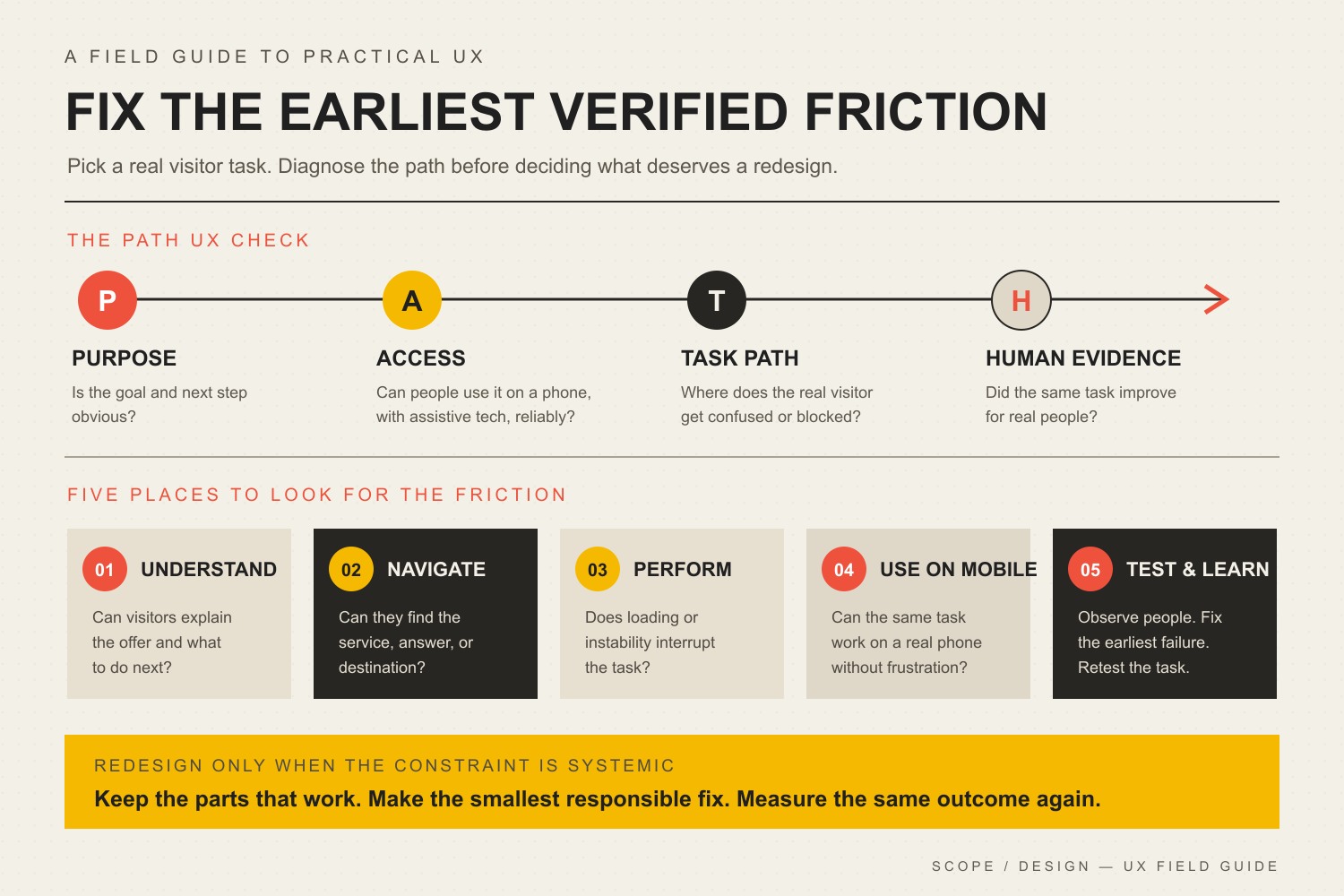
    Most business-site UX work lands in a handful of areas: understanding the user and task, simplifying navigation, improving performance, designing for real mobile behavior, and testing what actually changed. The visual below is a useful map of those areas. It is not a priority order. The right priority depends on where the task first breaks.

    The PATH UX Check covers Purpose, Access, Task path, and Human evidence, then five improvement areas: understand, navigate, perform, use on mobile, and test and learn.
    Five common website UX improvement areas. Diagnose the failing task before deciding which area deserves the next change.

    Use the Scope Design PATH UX Check

    The PATH UX Check is a simple way to stop a UX project from becoming a pile of unrelated best practices. Start at Purpose, then check Access, then the Task path, then Human evidence. When you find a verified constraint, fix the smallest responsible thing that can remove it and test again.

    PATH stepQuestionWhat to inspect
    P: PurposeWhat useful job is the visitor trying to finish?Offer clarity, page intent, qualification, primary next step, business outcome
    A: AccessCan the visitor reliably perceive and operate the experience?Performance, mobile behavior, accessibility, technical errors, input methods
    T: Task pathCan the visitor find, understand, trust, and complete each necessary step?Navigation, content, forms, controls, proof, feedback, error recovery
    H: Human evidenceWhat do real behavior and real outcomes show?Task observation, analytics, form errors, support questions, sales feedback, qualified outcomes

    PATH is not a claim that every journey is perfectly linear. Returning customers behave differently from first-time visitors, and people jump between pages. Its job is to keep the diagnosis ordered enough that you do not polish a later step while an earlier one is still failing.

    P: make the purpose and next step obvious

    Before you change colors, animations, or card layouts, read the page without the design language in your head. Can a visitor answer three questions: What is this? Is it for me? What should I do next?

    Use descriptive headlines instead of welcome copy. Name services the way customers recognize them. Make the primary call to action visually distinct from secondary actions. Put qualification details near the decision they affect instead of hiding them in an FAQ nobody has reached yet.

    Sometimes the first constraint is not “design” at all. If the page structure is sound but visitors still cannot understand the offer, compare the evidence before choosing between a layout change and a message change. Our guide to deciding whether design or content is the real conversion constraint goes deeper on that distinction.

    A: make the experience accessible, responsive, and reliable

    Test the task on a real phone

    “Responsive” is not the same as usable. A page can technically collapse to a narrow screen while still producing tiny controls, giant sticky elements, intrusive pop-ups, awkward forms, hidden comparison information, or a call to action that disappears several screens below the content that created intent.

    Use your actual phone. Try the same representative task in portrait orientation with the on-screen keyboard open. Check whether text remains readable, controls remain operable, focus is visible, the page survives zoom, errors appear near the right field, and fixed elements do not cover what you are trying to use.

    For a deeper treatment of responsive behavior, see why mobile optimization is more than shrinking the desktop layout.

    Fix performance that interrupts the task

    Speed matters because waiting, delayed responses, and unexpected movement interrupt what the visitor is trying to do. Google’s current Core Web Vitals cover Largest Contentful Paint (LCP), Interaction to Next Paint (INP), and Cumulative Layout Shift (CLS). For field data, the current “good” thresholds are LCP at 2.5 seconds or less, INP at 200 milliseconds or less, and CLS at 0.1 or less, evaluated at the 75th percentile. Those thresholds come from the official Core Web Vitals threshold guidance.

    Those metrics are useful diagnostics, not a complete definition of UX and not a ranking guarantee. Google explicitly recommends evaluating page experience holistically rather than treating it as a single signal. Its page experience guidance for Search is a useful guardrail against turning Core Web Vitals into superstition.

    • Resize and compress images instead of sending oversized files to every device.
    • Avoid loading scripts and widgets on pages that do not need them.
    • Reserve space for images, embeds, banners, and injected content so the interface does not jump.
    • Break up expensive JavaScript work that delays interaction.
    • Use field data when enough real-user data exists and lab tests to reproduce and diagnose individual problems.

    If performance is the verified constraint, use our website speed optimization guide for the implementation work instead of bloating this UX article into a performance manual.

    Treat accessibility as core usability

    Accessibility is part of UX because a task that cannot be perceived or operated is not a successful experience. The Web Content Accessibility Guidelines (WCAG) 2.2 organize accessibility around content that is perceivable, operable, understandable, and robust, with testable success criteria underneath those principles.

    Useful checks include keyboard navigation and visible focus, meaningful labels and instructions, identifiable errors, text that can resize without losing content or functionality, sufficient contrast, text alternatives where they carry meaning, and controls that do not depend on one input method. WCAG 2.2 also includes a Level AA Target Size (Minimum) criterion of 24 by 24 CSS pixels or one of its listed spacing, inline, equivalent, user-agent, or essential exceptions. The W3C’s Target Size explanation is the better reference than repeating an arbitrary “every button must be 44 or 48 pixels” rule.

    Accessibility requirements can intersect with legal obligations, but this article is not legal advice. Our detailed guide on improving website accessibility and ADA-related readiness covers the implementation problem in more depth.

    T: improve the task path, not just the interface

    Fix navigation and information architecture

    Navigation should help people predict where information lives. Clever labels create a tax on every click. “Solutions” might make sense internally, but if the customer is looking for “Commercial Roofing,” use the language that reduces interpretation.

    Audit the path, not just the menu. A visitor can have a tidy header and still get stuck because a service page has no next step, pricing context appears after the form, a location page dead-ends, or related information is scattered across pages with no useful cross-links.

    • Use labels that describe the destination.
    • Keep important routes consistent across templates.
    • Put supporting information near the decision it supports.
    • Use clear parent-child structure when the hierarchy is deep.
    • Check search, filters, account tools, or directories when they are necessary to a primary task.

    Reduce unnecessary form friction

    Forms fail for more reasons than “too many fields.” The better question is whether each step asks for information the business needs at that point, in a way the visitor can understand and recover from.

    Remove fields that exist only because somebody once thought they might be useful. Group related questions. Use persistent labels instead of placeholder-only instructions. Explain unusual requirements before the visitor triggers an error. Preserve entered information when validation fails. Make success unmistakable, including what happens next and when.

    Do not automatically shorten a form if qualification matters. A two-field lead form can create more submissions and worse leads. The UX target is not the least effort at any cost. It is the least unnecessary friction consistent with a useful outcome.

    Put trust and feedback where decisions happen

    Visitors hesitate when the cost of being wrong feels high. The useful response is not to dump a wall of testimonials at the top of every page. Put the right reassurance near the uncertainty it resolves.

    • Place relevant proof near the claim it substantiates.
    • Explain warranties, cancellation rules, returns, response times, or process steps before commitment.
    • Use real project examples or photographs when authenticity matters.
    • Show progress when a multi-step task takes time.
    • Confirm successful actions clearly.
    • Write error messages that explain what happened and how to recover.

    Feedback is UX, too. A button that looks dead after a click, a form that silently submits, or a filter that changes results without making the state clear forces the visitor to guess whether the interface heard them.

    A first-party example: ask for what the step actually needs

    On a fleet-services application flow we reviewed, the site asked people for information the business did not need at that stage. The reflexive UX answer could have been “make the form prettier” or “cut the form in half.” Instead, the useful question was what information the business needed now to move the application forward.

    Scope simplified the request to match that stage and instrumented the intended action so the business could judge what happened next. There is no honest universal conversion percentage to attach to that lesson. The information gain is the decision rule: remove unjustified friction, preserve justified friction, and measure the downstream outcome that matters.

    That distinction matters because UX can be made worse by chasing ease as the only goal. A financing application may need informed consent. A medical or safety workflow may need confirmation. A service business may need qualification details before promising a call. Good UX removes confusion and needless effort without removing safeguards the task genuinely requires.

    H: use human evidence before declaring a win

    Before changing the interface, record a baseline for the task you care about. Then compare the same task after the change. Pick measurements that reflect the actual job rather than whatever happens to be easiest to graph.

    • Task completion: Can representative users finish the task?
    • Time and effort: Where do they hesitate, backtrack, or ask for help?
    • Form or checkout completion: Where do people stop, and what errors occur?
    • Qualified outcome: Did the change improve useful leads, bookings, sales, applications, or support resolution rather than merely clicks?
    • Technical experience: Did mobile behavior, errors, accessibility failures, or Core Web Vitals improve where they were genuine constraints?
    • Qualitative evidence: What do user tests, support questions, sales conversations, and customer feedback reveal that analytics cannot explain?

    Do not declare a win because one chart moved. A shorter form that produces more junk leads may be worse. A new navigation that increases clicks because people now need two clicks instead of one is not automatically better. Connect the proxy to the outcome.

    Use symptoms to choose the first fix

    SymptomFirst questionLikely first fix to testWhat not to assume
    Visitors land but do not actDo they understand the offer and next step?Clarify message, qualification, and primary actionThat the page needs a visual redesign
    People cannot find key informationDo labels and page structure predict where it lives?Fix navigation, hierarchy, or contextual linksThat the menu simply needs fewer items
    Mobile users struggle with formsWhat breaks with a real phone and keyboard open?Fix layout, labels, controls, validation, or sticky UIThat “responsive” means usable
    Page feels slow or unstableWhich delivery problem interrupts the task?Fix the measured performance constraintThat a single score defines UX
    People start a form but abandon itIs the request justified and understood at that stage?Remove needless fields, explain requirements, improve recoveryThat shorter is always better
    Several templates fail in the same wayIs the constraint structural across the system?Evaluate a redesign or component-system changeThat local patches will stay cheaper

    How to know whether you actually need a redesign

    A redesign is justified when the constraint is structural enough that local fixes would create more complexity than they remove. That can happen when templates make essential content impossible to prioritize, the navigation model no longer matches the business, the component system cannot support accessible interaction, the mobile layout is fundamentally broken, performance problems are embedded in the architecture, or years of patchwork have made the site unsafe to change.

    “I am bored with it” is not the same thing. Neither is “a competitor changed theirs.” Preserve what works. If a narrow fix restores the task without creating another problem, take the narrow fix. If the same constraint appears across templates, journeys, devices, and content types, the evidence for redesign becomes stronger. Use the website redesign checklist when the problem has crossed that line.

    A 90-minute website user experience audit

    You can surface useful problems without commissioning a six-week research project. Use this website user experience audit as triage, not as a substitute for deeper research when the stakes are high.

    1. Choose one task. Name the visitor, starting page, intended outcome, and business value.
    2. Run the path cold. Use a phone and desktop. Record the first hesitation or failure rather than making a wish list.
    3. Check Purpose. Can the visitor understand the offer, qualification, and next step without insider knowledge?
    4. Check Access. Test mobile behavior, keyboard access, zoom, focus, performance, forms, and technical errors.
    5. Check the Task path. Can the person find, understand, trust, operate, complete, and recover?
    6. Collect Human evidence. Compare the observation with analytics, support questions, sales feedback, and form errors.
    7. Choose one constraint. Fix the earliest verified failure with the smallest responsible change.
    8. Repeat the same task. Compare behavior and outcomes to the baseline before opening a new round of work.

    Frequently asked questions about improving website UX

    What should I improve first on my website?

    Improve the earliest verified point of friction in an important visitor task. If people do not understand what the page offers, start with Purpose. If they understand it but cannot operate the experience, check Access. If the interface works but people cannot find, trust, or complete the next step, fix the Task path. Use Human evidence to decide whether the change actually helped.

    Do I need to redesign my website to improve user experience?

    Usually not. Many UX problems can be improved through content, navigation, forms, responsive behavior, performance, accessibility, trust, or feedback changes. Redesign when the underlying templates, architecture, component system, or accumulated technical debt prevent responsible local fixes.

    Are Core Web Vitals the same as user experience?

    No. LCP, INP, and CLS measure important aspects of loading, responsiveness, and visual stability. They do not tell you whether the offer is understandable, navigation is logical, a form asks the right questions, or the visitor trusts the business. Treat them as technical evidence inside a larger UX diagnosis.

    How do you measure website user experience?

    Measure the task and the outcome together. Useful evidence can include task completion, time and errors, form completion, qualified conversions, support questions, user-test observations, accessibility findings, and Core Web Vitals. Establish a baseline before the change so you can tell whether the fix improved the real job.

    What is the 3-second rule in website design?

    There is no universal UX standard saying every visitor leaves after exactly three seconds or that every page must fully load within that number. Use current performance measures such as LCP, INP, and CLS plus task evidence instead of treating a catchy timing rule as a law. More importantly, fix the specific delay or instability that interrupts the user’s task.

    What are the key factors in website user experience?

    There is no single official seven-factor list for every website. For practical business-site work, PATH covers the useful decision areas: Purpose, Access, Task path, and Human evidence. Inside those buckets you will inspect clarity, navigation, mobile behavior, accessibility, performance, forms, trust, feedback, completion, recovery, and real outcomes.

    Are the “7 C’s of a website” an official UX standard?

    No. Different articles use different “C” lists as teaching mnemonics. They can be useful if they help a team remember a real problem, but they are not a substitute for current technical standards, task observation, or business evidence. Use a mnemonic only when it improves the diagnosis rather than turning UX into a checklist contest.

    How to improve website user experience without replacing what works

    The best UX improvement is not the change with the most pixels attached to it. It is the change that removes the most important verified friction without creating a new one.

    Define the task. Run PATH. Find the earliest failure. Make the smallest responsible fix. Test the same task again. When the constraint is structural, redesign with evidence. When it is not, keep the working parts and solve the real problem.

    If your team knows the site is creating friction but cannot isolate the constraint, Scope Design’s web services team can audit the path across strategy, content, design, development, performance, accessibility, and measurement, then turn the findings into a prioritized plan instead of a cosmetic wish list.

    Sources and methodology

    This article was researched through a monitored Scope Design workflow on August 21, 2026. We reviewed Scope Design’s current UX doctrine in Open Brain, neighboring Content Studio articles and typed relationships, the literal internal-link graph, U.S. Ubersuggest keyword and SERP evidence, DataForSEO search and AI-query evidence, and current primary technical sources. Third-party search volumes were treated as directional research, not business-outcome facts.

    Primary technical references include web.dev’s Core Web Vitals threshold guidance, Google’s page experience guidance, the W3C’s WCAG 2.2 Recommendation, and the W3C’s Target Size (Minimum) explanation. We deliberately excluded legacy percentages about abandonment, UX ROI, universal conversion lifts, mobile traffic share, and navigation limits when the recovered evidence did not provide a defensible source chain.

  • Using Marketing Tactics in Tandem with A Solid Strategy

    Using Marketing Tactics in Tandem with A Solid Strategy

    Marketing strategy and tactics work together only when strategy decides what must change, for whom, and why, while tactics handle the specific actions and channels used to make it happen. Each tactic needs a defined job, a clear handoff to the next step, and measurement tied to a business outcome.

    Most small businesses do not have a shortage of marketing tactics. They have a shortage of reasons for choosing them.

    SEO, paid search, social media, email, direct mail, events, video, referral programs, and automation can all work. They can also become an expensive collection of chores when nobody can explain what business problem each tactic is supposed to solve, what should happen next, or how success will be judged.

    That is the point of using marketing tactics with strategy: fewer disconnected activities, clearer decisions, and a system that can tell you what to keep, change, or stop.

    TL;DR: Start with the business objective and the constraint blocking it. Clarify positioning and strategy before choosing tactics. Give each tactic one primary job, define its handoff, and judge the system by business outcomes before platform metrics.

    Marketing strategy vs. tactics: the practical difference

    The distinction is simple enough to memorize and easy enough to ignore.

    LayerQuestion it answersExample
    Business objectiveWhat outcome must improve?Increase qualified sales conversations from established regional manufacturers.
    StrategyHow will we create that outcome, and what will we deliberately prioritize?Win high-intent buyers by making specialized expertise easier to find and easier to trust.
    TacticsWhat specific actions will execute the strategy?Search content, paid search, case studies, a focused service page, and follow-up email.
    MeasurementHow will we know whether the system is working?Qualified conversations and pipeline, with channel and handoff metrics used to diagnose performance.

    The U.S. Chamber of Commerce’s small-business planning guidance makes a similar distinction: strategy sets direction, goals define measurable outcomes, and tactics are the actions tied to those goals and metrics. That hierarchy matters because a tactic can be executed perfectly and still be the wrong move.

    A beautiful landing page cannot rescue an offer people do not want. More traffic cannot repair a sales team that never follows up. Posting every day on social media does not solve a discoverability problem if the buyers who matter are searching elsewhere. The tactic may be fine. The diagnosis may be wrong.

    The Scope Design strategy-to-tactics sequence

    Scope Design uses a constraint-first sequence when deciding what marketing work deserves attention:

    Objective → Constraint → Positioning → Strategy → Tactics → Measurement

    1. Objective: Define the business outcome you actually need.
    2. Constraint: Identify the most important thing currently preventing that outcome.
    3. Positioning: Decide what the right buyer must understand or believe for progress to become possible.
    4. Strategy: Choose the approach that addresses the constraint and creates the required change.
    5. Tactics: Select the channels, campaigns, assets, and actions justified by the strategy.
    6. Measurement: Test whether the system moved the objective, then use supporting metrics to find where it worked or failed.

    The operating rule behind the sequence is even shorter: a requested tactic is evidence, not a diagnosis.

    When someone says, “We need Facebook ads,” “We need more SEO,” or “We need a newsletter,” that tells you what solution they currently have in mind. It does not prove that the solution matches the constraint. The broader small business marketing strategy should establish the system first. Tactics plug into it after the bottleneck is understood.

    Step 1: Diagnose the constraint before choosing a tactic

    Start with the business outcome, then ask what is preventing it. That one change in order eliminates a lot of “shiny object” marketing.

    What you observePossible constraintWhat it means for tactics
    The right prospects rarely find you.Awareness, discoverability, targeting, or distributionSEO, paid search, partnerships, local visibility, or outbound may deserve investigation.
    Relevant traffic arrives but few qualified people take the next step.Message, offer, proof, page experience, or conversion pathBuying more traffic may simply send more people into the same leak.
    Qualified leads arrive but do not become opportunities.Qualification, response time, sales handoff, or follow-upCRM routing, sales process, nurture, or booking improvements may matter more than lead generation.
    Customers buy once and disappear.Retention, lifecycle communication, service experience, or lack of a next offerEmail, account outreach, customer education, reminders, or loyalty work may be more useful than acquisition.

    More than one constraint can exist. The goal is not to pretend the business has one problem forever. It is to identify the first meaningful bottleneck well enough that your next marketing dollar has a reason behind it.

    Step 2: Give every tactic one primary job

    Once the constraint is clear, assign each tactic a primary job inside the campaign. A channel does not have one universal purpose. Its job depends on the objective and the buyer’s moment.

    • Search can capture existing intent from people already looking for an answer, product, or provider.
    • Educational content can reduce uncertainty, answer comparison questions, and give sales teams something useful to send.
    • Paid media can create controlled access to an audience, test a message, or scale a path that already works.
    • Email can nurture a lead, reactivate a customer, support onboarding, or trigger a timely next step.
    • Social media can distribute ideas, create familiarity, surface proof, or keep a brand present in a community.
    • Local and offline activity can build geographic awareness, credibility, referrals, and reasons for people to search for the brand later.

    The same email tool can support lead nurture in one campaign and customer retention in another. The tactic is not the strategy. The job you assign it is what gives it meaning.

    If you need the larger operating model for websites, search, content, email, social, paid media, analytics, sales, and lifecycle work, Scope Design’s digital marketing strategy guide goes deeper into assigning distinct channel roles without turning the stack into a tool pile.

    Step 3: Design the handoff between tactics

    Tactics begin to work in tandem when the output of one becomes a sensible input to the next.

    A handoff does not need to be complicated automation. It needs a clear next step and an owner.

    • Search ad → focused landing page → qualified booking → confirmation → sales response.
    • Problem-solving article → useful worksheet → permission-based email sequence → relevant service page → consultation.
    • Community event → QR or tagged URL → location-specific page → inquiry or email signup → follow-up.
    • Completed purchase → onboarding message → educational content → service reminder → repeat purchase or renewal.

    For each handoff, write down four things: what triggers it, where the person goes, who or what owns the response, and what evidence tells you the handoff worked.

    That is often where “channel performance” problems are hiding. The ad generated the right click, but the landing page answered the wrong question. The form worked, but the notification went to an unmonitored inbox. The newsletter earned attention, but every link dumped readers on the homepage. The tactics existed. The path did not.

    Step 4: Measure the outcome, then diagnose the signal

    Do not confuse the easiest metric to collect with the result the business needed.

    Google Ads’ conversion-measurement documentation starts from a useful principle: the advertiser chooses the actions that are valuable to the business—such as a purchase, signup, or phone call—and then measures which campaigns and keywords drive those actions. Your broader marketing measurement should follow the same logic.

    Use two levels of measurement:

    1. Business outcome: the deepest result the marketing system can reasonably influence, such as qualified conversations, pipeline value, booked-and-attended appointments, repeat purchases, renewals, or revenue.
    2. Diagnostic signals: the metrics that help explain why the outcome moved or did not move, such as impression share, click-through rate, landing-page conversion, source-to-qualified rate, response time, email engagement, booking completion, or repeat-visit behavior.

    An impression can tell you whether something was seen. A click can tell you whether the message earned a response. Neither can tell you by itself whether the business acquired a good customer.

    Measurement should also produce a decision. Before a campaign launches, decide what evidence would make you keep, change, or stop a tactic. The threshold may depend on sales cycle, traffic, budget, seasonality, and sample size. There is no honest universal schedule that says every business must make the same decision after seven days or every strategy must be rebuilt every quarter.

    Three examples of marketing tactics working in tandem

    Example 1: Increase qualified inquiries

    Objective: Increase qualified sales conversations for a specialized service.

    Constraint: High-intent prospects exist, but they do not find enough relevant evidence or a clear path to start a conversation.

    • Paid search: capture high-intent demand now.
    • Service landing page: explain fit, scope, proof, and the next step.
    • Case study or decision article: reduce uncertainty for buyers who are not ready to contact sales immediately.
    • Email or CRM follow-up: continue the conversation when the buyer needs more time.

    Handoff: Search → service page → proof/decision content → qualified form or booking → sales response.

    Outcome: Qualified conversations and pipeline. Click-through rate, landing-page conversion, response time, and source-to-qualified rate are diagnostic signals—not the finish line.

    Example 2: Improve customer retention

    Objective: Increase repeat business from customers who already received value.

    Constraint: Customers do not remember the next service, do not know what else the business can help with, or receive no timely reason to return.

    • Customer email: deliver reminders and relevant education based on lifecycle timing.
    • Knowledge-base or FAQ content: answer common post-purchase questions and reduce uncertainty.
    • Account or service-team outreach: handle high-value situations that deserve a human conversation.
    • CRM trigger: surface the right customer when a renewal, maintenance interval, or follow-up condition is reached.

    Handoff: Customer event → reminder or education → relevant next offer → human outreach when needed.

    Outcome: Repeat purchase, renewal, retention, or expansion. Open rate is useful only when it helps diagnose whether the communication is reaching and engaging the customer. For deeper execution guidance, see Scope Design’s email newsletter strategy.

    Example 3: Build local awareness that can be measured

    Objective: Generate more first-time inquiries or visits from a defined service area.

    Constraint: The offer is credible and converts when people find it, but too few local buyers know the business exists.

    • Community sponsorship or event: create real-world visibility and association.
    • Organic social: extend the event, people, proof, and story beyond the room.
    • Location-specific page: give interested people a relevant destination instead of a generic homepage.
    • Branded or local search support: capture people who search after seeing the business elsewhere.

    Handoff: Offline exposure → QR code or tagged URL → relevant page → inquiry, call, booking, or email opt-in.

    Outcome: Qualified local inquiries, bookings, or store visits where they can be measured. Google’s GA4 manual-campaign documentation confirms that UTM parameters populate manual campaign dimensions, which makes tagged campaign links useful when you need to distinguish sources and mediums in analytics.

    Should you change the strategy, channel, campaign, or tactic?

    When results disappoint, do not immediately replace the most visible tactic. Diagnose the level at which the problem exists.

    • Change the strategy when the audience, positioning, offer, business constraint, or desired outcome is wrong.
    • Change the channel mix when the mechanism does not match the buyer’s moment, the usable signal is too weak, the economics cannot work, or the team cannot realistically operate the channel.
    • Change the campaign when the channel is appropriate but the audience, message, creative, offer, destination, sequence, or measurement is wrong.
    • Change the tactic when the larger decisions are sound and one specific execution element is demonstrably limiting results.

    This distinction matters because “the ads aren’t working” can describe four completely different problems. Scope Design’s guide to diagnosing why marketing isn’t working goes deeper into finding the bottleneck before buying another tactic.

    A five-question strategy-to-tactics worksheet

    Before you add another channel, campaign, or tool, answer these five questions in plain language:

    1. What business outcome are we trying to improve? Use a result the business actually cares about, not a platform metric.
    2. What evidence tells us what is preventing that outcome right now? Separate observation from assumption.
    3. What must the right buyer understand, believe, or be able to do for that constraint to loosen?
    4. Which tactics can we realistically operate, and what single primary job will each one have? Include the next handoff.
    5. What result will make us keep, change, or stop the approach? Name both the business outcome and the diagnostic signals you will use to explain it.

    If you cannot answer question two, you are probably not ready to choose a new tactic. If you cannot answer question four, you may be collecting channels rather than designing a marketing system. If you cannot answer question five, you have activity without a learning loop.

    Frequently asked questions about marketing strategy and tactics

    What is the difference between a marketing strategy and a marketing tactic?

    A marketing strategy defines the approach, priorities, audience, positioning, and tradeoffs used to achieve a business objective. A marketing tactic is a specific action, channel, campaign, or execution choice used to carry out that strategy. Strategy explains why this approach; tactics explain what you will do.

    Do all of my marketing channels need to work together?

    No. Coordination does not mean forcing every channel into every campaign. A channel belongs when it has a useful job, a realistic owner, and a sensible handoff. Sometimes one well-matched channel and a strong follow-up path are better than an “omnichannel” plan nobody can maintain.

    How many marketing tactics should a small business use?

    There is no universal number. Use as few as necessary to cover the important jobs in the customer path and no more than the team can operate well. Capacity, audience behavior, sales cycle, budget, and the constraint should determine the mix.

    Can the same tactic support different strategies?

    Yes. Email can nurture a lead, onboard a customer, generate a repeat purchase, or support a referral program. Paid search can capture demand for a core service or test whether a new offer resonates. Define the tactic’s job within the specific campaign so its performance can be interpreted correctly.

    How often should I review my marketing strategy?

    Review tactics when enough evidence exists to make a responsible decision and review strategy when the underlying objective, constraint, audience, positioning, economics, or market conditions materially change. Operational decisions usually happen more often than strategic changes, but a fixed weekly/monthly/quarterly schedule is not a substitute for sufficient evidence.

    What is the biggest warning sign that my tactics are disconnected?

    Ask someone to explain what business outcome each tactic supports, what happens after a person responds, and which result would cause the team to change course. If the answers are mostly platform metrics, vague awareness goals, or “because we should be doing it,” the tactics are probably operating without enough strategy.

    Stop adding tactics. Start designing the system.

    A solid marketing strategy does not make tactics less important. It makes them accountable. It gives every channel a reason to exist, every campaign a place in the customer path, and every metric a decision it is supposed to inform.

    If your marketing calendar is full but the answer to “what constraint is this removing?” is fuzzy, do not solve that confusion by buying another tool or channel. Start with the system. Review Scope Design’s small business marketing strategy framework, or talk with Scope Design about a marketing audit and a clearer path from attention to business outcomes.

    Sources and further reading

  • How to Turn Business Mistakes Into Growth Opportunities That Drive Success

    How to Turn Business Mistakes Into Growth Opportunities That Drive Success

    Business mistakes do not automatically make a company stronger. A bad hire, failed launch, lost client, pricing error, or expensive assumption only becomes useful when it changes what you do next.

    That is the difference between having experience and learning from experience. The mistake is the event. The growth opportunity is the evidence you extract, the system you change, and the next bounded test you run.

    The short version: stabilize the damage, reconstruct what actually happened, identify the system or assumption that failed, make one concrete change, test that correction, and preserve the lesson so you do not pay tuition for the same mistake twice.

    Mistakes Do Not Create Growth. Feedback Loops Do.

    “Learn from your mistakes” sounds sensible, but it is incomplete advice. Plenty of businesses repeat the same problem with a slightly different customer, employee, campaign, vendor, or quarter.

    The useful question is not, “What lesson should I take from this?” It is, “What will be different in the business because this happened?”

    • If a proposal keeps getting misunderstood, change the proposal or sales process.
    • If a project became unprofitable because scope drift went unnoticed, change the checkpoints, pricing assumptions, or change-order rules.
    • If a product launch missed the mark because the team guessed at demand, change how you validate an idea before making a larger bet.
    • If one person could make an expensive error with no review, change the control—not merely the reminder to “be more careful.”

    This systems-first idea is not limited to business. Google’s SRE postmortem guidance emphasizes concrete, owned, measurable actions after incidents and warns that vague action items are easy to forget. OSHA’s incident-investigation guidance similarly recommends looking beyond immediate blame to underlying causes and corrective actions that reduce recurrence. A small business does not need an enterprise incident-management department to use the same principle: fix the conditions that made the mistake possible.

    The Five-Step Mistake-to-Growth Loop

    Use this loop after a meaningful mistake—something that cost money, trust, time, momentum, or strategic clarity. The goal is not to create paperwork. The goal is to produce three useful outputs: a defensible lesson, a system change, and a next test.

    Five steps for learning from a business mistake: stabilize damage, reconstruct what happened, change the system, run a bounded test, and preserve the learning.

    1. Stabilize the Damage Before You Analyze It

    When a mistake is still causing damage, analysis can wait. Stop the leak first.

    • Pause the campaign that is spending badly.
    • Contact the client whose expectations were missed.
    • Correct the invoice, access setting, price, schedule, or fulfillment problem.
    • Preserve records you will need to understand what happened.
    • Escalate legal, safety, security, tax, or compliance issues to the right professional instead of treating them as an experiment.

    Containment matters because an open problem distorts the review. Everyone becomes focused on defending themselves, pleasing the loudest stakeholder, or stopping the immediate pain. Stabilize first; learn second.

    2. Reconstruct What Actually Happened

    Memory becomes a storyteller very quickly. Reconstruct the mistake from observable facts before deciding what it “means.”

    Write down:

    • What did we expect to happen?
    • What actually happened?
    • What did we know when the decision was made?
    • What did we assume?
    • What signals did we miss, dismiss, or never collect?
    • Where did the outcome first diverge from the plan?
    • What made the problem larger or harder to detect?

    This is where you separate a bad outcome from a bad decision. Sometimes the decision was reasonable and the environment changed. Sometimes the outcome exposed an assumption you never tested. Sometimes execution was sloppy. Those are different failures and require different fixes.

    If the real issue is that your team struggles to make the choice in the first place, use a separate business decision-making framework. This article starts after there is an outcome to learn from.

    3. Change the System, Not Just the Story

    A lesson such as “communicate better,” “plan more,” or “do more research” is not a system change. It is a wish.

    Ask which part of the business needs to change:

    • Decision rule: What condition will make us say yes, no, stop, or escalate next time?
    • Process: What step, review, handoff, or checkpoint was missing?
    • Control: What should require approval, validation, backup, or a second set of eyes?
    • Assumption: What did we believe without enough evidence?
    • Signal: What leading indicator should we watch earlier?
    • Capability: Do we need better training, tooling, expertise, or role clarity?

    The best corrective action changes the environment in which future decisions are made. “Remember not to do that again” depends on memory. A new review step, pricing rule, alert, checklist, data field, contract clause, or validation threshold changes the system.

    4. Run a Bounded Test Instead of Swinging to the Opposite Extreme

    One painful mistake can make a business overcorrect. A bad employee leads to refusing to delegate. One weak campaign kills marketing for a year. One difficult client creates an approval process that punishes every good client.

    Do not let one data point become a permanent doctrine. Turn the correction into a bounded test:

    1. State what you changed.
    2. State what result you expect.
    3. Choose the smallest useful place to test it.
    4. Define what would count as success, failure, or “we still do not know.”
    5. Set a review date.

    This makes the lesson falsifiable. You are not trying to prove that your new idea is right; you are trying to make the next decision with better evidence.

    5. Preserve the Learning So the Company Gets Smarter

    If the insight lives only in the owner’s head, the company has not learned—one person has.

    Keep a simple mistake log or after-action note. It does not need to be a novel. Record the event, evidence, lesson, system change, owner, test, and recheck date. Link it to the process or decision it changed.

    Over time, this creates institutional memory. New team members do not have to rediscover why a rule exists. Repeated failures become visible. And when an old rule stops making sense, you can see the evidence that created it and decide whether the context has changed.

    Classify the Mistake Before You Choose the Lesson

    Not every bad outcome deserves the same response. A quick classification prevents you from solving the wrong problem.

    Type of mistakeWhat it usually meansUseful response
    Execution errorThe plan was sound, but the work broke downClarify ownership, sequence, training, checklist, or quality control
    Process/control failureThe system allowed an avoidable error to pass uncheckedAdd a review, approval, alert, backup, or handoff rule
    Assumption failureYou believed something important without enough evidenceImprove research, validation, or early signal collection
    Strategy errorThe business chose the wrong market, offer, priority, timing, or resource allocationRevisit the decision criteria and run a smaller next bet
    External shockThe environment changed in a way you could not reasonably controlImprove resilience, optionality, detection, or contingency planning

    Classification also protects you from hindsight bias. A reasonable decision that lost because the market changed is not the same as a decision that ignored obvious evidence. The lesson should fit the failure.

    Be Blameless About Causes and Accountable About Actions

    “Blameless” does not mean nobody owns anything. It means the review is designed to understand why the outcome made sense to the people involved at the time, then fix the conditions that should change.

    A productive review can say, “This action was wrong and caused damage,” without stopping at, “Jordan messed up.” Ask why the error was possible, why it was not caught, what information was missing, what pressure existed, and what safeguard failed.

    Then make the follow-up extremely accountable. Every corrective action should have an owner and a verifiable end state. “Improve onboarding” is fog. “Add a pre-launch QA checklist to every new client project and require the project lead to sign it before launch” can actually be completed.

    And if a painful mistake has made you afraid to make another move at all, solve that problem separately. Our guide to overcoming fear in business deals with the uncertainty and avoidance that can follow a setback.

    When a Business Mistake Is Not a “Growth Experiment”

    There is a limit to the “mistakes are opportunities” idea.

    Do not romanticize harm. An ethical breach, safety issue, security incident, discrimination complaint, tax problem, legal violation, or knowingly repeated negligence is not clever experimentation. The first obligations are to stop the harm, make appropriate restitution, preserve evidence, report or disclose what is required, and get qualified help where necessary.

    You can still learn from what happened. But “growth opportunity” should never become an excuse to minimize consequences or dodge accountability.

    Measure Whether the Lesson Actually Changed the Business

    There is no universal benchmark for how quickly a company should learn from a mistake. A two-person service firm, a manufacturer, and a software company have different risks and cycles. Measure improvement against your own baseline and the specific failure you are correcting.

    • Recurrence: Did the same failure happen again?
    • Time to detect: Do you notice the warning signal earlier?
    • Time to correct: Can you contain and fix the issue faster?
    • Corrective-action closeout: Did the agreed changes actually get implemented?
    • Cost of repetition: Is the financial or operational impact falling?
    • Test result: Did the changed process or assumption improve the outcome you cared about?

    Those metrics turn “we learned a lot” into something observable. They also reinforce a broader truth about sustainable business growth: progress usually comes from better decisions compounding, not one dramatic breakthrough.

    A 30-Minute After-Action Review for Small Businesses

    You do not need a retreat, facilitator, or 40-page report. For many mistakes, 30 focused minutes is enough if you leave with decisions.

    1. 5 minutes — State the event. What happened, what was the impact, and what did we expect instead?
    2. 10 minutes — Reconstruct the evidence. Timeline, assumptions, signals, contributing conditions, and what was known at each point.
    3. 5 minutes — Identify the system change. Which rule, process, control, assumption, signal, or capability should change?
    4. 5 minutes — Design the next test. Where will we try the correction, and what result will tell us whether it helped?
    5. 5 minutes — Assign follow-through. Owner, due date, documentation location, and review date.

    One rule makes this review dramatically better: do not end with a lesson that has no owner. Insight without a changed behavior or system is just a good conversation.

    Frequently Asked Questions About Business Mistakes

    How do you recover from a costly business mistake?

    Contain the immediate damage first. Then reconstruct the facts, identify the contributing system or assumption, make one concrete corrective change, test it in a bounded way, and document the result. If customers, employees, partners, or the public were harmed, accountability and appropriate remediation come before reframing the event as a learning opportunity.

    Should you blame the person who made the mistake?

    Hold people accountable for choices and responsibilities, but do not let blame replace diagnosis. Ask what information, incentives, process gaps, training, controls, or pressures made the error possible. A review that only identifies a person often leaves the same conditions in place for the next person.

    How do you stop repeating the same business mistake?

    Convert the lesson into a rule, process, control, signal, or documented standard. Give the corrective action an owner and due date, then track recurrence. If the same problem returns, the original action was incomplete, poorly implemented, or aimed at the wrong cause.

    When should you stop testing and abandon the idea?

    Define stop conditions before the next test. If the correction repeatedly fails to improve the key outcome, the economics no longer work, the risk is unacceptable, or new evidence invalidates the core assumption, continuing is not perseverance—it is refusal to update. Treat the new evidence as input to the next decision.

    What is the best metric for learning from mistakes?

    There is no single universal metric. Start with recurrence and the specific outcome the corrective action is meant to improve. Time to detect, time to correct, corrective-action completion, and cost of repetition can also show whether the business is actually getting better at responding.

    Turn the Mistake Into a Better Next Decision

    The goal is not to become a business that celebrates failure. It is to become a business that wastes less of it.

    When something goes wrong, ask for three outputs: What did the evidence teach us? What changed in the system? What will we test next? If you can answer all three, the mistake has a chance to become an asset instead of a recurring expense.

    For the larger strategic system behind those choices, see our business strategy and market intelligence playbook for a broader framework on market signals, operating constraints, and better bets.

  • How Websites Work: What Happens Between a Click and a Page Load

    How Websites Work: What Happens Between a Click and a Page Load

    A website is not a page sitting in the internet fog. It is a chain of systems that must cooperate: the domain must point to the right place, the browser must establish a trusted connection, the delivery and application infrastructure must build the response, the browser must turn it into something usable, and the form, checkout, booking, or other business task must actually finish. A 200 OK response proves a server answered. It does not prove the website did its damn job.

    TL;DR: A working page is only part of a working website

    • A visitor’s request moves through domain and DNS lookup, network routing, HTTPS, delivery infrastructure, the host and application, browser rendering, and the final business workflow.
    • Any layer can fail while the others appear healthy. That is why a website can load but a form can quietly send every lead into the void.
    • Test the chain with Scope Design’s CLICK test: Contact, Lock, Infrastructure, Construct, and Keep the promise.
    • Assign a business owner and technical owner to the domain, DNS, hosting, application, analytics, forms, email, integrations, and recovery plan.
    • Measure the last meaningful outcome the website can control. Uptime is useful. A completed, recorded, routed, and acknowledged business task is better.

    How does a website work in simple terms?

    When you enter a web address or click a link, the browser finds the website’s destination through DNS, connects to it over the internet, negotiates a secure HTTPS connection, requests a resource, receives a response from a server or intermediary, and then downloads and assembles the HTML, CSS, JavaScript, fonts, images, and data needed to display the page. That is the visible part.

    The business part continues after the page appears. A form may need to validate input, reject spam, store a submission, call a CRM, generate an email, pass authentication checks, reach an inbox, alert a staff member, and receive a human response. An online order may need to authorize payment, create the order, adjust inventory, send confirmation, and enter fulfillment. The website has not kept its promise merely because the button briefly changed color.

    MDN’s overview of how the web works explains the client, server, DNS, packet, and HTTP foundations. The Scope Design question is what those systems must accomplish together for the business.

    The internet, the web, and Wi-Fi are not the same thing

    The internet is the global network of connected networks that moves data between devices. The World Wide Web is one service that runs over that network, using URLs, HTTP, browsers, servers, and linked resources. Wi-Fi is one way a device connects to a nearby network. It is not the internet itself.

    Your laptop can have a strong Wi-Fi signal while the router has no working internet connection. A website can be reachable over the internet while its application is broken. A page can render while its sales notification fails. Those distinctions matter because “the website is down” is often a diagnosis assembled from panic and vibes.

    What happens when you type a URL into a browser?

    The exact path varies by browser, network, cache, CDN, platform, and application, but the useful business-level sequence is:

    1. The browser interprets the URL and checks relevant local information and caches.
    2. DNS resolves the hostname to the destination used for the request.
    3. The device routes packets through networks toward that destination.
    4. For HTTPS, the browser and responding system establish an encrypted, authenticated connection.
    5. The browser sends an HTTP request.
    6. A CDN, reverse proxy, cache, load balancer, web server, application, database, or third-party service may participate in producing the response.
    7. The browser receives an HTTP response and requests the additional resources the page references.
    8. It parses the HTML, applies CSS, runs JavaScript, lays out and paints the page, and enables interaction.
    9. The visitor attempts the real task—submitting, buying, booking, signing in, downloading, calling, or finding an answer.
    10. The application and connected business systems must record, route, confirm, and support that task.

    MDN’s browser-loading guide covers how browsers assemble HTML, CSS, JavaScript, and media. RFC 9110 defines HTTP semantics independently of a particular HTTP version.

    A 200 OK is not the same as a working website

    HTTP status 200 means the server successfully handled the HTTP request according to HTTP semantics. It does not certify that:

    • the correct content appeared;
    • the page works on a phone;
    • JavaScript completed without an error;
    • the form stored the submission;
    • the notification reached the right inbox;
    • analytics recorded the event once and attributed it correctly;
    • an order reached fulfillment;
    • somebody followed up with the lead;
    • the experience is accessible;
    • the page is fast enough for the people using it.

    This is why uptime monitoring is necessary and insufficient. A monitor that requests the homepage every five minutes can prove the homepage answered. It cannot prove the quote form worked, the payment provider returned correctly, or the booking calendar still had valid availability.

    The Scope Design CLICK test

    The CLICK test: Contact, Lock, Infrastructure, Construct, and Keep the promise, ending with proof that the business task was completed, recorded, and routed.
    The Scope Design CLICK test follows a visitor request through five stages and requires proof of the final business outcome.

    Use the CLICK test to follow a visitor request from the first contact to the business outcome.

    Contact: Can the visitor find and reach the correct destination?

    Contact covers the domain, registrar account, nameservers, DNS records, routing, and basic availability. DNS is the distributed naming system that helps clients locate services associated with a domain name. In plain English, it lets people use a memorable name instead of manually entering an address that may change.

    Common failures include:

    • the domain expires or renews against an obsolete card;
    • nameservers point to the wrong DNS provider;
    • an A, AAAA, CNAME, or other record points to the wrong destination;
    • one region or network receives stale or different DNS information;
    • an old service is removed before every dependent record is updated;
    • nobody knows which account actually controls the domain.

    The business should own or explicitly control the registrar account, keep recovery details current, document who can change DNS, and know where renewal notices go. Your domain is the front-door address of the business. Storing its only key in a former contractor’s personal account is not delegation. It is a future hostage negotiation.

    Lock: Can the browser establish a trusted, encrypted connection?

    HTTPS uses TLS to protect data in transit and authenticate the service the browser reached. The browser needs a valid certificate for the requested hostname and a connection it trusts. TLS 1.3 is specified in RFC 8446, but a business owner does not need to perform cryptography cosplay to understand the operating risk.

    Typical failures include:

    • an expired certificate;
    • a certificate issued for the wrong hostname;
    • a bad certificate chain;
    • the edge or CDN using HTTPS while the origin connection is misconfigured;
    • HTTP-to-HTTPS rules fighting with application redirects;
    • a redirect loop that sends the browser in circles until it gives up.

    Certificate automation has reduced routine work, not removed ownership. Someone still needs to know which system issues the certificate, which hostnames it covers, how renewal is validated, and what alert reaches a human if renewal fails.

    Infrastructure: Can the delivery and application stack produce the right response?

    Infrastructure may include a CDN, reverse proxy, cache, load balancer, host, web server, WordPress or another application, database, object storage, background jobs, APIs, plugins, and third-party services. Not every website uses every layer. More boxes do not automatically mean more sophistication. Sometimes they mean the diagram needed extra places to hide the blame.

    A CDN can serve cached resources closer to visitors and shield or accelerate the origin. A cache hit can avoid rebuilding a response. A cache miss is not automatically a failure; it often means the system must retrieve or generate the response and may then cache it. The implementation and cache rules determine whether that behavior is correct.

    Infrastructure failures include:

    • exhausted server resources;
    • a fatal application or plugin error;
    • a database connection or query failure;
    • stale cached HTML after an important update;
    • an API timeout;
    • a dependency changing its terms, credentials, endpoint, or behavior;
    • a redirect chain or loop;
    • a background job that never runs;
    • an update that succeeds technically but breaks a business workflow.

    This is where small-business web hosting matters, but faster hosting cannot repair inefficient application code, a broken integration, or an asset pile large enough to have its own postal code. Diagnose the actual constraint with a website speed optimization process before paying for random upgrades.

    Construct: Can the browser turn the response into a usable experience?

    After the browser receives a response, it still has work to do. It parses HTML, discovers and downloads supporting resources, builds internal structures, applies styles, runs scripts, calculates layout, paints pixels, and responds to interaction. MDN’s browser-performance guide describes navigation, DNS lookup, connection, response, parsing, rendering, and interactivity in more detail.

    Construction failures include:

    • CSS or fonts blocking visible content longer than necessary;
    • images or scripts that are far larger than the job requires;
    • a JavaScript exception that disables navigation or a form;
    • controls hidden below or outside the viewport;
    • layout shifts that move the button as a visitor tries to use it;
    • a browser-specific defect;
    • keyboard traps, missing labels, insufficient contrast, or other accessibility barriers;
    • a component that looks perfect with demo copy and collapses under real content.

    Responsive web design should preserve the customer’s task across screens, not merely shrink the desktop page until the words surrender. Cross-browser testing should prove critical tasks across a documented support matrix. A governed modular website design system can reduce repeated defects, but only when the modules themselves are tested, accessible, and intentionally limited.

    Keep the promise: Did the business task actually finish?

    This is the letter most technical diagrams politely forget.

    For a contact form, “finished” may mean:

    1. the browser validates and sends the request;
    2. the server validates it again;
    3. spam controls evaluate it without rejecting legitimate people;
    4. the submission is stored with a useful timestamp and context;
    5. any CRM or API handoff succeeds;
    6. a notification is generated;
    7. the sending system is authenticated and accepted for delivery;
    8. the message reaches the intended mailbox rather than spam or quarantine;
    9. the responsible person sees it;
    10. the business responds within its promised time.

    A success message on the screen proves almost none of that chain. If submissions are not stored, reconciled, monitored, and periodically tested, the business may learn about the failure from an angry prospect three months later. Delightful.

    The same principle applies to checkout, account creation, downloads, appointment booking, analytics, and any other conversion path. Test the outcome in the systems where the business actually works, not only the page where the visitor clicked.

    If you only test the first four CLICK stages, you can prove a page appeared. The fifth proves the website earned its keep.

    Who owns each website layer?

    One organization may fill several roles, but each role still needs a named owner and evidence.

    Domain, registrar, and DNS

    Business owner: an authorized business principal with current recovery access. Technical owner: the DNS or infrastructure maintainer. Proof: renewal status, registrar access, known nameservers, exported records, change history, and external resolution tests. Fallback: a second authorized contact, rollback records, and a documented transfer path.

    HTTPS, certificates, and edge delivery

    Business owner: the account owner for the CDN, edge, or host. Technical owner: the host or infrastructure maintainer. Proof: valid hostnames, certificate chain and renewal status, correct redirects, and external checks. Fallback: documented origin access and a manual recovery procedure.

    Hosting and application

    Business owner: the company-owned hosting account or explicit service contract. Technical owner: the host, developer, and maintainer according to their actual responsibilities. Proof: health checks, logs, supported versions, deployments, and monitoring. Fallback: a tested backup, rollback path, and named recovery owner.

    Database, files, and content

    Business owner: the business. Technical owner: the developer or platform operator. Proof: a recent restorable backup plus a usable export of the records and assets the business needs. Fallback: a documented migration route that has been tested before an emergency.

    Forms, checkout, and integrations

    Business owner: the operations or revenue owner. Technical owner: the developer and applicable vendors. Proof: a completed test transaction, stored record, API or application log, correct notification, and reconciliation in the system of record. Fallback: manual capture and a documented escalation procedure.

    Analytics and consent

    Business owner: the marketing or governance owner. Technical owner: the analytics implementer. Proof: debugger evidence, consent-state tests, and reconciliation against business records. Fallback: documented known gaps and an alternate source of operational truth.

    Email and notifications

    Business owner: the business mail owner. Technical owner: the mail administrator and application maintainer. Proof: authentication records, delivery logs, inbox receipt, and alerting. Fallback: stored submissions, secondary routing, and a monitored recovery address.

    Ownership does not mean one person personally fixes every layer. It means somebody is accountable for access, decisions, vendors, evidence, and escalation. “The website people handle it” is not an ownership model.

    A real project where the page was not the problem

    A long-established specialty auction business came to Scope Design asking for a new website and new features. Discovery showed that a prettier website was not the primary constraint.

    The visible site sat on top of broken forms, email-delivery problems, legacy systems, disconnected data, and operational processes that crossed far beyond the pages a visitor could see. Starting with mockups would have decorated the symptom. The responsible sequence was foundation first, features second: map the business path, identify the systems and owners, repair the critical failures, and build the website around how the company actually operated.

    That is why business website development starts with the technical and operational job. The deliverable a client requests is useful evidence about what hurts. It is not automatically the correct diagnosis.

    A practical website test for business owners

    Run this test after launches, meaningful updates, provider changes, DNS changes, plugin updates, and periodically during normal operation.

    • Open the site on a phone using cellular service and on a desktop using another network.
    • Check the main domain, important subdomains, HTTPS, and expected redirects.
    • Complete every critical task with realistic data: contact, quote, booking, checkout, login, download, or account action.
    • Confirm the result in the system of record, not only in the browser.
    • Confirm every required notification reaches the intended recipient.
    • Verify analytics and advertising events with debugging tools, then reconcile them against real business records.
    • Check keyboard navigation, zoom, labels, contrast, error handling, and mobile layouts.
    • Review server, application, payment, CRM, form, and mail logs for silent failures.
    • Confirm backups are recent and perform a controlled restore test. A backup that has never been restored is a reassuring theory.
    • Record who owns the fix and what happens if the primary provider is unavailable.

    Use website maintenance ownership to turn this into a recurring operating process. For WordPress, apply safe plugin update practices rather than clicking every update button on Friday afternoon and calling it courage. A managed WordPress maintenance service should provide evidence of testing, monitoring, backup, rollback, and response—not just a monthly invoice with the word “care” on it.

    Who should you call when something fails?

    Call the registrar or DNS owner when the domain expires, nameservers are wrong, records are missing, or the destination cannot be found.

    Call the host or infrastructure maintainer when the origin is unavailable, resources are exhausted, the certificate or edge configuration fails, or server-level logs show the fault.

    Call the developer or website maintainer when application code, plugins, the database, templates, forms, APIs, redirects, or browser behavior fail.

    Call the analytics or marketing owner when tracking, consent, attribution, tags, or reporting are wrong—but first prove the site and task are technically functioning.

    Call the operations or sales owner when the submission reached the correct system but nobody responded, inventory was not fulfilled, or the process after the website failed.

    Complex failures cross boundaries. The useful question is not “Whose fault is it?” It is “At which CLICK stage does the evidence stop?”

    Frequently asked questions

    How does a website work in simple terms?

    A browser uses DNS to find a website, connects over the internet, establishes HTTPS, sends an HTTP request, receives resources from delivery and application systems, and assembles them into an interactive page. The website’s business workflow must then complete the visitor’s intended task.

    What happens when you type a URL into a browser?

    The browser interprets the URL, resolves the hostname through DNS, establishes a network and usually TLS connection, sends an HTTP request, receives a response, downloads referenced resources, and renders the page. Redirects, caches, CDNs, applications, databases, and third parties may participate.

    What is the difference between the internet, the web, and Wi-Fi?

    The internet is the global network of networks. The web is a system of websites and resources accessed over that network using technologies such as URLs, HTTP, and browsers. Wi-Fi is a local wireless connection method that may provide access to the internet.

    What does DNS do for a website?

    DNS maps a website’s hostname to the records clients need to find its service. It lets people use a domain name while the underlying destination can be managed separately. Incorrect or inconsistent DNS records can send visitors to the wrong system or prevent access.

    What does website hosting actually do?

    Website hosting provides computing, storage, networking, and related services used to serve the site or run its application. Depending on the architecture, the host may run the web server, application, database, files, cache, background jobs, or other components.

    Does every website need a CDN?

    No. A CDN can improve delivery, resilience, caching, or security for many sites, especially geographically distributed audiences, but it adds another system to configure and own. The benefit depends on traffic, assets, origin performance, cache rules, risk, and operational needs.

    Why can a website work for some people but not others?

    Visitors may receive different DNS answers, network routes, cached versions, regional edge responses, browser behavior, device layouts, consent states, or account data. Testing another network, region, browser, and cache state helps isolate the failing layer.

    Why can a webpage load while its contact form still fails?

    Page delivery and form processing are separate workflows. The page may render normally while validation, spam filtering, storage, an API handoff, notification generation, email authentication, delivery, inbox routing, or staff follow-up fails.

    What do HTTP status codes 200, 301, 404, and 500 mean?

    200 indicates a successful request. 301 indicates a permanent redirect. 404 means the target resource was not found. 500 indicates an internal server error. Each code describes an HTTP result, not the full quality or business success of the experience.

    Who should own the domain, DNS, hosting, and website accounts?

    The business should own or have explicit contractual control and authorized access, with named technical operators and recovery contacts. Critical assets should not depend on one employee, contractor, personal email address, or undocumented password.

    How can a business owner verify that a website is really working?

    Complete every critical task using realistic devices and networks, verify the stored result in the system of record, confirm notifications and integrations, inspect logs and analytics, test accessibility and browser behavior, and periodically prove backups can be restored.

    Will faster hosting automatically fix a slow website?

    No. Hosting can be a performance constraint, but slow pages may also result from application code, database work, third-party scripts, large assets, caching, browser rendering, or network conditions. Measure the request path before replacing the host.

    Make the whole chain earn its keep

    A business website is working when the right people can reach it, trust the connection, receive the correct response, use the experience, and complete the business task—and when the business can prove what happened next.

    Scope Design maps the full path from domain ownership through the operational outcome. If your site is “up” but leads, orders, tracking, updates, or accountability keep disappearing, talk to our website development team before another cosmetic redesign puts fresh paint on the same broken plumbing.

  • Website Disaster Recovery Plan: Build the Runbook Before You Need It

    Website Disaster Recovery Plan: Build the Runbook Before You Need It

    A website disaster recovery plan is the short, tested set of decisions your business will use when a website is compromised, goes down, breaks after a change, loses access to a critical account, or can no longer complete an important customer action. Build it before the emergency. Name the owners, define what can be shut off, prove where a known-good recovery copy lives, decide what must work first, and rehearse the handoffs while everybody can still think clearly.

    TL;DR: Security controls reduce the chance and impact of a problem. A disaster recovery plan answers the uglier question: what exactly do we do when those controls are not enough? If your plan is just “call the web person” and “we have backups somewhere,” you do not have a plan. You have optimism with two bullet points.

    A Website Disaster Recovery Plan Is Not the Same Thing as Website Security

    Website security and disaster recovery overlap, but they own different jobs. Our website security guide covers the broader ongoing controls: ownership, access, updates, monitoring, backups, response, and documentation. This article starts later in the thought experiment. It assumes something important has failed and asks whether the business can contain the damage and recover without inventing the process under pressure.

    That distinction matters because a security checklist can be completely green while the recovery path is still fuzzy. You can have multifactor authentication, current software, a firewall, and automated backups and still discover during an incident that nobody knows who owns DNS, the backup cannot be restored, the payment integration is not included in the test, or the person with the registrar login is on a plane.

    The FAILSAFE disaster drill: Failure mode, Assets and business journey, Indicators, Limit impact, Safe recovery source, Authority and contacts, Functional proof, and Evidence and exercise.
    A website disaster recovery plan connects warning signals and prevention controls to ownership, containment, a known-good recovery source, and proof that the business journey works again.

    If you already suspect the site is compromised, stop treating this as a planning exercise. Use the hacked-website detection and recovery process and bring in the right technical, legal, insurance, or forensic help for the actual incident.

    What a Website Disaster Recovery Plan Must Answer

    A useful plan does not need to be a 90-page binder. It needs to answer the questions that change the response. The exact answers depend on whether the website is a brochure site, an ecommerce store, a membership platform, a booking system, or a custom application. The more revenue, data, staff workflow, and customer trust that depend on the site, the more precise the plan should become.

    • What is critical? Identify the website journeys that the business cannot casually lose: lead forms, checkout, payments, logins, booking, account access, downloads, donor flows, or another business-specific action.
    • What does the site depend on? Hosting, DNS, the domain registrar, CDN/WAF, CMS, database, plugins, themes, transactional email, payment processors, CRM, analytics, APIs, identity providers, and staff accounts can all sit in the dependency chain.
    • How will you know something is wrong? Uptime alerts, security alerts, failed forms, unexpected file changes, new administrator accounts, customer reports, payment failures, DNS changes, search warnings, or a broken deployment can all be signals.
    • Who has authority to act? Somebody must be allowed to disable an account, take a site offline, restore a backup, roll back a change, contact a vendor, communicate with customers, and approve emergency spending.
    • What is the known-good recovery source? A backup is only useful if it includes the right files and data, can be accessed during the incident, and has been restored successfully before.
    • What comes back first? Recovery order should follow business consequence, not whatever screen the technician happens to open first.
    • What proves recovery? “The homepage loads” is not enough when the actual business depends on checkout, forms, email notifications, logins, data integrity, DNS, HTTPS, or an API.

    NIST’s Cybersecurity Framework 2.0 Small Business Quick-Start Guide is a useful grounding model because it treats cybersecurity as a connected lifecycle of Govern, Identify, Protect, Detect, Respond, and Recover. The framework is intentionally flexible; it does not give every small business the same magic stack or the same recovery target.

    Use the Scope Design FAILSAFE Website Disaster Drill

    We use the FAILSAFE Website Disaster Drill to turn “we should probably have a plan” into eight concrete checks. Run one plausible failure through all eight. If the answer turns vague, you have found a readiness gap while it is still cheap to fix.

    F — Failure mode: what exactly went wrong?

    Do not exercise “cyberattack” as a giant blob. Pick a scenario that forces decisions: an administrator account was taken over, a plugin update broke checkout, DNS was changed without authorization, malware injected redirects, the host is unavailable, or the newest backup will not restore. Specific failures expose specific dependencies.

    A — Assets and business journey: what is actually at stake?

    Name the customer or staff journey that matters. A brochure site with a broken contact form has a different consequence than a store that cannot take payments or a membership site exposing account data. This is why a good business website technical foundation starts with the systems and handoffs the business actually depends on.

    I — Indicators and detection: how will you know?

    Write down the signals and who receives them. A detection path that terminates in an inbox nobody checks is theater. Include both automated signals and human reports. Security alerts, uptime monitoring, file-change detection, failed transactions, form tests, email-delivery failures, and customer reports can reveal different problems.

    L — Limit the blast radius: what can you safely stop?

    Containment may mean disabling a compromised account, revoking sessions, pausing checkout, blocking access, disabling a vulnerable component, switching DNS, or temporarily taking the site offline. The plan should say who can make that call. Waiting for six people to approve a reversible containment action is a great way to turn a small incident into a long afternoon.

    S — Safe recovery source: what known-good state can you trust?

    CISA’s #StopRansomware Guide recommends offline, encrypted backups of critical data and regular testing of backup availability and integrity. For a website, the practical question is broader than “is there a zip file?” You may need the database, uploads, configuration, code, DNS records, credentials, integration settings, license information, and a record of the last known-good application state.

    For WordPress, the official Hardening WordPress guidance likewise emphasizes regular backups, monitoring, trusted software sources, access limitation, and knowing the state of the installation. A restore test proves far more than a backup-success email.

    A — Authority and contacts: who can act when normal channels fail?

    List the primary and backup owner for the website, hosting, DNS/registrar, critical integrations, customer communication, and outside technical help. Keep an out-of-band contact method. If the company email account is part of the compromise, a recovery plan stored only in that inbox is a practical joke.

    F — Functional proof: what must work before you call it recovered?

    Define a small recovery test suite before the incident. Check the homepage, but also check the money path and the trust path: submit the lead form, place a test order when appropriate, verify transactional email, test login/logout, confirm permissions, inspect critical data, verify DNS and HTTPS, and confirm monitoring is alive again. Recovery is a business result, not a green server light.

    E — Evidence and exercise: what did the drill teach you?

    Record what worked, what was missing, who had the wrong access, which vendor instructions were stale, how long the exercise took, and what needs to change. Then run it again after a meaningful change to hosting, DNS, ecommerce, authentication, staffing, or another critical dependency. Plans rot when nobody exercises them.

    Seven Website Disasters Worth Rehearsing Before They Happen

    ScenarioQuestion to answer before it happensProof you want
    Administrator account takeoverWho can revoke sessions, disable the account, rotate credentials or keys, and inspect for unauthorized users or changes?MFA enabled, recovery access tested, account inventory current, alternate administrator path known.
    Compromised plugin, theme, or dependencyCan you disable or replace the component without guessing what else depends on it?Dependency inventory, current backup, change record, rollback or replacement path, critical journeys tested.
    Injected malware, redirects, or defacementWho contains the site, preserves useful evidence, and decides whether a clean rebuild or restore is appropriate?Logs available, known-good recovery source, escalation contact, post-recovery malware and account checks.
    Hosting, DNS, domain, or CDN failure/takeoverWho owns each account and what can the business do if one provider or login is unavailable?Registrar/DNS/host ownership documented, MFA/recovery methods tested, critical records exported, alternate contacts available.
    Broken update or deploymentCan the team identify the change and return only the failing component to a known-good state?Baseline, backup, change log, staging or controlled update process, targeted rollback and regression tests.
    Backup or restore failureWhat happens if the newest copy is corrupt, incomplete, encrypted by the same incident, or inaccessible?Independent copies, retention history, restore credentials, recent successful restoration test.
    Form, payment, login, or email integration failureHow will you detect a site that looks “up” while the business journey is broken?Synthetic or manual journey tests, alert owner, vendor contact, fallback process, confirmed downstream records.

    For recurring operational prevention, pair this drill with a business-continuity website maintenance process. The drill reveals what must be recoverable; maintenance keeps the recovery points, monitoring, tests, and ownership from quietly expiring.

    Build a One-Page Website Disaster Runbook

    The full documentation can live behind the scenes. The first page should be usable by a tired human at an inconvenient hour. Keep secrets in an appropriate password manager rather than embedding passwords in the document itself.

    Runbook fieldWhat to write down
    Incident triggerThe signal that turns a warning into an incident: confirmed account takeover, malware finding, critical outage, unauthorized DNS change, failed deployment, or another defined condition.
    Critical journeyThe customer/staff action to protect or restore first.
    Incident owner + backupTwo named people or roles with current contact methods.
    AuthorityWho can take the site offline, disable accounts/components, restore, roll back, contact customers, or approve emergency work.
    Containment actionsThe reversible first actions appropriate to this scenario.
    Recovery sourceWhere the known-good backup/configuration is, who can access it, and the date of the last successful restore test.
    Recovery priorityWhat comes back first and what can wait.
    Validation checklistThe exact pages, forms, orders, logins, data, email, DNS, HTTPS, and monitoring checks required before normal operation resumes.
    Outside contactsHost, registrar/DNS provider, website partner, ecommerce/payment vendor, insurer, legal counsel, forensic/security specialist, or others as relevant.
    Alternate communicationHow the team coordinates if normal email, website, or chat access is unavailable.
    Evidence to preserveLogs, timestamps, screenshots, account changes, alerts, affected URLs, vendor tickets, and decisions.

    This is intentionally not a universal incident-response script. A broken plugin update and a suspected theft of customer information do not deserve the same process. The runbook gives the business a stable starting point and an escalation path.

    Set Recovery Priorities From Business Consequence, Not a Template

    Two common disaster-recovery terms are useful as long as you do not turn them into fake precision. Recovery Time Objective (RTO) describes the target time to restore a service after disruption. Recovery Point Objective (RPO) describes how much recent data loss, expressed in time, the business can tolerate.

    Do not copy somebody else’s “one-hour RTO” because it sounds serious. Start with consequence. If a lead-generation site can temporarily route inquiries to a verified alternate channel, its acceptable downtime may be different from an ecommerce store losing paid orders or a portal needed for daily operations. Likewise, a site updated twice a month has a different data-loss problem from a store creating transactions every minute.

    Your plan should name the target, the reason, and the recovery design required to meet it. That conversation often changes backup frequency, hosting architecture, monitoring, staffing, and support expectations. If the business expects enterprise recovery with bargain-bin ownership, the math eventually files a complaint.

    A Backup Is Not Recovery Until You Have Restored It

    Automated backup notifications are useful. They are not proof that the complete website can be reconstructed. Test enough of the recovery path to answer:

    • Does the backup include the database and the files that matter?
    • Are integration settings, configuration, licenses, DNS information, and other non-obvious dependencies documented?
    • Can the recovery owner access the backup when the normal hosting account is unavailable or compromised?
    • Is there a recovery point old enough to predate a compromise that was discovered late?
    • Can you restore into a safe environment without overwriting the only useful evidence?
    • After restoration, do the critical customer journeys actually work?

    This is also why website maintenance ownership matters. Backups, updates, monitoring, forms, domains, SSL, hosting, and third-party integrations are recurring operational responsibilities. A disaster plan built once and ignored will age badly as those dependencies change.

    Run a Tabletop Exercise Without Turning It Into Security Theater

    A tabletop exercise is a structured conversation around a plausible incident. You are not trying to win cybersecurity trivia night. You are trying to discover where decisions, access, evidence, and recovery break down.

    1. Choose one scenario. “The main administrator account was taken over” is better than “we got hacked.”
    2. Give the team only the information they would have at first. An alert arrived, checkout is failing, or a customer reports a redirect.
    3. Ask who decides what happens next. Do not accept “IT handles it” when nobody can name the person, contact method, or authority.
    4. Introduce a complication. The primary owner is unavailable. The newest backup fails. Company email is inaccessible. The host has not replied.
    5. Walk through containment and recovery. Identify the safe stopping point, known-good source, and recovery order.
    6. Run the validation checklist. What would prove that the site, data, and business journey are actually healthy?
    7. Capture the gaps. Missing access, stale contacts, unclear authority, untested backups, forgotten dependencies, and absent monitoring become concrete follow-up work.

    CISA publishes cybersecurity scenario and tabletop resources for organizations that want a more formal exercise structure. For a small website-dependent business, the useful version can start with 30 to 60 focused minutes and one ugly scenario. The value comes from fixing the gaps afterward.

    Know When the Problem Is Bigger Than the Website Runbook

    A website partner can help with managed updates, backups, monitoring, rollback, website troubleshooting, and coordination across hosting, DNS, WordPress, and integrations. That does not automatically make the partner a forensic laboratory, breach-law firm, insurer, law-enforcement agency, or 24/7 security operations center.

    If there is reason to believe sensitive information was accessed, an attacker persists in the environment, business email or identity systems are involved, legal/contractual notification duties may apply, or the scope is uncertain, preserve evidence and involve the appropriate specialists. Do not “clean things up” so aggressively that you erase the information needed to understand what happened.

    Website Disaster Recovery Plan FAQ

    How do I create a website disaster recovery plan?

    Start with one critical website journey and one plausible failure. Map the systems it depends on, name the owner and backup owner, define the first containment decision, identify a known-good recovery source, decide what must be restored first, and write the tests that prove recovery. Then run a tabletop exercise and fix every vague answer it exposes.

    What should be in a website disaster recovery plan?

    Include critical systems and business journeys, dependencies, incident triggers, roles and authority, out-of-band contacts, containment actions, backup/recovery locations, recovery priorities, validation tests, communications, external escalation contacts, and evidence-preservation instructions. Keep credentials in a secure credential system rather than putting passwords directly in the plan.

    Is there a NIST disaster recovery plan template for a small business website?

    NIST provides the CSF 2.0 Small Business Quick-Start Guide and broader incident/recovery guidance rather than one universal website template. That is appropriate: recovery requirements depend on the business, systems, data, and acceptable disruption. Use NIST’s lifecycle as grounding, then make the runbook specific to your website dependencies and authority.

    How often should a small business test website backups?

    Use a schedule tied to consequence and change rate, not a universal calendar rule. The important point is that restoration is tested regularly enough to catch incomplete backups, expired access, broken procedures, and changed dependencies before an emergency. Test again after major hosting, ecommerce, authentication, or architecture changes.

    What is the difference between website security and disaster recovery?

    Website security reduces risk and helps prevent, detect, contain, and respond to threats. Disaster recovery focuses on restoring trusted systems, data, and business operations after a disruption. Strong security makes recovery less likely to be needed; strong recovery limits the damage when prevention fails.

    What should I do first if my website is hacked?

    Do not blindly restore or delete evidence. Triage the signal, preserve useful evidence, contain access where appropriate, identify the scope, and coordinate recovery from a known-good state. Our dedicated website hacked guide covers the active incident workflow in more detail.

    Do I need a separate backup from my web host?

    You need a recovery design that avoids one failure taking out every usable copy. Depending on the host and architecture, that may mean independent storage, offline or otherwise isolated copies, multiple retention points, and documented access outside the normal production environment. The point is separation from the same failure, not collecting backup logos.

    Who should own website disaster recovery?

    One business owner or accountable role should own the outcome even when technical work is outsourced. Providers can own tasks, but the business should know who has authority, who the backup decision-maker is, which vendors are responsible for which systems, and how escalation works. “Everybody sort of handles it” is how incidents acquire extra chapters.

    Sources and Methodology

    This article was rebuilt through Scope Design’s monitored content workflow on August 21, 2026. We reviewed the existing post and current Content Studio cluster, Scope Design’s Open Brain website-management doctrine, the literal internal-link graph, 12 months of exact-page GA4/Search Console/Bing evidence, U.S. Ubersuggest keyword and SERP data, DataForSEO Google SERP/PAA and search-volume data, and two authorized ChatGPT web-search observations. Third-party keyword volumes were treated as directional estimates, not demand guarantees.

    We deliberately removed the imported draft’s unsupported attack-frequency percentages, universal breach-cost numbers, closure claims, guaranteed recovery times, and unverified Scope Design security-performance claims. Precision without evidence is not reassurance. It is decoration.

    Make the Recovery Plan Somebody’s Job

    The best disaster plan is boring on purpose. The owner is known. The contacts work. The recovery copy has been tested. The business knows what must come back first. The validation checklist matches the real customer journey. And when the website changes, somebody keeps the plan current.

    If nobody clearly owns updates, monitoring, complete backups, restore testing, critical-function checks, and recovery, use our WordPress maintenance services guide to compare the responsibilities a managed plan should actually include. Buy accountable care, not dashboard confetti.

  • What Is A ‘Cloud’ And How Does It Work?

    What Is A ‘Cloud’ And How Does It Work?

    Cloud storage is a service that keeps your data on provider-managed computing infrastructure and lets you reach it over a network, usually the internet. The important part is that the “cloud” is not a mysterious place. Underneath the friendly app or folder are real servers, storage systems, networks, software, and data centers.

    That simple definition fixes a lot of confusion. Your files are not floating somewhere in cyberspace, and opening a cloud account does not generally mean a provider creates one dedicated virtual machine just for you. You are using a managed service that hides most of the infrastructure so you can focus on the files or application instead of the hardware.

    For a business, there is an even more useful way to think about it: the cloud is an operating model, not a place. Instead of asking only, “Is our data in the cloud?” ask, “What happens when a device, internet connection, account, employee, or provider fails—and who is responsible for recovery?”

    What is cloud storage?

    The National Institute of Standards and Technology defines cloud computing around on-demand network access to a shared pool of configurable resources such as networks, servers, storage, applications, and services. Cloud storage is the part of that model focused on keeping and retrieving data.

    In everyday use, that may look like saving a document to OneDrive, putting photos in iCloud, sharing a folder in Google Drive, storing a website backup with a remote provider, or an application writing files to an object-storage service. The interface changes, but the basic idea is the same: the provider operates the infrastructure and you access the service through an account, app, browser, API, or synced folder.

    • Local storage keeps the primary copy on hardware you directly control, such as a laptop, workstation, NAS, or server.
    • Cloud storage keeps data on infrastructure operated as a remote service.
    • Cloud sync keeps selected working files consistent across locations or devices.
    • Cloud backup is intended to preserve recoverable copies according to a retention and recovery policy.

    Those last two are easy to confuse, but the difference matters. We will come back to it.

    How does cloud storage work?

    From the user’s point of view, cloud storage can feel almost too simple: save a file here, open it somewhere else. Behind the scenes, several things have to happen.

    1. You choose or create data

    A phone, computer, website, or application has a file or other data that needs to be stored.

    2. The service authenticates the request

    The provider checks who or what is making the request and whether that account, device, or application is allowed to access the destination.

    3. The data crosses a network

    The data travels from your device or application to the provider. For consumer and small-business cloud services, that normally means crossing the internet.

    4. The managed service places the data

    The provider’s software maps the data to its underlying storage infrastructure. You usually do not need to know which exact disk or server holds a particular file. That abstraction is part of the value of the service.

    5. The provider applies its storage design

    Depending on the service you bought, the provider may store data redundantly across hardware, availability zones, or regions. The exact design is not universal. For example, Google Cloud Storage documents different redundancy behavior depending on bucket location and configuration.

    6. Your other devices or applications request it later

    Another device can download the file, an app can read it, or a sync client can update a local working copy. If a file has been intentionally downloaded or cached, some services can keep it available offline until the device reconnects.

    That is the practical flow: device or application → network → cloud service → underlying infrastructure → later access or synchronization.

    What is actually happening behind the scenes?

    Cloud providers use layers of software and infrastructure to turn physical computing resources into services customers can consume on demand. Virtualization is one important enabling technology, but it is not accurate to explain cloud storage as “every customer gets a virtual machine with their own slice of a giant drive.”

    Managed storage can be more abstract than that. In AWS’s shared-responsibility guidance, for example, highly abstracted services such as Amazon S3 are described as services where AWS operates the infrastructure, operating system, and platform while customers use endpoints to store and retrieve data. You interact with the service; the provider decides how to operate the machinery underneath it.

    This distinction matters because it changes the questions a business should ask. You do not need a tour of every disk in the data center. You do need to know what the service promises about access, durability, location, retention, security, export, and recovery.

    Cloud storage vs. sync vs. backup vs. local storage

    ApproachMain jobWhat happens to changes?Important limitation
    Local storageKeep files on hardware you controlChanges stay on that local system unless something else copies themA device failure, theft, fire, or ransomware can affect the only copy
    Cloud storageKeep data in a remotely managed serviceDepends on the service and how you access itRemote storage alone does not define your backup or recovery policy
    Cloud syncKeep working files consistent across devices/locationsAdditions, edits, moves, and deletions may propagateA bad change can be synchronized too
    BackupCreate recoverable copiesCopies should follow defined retention and recovery rulesA backup is only useful if it is protected and you can actually restore it

    Microsoft makes the sync behavior especially clear in its OneDrive documentation: adding, changing, or deleting a file in a synced OneDrive folder is reflected in OneDrive and vice versa. Apple documents similar behavior for iCloud Drive.

    That does not make sync bad. Sync is extremely useful. It simply means sync and backup solve different problems. If your business needs reliable recovery from accidental deletion, ransomware, compromised credentials, or a bad administrative change, verify the service’s retention, versioning, deletion protection, separation, and restore process instead of assuming “it is in the cloud” is enough.

    Does cloud redundancy mean your data is backed up?

    Not necessarily. Redundancy and backup overlap in ordinary conversation, but they are not the same control.

    Redundancy is usually about keeping a service available and data durable when some underlying hardware or location fails. Backup is about being able to recover an earlier or separate copy when the working data is lost, damaged, encrypted, deleted, or otherwise unusable.

    A provider may keep multiple copies for its own durability design, but those copies may all reflect the same current state. If an authorized deletion is synchronized everywhere, redundancy has done exactly what it was designed to do—and you may still need a backup to recover the old state.

    This is why the CISA ransomware guidance emphasizes recoverable backups, separation, deletion protection where appropriate, and restoration planning. For higher-stakes systems, our deeper guide to enterprise cloud backup and business continuity covers that recovery problem separately.

    Is cloud storage secure?

    Cloud storage can be part of a strong security design, but “the provider handles security” is an incomplete answer.

    The shared-responsibility model used by major cloud platforms is a useful way to think about the boundary. The provider protects the infrastructure it operates; customer responsibilities vary by service and can include data, users, permissions, configuration, applications, devices, and compliance decisions.

    • Use business-owned accounts instead of a former employee’s personal login.
    • Require strong authentication and multi-factor authentication where available.
    • Give people only the access they actually need.
    • Remove access promptly when roles change or someone leaves.
    • Know who controls billing, domain ownership, admin accounts, recovery methods, and encryption keys when applicable.
    • Know how to export your data and how long deleted versions remain recoverable.
    • Test recovery before an emergency, not during one.

    The same ownership principle applies to a business website. A secure host does not eliminate the need to maintain the application, accounts, backups, updates, and recovery process. Our website security guide uses that ongoing-ownership approach in a web-specific context.

    What happens when the internet or cloud provider is unavailable?

    Cloud access depends on networks. If your internet connection fails, a file that exists only online may be temporarily unavailable. A file that was downloaded or marked for offline use may still work locally, but it cannot synchronize new changes until connectivity returns.

    Provider outages are another dependency. Good services design for hardware and location failures, but no service should be treated as magically failure-proof. The right question is whether your work can tolerate the outage and what fallback you need.

    • If employees must keep working during an internet outage, decide which files need offline copies.
    • If a system is business-critical, understand the provider’s availability commitments and your own recovery-time needs.
    • If losing access to one account would stop the company, make sure admin ownership and recovery methods do not depend on one person.
    • If changing vendors would be painful, test export before you are forced to migrate.

    The Scope Design CLOUD Check

    Before relying on a cloud service for business data, run through five questions. This is our CLOUD Check—a practical decision framework, not an industry standard.

    C — Copy

    What are you actually buying: remote storage, synchronization, or an independent backup? If the working copy is deleted or encrypted, what separate state can you restore?

    L — Location

    Where can the provider store the data, and does that matter for latency, availability, customer contracts, insurance, or regulatory obligations? Not every small business needs a complex residency strategy, but the answer should be knowable when it matters.

    O — Ownership

    Who owns the account, admin access, billing relationship, recovery methods, permissions, and export path? Can the company regain control if an employee or vendor disappears?

    U — Uptime

    What happens when your ISP is down, the provider is down, or a critical file is online-only? Decide what must remain available offline and what level of interruption the business can tolerate.

    D — Delete & restore

    How long are deleted or previous versions retained? Can administrators accidentally purge them? Is there a separate backup? How long does a restore take? Most importantly: has anyone tested it?

    If you cannot answer one of those questions, that does not automatically mean the service is wrong. It means you found an assumption worth resolving before the assumption becomes an outage.

    When does cloud storage make sense for a small business?

    Cloud storage is often a strong fit when a business needs files across multiple devices, remote access, collaboration, centralized permissions, simpler sharing, or infrastructure it does not want to operate itself. It can also make capacity easier to expand because the provider is responsible for the underlying storage platform.

    But “cloud first” should not mean “cloud without questions.” Local copies can still be valuable for offline work, fast access to large files, recovery, or specialized workflows. Some businesses use a hybrid approach: cloud services for collaboration and managed applications, local storage for selected workloads, and a separate backup strategy for recovery.

    The best setup is the one that matches the actual failure modes, work patterns, security requirements, and recovery expectations of the business—not the one with the trendiest label.

    How cloud storage connects to websites and hosting

    Websites are another place where “the cloud” gets used loosely. A website may run on a single physical server, a virtual machine, managed hosting, a distributed cloud platform, or a mixture of services. Storage may be local to the server, attached over a network, or provided by an object-storage service.

    If you want to see the whole request path—from DNS and HTTPS through hosting, application code, browser rendering, forms, and analytics—read how websites work from click to business outcome. The cloud is one possible part of that architecture; it is not the entire internet.

    Cloud storage FAQ

    Where is cloud data physically stored?

    On real storage hardware in data centers operated by, or for, the provider. A service may keep data in one region or replicate it across multiple hardware locations. The exact geography and redundancy model depend on the service and configuration.

    Is cloud storage the same as cloud computing?

    No. Cloud computing is the broader model for delivering computing resources and services over a network. Cloud storage is one category within that model. Cloud computing can also provide applications, processing, databases, networking, development platforms, and more.

    Is cloud storage the same as backup?

    No. Cloud storage tells you where/how data is stored as a service. Backup tells you how recoverable copies are preserved. A cloud service can be used as part of a backup system, but a synced cloud folder is not automatically an independent backup.

    Can cloud storage work without the internet?

    You need connectivity to exchange new data with the cloud service. However, many services let you keep selected files downloaded or cached for offline use. Those local copies can be opened without internet access and synchronized again after reconnecting.

    Can cloud storage fail?

    Yes. Hardware, networks, software, providers, accounts, and users can all fail in different ways. Cloud architecture can reduce some risks through redundancy and managed operations, but a business should still plan for outages, account loss, deletion, and recovery.

    Do I need cloud storage?

    Not every workload has to be in the cloud. Cloud storage is most useful when remote access, collaboration, centralized control, managed infrastructure, or scalable capacity solve a real problem. Use the CLOUD Check to decide whether a specific service fits the way your business works and recovers.

    The simple version

    The cloud is someone else’s computing infrastructure delivered to you as a service. That can be convenient, scalable, and resilient—but the label alone tells you almost nothing about backup, security, ownership, offline access, or recovery.

    Know what is being stored, what is being synchronized, what is independently recoverable, who controls the account, and what happens when something fails. Once those answers are clear, “the cloud” stops being mysterious and becomes what it should be: a tool you can evaluate.