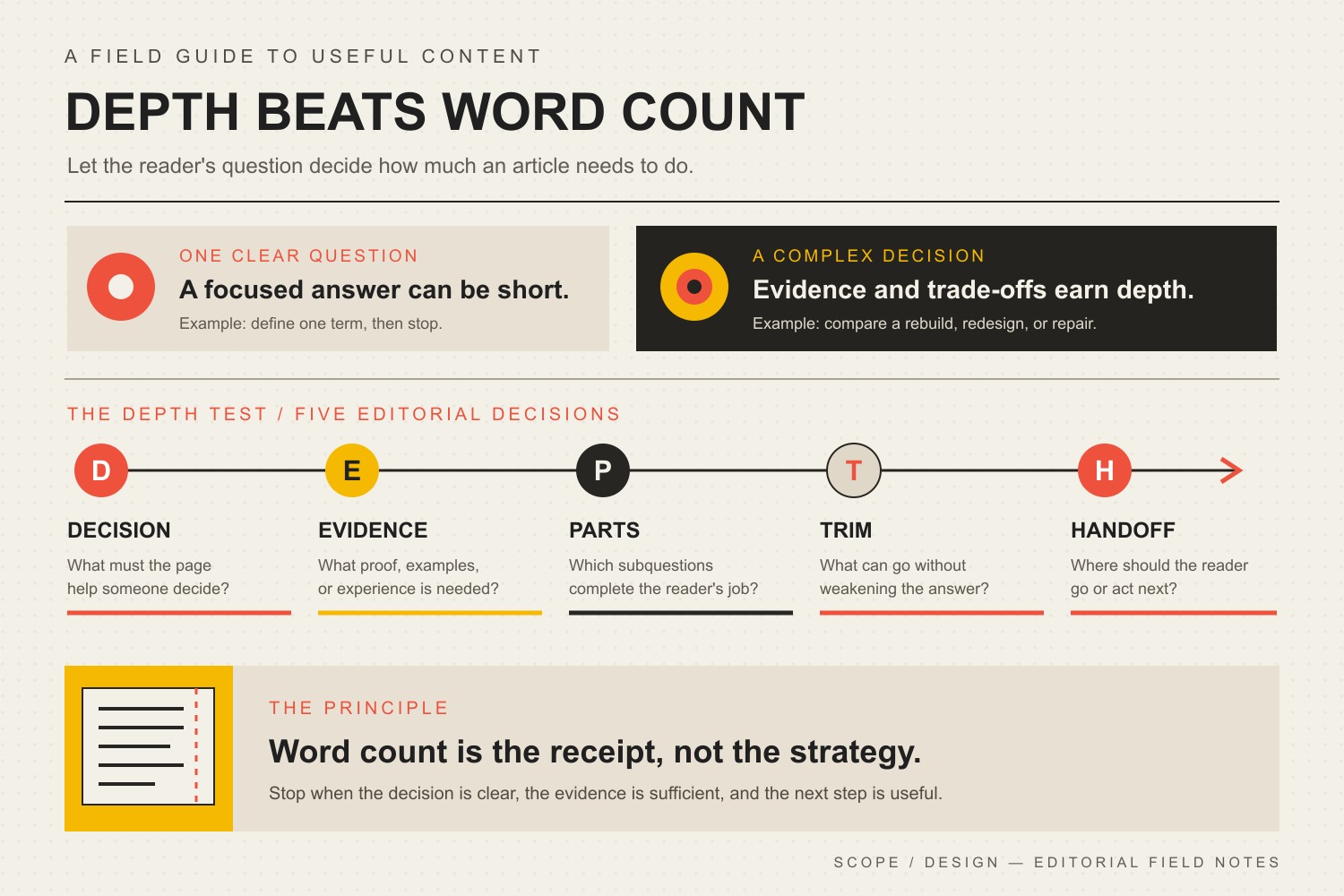
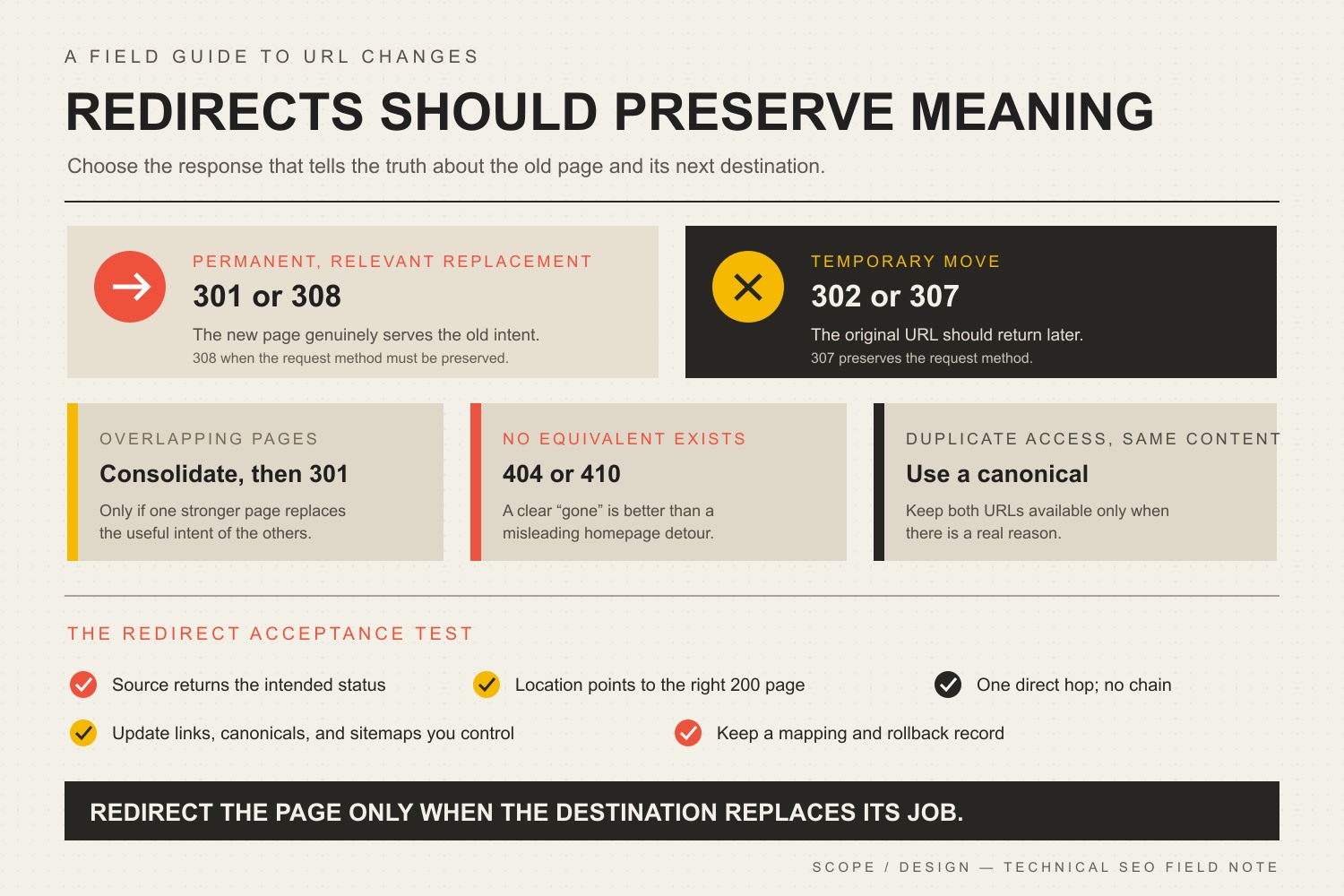
The most important things to know before starting a business are not motivational slogans. They are the facts and decisions that keep uncertainty from becoming an expensive, irreversible problem. You do not need perfect certainty before you begin. You do need evidence that a specific customer has a real problem, enough financial runway to test the idea without threatening your essentials, and clear rules for what you will do if the evidence says “not yet.”
That is the hard truth: entrepreneurship is a sequence of bets. Smart founders make the early bets small, measurable, and reversible. They save the big commitments—quitting income, borrowing, signing a lease, hiring full time, or building expensive systems—for the point when the evidence is strong enough to justify them.
The hard truth: uncertainty gets expensive when it becomes fixed
An idea can feel compelling long before it is commercially proven. Friends can love it. A survey can look positive. A logo can feel “real.” None of those things proves that enough customers will buy at a price that supports the business.
This is also why we are not repeating the familiar claim that “90% of startups fail.” The Bureau of Labor Statistics publishes establishment age and survival data, and survival patterns vary by cohort, time period, industry, and economic conditions. A single universal failure percentage is not a useful decision rule for your business.
Things to know before starting a business: the PAUSE Check
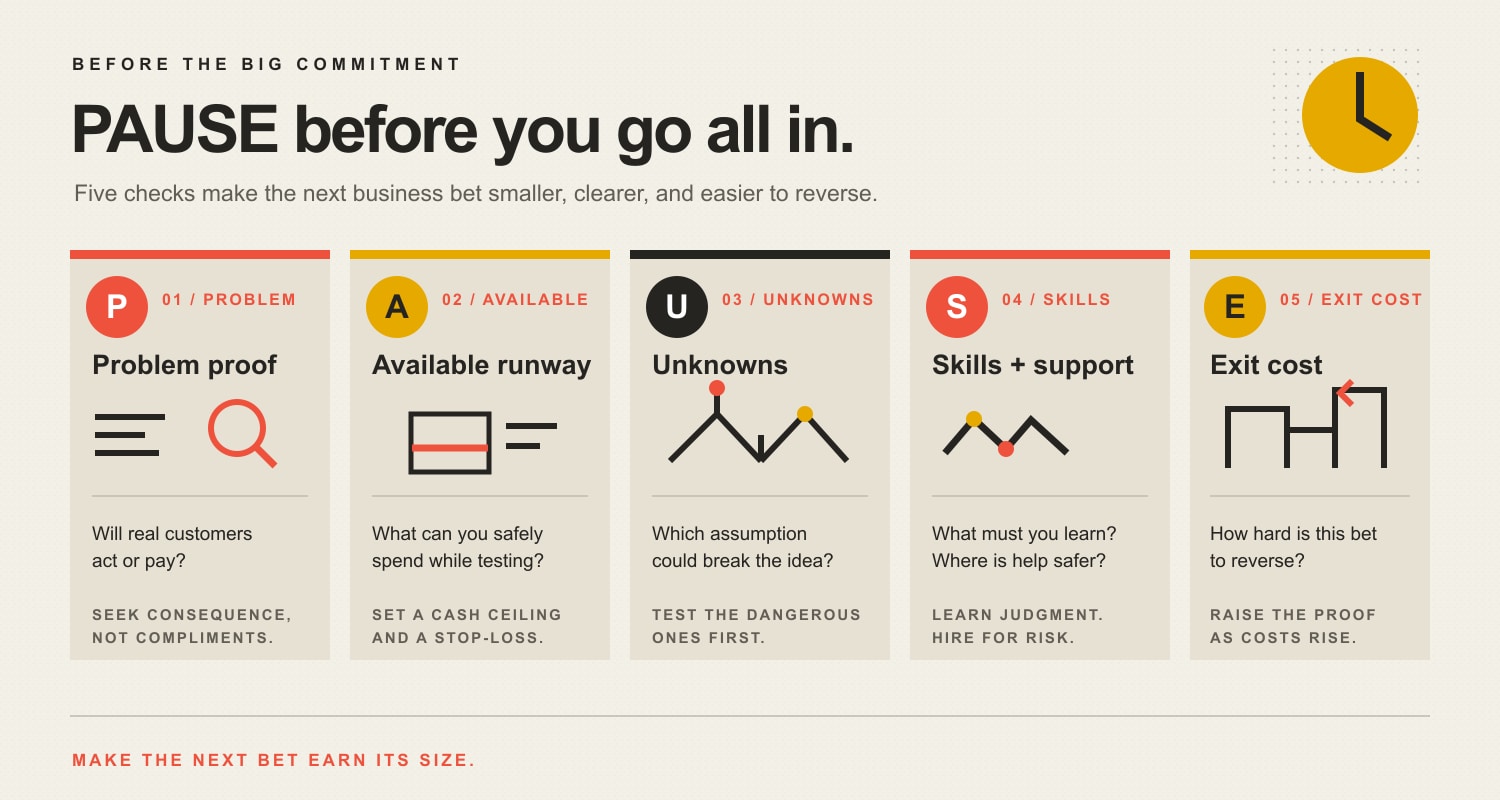
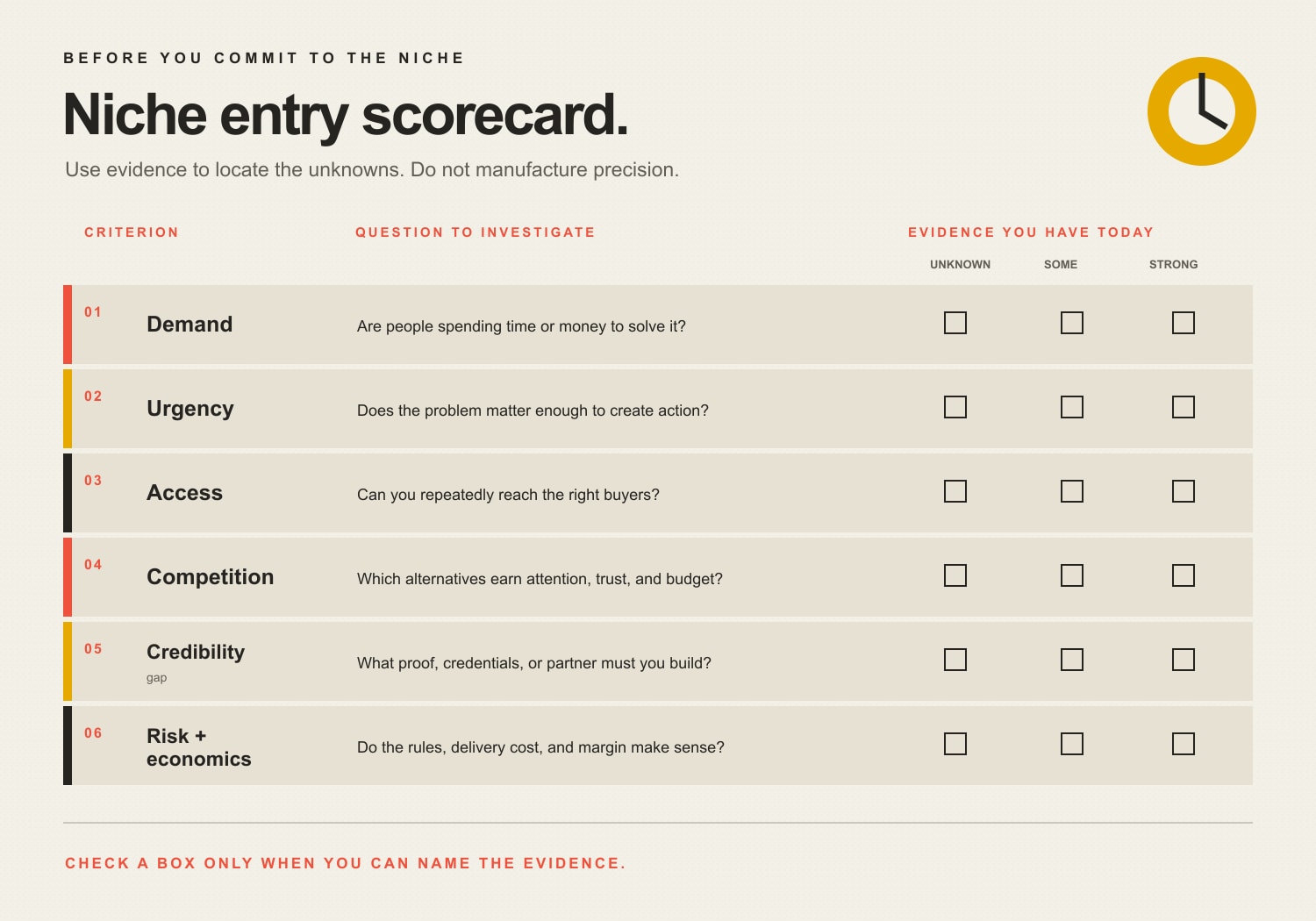
At Scope Design, a more useful question is not “Am I brave enough to go all in?” It is “What would I need to know before this next commitment is rational?” We use a five-part decision check: PAUSE—Problem proof, Available runway, Unknowns, Skills and support, and Exit cost.
The PAUSE Check helps separate cheap learning from expensive commitment.
P — Problem proof
What evidence shows a specific customer will act or pay? Start with the customer and the problem, not the business name, website, or product polish. Look for evidence with consequence: interviews that reveal an urgent problem, deposits, preorders, paid pilots, booked appointments, signed letters of intent where appropriate, or repeat requests from the same type of buyer.
Compliments are weak evidence because they cost the customer nothing. If demand is still uncertain, use market research to learn how customers describe the problem, what they use now, what triggers a purchase, and what would make them switch. Then validate the business idea with the smallest test that can prove or disprove the riskiest assumption.
A — Available runway
What can the business spend without threatening your personal essentials? Startup money and personal survival money are not the same pool. Before you spend, separate one-time setup costs, recurring business costs, and the household obligations that still exist while revenue is uncertain.
Set a hard cash ceiling and a stop-loss rule before enthusiasm moves the line. A useful startup budget prioritizes legal, safety, delivery, and revenue-enabling costs first, while delaying expensive polish until demand justifies it.
U — Unknowns
Which assumption could break the idea fastest? Most early businesses have unknowns around demand, price, acquisition channel, delivery time, capacity, repeat purchase, or required capital. Write them down. Rank them by how damaging they would be if wrong. Test the dangerous unknowns before the cosmetic ones.
A fast launch is only useful when it buys learning. Speed that locks you into the wrong lease, wrong hire, wrong software stack, or wrong offer is not momentum. It is an expensive way to avoid a question.
S — Skills and support
What judgment must you learn, and where is specialist help safer? Founders should understand the core logic of their business: customer, offer, price, economics, sales process, and delivery. That does not mean doing every job personally.
Our rule is learn the judgment, buy risk-sensitive expertise, delay polish. Learn enough marketing to judge a message and channel. Learn enough bookkeeping to understand cash and margins. But use qualified legal, tax, accounting, licensing, insurance, or other regulated specialists when the downside of being wrong is materially higher than the cost of expert help. Outsource execution when a specialist can do it faster without hiding the decision logic from you.
E — Exit cost
How hard is this decision to reverse? Early-stage uncertainty calls for reversible commitments. Month-to-month tools are safer than long contracts. A pilot is safer than a full rollout. Part-time or contract capacity can be safer than a premature full-time hire. A pop-up or sublease can test location demand before a long lease.
The more expensive a decision is to undo, the more evidence it should require. If you are wrestling with a high-stakes choice, use a formal business decision-making framework instead of treating urgency as proof.
What should you prove before the big commitments?
Commitment
Prove first
Lower-risk test
What to postpone
Quit your job
Repeatable demand, credible delivery capacity, personal runway, and a written stop/go rule
Sell during defined side-business hours, run paid pilots, or reduce hours if feasible
Treating one strong month as permanent demand
Borrow money
Exactly what the money buys and how conservative cash flow could repay it
Stage spending by milestone; pre-sell where appropriate
Debt used mainly to make the business look established
Sign a lease
Location-dependent demand and unit economics
Pop-up, shared space, appointment model, or short-term sublease
Long fixed occupancy cost before traffic is proven
Hire full time
Recurring workload, process clarity, and enough margin to support the role
Contractor, part-time help, or a documented process
Hiring because the founder feels busy rather than because a stable constraint exists
Build custom technology
A repeated workflow bottleneck and clear user demand
Manual service, spreadsheet, prototype, or low-code process
Complex software built to automate a business model that is still changing
Seven hard truths every entrepreneur should know
1. Enthusiasm is not demand
You can be deeply committed to the idea and still be wrong about the buyer, timing, price, or channel. The founder’s job is not to defend the original concept. It is to discover which version customers will actually choose.
2. Revenue is not the same as runway
A sale can be encouraging without making the business financially safe. Cash timing, delivery costs, taxes, refunds, inventory, payroll, debt, and owner living expenses all matter. Track the cash that remains available after obligations, not just the top-line number that feels good to report.
3. Speed matters only when it buys learning
“Move fast” is good advice when the action produces information. Interviewing five target customers this week can create evidence. Buying a year of software because you plan to need it someday does not. Early speed should shorten the feedback loop, not increase the exit cost.
4. Doing everything yourself is not automatically frugal
Founder time is a scarce resource. If you spend twenty hours avoiding a specialist fee while neglecting sales, delivery, or customer learning, the “free” option may be the expensive one. The goal is not maximum DIY. It is retaining judgment while allocating work to the person best equipped to do it.
5. Fear does not disappear when the decision is right
You do not need to eliminate fear before acting. Name the feared outcome, separate facts from assumptions, bound the downside, and choose the next reversible test. Our guide to dealing with fear in business goes deeper on making uncertainty actionable without pretending confidence is evidence.
6. Irreversible decisions deserve a higher evidence threshold
A $50 experiment and a five-year lease should not require the same confidence. Neither should a weekend test and quitting a stable income source. Raise the evidence threshold as the financial, legal, operational, or personal exit cost rises.
7. Starting a business changes your responsibilities, not your biology
Entrepreneurship can change how you spend time, make decisions, and think about risk. It does not make employment psychologically impossible, guarantee a permanent identity shift, or prove that your brain has been “rewired for success.” Those claims are more dramatic than useful. A better question is what operating role you actually want. If that is unclear, compare the practical differences between a business owner and an entrepreneur.
Learn it, hire it, or postpone it?
One of the hardest early decisions is deciding what deserves your time. Use this triage:
If the work…
Best default
Why
Shapes customer, offer, price, sales, or delivery judgment
Learn enough to own the decision
You need to recognize good evidence and make tradeoffs even if someone else executes.
Carries material legal, tax, accounting, licensing, safety, insurance, or technical risk
Hire qualified expertise
The cost of a serious mistake can exceed the cost of professional help.
Is repeatable execution with clear inputs and outputs
Delegate or automate when economics justify it
Your time may be more valuable on sales, customer learning, or the current bottleneck.
Mainly makes an unproven business look polished
Postpone it
Polish should follow evidence, not substitute for it.
A 30-day readiness sprint before you go all in
Of all the things to know before starting a business, the most useful are the ones you can test before they become fixed costs. If the idea is still mostly assumptions, spend a month buying evidence instead of buying infrastructure. The goal is not to “finish” the business. It is to make the next decision better.
Week 1: define the problem. Write the specific customer, painful situation, current workaround, and trigger that would make someone seek a solution. Interview people who actually fit that description.
Week 2: test the offer. Put a real price and clear outcome in front of the right buyers. Look for consequential behavior—bookings, deposits, pilots, preorders, introductions, or clear rejection reasons—not just positive comments.
Week 3: test delivery and economics. Deliver manually if possible. Record time, direct costs, rework, customer questions, acquisition effort, and what would break if demand doubled.
Week 4: decide with rules you set in advance. Define the evidence that means continue, revise, postpone, or stop. Do not move the threshold after the result simply because you are emotionally attached to the idea.
If the test exposes a weak assumption, that is useful information—not a personal verdict. Fix the assumption while the cost is still small.
Frequently asked questions before starting a business
How much money should I have before starting a business?
There is no responsible universal number. A home-based service, inventory-heavy retailer, restaurant, and software company have different startup and operating needs. Calculate business setup and recurring costs, personal living obligations, and a downside scenario. Then set a cash ceiling you can afford before revenue becomes dependable. The amount should come from your business model and runway, not a generic internet average.
Should I quit my job before starting a business?
Usually the better question is what evidence would make quitting rational. Look for repeatable demand, a believable delivery model, defined personal runway, and a written stop/go rule. If the business can be tested without immediately giving up income, that preserves optionality while you learn.
Do 90% of startups really fail?
Do not use that number as a universal planning fact. Official U.S. business-survival data are measured by establishment cohorts and vary across years, industries, and economic conditions. Your decision is better served by testing demand, economics, cash requirements, and reversibility than by applying one dramatic percentage to every kind of new business.
What should I learn before starting a business?
Learn enough to judge the customer problem, offer, pricing, sales process, unit economics, cash position, and delivery process. You do not need to become an expert in every supporting discipline. Build the judgment required to supervise specialists and recognize when regulated or high-risk work belongs with a qualified professional.
How do I know whether my idea has real demand?
Look for behavior that costs the customer something: time, money, effort, a change in routine, or a commitment to proceed. Interviews can reveal the problem and buying trigger; paid pilots, deposits, preorders, or booked appointments can test willingness to act. The exact test depends on the business, but the principle is consistent: seek evidence stronger than compliments.
What should I outsource first?
Start with work where the downside of an error is high or where specialist execution clearly frees you to work on the current constraint. Legal, tax, accounting, licensing, insurance, and specialized technical issues often deserve qualified help. For marketing, design, and operations, retain enough understanding to judge the strategy even when you delegate execution.
The bottom line
The hard truths about starting a business are less cinematic than “go all in.” Customers do not owe an idea demand. Cash does not care how confident you feel. Fear can coexist with a good decision. Specialist help can be cheaper than a preventable mistake. And the evidence required should rise with the cost of reversing the decision.
If you remember one list of things to know before starting a business, make it practical. Before the next major commitment, PAUSE: prove the Problem, protect Available runway, identify the biggest Unknowns, choose the right Skills and support, and measure the Exit cost. If the next step is cheap, reversible, and likely to teach you something important, take it. If it is expensive and hard to undo, make it earn a higher level of proof.
Small business web hosting should be the least complicated setup that reliably supports your website, gives your business control of its essential accounts and data, can be restored when something breaks, and has a named competent person responsible for the mess. Choose by workload, ownership, recovery, support, and total cost—not by the teaser price in 72-point type.
Hosting is infrastructure. Management is responsibility. Buying one does not automatically buy the other.
TL;DR: How to choose web hosting for a small business
Make sure the business controls the domain registration, registrar, DNS, hosting billing and administration, website accounts, current backups, and a usable export path.
Match the environment to the website’s actual workload, integrations, data, traffic pattern, and cost of failure. A brochure site and a busy ecommerce operation are not the same damn thing.
Ask what “managed” includes in writing. Server patches, WordPress updates, plugin testing, form monitoring, malware cleanup, content changes, and emergency response are different responsibilities.
Require backups you can restore, not a soothing checkbox labeled “daily backups.” Confirm frequency, retention, storage location, recovery time, likely data loss, and who performs the restore.
Compare the three-year cost: renewal pricing, management, licenses, migrations, overages, support, scaling, and exit costs—not merely the introductory monthly rate.
Plan a migration around the whole system: website, database, domain, DNS, email records, SSL, integrations, analytics, search controls, staging, cutover, rollback, and post-launch monitoring.
In this guide
Web hosting is not the whole website
Web hosting provides the computing environment that serves your website. Depending on the arrangement, that can include processing, memory, storage, database services, networking, certificates, caching, backups, and technical support. It does not automatically include every service your business mentally files under “the website.”
A typical business web presence can depend on separate systems for:
domain registration;
DNS;
website hosting;
content management;
business email;
transactional email from forms or ecommerce;
content delivery and security filtering;
backups and off-site storage;
analytics and search tools;
payment, booking, CRM, or other integrations;
application maintenance and development.
Those pieces may be sold by one company, but they remain different responsibilities. Bundling can be convenient. It can also make a migration spectacularly annoying when nobody knows whether changing a web server will disturb the company email, DNS, payment callbacks, or a ten-year-old integration held together by optimism.
Scope Design encountered this while planning work for a long-established specialty auction business. The visible request concerned a new website and features. Discovery showed that the hosting environment, domains, Office 365 email, auction platform, legacy stores, historical files, and new WordPress system were related—but not interchangeable. The responsible plan separated raw infrastructure, migration work, ongoing management, and future development instead of hiding everything beneath one vague “hosting” line item.
The lesson is reusable: before choosing the platform, know what you own, where it lives, and what still depends on it. Our broader website development process uses the same idea: a phase is not finished until the next responsible person can proceed without guessing.
The five common small business web hosting models
Small business web hosting labels are useful shorthand, not sacred truth. Providers package resources and management differently, so compare the actual service rather than assuming two plans with the same name are equivalent.
Hosting model
Usually fits
Main advantage
Main risk to investigate
Hosted website builder or SaaS platform
Conventional brochure, service, portfolio, or simple commerce sites that fit the platform
Hosting, software, and platform operations are bundled
Portability, feature limits, app costs, account ownership, and what can be exported
Shared hosting
Small, lower-risk sites with modest resource needs and competent management available
Low infrastructure cost and simple administration
Resource contention, plan limits, support scope, backups, noisy neighbors, and renewal pricing
Managed WordPress hosting
WordPress sites important to the business when nobody internal should operate the server
WordPress-oriented tools, support, caching, backups, staging, or updates may be included
“Managed” can mean almost anything; confirm application-level responsibility and exclusions
VPS or cloud instance
Sites needing more isolation, resources, configuration control, or a custom stack
Greater control and scalable resource options
A server you control is also a server somebody must patch, secure, monitor, back up, and recover
Dedicated or specialized infrastructure
High, unusual, regulated, legacy, or predictable workloads that justify dedicated capacity
Maximum control and isolation for the defined environment
Cost, specialist administration, architecture, redundancy, recovery, and vendor dependence
Quality shared hosting can be entirely appropriate for a modest site. Paying for a private cloud environment to serve six pages and a contact form can be the technical equivalent of buying a forklift to move a houseplant.
The real questions are whether the environment supports the software, provides sufficient resources, isolates accounts appropriately, maintains current server technology, handles backups and recovery competently, and has support that matches the business risk.
Shared hosting vs VPS: more control is not automatically better
A VPS generally provides more control and resource isolation than ordinary shared hosting. It may also hand you more operational responsibility. An unmanaged VPS is not an upgrade for a business with nobody capable of securing, updating, monitoring, and recovering it. It is a new job description wearing a server invoice.
Cloud hosting is not a performance spell
“Cloud” describes an infrastructure and delivery model. It does not prove that a particular site will be fast, secure, resilient, or well managed. Architecture, configuration, location, caching, database behavior, application code, third parties, traffic, and operational discipline still matter.
Managed WordPress hosting and website management are not identical
A managed WordPress provider may operate servers, supply a control panel, create backups, provide staging, apply selected updates, monitor infrastructure, or help with WordPress-specific problems. A website management partner may additionally test forms and checkout, review visual changes, coordinate plugins and licenses, monitor business journeys, fix application problems, manage content, and make improvements.
Compare the two scopes. The goal is neither to pay twice nor to leave a responsibility-shaped hole in the middle. Our WordPress maintenance services guide explains the application-management side in detail.
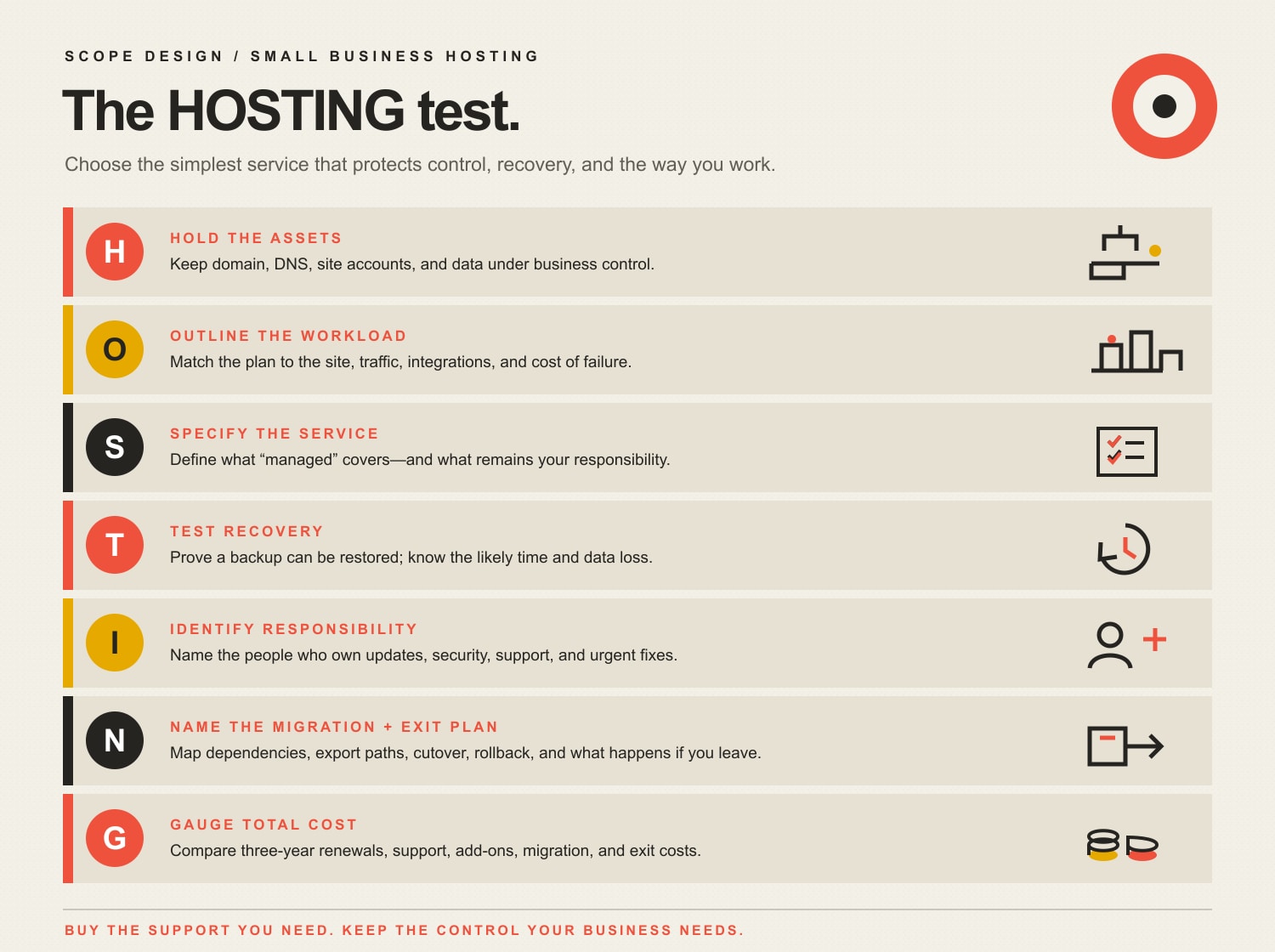
The Scope Design HOSTING test
Use this seven-part test to compare a platform, shared plan, managed WordPress provider, VPS arrangement, or custom environment without getting hypnotized by feature grids.
H — Hold the assets
The business should retain durable control of the domain registration, registrar account, DNS, hosting billing and administration, website administrator access, analytics, search accounts, backups, data, and relevant source assets. An agency can manage those systems with delegated access. It should not become the only person capable of reaching them.
Whose legal name and email address are on the domain and hosting accounts?
Who controls billing, renewal, multi-factor authentication, and recovery methods?
Can the business add or remove administrators without vendor permission?
Can files, databases, content, settings, logs, and backups be exported in usable formats?
What happens to access and retained data when the relationship ends?
O — Outline the workload
Choose from the website outward, not from a hosting coupon inward. Document:
the platform, runtime, database, plugins, themes, and custom code;
expected visits, concurrent activity, seasonal spikes, and geographic audience;
ecommerce, memberships, logins, search, uploads, video, or downloadable files;
forms, email delivery, payments, CRM, inventory, booking, and API connections;
personal, payment, health, employee, or other sensitive information;
storage growth, retention, reporting, and background jobs;
the business impact if the site is slow, unavailable, compromised, or missing recent data.
Traffic totals alone are weak sizing data. One million cached article views and fifty simultaneous personalized checkout sessions create very different work. A provider should be able to explain which resources matter for your workload and what occurs when a limit is reached.
S — Specify the service
Turn marketing phrases into testable responsibilities. Request written answers for:
compute, memory, storage, bandwidth, database, file-count, and process limits;
supported software versions and upgrade policy;
certificates, network protection, malware response, logging, and access controls;
caching, content delivery, staging, development, and deployment tools;
backup scope, frequency, retention, storage, restore method, and restore cost;
uptime commitment, measurement method, exclusions, remedies, and incident communication;
support hours, channels, response targets, escalation, and application boundaries;
prohibited plugins, applications, workloads, or configuration changes.
A backup is potential. A verified restore is evidence.
Ask the provider to explain or demonstrate how a complete site is restored, who can authorize it, how long it takes, what recent data may be lost, and whether the business can obtain an independent copy. For an important site, test the process in an appropriate non-production environment before a real incident turns the documentation into a scavenger hunt.
I — Identify responsibility
Put a name or contracted role beside every critical function:
Responsibility
Named owner
Server software and infrastructure security
WordPress core, plugins, themes, and custom code
Backups, retention, and restore tests
Domain, DNS, certificates, and renewals
Forms, checkout, transactional email, and integrations
Performance, uptime, errors, and capacity
Security alerts and incident response
Content accuracy, accessibility, privacy, and analytics
If everyone assumes the host handles it, nobody handles it. The Web Development and Technical Optimization pillar treats ownership, maintainability, recovery, security, accessibility, and performance as one technical foundation because business failures rarely respect vendor departments.
N — Name the migration and exit plan
Before entering, understand how you leave. Confirm export formats, migration assistance, transfer fees, notice periods, cancellation timing, backup availability after termination, domain-release procedures, and whether proprietary platform features can move elsewhere.
For the incoming migration, name the inventory, staging process, testing owner, approval gate, cutover steps, rollback conditions, DNS responsibility, monitoring period, and retirement date for the old environment.
G — Gauge total cost
Compare three years, not the first checkout screen. Include:
introductory and renewal hosting prices;
required add-ons, storage, bandwidth, email, backups, certificates, and security;
licenses, applications, content-delivery services, and transaction fees;
setup and migration;
developer, administrator, or agency management time;
monitoring, testing, support, incident response, and after-hours work;
scaling, overages, plan changes, and future migrations;
exit assistance and data transfer.
Our small-business website cost guide includes hosting inside the complete ownership picture. The cheapest server can be expensive once the business becomes its unpaid support department.
How small business web hosting affects performance and uptime
Small business web hosting affects performance, but it is one layer. Server response, database work, caching, network distance, redirects, code, media, fonts, third-party scripts, browser work, and user devices all contribute to the experience.
That means “fast hosting” should be tested on your real templates and journeys. A cached demo page does not prove that your uncached product search, member dashboard, or checkout will behave well. Use field data and representative tests. Our website speed optimization guide shows how to identify whether hosting is actually the constraint before paying to move the problem.
What 99.9% uptime allows
An uptime percentage sounds reassuring until it is translated into time. Over a 30-day month, the approximate maximum unavailable time is:
Availability
Approximate downtime per 30-day month
99%
7 hours, 12 minutes
99.9%
43 minutes, 12 seconds
99.95%
21 minutes, 36 seconds
99.99%
4 minutes, 19 seconds
Read the service-level agreement. Learn how availability is measured, which maintenance or external events are excluded, and whether the remedy is a meaningful response or a tiny service credit. Also monitor the business journey. A server can be “up” while a form silently discards leads, email fails, or checkout throws errors.
Backups answer “do copies exist?” Recovery answers “can the business restore the required service within an acceptable time and acceptable data-loss window?”
Two useful terms make the conversation concrete:
Recovery Point Objective (RPO): how much recent data the business can afford to lose. If orders change every five minutes, one nightly database copy may not match the business requirement.
Recovery Time Objective (RTO): how long the service can remain unavailable before the impact becomes unacceptable.
How often are files, databases, configuration, and related data captured?
How many versions are retained, and for how long?
Is at least one copy isolated from the live environment and its credentials?
Can the business download or control an independent copy?
Are backups encrypted and access-controlled appropriately?
Who can restore, and is self-service safe for this environment?
When was the last successful restore test?
How long did it take?
What happens to new orders, registrations, form entries, or edits made after the selected recovery point?
“We take daily backups” is the opening sentence, not the recovery plan.
How to evaluate small business web hosting support
Small business web hosting support becomes visible when systems behave badly, which is an inconvenient time to discover that “24/7 support” means an intake bot can create a ticket at 3:00 a.m.
Ask providers to distinguish:
availability from response time;
first response from resolution or meaningful escalation;
infrastructure problems from WordPress, plugin, code, database, DNS, email, or integration problems;
routine support from paid professional services;
standard incidents from security emergencies;
advice from hands-on remediation.
Before committing an important site, submit a technically specific pre-sales question. Evaluate whether the answer addresses the actual issue, identifies limits, and explains escalation. Search documentation for restore, incident, migration, security, cancellation, export, and support policies. A company that will not explain responsibility before the sale is unlikely to become more philosophical during an outage.
For a managed relationship, define who monitors alerts and who can act. An uptime notification sent to an abandoned inbox is performance art, not incident response.
How to migrate without creating a business fire drill
A hosting migration is a controlled business change. It should begin with an inventory, not a DNS change made because somebody had a free afternoon.
1. Map the current system
Record the website files and database, software versions, server configuration, domain registrar, DNS zone, SSL, business and transactional email, CDN or security proxy, analytics, Search Console, payment callbacks, forms, APIs, scheduled jobs, licenses, storage, redirects, and external services.
Confirm which items are moving. A website-hosting change does not automatically require moving the domain registration, DNS provider, or company email.
2. Define acceptance and rollback
Decide what must work before cutover: representative pages, navigation, search, forms, notifications, logins, payments, orders, media, redirects, analytics, consent, accessibility, and performance. Define the failure conditions that trigger rollback and how long the old environment will remain available.
3. Back up and stage
Create current recoverable copies and build the new environment without disrupting production. Match supported software, import the data, configure services, and test with controlled DNS or local preview methods. Do not declare victory because the homepage appears.
4. Plan the cutover
Assign the change window, final data synchronization, DNS update, certificate validation, cache behavior, monitoring, communication, and approval. Account for transactions or edits that might occur between the last database copy and the final switch.
5. Verify after launch
Test the business journeys from outside the administrative session. Confirm HTTP responses, indexing controls, canonical URLs, analytics, forms, email authentication and delivery, payments, integrations, error logs, performance, and alerts. Keep the old environment protected and available until the acceptance window closes.
If URLs change as part of a broader platform move, create a one-to-one map and permanent redirects. Google recommends testing the new site, using server-side permanent redirects, avoiding chains, updating internal links, and monitoring both old and new URLs in its site-move documentation. A pure hosting move should normally preserve the public URLs.
How much small business web hosting costs
There is no responsible universal monthly price because “hosting” can describe a restricted platform subscription, shared account, managed WordPress service, managed cloud environment, or dedicated system—and may include anywhere from almost no human responsibility to substantial operational care.
The useful comparison is:
Three-year hosting cost = infrastructure + required software + management labor + monitoring and recovery + migration and scaling + expected support + exit cost
A low-risk brochure site may need modest infrastructure. A revenue-critical site with ecommerce, customer accounts, high concurrency, complex integrations, or sensitive data may justify greater isolation, expertise, monitoring, and recovery capacity. Spend should follow consequence and workload, not ego.
Request two numbers from every provider:
The three-year required cost at your expected usage, including renewals and mandatory add-ons.
The separately priced responsibility for monitoring, updates, testing, troubleshooting, recovery, and changes.
That makes a $10 server and a $200 managed relationship comparable without pretending they are the same product.
Small business web hosting checklist
Use this before requesting proposals or approving a migration.
The provider or agency insists the domain and hosting must remain permanently in its own account with no client access.
“Managed” is prominent in the sales copy but undefined in the agreement.
Introductory pricing is clear while renewal pricing, limits, and required add-ons require archaeological work.
Backups exist, but restoration requires an unknown wait, fee, or support tier.
No one can say who manages WordPress, plugins, themes, custom code, forms, or integrations.
Support is advertised as 24/7 without response targets, escalation, or application expertise.
The provider cannot explain how to export the site and data or what happens after cancellation.
A migration plan ignores DNS, email, certificates, analytics, redirects, transactional data, or rollback.
The recommended solution is much more complex than the workload, but the person proposing it cannot name the business problem the complexity solves.
Performance is “guaranteed” from a generic demo rather than measured on representative pages and user journeys.
Small business web hosting FAQ
What web hosting is recommended for small businesses?
Use the least complex supported environment that reliably handles the website’s workload and has clear ownership, backup, recovery, security, and support responsibility. A hosted platform or quality shared plan can fit a simple site. Managed WordPress often fits an important WordPress site without internal technical staff. VPS, cloud, dedicated, or specialized infrastructure belongs where workload, isolation, configuration, data, or risk justifies it.
How do I choose which web hosting is right for me?
Document the website platform, traffic pattern, transactions, integrations, data, storage, growth, and cost of failure. Then compare account ownership, technical limits, security, backups, restore evidence, support boundaries, migration, exit, and three-year cost. Use the Scope Design HOSTING test above rather than selecting from price and storage alone.
What are the four main types of web hosting?
The traditional four are shared, VPS, dedicated, and cloud hosting. Small businesses should also consider hosted website platforms and managed application hosting because those models bundle software or operational responsibility differently. Labels overlap, so compare the actual service and management scope.
Is managed WordPress hosting worth it for a small business?
It can be when WordPress matters to the business and nobody internal should operate the hosting environment. Confirm whether the plan includes staging, backups, safe updates, security controls, monitoring, WordPress-aware support, and restoration. Do not pay a premium merely because WordPress is preinstalled and the product name says “managed.”
Is a VPS better than shared hosting?
A VPS usually provides more control and resource isolation. Shared hosting usually costs less and requires less server administration. A VPS is better only when the workload or configuration needs justify it and somebody competent owns patching, security, monitoring, backups, and recovery.
Is shared hosting good for beginners?
It can be a practical starting point for a modest site when the provider maintains a supported environment, supplies clear limits and recovery options, and the website has competent application management. Beginner-friendly should mean understandable and supported—not disposable.
Is free website hosting suitable for a small business?
Free hosting may suit a temporary experiment or low-risk prototype. It is usually a poor foundation for a business website that must protect its domain, reputation, data, availability, support path, and ability to move. Evaluate branding, limits, backups, security, exports, terms, and business continuity before trusting it with customer activity.
How much does it cost to host a small business website?
Cost depends on the platform, resources, traffic, data, transactions, backups, security, support, and management included. Compare three-year required cost rather than introductory price: infrastructure, renewals, add-ons, licenses, management, monitoring, recovery, migrations, scaling, and exit.
Does web hosting affect SEO?
Hosting can affect crawl availability, server errors, response time, HTTPS, and the performance experienced by users and search systems. It cannot fix weak content, a confused site structure, poor search intent, or a bad offer. Diagnose the actual constraint before migrating solely “for SEO.”
What does 99.9% uptime mean?
Over a 30-day month, 99.9% availability permits roughly 43 minutes and 12 seconds of downtime. The agreement may exclude maintenance or other events and may offer only service credits. Read how availability is measured, and monitor business functions that can fail even when the server responds.
Does a web host back up my website?
Some do, with widely different frequency, retention, storage, coverage, access, and restore terms. Confirm that both files and databases are included, at least one usable copy is independent of production, and the restoration process has been tested. Never infer recovery capability from a backup checkbox.
Is cloud hosting better for a small business?
Cloud hosting can provide flexible resources and architecture options, but it is not automatically faster, safer, cheaper, or easier to manage. Choose it when the workload, resilience, geography, integrations, or scaling model benefits from it and the operational responsibility is clear.
Should my web designer or host own my domain?
Normally, the business should be the domain registrant and retain durable administrative control of the registrar and DNS accounts. A provider can manage them using appropriate access. Any different ownership model should be explicit, understood, and include a reliable transfer process.
Can a website be migrated without downtime?
Many migrations can produce little or no visible downtime when the team inventories dependencies, stages and tests the new environment, plans DNS and data synchronization, preserves rollback, and monitors the cutover. Nobody should promise zero risk without understanding the application, data changes, email, DNS, integrations, and current infrastructure.
Does website hosting include business email?
Sometimes, but it does not need to. Website hosting, DNS, business mailboxes, and transactional website email are separate services even when one vendor sells them. Document MX, SPF, DKIM, DMARC, sending services, mailboxes, and ownership before changing hosting so a web migration does not accidentally kneecap email.
Are website hosting and website maintenance the same thing?
No. Hosting supplies the infrastructure and may include selected server or application services. Website maintenance manages the application and business-specific operating process: updates, testing, forms, integrations, content, accessibility, security response, performance, and recovery. Compare scopes and assign every responsibility.
The hosting product matters. The responsibility around it matters more. Buy a setup your business can control, understand, recover, and change—and make sure somebody qualified owns the gap between “the server is running” and “the website is actually doing its job.”
Business adaptation is the discipline of changing how your business operates when the assumptions underneath it stop matching reality. It is not a race to adopt every new platform, AI tool, sales tactic, or design trend. The goal is simpler: notice meaningful change early, decide whether it affects a real customer or operating constraint, test the smallest useful response, and keep only what improves the business.
That distinction matters for entrepreneurs because change creates two risks at the same time. Move too slowly and customer expectations, competitors, costs, or technology can pass you. Move too quickly and you can burn time and money modernizing things that were not actually broken. Competitive businesses learn to manage both risks.
Business adaptation in 60 seconds
Adapt to evidence, not novelty. A trend matters when it changes customer behavior, economics, risk, or your ability to deliver.
Diagnose before you buy. Find the constraint first; choose the website change, process, automation, offer, or tool second.
Protect reversibility early. Small tests are easier to learn from and cheaper to undo than company-wide transformations.
Measure an outcome. Activity is not proof. Decide what should become faster, easier, more reliable, more profitable, or more valuable to the customer.
Scale selectively. A successful experiment earns a larger commitment; a weak one earns a lesson and a stop decision.
Why business adaptation is a decision problem, not a technology shopping list
When business owners hear “adapt,” the conversation often jumps straight to tools: install a CRM, add a chatbot, rebuild the website, automate follow-up, launch another channel, or replace a manual process with AI. Any of those could be useful. None is automatically adaptation.
The better starting point is an operating question: What changed enough that one of our old assumptions is now costing us? Maybe prospects now expect an answer within hours instead of days. Maybe a once-reliable referral channel has slowed. Maybe staff are spending too much time re-entering the same information. Maybe customers reach the website on mobile and cannot complete the next step. Maybe margins changed enough that an old offer no longer makes sense.
The U.S. Small Business Administration recommends combining market research and competitive analysis to understand customers and identify competitive advantage. That is useful here because adaptation starts with a signal you can explain—not with the existence of a new tool.
Once the signal is real, use your business strategy as the filter. The question is no longer “Should we use this technology?” It becomes “Does this capability solve a problem that is important enough to change how we work?”
The ADAPT Loop: a practical business adaptation framework
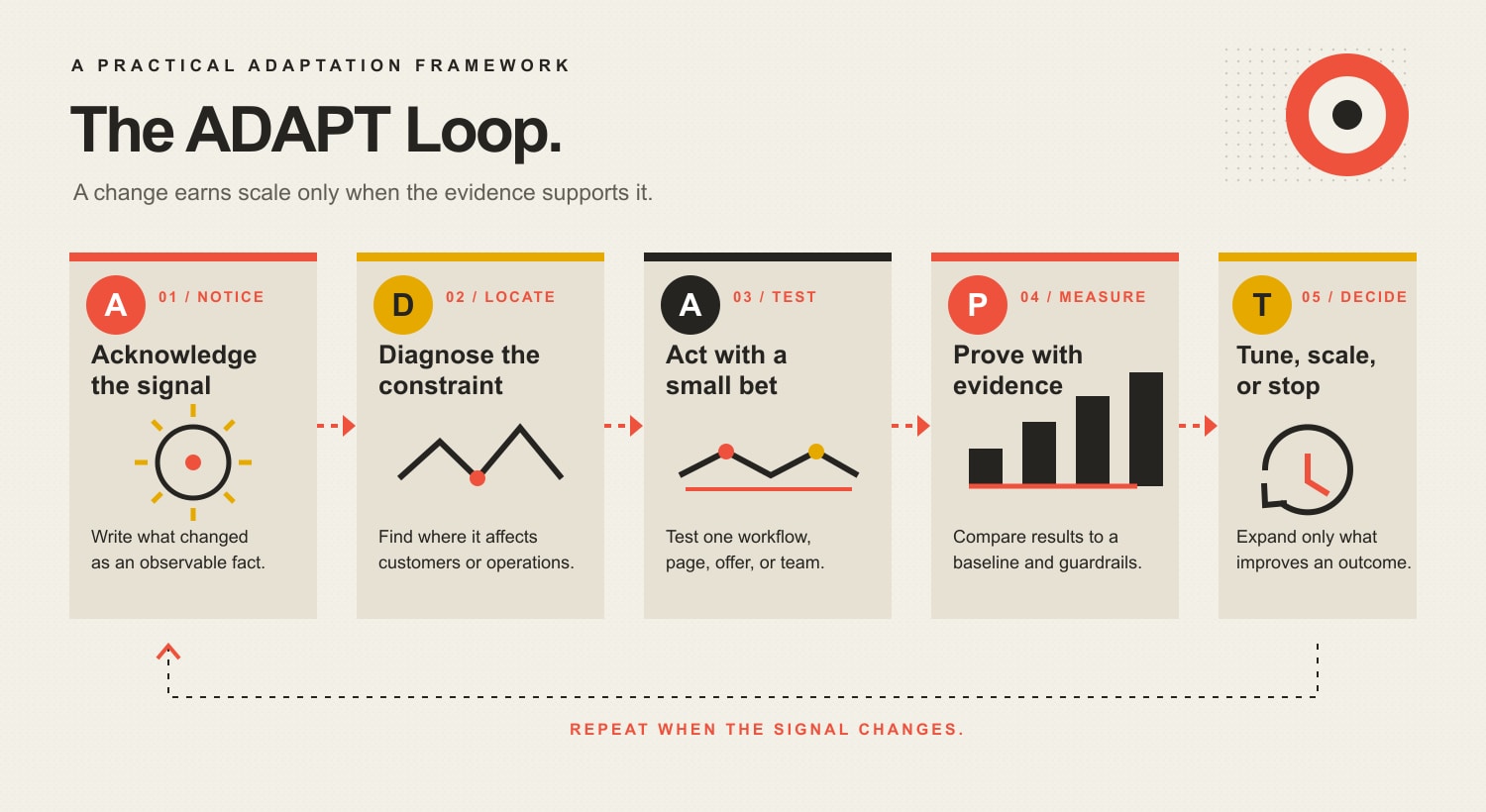
At Scope Design, a useful way to make adaptation concrete is the ADAPT Loop: Acknowledge the signal, Diagnose the constraint, Act with a small bet, Prove with evidence, then Tune, scale, or terminate. The loop is deliberately simple. It keeps the business moving without pretending every change deserves a transformation program.
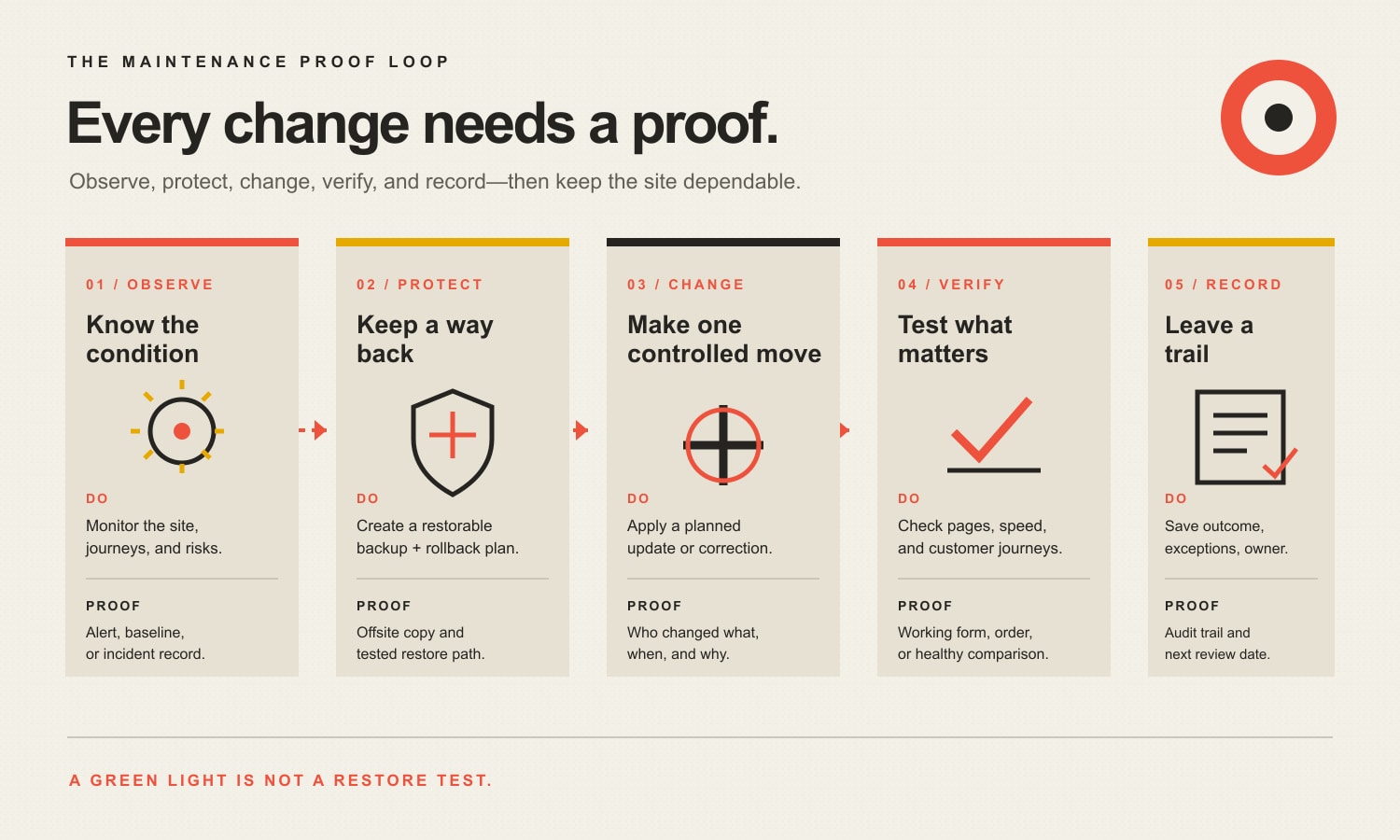
The ADAPT Loop turns change into a repeatable decision cycle instead of a series of disconnected upgrades.
A — Acknowledge the signal
Start with something observable. A useful signal is a repeated change in customer behavior, demand, economics, regulation, competition, delivery capacity, or available technology. One complaint is a story. A pattern of the same complaint, lost opportunity, delay, workaround, or cost increase is a signal worth investigating.
Write the signal as a sentence that separates fact from interpretation: “Qualified prospects are waiting two business days for a first response,” or “More customers are asking to book without calling,” is stronger than “We need AI” or “Our website feels old.”
D — Diagnose the constraint
Ask where the signal actually hurts. Is the constraint awareness, conversion, delivery, handoff, capacity, trust, margin, or retention? This step prevents a common failure mode: solving a visible symptom in the wrong system.
For example, a lead problem may not require more marketing if inquiries are already arriving but getting lost between first contact and follow-up. In that case, the better adaptation is likely in the customer lifecycle and handoff process, not another traffic campaign.
A — Act with the smallest reversible bet
Make the first move small enough that you can learn without creating a new dependency. Before rebuilding an entire sales system, test a shorter intake flow. Before automating every customer message, automate one repeated handoff. Before expanding an offer, sell the narrow version manually. Before redesigning an entire site, test the page or path where the constraint is happening.
Reversibility is a strategic advantage. A small bet gives you permission to be wrong cheaply. That is very different from being timid: you are buying information before buying scale.
P — Prove with outcome evidence
Decide what success means before the experiment starts. Pair one business outcome with one leading indicator. If the change is supposed to improve lead response, the leading indicator might be median first-response time and the business outcome might be qualified conversations started. If it is supposed to reduce administrative drag, measure time reclaimed and whether error or rework rates stay acceptable.
The point is not to build a giant dashboard. It is to make the change falsifiable. If nothing meaningful improves, do not manufacture a success story from clicks, logins, generated content, or hours of “activity.”
T — Tune, scale, or terminate
After the test, choose one of three moves. Tune when the direction is promising but the implementation needs work. Scale when the benefit is repeatable and your team can support the larger operating load. Terminate when the evidence is weak, the hidden cost is too high, or the change solves a problem customers do not value.
Stopping is not failure. A disciplined stop protects attention for the next signal and preserves the lesson for future decisions.
What should entrepreneurs adapt first?
Prioritize the change closest to a meaningful constraint, not the one with the loudest marketing around it. This table shows how to translate common signals into a testable next move.
Signal
Likely constraint
Smallest useful test
Evidence to watch
Prospects repeatedly ask for faster answers
Lead-response handoff
Create one routed intake path with a response owner and deadline
Response time and qualified conversations
Staff copy the same information between tools
Operational friction
Automate one stable, repetitive handoff
Time saved, error rate, exceptions created
Customers cannot complete an important website action reliably
Digital journey or technical foundation
Fix and test that path before redesigning everything
Successful completions and support friction
A competitor introduces a feature customers begin requesting from you
Changed customer expectation
Prototype the minimum version or service equivalent
Adoption, willingness to pay, retention or conversion effect
An offer sells but creates weak margin or delivery strain
Business-model economics
Test scope, price, packaging, or qualification on a subset
Contribution margin and delivery load
Notice what is missing from the table: “Everyone else is using it.” Competitor behavior is evidence only when it changes the market you actually serve.
When adaptation becomes digital modernization
Digital modernization is useful when the diagnosed constraint lives in a digital system. If leads are getting lost because there is no reliable handoff, the answer may involve CRM or automation. If staff repeat predictable work that can be safely standardized, AI automation workflows may be worth testing. If a slow, brittle, or confusing website blocks a customer from taking the next step, the problem may require stronger business website development.
But modernization is a means, not a goal. A new stack that adds integrations, training, exceptions, security exposure, and maintenance can make the business less adaptable if it does not remove a real constraint.
Risk belongs in the decision, too. The National Institute of Standards and Technology maintains Cybersecurity Framework 2.0 resources for small businesses to help organizations manage and reduce cybersecurity risk. When an adaptation changes how sensitive data, accounts, integrations, or critical processes work, security and recovery requirements should be part of the test—not an afterthought.
What should you not change?
Adaptability does not mean instability. Some parts of the business should stay boring when they are still doing their job. Keep a proven process until there is evidence that it is constraining the business. Keep a clear brand promise until customer or market evidence shows it no longer fits. Keep reliable infrastructure unless a replacement improves an outcome enough to justify migration risk.
A useful “not now” list protects this discipline. For every adaptation you approve, write down the attractive ideas you are deliberately postponing and why. That makes strategy visible. It also stops the business from reopening the same shiny-object debate every week.
How to measure whether business adaptation is working
Measure at three levels so an improvement in one area does not hide damage somewhere else:
Customer outcome: Did the experience become easier, faster, clearer, more trustworthy, or more valuable?
Operating outcome: Did the change reduce delay, manual effort, rework, failure points, or dependency on one person?
Business outcome: Did it improve qualified demand, conversion, retention, margin, capacity, cash flow, or another result that matters to the model?
You do not need all three to move at once. You do need to know which one the change was designed to affect and which guardrail must not get worse. If customer response becomes faster but errors double, the test is not finished. If automation saves time but creates low-quality customer interactions, the efficiency gain is incomplete.
For customer-facing changes, define a small set of customer success metrics that someone can actually own. The best metric is not the one that looks sophisticated; it is the one that changes the next decision.
Five business adaptation mistakes that make change more expensive
1. Treating novelty as urgency
A capability can be impressive without being relevant. Ask what customer behavior, economic condition, delivery constraint, or risk changed before you put it on the roadmap.
2. Buying the system before defining the problem
Tool selection feels like progress because it produces demos, pricing tables, and implementation tasks. But a vaguely defined constraint turns every product into a plausible answer. Diagnose first so you can reject most options quickly.
3. Making the first experiment too large
A company-wide rollout can hide what actually caused the result. Start with the smallest customer segment, workflow, page, or team that can give you useful evidence.
4. Measuring activity instead of value
More automations, more posts, more features, more dashboards, and more AI-generated output are not business outcomes. Track the constraint you intended to change.
5. Scaling faster than the operating system can absorb
A test can work in a controlled environment and fail at volume. Before scaling, ask what new exceptions, support needs, data dependencies, quality checks, and ownership requirements appear when usage multiplies.
A 30-day business adaptation sprint
You do not need a transformation committee to practice business adaptation. A focused month is enough to turn one meaningful signal into evidence.
Choose one signal tied to a meaningful constraint.
Record the current outcome so you have something to compare against.
Week 2: Design the smallest reversible test
Define the one assumption you are testing.
Limit the test to one segment, workflow, offer, page, or team when possible.
Name the success metric, guardrail, owner, and stop condition in advance.
Week 3: Run the test and log exceptions
Do not “optimize” halfway through every uncomfortable result. Let the test run long enough to observe behavior, while recording exceptions, customer confusion, team friction, and edge cases that averages can hide.
Week 4: Tune, scale, or stop
Compare the result with the baseline and the guardrail. Then make a decision. If the test worked, document what made it work before expanding. If it did not, record the lesson and close the experiment. A finished “no” is more valuable than a zombie pilot that consumes attention indefinitely.
When outside help is worth it
Entrepreneurs should keep the decision close to the business, but implementation does not have to be entirely internal. Outside help is usually worth considering when the constraint crosses specialties, the change is expensive to reverse, security or data risk is material, or the team lacks the capacity to test without disrupting normal operations.
The useful role of a partner is not to sell “modernization.” It is to help translate the diagnosed constraint into the smallest sensible implementation, identify dependencies, build the test correctly, and leave you with evidence you can act on. If your adaptation decision points to the website, customer journey, automation, analytics, or the systems connecting them, Scope Design can help turn the diagnosis into a scoped plan without treating every new tool as mandatory.
Frequently asked questions about business adaptation
What is business adaptation in simple terms?
Business adaptation means changing an important part of how your company works because the environment around it changed. The change could involve an offer, process, customer experience, technology, pricing, channel, or operating model. The key is that the change responds to evidence, not fashion.
Why is adaptation important in business?
Because the assumptions that made a business effective do not stay true forever. Customer expectations move, costs change, competitors improve, regulations evolve, and technology creates new capabilities. Adaptation gives the business a repeatable way to respond without rebuilding everything every time conditions shift.
What is a good example of business adaptation?
Imagine a service business notices that qualified prospects increasingly ask to schedule online, but the company still requires a phone call. Instead of launching a full digital transformation, it tests online booking for one service, measures completed bookings and no-show rates, gathers feedback, and then decides whether to expand it. That is adaptation: a changed customer expectation produced a bounded response and a measurable decision.
Is adopting AI automatically business adaptation?
No. AI becomes part of business adaptation when it addresses a diagnosed customer or operating constraint and improves a defined outcome within acceptable quality, risk, and maintenance limits. Installing an AI tool because competitors mention AI is technology adoption, not proof of adaptation.
How often should a small business adapt?
Continuously scan for meaningful signals, but do not confuse constant observation with constant change. Review customer friction, operating bottlenecks, economics, competitive moves, and new capabilities on a regular cadence that fits your market. Make a change when the evidence shows an assumption is no longer serving the business—not because a calendar says a modernization project is due.
Staying competitive means getting better at change—not doing more of it
The most adaptable entrepreneur is not the one with the longest software list or the fastest reaction to every trend. It is the one who can tell the difference between noise and a meaningful signal, connect that signal to a real constraint, make a small move, learn quickly, and commit only when the evidence earns a larger bet.
That is the practical advantage of the ADAPT Loop: acknowledge, diagnose, act, prove, tune. It turns business adaptation from an occasional panic response into a repeatable management habit—and keeps modernization subordinate to what customers and the business actually need.
An editorial calendar is the operating schedule that turns a content strategy into work your team can actually produce, approve, publish, distribute, and review. It should tell you more than what goes live on Tuesday. A useful calendar tells you why a piece exists, what evidence supports it, who owns it, where it will go, and when you will decide whether it deserves more investment.
If your editorial calendar contains only dates and titles, you do not have a content operating system. You have future homework.
This guide shows how to build an editorial calendar—or content calendar, if that is the term your team uses—that connects strategy to capacity and turns published work into a learning loop instead of a publishing treadmill.
What Is an Editorial Calendar?
An editorial calendar is a shared planning and workflow system for deciding what content will be created, who is responsible for it, when it will move through production, where it will be distributed, and how the team will review the result.
That definition is intentionally broader than “a publishing schedule.” The publication date matters, but it is only one field in the system. The calendar should connect a planned asset to an audience, a business job, evidence, an owner, a workflow, a distribution path, and a later decision.
Editorial calendar vs. content calendar: what is the difference?
Teams and software vendors use editorial calendar and content calendar differently, and plenty of teams use the terms interchangeably. You do not need two separate systems just to satisfy vocabulary.
For this guide, we use editorial calendar for the higher-level operating view—purpose, themes, ownership, capacity, workflow, launch path, and review—and content calendar for the detailed execution view of specific assets, channel versions, and dates. If one shared system can handle both views, that is usually simpler.
A Calendar Is Not a Content Strategy
A calendar answers “what is moving through the system and when?” It cannot decide why the business should create content in the first place.
Before you fill a single date, your small business marketing strategy should give the calendar constraints: the audience you want to help, the problem or decision you want to support, the offer or next step, the channels you can maintain, and the outcome that matters.
If the audience is still fuzzy, fix that first. Our guide to identifying your target audience is a better starting point than brainstorming 40 blog titles for people you have not defined.
The same distinction applies to content marketing. A blog post is a format. Email is a channel. A calendar is a schedule. The broader content marketing system still has to connect useful evidence to a real buyer question, deliberate distribution, a handoff, and a learning loop.
The Scope Design PUBLISH Loop
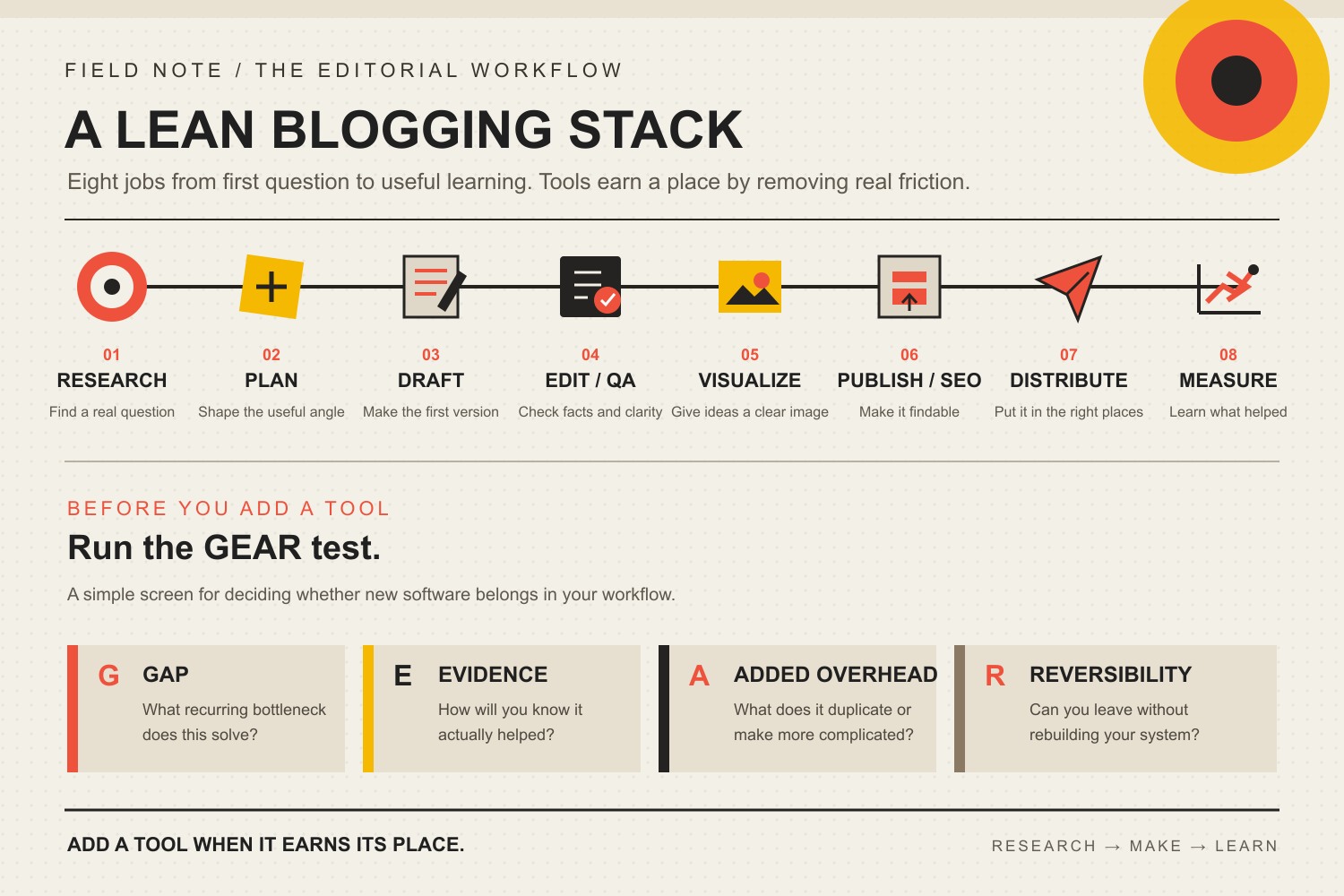
We use the PUBLISH Loop as a practical test for whether an editorial calendar is ready to run. The name is convenient; the important part is that each scheduled asset passes through seven connected decisions.
P — Purpose: Who is this for, what decision or problem does it help with, what business job should it perform, and what should the reader do next?
U — Useful evidence: What customer question, subject-matter expertise, first-party observation, research, example, or source makes the asset worth publishing?
B — Bottleneck capacity: Which required role or dependency is most likely to limit throughput—writer, subject-matter expert, designer, reviewer, legal approval, video production, or something else?
L — Launch path: What is the source asset, which channel versions are worth creating, where will they point, and how will distribution be tracked?
I — Inspection: Who verifies the facts, checks quality and brand fit, reviews accessibility where relevant, and gives final approval?
S — Schedule & status: What milestones must happen before publication, what is the current workflow state, and what is the real ship date?
H — Harvest learning: When will you review the result, and will you refresh, expand, repurpose, consolidate, pause, or retire the asset?
The key operating rule is simple: your calendar’s throughput is limited by its scarcest required role or dependency, not by the number of empty dates on the screen. If the owner can meaningfully review two deep pieces per month, scheduling four does not create capacity. It creates late work.
What Should an Editorial Calendar Include?
You do not need dozens of fields. You need enough information to make each content item executable, reviewable, and measurable. This is our minimum viable editorial-calendar record.
Field
What it answers
Audience / decision
Who is this for, and what are they trying to understand, compare, decide, or do?
Business job
Awareness, education, proof, lead generation, sales support, retention, support, or another defined job?
Topic / query
What question or subject does the asset own?
Evidence source
Which SME, customer question, internal data, example, research source, or original observation supports it?
Source asset / format
What is the main thing being created: article, guide, video, case study, webinar, tool, email, etc.?
Owner
Who is accountable for moving it forward?
Approver / dependencies
Who or what must happen before it can ship?
Workflow status
Backlog, approved, researching, drafting, review, scheduled, published, updating, or retired?
Milestone dates
When are research, draft, design, review, and approval actually due?
Publish date
When does the source asset go live?
Distribution
Which email, social, sales, partner, paid, or community channels deserve a version?
CTA / destination
Where should the reader go next?
Campaign tracking
If tagged links are used, which source, medium, campaign, or content values should travel with them?
Review date
When will the team look at useful evidence instead of forgetting the asset exists?
Lifecycle decision
Keep, refresh, expand, repurpose, consolidate, pause, or retire?
Pick the business job and audience problem first. “Publish every Tuesday” is not a goal. “Help operations managers understand the cost of delaying preventive maintenance before budget season” is a usable assignment.
For each planned source asset, write a one-line purpose statement: For [audience], help them [decision/problem] so they can [useful outcome], with [business next step] available when relevant.
2. Build an evidence queue before a topic queue
Weak calendars begin with “we need 12 ideas.” Stronger calendars ask what the business actually knows, sees, measures, explains, fixes, demonstrates, or gets asked repeatedly.
Customer emails, sales calls, support tickets, estimates, objections, SME interviews, project notes, search questions, analytics, and before/after examples can all become evidence sources. If you need a better method for finding material, start with content ideas worth sharing instead of a holiday list and a pile of blank caption boxes.
3. Set cadence from bottleneck capacity
Do not choose a publishing frequency because a benchmark told you to. List the roles every source asset actually requires, estimate what those people can reliably contribute, and find the bottleneck.
If a subject-matter expert can support two strong interviews and reviews in a month, that may be the current ceiling for evidence-heavy articles. You can still create channel derivatives from those assets, but scheduling four source articles does not magically double SME capacity.
Leave visible slack for revisions, client work, approvals, news, and the occasional week in which everyone suddenly remembers they have other jobs. A calendar with breathing room is not under-optimized. It is more believable.
4. Plan source assets before channel fragments
Choose the evidence-rich source asset first: the guide, case study, video, webinar, research note, comparison, tool, or other durable piece that carries the real information.
Then decide which derivatives have a job. An email may introduce the main finding. A LinkedIn post may turn one argument into a useful short explanation. A sales follow-up may point directly to the relevant section. A short video may demonstrate the same evidence instead of paraphrasing the headline.
For social channels specifically, the calendar should execute a defined social media content strategy; it should not become the strategy just because it has colored labels.
5. Define the workflow and approval path
“Due Friday” is not a workflow. Work backward from the ship date and name the states that matter: evidence ready, brief approved, draft ready, fact check, design, stakeholder review, final approval, scheduled, live.
Assign one accountable owner. Contributors can be many; ownership should not be mysterious. Then name dependencies early. If an engineer must validate a technical claim or a customer must approve a quote, that dependency belongs in the calendar before the draft is “finished.”
6. Put real work on the calendar
Only now should dates take over. Schedule the production milestones, not just the publication date. This is where the calendar becomes useful to the people doing the work.
Keep a separate idea horizon for future possibilities and a commitment horizon for work the team has actually agreed to produce. Your idea backlog can be ambitious. Your committed calendar should be credible.
7. Schedule the learning decision
Publication is the midpoint of the system, not the finish line. Add a review trigger when you schedule the asset. The right timing depends on the channel, traffic level, campaign window, sales cycle, and amount of evidence available, so avoid pretending there is one magic review interval.
At review, ask what the asset produced at several levels: Was it discovered? Was it actually consumed? Did the intended audience take a useful next action? Did it create qualified business activity? What did the team learn? Then choose a lifecycle action instead of automatically making “more content.”
A Worked Small-Business Content Calendar Example
Imagine a local B2B service company wants more qualified inquiries for an annual maintenance program. The team repeatedly hears the same question: “How do I know whether maintenance is worth paying for before something breaks?”
Instead of scheduling six disconnected posts, the team can build one evidence-rich source asset and a deliberate launch path.
Calendar item
Job
Evidence / owner
Launch path
Review decision
SME interview
Capture first-party expertise and common failure signals
Service lead + content owner
Feeds the source guide
Is the evidence specific enough to publish?
Source guide
Help buyers understand maintenance tradeoffs
Writer; service lead approves technical claims
Website article with relevant service CTA
Expand, refresh, or consolidate based on search and qualified-use evidence
Email
Introduce the guide to existing contacts who may have the problem
Content owner
Short explanation pointing to the guide
Did the right contacts click or reply?
LinkedIn explanation
Teach one useful signal without copying the whole article
Content owner + SME voice
Native post with guide link where useful
Was the idea useful enough to develop further?
Sales follow-up snippet
Answer the recurring objection in context
Sales/service team
Direct link to the most relevant section
Did it help move qualified conversations?
That is a content calendar with a spine. The derivative pieces are not random “more channels.” They inherit evidence and purpose from the source asset.
How Far Ahead Should You Plan an Editorial Calendar?
Plan committed work only as far ahead as your inputs are reasonably stable. There is no universal rule that every company needs a 30-day, quarterly, or annual calendar.
A useful approach is to maintain two horizons:
Idea horizon: a larger backlog of buyer questions, evidence sources, seasonal needs, campaigns, experiments, and future assets. These are options, not promises.
Commitment horizon: the work your team has enough evidence, capacity, and approval to realistically ship. These are promises.
Then run two clocks. The production clock keeps briefs, drafts, reviews, approvals, and launches moving. The learning clock brings published assets back for evidence-based decisions. Keeping those clocks separate prevents a weekly status meeting from pretending to be a strategy review.
Which Editorial Calendar Tool Should You Use?
The best editorial calendar tool is the simplest shared system that supports your actual workflow and that people will keep current.
A spreadsheet can be enough for a solo marketer or a small team with a simple workflow.
A project board or database becomes more useful when you have multiple owners, dependencies, statuses, reusable views, or approval steps.
A dedicated marketing calendar platform earns its complexity only if integrations, scheduling, approval, or reporting remove real work.
Whatever you choose, keep one source of truth. A calendar in a spreadsheet, a second version in a social scheduler, and a third version in a project tool is not “integrated marketing.” It is three places to be wrong.
How AI Fits Into an Editorial Calendar
AI can reduce mechanical content work. It can help summarize approved notes, suggest ways to structure a brief, generate derivative ideas, transform a verified source asset into channel-specific starting points, or identify gaps for a human to investigate.
It should not become an invisible source of truth.
If generative AI materially assists an asset, we recommend adding three simple controls to the calendar: the approved evidence/source packet, an AI-assisted flag or note, and a named human verifier/approver. That is a practical governance choice, not a legal requirement. It is consistent with the risk-management mindset in NIST’s Generative AI Profile.
This also aligns with where search is headed. Google’s current guidance for generative search emphasizes unique, non-commodity, expert-led content rather than “AEO/GEO hacks.” A calendar that rewards evidence and expertise is a better foundation than one designed to maximize AI-generated output volume.
Common Editorial Calendar Mistakes
Starting with dates. A date does not create a business reason, audience, or evidence source.
Confusing the calendar with strategy. Random activity does not become strategic because it is punctual.
Scheduling beyond bottleneck capacity. The calendar becomes an anxiety dashboard instead of an operating plan.
Publishing evidence-free filler. Search volume and “we need a post” are weak substitutes for something useful to say.
Treating every channel post as a separate idea. Start with strong source material, then adapt it where a channel has a real job.
Putting approval after the deadline. Dependencies belong in the production plan, not in the surprise column.
Stopping at publication. Without distribution and review, you cannot tell whether the calendar is improving.
Using fake freshness. Do not change a year in the title and call the article updated. Google’s people-first content guidance explicitly warns against changing dates just to make pages seem fresh when the content has not substantially changed.
Editorial Calendar FAQ
What is an editorial calendar?
An editorial calendar is a shared planning and workflow system that connects content topics to purpose, evidence, ownership, production milestones, publication, distribution, and review. A publishing date is part of the calendar, not the whole calendar.
What is the difference between an editorial calendar and a content calendar?
There is no single terminology rule every team follows. In this guide, the editorial calendar is the higher-level operating view, while the content calendar is the detailed execution view. One well-designed system can handle both.
How do you create an editorial calendar?
Start with the audience and business job, build an evidence queue, set cadence from real capacity, choose source assets and useful derivatives, define ownership and approvals, schedule production milestones, and add a review/lifecycle decision. Dates come after those decisions, not before.
What fields should a content calendar include?
At minimum, track the audience or business job, topic/query, evidence source, asset/format, owner, approver or dependencies, status, milestone and publish dates, distribution, CTA or destination, campaign tracking when used, review date, and lifecycle decision.
How often should you update an editorial calendar?
Update production status whenever the team needs it to coordinate real work. Review published content on a separate learning clock based on the campaign window, traffic, sales cycle, and amount of evidence available. There is no useful universal review frequency for every business and channel.
What is the best editorial calendar software?
The best tool is the simplest one that your team reliably uses and that supports the workflow you actually have. A spreadsheet may be enough; a project board or database is useful when ownership, dependencies, approvals, and multiple views become harder to manage manually.
Turn the Calendar Into a Working Content System
A good editorial calendar should make strong content easier to ship. It should reduce last-minute guessing, expose capacity problems before they become missed deadlines, preserve the evidence behind each asset, and make distribution and review part of the work instead of an afterthought.
Start smaller than your ambition. Build a calendar your current team can actually maintain. Ship the strongest evidence you have. Review what happens. Then earn the right to add more.
If your team has plenty of ideas but no reliable system for deciding what should ship, who owns it, and what happens after publication, talk with Scope Design. We can help connect content planning, SEO, marketing strategy, and implementation into one workable process.
You do not need years of experience in a niche before you can enter it. You do need a disciplined way to learn what you do not know, test whether the market is worth entering, and earn trust without pretending to be an expert.
That distinction matters. A beginner who is transparent, curious, and evidence-driven can become useful quickly. A beginner who copies surface-level advice and performs expertise usually creates a credibility problem before the business has a chance to create value.
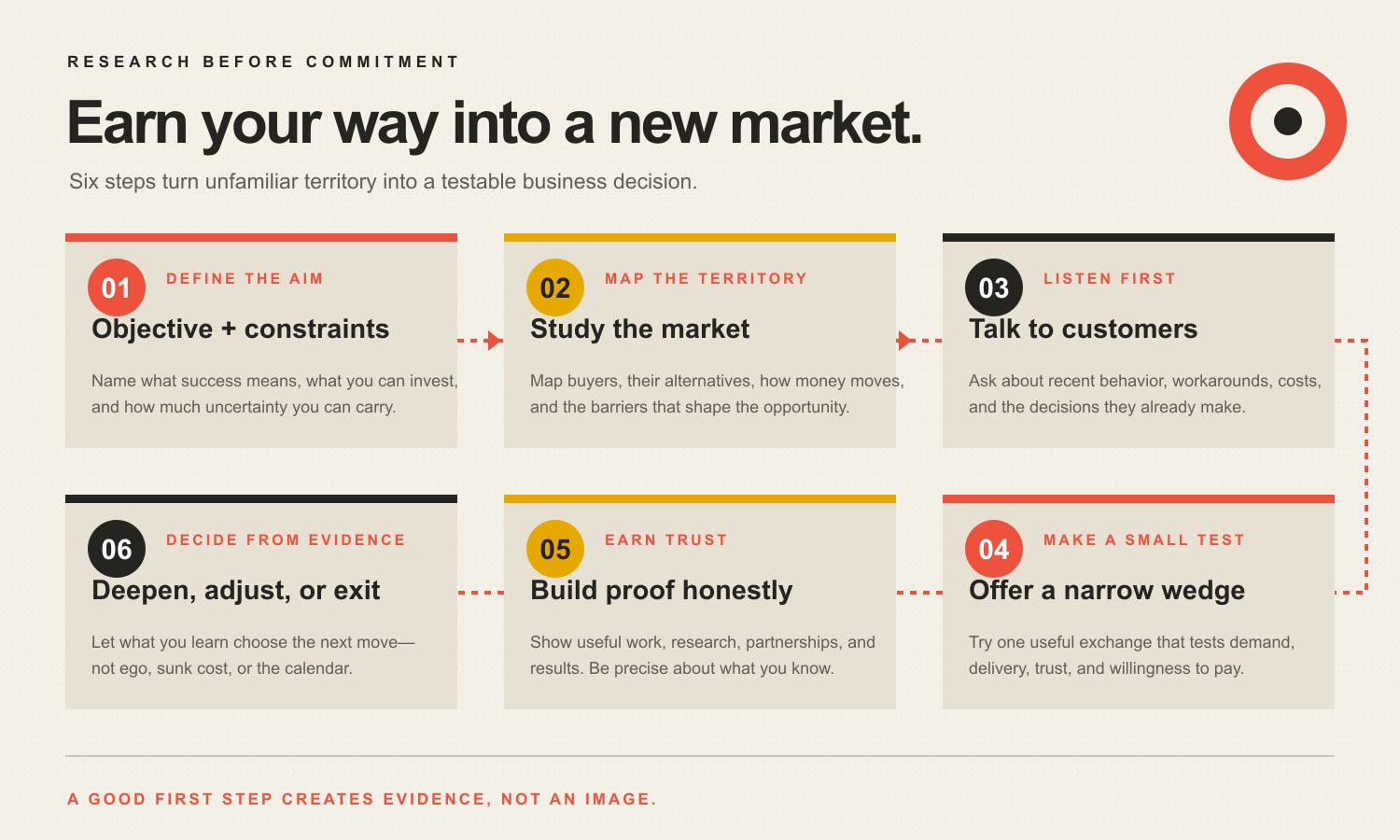
This guide shows how to enter a new niche with zero experience using a research-first process: define the objective, map the market, talk to customers, test a small entry point, build proof, and then decide whether to deepen your commitment, adjust the offer, or leave the niche alone.
Zero Experience Is Not the Same as Zero Value
Experience is only one source of value. You may already bring transferable skills in sales, operations, design, technology, research, writing, service delivery, project management, or problem solving. Those skills can matter in a new market—but they do not make you a domain expert overnight.
The safest stance is to be precise about what you know. If you are entering a market to build a business, create content, develop a service, or explore an opportunity, position yourself as a serious investigator first. Learn the language. Understand the buyer. Find the real constraints. Then let useful work create the evidence that supports stronger claims later.
That is also the better answer to the old question of whether you must already be the expert in your own niche. Expertise is valuable, but credibility can also come from rigorous research, access to experts, transparent reporting, and demonstrated results.
Start With the Business Objective, Not the Niche Tactics
A common mistake is to choose a niche and immediately jump to a website, social channel, content calendar, affiliate program, or product idea. Those are tactics. They are useful only after you know what problem you are trying to solve and what is currently preventing progress.
Scope Design uses a constraint-first approach: define the business objective, identify the binding constraint, clarify the positioning, and only then choose the tactics inside a coherent small-business marketing strategy. If the objective is to build a profitable service business, for example, the first constraint might be access to buyers—not a lack of blog posts. If the objective is to build a media property, the first constraint might be a weak information advantage—not a missing logo.
If you need a broader framework for evaluating an unfamiliar market, start with small-business market research rather than a list of marketing ideas.
How to Enter a New Niche: A 6-Step Framework
1. Define the objective and your constraints
Write down what success would actually mean. Are you trying to find a consulting niche, launch a product, build an audience, expand an existing company, or create a new revenue stream? The research required for each is different.
Then list the constraints you already know: available time, budget, geographic reach, access to customers, required credentials, technical capability, sales capacity, and how much uncertainty you can tolerate. A niche that looks attractive in the abstract can be a bad fit for your actual resources.
2. Map the market before you try to serve it
The U.S. Small Business Administration recommends using market research to understand factors such as demand, market size, location, saturation, and pricing, and using competitive analysis to understand competitors, barriers to entry, and your window of opportunity. Its market research and competitive analysis guidance is a practical starting point.
Build a one-page market map. Identify the customer segments, the problem they are trying to solve, the alternatives they use now, how money moves through the market, who influences the buying decision, and what would make switching difficult. This is more useful than asking whether a niche is simply “hot.”
If demand is still fuzzy, ask what behavior proves the problem matters, what alternatives are already being purchased, and what evidence would change your mind.
3. Talk to customers before you write the story in your head
Desk research tells you how a market is described. Customer conversations tell you how the problem is experienced. The SBA includes interviews, surveys, questionnaires, and focus groups among direct research methods. For a beginner, conversations are especially useful because they expose vocabulary, priorities, objections, workarounds, and assumptions you would otherwise miss.
Do not treat these conversations like disguised sales calls. Ask about recent behavior: what happened, what they tried, why they chose it, what it cost them in time or money, what frustrated them, and what would have made the decision easier. Listen for repeated patterns rather than fishing for praise for your idea.
The goal is to build a sharper audience definition, not a generic persona made from guesses. Once patterns become clear, translate the research into messaging and channel decisions.
4. Test a narrow wedge instead of launching the whole business
Your first offer should answer a question, not prove your identity. Can you help this customer with this specific problem using skills you already have plus the domain knowledge you have gathered? Keep the test small enough that failure is inexpensive and informative.
A wedge might be a paid diagnostic, a tightly scoped service, a research report, a workshop, a prototype, a curated resource, or a small implementation project. The form depends on the market. The principle is the same: create a real exchange that produces evidence about demand, delivery difficulty, buyer trust, and willingness to pay.
Use research to decide what to test, then judge validation by behavior. Interviews can reveal language, pain, context, alternatives, and buying roles, but they do not by themselves prove willingness to pay. Stronger evidence comes from behavior with real friction: requesting a proposal, accepting pricing, agreeing to a paid pilot, placing a deposit, switching, paying, or returning. Match the test to the riskiest assumption and set the continue, revise, or stop threshold before you run it.
5. Build credibility from proof, not posture
In a new niche, credibility should grow in layers. Start with transparent research. Then add useful outputs, customer feedback, documented results, partnerships, expert interviews, and case studies as you earn them. This is slower than declaring yourself an authority, but much faster than repairing a reputation built on overclaiming.
Borrowed credibility can be legitimate when the relationship is real: interview experienced practitioners, collaborate with specialists, cite primary sources, or bring a qualified partner into work that exceeds your competence. The line is simple—do not imply that someone else’s credentials are yours.
6. Decide whether to deepen, adjust, or exit
A niche is not a life sentence. After the first research and test cycle, review the evidence. Is the problem urgent enough? Can you reach buyers economically? Did customers understand the offer? Can you deliver the outcome? Is the margin worth the complexity? Are there regulatory or credibility barriers that make another niche more attractive?
If the evidence is strong, deepen the work. If the problem is real but the offer is wrong, adjust. If access, economics, regulation, or demand are fundamentally weak, exit before sunk costs turn a learning experiment into a stubborn commitment.
Use a Niche Entry Scorecard Before You Commit
A promising niche is not just a topic you enjoy. Score the opportunity on six practical dimensions: demand, urgency, access to buyers, competitive alternatives, credibility requirements, and risk/economics. You do not need fake precision; the scorecard is a forcing function that makes assumptions visible.
Demand: Are people already investing time or money to solve this problem?
Urgency: Is the problem painful or important enough to create action?
Access: Can you repeatedly reach the right buyers without depending on luck?
Competition: What alternatives already win attention, trust, and budget?
Credibility gap: What proof, experience, credential, or partner must exist before buyers should trust you?
Risk and economics: Do regulation, delivery cost, customer acquisition cost, margin, and liability make the opportunity sensible?
The point is not to eliminate uncertainty. The point is to locate it. That lets you design the next test around the biggest unknown instead of spending months polishing things that were never the constraint.
How to Create Content Before You Are an Expert
Content can be a powerful way to enter a niche, but only if you choose the right role. Do not write as though you have ten years of experience you do not have. Write as a researcher, synthesizer, interviewer, experimenter, or practitioner documenting what you are learning.
Useful beginner content can include expert interviews, comparisons of primary-source data, annotated resource lists, summaries of customer problems, transparent experiments, decision frameworks, and case studies of your own work. Your advantage is not that you know more than everyone. It is that you can organize the learning process and make the evidence easier to use.
This is also where a clear understanding of niche marketing matters. The goal is not merely to publish about a narrow topic; it is to understand a specific market well enough that your message, offer, and distribution fit the people you intend to serve.
Monetization Comes After Evidence
Avoid fixed promises such as “you should make your first revenue in three months.” Different markets have different buying cycles, startup costs, trust requirements, and regulations. A better milestone is evidence: a qualified conversation, a paid pilot, a repeat customer, a referral, or another behavior that proves the market is responding.
If your model includes affiliate links, sponsorships, testimonials, or endorsements, the credibility rules become even more important. The Federal Trade Commission says material connections should be disclosed clearly and conspicuously, and advertising claims must be truthful and supportable. See the FTC’s endorsement guidance before turning recommendations into revenue.
When Zero Experience Is Not Enough
There is a difference between entering a market and performing regulated, licensed, safety-critical, or high-stakes professional work. Healthcare, legal services, financial advice, engineering, skilled trades, and other regulated activities can require licenses, credentials, supervision, insurance, or jurisdiction-specific compliance.
In those markets, your zero-experience entry strategy may be to research the market, build software, provide non-regulated support, create media, partner with qualified professionals, or pursue the required training—not to perform work you are not qualified or permitted to do. Treat regulatory barriers as part of the market map, not as an inconvenience to work around.
Five Mistakes That Make Beginners Look Less Credible
Pretending expertise: inflated bios, vague claims, and recycled advice are easy trust killers.
Starting with content volume: fifty generic posts do not compensate for weak customer understanding.
Choosing tools before the constraint: software feels productive but may not solve the actual business problem.
Confusing attention with demand: likes, views, and search volume are signals, not proof that the right customer will pay.
Staying because you already invested: a disciplined exit from a weak niche is a successful research outcome.
A Practical First 30 Days
Do not measure the first month by how many assets you publish. Measure it by how much uncertainty you remove.
Days 1–5: define the objective, constraints, customer hypothesis, problem hypothesis, and what evidence would make the niche more or less attractive.
Days 6–12: map competitors, substitutes, pricing, customer language, buying process, barriers, and authoritative industry sources.
Days 13–20: speak with people in the market. Update your assumptions from what they actually do and say.
Days 21–26: design one narrow test—a diagnostic, pilot, prototype, research asset, or other useful wedge.
Days 27–30: review the evidence and decide the next constraint to solve. Continue only because the signal improved, not because the calendar says you should.
Do You Need to Choose a Niche Before Building a Website?
Usually, you need enough clarity to know who the site is for, what problem you solve, and what action you want visitors to take. You do not need every detail settled forever. A website should express a working strategy, not force you to invent certainty you have not earned yet.
If the niche itself is still unresolved, separate topic selection from the larger business question: who is the site for, what problem matters enough to solve, and what evidence would justify deeper investment?
Frequently Asked Questions
Can I really enter a niche with no experience?
Yes, if “enter” means learn the market, identify a problem you can responsibly help solve, and build evidence over time. No, if it means pretending to hold expertise, credentials, or experience you do not have.
How do I know whether a niche is worth entering?
Look for evidence of real demand, meaningful urgency, reachable buyers, understandable competition, acceptable barriers, and economics that fit your resources. Then test a small offer or other real exchange before making a large commitment.
Should I choose a niche based on passion or profit?
Neither is enough alone. Interest can help you stay engaged; economics determine whether a business can work. Add a third factor: fit. A good niche fits your transferable skills, access, credibility path, constraints, and the customer problem you can actually help solve.
How long does it take to become credible in a new niche?
There is no responsible universal timeline. Credibility depends on the complexity of the field, what you are claiming to do, the evidence you produce, the trust required to buy, and whether credentials are necessary. Focus on proof milestones rather than a calendar promise.
Turn an Unfamiliar Market Into a Testable Business Decision
Entering a new niche is not a confidence exercise. It is a research and decision-making problem. You do not have to know everything at the beginning. You have to know what you are trying to learn, where the biggest risks are, and what evidence should determine your next move.
If you are evaluating a market but cannot tell whether the problem is demand, positioning, offer design, customer access, or the website itself, Scope Design’s business strategy consulting can help diagnose the constraint, organize the research, and turn what you learn into a practical roadmap before you spend heavily on tactics.
Website maintenance is the ongoing work of keeping a website secure, recoverable, functional, fast, accurate, and useful. A real maintenance plan assigns every critical task a frequency, an owner, evidence that it worked, and a recovery path when it did not.
That last part matters. “The backup plugin says everything is fine” is not proof that anyone can restore the site. “Automatic updates are enabled” is not proof that the checkout, forms, navigation, or mobile layout survived the update. Green dashboard lights are comforting. So are night-lights. Neither one runs the business.
TL;DR: a website maintenance plan needs four things
For every maintenance task, document:
What must be protected or checked: software, backups, uptime, forms, payments, email delivery, speed, content, accessibility, accounts, domains, and integrations.
How often it happens: continuously, daily, weekly, monthly, quarterly, annually, or after a specific change.
Who owns the outcome: the business, host, developer, maintenance provider, marketing team, or another named person.
What proves it worked: a successful restore test, submitted form received in the correct inbox, completed test purchase, clean visual comparison, documented performance result, or resolved alert.
The useful question is not “Do we have website maintenance?” It is “Who notices, verifies, and recovers when something changes?” Our website change monitoring guide explains how to select page risks, baselines, scan intervals, evidence, and response owners.
In this website maintenance guide
What is website maintenance?
Website maintenance is a managed cycle of monitoring, updating, testing, correcting, documenting, and improving the systems that keep a website working. It covers more than the visible pages. A business website may depend on a content management system, hosting, DNS, SSL, plugins, themes, databases, forms, transactional email, analytics, consent tools, payments, scheduling, CRM connections, search indexing, and third-party APIs.
The maintenance job is to keep that system dependable after launch.
For a typical business website, the work includes:
software and security updates;
backups and restoration testing;
uptime and security monitoring;
form, email, booking, payment, and other conversion testing;
performance checks and optimization;
broken-link and error monitoring;
content, pricing, staff, policy, and contact-information reviews;
accessibility regression checks;
domain, DNS, SSL, hosting, license, and account renewals;
analytics and search-health checks;
documentation, incident response, and change records.
WordPress itself recommends regular maintenance, backups, updates, dead-link checks, and review of site health. Its Site Health documentation describes a healthy site as current, secure, well maintained, and running on supported software. That is a useful baseline. It is not the entire operating plan.
The Scope Design Maintenance Proof Loop
Scope Design uses a five-part maintenance logic: Observe, Protect, Change, Verify, Record. Every important maintenance action should pass through the loop.
The Scope Design Maintenance Proof Loop turns every important change into evidence: Observe, Protect, Change, Verify, and Record.
Step
What happens
Useful evidence
Observe
Monitor the site and identify the actual condition or planned change
Alert, baseline scan, error log, release note, or reported problem
Protect
Create a recovery point and confirm access before changing production
Current offsite backup, restore instructions, credentials, and rollback target
Change
Apply one controlled change or a deliberately grouped set
Change record with software version, person, time, and reason
Verify
Test the site technically, visually, and through its critical business journeys
Clean visual comparison, working forms, completed transaction, healthy logs, and performance check
Record
Preserve the result, exception, rollback, and follow-up ownership
Audit trail, held version, incident note, client report, and next review date
This is intentionally stricter than “click Update All and hope.” Automation is valuable, but automation without verification merely breaks things faster and with excellent consistency.
Why the loop starts before the update
A baseline tells you what “working” looked like before the change. Without it, a visual regression can be mistaken for an old problem, an old problem can be blamed on the update, and everyone gets to enjoy debugging by opinion.
For a WordPress plugin update, the controlled version of the loop is:
capture a baseline of priority pages and business functions;
confirm a recent backup and known recovery path;
review the update and compatibility risk;
test in staging when the site or change warrants it;
update one plugin or one understood dependency group;
run visual and functional checks;
continue if clean;
roll back only the failed change if something breaks;
verify recovery;
hold the known-good version and document the exception.
Our dedicated WordPress plugin update guide owns that process in detail. The larger point applies to every platform: a change is not complete when the installer finishes. It is complete when the business-critical result has been verified.
What should a website maintenance plan include?
A maintenance plan should cover nine operating areas. The exact depth depends on what the site does. A five-page brochure site and an ecommerce platform do not deserve identical plans just because both use WordPress.
1. Security and software health
Keep the CMS, extensions, themes, server software, and dependencies current. Remove abandoned or unused components. Review administrator accounts, authentication, file changes, malware alerts, firewall events, and unusual login activity.
WordPress advises keeping plugins and themes current and notes that automatic updates can fail depending on the server, installation, or scheduled-task configuration. Its auto-update documentation also recommends regular backups that support rollback.
The useful standard is not “updates are automatic.” It is:
high-risk updates are identified;
failed updates create an actionable alert;
the affected functions are tested;
a known-good version can be restored;
unresolved risks have a named owner.
2. Backups and recovery
Back up both the website files and the database. Store copies away from the live server, retain enough versions to recover from a problem that was not noticed immediately, protect backup access, and test restoration.
The official WordPress backup handbook explains why files and database backups are separate requirements and recommends retaining multiple recent copies in different locations.
A backup report is evidence that a file was created. A restore test is evidence that the business can recover.
At minimum, the plan should answer:
What is backed up?
How often?
Where are copies stored?
How long are they retained?
Who receives failure alerts?
Who can restore the site?
How recently was restoration tested?
What data could be lost between the last backup and an incident?
Backup frequency should reflect change frequency. An online store taking orders all day needs a much smaller recovery window than a five-page site that changes twice a year.
3. Uptime, errors, and incident response
Automated uptime monitoring should check the site frequently enough to match its business importance. But an alert alone is not a response plan.
Define:
what is monitored;
how quickly an alert is generated;
who receives it;
who determines whether the problem is the site, host, DNS, certificate, integration, or monitoring service;
what response time the plan actually promises;
when the business is notified;
when rollback or escalation begins.
Monitoring every five minutes is impressive only if someone can act. Otherwise it is a very punctual obituary.
4. Forms, payments, bookings, email, and other business journeys
Test the things that make or protect money.
For a service business, that usually means submitting each important form and confirming the message arrives in the correct inbox or CRM. For ecommerce, test product discovery, cart, checkout, payment, tax, shipping, confirmation email, refund, and inventory behavior. For a membership site, test login, password reset, protected content, billing, and cancellation. For a booking site, test availability, scheduling, reminders, rescheduling, and cancellation.
Do not stop at “the form displayed.” Confirm the entire journey. A beautiful thank-you screen attached to an email route that stopped working three months ago is conversion theater.
5. Performance and mobile behavior
Monitor important templates and business paths on representative mobile and desktop devices. Track meaningful regressions after design, plugin, content, tracking, advertising, and infrastructure changes.
Google says its systems consider multiple aspects of page experience and cautions that strong Core Web Vitals do not guarantee top rankings. Its page-experience guidance recommends an overall useful, secure, mobile-friendly experience rather than worshipping a single score.
Maintenance should therefore check:
whether priority pages became materially slower;
whether layout shifts or interaction delays harm use;
whether images, video, fonts, scripts, ads, or tags created the regression;
whether mobile users can complete the same critical actions;
whether a change improved a laboratory score while making the actual experience worse.
Speed scores are diagnostics. A customer completing the task is the outcome.
6. Content, links, search, and accuracy
Review information that can expire or quietly become wrong:
pricing and service details;
staff names and biographies;
locations, hours, phone numbers, and email addresses;
products, availability, screenshots, and documentation;
legal and policy statements;
statistics and dated claims;
internal and external links;
redirects, missing pages, and indexing issues;
title tags, descriptions, structured data, and social previews on priority pages.
Maintenance does not mean publishing filler every Tuesday to make the website look “fresh.” Update content when the facts, offer, audience, evidence, or search intent changes. Search engines do not award participation trophies for moving the copyright date.
7. Accessibility and interaction regressions
Accessibility can deteriorate as editors add content, plugins change markup, components are redesigned, and third-party widgets appear. Test new and changed templates for keyboard access, focus behavior, form labels, error handling, contrast, headings, image alternatives, zoom, reflow, and screen-reader behavior where appropriate.
Our website accessibility monitoring guide explains why this is an ongoing governance problem rather than a one-time scan. Automated testing is useful, but it cannot prove that every user can complete every task.
8. Domains, hosting, certificates, licenses, and account ownership
Record owners, administrators, billing contacts, recovery methods, renewal dates, and transfer procedures for:
domain registration and DNS;
hosting and content delivery;
SSL/TLS certificates;
CMS and administrative accounts;
premium plugins, themes, fonts, media, and software licenses;
email delivery and transactional messaging;
analytics, tag management, search tools, advertising, and consent platforms;
CRM, scheduling, payments, ecommerce, and other integrations.
The maintenance plan should not depend on a former employee’s personal email address or a developer being able to remember which card paid for the domain in 2019. That is not continuity. That is a future scavenger hunt.
9. Reporting, decisions, and improvement
Good reporting separates activity from outcome.
“Updated 14 plugins” is activity. Better reporting answers:
Were any updates held or rolled back?
Did monitored pages change visually?
Did forms, checkout, and email delivery pass?
Were security or uptime incidents detected?
Did performance materially change?
Which content or integrations need a business decision?
What risk remains open, who owns it, and by when?
The report should help the business decide, not merely prove that the provider has a dashboard.
Website maintenance checklist by frequency
Cadence should follow risk and change rate, not a universal calendar copied from somebody else’s blog. Use this as a starting operating model.
Frequency
Typical work
Proof to keep
Continuous
Uptime, security, certificate, blacklist, and critical-service monitoring
Actionable alerts, response owner, incident history
Daily
Backups for active sites; order, payment, or integration exception review
Successful backup record, exception queue, restore point
Weekly
Software and vulnerability review, controlled updates, critical-path checks, spam and account review
Domain/hosting/vendor review, disaster-recovery exercise, policy review, architecture and lifecycle assessment
Renewal decisions, recovery timing, risk register, improvement plan
After every material change
Baseline, backup, change, visual and functional verification, documentation
Before/after evidence, test result, rollback or approval record
Daily website maintenance tasks
Daily human work is not necessary for every site. Active stores, memberships, publications, or lead systems may need daily exception review, while simple sites can rely more heavily on automated monitoring.
Use daily checks for conditions where waiting a week would create meaningful data loss, lost revenue, customer harm, or recovery cost.
Weekly website maintenance tasks
Weekly is a reasonable review cycle for many business WordPress sites because security and compatibility changes do not politely wait for a monthly calendar reminder. Review available updates and their risk, apply controlled changes, verify priority pages and functions, and document exceptions.
Not every release requires immediate production deployment. A security fix, routine patch, major version, abandoned plugin, payment integration, and page-builder update deserve different decisions. “Up to date” and “stable” are both requirements. The maintenance process has to manage the tension rather than pretending it does not exist.
Monthly website maintenance tasks
Monthly review should test the business journey, not just the technology:
Submit every important form.
Confirm receipt in the correct inbox or system.
Complete a representative booking, purchase, application, login, or download.
Check priority pages on mobile and desktop.
Review errors, uptime, security, performance, analytics, and search issues.
Correct broken links and clearly stale business information.
Review administrative users and unresolved alerts.
Document what needs a business decision.
Quarterly and annual website maintenance tasks
Quarterly work proves recoverability and governance. Restore a recent backup to an isolated environment. Review who owns every essential account. Check that licenses, renewals, and recovery methods still work. Walk through the full customer journey with someone who did not build it.
Annual review asks whether the system still fits the business. That can lead to smaller improvements, new content, integration work, a hosting change, or occasionally a redesign. Maintenance findings should inform that decision; fashion should not.
How much does website maintenance cost?
Website maintenance cost depends on the site’s risk, complexity, change rate, support expectation, and required response—not the number of pages alone.
The main cost drivers are:
brochure site versus ecommerce, membership, booking, application, or custom functionality;
number and quality of plugins, themes, integrations, and vendors;
backup frequency, retention, storage, and restoration requirements;
monitoring frequency and supported hours;
update testing, staging, and visual regression coverage;
malware cleanup and incident response terms;
content edits and development time included;
reporting and account-management depth;
accessibility, privacy, or regulated-business responsibilities;
guaranteed response times and business continuity requirements.
Scope Design’s public WordPress support and maintenance plans currently begin at $89 per month and increase as update frequency, backup frequency, monitoring, protection, testing, ecommerce support, and included services expand. Check the plan page for current pricing and exact terms.
A cheaper plan can be correct for a low-risk site. It is not a bargain if the provider backs up the wrong things, never tests restoration, excludes the business-critical journey, or responds to an outage after the business has already discovered it.
DIY maintenance versus a professional maintenance service
DIY maintenance is reasonable when the business has the skill, access, time, documentation, and discipline to perform the work and recover from mistakes. The software may be inexpensive. The ownership is not free.
A professional plan becomes more valuable when:
the website produces or protects meaningful revenue;
downtime or lost data would be expensive;
nobody internally owns the technical system;
updates involve interacting dependencies;
the site accepts payments, personal information, applications, or bookings;
the business needs predictable response and reporting;
staff time is better used elsewhere;
“we think backups are running” is the current disaster-recovery strategy.
The decision is not DIY good, agency good. It is whether a competent owner can produce the required evidence at an acceptable cost and risk.
What should a website maintenance service include?
A useful maintenance service should state its scope in observable terms.
Ask providers:
Exactly what do you monitor, and how often?
Who receives alerts, and what happens next?
What is backed up: files, database, email, configuration, or something else?
Where are backups stored, how long are they retained, and how often is restoration tested?
How are updates reviewed, staged, grouped, verified, held, and rolled back?
Which pages and business journeys are tested after changes?
Is visual regression testing included?
Are forms, transactional email, payments, bookings, and integrations tested?
What does malware removal include, and what is excluded?
What response time is promised during and outside business hours?
Are content changes, development, performance work, accessibility review, and reporting included?
Who owns licenses, accounts, backups, code, and documentation if the relationship ends?
If the answers are “we keep everything updated” and a screenshot of a green dashboard, keep asking.
When can maintenance be automated?
Automate repetitive observation and low-risk execution. Keep human judgment around business impact, exceptions, and recovery.
Good automation candidates include:
uptime checks;
scheduled backups;
vulnerability and malware scanning;
certificate and domain-expiration alerts;
broken-link detection;
performance baselines;
visual comparisons;
software inventory and update availability;
log collection and routine reports.
Human review still matters for:
deciding whether and when a risky update should ship;
interpreting conflicting alerts;
testing unusual customer journeys;
evaluating visual or accessibility changes;
determining whether content is accurate;
communicating incidents and business choices;
authorizing rollback, replacement, or architecture work.
Automation should reduce repetitive labor and shorten detection time. It should not make responsibility disappear.
How do you know website maintenance is working?
Maintenance is working when the site is observable, recoverable, and dependable enough for its business job.
Use a compact scorecard:
uptime incidents detected and resolved;
time to detect and time to recover;
backup success and last verified restoration;
outstanding critical updates or known vulnerabilities;
failed, rolled-back, or held changes;
pass rate for forms, checkout, booking, login, and email delivery;
material performance regressions;
unresolved accessibility or content issues;
expiring domains, certificates, licenses, or vendor accounts;
decisions awaiting a business owner.
Do not reward a provider for reporting more activity. Reward a system for reducing unknowns, catching failures early, preserving recovery options, and keeping the customer journey working.
Website maintenance FAQ
How often should a website be maintained?
Website maintenance should combine continuous monitoring with daily, weekly, monthly, quarterly, and annual tasks based on risk. Active ecommerce or membership sites need more frequent backup and transaction checks than a simple brochure site. Every material change should trigger immediate verification.
What is included in monthly website maintenance?
Monthly maintenance commonly includes form and email testing, performance review, broken-link checks, analytics and search review, account review, content accuracy checks, and a documented issue report. Software and security review may need to happen more frequently than monthly.
How long does website maintenance take?
Routine maintenance can take minutes for a simple, healthy site or many hours for a complex site with updates, testing, content work, incidents, or custom integrations. Scope and evidence requirements determine the time; page count alone does not.
Does website maintenance improve SEO?
Maintenance can support search performance by preserving crawlable pages, working redirects, secure delivery, useful content, mobile usability, and reasonable performance. It does not create rankings by itself. Google explicitly says good page-experience scores do not guarantee top rankings.
Do small business websites really need maintenance?
Yes, if the website depends on software, accounts, domains, hosting, forms, email, tracking, or integrations—which nearly all business sites do. The plan can be modest, but someone still needs to own updates, recovery, testing, renewals, and incidents.
Can a hosting company maintain my website?
A host may maintain servers and provide backups, security features, or managed updates, but coverage varies. Confirm whether it tests your forms, checkout, content, accessibility, integrations, and visual behavior. Hosting maintenance and business-website maintenance overlap; they are not automatically the same service.
Can I hire someone to manage my website?
Yes. A website maintenance provider can manage updates, backups, security, monitoring, testing, support, and reporting. Use the Scope Design CARE Proof Test for WordPress maintenance services to compare coverage, accountability, recovery, evidence, exclusions, and response terms—not the length of a generic feature list.
Should WordPress plugins update automatically?
Low-risk plugins may be appropriate for automatic updates when reliable backups, alerts, and post-update verification exist. Business-critical or highly interconnected plugins often deserve controlled testing. Automatic does not mean risk-free, and WordPress notes that auto-updates can fail depending on configuration.
Is a website backup the same as website maintenance?
No. Backups are one part of maintenance. A complete plan also covers updates, security, uptime, business-function testing, performance, content, accessibility, accounts, and incident response. A backup becomes useful only when it contains what is needed and can be restored.
What is the difference between website maintenance and website support?
Maintenance is proactive work intended to prevent, detect, and recover from problems. Support is responsive help with questions, incidents, or requested changes. Many care plans combine both, but the agreement should distinguish routine maintenance, emergency response, and billable development.
What happens if a website is not maintained?
The risk of outdated software, broken forms, failed integrations, lost data, inaccessible content, expired services, performance regressions, and difficult recovery increases. Neglect does not guarantee catastrophe; it guarantees that the business knows less about whether the site is still doing its job.
Should website content be updated every month?
Not merely to appear fresh. Update content when facts, pricing, services, people, policies, evidence, customer questions, or search intent change. A scheduled accuracy review is useful. Publishing empty calories to satisfy a calendar is not.
Turn website maintenance into an owned business system
A website does not need constant tinkering. It needs explicit ownership, proportionate monitoring, safe change, verified business journeys, and a recovery plan that exists somewhere more reliable than somebody’s memory.
If you want the software, backups, monitoring, security, and verification handled without turning your week into an unpaid systems-administration internship, compare Scope Design’s WordPress maintenance plans. If your site is custom, ecommerce, unusually complex, or already behaving badly, contact Scope Design so we can scope the actual risk instead of pretending every website needs the same checklist.
Customer retention strategies work best when they help customers get more value from what they already bought. For a small business, that usually means improving onboarding and delivery, removing recurring friction, learning from customer evidence, and then creating sensible reasons to renew, reorder, refer, or stay connected. A loyalty program can help in the right business. It cannot rescue an experience people would rather escape.
That is the point of investing in customers: not spending money on random perks, but putting time, systems, attention, and budget into the parts of the relationship that make the customer more successful and the business easier to choose again.
TL;DR: where should a small business invest in customer retention?
Complete the outcome. Make sure customers actually receive the value they bought.
Respond to evidence. Use feedback, support requests, repeat behavior, churn, and customer questions to decide what deserves improvement.
Extend the relationship. Add renewal, reorder, referral, recognition, or loyalty mechanics only when there is a real next value for the customer.
If your marketing plan stops when somebody becomes a customer, it stops too early. Scope Design’s broader small business marketing strategy treats response and customer outcomes as part of the system, not as somebody else’s problem after the sale.
What does “investing in your customers” actually mean?
Investing in customers means improving the customer’s ability to get a useful result from the relationship. Sometimes that investment is money. Often it is operational discipline: a better onboarding email, clearer instructions, a faster handoff, a useful follow-up, a simpler reorder path, better staff authority, or a process for turning recurring customer questions into fixes.
This distinction matters because “customer retention” can turn into a shopping list of tactics. Buy a CRM. Launch points. Send birthday coupons. Add a chatbot. Start a community. None of those is automatically wrong. None is automatically a retention strategy either.
A tactic becomes useful when it solves a real relationship problem. If customers leave because delivery is confusing, a rewards platform is expensive theater. If customers love the service but forget when to reorder, a simple reminder can be more valuable than a complicated membership program.
The Scope Design CARE Loop for customer retention strategies
The CARE Loop is a four-part decision sequence for choosing where to invest after the sale: Complete, Anticipate, Respond, Extend. The order matters. You first protect the value the customer expected. Then you remove avoidable friction. Then you use evidence to improve the system. Only after those pieces are healthy do you add mechanisms designed to deepen or continue the relationship.
1. Complete the outcome customers bought
The first retention investment is not retention software. It is delivery.
A customer bought something because they expected an outcome: a repaired furnace, a better website, a cleaner office, an easier tax season, a product that solves a recurring problem. Your first job is to make that outcome easy to reach and easy to recognize.
Look for the gap between “transaction completed” and “customer got the result.” That gap is where many small-business retention problems hide.
Set expectations before the sale so the customer knows what happens next.
Create a clear onboarding or first-use path.
Give customers the instructions, access, contacts, or training they need.
Define who owns the relationship when work passes from sales to delivery or support.
Confirm completion instead of assuming silence means satisfaction.
For service businesses, a short check-in after delivery can be more valuable than a discount. For ecommerce, the equivalent may be setup guidance, care instructions, replenishment timing, or an easy support path. For recurring services, it may be a visible progress update that reminds the customer what is being done and why it matters.
This is also where value and pricing connect. A customer who cannot see or realize the value of the work will eventually question the price. Our guide to strategic pricing and value creation covers that side of the equation in more depth.
2. Anticipate friction before it becomes a complaint
Good customer service responds well. Better customer systems prevent the same avoidable problem from happening 40 times.
Start with recurring friction: the questions your team answers repeatedly, the step customers forget, the form they cannot find, the deadline that surprises them, the delivery status they have to chase, the invoice they do not understand, or the handoff where context disappears.
Then decide whether the right fix is communication, process, product, training, or automation. Technology should remove repetitive work without turning the relationship into a maze of bots and portals.
Use reminders where timing matters. Renewal, reorder, maintenance, appointment, and milestone reminders reduce the customer’s need to remember your process.
Personalize for usefulness. Use known preferences or history when it helps the customer make a better decision, not to perform creepy theatrical intimacy.
Make support ownership obvious. The customer should know where to go and should not have to retell the same story to three people.
Turn repeat explanations into reusable help. A short guide, video, checklist, or email sequence can improve service while reducing staff time.
If email is the right relationship channel, our small-business email marketing guide shows how to build onboarding, educational, reminder, and follow-up communication around a real job rather than a blast calendar.
Useful personalization also creates a data responsibility. The Federal Trade Commission’s business data-security guidance recommends keeping only personal information you have a legitimate business need for and protecting what you retain. “Collect everything because maybe marketing will use it later” is not a customer-experience strategy.
3. Respond to customer evidence, not anecdotes
Retention problems get expensive when the business guesses at them. One loud complaint becomes “customers hate this.” One loyal client becomes “everyone loves our process.” Neither is a useful operating model.
Build a lightweight evidence loop. You do not need an enterprise research department. You do need a repeatable way to notice what customers are telling you through words and behavior.
Ask a short post-project or post-purchase question: What worked? What was confusing? What nearly made this harder than it needed to be?
Tag recurring support questions and complaint themes.
Review cancellations, non-renewals, returns, lost repeat purchases, and dormant accounts for patterns.
Compare what your best-fit customers value with what your marketing emphasizes.
Close the loop when you change something because customers spoke up. “You asked, we fixed it” is more credible than another survey nobody acts on.
The broader digital marketing operating system should include this post-sale evidence. Customer questions can become better FAQs. Successful implementations can become case evidence. Churn reasons can improve fit criteria. Retention is not a separate island from acquisition; it teaches acquisition what “good customer” actually means.
Reviews can be part of that evidence and advocacy system, but incentives need care. The FTC’s Consumer Reviews and Testimonials Rule guidance says businesses cannot condition incentives on a review expressing a particular positive or negative sentiment, and material connections or incentives may require disclosure. Ask for honest feedback, not rented applause.
4. Extend the relationship only where there is real next value
Once the customer experience works, you can deliberately make the relationship easier to continue.
That can mean a reorder path, a maintenance reminder, a renewal conversation, a useful account review, an upgrade that solves a new problem, a referral request, priority access, recognition, or a formal loyalty program. The right mechanism depends on how often customers can reasonably return, the margin available, what they value, and whether your team can operate the promise without staff heroics.
That is why we treat loyalty programs as a fit decision, not a default checkbox. Our small-business loyalty program guide compares models by behavior, frequency, margin, customer value, and operational reality.
Harvard Business Review’s analysis of loyalty-program failure makes a similar practical point: programs underperform when the economics, customer insight, or engagement are weak. Points are not fairy dust. If customers are leaving because the core experience is unreliable, rewarding another purchase is not the first fix.
How should you measure customer-retention investments?
Measure the behavior or outcome your investment was supposed to improve. A retention dashboard with 27 numbers can still avoid the one question that matters: did the customer relationship get healthier in a way the business can sustain?
Customer investment
Useful signal
Question to answer
Onboarding or delivery improvement
Completion, activation, time-to-value, support contacts
Are more customers reaching the outcome with less confusion?
Proactive communication
Fewer repeated questions, missed appointments, late renewals, or status-chasing contacts
Did we remove avoidable customer effort?
Feedback-driven fixes
Recurrence of the issue, satisfaction feedback, cancellation reason trends
Did the problem actually become less common?
Renewal or reorder system
Renewal rate, repeat purchase rate, time between purchases
Are good-fit customers continuing when the next purchase makes sense?
Referral or advocacy effort
Qualified referrals, honest reviews, referred revenue
Are satisfied customers comfortably introducing us to similar buyers?
Loyalty program
Incremental repeat behavior, reward cost, margin, redemption and engagement
Is the program changing useful behavior rather than subsidizing purchases that would happen anyway?
Customer lifetime value can be a useful roll-up metric, but it should not become a fog machine. If CLV rises while support cost, refunds, service strain, or customer fit gets worse, you need the underlying drivers. Track enough to make the next decision, not enough to decorate a dashboard.
When is a loyalty program the wrong first investment?
A loyalty program is probably not your first move when customers cannot repeat the desired behavior often enough, your margins cannot support the reward, fulfillment or service quality is the real problem, customer records are unreliable, or a simple personal follow-up would outperform the software.
For a lower-frequency professional service, excellent onboarding, useful education, reliable communication, proactive support, and an easy referral process may create far more value than points. A business with a broken customer experience should fix the experience before rewarding people for enduring it.
A 30-day customer investment plan for a small business
You do not need to redesign the entire customer journey in a week. Pick one meaningful friction point and run a small operating experiment.
Week 1: Map the post-sale path. From payment or signed agreement through delivery, use, support, renewal, and referral, write down what the customer must do and who owns each handoff.
Week 2: Find one repeated friction point. Review customer questions, support notes, cancellations, reviews, staff complaints, and missed steps. Choose a problem that happens often enough to matter.
Week 3: Make the smallest useful fix. Improve the process, message, instruction, reminder, handoff, or support ownership. Avoid buying a platform before you know the job.
Week 4: Compare the evidence. Did the relevant signal improve? Ask the people who handled the work. Ask a few customers. Keep, revise, or kill the change based on what happened.
Then run the loop again. Retention compounds through better operations, not through one heroic “customer appreciation” week every November.
Frequently asked questions about customer retention strategies
What are customer retention strategies?
Customer retention strategies are deliberate ways a business improves the likelihood that good-fit customers continue the relationship when doing so creates real value. They can include better onboarding, proactive support, useful communication, feedback-driven improvements, easier renewal or reorder paths, referrals, recognition, and loyalty programs.
What are some examples of customer retention strategies for small businesses?
Useful examples include a service follow-up after completion, maintenance reminders, onboarding instructions, a reorder reminder based on normal usage, an account review before renewal, a simple referral process, or a loyalty benefit for a genuinely repeatable behavior. The best example is the one tied to a known customer need or friction point.
What is the best customer retention strategy?
There is no universal best tactic. Start by completing the outcome customers bought and fixing the most common reason a good-fit customer struggles, leaves, or fails to return. Once the experience works reliably, add the simplest mechanism that supports the next useful behavior.
How can a small business improve retention without discounts?
Reduce effort. Communicate clearly. Follow up. Teach customers how to get more value from the product or service. Remember useful preferences. Make repeat business easier. Give staff enough authority to solve ordinary problems. Discounts change price; these investments change the experience.
Should customer service improve before starting a loyalty program?
Usually, yes when service or fulfillment problems are the reason customers do not return. A loyalty program can encourage an already-healthy repeat behavior, but it should not be used to compensate for unreliable delivery, confusing support, or a weak core offer.
How do you know whether a retention strategy is working?
Choose the signal that matches the intervention. If you improved onboarding, measure completion and support friction. If you built renewal reminders, measure timely renewals. If you added a loyalty program, look for incremental repeat behavior after reward cost and margin, not just sign-ups. Compare the result over time and investigate the reason behind the number.
Do customer retention strategies work for B2B companies?
Yes. In B2B, the mechanics are often account reviews, implementation success, stakeholder communication, proactive support, documented value, renewals, expansion, referrals, and reducing risk for the buyer. The principle is the same: help the customer achieve the outcome and make the useful next step easier.
Invest where the customer feels the difference
The strongest customer retention strategies are not the ones with the fanciest software. They are the ones that make a good-fit customer more successful, reduce unnecessary effort, turn real evidence into better operations, and create a sensible next step.
Start with the customer outcome. Work the CARE Loop. If your broader marketing system is generating attention but leaking value after the sale, use our small business marketing strategy framework to diagnose the whole path before you buy more attention.
The most important business blogging tools are the ones that cover the jobs your content system actually has to do: research, planning, drafting, editing, visuals, publishing and SEO, distribution, and measurement. You do not need a 40-app shopping spree. You need a small stack that removes recurring friction without creating another system your team has to babysit.
If you are still deciding how blogging fits into your business, start with our guide to building a blogging and podcasting program. If the program already exists, this guide helps you decide which tools deserve a place in it.
TL;DR: Build the Minimum Viable Blogging Stack First
Research: start with search itself plus first-party search-performance data. Add a specialist keyword suite when research volume or competitive analysis becomes a real bottleneck.
Plan: use one source of truth for briefs, outlines, assignments, and evidence. The tool your team already uses is often better than a fashionable replacement.
Draft: use a reliable editor. AI can accelerate ideation and first passes, but strategy, expertise, facts, and final judgment still need an accountable human.
Edit and QA: build a repeatable review checklist for accuracy, voice, links, evidence, accessibility, and conversion intent.
Visualize: use one design workflow for featured images, diagrams, and useful screenshots. Do not decorate weak ideas with prettier pixels.
Publish and optimize: use a CMS plus one SEO layer. A plugin score is a diagnostic, not an editorial director.
Distribute: start with the channels you already own. Add scheduling and repurposing software only when manual handoffs are consistently wasting time.
Measure: combine search visibility, on-site behavior, and business outcomes. Traffic alone is not the finish line.
Before you add a paid tool, run it through Scope Design’s GEAR Test: Gap, Evidence, Added overhead, Reversibility. If you cannot name the bottleneck, define the result, explain the new complexity, and leave cleanly later, keep the company card in your wallet.
The Most Important Blogging Tools Cover Eight Jobs
Most “best blogging tools” articles start with products. That is backwards. A tool is useful only because it performs a job inside a larger content workflow.
At Scope Design, the durable sequence is closer to: understand the business job, research the audience and query, build the brief, draft, verify, publish, distribute, measure, and improve. That is also why a blogging stack belongs inside a broader content marketing strategy and a coherent small business marketing system. If the strategy is fuzzy, buying more software mostly lets you execute the fuzziness faster.
This distinction matters because products change constantly. Free tiers shrink. AI features get bundled into tools you already pay for. A standalone feature becomes native six months later. A decision framework ages much better than a 2026 shopping list.
Use the Scope Design GEAR Test Before Adding Another Tool
The GEAR Test is a simple way to separate a real capability gap from software FOMO.
G — Gap: what recurring bottleneck does this solve?
“It has AI” is not a gap. “Our editor spends three hours every week turning interview transcripts into structured briefs” is a gap. Name the job, the person who owns it, and the friction you are trying to remove.
E — Evidence: how will you know it helped?
Decide what should change before the trial starts: research time, revision cycles, publishing errors, content throughput, qualified impressions, assisted conversions, or another observable result. Hope is not an analytics strategy.
A — Added overhead: what does it duplicate or complicate?
Every app has a second price tag: setup, permissions, training, integrations, data cleanup, notifications, billing, and the “where the hell did we save that?” problem. If a new tool duplicates 80 percent of a system you already own, the last 20 percent needs to earn the mess.
R — Reversibility: can you leave without rebuilding the company?
Check exportability, content ownership, file formats, integrations, and what happens when the subscription ends. The best tool today can become an expensive hostage situation tomorrow if your data and process cannot move.
The Eight Jobs Your Business Blogging Stack Needs to Cover
1. Audience and keyword research tools
Research tools should help you answer three questions: What is the customer actually asking? What page should own that intent? What evidence will make the answer useful?
Start with Google Search, the questions and result formats you can observe directly, and Google Search Console performance data for pages you already own. Search Console is first-party evidence about how your pages and queries perform in Google Search, which makes it more useful for your own site than another generic “content score.”
Specialist suites such as Ahrefs Keywords Explorer and Semrush keyword research tools can expand keyword discovery, competitive analysis, and prioritization. You do not automatically need both. Pay for deeper research when the volume of work, competitor analysis, or time saved makes the subscription cheaper than the bottleneck.
Also separate topic selection from tool selection. Our business blogging practices guide covers the operating habits that make a blog useful. A keyword database cannot rescue a weak business question.
2. Planning and source-of-truth tools
Your planning layer needs to hold the brief, target audience, business goal, sources, outline, assignments, status, links, and next action. Google Docs, Microsoft 365, Notion, Trello, Asana, ClickUp, or a spreadsheet can all work. The brand matters less than whether the team knows where the truth lives.
A second planning tool usually creates more drag than leverage. If sales keeps customer questions in one place, marketing keeps the calendar in another, and writers keep sources in private documents, fix the information flow before shopping for a shinier board.
3. Drafting and AI-assisted writing tools
A good drafting tool makes it easy to write, comment, compare revisions, preserve sources, and hand work to the next person. For many teams, the boring answer is still a collaborative document editor.
AI tools can help with ideation, interview synthesis, outline options, first drafts, restructuring, and repurposing. They are much less trustworthy when you ask them to invent expertise, choose strategy without context, or produce factual claims without verification. If you want the deeper workflow, our ChatGPT for marketing guide focuses on defining the job, grounding the prompt, and evaluating the output instead of treating the model like a magic intern.
The rule is simple: use AI to reduce mechanical effort, not accountability. Somebody still owns the argument, the evidence, the client voice, and the decision to publish.
4. Editing and factual-QA tools
Grammar and style assistants can catch friction. Commenting and version history can make collaboration less painful. Neither one proves the article is correct.
Your real QA system should check the claim against its source, confirm dates and qualifiers, remove unsupported certainty, verify internal and external links, inspect headings and alt text, and ask whether the article does the business job defined in the brief. A polished hallucination is still a hallucination wearing a tie.
5. Visual-content tools
For many articles, one design tool can cover featured graphics, diagrams, social crops, and simple charts. Canva and Adobe Express are common choices. Screenshots are useful when they demonstrate a real interface or result. Custom design is worth the extra effort when the visual itself explains an original model, comparison, process, or piece of evidence.
Do not add images because a checklist says “blog posts need images.” Add a visual when it improves comprehension. Decorative wallpaper is still wallpaper.
6. Publishing and on-page SEO tools
Your CMS should let you publish accessible, indexable, maintainable content without requiring a developer for every comma. If your business site already runs on WordPress, you usually do not need a second “blog platform” just because a roundup ranked one higher.
Use one SEO layer for titles, descriptions, canonicals, robots settings, structured data, and basic content checks. Then keep the hierarchy straight. Google says its ranking systems are designed to surface helpful, reliable, people-first content. A green plugin light can expose a missed field; it cannot decide whether your explanation deserves to exist.
7. Distribution and repurposing tools
Publishing is not distribution. Your workflow still needs a path into email, social channels, sales conversations, customer support, and future derivative content.
Start with the native scheduling and publishing capabilities of the channels you actually use. Add a cross-channel scheduler, transcription tool, clipping tool, or automation layer when the same handoff happens often enough to become expensive. Our RECAST content-repurposing workflow is built around adapting a strong source asset for a new audience or decision, not spraying the same paragraph everywhere and calling it omnichannel.
8. Measurement and improvement tools
A useful measurement stack separates three different questions: Can search engines find and understand the page? Are real people engaging with it? Does that attention contribute to a business outcome?
Use Search Console for Google search-performance evidence, Google Analytics for event-based website behavior, and Bing Webmaster Tools as a separate first-party search signal. Then connect those systems to your actual inquiry, CRM, ecommerce, or sales process where possible.
Do not assume analytics is a perfect lead ledger. Missing events, consent behavior, attribution rules, bot traffic, direct traffic, and handoffs into phone or email can distort the picture. Measure what the tools can support, disclose the gaps, and avoid making the dashboard sound smarter than it is.
A Minimum Viable Business Blogging Tool Stack
For a small business, the best blogging tool stack is often the one you can explain on a single screen. Use this as a starting architecture, not a mandatory vendor list.
Job
Start with
Pay for a specialist when…
Research
Search + first-party search data
Keyword discovery, competitor analysis, or research volume repeatedly consumes expensive time.
Planning
Your existing shared document/project system
Handoffs, approvals, ownership, or reporting are breaking at scale.
Drafting
Collaborative editor; AI optional
Structured production volume or specialized collaboration creates a proven gap.
Edit + QA
Review checklist + version history
Editorial volume, compliance, or multi-reviewer workflows make manual QA unreliable.
Visuals
One design tool
Brand control, complex data, custom illustration, or production volume requires more.
Publish + SEO
CMS + one SEO layer
Governance, technical SEO, integrations, or multi-site work exceed the native workflow.
Distribution
Native channels
Recurring cross-channel scheduling or repurposing is consuming measurable staff time.
Measurement
Search Console + GA4 + Bing Webmaster Tools
Attribution, CRM integration, dashboards, or multi-client reporting require a deeper layer.
Notice what is missing: a requirement to buy three keyword platforms, two AI writers, four schedulers, and a productivity app whose main job is reminding you to use the productivity app.
When Is a Paid Blogging Tool Actually Worth It?
A paid tool earns its place when the value is concrete. Good reasons usually fall into five buckets.
It saves recurring skilled time. Saving ten minutes once is not a business case. Saving four hours every month on a repeatable job might be.
It gives you evidence you cannot reasonably get another way. Competitive keyword data, crawl diagnostics, brand monitoring, or specialized research can justify a paid layer.
It reduces meaningful risk. Better approval, accessibility, security, backups, or compliance workflows can be worth more than raw speed.
It connects systems that otherwise require manual rework. Integration is valuable when it removes a recurring handoff, not when it merely creates more synchronized clutter.
It remains reversible. You can export the data, understand ownership, and leave without rebuilding the process from scratch.
If you cannot tie the subscription to one of those outcomes, wait. Use the free or native capability until the constraint becomes obvious.
What Our Audit of This Exact Article Taught Us
We did not protect the old article just because it had been online for years. We audited the page the same way we would audit a client’s content before deciding what deserved to survive.
Signal checked
Observation on August 20, 2026
What it supports
GA4, last 12 complete months
No Organic Search landing-page rows. Across all channels, 2 Direct sessions, 0 engaged sessions, 0 configured key events. Prior comparison returned no rows.
The sample is far too small for behavior or conversion conclusions. There is no measured organic footprint forcing us to preserve unsupported copy.
Google Search Console
1 impression, 0 clicks for the exact page in the current 12-month period; no rows in the prior period. URL Inspection says the page is submitted and indexed with the established URL as canonical.
Google knows the page, but demonstrated search equity is minimal. Keep the stable address and improve the page’s job instead of manufacturing a migration.
Bing Webmaster Tools
0 clicks and 0 impressions for the URL; Bing has known the page since 2024 and crawled it in July 2026. Site sitemaps report success.
There is crawl history but no meaningful Bing traffic footprint to protect.
Ubersuggest
No ranking keywords or exact-URL backlinks were returned for the page.
Third-party evidence also shows little page-level equity, so weak claims and a bloated tool catalog do not deserve preservation.
That evidence does not prove blogging is worthless, that readers hated the page, or that this rewrite will rank. Scope’s analytics also has known attribution and key-event limitations. It supports a narrower editorial decision: preserve the established URL, remove claims we cannot substantiate, give the page one defensible job, and connect it to the right cluster.
The old version included time-stamped “2025” trends, unsupported lead-generation percentages, a “most profitable niches” list, an unverified AI-adoption statistic, an arbitrary ideal word-count range, and universal “best” claims about products. Those are gone. A useful tool guide should make the decision easier, not make the copy sound certain.
Frequently Asked Questions About Blogging Tools
What is the best tool for blogging?
There is no universal best tool because blogging is not one job. A CMS can publish but cannot decide the right topic. A keyword suite can research but cannot supply your expertise. An AI assistant can draft but cannot own the facts. Start by identifying the bottleneck, then choose the smallest tool that solves it.
What blogging tools do beginners need?
A beginner business stack can be very small: a CMS, a shared document or planning space, search and first-party search data, one design tool, one SEO layer, and basic analytics. Add specialized software after the workflow reveals a recurring constraint.
Are free blogging tools enough for a small business?
Often, yes, especially while the content program is small. Free and native tools can cover planning, writing, basic design, publishing, Google search reporting, Bing search reporting, and analytics. The reason to pay is not “professional bloggers pay for tools.” Pay when depth, scale, collaboration, automation, or risk reduction creates a measurable return.
Do I need Ahrefs or Semrush for business blogging?
No. Both are capable specialist research platforms, but neither is a prerequisite for publishing useful business content. A paid SEO suite becomes easier to justify when you perform regular keyword research, competitor analysis, backlink work, site audits, or multi-page planning and the extra data saves enough time or improves enough decisions to pay for itself.
Should a small business use AI tools to write blog posts?
AI can be useful for brainstorming, organizing research, drafting options, restructuring, and repetitive transformation. It should not be allowed to invent customer experience, case studies, statistics, sources, or technical certainty. Treat AI as an accelerator inside a controlled editorial workflow, not as the person accountable for the answer.
What platform do most business bloggers use?
The more useful question is which platform fits your existing website, ownership requirements, publishing workflow, integrations, and maintenance capacity. If your business website already has a capable CMS, splitting the blog onto another platform can create more SEO, analytics, branding, and governance work than it solves.
How many blogging tools should a small business use?
Use as few as possible while covering the eight jobs reliably. One product may cover several jobs. Two products may be justified for a job with different owners or requirements. The number is not the target; low friction, clear ownership, evidence, and reversibility are the target.
How do I know whether a blogging tool is helping?
Define the expected change before you buy it. Measure something the tool should actually influence: hours saved, errors reduced, approval cycles shortened, pages researched, qualified impressions gained, content reused, or attributable business actions. If you cannot connect the tool to a result after a reasonable trial, remove it or redefine the job.
Your Tool Stack Should Get Smaller as the System Gets Clearer
A mature content operation does not necessarily have more software. It has clearer ownership, cleaner evidence, better handoffs, and fewer mystery subscriptions. The best stack is boring in the right places.
Start with the eight jobs. Run every new purchase through GEAR. Keep the systems that create evidence or remove recurring friction, and kill the ones that mostly create tabs.
If the bottleneck is bigger than software — unclear topics, weak search ownership, inconsistent production, disconnected analytics, or no conversion path — Scope Design’s content and SEO work can help diagnose the system before you buy another tool to treat the symptom.
How long should a blog post be? Long enough to complete the reader’s job, and no longer. Google explicitly says it has no preferred word count, so a 3,000-word post does not earn SEO value merely by being long. Long-form content can still perform well when the topic genuinely needs depth, evidence, examples, and connected answers. The extra words are the byproduct, not the strategy.
Long-form content helps only when the reader’s question actually requires depth.
Choose length by the decision, evidence, and subquestions the page needs, then trim anything that does not improve the answer.
Use internal links to connect the article to the rest of the reader’s journey instead of forcing every adjacent topic onto one page.
Measure visibility, engagement, and qualified outcomes separately. A bigger article is not automatically a better business asset.
Our shorthand is simple: word count is the receipt, not the strategy. If a useful answer happens to take 700 words, publish 700 good words. If a complicated comparison needs 3,500, earn every one of them.
Long-form content can help SEO, but not because it is long
A lot of long-form SEO advice starts with a correlation and quietly turns it into a rule. Longer pages may cover more subtopics, attract links, answer more follow-up questions, or give a writer more room to demonstrate expertise. Those are real possibilities. None of them mean the word count itself caused the result.
Google’s people-first content guidance is unusually clear here. It asks whether you are writing to a particular word count because you heard Google prefers one, then answers the premise directly: it does not. That should kill the idea of a universal “ideal blog length” as an SEO target.
So what does “long-form” mean? We use it as a practical description, not a ranking threshold: a page is long-form when the reader’s problem genuinely requires multiple sections, supporting evidence, examples, comparisons, or follow-up answers. A detailed buying guide may need that. A definition of one term probably does not.
Padding a thin idea to 2,000 words is not optimization. It is a short answer wearing a trench coat.
How long should a blog post be for SEO? Use the DEPTH Test
Before setting a target length, run the topic through Scope Design’s DEPTH Test. It forces the article to earn its depth instead of treating verbosity as a feature.
DEPTH step
Question to ask
What it does to length
D — Decision
What question or decision must this page resolve?
Prevents a broad topic from swallowing three different articles.
E — Evidence
What proof, examples, sources, or first-party experience does the answer need?
Adds depth only where proof reduces uncertainty.
P — Parts
Which subquestions are necessary to complete the reader’s job?
Creates useful sections instead of keyword-shaped filler.
T — Trim
What can you remove without weakening the answer?
Cuts repetition, tangents, and ceremonial introductions.
H — Handoff
What is the next useful page, action, or measurement?
Lets internal links and next steps carry adjacent jobs instead of bloating this page.
Imagine two topics. “What does a 301 redirect do?” may be answered well in a focused article under 1,000 words. “Should our company rebuild, redesign, or keep repairing a ten-year-old website?” may need technical tradeoffs, cost ranges, ownership questions, examples, and a decision model. The second answer is longer because the decision is harder, not because Google awarded bonus points at word 2,001.
What our audit of this exact long-form article found
We did not rewrite this page from theory alone. Before revising it, we checked the exact URL across GA4, Google Search Console, Bing Webmaster Tools, Ubersuggest, the current search results, and Scope Design’s content graph.
Signal checked
Observation on August 20, 2026
What it actually supports
GA4, last 12 complete months
15 landing sessions, all Direct; 2 engaged sessions; 0 configured key events; no Organic Search landing row.
The sample is too small and attribution too uncertain for behavior conclusions. There is no measured organic footprint forcing us to preserve weak legacy copy.
Google Search Console
No exact-page query rows in the current or prior 12-month period. URL Inspection reports “Crawled – currently not indexed.” Indexing is allowed and Google selected the same canonical we declared.
The page is technically crawlable, but public existence did not equal demonstrated search visibility.
Bing Webmaster Tools
0 clicks and 0 impressions for the exact URL. Bing recognizes the page and has crawl history.
There is no meaningful Bing traffic footprint to protect.
Ubersuggest
No exact-page ranking keywords and no exact-URL backlinks returned.
Third-party evidence also shows no strong page equity requiring the old angle or statistics to survive.
Current query demand
Ubersuggest estimates 590 monthly U.S. searches for “how long should a blog post be.”
The direct reader question is a clearer content job than the legacy “SEO juice” framing. The estimate is directional, not a traffic promise.
The old article already had about 1,400 words. That word count did not magically create measurable organic visibility. This does not prove the topic is bad, that readers hated the page, or that this revision will rank. It proves something narrower and more useful: length by itself was not doing the job.
We kept the established URL because it is a known, self-canonical address with crawl history. A weak SEO plugin warning is not a good reason to create redirect risk. We changed the page’s job instead: answer the length question directly, remove claims we cannot defend, and connect it to the right content system.
When is longer content worth the cost?
Longer content is worth producing when additional depth changes the reader’s ability to understand, compare, trust, or act. Four situations commonly justify the extra work.
1. The reader is making a complex or expensive decision
A high-stakes service comparison needs more than a definition. Readers may need costs, tradeoffs, implementation questions, ownership issues, risks, examples, and a way to evaluate fit. If leaving out one of those pieces creates a predictable sales objection, the section probably earns its place.
2. The process has real steps, branches, or failure points
A useful tutorial may need setup, prerequisites, screenshots, troubleshooting, edge cases, and a clear finish state. Compressing that into 500 words can make the page shorter while making the task harder.
3. Evidence matters more than assertion
When readers are skeptical, more evidence can be more useful than more persuasion. First-party measurements, transparent methodology, authoritative sources, examples, and limitations take space. That is productive length because it helps the claim survive inspection.
4. The article is a durable source asset
A deep article can become the source for a sales brief, social posts, FAQs, a presentation, an email sequence, or a short video. That only works when the source contains real knowledge worth transforming. Our content repurposing workflow treats the durable source as evidence to recast for different audience moments, not a pile of sentences to resize.
When is short content better?
Short content wins when the reader’s job is narrow. A single definition, a concise policy update, an event announcement, a specific support answer, or a tightly targeted landing page may become worse when you bolt on history lessons and twelve “related” questions.
One question, one clear answer: do not turn it into an encyclopedia.
Time-sensitive update: speed and accuracy may matter more than exhaustive context.
Transactional page: the job may be to remove friction and help someone act, not teach the whole category.
Existing cluster coverage: link to the article that already owns the adjacent topic instead of duplicating it.
This is why the broader business blogging system and this article should remain separate. The broader guide owns the operating system. This page owns one decision inside it: how much depth a blog post actually needs.
What actually gives deep content more SEO upside?
Match the search intent completely
The page should solve the question the searcher actually asked. That may require a direct answer, definitions, comparisons, objections, examples, and next steps. It does not require every related keyword a research tool can produce. Completeness is about the reader’s job, not semantic confetti.
Add evidence and information another page cannot fake
Original analysis, first-party data, implementation experience, a transparent framework, or a useful synthesis gives a long page a reason to exist. Rewriting the same ten search results with more adjectives does not.
Make the answer easy to find
Long does not have to mean slow. Put the direct answer near the top. Use descriptive headings that make sense out of context. Use a table when the reader is comparing a real relationship. Use an image when the visual reduces explanation. Then let people go deeper only when they need to.
Use internal links to give the depth context
A useful cluster lets one article stay focused. This page does not need to teach the entire small business marketing strategy, the complete blogging process, organic acquisition, repurposing, and AI search optimization inside one monster page. It can explain its own decision well and link to the next useful owner.
Make claims easy to verify in AI search too
Google’s current guidance for AI search still emphasizes unique, valuable content for people, a good page experience, and technical accessibility. There is no special 2,000-word switch that makes a page citable. If AI visibility matters, focus on clear answers, explicit entities, original information, source-backed claims, and technical access. Our broader guide to AI search optimization and citation readiness covers that system in more depth.
How do you structure long-form content without turning it into sludge?
Answer first. Do not make a reader survive 400 words of scene-setting before you tell them what you think.
Give every section one job. A heading should answer a question, reduce uncertainty, provide evidence, expose a tradeoff, or move the decision forward.
Use examples where abstraction gets slippery. One concrete example can replace three paragraphs of marketing fog.
Make evidence visible. Link to original sources beside the claim and label your own measurements honestly.
Use visuals to compress explanation. The DEPTH graphic above does more work than another page of prose about the framework.
Trim repetition on purpose. If two sections make the same point with different keywords, merge them.
Design the next step. Link to the page that owns the next question instead of expanding forever.
That last step matters. A good article is part of a system, not a content guilt machine. If you need the complete workflow around research, publishing, distribution, refreshing, and measurement, use our small business blogging guide.
Internal linking: depth needs a place in the content system
Internal links are not decorations added five minutes before publishing. They are how you let pages specialize. This article can own the length-and-depth decision because other pages own adjacent jobs.
Traffic and rankings are useful diagnostic signals. They are not the finish line. Use qualified outcomes to decide whether the content deserves more investment.
Frequently asked questions about blog post length and SEO
How long should a blog post be for SEO?
Long enough to answer the searcher’s question completely and no longer. Google says it has no preferred word count. For a simple question, that may be under 1,000 words. A complex guide or comparison may need several thousand. Use the reader’s decision and evidence needs to determine length, not a universal target.
Is 2,000 words a lot for a blog post?
It can be a lot for a narrow question and not nearly enough for a complicated topic. Two thousand words is a production number, not a quality diagnosis. If the page repeats itself to reach 2,000, it is too long. If readers still need critical evidence at 2,000, it may be too short.
Is a 3,000-word blog post too long?
No, not automatically. A 3,000-word post is appropriate when each section does useful work and the topic genuinely requires that depth. It is too long when the reader has the answer at 900 words and the remaining 2,100 exist to satisfy a template.
Does Google prefer long-form content?
Google does not publish a preferred word count. Its current guidance emphasizes helpful, reliable, people-first content. A longer page can be useful when it answers a more complex intent, but length itself should not be treated as a ranking factor or guarantee.
Does longer content get more backlinks?
Some industry studies have found correlations between longer pages and more links, but correlation is not a reason to pad an article. A page earns links because it contains something useful to reference: original data, a strong explanation, a tool, a framework, a source, or a distinctive example. Length may accompany those assets without causing the links.
Can AI-generated long-form content rank?
AI can assist research, outlining, drafting, and editing, but producing more machine-written words is not a strategy. Google’s guidance focuses on content quality and purpose rather than whether a tool helped create it. A human still needs to own the facts, experience, examples, positioning, source verification, and final judgment.
Should every blog post be long-form?
No. Different reader jobs require different formats. A narrow FAQ, announcement, definition, comparison, case note, checklist, or landing page can be short and excellent. Make the content as deep as the job requires, not as long as the calendar demands.
Is blogging dead because of AI?
No. Generic commodity articles are easier than ever to produce, which makes original evidence, experience, clear answers, and useful tools more important. Google’s AI-search guidance explicitly continues to encourage unique, valuable content that fulfills people’s needs.
How often should long-form content be updated?
Update it when the answer, evidence, product behavior, law, market, links, search intent, or business context has materially changed. Do not change the date just to make old content look fresh. A useful refresh should improve the page, not repaint the timestamp.
The bottom line: depth beats word count
Long-form blog content can translate into more SEO value when the extra depth helps a real person complete a real job. It can answer a complicated question more completely, support claims with evidence, connect related decisions, and create something worth referencing. None of that requires pretending Google hands out rankings by the pound.
Use the DEPTH Test before you write: define the Decision, gather the Evidence, map the necessary Parts, Trim what does not help, and design the Handoff. Then stop when the reader has what they need.
If your blog is full of old posts built around arbitrary word counts, unsupported statistics, and no clear place in the marketing system, the useful next step is not “write more.” Audit what each page is supposed to do, what evidence it can defend, and where it belongs. That is the kind of content strategy Scope Design builds into the broader small business marketing system.
301 redirects tell browsers and search engines that a URL has moved permanently to a genuinely equivalent new address. A 301 redirect can preserve the relationship between the old page and its replacement, but it is not a magic hose for spraying “SEO value” at whatever page you like. If the destination does not satisfy the same user intent, the redirect is bullshit with a status code.
TL;DR: Use a 301 or 308 when an old URL has a permanent, relevant successor. Use a 302 or 307 when the move is temporary. Consolidate overlapping pages only when one stronger page honestly replaces them. Return 404 or 410 when content is gone and no useful equivalent exists. Then update internal links, canonicals, sitemaps, and other references so the redirect is a safety net—not your site’s permanent navigation system.
This guide is part of Scope Design’s broader SEO strategy and analytics framework. That pillar connects search visibility to qualified business outcomes. This article handles the narrower technical decision: what should happen when a URL changes or disappears?
A 301 is an HTTP response status meaning Moved Permanently. When someone requests the old URL, the server responds with the new location, and the browser requests that destination instead.
Google describes permanent redirects as a signal that the new target should become canonical and recommends server-side permanent redirects when a page’s URL has permanently changed. Google currently recognizes both 301 and 308 as permanent server-side redirects. Read Google’s redirect documentation.
That definition sounds simple because the code is simple. The judgment is not.
The real question is not, “Can we redirect this URL?” It is, “Does this destination replace what the visitor and search engine expected to find?”
The Scope Design Redirect Decision Map
A redirect is a documented claim that the old URL and the new destination serve the same intent. Make that claim honestly.
Situation
Correct response
Decision rule
The same page has a permanent new URL
301 or 308
The new destination replaces the old resource and should become the indexed URL.
The move is temporary
302 or 307
The original URL should remain the long-term address and the change will be reversed.
Several overlapping pages now have one stronger replacement
Consolidate, then 301
The destination meaningfully covers the useful intent of every retired page.
The content is gone and has no equivalent replacement
404 or 410
Do not manufacture relevance by dumping the visitor onto the homepage.
Two accessible URLs must remain but represent substantially the same content
Canonicalize
Keep both available when there is a real reason, but identify the preferred version consistently.
The destination changed again
Update to one direct hop
Point every old address directly to the final current URL.
This is the difference between redirect management and a junk drawer full of old slugs.
Does a 301 Redirect Affect SEO?
Yes, because a permanent redirect changes how search engines understand the relationship between URLs. It also affects users, crawling, canonicalization, internal architecture, referral traffic, and the usefulness of old links.
The good news is less dramatic than most SEO folklore. Google states that 301s and other permanent redirects do not cause a loss of PageRank during a site move. That does not mean every irrelevant redirect inherits the old page’s rankings, converts perfectly, or becomes immune to bad mapping. Google’s site-move guidance warns against sending many old URLs to one irrelevant destination, such as the homepage, because those redirects can confuse users and may be treated as soft 404s.
So stop asking what percentage of “link juice” transfers. That framing makes a serious information-architecture decision sound like a beverage problem.
Ask instead:
Does the destination answer the reason the old URL earned attention?
Is it accessible, indexable, self-canonical, and internally linked?
Does the redirect go directly to the final destination?
Have navigation, body links, sitemaps, ads, profiles, and important external references been updated?
Can we verify the response, destination, and downstream business behavior?
Our guide to improving a page’s Google rankings explains why technical eligibility is only one constraint. A redirect can preserve a useful path. It cannot make an irrelevant or mediocre destination deserve visibility.
301 vs. 302, 307, and 308 Redirects
The correct status depends on permanence and, in some technical cases, whether the redirected request method must remain unchanged.
Use 301 for a normal permanent page move
Use a 301 when a page, article, file, category, or domain has a permanent replacement. This is the common business-website case: a slug changes, two articles are consolidated, HTTP moves to HTTPS, or an old domain moves to a new one.
Use 308 for a permanent move that must preserve the request method
A 308 is also permanent. The important technical difference is that the client must preserve the request method and body. That matters for redirects involving POST requests, forms, uploads, APIs, or other non-GET behavior. MDN’s 308 reference explains this method-preservation behavior.
For an ordinary editorial page requested with GET, a 301 is usually the familiar and appropriate choice. Do not choose a status code because it sounds newer. Choose it because it describes the behavior.
Use 302 or 307 for a temporary move
Use a temporary redirect when the original URL should remain the long-term address. Examples include temporary maintenance, an unavailable service, a short campaign test, or a temporary regional destination.
Google says temporary redirects generally signal that the source URL should remain the canonical one. Use 307 instead of 302 when preserving the request method and body matters. MDN’s 307 reference documents the method-preserving behavior.
Use 404 or 410 when there is no replacement
A 404 means the server cannot find the requested resource without asserting whether the absence is permanent. A 410 means the resource is intentionally and permanently gone. MDN’s 404 reference and 410 reference make that distinction explicit.
Neither is inherently an SEO failure. An intentional 404 or 410 is more accurate than redirecting an obsolete page to an unrelated service, category, or homepage. A custom 404 page can help the person recover, but the HTTP response should still tell the truth.
When Should Old Content Be Consolidated?
Consolidate when multiple URLs compete to answer substantially the same question and one page can become the complete, maintained owner of that intent.
Good consolidation:
combines complementary information instead of deleting the useful half;
preserves the strongest existing URL when practical;
maps every retired page to a destination that covers its real subject;
updates internal links at their source;
retains recoverable copies and a redirect register;
measures what happens after the change.
Bad consolidation is deleting six vaguely related articles, redirecting all six to a generic pillar, and calling the resulting silence “topical authority.”
For a redesign or larger migration, our website redesign checklist expands this into a full URL-disposition inventory: keep, improve, merge, redirect, retire with 404/410, or create a genuinely missing page. This article stays focused on the redirect decision and the verification that follows it.
That same discipline belongs in any SEO content cluster: pillars organize broad decisions, supporting articles resolve narrower questions, and redirects protect the relationship when ownership changes.
Why Redirect Chains Are a Maintenance Problem
A redirect chain happens when an old URL points to another redirected URL before reaching the final page:
Old A → Old B → Current C
Google can follow multiple hops, but its site-move guidance recommends redirecting to the final destination directly and keeping unavoidable chains low. Every extra hop adds another request and another place for migrations, plugins, caches, crawlers, or future administrators to get confused.
The practical distinction is simple:
Internal links should point directly to the current URL.
Redirects should remain to protect traffic you do not control.
A working redirect is not permission to leave avoidable hops scattered through the site forever.
How to Implement a 301 Redirect Without Breaking Things
The tool varies by platform. The operating method should not.
1. Inventory the old URLs
Use more than the current sitemap. Review analytics landing pages, Google Search Console and Bing Webmaster Tools, server logs, backlink data, the CMS database or content export, internal-link crawls, campaign and profile URLs, PDFs and other files, and previous redirect records.
An old URL with no current sitemap entry can still have links, bookmarks, search impressions, or paying humans using it.
2. Map each old URL by intent
Create an explicit old-to-new mapping. Do not rely on a broad wildcard unless the URL structure and destination structure genuinely correspond.
For each source URL, record the current response, intended destination or 404/410 decision, reason for the mapping, available traffic/search/backlink evidence, redirect type, implementation layer, verification result, owner, and review date.
3. Preserve a rollback record
Before a bulk change, save the current rules, affected content, hashes or exports, and expected replacement counts. Redirect mistakes can be fixed quickly only when you know exactly what changed.
4. Implement the redirect at a reliable layer
Google recommends server-side redirects when possible. Depending on the environment, that might be the web server, CDN, hosting control panel, application, CMS, or a WordPress redirect manager.
WordPress plugins can be perfectly appropriate when they are maintained, controlled, exported, and included in the site’s operational ownership. The problem is not “plugin versus code.” The problem is a redirect living in a mystery layer nobody remembers during the next migration.
5. Update every signal you control
After the redirect exists, update internal links, canonical tags, XML sitemaps, hreflang annotations when applicable, structured-data URLs, image and file references, navigation and breadcrumbs, ads, email templates, profiles, QR codes, and important external links when the publisher will change them.
Google’s migration documentation specifically recommends updating internal links and the new page’s canonical annotations. The redirect catches leftovers; it should not become the architecture.
6. Test the response without automatically following it
Verify the first response before checking the final page. A browser that silently follows redirects can make a chain look like a clean success.
Confirm the source returns the intended 301, 302, 307, or 308.
Confirm the Location header is correct.
Confirm the destination resolves with 200.
Confirm there is no unnecessary intermediate hop.
Check HTTP/HTTPS and www/non-www behavior.
Keep or remove query strings intentionally.
Test forms, checkout, APIs, and non-GET requests when relevant.
Confirm the destination is indexable and self-canonical when appropriate.
7. Monitor after launch
Watch crawling, indexing, search impressions, landing-page traffic, server errors, conversions, and redirect hits. Significant site moves can produce temporary ranking fluctuations while search engines recrawl and process individual URLs. That is a reason to monitor calmly, not rewrite everything three days later because a chart wiggled.
Our guide to diagnosing Google ranking changes provides a broader triage process for separating migrations, technical failures, demand changes, competition, and algorithm updates.
The Scope Design Redirect Acceptance Test
A redirect is not finished when the rule exists. It is finished when the intended path and the surrounding signals can be verified.
Check
Pass condition
What a failure usually means
Source response
The old URL returns the intended 301/308 or temporary status.
The rule is missing, overridden, cached incorrectly, or implemented in the wrong layer.
Location header
It points to the exact intended current URL.
The mapping is wrong or a generic rule is catching more than intended.
Redirect hops
The source goes directly to the final destination whenever practical.
Legacy rules were stacked instead of updated.
Final response
The destination returns 200 and renders the expected resource.
You created a redirect to another error, redirect, or unavailable page.
Canonical/indexability
The final page is indexable and self-canonical when it is meant to rank.
The redirect and canonical signals disagree.
Controlled references
Internal links, sitemap entries, navigation, structured data, and other references use the final URL.
The redirect is being used as permanent internal plumbing.
Request behavior
Query strings, methods, bodies, forms, APIs, and checkout behavior work as intended.
The chosen status or implementation changed request behavior.
Monitoring
Errors, crawl/index signals, landing traffic, and business actions are watched after launch.
You can prove the rule exists but not whether the migration worked.
This test separates implementation proof from outcome proof. A clean 301 and final 200 prove that the redirect path works. They do not prove that rankings, traffic, or conversions will remain identical. Those outcomes require subsequent data.
How Scope Design Approaches Redirect Recovery
Redirect work is usually boring when it succeeds. That is a compliment.
Our operating pattern is evidence-first:
identify legacy URLs from analytics, search tools, crawls, logs, backlinks, or the CMS;
verify the source’s real public response before changing anything;
verify that the proposed destination exists and serves the same useful intent;
check existing redirect systems so a new rule does not collide with an old one;
preserve a recoverable record of rules and affected content;
implement the narrowest reliable mapping;
verify the source status and Location header without following the redirect;
follow the path and verify the final destination separately;
update internal references instead of forcing the redirect to handle traffic we control;
monitor the result without claiming an SEO lift before the data exists.
The standard is unglamorous: find recoverable intent, map it honestly, change only what you can audit, and verify the whole path.
Common 301 Redirect Mistakes
Redirecting everything to the homepage
The homepage is not the universal replacement for every dead page. Google warns that irrelevant mass redirects may be treated as soft 404s. More importantly, they annoy humans who expected a specific answer.
Changing slugs for cosmetic reasons
Removing a year from an evergreen title does not require changing its established URL. Preserve the slug unless the change solves a real problem. A cleaner-looking address is rarely worth creating migration work and risk.
Leaving internal links pointed at redirects
The redirect protects uncontrolled references. Update the links you own to point directly to the final destination.
Creating redirect chains during every redesign
When Page A previously moved to Page B and Page B now moves to Page C, update A to point directly to C. Keep the old source coverage, lose the unnecessary middle hop.
Redirecting unrelated deleted content
If no equivalent exists, return 404 or 410. Accuracy beats a fake connection.
Forgetting files and images
PDFs, images, videos, feeds, and downloadable resources can have search visibility and external links. Include them in migration mapping when they move.
Testing only in a browser
Browsers follow redirects so politely that they can hide the mess. Inspect the status and Location header directly, then verify the destination.
Deleting redirects after a few months
Google recommends keeping redirects for as long as possible, generally at least one year, and suggests considering indefinite retention for users. Scope Design’s default is to retain valid permanent redirects unless there is a documented operational reason not to.
301 Redirect Checklist
Confirm that the move is permanent.
Confirm that the destination genuinely replaces the old intent.
Preserve the existing rules and affected content before changing anything.
Use a server-side 301 or 308 when practical.
Point directly to the final 200 destination.
Update internal links, canonicals, sitemaps, structured data, and other references.
Verify the source status and Location header without following redirects.
Verify the final destination with redirect following enabled.
Check query strings, forms, mobile behavior, files, and alternate URL versions.
Record the mapping, implementation layer, owner, and verification date.
Monitor search, traffic, errors, and business actions.
Keep valid permanent redirects for at least a year and preferably longer when the old reference can still reach users.
Frequently Asked Questions About 301 Redirects and SEO
When should I use a 301 redirect?
Use a 301 when a URL has permanently moved and there is a relevant replacement that should become the preferred address. Common cases include slug changes, permanent domain moves, HTTP-to-HTTPS migrations, and consolidation of overlapping pages.
Is a 301 redirect better for SEO than a 302?
Neither is universally “better.” A 301 accurately describes a permanent move; a 302 accurately describes a temporary one. The SEO-friendly choice is the status that tells the truth about the move.
Does a 301 redirect pass all SEO value?
Google says permanent redirects do not cause a loss of PageRank in a site move. That does not guarantee the destination will keep every ranking, query association, conversion, or traffic level. Relevance, content, indexing, internal signals, competition, and user intent still matter.
How long should a 301 redirect remain active?
Google recommends keeping redirects for as long as possible and generally at least one year. For users, Google suggests considering indefinite retention. Scope Design normally keeps valid permanent redirects unless the old domain or infrastructure cannot reasonably be maintained.
Are redirect chains bad for SEO?
They are avoidable technical debt. Google can follow multiple hops but recommends redirecting directly to the final destination and keeping chains low. Chains add requests and create more failure points, so update old rules and internal links to use one direct hop whenever practical.
Should every deleted page redirect somewhere?
No. Redirect only when a relevant successor exists. If the content is gone and nothing genuinely replaces it, a proper 404 or 410 is more accurate than sending the user somewhere unrelated.
Should I redirect old blog posts to a category or pillar page?
Only if that category or pillar meaningfully replaces the old post’s useful intent. A broad topic relationship is not enough. If the visitor searched for a specific answer and lands on a generic index, the mapping is probably weak.
Can I use a WordPress redirect plugin?
Yes. A maintained WordPress redirect tool can be a sensible implementation layer, especially when rules need to be visible and manageable by the site team. Export or document the rules, avoid overlapping redirect systems, and verify the actual public HTTP response.
Do I need to update internal links if the 301 works?
Yes. Internal links should point directly to current URLs. This reduces unnecessary requests, prevents chains, clarifies site architecture, and stops a temporary implementation detail from becoming permanent clutter.
Does changing an article title require a redirect?
No. You can usually change the title and H1 while preserving the existing slug. Scope Design removes obsolete years from evergreen titles without changing established URLs solely for cosmetic consistency.
How do I check whether a 301 redirect works?
Inspect the source response with redirect following disabled, confirm the status and Location header, then follow the redirect and verify that the final page returns 200. Also check that the destination is the intended canonical page and that there are no unnecessary intermediate hops.
Redirects Should Preserve Meaning, Not Hide a Mess
A responsible redirect strategy preserves useful relationships between old and current content. It does not force every dead URL into a living page so the audit spreadsheet looks cleaner.
If your site has years of migrations, overlapping articles, broken links, conflicting redirect tools, or search traffic landing on the wrong pages, Scope Design can map the system before changing it. Review our SEO services or contact Scope Design to start with the evidence instead of another plugin-shaped guess.