Blog

  • Overcoming Business Bias: How Unexpected Partnerships Drive Growth

    Overcoming Business Bias: How Unexpected Partnerships Drive Growth

    Unexpected partnerships can become strategic partnerships for business growth when two organizations help the same customer make progress in different, complementary ways. The useful question is not “Does this company look like us?” It is “Can we create a better customer outcome together than either of us can create alone—and can we test that idea without making a large, irreversible commitment?”

    That distinction matters because familiarity can be a lousy filter. Teams often default to partners in the same industry, the same network, or the same business model. Sometimes that is appropriate. Sometimes it produces two companies bringing the same asset to the table while overlooking a more unusual business that has the audience, capability, credibility, distribution, or customer context they actually need.

    This guide gives you a practical way to screen unexpected partnership ideas, design a small pilot, and decide whether the evidence earns a larger commitment—without pretending every clever collaboration is a growth engine.

    What Is a Strategic Partnership?

    A strategic partnership is a deliberate collaboration between independent organizations that combine complementary assets to achieve a defined business or customer outcome. The assets might be distribution, expertise, technology, trust, content, audience access, service capacity, data, physical space, or a product capability.

    That is different from simply networking. It is also different from taking on a co-owner. If your question is about equity, decision rights, profit splits, exit terms, or a formal ownership relationship, use our business partnership guide. This article is about external strategic collaborations between businesses that remain independent.

    Why Unexpected Partnerships Can Be More Useful Than Obvious Ones

    An obvious partner often looks good because the relationship is easy to explain. An unexpected partner has to earn its way through a better test: does it improve the customer journey?

    One business may have trust but no implementation capacity. Another may have a strong product but weak access to the right audience. A third may reach the customer immediately before or after the problem you solve. When those pieces fit, the partnership can add a useful acquisition or distribution channel without requiring both companies to become the same kind of business.

    • Shared customer progress: both companies are relevant to the same underlying customer job, even if they sell different things.
    • Complementary assets: each side contributes something the other side would otherwise need to build, buy, or learn.
    • Believable trust transfer: the introduction makes sense to the customer instead of feeling like rented attention.
    • Clean handoff: ownership is clear when a customer, lead, order, or deliverable moves between the parties.
    • Testability: the idea can be exercised through a bounded pilot before anyone bets the relationship on a large launch.

    Use the Scope Design Partnership Fit Matrix

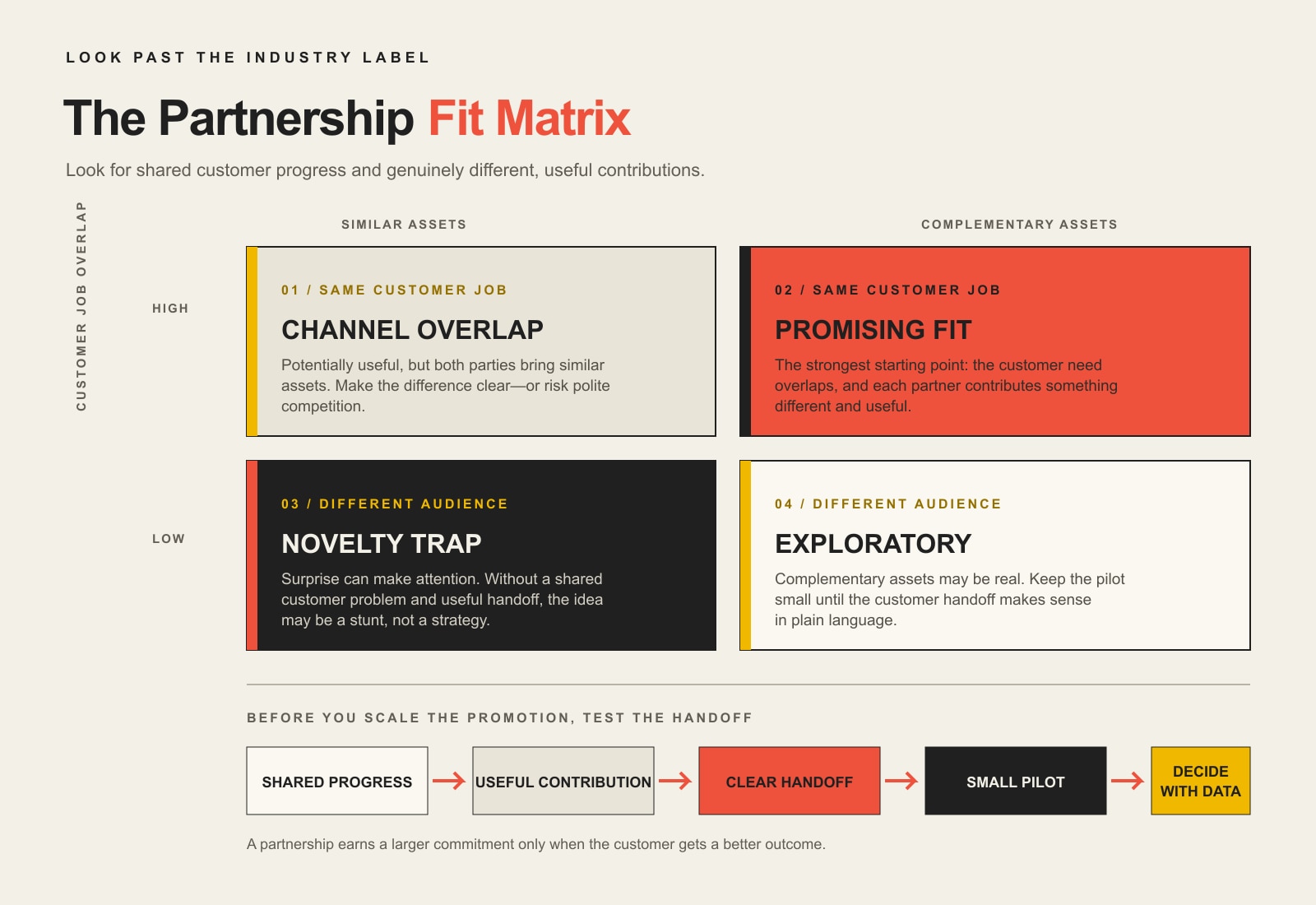
    Before asking whether a partnership is “creative,” plot it on two dimensions: customer-job overlap and asset complementarity. That produces four very different situations.

    A matrix compares overlap in the customer job with similarity or complementarity of partner assets, identifying channel overlap, promising fit, novelty trap, and exploratory opportunities.
    Scope Design Partnership Fit Matrix: the strongest unconventional partnership candidates usually combine meaningful customer-job overlap with genuinely different useful assets.

    1. Promising fit: same customer job, different useful assets

    This is the best place to look first. Think of a commercial real-estate broker and a workplace IT firm serving a company that is moving offices. They do different work, but the customer is trying to complete one larger transition. A coordinated checklist, referral path, move-readiness workshop, or handoff can create obvious value.

    2. Channel overlap: same customer job, similar assets

    Two firms may reach the same audience but bring nearly identical capabilities. The relationship can still work, but only if the differentiation is clear—different geography, specialty, capacity, segment, or stage of the customer journey. Otherwise the “partnership” can become polite competition.

    3. Exploratory: different audience, complementary assets

    This is where genuinely unusual ideas live. The capability fit may be strong, but the customer handoff is not yet obvious. Keep the experiment small until you can show why one audience should care about the other party.

    4. Novelty trap: different audience, unrelated assets

    Two brands can generate attention simply because they look surprising together. Attention is not the same as strategic value. If the shared customer problem, contribution, and handoff cannot be explained in plain language, the idea is probably a stunt before it is a growth system.

    Strategic Partnership Examples: What the Fit Actually Looks Like

    Apple + Nike: complementary assets around the runner

    In 2006, Apple and Nike announced Nike+iPod, pairing Nike+ footwear with the iPod nano and a Sport Kit that tracked workout information and delivered audio feedback. The important lesson is not that two famous brands collaborated. It is that the partnership connected different assets—footwear, running context, device technology, music, and workout data—around one customer experience.

    LEGO + Pharrell Williams: shared meaning, not shared category

    The LEGO Group and Pharrell Williams are not in the same industry, but the collaboration had a coherent center: creativity and curiosity. It included the co-designed Over the Moon set and connected with broader creative, film, and nonprofit work. The strategic fit is easier to see when you describe the shared meaning first and the categories second.

    Small-business example: the “before and after” partner

    A home inspector and a remodeling contractor may not sell the same service, but both become relevant around a property decision. A pediatric dentist and a speech therapist may serve different clinical needs while sharing family education moments. An accountant and a commercial insurance advisor may appear at different points in the same business-owner planning cycle.

    These examples are intentionally ordinary. You do not need a celebrity collaboration. For a small business, a strong partnership often looks like a trusted introduction, a co-created resource, a joint educational event, a bundled process with clear responsibilities, or a referral path that removes friction for the customer.

    Where Business Bias Gets in the Way

    The useful role of bias in this conversation is narrow: it can distort the screen you use before evidence arrives. If you want the broader decision-science discussion, read our guide to cognitive and marketing biases. For partnership decisions, watch for three patterns in particular.

    • Affinity bias: “They do not look like companies we normally work with.” Similarity feels safe, but it does not prove complementarity.
    • Confirmation bias: once the team labels a company a competitor, poor fit, or perfect fit, it notices evidence that reinforces the label.
    • Status-quo bias: an existing referral network feels less risky because it is familiar, even when it produces weak results.

    The countermeasure is not “be open-minded” in the abstract. Replace a vague fit conversation with explicit criteria. Ask what customer job overlaps, what each party contributes, what the handoff looks like, what could go wrong, and what evidence would change your mind.

    The Scope Design Fit-to-Pilot Loop

    Once an idea passes the first fit screen, do not jump straight to a long-term agreement or large campaign. Treat the partnership as a bounded growth experiment. That mirrors the discipline we recommend across small-business growth strategies: define the constraint, test the smallest useful change, observe business and quality signals, then scale, revise, or stop.

    Step 1: Name the customer progress you share

    Do not start with “we have similar audiences.” That is too broad. Complete the sentence: “Our shared customer is trying to ______.” If each company helps with a different part of that progress, you have a useful starting hypothesis.

    Step 2: Name the complementary contribution

    List what each side adds that the other side does not already have. Useful contributions include trusted access, implementation skill, subject-matter expertise, technology, distribution, physical reach, community credibility, content, service capacity, or a unique product layer.

    Step 3: Design the handoff before the promotion

    A lot of partnership ideas sound good in a meeting and fail at the handoff. Decide who introduces whom, what the customer is told, where the lead or order goes, who owns follow-up, how consent and data are handled, what happens when something goes wrong, and how each party represents the other.

    Step 4: Pick the smallest pilot that exercises the real relationship

    A good pilot is not a fake test. It is a smaller version of the real work. That could be one webinar, one co-created guide, a referral experiment with a defined segment, a limited bundled offer, one integration workflow, one location, or one customer cohort. Wharton’s strategic-partnering guidance similarly starts with the partnership goal and the level of uncertainty before choosing the form and commitment.

    Step 5: Declare the decision rule before launch

    Write down what would make you scale, revise, or stop. Otherwise a mediocre collaboration can survive because everyone likes the idea—or a promising one can die because one vanity metric looked disappointing.

    What Should a Partnership Pilot Measure?

    The metric depends on the job of the partnership. A referral relationship should not be judged like a co-marketing event, and an integration should not be judged like a brand collaboration. Start with the intended business outcome and add guardrails.

    SignalQuestion it answersExamples
    BusinessDid the partnership create useful economic movement?Qualified opportunities, partner-sourced customers, revenue or pipeline value
    QualityWere the resulting customers or opportunities actually a fit?Qualification rate, retention when observable, refund/complaint pattern, sales-cycle quality
    CustomerDid the collaboration make the experience easier or better?Completion, attendance, adoption, useful feedback, reduced friction
    CapacityCan both companies deliver this repeatedly?Time required, coordination overhead, support load, missed handoffs
    DecisionWhat happens next?Scale, revise one variable, or stop

    Do not let impressions and social engagement become the entire scorecard unless awareness was genuinely the objective. If the partnership only creates vague visibility, you have evidence of attention—not yet evidence of a repeatable growth system.

    Why Strategic Partnerships Fail

    Most partnership failure modes are less glamorous than “bad chemistry.” They are operating-design problems.

    • No shared customer job: the brands look interesting together, but the customer cannot see why the relationship exists.
    • Duplicate contributions: both parties bring audience or expertise, but neither adds the missing capability.
    • Vague ownership: everyone wants the upside; nobody owns follow-up, support, data hygiene, or recovery when the handoff breaks.
    • Unequal effort: one side does most of the delivery while value accrues elsewhere.
    • No stop rule: the partnership lingers because nobody defined what success or failure would look like.
    • Scaling before learning: the parties announce a large commitment before proving that the customer experience and operating relationship work.

    For higher-interdependence alliances, coordination becomes especially important. Wharton research on alliance governance argues that performance depends in part on matching coordination and exploration needs to the relationship’s interdependence and governance structure. In plain English: the more your operations depend on each other, the less you can rely on goodwill and improvisation.

    A 30-Day Unexpected Partnership Action Plan

    1. Days 1–7: Map the customer journey. Identify what customers do immediately before, during, and after buying from you. List the businesses they already trust at those moments.
    2. Days 8–14: Score five candidates. Use customer-job overlap, complementary assets, handoff credibility, operational fit, and reversibility. Do not rank by “looks like us.”
    3. Days 15–21: Design one pilot. Define the customer segment, offer or useful asset, handoff, owner on each side, cost ceiling, timeline, guardrails, and decision rule.
    4. Days 22–30: Launch small and review. Capture business, quality, customer, and capacity signals. Decide what the evidence supports next.

    The goal of the month is not to “land a partnership.” It is to make one partnership hypothesis legible enough to test.

    Frequently Asked Questions About Strategic Partnerships

    What makes a good strategic partnership?

    A good strategic partnership has a defined customer or business goal, complementary contributions, clear ownership at the handoff, incentives that make sense for both sides, and a way to measure whether the relationship is creating enough value to continue.

    What are the main types of strategic partnerships?

    Common forms include referral partnerships, co-marketing or co-created content, bundled offers, integrations, channel/distribution relationships, events or education partnerships, community partnerships, research collaborations, and product collaborations. The right form depends on the customer problem and the asset each party contributes—not on fitting a universal list.

    How do you find complementary business partners?

    Map businesses that serve your ideal customer immediately before, during, or after the problem you solve. Then look for a missing asset: trusted access, expertise, capacity, technology, distribution, or context. Start with the customer journey, not a networking directory.

    How should you test a partnership before committing?

    Use a small real-world pilot with defined scope, owners, customer handoff, timing, cost, and a scale/revise/stop rule. The test should exercise the actual relationship instead of merely measuring whether both sides enjoyed planning together.

    Is a strategic partner the same as a business partner or co-owner?

    No. A strategic partner can remain a completely independent company. A co-owner relationship introduces ownership, governance, compensation, legal, tax, and exit questions that require a different decision process and professional advice.

    The Better Question Is “What Can We Test Together?”

    Unexpected partnerships are not valuable because they are unexpected. They are valuable when a surprising combination reveals a practical complementarity that an industry-based screen would have missed.

    Look for the same customer progress, a different useful asset, a handoff you can explain, and a pilot you can reverse. Then let evidence—not familiarity, enthusiasm, or a clever launch concept—decide whether the relationship deserves to grow.

    If you want help identifying the constraint behind your growth problem, evaluating partnership ideas, or designing a test that produces a real decision, contact Scope Design. We can help make the opportunity legible before you invest heavily in it.

  • Google Ads Cost Per Click: Stop Chasing Cheap Traffic

    Google Ads Cost Per Click: Stop Chasing Cheap Traffic

    Google Ads cost per click is the amount you pay when someone clicks your ad. Average CPC is total click cost divided by total clicks. You can often lower it by changing bids, targeting less competitive or more relevant searches, excluding waste, improving the ad-to-page experience, and choosing a bidding strategy that matches the real objective.

    But lower CPC is not the goal. Profitable customer acquisition is the goal. A $3 click that produces nothing is infinitely expensive. A $30 click can be a bargain when it becomes a qualified, profitable customer. Optimizing CPC without tracking what happens after the click is how a dashboard gets prettier while the bank account remains stubbornly unimpressed.

    TL;DR: How do you lower Google Ads CPC without wrecking results?

    • Confirm what average CPC measures: total click cost divided by clicks.
    • Diagnose whether the apparent problem is auction pressure, poor query fit, aggressive bids, weak relevance, bad conversion tracking, low qualification, or weak sales economics.
    • Review actual search terms and exclude irrelevant demand before hunting for cheaper keywords.
    • Match bidding to the business goal. Maximize Clicks seeks clicks; conversion and value-based strategies seek different outcomes.
    • Strengthen the relevance chain from search intent through ad promise and landing-page answer.
    • Measure cost per qualified outcome and cost per customer—not only CPC or raw form submissions.
    • Accept a higher CPC when it buys more valuable demand at better overall economics.
    • Do not promise a universal percentage reduction. CPC is auction-specific, and the same change can produce different results in different markets.

    What does cost per click mean in Google Ads?

    Cost per click, or CPC, is the price charged when someone clicks an ad. With manual CPC bidding, you may set a maximum CPC—the most you are typically willing to pay for a click. Your actual CPC is the final amount charged, which is often lower than that maximum.

    Google defines average CPC with a simple formula:

    Average CPC = total cost of clicks ÷ total clicks

    If a campaign spends $1,000 and receives 100 clicks, its average CPC is $10. That calculation is exact. Whether $10 is good is an entirely different question.

    According to Google’s explanation of actual CPC, the auction typically charges what is minimally required to clear Ad Rank thresholds and beat the Ad Rank of the competitor immediately below. Auction-time ad quality, the bid, thresholds, competition, search context, and the expected impact of assets and formats all contribute to Ad Rank and actual CPC.

    That is why there is no single “normal” Google Ads CPC. The price varies by search, industry, location, device, position, competition, objective, and the value advertisers expect from winning that moment.

    What is a good Google Ads cost per click?

    A good CPC is one that allows the campaign to acquire qualified customers or another valuable outcome at acceptable economics. Industry averages can provide context, but they cannot tell you what your business can afford.

    The useful question is not:

    Is our CPC below the industry average?

    It is:

    Does this CPC produce enough qualified value after conversion, sales, fulfillment, and margin are considered?

    Imagine two campaigns:

    CampaignAverage CPCClicksCustomersCost per customer
    Cheap clicks$42501$1,000
    Expensive clicks$20505$200

    Both spend $1,000. The campaign with five-times-higher CPC acquires customers at one-fifth the cost. The numbers are illustrative, but the principle is real: click price without downstream quality is nearly useless.

    The Scope Design Click Economics Chain

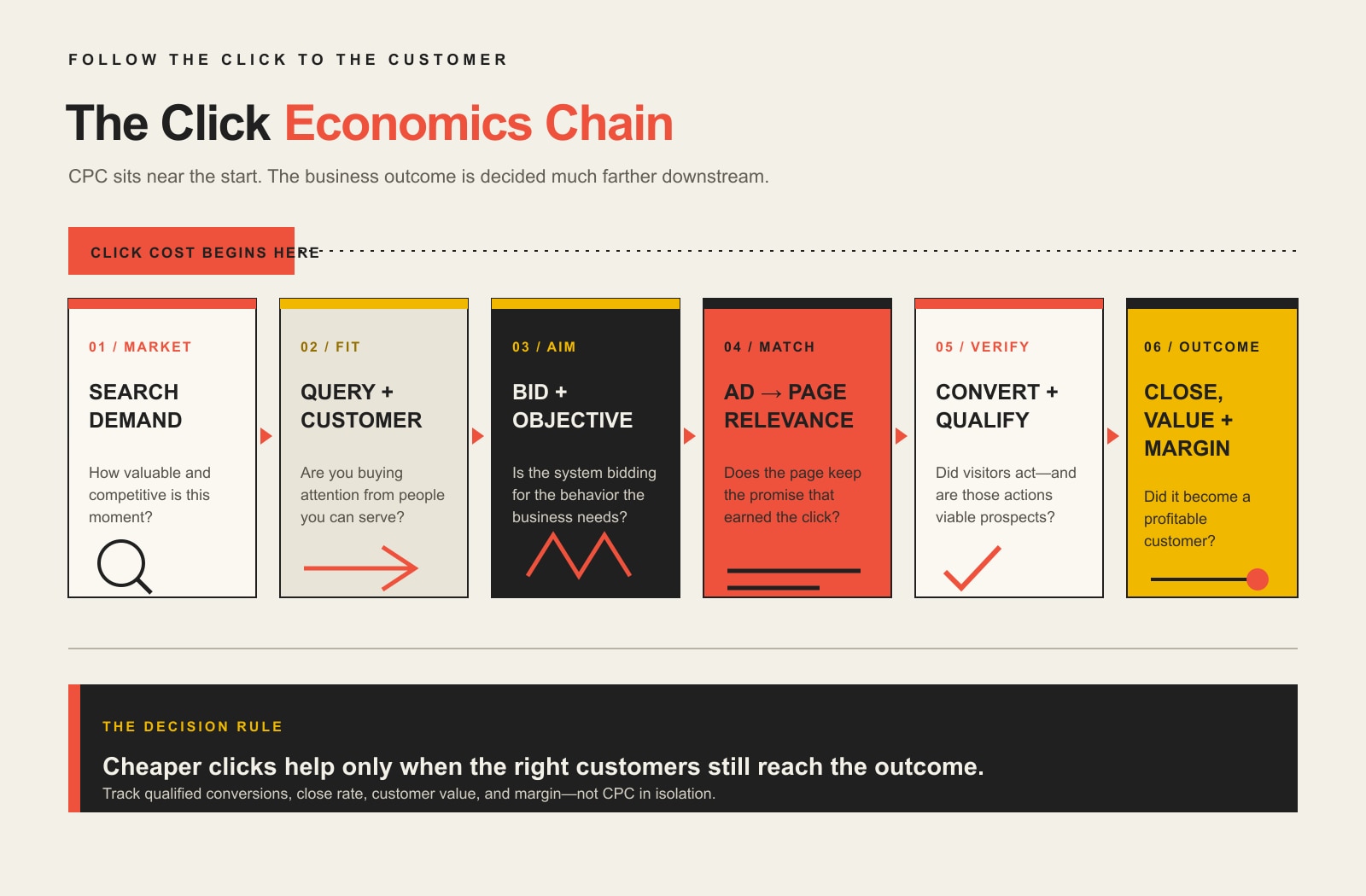
    Six connected stages trace paid-search economics from search demand through query fit, bidding, ad-to-page relevance, qualified conversions, and customer close rate, value, and margin.

    To diagnose CPC without becoming hypnotized by it, trace six connected layers:

    1. Search demand and auction pressure: How valuable and competitive is the moment?
    2. Query and customer fit: Are you buying attention from people the business can actually serve?
    3. Bid and objective: What is the bidding system instructed to pursue?
    4. Ad-to-page relevance: Does the promise earn the right click and continue coherently on the destination?
    5. Conversion and qualification: Do visitors take meaningful actions, and are those actions from viable prospects?
    6. Close rate, value, and margin: Do qualified opportunities become profitable customers?

    CPC lives near the top of this chain. Profit lives at the bottom. Cutting cost at the top can damage value below it.

    This is the paid-search version of buying bargain lumber for a building and celebrating before anyone checks whether the framing can hold up the roof. Cheap inputs are only useful when the finished system works.

    The math that makes CPC useful

    You do not need a finance degree, a crystal ball, or an agency report with seventeen gradients. You need a few connected rates.

    Cost per website conversion

    Cost per conversion = average CPC ÷ landing-page conversion rate

    At a $10 CPC and a 5% conversion rate, the expected cost per recorded conversion is $200:

    $10 ÷ 0.05 = $200

    This assumes one click opportunity per conversion and a stable conversion rate. Real attribution and repeat visits can complicate the picture, so use the formula as a diagnostic model rather than holy scripture.

    Cost per qualified outcome

    Raw conversions are easy to inflate. Add qualification:

    Cost per qualified outcome = average CPC ÷ conversion rate ÷ qualification rate

    At a $10 CPC, 5% conversion rate, and 50% qualification rate:

    $10 ÷ 0.05 ÷ 0.50 = $400

    If a form simplification raises conversion rate to 8% but qualification drops to 20%, cost per qualified outcome becomes $625. The conversion report improves while the business result gets worse. Congratulations on moving the mess into someone else’s calendar.

    Cost per acquired customer

    Add the close rate:

    Cost per customer = average CPC ÷ conversion rate ÷ qualification rate ÷ close rate

    Using the previous example and a 25% close rate:

    $10 ÷ 0.05 ÷ 0.50 ÷ 0.25 = $1,600

    Now compare that acquisition cost with gross profit or contribution margin, not merely top-line revenue. A $2,000 sale with $300 of contribution cannot support a $1,600 acquisition cost merely because the revenue number looked impressive in a slide deck.

    Break-even CPC

    A simplified break-even model works backward:

    Break-even CPC = allowable customer acquisition cost × conversion rate × qualification rate × close rate

    If the business can afford $1,000 to acquire a customer, the landing page converts 5%, half the inquiries qualify, and 25% of qualified opportunities close:

    $1,000 × 0.05 × 0.50 × 0.25 = $6.25

    That does not mean every bid must be capped at $6.25. Automated bidding, assisted conversions, customer lifetime value, refunds, sales labor, and attribution can change the model. It means the business finally has a rational reference point instead of asking whether $6.25 “feels high.”

    Expected contribution per click

    You can also estimate what a click is worth before media cost:

    Expected contribution per click = conversion rate × qualification rate × close rate × contribution per customer

    Using a 5% conversion rate, 50% qualification rate, 25% close rate, and $1,000 contribution per customer:

    0.05 × 0.50 × 0.25 × $1,000 = $6.25

    Subtract average CPC to estimate the contribution remaining after click cost. If the click costs $5, the simplified expected remainder is $1.25. If it costs $8, the path loses $1.75 before fixed overhead and other acquisition costs.

    This model becomes more useful when the inputs come from actual CRM, sales, refund, and margin data. It becomes decorative algebra when everyone quietly guesses the rates and then formats the result to two decimal places.

    Why is Google Ads CPC so high?

    High CPC is a symptom with several possible causes. Diagnose before prescribing.

    The auction is genuinely competitive

    Some searches carry strong commercial intent and large potential customer value. More advertisers compete, bids rise, and Ad Rank thresholds for prominent positions may be higher. Google notes that actual CPC for ads above search results is often higher than for ads below them because prominent locations carry different thresholds and value.

    You cannot optimize away the existence of competitors. You can decide which auctions deserve your money.

    Your queries are too broad or poorly matched

    Keywords are targeting instructions; search terms are what people actually searched. The distinction matters. A keyword can enter auctions for queries with different intent, urgency, geography, or fit.

    Use the Google Ads search terms report to find relevant phrases worth developing and irrelevant searches that may need negative keywords. Do not add negatives blindly. A word that looks wasteful in isolation may appear inside a valuable query.

    The bidding objective values the wrong behavior

    Maximize Clicks is designed to seek the most clicks within a budget. That can be appropriate when traffic is genuinely the objective. It is not the same as seeking qualified leads, sales, profit, or conversion value.

    Google’s bid-strategy guidance separates click, visibility, conversion-volume, and conversion-value goals. If the business needs qualified value but tells the platform to maximize click volume, cheap clicks may be the system working exactly as instructed.

    Your ad and landing page are a weak match

    Auction-time quality includes expected CTR, ad relevance, and landing-page experience. A weak path can increase the amount required to compete and waste the click after it arrives.

    Our guide to Google Ads Quality Score explains the diagnostic in detail. The short version: fix the connection from search intent to keyword, ad promise, landing-page answer, and measured business action. Do not chase the visible 1–10 number as a KPI.

    Your targeting enters expensive contexts

    Device, location, time, audience, network, match behavior, and other context can change which auctions you enter. Segment performance before assuming an account-wide CPC problem. A high-CPC location may also produce the best customers. A low-CPC device may generate accidental clicks and no qualified action.

    Your market or strategy changed

    Competition, seasonality, product demand, budgets, bidding targets, creative, landing pages, conversion tracking, and account structure all move. A rising CPC with no obvious manual change does not mean nothing changed. The auction is not a fixed-price vending machine.

    How to lower Google Ads CPC responsibly

    The safest reductions remove waste or improve relevance without sacrificing qualified demand.

    1. Validate conversion tracking first

    Test the actual forms, calls, purchases, bookings, and imports. Check for duplicate events, dead notifications, thank-you-page reloads, accidental button-click conversions, and conversions that do not reflect customer value.

    Automated bidding uses the signals you provide. Bad tracking is not a harmless reporting inconvenience. It teaches the system to pursue the wrong behavior with machine-speed confidence.

    2. Separate raw conversions from qualified outcomes

    Define what makes a lead viable: service, geography, budget, authority, timing, problem, or another business-specific criterion. Connect advertising data to CRM status, sales-qualified opportunity, purchase value, or an equivalent downstream result where feasible.

    Google’s conversion-value documentation explains how different values can help measure and optimize business impact rather than treating every conversion as identical. A spam form and a $50,000 opportunity should not both receive a cheerful value of one.

    3. Read the search terms

    Classify actual searches by intent and fit. Look for:

    • services or products you do not offer;
    • locations you cannot serve;
    • job, support, free, DIY, definition, or research intent when it conflicts with the campaign’s job;
    • comparison and pricing searches that need a different page;
    • valuable queries hidden inside a broad theme;
    • repeated language customers use that your ads ignore.

    Add negative keywords for demonstrably irrelevant intent. Create new themes when a materially different query needs a different ad, page, offer, or measurement path. Do not build a negative-keyword fortress that blocks every unfamiliar phrase before it has a chance to prove value.

    4. Decide which auctions are worth entering

    Cheaper demand is not automatically equivalent demand. Evaluate search intent, likely customer value, volume, competitive pressure, and business fit together.

    Longer, more specific searches can be less competitive, but “long-tail” is not a coupon code. Some specific legal, medical, software, or industrial queries are expensive precisely because they signal valuable intent. Choose them because the economics work, not because a blog post promised cheap clicks in bulk.

    5. Improve the ad-to-page relevance chain

    Use clear ads that accurately preview the destination and help bad-fit searchers self-select out. Match the landing-page opening to the search and ad. Answer the questions required for the decision. Include relevant proof. Make the page usable on mobile. Ask for an action appropriate to the buyer’s stage.

    Our landing-page optimization guide covers this as an intent contract: known arrival, matched promise, relevant proof, appropriate action, and operational follow-through.

    Improved relevance may help auction economics. More importantly, it prevents you from paying for a click and then breaking the promise yourself.

    6. Match the bid strategy to the objective

    Google Ads offers strategies designed around different goals:

    Business needStrategy familyWhat the system is asked to pursue
    TrafficMaximize ClicksMore clicks within the budget
    VisibilityTarget Impression ShareA chosen level or location of visibility
    Conversion volumeMaximize Conversions or Target CPAMore conversions or conversions around a target cost
    Conversion valueMaximize Conversion Value or Target ROASMore reported value or value around a return target

    Google began changing some Smart Bidding labels in June 2026, while stating that the underlying behavior remains the same. Use the current interface names, but choose based on the business goal—not whichever recommendation card appears most enthusiastic.

    Smart Bidding uses auction-time signals to optimize for conversions or conversion value. It can operate without prior campaign data, but Google notes that historical conversion data can improve calibration and that recommendations vary by campaign and strategy. There is no responsible universal rule that every business must switch after exactly 30 conversions.

    7. Set targets from economics, not aspiration

    A Target CPA lower than the auction and conversion path can sustain may restrict volume or push the system toward lower-value opportunities. A Target ROAS based on inflated or incomplete conversion values optimizes a fiction.

    Build targets from allowable acquisition cost, margin, cash flow, sales capacity, conversion delay, repeat value, and the reliability of the signal. Then watch whether the target produces enough volume and quality to matter.

    8. Use experiments and bounded changes

    Change one coherent part of the diagnosis: search coverage, negatives, ad promise, landing-page path, conversion goal, bid strategy, or target. Document the date and expected effect. Allow for conversion delay and sufficient evidence before judging.

    Google advises allowing at least a conversion cycle before evaluating many Smart Bidding changes. Constant target edits can make the business feel busy while making cause and effect impossible to separate.

    When a higher CPC is the better result

    A rising CPC may be acceptable—or desirable—when it accompanies:

    • a higher qualified-lead rate;
    • a better lead-to-opportunity or close rate;
    • larger or more profitable customers;
    • stronger conversion value per click;
    • fewer low-value inquiries consuming sales time;
    • entry into a valuable new market;
    • improved top-of-page eligibility for searches proven to matter;
    • lower cost per customer despite higher click cost.

    For example, shifting from generic “business software” searches to specific “manufacturing inventory software implementation” searches might increase CPC and dramatically improve fit. The expensive click is doing more work.

    Do not use that argument to excuse any high CPC. Use it to insist on complete measurement.

    When a lower CPC is a warning

    CPC can fall because:

    • ads moved into weaker positions;
    • search coverage expanded into lower-intent queries;
    • targeting shifted to locations or devices that do not convert;
    • a traffic-focused strategy found abundant cheap clickers;
    • brand traffic diluted more expensive non-brand demand;
    • competitors left auctions whose customers you also wanted;
    • the ad became click-friendly and qualification-hostile.

    Always ask what changed in impressions, search terms, position, conversions, qualification, customer acquisition cost, and value. A cheaper click is a clue, not a standing ovation.

    How much daily budget do Google Ads need?

    Questions such as “Is $10 or $20 a day enough?” appear frequently in search. The honest answer is: enough for what, in which auction, over what learning period?

    A daily budget should be evaluated against expected CPC, available qualified search volume, conversion rate, sales economics, and how much evidence is needed to make a decision.

    At a $20 daily budget and $10 average CPC, the campaign may receive roughly two clicks per day on average. If the landing page converts 5% of clicks, the simplified expectation is one conversion per 20 clicks—or about ten days before qualification and sales outcomes are considered. Randomness means actual results will not arrive on schedule like a commuter train.

    A small budget can be useful for a narrow market, a bounded learning objective, or a high-margin business willing to wait. It is inadequate when it spreads across too many services, locations, and intentions to produce interpretable evidence.

    This article owns click economics, not a universal Google Ads pricing table. A separate cost-and-budget guide should compare campaign goals, market demand, management cost, creative and landing-page work, and the evidence threshold required for a useful test.

    A practical CPC audit sequence

    Use this order:

    1. Confirm tracking: Do conversions fire, arrive, and represent useful actions?
    2. Calculate the chain: CPC, conversion rate, qualification rate, close rate, customer acquisition cost, value, and margin.
    3. Segment the result: Campaign, search term, keyword/theme, landing page, device, geography, time, and audience where relevant.
    4. Read actual searches: Identify valuable demand, ambiguity, and demonstrable waste.
    5. Check the objective and bid strategy: Is the system pursuing clicks, visibility, conversions, or value?
    6. Inspect relevance: Does the search, ad, page, and action form one coherent promise?
    7. Find the binding constraint: Auction cost, query fit, bidding, page conversion, qualification, sales follow-up, or offer economics.
    8. Make one bounded intervention: Define what should change and what would disprove the diagnosis.
    9. Wait for complete outcomes: Respect conversion delay and sales-cycle length.
    10. Judge the business result: Keep the change only if qualified economics or useful learning improve.

    If the account lacks enough volume for a controlled test, use stronger qualitative evidence: search terms, recorded calls with permission, form details, sales objections, customer interviews, and the difference between won and lost opportunities. Low traffic does not justify guessing with greater confidence.

    Frequently asked questions about Google Ads CPC

    What is cost per click in Google Ads?

    Cost per click is the amount charged when someone clicks an ad. Average CPC equals total click cost divided by total clicks. Actual CPC is the final price of a specific click and is often lower than a manual maximum CPC bid.

    What determines actual CPC?

    Google says actual CPC reflects what is needed to clear Ad Rank thresholds and compete with the advertiser below. Auction-time ad quality, bids, thresholds, competition, search context, and the expected impact of assets and formats contribute to Ad Rank and price.

    What is a good Google Ads CPC?

    A good CPC supports an acceptable cost per qualified customer or other valuable outcome. Compare it with conversion rate, qualification, close rate, customer value, and margin. An industry average cannot determine what your business can profitably afford.

    Why is my Google Ads CPC so high?

    Possible causes include intense competition, commercially valuable searches, aggressive bids or targets, broad or poor-fit query coverage, weak ad-to-page relevance, prominent positions, targeting context, seasonality, and market changes. Segment the account before choosing a fix.

    How can I lower CPC in Google Ads?

    Remove irrelevant search demand, improve the ad-to-page relevance chain, choose auctions deliberately, match bidding to the correct objective, set economically realistic targets, and improve conversion and value signals. Lower bids can reduce CPC but may also reduce eligibility, position, volume, or value.

    Is lower CPC always better?

    No. Lower CPC is better only when the downstream outcome remains equal or improves. Cheap clicks that produce unqualified leads or no sales can create a higher customer acquisition cost than expensive, high-intent clicks.

    Does Quality Score affect CPC?

    The visible 1–10 Quality Score is not an auction input, but related auction-time quality factors can influence Ad Rank and actual CPC. Use Quality Score to diagnose relevance, then judge changes by qualified business outcomes.

    Do negative keywords lower CPC?

    Negative keywords can prevent ads from entering irrelevant searches, reducing wasted spend and changing the campaign’s average CPC. They do not guarantee cheaper clicks. Their more important job is improving search fit and protecting budget for demand the business wants.

    Should I use Manual CPC or Smart Bidding?

    Choose based on the objective, tracking quality, available evidence, operational capacity, and need for control. Smart Bidding optimizes at auction time for conversions or value; Manual CPC provides direct bid control. Neither repairs bad measurement or a weak offer.

    Can I set a maximum CPC with automated bidding?

    Capabilities vary by strategy. Manual CPC uses max CPC bids, and Maximize Clicks can support a maximum CPC limit. Conversion and value-based Smart Bidding strategies use auction-time bids around their objectives and constraints. Check the current strategy settings rather than assuming one account-wide cap applies.

    Is $10 or $20 per day enough for Google Ads?

    It can be enough for a narrow test or low-cost market, but not by universal rule. Divide the budget by expected CPC, then consider how many clicks are required to observe conversions, qualified outcomes, and sales. A small budget spread across too many variables may never produce useful evidence.

    How often should I change Google Ads bids or targets?

    Change them when business objectives, economics, or sufficient performance evidence justify it. Account for conversion delay and allow enough time to observe complete outcomes. Constant changes make diagnosis difficult and can move campaigns into different auctions before results mature.

    Stop asking whether the click is cheap

    Ask whether the click belongs in the campaign, receives an honest and relevant promise, reaches a useful destination, becomes a qualified opportunity, and produces enough value to justify its cost.

    That is the actual job.

    Use the Scope Design Marketing & Advertising guide to place paid search inside the wider marketing system. Use the Google Ads Quality Score guide when the relevance diagnostic needs deeper investigation. Use the Analytics & SEO measurement guide when traffic and platform metrics are not connected to useful business outcomes.

    If your CPC report looks alarming but nobody can explain which searches become profitable customers, talk with Scope Design. We will diagnose the auction, query, ad, page, measurement, and sales path before prescribing cheaper traffic that may be worth even less.

  • De Beers Marketing Campaign: How “A Diamond Is Forever” Changed Demand

    De Beers Marketing Campaign: How “A Diamond Is Forever” Changed Demand

    The De Beers marketing campaign is often told as a simple story: a diamond company invented engagement rings, wrote one brilliant slogan, and convinced the world that a shiny stone was mandatory for marriage. The real history is more interesting—and more useful to marketers.

    Diamond engagement rings existed centuries before De Beers. What De Beers and its U.S. advertising agency, N.W. Ayer, did far more effectively was turn an existing elite custom into a mass-market expectation. They connected a product to a life ritual, gave the purchase emotional meaning, repeated that meaning through culture and commerce, and defended the idea of lasting value for decades.

    That distinction matters for marketers. The useful lesson is not “manufacture a tradition.” It is how a clear position can become stronger when the product, the moment, the identity, and the proof all reinforce the same idea.

    What De Beers actually changed

    De Beers did not invent engagement rings or even diamond engagement rings. The Gemological Institute of America’s history of engagement rings traces betrothal rings to the Romans and notes a written record of a diamond engagement ring in 1477, when the future Holy Roman Emperor Maximilian was advised to give Mary of Burgundy a ring set with a diamond.

    So the breakthrough was not invention. It was normalization at scale. A diamond ring moved from being one possible luxury symbol to becoming, for many buyers, the expected symbol of engagement. That is a much more interesting marketing achievement because it required changing what people believed the purchase meant.

    The strongest campaigns rarely create desire from nothing. They attach an offer to desires that already exist: love, security, status, belonging, celebration, competence, relief, or progress. De Beers attached diamonds to one of the most emotionally loaded transitions in adult life and then worked to make the association feel natural.

    How the De Beers marketing campaign worked before the slogan

    The famous slogan arrived in 1947, but the demand-building system was already taking shape. GIA’s history of the 4Cs records that it was collaborating with De Beers on advertising to stimulate interest in diamonds by 1940, and that N.W. Ayer represented De Beers in the United States.

    That matters because it corrects another myth: the campaign was never just four magic words. The broader machine included advertising, retailer education, public education, editorial influence, celebrity imagery, and repeated explanations of how to evaluate diamonds. A slogan can crystallize a strategy, but it cannot replace one.

    Modern marketers would recognize the distribution logic. The message becomes more believable when it appears consistently in more than one context. That is not identical to today’s omnichannel marketing, but the principle is familiar: each touchpoint should reinforce the same customer meaning instead of telling a different story.

    Why “A Diamond Is Forever” worked

    The De Beers marketing campaign found its most durable expression in 1947, when N.W. Ayer copywriter Frances Gerety wrote the line “A Diamond Is Forever.” WARC’s campaign history describes the core strategic move: the slogan linked the physical durability of a diamond with the idea of enduring romantic love.

    That is unusually efficient positioning. Four words carried a product attribute, an emotional promise, and a behavior cue at the same time:

    • Product truth: diamonds are physically durable.
    • Emotional analogy: enduring material becomes a symbol for enduring love.
    • Purchase logic: an important, permanent commitment deserves an important, permanent object.
    • Retention logic: “forever” frames the ring as something to keep, not something bought for short-term utility.

    The line did not need to explain mining, gemology, or price. It gave the buyer a simple story for why the product belonged in the moment.

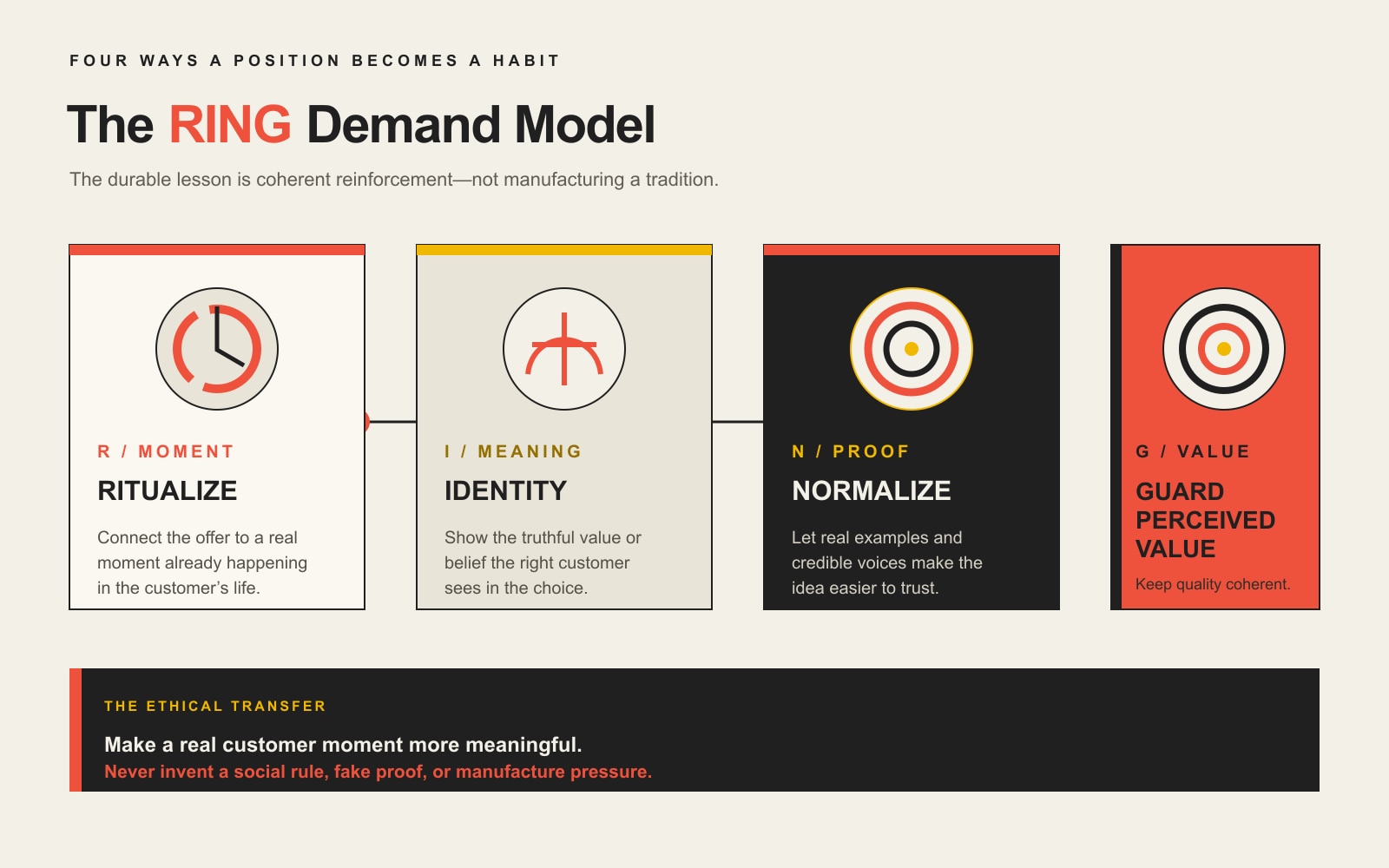
    Scope Design’s RING demand model

    De Beers is an extreme historical case, but the mechanism can be separated from the parts modern businesses should not copy. We use the RING model to describe the durable portion of the strategy: Ritualize, Identity, Normalize, Guard value.

    The RING demand model moves from Ritualize a meaningful moment to Identity, Normalize with credible proof, and Guard perceived value; the ethical note warns against invented social rules, fake proof, and manufactured pressure.

    R — Ritualize a meaningful moment

    A ritual gives a purchase timing. Engagement created a natural “when”: at the proposal or commitment milestone. For a modern business, the ethical version is to understand the real transition your customer is already going through. A new hire needs onboarding. A growing company outgrows a homemade website. A homeowner preparing to sell needs the property ready for market.

    The offer becomes easier to understand when the customer can answer, “This is what people like me do when this moment happens.”

    I — Identity: make the choice mean something

    De Beers did not market only a mineral. The ring signaled commitment, seriousness, taste, and eventually social expectation. Identity compresses complicated value into a recognizable symbol.

    Modern brands can use identity without manipulation. The question is not “How do we make people insecure?” It is “What truthful statement does choosing us let the right customer make about themselves?” Reliability, craftsmanship, independence, local expertise, speed, sustainability, or premium service can all be identity signals when the underlying experience earns them.

    N — Normalize with distributed proof

    An idea feels safer when people encounter it repeatedly from credible places. Advertising can introduce the message, but retailers, educators, press, peers, customer stories, and recognizable examples can make it feel normal.

    The ethical line is crucial: use real proof. Do not invent testimonials, fake scarcity, stage popularity, or pressure customers with a social rule you made up. Our guide to marketing psychology without tricking people goes deeper on helping buyers decide without exploiting them.

    G — Guard perceived value

    Premium positioning collapses when every message trains the buyer to think only about discounts. De Beers spent decades reinforcing durability, symbolism, quality language, and occasion-based meaning. That protected a value story far larger than the stone’s functional utility.

    For an ordinary business, guarding value means consistency and substance: clear positioning, a coherent offer, proof of results, dependable delivery, and pricing that matches the experience. It does not mean copying the historical diamond industry’s market power or manufacturing scarcity.

    De Beers did not invent the 4Cs

    The old version of this article credited De Beers with creating the 4Cs—cut, color, clarity, and carat. That is incorrect.

    GIA identifies its founder, Robert M. Shipley, as the originator of the 4Cs mnemonic in the early 1940s. The more nuanced history is better: De Beers and N.W. Ayer helped spread the framework. GIA notes that Ayer lecturers taught jewelers how to explain the four factors and that De Beers later used the term in national advertising.

    That distinction is itself a marketing lesson. A company does not have to invent every useful framework to benefit from making it easier for customers to understand a category. Education can reduce uncertainty and give buyers a vocabulary for comparison—as long as the information is accurate and the source gets proper credit.

    The two-month salary guideline was advertising, not etiquette

    Another durable piece of diamond folklore is the idea that an engagement ring should cost two months of salary. It is not a timeless social rule or a financial standard.

    JCK’s contemporary trade coverage documented De Beers/Ayer advertising that explained the 4Cs and the two-month salary guideline. In a later JCK retrospective, the publication placed the two-month version in the 1990s and described it explicitly as a De Beers effort to increase the average engagement-ring price.

    For marketers, this is a useful warning about the power of anchors. A suggested budget can become memorable even when it has no independent authority. That is exactly why pricing guidance should help customers make a better decision, not disguise a seller’s preferred spend as a rule everyone is supposed to follow.

    What marketers can copy—and what they should not

    The De Beers case is compelling because the ethical and strategic lessons sit side by side. Separating them makes the case more useful.

    Worth copying

    • Own one clear association. “Forever” gave the product a compact emotional position.
    • Connect the offer to a real moment. A timed need is easier to act on than generic awareness.
    • Teach customers how to evaluate the category. Good education lowers uncertainty and makes expertise visible.
    • Repeat the same meaning across touchpoints. Consistency compounds; scattered messages reset the conversation.
    • Build distinctive memory. A memorable phrase, visual system, or framework can become an asset that works for years.

    Not worth copying

    • Manufactured social pressure. “Everyone expects this” is not ethical proof unless it is actually true and relevant.
    • Artificial urgency or scarcity. A premium should come from real value, not a false constraint.
    • Opaque pricing rules. A seller-created spending norm should not masquerade as independent advice.
    • Market control as strategy. Historical concentration of diamond supply is part of the context, not a playbook for small businesses.

    The difference is simple: strong positioning helps the right customer understand real value. Manipulation tries to manufacture a reason to buy that would collapse if the customer had better information.

    Why the De Beers marketing campaign still matters

    The most telling proof of the slogan’s durability is that De Beers still returns to it. In November 2024, the company announced its “Forever Present” campaign and said it was reviving the “A Diamond Is Forever” tagline for U.S. natural-diamond marketing. That is a primary-source claim from De Beers’ own campaign release, so it tells us what the company chose to reuse—not whether every claim in the campaign should be accepted uncritically.

    Still, the strategic point is hard to miss. A distinctive idea can outlive individual media plans, creative executions, and generations of buyers. The asset is not merely the ad. It is the association the ad keeps reinforcing.

    For a small business, that is the bridge back to the whole marketing system. If positioning is fuzzy, adding more ads usually amplifies the fuzziness. If the message, offer, proof, and customer journey agree, paid attention has something coherent to multiply. Our small business marketing strategy guide covers that broader system.

    Frequently asked questions

    Did De Beers invent diamond engagement rings?

    No. Diamond engagement rings existed centuries before the De Beers campaign; GIA documents a written example from 1477. De Beers’ achievement was helping turn the diamond engagement ring into a much broader cultural expectation through sustained marketing.

    Who wrote “A Diamond Is Forever”?

    N.W. Ayer copywriter Frances Gerety wrote the slogan in 1947 for De Beers. Its power came from connecting diamond durability with the idea of enduring love.

    Did De Beers invent the 4Cs of diamonds?

    No. GIA credits founder Robert M. Shipley with developing the 4Cs mnemonic in the early 1940s. De Beers and N.W. Ayer helped popularize the language through education and advertising.

    Is two months of salary a real rule for buying an engagement ring?

    No. It was an advertising guideline, not a financial or etiquette standard. A couple’s ring budget should be based on their own priorities and finances, not a seller-created formula.

    Why was the De Beers marketing campaign so effective?

    The De Beers marketing campaign aligned one memorable idea with a meaningful life moment, repeated it across many credible touchpoints, educated buyers about the category, and reinforced a consistent value story for decades. The result came from the system around the slogan, not from four words acting alone.

    The real De Beers marketing lesson

    The De Beers marketing campaign is more impressive—and more useful—when we stop repeating the myths around it. The company did not invent diamond engagement rings. It did not invent the 4Cs. And one slogan did not single-handedly create a neatly measurable $350 billion industry.

    What De Beers and N.W. Ayer did was build a remarkably persistent system of meaning around an existing product and an existing ritual. They made the product easier to remember, easier to justify, easier to compare, and harder to separate from the moment it represented.

    That is the part worth studying. Ritualize the right moment. Give the choice truthful identity. Normalize it with real proof. Guard value with consistency and genuine differentiation. If the meaning survives better information, you are building a brand. If it depends on hiding the truth, you are building a trap.

  • How To Change Anyone, Even Yourself

    How To Change Anyone, Even Yourself

    How to change behavior is a harder question than it sounds, because behavior is not a switch you flip with the right argument. You can control your own choices imperfectly. You can influence another adult’s choices. You cannot reliably make someone want, value, or repeat a change they do not endorse.

    Short answer: lasting change is more likely when the desired behavior is specific, the person has a reason that matters to them, the environment makes the new action easier, the next step is concrete, and the result is reviewed without turning every setback into a character judgment.

    That distinction matters at work and at home. If you are trying to change yourself, you have direct access to your environment, routines, and decisions. If you are trying to help an employee, client, partner, or colleague change, your job is different: improve the conditions for change, make expectations clear, listen for real resistance, and leave the other person with agency. This guide is about general adult behavior and workplace application, not clinical treatment, diagnosis, addiction care, or child discipline.

    Can You Really Change Anyone?

    Not in the way the title sounds. You cannot install a new belief or habit in another person. You can influence what happens around a behavior: the situation, what gets attention, how the person interprets the situation, what response is easiest, what gets rewarded, and what happens next.

    That is not just a semantic distinction. A 2020 review by Angela Duckworth and James Gross organizes behavior-change strategies around situations, attention, appraisals, and responses. The authors explicitly include both self-initiated strategies and changes introduced by other people or organizations. The useful business translation is simple: stop treating every repeated behavior as a motivation defect. Sometimes the person needs a better reason. Sometimes the process is badly designed. Sometimes the desired action is too vague. Sometimes the current behavior is simply easier.

    Autonomy also matters. Self-determination research distinguishes between behavior a person experiences as self-endorsed and behavior driven mainly by control or pressure. In a 2020 meta-analysis of 65 tests of self-determination-theory interventions, the average behavior effect was small, not magical, and autonomous motivation and perceived competence helped explain the effect. That is a better reason to respect choice than the usual motivational slogan: the evidence supports autonomy as one part of change, not a universal guarantee.

    How to Change Behavior Without Relying on Willpower

    Willpower is useful for a moment. It is a poor operating system. If the same problem keeps happening in the same setting, inspect the setting before you demand more determination.

    • Make the behavior observable. “Be more proactive” is an opinion. “Flag a blocked project within one business day” is a behavior.
    • Find the trigger. What happens immediately before the old behavior? A meeting ends, an email arrives, the phone lights up, a difficult task appears, or uncertainty goes unresolved.
    • Reduce friction for the new action. Put the tool where it is needed, remove an unnecessary approval, create a template, set a default, or make the first step smaller.
    • Increase friction for the old action. Disable the distracting notification, move the tempting option, require a deliberate confirmation, or change the handoff that keeps producing the same mistake.
    • Decide what happens next. A vague intention becomes more usable when the person knows the cue and the response in advance.

    This is why “try harder” so often fails. The environment keeps presenting the same cue, the same reward, and the same easy path. Changing the person without changing any of that asks motivation to fight the system every day.

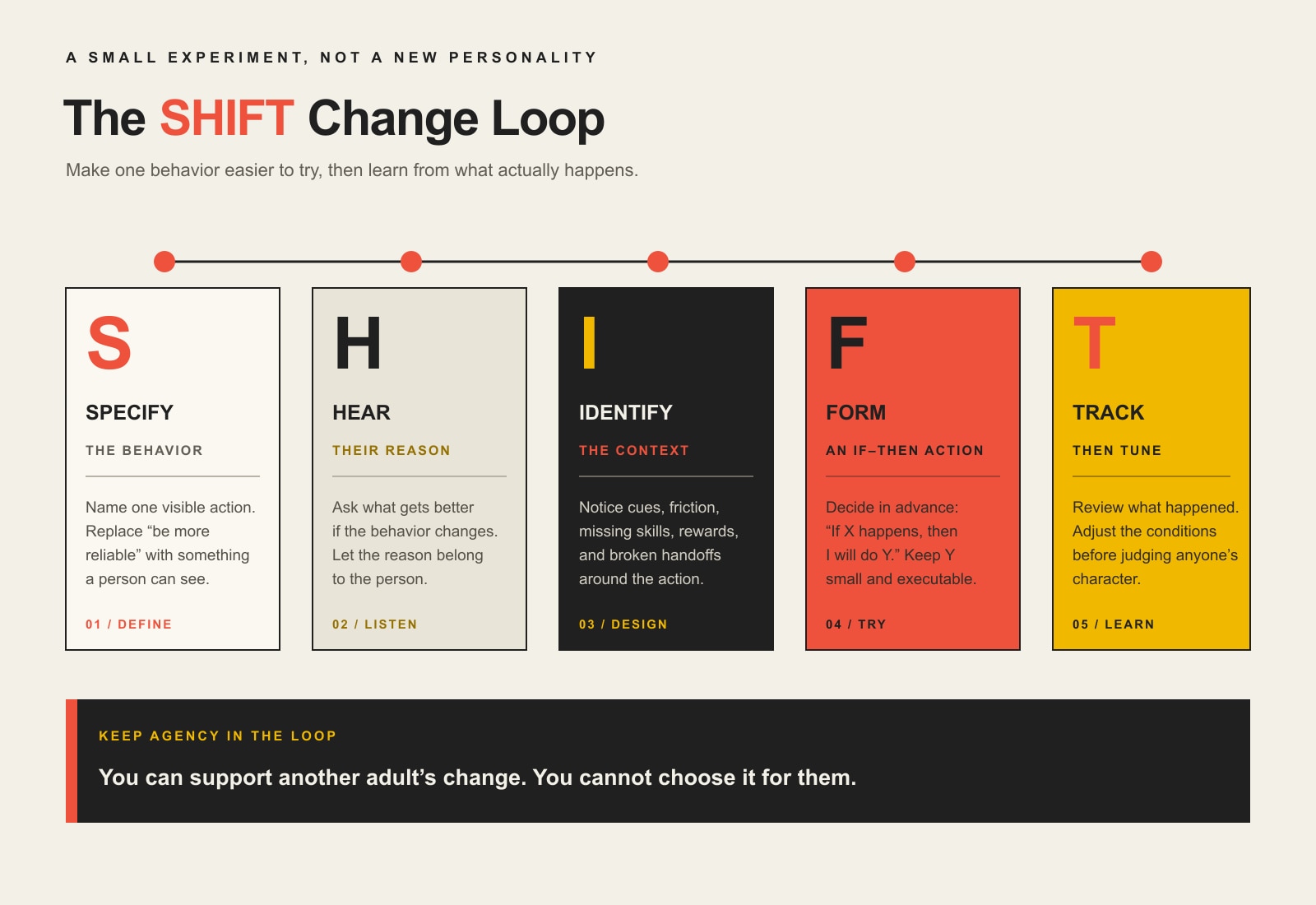
    The SHIFT Change Loop

    Scope Design’s SHIFT Change Loop is an evidence-informed synthesis for turning a vague desire to change into a specific experiment. It is not a validated clinical instrument. Think of it as a practical checklist for general self-management, coaching conversations, and workplace behavior.

    1. S — Specify the observable behavior. Describe what someone would actually see or hear. Replace “communicate better” with “send the status update by 3 p.m. Thursday.”
    2. H — Hear the person’s own reason. Ask what gets better if the behavior changes. For self-change, answer the question yourself. For another person, do not supply their motivation for them.
    3. I — Identify the situation and friction. Find the cue, competing reward, ambiguity, missing skill, bad handoff, or environmental obstacle that keeps the old pattern alive.
    4. F — Form an if-then next action. Decide in advance: “If X happens, then I will do Y.” Keep Y small enough to execute under real conditions.
    5. T — Track the result and tune the system. Review what happened. If the behavior did not occur, ask what the evidence says about the cue, friction, capability, priority, or incentive before deciding the person “doesn’t care.”
    The SHIFT behavior-change experiment: Specify the observable behavior, Hear the person reason, Identify context and friction, Form a small if-then action, and Track results to tune the conditions while preserving agency.
    The SHIFT Change Loop turns behavior change into a five-step experiment: specify the behavior, hear the reason, identify the context, form an if-then action, and track what happens.

    S: Specify What Must Change

    Start with evidence, not labels. “He’s unreliable” is an interpretation. “Three client follow-ups were sent more than two days after the agreed deadline” is observable. That difference protects you from designing a solution for the story in your head instead of the behavior in front of you.

    This is especially important when working with customers or prospects. Our guide to buyer psychology uses the same discipline: investigate real decisions, hesitation, alternatives, and language instead of pretending a personality label gives you a secret control panel.

    H: Hear a Reason That Belongs to the Person

    One useful idea from motivational interviewing is to ask and listen instead of winning an argument. But the old version of this article overstated that evidence. Motivational interviewing is not “proven 70% effective” across problems. A large 2018 review of reviews found a lot of low- or very-low-quality evidence and only small short-term benefits in a subset of higher-quality comparisons. The responsible takeaway is narrower: collaborative conversation can be useful, but results depend on the behavior, setting, delivery, and person.

    Try questions such as: “What would be better if this changed?” “What makes the current way useful?” “What worries you about the new approach?” “What would make the next step easier?” The point is not to corner someone into saying what you want. It is to learn whether there is a reason for change that they actually endorse.

    I: Identify What the Environment Is Teaching

    Repeated behavior usually has a context. A team may ignore a new project-management field because nobody uses the data. A founder may keep checking email because uncertain work feels harder than a visible inbox. A client may delay approvals because the review request contains six decisions at once.

    Look for the current lesson embedded in the system: What is easiest? What is rewarded? What creates embarrassment? Where is the handoff unclear? What competing priority wins when time gets tight? If the same “people problem” appears across otherwise capable people, inspect the operating system. Scope Design’s business strategy framework starts with the actual constraint before adding another tool, training session, or initiative.

    F: Form an If-Then Action

    A goal says what you want. An implementation intention says what you will do when a specific situation appears. The classic structure is simple: If X happens, then I will do Y.

    A 2006 meta-analysis of 94 independent tests found that implementation intentions improved goal attainment with a medium-to-large pooled effect. The research does not mean every if-then sentence works automatically. It means that pre-deciding the cue and response can help close the gap between intending and doing.

    • If I finish a client call, then I will enter the next action before opening email.
    • If a project becomes blocked for more than one business day, then I will post the blocker in the project channel.
    • If I feel the urge to abandon my writing session, then I will work for five more minutes before deciding.
    • If a customer asks for a discount, then I will ask what constraint they are trying to solve before changing the price.

    T: Track Behavior, Then Tune

    Track the smallest signal that tells you whether the behavior happened: count, timestamp, completion, handoff, response time, or a brief self-check. Then review the pattern. The purpose is diagnosis, not surveillance theater.

    When the desired behavior fails, ask: Was the cue visible? Was the action too large? Did a stronger reward win? Was there enough skill? Was the expectation understood? Did the process make the wrong behavior easier? A useful change loop treats failure as data before it treats failure as identity.

    How to Change Yourself With SHIFT

    Self-change gives you the most leverage because you can change both your action and much of the environment around it. Pick one behavior, not a new personality.

    Suppose you want to “be less distracted.” That is too broad. SHIFT might turn it into this:

    • Specify: During the first 25 minutes of my morning work block, my phone stays out of reach and I work on the named priority.
    • Hear: Finishing one meaningful task before reacting to messages makes the rest of the day calmer.
    • Identify: The phone is on the desk, notifications are visible, and the priority task has an ambiguous first step.
    • Form: If I sit down with coffee, then I put the phone in another room, open only the needed file, and work until the 25-minute timer ends.
    • Track: Mark whether the block happened for ten workdays. If it fails repeatedly, change the cue or reduce the first step rather than inventing a harsher self-description.

    If the real problem is goal selection, prioritization, or maintaining a larger system around the behavior, go deeper with our goal-achievement guide. This article owns the behavior loop; that guide owns the broader goal system.

    How to Help Someone Else Change Without Manipulation

    The ethical boundary is simple: do not disguise control as empathy. If you already decided the acceptable outcome, say what the expectation is. If the person genuinely has a choice, let the choice be real.

    For an employee, that can sound like: “The role requires client issues to be acknowledged within one business day. I want to understand what is getting in the way and agree on a process that makes that achievable.” That sentence does two things at once: the performance standard is not fake-negotiable, and the method for meeting it can be collaborative.

    For a client: “You do not have to adopt this recommendation. Before you decide, can we look at the constraint it is meant to solve and what concerns you about the change?” You are not trying to trick the client into agreement. You are making the decision easier to inspect.

    For a colleague: “When this handoff is late, my part of the project stops. What is happening on your side, and what change would make the handoff more reliable?” The conversation stays anchored to observable impact instead of motive-reading.

    Your own behavior is part of the environment too. If people hide problems because you become defensive, impatient, or punishing when bad news arrives, telling them to “communicate earlier” will not solve much. Our emotional-intelligence tune-up focuses on the leader behaviors you can actually observe and practice.

    How to Change Behavior at Work

    Workplace change is where bad behavior advice becomes expensive. Leaders often jump from an outcome to a personality judgment: salespeople are not disciplined, the team resists change, managers lack accountability, employees hate the new system.

    Run a behavior-and-system check first:

    1. What exact behavior would indicate the change is working?
    2. Does the person understand the behavior and why it matters to the role or outcome?
    3. Can they perform it with the current skill, authority, time, and tools?
    4. Does the workflow make the desired behavior easier or harder?
    5. What currently happens when someone follows the old pattern?
    6. What feedback arrives soon enough to help them adjust?

    Example: a manager complains that remote employees are not communicating. The behavior might actually be “raise a blocker before the deadline is at risk.” If blockers require a meeting, nobody knows which channel to use, and people get punished for surfacing bad estimates, the system teaches silence. Change the communication contract, make the escalation path obvious, and respond constructively when someone uses it. For distributed teams, our guide to remote-team management goes deeper into expectations, communication rhythms, and trust without digital babysitting.

    What If They Still Won’t Change?

    Then the problem becomes a decision, not a persuasion puzzle.

    If the person has the capability, understands the expectation, has a workable process, sees the consequences, and still chooses not to act, you may need to set a boundary, change responsibilities, enforce a consequence, redesign the agreement, or accept that your preferences do not control them.

    This is one of the most useful limits in behavior change: influence is not ownership. A manager owns the clarity of the role, the quality of the system, fair feedback, and appropriate consequences. The employee still owns their behavior. A business can reduce customer friction, clarify value, and make a decision easier; the customer still owns the decision. You can change your routine; you cannot guarantee your future self will never deviate from it.

    Frequently Asked Questions About Behavior Change

    How can I change my behavior?

    Start with one observable behavior. Identify what triggers the current response, decide why the new response matters, change the environment to make the new action easier, write an if-then plan, and track whether the behavior actually happens. Adjust the system based on the result.

    Can you really change someone else?

    You can influence another adult’s behavior, but you cannot reliably control their motivation or choices. The most defensible approach is to clarify the behavior and consequences, understand their reasons and resistance, improve the conditions for the desired action, and preserve genuine agency where a choice exists.

    What motivates people to change behavior?

    There is no single universal motivator. Reasons can include personally valued outcomes, competence, social expectations, incentives, avoided costs, identity, convenience, or immediate rewards. The practical move is to investigate the actual person and context instead of assuming a generic motivational trigger.

    How long does it take to change a habit?

    Do not use 21 days—or even 66 days—as a personal deadline. In Phillippa Lally and colleagues’ real-world habit study, the modeled time to reach near-asymptotic automaticity ranged from 18 to 254 days. The study also found that missing one opportunity did not materially derail the formation process. The useful lesson is variation: repeat the behavior in a stable context and judge the pattern over time.

    Does motivational interviewing work for behavior change?

    It can help in some contexts, especially when delivered with fidelity, but the evidence is not a universal percentage and should not be casually transferred from health care into every workplace conversation. Borrow the conversational discipline—ask, listen, reflect, avoid pointless argument—without pretending you are providing therapy or using a guaranteed technique.

    Why is it so hard to change behavior?

    Because intentions compete with immediate rewards, familiar cues, environmental defaults, uncertainty, skill gaps, and old routines. The current behavior often wins because it is easier or more immediately rewarding, not because the person lacks character. Changing the situation and the next response can be more effective than repeatedly demanding more motivation.

    Start With One Behavior, Not a New Personality

    If you want to change yourself, choose one behavior you can observe this week. If you want someone else to change, decide whether you are offering a genuine choice or enforcing a legitimate expectation. Then run SHIFT: Specify, Hear, Identify, Form, Track.

    The goal is not to become better at controlling people. It is to become better at designing conditions in which useful behavior is clearer, easier, more self-endorsed, and easier to learn from. That is slower than a persuasion trick—and far more honest.

  • AI-Powered Goal Achievement: The Science-Backed System That Actually Works

    AI-Powered Goal Achievement: The Science-Backed System That Actually Works

    AI goal setting can be useful, but not because a chatbot can choose the right life or business goal for you. Its best role is narrower: help you turn a human-selected outcome into observable actions, plan for predictable friction, summarize recorded progress, and make review faster. You still own the goal, the tradeoffs, and the decision to keep going, change course, or stop.

    That distinction matters because the strongest research behind an AI goal setting system is not “AI makes people achieve more.” The evidence is about the mechanics of goal pursuit: specific goals, implementation intentions, feedback, and progress monitoring. AI can make those mechanics easier to apply, but it should not be confused with the mechanism itself.

    AI goal setting works when AI has a bounded job

    Most AI goal-setting tools start with generation: type a vague ambition, get a SMART goal, then admire the tidy wording. That solves only the first few minutes of the problem. Goals usually fail later, when the week gets crowded, a constraint appears, the plan stops matching reality, or nobody looks closely at what actually happened.

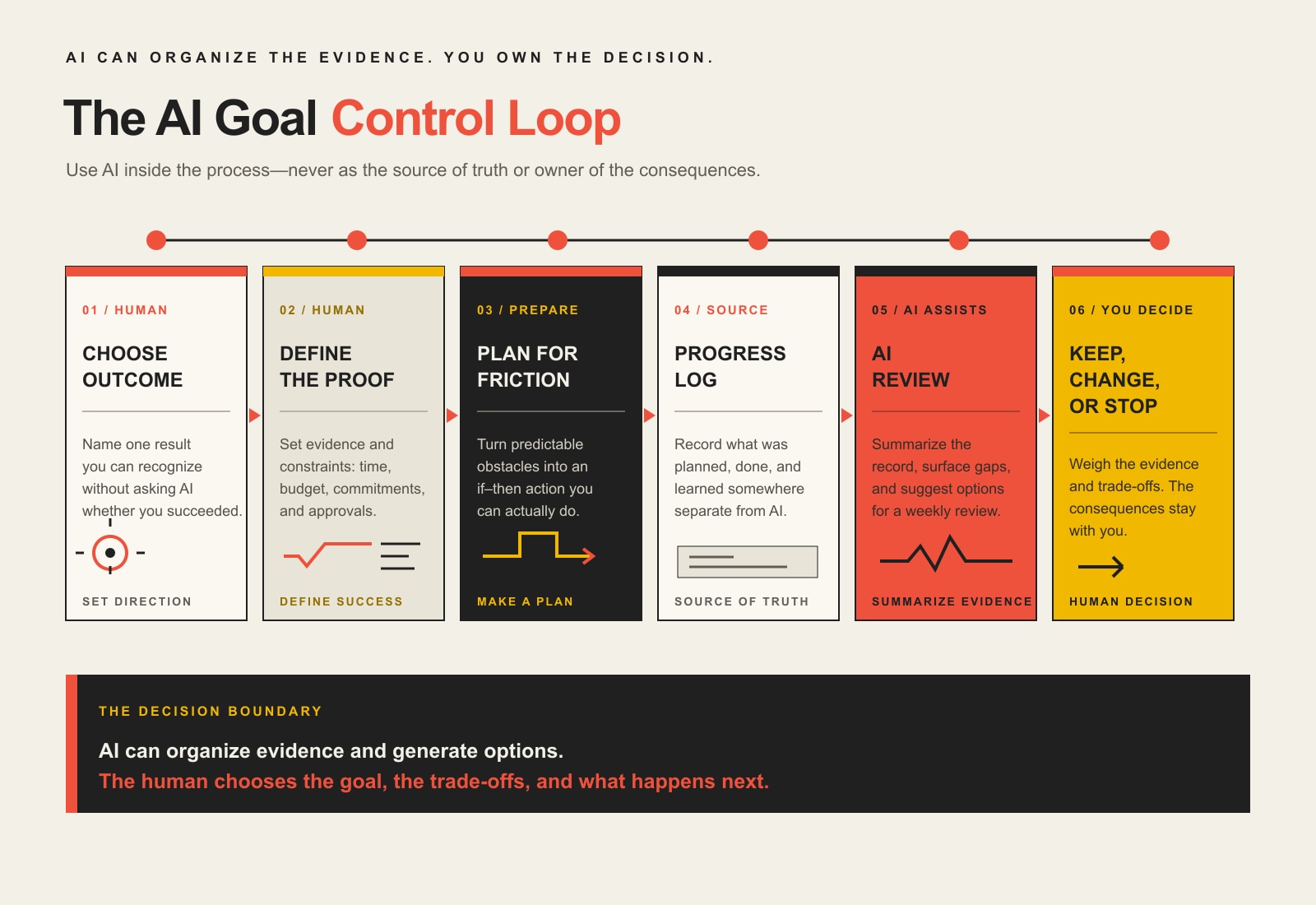
    A more useful model is an AI-assisted goal control loop:

    1. Choose the outcome yourself.
    2. Define the evidence that would prove progress.
    3. Plan for likely obstacles with if-then rules.
    4. Record what actually happened.
    5. Let AI summarize the evidence and surface gaps.
    6. Make the decision yourself: keep, change, or stop.

    AI is useful inside the loop because it is fast at restructuring information, comparing a log against criteria, and generating options. It is weak at owning consequences. That is why the decision boundary stays human.

    The science underneath the system

    Three well-established findings are especially useful for designing an AI goal setting workflow. None requires AI. That is exactly the point: use AI to reduce the effort of applying mechanisms that already have evidence behind them.

    1. A goal needs specificity, challenge, feedback, and commitment

    In their influential review of 35 years of goal-setting research, Edwin Locke and Gary Latham summarized evidence showing why specific, appropriately challenging goals can outperform vague “do your best” instructions under the right conditions. They also emphasized important moderators such as commitment, feedback, ability, and task complexity. In other words, specificity helps, but a goal is not a magic sentence. See the Locke and Latham review in American Psychologist.

    AI can help here by interrogating fuzzy language. If your goal is “grow the business,” ask the model to identify what would be observable at the end of the period: qualified opportunities, recurring revenue, margin, retention, delivery capacity, or another measure that actually matches your objective. You choose which measure matters.

    2. “If X, then I will Y” plans help close the intention-action gap

    Implementation intentions turn a general intention into a pre-decided response: if a specific situation occurs, then I will take a specific action. A 2006 meta-analysis by Peter Gollwitzer and Paschal Sheeran covered 94 independent tests and reported a medium-to-large positive effect on goal attainment (d = .65). Read the implementation-intentions meta-analysis.

    This is a natural job for AI because the model can help you brainstorm likely failure points without pretending it knows the future. For example:

    • If a client emergency takes the morning block, then I will move the goal task to the 2:00 PM recovery block.
    • If I do not have the data needed for a decision by Wednesday, then I will ask the owner directly instead of waiting for another meeting.
    • If a planned action misses twice, then I will review whether the action is unrealistic, underspecified, or no longer relevant.

    The useful output is not the AI’s prose. It is a decision rule you are willing to follow.

    3. Monitoring progress improves goal attainment

    A 2016 meta-analysis led by Benjamin Harkin examined 138 randomized studies with 19,951 participants. Interventions designed to increase progress monitoring improved goal attainment on average (d+ = .40). Effects were larger when outcomes were reported or made public and when progress information was physically recorded. Read the progress-monitoring meta-analysis in Psychological Bulletin.

    This is the strongest reason not to make your chatbot the source of truth. Keep the progress record somewhere explicit: a spreadsheet, project board, CRM, task system, journal, or other log. Then give AI the record to analyze. If the model can invent the history, you no longer have monitoring; you have storytelling.

    The AI goal setting control loop

    Six stages of an AI-assisted goal loop: choose a human-owned outcome, define evidence and constraints, plan for friction, record progress separately, let AI review the record, and keep the decision human.

    Step 1: Choose one observable outcome

    Start with a result you can recognize without asking AI whether you succeeded. “Publish the new service site with the five required pages, functioning forms, analytics, and approved launch checklist by October 15” is observable. “Improve our online presence” is not.

    For AI goal setting to be useful, ask AI to challenge ambiguity, not to pick your values. A useful request is: “List the terms in this goal that could be interpreted two different ways. Ask me questions until the finish line could be verified by another person.”

    Step 2: Define evidence and constraints before generating a plan

    In AI goal setting, tell the model what counts as evidence and what it may not optimize away. Constraints might include budget, available hours, required approvals, legal requirements, brand standards, existing commitments, or a hard deadline.

    This prevents a common AI failure mode: producing a theoretically efficient plan that ignores the environment in which the work has to happen.

    Step 3: Turn predictable friction into implementation intentions

    Now ask AI to identify likely obstacles from the information you provide. For each obstacle, create an if-then response. Keep only the rules that are specific enough to trigger an action and realistic enough that you will use them.

    For a sales goal, “If there are fewer than five qualified opportunities in the pipeline on Friday, then Monday’s first 45 minutes becomes outbound follow-up” is much more useful than “stay consistent with prospecting.”

    Step 4: Record what happened in a separate progress log

    In an AI goal setting system, your progress log can be simple. At minimum, record the date, planned action, completed action, result, blocker, and any evidence that changed your understanding of the goal. The point is not to create a perfect dashboard. The point is to leave a trail that can be reviewed without relying on memory.

    Do not ask AI to “remember” the week unless the underlying record is available in the conversation or connected system. Your review should be grounded in the actual log.

    Step 5: Use AI for the weekly review

    At review time, AI goal setting becomes most useful when the model acts as an analyst. Give it the goal, evidence criteria, constraints, if-then rules, and progress log. Ask it to separate facts from inferences, compare the evidence with the target, identify repeated misses, and suggest a small number of adjustments.

    Limiting the number of recommendations matters. A model can generate twenty plausible ideas in seconds. That is not the same as making the next decision easier.

    Step 6: Keep the decision human

    The review ends with a choice: keep, change, or stop. Keep the current plan when the evidence supports it. Change an action or assumption when the evidence says the plan is not working. Stop when the goal no longer deserves the cost, even if a model can invent a clever way to continue.

    That last category is important. Goal systems become unhealthy when “achievement” is defined as never abandoning a goal. Good judgment includes recognizing when new evidence changes the decision.

    What AI should not decide

    A safe AI goal setting workflow can help structure a decision, but it should not be allowed to quietly become the decision-maker. Keep these responsibilities on the human side of the boundary:

    • Which goal is worth pursuing. A model does not bear the opportunity cost.
    • Which tradeoffs are acceptable. Speed, money, quality, relationships, reputation, and risk are value judgments.
    • Whether the evidence is trustworthy. AI can summarize bad data perfectly.
    • Whether a recommendation is ethical, legal, or appropriate. High-stakes decisions need the right qualified human review.
    • Whether to persist or quit. The model can surface consequences; you own them.

    A useful rule is: AI may propose; evidence must support; a human approves.

    A copyable AI goal setting review prompt

    This AI goal setting prompt is deliberately stricter than “How am I doing?” It forces the model to work from the record instead of rewarding confident improvisation.

    Act as a review analyst, not a goal chooser.
    
    GOAL OUTCOME:
    [Paste the observable outcome.]
    
    EVIDENCE OF SUCCESS:
    [Paste the measures or completion criteria.]
    
    CONSTRAINTS:
    [Paste budget, time, approvals, non-negotiables, and other limits.]
    
    IF-THEN PLANS:
    [Paste the implementation intentions I committed to.]
    
    PROGRESS LOG:
    [Paste this week's actual record.]
    
    Review the material using only the evidence provided.
    1. Summarize what happened in no more than five bullets.
    2. Separate facts from your inferences.
    3. Compare actual progress with the success evidence.
    4. Identify repeated blockers or missed implementation intentions.
    5. Propose no more than three adjustments, each with a tradeoff.
    6. Flag any conclusion that cannot be supported by the log.
    7. End by asking me to choose: keep, change, or stop.
    
    Do not rewrite my goal, invent missing progress, or make the final decision for me.

    If the output is generic, the first thing to improve is usually the input evidence, not the prompt.

    How this fits a 90-day execution system

    An AI goal setting workflow does not need a magical planning horizon. This article intentionally does not turn “90 days” into another scientific claim. A quarter is simply a useful planning container for many business goals: long enough to produce meaningful work, short enough to review before assumptions get stale. If you want the broader planning structure—outcome, milestones, checkpoints, and execution rhythm—use Scope Design’s 90-day goal-setting framework, then use the AI control loop here for planning friction, progress analysis, and review.

    For a business, the same idea can eventually move beyond a personal chat into a repeatable workflow: data comes from the systems where work happens, AI summarizes or routes exceptions, and a person remains accountable for decisions. If that is the stage you are at, see our guide to AI automation for business.

    Frequently asked questions about AI goal setting

    Can AI actually help me achieve my goals?

    AI goal setting can help with parts of goal execution: clarifying an outcome, generating if-then plans, organizing a progress log, comparing evidence with a target, and proposing adjustments. The evidence cited in this article supports those underlying self-regulation practices, not a blanket claim that using AI itself causes goal achievement.

    How do I use ChatGPT for AI goal setting?

    For AI goal setting, use ChatGPT or another capable model as a structured thought partner. Give it one observable goal, the evidence of success, your constraints, likely obstacles, and your actual progress record. Ask it to identify ambiguity, create candidate if-then plans, and perform a weekly evidence review. Do not let it invent the goal or progress history.

    What is the best AI goal setting tool?

    The best AI goal setting tool is the one that fits the workflow; the workflow matters more than a particular brand. A useful tool needs enough context to read your goal criteria and progress log, produce structured output, and fit your privacy and data-handling requirements. If your system only generates motivational language but never reviews evidence, changing models will not fix the design.

    Should I track my goals with AI?

    For AI goal setting, track progress in a durable source of truth, then let AI analyze it. A spreadsheet, project tool, CRM, or journal can hold the record. AI can summarize patterns and exceptions, but the underlying log should remain reviewable without trusting the model’s memory.

    Can AI replace an accountability partner or manager?

    Not completely. AI can make review more consistent and reduce administrative work, but it does not share the consequences of the decision and cannot provide the same social accountability, authority, domain responsibility, or human judgment. Use it to improve the review process, not to erase responsibility.

    The bottom line

    AI goal setting does not make goal achievement scientific. Good goal execution already has a research base: define the outcome clearly, plan responses to predictable situations, monitor real progress, and use feedback to adjust. AI earns its place when it makes those behaviors easier to perform without taking ownership away from the person who has to live with the result.

    Start with one goal. Define what evidence would prove progress. Write two or three if-then rules for the friction you already expect. Keep an honest log. Then use AI once a week to compare the evidence with the target—and make the final decision yourself.

  • How to Overcome Fear in Business: 7 Proven Strategies That Actually Work

    How to Overcome Fear in Business: 7 Proven Strategies That Actually Work

    If you are trying to learn how to overcome fear in business, do not wait until you feel fearless. Make the fear specific enough to investigate, small enough to manage, and clear enough to act on.

    That matters because fear of failure is not automatically a stop sign. Entrepreneurship research describes it as context-dependent: it can inhibit action in some situations and motivate greater effort in others. The useful question is not “How do I get rid of fear?” It is “What is this fear telling me to check before I move?” Research on fear of failure in entrepreneurship supports that more nuanced view.

    The seven strategies below combine evidence-backed action planning with practical business-risk controls. They cannot guarantee an outcome. They can help you stop treating uncertainty as an emotion problem and start treating it as a decision problem.

    The FEAR Check: Turn Worry Into Decision Requirements

    Before you try to “push through” fear, run it through a simple four-part check. We call it the FEAR Check:

    CheckQuestion to answerWhat you are looking for
    F: FactsWhat do I actually know, and what am I assuming?Evidence that changes the decision
    E: ExposureWhat can I lose, and can the business absorb it?A defined downside, not a vague disaster
    A: AssumptionWhich uncertain assumption would change my choice if it were wrong?The highest-value unknown to test
    R: ReversibilityHow can I shrink, stage, pause, or undo this commitment?A smaller next move that still produces useful evidence

    Fear becomes useful when it exposes a missing fact, unbounded downside, untested assumption, or commitment that is too hard to reverse. If it does none of those things and you keep reopening the same research, fear may be wearing a business-casual disguise and calling itself due diligence.

    How to Overcome Fear in Business: 7 Strategies

    1. Name the Exact Outcome You Are Afraid Of

    “I am afraid this will fail” is emotionally real but strategically useless. Failure can mean losing $2,000, missing payroll, being embarrassed in front of peers, losing a major customer, or spending six months on a product nobody buys. Those are different problems with different responses.

    Finish this sentence:

    If I make this decision, I am afraid that __________ will happen because __________.

    Then make it measurable. “Expansion could ruin us” becomes “If revenue is 25% below our base case for six months, our cash reserve falls below the amount we need to cover payroll and fixed costs.” “Customers may hate the offer” becomes “We may not get enough qualified buyers at the price required for this margin.”

    Once the fear names a failure mechanism, you have something to investigate. Until then, your brain can keep generating increasingly cinematic versions of “what if?” without producing a better decision.

    2. Separate Facts From Assumptions

    Most scary business decisions contain a mixture of known facts and untested beliefs. Put them in separate columns.

    FactsAssumptions
    Three existing customers asked for the service.Enough similar customers will buy it at the required price.
    The company can fund a $5,000 test without touching payroll reserves.The test will generate useful evidence within 60 days.
    A supplier quoted a specific unit cost.The cost will remain stable at higher volume.

    Now ask which assumption is both important and uncertain. Test that first. The U.S. Small Business Administration explicitly recommends market research to help confirm or improve an idea and reduce risk by examining questions such as demand, market size, saturation, and pricing. That does not remove uncertainty, but it helps replace the most expensive guesses with evidence. See the SBA’s current market research guidance.

    If the unknown is customer demand, our guide to self-directed market research gives you practical ways to collect evidence before making a larger commitment.

    3. Bound the Downside Before You Chase the Upside

    Fear gets louder when “the downside” has no boundary. Give it one.

    • What is the maximum cash you are willing to lose?
    • What minimum reserve will you protect?
    • How much owner or team time can the test consume?
    • What customer, legal, compliance, or reputation risks could create lasting damage?
    • At what point will you stop, pause, or redesign the plan?

    The goal is not to prove that nothing bad can happen. It is to determine whether the downside is survivable and proportionate. A $3,000 experiment that can be stopped next month is different from a five-year lease, a personal guarantee, or a hire the business cannot support if sales miss the forecast.

    If the severe-but-plausible downside threatens the core business, fear may be doing its job. Redesign the commitment before proceeding.

    4. Make the Next Move Smaller and More Reversible

    A common mistake is treating a business decision as binary: do the whole thing or do nothing. There is often a third option: make a smaller move that produces real evidence.

    • Pre-sell before building the full offer.
    • Run a 30- or 60-day pilot.
    • Launch to one customer segment before the whole market.
    • Use a contractor before creating a permanent role.
    • Set a capped test budget.
    • Lease or borrow before buying an expensive asset.
    • Negotiate an exit clause before signing a long commitment.

    The best small test is not the one that makes you feel productive. It is the one that tests the assumption most likely to change your decision. That is also why seemingly wild concepts should be validated before you bet the business on them.

    5. Set Decision Rules Before Fear Becomes Endless Research

    Research is useful when it can change a decision. It becomes avoidance when you keep gathering information but never change the criteria for saying yes, no, or “not yet.”

    Define your threshold before the next research round:

    I will proceed if the pilot produces at least X qualified customers, gross margin stays above Y, and the downside case leaves at least Z months of protected operating cash. I will decide by [date].

    After that, more research needs to earn its keep. Ask: What new fact am I trying to learn, and could it realistically change one of those thresholds? If you cannot answer, paralysis may be masquerading as research.

    Once fear has been translated into an actual choice between options, use a structured business decision framework instead of reopening the emotional question from scratch.

    6. Use an If-Then Plan for the Moment Fear Usually Wins

    Knowing what you should do is not the same as doing it. Research on implementation intentions has found that specific if-then plans can help people translate intentions into action across many contexts. The effect is not a guarantee and the research is not specific to business ownership, but the tool is simple and useful here.

    Choose the moment fear usually interrupts you and pre-decide the response:

    • If I reopen research after the agreed decision threshold is met, then I will write down the new fact I expect to learn and which threshold it could change.
    • If there is no decision-changing question, then I will take the next agreed action.
    • If the pilot crosses the stop-loss threshold, then I will pause it without treating the pause as a personal failure.

    This moves the choice out of the most emotionally charged moment. You are not promising to be brave later. You are specifying what “later” will do.

    7. Review Decision Quality, Not Just the Outcome

    A good decision can still produce a bad outcome. A reckless decision can occasionally get lucky. If you judge every decision only by what happened afterward, you train yourself to fear any move that once went badly.

    After the result is known, review the process:

    • Were the important facts accurate?
    • Which assumption turned out to be wrong?
    • Was the exposure within the limit you set?
    • Did the test produce the evidence it was supposed to produce?
    • Did you follow your decision rule or move the goalposts?
    • What should change in the next decision?

    That is how a mistake becomes information instead of a reason to freeze. We go deeper into that process in turning business mistakes into growth opportunities.

    When Fear Is Useful and When It Is Just a Stop Sign

    Fear may be useful when…Fear may be blocking you when…
    It points to a specific failure mechanism.It produces only “something bad might happen.”
    The downside could threaten payroll, solvency, compliance, or a key relationship.The main feared outcome is embarrassment, judgment, or regret.
    A critical assumption has little evidence behind it.You keep researching the same issue without changing decision criteria.
    The commitment is expensive or difficult to reverse.You keep moving the decision deadline because certainty still has not arrived.
    An independent, knowledgeable person identifies the same risk.You ignore the cost of waiting or doing nothing.

    Also remember that fear is not the only thing that can distort a decision. Once you have framed the real business risk, check whether cognitive biases are influencing your judgment in ways the FEAR Check alone will not catch.

    A 15-Minute Fear-to-Action Worksheet

    You can run the whole framework on one page. Do not turn this into a three-day journaling project. The point is to expose the decision structure.

    1. Feared outcomeIf I do this, I am afraid that __________ will happen because __________.
    2. FactsWhat do I know from actual numbers, customers, contracts, or observed behavior?
    3. ExposureWhat is the maximum cash, time, relationship, or operational loss? Can we absorb it?
    4. AssumptionWhich uncertain belief would change the decision if it were wrong?
    5. ReversibilityWhat is the smallest credible test or staged commitment?
    6. Decision thresholdWhat result means proceed, modify, pause, or stop?
    7. DeadlineWhen will I decide?
    8. If-then actionIf fear triggers my usual avoidance behavior, then I will __________.

    If another research task appears after you complete the worksheet, make it pass one test: What could this information change? If the honest answer is “nothing, I just want to feel more certain,” you probably have enough information for the next bounded step.

    Common Business Fears Are Different Problems

    “Fear in business” is not one thing. Different fears point to different work.

    FearWhat to examine
    Fear of failureSeparate a survivable business downside from what the outcome would mean about you personally.
    Fear of losing moneyDefine exposure, reserves, stop-loss limits, and the cheapest useful test.
    Fear of rejectionCollect enough customer evidence that one person’s “no” is data, not a verdict.
    Fear of being judgedDistinguish genuine reputation risk from ordinary discomfort with being visible.
    Fear of the unknownFind the highest-value uncertainty and design a test that can answer it.
    Fear of responsibilityExamine staffing, systems, controls, workload, and review thresholds instead of relying on willpower.

    This article is about ordinary business fear and uncertainty. Persistent or severe anxiety that is disrupting daily life is a different problem and deserves appropriate professional support, not another business checklist.

    Questions Business Owners Ask About Fear

    Why is starting a business so scary?

    Starting a business concentrates uncertainty: demand, pricing, cash flow, your own ability, other people’s opinions, and often personal money are all involved at once. The answer is not to prove the venture cannot fail. It is to separate those unknowns, identify the ones that matter most, and test them without taking more exposure than the opportunity justifies.

    Can fear of failure ever be useful?

    Yes. Fear can prompt preparation, evidence gathering, or a safer design when it identifies a real vulnerability. It becomes less useful when it stays vague, demands certainty, or keeps moving the finish line after your decision criteria have been met.

    How do entrepreneurs overcome fear of failure?

    The practical goal is not to eliminate the feeling. Name the feared outcome, separate facts from assumptions, bound the downside, test the most important uncertainty, make the commitment more reversible, and set a decision rule and deadline. Then act when the rule is met even if your confidence is not perfect.

    How do I know whether a business risk is too high?

    A risk is too high when the severe-but-plausible downside exceeds what the business can responsibly absorb or when the commitment is so irreversible that you cannot learn before major damage is done. Reduce the exposure, add a checkpoint, or redesign the bet before proceeding.

    What if I still feel afraid after doing the analysis?

    If the important facts are known, the downside is bounded, the critical assumption has been tested as far as practical, the next move is survivable, and your decision threshold is met, fear does not get an automatic veto. Take the controlled action you already defined. Confidence often follows evidence and action; it does not have to come first.

    Fear Should Change the Question, Not Run the Business

    You do not need to become fearless to run a business. You need a better way to decide what fear means.

    Run the FEAR Check. Get the facts that matter. Bound the exposure. Test the assumption most likely to change the choice. Make the commitment as reversible as practical. Set the rule. Set the date. Then act.

    The practical answer to how to overcome fear in business is not more motivation. If fear is pointing to a real strategic unknown such as market demand, economics, positioning, or the order of operations, research and strategy should do the work: turn the unclear growth question into evidence, a decision structure, and a concrete next move.

  • Small Business Marketing Budget: How Much Should You Actually Spend?

    Small Business Marketing Budget: How Much Should You Actually Spend?

    A small business should spend the amount its economics, operating capacity, and evidence can justify—not a random percentage of revenue copied from a company with a billion-dollar balance sheet. Start by identifying the real business constraint. Then calculate what a customer is worth before acquisition, confirm the offer and follow-up path work, set a loss you can tolerate, and run a bounded test with a written stop, continue, or expand rule.

    If you need a single percentage before you have done any of that, you do not have a marketing budget yet. You have a comforting little number wearing a business costume.

    TL;DR: The Responsible Answer

    • Revenue percentages are context, not a prescription.
    • Marketing includes more than ad spend. Count the people, creative, technology, destination, measurement, and follow-up required to make the campaign work.
    • Budget from contribution and cash flow, not revenue alone.
    • Fix a broken offer, website, form, sales response, or fulfillment constraint before paying to expose it to more people.
    • Test one clear hypothesis within a loss boundary you can survive.
    • Judge qualified outcomes and downstream economics—not reach, clicks, followers, or a giant sack of useless leads.

    Use the Scope Design SPEND Test: Solve the right constraint, Protect the economics, Ensure the path works, Narrow the test, and Decide what the evidence earns next.

    In This Guide

    Why Percentage Rules Are Incomplete

    Search for a small business marketing budget and you will find a glorious buffet of percentages. Spend 5%. Spend 8%. Spend 12%. Use 70/20/10. Use 60/40. Apparently the fate of your company can be solved by picking the nicest-looking fraction.

    Benchmarks can be useful. They tell you what a particular group reported spending under particular conditions. They do not tell you whether your next dollar should go to advertising, a broken contact form, a salesperson who answers the phone, customer retention, or nowhere at all.

    For example, Gartner reported that marketing budgets averaged 7.7% of company revenue in its 2025 CMO survey. That is a real result from 402 marketing leaders. It also came from a sample in which the vast majority of respondents represented companies with more than $1 billion in annual revenue. That makes it useful market context and a pretty lousy prescription for a five-person service business. Read Gartner’s survey description.

    Revenue alone leaves out the variables that decide whether spending is sane:

    • gross margin and contribution after delivery costs;
    • average first purchase and realistic customer lifetime value;
    • how many leads become qualified opportunities;
    • how many qualified opportunities become customers;
    • how long cash is tied up before a sale pays back;
    • whether the team can answer, sell, onboard, and deliver;
    • whether the business needs more demand at all.

    Two companies can each generate $1 million in revenue and responsibly choose wildly different budgets. One may have high margins, recurring revenue, strong retention, fast follow-up, and room to serve another hundred customers. The other may have thin margins, a three-month sales cycle, a broken quote form, and a team already drowning in work. Giving both the same percentage is not strategy. It is numerology with a pie chart.

    The U.S. Small Business Administration’s current marketing guidance takes the more useful route: build a complete cost breakdown, keep tracking costs, compare marketing and sales costs with the revenue generated, update the plan, and account for operations. See the SBA marketing-plan guidance. That still does not hand you one universal number—because a responsible answer cannot.

    What Belongs in a Marketing Budget?

    Your marketing budget is not just the money sent to Google, Meta, a printer, or the nice person who promised to make you “go viral.” It is the full cost of creating attention, turning that attention into a useful decision, and learning what happened.

    Depending on the business, include:

    Budget areaExamplesWhy it counts
    Strategy and researchaudience research, positioning, competitive review, campaign planningDecides whom you are trying to reach and why they should care.
    Message and creativecopy, design, photography, video, offers, case studiesGives the audience something credible to understand and evaluate.
    Destinationwebsite, landing page, product page, booking flow, accessibility, performanceConverts attention into a usable next step.
    Distributionads, sponsorships, direct mail, events, partnerships, email toolsPlaces the message in front of the intended audience.
    Peopleemployees, freelancers, agencies, sales-development timeMarketing does not execute itself, despite what the software demo implied.
    TechnologyCRM, email platform, call tracking, analytics, automation, reportingRoutes, records, and measures the response.
    Sales handoffqualification, response time, proposals, booking, follow-upDetermines whether generated interest becomes a real opportunity.
    Retentiononboarding, customer email, review requests, referral systemsProtects and expands the value already acquired.

    This is why marketing budget and advertising budget are not interchangeable. Advertising is paid distribution. Marketing is the larger system that includes the audience, offer, message, experience, measurement, and follow-through. A $2,000 ad buy pointed at a vague offer and a broken mobile form is not a $2,000 marketing test. It is a $2,000 public demonstration of unfinished work.

    If cash is tight, our guide to free marketing strategies that can produce real results covers labor-heavy approaches. “Free” still costs time and attention, but it may be the right trade while the business is proving its message or building the assets a paid campaign will need.

    The Scope Design SPEND Test

    The five-part SPEND Test: solve the real constraint, protect business economics, ensure the path works, narrow the experiment, and decide by evidence.
    The Scope Design SPEND Test turns a marketing budget into a controlled business decision.

    The budget comes after the diagnosis. Use these five gates in order.

    S — Solve the Right Constraint

    Ask what is actually preventing the next stage of healthy growth.

    Is it:

    • too little awareness among the right people;
    • traffic from people who were never likely to buy;
    • an offer that is difficult to understand or compare;
    • a website or booking experience that loses interested visitors;
    • slow or inconsistent sales follow-up;
    • poor close rates after qualified conversations;
    • weak onboarding or retention;
    • insufficient capacity to serve more customers profitably?

    More promotion only helps when a shortage of appropriate demand is the constraint. If the team takes three days to answer inquiries, purchasing more inquiries creates a larger pile of neglected people. If qualified prospects understand the offer but consistently reject the value, a new ad does not fix the offer. If existing customers quietly leave after two months, acquisition can make the revenue chart look busier while the bucket keeps leaking.

    This is the same constraint-first principle behind our website strategy and conversion playbook: the deliverable a business asks for is not necessarily the problem it needs solved.

    P — Protect the Economics

    Revenue is not the amount available to acquire a customer. Delivery has a cost. So do refunds, payment processing, commissions, support, onboarding, and every other inconvenient item that motivational posts tend to misplace.

    Start with a defensible estimate of contribution before acquisition:

    Revenue from the customer minus the variable costs required to sell, deliver, support, and retain that customer before marketing acquisition cost.

    Then decide how much of that contribution the business can use to acquire the customer while still leaving the required profit, overhead coverage, risk allowance, and cash-flow safety.

    That produces an acquisition ceiling, not a target. Spending right up to the ceiling may be technically survivable and strategically stupid. The business still needs margin for uncertainty, fixed costs, delays, and the fact that a spreadsheet has never once answered an angry customer at 4:57 on Friday.

    For a considered service, work backward through the funnel:

    1. What is a new customer worth in contribution, using evidence rather than fantasy lifetime value?
    2. What acquisition cost leaves enough money and cash-flow room?
    3. What percentage of qualified opportunities become customers?
    4. What percentage of valid inquiries become qualified opportunities?
    5. What can the business therefore afford per qualified opportunity and per valid inquiry?

    If those numbers are unknown, do not invent precision. Mark them as assumptions, use conservative ranges, and make learning those numbers part of the test.

    E — Ensure the Path Works

    Before buying attention, walk the entire route a prospective customer must take:

    • Does the message match what the audience is trying to decide?
    • Is the offer clear, credible, and relevant?
    • Does the landing experience work on a real phone over an ordinary connection?
    • Do the form, phone number, calendar, checkout, and confirmation actually work?
    • Is source tracking configured without pretending attribution is perfect?
    • Who owns the first response?
    • How quickly can that person respond during business hours?
    • How is a fit distinguished from a form fill?
    • Can sales answer the objections the campaign creates?
    • Can operations deliver what marketing promises?

    This is not busywork. The SBA explicitly warns that operations shape the customer experience and should not be forgotten in marketing and sales planning. A campaign sits inside a business system, whether the campaign dashboard acknowledges that system or not.

    Our broader small-business marketing strategy guide covers that attention-to-outcome system. The short version: channel choice comes after the offer, destination, response process, capacity, and measurement are ready.

    N — Narrow the Test

    A useful test is not “do some marketing and see what happens.” Define:

    • one primary audience;
    • one meaningful problem or buying moment;
    • one offer;
    • one main destination and action;
    • one primary distribution channel;
    • the total amount you are prepared to lose while learning;
    • a review window appropriate to the buying cycle;
    • the leading and downstream evidence you will inspect;
    • the conditions for stopping, continuing, or expanding.

    The test must be large and long enough to encounter real customer behavior, but there is no universal four-week window or magic minimum number of leads. A same-day local service, a six-month consulting sale, and a subscription product do not accumulate evidence at the same speed.

    Choose the review window from the actual sales cycle and response volume. If the business normally closes a qualified opportunity in 45 days, declaring victory on click-through rate after one week is dashboard cosplay.

    D — Decide What the Evidence Earns Next

    The test earns one of three decisions:

    • Stop when the underlying assumption is contradicted, economics cannot work, the audience is wrong, the path is broken, or continuing would cross the loss boundary without learning anything new.
    • Continue when the signal is promising but the full decision cycle is incomplete, tracking needs repair, or more evidence is required within the original risk boundary.
    • Expand when qualified outcomes repeat, the downstream economics are acceptable, the operation can absorb more volume, and the next increase is still controlled.

    Expansion is not “triple the budget because Tuesday looked good.” Increase exposure in steps, watch lead quality and capacity, and confirm that marginal performance remains acceptable. A channel can perform well at one spend level and deteriorate as the audience broadens or the team becomes slower.

    Calculate What You Can Afford to Learn

    A marketing test has two limits:

    1. the economic ceiling suggested by customer contribution and conversion; and
    2. the loss boundary the business can survive without jeopardizing payroll, taxes, delivery, or necessary reserves.

    The lower practical limit wins.

    Use this planning sequence:

    1. Estimate contribution before acquisition

    For one sale or a conservative initial customer period:

    Customer revenue − variable delivery and service costs − transaction/refund allowances = contribution before acquisition

    Do not use total revenue as though fulfillment happens through positive thinking.

    2. Reserve required contribution

    Decide what must remain for overhead, profit, risk, and reinvestment. The remainder is the maximum available for acquisition—not necessarily what you should spend.

    3. Translate the ceiling upstream

    If the business can responsibly spend up to $600 to acquire one customer and closes 25% of qualified opportunities, the ceiling per qualified opportunity is $150 before considering inquiry-to-qualified conversion. If half of valid inquiries qualify, the theoretical ceiling per valid inquiry is $75.

    Those numbers are planning limits based on assumptions. They are not promises from the universe.

    4. Add the complete campaign cost

    Include creative, landing work, tools, management, media, sales time, and measurement. A campaign with $3,000 in media and $4,000 in required setup costs is a $7,000 decision.

    5. Protect cash flow

    A campaign can look profitable on paper and still create a cash crunch if acquisition costs are paid today while customer contribution arrives over six months. Match the test to the payback period the business can carry.

    For material budgets, validate the model with your financial professional. This article is a decision framework, not individualized accounting or investment advice.

    A Worked Small-Business Example

    Consider a hypothetical specialist service business. These numbers are deliberately simple to show the logic; they are not an industry benchmark.

    • Average initial project revenue: $8,000
    • Variable delivery, commission, and payment costs: $4,400
    • Contribution before acquisition: $3,600
    • Contribution the owner requires for overhead, profit, and risk: $2,400
    • Maximum acquisition ceiling: $1,200 per new customer
    • Historical close rate from genuinely qualified opportunities: 30%
    • Historical qualification rate from valid inquiries: 50%

    Working backward:

    • At a 30% close rate, the theoretical ceiling per qualified opportunity is $360.
    • At a 50% qualification rate, the theoretical ceiling per valid inquiry is $180.

    Now the operational check changes the plan. The company can onboard only three additional projects next quarter. Its form works, but response time varies from two hours to two days because no one owns it.

    The responsible first investment is not maximum lead volume. It is assigning response ownership, improving the qualification path, and then testing enough demand to fill—not overwhelm—the available capacity. A campaign that produces 100 cheap inquiries could be worse than one that produces ten expensive, well-qualified opportunities.

    The budget also needs a loss boundary. If the company can safely risk $4,000 in total campaign costs without touching payroll or delivery reserves, that may define the first test even though the theoretical acquisition math could justify more. The test might allocate part of that amount to the destination and measurement, part to creative, and the remainder to controlled distribution.

    The final decision is made after the normal sales cycle:

    • If inquiries are plentiful but almost none qualify, stop or change the audience/message.
    • If qualified opportunities appear but response is still slow, fix the operating constraint before buying more traffic.
    • If qualified opportunities close within the acquisition ceiling and delivery quality holds, expand carefully.

    That is a budget tied to a business. “Spend 8%” is a number tied to a search result.

    Different Business Stages Need Different Budgets

    A startup without reliable conversion history

    A startup has more assumptions and less evidence. Its first budget should buy learning before scale: audience conversations, offer tests, proof creation, a credible destination, and small distribution experiments. Treat every conversion-rate estimate as a range. Keep the loss boundary tight enough that a wrong hypothesis does not become an existential event.

    The goal is not to look like a mature company’s channel mix. It is to discover who responds, why, what they will pay, and whether the business can deliver profitably.

    An established business with reliable data

    An established business can use actual customer contribution, channel history, close rates, seasonality, retention, and capacity. Its budget can be more confident—but it still should not become automatic. Historical performance can decay, attribution can mislead, and a channel that worked at $5,000 may not behave the same at $25,000.

    Use the baseline to design sharper tests, not to stop asking questions.

    A capacity-constrained business

    When demand already exceeds healthy delivery capacity, the marketing budget may need to shift toward qualification, pricing, onboarding, retention, self-service, and operational efficiency. More top-of-funnel volume may be the dumbest available purchase.

    This does not mean “stop marketing.” It means market for the outcome the business needs: better-fit customers, smoother demand, higher retention, stronger referrals, or fewer support burdens.

    How to Allocate a Test Budget

    Allocation rules such as 70/20/10, 70/30, 60/40, or 40/40/20 can be planning prompts. They are not laws, and different versions assign the numbers to different things—proven versus experimental activity, brand versus activation, audience versus offer versus creative, or acquisition versus retention.

    Before using any rule, ask:

    1. What exactly does each bucket mean in the source using it?
    2. Was the rule built for a company, channel, and buying cycle like yours?
    3. Does it include people, creative, technology, and measurement, or only media?
    4. Does your business have enough evidence to label an activity “proven”?
    5. Would following the split starve the weakest necessary part of the system?

    A more useful small-business allocation starts with required functions:

    FunctionQuestion
    FoundationWhat must be fixed before distribution can produce valid evidence?
    ProductionWhat message, proof, and creative are required for this audience and offer?
    DistributionWhat will it cost to reach enough of the intended audience to learn?
    ResponseWho will answer, qualify, and follow up?
    MeasurementHow will source, action, qualification, sale, and retention be connected?
    ReserveWhat amount remains available for an evidence-earned iteration?

    Only after these functions are funded should the business compare specific channels. Our guide to online advertising strategies helps with paid-channel fit. Do not spray five channels with pocket change just to achieve omnichannel disappointment. One well-formed test usually teaches more than five underfunded guesses.

    Stop, Continue, or Expand

    Write the decision rules before launch, when optimism has not yet started editing the spreadsheet.

    Stop or repair when

    • tracking, forms, checkout, or lead routing fail;
    • the response process misses the promised window;
    • the audience produces volume but not fit;
    • valid opportunities cannot support the acquisition ceiling;
    • delivery problems or no-shows erase the apparent win;
    • the test reaches its loss boundary without changing the decision you can make;
    • the tactic requires misleading claims, fake urgency, or other trust debt.

    Our CLEAN test for ethical marketing psychology is useful here. A conversion that depends on tricking the buyer is not an asset; it is a refund, complaint, or reputation problem with delayed billing.

    Continue when

    • early fit signals are credible but the normal buying cycle is incomplete;
    • the test has exposed a repairable path problem and the remaining boundary can fund the repair;
    • there is enough evidence to refine one variable without changing the entire hypothesis;
    • qualified opportunities exist, but final economics need more time to mature.

    Expand when

    • the same qualified outcome repeats;
    • acquisition and payback remain within the approved range;
    • lead quality does not collapse as volume increases;
    • sales response and delivery capacity remain healthy;
    • the business knows which assumption the next increment is testing.

    Measure the chain, not just the cheapest visible event:

    Attention → engaged visit → valid inquiry → qualified opportunity → held conversation → sale → contribution → retention/referral

    Not every business uses every step, but every business needs a version that reaches something economically meaningful. Cost per click is diagnostic. Cost per qualified opportunity is closer. Contribution after acquisition is closer still.

    Common Marketing-Budget Mistakes

    Starting with a percentage instead of a constraint

    The percentage answers “how much” before the business knows “for what.” Diagnose first.

    Counting media but ignoring the system

    Creative, landing experience, tools, management, sales follow-up, and measurement all consume resources. Ignoring them understates the decision and often underfunds the parts that make media useful.

    Using revenue instead of contribution

    High revenue with thin margins can support less acquisition cost than lower revenue with strong contribution. Revenue is not a wallet.

    Buying leads when the business needs qualification

    More form fills can increase sales workload while reducing close rate. Add intentional friction when it helps serious prospects self-select and protects limited staff time.

    Testing too many things at once

    New audience, new offer, new creative, new channel, new landing page, and new sales process launched together produce a result and very little learning.

    Declaring victory upstream

    Impressions, engagement, clicks, and raw leads can help explain performance. None automatically proves profitable growth.

    Scaling beyond operational capacity

    Marketing can succeed and still damage the business if response slows, quality drops, or fulfillment breaks. Capacity belongs in the budget decision.

    Continuing because money has already been spent

    Sunk cost is not a strategy. If the test has answered the question, act on the answer.

    Frequently Asked Questions

    How much should a small business spend on marketing?

    Spend what the business can justify after calculating customer contribution, conversion, cash-flow exposure, operating capacity, and a bounded test. Percentage benchmarks can provide context, but they cannot replace those inputs. If the business lacks historical data, start with a smaller learning budget that protects essential cash and tests the most important assumption.

    What percentage of revenue should a small business spend on marketing?

    There is no universal responsible percentage. Published figures describe different samples, definitions, industries, margins, and growth stages. Gartner’s 7.7% result, for example, came primarily from very large companies. Use a comparable benchmark as a reasonableness check after building the budget from your economics—not as the foundation.

    What is the 70/20/10 rule for a marketing budget?

    One common version allocates most resources to proven activity, a smaller share to emerging opportunities, and the smallest share to experiments. Other sources define the buckets differently. It can help diversify an established program, but it does not determine the total budget, prove that an activity is actually “proven,” or account for a small business that first needs to repair its foundation.

    What are the 70/30, 60/40, and 40/40/20 marketing rules?

    They are allocation heuristics, not universal standards. Depending on the source, they may divide budget between acquisition and retention, brand and activation, media and production, or audience, offer, and creative. Always define the buckets and check whether the rule fits your business before using it. A ratio without context is just branded arithmetic.

    Is $500 enough for Facebook or other digital ads?

    It can be enough to test a narrow question in some markets and nowhere near enough in others. The answer depends on audience cost, expected response rate, conversion path, sales cycle, and what $500 must include. If the amount is too small to produce evidence, use it to improve the offer, proof, destination, tracking, or customer research instead of forcing an underpowered media test.

    How much does advertising cost for a small business?

    Advertising cost varies by channel, geography, competition, audience, creative needs, and management. Separate the media price from the full campaign cost. A realistic budget may include strategy, creative, landing-page work, tracking, software, management, and follow-up in addition to the ad placement itself.

    What is the difference between a marketing budget and an advertising budget?

    Advertising budget pays for distribution such as search ads, social ads, print, sponsorships, or direct mail. Marketing budget is broader: research, strategy, message, creative, website or landing experience, technology, measurement, people, sales handoff, and retention can all belong in it.

    Should salaries, agency fees, software, and website costs count?

    Count any cost required to plan, produce, distribute, respond to, or measure the program when you need the true investment. A company may track media separately for operational reasons, but the decision model should still show the complete cost. Otherwise, a campaign can look profitable only because half its bill was hidden in other departments.

    How should a startup set a marketing budget without historical data?

    Use conservative ranges, protect essential cash, and budget to learn the highest-risk assumptions: audience, problem, offer, willingness to pay, and delivery. Run focused tests and record what would change the next decision. Do not scale from clicks or enthusiasm; wait for repeatable evidence closer to revenue and contribution.

    How long should a marketing test run?

    Long enough to observe the behavior relevant to the decision, but no longer than the approved risk boundary permits. Use the real buying cycle, response volume, seasonality, and conversion delay. A local emergency service and a complex B2B sale need different windows. There is no honest universal “run it for 30 days” rule.

    What are ROI and ROAS?

    ROAS compares attributed revenue with advertising spend. ROI attempts to compare the broader return with the broader investment. ROAS can help evaluate media, but it can overstate success when it ignores delivery cost, creative, staff, software, refunds, or sales effort. Use the metric whose numerator and denominator match the decision you are making, and state what is included.

    How do I know whether I am spending too much or too little?

    You may be spending too much when acquisition exceeds the approved economic ceiling, payback strains cash, quality falls as volume grows, or operations cannot deliver. You may be spending too little when a well-measured system repeatedly produces profitable qualified outcomes and has unused sales and delivery capacity. “Competitors spend more” is evidence of competitor spending, not evidence of what you should do.

    Should I cut marketing during a slow period?

    Do not cut or increase it reflexively. Identify why the period is slow, which activities produce qualified outcomes, how long their effects take, and what cash the business must protect. Stop waste, preserve assets and relationships that take time to rebuild, and keep tests tied to explicit decisions. An across-the-board cut can remove the only thing creating future demand; automatic spending can burn cash into a broken system.

    The Budget Is an Output, Not a Personality Test

    A small-business marketing budget should tell a coherent story:

    • This is the constraint we intend to solve.
    • This is what a customer is worth before acquisition.
    • This is the amount of risk and payback we can carry.
    • This is the path that turns attention into a qualified outcome.
    • This is the capacity available if the campaign works.
    • This is the bounded test.
    • This is the evidence that will make us stop, continue, or expand.

    If your current plan begins and ends with “the internet said 8%,” it is not a plan. It is a percentage looking for somewhere to happen.

    Scope Design helps businesses diagnose the system before recommending the shiny thing. If you want a marketing and website plan tied to real business constraints, start a conversation with Scope Design. We will ask annoying questions about economics, follow-up, capacity, and measurement before telling you to spend more money. That is the point.

  • Remote Work Productivity: Stop Measuring Busyness and Fix the System

    Remote Work Productivity: Stop Measuring Busyness and Fix the System

    Remote work productivity improves when the work has a clear outcome, attention is protected, communication rules are explicit, and the day has an actual stopping point. It drops when “productivity” means staying green in chat, attending every meeting, answering every notification, and performing frantic little keyboard noises so nobody wonders whether you are alive.

    The location is not the operating system. Your home office can support excellent work or industrial-grade procrastination. The difference is not a motivational quote taped above the monitor. It is whether the workday has been designed.

    TL;DR: Remote productivity is an operating system, not a vibe

    • Choose one valuable outcome before opening the inbox.
    • Protect at least one uninterrupted focus window for the work that requires a functioning brain.
    • Make your physical environment support the task instead of fighting it.
    • Set communication expectations so every notification is not treated like a small electrical fire.
    • Measure completed, useful work, not hours online, messages sent, or mouse movement.
    • Review the system weekly and fix the actual constraint.
    • End the workday deliberately. Living at work is not the same as working effectively from home.

    Scope Design’s framework is the OUTCOME Workday System: One useful outcome, Uninterrupted focus, Tune the environment, Communication contract, Output over online theater, Maintenance review, and End work on purpose.

    Are remote workers actually more productive?

    Sometimes. That is the honest answer, which is less exciting than the internet’s usual cage match between “the office is dead” and “everyone working from home is secretly folding laundry.”

    The U.S. Bureau of Labor Statistics found that the relationship depends on the work, technology, home environment, motivation, and management practices. Its industry analysis found a positive association between growth in remote work and total-factor productivity during parts of the pandemic period, but it also notes other research finding little aggregate relationship and mixed results at individual firms. Association is not magic, and a Zoom license is not a productivity strategy.

    A six-month randomized trial published in Nature followed 1,612 employees. Working from home two days a week did not damage performance reviews, promotion rates, or lines of code, while attrition fell by one-third and job satisfaction improved. That is strong evidence for one hybrid arrangement at one company, not a permission slip to declare every remote setup superior.

    Fully remote work can behave differently. Stanford’s review of the evolution of working from home reports that fully remote arrangements have often been associated with lower productivity than fully in-person work, with communication, mentoring, culture, and self-motivation among the likely factors. Meanwhile, newer Stanford research found that work-from-home levels stabilized rather than disappeared.

    So no, remote work is not automatically productive or unproductive. It amplifies the quality of the system around it. Clear work gets clearer. Chaotic work becomes a Slack notification wearing sweatpants.

    Why working from home goes sideways

    Most remote-productivity problems fall into one of five buckets:

    1. The outcome is vague. The day fills with activity because nobody defined what useful completion looks like.
    2. Attention is treated as public property. Email, chat, meetings, alerts, and household interruptions compete continuously.
    3. The environment fights the work. The chair hurts, the display is wrong, the room is noisy, or the laptop lives beside three obvious distractions.
    4. Communication has no contract. Every channel feels urgent because response times, escalation rules, and documentation habits are undefined.
    5. The workday leaks into everything. Without a commute or shutdown ritual, “I could finish one more thing” becomes an all-evening hostage situation.

    Buying another app does not repair those problems. It gives the problems another place to send notifications.

    The OUTCOME Workday System

    The OUTCOME Workday System is a practical test for a remote day that produces useful work without requiring surveillance, martyrdom, or twelve productivity subscriptions.

    The seven checks of the OUTCOME Workday System: choose one useful outcome, protect uninterrupted focus, tune the setting, agree on communication channels, measure useful output, maintain the system, and end work on purpose.
    The OUTCOME Workday System: seven checks for a productive remote workday.

    O: One useful outcome

    Start with the most valuable result the day needs to produce.

    Not “work on the proposal.” Not “do marketing.” Not “catch up.” Those are vague activity buckets where hours go to die.

    A useful outcome is observable:

    • Send the approved proposal with final pricing by 3 p.m.
    • Finish and test the checkout-error fix.
    • Draft the article section that answers the buyer’s pricing objection.
    • Review ten customer interviews and document the three repeated problems.

    One outcome does not mean doing only one thing. It means the workday has a spine. Email, administration, and small tasks can happen around it without pretending they are equally important.

    If everything is a priority, congratulations: management has invented a list.

    U: Uninterrupted focus window

    Reserve a block of time for the outcome before reactive work consumes the day. The right length depends on the task and your capacity; the point is not to worship a perfect number. The point is to prevent every other person and application from renting your attention by the minute.

    During the window:

    • close inboxes and chat;
    • silence nonessential alerts;
    • keep only the required files and applications open;
    • put the phone outside immediate reach;
    • tell collaborators when you will check messages again;
    • write down stray tasks instead of switching into them.

    You do not need a four-hour cinematic “deep work” ritual with rain sounds and a hand-thrown ceramic mug. You need a protected interval long enough to finish a meaningful unit of work.

    T: Tune the environment

    Your workspace is part of the workflow. It changes what is easy, visible, comfortable, and distracting.

    The CDC’s National Institute for Occupational Safety and Health notes that workstation and chair adjustability, the placement of equipment and work materials, lighting, and the design and organization of tasks all affect comfort. It also recommends breaking up long computer sessions with frequent rest breaks or other tasks that use different movements. That is not glamorous. Neither is a headache at 2 p.m., but here we are.

    Tune the environment in layers:

    LayerQuestionPractical fix
    BodyCan you work without accumulating pain or eye strain?Adjust the chair and display, change posture, take brief movement and screen breaks.
    AttentionWhat steals focus without permission?Remove visual clutter, silence alerts, use a door or visible signal, move the phone.
    AccessIs required information easy to reach?Prepare files, credentials, references, and tools before the focus window.
    BoundaryDoes the space tell your brain when work begins and ends?Use a dedicated area when possible and close or reset it during shutdown.

    Do not turn this into a shopping spree. A folded towel can improve a chair. A box can raise a monitor. The goal is a usable environment, not a home-office influencer sponsorship.

    C: Communication contract

    Remote teams need explicit rules for how information moves. Office habits relied on proximity, overheard context, and walking over to somebody’s desk. Remote work exposes how much of that system was undocumented improvisation.

    A communication contract defines:

    • which channel owns which kind of message;
    • expected response windows;
    • what counts as urgent;
    • how urgent issues are escalated;
    • where decisions are recorded;
    • when a meeting is justified;
    • what information must accompany a handoff;
    • when people are expected to be unavailable for focus.

    The contract might say that project decisions live in the project system, normal chat receives a response within four working hours, true emergencies use a phone call, and nobody schedules over protected focus blocks without a damn good reason.

    The team-level version belongs in our companion guide to managing and connecting a remote team. If every question still requires an immediate response from one specific person, you do not have collaboration. You have a human API with no rate limit.

    O: Output over online theater

    Measure the result that matters. Do not substitute visible activity because it is easy to count.

    Microsoft described the gap between employees who report being productive and leaders who struggle to trust what they cannot see as productivity paranoia. Its recommendation is the useful one: judge the quality and impact of outcomes rather than emails sent or early-morning activity.

    Good measures depend on the job:

    • approved deliverables;
    • completed customer outcomes;
    • resolved defects;
    • cycle time;
    • accuracy or rework;
    • qualified opportunities;
    • service-level performance;
    • revenue, margin, retention, or cost avoided when the work genuinely controls them.

    Bad measures include green status lights, keystrokes, screenshots, time online, raw message counts, and meeting attendance without a decision or action attached.

    Surveillance software can measure motion. It cannot tell you whether the motion was intelligent. Worse, it teaches people to optimize for looking active instead of solving the problem. That is management theater with an invoice.

    M: Maintenance review

    Review the work system once a week. The goal is not to grade your personality. It is to identify the tightest constraint and change one thing.

    Ask:

    1. Which useful outcomes were completed?
    2. What important work kept slipping?
    3. Where did attention get fragmented?
    4. Which meeting or communication loop created avoidable work?
    5. Which tool, permission, file, or decision was missing?
    6. What should be eliminated, documented, delegated, or automated?
    7. What one adjustment will we test next week?

    This is where the Scope Design point of view matters: stop worshiping busywork and design the machine. Consistent small improvements beat downloading a new “life-changing” system every Tuesday.

    When repetitive administration is the real constraint, use our business automation and AI services or the broader OWNED automation framework to decide what is safe and worthwhile to automate. Automating a broken process only helps it fail before lunch.

    E: End work on purpose

    Remote work needs a finish line because the building does not provide one.

    A useful shutdown takes ten minutes:

    1. Capture unfinished tasks and loose commitments.
    2. Record the next action for the primary project.
    3. Send any promised update.
    4. Check tomorrow’s first outcome and calendar.
    5. Close work applications and clear the physical workspace.
    6. Use a consistent transition: walk, exercise, music, changing rooms, or anything that tells your brain the workday is done.

    Detachment is not laziness. It protects tomorrow’s attention. Working until the laptop slides off your chest is not a competitive advantage.

    A practical remote-work schedule

    There is no universally perfect schedule. Use the shape below as a starting point, then adapt it to the work, team coverage, time zone, health, and household reality.

    Workday phasePurposeExample
    StartupSelect the outcome and prepare the environmentReview commitments, choose the day’s result, open required materials.
    Focus blockProduce the hardest useful work60–120 protected minutes before routine messages.
    Communication windowUnblock people and process decisionsEmail, chat, approvals, short calls, documented updates.
    Secondary workComplete smaller or collaborative tasksReviews, administration, implementation, follow-ups.
    RecoveryRestore attention and physical comfortLunch away from the screen, movement, daylight, brief breaks.
    Review and shutdownCapture, communicate, and endRecord progress, define next action, close the workday.

    If your role requires immediate customer response, the same principles still apply. Rotate coverage, use shifts, define escalation, or protect smaller focus windows. “Our work is reactive” is a design constraint, not proof that everyone must remain interruptible all day.

    How managers can improve remote work productivity

    Managers control much of the environment employees are being told to overcome with personal discipline.

    Define outcomes and decision rights

    Every recurring responsibility needs an owner, a usable definition of done, and clarity about which decisions that person may make. Otherwise, employees spend their days asking permission and managers spend theirs complaining that nobody takes ownership. Beautiful system.

    Replace constant availability with predictable availability

    Establish response windows, office hours, escalation rules, and focus blocks. People can be reliably reachable without being continuously interruptible.

    Reduce meeting debt

    Before scheduling, ask whether the work requires live discussion, shared creation, conflict resolution, or a decision that cannot be handled asynchronously. If not, document it. When a meeting is warranted, use an agenda, pre-work, a decision owner, action owners, and deadlines. Our guide to virtual meeting best practices owns the mechanics.

    Fix the work before adding software

    Define the behavior first: how tasks enter, where work is tracked, where files live, how decisions are recorded, and how people escalate. Then choose the smallest tool set that supports it. The remote-work tools guide covers the stack decision without pretending a list of logos is a strategy.

    Watch for system failures, not personality defects

    Late work may be a capability or effort problem. It may also be unclear scope, too many concurrent priorities, missing access, dependency delays, nonstop meetings, or slow approvals. Diagnose before prescribing. That is the same discipline behind effective website strategy: the requested fix is not necessarily the actual constraint.

    How to diagnose your remote-productivity problem

    Use the symptom to find the likely system failure.

    SymptomLikely constraintFirst test
    Busy all day, little finishedNo priority or work-in-progress limitChoose one daily outcome and cap concurrent work for a week.
    Cannot focus for more than a few minutesNotifications, environment, unclear next action, fatiguePrepare one specific task and run a protected 45-minute window.
    Constant messages and status checksNo communication contract or trustDefine channel purpose, response windows, escalation, and output measures.
    Too many meetingsDecisions and documentation have no homeAudit recurring meetings; require purpose, owner, and expected decision.
    Work expands into eveningsNo shutdown boundary or unrealistic loadAdd a shutdown ritual and compare committed work with actual capacity.
    Tools create duplicate workStack overlap and weak ownershipMap each tool to one capability and remove or integrate redundant paths.
    Work is completed but misses the markWeak definition of done or late feedbackAdd acceptance criteria and an earlier review point.

    Do not change seven variables at once. Run a small test, observe the effect, and keep what works. Productivity advice becomes useless when it turns into a second full-time job.

    The bottom line

    Remote work productivity does not come from proving that home is better than the office. It comes from designing work that can succeed wherever it happens.

    Define the outcome. Protect attention. Make the environment usable. Establish communication rules. Measure useful output. Review the system. End the day.

    That is less exciting than buying a dashboard that records mouse movement. It is also how actual work gets done.

    Frequently asked questions about remote work productivity

    What is remote work productivity?

    Remote work productivity is the useful output produced in relation to the time, effort, and resources required while working away from a central office. It should be measured through job-relevant outcomes, quality, timeliness, customer impact, and sustainable capacity, not visibility or online activity alone.

    Are remote workers actually more productive?

    Research is mixed because jobs, arrangements, management, and measurement differ. A major randomized hybrid-work trial found no performance damage and lower attrition, while research on fully remote arrangements has found productivity challenges in some contexts. Remote work is not automatically better or worse; system quality matters.

    How can I be more productive while working from home?

    Choose one useful outcome, prepare the required materials, protect an uninterrupted focus window, silence nonessential alerts, use defined communication windows, take physical and screen breaks, and end with a short review and shutdown routine.

    How do I stay focused when working from home?

    Make the next action specific, remove visible and digital distractions, work in a defined location, use a timed focus block, and tell others when you will be available again. If focus repeatedly fails, check sleep, workload, stress, pain, unclear expectations, and environmental constraints instead of blaming willpower by default.

    What is the 3-3-3 rule for productivity?

    One popular version recommends spending three hours on an important project, completing three shorter tasks, and handling three maintenance activities. It is a planning heuristic, not a scientific law. Use it if that shape fits your work; discard it if it creates another arbitrary scorecard.

    What are the biggest remote-work time wasters?

    Common time wasters include unclear priorities, unnecessary meetings, constant notifications, repeated status requests, searching for information, tool switching, vague tasks, slow approvals, and work that must be redone because “done” was never defined.

    How should managers measure remote employee productivity?

    Use role-specific outcomes such as completed deliverables, quality, cycle time, customer results, resolved issues, rework, and reliable commitments. Pair quantitative measures with context. Avoid using presence, keystrokes, green status, or message volume as substitutes for value.

    Does employee-monitoring software improve productivity?

    It can verify limited security or compliance requirements, but activity monitoring is a poor proxy for knowledge-work value and can encourage performance theater. If monitoring is necessary, define the legitimate purpose, minimize collection, communicate it clearly, protect the data, and never pretend mouse movement measures judgment.

    How many breaks should remote workers take?

    The right cadence depends on the work and the person. NIOSH recommends breaking up long computer sessions with frequent rest breaks or other tasks that use different movements. Use breaks to restore attention and physical comfort, not as a rigid productivity contest.

    Is remote work dying?

    No. It has receded from pandemic peaks, but Stanford’s multinational and U.S. research found work-from-home levels stabilized after the initial decline. Specific employers may change policies, but remote and hybrid work remain durable parts of the labor market.

    Is hybrid work more productive than fully remote work?

    There is no universal answer. A large randomized trial found that two work-from-home days did not damage performance and improved retention. Other research has identified communication, mentoring, and motivation challenges in fully remote arrangements. The work type and operating system matter more than the label.

    Does music help remote-work focus?

    It can help some people mask distracting noise or establish a focus cue, but lyrics, novelty, and volume can interfere with language-heavy or complex work. Test it against a real outcome. “Focus music” is useful only if you focus.

    Do I need a dedicated home office?

    No, but a consistent work-ready area helps. Control noise and glare where possible, support your posture, position the display comfortably, keep required materials accessible, and create a visible boundary that can be reset when work ends.

    Which tools improve remote work productivity?

    Use the smallest set that reliably covers communication, work tracking, documentation, files, meetings, security, and any role-specific work. Add a tool only when it fixes a defined gap, has an owner, fits the workflow, and does not create more duplication than it removes.

    What should I do when remote productivity suddenly drops?

    Check for changes in workload, clarity, health, sleep, workspace, tools, dependencies, meeting load, household demands, and team expectations. Find the first broken constraint, run one small adjustment, and review the result. A sudden drop is evidence to investigate, not a moral verdict.

  • How to Price a Product Without Guessing: The PRICE Test

    How to Price a Product Without Guessing: The PRICE Test

    How to price a product without guessing: find a viable range, not one magical number hiding in a spreadsheet. Build a floor from the economics of delivering the product, estimate a ceiling from the value and alternatives the right customer sees, choose a starting price inside that corridor, and test it against real behavior.

    Before changing the number, make sure price is actually the problem. If the product fails, the audience is wrong, the value is unclear, or the proof is weak, a discount is just cheaper disappointment.

    TL;DR: A defensible product price does five jobs

    • It reflects a valuable outcome for a specific customer, not “everyone with a wallet.”
    • It makes sense beside the buyer’s real alternatives, including DIY, doing nothing, substitutes, and competitors.
    • It covers the costs and burdens the sale actually creates, including support, returns, acquisition, risk, and capacity.
    • It is supported by customer evidence instead of a competitor’s price page and a hopeful shrug.
    • It can be tested in a controlled way, then kept, revised, repackaged, or rejected.

    Scope Design calls this the PRICE Test: Product outcome, Real alternatives, Internal economics, Customer evidence, and Experiment and evolve.

    Pricing is one business bet inside a larger system. If the product, market, or company strategy is still fuzzy, begin with Scope Design’s business strategy framework before polishing the decimal places.

    Pricing is a business hypothesis, not a receipt

    A receipt tells you what happened. A price predicts what might happen.

    It predicts that a specific customer will understand the value, compare it with available alternatives, believe the proof, accept the trade, and produce enough margin for the business to deliver the promise without quietly hating its own product.

    That is why cost alone cannot produce the final answer. Cost helps establish the floor. It does not tell you what the outcome is worth, which segment values it most, what substitutes buyers consider, how much support they will require, or what the price communicates about the offer.

    Competitor prices do not produce the answer either. They reveal part of the comparison set. They do not reveal the competitor’s costs, acquisition efficiency, support load, margins, funding, customer mix, bundling, discounts, or strategic desperation.

    Copying a competitor’s price is setting your thermostat by looking through the neighbor’s window. You can see a number. You cannot see what created it.

    The goal is not the highest price a buyer will tolerate. The goal is a healthy exchange:

    • the right customer receives enough value to choose and keep the product;
    • the business earns enough contribution to deliver, support, improve, and continue offering it;
    • the price reinforces the intended position rather than contradicting it;
    • demand fits the company’s capacity and goals.

    That is a more useful definition of a strong price than “maximum profit,” because profit depends on demand, cost, retention, volume, support, and capacity together. A giant unit margin on a product nobody buys is not a pricing triumph. It is a very tidy shelf ornament.

    Is price actually the problem?

    Weak sales do not automatically mean the price is too high. Strong sales do not automatically mean the price is right.

    Before changing the number, review the whole 7 Ps product strategy audit. Price interacts with the product, promotion, place, people, process, and physical evidence around it.

    Use the following patterns as diagnostic clues, not courtroom verdicts.

    What you observeWhat may actually be wrongFirst useful check
    Few qualified people ever reach the offerDemand, targeting, distribution, or discoverabilityConfirm the target segment and acquisition path before testing price
    Prospects ask what the product does or who it is forCategory, use case, message, or audienceClarify the promise and comparison set
    Prospects understand the promise but do not believe itProof, risk, trust, or claim strengthImprove demonstrations, evidence, guarantees, or claim precision
    Customers buy, then fail to activate, repeat, retain, or get the promised resultProduct or use-case gapFix the experience or diagnose a product or positioning mismatch
    Almost every sale requires a discountPrice, weak proof, wrong segment, sales habit, or discount conditioningReview who buys at full price and why
    Demand is strong but delivery is overloadedCapacity, packaging, or a price that is too low for the current offerRaise price, narrow scope, add capacity, or separate service levels
    One segment buys faster, stays longer, and needs less supportAudience or use-case fitPrice and package for that segment rather than averaging everyone together
    Conversion rises after a price cut, but refunds, support, churn, or low-quality leads rise tooThe lower price attracted less valuable demandCompare contribution and retained value, not conversion alone

    If customers buy and the product still cannot deliver the result, fix the product. If the product works for a real segment but the market attracts the wrong people or compares it with the wrong alternative, fix the position. Price becomes useful after the offer deserves a price.

    The Pricing Corridor sets a sustainable floor, a customer-value ceiling, and a fit zone; the PRICE Test checks product outcome, real alternatives, internal economics, customer evidence, and experiments.

    Use the Pricing Corridor instead of hunting for a perfect number

    There is rarely one objectively correct price. There is a Pricing Corridor with three parts.

    The floor: the lowest price that remains worth delivering

    The floor is not merely the cost of materials or the hours required to produce one unit. It includes the costs and burdens that the sale actually creates.

    Depending on the business, that can include:

    • inventory or production;
    • labor and fulfillment;
    • packaging and shipping;
    • payment and platform fees;
    • sales commissions;
    • customer acquisition;
    • onboarding and implementation;
    • support and account management;
    • expected refunds, replacements, or returns;
    • warranty and compliance risk;
    • revisions, scope creep, and custom handling;
    • the capacity consumed by the work;
    • a reasonable contribution toward fixed costs and future improvement.

    A service business that prices only the visible production hours will eventually discover that meetings, project management, revisions, documentation, training, support, and risk have been working for free. They are rarely grateful.

    A simple floor model is:

    Minimum sustainable price = variable delivery cost + sale-specific burden + required contribution

    The exact allocation of fixed costs depends on volume and the business model, so do not turn this into false precision. The purpose is to expose what the current price must support.

    The ceiling: the value the right customer can justify

    The ceiling is not “the most money we can squeeze out of someone.” It is the upper edge of what a target customer can reasonably justify based on:

    • the outcome they receive;
    • the urgency and cost of the problem;
    • risk reduced;
    • time or labor saved;
    • revenue enabled;
    • convenience or confidence created;
    • status or identity value;
    • expected duration of value;
    • available substitutes;
    • the cost and inconvenience of doing nothing;
    • the credibility of the proof.

    The ceiling changes by segment and use case. A workflow that saves a solo operator thirty minutes a month is not worth the same amount as the same workflow preventing a fifty-person team from losing billable work every week.

    That is why the U.S. Small Business Administration recommends researching demand, market size, saturation, customer location, and what buyers already pay for alternatives. Good pricing begins with a real market, not a fictional average customer.

    The fit zone: where customer value and business health overlap

    The fit zone is the range between the floor and ceiling where the offer can create a healthy exchange.

    A price belongs in the fit zone when it produces an acceptable combination of:

    • qualified conversion;
    • contribution margin;
    • revenue per qualified visitor or opportunity;
    • activation and successful use;
    • repeat purchase or retention;
    • refund and churn patterns;
    • support burden;
    • sales-cycle length;
    • discount rate;
    • delivery capacity;
    • strategic positioning.

    This is where pricing becomes a decision rather than a formula. You are choosing which tradeoffs best support the business and the customer.

    How to price a product with the PRICE Test

    The Pricing Corridor gives you the range. The PRICE Test gives you the decision process.

    P: Define the product outcome

    Start with the progress the customer is buying.

    What changes after they use the product successfully? What risk disappears? What work becomes easier? What opportunity becomes possible? What do they stop doing, waiting for, worrying about, or paying for?

    Do not answer with a feature list.

    “Includes an automated dashboard” is a feature. “Lets an operations manager see overdue work before a customer complains” is an outcome.

    A useful outcome statement names:

    1. the target customer;
    2. the job or problem;
    3. the meaningful result;
    4. the evidence the product can produce it;
    5. the time or conditions required.

    The same product may create different value for different segments. That can justify separate packages, usage levels, implementation options, or service tiers. It does not justify randomly charging people different amounts because an algorithm thinks they look expensive.

    R: Map the real alternatives

    Buyers do not compare your product only with direct competitors. They compare it with whatever they would do instead.

    Real alternatives may include:

    • doing nothing;
    • postponing the decision;
    • using a spreadsheet or manual process;
    • hiring an employee or contractor;
    • buying a smaller substitute;
    • assembling several tools;
    • choosing a direct competitor;
    • living with the current cost or risk.

    For each alternative, record:

    • direct price;
    • setup and switching effort;
    • time required;
    • risk and uncertainty;
    • ongoing support burden;
    • limitations;
    • who owns the work;
    • the result the customer actually receives.

    Then identify the buyer’s frame of reference. A $200 product can seem expensive beside a $20 app and inexpensive beside a $2,000 service. If the buyer compares you with the wrong category, the problem may be positioning rather than price.

    Use competitor prices to understand category expectations and packaging conventions. Do not inherit another company’s economics as if it were open-source software.

    I: Calculate the internal economics

    Now determine what the offer must produce for the business.

    At minimum, calculate:

    • variable cost per sale;
    • gross profit per sale;
    • gross margin;
    • contribution after sale-specific acquisition, support, and fulfillment costs;
    • expected refund or churn burden;
    • capacity consumed;
    • cash timing;
    • break-even volume under realistic assumptions.

    Markup and margin are not the same thing

    This mistake creates a surprising amount of confident nonsense.

    • Markup compares gross profit with cost.
    • Gross margin compares gross profit with selling price.

    If a product costs $40 and sells for $100:

    • gross profit is $60;
    • markup is $60 ÷ $40 = 150%;
    • gross margin is $60 ÷ $100 = 60%.

    A 50% markup does not create a 50% margin. If the product costs $40 and you add a 50% markup, the price is $60 and the gross margin is 33.3%.

    There is no universal “good margin” for every product. A sustainable target depends on inventory risk, volume, acquisition cost, payment timing, support, returns, retention, complexity, and capacity.

    For a subscription product, the first month’s margin tells only part of the story. Acquisition cost, activation, retention, support, expansion, failed payments, and cancellation behavior matter. For a service product, utilization, revisions, meetings, scope boundaries, and opportunity cost matter. For a physical product, landed cost, inventory, damage, shipping, returns, and channel fees matter.

    The number must survive contact with the business that delivers it.

    C: Collect customer evidence

    The fastest way to make pricing research useless is to ask people, “Would you pay $99 for this?” and treat polite optimism as a purchase order.

    Use several kinds of evidence.

    Interview evidence

    Talk with recent buyers, lost prospects, successful customers, poor-fit customers, and people who chose an alternative.

    Ask about behavior and context:

    • What triggered the search?
    • What were they doing before?
    • What alternatives did they consider?
    • What did the current problem cost in time, money, risk, or frustration?
    • Who approved the purchase?
    • What made the decision feel safe or unsafe?
    • What nearly stopped the sale?
    • What happened after purchase?

    Use customer and market research to understand segments and alternatives before reducing the result to a preferred price.

    Transaction and sales evidence

    Review:

    • full-price versus discounted wins;
    • win/loss notes;
    • sales-cycle length;
    • objections;
    • package selection;
    • upgrade and downgrade behavior;
    • refunds and cancellations;
    • repeat purchase;
    • renewal;
    • support usage;
    • retention by segment;
    • which customers get the strongest result.

    A segment that buys at a higher price, succeeds faster, and requires less support may be more valuable than a larger group that converts cheaply and leaves quickly.

    Choice research

    When the offer contains several attributes, ask buyers to make tradeoffs among realistic packages rather than rating every feature as “important.” Original conjoint-measurement research established a way to quantify tradeoffs among attributes such as price, support, speed, limits, and features.

    Treat research as directional unless it is tied to real behavior. A survey can improve a hypothesis. It cannot make the market sign it.

    E: Experiment and evolve

    Choose a starting hypothesis and test it with the smallest change that can produce useful evidence.

    Possible tests include:

    • one dedicated landing page for a defined segment;
    • a new-customer price while existing customers keep their current terms;
    • two clearly different packages rather than arbitrary dollar changes;
    • a sales-deck or proposal test for a qualified B2B segment;
    • a limited geographic or channel rollout;
    • a pilot with explicit scope and success criteria;
    • a checkout test with equivalent audiences and a real purchase opportunity;
    • a tier test that changes service level as well as price, when packaging is the actual hypothesis.

    Do not change price, package, audience, headline, guarantee, sales process, and product at the same time if you expect to learn which change mattered.

    Use the SCOPE Decision Filter to match rigor to stakes and reversibility. A reversible landing-page test does not need the same process as changing pricing for thousands of existing subscribers.

    Before the test, define:

    • the target segment;
    • the exact hypothesis;
    • the baseline;
    • what will change;
    • what will remain constant;
    • primary and guardrail metrics;
    • the minimum exposure or time needed for a useful read;
    • conditions for keeping, revising, or stopping;
    • how existing customers will be treated;
    • operational and legal review requirements.

    The test is not complete when the conversion rate changes. It is complete when you understand whether the new price improves the business and the customer exchange.

    Which product pricing method should you use?

    Pricing methods are inputs. None deserves to become a religion.

    MethodBest useWhat it contributesWhat it misses when used alone
    Cost-plus pricingEstablishing a floor and protecting unit economicsClear relationship between cost, markup, and priceCustomer value, alternatives, demand, positioning, and capacity
    Competitive pricingUnderstanding category expectations and comparison anchorsReal market reference points and package conventionsCompetitors' different costs, segments, funding, support, and strategy
    Value-based pricingOffers with a meaningful, measurable outcome for a defined segmentConnects price with customer value and willingness to actRequires strong research, segmentation, proof, and delivery confidence
    Tiered or packaged pricingDifferent needs, service levels, usage, or risk profilesLets buyers self-select and protects a simpler core offerToo many tiers create confusion and artificial feature fences
    Subscription pricingOngoing value, access, monitoring, service, or replenishmentAligns revenue with continuing use or serviceFails when value is one-time, retention is weak, or ongoing support is underpriced
    Usage-based pricingValue and cost rise with measurable consumptionScales price with actual useCan create bill anxiety, forecasting difficulty, and mismatched value units

    A sensible process often combines methods:

    1. use cost and contribution to establish the floor;
    2. use alternatives to understand the comparison set;
    3. use customer outcomes and evidence to estimate the ceiling;
    4. use packaging to serve meaningful segments;
    5. use controlled tests to choose and revise the starting price.

    “Value-based” does not mean inventing a heroic ROI number and charging a percentage of the fantasy. The claimed value must be credible, relevant, and supported. The Federal Trade Commission’s advertising-substantiation policy is a useful reminder that objective claims need an appropriate basis before they are used to sell.

    How should you test willingness to pay?

    Willingness to pay is not a permanent personality trait. It changes with the segment, use case, urgency, alternatives, proof, package, buying authority, and timing.

    Use a ladder of evidence.

    Weak but useful for discovery

    • open-ended interviews;
    • reactions to a concept;
    • surveys;
    • stated price ranges;
    • “too cheap / reasonable / expensive / too expensive” questions;
    • competitor and category review.

    These help form hypotheses. They are vulnerable to politeness, imagination, framing, and the fact that nobody has to hand over money.

    Stronger for comparison

    • realistic package-choice exercises;
    • conjoint-style tradeoff research;
    • proposal tests with qualified prospects;
    • monadic price research where different respondents see different prices;
    • analysis of historical wins, losses, discounts, upgrades, and downgrades.

    These force tradeoffs and reduce the temptation to call every feature essential.

    Strongest for behavior

    • real purchase decisions;
    • controlled price or package experiments;
    • renewal and retention behavior;
    • repeat purchase;
    • paid pilots;
    • expansion and contraction;
    • refund and cancellation patterns.

    Observed behavior deserves more weight, but it still requires interpretation. A lower price can improve conversion while damaging margin, support quality, or customer fit. A higher price can reduce raw conversion while improving contribution and delivery capacity.

    Measure pricing with a business scorecard, not one green number

    The primary metric depends on the hypothesis, but every test needs guardrails.

    MetricWhat it tells youWhat can fool you
    Qualified conversion rateWhether the right audience accepts the offerCheap or low-quality demand can inflate it
    Revenue per qualified visitor or opportunityCombines price and conversionDoes not include delivery or retention
    Contribution per saleWhat remains after sale-specific costsFixed costs and future support may still matter
    Activation or successful useWhether buyers reach the intended valueA quick activation event may not equal a real outcome
    Repeat purchase or retentionWhether value continuesLong observation windows may be required
    Refund or churn rateWhether the exchange disappoints or attracts poor fitProduct and onboarding changes can confound it
    Support burdenWhether the price funds the service requiredSupport logging may be incomplete
    Sales-cycle lengthWhether the price and proof create frictionSegment and deal complexity affect it
    Discount rateWhether full-price value is credibleSales habits can create the discount problem
    Capacity and lead timeWhether demand fits deliveryOperational bottlenecks may be unrelated to price

    A useful decision rule is:

    Choose the price that improves retained contribution from the right customers without breaking delivery, trust, or strategic positioning.

    That is harder than celebrating a conversion lift. It is also how businesses avoid becoming busier and poorer at the same time.

    Should you raise, lower, or hold the price?

    Consider raising the price when

    • demand consistently exceeds healthy capacity;
    • the current margin cannot support delivery, support, risk, or improvement;
    • the best-fit segment receives substantially more value than the price reflects;
    • customers routinely choose the highest package without meaningful resistance;
    • sales require little discounting and retention remains strong;
    • a very low price makes the offer look implausible or attracts poor-fit demand;
    • the product and proof have materially improved.

    A price increase may also require narrower scope, clearer packages, stronger proof, or better communication. Do not assume the number can carry the entire strategy on its back.

    Consider lowering the price when

    • the product creates real value but the current price sits outside the target segment’s credible alternatives;
    • the economics support a lower price at realistic volume;
    • a simpler package can remove cost and risk rather than merely discounting the same burden;
    • the acquisition or delivery model has genuinely become more efficient;
    • behavioral evidence shows a price barrier after product, audience, message, and proof have been checked.

    Lowering price without changing the cost structure can produce more work at a worse exchange. Sometimes the better move is a smaller package, limited tier, paid pilot, financing option, or different segment.

    Hold the price when

    • the sample is too small;
    • tracking is unreliable;
    • the product, audience, package, or message just changed;
    • demand is seasonal or distorted by a campaign;
    • the team is reacting to one loud prospect;
    • the proposed move is driven by anchoring, sunk cost, or confirmation bias rather than evidence.

    Pricing decisions are especially vulnerable to anchoring and sunk-cost bias. The first number you saw and the money already spent are not entitled to run the next decision.

    Discounts are a pricing decision, not decorative confetti

    Discounts can be useful when they have a clear job:

    • rewarding an economically meaningful commitment;
    • reducing acquisition or service cost;
    • moving seasonal or perishable inventory;
    • encouraging trial for a defined segment;
    • offering a smaller scope or lower service level;
    • supporting a transparent launch or promotion.

    They become dangerous when they train buyers to wait, hide weak value, confuse the reference price, or make full-price customers feel foolish.

    In the United States, former-price and comparable-value advertising is not a place for creative fiction. The federal Guides Against Deceptive Pricing warn against using a fictitious former price to manufacture a bargain. Do not create a permanent “sale,” invent a “was” price, or compare unlike offers without an honest basis. State laws and regulated industries may add requirements, so get qualified legal advice when the stakes justify it.

    A clean discount policy states:

    • who qualifies;
    • why the discount exists;
    • what changes in return;
    • how long it lasts;
    • whether it renews;
    • which price is the normal price;
    • how existing customers are treated.

    Hope is not a discount strategy either.

    Three practical product pricing examples

    Example 1: A physical product with misleading unit economics

    Imagine a product with a $24 manufacturing cost. The owner adds a 50% markup and prices it at $36.

    That looks tidy until the business adds $4 packaging, $5 average shipping subsidy, $2 payment and marketplace fees, $3 expected returns and replacements, and $6 average acquisition cost. The sale now creates roughly $44 in direct and sale-specific burden before contributing to fixed costs or profit.

    The original price was not “competitive.” It was below the real floor.

    The next step is not automatically charging $80. The business should:

    1. calculate the actual floor;
    2. review customer value and alternatives;
    3. decide whether shipping, bundle size, channel, or packaging should change;
    4. choose a viable range;
    5. test the offer with the target segment.

    Example 2: A software product with a positioning problem

    A general workflow app charges $29 a month and struggles to convert. The team proposes cutting the price to $19.

    Research shows that broad small-business prospects compare it with inexpensive task apps. A smaller field-service segment uses it for photo-based job handoffs, avoids disputed work, retains longer, and needs less support. That segment compares it with manual coordination and larger field-service systems.

    The better hypothesis may be a new audience, use case, package, and proof, not a cheaper version of the same generic story. Test the position first. Then test the price inside the new comparison set.

    Example 3: A custom service priced like a commodity

    A business requests a custom website with content migration, ecommerce, integrations, stakeholder reviews, training, and post-launch support. A competitor advertises a much lower “website package,” so the natural impulse is to match it.

    But the packages are not equivalent. One may be a template with strict limits. The other may include strategy, content, technical risk, custom functionality, project management, QA, and ongoing ownership.

    The correct response is not to declare the expensive option superior. Custom work must earn its cost. The provider should separate required outcomes from optional complexity, define scope, calculate delivery economics, show the proof, and offer a simpler path when it solves the problem.

    That is pricing as product strategy rather than proposal theater.

    A practical 30-day pricing test

    Thirty days is an example, not a universal law. A high-volume ecommerce product may produce a useful read faster. A complex B2B sale may need a full sales cycle or longer.

    Days 1 to 5: Diagnose and establish the baseline

    Record:

    • target segment;
    • current package and price;
    • qualified traffic or opportunities;
    • conversion and discount rate;
    • contribution per sale;
    • activation or successful use;
    • refunds, churn, or repeat purchase;
    • support burden;
    • sales-cycle length;
    • current alternatives and objections.

    Confirm that product, audience, use case, message, and proof are credible enough to test price.

    Days 6 to 10: Build the Pricing Corridor

    Calculate the floor. Map the alternatives. Define the customer outcome. Estimate the value ceiling conservatively. Choose a starting price or package hypothesis inside the corridor.

    Write the hypothesis plainly:

    “For independent agencies that need client-approval tracking, a $79 monthly package with unlimited reviewers will improve contribution without materially reducing qualified activation or 90-day retention.”

    Now the team knows what it is testing.

    Days 11 to 25: Run the controlled test

    Expose the change to a relevant audience while keeping the rest of the offer as stable as practical. Protect existing customers when appropriate. Log sales conversations, objections, behavior, support, and operational effects.

    Do not end the test because three people liked the price and one person sent an angry email.

    Days 26 to 30: Compare and decide

    Compare the test with the baseline and review both numbers and customer language.

    Choose one action:

    • keep the new price;
    • revise and test again;
    • change the package;
    • improve proof or positioning;
    • fix the product;
    • target a different segment;
    • restore the old price;
    • stop investing.

    A test that prevents a bad rollout is not a failure. It is cheaper tuition.

    Product pricing FAQ

    What is the best formula for pricing a product?

    There is no single best formula for every product. Use cost and sale-specific burden to establish a floor, then evaluate customer value, alternatives, demand, proof, and capacity to estimate a viable range. Cost-plus pricing can protect unit economics, but it does not reveal what the outcome is worth or whether buyers will choose it. A useful starting model is: minimum sustainable price equals variable delivery cost plus sale-specific burden plus the contribution the business requires. The final price still needs customer and market evidence.

    How do you calculate the selling price from cost?

    For a cost-plus starting point, add the desired markup to cost. If cost is $40 and the desired markup is 50%, the selling price is $60. That creates a 33.3% gross margin, not a 50% margin. To price for a target gross margin, divide cost by one minus the target margin. A $40 cost with a 60% target gross margin produces a $100 price: $40 ÷ (1 – 0.60). This calculation checks economics. It does not prove demand or value.

    What is the difference between markup and profit margin?

    Markup divides gross profit by cost. Gross margin divides gross profit by selling price. With a $40 cost and $100 price, gross profit is $60, markup is 150%, and gross margin is 60%. Confusing the two can cause a business to underprice while believing it has protected its margin. Also remember that gross margin does not automatically include acquisition, support, refunds, overhead, taxes, financing, or other business costs.

    What is a good profit margin for a product?

    A good margin is one that supports the product’s real business model and remains competitive with the value offered. There is no responsible universal target. Physical goods, software, subscriptions, services, marketplaces, regulated products, and high-return categories carry different inventory, acquisition, support, risk, and capital needs. Define the contribution the product must produce, model realistic volume, and compare the result with retention, capacity, and customer value.

    Is value-based pricing better than cost-plus pricing?

    They answer different questions. Cost-plus pricing helps establish whether the offer can be delivered sustainably. Value-based pricing helps connect the number with the outcome a defined customer receives. A strong process normally uses both: cost and contribution establish the floor, while customer value and alternatives help estimate the ceiling. Value-based pricing becomes bullshit when the value claim is imaginary, unproven, or unrelated to what the buyer can actually capture.

    Should I copy competitor pricing?

    No. Use competitor prices to understand the category, packages, reference points, and alternatives buyers see. Do not copy them as the answer. Competitors may have different costs, funding, acquisition efficiency, service levels, support burden, customer segments, margins, and goals. A competitor may also be underpricing, bundling, using a loss leader, or quietly regretting the number. Research the comparison set, then make your own economics and value decision.

    How do I price a new product with no direct competitors?

    Start with the problem and alternatives rather than the category label. What does the customer do now? What does doing nothing cost? Could they use staff time, a spreadsheet, a consultant, several tools, or an adjacent product? Calculate the internal floor, estimate the value created for a specific segment, and test a realistic starting price with interviews, package choices, paid pilots, proposals, or controlled purchase opportunities. No direct competitor does not mean no alternative.

    How do I find out what customers are willing to pay?

    Combine interview, choice, and behavioral evidence. Ask about triggers, alternatives, current costs, decision authority, objections, and prior purchases. Use realistic package comparisons or conjoint-style research when several attributes matter. Review sales, discounts, upgrades, refunds, churn, and retention. Then test a real price with a relevant audience. Treat survey answers as hypotheses. Real choices and retained customers deserve more weight.

    Can I A/B test product prices?

    Yes, when the test is operationally, ethically, and legally appropriate. Use equivalent audiences, a clear hypothesis, stable offer elements, and enough exposure for a useful read. Decide how existing customers will be treated and avoid deceptive reference prices. Track contribution, customer quality, refunds, retention, and support, not only conversion. For low-volume or complex B2B offers, proposal tests, paid pilots, or sequential tests may be more practical than a conventional web A/B test.

    When should I raise my product price?

    Consider a raise when demand consistently exceeds healthy capacity, the current margin cannot fund delivery and support, the product or proof has materially improved, the best-fit customers receive more value than the number reflects, or customers routinely choose the top package without serious resistance. Test the change with a defined segment and communication plan. A higher price should be supported by a credible product and exchange, not a motivational quote about charging your worth.

    When should I lower my product price?

    Lower the price when evidence shows a real value-producing product is outside the target segment’s credible range and the economics support a lower number. First check the product, audience, use case, message, proof, and alternatives. Consider a smaller package, limited tier, financing option, paid pilot, or lower-cost delivery model before discounting the same burden. More sales at a negative or exhausting contribution are not progress.

    Should different customer segments have different prices?

    Different segments can justify different packages, service levels, usage limits, implementation options, contract terms, or volume commitments when the differences are legitimate and transparent. Avoid arbitrary or discriminatory pricing based on sensitive traits. Dynamic or segmented pricing can raise fairness, disclosure, contractual, and legal questions, especially in regulated markets. Use qualified legal guidance when the stakes require it.

    How should I price a subscription product?

    Price the continuing value and continuing burden. Model acquisition, activation, retention, support, payment failures, infrastructure, usage, expansion, downgrades, and cancellations. Choose a value metric that customers understand and that grows reasonably with the benefit or cost created. Test new-customer pricing separately when changing terms for existing subscribers could damage trust or create legal and contractual issues. A subscription is not automatically better merely because recurring revenue looks nice in a spreadsheet.

    Are discounts bad for a brand?

    Not automatically. Discounts can reward commitment, reduce service cost, move seasonal inventory, support a transparent launch, or offer a smaller scope. They damage the exchange when they become permanent, train customers to wait, replace proof, or rely on a fake former price. Define the discount’s job, qualification, duration, renewal treatment, and normal price. Make the reason understandable.

    How often should product pricing be reviewed?

    Review pricing when costs, customer value, alternatives, product quality, capacity, segment mix, acquisition, retention, or strategic goals materially change. Also review it on a planned cadence so the team does not wait for a crisis. The frequency depends on the market and sales cycle. A volatile commodity may need frequent review; a complex B2B offer may need a slower cycle with deeper evidence. Avoid changing price so often that the business cannot learn from it.

    Do not change the number until you know what the number is supposed to fix

    Product pricing should connect customer value, real alternatives, business economics, evidence, and controlled learning. That is more work than adding a markup or copying a competitor. It also produces a price the business can explain, test, and improve.

    If your team is bouncing between “lower the price,” “add more features,” “redo the website,” “offer a discount,” and “target everyone,” the requested fix may not be the actual constraint. Talk with Scope Design and we will start with the business problem before prescribing the project.