

Brand authority is the earned belief that your business understands a specific problem unusually well, can prove how it thinks, and can act reliably on that understanding. You build it by owning a clear problem, recording evidence from real work, forming an original and defensible point of view, publishing things people can use, distributing them where the right buyers pay attention, and tracking qualified trust, not follower counts.
Calling yourself a thought leader does not make you one. It makes you a person who typed “thought leader.” The market handles the rest of that decision.
TL;DR: Do not build an audience around yourself. Build a body of evidence around a point of view. Use Scope Design’s PROOF Authority Loop: Pick a problem worth owning, Record what reality teaches, Organize the evidence into a defensible perspective, Offer useful artifacts, and Follow the qualified consequences. Attention may introduce you. Proof, usefulness, and corroboration make people believe you.
In this brand authority guide
What is brand authority?
Brand authority is the degree to which relevant people believe a business is a credible, useful, and dependable source on a particular problem or field.
It is not a badge the business awards itself. It exists in other people’s judgment and behavior:
- buyers use your explanation to understand their problem;
- prospects mention your framework before a sales call;
- clients trust you with higher-stakes decisions;
- peers cite, challenge, or build on your work;
- partners and customers recommend you to right-fit people;
- journalists, associations, or communities ask for your contribution;
- your team can show how claims were formed and where they stop applying.
Authority is narrower than “people have heard of us” and more demanding than “our website looks established.” Recognition can earn an initial look. Authority helps a buyer decide whose judgment deserves weight.
Brand authority, awareness, reputation, trust, and branding are different jobs
These ideas reinforce one another, but sloppy language makes weak strategy look complete.
| Concept | The question it answers | What it does not prove |
|---|---|---|
| Brand awareness | Have relevant people encountered us? | That they believe or prefer us |
| Brand recognition | Can people identify us again? | That the remembered impression is useful |
| Reputation | What pattern do people believe about our conduct and results? | That we are the expert for this particular problem |
| Trust | Will people accept risk based on our judgment or behavior? | That we are visible or differentiated |
| Brand authority | Whose explanation and recommendation carries weight here? | That every claim or offer is automatically correct |
| Branding | How is our position expressed and recognized consistently? | That the position has been earned |
The distinction matters because a gorgeous identity can make a weak claim easier to recognize. It cannot make the claim true. Branding gives your position a coherent voice and form; authority gives people reasons to believe it.
That is why Scope Design keeps a separate Branding category for identity and expression. This pillar owns earned authority, thought leadership, proof, reputation, and preference.
Why does brand authority matter?
Complex purchases rarely depend on one obvious buyer comparing feature lists in a vacuum. People research privately, share material internally, ask trusted colleagues, and involve stakeholders the seller may never meet.
The 2025 Edelman–LinkedIn B2B Thought Leadership Impact Report surveyed nearly 2,000 global professionals, including visible and “hidden” buyers in functions such as finance, legal, compliance, procurement, and operations. The survey found that these less-visible stakeholders consume and evaluate thought leadership and may advocate for lesser-known providers when the thinking is strong. Read the original report and methodology.
Treat that as disclosed survey research, not a magic revenue formula. It supports a useful business point: your ideas may have to establish credibility before sales enters the room, and with people who never follow your company page.
Real authority can improve several commercial conditions:
- a prospect understands the problem before contacting you;
- an unfamiliar provider survives the first credibility check;
- the sales conversation starts with substance instead of biography;
- a buyer can explain your approach to other stakeholders;
- right-fit people self-select while bad-fit people opt out;
- price is evaluated against a distinct method and evidence, not a generic category label;
- useful material keeps working between active buying cycles.
Authority does not guarantee a sale. It improves the quality of consideration. A bad offer, slow response, poor delivery, or dishonest claim can still wreck the deal quite efficiently.
The Scope Design PROOF Authority Loop
Authority is not a campaign with a launch date and a victory post. It is a loop: real work creates observations; observations become a point of view; the point of view becomes useful material; relevant people use and test it; the resulting questions and outcomes improve the next round of work.
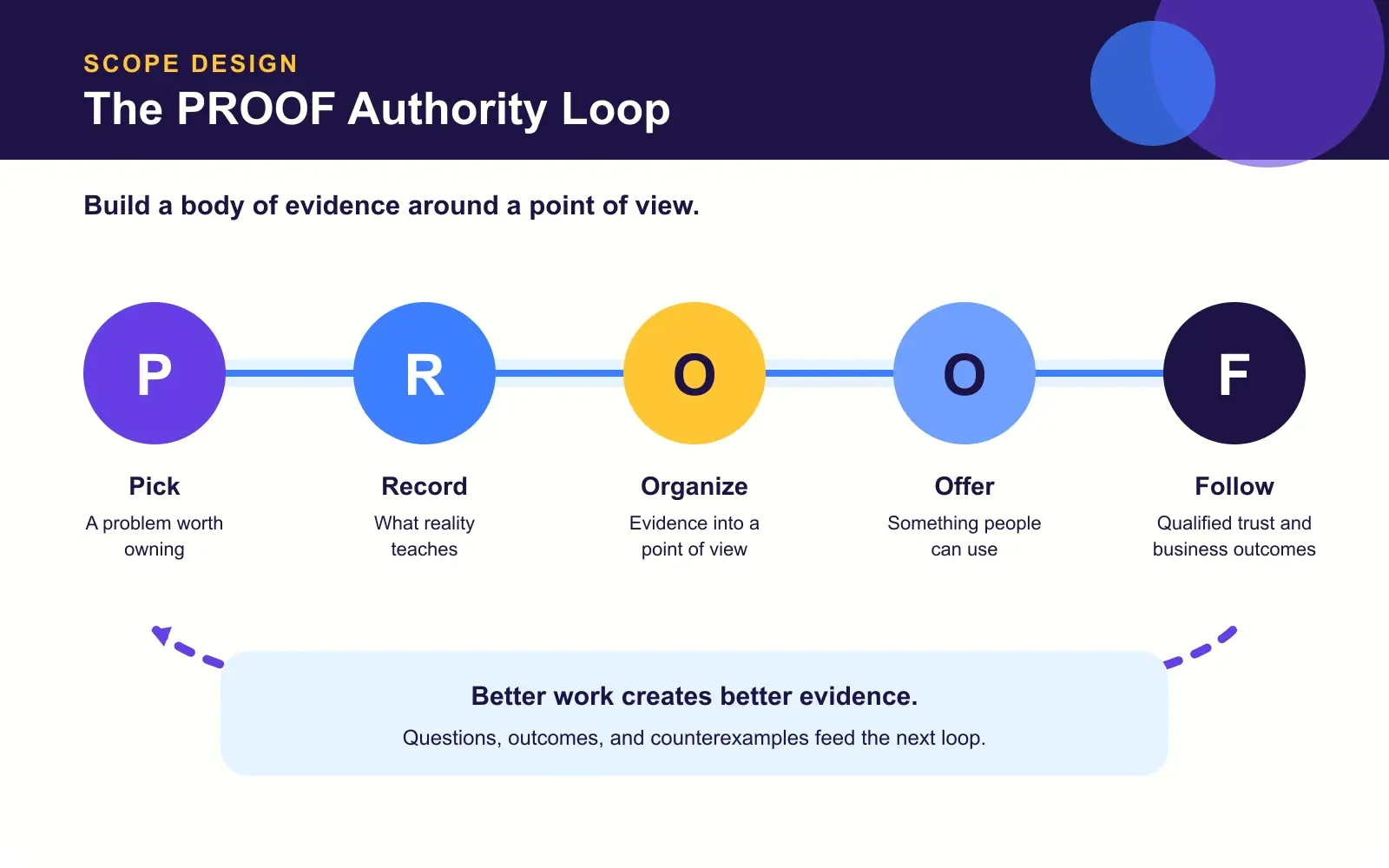
P: Pick a problem worth owning
“We help businesses grow” is not a position. It is the verbal equivalent of beige office carpet.
Choose a territory narrow enough that the right buyer can recognize a specific situation:
- who experiences the problem;
- what expensive consequence it creates;
- when it becomes urgent;
- what people usually misunderstand about it;
- what outcome you are equipped to improve;
- who is not a fit;
- what you will refuse to claim or do.
Scope Design, for example, is not merely interested in “better websites.” Our useful territory is the business system behind the requested deliverable: the constraint, customer decision, content, proof, conversion path, operational handoff, technology, ownership, and maintenance that determine whether the website earns its keep.
The brand-messaging guide owns how that position becomes a repeatable message. The useful-weirdness article owns differentiation. The pillar’s job is to show why a position needs evidence before it becomes authority.
R: Record what reality teaches
Your strongest authority asset is not your opinion. It is evidence that the opinion survived contact with reality.
Maintain an evidence ledger that distinguishes:
- direct evidence: measurements, deliverables, observations, decisions, and outcomes from work you actually performed;
- client evidence: approved quotes, case details, artifacts, and results with disclosure status recorded;
- external evidence: primary research, standards, law, official documentation, and reliable datasets;
- inference: your interpretation of the evidence, labeled honestly;
- hypothesis: a useful idea that still needs testing;
- limit or counterexample: where the recommendation fails, changes, or remains uncertain.
For Scope Design’s content program, we preserve old revisions, inspect analytics and search data, record content hashes, verify public rendering, and distinguish a real implementation example from a results case. That is less exciting than claiming a 12X transformation. It is also evidence.
When a client story is covered by an NDA or contains sensitive operational details, anonymize it or get permission. Do not sprinkle confidential details through a public article because the case study felt a little thin.
O: Organize evidence into a point of view
Original thinking does not require inventing a new law of physics before lunch. It requires doing more than summarizing the same search results everybody else summarized.
Use this chain:
Repeated observation → pattern → explanation → implication → recommendation → boundary
For example:
- Observation: Businesses repeatedly request a redesign before anyone checks traffic quality, offer clarity, sales follow-up, or technical failures.
- Pattern: The requested deliverable often contains an untested diagnosis.
- Explanation: A visible website feels easier to blame and easier to buy than a messy business process.
- Implication: Starting with screens can spend the client’s money without touching the constraint.
- Recommendation: Diagnose volume, technical function, traffic fit, messaging, UX, offer, and follow-up before prescribing the build.
- Boundary: Sometimes the website genuinely is broken and should be rebuilt. Discovery is not a ritual for delaying obvious work.
Now there is an inspectable argument. People can use it, disagree with it, compare it with their situation, and see how you make decisions.
A slogan becomes authority only after reality keeps voting for it.
O: Offer something useful
Most “thought leadership” is a familiar opinion wearing a blazer.
Useful authority material produces an intellectual object someone can apply:
- a diagnostic;
- a decision tree;
- a calculator;
- an operating framework;
- a comparison matrix;
- a checklist with actual decision rules;
- a teardown or annotated example;
- an original dataset or benchmark;
- a sample deliverable;
- a postmortem;
- a buyer’s guide;
- a “when not to hire us” guide;
- a glossary that resolves real ambiguity;
- a documented method with limits and counterexamples.
An article can be useful too, but length is not the achievement. A 5,000-word fog bank is still fog.
Google’s official people-first content guidance asks whether material provides original information, substantial analysis, clear sourcing, demonstrated expertise, and value beyond rewriting other sources. It also encourages clarity about who created the content, how it was produced, and why. That guidance is about search quality. It is not a promise that good content will rank, but it aligns with credible authority work. See Google’s “Who, How, and Why” guidance.
Our SEO content-writing guide owns the search-writing workflow. This pillar owns the body of proof the writing should expose.
F: Follow the qualified consequences
Authority is earned in other people’s decisions, so follow what the work causes.
Distribute through a small number of relevant paths:
- customers and referrals;
- search for problems you genuinely understand;
- niche communities and associations;
- partners serving the same audience differently;
- direct outreach that shares something useful;
- industry publications, podcasts, or events;
- a newsletter people would notice missing;
- social platforms where actual buyers and peers participate;
- sales follow-up and assignment selling;
- internal enablement for the people representing the business.
The goal is not maximum reach. It is maximum relevance per impression.
Then record the consequences: who used the work, what question it answered, whether it earned a citation or introduction, which inquiries fit, whether prospects arrived better educated, and what happened commercially.
The social-media authority guide will own platform presence and distribution after its rebuild. This pillar keeps distribution tied to the evidence system instead of a posting streak.
What counts as proof of expertise?
Proof has different strength depending on the claim.
| Proof type | What it can support | Common abuse |
|---|---|---|
| Specific case evidence | A method worked in a stated context | Removing the context and universalizing the result |
| Before-and-after measurement | Direction and magnitude of a documented change | Taking credit for every simultaneous change |
| Process artifact | The expertise is operational and inspectable | Showing a polished template nobody actually uses |
| Client testimonial | Someone is willing to describe an experience | Publishing vague praise or hiding an incentive |
| Customer review pattern | Repeated public experience signals | Cherry-picking, suppressing, or buying sentiment |
| Original research | A defined sample produced a defined finding | Pretending the sample describes the universe |
| Primary external source | A claim is grounded in authoritative evidence | Citing a source that does not support the sentence |
| Failure or counterexample | You understand limits and tradeoffs | Turning a mistake into self-congratulatory theater |
| Independent citation | Others found the work useful enough to reference | Treating one mention as universal recognition |
The testimonial strategy guide owns how to collect and place selected client evidence. The review-generation guide owns the ethical request process. The customer-review guide owns how buyers interpret that public evidence.
Those practices have legal and ethical boundaries. The FTC distinguishes reviews from testimonials and prohibits fake or false reviews and certain sentiment-conditioned incentives. Its Consumer Reviews and Testimonials Rule Q&A is the primary U.S. starting point. Industry and jurisdictional rules may add more.
How do you create credible thought leadership?
Thought leadership is a publishing practice that helps a defined audience understand an important problem differently or act on it more intelligently. It contributes to authority when the thinking is useful, evidence-led, specific, and attributable.
Use a repeatable workflow:
- Capture a decision, contradiction, failure, pattern, or repeated customer question from real work.
- Check whether the observation is common, unusual, or merely memorable.
- Gather direct evidence, primary external research, and counterexamples.
- State the point of view and the conditions under which it applies.
- Create a useful artifact or clear recommendation.
- Let a qualified human review claims, sourcing, confidentiality, and business implications.
- Publish with an identifiable author and a visible method where useful.
- Distribute to the people who face the problem.
- Record objections, uses, citations, inquiries, and outcomes.
- Revise the thinking when reality proves it incomplete.
That last step matters. Authority is not the ability to sound certain forever. It is the ability to update without pretending the earlier version never happened.
How should AI be used in authority-building content?
Use AI to increase the reach of real thinking, not to manufacture the appearance that thinking occurred.
Good uses include:
- searching and organizing a controlled knowledge base;
- finding gaps, contradictions, and repeated questions;
- transcribing expert interviews;
- comparing an article against a source ledger;
- checking whether claims are actually cited;
- producing structural drafts and alternative explanations;
- formatting, proofreading, tagging, and repurposing;
- extracting FAQs from verified research;
- tracking links, revisions, schema, and publication QA.
Keep human judgment over:
- original perspective;
- client stories and permission;
- claims about results;
- legal, medical, financial, or regulated interpretation;
- criticism of competitors;
- first-person experience;
- strategic recommendations;
- publication approval.
The AI automation pillar covers that human-led operating model in detail. If your “thought leadership” can be generated from a broad prompt without your experience, evidence, or judgment, competitors can manufacture the same beige sludge before your coffee cools.
Build a knowledge group, not a pile of posts
A useful topic cluster is a body of focused pages with explicit ownership and meaningful links. It is not 40 articles repeating the pillar’s opening paragraph to create the impression of depth.
For Brand Strategy & Authority Building, the cluster should let a reader move among distinct jobs:
- the pillar defines how authority is earned;
- positioning explains the territory worth owning;
- perceived value explains how proof and risk shape preference;
- testimonials and reviews provide different forms of evidence;
- review generation owns the request process;
- reputation owns the broader public pattern and response system;
- distribution explains how useful work reaches relevant people.
Each supporting owner links upward when the reader needs the system. The pillar links down when the reader needs the operating detail. Lateral links exist only when one decision genuinely depends on another.
That helps humans understand the subject, helps search systems identify a coherent body of knowledge, and gives AI systems clearer passages and relationships to cite. It does not guarantee rankings or citations. Anybody guaranteeing those is selling weather control with a dashboard.
How do you measure brand authority?
There is no single universal authority score. Moz’s metric called Brand Authority, social follower counts, search impressions, branded search volume, survey awareness, citations, referrals, and sales data each measure different things.
Use a hierarchy tied to decisions:
| Layer | Useful evidence | The decision it should inform |
|---|---|---|
| Discovery | Branded search, direct visits, repeat visitors, relevant reach | Are the right people encountering us? |
| Usefulness | Saves, downloads, artifact use, return visits, completion | Did the work help someone do something? |
| Corroboration | Citations, backlinks, invitations, expert references, specific reviews | Are others independently validating the work? |
| Relevance | Right-fit inquiries, referral quality, buyer role, problem match | Is the attention commercially appropriate? |
| Sales effect | Content mentioned, pre-educated prospects, close rate, cycle length | Does authority improve the buying conversation? |
| Business effect | Wins, contribution, retention, expansion, referrals | Is the system creating durable economic value? |
Do not claim the article caused revenue because a buyer once visited it. Use source, sequence, sales notes, customer interviews, and reasonable attribution. Authority often assists a decision rather than receiving a neat last-click trophy.
The perceived-value guide will own how specificity, evidence, risk, and experience affect the value judgment. The online-reputation guide will own monitoring and response.
Common authority-building mistakes
Trying to look famous instead of becoming useful
Large follower counts and conference photos can create recognition. They do not prove that the advice works.
Publishing generic summaries at industrial volume
If every article could belong to any competitor, the content demonstrates production capacity, not perspective.
Borrowing certainty from famous brands
Apple, Nike, Patagonia, and whichever company is fashionable this quarter do not prove your recommendation. Explain the mechanism, evidence, and limits relevant to the reader.
Making claims the evidence cannot carry
One project is not an industry benchmark. One testimonial is not a controlled study. A correlation is not automatic causation. Use the strongest honest claim, not the loudest available adjective.
Hiding every mistake and tradeoff
Perfect case-study theater makes experienced buyers suspicious. Show what changed, what did not, what you learned, and where the method is not a fit.
Confusing consistency with repetition
A coherent worldview should appear across your work. Repeating the exact focus keyword 30 times is not consistency. It is a cry for help from the copy.
Treating a founder’s personality as the whole brand
Personal experience is useful evidence when it illuminates a professional truth. It should not turn every business insight into an autobiographical content franchise.
Automating the judgment
Automate assembly, retrieval, and QA. Keep consequential claims, interpretations, and client-sensitive decisions attached to accountable humans.
Measuring impressions while sales reports confusion
Attention cannot compensate for unclear fit, weak proof, slow response, or an offer nobody wants.
A 90-day brand-authority plan
Days 1–30: define and document
- Choose one expensive problem and one right-fit audience.
- State your point of view, non-fit, and evidence limits.
- Inventory cases, decisions, artifacts, customer questions, reviews, research, and missing proof.
- Establish a baseline for branded discovery, qualified inquiries, referrals, citations, and sales notes.
- Assign ownership for evidence, publication, distribution, and measurement.
Days 31–60: build the first proof set
- Publish one pillar that defines the territory.
- Create one diagnostic or decision tool.
- Publish one specific case or anonymized decision story.
- Write one strong contrary position with evidence and boundaries.
- Create one “wrong fit” or “when not to buy” resource.
- Link the material into a coherent knowledge group.
Days 61–90: distribute and learn
- Share each artifact with relevant clients, prospects, partners, and communities.
- Equip sales and service teams to use the right page in real conversations.
- Record questions, objections, referrals, citations, and qualified opportunities.
- Improve weak explanations and add missing evidence.
- Stop any channel producing vanity activity with no relevant downstream use.
- Choose the next article from a real knowledge gap, not a random publishing quota.
Ninety days will not make you the unquestioned authority in an industry. It is enough to replace vague ambition with a working evidence system.
Brand authority FAQ
What is brand authority?
Brand authority is the earned belief that a business is a credible, useful, and dependable source on a specific problem. It is demonstrated through evidence, original perspective, useful work, corroboration, and reliable outcomes.
Why does brand authority matter?
Authority helps unfamiliar or smaller providers survive evaluation, helps buyers understand complex problems, gives internal stakeholders material they can share, and can improve the quality of inquiries and sales conversations.
How do you build brand authority?
Own a clear problem, record evidence from real work, form a defensible point of view, publish useful artifacts, distribute them to relevant people, invite independent corroboration, and measure qualified commercial consequences.
What is the difference between brand authority and brand awareness?
Awareness means people have encountered or remember the brand. Authority means relevant people give the brand’s judgment weight on a particular problem. A business can be famous without being trusted and authoritative without being broadly famous.
What is the difference between brand authority and reputation?
Reputation is the broader pattern people believe about a business’s conduct and results. Authority is the weight given to its expertise in a defined area. Strong reputation supports authority, but they are not identical.
Is thought leadership the same as brand authority?
No. Thought leadership is one way to express useful original thinking. Brand authority is the larger earned judgment created by the business’s work, proof, reputation, communication, and third-party corroboration.
What makes thought leadership credible?
Credible thought leadership has a defined audience and problem, an attributable author, primary or direct evidence, an original interpretation, clear practical consequences, honest limits, and enough detail for readers to use or challenge it.
Can a small business build authority without a large audience?
Yes. A small firm can build deep authority with a narrow audience when its work is specific, useful, well evidenced, and repeatedly relevant. Hundreds of right-fit buyers can matter more than thousands of miscellaneous followers.
Do social-media followers prove authority?
No. Followers measure potential distribution, and even that can be noisy. Authority requires evidence that relevant people trust, use, cite, recommend, or act on the business’s expertise.
How long does brand authority take to build?
There is no universal timeline. It depends on existing expertise, proof, market complexity, publishing quality, distribution, reputation, and buying cycles. A useful body of work can improve credibility quickly; durable authority compounds through repeated evidence and outcomes.
What are the pillars of brand authority?
There is no official universal list. Scope Design uses the PROOF Authority Loop: Pick a problem, Record reality, Organize evidence into a point of view, Offer useful artifacts, and Follow qualified consequences.
Are there really five or seven universal pillars of brand strategy?
No. Different models group positioning, audience, purpose, identity, experience, culture, reputation, and measurement differently. Judge a framework by whether it produces better decisions, not whether its acronym has the fashionable number of letters.
How do reviews and testimonials affect authority?
They provide different forms of third-party evidence. Reviews show a broader public pattern; testimonials are selected endorsements used by the business. Both should be authentic, specific, contextual, and handled within applicable disclosure and review rules.
How can a business prove expertise without revealing client secrets?
Use approved case studies, anonymized decision stories, aggregated patterns, redacted artifacts, process demonstrations, public examples, original research, and clearly labeled hypothetical examples. Do not reveal sensitive details merely to make a claim sound impressive.
How should AI be used in thought leadership?
Use AI for research organization, retrieval, transcription, gap analysis, drafting support, formatting, and QA. Keep accountable humans responsible for perspective, evidence interpretation, client stories, sensitive claims, and publication.
How do you measure brand authority?
Use multiple layers: branded discovery, useful engagement, independent citations and referrals, right-fit inquiries, sales-cycle effects, wins, margin, retention, and expansion. No single platform score proves authority.
Can low-quality content damage brand authority?
Yes. Generic, inaccurate, overconfident, or visibly mass-produced content teaches buyers that the business values output over judgment. Silence is often less damaging than publishing material that makes expertise look interchangeable.
What should a business stop doing if it wants to look credible?
Stop claiming leadership without evidence, copying competitor language, inflating weak results, buying or manipulating proof, publishing generic summaries at high volume, hiding every limitation, and measuring success entirely through attention metrics.
Build evidence around a point of view
Brand authority is not a content volume contest, a personal-brand costume, or a polished website announcing that you are “trusted.”
Pick a problem. Pay attention to reality. Preserve the evidence. Explain the pattern. Make something useful. Let other people test and corroborate it. Follow the qualified business consequences. Then improve the work.
That creates a flywheel:
Do excellent work → notice something → explain it → prove it → make it useful → reach the right people → earn trust → get better work → notice more things.
The paradox is simple: the less desperately you try to look authoritative, the more room you create to become authoritative.
If your authority strategy is currently a pile of generic articles, vague positioning, unverified claims, and channels nobody can connect to a business outcome, Scope Design’s Impact Consulting can diagnose the system before you feed more content into it.

