Author: scopedesign

  • Product Repositioning: Fix the Mismatch Before You Rebrand

    Product Repositioning: Fix the Mismatch Before You Rebrand

    Product repositioning is the deliberate act of changing how a market understands, compares, and chooses an existing product. It makes sense when the product can deliver real value, but the current audience, use case, category, proof, or message is wrong. If the product does not reliably do its job, repositioning is not strategy. It is better packaging around the same problem.

    Weak sales are a symptom. Before you touch the logo, rewrite the website, change the price, or add another feature, figure out what is actually mismatched.

    TL;DR: Reposition only after you diagnose the gap

    • A product gap is not a positioning problem. If customers buy and then cannot get the promised result, fix the product first.
    • Audience, use-case, category, proof, and message gaps can often be tested without rebuilding the product.
    • Change one positioning lever at a time. A full rebrand changes so many variables that you can easily spend a pile of money and learn almost nothing.
    • Use real behavior as evidence. Customer interviews, win/loss notes, activation, repeat use, retention, qualified conversion, and support patterns beat opinions from people who were never going to buy.
    • Repositioning should earn the right to become permanent. Test the hypothesis on a limited audience or page first, then keep it, revise it, rebuild the product, or stop.

    In this guide

    If you need the broader decision system around this, start with Scope Design’s Business Strategy framework. This article owns one narrower decision: what to do when an existing product is underperforming and someone says, “Maybe we just need to reposition it.”

    What is product repositioning?

    Product repositioning changes the place an existing product occupies in a buyer’s mind. That may mean changing the target audience, the main use case, the category buyers compare it against, the value proposition, the proof used to support that value, or the language used to explain it.

    That definition matters because repositioning is often confused with three very different moves: rebranding, product improvement, and product replacement.

    MoveWhat actually changesUse it whenCommon mistake
    Product positioningThe initial market frame for a productYou are defining who it is for, what job it does, and why it is differentWriting a tagline before the market choice is clear
    Product repositioningThe market frame for an existing productEvidence says the product can work, but the current fit is wrongTreating weak sales as proof that messaging is the only problem
    RebrandingBrand identity, expression, or architectureThe brand itself is creating confusion or no longer fits the businessPaying for a new identity before validating a new position
    Product changeFeatures, delivery, quality, workflow, or economicsThe product cannot reliably deliver the promised outcomeTrying to market around a product defect
    RetirementThe decision to stop investingDemand, economics, or strategic fit remain weak after credible testsKeeping a product alive because of sunk cost

    Kellogg’s Alice Tybout makes a useful distinction in her discussion of brand repositioning: a position can become too broad to be supported by the brand’s “reason to believe,” meaning the proof behind the promise. That is a good reminder that a positioning problem can be caused by an overextended claim, not just bad copy.

    Before you reposition, ask the uncomfortable question: does the product deserve to survive?

    The temptation is to assume the product is fine and the market simply misunderstood it. Sometimes that is true. Sometimes the market understood it perfectly and shrugged.

    A product is a poor repositioning candidate when the core problem sits inside the product itself. Watch for patterns such as:

    • customers understand the promise, buy, and still cannot get the expected result;
    • trial or first purchase looks healthy, but activation, repeat use, renewal, or retention is persistently weak;
    • support complaints reveal the same functional failure again and again;
    • the economics only work if you hide real delivery costs or depend on unrealistic volume;
    • the proposed new message would require claims the product cannot substantiate;
    • the only reason to continue is, “We already spent too much to stop now.”

    That last one deserves special suspicion. If the team is defending the past investment instead of evaluating the next investment, run the decision through the SCOPE Decision Filter and check for the cognitive biases that turn sunk cost into strategy.

    If the product works for some real customers and produces a useful outcome, then repositioning becomes much more interesting. Now the question is not “How do we make this sound better?” It is “Where is the mismatch?”

    Use the Product Repositioning Gap Map to diagnose the mismatch

    Most underperforming products do not need a random collection of marketing tactics. They need a diagnosis. Scope Design’s Positioning Gap Map separates six problems that are routinely mashed together under the phrase “bad positioning.”
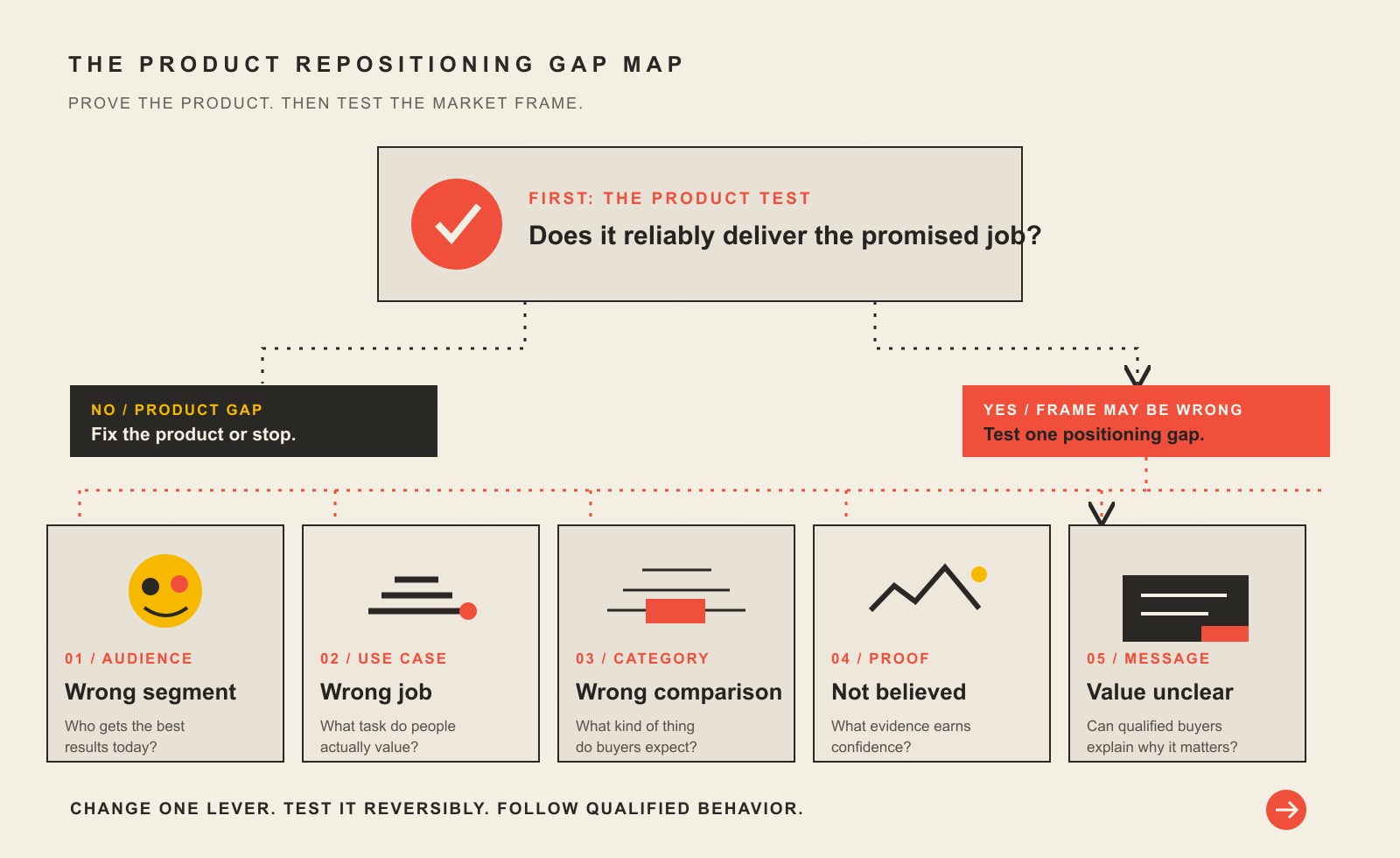
    Product repositioning diagnostic: first verify the product delivers reliably; if it does, investigate a mismatch in audience, use case, category, proof, or message.

    1. Product gap

    The product cannot reliably deliver the promised job.

    This is the one gap you should not solve with repositioning. If the product is unreliable, incomplete, unsafe, too hard to use, or structurally uneconomic, change the product or stop selling it.

    A prettier promise cannot turn failure into value. It can only increase the number of disappointed customers.

    2. Audience gap

    The product works, but the current audience is a poor fit.

    You may discover that a smaller, more specific segment converts faster, uses the product more deeply, asks fewer support questions, or retains better than the audience you originally targeted.

    Do not immediately declare a new target market because three people said nice things. Use market research to compare behavior, alternatives, willingness to act, and competitive context across segments. The U.S. Small Business Administration recommends market research and competitive analysis to understand customers, demand, alternatives, and market segments.

    3. Use-case gap

    Customers value a different job than the one you built your marketing around.

    A product may have been created for one workflow and become valuable for another. The important evidence is not that people can invent clever uses for it. The important evidence is that a meaningful group already behaves differently and gets value from that behavior.

    Look at what customers actually do, not what a brainstorming session says they might do. Harvard Business School’s Jobs to Be Done interview guidance emphasizes observing and interviewing customers to uncover the job they are actually trying to accomplish.

    4. Category gap

    Buyers do not know what shelf in their brain to put the product on.

    If prospects repeatedly ask “What is this?” or compare the product with something that makes the value look absurd, the category or frame of reference may be wrong.

    A better category does not need to be clever. It needs to help the buyer answer three fast questions: What kind of thing is this? What should I compare it with? Why should I care about the difference?

    5. Proof gap

    The value may be real, but the buyer has no good reason to believe the promise.

    A proof gap can look like a message problem because prospects understand what you are saying but still do not act. The fix may be stronger demonstrations, clearer case evidence, credible reviews, a useful trial, transparent methodology, or narrower claims.

    This is also where repositioning can wander into bullshit. The Federal Trade Commission requires objective advertising claims to have an appropriate factual basis before they are made. Changing the position does not create permission to invent the proof.

    6. Message gap

    The product, audience, use case, category, and proof are basically sound, but the language hides the value.

    This is the gap marketers love because it can be fixed with words. It is also the gap teams diagnose far too early.

    If prospects can explain the product back to you accurately but do not care, you probably do not have a message problem. If qualified prospects consistently misunderstand what it does, who it is for, or why it matters, then the message deserves attention.

    Market saturation matters here too. A claim that worked when it was novel can become invisible when every competitor says the same thing. Scope’s market sophistication framework helps separate a genuinely weak position from a message that has simply become marketing wallpaper.

    Read the evidence as a pattern, not a magic diagnostic

    No single metric proves which gap you have. The patterns below are hypotheses worth testing, not commandments carved into a conference-room wall.

    What you observeLikely gap to investigateFirst useful test
    One customer segment retains or repeats much better than the restAudience or use caseRebuild one landing page and sales pitch for that segment only
    Prospects repeatedly compare you with the wrong alternativeCategoryTest a clearer frame of reference and comparison set
    Prospects understand the value but do not believe the claimProofAdd specific evidence or narrow the claim before changing the whole message
    Qualified visitors engage but routinely misunderstand what the product doesMessageTest a simpler promise, explanation, and example
    People buy or trial, but usage and retention collapseProduct or use caseInterview successful and unsuccessful users, then inspect the actual experience
    Every segment stays weak after repeated credible testsProduct, demand, or economicsStop polishing the position and reconsider the product itself

    The useful question is not “Which metric is bad?” It is “Which explanation best fits several pieces of evidence at once?”

    Use the RESET Repositioning Loop before you pay for the full rebrand

    Once you have a plausible gap, use a controlled loop instead of a dramatic launch. We call it RESET:

    Read the evidence

    Start with what already exists: customer interviews, lost deals, support tickets, reviews, product usage, sales notes, search demand, competitive alternatives, repeat behavior, and margins.

    Do not begin with a workshop where everyone writes adjectives on sticky notes. That can come later, after reality has had a vote.

    Expose the mismatch

    Write the problem as a falsifiable statement.

    Bad: “Our positioning feels stale.”

    Better: “Independent agencies that use the product for client approvals retain longer than the general small-business audience, but our site never presents client approvals as the primary use case.”

    Now you have something you can test.

    Select one positioning lever

    Choose the smallest change that would test the hypothesis:

    • target segment;
    • primary job or use case;
    • category or frame of reference;
    • value proposition;
    • proof;
    • message hierarchy;
    • packaging or offer structure when it materially changes the perceived value.

    If you change the audience, category, pricing, product, name, visual identity, website, and advertising all at once, the launch may look impressive and teach you absolutely nothing.

    Experiment before the rebrand

    Test the new position somewhere reversible. That could be a dedicated landing page, a small paid campaign, a sales deck, a targeted email to a qualified segment, a new onboarding path, or a limited outbound sequence.

    Use enough exposure to observe real behavior, not enough commitment to make the test politically impossible to reverse.

    Track response and decide

    Predefine what would count as stronger evidence. Depending on the business, that might be better qualified conversion, improved activation, shorter sales cycles, fewer “I don’t get it” objections, stronger retention, healthier margins, or a more favorable win/loss pattern.

    Then decide: keep the new position, revise and test again, fix the product, or stop investing.

    This loop fits inside the broader 7 Ps product strategy audit. The 7 Ps help you examine the whole product-marketing system. RESET is for the narrower moment when an existing product is not getting the response you expected.

    Product repositioning is not the same as rebranding

    Repositioning changes the strategic meaning of the product. Rebranding changes how that meaning is expressed through identity, naming, visual language, architecture, or other brand elements.

    Sometimes a new position eventually requires a new brand expression. Sometimes it does not.

    If your test shows that a different audience responds strongly to a different use case, you may be able to update the product page, sales story, examples, and proof without touching the logo. That is usually a lovely discovery because logos are not paid by the hour to solve market fit.

    A rebrand should follow a strategic change when the existing identity or brand architecture genuinely obstructs the new position. It should not be the expensive experiment you use to discover whether the new position works.

    A practical product repositioning example

    Imagine a project-management app originally marketed as “simple productivity for every small business.”

    The broad market performs poorly. Sales calls are long. Prospects compare it with enormous all-in-one platforms and conclude it has fewer features. Generic small businesses sign up but rarely become active users.

    Then the team notices a pattern: small field-service companies use the app heavily for one specific workflow, photo-based job handoffs between office staff and technicians. They activate faster, repeat the workflow every week, and describe the product to colleagues as “the easiest way to prove what happened on site.”

    The product may not need a reinvention. It may have an audience, use-case, and category gap.

    A sensible repositioning test would be:

    1. target field-service teams instead of “every small business”;
    2. lead with the job-handoff use case instead of generic productivity;
    3. compare the product with manual handoff methods and bloated field-service suites, not every project-management platform;
    4. show real workflow proof;
    5. run that position on one landing page and one sales path before rebuilding the brand.

    If the targeted path improves qualified conversion and the customers continue to activate and retain, the repositioning has earned more investment. If they click the new message and then churn because the workflow still breaks, congratulations, you found a product gap before buying new stationery.

    That is the point of diagnosis-first repositioning.

    A sample 30-day product repositioning test

    Thirty days is not a universal law. A complex enterprise sale may need much longer, while a high-volume ecommerce test may produce useful evidence faster. Treat this as a compact test structure, not a promise about timing.

    Days 1 to 5: establish the baseline

    Record the current audience, promise, conversion path, objections, activation or repeat behavior, retention when relevant, margins, and the competing alternatives customers actually consider.

    Interview recent buyers, non-buyers, and lost prospects. Ask about what they did before, what triggered the search, what alternatives they considered, what made them hesitate, and what happened after purchase.

    Days 6 to 10: choose one gap hypothesis

    Write one clear statement about the suspected mismatch. Pick one primary segment or use case. Define the behavior that would make the hypothesis more credible and the behavior that would weaken it.

    Days 11 to 24: run the controlled test

    Change only the positioning elements necessary to test the hypothesis. Keep the existing version available as a baseline when practical. Route a limited, relevant audience through the new version.

    Do not judge the test on likes, compliments, or the enthusiasm of coworkers who now feel emotionally attached to the new headline.

    Days 25 to 30: compare behavior and decide

    Compare the new path with the baseline. Review both numbers and actual customer language. Decide whether the evidence supports a larger rollout, another focused test, a product change, or a stop decision.

    The goal of the pilot is learning. A test that disproves a repositioning hypothesis before a six-month rebrand can be a very profitable failure.

    How should you measure whether product repositioning is working?

    The right metrics depend on where the suspected gap sits in the customer journey.

    Acquisition and qualification

    Look at whether the new position attracts more of the right people, not merely more people. Useful measures may include qualified landing-page conversion, lead quality, demo quality, segment mix, and which alternatives prospects mention.

    Sales friction

    Track objections, win/loss reasons, sales-cycle length, follow-up burden, price confusion, and how often salespeople need to re-explain the product after the marketing supposedly explained it.

    Product behavior

    If the product has an activation or repeat-use cycle, inspect it. Better marketing with worse activation is not progress. Retention, renewal, repeat purchase, usage depth, support burden, and successful completion of the core job help tell you whether the new audience/use case fits the actual product.

    Economics

    A position that raises conversion but attracts an expensive-to-serve segment may still be a bad trade. Include acquisition cost, delivery cost, gross margin, refund or churn patterns, and the operational burden created by the new promise.

    Qualitative evidence

    Capture the words customers use. A strong position often makes sales conversations clearer because buyers can explain the value in their own language. That is not a substitute for behavioral evidence, but it is useful diagnostic material.

    When should you stop repositioning and make a harder decision?

    Repositioning has become avoidance when:

    • every new message produces the same weak behavior;
    • the only segment showing interest is too small or too expensive to serve;
    • the product still fails its core job after the audience and use case are clear;
    • the economics do not work under realistic acquisition and delivery assumptions;
    • a new position would depend on claims you cannot substantiate;
    • the team keeps moving the target because admitting the product is weak feels worse than launching another campaign.

    A failed repositioning test does not automatically mean the product is dead. It does mean you should update the diagnosis instead of protecting the theory.

    That is the same constraint-first principle Scope uses in website strategy: a requested redesign, feature, campaign, or message is not automatically the real problem. Diagnose the binding constraint before optimizing the thing that is easiest to see.

    Product repositioning FAQ

    What is product repositioning?

    Product repositioning is changing how an existing product is understood and compared in the market. The change may involve the target audience, use case, category, value proposition, proof, or message while keeping some or all of the core product intact.

    What is the difference between product positioning and repositioning?

    Positioning establishes the intended market frame for a product. Repositioning changes that frame after the product already has a market history, customer perception, or performance record.

    When should a company reposition a product?

    Reposition when credible evidence suggests the product delivers value but the current audience, use case, category, proof, or message is mismatched. Do not default to repositioning when the product itself cannot deliver the promised result.

    Can you reposition a product without changing the product?

    Yes. An audience, use-case, category, proof, or message reposition can leave the core product largely unchanged. The key is that the new promise must match what the product can actually deliver.

    Does product repositioning require a rebrand?

    No. Repositioning is a strategic change in market meaning; rebranding is a change in brand expression. Test the strategic position first. Rebrand when the existing identity genuinely blocks the validated position.

    What are common product repositioning strategies?

    Common approaches include narrowing or changing the target segment, emphasizing a different use case, changing the competitive frame, clarifying the value proposition, strengthening proof, changing packaging or offer structure, and rewriting the message hierarchy.

    Can you give an example of product repositioning?

    A software product marketed broadly as “productivity for small business” might discover that field-service teams use it heavily for photo-based job handoffs. Repositioning could target that segment, lead with that job, change the comparison set, and add relevant proof without rebuilding the whole product. That is a hypothetical example, but it shows the decision clearly.

    How do you know whether poor sales are a positioning problem or a product problem?

    Look beyond sales. If qualified customers understand the promise, buy, and then fail to activate, repeat, renew, or get the intended result, investigate the product or use case. If the product creates strong outcomes for a specific group but the market attracts the wrong buyers or misunderstands the value, investigate positioning.

    How do you reposition a failed product?

    First determine whether it is actually a failed product. Read customer and product evidence, identify the most plausible gap, select one positioning lever, run a limited test, and compare behavior with the baseline. If the core product fails, fix or retire it instead of disguising the failure.

    What are the biggest risks of product repositioning?

    The main risks are confusing or alienating existing customers, changing too many variables to learn anything, making claims the product cannot support, chasing a tiny or unprofitable segment, and spending heavily on a rebrand before the new position has been validated.

    How long does product repositioning take?

    The strategic test can be quick when traffic and sales cycles are short, or much longer in complex B2B markets. Separate the time required to test the hypothesis from the time required to roll out a validated position across the product, brand, website, sales process, and operations.

    What metrics should you track after repositioning?

    Track metrics tied to the suspected gap: qualified conversion and segment mix for audience/message changes; objections and win/loss reasons for category/proof changes; activation, repeat use, retention, and support burden for product/use-case fit; and margin or acquisition economics for the overall business decision.

    Do not buy a new story before you know what is broken

    Product repositioning can be a smart response to weak demand. It can also become an expensive way to avoid admitting that the product, audience, economics, or evidence is wrong.

    The useful order is simple: diagnose the gap, test the smallest meaningful change, watch qualified behavior, then decide.

    If your team is bouncing between “we need a new website,” “we need better ads,” “we need a rebrand,” and “we need more features,” Scope Design can help separate the requested fix from the actual constraint. Contact Scope Design and we will start with the problem before prescribing the project.

  • AI-Powered Business Resilience: How to Thrive When Everything Goes Wrong

    AI-Powered Business Resilience: How to Thrive When Everything Goes Wrong

    AI-powered business resilience is not about automating every response. It is about using AI to notice trouble sooner, organize evidence faster, preserve useful operating knowledge, and rehearse difficult scenarios—while keeping people, permissions, backups, and manual fallbacks strong enough to take over when the AI is wrong or unavailable.

    That last part matters. An AI system can reduce friction in a disruption, but it can also become a new dependency. If a critical workflow stops because a model hallucinates, an API goes down, a connector loses access, or an automated action fires at the wrong time, the “resilience” tool has become part of the incident.

    TL;DR: Use AI as a resilience assistant, not the resilience system

    • Use AI for monitoring, anomaly detection, evidence compression, documentation, and scenario rehearsal.
    • Do not let an AI system become the only place that critical knowledge, credentials, decisions, or recovery steps live.
    • Define stop conditions before you automate high-impact actions.
    • Give every critical AI workflow a human owner, backup owner, manual fallback, and recoverable state.
    • Test failure on purpose. A workflow you have never rehearsed is a theory, not a resilience plan.

    What AI-powered business resilience actually means

    Business resilience is broader than AI. It includes the ability to keep important outcomes moving when a supplier, system, person, location, or assumption fails. Scope Design’s broader business resilience framework covers that full operating model—priorities, dependencies, triggers, decision rights, fallbacks, and testing.

    This article owns the narrower AI layer: how artificial intelligence can strengthen detection and response without quietly introducing another single point of failure.

    The distinction is important because “use AI” is not a continuity strategy. A resilient company can use AI heavily and still keep critical work moving when that AI is unavailable. A fragile company may look technologically sophisticated right up until the automation fails and nobody knows how to complete the task manually.

    Four resilience jobs AI can do well

    1. Detect unusual conditions earlier

    AI can help teams scan operational data, support queues, transaction patterns, logs, inventory levels, site behavior, or other business signals for conditions that deserve attention. The useful output is not “AI predicts the future.” It is a practical alert: something changed, here is the evidence, and this threshold was crossed.

    This lines up with CISA’s small-business logging guidance, which emphasizes logging normal activity, monitoring for changes, and creating alerts for high-risk events. AI can help prioritize those signals, but the logging and alerting foundation still has to exist.

    2. Compress evidence for faster triage

    During a disruption, teams often lose time collecting context: what failed, what changed, which customer is affected, what the last successful state was, and who owns the next decision. An AI assistant can summarize logs, tickets, alerts, notes, and status updates into a briefing that a human can verify.

    The key word is verify. AI should shorten the distance between evidence and a decision, not replace the evidence. For high-impact work, preserve links back to source systems, timestamps, owners, and the underlying records.

    3. Keep operating knowledge usable

    Critical procedures are often scattered across inboxes, chat threads, old documents, and one person’s memory. AI can make approved runbooks, vendor details, escalation paths, recovery procedures, and decision criteria easier to retrieve—provided the underlying knowledge is current and governed.

    We think of this as a truth vault: the AI may help retrieve and explain the operating knowledge, but the source of truth remains a controlled, human-maintained system that can be accessed without the model. That design principle is also useful when building AI automation for business: the workflow should earn its keep without becoming impossible to operate around.

    4. Rehearse scenarios before they are real

    AI is useful for tabletop exercises because it can generate realistic variations: the payment processor is down during a promotion, a key employee is unavailable, an AI agent sends a wrong customer message, a supplier misses a deadline, or the website starts returning errors after an update. The value comes from forcing the team to answer concrete questions before stress makes those questions harder.

    Scenario generation is not the same as approving the response. People still decide what counts as safe, which action is authorized, when communication is required, and when the business should switch to a fallback path.

    How AI can make a resilient business more fragile

    The failure modes are predictable enough that they should be designed for up front.

    • Vendor or API outage: the model, automation platform, connector, or authentication layer becomes unavailable.
    • Confidently wrong output: the AI invents a fact, misreads context, or summarizes the wrong record.
    • Over-privileged action: an AI agent can send, edit, delete, publish, purchase, refund, or change a system without adequate approval.
    • Stale knowledge: the AI retrieves an old procedure, obsolete price, wrong policy, or superseded vendor contact.
    • Automation loop: one trigger creates another event, which retriggers the same workflow and amplifies the error.
    • Data exposure: sensitive information is sent to a tool, model, or destination that was never approved for it.

    NIST’s AI Risk Management Framework exists to help organizations manage risks created by AI systems, not just the risks AI might help detect. Its Generative AI Profile goes further on operational controls, including incident-response ownership, rehearsal, continuous monitoring, data redundancy, and testing rollover or fallback technologies—including manual processing.

    That is the right mental model for business-critical automation: every useful AI capability should come with a defined boundary. Our guide to AI chatbots for business applies the same principle at the interaction layer—know the job, know the limits, and require verification before a system takes consequential action.

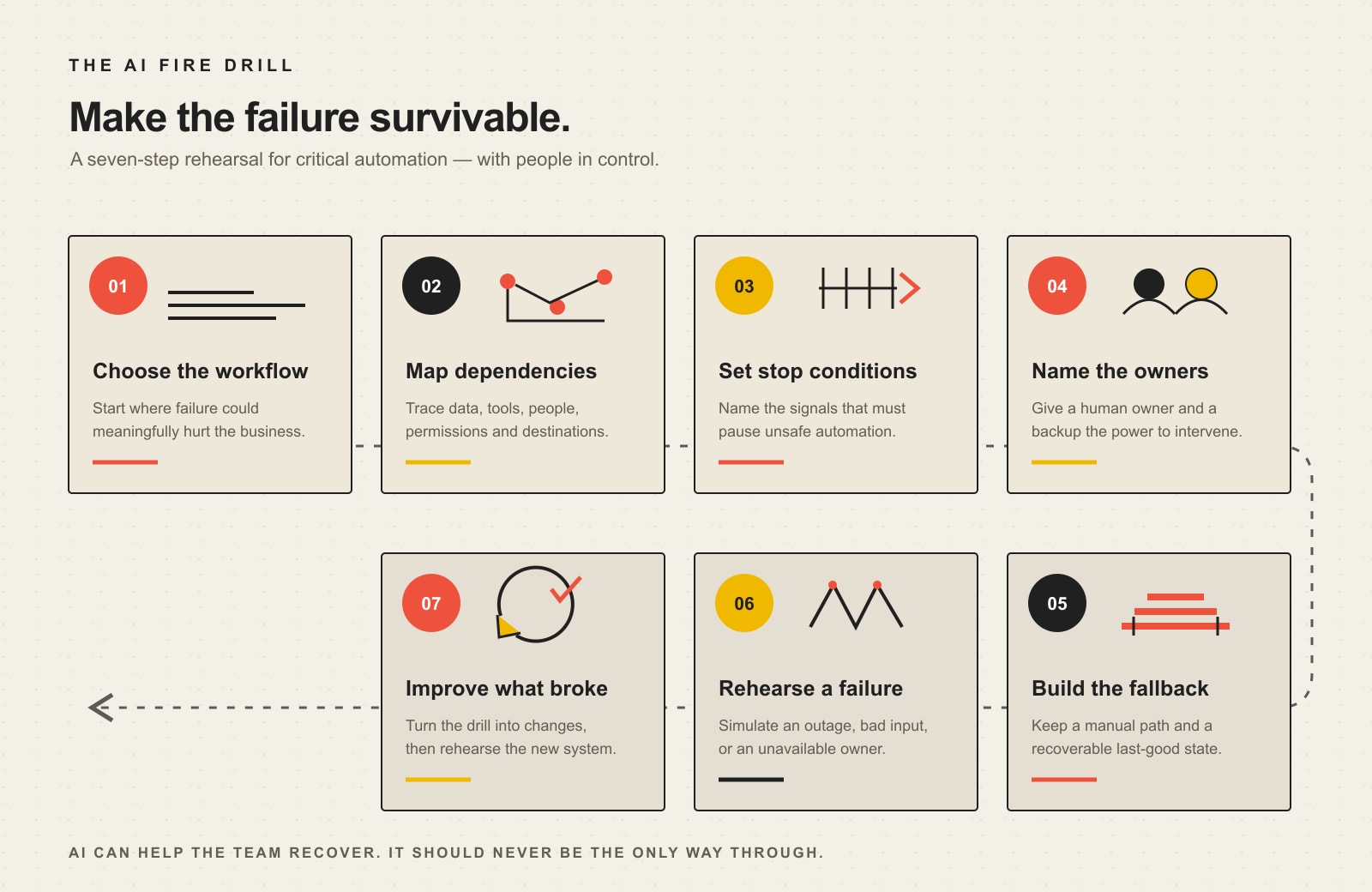
    The Scope Design AI Fire Drill

    Before trusting an AI workflow with a critical business process, run one controlled failure. The goal is not to prove that the automation works. The goal is to prove that the business can recover when it does not.

    Seven-step AI resilience fire drill: choose a critical workflow, map its dependencies, set stop conditions, name owners, build a manual fallback, rehearse failure, and improve what broke.

    1. Choose one critical workflow

    Pick something where failure would affect revenue, customer service, safety, compliance, reputation, or the ability to operate. Do not start with your most complicated workflow; start with the one whose failure would teach you the most.

    2. Map inputs, outputs, and dependencies

    List the data sources, APIs, SaaS platforms, credentials, people, permissions, destinations, and timing dependencies. If any one of those fails, note whether the workflow stops cleanly, retries, degrades, or keeps acting with incomplete information.

    3. Define harmful failures and stop conditions

    Write down the conditions that should halt automation: missing source data, stale records, inconsistent totals, unverified customer identity, unusually large transactions, an unapproved destination, repeated errors, or a model response that cannot cite its source. A stop condition is valuable because it turns “be careful” into an observable rule.

    4. Assign a human owner and backup

    Someone must be able to pause the automation, inspect evidence, authorize exceptions, communicate with affected people, and start recovery. Name the backup too. A resilience plan that depends on one person answering a phone is still a single-point failure.

    5. Create a manual fallback and restore point

    Document the non-AI path for the critical outcome. Preserve the last known good state where practical. Keep essential account, vendor, customer, and recovery information outside the AI layer. The point is not to recreate every convenience manually; it is to keep the important outcome moving long enough to recover.

    6. Run a tabletop failure

    Disable a connector in a test environment, feed the system a stale record, simulate a model outage, present a misleading input, or pretend the primary owner is unavailable. Watch what the team notices, where information is missing, and how long it takes to switch paths.

    7. Update the system from what broke

    Turn the findings into changes: narrower permissions, clearer thresholds, better alerts, a shorter runbook, a second owner, a tested backup, a new restore step, or a decision that the workflow should not be fully automated at all. Then rehearse again.

    Scope Design rule of thumb: if the business cannot keep a critical outcome moving when AI is wrong, unavailable, or disconnected, the automation is not resilient yet.

    A practical AI resilience failure-mode table

    Failure modeUseful stop conditionFallback
    AI or vendor outageNo response, timeout, authentication failure, or failed health checkManual runbook, alternate provider if approved, or queue work for human handling
    Wrong or unsupported answerSource cannot be verified, required fields disagree, or confidence rule failsEscalate to human review and show source records
    Over-privileged actionAction exceeds amount, destination, permission, or risk thresholdRequire explicit human approval or remove write access
    Stale knowledgeSource document exceeds review date or conflicts with current policyUse the controlled truth vault and block autonomous action
    Automation loopRepeated identical events or retry count exceeds limitKill switch, idempotency key, queue review, and restore last good state
    Data exposure riskSensitive field, unapproved tool, or unapproved destination is detectedRedact, route to an approved environment, or stop the workflow

    Build the continuity layer before the AI layer

    Business continuity planning already gives us useful language for this work. Ready.gov’s business continuity guidance uses a Business Impact Analysis to identify critical processes and dependencies, then recovery-time and recovery-point objectives to define how quickly work must resume and how much data loss is tolerable.

    You do not need enterprise jargon to use the idea. For each AI-supported critical process, answer four questions:

    1. What outcome must continue?
    2. How long can this process be unavailable before the damage becomes material?
    3. What information or state must be recoverable?
    4. What non-AI path can keep the outcome moving while recovery happens?

    Then make the truth vault boring and accessible: current contacts, approved procedures, known dependencies, credential-recovery instructions, vendor escalation routes, communication templates, last-good configurations, and decision thresholds. AI can make that information easier to use. It should not be the only way to reach it.

    A 30-day rollout for a small business

    Week 1: Pick the outcome and map the dependency chain

    Choose one AI-supported workflow with real business impact. Map its data, tools, people, permissions, vendors, and destinations. Identify the human owner and backup.

    Week 2: Add monitoring and stop conditions

    Decide what “normal” looks like, what deserves an alert, and what should stop automation completely. Log enough evidence to reconstruct what happened. CISA’s small-business cybersecurity resources are a useful baseline for backups, MFA, incident-response preparation, and other controls that should exist around any important automated workflow.

    Week 3: Build the manual fallback and truth vault

    Write the shortest viable procedure that lets a capable person continue the critical outcome without the AI. Verify access to backups, source records, credentials, and recovery contacts.

    Week 4: Run the fire drill

    Simulate one failure, record the weak points, fix them, and schedule the next test. Do not wait for a dramatic annual exercise. Test when the workflow changes, a vendor changes, permissions change, an incident exposes a gap, or the consequences of failure increase.

    When the disruption is already happening

    Once an incident is active, the goal shifts from design to control: verify the scope, stop harmful automation, protect evidence, keep critical outcomes moving, and communicate facts consistently. If the event affects customers or the public, use a dedicated crisis communication plan rather than letting an AI draft outrun operational reality.

    If the failure involves a compromised website, malware, unauthorized changes, credential theft, or a broken web property, follow a security-specific recovery process. Our website security disaster guide covers that incident-response layer in more detail.

    What our audit of this exact page taught us

    We applied the same resilience principle to this revision: inspect the system before changing it. On August 20, 2026, GA4 returned no matching landing-page rows for this URL over the reviewed twelve-month period. Google Search Console returned no exact-page performance rows, but URL Inspection reported the page as submitted and indexed, with a successful fetch and matching Google-selected and user-declared canonicals. Bing recognized and crawled the page but reported zero URL-level clicks and impressions. Ubersuggest returned no ranking-keyword data and no exact-page backlinks.

    That does not prove the topic is worthless. It supports a narrower editorial decision: there was no measured search or backlink signal strong enough to justify preserving unsupported statistics, while the established URL already had crawl history and a correct canonical. So we kept the URL, removed invented performance claims, clarified the page’s AI-specific job, and strengthened its connection to the broader resilience and AI-automation clusters.

    Frequently asked questions about AI-powered business resilience

    What is AI-powered business resilience?

    It is the use of AI to strengthen a business’s ability to detect, understand, respond to, and learn from disruptions. The AI layer should support monitoring, triage, documentation, scenario testing, and recovery—not replace ownership, source evidence, continuity planning, or manual fallbacks.

    Can AI improve business continuity?

    Yes, when it shortens detection and triage, makes runbooks easier to use, and helps teams rehearse realistic failures. It can hurt continuity when the AI becomes an opaque dependency, has too much authority, or is the only path to critical knowledge or action.

    What controls make an AI automation safer for a critical process?

    Useful controls include narrow permissions, explicit approval thresholds, source verification, logging, monitoring, retry limits, stop conditions, a kill switch, human ownership, recoverable state, and a tested non-AI fallback. The exact controls should match the harm the workflow could cause.

    How do you test an AI-enabled business continuity plan?

    Run a tabletop or controlled simulation in which the model is unavailable, returns a wrong answer, loses a connector, acts on stale data, or cannot reach its normal destination. Measure whether the team notices, stops harmful action, reaches source evidence, switches to the fallback, and restores normal operation.

    How often should an AI resilience plan be tested?

    Use a risk-based cadence rather than a magic number. Re-test after meaningful workflow, vendor, permission, model, data-source, or policy changes; after a real incident; and whenever the consequences of failure increase. A simple critical workflow may need a lightweight tabletop, while a high-impact automated action deserves more frequent and more controlled testing.

    The goal is not more automation. It is more recoverable operations.

    The strongest AI resilience strategy is not the one with the most models, agents, dashboards, or automatic responses. It is the one that makes trouble easier to see, decisions easier to support, knowledge easier to retrieve, and recovery easier to execute without surrendering control.

    Start with one critical workflow. Give it an owner. Define when the automation must stop. Build a manual fallback. Preserve a restore point. Then break the workflow on purpose and learn from what happens.

  • What Affects Website Speed? 25 Performance Factors That Slow Sites Down

    What Affects Website Speed? 25 Performance Factors That Slow Sites Down

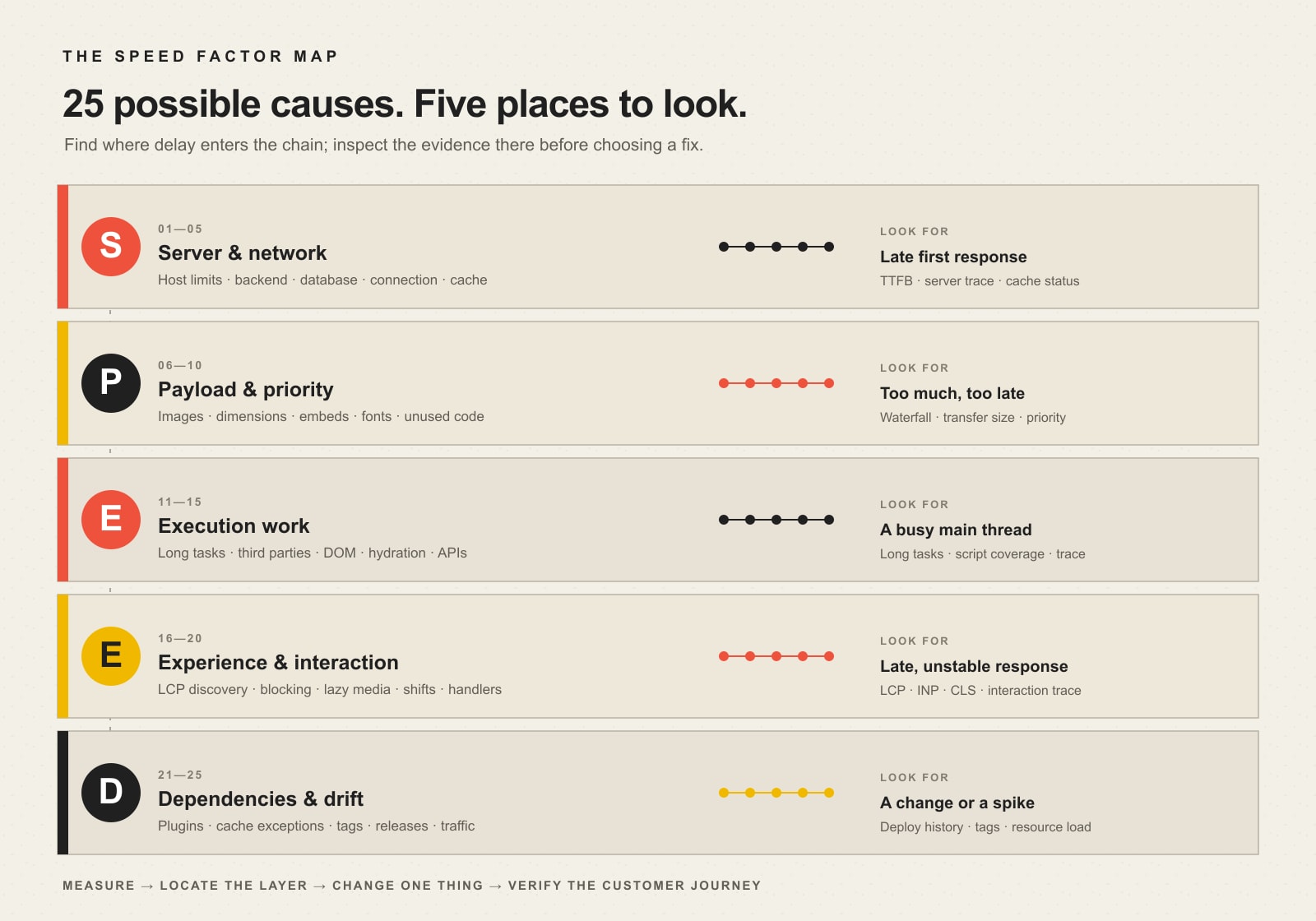
    What affects website speed? Usually not one thing. A slow business website can be held back by the server that builds the page, the amount and priority of data sent to the browser, the JavaScript and layout work the browser must perform, the way important content appears and responds, or dependencies that quietly get heavier over time.

    That is why “make the site faster” is a bad troubleshooting instruction. It invites random changes. A better approach is to identify the layer creating the delay, inspect the evidence, and fix the highest-impact constraint first. Scope Design uses a five-layer model for that job: the SPEED Factor Map.

    • S — Server & network delivery: how quickly the first useful response can reach the visitor.
    • P — Payload size & priority: how much data must move and whether the browser receives the important pieces first.
    • E — Execution work: how much code and layout work the device must perform.
    • E — Experience rendering & interaction: when useful content becomes visible, stable, and responsive.
    • D — Dependencies & drift: plugins, tags, updates, traffic patterns, and configuration changes that make a once-fast site slower.

    If you already know a page is slow and need the full testing-and-remediation process, use our guide to diagnosing and fixing a slow website. This article has a different job: showing what can make a site slow so you can narrow the search instead of optimizing everything at once.

    Website speed is a chain, not a score

    PageSpeed Insights, Lighthouse, a browser waterfall, and real-user monitoring can all tell you useful things. None of them is the business outcome by itself. Google’s PageSpeed Insights documentation distinguishes field data from real Chrome users from Lighthouse lab data generated under controlled conditions. The two can disagree because they answer different questions.

    A synthetic score can help you reproduce a problem. Field data can show what real visitors experience across devices and networks. Your analytics can show whether those visitors continue, submit forms, buy, book, or leave. A useful performance decision connects all three.

    This also means a “100” score is not the goal. A score can improve while a real sales path remains slow, an interaction still lags, or an important third-party service delays the exact page your customers use. Measure the journey that matters.

    The SPEED Factor Map: 25 website speed factors

    The map below groups 25 common website performance factors by where the delay enters the delivery chain. Use it as a triage map, not a checklist you must “fix” in order.

    The SPEED Factor Map groups 25 website performance factors into server and network, payload and priority, execution, experience and interaction, and dependencies and drift, with evidence to inspect for each layer.
    The SPEED Factor Map: locate the slow layer before choosing the fix.
    LayerTypical symptomsEvidence to inspect
    Server & networkHTML starts late; uncached pages are much slowerTTFB, server timing, cache status, database/application traces
    Payload & priorityHuge transfers; hero content arrives lateNetwork waterfall, resource sizes, priority, image/font requests
    ExecutionPage downloads but feels busy or frozenMain-thread tasks, JavaScript coverage, third-party work, layout cost
    ExperienceMain content appears late, shifts, or reacts slowlyLCP, INP, CLS, element attribution, interaction traces
    Dependencies & driftPerformance worsens after changes or under loadDeploy history, plugin/tag inventory, cache rules, resource utilization

    S — Server and network delivery factors

    1. Hosting resource limits and contention

    CPU, memory, process limits, storage latency, or noisy shared resources can slow the server before the browser has much to do. This is why front-end tricks cannot rescue every slow page. If the initial document itself consistently arrives late, start at the origin.

    2. Backend application work

    WordPress, an ecommerce platform, a membership system, or a custom application may need to run expensive PHP, template, search, personalization, or API logic before sending HTML. The right question is not “Is WordPress slow?” but “What work is this request performing before it can respond?” Our broader guide to a fast, functional web-development foundation explains why architecture and maintainability matter here.

    3. Database queries and data volume

    Slow queries, missing indexes, oversized option tables, expensive product filters, or repeated lookups can make otherwise simple pages expensive to build. Database symptoms often appear only on certain templates or under concurrency, which is why page-by-page evidence beats a blanket “upgrade hosting” answer.

    4. Distance, DNS, connection, and TLS setup

    A visitor must reach the right server before the page can arrive. Geography, DNS resolution, connection establishment, and TLS all contribute to the path. For many sites these are not the biggest bottleneck, but they matter more when critical resources live on many different origins or users are far from the origin.

    5. Redirects, cache behavior, CDN, and compression configuration

    Extra hops delay useful work. Missing page caching can force the application to rebuild the same public page repeatedly. A CDN can shorten delivery paths and absorb traffic, but only when caching rules match the content. Compression can reduce transferred text resources. These are configuration decisions, not magic switches; verify what is actually cached, compressed, and served from where.

    P — Payload size and priority factors

    6. Oversized images

    Photography and hero artwork can dominate transferred bytes. Start with the images real users download, not a generic recommendation to “compress everything.” A visually important image may deserve more bytes than a decorative image; the goal is appropriate dimensions, encoding, quality, and delivery.

    7. Wrong image dimensions and responsive delivery

    Sending a 2400-pixel image into a 420-pixel mobile slot wastes transfer. Responsive image markup lets the browser select a more appropriate source. That belongs with good responsive web design: the mobile experience is not just a narrower desktop layout; it has different bandwidth, viewport, and device constraints.

    8. Heavy video, iframes, maps, and embeds

    Embedded media can add large files, new origins, scripts, and player code. A poster image, click-to-load pattern, or delayed embed can preserve the content while keeping the initial page lighter. The best choice depends on whether the media is the reason the visitor came to the page.

    9. Web-font weight and variants

    Multiple families, weights, character sets, and externally hosted files can turn typography into a critical-path dependency. Remove variants nobody uses, subset when appropriate, and choose a loading strategy that avoids both needless transfer and jarring text changes.

    10. Unused CSS and JavaScript bytes

    A bundle can be cached and still be wasteful. Site builders, themes, component libraries, and plugin assets may ship code a specific page never uses. The opportunity is not merely minification; it is reducing work and bytes that should not be there in the first place.

    E — Execution-work factors

    11. Long JavaScript tasks

    A page may download quickly and still feel slow because the main thread is parsing, compiling, or executing JavaScript. Long tasks can delay clicks, menus, filters, and form interactions. That makes JavaScript cost a responsiveness issue, not just a file-size issue.

    12. Third-party scripts

    Analytics, advertising, chat, heatmaps, testing tools, social widgets, payment components, and consent systems all compete for network and execution time. Third parties are especially important to inventory because teams often add them one campaign at a time and rarely remove them together.

    13. Large DOM, style, and layout work

    Deep wrappers, repeated components, very large menus, complex selectors, and frequent layout changes can make style calculation and rendering expensive. More markup is not automatically slow, but a complicated document gives the browser more work when styles or dimensions change.

    14. Client-side rendering and hydration

    Modern frameworks can send a page shell that needs substantial JavaScript before it becomes useful or interactive. That architecture may be justified for an application, but it should not be treated as free. Measure what the visitor sees and can do before and after the client work finishes.

    15. Slow external APIs and data dependencies

    Search, inventory, reviews, booking availability, personalization, or CRM data may depend on another service. If page rendering waits on it, that provider becomes part of your performance budget. Timeouts, caching, graceful fallbacks, and asynchronous loading can be as important as front-end optimization.

    E — Experience rendering and interaction factors

    16. Late LCP resource discovery

    The browser cannot load an important hero image early if it does not discover it until CSS or JavaScript runs. web.dev’s LCP optimization guidance recommends making the likely Largest Contentful Paint resource discoverable early and prioritizing it appropriately.

    17. Render-blocking critical-path resources

    Critical CSS and scripts can be necessary; unnecessary blocking is the problem. The browser must know what it needs to render the first useful view and should not be forced to wait on unrelated work. Waterfall order often tells you more here than the total request count.

    18. Lazy-loading above-the-fold or LCP media

    Lazy loading is valuable for offscreen content, but applying it blindly to the main hero image can delay the very resource used to judge loading performance. web.dev explicitly advises against lazy-loading the LCP image. Performance rules need context: “lazy load images” is incomplete advice without asking which images.

    19. Layout shifts, font swaps, and late space allocation

    Images without reserved dimensions, injected banners, ads, late-loading widgets, and font changes can move content after a visitor has started reading or aiming at a control. That is why visual stability belongs in performance work rather than being dismissed as a design annoyance.

    20. Slow interaction handlers

    A click can be delayed by JavaScript, synchronous work, a costly rerender, or a round trip to a server. Interaction to Next Paint (INP) exists to capture responsiveness across interactions. A page that “loads” in two seconds but makes every filter or menu feel sticky is not a fast experience.

    D — Dependencies and performance-drift factors

    21. Plugin, theme, or module bloat and conflicts

    Plugin count alone is a poor diagnosis. One inefficient extension can be worse than ten lightweight ones. What matters is the work each dependency adds: database calls, scheduled jobs, frontend assets, remote requests, or duplicate functionality. In Scope Design’s WordPress work, we prefer a lean stack because fewer unnecessary moving parts are easier to test and maintain.

    22. Cache exceptions and personalized pages

    Logged-in users, carts, account pages, geolocation, personalization, query parameters, cookies, and custom rules can bypass full-page caching. A homepage may test beautifully while the revenue-producing account or checkout path does far more server work.

    23. Tag, chat, consent, and campaign growth

    Sites accumulate tracking. A new ad platform adds a tag; a new CRM adds a form script; a new chat tool loads everywhere; a consent manager coordinates them. Over time the combined tax can become substantial. Treat third-party inventory as an ongoing governance task, not a one-time cleanup.

    24. Update and deployment regressions

    An update can change queries, asset bundles, markup, cache compatibility, image behavior, or JavaScript timing. That is why maintenance should include verification, not merely clicking “update.” Our guide to WordPress maintenance and support treats monitoring, controlled change, and continuity as part of website ownership.

    25. Traffic spikes, bots, and resource exhaustion

    A site can be fast during a quiet test and slow under real concurrency. Marketing campaigns, crawlers, malicious traffic, inventory jobs, scheduled tasks, or legitimate seasonal demand can exhaust resources. Test and monitor the conditions your business actually creates.

    Which website speed factor should you fix first?

    Start with the symptom that costs the user time, then inspect the layer most likely to produce it. Do not begin with the easiest plugin setting just because it is available.

    If you see thisCheck this layer firstWhy
    The initial HTML starts lateServer & networkThe browser cannot render a response it has not received.
    A hero image is huge or starts latePayload & priority / ExperienceBytes and discovery order both affect the critical resource.
    The page appears, then freezes during interactionExecutionMain-thread work can block responses to input.
    Content jumps after it appearsExperienceSpace allocation, fonts, ads, or injected UI may be unstable.
    The site became slow after a releaseDependencies & driftA before/after change is stronger evidence than a generic optimization list.
    Only uncached or logged-in paths are slowServer / DependenciesThose requests may bypass page caching or perform personalized work.

    Our preferred operating loop is simple: measure a baseline → change one meaningful variable → verify the user-facing result → keep the improvement or roll back the regression. Changing five systems at once can produce a better score while teaching you nothing about what actually fixed—or broke—the site.

    Core Web Vitals: the current performance targets that matter

    Google’s current Core Web Vitals are Largest Contentful Paint (LCP) for loading, Interaction to Next Paint (INP) for responsiveness, and Cumulative Layout Shift (CLS) for visual stability. PageSpeed Insights classifies a good experience at the 75th percentile as LCP at 2.5 seconds or less, INP at 200 milliseconds or less, and CLS at 0.1 or less.

    Time to First Byte (TTFB) is also useful, especially when diagnosing server and network delay, but it is not itself a Core Web Vital. Treat it as a clue. A slow TTFB can make a good LCP difficult; a fast TTFB does not guarantee the page will render or respond well.

    Use field and lab data together. Field data tells you what real Chrome users experienced over time when sufficient data exists. Lab data gives you a repeatable environment for debugging. If a low-traffic page has no URL-level field data, do not invent certainty from a single lab run.

    Does website speed affect SEO and conversions?

    Yes—but not as a universal formula. Google says Core Web Vitals are used by its ranking systems while also warning that good Core Web Vitals or tool scores do not guarantee top rankings. Relevance and the broader quality of the page still matter.

    The conversion relationship should be handled the same way. Faster, more stable, responsive experiences remove friction, and web.dev publishes case studies where organizations measured meaningful commercial improvements. For example, Rakuten 24 reported conversion and revenue-per-visitor gains in an A/B test. That is evidence that performance can matter to business outcomes—not a promise that every site will get the same percentage lift.

    For a business website, connect technical metrics to the funnel: landing-page engagement, form starts, form completions, phone clicks, bookings, orders, qualified leads, revenue per visitor, and other actions that actually matter. A 500-millisecond improvement is interesting. A measured improvement that removes a drop-off in the path to revenue is useful.

    A safer way to improve WordPress performance

    WordPress speed work often goes wrong when every recommendation becomes another plugin. A caching plugin, image plugin, script manager, database cleaner, CDN integration, and optimization suite can create overlapping behavior that is harder to understand than the original problem.

    1. Capture a baseline. Test the important page and record the user-facing symptom, field data when available, lab trace, waterfall, and business-path behavior.
    2. Name the likely SPEED layer. Server? Payload? Execution? Experience? Drift?
    3. Choose one high-impact change. Compress the actual oversized hero, fix the slow query, remove an unused third party, or correct LCP discovery.
    4. Retest the same scenario. Use the same page, device class, and meaningful interaction.
    5. Keep evidence, not superstition. If the change helps, retain it. If it causes a regression or does not solve the constraint, undo it and move to the next hypothesis.

    This approach also exposes technical development mistakes that hurt business growth instead of hiding them beneath a higher synthetic score.

    When a website speed audit is worth paying for

    A paid audit is useful when the bottleneck crosses systems: the server is slow only on certain templates, an ecommerce path bypasses caching, third-party scripts block interactions, performance regresses after updates, or the team has already installed “speed” tools without understanding what changed.

    The deliverable should not be a generic list of red and green scores. It should tell you what is slow, where the time is going, which evidence supports the diagnosis, what to change first, what risk the change creates, and how success will be verified. That is the difference between a performance report and a performance plan.

    Website speed FAQ

    What is slowing my website down?

    The most common cause families are slow server/backend response, heavy or poorly prioritized media and code, expensive JavaScript or third parties, late or unstable rendering, and dependencies that have accumulated or regressed. Use a waterfall and performance trace to locate the slow layer before choosing a fix.

    How do I improve my website speed?

    Measure the important page first, identify the biggest constraint, make one meaningful change, and retest. Fixing a giant hero image can be right on one page; fixing backend response can be right on another. There is no responsible universal order without evidence.

    Why did my website suddenly become slow?

    Look for what changed: a deployment, plugin or theme update, new marketing tag, traffic spike, cache failure, database growth, external API degradation, expired CDN rule, or hosting resource pressure. A before/after timeline is often more valuable than a generic optimization checklist.

    Is a 100 PageSpeed score necessary?

    No. A high lab score can be useful, but it is not a business KPI and does not guarantee perfect real-user Core Web Vitals, rankings, conversions, or accessibility. Prioritize good real-user experience and the journey your customers actually take.

    What Core Web Vitals should I watch?

    Watch LCP for loading, INP for responsiveness, and CLS for visual stability. Google’s current “good” thresholds at the 75th percentile are LCP ≤2.5 seconds, INP ≤200 milliseconds, and CLS ≤0.1.

    Does hosting affect website speed?

    It can, especially when server response is the bottleneck or the site exhausts CPU, memory, processes, or database resources. But faster hosting will not fix a multi-megabyte hero image, long JavaScript tasks, or a slow external widget. Diagnose the layer first.

    Do more WordPress plugins always make a site slower?

    No. Plugin count is a weak proxy. One poorly designed plugin can add more database, network, or JavaScript work than several lightweight plugins. Remove unnecessary dependencies, but evaluate the work they perform rather than counting icons in the admin screen.

    Why is mobile website speed different from desktop?

    Mobile visitors can have slower networks, higher latency, smaller screens that select different assets, and less CPU power for JavaScript and rendering. That is why desktop-only testing can miss a real customer constraint.

    Find the slow layer before you optimize

    What affects website speed is not a mystery once the delivery chain is visible. Put the symptom into the SPEED Factor Map, inspect evidence at that layer, and make the smallest change capable of removing the real constraint. Then verify the result in the customer journey.

    If your site is slow and the evidence points in several directions at once, Scope Design can help separate server, code, media, interaction, and maintenance problems into a prioritized performance plan. The goal is not to make a dashboard greener. It is to make the website work better for the people using it.

  • Overcoming Learning Obstacles: How to Learn a New Skill When You Don’t Know How

    Overcoming Learning Obstacles: How to Learn a New Skill When You Don’t Know How

    How to Learn a New Skill When You Don’t Know How

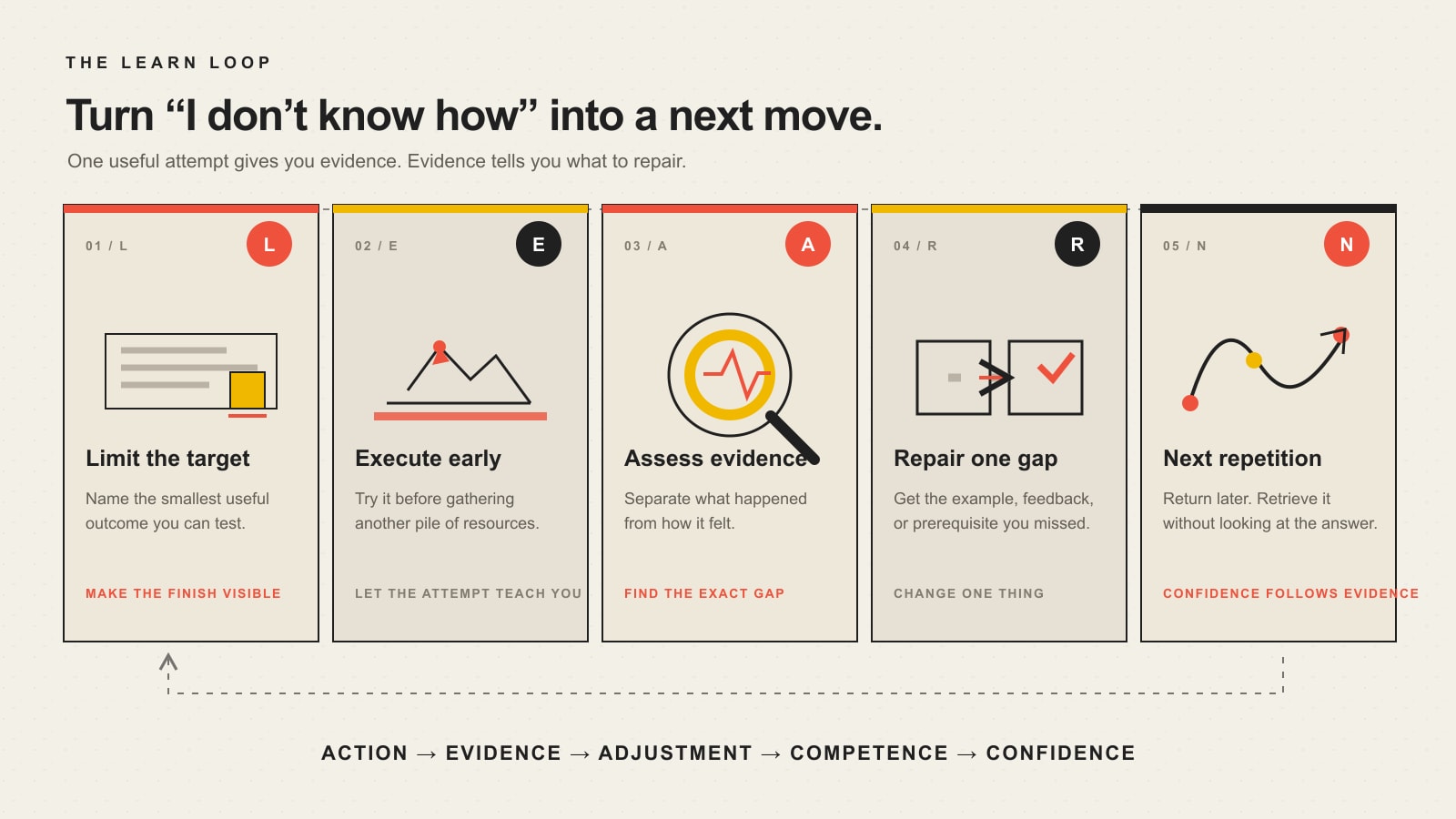
    If you want to know how to learn a new skill when your brain keeps saying “I don’t know how,” stop waiting for confidence. Define one small useful outcome, make a real attempt, inspect what happened, repair one specific gap, and repeat. Confidence usually becomes more useful after you have evidence that you can make progress.

    That is the core mistake behind a lot of learning frustration. We treat confidence like an admission ticket when it is often a receipt. You do not need to feel ready enough to begin. You need a next action small enough to test.

    TL;DR: Use the LEARN Loop

    • Limit the target: define the smallest useful outcome.
    • Execute early: make an attempt before collecting more information.
    • Assess evidence: identify what worked and exactly where the attempt broke.
    • Repair one gap: get feedback, instruction, an example, or a missing prerequisite.
    • Next repetition: retry later, retrieve what you learned from memory, and track what changed.

    This is Scope Design’s LEARN Loop. It turns “I don’t know how” from a verdict into a diagnosis.

    Why “I Don’t Know How” Feels Bigger Than It Is

    “I don’t know how” sounds like one problem. It usually hides several different ones. If you misdiagnose the obstacle, you can spend hours studying without getting any closer to usable skill.

    What it feels likeWhat may actually be wrongBetter next move
    “This is too complicated.”The target is too large.Shrink it to one observable outcome.
    “I keep getting stuck at the same point.”A prerequisite is missing.Identify and learn the missing building block.
    “I practice, but I’m not improving.”The feedback loop is weak.Compare the attempt with a model, coach, test, or measurable result.
    “I’m probably just bad at this.”Discomfort is being treated as a capability verdict.Judge the attempt, not your identity.

    That last distinction matters. A mistake is data about a specific attempt. “I am bad at this” is a story about the person making it. Only one of those gives you something useful to fix.

    The Scope Design LEARN Loop

    Most learning advice becomes a pile of tips: focus harder, believe in yourself, watch a course, find a mentor, practice more. Some of that is useful. The problem is that a pile of advice does not tell you what to do when you are stuck at 2:17 on a Tuesday afternoon. The LEARN Loop is a practical system for how to learn a new skill without turning the process into endless research.

    The five-step LEARN Loop: limit the target, execute early, assess evidence, repair one gap, and take the next repetition; action and evidence lead to competence and confidence.
    The LEARN Loop turns uncertainty into a sequence of small attempts and evidence.

    L — Limit the target

    Do not start with “learn web design,” “learn AI,” “learn sales,” or “learn analytics.” Those are continents.

    Define the smallest useful result you could produce. “Build one responsive landing-page section.” “Create one automation that moves a form submission into a spreadsheet.” “Explain one analytics report well enough to make a marketing decision.”

    A useful target has an observable finish line. If you cannot tell whether you did it, you cannot learn from the attempt.

    E — Execute early

    Information gathering feels productive because nothing can go wrong while you are collecting tabs. Unfortunately, twelve tutorials and three bookmarked courses can coexist with zero skill.

    Learn enough to make the first attempt, then do the thing. The attempt creates information that passive consumption cannot: where you hesitate, what you misunderstand, what breaks, and what you can already do without help.

    Research on practice supports the basic direction here. Repeated practice can improve fluency and reduce the cognitive effort required to perform a practiced task over time. A 2018 review by researchers at Johns Hopkins describes how practice can change speed, skill, habit, and cognitive load.

    A — Assess evidence

    After the attempt, separate evidence from emotion. “That felt awful” can be true and still tell you almost nothing about whether you improved.

    • What worked without help?
    • Where did I stop knowing what to do?
    • What error repeated?
    • What would a correct result look like?
    • What changed between this attempt and the last one?

    This is where a vague learning goal becomes a feedback loop. It is also the bridge between this article and a broader goal-achievement system: outcomes matter, but leading actions and feedback tell you what to change before the final outcome arrives.

    R — Repair one gap

    Do not respond to one failed attempt by restarting the entire subject from chapter one. Repair the narrowest useful gap.

    Maybe you need an example. Maybe you need a coach to point out a bad technique. Maybe the “advanced” thing you keep failing depends on a basic concept you skipped. Maybe you simply need a second attempt with less complexity.

    The point is precision. “I need to get better at coding” is fog. “I do not understand why this function receives an object here instead of a string” is a problem you can actually investigate.

    N — Next repetition

    Learning is not complete because you understood an explanation once. Come back later and try to reproduce the skill or retrieve the knowledge without staring at the answer.

    A 2022 Nature Reviews Psychology review summarizes strong evidence for spacing learning over time and for retrieval practice: actively pulling information from memory instead of only rereading it. Those strategies are useful because they test whether the knowledge is actually available when you need it.

    If the skill matters enough for a longer push, turn the loop into a bounded plan. Scope Design’s 90-day goal framework is useful when you need milestones, leading actions, guardrails, and a review rhythm rather than another inspirational deadline.

    Confidence Is a Lagging Indicator

    The sequence most people want is:

    Confidence → action → competence.

    For a new skill, the more reliable sequence is usually:

    Action → evidence → adjustment → competence → confidence.

    That does not mean emotion is irrelevant. It means you do not give emotion veto power over the first attempt. Confidence based on evidence is sturdier than confidence produced by repeating “you’ve got this” until the phrase files a restraining order.

    What Growth Mindset Can — and Cannot — Do

    A growth-oriented belief can help you interpret difficulty as something that may respond to better strategy, effort, feedback, or instruction instead of proof that ability is fixed. The American Psychological Association’s learning principles connect beliefs about ability with challenge-taking and responses to failure.

    But “have a growth mindset” is not a complete learning system. Context matters. Instruction matters. Prior knowledge matters. Feedback matters. APA’s review of growth-mindset classroom research explicitly notes that the surrounding environment can change how well mindset interventions work.

    Mindset without a useful method is motivational wallpaper. Keep the belief that improvement is possible, then make the next attempt specific enough to produce evidence.

    Practice Matters, but Mastery Is Not a Vending Machine

    Practice matters. Deliberate, structured practice aimed at improving performance matters even more. But there is no honest universal formula where you insert a fixed number of hours and mastery falls out.

    A large meta-analysis published in Psychological Science found that deliberate practice explained meaningful but very different amounts of performance variation across domains. The useful conclusion is not that practice is overrated. It is that performance has multiple causes.

    Your learning plan may also depend on prior experience, quality of instruction, the kind of skill, feedback, available time, physical constraints, tools, and whether the practice resembles the real task. That is why the LEARN Loop keeps asking for evidence instead of worshiping a magic hour count.

    How to Use AI as a Learning Assistant Without Outsourcing Your Brain

    AI can make “I don’t know where to start” dramatically easier to work with. Use it as a tutor, simulator, question generator, explainer, or critique partner. Do not confuse a confident answer with a correct one.

    • Limit: ask AI to break a large skill into prerequisite sub-skills and one beginner outcome.
    • Execute: ask for a practice scenario, then attempt it before requesting the solution.
    • Assess: show your work and ask for a critique against explicit criteria.
    • Repair: ask for one explanation, analogy, or worked example targeted to the exact gap.
    • Next repetition: ask for a fresh problem later and solve it without looking at the previous answer.

    Verify factual or high-stakes material against authoritative sources, and keep a human owner for decisions that affect customers, money, security, privacy, or compliance. That same ownership principle sits at the center of Scope Design’s guide to AI automation for business.

    A Worked Example: Learn Enough Analytics to Make One Decision

    Imagine a business owner who keeps saying, “I need to learn analytics.” That target is too vague to be useful. They probably do not need to become an analyst. They need to answer a business question.

    Suppose the question is: “Is this landing page bringing qualified organic traffic?”

    1. Limit: learn enough to open one landing-page report and identify the traffic source and the page’s basic engagement or conversion evidence.
    2. Execute: pull the report now instead of watching another two-hour analytics course.
    3. Assess: write down what each metric appears to say and which field you cannot interpret.
    4. Repair: learn only the missing concept, such as the difference between a dimension and a metric or how channel attribution works.
    5. Next repetition: run the same review next week without using the tutorial.

    Now the person is not “learning analytics.” They are building a repeatable decision skill. That is a much better target.

    Common Learning Obstacles That Waste Time

    1. Becoming a resource collector

    You do not need the perfect course stack. You need one resource good enough to produce the next attempt. Collecting ten sources before touching the skill is often procrastination with excellent browser organization.

    2. Practicing the whole skill instead of one sub-skill

    “Get better at public speaking” is too large to diagnose. “Deliver the opening without reading,” “answer an objection in 30 seconds,” or “remove filler words from one minute of speech” gives feedback somewhere to land.

    3. Repeating errors without feedback

    Repetition is not automatically improvement. If the same error survives every attempt, you may be rehearsing the mistake. Introduce a model answer, coach, test, instrument, benchmark, or observable result.

    4. Switching methods every time learning feels hard

    Some difficulty is diagnostic. Some is simply the cost of being a beginner. Change the method when evidence says it is failing, not because the third repetition was less entertaining than the first.

    5. Confusing a prerequisite gap with lack of talent

    If the next step depends on something you never learned, brute force may not fix it. Back up one level. Learn the missing foundation. Then retry the real task.

    The 30-Minute “I Don’t Know How” Reset

    When you are stalled, you do not need a new identity. You need thirty useful minutes.

    1. 5 minutes — Limit: write the smallest useful outcome you can complete or test today.
    2. 10 minutes — Execute: attempt it with the resources you already have.
    3. 5 minutes — Assess: write what worked, where you stopped, and the error you can actually name.
    4. 5 minutes — Repair: get one answer, example, hint, or prerequisite explanation.
    5. 5 minutes — Next: retry the hardest part or schedule the next spaced repetition.

    If you finish with one clearer question than you started with, that still counts as progress. A precise question is more valuable than a vague hour of “studying.”

    Frequently Asked Questions About Learning a New Skill

    What is the best way to learn a new skill?

    The best general approach is to define a specific useful outcome, break the skill into smaller components, practice early, get feedback, and repeat over time. Use active retrieval and spaced practice when memory matters. The exact method should match the skill: learning a language, operating software, selling a service, and performing a physical task do not require identical practice.

    How do I overcome learning barriers when I feel completely stuck?

    Diagnose the point of failure before adding effort. Is the target too large? Are you missing a prerequisite? Do you lack feedback? Are you repeating the same error? Shrink the next action until you can produce evidence, then repair the specific gap the attempt reveals.

    Is growth mindset enough to overcome a learning obstacle?

    No. Believing improvement is possible can support persistence, but it does not replace instruction, practice, feedback, prior knowledge, or a workable environment. Treat mindset as support for the system, not the system itself.

    How long does it take to master a new skill?

    There is no universal hour count. The time depends on the definition of mastery, the skill, prior experience, practice quality, feedback, frequency, and the performance standard you need. Define the level you actually need before estimating the time.

    Can AI help me learn a new skill faster?

    AI can reduce the friction of getting explanations, examples, quizzes, practice scenarios, and feedback. It is most useful when you still perform the task and verify important claims. If AI does all the thinking, you may get an output without building the skill you wanted.

    What should I do if I keep making the same mistake?

    Stop repeating the full task. Isolate the exact step that fails, compare it with a correct example or expert feedback, check for a missing prerequisite, and practice the corrected sub-skill before returning to the whole task.

    When should I stop learning and hire someone instead?

    Learn the skill yourself when the knowledge will be used repeatedly, gives you strategic leverage, or helps you make better decisions. Consider hiring when the work is infrequent, high-risk, highly specialized, or more expensive to learn than to delegate. You may still need enough knowledge to define the outcome and judge the result.

    Turn “I Don’t Know How” Into the Next Decision

    The goal is not to become fearless about every unfamiliar skill. The goal is to stop treating unfamiliarity as a dead end.

    Limit the target. Execute early. Assess evidence. Repair one gap. Take the next repetition. If you keep doing that, “I don’t know how” becomes a temporary description instead of a permanent excuse.

    And if the thing blocking your business is a website, marketing system, or automation workflow, you may not need another month of tutorials. Scope Design can help you decide what you should learn, what should become a repeatable system, and what is better handed to a specialist.

  • 6 Proven Local Marketing Strategies to Boost Sales and Drive Business Growth

    6 Proven Local Marketing Strategies to Boost Sales and Drive Business Growth

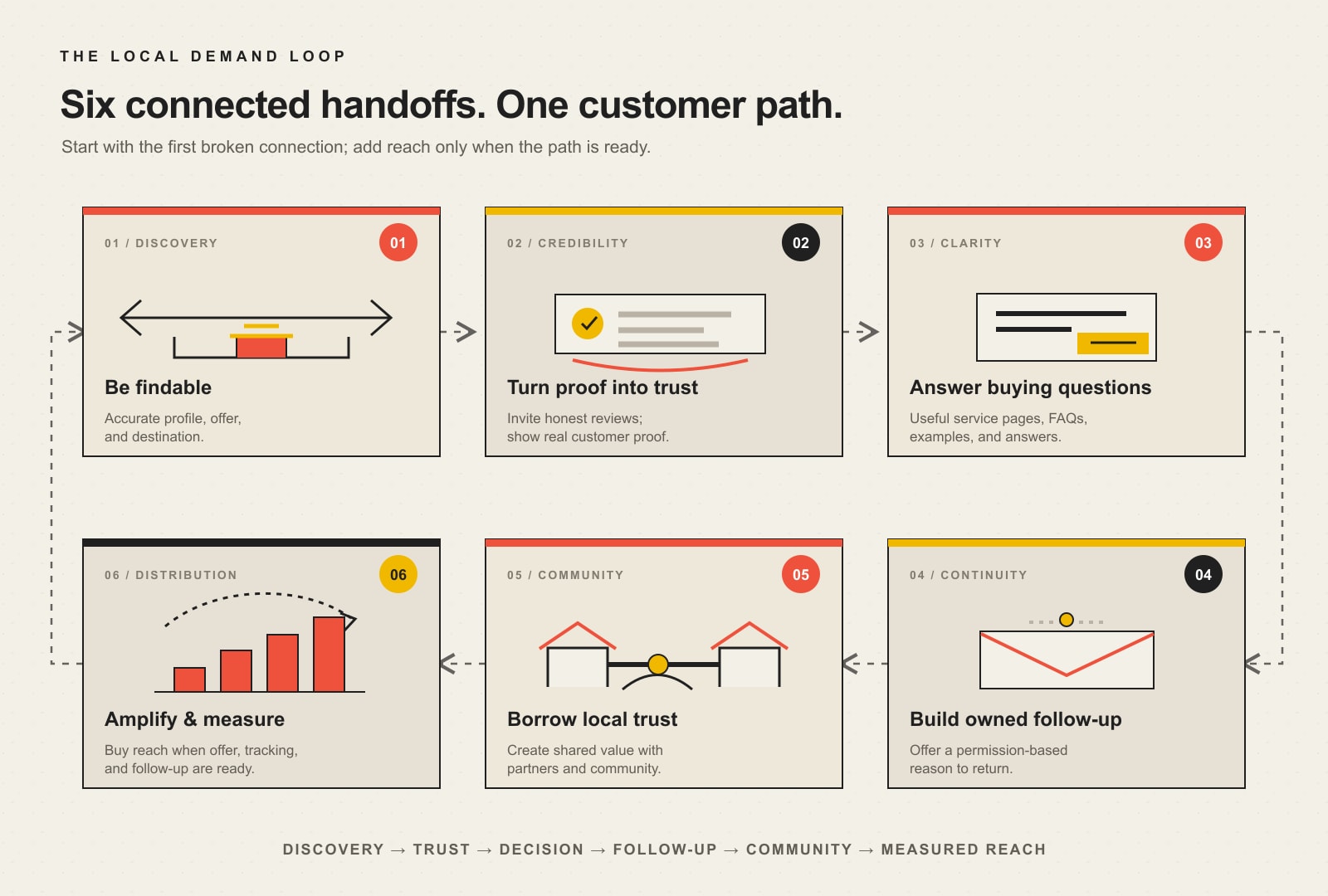
    The six local marketing strategies that matter most are the ones that move a nearby prospect through a complete buying path: get found, build trust, answer the questions that delay a decision, create a permission-based follow-up path, borrow credibility from local relationships, and add paid reach only when the rest of the system is ready. The mistake is treating those as six unrelated channels. They work better as connected handoffs.

    For a small local business, that distinction matters. More posts, more ads, or more listings do not automatically create more sales. A useful local marketing system helps the right people discover you, understand why you fit, take a next step, and stay connected long enough to buy or refer someone else. If you need the broader framework for choosing channels by buying moment, start with Scope Design’s small business marketing strategy guide. This article focuses on the local handoffs.

    The Local Demand Loop: 6 strategies that work together

    1. Be findable where local intent starts. Keep your Google Business Profile and core business information accurate, complete, and aligned with what your website actually offers.
    2. Turn real customer proof into trust. Build a repeatable, honest review and proof system instead of waiting for testimonials to appear by chance.
    3. Answer local buying questions. Create useful service, location, FAQ, case-study, photo, and video content around real decisions—not a content treadmill.
    4. Build an owned follow-up path. Give prospects and customers a reason to opt into email or another permission-based relationship you control.
    5. Borrow local trust. Create partnerships, referrals, community participation, and cross-promotions with organizations that already have the audience’s attention.
    6. Amplify and measure. Use paid search, paid social, and other local promotion only when the offer, destination, tracking, and follow-up are strong enough to learn from the spend.

    If you want a bigger catalog of tactics, Scope Design also maintains a broader guide to 15 local marketing strategies. The job here is different: decide which part of your local demand path is broken first.

    What should you fix first?

    What you are seeingLikely broken handoffStart here
    People nearby need what you sell, but few find or contact youFindabilityBusiness Profile, service area, core facts, website alignment
    You appear in searches, but prospects still choose competitorsProof and trustReview workflow, customer evidence, photos, clear credibility signals
    Prospects keep asking the same fit, price, timing, or process questionsDecision supportService pages, FAQs, case studies, useful local content
    Traffic and inquiries disappear after one visit or conversationOwned follow-upPermission-based email, CRM, useful follow-up sequence
    You have a credible offer but weak local awarenessBorrowed trustPartnerships, referrals, local groups, events, cross-promotion
    Your offer converts, but qualified volume is too lowDistributionMeasured paid search, paid social, sponsorships, or local promotion
    Six connected local marketing steps: be findable, turn customer proof into trust, answer buying questions, build owned follow-up, borrow community trust, and amplify and measure after the customer path is ready.
    The Local Demand Loop works best when you fix the first broken handoff instead of adding another channel by default.

    1. Be findable where local intent starts

    For many local businesses, the first buying moment is simple: someone searches for a service, product, or place near them. Your job is not to “hack” that moment. It is to make the basic facts about your business easy for customers and platforms to understand.

    Google’s current Business Profile guidance says local results are mainly based on relevance, distance, and prominence. Google also says businesses with complete and accurate information are more likely to appear for relevant local searches. That makes a clean foundation more useful than chasing speculative ranking tricks. Review your address or service area, hours, primary category, services, contact information, photos, and the pages you send people to. Make sure the website describes the same business the profile describes. Google’s local ranking guidance is the right source for current platform-specific details.

    Do this first: search for your own business the way a new customer would, then compare the profile, website, phone number, hours, service area, and core offer. Fix contradictions before adding more content or promotion.

    Measure: calls, website visits, direction requests, bookings, quote requests, and qualified form submissions. Google now documents Business Profile interactions such as calls, website clicks, directions, messages, and bookings as performance data that can be shared with Google Analytics. Those customer actions are more useful than a promise to “rank #1.”

    2. Turn real customer proof into trust

    Findability earns attention. Proof helps a prospect feel safe choosing you. For a local business, proof can include reviews, before-and-after photos, project examples, recognizable locations, team photos, case studies, and specific answers from people who have actually used the service.

    The operational mistake is waiting until you “need more reviews” and then asking everyone at once. Build the request into a real customer moment: after a successful delivery, completed appointment, solved problem, or positive follow-up. Make the request easy, respond to feedback, and reuse genuine customer evidence where you have permission.

    Keep the system honest. The Federal Trade Commission’s Consumer Reviews and Testimonials Rule, effective October 21, 2024, addresses fake and deceptive review practices. Among other provisions, it prohibits fake or false reviews and incentives conditioned on a particular positive or negative sentiment. In practical terms: ask for honest feedback, not “five-star reviews,” and do not buy manufactured credibility.

    Do this first: choose one legitimate moment in your customer process when a review request makes sense, write a short neutral request, and assign responsibility for sending it.

    Measure: review-request completion, new legitimate reviews, response rate, and—more importantly—whether qualified prospects are moving from profile or proof pages into calls, quotes, bookings, or purchases.

    3. Answer the local buying questions that slow decisions

    Content works best when it removes uncertainty. That is especially true locally, where customers often need answers that generic national content cannot give them: Do you serve my town? Is this right for an older home? What happens after I request a quote? Can I see examples nearby? How long does this usually take? What should I prepare before the appointment?

    Turn repeated sales and service questions into durable decision-support assets. A strong service page can explain the offer and next step. A useful location section can clarify a real service area. A case study can show the problem, approach, and result without inventing performance claims. A short video can demonstrate a process. A photo set can make the experience tangible. An FAQ can answer objections before someone calls.

    This is also where many businesses waste effort by confusing a format with a strategy. Short-form video, social posts, blogs, and email are containers. Use the container that fits the question and the customer. If you publish on Facebook because your local community is genuinely active there, Scope Design’s Facebook marketing guide for local businesses goes deeper on building community without turning the platform into a content treadmill.

    Do this first: write down the five questions customers ask most often before they buy. Turn the highest-friction question into one useful page, section, video, checklist, or case study. Then reuse that answer across the places where customers already encounter you.

    Measure: qualified entrances to the content, assisted calls or forms, sales conversations that start with better-informed prospects, and fewer repeated clarification steps when that is meaningful to your process.

    4. Build an owned follow-up path

    Local marketing gets expensive when every future sale requires rediscovering the same person from scratch. An owned follow-up path gives a prospect or customer a reason to stay connected after the first visit, quote, appointment, or purchase.

    Email is usually the most practical example because it is a direct, permission-based relationship that does not depend on a social feed deciding whether to show your next post. But the value is not “having a newsletter.” The value is having a useful reason to follow up: appointment preparation, maintenance reminders, seasonal availability, relevant education, replenishment, event invitations, project planning, or a thoughtful post-purchase sequence.

    Scope Design’s email marketing for small business guide treats email as a relationship system rather than a blast calendar. That is the right mental model here: capture permission, segment when it changes relevance, make the next step obvious, and connect the email back to a real business action.

    Do this first: identify one moment where a customer would reasonably want future information from you, state what they will receive, collect permission, and create the first useful follow-up message.

    Measure: opt-ins, replies, booked appointments, quote restarts, repeat purchases, and other downstream actions you can credibly connect to follow-up. Open rates alone are not the business outcome.

    5. Borrow trust through local partnerships and community

    Some local audiences are easier to reach through relationships than through algorithms. A complementary business, neighborhood organization, trade group, school, nonprofit, venue, employer, realtor, property manager, or event organizer may already have the trust and attention you are trying to build.

    The strongest partnerships are not “please promote me” arrangements. Start with a useful overlap. A landscaper and a nursery can teach a seasonal workshop. A photographer and a wedding venue can build a planning resource. A contractor and a realtor can create a pre-sale home checklist. A restaurant can support an event its customers already care about. A professional service firm can contribute expertise to a local organization without turning every interaction into a pitch.

    Community participation also creates better raw material for your digital marketing. Real collaborations produce photos, stories, customer questions, referral paths, and context that generic “local content” cannot manufacture.

    Do this first: list five organizations that serve the same people before, after, or adjacent to your purchase. Pick one where you can create value for the shared audience without requiring an immediate sale.

    Measure: referral conversations, qualified introductions, event sign-ups, partner-sourced leads, repeat collaborations, and customers—not just logo placements or social impressions.

    6. Buy local distribution only after the path can convert

    Paid promotion can be the fastest way to increase reach, but it is also the fastest way to pay for a broken handoff. Before increasing a local ad budget, confirm that the offer is clear, the landing destination matches the ad, tracking is working, someone can follow up with leads, and the customer economics leave room for acquisition cost.

    That readiness check matters more than declaring one platform universally “best.” Paid search may fit a high-intent service people actively look for. Paid social may fit an offer that needs visual demonstration or audience targeting. Sponsorships may fit a geographic or community trust objective. Retargeting may fit a longer decision cycle. The channel follows the buying moment and the economics.

    For the deeper channel-and-math decision, use Scope Design’s online advertising strategy for small businesses. Its core rule applies locally too: choose the channel after you understand intent, signal, follow-up, creative capacity, and customer value.

    Do this first: define one offer, one audience, one destination, one conversion action, one follow-up owner, and one budget you can treat as a learning test. If you cannot define those six things yet, fix the earlier handoff before buying more reach.

    Measure: use a simple ladder. Start with visibility and interactions, then track the customer action, then qualified leads, then customers, then revenue or customer value where attribution is trustworthy. Google’s Business Profile documentation, for example, recognizes actions such as website clicks, calls, directions, messages, and bookings. Those are better intermediate signals than impressions alone.

    A practical 30-day way to use these local marketing strategies

    You do not need to launch all six at once. In fact, that usually makes learning harder. Use the system as a sequence.

    1. Week 1: baseline the handoffs. Check local profile accuracy, top customer proof, key decision pages, follow-up, referral sources, and current paid promotion. Write down the qualified actions you care about.
    2. Week 2: fix the first obvious constraint. Correct incomplete business information, create a review request, answer the highest-friction buying question, or repair the conversion path—whichever appears first in the loop.
    3. Week 3: ship one small useful improvement. Do not wait for a “complete marketing campaign.” Publish the page, send the follow-up, activate the partnership, or run the bounded test.
    4. Week 4: review business signals. Did the change create more useful calls, quotes, bookings, conversations, or customers? Did lead quality improve? What did prospects still need? Keep, revise, or stop the change based on what you learned.

    This is the same constraint-first logic we use across marketing work: fix the first broken handoff, observe what changes, then decide whether the next layer deserves time or budget. It is more disciplined than adding a channel because a platform is currently fashionable.

    Frequently asked questions about local marketing

    How do I advertise my small business locally?

    Start by making sure people nearby can find accurate information about the business, see trustworthy proof, and reach a clear next step. Then choose promotion based on the buying moment. That might be Google Search, local social media, community sponsorships, referral partnerships, events, direct outreach, or paid ads. Advertising works better when it amplifies a path that already makes sense rather than compensating for an unclear offer or weak landing page.

    Which local marketing strategy should I fix first?

    Fix the earliest broken handoff. If qualified prospects cannot find you, start with findability. If they find you but do not trust you, improve proof. If they trust you but remain confused, answer the buying questions. If they disappear after first contact, improve follow-up. If the system converts but not enough people enter it, then add partnerships or paid distribution.

    When should a local business start paid advertising?

    Start when you can define the audience, offer, landing destination, conversion action, follow-up owner, and customer economics well enough to learn from the test. Paid traffic can create volume; it cannot repair a weak offer, confusing destination, or nonexistent follow-up process.

    What should a local business measure besides clicks and impressions?

    Measure the handoff into business outcomes: calls, direction requests when relevant, quote requests, appointments, bookings, qualified leads, customers, repeat purchases, and revenue or customer value where attribution is credible. Platform metrics are useful diagnostic signals, but they are not the finish line.

    What is a safe way to ask customers for reviews?

    Ask real customers for honest feedback at a natural point in the relationship, make the process easy, and do not condition a reward on a positive or negative sentiment. Avoid fake reviews, purchased reputation, or internal reviews that hide material connections. For U.S. businesses, review the current FTC rule and platform-specific policies before using incentives or automated review programs.

    Build the local system before adding another tactic

    The strongest local marketing strategies are not isolated tricks. They connect discovery, credibility, decision support, follow-up, community trust, and measured distribution. When those handoffs reinforce one another, every channel has a clearer job—and it becomes easier to see what is actually producing qualified business.

    If you are not sure which handoff is limiting growth, talk with Scope Design. We can help map the local customer path, identify the constraint, and connect search visibility, website conversion, content, follow-up, and promotion into one measurable system.

  • Cross-Browser Testing: Prove Every Critical Website Task Works

    Cross-Browser Testing: Prove Every Critical Website Task Works

    Cross-browser testing is the process of proving that a website’s critical tasks work across the browser engines, operating systems, devices, inputs, permissions, and user states your audience actually uses. It does not mean forcing every pixel to look identical. It means a visitor can navigate, submit, buy, book, sign in, recover, and leave with the same successful outcome.

    Opening Chrome, squinting at the homepage, and declaring victory is not quality assurance. It is vibes in a lab coat.

    TL;DR: What serious cross-browser testing requires

    • Define the business tasks that absolutely must work.
    • Build a test matrix from your analytics, technical risk, and contractual requirements—not a random list of browser logos.
    • Cover the three major browser-engine families: Chromium/Blink, WebKit, and Gecko.
    • Test operating systems, real devices, keyboard and touch input, permissions, session state, and assistive-technology combinations where they matter.
    • Combine standards-based development, feature detection, automated regression tests, focused manual testing, and real-device checks.
    • Record the browser, operating system, device, state, exact steps, expected result, actual result, and evidence for every defect.
    • Treat a blocked sale, form, booking, login, or accessibility path as a release problem—not a “we’ll circle back” decoration problem.

    If you want the larger technical context, start with Scope Design’s business website development foundation. This guide owns the narrower question: how do you prove that a working website keeps working outside the browser sitting on the developer’s desk?

    What is cross-browser testing?

    Cross-browser testing verifies that a website or web application provides an acceptable experience across the browsers and environments it claims to support. That includes functionality, content, layout, interaction, accessibility, performance, and recovery when something goes wrong.

    MDN’s cross-browser testing introduction makes two useful points that marketing-grade tool lists often skip. First, your users may have different browsers, devices, hardware capabilities, input methods, and assistive technologies. Second, the experience does not need to be identical everywhere as long as the core functionality remains available.

    That distinction matters. Safari may render a native date field differently from Chrome. Firefox may draw form controls or fonts a little differently. Those differences are not automatically defects. A calendar that cannot be opened, a form that cannot be submitted, or a checkout that loses the selected product is a defect.

    The practical standard is outcome parity:

    The supported environments may present the journey differently, but they must preserve the information, controls, feedback, and successful business outcome.

    Pixel parity is a screenshot contest. Outcome parity protects the customer journey.

    Cross-browser testing is not the same as responsive testing

    The two disciplines overlap, but they are not interchangeable.

    QuestionResponsive testingCross-browser testing
    Primary concernDoes the task survive changes in available space and input context?Does the task survive different browser engines, operating systems, implementations, permissions, and states?
    Typical failureA table spills off a narrow screen or a button disappears at a breakpointA form, script, media element, payment flow, font, or interaction behaves differently in Safari, Firefox, or a branded Chromium browser
    Test dimensionsWidth, height, orientation, zoom, touch, content expansionEngine, browser version, OS, device, input, permissions, storage, extensions, and session state
    Canonical Scope Design guideResponsive web design and the REFLOW testThis cross-browser testing guide and the ENGINE release gate

    A responsive page can still fail in one browser. A cross-browser test can also miss a narrow-screen failure if it only runs at desktop dimensions. “Works on my laptop” remains a surprisingly durable way to ship nonsense.

    Why browser compatibility problems still happen

    Modern browsers follow standards far more consistently than the browser-war circus of the 1990s. They are not clones.

    Compatibility failures still appear because:

    • browser engines implement new platform features on different schedules;
    • the same feature can contain engine-specific bugs or edge cases;
    • operating systems influence fonts, native controls, media support, scrolling, permissions, and assistive technology;
    • third-party scripts, consent systems, payment providers, maps, chat widgets, and embedded media add their own compatibility layer;
    • cached assets and old service workers can leave one visitor running a different version of the site;
    • browser extensions and privacy settings can block scripts, cookies, storage, or network requests;
    • touch, keyboard, mouse, voice, and assistive technology expose different interaction assumptions;
    • developers use browser detection when they should test for the actual feature;
    • automation proves the path it was told to check, not every condition a human can accidentally create.

    This is why a generic browser-market-share chart is a weak testing strategy. It tells you what exists in aggregate. It does not tell you which environment your highest-value customer uses, which browser your client’s locked-down corporate network requires, or where your payment form quietly falls apart.

    The Scope Design ENGINE release gate

    Scope Design uses ENGINE as a practical way to turn compatibility from a browser-logo checklist into release evidence.

    Six-part ENGINE cross-browser release gate: Essential journeys, Native engines, Genuine environments, Inputs and interruptions, Network permissions and state, and Evidence before release.
    The Scope Design ENGINE release gate turns cross-browser testing into evidence across journeys, engines, genuine environments, inputs, state, and release proof.

    E: Essential journeys

    Start with the tasks closest to money, trust, access, or staff workload. A brochure page and a payment flow do not deserve equal testing depth.

    Essential journeys commonly include:

    • primary navigation and site search;
    • lead forms, file uploads, and confirmation messages;
    • booking, quoting, checkout, tax, shipping, and payment;
    • account creation, sign-in, password recovery, and logout;
    • consent choices and preference changes;
    • document, video, map, portal, or dashboard access;
    • phone, email, CRM, analytics, and fulfillment handoffs.

    Write the expected outcome before choosing a tool. If the expected result is vague, the test will also be vague.

    N: Native engines

    Cover the engine families that can expose genuinely different behavior:

    • Chromium/Blink, used by Chrome, Edge, and many downstream browsers;
    • WebKit, required for Safari and especially important on Apple devices;
    • Gecko, used by Firefox.

    Testing Chrome and Edge is not the same as testing two independent engines, even though branded features and enterprise policies can still make both worth checking. Test engines for implementation differences and branded browsers when your audience, organization, or integration creates a reason.

    G: Genuine environments

    An environment is more than a viewport preset. It includes the browser build, operating system, device hardware, display scaling, fonts, media capabilities, and—in mobile cases—the browser chrome, virtual keyboard, safe areas, and operating-system behavior.

    Emulation is excellent for quick feedback. It is not a notarized affidavit from an iPhone. Use at least a focused set of real devices for high-risk journeys.

    I: Inputs and interruptions

    Test with keyboard, mouse, touch, zoom, and assistive technology as appropriate. Then interrupt the happy path.

    Try rotating the device, opening a virtual keyboard, using the browser Back button, refreshing mid-process, switching tabs, timing out, submitting twice, and recovering from an error. A journey that only works while everyone behaves perfectly is a demo, not a system.

    N: Network, permissions, and state

    Browsers behave differently when cookies are restricted, a permission is denied, storage is full or unavailable, a connection is slow, a cached asset is stale, or a user returns with an existing session.

    Test at least the states that materially change the journey:

    • new visitor and returning visitor;
    • logged out and logged in;
    • empty and populated cart or saved state;
    • permission allowed and denied;
    • fresh cache and warmed cache;
    • normal and constrained network;
    • accepted and rejected consent choices;
    • valid, invalid, incomplete, duplicate, and expired submissions.

    E: Evidence before release

    A pass needs more than someone’s memory of clicking around. Record the supported environment, test case, expected result, actual result, tester or automation run, date, and evidence.

    A defect needs enough information to reproduce it:

    • exact browser and version;
    • operating system and version;
    • device or emulation profile;
    • account, permission, consent, and cache state;
    • minimal reproduction steps;
    • expected and actual outcomes;
    • console, network, screenshot, recording, or trace evidence;
    • business severity and owner.

    No reproduction information means the developer gets to play detective while the deadline burns. Very cinematic. Not especially efficient.

    How to choose a browser and device test matrix

    There is no universal “latest plus two” commandment carved into a server rack. Choose coverage from evidence.

    1. Start with your own analytics and real-user monitoring

    Segment actual customers by browser, browser version, operating system, device category, and conversion outcome. Do not only count visits. A low-volume environment may still represent a high-value enterprise customer or a browser-specific conversion failure.

    Useful questions include:

    • Which browsers generate qualified leads, purchases, or booked work?
    • Does one browser have traffic but an abnormally weak completion rate?
    • Which environments reach the form, checkout, or portal and then disappear?
    • Are support tickets clustered around one browser, device, or operating system?
    • Does staff or a contracted customer depend on a managed browser version?

    The Scope Design rule is simple: coverage follows user evidence, business risk, and technical difference—not popularity alone.

    2. Cover distinct engines before collecting browser logos

    Chrome, Edge, Opera, Brave, and other Chromium-based browsers share a large part of their engine foundation. They are not identical, but testing five Chromium brands while skipping WebKit or Gecko creates impressive-looking coverage with a hole in the middle.

    Use at least one appropriate configuration from each relevant engine family, then add branded browsers for audience, policy, extension, codec, or integration reasons.

    3. Add operating systems where they change behavior

    Safari is tied to Apple platforms. Font rendering, native form controls, scrolling, media, file selection, permissions, and assistive-technology pairings can vary by operating system even when the browser brand is familiar.

    If the journey uses uploads, camera, microphone, location, payments, downloads, notifications, authentication, or rich media, operating-system coverage becomes more important.

    4. Set a declared support policy

    State what you support, what you monitor, and what you do not promise. For example:

    TierPurposeTypical treatment
    Release gateEnvironments carrying material traffic, revenue, accessibility, or contractual riskCritical journeys tested before every release
    Regression rotationRelevant environments with lower risk or older supported versionsAutomated coverage plus scheduled manual checks
    Best effortRare, unsupported, or obsolete environmentsCore content should remain available where practical; advanced behavior is not guaranteed

    web.dev’s Baseline and Browserslist guidance explicitly recommends consulting analytics or real-user monitoring when choosing a target. Baseline helps establish whether platform features are newly or widely available across its core browser set; your support policy still has to reflect your users.

    5. Revisit the matrix

    Browser versions, user behavior, business processes, and third-party integrations change. Review the matrix after major releases, platform changes, conversion anomalies, support incidents, and at an agreed recurring interval.

    What should be tested across browsers?

    Start with the complete business journey, then work inward to components.

    Test areaWhat to verifyEvidence of success
    NavigationHeader, mobile menu, search, breadcrumbs, deep links, Back/Forward behaviorVisitor reaches the intended content without traps or lost state
    ContentText, images, video, embeds, downloads, print styles, long words, translated or enlarged textInformation remains readable, available, and correctly associated
    FormsLabels, field types, validation, autofill, error recovery, uploads, duplicate submission, success confirmationValid data arrives once in the correct destination; errors explain how to recover
    Commerce and bookingProduct selection, pricing, calendar, cart, tax, shipping, payment, confirmationCorrect transaction or reservation completes and downstream systems receive it
    AuthenticationRegistration, login, multifactor flow, password reset, timeout, logoutAuthorized access works; failure states do not expose or lose data
    InteractionMenus, tabs, accordions, dialogs, carousels, drag/drop, keyboard focus, touchControls expose the right state and work with supported inputs
    Permissions and privacyCookies, consent, location, camera, microphone, notifications, storageDenial is handled gracefully and consent choices are honored
    AccessibilityKeyboard, focus, names, roles, states, zoom, reflow, screen-reader/browser combinationsUsers can perceive, understand, operate, and complete the task
    PerformanceLoading, response, layout stability, script errors, constrained hardware/networkThe task becomes usable and stays responsive in the supported environment
    HandoffsEmail, CRM, analytics, payment, fulfillment, webhooks, downloadsThe visible success message matches the actual downstream result

    The last row catches a common bit of theater: the form says “Thanks!” while the lead goes nowhere. A green confirmation screen is not proof of a completed business process.

    Manual testing, automation, emulation, and real devices

    Serious coverage uses all four for different jobs.

    Manual testing

    Humans notice confusing labels, unexpected focus, awkward native controls, clipped content, misleading error messages, and “technically passed” journeys that feel broken. Manual testing is especially valuable for new features, accessibility, exploratory testing, and high-risk flows.

    Automated testing

    Automation is excellent for repeatable critical paths, browser-engine coverage, form rules, state transitions, and regression checks after code changes. Playwright projects can run the same tests across browser and device configurations and across states such as logged in and logged out.

    Automation should assert outcomes, not merely clicks. “The button was clicked” is weak. “The order exists once, shows the correct total, and produced the expected confirmation” is evidence.

    Emulation and simulation

    Emulation accelerates development and expands cheap coverage. It can model viewport, touch, user agent, network, color preferences, geolocation, and other conditions. It cannot reproduce every hardware, operating-system, browser-shell, keyboard, codec, power, memory, or assistive-technology behavior.

    Real devices and real browsers

    Use genuine environments for the journeys where simulation risk is unacceptable. That may mean a small in-house device set, a cloud device service, client hardware, or scheduled external testing. The right answer depends on the support matrix and business exposure—not which vendor wrote the loudest comparison page.

    Cross-browser testing tools: choose by job

    A useful stack usually contains categories, not one magical dashboard.

    Support and standards research

    • MDN browser-compatibility tables and MDN’s common HTML and CSS problem guide
    • Web Platform Baseline for interoperable feature status
    • Browserslist for declared build targets
    • HTML, CSS, and JavaScript validation and linting

    Manual inspection and debugging

    • browser developer tools;
    • real local devices;
    • remote browser and device clouds;
    • responsive multi-viewport tools for quick comparison;
    • console, network, accessibility-tree, storage, and performance inspection.

    Automated functional regression

    • Playwright for Chromium, WebKit, Firefox, branded-browser channels, multiple configurations, traces, and screenshots;
    • Selenium when its ecosystem and language support fit the team;
    • component or application test tools already native to the product stack.

    Visual regression

    Use screenshot baselines to detect unexpected changes, then have a human decide whether the change is a defect. Pixel diffs are sensors, not judges. Antialiasing, font rendering, dynamic content, and browser chrome can generate noise.

    Accessibility evaluation

    Automated checks find a useful subset of failures. They cannot establish complete accessibility. W3C’s WCAG conformance explanation calls for a combination of automated testing and human evaluation, and the W3C’s assistive-technology support guidance says developers should test with multiple assistive technologies.

    Use the site’s broader website accessibility and WCAG guide for the full compliance and evaluation boundary.

    A practical cross-browser testing workflow

    Step 1: Define the supported environment matrix

    Record engines, browser brands and versions where relevant, operating systems, devices, viewports, input methods, assistive-technology combinations, and exceptional client requirements.

    Step 2: Map critical journeys

    Give each journey a start condition, exact steps, expected visible result, expected downstream result, and severity if it fails.

    Step 3: Prevent obvious compatibility debt

    Use valid semantic HTML, well-scoped CSS, standards-based JavaScript, progressive enhancement, documented fallbacks, and feature-support research before testing. Prevention is cheaper than maintaining a museum of browser-specific hacks.

    When support varies, use feature detection. MDN’s feature-detection guidance recommends checking whether the capability exists and providing an acceptable alternative. It explicitly warns against browser sniffing.

    Step 4: Automate stable, repeated outcomes

    Add engine-level tests for the paths that must keep working. Run fast checks on every material change and broader matrices on a schedule appropriate to cost and risk.

    Step 5: Perform focused manual exploration

    Test the highest-risk combinations, new interactions, visual behavior, native controls, keyboard paths, touch behavior, permissions, and failure recovery.

    Step 6: Verify on genuine devices

    Run essential mobile and hardware-dependent journeys on real devices. Do not assume a resized desktop browser proves mobile behavior.

    Step 7: Report reproducible defects

    Separate symptoms from causes. “Safari is broken” is not a bug report. “On iOS Safari with location denied, tapping Find a Location leaves the submit control disabled and provides no recovery message” is actionable.

    Step 8: Retest the fix and the neighbors

    Compatibility fixes can break another engine or state. Retest the failed case, the critical journey around it, and the other supported engines.

    Step 9: Make compatibility a release gate

    Cross-browser testing belongs inside the website development process, not in a frantic hour after someone has already announced launch.

    How to classify browser compatibility defects

    Use business impact, not visual drama.

    SeverityMeaningExampleRelease decision
    BlockerEssential task cannot complete, security/privacy failure, or critical accessibility barrierCheckout cannot submit in Safari; keyboard user cannot reach the booking buttonStop release or disable the affected path safely
    HighMajor function works incorrectly or creates material data/operational riskForm says success but CRM receives nothing; file upload silently failsFix before release unless an explicit, safe contingency exists
    MediumTask completes with meaningful friction or degraded informationError recovery is confusing; layout obscures part of a comparison tableFix in the release when practical; document and schedule otherwise
    LowCosmetic difference with no meaningful task, comprehension, or brand harmSlight font or spacing variationAccept, monitor, or fix with normal prioritization

    This prevents the team from spending two hours on a three-pixel shadow while a Firefox user cannot submit the damn form.

    Common cross-browser failures and better fixes

    Browser sniffing

    Changing behavior because a user-agent string “looks like Safari” is brittle. Detect the feature or condition you actually need, then provide a fallback.

    Assuming native controls are identical

    Date fields, file inputs, selects, media controls, autofill, and validation messages may vary. Preserve label, instruction, value, error, and completion—not a fantasy of identical chrome.

    Shipping unsupported platform features without a fallback

    Research compatibility before adopting a new API or CSS feature. Use progressive enhancement, Baseline targets, feature detection, build transforms, or a simpler alternative when the business journey requires broader support.

    Testing pages instead of journeys

    A screenshot can show that the checkout page exists. It cannot prove inventory, taxes, payment, confirmation, email, analytics, and fulfillment agree.

    Ignoring third-party dependencies

    Consent managers, chat widgets, maps, CAPTCHA, payment fields, video players, and marketing tags can fail independently of the site’s core code. Test them as part of the journey and define who owns the incident.

    Confusing accessibility automation with accessibility support

    An automated scan may pass while a browser and screen-reader combination exposes the wrong role, state, focus order, or instruction. Test human interaction and the supported browser/assistive-technology combinations.

    Fixing one browser with a global hack

    A rushed override can move the defect elsewhere. Isolate the cause, prefer standards-based corrections, use narrow fallbacks, and rerun the matrix.

    Ignoring performance by browser

    Different engines, devices, and operating conditions can expose long tasks, memory pressure, media problems, or loading behavior differently. Use the website speed diagnosis guide when the compatibility problem is really a performance constraint.

    A lean test plan for a small business website

    You do not need an enterprise device lab to stop shipping obvious browser failures.

    Start with:

    1. the current Chromium-based desktop browser most used by your audience;
    2. current desktop Firefox;
    3. current Safari on macOS when Apple users matter;
    4. current iOS Safari on a real iPhone;
    5. current Chrome on a real Android device;
    6. any managed, contractual, assistive-technology, or high-value environment identified by evidence;
    7. automated essential-journey checks across Chromium, WebKit, and Firefox;
    8. manual keyboard, zoom, consent, denial, error, and recovery checks;
    9. post-release monitoring segmented by browser and device.

    Then expand based on actual traffic, conversion, feature risk, and incidents. Do not buy 3,000 theoretical combinations before you can explain which five business journeys need protection.

    If the current site has no declared support matrix, no reproducible tests, and no one responsible for release evidence, Scope Design’s website development service can help establish the foundation without turning QA into performative bureaucracy.

    How to measure whether cross-browser testing is working

    Useful measures connect the test program to reliability:

    • percentage of essential journeys covered by engine and risk tier;
    • compatibility defects found before versus after release;
    • blocker and high-severity escape rate;
    • browser-specific completion or conversion gaps;
    • repeat defects prevented by regression tests;
    • time from report to reproducible diagnosis and verified fix;
    • support tickets and staff recovery work caused by browser failures;
    • percentage of defects containing complete reproduction evidence.

    Do not optimize for the number of tests. Ten assertions that confirm one button exists are less valuable than one test proving a lead reaches the right system once.

    Frequently asked questions about cross-browser testing

    What is cross-browser testing?

    Cross-browser testing verifies that a website or application provides an acceptable functional, visual, accessible, and performance experience across the browsers and environments it claims to support.

    Why is cross-browser testing important?

    It prevents browser-specific failures from blocking sales, leads, bookings, account access, content, and accessible use. It also gives the team reproducible evidence instead of relying on “it worked for me.”

    How do I test a website in different browsers?

    Define critical journeys and a support matrix, run automated tests across the major engines, manually test high-risk interactions, verify essential paths on real devices, and record reproducible evidence for every failure.

    Does a website need to look identical in every browser?

    No. Minor rendering differences are acceptable when content, controls, feedback, accessibility, and successful outcomes remain equivalent. Outcome parity matters more than pixel parity.

    Which browsers should a website support?

    Choose from actual user analytics, conversion value, engine diversity, operating-system dependencies, contractual requirements, accessibility needs, feature support, and business risk. Publish the decision as a support policy.

    Do I need to test every browser?

    No. Testing every browser, version, device, state, and assistive-technology combination is usually impossible. Use a risk-based matrix that covers distinct engines and the environments that matter to the business.

    What is the difference between responsive and cross-browser testing?

    Responsive testing checks whether tasks survive changes in available space and input context. Cross-browser testing checks whether they survive differences in engines, browsers, operating systems, devices, permissions, storage, and state.

    What are the best cross-browser testing tools?

    The best stack depends on the job. Use compatibility data and Baseline for support decisions, browser developer tools for diagnosis, automation such as Playwright for repeatable engine coverage, real-device access for genuine environments, visual comparison for unexpected changes, and manual accessibility testing for human interaction.

    Is there a free way to test across browsers?

    Yes. Locally installed browsers, developer tools, MDN compatibility data, Baseline, open-source automation, validators, and a small set of real devices can provide strong initial coverage. Paid device clouds become useful when you need broader or repeatable environment access.

    Can automation replace manual browser testing?

    No. Automation is excellent for stable regression paths, but it does not reliably judge clarity, awkward interaction, assistive-technology behavior, visual meaning, or every unexpected state. Use automation and focused human testing together.

    Is browser emulation the same as testing a real device?

    No. Emulation reproduces selected conditions efficiently but cannot perfectly reproduce hardware, operating-system services, browser chrome, virtual keyboards, media capabilities, memory, power, and assistive technology. Use real devices for high-risk paths.

    How often should cross-browser testing be done?

    Run focused regression checks after material changes and before releases. Revisit the full support matrix after major browser, platform, integration, or business changes and on a scheduled cadence appropriate to risk.

    How do you fix cross-browser compatibility problems?

    Reproduce the failure precisely, isolate whether it comes from invalid code, unsupported features, engine bugs, third parties, state, or performance, apply the narrowest standards-based correction or fallback, and retest the failed journey across the supported matrix.

    Does cross-browser compatibility affect SEO?

    Search visibility can suffer indirectly when browser or device failures make content unavailable, create poor mobile behavior, break navigation, or damage performance. The primary reason to test is still more concrete: users must be able to complete the task.

    The release standard

    A browser list is not a testing strategy. A screenshot gallery is not a business outcome. A test suite that never verifies the downstream result is just code admiring code.

    Define the essential journeys. Cover the engines and environments that evidence says matter. Interrupt the happy path. Record the result. Stop the release when a critical customer cannot finish the job.

    That is cross-browser testing without the ceremonial bullshit.

  • Website Hacked? Signs, First Steps, and Recovery

    Website Hacked? Signs, First Steps, and Recovery

    If your website was hacked—or you have good reason to think it was—document the symptom, stop further harm, contact the host and technical owner, preserve the current state, rotate exposed access from a clean device, remove both the malicious changes and the entry point, restore only from a known-clean source, test the real business journeys, and watch for reinfection. Do not start deleting random files or blindly restore the newest backup. Panic is understandable. Panic with administrator access is how one problem becomes three.

    TL;DR: What to do when your website is hacked

    1. Record what happened. Capture screenshots, affected URLs, warnings, account changes, times, time zone, recent updates, and who noticed the problem.
    2. Protect people and operations. If the site is redirecting visitors, stealing credentials, serving malware, exposing personal information, or processing transactions unreliably, restrict public access or replace it with a clean temporary response.
    3. Call the right owners. Contact the hosting provider, website maintainer, domain and DNS owner, payment provider when relevant, and qualified security or legal help when data exposure may be involved.
    4. Preserve before you purge. Save logs, alerts, account lists, database and file copies, server details, and the compromised state before cleanup when it is safe to do so.
    5. Rotate access from a clean device. Change hosting, CMS, SFTP/SSH, database, domain, DNS, email, API, and integration credentials that may be exposed. Revoke sessions, unknown users, keys, and tokens.
    6. Find the entry point, not only the graffiti. Removing a spam page is not recovery if the stolen password, vulnerable plugin, malicious administrator, scheduled task, or backdoor still works.
    7. Restore carefully. A backup is useful only if it is complete, old enough to be clean, recent enough to be useful, and restored into an environment you can trust.
    8. Verify and monitor. Test forms, payments, logins, email, analytics, search visibility, mobile pages, permissions, updates, and security monitoring before declaring victory.

    If customer, employee, payment, health, financial, or other sensitive information may have been exposed, stop treating this as a normal website repair. Bring in qualified incident-response and legal professionals, check cyber-insurance requirements, and determine the notification obligations that apply to the actual incident and jurisdiction.

    In this recovery guide

    How can you tell whether a website was hacked?

    A hacked website does not always arrive wearing a skull-and-crossbones homepage. Sometimes it is obvious. Sometimes the public site looks perfectly normal while search engines see pharmacy spam, an attacker quietly receives form submissions, or an unauthorized administrator waits for the next opportunity.

    The useful question is not “Does this look weird?” It is “What evidence suggests an unauthorized change, access, or use of the system?” The official WordPress hacked-site guidance calls these indicators of compromise. One indicator may be a technical failure or configuration mistake. Several related indicators—or one unambiguous unauthorized change—deserve immediate investigation.

    Search engines or browsers show a security warning

    Google Search, Chrome, other browsers, hosting companies, malware scanners, and security vendors may flag the site as dangerous, deceptive, hacked, or infected. Google Search Console’s Security Issues report can show detected issue types and example URLs. Treat the alert as evidence to investigate, not as a complete diagnosis of every affected file or account.

    A warning can crush traffic because visitors are correctly being told not to trust the site. Do not request a review simply because someone deleted the most visible bad page. Clean the compromise, close the entry point, verify the site, and then request the appropriate review.

    Visitors are redirected somewhere they did not choose

    Unexpected redirects to gambling, counterfeit products, adult content, fake software updates, phishing pages, or another business are strong warning signs. Test from more than one device, browser, network, and entry source. Some malicious redirects trigger only on mobile, only for first-time visitors, only from search results, or only in certain locations so the site owner does not see the same behavior.

    Search for the domain and review indexed pages, page titles, and descriptions. Unfamiliar language, pharmaceutical terms, casino pages, doorway pages, or hundreds of URLs the business never created may indicate injected content or SEO spam. Search engines may discover those pages before the owner does.

    Do not assume every odd result is a hack. Old staging sites, abandoned imports, badly configured search pages, and legitimate but forgotten content can also create a mess. The difference is authorization and provenance: who created it, how, and whether the system was supposed to do that.

    Unknown users, administrators, keys, or integrations appear

    Review CMS users, hosting users, SFTP and SSH access, database users, domain and DNS access, API keys, application passwords, webhooks, payment integrations, email services, and deployment systems. An unfamiliar administrator or token is not “probably from an old plugin.” It is an access path until proven otherwise.

    Also look for legitimate accounts with permissions they no longer need. Attackers do not always create a new identity; they may use a contractor’s old account, a reused password, or a mailbox that controls password resets.

    Files, settings, templates, or scheduled jobs changed without authorization

    Unexpected file modifications, unfamiliar plugins or themes, altered .htaccess or server rules, injected scripts, modified templates, rogue scheduled tasks, new cron jobs, disabled security controls, and unexplained configuration changes all deserve investigation. File timestamps help, but they are not proof by themselves because deployments, cache systems, backup tools, and attackers can change them.

    Forms, email, payments, or business workflows behave differently

    A compromise may show up as contact-form messages going to an unfamiliar address, orders changing destination, payment scripts loading from a new domain, password-reset emails nobody requested, legitimate mail suddenly being rejected, or customers receiving messages the business did not send.

    These are not side effects to fix after the “website” is cleaned. They may be the business impact. Preserve records and involve the relevant providers before evidence or transaction history disappears.

    The host reports malware, abuse, spam, or unusual resource use

    Hosts may suspend a site, flag malicious files, report mass email, detect abusive outbound traffic, or show sharp CPU and storage changes. A traffic spike alone is not proof of a hack; a viral post, crawler, marketing campaign, denial-of-service attempt, or analytics bug can look similar. Correlate the host’s evidence with logs, files, users, requests, and recent changes.

    The website becomes slow, broken, or unavailable

    Slowness and downtime are symptoms, not verdicts. A bad update, exhausted hosting plan, database failure, cache problem, DNS error, expired domain, or broken integration can take down a site without an attacker touching it. Start with the incident facts. Do not diagnose a cyberattack because the spinner looked menacing.

    The TRACE hacked-website recovery process

    Scope Design uses a simple decision framework for the first response: TRACE—Triage, Restrict, Archive, Clean, Exercise. It keeps the business from confusing visible cleanup with verified recovery.

    The five-stage TRACE website recovery process: triage the signal, restrict further harm, archive evidence, clean the compromise and close the entry point, exercise recovery and monitor; return only when harm has stopped, entry is closed, critical journeys work, and monitoring is active.
    Scope Design’s TRACE process: triage the signal, restrict harm, archive evidence, clean the compromise and entry point, then exercise recovery and monitor.
    TRACE stageImmediate questionEvidence of completion
    Triage the signalWhat happened, when, where, and to whom?Incident timeline, symptoms, affected URLs and systems, named response owner
    Restrict further harmWhat must stop now to protect people, data, money, and connected systems?Safe containment decision, access restrictions, provider escalation, clean temporary service where appropriate
    Archive evidence and current stateWhat will we need to understand scope, recover, make a claim, or meet an obligation?Preserved logs, alerts, account state, file/database copy, transaction and communication records
    Clean the compromise and close the entry pointWhat changed, how did access occur, and what persistence remains?Malicious artifacts removed, access rotated, vulnerable path repaired, unauthorized accounts and tasks removed
    Exercise recovery and watch for reinfectionCan the actual business safely operate, and will we notice if the attacker returns?Tested journeys, verified monitoring, search review, clean scans, documented watch period and lessons

    T — Triage the signal

    Start an incident record before changing the system. Include:

    • the exact warning, behavior, or unauthorized change;
    • affected URLs, accounts, forms, transactions, devices, and services;
    • when it was first noticed, including time zone;
    • who noticed it and how;
    • recent plugin, theme, hosting, DNS, content, or account changes;
    • alerts from Google Search Console, browsers, the host, payment services, email providers, or security tools;
    • whether sensitive information or money may be involved;
    • who owns the response and who can authorize containment.

    This sounds bureaucratic until six people make changes in three dashboards and nobody can remember what the site looked like twenty minutes ago. WordPress makes documentation the first actionable step for good reason.

    Triage also separates a compromise from an ordinary technical failure. Confirm the domain and hosting are paid, DNS resolves correctly, certificates are valid, the server is running, and recent deployments or updates did not cause the symptom. If the evidence still points to unauthorized behavior, proceed as an incident.

    R — Restrict further harm

    Containment is a business-risk decision, not an automatic “flip the whole internet off” rule. The right response depends on what the site is doing.

    If visitors are being redirected to malware, credentials may be captured, payment pages are untrustworthy, personal information is publicly exposed, or the attacker is actively changing the system, public service may need to be restricted immediately. A clean temporary site or correctly configured 503 Service Unavailable response can be safer than leaving a compromised application online. Google’s hacked-site recovery guidance likewise recommends temporarily taking a compromised site offline while it is being fixed.

    If the suspected problem affects one isolated function, the team may be able to disable that function while preserving safe parts of the business. Coordinate with the host and incident specialist before shutting down or rebooting evidence-sensitive systems. The FTC specifically warns businesses not to destroy forensic evidence during remediation.

    Contain connected access too. Revoke suspicious sessions, disable unknown users, restrict compromised integrations, and rotate relevant credentials from a device believed to be clean. An infected laptop or compromised email account can hand the new password straight back to the attacker.

    Prioritize accounts with the power to reset or rewrite everything else:

    1. primary email and identity accounts;
    2. domain registrar and DNS;
    3. hosting and cloud control panels;
    4. CMS administrators;
    5. SFTP, SSH, deployment, and database access;
    6. payment, ecommerce, CRM, email-delivery, analytics, and API credentials.

    Use unique credentials and multifactor authentication where supported. Remove unknown accounts and revoke active sessions. Do not delete the records of those accounts before preserving what you may need to understand the incident.

    A — Archive evidence and the current state

    Before cleanup, preserve enough information to investigate and recover. That may include:

    • screenshots and exact warning text;
    • server, application, firewall, authentication, email, DNS, payment, and security logs;
    • CMS user and role lists;
    • active plugins, themes, integrations, keys, and scheduled tasks;
    • a copy of files and database in their compromised state;
    • file hashes, modification times, and detected malware paths;
    • hosting and network details;
    • orders, form submissions, exports, or other business records that may change during restoration;
    • a timeline of every action the response team takes.

    A compromised backup is not the one you restore into production, but it can still be valuable evidence and a reference for recent legitimate data. Store it safely with access limited to the response team.

    If the incident may involve regulated or personal information, litigation, law enforcement, a cyber-insurance claim, or a contractual reporting duty, do not improvise evidence handling from a blog post. Contact the appropriate insurer, counsel, and incident-response professionals early. Insurance policies sometimes require prompt notice or approved vendors before work begins.

    C — Clean the compromise and close the entry point

    Cleanup has two jobs:

    1. remove the attacker’s code, content, accounts, jobs, and persistence; and
    2. remove or control the route that allowed the compromise.

    Completing only the first job is digital whack-a-mole.

    On WordPress, investigation may include core files, plugins, themes, uploads, must-use plugins, configuration files, server rules, scheduled tasks, database content, administrator accounts, application passwords, and hosting-level access. Compare WordPress core and repository-hosted extensions with trusted originals where possible. Replace compromised software from known-good sources instead of attempting to prettify malicious code line by line.

    The entry point may be an outdated extension, abandoned component, stolen administrator credential, compromised email account, reused password, infected workstation, exposed key, vulnerable custom code, weak hosting isolation, or unauthorized vendor access. Sometimes the original evidence is incomplete and the exact route cannot be proven. Say that honestly, then close every plausible access path supported by the evidence.

    Do not treat a remote scanner as a complete cleanup certificate. A public scanner sees what an outside visitor receives. It may catch warnings, injected scripts, and known malware behavior, but it usually cannot prove the database, server, user list, private files, scheduled tasks, or connected accounts are clean.

    E — Exercise recovery and watch for reinfection

    Recovery is not “the homepage loads.” It is the return of trustworthy business operation.

    A clean backup can accelerate recovery, but answer four questions first:

    • Complete: Does it include the necessary files, database, configuration, uploads, and business data?
    • Clean: Was it created before the compromise, and has it been checked for malicious accounts, code, content, and persistence?
    • Current enough: What orders, leads, content, users, or transactions would be lost by restoring it?
    • Safe destination: Are you restoring into an environment with repaired access, updated software, and a closed entry point?

    Blindly restoring yesterday’s backup can restore yesterday’s backdoor. Restoring a month-old backup can erase a month of business. A thoughtful recovery may rebuild application files from trusted sources, import carefully reviewed business data, and reconcile transactions created after the clean recovery point.

    Before reopening, test the journeys that matter:

    • public pages and navigation on mobile and desktop;
    • administrator access and permissions;
    • contact, quote, signup, and support forms;
    • ecommerce cart, checkout, payment, tax, shipping, refunds, and transactional email;
    • login, password reset, memberships, portals, and file access;
    • analytics, advertising tags, consent controls, CRM, webhooks, and API integrations;
    • site search, redirects, canonical tags, robots rules, sitemaps, and structured data;
    • backups, monitoring, alerts, and the response contact path.

    Then maintain heightened monitoring. Watch for new files, unexpected users, recurring spam URLs, redirects, authentication anomalies, outbound email, resource spikes, Search Console warnings, and the same indicators that triggered the response. Reinfection often means the entry point or persistence was missed—not that the attacker possesses supernatural keyboard powers.

    How do you recover Google visibility after a website hack?

    Open Google Search Console and review Security Issues, Manual Actions, indexed pages, sitemaps, and performance changes. Record example hacked URLs before cleanup. Search the domain for injected titles and pages, but remember that a normal search does not show everything Google knows.

    After the site is clean and the vulnerability is closed:

    1. ensure malicious pages return the appropriate status or clean canonical content;
    2. restore legitimate pages and internal links;
    3. confirm robots rules and accidental noindex settings are not blocking recovery;
    4. submit a current sitemap when appropriate;
    5. request a review through the relevant Search Console security workflow;
    6. monitor warnings, indexed spam URLs, crawl behavior, impressions, and branded results.

    Google says its Security Issues report can provide the detected issue type and example URLs, and that site owners can request a review after cleaning the site and closing the security holes. A review request is not a substitute for cleanup, and repeatedly submitting one against a still-compromised site is not a strategy.

    Search recovery can lag technical recovery because crawlers need to revisit pages and warning systems need to re-evaluate the site. Do not promise an exact clearance date. Document the request, monitor status, and keep the site stable and clean.

    When does a hacked website become a data-breach problem?

    A hacked website and a legally reportable data breach are not identical, but they can overlap. The incident deserves legal and forensic escalation when there is credible reason to believe an unauthorized party accessed, altered, exposed, or took personal, regulated, confidential, or payment-related information.

    Examples include:

    • a malicious checkout or payment script;
    • exposed customer, employee, health, identity, or financial records;
    • stolen form submissions or account credentials;
    • unauthorized database access;
    • public posting of private information;
    • compromise of systems connected to the website;
    • contractual or insurance requirements triggered by the incident.

    The FTC’s data-breach response guide advises businesses to secure operations, stop additional data loss, preserve evidence, investigate the scope, fix vulnerabilities, develop a communication plan, and determine applicable notification requirements. The laws depend on the information, people, business, and jurisdiction. Scope Design can help coordinate website operations and technical ownership, but it does not replace breach counsel or a qualified forensic investigator.

    Do not publish confident statements before the facts are understood. Do not hide material facts that affected people need to protect themselves. And do not let the marketing department write incident law because the homepage CMS was nearby.

    What Scope Design can—and cannot—own

    Scope Design’s practical role includes managed WordPress maintenance, controlled updates, backups, uptime and operational monitoring, compatibility checks, targeted rollback, website troubleshooting, and coordination across the website’s owners and providers. That work helps reduce risk and makes recovery less chaotic.

    It is not a 24/7 security operations center, a forensic laboratory, penetration-testing practice, breach-law firm, insurer, or law-enforcement agency. Serious incidents may require several specialists. A trustworthy website partner should recognize that boundary early instead of cosplaying as the FBI because a malware plugin found a suspicious file.

    The broader website security guide explains the ongoing LOCKED program for ownership, access, updates, monitoring, backups, and rehearsed response. The WordPress plugin update guide explains controlled updates and rollback. The website maintenance guide assigns the recurring operational work, while Scope Design’s WordPress maintenance services guide explains what managed support should actually include.

    Hacked website recovery checklist

    DecisionConfirm before closing the incident
    ScopeAffected sites, accounts, data, integrations, devices, and providers have been identified as far as the evidence allows
    ContainmentHarmful public behavior and unauthorized access have been restricted without casually destroying evidence
    AccessRelevant credentials, sessions, keys, users, roles, and provider access have been reviewed and rotated
    CleanupMalicious code, content, accounts, jobs, redirects, and database changes have been removed
    Root causeThe confirmed or plausible entry path has been repaired, removed, patched, or tightly controlled
    RecoveryThe restored system comes from trusted sources and reconciles necessary current business data
    TestingForms, payments, email, logins, permissions, integrations, mobile pages, analytics, and search controls work
    SearchSecurity warnings, hacked URLs, sitemaps, indexing, and review requests have been handled
    ObligationsInsurance, legal, regulatory, contractual, law-enforcement, and communication decisions have named owners
    MonitoringReinfection indicators, access changes, file changes, uptime, backups, and business journeys are being watched
    LearningThe inventory, maintenance plan, access policy, backups, monitoring, and incident procedure have been updated

    Frequently asked questions about hacked websites

    What are the most common signs a website has been hacked?

    Common signs include browser or search-engine warnings, unfamiliar redirects, injected pages or links, unknown administrators, unauthorized file or configuration changes, unexpected password resets, altered form or payment behavior, spam email from the domain, host malware alerts, and suspicious scheduled tasks. Slowness or downtime alone is not proof; correlate symptoms with logs and unauthorized changes.

    What should I do first if my website is hacked?

    Document the exact symptom and time, name the response owner, protect visitors and connected systems from further harm, contact the host and technical owner, and preserve relevant evidence before deleting or restoring anything. If sensitive data may be involved, notify qualified legal, forensic, security, and insurance contacts immediately.

    Should I take a hacked website offline?

    Restrict public access when the site may harm visitors, capture credentials or payments, expose personal information, distribute malware, or remain under active attacker control. A clean temporary response may preserve safe business communication. Coordinate evidence-sensitive shutdown decisions with the host and incident professionals; the right containment depends on the incident.

    Can I check whether my website is hacked myself?

    You can review Google Search Console, browser warnings, host alerts, users, recent changes, public pages, indexed URLs, file changes, and reputable remote scans. Those checks are useful but cannot prove the private server, database, accounts, tasks, and integrations are clean. Escalate when the evidence, data, or business risk exceeds your expertise.

    Can a malware scanner prove my website is clean?

    No single scan proves the whole system is clean. Remote scanners inspect public behavior; application scanners have access only to what their permissions and signatures reveal. Verification may require file and database comparison, account review, log analysis, scheduled-task inspection, configuration review, root-cause repair, business-journey testing, and continued monitoring.

    Can I restore a hacked website from a backup?

    Often, but the backup must be complete, clean enough, current enough, and restored into a trustworthy environment after the entry point is closed. A blind restore can reintroduce malware or erase recent orders and leads. Preserve current business data and reconcile it deliberately.

    How do hackers get into WordPress websites?

    Common routes include stolen or reused credentials, compromised email accounts or devices, outdated or abandoned plugins and themes, vulnerable custom code, excessive permissions, exposed keys, insecure hosting or deployment access, and forgotten vendor accounts. The specific cause must come from evidence; guessing “it was WordPress” is not a root-cause analysis.

    Should I change passwords before or after cleaning the site?

    Use a clean device to rotate credentials needed for immediate containment, revoke sessions, and stop unauthorized access. After cleanup, rotate them again where the incident plan calls for it, because credentials used while the system was still compromised may have been captured. Include hosting, CMS, domain, DNS, SFTP/SSH, database, email, API, and integration access as relevant.

    How long does hacked website recovery take?

    There is no honest universal estimate. A simple injected file with a known clean backup and confirmed entry point may be resolved quickly. A compromise involving multiple accounts, ecommerce, personal data, an unknown timeline, poor logs, or persistent backdoors can take far longer. Scope and evidence determine the work.

    How do I remove Google’s hacked-site warning?

    Use Google Search Console to review the Security Issues report and example URLs. Remove the compromise, close the vulnerability, verify the site, and then request a review through the appropriate workflow. Continue monitoring indexed spam URLs and search results while Google recrawls and re-evaluates the site.

    Is a hacked website automatically a data breach?

    Not automatically. A compromise becomes a potential data-breach matter when unauthorized access, acquisition, alteration, or exposure may involve protected or sensitive information. Because definitions and duties vary, preserve evidence and consult qualified counsel and incident professionals rather than making the legal determination from a generic checklist.

    Will updating WordPress remove malware?

    No. Updating supported software can close known vulnerabilities and replacing trusted core or extension files can remove some malicious changes, but an update does not necessarily remove database injections, unknown users, stolen credentials, scheduled tasks, backdoors, compromised devices, or malicious integrations. Cleanup and root-cause repair are separate jobs.

    How do I prevent the website from being hacked again?

    Close the incident’s entry point, remove unnecessary accounts and software, use unique credentials and multifactor authentication, keep supported components current, control changes, maintain separate restorable backups, monitor access and file changes, watch critical business journeys, document ownership, and rehearse the response. Perfect safety is fiction; reducing likelihood, blast radius, and recovery time is the real job.

    The useful definition of recovered

    A hacked website is not recovered because the ugly redirect disappeared. It is recovered when the harmful behavior has stopped, the unauthorized access and persistence have been removed, the entry path has been closed, the necessary business data is intact, the important journeys work, search warnings are being resolved, obligations have owners, and monitoring can catch a return.

    That is less dramatic than “deploy AI-powered cyber defense.” It is also how grown-ups get the business safely back online.

  • 10 Marketing Mistakes That Waste Money Before the Campaign Even Has a Chance

    10 Marketing Mistakes That Waste Money Before the Campaign Even Has a Chance

    The most expensive marketing mistakes happen when a business attracts the wrong people, makes a weak or dishonest promise, sends attention to a broken destination, mishandles the response, or sells work it cannot deliver profitably. A bad ad wastes media spend. A bad marketing system wastes the ad spend, the lead, the salesperson’s time, the customer’s patience, and sometimes the reputation too.

    That is why “make better content” is not the answer. The campaign may be the least broken part of the whole damn thing.

    TL;DR:

    • Define the qualified business outcome before choosing metrics or channels.
    • Decide who the offer is for—and who it should repel.
    • Make the promise, price logic, trade-offs, proof, and next step clear.
    • Fix the destination, tracking, and response process before buying more attention.
    • Optimize for qualified value, not the easiest number to inflate.
    • Give every inquiry an owner and every channel a specific job.
    • Do not automate confusion or manipulate people into short-term conversions.
    • Include sales, delivery, retention, and capacity in the marketing system.
    • Learn from closed customers and lost opportunities, not only clicks.
    • Treat rules of thumb as prompts, not commandments delivered from Marketing Mount Sinai.

    Why marketing mistakes cost more than the campaign budget

    Marketing creates consequences downstream.

    A vague audience creates irrelevant clicks. Irrelevant clicks create low-quality inquiries. Low-quality inquiries consume sales time. Poorly handled inquiries create bad attribution. Bad attribution funds another round of the wrong campaign. Eventually everyone agrees that “marketing doesn’t work,” except the platform that kept your credit card on file.

    The same compounding effect works in the other direction. A clear audience supports a useful promise. A useful promise attracts better-fit attention. A credible destination helps people make a decision. A reliable handoff protects the opportunity. Delivery creates proof, retention, and referrals. Measurement gets smarter because the business can connect activity to actual customer value.

    Marketing is not a bag of tactics. It is a chain of decisions.

    The Scope Design Marketing Waste Multiplier

    The eight-stage Marketing Waste Multiplier follows Attention, Fit, Promise, Destination, Response, Sale, Delivery, and Learning; a mismatch early in the chain creates downstream costs and can contaminate the next decision.

    Use eight stages to see how an early mistake multiplies downstream:

    1. Attention — Who sees the business and why?
    2. Fit — Are those people plausible customers in the right buying moment?
    3. Promise — Is the offer clear, credible, differentiated, and worth considering?
    4. Destination — Can people understand, trust, and complete the intended action?
    5. Response — Does the inquiry reach a responsible human or system quickly and reliably?
    6. Sale — Does qualification and follow-up protect time, margin, and customer fit?
    7. Delivery — Can the business fulfill the promise without breaking service quality?
    8. Learning — Do customer outcomes improve the next audience, offer, message, and budget decision?

    The expensive part is not simply losing one conversion. It is using contaminated evidence to make the next decision.

    A quick map of the ten mistakes

    MistakeWhat it damages firstWhat it quietly damages next
    Measuring activity instead of business valueBudget decisionsLead quality, margin, and trust in reporting
    Trying to reach everyoneRelevanceMessage clarity, media cost, qualification time
    Making a generic or unprovable promiseCredibilityConversion, sales objections, customer expectations
    Choosing channels before readinessCampaign fitDestination performance, follow-up, capacity
    Sending traffic to a weak destinationTask completionAd learning, sales volume, brand confidence
    Optimizing raw lead volumeReported conversionSales time, close rate, customer fit
    Leaving response and qualification ownerlessOpportunity handlingAttribution, revenue, internal trust
    Automating a broken processError speedCustomer frustration, data quality, staff workload
    Manipulating people for short-term conversionCustomer autonomyReputation, refunds, churn, accessibility
    Ignoring delivery, retention, and learningCustomer valueProof, referrals, future targeting, profit

    Mistake 1: measuring activity instead of qualified business value

    Impressions, reach, clicks, sessions, video views, opens, followers, and raw leads are useful only when they help explain progress toward a meaningful outcome.

    They become dangerous when they replace the outcome.

    What this mistake looks like

    • The report celebrates traffic while sales reports no useful opportunities.
    • Cost per lead improves because qualification standards quietly disappeared.
    • An agency takes credit for every form submission but never checks what became a customer.
    • The business optimizes email opens while unsubscribes, replies, booked conversations, and revenue remain disconnected.
    • A ranking increase is treated as success even when the query has no commercial relevance.

    The better decision

    Choose the last meaningful outcome marketing can influence, then trace it toward money where possible.

    For a considered service business, that may be a qualified opportunity. For a local service, it may be a tracked call or booked-and-attended appointment. Ecommerce may use profitable purchases and repeat value. A subscription business must include retention or it can acquire a beautifully measured parade of future cancellations.

    Use supporting metrics to explain the result. Do not promote the supporting cast to CEO because they were easier to graph.

    Our marketing diagnosis guide explains how to locate the constraint after performance disappoints.

    Mistake 2: trying to reach everyone who technically could buy

    “Everyone who needs our service” is not an audience. It is an abdication with a large potential reach estimate.

    Useful audience definition includes:

    • the problem or desired outcome;
    • the buying moment;
    • the context that makes the problem urgent or costly;
    • geography or operational fit;
    • budget or complexity fit where relevant;
    • who influences and approves the decision;
    • evidence needed to reduce risk;
    • reasons the person should not choose the offer.

    Demographics are not a substitute for intent

    Age, gender, job title, and income can matter, but they do not automatically explain why someone is deciding today. Two people with identical demographics can have completely different problems, constraints, knowledge, and risk tolerance.

    Start with the decision, not the stock-photo persona.

    Repelling is part of positioning

    A useful message should help wrong-fit prospects leave before they consume sales and delivery time. Honest price ranges, scope boundaries, right-fit and wrong-fit criteria, process requirements, and trade-offs can reduce raw conversion while improving the business result.

    If every person feels vaguely included, nobody feels specifically understood.

    Mistake 3: making a generic, hidden, or unprovable promise

    “Solutions that empower growth” is not positioning. It is corporate fog with a gradient background.

    A strong promise answers:

    • What changes for the customer?
    • For whom?
    • Under what conditions?
    • Why is this approach credible?
    • What trade-offs or limits apply?
    • What should the person do next?

    Hiding the useful decision information

    Businesses often avoid price, drawbacks, comparisons, implementation effort, timing, requirements, and fit because they want to “control the conversation” on a sales call.

    The buyer still has those questions. Silence does not remove the objection; it forces the visitor to answer it pessimistically or leave for a source willing to help.

    Not every service has a fixed price. Every serious service can explain the variables, likely range, what changes the investment, and when it is not a fit.

    Proof belongs beside the claim

    A page should not make the visitor visit an archaeological wing called “Testimonials” to verify every important promise. Put specific, relevant proof where doubt appears. Use real customer language, documented outcomes, demonstrations, process evidence, credentials, or transparent limitations.

    Never invent a result because the sentence looked lonely without a percentage.

    Mistake 4: choosing channels before the business is ready for attention

    Channel selection comes after the audience, offer, destination, response process, measurement, and delivery capacity.

    Yet many plans begin with:

    • “We need to be on TikTok.”
    • “Our competitor is running Google Ads.”
    • “Email has the best ROI.”
    • “The owner heard podcasts are back.”

    Those statements describe platforms or folklore, not strategy.

    Give every channel a job

    Search captures existing intent. Social can create familiarity, conversation, and discovery. Email continues a permission-based relationship. Paid media buys controlled access to a defined audience or signal. Partnerships borrow trust and distribution. Local events create proximity and human proof.

    The best channel is the one whose mechanism fits the buying moment, creative capacity, signal quality, destination, response process, and economics.

    Use our online advertising strategy guide before paying to discover that the landing page, offer, and inbox were the actual campaign.

    Mistake 5: sending expensive attention to a weak destination

    An ad can do its job perfectly and still produce a terrible business outcome if the next experience is confusing, slow, inaccessible, untrustworthy, or broken.

    Check:

    • Does the message match what brought the person there?
    • Can the visitor understand the offer without detective work?
    • Is the proof relevant to this decision?
    • Are price logic, process, trade-offs, and fit clear enough?
    • Is the next action appropriate to the visitor’s commitment?
    • Can the action be completed on a phone and with assistive technology?
    • Does the form, booking, call, purchase, or application actually reach the right system?
    • Does the visitor know what happens next?

    Real example: the destination comes before the tag

    A fleet-services company wanted measurement for job-application advertising. Before the campaign could be judged responsibly, Scope Design simplified the application by removing unnecessary sensitive and wage fields and reducing which fields were required. Then the requested Google tag was added to the intended action.

    The documented lesson is not a fabricated conversion lift. The destination became simpler and the action became measurable. That is the foundation needed before responsible optimization.

    The website strategy and optimization playbook covers the larger business system behind the page.

    Mistake 6: optimizing raw lead volume instead of customer fit

    Reducing form fields, weakening qualification, hiding price, and broadening targeting can make the conversion dashboard rise while the business result falls.

    Raw lead volume ignores:

    • service-area fit;
    • problem fit;
    • budget and scope fit;
    • urgency and timing;
    • authority to decide;
    • delivery compatibility;
    • expected margin and value;
    • staff time required to qualify and chase.

    Friction is not universally bad

    Accidental friction blocks people who want to act. Intentional friction helps people make an informed choice and protects both sides from a bad fit.

    A considered service form may reasonably ask about the problem, timeline, location, existing system, or investment expectations. The goal is not the shortest form. It is the least effort needed to create a useful next conversation.

    Count qualified conversations, held appointments, opportunities, and customers—not just contacts that made the confetti fire.

    Mistake 7: leaving response and qualification ownerless

    Businesses pay to make the phone ring and then let it ring into an unlabeled voicemail box. They build a beautiful form that emails three people, which is another way of emailing nobody.

    Every intended action needs:

    • a reliable record;
    • a named owner;
    • a response expectation;
    • a qualification definition;
    • an appropriate acknowledgment;
    • a clear next step;
    • a final disposition;
    • feedback to the source that produced it.

    “Sales says the leads are bad” is not a learning loop

    Marketing needs structured outcomes from sales:

    • qualified or not, and why;
    • contacted or not;
    • appointment booked and held;
    • opportunity created;
    • lost reason;
    • won value;
    • time to first response;
    • future follow-up status.

    Without that feedback, marketing optimizes for the only events it can see. Usually that means cheaper clicks and more forms—the exact proxies everyone later complains about.

    Mistake 8: automating a process before it deserves to scale

    Automation multiplies whatever you give it. Sometimes that is leverage. Sometimes it is a broken process moving at machine speed and sending customers personalized nonsense at 2:13 a.m.

    Before automating, define:

    • the trigger;
    • the intended outcome;
    • the required data;
    • the judgment points;
    • the exceptions;
    • the human owner;
    • the stop condition;
    • how errors are detected;
    • how a customer reaches a person.

    Keep humans at the consequential seams

    Automation is excellent for reliable acknowledgment, routing, reminders, status changes, enrichment, and repetitive transformations. It is weaker where context, empathy, liability, ambiguity, negotiation, or unusual customer circumstances matter.

    Do not automate a process the team cannot explain on paper. You are not removing work; you are hiding it inside a harder-to-debug box.

    Mistake 9: trading long-term trust for a short-term conversion bump

    Scope Design uses two tests for conversion tactics:

    1. Would the improvement survive if the visitor understood why the tactic was used?
    2. Does the improvement remain after refunds, no-shows, churn, staff time, lead quality, accessibility, and long-term trust are counted?

    That rules out:

    • countdown timers that reset;
    • fake stock or availability;
    • fabricated reviews or customer activity;
    • confirmshaming;
    • hidden fees;
    • preselected consent;
    • cancellation traps;
    • inaccessible popups and forms;
    • misleading claims;
    • pressure aimed at vulnerability;
    • attribution that takes credit the evidence cannot support.

    The FTC’s advertising guidance explains the basic requirement that advertising be truthful, not misleading, and appropriately supported. Compliance is the floor. Trust is the asset.

    If the customer feels tricked after understanding what happened, the conversion was borrowed from the future at an ugly interest rate.

    Mistake 10: stopping the marketing system at the sale

    Acquisition is one part of customer value. Delivery, onboarding, retention, repeat purchases, referrals, reviews, proof, and product learning all affect whether the acquisition was worthwhile.

    Ask:

    • Can the team deliver the promise at the volume marketing may create?
    • Does onboarding establish expectations and ownership?
    • Are customers reaching the outcome they bought?
    • Which customers stay, expand, refer, and produce healthy margins?
    • What do lost customers and failed projects teach the offer?
    • Does support see recurring confusion that marketing could prevent?
    • Are strong outcomes becoming credible proof?

    Capacity is a marketing input

    When capacity is constrained, targeting, qualification, offers, campaign timing, budgets, and promises should change. Creating demand the company cannot serve is not evidence that marketing worked. It is evidence that marketing and operations stopped speaking.

    The customer experience eventually becomes the message other customers hear.

    Rules such as 3-3-3, 40-40-20, and 70/20/10 are not diagnoses

    Marketing rules of thumb can be useful memory aids. The trouble is that the same label often describes different frameworks, and a clean ratio is seductive even when the business context is nowhere to be found.

    What to ask before applying a marketing rule

    • What mechanism is the rule supposed to improve?
    • Which business model, audience, channel, and buying cycle was it designed for?
    • What outcome does it measure?
    • What evidence supports it?
    • What constraints would make it fail here?
    • Is the allocation reversible if the assumption is wrong?

    Use a ratio to structure a test if it fits. Do not use it to avoid thinking.

    How to prevent these mistakes before launch

    Use a one-page readiness review:

    DecisionRequired answer before launch
    Business outcomeWhat qualified, observable result should change?
    Audience and momentWho is deciding what, and why now?
    Offer and proofWhat is promised, what are the limits, and why should they believe it?
    Channel jobWhy is this channel suited to this buying moment?
    DestinationWhere does attention land, and can the intended action be completed?
    ResponseWho owns the action, how quickly, and what happens next?
    QualificationWhat makes the opportunity worth pursuing?
    DeliveryCan the business fulfill the promise without harming existing customers?
    MeasurementHow will source, qualified outcome, and customer value connect?
    ReviewWhen will evidence be reviewed, by whom, and what decisions can change?

    This does not guarantee success. It removes a remarkable amount of preventable stupidity.

    The broader small-business marketing strategy pillar explains how those decisions fit together. The digital marketing strategy guide covers the governed digital operating system.

    Frequently asked questions

    What are the most common marketing mistakes?

    The most common mistakes are measuring activity instead of business value, targeting too broadly, using a generic offer, choosing channels before the destination and response process are ready, optimizing raw leads, mishandling follow-up, automating broken processes, manipulating customers, and ignoring delivery and retention.

    What is the biggest marketing mistake a small business can make?

    The biggest mistake is solving the wrong constraint. A business can spend heavily on traffic when the offer, website, qualification, follow-up, sales process, or capacity is the actual problem. Diagnose the system before prescribing the tactic.

    Why do marketing campaigns fail?

    Campaigns fail when the audience, offer, creative, channel, destination, measurement, response, economics, or delivery system does not align. Sometimes the campaign performs as designed and the failure occurs after the click.

    How can a business avoid marketing mistakes?

    Define the intended business outcome, validate audience and offer assumptions, test the destination and handoff, assign ownership, use a bounded launch, and review qualified customer outcomes—not only platform metrics.

    Is targeting everyone a marketing mistake?

    Yes, when it produces generic messaging, weak fit, and expensive qualification. A useful audience is defined by the decision, problem, context, fit, and evidence needed—not merely broad demographics.

    Are more leads always better?

    No. More unqualified leads can increase sales workload, slow response to good opportunities, damage reporting, and fill delivery capacity with poor-fit work. Qualified value matters more than raw volume.

    Is hiding prices a marketing mistake?

    It can be. Bespoke services may not have one fixed number, but they can explain likely ranges, cost variables, fit, and process. Hiding all price logic merely to force a call often creates more unqualified inquiries and less trust.

    Is using only one marketing channel a mistake?

    Not automatically. A focused channel can be rational when it reliably reaches the right audience and the business understands the concentration risk. Adding channels without capacity or distinct jobs creates a different kind of waste.

    How often should marketing be reviewed?

    Match review timing to the buying cycle, traffic volume, spend, and risk. Operational failures may need immediate alerts; campaign signals may need weekly review; qualified outcomes and strategic decisions often need a longer window. Avoid both daily panic and annual archaeology.

    What is the 3-3-3 rule in marketing?

    The phrase is used for several unrelated audience, content, and messaging rules. Treat it as a mnemonic only after identifying the exact version, mechanism, and intended outcome. It is not a universal strategy.

    What is the 40-40-20 rule in marketing?

    It commonly attributes campaign success to audience, offer, and creative in a 40/40/20 split. The idea usefully emphasizes audience and offer, but the exact allocation is not a universal law and does not account for destination, handoff, delivery, or measurement failures.

    What is the 70/20/10 rule in marketing?

    It is often used to allocate resources among proven work, adjacent tests, and experiments, though versions differ. Apply it only when the business’s evidence, risk tolerance, capacity, and budget support that portfolio.

    Stop paying to multiply preventable waste

    The job is not to eliminate uncertainty. Marketing always contains uncertainty.

    The job is to stop paying repeatedly for mistakes the business can already see: wrong audience, mushy promise, broken destination, ownerless lead, weak delivery, dishonest tactic, and useless measurement.

    Fix the chain. Give each channel a job. Make the buyer’s decision easier. Protect the handoff. Learn from customers. Then spend more when the system has earned the right.

    If your campaign problem keeps moving every time someone looks at it, talk to Scope Design. We diagnose the website, marketing, measurement, and operational handoffs together—because the leak rarely respects the org chart.

  • Email Newsletter Strategy: Publish Something Worth Opening

    Email Newsletter Strategy: Publish Something Worth Opening

    Email newsletter strategy works when every issue does a specific job for a specific reader and connects that usefulness to a measurable business outcome. If your newsletter is a monthly bucket of company news, staff birthdays, recycled promotions, and whatever somebody remembered at 4:47 p.m., that is not a strategy. It is an internal memo wearing marketing pants.

    TL;DR: Decide who the newsletter serves, what recurring problem it helps solve, what evidence makes the advice trustworthy, what next step the reader should take, and which business signal will prove the effort is useful. Build a repeatable format around that job. Send only as often as you can keep the promise. Measure replies, qualified clicks, conversions, retention, and downstream customer behavior—not just the little ego cookie called an open rate.

    Are email newsletters still worth it?

    Yes—when the newsletter gives people a recurring reason to pay attention and gives the business a useful way to continue the relationship. No—when it exists because somebody read that “email has the best ROI” and decided another content obligation sounded fun.

    Email has one durable advantage: the relationship is not trapped inside a social platform’s feed. A permissioned list gives a business a direct way to reach people who asked to hear from it. That does not make every message valuable, and it certainly does not guarantee revenue. Ownership of the channel is an opportunity, not a magical vending machine.

    A worthwhile newsletter can:

    • answer buyer questions before a sales conversation;
    • help customers use a product or service more successfully;
    • expose subscribers to useful expertise they would not search for on their own;
    • reactivate a relevant conversation when circumstances change;
    • create replies, referrals, qualified visits, bookings, purchases, or renewals;
    • reveal which problems and topics deserve deeper content.

    The newsletter earns those outcomes by being useful repeatedly. Merely arriving repeatedly is called clutter.

    A newsletter is a product, not a blast

    Treat the newsletter as a small recurring product. It has an audience, a promise, a format, a release rhythm, a quality standard, and an intended outcome.

    That mindset changes the planning question from “What can we send this month?” to “What useful job have subscribers trusted us to do?”

    The first question produces a parade of office announcements, random links, weak discounts, and last-minute filler. The second creates editorial discipline. A useful newsletter does not have to be long or fancy. It has to be recognizable, relevant, credible, and worth the interruption.

    This also prevents the newsletter from becoming the dumping ground for every department’s request. If an item does not serve the reader promise or support the issue’s job, it does not belong. The CEO’s desire to mention an award is not automatically a reader need. Harsh, perhaps. Still true.

    The Scope Design Newsletter Utility Loop

    The five-part Newsletter Utility Loop: begin with a reader problem, offer a useful answer, support it with credible evidence, suggest an intentional next step, then use business signals to improve the next issue.

    The Scope Design Newsletter Utility Loop is a five-part test for deciding whether an issue deserves to be sent:

    1. Reader problem: What situation, question, risk, or opportunity matters to this audience now?
    2. Useful answer: What can the reader understand, decide, or do after reading?
    3. Credible evidence: What experience, example, source, demonstration, or result makes the answer believable?
    4. Intentional next step: Where should an interested reader go next without being shoved into a sales ambush?
    5. Business signal: What observable behavior will tell the business whether the issue helped?

    The loop matters because the business signal should improve the next issue. Replies can expose missing explanations. Qualified clicks can show which problems deserve a full guide. Unsubscribes and complaints can reveal a broken promise, poor targeting, or reckless frequency. Sales conversations can show whether the content prepared buyers or merely entertained browsers.

    The loop is not “send, stare at dashboard, celebrate a percentage.” It is a learning system.

    Choose one primary reader and one primary job

    “Our customers and prospects” is usually too vague to guide an issue. A recent customer, an inactive subscriber, a skeptical prospect, and a long-term client do not need the same email at the same moment.

    Start with the lifecycle and choose the primary reader for the newsletter—or create distinct versions when the needs are genuinely different.

    ReaderUseful newsletter jobPossible business signal
    New subscriberDeliver the promised value and establish what the relationship will provideWelcome-series completion, replies, qualified content visits
    Evaluating prospectAnswer buying questions, tradeoffs, costs, and fitService-page visits, assessment starts, qualified inquiries
    New customerReduce uncertainty and help the customer get value fasterOnboarding completion, fewer avoidable support questions
    Active customerImprove use, expose adjacent value, and strengthen the relationshipFeature adoption, repeat purchase, renewal, referral
    Inactive customerSurface a relevant reason to return without pretending every person needs a couponReactivation, preference update, clean opt-out

    You can serve more than one group across an email program. Each issue still needs a dominant reader and job. Trying to speak equally to everyone produces generic mush—technically digestible, nutritionally pointless.

    For the larger system, use the Scope Design email marketing guide to map permission, segmentation, delivery, handoffs, and outcomes. A newsletter is one component of that system, not the whole damn thing.

    Write a reader promise

    A reader promise explains why the newsletter deserves a place in somebody’s inbox. It should be concrete enough to reject irrelevant ideas.

    Use this sentence:

    This newsletter helps [specific reader] make [specific decision or improvement] by delivering [recurring type of value] at a [sustainable rhythm].

    Weak promise:

    Stay up to date with company news and offers.

    That describes the sender’s desire, not the reader’s benefit.

    Stronger promise:

    Every other Thursday, we help small-business owners spot one expensive website problem, understand why it matters, and decide what to fix next.

    Now the editorial choices become easier. A new logo announcement probably does not qualify. A teardown of a confusing booking flow does. A useful promise is both a magnet and a filter.

    The promise also sets expectations about cadence and content. If those expectations change, say so. Permission is not just a checkbox collected years ago; it is an ongoing agreement about what will arrive and why.

    Build a repeatable issue structure

    Readers benefit from recognition. Writers benefit from not reinventing the publication every time. A repeatable structure gives both sides a fighting chance.

    A service-business issue might use:

    1. The direct answer: one useful conclusion near the top.
    2. Why it matters: the business consequence or risk.
    3. The evidence: a real example, observation, source, or short teardown.
    4. The decision: what the reader should evaluate or do next.
    5. The route: one primary link, reply prompt, tool, or next step.

    A local retailer may use a different structure: one useful product insight, one local story, one customer-specific recommendation, and one timely offer. A membership organization may lead with a decision, deadline, resource, and member action.

    The format should follow the job. Do not copy somebody else’s three-section newsletter because it looks tidy on LinkedIn. Their audience, offer, operating capacity, and sales motion are not yours.

    What should a business newsletter include?

    Include material that helps the reader make progress and helps the business build an honest relationship. Common ingredients include:

    • a direct answer to a recurring customer question;
    • a lesson from real work, with client details anonymized when necessary;
    • a useful comparison, tradeoff, or “right fit / wrong fit” distinction;
    • a short example showing how a principle works;
    • a curated resource with an explanation of why it matters;
    • a relevant change in the market, law, platform, or technology;
    • one clear next step for readers who need more depth.

    Different email assets should not all become newsletter sections. Give each intent a proper home:

    NeedBest destination
    Broad email strategy, segmentation, and lifecycle planningEmail marketing for small business
    Subject-line decisionsEmail subject-line strategy
    Automated onboarding and welcome messagesRelationship-building autoresponder series
    Delivery and bulk-sending problemsHow to send bulk email without creating a spam problem
    Subscriber exits and list-quality symptomsHow to reduce email unsubscribe problems
    Rewards and repeat-purchase mechanicsLoyalty and rewards programs for small businesses

    The newsletter can point to those resources. It does not need to swallow all of them whole.

    How often should you send it?

    Send as often as you can reliably deliver the promised value without exhausting the reader or the team responsible for producing it.

    That may be weekly, every other week, monthly, or triggered by a genuinely relevant event. There is no universal winning cadence. A daily market briefing and a monthly professional-services analysis are different products. Treating them as if one benchmark controls both is spreadsheet cosplay.

    Choose cadence using four constraints:

    • Reader need: How often does the underlying problem change or require action?
    • Value supply: Can the business produce something genuinely useful at that pace?
    • Operational capacity: Who researches, writes, approves, builds, sends, and responds?
    • Feedback: Do replies, complaints, unsubscribes, and downstream behavior suggest the rhythm is useful?

    Consistency matters because it helps readers recognize the relationship. Consistency does not mean sending garbage on schedule. If the choice is between missing a date and wasting thousands of people’s attention, miss the date and fix the production system.

    Stop worshipping arbitrary content ratios

    People Also Ask is full of rules such as 80/20, 90/10, 70/20/10, and 3-3-3. These can be prompts for thinking. They are not laws of email physics.

    The useful principle underneath most of them is simple: earn attention with relevance and value before demanding action. That does not require exactly eight educational blocks for every two promotions. A product recall may be entirely operational. A limited enrollment period may require a direct offer. A customer education issue may contain no promotion at all.

    Judge the balance against the reader promise:

    • Is the message primarily useful to the recipient or merely convenient for the sender?
    • Does the promotion naturally follow the problem and evidence?
    • Would the message still feel honest if the reader knew why it was written?
    • Does the next step help the reader make a decision, or does it manufacture pressure?

    Scope Design will use urgency when the deadline is real. We will not bolt a fake countdown timer onto a newsletter and call the resulting anxiety “optimization.”

    Connect each issue to an intentional next step

    A useful newsletter should not end in a dead alley. It also should not demand marriage on the first date.

    Match the next step to the reader’s likely readiness:

    • reply with a question or situation;
    • read a deeper article;
    • use a checklist or decision tool;
    • compare options;
    • update preferences;
    • review a relevant service;
    • schedule a conversation when the issue has created enough context.

    Use one dominant action. Secondary links can exist, but the issue should have a clear route. A newsletter with seven equally loud buttons is not generous. It is indecisive.

    For considered services, the next step often should help the reader diagnose the problem before asking for a call. Scope Design’s broader marketing strategy pillar explains why channel execution must follow the business constraint rather than replace discovery.

    Measure the business signal, not the applause

    Open and click metrics can help diagnose delivery and interest. They are not the business outcome.

    Apple’s Mail Privacy Protection can load remote email content in the background, which makes opens less reliable as a direct measure of human attention. Use open trends cautiously and pair them with stronger behavior.

    Build a measurement chain:

    LayerExamplesWhat it can tell you
    Delivery healthDelivered, bounced, spam complaintsWhether the message reached permissioned inboxes safely
    AttentionOpens, scroll behavior where availableA directional signal, not proof of value
    EngagementQualified clicks, replies, forwards, preference changesWhether the issue prompted useful interaction
    ConversionAssessment starts, bookings, purchases, renewalsWhether the next step worked
    Business outcomeQualified pipeline, repeat margin, retained revenue, reduced support burdenWhether the newsletter contributed to something the business actually values

    Add campaign identifiers to links and carry source information into analytics and the CRM. If a qualified lead becomes a customer three weeks later, the newsletter should not lose all credit simply because the sale did not happen in the first session.

    Do not optimize raw clicks by making the subject line misleading. That improves a proxy while weakening the relationship. The Scope Design Inbox Promise Test keeps the promise before and after the open aligned.

    Protect permission, accessibility, and deliverability

    A newsletter that cannot be read, trusted, or delivered is a beautifully formatted failure.

    At minimum:

    • send only to people you have a defensible reason and permission to contact;
    • identify the sender accurately;
    • avoid deceptive routing information and subject lines;
    • provide a clear unsubscribe mechanism and honor requests;
    • authenticate the sending domain using the standards required by mailbox providers;
    • keep complaint and bounce problems visible;
    • use readable type, meaningful link text, logical heading order, sufficient contrast, and useful alternative text;
    • do not build an image-only email that disappears when images are blocked;
    • test the important layouts, links, and actions on mobile and desktop.

    The FTC’s CAN-SPAM compliance guide explains the federal requirements for commercial email. Google’s sender guidelines explain current authentication, unsubscribe, and spam-rate expectations for messages sent to Gmail accounts. Apple’s Mail Privacy Protection documentation explains why open tracking needs interpretation.

    If sending and authentication are the primary problem, handle that in the bulk email and deliverability guide instead of burying it in a content-planning meeting.

    When you should not start a newsletter

    Do not start one yet if:

    • nobody can explain which reader it serves;
    • the business has no permissioned audience and intends to buy a list;
    • there is no repeatable source of useful material;
    • nobody owns production, approval, sending, or replies;
    • the website has nowhere useful to send interested readers;
    • sales and service teams will ignore responses;
    • the only goal is “stay top of mind” and nobody can define what that should lead to;
    • the team is already failing to maintain higher-priority customer communication.

    Sometimes the right move is a short onboarding sequence, a transactional update, or a targeted customer message—not an endless publication commitment. Strategy includes deciding which content machine not to build.

    A practical four-issue pilot

    Before promising a weekly newsletter until the sun burns out, design a four-issue pilot.

    1. Define the primary reader, job, promise, next step, and business signal.
    2. Choose four real questions from sales, service, analytics, or customer conversations.
    3. Outline all four issues using the same repeatable structure.
    4. Build the measurement and response handoff before sending issue one.
    5. Send at the proposed sustainable cadence.
    6. Review qualitative responses and downstream behavior after the fourth issue.

    The pilot is long enough to expose whether the team can maintain the promise and short enough to change direction without creating another abandoned marketing shrine.

    Frequently asked questions

    What are five elements of an effective newsletter?

    An effective newsletter needs a defined reader problem, a useful answer, credible evidence, an intentional next step, and a measurable business signal. Those five elements form the Scope Design Newsletter Utility Loop. Design and subject lines support the loop; they do not replace it.

    Are newsletters still relevant?

    Yes, when subscribers have given permission and the newsletter provides recurring value that supports a real customer or business outcome. A newsletter is not relevant merely because email remains widely used. Relevance must be earned issue by issue.

    What should a small-business newsletter include?

    Include a direct answer, an explanation of why it matters, credible evidence or an example, and one clear next step. Recurring sections can make production and reading easier, but each section should serve the newsletter’s promise rather than fill space.

    How often should a business send a newsletter?

    Use the fastest cadence at which the business can consistently produce useful, relevant material and responsibly handle responses. Weekly is not inherently better than monthly. Reader need, content supply, operational capacity, and feedback should determine the schedule.

    What is the 80/20 rule in email marketing?

    It is commonly used to suggest that most content should provide value while a smaller portion promotes an offer. Treat it as a reminder, not a universal formula. The right balance depends on audience expectations, the newsletter’s job, and the message’s context.

    What is the 3-3-3 rule in marketing?

    Different marketers use “3-3-3” to describe different planning shortcuts, which is precisely why it should not govern your newsletter. Define the reader, job, promise, next step, and outcome directly instead of relying on a catchy but ambiguous rule.

    How long should an email newsletter be?

    Long enough to complete the promised job and no longer. A concise answer may require 200 words; a considered analysis may require 1,500. Use headings, short sections, descriptive links, and a clear hierarchy so readers can scan without losing the argument.

    How do you get people to read a newsletter?

    Set an honest expectation when they subscribe, send relevant material to the right segment, use a subject line that accurately signals the value inside, front-load the useful answer, and maintain a recognizable format. Clickbait may win an open and lose the relationship.

    Should a newsletter contain company news?

    Only when the news changes something the reader values, needs to know, or can act on. A new capability, policy, location, deadline, or service change may matter. An award or office party usually matters much more to the company than to the customer.

    How many calls to action should a newsletter have?

    Give the issue one dominant next step. Supporting links can provide context, but multiple competing buttons dilute the decision. Match the primary action to the reader’s stage instead of forcing every subscriber into “Book a Call.”

    Which newsletter metrics matter most?

    Start with delivery health and complaints, then examine qualified clicks, replies, preference changes, conversions, and downstream business outcomes. Opens are directional because privacy features can load tracking pixels without a person actively reading the message.

    What are common newsletter mistakes?

    The big failures are unclear audience, self-centered company updates, inconsistent or reckless frequency, generic content, deceptive subject lines, too many calls to action, weak permission practices, inaccessible design, poor deliverability, and measuring vanity metrics without following the customer outcome.

    The bottom line

    An email newsletter should be a recurring act of usefulness with a business reason behind it. Define the reader. Make a promise. Answer something that matters. Show why the answer is trustworthy. Offer a sensible next step. Learn from what happens afterward.

    If all you have is a monthly pile of company updates, do not “blast the list.” Put the pile back in the meeting where it came from.

  • How to Outsource Any Project Successfully: A Practical Guide

    How to Outsource Any Project Successfully: A Practical Guide

    Project outsourcing works when you transfer execution without transferring ownership. The outside provider can own the agreed method and production work, but your business should still own the outcome, source-of-truth information, approvals, access decisions, acceptance criteria, and exit path.

    That distinction matters because most outsourcing failures are not really “vendor problems.” They start earlier: a vague brief, nobody internally accountable, quality described as a feeling, uncontrolled access, changes handled in chat, or a handoff nobody planned until the final invoice.

    If you are still deciding whether outside execution is the right operating model, start with our in-house vs. outsourcing decision framework. If you have already decided to outsource a defined project, this guide shows you how to run it without losing control.

    The seven controls of successful project outsourcing

    At Scope Design, we think about outsourced work through seven controls. You do not need a giant procurement department to use them. You need each control to have a clear answer before the project gets too far downstream.

    ControlQuestion you must be able to answerWhat “good” looks like
    1. OutcomeWhat business result are we trying to create?A specific outcome and bounded deliverables
    2. OwnershipWho inside our business remains accountable?One internal owner with decision authority
    3. EvidenceHow will we know each deliverable is acceptable?Observable tests, approvals, files, metrics, or checks
    4. ProviderWhat type of outside partner fits the coordination problem?Relevant proof, capacity, communication fit, and realistic constraints
    5. GuardrailsWhat rules control scope, access, security, payment, and changes?Written expectations and a clear change path
    6. ReviewWhen will we inspect work and make decisions?Early checkpoints tied to real deliverables
    7. TransferWhat must come back to us at the end?Accepted work, source files, documentation, owned accounts, and revoked access

    The framework is deliberately simple. Its job is to expose missing controls before they turn into expensive misunderstandings.

    Before you outsource: make sure the project is ready

    Outsourcing is not a substitute for defining the work. In our own subcontracting and delivery processes, we get better results when the task, skills required, time constraints, budget, communication expectations, and review points are explicit before someone external starts producing.

    A project is usually ready for outside execution when you can describe the desired result, identify the decisions that must stay internal, and give a provider enough context to estimate or propose a sensible approach. You do not need every implementation detail solved in advance. You do need enough definition to distinguish discovery from production.

    If the core problem is still unclear, consider outsourcing a discovery phase first rather than pretending the entire project is fixed. A good discovery engagement can produce the requirements, risks, options, and delivery plan for the next phase. That is more honest—and more governable—than asking multiple vendors to price an undefined outcome.

    If the business priority itself is still unclear, use our broader business strategy framework to clarify the objective, constraint, and evidence before you outsource the execution.

    1. Outcome: write a project brief a provider can actually use

    Your outsourcing brief should explain the business problem before it lists tasks. Providers make better decisions when they understand what the work is supposed to accomplish, not just what files they are supposed to produce.

    Minimum viable outsourcing brief

    • Business goal: What changes if this project succeeds?
    • Deliverables: What specific outputs should exist at the end?
    • Out of scope: What is explicitly not included?
    • Audience or users: Who will use, approve, or be affected by the work?
    • Source of truth: Which data, brand rules, requirements, files, systems, or people are authoritative?
    • Constraints: Deadlines, platforms, compliance needs, dependencies, brand requirements, or technical limits.
    • Milestones: Which intermediate outputs should be reviewable?
    • Acceptance evidence: What must be demonstrated, tested, delivered, or approved for each milestone?
    • Access: Which systems may be required, and what can remain unavailable until needed?
    • Change process: Who can approve a change and how will time, price, and acceptance be updated?
    • Handoff: Which source files, credentials, documentation, training, or account ownership must return to your business?

    For a website project, our website project organization guide goes deeper into gathering content, stakeholders, approvals, and dependencies before production begins.

    2. Ownership: keep one accountable person inside the business

    External execution does not eliminate internal responsibility. Someone on your side still needs to own the business result and have enough authority to answer questions, approve decisions, resolve conflicts, and accept work.

    A useful division of responsibility looks like this:

    The client should retainThe provider can own
    Business outcome and prioritiesRecommended execution method
    Source-of-truth facts and materialsProduction workflow and specialist work
    Access approvalsUse of approved tools and systems
    Decisions that change scope or riskDay-to-day implementation decisions within scope
    Acceptance or rejection against agreed evidenceTesting, correction, and delivery of the agreed work

    This is not about micromanagement. It is about keeping the decisions that only your business can legitimately make. A provider should not have to invent your priorities because nobody internally owns them.

    3. Evidence: define “done” before production starts

    “High quality,” “modern,” “fast,” and “professional” are not acceptance criteria. They are preferences until you turn them into something observable.

    Project Management Institute guidance on managing outsourced projects makes the same buyer-side point: quality becomes governable when it is defined in advance in measurable terms for the deliverables being produced.

    Acceptance evidence depends on the project. It might be a signed-off design, a working import using a provided test file, a page that passes an agreed browser/device checklist, source files in an editable format, a campaign built in the client-owned ad account, or documentation that another qualified person can follow.

    A simple acceptance formula

    For each meaningful deliverable, write:

    1. Deliverable: What is being produced?
    2. Evidence: What proves it works or is complete?
    3. Reviewer: Who can accept it?
    4. Correction path: What happens if it does not pass?

    Doing this before kickoff changes vendor selection too: providers are pricing and planning against the same definition of completion instead of interpreting “quality” differently.

    4. Provider: choose the model that fits the coordination problem

    Do not assume a freelancer is automatically cheaper, an agency is automatically better, or a managed service is automatically safer. Those are different operating models. The best fit depends on how much coordination, specialization, continuity, and internal management the project requires.

    Provider modelOften fits whenWatch for
    Freelancer / independent specialistThe work is narrow, one person can reasonably own delivery, and you can manage coordination internally.Capacity, backup coverage, documentation, and dependence on one person.
    AgencyThe project needs several disciplines, coordinated delivery, or one accountable team across phases.Who will actually do the work, handoffs between sales and delivery, and whether the process fits your project.
    Specialist firmThe project has a deep technical, regulatory, creative, or industry-specific requirement.Narrow expertise that may need coordination with other providers.
    Managed serviceYou want an ongoing outcome or operating function rather than a one-time deliverable.Service levels, account ownership, escalation, data portability, and termination terms.

    If the outsourced project is specifically a website, use our guide to choosing a web design company for the deeper provider-selection questions that do not belong in this general outsourcing guide.

    Vet relevant evidence, not presentation polish

    Ask for proof that reduces the uncertainty your project actually has. A beautiful portfolio can prove design capability but tell you nothing about migrations, documentation, project recovery, security practices, or stakeholder management.

    • Ask for work similar in complexity, constraints, or outcome—not just the same industry.
    • Ask who will do the work and who has final responsibility.
    • Ask the provider to identify assumptions and unknowns in your brief.
    • Ask how changes, delays, dependencies, and rejected deliverables are handled.
    • Ask what you will own at the end and what would make a future provider transition difficult.
    • For technology suppliers, consider formal due diligence proportionate to the access and risk involved. NIST SP 1326 describes supplier due diligence as researching pertinent supplier or product information so acquisition decisions can be informed.

    Use a paid pilot when the uncertainty is testable

    If a project is large but one risky assumption can be isolated, a paid pilot can be more informative than another sales call. Choose a small piece of real work with a clear endpoint and the same kind of constraints the larger engagement will face. Do not use free speculative work as a substitute for due diligence, and do not “pilot” high-risk security or compliance work in a way that creates avoidable exposure.

    5. Guardrails: put scope, access, security, and change rules in writing

    Your agreement does not have to turn a small project into enterprise procurement. It does need to capture the parts most likely to become disputed or risky: deliverables, responsibilities, price or billing method, schedule assumptions, acceptance, changes, confidentiality, intellectual property, termination, and handoff.

    For technology-related suppliers, NIST SP 1305 recommends defining and communicating supplier requirements as part of supply-chain risk management. The practical small-business translation is simple: if a requirement matters, do not leave it trapped in your head.

    Treat vendor access as a lifecycle

    Access is not a one-time setup task. Decide what the provider needs, when they need it, how they should authenticate, what data they may handle, and when access will be removed.

    The Federal Trade Commission’s Start with Security guidance recommends need-to-know access, choosing service providers capable of reasonable security, putting security expectations in writing, and verifying that providers follow those expectations.

    • Create provider-specific accounts where the system supports them rather than sharing a master login.
    • Grant the minimum practical permissions.
    • Keep important domains, hosting, analytics, ad accounts, repositories, payment systems, and other business assets under client-controlled ownership whenever possible.
    • Use your normal secure credential-sharing method instead of putting passwords in project chat.
    • Record what access was granted so you can revoke it deliberately during handoff.

    Security and contract requirements vary by project and jurisdiction. For sensitive data, regulated work, intellectual property, or complex contractor relationships, get qualified legal, tax, or security advice rather than treating a generic checklist as individualized advice.

    Make scope changes visible

    Scope creep is often just unpriced decision-making. A stakeholder asks, “Could we also…?” The provider says yes. Nobody updates the schedule or acceptance criteria. Weeks later, both sides remember a different project.

    PMI guidance on third-party outsourced projects recommends documenting changes and evaluating their impact before they become part of the project. Our practical version is a three-impact check:

    • Cost: Does the change affect price, hours, or another resource?
    • Timing: Does it move a milestone or create a dependency?
    • Evidence: Does it change what must be demonstrated for acceptance?

    If none of those change, the request may be a clarification. If one changes, record the decision.

    6. Review: manage by checkpoints, decisions, and working evidence

    You do not need constant status meetings. You need visibility at the points where feedback is still cheap.

    A useful kickoff confirms the brief, deliverables, client responsibilities, first actions, communication channel, review cadence, and the person on each side who can make decisions. Then schedule reviews around meaningful work: a discovery summary, wireframe, prototype, data sample, draft campaign, staging build, test result, or other inspectable output.

    A lightweight review rhythm

    • Kickoff: confirm scope, assumptions, roles, access, and first milestone.
    • Early checkpoint: inspect direction before too much work accumulates.
    • Milestone reviews: compare actual deliverables with the agreed evidence.
    • Decision log: record changes, approvals, and unresolved choices in one place.
    • Risk/escalation check: surface blocked dependencies or threats while there is still time to act.
    • Final acceptance: do not confuse “delivered” with “accepted.” Test the agreed evidence first.

    For web work, our guide to working effectively with a web design company covers the collaboration responsibilities in more depth.

    7. Transfer: design the handoff before kickoff

    A project is not truly complete if the business cannot operate, maintain, audit, or transfer what it bought. That is why handoff requirements belong in the original brief.

    Depending on the project, final transfer may include:

    • Final deliverables in the agreed formats.
    • Editable/source files where included.
    • Code repositories or exportable project files.
    • Documentation for setup, maintenance, recurring processes, or known limitations.
    • Client-owned account access and ownership confirmation.
    • Licensing information and renewal responsibilities.
    • Training or recorded walkthroughs where included.
    • An open-issues list with accepted exceptions clearly identified.
    • Revocation of provider accounts, temporary credentials, tokens, and unnecessary permissions.
    • A final reconciliation of the delivered work against scope and approved changes.

    Designing for reversibility does not mean you expect the relationship to fail. It means a successful project should leave the client more capable—not more trapped.

    How to measure whether outsourcing actually worked

    Do not reduce success to “Was the outside invoice lower than an internal salary estimate?” A project can look cheaper while creating weeks of rework, management burden, lock-in, or unusable output.

    Measure the things that mattered in your original reason for outsourcing:

    • Outcome: Did the project create the intended business capability or result?
    • Acceptance: How many deliverables passed the agreed evidence without unplanned rework?
    • Delivery: Were milestones met after accounting for approved changes and client-caused dependencies?
    • Change: How much of the final project came from approved changes versus avoidable ambiguity?
    • Internal load: How much management and specialist time did your team still spend?
    • Knowledge transfer: Can your team operate or explain the result after handoff?
    • Reversibility: Could another qualified provider take over without reconstructing your accounts, files, decisions, or process from scratch?

    These metrics do something universal cost-savings percentages cannot: they tell you whether your outsourcing decision actually delivered the value you needed.

    Common outsourcing failure modes—and the control that fixes each one

    Failure modeWhat is usually missingFix
    The provider built the wrong thing wellOutcomeExplain the business result and source-of-truth requirements before tasks.
    Questions sit unanswered for daysOwnershipName one internal owner with decision authority.
    Both sides disagree whether the work is “good enough”EvidenceDefine acceptance tests or observable proof before production.
    A great sales presentation turns into weak deliveryProviderVet the actual team, relevant proof, assumptions, capacity, and process.
    Scope grows in chat without consequencesGuardrailsUse written change decisions that address cost, timing, and evidence.
    Problems appear only at the endReviewInspect early working outputs, not percentages-complete.
    The client cannot change providersTransferPlan account ownership, source files, documentation, and access revocation from kickoff.

    Outsourcing project checklist

    • ☐ We can state the business outcome in plain language.
    • ☐ Deliverables and important exclusions are documented.
    • ☐ One person inside our business owns decisions and acceptance.
    • ☐ Every major deliverable has observable acceptance evidence.
    • ☐ The provider has shown relevant proof for the actual project risk.
    • ☐ Key assumptions and dependencies are written down.
    • ☐ Scope, payment, confidentiality/IP, change handling, and termination expectations are documented appropriately for the engagement.
    • ☐ Access will be granted on a minimum-necessary basis and can be revoked.
    • ☐ Review checkpoints happen before the final delivery.
    • ☐ Changes are evaluated for cost, timing, and acceptance impact.
    • ☐ Source files, documentation, account ownership, and training expectations are defined.
    • ☐ Final acceptance includes access cleanup and a scope reconciliation.

    Project outsourcing FAQ

    How do you outsource a project successfully?

    Define the outcome and deliverables, keep one internal owner, set acceptance evidence, choose a provider based on relevant proof, document scope/access/change guardrails, review real work at early checkpoints, and plan handoff before kickoff. The goal is to outsource execution while keeping business ownership and an exit path.

    What should be included in an outsourcing project brief?

    Include the business goal, deliverables, exclusions, audience, source-of-truth inputs, constraints, milestones, acceptance evidence, expected access, change process, client responsibilities, and handoff requirements. If the work is too uncertain to define, scope a discovery phase instead of pretending the whole project is fixed.

    How do you choose between a freelancer and an agency?

    Choose based on coordination and capability, not the label. A freelancer can be ideal for bounded specialist work when you can manage coordination. An agency can fit multi-discipline work when you want one team to coordinate several roles. In either case, vet the people doing the work, relevant proof, capacity, communication, ownership, and handoff.

    How do you prevent scope creep when outsourcing?

    Document the original scope and acceptance evidence, give change approval to a named person, and record any request that changes cost, timing, or the definition of done. This protects both sides: the provider does not absorb undefined work and the client does not discover hidden changes at the end.

    How much access should an outsourced provider receive?

    Only the access reasonably required for the work, for only as long as it is needed. Prefer provider-specific accounts and client-owned business assets, document what was granted, and revoke unnecessary permissions during handoff. Sensitive or regulated environments may require additional security controls.

    Does calling someone an independent contractor settle their status?

    No. In the United States, IRS educational guidance distinguishes employees and independent contractors based on facts including who controls how work is performed and the nature of the relationship. See the IRS explanation of employees and independent contractors, and get qualified tax or legal advice for your situation.

    Outsource the work—not your responsibility for the result

    The strongest outsourcing relationship is not the one with the most meetings, the longest contract, or the fanciest project dashboard. It is the one where both sides can answer the same basic questions: What are we creating? Who owns each decision? What proves the work is acceptable? What happens when something changes? And what does a clean handoff look like?

    If the project you need to outsource involves website strategy, design, development, marketing, content, or related digital execution, Scope Design can help you turn the business goal into a practical delivery plan and define what should stay under your control.