The best local marketing ideas are not the ones getting the most attention this month. They are the ones that solve the bottleneck your business has right now. A local company that is hard to find needs a different marketing test than one that gets plenty of inquiries but weak follow-up. A business with more demand than it can fulfill should not buy even more attention.
That is the filter behind this guide. Instead of treating local marketing as a checklist of channels, use each idea as a bounded experiment: name the problem, choose one bet, decide what qualified business result should change, then scale or stop based on evidence.
If you need the broader system first, start with our small-business marketing strategy. This article has a narrower job: helping you pick the next practical local marketing idea without trying ten things at once.
Good blog post ideas do not start with a blank document and a demand to “be creative.” They start with a real signal: a customer question, a sales objection, a search query, a repeated support problem, a useful piece of evidence, or something your team keeps explaining. Then you multiply that signal into angles and throw away the weak ones.
This guide gives you 103 reusable brainstorming prompts, but the list is only half the job. Scope Design’s SPARK Loop turns those prompts into a repeatable ideation system: Start with a signal, Push it through prompts, Add useful angles, Reality-check the shortlist, and Keep the winners.
TL;DR: generate more ideas without publishing more junk
Start with evidence of a real question. Do not ask a prompt generator to invent demand from thin air.
Use templates to multiply angles. One useful signal can produce many possible posts.
Let AI expand and regroup ideas. Do not let it invent customer research, expertise, statistics, or proof.
Reality-check the shortlist. Ask whether the idea helps a real reader, whether you can support the answer, and whether another page already owns the intent.
Schedule only the winners. A content calendar should contain decisions, not every thought that survived a brainstorming meeting.
103 blog post ideas are useful when you start with a real signal
Search results already have plenty of giant idea lists. In our U.S. research on August 20, 2026, Ubersuggest estimated roughly 390 monthly searches for “blog post ideas” and 260 for “blog topic ideas.” DataForSEO’s live Google results showed an AI Overview followed by pages offering 101, 52, 100, 82, and 75 ideas. People Also Ask immediately surfaced questions such as “What are some good topics for a blog post?” and “What should I write my blog post about?”
Those numbers are third-party estimates and a search snapshot, not a forecast. The useful conclusion is simpler: people still want help getting unstuck, and the internet is not suffering from a shortage of raw lists. The better job is helping someone use the list without turning a content calendar into random-topic roulette.
That distinction also keeps this page from duplicating our deeper guide to choosing business blog topics that attract buyers. This article owns brainstorming and angle expansion. That one owns the harder strategic question: which business topics deserve the investment.
The Scope Design SPARK Loop for generating blog post ideas
The SPARK Loop is deliberately simple. It separates idea generation from the decision to publish. That matters because brainstorming should be generous; editing should be ruthless.
The Scope Design SPARK Loop turns a real signal into multiple angles, then forces a reality-check before anything earns a place on the calendar.
S — Start with a signal
A signal is evidence that a topic deserves attention. It can be qualitative or quantitative. The point is that it came from somewhere more useful than “we have not posted this week.”
A question prospects ask on sales calls
A support issue your team explains repeatedly
A confusing comparison buyers keep making
A Search Console query or People Also Ask question
A sales objection that stalls a good-fit buyer
A mistake you see before, during, or after a project
An internal process that would genuinely help the audience understand a decision
Original data, project evidence, or a strong expert observation you can actually support
P — Push it through prompts
Now use the 103 patterns below as angle multipliers. Do not treat every template as a command. A prompt containing “7 secrets” does not authorize you to invent seven secrets. A template promising a result in 14 days does not make that timeline true. The blank is a creative variable; the factual burden is still yours.
A — Add useful angles
Change one dimension at a time. The same core question can become content for a beginner, a buyer comparing options, an existing customer, a skeptical stakeholder, or an expert looking for implementation detail.
Angle
Question to ask
Example transformation
Audience
Who needs the answer?
“Website maintenance” → “Website maintenance for a two-person service business”
Stage
What does the reader already know?
Beginner guide → vendor-comparison checklist
Risk
What could go wrong?
How-to → mistakes, warning signs, rollback plan
Evidence
What can we show?
Opinion → audit findings, examples, screenshots, first-party data
Decision
What choice is the reader making?
Definition → A vs. B comparison
Format
What makes the answer easiest to use?
Essay → checklist, table, FAQ, teardown, calculator, case example
R — Reality-check the shortlist
Before an idea becomes a brief, ask four questions: Is there a real audience signal? Can we support the answer with expertise or evidence? Does another page already own the same intent? Is there a useful next step after the reader gets the answer? If an idea fails two or three of those, it probably belongs in the parking lot rather than the publishing queue.
This is where brainstorming hands off to strategy. If you are choosing among several business-focused candidates, use our business blog topic selection guide for the deeper buyer, demand, evidence, and business-value decision.
K — Keep the winners
For each winner, save the signal that created it, the intended reader, the question or query it owns, the evidence you expect to use, the next useful page or action, and the person responsible for the draft. That record is far more useful six weeks later than a spreadsheet cell that says “blog about SEO.”
Where to find better starting signals
If you only brainstorm from keywords, your content starts sounding like search results talking to themselves. If you only brainstorm from customer conversations, you can miss demand that has not reached your inbox yet. Use both.
Sales conversations: questions, objections, “why is this so expensive?” moments, and comparisons buyers keep making.
Support and service work: recurring problems, setup confusion, maintenance issues, and preventable mistakes.
Search evidence: Search Console queries, autocomplete, People Also Ask, related searches, and current SERP formats.
Internal expertise: what your team notices after doing the work dozens or hundreds of times.
Customer language: reviews, survey answers, interview notes, emails, and the exact phrasing people use when describing the problem.
Competitor gaps: not “what can we rewrite,” but “what important question, tradeoff, example, or limitation did everybody skip?”
Existing content: outdated sections, unanswered comments, thin FAQs, internal-search terms, and articles that deserve a deeper supporting page.
Google’s current people-first content guidance is useful here because it asks whether content serves an intended audience, demonstrates first-hand expertise, adds original value, and leaves the reader feeling they learned enough to achieve a goal. That is a better publishing test than “the keyword tool had a number beside it.”
103 blog brainstorming prompts you can reuse
Pick one real signal and run it through ten prompts before you switch topics. You will usually get more useful variety by exploring one grounded question deeply than by generating 100 unrelated nouns.
How doing ___ might make ___ better or worse
5 things you need to know before ___
The most annoying ___ and what to do about it
How to avoid 7 costly mistakes when ___
Why ___ might be a bad idea
7 secrets of ___
3 simple ways to ___
2 lessons learned from ___
The overlooked power of ___
___: 5 mistakes and how to avoid them
My new favorite ___ and why
The truth about ___
4½ lessons from a ___
How to ___ like a pro
The secret to ___ that actually ___
___ of the week
The quick and easy way to ___
3 tips on ___ that ___
___ vs. ___: which is better?
Why your ___ hates ___ and what to do about it
12 surprising ___ that cause ___
What do ___ and ___ have in common?
How to bring ___ to ___
8 things I would do differently when ___
Why ___ makes ___
10 things I wish I had known about ___
What is wrong with your ___?
How to ___ faster without ___
My 5 top tips for ___
7 things you can learn about ___ from ___
Surprising ___ that actually work
The surprising reason you may need ___
3 best ___ for ___
How to avoid ___
7 ___ resources worth reading
Unusual ways to ___
How to get the most out of ___
5 ___ that will not drive you crazy
How I ___
What to do the next time ___ happens
How to make ___
4 stupid mistakes I will never make again
Should you get ___ or ___?
The 3 best ___ and how to choose the right one
How not to ___ ever again
The rebel’s guide to ___
10 extreme ideas to ___
Why I disagree with ___
The worst ___ I ever experienced
7 lessons learned from the worst ___ ever
An unexpected way to ___
How I use ___ to ___
Do this before you ___
4 ___ that actually work
The ultimate guide to ___
How to be a better ___
5 things I learned from ___
___: everything you need to know about ___
Do you make these 10 mistakes when you ___?
How to get more ___
6 ways to ___ in 14 days
The ___ trap that can hurt your business
12 books on ___ worth reading
The bootstrapper’s guide to ___
What to look for when buying your next ___
From ___ to ___ in 8 steps
10 uses for ___ you may not have considered
Do you know how to ___? Take our quiz
4 ways to do ___ with only ___
When it comes to ___, do this first
Let’s talk about ___
7 habits that can improve ___
New trends shaping ___ in [year]
From ___ experts: 33 practical tips
Create your own ___. No ___ required
5 strategies for ___
What the best ___ know about ___ that you do not
How ___ causes ___
All ___ is not created equal: what to know
7 reasons to never ___
The best ___ I have seen and why
The ugly truth about ___
Why ___ get ___ wrong
3 ways to finally stop ___
How to prepare for ___
5 lies we tell ourselves about ___
The ___ nobody wants to talk about
Why I do not do ___ anymore
22 ___ experts or trends to watch in [year]
10 things experts do not tell you about ___
The most surprising lesson from ___
So you want to ___? 7 things to know first
The ultimate ___ test
7 keys to ___
How to build a killer ___
The rise of ___ and what it means for you
33 ___ tips from 33 ___ experts
The top 11 resources about ___
How to learn ___
What ___ taught me about ___
8 myths about ___ that are wrong
The unexpected dangers of ___
What to do after ___: your next-step checklist
A few of those templates are intentionally aggressive because they force a different angle. Do not let the headline pattern outrun the evidence. If you do not have seven defensible reasons, use three. If there is no “secret,” call it a lesson. If you cannot support the timeline, delete the timeline. Headline theater is not information gain.
How to use AI for blog post ideas without generating generic sludge
AI is excellent at expansion. Give it one grounded signal plus context and it can produce alternative framings, group overlapping ideas, identify obvious missing comparisons, or apply the 103 patterns faster than you would manually. It is much worse at knowing which questions occur in your actual sales process, which evidence your company can defend, or which page already owns an intent unless you provide that context.
A useful prompt sounds more like this: “Here is the customer question, the audience, the offer, the evidence we have, and the pages we already own. Generate 20 distinct angles using comparison, risk, beginner, objection, checklist, and case-example patterns. Flag any angle that would require evidence I have not supplied.”
If you want the deeper prompting system, use our guide to writing ChatGPT prompts without getting generic slop. The important division of labor is the same: AI can expand the option set; a human still owns the reality.
Reality-check your shortlist before you publish
Once you have 20 or 50 candidates, stop generating. More options are no longer the bottleneck. Use a short pass/fail screen before you spend time on keyword research, interviews, graphics, or a draft.
Check
Pass when…
Fail when…
Signal
You can point to a real question, behavior, search surface, or business observation.
The only reason is “we need something to post.”
Evidence
You have expertise, examples, data, documentation, or a credible research path.
The headline requires invented certainty.
Ownership
The idea has a distinct job or clearly improves an existing owner.
Another page already answers the same intent better.
Usefulness
The reader can make a clearer decision or take a sensible next step.
The post exists mainly to target a phrase.
Fit
The topic belongs to the company’s real expertise, audience, or offer.
The idea wandered in from a trend list with no strategic connection.
For business content, take the survivors into the more rigorous topic-worthiness and qualified-demand process. Brainstorming should give that process better raw material, not replace it.
Worked example: turn one customer question into a month of angles
Suppose a prospect asks a web company, “Do we need a new website, or can we fix the one we have?” That single signal is already more valuable than “write something about websites.” Run it through different prompt types:
Comparison: Website redesign vs. targeted repairs: which problem are you actually solving?
Warning signs: 7 signs your website needs more than another patch.
Cost: What makes repairing an old site more expensive than rebuilding it?
Checklist: What to audit before approving a website redesign.
Contrarian: Why a full redesign might be a bad idea right now.
Experience: 5 things we check before telling a client to rebuild.
Risk: The migration problems a redesign can create if nobody plans the handoff.
Buyer question: What should be included in a website redesign proposal?
Timeline: What actually determines how long a redesign takes?
Next step: Fix, redesign, or maintain: a simple decision checklist.
You probably should not publish all ten. A page-ownership review may reveal that three belong inside one strong guide, two already exist, one is better as a sales handout, and four deserve separate pages. That is success. The brainstorming session produced options; the editorial system prevented a small content farm from forming in the conference room.
Move the winners into clusters and a content calendar
A content calendar should answer “what is moving through the system and when?” It should not be asked to invent the strategy. Once the shortlist survives the reality-check, group related ideas around the page that owns the main decision, connect each article to the next useful context, and assign a realistic production cadence.
Start with a real signal such as a customer question, search query, support issue, objection, project lesson, or piece of evidence. Then use prompt patterns to create multiple angles. Do not start by asking for 100 random topics with no audience, context, or business problem attached.
What should I write my blog post about?
Write about a question your intended reader genuinely needs answered and that you are qualified to answer well. The strongest candidates usually combine audience usefulness, evidence or experience, distinct page ownership, and a sensible next step.
What are good topics for a blog?
Good topics can include how-to explanations, comparisons, mistakes, checklists, buyer questions, myths, case examples, process breakdowns, trends, research, and expert commentary. The format is secondary. A good topic solves a real information problem for a specific audience.
Can ChatGPT generate blog post ideas?
Yes. ChatGPT and similar tools are useful for expanding, regrouping, and challenging ideas when you supply real context. They cannot independently know your customer conversations, unpublished evidence, business priorities, or existing content ownership. Use AI as an angle generator, not as proof that a topic matters.
Are AI-generated blog ideas good for SEO?
They can be, but the fact that AI suggested an idea has no special SEO value. What matters is whether the resulting page is useful, original, accessible, relevant to the query, and supported by credible evidence. Google’s guidance focuses on helpful, reliable, people-first content rather than granting a special exemption or penalty based on whether AI helped brainstorm it.
Is blogging outdated in 2026?
No, but “publish posts because blogs are good for SEO” is outdated thinking. A useful article can answer search questions, support sales, give AI and search systems clear source material, help customers self-educate, and become a durable asset for email, social, proposals, or support. A random publishing treadmill is much harder to defend.
What is the 80/20 rule for blogging?
There is no single official 80/20 law for blogging. People use the phrase for different ideas, including balancing helpful content and promotion or focusing effort on the minority of content that produces most results. Treat it as a heuristic, not a rule. Measure what your audience and business actually use.
How many blog ideas should I brainstorm at once?
Enough to create meaningful choice, but not so many that you spend the afternoon admiring a backlog. Ten to twenty angles around one grounded signal is often more useful than 100 unrelated ideas. Stop generating once the bottleneck becomes evaluation rather than creativity.
How do I choose between several blog topic ideas?
First eliminate ideas without a real audience signal, credible evidence path, distinct ownership, or useful outcome. Then compare the survivors by audience relevance, demand and intent, business usefulness, competition, production effort, and the strength of what you can uniquely add. That is the point where brainstorming becomes content strategy.
Turn brainstorming into a content system
If your team keeps running out of ideas, the problem may not be creativity. It may be that customer questions, search evidence, project knowledge, and editorial decisions live in separate places and never become a usable backlog.
Start small: capture signals, run SPARK, keep only the defensible winners, and connect each winner to the right cluster and next step. If the broader marketing system is still fuzzy, use Scope Design’s small-business marketing strategy framework to decide what content is supposed to accomplish before you ask the calendar to manufacture more of it.
90 day goals work when you treat the next three months as a bounded execution cycle, not a motivational stunt. Pick one meaningful outcome, decide what evidence will prove progress, turn the outcome into weekly actions, and review the plan often enough to change course before the deadline. You cannot literally achieve anything in 90 days, but you can stop letting a vague annual goal hide behind eleven months of “later.”
The calendar is not magic. The value of a 90-day cycle is that it is long enough to complete meaningful work and short enough to force decisions. The point is not to worship the quarter. The point is to create a finish line, a weekly operating rhythm, and a rule for what happens when reality punches the plan in the mouth.
90 Day Goals: The Short Version
Choose one primary outcome. Other work can continue, but one result gets priority when capacity conflicts.
Define “done” before you start. Use an outcome metric, a small set of leading actions, and guardrails for cost, quality, risk, or capacity.
Work in weeks, not vague months. Decide what must happen this week and when it will happen.
Review written evidence every week. Keep, change, cut, or rescope based on what actually happened.
Use days 30 and 60 as decision points. They are not ceremonial milestones. They are chances to fix a bad tactic before day 90 becomes an autopsy.
What Are 90 Day Goals?
A 90-day goal is a specific outcome you intend to achieve, complete, or materially advance during a roughly three-month execution cycle. Good 90 day goals are concrete enough to measure and important enough to deserve a tradeoff. “Improve marketing” is not a useful 90-day goal. “Generate 20 qualified sales conversations from our existing email list without increasing paid-media spend” is much closer.
Some goals are complete projects: launch the new client portal, document and automate a repeated workflow, finish a certification, publish a defined content asset, or reduce a known operational bottleneck. Other goals are building blocks inside a larger strategy. If the real objective takes a year, the next 90 days should produce the next meaningful proof, capability, or milestone rather than pretending the whole thing belongs in one quarter.
If you are not sure which outcome deserves the cycle, use a decision process before you use a productivity process. Scope Design’s SCOPE Decision Filter is built for that job: choose the consequential decision first, then build the 90-day plan around it.
Why Can a 90-Day Goal Cycle Be Useful?
There is no credible evidence in the sources we reviewed that exactly 90 days is a universal productivity optimum or that quarterly goals automatically beat annual goals. That claim sounds tidy. It is also more certainty than the evidence earns.
The useful research is about the mechanisms inside a good execution system. A major review by Edwin Locke and Gary Latham summarizes decades of goal-setting research and supports specific, challenging goals under the right conditions, including feedback and commitment, over vague “do your best” instructions. The implication is practical: define an actual result and create a way to see whether your behavior is moving toward it.
Follow-through matters too. A meta-analysis by Peter Gollwitzer and Paschal Sheeran covering 94 independent tests found that implementation intentions, often expressed as “if X happens, then I will do Y,” improved goal attainment with a medium-to-large effect. Pre-deciding the action reduces the amount of future negotiation required from your tired, distracted, suddenly-very-interested-in-cleaning-the-desk self.
And progress should be visible. A Psychological Bulletin meta-analysis of 138 studies and 19,951 participants found that interventions increasing progress monitoring promoted goal attainment, with stronger effects when progress was physically recorded or reported. That is a much better reason for a weekly scorecard than “successful people journal on Sundays.”
So use 90 days as a practical operating constraint: a deadline near enough to expose tradeoffs, paired with clear goals, implementation plans, and recorded progress. The quarter is the container. The behavior inside it does the work.
The LEAD 90-Day Loop
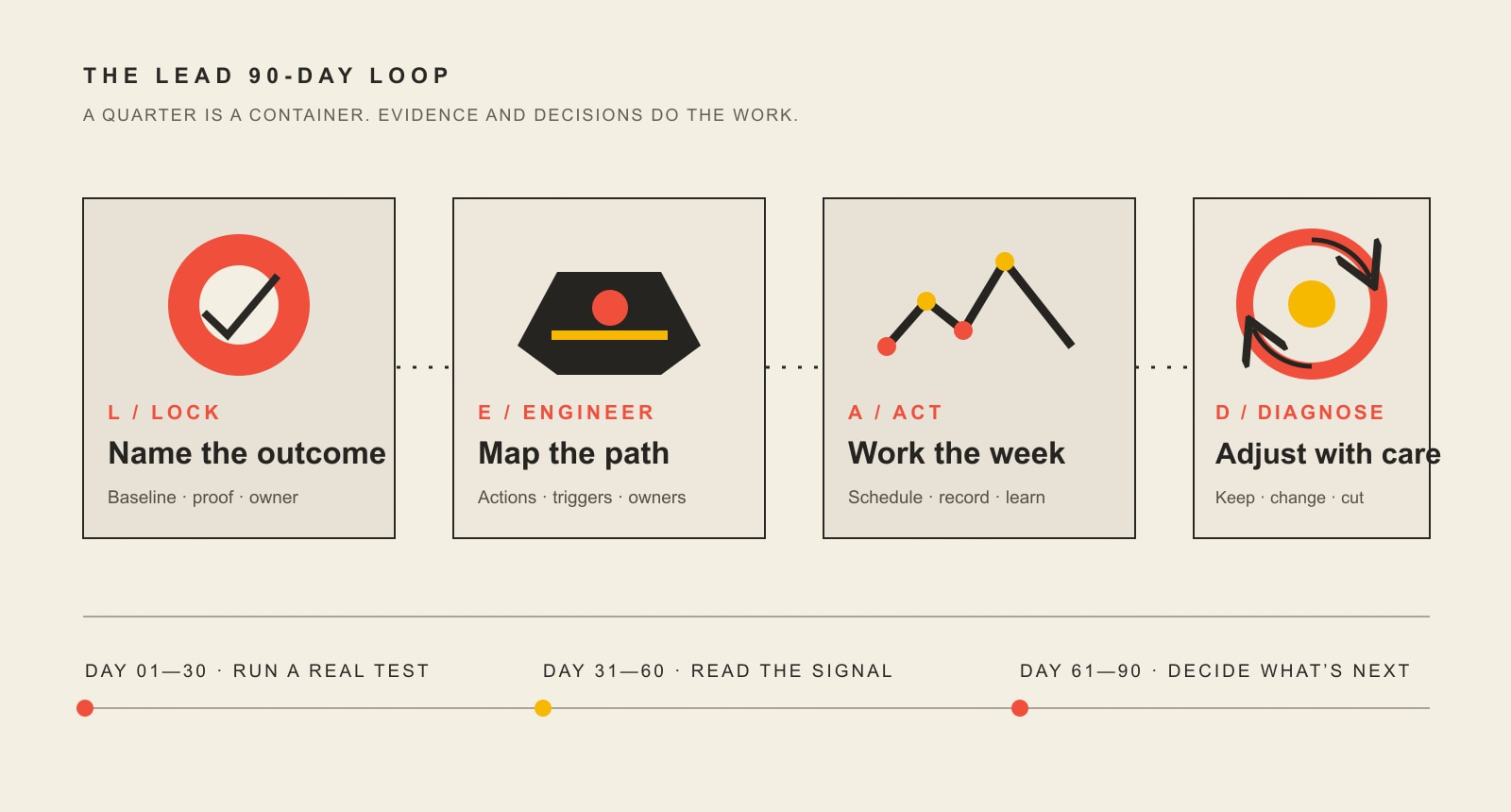
Scope Design’s framework is the LEAD 90-Day Loop: Lock the outcome, Engineer the path, Act one week at a time, Diagnose and adjust. It is deliberately simple. A goal system that requires a two-day retreat, seventeen dashboards, and a ceremonial leather notebook has already become a new project.
1. Lock the outcome
Write one sentence that defines what will be meaningfully different by day 90. Use a result, not a mood. “Feel more organized” is fog. “Reduce average proposal turnaround from five business days to two without increasing revision errors” gives you something to operate.
Outcome: What will be true on day 90?
Baseline: What is true now?
Proof: What evidence will show the outcome actually happened?
Owner: Who can make or coordinate the decisions?
Stop list: What will not compete for the same capacity during this cycle?
The stop list is not decorative. A goal is not a priority if every other initiative is also “top priority.” If a new request collides with the 90-day outcome, the team needs a rule for which work moves, waits, shrinks, or dies.
2. Engineer the path
Work backward from the outcome and identify the smallest set of controllable actions likely to produce it. Separate dependencies from wishes. If the goal depends on a vendor, customer, employee, or system you do not control, build that uncertainty into the plan rather than pretending the dependency is a task with a due date.
Then create implementation triggers. Instead of “work on the proposal process twice a week,” write “Tuesday and Thursday at 9:00 a.m., I will review the current queue and remove the oldest blocking step.” If a common obstacle appears, pre-decide the response: “If legal review exceeds two business days, the owner escalates it at the next morning check-in.”
This is also where systems earn their keep. If repeated work should be automated, documented, delegated, or connected across tools, the broader AI automation for business guide explains how to decide what should become a workflow instead of another recurring reminder.
3. Act one week at a time
A 90-day plan becomes real only when it survives contact with Monday morning. Translate the engineered path into weekly commitments small enough to schedule and specific enough to score. “Make progress on automation” is useless. “Map the intake workflow, identify the three manual handoffs, and test one automated routing rule” can be done, reviewed, and learned from.
Do not turn the quarter into thirteen simultaneous workstreams. Choose the few actions that matter now. Finish or learn something before adding more crap. For a marketing-specific application of that constraint-first idea, see Scope Design’s 90-Day Marketing Acceleration Framework.
4. Diagnose and adjust
Every week, compare what you planned with what happened. Do not ask only, “Am I on track?” Ask why the evidence looks the way it does. A missed target can mean at least four different things: the action was not executed, the tactic was weak, the scope was unrealistic, or the environment changed.
Keep: What worked well enough to repeat?
Change: What should be adjusted because the tactic is underperforming?
Cut: What is consuming capacity without improving the outcome?
Rescope: Has new evidence changed what a credible day-90 result should be?
A review is not a motivational ritual. It is a decision loop. Hope is not an analytics strategy, and “we’ll try harder next week” is not a diagnosis.
What Should You Measure During 90 Day Goals?
Use three evidence classes together. One metric cannot safely tell the whole story.
Evidence type
Question it answers
Example
Outcome metric
Did the business result change?
Average proposal turnaround falls from 5 days to 2.
Leading actions
Did we execute the behaviors expected to influence the outcome?
Every new request is routed through one standardized intake within 1 hour.
Guardrails
Did we improve one number by quietly damaging something else?
Revision error rate stays below the current baseline; staff overtime does not increase.
This distinction matters because outcome metrics often lag. If the result has not moved by week three but the leading actions are being executed cleanly, you may need more time. If the leading actions are not happening, the tactic has not really been tested. If the outcome improves while quality collapses, congratulations: you optimized the wrong thing.
A Worked 90-Day Business Goal Example
Suppose a small service business says, “We need to use AI and automation this quarter.” That is not a goal. It is a technology preference wearing a tiny project-management hat.
A stronger day-90 outcome might be: “Reduce manual lead-intake handling from an average of 18 minutes per inquiry to under 6 minutes, while keeping response accuracy and ownership clear.”
Baseline: 18 minutes of manual work per inquiry, inconsistent routing, no single owner for exceptions.
Outcome metric: Median manual handling time under 6 minutes by day 90.
Leading actions: Standardize intake fields, map decision rules, automate routing for approved cases, review exceptions weekly.
Guardrails: No increase in missed inquiries, duplicate records, bad assignments, or response errors.
Implementation trigger: If an inquiry cannot be classified automatically, route it to the named owner within 15 minutes rather than letting it disappear into an inbox.
Stop list: Do not simultaneously replace the CRM, rebuild the website, launch a chatbot, and redesign the sales process unless one of those is actually required for the outcome.
Days 1–30 are for baseline, mapping, and the smallest useful test. Days 31–60 are for running the workflow and collecting exception evidence. Days 61–90 are for improving reliability, documenting ownership, and deciding whether to scale. If the business wants help turning that kind of plan into working systems, Scope Design’s Business Automation & AI service is the relevant next step.
Use 30-, 60-, and 90-Day Checkpoints as Decisions
Day 30: Do we have a real test?
By day 30, the goal should be operating, not merely planned. You should have a baseline, visible leading actions, a written scorecard, and enough real-world friction to expose bad assumptions. If the first month was consumed by planning the plan, you do not need more planning. You need a smaller test.
Day 60: Is the tactic producing credible evidence?
At day 60, look for repeated patterns. Are the leading actions happening? Is the outcome moving? Which exceptions keep returning? This is the right time to change a tactic that is failing, remove work that is not contributing, or tighten the goal if the original scope was fantasy.
Day 90: What did we achieve, learn, and decide?
Do not grade the quarter only as “hit” or “missed.” Record the outcome, the execution rate, the strongest evidence, the biggest wrong assumption, and the next decision. A goal can miss its original number and still produce valuable knowledge. It can also hit the number through unsustainable heroics and be a terrible system. Review both the result and the method.
Common 90-Day Goal-Setting Mistakes
Choosing too many primary goals. Multiple responsibilities are normal. Multiple “number one priorities” are arithmetic cosplay.
Measuring only the final outcome. You need leading actions and guardrails to diagnose what is happening before day 90.
Using milestones that are just calendar fractions. Being one-third through the quarter does not mean every outcome should be one-third complete.
Planning work you do not control as if it were guaranteed. Dependencies need owners, fallback rules, and decision dates.
Confusing activity with evidence. Twenty meetings can coexist with zero progress.
Never changing the plan. Sticking to a bad tactic is not discipline. It is stubbornness with a spreadsheet.
Changing the goal every bad week. A single rough week is not necessarily evidence that the goal is wrong. Look for the cause before rewriting the destination.
If the goal is primarily about learning a skill, the bottleneck is often different from a business-output goal. Scope Design’s guide to overcoming learning obstacles goes deeper on turning “I don’t know how” into a next action, feedback loop, and practice plan.
Can AI Help With 90 Day Goals?
Yes, but give AI a bounded job. It can help brainstorm measurable outcomes, turn a project into candidate weekly actions, identify dependencies, summarize a scorecard, compare planned versus completed work, or generate questions for a weekly review. It should not decide what matters to your business, invent evidence, or quietly replace judgment with confident autocomplete.
For the AI-specific angle, see AI-Powered Goal Achievement. This article owns the broader 90-day execution framework; the AI article is the better destination when the question becomes how to use AI inside that framework.
Frequently Asked Questions About 90 Day Goals
How many 90 day goals should I set?
For most people or small teams, choose one primary outcome for the cycle and treat other responsibilities as maintenance or supporting work. That is not a scientific law. It is an operating choice that makes tradeoffs visible. If you truly have several independent teams with separate capacity and owners, they can each run their own primary outcome.
What are good three-month goals?
Good three-month goals are meaningful, measurable, and controllable enough to execute. Examples include launching a defined service, reducing a measurable process delay, validating a market assumption, finishing a substantial certification, improving a specific conversion bottleneck, or completing one phase of a larger project. Avoid arbitrary outcomes chosen because the number sounds impressive.
What is the difference between a 90-day goal and a 30/60/90-day plan?
A 90-day goal system is a general execution cadence for achieving a defined outcome. A 30/60/90-day plan often refers to onboarding or performance expectations for a new employee or manager. The timelines can look similar, but the intent is different. That distinction is why this article targets “90 day goals” rather than chasing the higher-volume but often employment-focused “90 day plan” query.
Should a 90-day goal be part of a bigger annual goal?
Often, yes. A quarter is useful for producing the next meaningful result, proof, or capability inside a larger strategy. The annual direction can stay stable while the next 90 days answer a more immediate question: what must be true next for the larger goal to remain credible?
What if I am behind after 30 days?
Diagnose before you panic. Check whether the planned actions actually happened, whether the tactic produced the expected signal, whether a dependency failed, and whether the original scope was realistic. Change the cause you can identify. Do not automatically shrink the goal after one bad week or keep a broken tactic just to prove commitment.
How often should I review a 90-day goal?
Review the evidence weekly and use deeper checkpoints around days 30 and 60. The weekly review should be short enough to sustain but serious enough to produce a decision. Record the result so next week’s review starts from evidence instead of memory.
Do 90-day goals work better than annual goals?
The sources reviewed for this article do not establish that exactly 90 days is universally superior. The stronger evidence supports mechanisms such as specific goals, implementation intentions, feedback, and progress monitoring. A 90-day cycle is a useful way to package those mechanisms into an execution rhythm, not a scientifically proven magic duration.
When should I change the goal instead of the tactics?
Change the goal when new evidence shows the outcome is no longer valuable, feasible, ethical, or aligned with the larger strategy. Change the tactic when the outcome still matters but the chosen path is not working. Rescope when the direction is right but the original deadline or capacity assumption was unrealistic.
Can I start a 90-day goal at any time of year?
Yes. The system does not require a calendar quarter. Start when a meaningful outcome, owner, baseline, and operating window are clear. January 1 is not a technical dependency.
Your Next 90 Days Need a Decision, Not More Motivation
Pick the outcome. Define the evidence. Put the first week on the calendar. Then review what reality tells you.
If your 90-day goal involves turning a repeated manual process into a reliable workflow, connecting systems, or applying AI where it can remove real operational friction, Scope Design can help with the Business Automation & AI work. The goal is not more tools. It is a system that earns its keep.
Yes, GDPR can apply to a US small business—but an EU resident simply visiting your website does not automatically trigger it. The first question is whether your processing falls within the GDPR’s territorial scope: for a US business without an EU establishment, that usually means intentionally offering goods or services to people in the Union or monitoring their behavior there. GDPR Article 3 sets the rule, and the European Data Protection Board’s territorial-scope guidance makes an important point that many summaries miss: mere website accessibility in Europe is not enough by itself.
That distinction matters because a lot of small-business GDPR advice starts with the wrong question. It jumps straight to cookie banners, privacy-policy generators, or scary fine numbers before asking whether the activity is actually in scope. That’s backwards. Compliance theater is still theater, even when the button says “Accept All.”
This guide is general information for US small businesses, not individualized legal advice. Scope Design can help implement website, tracking, security, form, consent, and vendor-control changes. A qualified privacy attorney should decide material legal questions about applicability, lawful basis, representative or DPO obligations, sensitive processing, international-transfer mechanisms, or regulator response.
GDPR compliance for US small businesses: the short version
EU traffic alone is not the test. A random visitor from France does not, by itself, prove that you are targeting the EU.
Intentional EU sales or marketing can be the test. EU-directed advertising, EU delivery, Member-State references, EU-focused languages or currencies tied to ordering, and similar signals can show an intention to offer goods or services to people in the Union.
Behavior monitoring can also bring a US business into scope. Tracking or profiling people in the Union to analyze or predict behavior can matter under Article 3(2).
Small does not mean exempt. Some obligations have narrow exceptions, but there is no blanket “small business exemption” from GDPR.
Cookies are not just a GDPR question. GDPR governs personal-data processing, while the ePrivacy rules contain more specific requirements for storing or accessing information on a user’s device.
Operational readiness matters more than a badge. You need to know what data you collect, why you collect it, who receives it, how long you keep it, how you secure it, and how you will respond when someone exercises a right or something goes wrong.
Does GDPR apply to your US company? Use this scenario test
The GDPR can reach organizations outside Europe. But it does not do so because of citizenship alone, and it does not automatically attach to every US website that can be opened in Europe. The practical starting point is Article 3.
Scenario
Practical read
What to inspect
A person in France lands on your US-only website
Not enough by itself.
Whether you actually target people in the Union or monitor their behavior there.
You run ads aimed at EU countries, ship there, or build EU-specific offers
GDPR may apply.
Targeting signals, customer journey, order flow, payment, delivery, and marketing data.
You profile or track people in the EU for behavioral advertising or prediction
You have an EU office, branch, or sufficiently stable establishment involved in the processing
Article 3(1) may apply.
The relationship between the EU establishment’s activities and the processing.
You process personal data for an EU client as its vendor
Processor duties and contract terms may apply.
Your role, Article 28 terms, instructions, subprocessors, security, transfers, and breach workflow.
Your customers are only in the UK
Do not treat EU GDPR and UK GDPR as identical jurisdictions.
UK GDPR and UK-specific guidance rather than assuming the EU analysis answers the UK question.
The EDPB says that simply making a website accessible in the Union is not enough to demonstrate an intention to offer goods or services there. It looks for evidence of targeting. Its examples include EU-directed marketing, references to Member States or EU customers, delivery to EU countries, and language or currency choices that make sense as part of an EU-facing commercial offer. Context matters, which is exactly why “someone from Germany visited my site” is a lousy compliance test.
Monitoring is also more specific than “we have analytics installed.” The EDPB discusses tracking people on the internet, including potential profiling used to analyze or predict personal preferences, behaviors, or attitudes. The purpose and actual processing matter. If your marketing stack includes analytics, ad pixels, audience building, retargeting, CRM enrichment, session recording, or personalization, inventory those tools before making a conclusion.
The TRACE self-audit: make GDPR an operating system, not a banner
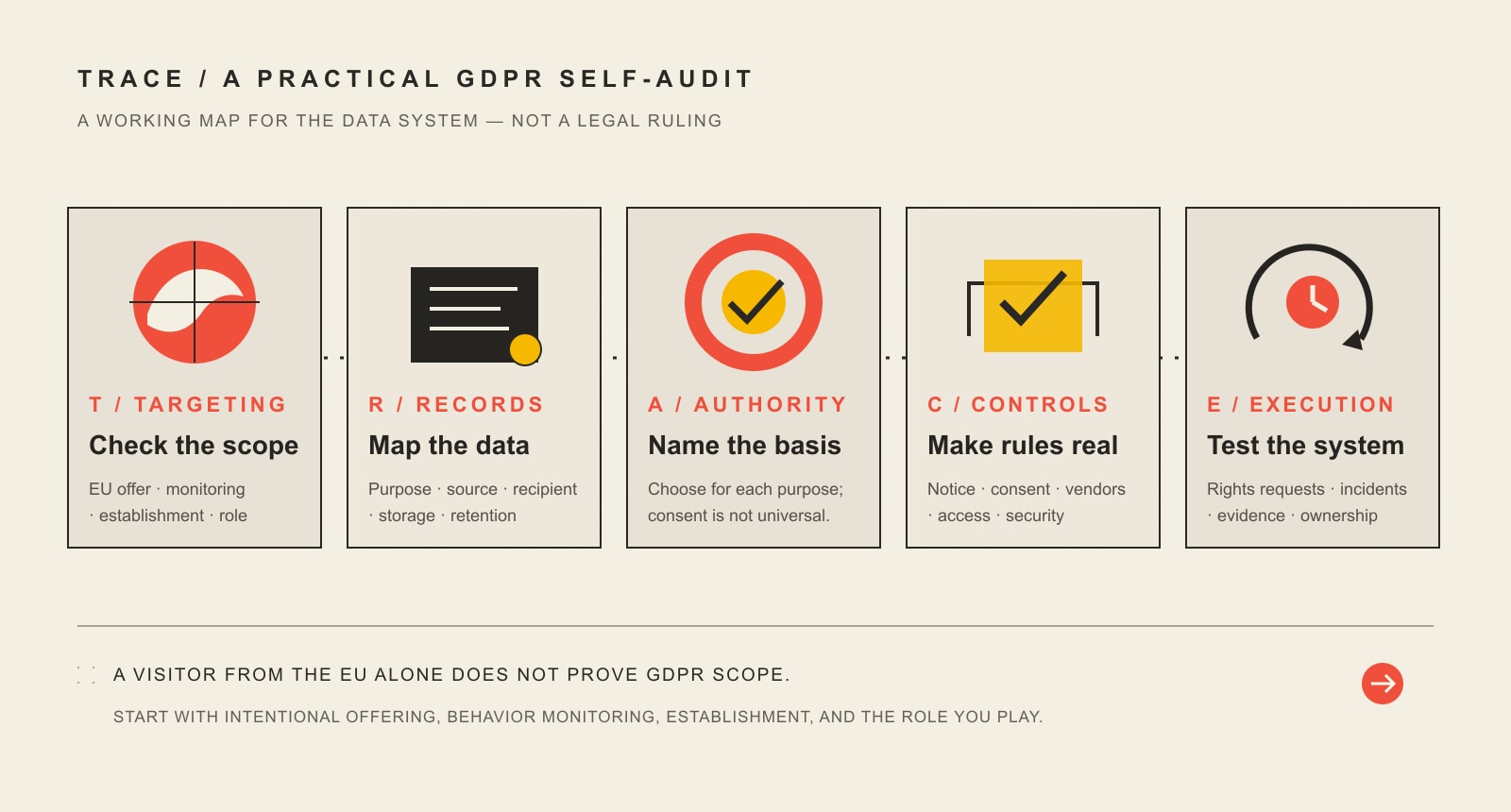
Scope Design uses a five-part way to organize the implementation conversation: TRACE—Targeting, Records, Authority, Controls, Execution. TRACE is our operating framework, not language from the regulation. Its job is to stop a small business from buying one privacy plugin and pretending the rest of the data system disappeared.
TRACE turns the GDPR conversation into five operational checks: Targeting, Records, Authority, Controls, and Execution.
T — Targeting
First, establish why GDPR may apply. Are you intentionally selling or marketing to people in the Union? Are you monitoring behavior there? Do you have an EU establishment? Are you acting as a processor for a client whose instructions bring the processing within GDPR? Write the reason down. If nobody can explain why the regulation applies, everything after this step is guesswork.
R — Records
Map the data system you actually have. Include contact forms, newsletter signups, ecommerce, analytics, advertising pixels, CRM, payment providers, scheduling tools, help desks, cloud storage, employee systems, backups, embedded video, chat widgets, security logs, and anything else that receives personal data. Record purpose, data type, source, recipient, storage location, retention, deletion method, and international transfers.
A — Authority
For each purpose, identify the lawful basis that actually supports the processing. Article 6 includes consent, contract, legal obligation, vital interests, public task, and legitimate interests. Consent is important in the right places, but it is not the universal answer for every data flow. If you rely on consent, the way you collect and withdraw it matters. If you rely on legitimate interests, that is not a magic phrase you paste into a privacy policy; the balancing and context matter.
C — Controls
Now make the rules real: privacy notices, cookie behavior, collection fields, retention, access controls, processor agreements, subprocessor visibility, transfer mechanisms, security, backups, and governance. This is where design and development decisions become compliance decisions. A beautiful privacy page cannot fix a Meta Pixel firing before consent, an old CRM export sitting in a shared folder, or five ex-employees who still have admin access.
E — Execution
Finally, prove that the system can function under pressure. Who receives a data-rights request? How is identity checked? Who searches the CRM, inboxes, help desk, backups, and vendor systems? Who assesses a breach? Who can contact counsel and the relevant supervisory authority? What evidence do you retain? When is the next vendor and tracker review? A policy that nobody can execute is just formatted optimism.
What GDPR requirements should a US small business implement when it is in scope?
1. Minimize the data you collect and document why you need it
Article 5 includes principles such as purpose limitation, data minimization, accuracy, storage limitation, integrity/confidentiality, and accountability. For a small business, the operational version is simple: stop collecting data because a form template happened to include the field.
For every collection point, ask: What business purpose does this field serve? What lawful basis supports that purpose? Who needs access? How long do we need it? Can we accomplish the same goal with less data? Removing unnecessary fields reduces privacy risk, breach impact, staff confusion, and future cleanup.
2. Make the privacy notice match the real system
Your privacy notice should explain the actual categories of data, purposes, legal bases where required, recipients, transfers, retention logic, rights, and relevant contact information. Do not copy a competitor’s policy and swap the company name. Their stack is not your stack.
Start from the data map, then write the notice. That order sounds obvious because it is. Somehow, the internet managed to turn it into a downloadable-template industry.
3. Treat cookies, analytics, and advertising tags as a separate implementation project
Cookie compliance is commonly explained badly. The EDPB’s cookie guidance notes that GDPR applies when cookies involve personal-data processing, while the ePrivacy Directive supplies more specific rules about storing information or accessing information on a user’s device. Non-essential storage/access generally needs prior consent; technically necessary uses can fall within an exception.
That means a consent banner should be connected to an inventory of what actually loads. Test analytics, ad pixels, embedded media, chat, session recording, personalization, and third-party scripts before and after each consent choice. The European Commission’s current privacy guidance also emphasizes that rejecting cookies should be as easy as accepting them and warns against manipulative consent interfaces. A dark-pattern banner is not improved because it has rounded corners.
If email is part of the same funnel, GDPR is only one piece of the compliance picture. Our email marketing laws guide separates GDPR from CAN-SPAM, CASL, UK/EU rules, unsubscribe duties, and the evidence you should retain for your list.
4. Build a data-subject-rights workflow before the first request arrives
GDPR gives individuals rights that can include access, rectification, erasure, restriction, portability, objection, and protections around certain automated decisions, depending on the circumstances. Article 12 generally requires action without undue delay and within one month. For complex or numerous requests, that period can be extended by two further months, but the person must be told within the first month and given the reason.
Create one intake path, one owner, a verification process, a system-search checklist, a decision/escalation step, and response records. Include vendors. If your CRM can delete a person but your email platform, support desk, form database, and cloud exports cannot, you do not yet have an executable process.
5. Review vendors and Article 28 data-processing terms
Most small businesses do not process data alone. Hosting providers, email platforms, analytics vendors, CRMs, payment processors, scheduling apps, support desks, cloud storage, and marketing tools may all touch personal data. Article 28 requires a controller to use processors providing sufficient guarantees and to govern processing through a contract or other binding legal act with required terms.
Maintain a vendor list with purpose, data, role, subprocessor information, security commitments, retention/deletion terms, breach obligations, and transfer mechanism. “We use a famous SaaS company” is not a vendor-risk assessment.
6. Check international transfers instead of assuming every US vendor is covered
Moving EU personal data to a recipient in the United States can trigger GDPR Chapter V transfer rules. The European Commission’s current adequacy page lists the United States for commercial organizations participating in the EU-US Data Privacy Framework. That does not mean every US organization or vendor is automatically covered.
For each relevant transfer, verify the receiving organization and the mechanism being relied on. Depending on the relationship and facts, another recognized safeguard—such as standard contractual clauses—may be part of the analysis. This is one of the places where legal review earns its keep, especially when multiple vendors, subprocessors, sensitive data, or non-adequate destinations are involved.
7. Make security proportional to the risk—and make response readiness part of security
Article 32 calls for technical and organizational measures appropriate to the risk. It does not say “install one security plugin and relax.” Access control, supported software, multifactor authentication, encryption where appropriate, logging, monitoring, backups, recovery, vendor security, staff procedures, and evidence all matter in context.
For the website side, our website security guide uses the LOCKED framework to turn security into owned operations rather than a pile of tools. Credential hygiene is part of that system too; a business password manager can help eliminate shared passwords and unmanaged access, which is why we maintain a separate business password-management guide.
Breach response also needs nuance. Under Article 33, a controller generally notifies the competent supervisory authority without undue delay and, where feasible, within 72 hours after becoming aware of a personal-data breach unless the breach is unlikely to result in a risk to individuals’ rights and freedoms. Article 34 separately addresses communication to affected people when high risk is likely, subject to specified exceptions. So the real requirement is fast assessment and escalation—not the simplistic slogan “every incident must be reported in 72 hours.”
8. Do not assume small size removes records, representative, or governance questions
Three recurring myths deserve their own correction.
“We’re under 250 employees, so Article 30 records do not apply.” Not necessarily. Article 30(5) has a narrow carve-out, but it does not remove recordkeeping when processing is not occasional, is likely to risk people’s rights and freedoms, or includes specified special-category or criminal-conviction data.
“Every US company under GDPR needs a DPO.” No. Article 37 requires a data protection officer in defined situations, including certain large-scale monitoring or large-scale special-category/criminal-data processing. The criteria matter.
“We’re small, so we cannot need an EU representative.” Article 27 is more specific. A non-EU controller or processor subject to Article 3(2) generally must designate a representative in the Union unless a limited exception applies, including requirements around occasional and low-risk processing. See Article 27 and get counsel involved if this question is live for your business.
A 30-day GDPR implementation plan for a small US business
If GDPR likely applies, do not try to “finish GDPR” in an afternoon. Use a short implementation cycle that produces evidence and leaves an operating rhythm behind.
Week 1: prove scope and map the data
Document the Article 3 reason the business may be in scope.
List every public collection point and major internal system.
Record vendors, purposes, data categories, recipients, locations, retention, and transfers.
Flag sensitive data, children, profiling, large-scale monitoring, or other higher-risk activity for legal review.
Week 2: match authority, notice, and consent to reality
Map each processing purpose to its proposed lawful basis.
Update privacy notices from the data map, not from a template.
Test cookie/tracker behavior before consent, after accept, after reject, and after preference changes.
Fix forms so they collect only what is necessary and use accurate permission language.
Review email and marketing consent separately from general website data collection.
Week 3: fix vendor, transfer, access, and retention controls
Collect and review processor agreements for relevant vendors.
Verify subprocessor and transfer information.
Check Data Privacy Framework participation or other transfer mechanisms where relevant.
Remove stale accounts, reduce unnecessary admin access, enable stronger authentication, and document ownership.
Set realistic retention and deletion rules instead of keeping data forever because storage is cheap.
Week 4: test rights and incident response
Run a mock access or deletion request across your real systems.
Time how long it takes to locate the data and identify gaps.
Run a tabletop breach scenario: who is called, what gets preserved, who assesses risk, and who can contact counsel or a regulator?
Document the process and evidence.
Schedule recurring tracker, vendor, access, retention, and privacy-notice reviews.
This is the same systems-first thinking we use in broader small-business marketing strategy: channels and tools only work when the underlying audience, conversion, follow-up, capacity, measurement, and ownership system is coherent. Privacy compliance belongs inside that system, not bolted to the footer after launch.
What are the GDPR penalties for a US small business?
The maximum numbers are real, but they should not be used as clickbait. Article 83 sets case-specific factors for administrative fines and different maximum tiers. Specified infringements can carry maximums of €10 million or 2% of total worldwide annual turnover, while specified higher-tier infringements can reach €20 million or 4%, with the regulation applying the relevant “whichever is higher” structure for undertakings.
That does not mean a small business automatically receives a maximum fine for a first mistake. Regulators consider factors such as nature, gravity, duration, intent or negligence, mitigation, responsibility, prior infringements, cooperation, data categories, and how the issue became known. The better business lesson is not “panic about €20 million.” It is “build a system that can show what you knew, what you controlled, what you fixed, and how you responded.”
Frequently asked questions about GDPR and US small businesses
Does GDPR apply to US companies?
It can. A US company may fall within GDPR because of an EU establishment or, for certain non-EU processing, because it intentionally offers goods or services to people in the Union or monitors their behavior there. The company’s US location does not automatically put it outside GDPR.
Does GDPR apply just because someone in Europe visits my website?
No—not by that fact alone. EDPB territorial-scope guidance says mere website accessibility in the Union is not enough to demonstrate an intention to offer goods or services there. Look for intentional targeting or relevant behavior monitoring instead.
Can Google Analytics or advertising pixels make GDPR apply to a US business?
Potentially, depending on what the processing is doing and where the people are. Article 3(2) includes monitoring behavior in the Union, and EDPB guidance discusses internet tracking and profiling used to analyze or predict behavior. Do not decide based only on the tool’s brand name; inspect purpose, configuration, audience, identifiers, and downstream use.
Do businesses with fewer than 250 employees need GDPR records?
They may. Article 30’s under-250 provision is not a blanket exemption. Records can still be required when processing is not occasional, is likely to risk rights and freedoms, or includes specified special-category or criminal-conviction data.
Does every US business subject to GDPR need a DPO?
No. Article 37 defines specific circumstances in which a DPO is mandatory. Many small private businesses will not meet those tests, but the decision should be based on the statutory criteria rather than company size alone.
Does a US business need an EU representative?
A non-EU controller or processor subject to Article 3(2) generally faces the Article 27 representative requirement unless a limited exception applies. Because the exception is fact-specific, this is a sensible legal-review checkpoint when a US company intentionally serves or monitors people in the EU.
Do all cookies require GDPR consent?
No single sentence like that is accurate. GDPR governs personal-data processing, while ePrivacy has more specific storage/access rules. Non-essential cookies and similar technologies generally require prior consent under those rules, while technically necessary uses can be exempt. Inventory the technology and classify purpose before configuring the banner.
Does every data breach have to be reported within 72 hours?
No. Article 33 says supervisory-authority notification is required without undue delay and, where feasible, within 72 hours unless the breach is unlikely to result in a risk to rights and freedoms. Notification to affected individuals has its own high-risk test under Article 34. Get legal and incident-response help quickly because the clock and the risk assessment can matter.
Does the EU-US Data Privacy Framework make every transfer to the United States compliant?
No. The European Commission’s adequacy finding applies to participating US commercial organizations. Verify participation or another valid transfer mechanism for the receiving organization and relevant processing.
Is UK GDPR the same thing as EU GDPR for a US company?
No. They are closely related frameworks, but the UK operates its own post-Brexit data-protection regime and regulator. If your business targets or monitors people in the UK, perform the UK analysis separately instead of assuming an EU conclusion automatically answers it.
What to do next
If your US business may fall within GDPR, start with TRACE: document the targeting or monitoring reason, map the data, identify the authority for each purpose, fix the controls, and test execution. That will give your lawyer, developer, marketing team, and vendors something concrete to work from instead of a vague instruction to “make the website GDPR compliant.”
Scope Design can help with the implementation layer—data-flow and tracker inventory, consent behavior, forms, marketing integrations, privacy-aware UX, access/security controls, and the technical cleanup that turns decisions into a working website. For legal conclusions, use qualified privacy counsel. The useful outcome is not a compliance badge. It is a system you understand, can explain, and can operate when a real request or incident lands on your desk.
Your marketing is not working because at least one link between attention and revenue is failing—and there is a decent chance you are trying to fix a different link. Before you redesign the website, fire the agency, start a podcast, add AI to everything, or shovel more money into ads, use a marketing audit to verify the measurement, traffic volume, audience fit, message, user experience, offer, follow-up, and delivery capacity in that order.
That is the direct answer. “Marketing is broken” is not a diagnosis. It is the business equivalent of telling a mechanic that the car “sounds expensive.”
TL;DR:
Confirm that analytics, forms, calls, bookings, checkout, and lead notifications actually work.
Decide whether enough relevant people are arriving to support a conclusion.
Segment traffic and leads before blaming the website or creative.
Test whether people understand the offer before testing button colors or trendy tactics.
Find where qualified people stop: message, proof, task completion, price/value, response, sales, or delivery.
Measure the last meaningful outcome each part of the system can influence—not the prettiest number in the report.
Fix the largest constraint first. Improving a non-constraint is industrious-looking waste.
What “marketing isn’t working” actually means
It means the business is not producing enough of the right outcome at an acceptable cost, within the capacity of the team to respond and deliver.
That outcome depends on the business model:
A local service company may need qualified calls or booked-and-attended appointments.
A considered B2B company may need qualified opportunities and pipeline value.
Ecommerce may need profitable purchases, repeat orders, and useful customer value.
A subscription business may care more about retention and lifetime value than cheap sign-ups.
An overloaded service business may need better qualification or fewer manual touches, not more leads.
Sessions, impressions, rankings, clicks, followers, email opens, raw leads, and time on page can help explain what is happening. They are not proof that the business result improved.
If your report celebrates 400 leads while sales spent three weeks chasing students, bots, tire-kickers, and people outside the service area, congratulations: the dashboard had a wonderful quarter.
Marketing diagnosis: follow the evidence
Marketing effectiveness versus marketing activity
Marketing activity is what the team did. Marketing effectiveness is whether those activities contributed to the intended business outcome without creating a larger operational mess somewhere else.
Activity answers questions such as:
How many campaigns launched?
How many posts went out?
How much traffic arrived?
How many leads were captured?
Effectiveness asks harder questions:
Were the visitors likely buyers?
Did they take the intended action?
Were inquiries qualified?
Did anyone respond while the inquiry was still warm?
Did opportunities become profitable customers?
Could the business deliver what marketing promised?
Did customers stay, return, refer, or quietly escape?
The first list is easier to report. The second list is why the business hired marketing in the first place.
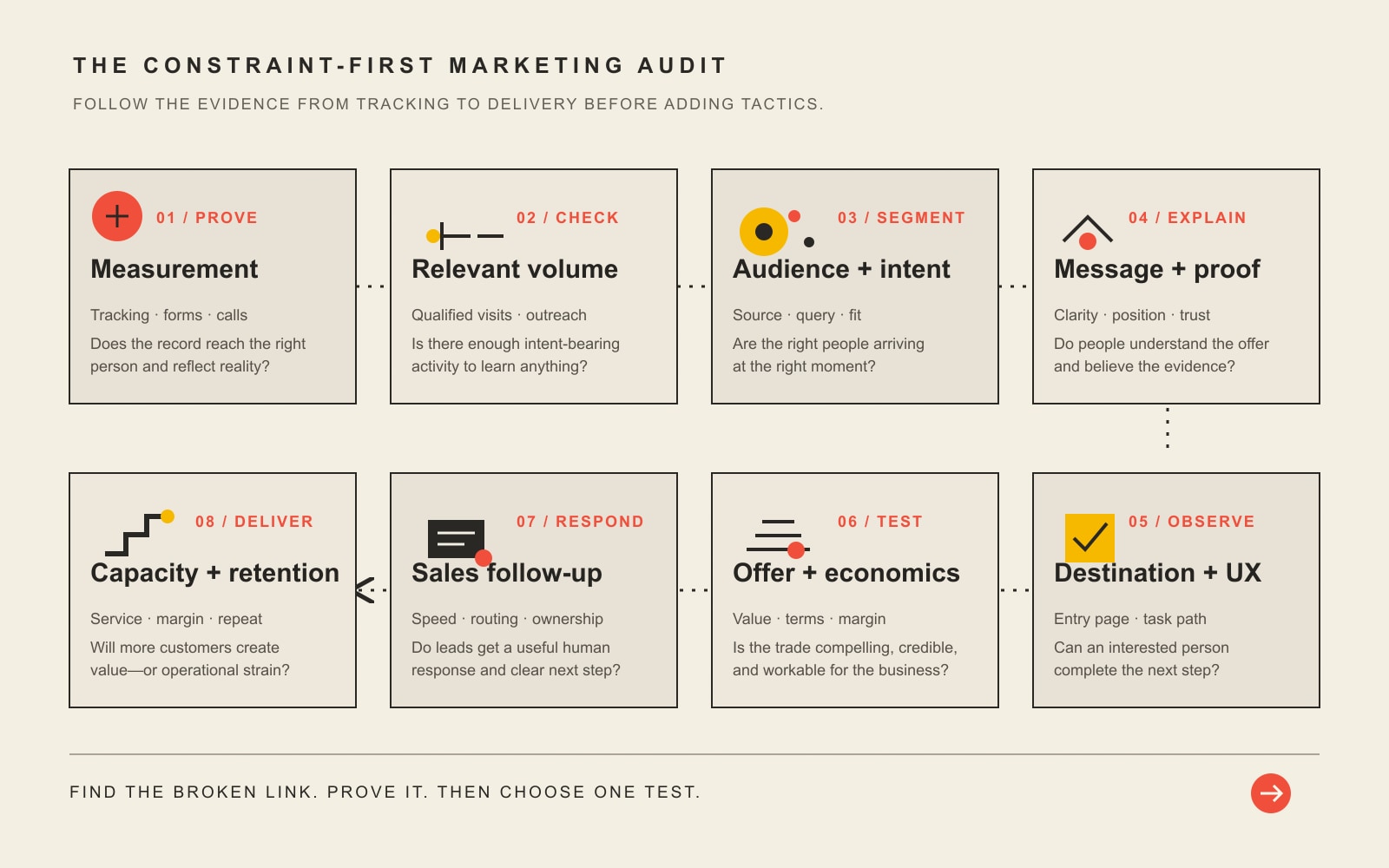
The Scope Design Constraint-First Marketing Audit
Use this sequence because upstream failures make downstream conclusions unreliable.
Measurement integrity — Can you trust the tracking and the customer-facing actions?
Relevant volume — Is there enough intent-bearing traffic or outreach to diagnose anything?
Audience and intent fit — Are the people arriving plausible buyers in the right moment?
Message, position, and proof — Do they understand the offer and believe the argument?
Destination and UX — Can an interested person complete the intended task?
Offer and economics — Is the trade compelling, credible, and financially workable?
Response, qualification, and sales — Does the business handle demand competently?
Delivery, retention, and capacity — Does acquiring more customers create value or chaos?
Do not skip straight to the most entertaining stage. A new campaign concept is more fun than submitting your own contact form and discovering it has been emailing a former employee since March. The boring check still wins.
Limit or reshape demand until delivery can support the promise
This table narrows the investigation. It does not convict a suspect. The test still matters.
1. Verify measurement and technical integrity
Start by proving that the marketing system can record reality.
Test the following yourself:
Every contact, quote, application, booking, purchase, and download path.
Form validation, confirmation messages, notification delivery, and CRM creation.
Phone numbers on desktop and mobile.
Checkout, payment, coupon, shipping, and account steps where relevant.
Analytics events and key events.
Ad-platform conversions where campaigns depend on them.
Mobile layouts, browser differences, and obvious performance failures.
Consent, privacy, and accessibility behavior in the real interface.
Do not stop when the screen says “Thanks.” Confirm that the inquiry reached the correct inbox or system, contained the submitted information, and has an owner.
A technical failure can impersonate every other problem
A broken form makes healthy demand look like weak demand. Bad tracking makes successful campaigns look useless. Duplicate events make mediocre campaigns look heroic. A mobile bug can masquerade as poor audience quality if most people from one channel arrive on phones.
Technical checks come first because they are relatively cheap to confirm and contaminate everything downstream.
2. Determine whether there is enough relevant volume
A conversion rate based on a handful of visitors is not a strategy. It is a mood swing with a percentage sign.
Ask:
How many people arrived from sources with plausible buying intent?
How many saw the campaign or search result before deciding whether to click?
How many entered the actual decision page, not the entire site?
Is the sample large enough to separate a pattern from one unusually enthusiastic cousin?
Does the business operate in a niche where qualitative evidence matters more than high-volume testing?
Low volume does not automatically mean “buy ads.” It may mean the market is narrow, the search demand is limited, referral relationships are underdeveloped, the content is undiscoverable, or the business needs outbound conversations rather than another blog post.
If qualified traffic is limited, use customer interviews, sales objections, call records, search queries, usability observation, and controlled message tests. Do not cosplay as a billion-visit ecommerce company and pretend a button-color test will reach statistical significance by retirement.
3. Separate traffic quality from traffic quantity
More people is not the same as more potential customers.
Segment performance by:
source and channel;
campaign and ad group;
search query or keyword;
landing page;
location and service area;
device;
new versus returning visitor;
offer or service;
qualified versus unqualified inquiry;
customer value, where traceable.
If one source produces qualified conversations and another produces cheap form fills that never close, do not blend them into one conversion rate and call it insight.
Read the inquiries, not just the chart
Review the last 20 to 50 inquiries. What did people think you sold? What did they ask for? Were they in the right geography? Could they afford the likely engagement? Did they mention a page, ad, referral, or search? What happened next?
Those conversations often expose an audience mismatch faster than an elaborate attribution model.
For paid media, use our online advertising strategy guide to evaluate channel mechanism, signal, destination, response capacity, and test economics before moving the budget around.
4. Test the message, position, and proof
Traffic can be qualified and still leave because the page makes the reader assemble the meaning with an Allen key and three missing screws.
Ask someone unfamiliar with the business to look at the entry page briefly, then answer:
What does this company do?
Who is it for?
What problem or outcome does it address?
Why should I believe it?
What should I do next?
If the answers are vague, contradictory, or based on a stock photo of people pointing at a laptop, start with the message.
Common message failures
The company is the hero and the customer is a supporting extra.
The headline describes a category instead of a useful difference.
Claims are broad but proof is absent or marooned on another page.
The site hides price logic, trade-offs, process, or fit.
Every competitor could paste in the same copy without changing a noun.
The call to action is either invisible or absurdly large for the visitor’s current commitment.
This is where brand position, customer language, evidence, and offer clarity meet. It is not solved by adding more adjectives.
5. Find destination and UX friction
Messaging failure happens when people do not understand or care. UX failure happens when they understand, care, and still cannot complete the task without swearing at the interface.
Look for:
people reaching the form, booking tool, cart, or application and abandoning it;
errors or unclear validation;
sharp mobile-versus-desktop differences at the same step;
repeated clicks on elements that are not interactive;
hidden fees or requirements revealed late;
unnecessary fields or account creation;
inaccessible controls, weak contrast, poor keyboard behavior, or unreadable content;
a slow or unstable key page;
no confirmation about what happens next.
Google’s Core Web Vitals documentation explains the current loading, responsiveness, and visual-stability signals used in its page-experience systems. Those signals matter, but a green performance report does not prove a person understands the offer or can complete the form.
Real example: fix the destination before judging the campaign
A fleet-services company wanted better measurement for job-application advertising. Before the campaign could be judged responsibly, the application experience needed work. Scope Design removed unnecessary sensitive and wage fields, reduced which fields were required, and then added the requested Google tag to the intended action.
The defensible result is not a magic conversion percentage. The destination was simplified and the action became measurable. That is what the evidence supports—and it is more useful than invented victory confetti.
An offer problem appears after the right people arrive, understand the message, see the proof, and can complete the action—but decide the trade is not worthwhile.
Investigate:
the outcome the buyer believes they will receive;
price and payment structure;
time to value;
effort, disruption, or switching cost;
risk and reversibility;
proof from comparable customers;
alternatives, including doing nothing;
business margin and delivery cost;
whether the offer attracts customers the business actually wants.
Do not diagnose “price objection” from one person asking about price. Look at patterns in lost opportunities and compare them by fit, source, service, deal size, and reason.
Lowering the price can increase conversion and damage the business. More leads can decrease profit. A high-converting offer that attracts miserable, unprofitable work is not effective marketing. It is a very efficient self-inflicted wound.
7. Audit response, qualification, and sales follow-up
Marketing does not own what happens after every inquiry, but the business cannot evaluate marketing without inspecting the handoff.
Measure:
inquiry-to-first-human-response time;
whether the lead reached the correct person;
the share of inquiries reviewed and dispositioned;
qualification rate by source;
booked, held, and missed appointments;
sales-cycle length;
close rate by source and offer;
common loss reasons;
opportunities with no recorded next action.
“The leads are bad” is not data. “Twelve of 20 inquiries were outside our service area, five fit, three received no response for two days, and one became a customer” is data you can act on.
Define ownership before increasing demand
Every intended action needs:
a destination;
a reliable notification or record;
a named owner;
a response expectation;
a qualification method;
a next step;
a final disposition.
If nobody owns the lead, the lead does not exist. It is just a timestamp in a neglected system.
8. Check delivery, retention, and capacity
Marketing can increase sales while making the business worse.
Watch for:
more low-margin work;
longer delivery times;
onboarding breakdowns;
customer churn or refunds;
staff overtime and missed follow-up;
poor-fit projects crowding out good clients;
promises the operation cannot reliably keep.
Capacity should influence targeting, offer design, campaign timing, qualification, and budget. Paying to create a backlog of disappointed customers is not growth. It is reputation damage with media spend.
Measure marketing with an outcome hierarchy
Choose one primary outcome tied to money and a small set of supporting signals that explain movement in it.
Explains whether enough of the right attention arrived
Attention diagnostics
Reach, views, followers, opens, engagement
Useful for channel behavior; not a business result by itself
Track outcomes through to revenue where possible so the system learns which sources and messages produce customers, not merely contacts. Do not pretend the website closed a complex sale by itself, and do not let marketing declare victory at the first form fill.
Do not add channels because a competitor posted a screenshot.
Do not buy traffic before checking the destination and follow-up.
Do not treat a benchmark as a diagnosis.
Do not optimize raw lead volume while ignoring quality and staff time.
Do not rewrite everything because one week was quiet.
Do not declare SEO broken because rankings moved without checking qualified outcomes.
Do not assume a redesign fixes a traffic, offer, or sales problem.
Do not manufacture urgency, proof, or scarcity to goose a short-term number.
Do not automate a broken process and call the faster mess innovation.
The goal is not to make every metric go up. It is to make the business system produce better outcomes with less waste, less confusion, and fewer preventable leaks.
Frequently asked questions
Why is my marketing not working?
Usually because one part of the chain is failing: tracking, relevant volume, audience fit, message, proof, user experience, offer, follow-up, sales, or delivery. Test those in order instead of assuming the newest visible symptom is the root cause.
What is a marketing audit?
A marketing audit is a structured review of goals, audience, offer, channels, assets, measurement, handoffs, and outcomes. A useful audit identifies the current binding constraint and the evidence needed to test it; it does not merely grade every social profile.
What is marketing effectiveness?
Marketing effectiveness is the degree to which marketing contributes to the intended business outcome at an acceptable cost and without creating larger problems in sales, delivery, retention, accessibility, or trust.
How do I know whether marketing is working?
Define the last meaningful outcome marketing can influence, measure it by source and intent, and trace it toward revenue where possible. Pair that primary outcome with two or three diagnostic metrics that explain volume, quality, and conversion.
What are the five most useful marketing metrics?
There is no universal five. For many service businesses, a useful set is qualified opportunities, cost per qualified opportunity, source-to-qualified conversion, response time, and closed pipeline or revenue. Ecommerce, subscriptions, nonprofits, and operational projects need different sets.
How do you solve a marketing problem?
Verify the data, locate the largest drop in the customer journey, form one falsifiable explanation, run the smallest useful test, and compare the result against the intended business outcome. Do not change five variables and then invent a story about which one worked.
How long should marketing take to work?
It depends on the buying cycle, channel, market demand, traffic volume, offer, and measurement window. Paid search can create feedback quickly; authority and organic search compound over longer periods; considered B2B decisions may take months. Set a review window from the mechanism rather than copying a universal deadline.
Should I increase traffic or improve conversion first?
Confirm technical integrity first. If conversion is reasonable but there is too little qualified volume, increase relevant traffic. If enough qualified people arrive and fail at a consistent step, address the message, experience, offer, or handoff before buying more attention.
Can marketing work without paid advertising?
Yes. Referral systems, partnerships, local visibility, customer communication, search, useful content, email, community participation, and sales enablement can all create demand. They still cost time, skill, tools, and operational attention, so “not paid media” does not mean free.
What is the 3-3-3 rule in marketing?
Different marketers use “3-3-3” for unrelated posting, messaging, and audience frameworks. It is not a universal diagnostic standard. If a rule does not explain its mechanism, context, evidence, and intended outcome, it is a mnemonic—not a strategy.
What is the 70/20/10 rule in marketing?
It is commonly used as a portfolio allocation idea—often protecting a core, testing adjacent opportunities, and reserving a smaller share for experiments—but versions differ. Use it only if that allocation fits the business’s risk, evidence, capacity, and budget. The ratio is not sacred.
What should I do if I have almost no data?
Test every customer-facing action, interview customers and sales staff, review recent inquiries, observe several people using the site, inspect search and campaign intent, and establish a simple baseline. Low data calls for stronger qualitative evidence and smaller reversible tests, not louder certainty.
Stop fixing the wrong damn problem
When marketing disappoints, the fastest-looking response is usually to add activity: more ads, more posts, more email, more tools, more content, more meetings about the tools.
The useful response is diagnosis.
Find the broken link. Decide what evidence would prove it. Fix the constraint the business actually has. Then measure whether the improvement survives lead quality, sales follow-up, delivery, retention, and the accounting department.
If the diagnosis crosses marketing, website, analytics, and business operations—as it often does—talk to Scope Design. We would rather tell you the website is not the problem than sell you a prettier version of the same leak.
How to raise prices: start with the economics, not a percentage. A price increase is justified when the current price no longer funds reliable delivery, required margin, or sensible use of limited capacity—and when you can explain what is changing without pretending a higher number creates value by itself. Calculate the gap, choose who the change applies to, give appropriate notice, implement it deliberately, and measure what happens.
The goal is not to raise prices with zero customer reaction. That promise is unrealistic. The goal is to avoid preventable surprise, keep the right customers, protect the quality of what you deliver, and learn whether the new price improves the business after customer behavior is included.
When should you raise prices?
Raise prices when evidence says the old price is no longer a good business decision. One weak month is not enough. One competitor charging more is not enough. A useful trigger is a mismatch between the economics or capacity of the offer and the price you are asking customers to pay.
Your delivery economics changed. Labor, materials, software, subcontractors, support, financing, or overhead increased enough that the old price no longer supports the required contribution.
Demand is consistently outrunning capacity. If the team is booked beyond a healthy level and additional volume would reduce quality or extend lead times, price can become one way to allocate scarce capacity.
The offer now creates or includes materially more value. Scope, expertise, turnaround, risk reduction, support, warranty, access, or outcomes improved and the price never caught up.
Your customer mix changed. The accounts you are attracting require more service, customization, coordination, or risk than the old price assumed.
You cannot fund the promise customers already bought. If the price leaves no room for training, quality control, maintenance, reasonable response time, or the operating cushion needed to deliver reliably, keeping the price low can become a customer-experience problem.
If you are still trying to establish a defensible baseline price rather than raise an existing one, use our PRICE Test for product and service pricing. This guide owns the next decision: what to do when an existing price needs to move.
Run the math before you choose a percentage
The most defensible price increase starts with the gap you need to solve. The U.S. Small Business Administration defines break-even as the point where total revenue and total cost are equal, and gives the unit formula as fixed costs divided by price minus variable cost. That is a useful floor calculation, not a complete pricing strategy: a business also needs room for profit, reinvestment, uncertainty, and the actual capacity required to deliver.
For a service business, a practical version is: add the monthly costs the work must carry, add the operating profit the business needs, then divide by the number of units, projects, retainers, appointments, or genuinely sellable hours available. Do not divide by every hour on the calendar. Selling, admin, training, support, rework, and management consume capacity too.
Simple example: suppose an offer needs to produce $11,000 per month to cover its share of delivery, overhead, and the operating profit you have deliberately assigned to it. At 20 comparable customer accounts, the required average revenue is $550 per account. If the current average is $500, the gap is $50—not “whatever 10% sounds like” but a number tied to an explicit requirement. If the new price changes retention, service load, or mix, recalculate with the new evidence.
Competitor prices still matter, but as context. A competitor may have different labor costs, scope, automation, risk, brand strength, purchasing power, or strategic goals. Their number does not know your economics.
Use the Scope Design RAISE price-increase sequence
RAISE is a five-step sequence for turning “we should probably charge more” into a measurable business decision: Run the economics, Audit the evidence, Identify what changes, Stage the increase, then Explain and evaluate.
The RAISE sequence keeps a price increase connected to economics, evidence, rollout, communication, and measurement.
R — Run the economics
Define the business problem the new price must solve. Is the offer below its required margin? Is capacity full? Are delivery costs rising faster than revenue? Does the existing price prevent the staffing or support level customers expect? Write the current economics and the required economics side by side.
A — Audit the evidence
Look for repeated evidence rather than one loud opinion. Review demand, close rate, discount requests, customer outcomes, support burden, utilization, repeat purchases or retention where relevant, and credible alternatives in the market. Customer interviews and sales conversations can explain the numbers, especially when buyers value something different from what the team assumes.
Price is not the same thing as perceived value. A higher price can raise the sacrifice in the buying decision just as easily as it raises expectations. Our guide to building perceived value without faking it goes deeper on evidence, risk, clarity, and experience.
I — Identify what changes
Decide whether the new price applies to every offer, one product line, one service tier, new customers, renewals, or a specific customer cohort. Sometimes the cleanest change is not “everything goes up 12%.” It is retiring an underpriced package, removing work that should not be bundled, introducing a higher minimum, or separating optional services that were quietly being given away.
S — Stage the increase
Choose an effective date and rollout that match the business. New customers can often receive the new price immediately. Existing customers may need notice, renewal timing, contract review, personal outreach, or a temporary transition. The right notice period depends on the relationship, billing cycle, agreement, and operational risk; there is no universal number that fits every business.
Citizens Bank’s guide to raising prices follows the same practical sequence: understand margin, research the market, choose timing carefully, and give current customers advance notice with a clear explanation of what is changing and when.
E — Explain and evaluate
Tell customers what they actually need to know: the effective date, the new price or pricing method, what remains included, and any action required. Give a concise reason when it is useful and true. Then measure the outcome. The increase is not validated because the email was sent successfully; it is validated by what happens to margin, conversion, retention, service load, and customer fit.
How much should you raise your prices?
Raise the price enough to solve a defined economic or capacity problem, then test the assumptions that make the number work. An arbitrary 3%, 5%, 10%, or 20% increase can be accidentally right, but the percentage itself is not evidence.
Find the required floor. What price supports delivery, overhead, and the operating profit or contribution the offer needs?
Check the market corridor. What alternatives will a reasonable customer compare, and how different is your scope?
Model behavior. What happens if volume or retention changes after the increase?
Check capacity. If fewer customers at a higher price would improve delivery and total contribution, lower volume may be a feature rather than a failure.
Choose a review rule. Decide before rollout what evidence would make you hold, expand, adjust, or reverse the change.
How to raise prices without losing customers unnecessarily
You cannot guarantee that nobody will leave after a price increase, and you should not design the rollout around that impossible goal. You can reduce preventable loss by avoiding surprise, applying the change consistently, explaining the decision clearly, and making sure the offer still earns the new price.
A good price-increase message is short and specific
For an existing customer relationship, the message usually needs five things:
the date the new price takes effect;
the new price, range, or pricing method;
what is included and whether scope is changing;
a concise, truthful reason when context helps; and
a real person or process for questions.
Example: “Beginning November 1, our monthly service will be $650. The scope and response process remain the same. This change lets us maintain the staffing and support level required for the work. Your October invoice is unchanged. If you want to review your plan before the new rate takes effect, reply here and we’ll walk through the options.”
Do not bury the number under a page of apology. Do not invent a dramatic justification. Do not call the change an “upgrade” when nothing improved. If the new price includes a real scope or service change, explain it. If the reason is simply that the old price no longer supports the work, say that professionally.
If the harder problem is how the price is displayed, compared, anchored, or explained on a website, that belongs to our separate guide to pricing psychology for clearer online decisions. Communication should make a true decision easier, not disguise the cost.
Should you raise prices for new customers first?
Starting with new customers is often a useful way to separate market acceptance from relationship-management risk. New prospects have no legacy price to compare. You can see whether qualified buyers still convert before moving a larger installed base.
That does not mean existing customers should keep the old price forever. Permanent grandfathering can create a second price system that becomes harder to support every year. If you grandfather customers, define why, who qualifies, and when the exception will be reviewed or end. Honor contractual commitments and any notice requirements that apply to the relationship.
For high-value or high-complexity accounts, personal outreach before a general notice can be worth the time. The purpose is not to negotiate against yourself. It is to surface scope, contract, and operational issues before the invoice becomes the first conversation.
What should you measure after a price increase?
Measure the consequence the increase was supposed to improve, plus the customer behaviors that could erase the gain. Revenue alone is not enough.
Measure
What it tells you
Contribution or gross profit per sale/account
Whether the economics improved after delivery cost is included.
Qualified close or conversion rate
Whether right-fit buyers still accept the offer.
Retention, churn, cancellations, or repeat purchase
Whether existing-customer behavior changed where those measures apply.
Revenue per project, account, or unit of capacity
Whether scarce capacity is producing more useful value.
Delivery time and support burden
Whether the new economics actually improve operations or just raise the invoice.
Discount requests and objection reasons
Whether the problem is price, value clarity, scope, fit, or sales execution.
Compare cohorts when possible. New customers quoted the new rate are different from long-term customers receiving an increase. Mixing them together can hide the reason results changed.
Six price-increase mistakes to avoid
Choosing a tidy percentage before finding the problem. “Let’s raise everything 10%” is a guess until the economics show why 10% matters.
Using competitors as a calculator. Their price can identify a market boundary, but not your required margin or delivery model.
Assuming a higher price automatically creates higher perceived value. A higher sacrifice with weak evidence can make the offer look worse. Fix the offer or proof problem instead.
Apologizing until the decision sounds suspicious. Customers need clarity more than a nervous essay.
Discounting immediately after the first objection. One objection is information, not a referendum. Record patterns before you dismantle the increase.
Grandfathering forever without a reason. Exceptions accumulate operational debt. Give them an owner and a review date.
Price is also only one part of customer value. If the increase is exposing a deeper experience problem, revisit what customers receive and where friction lives. Our guide to building value by investing in customers covers that side of the relationship.
What auditing this exact article changed
We did not preserve the old version just because it already existed. For the 12 complete months from August 21, 2025 through August 20, 2026, the active Scope Design GA4 property recorded one landing session for this URL, with zero engaged sessions and zero configured key events. Google Search Console returned no reportable exact-page query rows. Bing recognized the URL but reported zero clicks and zero impressions in the fresh URL check. Ubersuggest returned no exact-page backlinks.
That tiny sample does not prove the topic is worthless, that readers disliked the old article, or that this revision will rank. Scope Design’s analytics attribution and key-event configuration also have limitations. It supports a narrower editorial decision: preserve the established URL, remove unsupported statistics and trend claims, give the page one clear job, and make its advice more useful than the legacy copy.
The previous version leaned on old business-failure percentages, broad pricing-trend claims, sustainability-premium numbers, and the idea that a higher price can function as an automatic quality signal. Those claims are gone. The replacement uses a business-specific economics check, a reusable rollout sequence, current query evidence, direct source support, and explicit limits.
Frequently asked questions about raising prices
When should a business raise prices?
Raise prices when the old price no longer supports the economics, capacity, scope, or reliable delivery of the offer and the change can be tied to evidence rather than fear or imitation. Review the price when meaningful inputs change instead of waiting for a crisis.
How much should I raise my prices?
Start with the required economic gap, then model customer behavior and market alternatives. There is no universal “safe” percentage. A smaller increase that leaves the business underfunded is not automatically safer, and a larger increase that changes customer fit must be evaluated with real response data.
How do I raise prices without losing customers?
You cannot guarantee zero customer loss. Reduce preventable loss by avoiding surprise, honoring agreements, giving appropriate notice, stating the new price clearly, keeping the reason truthful and concise, and making sure the offer still earns the price. Judge success by total business consequences, not by whether every customer stays.
Should existing customers be grandfathered at the old price?
Sometimes, temporarily. Grandfathering can protect a contractual or relationship transition, but indefinite exceptions create operational complexity and can leave the original economics unsolved. Define eligibility, duration, and a review date.
How often should a business review prices?
There is no universal cadence, but prices should be reviewed whenever costs, scope, demand, capacity, customer mix, or market alternatives change materially. A regular scheduled review is useful because it prevents years of drift followed by one painful emergency increase.
Make the price a business decision
A price increase should solve something real. Run the economics, audit the evidence, identify what changes, stage the rollout, explain it clearly, and evaluate what happened. If the increase improves the business while preserving the customers and delivery model you actually want, you have learned something useful. If it exposes a positioning, offer, capacity, or customer-fit problem, that is useful evidence too.
If pricing pressure is only one symptom of a broader constraint, start with Scope Design’s Business Strategy and Market Intelligence guide. It is built for the larger question: what decision deserves resources next, what must be true, and what evidence should change your mind.
Scope Design’s own GA4, Google Search Console, Bing Webmaster Tools, Ubersuggest, and DataForSEO observations: used to audit this exact article’s existing footprint and current search-question shape before revision.
Scope Design Content Studio and internal knowledge graph: used to keep this page distinct from the separate owners for baseline pricing, perceived value, pricing psychology, customer value, and broader business strategy.
Social media marketing for small business is not a posting habit. It is a small operating system. The visible part is the post. The hidden part is choosing a business outcome, producing useful material, responding to people, routing qualified interest, measuring what happened, and deciding what to change next.
That is why a business can be busy on Facebook, Instagram, LinkedIn, TikTok, or another platform and still have no idea whether the effort is helping. The problem is not always “bad content.” Often, one of the hidden jobs has no owner or no connection to a business result.
The short version: 7 things people don’t tell you about social media marketing
Followers are an audience state, not a business outcome.
Consistency has an operating cost. Someone must research, create, review, publish, and respond.
Measurement needs an evidence chain. Likes, clicks, inquiries, bookings, and sales are different signals.
Engagement creates work. Comments and DMs need response rules and a handoff owner.
Virality is upside, not a plan. You can design a test; you cannot responsibly promise distribution.
Social needs somewhere useful to send qualified interest. A feed should connect to a website, inbox, booking path, sales conversation, or customer record when the journey calls for it.
Platforms change. Your learning loop and customer relationships should be more durable than one feed, format, or algorithm.
These seven realities fit inside a larger principle we use in our small business marketing strategy framework: attention is useful only when the business has a clear path from attention to an outcome.
What social media marketing for small business really requires
Social media can help a business become easier to discover, give prospects useful evidence, start conversations, support existing customers, recruit employees, or create demand. But not every business needs every platform, and not every social account needs the same job.
Before worrying about reach or posting frequency, answer one question: What decision or behavior should social media help influence? That might be a qualified inquiry, an appointment, an event registration, a product purchase, a store visit, a repeat purchase, a referral, or simply a useful conversation that teaches you something about the market.
Once the result is clear, the channel becomes easier to judge. You can choose a message, a cadence, a call to action, and a measurement method that fit the job instead of copying somebody else’s content calendar.
1. Followers are an audience, not an outcome
A larger follower count can increase the number of people who might see your work. It does not tell you whether those people are the right people, whether they remember you, or whether they ever take a useful next step.
That distinction matters because follower growth is easy to celebrate. Business outcomes are harder. A local service company might care more about qualified estimate requests. A professional firm might care about introductions or booked calls. A retailer might care about purchases, repeat customers, or store visits. A school or nonprofit might care about applications, registrations, volunteers, or donors.
A smaller audience that reliably produces the right conversations can be more valuable than a much larger passive audience. Treat follower count as an attention signal, then look for stronger evidence of intent and business effect.
2. Consistency has a real operating cost
People often call organic social media “free.” The account may be free. The operation is not.
Someone has to find ideas, capture photos or video, write, design, review, obtain approvals or rights when needed, publish, monitor comments, answer DMs, route leads, report results, and follow up. Sometimes one owner does all of that. Sometimes a coordinator, agency, freelancer, salesperson, or subject-matter expert shares the work.
The important question is not whether you have a large creative team. It is whether the work has an owner and a cadence that the real organization can sustain. A useful weekly rhythm with thoughtful responses can beat an ambitious daily schedule that collapses after three weeks.
3. Measurement is an evidence chain, not one dashboard
Platform analytics are useful, but a single dashboard rarely answers the whole business question. Reach and video views describe attention. Saves, replies, profile visits, link clicks, and DMs can indicate stronger intent. Form submissions, bookings, purchases, calls, qualified opportunities, and repeat business live closer to the business result.
When a social post is supposed to send someone to your website, consistent campaign tagging can make the handoff easier to inspect. Google’s Campaign URL Builder can help create tagged destination URLs; source, medium, and campaign values then give your analytics a clearer way to separate campaign traffic.
But tagged links do not solve every attribution problem. A customer may see several posts, search for the company later, call from a different device, walk into a store, or ask a friend before buying. That is why practical measurement can also include “How did you hear about us?” fields, sales notes, promo codes where appropriate, call tracking, and the quality of inbound conversations.
The goal is not perfect attribution. The goal is enough evidence to make the next decision. If your social program is active but you still cannot tell what is working, the social media ROI troubleshooting guide goes deeper into diagnosing the broken link.
4. Engagement creates response and routing work
“Get more engagement” sounds like a content goal. In practice, engagement also creates an operations question: what happens when somebody responds?
A comment may need a simple thank-you. A product question may need a link. A complaint may need support. A pricing question may belong with sales. A DM that says “Can you do this for my business?” may be far more valuable than hundreds of lightweight reactions—but only if someone notices it and knows what to do next.
Define response ownership before you chase engagement. Decide who monitors the account, what deserves a public reply, what moves to a private conversation, how quickly high-intent inquiries should be routed, and where useful customer feedback is recorded.
This is the hidden “social” part of social media marketing. Broadcasting is publishing. Social marketing requires listening and response.
5. Virality is upside, not a plan
You can plan a clear message, a relevant hook, a useful format, a distribution schedule, and a response path. You cannot responsibly plan the exact amount of reach a platform will give you.
That is why “go viral” is a poor operating objective for most small businesses. A viral post can be wonderful if the audience is relevant and the business can capture the opportunity. It can also create a pile of low-value attention that produces no qualified demand.
A better approach is a bounded test. Choose one audience problem, one message, one format, one call to action, and one measurement window. Publish enough to learn something. Then ask what the test taught you about the buyer, the message, the handoff, and the channel. Scale what earns qualified evidence. Revise the weak link. Stop what cannot justify the workload.
6. Social media needs a handoff beyond the feed
Not every post needs to push people off-platform. Sometimes the best next action is a comment, share, save, or DM. But when somebody becomes genuinely interested, the business needs a durable next step.
That might be a service page that answers buying questions, an email signup, a booking calendar, a phone call, a store visit, a sales conversation, or a customer record that supports follow-up. The exact handoff depends on what you sell and how people buy.
The principle is simple: do not let qualified attention die inside the feed. Decide the next useful step while you are planning the content, not after a promising message arrives.
7. Platforms change, so your learning loop has to survive
Social platforms change formats, features, policies, ad products, and distribution systems. That is normal platform risk. The dangerous version is when a business builds a marketing process that only works if one feed behaves exactly as expected.
You do need to pay attention to platform changes. You do not need to rebuild your strategy around every rumor or “algorithm hack.” Protect the parts of the system that should remain useful: what you know about the customer, the problems you can explain, the evidence you can show, the relationships you have earned, the destination you control, and the measurement process that helps you learn.
If a format stops working, the question becomes “What did we learn, and where else can we express the same useful idea?” That is a much stronger position than depending on a single trick.
The Social Media Reality Ledger
Use this seven-row ledger before you add another platform, raise posting frequency, hire a creator, or increase ad spend. Each row exposes a hidden job that can quietly break the system.
Reality
Question to answer
Evidence to collect
Outcome
What business result should social influence?
Qualified inquiries, bookings, purchases, visits, referrals, registrations, or another defined result
Response time, unresolved questions, qualified conversations, recurring customer issues
Handoff
Where does qualified interest go next?
Website actions, calls, bookings, email signups, sales conversations, store visits
Measurement
What links activity to outcomes?
Platform signals, tagged links, CRM or sales notes, “How did you hear about us?” evidence
Volatility
What changes when the platform changes?
Dependence on one format, one feed, one source of audience, or one paid tactic
Learning
What test decides the next investment?
A clear scale, revise, or stop decision based on qualified evidence and workload
Decision rule: if social produces qualified evidence at a cost and workload you can sustain, keep improving it. If it does not, change the message, handoff, cadence, or channel. Measure the system, not the follower count.
A practical 30-day social media decision test
Thirty days is not a magic success deadline. It is simply a useful way to bound a small experiment so it ends with a decision instead of becoming permanent background work.
Name one job for the channel. Example: generate qualified estimate requests, support an event, create product discovery, or reactivate dormant customers.
Pick one audience and one message. Do not test five audiences, six offers, and three new platforms at once.
Set a sustainable production and response rhythm. Track the real hours and outside costs required to keep it running.
Instrument the handoff. Use tagged links when appropriate, define the next action, and record useful customer-source evidence.
Make a decision at the end. Scale, revise, or stop. Write down what you learned so the next test starts smarter.
If the test succeeds only when the owner works nights, ignores DMs, or skips measurement, the channel has not proven that it scales. It has proven that the workload can be hidden for a month.
Social media marketing FAQs for small businesses
How do beginners start social media marketing?
Start with the customer and the business outcome, not the platform. Choose the one or two places where the people you need to reach actually discover, evaluate, or interact with businesses like yours. Pick one job for the channel, build a sustainable content-and-response routine, and define the next action you want an interested person to take.
Do small businesses need to post every day?
No universal cadence is strategically correct for every business. Frequency should match audience behavior, content quality, response capacity, and what you need to learn. A schedule you can sustain and measure is more useful than a daily streak that produces weak posts or unanswered conversations.
How do I know whether social media marketing is working?
Define the outcome first, then use a ladder of evidence. Track attention signals such as reach, stronger intent signals such as saves, DMs or link clicks, and business signals such as inquiries, bookings, purchases, visits, referrals, or repeat customers. Add the time and money required to operate the channel so you can compare the value with other marketing options.
Are social media followers important for a small business?
They can be useful because they represent potential attention and an audience you may be able to reach again. But follower count is not the same as qualified demand or revenue. Judge the audience by who it contains, how people respond, and whether the account contributes useful business evidence or outcomes.
Should a small business use paid social advertising?
Paid social can be useful when the audience and offer are clear, the destination works, someone owns follow-up, conversion measurement exists, and the business can run a bounded learning budget. Paid reach can buy attention and evidence. It cannot repair a confusing offer, broken landing path, or missing follow-up process.
What does social media marketing for small business cost?
The platform account may cost nothing, but the operation still consumes labor or budget. Count research, creation, approvals, publishing, response time, lead routing, software, outside help, paid promotion, reporting, and follow-up. Compare that real operating cost with the qualified evidence and outcomes the channel produces.
The part that matters most
The hardest part of social media marketing for small business is rarely pressing Publish. It is building the system around the post: knowing why the channel exists, producing work you can sustain, responding when people engage, giving qualified interest somewhere useful to go, and learning enough to make a better next decision.
If your social channels are active but disconnected from the rest of your marketing, Scope Design can help audit the path from attention to outcome, identify the weak handoff, and build a leaner plan around the capacity you actually have.
Marketing ROI is not a universal channel leaderboard. The highest-return marketing investment is the one that profitably moves your current business constraint. Email can be exceptional when you already have a permissioned audience. SEO can compound when real search demand exists and you can wait for it. Paid search can win when buyers are actively looking and your margins can support acquisition costs. Short-form video can be powerful when attention and proof are the bottleneck. None of those conditions is true for every business.
That changes the budgeting question from “Which channel has the highest ROI?” to a more useful one: “Which channel deserves the next dollar based on our economics, measurement, and bottleneck?”
This guide gives you a practical way to calculate marketing ROI, separate ROI from ROAS, compare channels without fake certainty, and decide what to fund next.
What Marketing ROI Actually Measures
At its core, marketing return on investment asks whether the economic value created by marketing exceeded what you spent to create it. Google Ads describes ROI in terms of net profit relative to costs and recommends measuring valuable conversions before judging return.
A practical formula is:
Marketing ROI = (profit attributable to marketing − marketing investment) ÷ marketing investment × 100
The word profit matters. Revenue can make a campaign look healthier than it is. If a campaign produces $10,000 in sales but those sales carry $6,000 in product, fulfillment, discount, and service costs, the business did not create $10,000 of economic value from the campaign.
For lead-generation businesses, the same principle applies. Do not stop at form fills. Connect leads to qualified opportunities, close rate, average contribution margin, and—when the sales cycle is long enough to matter—eventual customer value.
ROI vs. ROAS: Similar Acronyms, Different Decisions
ROAS (return on ad spend) is narrower. It usually compares attributed conversion value with advertising spend. A campaign that attributes $10,000 in revenue to $2,000 in ad spend shows a 5x ROAS. That can be useful for campaign optimization, but it is not automatically the same as business profit.
The difference becomes more important when you add product margin, sales labor, agency fees, creative production, software, discounts, refunds, and the revenue that may have happened without the campaign. Google’s own Conversion Lift documentation distinguishes ordinary attributed ROAS from incremental ROAS, which asks how much additional value advertising caused compared with a control or baseline.
A simple rule: use ROAS to diagnose advertising efficiency; use ROI to make business investment decisions.
Why “Highest-ROI Marketing Channel” Lists Mislead
Channel benchmarks can be useful context. They become dangerous when they are treated as instructions. A published average cannot know your margins, list quality, local competition, sales cycle, offer strength, existing demand, or measurement gaps.
The denominator changes. Some ROI studies count only media spend. Others include people, tools, creative, and production.
The time horizon changes. Paid ads may create a signal this month. SEO and content may require a longer window before the economics are visible.
Your constraint changes the value of traffic. Buying more visitors is a poor investment if the real problem is a confusing offer, weak trust, or a broken conversion path.
Channel saturation changes returns. The first profitable audience segment or keyword set may not scale at the same cost forever.
Conversion quality matters. Ten cheap leads can be worse than three expensive leads if the cheap leads never become customers.
This is why our broader constraint-first website strategy starts with measurement integrity and the actual business bottleneck before prescribing more traffic or more tactics.
Marketing Channels That Can Earn Strong ROI—and the Condition Each One Needs
Instead of ranking channels from “best” to “worst,” compare the condition each channel needs in order to work.
Channel
Strongest when
What to measure
Common ROI trap
Email / CRM
You already have permissioned prospects or customers and a reason to stay in touch.
Qualified replies, repeat purchases, lead-to-sale rate, revenue or margin per recipient.
Calling email “free” while ignoring list acquisition, offer quality, deliverability, and labor.
SEO + content
Buyers search for the problem you solve, organic visibility can compound, and you can tolerate a longer feedback loop.
Qualified organic leads, assisted conversions, close rate, contribution margin from search.
Optimizing for traffic volume instead of buyer intent and business value.
Paid search
Active demand exists now and customer economics can support the cost per click and cost per acquisition.
Qualified conversion rate, CAC/CPA, close rate, contribution margin, ROAS as a diagnostic.
Scaling platform-reported conversions that do not become profitable customers.
Paid social + short-form video
You need discovery, attention, repeated proof, or audience creation before buyers search for you.
Qualified pipeline, customer acquisition cost, assisted conversions, lift where testable.
Confusing cheap reach or engagement with incremental demand.
Creators / partnerships / referrals
Trust transfer matters and the partner has credible access to your market.
Partner-sourced qualified leads, close rate, margin, retention, referral velocity.
Judging follower count instead of audience fit and customer quality.
AI + automation
The bottleneck is execution capacity, response speed, repetitive work, or analysis—not lack of demand.
Hours saved, cycle time, error rate, output capacity, conversion or retention improvement enabled by the workflow.
Treating AI as an acquisition channel instead of an efficiency layer.
Email and CRM: High Leverage When You Already Own the Relationship
Email has attractive economics because you can communicate repeatedly with an audience you have already earned permission to contact. But that advantage disappears if the list is cold, the offer is weak, or the business has no useful follow-up system. Judge email by the business outcome it moves—repeat revenue, qualified conversations, recovered opportunities, renewals—not by open rate alone.
SEO and Content: Strong When Search Demand and Patience Exist
SEO can become highly efficient because a useful page can keep earning discovery without paying for every click. That does not make every keyword valuable. Our SEO strategy and analytics framework separates visibility from business value: a smaller keyword with buying intent can be worth more than a larger term that produces curiosity traffic.
Paid Search: Fast Feedback When Demand Is Already Visible
Paid search is useful when people are already looking for a solution and you need faster evidence than an organic program can provide. The price of that speed is explicit media cost. A paid search campaign deserves more budget only when the downstream economics—qualified lead rate, close rate, margin, and capacity—survive the added spend.
Social, Video, and Creators: Strong When Attention or Proof Is the Constraint
Current marketer surveys do show momentum here. HubSpot’s 2026 State of Marketing, based on 1,500+ global marketers, reports that 48.6% ranked short-form video among the media formats producing their biggest ROI. That is useful trend evidence—not a promise that a local contractor, B2B manufacturer, retailer, and software company will all get the same return.
Video is a format. Social is a distribution environment. Creator partnerships are a trust mechanism. The ROI comes from whether the combination helps a specific audience move toward a profitable outcome.
AI and Automation: An Efficiency Layer, Not a Standalone Marketing Channel
AI can improve marketing economics by reducing research time, speeding production, helping teams repurpose useful material, improving follow-up, or making reporting easier to act on. But an AI workflow that produces more low-value output simply scales waste. Our AI automation framework starts with the business workflow and the constraint, then asks whether automation actually earns its keep.
The Scope Design ROI Decision Loop
Before increasing any marketing budget, run the decision through four stages: measure, find the constraint, bound the test, then scale or stop.
The Scope Design ROI Decision Loop turns channel selection into a repeatable investment decision instead of a trend chase.
1. Measure the Business Outcome
Define the outcome before choosing the tactic. Is the business trying to create qualified leads, increase contribution margin, recover lost customers, raise repeat purchase rate, or shorten the sales cycle? Confirm the tracking is good enough to observe that result, and define the baseline you are trying to improve.
2. Find the Constraint
Ask what is preventing the outcome now. If not enough qualified people know you exist, attention may be the constraint. If traffic is healthy but few people act, the constraint is likely closer to the offer, trust, page experience, or conversion path. If leads arrive but do not close, buying more leads can make the economics worse.
A useful test has edges. State the hypothesis, audience, offer, channel, budget, time window, minimum evidence you need, and the condition that will make you stop. “Try social media for a while” is not a test. “Spend a fixed amount to test two proof-led offers against one defined audience and judge qualified opportunity cost” is.
4. Scale or Stop
Scale only when the result you care about improves at acceptable economics. If the signal is weak, diagnose why before adding money. The goal is not to defend the tactic. The goal is to buy evidence cheaply, learn what changed, and put the next dollar where it has a better chance of producing business value.
You do not need a universal ranking. You need a decision rule.
Not enough qualified attention: test paid search when active demand already exists; invest in SEO/content when that demand is durable and you can wait; use social/video/creators when buyers need discovery and repeated proof before they search.
Traffic is healthy but leads are weak: fix the offer, page, trust, or conversion path before increasing acquisition spend.
Leads arrive but sales are weak: inspect lead quality, qualification, speed-to-lead, sales follow-up, pricing, and offer-market fit. A cheaper lead is not a win if it never closes.
Existing customers are underused: email, CRM, retention, referral, and reactivation work may outperform another acquisition campaign because the relationship already exists.
The team cannot execute consistently: improve the workflow before adding channels. Automation can create leverage when capacity—not demand—is the constraint.
What to Measure by Channel
Platform metrics help you troubleshoot. Business metrics tell you whether to keep spending.
Qualified CPA/CAC, close rate, margin, incremental revenue where measurable
Paid social / video
Reach, watch time, CPM, engagement
Qualified pipeline, CAC, lift, assisted revenue
Creators / referrals
Reach, referral traffic, response
Partner-sourced opportunities, close rate, retention, margin
AI / automation
Tasks completed, output volume
Hours saved, faster cycle time, lower error rate, capacity or conversion improvement
If a dashboard is full of clicks, views, and engagement but cannot connect them to a qualified outcome, the immediate marketing problem may be measurement—not channel selection.
Marketing ROI FAQ
What marketing channel has the highest ROI?
There is no single highest-ROI channel for every business. Email tends to have favorable economics when you already own a responsive audience. SEO can compound when search demand and conversion quality are strong. Paid search can produce fast, high-intent feedback. Social and short-form video can work well when attention or proof is the bottleneck. The winner is the channel that produces the best qualified business outcome relative to its fully loaded cost in your situation.
What is a good marketing ROI?
A good marketing ROI is one that clears your business’s required return after material costs, remains credible after attribution uncertainty, and is strong enough to justify using the money there instead of somewhere else. A universal percentage is less useful than your margin, cash cycle, risk, capacity, and alternative uses of capital.
What does a 20% marketing ROI mean?
If the inputs are defined correctly, a 20% ROI means the measured investment produced net return equal to 20% of that investment. Whether 20% is attractive depends on how long it took, how confidently the result can be attributed, the risk involved, and what other investments were available.
How do I compare SEO ROI with Google Ads ROI?
Compare them against the same business outcome, not unlike metrics. Include the fully loaded costs of each program, use a time window appropriate to each channel, and follow leads through qualification and sales. Do not compare SEO traffic with ad revenue or compare an ad-platform ROAS number with an organic lead count.
How long should I wait before judging marketing ROI?
Set the evaluation window before the test. Paid channels can often produce directional evidence sooner because spend and exposure begin immediately. SEO, content, partnerships, and brand-building usually need longer windows. For long sales cycles, judge leading indicators first but do not call the program profitable until the qualified outcomes have had time to mature.
Does AI improve marketing ROI?
It can, when it reduces the cost or time required to produce a valuable outcome. AI does not fix weak demand, bad positioning, poor measurement, or a broken conversion path. Treat it as leverage inside a working system, then measure whether the workflow actually improved cost, speed, quality, conversion, or retention.
Stop Funding the Channel. Fund the Constraint.
The most useful marketing trend is not a new platform. It is a stricter standard for deciding what deserves budget.
Measure the business outcome. Find the constraint. Run a bounded test. Scale only when qualified results justify it. That approach will not produce a tidy universal leaderboard, but it gives you something more valuable: a repeatable way to make the next marketing dollar smarter than the last one.
If your marketing dashboard shows plenty of activity but you still cannot tell which investment is earning its keep, Scope Design can help you diagnose the measurement, conversion, and channel system before you add more spend.
Blogging and podcasting can work together extremely well—but starting both at once is not automatically a better strategy. The right choice is the smallest content system that helps a specific audience solve a real problem, gives your business a useful way to earn trust, and can be maintained without turning every week into a production emergency.
For many small businesses, consultants, and experts, that means starting with one durable source of truth and then adapting it into a blog post, podcast episode, email, video, or social post only when the second format adds something useful. The goal is not “more content.” The goal is more value from the same expertise.
TL;DR: Start with the content job, not the channel
Start with a blog when the answer needs to be searchable, scannable, linked, cited, updated, or used as a durable reference.
Start with a podcast when conversation, interviews, voice, nuance, guest relationships, or listen-while-doing-something-else behavior are central to the value.
Use both when one research and evidence layer can support both formats and the second format improves the audience experience instead of merely multiplying production work.
Own the source. Keep the durable answer, calls to action, analytics, and audience-capture path on channels you control, then use platforms for discovery and distribution.
Measure the business system. Track production cost, discovery, attention, subscriber or inquiry growth, and qualified business outcomes—not traffic or downloads in isolation.
Blogging and podcasting: should you start one or both?
The practical answer is: start with the format that best serves the first audience decision you need to own. Add the second format when it has a distinct job and can share the same research, evidence, and editorial source.
Start here
Strong fit when…
Watch out for…
Blog
People search for the problem; the answer benefits from examples, links, screenshots, comparisons, updates, or reference value.
Publishing pages without a distribution plan, evidence, internal links, or a clear next action.
Podcast
Interviews, conversation, personality, nuance, or access to guests is part of the value; your audience can consume audio naturally.
Launching because podcasts feel prestigious, then discovering that editing, booking, show notes, promotion, and quality control exceed your capacity.
Both
The same source question and evidence can create a useful written answer and a useful audio conversation without duplicating the whole production process.
Turning every episode into a transcript dump or every article into a read-aloud recording and calling that repurposing.
If you are mainly trying to improve your blog, use our small-business blogging guide. If the strategic decision is already made and your problem is the tool stack, our guide to business blogging tools owns that job. This page stays at the program level: how the formats fit together and when they should not.
What auditing this exact article changed
We did not preserve the old version merely because it had been online for years. Before revising it, we checked the exact URL across Scope Design’s analytics, Google Search Console, Bing Webmaster Tools, Ubersuggest, current search results, internal-link ownership, and technical crawl evidence.
Signal checked
Observation before this revision
What it actually supports
GA4, last 12 complete months
No Organic Search landing-page rows; only 2 Direct sessions across all channels, 0 engaged sessions, and 0 configured key events.
The sample is far too small for behavior or conversion conclusions. There is no measured organic footprint forcing unsupported legacy claims to survive.
Google Search Console
No exact-page query/page rows in the current or prior 12-month period. URL Inspection reported “Crawled – currently not indexed,” while fetching, crawling, and indexing were allowed and Google/user canonicals matched.
The page needs stronger ownership and usefulness, not a speculative URL migration.
Bing Webmaster Tools
0 clicks and 0 impressions for the exact URL.
There is crawl history but no Bing traffic signal that justifies protecting weak claims.
Ubersuggest
0 page-ranking keywords, 0 backlinks, and 0 referring domains returned for the URL.
Third-party evidence also shows little page-level equity requiring the old monetization promises or formulas to remain.
That evidence does not prove blogging is dead, podcasting is ineffective, readers disliked the page, or this rewrite will rank. It supports a narrower editorial decision: preserve the established URL, remove claims we cannot defend, give the page one distinct job, and connect it to the right content cluster.
Start with one audience problem and one business job
A channel is not a strategy. Before choosing microphones, themes, podcast hosts, recording software, or publishing calendars, finish this sentence:
For [specific audience] trying to [make a decision or solve a problem], this content should help them [useful outcome], and the business should be able to observe [meaningful signal].
Good starting signals include sales questions, support problems, recurring objections, project lessons, customer language, Search Console queries, People Also Ask questions, and topics where your team has real experience. If you need a repeatable way to expand those signals into angles, use the SPARK blog-ideation process rather than starting from a random “100 profitable niches” list.
This also prevents a common content failure: assigning a separate strategy to every channel. A topic can have one source of truth and several expressions. Your website may hold the durable answer. A podcast can add an interview, disagreement, story, or expert nuance. Email can carry the practical takeaway to people who asked to hear from you. Social can distribute a useful fragment and point back to the deeper source.
Use the One-Source Content Loop
The One-Source Content Loop is a simple operating model for deciding what deserves to become multiple formats. It is not a rule that every source must become a blog, podcast, video, and social campaign. The operating rule is the opposite: if a second format cannot reuse the source while adding a distinct audience benefit, do not add it yet.
1. Signal: find a question worth owning
Start with evidence that the question matters. Search demand can help, but so can a repeated sales objection, a support issue, a customer interview, a project mistake, or a pattern your team notices after doing the work repeatedly. The source should exist because somebody needs the answer—not because the calendar has an empty Tuesday.
2. Source: build the durable answer
Gather the evidence, examples, caveats, point of view, and next step in one place. For a business with a strong website, the source often belongs on the site because it can be linked, updated, cited, measured, and connected to the rest of the customer journey. Google’s current guidance similarly emphasizes helpful, reliable, people-first content that contributes original information or analysis rather than merely rewriting what already ranks. Google also explicitly says it does not have a preferred word count.
3. Adapt: rebuild the idea for the format
A good adaptation preserves the truth but changes the experience. The article may need the definitive checklist. The podcast may need a guest who can challenge assumptions. The email may need one sharp decision and a link to the source. The short video may need a visual demonstration. Our content repurposing workflow goes deeper on extracting knowledge units and rebuilding them for different audience moments.
4. Distribute: give every format a route
Publishing is a production event; distribution is how the work reaches people. Decide before production is finished which routes make sense: search, an email list, podcast directories, a guest’s audience, partners, social platforms, internal links, or a relevant YouTube channel. If YouTube is part of the plan, use it because video or YouTube discovery adds value—not because every audio file must automatically become a video. Our YouTube tools guide covers the native and paid layers separately.
5. Learn: decide what deserves another cycle
Look at the result in layers. Did the workflow consume more staff time than expected? Did search impressions, email subscribers, listeners, or qualified inquiries move? Did the source answer appear in sales conversations? Did one format attract attention but no useful next action? Use that information to update the source, improve distribution, keep the second format, or remove a step that is not earning its place.
Build the minimum viable setup
You do not need an enormous software stack to begin blogging and podcasting. You need the minimum set of systems that lets you create, publish, distribute, measure, and retain access to your work.
An owned web destination. Use a site you control for durable articles, episode pages, show notes, calls to action, analytics, and the source material you expect to update over time.
A permission-based audience path. Email is useful because a subscriber relationship is not dependent on a platform deciding to show your next post. This is one part of a broader small-business marketing system, not a reason to gate every article behind an email form.
A lean writing and publishing stack. Research, drafting, editing, visuals, publishing, SEO, distribution, and measurement are the jobs. Buy tools only when they remove a proven bottleneck.
Recording and editing you can sustain. A microphone, quiet-enough recording environment, recording software, and an editing process are enough to test the format. Production quality should be understandable and professional; it does not need to imitate a major studio on day one.
A podcast host or feed you can manage. Apple Podcasts documents that RSS-submitted shows can use a third-party-hosted feed or a self-generated feed. Its RSS requirements include required tags, at least one episode, and artwork. Apple also explains the submission and validation process. Treat directories as destinations that must be configured and managed, not as a magical automatic distribution layer.
Measurement from the beginning. Set up analytics, Search Console where relevant, email metrics, and the platform analytics your podcast host or directory provides. Establish the baseline before you interpret movement.
Run one source through multiple useful formats
Imagine a web-design firm keeps hearing the question: “Should I redesign my website before investing in more marketing?” That is the signal.
Source article: build the durable decision guide with diagnostic questions, examples, tradeoffs, internal links, and a clear next step.
Podcast episode: invite a strategist or client-side operator to discuss cases where the answer was “redesign first” and cases where the real constraint was traffic, offer, follow-up, or measurement.
Email: send the simplest diagnostic: “Before buying more traffic, identify the first broken handoff in the customer journey,” then link to the full source.
Social: turn one counterintuitive finding or diagram into a native post, not a chopped-up paragraph with “link in bio” attached.
Sales reuse: give the source to prospects asking the same question, then note which follow-up questions repeatedly appear.
Learn: update the source with the best recurring question and decide whether the podcast format added enough useful nuance to repeat.
That is much more efficient than inventing one blog topic, one unrelated podcast topic, five disconnected social posts, and an email newsletter from scratch every week. The same expertise creates multiple useful entry points while one source remains responsible for the durable answer.
Make podcast content accessible and reusable
A transcript is not automatically a good blog post, but equivalent text is important. W3C’s WCAG 2.2 guidance for prerecorded audio-only content calls for an alternative for time-based media that presents equivalent information. A reviewed transcript or equivalent text gives people who cannot fully hear the audio access to the information.
Text also makes the episode easier to scan, quote internally, turn into show notes, identify follow-up questions from, and adapt into other formats. But do not mistake raw transcription for editorial work. Remove transcription errors, identify speakers, make links understandable, preserve important context, and build headings or summaries that help a reader navigate.
If a transcript contains a strong original explanation, that explanation can feed the next source article. If it is merely a record of casual conversation, it may belong on the episode page as an accessibility resource without becoming a separate “SEO post.”
Plan distribution before production is finished
A strong content system separates source ownership from distribution reach. Your website and permission-based audience give you durable control. Search engines, podcast directories, YouTube, social platforms, guests, and partners can introduce the work to people who do not know you yet.
That does not mean every source belongs on every platform. Choose distribution based on the audience and the job. A technical article may earn search traffic and backlinks over time. An interview can reach the guest’s network. An email can move a known reader back to the most useful source. A social post can test whether a framing resonates. The broader content marketing strategy should connect these routes instead of treating them as independent calendars.
Measure the system, not just traffic and downloads
Downloads can matter. Search traffic can matter. Neither one is the whole business case. Measure the program in layers so a healthy top-of-funnel number does not hide an expensive or unproductive system.
Layer
Examples
Question it answers
Workflow
Research hours, editing time, correction rate, turnaround time, episodes or articles actually completed
Can we sustain this without hidden rework?
Discovery
Search impressions/clicks, directory discovery, referral traffic, email list growth, partner or guest referrals
Are more relevant people finding the source?
Attention
Engaged sessions, return visits, email replies/clicks, listening or viewing signals available from the platform
Are people consuming enough to get value?
Business effect
Qualified inquiries, booked calls, sales-assisted use, attributable purchases where measurement is credible, retained customers, useful subscriber growth
Did the content contribute to a valuable relationship or decision?
Do not declare success after one strong episode or one ranking jump. Establish a baseline, run enough cycles to expose workflow problems, and look for patterns. If the podcast creates useful sales conversations but modest downloads, it may still be doing a valuable job. If an article gets impressions but attracts the wrong inquiries, the traffic chart is not a victory by itself.
Monetize after fit—not before it
A blog or podcast can eventually support services, products, memberships, sponsorships, affiliate relationships, events, or paid content. But “monetize immediately” is a poor universal rule. First prove that the audience problem is real, the content is useful, the production system is sustainable, and the next business step makes sense.
If you recommend products through affiliate relationships or accept sponsorships, treat disclosure as part of the publishing workflow. The Federal Trade Commission says material connections between endorsers and sellers must be disclosed, and advertising claims must be truthful and supportable. A disclosure is not a conversion obstacle to hide; it is part of maintaining the reader’s ability to judge the recommendation.
There is no responsible universal answer to “How much will 10,000 podcast listeners earn?” or “How long until a blog makes $500 per month?” Those outcomes depend on the audience, offer, niche, geography, sponsorship or affiliate economics, pricing, conversion, costs, and what “make” means. Treat any single audience-to-income formula as a scenario, not a promise.
A realistic first 90 days
Days 1–30: prove the source workflow
Choose one audience and one recurring problem worth owning.
Decide whether blog or podcast is the better first expression.
Build the minimum publishing, measurement, and distribution setup.
Create one complete source asset with real evidence and a clear next action.
Record the production time and friction honestly.
Days 31–60: repeat before expanding
Run two or more additional source cycles using the same workflow.
Improve the recurring bottleneck instead of buying tools at random.
Distribute each source through the routes that fit the audience.
If the second format has a clear job and the source can support it, pilot it on one piece.
Compare the second-format value with its actual production cost.
Days 61–90: keep, change, or stop
Review workflow, discovery, attention, and qualified-outcome signals together.
Update the strongest source with questions you learned after release.
Keep the second format if it adds meaningful value; simplify or remove it if it mainly adds work.
Connect the most useful sources more deliberately through internal links, email, sales follow-up, and relevant platform distribution.
Choose the next 90-day constraint to improve. Do not add a new channel just because the calendar has room.
Frequently asked questions about blogging and podcasting
What is the difference between blogging and podcasting?
Blogging is primarily a written, web-based format that is easy to scan, search, link, update, and reference. Podcasting is primarily an audio format that is well suited to conversation, interviews, voice, and listening while doing other activities. The best format depends on the problem, audience behavior, and what the content needs to communicate.
Should a small business start a blog or a podcast first?
Start with the format that best serves the first customer question you need to own and that your team can sustain. A blog is often the stronger first source when searchability, reference value, examples, or updates matter. A podcast can be the stronger first format when interviews, voice, relationships, or conversation are central to the value.
Do I need both a blog and a podcast?
No. Use both when one source of research and expertise can support two genuinely useful experiences without doubling the whole workflow. If the second format does not add a clear audience benefit, keep the system smaller.
Is blogging dead?
No. Written web content still performs useful jobs: answering search questions, explaining complex decisions, documenting expertise, supporting internal links, giving sales teams reference material, and creating an owned source that can be updated. Publishing generic articles without evidence, distribution, ownership, or a business job is the part worth retiring.
How often should I publish?
Use a cadence your real production bottleneck can support. One useful, well-researched source every two weeks can be better for a small expert team than promising three weekly pieces and shipping shallow work. Measure the process, then increase frequency only when quality control and distribution can keep up.
Does a podcast transcript count as a blog post?
Not automatically. A reviewed transcript can be an important accessibility resource and useful source material. A blog post should be structured for a reader’s job: clear answer, useful headings, examples, links, context, and a next step. Adapt the transcript when that creates a better written experience instead of publishing raw speech as an article.
How long does it take for a blog or podcast to make money?
There is no reliable universal timeline. Revenue depends on audience fit, what you sell, the buying cycle, traffic or listener quality, pricing, conversion, distribution, sponsorship or affiliate economics, and costs. Use early months to prove the audience problem and operating system before treating a revenue date as a commitment.
Do I need expensive blogging or podcasting tools?
No. Start with the native or low-cost tools that complete the actual jobs. Pay for a specialist tool when it saves recurring skilled time, provides evidence you cannot reasonably obtain another way, reduces meaningful risk, removes a proven handoff, or otherwise solves a bottleneck you have actually observed.
Build the smallest system that can learn
The best blogging and podcasting program is not the one with the most channels. It is the one that turns real customer questions and real expertise into durable answers, adapts those answers only where the format adds value, reaches people through deliberate distribution, and learns from outcomes that matter to the business.
If your content operation is currently a collection of disconnected tools and calendars, Scope Design can help you map the website, content, search, email, and measurement pieces into a system your team can actually run.
Giving feedback to clients is not a choice between “being honest” and “being nice.” The useful question is: How much directness does this decision deserve right now?
Some situations call for a clear recommendation with very little cushioning. Others call for questions, caveats, and a slower conversation because the evidence is incomplete, the decision belongs to the client, or you do not yet understand the constraint behind their request.
At Scope Design, our client communication rule is simpler: be direct about the business risk, evidence, recommendation, and next decision; be diplomatic about the person, uncertainty, intent, and legitimate constraints. Trust can make a conversation shorter and more candid. It does not give anyone a license to be cruel.
Direct vs. Diplomatic Is the Wrong Choice
Directness and diplomacy solve different problems. Directness reduces ambiguity. Diplomacy reduces unnecessary interpersonal friction. You often need both at the same time.
Direct: “The checkout is failing on mobile. I recommend we delay the campaign until it is fixed.”
Diplomatic: “I know the launch date matters, and I want to separate that pressure from the technical risk.”
Both: “The checkout is failing on mobile, so I recommend delaying the campaign until it is fixed. I know that affects the launch plan; if the date cannot move, let’s compare the least-risky fallback options.”
The third version is not softer about the problem. It is simply more precise about what is known, what is recommended, and where the client still has agency.
That distinction matters because feedback itself is not automatically helpful. In a major 1996 meta-analysis by Avraham Kluger and Angelo DeNisi, feedback interventions improved performance on average, but more than one-third of the studied interventions reduced performance. Their feedback-intervention theory also points to a useful practical lesson: feedback tends to become less effective as attention shifts away from the task and toward the self.
That is why “You are being unrealistic” is usually worse feedback than “This deadline leaves no testing window, which increases launch risk.” One labels the person. The other identifies an observable constraint and its consequence.
The TRUST Directness Dial for Client Feedback
The TRUST Directness Dial is Scope Design’s decision framework for choosing how direct to be before you decide exactly how to phrase the feedback. It uses five factors: Trust, Risk, Uncertainty, Scope, and Timing. When giving feedback to clients, the dial helps you avoid both false certainty and vague hedging.
Factor
Question to ask
What it does to directness
Trust
Do we have evidence that candid conversations are understood as an attempt to improve the work?
More earned trust can support shorter, more candid language. Low trust calls for more context, not less truth.
Risk
What happens if the client delays, ignores, or chooses the wrong option?
Higher business or project risk increases the need for a clear recommendation.
Uncertainty
How strong is the evidence behind my conclusion?
More uncertainty should reduce certainty in your wording. Ask, test, or label a hypothesis instead of presenting a guess as fact.
Scope
Is this inside my expertise, and who actually owns the decision?
Clear expertise and decision ownership support direct advice. Fuzzy scope calls for clarification before prescription.
Timing
How close are we to a costly, public, or hard-to-reverse consequence?
As the window to act closes, the conclusion should become harder to miss.
This is a dial, not a scorecard. You do not need to assign each factor a number. The goal is to notice which conditions should make your language more decisive and which should make it more exploratory.
1. Trust: Trust Is Not Tenure
A client you met yesterday may welcome a strong recommendation because they hired you specifically for expertise. A five-year client may become defensive if previous disagreements were handled badly. Relationship age is a weak shortcut for trust.
Amy Edmondson’s research on psychological safety and learning behavior defines psychological safety around perceived safety for interpersonal risk-taking. The original study concerned work teams, not agency-client relationships, so we should not pretend it proves that long-term clients automatically tolerate blunt feedback. The relevant lesson is narrower: people make interpersonal-risk calculations before speaking up, asking questions, admitting mistakes, or challenging assumptions.
2. Risk: Higher Stakes Require a Clearer Conclusion
If the consequence is small and reversible, you can leave more room for preference. If a choice could waste a large budget, break a critical workflow, create weeks of rework, or lock the team into the wrong direction, the client deserves a recommendation that is difficult to misunderstand.
That does not mean pretending there is only one option. It means naming the tradeoff. Our broader guide to making better business decisions goes deeper on reversibility and testing when the choice itself is the main problem.
3. Uncertainty: Calibrate Confidence to Evidence
One of the easiest ways to lose trust is to sound certain when you are guessing.
Strong evidence: “The form is not submitting in Safari. We need to fix it before sending paid traffic.”
Moderate evidence: “The analytics and recordings point to the pricing section as a likely source of confusion. I recommend we test a simpler version.”
Weak evidence: “I have a hypothesis that the headline is creating the wrong expectation, but I would not redesign the page from that alone. Let’s validate it first.”
Diplomacy is especially valuable when the evidence is incomplete because it creates room for new information. The goal is not to sound timid. The goal is to be exact about what you know.
4. Scope: Separate Advice From Decision Ownership
Good client communication gets easier when everyone knows who owns which decision. A client should not have to become the designer, developer, marketer, or strategist to give useful input. At the same time, an expert should not use “professional opinion” to steamroll a legitimate business constraint.
For website projects, our guide to working with a web design company makes this ownership split explicit: the client supplies business context, user knowledge, priorities, and constraints; the specialist translates that input into professional decisions. That same principle applies to feedback.
Before getting more forceful, ask: Is this actually my call, the client’s call, or a joint decision?
5. Timing: Say the Important Thing Before It Is Too Late
Feedback loses value when the recipient no longer has a realistic chance to act on it. That is one reason practical guidance from the University of Waterloo emphasizes timely, specific, actionable feedback focused on behavior rather than the person.
If a launch is tomorrow, “something to think about” may be irresponsible wording for a critical risk. If a strategy is still in discovery, declaring a final verdict may be equally irresponsible. Match the force of the message to the decision window.
Giving Feedback to Clients: Four Common Situations
Situation
Best mode
Example
High stakes + strong evidence
Direct recommendation
“I recommend we do not launch with this checkout issue. The failure is reproducible and affects the purchase path.”
High stakes + low trust
Direct conclusion + more reasoning
“I know this is early in our relationship, so I want to show you exactly why I’m pushing back. Here is the failure, the risk, and the safest alternative.”
Low certainty + high trust
Candid hypothesis
“I may be wrong, but I think the offer is solving a problem your buyers do not rank as urgent. Let’s test that before we rebuild the page.”
Low certainty + unclear scope
Discovery first
“Before I recommend a change, I need to understand why this constraint exists and who owns the final decision.”
Notice that “diplomatic” never means hiding the conclusion. It means giving the conclusion the amount of context, humility, and agency the situation requires.
How to Give Feedback That Leads to a Decision
Once you choose the appropriate level of directness, structure the feedback so the client can do something with it. A useful sequence is:
Observation: What happened? Stick to something you can point to, reproduce, quote, measure, or clearly describe.
Impact: Why does it matter to the project, user, budget, timeline, or goal?
Recommendation: What do you think should happen next, and how confident are you?
Owner: Who decides or acts?
Next step: What happens after this conversation?
This complements the Center for Creative Leadership’s established Situation-Behavior-Impact-Intent (SBII) model. SBI focuses on describing a situation, observable behavior, and impact; adding inquiry about intent turns one-way feedback into a two-way conversation. The TRUST Dial does a different job: it helps you decide how strongly to state the recommendation in the first place.
Example: A Client Wants a Design Change You Think Will Hurt the Goal
A weak response is: “That’s bad UX.” It is direct, but it gives the client almost nothing useful.
A better response is: “I understand why you want the button moved. My concern is that it would separate the call to action from the information a visitor needs before deciding. I recommend we keep the button here and test the stronger label you suggested. You own the final business decision; my job is to make the UX tradeoff clear.”
That response separates the client’s underlying goal from the literal requested implementation. It also makes the professional recommendation and decision boundary explicit.
When to Be More Direct With a Client
Increase directness when several of these are true:
The risk of getting the decision wrong is meaningful.
The evidence is strong enough to defend your conclusion.
The issue sits squarely inside your expertise or responsibility.
The client explicitly asked for your recommendation, not just options.
The same unresolved pattern is repeatedly causing rework or blocking progress.
The window to make a safe correction is closing.
Direct feedback should make the recommendation clearer, not the person smaller.
Direct: “I do not recommend putting more ad spend behind this funnel yet. We have not shown that the current traffic converts, so more traffic would increase spend before we know what is broken.”
When Diplomacy Deserves More Weight
Increase diplomacy—not vagueness—when:
You are missing important context or the evidence is ambiguous.
You are commenting outside your core expertise.
The decision touches a constraint the client may not be free to change.
Multiple stakeholders have different incentives or authority.
The client cannot act on the feedback yet.
You sense that intent and impact may have diverged and you need to understand why.
In these cases, the most professional sentence may be a question: “What constraint am I missing?” or “What would have to be true for this option to make sense?”
A 2017 review of effective feedback practices similarly recommends tailoring feedback to the person and situation, focusing on tasks and objective events rather than personality traits, and using specific examples. The context in that paper is healthcare training, so the article is not evidence about client retention or agency revenue. The practical feedback principles are still useful when applied within their limits.
Six Client Feedback Mistakes That Damage Trust
1. Treating Diplomacy as Ambiguity
“You may want to revisit this at some point” is not diplomatic if what you mean is “This will create a serious launch problem.” It is merely hard to act on.
2. Treating Bluntness as Proof of Expertise
Calling yourself a straight shooter does not make an unsupported opinion more accurate. Strong experts can show their reasoning, label uncertainty, and change their minds when the evidence changes.
3. Hiding the Important Point Inside a Feedback Sandwich
Positive feedback is valuable when it is real and specific. It becomes a problem when praise is used as camouflage for a critical message. If a client has to decode which sentence actually matters, the structure failed.
4. Turning an Observation Into a Personality Diagnosis
“You are indecisive” is a label. “We reopened the approved homepage direction three times this week, and each reopening moved the delivery date” is observable. The second version creates something both sides can discuss.
5. Giving Advice Outside the Agreement Without Naming It
Sometimes the right feedback uncovers a different problem. Say so. “This is outside the original scope, but I think it is affecting the result. Do you want a quick risk note, or should we treat it as separate discovery?” That protects the relationship and the project.
6. Giving Feedback With No Decision Owner
A room can agree that something is wrong and still make no progress. End important feedback with ownership: who decides, who acts, what evidence is needed, and when the decision will be revisited.
What If the Feedback Lands Badly?
Do not turn a bad reaction into a second argument about whether your tone was technically justified. Repair the conversation while preserving the substance.
Check impact: “I think that landed harder than I intended. What felt off?”
Clarify intent without using it as an excuse: Explain what you were trying to protect or improve.
Restate the evidence and recommendation: Do not make the business issue disappear just to reduce tension.
Invite missing context: Ask what you may not understand.
Document the decision: Especially when the issue affects scope, budget, timeline, or a previously approved direction.
When giving feedback to clients, do not use retention or revenue as simple proof that your communication style works. Too many other variables affect those outcomes. Measure the communication process more directly.
Time to decision: How long does an important issue remain unresolved after it is raised?
Clarification loops: How many follow-up messages are needed before both sides understand the problem and recommendation?
Reopened decisions: How often does an approved choice return because the rationale or owner was unclear?
Implementation rate: When a client accepts a recommendation, does the agreed action actually happen?
Repeated issue rate: Does the same problem keep returning despite previous conversations?
Scope/change friction: Are changes documented early enough to prevent surprise rework, budget disputes, or timeline confusion?
Those measures do not prove that every good result came from your communication style. They do tell you whether feedback is producing clearer decisions instead of more conversation.
Client Feedback FAQ
How do you give feedback to a client without offending them?
Focus on observable facts, business impact, and the next decision rather than judging the client’s personality or motives. Calibrate your confidence to the evidence, acknowledge legitimate constraints, and make it clear where the client retains decision authority. You cannot guarantee that no one will feel uncomfortable, but you can avoid making unnecessary personal judgments.
How direct should you be with a client?
Use the TRUST Directness Dial: consider trust, risk, uncertainty, scope/decision ownership, and timing. Higher stakes, stronger evidence, clearer expertise, and tighter timing generally justify a more explicit recommendation. Greater uncertainty or unclear ownership calls for more questions and caveats.
What if a client disagrees with your recommendation?
Separate disagreement from disrespect. Confirm that both sides understand the evidence, tradeoffs, and decision owner. If the client owns the decision and the choice is lawful and workable within the agreement, document the choice and proceed. If the choice creates a risk you cannot responsibly accept, define that boundary rather than pretending to agree.
Should difficult client feedback be written or discussed live?
Use a live conversation when nuance, emotion, uncertainty, or stakeholder alignment makes rapid clarification valuable. Follow it with a short written record when the outcome changes scope, budget, timeline, responsibilities, or an approved direction. For simple, low-stakes, well-evidenced corrections, written feedback may be enough.
Is the feedback sandwich a good client communication framework?
Genuine positive feedback is useful. The problem is using praise mainly to disguise criticism. If the client must guess which part is the real message, you have reduced clarity. State what is working when it matters, then state the concern, evidence, recommendation, and next step plainly.
The Goal Is Clearer Decisions, Not Harsher Conversations
Trust-based client feedback is not a progression from “nice” to “blunt.” It is a system for matching clarity to the situation.
When giving feedback to clients, use more direct language when the evidence is strong, the stakes are high, your role is clear, and the decision window is closing. Use more exploratory language when uncertainty is high, scope is fuzzy, or missing context could change the conclusion. In both cases, keep the feedback focused on the work, the impact, and the decision—not on a story you have invented about the person.
Trust unlocks brevity, not cruelty. The best client communication is clear enough to act on and respectful enough to keep the truth discussable.