Author: scopedesign

  • The Truth About Overnight Success: A Reality-Based Guide to Sustainable Business Growth

    The Truth About Overnight Success: A Reality-Based Guide to Sustainable Business Growth

    The Bottom Line: Overnight Success Is Usually a Visibility Event

    There is no honest universal number of years it takes a business to become “successful.” A first sale, steady profitability, repeatable demand, scale-readiness, and public recognition are different milestones. They run on different clocks.

    That is the part the overnight-success story usually hides. The breakthrough may happen in a week. The capability that makes the breakthrough useful may have been developing for years. Or the attention may arrive before the business is actually ready for it.

    For this guide, sustainable business growth means growth the company can support without breaking cash flow, margins, delivery quality, customer experience, or owner capacity. We are talking about durable, maintainable growth—not environmental or ESG sustainability.

    The reality is less cinematic than “work hard for exactly seven years.” It is also more useful: prove something, make it repeatable, build the capacity to support it, and only then increase the bet.

    Why Overnight Success Looks Real

    Overnight success feels real because the audience joins the story late. You see the contract, launch, ranking jump, viral post, acquisition, or packed calendar. You usually do not see the failed offers, customer conversations, process changes, skill development, boring systems work, and decisions that came before it.

    There is another problem: visible success gets compressed into a clean story. “One post changed everything” is memorable. “We ran 19 experiments, fixed our offer, changed our follow-up process, improved delivery, and then one post finally had somewhere useful to send people” is harder to fit into a headline.

    The shortcut story can be dangerous because it encourages you to copy the visible event instead of building the underlying conditions. You chase the post instead of the offer, the ad instead of the economics, the redesign instead of the sales problem, or the hiring spree instead of the capacity constraint.

    The Four Business Clocks

    Instead of asking one vague question—“How long until I am successful?”—track four separate clocks.
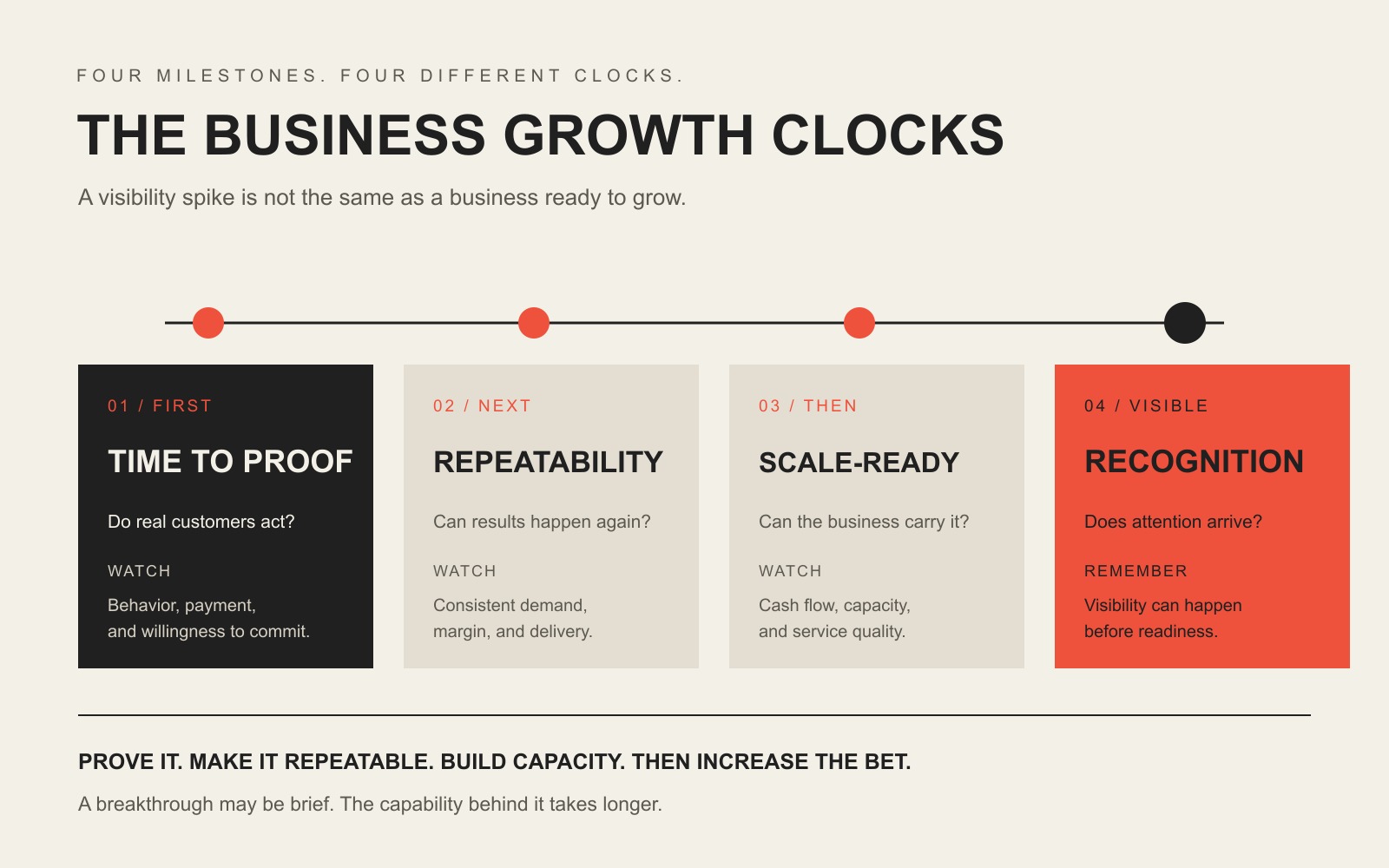
    Four distinct business milestones: time to proof, repeatability, scale-readiness, and recognition, each with different evidence to watch.

    1. Time to proof

    Will a real customer do something that matters? That might mean paying, booking, replying, requesting a proposal, renewing, or taking another qualified next step. Opinions help you learn, but behavior is stronger evidence.

    If demand is still a theory, start with small-business market research and validate the business idea before you bet the business.

    2. Time to repeatability

    Can you produce the result again without inventing a new process every time? One great month may be a signal. Repeatable lead flow, a sales process people can actually follow, consistent delivery, and customers who return or refer are stronger signs that you have something durable.

    3. Time to scale-readiness

    Can the system survive more volume? This is where growth gets expensive if the answer is no. More demand can expose weak margins, slow fulfillment, founder bottlenecks, poor onboarding, sloppy reporting, or a team that is already operating at the edge.

    Scope Design’s rule is simple: growth is a multiplier, not a cure. If you want the deeper operating check, use our business growth strategy guide before you add more volume.

    4. Time to recognition

    This is when the outside world notices: stronger referrals, bigger contracts, better rankings, industry attention, press, a breakout campaign, or a visible jump in demand. Recognition can lag behind a healthy business. It can also arrive too early and overwhelm a fragile one.

    That gap between the four clocks is what we call the Success Lag. Public attention is not proof that the other clocks are healthy. Lack of public attention is not proof that no progress is happening.

    What Sustainable Business Growth Actually Means

    Sustainable growth is not “revenue went up.” It is closer to this: the company becomes stronger at higher volume rather than merely busier.

    That means growth should improve—or at least protect—the things that keep the business healthy:

    • Economics: the work still produces acceptable margin and cash flow.
    • Demand quality: you are attracting buyers who fit the offer, not just generating activity.
    • Delivery: quality and response times do not collapse as volume rises.
    • Retention and trust: customers stay, return, upgrade, refer, or otherwise confirm the value.
    • Capacity: the company can handle more work without every exception landing back on the owner.

    A business can grow revenue while becoming less scalable. If every sale creates another founder approval, rescue mission, custom exception, or margin leak, the chart may look good while the operating system gets worse.

    The Proof-Before-Scale Check

    Before you treat a quick win as permission to accelerate, look for four kinds of proof.

    Demand proof

    People with the problem can be reached, understand the offer, and take a meaningful action. A burst of traffic is not demand proof if nobody qualified moves forward.

    Economics proof

    The sale works after the real costs are counted. That includes acquisition, fulfillment, support, refunds, rework, commissions, software, and the owner time that quietly subsidizes the process.

    Delivery proof

    The company can consistently produce the promised result. If quality depends on a heroic week from one person, you have a win—not yet a system.

    Capacity proof

    You know what more volume will require. That may mean automation, a documented process, better tooling, a contractor, a hire, a partner, more working capital, or simply saying no to the wrong work.

    When those four proofs are weak, make the next bet smaller. When they strengthen, earn the right to increase it.

    A Quick Note on Scary Startup Statistics

    The previous version of this article repeated several dramatic claims about startup failure and a fixed seven-to-ten-year success timeline. We removed them because the definitions were too loose for the certainty they implied.

    The U.S. Bureau of Labor Statistics is more careful: it reports establishment survival and explicitly notes that survival varies by business cycle, industry, and location. Its one-year figures are commonly around four in five across the table—not “90% fail.” More importantly, survival is not the same thing as profitability, founder wealth, repeatability, or scale-readiness.

    That distinction matters. If you use a survival statistic to answer “How long until my business is successful?” you are pretending several different questions are the same question.

    Quick Wins Are Signals, Not Strategy

    A quick win can be excellent news. The mistake is promoting it to a law of nature.

    • A viral post tells you a message or format earned attention. It does not prove profitable customer acquisition.
    • A large contract tells you one buyer said yes. It does not prove the sales process is repeatable.
    • A strong month tells you the offer can work. It does not prove the next six months will look the same.
    • A burst of referrals tells you trust exists somewhere in the system. It does not tell you whether you can create that demand on purpose.

    Treat the win as new evidence. Ask what caused it, what would have to be true for it to happen again, and what would break if it happened ten times next month.

    What to Measure Instead of “Am I Successful Yet?”

    The better question is: What evidence would make the next decision easier?

    • Customer action: conversations, qualified leads, proposals, purchases, renewals, referrals.
    • Economics: contribution margin, cash generation, payback, rework, support burden.
    • Repeatability: can the same channel, offer, sales process, or delivery system work again?
    • Capacity: utilization, bottlenecks, response times, backlog, owner dependence.
    • Learning velocity: how quickly does a test produce an answer that changes what you do next?

    This is where the old “do the one most important thing every day” advice becomes useful again. Your big rock should not be whatever feels important. It should be the action most likely to reduce the current constraint or resolve the most expensive uncertainty.

    A 30-Day Reality-Based Growth Loop

    You do not need a five-year prophecy to make a good decision this month. Use one short learning cycle.

    1. Name the constraint. Is the problem demand, lead quality, conversion, pricing, delivery, capacity, retention, cash, or something else?
    2. Define the evidence. What observable result would support or weaken your current assumption?
    3. Run the smallest useful test. Limit the budget, audience, channel, scope, or time window so you can learn without betting the company.
    4. Review the result. Keep, modify, or kill the idea based on what happened—not how attached you are to it.
    5. Systemize what survives. Document the process, improve the handoff, automate the boring parts, and decide whether the evidence earns a larger bet.

    If marketing is the current constraint, our 90-day marketing plan uses the same constraint-first logic over a longer operating window.

    When Your Website Becomes the Growth Constraint

    A website can support sustainable growth, but it cannot rescue a business model nobody wants. The useful question is not “Do we need a new website?” It is “What job is the current site failing to do?”

    Common growth constraints include an offer people cannot understand, weak proof, a confusing conversion path, slow manual follow-up, no useful measurement, brittle integrations, or a site that cannot support the way the business now sells and delivers.

    If that is the problem, start with our guide to creating a business website without buying the wrong thing. If the constraint touches positioning, market validation, lead flow, measurement, automation, or the operating process around digital work, Scope Design can help diagnose the problem before recommending a project.

    Frequently Asked Questions About Overnight Success and Sustainable Growth

    How long does it take for a business to become successful?

    There is no responsible universal timeline because “successful” can mean first sale, profitability, stable owner income, repeatable acquisition, a scalable operation, or public recognition. Track those milestones separately. Use evidence from your market, economics, delivery system, and capacity instead of borrowing a generic year count from somebody else’s business.

    Is overnight success real?

    Sudden recognition is real. Sudden capability is much rarer. A business can get a rapid burst of attention, sales, or opportunity, but whether that breakthrough becomes durable depends on the proof, repeatability, economics, and capacity already underneath it.

    What is sustainable business growth?

    In this article, sustainable business growth means growth the company can maintain without degrading cash flow, margins, quality, customer experience, or owner/team capacity. It is growth the system can support, not simply a bigger top-line number.

    How do I know when my business is ready to scale?

    Look for evidence that demand is real, the economics work, delivery is repeatable, and the organization has a credible capacity plan. You do not need perfect certainty, but the size of the next bet should be proportional to what you actually know.

    Build the Business That Can Survive the Breakthrough

    The goal is not to avoid fast growth. It is to avoid confusing speed with strength.

    Build proof. Make the result repeatable. Protect the economics. Remove the capacity constraint. Then scale what survives contact with reality.

    Do that long enough and the outside world may eventually call you an overnight success. You will know better.

  • Is it Wrong to Promote Products You Don’t Use?

    Is it Wrong to Promote Products You Don’t Use?

    Affiliate marketing ethics starts with a simple distinction: it is not automatically wrong to promote a product you do not personally use. But there is a hard line: do not present yourself as a first-hand user when you are not one, and do not make a recommendation stronger than the evidence behind it.

    That distinction matters for affiliates, agencies, publishers, creators, and businesses. You can explain what a product does, compare it using verifiable criteria, or tell an audience why it may be worth considering without pretending you have personal experience you do not have. The ethical question is not simply, “Did I buy it?” It is, “What am I claiming, what supports that claim, what incentive do I have, and what will a reasonable reader think I experienced?”

    TL;DR: Promoting something you have not personally used can be defensible when you state your experience level, disclose incentives, verify the claims you make, and match your certainty to the evidence. What crosses the line is pretending to have firsthand experience or using disclosure to excuse unsupported claims.

    Promotion and endorsement are not the same thing

    A business can advertise a product without every employee being a customer. An agency can market software its team does not need for its own operations. A publisher can curate tools based on documented features, pricing, demonstrations, customer evidence, and expert analysis.

    The problem starts when marketing language implies personal experience. “This has the features a small accounting firm may need” is a different claim from “I use this every day and love it.” The second statement is a personal endorsement. If you have not used the product, you cannot honestly make it.

    The Federal Trade Commission’s endorsement guidance makes the same basic distinction in legal terms: endorsements must be truthful and not misleading, and endorsers should not describe an experience with a product they have not tried.

    Disclosure is necessary, but it is not a magic shield

    The old version of this article had a simple rule: if you tell people you have not used the product, promoting it is ethical. That was too broad.

    Disclosure solves one problem: it helps the audience understand your relationship to the recommendation. It does not solve every other problem. Saying “I have not used this” does not give you permission to invent benefits, repeat unsupported performance claims, call something “the best” without a defensible basis, or hide the fact that you earn money if someone buys.

    If there is an affiliate commission, free product, client relationship, sponsorship, or another connection that could affect how readers evaluate your recommendation, disclose it clearly and where people will actually see it. The FTC’s Endorsement Guides FAQ is a useful source for the practical details.

    When promoting a product you do not use can be defensible

    There are legitimate situations where first-hand ownership is not the right standard. The better standard is whether your wording matches what you genuinely know.

    • You are not the target customer. A marketing consultant may be qualified to evaluate a CRM for a 50-person sales team without personally needing one.
    • You are curating rather than testifying. A resource guide can identify products that meet documented criteria without claiming the author personally used every option.
    • You have a credible evidence base. Product documentation, live demonstrations, independent testing, customer evidence, pricing, support policies, and verifiable specifications can support limited claims.
    • You are explicit about the limits of your knowledge. “Worth evaluating because…” is very different from “I recommend this from experience.”
    • Your commercial relationship is visible. Readers can tell when you may receive compensation or when the company is a client.

    When it crosses the line

    The issue is not lack of personal use by itself. It is a mismatch between what you know and what your marketing leads people to believe.

    • You imply that you personally used or tested the product when you did not.
    • You repeat a seller’s claims without checking whether there is a reasonable basis for them.
    • You rank products based mainly on commission rather than a reader-centered criterion.
    • You hide or bury an affiliate, sponsorship, client, or free-product relationship.
    • You use certainty words such as “best,” “guaranteed,” or “proven” when your evidence does not justify them.
    • You recommend something you would not be comfortable defending if the reader asked, “What exactly is this recommendation based on?”

    Use the Scope Design TRUST Check

    Before publishing a promotion for something you do not personally use, run it through five questions.

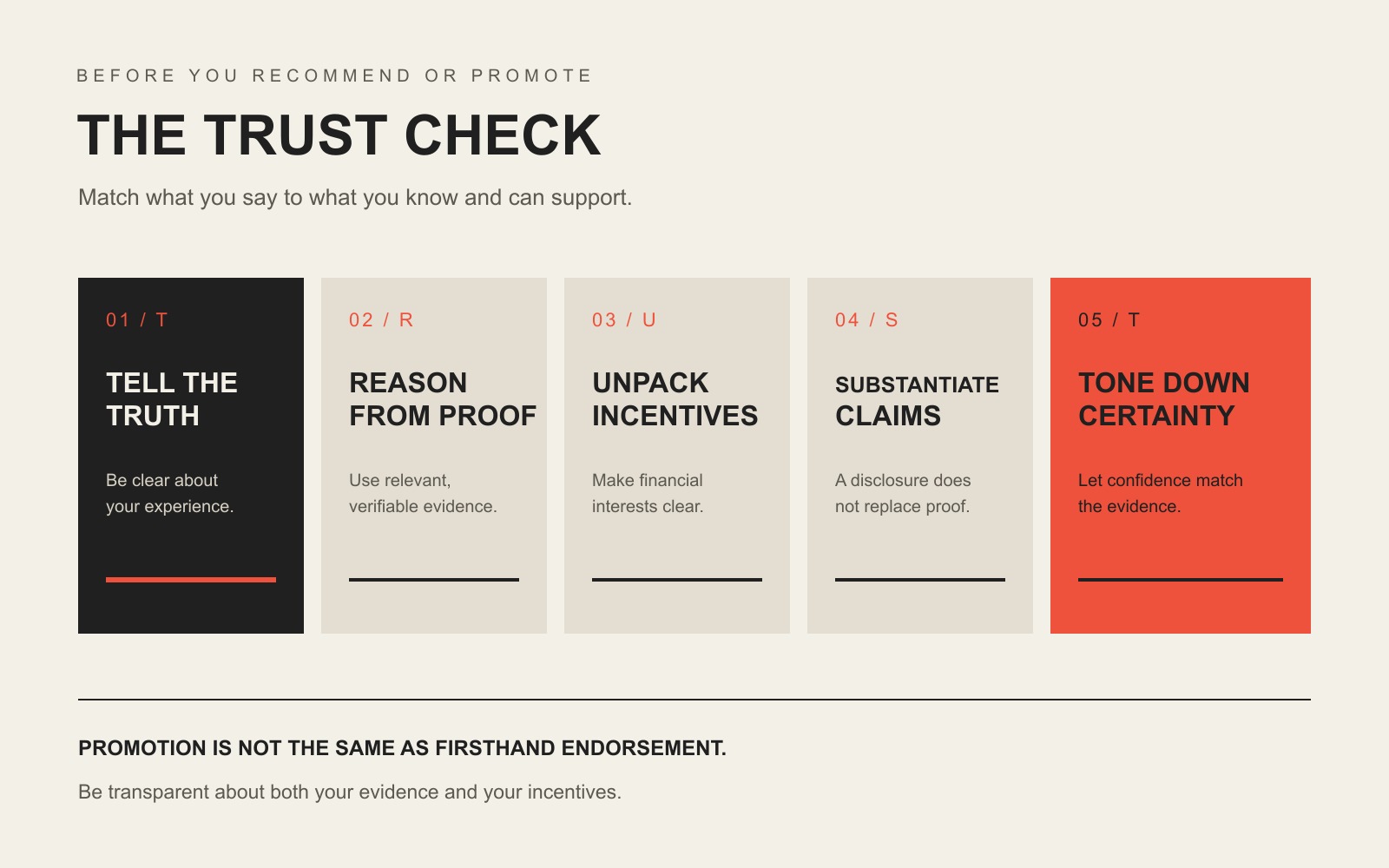
    The TRUST Check: Tell the truth about experience, Reason from evidence, Unpack incentives, Substantiate claims, and Tone down certainty to match the evidence.

    T: Tell the truth about your experience

    State the real level of contact you have had with the product. Did you buy it, use a trial, watch a live demonstration, inspect the documentation, interview customers, or only read the sales page? Do not let the copy imply a deeper experience than you actually have.

    R: Reason from evidence

    Be able to explain why the product made your list. A useful recommendation has a basis beyond “the commission is good.” Define the criteria that matter to the intended buyer and evaluate against those criteria.

    U: Unpack your incentives

    Tell readers about relationships that could affect how they interpret the recommendation. Compensation does not automatically make a recommendation dishonest. Hidden compensation makes it much harder for the audience to judge your advice fairly.

    S: Substantiate the claims

    Separate facts you can verify from opinions and predictions. If a vendor says its product “doubles conversions,” do not simply inherit that claim. The more consequential the claim, the stronger the evidence should be before you repeat it.

    T: Tone down certainty to match the evidence

    Your language should reflect what you really know. If you have not used the product, “this may be worth considering for X because of Y” is often more accurate than “this is the best tool for X.” Strong certainty requires strong evidence.

    What ethical wording actually sounds like

    Good marketing does not need fake certainty. In fact, precision usually makes a recommendation more useful.

    “I have not used this product in my own business because we do not need this category of software. I included it because its published feature set, pricing, and support model match the criteria we used for this guide. This is an affiliate link, so we may earn a commission if you buy.”

    That statement tells the reader what you did not do, what you did evaluate, and how money enters the picture. It also avoids pretending that research and personal experience are interchangeable.

    Affiliate marketing ethics: what makes a promotion ethical?

    Affiliate marketing is not inherently unethical. The model becomes questionable when the incentive drives the advice more than the reader’s needs, or when the marketer disguises advertising as independent personal experience.

    If you are deciding whether an affiliate model is appropriate in the first place, that is a separate business question. Scope Design’s guide to referral programs versus affiliate marketing deals with that choice. This article is about what happens after you choose to promote: what you can honestly claim and how you should disclose it.

    What about agencies promoting client products?

    An agency does not need every employee to become a customer of every client. That would be impossible in many industries. What the agency does need is enough product knowledge and evidence to create accurate advertising.

    If Scope Design markets a client’s service, the job is not to pretend we personally hired that service as a consumer. The job is to understand the offer, verify the claims we use, understand the intended buyer, and communicate the value without inventing experience. That is consistent with our broader approach to marketing psychology without tricking people: help people make a good decision instead of manufacturing pressure.

    A simple rule for deciding whether to publish

    Before you promote a product you do not use, ask one uncomfortable question: If a buyer challenged every sentence, could I explain exactly what this claim is based on?

    If the answer is yes, your experience is described accurately, your incentives are visible, and the evidence supports the language, the promotion can be both useful and ethical. If the answer depends on the reader assuming you know more than you do, rewrite it.

    That principle fits the larger Marketing & Advertising strategy Scope Design uses across channels: earn attention with a useful message, then give the buyer enough truth and context to decide.

    Frequently asked questions

    Can you recommend a product you have not used?

    You can discuss or recommend a product without owning it, but the strength and wording of the recommendation should match your evidence. Do not imply personal use or experience you do not have.

    Is affiliate marketing ethical?

    It can be. The ethical problems are usually misleading claims, hidden incentives, poor evidence, and recommendations designed around commission rather than audience fit. The payment model alone does not decide the ethics.

    In the United States, a material connection that could affect how people evaluate an endorsement should be disclosed clearly and conspicuously. Put the disclosure where readers can notice and understand it, not in a distant policy page.

    Does saying “I have not used this” make the promotion okay?

    No. That disclosure is useful, but the rest of the message still needs to be truthful and supported. You can be transparent about not using a product and still make a bad or misleading recommendation.

    Can an agency promote a product its team does not personally use?

    Yes, if the agency has enough knowledge to make accurate claims and does not pretend to offer a personal user testimonial. Marketing expertise and consumer experience are different forms of evidence.

    The bottom line

    You do not need to buy every product before you can say anything useful about it. You do need to be disciplined about the line between research, promotion, and personal endorsement.

    Tell people what you actually know. Show the basis for the recommendation. Disclose the incentive. Support the claims. Match your certainty to the evidence. If you can do those five things, you are helping the reader decide instead of asking them to trust a performance.

  • Email Marketing Laws: Complete 2026 Compliance Guide for Business Owners

    Email Marketing Laws: Complete 2026 Compliance Guide for Business Owners

    Last reviewed: August 18, 2026. Email marketing is still legal and useful, but there is no single global consent rule. For a U.S. business, the federal CAN-SPAM Act generally regulates commercial email as an opt-out system. Canada, the UK, the EU, and privacy laws can change what you need to do depending on who you are emailing, where they are, how you got the address, and what kind of message you are sending.

    The safest way to think about email compliance is not “Do I have a checkbox?” It is “Can I explain why this person is receiving this message, which rules apply, and how I will stop when they ask?”

    This guide is general educational information, not legal advice. Email and privacy laws change, and the right answer can depend on your audience, industry, data practices, and jurisdictions. For a high-risk campaign or a multi-country list, have qualified counsel review your process.

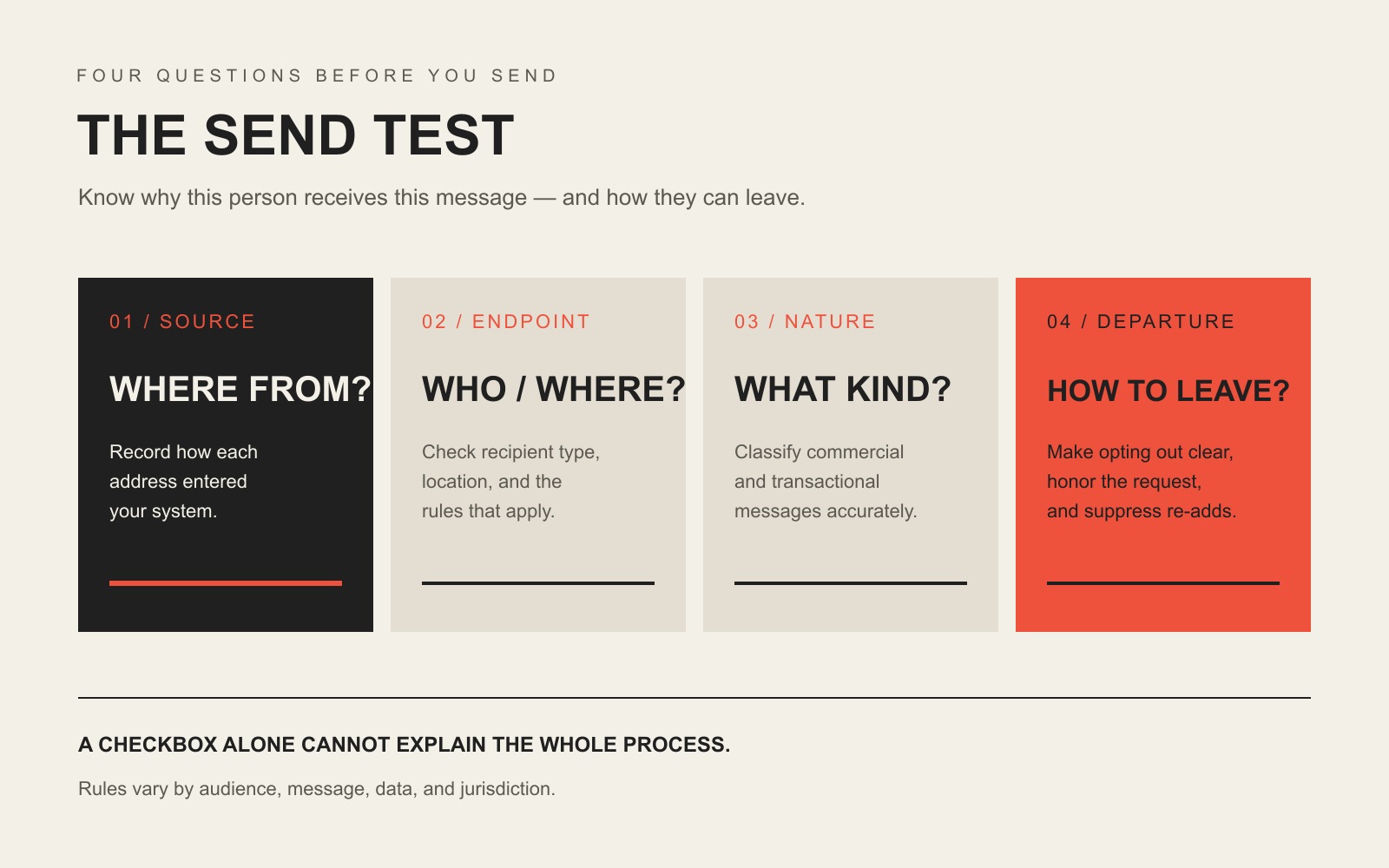
    The Scope Design SEND Test: Four Questions Before You Send

    Compliance gets easier when you treat it as a routing problem. Scope Design’s SEND Test gives a small business four checks to run before every campaign:

    • S = Source. Where did this email address come from? Do you have a signup, purchase, inquiry, event, referral, or list-source record? What permission or lawful basis can you prove?
    • E = Endpoint. Who is receiving the email, where are they, and what kind of subscriber are they? A U.S. business contact, a Canadian consumer, and a UK corporate address may be governed differently.
    • N = Nature. Is the message commercial, transactional or relationship-based, or mixed? The message’s primary purpose can change which rules apply.
    • D = Departure. Can the recipient opt out easily, and will every platform, employee, agency, and automation honor that choice?
    The SEND Test: Source of the contact, Endpoint and jurisdiction, Nature of the message, and Departure through a clear, honored unsubscribe.

    This is the practical mistake we see most often: a business treats the email platform as the compliance system. It is not. Mailchimp, HubSpot, Constant Contact, Klaviyo, or another provider can enforce settings, but your business still needs one source of truth for permission, list provenance, and suppression.

    U.S. Email Marketing Laws: CAN-SPAM Is the Main Federal Rule

    For U.S. businesses, start with the FTC’s CAN-SPAM compliance guide. CAN-SPAM applies to commercial email, including business-to-business email. It is not limited to bulk blasts.

    Generally, no. CAN-SPAM does not create a universal federal requirement to get prior opt-in consent before sending a commercial email. That is one of the most important corrections to older compliance articles. You can still violate CAN-SPAM even when someone signed up, and a message can still comply with CAN-SPAM even if there was no prior opt-in, provided all applicable requirements are met.

    That does not mean buying lists or emailing every address you can find is a smart policy. Other countries can require consent, state privacy rules can affect how personal data is collected or shared, email providers can impose stricter terms, and poor list practices can destroy deliverability. For most small businesses, a permission-first list is still the better operational standard.

    The core CAN-SPAM requirements

    1. Use accurate header information. Your From, To, Reply-To, originating domain, and routing information must accurately identify the sender.
    2. Use truthful subject lines. The subject must reflect the content of the message rather than tricking someone into opening it.
    3. Identify commercial messages as advertising. The FTC says this disclosure must be clear and conspicuous, while giving businesses flexibility in how it is presented.
    4. Include a valid physical postal address. A current street address, a properly registered USPS post office box, or a qualifying commercial mailbox can satisfy this requirement.
    5. Provide a clear way to opt out. People must be able to stop future marketing email from you without paying, providing extra personal information, or navigating a maze.
    6. Keep the opt-out mechanism working for at least 30 days after the send. Do not let a short-lived campaign landing page break the unsubscribe path.
    7. Honor opt-out requests within 10 business days. Faster is better operationally, but 10 business days is the federal maximum stated by the FTC.
    8. Monitor vendors and agencies. Hiring someone else to send your campaign does not let your company contract away CAN-SPAM responsibility.

    The FTC currently states that each separate violating email can be subject to penalties of up to $53,088. That is a ceiling, not a prediction of what a particular enforcement case would cost, but it is enough reason to make compliance a system rather than a footer someone remembers at the last minute.

    Commercial vs. Transactional Email: Classify the Message First

    CAN-SPAM treats commercial messages differently from qualifying transactional or relationship messages. A receipt, account update, warranty notice, or transaction-related message may fall into a transactional category. A newsletter promoting products or a sales announcement is commercial. Mixed messages require more care because the primary purpose matters.

    A common mistake is to remove the unsubscribe link because “they are already a customer.” Customers and members can still opt out of marketing. Before treating a customer email as transactional, make sure the content actually fits the legal category rather than simply being sent to someone who has a relationship with you.

    Where the Rule Gets Stricter: Canada, the UK, the EU, and California

    If your list crosses borders, do not apply CAN-SPAM to everyone and call the job done. The important difference is that several other regimes put more weight on consent, the source of the address, or the handling of personal data.

    Canada’s Anti-Spam Legislation is materially stricter than U.S. CAN-SPAM. The CRTC says commercial electronic messages generally require three things: consent, identification information, and an unsubscribe mechanism. Consent can be express or, in limited circumstances, implied. The sender needs to be able to prove the consent it relies on.

    Practical takeaway: if Canadians are intentionally in your marketing audience, build consent records into your process instead of assuming a U.S.-style cold-email rule will carry over.

    United Kingdom: PECR depends on subscriber type and how you got the address

    The UK Information Commissioner’s Office updated its electronic-mail marketing guidance in 2026. For unsolicited marketing to individual subscribers, you generally need consent or must meet every condition of a valid soft opt-in. Corporate subscribers are treated differently, but you still cannot hide your identity and you must provide a valid opt-out route.

    The products-and-services soft opt-in is not a loophole for purchased lists. It depends on collecting the contact details directly while selling or negotiating a sale, marketing your own similar products or services, and offering an opt-out both when the details are collected and in later messages.

    European Union: email rules and data-protection rules work together

    For EU audiences, email marketing can involve both the GDPR and electronic-communications rules. The European Commission notes that marketing data received from a third party must have been obtained lawfully and that the intended advertising use must be permitted. People also have a strong right to object to processing for direct marketing, and an objection must be respected.

    If you intentionally market to people in the EU or maintain a meaningful EU audience, do not reduce the question to a single “GDPR consent” checkbox. Review both your data-processing basis and the electronic-marketing rules that apply. For a deeper overview, see Scope Design’s GDPR compliance guide for U.S. small businesses.

    California: CCPA is a privacy law, not a universal email opt-in law

    The California Consumer Privacy Act is frequently mixed into email-law articles as though it requires every business to get email consent from every Californian. That is not an accurate shortcut. The California Attorney General describes the CCPA as a privacy law that gives consumers rights over personal information and applies to covered for-profit businesses meeting statutory thresholds.

    For email marketing, CCPA matters when your business is covered and your list-building, segmentation, sharing, sale, or advertising practices involve personal information. It can affect notices, consumer requests, and sale/sharing choices. It does not replace CAN-SPAM with a blanket California email-consent rule.

    Your List Source Matters More Than Most Businesses Realize

    The Source part of the SEND Test is where many preventable problems begin. Before importing any list, make the source visible in your CRM or email platform.

    • Website signup. Keep the form language, date, source page, and the preferences the person selected. Double opt-in is not a universal U.S. legal requirement, but it can provide stronger proof and improve list quality.
    • Customer purchase. A purchase does not automatically turn every later message into transactional email. Keep marketing and transactional logic separate.
    • Inquiry or lead form. Someone asking for a quote has asked for a response. That does not necessarily mean they asked for an indefinite promotional newsletter.
    • Networking or event contact. Record the context instead of dropping business cards into a generic sequence with no explanation.
    • Purchased, rented, scraped, or publicly listed addresses. Treat these as high-risk. Some jurisdictions require consent that a public address does not provide, bought-list consent may not name your organization, and providers may prohibit the practice even where U.S. federal law would not categorically ban a compliant commercial email.

    If you are building a small-business email program, legal compliance should be the floor. Scope Design’s broader email marketing strategy guide explains why permission, segmentation, handoffs, and useful content usually outperform a blast-calendar mindset.

    A working unsubscribe link is necessary, but it is not enough if your systems can accidentally re-add the same person tomorrow. The Departure part of the SEND Test is about suppression discipline.

    • Maintain one authoritative suppression status for each email address.
    • Sync suppression across your email service provider, CRM, sales automation, ecommerce platform, and agency tools.
    • Do not upload an old spreadsheet that silently re-subscribes people.
    • Audit forms and integrations after migrations, platform changes, and agency handoffs.
    • Keep enough evidence to show when and how a person opted out and when the system processed it.
    • Test unsubscribe links as a recipient, including mobile, before major sends.

    Scope Design rule: one business should not have five different versions of “unsubscribed.” Suppression needs a single operational truth.

    A Practical Email Compliance Stack for Small Businesses

    You do not need enterprise compliance software to create a defensible process. You do need clear ownership and a few controls that survive staff changes.

    1. Define audiences. Know which countries, states, and customer types you intentionally market to.
    2. Standardize collection language. Keep approved signup and privacy language for forms, checkout, lead magnets, events, and offline collection.
    3. Record provenance. Store where, when, and how each contact entered the system.
    4. Separate message types. Transactional messages and promotional campaigns should not share sloppy rules just because they use the same email platform.
    5. Centralize suppression. Make opt-out status harder to override than a marketing list import.
    6. Control vendors. Give agencies and contractors written rules for list use, sender identity, approval, and suppression.
    7. Review periodically. Recheck laws, forms, automations, vendor settings, privacy notices, and unsubscribe behavior when your markets or technology change.

    For local businesses, context matters too. A person may willingly hear from a nearby business about genuinely relevant local information and still dislike broad, creepy targeting. Our local email marketing guide covers that operational side of permission and usefulness.

    2026 Email Marketing Compliance Checklist

    Before collecting addresses

    • Identify the jurisdictions and subscriber types you plan to market to.
    • Use clear signup language that matches what you will actually send.
    • Link to an accurate privacy notice when personal-data laws require it.
    • Decide what evidence of consent, permission, or list source you will retain.

    Before each campaign

    • Run the SEND Test: Source, Endpoint, Nature, Departure.
    • Confirm the From name, domain, Reply-To, and subject are accurate.
    • Include required sender identification and a valid postal address.
    • Include a clear unsubscribe path for commercial marketing.
    • Exclude suppressed contacts and validate any new import before it enters an automation.
    • Check whether a stricter consent rule applies to any segment.
    • Test the message and unsubscribe flow on desktop and mobile.

    After sending

    • Process opt-outs promptly and keep the federal 10-business-day maximum in mind for U.S. CAN-SPAM.
    • Investigate spam complaints, unusual bounce patterns, and evidence that list provenance is poor.
    • Keep suppression synchronized across systems and vendors.
    • Record major process changes so the next employee or agency does not recreate an old mistake.

    Common Email Marketing Law Questions

    Not automatically. Federal CAN-SPAM generally does not require prior opt-in consent for commercial email, but the message still has to comply with CAN-SPAM. Other laws, jurisdictions, industry rules, platform terms, or data practices can create stricter obligations.

    Commercial emails covered by CAN-SPAM need a clear and conspicuous way to opt out of future marketing. Purely transactional or relationship messages can be treated differently, so classify the message rather than assuming every email belongs in one bucket.

    How quickly must a U.S. business honor an unsubscribe?

    The FTC says CAN-SPAM opt-out requests must be honored within 10 business days, and the opt-out mechanism must remain capable of processing requests for at least 30 days after the message is sent. Good systems typically suppress much faster.

    Can I cold-email another business?

    CAN-SPAM has no B2B exception, but it also does not create a general federal prior-consent requirement. A U.S. B2B cold email can still be subject to CAN-SPAM’s commercial-message rules. If the recipient is outside the U.S., or personal data was sourced or used in a way covered by another privacy law, the answer can change.

    Can I use a purchased email list?

    Treat purchased lists as high-risk. A seller’s claim that a list is “compliant” does not prove that consent names your business or covers email marketing. UK guidance specifically warns that bought-list consent must validly cover your organization and method, and the soft opt-in does not apply to bought-in lists. Even where a U.S. send could be structured to comply with CAN-SPAM, purchased lists are usually a poor foundation for deliverability and trust.

    If my agency sends the emails, who is responsible?

    The FTC explicitly warns businesses that they cannot contract away CAN-SPAM responsibility. Your agreement should define list-source rules, approvals, sender identity, unsubscribe handling, suppression, access, and evidence retention, but your business still needs to monitor what is being sent on its behalf.

    Compliance Is the Floor. A Useful Email Program Is the Goal.

    The strongest email programs do not look for the minimum legal excuse to send one more message. They make permission obvious, keep data clean, make leaving easy, and send things people have a reason to want.

    That approach improves more than compliance. It gives your sales and marketing team a cleaner audience, reduces accidental re-contact, makes vendor handoffs safer, and creates a system you can explain when someone asks, “Why did I get this?”

    Scope Design is not a law firm, but we can help you turn counsel-approved requirements into forms, CRM fields, email-platform settings, automations, suppression workflows, and a practical marketing process. If your email system has grown into a pile of lists and disconnected tools, contact Scope Design and we can help you straighten out the operational side.


    Primary sources used for this update: Federal Trade Commission CAN-SPAM compliance guide; UK ICO electronic-mail marketing guidance; CRTC CASL guidance; California Attorney General CCPA overview; and European Commission direct-marketing data guidance.

  • How to Start an Online Business With Less Risk: A Validation-First Guide

    How to Start an Online Business With Less Risk: A Validation-First Guide

    If you want to know how to start an online business with less risk, stop looking for a business that cannot fail. There is no universally safe model, guaranteed income timeline, or “hot” niche that removes uncertainty. A better goal is to make the next decision reversible: cap what you can lose, test one important assumption, and invest more only when real buyer behavior gives you a reason.

    That changes the starting question from “Which online business will make the most money?” to “What is the cheapest credible way to learn whether a specific buyer will pay for this?” If you are still deciding what to sell, start with Scope Design’s guide to generating business ideas. If you already have an idea, this guide helps you decide how much of a bet it has earned.

    What “low risk” actually means for an online business

    Online businesses can avoid some costs that come with a physical location, but “online” does not mean “free.” Your time has value. Domains, software, licenses, professional help, advertising, fulfillment, payment processing, inventory, and customer support can all become real expenses depending on the model.

    The U.S. Small Business Administration recommends calculating startup costs before launch because those costs affect profit estimates and break-even planning. Its startup-cost guidance explicitly includes online businesses and reminds founders to account for expenses such as market research, websites, marketing, licenses, and professional services.

    At Scope Design, we prefer a simpler operating definition: a low-risk launch is one where a failed test teaches you something useful without creating a loss you cannot comfortably absorb.

    Set a Risk Budget before you test

    Risk limitDecide this before launchWhy it matters
    Cash ceilingThe most cash you are willing to spend before reviewing the evidencePrevents a small experiment from turning into an open-ended build
    Time ceilingThe hours or calendar window you will give this version of the testMakes founder time visible instead of pretending it is free
    Dependency ceilingThe platforms, contracts, inventory, tools, or people you are willing to depend onReduces lock-in while the idea is still uncertain
    Decision dateThe date when you will continue, change, or stopStops “just one more month” from becoming the default strategy

    This is not a full startup budget. If you need to model the broader financial plan, use our guide to launching a startup under a constrained budget. The Risk Budget has one job: define how much uncertainty you can afford to buy with the next experiment.

    Choose the model you can validate—not the model someone calls “best”

    Search results are full of “best online business” lists. The problem is that risk moves around. A service may require little inventory but depend heavily on your time. A digital product may have low delivery cost but require substantial creation and audience work before demand is known. Ecommerce may create faster purchase evidence but add product, fulfillment, return, and supplier exposure.

    ModelWhat you can test earlyMain early exposureStronger proof signal
    Service or consultingA narrow paid pilot delivered manuallyYour time and sales accessA qualified buyer pays for a defined outcome
    Digital productA workshop, prototype, paid beta, or small first versionCreation time before demand is clearBuyers pay for the narrow version and use it
    Content / audience / affiliateA focused body of useful content around one buyer problemTime to earn attention and trustQualified traffic takes commercially meaningful actions
    EcommerceA small assortment, pre-order where appropriate, or limited batchInventory, fulfillment, returns, supplier dependenceReal orders with economics you can support

    There is no universal winner in that table. The better starting model is usually the one that lets you reach a specific buyer, make a real offer, and observe meaningful behavior without exceeding your Risk Budget.

    Use an Evidence Ladder instead of collecting compliments

    “That sounds cool” is not the same evidence as “Where do I pay?” Early validation gets stronger as behavior moves closer to an actual exchange of value. You do not need a magic number of interviews, clicks, or preorders. You need evidence strong enough for the size of the next commitment you are considering.

    1. Attention: people search, click, save, watch, or read. Useful for discovering interest, but weak proof of willingness to pay.
    2. Conversation: the right buyers describe the problem in their own words, ask specific questions, or reply to outreach.
    3. Commitment: someone books a call, joins a relevant waitlist, requests a quote, shares requirements, or gives you permission to follow up.
    4. Money-adjacent behavior: a buyer accepts pricing, requests a proposal, agrees to a paid pilot, or takes another action that carries real friction.
    5. Payment and repeat behavior: buyers pay, use the offer, return, refer others, or buy again under economics you can support.

    If you want a deeper pre-screen before you spend, our article on profit signals in business ideas is the better handoff. The key distinction is simple: trends can suggest where to look; behavior tells you whether your specific offer is earning the next bet.

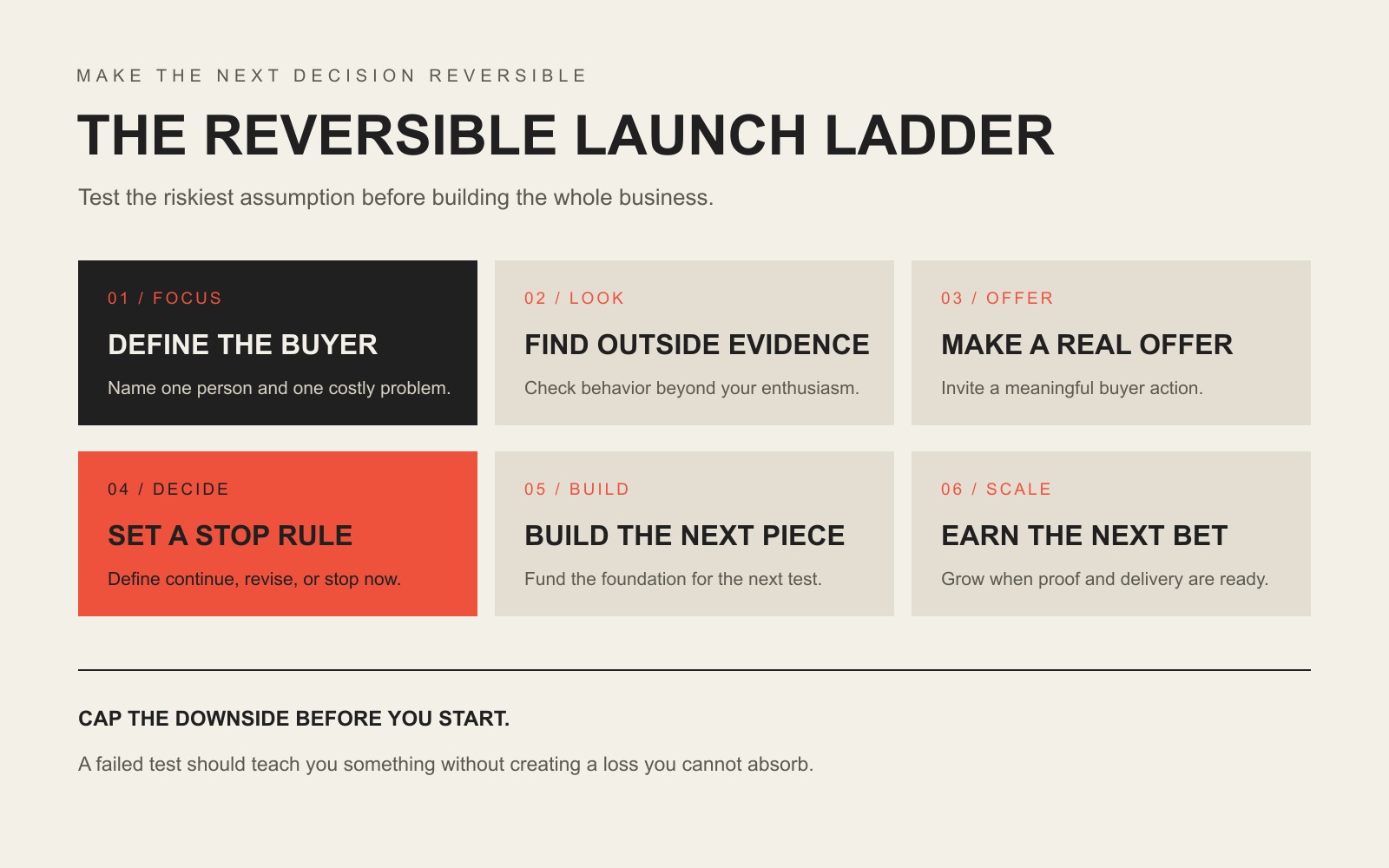
    How to start an online business: the Scope Design Reversible Launch Ladder

    This is the sequence we recommend when an idea looks plausible but has not yet earned a large website, inventory purchase, software build, automation stack, or advertising budget. It turns the question of how to start an online business into a series of smaller decisions that can each be tested before the next commitment grows.

    The Reversible Launch Ladder: define one buyer, find outside evidence, make a real offer, set a stop rule, build only the next piece, and scale when proof supports it.

    1. Define one buyer and one problem

    “Small businesses” is not a buyer definition. “Independent HVAC companies that lose emergency-call leads after hours” is closer. Specificity makes research, outreach, pricing, landing-page copy, and validation less ambiguous.

    2. Look for evidence outside your own enthusiasm

    Look for existing spending, repeated complaints, search behavior, competitor demand, workarounds, active communities, and reachable buyers. The SBA’s current market-research guidance says market research can help confirm or improve an idea and reduce risk before a business launches. It specifically points founders toward questions about demand and market size.

    3. Make the smallest real offer

    Do not build the automated version first if you can test the value manually. Sell the smallest useful outcome. For a service, that may be a paid pilot. For a digital product, it may be a live workshop before a polished course. For ecommerce, it may be a small assortment rather than a warehouse of inventory.

    4. Set the stop/continue rule before results arrive

    Decide what would make you continue, change the offer, change the audience, or stop. Do this before you see results so you are less tempted to reinterpret every weak signal as proof you should keep spending.

    5. Build only the foundation the next test needs

    A simple owned foundation can be valuable: a domain you control, a clear landing page, professional email, a way to capture leads, basic analytics, and a reliable path to buy or contact you. It does not need to be a giant custom build on day one. When the offer has earned a stronger web presence, use our guide to creating a business website without buying the wrong thing.

    6. Earn the right to scale

    More traffic does not fix an offer people do not want. Before you add channels, ask whether the current experiment produced enough qualified demand and workable economics to justify the next cost. When it has, build your first measurable internet-marketing loop; after validation is stronger, move into startup growth experiments that earn the right to scale.

    When should you spend more on a website, automation, inventory, or ads?

    Spend more when the investment removes a constraint you have actually observed. A better website can make sense when qualified prospects need clearer proof, easier booking, stronger checkout, or better measurement. Automation can make sense when a repeatable process is consuming time. More inventory can make sense when proven demand is being constrained by availability. Ads can make sense when you have an offer and conversion path worth putting more people through.

    That is different from buying tools because a successful founder on YouTube uses them. Technology is leverage. Leverage is most useful after you know what deserves to be multiplied.

    If your next constraint is marketing rather than validation, Scope Design’s small-business marketing strategy guide shows how the larger system fits together.

    A seven-day validation sprint that does not promise seven-day profit

    You can learn a lot in a week if you keep the goal narrow. This is a learning sprint, not an income guarantee or a claim that every business can be validated in seven days.

    1. Day 1 — Define: write one buyer, one problem, one outcome, and one reason the problem matters now.
    2. Day 2 — Gather evidence: review search demand, competitor offers, communities, reviews, complaints, and existing spending. Write down what is observed versus what is assumed.
    3. Day 3 — Shape the smallest offer: define a narrow deliverable, price or pricing range, who it is for, and what it does not include.
    4. Day 4 — Create the minimum path: use a simple page, form, booking link, checkout, marketplace listing, or direct outreach script—whatever is sufficient for a credible test.
    5. Days 5–6 — Put it in front of the right people: ask for a real next action, not general feedback. Record objections and questions verbatim.
    6. Day 7 — Review against the stop rule: compare results with the Risk Budget and Evidence Ladder. Continue, change one major assumption, or stop.

    Six mistakes that make an “online” business riskier than it needs to be

    • Treating a booming trend as proof of your market. A trend can be interesting without producing a reachable buyer who wants your offer.
    • Building the finished system before testing the riskiest assumption. A polished website cannot validate a problem that does not matter enough.
    • Depending on one platform you do not control. Marketplaces and social platforms can be useful, but your domain, customer records, email permission, and core assets reduce unnecessary dependency.
    • Automating uncertainty. Automation makes a known process faster. It can also make a bad process fail faster.
    • Confusing attention with economics. Views, likes, and traffic are inputs. A business still needs revenue that can support the real costs of delivery and acquisition.
    • Starting with “passive income” as the operating requirement. Many models become more leveraged over time, but learning the buyer, offer, delivery, support, and acquisition system is active work.

    A note on affiliate and sponsored recommendations

    Affiliate revenue can be one monetization method, but it is not permission to recommend products you cannot stand behind. The Federal Trade Commission says material financial relationships should be disclosed clearly and conspicuously so readers can evaluate the endorsement. Its Endorsement Guides FAQ specifically addresses affiliate marketers who earn commissions through links.

    That is why this revision intentionally removes the old commission ranges, sponsorship-price ranges, subscriber-value claims, and fast-profit promises. Those numbers varied too much by business and lacked a defensible evidence chain for this article.

    Frequently asked questions about how to start an online business

    What is the best online business to start for beginners?

    There is no universal best model. A good beginner option is one where you understand the buyer, can reach them, can deliver the first version without large irreversible costs, and can ask for a meaningful commitment quickly. For some people that is a service; for others it is a product, content business, or small ecommerce test.

    Can I start an online business with no money?

    You may be able to test some service or audience ideas with very little cash, especially if you already own the necessary equipment and can reach buyers directly. But “no money” should not mean “no cost.” Your time, software, transaction fees, legal obligations, taxes, licenses, professional advice, fulfillment, and website needs can create real expenses. Build a Risk Budget instead of relying on a zero-cost promise.

    Do I need a website before I validate an online business idea?

    Not always. You can sometimes test demand through direct outreach, a marketplace, a simple booking page, a basic landing page, or a manual paid pilot. A website becomes more important when you need a durable home for your offer, proof, search visibility, lead capture, measurement, or transactions. The right question is not “website or no website?” It is “what minimum owned foundation does the next credible test require?”

    How do I know whether an online business idea can be profitable?

    Early interest is not proof of profit. You need buyers willing to pay, a price that can cover the real costs of delivery, and a repeatable way to acquire and serve customers without the economics collapsing as volume grows. Track revenue, direct costs, acquisition costs, fulfillment effort, refunds or churn where relevant, and the founder time the model requires.

    How can I make $10,000 a month online?

    Treat $10,000 as a target to model, not a promise. Work backward from price and gross contribution: how many customers, projects, memberships, orders, or transactions would the business need? Then ask whether your reachable market, delivery capacity, acquisition cost, and retention make that volume plausible. If the math depends on unrealistic conversion assumptions, change the model before increasing spend.

    What should I automate first?

    Automate the repeated, stable work you already understand: routine follow-up, scheduling, invoicing, reporting, content distribution, or data movement can be good candidates. Do not automate the part of the business that is still teaching you what customers want. Manual work is often valuable during validation because it exposes the questions, exceptions, and friction an automated system would otherwise hide.

    Start smaller—but make the test more real

    The goal is not to avoid every risk. It is to stop paying large prices for lessons you could have learned more cheaply.

    Define a buyer. Identify the assumption most likely to kill the idea. Set a Risk Budget. Ask for behavior stronger than compliments. Build only what the next proof step needs. Then invest more when the evidence earns it. That is the core of how to start an online business without confusing motion, tools, or trends with proof.

    If your offer has reached that point, Scope Design can help you turn the proven direction into a right-sized website and marketing system—without pretending more technology can substitute for market evidence.

  • Google Algorithm Updates: What Businesses Should Do When Rankings Move

    Google Algorithm Updates: What Businesses Should Do When Rankings Move

    Google algorithm updates can change rankings and organic traffic, but a traffic drop does not automatically mean Google “penalized” your website. Confirm the update, isolate which pages and queries changed, rule out tracking and technical failures, compare the affected content with current search intent, and then improve the underlying weakness. An update is a reason to diagnose—not a diagnosis.

    TL;DR: Do not rewrite the whole website in a panic. Use this order:

    1. Verify that the drop is real and overlaps a confirmed Google update.
    2. Identify the affected pages, queries, devices, countries, and search types.
    3. Rule out crawling, indexing, security, migration, and tracking problems.
    4. Check whether demand or the search results changed.
    5. Improve usefulness, originality, clarity, and trust where the evidence supports it.
    6. Measure qualified actions and business impact—not rankings alone.

    Scattering keywords around the page like holy water is not an update-recovery strategy. It is how a nervous business creates a second problem while trying to fix the first.

    What is a Google algorithm update?

    A Google algorithm update is a change to the automated systems Google uses to crawl, understand, rank, and present web content. Google says its ranking systems evaluate many factors and signals, mostly at the page level, while also using some site-wide signals and classifiers. Significant broad changes are called core updates; Google announces those when the notice is likely to help site owners.

    Core updates are not normally targeted punishments against one website. They are broad reassessments intended to improve the relevance and usefulness of results as content, competitors, search behavior, and Google’s systems change. A page moving down may be weaker than the pages now ranking above it, but it may also be caught in a technical problem, a change in demand, a different result layout, or ordinary volatility.

    That distinction matters. “Google changed something” describes timing. It does not tell you what to fix.

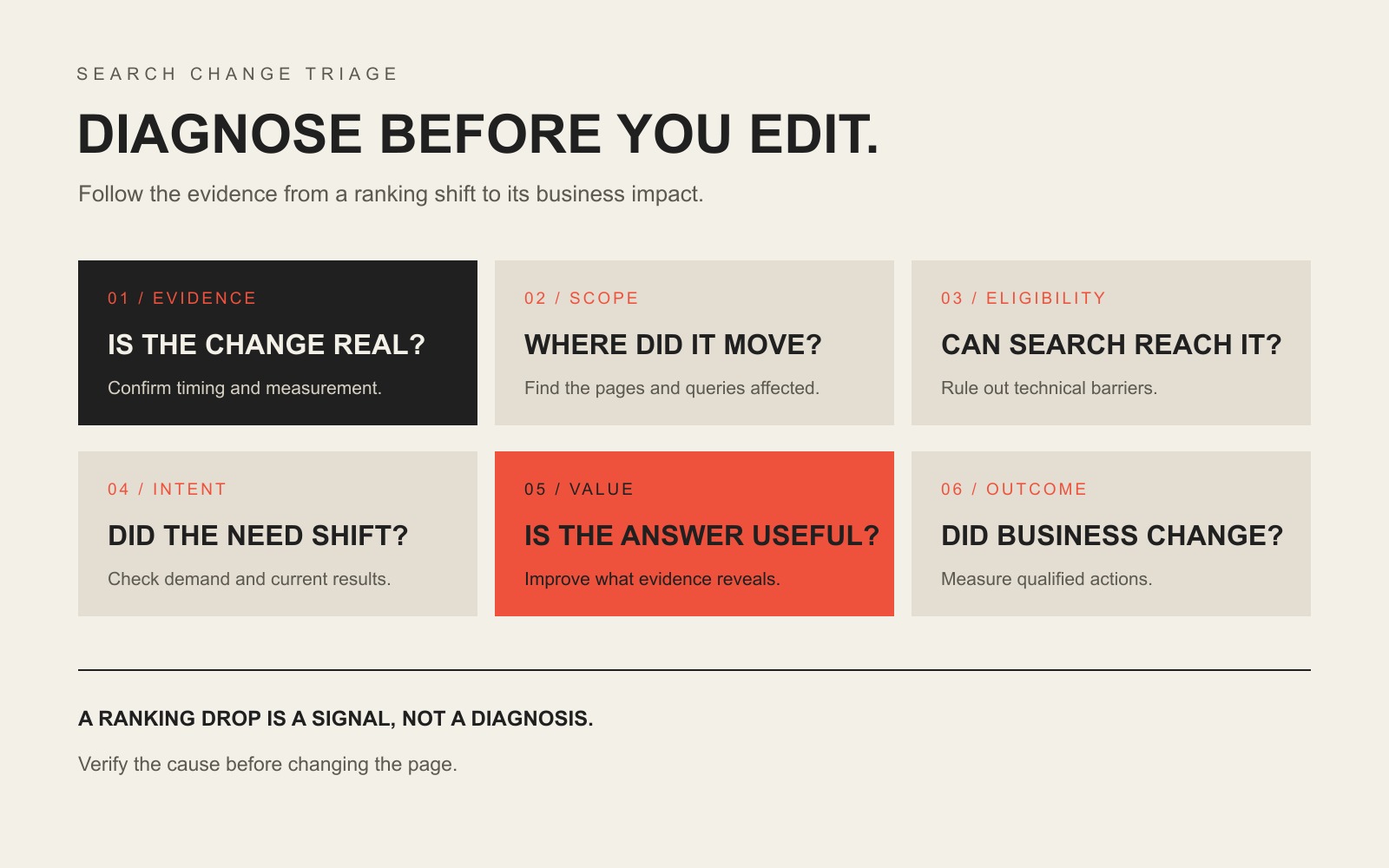
    The Scope Design Search Change Triage

    When search visibility moves, investigate six layers in order: evidence, scope, eligibility, intent, value, and outcome. Each layer answers a different question, and skipping one encourages expensive guessing.

    Search Change Triage: verify evidence, scope the change, confirm technical eligibility, assess intent, improve content value, then measure business outcomes.

    Layer Question to answer Useful evidence Common bad reaction
    Evidence Did a meaningful change actually happen? Search Console, analytics, status dashboard, tracking checks Reacting to a one-day wobble
    Scope Exactly where did performance change? Pages, queries, devices, countries, search types Treating one page as a site-wide collapse
    Eligibility Can search engines crawl, index, and serve the content correctly? Indexing, crawl, security, manual-action, canonical, robots, and server checks Rewriting copy while the page is accidentally noindexed
    Intent Did demand or the result page change? Search results, Google Trends, query patterns, competitor movement Blaming quality for a seasonal decline
    Value Is the page still the most useful answer for the intended audience? First-hand review, content comparison, source and trust audit Adding 600 words because an SEO tool looked disappointed
    Outcome Did the change affect qualified business activity? Qualified inquiries, purchases, booked calls, pipeline, assisted conversions Calling a ranking loss a revenue disaster without checking revenue

    This sequence protects good pages from random surgery and bad pages from cosmetic “optimization.” It also tells you when the website is not the constraint.

    Step 1: Verify the update and the data before changing content

    Start with Google’s Search Status Dashboard. It records announced ranking, crawling, indexing, and serving incidents, including the beginning and end of broad rollouts.

    Google recommends waiting at least a full week after a core update finishes before making the primary before-and-after comparison in Search Console. Compare a representative period after the rollout with a similar period before it, and account for seasonality. A frantic mid-rollout audit can turn temporary volatility into permanent self-inflicted damage.

    Then verify the measurement itself:

    • Is Search Console showing lower impressions, lower clicks, or both?
    • Does Analytics show the same landing-page decline?
    • Did a consent change, tag change, analytics filter, or site deployment alter measurement?
    • Did the business migrate URLs, redesign templates, change domains, or modify internal links?
    • Is the apparent decline limited to one day, one device, or one geography?

    Search Console and Analytics measure different parts of the journey, so the numbers will not match perfectly. What you need is a coherent pattern, not identical totals.

    Step 2: Isolate the pages, queries, and search surfaces that moved

    “Organic traffic is down” is too vague to act on. Break the change apart.

    Compare:

    • individual landing pages;
    • queries and query groups;
    • branded versus non-branded searches;
    • commercial versus informational intent;
    • desktop versus mobile;
    • countries and service regions;
    • Web, Images, Video, News, and Discover where relevant;
    • clicks, impressions, click-through rate, and average position.

    The shape of the change narrows the diagnosis. If impressions fell with stable positions, demand may have changed. If impressions remain stable but clicks fall, the result page, title, snippet, or competing result may be taking attention. If one template or directory drops, investigate what those pages share. If every search surface falls on the same deployment date, stop composing a thought-leadership essay and inspect the deployment.

    Average position is useful here as a diagnostic, not as the business objective. Our guide to SEO metrics that matter explains why rankings belong below qualified actions in the measurement hierarchy.

    Step 3: Rule out technical eligibility and policy problems

    Content quality cannot save a page Google cannot reliably crawl, index, or serve. Before rewriting anything, check the boring machinery:

    • server availability and response errors;
    • Page Indexing and Crawl Stats reports;
    • accidental noindex directives;
    • robots.txt and firewall restrictions;
    • incorrect canonicals;
    • broken redirects or redirect chains;
    • URL changes from a migration or redesign;
    • security warnings and hacked content;
    • Manual Actions in Search Console;
    • structured data that contradicts the visible page;
    • important content hidden from the rendered page.

    Technical failures often create cleaner patterns than content problems: one template disappears, mobile collapses while desktop holds, or traffic falls immediately after a release. That is useful. A broken canonical is less philosophical than “maybe Google dislikes our vibe.”

    If URLs changed, use permanent redirects carefully and update internal links at their source. Our 301 redirect guide covers the mechanics, although the decision to change an established URL should never be cosmetic.

    Step 4: Check whether search demand or intent changed

    Not every decline is about your website. Search demand changes with seasons, news, technology, terminology, regulation, and buyer behavior. Google’s traffic-drop guidance specifically recommends comparing affected queries with Google Trends to distinguish a site-specific loss from a broader shift in interest.

    Inspect the current results for the queries that mattered. Ask:

    • Are users now looking for a current answer rather than an evergreen one?
    • Did the query become local, transactional, visual, or comparison-driven?
    • Are product listings, videos, forums, maps, or AI features occupying more of the result page?
    • Did a new entity, term, or product replace the language your audience used before?
    • Are the pages now ranking solving a different job?

    A page can be accurate and still miss the current question. Search intent is not a keyword costume. It is the job the searcher expects the result to perform.

    Step 5: Improve the underlying content weakness—not the plugin score

    When the decline is sustained, significant, and concentrated in pages that lost relevance or usefulness, perform a real content assessment.

    Look for:

    • an answer buried beneath a long introduction;
    • generic summaries with no first-hand experience;
    • stale facts, screenshots, pricing, examples, or platform instructions;
    • unsupported statistics and suspiciously precise claims;
    • several thin pages competing for the same intent;
    • weak authorship, business identity, sourcing, or contact information;
    • missing comparisons, risks, costs, limitations, and next steps;
    • a page that describes a topic but never helps the reader make a decision;
    • obvious templated or scaled content that adds nothing new.

    Google advises against quick fixes based on rumors and recommends meaningful, sustainable improvements for users. It also treats deletion as a last resort when content can be salvaged. That supports a sane editorial decision tree: protect pages that already work, update pages whose facts or usefulness slipped, consolidate overlapping pages, redirect obsolete duplicates, and remove only material that serves no useful purpose.

    That is also how Scope Design is rebuilding this content library. We are not deleting URLs because a content plugin made a frowny face. We are protecting evidence of value and fixing the actual weaknesses.

    For the fundamentals behind crawlability, relevance, authority, and conversion, start with our SEO basics guide for business owners. For the full operating model, see the SEO Strategy and Analytics pillar.

    Step 6: Connect the search change to a business outcome

    Traffic is evidence of attention, not evidence of value.

    A commercial service page losing ten qualified visits may matter more than a glossary post losing a thousand drive-by readers. A ranking decline can be strategically harmless if the lost queries never produced useful action. Conversely, stable traffic can hide a real problem if the audience shifts toward students, job seekers, competitors, or people outside the service area.

    Measure the last outcome the website can genuinely influence:

    • qualified inquiries by landing page and source;
    • purchases or revenue for transactional sites;
    • booked and attended appointments;
    • sales-ready opportunities and pipeline contribution;
    • lead quality and sales acceptance;
    • assisted conversions from educational content;
    • useful self-service or staff time saved.

    Rankings and clicks explain movement. Qualified actions tell you whether the movement matters.

    What should you do while a Google core update is rolling out?

    Document first. Avoid broad changes to pages that were performing well before the rollout unless you uncover a definite technical, security, legal, or factual problem.

    During the rollout:

    1. Record the start date and affected metrics.
    2. Check for unrelated deployments and tracking changes.
    3. Export or annotate baseline Search Console and Analytics data.
    4. Test critical pages, forms, and server responses.
    5. Note affected query and page groups.
    6. Wait for the rollout to finish before declaring a winner, loser, or apocalypse.

    After the rollout, allow enough time for a clean comparison. Google distinguishes small position changes from large sustained drops and explicitly advises against drastic action for pages that remain strong. You do not need an emergency rewrite because a page moved from second to fourth for three days.

    What does recovery from a core update look like?

    Recovery is not an undo button. It is a series of defensible improvements followed by re-crawling, re-evaluation, and measurement.

    A practical recovery sequence is:

    First week after the rollout

    • Verify the timing and data.
    • Segment pages and queries.
    • Fix confirmed technical, security, tracking, or policy problems.
    • Protect pages with small changes and strong business value.

    First 30 days

    • Review the most affected high-value pages manually.
    • Compare them with the current intent and strongest results.
    • Update stale facts and improve clarity, evidence, first-hand insight, and navigation.
    • Consolidate substantial overlap instead of publishing more near-duplicates.
    • Strengthen useful internal links between pillar, supporting, and service pages.

    Following months

    • Monitor impressions, clicks, query mix, and qualified actions.
    • Record what changed and when.
    • Continue improving the overall topic library and website foundation.
    • Resist attributing every fluctuation to the last edit you remember making.

    Google says some changes may appear within days while others can take several months, and no improvement guarantees a visible ranking gain. Anyone guaranteeing complete recovery by a particular Tuesday is selling certainty Google itself does not offer.

    Do AI Overviews and AI Mode require a separate SEO strategy?

    No. Google says there are no additional technical requirements or special schema needed to appear as a supporting link in AI Overviews or AI Mode. A page must be indexed, eligible to appear in Search with a snippet, comply with policies, and follow the same foundational SEO practices.

    That does not mean the writing should remain vague. AI systems and human readers both benefit from direct answers, descriptive headings, explicit entities, original frameworks, visible expertise, and claims linked to authoritative evidence. Those are good information practices—not a magic “GEO” incantation.

    Google includes traffic from its AI features in Search Console under the Web search type. Use Search Console and Analytics together, and avoid inventing an “AI citation conversion rate” your tools cannot actually measure.

    What not to do after rankings fall

    • Do not rewrite every page before confirming the pattern.
    • Do not change established URLs to make them look fresher.
    • Do not stuff exact-match keywords into every heading.
    • Do not publish five new pages targeting the same intent.
    • Do not remove useful content because of a third-party score.
    • Do not buy links from somebody who calls them “authority injections.”
    • Do not claim AI content is automatically penalized.
    • Do not assume more words mean more usefulness.
    • Do not celebrate recovered traffic until you know whether it produces qualified action.

    Google’s spam policy focuses on manipulative behavior, including scaled production of unoriginal pages that add little value, regardless of how the content was created. The problem is not that software touched the draft. The problem is publishing a warehouse of beige nothing for the primary purpose of manipulating rankings.

    Frequently asked questions about Google algorithm updates

    How often does Google update its algorithm?

    Google makes smaller changes continually and says significant broad core updates happen several times a year. It announces notable ranking updates on the Search Status Dashboard, but many smaller changes are not announced.

    Was there a recent Google algorithm update?

    Check the official Search Status Dashboard for the current rollout history and dates. An evergreen article should not pretend a hard-coded “latest update” remains latest forever.

    How do I know whether a core update affected my website?

    Compare the start and end dates of the confirmed update with Search Console performance. Wait until the rollout is complete, then compare representative periods and segment by page, query, country, device, and search type. Rule out technical changes, tracking failures, seasonality, and demand shifts before attributing the decline to the update.

    Should I change content during a core update?

    Usually, avoid broad speculative changes while a rollout is still moving. Fix confirmed technical, security, policy, legal, or factual problems immediately, but document the baseline and wait for a stable comparison before restructuring pages that previously performed well.

    How long does Google core update recovery take?

    There is no guaranteed recovery period. Google says improvements may be reflected in days, but broader reassessment can take several months. Continued movement may also happen through smaller unannounced updates.

    Can I reverse a Google algorithm update?

    No. You cannot switch off an update or restore the old ranking system. You can diagnose the affected areas, improve the website and content, and allow Google’s systems to re-evaluate them.

    Does Google penalize AI-generated content?

    Google’s policies focus on purpose and value rather than banning a particular production tool. Using generative AI to produce many unoriginal pages primarily to manipulate rankings is listed as scaled content abuse. Reviewable AI assistance is not the same thing as publishing low-value content at industrial scale.

    Do I need special schema for Google AI Overviews?

    No. Google says there is no special structured data required for AI Overviews or AI Mode. Use accurate schema that matches the visible page, keep important information in readable text, and maintain normal crawl and index eligibility.

    Can an SEO company guarantee recovery?

    No credible company can guarantee a particular ranking or complete recovery. Google explicitly says improvements do not guarantee a noticeable search impact. A responsible partner can promise a disciplined diagnostic process, documented changes, technical integrity, and honest measurement.

    Diagnose the drop before buying the cure

    If your organic traffic changed, the first useful deliverable may be a diagnosis—not another content package, redesign, or link campaign. Scope Design can help separate measurement problems, technical failures, intent changes, content weaknesses, and business-impact questions before anybody starts spending money on the wrong fix.

    Learn about Scope Design SEO services or contact Scope Design to start with the evidence.

    Sources

  • Traffic is NOT the Holy Grail – This Is What Actually Drives Business Growth

    Traffic is NOT the Holy Grail – This Is What Actually Drives Business Growth

    The bottom line: More website traffic is useful only when traffic is actually the constraint. If the wrong people are arriving, the offer is unclear, the conversion path is broken, sales follow-up is weak, acquisition economics do not work, customers do not stay, or the business cannot absorb more demand, extra traffic mostly gives the existing problem more volume.

    That is why the traffic-versus-conversion argument is usually framed too narrowly. Traffic is not the holy grail. Conversion rate is not the holy grail either. The real job is to find the binding constraint—the weakest part of the system that currently limits business growth—and fix that before scaling the next input.

    This article owns that decision. If you need the broader visibility and measurement system, start with our SEO strategy and analytics framework. If you already know the website conversion path is the constraint, our conversion rate optimization guide goes deeper into the CRO process.

    Website Traffic Is an Input, Not a Business Outcome

    A website traffic report tells you how much attention reached a website. It does not tell you whether the attention was relevant, whether a visitor understood the offer, whether a qualified lead was handled well, whether the sale was profitable, whether the customer stayed, or whether the business delivered the work successfully.

    That is why two sites with the same session count can have completely different business results. One may attract people who match the offer and move through a clear sales path. The other may attract curiosity, bots, students, competitors, broad informational searches, or buyers who were never a fit. Raw volume hides that difference.

    The same warning applies to conversion rate. A high conversion rate on low-value or poorly qualified leads can still be a bad business. A lower conversion rate can be perfectly acceptable if the resulting customers are valuable, profitable, and well matched. The right question is not “What is a good conversion rate?” It is “Where does our system lose the most value right now?”

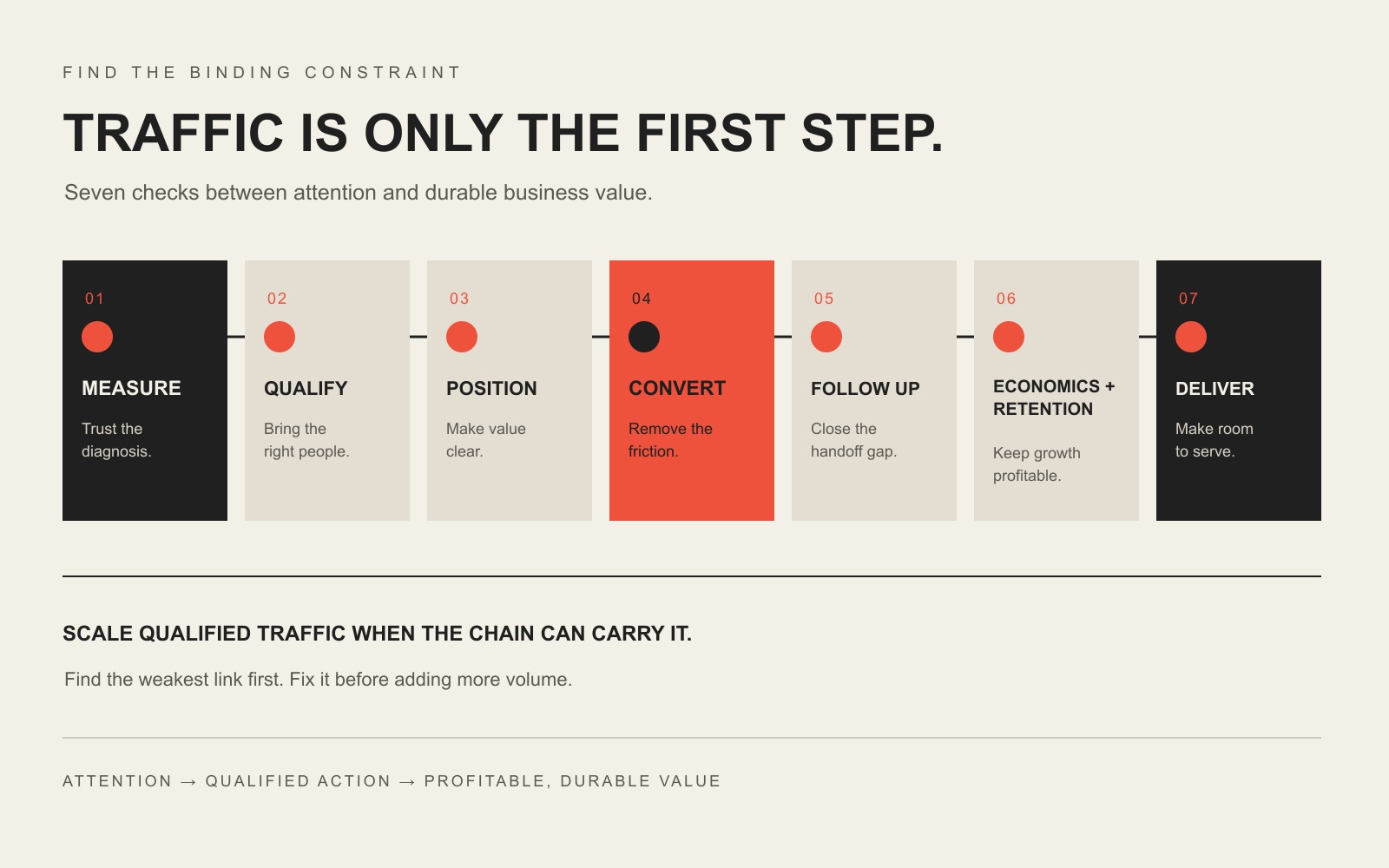
    The Growth System Has Seven Places to Break

    Think of growth as a chain rather than a traffic counter. Qualified attention has to pass through several stages before it becomes durable business value. The first weak stage is usually the next job.

    Seven growth stages: measurement, qualified demand, message and offer, conversion, sales follow-up, economics and retention, and delivery capacity. Fix the weakest link before scaling qualified traffic.

    1. Measurement: Can you trust the diagnosis?

    Before changing traffic or conversion tactics, confirm that meaningful actions can be traced to source, page, campaign, or lead. Google Analytics documentation is one common reference for acquisition and event data, but the measurement design still has to reflect the outcome your business actually cares about. If tracking is incomplete, the first constraint may be measurement itself. You cannot optimize confidently when every channel looks the same or when a “conversion” mixes weak micro-actions with real business outcomes.

    For a deeper measurement ladder—from visibility through business value—see our guide to the SEO metrics that matter.

    2. Qualified demand: Are the right people arriving?

    A site can have “plenty of traffic” and still have a demand problem. Segment by source, campaign, landing page, search intent, geography, device, and whatever else meaningfully distinguishes buyer fit. If high-intent sources behave well while broad sources do not, the answer may be better targeting—not more total sessions and not a site-wide conversion overhaul.

    This is also why content should be built around buyer questions rather than random volume. Our guide to business blog topics that attract buyers instead of random traffic covers that acquisition-side problem in more depth.

    3. Message and offer: Do qualified visitors understand the value?

    If the right people arrive but cannot quickly tell who the offer is for, what problem it solves, why it is different, and what to do next, buying more traffic is buying more confusion. The constraint is positioning, offer design, or message clarity.

    4. Conversion path: Can a qualified visitor act without avoidable friction?

    Once the visitor and offer fit, inspect the path: landing page, navigation, form, checkout, scheduling flow, call-to-action, trust signals, mobile experience, and page performance. Do not change all of them at once. Diagnose the most plausible constraint, make a controlled change, and compare the result against your own baseline.

    5. Sales follow-up: What happens after the website conversion?

    A form submission is not revenue. If good leads wait two days for a reply, receive inconsistent qualification, or disappear between marketing and sales, the website may be doing its job while the handoff is failing. More traffic simply gives the sales leak more opportunities to leak.

    6. Economics and retention: Is growth worth buying?

    Acquisition should be judged against customer value, margin, sales cost, fulfillment cost, and retention—not traffic price in isolation. A channel that looks expensive can be attractive when it produces better customers. A cheap channel can be a waste when it produces one-and-done buyers, low-margin work, refunds, or poor-fit clients.

    If this is the weak link, use real customer economics rather than generic rules of thumb. Our customer lifetime value guide covers how to calculate value without pretending every customer is identical.

    7. Delivery capacity: Can the business absorb more demand?

    Growth can break a business that is already at capacity. If more qualified leads would create missed deadlines, poor onboarding, slower support, stockouts, quality problems, or owner burnout, the marketing system may not be the active constraint. Capacity, process, hiring, inventory, or service design may need to move first.

    The Traffic-or-Constraint Decision Matrix

    Use evidence patterns rather than a universal benchmark. The goal is not to prove traffic “good” or “bad.” It is to identify the next lever with the strongest reason behind it.

    What you observeLikely constraintBest next move
    High volume, weak performance across nearly every sourceOffer, message, path, or measurementDiagnose before increasing acquisition
    Some sources produce strong leads while broad traffic does notTraffic quality / targetingShift budget and content toward qualified demand
    Qualified leads arrive but close poorlySales follow-up or offer economicsFix the handoff and qualification process
    Customers buy but margin or retention is weakEconomics / customer fitImprove value, retention, pricing, or targeting
    Everything downstream is healthy but lead volume is too lowQualified traffic volumeScale the proven acquisition channels
    Demand is strong but fulfillment is strainedCapacityIncrease operational capacity before demand

    When More Website Traffic Is Actually the Right Answer

    Sometimes the constraint really is traffic. The mistake is not scaling acquisition; the mistake is assuming acquisition is always the bottleneck.

    • Your tracking can distinguish meaningful outcomes by source or campaign.
    • The traffic you already receive is relevant to the offer.
    • Qualified visitors complete the intended path at a rate that is stable enough for your business to plan around.
    • Sales follow-up is timely and consistent.
    • Customer economics support the cost of acquiring more demand.
    • Retention and fulfillment quality are not collapsing as volume rises.
    • The business has enough capacity to serve additional customers.

    When those conditions are true, increasing qualified website traffic is not vanity. It is fuel for a system that has already shown it can turn attention into value.

    When More Website Traffic Just Amplifies Waste

    Extra sessions are dangerous when they create the illusion of progress while the business outcome stays flat. A marketing dashboard can look “up and to the right” while the company gets more poor-fit leads, more support load, more sales work, or more low-margin customers.

    If you are not sure where the failure lives, do not jump straight to ads, SEO, a redesign, or A/B tests. Use a full constraint-first marketing audit to separate visibility, fit, offer, conversion, sales, economics, and capacity before selecting the tactic.

    Measure the Chain, Not One Vanity Number

    You do not need a giant analytics stack to start. You need a measurement chain that follows the business logic. At minimum, compare relevant attention, qualified actions, sales outcomes, customer value, retention, and capacity. Break those measures down by source or cohort whenever that changes the decision.

    A useful internal conversion rate can be as simple as meaningful actions ÷ qualified visits. A useful lead-to-sale rate is closed customers ÷ qualified leads. Customer acquisition cost should use the real acquisition spend associated with the customers you are counting. None of those numbers needs a universal “good” threshold to be useful. Compare them with your historical baseline, your strongest sources, and the economics your business actually requires.

    Three Illustrative Scenarios

    Scenario A: Traffic problem. A service company has reliable tracking, a clear offer, good close rates from referrals, healthy margins, and unused delivery capacity—but very few qualified website visitors. The next lever is acquisition. More of the right website traffic is justified.

    Scenario B: Conversion-path problem. A company gets relevant visitors from several sources, but mobile users abandon a long form and phone calls are hard to find. The next lever is the path, not traffic. The company should fix the high-friction step and measure the change before paying to increase volume.

    Scenario C: Capacity problem. A local business already has more qualified inquiries than it can answer promptly. Ads are performing, but response time and fulfillment quality are slipping. The next lever is operations. More website traffic would make marketing look better while making the customer experience worse.

    What We Found Before Rewriting This Exact Page

    We applied the same constraint-first rule to this article. Before rewriting it, we checked the exact page path in our first-party systems rather than assuming the old copy deserved protection because it already existed.

    Signal checkedWhat we observedWhat that supports
    GA4 exact page pathNo exact-path rows returned in the current/prior 12-month comparison we queriedDo not invent behavior or conversion conclusions from sitewide averages
    Google Search Console exact URLNo exact-page query rows in the available comparison windowNo demonstrated Google query footprint required preserving unsupported legacy claims
    Bing Webmaster exact URLRecognized page; 0 clicks and 0 impressions in the URL traffic responseThe URL exists in Bing’s system, but there was no measured Bing traffic to defend

    The sensible revision was not to change the established URL or chase a plugin score. It was to keep the address, remove unsupported benchmarks and absolutes, give the page a clearer job, and make the answer materially more useful.

    Frequently Asked Questions

    Why is my website getting traffic but no conversions?

    Start by separating traffic quality from site performance. If qualified sources convert and broad sources do not, targeting is the likely constraint. If qualified visitors from several sources fail at the same step, investigate the message, offer, path, or tracking.

    Should I increase website traffic or improve conversions first?

    Improve the first weak link. Scale website traffic when measurement, relevance, conversion, sales follow-up, economics, retention, and capacity are healthy enough that more qualified attention can move through the system.

    What is a good website conversion rate?

    There is no universal rate that tells you whether a business is healthy. Define the conversion that matters, segment it by meaningful traffic source or cohort, compare it with your own baseline, and judge it alongside close rate, margin, customer value, and capacity.

    Can more website traffic lower my conversion rate?

    Yes. If new website traffic comes from broader or lower-intent sources, the blended conversion rate can fall even while qualified conversions increase. That is why source-level performance matters more than one site-wide ratio.

    When should I scale paid or organic traffic?

    Scale when you can identify which acquisition sources produce qualified outcomes, customer economics support the acquisition cost, and the business can handle additional demand without degrading the customer experience.

    Stop Asking “How Do We Get More Traffic?” First

    Ask a better question: What is preventing the next unit of attention from becoming profitable, durable business value?

    Sometimes the answer is website traffic. Sometimes it is conversion. Sometimes it is targeting, sales, economics, retention, measurement, or capacity. The advantage comes from diagnosing the system before buying the next tactic.

    If you want help finding the constraint instead of guessing at it, Scope Design can audit the acquisition-to-customer path and identify the smallest high-leverage change worth testing next.

  • What NOT to Do When Selling: 7 Fatal Sales Mistakes That Kill Deals

    What NOT to Do When Selling: 7 Fatal Sales Mistakes That Kill Deals

    The sales mistakes that kill otherwise good deals are usually stage mistakes. A seller pitches before understanding the problem, keeps persuading after the buyer has shifted into decision mode, overpromises, argues with objections, dumps features, manufactures urgency, or skips qualification. The fix is not to become timid. It is to make every interaction improve the buyer’s ability to make a confident decision.

    That distinction matters because buyers do not need a salesperson to recite everything the website already says. They need help when context, judgment, risk, fit, and next steps get messy. If the buyer is already convinced and you keep piling on reasons to buy, you can turn useful confidence into a fresh reason to wonder what you are hiding.

    TL;DR: the 7 sales mistakes to stop making

    • Keep selling after the buyer has moved into decision mode. Answer the question they are actually asking instead of restarting the pitch.
    • Pitch the solution before diagnosing the problem. A recommendation without diagnosis feels generic because it usually is.
    • Overpromise or hide the tradeoffs. Confidence is useful; pretending there is no downside is not.
    • Treat objections as something to defeat. An objection may be missing information, missing trust, a real constraint, or a legitimate sign of bad fit.
    • Dump features or proof without connecting it to the buyer’s decision. Evidence should resolve a specific doubt.
    • Manufacture urgency or keep pushing after “no” or “not now.” Your deadline is not automatically the buyer’s business reason to act.
    • Skip qualification and the real decision process. Fit, value, stakeholders, timing, responsibilities, and next steps matter before a proposal deserves oxygen.

    The two sales pitches that talked me out of buying

    I learned the first lesson from the buyer’s side. I was on a teleconference for an opportunity in a hot niche. The presenter had my attention. I was genuinely interested in the information and, for a while, the offer sounded worth considering.

    Then he started selling. And selling. And selling some more.

    If this offer is really this good, why does he need this much convincing to get me to buy it?

    By the time he finally got to the price and sales page, I had gone from interested to suspicious. The pitch did not fail because it lacked enthusiasm. It failed because the extra enthusiasm became new evidence I had to explain away.

    A couple of weeks later, another presenter kept repeating that his system was “as easy as taking candy from a baby.” He said some version of it so many times that the phrase became the entire problem. If it was that easy, why was all this hype necessary?

    The most believable moment came when an assistant briefly described how excited she felt when someone struggled with the business model and then started making sales. Finally, a human sentence. There was difficulty, then progress. The presenter shut that down and went back to the easy-money line. I did not buy that offer either.

    That experience is the reason this article is not a lecture about closing tricks. It is about the point where selling stops helping. When the buyer has enough interest to ask real decision questions, the seller’s job changes.

    Why good sellers become decision support

    Current B2B buyer research supports that shift. In a May 2026 survey of 645 B2B buyers, Gartner reported that 69% prefer to validate AI-generated insights with sales reps. The same research found strong preferences for self-directed and digital buying, while describing the seller’s distinctive value at critical moments as validation, context, risk reduction, and decision support.

    That is not a contradiction. Buyers can want less unnecessary seller involvement and still want human judgment when the decision becomes consequential. In Gartner’s 2025 research, 73% of surveyed B2B buyers said they actively avoid suppliers that send irrelevant outreach, while 69% reported inconsistencies between what a company website says and what its sellers say. More contact is not automatically more value.

    For service businesses, that is a useful reality check. The buyer can usually read your services, reviews, and case studies before talking to you. The sales conversation earns its place by making the decision clearer than the website could on its own. If your broader audience, offer, channel, or handoff system is confused before the call even starts, fix that upstream in your small business marketing strategy instead of asking sales pressure to compensate for a bad system.

    Use the Scope Design STOP Check before you keep pitching

    Before adding one more benefit, testimonial, discount, slide, follow-up, or closing line, run the conversation through four questions. We call it the Scope Design STOP Check.

    The Scope Design STOP Check: Stage, Truth, Objection, and Progress. Ask what decision the buyer is making, what tradeoff to state, what concern remains, and whether your next words help them decide.
    The Scope Design STOP Check: Stage, Truth, Objection, and Progress.
    CheckQuestionWhat a useful answer changes
    StageWhat decision is the buyer actually making now?You match the conversation to exploration, comparison, validation, approval, or implementation instead of replaying the whole pitch.
    TruthWhat limitation, tradeoff, or deadline needs to be stated plainly?You make the recommendation more believable by showing where it fits and where it does not.
    ObjectionWhat concern or missing condition still remains?You learn whether the buyer needs evidence, clarification, another stakeholder, different timing, or a different solution.
    ProgressWill the next thing you say increase buyer confidence or only seller pressure?You choose an answer, proof point, pause, next step, or respectful no instead of reflexively pitching harder.

    The STOP Check is not a script for manipulating people more elegantly. It is a guardrail against doing the wrong sales job at the wrong time. If the next thing you are about to say does not help the buyer make progress, there is a decent chance silence will outperform it.

    7 fatal sales mistakes that kill otherwise good deals

    1. You keep selling after the buyer has moved into decision mode

    One of the clearest sales mistakes is treating every positive signal as permission to restart the pitch. The buyer asks, “What happens next?” and the seller hears, “Please explain the value proposition again.” The buyer asks about onboarding, support, pricing at their scale, contract terms, implementation, references, or who needs to approve the work, and the seller responds with another fifteen minutes of features.

    Those questions are different from early curiosity. They suggest the buyer is trying to picture the decision in the real world. Your job is to answer the specific risk or next-step question in front of you. If they ask how implementation works, explain dependencies, responsibilities, timeline, and what can go wrong. If they ask who should join the next call, help them bring the right people in.

    Better move: when the buyer’s questions change from “why should I care?” to “how would this work here?”, stop broad persuasion and start decision support. Do not manufacture new objections by reopening settled questions.

    2. You pitch the solution before diagnosing the problem

    A fast pitch can feel efficient to the seller because it gets to the offer quickly. To the buyer, it often feels like you were going to recommend the same thing no matter what they said.

    Scope Design’s sales notes use a staged sequence for a reason: qualify, discover, recommend, decide. Discovery should tell you what the business sells, who the best customer is, what blocks the sale, what the current process does, what outcome matters, and whether the problem is valuable enough to fix. Only then should the solution take shape.

    For service businesses, the distinction is especially important. A weak website may be a symptom of poor positioning, low trust, bad lead quality, slow follow-up, or an unclear offer. Selling a redesign before understanding which problem actually matters is just expensive pattern matching. Our positive companion guide to selling services online goes deeper on reducing buyer uncertainty across the whole path.

    Better move: earn the recommendation. Ask enough useful questions to explain why this solution fits this buyer, and be willing to discover that it does not.

    3. You overpromise or hide the tradeoffs

    “Absolutely, we can do that.” “There is basically no downside.” “Results should be fast.” “This is easy.” Those sentences feel comforting until reality shows up with a clipboard.

    Credible selling has edges. A custom website may be the right investment, but it requires decisions, content, approvals, maintenance, and sometimes behavior change inside the business. SEO can create durable visibility, but you do not control Google. Paid campaigns can produce useful data quickly, but money does not rescue a weak offer. The tradeoff is part of the recommendation.

    There is also a basic truthfulness standard here. The FTC’s business guidance says advertising claims must be truthful, non-deceptive or unfair, and evidence-based. Even when a sales conversation is not a formal ad, the operating principle is worth keeping: do not turn uncertainty into certainty because certainty closes faster. If you want the broader Scope Design position, read why marketing lies cost more than truth.

    Better move: say what you know, say what you need to verify, name the downside, and explain what would make the recommendation a bad fit. “I need to check that before I promise it” is often a stronger sales sentence than a confident guess.

    4. You treat objections as something to defeat

    An objection is not automatically a wall between you and the commission. It is information. Price may mean the value is unclear, the budget is real, the timing is wrong, the risk feels too high, or the buyer is comparing you with a cheaper category of solution. “I need to think about it” may mean exactly that, or it may mean a stakeholder is missing, a concern has not been voiced, or the buyer simply does not want the offer.

    If you counter every concern immediately, you teach the buyer that the conversation has only one acceptable outcome: yes. That makes honest discovery harder because every answer becomes ammunition.

    A better diagnostic is: What would need to be true for this to feel like a confident decision? Then listen. If the answer exposes a real fit problem, respect it. The job is not to hypnotize the buyer into ignoring their own constraints. Our buyer psychology guide goes deeper on diagnosing uncertainty instead of labeling every hesitation a closing problem.

    Better move: clarify the concern, test what evidence or condition would resolve it, and accept that sometimes the right outcome is “not this,” “not yet,” or “not us.”

    5. You dump features or proof without connecting it to the buyer’s decision

    Features are not useless. Proof is not useless. They become useless when they are detached from the reason the buyer is evaluating the purchase.

    A hosting feature matters if uptime, support, security, ownership, or speed is part of the buyer’s risk. A case study matters if it resembles the buyer’s situation closely enough to reduce uncertainty. A testimonial matters when it answers a doubt the buyer actually has. Ten random testimonials in a carousel are not automatically stronger than one specific piece of evidence beside the claim it supports.

    That is why our testimonial workflow starts by mapping claims and doubts, then choosing the evidence type that fits. Proof has a job. Give it the job instead of throwing it at the buyer like confetti.

    Better move: connect every feature or proof point to the buyer’s stated outcome, concern, or decision criterion. If you cannot finish the sentence “This matters here because…”, it probably does not belong in that moment.

    6. You manufacture urgency or keep pushing after “no” or “not now”

    Real urgency exists. A seasonal launch date, contract expiration, event, compliance deadline, inventory constraint, staffing window, or known cost increase can create a legitimate decision window. Fake urgency exists too, and buyers can usually smell the difference.

    The key question is whose deadline it is. “We need this signed by Friday because our calendar is filling” can be honest information. “You must decide by Friday or everything falls apart” is a different claim. If the buyer cannot connect the deadline to their own business consequence, you are transferring your pressure to them.

    The same applies to follow-up. Gartner’s 2025 survey found that 73% of B2B buyers actively avoid suppliers that send irrelevant outreach. A useful follow-up adds something: an answer, a clarification, a relevant example, a missing document, a decision recap, or a sensible next step. “Just checking in” five times is not a nurturing strategy. It is a calendar reminder wearing a sales badge.

    Better move: be clear about real timing constraints, add value when you follow up, and respect a clear no. “Not now” can get a future date if the buyer wants one. “No” is not a puzzle you are entitled to solve.

    7. You skip qualification and the real decision process

    Unqualified prospects make every later stage harder. The issue is not only whether the person can pay. A worthwhile opportunity usually has a real problem, meaningful business value, access to the people who decide, a plausible timeline, fit with the way you deliver, willingness to participate, and a clear outcome worth measuring.

    You also need to understand the decision itself. Who else needs to be comfortable? What questions will finance, operations, IT, a partner, or another owner ask? What does the buyer need to compare? What happens if they do nothing? What responsibility belongs to the client after the sale?

    Skipping those questions is how sellers celebrate an enthusiastic contact while the actual buying group quietly kills the deal two weeks later. It is also how agencies write elaborate proposals for people who were never qualified to buy.

    Better move: qualify the opportunity before investing heavily in it, identify the decision process before the proposal, and make every interaction earn the next one.

    A calmer sales sequence: qualify → discover → recommend → decide → hand off

    The opposite of high-pressure selling is not passive selling. You still lead the process. You simply lead it by making the next decision clearer.

    1. Qualify: confirm the problem, value, fit, decision access, timing, responsibilities, and outcome before spending hours on a speculative solution.
    2. Discover: understand the business, customer, market, current path, failed attempts, constraints, and what success would actually change.
    3. Recommend: present the smallest solution that addresses the biggest relevant problem. Explain what it includes, what it does not, the tradeoffs, investment, and assumptions.
    4. Decide: answer the remaining decision questions. Bring in stakeholders. Clarify proof, risk, timing, terms, alternatives, and next steps without reopening the entire sales pitch.
    5. Hand off: once the decision is made, convert promises into a work plan. Confirm scope, responsibilities, access, dates, communication, and the first action.

    That sequence is deliberately boring compared with a bag of closing tricks. Good. A service sale should feel less like a magic act and more like two adults reducing uncertainty until there is enough clarity to move forward or walk away.

    Frequently asked questions about sales mistakes

    What is the biggest mistake in sales?

    The biggest mistake is doing the wrong sales job for the buyer’s current stage. In practice, that often means continuing broad persuasion after the buyer has moved into specific decision questions. Once they are evaluating implementation, risk, stakeholders, terms, proof, or timing, more generic pitching can add friction instead of value.

    What should you not do in sales?

    Do not pitch before diagnosing, overpromise, hide tradeoffs, argue with every objection, dump irrelevant features or proof, invent urgency, chase a clear no, or skip qualification and stakeholder discovery. Those behaviors all share the same flaw: they prioritize seller motion over buyer progress.

    When should a salesperson stop selling?

    Stop broad selling when the buyer has enough context to evaluate the decision and their questions shift to how the purchase would work in reality. Answer implementation, risk, pricing, approval, proof, support, and next-step questions directly. Also stop when the buyer gives a clear no. The right late-stage move may be an answer, a pause, a document, a stakeholder conversation, or nothing at all.

    Does overselling actually lose customers?

    It can, but there is no responsible universal percentage for “deals lost to overselling.” The original version of this article used tidy statistics that did not survive verification, so they are gone. What we can say is that current B2B research shows buyers strongly value relevance, consistency, self-directed research, and seller input that adds context or confidence. My own buyer-side experiences also show how extra hype can create doubt after interest already exists. Treat overselling as a preventable trust risk, not a fake conversion formula.

    How do you handle objections without being pushy?

    Start by naming the concern accurately. Ask what needs to be true for the buyer to feel confident, then determine whether the missing piece is evidence, clarity, timing, budget, stakeholder agreement, risk tolerance, or fit. Resolve what you can honestly resolve. If the condition cannot be met, say so. Objection handling should improve the decision, not erase the buyer’s right to make one.

    What is a good buying signal?

    A useful cue is a change in the buyer’s questions. Early questions tend to explore the problem and your relevance. Later questions tend to simulate ownership: implementation, support, pricing at their scale, contract terms, references, stakeholder approval, integration, onboarding, or what happens next. Treat those cues as a reason to get more specific, not louder.

    How should you follow up without sounding desperate?

    Bring something useful. Recap a decision, answer an unresolved question, send a relevant proof point, clarify a tradeoff, provide the document another stakeholder needs, or propose a sensible date. If you have nothing new to add, a brief respectful check-in can be enough once. Repeated “just checking in” messages mostly advertise that you want an answer.

    Fix the sales stage that is actually broken

    If your marketing is producing the right conversations but deals keep getting weird near the finish line, do not buy more traffic first. Audit the sales stages. Look for premature pitching, weak discovery, promises that delivery cannot keep, objections nobody actually understands, missing stakeholders, or follow-up with no customer job.

    If the problem starts earlier — wrong audience, muddy offer, low trust, weak destination, broken handoff, or no measurement — the sales call cannot rescue the system by trying harder. Start with the broader marketing strategy diagnostic, then make the sales conversation do the smaller job it is supposed to do.

    The rule is simple: help the buyer make progress. When the next pitch no longer does that, stop pitching.

  • Perceived Value: Make Your Offer Worth More Without Faking It

    Perceived Value: Make Your Offer Worth More Without Faking It

    Perceived value is the customer’s judgment that the outcome they expect, combined with their confidence that you can deliver it, justifies the price, time, effort, delay, and risk required to buy. You increase it honestly by making real value easier to understand, easier to believe, and less painful to obtain.

    A fancy box can help a good product look like the good product it is. It cannot make a weak offer useful. That is not value strategy. That is a raccoon in a tuxedo.

    TL;DR

    • Perceived value is a tradeoff. Buyers weigh expected benefits against money, time, effort, uncertainty, and risk.
    • Real value and perceived value need to align. If delivery is stronger than the message, good work stays invisible. If the message is stronger than delivery, the business creates trust debt.
    • Proof usually beats puffery. Specific evidence, a visible process, honest scope, and relevant examples give buyers reasons to believe.
    • Reducing sacrifice can raise value without lowering price. Faster response, clearer ownership, simpler onboarding, fewer surprises, and lower implementation risk all count.
    • Use the Scope Design VALUE Test: Valuable outcome, Audience fit, Lower sacrifice, Understandable offer, and Evidence that matches the experience.

    In this guide

    What Is Perceived Value?

    Perceived value is the buyer’s overall evaluation of what they expect to receive compared with what they expect to give up.

    Those two sides are broader than “features versus price.” Benefits can be functional, financial, emotional, social, relational, or experiential. Sacrifices can include price, time, effort, delay, switching cost, uncertainty, reputational exposure, and the possibility that the solution simply will not work.

    A 2024 customer-perceived-value meta-analysis synthesized 687 articles, 780 independent samples, and 357,247 customers. Its most integrative model, which included benefits, sacrifices, and overall value, performed better than narrower versions. It also found that context matters: goods and services, B2B and B2C, online and offline, and contractual and non-contractual relationships do not all behave identically.

    That is useful because it kills the lazy formula that says perceived value is just a higher price, prettier packaging, or a larger pile of bonuses.

    For a $40 kitchen tool, convenience and durability may dominate the decision. For a $40,000 professional engagement, the buyer may care more about confidence, implementation risk, internal effort, executive credibility, and whether anyone will answer the phone when the project gets weird.

    Same concept. Very different value equation.

    Real Value and Perceived Value Are Different, But They Are Not Enemies

    Real value is what the offer actually produces for the customer. Perceived value is what the customer can understand and believe before, during, and after the purchase.

    The old version of this article treated them like competing forces and argued that perception mattered more. That is how businesses talk themselves into polishing the sales page while ignoring the product, support, or delivery mess underneath it.

    The healthier relationship is a feedback loop:

    1. Before buying, the customer estimates value from the promise, proof, price, process, reputation, and apparent risk.
    2. During delivery, the customer updates that estimate through communication, effort, speed, ownership, competence, and friction.
    3. After delivery, the customer compares the promised outcome with the experienced outcome.
    4. Later, reviews, referrals, renewals, complaints, and cancellations reveal whether the original perception held up.

    Good marketing makes real value legible. Good delivery makes the marketing true.

    The Perception–Delivery Gap

    Every offer lives in one of three states.

    StateWhat the buyer seesWhat the business deliversCommercial consequence
    Hidden valueLess than the offer is genuinely worthStrong outcome and experienceUnderpricing, weak close rates, price comparisons, and “I didn’t know you did that”
    Aligned valueA clear, credible picture of the offerAn experience that supports the promiseSustainable preference, healthier pricing, trust, referrals, and repeat business
    Inflated valueMore than the offer can reliably supportWeak, inconsistent, or disappointing experienceRefunds, churn, bad reviews, buyer remorse, and trust debt
    The Perception–Delivery Gap compares what the buyer sees with what the business delivers: hidden value, aligned value, or an inflated promise that creates churn and trust debt.

    The Perception–Delivery Gap: under-communicated value leaves good work hidden; aligned value makes the promise believable; inflated value crushes trust under a promise delivery cannot support.

    Hidden value is common in technically strong businesses. The team knows how much work, judgment, risk prevention, and follow-through sit behind the result. The customer sees “website,” “consulting,” “maintenance,” “installation,” or “bookkeeping” and compares prices as if every provider is selling the same box.

    Inflated value is common when marketing becomes detached from operations. The homepage promises transformation. The proposal promises partnership. The onboarding experience delivers a form, a generic project manager, and three weeks of silence.

    Alignment is less glamorous and far more valuable. The business says what it can do, shows why the buyer should believe it, makes the tradeoffs visible, and then behaves consistently with the promise.

    Use the Scope Design VALUE Test

    The VALUE Test is a five-part check for determining whether an offer will feel worth the commitment to the right buyer.

    V: Valuable Outcome

    What changes for the customer if the offer works?

    Do not begin with deliverables. A 60-page report is not an outcome. Neither is a website, dashboard, brand guide, automated workflow, or twelve-module course. Those are containers.

    The outcome may be more qualified opportunities, a shorter sales cycle, fewer support failures, faster staff work, reduced risk, easier maintenance, stronger credibility, clearer decisions, or reclaimed capacity. The outcome must matter enough to justify action.

    If the problem is minor, the offer should probably be minor too. Custom work should earn its price. Expensive theater is still theater, even when the discovery deck has lovely typography.

    A: Audience Fit

    Does the value match this buyer’s actual situation?

    A powerful capability can have low perceived value when it solves the wrong problem, arrives at the wrong time, exceeds the buyer’s operating capacity, or requires a level of commitment they cannot support.

    Audience fit gets specific about:

    • who has the problem;
    • how they currently solve it;
    • what the failure costs them;
    • what alternatives they are comparing;
    • what constraints limit implementation;
    • who owns the decision; and
    • what evidence they require.

    This is where brand differentiation becomes commercially useful. A position is valuable when it makes the right buyer say, “That is exactly the problem we have,” not merely when it makes the company sound unusual.

    L: Lower Total Sacrifice

    What must the customer give up besides money?

    Price matters, but buyers also calculate the pain surrounding the purchase. A cheaper solution can feel expensive when it requires weeks of internal coordination, fragile integrations, constant follow-up, unclear ownership, retraining, migration risk, or a heroic employee who becomes the human API between three systems.

    Ways to lower total sacrifice include:

    • clearer scope and exclusions;
    • phased commitments;
    • a useful paid diagnostic before a large build;
    • faster, more precise response;
    • simpler onboarding;
    • defined customer responsibilities;
    • migration and recovery planning;
    • accessible documentation;
    • one accountable owner;
    • easier cancellation or handoff; and
    • ongoing support that matches the operational risk.

    Lowering sacrifice does not mean removing every bit of friction. Some friction protects both parties. A high-ticket service may need qualification fields, stakeholder interviews, data access, or a paid discovery phase. The test is whether the effort improves the decision or merely makes the buyer do administrative calisthenics.

    U: Understandable Offer

    Can the customer explain what they are buying, why it matters, and what happens next?

    Confusion creates uncertainty, and uncertainty feels expensive.

    An understandable offer makes these points visible:

    • the problem it solves;
    • the intended outcome;
    • who it is and is not for;
    • what is included and excluded;
    • how the process works;
    • what the customer must provide;
    • how long the work is likely to take;
    • what it costs or what determines the cost;
    • what happens after delivery; and
    • what the next step requires.

    This is not permission to turn the page into a wall of copy. It is permission to stop hiding the information buyers need. Your brand-message system should make the offer easier to understand, not dress ambiguity in more expensive adjectives.

    E: Evidence Matches the Experience

    What gives the customer a reasonable basis for believing the promise, and will the actual experience confirm it?

    Evidence can include:

    • relevant case examples;
    • demonstrations or samples;
    • specific testimonials;
    • public customer reviews;
    • documented methods;
    • named standards;
    • measurable results with the conditions attached;
    • credentials when they matter;
    • transparent limitations; and
    • a sales and onboarding experience that already shows competence.

    The classic business-to-business value-proposition research summarized by Harvard Business Review makes a blunt point: suppliers often claim savings and benefits without documenting them, so customer managers dismiss the language as puffery. “We provide incredible value” is not evidence. It is the marketing equivalent of writing your own permission slip.

    Use customer testimonials for selected, attributable evidence and customer reviews for the broader public pattern. Do not pretend the two are interchangeable.

    Seven Honest Ways to Increase Perceived Value

    1. Make the Outcome Concrete

    Replace broad claims with a specific change the buyer can evaluate.

    Weak: “We help businesses thrive online.”

    Stronger: “We identify whether your website has a traffic, messaging, usability, offer, technical, or follow-up problem before recommending what to rebuild.”

    The stronger version names the decision, reduces the risk of buying the wrong deliverable, and gives the buyer something useful to compare.

    2. Show the Work That Matters

    Customers cannot value effort or judgment they cannot see.

    Operational transparency can help when the visible work is relevant. In five simulated online-service experiments, Buell and Norton’s operational-transparency research found that signaling the work being performed could increase perceived value, even when the process took longer. That does not mean adding a fake spinner or narrating every internal meeting. It means helping buyers understand the meaningful labor, safeguards, and decisions behind the result.

    For a painter, surface repair, protection, primer, coat count, cleanup, and final inspection explain why two “paint the room” quotes are not necessarily the same.

    For a website project, research, content architecture, accessibility, responsive design, development, integrations, quality assurance, training, hosting, security, and maintenance explain why two five-page proposals can represent completely different commitments.

    Show consequential work. Nobody needs a documentary about your folder structure.

    3. Match Proof to the Buyer’s Moment of Doubt

    Proof works best beside the claim or uncertainty it supports.

    Place a relevant outcome near the promise. Place an implementation example near the process. Place a service review near the commitment. Place ownership and maintenance evidence near the handoff. Do not exile every testimonial and case study to a proof museum that nervous buyers must hunt for.

    Specificity matters more than volume. One example involving a similar problem, buyer, constraint, and outcome can be more useful than forty logo tiles.

    4. Reduce Risk Before Adding More Stuff

    Businesses often respond to price resistance by stacking bonuses. That can make the offer harder to understand and more burdensome to use.

    Try reducing risk instead:

    • separate diagnosis from implementation;
    • use milestones and decision gates;
    • define acceptance criteria;
    • identify what could go wrong;
    • specify ownership;
    • provide recovery and handoff plans;
    • make exclusions explicit; and
    • explain what happens when assumptions change.

    For Scope Design, a paid discovery product can create value before a larger commitment. The client receives a useful diagnosis or plan even if they do not proceed. Scope avoids giving away consequential strategy inside a speculative proposal, and both sides get a cleaner decision.

    5. Improve the Experience Around the Offer

    Customers infer future delivery from the current interaction.

    If the sales process is vague, slow, defensive, or disorganized, the buyer assumes the project may be too. If the first interaction is prepared, specific, candid, and useful, the buyer has early evidence of how the work will feel.

    Value signals include:

    • responding when promised;
    • asking informed questions;
    • summarizing decisions;
    • assigning an owner;
    • naming the next step;
    • explaining tradeoffs;
    • making documents readable; and
    • refusing to prescribe work before understanding the problem.

    That last one matters. Selling the client a bigger hammer does not increase value when the constraint is plumbing.

    6. Explain Price Without Apologizing for It

    Price is both a sacrifice and a piece of information. Buyers use it alongside reputation, proof, alternatives, and their expectations of quality.

    Do not assume raising the price automatically raises perceived value. A high price with weak evidence creates suspicion. A low price with a complex promise creates a different suspicion: which steps, people, protections, or responsibilities are missing?

    Explain:

    • what drives the price;
    • what is included;
    • what is not included;
    • which parts are optional;
    • what the customer owns afterward;
    • what ongoing costs exist; and
    • what lower-cost route is sensible when the full offer is unnecessary.

    Transparent pricing does not require one flat number for genuinely variable work. It requires enough information for a reasonable buyer to understand the likely commitment and the variables that change it.

    7. Make Delivery Earn the Message

    The fastest way to destroy perceived value is to deliver less than the marketing implied.

    Review the entire promise: page copy, visuals, proposal, sales conversation, guarantee, timeline, onboarding, and follow-up. Both express and implied claims matter. The Federal Trade Commission’s small-business advertising guidance says advertising must be truthful and non-deceptive, objective claims need a reasonable basis before the ad runs, and a money-back guarantee does not replace substantiation.

    Even when a tactic never reaches an enforcement desk, the commercial rule is simple: do not borrow trust from the future to close a sale today.

    How Scope Design Builds Value Into a Professional Service

    Consider a business that asks for a website redesign and new features. A commodity proposal lists pages, features, hours, and price. A strategic engagement first determines whether the requested website is the actual constraint.

    In one anonymized Scope Design engagement, discovery revealed that a specialty business’s public website sat in the middle of legacy data, invoicing, inventory, shipping, email, customer, and historical-sales systems. The useful sequence became foundation first, features second.

    No revenue or efficiency result is claimed here. The value is in the decision quality:

    • the client’s apparent “website” purchase became an understandable systems problem;
    • hidden dependencies became visible;
    • foundation work was separated from future features;
    • ongoing ownership and support became part of the product; and
    • the business could evaluate scope and risk before funding implementation.

    That is perceived value built from better diagnosis, specificity, and lower uncertainty. It does not come from adding twelve bonuses to the proposal.

    How to Increase Perceived Value on a Website or Offer Page

    Map the page to the questions the buyer is trying to answer.

    Buyer questionPage responsibilityUseful evidence
    Is this for a problem like mine?Name the buyer, problem, stakes, and right-fit conditionsSpecific situation, language, and exclusions
    What changes if it works?State the outcome before the feature listBefore/after condition, business implication, concrete deliverable-to-outcome bridge
    Why should I believe you?Support claims where doubt appearsRelevant example, demonstration, method, testimonial, review, or credential
    What am I committing to?Explain scope, price variables, time, effort, and responsibilitiesProcess, milestones, assumptions, ranges, and ownership map
    What could go wrong?Address risk without melodramaLimitations, dependencies, recovery, support, and decision gates
    What happens next?Make one sensible next step obviousDiagnostic, consultation, assessment, purchase, or application that matches the buyer’s stage

    The page should not merely say “premium,” “trusted,” or “results-driven” more often. It should make the offer easier to evaluate.

    How to Measure Perceived Value Without Making Up a Score

    There is no universal perceived-value number you can paste into every business dashboard.

    Use evidence from the whole journey:

    • interviews asking why customers chose or rejected the offer;
    • sales-call language and recurring objections;
    • the alternatives buyers compare;
    • proposal acceptance by customer type;
    • discount requests and where they occur;
    • qualified lead-to-close rate;
    • sales-cycle length;
    • onboarding abandonment;
    • product usage or service participation;
    • refunds, cancellations, churn, and complaints;
    • renewals, expansion, referrals, and repeat purchases; and
    • gross margin, because unprofitable “value” is not a business model.

    Separate perception from delivery when diagnosing results. If qualified prospects do not understand the value before buying, the message, proof, or offer may be weak. If buyers purchase and then leave, the experience or outcome may be weak. If the business closes plenty of work at miserable margins, the problem may be price, scope, qualification, or delivery efficiency.

    One metric cannot tell those stories apart.

    A 30-Minute Perceived-Value Audit

    Take one important offer and answer these questions without using “quality,” “service,” “innovative,” or “customized” as evidence.

    1. What valuable outcome does the customer expect?
    2. Which customer and situation value that outcome most?
    3. What money, time, effort, delay, uncertainty, and risk must the buyer accept?
    4. Which sacrifice can we remove, reduce, explain, or deliberately retain?
    5. Can a buyer explain the offer after reading the page once?
    6. Which three claims most influence the decision?
    7. What proof supports each claim?
    8. Where does that proof appear?
    9. What does our sales and onboarding experience imply about delivery?
    10. Where does the promise exceed the current operation?
    11. Where does delivery exceed what marketing makes visible?
    12. What one change would improve alignment most?

    Do not leave with twenty-seven content tasks. Pick the largest gap between perception and delivery, assign an owner, and fix it.

    Frequently Asked Questions About Perceived Value

    What Is the Meaning of Perceived Value?

    Perceived value is a customer’s judgment of whether the benefits they expect are worth the money, time, effort, delay, and risk required to obtain them. It is subjective, but it is not random; customers use signals such as clarity, proof, price, reputation, process, and experience.

    What Is Customer Perceived Value?

    Customer perceived value is the same core concept stated from the customer’s perspective: the overall tradeoff between expected benefits and expected sacrifices. The relevant benefits and sacrifices vary by customer, context, and type of offer.

    What Is an Example of Perceived Value?

    Two contractors may both quote “paint one room.” One explains protection, surface repair, primer, coat count, cleanup, inspection, timeline, and responsibility for materials. The second offer may feel more valuable because the buyer can see the work, risk reduction, and expected experience. The paint did not become magical.

    What Is the Difference Between Actual Value and Perceived Value?

    Actual or experienced value is what the customer genuinely receives. Perceived value is what the customer expects and concludes from available information and experience. Sustainable marketing makes the two align.

    What Does Higher Perceived Value Mean?

    Higher perceived value means the buyer believes the expected benefits more clearly outweigh the total sacrifices. It does not necessarily mean the offer is more expensive, more luxurious, or loaded with more features.

    What Are the Types of Customer Value?

    There is no single universal list. Common research models include functional, monetary, emotional, social, experiential, relational, and other context-specific benefits, plus monetary and nonmonetary sacrifices. Use the dimensions that genuinely affect your buyer’s decision rather than forcing every offer into a tidy internet list.

    How Do You Determine Perceived Value?

    Study what customers expect, value, fear, compare, and sacrifice. Combine interviews, sales objections, win/loss reasons, behavior, pricing response, onboarding, retention, complaints, and referrals. A survey alone will miss what customers actually do.

    How Do You Increase Perceived Value?

    Increase the relevance or quality of the outcome, make the offer easier to understand, show credible proof, reduce unnecessary effort and uncertainty, improve the surrounding experience, and deliver what the message promises.

    Does a Higher Price Increase Perceived Value?

    Sometimes price influences quality expectations, but it is not a universal lever. A higher price without relevant benefits and credible evidence can reduce value by increasing sacrifice and suspicion. Test price with the actual audience and protect margin.

    Can Good Branding Increase Perceived Value?

    Yes, when branding improves recognition, clarity, coherence, trust, and the experience of the offer. Branding cannot permanently compensate for poor delivery, false claims, or a product the customer does not need. The Brand Authority pillar explains how proof and usefulness turn presentation into earned belief.

    Do Testimonials and Reviews Increase Perceived Value?

    They can reduce uncertainty when they are relevant, specific, attributable, and placed near the claim they support. Generic praise and unrelated review volume are weaker than evidence involving a similar customer, problem, and outcome.

    Do Bonuses Increase Perceived Value?

    Only when the bonus improves the desired outcome or reduces a real sacrifice. Random extras can create confusion, implementation burden, or suspicion that the core offer cannot justify its price.

    Is Scarcity a Good Way to Increase Perceived Value?

    Genuine capacity limits, deadlines, or inventory constraints can help buyers decide. Manufactured countdowns and fake availability create pressure, not value, and can damage trust when the mechanism becomes obvious.

    How Does Perceived Value Apply to Professional Services?

    Service buyers often cannot evaluate the final quality before purchase, so they rely heavily on diagnosis, relevant proof, transparent scope, visible process, ownership, communication, risk management, and the quality of the initial experience.

    How Often Should a Business Review Perceived Value?

    Review it when the offer, price, audience, competitors, delivery process, evidence, or recurring objections change materially. Also review it when sales and delivery tell different stories. For example, prospects may resist the price while existing customers say the work was worth far more.

    Stop Decorating the Promise. Make It Easier to Believe.

    Perceived value is not a bag of psychological tricks. It is the buyer’s attempt to answer a practical question: “Is this outcome worth what I must spend, do, wait for, and risk?”

    Make the outcome valuable. Fit it to the right audience. Lower unnecessary sacrifice. Explain the offer clearly. Show evidence that the delivery experience can support.

    If your offer still sounds like three admirable adjectives in a trench coat, Scope Design’s Impact Consulting can help diagnose the customer, constraint, offer, proof, message, and operating reality before you spend money making the wrong promise prettier.

  • Online Marketing Success: 4 Essential Questions to Answer First

    Online Marketing Success: 4 Essential Questions to Answer First

    Online marketing success starts with four answers, not a channel list. Before you choose SEO, paid ads, social media, email, or a website redesign, define: where the customer is now, where they want to go, why that change matters, and what you can credibly offer as the bridge. If any answer is too vague to change a headline, offer, proof point, call to action, or channel decision, it is not specific enough yet.

    TL;DR: The NOW → NEXT → WHY → OFFER framework

    • NOW: What is the customer experiencing today?
    • NEXT: What observable result are they trying to reach?
    • WHY: Why does that result matter enough to act?
    • OFFER: What can you credibly deliver to help them move from NOW to NEXT?

    This is the four-question marketing bridge we use at Scope Design. The questions sound simple. The useful work is replacing generic answers with customer evidence and then making sure each answer changes a real decision.

    The NOW NEXT WHY OFFER framework: describe what the customer experiences, define the result they want, understand why it matters, and make a credible offer. Each answer changes problem framing, the promise, proof, or next action.

    Why online marketing success starts with diagnosis

    Most marketing problems that look like channel problems are diagnosis problems. A business says it needs more Instagram content, better SEO, a new website, or paid traffic. Sometimes that is true. But if the customer, desired result, motivation, and offer are still fuzzy, a new channel mostly gives fuzzy thinking a larger distribution system.

    That matters because the current search landscape is already full of broad digital-marketing advice. In our August 21, 2026 U.S. SERP check for online marketing success, the results were dominated by large, general guides plus an AI Overview that summarized familiar ideas such as knowing the audience, setting goals, creating useful content, using multiple channels, and measuring performance. None of that is wrong. It is simply one layer too high to tell a small business what to say, what to offer, or which channel deserves attention first.

    The four questions below are meant to close that gap. They turn “know your audience” into a diagnostic you can actually use.

    Question 1 — NOW: What is the customer experiencing today?

    Start with the customer’s current situation, not a demographic profile. Age, location, industry, company size, and income can matter, but they do not automatically explain what triggered a buying decision.

    A useful NOW answer describes an observable situation: the problem they notice, what they have already tried, what is getting harder, what they are tolerating, and what finally causes them to look for help.

    • Weak: “Small-business owners who need marketing.”
    • Stronger: “Owners getting enough referrals to stay busy but not enough predictable inbound leads to plan hiring or growth.”
    • Weak: “People who need a better website.”
    • Stronger: “Service businesses sending prospects to a site that does not explain the offer clearly, so sales calls start with basic education instead of qualification.”

    Do not invent a fictional “ideal customer” and then treat the story as evidence. Use interviews, sales notes, support conversations, reviews, search behavior, analytics, and community language to test the hypothesis. If you need a repeatable way to gather that evidence, our guide to small-business market research gives you practical methods that do not require a giant research budget.

    Decision this answer should change: the words you use to describe the problem. If NOW does not change the opening of an ad, landing page, sales email, or conversation, keep digging.

    Question 2 — NEXT: What observable result do they want?

    “Grow the business,” “get more traffic,” and “improve our marketing” are aspirations, not usable outcomes. NEXT should describe what becomes measurably or visibly different when the problem is solved.

    • More qualified sales conversations each month
    • A shorter gap between inquiry and booked appointment
    • More repeat purchases from existing customers
    • A website that answers the questions prospects repeatedly ask on sales calls
    • A reliable way to reach past customers without depending on an algorithm

    Do not force every outcome into a vanity metric. A local professional service may care more about qualified calls than followers. A retailer may care about repeat orders. A B2B firm may care about pipeline quality, sales-cycle friction, or the number of buying stakeholders who reach the right information.

    Decision this answer should change: the promise. Once NEXT is clear, your marketing can describe a result the customer recognizes instead of a pile of activities you perform.

    Question 3 — WHY: Why does that result matter enough to act?

    This question is not an invitation to manufacture fear. It is a way to understand the stakes behind the requested outcome. Two customers can want the same result for completely different reasons, and those reasons change what proof and urgency feel credible.

    For example, two owners may both want more leads. One wants predictability so they can hire without guessing. The other has plenty of inquiries but too many are poor fits, so the real need is qualification. Same surface goal; different WHY; different message and solution.

    • What gets harder if nothing changes?
    • What opportunity becomes possible if the result is achieved?
    • Who else is affected by the current problem?
    • What risk is the customer trying to reduce?
    • What does the customer want to feel confident doing next?

    Decision this answer should change: urgency and proof. A strong WHY tells you whether the customer needs reassurance, speed, risk reduction, evidence, control, convenience, status, or something else before taking the next step.

    Question 4 — OFFER: What can you credibly deliver as the bridge?

    Only now should you center your product or service. The job of the offer is not to sound impressive. It is to bridge the specific NOW and NEXT you have already defined, within the customer’s real constraints and your real capabilities.

    A credible offer answers four practical questions:

    • Fit: Does it solve the diagnosed problem rather than a nearby problem?
    • Feasibility: Can the customer realistically adopt it with their budget, time, team, and tools?
    • Proof: What can you demonstrate, document, show, or explain without hand-waving?
    • Next action: What is the smallest sensible step toward the result?

    This is also where a vague “free consultation” often underperforms a more specific next step. If the diagnosed problem is unclear positioning, offer a positioning review. If paid traffic is leaking because the page promise and action do not match, fix that mismatch. When the bridge belongs on a campaign page, our guide to landing page optimization shows how to match one promise to one action.

    Decision this answer should change: the offer, call to action, proof, and sometimes the channel itself.

    The decision-change test: Make every answer earn its place

    Here is the fastest way to tell whether you have gone deep enough: each answer must change a real marketing decision.

    QuestionIf the answer is useful, it should change…
    NOWAudience language, problem framing, examples, objections
    NEXTPromise, outcome language, success criteria
    WHYUrgency, proof, reassurance, stakes
    OFFERDeliverable, CTA, proof, price framing, channel choice

    If your answers could describe almost any customer, they are not ready. If they make your homepage, ad, email, or sales pitch more specific, you are getting somewhere.

    Turn the four answers into channel choices

    Channel selection comes after diagnosis. A live ChatGPT web-search observation we ran for this revision reached the same practical ordering: clarify goals, customer buying behavior, existing assets, and sustainable execution capacity before deciding whether SEO, paid ads, social, or email is the right fit. That ordering is also consistent with Microsoft’s small-business marketing guidance, which emphasizes understanding the audience, setting measurable goals, and focusing resources instead of trying to maintain every channel at once.

    Use the framework to ask what behavior you need to support:

    • People actively search when the problem appears: SEO, local SEO, or paid search may deserve attention.
    • The product is discovered visually or socially: social content or paid social may fit the buying behavior.
    • You already have customers or leads who may buy again: email can help with nurture, retention, and repeat purchases.
    • Traffic exists but the promise or next action is unclear: a landing-page or website conversion problem may come before buying more traffic.
    • You still do not know what triggers demand: research comes before channel expansion.

    These are decision cues, not universal rules. Your economics, sales cycle, geography, capacity, creative assets, and competitive environment still matter. Once the diagnosis is solid, a focused 90-day marketing plan can turn the highest-priority constraint into a manageable execution sequence.

    A 30-minute worksheet for your next marketing decision

    You do not need a three-week workshop to start. Use 30 minutes to create a first evidence map:

    1. 5 minutes — NOW: Write the current customer situation in one sentence. Underline every assumption.
    2. 5 minutes — NEXT: Describe one observable result the customer wants.
    3. 5 minutes — WHY: Write what changes for the customer if they get the result—or fail to.
    4. 5 minutes — OFFER: Define the smallest credible bridge you can actually deliver.
    5. 10 minutes — Evidence: List the customer quotes, sales notes, analytics, reviews, search behavior, or interviews that support each answer. Mark unsupported claims for research.

    Then run the decision-change test. Which headline changes? Which proof point becomes necessary? Does the CTA become more specific? Does one channel suddenly make more sense than another? If nothing changes, your answers are still too generic.

    Why we rewrote this article instead of preserving the old statistics

    We checked this page before revising it. For the 12 complete months ending August 19, 2026, GA4 recorded 9 Direct landing sessions, 1 engaged session, and 0 key events for the exact URL; it recorded no organic landing sessions. Google Search Console returned no exact-page query rows in either 12-month comparison window, and URL Inspection reported that the URL was unknown to Google. Bing recognized and crawled the page but reported 0 clicks and 0 impressions.

    That sample is far too small to say the topic has no demand. It is enough to say the old article was not earning observable search traction. So we kept the established URL, removed the unsupported percentage-heavy “2025 statistics” material, and rebuilt the article around the durable part: the four questions and how to use them.

    Frequently asked questions about online marketing success

    How do you become successful in online marketing?

    Start by diagnosing the customer and offer before choosing tactics. Define the customer’s current situation, desired result, motivation, and the credible bridge you can provide. Then choose channels that match how that customer discovers, evaluates, and buys—and measure the business outcome the channel is supposed to influence.

    Is digital marketing still worth it in 2026?

    It can be, but “digital marketing” is too broad for a blanket yes or no. SEO, paid search, social, email, content, and website work solve different distribution and conversion problems. A channel is worth using when the customer behavior, economics, measurement plan, and execution capacity support it.

    What are the four main marketing strategies?

    There is no single universal four-strategy taxonomy that fits every business. The four items in this article are diagnostic questions, not channel categories: NOW, NEXT, WHY, and OFFER. Their purpose is to clarify the customer and offer so you can choose a strategy intelligently.

    How often should you revisit the four questions?

    Revisit them when something material changes: a new offer, a new customer segment, a meaningful shift in objections or close reasons, a new geography, a major pricing change, or evidence that the current message no longer matches buyer behavior. A calendar reminder is less useful than an evidence trigger.

    Does the framework work for B2B and B2C?

    Yes, but the evidence can look different. In B2B, NOW, NEXT, and WHY may vary by stakeholder: the user, manager, finance team, and executive sponsor can each have different constraints and success criteria. Answer the questions for the real buying process rather than pretending one persona represents everyone.

    Use the four questions before you buy more marketing

    The durable lesson is simple: online marketing success is easier to engineer when the customer diagnosis is specific enough to constrain your choices. Know NOW. Define NEXT. Understand WHY. Build an OFFER you can credibly deliver. Then choose the channel.

    If you want Scope Design to help pressure-test the diagnosis, bring the current problem, the desired result, why it matters, and the constraints you are working within. That is a much better starting point than “we need more marketing.” If the bottleneck turns out to be the website, positioning, SEO, paid media, content, or another part of the digital system, we can define a specific next step from there.

  • Content Repurposing: Recast Good Evidence, Not Generic Slop

    Content Repurposing: Recast Good Evidence, Not Generic Slop

    Content repurposing is the deliberate transformation of a useful source asset into a new format for a different audience moment, channel, or decision. Done well, it preserves the facts and point of view while changing the hook, structure, length, visuals, and next step. Done badly, it turns one forgettable post into twelve smaller pieces of forgettable sludge. Congratulations, you have automated mediocrity.

    Scope Design TL;DR: Repurpose evidence, not just words. Start with something worth carrying forward, give the new version a specific job, adapt it to the destination, keep its claims and permissions intact, connect it to a useful next step, and measure whether it helped anyone do anything that matters.

    Content repurposing belongs inside a broader content marketing system. It is not the entire strategy. The source article owns the complete explanation; repurposing makes that knowledge useful in more contexts without forcing the business to invent a brand-new idea every Tuesday morning.

    What is content repurposing?

    Content repurposing means taking an existing asset and rebuilding it for another useful purpose. A research article might become a decision checklist. A webinar might become an edited guide and a short demonstration. A customer question might become an FAQ answer, a sales follow-up, and a social post. The underlying knowledge stays consistent, but the way people encounter and use it changes.

    The operative word is rebuilding. Changing a horizontal video to vertical dimensions is formatting. Posting the same paragraph on five networks is distribution. Publishing the same article under several URLs is duplication. Repurposing requires a new job and a meaningful adaptation.

    Repurposing, reposting, cross-posting, and updating are not the same thing

    PracticeWhat changesWhen it is usefulCommon failure
    RepurposingFormat, structure, context, examples, or interactionA proven idea can help in another audience momentThe derivative loses the source’s nuance or truth
    RepostingLittle or nothingA durable post deserves another distribution windowRepetition without timing, context, or value
    Cross-postingDestination, with limited adaptationThe same audience genuinely uses more than one channelIdentical content feels lazy or performs poorly in the native environment
    UpdatingFacts, examples, guidance, links, or conclusionsThe source asset is stale, incomplete, or newly relevantA cosmetic date change pretends nothing else aged

    These practices can work together, but they solve different problems. Treating them as synonyms is how a simple workflow becomes an incoherent content landfill.

    Why content repurposing works when it actually works

    The usual sales pitch is that repurposing saves time and multiplies reach. Sometimes it does. Those are possible consequences, not natural laws.

    Repurposing creates useful reach and efficiency when the source contains enough substance to support more than one expression. A recorded client workshop may contain a diagnostic model, three objections, a process demonstration, and a story. Those are separate knowledge units hiding inside one delivery format. Extracting and rebuilding them can reduce reinvention while making the ideas easier to find, understand, and use.

    It also supports different consumption needs. Some people want the complete article. Others need a two-minute demonstration, a comparison table, an email they can forward internally, or a checklist during a buying conversation. The point is not to accommodate every imaginable preference. The point is to meet a real audience where a different interface improves the decision.

    Repurposing cannot rescue weak source material

    If the original asset is generic, inaccurate, thin, or detached from a business problem, multiplying it does not create authority. It creates a larger cleanup project.

    Google’s people-first content guidance asks whether a page offers original information, analysis, substantial value, and demonstrable expertise. That standard should be applied before repurposing. If the source would not survive an honest usefulness review, fix it first or retire it.

    More formats do not automatically mean more reach

    A business can publish twelve derivatives and reach the same indifferent people twelve times. Reach depends on audience fit, distribution, platform behavior, timing, creative quality, and whether the source idea deserves attention. Anyone promising that one blog post will reliably produce a fixed traffic multiplier is selling arithmetic cosplay.

    The Scope Design RECAST Test

    The RECAST Test turns repurposing from a content-volume trick into an accountable operating decision.

    The Scope Design RECAST Test: Reason, Evidence, Channel, Adaptation, Source, and Tracking. Each step helps turn one truthful source into a distinct, useful derivative.

    1. Reason: why should this version exist?

    Name the specific job before choosing the format. Useful reasons include answering an earlier-stage question, equipping a salesperson, making a complex process visible, supporting accessibility, helping an existing customer complete a task, or bringing a durable insight to an audience that will not encounter the original.

    “We need more posts” is not a reason. It is a symptom of a calendar that has become management’s tiny digital tyrant.

    Ask:

    • Who needs this version?
    • What are they trying to understand, decide, explain, or do?
    • Why is the source format insufficient in that moment?
    • What useful action should become easier afterward?

    2. Evidence: what must remain true?

    Identify the parts that give the source authority: data, client experience, screenshots, quotations, demonstrations, examples, limitations, dates, permissions, and the author’s actual judgment. Preserve provenance as the content changes shape.

    A short social post may omit detail, but it must not distort the conclusion. A video clip must not remove the qualification that made a claim honest. An AI summary must not invent a statistic because the original paragraph felt lonely without one.

    3. Channel: why does the destination fit?

    Choose the destination based on audience behavior and the derivative’s job. A searchable article is useful for durable explanation. Email works for direct delivery and follow-up. A short video can demonstrate one visible action. A sales document can help several stakeholders evaluate the same decision. A social post can open a conversation or route attention to deeper evidence.

    If the goal spans several touchpoints, connect the work to an omnichannel marketing handoff rather than scattering assets and calling the mess integrated.

    4. Adaptation: what must be rebuilt?

    Adaptation changes the experience, not merely the container. Rework the opening, sequence, examples, visual language, pace, interaction, captioning, and call to action for the destination.

    For example, an article might establish context before presenting a framework. A short video may need to show the framework first, then explain one consequence. An email may begin with the buyer’s current objection. A sales checklist may remove the narrative entirely and organize the same knowledge around decisions.

    5. Source: where does the durable truth live?

    Maintain a source of record. For Scope Design’s publishing system, that is usually a strong canonical article connected to the relevant pillar and supporting cluster. The derivative should either link to it, name it, embed it, or remain traceable to the same evidence record.

    This prevents versions from drifting into contradictory claims. It also gives the team somewhere to update the truth when a platform rule, statistic, process, or recommendation changes.

    For similar or duplicate versions published on owned web URLs, use deliberate canonicalization. Google documents redirects and canonical annotations as strong signals for consolidating duplicate or very similar web pages. Do not create five near-identical blog URLs and hope Google appreciates your enthusiasm.

    6. Tracking: what consequence earns another round?

    Measure the consequence appropriate to the job. A derivative designed for discovery may be judged on qualified visits and useful engagement. A sales asset may be judged on whether it answers an objection or improves meeting readiness. A customer-support derivative may reduce repeated questions or completion errors.

    Use consistent campaign parameters when a derivative links back to the site. Google Analytics documents UTM parameters for identifying referring campaigns and creatives. They tell you where a visit came from. They do not prove that the post caused revenue, fixed the sales process, or deserves a celebratory gong.

    How to build a content repurposing workflow

    Step 1: inventory source assets by evidence, not vanity

    Start with assets that contain durable value:

    • original research or analysis;
    • first-hand lessons from completed work;
    • useful frameworks, checklists, or demonstrations;
    • customer questions that recur in sales or delivery;
    • case evidence with permission and sufficient context;
    • high-intent articles that already support a business decision;
    • recordings whose substance is trapped in an inconvenient format.

    High traffic can be a selection signal, but it is not the only one. A low-traffic implementation guide that helps every qualified prospect may be more valuable than a high-traffic post that attracts students looking for definitions.

    Step 2: extract knowledge units

    Break the source into distinct units before brainstorming formats. Mark the central claim, supporting evidence, process steps, objections, examples, quotable judgments, visuals, and next actions.

    This avoids the lazy “turn article into ten posts” prompt. You are not asking a machine to make ten versions of 2,000 words. You are identifying which ideas can stand independently without becoming misleading.

    Step 3: map each unit to an audience moment

    Match the knowledge unit to a real moment:

    Audience momentUseful derivativeJob
    Problem recognitionShort post, diagnostic question, or quick videoHelp the buyer name the issue
    Active researchArticle section, comparison, FAQ, or annotated exampleImprove understanding and evaluation
    Internal discussionOne-page brief, email, or presentation slideHelp a champion explain the decision
    Sales evaluationCase excerpt, checklist, calculator, or process videoReduce uncertainty and expose fit
    ImplementationWorksheet, tutorial, transcript, or support guideHelp the customer complete the work
    Ongoing relationshipNewsletter, update, or customer education sequenceExtend value and surface the next relevant need

    Step 4: write a derivative brief

    Each derivative needs a tiny brief:

    • audience and moment;
    • job;
    • source asset and evidence;
    • destination;
    • adaptation requirements;
    • accessibility requirements;
    • owner and approval;
    • next step;
    • tracking convention;
    • review or expiration date.

    That may look excessive for a 45-second video. It is still faster than publishing a misleading clip, correcting it across four platforms, and debating which intern invented the claim.

    Step 5: produce and review in batches

    Batch work around the source, not around random platform quotas. One reviewer can validate claims and permissions across the derivative set. A designer can create a coherent visual family. A subject-matter expert can correct misunderstandings once before they reproduce.

    Use the Scope Design social media content system to decide what social derivatives should do. Repurposing supplies source material; it does not replace channel strategy, community judgment, or a sustainable cadence.

    Step 6: publish, hand off, and govern

    Record where derivatives live, what they link to, which source version they reflect, and when they need review. If the source changes materially, decide whether each derivative should be updated, removed, or left as a clearly dated record.

    The workflow is complete only when the team can trace the derivative back to its truth and forward to its intended consequence.

    Content repurposing examples that do more than resize things

    Turn a webinar into a decision library

    Do not dump the transcript into a blog and call it thought leadership. Edit the webinar into:

    • a canonical article that organizes the complete argument;
    • a short video showing the most useful demonstration;
    • an FAQ based on live audience questions;
    • a sales brief addressing the objections raised;
    • an email linking participants to the relevant resources;
    • a checklist that helps people apply the method.

    The transcript is raw material. The useful assets come from editorial judgment.

    Turn project discovery into public expertise

    A discovery process often reveals recurring mistakes, hidden dependencies, and questions buyers do not know to ask. Anonymized and permission-safe lessons can become a diagnostic article, a red-flags graphic, a short story, a proposal checklist, and a sales follow-up.

    This is stronger than recycling internet summaries because the evidence comes from real work. It also supports brand authority built on proof rather than a content costume.

    Turn an article into a sales-enablement sequence

    Extract the definition, decision criteria, objection, example, and next step. Build one short email for each sales-stage need. Link each message to the relevant section of the canonical source instead of forcing a prospect through a generic “learn more” maze.

    Turn support questions into better onboarding

    Repeated support questions can become annotated screenshots, a short setup video, an accessible transcript, a troubleshooting checklist, and an onboarding email. Here, the success metric is not social reach. It is fewer avoidable errors and a smoother customer experience.

    How AI should help with content repurposing

    AI is excellent at extraction, transcription, classification, first-pass format conversion, alternative hooks, and assembly. It is not the source of truth, the rights department, or the adult responsible for the final claim.

    AI can assist withHuman responsibility remains
    Transcribing recorded materialCorrecting names, terminology, context, and omissions
    Extracting candidate clips or quotationsDeciding whether the excerpt remains honest outside its original context
    Summarizing a long assetRestoring nuance, evidence, and the actual Scope Design point of view
    Drafting platform variationsMaking each version useful and native instead of generically cheerful
    Reformatting text into a script or outlineDirecting story, examples, pacing, visual meaning, and CTA
    Tagging and cataloging derivativesMaintaining governance, permissions, source versions, and review dates

    The Scope Design AI content creation workflow keeps human ownership at the critical handoffs. Google’s current guidance for generative search also emphasizes unique, non-commodity content and warns against manufacturing many query-variation pages merely to influence rankings or AI answers. Read Google’s generative-AI search guidance before using a bulk workflow to spray near-duplicates across your own site.

    The U.S. Copyright Office has also clarified that AI assistance does not prevent copyright protection where sufficient human-authored expression remains, while prompts alone are not enough. That is one more reason to treat AI output as material for human authorship and review, not as an unattended publishing endpoint.

    Accessibility and rights travel with the content

    Repurposing creates new obligations because a new format introduces new barriers and permissions questions.

    Make transformed media accessible

    When an article becomes video, include accurate captions and meaningful descriptions of essential visual information. When audio becomes an article, edit the transcript into readable structure without deleting necessary context. When a graphic carries the argument, provide meaningful alternative text and a nearby text explanation.

    The W3C Web Accessibility Initiative’s media guidance explains captions, transcripts, descriptions, and accessible media players. Accessibility is not a garnish added after the clip is scheduled. Plan it with the transformation.

    Confirm that you own or can reuse the material

    Your right to publish an article does not automatically grant permission to reuse every photograph, song, customer quotation, event recording, or third-party chart inside it. Check licenses, releases, customer permissions, talent agreements, and platform terms before extracting derivatives.

    Fair use is contextual, not a magic phrase pasted into the asset folder. When the rights are unclear and the material matters, get qualified legal advice.

    How to measure content repurposing without lying to yourself

    Use a measurement ladder rather than one blended “engagement” number.

    LevelQuestionPossible evidence
    ProductionDid the workflow create the intended asset correctly?Cycle time, review defects, accessibility completion, version accuracy
    DiscoveryDid the right people encounter it?Qualified impressions, search visibility, referral sessions, audience fit
    UsefulnessDid they consume or use enough to matter?Relevant watch depth, saves, replies, downloads, section engagement
    IntentDid they move toward a decision?Visits to the source, comparison views, return visits, qualified CTA use
    Business effectDid it support a valuable outcome?Qualified inquiries, sales-use evidence, assisted pipeline, fewer support errors
    LearningWhat should change next?Winning questions, failed formats, recurring objections, update needs

    Do not add every derivative’s impressions together and call the total “incremental reach.” Audiences overlap. Platforms estimate differently. Attribution loses information. Use the numbers to compare decisions and improve the system, not to manufacture a victory slide.

    Common content repurposing mistakes

    Starting with quantity

    “One piece into 30 posts” is a production claim, not a strategy. Set an upper limit only after you identify distinct audience jobs. Some sources deserve one derivative. Some deserve eight. Some deserve a respectful burial.

    Copy-pasting across channels

    The same idea can travel; the same execution often should not. Rebuild for context, behavior, and format. If no meaningful adaptation is needed, call it cross-posting and judge it accordingly.

    Letting summaries replace the source

    A derivative should not cannibalize the detailed evidence when the buyer needs depth. Connect short versions to the canonical explanation, relevant service, or next decision.

    Repurposing claims after they expire

    Statistics, platform features, legal requirements, pricing, screenshots, and recommendations age. Version the source, track review dates, and remove derivatives that now mislead.

    Measuring applause instead of consequence

    Likes can be useful diagnostic feedback. They are not qualified pipeline, sales readiness, customer success, or profit. Match the measurement to the derivative’s job.

    A practical 30-day content repurposing pilot

    Week 1: choose and audit one source

    Select one evidence-rich asset tied to a current business priority. Verify its claims, permissions, internal links, and intended next step. Extract five to ten knowledge units without committing to formats.

    Week 2: choose three audience moments

    Pick no more than three distinct jobs. For example: problem recognition, active evaluation, and implementation. Choose the destination that best fits each job and write a derivative brief.

    Week 3: produce the RECAST set

    Create the derivatives, complete human review, add accessibility features, use consistent campaign tracking where relevant, and preserve the source relationship. Do not add another platform because the scheduler has an empty checkbox.

    Week 4: evaluate and govern

    Review production defects, audience fit, useful engagement, qualified actions, sales feedback, and what the team learned. Continue the useful derivative, revise the weak one, and retire the one that existed only because everyone was afraid of an empty calendar.

    Content repurposing FAQ

    What is content repurposing?

    Content repurposing is the deliberate transformation of an existing source asset into a new format or experience for a different audience moment, channel, or decision. The derivative should preserve the source’s truth while adding a legitimate reason to exist.

    What is an example of content repurposing?

    A webinar can become an edited canonical article, a demonstration clip, an FAQ based on audience questions, a sales-objection brief, an implementation checklist, and a follow-up email. Each version uses the same evidence but performs a different job.

    Is repurposing the same as reposting?

    No. Reposting distributes substantially the same asset again. Repurposing changes the format, context, structure, or interaction to serve another purpose. Both can be useful, but they should not be measured or managed as the same practice.

    What content should be repurposed first?

    Start with durable, evidence-rich content tied to a real business or customer decision. Prioritize first-hand experience, original analysis, recurring customer questions, useful demonstrations, and assets that already help qualified prospects or customers.

    Can old content be repurposed?

    Yes, after an accuracy review. Update expired claims, links, examples, permissions, platform references, and recommendations before turning an old asset into new versions. Repurposing stale errors merely makes them travel faster.

    How many pieces should one source become?

    There is no responsible universal number. Create only as many derivatives as there are distinct useful jobs and formats the team can produce, review, distribute, and govern well.

    Does repurposed content hurt SEO?

    Channel-native derivatives normally serve different environments and are not inherently an SEO problem. On your own website, several substantially similar URLs can compete or be consolidated by search systems. Prefer one strong canonical owner, add substantial unique value where another page truly needs to exist, and use redirects or canonical annotations for true duplicates.

    Can AI repurpose content?

    AI can transcribe, extract, summarize, classify, and draft variations. A human should still verify facts, rights, context, voice, accessibility, source alignment, and whether the derivative deserves publication.

    What are the best content repurposing tools?

    The best tool fits the source format, destination, review process, accessibility needs, integrations, and team capacity. Transcription, video editing, design, scheduling, and AI drafting tools solve different parts of the workflow. Choose after defining the job, not before.

    How do you repurpose video content?

    Start with a transcript and shot-level inventory. Extract complete ideas rather than merely energetic moments. Build short clips, an edited article, captions, a descriptive transcript, still graphics, FAQs, or a tutorial according to audience need. Verify that each excerpt remains accurate outside the original sequence.

    How often should content be repurposed?

    Repurpose when a useful source matches a current audience moment and distribution opportunity. A calendar cadence can coordinate production, but it should not force derivatives that have no job.

    How do you measure repurposed content?

    Track production quality, qualified discovery, usefulness, intent, business effect, and learning. Use consistent campaign identifiers for referral links and connect marketing data with sales or operational feedback where possible.

    Do I need permission to repurpose content?

    If your asset includes material owned by customers, photographers, musicians, speakers, event hosts, publishers, or other third parties, you may need permission or an appropriate license. Confirm rights before transforming and redistributing the material.

    Reuse the intelligence, not the clutter

    Good content repurposing makes expertise easier to find and use. It protects the original evidence, respects the destination, and reduces the need to invent fresh fluff merely to keep channels moving.

    The larger small business marketing strategy still decides where content belongs and what business constraint matters. RECAST helps one valuable source do more honest work inside that system.

    If your content library is full but your team still starts from a blank page every week, talk with Scope Design. We can identify the source assets worth keeping, the derivatives worth building, and the zombie content that deserves to stop haunting your calendar.