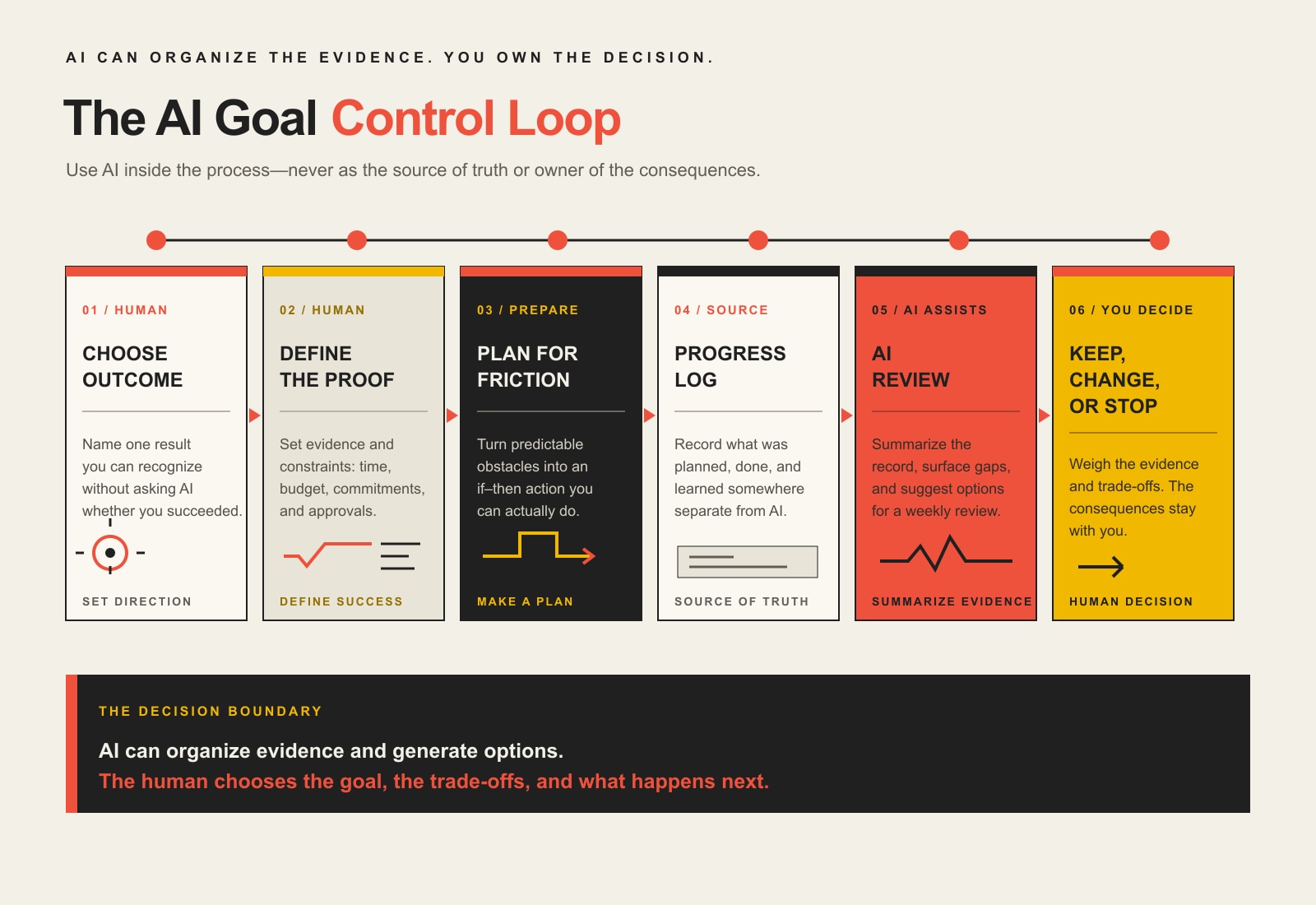
Author: scopedesign

  • What Makes a Good Website? The Website Fitness Test

    What Makes a Good Website? The Website Fitness Test

    What makes a good website? A good website reliably does its assigned job for the right people without creating avoidable confusion, exclusion, technical failure, operational drag, or false confidence. It should be clear, trustworthy, usable, technically sound, maintainable, and connected to a business outcome you can observe. Looking expensive is not the same as working. A polished website with a broken form is still broken; it is just broken in a nicer font.

    TL;DR: what makes a good website

    1. Purpose: it has a defined job and a clear priority.
    2. Audience: it helps the right people recognize that it is for them—and lets the wrong people self-select out.
    3. Clarity: visitors can understand the offer, find the information they need, and choose a sensible next step.
    4. Trust: important claims are supported by relevant evidence, transparent limitations, and identifiable expertise.
    5. Experience: essential tasks work across devices and for people with different abilities.
    6. Technical reliability: the site loads, functions, protects data, can be found, and does not quietly drop inquiries into a digital sewer.
    7. Business fitness: the organization can operate, measure, maintain, and improve it after launch.

    That is the Scope Design Website Fitness Test. Score each dimension from 0 to 2: 0 means broken or unknown, 1 means plausible but unverified, and 2 means working with evidence. The highest possible score is 14. But this is not Olympic gymnastics: a critical failure cannot be averaged away by accumulating style points somewhere else.
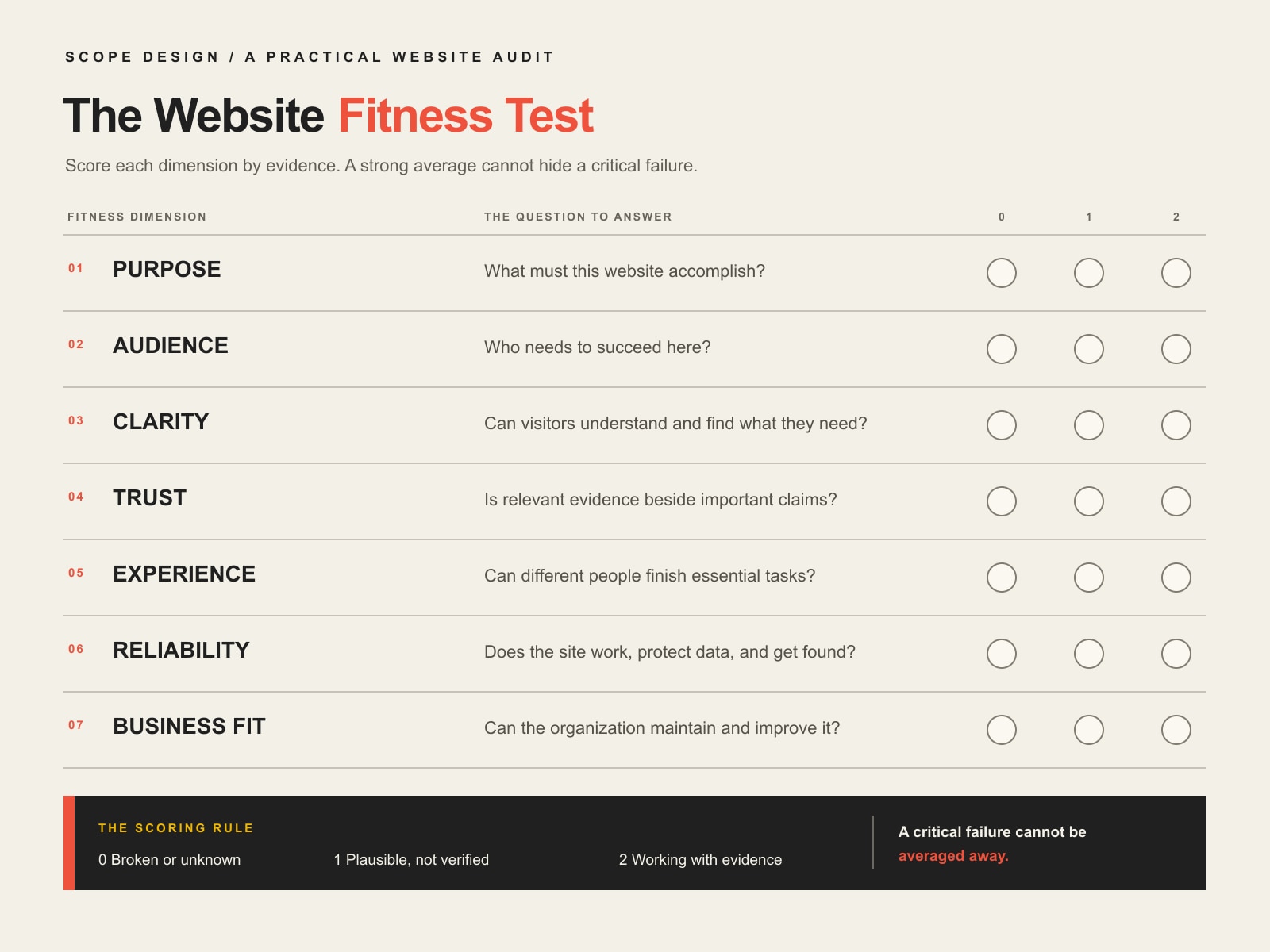
    The Website Fitness Test scorecard lists purpose, audience, clarity, trust, experience, reliability, and business fit, each scored from zero to two, with a note that critical failures cannot be averaged away.

    A good website is good relative to its job

    “Good” is not a visual style. It is a relationship between a website, its users, and the business behind it.

    A referral-driven consultant may need a compact site that establishes credibility and makes contact painless. An ecommerce company needs product discovery, checkout, fulfillment, and support to behave as one system. A manufacturer may need qualified inquiries, specification documents, distributor information, and a clean handoff to sales. A school may need families to find current information quickly without staff calling a developer every time lunch schedules change.

    Those sites should not be judged by the same conversion rate or feature list. They should be judged by whether they do the job assigned to them. This is why website strategy must come before the sitemap. If nobody has decided what the website is accountable for, “make it better” is not a brief. It is an expensive mood.

    Fitness dimensionThe question to answerEvidence of a 2
    PurposeWhat job must this website do?A named priority, owner, and success condition
    AudienceWho must succeed here, and what are they trying to do?Real buyer language, intent paths, and fit criteria
    ClarityCan people understand and find what they need?Successful task checks and fewer repeated questions
    TrustWhy should anyone believe the claims?Relevant proof, transparent limits, and clear authorship
    ExperienceCan different people complete essential tasks?Mobile, keyboard, accessibility, and error-state checks
    Technical reliabilityDoes the machinery work consistently?Field performance, tested forms, monitoring, backups, and clean indexing
    Business fitnessCan the organization operate and improve it?Named ownership, maintainable systems, and outcome reporting

    1. Purpose fitness: the website has one primary job

    A good website begins with a decision: what is the most important thing this website must accomplish for the business and its users?

    It may need to generate qualified sales conversations, complete purchases, support customers, recruit employees, distribute essential information, or establish enough credibility for a referred prospect to make contact. It can support several goals, but they cannot all be the top priority. When five audiences and seven calls to action are equally important, the actual strategy is “good luck, everybody.”

    • 0: nobody can state the website’s job, or departments give conflicting answers.
    • 1: a goal exists, but it is vague—“build awareness,” “look modern,” or “get more traffic.”
    • 2: the website has a prioritized job, a responsible owner, and an observable success condition.

    If the job is still fuzzy, use our website purpose framework before discussing colors, layouts, or software.

    2. Audience fitness: it works for the people arriving

    A website is not good because the owner understands it. Owners navigate their own sites from memory. Visitors arrive from a search result, advertisement, referral, email, or sales conversation with a question already in their head.

    Audience fitness means matching that moment of arrival. The page should help a person identify whether the offer fits their situation, what information matters next, and whether they should continue. That includes honest non-fit guidance. A site that prevents a bad-fit inquiry may be performing better than one that converts every curious stranger into a sales interruption.

    • 0: the site talks to “everyone,” or the traffic arriving has little connection to what the business sells.
    • 1: personas or audience labels exist, but they were invented internally and never checked against real questions.
    • 2: pages reflect real search intent, sales questions, support issues, buyer language, and qualification criteria.

    3. Clarity fitness: the website makes an argument

    Beautiful websites often fail because they were designed to look credible rather than to make a useful argument. The visitor sees tasteful animation, a cinematic drone shot, and “transforming possibilities through innovation.” Wonderful. What the hell does the company do?

    Clarity is more than short copy. A considered purchase may require substantial detail. The test is whether the information arrives in a useful sequence: offer, fit, problem, outcome, process, investment, evidence, risks, alternatives, and next step. Our business website information checklist covers that decision file in detail.

    Clear structure helps humans and machines understand the page. The W3C explains that headings communicate content organization and support in-page navigation, while Google recommends descriptive titles, original information, clear sourcing, and content that leaves the reader able to accomplish a goal.

    • 0: visitors cannot tell what the organization does, who it serves, or where important information lives.
    • 1: the basic message is present, but generic language, internal jargon, or weak hierarchy makes people work for it.
    • 2: unfamiliar users can accurately explain the offer, find critical answers, and identify the next appropriate action.

    4. Trust fitness: evidence sits beside the claim

    Trust is not a testimonial carousel filled with “Great service!” It is the reduction of justified uncertainty.

    A trustworthy website identifies who is speaking, distinguishes documented results from professional judgment, explains meaningful limitations, answers uncomfortable questions, and places relevant evidence close to the claim it supports. A specific example with modest conclusions is stronger than an impressive percentage nobody can trace.

    • 0: claims are unsupported, outdated, deceptive, contradictory, or impossible to verify.
    • 1: proof exists, but it is generic, remote from the claim, or missing important context.
    • 2: relevant work, methods, sources, authorship, constraints, and tradeoffs make the claim proportionate and believable.

    This matters for search visibility too, but not because “E-E-A-T” is a magic switch. Google describes experience, expertise, authority, and especially trust as concepts its systems try to recognize—not a plugin field you can fill until the traffic light turns green.

    5. Experience fitness: essential tasks work for real humans

    User experience is not a decorative layer applied after the strategy. It is the discipline of helping someone comprehend and complete the task.

    Check the essential paths on a phone, with a keyboard, at high zoom, with images disabled, and with deliberately bad input. Labels should describe controls. Focus should remain visible. Errors should explain how to recover. Tap targets should not require the precision of a neurosurgeon riding a bus. Accessibility is not a special mode for somebody else; it is part of whether the interface works.

    • 0: an essential task is inaccessible or breaks on a common device or input method.
    • 1: the happy path works, but accessibility, mobile behavior, validation, or recovery states are assumed rather than checked.
    • 2: representative users can complete essential tasks across relevant devices and input methods, including error recovery.

    Be suspicious of universal UX commandments. Fewer clicks are not automatically better; three confident clicks beat one confusing one. Shorter forms are not automatically better; intentional fields can improve qualification. Removing navigation may help a focused paid landing page and damage an organic research page. Context is the whole damn job.

    6. Technical fitness: the machinery earns trust quietly

    A website cannot communicate, convert, or support anyone if it does not reliably load and function. Technical quality includes performance, responsive behavior, search accessibility, form delivery, security, privacy, integrations, backups, and recovery—not merely a perfect score from whichever scanner is shouting today.

    Google’s current Core Web Vitals define “good” field performance at the 75th percentile as Largest Contentful Paint of 2.5 seconds or less, Interaction to Next Paint of 200 milliseconds or less, and Cumulative Layout Shift of 0.1 or less. Those are useful experience thresholds, not the definition of a good business. A fast page with the wrong offer simply disappoints people efficiently.

    • 0: critical forms, checkout, search access, security, or data handling are broken or unknown.
    • 1: the site appears functional, but nobody monitors it, restores backups, tests notifications, or checks field performance.
    • 2: essential paths are tested, performance is measured with real-user data where available, ownership is clear, and recovery is practiced.

    This is also where a professional website differs from a basic website: the invisible foundation, responsibilities, and failure handling are part of the product.

    7. Business fitness: the website survives contact with the organization

    A launch is not evidence that a website is good. It is evidence that the launch happened.

    Business fitness asks what happens next. Who answers inquiries? Who owns updates? Can staff publish routine content without breaking layouts? Are the domain, hosting, code, analytics, and vendor accounts owned by the business? Can data move between the website and the systems that actually run the operation? Does anyone review the outcomes and decide what to improve?

    • 0: ownership is unclear, leads disappear, the system depends on one unavailable person, or nobody can safely maintain it.
    • 1: responsibilities exist informally, but documentation, reporting, access, or ongoing budget is incomplete.
    • 2: ownership, access, workflows, maintenance, measurement, and improvement cadence are explicit and sustainable.

    The website may generate a qualified conversation, but it cannot make the sales team return the call. Measure the last outcome the website genuinely controls, then follow it downstream to learn whether it produced business value. Our website conversion checklist maps that entire chain.

    The fail conditions: when the score no longer matters

    A total score is useful for prioritization, but it must not hide catastrophic weaknesses. Any of these conditions is an automatic failure until corrected:

    • An essential path—contact, application, checkout, booking, login, or support—does not work.
    • A required task excludes users because it cannot be completed with relevant assistive technology, keyboard input, or common mobile devices.
    • The site makes deceptive claims, uses fabricated proof, or employs manipulative patterns that visitors would resent if they understood them.
    • Sensitive data is collected or handled without appropriate security, privacy, ownership, or retention controls.
    • The business cannot access, maintain, move, or recover the site and its essential data.
    • Nobody knows what success means, whether the primary action works, or who is responsible for responding.

    A site can be gorgeous, quick, and technically valid while failing one of those tests. That is not a 12 out of 14. It is a fire alarm with excellent kerning.

    A real example: the website request that was not really a website problem

    A long-established specialty auction business approached Scope Design about a new website and a substantial list of features. A cosmetic review would have produced new page designs. Discovery produced a different diagnosis.

    The visible site sat on top of legacy technology, broken or incomplete customer-facing processes, disconnected data, manual invoicing, older operational software, infrastructure responsibilities, and several systems the new website would need to support. The feature list was only the surface. Building it responsibly required mapping where information lived, which system owned it, how it moved, and who would operate the result.

    So the work became foundation first, features second. That example does not prove a percentage increase in revenue, and we will not invent one to make the paragraph sparkle. It supports a narrower and more useful point: the thing a client asks you to build is not necessarily the problem they need you to solve.

    How to evaluate a website in 30 minutes

    1. Write down the job. Complete this sentence: “This website is working when the right visitor can ______, and the business can observe ______.”
    2. Choose three real entry pages. Use pages receiving organic, referral, paid, or direct traffic—not only the homepage everybody has polished to death.
    3. Ask an unfamiliar person to orient themselves. Can they explain what is offered, who it is for, and what they would do next?
    4. Complete the primary task. Use a phone and keyboard. Submit the form, place a test order, book the appointment, or find the support answer.
    5. Confirm the handoff. Did the notification arrive? Was the data recorded correctly? Does a named person know what to do next?
    6. Inspect the evidence. Are the important claims supported where the reader is likely to doubt them?
    7. Check the foundation. Review mobile behavior, accessibility basics, Search Console, field performance, security ownership, backups, and update responsibility.
    8. Score the seven dimensions. Record what you observed, not what the team assumes.

    Do not begin by debating button colors. If the offer is unclear, the wrong people are arriving, or leads sit unanswered for three days, micro-optimization is deck-chair arrangement with a monthly reporting fee.

    What the Website Fitness Test is—and is not

    This framework is a diagnostic, not a universal recipe. It helps identify where the website is weak and what evidence is missing. It does not prescribe the same number of pages, form fields, words, calls to action, plugins, or animations for every business.

    It also does not mean every weakness requires a redesign. Sometimes the best next move is to repair a form, clarify one offer, rewrite three entry pages, document the follow-up process, or stop buying traffic until the business can service it. If the real constraint is upstream, a new website can become a very handsome way to avoid the decision.

    Frequently asked questions

    What are the qualities of a good website?

    A good website has a clear purpose, serves the intended audience, communicates plainly, supports its claims, enables accessible and usable task completion, works reliably, and fits the business processes responsible for operating and measuring it. Visual quality matters, but it cannot compensate for failure in those areas.

    What are the seven C’s of a good website?

    Several unrelated “seven C’s” frameworks circulate online, commonly using terms such as context, content, community, customization, communication, connection, and commerce. They can be useful prompts, but they are not a universal standard. Scope Design uses seven fitness dimensions instead: purpose, audience, clarity, trust, experience, technical reliability, and business fitness.

    What are the five most important things on a business website?

    If forced to choose five, include a clear offer, explicit audience fit, credible evidence, usable paths to essential information or actions, and a specific next step. The underlying technology and operational handoff still need to work; they simply are not always visible on the page.

    Is a visually attractive website automatically a good website?

    No. Visual design can improve comprehension, distinctiveness, credibility, and emotional response. It can also conceal vague messaging, inaccessible controls, broken forms, poor performance, and weak operations. Appearance is one part of the experience, not the verdict.

    Does a good website have to convert visitors into customers?

    Not every website or page has a direct sales job. A site may need to support customers, recruit employees, publish essential information, or establish credibility for referred prospects. It should produce the outcome assigned to it. When the job is lead generation or ecommerce, qualified conversions matter more than raw traffic or indiscriminate form submissions.

    How fast should a good website load?

    For current Core Web Vitals, Google classifies “good” field performance at the 75th percentile as LCP at or below 2.5 seconds, INP at or below 200 milliseconds, and CLS at or below 0.1. Treat these as useful experience thresholds, then investigate the actual pages and users involved rather than worshipping a single lab score.

    Does a good website need to be custom-built?

    No. A template can be the right solution when the site has a simple job, stable content, no unusual integrations, and a limited maintenance budget. Custom work earns its cost when the workflow, data, integration, content scale, or brand distinction genuinely requires it. Buying complexity as a status symbol is still buying complexity.

    How often should a business evaluate its website?

    Monitor critical paths continuously and review the broader site whenever the offer, audience, business process, technology, legal obligations, or evidence changes. As an operating baseline, Scope Design recommends a substantive review at least annually for conceptual content and roughly every six months for platform, pricing, and technical material that becomes stale faster.

    The blunt definition

    A good website helps the right person make progress and helps the business fulfill its side of the bargain. It is understandable without insider knowledge, credible without manufactured hype, usable without unnecessary struggle, reliable without constant heroics, and maintainable after the launch applause dies down.

    If you cannot tell which dimension is failing—or whether the website is even the constraint—a redesign quote is premature. Talk to Scope Design about a paid website diagnostic. We will identify what is actually broken before prescribing a prettier version of the wrong solution.

    Sources and standards

  • Email Subject Lines: Write an Honest Promise, Not Inbox Clickbait

    Email Subject Lines: Write an Honest Promise, Not Inbox Clickbait

    A good email subject line tells the right recipient what the message is about, why it matters now, and what kind of value or action is inside—without lying, shouting, or playing psychological three-card monte. It should earn attention by making a relevant promise the email actually keeps.

    TL;DR: Make the sender recognizable, state the useful point early, match the body exactly, front-load words that survive mobile truncation, and judge the subject by downstream actions—not only opens. Curiosity is fine. Manufactured urgency, fake personalization, and deceptive framing are trust debt wearing marketing pants.

    What Is an Email Subject Line?

    An email subject line is the short inbox headline that identifies the topic or purpose of a message before the recipient opens it. It works beside the sender name, sender address, preview text, timing, and the recipient’s existing relationship with the business.

    That context matters. The subject line does not operate in a laboratory. A precise service notice from a company the customer recognizes can outperform a “power-word” masterpiece from an unfamiliar sender. A relevant appointment reminder does not need curiosity. A promotional email may need a stronger reason to care, but it still does not need to pretend the recipient’s account is on fire.

    The subject line’s real job is to make a trustworthy micro-decision easier: Is this message relevant enough to open now, save for later, or ignore?

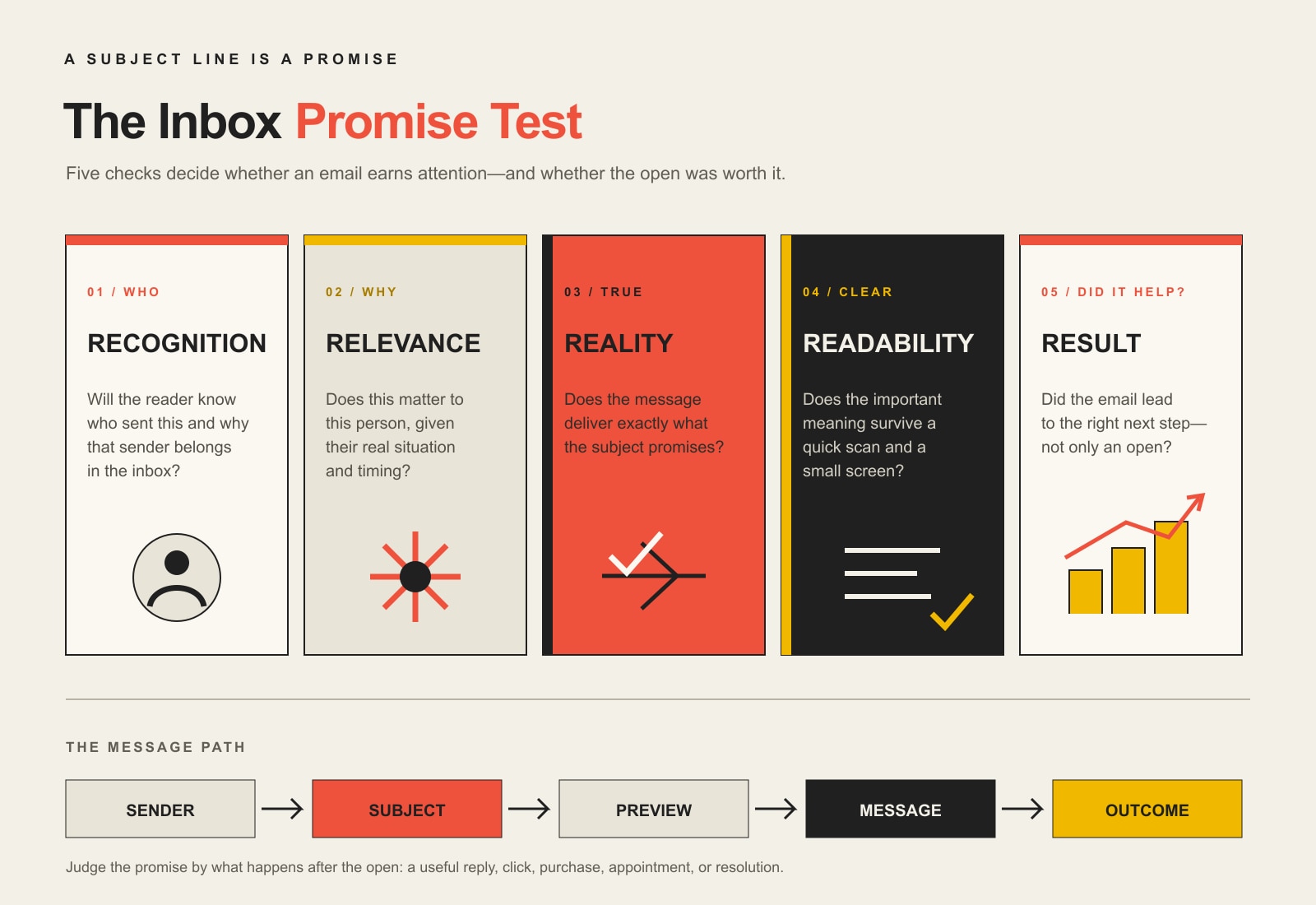
    The Scope Design Inbox Promise Test

    The Inbox Promise Test checks recognition, relevance, reality, readability, and result, tracing a message from sender through subject, preview, and message to outcome.

    Evaluate every subject line through five connected checks: Recognition, Relevance, Reality, Readability, and Result.

    CheckQuestionFailure signal
    RecognitionWill the recipient understand who this is and why that sender belongs in the inbox?A clever line arrives from an unrecognizable name or reply address
    RelevanceDoes the subject connect to this recipient’s actual situation, preference, purchase, question, or timing?Decorative personalization tries to imitate a relationship
    RealityDoes the body deliver exactly what the subject promises?“Last chance” is followed by three more last chances
    ReadabilityCan the important meaning survive quick scanning, mobile truncation, and ordinary human distraction?The useful noun is buried after a ceremonial preamble
    ResultDid the message help produce the intended reply, click, purchase, appointment, resolution, or other next step?Opens rise while complaints, low-quality clicks, or unsubscribes rise too

    Most advice begins at Readability—shorter words, emojis, punctuation, “power” verbs. Those details can matter, but they are downstream. Recognition, relevance, and reality determine whether the subject deserves to be opened. Result determines whether the open was worth anything.

    1. Start with the Message’s Job

    Write the subject after deciding what the email must help the recipient understand or do. If the team cannot state the message’s job in one sentence, the subject line will probably become vague, inflated, or both.

    Useful jobs include:

    • confirm an order, appointment, payment, or request;
    • explain a change that affects the customer;
    • deliver something the recipient asked for;
    • answer a consequential question;
    • invite a qualified next step;
    • announce a genuine offer, deadline, event, or availability change;
    • support onboarding, service, renewal, or re-engagement;
    • publish a recurring newsletter with a clear editorial promise.

    “Increase engagement” is not a message job. “Help current hosting customers understand the maintenance window and whether they need to do anything” is.

    This fits the broader small-business email marketing strategy: each message needs permission, purpose, a maintained contact record, relevant context, reliable delivery, an accountable handoff, and an observable outcome. A subject line is one promise inside that system, not the system itself.

    2. Put the Useful Meaning First

    Inbox interfaces truncate subject lines differently according to device, app, window width, font settings, and whether preview text is shown. There is no universal character count that guarantees full display everywhere.

    Instead of worshipping an exact length, front-load the information that helps the reader classify the message:

    Weak or delayedClearer front-loaded versionWhy it is better
    A quick update regarding the changes to your upcoming appointmentAppointment moved to 2:30 ThursdayThe decision-changing fact arrives first
    We wanted to let you know about some exciting new store hoursNew Saturday hours begin September 5Specific change before filler
    Don’t miss out on this incredible opportunity before it is too lateRegistration closes Friday at noonReal deadline replaces theatrical urgency
    Here is an important document you requested from our teamYour website audit is readyRequested object and status are immediate
    Following up with some additional information for your reviewRevised estimate: hosting option addedThe revision is identifiable in the inbox

    Short is useful when it removes waste. Short is not automatically clear. “Quick question” is compact but forces the recipient to open the message to discover whether the question is relevant. “Question about the March estimate” is longer and more respectful.

    3. Coordinate the Sender Name, Subject, and Preview Text

    The sender name answers “Who?” The subject answers “What and why now?” The preview text can add context or the next useful detail. Treat them as a small message hierarchy.

    For example:

    • Sender: Scope Design Support
    • Subject: Website maintenance begins at 9 p.m.
    • Preview: No action is required; expected interruption is under five minutes.

    Repeating the same sentence three times wastes the limited inbox surface. Hiding the sender behind an employee name the customer has never seen damages Recognition. Allowing the preview to begin with “View this email in your browser” makes the software—not the customer—the main character.

    Use a monitored reply address when replies are appropriate. “No-reply” may be necessary for some transactional systems, but it should not become the default for relationship-building messages that invite conversation.

    4. Use Personalization Only When It Adds Meaning

    A first name is not relevance. It is a database field wearing a tiny hat.

    Useful personalization reflects a legitimate relationship fact that changes the message:

    • the recipient requested a specific guide or estimate;
    • an appointment, order, account, service, or project has a real status;
    • a product is back in stock for people who requested notice;
    • an event or service applies to the recipient’s location;
    • the person selected a topic or communication preference;
    • a customer action created a useful next step.

    Bad personalization is decorative, inaccurate, overly intimate, or based on data the recipient did not expect the business to use. It can reduce trust faster than a generic subject because it demonstrates that the database knows something without demonstrating that the business understands anything.

    Before using a personalized field, define the fallback, test missing or malformed values, and confirm that the data stays current. “Hi FNAME, your Albany order is ready” is not the unforgettable brand experience anyone ordered.

    5. Curiosity Must Have a Payload

    Curiosity works when the subject reveals enough context to let the right person recognize relevance while leaving a useful question the body answers.

    Responsible curiosity:

    • The form field costing applicants unnecessary time
    • Why the redesign did not fix the lead problem
    • One hosting responsibility most proposals leave vague
    • What changed in your July service report

    Empty curiosity:

    • You won’t believe this
    • This changes everything
    • We need to talk
    • Bad news...

    The first group names a topic and creates a credible information gap. The second group withholds the topic to force an open. That may generate activity, but it also trains recipients to treat the sender like a carnival barker who wandered into Outlook.

    Use the inbox test: Would the subject still feel fair after the message is opened? If the body cannot pay off the curiosity immediately and specifically, rewrite it.

    6. Use Urgency Only When Time Is Actually the Constraint

    Urgency is appropriate for a real appointment, deadline, expiring application, limited capacity, service interruption, inventory condition, or time-bound offer. State the concrete constraint.

    Better urgency:

    • Approve the proof by Tuesday for Friday delivery
    • Two consultation slots remain for September
    • Renewal price changes October 1
    • Store closes at 3 p.m. during road work

    Manipulative urgency:

    • ACT NOW!!!
    • Final warning when nothing bad happens if the reader ignores it;
    • Only three left when inventory is not actually limited;
    • a countdown that resets when the page reloads;
    • “today only” followed by the same sale tomorrow.

    Genuine urgency improves a decision by revealing time. Manufactured urgency steals a decision by faking it. Scope Design will not trade next quarter’s trust for this afternoon’s open rate.

    7. Negative Framing Can Clarify a Problem—Or Manufacture One

    Negative framing is not inherently deceptive. A subject such as Three errors blocking the application form can be useful when those errors are real and the email explains them. A warning can be the most responsible subject when a customer faces a security, billing, service, safety, or deadline issue.

    The problem begins when negative emotion is used as bait:

    • implying an account problem that does not exist;
    • inventing a mistake or threat;
    • using shame or anxiety unrelated to the message;
    • presenting an ordinary promotion as an emergency;
    • claiming a tactic “doesn’t work” only to sell the same tactic inside.

    The old separate Scope Design article on negative subject lines claimed a universal 15–25% open-rate lift and a $1,000-per-email legal risk. Neither belongs in an evergreen recommendation. The lift was unsupported, and Washington changed its commercial email statute effective June 11, 2026. The current law prohibits a subject line that, based on actual knowledge or knowledge fairly implied by objective circumstances, contains false or misleading information. It also changed statutory damages for recipients. Legal rules can move; a tidy old penalty figure should not be left pretending it is immortal.

    The durable recommendation is simpler: use negative framing only for a real, relevant problem; make the claim supportable; match the body; and consider applicable federal, state, industry, and international rules. This is editorial and operational guidance, not individualized legal advice.

    The Federal Trade Commission’s CAN-SPAM compliance guide says commercial email subject lines must accurately reflect the message content. Accurate routing information, a valid postal address, an effective opt-out, and other requirements also apply.

    Washington’s current RCW 19.190.020 separately addresses false or misleading commercial email subject lines in messages sent from a computer in Washington or to an address the sender knows or has reason to know belongs to a Washington resident. Other jurisdictions may impose different requirements.

    Compliance is the floor. A technically defensible subject can still be manipulative, annoying, or corrosive. Ask whether the recipient would feel tricked after opening the email. If the answer is yes, the open is not a win. It is a loan taken against sender trust.

    9. Emojis, Capitals, and Punctuation Are Context—Not Strategy

    An emoji can help label a familiar recurring message, add a small amount of tone, or make a legitimate event easier to scan. It can also render differently across platforms, distract from the meaning, create accessibility friction, or make a professional message look like it escaped from a clearance bin.

    Use symbols only when they add meaning. Do not replace critical words with an icon. Test the subject in the email clients and assistive settings relevant to the audience. The same restraint applies to capitalization and punctuation.

    • Sentence case usually scans naturally.
    • ALL CAPS resembles shouting and can reduce readability.
    • One question mark is usually enough to indicate a question.
    • Repeated exclamation points do not make the offer more true.
    • Brackets such as [Invoice] or [Action required] can help recurring operational email when the label is accurate and consistently used.

    There is no magical “spam word” list that automatically determines delivery. Google’s sender guidelines emphasize authentication, wanted mail, spam rates, alignment, and subscription practices. Subject-line styling is one signal inside a much larger sender relationship.

    10. Test the Promise, Not Just the Trick

    An A/B test should answer a useful question. Test one material difference against a meaningful segment, give the test enough data and time to reduce random noise, and interpret the result according to the message’s business job.

    Useful test questions include:

    • Does a specific outcome outperform a generic announcement?
    • Does front-loading the deadline reduce missed actions?
    • Does the customer’s chosen topic improve qualified clicks?
    • Does a straightforward subject create fewer opens but more replies or purchases?
    • Does an operational label reduce support confusion?

    Open rate is an imperfect signal. Apple Mail Privacy Protection can prevent senders from seeing whether a recipient opened a message and can load remote content privately in the background. Judge tests using the deepest observable result the email can reasonably influence: replies, useful clicks, bookings, purchases, completed steps, service resolution, unsubscribes, complaints, or downstream revenue where traceable.

    Low-volume small businesses should be especially skeptical of tiny subject-line tests. If each version reaches forty people, a difference of three opens is not a universal law. Use the result as a clue, combine it with replies and sales feedback, and prioritize larger problems such as list quality, offer relevance, delivery, and follow-up.

    11. Resend to Non-Openers Carefully

    Automatically resending every campaign to “non-openers” is not an ultimate hack. Open tracking is imperfect, so the group may include people who opened privately. Repeated sends can also increase fatigue, complaints, or unsubscribes.

    A resend can be reasonable when:

    • the message is genuinely important or time-sensitive;
    • the audience expects the communication;
    • the original timing may have buried it;
    • the new subject clarifies rather than manipulates;
    • the resend is limited and monitored;
    • the message stops after the recipient acts.

    Do not turn “in case you missed it” into an automated nagging subscription nobody requested. When the message contains a real deadline, say what it is. When it does not, allow silence to remain a valid response.

    Email Subject Line Examples by Message Job

    Examples should be adapted to the actual facts. Brackets indicate information the business must supply honestly.

    Message jobSubject-line patternExample
    Requested resource[Resource] is readyYour website planning worksheet is ready
    Appointment[Appointment] + [specific change or action]Site review moved to 2:30 Thursday
    Estimate or proposal[Document/status]: [meaningful update]Revised estimate: migration option added
    Service notice[System/service] + [timing or impact]Website maintenance begins at 9 p.m.
    Invoice[Invoice identifier] + [status or due date]Invoice 1042 is due Friday
    Event[Event] + [real deadline or next step]Workshop registration closes Friday at noon
    Newsletter[Useful topic or conclusion]Why the redesign did not fix the lead problem
    Product availability[Product] + [truthful status]The walnut desk is back in stock
    Re-engagement[Preference or relationship question]Still want the monthly website briefing?
    Sales follow-up[Shared context] + [specific next step]Question about the auction-system diagnostic

    For recurring editorial email, the email newsletter guide should govern the format and reader promise. The subject should identify the strongest useful idea, not disguise the newsletter as a personal emergency.

    A Practical Subject-Line Writing Process

    1. Write the message’s primary job in one sentence.
    2. Identify the recipient’s legitimate relationship and why the message matters now.
    3. Draft one plain, specific subject that tells the truth without trying to be clever.
    4. Draft two alternatives that change one meaningful angle: context, outcome, question, or genuine timing.
    5. Apply the Inbox Promise Test: Recognition, Relevance, Reality, Readability, Result.
    6. Coordinate sender name and preview text without repeating the same words.
    7. Test personalization fallbacks, truncation, links, reply handling, and the actual body promise.
    8. Send only to the appropriate permissioned segment.
    9. Review downstream actions, complaints, unsubscribes, and sales or service feedback.
    10. Save useful patterns with their audience and context—not as universal swipe-file commandments.

    Frequently Asked Questions About Email Subject Lines

    What is a good email subject line?

    A good subject line is recognizable, relevant, truthful, easy to scan, and connected to the message’s intended result. It helps the right recipient understand what is inside without forcing an open through ambiguity or pressure.

    What should I write in the subject of an email?

    State the most useful combination of topic, status, timing, and required action. For operational email, specifics such as Invoice 1042 due Friday or Appointment moved to 2:30 Thursday usually beat cleverness.

    What is an example of a professional email subject line?

    Revised project estimate: hosting option added is professional because it names the document, identifies the change, and avoids filler. The best wording depends on the real relationship and message job.

    How long should an email subject line be?

    There is no universal ideal character count because inbox displays vary. Keep it as short as clarity permits and put the decision-changing words first so the meaning survives truncation.

    Do emojis improve email subject lines?

    Sometimes an emoji can help scanning or tone for an audience that expects it. It is not a guaranteed performance lift. Use it only when it adds meaning, never as a substitute for critical words, and test rendering and accessibility.

    Should I put the recipient’s first name in the subject line?

    Only when the personalization is accurate and meaningfully improves relevance. A first name pasted into a generic promotion is not a relationship. Context such as a requested estimate, appointment, order, or chosen topic is often more useful.

    Do urgent subject lines get more opens?

    Genuine urgency can help recipients act on a real deadline or constraint. Manufactured urgency may create an open while damaging trust, complaints, and long-term response. State the concrete deadline rather than shouting.

    Are negative email subject lines effective?

    They can clarify a genuine risk, mistake, or problem, but there is no universal lift. Negative framing should be accurate, relevant, supported by the body, and evaluated beyond opens. Do not invent anxiety to manufacture attention.

    Can I resend an email with a different subject line?

    Yes, selectively. Use resends for genuinely important messages, account for imperfect open tracking, change the subject to improve clarity, limit frequency, stop after action, and monitor complaints and unsubscribes.

    How should I A/B test email subject lines?

    Test one meaningful difference at a time, use a relevant segment, and judge the deepest observable result—not merely opens. For a low-volume list, treat small differences as clues rather than statistical commandments.

    Which words send an email to spam?

    No single universal word list determines inbox placement. Authentication, permission, complaints, reputation, list quality, content, sending patterns, and platform rules all matter. Excessive caps, punctuation, and misleading promotion can still harm trust and complaint rates.

    What email subject lines get the most opens?

    No wording wins across every audience and message. The most dependable starting point is a recognizable sender, specific relevance, an honest promise, and clear meaning. Then measure replies, clicks, conversions, service outcomes, complaints, and unsubscribes in your own context.

    Your Subject Line Is a Promise

    The subject line does not need to win a shouting match against every message in the inbox. It needs to help the right person recognize a useful message from a sender they can trust.

    If email performance is weak across the board, do not spend the next month rearranging punctuation while the list, offer, authentication, segmentation, or follow-up process is broken. Scope Design’s Impact Consulting can identify the actual constraint before another round of “killer subject lines” murders the remaining goodwill.

  • 4 Proven Ways to Increase Sales Immediately

    4 Proven Ways to Increase Sales Immediately

    Quick answer: To increase sales without guessing, work on the constraint closest to revenue first. If qualified prospects already reach you but do not buy, improve conversion. If past leads or customers are sitting idle, reactivate them. If your sales rate is healthy but each sale is worth too little, improve pricing or packaging. Only after the sales path converts reliably should you add more qualified demand.

    Those are proven revenue levers, but “immediately” needs an honest definition. You can start the right test today. You cannot guarantee that every business will produce more revenue today, this week, or from the same tactic.

    At Scope Design, the rule is simple: a requested tactic is evidence, not a diagnosis. Our constraint-first order is Objective → Constraint → Positioning → Strategy → Tactics → Measurement. If you need the broader system behind channel and marketing decisions, see our small-business marketing strategy guide.

    The Fastest Sales Lever Is Usually the Closest Revenue Constraint

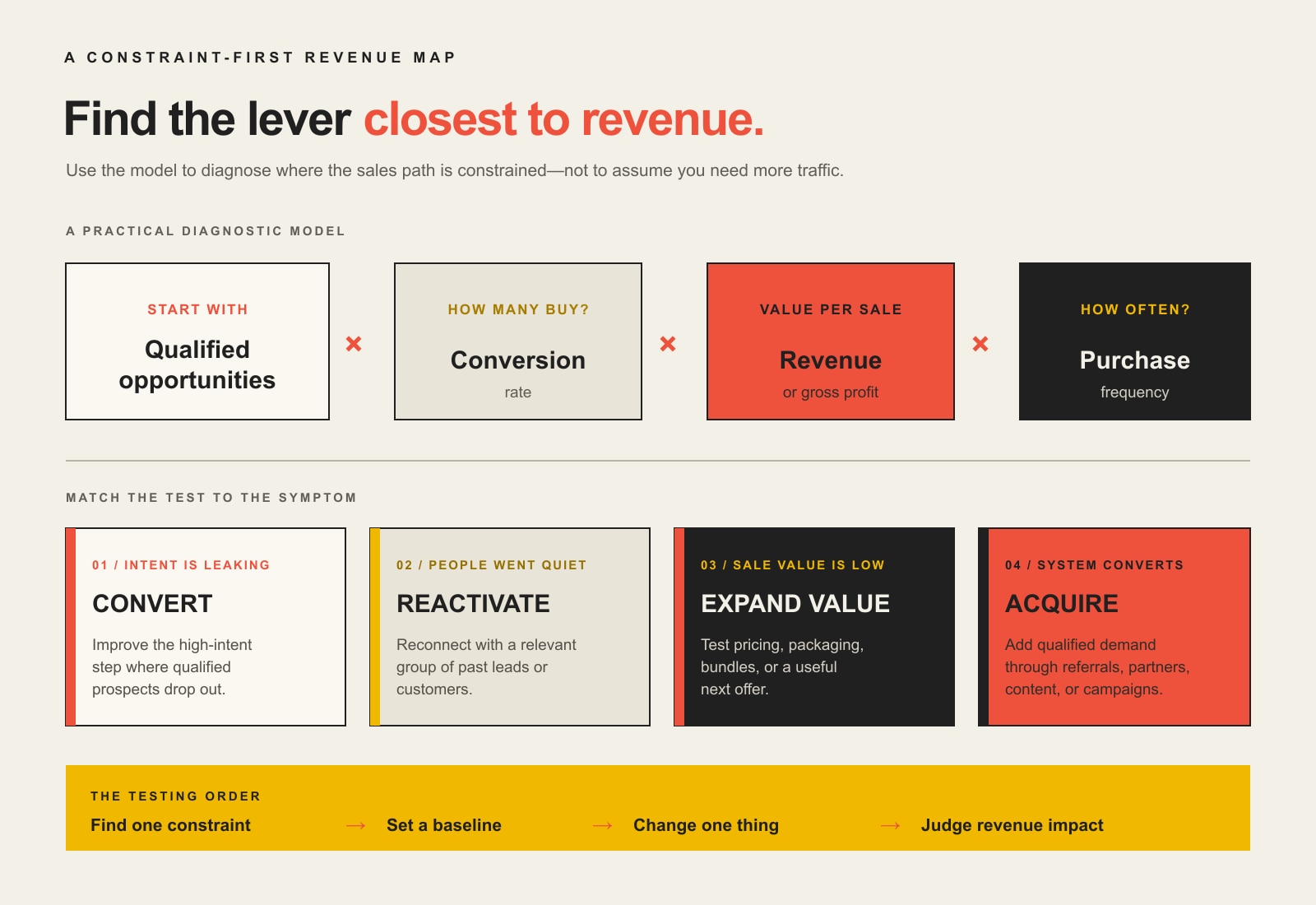
    A useful way to diagnose sales is to model revenue as four connected variables:

    Revenue ≈ qualified opportunities × conversion rate × value per sale × purchase frequency.

    This is a diagnostic model, not an accounting formula for every company. Its value is that it stops you from treating “more traffic” as the default answer. Each part of the model points to a different lever you can test.

    1. Convert: get more qualified prospects who are already in the sales path to take the next meaningful action.
    2. Reactivate: reconnect with leads and customers who already know the business.
    3. Expand value: improve revenue or gross profit per sale through better pricing, packaging, bundles, or appropriate upsells.
    4. Acquire: add new qualified demand through referrals, partnerships, affiliates, content, advertising, or other channels.
    A diagnostic model connects qualified opportunities, conversion rate, value per sale, and purchase frequency to four tests: convert, reactivate, expand value, or acquire; the testing order is find a constraint, set a baseline, change one thing, and judge revenue impact.
    Start with the symptom closest to revenue, establish a baseline, and test one lever at a time.

    If you are unsure which variable is actually constrained, our deeper guide to diagnosing why marketing is not working walks through the bottleneck before adding another tactic.

    1. Convert More of the Qualified Demand You Already Have

    This lever comes first when people are already reaching a high-intent page, requesting information, starting checkout, asking for quotes, or entering the sales process—but too few finish the next meaningful step.

    Do not begin with a sitewide redesign or a dozen simultaneous changes. Find the point where qualified intent is leaking out. Depending on the business, that might be a confusing offer, weak proof, an unclear call to action, unnecessary checkout friction, slow response time, or a sales handoff that leaves the prospect wondering what happens next.

    A bounded conversion test

    • Baseline one meaningful outcome. Use a purchase, qualified inquiry, booked consultation, accepted proposal, or another outcome tied to the sales path—not just pageviews.
    • Choose one high-intent step. Work on the page, form, checkout, quote process, or follow-up where the loss occurs.
    • Change one material thing. Clarify the offer, put proof near the decision, remove an unnecessary field, make the next step explicit, or tighten the handoff.
    • Judge the business outcome. A higher click rate is useful only if it moves more qualified people toward revenue.

    Example: if 100 qualified prospects reach a decision page and two buy, your baseline conversion is 2%. You do not need an industry-average conversion rate to know whether your own controlled change improves that baseline. The right comparison is your business before and after the test, with enough volume and time to avoid overreacting to noise.

    2. Reactivate Leads and Customers Already in Your Orbit

    Before paying to introduce yourself to strangers, look at the people who already raised a hand. Open proposals, older inquiries, previous buyers, renewal candidates, and customers with a logical next need can be closer to revenue than a brand-new visitor.

    The mistake is turning “follow up” into “email everyone more often.” There is no universal send frequency that maximizes every list. A useful cadence depends on why someone joined, what stage they are in, what you have to say, how long the buying cycle is, and whether the audience is responding.

    A better first test is one relevant message to one defined group. For example:

    • Ask stalled prospects whether the original problem still needs to be solved.
    • Show past customers a genuinely complementary service, refill, maintenance option, or next step.
    • Answer the objection that repeatedly stopped a specific class of lead.
    • Invite a segment to a useful resource or offer that matches what they originally asked about.

    Measure replies, qualified conversations, bookings, purchases, or reactivated revenue—not the number of messages sent. For the deeper system behind list ownership, lifecycle, message jobs, and sustainable cadence, use our email marketing roadmap for local business.

    3. Increase Value per Sale Without Pricing by Vibes

    If qualified customers are buying at a healthy rate but revenue or margin per sale is too low, the next lever may be value rather than volume. That can mean a price change, a clearer package, a bundle, a minimum engagement, an add-on, or an upsell that genuinely helps the buyer.

    Do not assume “raise prices” automatically means “make more profit.” Model the economics first. The U.S. Small Business Administration’s break-even guidance defines break-even as the point where total cost equals total revenue and uses fixed cost, selling price, variable cost, and projected unit sales to model the result. That is a better starting point than pricing psychology slogans.

    Use the old pricing example the right way

    Suppose a $29 offer produces seven sales per 100 qualified opportunities. That is $203 in revenue. If a $47 version produces five sales, that is $235. The second scenario generates $32 more revenue per 100 opportunities—but that does not prove the higher price is better. You still need to consider variable costs, acquisition costs, refunds, support load, retention, and what happened to the quality of the customer relationship.

    The point of the math is to show why conversion rate alone is not the business outcome. Price and volume interact. Test them deliberately. If pricing is the real constraint, our strategic guide to raising prices goes deeper into cost, value, positioning, segmentation, testing, and communication.

    4. Add Qualified Demand Through Referrals, Partners, and Affiliates

    Acquisition belongs fourth in this diagnostic—not because new demand is unimportant, but because pouring more people into a weak sales path can make the business busier without making it healthier.

    If the offer is understood, the sales path converts, the economics work, and follow-up is functional, then new qualified demand can become the right constraint to attack. Start with sources that bring context and trust, not just raw traffic.

    Three practical acquisition tests

    • Customer referrals: ask satisfied customers who else has the problem you solve, and make the introduction easy without turning the relationship into pressure.
    • Complementary partners: find businesses that serve the same customer before or after you do, then build a referral or co-marketing path that makes sense for both sides. Our guide to unexpected business partnerships explores that relationship more deeply.
    • Affiliates or creators: recruit a small number of partners whose audience and reputation fit the offer, give them a clear reason to care, and measure qualified sales rather than clicks.

    If compensation or another material relationship is involved in an endorsement, the Federal Trade Commission’s Endorsement Guides say the relationship should be disclosed clearly and conspicuously. Treat disclosure as part of the partnership design, not fine print added later.

    For acquisition, use the same discipline as the other levers: one audience, one offer, one channel, one measurable handoff, and one decision point. Our growth-hacking guide uses the same bounded-experiment idea for customer acquisition.

    How to Choose the First Sales Test This Week

    Use the symptom, not your favorite tactic, to choose the first move:

    • You have enough qualified visits, inquiries, or sales conversations, but too few become customers: test Convert.
    • You have a meaningful pool of past leads or customers who are not receiving relevant follow-up: test Reactivate.
    • Customers buy, but the economics are thin or the average sale leaves obvious value on the table: test Expand Value.
    • The sales path converts reliably and profitably, but there are not enough qualified opportunities entering it: test Acquire.

    Then write down three things before changing anything: your baseline, the single variable you are changing, and the business outcome that determines keep/change/stop. The review window should match the sales cycle. An ecommerce store may see a useful signal quickly; a consultative service with a long proposal cycle may need substantially longer.

    This prevents the most common failure mode in “increase sales” advice: changing the landing page, email schedule, price, ad creative, and partner outreach at the same time, then having no idea which change helped or hurt.

    What “Increase Sales Immediately” Should Actually Mean

    You can increase the quality of your sales process immediately. You can remove friction today. You can send a relevant follow-up today. You can model a pricing change today. You can ask for a referral today. What you should not promise is that any of those actions will create guaranteed same-day revenue.

    The useful definition of “immediate” is the shortest responsible feedback loop you can control. That keeps urgency without replacing judgment with hype.

    Frequently Asked Questions About Increasing Sales

    How can a small business increase sales quickly?

    Start with the closest revenue constraint. Improve conversion if qualified demand already exists, reactivate past leads or customers if you have dormant demand, improve pricing or packaging if value per sale is the problem, and add qualified demand only when the sales path already converts. Pick one lever and one measurable test rather than launching several tactics at once.

    Is more traffic the fastest way to increase sales?

    Not always. More traffic helps when too few qualified opportunities enter a sales system that already converts economically. If the real problem is a confusing offer, weak proof, checkout friction, poor follow-up, or thin pricing, more traffic can simply send more people into the same leak.

    Should I raise or lower prices to increase sales?

    Neither direction is automatically correct. Model contribution and break-even, understand what customers value, and test a controlled price or package change. Watch revenue and profit contribution along with conversion, customer quality, retention, and support cost.

    How often should I email leads and customers?

    There is no universal best frequency. Base cadence on audience expectations, lifecycle stage, buying cycle, the usefulness of what you have to say, and response. A relevant follow-up to a defined segment is a better first test than simply deciding everyone should receive more email.

    What sales metric should I measure first?

    Measure the last meaningful outcome the part of the system can control. For ecommerce that may be a purchase or contribution margin. For a service business it may be a qualified inquiry, booked consultation, accepted proposal, or closed sale. Use traffic, clicks, opens, and form starts as diagnostic metrics—not substitutes for the business outcome.

    Stop Collecting Tactics. Find the Constraint.

    The four ways to increase sales are not four commands every business should run at once. They are four places to look for the next constraint: convert, reactivate, expand value, and acquire. Diagnose the closest leak, run one bounded test, measure the outcome, and earn the right to move to the next lever.

    If the constraint is your website, lead path, marketing system, or measurement—and you want help diagnosing it before buying another tactic—contact Scope Design. We can help map the path from qualified attention to revenue and identify what deserves the next test.

  • Overcoming Business Bias: How Unexpected Partnerships Drive Growth

    Overcoming Business Bias: How Unexpected Partnerships Drive Growth

    Unexpected partnerships can become strategic partnerships for business growth when two organizations help the same customer make progress in different, complementary ways. The useful question is not “Does this company look like us?” It is “Can we create a better customer outcome together than either of us can create alone—and can we test that idea without making a large, irreversible commitment?”

    That distinction matters because familiarity can be a lousy filter. Teams often default to partners in the same industry, the same network, or the same business model. Sometimes that is appropriate. Sometimes it produces two companies bringing the same asset to the table while overlooking a more unusual business that has the audience, capability, credibility, distribution, or customer context they actually need.

    This guide gives you a practical way to screen unexpected partnership ideas, design a small pilot, and decide whether the evidence earns a larger commitment—without pretending every clever collaboration is a growth engine.

    What Is a Strategic Partnership?

    A strategic partnership is a deliberate collaboration between independent organizations that combine complementary assets to achieve a defined business or customer outcome. The assets might be distribution, expertise, technology, trust, content, audience access, service capacity, data, physical space, or a product capability.

    That is different from simply networking. It is also different from taking on a co-owner. If your question is about equity, decision rights, profit splits, exit terms, or a formal ownership relationship, use our business partnership guide. This article is about external strategic collaborations between businesses that remain independent.

    Why Unexpected Partnerships Can Be More Useful Than Obvious Ones

    An obvious partner often looks good because the relationship is easy to explain. An unexpected partner has to earn its way through a better test: does it improve the customer journey?

    One business may have trust but no implementation capacity. Another may have a strong product but weak access to the right audience. A third may reach the customer immediately before or after the problem you solve. When those pieces fit, the partnership can add a useful acquisition or distribution channel without requiring both companies to become the same kind of business.

    • Shared customer progress: both companies are relevant to the same underlying customer job, even if they sell different things.
    • Complementary assets: each side contributes something the other side would otherwise need to build, buy, or learn.
    • Believable trust transfer: the introduction makes sense to the customer instead of feeling like rented attention.
    • Clean handoff: ownership is clear when a customer, lead, order, or deliverable moves between the parties.
    • Testability: the idea can be exercised through a bounded pilot before anyone bets the relationship on a large launch.

    Use the Scope Design Partnership Fit Matrix

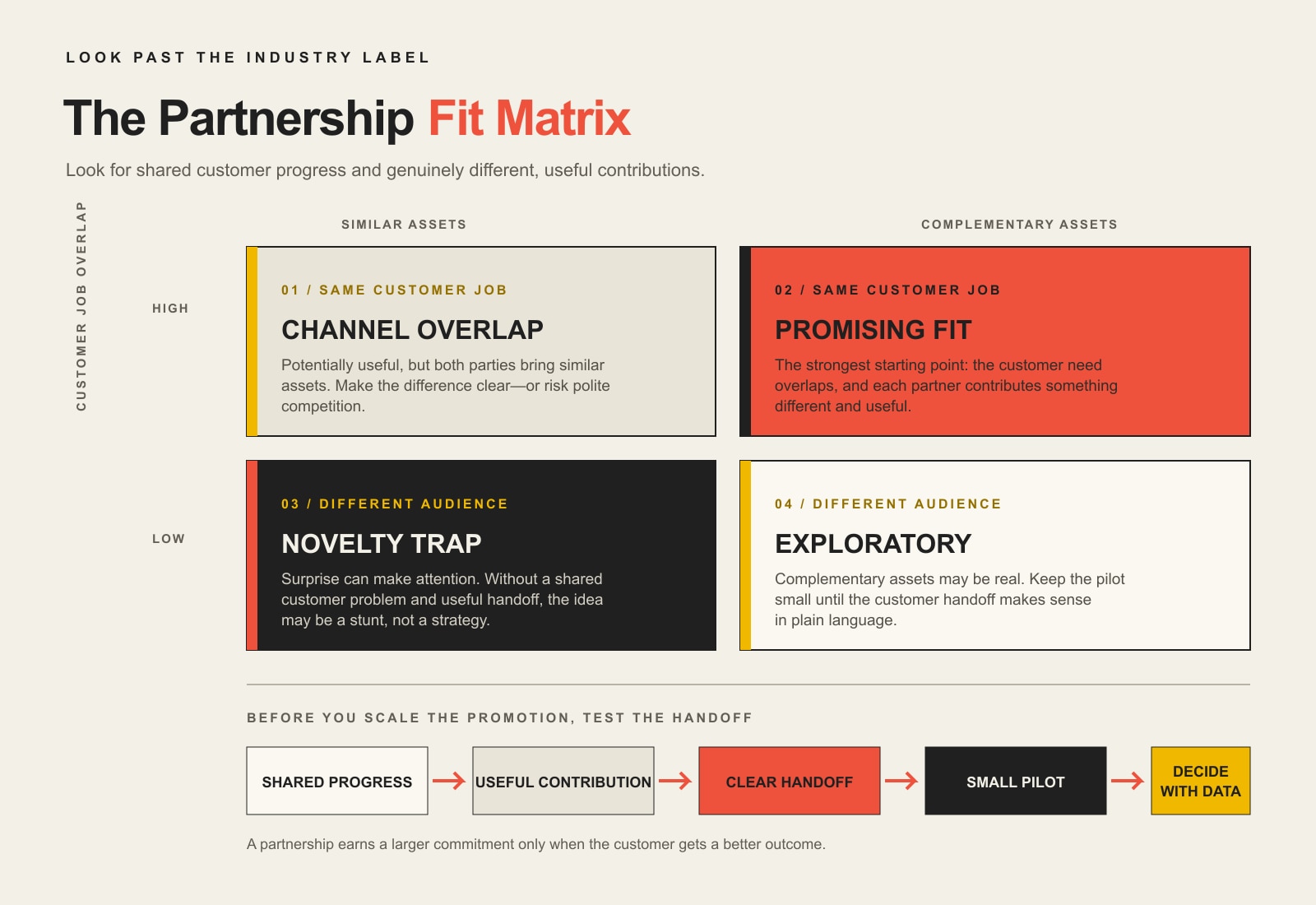
    Before asking whether a partnership is “creative,” plot it on two dimensions: customer-job overlap and asset complementarity. That produces four very different situations.

    A matrix compares overlap in the customer job with similarity or complementarity of partner assets, identifying channel overlap, promising fit, novelty trap, and exploratory opportunities.
    Scope Design Partnership Fit Matrix: the strongest unconventional partnership candidates usually combine meaningful customer-job overlap with genuinely different useful assets.

    1. Promising fit: same customer job, different useful assets

    This is the best place to look first. Think of a commercial real-estate broker and a workplace IT firm serving a company that is moving offices. They do different work, but the customer is trying to complete one larger transition. A coordinated checklist, referral path, move-readiness workshop, or handoff can create obvious value.

    2. Channel overlap: same customer job, similar assets

    Two firms may reach the same audience but bring nearly identical capabilities. The relationship can still work, but only if the differentiation is clear—different geography, specialty, capacity, segment, or stage of the customer journey. Otherwise the “partnership” can become polite competition.

    3. Exploratory: different audience, complementary assets

    This is where genuinely unusual ideas live. The capability fit may be strong, but the customer handoff is not yet obvious. Keep the experiment small until you can show why one audience should care about the other party.

    4. Novelty trap: different audience, unrelated assets

    Two brands can generate attention simply because they look surprising together. Attention is not the same as strategic value. If the shared customer problem, contribution, and handoff cannot be explained in plain language, the idea is probably a stunt before it is a growth system.

    Strategic Partnership Examples: What the Fit Actually Looks Like

    Apple + Nike: complementary assets around the runner

    In 2006, Apple and Nike announced Nike+iPod, pairing Nike+ footwear with the iPod nano and a Sport Kit that tracked workout information and delivered audio feedback. The important lesson is not that two famous brands collaborated. It is that the partnership connected different assets—footwear, running context, device technology, music, and workout data—around one customer experience.

    LEGO + Pharrell Williams: shared meaning, not shared category

    The LEGO Group and Pharrell Williams are not in the same industry, but the collaboration had a coherent center: creativity and curiosity. It included the co-designed Over the Moon set and connected with broader creative, film, and nonprofit work. The strategic fit is easier to see when you describe the shared meaning first and the categories second.

    Small-business example: the “before and after” partner

    A home inspector and a remodeling contractor may not sell the same service, but both become relevant around a property decision. A pediatric dentist and a speech therapist may serve different clinical needs while sharing family education moments. An accountant and a commercial insurance advisor may appear at different points in the same business-owner planning cycle.

    These examples are intentionally ordinary. You do not need a celebrity collaboration. For a small business, a strong partnership often looks like a trusted introduction, a co-created resource, a joint educational event, a bundled process with clear responsibilities, or a referral path that removes friction for the customer.

    Where Business Bias Gets in the Way

    The useful role of bias in this conversation is narrow: it can distort the screen you use before evidence arrives. If you want the broader decision-science discussion, read our guide to cognitive and marketing biases. For partnership decisions, watch for three patterns in particular.

    • Affinity bias: “They do not look like companies we normally work with.” Similarity feels safe, but it does not prove complementarity.
    • Confirmation bias: once the team labels a company a competitor, poor fit, or perfect fit, it notices evidence that reinforces the label.
    • Status-quo bias: an existing referral network feels less risky because it is familiar, even when it produces weak results.

    The countermeasure is not “be open-minded” in the abstract. Replace a vague fit conversation with explicit criteria. Ask what customer job overlaps, what each party contributes, what the handoff looks like, what could go wrong, and what evidence would change your mind.

    The Scope Design Fit-to-Pilot Loop

    Once an idea passes the first fit screen, do not jump straight to a long-term agreement or large campaign. Treat the partnership as a bounded growth experiment. That mirrors the discipline we recommend across small-business growth strategies: define the constraint, test the smallest useful change, observe business and quality signals, then scale, revise, or stop.

    Step 1: Name the customer progress you share

    Do not start with “we have similar audiences.” That is too broad. Complete the sentence: “Our shared customer is trying to ______.” If each company helps with a different part of that progress, you have a useful starting hypothesis.

    Step 2: Name the complementary contribution

    List what each side adds that the other side does not already have. Useful contributions include trusted access, implementation skill, subject-matter expertise, technology, distribution, physical reach, community credibility, content, service capacity, or a unique product layer.

    Step 3: Design the handoff before the promotion

    A lot of partnership ideas sound good in a meeting and fail at the handoff. Decide who introduces whom, what the customer is told, where the lead or order goes, who owns follow-up, how consent and data are handled, what happens when something goes wrong, and how each party represents the other.

    Step 4: Pick the smallest pilot that exercises the real relationship

    A good pilot is not a fake test. It is a smaller version of the real work. That could be one webinar, one co-created guide, a referral experiment with a defined segment, a limited bundled offer, one integration workflow, one location, or one customer cohort. Wharton’s strategic-partnering guidance similarly starts with the partnership goal and the level of uncertainty before choosing the form and commitment.

    Step 5: Declare the decision rule before launch

    Write down what would make you scale, revise, or stop. Otherwise a mediocre collaboration can survive because everyone likes the idea—or a promising one can die because one vanity metric looked disappointing.

    What Should a Partnership Pilot Measure?

    The metric depends on the job of the partnership. A referral relationship should not be judged like a co-marketing event, and an integration should not be judged like a brand collaboration. Start with the intended business outcome and add guardrails.

    SignalQuestion it answersExamples
    BusinessDid the partnership create useful economic movement?Qualified opportunities, partner-sourced customers, revenue or pipeline value
    QualityWere the resulting customers or opportunities actually a fit?Qualification rate, retention when observable, refund/complaint pattern, sales-cycle quality
    CustomerDid the collaboration make the experience easier or better?Completion, attendance, adoption, useful feedback, reduced friction
    CapacityCan both companies deliver this repeatedly?Time required, coordination overhead, support load, missed handoffs
    DecisionWhat happens next?Scale, revise one variable, or stop

    Do not let impressions and social engagement become the entire scorecard unless awareness was genuinely the objective. If the partnership only creates vague visibility, you have evidence of attention—not yet evidence of a repeatable growth system.

    Why Strategic Partnerships Fail

    Most partnership failure modes are less glamorous than “bad chemistry.” They are operating-design problems.

    • No shared customer job: the brands look interesting together, but the customer cannot see why the relationship exists.
    • Duplicate contributions: both parties bring audience or expertise, but neither adds the missing capability.
    • Vague ownership: everyone wants the upside; nobody owns follow-up, support, data hygiene, or recovery when the handoff breaks.
    • Unequal effort: one side does most of the delivery while value accrues elsewhere.
    • No stop rule: the partnership lingers because nobody defined what success or failure would look like.
    • Scaling before learning: the parties announce a large commitment before proving that the customer experience and operating relationship work.

    For higher-interdependence alliances, coordination becomes especially important. Wharton research on alliance governance argues that performance depends in part on matching coordination and exploration needs to the relationship’s interdependence and governance structure. In plain English: the more your operations depend on each other, the less you can rely on goodwill and improvisation.

    A 30-Day Unexpected Partnership Action Plan

    1. Days 1–7: Map the customer journey. Identify what customers do immediately before, during, and after buying from you. List the businesses they already trust at those moments.
    2. Days 8–14: Score five candidates. Use customer-job overlap, complementary assets, handoff credibility, operational fit, and reversibility. Do not rank by “looks like us.”
    3. Days 15–21: Design one pilot. Define the customer segment, offer or useful asset, handoff, owner on each side, cost ceiling, timeline, guardrails, and decision rule.
    4. Days 22–30: Launch small and review. Capture business, quality, customer, and capacity signals. Decide what the evidence supports next.

    The goal of the month is not to “land a partnership.” It is to make one partnership hypothesis legible enough to test.

    Frequently Asked Questions About Strategic Partnerships

    What makes a good strategic partnership?

    A good strategic partnership has a defined customer or business goal, complementary contributions, clear ownership at the handoff, incentives that make sense for both sides, and a way to measure whether the relationship is creating enough value to continue.

    What are the main types of strategic partnerships?

    Common forms include referral partnerships, co-marketing or co-created content, bundled offers, integrations, channel/distribution relationships, events or education partnerships, community partnerships, research collaborations, and product collaborations. The right form depends on the customer problem and the asset each party contributes—not on fitting a universal list.

    How do you find complementary business partners?

    Map businesses that serve your ideal customer immediately before, during, or after the problem you solve. Then look for a missing asset: trusted access, expertise, capacity, technology, distribution, or context. Start with the customer journey, not a networking directory.

    How should you test a partnership before committing?

    Use a small real-world pilot with defined scope, owners, customer handoff, timing, cost, and a scale/revise/stop rule. The test should exercise the actual relationship instead of merely measuring whether both sides enjoyed planning together.

    Is a strategic partner the same as a business partner or co-owner?

    No. A strategic partner can remain a completely independent company. A co-owner relationship introduces ownership, governance, compensation, legal, tax, and exit questions that require a different decision process and professional advice.

    The Better Question Is “What Can We Test Together?”

    Unexpected partnerships are not valuable because they are unexpected. They are valuable when a surprising combination reveals a practical complementarity that an industry-based screen would have missed.

    Look for the same customer progress, a different useful asset, a handoff you can explain, and a pilot you can reverse. Then let evidence—not familiarity, enthusiasm, or a clever launch concept—decide whether the relationship deserves to grow.

    If you want help identifying the constraint behind your growth problem, evaluating partnership ideas, or designing a test that produces a real decision, contact Scope Design. We can help make the opportunity legible before you invest heavily in it.

  • Google Ads Cost Per Click: Stop Chasing Cheap Traffic

    Google Ads Cost Per Click: Stop Chasing Cheap Traffic

    Google Ads cost per click is the amount you pay when someone clicks your ad. Average CPC is total click cost divided by total clicks. You can often lower it by changing bids, targeting less competitive or more relevant searches, excluding waste, improving the ad-to-page experience, and choosing a bidding strategy that matches the real objective.

    But lower CPC is not the goal. Profitable customer acquisition is the goal. A $3 click that produces nothing is infinitely expensive. A $30 click can be a bargain when it becomes a qualified, profitable customer. Optimizing CPC without tracking what happens after the click is how a dashboard gets prettier while the bank account remains stubbornly unimpressed.

    TL;DR: How do you lower Google Ads CPC without wrecking results?

    • Confirm what average CPC measures: total click cost divided by clicks.
    • Diagnose whether the apparent problem is auction pressure, poor query fit, aggressive bids, weak relevance, bad conversion tracking, low qualification, or weak sales economics.
    • Review actual search terms and exclude irrelevant demand before hunting for cheaper keywords.
    • Match bidding to the business goal. Maximize Clicks seeks clicks; conversion and value-based strategies seek different outcomes.
    • Strengthen the relevance chain from search intent through ad promise and landing-page answer.
    • Measure cost per qualified outcome and cost per customer—not only CPC or raw form submissions.
    • Accept a higher CPC when it buys more valuable demand at better overall economics.
    • Do not promise a universal percentage reduction. CPC is auction-specific, and the same change can produce different results in different markets.

    What does cost per click mean in Google Ads?

    Cost per click, or CPC, is the price charged when someone clicks an ad. With manual CPC bidding, you may set a maximum CPC—the most you are typically willing to pay for a click. Your actual CPC is the final amount charged, which is often lower than that maximum.

    Google defines average CPC with a simple formula:

    Average CPC = total cost of clicks ÷ total clicks

    If a campaign spends $1,000 and receives 100 clicks, its average CPC is $10. That calculation is exact. Whether $10 is good is an entirely different question.

    According to Google’s explanation of actual CPC, the auction typically charges what is minimally required to clear Ad Rank thresholds and beat the Ad Rank of the competitor immediately below. Auction-time ad quality, the bid, thresholds, competition, search context, and the expected impact of assets and formats all contribute to Ad Rank and actual CPC.

    That is why there is no single “normal” Google Ads CPC. The price varies by search, industry, location, device, position, competition, objective, and the value advertisers expect from winning that moment.

    What is a good Google Ads cost per click?

    A good CPC is one that allows the campaign to acquire qualified customers or another valuable outcome at acceptable economics. Industry averages can provide context, but they cannot tell you what your business can afford.

    The useful question is not:

    Is our CPC below the industry average?

    It is:

    Does this CPC produce enough qualified value after conversion, sales, fulfillment, and margin are considered?

    Imagine two campaigns:

    CampaignAverage CPCClicksCustomersCost per customer
    Cheap clicks$42501$1,000
    Expensive clicks$20505$200

    Both spend $1,000. The campaign with five-times-higher CPC acquires customers at one-fifth the cost. The numbers are illustrative, but the principle is real: click price without downstream quality is nearly useless.

    The Scope Design Click Economics Chain

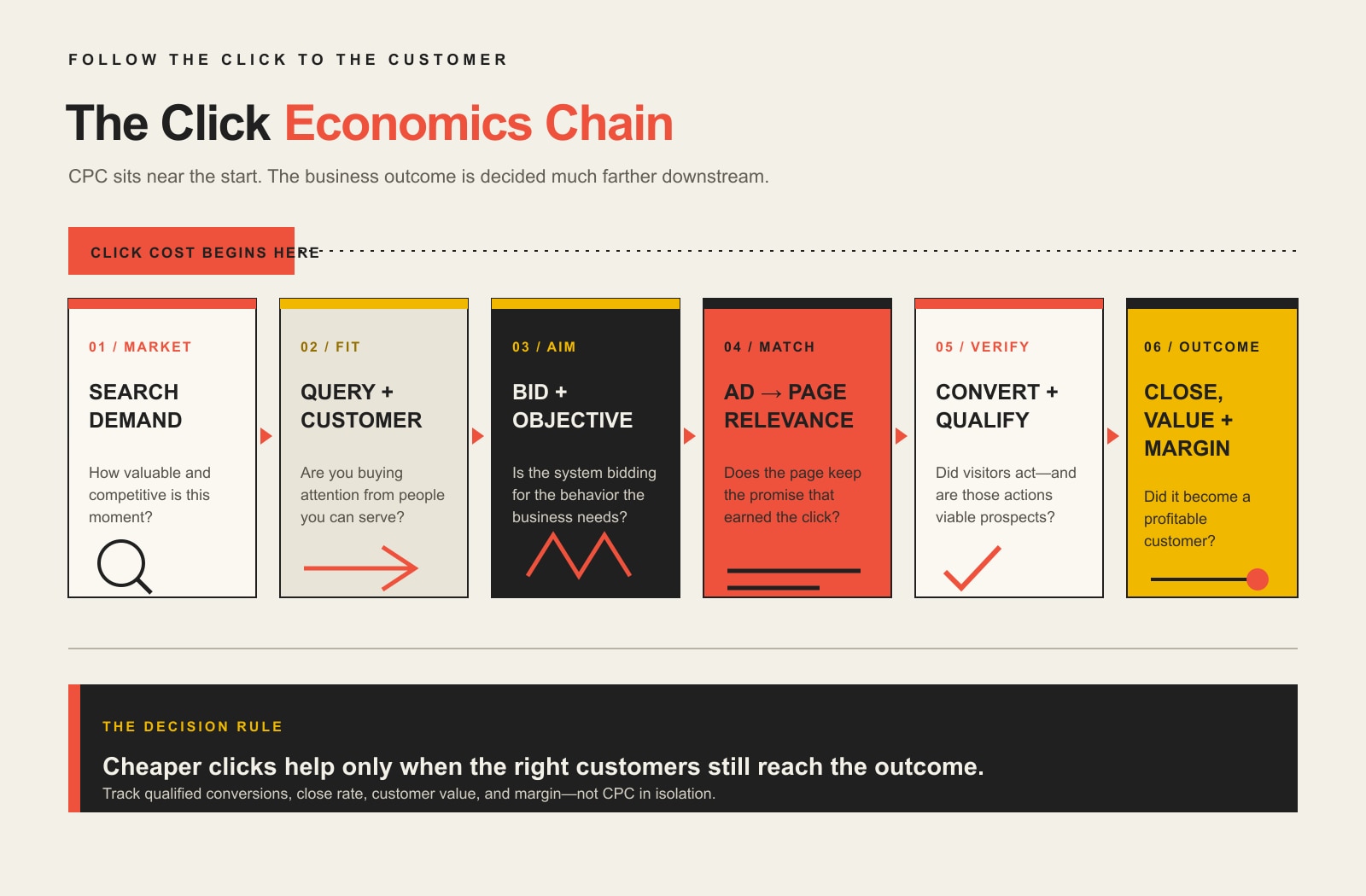
    Six connected stages trace paid-search economics from search demand through query fit, bidding, ad-to-page relevance, qualified conversions, and customer close rate, value, and margin.

    To diagnose CPC without becoming hypnotized by it, trace six connected layers:

    1. Search demand and auction pressure: How valuable and competitive is the moment?
    2. Query and customer fit: Are you buying attention from people the business can actually serve?
    3. Bid and objective: What is the bidding system instructed to pursue?
    4. Ad-to-page relevance: Does the promise earn the right click and continue coherently on the destination?
    5. Conversion and qualification: Do visitors take meaningful actions, and are those actions from viable prospects?
    6. Close rate, value, and margin: Do qualified opportunities become profitable customers?

    CPC lives near the top of this chain. Profit lives at the bottom. Cutting cost at the top can damage value below it.

    This is the paid-search version of buying bargain lumber for a building and celebrating before anyone checks whether the framing can hold up the roof. Cheap inputs are only useful when the finished system works.

    The math that makes CPC useful

    You do not need a finance degree, a crystal ball, or an agency report with seventeen gradients. You need a few connected rates.

    Cost per website conversion

    Cost per conversion = average CPC ÷ landing-page conversion rate

    At a $10 CPC and a 5% conversion rate, the expected cost per recorded conversion is $200:

    $10 ÷ 0.05 = $200

    This assumes one click opportunity per conversion and a stable conversion rate. Real attribution and repeat visits can complicate the picture, so use the formula as a diagnostic model rather than holy scripture.

    Cost per qualified outcome

    Raw conversions are easy to inflate. Add qualification:

    Cost per qualified outcome = average CPC ÷ conversion rate ÷ qualification rate

    At a $10 CPC, 5% conversion rate, and 50% qualification rate:

    $10 ÷ 0.05 ÷ 0.50 = $400

    If a form simplification raises conversion rate to 8% but qualification drops to 20%, cost per qualified outcome becomes $625. The conversion report improves while the business result gets worse. Congratulations on moving the mess into someone else’s calendar.

    Cost per acquired customer

    Add the close rate:

    Cost per customer = average CPC ÷ conversion rate ÷ qualification rate ÷ close rate

    Using the previous example and a 25% close rate:

    $10 ÷ 0.05 ÷ 0.50 ÷ 0.25 = $1,600

    Now compare that acquisition cost with gross profit or contribution margin, not merely top-line revenue. A $2,000 sale with $300 of contribution cannot support a $1,600 acquisition cost merely because the revenue number looked impressive in a slide deck.

    Break-even CPC

    A simplified break-even model works backward:

    Break-even CPC = allowable customer acquisition cost × conversion rate × qualification rate × close rate

    If the business can afford $1,000 to acquire a customer, the landing page converts 5%, half the inquiries qualify, and 25% of qualified opportunities close:

    $1,000 × 0.05 × 0.50 × 0.25 = $6.25

    That does not mean every bid must be capped at $6.25. Automated bidding, assisted conversions, customer lifetime value, refunds, sales labor, and attribution can change the model. It means the business finally has a rational reference point instead of asking whether $6.25 “feels high.”

    Expected contribution per click

    You can also estimate what a click is worth before media cost:

    Expected contribution per click = conversion rate × qualification rate × close rate × contribution per customer

    Using a 5% conversion rate, 50% qualification rate, 25% close rate, and $1,000 contribution per customer:

    0.05 × 0.50 × 0.25 × $1,000 = $6.25

    Subtract average CPC to estimate the contribution remaining after click cost. If the click costs $5, the simplified expected remainder is $1.25. If it costs $8, the path loses $1.75 before fixed overhead and other acquisition costs.

    This model becomes more useful when the inputs come from actual CRM, sales, refund, and margin data. It becomes decorative algebra when everyone quietly guesses the rates and then formats the result to two decimal places.

    Why is Google Ads CPC so high?

    High CPC is a symptom with several possible causes. Diagnose before prescribing.

    The auction is genuinely competitive

    Some searches carry strong commercial intent and large potential customer value. More advertisers compete, bids rise, and Ad Rank thresholds for prominent positions may be higher. Google notes that actual CPC for ads above search results is often higher than for ads below them because prominent locations carry different thresholds and value.

    You cannot optimize away the existence of competitors. You can decide which auctions deserve your money.

    Your queries are too broad or poorly matched

    Keywords are targeting instructions; search terms are what people actually searched. The distinction matters. A keyword can enter auctions for queries with different intent, urgency, geography, or fit.

    Use the Google Ads search terms report to find relevant phrases worth developing and irrelevant searches that may need negative keywords. Do not add negatives blindly. A word that looks wasteful in isolation may appear inside a valuable query.

    The bidding objective values the wrong behavior

    Maximize Clicks is designed to seek the most clicks within a budget. That can be appropriate when traffic is genuinely the objective. It is not the same as seeking qualified leads, sales, profit, or conversion value.

    Google’s bid-strategy guidance separates click, visibility, conversion-volume, and conversion-value goals. If the business needs qualified value but tells the platform to maximize click volume, cheap clicks may be the system working exactly as instructed.

    Your ad and landing page are a weak match

    Auction-time quality includes expected CTR, ad relevance, and landing-page experience. A weak path can increase the amount required to compete and waste the click after it arrives.

    Our guide to Google Ads Quality Score explains the diagnostic in detail. The short version: fix the connection from search intent to keyword, ad promise, landing-page answer, and measured business action. Do not chase the visible 1–10 number as a KPI.

    Your targeting enters expensive contexts

    Device, location, time, audience, network, match behavior, and other context can change which auctions you enter. Segment performance before assuming an account-wide CPC problem. A high-CPC location may also produce the best customers. A low-CPC device may generate accidental clicks and no qualified action.

    Your market or strategy changed

    Competition, seasonality, product demand, budgets, bidding targets, creative, landing pages, conversion tracking, and account structure all move. A rising CPC with no obvious manual change does not mean nothing changed. The auction is not a fixed-price vending machine.

    How to lower Google Ads CPC responsibly

    The safest reductions remove waste or improve relevance without sacrificing qualified demand.

    1. Validate conversion tracking first

    Test the actual forms, calls, purchases, bookings, and imports. Check for duplicate events, dead notifications, thank-you-page reloads, accidental button-click conversions, and conversions that do not reflect customer value.

    Automated bidding uses the signals you provide. Bad tracking is not a harmless reporting inconvenience. It teaches the system to pursue the wrong behavior with machine-speed confidence.

    2. Separate raw conversions from qualified outcomes

    Define what makes a lead viable: service, geography, budget, authority, timing, problem, or another business-specific criterion. Connect advertising data to CRM status, sales-qualified opportunity, purchase value, or an equivalent downstream result where feasible.

    Google’s conversion-value documentation explains how different values can help measure and optimize business impact rather than treating every conversion as identical. A spam form and a $50,000 opportunity should not both receive a cheerful value of one.

    3. Read the search terms

    Classify actual searches by intent and fit. Look for:

    • services or products you do not offer;
    • locations you cannot serve;
    • job, support, free, DIY, definition, or research intent when it conflicts with the campaign’s job;
    • comparison and pricing searches that need a different page;
    • valuable queries hidden inside a broad theme;
    • repeated language customers use that your ads ignore.

    Add negative keywords for demonstrably irrelevant intent. Create new themes when a materially different query needs a different ad, page, offer, or measurement path. Do not build a negative-keyword fortress that blocks every unfamiliar phrase before it has a chance to prove value.

    4. Decide which auctions are worth entering

    Cheaper demand is not automatically equivalent demand. Evaluate search intent, likely customer value, volume, competitive pressure, and business fit together.

    Longer, more specific searches can be less competitive, but “long-tail” is not a coupon code. Some specific legal, medical, software, or industrial queries are expensive precisely because they signal valuable intent. Choose them because the economics work, not because a blog post promised cheap clicks in bulk.

    5. Improve the ad-to-page relevance chain

    Use clear ads that accurately preview the destination and help bad-fit searchers self-select out. Match the landing-page opening to the search and ad. Answer the questions required for the decision. Include relevant proof. Make the page usable on mobile. Ask for an action appropriate to the buyer’s stage.

    Our landing-page optimization guide covers this as an intent contract: known arrival, matched promise, relevant proof, appropriate action, and operational follow-through.

    Improved relevance may help auction economics. More importantly, it prevents you from paying for a click and then breaking the promise yourself.

    6. Match the bid strategy to the objective

    Google Ads offers strategies designed around different goals:

    Business needStrategy familyWhat the system is asked to pursue
    TrafficMaximize ClicksMore clicks within the budget
    VisibilityTarget Impression ShareA chosen level or location of visibility
    Conversion volumeMaximize Conversions or Target CPAMore conversions or conversions around a target cost
    Conversion valueMaximize Conversion Value or Target ROASMore reported value or value around a return target

    Google began changing some Smart Bidding labels in June 2026, while stating that the underlying behavior remains the same. Use the current interface names, but choose based on the business goal—not whichever recommendation card appears most enthusiastic.

    Smart Bidding uses auction-time signals to optimize for conversions or conversion value. It can operate without prior campaign data, but Google notes that historical conversion data can improve calibration and that recommendations vary by campaign and strategy. There is no responsible universal rule that every business must switch after exactly 30 conversions.

    7. Set targets from economics, not aspiration

    A Target CPA lower than the auction and conversion path can sustain may restrict volume or push the system toward lower-value opportunities. A Target ROAS based on inflated or incomplete conversion values optimizes a fiction.

    Build targets from allowable acquisition cost, margin, cash flow, sales capacity, conversion delay, repeat value, and the reliability of the signal. Then watch whether the target produces enough volume and quality to matter.

    8. Use experiments and bounded changes

    Change one coherent part of the diagnosis: search coverage, negatives, ad promise, landing-page path, conversion goal, bid strategy, or target. Document the date and expected effect. Allow for conversion delay and sufficient evidence before judging.

    Google advises allowing at least a conversion cycle before evaluating many Smart Bidding changes. Constant target edits can make the business feel busy while making cause and effect impossible to separate.

    When a higher CPC is the better result

    A rising CPC may be acceptable—or desirable—when it accompanies:

    • a higher qualified-lead rate;
    • a better lead-to-opportunity or close rate;
    • larger or more profitable customers;
    • stronger conversion value per click;
    • fewer low-value inquiries consuming sales time;
    • entry into a valuable new market;
    • improved top-of-page eligibility for searches proven to matter;
    • lower cost per customer despite higher click cost.

    For example, shifting from generic “business software” searches to specific “manufacturing inventory software implementation” searches might increase CPC and dramatically improve fit. The expensive click is doing more work.

    Do not use that argument to excuse any high CPC. Use it to insist on complete measurement.

    When a lower CPC is a warning

    CPC can fall because:

    • ads moved into weaker positions;
    • search coverage expanded into lower-intent queries;
    • targeting shifted to locations or devices that do not convert;
    • a traffic-focused strategy found abundant cheap clickers;
    • brand traffic diluted more expensive non-brand demand;
    • competitors left auctions whose customers you also wanted;
    • the ad became click-friendly and qualification-hostile.

    Always ask what changed in impressions, search terms, position, conversions, qualification, customer acquisition cost, and value. A cheaper click is a clue, not a standing ovation.

    How much daily budget do Google Ads need?

    Questions such as “Is $10 or $20 a day enough?” appear frequently in search. The honest answer is: enough for what, in which auction, over what learning period?

    A daily budget should be evaluated against expected CPC, available qualified search volume, conversion rate, sales economics, and how much evidence is needed to make a decision.

    At a $20 daily budget and $10 average CPC, the campaign may receive roughly two clicks per day on average. If the landing page converts 5% of clicks, the simplified expectation is one conversion per 20 clicks—or about ten days before qualification and sales outcomes are considered. Randomness means actual results will not arrive on schedule like a commuter train.

    A small budget can be useful for a narrow market, a bounded learning objective, or a high-margin business willing to wait. It is inadequate when it spreads across too many services, locations, and intentions to produce interpretable evidence.

    This article owns click economics, not a universal Google Ads pricing table. A separate cost-and-budget guide should compare campaign goals, market demand, management cost, creative and landing-page work, and the evidence threshold required for a useful test.

    A practical CPC audit sequence

    Use this order:

    1. Confirm tracking: Do conversions fire, arrive, and represent useful actions?
    2. Calculate the chain: CPC, conversion rate, qualification rate, close rate, customer acquisition cost, value, and margin.
    3. Segment the result: Campaign, search term, keyword/theme, landing page, device, geography, time, and audience where relevant.
    4. Read actual searches: Identify valuable demand, ambiguity, and demonstrable waste.
    5. Check the objective and bid strategy: Is the system pursuing clicks, visibility, conversions, or value?
    6. Inspect relevance: Does the search, ad, page, and action form one coherent promise?
    7. Find the binding constraint: Auction cost, query fit, bidding, page conversion, qualification, sales follow-up, or offer economics.
    8. Make one bounded intervention: Define what should change and what would disprove the diagnosis.
    9. Wait for complete outcomes: Respect conversion delay and sales-cycle length.
    10. Judge the business result: Keep the change only if qualified economics or useful learning improve.

    If the account lacks enough volume for a controlled test, use stronger qualitative evidence: search terms, recorded calls with permission, form details, sales objections, customer interviews, and the difference between won and lost opportunities. Low traffic does not justify guessing with greater confidence.

    Frequently asked questions about Google Ads CPC

    What is cost per click in Google Ads?

    Cost per click is the amount charged when someone clicks an ad. Average CPC equals total click cost divided by total clicks. Actual CPC is the final price of a specific click and is often lower than a manual maximum CPC bid.

    What determines actual CPC?

    Google says actual CPC reflects what is needed to clear Ad Rank thresholds and compete with the advertiser below. Auction-time ad quality, bids, thresholds, competition, search context, and the expected impact of assets and formats contribute to Ad Rank and price.

    What is a good Google Ads CPC?

    A good CPC supports an acceptable cost per qualified customer or other valuable outcome. Compare it with conversion rate, qualification, close rate, customer value, and margin. An industry average cannot determine what your business can profitably afford.

    Why is my Google Ads CPC so high?

    Possible causes include intense competition, commercially valuable searches, aggressive bids or targets, broad or poor-fit query coverage, weak ad-to-page relevance, prominent positions, targeting context, seasonality, and market changes. Segment the account before choosing a fix.

    How can I lower CPC in Google Ads?

    Remove irrelevant search demand, improve the ad-to-page relevance chain, choose auctions deliberately, match bidding to the correct objective, set economically realistic targets, and improve conversion and value signals. Lower bids can reduce CPC but may also reduce eligibility, position, volume, or value.

    Is lower CPC always better?

    No. Lower CPC is better only when the downstream outcome remains equal or improves. Cheap clicks that produce unqualified leads or no sales can create a higher customer acquisition cost than expensive, high-intent clicks.

    Does Quality Score affect CPC?

    The visible 1–10 Quality Score is not an auction input, but related auction-time quality factors can influence Ad Rank and actual CPC. Use Quality Score to diagnose relevance, then judge changes by qualified business outcomes.

    Do negative keywords lower CPC?

    Negative keywords can prevent ads from entering irrelevant searches, reducing wasted spend and changing the campaign’s average CPC. They do not guarantee cheaper clicks. Their more important job is improving search fit and protecting budget for demand the business wants.

    Should I use Manual CPC or Smart Bidding?

    Choose based on the objective, tracking quality, available evidence, operational capacity, and need for control. Smart Bidding optimizes at auction time for conversions or value; Manual CPC provides direct bid control. Neither repairs bad measurement or a weak offer.

    Can I set a maximum CPC with automated bidding?

    Capabilities vary by strategy. Manual CPC uses max CPC bids, and Maximize Clicks can support a maximum CPC limit. Conversion and value-based Smart Bidding strategies use auction-time bids around their objectives and constraints. Check the current strategy settings rather than assuming one account-wide cap applies.

    Is $10 or $20 per day enough for Google Ads?

    It can be enough for a narrow test or low-cost market, but not by universal rule. Divide the budget by expected CPC, then consider how many clicks are required to observe conversions, qualified outcomes, and sales. A small budget spread across too many variables may never produce useful evidence.

    How often should I change Google Ads bids or targets?

    Change them when business objectives, economics, or sufficient performance evidence justify it. Account for conversion delay and allow enough time to observe complete outcomes. Constant changes make diagnosis difficult and can move campaigns into different auctions before results mature.

    Stop asking whether the click is cheap

    Ask whether the click belongs in the campaign, receives an honest and relevant promise, reaches a useful destination, becomes a qualified opportunity, and produces enough value to justify its cost.

    That is the actual job.

    Use the Scope Design Marketing & Advertising guide to place paid search inside the wider marketing system. Use the Google Ads Quality Score guide when the relevance diagnostic needs deeper investigation. Use the Analytics & SEO measurement guide when traffic and platform metrics are not connected to useful business outcomes.

    If your CPC report looks alarming but nobody can explain which searches become profitable customers, talk with Scope Design. We will diagnose the auction, query, ad, page, measurement, and sales path before prescribing cheaper traffic that may be worth even less.

  • De Beers Marketing Campaign: How “A Diamond Is Forever” Changed Demand

    De Beers Marketing Campaign: How “A Diamond Is Forever” Changed Demand

    The De Beers marketing campaign is often told as a simple story: a diamond company invented engagement rings, wrote one brilliant slogan, and convinced the world that a shiny stone was mandatory for marriage. The real history is more interesting—and more useful to marketers.

    Diamond engagement rings existed centuries before De Beers. What De Beers and its U.S. advertising agency, N.W. Ayer, did far more effectively was turn an existing elite custom into a mass-market expectation. They connected a product to a life ritual, gave the purchase emotional meaning, repeated that meaning through culture and commerce, and defended the idea of lasting value for decades.

    That distinction matters for marketers. The useful lesson is not “manufacture a tradition.” It is how a clear position can become stronger when the product, the moment, the identity, and the proof all reinforce the same idea.

    What De Beers actually changed

    De Beers did not invent engagement rings or even diamond engagement rings. The Gemological Institute of America’s history of engagement rings traces betrothal rings to the Romans and notes a written record of a diamond engagement ring in 1477, when the future Holy Roman Emperor Maximilian was advised to give Mary of Burgundy a ring set with a diamond.

    So the breakthrough was not invention. It was normalization at scale. A diamond ring moved from being one possible luxury symbol to becoming, for many buyers, the expected symbol of engagement. That is a much more interesting marketing achievement because it required changing what people believed the purchase meant.

    The strongest campaigns rarely create desire from nothing. They attach an offer to desires that already exist: love, security, status, belonging, celebration, competence, relief, or progress. De Beers attached diamonds to one of the most emotionally loaded transitions in adult life and then worked to make the association feel natural.

    How the De Beers marketing campaign worked before the slogan

    The famous slogan arrived in 1947, but the demand-building system was already taking shape. GIA’s history of the 4Cs records that it was collaborating with De Beers on advertising to stimulate interest in diamonds by 1940, and that N.W. Ayer represented De Beers in the United States.

    That matters because it corrects another myth: the campaign was never just four magic words. The broader machine included advertising, retailer education, public education, editorial influence, celebrity imagery, and repeated explanations of how to evaluate diamonds. A slogan can crystallize a strategy, but it cannot replace one.

    Modern marketers would recognize the distribution logic. The message becomes more believable when it appears consistently in more than one context. That is not identical to today’s omnichannel marketing, but the principle is familiar: each touchpoint should reinforce the same customer meaning instead of telling a different story.

    Why “A Diamond Is Forever” worked

    The De Beers marketing campaign found its most durable expression in 1947, when N.W. Ayer copywriter Frances Gerety wrote the line “A Diamond Is Forever.” WARC’s campaign history describes the core strategic move: the slogan linked the physical durability of a diamond with the idea of enduring romantic love.

    That is unusually efficient positioning. Four words carried a product attribute, an emotional promise, and a behavior cue at the same time:

    • Product truth: diamonds are physically durable.
    • Emotional analogy: enduring material becomes a symbol for enduring love.
    • Purchase logic: an important, permanent commitment deserves an important, permanent object.
    • Retention logic: “forever” frames the ring as something to keep, not something bought for short-term utility.

    The line did not need to explain mining, gemology, or price. It gave the buyer a simple story for why the product belonged in the moment.

    Scope Design’s RING demand model

    De Beers is an extreme historical case, but the mechanism can be separated from the parts modern businesses should not copy. We use the RING model to describe the durable portion of the strategy: Ritualize, Identity, Normalize, Guard value.

    The RING demand model moves from Ritualize a meaningful moment to Identity, Normalize with credible proof, and Guard perceived value; the ethical note warns against invented social rules, fake proof, and manufactured pressure.

    R — Ritualize a meaningful moment

    A ritual gives a purchase timing. Engagement created a natural “when”: at the proposal or commitment milestone. For a modern business, the ethical version is to understand the real transition your customer is already going through. A new hire needs onboarding. A growing company outgrows a homemade website. A homeowner preparing to sell needs the property ready for market.

    The offer becomes easier to understand when the customer can answer, “This is what people like me do when this moment happens.”

    I — Identity: make the choice mean something

    De Beers did not market only a mineral. The ring signaled commitment, seriousness, taste, and eventually social expectation. Identity compresses complicated value into a recognizable symbol.

    Modern brands can use identity without manipulation. The question is not “How do we make people insecure?” It is “What truthful statement does choosing us let the right customer make about themselves?” Reliability, craftsmanship, independence, local expertise, speed, sustainability, or premium service can all be identity signals when the underlying experience earns them.

    N — Normalize with distributed proof

    An idea feels safer when people encounter it repeatedly from credible places. Advertising can introduce the message, but retailers, educators, press, peers, customer stories, and recognizable examples can make it feel normal.

    The ethical line is crucial: use real proof. Do not invent testimonials, fake scarcity, stage popularity, or pressure customers with a social rule you made up. Our guide to marketing psychology without tricking people goes deeper on helping buyers decide without exploiting them.

    G — Guard perceived value

    Premium positioning collapses when every message trains the buyer to think only about discounts. De Beers spent decades reinforcing durability, symbolism, quality language, and occasion-based meaning. That protected a value story far larger than the stone’s functional utility.

    For an ordinary business, guarding value means consistency and substance: clear positioning, a coherent offer, proof of results, dependable delivery, and pricing that matches the experience. It does not mean copying the historical diamond industry’s market power or manufacturing scarcity.

    De Beers did not invent the 4Cs

    The old version of this article credited De Beers with creating the 4Cs—cut, color, clarity, and carat. That is incorrect.

    GIA identifies its founder, Robert M. Shipley, as the originator of the 4Cs mnemonic in the early 1940s. The more nuanced history is better: De Beers and N.W. Ayer helped spread the framework. GIA notes that Ayer lecturers taught jewelers how to explain the four factors and that De Beers later used the term in national advertising.

    That distinction is itself a marketing lesson. A company does not have to invent every useful framework to benefit from making it easier for customers to understand a category. Education can reduce uncertainty and give buyers a vocabulary for comparison—as long as the information is accurate and the source gets proper credit.

    The two-month salary guideline was advertising, not etiquette

    Another durable piece of diamond folklore is the idea that an engagement ring should cost two months of salary. It is not a timeless social rule or a financial standard.

    JCK’s contemporary trade coverage documented De Beers/Ayer advertising that explained the 4Cs and the two-month salary guideline. In a later JCK retrospective, the publication placed the two-month version in the 1990s and described it explicitly as a De Beers effort to increase the average engagement-ring price.

    For marketers, this is a useful warning about the power of anchors. A suggested budget can become memorable even when it has no independent authority. That is exactly why pricing guidance should help customers make a better decision, not disguise a seller’s preferred spend as a rule everyone is supposed to follow.

    What marketers can copy—and what they should not

    The De Beers case is compelling because the ethical and strategic lessons sit side by side. Separating them makes the case more useful.

    Worth copying

    • Own one clear association. “Forever” gave the product a compact emotional position.
    • Connect the offer to a real moment. A timed need is easier to act on than generic awareness.
    • Teach customers how to evaluate the category. Good education lowers uncertainty and makes expertise visible.
    • Repeat the same meaning across touchpoints. Consistency compounds; scattered messages reset the conversation.
    • Build distinctive memory. A memorable phrase, visual system, or framework can become an asset that works for years.

    Not worth copying

    • Manufactured social pressure. “Everyone expects this” is not ethical proof unless it is actually true and relevant.
    • Artificial urgency or scarcity. A premium should come from real value, not a false constraint.
    • Opaque pricing rules. A seller-created spending norm should not masquerade as independent advice.
    • Market control as strategy. Historical concentration of diamond supply is part of the context, not a playbook for small businesses.

    The difference is simple: strong positioning helps the right customer understand real value. Manipulation tries to manufacture a reason to buy that would collapse if the customer had better information.

    Why the De Beers marketing campaign still matters

    The most telling proof of the slogan’s durability is that De Beers still returns to it. In November 2024, the company announced its “Forever Present” campaign and said it was reviving the “A Diamond Is Forever” tagline for U.S. natural-diamond marketing. That is a primary-source claim from De Beers’ own campaign release, so it tells us what the company chose to reuse—not whether every claim in the campaign should be accepted uncritically.

    Still, the strategic point is hard to miss. A distinctive idea can outlive individual media plans, creative executions, and generations of buyers. The asset is not merely the ad. It is the association the ad keeps reinforcing.

    For a small business, that is the bridge back to the whole marketing system. If positioning is fuzzy, adding more ads usually amplifies the fuzziness. If the message, offer, proof, and customer journey agree, paid attention has something coherent to multiply. Our small business marketing strategy guide covers that broader system.

    Frequently asked questions

    Did De Beers invent diamond engagement rings?

    No. Diamond engagement rings existed centuries before the De Beers campaign; GIA documents a written example from 1477. De Beers’ achievement was helping turn the diamond engagement ring into a much broader cultural expectation through sustained marketing.

    Who wrote “A Diamond Is Forever”?

    N.W. Ayer copywriter Frances Gerety wrote the slogan in 1947 for De Beers. Its power came from connecting diamond durability with the idea of enduring love.

    Did De Beers invent the 4Cs of diamonds?

    No. GIA credits founder Robert M. Shipley with developing the 4Cs mnemonic in the early 1940s. De Beers and N.W. Ayer helped popularize the language through education and advertising.

    Is two months of salary a real rule for buying an engagement ring?

    No. It was an advertising guideline, not a financial or etiquette standard. A couple’s ring budget should be based on their own priorities and finances, not a seller-created formula.

    Why was the De Beers marketing campaign so effective?

    The De Beers marketing campaign aligned one memorable idea with a meaningful life moment, repeated it across many credible touchpoints, educated buyers about the category, and reinforced a consistent value story for decades. The result came from the system around the slogan, not from four words acting alone.

    The real De Beers marketing lesson

    The De Beers marketing campaign is more impressive—and more useful—when we stop repeating the myths around it. The company did not invent diamond engagement rings. It did not invent the 4Cs. And one slogan did not single-handedly create a neatly measurable $350 billion industry.

    What De Beers and N.W. Ayer did was build a remarkably persistent system of meaning around an existing product and an existing ritual. They made the product easier to remember, easier to justify, easier to compare, and harder to separate from the moment it represented.

    That is the part worth studying. Ritualize the right moment. Give the choice truthful identity. Normalize it with real proof. Guard value with consistency and genuine differentiation. If the meaning survives better information, you are building a brand. If it depends on hiding the truth, you are building a trap.

  • How To Change Anyone, Even Yourself

    How To Change Anyone, Even Yourself

    How to change behavior is a harder question than it sounds, because behavior is not a switch you flip with the right argument. You can control your own choices imperfectly. You can influence another adult’s choices. You cannot reliably make someone want, value, or repeat a change they do not endorse.

    Short answer: lasting change is more likely when the desired behavior is specific, the person has a reason that matters to them, the environment makes the new action easier, the next step is concrete, and the result is reviewed without turning every setback into a character judgment.

    That distinction matters at work and at home. If you are trying to change yourself, you have direct access to your environment, routines, and decisions. If you are trying to help an employee, client, partner, or colleague change, your job is different: improve the conditions for change, make expectations clear, listen for real resistance, and leave the other person with agency. This guide is about general adult behavior and workplace application, not clinical treatment, diagnosis, addiction care, or child discipline.

    Can You Really Change Anyone?

    Not in the way the title sounds. You cannot install a new belief or habit in another person. You can influence what happens around a behavior: the situation, what gets attention, how the person interprets the situation, what response is easiest, what gets rewarded, and what happens next.

    That is not just a semantic distinction. A 2020 review by Angela Duckworth and James Gross organizes behavior-change strategies around situations, attention, appraisals, and responses. The authors explicitly include both self-initiated strategies and changes introduced by other people or organizations. The useful business translation is simple: stop treating every repeated behavior as a motivation defect. Sometimes the person needs a better reason. Sometimes the process is badly designed. Sometimes the desired action is too vague. Sometimes the current behavior is simply easier.

    Autonomy also matters. Self-determination research distinguishes between behavior a person experiences as self-endorsed and behavior driven mainly by control or pressure. In a 2020 meta-analysis of 65 tests of self-determination-theory interventions, the average behavior effect was small, not magical, and autonomous motivation and perceived competence helped explain the effect. That is a better reason to respect choice than the usual motivational slogan: the evidence supports autonomy as one part of change, not a universal guarantee.

    How to Change Behavior Without Relying on Willpower

    Willpower is useful for a moment. It is a poor operating system. If the same problem keeps happening in the same setting, inspect the setting before you demand more determination.

    • Make the behavior observable. “Be more proactive” is an opinion. “Flag a blocked project within one business day” is a behavior.
    • Find the trigger. What happens immediately before the old behavior? A meeting ends, an email arrives, the phone lights up, a difficult task appears, or uncertainty goes unresolved.
    • Reduce friction for the new action. Put the tool where it is needed, remove an unnecessary approval, create a template, set a default, or make the first step smaller.
    • Increase friction for the old action. Disable the distracting notification, move the tempting option, require a deliberate confirmation, or change the handoff that keeps producing the same mistake.
    • Decide what happens next. A vague intention becomes more usable when the person knows the cue and the response in advance.

    This is why “try harder” so often fails. The environment keeps presenting the same cue, the same reward, and the same easy path. Changing the person without changing any of that asks motivation to fight the system every day.

    The SHIFT Change Loop

    Scope Design’s SHIFT Change Loop is an evidence-informed synthesis for turning a vague desire to change into a specific experiment. It is not a validated clinical instrument. Think of it as a practical checklist for general self-management, coaching conversations, and workplace behavior.

    1. S — Specify the observable behavior. Describe what someone would actually see or hear. Replace “communicate better” with “send the status update by 3 p.m. Thursday.”
    2. H — Hear the person’s own reason. Ask what gets better if the behavior changes. For self-change, answer the question yourself. For another person, do not supply their motivation for them.
    3. I — Identify the situation and friction. Find the cue, competing reward, ambiguity, missing skill, bad handoff, or environmental obstacle that keeps the old pattern alive.
    4. F — Form an if-then next action. Decide in advance: “If X happens, then I will do Y.” Keep Y small enough to execute under real conditions.
    5. T — Track the result and tune the system. Review what happened. If the behavior did not occur, ask what the evidence says about the cue, friction, capability, priority, or incentive before deciding the person “doesn’t care.”
    The SHIFT behavior-change experiment: Specify the observable behavior, Hear the person reason, Identify context and friction, Form a small if-then action, and Track results to tune the conditions while preserving agency.
    The SHIFT Change Loop turns behavior change into a five-step experiment: specify the behavior, hear the reason, identify the context, form an if-then action, and track what happens.

    S: Specify What Must Change

    Start with evidence, not labels. “He’s unreliable” is an interpretation. “Three client follow-ups were sent more than two days after the agreed deadline” is observable. That difference protects you from designing a solution for the story in your head instead of the behavior in front of you.

    This is especially important when working with customers or prospects. Our guide to buyer psychology uses the same discipline: investigate real decisions, hesitation, alternatives, and language instead of pretending a personality label gives you a secret control panel.

    H: Hear a Reason That Belongs to the Person

    One useful idea from motivational interviewing is to ask and listen instead of winning an argument. But the old version of this article overstated that evidence. Motivational interviewing is not “proven 70% effective” across problems. A large 2018 review of reviews found a lot of low- or very-low-quality evidence and only small short-term benefits in a subset of higher-quality comparisons. The responsible takeaway is narrower: collaborative conversation can be useful, but results depend on the behavior, setting, delivery, and person.

    Try questions such as: “What would be better if this changed?” “What makes the current way useful?” “What worries you about the new approach?” “What would make the next step easier?” The point is not to corner someone into saying what you want. It is to learn whether there is a reason for change that they actually endorse.

    I: Identify What the Environment Is Teaching

    Repeated behavior usually has a context. A team may ignore a new project-management field because nobody uses the data. A founder may keep checking email because uncertain work feels harder than a visible inbox. A client may delay approvals because the review request contains six decisions at once.

    Look for the current lesson embedded in the system: What is easiest? What is rewarded? What creates embarrassment? Where is the handoff unclear? What competing priority wins when time gets tight? If the same “people problem” appears across otherwise capable people, inspect the operating system. Scope Design’s business strategy framework starts with the actual constraint before adding another tool, training session, or initiative.

    F: Form an If-Then Action

    A goal says what you want. An implementation intention says what you will do when a specific situation appears. The classic structure is simple: If X happens, then I will do Y.

    A 2006 meta-analysis of 94 independent tests found that implementation intentions improved goal attainment with a medium-to-large pooled effect. The research does not mean every if-then sentence works automatically. It means that pre-deciding the cue and response can help close the gap between intending and doing.

    • If I finish a client call, then I will enter the next action before opening email.
    • If a project becomes blocked for more than one business day, then I will post the blocker in the project channel.
    • If I feel the urge to abandon my writing session, then I will work for five more minutes before deciding.
    • If a customer asks for a discount, then I will ask what constraint they are trying to solve before changing the price.

    T: Track Behavior, Then Tune

    Track the smallest signal that tells you whether the behavior happened: count, timestamp, completion, handoff, response time, or a brief self-check. Then review the pattern. The purpose is diagnosis, not surveillance theater.

    When the desired behavior fails, ask: Was the cue visible? Was the action too large? Did a stronger reward win? Was there enough skill? Was the expectation understood? Did the process make the wrong behavior easier? A useful change loop treats failure as data before it treats failure as identity.

    How to Change Yourself With SHIFT

    Self-change gives you the most leverage because you can change both your action and much of the environment around it. Pick one behavior, not a new personality.

    Suppose you want to “be less distracted.” That is too broad. SHIFT might turn it into this:

    • Specify: During the first 25 minutes of my morning work block, my phone stays out of reach and I work on the named priority.
    • Hear: Finishing one meaningful task before reacting to messages makes the rest of the day calmer.
    • Identify: The phone is on the desk, notifications are visible, and the priority task has an ambiguous first step.
    • Form: If I sit down with coffee, then I put the phone in another room, open only the needed file, and work until the 25-minute timer ends.
    • Track: Mark whether the block happened for ten workdays. If it fails repeatedly, change the cue or reduce the first step rather than inventing a harsher self-description.

    If the real problem is goal selection, prioritization, or maintaining a larger system around the behavior, go deeper with our goal-achievement guide. This article owns the behavior loop; that guide owns the broader goal system.

    How to Help Someone Else Change Without Manipulation

    The ethical boundary is simple: do not disguise control as empathy. If you already decided the acceptable outcome, say what the expectation is. If the person genuinely has a choice, let the choice be real.

    For an employee, that can sound like: “The role requires client issues to be acknowledged within one business day. I want to understand what is getting in the way and agree on a process that makes that achievable.” That sentence does two things at once: the performance standard is not fake-negotiable, and the method for meeting it can be collaborative.

    For a client: “You do not have to adopt this recommendation. Before you decide, can we look at the constraint it is meant to solve and what concerns you about the change?” You are not trying to trick the client into agreement. You are making the decision easier to inspect.

    For a colleague: “When this handoff is late, my part of the project stops. What is happening on your side, and what change would make the handoff more reliable?” The conversation stays anchored to observable impact instead of motive-reading.

    Your own behavior is part of the environment too. If people hide problems because you become defensive, impatient, or punishing when bad news arrives, telling them to “communicate earlier” will not solve much. Our emotional-intelligence tune-up focuses on the leader behaviors you can actually observe and practice.

    How to Change Behavior at Work

    Workplace change is where bad behavior advice becomes expensive. Leaders often jump from an outcome to a personality judgment: salespeople are not disciplined, the team resists change, managers lack accountability, employees hate the new system.

    Run a behavior-and-system check first:

    1. What exact behavior would indicate the change is working?
    2. Does the person understand the behavior and why it matters to the role or outcome?
    3. Can they perform it with the current skill, authority, time, and tools?
    4. Does the workflow make the desired behavior easier or harder?
    5. What currently happens when someone follows the old pattern?
    6. What feedback arrives soon enough to help them adjust?

    Example: a manager complains that remote employees are not communicating. The behavior might actually be “raise a blocker before the deadline is at risk.” If blockers require a meeting, nobody knows which channel to use, and people get punished for surfacing bad estimates, the system teaches silence. Change the communication contract, make the escalation path obvious, and respond constructively when someone uses it. For distributed teams, our guide to remote-team management goes deeper into expectations, communication rhythms, and trust without digital babysitting.

    What If They Still Won’t Change?

    Then the problem becomes a decision, not a persuasion puzzle.

    If the person has the capability, understands the expectation, has a workable process, sees the consequences, and still chooses not to act, you may need to set a boundary, change responsibilities, enforce a consequence, redesign the agreement, or accept that your preferences do not control them.

    This is one of the most useful limits in behavior change: influence is not ownership. A manager owns the clarity of the role, the quality of the system, fair feedback, and appropriate consequences. The employee still owns their behavior. A business can reduce customer friction, clarify value, and make a decision easier; the customer still owns the decision. You can change your routine; you cannot guarantee your future self will never deviate from it.

    Frequently Asked Questions About Behavior Change

    How can I change my behavior?

    Start with one observable behavior. Identify what triggers the current response, decide why the new response matters, change the environment to make the new action easier, write an if-then plan, and track whether the behavior actually happens. Adjust the system based on the result.

    Can you really change someone else?

    You can influence another adult’s behavior, but you cannot reliably control their motivation or choices. The most defensible approach is to clarify the behavior and consequences, understand their reasons and resistance, improve the conditions for the desired action, and preserve genuine agency where a choice exists.

    What motivates people to change behavior?

    There is no single universal motivator. Reasons can include personally valued outcomes, competence, social expectations, incentives, avoided costs, identity, convenience, or immediate rewards. The practical move is to investigate the actual person and context instead of assuming a generic motivational trigger.

    How long does it take to change a habit?

    Do not use 21 days—or even 66 days—as a personal deadline. In Phillippa Lally and colleagues’ real-world habit study, the modeled time to reach near-asymptotic automaticity ranged from 18 to 254 days. The study also found that missing one opportunity did not materially derail the formation process. The useful lesson is variation: repeat the behavior in a stable context and judge the pattern over time.

    Does motivational interviewing work for behavior change?

    It can help in some contexts, especially when delivered with fidelity, but the evidence is not a universal percentage and should not be casually transferred from health care into every workplace conversation. Borrow the conversational discipline—ask, listen, reflect, avoid pointless argument—without pretending you are providing therapy or using a guaranteed technique.

    Why is it so hard to change behavior?

    Because intentions compete with immediate rewards, familiar cues, environmental defaults, uncertainty, skill gaps, and old routines. The current behavior often wins because it is easier or more immediately rewarding, not because the person lacks character. Changing the situation and the next response can be more effective than repeatedly demanding more motivation.

    Start With One Behavior, Not a New Personality

    If you want to change yourself, choose one behavior you can observe this week. If you want someone else to change, decide whether you are offering a genuine choice or enforcing a legitimate expectation. Then run SHIFT: Specify, Hear, Identify, Form, Track.

    The goal is not to become better at controlling people. It is to become better at designing conditions in which useful behavior is clearer, easier, more self-endorsed, and easier to learn from. That is slower than a persuasion trick—and far more honest.

  • AI-Powered Goal Achievement: The Science-Backed System That Actually Works

    AI-Powered Goal Achievement: The Science-Backed System That Actually Works

    AI goal setting can be useful, but not because a chatbot can choose the right life or business goal for you. Its best role is narrower: help you turn a human-selected outcome into observable actions, plan for predictable friction, summarize recorded progress, and make review faster. You still own the goal, the tradeoffs, and the decision to keep going, change course, or stop.

    That distinction matters because the strongest research behind an AI goal setting system is not “AI makes people achieve more.” The evidence is about the mechanics of goal pursuit: specific goals, implementation intentions, feedback, and progress monitoring. AI can make those mechanics easier to apply, but it should not be confused with the mechanism itself.

    AI goal setting works when AI has a bounded job

    Most AI goal-setting tools start with generation: type a vague ambition, get a SMART goal, then admire the tidy wording. That solves only the first few minutes of the problem. Goals usually fail later, when the week gets crowded, a constraint appears, the plan stops matching reality, or nobody looks closely at what actually happened.

    A more useful model is an AI-assisted goal control loop:

    1. Choose the outcome yourself.
    2. Define the evidence that would prove progress.
    3. Plan for likely obstacles with if-then rules.
    4. Record what actually happened.
    5. Let AI summarize the evidence and surface gaps.
    6. Make the decision yourself: keep, change, or stop.

    AI is useful inside the loop because it is fast at restructuring information, comparing a log against criteria, and generating options. It is weak at owning consequences. That is why the decision boundary stays human.

    The science underneath the system

    Three well-established findings are especially useful for designing an AI goal setting workflow. None requires AI. That is exactly the point: use AI to reduce the effort of applying mechanisms that already have evidence behind them.

    1. A goal needs specificity, challenge, feedback, and commitment

    In their influential review of 35 years of goal-setting research, Edwin Locke and Gary Latham summarized evidence showing why specific, appropriately challenging goals can outperform vague “do your best” instructions under the right conditions. They also emphasized important moderators such as commitment, feedback, ability, and task complexity. In other words, specificity helps, but a goal is not a magic sentence. See the Locke and Latham review in American Psychologist.

    AI can help here by interrogating fuzzy language. If your goal is “grow the business,” ask the model to identify what would be observable at the end of the period: qualified opportunities, recurring revenue, margin, retention, delivery capacity, or another measure that actually matches your objective. You choose which measure matters.

    2. “If X, then I will Y” plans help close the intention-action gap

    Implementation intentions turn a general intention into a pre-decided response: if a specific situation occurs, then I will take a specific action. A 2006 meta-analysis by Peter Gollwitzer and Paschal Sheeran covered 94 independent tests and reported a medium-to-large positive effect on goal attainment (d = .65). Read the implementation-intentions meta-analysis.

    This is a natural job for AI because the model can help you brainstorm likely failure points without pretending it knows the future. For example:

    • If a client emergency takes the morning block, then I will move the goal task to the 2:00 PM recovery block.
    • If I do not have the data needed for a decision by Wednesday, then I will ask the owner directly instead of waiting for another meeting.
    • If a planned action misses twice, then I will review whether the action is unrealistic, underspecified, or no longer relevant.

    The useful output is not the AI’s prose. It is a decision rule you are willing to follow.

    3. Monitoring progress improves goal attainment

    A 2016 meta-analysis led by Benjamin Harkin examined 138 randomized studies with 19,951 participants. Interventions designed to increase progress monitoring improved goal attainment on average (d+ = .40). Effects were larger when outcomes were reported or made public and when progress information was physically recorded. Read the progress-monitoring meta-analysis in Psychological Bulletin.

    This is the strongest reason not to make your chatbot the source of truth. Keep the progress record somewhere explicit: a spreadsheet, project board, CRM, task system, journal, or other log. Then give AI the record to analyze. If the model can invent the history, you no longer have monitoring; you have storytelling.

    The AI goal setting control loop

    Six stages of an AI-assisted goal loop: choose a human-owned outcome, define evidence and constraints, plan for friction, record progress separately, let AI review the record, and keep the decision human.

    Step 1: Choose one observable outcome

    Start with a result you can recognize without asking AI whether you succeeded. “Publish the new service site with the five required pages, functioning forms, analytics, and approved launch checklist by October 15” is observable. “Improve our online presence” is not.

    For AI goal setting to be useful, ask AI to challenge ambiguity, not to pick your values. A useful request is: “List the terms in this goal that could be interpreted two different ways. Ask me questions until the finish line could be verified by another person.”

    Step 2: Define evidence and constraints before generating a plan

    In AI goal setting, tell the model what counts as evidence and what it may not optimize away. Constraints might include budget, available hours, required approvals, legal requirements, brand standards, existing commitments, or a hard deadline.

    This prevents a common AI failure mode: producing a theoretically efficient plan that ignores the environment in which the work has to happen.

    Step 3: Turn predictable friction into implementation intentions

    Now ask AI to identify likely obstacles from the information you provide. For each obstacle, create an if-then response. Keep only the rules that are specific enough to trigger an action and realistic enough that you will use them.

    For a sales goal, “If there are fewer than five qualified opportunities in the pipeline on Friday, then Monday’s first 45 minutes becomes outbound follow-up” is much more useful than “stay consistent with prospecting.”

    Step 4: Record what happened in a separate progress log

    In an AI goal setting system, your progress log can be simple. At minimum, record the date, planned action, completed action, result, blocker, and any evidence that changed your understanding of the goal. The point is not to create a perfect dashboard. The point is to leave a trail that can be reviewed without relying on memory.

    Do not ask AI to “remember” the week unless the underlying record is available in the conversation or connected system. Your review should be grounded in the actual log.

    Step 5: Use AI for the weekly review

    At review time, AI goal setting becomes most useful when the model acts as an analyst. Give it the goal, evidence criteria, constraints, if-then rules, and progress log. Ask it to separate facts from inferences, compare the evidence with the target, identify repeated misses, and suggest a small number of adjustments.

    Limiting the number of recommendations matters. A model can generate twenty plausible ideas in seconds. That is not the same as making the next decision easier.

    Step 6: Keep the decision human

    The review ends with a choice: keep, change, or stop. Keep the current plan when the evidence supports it. Change an action or assumption when the evidence says the plan is not working. Stop when the goal no longer deserves the cost, even if a model can invent a clever way to continue.

    That last category is important. Goal systems become unhealthy when “achievement” is defined as never abandoning a goal. Good judgment includes recognizing when new evidence changes the decision.

    What AI should not decide

    A safe AI goal setting workflow can help structure a decision, but it should not be allowed to quietly become the decision-maker. Keep these responsibilities on the human side of the boundary:

    • Which goal is worth pursuing. A model does not bear the opportunity cost.
    • Which tradeoffs are acceptable. Speed, money, quality, relationships, reputation, and risk are value judgments.
    • Whether the evidence is trustworthy. AI can summarize bad data perfectly.
    • Whether a recommendation is ethical, legal, or appropriate. High-stakes decisions need the right qualified human review.
    • Whether to persist or quit. The model can surface consequences; you own them.

    A useful rule is: AI may propose; evidence must support; a human approves.

    A copyable AI goal setting review prompt

    This AI goal setting prompt is deliberately stricter than “How am I doing?” It forces the model to work from the record instead of rewarding confident improvisation.

    Act as a review analyst, not a goal chooser.
    
    GOAL OUTCOME:
    [Paste the observable outcome.]
    
    EVIDENCE OF SUCCESS:
    [Paste the measures or completion criteria.]
    
    CONSTRAINTS:
    [Paste budget, time, approvals, non-negotiables, and other limits.]
    
    IF-THEN PLANS:
    [Paste the implementation intentions I committed to.]
    
    PROGRESS LOG:
    [Paste this week's actual record.]
    
    Review the material using only the evidence provided.
    1. Summarize what happened in no more than five bullets.
    2. Separate facts from your inferences.
    3. Compare actual progress with the success evidence.
    4. Identify repeated blockers or missed implementation intentions.
    5. Propose no more than three adjustments, each with a tradeoff.
    6. Flag any conclusion that cannot be supported by the log.
    7. End by asking me to choose: keep, change, or stop.
    
    Do not rewrite my goal, invent missing progress, or make the final decision for me.

    If the output is generic, the first thing to improve is usually the input evidence, not the prompt.

    How this fits a 90-day execution system

    An AI goal setting workflow does not need a magical planning horizon. This article intentionally does not turn “90 days” into another scientific claim. A quarter is simply a useful planning container for many business goals: long enough to produce meaningful work, short enough to review before assumptions get stale. If you want the broader planning structure—outcome, milestones, checkpoints, and execution rhythm—use Scope Design’s 90-day goal-setting framework, then use the AI control loop here for planning friction, progress analysis, and review.

    For a business, the same idea can eventually move beyond a personal chat into a repeatable workflow: data comes from the systems where work happens, AI summarizes or routes exceptions, and a person remains accountable for decisions. If that is the stage you are at, see our guide to AI automation for business.

    Frequently asked questions about AI goal setting

    Can AI actually help me achieve my goals?

    AI goal setting can help with parts of goal execution: clarifying an outcome, generating if-then plans, organizing a progress log, comparing evidence with a target, and proposing adjustments. The evidence cited in this article supports those underlying self-regulation practices, not a blanket claim that using AI itself causes goal achievement.

    How do I use ChatGPT for AI goal setting?

    For AI goal setting, use ChatGPT or another capable model as a structured thought partner. Give it one observable goal, the evidence of success, your constraints, likely obstacles, and your actual progress record. Ask it to identify ambiguity, create candidate if-then plans, and perform a weekly evidence review. Do not let it invent the goal or progress history.

    What is the best AI goal setting tool?

    The best AI goal setting tool is the one that fits the workflow; the workflow matters more than a particular brand. A useful tool needs enough context to read your goal criteria and progress log, produce structured output, and fit your privacy and data-handling requirements. If your system only generates motivational language but never reviews evidence, changing models will not fix the design.

    Should I track my goals with AI?

    For AI goal setting, track progress in a durable source of truth, then let AI analyze it. A spreadsheet, project tool, CRM, or journal can hold the record. AI can summarize patterns and exceptions, but the underlying log should remain reviewable without trusting the model’s memory.

    Can AI replace an accountability partner or manager?

    Not completely. AI can make review more consistent and reduce administrative work, but it does not share the consequences of the decision and cannot provide the same social accountability, authority, domain responsibility, or human judgment. Use it to improve the review process, not to erase responsibility.

    The bottom line

    AI goal setting does not make goal achievement scientific. Good goal execution already has a research base: define the outcome clearly, plan responses to predictable situations, monitor real progress, and use feedback to adjust. AI earns its place when it makes those behaviors easier to perform without taking ownership away from the person who has to live with the result.

    Start with one goal. Define what evidence would prove progress. Write two or three if-then rules for the friction you already expect. Keep an honest log. Then use AI once a week to compare the evidence with the target—and make the final decision yourself.

  • How to Overcome Fear in Business: 7 Proven Strategies That Actually Work

    How to Overcome Fear in Business: 7 Proven Strategies That Actually Work

    If you are trying to learn how to overcome fear in business, do not wait until you feel fearless. Make the fear specific enough to investigate, small enough to manage, and clear enough to act on.

    That matters because fear of failure is not automatically a stop sign. Entrepreneurship research describes it as context-dependent: it can inhibit action in some situations and motivate greater effort in others. The useful question is not “How do I get rid of fear?” It is “What is this fear telling me to check before I move?” Research on fear of failure in entrepreneurship supports that more nuanced view.

    The seven strategies below combine evidence-backed action planning with practical business-risk controls. They cannot guarantee an outcome. They can help you stop treating uncertainty as an emotion problem and start treating it as a decision problem.

    The FEAR Check: Turn Worry Into Decision Requirements

    Before you try to “push through” fear, run it through a simple four-part check. We call it the FEAR Check:

    CheckQuestion to answerWhat you are looking for
    F: FactsWhat do I actually know, and what am I assuming?Evidence that changes the decision
    E: ExposureWhat can I lose, and can the business absorb it?A defined downside, not a vague disaster
    A: AssumptionWhich uncertain assumption would change my choice if it were wrong?The highest-value unknown to test
    R: ReversibilityHow can I shrink, stage, pause, or undo this commitment?A smaller next move that still produces useful evidence

    Fear becomes useful when it exposes a missing fact, unbounded downside, untested assumption, or commitment that is too hard to reverse. If it does none of those things and you keep reopening the same research, fear may be wearing a business-casual disguise and calling itself due diligence.

    How to Overcome Fear in Business: 7 Strategies

    1. Name the Exact Outcome You Are Afraid Of

    “I am afraid this will fail” is emotionally real but strategically useless. Failure can mean losing $2,000, missing payroll, being embarrassed in front of peers, losing a major customer, or spending six months on a product nobody buys. Those are different problems with different responses.

    Finish this sentence:

    If I make this decision, I am afraid that __________ will happen because __________.

    Then make it measurable. “Expansion could ruin us” becomes “If revenue is 25% below our base case for six months, our cash reserve falls below the amount we need to cover payroll and fixed costs.” “Customers may hate the offer” becomes “We may not get enough qualified buyers at the price required for this margin.”

    Once the fear names a failure mechanism, you have something to investigate. Until then, your brain can keep generating increasingly cinematic versions of “what if?” without producing a better decision.

    2. Separate Facts From Assumptions

    Most scary business decisions contain a mixture of known facts and untested beliefs. Put them in separate columns.

    FactsAssumptions
    Three existing customers asked for the service.Enough similar customers will buy it at the required price.
    The company can fund a $5,000 test without touching payroll reserves.The test will generate useful evidence within 60 days.
    A supplier quoted a specific unit cost.The cost will remain stable at higher volume.

    Now ask which assumption is both important and uncertain. Test that first. The U.S. Small Business Administration explicitly recommends market research to help confirm or improve an idea and reduce risk by examining questions such as demand, market size, saturation, and pricing. That does not remove uncertainty, but it helps replace the most expensive guesses with evidence. See the SBA’s current market research guidance.

    If the unknown is customer demand, our guide to self-directed market research gives you practical ways to collect evidence before making a larger commitment.

    3. Bound the Downside Before You Chase the Upside

    Fear gets louder when “the downside” has no boundary. Give it one.

    • What is the maximum cash you are willing to lose?
    • What minimum reserve will you protect?
    • How much owner or team time can the test consume?
    • What customer, legal, compliance, or reputation risks could create lasting damage?
    • At what point will you stop, pause, or redesign the plan?

    The goal is not to prove that nothing bad can happen. It is to determine whether the downside is survivable and proportionate. A $3,000 experiment that can be stopped next month is different from a five-year lease, a personal guarantee, or a hire the business cannot support if sales miss the forecast.

    If the severe-but-plausible downside threatens the core business, fear may be doing its job. Redesign the commitment before proceeding.

    4. Make the Next Move Smaller and More Reversible

    A common mistake is treating a business decision as binary: do the whole thing or do nothing. There is often a third option: make a smaller move that produces real evidence.

    • Pre-sell before building the full offer.
    • Run a 30- or 60-day pilot.
    • Launch to one customer segment before the whole market.
    • Use a contractor before creating a permanent role.
    • Set a capped test budget.
    • Lease or borrow before buying an expensive asset.
    • Negotiate an exit clause before signing a long commitment.

    The best small test is not the one that makes you feel productive. It is the one that tests the assumption most likely to change your decision. That is also why seemingly wild concepts should be validated before you bet the business on them.

    5. Set Decision Rules Before Fear Becomes Endless Research

    Research is useful when it can change a decision. It becomes avoidance when you keep gathering information but never change the criteria for saying yes, no, or “not yet.”

    Define your threshold before the next research round:

    I will proceed if the pilot produces at least X qualified customers, gross margin stays above Y, and the downside case leaves at least Z months of protected operating cash. I will decide by [date].

    After that, more research needs to earn its keep. Ask: What new fact am I trying to learn, and could it realistically change one of those thresholds? If you cannot answer, paralysis may be masquerading as research.

    Once fear has been translated into an actual choice between options, use a structured business decision framework instead of reopening the emotional question from scratch.

    6. Use an If-Then Plan for the Moment Fear Usually Wins

    Knowing what you should do is not the same as doing it. Research on implementation intentions has found that specific if-then plans can help people translate intentions into action across many contexts. The effect is not a guarantee and the research is not specific to business ownership, but the tool is simple and useful here.

    Choose the moment fear usually interrupts you and pre-decide the response:

    • If I reopen research after the agreed decision threshold is met, then I will write down the new fact I expect to learn and which threshold it could change.
    • If there is no decision-changing question, then I will take the next agreed action.
    • If the pilot crosses the stop-loss threshold, then I will pause it without treating the pause as a personal failure.

    This moves the choice out of the most emotionally charged moment. You are not promising to be brave later. You are specifying what “later” will do.

    7. Review Decision Quality, Not Just the Outcome

    A good decision can still produce a bad outcome. A reckless decision can occasionally get lucky. If you judge every decision only by what happened afterward, you train yourself to fear any move that once went badly.

    After the result is known, review the process:

    • Were the important facts accurate?
    • Which assumption turned out to be wrong?
    • Was the exposure within the limit you set?
    • Did the test produce the evidence it was supposed to produce?
    • Did you follow your decision rule or move the goalposts?
    • What should change in the next decision?

    That is how a mistake becomes information instead of a reason to freeze. We go deeper into that process in turning business mistakes into growth opportunities.

    When Fear Is Useful and When It Is Just a Stop Sign

    Fear may be useful when…Fear may be blocking you when…
    It points to a specific failure mechanism.It produces only “something bad might happen.”
    The downside could threaten payroll, solvency, compliance, or a key relationship.The main feared outcome is embarrassment, judgment, or regret.
    A critical assumption has little evidence behind it.You keep researching the same issue without changing decision criteria.
    The commitment is expensive or difficult to reverse.You keep moving the decision deadline because certainty still has not arrived.
    An independent, knowledgeable person identifies the same risk.You ignore the cost of waiting or doing nothing.

    Also remember that fear is not the only thing that can distort a decision. Once you have framed the real business risk, check whether cognitive biases are influencing your judgment in ways the FEAR Check alone will not catch.

    A 15-Minute Fear-to-Action Worksheet

    You can run the whole framework on one page. Do not turn this into a three-day journaling project. The point is to expose the decision structure.

    1. Feared outcomeIf I do this, I am afraid that __________ will happen because __________.
    2. FactsWhat do I know from actual numbers, customers, contracts, or observed behavior?
    3. ExposureWhat is the maximum cash, time, relationship, or operational loss? Can we absorb it?
    4. AssumptionWhich uncertain belief would change the decision if it were wrong?
    5. ReversibilityWhat is the smallest credible test or staged commitment?
    6. Decision thresholdWhat result means proceed, modify, pause, or stop?
    7. DeadlineWhen will I decide?
    8. If-then actionIf fear triggers my usual avoidance behavior, then I will __________.

    If another research task appears after you complete the worksheet, make it pass one test: What could this information change? If the honest answer is “nothing, I just want to feel more certain,” you probably have enough information for the next bounded step.

    Common Business Fears Are Different Problems

    “Fear in business” is not one thing. Different fears point to different work.

    FearWhat to examine
    Fear of failureSeparate a survivable business downside from what the outcome would mean about you personally.
    Fear of losing moneyDefine exposure, reserves, stop-loss limits, and the cheapest useful test.
    Fear of rejectionCollect enough customer evidence that one person’s “no” is data, not a verdict.
    Fear of being judgedDistinguish genuine reputation risk from ordinary discomfort with being visible.
    Fear of the unknownFind the highest-value uncertainty and design a test that can answer it.
    Fear of responsibilityExamine staffing, systems, controls, workload, and review thresholds instead of relying on willpower.

    This article is about ordinary business fear and uncertainty. Persistent or severe anxiety that is disrupting daily life is a different problem and deserves appropriate professional support, not another business checklist.

    Questions Business Owners Ask About Fear

    Why is starting a business so scary?

    Starting a business concentrates uncertainty: demand, pricing, cash flow, your own ability, other people’s opinions, and often personal money are all involved at once. The answer is not to prove the venture cannot fail. It is to separate those unknowns, identify the ones that matter most, and test them without taking more exposure than the opportunity justifies.

    Can fear of failure ever be useful?

    Yes. Fear can prompt preparation, evidence gathering, or a safer design when it identifies a real vulnerability. It becomes less useful when it stays vague, demands certainty, or keeps moving the finish line after your decision criteria have been met.

    How do entrepreneurs overcome fear of failure?

    The practical goal is not to eliminate the feeling. Name the feared outcome, separate facts from assumptions, bound the downside, test the most important uncertainty, make the commitment more reversible, and set a decision rule and deadline. Then act when the rule is met even if your confidence is not perfect.

    How do I know whether a business risk is too high?

    A risk is too high when the severe-but-plausible downside exceeds what the business can responsibly absorb or when the commitment is so irreversible that you cannot learn before major damage is done. Reduce the exposure, add a checkpoint, or redesign the bet before proceeding.

    What if I still feel afraid after doing the analysis?

    If the important facts are known, the downside is bounded, the critical assumption has been tested as far as practical, the next move is survivable, and your decision threshold is met, fear does not get an automatic veto. Take the controlled action you already defined. Confidence often follows evidence and action; it does not have to come first.

    Fear Should Change the Question, Not Run the Business

    You do not need to become fearless to run a business. You need a better way to decide what fear means.

    Run the FEAR Check. Get the facts that matter. Bound the exposure. Test the assumption most likely to change the choice. Make the commitment as reversible as practical. Set the rule. Set the date. Then act.

    The practical answer to how to overcome fear in business is not more motivation. If fear is pointing to a real strategic unknown such as market demand, economics, positioning, or the order of operations, research and strategy should do the work: turn the unclear growth question into evidence, a decision structure, and a concrete next move.