Author: scopedesign

  • Why Marketing Lies Cost More Than Truth: The Real Price of Deceptive Advertising

    Why Marketing Lies Cost More Than Truth: The Real Price of Deceptive Advertising

    Deceptive advertising is marketing that is likely to mislead a reasonable buyer about something important to the decision to buy or use a product or service. The problem is bigger than an obviously false sentence. A misleading impression can come from an express claim, an implied claim, a picture, a missing limitation, a buried condition, or proof that does not actually support what the ad suggests.

    For a small business, the cheapest way to handle deceptive advertising is not to become better at disclaimers after the fact. It is to make sure the promise, proof, and delivery agree before the message goes live. When they do not, the business inherits costs that the marketing dashboard usually does not show.

    At Scope Design, we call that downstream burden claim debt: the work and risk created when a marketing promise outruns the evidence or the business’s ability to deliver it. Claim debt is our operational term, not a legal doctrine. It is useful because it forces a better question than “Did this ad convert?” The better question is: What did this promise make the rest of the business responsible for?

    What Counts as Deceptive Advertising?

    The Federal Trade Commission’s Advertising FAQs for Small Business give a practical federal baseline: advertising must be truthful and non-deceptive, advertisers need evidence to back their claims, and advertisements cannot be unfair. The FTC says an ad can be deceptive when a statement or omission is likely to mislead consumers acting reasonably under the circumstances and the issue is material to their decision.

    That definition matters because “technically true” is not the same as “not misleading.” The FTC looks at the overall impression of an ad, including words, phrases, pictures, express claims, implied claims, and important information left out. It also expects advertisers to have a reasonable basis for objective claims before the ad runs, with the type of evidence depending on the claim.

    This article is general U.S. business guidance, not legal advice. Products and industries such as health, finance, credit, children’s advertising, and regulated services can have additional requirements.

    Why Marketing Lies Cost More Than Truth: The Claim Debt Stack

    A deceptive claim can look profitable at the top of a funnel because clicks, inquiries, or initial sales arrive before the downstream costs do. That timing gap is exactly why bad claims survive inside otherwise sensible businesses.

    1. Bad-fit demand enters the system

    An exaggerated promise can attract people who would not have responded to an accurate one. That may raise response volume while lowering customer fit. Sales now has to qualify more aggressively, reset expectations, or close buyers whose expectations already exceed what the offer can deliver.

    2. Sales and support inherit the expectation reset

    If the ad says “effortless,” “guaranteed,” “instant,” “unlimited,” or “done for you,” somebody downstream has to explain the conditions those words failed to carry. The cost is not only support time. It is the awkward moment when the company has to make its sales conversation less attractive than its marketing.

    3. Reversals and rework appear after conversion

    Refunds, credits, chargebacks, make-goods, extra onboarding, rushed fulfillment, and service recovery are all possible forms of claim debt. They are not guaranteed consequences of every weak claim, but they belong in the economics of the campaign when the promise is contributing to them.

    4. Reputation loss arrives with a delay

    A buyer who feels misled does not evaluate the ad in isolation. They evaluate the company. That can show up later in review language, referrals, renewals, repeat purchases, sales objections, and the amount of reassurance future prospects need before saying yes.

    5. Compliance cleanup competes with productive work

    When a claim cannot be supported, the business may need to locate evidence, change ads and landing pages, revise disclosures, retrain staff, correct partner or influencer messaging, preserve records, and in higher-risk situations involve qualified legal counsel. Avoiding that cleanup is one reason proof should live beside the claim from the start.

    6. Measurement gets distorted

    A campaign can “win” on click-through rate or front-end conversion while producing worse customers. If the reporting stops at the form fill or transaction, a misleading promise can be rewarded by the very dashboard that should expose it. Marketing performance needs to connect to qualified demand and delivered outcomes, not just response.
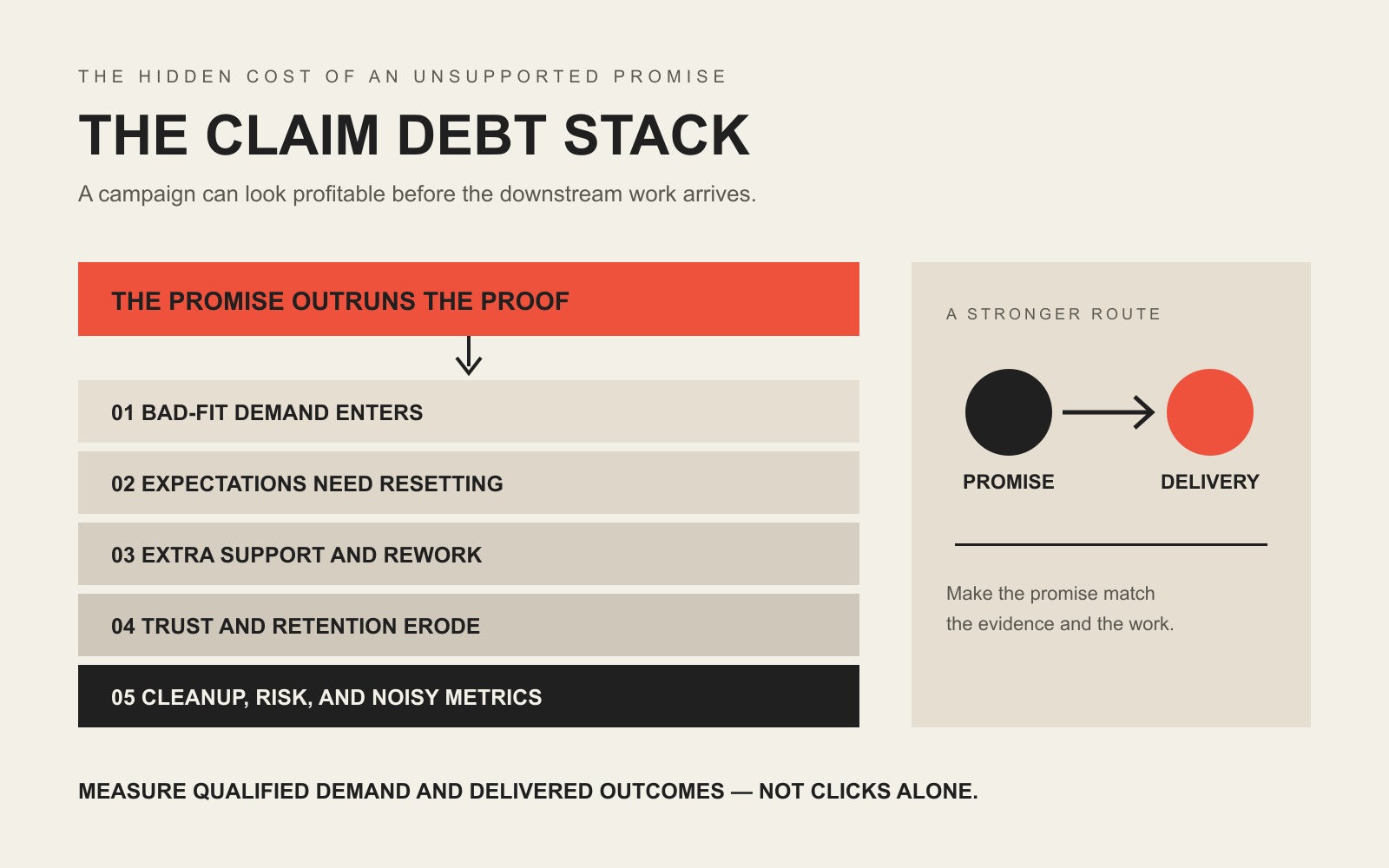
    An unsupported marketing promise creates a cascade of bad-fit demand, expectation resets, extra support and rework, trust loss, and cleanup risk.

    Persuasion Is Not the Same as Deception

    Good marketing is selective. It leads with the most relevant benefit, simplifies complexity, uses emotion, tells stories, and asks people to act. None of that requires deception.

    The line gets crossed when the persuasive framing creates a material impression the business cannot support. A dramatic headline can be honest. A deadline can be real. A testimonial can be accurate. A guarantee can have clear terms. The issue is whether the total message helps a reasonable buyer understand the offer or manufactures certainty, urgency, popularity, or expected results that are not actually there.

    That is also why an ethical review should not flatten good copy into legal-sounding mush. Our guide to ethical marketing psychology goes deeper on using behavioral principles without dark patterns. The job here is narrower: make sure the claim can survive proof and delivery.

    The Scope Design CLAIM Test for Marketing Promises

    Before publishing a consequential claim, run it through five questions. We use the acronym CLAIM to keep the review operational rather than abstract.

    C — Claim: What exactly will a reasonable person think you promised?

    Write the promise in plain language. Include what the words, images, comparison, testimonial, or surrounding context imply—not just the sentence you can defend literally. If your team cannot agree on what the ad is promising, the buyer is being asked to resolve ambiguity you created.

    L — Limits: What conditions or boundaries change the meaning?

    List eligibility requirements, timeframes, exclusions, dependencies, quantities, renewal terms, effort required, or other limitations that matter to the decision. If a limitation is essential to making the headline honest, hiding it in a footnote does not fix the underlying communication problem.

    A — Adequate basis: What evidence exists before publication?

    Link to the actual source. “Everybody knows,” “the vendor told us,” and “we will find the study later” are not evidence files. The evidence must support the claim being made, at the strength it is being made, and the required level of support can vary by claim and industry. This is the point where a simple claim ledger becomes more useful than another round of copy polishing.

    I — Incentives and identity: Who benefits from the endorsement or proof?

    Reviews, testimonials, influencer posts, affiliate recommendations, employee endorsements, awards, and research references can all change how a buyer evaluates a claim. Ask whether the person is real, whether the experience is genuine, whether the example is representative of what the message implies, and whether a material connection needs to be disclosed.

    The FTC’s endorsement guidance says endorsements must be truthful and not misleading and addresses disclosure of material connections. The separate Consumer Reviews and Testimonials Rule, effective October 21, 2024, also covers specific deceptive or unfair review and testimonial practices.

    M — Match operations: Can the business consistently deliver the impression?

    This is the test marketers skip most often. Ask sales, fulfillment, customer service, product, and account management whether they can live with the promise. A claim can be well sourced and still be strategically reckless if normal delivery cannot match the expectation it creates.

    ClaimWhat to verifySafer direction when proof is weak
    “Guaranteed results”Exactly what is guaranteed, under what conditions, and who controls the outcomeDescribe the process, deliverables, conditions, and what the business can actually commit to
    “Only 3 spots left”Real capacity or inventory at the time the claim is shownState the genuine capacity constraint without artificial scarcity
    “Customers typically double results”Data set, methodology, timeframe, selection criteria, and whether the statement reflects typical outcomesUse a documented case example with its context instead of turning one result into a population claim
    “No hidden fees”All mandatory charges, renewals, add-ons, and conditionsShow the total required price structure before the customer commits
    “Best” or comparative performanceWhat is being compared, by what measure, over what market/time periodUse a specific, supportable differentiator rather than an undefined superiority claim

    Five Common Deceptive Advertising Traps for Small Businesses

    1. Turning a possibility into an expected result

    A strong customer outcome can be useful proof. It becomes risky when one exceptional outcome is presented so that readers reasonably infer it is what they should normally expect. Keep the case, but keep the context too: starting point, timeframe, scope, customer contribution, and relevant limitations.

    2. Using urgency that is really theater

    Countdowns that reset, “last chance” messages that run every week, and capacity claims that nobody tracks may lift short-term response while teaching customers not to believe you. If urgency is part of your conversion strategy, our guide to CTA trigger words and urgency covers how truth, inventory, deadlines, and terms should constrain the copy.

    3. Letting the subject line promise more than the destination

    Email creates a small but revealing claim-governance test: does the message deliver what the subject line led the reader to expect? A subject line that gets the open by creating the wrong expectation spends trust to improve a top-of-funnel metric. Our email subject line strategy treats the subject as a promise the email must keep.

    4. Treating disclaimers as a permission slip

    A disclosure can clarify a truthful claim. It should not be used as a hiding place for information that reverses the headline’s main impression. If the “fine print” changes what a reasonable customer would think they are buying, rewrite the main message first.

    5. Publishing AI-assisted claims nobody sourced

    AI can make unsupported specificity sound polished: an invented percentage, a plausible benchmark, a credential that was never checked, or a summary that overstates the source. The solution is not to ban AI from copywriting. The solution is to require provenance for consequential facts before they reach a customer-facing asset.

    A 30-Minute Deceptive Advertising Audit

    You do not need to review every adjective on your website at once. Start with the claims most capable of changing a buying decision.

    1. Inventory the claim surfaces. Check the homepage, top service/product pages, paid ads, landing pages, sales deck, proposal template, email subject lines, social bios/ads, Google Business Profile copy, call scripts, guarantees, pricing, testimonials, and automated follow-up.
    2. Circle decision-changing statements. Prioritize price, savings, results, speed, safety, availability, exclusivity, guarantees, comparisons, credentials, popularity, and customer outcomes.
    3. Run CLAIM. For each important statement, write the claim, limits, evidence source, incentive/disclosure status, and operational owner.
    4. Use red/yellow/green. Green means supported and operationally aligned. Yellow means support or limits need clarification. Red means the claim should not run in its current form.
    5. Fix the first serious red before polishing the rest. One unsupported headline can matter more than twenty minor copy edits.
    6. Assign an evidence owner and review date. Pricing, inventory, competitor comparisons, certifications, results, and regulations change. A once-true claim can become misleading when nobody owns its maintenance.

    This fits the broader marketing system we recommend: the audience, offer, proof, destination, handoff, delivery, and measurement should agree before you buy more attention. Advertising cannot rescue an offer whose promise and proof are fighting each other.

    Measure the Cost of the Promise, Not Just the Conversion

    If you want to know whether claim debt exists, connect marketing data to post-click outcomes. You do not need a universal benchmark. You need a baseline for your own business and a way to see whether a message changes customer quality.

    • Qualified lead rate: What share of inquiries actually fit the offer?
    • Expectation-reset rate: How often do sales or support have to correct something prospects believed from the marketing?
    • Refund, credit, cancellation, and chargeback reasons: Which reversals mention a promise, timeline, feature, price, or result?
    • Delivery rework: How often does the team perform extra work mainly to close the gap between expectation and scope?
    • Review and complaint themes: Do customers repeatedly use words such as “misleading,” “not what I expected,” or “wasn’t clear”?
    • Retention and referral quality: Do customers acquired by one message stay, renew, and refer at the same rate as customers acquired by another?
    • Claim maintenance: Which proof files, terms, pricing facts, certifications, and comparisons are stale or ownerless?

    The point is not to prove that honest copy always wins every immediate A/B test. It may not. The point is to evaluate the full operating result instead of rewarding a promise for generating a click before the bill arrives.

    Deceptive Advertising FAQ

    What are examples of deceptive advertising?

    Examples can include false performance claims, unsupported comparisons, fake scarcity, misleading pricing, important omissions, fabricated or manipulated reviews, undisclosed material connections in endorsements, or a technically true statement presented so that the overall impression is misleading. Context matters, which is why the FTC evaluates the whole ad rather than a single word in isolation.

    Is exaggeration automatically false advertising?

    Not every enthusiastic phrase is treated the same way. The practical business question is whether a reasonable buyer would take the message as an objective, material claim. If the statement concerns measurable performance, price, results, safety, speed, availability, or another buying factor, treat it as a claim that needs support rather than assuming it is harmless hype.

    Can a disclaimer fix a misleading headline?

    A disclosure can supply necessary context, but it is a poor strategy to make a strong misleading impression and hope smaller text reverses it. Write the main claim so it is accurate on its own terms, then use disclosures for conditions and context that genuinely clarify the offer.

    Are fake reviews a deceptive advertising problem?

    They can be. The FTC’s current Consumer Reviews and Testimonials Rule addresses specified deceptive or unfair review and testimonial practices, including fake or false reviews and certain sentiment-conditioned incentives. Treat reviews as evidence supplied by real people, not an inventory of praise to manufacture.

    What if a claim is true but leaves out something important?

    An omission can still contribute to deception when leaving out material information creates a misleading impression. The CLAIM Test’s “Limits” step exists for exactly this reason: ask which condition would materially change how a reasonable buyer interprets the promise.

    How should a small business substantiate marketing claims?

    Identify the objective claim, save the evidence that supports it before publication, make sure the evidence actually matches the strength and scope of the claim, record important limitations, and assign an owner to keep the evidence current. Higher-risk or regulated claims may need specialized evidence and qualified legal review.

    Do truth-in-advertising principles apply online?

    Yes. The FTC maintains specific online advertising and marketing guidance, and its endorsement guidance applies across modern media including online and social channels. Your website, ad, email, influencer post, or landing page does not get a separate definition of truth.

    The Cheapest Marketing Claim Is the One Your Business Can Keep

    Deceptive advertising is expensive because the promise does not stay inside the ad. It moves into sales conversations, customer expectations, fulfillment, support, reviews, reporting, and compliance. That is why truth can be a cost-control strategy as much as an ethical one.

    Before the next campaign goes live, ask five questions: What are we claiming? What limits matter? What evidence exists? Who has an incentive or connection the buyer should understand? Can our operation deliver the impression consistently? If those answers line up, the copy can be persuasive without borrowing trouble from the future.

    If your marketing is generating attention but the sales and delivery teams keep correcting expectations, Scope Design can help trace the gap from message to outcome. Contact Scope Design to review the claim, proof, offer, and customer journey together.


  • AI for Sales: 7 Practical Ways to Improve Sales Performance

    AI for Sales: 7 Practical Ways to Improve Sales Performance

    AI for sales works best as a decision-support and workflow layer around a sales team—not as a substitute for human judgment. Used well, it can research accounts, summarize conversations, suggest priorities, draft follow-ups, keep CRM records current, surface pipeline risk, and handle bounded inbound questions. The practical goal is not to make an AI “close deals.” It is to remove friction so people can spend more time diagnosing needs, making good promises, and building trust.

    That distinction matters because AI can scale a bad sales process just as efficiently as a good one. If nobody owns the lead, the CRM is unreliable, qualification rules are vague, or follow-up disappears into memory, adding another AI tool may simply make the mess move faster.

    Current sales platforms reflect this shift. Salesforce’s sales AI and HubSpot Sales Hub now describe features for research, summaries, lead or deal scoring, forecasting, meeting preparation, follow-up, and conversation intelligence. Those capabilities are useful—but the tool should come after the process decision.

    What Is AI for Sales?

    AI for sales is the use of artificial intelligence to help a sales team understand opportunities, reduce repetitive work, preserve customer context, and make better-informed next-step decisions. Depending on the workflow, that may include generative AI for writing and summarization, machine-learning models for scoring or forecasting, conversation intelligence for call analysis, or conversational AI for answering and routing inbound questions.

    The useful question is not, “Where can we add AI?” It is, “Where is the sales process losing time, context, consistency, or opportunities?” Scope Design uses the same constraint-first logic we recommend for broader marketing and growth decisions: diagnose the bottleneck before choosing the tactic.

    Use the Scope Design SCOPE AI Sales Test First

    Before automating a sales task, run it through five questions. We call this the SCOPE AI Sales Test. It is an operating framework, not a promise that every business needs the same software or the same level of automation.

    • S — Sales constraint: What bottleneck are we actually trying to fix?
    • C — Clean context: What data is trustworthy, current, and permitted for the AI to use?
    • O — Owner + override: Who reviews exceptions and can reverse or reject the AI’s recommendation?
    • P — Pipeline proof: Which downstream sales outcome will tell us whether the workflow helped?
    • E — Escalation boundary: When must the AI stop and hand the situation to a person?

    This test keeps the implementation grounded. If the sales constraint is slow follow-up, a sophisticated forecasting model is not the first project. If the CRM contains duplicate companies, stale stages, and missing next steps, feeding that data into AI does not make it clean. And if nobody can explain when the AI should defer to a human, the automation is not ready.

    For the broader workflow-design side of this problem, our guide to AI automation for business goes deeper on when automation earns its place and how to build around the real process instead of the demo.

    7 Practical Ways to Use AI for Sales

    1. Prioritize Leads and Deals Without Letting AI Make the Final Call

    Lead and opportunity prioritization is one of the clearest uses of AI for sales. A system can combine known fit criteria, recent activity, CRM history, stage age, engagement signals, and other approved data to help a rep decide what deserves attention first.

    The important word is prioritize, not reject. A score should help a person inspect the pipeline, not become an invisible rule that automatically discards unusual opportunities. Historical sales data can contain the habits and blind spots of the old process. If yesterday’s team systematically ignored a good segment, a model trained on yesterday may learn to ignore it too.

    • Useful inputs: explicit fit criteria, lifecycle stage, recency, buying signals, account history, and known next steps.
    • Human boundary: require review before disqualifying high-value, unusual, sensitive, or strategically important opportunities.
    • Measure: qualification-to-opportunity movement, false-negative reviews, rep response patterns, and whether good opportunities spend less time unattended.

    2. Research Accounts and Prepare Better Sales Conversations

    Sales research is a strong AI use case because the output is preparation, not the customer-facing promise itself. AI can summarize a prospect’s website, CRM history, prior emails, open support issues, public announcements, and previous meeting notes into a brief that helps the rep enter the conversation with context.

    At Scope Design, our sales notes keep returning to the same principle: educate and listen before trying to close. Better preparation should produce better questions—What made this a priority now? What happens after someone contacts you? What would make this project worth the investment?—not a longer monologue about the seller’s tools.

    A practical AI research brief might contain the company’s apparent business model, relevant services, recent interactions, known stakeholders, unresolved questions, likely risks, and five discovery questions. The rep should verify time-sensitive facts before using them. AI-generated research is a starting point for attention, not a substitute for reading the source.

    • Useful inputs: prospect URL, approved CRM data, previous conversations, proposals, and account notes.
    • Human boundary: verify claims, contacts, pricing, organizational changes, and anything that could materially affect the conversation.
    • Measure: prep time, discovery completeness, useful notes captured, and whether the next step becomes clearer after the call.

    3. Draft More Relevant Outreach and Follow-Up

    AI can draft prospecting emails, recap calls, suggest follow-up language, and adapt a reusable message structure to the actual account context. This is much more useful than “personalization” that merely inserts a first name and a scraped compliment.

    A good follow-up adds something: a clarified next step, an answer, a screenshot, a comparison, a relevant resource, or a reminder tied to the prospect’s stated timing. Scope Design’s working rule is simple: every real opportunity should have a next follow-up date. AI can help create the draft and the task; a person still owns the reason for reaching out.

    Human review is especially important for higher-value outreach. HubSpot’s current AI prospecting agent, for example, includes a review-before-send option. That is a useful design pattern even if you use a different platform: let AI reduce writing friction without giving it unlimited permission to speak for the business.

    Also design the handoff after the response. Our guide to marketing assets and sales handoffs treats routing, qualification questions, CRM ownership, response templates, follow-up rules, and closed-won/closed-lost reasons as part of the same operating system. A polished email does not matter much if the reply has nowhere dependable to go.

    • Useful inputs: the prospect’s stated problem, prior messages, relevant proof, next-step rules, and approved messaging.
    • Human boundary: review pricing, commitments, guarantees, scope, legal claims, and sensitive situations before sending.
    • Measure: qualified replies, meetings held, opportunities advanced, follow-up completion, and opt-outs—not open rate alone.

    4. Automate CRM Cleanup and Sales Admin Without Automating Judgment

    CRM administration is exactly the kind of friction AI should reduce. After a meeting, a sales assistant can summarize the call, identify stakeholders, suggest fields to update, create a follow-up task, attach notes to the right company, and flag missing information. It can also surface records that have no owner or no next action.

    But do not let the automation silently rewrite the meaning of the pipeline. A deal should not move from “discovery” to “proposal” just because a transcript contained the word “budget.” Stage definitions, qualification criteria, and required evidence still belong to the sales process.

    Data permission matters too. The Federal Trade Commission has warned AI companies and businesses to honor privacy and confidentiality commitments, including when customers provide internal or user data. Before connecting email, CRM, call recordings, proposals, or customer records to an AI system, understand what the provider retains, how the data may be used, who can access it, and how it can be removed.

    • Useful inputs: calls, emails, calendar events, contact records, account records, and explicit stage rules.
    • Human boundary: approve stage changes, material record merges, commitments, disqualification, and exceptions.
    • Measure: percentage of active opportunities with an owner and next step, correction rate, overdue follow-ups, and admin time.

    5. Analyze Sales Conversations for Patterns and Coaching

    Conversation intelligence can turn calls and meetings into searchable summaries. A team can use AI to extract questions, objections, commitments, competitors mentioned, follow-up items, and recurring themes across conversations. That creates a useful feedback loop between sales, marketing, service, and product decisions.

    The safest use is evidence retrieval and pattern finding—not pretending a model can read someone’s mind. Treat “sentiment,” “intent,” or personality-style labels as uncertain signals, especially when the model cannot show how it reached them. For recording and transcription, follow applicable consent, employment, privacy, and industry requirements.

    NIST’s Generative AI Profile for the AI Risk Management Framework emphasizes governance practices such as human review, documentation, monitoring, and management oversight where the context warrants them. In a sales workflow, that translates into a practical rule: keep the evidence available, let people inspect the output, and name the person accountable for decisions made from it.

    • Useful inputs: approved recordings/transcripts, CRM outcomes, objection tags, call notes, and coaching criteria.
    • Human boundary: do not treat inferred emotion, sensitive traits, or automated coaching scores as unquestionable truth.
    • Measure: follow-up completeness, recurring objections resolved, coaching actions completed, and whether call notes become more usable downstream.

    6. Forecast Pipeline and Surface Risk Earlier

    AI can help a sales manager inspect the pipeline by highlighting deals with missing next steps, unusual stage age, weak activity, changing stakeholders, unresolved objections, or gaps between the CRM record and recent conversations. It can also summarize why a forecast changed instead of leaving the manager to compare rows manually.

    The mistake is turning a forecast into an oracle. A prediction is only as useful as the stage definitions, historical data, business conditions, and inputs behind it. New offers, seasonal work, a new territory, a major pricing change, or an unusual account can all make historical patterns less informative.

    Use AI to make risk visible and reviewable. Ask it to show the missing evidence, explain the factors behind a flag, and help a manager decide what needs inspection. Keep the actual forecast accountable to a named person.

    • Useful inputs: stage history, next actions, activity recency, amount, close-date changes, stakeholder activity, and outcome history.
    • Human boundary: managers own commit decisions, exceptions, strategic accounts, and any override of the model.
    • Measure: forecast error over time, stale-stage rate, missing-next-step rate, and whether identified risks are acted on.

    7. Qualify Inbound Conversations and Hand Them to the Right Person

    Conversational AI can earn its keep when the job is narrow: answer approved questions, collect the reason for contact, capture basic fit information, schedule a meeting, route the request, and preserve the conversation context for the human who takes over.

    The handoff is the important part. A warm handoff transfers the person, their question, the context already collected, what the AI attempted, and the next expected action. A cold handoff dumps the visitor onto a generic inbox and makes them repeat everything.

    Our AI chatbot guide goes deeper on approved knowledge, permissions, escalation triggers, and human escape paths. The broader customer lifecycle management guide explains why ownership and context must survive the transition from inquiry to qualification, sales, onboarding, and ongoing service.

    • Useful inputs: approved FAQs, service area, fit questions, scheduling rules, contact data, and routing rules.
    • Human boundary: escalate when the customer requests a person, the answer is uncertain, the issue is sensitive, or the requested commitment exceeds the AI’s authority.
    • Measure: qualified handoffs, successful bookings, abandonment, escalation quality, repeated questions, and corrections—not conversation volume alone.

    How to Choose AI Sales Tools Without Buying a Tool Pile

    There is no single “best AI for sales” because sales teams do different jobs with different systems, data, risks, and volumes. Choose the workflow first, then evaluate tools against the job.

    QuestionWhy it matters
    What exact sales job does the tool perform?“AI assistant” is too broad. Name the task: research, note capture, follow-up, scoring, forecasting, routing, or another defined job.
    What data does it need?You need to know which CRM objects, emails, calls, files, calendars, or web sources become inputs.
    Can a person review and override the output?Approval, edit history, confidence signals, and clear exception handling matter when the AI can affect customers or pipeline decisions.
    What happens to your data?Check retention, model-training terms, access controls, permissions, deletion, export, and contractual commitments.
    Does it preserve evidence?A useful system should let you inspect the source, transcript, record, or reasoning context behind important recommendations.
    Does it fit the CRM and workflow you already use?Copying context between disconnected tools can create more work and more data drift.
    How will you measure the result?Decide the baseline, outcome, guardrail, and stop rule before the pilot becomes permanent.

    The product name matters less than whether the workflow remains auditable. That is the same principle we use when evaluating AI for market research: accuracy, traceability, privacy, exportability, and access to the underlying evidence matter more than a flashy demo.

    A 30-Day AI for Sales Pilot

    Do not start by “transforming sales with AI.” Start with one bounded workflow that can produce useful evidence in a month.

    Week 1: Baseline One Sales Constraint

    • Pick one bottleneck: slow follow-up, incomplete CRM notes, inconsistent call preparation, stale deals, weak handoffs, or another observable problem.
    • Document the current process and owner.
    • Choose one primary outcome plus one or two guardrails.
    • Identify which data is allowed and reliable enough to use.

    Week 2: Configure the Smallest Useful Workflow

    • Connect only the systems the use case actually requires.
    • Define what the AI may read, suggest, create, or change.
    • Create the human review and escalation path.
    • Test ordinary cases, edge cases, wrong data, missing data, and ambiguous requests.

    Week 3: Run a Bounded Live Pilot

    • Use a limited group of reps, accounts, lead sources, or activities.
    • Log edits, overrides, failures, and escalations instead of hiding them.
    • Keep the old process available when the new workflow fails.
    • Collect qualitative feedback from the people doing the work.

    Week 4: Compare, Correct, Expand—or Stop

    • Compare the pilot outcome with the baseline.
    • Check downstream effects, not just activity inside the AI tool.
    • Review errors, customer friction, data-quality problems, and staff workarounds.
    • Expand only if the workflow improved the real sales constraint without creating unacceptable risk or hidden work.

    A Worked Example: AI-Assisted Sales for a Service Business

    Consider a hypothetical commercial cleaning company. A facilities manager submits an inquiry because the current vendor has recurring service and communication problems. The company wants to improve response and preparation without letting AI quote complex work or decide whether the prospect is a fit.

    • Inquiry: the website form captures location, facility type, approximate scope, timing, and the reason for considering a change.
    • AI preparation: the system creates the CRM record, summarizes the request, checks approved public account information, and proposes discovery questions.
    • Human qualification: the sales owner reviews service area, scope, timing, operational capacity, and the prospect’s real concern.
    • Follow-up: AI drafts a concise recap around switching risk, access coordination, and next steps; the rep edits and sends it.
    • Next action: the CRM receives an owner, due date, walkthrough task, and the reason the opportunity did or did not advance.
    • Boundary: AI does not invent pricing, promise staffing, guarantee service outcomes, or automatically disqualify an unusual facility.

    The value comes from context moving cleanly through the system. The rep still diagnoses the need and makes the promise. AI helps make sure the research, notes, follow-up, and next action do not disappear between tools.

    How to Measure Whether AI Is Improving Sales

    AI sales ROI should be measured against the bottleneck the pilot was designed to fix. Do not call the project a success because the AI generated more emails, summaries, scores, or chatbot conversations. Activity is useful only when it improves the sales system downstream.

    Metric layerExamplesWhat it tells you
    OperationalTime to first useful response, prep time, admin time, follow-up completionWhether the workflow removes friction
    Data qualityOpportunities with an owner and next step, missing fields, correction rateWhether AI improves or pollutes the system of record
    QualificationQualified-to-opportunity movement, meetings held, disqualification reasonsWhether attention is reaching better-fit work
    Sales outcomeSales cycle, win rate, margin, revenue from affected opportunitiesWhether operational improvements eventually reach business results
    Risk and trustOverrides, escalations, incorrect drafts, complaints, opt-outsWhether automation creates hidden customer or governance costs

    For small sales volumes, do not demand fake statistical certainty. Use a sensible baseline, inspect individual cases, compare affected opportunities where possible, and combine quantitative outcomes with rep and customer evidence. If a workflow saves minutes but creates inaccurate promises, it is not an improvement.

    AI for Sales FAQ

    Can you use AI for sales?

    Yes. AI can support sales research, prioritization, follow-up, CRM administration, call analysis, forecasting, and bounded inbound qualification. The strongest implementations give AI a narrow job, reliable context, a human owner, a measurable outcome, and a clear escalation path.

    Which AI is best for salespeople?

    The best AI depends on the sales job and the systems you already use. A team that needs CRM cleanup should evaluate a different workflow than a team that needs call analysis or account research. Prioritize fit with your CRM, data controls, review/override features, source traceability, exportability, and measurement—not a generic “best AI” ranking.

    Can AI replace sales reps?

    AI can replace pieces of repetitive sales work, but it should not be treated as a universal replacement for discovery, judgment, negotiation, accountability, or relationship management. In complex service sales, the buyer often needs someone who can interpret context, make a responsible promise, handle exceptions, and coordinate the next step.

    What sales task should a small business automate first?

    Start with a frequent, low-risk task tied to an observable bottleneck. Good candidates include call summaries, research briefs, follow-up task creation, CRM field suggestions, meeting recaps, or approved FAQ routing. Avoid starting with autonomous pricing, automatic disqualification, or customer-facing promises.

    What data does AI sales software need?

    It depends on the use case. Common inputs include CRM records, account activity, emails, meetings, transcripts, website or public account information, stage history, and approved knowledge. Use the minimum data needed for the job, check provider retention and training terms, and keep access permissions appropriate to the sensitivity of the information.

    How do you measure AI sales ROI?

    Compare the cost and effort of the workflow with the bottleneck it was designed to improve. Track operational changes such as response time or admin work, then follow the affected opportunities into qualification, sales cycle, win/loss, margin, and revenue where the sample is meaningful. Include correction, escalation, and customer-friction costs so the ROI calculation does not ignore the downside.

    What should you not automate in sales?

    Do not automate judgment merely because a model can produce an answer. High-stakes commitments, unusual exceptions, sensitive decisions, unverified claims, relationship recovery, pricing outside clear rules, or anything with meaningful legal, financial, privacy, or reputational consequences should have an explicit human decision owner.

    Put AI Around the Sales Process—Not in Charge of It

    The most useful AI for sales is often less dramatic than the demo. It prepares the rep. It remembers the next action. It cleans the record. It turns a call into usable context. It spots a stalled opportunity. It hands an inbound conversation to the right person without making the customer start over.

    Start with the sales constraint, not the subscription. Give the AI clean context, a human owner, a downstream metric, and an escalation boundary. Then automate the smallest useful step, measure what happens, and expand only when the evidence earns it.

    If your sales problem crosses the website, forms, CRM, follow-up, automation, and customer handoffs, Scope Design can help map the operating workflow before another disconnected tool gets added to the pile.

  • How to Validate a Business Idea Before You Bet the Business

    How to Validate a Business Idea Before You Bet the Business

    To validate a business idea, identify the assumption most likely to kill it, run the smallest real-world test that could prove that assumption wrong, and decide in advance what evidence would justify the next commitment. Compliments, survey answers, market-size estimates, and AI scores can help you decide what to investigate. They do not prove that customers will change behavior, approve a budget, pay, stay, or tolerate the real delivery experience.

    The goal is not to prove that the idea will work forever. You cannot. The goal is to make uncertainty cheaper before you make the next expensive or hard-to-reverse bet.

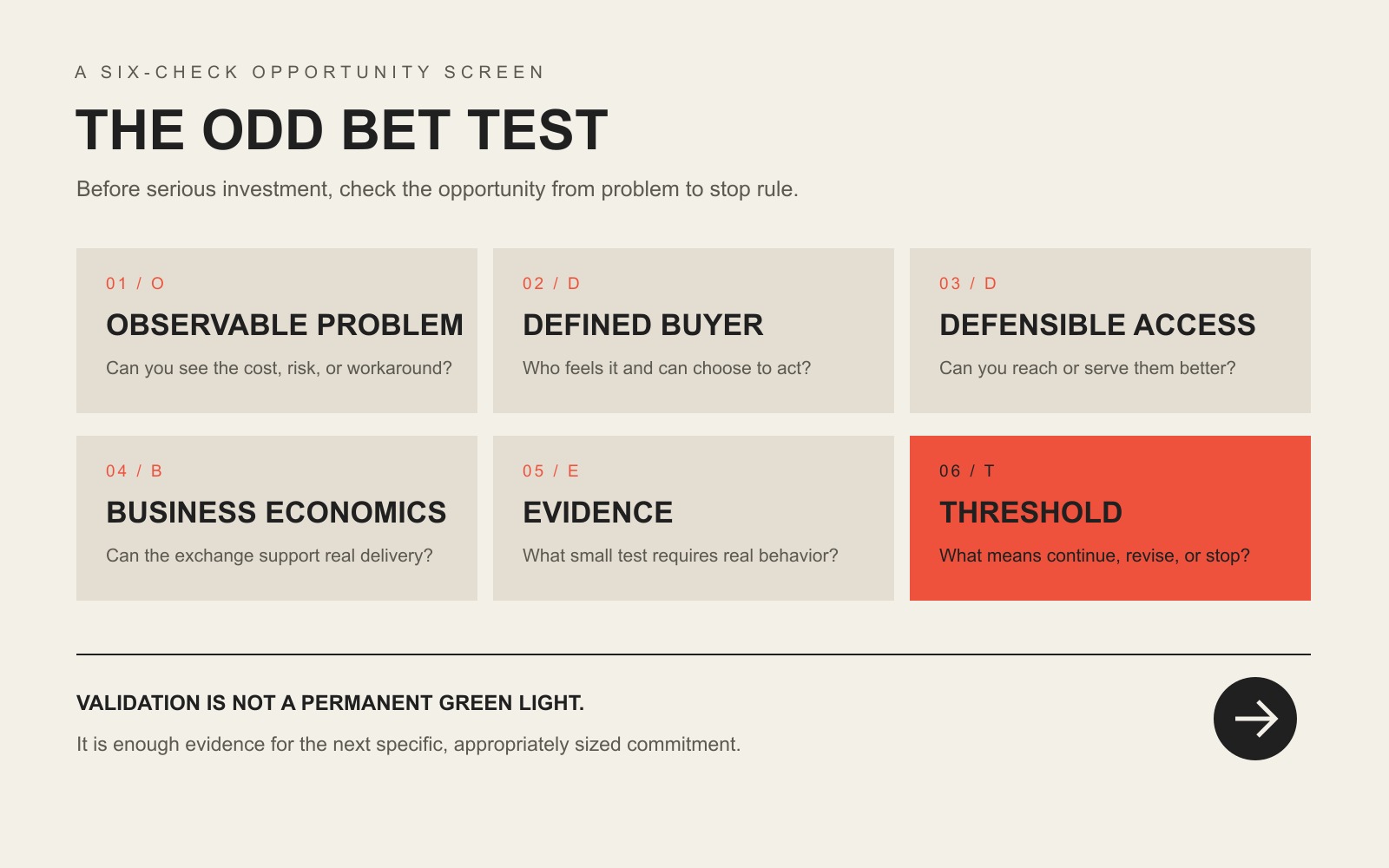
    Scope Design uses the ODD BET Test to diagnose whether an opportunity deserves more time and money:

    • O — Observable problem: Is there a real problem, job, risk, cost, or desire you can observe?
    • D — Defined buyer: Who specifically experiences it and has the ability to act?
    • D — Defensible access or advantage: Can you reach, serve, or solve for that buyer better than realistic alternatives?
    • B — Business economics: Can the exchange plausibly support delivery, acquisition, risk, and continued operation?
    • E — Evidence from the smallest real test: What is the cheapest test that requires meaningful behavior instead of compliments?
    • T — Threshold: What result means continue, revise, pause, or stop before sunk-cost logic takes over?

    If the broader business choices are still fuzzy, start with Scope Design’s business strategy framework. This article goes one level deeper: what evidence is strong enough to justify putting more money, time, reputation, or irreversibility behind one unproven idea?

    What counts as business idea validation?

    Business idea validation is the process of testing the assumptions underneath an idea against evidence that can change a real decision. It is not a confidence exercise and it is not a ceremonial green light.

    A business idea is not validated because your friends like it, competitors exist, an AI tool gives it an 87/100, a survey respondent says they would probably buy, or you have already spent six months building it.

    Useful evidence gets progressively harder to fake. A recurring complaint is better than your own assumption. An observed workaround is better than a complaint. A pilot is stronger than enthusiasm. A deposit, purchase, repeat use, renewal, or expansion can be stronger still because the customer has more at stake.

    Even strong evidence has limits. One purchase does not prove retention. One paid pilot does not prove scalability. A waitlist does not prove profitable demand. Validation means the evidence is good enough for the next specific bet, not that the whole business has been permanently proven.

    Why “foolish” business ideas are the wrong lesson

    The old version of this article focused on apparently ridiculous ideas that became successful businesses. That makes a good story and a lousy decision rule. Looking backward at famous winners hides the huge number of strange ideas that stayed strange and unprofitable.

    The useful question is not, “Does this sound crazy enough to be innovative?” It is: What would have to be true for this opportunity to work, and what evidence can we get before betting heavily on those assumptions?

    Ridicule and enthusiasm are both weak evidence. People can dismiss something valuable. They can also praise something they will never buy. The market does not owe either group a satisfying ending.

    First, separate an idea from an opportunity

    An idea is a proposed way to create value. An opportunity is an idea connected to enough evidence that a specific customer problem, reachable market, workable exchange, and feasible operating model may exist.

    If you are still generating or screening raw ideas, use Scope Design’s business idea generation process and pre-validation profit screen first. Validation becomes useful after you have a specific buyer-problem-solution hypothesis worth testing.

    The ODD BET Test: six checks before serious investment

    The ODD BET Test checks for an Observable problem, Defined buyer, Defensible access, Business economics, Evidence from a real test, and a decision Threshold.

    O: Is there an observable problem?

    Start with reality, not the solution you are already attached to. What is happening today that makes somebody spend money, waste time, accept risk, build a workaround, delay a goal, or tolerate an ugly process?

    The U.S. Small Business Administration’s current planning guidance treats market research as a way to reduce uncertainty while an idea is still being evaluated and points owners toward demand, market size, location, saturation, pricing, and competitors. That is useful groundwork. It does not by itself prove that a specific buyer will act. For a deeper research process, use our small-business market research guide.

    • Look for repeated descriptions of the same frustrating job.
    • Observe spreadsheets, manual workarounds, staff time, hacks, or existing purchases devoted to the problem.
    • Document delays, errors, risk, lost opportunities, or costs buyers can describe concretely.
    • Notice regulations, technology shifts, cost changes, or workflow changes that create new pain.

    If you cannot describe the problem without naming your product, you probably understand the solution better than the opportunity.

    D: Is the buyer defined tightly enough to test?

    “Small businesses,” “busy professionals,” and “people who care about wellness” are not buyers. A useful target is specific enough that you can find people, recognize the purchase context, and distinguish the person with the problem from the person who approves or pays.

    • Who experiences the problem?
    • Who feels the consequence?
    • Who chooses the solution?
    • Who pays or approves the budget?
    • What event creates urgency?
    • What alternatives do they already use?

    A market-size estimate can tell you that a population exists. It cannot tell you how many members feel the problem, trust your solution, have budget, or care right now.

    D: Do you have defensible access or advantage?

    A real problem and buyer still do not guarantee a business opportunity. You need a credible way to enter the exchange.

    • Can you reach the buyer without an acquisition cost the model cannot support?
    • Do you understand the workflow unusually well?
    • Do you have trust, distribution, expertise, relationships, data, or technical capability that matters?
    • Can you deliver faster, more safely, more simply, or in a form customers prefer?
    • Why have obvious alternatives not already solved the problem?

    “Nobody else is doing this” may signal an overlooked opportunity. It may also signal weak demand. “Lots of competitors exist” may mean a crowded category—or that buyers already understand the problem and spend money solving it. Competition is evidence to interpret, not a stop sign or permission slip.

    B: Do the economics work before fantasy volume arrives?

    An idea can create value and still be a terrible business. Model the sale you can deliver now, not the imaginary future version where scale removes every inconvenience.

    • realistic price or price range;
    • direct cost to deliver;
    • sales and acquisition burden;
    • onboarding, support, returns, refunds, rework, or warranty risk;
    • payment timing and working capital;
    • capacity consumed per customer;
    • repeat purchase or retention assumptions where relevant;
    • fixed costs the offer eventually needs to support.

    Use ranges and explicit assumptions. If the opportunity works only when every uncertain number lands in the optimistic column, you have not found a business model. You have built a motivational spreadsheet. For deeper price testing, use Scope Design’s product-pricing framework.

    Use the BET Validation Ladder inside the evidence and threshold stages

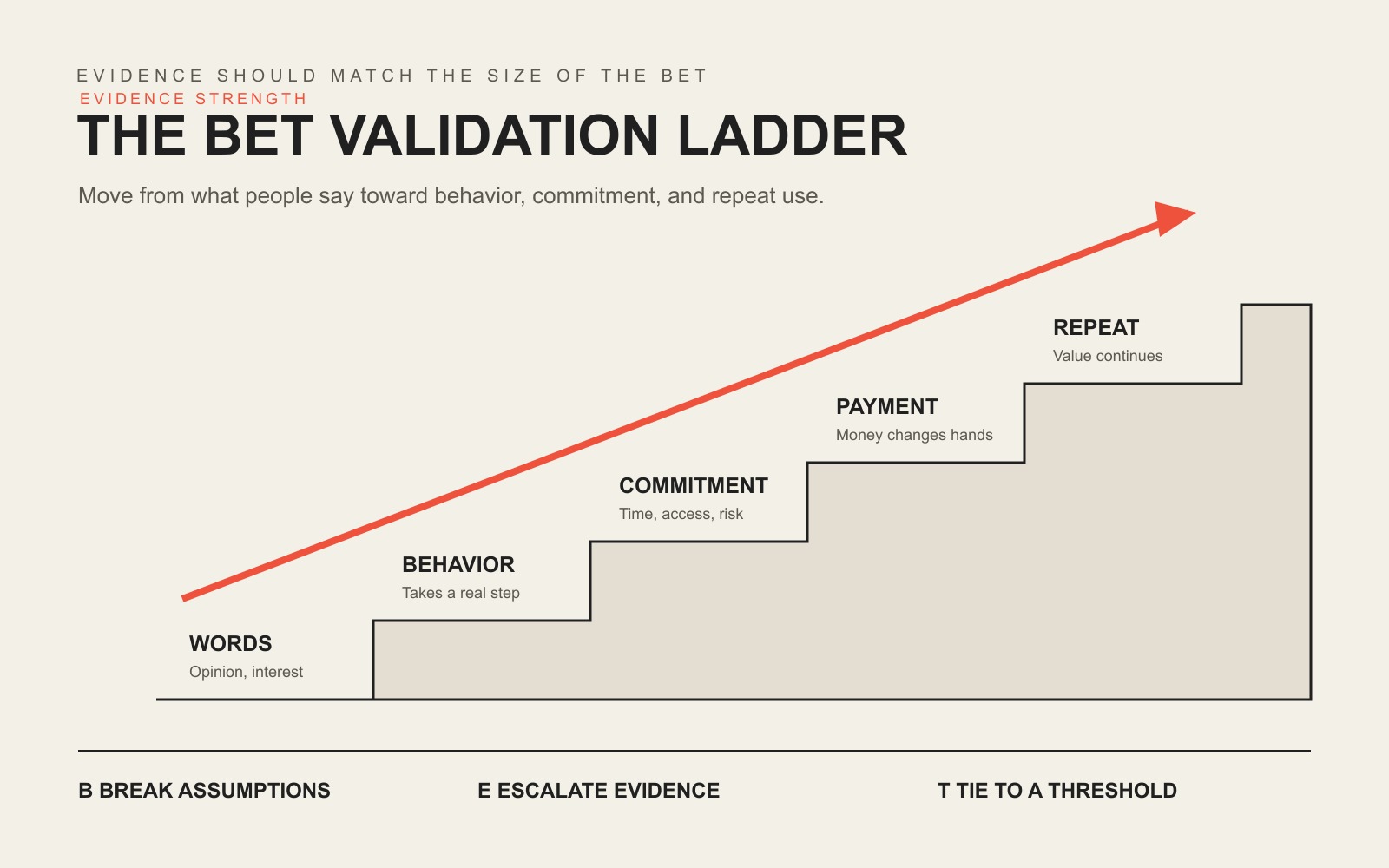
    ODD BET diagnoses the opportunity. The BET Validation Ladder keeps the E and T stages tied to the decision you actually face:

    • B — Break the idea into falsifiable assumptions. Stop evaluating “the idea” as one giant blob. Name what must be true about the problem, buyer, urgency, price, channel, delivery model, and economics.
    • E — Escalate the strength of the evidence. Start cheaply, but do not confuse low-consequence signals with proof. Move from words toward behavior, commitment, payment, and repeat behavior when the decision requires stronger evidence.
    • T — Tie the next bet to a threshold. Decide what result means proceed, pause, pivot, or stop before you see the result. Otherwise enthusiasm moves the goalposts for you.
    The BET Validation Ladder escalates evidence from words to behavior, commitment, payment, and repeat behavior, with the next bet tied to a threshold.

    The ladder matters because “validated idea” is too binary. A few useful interviews may justify a rough prototype. They are usually not enough evidence to justify quitting a stable job, signing a long lease, hiring a full-time team, or spending six figures on custom software. The size and reversibility of the next commitment should influence the evidence burden.

    Break the idea into claims that can fail

    Write the opportunity as a set of claims that could be wrong. For example:

    • The problem is real, recurring, and important enough to change behavior.
    • The person with the problem can influence or control the purchase.
    • Existing alternatives leave a meaningful gap.
    • The buyer will accept a price that can support delivery.
    • You can reach qualified buyers through a viable channel.
    • The solution can be delivered with acceptable cost and operational burden.

    Then rank those assumptions by danger. The highest-risk assumption is not always “will people buy?” In one business it may be customer access. In another it may be regulation, fulfillment, channel economics, behavior change, or retention.

    Escalate evidence without pretending one signal proves everything

    Evidence levelWhat it can tell youWhat it cannot prove
    WordsThe buyer recognizes a problem, story, or conceptThat they will change behavior or pay
    Observed behaviorThe problem already creates workarounds, search, effort, or switching attemptsThat your offer will win
    Meaningful commitmentThe buyer accepts time, access, reputation, setup, or another real frictionThat the economics will scale
    PaymentAt least some buyers will exchange money for the offerRetention, repeatability, or long-term profitability
    Repeat behaviorValue persists enough to drive renewal, reuse, repeat purchase, or expansionThat every acquisition or operating constraint is solved

    No stage is universally “best.” Evidence strength depends on the assumption. A regulatory constraint may need authoritative legal or technical evidence. A willingness-to-pay assumption needs economic behavior. A delivery-risk assumption needs real delivery experience.

    Tie the next bet to a decision threshold set before the result

    Before a test, write three outcomes:

    • Continue: What evidence would justify the next investment?
    • Revise or pivot: What result would support the problem but challenge the buyer, offer, channel, price, or delivery model?
    • Pause or stop: What result would make the core assumption too weak to justify more investment?

    There is no universal pass rate. Use the SCOPE business decision-making framework when you need to match decision rigor to stakes, reversibility, uncertainty, and consequences.

    Run a seven-step business idea validation sprint

    1. Write the next decision in one sentence

    Do not start with “Is this a good idea?” Start with the decision you actually face: build a rough prototype, spend $1,000 testing acquisition, add a second service area, order inventory, sign a lease, hire, or hold.

    2. List what must be true

    Separate demand assumptions from delivery assumptions. Write the buyer, problem, urgency, alternatives, price, reach, fulfillment, margin, and repeat-behavior claims plainly enough that evidence could prove them wrong.

    3. Choose the assumption that could kill the bet fastest

    Do not average away the ugly unknown. Test the assumption whose failure would change the decision most.

    4. Pick the cheapest test that could actually change your mind

    If every possible result leads to “keep going,” you designed reassurance, not validation. Choose a test with a credible failure state.

    5. Set the threshold and stopping rule

    Define success, ambiguity, and failure before the result. Put time, money, sample, or exposure bounds around the experiment so it cannot turn into endless research.

    6. Run the test with people who can create the real outcome

    Friends and friendly peers can improve your wording. They are not substitutes for qualified buyers, budget owners, users, or operators who can generate the behavior you need to observe.

    7. Decide: keep, kill, pivot, or escalate

    A failed small test can be a successful business decision if it saves a larger spend. If the evidence clears the threshold, increase the bet only enough to address the next major uncertainty.

    How much evidence is enough before the next bet?

    The evidence burden should be proportional to the next commitment. Use this as a decision map, not a universal benchmark:

    Next commitmentEvidence that may be proportionateSlow-down signal
    Weekend rough prototypeRecurring problem patterns from qualified customersYou still cannot name the buyer, problem, or current workaround
    Small acquisition budgetA specific offer, audience, conversion action, and pre-set learning thresholdYou are buying traffic before defining what behavior would count as validation
    Custom software buildRepeated workflow evidence, manual delivery that works, and buyers who value the outcomeYou are using software to discover whether the problem exists
    Hire for a new offerRecurring demand, visible workload, workable margin, and a legible delivery processOne unusually large customer is being mistaken for repeatable demand
    Long lease or expensive equipmentLocation-specific demand plus realistic utilization, capacity, and economicsThe evidence comes from a different market or optimistic utilization assumptions
    Quit stable income or make another major personal leapEvidence appropriate to your runway, obligations, demand, economics, and personal risk toleranceA generic article is being used as individualized financial advice

    A business article cannot decide your personal runway, debt capacity, family obligations, financing terms, or risk tolerance. If you are still sorting out startup readiness rather than a specific validation test, read the hard truths about starting a business before escalating the bet.

    Match the validation method to the assumption

    Customer interviews: learn context and past behavior

    Ask about the last time the problem occurred, what triggered it, what the customer did, what alternatives they considered, what it cost, who approved the decision, and what happened afterward. Interviews are discovery evidence. They do not prove payment.

    Market and competitor research: map the reality around the test

    Use research to locate plausible buyers, alternatives, saturation, pricing ranges, channels, and constraints. The SBA’s current planning resources are useful for this boundary: market research can reduce uncertainty and improve an idea, but it is not the same thing as watching a customer make a real commitment.

    Concierge or manual delivery: test the outcome before automation

    For services and software-enabled workflows, manually deliver the result before building a large system. This exposes value, support burden, edge cases, and operational cost while the bet is still reversible.

    Landing page or smoke test: test message and behavior honestly

    A landing page can test whether a defined audience responds to a real proposition. Keep the offer truthful. The Federal Trade Commission’s business guidance says advertising claims should be truthful and non-deceptive; do not invent customers, fake proof, or imply capabilities you do not have simply because the page is “only a test.”

    Paid pilot, deposit, or preorder: add economic friction carefully

    Real economic commitment can be stronger than stated interest, but it still does not prove retention, scale, support burden, or profitable delivery. If you take real online orders for merchandise, promised shipment timing needs a reasonable basis; the FTC’s Mail, Internet, or Telephone Order Merchandise Rule includes delay, consent, and refund obligations. Verify the rules that apply to your offer and jurisdiction before taking money.

    Pricing and choice tests: test the tradeoff, not “what would you pay?”

    Compare realistic packages, observe what buyers already spend, and test paid offers where appropriate. Price is part of the business model, not a detail added after validation.

    Prototype or MVP: test the riskiest experience, not every feature

    A minimum viable product is useful when product experience itself is the uncertainty. It is wasteful when a cheaper manual test could answer the real question first.

    What business idea validation cannot prove

    • Interviews cannot prove that customers will pay.
    • A waitlist cannot prove viable acquisition economics.
    • A paid pilot cannot prove scalable delivery.
    • First sales cannot prove retention or repeatability.
    • Competitors cannot prove that your version will win.
    • A large market cannot prove that you can reach the right slice of it.
    • An AI-generated score cannot prove future customer behavior.

    Validation reduces uncertainty in sequence. It does not eliminate uncertainty.

    What if the idea already exists and sales are weak?

    Then you may no longer have an idea-validation problem. If customers get real value but the audience, use case, category, proof, or message is wrong, use the product repositioning framework. If the opportunity is credible but the product, price, promotion, people, process, or proof system conflicts, audit the 7 Ps of product strategy.

    If people understand the offer and want it but the economics fail, revisit price, packaging, delivery, acquisition, or scope. Validation is useful partly because it tells you which problem you actually have.

    Can AI validate a business idea?

    AI can help with business idea validation. It cannot complete it.

    • map competitors and alternatives;
    • surface assumptions you may have missed;
    • organize public research;
    • draft interview guides;
    • suggest experiments;
    • compare scenarios;
    • simulate objections and challenge your logic.

    AI cannot establish that real customers will change behavior, approve a budget, pay, adopt, renew, refer, or tolerate the actual delivery experience. An AI idea score can be a prompt for investigation. It is not market evidence.

    Business idea validation FAQ

    How do I validate my business idea?

    Define a specific buyer and problem, investigate current behavior and alternatives, estimate whether the economics can work, identify the riskiest assumption, and run the smallest test that requires meaningful behavior. Decide in advance what evidence means continue, revise, or stop.

    How can I validate a product idea before building it?

    Test the assumption most likely to change the build decision with a cheaper substitute first: interviews about past behavior, a manual service, mockup, landing page, proposal, paid pilot, limited batch, or other reversible experiment. Build only enough to answer the question the next commitment requires.

    How do I know if a business idea is viable?

    A viable opportunity normally has evidence of a meaningful problem, a defined and reachable buyer, realistic alternatives you can compete with, feasible delivery, plausible economics, and behavior showing that at least some qualified customers will take the required action. Viability is a range of evidence, not a single score.

    How many customer interviews should I do?

    There is no universal number that validates an idea. Interview enough well-chosen people to identify patterns, contradictions, and meaningful segment differences. When conversations stop producing materially new context, the next useful test should usually become more behavioral.

    Is market research the same as business idea validation?

    No. Market research gathers and interprets evidence about customers, demand, competitors, alternatives, pricing, and behavior. Validation uses research plus real-world tests, economics, and decision thresholds to decide whether the opportunity deserves the next investment.

    Is a preorder proof that the business idea works?

    No. A real preorder is stronger than stated interest because the buyer accepts economic friction. It still does not prove retention, repeat demand, delivery economics, support burden, market scale, or long-term profitability.

    What if the validation results are mixed?

    Do not average contradictory evidence into a vague “maybe.” Identify which assumption the disagreement belongs to. The problem may be real while the buyer is wrong; the buyer may want the outcome while the price or channel fails; the offer may sell while delivery economics break. Mixed results usually mean the next test needs to isolate the uncertainty more cleanly.

    What comes after an idea is validated?

    Move to the next unresolved risk rather than declaring victory. That may be offer design, pricing, product development, acquisition, delivery, positioning, or operational capacity. Validation should reduce uncertainty in sequence, not create a ceremonial “validated” badge.

    Sources and methodology

    This consolidation was reviewed August 21, 2026 using Scope Design Content Studio and Open Brain evidence, live cluster ownership, Google Search Console, GA4, Bing Webmaster Tools, Ubersuggest, DataForSEO research, and authoritative U.S. business guidance. Third-party keyword volumes are treated as directional estimates, not demand facts.

    A good business idea earns the next bet

    The point of business idea validation is not to eliminate uncertainty. Business does not offer that upgrade. The point is to stop paying premium prices for uncertainty you could have reduced cheaply.

    Find the observable problem. Define the buyer. Identify why you can reach or serve them. Test the economics. Break the opportunity into assumptions. Ask the market to do something real. Set the decision threshold before the result. Then make the next bet proportional to what you actually know.

    If your team is arguing about whether an opportunity needs a product, a rebrand, a website, an ad campaign, a different price, or a merciful death, talk with Scope Design. We start by diagnosing the business problem before recommending the project.

  • How to Find Profitable Business Ideas: 10 Signals Worth Testing

    How to Find Profitable Business Ideas: 10 Signals Worth Testing

    If you want to know how to find profitable business ideas, start with a less exciting truth: no one can tell from a brainstorm alone whether a business idea will be profitable. A useful idea is a hypothesis: a specific buyer has a problem that matters, already behaves as if the problem has value, can be reached, and may be served at economics that leave room for a business.

    That changes the question from “What is a guaranteed profitable business?” to “Which ideas show enough evidence to deserve serious research?” This guide gives you 10 practical profit signals plus the Scope Design PRICE pre-screen for answering that second question.

    If you still need raw candidates, start with our guide to business idea generation methods. The job of this article begins one step later: deciding which candidates look economically interesting enough to investigate.

    TL;DR: how to find profitable business ideas without guessing

    • Look for behavior before enthusiasm: existing spending, workarounds, repeated effort, switching, or active searches for alternatives.
    • Favor problems with a clear cost, a specific buyer, and a realistic way to reach that buyer.
    • Check whether a plausible selling price can cover delivery, acquisition, and fixed costs. A spreadsheet is an estimate, not proof.
    • Use your experience, access, trust, or distribution as an edge, but do not confuse founder familiarity with customer demand.
    • Shortlist ideas with the PRICE pre-screen, then move the strongest ones into market research and customer validation.

    How to spot a business idea with real profit potential

    “Profitable business idea” is often treated as a category: cleaning businesses are profitable, SaaS is profitable, consulting is profitable, and so on. That framing skips the variables that actually determine whether one specific business works. Two companies can sell nearly identical services and produce completely different outcomes because their customers, prices, delivery costs, acquisition costs, positioning, and execution are different.

    A better early-stage question is whether the idea has profit signals. These are observable clues that the economics might work. They do not prove the opportunity. They help you decide where to spend the next hour of research instead of treating every brainstormed concept equally.

    The U.S. Small Business Administration’s business-planning guidance points founders toward the same kinds of evidence: demand, market size, where customers can be reached, market saturation, competitive context, and what potential customers already pay for alternatives. Those are more useful than asking whether an idea sounds original.

    Think of the process as three separate jobs:

    1. Generate: create several plausible problem-and-buyer hypotheses.
    2. Pre-screen: look for stronger or weaker opportunity and profit signals.
    3. Validate: test whether real customers behave the way your hypothesis predicts.

    Keeping those jobs separate prevents a common mistake: using brainstorming, research, or an AI answer as if it were customer validation.

    The Scope Design PRICE filter: a pre-validation screen

    We use PRICE as a qualitative screen for deciding which ideas deserve deeper work. It is not a formula and it does not produce a probability of success. For each idea, mark every dimension green when you have concrete evidence, yellow when the case is plausible but unverified, or red when the idea currently depends mostly on assumption.

    PRICE factorQuestion to askEvidence worth looking for
    P — Problem costWhat happens if the buyer does nothing?Lost time, lost revenue, rework, delay, risk, missed opportunity, or repeated frustration that already has a consequence.
    R — ReachabilityCan you identify and reach a specific buyer?Clear job titles, industries, communities, search behavior, directories, partner channels, or existing relationships.
    I — In-market evidenceDo people already behave as if the problem matters?Existing purchases, renewals, workarounds, spreadsheets, consultants, competing tools, switching, or active comparison.
    C — Cost-to-serveCould you deliver the outcome for materially less than a realistic selling price?Supplier quotes, labor estimates, software costs, fulfillment requirements, support burden, customer-acquisition assumptions, and break-even math.
    E — EdgeWhy are you unusually well positioned to solve this problem?Domain knowledge, trust, access, proprietary process, distribution, data, speed, relationships, or a delivery capability others lack.

    Do not total the colors into a fake precision score. One red item can be more important than four green ones. For example, a great problem and strong founder expertise do not rescue an offer that costs more to acquire and serve than customers will plausibly pay. The value of PRICE is that it exposes the next uncertainty you need to resolve.

    10 profit signals that can reveal business ideas worth testing

    1. Customers already spend money and still complain

    Complaints are easy to collect. Spending is harder evidence. When buyers repeatedly pay for an imperfect product, service, employee workaround, freelancer, consultant, or internal process, the problem already has a budget attached to it.

    Look for dissatisfaction inside an active market: recurring subscriptions people resent but keep, services with persistent review complaints, manual work performed because the available software is awkward, or teams paying multiple vendors to produce one outcome. The opportunity is not “people hate this.” It is “people care enough to keep paying or working around it.”

    Question to ask: What is this buyer paying for now, and what specifically remains unsolved after the purchase?

    2. The problem has a measurable cost

    A problem becomes easier to sell against when the buyer can describe the consequence of leaving it alone. That consequence might be wasted labor, delayed revenue, lost capacity, errors, missed deadlines, customer churn, rework, or a personal inconvenience significant enough to motivate a purchase.

    You do not need to invent a dramatic ROI number. Ask the buyer to describe the current process: how often the problem happens, who gets pulled into it, what they stop doing, and what they use to recover. That gives you an evidence trail you can later quantify.

    Watch out for: loud frustrations with no meaningful consequence. A complaint can be real and still be too cheap to ignore.

    3. The need repeats — or the rare event is expensive enough to matter

    Frequency creates learning opportunities. A weekly or monthly problem lets you observe patterns, improve delivery, and potentially earn repeat business. But frequency is not mandatory. Some problems occur rarely and still support good businesses because the event is high-value, urgent, or complicated.

    The useful distinction is not “recurring equals good.” It is whether the economics of the event match its frequency. A low-value problem that appears once every five years is harder to build around than a recurring operational bottleneck. A rare, high-stakes purchase may still work if the buyer is identifiable at the right moment.

    Question to ask: How often does the buying problem occur, and what is one occurrence worth to the buyer?

    4. There is a visible trigger that creates buying intent

    Some needs become much easier to market when a recognizable event turns a general problem into an immediate one. A new hire can trigger onboarding needs. A move can trigger home and business services. A renewal date can trigger vendor comparison. A website launch can trigger copy, analytics, accessibility, hosting, and marketing work.

    A trigger is valuable because it gives you a timing hypothesis. Instead of trying to convince everyone that the category matters, you can look for buyers who just entered the situation where the problem becomes relevant.

    Question to ask: What changes immediately before this buyer starts looking for help?

    5. You can describe and reach the buyer without saying “everyone”

    A huge theoretical market does not help if you cannot find the buyer. Early ideas become more actionable when you can name the type of customer, the context that creates the need, and at least one practical channel for reaching them.

    “Small businesses” is usually too broad for an early hypothesis. “Independent HVAC companies with 5–25 field technicians that still schedule maintenance by phone” is testable. You can build a list, inspect current alternatives, interview owners, and estimate how hard the audience may be to reach.

    Reachability also becomes part of the economics. A buyer can have a painful problem and still be unattractive if reaching one qualified prospect costs more than the opportunity can support. Once the offer is validated, our small business marketing strategy guide explains how to build the acquisition system around the right buyer and offer.

    6. You can reach a first sale before building the full vision

    Ideas are easier to learn from when you can sell a narrow version of the outcome before committing to months of product development. A manual service, paid pilot, limited implementation, concierge version, workshop, audit, or pre-order can expose what customers actually value.

    This does not mean every business should begin as consulting. It means the path to evidence should be proportionate to the uncertainty. If the biggest unknown is whether anyone will pay, spending heavily to automate delivery first solves the wrong problem.

    Question to ask: What is the smallest honest version of the outcome I could sell or test without pretending the unfinished product already exists?

    7. Startup and delivery costs are manageable enough to learn

    An opportunity can be attractive and still be the wrong first bet if it requires expensive equipment, inventory, licenses, facilities, custom software, or a large team before you can learn whether customers care. Capital intensity raises the cost of being wrong.

    List one-time and ongoing costs before you fall in love with the upside. Estimate what must exist before the first sale, what can be rented or done manually, and which costs scale with each customer. Our guide to launching a startup without breaking the bank goes deeper on protecting cash while you learn.

    Signal to look for: you can get meaningful evidence while the cost of a wrong assumption is still survivable.

    8. There is plausible room between price and cost-to-serve

    Revenue is not the same as profit. Before calling an idea “profitable,” build a rough economic model using a realistic selling price, the variable cost of delivering one unit or serving one customer, fixed costs, and an acquisition assumption.

    The SBA’s break-even guidance uses fixed costs, selling price, projected unit sales, and variable cost per unit to estimate when total revenue covers total cost. It also cautions that break-even analysis is an estimate, not a guarantee. That is exactly how to use early economics: as a way to expose impossible assumptions, not certify the business.

    If the only way the model works is with a price no comparable buyer pays, zero acquisition cost, unrealistically low support, or instant scale, mark Cost-to-serve red and investigate before building.

    Question to ask: At a price the buyer can plausibly accept, what must be true about delivery and acquisition for money to remain after the sale?

    9. You have an operator edge that reduces uncertainty or improves delivery

    An edge is not a motivational slogan about “passion.” It is a practical reason you can understand, reach, or serve the buyer better than a generic entrant. That might come from years inside the workflow, trusted relationships, a distribution channel, a repeatable process, specialized data, technical capability, or unusual speed.

    At Scope Design, one recurring pattern is turning agency pain into systems. When the same operational problem keeps showing up across client work, we already understand the workflow, failure modes, and ugly edge cases. That can make the problem a better candidate for a repeatable process or software tool.

    But operator familiarity is still only an edge. It does not prove that enough people share the problem, that they will pay, or that the economics work.

    Question to ask: What do I know, possess, or access that makes this problem cheaper to understand, reach, or solve?

    10. The solution can become repeatable or expand naturally

    One-off custom work can be profitable, but repeatability makes a business easier to learn and improve. Look for a core outcome that can be delivered through a consistent process, reused assets, standardized onboarding, reusable software, productized expertise, or recurring customer behavior.

    Expansion can matter too. A narrow first offer may create adjacent opportunities once trust exists: another workflow for the same buyer, another buyer inside the same organization, a maintenance layer, training, implementation, or a higher-value version of the same result.

    Do not force everything into a subscription. The signal is that each successful delivery teaches you something reusable rather than starting from zero every time.

    Question to ask: If this works for five customers, what becomes easier for customer six?

    How to shortlist business ideas without fooling yourself

    The practical way to learn how to find profitable business ideas is to compare evidence, not excitement. You do not need a 40-tab spreadsheet. You need a short, falsifiable record of what you know and what you are assuming. Use this workflow over a few focused sessions:

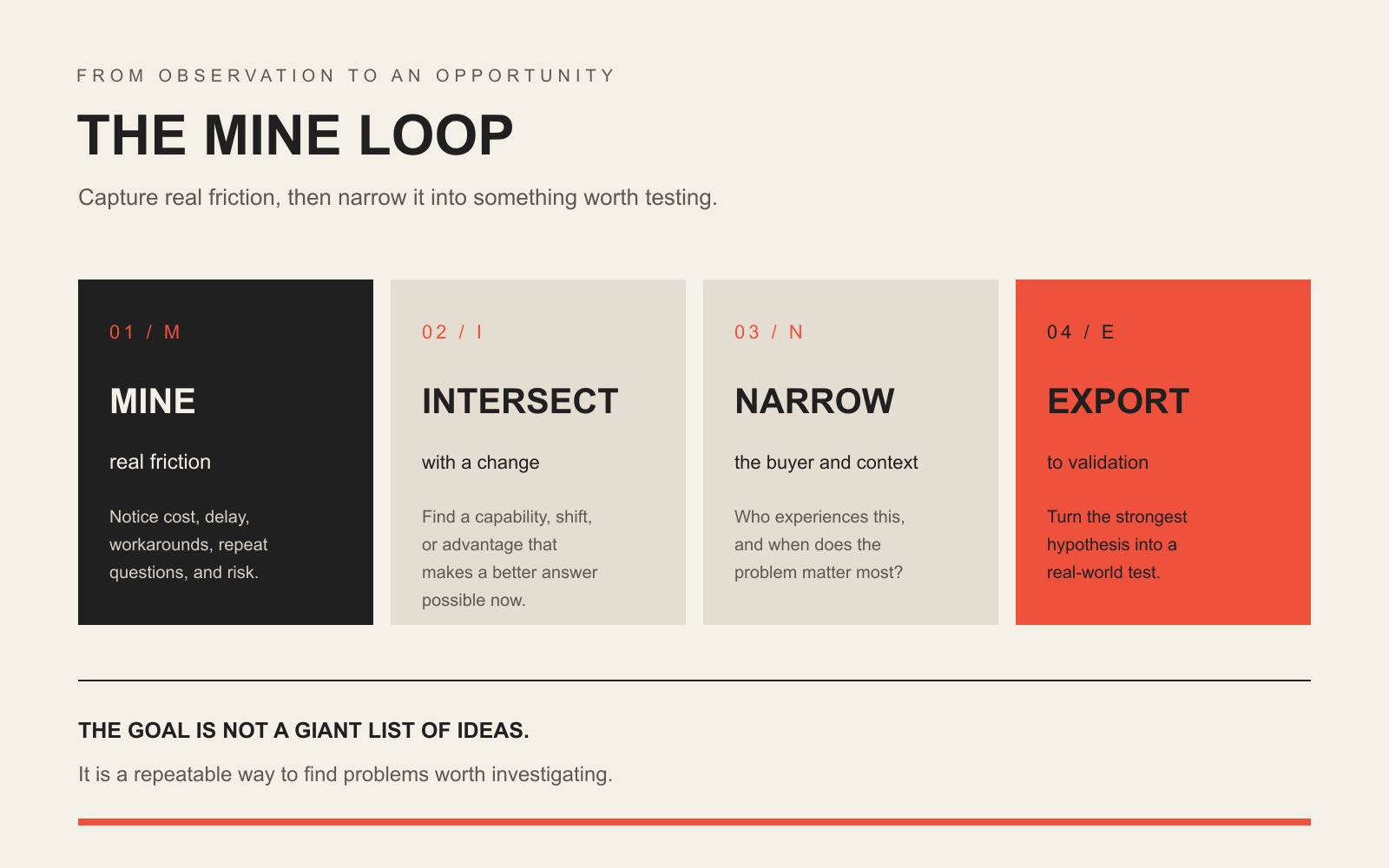
    1. Collect 8–12 candidates. If you are stuck, use the MINE-style idea-generation process from our dedicated ideation guide rather than forcing this screening article to do both jobs.
    2. Write one sentence for each idea. Use the structure: “When [specific buyer] experiences [specific problem/trigger], they currently [pay/use workaround/do nothing], and I could help by [outcome].”
    3. Run PRICE. Mark each dimension green, yellow, or red and write one piece of evidence beside the color. “I think so” is not evidence.
    4. Identify the highest-risk unknown. Do not average it away. Ask what evidence would change your mind about the idea.
    5. Research the best two or three. Use direct interviews, competitor evidence, public data, search behavior, reviews, and our self-directed market research methods to replace yellow assumptions with evidence.
    6. Validate behavior, not compliments. Move the strongest candidate into our business idea validation process, where the goal is to observe meaningful customer action before making a larger bet.

    If two ideas remain close after research, use a decision process instead of choosing whichever feels exciting that day. Our guide to better business decision frameworks is designed for that handoff.

    Where AI helps — and where it does not

    AI is useful for expanding a search space, clustering observations, comparing alternatives, finding contradictions in your notes, drafting interview questions, and attacking your assumptions. It is especially helpful when you give it real evidence instead of asking for “10 profitable businesses I can start.”

    AI cannot prove that a customer has a problem, will pay your price, can be acquired at an acceptable cost, or will stay long enough for the economics to work. A confident answer can still be built from generic patterns, stale information, or invented numbers.

    Useful prompt: “Act as a skeptical business analyst. Evaluate this idea using Problem cost, Reachability, In-market evidence, Cost-to-serve, and Edge. Separate facts I supplied from your assumptions. Mark every dimension green, yellow, or red. For every yellow or red item, tell me what real-world evidence would change the rating. Do not invent market size, willingness to pay, conversion rates, or customer-acquisition costs.”

    The point is not to make AI declare the winner. It is to make your unknowns visible faster.

    What to do after you choose a promising idea

    A promising pre-screen is permission to research, not permission to scale. Your next job is to turn the green and yellow PRICE assumptions into evidence.

    • Market: confirm the buyer, demand, alternatives, saturation, reachability, and price context.
    • Customer: observe current behavior, workarounds, buying triggers, objections, and meaningful commitment.
    • Economics: replace guessed delivery costs, selling prices, and acquisition assumptions with real quotes and tests.
    • Decision: write down what evidence would make you proceed, change the offer, narrow the buyer, or stop.

    For the wider strategic context, use our business strategy and market intelligence playbook. Once the buyer and offer have survived validation, then build the positioning, website, brand, sales process, and marketing system around evidence rather than hope.

    Frequently asked questions about finding profitable business ideas

    How do I find a profitable business idea?

    If you are learning how to find profitable business ideas, start by looking for specific buyers who already spend money, time, or effort on an important problem. Then check whether you can reach those buyers, deliver a useful outcome at plausible economics, and bring some execution advantage. That only identifies ideas with profit potential; profitability is learned through research, customer behavior, and operating results.

    What makes a business idea potentially profitable?

    Strong early signals include an important problem, observable spending or workarounds, a specific reachable buyer, a realistic selling price, manageable cost-to-serve, and a reason you can compete. Market size, competition, acquisition cost, repeat purchase, fixed costs, and execution still determine whether the business actually produces profit.

    Does a good business idea need to be original?

    No. Originality can be useful, but an existing market can give you something more valuable: evidence that buyers already understand the category and spend money in it. A differentiated buyer, better experience, narrower use case, new channel, stronger economics, or better execution may be more commercially important than inventing a category from scratch.

    How can I tell whether customers will pay?

    You cannot know from interviews alone. Existing purchases and costly workarounds are useful signals, but the stronger test is meaningful behavior: a paid pilot, deposit, pre-order, signed agreement, real switching action, or another commitment appropriate to the business. Use research to design the test, then validation to observe what happens.

    How many business ideas should I shortlist?

    There is no universal number. In practice, two or three serious candidates are usually enough to compare without turning research into avoidance. Keep weaker ideas in a parking lot. The point is to concentrate learning on the candidates with the strongest evidence and the most important unresolved assumptions.

    Can AI find a profitable business idea for me?

    AI can suggest candidates and help analyze the evidence you provide. It cannot independently prove demand, willingness to pay, acquisition economics, or delivery cost. Treat AI output as hypotheses and questions to investigate, not as market validation.

    What is the difference between idea generation and business idea validation?

    Idea generation creates possible buyer-problem-solution hypotheses. Profit screening compares those hypotheses using evidence such as spending, reachability, economics, and operator advantage. Validation comes after that and tests whether real customers behave as expected. Keeping those stages separate prevents a good story from masquerading as evidence.

    The goal is not a perfect idea. It is a better next bet.

    You do not need certainty before taking the next step. You need enough evidence to choose which uncertainty is worth resolving next. Find problems with real consequences, look for behavior that shows the market already cares, check whether the buyer is reachable and the economics are plausible, and be specific about your edge.

    Then stop screening and start validating. That is the durable answer to how to find profitable business ideas: make better evidence-based bets and let reality keep confirming—or rejecting—the important assumptions.

  • Website Security: The Practical Business Owner’s Guide

    Website Security: The Practical Business Owner’s Guide

    Website security is the ongoing practice of reducing the chance and impact of compromise by assigning ownership, controlling access, maintaining supported software, reducing attack surface, monitoring for change, keeping restorable backups, and rehearsing the response. Our website change monitoring guide owns the public page-integrity layer: what changed, when it was observed, and what evidence exists. A plugin can help with one control. It cannot own the system, test the backup, call the host, preserve evidence, or explain to customers what happened. Annoying, but true.

    If your entire security plan is “we installed a plugin once,” you do not have a security plan. You have a plugin and a surprisingly optimistic personality.

    TL;DR: How to secure a business website

    • Assign a named owner for the website, hosting, domain, DNS, software, integrations, backups, monitoring, and incident decisions.
    • Inventory every privileged account, vendor, plugin, theme, custom component, data flow, and external service connected to the site.
    • Require unique credentials and multifactor authentication where available, limit administrator access, and remove accounts that no longer need entry.
    • Keep the platform, plugins, themes, server software, and custom dependencies supported and current. Remove abandoned or unused components instead of letting them fossilize in production.
    • Put preventive controls in the right layer: secure hosting, HTTPS, sensible permissions, a web application firewall when appropriate, safe development practices, spam controls, and least privilege.
    • Monitor uptime, file and configuration changes, authentication anomalies, malware warnings, form delivery, search-engine security alerts, and backup jobs.
    • Back up the files and database to a separate location, retain more than one recovery point, and prove that someone can restore them.
    • Write the first-hour response before the emergency: who can take the site offline, contact the host, preserve a copy, rotate credentials, call legal counsel, notify the insurer, and authorize recovery.
    • Treat cleanup and recovery as different jobs. Deleting visible malware does not close the entry point, and restoring an infected backup does not make the site clean.
    • Keep evidence. If no one can show what was updated, tested, restored, or investigated, “we think it is fine” is doing far too much work.

    In this guide

    What is website security?

    Website security is the collection of technical controls, operating routines, ownership decisions, and recovery plans used to protect a website and its users from unauthorized access, harmful changes, data exposure, fraud, disruption, and abuse.

    That definition matters because security is not a thing you buy and bolt onto the footer. It is a condition you manage over time. The official WordPress hardening guidance makes the same blunt point: perfect security is impractical; the real job is reducing risk with reasonable controls, limiting damage, and preparing to recover.

    For a business website, three properties matter:

    • Confidentiality: private information is not exposed to people who should not have it.
    • Integrity: content, code, orders, forms, accounts, and settings are not altered without authorization.
    • Availability: legitimate visitors and staff can use the site when the business needs it.

    A security decision that protects one property can damage another. Locking every editor out may improve access control while destroying the team’s ability to publish. An overaggressive firewall can block real customers. An automatic update can close a vulnerability and break checkout. Serious security work manages those tradeoffs; it does not chant “best practice” and wander off.

    A security plugin is not a website security program

    A reputable security plugin can scan files, limit login attempts, record activity, flag known vulnerabilities, or help configure controls. Useful? Absolutely. Complete? Not remotely.

    The plugin usually cannot determine who still owns the domain account, whether the former employee retained hosting access, whether an integration token leaked, whether the database backup contains current orders, whether the backup is stored outside the compromised account, or whether a privacy incident triggers contractual or legal obligations.

    It also cannot make the hardest business decision: what happens next when a warning appears at 7:42 on a Saturday morning?

    Security products are components. Ownership is the system. That is the line between a managed website and a pile of tools hoping somebody notices the red badge.

    The Scope Design LOCKED website security framework

    The NIST Cybersecurity Framework 2.0 organizes cybersecurity risk around Govern, Identify, Protect, Detect, Respond, and Recover. NIST designed those outcomes for organizations of different sizes and maturity levels, not only giant enterprises with windowless command centers.

    LOCKED translates that lifecycle into a practical operating system for a business website. It is not a certification. It is a way to expose missing ownership before an attacker, a broken update, or a panicked recovery attempt does it for you.

    The LOCKED website security framework: List assets and owners, Own every access path, Close known gaps, Keep watch, Exercise recovery, and Document evidence.

    L — List what matters and who owns it

    Start with the system you actually have, not the tidy diagram someone remembers from launch day.

    List the domain registrar, DNS provider, hosting account, CDN or firewall, content management system, plugins, themes, repositories, deployment tools, email service, form destinations, analytics, payment services, CRM connections, API keys, administrators, contractors, and recovery contacts. Then name an owner for each one.

    This inventory reveals the embarrassing-but-common gaps: the domain belongs to an old employee, the only backup lives inside the hosting account it is supposed to rescue, a plugin has not been supported in three years, or the contact form delivers to an inbox nobody checks.

    The point is not paperwork for its own sake. You cannot protect, monitor, or recover an asset no one knows exists.

    O — Own every access path and dependency

    Website access is broader than the WordPress Users screen. An attacker who controls the registrar, DNS, hosting dashboard, email account, source repository, deployment key, database, CDN, or connected automation may never need the WordPress login.

    Use unique credentials, a password manager, and multifactor authentication wherever the provider supports it. Give people the least access their job requires. Review administrators and service accounts on a schedule. Revoke access when roles change, not six months later when someone remembers.

    For WordPress, the platform’s current brute-force guidance recommends strong unique passwords, two-factor authentication or passkeys where appropriate, rate limiting or edge controls, current software, and monitoring authentication anomalies. Renaming a login page while leaving weak reused credentials everywhere else is security theater with a nicer URL.

    Dependencies deserve the same ownership. Every plugin, theme, library, form service, analytics script, and API is part of the site’s supply chain. Ask who maintains it, how security notices arrive, what happens if it is abandoned, and whether the business can replace it without rebuilding half the website.

    C — Close known gaps and reduce attack surface

    Patch supported software. Remove unused plugins and themes. Delete abandoned components. Restrict file and database permissions. Disable editing or interfaces the site does not need. Use trusted sources. Keep development credentials out of public code. Validate and sanitize input. Protect administrative traffic with HTTPS.

    The official WordPress guidance says the most important baseline is keeping WordPress, installed plugins, and themes current and choosing components that still receive updates. It also distinguishes host responsibility from application responsibility: a secure server does not excuse an unmaintained website sitting on top of it.

    Updates still need discipline. Scope Design’s preferred WordPress process is not “select all, click update, and discover character.” Establish a baseline, update in controlled steps, test the critical journeys, compare the before and after state, roll back the component that caused the problem, verify recovery, and continue with evidence. Our detailed WordPress plugin management guide owns that workflow.

    Application-specific risks belong in development too. The OWASP Top 10 is a useful awareness baseline for risks such as broken access control, injection, insecure design, and vulnerable components. A firewall can reduce exposure; it cannot turn unsafe custom code into safe custom code by positive thinking.

    K — Keep watch for changes, warnings, and failures

    Prevention eventually misses something. Detection determines how long the problem gets to enjoy itself.

    Monitor more than uptime. A hacked site can stay online while serving spam pages to Google, redirecting mobile visitors, creating unknown administrators, changing payment details, sending malicious email, or injecting scripts only under specific conditions. Google documents injected content, cloaking, and conditional redirects as common hacked-site behavior, and Search Console security alerts can expose problems an ordinary homepage check misses.

    A practical monitoring stack may include:

    • uptime and certificate-expiration alerts;
    • file, configuration, and administrator-account changes;
    • vulnerability and malware notifications;
    • login failures and unusual authentication activity;
    • backup success, age, size, and storage-location checks;
    • form and transactional-email delivery tests;
    • Search Console Security Issues and Safe Browsing warnings;
    • unexpected index growth, foreign-language pages, redirects, or traffic changes;
    • payment, checkout, account, and integration failures;
    • visual and functional checks after updates.

    No single scanner sees everything. The goal is overlapping signals and a human who knows which signals matter.

    E — Exercise response and restoration

    A backup is not a recovery plan. It is raw material for one.

    A complete WordPress recovery generally needs the database and the site files. It may also need DNS access, certificates, server configuration, external media, environment variables, licenses, transactional data, and a clean place to restore. The WordPress backup guidance recommends multiple copies in different locations. That is sensible because a backup trapped inside the compromised hosting account may disappear with everything else.

    Test restoration before the emergency. Record how long it takes, what credentials are required, what data might be lost, how recent transactions are handled, and who can authorize a rollback. A backup job that sends a cheerful success email but has never produced a working site is a very polite liability.

    Then rehearse the first hour of an incident. Decide who will:

    1. confirm the symptom without destroying evidence;
    2. restrict or isolate affected access;
    3. contact the host and relevant vendors;
    4. preserve a copy of the compromised environment;
    5. rotate credentials from a known-clean device;
    6. involve legal counsel, the cyber insurer, law enforcement, or an incident-response specialist when the facts require them;
    7. communicate internally and externally;
    8. authorize cleanup, restoration, validation, and reopening.

    If personal information may have been exposed, this is no longer merely a website-maintenance ticket. The FTC’s breach-response guide recommends quickly securing operations and assembling the legal, forensic, technical, communications, and management expertise appropriate to the incident. Requirements vary by facts and jurisdiction, so call qualified counsel instead of treating a blog post as a substitute for legal advice.

    D — Document evidence, decisions, and lessons

    Write down what existed, what changed, who approved it, what was tested, what failed, what was restored, and what remains uncertain.

    Evidence improves routine maintenance because the team can identify the exact update that introduced a regression. It improves incident response because specialists can reconstruct the timeline. It improves accountability because “someone handles that” becomes a name, a process, and a record.

    After any incident or near miss, update the inventory, controls, monitoring, backup policy, response plan, and vendor decisions. Recovery without learning is just scheduling the sequel.

    Who is responsible for website security?

    Website security is shared, but shared does not mean vague. Every layer needs an explicit owner and an escalation path.

    LayerTypical ownerQuestions that must have an answer
    Business risk and dataBusiness leadershipWhat must remain available? What data is collected? What loss is unacceptable? Who can authorize shutdown or notification?
    Domain and DNSBusiness owner or designated technical managerWho owns the registrar account? Is MFA enabled? Who can restore DNS?
    Hosting and serverHosting provider plus technical managerWhat does the host secure? What remains the customer’s responsibility? How are backups, logs, isolation, and escalation handled?
    Website applicationDeveloper or management providerWho updates, tests, hardens, monitors, and documents the CMS, plugins, themes, and custom code?
    Content and usersBusiness plus website managerWho approves administrators? Who removes access? Who reviews suspicious content or accounts?
    Integrations and data flowsBusiness system owner plus implementerWhich services receive data? Where are credentials stored? What breaks if the connection fails?
    Incident and legal responseLeadership, counsel, insurer, and qualified specialistsWho preserves evidence, determines exposure, communicates, and approves recovery?

    Ask these questions before signing a hosting or maintenance agreement. “Security included” is not an answer. It is marketing copy wearing a tiny trench coat.

    A practical website security checklist by cadence

    Cadence should match the site’s change rate, risk, transaction volume, and business criticality. A brochure site and a busy ecommerce store should not have identical routines.

    WhenWhat to verify
    Continuously or automaticallyUptime, certificate health, security alerts, authentication anomalies, malware or file-change signals, backup jobs, critical form and transaction failures
    Before every release or updateCurrent backup, known baseline, change owner, rollback path, staging or controlled rollout, critical-journey test list
    After every release or updatePublic pages, forms, login, checkout or booking, email delivery, mobile behavior, visual regressions, logs, cache, monitoring status
    WeeklyAvailable security updates, failed jobs, suspicious accounts or content, error trends, form delivery, search warnings, backup age
    MonthlyAdministrator and service-account review, unused components, licenses, dependency support, restore spot-check, third-party integrations
    QuarterlyFull ownership inventory, vendor access, incident contacts, recovery assumptions, critical-journey coverage, data collection and retention
    At least annually and after material changeRestore exercise, response tabletop, hosting responsibility review, insurance/counsel contacts, business-impact priorities

    This is a starting point, not a universal compliance schedule. If the site handles regulated, financial, health, identity, or high-volume customer data, get security and legal requirements from qualified professionals who understand that specific environment.

    Common website threats and the controls that actually matter

    Threat lists are easy to write and fun to make terrifying. The useful question is which controls reduce likelihood, limit damage, improve detection, and make recovery possible.

    RiskUseful controlsWhat the control does not solve alone
    Stolen or reused credentialsPassword manager, unique credentials, MFA/passkeys, least privilege, access review, login monitoringA compromised device, malicious administrator, or exposed API key
    Vulnerable softwareSupported components, timely updates, vulnerability notices, controlled testing, removal of abandoned codeUnsafe custom code or a stolen privileged account
    Malicious or untrusted plugins/themesTrusted sources, code/vendor review, minimum component count, delete unused softwareA legitimate component that later develops a vulnerability
    Automated login and form abuseEdge rate limiting, WAF rules, 2FA, CAPTCHA or bot controls, spam filteringTargeted social engineering or stolen sessions
    Injection and unsafe application logicSecure development, validation, sanitization, parameterized queries, code review, testingBusiness-logic abuse that is technically valid
    Malicious file or content changesRestricted permissions, integrity monitoring, logs, malware scanning, deployment disciplineDetermining scope, root cause, or legal impact by itself
    Hosting or service failureRedundancy where justified, offsite backups, recovery procedures, vendor escalation, DNS accessBad application releases or compromised credentials
    Hacked search content and redirectsSearch Console monitoring, file/configuration review, clean recovery, vulnerability remediation, review requestReinfection if the entry point remains open

    The boring controls—ownership, supported software, access discipline, monitoring, backups, and tested recovery—do most of the useful work. “Boring” is underrated when the alternative is explaining a pharmacy-spam page to a customer.

    How can you check whether your website is secure?

    You cannot prove a website is perfectly secure. You can verify that important controls exist, work, and have an owner.

    Start with evidence:

    • Can you name every administrator and explain why each account exists?
    • Are domain, DNS, hosting, email, repository, CDN, and website accounts protected with unique credentials and MFA where available?
    • Are core software and dependencies supported and current?
    • Are unused components removed?
    • Does HTTPS work everywhere it should, including administration?
    • Are permissions and secrets appropriate to the environment?
    • Are monitoring alerts reaching a person who will act?
    • Does Search Console show a Security Issue?
    • Do backups include files and database, live outside the production failure domain, retain multiple recovery points, and restore successfully?
    • Can the team describe the first hour of a compromise without inventing the plan in real time?
    • Can the developer show the tests and evidence from the last material change?

    Automated scanners can identify known problems, exposed services, configuration issues, or suspicious files. They are useful inputs, not a verdict. A clean scan does not prove the domain account is owned correctly, the payment integration is safe, or the recovery process works.

    What Scope Design manages—and where the boundary is

    Scope Design’s website-management work includes controlled WordPress updates, backups, uptime and operational monitoring, performance, edits, ecommerce support, compatibility checks, rollback discipline, and the practical coordination required to keep a website working.

    That makes us the right partner for reducing ordinary website risk and keeping the operational foundation from rotting quietly.

    It does not make us your attorney, cyber insurer, law-enforcement liaison, compliance auditor, digital-forensics laboratory, or enterprise security operations center. If an incident may involve exposed personal information, regulated systems, material financial loss, insider activity, or litigation, the responsible move is to bring the appropriate specialists into the response. Anyone promising to be every one of those things in a single maintenance plan is either magnificently staffed or full of it.

    Our role is to make ownership, routine care, evidence, and escalation better before the emergency—and to work with the right people when the problem crosses that boundary.

    Frequently asked questions about website security

    How do I make my website secure?

    Assign an owner, inventory the system, secure every access path, keep supported software current, remove unused components, use appropriate hosting and application controls, monitor for change, maintain offsite restorable backups, and rehearse incident response. No single action makes a website perfectly secure; layered controls reduce likelihood and impact.

    Can I check website security myself?

    You can verify ownership, users, updates, HTTPS, backups, monitoring, Search Console warnings, and obvious configuration gaps. Automated tools can help identify known issues. Custom applications, suspected compromises, regulated data, and high-risk systems may require qualified security, legal, or forensic professionals.

    Is HTTPS enough to secure a website?

    No. HTTPS encrypts traffic between the browser and server and is essential, but it does not patch vulnerable software, stop stolen administrator credentials, clean malware, validate custom code, or prove backups work.

    Do I need a website security plugin?

    Maybe. A reputable plugin can provide useful scanning, logging, firewall, or login controls. Choose it for a defined job, configure it correctly, keep it updated, and avoid assuming it replaces secure hosting, maintenance, access management, monitoring, backups, or response planning.

    How often should a website be updated for security?

    Review security updates continuously or on a frequent managed schedule, then prioritize based on severity, exposure, exploit activity, compatibility risk, and business impact. Critical fixes may require immediate action; routine updates still need backups, controlled rollout, and post-update testing.

    How often should I back up my website?

    Back up often enough that the maximum acceptable data loss matches the business. A frequently changing ecommerce site may need far more frequent database backups than a mostly static brochure site. Keep multiple recovery points in a separate location and test restoration.

    Are hosting backups enough?

    Not by themselves. Host backups are useful, but confirm retention, frequency, what they include, how restoration works, and whether copies survive a hosting-account failure or compromise. Maintain an independent recovery option when the business impact justifies it.

    What is the difference between a malware scan and malware removal?

    A scan looks for suspicious or known malicious indicators. Removal cleans identified malicious content. A complete response also determines scope, closes the entry point, removes backdoors, rotates credentials, validates data and functionality, monitors for reinfection, and handles any legal or communication obligations.

    Can a hacked website be recovered from a backup?

    Often, but the backup must be clean enough, complete enough, and restored into a trustworthy environment. Blindly restoring can reintroduce malware or erase recent orders and content. Preserve evidence, understand the compromise, repair the vulnerability, and validate the recovered site.

    How can I tell if my website has been hacked?

    Possible signs include unknown administrators, unexpected redirects, injected pages, search-engine warnings, modified files, strange outbound email, payment or form changes, hosting suspension, unusual traffic, or security alerts. Some attacks hide from ordinary visitors. Use the dedicated hacked-website detection and recovery guide for the incident workflow.

    What should I do first if my website is hacked?

    Confirm and document the symptom, restrict further damage without destroying evidence, contact the host and responsible technical owner, preserve a copy, and escalate based on the data and business impact. Rotate credentials from a clean device when advised. Do not start randomly deleting files before you know what happened.

    Can website security guarantee that I will not be hacked?

    No honest provider can guarantee that. Good website security reduces risk, limits damage, detects problems sooner, and improves recovery. Ask providers what they own, monitor, test, document, exclude, and do when a control fails.

    Stop buying security nouns. Build a security process.

    Your website does not become secure because the invoice says “security,” the browser shows a padlock, or a plugin dashboard displays a large green circle.

    It becomes more defensible when the business knows what exists, who owns it, how access is controlled, how changes are tested, what signals are watched, where clean recovery points live, and who acts when something goes sideways.

    That is LOCKED: list, own, close, keep watch, exercise, and document. It is less dramatic than cyber-threat theater. It is also considerably more useful.

    If your current answer to “who owns website security?” is a group shrug, start with our WordPress maintenance guide or talk with Scope Design about a management plan built around evidence rather than optimism.

  • Website Maintenance for Business Continuity: Build a Recovery-Ready Site

    Website Maintenance for Business Continuity: Build a Recovery-Ready Site

    Website maintenance for business continuity means operating your website so a routine update, expired certificate, broken integration, compromised account, or hosting problem does not turn into a mystery outage. The goal is not to keep a dashboard perfectly green. The goal is to know what must keep working, detect when it stops, recover to a known-good state, and know exactly who owns the response.

    If you only need the recurring task calendar, use our website maintenance guide. This article owns a narrower question: how should maintenance protect the continuity of the business job your website performs?

    TL;DR: maintenance should reduce the failure window

    • Define the website journeys that actually matter: lead forms, checkout, bookings, logins, downloads, customer portals, email delivery, and integrations.
    • Capture a known-good baseline before consequential changes so you have something real to compare against.
    • Make changes in bounded steps, test the same critical journeys afterward, and roll back the smallest failed component when practical.
    • Treat backups as recovery inputs, not proof that recovery will work. A WordPress restore normally needs both the database and site files.
    • Set recovery expectations based on business impact instead of borrowing somebody else’s arbitrary “daily” or “four-hour” rule.
    • Automate observation and routine work, but keep a named person accountable for exceptions, restoration, escalation, and decisions.

    Website maintenance for business continuity protects the business handoff

    A website is not healthy because the homepage loads. A service business can have a beautiful homepage while its quote form silently drops submissions. An ecommerce site can be “up” while checkout fails after a payment extension update. A membership site can return HTTP 200 while login is broken. An appointment site can look normal while confirmation email never leaves the server.

    That is why maintenance has to protect the handoff between the website and the business. Our business website development guide makes the same point from the build side: the technical foundation should prove the business journey works, can be changed safely, and can be recovered. Maintenance is the operating discipline that keeps proving it after launch.

    The distinction also keeps this article from becoming another giant checklist. Checklists are useful, but they can create a dangerous illusion: every box is checked, therefore the business is protected. That logic falls apart the moment an automated update succeeds technically and breaks the thing customers came to do.

    Use the Scope Design CONTROL Loop

    Our maintenance approach comes from a simple first-party operating lesson: make a smaller change, compare it with a known-good state, verify the result, reverse the smallest failed change when necessary, and preserve the evidence. We call the buyer-facing version the CONTROL Loop.

    The CONTROL Loop: Capture a baseline, Observe critical paths, Narrow each change, Test the same journeys, Roll back precisely, Own the response, and Log evidence.

    C — Capture the baseline

    Before a meaningful change, record the state you expect to preserve. That can include representative screenshots, software versions, key page behavior, a current backup, form delivery, checkout, login, analytics events, response time, and known open issues. A baseline turns “it seems different” into something diagnosable.

    O — Observe critical paths

    Decide which user journeys deserve active observation. A five-page brochure site may have one critical path: inquiry form to delivered email or CRM record. A WooCommerce site may need product, cart, checkout, payment, confirmation email, inventory, tax, shipping, and account flows. Monitoring the server while ignoring those handoffs is like watching the electrical panel while the cash register is on fire.

    N — Narrow the change

    Reduce the blast radius. Update one component or one understood dependency group when practical. Separate content edits from infrastructure changes. Avoid stacking ten unrelated changes into one maintenance window and then asking which one broke the site. Our detailed WordPress plugin update guide owns the step-by-step update process.

    T — Test after change

    Re-run the same paths you baselined. Do not stop at “the plugin updated successfully.” Complete the form. Submit the order. Log in. Check the downstream CRM or email. Verify the browser state and the business state. Our practical website test goes deeper on proving the result beyond the browser.

    R — Roll back precisely

    If a bounded change fails, reverse the smallest responsible change when you can do so safely. Restoring yesterday’s entire site because one plugin broke can erase legitimate orders, form submissions, user changes, or content created since the backup. Full restore is sometimes correct. It should not be the only recovery idea in the building.

    O — Own the response

    Name the person who investigates, the person who can authorize a restore or rollback, and the person who communicates when the issue affects customers or staff. If the only answer is “the hosting company probably handles that,” you do not have ownership. You have a future support ticket.

    L — Log the evidence

    Record what changed, what passed, what failed, what was rolled back, what remains on hold, and what follow-up decision is required. Good maintenance evidence is not a 40-page automated report full of green icons. It is a short record that tells the next qualified person what happened and what state the site is in now.

    Start with the journeys that would hurt if they failed

    Business continuity begins with consequences. A website that publishes a restaurant menu has a different failure profile from a site that collects legal intake, sells event tickets, handles donations, or accepts hundreds of ecommerce orders per day. The technology matters, but the business job tells you where to look first.

    Website jobCritical journeyEvidence it still worksLikely response owner
    Lead generationForm → email/CRM → staff handoffTest submission appears in the real destinationWebsite owner + sales/ops owner
    EcommerceProduct → cart → checkout → payment → confirmationTest order, payment state, email, inventory/tax/shipping resultWebsite owner + store operations
    BookingAvailability → booking → payment/confirmationAppointment exists in the system of record and customer receives confirmationWebsite owner + scheduling staff
    Member or client portalLogin → authorization → protected taskTest account can complete expected task without excess accessWebsite owner + application owner
    Content/authority siteDiscovery → page load → CTA/subscriptionRepresentative pages render, forms work, tracking fires, no critical errorsWebsite owner + marketing

    Do not test only the homepage. Test the journeys where failure creates lost revenue, lost data, missed communication, customer frustration, or reputational damage. This is also where performance monitoring becomes useful: speed is a condition to diagnose in context, not a vanity score to worship.

    A backup is not the same thing as recovery

    Backups matter. They are not magic. WordPress’s own backup documentation explains that a typical WordPress site needs both the database and site files for a complete restore. If your backup contains only one side, you may have a partial recovery point rather than a recoverable website.

    A continuity-ready backup process should answer five questions without hand-waving:

    1. What is included? Files, database, uploads, configuration, and any external data or credentials required to restore service.
    2. Where is it stored? Preferably somewhere a production failure cannot destroy at the same time.
    3. How long is it retained? Enough history to recover from problems that were not noticed immediately.
    4. Who can restore it? With access that still works when the normal production account is unavailable.
    5. Has restoration been tested? Not “the job says successful.” A real, controlled restore test.

    For the deeper infrastructure distinction between storage, sync, backup, and disaster recovery, use our business continuity and backup guide. The key point here is simpler: a backup is an ingredient. Recovery is the ability to resume the website’s business job.

    Use RTO and RPO to stop arguing about arbitrary schedules

    Two disaster-recovery terms are useful even for a small website when you translate them out of enterprise-speak. Google Cloud’s disaster recovery planning guide uses both objectives when planning recovery:

    • Recovery Time Objective (RTO): how long the system or process can be unavailable before the interruption creates unacceptable business impact.
    • Recovery Point Objective (RPO): how far back in time you can afford to restore data after an outage.

    Those two questions should influence your maintenance design. If losing a day of orders is unacceptable, a once-daily backup may not match the business. If a brochure site can be offline for several hours with little consequence, engineering a five-minute recovery target may be expensive theater. The correct answer comes from business impact, not from copying another company’s maintenance plan.

    Disaster recovery is only one part of the larger continuity problem. Google Cloud describes disaster recovery as restoring IT infrastructure and data after disruption to support continuity, while our business resilience framework separates business continuity from the narrower technical job of restoring a damaged capability.

    Detection is part of recovery because time starts before the alert

    A failure you discover in five minutes and a failure you discover in five days may require completely different recovery choices. That is why monitoring belongs in a continuity-oriented maintenance plan.

    Useful monitoring can include:

    • uptime and HTTP response checks;
    • SSL/TLS certificate expiration and domain/DNS condition;
    • application errors and server logs;
    • security or vulnerability alerts;
    • visual-regression signals after changes;
    • form, email, payment, or integration health;
    • performance regressions on representative journeys.

    CISA’s small and medium business resources group practical controls such as software updates, backups, logging, encryption, and multifactor authentication. Those controls are not identical to website maintenance, but the operating lesson is the same: secure operation requires both prevention and evidence that something changed.

    Safe maintenance treats every consequential change like a small deployment

    WordPress itself recommends keeping plugins current and warns that you should have a current backup before updating because problems can happen. See WordPress’s plugin management guidance. WordPress also recommends regular backups when using automatic updates; see its plugin and theme auto-update documentation.

    The practical business version is not “never automate.” It is automate according to consequence.

    Change typeReasonable approachWhat still needs proof
    Low-risk, isolated updateAutomatic or scheduled update may be reasonableBackup, monitoring, alerting, rollback path
    Business-critical plugin or integrationScheduled, controlled update; staging when the risk justifies itCritical journey tests and downstream confirmation
    Theme/template changeBaseline representative layouts and devices firstVisual/function regression check
    Payment, account, or data-model changeExplicit test plan and recovery pathData integrity, permissions, transactions, notifications
    Infrastructure/DNS/hosting changeCoordinate ownership and rollback across providersDNS, TLS, server, application, email/integration behavior

    The goal is not ceremony. It is diagnosability. If the site changes and something goes wrong, you should be able to answer what changed, whether the business journey failed, and how to get back to a known-good state.

    Know when to roll back one thing and when to restore the site

    Precise rollback is useful when you have a clear causal change: one plugin version, one deployment, one theme edit, one configuration adjustment. A full restore makes more sense when the failure is broader, the current state is untrustworthy, data has been corrupted, or a compromise requires a clean recovery path.

    If you suspect an actual compromise rather than a normal regression, stop treating it like routine maintenance. Our hacked website recovery guide covers triage, containment, evidence, cleanup, restoration, and the point where forensic or legal specialists may be necessary.

    The continuity question is not “Which recovery method sounds more sophisticated?” It is “Which recovery method restores the required business state with the least additional damage?” Sometimes that is a targeted rollback. Sometimes it is a complete restore. Sometimes it is a provider failover or DNS change. The recovery mechanism should fit the failure.

    Hosting is not automatically the maintenance owner

    Hosting supplies infrastructure. It may also include server backups, malware scanning, WordPress updates, CDN features, or support, depending on the plan. But infrastructure coverage does not automatically own your business-specific application journey.

    For example, a host may confirm the server is online while a form integration is failing. It may restore a snapshot without knowing whether that restore overwrites orders placed after the snapshot. It may update WordPress without testing a custom booking workflow. That does not make the host bad. It means the responsibility boundary has to be explicit.

    Use our small business web hosting guide to compare infrastructure ownership. Then make sure the maintenance plan owns whatever remains: application updates, critical-journey testing, recovery decisions, monitoring, integrations, and escalation.

    Use a continuity proof scorecard instead of counting checkmarks

    A useful maintenance report should help a business answer condition, exception, action, and decision. This scorecard is intentionally evidence-based.

    ControlQuestionUseful evidenceRed flag
    BaselineDo we know the current working state?Versions, screenshots, journey checks, known issues“It looked fine last month.”
    BackupCan we recover the required site and data?Coverage, location, retention, failed-job alert, restore recordOnly “backup successful” emails
    ChangeCan we identify what changed?Update/deployment log and risk noteTwenty updates applied at once with no record
    VerificationDid the business journey still work?Form/order/login/booking result in the real destinationOnly homepage screenshots
    DetectionHow quickly will we know something failed?Monitoring interval, alert path, logsCustomer complaint is the monitoring plan
    RecoveryCan we restore the right state without causing new loss?Rollback/restore method and verified result“We can probably reinstall it.”
    OwnershipWho acts when an exception appears?Named owner, support hours, escalation pathThree vendors pointing at each other

    If you are buying care rather than running it internally, our WordPress maintenance services guide uses the CARE Proof Test to compare Coverage, Accountability, Recovery, and Evidence. That page owns plan comparison and pricing; this page owns the continuity logic behind the work.

    What maintenance automation can own, and what it cannot

    Automation is excellent at repetitive observation and bounded action. It can run backups, check uptime, scan for known vulnerabilities, watch certificate expiration, apply selected updates, compare screenshots, collect logs, and trigger alerts.

    Automation is much weaker at deciding whether a business consequence is acceptable. A system can tell you that a page changed. It may not know that the missing price table is legally required, that a form stopped routing to the salesperson covering a territory, or that restoring a snapshot will erase legitimate orders. Somebody still owns judgment.

    A useful division of labor is:

    • Automation observes: uptime, versions, errors, security signals, visual changes, backup jobs, performance signals.
    • Automation executes bounded work: selected updates, scheduled backups, cache operations, known rollback actions where the environment supports them.
    • A human owns exceptions: business impact, recovery choice, conflicting evidence, vendor coordination, customer communication, and decisions that can destroy or overwrite data.

    A practical 30-day continuity hardening plan

    Week 1: map the business job and ownership

    • List the three to five website journeys whose failure would matter most.
    • Identify the systems they hand off to: email, CRM, payment processor, booking platform, inventory, analytics, or portal.
    • Name the internal owner and technical owner for each journey.
    • Write down vendor boundaries before there is an incident.

    Week 2: prove the recovery inputs

    • Verify the backup includes the files, database, and other data required for the business journey.
    • Confirm retention, storage location, access, and failed-job alerts.
    • Define a realistic RTO and RPO based on business impact.
    • Confirm the person expected to restore the site can actually access the recovery systems.

    Week 3: baseline, change, and monitor

    • Capture representative baseline evidence for the critical journeys.
    • Review which updates can be automated and which need scheduled verification.
    • Confirm uptime, error, security, certificate, and business-journey alerts reach a real person.
    • Run one controlled maintenance change through the CONTROL Loop.

    Week 4: run a recovery exercise

    • Restore a backup in a safe environment or run the documented rollback process.
    • Verify the critical journey after recovery, not just the page load.
    • Time the exercise and compare it with the business expectation.
    • Fix access gaps, undocumented dependencies, alert failures, or ownership confusion revealed by the exercise.

    At the end of 30 days, the win is not “we did more maintenance.” The win is that the business can explain what matters, what is observed, how a change is verified, how recovery works, and who acts when normal automation reports an exception.

    Frequently asked questions about website maintenance and business continuity

    Is a website backup enough for business continuity?

    No. A backup provides a recovery point. Business continuity requires the broader ability to restore or continue the required business operation. You still need complete coverage, restore access, monitoring, a tested procedure, recovery objectives, and an owner who can act.

    How often should a business website be maintained?

    There is no universal cadence. Security alerts may need immediate review, selected updates may be automatic, business-critical changes may be scheduled, backups may run multiple times per day, and deeper reviews may be monthly or quarterly. Match cadence to change frequency, business consequence, and recovery objectives. For the full task-by-frequency model, use the website maintenance checklist and ownership guide.

    What should be tested after a website update?

    Test the critical journeys that the changed component could affect. Typical checks include representative layouts, contact forms, checkout, login, search, email delivery, integrations, analytics events, permissions, and error logs. Confirm the result in the downstream system when one exists.

    Who is responsible for website maintenance?

    A named person or provider should be accountable for the maintenance operating process, but responsibility can be shared across hosting, developers, marketing, IT, and business operations. The important part is that every critical task and escalation has a clear owner. “Somebody handles it” is not an ownership model.

    Are automatic WordPress updates safe?

    They can be appropriate for selected lower-risk components when backups, monitoring, alerting, and rollback are reliable. Business-critical or tightly coupled components deserve more controlled testing. The right decision is based on consequence, not a philosophical position for or against automation.

    What is the difference between website maintenance and disaster recovery?

    Website maintenance is the ongoing operating discipline that keeps the site current, observable, functional, recoverable, and supported. Disaster recovery is the plan and capability for restoring technology and data after a disruptive event. Good maintenance makes disaster recovery less chaotic because the site has better backups, baselines, monitoring, ownership, and documentation before the incident.

    Does managed hosting replace website maintenance?

    Not automatically. Managed hosting may cover infrastructure, server security, backups, selected WordPress updates, or support. Website maintenance also needs to own business-specific application behavior: forms, payments, integrations, accounts, content, and recovery decisions. Compare scopes so there is neither duplicate spend nor an unowned gap.

    How should a small business choose an RTO and RPO for its website?

    Start with consequence. Ask how long the website can be unavailable before the business impact becomes unacceptable, then ask how much recent data could be lost before recovery creates an unacceptable problem. Those answers should reflect the website’s real job. An ecommerce store, booking system, lead site, and static brochure site do not need identical targets.

    Make website maintenance boring enough to trust

    Good maintenance is gloriously uneventful. Changes are smaller. Failures are visible. Recovery is rehearsed. The business paths still work. Exceptions reach a person who knows what to do. Nobody needs a heroic midnight story because the operating system did its job before the crisis.

    If your team can own the CONTROL Loop internally, document it and run it consistently. If the website is too important, too integrated, or too annoying to make that somebody’s side job, compare what accountable WordPress maintenance should include, or contact Scope Design to talk through the actual risk and ownership boundaries.

  • How to Create Killer Content for Social Media Feeds That Drives Real Engagement

    How to Create Killer Content for Social Media Feeds That Drives Real Engagement

    Engaging social media posts do one thing better than most feed filler: they earn a useful next action from the right person. That action might be a thoughtful comment, a save, a share with a coworker, a direct message, a click to compare options, or a question that exposes real buying intent. A pile of reactions can be nice. It is not the same thing as useful engagement.

    That distinction matters because social feeds make it easy to optimize for the visible stuff. Big hook. Trendy format. Broad question. More reactions. Then Monday comes and nobody can explain what the post actually taught the audience, what the business learned, or what happened next.

    Scope Design uses a simpler pre-publish test: FEED. Before a post goes live, check whether it Fits the person and feed, Earns attention with substance, Enables a meaningful response, and Directs the next useful step. If one of those breaks, the post usually needs work.

    What “real engagement” actually means

    Social media engagement is a broad bucket. Platforms may count reactions, comments, reposts, clicks, follows, video actions, and other behaviors differently. Even within one platform, those actions do not mean the same thing. LinkedIn, for example, reports impressions, clicks, reactions, comments, reposts, and other metrics as distinct behaviors in its Page content analytics documentation.

    For a business, the useful question is not “Did people engage?” It is: Did the people we care about do something that helped them understand us, helped us understand them, built trust, surfaced intent, or created a sensible next step?

    One buyer asking a specific question about lead time, implementation, fit, or pricing can be more useful than a hundred generic reactions. A save can matter because the person intends to return. A share can matter because the post moved into a private decision process you cannot see. A comment can matter because it reveals confusion you should address in your sales copy. Context gives the metric value.

    If you need the broader measurement framework, Scope Design has a separate guide to social media engagement. This article is narrower: how to build the individual post that gives meaningful engagement a chance to happen.

    The Scope Design FEED Test for engaging social media posts

    Run every important feed post through these four checks before you hit publish.

    F — Fit the person and the feed

    A post for “everyone who might someday need us” is usually a post for nobody. Pick the person and the moment first. A facilities manager comparing vendors has a different question from a founder who just realized the website is leaking leads. A current customer needs different proof from a cold prospect.

    Then fit the packaging to the feed. That does not mean copying whatever format is trending this week. It means respecting how people encounter information there. A professional feed may reward a useful observation that can stand on its own. A visual feed may need the idea to be understandable before somebody reads the caption. A short video needs to communicate even when the viewer gives you only a few seconds to decide whether it is worth continuing.

    Ask: Who exactly is this for, what are they dealing with right now, and does this format help them get the point?

    E — Earn attention with substance

    Attention is rented. Substance is what earns the next few seconds.

    A strong opening can use a problem, observation, contradiction, specific example, result, mistake, or useful promise. What it cannot do is write a check the rest of the post cannot cash. “You are doing social media WRONG” may stop a thumb. If the next paragraph serves recycled advice, you borrowed attention and burned trust.

    Give the reader something concrete: a decision rule, a before-and-after example, a small diagnostic, a real customer question, a screenshot you can explain, a mistake you keep seeing, a tradeoff most advice ignores, or a strong opinion with reasoning behind it.

    E — Enable a meaningful response

    Do not bolt “Thoughts?” onto the end of every post and call it engagement strategy. Decide what useful response fits the job of the post.

    • If the post teaches a checklist, a save may be the natural behavior.
    • If it clarifies a decision, a share with a teammate may be useful.
    • If you need market language, ask a specific question people can answer from experience.
    • If the topic is sensitive or specific to the reader, a DM may be more realistic than a public comment.
    • If the reader is ready for depth, a click to the full guide, tool, case study, or service page can make sense.

    Not every post needs a call to action. Sometimes the useful next step is simply “understand this idea and remember who explained it clearly.” Forcing a conversion ask into every post makes the feed feel like a row of tiny landing pages.

    D — Direct the next useful step

    When a response happens, where does it go? This is where social media stops being an isolated content chore and becomes part of a marketing system.

    A strong post might direct a curious reader to a detailed guide. A product comparison post might point to a calculator or spec page. A comment might trigger a helpful reply from a named team member. A DM might move into a discovery conversation. The handoff should match the level of intent instead of jumping from “interesting post” to “BOOK A SALES CALL NOW.”

    This is also why your small-business marketing system matters more than any one channel. Social can create attention and intent, but the website, email, sales process, and follow-up have to know what to do with it.

    The FEED Test: Fit the person and the feed, Earn attention with substance, Enable a meaningful response, and Direct the next useful step.

    How to create an engaging social media post from scratch

    The fastest way to improve social content is to stop starting with the caption. Start with the point.

    1. Write the one thing you want the reader to get

    Write one plain sentence that starts with “After this post, the right person should understand…” If you need three semicolons to finish the sentence, you probably have three posts.

    Example: “After this post, a local business owner should understand why a homepage headline that describes the company is weaker than one that clarifies the customer’s problem and next step.” That is a job. “We need to post about websites today” is not.

    2. Add proof, not decoration

    Proof makes the point believable. Use a concrete example, a small demonstration, a customer question, a process screenshot, a quote you have permission to use, a comparison, or an observed pattern from your work.

    If you have nothing concrete to add, that is useful feedback. The problem may not be the caption. The idea itself may be too thin.

    3. Choose the format that helps the idea

    Format should serve comprehension. Do not turn a two-sentence insight into a nine-slide carousel because carousels are on the calendar. Do not make a 45-second video out of something a diagram explains in four seconds. Do not bury a nuanced point in a poll with four bad answer choices.

    4. Cut the throat-clearing

    Most weak social posts spend too long walking to the point. Delete the corporate preamble, the scene-setting everybody already knows, and the sentence explaining that “in today’s fast-paced digital world” social media is important. Start where the useful thing starts.

    5. Add one response path

    Choose the most natural useful response. If the post teaches, invite a save or offer the deeper guide. If it asks for input, make the question narrow enough that a real person can answer without writing an essay. If the post demonstrates expertise, you may not need an explicit CTA at all.

    6. Check the handoff

    If someone does exactly what you asked, what happens next? Make sure the destination works, the form is reasonable, the linked page continues the same idea, and somebody owns replies or DMs. A great post with a broken handoff is still a broken marketing experience.

    Match the format to the job, not the trend

    FormatUseful when…Do not use it to hide…
    Text postThe idea, story, observation, or opinion can carry itself.A vague point that needs five paragraphs to become useful.
    Single imageOne visual proves or clarifies the point quickly.Generic stock art with no information value.
    Carousel / documentThe reader benefits from sequence, comparison, steps, or examples.A tiny idea stretched across too many slides.
    Short videoVoice, demonstration, motion, personality, or before/after context matters.A script that would be easier to scan as text.
    Poll / questionYou genuinely need a constrained answer and will use what you learn.Engagement bait that produces no useful insight.
    Customer proofA real outcome, objection, experience, or transformation supports the point.Unverifiable hype or context-free praise.

    The best format is often the least elaborate one that communicates the point well. Production value is useful when it increases clarity or trust. It becomes overhead when the team spends three hours decorating a weak idea.

    Repurpose the idea without manufacturing generic slop

    Good social media content does not require inventing a brand-new idea every morning. A strong blog section, customer email, sales objection, webinar clip, FAQ, case-study detail, or internal explanation can become a useful feed post.

    But repurposing means adapting the idea to a new context, not pasting the same wrapper everywhere. Keep the useful core. Change the opening, proof, format, level of detail, and response path for the audience and feed you are actually using.

    If your bigger challenge is turning one strong asset into multiple useful pieces, use our guide to repurpose strong content. That is a different job from making the individual post pass FEED.

    Measure the interaction chain, not a pile of likes

    The simplest useful social scorecard has four layers:

    1. Attention: Did the intended audience have a reasonable chance to see the post?
    2. Useful interaction: Did people save, share, click, ask, answer, reply, or otherwise do the thing the post was built to enable?
    3. Intent: Did the interaction expose a problem, comparison, need, objection, or desire to go deeper?
    4. Business outcome: Did qualified visits, inquiries, subscriptions, conversations, opportunities, purchases, or retention behavior follow?

    Do not expect every post to hit all four layers. A teaching post may be doing its job when the right people save it. A proof post may be doing its job when prospects click into a case study. A customer-community post may be valuable because it generates substantive replies from people you already serve.

    The mistake is judging every post with the same generic engagement-rate target. Platform analytics are useful, but read the metric in the context of the post’s job. If your broader social media marketing has no handoff from interaction to something the business can act on, more feed activity can simply create more unowned noise.

    Run a five-post FEED audit before posting more often

    Before adding frequency, audit the last five posts your business published. Give each one a simple pass/fail for the four FEED checks.

    • Fit: Can you name the specific person and context?
    • Earn: Is there a useful point, proof, example, or decision aid?
    • Enable: Is there a natural useful response the reader can take?
    • Direct: If that response happens, is there a sensible next step or owner?

    Then look for the repeated failure. If four of five posts fail “Earn,” you do not have a posting-frequency problem. You have an idea-quality problem. If they fail “Direct,” you probably have a handoff problem. If they fail “Fit,” your content process may be starting with “what should we post?” instead of “what does this audience need from us?”

    Rewrite one weak post before you create five more. Improvement gets much easier when the team can name the failure mode.

    What this guide deliberately does not prescribe

    You will see social advice built around rules such as 50/30/20, 5-5-5, 5-3-1, or 70/20/10. Those ratios can be useful brainstorming constraints for some teams. They are not laws of social media, and they do not replace evidence from your audience, your offer, your platform analytics, or the job of a specific post.

    The same goes for universal “best” posting times, ideal caption lengths, magic hashtag counts, and guarantees about what an algorithm will reward. Platforms change. Audiences differ. A contractor serving one county, a B2B software company selling to operations leaders, and a school communicating with families should not expect one posting formula to fit all three.

    Use rules as prompts when they help you think. Use your own results when you decide.

    A quick compliance note for endorsements and incentives

    If a social post includes an endorsement tied to a material relationship—such as compensation, free products, discounts, or another connection that could affect how people evaluate the recommendation—do not treat disclosure as a buried afterthought. The FTC’s endorsement guidance applies consumer-protection principles to social media and explains why material connections should be disclosed appropriately for the context. This is a compliance reminder, not legal advice.

    Frequently asked questions about engaging social media posts

    What makes a social media post engaging?

    An engaging post fits a specific audience, gives them something worth their attention, makes a useful response easy, and connects that response to a sensible next step. Visible reactions can be part of engagement, but the business value comes from context: who acted, what they did, what you learned, and what happened next.

    How do you create engaging social media content for a small business?

    Start with one customer problem, question, objection, decision, or useful observation from the business. Add a concrete example or proof. Choose the simplest format that communicates it clearly. Then decide what meaningful response fits the post and where that response should go. The FEED Test gives you a repeatable quality check before publishing.

    Does every social media post need a CTA?

    No. A post can build trust, teach something useful, clarify your point of view, or make the brand more memorable without asking for a click or comment. Use a CTA when there is a natural next step, not because the template has a blank labeled “CTA.”

    Should a business post on social media every day?

    There is no universal daily-posting requirement. Sustainable frequency depends on the audience, platform, content supply, team capacity, and whether the posts are actually useful. Fix weak Fit, Earn, Enable, or Direct scores before adding more volume.

    What are the 50/30/20 and 5-5-5 rules for social media?

    They are examples of community-created content-mix or activity heuristics. Different sources define them differently. Treat them as optional prompts, not platform rules or guaranteed growth formulas. A ratio cannot tell you whether a specific post is relevant, useful, credible, or connected to a business outcome.

    Can AI write engaging social media posts?

    AI can help reshape a strong idea, generate variants, tighten an opening, extract posts from a larger asset, or adapt packaging for different feeds. It is much less useful when the source idea is generic. Give it real customer questions, examples, constraints, proof, brand voice, and a clear post job—then use FEED to judge the output instead of publishing the first draft.

    How do I know whether social media engagement is meaningful?

    Define the intended response before publishing, then track the chain after: attention, useful interaction, intent, and business outcome. Look at comments and DMs qualitatively as well as quantitatively. A small number of high-intent actions can be more valuable than a large amount of shallow activity.

    Make the next post earn its place in the feed

    You do not need another pile of random social media content ideas. You need a way to tell whether the idea in front of you deserves to become a post.

    Run it through FEED: Fit the person and feed. Earn attention with substance. Enable a meaningful response. Direct the next useful step. If the post passes, publish with a clear job. If it fails, fixing the weak stage is usually more useful than making the hook louder.

    If the real problem is bigger—your social posts are disconnected from your website, offers, email, follow-up, or measurement—talk with Scope Design about building the marketing system around the content.

  • Quality vs. Quantity on Social Media: How Often Should a Business Post?

    Quality vs. Quantity on Social Media: How Often Should a Business Post?

    How often should a business post on social media? As often as it can publish something useful for the right audience, respond to what the post generates, support the next step, and learn from business-relevant evidence. For many small businesses, that will be less often than the content treadmill would like you to believe.

    The correct frequency is not “three to five times a week.” It is the minimum useful cadence your business can sustain without turning every customer question into lukewarm content oatmeal.

    TL;DR: Quality vs. Quantity on Social Media

    QuestionUseful answer
    How often should a business post?Start with the smallest sustainable cadence that lets you create useful work and respond responsibly; increase only when additional posts add distinct value
    What makes a social post good?It helps a specific audience understand, decide, trust, act, or get support—and it connects to a real business job
    Does consistency matter?Yes, when consistency means dependable usefulness and maintenance; no, when it means publishing filler on schedule
    Is more content better?Only while the additional posts create more relevant value than operational cost, repetition, or audience fatigue
    What should you measure?Attention, interest, intent, outcomes, and learning—not reactions in isolation
    Should you follow an 80/20 or 5-3-2 rule?Use formulas as prompts if they help; do not mistake them for a strategy

    That is the direct answer. The rest of this guide shows how to decide whether a post deserves to exist and how to find a frequency grounded in your business rather than somebody else’s content machine.

    Why “Post More Often” Is Usually Incomplete Advice

    Frequency advice is popular because it produces a neat answer to a messy question. Google results currently offer confident platform schedules: this many Facebook posts, that many Instagram Reels, several Stories, a LinkedIn rhythm, and enough short-form video to ensure nobody in the company finishes their actual job.

    Those numbers may summarize averages from a particular dataset. They cannot know:

    • whether your customers use the platform;
    • what you sell or how long the decision takes;
    • whether the account has a useful audience;
    • whether your business has credible material worth publishing;
    • whether somebody can answer the resulting questions;
    • whether the website or booking path works;
    • whether additional posts create incremental value;
    • what work content production displaces.

    A national retail brand, a local plumber, a niche industrial manufacturer, and a two-person consulting firm do not need the same publishing system. Even two similar businesses may have different audience behavior, offers, proof, staffing, and customer acquisition economics.

    Posting frequency is a capacity and marginal-value decision disguised as a calendar decision.

    The Scope Design Post Job Test

    The seven-part Post Job Test checks audience, moment, job, proof, path, capacity, and evidence before choosing a sustainable publishing cadence.

    Before a post enters the calendar, make it pass seven checks.

    1. Audience: Who specifically needs this?

    “Our followers” is not an audience definition. Identify the person and context:

    • a local homeowner comparing service providers;
    • an existing customer confused about a process;
    • a business owner who knows something is broken but not why;
    • a technical buyer checking whether your team understands the risk;
    • a past customer who may need the service again.

    A useful post can serve a narrow group. It does not need to delight everybody who wandered near the account. Trying to make every post broadly relatable is how you get inspirational quotes over pictures of mountains.

    2. Moment: What are they trying to understand or decide?

    Content works differently depending on the audience’s moment.

    Someone discovering a problem needs language and orientation. Someone comparing options needs tradeoffs, drawbacks, cost variables, and proof. Someone ready to act needs a clear pathway and enough reassurance to take the next step. An existing customer may simply need an accurate answer.

    Do not shove a booking link at every moment. Do not bury a ready buyer under a fifteen-post educational odyssey either.

    3. Job: What useful work should the post perform?

    Give every post one primary job:

    • Teach: explain a real problem or process.
    • Clarify: correct confusion or define a decision.
    • Compare: show meaningful differences, tradeoffs, or fit.
    • Prove: demonstrate experience, results, process, or judgment.
    • Invite: offer a proportionate next step.
    • Support: answer an existing customer’s question.
    • Repel: help a wrong-fit prospect recognize that the service is not for them.

    A post can have secondary benefits, but if the brief says “educate, entertain, engage, build awareness, establish authority, drive traffic, generate leads, and go viral,” the brief does not contain a strategy. It contains a hostage situation.

    4. Proof: Why should anybody believe it?

    Strong content carries receipts. Depending on the claim, proof may be:

    • a real project or anonymized client example;
    • a demonstration;
    • a customer quote used with permission;
    • a primary source;
    • data with clear origin and limits;
    • a screenshot or process artifact;
    • a candid explanation of what failed;
    • a specific observation grounded in your work.

    Do not publish a statistic merely because it has a percentage sign and wandered through several marketing blogs. If the claim cannot be traced, qualified, and defended, remove it or present it honestly as judgment.

    5. Path: What sensible next step follows?

    The next step should match the audience’s moment and the post’s job. It may be:

    • read the detailed guide;
    • compare the options;
    • check the relevant service;
    • ask a useful question;
    • download a planning tool;
    • call, visit, book, or buy;
    • do nothing now but remember the business accurately.

    Test the destination. A brilliant post sending people to a vague homepage, broken form, or unattended inbox is not brilliant marketing. It is a more efficient way to reveal the broken part.

    6. Capacity: Can the business support what happens next?

    Ask:

    • Who creates and approves the post?
    • Who answers comments and messages?
    • Can the business handle additional inquiries?
    • Does the team have the evidence and assets needed?
    • Is this repeatable without heroic effort?
    • What higher-value work will not happen because this does?

    If a post takes six hours, attracts low-value arguments, and generates nothing useful, “engagement” does not reimburse the business.

    7. Evidence: How will we know it was useful?

    Match the evidence to the job.

    Post jobUseful evidence
    Teach or clarifyRelevant saves, qualified questions, detailed-guide visits, fewer repeated support questions
    CompareComparison-page visits, better-informed inquiries, sales feedback about reduced confusion
    ProveCase-study visits, branded searches, qualified conversations referencing the example
    InviteRelevant clicks, booking starts, held appointments, purchases, visits, calls
    SupportResolved issues, reduced response time, fewer repeated tickets, customer retention
    RepelFewer wrong-fit inquiries, clearer prequalification, better sales-call quality

    Likes can be evidence of attention. They are not evidence that the post did its job.

    What Makes a Good Social Media Post?

    A good business social post is relevant, specific, believable, comprehensible, and connected to a sensible next step. Production value can help, but quality is not the same as polish.

    An unpolished phone video showing exactly how a product works may outperform a flawless graphic saying “Happy Wednesday!” because the video answers a question and the graphic occupies pixels.

    Use this pre-publish checklist:

    1. Can the intended customer recognize that this is for them?
    2. Is there one clear point?
    3. Is the claim specific enough to be useful?
    4. Is the proof proportionate to the claim?
    5. Can somebody understand it without inside knowledge?
    6. Does the post respect the platform context?
    7. Is the next step working and appropriate?
    8. Can the team respond if people act?
    9. What evidence will we review?
    10. Would we still publish it if public reaction counts were hidden?

    That final question exposes a lot of filler.

    The Minimum Useful Cadence

    Instead of starting with an industry frequency chart, find your Minimum Useful Cadence: the smallest repeatable publishing rhythm that lets the business remain accurate, useful, responsive, and capable of learning.

    Step 1: Define the channel’s job

    Is the account primarily for local relationships, proof, customer support, product education, demand generation, event communication, recruitment, or reputation verification?

    If the channel has no defensible job, frequency is the wrong question. The right question is whether the business should maintain the account at all. Our Social Account Triage helps decide whether to revive, reposition, redirect, keep dormant, or retire it.

    Step 2: Inventory the material you actually possess

    List real customer questions, objections, comparisons, process explanations, project evidence, demonstrations, changes, events, and useful opinions.

    Do not invent four “content pillars” first and then desperately fill them. Start with expertise and customer need. Categories should emerge from material worth knowing.

    Step 3: Set a conservative starting rhythm

    Choose a cadence the team can maintain for a bounded test without lowering quality or abandoning responses. That might be one strong weekly post, several useful updates, or event-driven publishing. The number is an operating hypothesis, not a moral obligation.

    Step 4: Measure marginal value and marginal cost

    After each cycle, ask:

    • Did the additional post serve a distinct need?
    • Did it reach or help the right people?
    • Did response quality remain acceptable?
    • Did website, sales, support, or store evidence improve?
    • Did production displace more valuable work?
    • Are posts becoming repetitive?

    Increase frequency only while the next post adds more useful value than cost. Decrease it when marginal posts become filler, response quality drops, or the team is feeding the account instead of the business.

    Step 5: Revisit the cadence when conditions change

    Frequency may increase for a launch, event, seasonal period, crisis, or active campaign. It may decrease when demand shifts, capacity tightens, or another channel performs the job better.

    Consistency should mean a dependable operating standard, not a rigid promise to manufacture content regardless of whether anything needs saying.

    Quality and Quantity Are Not Actually Opposites

    More high-quality content can create more opportunities to help, learn, and be discovered. The problem begins when volume is purchased by reducing relevance, proof, response, or operational sanity.

    The relationship looks like this:

    1. At very low volume, useful ideas remain unpublished and the account may appear inactive.
    2. As frequency rises, the business reaches more relevant moments and learns faster.
    3. Eventually, the next post adds little distinct value.
    4. Beyond that point, repetition, lower standards, audience fatigue, and operating cost increase.

    The optimal point changes. It cannot be extracted from a generic platform average without knowing your curve.

    This is why “quality over quantity” is also incomplete. A business that spends three months perfecting one cinematic post may be protecting craft, not creating value. Quality includes timeliness and sufficient distribution.

    The real goal is enough useful work, delivered at a sustainable standard, to produce business learning and customer value.

    Social Media Content Rules You Can Treat as Prompts

    People Also Ask results are full of numerical formulas. They can help a blank-page problem. They cannot diagnose a business.

    What is the 80/20 rule for social media?

    It is commonly described as publishing mostly useful, educational, or relationship-building content and a smaller portion of direct promotion. The underlying warning—do not make every post a sales pitch—is sensible. The ratio is not a law.

    What is the 5-3-2 rule?

    It generally divides ten posts among curated content, original content, and more personal or human material. This may diversify a feed, but it does not tell you whether the curated sources are credible, whether the original posts serve customers, or whether ten posts should exist.

    What is the 5-5-5 rule?

    Different sources use the label for different engagement or publishing routines. That inconsistency is a clue: treat it as a creator’s organizing device, not a universal strategy.

    What is the 70/20/10 rule?

    Versions typically divide content among proven material, experimental material, and promotional or innovative material. Experimentation is useful. The correct allocation depends on risk, audience, resources, and what the business needs to learn.

    Use a formula if it creates better questions. Drop it when the spreadsheet begins driving the business.

    When More Posting Is the Wrong Fix

    Do not increase frequency to solve:

    • an audience that does not match the business;
    • an unclear offer;
    • stale profile information;
    • broken website or booking pathways;
    • unanswered customer messages;
    • a lack of proof;
    • unqualified traffic;
    • weak sales follow-up;
    • a channel the business cannot maintain;
    • content that says nothing distinctive.

    If the Page itself is inaccurate or insecure, start with the Facebook Business Page Readiness Check. If the goal is genuine local relationships, use the Local Relationship Loop. If the business is choosing among channels, offers, destinations, and measurement, start with the broader Marketing & Advertising system.

    More posts amplify the system you already have. That is lovely when the system works and magnificently inconvenient when it does not.

    How to Audit Your Last 20 Social Media Posts

    Review a meaningful sample—twenty is a workable starting point, not a sacred number. Score each post from zero to two on the seven Post Job checks:

    ScoreMeaning
    0Missing, irrelevant, or unsupported
    1Present but vague, weak, or incomplete
    2Clear, specific, credible, and operationally supported

    Then add contextual evidence:

    • intended audience and job;
    • meaningful responses or customer questions;
    • qualified clicks and downstream actions;
    • creation and response time;
    • sales or support feedback;
    • whether the post should be reused, expanded, corrected, or retired.

    Look for patterns:

    • Which jobs are consistently useful?
    • Which audience moments are ignored?
    • Which claims lack proof?
    • Which formats are expensive without adding value?
    • Which posts produce the wrong attention?
    • Where does the customer pathway fail?
    • Is the team publishing more than it can respond to?

    The point is not to generate a cute score. The point is to make a decision: publish differently, publish less, publish more, repair the pathway, or stop using the channel.

    Frequently Asked Questions

    How often should a business post on social media?

    There is no universal correct frequency. Start with the smallest sustainable cadence that produces useful content and responsible responses. Increase only when additional posts serve distinct audience needs and generate more business value or learning than cost.

    Should a business post on social media every day?

    Only if daily publishing is useful, sustainable, and supported by a real audience and business process. Daily filler is not consistency. A lower cadence with stronger relevance, proof, and follow-through may be more valuable.

    Is quality or quantity more important on social media?

    Neither works alone. Quality without enough distribution may remain invisible; quantity without relevance creates noise. Aim for enough useful content to serve customers and produce learning without lowering standards or overwhelming the business.

    What makes a good social media post?

    A good post helps a specific audience in a specific moment. It has one useful job, provides proportionate proof, leads to an appropriate next step, fits business capacity, and can be evaluated using meaningful evidence.

    Does posting more increase engagement?

    More posts create more opportunities for reactions, so totals may rise even when average usefulness falls. Engagement may come from people who will never become customers. Evaluate who engaged, why, and what happened next.

    Does consistency matter on social media?

    Yes, when it means the account remains accurate, useful, responsive, and trustworthy. Consistently publishing weak content merely makes the weakness dependable.

    What is the best social media content ratio?

    There is no universal ratio. Build the mix around customer moments and post jobs: teaching, clarifying, comparing, proving, inviting, supporting, and repelling. Adjust it using business evidence.

    Should every social media post have a call to action?

    Every post should have a job and a sensible next step, but that does not require a sales button. The next step may be understanding, remembering, replying, reading, comparing, visiting, booking, or doing nothing until the need is real.

    How do you measure social media content quality?

    Measure whether the post fulfilled its job for the intended audience. Combine attention signals with qualified interest, intent, outcomes, operational cost, and what the business learned.

    Is it okay to skip posting when there is nothing useful to say?

    Yes. Use the time to gather customer questions, document work, improve proof, repair the destination, or engage meaningfully. Silence is often less damaging than publishing something that trains the audience to ignore you.

    Can AI help a business post more often?

    AI can help organize research, extract themes, draft variants, repurpose source material, and reduce production time. It can also manufacture a breathtaking volume of generic sludge. Keep human judgment, factual verification, original evidence, and accountability in the workflow.

    When should a business increase its posting frequency?

    Increase it when the team has additional useful material, the audience responds meaningfully, the customer pathway works, response capacity remains healthy, and the next posts add distinct value rather than repeating the previous ones.

    Publish When You Have a Job to Do

    Social media is not a hungry god that must be fed at precisely 9:00 a.m. on Tuesday.

    Define the audience. Understand the moment. Give the post one job. Carry proof. Build a working path. Respect capacity. Judge the evidence. Then publish at the minimum useful cadence and adjust from what actually happens.

    If the team is drowning in content while the website, offer, analytics, or follow-up remains broken, Scope Design can diagnose the real marketing constraint before you turn another quarter into a scheduling exercise.

  • Business Idea Generation: 12 Proven Methods That Actually Work

    Business Idea Generation: 12 Proven Methods That Actually Work

    The most useful business ideas usually do not arrive as lightning bolts. They come from noticing expensive, recurring, frustrating problems and getting disciplined about turning those observations into opportunities.

    That is the point of business idea generation: not to produce a giant list of clever concepts, but to create a repeatable way to find problems worth investigating.

    At Scope Design, we think about it as an opportunity-capture system. Pay attention to friction. Look for the forces that make a better solution possible now. Narrow the opportunity to a real buyer. Then validate the strongest ideas before you invest heavily.

    A simple way to remember the process is our MINE Loop:

    • Mine real friction.
    • Intersect the problem with a capability, change, or advantage.
    • Narrow it to a specific buyer and context.
    • Export the strongest hypothesis to validation.

    The 12 methods below give you practical ways to feed that loop.

    TL;DR: Generate ideas by mining real problems, intersecting them with changed capabilities or advantages, narrowing to a specific buyer, and exporting only the strongest hypotheses to research and validation. Idea volume creates options; evidence earns the next bet.

    What Makes a Business Idea Worth Pursuing?

    A business idea is not profitable because it sounds original. It becomes interesting when there is a believable path from a real problem to a customer who cares enough to act.

    At the idea-generation stage, you are looking for signals such as:

    • the problem happens repeatedly;
    • the problem costs time, money, revenue, attention, or creates meaningful risk;
    • people already use a workaround or pay for an imperfect solution;
    • you can identify who experiences the problem and who makes the buying decision;
    • you have a credible way to reach that buyer;
    • a change in technology, regulation, behavior, cost, or distribution makes a better solution possible;
    • you have experience, access, relationships, skills, or a point of view that could help you solve it unusually well.

    None of those signals guarantees a profitable business. They simply give you a better starting hypothesis than, “This would be a cool app.”

    The U.S. Small Business Administration recommends studying demand, customers, competitors, and pricing as part of market research. Generation gives you a candidate idea; evidence tells you whether it deserves more investment. See the SBA’s market research and competitive analysis guidance for the formal research side of that process.

    The MINE Loop: A Repeatable Business Idea Generation System

    The MINE Loop gives structure to the messy front end of entrepreneurship. You can use it whether you are starting from zero, looking for a second revenue stream, or trying to turn repeated client work into a more scalable offer.

    The MINE Loop: Mine real friction, Intersect it with a change or advantage, Narrow to a buyer and context, and Export the strongest idea to validation.

    Mine Real Friction

    Start with problems, not products. Collect moments when someone says “Why is this so hard?”, “We do this manually every week,” “We hate our current software,” or “I wish somebody would just handle this.” Do not rush to solve every observation. Your first job is to capture enough real friction that patterns can emerge.

    Intersect the Problem With Change or Advantage

    A problem may have existed for years without creating a good business opportunity. Ask: why might this be solvable differently now? Look for new technology, lower delivery costs, changing customer behavior, regulation, a new distribution channel, or your own expertise, relationships, data, process, or audience.

    This is one reason we keep old product and service ideas rather than assuming an idea that failed once is permanently bad. Sometimes the original idea was fine and the timing was wrong.

    Narrow to a Buyer and Context

    “Small businesses need better marketing” is too broad to be useful. “Independent dental practices with no marketing staff struggle to turn patient reviews into a consistent local-content system” is much more useful. You can picture the buyer, the problem, the current environment, and the type of solution that might fit.

    Narrowing does not make an idea smaller. It makes it testable.

    Export the Strongest Ideas to Validation

    Generation and validation are different jobs. This article helps you produce better hypotheses. Once a few ideas look promising, test demand, buyer behavior, economics, competition, and your ability to reach the market. Our guide to business opportunity evaluation and idea validation covers that next stage in detail.

    12 Proven Methods to Generate Better Business Ideas

    You do not need to use all 12 methods every week. Pick the ones that expose you to real problems and run them consistently enough to build a useful idea pipeline.

    1. Keep a Friction Log

    For one week, write down anything that feels unnecessarily slow, expensive, confusing, repetitive, or annoying. Include problems in your own work, your customers’ work, your household, your industry, and the businesses you interact with.

    A useful friction-log entry records who experiences the problem, what goes wrong, the current workaround, and the cost in money, time, lost revenue, frustration, or risk. The goal is not to invent a company on the spot. You are building raw material.

    2. Mine Repeated Customer Questions and Complaints

    Repeated questions are often requests for a missing product, clearer service, better onboarding, or simpler process in disguise. Review sales calls, support requests, contact-form questions, project kickoff notes, recurring client confusion, and requests you keep saying “we do not offer that” to.

    Pay special attention when the same issue appears across different customers. At an agency, this is especially valuable because you see problems across multiple businesses. A task that feels like “just another annoying thing we have to do” can become a product opportunity if other companies have the same pain.

    3. Find Expensive Manual Work

    Look for skilled people doing low-leverage work over and over: copying data between systems, building the same report by hand, chasing approvals, reconciling inconsistent records, repeating setup steps, or manually checking something that could be monitored.

    Manual work is not automatically a software opportunity. Sometimes the better first business is a specialized service, managed workflow, or productized service. The opportunity is the outcome, not the technology.

    4. Study Ugly Workarounds

    A workaround is evidence that someone cares enough about a problem to do extra work. Look for giant spreadsheets, copy-and-paste processes, long email chains, shared documents pretending to be databases, multiple disconnected tools, or staff members whose unofficial job is “keeping the system together.”

    Do not mock the workaround. Understand why it exists. It may be doing something the official tools do not do well. That gap between the formal system and the real workflow is fertile territory for business idea generation.

    5. Read Low-Star Reviews and Competitor Complaints

    You do not need to invent a new category to build a useful business. Read negative reviews of products and services in markets you understand. Look for repeated complaints about pricing complexity, slow support, difficult setup, bloated interfaces, missing integrations, buying friction, or a service that works technically but creates operational headaches.

    The strongest pattern is not “this company is bad.” It is “customers consistently value the category but dislike the same part of the experience.”

    6. Trace Lost Deals, Objections, and Support Tickets

    Review why prospects say no, which projects become unprofitable, and which customer requests repeatedly fall outside your normal scope. Ask whether people want a smaller first step, whether they are buying the wrong thing because the real problem is poorly diagnosed, or whether a recurring service gap exists between vendors.

    A business idea can be a product, but it can also be a diagnostic, a smaller entry offer, a managed service, or a better sequence of existing services.

    7. Reopen Old Ideas When Technology or Economics Change

    Keep an idea archive. An idea can be unattractive today because one dependency is too expensive, slow, difficult, or unavailable. Revisit old ideas when those constraints change.

    AI has made this especially relevant. Tasks that once required custom software, large content teams, specialized analysis, or hours of manual categorization may now be possible with a smaller team and a different workflow. The discipline is not “add AI to everything.” It is asking: which old problem now has a newly practical solution?

    8. Go Narrower: Find an Underserved Buyer or Context

    Broad markets hide useful differences. Instead of “project management software,” look at project management for a specific workflow. Instead of “marketing services,” look at one type of company at one stage of growth with one recurring constraint.

    Narrow by industry, company size, geography, role, technology stack, regulatory environment, purchase trigger, business stage, or unusual workflow. For a broader way to think about where a company can win, see our Strategic Advantage & Market Intelligence playbook.

    9. Unbundle Bloated Products or Services

    Large products accumulate features and large service packages accumulate steps. Ask which part customers value most, which part is hardest to buy separately, which part could be delivered faster or more transparently, and which customer only needs a focused slice of the current solution.

    An unbundled offer is not automatically better. But it can create a compelling entry point when the incumbent solution is oversized for a clear customer segment.

    10. Productize Repeated Service Work

    If you perform the same valuable service repeatedly, you may already have the beginnings of a product. Look for work with a consistent input, repeatable method, recognizable output, similar customer questions, predictable handoffs, and opportunities for templates, automation, or software support.

    The first version does not need to become software. A productized service can keep you closer to the customer and produce learning faster. We use this pattern ourselves: when a problem keeps appearing across client work, we ask whether it can become a repeatable system rather than treating every occurrence as a one-off project.

    11. Use Constraints and Forced Change as Prompts

    Constraints create demand because people cannot simply keep doing things the old way. Watch for compliance requirements, platform policy changes, discontinued software, labor shortages, cost increases, supply changes, accessibility or privacy expectations, and customer behavior moving to a new channel.

    Ask: Who has a newly painful job to do because this changed? That keeps the idea grounded in a customer problem rather than a trend headline.

    12. Practice Deliberate Idea Volume—Without Confusing Volume With Evidence

    There is value in forcing yourself to generate multiple ideas. It loosens your attachment to the first concept and makes combinations easier to see. Choose one real problem and generate ten possible ways to solve it by changing the delivery model, buyer, channel, level of service, pricing model, or technology.

    One reporting problem might become a done-for-you service, template library, specialist consultancy, automated dashboard, data-cleanup service, vertical-specific tool, training product, monitoring service, integration, or diagnostic. The value of idea volume is range, not proof. Ten ideas are ten hypotheses.

    Turn Raw Observations Into Business Concepts

    Once your notes start accumulating, convert each promising observation into the same simple structure:

    For [specific buyer] who struggles with [specific problem] when [context/trigger], we could provide [better outcome or mechanism] because [why we may be able to solve it differently now].

    For example: For small professional-service firms that lose track of website leads because inquiries move between forms, email, and spreadsheets, we could provide a managed lead-routing and follow-up system because modern automation can connect the workflow without requiring a full custom CRM implementation.

    That is still not a validated business. But it is specific enough to research. If your concept cannot name a buyer, problem, and context, it is probably still too fuzzy.

    Use a Fast Filter Before You Spend Time Validating

    When you have 20 raw ideas, you do not need to deeply research all 20. Use a light triage filter first.

    1. Pain and frequency: Is the problem important, repeated, or costly enough to matter?
    2. Existing behavior: What do people do today? Is there a workaround, budget, vendor, or internal labor already attached to the problem?
    3. Reachability: Can you identify and reach likely buyers without needing mass-market scale?
    4. Access or advantage: Do you understand the problem, customer, workflow, channel, or technology unusually well?
    5. Cheap path to a test: Can you test the core assumption without building the full business first?

    This is triage, not validation. It helps you decide which ideas deserve the next round of research. If you need a more deliberate pre-validation screen, use our profit-signal and PRICE screening framework. When several opportunities still look plausible, our guide to decision-making frameworks can help you compare them more deliberately.

    AI Can Accelerate Business Idea Generation—But It Is Not Market Evidence

    AI is useful for expanding the surface area of your thinking. It is especially good at helping you organize observations, combine constraints, and generate alternative ways to solve a known problem.

    • cluster a large set of customer complaints into recurring themes;
    • turn meeting notes into a problem inventory;
    • generate alternative customer segments for the same problem;
    • suggest different business models around one known pain point;
    • find combinations between an existing problem and a new capability;
    • challenge an idea by listing assumptions that would need to be true;
    • turn a messy observation into several clearer opportunity statements.

    A useful prompt is: “Here are 30 real problems I have observed. Group them by underlying job, frequency, buyer, current workaround, and likely cost of the problem. Then generate three different business models for the strongest recurring patterns. Do not assume demand is proven.”

    Bad use of AI is asking, “Give me 50 profitable business ideas” and treating the output as market research. An AI model can suggest possibilities. It cannot make a customer have a problem, give that customer a budget, or make the economics work.

    What to Do With Your Best Three Ideas

    Once three ideas survive your first filter, stop generating for a moment and start learning. Investigate who has the problem, how they handle it today, what they already spend in money or labor, what competing options exist, how buyers discover those options, whether you can reach them economically, and which assumption could kill the idea fastest.

    Our guide to self-directed market research gives you practical ways to gather that information. Then use the business opportunity evaluation framework to test the strongest opportunity before you bet significant time or money on it.

    That sequence matters: Generate → narrow → research → validate → build. Not: Generate → fall in love → build → hope.

    Business Idea Generation FAQ

    How Can I Generate a Business Idea?

    Start by collecting real problems rather than trying to invent companies. Track recurring friction in your work, customer conversations, reviews, support requests, manual processes, and industry changes. Then narrow each promising problem to a specific buyer and consider what has changed that might make a better solution possible now.

    What Are Good Sources of Business Ideas?

    Useful sources include your own recurring frustrations, customer questions, manual business processes, competitor reviews, existing workarounds, support tickets, lost sales, changing regulations, new technology, underserved customer segments, and old ideas that have become feasible because a constraint changed.

    Which AI Tool Is Best for Business Idea Generation?

    There is no single “best” tool independent of the job. General-purpose AI assistants are useful for clustering observations, reframing problems, generating alternative business models, and exposing assumptions. The quality of the input matters more than the novelty of the tool: give the model real customer language and real constraints, then verify everything important outside the model.

    Does a Business Idea Have to Be Original?

    No. A business can create value with a better experience, narrower audience, improved delivery model, stronger positioning, lower friction, different channel, or better fit for a specific workflow. Originality is less important than solving a meaningful problem for a reachable customer in a way that can support healthy economics.

    How Do I Know Whether a Business Idea Will Be Profitable?

    You do not know at the idea-generation stage. Profitability depends on willingness to pay, cost to deliver, customer-acquisition cost, retention, market size, competition, and operating complexity. Generation creates the hypothesis; research and validation test it.

    Is Competition a Bad Sign?

    Not automatically. Competition can indicate that buyers already spend money in the category. The important questions are whether customers are well served, whether you can identify a meaningful difference, and whether you can reach the right buyer economically.

    Build an Idea Pipeline, Not a Favorite Idea

    The biggest improvement you can make to business idea generation is to stop treating each idea like a rare object that needs to be protected. Keep a pipeline. Capture problems continuously. Revisit old observations. Combine them with new capabilities. Narrow them until a buyer and context are clear. Then let evidence decide which ideas move forward.

    That is a much stronger operating system than waiting for inspiration—and it makes it easier to abandon a weak idea without feeling like you are starting from zero.

    If you have several possible opportunities but need help figuring out which market, positioning, or offer is worth pursuing, Scope Design can help with strategy, market research, positioning, and the digital systems needed to test the opportunity. Start a conversation with Scope Design and bring the messy version. That is usually where the useful work starts.

  • How to Define a Brand Message People Can Actually Repeat

    How to Define a Brand Message People Can Actually Repeat

    A brand message is the clearest useful explanation of who you help, what problem you solve, what better outcome you create, and why anyone should believe you. If customers cannot understand it, your team cannot use it, or your business cannot prove it, it is not a brand message. It is decorative corporate wallpaper.

    TL;DR

    Strong brand messaging does three jobs:

    1. Say something specific enough to matter.
    2. Prove the promise with evidence and actual customer experience.
    3. Repeat the same meaning across your website, sales conversations, marketing, service, and customer word of mouth.

    That is Scope Design’s Say → Prove → Repeat framework. Start with the customer and the expensive problem they need solved. Make one defensible promise. Support it with proof. Then listen to how customers describe the result. If the message they repeat is different from the one you intended, the market has handed you an edit, not a personal insult.

    In this brand messaging guide

    What is brand messaging?

    Brand messaging is the system of ideas, claims, proof, language, and priorities a business uses to explain its value. It gives your homepage, sales team, proposals, ads, emails, social posts, and customer experience a shared argument.

    The word system matters. A tagline is one line. A value proposition is one promise. A brand voice is the personality used to express that promise. Brand messaging connects those parts so the business does not sound like six unrelated companies depending on who opened the document.

    At minimum, a useful brand messaging system defines:

    • the customer you are speaking to;
    • the problem or desire that matters now;
    • the outcome you help create;
    • the meaningful alternative you stand against;
    • the reason your claim is believable;
    • the language and tone your team should use;
    • the next action you want the customer to take.

    If you are still deciding the larger strategic position, start with our brand strategy guide. This article owns the next question: once the strategic choice exists, what the hell should the business actually say?

    Your company writes the message. The market decides what it means.

    Here is the uncomfortable bit: you do not have total control over your brand message.

    You can choose the promise. You can train the team. You can build the website. You can buy enough ads to make the internet briefly sick of seeing you. Customers, employees, partners, reviewers, and actual experience still help determine what the brand means.

    That is not just agency philosophy dressed in a black turtleneck. A 2024 study in the Journal of Brand Management describes brands as dynamic, multi-actor systems. It found that brand meaning develops through interactions among the organization, customers, employees, media, partners, and others. The authors argue that brand owners increasingly act as conductors of the process rather than absolute guardians of meaning. Read the study on brand co-creation.

    Scope’s version is simpler:

    You control what you claim. You influence what people experience. You learn what the market repeats.

    That gap between claim, experience, and reputation is where most messaging problems live.

    If you say “effortless” and onboarding requires eleven emails, the onboarding wins.

    If you say “strategic partner” and immediately quote whatever deliverable a prospect requested, the order-taking behavior wins.

    If you say “premium” while every sales call starts with a discount, the discount wins.

    Customers are not being difficult. They are grading the message against reality.

    The Say → Prove → Repeat brand messaging framework

    Most brand messaging frameworks become filing cabinets full of mission statements, personas, adjectives, boilerplate, and approved phrases. Those items can be useful, but a full cabinet of language is not the same thing as a working message.

    The Say → Prove → Repeat framework is built around three tests the message has to survive in the real world.

    StageThe questionThe outputThe failure it prevents
    SayWhat specific idea should the right customer understand?A clear core promise and supporting messagesVague, interchangeable positioning
    ProveWhat makes that promise credible?Evidence, process, constraints, and customer experienceEmpty superlatives and marketing bullshit
    RepeatCan people recall and use the same meaning?Shared language across customers, staff, channels, and AI/search answersMessage drift and brand fragmentation

    The three stages form a loop. What customers repeat helps refine what you say. What the business can consistently prove determines how ambitious the claim can be. The message gets stronger through contact with reality.

    The Say Prove Repeat framework: Say something specific, prove the promise with evidence and delivery, and repeat the meaning across customer touchpoints.

    Step 1: Say something specific enough to matter

    A useful core brand message answers five questions:

    1. Who is this for?
    2. What costly problem, frustrated desire, or stalled progress do they recognize?
    3. What better state do you help create?
    4. Why is your approach meaningfully different?
    5. What should the person do next?

    You do not have to cram all five answers into one heroic sentence. You do need the answers to appear in the message hierarchy.

    Start with the decision, not your autobiography

    Prospects did not arrive hoping to admire your internal vocabulary. They are trying to make a decision.

    Replace this:

    We are a passionate, full-service team delivering innovative solutions with unmatched customer service.

    With something that helps a buyer think:

    We diagnose the business problem behind your website request, then build the strategy, content, design, and technology needed to solve it.

    The second statement is not perfect for every placement, but it has a position. It says Scope is not a pair of hands waiting for a page list. It also creates a useful expectation: discovery comes before the prescription.

    Name the customer without inventing a cardboard persona

    “Busy Brenda, 42, likes podcasts and oat milk” is not automatically useful customer insight.

    Define the customer by the situation that makes your offer relevant:

    • a service business getting traffic but poor-quality inquiries;
    • a manufacturer whose sales team cannot explain its technical advantage;
    • an organization trapped in disconnected systems and manual work;
    • a founder whose offer changed but whose website still sells the old company.

    Situations create intent. Decorative demographics mostly create slide decks.

    Name the expensive problem

    Strong messaging does not stop at a surface complaint. It explains why the problem matters to the business.

    “Our website feels dated” may actually mean:

    • qualified prospects cannot tell why the company is different;
    • the sales team keeps answering the same basic questions;
    • leads arrive expecting the wrong service or price;
    • the business cannot launch new offers without developer intervention;
    • customers do not trust the company enough to take the next step.

    The sharper message connects the visible symptom to the commercial consequence.

    Make a choice about the alternative

    Differentiation is not a pile of adjectives. It is a meaningful choice.

    Scope’s work frequently stands against deliverable-first thinking: prescribing a redesign, funnel, landing page, or feature before diagnosing the bottleneck. That point of view is more useful than saying we are “creative, strategic, and results-driven,” because every agency has apparently been issued those same three words at birth.

    If your position still sounds like the competitors you copied while researching them, read why useful weirdness can be commercially valuable. Different does not mean random. It means recognizably yours and relevant to the buyer.

    Step 2: Prove the promise before you promote it

    A claim without proof is not positioning. It is optimism with a media budget.

    The Federal Trade Commission says advertisers need a reasonable basis, meaning objective evidence, for express and implied claims before an ad runs. The FTC also evaluates the full impression an ad creates, not just the literal wording. Read the FTC advertising guidance for small businesses.

    That legal standard matters, but the commercial standard is even more immediate: skeptical buyers are already looking for the hole in your argument.

    Build a claim-and-proof ledger

    For every important message, document the evidence that supports it.

    ClaimUseful proofWeak substitute
    “We reduce implementation risk.”A defined discovery process, risk register, staged rollout, and relevant case evidence“We care about quality”
    “Our websites generate better leads.”Qualified-lead definitions, baseline data, tracked outcomes, and sales feedbackMore form submissions with no quality check
    “We make complex systems easier to manage.”Workflow maps, integrations, reduced manual steps, and staff adoptionA prettier dashboard screenshot
    “We are responsive.”Published response standards and actual service recordsOne testimonial saying “great communication”

    Proof can include:

    • specific case studies;
    • before-and-after performance data;
    • customer language and documented outcomes;
    • a visible process;
    • certifications or independently verifiable credentials;
    • product demonstrations;
    • policies, guarantees, or service standards;
    • honest constraints and right-fit criteria.

    The last item is underrated. Saying who you are not for can make the right promise more believable. Our brand authority guide goes deeper into the evidence and earned trust that make positioning credible.

    Let the experience finish the sentence

    Messaging is not confined to copy. The experience either confirms or contradicts it.

    If a brand promises simplicity, the proposal, checkout, onboarding, documentation, support, invoices, and cancellation process all become messaging.

    This is where brand identity and messaging connect without becoming the same thing. Identity provides recognizable sensory cues. Messaging provides the verbal argument. Operations provide the evidence. A strong brand aligns all three.

    Step 3: Repeat the meaning, not necessarily the exact sentence

    Consistency does not require every employee to speak like a hostage reading the same corporate script.

    The goal is semantic consistency: the same essential meaning survives different people, channels, formats, and moments.

    A salesperson can explain the message in a conversation. A homepage can compress it into a headline and proof. A proposal can expand it into scope and tradeoffs. A customer can summarize it in plain language. The words may change. The strategic meaning should not.

    Run the repeat-back test

    Ask five people separately:

    1. What does this company help customers accomplish?
    2. Who is it best suited for?
    3. Why would someone choose it instead of an alternative?
    4. What proof makes the promise believable?
    5. What should a prospect do next?

    Use a mix of leadership, sales, delivery staff, customers, and someone unfamiliar with the business.

    Do not grade them on reciting your preferred wording. Grade whether they return the same meaning.

    If every answer is different, the message is not flexible. It is missing.

    Write for scanners first and committed readers second

    Nielsen Norman Group’s eye-tracking research shows that people use several scanning patterns online and that poorly formatted walls of text encourage an F-shaped scan that can cause important content to be missed. Their recommendation is to prioritize and format the information users need. Review the web-reading research.

    That does not mean every brand must communicate in toddler fragments.

    A 2010 Journal of Consumer Psychology paper found an important nuance: difficult preference formation often leads people to defer a choice, but additional effort can improve evaluation when someone is immersed in a brand story. Read the research on preference fluency and narrative processing.

    The practical answer is not “short copy always wins.” It is:

    • make the core promise easy to find and understand;
    • make the supporting proof easy to scan;
    • give interested buyers enough depth to resolve doubt;
    • use story where it adds meaning, not where it delays the answer.

    Clarity at the top. Depth underneath. No interpretive scavenger hunt.

    A practical brand message hierarchy

    One message cannot do every job. Build a hierarchy so your team knows what belongs where.

    1. Core message

    The shortest useful explanation of the customer, problem, outcome, and difference.

    Scope working example:

    Scope Design finds the business problem behind the website request, then builds the strategy and systems needed to solve it.

    That is a strategic message, not necessarily a homepage headline or tagline.

    2. Audience-specific value messages

    Translate the core message for different buying situations without changing the position.

    • For an owner: stop guessing which digital investment will actually move the business.
    • For a marketing leader: connect message, experience, technology, and measurement instead of managing disconnected vendors.
    • For operations: remove manual work and brittle systems before adding another shiny feature.

    3. Messaging pillars

    Choose three or four themes that repeatedly support the core claim. For Scope, a working set might include:

    • diagnose before prescribing;
    • business outcomes before decorative deliverables;
    • evidence before optimization theater;
    • systems that remain useful after launch.

    These are not service categories. They are the recurring arguments that make the position believable.

    4. Proof points

    Attach evidence to every pillar. Proof belongs near the claim, not imprisoned on a testimonial page nobody visits.

    5. Voice and language rules

    Define how the business sounds and what it refuses to sound like.

    Scope’s voice is direct, irreverent, mildly profane, anti-mediocrity, and very clear about business outcomes. That does not mean adding “damn” to generic copy and calling it personality. Voice should sharpen the idea, not cosplay as confidence.

    6. Calls to action

    Decide the next step for ready buyers and the next useful step for people still evaluating.

    A message without a next action is a speech, not a sales system.

    Brand messaging example: from vague to useful

    Imagine a managed IT company whose current message is:

    Innovative technology solutions that empower your business.

    It sounds polished. It also says nearly nothing.

    The diagnosis

    • Customer: regional professional-service firms without a senior internal IT team.
    • Problem: technology failures, security uncertainty, and vendors that react after something breaks.
    • Outcome: predictable systems, faster issue resolution, and fewer operational surprises.
    • Difference: proactive planning tied to business risk, not just a help desk.
    • Proof: response standards, security reviews, documented technology roadmaps, and client retention.

    The improved core message

    We help growing professional firms prevent expensive IT surprises with proactive support, security planning, and a technology roadmap the leadership team can actually understand.

    Supporting messages

    • Know which technology risks need attention before they become emergencies.
    • Give employees one accountable support team instead of a vendor scavenger hunt.
    • Make technology decisions against a business roadmap, not this week’s loudest problem.

    What improved?

    The new message identifies a customer, names a costly problem, promises a better operating state, signals a distinct approach, and creates obvious proof requirements. It also gives the sales team something more useful than the word “innovative,” which should now be allowed a long and peaceful retirement.

    Brand messaging, positioning, voice, tagline, and copy are not interchangeable

    TermIts jobThe question it answers
    Brand strategySets the choices that organize the brandWhat do we want to be known and chosen for?
    PositioningDefines the meaningful place relative to alternativesWhy this option for this customer?
    Brand messagingOrganizes the claims, proof, and languageWhat should we consistently communicate?
    Value propositionStates the principal value exchangeWhat useful result does the customer get?
    Brand voiceGives communication a recognizable personalityHow should we sound?
    Tagline or sloganCompresses one memorable expressionWhat short line can cue the larger idea?
    CopyApplies the system to a specific page or campaignWhat should we say here, now, to move this person?

    If you need the short-line craft, use our guide to writing memorable slogans and taglines. Do not ask a tagline to carry an entire strategy on its tiny back.

    How to research the language for your brand message

    Do not begin with a thesaurus. Begin with evidence.

    Interview customers about the before and after

    Ask recent good-fit customers:

    • What was happening when you started looking for help?
    • What had you already tried?
    • What made the problem urgent?
    • What worried you about choosing a provider?
    • What nearly stopped you from choosing us?
    • What changed after the work?
    • How would you explain the value to a colleague?

    The last answer is repeat-back gold.

    Mine sales and service language

    Review:

    • discovery-call notes;
    • proposal objections;
    • lost-deal reasons;
    • support tickets;
    • reviews and testimonials;
    • search queries;
    • chat transcripts;
    • emails customers send before buying.

    Look for repeated phrases, not isolated clever lines. Pay attention to the difference between the problem customers first describe and the result they later value.

    Study competitors for sameness

    Competitor research is not an invitation to assemble a Frankenstein paragraph from everyone else’s homepage.

    Map the claims competitors repeat. Then identify:

    • claims nobody proves;
    • customer questions nobody answers;
    • tradeoffs nobody admits;
    • language so common it has become invisible;
    • a position your business can credibly own.

    Separate insight from exact wording

    Customer language should inform the message, but transcription is not strategy. Customers may describe symptoms rather than root causes. Your job is to connect their language to a useful diagnosis without replacing it with insider jargon.

    How to test a brand message without pretending opinions are data

    You do not need a laboratory. You do need a test more useful than asking the leadership team which sentence “feels elevated.”

    The five-second comprehension test

    Show the message in context, then remove it and ask:

    • What does the company do?
    • Who is it for?
    • What is the main benefit?
    • What makes it different?
    • What would you do next?

    The sales-call test

    Track whether prospects still ask basic questions the message should have answered. Listen for the phrases they use when summarizing the offer back to you.

    The lead-quality test

    Do inquiries increasingly match the customers, problems, budgets, and expectations the business is built to serve?

    More leads is not automatically better. A message that attracts fifty bad fits and exhausts the sales team is not outperforming one that attracts ten credible opportunities.

    The proof test

    Underline every factual or implied claim. For each one, ask:

    • What evidence supports this?
    • Is the evidence specific to the claim?
    • Is the proof visible near the moment of doubt?
    • Does the real customer experience agree?

    The AI-answer test

    Ask major AI search tools direct questions such as:

    • What does this company specialize in?
    • Who is this company best for?
    • How is it different from competitors?
    • What evidence supports its claims?

    AI answers are not the final authority, but inconsistent summaries can expose muddy entities, contradictory pages, and missing proof. Make the important facts explicit in crawlable text, connect them across your site, and use accurate article and organization schema. Do not hide the whole argument inside a graphic and then wonder why machines missed it.

    Common brand messaging mistakes

    Trying to say everything

    When every benefit is equally important, nothing is memorable. Choose the few ideas the business needs to own.

    Leading with the company

    “We were founded in 1998” may support credibility later. It usually is not the first answer to the customer’s current problem.

    Confusing emotion with vagueness

    Emotional messaging still needs a recognizable situation and outcome. “Unlock possibility” is not automatically profound. Sometimes it is just fog with nice typography.

    Claiming what the experience contradicts

    No rewrite can rescue a promise the operation refuses to keep.

    Using proof that proves something else

    High traffic does not prove qualified demand. More leads do not prove revenue. A beautiful launch does not prove usability. Match the evidence to the claim.

    Copying the category leader

    Large brands can use minimal language because the market already knows the backstory. Lesser-known businesses need to earn clarity before they borrow the minimalism.

    Changing the message every quarter

    Refinement is healthy. Strategic whiplash is not. Change a message when the audience, offer, evidence, market, or company direction meaningfully changes, or when testing shows the current system is misunderstood.

    Treating messaging as a marketing-only document

    Sales, delivery, support, leadership, recruiting, and operations all shape what customers hear and experience. If only the copywriter understands the message, the system has already failed.

    Brand messaging checklist

    Before approving the framework, confirm that:

    • ☐ the intended customer can recognize themselves;
    • ☐ the message names a meaningful problem or desire;
    • ☐ the outcome is clear enough to evaluate;
    • ☐ the differentiation reflects a real business choice;
    • ☐ every important claim has appropriate proof;
    • ☐ the customer experience supports the promise;
    • ☐ staff can explain the same meaning in their own words;
    • ☐ the website makes the core answer visible near the top;
    • ☐ deeper proof is available for higher-consideration buyers;
    • ☐ the language works across sales, marketing, and service;
    • ☐ the message has a clear next action;
    • ☐ testing includes comprehension and lead quality, not taste alone.

    Frequently asked questions about brand messaging

    What is an example of brand messaging?

    A strong brand message might be: “We help growing professional firms prevent expensive IT surprises with proactive support, security planning, and a technology roadmap leadership can understand.” It names the customer, problem, outcome, and approach. Supporting proof and audience-specific messages would sit underneath it.

    What does brand messaging mean?

    Brand messaging is the organized system of claims, proof, language, and priorities a business uses to communicate its value. It includes more than a tagline or voice and should guide websites, sales, marketing, service, and customer experience.

    What is a brand messaging strategy?

    A brand messaging strategy determines which audiences, problems, outcomes, differences, and proof the business will emphasize, then establishes how those ideas should appear across channels. The strategy makes communication choices; the messaging framework documents and applies them.

    What should a brand messaging framework include?

    Include a core message, audience-specific value messages, three or four supporting pillars, proof points, voice and language rules, common objections, calls to action, and examples of the message applied in real contexts.

    What are key messages for a brand?

    Key messages are the small set of ideas the business wants customers and staff to consistently understand and repeat. They normally cover the principal value, the problem solved, the meaningful difference, and the proof supporting the promise.

    What is the difference between brand messaging and brand voice?

    Brand messaging defines what the business needs to communicate. Brand voice defines how that communication sounds. The same message can be expressed in a direct, warm, technical, playful, or formal voice without changing its strategic meaning.

    What is the difference between positioning and messaging?

    Positioning defines the place a brand aims to occupy relative to alternatives for a specific customer. Messaging turns that position into claims, proof, language, and a hierarchy that people can actually use.

    Is a brand message the same as a tagline?

    No. A tagline is a short memorable expression. A brand message is the larger communication system that gives the tagline meaning and credibility. A clever tagline cannot compensate for unclear positioning or missing proof.

    How many brand messaging pillars should a business have?

    Usually three or four is enough. The right number is the smallest set that fully supports the core promise without creating overlap. If the team needs a laminated decoder ring to remember all twelve pillars, there are too many.

    How do you create brand messaging for a small business?

    Interview good customers, review sales and service language, define the most valuable customer situation, choose one defensible outcome and difference, build a claim-and-proof ledger, create the message hierarchy, and test whether customers and employees repeat the same meaning.

    How often should brand messaging be updated?

    Review it when the audience, offer, evidence, competitive environment, or business direction changes. Otherwise, improve weak applications without constantly replacing the strategic core. Consistency needs enough time to compound.

    Can brand messaging improve SEO and AI visibility?

    Yes, indirectly and sometimes substantially. Clear messaging helps a site explicitly define its audience, services, problems, outcomes, and evidence. That gives search engines and AI systems better text and relationships to interpret. It does not replace technical SEO, authority, structured data, or useful content.

    Should every channel use exactly the same brand message?

    Every channel should preserve the same strategic meaning, but the wording and depth should adapt to context. A search result, homepage, proposal, sales call, and support email have different jobs. Consistency is not copy-and-paste sameness.

    The final test: what do people repeat when you leave the room?

    Your brand message is not the sentence the leadership team approved after fourteen rounds of comments.

    It is the useful meaning that survives contact with the website, the sales call, the work, the invoice, the support request, the review, and the recommendation.

    Say something specific. Prove it in public and in practice. Listen to what people repeat. Then tighten the gap.

    That is brand messaging without the corporate incense.

    If your company has plenty to say but no shared argument, Scope Design’s Impact Consulting can help diagnose the positioning, proof, customer journey, and business systems underneath the copy before anyone starts rearranging adjectives.