Category: Website Solutions

  • Basic Website vs. Professional Business Website: What Separates a Serious Site?

    Basic Website vs. Professional Business Website: What Separates a Serious Site?

    Direct answer: A professional business website is not defined by custom code, a giant page count, or a designer price tag. It is defined by the business responsibility the site carries. A basic website mainly establishes a credible presence and provides essential information. A professional business website is scoped to help the business attract, persuade, qualify, serve, measure, connect, automate, and improve. The difference is the job the website is designed to do—and the consequences if it fails.

    TL;DR: A basic website is usually an online brochure: it explains who you are, what you do, and how to contact you. A serious business website has more responsibility. It supports customer decisions, creates clear conversion paths, connects to business systems, measures meaningful actions, and has an ownership plan for security, backups, maintenance, recovery, and change. A template-based site can be fully professional when that is all the business needs. Custom work should earn its place.

    A basic website and a professional business website can both be good investments. They simply have different jobs.

    Sometimes a business needs a clean, credible place online so people can verify that it is legitimate, understand the services, see proof, and make contact. That is a perfectly reasonable goal. Not every company needs a client portal, a quoting engine, six integrations, and enough automation to make a robot jealous.

    The problem starts when a business buys a digital business card and expects it to behave like a sales team, operations assistant, lead qualifier, customer-service desk, and marketing engine.

    That is not a website problem. That is an expectation problem.

    What Does a Basic Website Include?

    A basic website usually includes a homepage, an About page, service or product information, contact details, and a simple inquiry form. It may also include testimonials, a map, business hours, a gallery, FAQs, or a small blog. It should still look professional, load quickly, work on phones, use clear language, present the brand consistently, be reasonably accessible, and make contacting the business easy. “Basic” is not permission to build something slow, confusing, insecure, or held together with digital duct tape.

    It simply means the scope is focused.

    • Establish a credible online presence.
    • Explain a straightforward set of services.
    • Show hours, location, service area, or contact information.
    • Support referrals who already know the company name.
    • Launch quickly while an offer or market is still being validated.
    • Give customers one dependable place to verify the business.

    If that is the actual job, a well-built basic website may be exactly right. A focused site built from a strong theme, design system, or website builder can still be professional. The platform does not decide whether the work is serious; the fit between the business need and the execution does.

    But if the website is expected to generate qualified leads, support a complicated buying decision, connect to business systems, automate work, serve customers, or create measurable revenue, the project has crossed into different territory.

    Basic Website vs. Professional Business Website: The Difference at a Glance

    Area Basic website Professional business website
    Primary job Establish presence and provide information Improve marketing, sales, service, or operations
    Strategy Organized around pages and supplied content Organized around a business outcome, audience needs, and measurable actions
    Visitor journey Browse, read, contact Arrive with intent, find the right path, build confidence, take the next step
    Functionality Standard pages, forms, maps, galleries Workflows, portals, quoting, booking, ecommerce, search, or gated content when justified
    Integrations Few or none CRM, email, payments, scheduling, analytics, inventory, support, or internal tools
    Content Essential business information Content mapped to customer questions, proof, search intent, and conversion paths
    Measurement Traffic and form notifications Events, lead sources, conversion paths, funnel behavior, and business outcomes
    Ownership after launch Occasional updates Clear responsibility for maintenance, security, backups, monitoring, recovery, and iteration

    The visual design matters in both columns. It just is not the whole damn job.

    1. A Professional Business Website Starts With a Business Outcome

    A basic project often starts with a page list: Home, About, Services, Contact. A serious project starts with better questions.

    • What is the business trying to improve?
    • Who is the right customer?
    • What does that customer need to understand before taking action?
    • Where are leads or customers getting stuck?
    • Which repetitive tasks are wasting staff time?
    • What systems already exist, and where are the handoffs failing?
    • What result would make the project worth doing?
    • Who will own the site, accounts, data, and maintenance after launch?

    Those answers shape architecture, content, features, integrations, measurement, and calls to action. The website is not planned as a stack of pages. It is planned as part of the business.

    That is the core of website strategy: define the business outcome, understand the customer decisions, identify the constraint, and make the site responsible for the parts it can actually improve.

    “We need a new website” may actually mean:

    • Our leads are terrible.
    • Customers do not understand what makes us different.
    • Our sales team answers the same questions all day.
    • Quotes take too long to prepare.
    • We look smaller and less capable online than we are in real life.
    • Staff members are copying information between systems like it is still 2007.

    The website is often the visible part of the project. The thinking behind it is where much of the value lives.

    2. It Is Built Around Customer Decisions, Not a Navigation Menu

    Visitors do not arrive because they are excited to admire your menu structure. They arrive with a problem, a question, a concern, or a decision to make.

    A serious website helps a visitor answer three things quickly:

    1. Can you solve my problem?
    2. Can I trust you?
    3. What should I do next?

    That means the site needs clear positioning, useful proof, relevant service details, realistic expectations, and an obvious next step. Different visitors may need different paths. A first-time buyer may need education. A ready-to-buy prospect may want pricing context or a consultation. An existing client may need support, documents, or a portal.

    Good design makes those paths feel obvious. Good strategy makes sure they exist in the first place. If the site already attracts people but they do not act, the deeper issue may be conversion friction rather than appearance.

    3. It Does More Than Display Information

    A brochure site publishes information. A serious site can participate in the work.

    • Qualifying leads before they reach the sales team.
    • Guiding customers to the correct service or product.
    • Calculating estimates or configuring options.
    • Scheduling appointments or consultations.
    • Accepting payments, deposits, applications, or document uploads.
    • Providing a client, dealer, member, or employee portal.
    • Searching complex inventories, records, resources, or catalogs.
    • Routing inquiries based on location, service, urgency, or value.
    • Triggering follow-up messages and internal tasks.
    • Syncing information with a CRM, accounting system, ecommerce platform, or help desk.

    This is where “just a website” stops being an honest description. The site becomes software with a public face.

    That does not mean every business needs custom development. Standard tools should do the work when they solve the problem cleanly. Custom functionality becomes justified when the required workflow, integration, data model, transaction, or operational risk cannot be handled responsibly with standard patterns. Adding features because they sound impressive is how budgets disappear into a smoking crater. Adding the right feature because it removes friction or creates value is a different story.

    4. It Connects Systems Instead of Creating Another Silo

    Many businesses already have a website, CRM, email platform, scheduling tool, payment processor, accounting system, spreadsheets, and at least one mysterious workflow that only Linda understands.

    A serious website project considers that ecosystem. The public website may sit between customer intent and several business systems: a form creates a lead, a booking reserves time, a payment updates an order, a portal retrieves records, or an application launches an internal review.
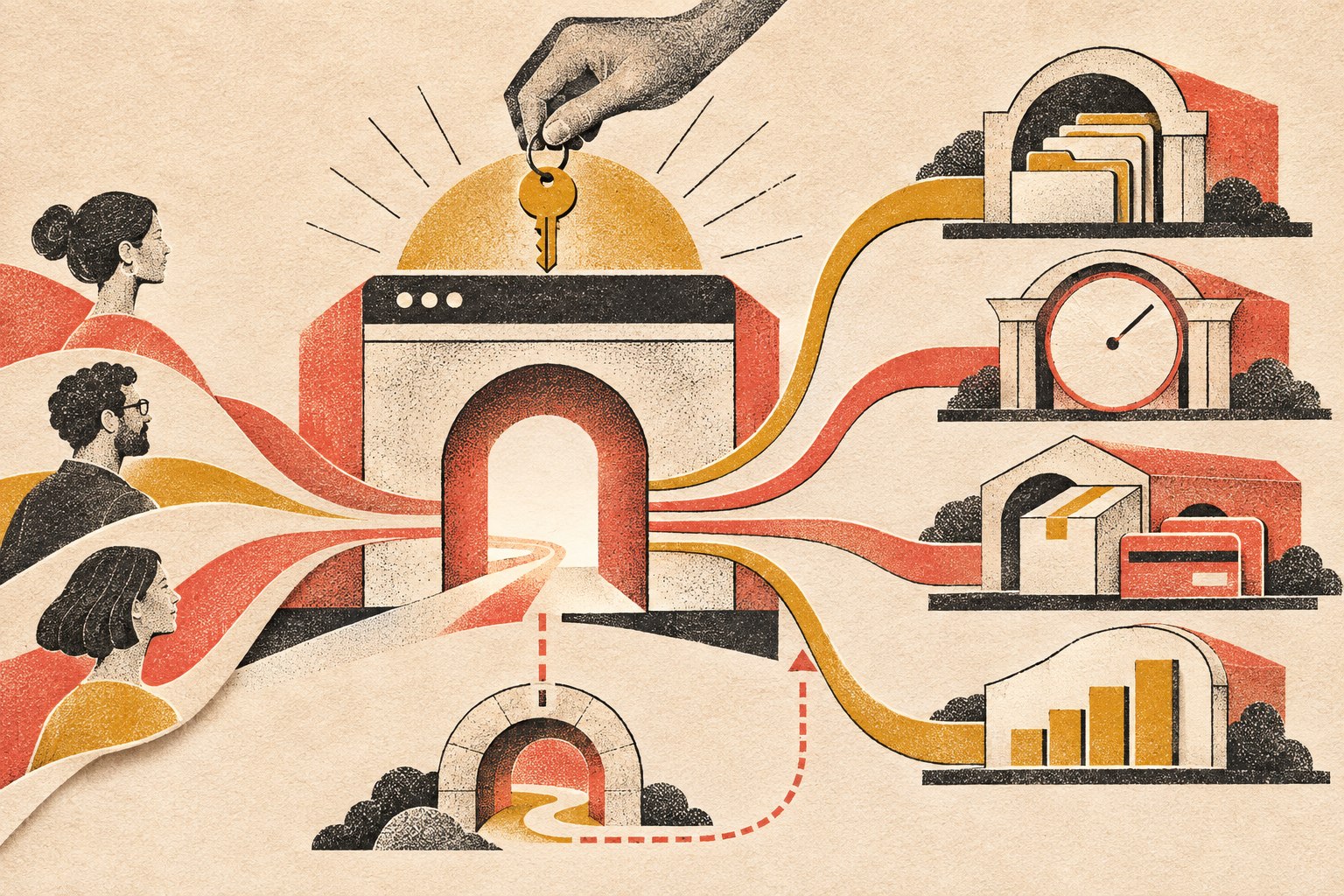
    A considered website gateway routes customer pathways to records, bookings, commerce, and measurement, with a clear fallback path.

    If a form submission still has to be copied into three systems by hand, the website may look modern while the process behind it is wearing a powdered wig. The hard part is not drawing a line between two logos on a flowchart. It is deciding which system owns each piece of information, what should happen when data changes, how errors and duplicates are handled, what staff must approve, and what happens when an external service is unavailable.

    Those are operational decisions. They belong in website planning whenever the site is expected to do real work.

    5. The Content Has a Job

    Serious websites do not treat content as filler poured into a finished design five minutes before launch.

    • The homepage establishes the broad value and main routes.
    • Service pages help a buyer evaluate a specific solution.
    • Comparison pages support commercial research.
    • Case studies and reviews provide proof.
    • Blog articles answer informational questions and build topical depth.
    • FAQs remove friction and handle objections.
    • Contact and booking pages make the next step feel safe and clear.

    This is also where search and AI discoverability begin. The goal is not to repeat one keyword until the page sounds like it was written by a malfunctioning parrot. The goal is to make the answer genuinely useful, structurally clear, easy to crawl, and unambiguous about the question it owns.

    That is why the direct answer appears at the top of this article. Readers should not have to survive 900 words of throat-clearing before learning the point. Scope Design’s guide to front-loading content for AI search explains that approach in more detail.

    6. Technical Quality Is Part of the Product

    A serious website must work when real people use it under real conditions. That includes people on phones, people with slower connections, people using assistive technology, people who mistype information, and people who do things the project team did not expect.

    • Responsive behavior across screen sizes.
    • Performance optimization and sensible asset loading.
    • Accessibility-minded structure, contrast, controls, and content.
    • Secure configuration, updates, backups, and recovery planning.
    • Browser and device testing.
    • Form validation and spam protection.
    • Redirects, canonical URLs, sitemap behavior, and indexation controls.
    • Analytics and event tracking.
    • Clean integrations and documented custom functionality.
    • Staging, deployment, rollback, and post-launch checks.

    None of that is glamorous. Neither is a seatbelt, right up until the moment it matters.

    Google’s current Core Web Vitals guidance defines good field performance as Largest Contentful Paint of 2.5 seconds or less, Interaction to Next Paint of 200 milliseconds or less, and Cumulative Layout Shift of 0.1 or less, measured at the 75th percentile. Performance is not the whole website, but it is one part of whether the experience works well.

    Accessibility deserves the same seriousness. The U.S. Department of Justice explains in its web accessibility and ADA guidance that inaccessible web features can prevent people with disabilities from accessing the goods, services, programs, and activities of covered organizations. The practical point for a business website is simple: accessibility is part of usable design, not a decorative checkbox at the end.

    For more on the performance layer, see Fast & Functional: Web Development & Performance Mastery.

    7. A Serious Website Measures Outcomes

    Page views are interesting. Business outcomes are useful.

    A professional business website should make it possible to understand what is working. The exact measurements depend on the business, but they may include:

    • Qualified contact requests.
    • Phone calls or booked consultations.
    • Quote starts and completions.
    • Ecommerce revenue and checkout completion.
    • Downloads, applications, or registrations.
    • Lead source and campaign performance.
    • Movement through important page sequences.
    • Use of specific tools, searches, calculators, or portal features.

    The point is not to collect every possible event because dashboards are pretty. The point is to connect website behavior to decisions. If nobody can explain what success looks like, the team cannot reliably improve it. They can only rearrange things and hope. Hope is not an analytics strategy.

    8. It Is Built to Change Without Falling Apart

    Businesses evolve. Services change. Teams grow. Marketing campaigns launch. New systems appear. Old systems are finally taken behind the barn.

    • A maintainable content structure.
    • Reusable design patterns.
    • Sensible custom code rather than mystery snippets everywhere.
    • Documentation for important workflows and integrations.
    • A staging environment for safer updates.
    • Clear ownership of domains, hosting, accounts, analytics, code, and source assets.
    • A recovery path if an update, integration, or deployment fails.
    • A plan for extending features without rebuilding the whole thing.

    Scalability does not mean engineering a global platform for a company with twelve customers. It means making smart choices today so tomorrow’s reasonable change does not become a demolition project.

    9. Launch Is a Milestone, Not a Funeral

    Basic sites are often treated as one-time projects: launch it, celebrate, and slowly forget the login.

    Serious business websites need an explicit ownership plan. Software changes. Integrations change. Content changes. Search behavior changes. Security issues appear. Forms break at the worst possible moment because apparently software also enjoys comedy.

    • Updates and compatibility testing.
    • Security monitoring and backups.
    • Uptime and performance monitoring.
    • Broken-link and visual-change checks.
    • Analytics review and conversion improvements.
    • Content updates and search refinement.
    • Testing forms, payments, notifications, and integrations.
    • Recovery procedures and clear account ownership.
    • Planning new features as the business changes.

    A website that matters to the business cannot be treated like a lawn ornament. Ongoing care is part of the system’s reliability.

    10. Cost Follows Responsibility, Complexity, and Risk

    People often compare website prices as if every project is the same object sold in different boxes.

    It is not.

    A focused site using established patterns is not the same project as a site that needs discovery, original positioning, complex content architecture, several audiences, advanced forms, integrations, automation, ecommerce rules, data migration, accessibility work, analytics, testing, and a safe launch plan.

    The higher scope is not payment for extra pixels. It covers more thinking, specialized work, coordination, testing, responsibility, and risk. That still does not mean expensive automatically equals good. A bloated proposal can produce an impressive pile of nonsense. Price is evidence of scope, not proof of quality.

    If you need actual budget ranges and a framework for comparing proposals, use Scope Design’s small business website cost guide. This article’s job is narrower: decide what level of responsibility the website needs to carry before you compare numbers.

    Which Kind of Website Do You Need?

    Choose a focused basic website when:

    • The offer is straightforward.
    • Referrals and existing relationships drive most business.
    • The main goal is credibility and essential information.
    • Standard functionality covers the need.
    • The business is validating an idea or needs to launch quickly.
    • There is no strong business case for deeper integrations or automation yet.

    Consider a more serious website investment when:

    • The site must generate or qualify leads.
    • Buyers need education, proof, or multiple decision paths.
    • The business has complex services, products, audiences, or locations.
    • Staff members are repeating work the website could reduce.
    • Multiple systems need to exchange information.
    • Quoting, booking, ecommerce, search, portal, or workflow features are required.
    • The current site is limiting marketing or operations.
    • Measurement, reliability, ownership, security, and ongoing improvement matter.

    There is no prize for buying more website than you need. There is also no bargain in buying too little for a site that is expected to carry real business risk.

    If you are still deciding what to buy, Scope Design’s business website buyer guide covers the full process from requirements and ownership to budget, provider selection, launch, and maintenance.

    Frequently Asked Questions

    What counts as a professional business website?

    A professional business website is a site whose strategy, content, design, technical quality, measurement, and ownership match the business job it is expected to do. It should clearly explain the offer, help the right visitor decide, provide an obvious next step, work reliably, and have a plan for what happens after launch.

    Is a basic website unprofessional?

    No. A focused website can be professional, useful, fast, accessible, and well designed. It becomes a problem only when its limited scope does not match what the business expects it to accomplish.

    Does a professional website have to be custom-coded?

    No. Templates, design systems, WordPress builders, and hosted website platforms can all produce professional results when their capabilities fit the business need. Custom development makes sense when the required workflow, data, integration, transaction, or product behavior cannot be handled responsibly with standard tools.

    When has a business outgrown a basic website?

    A business has probably outgrown a basic site when the website is limiting lead generation, customer service, marketing, ecommerce, internal workflows, integrations, measurement, or the ability to clearly explain a more complex offer.

    What’s the best website for a small business?

    The best website is the smallest responsible solution that can do the job the business actually needs. A simple service company may need a focused site with excellent messaging and contact paths. A revenue-critical operation may need ecommerce, portals, integrations, automation, advanced search, or custom workflows. Start with the business outcome, not the software brand.

    How much does a professional website cost?

    There is no useful universal number because “professional website” can describe very different scopes. Cost should follow the amount of strategy, content, design, functionality, integration, testing, migration, risk, and ongoing responsibility involved. Compare what the website must accomplish and what the proposal includes before comparing totals.

    Is Wix a professional website platform?

    It can be. Wix and other hosted builders can be a professional fit when their standard design, content, ecommerce, booking, and marketing tools cover the need. The question is not whether the platform is “professional.” The question is whether its limits interfere with the business requirements, ownership, integrations, performance, accessibility, or future change.

    Can WordPress handle a serious business website?

    Yes. WordPress can support brochure sites, ecommerce, memberships, portals, structured content, advanced search, integrations, and custom workflows when it is architected and maintained properly. The platform is only one part of the system; implementation and ownership matter more than the logo on the admin screen.

    What should a business website measure?

    Measure actions tied to business value: qualified inquiries, bookings, calls, quote requests, applications, sales, lead sources, conversion paths, and use of important tools or workflows. Traffic can provide context, but it does not tell you by itself whether the site is doing its job.

    What happens after a serious website launches?

    The site should be monitored, maintained, backed up, secured, tested, measured, and improved. Important accounts and assets should have clear owners, and the team should know how to recover when something breaks. Launch is the beginning of real-world use, not the moment everyone walks away and hopes the plugins behave forever.

    Stop Asking Your Website to Coast

    If all you need is a clean online presence, build that well and do not apologize for it.

    But if the website is supposed to help the business sell, operate, serve customers, and grow, stop treating it like a decorative expense. Treat it like the business system it is.

    Before choosing a scope, use the Website Fitness Test to judge whether the result will actually be good, check the Buyer Decision File for the information it must contain, and audit the full path with the seven-link conversion checklist. Then explore Scope Design’s website development services or contact Scope Design to talk about what your website actually needs to accomplish.


  • Why Smart Businesses Use Design Firms on Retainer (ROI + Cost Analysis)

    Why Smart Businesses Use Design Firms on Retainer (ROI + Cost Analysis)

    A graphic design retainer is not automatically cheaper than project work, a freelancer, or an in-house designer. Its economic value comes from buying a dependable slice of capacity: priority access, accumulated brand and business context, a known request-and-approval path, and less time spent repeatedly quoting, briefing, and restarting work.

    That is why we think of a retainer as a capacity contract, not a bulk-discount coupon. The right question is not “What percentage can I save?” It is: Will the operating value of reserved capacity exceed the cost of unused capacity, overages, and the best alternative?

    What does a graphic design retainer actually buy?

    A graphic design retainer is a recurring agreement that reserves an agreed amount of a designer’s or design firm’s capacity for ongoing work. The unit might be hours, requests, deliverables, a defined service scope, or a hybrid. What matters is that both sides know what capacity is being reserved and how requests move through it.

    • Reserved capacity: you are not starting from zero every time a brochure, ad, landing-page asset, presentation, email graphic, or website update appears.
    • Accumulated context: the team can retain knowledge about your brand, audience, approvals, systems, and recurring work instead of relearning them for every project.
    • A predictable operating path: requests, priority, feedback, approvals, files, and handoffs have a defined route.
    • Capability access: a firm may cover a wider mix of creative, web, copy, production, or technical needs than one full-time role can economically cover.

    Those benefits can be worth real money. They can also be worth nothing if demand is sporadic, the agreement is vague, or you consistently leave paid capacity unused. That is why a cost analysis has to include how the work actually operates.

    The biggest design-retainer cost mistake: comparing invoice to invoice

    Businesses often compare a monthly retainer fee with a freelancer’s hourly rate or an employee’s salary and call the lower number the winner. When you compare a graphic design retainer with another model, that misses the costs surrounding the work.

    For an in-house benchmark, the U.S. Bureau of Labor Statistics reports that the median annual wage for graphic designers was $61,300 in May 2024. That is wage data, not an employer’s all-in cost. In a separate economy-wide measure, BLS reported that private-industry employers in March 2026 averaged $32.60 per hour in wages and salaries plus $14.01 per hour in benefit costs, for $46.61 in total compensation.

    Those two BLS datasets cover different populations, so you should not apply the private-industry benefit ratio as a universal markup to a graphic designer’s median wage. The useful point is narrower: salary alone is not the same as total employment cost. Recruiting, management, software, equipment, benefits, payroll costs, unused capacity, and specialist gaps can all matter in a real hiring decision.

    Use the Scope Design Retainer ROI Ledger

    Instead of asking whether retainers are “usually cheaper,” compare the total operating cost of the realistic alternatives. Our Retainer ROI Ledger separates the value created or cost avoided from the leakage a monthly commitment can introduce.

    Value created or cost avoided

    • Coordination time avoided: less time sourcing vendors, requesting quotes, briefing from scratch, chasing status, moving files, and repeating approvals.
    • Delay cost avoided: the value of getting an important campaign, sales asset, website change, or correction into market sooner.
    • Context and rework avoided: less repeated explanation and fewer resets caused by a provider who does not know the brand, workflow, or technical environment.
    • Capability access: the value of having several relevant skills available without keeping every specialty on payroll full time.

    Costs and leakage

    • Unused capacity: paid hours, requests, or deliverables that expire or sit idle.
    • Overage and rush costs: charges or operational pain when demand repeatedly exceeds the reserved lane.
    • Internal coordination that remains: a retainer does not eliminate the need for a capable owner, brief, feedback, or approval.
    • Switching and exit cost: documentation, file cleanup, transfer of credentials/assets, and replacement-provider onboarding.

    The break-even question is simple even when the inputs are not:

    Retainer advantage = coordination time avoided + delay cost avoided + rework/context resets avoided + capability value − unused capacity − overages/rush − switching/exit cost.

    Compare that result with the total cost of the best alternative, not with a hand-picked hourly rate.

    A simple illustrative break-even example

    This is a worked example, not a market benchmark. Replace every number with your own.

    Monthly cost inputAd hoc exampleRetainer example
    Vendor/retainer fee$3,600$3,400
    Internal coordination time$480$240
    Rush/rework or unused-capacity reserve$350$250
    Modeled monthly total$4,430$3,890

    In that illustration, the retainer is $540 lower for the month. But the result can flip quickly. If coordination does not fall, unused capacity rises, or overages become routine, the retainer may cost more. The model is useful because it forces the assumptions into the open.

    When does a graphic design retainer beat ad hoc project work?

    A graphic design retainer becomes more attractive when the work is recurring enough that repeatedly rebuilding the operating context is wasteful. Good signals include:

    • a real backlog of recurring design, campaign, sales, web, or content-production requests;
    • frequent small-to-medium requests that are awkward to quote individually;
    • work where waiting for availability creates a meaningful business cost;
    • brand or technical context that compounds in value when the same team stays involved;
    • a need for multiple capabilities, but not enough steady work to justify several specialized hires;
    • a team that can actually feed the reserved capacity with clear requests and timely approvals.

    If the recurring work is specifically a website, the commercial-model question becomes more specialized. Our website redesign project-vs-retainer pricing guide explains when a defined rebuild, ongoing capacity, or a hybrid arrangement makes more sense. This article owns the broader design-retainer economics.

    When is a project, freelancer, subscription, or in-house designer better?

    A smart retainer article should tell you when not to buy one. No operating model wins every workload.

    ModelOften fits whenMain economic risk to watch
    Project-based firmYou have a defined outcome, stable scope, and a natural finish line.Repeated quoting, queues, and re-onboarding if “one project” becomes constant change.
    Freelancer or small studioThe work is focused and one person or a small team can cover most needs.Availability, backup coverage, breadth limits, and handoff if that person is unavailable.
    Design subscriptionYou have a steady queue of standardized production work and can work within the provider’s request rules.Parallel-task limits, variable strategic depth, and paying for a process that may not fit complex work.
    Design-firm retainerYou need recurring cross-channel capacity, continuity, and a broader capability mix.Unused capacity, vague scope, overages, or a long commitment that outlives the workload.
    In-house designerDesign demand is continuous enough to use a role deeply every week and close daily collaboration matters.Fixed employment cost, unused capacity, management burden, and specialist gaps outside the hire’s strengths.

    Choose the smallest responsible model that can handle the actual work and risk. If you are also deciding who should own the work, our guide to choosing a web design company without getting trapped compares freelancer, agency, managed-service, and specialist-team responsibilities in more depth.

    Size a retainer from 90 days of real work, not optimism

    The easiest way to overbuy a graphic design retainer is to estimate future demand during a week when everything feels urgent. Use your last 90 days instead.

    1. Inventory every design request. Include finished work, delayed work, abandoned work, and work your team did internally because no provider was available.
    2. Group requests by type. Separate predictable production work from strategic, web, copy, campaign, presentation, and emergency work.
    3. Estimate real effort. Include briefing, revisions, approvals, export/production, meetings, file management, and implementation—not just the visible design time.
    4. Mark the cost of waiting. Which requests could wait a week? Which blocked a campaign, proposal, event, sales conversation, or important fix?
    5. Find the recurring baseline. Reserve capacity around the stable center of demand, not the biggest spike.
    6. Keep a buffer strategy. Decide in advance what happens when work is below or above the reserved amount.

    This “90-day capacity test” prevents two opposite mistakes: buying too little and living in overages, or buying too much and manufacturing work just to use what you already paid for.

    The graphic design retainer terms that decide whether the economics work

    For a graphic design retainer, the monthly price is only one part of the agreement. Before signing, make these operating rules explicit:

    • Scope: which services and deliverables are included, and which are not?
    • Capacity unit: hours, requests, deliverables, service scope, or another measure?
    • Turnaround and priority: what does “priority” actually mean, and when does the clock start?
    • Rollover or expiration: what happens to unused capacity?
    • Overages: what happens when work exceeds the reserved amount?
    • Rush work: what qualifies as urgent, and does it change price or queue order?
    • Request channel: where must new work be submitted so it does not disappear across email, texts, chat, and meetings?
    • Feedback and approval: who consolidates comments, who approves, and how many rounds are included?
    • Files and ownership: what files, licenses, working documents, credentials, and exports do you receive?
    • Cancellation and exit: notice period, minimum commitment, final handoff, and what survives termination.

    Feedback mechanics deserve special attention because a poor approval process can burn capacity without improving the work. Our guide to working effectively with a web design company covers preparation, decision ownership, and consolidated feedback in more detail.

    At Scope Design, this is the part we would rather make boring and explicit. A retainer should define the rules for scope, turnaround, rollover, overage, rush work, communication, cancellation, and exclusions before the recurring work becomes routine. Ambiguity is not flexibility; it is deferred conflict.

    How should you measure graphic design retainer ROI after 90 days?

    Do not judge the agreement only by how many deliverables appeared. Measure whether the operating system improved.

    • Capacity utilization: how much of the reserved lane did you actually use?
    • Cycle time: how long did important requests take from ready brief to usable deliverable?
    • Internal coordination hours: did your team spend less time quoting, explaining, chasing, and moving work?
    • Rework: did repeated brand/context corrections fall, stay flat, or rise?
    • Backlog age: are important requests clearing faster, or is work simply accumulating inside a new queue?
    • Overage/rush frequency: is the reserved level sized correctly?
    • Capability coverage: did the agreement reduce the number of times you needed a separate specialist?

    For revenue or lead-generation impact, be stricter. A new sales deck or landing-page asset may contribute to a result, but the retainer should not take credit for every dollar that happened afterward. Track operating measures directly, then connect individual creative work to business outcomes only where attribution is defensible.

    A quick graphic design retainer fit test

    A design retainer is worth serious consideration if you can answer yes to most of these:

    • Do we have recurring design demand, not just occasional projects?
    • Does waiting for provider availability regularly slow important work?
    • Does brand, audience, system, or technical context become more valuable when retained over time?
    • Would we benefit from several capabilities without employing every specialty full time?
    • Can our team supply clear requests and timely approvals consistently?
    • Can the agreement explain unused capacity, overages, turnaround, ownership, and exit in plain English?
    • Can we measure utilization, cycle time, coordination, and backlog after 90 days?

    If most answers are no, a project or smaller on-demand relationship is probably the cleaner buy. If most are yes, model the total cost with your real workload and negotiate the agreement around the risks you found.

    Frequently asked questions about design retainers

    How much should a graphic design retainer cost?

    There is no responsible universal price because retainers can reserve very different things: a few production hours, a request queue, cross-disciplinary agency capacity, strategic direction, web work, copy support, or a defined package of deliverables. Ask for the capacity unit, included services, turnaround, overage rules, and commitment length. Then compare total operating cost with your real alternatives instead of shopping a single monthly number.

    Is a design retainer cheaper than hiring an in-house designer?

    Not automatically. An in-house designer can be the better economic choice when you have enough continuous work to use the role deeply and need daily integration. A retainer can be stronger when demand is recurring but below full-time utilization, when you need multiple specialties, or when reserved external capacity reduces coordination and delay. Compare all-in employment cost and utilization with the retainer’s fee, unused capacity, overages, and management time.

    What are the disadvantages of a retainer fee?

    The main risks are paying for unused capacity, unclear scope, poor rollover rules, overage surprises, a commitment that outlives the workload, and assuming “priority” means something the agreement never defines. A retainer can also hide a weak process: if your team cannot brief or approve work, reserved capacity will not fix that.

    What happens to unused design-retainer hours?

    It depends entirely on the agreement. They may expire, roll over for a limited period, convert to another type of work, or be governed by a deliverable/request model instead of hours. Do not assume. Unused-capacity rules are part of the economics and should be clear before you sign.

    What is the difference between a design retainer and a design subscription?

    The labels overlap in the market, so read the operating rules. A subscription often standardizes intake, queue order, turnaround, and how many requests can be active at once. A firm retainer may reserve hours, deliverables, access to a broader team, or a defined service scope. Neither label tells you enough by itself; compare capacity, expertise, process, ownership, and exit terms.

    Can you start with a project and move to a retainer later?

    Yes, and that can be a sensible way to reduce uncertainty. A defined project lets both sides test communication, quality, decision-making, and technical fit. If the work reveals a recurring backlog after launch, you can size ongoing capacity from real evidence instead of guessing before the relationship begins.

    The smartest retainer is the one your workload can prove

    A graphic design retainer does not make a business smarter by itself. The smart move is choosing an operating model that matches the workload.

    If recurring creative work is constantly waiting, context keeps getting rebuilt, and one-off coordination is consuming more time than anyone admits, reserved capacity can be a strong investment. If demand is genuinely occasional, a retainer can simply turn variable cost into unused fixed capacity.

    Start with the last 90 days. Calculate the real operating cost. Define the agreement’s boundaries. Then measure the next 90 days against the same ledger. That gives you an ROI answer you can defend.

    If you have recurring brand, marketing-collateral, web, or design work and want help deciding what should be project-based versus ongoing, see Scope Design’s marketing collateral capabilities and bring us the workload—not a made-up monthly package. We can start with the actual jobs your team is trying to move.

  • User Centered Design Excellence: Psychology-Driven UX That Converts Without Dark Patterns

    User Centered Design Excellence: Psychology-Driven UX That Converts Without Dark Patterns

    User centered design means making design decisions from evidence about the people who will use the thing: what they are trying to accomplish, what they understand, what gets in their way, and what feedback helps them finish. Psychology belongs in that process when it reduces uncertainty and mental work. It stops being user-centered when the interface depends on pressure, deception, obstruction, or the hope that somebody will not notice what just happened.

    For a business website, that distinction matters. A site can be visually polished and still make the visitor decode your navigation, compare five vague service options, hunt for pricing context, fight a form, and wonder whether clicking the button commits them to something. That is not a conversion problem wearing nicer typography. It is decision friction.

    TL;DR: Use the Scope Design CHOICE Test: Context, Hierarchy, Obstacles, Integrity, Completion, Evidence. Start with the user’s real task. Make the next useful choice obvious. Remove avoidable friction. Preserve the person’s ability to make an informed choice and say no. Make completion and recovery clear. Then measure whether the design helped both the user and the business.

    What user centered design means for a business website

    User centered design is not a mood board, a persona poster, or a promise to give visitors everything they ask for. It is a way of structuring design work around people, tasks, context, requirements, solutions, and evaluation. ISO 9241-210:2019, the current international standard for human-centred design of interactive systems, explicitly includes websites and applications within its scope and treats human-centred design as a lifecycle activity rather than a final coat of interface paint.

    That is the practical difference between a company-centered website and a user-centered one. The company-centered version asks, “What do we want to say?” The user-centered version asks, “What does this person need to understand or do next, and what evidence will tell us whether we helped?” Business goals still matter. They simply do not get to erase the user’s goal.

    Discipline Primary question What it does not replace
    User centered design Can the intended user understand and complete the important task in context? Business strategy, accessibility standards, or measurement
    UX design How does the overall interaction feel and work across the journey? A clear offer or healthy traffic source
    Conversion optimization Which evidence-backed change improves a defined business action? Usability diagnosis or an honest value proposition
    Accessibility Can people with disabilities perceive, understand, navigate, and interact without barriers? User research or broader inclusion work

    If your real question is broader than this article — for example, “Why is my website getting traffic but not producing useful inquiries?” — start with our website UX and conversion diagnosis. This guide owns a narrower job: how to make psychologically informed interface decisions without turning “conversion psychology” into manipulative nonsense.

    Use the Scope Design CHOICE Test before you polish the interface

    The CHOICE Test is a six-part decision check for website UX. It is not a universal scientific model. It is Scope Design’s practical way to make user-centered design inspectable before a team spends time polishing the wrong interaction.

    The Scope Design CHOICE Test turns “make the UX better” into six questions a team can actually investigate.

    C — Context: who is trying to do what?

    Start with the task, not the screen. Who is here? What are they trying to accomplish? What do they already know? Are they on a phone in a parking lot, on a desktop comparing vendors, using a keyboard instead of a mouse, returning to finish a form, or trying to undo a purchase? Context changes what “easy” means.

    Do not substitute demographic wallpaper for task evidence. “Busy homeowner, age 35–55” tells you less than “needs to know whether you service their ZIP code before they will invest time in a quote form.” The second statement can shape a design and be tested.

    H — Hierarchy: is the next useful choice obvious?

    Hierarchy is how the interface answers, “What matters here?” A page with six equally loud buttons is not flexible. It is a tiny committee meeting. Give the primary task a clear visual and content priority, keep secondary routes available, and use labels that describe the outcome rather than internal department names.

    Familiar conventions help because users should not need to learn your private interface language before they can buy, book, compare, or contact you. Nielsen Norman Group’s usability heuristics capture useful checks here: match the real world, maintain consistency, show system status, favor recognition over recall, and prevent errors where possible.

    O — Obstacles: what friction blocks the task?

    Friction can be cognitive, visual, technical, procedural, or emotional. A visitor may not understand the difference between two services. A form may ask for information before explaining why it is needed. A mobile menu may hide the one page people actually need. A slow or jumpy interface may make the site feel broken. An accessibility barrier may make the task impossible for some users.

    Do not remove every step automatically. Some friction is useful. Confirming a destructive action, reviewing an order before payment, or asking a qualifying question can protect the user and the business. The goal is not “fewer clicks.” The goal is fewer pointless obstacles between intent and a correct outcome.

    I — Integrity: can the user still make an informed choice?

    This is where psychology-driven UX either earns its keep or turns into a bag of tricks. Honest social proof can reduce uncertainty. Clear defaults can reduce effort. Progress feedback can help someone finish a task they chose. But fake scarcity, hidden fees, disguised opt-outs, preselected data sharing, or a cancellation maze use the interface against the user’s own decision.

    The Federal Trade Commission’s dark-pattern guidance documents designs that can obscure, subvert, or impair consumer autonomy and decision-making. Scope Design’s simpler integrity question is: would we still call this good UX if the user fully understood how the interface was influencing them? If the tactic only works because the person overlooks something, misunderstands the stakes, or gives up, it is not user-centered.

    C — Completion: can the user finish, recover, or undo?

    A good path has an ending. The user should know what happened, what happens next, and how to recover from a mistake. Forms need useful validation. Submission needs a clear confirmation. Account actions need understandable status. Reversible choices should be reasonably easy to reverse.

    This sounds basic because it is basic. It is also where a surprising amount of expensive “conversion work” falls apart. A beautiful CTA does not compensate for a confirmation page that leaves the customer wondering whether the request went through.

    E — Evidence: what will prove the design helped?

    Before changing the interface, write the hypothesis. “Make the button bigger” is a task. “People who understand the service but hesitate at the form cannot tell what happens after submitting it; adding clear next-step copy should improve successful submissions without reducing lead quality” is a hypothesis.

    Measure the user outcome and the business outcome together. Task success, errors, abandonment, completion time, support questions, qualified inquiries, and downstream sales quality tell different parts of the story. Our cognitive-bias decision guide is useful when a team is in danger of cherry-picking the metric that flatters its favorite design.

    Psychology should reduce mental work, not exploit it

    “Use psychology” is terrible design advice by itself. People hear it and immediately reach for loss aversion, urgency, scarcity, social proof, reciprocity, and a collection of pop-science shortcuts. Those concepts can be relevant, but the more reliable website question is simpler: what mental work are we forcing the user to do that the interface could do instead?

    • Replace recall with recognition. Keep relevant choices, labels, previous selections, and status visible instead of making people remember them from another screen.
    • Match the user’s language. “Schedule a roof inspection” is more useful than “Initiate service engagement.” Nobody should need your org chart as a decoder ring.
    • Group related decisions. Break a complicated process into meaningful chunks without hiding important costs or consequences.
    • Show feedback. Loading, saving, submitting, approving, and failing should all produce understandable status.
    • Make comparison possible. If the user has to open five tabs and build a spreadsheet to understand your own plans, the interface is outsourcing its job.
    • Design error recovery. Prevent avoidable mistakes and preserve work when something goes wrong.

    These patterns do not guarantee conversion. They make it easier for a motivated person to understand and act. That is a more defensible goal than pretending a cognitive bias is a cheat code for revenue.

    Ethical persuasion has an easy test: can the user still say no?

    Persuasion is not automatically manipulation. A clear value proposition persuades. A testimonial can reduce uncertainty. A comparison table can make tradeoffs visible. A well-timed reminder can help someone finish what they already intended to do. The line is crossed when the design weakens a person’s ability to make an informed choice.

    Pattern User-centered use Dark-pattern warning
    Scarcity Show a real capacity limit or deadline with accurate context. Fake or resetting countdowns that manufacture urgency.
    Social proof Show truthful reviews or evidence relevant to the decision. Fabricated activity, selective proof, or numbers designed to create panic.
    Defaults Choose a sensible, reversible option that primarily helps the user. Preselect a company-benefiting choice and hide the alternative.
    Progress Show where the user is in a meaningful multi-step task. Add steps and friction to stop cancellation or opt-out.
    Pricing Make the real cost and key conditions understandable before commitment. Hide mandatory fees or material terms until late in the process.

    If your team is testing conversion changes, our broader conversion optimization guide covers experimentation and measurement. If the site is solving the wrong business problem, step back to our constraint-first website strategy framework before optimizing the interface into a very efficient wrong answer.

    Accessibility is part of user-centered design, but it is not the whole job

    Accessibility, usability, and inclusion overlap, but they are not synonyms. W3C’s Web Accessibility Initiative distinguishes accessibility as addressing barriers that affect people with disabilities, usability as effectiveness, efficiency, and satisfaction in context, and inclusion as a broader concern involving diverse people and situations.

    That distinction prevents two common mistakes. First, a site can pass many technical checks and still be confusing in real use. Second, “we tested it with users” does not replace accessibility standards, because no small research sample can represent every disability, assistive technology, and interaction need.

    WCAG 2.2 is the current W3C Recommendation. Treat it as a technical accessibility baseline, then involve real people and test important tasks. For more depth, use our guides to website accessibility and WCAG and inclusive web design.

    Performance is user experience evidence, not a UX strategy

    People cannot complete a task on a page that will not load, respond, or hold still. Google’s current Core Web Vitals measure three specific parts of real-world experience: loading with Largest Contentful Paint (LCP), responsiveness with Interaction to Next Paint (INP), and visual stability with Cumulative Layout Shift (CLS). The recommended “good” thresholds are LCP at 2.5 seconds or less, INP at 200 milliseconds or less, and CLS at 0.1 or less, evaluated at the 75th percentile.

    Those are useful technical signals. They are not a complete user-experience score. A fast page can still explain the wrong thing, hide the next step, use inaccessible controls, or demand a terrible form. For the engineering side of that work, continue with our website development and performance guide.

    A hypothetical service-site example: diagnosing decision friction

    Imagine a local service company getting reasonable traffic to a “Request an Estimate” page but seeing inconsistent form completion. This example is hypothetical. The point is the reasoning process, not an invented case-study win.

    CHOICE check What the team observes Better next move
    Context Many visitors are on mobile and first need to confirm service area and timing. Answer location and availability questions before asking for contact details.
    Hierarchy The page gives equal weight to call, chat, financing, newsletter, and estimate CTAs. Make the estimate path primary and keep genuine alternatives secondary.
    Obstacles The form asks 14 questions, including information the company can collect later. Keep only fields needed to route and qualify the first conversation.
    Integrity The CTA says “Get Price” but submitting only starts a sales call. Rename the action so it accurately describes what happens next.
    Completion After submission, the page only says “Thanks.” Confirm receipt, expected response time, and what the customer should prepare.
    Evidence The team watches form completions alone. Track successful submissions, qualified lead rate, errors, abandonment, and common questions.

    The useful insight is not “short forms always win.” Sometimes qualification protects everyone’s time. The user-centered move is to make every required step earn its place and explain enough context for the person to decide whether continuing makes sense.

    Measure successful decisions, not just button clicks

    A conversion can be a good outcome, a bad outcome, or an incomplete story. If a redesign increases form submissions but floods the sales team with poor-fit inquiries, the button metric improved while the business system got worse. If a clearer pricing page reduces raw inquiries but increases qualified conversations, fewer clicks may be the healthier result.

    Evidence layer Useful questions Example measures
    Task Can the person complete the intended job? Task success, completion time, error rate, recovery
    Behavior Where do people hesitate, abandon, or choose another path? Form abandonment, path completion, repeated clicks, search behavior
    Qualitative Why did the interface make sense or fail? Usability observations, interviews, support questions, open-text feedback
    Business Did the completed task create the right business result? Qualified inquiries, booked work, support burden, retention, revenue quality

    Start with the smallest test that can answer the important uncertainty. Our design-friction checks provide a complementary diagnostic for finding problems before redesign work expands, while the UX pillar helps determine whether UX is even the first constraint.

    What rebuilding this guide taught us about UX advice

    We audited the previous version of this article and found a common content-marketing failure: muscular-looking percentages with weak or missing provenance. The old draft claimed universal lifts in conversion, revenue, engagement, personalization performance, and inclusive-design returns. We could not support those claims from the original collectors, so they are gone.

    That cleanup changed the article for the better. Instead of promising that user centered design magically increases conversion by a tidy number, this guide tells you what to inspect, which standards support the underlying principle, where ethical boundaries sit, and what evidence would show whether a change helped your particular users and business.

    Scope Design’s editorial rule is simple: if a percentage cannot survive a source check, it does not get to rent space on the page. Hope is not an analytics strategy, and a made-up benchmark is not user research.

    Frequently asked questions about user centered design

    What is meant by user centered design?

    User centered design is an iterative approach that grounds design decisions in evidence about intended users, their goals, tasks, context, requirements, and evaluation of proposed solutions. For a website, that means organizing important journeys around what people need to understand and accomplish rather than around internal departments or visual preferences.

    What are the stages of user centered design?

    Stage counts vary because different frameworks package the work differently. Do not treat “four,” “five,” or “seven” as magic. A defensible process repeatedly covers four jobs: understand the context of use, define user and business requirements, create design solutions, and evaluate those solutions against the requirements. Then iterate as the evidence changes.

    Can you give an example of user centered design?

    A service company discovers that mobile visitors will not start its quote form until they know whether the company serves their ZIP code. Instead of simply shortening the form or enlarging the CTA, the team puts service-area confirmation before the form, explains what happens after submission, tests task completion, and measures lead quality. The design changed because of the user’s task and uncertainty, not because a trend said “forms should be shorter.”

    How is user centered design different from UX design?

    User centered design is a process orientation: involve and understand users, design around their context and requirements, evaluate, and iterate. UX design is the broader practice concerned with the quality of the experience across interactions and touchpoints. They overlap heavily, but the terms are not identical.

    How can psychology improve UX without manipulating users?

    Use psychological insight to reduce memory burden, clarify hierarchy, match familiar mental models, show progress and feedback, and explain tradeoffs. Avoid tactics that rely on deception, hidden information, fabricated urgency, obstructive opt-outs, or the user’s failure to notice a consequence. A useful ethical test is whether the design still works when the user clearly understands how it is influencing the choice.

    Does accessibility automatically make a site user-friendly?

    No. Accessibility removes barriers for people with disabilities and is essential to quality web design, but a technically compliant experience can still have confusing information architecture, weak content, poor task flow, or a mismatched offer. Combine accessibility standards with usability work and involvement from real users, including people with disabilities.

    Does user centered design increase conversions?

    It can improve the conditions that support a useful conversion by making the offer, choices, controls, feedback, and task flow easier to understand. There is no honest universal percentage. Measure your baseline, define the user and business outcome, make a testable change, and evaluate what happened. If somebody promises a guaranteed lift because they moved a button, keep your wallet in the other room.

    How do you measure whether user centered design worked?

    Use multiple evidence layers. Measure task success, errors and recovery, completion or abandonment, qualitative observations, support friction, and the downstream quality of the business action. A good result helps the intended user complete the right task and helps the business receive a valuable outcome without hiding tradeoffs.

    Build the next decision around evidence, not tricks

    Good user centered design does not ask, “Which psychological trigger will make people click?” It asks, “What is this person trying to decide or accomplish, what unnecessary work are we making them do, and what would prove that the interface helped?” That is slower than copying a list of persuasion hacks. It is also how you avoid optimizing a website into something technically clever and deeply annoying.

    If people are reaching your site but the right action still feels harder than it should, use the CHOICE Test on one important journey first. If the problem is broader and you are not sure whether UX, traffic, the offer, technology, or follow-up is the actual constraint, use our UX diagnosis guide before commissioning a redesign.

    Research reviewed: August 21, 2026, United States. Sources include ISO 9241-210:2019, W3C WAI and WCAG 2.2, Federal Trade Commission dark-pattern materials, Google/web.dev Core Web Vitals documentation, Nielsen Norman Group usability heuristics, DataForSEO, Ubersuggest, Google Search Console, Bing Webmaster Tools, Google Analytics, and Scope Design’s Content Studio/Open Brain evidence.

  • Modern Web Design Trends 2026: What’s Worth Using—and What Needs Guardrails

    Modern Web Design Trends 2026: What’s Worth Using—and What Needs Guardrails

    Modern web design trends in 2026 are moving in two directions at once: interfaces are becoming more adaptive and expressive, while the best production work is also becoming more disciplined about accessibility, performance, privacy, and maintenance. The trends most worth using now are purposeful micro-interactions, flexible typography, performance-first delivery, and inclusive responsive defaults. AI-driven interfaces, immersive 3D, and voice or conversational controls can be useful, but only in the right task. Brutalist styling and experimental navigation are better treated as visual choices than automatic business improvements.

    The useful question is not “What looks futuristic?” It is “What makes this website clearer, faster, more usable, or more capable without creating a bigger problem somewhere else?” That distinction matters because broader design-technology trends can be exciting long before they are appropriate for a production website.

    Modern Web Design Trends 2026: The Quick Decision Map

    Trend How to treat it Best use Main guardrail
    Purposeful motion and micro-interactions Use now Status, feedback, transitions, progressive disclosure Reduced-motion support and restraint
    Variable and responsive typography Use now Flexible hierarchy and reading systems Test real font payload and legibility
    Performance-first, lower-transfer design Use now Every website Measure field performance, not aesthetics alone
    Inclusive responsive defaults Use now Every critical journey Keyboard, focus, zoom, mobile, and fallback testing
    AI and adaptive interfaces Use selectively Search, recommendations, assistance, bounded personalization Privacy, consistency, human review, fallback paths
    3D, WebGL, and WebXR Use selectively Product visualization, spatial explanation, training Device support, page weight, accessibility, privacy
    Voice and conversational controls Use selectively Hands-busy tasks, support, search, guided workflows Keep standard visual/input controls available
    Brutalist or raw visual styling Treat as style Distinctive brand expression Readability, hierarchy, contrast, audience fit
    Experimental navigation Treat as style Optional exploration and storytelling Preserve a conventional route to critical tasks

    Modern Does Not Mean Novel

    A website can look current and still be difficult to use. It can also look visually restrained while using very modern engineering underneath. That is why we separate visual novelty from useful innovation.

    Useful web design innovation changes something that matters: how quickly a person understands the page, how clearly the interface communicates state, how well the experience adapts across devices and input methods, or how efficiently the site delivers media and functionality. Novelty only changes what the interface looks or feels like.

    If a website has a basic usability problem, a new visual treatment will not diagnose it. Start with the underlying experience and diagnose the UX before redesigning it. Then use trends where they solve a defined problem rather than as decoration applied after the fact.

    Use the Scope Design PACE Test Before You Ship a Trend

    At Scope Design, we use a simple production question: will this innovation survive the real website? The PACE Test turns that question into four checks.

    P — Purpose

    What real user or business task improves? “It looks modern” is not a purpose. “The animation makes a loading state understandable,” “the product can be inspected in three dimensions before purchase,” or “the interface can answer a narrow support question without hiding the normal navigation” are testable purposes.

    A — Access

    Can people still complete the task with a keyboard, a smaller screen, zoom, reduced motion, an assistive technology, a slower device, or a fallback experience? A modern interface that only works for the designer’s preferred device is not modern enough.

    C — Cost

    What does the trend add in page weight, privacy exposure, development time, support complexity, ongoing content work, and maintenance? This is where a visually impressive idea often stops being a small design choice and becomes a recurring operating commitment.

    E — Evidence

    What will prove the change belongs? Define a baseline, a metric, a success threshold, and a stop condition before implementation expands. Evidence can include task completion, error rate, support volume, user feedback, field performance, qualified leads, or another outcome tied to the original purpose. Do not substitute an animation count or plugin score for a business result.

    Four Modern Web Design Trends Worth Using Now

    1. Purposeful Motion and Micro-Interactions

    Micro-interactions are small interface responses: a button confirms an action, a progress indicator explains that something is happening, a form field shows a useful validation state, or a panel transitions so the user understands where content moved. In those cases, motion communicates meaning.

    The mistake is treating every hover, scroll, and page change as an opportunity for spectacle. Decorative motion can delay reading, create distraction, and make the interface harder for people who reduce or avoid animation. Build the no-animation or reduced-motion experience as a first-class path, then add movement where it clarifies state or sequence.

    Do not claim that micro-interactions automatically improve conversion. If the goal is conversion, first identify the actual friction. Our guide to design friction and conversion shows why hierarchy, control states, navigation, form behavior, content, and offer quality must be diagnosed together.

    2. Variable and Responsive Typography

    Modern typography is less about choosing a fashionable font and more about building a resilient reading system. Fluid type scales, responsive spacing, variable-font axes, and better language support can help one design system adapt across viewports and content lengths without creating dozens of disconnected type rules.

    Variable fonts can consolidate multiple styles into one font resource in some implementations, but “variable” does not automatically mean “lighter.” Compare the actual files you plan to ship, subset when appropriate, preload only what earns it, and keep fallback fonts predictable. The production goal is readable hierarchy with a controlled payload.

    3. Performance-First and Lower-Transfer Design

    Performance-first design is one of the least flashy modern web design trends and one of the most durable. It means making media, interaction, and layout decisions with loading, responsiveness, and visual stability in mind from the start—not trying to optimize a heavy design after everything has been approved.

    Google’s current Core Web Vitals are Largest Contentful Paint (LCP), Interaction to Next Paint (INP), and Cumulative Layout Shift (CLS). The current “good” thresholds are LCP at 2.5 seconds or less, INP at 200 milliseconds or less, and CLS at 0.1 or less at the 75th percentile. These are useful experience metrics; they are not a promise that a page will rank or convert.

    The same discipline often aligns with lower-transfer and more sustainable delivery: compress media, avoid unnecessary scripts, cache intelligently, and make the simplest version of the task work well. The W3C’s Web Sustainability Guidelines address user-centered design, performant development, infrastructure, strategy, and emerging technology. The 2026 document is a Draft Note, so it should be treated as evolving guidance rather than a final normative standard.

    For implementation depth, a strong technical website foundation still matters more than any isolated visual trend.

    4. Inclusive Responsive Defaults

    Responsive design is no longer a novelty, but the definition of “responsive” is getting broader. A production interface has to respond not only to screen width, but also to zoom, text expansion, keyboard input, touch targets, orientation, motion preferences, network conditions, and the user’s chosen assistive technology.

    That makes inclusive design a design input, not a cleanup phase. It also means testing the actual critical journey on a phone rather than assuming a responsive breakpoint solved the problem. Our mobile-optimized website guide goes deeper on that operating layer.

    Three Modern Web Design Trends to Use Selectively

    5. AI and Adaptive Interfaces

    AI can make a website more capable without making it more mysterious. Useful applications include narrow conversational assistance, smarter search, content or product recommendations, summarization, form support, or adapting a secondary interface around a clearly stated preference.

    The dangerous version is an interface that changes unpredictably, hides why something was recommended, moves primary navigation based on inferred behavior, or treats every visitor as a profiling opportunity. NIST’s Generative AI Profile is a useful reminder that AI risk has to be managed through design, development, use, and evaluation—not bolted on after launch.

    For a web implementation, keep the normal route visible, minimize the personal data required, provide a human or deterministic fallback for consequential tasks, and measure whether the AI path actually improves the defined job. Personalization is a capability, not proof of engagement or conversion.

    6. 3D, WebGL, and Immersive Web Experiences

    3D is useful when depth communicates something the flat page cannot: inspecting a product, understanding a spatial relationship, demonstrating equipment, or teaching a physical procedure. It is much less useful when a rotating object is only there to make the homepage look expensive.

    Browser-based immersive work still requires selective implementation. MDN currently marks the WebXR Device API as limited availability and experimental. The W3C’s XR Accessibility User Requirements emphasize multimodal, navigable, personalized experiences, while NIST IR 8557 treats immersive technology privacy and cybersecurity as active design concerns.

    Use progressive enhancement: the core information and task should still work without the immersive layer. If 3D is valuable enough to keep, measure its payload, device behavior, accessibility path, and task outcome separately from the rest of the page.

    7. Voice and Conversational Controls

    Voice and conversational controls make sense when they reduce real input friction: hands-busy tasks, guided troubleshooting, site search, or a constrained question-and-answer flow. They do not make sense simply because “voice is the future.”

    Do not confuse a voice option with an accessible interface. Speech can be useful for some people and impossible or undesirable for others. Keep standard controls and text alternatives available, make system state visible, and avoid putting critical actions behind a conversation that cannot be navigated another way.

    Two Trends to Treat as Style, Not Strategy

    8. Brutalist and Raw Visual Design

    Brutalist and neo-brutalist web design can be memorable: oversized type, hard edges, blunt color relationships, visible grids, and deliberately unfinished-looking elements can create a strong voice. But the style is not inherently clearer, faster, more authentic, or more accessible.

    Use it when the brand and audience can support the tension. Then check the same basics you would check in any interface: readable hierarchy, sufficient contrast, recognizable controls, usable forms, coherent responsive behavior, and a clear next action. A visual language can differentiate a brand; it does not replace strategy.

    9. Experimental Navigation

    Horizontal scrolling, spatial navigation, scroll-driven storytelling, hidden menus, and non-linear exploration can create a distinctive experience. They can also remove the orientation cues people use to understand where they are and how to get somewhere important.

    For most business websites, keep the primary route boring in the best sense of the word: recognizable navigation, visible labels, predictable backtracking, and a direct path to the critical task. If an experimental layer adds value, make it optional rather than turning the entire website into a puzzle.

    A Trend-to-Production Workflow That Prevents Expensive Novelty

    You do not need a redesign every time the web-design conversation changes. Use a small controlled implementation loop instead.

    1. Write the problem before the trend. Define the task, failure, delay, confusion, or brand requirement you are trying to improve.
    2. Capture the baseline. Measure the current task with the smallest useful set of metrics: completion, error rate, field performance, qualified inquiries, support burden, or direct user feedback.
    3. Prototype one bounded change. Test the micro-interaction, variable type system, AI assistant, 3D viewer, or visual treatment without rebuilding unrelated parts of the site.
    4. Test the ugly edge cases. Keyboard, reduced motion, phone, zoom, slower network, long content, form errors, browser/device variation, unavailable AI/3D services, and real maintenance workflows belong in the test.
    5. Compare against the simpler version. If the new implementation is not materially better at the job, the simpler interface wins.
    6. Standardize only what proves useful. Document the successful pattern, its fallback, its performance budget, and who owns it after launch.

    This is also why modern web design should be coordinated with the team responsible for development and ongoing management. The prettier option can become the worse option if nobody can maintain it six months later.

    What Auditing This Exact Article Changed

    The previous version of this page said modern design innovations could produce up to a 200% improvement in engagement and a 150% increase in conversions. We could not substantiate those figures, and this page’s own performance data does not support that kind of conclusion.

    For the 12 complete months ending August 20, 2026, the exact URL recorded seven GA4 landing sessions, all Direct, with zero engaged sessions and zero configured key events. Google Search Console returned no exact-page query rows, and Bing reported zero clicks and zero impressions. Google has successfully crawled the page and allows indexing, but URL Inspection currently reports “Crawled – currently not indexed.”

    That is not enough data to declare that the old article failed, and it is certainly not enough to claim that any particular design trend caused a business result. It is enough to reject unsupported percentage claims. We preserved the established URL, narrowed the article’s ownership, and rebuilt the guidance around testable implementation decisions.

    Frequently Asked Questions About Modern Web Design Trends

    What web design trends matter most in 2026?

    The most useful 2026 trends are purposeful motion, flexible typography, performance-first delivery, inclusive responsive behavior, and selective use of AI, 3D, and conversational interfaces. The durable pattern is not one visual style; it is designing richer experiences without giving up accessibility, speed, clarity, or maintainability.

    Which modern web design trends should a small business actually use?

    Start with the low-regret improvements: clear interaction feedback, responsive typography, optimized media, stable layouts, mobile usability, and accessible controls. Add AI, 3D, or voice only when a specific customer task justifies the extra complexity.

    Is AI personalization a web design trend worth using?

    Sometimes. It is most defensible when personalization is bounded, explainable, privacy-conscious, and easy to bypass. Keep primary navigation and essential content predictable. Measure whether personalization improves the intended task instead of assuming “personalized” means “better.”

    Are 3D and immersive websites practical for most businesses?

    Not as a default. They are practical when spatial understanding is part of the job—product inspection, training, equipment explanation, architecture, or a similar use case. For a typical service-business homepage, the performance, accessibility, and maintenance cost may be larger than the benefit.

    Do modern web design trends automatically improve SEO or conversions?

    No. A modern design can improve a specific user task or technical condition, but no trend guarantees rankings or conversions. Search visibility depends on many factors, and conversion depends on the offer, audience, content, trust, UX, technical quality, and measurement. Treat trends as hypotheses to test, not outcomes to promise.

    How do you test a web design trend before making it permanent?

    Use PACE: define the Purpose, test Access, quantify the Cost, and specify the Evidence. Prototype the smallest useful version, compare it with the simpler alternative, test edge cases, and keep it only if the result improves the job enough to justify its operating burden.

    Build a Modern Website Without Turning It Into a Trend Demo

    Modern web design is not a contest to use the newest interface effect first. It is the discipline of combining visual communication, interaction, technology, and operational reality into an experience people can understand and use.

    Scope Design can help you evaluate a current website, identify the friction worth fixing, and decide where a new interaction, visual system, performance improvement, or AI-assisted capability actually earns its place. If you are planning a redesign or a focused modernization project, contact Scope Design and bring the problem you want the website to solve—not a shopping list of trends.

    Sources and Methodology

    This revision was researched on August 21, 2026. We combined the article’s own GA4, Google Search Console, Bing Webmaster, and Ubersuggest evidence with current primary-source technical guidance. We reused equivalent source observations verified earlier the same day before running one narrower AI-search demand check.

  • Website Redesign Cost: Project vs. Retainer Pricing Guide

    Website Redesign Cost: Project vs. Retainer Pricing Guide

    Website redesign cost depends on more than page count, design polish, or the hourly rate on a proposal. One of the biggest cost decisions is how you buy the work: as a defined project with a finish line, or as ongoing retainer capacity that keeps improving the site over time.

    The short version: if you can clearly define what “done” means, a project usually fits better. If the work is valuable because the site will keep changing, testing, integrating, and evolving, a retainer can make more sense. The expensive mistake is buying the wrong operating model for the problem.

    TL;DR: Project or retainer?

    • Choose a project when the redesign has a defined outcome, a reasonably stable scope, acceptance criteria, and someone who can own the site after launch.
    • Choose a retainer when the business needs ongoing design/development capacity, frequent changes, continuous optimization, or an external team that stays responsible after launch.
    • Use a hybrid when you need a serious rebuild first and ongoing support afterward.
    • Do not compare the models using monthly price alone. Compare the total ownership burden, change frequency, risk, and cost of waiting.
    • Before deciding how to pay for a redesign, make sure you actually need one. Our website redesign checklist is designed for that decision.

    The Finish-Line Test: the simplest way to choose

    At Scope Design, we think the useful question is not “Which pricing model is cheaper?” It is:

    Can you define a credible finish line?

    That gives you the Finish-Line Test.

    Ask four questions:

    1. Can we define done? Can you describe the deliverables and acceptance criteria without using phrases like “we’ll know it when we see it”?
    2. How fast will the requirements change? Are products, offers, content, integrations, campaigns, regulations, or internal processes likely to change while the work is underway?
    3. Who owns the website after launch? Do you have someone internally who can manage updates, vendors, analytics, security, content, and future requests?
    4. What does waiting cost? If every new request has to become a separate quote, approval, and mini-project, does that slow the business down enough to matter?

    If the finish line is stable and post-launch ownership is clear, project pricing is usually easier to control. If the finish line keeps moving because the business itself keeps moving, ongoing capacity is often the more honest model.

    That does not mean a retainer is automatically better. Paying every month for capacity you barely use is not strategy. It is a subscription to guilt.

    A thoughtful owner stands between a completed stone path and a living garden path that is tended over time.

    What actually drives website redesign cost?

    A redesign quote is rarely just payment for “making the site look better.” Cost is usually created by the amount of uncertainty, migration work, decision-making, custom functionality, content, and post-launch responsibility hidden inside the phrase website redesign.

    Common cost drivers include:

    • number and complexity of page templates;
    • content rewriting, editing, migration, or restructuring;
    • ecommerce, membership, booking, CRM, payment, or other integrations;
    • custom functionality and business logic;
    • analytics and conversion tracking;
    • SEO preservation and URL migration;
    • accessibility requirements;
    • performance work;
    • photography, illustration, video, or other creative production;
    • stakeholder reviews and approval complexity;
    • training and documentation;
    • post-launch maintenance and improvement.

    For a broader look at total website budgets and the differences between DIY, professional, and custom work, see our small business website cost guide. This article is narrower: it focuses on how the commercial relationship itself changes the cost and risk of the redesign.

    Project-based website redesign pricing

    A project agreement buys a defined outcome. The agency and client agree on what is being built, what is included, what counts as complete, and how changes will be handled.

    That structure works well when uncertainty can be reduced before the build begins.

    What a good redesign project should define

    A solid project scope should make the following explicit:

    • business goals and priority users;
    • sitemap or page inventory;
    • required page templates;
    • content responsibilities;
    • functionality and integrations;
    • migration requirements;
    • design review and revision process;
    • technical requirements;
    • launch responsibilities;
    • acceptance criteria;
    • warranty or post-launch correction period;
    • what happens when scope changes.

    If those items are fuzzy, the fixed project price may only be pretending to be fixed.

    The real advantage of project pricing

    The main benefit is not simply “lower cost.” It is a defined commitment.

    You can approve a budget for a specific outcome. The agency can plan staffing around that outcome. Both sides have a shared definition of completion. Once the project is accepted and launched, the engagement can end cleanly.

    That is especially useful when:

    • the redesign is a one-time strategic change;
    • the website will be relatively stable afterward;
    • internal staff or an existing vendor can own maintenance;
    • procurement requires a defined budget and deliverable;
    • leadership wants a clear launch date and handoff.

    Where project pricing gets expensive

    Project pricing becomes painful when the business keeps changing faster than the scope can keep up.

    Typical pressure points include:

    • a new service gets added halfway through the build;
    • sales changes the offer after pages are approved;
    • an integration turns out to have undocumented limitations;
    • the client discovers missing content late;
    • stakeholders request major structural changes after design approval;
    • launch reveals a stream of follow-up work that was never part of the project.

    None of those automatically mean the agency did something wrong. They may simply mean the work was never truly bounded.

    This is why project governance matters. If you choose a project model, our guide to managing a website project without losing the plot covers requirements, decisions, changes, acceptance, and handoff.

    Retainer-based website redesign pricing

    A retainer buys ongoing access to capacity and continuity, not one frozen deliverable.

    The exact structure can vary. Some retainers reserve a set number of hours or points. Others cover a defined service band. Some combine strategy, design, development, maintenance, and optimization. What matters is that the relationship is intentionally ongoing.

    What you are paying for in a retainer

    A useful website retainer may include some combination of:

    • design and development capacity;
    • content changes;
    • landing pages and campaign support;
    • technical maintenance;
    • performance improvements;
    • analytics review;
    • conversion experiments;
    • integration work;
    • ongoing UX improvements;
    • priority scheduling;
    • strategic planning;
    • retained knowledge of the site and business.

    The last item is easy to underestimate. Every time a new vendor touches a complex website, somebody has to relearn the architecture, plugins, integrations, business rules, hosting, analytics, and history. Continuity can reduce that repeated discovery burden.

    The real advantage of a retainer

    A retainer works best when change itself is the requirement.

    The site is not a finished brochure. It is an operating system for marketing, sales, service, ecommerce, or internal workflows. New work will keep arriving, and the business benefits from having a team that already understands the environment.

    That tends to fit businesses that:

    • launch campaigns or offers regularly;
    • rely heavily on the website for leads or revenue;
    • have ongoing development or integration needs;
    • lack internal website ownership;
    • want continuous testing and improvement;
    • would lose money or momentum waiting for a new quote every time something changes.

    Where retainers waste money

    A retainer is a bad fit when the client has no meaningful ongoing backlog, cannot make decisions fast enough to use the capacity, or expects “unlimited everything” from a finite team.

    Warning signs include:

    • no one internally owns priorities;
    • work requests arrive randomly with no business value attached;
    • the retainer exists only because canceling feels awkward;
    • most months are quiet;
    • the agency cannot explain what capacity is reserved or how work is prioritized;
    • the client expects every large new initiative to fit inside the same monthly fee.

    A retainer should create leverage, not fog.

    Project vs. retainer: cost comparison

    The useful comparison is not “$X project versus $Y per month.” The useful comparison is what each model makes you responsible for.

    Decision factor Project Retainer
    Best when Outcome has a clear finish line Work is continuous or requirements change often
    Budget structure Defined project budget Recurring budget for ongoing capacity
    Scope More fixed and acceptance-driven Prioritized and continuously managed
    Change handling Often requires change orders or added scope Smaller changes may flow through the ongoing backlog
    Team continuity May decline after launch Usually stronger by design
    Post-launch ownership Must transfer somewhere Can remain with the retained team
    Procurement simplicity Easier for one-time capital-style approval Easier for predictable operating spend when ongoing work is expected
    Main risk Scope was not actually stable Paying for capacity without enough valuable work

    Neither model removes risk. It changes where the risk lives.

    A project pushes more risk into scoping and change control. A retainer pushes more risk into prioritization, utilization, and relationship management.

    The hidden cost most redesign budgets miss: ownership after launch

    A website does not become maintenance-free because somebody sent a “launch complete” email.

    After launch, someone still needs to own things such as:

    • WordPress, plugins, hosting, backups, and security;
    • new content and page changes;
    • broken integrations;
    • form and email delivery issues;
    • analytics and tracking changes;
    • accessibility improvements;
    • performance regressions;
    • campaign pages;
    • product, pricing, or service changes;
    • vendor coordination.

    If your project proposal ends at launch, ask who owns that list next.

    This is where a cheap-looking project can become expensive operationally. The business may save on the initial agreement but then spend staff time coordinating freelancers, opening new tickets, approving small proposals, or rediscovering how the site works every few months.

    Conversely, a retainer can be wasteful when internal staff already handles those responsibilities well.

    The right cost comparison includes who owns the next 12 to 24 months, not just who builds the next 12 pages.

    A hybrid model is often the least stupid answer

    Many businesses do not need to choose one model forever.

    A practical hybrid can look like this:

    1. Discovery and redesign project: define the strategy, architecture, design system, content, migration, integrations, launch, and acceptance criteria.
    2. Handoff decision: determine what the internal team can realistically own.
    3. Ongoing support: move only the recurring work into a care plan or retainer.

    This preserves the accountability of a project while acknowledging that some websites are too important to throw over the wall after launch.

    It also makes the retainer easier to size because the agency is no longer guessing what the rebuild will uncover. The large transformation is handled as a project; the recurring operational work becomes the ongoing relationship.

    How SEO, URL migration, and accessibility affect redesign cost

    Some redesign costs are not visible in a mockup.

    SEO and URL changes

    If the redesign changes URLs, the project needs migration work: redirect mapping, canonical checks, controlled internal-link updates, sitemap behavior, and post-launch verification. Google publishes specific guidance for site moves with URL changes, which is a good reminder that “we changed the slug and hoped for the best” is not a migration plan.

    If there is no compelling reason to change an established URL, preserving it is often the cleaner choice.

    Accessibility

    Accessibility is another scope item that should be explicit rather than assumed. The W3C Web Content Accessibility Guidelines 2.2 cover a broad set of requirements that can affect design systems, navigation, forms, contrast, keyboard behavior, media, content, and testing.

    If accessibility matters to the project, define the expected standard and testing responsibility before the build is priced.

    How to compare two redesign proposals without getting fooled by the totals

    When two agencies quote different amounts, ask what each number actually owns.

    Compare:

    • discovery and strategy;
    • content responsibility;
    • number of unique templates, not just pages;
    • migration work;
    • integrations;
    • SEO preservation;
    • accessibility scope;
    • analytics implementation;
    • testing and QA;
    • revisions;
    • change-control rules;
    • training;
    • launch support;
    • warranty period;
    • maintenance after launch;
    • response expectations;
    • who owns unresolved issues.

    A proposal that is 30% cheaper because it excludes migration, content, QA, and post-launch ownership is not necessarily cheaper. It may simply move those costs into your staff calendar.

    Likewise, a large retainer is not automatically more sophisticated. If nobody can explain what work will actually be prioritized each month, you are buying capacity without a plan.

    Which model should a small business choose?

    Use the project model when all of these are mostly true:

    • the desired redesign outcome is clear;
    • the scope can be documented with reasonable confidence;
    • major business changes are unlikely during the build;
    • someone can own the site after launch;
    • follow-up changes will be occasional;
    • a defined budget and handoff matter more than continuous access.

    Use a retainer when several of these are true:

    • the website supports ongoing marketing or sales operations;
    • requirements change frequently;
    • integrations or technical work continue after launch;
    • internal ownership is weak or intentionally outsourced;
    • speed of iteration matters;
    • there is a meaningful, prioritized backlog every month.

    Use a hybrid when the site needs a major reset and ongoing ownership afterward.

    Frequently asked questions

    What is a website retainer fee?

    A website retainer is a recurring fee paid for ongoing access to a defined level of website strategy, design, development, maintenance, or optimization capacity. The agreement should explain what capacity is reserved, what is included, how priorities are handled, and what happens when work exceeds the agreed level.

    Is a website retainer cheaper than a redesign project?

    Not inherently. A retainer can cost more over a year because it buys ongoing capacity rather than one deliverable. It can also reduce repeated quoting, onboarding, and handoff friction when the business genuinely has continuous work. Compare the models based on the amount and frequency of work you actually expect.

    What are the disadvantages of a retainer?

    The main risks are underusing the capacity, unclear prioritization, fuzzy boundaries, and staying in an ongoing agreement after the business need has disappeared. A good retainer should make capacity, responsibilities, and review points visible.

    What are the disadvantages of project pricing?

    Project pricing can become rigid when requirements change. If the original scope is incomplete or the business changes during the build, change orders and follow-up projects can add cost and delay. Project pricing works best when discovery creates a credible definition of done.

    What is a reasonable website redesign cost?

    There is no universal number that is useful without scope. Page templates, content, custom functionality, integrations, ecommerce, migration, SEO, accessibility, stakeholder complexity, and post-launch ownership can change the budget dramatically. For broader budget ranges and buying routes, use our small business website cost guide.

    How long should a website redesign take?

    Timeline depends on scope, content readiness, decision speed, integrations, review cycles, and technical complexity. A smaller, well-defined project can move quickly; a complex redesign with multiple stakeholders and integrations can take much longer. A retainer does not automatically make the rebuild faster, but it can make ongoing post-launch work easier to prioritize.

    Can I start with a project and move to a retainer later?

    Yes. In many cases that is the cleanest structure: complete the defined redesign as a project, then decide what recurring work is valuable enough to retain. The post-launch agreement can be sized using a real backlog instead of guesses made before the redesign begins.

    Should maintenance be included in the redesign cost?

    The proposal should at least state what post-launch maintenance is and is not included. Whether it is bundled into the project, sold as a separate care plan, or handled through a retainer matters less than making ownership explicit before launch.

    The decision is not project versus retainer. It is finish line versus continuous ownership.

    A website redesign project is a good buying model when you can define the outcome, control the scope, and hand the site to a capable owner afterward.

    A retainer is a good buying model when the business needs ongoing website capacity and continuity because the work will keep changing.

    If you are not sure which one you need, start one level earlier: identify the actual constraint. Sometimes the problem is design. Sometimes it is content, technology, ownership, conversion friction, maintenance, or a business process wearing a website costume.

    Scope Design works across website development and ongoing management, so we can help you decide whether the right next move is a defined redesign project, ongoing support, or a hybrid. The goal is not to sell you the longer agreement. The goal is to put the finish line in the right place.

  • The Complete Web Redesign Strategy Guide: Essential Planning for 2025 Success

    The Complete Web Redesign Strategy Guide: Essential Planning for 2025 Success

    A website redesign strategy is the plan for changing your site without accidentally deleting the parts that already do their jobs. Before anyone opens Figma, picks a theme, or starts arguing about button colors, define the business outcome, diagnose the constraint, capture a baseline, inventory what must survive, map the systems the website touches, and decide how the finished redesign will be accepted and measured.

    At Scope Design, we use a simple rule: a requested redesign is evidence of dissatisfaction, not a diagnosis. Sometimes the site really is the constraint. Sometimes the actual problem is weak traffic, unclear positioning, a bad offer, broken tracking, slow lead follow-up, or one ugly piece of UX hiding inside an otherwise useful site. A redesign can be an expensive way to solve the wrong damn problem.

    This guide owns the strategy layer: what you need to decide before and around a redesign so the project improves the business without trashing search visibility, conversion paths, analytics continuity, useful content, or operational systems. If you are still trying to determine what is actually failing, start with our guide to diagnosing website UX before redesigning it.

    What a website redesign strategy actually is

    A website redesign strategy is not a mood board, a sitemap, or a list of trendy features. Those can be outputs. Strategy is the set of decisions that makes those outputs make sense.

    A useful redesign strategy answers five questions:

    1. Outcome: What meaningful business result should the website influence?
    2. Constraint: What is currently preventing that result?
    3. Preserve: Which URLs, content, proof, data, accounts, workflows, and integrations already work and must survive?
    4. Change: What exactly will change, and what evidence will prove the change is acceptable?
    5. Operate: Who owns measurement, maintenance, content, accessibility, and improvement after launch?

    That sequence matters. If you jump straight from “the site feels old” to “let’s redesign it,” you have skipped the two decisions most likely to prevent wasted work: what outcome matters and what is actually blocking it.

    First question: do you actually need a redesign?

    Do not let the requested deliverable smuggle in the diagnosis. “We need a new website” may be true, but it is still a hypothesis.

    We normally work through the constraint in roughly this order: measurement and technical integrity, sufficient relevant traffic, traffic quality, messaging clarity, UX friction, offer and positioning, then sales or operational follow-through. The order keeps a company from polishing the interface when the real failure happens before or after the interface.

    One long-established specialty auction business came to us asking for a new website and features. Discovery showed that the visual site was only part of the problem. Legacy web infrastructure and disconnected operational systems were creating the deeper constraint. The responsible plan became foundation first, features second: map how the business actually works, rebuild the system foundation, then decide which interface changes deserve to exist.

    That is why “redesign” should be a conclusion, not the opening assumption. When redesign is the right intervention, the next step is not random inspiration hunting. Use a structured readiness process. Our website redesign checklist covers the detailed operational gates; this article focuses on the strategy that tells those gates what they are protecting.

    The Scope Design Redesign Control Map

    The Redesign Control Map is our compact way to keep a website redesign strategy from turning into an uncontrolled pile of pages, preferences, and late discoveries. Every major decision should attach to one of five controls: Outcome, Constraint, Preserve, Change, or Operate.

    A renovation team diagnoses a building, preserves valuable original work, rebuilds a focused section, and prepares its ongoing care.
    Control Question Required artifact
    Outcome What business result must the site influence? One primary outcome plus a small set of diagnostic metrics
    Constraint What is actually blocking that outcome? Evidence-backed problem statement
    Preserve What already works or carries risk if lost? Preserve Register
    Change What will change, and how will we know it works? Scope map plus acceptance criteria
    Operate Who owns the site after launch? Owners, measurement cadence, maintenance plan

    1. Outcome: define success before the deliverables

    Pick the last meaningful outcome the website can reasonably control. For a service business, that may be a qualified inquiry or booked consultation. For ecommerce, it may be a completed order. For a membership organization, it may be an application or renewal. Sessions, rankings, scroll depth, and speed are useful diagnostics, but they are not automatically the business outcome.

    2. Constraint: prove what is blocking the outcome

    Write the constraint as an evidence-backed statement, not a vibe. “The homepage looks dated” is a preference. “Qualified prospects reach the service page but cannot understand the difference between our two offers” is a problem you can test.

    3. Preserve: identify the equity you refuse to lose by accident

    Preservation is not fear of change. It is change control. If a URL ranks, a form routes correctly, a product page answers the right objections, or an old integration quietly keeps the business moving, it deserves an explicit keep/change decision rather than accidental deletion.

    4. Change: turn redesign goals into testable decisions

    “Make it modern” is not acceptance criteria. “A buyer can identify the right service, understand the proof, complete the inquiry, and trigger the correct CRM/email workflow on mobile and desktop” is much closer.

    5. Operate: design the ownership model before launch

    A website that launches with no owner is already decaying. Decide who handles content, forms, analytics, updates, backups, accessibility checks, performance, search issues, and integrations. Launch is a milestone, not a retirement party.

    Build the baseline before you touch the site

    You cannot prove a redesign improved anything if you never captured what “before” looked like. The baseline also tells you what is worth preserving.

    Capture four kinds of evidence:

    • Business: qualified inquiries, bookings, orders, applications, revenue-connected outcomes, and the current sales/fulfillment process.
    • Acquisition and search: organic landing pages, paid campaign destinations, rankings that matter, indexed URLs, backlinks, branded search patterns, and traffic sources.
    • User behavior and conversion: critical paths, form completion, drop-off points, navigation failures, support questions, and known objections.
    • Technical and operational: performance, errors, accessibility findings, CMS/hosting, DNS/CDN, analytics, consent, email, CRM, payments, scheduling, search, APIs, webhooks, and ownership.

    Verify the instrumentation before trusting the numbers. Google’s current Analytics troubleshooting guidance recommends DebugView and other immediate verification methods for confirming that events and parameters are being sent correctly. Analytics that never fired correctly is not a baseline; it is a misleading spreadsheet.

    Save the baseline with a date and an owner. Screenshots are fine for context, but exports and documented definitions are better. “Conversion” should mean the same thing before and after launch.

    Create a Preserve Register: what must survive the redesign

    The Preserve Register is one of the highest-leverage redesign artifacts because it forces the team to distinguish intentional change from collateral damage. Make it before designs are approved, not the night before launch.

    • URLs and search equity: current URLs, top landing pages, inbound links, canonicals, titles, structured data, and any content with meaningful search demand.
    • Content and proof: useful copy, testimonials, case evidence, product/service details, FAQs, documentation, policies, downloads, media, and evergreen resources.
    • Conversion paths: forms, phone links, chat where it genuinely helps, booking flows, cart/checkout, payment confirmation, thank-you pages, and lead-routing logic.
    • Measurement: GA4 property/data stream, Google Tag Manager container, ad pixels, Search Console/Bing ownership, consent settings, event names, key events, and campaign conventions.
    • Operations: CRM, email delivery, automations, webhooks, scheduling, search, customer portals, inventory, subscriptions, APIs, DNS/CDN, backups, and deployment routines.
    • Control: registrar, hosting, CMS, analytics, ad accounts, payment accounts, API credentials, recovery methods, and the person responsible for each one.

    If a URL still accurately represents the content and is not creating a real technical or usability problem, changing it simply because a cleaner slug looks nicer usually creates work without creating value. When URLs do change, Google recommends an old-to-new URL mapping and server-side permanent redirects such as 301 or 308 where possible, with redirects pointing as directly as possible to the final destination. Its current site-move guidance also warns that significant moves can produce temporary ranking fluctuations while changed URLs are recrawled and reindexed.

    The redesign strategy should therefore say which URLs stay, which change, why they change, where they map, and who verifies the map. “We’ll handle redirects later” is not a strategy.

    Map redesign scope as a system, not a page list

    A sitemap tells you what pages exist. It does not tell you why those pages exist, what systems they depend on, or what breaks when they change. A redesign strategy needs a wider map.

    Layer Decisions to make Failure if ignored
    Positioning and message Audience, arrival intent, promise, differentiation, proof New design presents the same unclear argument more beautifully
    Information architecture and content Page roles, navigation, findability, content ownership, migration Useful content disappears or buyers cannot find it
    UX and conversion Tasks, decision paths, forms, qualification, checkout/booking More clicks, dead ends, or lower-quality leads
    Visual system Brand expression, hierarchy, responsive behavior, reusable components One-off pages and inconsistent experiences
    Technology CMS, hosting, performance, security, accessibility, integrations, deployment A pretty site that is fragile or impossible to maintain
    Operations CRM, email, fulfillment, ownership, analytics, content process The website succeeds technically while the business drops the handoff

    This is where project management matters. Requirements, responsibilities, approvals, content dependencies, acceptance tests, and launch decisions need named owners. Our guide to organizing a website design project goes deeper on keeping those moving parts from turning into chaos.

    Turn vague redesign goals into acceptance criteria

    Acceptance criteria answer a brutally useful question: what must be true before we call this redesign ready? They prevent “looks good to me” from becoming the only quality standard.

    Search and URL migration

    • Every changed URL has an intentional destination.
    • Permanent moves use appropriate server-side redirects where technically possible.
    • Internal links point to final destinations rather than relying on redirect chains.
    • Canonical tags, indexability, robots directives, XML sitemaps, titles, and key structured data are checked.
    • Important pre-redesign landing pages are compared against the Preserve Register.

    Google’s redirect documentation treats permanent redirects as a canonicalization signal, which is another reason redirect behavior belongs in the specification instead of the cleanup list.

    Performance

    Define measurable targets, not “fast.” Google’s current Core Web Vitals are LCP, INP, and CLS. Its published “good” thresholds are LCP at or below 2.5 seconds, INP at or below 200 milliseconds, and CLS at or below 0.1, evaluated at the 75th percentile. Those are useful web-performance targets; your project may also need page-weight, server-response, or business-specific performance budgets.

    Accessibility

    Name the accessibility target and how it will be tested. WCAG 2.2 is a W3C Recommendation with testable, technology-neutral success criteria. Use the standard as a technical target; do not turn “we ran an automated scanner” into a blanket promise of legal compliance. Automated checks are useful, but critical journeys also deserve human keyboard, focus, content, form, and assistive-technology review where appropriate. Our website accessibility monitoring guide covers the ongoing side of that work.

    Measurement

    • Analytics loads on the intended templates.
    • Critical events fire with the expected names and parameters.
    • Key events reflect the business outcomes defined in the strategy.
    • Consent behavior is tested.
    • Realtime/DebugView or equivalent verification proves the implementation is collecting what the team expects.

    Conversion and operations

    • Forms, calls, bookings, carts, checkout, account flows, and confirmations work on representative devices.
    • Leads and orders reach the correct CRM, inbox, automation, fulfillment, or payment system.
    • Error states are understandable and recoverable.
    • Every critical handoff has an owner.
    • The team knows how to update the site without rebuilding the whole damn thing six months later.

    Acceptance criteria should be written while scope is being decided. If you wait until QA, you are discovering what “done” means after most of the money has already been spent.

    Plan launch as a migration, not a reveal party

    A redesign launch is a controlled systems change. Treat it like one.

    • Freeze the moving target. Decide when content, configuration, and URL changes stop being casual edits and start going through launch control.
    • Keep a rollback path. Know what will be backed up, how restoration works, and who has authority to use it.
    • Run the redirect map. Check old URLs against their final destinations, not just the ones someone remembers.
    • Test critical journeys. Inquiry, checkout, booking, account access, search, email, CRM, analytics, consent, and payment flows deserve end-to-end tests.
    • Launch when the business can observe it. If timing is flexible, choose a lower-risk traffic/operational window and make sure the people who can fix problems are available.
    • Monitor after the change. Watch 404s, forms, integrations, analytics, performance, crawl/index behavior, and the primary business outcome against the baseline.

    Do not confuse migration volatility with failure, and do not dismiss real failures as “Google just needs time.” The baseline, Preserve Register, and acceptance criteria give you a way to tell the difference. For the operational sequence around launch, use the redesign checklist rather than improvising from a Slack thread.

    Measure the redesign against a business outcome

    Do not declare victory because the new site has better Lighthouse scores, longer sessions, more animation, or a stakeholder who finally likes the font. Those may be useful signals. They are not automatically the reason the business paid for the redesign.

    Choose one primary money-connected outcome the site can materially influence, then two or three diagnostics that help explain movement. Examples:

    • Service business: qualified inquiries as the outcome; organic landing-page quality, form completion, and lead-routing success as diagnostics.
    • Ecommerce: completed orders or contribution margin as the outcome; product discovery, checkout completion, performance, and error rate as diagnostics.
    • Membership or nonprofit: completed applications, registrations, or donations as the outcome; task completion and content findability as diagnostics.

    Compare the new site with a trustworthy baseline over enough business cycles to mean something. A one-day spike or dip is not a strategy review. The point is to learn whether the redesign relieved the diagnosed constraint, not to manufacture a “before and after” victory chart.

    Decide who owns the site after launch

    Website strategy does not end at launch because the website does not stop changing. Plugins and platforms update. Content ages. Staff changes. Integrations break. Offers evolve. Accessibility regressions appear. Analytics tags drift. Search behavior moves.

    Assign ownership for forms and integrations, uptime/security, backups, software updates, accessibility, performance, search monitoring, analytics, content, and improvement. The cadence should reflect risk and change rate, not a ritual calendar. Our website maintenance guide explains how to turn that into an operating cycle instead of emergency work.

    If your redesign partner disappears the moment the launch checklist is green, make sure the handoff leaves your team with administrative access, documentation, data ownership, and a clear path for maintenance. If you are still comparing providers, our guide to choosing a web design company includes the questions that expose those ownership gaps early.

    Website redesign strategy FAQ

    How often should a website be redesigned?

    There is no responsible universal redesign schedule. Redesign when evidence shows the current system cannot support the business objective without structural change. If the real problem is content, an offer, traffic quality, one broken flow, or maintenance debt, fix that problem instead of rebuilding on a calendar.

    How do you redesign a website without losing SEO?

    Inventory current URLs and valuable landing pages, preserve useful content and metadata where appropriate, map every intentional URL change, use proper permanent redirects, update internal links to final destinations, verify canonicals/indexability/sitemaps, and monitor Search Console and analytics after launch. SEO preservation is migration work, not a plugin setting.

    What should a website redesign plan include?

    At minimum: the business outcome, diagnosed constraint, baseline, Preserve Register, scope/change map, acceptance criteria, URL/content migration rules, launch/rollback plan, measurement plan, and post-launch owners. Budget and timeline should be built around that scope rather than guessed first.

    Should you keep the same URLs during a redesign?

    Keep a URL when it is still accurate, understandable, and not causing a real technical or information-architecture problem. Change it when the long-term benefit is worth the migration risk, then map and redirect it deliberately. Do not churn established URLs just to squeeze an exact keyword into the slug.

    How much does a website redesign cost?

    Cost is driven by uncertainty and scope: number of templates, content migration, integrations, functionality, SEO migration, accessibility/performance requirements, creative work, stakeholder complexity, training, and post-launch ownership. For the pricing decision itself, see our guide to website redesign costs and project-vs-retainer planning.

    Is there really a 3-second rule for website design?

    Not as a universal law that says every visitor decides your fate at exactly three seconds. Treat that kind of rule as a prompt to investigate, not a design standard. Performance is measurable with real metrics such as Core Web Vitals, and comprehension should be tested against the actual user, task, message, and context.

    Control the change before you decorate it

    A strong website redesign strategy does not make change slower. It makes change intentional. You know what outcome matters, what constraint you are solving, what cannot be lost by accident, what the new system must prove, and who owns it after launch.

    That gives designers and developers better constraints, gives stakeholders fewer subjective arguments, and gives the business a way to judge the investment without pretending every metric moved because the homepage got prettier.

    If you want help diagnosing the constraint and turning it into a redesign plan your team can actually build and operate, talk with Scope Design. We will start with the problem the website needs to solve—not with a pile of mockups.

  • What Is Website Design? What a Business Website Actually Includes

    What Is Website Design? What a Business Website Actually Includes

    What is website design? It is the planning and shaping of a website’s interface and experience: how information is organized, presented, and interacted with. For a business website, design is only one part of the job. Strategy defines what the site must accomplish. Content supplies the meaning and proof. UX defines the path. UI and visual design present it. Development makes it work. SEO supports discovery. Accessibility removes barriers. Measurement and maintenance keep the whole thing useful after launch.

    TL;DR: If someone quotes “website design” without defining strategy, content, functionality, integrations, accessibility, SEO foundations, analytics, ownership, and ongoing care, you do not have a complete scope. You have a pretty noun and several future invoices hiding behind it.

    People use “web design” to mean everything from choosing colors in a template to rebuilding the operating system for an entire business. That linguistic soup is convenient until the contact form does not deliver, the copy says nothing, the inventory will not sync, nobody owns the software licenses, and the project team explains that those things were “outside design.”

    The customer does not experience separate departments. They experience one website. A useful scope still separates responsibilities, because somebody must own each one.

    What does website design mean in simple terms?

    Website design decides how a person experiences information and actions on a website. It covers the page structure, visual hierarchy, navigation, layout, typography, color, imagery, interaction patterns, responsive behavior, and interface states that help someone understand where they are and what to do next.

    That is broader than decoration and narrower than the complete website project.

    A designer might determine how a service comparison works on desktop and mobile, where proof appears, how the navigation reveals the site’s structure, what happens when a form field has an error, and which visual relationships communicate priority. Those are experience decisions, not merely aesthetic ones.

    But design alone does not decide which service the business should sell, write the evidence supporting its claims, connect the form to a CRM, configure analytics, establish editorial ownership, or keep the software secure. A capable team may provide all of those services. The disciplines are still different, and the proposal should say which ones are actually included.

    The GOV.UK design principles begin with user needs, data, iteration, accessibility, and the whole service rather than isolated screens. That is a useful antidote to treating web design as a layer of attractive frosting applied after every meaningful decision has already gone stale.

    What does web design include—and what does it not include?

    The exact boundary varies by team, but the responsibilities should never be left to telepathy.

    Discipline Its primary job Typical outputs What goes wrong when nobody owns it
    Website strategy Define the business job, audience, constraints, evidence, journeys, and success boundary Discovery findings, goals, requirements, decision architecture A polished site solves the wrong problem
    Content strategy and copy Supply meaning, proof, answers, labels, media requirements, and editorial structure Message hierarchy, page briefs, copy, asset plan, governance Empty layouts get filled with vague claims and placeholder sludge
    UX and information architecture Make important tasks understandable and achievable Sitemap, user flows, wireframes, prototypes, task tests People cannot find, compare, or complete what they came to do
    UI and visual design Present the experience coherently and recognizably across states and devices Design system, responsive layouts, components, interaction states The interface is confusing, inconsistent, inaccessible, or generic
    Development Turn the intended experience into a functioning system Templates, components, CMS, integrations, forms, data handling Beautiful mockups become a collection of broken promises
    SEO foundations Help search engines discover, interpret, and present the right content Crawl/index controls, metadata, internal links, structured data, technical checks Useful pages are difficult to discover or send contradictory signals
    Accessibility and quality assurance Prevent barriers and verify the real implementation Standards review, keyboard and screen-reader checks, browser/device tests, remediation The delivered site excludes people or works only in the presentation deck
    Analytics, maintenance, and governance Measure outcomes and keep the system trustworthy after launch Event plan, dashboards, backups, update ownership, content lifecycle The site slowly rots while everyone assumes somebody else is responsible

    The table is not an excuse to build an eight-person committee for a five-page site. One qualified person may own several responsibilities. The point is that the responsibilities still exist. Combining roles is efficient; pretending they vanished is how $500 becomes “surprisingly” expensive.

    For a deeper comparison of the content and interface responsibilities, read Web Design vs. Content: Which Should You Fix First?. This article owns the larger project boundary.

    Web design vs. web development: what is the difference?

    Web design defines the intended interface and experience. Web development implements the system that produces that experience.

    In plain language:

    • Design decides how the navigation should behave, what the page hierarchy communicates, and how a form should respond.
    • Development writes or configures the code, templates, data, integrations, and infrastructure that make those decisions real.
    • Content supplies the actual labels, explanations, evidence, and media the interface carries.
    • Strategy determines whether that navigation, form, and content serve the correct business and user need.

    The boundary is not a brick wall. Designers need to understand technical constraints. Developers make interaction decisions. Content changes layout. Accessibility affects every role. Strong teams collaborate early enough that nobody designs an imaginary product and throws it over a departmental fence.

    MDN’s web-development guidance describes HTML as the structure of web content and its web-standards overview distinguishes that structure from CSS presentation and JavaScript behavior. Business owners do not need to become developers, but they should understand that approving a picture of a page is not the same as approving the working system.

    User experience design (UX) deals with whether people can understand and complete the relevant task in context. It includes research, information architecture, flows, interaction logic, prototypes, usability testing, and the wider service surrounding the screen.

    User interface design (UI) defines the controls, components, states, layouts, and visual relationships through which that task happens.

    Visual design applies brand expression, composition, typography, color, imagery, rhythm, and aesthetic character.

    A website can look striking and have dreadful UX. It can be usable but visually interchangeable with every competitor. It can have a lovely component library wrapped around a business journey nobody needed. “Looks good to the people in the approval meeting” is not the same acceptance test as “works for the anxious, distracted buyer using a phone in the real world.”

    Scope’s UX diagnosis guide owns the deeper question of why people fail to understand, trust, navigate, or complete a task. This article explains where UX sits inside the broader website build.

    Use the Scope Design Website Build Stack

    A complete business website has seven layers: Purpose, Proof, Path, Presentation, Production, Protection, and Progress. The layers are not a rigid agency org chart. They are a responsibility check. Skip one and the consequence usually reappears later with a larger estimate.

    A visitor moves through a layered business website with clear content and architecture above connected production, protection, and ongoing maintenance.

    1. Purpose: What business job must the website do?

    Purpose defines the primary commercial job, intended audience, arrival intent, business constraint, required user outcomes, operating constraints, and measurement boundary.

    “We need a modern website” is not a purpose. It is a preference wearing business casual.

    A service company may need the website to create qualified conversations. An ecommerce business may need profitable purchases and repeat customers. An organization with an overloaded support team may need accurate self-service. Those sites should not share the same success definition simply because all three use WordPress.

    Scope’s constraint-first website strategy guide explains how purpose, audience intent, positioning, evidence, conversion architecture, acquisition, measurement, and governance shape the site before the page list becomes inevitable.

    2. Proof: What must the website say and substantiate?

    Proof includes the value proposition, service explanations, pricing context, comparisons, case evidence, testimonials, process details, limitations, policies, authorship, photography, diagrams, data, and answers to uncomfortable buyer questions.

    Design cannot invent credible evidence after the layout is approved. A row of six identical testimonial cards does not become persuasive because the corners are tastefully rounded.

    Content planning also establishes the approximate shape of the real material before detailed page design. Teams do not need every comma finalized before prototyping, but they do need the claims, evidence, content types, message hierarchy, and approval responsibilities. Otherwise the design is optimized for lorem ipsum—a famously undemanding customer.

    Use the business website information guide to identify the questions and evidence buyers need before they can make a confident decision.

    3. Path: How will the right person find and complete the right task?

    Path covers information architecture, navigation, user journeys, page relationships, search intent, comparison routes, self-selection, forms, and the transitions between online and human service.

    A sitemap names destinations. A path explains why each destination exists, which question it resolves, where the person arrived from, what they need next, and where intentional qualification belongs.

    Clicks are not inherently bad. Uncertainty is. Three confident clicks can be better than one page containing every piece of information the company has produced since 2009.

    4. Presentation: How should the experience look and communicate?

    Presentation is the layer most people picture when they hear “website design”: layout, hierarchy, brand expression, typography, color, imagery, components, motion, states, and responsive behavior.

    Its job is not to win a private art contest. It should make the intended meaning and action clearer, establish appropriate character and credibility, and work across the states and devices defined by the project.

    Responsive work is not “make the desktop design smaller.” Google explains that its systems use the mobile version for indexing and recommends responsive design while requiring equivalent primary content and meaning across versions in its mobile-first indexing guidance. More importantly, your customer is using the mobile version whether the approval committee looked at it or not.

    5. Production: What must the website actually do?

    Production includes the CMS, templates, front-end behavior, forms, ecommerce, search, accounts, databases, APIs, CRM and email connections, hosting, deployment, and administrative experience.

    This is where “Can you add a simple feature?” encounters data ownership, permissions, exceptions, legacy systems, security, maintenance, and the inconvenient fact that the feature must work more than once.

    Functionality should be discovered before a fixed scope is treated as complete. The front end may be the visible tip of a process involving inventory, staff handoffs, approvals, fulfillment, invoicing, or customer records. Designing the screen before mapping that process is like choosing cabinet handles before confirming the house has plumbing.

    6. Protection: What can prevent people or the business from succeeding?

    Protection combines accessibility, security, privacy requirements, performance, content quality, browser and device testing, error handling, backups, and launch verification.

    Accessibility is not one plugin, one automated score, or the developer’s problem at the end. W3C separates responsibilities for writers, designers, and developers and explains that accessibility, usability, and inclusion overlap without being identical. The words, controls, visual presentation, code, media, and testing all matter.

    Scope’s website accessibility guide owns the implementation depth. In the project scope, the important question is who is responsible for each part and how the delivered site will be verified.

    7. Progress: How will the website improve instead of quietly decomposing?

    Progress covers analytics, search performance, content governance, software maintenance, security monitoring, backups, testing, ownership, licenses, documentation, and the process for making future changes.

    Launch is the beginning of operational responsibility, not the moment the website freezes in amber. The business will change. Buyer questions will change. Search demand and platform requirements will change. Content will become outdated. Software will need attention.

    A serious scope says who owns those decisions, what signals are reviewed, how often the system is maintained, and what happens when nobody on the client’s team wants a second career as a reluctant webmaster.

    A real discovery example: the website request was not the real problem

    A long-established specialty auction business approached Scope Design for a new website and new website features. That sounded like a design-and-development project. Discovery showed something much larger.

    The existing website sat on an aging technical foundation. Important forms and commerce functions did not work reliably. Some failures were visible to the public. Mobile use was poor. Email and data moved through disconnected systems. Auction information, inventory, post-sale invoicing, shipping, customer records, and years of historical information crossed multiple tools and manual processes.

    A prettier front end would have hidden that machinery for approximately five minutes.

    The project had to become foundation first, features second. Before deciding how a new page should look, the team needed to map the business processes, identify data ownership and handoffs, separate current requirements from inherited technical debt, and define a foundation capable of supporting the intended features.

    That is what diagnostic discovery is for. The thing a client asks you to build tells you what they currently imagine the solution is. It does not prove which constraint the business needs solved.

    The lesson is not that every website needs enterprise architecture and a documentary miniseries. It is that the visible page may sit in the middle of a much larger operating system. Scope should follow the business reality, not the first noun in the inquiry form.

    What are the steps in a website design process?

    There is no sacred seven-step sequence handed down by the Department of Internet. The process should fit the risk, scope, team, and system. A practical business website process usually includes these decision gates:

    1. Diagnose the business constraint. Define why the project exists, what has been tried, what the current data shows, and which outcome the website can influence.
    2. Research users and arrival intent. Identify who must succeed, what they already know, what they fear, and where they come from.
    3. Map requirements and content. Document functionality, integrations, evidence, page responsibilities, data, governance, compliance, and operational handoffs.
    4. Structure and prototype the experience. Build flows, information architecture, wireframes, content hierarchy, and realistic prototypes using actual material.
    5. Design and develop the system. Create the visual and interaction system, implement it responsively, connect the required services, and preserve sensible ownership.
    6. Test the real implementation. Verify tasks, forms, devices, browsers, accessibility, performance, analytics, search controls, errors, and human handoffs.
    7. Launch, measure, and maintain. Watch the outcomes defined in discovery, fix what the evidence reveals, and keep the content and technology healthy.

    These steps overlap. Content changes prototypes. Technical constraints change interactions. Testing changes design. The overlap is not failure; it is what happens when real material meets a real system before launch day.

    What does a web designer actually do?

    A web designer turns user, content, brand, and business requirements into an interface people can understand and use. Depending on the role, that may include research, content hierarchy, information architecture, wireframes, responsive layouts, design systems, prototypes, interaction states, accessibility decisions, asset direction, usability testing, and collaboration with developers.

    Some designers also write code. Some build in no-code or low-code tools. Some specialize in UX research, visual systems, ecommerce, product interfaces, or content-heavy websites. The title alone does not tell you the scope.

    When hiring, ask what the person owns, what they expect from you, who handles adjacent disciplines, what the deliverables are, how decisions are tested, and who is responsible after launch. A portfolio proves visual capability. It does not automatically prove diagnostic strategy, content judgment, technical reliability, accessibility, or operational support.

    Can a template, no-code builder, or AI design a website?

    Yes—if “design a website” means producing layouts, components, copy suggestions, images, or working pages. Tools can accelerate execution dramatically. They do not make the business decisions disappear.

    A template provides a pre-existing visual and structural system. A no-code builder makes implementation accessible. AI can draft, generate alternatives, summarize research, assemble code, and accelerate repetitive work. Each can be a sensible choice when the requirements fit.

    None of them inherently knows:

    • which business constraint matters most;
    • whether the requested feature fixes it;
    • which claim is true and defensible;
    • what evidence a skeptical buyer needs;
    • how legacy data and staff workflows actually behave;
    • what risk the organization can accept;
    • who should own accounts, licenses, and maintenance;
    • whether the fluent-looking output is wrong.

    AI is especially good at producing plausible completeness. That is useful when a competent human can inspect the sources, output, and consequences. It is dangerous when the reviewer cannot tell a polished answer from a fabricated one.

    The right question is not whether a tool can make pages. It is whether the resulting system solves the correct problem, survives real use, and remains owned by the business.

    How much website design does a business need?

    Enough to solve the defined problem without buying complexity as a personality trait.

    A small, focused service site may need a clear strategy, original copy, a restrained design system, reliable forms, basic integrations, sound accessibility and SEO foundations, analytics, and an explicit maintenance owner. It may not need custom software.

    A business with complex pricing, member accounts, regulated information, multiple data sources, ecommerce, operational automation, or unusual customer journeys may need deeper research, custom UX, development, testing, governance, and support.

    Scope should expand because requirements and consequences justify it—not because the agency discovered another deliverable it enjoys selling.

    The basic versus professional business website comparison explains how scope, ownership, evidence, operations, and ongoing care separate a serious business system from a digital business card. The $500 website guide shows what a tiny budget can reasonably buy and which responsibilities are usually omitted. Cheap is not immoral. Undefined is expensive.

    What should a business clarify before requesting a website quote?

    Ask these questions before treating a page count as a scope:

    1. What is the website’s primary business job?
    2. Which audiences and arrival intents must it serve?
    3. What is the current constraint: traffic, clarity, usability, offer, technology, operations, or something else?
    4. What evidence supports the claims the website must make?
    5. Who owns the strategy, copy, images, data, approvals, and ongoing content?
    6. Which functions, integrations, permissions, and exceptions must work?
    7. What accessibility, privacy, security, or regulatory responsibilities apply?
    8. What accounts, domains, hosting, analytics, licenses, and data will the business own?
    9. What does success mean, and where does the website’s responsibility end?
    10. Who maintains, measures, and improves the site after launch?

    You do not need perfect answers before discovery. You do need a process that resolves them before everyone signs off on an attractive collection of assumptions.

    Frequently asked questions about website design

    What is website design?

    Website design is the planning and shaping of a website’s interface and experience, including structure, hierarchy, navigation, layout, typography, imagery, components, interactions, states, and responsive behavior. A complete business website project also requires adjacent work such as strategy, content, development, accessibility, SEO foundations, analytics, and maintenance.

    What are the main elements of website design?

    The main interface elements include information hierarchy, navigation, layout, typography, color, imagery, components, interaction patterns, feedback states, responsive behavior, and accessibility. Their purpose is to help the right person understand and complete the right task—not to satisfy a universal design-rule checklist.

    What is the difference between web design and web development?

    Web design defines the intended interface and experience. Web development implements that experience through code, templates, content systems, integrations, data, and infrastructure. The roles overlap, but approving a design mockup is not the same as verifying a functioning website.

    What is the difference between UX and UI design?

    UX design focuses on whether the overall journey and task work for the person in context. UI design focuses on the controls, components, layouts, and states through which that journey happens. Visual design adds brand expression and aesthetic character. A successful website coordinates all three.

    What are the seven steps of web design?

    There is no universal seven-step law. A practical business process is to diagnose the constraint, research users and intent, map requirements and content, prototype the experience, design and develop the system, test the real implementation, then launch, measure, and maintain it.

    Does a web designer need to know how to code?

    Not every web designer writes production code, but designers should understand the medium’s constraints, responsive behavior, accessibility, states, content variability, and development implications. The project still needs a named owner for implementation, whether that is the designer, a developer, or a platform specialist.

    Can ChatGPT or another AI design a website?

    AI can generate layouts, copy, images, code, components, and alternatives. It can accelerate a qualified team. It does not independently verify the business problem, truth of the claims, accessibility, operational fit, data ownership, legal obligations, or long-term maintainability. Human accountability remains essential where errors have consequences.

    Can I design my business website myself?

    Yes, especially when the site is simple, the risk is low, and you are willing to own the strategy, content, configuration, testing, accessibility, analytics, and maintenance decisions. DIY tools reduce production effort; they do not remove the decisions. Compare the time, risk, opportunity cost, and likely lifespan with professional help.

    Is SEO included in website design?

    Sometimes, but never assume it. Design affects content hierarchy, navigation, mobile use, performance, and internal discovery, while SEO also requires search-intent research, crawl and index controls, metadata, structured data, internal linking, content quality, and measurement. Google’s SEO Starter Guide describes SEO as helping search engines understand content and helping users find and decide whether to visit it—not as a magic ranking switch included with a theme.

    Is accessibility part of website design?

    Yes. Designers make decisions about contrast, typography, layout, controls, focus, error states, motion, and responsive behavior, but accessibility also depends on content, development, media, and testing. It is a shared project responsibility that should be defined and verified explicitly.

    How long does website design take?

    It depends on the number of unique decisions, stakeholders, content readiness, technical requirements, integrations, review cycles, migration, and testing—not merely the number of pages. A focused site with approved content and standard functionality can move quickly. A system tangled in legacy data and business operations should not be scheduled like a brochure.

    When should a business redesign its website?

    Redesign when evidence shows the current site no longer supports the business job, audience, content, brand position, tasks, technology, accessibility, or maintenance needs. Do not redesign solely because someone is bored with the color palette. Diagnose whether the constraint is the website at all before replacing it.

    Is website design still worth paying for when templates and AI exist?

    It is worth paying for judgment, originality, risk reduction, integration, testing, and accountable execution when those matter to the business. If a template and competent internal owner can solve the problem responsibly, use them. Professional value is not the ability to place boxes on a page; it is knowing which system should be built and making it work.

    A website is one system, even when the proposal has eight headings

    Website design matters because presentation and interaction determine whether people can use what the business has to say and offer. It is not the entire business website project, and pretending it is leaves crucial responsibilities floating around the room waiting to become change orders.

    Start with the business job. Gather the proof. Map the path. Design the presentation. Build the production system. Protect the experience. Define how progress will be measured and maintained.

    If the project begins with “How many pages?” before anyone asks what is broken, what the buyer needs, or what happens after the form is submitted, the process is already decorating assumptions.

    Talk with Scope Design about the business problem before choosing the deliverable. We will help determine whether you need a redesign, better content, a technical rebuild, a more focused website, or the deeply inconvenient answer that the website is not the constraint.

  • How Much Does a Small Business Website Cost? The Honest Budget Guide

    How Much Does a Small Business Website Cost? The Honest Budget Guide

    Small business website cost can range from a few hundred dollars a year when the owner builds and runs a simple subscription site, to a few thousand dollars for a tightly scoped professional presence, to $10,000-$20,000+ for substantial custom strategy and implementation. Ecommerce, portals, operational workflows, and integrations can push the investment higher. Those are planning lanes, not a universal rate card. The useful number is the three-year cost of getting the right job done—not the first invoice with all the inconvenient parts cropped out.

    TL;DR: Compare website quotes using the same responsibilities and the same three-year time horizon. Add the initial build, content and business inputs, platform and operating costs, planned changes, migration or exit costs, and your team’s time. The cheapest quote often looks cheap because somebody else’s labor is hiding inside it. Usually yours.

    Pricing-sensitive details reviewed August 2026. We review this guide at least every six months because software plans and market conditions change. All ranges are qualified planning estimates, not binding quotes or promised results.

    Small business website cost at a glance

    There is no honest single average for “a website.” A five-page site assembled from approved copy and photography is not the same product as a lead-generation system that needs research, positioning, copywriting, custom design, accessibility work, CRM integration, analytics, and ongoing optimization. Counting both as five-page websites is how nonsense becomes a spreadsheet.

    Use these planning lanes to identify the likely route before requesting a quote:

    Website route Practical planning range Who supplies most of the labor? Best fit
    Owner-built subscription site A few hundred dollars per year in core software, plus owner time and optional add-ons The owner or internal team A simple presence, a validated offer, or a business with more time than cash
    Tightly scoped professional site Low-to-mid four figures A freelancer, small studio, or managed provider, with substantial client inputs A clear offer, limited content, standard functionality, and few integrations
    Strategic lead-generation site Mid-four figures into low five figures A multidisciplinary professional team A business that needs research, messaging, content, conversion paths, design, development, and measurement
    Substantial custom strategy and implementation Roughly $10,000-$20,000+ as Scope Design’s qualified planning range A strategic design/development partner with active client collaboration An established business with differentiated needs, meaningful commercial stakes, or custom workflows
    Operational platform or complex ecommerce Often above the ranges above Strategy, design, engineering, operations, data, and subject-matter teams A website that must transact, integrate, automate, personalize, or support business operations

    These lanes overlap. A disciplined expert can produce an excellent small site, while a sprawling project can spend handsomely on the wrong problem. Price is evidence of scope, not evidence of quality. That is why small business website cost cannot be evaluated responsibly from one market average.

    Market datasets also need context. Clutch’s 2026 web-design pricing guide says most projects represented in its verified-review dataset cost under $10,000, while its reported mean is more than $38,000 and listed agency rates commonly fall around $100-$149 per hour. That spread is the point: averages blend radically different projects, buyers, providers, geographies, and levels of complexity. An average can tell you the market is wide. It cannot tell you what your business should buy.

    If you have not yet decided whether you need DIY, managed, professional CMS, or custom work, begin with our business website buyer’s guide. Choose the least complex responsible route. You do not earn bonus points for buying more machinery than the business can operate.

    A website quote is not a price until the responsibilities are comparable

    Imagine two quotes:

    • Quote A: $3,000
    • Quote B: $15,000

    The numbers invite a quick conclusion. Quote B costs five times as much. Except we still do not know what either number buys.

    Quote A may assume you will provide final copy, brand assets, photography, page structure, search targets, accessibility requirements, legal language, integrations, analytics setup, testing, project management, content entry, training, and post-launch maintenance. Quote B may include most of those responsibilities.

    Or Quote B may simply be expensive. A larger number does not magically create rigor.

    Until both providers answer the same responsibility questions, you are not comparing prices. You are comparing two labels attached to two unidentified objects. Most small business website cost comparisons fail right here.

    This is why page count is such a weak pricing shortcut. Pages matter, but a single pricing calculator connected to a CRM may require more discovery, logic, testing, and risk management than 20 straightforward service pages. Operational complexity matters more than employee count and often more than page count.

    Our guide to choosing a web design company covers provider proof, ownership, contracts, and handoff in depth. For cost comparison, start with a responsibility matrix:

    Responsibility Quote A Quote B Your team Not included
    Business and audience discovery
    Information architecture and page plan
    Search and competitor research
    Positioning and website copy
    Photography, illustration, and brand assets
    UX, visual design, and mobile behavior
    Development and integrations
    Accessibility requirements and testing
    Analytics, consent, and conversion tracking
    Content entry and migration
    Browser, device, form, and launch QA
    Training, documentation, and handoff
    Hosting, licenses, maintenance, and support

    Do not accept “included” as the final level of detail. Included how deeply? Based on how many pages, templates, interviews, revision rounds, products, records, integrations, tests, or hours? Ambiguity is rarely free. It merely sends the invoice later.

    Use the Scope Design Three-Year Website Cost Equation

    The first invoice answers one question: what are we paying this provider now? A useful budget answers a better question: what will it take to own, operate, improve, and eventually move this website over a realistic planning period?

    The Scope Design Three-Year Website Cost Equation is:

    True three-year website cost = initial build + business inputs + platform and operations + planned change + migration or exit + owner/team time

    A small business owner builds, operates, updates, and prepares to move a website across its full lifecycle.
    True three-year website cost includes the build, business inputs, operations, planned change, migration or exit, and owner or team time.

    1. Initial build

    This is the part most proposals describe. Depending on the project, it may include:

    • discovery and diagnosis;
    • audience, competitor, and search research;
    • website strategy and information architecture;
    • wireframes and conversion paths;
    • copy direction or full copywriting;
    • visual design and responsive behavior;
    • content management and development;
    • forms, ecommerce, booking, CRM, email, or data integrations;
    • accessibility requirements and testing;
    • analytics, consent, and event tracking;
    • quality assurance, launch, training, and documentation.

    Website design is skilled, multidisciplinary work. The U.S. Bureau of Labor Statistics describes web developers and digital designers as creating, testing, and maintaining interfaces, navigation, functionality, content, performance, and usability. Its 2024 median annual wages were $90,930 for web developers and $98,090 for web and digital interface designers. Those wages are not agency billing rates and should not be multiplied into a quote. They simply provide useful context when someone claims that strategy, design, development, testing, and maintenance are a few hours of button-poking.

    Our plain-English explanation of website design separates the disciplines and shows what a complete business project may include.

    2. Business inputs

    Every website needs knowledge and material from the business. Someone must supply or create:

    • offer, audience, and positioning decisions;
    • subject-matter interviews and factual review;
    • approved copy;
    • brand standards, logo files, and fonts;
    • photography, video, illustrations, and product images;
    • service, product, team, location, policy, and contact data;
    • testimonials, case studies, certifications, and evidence;
    • legal and privacy review where required;
    • stakeholder feedback and final approvals.

    If the provider does not include these inputs, the work does not vanish. It moves to your team. That can be an excellent way to control cost when you have the skill and capacity. It can also turn a four-month project into an archaeological era when nobody actually owns the work.

    The correct question is not “Does the proposal include content?” Ask who interviews the experts, who develops the message, who writes each page, who enters it, who supplies images, who verifies claims, how many review rounds exist, and what happens when inputs arrive late.

    3. Platform and operations

    A website continues to incur costs after launch. Depending on the route, those may include:

    • domain registration and DNS management;
    • hosting or a website-builder subscription;
    • premium themes, plugins, apps, fonts, or software licenses;
    • email delivery, form, booking, search, commerce, or CRM services;
    • backups, uptime monitoring, security scanning, and software updates;
    • technical support and incident response;
    • analytics, consent management, and reporting;
    • accessibility reviews and ongoing content governance.

    Website builders can make a simple site affordable because the subscription bundles software, hosting, templates, and varying levels of business functionality. Wix’s official plan page, for example, shows tiered storage, marketing, ecommerce, scheduling, and collaboration features and notes that prices vary by location and subscription term. That recurring software price is real. It is simply not the same thing as the labor required to plan, write, configure, test, operate, and improve the site.

    Ask which recurring services are mandatory, which are optional, who owns each account, whether fees can increase, and what breaks if a license or relationship ends.

    4. Planned change

    The website you launch is not the last website the business will need. Over three years, you may add:

    • services, products, locations, team members, and case studies;
    • landing pages and campaign assets;
    • new integrations or automations;
    • search-focused articles and content clusters;
    • accessibility, privacy, analytics, or platform changes;
    • conversion improvements based on actual behavior;
    • redesigns prompted by a business change rather than decorative boredom.

    Budget for foreseeable change. A system that is cheap only while frozen is a brochure trapped in amber.

    5. Migration or exit

    Eventually you may change providers, platforms, hosting, or internal responsibilities. A responsible budget considers:

    • content and data export;
    • domain, DNS, analytics, and account transfer;
    • reusable versus proprietary code and components;
    • license replacement;
    • documentation and credential handoff;
    • migration labor and downtime risk;
    • whether another qualified provider can maintain the system.

    Do you own the asset, or do you merely have permission to keep paying for it? A low monthly fee can become expensive when leaving requires a complete rebuild. Conversely, a proprietary managed platform can be a sensible choice when its convenience and support are worth the tradeoff. The problem is not a tradeoff. The problem is discovering it during the breakup.

    6. Owner and team time

    DIY does not mean free. It means you are the provider.

    Track the hours your team will spend learning software, preparing content, managing approvals, configuring tools, testing forms, fixing mistakes, publishing updates, answering support issues, and coordinating vendors. Then assign an internal value to that time.

    This is not an argument against DIY. Scope Design has no theological objection to Wix, Squarespace, templates, or competent owners doing their own work. If a simple builder solves the problem and your time is genuinely available, use it. A template does not become immoral because someone else has seen it before.

    But calculate honestly. “Free except for 120 hours from the owner” is not free. It is a business decision with a cleverly concealed labor line.

    What actually changes the cost of website design?

    Website costs rise when the project requires more judgment, production, coordination, risk management, or technical uncertainty. The biggest drivers are usually these.

    The business problem and consequences

    A site that establishes basic legitimacy carries different stakes than a site responsible for qualified leads, online sales, customer onboarding, regulated information, applications, inventory, or internal operations. Higher consequences require stronger discovery, evidence, testing, and governance.

    This is why website strategy must diagnose the real constraint before anyone prescribes pages or features. A redesign cannot fix bad traffic, an unclear offer, or leads that sit unanswered for three days.

    Content readiness

    Final, accurate copy and strong visual assets reduce production uncertainty. A folder containing a logo from 2009, six blurry phone photos, and the instruction “make it pop” is not content readiness. Research, interviewing, writing, photography, illustration, review, and migration are real work.

    Design system and differentiation

    A proven template with restrained customization can be the responsible route. Custom design costs more when the business needs original interaction patterns, a differentiated visual system, multiple content templates, complex responsive behavior, or a scalable component library.

    The meaningful distinction between a basic and a professional business website is not whether every pixel was invented from scratch. It is whether the scope responsibly supports the business job.

    Functionality, data, and integrations

    Forms are not all the same. Neither are stores, calendars, directories, portals, calculators, memberships, multilingual systems, search tools, or CRM connections. Complexity depends on business rules, data quality, permissions, exception handling, third-party APIs, security, testing, and what happens when something fails.

    Accessibility, privacy, and risk

    Accessibility must be considered in design, content, development, and ongoing publishing; it is not a magic plugin checkbox. Privacy and consent needs depend on the data collected, technologies used, audiences served, and applicable law. The website team can implement defined requirements, but qualified legal advice belongs with qualified counsel.

    Decision-making and project governance

    Five stakeholders who disagree quietly can cost more than five page templates. Clear decision rights, prepared reviewers, scheduled approvals, and one accountable owner reduce rework. Design by committee is not collaboration. It is expensive fog.

    Testing, migration, and launch risk

    Replacing an existing site may involve redirects, analytics continuity, email deliverability, data migration, SEO preservation, form routing, browser/device testing, integrations, backups, rollback planning, and staff training. Launch is a business change, not a decorative reveal.

    What a professional website quote should include

    A useful proposal or scope should make the following legible:

    1. The business objective and current diagnosis.
    2. The audience, use cases, and required outcomes.
    3. Deliverables, templates, features, integrations, and content quantities.
    4. Provider responsibilities and client responsibilities.
    5. Assumptions, dependencies, exclusions, and limits.
    6. Discovery, review, approval, testing, launch, and acceptance stages.
    7. Revision and change-control rules.
    8. Timeline, client deadlines, and consequences of delayed inputs.
    9. Initial price, payment schedule, variable fees, and taxes where applicable.
    10. Recurring software, hosting, maintenance, support, and renewal costs.
    11. Account, domain, data, content, code, and license ownership.
    12. Training, documentation, warranty, and post-launch support.
    13. Exit, export, and transfer process.
    14. Measurement plan and claims the provider will not guarantee.

    If a proposal says “SEO included,” ask what that means. Technical foundations, metadata, redirects, keyword research, content strategy, ongoing publishing, local optimization, and authority development are different responsibilities. The same scrutiny applies to “mobile friendly,” “accessible,” “secure,” “custom,” and “conversion optimized.” Adjectives are not deliverables.

    For a vivid breakdown of what disappears inside a bargain scope, read why a $500 website is like building a house with one hammer. A very small budget can buy something useful. It cannot buy every discipline while obeying the known laws of time.

    How to compare a $3,000 quote with a $15,000 quote

    Normalize both quotes in five passes.

    Pass 1: Match the job

    Are both providers solving the same business problem for the same audience and outcome? If one is pricing a brochure and the other is pricing a lead-generation system, stop. The comparison is already invalid.

    Pass 2: Match the responsibilities

    Complete the responsibility matrix. Put every unassigned item in the “not included” column. Do not assume the client, provider, hosting company, or benevolent internet elves will absorb it.

    Pass 3: Match the quality and evidence standard

    Compare research depth, copy development, design exploration, responsive specifications, accessibility work, QA, analytics, documentation, and relevant proof. More activity is not automatically better, but important omissions should be explicit.

    Pass 4: Match ownership and three-year operating cost

    Add subscriptions, hosting, licenses, required maintenance, support, likely changes, and exit costs. Confirm who controls the domain, registrar, hosting, CMS, analytics, search accounts, source files, data, credentials, and essential third-party services.

    Pass 5: Add your team’s time

    Estimate internal hours for content, approvals, project management, configuration, testing, publishing, and ongoing operation. Use the same internal hourly value for both options.

    Now compare the normalized total, risk, fit, and expected business value. You may still choose the $3,000 quote. You may discover it is the smarter option. The point is to make that decision after finding the hidden labor, not before.

    Calculate break-even without inventing a magical ROI percentage

    A website does not produce the same return for every business, and anyone promising a universal multiplier is selling numerology with a login screen.

    Use your own economics:

    Required incremental gross profit = three-year website cost

    Required new customers to break even = three-year website cost ÷ gross profit per new customer

    Monthly break-even customers = required new customers ÷ 36

    Suppose a hypothetical business estimates:

    • three-year website cost: $18,000;
    • average revenue from a new customer: $4,000;
    • gross margin on that work: 50%;
    • gross profit per new customer: $2,000.

    The website would need to contribute nine incremental customers over three years to recover the $18,000 cost on a gross-profit basis. That is one additional customer every four months.

    This is an illustration, not a promise. The calculation improves when you account for close rate, lead quality, sales capacity, customer lifetime, attribution limits, and the value of operational savings. A website that saves 20 staff hours every month may justify itself differently from one that generates online purchases.

    Choose the last meaningful outcome the website can influence—qualified inquiries, completed purchases, booked-and-attended appointments, applications, self-service resolutions, or another business-specific event—and track it through to revenue or saved cost. Sessions, impressions, and rankings are useful diagnostics. They are lousy substitutes for business value.

    When should a small business spend more—or less?

    Spend less when:

    • the offer is still being validated;
    • the site only needs to establish a simple, accurate presence;
    • the platform already handles the required job;
    • you have capable internal time for content and operation;
    • custom functionality would add complexity without meaningful value;
    • the business cannot yet maintain the system it wants to buy.

    Spend more when:

    • the website is tied to a meaningful commercial outcome;
    • weak positioning or content requires expert diagnosis and development;
    • multiple audiences need distinct decision paths;
    • the site must integrate with sales, marketing, data, inventory, booking, or operations;
    • accessibility, privacy, security, or reliability consequences are substantial;
    • poor information architecture makes content difficult to find and govern;
    • migration, search equity, data, or business continuity must be protected;
    • differentiation and evidence materially affect the buying decision;
    • the business has the capacity to use and improve the resulting asset.

    The point is not to maximize the website budget. It is to fund the least complex responsible solution. Underbuy and the missing work becomes risk, internal labor, or rework. Overbuy and the business inherits a magnificent machine nobody needed and nobody knows how to drive.

    A five-minute small business website cost reality check

    Before requesting quotes, answer these questions:

    1. What single business job must the website do?
    2. Which audiences and decisions must it support?
    3. What content and evidence already exist?
    4. Who will write, photograph, review, approve, and enter content?
    5. Which forms, transactions, integrations, or data workflows are required?
    6. What accessibility, privacy, security, and legal requirements have been defined?
    7. Which accounts and assets must the business own?
    8. Who will host, update, monitor, support, and improve the site?
    9. What changes are likely during the next three years?
    10. What happens if the provider relationship ends?
    11. How many internal hours will the chosen route require?
    12. Which measurable business outcome would make the investment worthwhile?

    If you cannot answer all 12 yet, that is normal. It means part of the budget belongs to discovery. Pretending the unknowns do not exist does not make the quote more accurate. It makes the surprise more punctual.

    Frequently asked questions about small business website cost

    How much should I pay for a small-business website?

    Pay for the least complex route that responsibly supports the website’s business job. A simple owner-built subscription site may involve a few hundred dollars per year in software plus your time. Tightly scoped professional work often begins in the low four figures. Strategic custom work commonly moves into five figures; Scope Design generally treats substantial custom strategy and implementation as roughly $10,000-$20,000+ when a planning range is appropriate. Complex operational systems can cost more.

    Is $1,500 a good price for a website?

    $1,500 can be a good price for a clearly limited site when content is ready, functionality is standard, responsibilities are explicit, and the provider is competent. It is not a plausible all-inclusive price for deep strategy, custom copy, photography, original design, development, integrations, extensive accessibility work, analytics, maintenance, and unlimited revisions. Judge the scope, not the number in isolation.

    Is a $500 website possible?

    Yes. A $500 website may be a template setup, a one-page presence, a favor, a loss leader, or a project in which the owner supplies nearly everything. The honest question is what the price includes, which responsibilities move to you, what is omitted, and whether that limited scope fits the business.

    How much does a small-business website cost per month or year?

    Recurring cost depends on the platform and services. It may include a builder subscription or hosting, domain renewal, premium software, email delivery, ecommerce or booking services, backups, monitoring, security updates, maintenance, support, and planned improvements. Request a three-year schedule of required and optional recurring costs rather than relying on one monthly headline.

    How much does a one-page website cost?

    A one-page site can range from owner-built software cost to several thousand dollars or more. One page reduces some production work, but it may still require research, positioning, copywriting, custom design, forms, analytics, accessibility work, photography, and testing. One page is a content format, not a complete scope.

    Can I build and host a business website for free?

    Free plans can be useful for learning, prototyping, or temporary validation. Business use may require a custom domain, removal of platform branding, more storage or bandwidth, forms, commerce, analytics, integrations, support, and account portability. Your setup and operating time also remain real costs.

    What does website maintenance cost?

    Maintenance cost depends on the platform, update frequency, software stack, support response, security and backup requirements, content changes, integrations, and business risk. Some managed subscriptions include much of the technical platform maintenance; custom CMS and operational sites often require a defined care plan. Ask what is monitored, updated, tested, restored, and excluded.

    Why do website quotes differ so much?

    Quotes differ because providers may be pricing different problems, responsibilities, expertise, production depth, technologies, risk, timelines, support, and ownership models. One may expect the client to supply final content and strategy while another includes them. Normalize the job, responsibility matrix, evidence standard, ownership, and three-year operating cost before comparing totals.

    What should be included in a professional website quote?

    The quote should identify the objective, audience, deliverables, quantities, functionality, provider and client responsibilities, assumptions, exclusions, timeline, revisions, change control, testing, launch, price, recurring costs, ownership, licenses, training, support, maintenance, measurement, and exit process. Vague labels such as “SEO,” “accessible,” or “custom” need specific definitions.

    Is a template website unprofessional?

    No. A suitable template can be efficient, attractive, accessible, maintainable, and completely responsible for the job. Professionalism comes from accurate content, sound decisions, careful implementation, testing, ownership, and ongoing operation—not from pretending every rectangle was discovered for the first time.

    How do I compare a $3,000 website quote with a $15,000 quote?

    First confirm both quotes solve the same job. Then compare responsibilities, deliverables, content, design and technical depth, testing, ownership, recurring costs, likely changes, exit terms, and internal labor over three years. The lower quote may be the right choice, but only after the hidden work is assigned and valued.

    How do I calculate website ROI?

    Use business-specific economics instead of a universal multiplier. Divide the website’s three-year cost by the gross profit from an incremental customer to estimate the number of new customers required to break even. For ecommerce, subscriptions, service operations, or self-service systems, incorporate purchase margin, retention, staff time saved, lead quality, close rate, and attribution limits as appropriate.

    Is a website worth it for a small business?

    A website is worth it when it performs a necessary business job more effectively than the alternatives and the expected value justifies the total cost. That job may be credibility, discovery, qualification, sales, booking, support, recruitment, or operations. A website that merely exists is not automatically an asset; a simple site that reliably solves the right problem can be.

    Buy the job, not the impressive-looking invoice

    The honest small business website cost is not a magic average. It is the cost of the right route, with the work assigned, the asset controlled, the next three years acknowledged, and the business value made explicit.

    Start with the job. Compare responsibilities. Protect ownership. Add operating and exit costs. Count your own time. Then choose the least complex responsible solution.

    If your website needs substantial strategy, original content and design, custom functionality, or integration with the way the business actually operates, talk with Scope Design. We will help diagnose the problem before prescribing the machinery—and we will say so if a simpler route is the smarter buy.

  • How to Create a Business Website Without Buying the Wrong Thing

    How to Create a Business Website Without Buying the Wrong Thing

    To create a business website, first define the business job, audience, proof, functionality, ownership, budget, and maintenance responsibility. Then choose the least complex route that can meet those requirements: a DIY builder, a managed website service, a professionally built CMS, or custom development. The platform comes after the requirements. Starting with a logo carousel of software options is how businesses buy a tool before they understand the job.

    TL;DR: Decide what the website must change for the business, what customers need to do, what systems it must connect to, who will own every account, and who will keep it working. Compare the full three-year cost, not the launch invoice. Pick the cheapest responsible route, not the cheapest object that can technically display a homepage.

    A business website can be a five-page credibility tool, a lead-qualification system, a publishing platform, a store, a customer-service layer, or operational software with a public face. Those are not the same purchase. They should not receive the same scope, platform, budget, or maintenance plan.

    This guide helps a business owner make that decision without becoming a part-time web developer or accepting a proposal full of attractive nouns and missing responsibilities.

    Creating a business website starts with the business, not the builder

    Most “how to create a business website” guides begin by telling you to choose a platform, buy a domain, select a template, and start dragging boxes around. That sequence is convenient for companies selling platforms. It is not always convenient for the business that has to live with the result.

    Begin with the change the website must create. Do you need more qualified inquiries, fewer repetitive support calls, clearer sales education, online transactions, better recruiting, faster quoting, a credible destination for referrals, or a system that coordinates work behind the scenes?

    The answer changes everything downstream. A local consultant who needs five durable pages and a booking link has a different problem from a distributor with account-specific pricing, an inventory feed, and several decades of product data. Calling both projects “a website” is technically correct and commercially useless.

    Our guide to what website design actually includes separates strategy, content, UX, visual design, development, accessibility, SEO, analytics, and maintenance. This pillar makes the next decision: which combination does your business actually need, and how should you buy it?

    Use the Scope Design Website Route Test

    The Website Route Test uses eight decisions: Purpose, People, Proof, Process, Platform, Property, Price, and Progress. Platform is deliberately fifth. Software deserves a seat at the table; it does not get to chair the meeting before the business requirements arrive.

    A business owner and designer pack customer needs, proof, operations, ownership, and maintenance before choosing a website route.

    1. Purpose: What job must the website do?

    Choose one primary business job. A site may support several outcomes, but one should drive the architecture and investment decision.

    For a considered service business, the job may be generating qualified conversations. For ecommerce, it may be profitable purchases and repeat orders. For a membership organization, it may be enrollment and self-service. For an operational project, the best outcome may be fewer manual errors or less staff time wasted re-entering information.

    “Look modern” is not a business job. It may support credibility, but it does not tell a team which visitor, action, evidence, or system deserves priority.

    If the business problem itself is still unclear, start with constraint-first website strategy. A sitemap is an output. The strategy is the commercial and operational reasoning that makes the sitemap inevitable.

    2. People: Who arrives, and what are they trying to decide?

    Do not stop at a broad persona such as “small business owner.” Identify the moment of arrival.

    A referred prospect verifying that you are legitimate needs different information from a search visitor comparing three providers. A returning customer trying to find a support answer needs a different path from a first-time buyer asking what the service costs. A job applicant and a procurement officer can visit the same website with completely different definitions of success.

    Map the important audiences, their arrival sources, the question in their head, the proof they require, and the next useful action. If five audiences are declared equally important, nobody has made a decision yet.

    3. Proof: What information will make the claims believable?

    Websites do not become persuasive because a template contains a testimonial slider. The business needs actual evidence: specific case studies, useful explanations, process details, pricing context, qualifications, comparison information, customer language, product data, photographs, policies, and answers to uncomfortable questions.

    List what already exists, what is trustworthy, what requires permission, and what must be created. Content is often the real schedule constraint. A design team cannot typeset a case study that nobody has documented, and placeholder copy has a nasty habit of surviving launch.

    Use our guide to the information a business website should include to build the content inventory. Then assign an owner and approval date to every missing item.

    4. Process: What must happen behind the page?

    Follow the action past the button. If a visitor submits a quote request, who receives it, how quickly, with which information, in which system, and what happens next? If a customer buys, books, uploads, applies, renews, or requests support, what operational process must the website trigger?

    This is where a “simple form” turns into routing, notifications, CRM records, conditional logic, payment handling, inventory, scheduling, document generation, or staff review. Sometimes the correct answer is a standard integration. Sometimes the business process itself needs repair before software should automate it.

    A long-established specialty auction business once came to Scope Design asking for a new website and new features. Discovery showed that a prettier site was not the real problem. The public pages sat on top of broken forms, disconnected data, manual processes, legacy software, and systems that could not support where the business needed to go. We mapped the business processes and rebuilt the foundation first. Features came second.

    That is the point of discovery: the deliverable a client requests is evidence of a concern, not proof of the correct diagnosis.

    5. Platform: Which technology fits the requirements and the team?

    Now choose the platform. Compare it against content structure, editing needs, integrations, ecommerce, accessibility, performance, security, portability, internal skills, provider availability, and expected change.

    A hosted builder can be an excellent fit for a stable, conventional site with modest functionality. An open-source CMS can provide greater flexibility and a broader ecosystem, but somebody must take responsibility for hosting, updates, backups, security, and compatibility. Custom software makes sense when the website becomes operational infrastructure and off-the-shelf tools cannot satisfy the requirement economically or reliably.

    WordPress software is released under the GPL, which supports the freedom to use, study, modify, and redistribute the software. That flexibility does not magically include hosting, maintenance, judgment, or a competent build. “Open source” and “nobody owns the responsibility” are not synonyms.

    6. Property: What will the business own and control?

    The business should control the domain registration, DNS, hosting or platform account, CMS administrator access, analytics, Search Console, advertising accounts, email systems, payment processors, source files, content, licensed assets, backups, and exported data unless a clearly understood business model says otherwise.

    ICANN defines the domain registrant as the individual or entity that registers the domain and manages it through the registrar. Put the business in that position. The developer can be granted access. The developer should not become the accidental landlord of your company name because somebody wanted to save five minutes during setup.

    Ask what can be exported, in which format, and what cannot move. Portability is not absolute. A proprietary layout may not transfer cleanly even when the text and images do. The goal is not fantasy-level independence; it is knowing the exit cost before the entrance looks irresistible.

    7. Price: What is the full three-year cost?

    Use our small business website cost guide to compare the total cost of ownership, not one seductive number on the proposal cover.

    Include discovery, strategy, content, photography, design, development, domain renewal, hosting or platform fees, premium extensions, third-party apps, email, transactions, accessibility work, analytics, training, maintenance, support, backups, security, future changes, migration, and exit assistance. Also count staff time. A cheap tool that consumes ten hours every month is not cheap; it simply sends part of the invoice to payroll.

    The right budget depends on the business requirement and the cost of failure. A basic credibility site should not be scoped like custom software. A revenue-critical system should not be purchased like a disposable brochure. Our basic versus professional website comparison explains the difference, and the $500 website analogy shows which responsibilities disappear when the budget and promise stop matching.

    8. Progress: Who measures, maintains, and improves it?

    A launch date is a milestone, not a retirement party for the website.

    Define who monitors forms, uptime, security, updates, backups, accessibility, performance, search visibility, analytics, and content accuracy. Define what gets reviewed monthly, quarterly, and annually. Set the primary business outcome and a small group of diagnostic measures before launch.

    Google Analytics supports account- and property-level access with assigned roles. The business should hold administrative control and grant the provider the access needed to work. If the only analytics login belongs to a former freelancer, the measurement plan has already become archaeology.

    Which way should a small business build its website?

    There are four common routes. None is universally best. The responsible choice is the least complex route that satisfies the business requirement without creating an ownership, maintenance, or migration trap.

    Route Best fit What the business must supply Main tradeoff Ownership question
    DIY hosted builder A small, conventional site; limited integrations; low budget; owner has time and judgment Strategy, copy, assets, setup, QA, updates, and ongoing administration Low entry cost, but the owner absorbs the work and platform limits Can the content, domain, data, and accounts move if the business outgrows it?
    Managed website service or subscription A conventional business site that needs professional setup and ongoing help without a large project Business expertise, approvals, source material, and a continuing fee Predictable service, but scope and exit terms matter What is included, who owns the site and accounts, and what happens at cancellation?
    Professionally built CMS A growth-oriented site with structured content, search strategy, integrations, multiple editors, or changing campaigns Discovery participation, content decisions, approvals, and maintenance budget More capability and control, with more implementation and care responsibility Does the business receive administrator access, accounts, files, licenses, and a usable handoff?
    Custom development The website is operational software or has requirements standard products cannot meet responsibly Process access, subject experts, testing time, governance, product ownership, and a serious lifecycle budget Exact fit and differentiation, with the highest build and maintenance responsibility Who owns the code, infrastructure, documentation, data model, and ability to hire another qualified maintainer?

    Choose a DIY website builder when the requirement is genuinely simple

    DIY is reasonable when the site has a conventional structure, standard forms or booking, limited integrations, stable content, and low operational risk. It also requires somebody with enough time to make good decisions about copy, hierarchy, mobile behavior, accessibility, search basics, and quality assurance.

    The hidden DIY cost is not necessarily the subscription. It is the owner’s time and the opportunity cost of learning several disciplines just well enough to make the site work. That can still be a smart trade when cash is tight and the site’s job is modest.

    Do not choose DIY merely because the business is small. Choose it because the requirement is simple and the responsible person has the capacity to own it.

    Choose a managed website service when you need a result, not a new hobby

    A managed subscription or service can fit a business that needs a conventional website, professional execution, hosting, maintenance, and support wrapped into a predictable relationship.

    The contract matters. Clarify page and feature limits, content responsibilities, revision rules, accessibility scope, search setup, support response, third-party fees, minimum term, price changes, account control, domain registration, export options, and cancellation handoff.

    Managed does not have to mean trapped. It does mean the service model, ownership model, and exit model should be understandable before signing.

    Choose a professionally built CMS when content and growth matter

    A professional CMS build is often the middle route for businesses that need strategic content, flexible pages, structured publishing, integrations, campaign support, multiple editors, or meaningful search growth without building a custom application.

    The platform may be WordPress or another suitable CMS. The important question is not which logo appears in the admin area. It is whether the implementation matches the requirements, remains maintainable, gives the business appropriate control, and can evolve without requiring a demolition every time marketing has an idea.

    An open-source CMS expands options, but it also expands responsibility. Name the host, maintenance owner, update process, backup location, security responsibilities, license renewals, and support path.

    Choose custom development only when custom earns its place

    Custom development is justified when the website must support a distinctive workflow, complex data, unusual permissions, proprietary calculations, deep integrations, or an experience that standard products cannot provide without a brittle pile of workarounds.

    Custom should not mean “we drew the homepage from scratch.” It should mean the business requirement cannot be met responsibly with a less expensive maintained system.

    The project needs product ownership, documentation, testing, infrastructure, monitoring, security, data governance, and a long-term maintenance path. Otherwise custom functionality is expensive theater with a future emergency attached.

    What pages and content should a business website include?

    Most business websites need a clear homepage, service or product information, proof, an about or credibility layer, contact or conversion paths, and required policy information. The exact pages should follow user questions and business tasks, not a universal page-count package.

    A useful planning inventory includes:

    • a plain-language explanation of what the business provides and for whom;
    • the customer problems and outcomes the offer addresses;
    • service, product, process, and pricing context;
    • evidence such as case studies, results, reviews, qualifications, and original expertise;
    • right-fit and wrong-fit guidance where qualification matters;
    • answers to cost, timing, risk, comparison, and implementation questions;
    • clear direct and lower-commitment next steps;
    • contact, location, service-area, support, and account information where relevant;
    • privacy, accessibility, terms, disclosures, and other policies appropriate to the business and jurisdiction;
    • content ownership, approval, and update responsibilities.

    Do not create an About page because every template has one. Create the evidence a skeptical buyer needs. Sometimes that belongs on an About page. Sometimes it belongs beside the claim it proves.

    Plan SEO, accessibility, and analytics before launch

    SEO is not a magic switch installed after the site is written. Google’s Search Essentials emphasize helpful, reliable, people-first content, words that match how people search, crawlable links, and technical eligibility. The content structure, URLs, internal links, titles, media, and measurement plan are build inputs.

    Accessibility also belongs in planning. W3C accessibility planning guidance recommends establishing goals, responsibilities, budgets, quality checks, and acceptance testing. A late automated scan can find some problems. It cannot retroactively make accessibility part of the content, components, interactions, and procurement decisions that created the site.

    Analytics should answer a business question. Track the last meaningful outcome the website can influence, then connect it to downstream sales or operational results where possible. Sessions, rankings, and engagement time can diagnose behavior; they are not the business outcome by themselves.

    For deeper guidance, use Scope Design’s website accessibility and WCAG guide and UX conversion diagnostic.

    What is the actual business website creation process?

    A responsible website project plan usually moves through these stages, even when one person performs several of them. If the work replaces an existing site, use the website redesign checklist first to prove the rebuild is the right intervention and protect what already works:

    1. Diagnosis and discovery: Define the business constraint, site job, audiences, evidence, processes, requirements, risks, ownership, and success boundary.
    2. Content and information planning: Inventory current material, identify missing proof, map questions and tasks, and organize the information architecture.
    3. Solution and platform selection: Compare the four routes and choose technology after requirements, capacity, portability, and total cost are understood.
    4. Content production: Write, edit, source, approve, and structure the words, images, data, and proof the site needs.
    5. UX and visual design: Define flows, layouts, responsive behavior, components, interaction states, and brand expression.
    6. Development and integration: Implement the CMS or software, content structures, forms, data, integrations, performance, security, and technical search foundations.
    7. Quality assurance and acceptance: Test content, links, forms, notifications, accessibility, browsers, devices, analytics, indexing controls, backups, and operational handoffs.
    8. Launch and governance: Publish, monitor, document ownership, train responsible people, and schedule maintenance and improvement.

    Small projects can compress the process. They should not pretend the decisions no longer exist. Combining responsibilities is efficient. Omitting them accidentally is how launch day becomes a public debugging session.

    Questions to ask a web designer, agency, or platform provider

    Ask questions that reveal responsibilities and consequences, not just taste.

    Business and strategy

    • What problem do you believe the website is solving?
    • What evidence would change your recommended scope?
    • How will you learn about our customers, sales process, operations, and constraints?
    • Which outcome will the website be designed to influence?

    Scope and content

    • Who is responsible for research, strategy, copy, images, data entry, migration, and approvals?
    • What is explicitly excluded?
    • How are accessibility, SEO foundations, analytics, privacy requirements, and quality assurance handled?
    • What happens if content is late or the requirements change?

    Technology and operations

    • Why does the recommended platform fit our requirements and internal capacity?
    • Which integrations are included, and who supports them after launch?
    • How are backups, updates, security, performance, and incidents handled?
    • What depends on proprietary plugins, themes, accounts, or provider-only systems?

    Ownership and exit

    • Who will be the domain registrant and account owner?
    • Which administrator accounts will the business control?
    • What content, data, source files, code, licenses, and documentation do we receive?
    • What can be exported, what cannot, and what would migration require?
    • If the relationship ends, what is the handoff process and cost?

    Cost and accountability

    • What is the expected three-year cost, including third-party services and maintenance?
    • Which fees can change, renew, or grow with usage?
    • What support response is included?
    • How will we verify that forms, tracking, search controls, and integrations work before launch?

    The best provider does not necessarily answer every question with “included.” They answer clearly, identify tradeoffs, and refuse to sell complexity that has not earned its cost.

    Business website launch checklist

    Before publishing, verify:

    • the business owns or controls the domain, accounts, analytics, and essential integrations;
    • the site clearly explains the offer, audience, value, proof, and next action;
    • important pages have unique titles, descriptions, headings, and crawlable internal links;
    • forms submit, route, notify, store, and acknowledge correctly;
    • phone numbers, email links, booking, payments, and other actions work on real devices;
    • mobile layouts, keyboard operation, focus states, labels, contrast, alternative text, and error messages have been checked;
    • analytics records the intended events in a business-controlled property;
    • indexing rules, canonical URLs, sitemap behavior, and redirects are correct;
    • performance, security, backups, recovery, and software updates have named owners;
    • policies and disclosures appropriate to the business have been reviewed by qualified counsel when needed;
    • the team knows how to update content and where the handoff documentation lives;
    • somebody is responsible for the first week of monitoring after launch.

    Launch checklists are not glamorous. Neither is discovering three weeks later that every qualified inquiry was sent to an abandoned mailbox.

    Frequently asked questions about creating a business website

    Is it free to create a business website?

    You can create a basic site with no initial platform fee, but a credible business website still consumes domain, service, content, setup, maintenance, and staff resources. “Free” usually describes one line item, not the total cost of ownership.

    Do I need an LLC to create a website?

    No. You do not need an LLC merely to register a domain or publish a website. Your business structure, licenses, tax obligations, policies, and disclosures depend on what you do and where you operate, so get jurisdiction-specific advice when those questions matter.

    Can ChatGPT or another AI create a business website?

    AI can help generate copy, code, layouts, images, and configuration. It cannot independently supply accurate business strategy, verified proof, legal judgment, account ownership, operational integration, user testing, or long-term responsibility. Use it as a tool inside an accountable process, not as the adult in the room.

    What should every business website include?

    Every business website should clearly state what the business provides, who it serves, why the claim is credible, and what the visitor should do next. It also needs appropriate contact information, functional paths, ownership, measurement, accessibility, security, and maintenance. The exact page list depends on the business and buyer journey.

    What are the five golden rules of a website?

    There is no universal official set. A useful version is: be clear, be credible, make important tasks easy, remove avoidable barriers, and measure the business outcome. Lists are memorable; requirements are specific.

    What is the cheapest way to own a website?

    For a genuinely simple requirement, a DIY hosted builder can have the lowest upfront cost. Compare the owner’s time, required apps, renewals, maintenance, export limits, and likely migration before calling it cheapest over three years.

    Should I build my website myself or hire a professional?

    Build it yourself when the requirement is conventional, risk is low, and you have more available time than budget. Hire help when the site must produce meaningful revenue, coordinate operations, support substantial content, meet demanding quality requirements, or launch without turning the owner into the project’s least-trained specialist.

    Is WordPress better than a website builder for a small business?

    WordPress generally offers more implementation flexibility and a large ecosystem, while hosted builders simplify hosting and administration. The better choice depends on content structure, integrations, portability, internal capacity, maintenance responsibility, and how much the site must change.

    How long does it take to create a business website?

    Timing depends more on decisions, content, integrations, approvals, and testing than page count alone. A prepared conventional site can move quickly. A custom operational system should not be rushed into a brochure-site schedule because both have a homepage.

    Who should own my business website domain?

    The business should normally be the domain registrant and control the registrar account, renewal method, and DNS access. Grant providers the access they need without giving away the underlying asset.

    How much does a business website cost?

    Cost depends on the business problem, content, design, functionality, integrations, risk, ownership model, and ongoing service. Compare the complete three-year cost and the cost of failure, not a page-count package in isolation.

    Does a new website automatically rank in Google or appear in AI answers?

    No. Google explicitly says meeting its requirements does not guarantee crawling, indexing, or ranking. Search and AI visibility require discoverable, useful, trustworthy content; sound technical foundations; clear entities and answers; relevant links and authority; and continued improvement. Anyone promising automatic rankings is selling glitter with an invoice number.

    Create the brief before you create the website

    The first useful deliverable is not a homepage mockup. It is a decision brief that defines the job, audience, evidence, operations, route, ownership, cost, and measurement plan.

    If you can answer the eight parts of the Website Route Test, you can compare builders, subscriptions, agencies, CMS proposals, and custom systems on the same terms. If you cannot, every quote is pricing a different imaginary project.

    Scope Design helps businesses diagnose the real constraint, choose the responsible route, and build the strategy, content, design, technology, and management around it. Talk with Scope Design about the website your business actually needs, not whichever platform happened to buy the first search ad.

  • How to Choose a Web Design Company Without Getting Trapped

    How to Choose a Web Design Company Without Getting Trapped

    To choose a web design company, judge how well it defines the business problem, proves its claims, scopes responsibility, protects your ownership, explains the full cost, and plans the handoff. A pretty portfolio may earn a meeting. It should not earn a deposit by itself. You are hiring a company to make consequential decisions about a business asset, not selecting the winner of a homepage beauty pageant.

    TL;DR: Choose the provider that makes the project’s risks, responsibilities, evidence, cost, and exit terms clear before you sign. Prefer a company that can explain how another qualified provider could take over later. If the relationship only works while you are trapped inside it, that is not partnership. That is captivity with tasteful typography.

    In this guide

    A portfolio tells you what was launched, not whether the project worked

    Most advice about choosing a web design company begins with the portfolio. That is reasonable, but incomplete.

    A portfolio can show visual judgment, range, and whether the company has shipped real work. It cannot tell you, by itself:

    • what problem the client needed to solve;
    • which work the agency actually performed;
    • whether the client supplied the strategy, copy, photography, and design;
    • what constraints shaped the result;
    • whether the project stayed usable and maintainable after launch;
    • whether the website improved a meaningful business outcome;
    • whether the client still controls the domain, data, accounts, and platform;
    • whether the relationship was professional or a six-month hostage negotiation conducted in a project-management app.

    The same applies to testimonials and star ratings. Reviews are useful signals, especially when they contain specific details about communication, problem-solving, and life after launch. They are not infallible proof. The Federal Trade Commission’s rule and guidance on reviews and testimonials address fake, false, and otherwise deceptive review practices, including conduct involving agencies and review-management firms.

    Use the portfolio and reviews to decide what to investigate. Do not use them as a substitute for investigating.

    Define the website’s job before you interview anyone

    You cannot evaluate a provider until you know what you are asking it to accomplish.

    “We need a new website” is dissatisfaction dressed as a project brief. It does not explain whether the actual constraint is weak positioning, irrelevant traffic, broken lead handling, poor mobile usability, inaccessible content, a fragile platform, disconnected operations, or an offer nobody wants.

    Before requesting proposals, write down:

    1. The primary job the website must do.
    2. The people it must help and the decisions they are trying to make.
    3. The business outcome that would make the investment worthwhile.
    4. The required content, functions, integrations, and legal or accessibility obligations.
    5. The people responsible for decisions, content, approvals, and maintenance.
    6. The accounts, data, domain, and other assets the business must control.
    7. The available budget, timeline, and internal capacity.

    Our business website buyer’s guide explains how to choose among DIY, managed, professional CMS, and custom routes before selecting a provider. If you do not yet know which route fits, solve that question first. Comparing agencies before defining the job produces beautifully formatted guesses at different price points.

    This is also where a strong web company starts to reveal itself. Good discovery does not merely ask which colors you like. It tests the diagnosis embedded in your request.

    At Scope Design, one of the clearest real-world examples involved a long-established specialty auction business that initially asked for a new website and new features. Discovery showed that a prettier website was not the real problem. The site sat on top of broken forms, disconnected data, manual processes, legacy software, and systems that could not support where the business needed to go. The responsible project became foundation first, features second.

    An order-taker would have priced the requested pages. A partner had to understand the system.

    How to choose a web design company with the Scope Design Web Partner Proof Test

    The Scope Design Web Partner Proof Test gives you eight areas to evaluate across every finalist: Problem, Proof, Process, People, Property, Price, Portability, and Performance.

    Do not treat it as a point-collecting contest where the agency with the most jargon wins. Its purpose is to make risk visible and expose unanswered questions before those questions become change orders, delays, or expensive archaeology.

    An independent business owner reviews a web studio’s plan, evidence, process, ownership terms, cost, and exit route before choosing a partner.

    1. Problem: Do they diagnose before they prescribe?

    The provider should be able to explain what it believes the website needs to accomplish, which assumptions remain untested, and what evidence would change its recommendation.

    Listen to the questions it asks:

    • What is the primary business objective?
    • How do qualified customers currently find and choose you?
    • What happens after a lead, sale, booking, or application?
    • Which parts of the current website work and must be preserved?
    • What has already been tried?
    • Which claims can the business substantiate?
    • What must integrate with the website?
    • Who will maintain the result?
    • What would make the project a failure even if the website looked good?

    A company that challenges your requested deliverable is not necessarily being difficult. It may be the first one paying attention. The provider that says yes to everything during sales often discovers the word “no” shortly after the deposit clears.

    For a deeper diagnostic model, use Scope Design’s constraint-first website strategy. It separates technical, traffic, messaging, UX, offer, and operational problems before prescribing a redesign.

    2. Proof: Can they substantiate the claims that matter?

    Ask for proof that resembles your decision. A restaurant homepage is not meaningful evidence for a membership platform with complex account permissions. A screenshot of a traffic graph is not proof that an agency caused the improvement.

    For each important claim, request five things:

    Proof question What a useful answer includes
    What was the starting problem? The baseline, constraint, audience, and business context
    What did your company actually do? Specific responsibilities rather than collective credit for the entire project
    What changed? The design, content, technical, operational, or marketing intervention
    What happened afterward? A measured outcome, observed improvement, or honest qualitative result
    What are the limits of the claim? Timeframe, attribution caveats, missing data, and what cannot be concluded

    Useful proof may include relevant case studies, before-and-after artifacts, anonymized analytics, accessibility reports, performance tests, project documentation, client references, or a walkthrough of a real implementation decision.

    When metrics are unavailable, the company should say so. “We do not have enough evidence to claim that” is a stronger signal than a miraculous percentage whose source has apparently wandered into the woods.

    3. Process: Can two reasonable people tell what happens next?

    A proposal should make the work understandable before the project begins. It should define:

    • discovery and research;
    • strategy and architecture;
    • content responsibilities;
    • design stages and review points;
    • development and integration scope;
    • accessibility and quality assurance;
    • search migration and redirect responsibilities;
    • analytics and conversion tracking;
    • feedback, revisions, and change control;
    • acceptance criteria;
    • launch responsibilities;
    • warranty, training, maintenance, and support.

    Ask how disagreements are resolved and how new requests affect cost and schedule. “Unlimited revisions” sounds generous until nobody can define done. A disciplined review process protects both sides.

    The distinction matters because website design includes more than the visible interface. Strategy, content, UX, development, accessibility, QA, analytics, and governance do not materialize simply because a proposal contains the word “website.”

    4. People: Who is actually doing the work?

    Meet the people who will own the important decisions. The charismatic salesperson may disappear after kickoff like a stage magician with your scope tucked into a hat.

    Ask:

    • Who leads strategy and discovery?
    • Who writes or structures the content?
    • Who designs the experience?
    • Who develops and tests it?
    • Which work is subcontracted?
    • Who is your day-to-day contact?
    • Who has authority to make decisions and resolve problems?
    • How many active projects will the team manage at the same time?
    • What happens if a key person becomes unavailable?

    There is nothing inherently wrong with freelancers, small studios, distributed teams, or subcontractors. The risk is opacity, not team shape. You need to know who is responsible, how the parts connect, and whether the promised expertise will actually touch your project.

    Also notice whether the company can explain technical subjects in business language. Educated clients make better decisions. Jargon should clarify a precise concept, not create a fog bank around a weak answer.

    5. Property: What will your business own and control?

    The business should normally control the domain registration and the essential accounts connected to its operations. A provider can receive appropriate administrative access without becoming the owner of the client’s identity.

    Clarify control of:

    • the domain registrar and DNS;
    • hosting or managed-platform accounts;
    • CMS administrator access;
    • analytics and search accounts;
    • advertising and tag-management accounts;
    • email and form-delivery services;
    • source files, repositories, and databases where applicable;
    • content, photography, video, and custom graphics;
    • fonts, plugins, themes, stock assets, and other licensed components;
    • CRM, ecommerce, booking, payment, and automation integrations;
    • backups, documentation, and credentials.

    ICANN’s information for domain registrants explains the registrant’s role, rights, responsibilities, and domain-management processes. In plain English: do not discover during a breakup that your agency is listed as the owner of your company’s domain.

    Ownership is not the same as receiving unlimited rights to every component. A company may reasonably retain reusable frameworks or use third-party software, fonts, photographs, and services governed by licenses. The contract should identify those exceptions and explain how they affect continued operation.

    “You own the website” is not specific enough. Own what, control which account, receive which files, under what license, and when?

    6. Price: Can you see the complete economic commitment?

    Compare proposals by responsibility and total cost, not by page count or the number printed beside “website design.”

    The written scope should identify:

    • included deliverables;
    • excluded work;
    • client-supplied work and dependencies;
    • optional work;
    • assumptions that affect price;
    • payment schedule;
    • change-request pricing;
    • hosting and infrastructure;
    • recurring software and licenses;
    • maintenance and support;
    • content and asset costs;
    • migration, training, and handoff;
    • cancellation or transfer charges.

    Ask for the likely first-year and three-year cost under realistic conditions. A lower build fee can be completely rational when the requirement is simple. It can also be the bait attached to a proprietary subscription, mandatory maintenance, or an export process with all the charm of a root canal.

    Do not demand a fixed price before the provider has enough information to define the work. Do demand a clear explanation of what must be learned before price can responsibly become fixed.

    Our basic-versus-professional website comparison and $500 website scope breakdown explain why two proposals called “a website” may contain radically different responsibilities.

    7. Portability: What happens when the relationship ends?

    Ask every finalist to explain the exit before the sale.

    A useful answer covers:

    • what the client receives;
    • which accounts remain under client control;
    • how content and data can be exported;
    • whether the design and custom code can be used elsewhere;
    • which licenses stop when the relationship ends;
    • whether another provider can host or maintain the site;
    • the transfer process, cost, and expected timing;
    • how credentials and documentation are delivered;
    • what happens to backups and retained client data.

    Prefer the provider that makes itself replaceable.

    That does not mean treating the relationship as disposable. It means the relationship earns continuity through value rather than technical captivity. A company confident in its work should not need to hide the exit behind vague language or a proprietary trapdoor.

    8. Performance: What will success mean, and what will they refuse to promise?

    The provider should connect the website to the last meaningful outcome it can influence and define the supporting measures that help diagnose performance.

    Depending on the business, that may be:

    • qualified opportunities or pipeline value;
    • booked-and-attended appointments;
    • purchases, order value, or repeat buying;
    • completed applications;
    • customer self-service or staff time saved;
    • successful content discovery and task completion.

    Traffic, rankings, page speed, and engagement metrics can be useful diagnostics. They are not automatically business outcomes.

    Be especially careful with search promises. Google’s current guidance for hiring an SEO recommends asking for examples, references, expected results, measurement methods, communication practices, and genuine interest in the business. Google also says that no one can guarantee a number-one ranking. If a web company promises first place, Google has already supplied your next step: find someone else.

    How to test a web design portfolio claim

    You do not need to conduct a forensic audit of every pixel. Ask a few precise questions and listen for a coherent answer.

    Suppose an agency says, “This redesign increased leads by 80 percent.” Ask:

    1. What counted as a lead?
    2. What was the baseline volume?
    3. Over what period was the change measured?
    4. Which traffic sources changed during that period?
    5. What did the agency change?
    6. Did the offer, sales process, pricing, advertising, seasonality, or tracking also change?
    7. Can the evidence be shown without exposing client information?

    The goal is not to catch the provider in a lie. It is to understand whether the claim is decision-useful.

    Apply the same method to technical claims:

    • “Accessible” becomes: Which standard and conformance target? Which pages and states? What automated and human evaluation? What report and remediation process?
    • “Fast” becomes: Which pages, devices, conditions, metrics, and testing method? What is monitored after launch?
    • “SEO-ready” becomes: Which research, architecture, content, metadata, schema, redirects, crawl controls, and measurement tasks are included?
    • “Easy to manage” becomes: Which roles can update which content? What training, safeguards, documentation, and support exist?
    • “Custom” becomes: Which requirement could not be met responsibly with a simpler route, and how does the custom work earn its lifecycle cost?

    For accessibility, W3C recommends evaluating early and throughout development and explains that automated tools alone cannot determine whether a site meets accessibility standards. Ask for a standard, method, scope, milestones, and human judgment—not an “ADA compliant” sticker slapped onto a sales deck.

    Questions to ask a web design company before hiring it

    Use these questions with every serious finalist. Ask the same core questions so the answers are comparable.

    Business and diagnosis

    1. Based on what you know, what do you believe our website needs to accomplish?
    2. Which assumptions would you test before recommending a solution?
    3. What might make a redesign the wrong first project?
    4. How will you learn from our customers, staff, sales process, and existing data?
    5. Which outcome should the website influence, and how would we measure it?

    Evidence and expertise

    1. Show us a relevant project and explain the starting problem, your responsibility, the decisions made, and the outcome.
    2. Which claims in your proposal can you substantiate, and where are the limits?
    3. May we speak with a current or recent client whose project had similar complexity?
    4. What important work do you not provide internally?
    5. Tell us about a recommendation you changed after discovery.

    Scope and delivery

    1. What exactly is included, excluded, assumed, and supplied by us?
    2. Who performs strategy, content, design, development, accessibility, SEO, QA, and project management?
    3. How are feedback, revisions, delays, and out-of-scope requests handled?
    4. What are the acceptance criteria for launch?
    5. What support, warranty, training, and maintenance follow launch?

    Ownership and exit

    1. Which accounts will be created in our business’s name?
    2. What will we own, what will we license, and what remains proprietary?
    3. Which recurring third-party products are required, and what happens if we stop paying for them?
    4. What exactly do we receive if the relationship ends?
    5. Could another qualified provider take over? What would the transfer involve?

    Search, accessibility, and accountability

    1. What search work is included, and what ranking claims will you refuse to make?
    2. What accessibility target and evaluation method are included?
    3. How will you preserve valuable URLs, content, analytics, and tracking during a redesign?
    4. What will you report after launch, and who owns the measurement accounts?
    5. What would cause you to recommend that we not hire you?

    That last question matters. A provider that cannot describe a wrong-fit client is probably optimizing for deposits rather than outcomes.

    Compare web design proposals by responsibility, not page count

    Page count is easy to compare and often nearly useless.

    One proposal may treat a 10-page site as 10 templates filled with client-supplied text. Another may include research, positioning, copy development, content modeling, original design, analytics, accessibility evaluation, redirects, staff training, and post-launch support. Both say “10 pages.” They are not the same product.

    Build a comparison sheet with these rows:

    Responsibility Provider A Provider B Provider C
    Business diagnosis and discovery
    Audience, positioning, and messaging
    Information architecture and user journeys
    Copywriting and content migration
    Visual design and responsive states
    Development, CMS, and integrations
    Search preservation and setup
    Accessibility target and evaluation
    Analytics and conversion measurement
    Quality assurance and acceptance
    Training, documentation, and handoff
    Hosting, security, maintenance, and support
    Ownership, licensing, and portability
    One-year and three-year cost

    Mark each cell as included, excluded, client-owned, optional, or unclear. “Unclear” is not a minor inconvenience. It is where future invoices breed.

    Web design company red flags that should end the sales call

    Walk away or demand a written correction when a provider:

    • guarantees a number-one Google ranking;
    • registers your domain under its own identity without a clear, justified arrangement;
    • refuses to provide administrative access to essential business accounts;
    • cannot explain what happens if you leave;
    • says you own everything while the contract grants only a narrow or revocable license;
    • hides required recurring costs;
    • presents fake, unverifiable, or context-free proof;
    • claims accessibility compliance without naming a standard, scope, method, and evaluation responsibility;
    • recommends technology before understanding the business requirement;
    • cannot identify who will perform the work;
    • treats “SEO,” “strategy,” “optimization,” or “support” as deliverables without defining the tasks;
    • uses pressure tactics to rush a consequential agreement;
    • refuses to explain significant recommendations;
    • proposes a proprietary system without a credible export and transition path;
    • shows no interest in your customers, operations, constraints, or definition of success.

    One red flag may be a misunderstanding. A pattern is a business model.

    Should you hire a freelancer, agency, managed service, or specialist team?

    Choose based on the responsibility and risk, not the label.

    Provider type Often fits when Questions that matter most
    Freelancer or small studio The scope is focused, decision-making is simple, and one person’s judgment can cover most of the work Availability, backup coverage, breadth limits, subcontracting, documentation, and handoff
    Full-service web agency Strategy, content, design, development, coordination, and launch responsibility need to be integrated Who actually performs each discipline, how teams coordinate, and whether breadth is real or brochure-deep
    Managed website service The requirement is conventional and the business values predictable setup and ongoing help Ownership, included changes, platform limits, subscription economics, cancellation, and export
    Specialist team The project has a demanding constraint such as ecommerce, accessibility, search migration, data, or custom integration How specialists integrate with the broader project and who owns the complete outcome

    A larger agency is not automatically safer. A freelancer is not automatically cheaper. A local provider is not automatically more attentive. A remote team is not automatically harder to manage. Ask for evidence about the risk that matters instead of using the company type as a horoscope.

    How to select the final web design partner

    Shortlist two or three providers after an initial fit review. Then use the same process for each:

    1. Share the same business brief and known constraints.
    2. Hold a working conversation, not just a capabilities pitch.
    3. Score the eight Proof Test areas as clear, partial, unclear, or concerning.
    4. Compare responsibilities and three-year cost.
    5. Review the actual contract, ownership language, and exit terms.
    6. Speak with relevant references and ask about the period after launch.
    7. Ask each provider to identify the largest unresolved risk.
    8. Select the company with the strongest combination of diagnosis, evidence, clarity, control, and fit.

    Do not average every criterion into mush. Some failures are disqualifying. A brilliant creative concept does not offset losing control of your domain. A low price does not offset a provider that cannot explain the handoff. A famous client logo does not offset weak answers about your project.

    The right choice is not necessarily the company that agrees with you most. It is the company whose reasoning you can inspect and whose tradeoffs you understand.

    Frequently asked questions about choosing a web design company

    How do I choose a good web design company?

    Choose a web design company by comparing its diagnosis, relevant proof, delivery process, team, ownership terms, full cost, exit plan, and measurement approach. Use the same questions with every finalist and require important promises to appear in the written scope or contract.

    How many web design companies should I interview?

    Two or three serious finalists are usually enough after an initial screening. Interviewing more companies does not automatically improve the decision; it can produce a larger pile of incompatible proposals. Define the job first, screen for fit, and invest real attention in the strongest candidates.

    What questions should I ask a web designer before hiring them?

    Ask what they believe the website must accomplish, what they need to learn, who will perform each part of the work, what is included and excluded, what proof supports their claims, which accounts and assets you control, how changes are handled, what happens after launch, and how another provider could take over.

    Should I hire a web designer or a web design agency?

    Hire the smallest responsible team that can cover the project’s actual requirements and risks. A focused site may fit an experienced freelancer or studio. A multidisciplinary or operationally complex project may require coordinated strategy, content, design, development, accessibility, search, data, and project leadership.

    Does a web design company need experience in my industry?

    Relevant industry experience can reduce the learning curve, but it is not a substitute for strong discovery or problem-solving. A provider that has solved a comparable business, compliance, content, or integration problem may be more useful than one that has repeatedly produced the same industry template.

    How much should I pay a web design company?

    The responsible price depends on the work, risk, content, functionality, integrations, evidence, team, and ongoing responsibility—not an industry-wide page-rate chart. Compare included responsibilities and the realistic one-year and three-year cost. The upcoming Scope Design cost guide will own detailed cost planning rather than stuffing unsupported universal ranges into this article.

    Should a web design company own my domain?

    Normally, no. Your business should generally be the domain registrant and control the registrar and DNS accounts, while granting the provider the access required to work. Any different arrangement should be explicit, justified, and include a clear transfer process.

    Will I own the website after it is built?

    That depends on the contract, platform, and component licenses. Clarify ownership of custom work, content, design files, code, data, and accounts; identify third-party and reusable components; and document exactly what you receive after final payment or termination.

    Can a web design company guarantee Google rankings?

    No responsible company can guarantee a number-one Google ranking. Google explicitly warns against such guarantees. A provider can perform defined search work, follow official guidance, preserve technical foundations, produce useful content, and measure results, but it cannot control Google’s rankings.

    How can I verify a web design company’s case studies?

    Ask for the baseline, the work performed, the timeframe, the measurement method, the provider’s exact responsibility, and the limits of attribution. When appropriate, request an anonymized artifact or speak with a reference. Context turns a marketing claim into useful evidence.

    What should a web design contract include?

    A web design contract should clearly describe deliverables, responsibilities, dependencies, payment, timeline, feedback, changes, acceptance, intellectual property, licensing, confidentiality, termination, transfer, support, and recurring costs. Have qualified legal counsel review significant agreements; this article is a business evaluation guide, not individualized legal advice.

    Is the cheapest web design company usually a bad choice?

    No. A low-cost provider can be the correct choice for a modest, well-defined requirement. The danger is an inexpensive quote that omits necessary work, shifts major responsibilities to the client, creates lock-in, or hides recurring costs. Cheap is a number. Incomplete is a scope problem.

    Will AI replace the need for a web designer or agency?

    AI can accelerate research, drafting, design exploration, code generation, testing, and content operations. It does not remove the need to define the business problem, validate claims, make accountable decisions, integrate systems, test accessibility, protect ownership, or maintain the result. Ask how the provider governs and reviews AI-assisted work rather than whether it has sprinkled AI into the sales deck.

    Choose the company that earns trust by reducing dependence

    The best web design company for your business is not the one with the loudest promises. It is the one that understands the problem, proves what it can, scopes what it will do, names what it will not do, protects your assets, and explains how the relationship can end cleanly.

    That last part is not pessimism. It is what confidence looks like in a contract.

    If you want a provider to simply decorate a predetermined page list, Scope Design may be more discovery than you need. If you want someone to diagnose the constraint, challenge weak assumptions, connect the website to the business behind it, and leave you with a system you can actually control, talk with Scope Design. We will tell you where we fit, where we do not, and what needs to be true before a responsible proposal exists.