Category: Marketing & Advertising

  • When to Hire a Copywriter: 5 Situations Where It Makes Sense

    When to Hire a Copywriter: 5 Situations Where It Makes Sense

    If your message is the thing preventing good prospects from understanding, trusting, or acting on your offer, it probably makes sense to hire a copywriter. If the real problem is weak traffic, a weak offer, or a broken user experience, better sentences will not rescue the wrong constraint.

    That distinction matters more now that AI can produce a decent first draft in seconds. The question is no longer, “Can someone write these words?” The better question is, “Does this job require research, message hierarchy, customer perspective, evidence, judgment, and someone willing to own the final message?”

    That is the line this guide is built to find. If you already know you need help and want the companion view on value and process, read our guide to the benefits of hiring a professional copywriter for your website.

    TL;DR: The Copywriter Hire Test

    • Clarity: Prospects cannot quickly explain what you sell, who it is for, why it matters, or what to do next.
    • Capacity: Writing and rewriting are delaying higher-value work that only you or your senior team can do.
    • Complexity: The message requires customer research, technical accuracy, evidence, multiple reviewers, or careful handling of claims.
    • Distance: You are too close to the business to hear your own jargon, assumptions, and feature-heavy explanations.
    • Stakes: The copy sits on a launch, rebrand, core sales page, or major offer where confusion has a meaningful cost.

    One checked box does not automatically mean “hire someone.” Severity matters. But the more boxes you check, the stronger the case for professional help.

    The Copywriter Hire Test: 5 situations where professional help makes sense
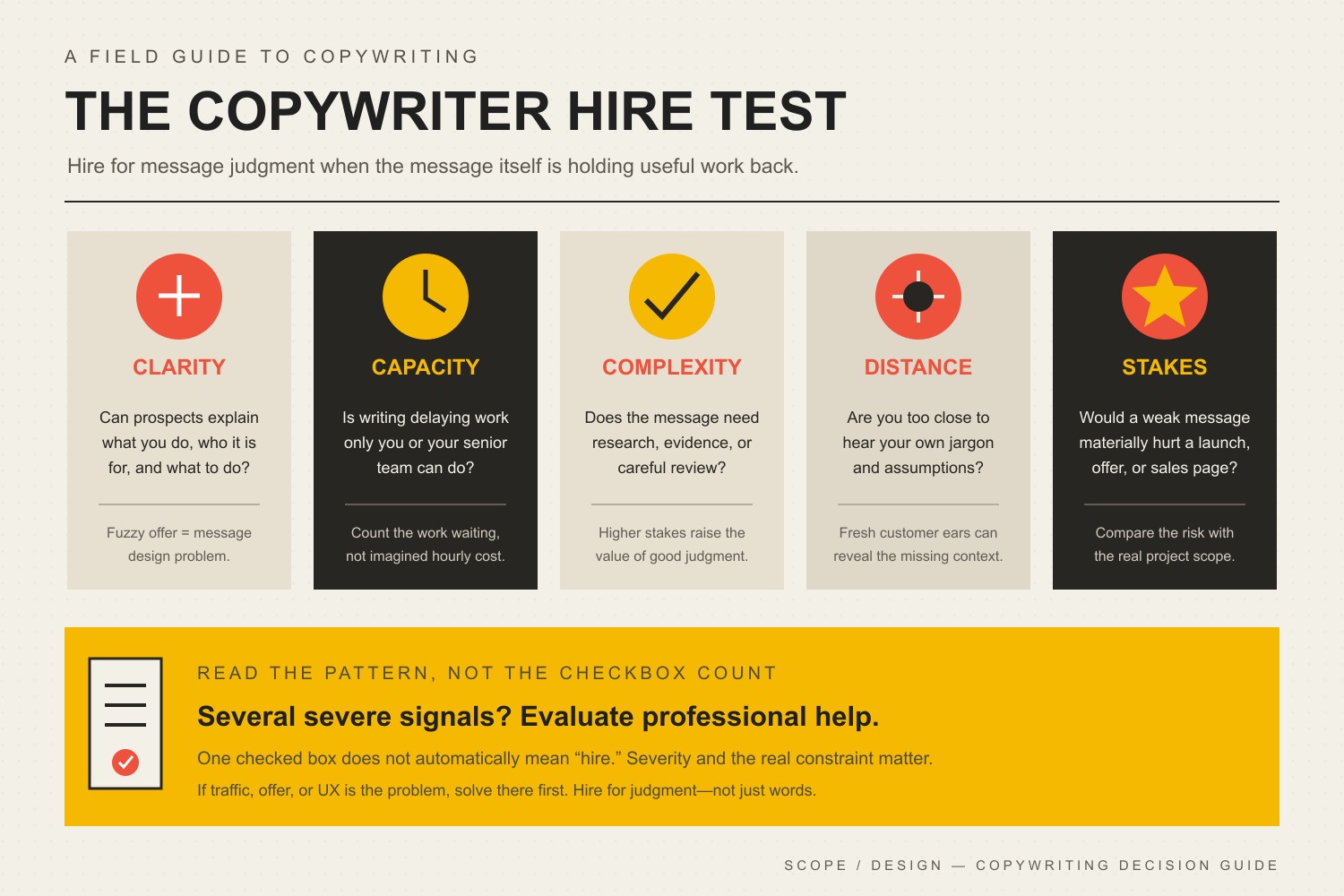
    Five signals for deciding whether to hire a copywriter: Clarity, Capacity, Complexity, Distance, and Stakes. Several severe signals strengthen the case, but a checked box alone does not mean hire.

    1. Clarity: people reach the message but still do not understand the offer

    Clarity problems often hide in plain sight. You know what the company does, so your brain automatically fills in missing context. A new prospect does not have that luxury.

    A simple test is to ask whether a good-fit prospect can answer four questions after a quick read: What is this? Is it for me? Why should I care? What should I do next? If those answers are fuzzy, the problem is not “we need more words.” It is a message-design problem.

    That is where a professional copywriter should start with research rather than adjectives. Customer questions, sales objections, support conversations, competitor language, and actual behavior on the site all provide better raw material than an internal brainstorming session. Current Digital.gov plain-language guidance makes the same audience-first point: learn what users ask and need, then focus the content on what applies to them.

    Hire when: different people on your team explain the offer differently, prospects keep asking basic questions the page should answer, or your copy lists features without creating a clear decision path.

    2. Capacity: writing has become a bottleneck for higher-value work

    Being capable of writing your own copy does not mean you should write every piece of it. The real cost of DIY is not an hourly rate pulled from a calculator. It is what important work stops while the owner, founder, subject-matter expert, or marketing lead goes through another round of “maybe this headline is better.”

    For a low-risk announcement or rough first draft, internal writing or AI may be completely reasonable. But if a website launch is waiting on copy for three weeks, five people are rewriting the same paragraph, or the person with the most valuable expertise is spending half a day fighting a blank page, capacity has become a business constraint.

    Hire when: copy repeatedly misses deadlines, senior people are trapped in revision loops, or getting the message finished is more valuable than proving you can write it yourself.

    3. Complexity: the message needs research, evidence, or careful review

    Some copy is hard because the sentence is hard. More often, it is hard because the business decision behind the sentence is hard.

    Complexity rises when you have a technical offer, several audiences, multiple stakeholders, competing priorities, or claims that need evidence. A copywriter can help translate approved facts into language people can understand, organize the message, and keep reviewers from turning the final page into a committee-written casserole.

    There is an important boundary here: a copywriter is not a substitute for legal, compliance, medical, financial, or other qualified subject-matter review. In the United States, the FTC’s advertising guidance for small businesses says advertising claims must be truthful and non-deceptive and that advertisers need evidence to support express and implied claims. The writer’s job is to make approved truth clear—not invent proof that does not exist.

    Hire when: the work requires interviews, source review, claim substantiation, technical translation, or someone who can keep a complicated review process focused on the reader.

    4. Distance: you are too close to the business to hear your own assumptions

    Business owners usually know too much, not too little. That creates a strange communication problem: you stop noticing what a first-time buyer cannot possibly know.

    Internal shorthand becomes website copy. Features feel self-explanatory. Company history gets more space than the customer’s problem. The page answers the questions your team finds interesting instead of the questions a buyer needs answered.

    A good outside copywriter is useful partly because they are allowed to ask the “obvious” questions: Who is this really for? What changes after they buy? Why should they believe you? What objection is stopping the next step? What does the customer call this problem when nobody from your company is in the room?

    Hire when: your copy sounds accurate to insiders but confusing, generic, or jargon-heavy to everyone else.

    5. Stakes: the downside of a weak message is materially bigger than the cost of getting help

    Not every paragraph deserves a strategy workshop. Your core website, a rebrand, a new offer, a high-value sales page, or a campaign sending meaningful traffic to one decision deserves more care than a routine update.

    High stakes change the economics. If the message will be seen by thousands of prospects, reused across sales materials, or become the language your whole team repeats for the next two years, a cheap first draft can become expensive through repetition. The more durable and consequential the message, the more valuable research, hierarchy, and review become.

    Hire when: the copy will define how the market understands the business, support a major investment in traffic, or sit close to an important buying decision.

    When not to hire a copywriter yet

    This is the part many copywriting pages skip because it is bad for the hard sell and good for the reader: sometimes copy is not the problem.

    What you seeLikely constraintWhat to do first
    Almost no qualified prospects reach the pageTraffic or distributionFix acquisition and targeting before rewriting everything.
    People understand the offer but do not want itOffer or market fitRevisit the product, positioning, price, proof, or audience.
    People want the offer but cannot complete the taskUX or functionalityFix navigation, forms, checkout, mobile issues, or broken flows.
    People arrive, engage, but leave confused about value or next stepMessagingNow copywriting is a credible place to intervene.

    This constraint-first approach is part of our broader small-business marketing strategy: fix the system that is actually limiting growth instead of buying the next fashionable tactic. Our related copywriting guide goes deeper on the message-friction questions to diagnose before you hire.

    AI or a professional copywriter? Split the job, not the ideology

    AI changed the economics of drafting. It did not make every part of copywriting equally automatable.

    TaskAI can helpHuman ownership matters most when…
    Brainstorming angles or headline variantsYesYou need to choose the angle that matches real customer evidence.
    Summarizing approved source materialYes, with verificationAccuracy or nuance is consequential.
    Drafting low-risk routine copyOftenThe draft will represent the brand in an important decision.
    Interviewing customers or subject-matter expertsAssist with prep and synthesisFollow-up questions and interpretation matter.
    Building message hierarchyAssistYou must decide what the reader needs to believe, in what order.
    Choosing and validating proofAssist with organizationClaims require evidence and accountable review.
    Brand-voice governance and final judgmentAssist with consistency checksThe message is durable, high-stakes, or shared across channels.

    Google’s current guidance for generative-AI search makes a useful quality distinction too: it recommends unique, non-commodity content that adds genuine point of view and usefulness, rather than material that simply recycles what a generative model could produce. In practical terms, AI is excellent at accelerating parts of the work. It is a poor excuse for skipping the thinking.

    Formulas can help structure a draft, and AI can generate variations quickly. Our guide to copywriting formulas explains where structure helps and where diagnosis still matters. Use tools. Just do not confuse the tool with the decision-maker.

    What should a professional copywriter do before writing?

    If the process starts with “send me the word count,” you are probably buying typing, not strategic copywriting.

    1. Understand the business and offer. What is being sold, to whom, and what business outcome should the page support?
    2. Learn the audience’s language. Review customer questions, objections, interviews, reviews, support tickets, search behavior, and sales conversations when available.
    3. Decide the job of the page. One page should not try to teach everything, sell everything, and satisfy every stakeholder equally.
    4. Build the message hierarchy. Decide what comes first, what needs proof, what objections need answers, and what can wait.
    5. Gather and validate proof. Testimonials, data, examples, product facts, demonstrations, guarantees, and other evidence should support the claims being made.
    6. Write the full decision path. Headlines, body copy, proof, microcopy, and calls to action should work together rather than as disconnected “clever” lines.
    7. Revise after feedback without losing the reader. Stakeholder comments matter, but the final page still needs one coherent voice and purpose.

    That process is also why project pricing varies so much. The words are the visible output; the research and decisions behind them are most of the job.

    How to hire a copywriter without buying a mystery box

    Portfolios matter, but a polished sample cannot tell you how the work was produced. Before you hire a copywriter, ask questions that expose the process.

    • What do you need from us before you start writing?
    • Will you interview customers, salespeople, founders, or subject-matter experts when the project needs it?
    • How do you identify the main audience, objection, promise, proof, and next step?
    • How do you handle technical or regulated claims and source material?
    • What exactly is included: research, strategy, page copy, SEO considerations, microcopy, revisions, handoff?
    • How many stakeholders can review, and how do you consolidate conflicting feedback?
    • How will you work with the designer, developer, SEO team, or campaign owner?
    • What will we use to judge whether the finished copy is doing its job?

    The strongest answer is usually a process, not a promise that the writer has a secret vocabulary that “converts.”

    How much does it cost to hire a copywriter?

    There is no honest universal rate that tells you what professional copywriting should cost. A five-email sequence with supplied research is a different job from repositioning a technical company, interviewing customers, and rewriting a multi-page website.

    Price usually changes with the depth of research, number and type of deliverables, interviews, strategy work, SEO requirements, evidence and source handling, number of reviewers, revision scope, and how much responsibility the writer owns. Comparing two quotes by “price per word” can make wildly different scopes look falsely equivalent.

    A better comparison is: What thinking, research, deliverables, and revision responsibility am I actually buying? If you want a deeper explanation of that value, see our guide to what a professional website copywriter should actually do.

    Frequently asked questions about hiring a copywriter

    Do people still hire copywriters?

    Yes. The valuable part of the role is shifting away from “someone who can produce words” and toward research, audience understanding, message hierarchy, evidence, brand judgment, editing, and accountability. AI reduces the cost of a first draft; it does not eliminate the need to decide what the message should say or why anyone should believe it.

    Can I use ChatGPT for copywriting?

    Yes. It is useful for brainstorming, outlines, summarizing source material, generating variants, and rough drafts. The higher the stakes, the more important it becomes to verify facts, protect confidential information, validate claims, preserve brand voice, and have a qualified person own the final judgment. Google’s broader people-first content guidance also makes the core point that usefulness, originality, expertise, and trust matter more than whether a tool happened to generate part of the text.

    What exactly does a copywriter do?

    A professional copywriter should do more than write sentences. Depending on the project, the work can include discovery, customer and competitor research, interviews, positioning, message hierarchy, page structure, headlines, body copy, proof, calls to action, microcopy, editing, and revision with stakeholders.

    Is hiring a copywriter worth it?

    It is worth serious consideration when messaging is a meaningful constraint, the project is difficult to produce internally, and the consequence of weak communication is material. If the real bottleneck is traffic, the offer, or broken UX, spend there first.

    What is the 80/20 rule in copywriting?

    People often use “80/20” as shorthand for the idea that a small number of elements—such as the offer, headline, proof, and call to action—can do a disproportionate share of the work. Treat it as a prioritization reminder, not a fixed measurement or guarantee. Which elements matter most depends on the page, audience, and decision.

    When should I not hire a copywriter?

    Do not hire one just because writing is annoying. If almost nobody qualified reaches the page, fix traffic. If buyers understand the offer and still do not want it, fix the offer. If the site is confusing or broken, fix UX. Bring in copywriting when the message itself is a credible reason the right people are not moving forward.

    The decision: hire for judgment, not just words

    The strongest reason to hire a copywriter is not that you dislike writing. It is that the business consequence of a weak message now justifies better research and better judgment.

    Run the five tests: Clarity, Capacity, Complexity, Distance, and Stakes. If several are flashing red, professional help is probably worth evaluating. If none are, keep the work in-house, use AI where it saves time, and spend the budget on the constraint that actually matters.

    If you want help figuring out which problem you have before paying someone to rewrite everything, talk with Scope Design. If copy is the constraint, we can help research, structure, and write it. If it is not, the first useful answer should be to say so.


  • 5 Benefits of Hiring A Professional Copywriter for Your Website

    5 Benefits of Hiring A Professional Copywriter for Your Website

    Hiring a professional copywriter can make your website easier to understand, easier to trust, and easier to act on. The real benefit is not “better words.” It is a clearer path between what your customer needs and what your business can do about it.

    That matters because a website has a job. It needs to explain the problem you solve, show why your approach makes sense, answer the questions standing in the way, and make the next step obvious. A good website copywriter helps turn those jobs into a message a real person can follow.

    Quick answer: a professional copywriter is most useful when the message—not traffic, the offer itself, or site functionality—is slowing a qualified visitor’s path to action. The five practical benefits are clearer positioning, more customer-centered copy, a more consistent brand voice, SEO-aware people-first writing, and clearer next steps.

    There is an important caveat: copy is not magic. If your real constraint is no traffic, a weak offer, a broken checkout, or a slow site, rewriting headlines alone will not fix the business. Professional copywriting is most valuable when unclear messaging is part of the friction.

    Is hiring a professional copywriter worth it?

    It can be—especially when your website is asking prospects to make a meaningful decision. A professional copywriter brings an outside perspective, a repeatable research process, message hierarchy, brand-voice discipline, and experience turning complicated ideas into clear next steps.

    You are not paying someone to sprinkle adjectives over a page. You are paying for the thinking behind the page: Who is this for? What are they trying to accomplish? What is getting in their way? What do they need to understand or believe before they contact you, book, subscribe, or buy?

    1. You get a clearer message before you get clever wording

    Business owners know their companies too well. That expertise is valuable, but it can also make it difficult to see where a new visitor gets lost. Internal shorthand, industry jargon, feature lists, and company history can crowd out the one thing the visitor needs first: a clear explanation of what you can help them do.

    A professional copywriter should pull the message apart before putting sentences together. That means identifying the audience, the problem, the desired outcome, the strongest proof, the objections, and the action the page needs to support. Once those decisions are clear, the writing gets much easier—and usually much shorter.

    This is where outside perspective earns its keep. A copywriter can ask the “obvious” questions your team stopped asking years ago and spot gaps that are invisible from inside the business.

    2. Your website starts with the customer, not the company

    A common website problem is making the company the main character. The page opens with how long the business has existed, how passionate the team is, how many services it offers, and how proud everyone is of the work.

    Those details can matter, but only after the visitor understands why they should care. Strong website copy keeps the customer in the hero role. Your business is the guide: you understand the problem, you have a credible way forward, and you can help the customer reach the outcome they want.

    That shift changes the questions the page answers. Instead of “What do we want to say about ourselves?” the copywriter asks “What does the customer need to know next?” That is a much better organizing principle for a home page, service page, landing page, or sales page.

    3. Your brand sounds consistent from page to page

    Brand voice is not a collection of quirky phrases. It is a consistent way of communicating—how direct you are, how technical you get, how much personality you use, which words fit the brand, and which ones do not.

    Without that discipline, websites often sound like several different companies stitched together. The home page was written by the founder, the service pages by a freelancer, the about page by an employee, and the newest landing page by an AI tool. Each page may be acceptable on its own, but the experience feels uneven.

    A professional copywriter can establish the voice and apply it consistently across the site. Just as important, a useful copy process leaves behind decisions your team can reuse in future emails, proposals, ads, social posts, and sales materials.

    4. SEO and human-readable copy can support each other

    Search optimization and good writing are not competing goals. Google’s guidance emphasizes helpful, reliable, people-first content. That is a useful standard for website copy, too.

    An SEO-aware website copywriter can use search research to understand the language customers use, the questions they ask, and the intent behind a page—then work those ideas into useful copy naturally. The goal is not to repeat a keyword until the page sounds robotic. The goal is to make the page clearer to the person who searched and easier for a search engine to understand.

    That also means knowing when SEO is not the main job. A checkout confirmation page, a short lead form, or a highly targeted campaign landing page may have different priorities than an evergreen service page. Good copy starts with the page’s role instead of forcing the same formula everywhere.

    5. Every page gives visitors a clearer next step

    A website can be informative and still fail to move anyone forward. Visitors finish reading and think, “Okay… now what?” That is often a messaging problem, not a design problem.

    A copywriter should connect the promise of the page to a logical next action. That might be booking a consultation, requesting an estimate, choosing a plan, viewing a case study, subscribing, or buying. The call to action does not have to be loud. It does have to make sense.

    Clear calls to action work best when the rest of the page has done its job: the visitor understands the offer, sees how it connects to their situation, has enough proof to continue, and knows what will happen after the click.

    What should a professional website copywriter actually do?

    A website copywriter’s process should match the stakes and scope of the project, but useful work usually includes more than drafting.

    • Learning about the business, offer, audience, and goals.
    • Reviewing customer language, common objections, competitors, analytics, or sales conversations when those inputs are available.
    • Deciding what job each page needs to do and what information belongs there.
    • Building a message hierarchy so the most important ideas appear in the right order.
    • Writing headlines, body copy, proof, microcopy, and calls to action.
    • Using natural search language when SEO is part of the page’s job.
    • Revising after stakeholder feedback without losing the customer’s perspective.

    If you want to see how Scope approaches that work, our copywriting services cover website copy, landing pages, SEO-aware content, email, product copy, and related messaging.

    When copywriting is not the first problem to fix

    It is possible to have excellent copy on a website that still underperforms. If nobody is reaching the site, traffic may be the constraint. If people understand the offer but do not want it, positioning or the offer itself may be the problem. If interested buyers hit errors, confusing forms, or painfully slow pages, functionality and UX may come first.

    Use the Message Friction Test

    Before you hire a copywriter, ask one question: What is stopping the right visitor from taking the next step? Scope’s Message Friction Test separates four common bottlenecks so copy does not get blamed for the wrong problem.

    What you observeLikely constraintFirst move to investigate
    Qualified prospects are not reaching the page.Traffic or distributionAcquisition channels, targeting, discoverability, or demand.
    Visitors arrive but cannot quickly explain the offer, why it matters, or what to do next.Message clarity or positioningCopywriting, message hierarchy, proof, and calls to action.
    Visitors understand the offer but still do not want it.Offer or market positioningValue proposition, audience fit, proof, pricing, or the offer itself.
    Visitors want to continue but errors, slow pages, forms, or checkout get in the way.UX or functionalityFix the technical path before polishing the message around it.

    This is a diagnostic starting point, not a law of marketing. More than one constraint can exist at the same time. The goal is to find the first meaningful bottleneck instead of buying another tactic because it sounds useful. If the problem is broader than wording, start with our small business marketing strategy framework for diagnosing the system before buying more attention.

    If you are specifically trying to decide whether now is the right time to bring someone in, see our companion guide on five situations where hiring a professional copywriter makes sense.

    What to look for when hiring a copywriter

    Before you hire someone, ask questions that reveal how they think—not just how polished their portfolio looks.

    • How do you research an unfamiliar business or industry?
    • How do you get up to speed on the audience, offer, objections, proof, goals, and desired action?
    • How do you adapt to an existing brand voice?
    • How much SEO work do you include, and how do you avoid writing for an algorithm instead of a person?
    • What happens if your research suggests the page or offer needs a different approach than we assumed?
    • How does the revision process work?

    The answers should help you compare process, judgment, and scope—not just samples. A beautiful portfolio can show writing skill, but it cannot tell you whether the writer will ask the right questions for your business.

    Frequently asked questions about hiring a website copywriter

    What does a website copywriter do?

    A website copywriter researches the audience and offer, decides what each page needs to communicate, organizes the message, and writes the headlines, body copy, proof, microcopy, and calls to action that help a visitor make the next decision. Depending on the project, the work may also include interviews, competitor review, search research, voice guidelines, and revisions with stakeholders.

    Can a copywriter help with SEO?

    Yes, when search is part of the page’s job. An SEO-aware copywriter can use keyword and intent research to understand how people describe a problem and what they expect from the page. That can improve relevance and clarity, but no responsible copywriter can guarantee rankings, traffic, or leads from wording alone.

    How much does website copywriting cost?

    There is no useful universal price for website copywriting. Cost changes with research depth, the number and complexity of pages, interviews, strategy, SEO scope, revision rounds, and the number of stakeholders involved. Compare what the writer will actually research, decide, draft, and revise rather than relying on a generic per-word number.

    Should I use AI for website copy or hire a professional copywriter?

    AI can be useful for brainstorming, summarizing source material, exploring variants, and speeding up low-risk drafting when the inputs are good. A professional copywriter adds interviewing, prioritization, message hierarchy, brand-voice governance, editorial judgment, and accountability for the page’s job. The useful question is not “human or AI?” in the abstract. It is which parts of the work require research, judgment, and ownership—and where automation genuinely helps.

    When should I hire a professional copywriter?

    Hire one when unclear messaging is a meaningful constraint: prospects struggle to understand the offer, the site sounds inconsistent, important objections go unanswered, or pages do not lead naturally to a next step. If the first problem is traffic, the offer itself, or a broken user experience, fix or diagnose that constraint before assuming new copy is the answer.

    The bottom line

    The best reason to hire a professional copywriter is not that you dislike writing. It is that your website’s message has business consequences. Visitors need to understand what you do, why it matters to them, why they should believe you, and what to do next.

    When messaging is the constraint, professional copywriting can bring structure to that decision. It gives your website a clearer job, gives your brand a more consistent voice, and gives the customer a better path forward.

    If your website looks fine but the message still feels muddy, Scope Design can help diagnose whether copy is actually the problem—and, if it is, turn the strategy into words that do some work.

  • Using Marketing Tactics in Tandem with A Solid Strategy

    Using Marketing Tactics in Tandem with A Solid Strategy

    Marketing strategy and tactics work together only when strategy decides what must change, for whom, and why, while tactics handle the specific actions and channels used to make it happen. Each tactic needs a defined job, a clear handoff to the next step, and measurement tied to a business outcome.

    Most small businesses do not have a shortage of marketing tactics. They have a shortage of reasons for choosing them.

    SEO, paid search, social media, email, direct mail, events, video, referral programs, and automation can all work. They can also become an expensive collection of chores when nobody can explain what business problem each tactic is supposed to solve, what should happen next, or how success will be judged.

    That is the point of using marketing tactics with strategy: fewer disconnected activities, clearer decisions, and a system that can tell you what to keep, change, or stop.

    TL;DR: Start with the business objective and the constraint blocking it. Clarify positioning and strategy before choosing tactics. Give each tactic one primary job, define its handoff, and judge the system by business outcomes before platform metrics.

    Marketing strategy vs. tactics: the practical difference

    The distinction is simple enough to memorize and easy enough to ignore.

    LayerQuestion it answersExample
    Business objectiveWhat outcome must improve?Increase qualified sales conversations from established regional manufacturers.
    StrategyHow will we create that outcome, and what will we deliberately prioritize?Win high-intent buyers by making specialized expertise easier to find and easier to trust.
    TacticsWhat specific actions will execute the strategy?Search content, paid search, case studies, a focused service page, and follow-up email.
    MeasurementHow will we know whether the system is working?Qualified conversations and pipeline, with channel and handoff metrics used to diagnose performance.

    The U.S. Chamber of Commerce’s small-business planning guidance makes a similar distinction: strategy sets direction, goals define measurable outcomes, and tactics are the actions tied to those goals and metrics. That hierarchy matters because a tactic can be executed perfectly and still be the wrong move.

    A beautiful landing page cannot rescue an offer people do not want. More traffic cannot repair a sales team that never follows up. Posting every day on social media does not solve a discoverability problem if the buyers who matter are searching elsewhere. The tactic may be fine. The diagnosis may be wrong.

    The Scope Design strategy-to-tactics sequence

    Scope Design uses a constraint-first sequence when deciding what marketing work deserves attention:

    Objective → Constraint → Positioning → Strategy → Tactics → Measurement

    1. Objective: Define the business outcome you actually need.
    2. Constraint: Identify the most important thing currently preventing that outcome.
    3. Positioning: Decide what the right buyer must understand or believe for progress to become possible.
    4. Strategy: Choose the approach that addresses the constraint and creates the required change.
    5. Tactics: Select the channels, campaigns, assets, and actions justified by the strategy.
    6. Measurement: Test whether the system moved the objective, then use supporting metrics to find where it worked or failed.

    The operating rule behind the sequence is even shorter: a requested tactic is evidence, not a diagnosis.

    When someone says, “We need Facebook ads,” “We need more SEO,” or “We need a newsletter,” that tells you what solution they currently have in mind. It does not prove that the solution matches the constraint. The broader small business marketing strategy should establish the system first. Tactics plug into it after the bottleneck is understood.

    Step 1: Diagnose the constraint before choosing a tactic

    Start with the business outcome, then ask what is preventing it. That one change in order eliminates a lot of “shiny object” marketing.

    What you observePossible constraintWhat it means for tactics
    The right prospects rarely find you.Awareness, discoverability, targeting, or distributionSEO, paid search, partnerships, local visibility, or outbound may deserve investigation.
    Relevant traffic arrives but few qualified people take the next step.Message, offer, proof, page experience, or conversion pathBuying more traffic may simply send more people into the same leak.
    Qualified leads arrive but do not become opportunities.Qualification, response time, sales handoff, or follow-upCRM routing, sales process, nurture, or booking improvements may matter more than lead generation.
    Customers buy once and disappear.Retention, lifecycle communication, service experience, or lack of a next offerEmail, account outreach, customer education, reminders, or loyalty work may be more useful than acquisition.

    More than one constraint can exist. The goal is not to pretend the business has one problem forever. It is to identify the first meaningful bottleneck well enough that your next marketing dollar has a reason behind it.

    Step 2: Give every tactic one primary job

    Once the constraint is clear, assign each tactic a primary job inside the campaign. A channel does not have one universal purpose. Its job depends on the objective and the buyer’s moment.

    • Search can capture existing intent from people already looking for an answer, product, or provider.
    • Educational content can reduce uncertainty, answer comparison questions, and give sales teams something useful to send.
    • Paid media can create controlled access to an audience, test a message, or scale a path that already works.
    • Email can nurture a lead, reactivate a customer, support onboarding, or trigger a timely next step.
    • Social media can distribute ideas, create familiarity, surface proof, or keep a brand present in a community.
    • Local and offline activity can build geographic awareness, credibility, referrals, and reasons for people to search for the brand later.

    The same email tool can support lead nurture in one campaign and customer retention in another. The tactic is not the strategy. The job you assign it is what gives it meaning.

    If you need the larger operating model for websites, search, content, email, social, paid media, analytics, sales, and lifecycle work, Scope Design’s digital marketing strategy guide goes deeper into assigning distinct channel roles without turning the stack into a tool pile.

    Step 3: Design the handoff between tactics

    Tactics begin to work in tandem when the output of one becomes a sensible input to the next.

    A handoff does not need to be complicated automation. It needs a clear next step and an owner.

    • Search ad → focused landing page → qualified booking → confirmation → sales response.
    • Problem-solving article → useful worksheet → permission-based email sequence → relevant service page → consultation.
    • Community event → QR or tagged URL → location-specific page → inquiry or email signup → follow-up.
    • Completed purchase → onboarding message → educational content → service reminder → repeat purchase or renewal.

    For each handoff, write down four things: what triggers it, where the person goes, who or what owns the response, and what evidence tells you the handoff worked.

    That is often where “channel performance” problems are hiding. The ad generated the right click, but the landing page answered the wrong question. The form worked, but the notification went to an unmonitored inbox. The newsletter earned attention, but every link dumped readers on the homepage. The tactics existed. The path did not.

    Step 4: Measure the outcome, then diagnose the signal

    Do not confuse the easiest metric to collect with the result the business needed.

    Google Ads’ conversion-measurement documentation starts from a useful principle: the advertiser chooses the actions that are valuable to the business—such as a purchase, signup, or phone call—and then measures which campaigns and keywords drive those actions. Your broader marketing measurement should follow the same logic.

    Use two levels of measurement:

    1. Business outcome: the deepest result the marketing system can reasonably influence, such as qualified conversations, pipeline value, booked-and-attended appointments, repeat purchases, renewals, or revenue.
    2. Diagnostic signals: the metrics that help explain why the outcome moved or did not move, such as impression share, click-through rate, landing-page conversion, source-to-qualified rate, response time, email engagement, booking completion, or repeat-visit behavior.

    An impression can tell you whether something was seen. A click can tell you whether the message earned a response. Neither can tell you by itself whether the business acquired a good customer.

    Measurement should also produce a decision. Before a campaign launches, decide what evidence would make you keep, change, or stop a tactic. The threshold may depend on sales cycle, traffic, budget, seasonality, and sample size. There is no honest universal schedule that says every business must make the same decision after seven days or every strategy must be rebuilt every quarter.

    Three examples of marketing tactics working in tandem

    Example 1: Increase qualified inquiries

    Objective: Increase qualified sales conversations for a specialized service.

    Constraint: High-intent prospects exist, but they do not find enough relevant evidence or a clear path to start a conversation.

    • Paid search: capture high-intent demand now.
    • Service landing page: explain fit, scope, proof, and the next step.
    • Case study or decision article: reduce uncertainty for buyers who are not ready to contact sales immediately.
    • Email or CRM follow-up: continue the conversation when the buyer needs more time.

    Handoff: Search → service page → proof/decision content → qualified form or booking → sales response.

    Outcome: Qualified conversations and pipeline. Click-through rate, landing-page conversion, response time, and source-to-qualified rate are diagnostic signals—not the finish line.

    Example 2: Improve customer retention

    Objective: Increase repeat business from customers who already received value.

    Constraint: Customers do not remember the next service, do not know what else the business can help with, or receive no timely reason to return.

    • Customer email: deliver reminders and relevant education based on lifecycle timing.
    • Knowledge-base or FAQ content: answer common post-purchase questions and reduce uncertainty.
    • Account or service-team outreach: handle high-value situations that deserve a human conversation.
    • CRM trigger: surface the right customer when a renewal, maintenance interval, or follow-up condition is reached.

    Handoff: Customer event → reminder or education → relevant next offer → human outreach when needed.

    Outcome: Repeat purchase, renewal, retention, or expansion. Open rate is useful only when it helps diagnose whether the communication is reaching and engaging the customer. For deeper execution guidance, see Scope Design’s email newsletter strategy.

    Example 3: Build local awareness that can be measured

    Objective: Generate more first-time inquiries or visits from a defined service area.

    Constraint: The offer is credible and converts when people find it, but too few local buyers know the business exists.

    • Community sponsorship or event: create real-world visibility and association.
    • Organic social: extend the event, people, proof, and story beyond the room.
    • Location-specific page: give interested people a relevant destination instead of a generic homepage.
    • Branded or local search support: capture people who search after seeing the business elsewhere.

    Handoff: Offline exposure → QR code or tagged URL → relevant page → inquiry, call, booking, or email opt-in.

    Outcome: Qualified local inquiries, bookings, or store visits where they can be measured. Google’s GA4 manual-campaign documentation confirms that UTM parameters populate manual campaign dimensions, which makes tagged campaign links useful when you need to distinguish sources and mediums in analytics.

    Should you change the strategy, channel, campaign, or tactic?

    When results disappoint, do not immediately replace the most visible tactic. Diagnose the level at which the problem exists.

    • Change the strategy when the audience, positioning, offer, business constraint, or desired outcome is wrong.
    • Change the channel mix when the mechanism does not match the buyer’s moment, the usable signal is too weak, the economics cannot work, or the team cannot realistically operate the channel.
    • Change the campaign when the channel is appropriate but the audience, message, creative, offer, destination, sequence, or measurement is wrong.
    • Change the tactic when the larger decisions are sound and one specific execution element is demonstrably limiting results.

    This distinction matters because “the ads aren’t working” can describe four completely different problems. Scope Design’s guide to diagnosing why marketing isn’t working goes deeper into finding the bottleneck before buying another tactic.

    A five-question strategy-to-tactics worksheet

    Before you add another channel, campaign, or tool, answer these five questions in plain language:

    1. What business outcome are we trying to improve? Use a result the business actually cares about, not a platform metric.
    2. What evidence tells us what is preventing that outcome right now? Separate observation from assumption.
    3. What must the right buyer understand, believe, or be able to do for that constraint to loosen?
    4. Which tactics can we realistically operate, and what single primary job will each one have? Include the next handoff.
    5. What result will make us keep, change, or stop the approach? Name both the business outcome and the diagnostic signals you will use to explain it.

    If you cannot answer question two, you are probably not ready to choose a new tactic. If you cannot answer question four, you may be collecting channels rather than designing a marketing system. If you cannot answer question five, you have activity without a learning loop.

    Frequently asked questions about marketing strategy and tactics

    What is the difference between a marketing strategy and a marketing tactic?

    A marketing strategy defines the approach, priorities, audience, positioning, and tradeoffs used to achieve a business objective. A marketing tactic is a specific action, channel, campaign, or execution choice used to carry out that strategy. Strategy explains why this approach; tactics explain what you will do.

    Do all of my marketing channels need to work together?

    No. Coordination does not mean forcing every channel into every campaign. A channel belongs when it has a useful job, a realistic owner, and a sensible handoff. Sometimes one well-matched channel and a strong follow-up path are better than an “omnichannel” plan nobody can maintain.

    How many marketing tactics should a small business use?

    There is no universal number. Use as few as necessary to cover the important jobs in the customer path and no more than the team can operate well. Capacity, audience behavior, sales cycle, budget, and the constraint should determine the mix.

    Can the same tactic support different strategies?

    Yes. Email can nurture a lead, onboard a customer, generate a repeat purchase, or support a referral program. Paid search can capture demand for a core service or test whether a new offer resonates. Define the tactic’s job within the specific campaign so its performance can be interpreted correctly.

    How often should I review my marketing strategy?

    Review tactics when enough evidence exists to make a responsible decision and review strategy when the underlying objective, constraint, audience, positioning, economics, or market conditions materially change. Operational decisions usually happen more often than strategic changes, but a fixed weekly/monthly/quarterly schedule is not a substitute for sufficient evidence.

    What is the biggest warning sign that my tactics are disconnected?

    Ask someone to explain what business outcome each tactic supports, what happens after a person responds, and which result would cause the team to change course. If the answers are mostly platform metrics, vague awareness goals, or “because we should be doing it,” the tactics are probably operating without enough strategy.

    Stop adding tactics. Start designing the system.

    A solid marketing strategy does not make tactics less important. It makes them accountable. It gives every channel a reason to exist, every campaign a place in the customer path, and every metric a decision it is supposed to inform.

    If your marketing calendar is full but the answer to “what constraint is this removing?” is fuzzy, do not solve that confusion by buying another tool or channel. Start with the system. Review Scope Design’s small business marketing strategy framework, or talk with Scope Design about a marketing audit and a clearer path from attention to business outcomes.

    Sources and further reading

  • How to Find the Right Images for Your Facebook Ads

    How to Find the Right Images for Your Facebook Ads

    There is no universally “best” Facebook ad image. The right image is the one that makes this offer easier for this audience to recognize, understand, and act on—and gives you a clean hypothesis you can test. If your creative process starts with “What picture looks nice?”, you are already one step too late.

    For most Facebook ad images, start with three practical questions: What job must the visual do? Will the intended buyer recognize what it means without decoding a generic stock metaphor? And can you test the image without changing the offer, audience, copy, and objective at the same time?

    TL;DR: choose the image after you know the job

    • Make the offer visible. A product, result, process, person, proof point, or contrast is usually more useful than decorative “business” imagery.
    • Use one focal point. Meta’s own photo-ad guidance recommends keeping the visual clear rather than turning the image into a miniature flyer.
    • Design for placements. Feed creative commonly uses 1:1 or 4:5 framing; full-screen placements need their own vertical treatment. Preview crops before launch.
    • Check permission before performance. Stock licenses, photographer rights, customer/creator permission, trademarks, and AI-generated elements all deserve a real review.
    • Test one visual idea at a time. If you change the image, headline, audience, landing page, and offer together, you will not know what actually helped.

    If the bigger question is whether paid social is even the right channel for the job, start with our small-business marketing system and channel guide. This article stays narrower: choosing the image.

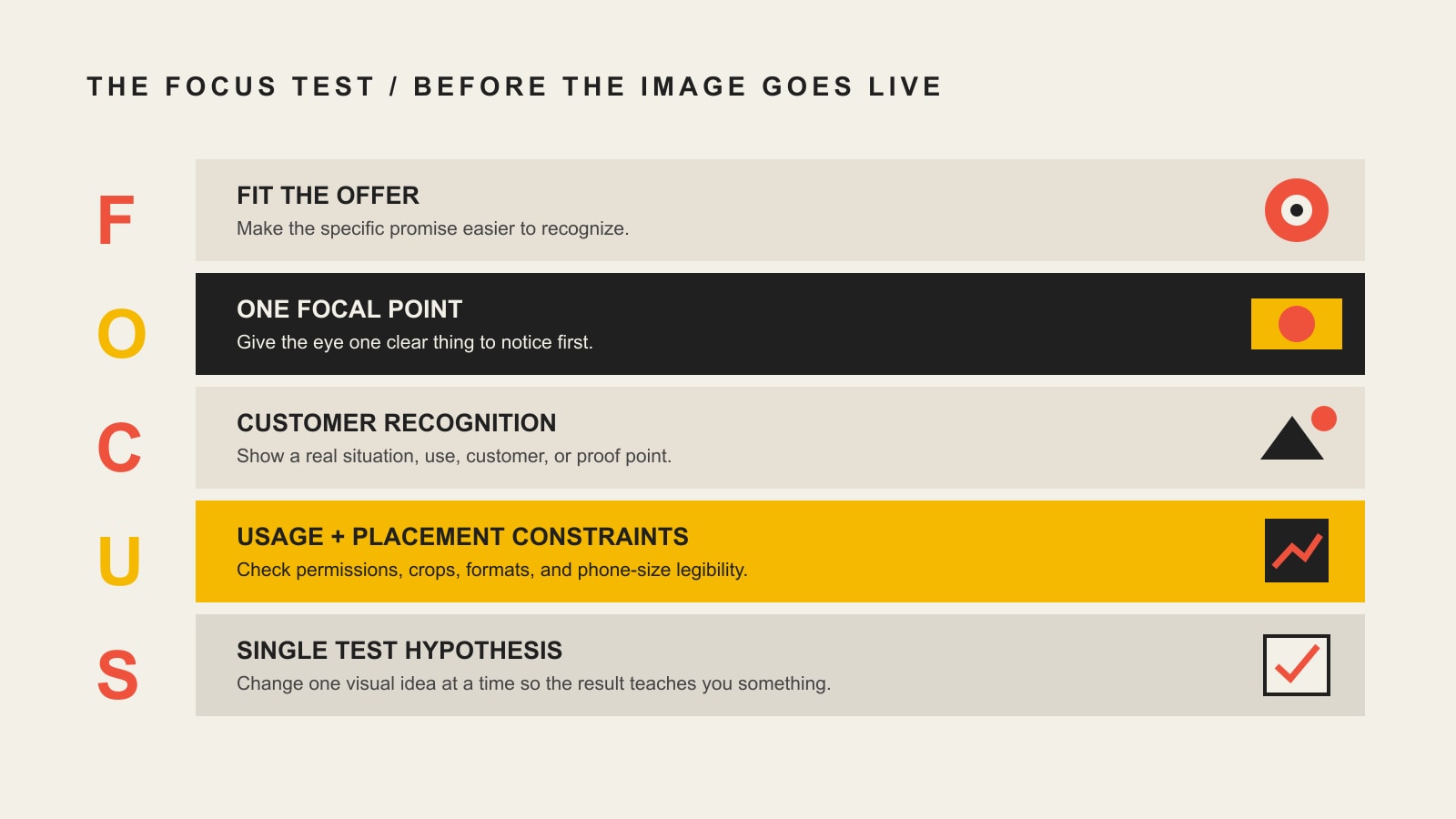
    How to choose Facebook ad images: the Scope Design FOCUS Test

    We use a simple five-part check to move image selection out of the “I like this one” zone. Before an image becomes paid creative, run it through FOCUS.

    F — Fit the offer

    Does the image make the specific product, service, promise, or outcome easier to understand? A roofing company advertising storm-damage inspections should probably show a roof, damage, an inspector, or the inspection outcome—not two people shaking hands in a glass office.

    O — One focal point

    At feed size, is there one obvious thing to notice first? Meta’s photo-ad guidance explicitly recommends a single focal point and advises advertisers not to cram too many competing things into one image. If the viewer needs a tour guide, simplify it.

    C — Customer recognition

    Can the intended buyer recognize their situation, aspiration, proof, product use, or problem? “Recognition” matters more than generic polish. A homeowner should be able to see a home problem. A manufacturer should be able to see the machine, process, part, or result. A professional-service buyer may need to see the person, environment, deliverable, or evidence that makes an intangible service concrete.

    U — Usage + placement constraints

    Do you have the right to use the asset in advertising? Does the important subject survive a square crop, a vertical crop, and the interface elements around the ad? Is any on-image text still legible on a phone? These are not glamorous questions, but they are the difference between “finished artwork” and usable campaign creative.

    S — Single test hypothesis

    What are you actually testing? “This version has a woman holding the product while that one shows the product by itself” is a testable visual hypothesis. “This one has a different image, offer, audience, headline, CTA, and landing page” is a different campaign wearing an A/B-test costume.

    The FOCUS Test: Fit the offer, One focal point, Customer recognition, Usage and placement constraints, and Single test hypothesis.

    Start with the job the image has to do

    Before choosing stock versus original photography—or debating whether an AI image looks “real enough”—decide what the visual is supposed to contribute to the ad.

    Image jobUseful visual directionsWhat can go wrong
    Show the productProduct hero, detail, scale, before/after state, product in contextBeautiful shot with no sense of why the product matters
    Show use or processCustomer using it, technician at work, behind-the-scenes step, hands-on demonstrationPosed “people at work” stock that does not resemble the real service
    Supply proofCustomer photo, result, review excerpt, recognizable deliverable, real projectPermission problems, unverifiable claims, tiny screenshots no one can read
    Make the problem or contrast visibleBroken vs. repaired, cluttered vs. organized, old vs. improved, confusing vs. clearManipulative fear imagery or a contrast the offer cannot honestly deliver
    Explain an ideaSimple graphic, diagram, comparison, one-number visual, branded illustrationTurning the ad into a dense infographic that requires zooming

    Meta’s current guidance also recommends making the product or service the focal point and, where it helps, showing people benefiting from the product. That is useful direction—not a guarantee. The correct image still depends on your offer and customer.

    Where to get Facebook ad images: original, stock, UGC, or AI

    Image source is a production decision, not a strategy. Original photography can be generic. Stock can be specific. User-generated content can feel forced. AI can be useful or spectacularly wrong. Choose the job first, then choose the source that can do it credibly and legally at the pace your campaign needs.

    Original photography and graphics

    Use original assets when the real product, team, location, process, or customer context is part of the value. You do not necessarily need a giant commercial shoot. A planned half-day can produce a useful library of product-in-use shots, people, details, horizontal and vertical compositions, negative space for occasional text, and multiple crops for testing.

    Professional production earns its keep when premium positioning, technical accuracy, controlled lighting, consistency, or a long campaign life matters. The point is not “professional photos always perform better.” The point is having assets that accurately communicate the offer.

    Stock photography

    Stock is useful when speed and breadth matter more than documenting something only your business can show. The mistake is searching for abstractions such as “success,” “innovation,” or “teamwork” and settling for the first polished cliché.

    1. Search for the situation, not the marketing concept: “homeowner checking roof shingles” beats “home improvement success.”
    2. Match the real audience: age range, environment, clothing, tools, geography, product category, and level of formality.
    3. Avoid images that accidentally make promises your offer cannot support.
    4. Check the actual license for paid advertising and any restrictions around recognizable people, property, trademarks, or sensitive uses.

    The U.S. Copyright Office notes that photographs and other visual works can be protected by copyright and that using someone else’s work generally requires permission from the owner. “I found it on Google” is not a license.

    Customer, creator, and UGC-style imagery

    Customer or creator content can be especially useful when the ad needs proof or a believable product-in-use moment. But “user-generated” does not mean “free to reuse.” Get clear permission for advertising use, understand what the agreement covers, and be careful about implying endorsements or results that are not actually true.

    Also separate UGC as a look from actual customer evidence. A creator holding a product can be a production style; a real customer describing a real experience is proof. Those are different jobs.

    AI-generated or AI-assisted images

    AI can help with concept exploration, backgrounds, object cleanup, variations, illustration, and production speed. It can also hallucinate product details, logos, hands, interfaces, locations, people, or results that your business never delivered. Treat generated imagery like any other commercial asset: inspect it, verify it, document rights and source terms, and ask whether it changes what a reasonable customer would believe.

    There is also a current transparency consideration. Meta’s June 1, 2026 update on generative-AI ad transparency says “AI info” labeling can apply to ads created or significantly edited with Meta’s generative tools, and Meta is expanding detection and labeling toward third-party AI tools using industry-standard signals. Do not build your creative process around the assumption that AI involvement is invisible.

    Facebook ad image sizes: build for placements, not one magic dimension

    Image size is important, but it is a constraint—not the strategy. Meta’s current business guidance recommends mobile-friendly 1:1 or 4:5 framing for photos in feed contexts. A July 2026 spec refresh from Hootsuite, citing Meta’s Ads Guide, lists 1440×1440 for 1:1 feed images and 1440×1800 for 4:5 feed images, with JPG or PNG files up to 30 MB. Full-screen Stories-style creative uses a 9:16 canvas, commonly 1440×2560 in the same current spec sheet.

    Placement starting pointRatioPractical production note
    Facebook Feed — square1:1Versatile fallback; keep the focal point centered enough to survive related crops.
    Facebook Feed — vertical4:5Uses more mobile feed height; re-compose rather than simply stretching a square design.
    Full-screen Stories-style placement9:16Create a dedicated vertical version and keep key copy/subjects away from interface areas.

    Do not create one master image and assume automatic cropping will protect every important detail. Export deliberate variants, use the highest useful resolution, and preview the live placements. Meta changes products and specs over time, so confirm the current Meta Ads Guide before a large production batch.

    What about text on the image?

    The old “20% text rule” still haunts Facebook-ad advice long after it stopped being a useful universal policy shortcut. Current Meta guidance is simpler: keep the image clean, make text legible, and do not clutter the visual. Use on-image text when it makes the message faster to understand—not because you are trying to squeeze the entire landing page into a JPEG.

    Your image, primary copy, headline, and button need to act like one unit. If the next problem is wording the action itself, our guide to better CTA words and phrases goes deeper without relying on manipulative “magic words.”

    Use the Meta Ad Library for patterns, not proof

    The Meta Ad Library lets you search ads that are currently active across Meta products. That makes it useful for creative research. It does not tell you that an ad is profitable, that the image is the reason it is running, or that the same concept will work for your market.

    A better competitor-review process is to look for repeated patterns across several advertisers:

    1. Collect, do not copy. Save 15–30 relevant ads from competitors and adjacent categories.
    2. Label the visual job. Product, process/person, proof, problem/contrast, or explanation.
    3. Notice repeated structures. Is the product large? Are people present? Is there on-image text? Is the visual polished, documentary, screenshot-based, or creator-style?
    4. Turn patterns into hypotheses. “Three competitors show the service technician with the homeowner; we should test real technician/customer-context imagery against equipment-only creative.”
    5. Build your own execution. Use your offer, customers, proof, brand, and production—not a traced copy of someone else’s ad.

    This matters because tactics without a strategy are easy to imitate and hard to diagnose. Our article on using marketing tactics with a solid strategy covers that broader problem.

    How to test Facebook ad images without learning the wrong lesson

    The cleanest image test changes one meaningful visual idea while holding the rest of the campaign as stable as practical. You are not trying to prove that one color “wins Facebook.” You are trying to learn something useful about how your buyer responds to the way you present the offer.

    Good test: product-only vs. product-in-use

    Keep the product, offer, primary copy, headline, CTA, audience, optimization goal, and landing page stable. Change the visual from a clean product hero to the same product being used in the intended context. Now the result can teach you whether use-context helps this audience understand or want the offer.

    Bad test: “new creative” vs. “old creative”

    If “new creative” also has a different discount, landing page, audience, headline, CTA, campaign objective, and image, you have no clean answer about the image. You may still discover a better campaign, but do not tell yourself you proved that “lifestyle photography beats product photography.”

    Choose the metric that matches the business job

    CTR can tell you an image attracted clicks. It cannot tell you whether those clicks were qualified. If one image earns cheaper clicks but produces worse leads or fewer purchases, it may be generating curiosity instead of alignment.

    • For a lead-generation campaign, compare qualified lead cost or downstream lead quality—not only CTR.
    • For ecommerce, look at purchases, revenue, or contribution margin alongside click behavior.
    • For awareness, use the metrics appropriate to the campaign objective and do not retroactively pretend the campaign was built for direct-response conversion.
    • Watch frequency and performance trends, but avoid fixed “refresh every X days” rules that ignore audience size and spend.

    If the campaign is failing before the image test even matters—unclear offer, weak signal, wrong audience, bad objective, broken follow-up—see our guide to Facebook ad mistakes that kill ROI.

    Facebook ad image mistakes to avoid

    • Choosing by taste alone. “I like blue” is not a creative brief.
    • Using a generic metaphor instead of the offer. Handshakes, light bulbs, chess pieces, and mountains have committed enough marketing crimes.
    • Making the image do all the copy’s work. If the visual needs six text boxes, a disclaimer, three arrows, and a paragraph, simplify the message.
    • Ignoring crop behavior. The person, product, logo, or proof point disappears in another placement.
    • Using customer or creator content without documented permission. “They tagged us once” is not an advertising-use agreement.
    • Letting AI invent facts. Fake product details, fake UI, fake results, or fake people can create a trust problem before the campaign creates a lead.
    • Copying active competitor ads as if they were benchmarks. Ad Library visibility is not profitability evidence.
    • Declaring a visual winner from CTR alone. The image should help the campaign produce the outcome it was built to produce.

    Frequently asked questions about Facebook ad images

    What are the best Facebook ad images?

    The best Facebook ad image is the one that clearly supports the specific offer for the intended audience and performs better against the campaign’s real goal in a controlled test. Product images, people, proof, UGC, graphics, and stock can all work; none is a universal winner.

    What size should a Facebook ad image be?

    For feed creative, current Meta guidance supports 1:1 and 4:5 framing. A current July 2026 spec sheet citing Meta’s Ads Guide lists 1440×1440 for 1:1 and 1440×1800 for 4:5. If you are using full-screen Stories-style placements, create a dedicated 9:16 version rather than relying on an automatic crop. Always confirm the live Ads Guide before a large production run because platform specs can change.

    Are stock photos okay for Facebook ads?

    Yes—when the license allows paid advertising and the photo accurately fits the audience, situation, and offer. Stock becomes weak when it is merely decorative or so generic that it could advertise fifty unrelated businesses.

    Should I use people in Facebook ad images?

    Use people when they make the product use, service experience, customer identity, emotion, scale, or outcome easier to understand. Meta’s own photo guidance recommends showing people benefiting from a product when that fits the story. Do not add a smiling model just to check a box.

    Can I use AI-generated images in Facebook ads?

    AI-assisted images can be part of an ad-production workflow, but review them for factual accuracy, trademarks, product details, people, rights, and the impression they create. Meta is also expanding AI-transparency labeling for ads, including detection of some third-party AI-generated or edited content.

    How much text should be on a Facebook ad image?

    There is no useful reason to design around the old “20% rule” as if it were the current creative law. Meta’s present guidance is to keep images simple and uncluttered. Use only the on-image text that makes the idea faster to grasp, keep it readable at phone size, and let the surrounding ad copy do its job.

    How often should I change Facebook ad images?

    Change or expand creative when the data gives you a reason: performance deterioration, rising frequency, audience saturation, a new offer, a new placement, or a test question you need answered. A fixed calendar rule can make you replace good creative too early or leave stale creative running too long.

    The image is part of the argument, not decoration

    The strongest Facebook ad images do not need to win a beauty contest. They need to make the offer easier to recognize, keep the viewer oriented around one idea, survive the practical constraints of paid placements, and give the campaign a clean learning loop.

    Use the FOCUS Test before you approve creative: Fit the offer. One focal point. Customer recognition. Usage + placement constraints. Single test hypothesis. Then let the campaign data—not a designer’s favorite, a competitor screenshot, or an unsupported internet percentage—tell you what deserves the next dollar.

    If the hard part is turning your offer into a repeatable creative and paid-media system, Scope Design can help connect the strategy, message, visuals, landing experience, and measurement instead of treating the ad image as an isolated trick.

  • Shareable Content: Give People Something Worth Forwarding

    Shareable Content: Give People Something Worth Forwarding

    Shareable content gives one person a credible reason to send something to someone specific. It helps the recipient understand, decide, avoid, feel, or do something useful. It also protects the sender’s reputation, because forwarding a piece of content is a tiny endorsement. If your only reason for wanting a share is “please give us free reach,” you do not have a shareability strategy. You have a digital panhandling problem.

    Scope Design TL;DR: Create for the handoff, not the algorithm. Name who would send the content, who should receive it, why the exchange helps both people, what makes the asset worth attaching a reputation to, and what useful next step follows. Then measure whether the share produced qualified attention or action. A big share count attached to the wrong audience is just a louder way to accomplish nothing.

    Shareable content belongs inside a complete content marketing system. It is not a substitute for positioning, original evidence, useful offers, distribution, or follow-up. Those little omissions are how a business gets a meme with a huge view count and absolutely no idea why the phone is still silent.

    What is shareable content?

    Shareable content is an article, video, graphic, tool, email, story, checklist, or other asset that gives someone a meaningful reason to pass it to another person. The transfer may happen through a public repost, a private message, an email, a team chat, a sales conversation, or a link dropped into a meeting note.

    The public share is only one version. For many small businesses, the most valuable handoff is private:

    • a manager sends a decision guide to the owner;
    • a customer texts a checklist to a friend;
    • a salesperson emails an article to the rest of a buying committee;
    • a client forwards a diagnostic to someone with the same problem;
    • an employee shares a process explanation with a prospect;
    • a partner includes a useful resource in a referral introduction.

    Those exchanges will not all produce a giant visible share counter. They may still be far more commercially useful than a burst of public attention from people who were never plausible customers.

    Shareable is not the same as viral

    Shareable content is deliberately designed to earn an interpersonal handoff. Viral content achieves unusually large or fast distribution, often through network effects that no creator fully controls.

    Something can be highly shareable inside a small, valuable community without going viral. A technical comparison forwarded among a handful of decision-makers may outperform a comedy clip seen by an enormous crowd of strangers. If the business needs broad distribution, our separate guide explains how to pursue virality without losing the plot. This article has a narrower job: make the individual handoff worth making.

    Shareable is not the same as repurposed

    Content repurposing changes a useful source asset for a different audience moment, channel, or decision. Shareability describes why one person would pass an asset to another. A repurposed checklist may become easier to share, but changing the format does not automatically make the idea worth forwarding.

    You can turn one weak article into a carousel, short video, email, and PDF. Congratulations. You now have weak content in a coordinated outfit.

    A share is a reputation handoff

    Every time someone forwards your content, they attach a little of their judgment to it. The recipient does not only evaluate the asset. They also make an inference about the sender:

    • This person understands my problem.
    • This person finds this funny.
    • This person believes this source.
    • This person wants me to know this.
    • This person thinks this reflects our values.
    • This person may be trying to sell me something.

    That is why a “Share this!” button cannot rescue content that is vague, embarrassing, dishonest, painfully promotional, or irrelevant. The button reduces mechanical friction. It does not create a reason for another human to put their name behind the thing.

    Research offers useful clues without producing a universal recipe. Berger and Milkman’s study of New York Times articles found that practical usefulness, surprise, interest, and high-arousal emotions were associated with greater transmission in that dataset. Their experiments also supported a causal role for arousal. That does not mean anger, awe, or anxiety is a magic share button on every platform. It means emotion and usefulness can affect whether people pass information along, and context still matters.

    Berger’s work also describes social currency, practical value, triggers, emotion, public observability, and stories as drivers of transmission. In a Penn interview about the research, he explains that people often share things that make them look informed, useful, or in the know.

    Scope Design’s practical translation is blunter: if sharing your content makes the sender look gullible, annoying, careless, or like an unpaid member of your sales team, the handoff is dead.

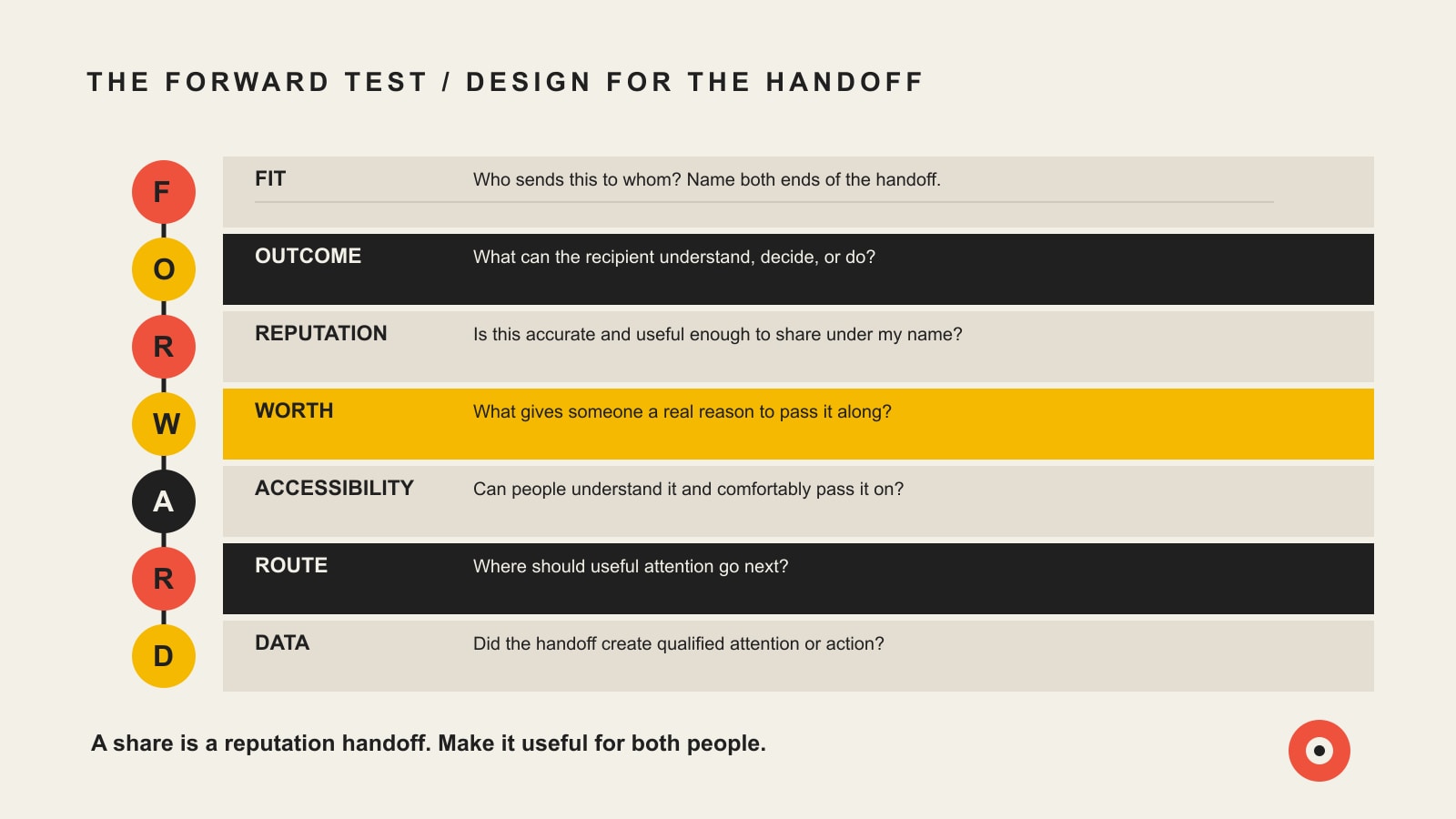
    The Scope Design FORWARD Test

    The FORWARD Test evaluates whether content deserves a handoff and whether that handoff can produce something useful for the business.

    The FORWARD Test checks Fit, Outcome, Reputation, Worth, Accessibility, Route, and Data for a useful content handoff.
    The Scope Design FORWARD Test for shareable content: Fit, Outcome, Reputation, Worth, Accessibility, Route, and Data.

    1. Fit: who sends this to whom?

    Name the sender, recipient, relationship, and moment. “Our audience will share it” is too vague to guide anything.

    Useful definitions sound like this:

    • A homeowner sends our pre-hire checklist to a spouse before choosing a contractor.
    • A marketing manager sends our comparison to the owner before requesting budget.
    • A current client sends our maintenance guide to a colleague whose website keeps breaking.
    • A parent sends our event schedule to another parent deciding what to do Saturday.
    • A salesperson sends our implementation article to a technical reviewer after the first call.

    Fit prevents a business from confusing large audiences with relevant networks. It also determines tone. A founder forwarding something to a board member needs a different artifact than a friend sending a joke in a group chat.

    2. Outcome: what should the recipient gain?

    Define what becomes easier after the handoff. The recipient might understand a risk, compare options, complete a task, avoid a mistake, articulate a frustration, laugh at a shared experience, or start a more informed conversation.

    The outcome must belong to the recipient before it belongs to the brand. “They become aware of us” is a company wish, not an audience benefit. A better outcome is “They can identify the five warning signs of a weak website proposal and know what to ask next.” Brand awareness can follow because the business supplied the useful thinking.

    3. Reputation: is it safe to attach a name to this?

    Ask what sharing the asset says about the sender. Does it make them look helpful, perceptive, funny, prepared, generous, credible, or aligned with the recipient’s values? Or does it make them look like they fell for a loud headline attached to a steaming pile of nothing?

    Reputation safety requires:

    • a claim the sender can defend;
    • language appropriate to the relationship;
    • credible sourcing where facts matter;
    • no bait-and-switch between headline and substance;
    • no fabricated urgency, fake proof, or emotional manipulation;
    • enough context that the recipient will not misunderstand the point;
    • a brand presence that supports the idea without hijacking it.

    This does not require bland content. A sharp point of view can be highly shareable because it gives the sender language for something they already believe. The test is whether the position is earned, useful, and honest.

    4. Worth: what earns the handoff?

    The asset needs a real payload. That may be practical value, original evidence, a fresh explanation, a useful framework, a vivid demonstration, a well-told story, a genuinely funny observation, or an emotional truth the audience recognizes.

    Common worthwhile payloads include:

    • a checklist that reduces risk;
    • a comparison that clarifies a tradeoff;
    • a calculator that makes a hidden cost visible;
    • a diagram that explains a confusing process;
    • an example that makes an abstract lesson concrete;
    • a first-hand lesson competitors keep pretending is not true;
    • a customer story with permission, context, and honest boundaries;
    • a phrase that helps someone explain the problem internally;
    • a small delight that strengthens a real community connection.

    Generic advice does not become valuable because the graphic has rounded corners. “Know your audience,” “be authentic,” and “post consistently” are not insights. They are the decorative parsley of marketing content.

    Google’s people-first content guidance asks whether a page provides original information or analysis, substantial additional value, and something a reader would bookmark or share. That is a useful pre-publication standard even when Google is not the distribution channel.

    5. Accessibility: can people understand and pass it?

    The core idea should survive the handoff. A recipient may see the asset without the caption, previous post, campaign context, or helpful employee standing nearby.

    Make it easy to receive:

    • write a headline that states the real subject;
    • make the central idea self-contained;
    • use legible type and sufficient contrast;
    • caption video and provide transcripts where appropriate;
    • add descriptive alternative text to meaningful images;
    • avoid burying the conclusion beneath an autobiography nobody requested;
    • ensure the linked page works on a phone;
    • give files recognizable names and reasonable sizes;
    • check that a private recipient can open the destination without an account wall.

    Accessibility is not an extra polishing pass after the “real” creative work. It determines who can receive the idea at all. W3C’s guidance for accessible images and audio and video provides practical starting points.

    6. Route: where should useful attention go?

    A share can be valuable without an immediate click, but business content still needs an honest route. The next step may lead to a canonical article, a calculator, a product page, a consultation, an email subscription, a store visit, a reply, or simply the next useful decision.

    The route should match the recipient’s readiness. A stranger receiving a useful checklist may not be ready to “BOOK A CALL NOW!!!” in seventeen different buttons. They may be ready to read a deeper explanation or compare approaches. Someone who received a recommendation from a trusted colleague may be ready to contact the business immediately.

    This is where shareability connects to omnichannel marketing. The handoff should continue the customer journey instead of dropping a person into an unrelated homepage and wishing them luck.

    7. Data: did the handoff matter?

    Measure shares as evidence that people chose to distribute the content. Do not confuse that evidence with the final business result.

    Use a measurement chain:

    StageUseful signalsQuestion
    HandoffPublic shares, private sends where reported, email forwards, partner uses, sales-team usesDid anyone consider the asset worth passing along?
    ReceiptReferred visits, landing-page views, video completion, document opensDid recipients actually receive or consume it?
    EngagementUseful scroll depth, return visits, saves, replies, tool use, related-page visitsDid the asset help them investigate or act?
    Qualified actionRelevant signup, inquiry, booking, product view, estimate request, store visitDid the right person take a meaningful next step?
    Business effectQualified opportunity, sale, retention, reduced support work, faster decisionDid the handoff improve a business outcome?
    LearningSender, recipient, context, format, message, objectionWhat deserves another version, better distribution, or retirement?

    Google Analytics documents campaign URL measurement for identifying the campaigns, sources, media, and creative variants that refer traffic. UTMs help identify the route. They do not prove that one post single-handedly caused a sale, healed the funnel, and deserves its own awards dinner.

    Shareable content that also helps the business

    The most shared content is not automatically the most valuable content. Akpinar and Berger’s Valuable Virality research examined the difference between content that spreads and content that improves brand-related outcomes. In their studies, emotional appeals were more likely to be shared, while informative appeals strengthened brand evaluation and purchase intent. Emotional content performed better on both dimensions when the brand was integral to the narrative.

    That last part matters. If the story could belong to any company after swapping the logo, the attention may have little reason to return to you.

    Brand-integral does not mean interrupting a useful story every six seconds to yell the company name. It means the expertise, product, process, customer experience, or point of view is necessary to the value of the asset.

    For Scope Design, an article about the hidden operational systems beneath a website is brand-integral because that diagnostic work is what we actually do. A random dancing mascot with our logo in the corner might earn attention, but it teaches the audience nothing about why they should remember, trust, or hire us.

    Shareable content examples by business situation

    Formats are not universally shareable. The sender, recipient, and decision determine the useful container.

    Business situationSender to recipientShareable assetWhy it earns the handoffUseful next step
    Professional serviceInternal champion to ownerDecision checklist or risk comparisonHelps justify a considered purchaseRead the full approach or schedule discovery
    Local home serviceCustomer to neighborSeasonal warning-sign guideHelps someone avoid damage or a bad hireRequest an inspection or save the number
    B2B softwareUser to operations leaderWorkflow diagram and cost calculatorMakes an operational problem visibleRun the calculator or evaluate fit
    Retail or ecommerceCustomer to friendProduct-use demonstration or gift guideSolves a specific use or buying problemView the relevant product collection
    Nonprofit or community groupMember to local networkEvent explainer or action checklistMakes participation understandable and timelyRegister, attend, donate, or volunteer
    Existing customer programCustomer to colleagueHonest case story or implementation lessonTransfers proof from a credible peer contextReview the process or ask a technical question

    The best format is the one that carries the idea through the actual relationship. Stop crowning video, carousels, infographics, or memes as universal winners. A buyer who needs to convince a CFO may prefer a one-page comparison they can forward without apologizing for it.

    A practical shareable-content workflow

    Start with a real audience moment

    Collect recurring questions from sales, support, delivery, search, community conversations, and customer interviews. Look for moments when one person naturally needs to explain something to another.

    Useful prompts include:

    • What does the buyer need to show someone else before a decision can move?
    • What warning do customers repeatedly give friends after learning it the hard way?
    • What internal objection stalls an otherwise good opportunity?
    • What useful explanation does the sales team keep rewriting in email?
    • What tool, checklist, or visual would help a customer complete the job correctly?
    • What honest position does the audience wish someone in the industry would say clearly?

    Write the forwarding sentence first

    Before creating the asset, write the message you hope accompanies it:

    “You should read this because it explains why the cheap proposal is missing half the work.”

    “This is the checklist I mentioned for spotting the problem before it gets expensive.”

    “This says what we have been trying to explain to the team.”

    “This is painfully accurate and also useful.”

    If the imagined message is only “Thought you might like this,” the idea may still work, but the value is not yet sharp enough to guide production.

    Build one complete source asset

    Create a durable source with the full evidence, reasoning, limitations, examples, and next step. That may be an article, demonstration, research note, case study, or tool. It becomes the source of record for later derivatives.

    This protects accuracy and gives recipients somewhere deeper to go. It also makes later adaptation more efficient through the Scope Design RECAST workflow.

    Adapt the handoff, not just the dimensions

    The same idea may need a private email version, a public social version, a sales-enablement version, and a visual explanation. Change the opening, level of context, pace, evidence, and next step for each use.

    The ongoing channel decisions belong in a governed social media content strategy and a relationship-based small-business email system. Shareability is one operating requirement, not the boss of every channel.

    Test the handoff with real people

    Ask a few people from the intended audience:

    1. Who would you send this to, if anyone?
    2. What would you say when sending it?
    3. What does sharing it say about you?
    4. What is the main point after one pass?
    5. What would you do next?

    These questions expose more than “Do you like it?” People cheerfully like content they would never risk forwarding.

    Publish, distribute, and document the route

    Use consistent campaign tags, a known destination, and a named owner for follow-up. Tell the sales or service team the asset exists and when to use it. Shareable content hidden in a blog archive is a beautifully prepared referral tool nobody can find.

    Review the entire chain

    Compare handoffs, receipt, engagement, qualified action, and business effects. Identify patterns by sender, recipient, topic, and use case. Do not merely crown the post with the largest public share count and clone it until everybody is sick of you.

    What AI should and should not do

    AI can help extract repeated questions, identify possible sender-recipient pairs, generate format alternatives, summarize performance patterns, draft accessibility descriptions, and challenge whether the handoff logic is clear.

    AI should not invent the insight, customer story, statistic, controversy, or emotional stakes. It should not manufacture forty versions of an unproven idea because the scheduling tool has empty boxes. It should not flatten a sharp expert opinion into the verbal oatmeal most models produce when nobody is supervising.

    Use AI to support the workflow:

    • cluster real customer questions;
    • suggest forwarding sentences for human review;
    • identify missing context or evidence;
    • adapt an approved source for a specific destination;
    • compare outcomes across tagged variants;
    • flag claims that need verification;
    • run a final clarity and accessibility pass.

    Keep a human accountable for truth, usefulness, tone, permissions, and the business decision behind the asset.

    Shareability does not excuse bullshit.

    Do not fabricate customer stories, disguise employees as ordinary customers, purchase undisclosed praise, remove qualifications from a result, or ask partners to repeat claims the business cannot substantiate.

    The FTC’s Endorsement Guides guidance explains that endorsements must be honest and not misleading, and that material connections which could affect how people evaluate an endorsement should be disclosed clearly and conspicuously. The context matters, so treat specific legal questions as legal questions rather than improvising compliance from a marketing blog.

    Also protect the people and material inside the asset:

    • obtain permission for customer names, images, quotes, and identifiable stories;
    • preserve the context around results and unusual outcomes;
    • confirm rights for music, footage, photography, illustrations, and quotations;
    • make disclosures visible in the content where the audience will encounter them;
    • avoid emotional tactics that exploit vulnerable people;
    • provide an accessible equivalent when the chosen format creates a barrier.

    Trust travels with the handoff. Lose it once and the audience will become extremely efficient at not sharing the next thing.

    Common shareability mistakes

    Asking for shares before earning them

    “Like, comment, and share” is not a value proposition. A call to share can help once the content already creates a reason. Without that reason, it is a request for unpaid distribution work.

    Chasing emotion without business relevance

    An emotional story may spread while leaving the brand invisible or interchangeable. Connect the emotion to a truth, product, process, or perspective the business can legitimately own.

    Making the brand the only beneficiary

    People rarely forward an ad because the company would enjoy more reach. Give the recipient a payoff and the sender a credible reason to deliver it.

    Confusing provocation with courage

    Controversy can attract attention, but borrowed outrage is a flimsy content strategy. Take positions you can defend, that matter to your customers, and that connect to how the business actually operates.

    Optimizing the public feed while ignoring private sharing

    Screenshots of share counts miss email forwards, team chats, direct messages, sales uses, and referral conversations. Build tracking where practical, but also ask sales, support, partners, and customers how the asset travels.

    Measuring distribution without consequence

    A share is a handoff, not a sale. Track what happens next and decide whether the audience, route, offer, or follow-up needs work.

    Shareable content FAQ

    What makes content shareable?

    Content becomes shareable when a specific person has a credible reason to send it to someone else. It usually provides practical value, a useful insight, emotional resonance, identity relevance, or a story worth passing along. It must also be easy to understand and safe for the sender’s reputation.

    What are examples of shareable content?

    Examples include decision checklists, comparison tables, calculators, demonstrations, concise how-to guides, original research, customer stories with permission, diagrams, useful templates, relevant humor, event explainers, and well-supported points of view. The format only works when it fits the sender, recipient, and moment.

    What type of content is most shareable?

    There is no universal winning format. Practical, surprising, interesting, and emotionally activating content can be more likely to travel, but audience and context determine the useful container. A private one-page comparison may outperform a public video for a complex B2B decision.

    Why do people share content?

    People share to help others, express identity, strengthen relationships, participate in a community, evoke emotion, start a conversation, or signal what they know and value. The same person may have different motives in a work chat, family text, public feed, or customer referral.

    How do I make content more shareable?

    Name the sender and recipient, define the recipient’s benefit, protect the sender’s credibility, supply a worthwhile payload, remove access and comprehension barriers, create an honest next step, and track what happens after the handoff. Use the FORWARD Test before polishing the format.

    Does emotional content get shared more?

    Some research has found that high-arousal emotions can increase transmission in the studied contexts. That does not make emotion a universal hack. The emotion must fit the audience, message, brand, and ethical boundary, and a highly shared asset can still fail to help the business.

    Is controversial content more shareable?

    It can be, but attention from conflict may attract the wrong audience or damage trust. Publish a challenging position when it is true, relevant, useful, and connected to how the business works. Manufactured outrage is rented attention with an ugly security deposit.

    Should every business post be designed for shares?

    No. Some content should convert, educate, support customers, answer a narrow search question, document a process, or help sales close an objection. Shareability is one possible job. Making it the goal of every asset produces distorted content and terrible judgment.

    How is shareable content different from viral content?

    Shareable content earns an individual handoff. Viral content achieves unusually large or fast distribution. Something can be valuable and shareable inside a small relevant network without becoming viral, and something can go viral without producing a useful business outcome.

    Do social-sharing buttons increase shares?

    They can reduce mechanical friction, but they do not create motivation. Place sharing controls where they are useful, especially on mobile, but fix the idea, value, and trust problem before rearranging buttons.

    How many shares is a good result?

    The useful number depends on audience size, channel, intent, and downstream effect. Ten shares into ten qualified buying teams may be more valuable than ten thousand shares into an irrelevant audience. Compare the result with the asset’s stated job and the actions that followed.

    How should I track shared content?

    Use consistent UTM parameters for links you control, platform share and send data where available, referral traffic, landing-page behavior, qualified actions, CRM source notes, and sales or partner feedback. Treat attribution as evidence with limitations, not a bedtime story where one post heroically caused every later event.

    Can AI create shareable content?

    AI can help identify patterns, test angles, adapt formats, and improve clarity. It cannot supply first-hand expertise, honest emotion, customer permission, or a defensible point of view on its own. Without those inputs, AI usually scales generic content faster than humans can ignore it.

    Create something a person can forward without apologizing

    The practical test is not whether the business wants more shares. Every business wants more free attention. The test is whether one real person would spend a little credibility to put the asset in front of another real person.

    Build for that exchange. Make the recipient better informed. Make the sender look helpful rather than manipulated. Keep the brand integral to the value. Create a route that respects readiness. Measure the consequence.

    Do that consistently and shareable content becomes part of building real brand authority, not another frantic attempt to appease a platform.

    If your content calendar is full but nobody would forward the work to someone they respect, talk to Scope Design. We will help diagnose the audience, evidence, handoff, and business route before producing more extremely polished noise.

  • Google Ads Quality Score: Fix Relevance Without Worshipping the Number

    Google Ads Quality Score: Fix Relevance Without Worshipping the Number

    Google Ads Quality Score is a keyword-level diagnostic that compares the expected quality of your Search ads and landing pages with other advertisers. It uses a 1–10 score plus three component ratings: expected clickthrough rate, ad relevance, and landing-page experience.

    That is the useful answer. Here is the part many “ultimate guides” mangle: Quality Score is not your campaign goal, it is not a key performance indicator, and the visible 1–10 number is not an input in the ad auction. Google says all three of those things plainly. A better score can point toward a better search experience, but a beautiful 10/10 cannot rescue rotten economics, useless leads, broken tracking, or an offer nobody wants.

    Treat Quality Score like a smoke alarm. When it complains, investigate. Do not frame the smoke alarm, put it on the executive dashboard, and congratulate everyone while the kitchen burns.

    TL;DR: What should you do about Google Ads Quality Score?

    • Use Quality Score to identify a possible relevance problem, not to declare a campaign successful.
    • Examine the three component ratings before touching the overall 1–10 score.
    • Fix the weakest connection between search intent, keyword, ad promise, landing-page answer, and measured business action.
    • Compare Quality Score with conversion quality, cost per qualified outcome, search terms, and sales follow-through.
    • Do not assume a specific score creates a guaranteed CPC discount. Google makes no universal promise like that.
    • Leave a commercially successful keyword alone when the score is merely average and the underlying business results are strong.
    • Investigate a high-scoring keyword that produces junk leads. The platform diagnostic and the business outcome are answering different questions.

    What is Google Ads Quality Score?

    Quality Score is a diagnostic available for keywords in Google Search campaigns. Google calculates it on a scale from 1 to 10 using historical performance associated with exact searches for the keyword. A higher number means Google estimates that the ad and landing page are more relevant and useful to that search than those of other advertisers.

    The score is useful because “the campaign feels off” is not a diagnosis. Its component ratings can narrow the investigation to one of three areas:

    Quality Score componentWhat Google is estimatingWhat you should investigate
    Expected clickthrough rateHow likely the ad is to be clicked when shownSearch intent, offer clarity, ad usefulness, differentiation, and whether the query deserves the click
    Ad relevanceHow closely the ad matches the intent behind the searchSearch terms, keyword grouping, ad language, intent changes, and mixed themes
    Landing-page experienceHow relevant and useful the destination is after the clickMessage match, usefulness, transparency, mobile usability, speed, accessibility, and action clarity

    Each component is reported as Above average, Average, or Below average. Google bases the comparison on advertisers whose ads appeared for the same exact search during the previous 90 days. The comparison is competitive and contextual, not a permanent grade tattooed onto your account.

    If the interface shows a dash instead of a score, Google says there may not have been enough searches that exactly match the keyword to calculate one. A missing score is not automatically a disaster. Sometimes the platform simply does not have enough evidence yet.

    What Quality Score is not

    Quality Score attracts nonsense because a tidy number feels easier to manage than a messy business. Let us remove several myths before they reproduce.

    Quality Score is not a KPI

    Google explicitly says Quality Score is not a key performance indicator and should not be optimized or aggregated with the rest of your data. Your business does not deposit Quality Score points at the bank. It needs profitable sales, qualified opportunities, useful calls, completed bookings, retained customers, or another outcome that survives contact with accounting.

    The number may help explain performance. It is not performance by itself.

    The 1–10 score is not an auction input

    The visible score is not plugged into the live auction as a neat multiplier. Ad Rank is calculated at auction time using the bid, auction-time assessments of ad and landing-page quality, Ad Rank thresholds, competition, search context, and the expected impact of assets and formats.

    Quality Score summarizes related ideas for diagnosis. Ad Rank uses current auction signals. They are cousins, not twins wearing the same name tag.

    Quality Score does not guarantee conversions

    Google can evaluate relevance without knowing whether a lead is profitable, whether the caller is qualified, whether the sales team responds, or whether the customer stays. If the conversion event is weak or the business never sends useful downstream data back to the advertising system, Google may optimize toward behavior that looks productive and creates operational garbage.

    A relevant ad for the wrong offer is still the wrong offer.

    Quality Score does not come with a universal CPC discount table

    Higher ad quality can often contribute to better Ad Rank and lower CPCs. Google says as much. But the familiar charts claiming that a score of 10 always earns a 50% discount or a score of 2 always creates a fixed penalty are not current Google guarantees.

    Actual CPC depends on the auction, competition, bid strategy, context, thresholds, quality signals, and other factors. Anyone promising exact savings from a score change without seeing the account is selling numerology with a dashboard.

    The Scope Design Relevance Chain

    Five linked stages: search intent, keyword or theme, ad promise, landing page answer, and measured business action, with a potential mismatch highlighted for diagnosis.

    Quality Score becomes much more useful when it is connected to the entire customer path. We use a five-part diagnostic called the Scope Design Relevance Chain:

    1. Search intent: What is the person actually trying to accomplish?
    2. Keyword or theme: What targeting decision allowed the business to enter that search?
    3. Ad promise: What did the ad lead the person to expect?
    4. Landing-page answer: Did the destination satisfy that expectation and help the person decide?
    5. Measured business action: Did the resulting action have commercial value?

    The first four stages closely affect the experience Google can observe. The fifth protects the business from celebrating activity that does not matter.

    This chain also prevents the usual silo fight. The media buyer blames the landing page. The designer blames targeting. The copywriter blames the offer. Sales blames lead quality. Everyone may be partially right, which is why changing one headline and announcing an optimization victory is a bit premature.

    Trace one real search from query to outcome. Find the first broken promise. Fix that before launching another redesign, bidding experiment, or twelve-tab reporting ritual.

    Diagnose the component before prescribing the fix

    Do not attack every setting because the overall score looks emotionally disappointing. Add the current and historical component columns, identify where the rating is weak, and check the business evidence beside it.

    Diagnostic patternLikely investigationBad reflex
    Below-average expected CTR; relevance and landing page are healthyOffer presentation, ad usefulness, differentiation, asset coverage, and whether the keyword deserves attentionStuff the keyword into every headline until the ad reads like a malfunctioning robot
    Below-average ad relevance; other components are healthyMixed search intent, loose themes, query drift, or ad language that does not match the searchCreate hundreds of microscopic ad groups without enough data or operational value
    Below-average landing-page experienceMessage mismatch, thin answers, poor mobile experience, intrusive friction, speed, trust, or accessibilityRemove navigation, forms, and useful detail merely to make the page look “clean”
    High Quality Score; poor lead qualityTargeting, offer, conversion definition, qualification, or sales processKeep spending because the platform gave you a lovely number
    Average Quality Score; strong qualified economicsMonitor and look for material opportunitiesRebuild a profitable path to chase cosmetic perfection
    No Quality ScoreLow exact-search volume or insufficient historyPanic, duplicate campaigns, or make daily changes that prevent learning

    How to improve expected clickthrough rate

    Expected CTR estimates whether people are likely to click the ad when it appears. It is not simply your raw account CTR, and a click is not automatically good. A sensational ad can attract the wrong people with great enthusiasm.

    Start with the search terms, not the ad-writing screen. Ask:

    • Does this query reflect a problem, product, comparison, location, or buying stage we actually serve?
    • Is the person looking for information while the ad demands a sales call?
    • Is the query ambiguous enough to represent several incompatible intentions?
    • Does the offer provide a credible reason to choose this result now?
    • Does the ad reveal enough to repel obvious bad fits?

    Then write ads that are specific enough to be useful. Match the searcher’s language where it remains accurate. State the result or category plainly. Add a differentiator you can prove. Include the next step without manufacturing panic. Use assets when they genuinely help people reach relevant pages or understand the offer.

    Do not use fake scarcity, empty superlatives, or promises the landing page cannot support. You might win the click and lose the customer’s trust one second later. That is not a conversion strategy. It is borrowing attention at predatory interest.

    Google’s own guidance recommends making the offer more compelling and ensuring the ad details match keyword intent. That is refreshingly sensible. The work is not “increase CTR at any cost.” The work is “earn the right click from the right person.”

    How to improve ad relevance

    Ad relevance asks whether the ad matches the intent behind the search. The important word is intent, not merely keyword.

    Someone searching “what does CRM implementation cost” is not asking for the same experience as someone searching “hire CRM implementation consultant.” Both may contain the same product category. One is evaluating cost; the other may be selecting help. Sending both to a vague “transform your business” ad wastes the information the searches already gave you.

    Review the actual search terms that triggered ads. Separate distinct intentions when doing so gives you enough control to create a materially better message and destination. Google recommends splitting ad groups when different keywords need ads that better match the searches, but do not turn account structure into competitive origami. More ad groups are useful only when the separation changes the message, page, offer, measurement, or decision.

    Look for:

    • keywords collecting unrelated search terms;
    • brand, comparison, problem, and purchase searches forced through one ad;
    • locations or services the business does not serve;
    • informational queries sent to a hard-sell destination;
    • ads that repeat a keyword but never answer why the person should care;
    • negative keywords blocking useful intent or failing to block obvious waste.

    The goal is coherent intent, not an account that wins a prize for having the most folders.

    How to improve landing-page experience

    The landing page must keep the promise made by the search and ad. If the ad says “commercial roof repair pricing” and the page opens with “Welcome to our family,” the visitor has been mugged by irrelevant hospitality.

    Google recommends matching the landing page to user searches, keeping the message consistent from ad to page, and making the destination useful. Our Landing Page Intent Contract expands that into five practical checks: known arrival, matched promise, relevant proof, appropriate action, and operational follow-through.

    Audit the destination for:

    Message match

    The opening should confirm that the visitor reached the right place. Use the same problem, service, product, location, or comparison language the ad promised. Do not require people to translate brand poetry before finding the answer.

    Useful decision content

    Answer the questions that matter for the level of commitment: fit, process, cost factors, timing, tradeoffs, evidence, risks, and next steps. Short copy is not automatically better. Complex and expensive decisions often require depth. The page should be as long as necessary and no longer than useful.

    Credible proof

    Place specific proof near the claim it supports. A testimonial page hidden in the navigation cannot rescue an unsupported promise beside the form. Use documented examples, relevant credentials, transparent explanations, and real limitations. Avoid invented counters, decorative logos, and testimonials that say little beyond “great job.”

    Mobile usability, performance, and accessibility

    Test the actual task on a phone. Can a person read the text, dismiss overlays, use the navigation, understand errors, complete the form, and receive confirmation? Speed matters because a page that does not become usable cannot persuade anyone, but a perfect lab score does not compensate for incoherent content.

    Appropriate action

    The requested commitment should fit the searcher’s stage and the business model. A low-risk product may justify immediate checkout. A complicated service may need an assessment, consultation, pricing explanation, or qualification form. Removing every field can increase submissions and drown sales in junk. Friction should clarify and qualify, not punish.

    Does Quality Score affect CPC and Ad Rank?

    The careful answer is: the visible Quality Score does not directly enter the auction, but the underlying quality concepts matter.

    Google explains that Ad Rank uses auction-time quality assessments, including expected CTR, ad relevance, and landing-page experience among other signals. Better-quality ads can often qualify for lower CPCs, stronger eligibility, and more useful ad formats. The auction also considers the bid, thresholds, competition, search context, and expected asset impact.

    Therefore:

    • improving a genuinely weak relevance chain may improve both user experience and advertising economics;
    • moving a displayed score does not guarantee a specific CPC change;
    • optimizing only the score can shift attention away from conversion quality and profit;
    • a CPC change cannot be attributed to Quality Score alone without controlling for the auction conditions that also changed.

    Quality Score is a clue in the causal story, not the entire story wearing a cape.

    What is a good Google Ads Quality Score?

    There is no universal target that deserves to override commercial performance. A score above average for the relevant search can indicate a coherent experience, but “good” depends on what the keyword produces and what improving it would cost.

    Use this order of judgment:

    1. Does the keyword generate qualified, valuable outcomes at acceptable economics?
    2. Do the search terms match the business and offer?
    3. Does the ad make an accurate, useful promise?
    4. Does the landing page satisfy that promise?
    5. Do the component ratings reveal a specific improvement worth testing?

    A score of 7 is commonly described online as “good,” but that shorthand is not a business rule. A profitable keyword with an average component may deserve monitoring. A 10/10 keyword producing unqualified leads deserves intervention.

    When should you stop chasing a higher score?

    Stop treating Quality Score as the priority when:

    • qualified conversion economics are already healthy and the proposed change risks weakening the offer;
    • the keyword has too little exact-search volume to produce a stable diagnostic;
    • the weak result is caused by intentionally narrow or specialized language that accurately qualifies the audience;
    • the real bottleneck is broken conversion tracking, poor lead handling, sales delay, pricing, capacity, or retention;
    • a higher-CTR ad would attract more people who should not become customers;
    • the landing page needs necessary detail, navigation, disclosures, accessibility, or form fields that a generic “best practice” says to remove;
    • the team is changing campaigns so frequently that it cannot learn what caused anything.

    An optimization is worthwhile when it strengthens the customer path or produces reliable learning. It is busywork when its only result is making one column greener.

    Where can you find Quality Score in Google Ads?

    Google’s interface changes, but its current instructions place Quality Score in the keyword reporting columns:

    1. Open the Search campaign’s keyword view.
    2. Select the columns control.
    3. Open the Quality Score section.
    4. Add Quality Score, landing-page experience, expected CTR, and ad relevance.
    5. Add the historical versions of those columns for trend analysis.
    6. Segment by day when you need to inspect when the diagnostic changed.

    Google documents the current and historical columns. The Google Ads API also exposes historical Quality Score and component fields for reporting, which is helpful for larger accounts where manual checking turns into clerical punishment.

    Do not aggregate the score across the entire account and call that insight. Diagnose at the keyword and component level, then roll findings up by a meaningful theme such as intent, service, landing page, or business outcome.

    A practical Google Ads Quality Score audit

    Use this sequence to avoid fixing the most visible symptom before the actual cause.

    1. Validate measurement

    Confirm that conversions fire correctly, duplicate events are not inflating totals, calls and forms reach the business, and the team can distinguish qualified outcomes from noise. If the measurement is wrong, every optimization downstream is being graded by a drunk substitute teacher.

    2. Segment business results

    Review spend, conversions, qualified outcomes, cost per qualified outcome, and pipeline or revenue where traceable. Segment by campaign, keyword, search term, device, location, and landing page. Find where the business result breaks, not merely where the platform metric looks unfriendly.

    3. Add component and historical columns

    Locate below-average components and changes over time. Do not react to the overall number without knowing which ingredient produced it.

    4. Read real search terms

    Classify them by intent and fit. Add negatives where the query is clearly irrelevant. Separate themes when the search needs a different ad, page, or offer. Preserve useful ambiguity when the data does not justify false precision.

    5. Compare the ad promise with the landing-page answer

    Read the ad and page in sequence. Does the page immediately confirm the promise? Can the visitor find the proof, tradeoffs, cost context, and action appropriate to the query? Complete the task on mobile.

    6. Form one diagnosis

    Choose the strongest evidence-supported problem: weak expected CTR, mixed intent, message mismatch, poor landing-page utility, bad conversion definition, or operational follow-up. State what evidence would prove the diagnosis wrong.

    7. Make a bounded change

    Change enough to test the diagnosis without replacing the entire system. Keep a record of the date, affected entities, reason, and expected business effect. Watch both the diagnostic component and the qualified outcome.

    8. Decide using business evidence

    Keep, refine, or reverse the change based on useful outcomes and sufficient evidence. A higher score with worse lead quality is not a win. A flat score with better qualified economics may be.

    An example: the keyword was not the whole problem

    Consider a professional service campaign targeting several searches about audits, implementation, consulting, and free templates in one ad group. The ad promises “expert solutions” and sends everyone to a broad services page. Expected CTR and ad relevance are below average, while the landing page is average.

    The lazy prescription is “write punchier ads.” The relevance-chain diagnosis is more useful:

    • Search intent: four distinct needs are mixed together.
    • Keyword theme: the grouping gives one ad too many jobs.
    • Ad promise: “expert solutions” says almost nothing.
    • Landing-page answer: the general page cannot immediately satisfy every query.
    • Business action: free-template visitors are counted beside serious consulting inquiries.

    A grounded intervention would separate the materially different intent, exclude searches the business does not want, write accurate ads for the remaining themes, route each theme to the most relevant page, and track qualified inquiries separately from raw forms.

    That example is illustrative, not a fabricated Scope Design performance case. The point is diagnostic: Quality Score may reveal a relevance problem, but the business has to repair the whole path and measure whether the repair produces better customers.

    Frequently asked questions about Google Ads Quality Score

    What is Google Ads Quality Score?

    Google Ads Quality Score is a 1–10 keyword-level diagnostic for Search campaigns. It compares the expected quality of your ad and landing-page experience with other advertisers using expected CTR, ad relevance, and landing-page experience.

    What are the three components of Quality Score?

    The three reported components are expected clickthrough rate, ad relevance, and landing-page experience. Each is labeled Above average, Average, or Below average so you can identify where investigation may be useful.

    Is Quality Score used in the Google Ads auction?

    No. Google states that the visible Quality Score is not an input in the ad auction. Ad Rank uses auction-time assessments of quality plus the bid, thresholds, competition, search context, and expected impact of assets and formats.

    Does Quality Score affect cost per click?

    The displayed 1–10 score does not directly set CPC. However, the auction-time quality factors related to expected CTR, relevance, and landing-page experience can affect Ad Rank and often contribute to lower CPCs. There is no guaranteed discount for moving from one score to another.

    What is considered a good Quality Score?

    Many advertisers use 7 or higher as a rough reference, but Google does not present that as a universal business target. A good result is a coherent search experience that produces qualified outcomes at acceptable economics. Use the component ratings and business performance together.

    How can I raise my Google Ads Quality Score?

    Identify the weak component first. Improve expected CTR by earning the right click with a clear, useful offer; improve ad relevance by aligning ads with actual search intent; and improve landing-page experience by matching the promise, answering the decision, proving claims, and making the page usable.

    How long does it take Quality Score to change?

    There is no fixed public timetable for every account. Quality Score depends on historical exact-search activity, and Google compares component performance over a 90-day context. Low-volume keywords may take longer to produce a score or meaningful change.

    Why does my keyword show a dash instead of a Quality Score?

    Google says a dash can appear when there are not enough searches that exactly match the keyword to determine its Quality Score. Check search activity and the underlying campaign rather than treating the missing number as a penalty.

    Does changing keyword match type improve Quality Score?

    Not by itself. Google says Quality Score is based on historical impressions for exact searches of the keyword, so changing match type does not directly change the score. Match type can change which searches you enter, which may affect campaign performance for other reasons.

    Can a high Quality Score still produce poor results?

    Yes. The ad and page can be relevant while the offer, pricing, qualification, conversion tracking, sales response, or customer economics remain weak. Quality Score measures a search-experience relationship, not profit.

    Should I pause every low-Quality-Score keyword?

    No. First inspect the component ratings, search terms, qualified outcomes, and strategic role. A low score may reveal a fixable relevance problem, insufficient data, or a specialized query. Pause a keyword because the evidence says it is commercially wrong, not because one column hurt your feelings.

    How often should I review Quality Score?

    Review it during a structured account audit and after enough activity has accumulated following a material change. Historical columns are more useful than daily score-watching. High-spend or rapidly changing campaigns may warrant more frequent checks, but constant reaction creates noise.

    Fix the relevance chain, then measure what matters

    Quality Score is useful when it leads to a better question: where does this searcher’s path stop making sense?

    Inspect the intent. Check the targeting. Read the promise. Use the destination. Follow the lead into the business. Then decide whether the campaign is attracting and converting the right people at economics the business can support.

    For broader paid-media planning, use Scope Design’s Marketing & Advertising strategy guide. For the relationship between bids, competition, quality, and spend, continue with How to Lower Google Ads Cost Per Click. If your reports are full of activity but short on decisions, the Analytics & SEO measurement guide will help separate diagnostic metrics from business outcomes.

    If you want someone to diagnose the entire path instead of polishing one platform number, talk with Scope Design. We will look at the search, ad, page, measurement, and operational follow-through before prescribing another pile of changes.

  • How to Build A Winning Business Marketing Strategy Online: Part V (Final) – Organic Traffic Generation in the AI Era

    How to Build A Winning Business Marketing Strategy Online: Part V (Final) – Organic Traffic Generation in the AI Era

    Organic traffic generation in the AI era is not a contest to produce the most pages or collect the most sessions. It is the work of making your business discoverable when the right buyer has a real question, giving that buyer a useful answer worth trusting, creating more than one route into that answer, and measuring whether the attention turns into a qualified next step.

    Search still matters. So do AI-generated answers, referrals, unpaid social reach, email, partners, communities, video, and people who remember your brand and come back directly. Your analytics may classify those visits into different channels, which is exactly why “organic traffic” can become a sloppy business objective. The better objective is organic acquisition: building unpaid and earned discovery around useful assets you control, then connecting discovery to an outcome the business actually values.

    This is the final installment of our five-part online marketing strategy series. If you need the earlier layers first, start with Part I: the strategy foundation, then continue through Part II, Part III, and Part IV on paid advertising. For the broader system that connects all of those decisions, use our small business marketing strategy guide.

    What organic traffic generation means in the AI era

    In the narrow search-marketing sense, organic traffic is traffic earned from unpaid search results rather than ads. In this guide, I am using organic acquisition as the wider business system around that traffic: search visibility, useful content, earned mentions, internal discovery paths, unpaid distribution, and repeat discovery that does not require buying every visit.

    That distinction matters because a business can improve its organic acquisition system without every gain appearing as “Organic Search” in a dashboard. Someone may discover your company in an AI answer, see you mentioned by a partner, read a useful article later through an email, and return directly when the problem becomes urgent. The path is messier than the channel report. Pretending otherwise makes the report tidy and the strategy stupid.

    AI search changes the shape of discovery, but it does not erase the basics. Google’s current guidance for AI Overviews and AI Mode says the same foundational SEO practices remain relevant and there are no additional technical requirements just to appear in those AI features. A page still needs to be accessible, indexable, eligible to appear with a snippet, relevant to the question, and worth surfacing.

    So the practical question is not, “What secret GEO hack will make the robots love us?” It is, “What useful thing should we become the best available source for, and how do we make sure the right people and systems can find it?”

    The CLEAR Organic Acquisition Loop

    Scope Design uses a constraint-first approach to marketing: Objective → Constraint → Positioning → Strategy → Tactics → Measurement. For organic traffic generation, that logic becomes a more specific five-stage loop:

    1. Constraint: find the real bottleneck before choosing a traffic tactic.
    2. Language: map the buyer’s real question and intent to one clear page or source asset.
    3. Evidence: publish an answer with enough expertise, proof, and usefulness to deserve discovery and citation.
    4. Amplification: connect and distribute the asset so publication is not the end of the job.
    5. Results: measure qualified action and business outcome, then use the evidence to identify the next constraint.

    That is CLEAR: Constraint, Language, Evidence, Amplification, Results. It is deliberately a loop. Organic acquisition is not a campaign you “finish.” You build an asset, observe how discovery and behavior change, improve the weak link, and compound what works.

    C — Constraint: find the bottleneck before choosing a traffic tactic

    A request for “more organic traffic” tells you what somebody wants to see in the dashboard. It does not tell you what is broken.

    Before you commission ten articles, hire a link builder, add a video channel, or sprinkle AI on the problem, identify the constraint. A low-traffic page can be suffering from very different failures: search systems cannot reliably access it; the topic has little relevant demand; the page targets the wrong intent; several pages compete for the same job; the answer is generic; the business has no distribution; the search result earns attention but the page does not move the buyer; or the leads are fine and the failure is actually follow-up.

    The correct tactic depends on which condition is true. If the page is not eligible to appear, writing another article is avoidance. If the right people already arrive but do not act, adding more traffic can simply deliver more people into the same leak. If the market barely searches for the problem, a brilliant SEO plan can still be a bad allocation of capacity.

    This is where the broader SEO strategy and analytics framework belongs. Part V is about organic acquisition execution; the SEO pillar owns the full visibility-to-business-outcome system.

    L — Language: own the buyer question, not a bag of keywords

    Keyword research is useful when it reveals how real people describe a problem, compare options, or look for a solution. It becomes cargo cult SEO when the output is a spreadsheet full of phrases that nobody has assigned to a specific page, buyer stage, or business decision.

    Give each important page one primary search job. A service page may own the commercial decision. A comparison may own “A vs. B.” A guide may own the problem and decision criteria. A case example may own proof. A FAQ section may resolve the objections that naturally belong on that page. You can cover related language, but the page should still have a coherent reason to exist.

    This reduces cannibalization and makes internal linking useful. Instead of five mediocre posts vaguely repeating “small business SEO,” you can build one strong canonical answer and let supporting pages handle distinct sub-decisions. Search systems get a clearer structure. Readers get fewer near-duplicate pages. Your editorial calendar stops behaving like a photocopier with anxiety.

    Language also needs to survive outside the ten-blue-links model. AI-assisted search often begins with longer, conversational questions and follow-ups. That does not mean chopping every article into context-free fragments. It means writing sections with descriptive headings, direct answers, clear entities, useful definitions, and enough surrounding explanation that the answer still makes sense when someone lands in the middle.

    E — Evidence: build a source asset worth finding and citing

    The easiest content to automate is also the easiest content to replace. A generic article that summarizes the same ten tips already ranking has very little reason to be chosen by a search engine, an AI system, a journalist, a partner, a prospect, or a human being with functioning pattern recognition.

    Build source assets instead. A source asset answers the question directly, then adds something defensible: firsthand experience, an original framework, a useful calculation, a process diagram, a before-and-after decision, screenshots, product or service constraints, a comparison, a failure mode, a checklist tied to real work, or a carefully sourced explanation.

    Google’s current guidance on helpful, reliable, people-first content explicitly asks whether a page provides original information or analysis, demonstrates first-hand expertise, makes sourcing and authorship trustworthy, and gives readers substantial value beyond other search results. That is a much more durable standard than “Did we mention the keyword 2.3% of the time?”

    Evidence does not mean turning every article into an academic paper. It means matching proof to the claim. If you make a technical claim, use current primary documentation. If you recommend a process, explain where it works and where it does not. If you claim a result, include the scope, conditions, timeframe, and permission to use it. If the answer is professional judgment, label it as judgment rather than laundering an opinion through a mystery statistic.

    For the full production side of this idea, our content marketing system for small businesses explains how to build durable assets instead of feeding a publishing treadmill.

    A — Amplification: publication is not distribution

    A good article with no route into it is a beautifully stocked store at the end of a road nobody built.

    Design distribution before you publish. Link the asset from pages that naturally establish context or pass readers to the next decision. Reference it from sales follow-up when it answers a recurring objection. Turn the strongest idea into an email, short video, social post, webinar segment, sales deck, or partner resource without pretending that resizing the same paragraph is a strategy. Share it where the intended audience already pays attention.

    Earned distribution matters too. Expert contributions, interviews, useful tools, original data, partnerships, community participation, and legitimate media mentions can create discovery and authority because somebody else decided the source was worth referencing.

    That is different from running a “guest post for backlinks” assembly line. Google’s current spam policies define link spam around links created primarily to manipulate rankings and specifically include paid or optimized links in articles and guest posts among the examples. Guest expertise can be good marketing. Manufacturing articles to smuggle ranking credit is a different job, and it is not one we recommend.

    The point of amplification is not to make every channel report “organic.” The point is to reduce dependence on a single distribution gatekeeper and give a useful asset more chances to meet the right buyer.

    R — Results: measure the qualified outcome

    Organic traffic is useful. It is not the finish line.

    Measure the system in layers. First, can the page be accessed, indexed, and understood? Then, does it appear for relevant questions or earn citations and mentions? Do the right visitors engage with the useful sections? Do they take the intended action? Are those actions from people the business can actually help? Does the outcome show up in pipeline, purchases, booked appointments, retention, saved staff effort, or another business result you chose before the campaign started?

    This hierarchy protects you from vanity reporting. Ten thousand irrelevant visits are not inherently better than five hundred visits from the exact audience evaluating a high-value service. A ranking improvement can be good diagnostic news without being revenue. An AI citation can expand visibility without proving that anyone became a customer. A form submission can be an action while still being a terrible lead.

    Our guide to SEO metrics that matter goes deeper on that measurement ladder. The operating rule here is simpler: use traffic and visibility to diagnose the system; use qualified outcomes to decide whether the system deserves more investment.

    What AI search actually changes—and what it does not

    AI-generated search experiences make it easier for a user to ask complicated questions, refine them conversationally, and sometimes get enough of an answer without following the classic search-result path. That increases the value of content that is clear, specific, well-supported, and easy to retrieve in context.

    What it does not do is create permission to ignore technical SEO, publish machine-written sludge at industrial scale, or install every new file format somebody on LinkedIn names after lunch.

    For Google specifically, the company says the same foundational SEO practices apply to AI features. That means the durable work is familiar: make important content accessible; use descriptive language; keep canonical page ownership clear; provide original value; use structured data only when it truthfully represents visible content; make the page experience usable; and maintain the underlying site well enough that crawlers and people can reach the answer.

    The new emphasis is editorial. A source that can answer a narrow question cleanly, support the answer, explain the exception, and identify who is speaking has more utility than a page that buries the answer under 900 words of throat-clearing. That helps humans even if no AI system ever cites the page.

    If AI-search citation work is a major objective, use our dedicated AI Search Optimization guide. It owns that job in depth. This article keeps AI in its proper place: one discovery surface inside the wider organic acquisition system.

    A practical 90-day organic acquisition plan

    Days 1–15: establish the objective and constraint

    Choose the business outcome first. For a professional service, that may be qualified opportunities. For a local appointment business, booked-and-attended appointments may matter more. For ecommerce, purchases and repeat behavior may be the relevant outcomes.

    Then verify the basics before judging content. Confirm that important pages are accessible and indexable, forms and calls are being recorded, the relevant market actually has demand, and current traffic can be segmented well enough to tell useful attention from noise. Inventory pages that already own important search jobs and identify obvious overlap.

    Days 16–30: repair ownership and buyer language

    Map the recurring buyer questions to the pages that should answer them. Strengthen one canonical owner before creating a new URL. Merge or reposition overlapping content when necessary. Improve titles and headings where they are vague, and make sure internal links connect prerequisites, evidence, comparisons, and next steps.

    Do not change established URLs just because a plugin wishes the keyword appeared in the slug. URL changes are migrations. Make them when the clarity or architecture benefit is worth the risk, not because a score turned orange.

    Days 31–60: build or upgrade one source asset

    Choose a question that matters to the buyer and that the business can answer with real expertise. Create the best available version you can defend: a direct answer, original framework or judgment, useful examples, corroborating primary sources, a visual where it helps, honest limitations, and a clear next action.

    One source asset that sales uses, partners reference, search systems surface, and prospects return to can be worth more than a month of content-calendar confetti.

    Days 61–90: amplify, observe, and choose the next constraint

    Distribute the asset intentionally. Add the relevant internal links. Send it to the audience segment that would actually benefit. Use it in follow-up. Give partners or industry contacts a reason to reference it. Repurpose the core idea when another format helps the audience consume it.

    Then review the measurement chain. If eligibility is weak, fix technical access. If visibility is weak, revisit intent, relevance, evidence, or authority. If traffic arrives but no qualified action follows, investigate the page, offer, next step, and sales handoff. The 90-day plan should end with a better diagnosis, not a victory slide full of arrows pointing up.

    Six organic-traffic habits to stop

    • Stop treating traffic volume as the objective. More of the wrong visitor is just more server logs.
    • Stop publishing generic AI summaries because a keyword has volume. If the page adds no judgment, evidence, or utility, it is competing on commodity supply.
    • Stop buying guest posts as a backlink quota. Pursue real audience access, credible mentions, partnerships, and expertise instead.
    • Stop changing established URLs for cosmetic SEO reasons. Preserve useful history unless the migration benefit is real and verified.
    • Stop calling publication a distribution plan. “We posted it on the blog” describes a location, not a route to an audience.
    • Stop forcing every unpaid touchpoint into one channel story. Search, AI discovery, referral, email, social, direct return, and sales-assisted content can work together without needing the same label in analytics.

    Frequently asked questions about organic traffic generation

    What is organic traffic in simple terms?

    Organic search traffic is website traffic that comes from unpaid search results rather than paid search ads. For business strategy, it is often more useful to think about the broader organic acquisition system: the owned assets and earned or unpaid discovery paths that help the right people find and return to your business without purchasing every visit.

    Is SEO dead now that AI can answer questions directly?

    No. Search behavior and result formats are changing, but Google’s current AI-search guidance says foundational SEO remains relevant to AI Overviews and AI Mode. The more useful adjustment is to make your content clearer, more original, better supported, technically accessible, and focused on the real buyer question instead of treating SEO as a keyword-placement exercise.

    Is organic traffic better than paid traffic?

    Not automatically. Paid media can create controlled reach quickly and is excellent when the economics, targeting, and conversion path support it. Organic acquisition can build durable assets and reduce dependence on paying for every exposure, but it takes expertise, production, maintenance, and time. The right mix depends on the objective and constraint. That is why Part IV covers paid advertising separately rather than pretending one channel wins every argument.

    Is organic traffic free?

    There is no media fee just to appear in an organic Google Search result, but the acquisition system is not free. Research, expert time, writing, design, development, technical maintenance, distribution, measurement, and opportunity cost are real costs. “Free traffic” is usually accounting with several columns hidden.

    How long does it take to increase organic traffic?

    There is no responsible universal timeline. Google notes that the effects of meaningful improvements can show up in days for some changes and take months for others, with no guaranteed ranking outcome. Your timeline also depends on crawlability, competition, demand, current authority, content quality, distribution, brand recognition, and whether the real bottleneck is even traffic. Use review windows and decision rules; do not buy a fixed ranking promise dressed up as a calendar.

    How should a business measure organic traffic?

    Start with eligibility and visibility, then move down the chain to engagement, action, lead or customer quality, and business outcome. Rankings, impressions, citations, sessions, and click-through rates are useful diagnostics. They become misleading when they are reported as if they were revenue, pipeline, retention, or qualified demand.

    Make organic discovery compound

    The durable version of organic traffic generation is not “publish more.” It is a system that makes your expertise easier to discover, easier to trust, easier to share, and easier to connect to a useful next step.

    Start with the constraint. Use the buyer’s language. Create evidence instead of filler. Build distribution into the asset. Measure the qualified outcome. Then run the loop again.

    If you need the broader channel and business framework around this work, return to our small business marketing strategy guide. If the problem is specifically search visibility and measurement, move into our SEO strategy and analytics system. The point is not to collect tactics. It is to fix the constraint that is keeping the right people from finding, trusting, and choosing you.

  • Paid Advertising Strategy: Test, Measure, and Scale Without Burning Budget

    Paid Advertising Strategy: Test, Measure, and Scale Without Burning Budget

    The best paid advertising strategy is not “pick a platform, turn on automation, and hope the dashboard turns green.” Build a measurable conversion chain, run one bounded experiment, and increase spend only when qualified outcomes—not cheap clicks—justify it. Paid ads can buy attention and evidence quickly. They cannot manufacture a good offer, repair a broken landing page, or make bad measurement tell the truth.

    If you still need to decide whether paid media belongs in the mix at all, start with our broader online advertising strategy guide. This article owns the next decision: how to operate a paid campaign so the first dollars buy useful learning and later dollars scale something worth scaling. For the larger system around it, see our small-business marketing strategy.

    TL;DR: Paid Advertising Should Buy Evidence Before It Buys Scale

    • Prepare the conversion chain before buying traffic: buyer, promise, destination, response owner, and operating capacity.
    • Attach trustworthy outcomes so the platform learns from actions the business actually values, not just whatever event is easiest to count.
    • Isolate a bounded test with one useful hypothesis, a spend boundary, and enough stability to learn.
    • Decide from qualified economics: scale, revise the first weak link, or stop.
    • Use automation to optimize a trustworthy signal. Do not ask an algorithm to infer your definition of a good customer from a pile of unqualified form fills.

    Where Part IV Fits in the Marketing Strategy Series

    Paid advertising belongs downstream of basic market and customer understanding. Part III of this series focuses on evidence about the market and the buyer. Once you have a plausible audience, offer, and channel hypothesis, paid media can become a controlled way to test that thinking.

    This Part IV is deliberately not another tour of Google, Meta, Microsoft, LinkedIn, TikTok, and YouTube. Scope already has dedicated owners for channel selection and platform mechanics. Here, the question is operational: what has to be true before a campaign deserves money, what should the campaign learn, and what evidence earns the next dollar?

    The final part of this series covers organic traffic generation and the longer-term assets that can reduce dependence on rented attention.

    Why Paid Ads Often Fail Before the First Click

    A campaign can be technically competent and still be a business failure because the weak link lives somewhere else. The real chain is longer than ad → click:

    • Buyer: Are you reaching a plausible customer in a relevant moment?
    • Promise: Does the ad make a clear, honest claim that matters to that buyer?
    • Destination: Does the landing page continue the promise instead of making the visitor start over?
    • Action: Is the next step appropriate for the buying stage?
    • Response: Does a person or system actually handle the lead, purchase, call, or booking well?
    • Economics: Is the qualified result valuable enough to justify acquisition cost and operating effort?

    If the ad gets the click but the destination loses the promise, that is a conversion-rate optimization problem before it is a bidding problem. If the campaign generates inquiries but nobody follows up quickly or captures source and qualification data, the failure is in the handoff. Our direct response marketing guide goes deeper on building the measurable action path.

    More traffic magnifies both good systems and bad ones with impressive fairness.

    Build a Paid Advertising Strategy With the PAID Learning Loop

    Scope Design uses the PAID Learning Loop to keep paid media from turning into a subscription to expensive confusion. PAID stands for Prepare, Attach, Isolate, Decide. It is a loop because every meaningful result changes what you know and what should be tested next.

    The PAID Learning Loop: Prepare the conversion chain, Attach trustworthy outcomes, Isolate a bounded test, and Decide to scale, revise, or stop.
    The PAID Learning Loop turns ad spend into a controlled cycle of readiness, measurement, testing, and decision-making.

    P — Prepare the Conversion Chain

    Before launch, write down what the campaign is supposed to connect. Name the buyer, the problem or desire, the offer, the promise, the destination, the desired action, the response owner, and the capacity constraint. If one of those fields is “we’ll figure it out after traffic arrives,” you have found a pre-launch risk.

    The landing page does not need to be a twelve-section conversion cathedral. It needs to continue the ad’s promise, provide enough proof for the decision, make the next step obvious, and work on the devices people actually use. If the destination is weak, fix that before increasing reach.

    Claims also need to survive contact with reality. The Federal Trade Commission’s advertising guidance for small businesses says advertising must be truthful and non-deceptive, objective claims need evidence, and ads cannot be unfair. Fake scarcity, invented savings, and claims you cannot substantiate are not “conversion psychology.” They are liabilities wearing marketing pants.

    Finally, separate the campaign budget from the business’s total marketing budget. If you need to decide how much the company can responsibly devote to acquisition across channels, use our small-business marketing budget guide. The campaign budget is a smaller decision inside that constraint.

    A — Attach Trustworthy Outcomes

    Platforms can optimize only toward the signals they receive. That makes measurement part of campaign design, not cleanup work for Friday afternoon.

    Google Ads describes conversion measurement around actions a business considers valuable, including purchases, sign-ups, calls, and other configured actions. Its conversion tracking guidance is a useful reminder to define the valuable action first and then implement the appropriate measurement. A click is evidence that somebody clicked. It is not automatically evidence of a qualified opportunity, profitable order, or good customer.

    Measurement layerUseful questionExamplesWhat it cannot prove alone
    DeliveryDid the platform serve and attract attention?Impressions, reach, clicks, video viewsThat the traffic was qualified or profitable
    ConversionDid the visitor complete the defined action?Form submit, call, booking, purchase, sign-upThat the action had business value
    QualificationWas the action from a plausible customer?Qualified lead, valid order, sales-accepted opportunityThat the customer will close, retain, or be profitable
    EconomicsDid the outcome justify the spend and operating cost?Gross contribution, qualified acquisition cost, tracked revenue, close ratePerfect attribution across every touchpoint

    For lead generation, connect ad-source data to whatever qualifies the lead downstream when practical. For ecommerce, include cancellations, refunds, margins, and repeat behavior where they materially change the answer. If all conversions are reported to the platform as equally valuable, automation has no magical side channel where it learns which customers your sales team quietly hates.

    I — Isolate a Bounded Test

    A good paid test answers a decision. “Let’s run some ads and see what happens” is not a hypothesis; it is a receipt generator.

    Choose one meaningful uncertainty at a time when possible: buyer segment, offer, message, destination, objective, or another major variable. Define the spend or time boundary you are willing to use for learning, the evidence you need, and the conditions that would make you continue, revise, or stop. Then give the campaign enough stability to produce interpretable evidence instead of changing five settings every morning.

    There is no universal learning budget. A $20-per-day search test can be plenty in one low-cost local auction and nearly useless in a category where a single relevant click is expensive. The correct budget is the smallest amount the business can responsibly risk that still gives the test a realistic chance to produce decision-worthy evidence. If the likely spend required to learn is more than the business can afford to lose, that is a valid reason not to run the test.

    The popular “70-20-10” split can be a planning heuristic in some contexts, but it is not a law of paid advertising and it does not override campaign economics. Do not force 70% of the budget into something merely because a tidy ratio looks strategic in a slide deck.

    When the test gets platform-specific, use the specialist owner rather than treating one article as an encyclopedia. For Google Search, our Google Ads Quality Score guide explains relevance diagnostics without worshipping the score. For Meta, our Meta campaign objectives guide explains how objective and performance-goal choices tell the delivery system what behavior to seek.

    D — Decide to Scale, Revise, or Stop

    A paid campaign is not successful because cost per click fell. It is successful when the campaign’s job is being done at economics the business can support. That may mean profitable purchases, qualified appointments, sales opportunities, calls that turn into booked work, or another clearly defined outcome.

    Evidence patternLikely first diagnosisBetter next move
    Relevant clicks, weak landing-page actionPromise/destination frictionFix the destination before buying more traffic
    Many form fills, poor lead qualityTargeting, message, offer, or qualification mismatchTighten who the campaign invites and what the form qualifies
    Qualified leads, weak close rateSales handoff, response, offer, or downstream fitRepair the sales path before blaming the ad platform
    Good qualified outcomes at workable economicsPromising campaign-system fitScale cautiously and keep watching marginal quality and cost
    Tiny sample with no stable patternInsufficient evidenceKeep the test stable if the learning boundary still makes sense
    Boundary reached with no useful signalBad hypothesis or weak systemStop or redesign the test instead of funding sunk-cost theater

    Scaling is not a victory lap. It is another test. More budget can change auction dynamics, audience quality, creative fatigue, response capacity, and the mix of customers you attract. The economics that worked at one spend level are evidence, not a lifetime guarantee.

    Automation Is Powerful After the Signal Is Worth Optimizing

    Google says Smart Bidding uses Google AI at auction time to optimize toward conversions or conversion value, and Google requires conversion tracking to use Smart Bidding. That is exactly why measurement quality matters. Google’s Smart Bidding guidance describes the machinery; your business still has to decide which result deserves to be fed into it.

    Automation can process more auction signals than a human can and can make bidding adjustments continuously. What it cannot do reliably is invent your business definition of a qualified lead, decide whether an unprofitable customer is strategically valuable, repair a slow sales team, or know that a conversion event fires on the wrong page unless the data exposes the problem.

    Platform language also changes. Google documented a June 2026 transition in how some Target CPA and Target ROAS options are labeled while saying the underlying bidding behavior remains the same. That is a useful operational lesson: learn the business logic behind the setting, not just the screenshot from last year’s tutorial.

    Use the Right Paid Advertising Metrics for the Business Model

    There is no universal “good ROAS” or “good conversion rate.” A 4:1 return on ad spend can be excellent for one business and terrible for another depending on gross margin, fulfillment, refunds, sales labor, repeat purchase, and what the revenue number actually includes.

    Use platform metrics for diagnosis and business metrics for decisions:

    • Search and social delivery: impression share, click-through rate, cost per click, reach, frequency, and engagement can help explain what the system is doing.
    • Lead generation: cost per conversion should be paired with qualified-lead rate, sales acceptance, booked appointments, opportunity value, close rate, and response time where available.
    • Ecommerce: tracked revenue and ROAS should be read alongside margin, average order value, refunds, repeat purchase, and acquisition cost.
    • Long sales cycles: use staged outcomes such as qualified opportunity or pipeline movement rather than pretending every click can be assigned a final sale immediately.
    • Capacity-constrained services: include whether the team can actually respond well to the volume being created.

    The point is not to build a spreadsheet with seventy-seven columns. It is to create a short chain from spend to a business result that somebody owns.

    Common Paid Advertising Mistakes That Waste the Learning Budget

    • Optimizing for the friendliest metric. Cheap clicks are not a consolation prize if the business needs qualified leads or sales.
    • Sending every ad to the homepage. The destination should continue the specific promise that earned the click.
    • Changing too many variables at once. Constant tinkering makes it hard to know what actually improved or damaged the result.
    • Turning on automation before validating the event. Fast optimization toward a bad signal is still bad optimization.
    • Calling every form fill a lead. Qualification belongs in the measurement chain.
    • Using platform-reported revenue as the whole business case. Margin, refunds, sales labor, fulfillment, and repeat behavior can change the economics.
    • Scaling past response capacity. More demand can create a worse customer experience if nobody can answer, quote, fulfill, or follow up.
    • Refusing to stop. A sunk cost is not evidence that the next dollar deserves to join it.

    A Practical 30-Day Paid Advertising Operating Sequence

    Thirty days is not a universal verdict window. Use it as an operating cadence for building the system and making the first disciplined review.

    1. Week 1 — Prepare. Confirm the buyer, offer, promise, destination, action, response owner, capacity, and the maximum learning loss the business is willing to accept.
    2. Week 2 — Attach. Implement and test conversion tracking, source capture, phone/form/booking paths, qualification, and downstream ownership. Confirm the event fires where it should.
    3. Week 3 — Isolate. Launch the bounded test, keep major variables stable long enough to learn, review obvious errors, and avoid panic-editing every morning.
    4. Week 4 — Decide. Compare delivery, conversion, qualification, economics, and capacity. Scale only the part that has earned more exposure; otherwise repair the first weak link or stop the test.

    If the campaign is still too small or the buying cycle too long for a confident economics decision after that period, say so. “Not enough evidence yet” is a legitimate conclusion. Invented certainty is not.

    Frequently Asked Questions About Paid Advertising Strategy

    What is a paid advertising strategy?

    A paid advertising strategy is the system for deciding what outcome paid media should produce, which audience and promise to test, where the attention should go, how results will be measured, what budget can be risked for learning, and what evidence will trigger a scale, revise, or stop decision. The platform setup is part of the strategy, not the whole thing.

    How much should a small business spend testing paid ads?

    There is no universal dollar amount. Set a loss boundary the business can responsibly absorb, then ask whether that amount can realistically generate enough relevant traffic or conversions to test the hypothesis in the chosen auction. If the minimum useful learning budget would strain cash flow, do not pretend the campaign is affordable just because the platform accepts a smaller daily budget.

    Is $20 a day good for Google Ads?

    It can be, but the number by itself says almost nothing. In a low-cost local niche, $20 a day might produce enough relevant activity to learn. In a competitive market with expensive clicks, it may produce too little data to judge the offer or campaign. Work backward from auction cost, realistic conversion volume, business economics, and the decision you need the test to answer.

    What does the 70-20-10 rule mean in advertising?

    Several marketing frameworks use a 70-20-10 split for different purposes, usually to separate proven activity, adjacent experimentation, and more speculative tests. It can be a discussion starter, not a law. A paid-advertising budget should follow the business’s risk tolerance, campaign economics, evidence quality, and opportunity set rather than a fixed ratio copied from somebody else’s deck.

    When should a small business scale a paid advertising campaign?

    Scale after the campaign produces enough qualified outcomes to show that the current economics are workable and the business has capacity to handle more. Increase gradually enough to notice whether lead quality, costs, conversion rate, or fulfillment changes. A campaign that works at one spend level has earned a larger test, not infinite budget.

    What should you track before using automated bidding?

    Track the conversion action the business genuinely wants the system to optimize, validate that it fires correctly, and connect that action to qualification or value when possible. For lead generation, that may mean distinguishing a qualified inquiry from any form submission. For ecommerce, it may mean using purchase value accurately and accounting for outcomes that materially change profitability.

    What is a good ROAS for paid advertising?

    A good ROAS is one that works with your actual gross margin, fulfillment cost, refunds, sales cost, repeat behavior, and growth goals. There is no responsible universal target. Treat ROAS as one ratio inside the economics, not as a magic score that makes an unprofitable customer profitable.

    Should a small business use Google Ads or Meta Ads first?

    Start with buyer behavior and the campaign job. Google Search can be strong when people already express high-intent demand. Meta can be strong when creative, audience signals, and demand creation or discovery matter. Neither platform is universally first. Use the broader channel-fit decision in our online advertising guide, then use the platform-specific objective and measurement guidance once the channel has a reason to exist.

    Buy Learning First. Buy More Attention Only When It Earns It.

    Paid advertising is valuable because it gives a business unusual control over audience, message, destination, timing, and spend. That control makes it a powerful testing system. It also makes it painfully easy to spend faster than you learn.

    Use the PAID Learning Loop: prepare the chain, attach trustworthy outcomes, isolate a bounded test, and decide from qualified economics. If the campaign works, scale carefully. If the first weak link is the landing page, sales handoff, offer, tracking, or qualification, fix that. If the evidence says stop, stop.

    If your paid campaigns are producing activity but nobody can clearly explain what deserves more budget, Scope Design can help audit the offer, destination, tracking, campaign structure, and measurement chain. The goal is not to make the ad account busier. It is to make the next dollar easier to justify.

  • How to Build A Winning Business Marketing Strategy Online: Part III

    How to Build A Winning Business Marketing Strategy Online: Part III

    A marketing campaign strategy is the bounded test inside your larger marketing strategy. It should connect one buyer situation to one message, one destination, one meaningful action, and a rule for what you will do with the result. If you cannot describe those decisions before launch, you do not have a campaign strategy yet. You have activity.

    That distinction matters for small businesses because every campaign consumes more than media budget. It consumes attention, production time, sales follow-up, delivery capacity, and management focus. Part III of this series is about turning the customer and market evidence you already have into a campaign you can actually evaluate—without pretending a fictional persona, a pile of clicks, or a dashboard full of green arrows is the same thing as business progress.

    If you still need the broader foundation, start with Part I of the business marketing strategy series and Part II. For the complete system around channels, destinations, response processes, capacity, and qualified outcomes, use our small-business marketing strategy guide.

    What a Marketing Campaign Strategy Actually Decides

    A marketing strategy answers the larger questions: which market matters, what you want to be known for, which buyers you can serve well, how you create value, and how attention becomes a business outcome. A campaign is narrower. It is a time-bounded attempt to move a defined audience toward a defined next step.

    LayerQuestion it answersExample
    Marketing strategyWhere will we compete, for whom, and how will marketing create business value?Become the preferred commercial cleaning partner for multi-site professional offices in our service area.
    Campaign strategyWhat specific buyer situation, message, path, action, and learning rule will we test?Reach facility managers evaluating a vendor change and test a disruption-reduction promise that leads to a site walkthrough request.
    TacticWhat execution will carry part of the campaign?Search ad, email, comparison page, webinar, direct mail piece, or retargeting audience.

    The channel is not the strategy. Neither is the ad creative, landing page, email sequence, or keyword list. Those are parts of the path. A useful campaign strategy tells each part what job it has and tells the business what evidence will change the next decision.

    Start With Evidence, Not a Fictional Avatar

    The legacy version of this article leaned heavily on personas. The useful idea underneath that advice is still worth keeping: your message should reflect a real customer situation. The problem begins when the persona becomes more detailed than the evidence.

    Before a campaign, separate what you know from what you assume. Useful evidence can come from sales calls, CRM notes, won-and-lost reasons, customer interviews, support questions, search behavior, form submissions, referral patterns, service-area data, and repeated objections. An assumption can still be worth testing; it just needs to stay labeled as an assumption.

    Use a buyer attribute only when it changes a decision. Does it change the promise, offer, eligibility, channel, proof, price sensitivity, buying authority, or follow-up? If not, it may be descriptive trivia rather than campaign intelligence. Our complete guide to identifying your target audience and finding them online owns that research job in more depth.

    Campaign rule: never let a polished persona hide a weak evidence base. “Operations Olivia likes podcasts and drives an SUV” is not useful unless one of those facts changes what you will actually do.

    Build the Scope Design Campaign Decision Record

    Our preferred marketing campaign strategy format is a one-page decision record. It forces the team to connect customer evidence to the campaign path before money or production effort starts flowing.

    FieldWrite downWhy it matters
    1. Evidence sourceWhere did this insight come from?Keeps observed behavior separate from assumptions.
    2. Buyer situationWhat is happening when this buyer becomes relevant?Situations usually produce better messages than generic demographics.
    3. Problem or desired changeWhat are they trying to fix, avoid, improve, or accomplish?Gives the campaign a real job.
    4. Message hypothesisWhat promise, angle, or proof do you believe will matter?Makes the idea testable.
    5. Channel jobWhy is this route appropriate for this buyer behavior?Prevents choosing a platform just because it is fashionable.
    6. DestinationWhere does the person go next?Forces continuity between the message and the page or experience.
    7. Meaningful conversion actionWhat online action signals useful progress?Separates the intended action from vanity activity.
    8. Qualification ruleWhat makes that action a useful business opportunity?Prevents easy conversions from masquerading as good leads.
    9. GuardrailWhat budget, margin, service area, response time, capacity, or brand constraint must hold?A campaign that overwhelms delivery can still be a bad decision.
    10. Review and decision ruleWhen will you review, and what would make you scale, revise, or stop?Reduces post-hoc storytelling after the results arrive.

    The point is not paperwork. The point is to make hidden assumptions visible. A six-person company does not need a 70-slide campaign deck if one page can tell the team what is being tested, how the handoff works, and what result changes the next decision.

    A Worked Small-Business Marketing Campaign Example

    Consider a hypothetical commercial cleaning company. Its recent sales notes show a recurring pattern: facility managers are less worried about finding any cleaning vendor than they are about changing vendors without disrupting employees, access schedules, or security procedures.

    Evidence sourceWon/lost notes and sales calls repeatedly mention switching risk, access coordination, and poor response from the current vendor.
    Buyer situationA facility manager is evaluating a vendor change after recurring service or communication problems.
    Message hypothesis“Change cleaning vendors without creating another facilities headache.”
    Channel jobCapture or reach people already showing vendor-evaluation behavior. The exact channel should come from audience evidence, not this example.
    DestinationA focused page explaining transition planning, access/security coordination, scope, proof, service area, and what happens during a walkthrough.
    Meaningful actionRequest a site walkthrough.
    Qualification ruleCommercial facility in the service area, minimum viable scope, appropriate buyer role, and plausible timing.
    GuardrailThe sales/operations team can respond to walkthrough requests promptly and has capacity for additional accounts.
    Review ruleReview the message-to-walkthrough path after enough real activity exists to make a business decision; diagnose attention, conversion, qualification, and follow-up separately.

    Notice what is missing: invented hobbies, arbitrary age brackets, a universal conversion-rate target, and a promise that one channel always works. The record stays close to evidence and to the actual business decision.

    Make the Campaign Message and Destination Agree

    A surprisingly common campaign failure happens after the click. The ad, email, post, referral, or event promises one thing, but the destination resets the conversation.

    If the campaign says “compare managed IT plans for a 25-person office” and the click lands on a generic homepage that says “innovative solutions for your digital future,” the buyer has to reconstruct the connection themselves. That is not a traffic problem. It is a handoff problem.

    • The first screen should confirm the reason the person clicked.
    • The proof should support the specific promise, not merely decorate the page.
    • The primary action should fit the visitor’s readiness.
    • The form should collect what the next owner genuinely needs.
    • The response process should have a real owner.

    Our landing page optimization guide owns the deeper page-design and conversion job. If several tactics hand people from one experience to another, our guide to using marketing tactics in tandem explains how to map the trigger, destination, owner, and evidence for each handoff.

    Define the Online Conversion and the Qualified Outcome Before Launch

    Do not wait until reporting day to decide what success means.

    Google Analytics defines a key event as an event that measures an action particularly important to the success of the business. Google also documents how a business can create an event for a specific lead-form submission and mark it as a key event.

    That is useful—but it is only the online action. A form submission does not automatically tell you whether the inquiry fits your service area, has the right need, comes from a decision-maker, meets minimum scope, has workable timing, or ever became a customer.

    Measurement layerExampleQuestion
    DeliveryImpression, delivered email, served adDid the message have a chance to be seen?
    AttentionVisit, click, engaged sessionDid the message earn a next step?
    Online conversionWalkthrough request, booking, purchase, applicationDid the intended website action occur?
    Qualified outcomeRight-fit opportunityWas the action commercially appropriate?
    Business outcomeSale, retained customer, expansion, contributionDid the campaign help create durable value?

    Do not collapse those layers into one number. A campaign can earn inexpensive clicks and terrible leads. It can produce fewer form submissions and better opportunities. It can also produce strong inquiries that the company mishandles after the form. The diagnosis changes depending on where the chain breaks.

    Use the Learning Loop: Scale, Revise, or Stop

    The best campaign review question is not “Did the dashboard go up?” It is “What did this test teach us about the buyer, message, path, and business system?”

    What you observeLikely questionNext move to consider
    Little relevant attentionWas the audience reachable here? Was the promise strong enough to earn attention?Revisit targeting, channel job, or message before redesigning everything else.
    Relevant attention, weak conversionDid the destination continue the promise? Is the next step appropriate?Inspect message-to-page continuity, proof, friction, and CTA.
    Conversions, poor qualificationDid the campaign attract the wrong situation, or is the offer/form failing to clarify fit?Tighten message, eligibility, proof, offer, or qualification.
    Qualified opportunities, weak sales outcomeIs marketing being blamed for a follow-up, pricing, capacity, or sales-process problem?Audit the downstream handoff before changing acquisition.
    Qualified outcomes within guardrailsCan the business absorb more demand without degrading service or economics?Scale carefully while watching quality and capacity.

    There is no universal “run every campaign for 30 days” rule. A seasonal retail promotion, a six-month B2B sales cycle, and an emergency local service produce evidence at different speeds. Define a review window that fits the volume and buying cycle, then stop sooner if tracking is broken, the customer experience is misleading, or the campaign creates operational harm.

    If the campaign uses paid media, go deeper with our current online advertising strategy for small businesses. That guide owns budget math, platform choice, paid-media economics, and scaling; this Part III stays focused on the campaign decision system that should exist before any channel gets more money.

    A 30-Minute Marketing Campaign Strategy Preflight

    You do not need an enterprise planning ceremony. Before launch, gather the people who own marketing, the website/destination, sales response, and delivery. Work through this list:

    • Evidence: What buyer behavior, conversation, objection, or first-party signal makes this campaign worth testing?
    • Assumptions: What are we still guessing?
    • Buyer situation: What is happening when the person becomes receptive?
    • Campaign job: What one change are we trying to create?
    • Message: What promise or angle will we test?
    • Channel job: Why is this route appropriate for the behavior we observed?
    • Destination: Where does the person go, and does it continue the promise?
    • Action: What meaningful online event counts?
    • Qualification: What makes that action useful to the business?
    • Owner: Who responds, and what is the expected response process?
    • Guardrail: What budget, margin, service-area, capacity, or experience limit must hold?
    • Decision: What evidence would make us scale, revise, or stop?

    If the team cannot answer one of those, that is not a reason to delay forever. It is a reason to label the uncertainty and design the test so you can learn something specific.

    Common Marketing Campaign Strategy Failures

    Starting with the platform

    “We need a TikTok strategy” or “we should run Google Ads” starts with inventory instead of the buyer. Start with the business problem and audience behavior, then give the channel a job.

    Trying to accomplish five primary goals

    A campaign can create secondary effects, but it needs one primary job. Awareness, lead generation, customer feedback, upsell, event registration, and hiring all produce different messages, paths, and measures.

    Measuring the easiest number

    Impressions and clicks are useful diagnostics. They are weak finish lines when the business needs qualified inquiries, bookings, purchases, or another meaningful outcome.

    Changing everything after a weak week

    If you change the audience, offer, ad, page, price, and form at the same time, you may improve the result while learning almost nothing about why. Change the constraint your evidence points to.

    Ignoring delivery capacity

    A campaign can be “successful” in the dashboard and still hurt the business if response time collapses, sales cannot follow up, inventory is unavailable, or service quality drops. Capacity belongs in campaign planning.

    Letting AI invent the evidence

    AI can help organize interview notes, generate variants, summarize patterns, or challenge a campaign brief. It should not quietly turn assumptions into customer facts. Keep the source of every important insight visible.

    Where Part III Fits in the Series

    This article has one job: turn evidence into a campaign you can learn from. It does not need to re-own every adjacent marketing topic.

    The result should be a knowledge group, not five articles trying to answer the same question with slightly different headings.

    Frequently Asked Questions About Marketing Campaign Strategy

    What is a marketing campaign strategy?

    A marketing campaign strategy is a bounded plan for moving a specific buyer situation toward a specific outcome. It should define the evidence behind the campaign, the message hypothesis, the channel’s job, the destination, the intended action, the qualification rule, the guardrails, and what result will lead you to scale, revise, or stop.

    What is the difference between a marketing strategy and a marketing campaign?

    Marketing strategy is the broader system: audience, positioning, offer, channels, customer journey, economics, capacity, and measurement. A marketing campaign is one bounded effort inside that system. A tactic is one execution method inside the campaign.

    How do you create a marketing campaign strategy?

    Start with a verified buyer situation or clearly labeled hypothesis. Define the campaign’s one primary job, message, channel job, destination, meaningful action, qualification rule, guardrails, review window, and decision criteria. Then build the assets needed to carry that path.

    What should a marketing campaign plan include?

    At minimum: evidence source, buyer situation, objective, message hypothesis, channel role, destination, conversion action, qualification, budget/capacity guardrails, owners, timeline, instrumentation, and a clear decision rule. A small business can often fit this on one page.

    How long should you run a marketing campaign before changing it?

    There is no universal number of days. Use a review window that fits your traffic volume, buying cycle, campaign type, and cost of waiting. Do not wait for an arbitrary date if tracking is broken, the campaign is misleading customers, or the business cannot safely handle the demand.

    Can a small business build a campaign strategy without expensive software?

    Yes. The decision record can live in a document or spreadsheet. You need reliable evidence, clear ownership, a working destination, a way to measure the intended action, and a downstream method for assessing lead or customer quality. Software can make collection easier; it does not replace the decisions.

    What is a good small-business marketing campaign example?

    A good example is one where the buyer situation, message, path, conversion, and qualification line up. The commercial-cleaning example above starts from repeated switching-risk evidence, tests a disruption-reduction message, sends the buyer to a focused destination, measures walkthrough requests, and separately qualifies whether each request fits the business.

    Build the Campaign You Can Explain Before You Launch It

    A good marketing campaign strategy makes the team less dependent on optimism after launch. You know what evidence led to the idea, what the message is supposed to change, where the buyer goes next, which action matters, what qualifies as useful business value, and what result changes the plan.

    That is a much stronger foundation than “we posted more” or “the campaign got clicks.” If you want help turning customer evidence, website paths, paid/organic channels, and conversion measurement into one practical plan, talk with Scope Design.

  • How to Build A Winning Business Marketing Strategy Online: Part II

    How to Build A Winning Business Marketing Strategy Online: Part II

    A winning business marketing strategy online is not a list of channels. Before you spend money or staff time on campaigns, one real buyer should be able to move from a real problem to a credible promise, a useful next step, a response owner, and a measurable business outcome. If that path is broken, more traffic usually makes the leak more expensive.

    That is the job of Part II. Part I covers the strategy foundation. This article turns those inputs into a buyer path the business is actually ready to operate. Part III then turns that ready path into a bounded campaign you can learn from.

    TL;DR: Build the path before you build the campaign

    • Problem + proof: Know the buyer situation, alternatives, promise, and evidence well enough to say something specific.
    • Action path: Give the buyer one useful destination and a clear next step.
    • Traffic roles: Give each selected channel a job instead of collecting platforms like refrigerator magnets.
    • Handoff + measurement: Decide who responds, how leads are qualified, and which outcome tells you the path is working.

    Scope Design calls this the PATH Readiness Test. PATH is not a replacement for a complete marketing strategy or marketing plan. It is the readiness check between strategy and campaign execution.

    Where Part II fits in your online marketing strategy

    Marketing language gets blended into beige paste, so the boundary matters. Strategy decides where you will focus and what you will deliberately not do. A plan translates those decisions into assets, channels, owners, resources, and measures. A campaign is a bounded execution package inside that plan.

    If you need the complete digital system, use our digital marketing strategy framework. If you need the full planning architecture, our MAPS internet marketing plan owns that job. Part II stays narrower on purpose: it asks whether the specific buyer path you want to promote is ready for traffic.

    That narrowness is useful. A small business can have a sensible strategy and still launch a lousy campaign because the landing page says one thing, the ad promises another, the form asks for too much, the sales team does not know what the lead saw, and the dashboard celebrates clicks. None of those problems are solved by “doing more marketing.”

    Why more traffic cannot fix a broken buyer path

    Traffic is an amplifier. It can amplify a clear offer and a functioning response process. It can also amplify confusion, weak proof, slow follow-up, poor qualification, and a page nobody trusts.

    This is why channel-first planning is dangerous. “We need LinkedIn,” “we should run Google Ads,” or “we need more social content” are not diagnoses. They are proposed delivery mechanisms. Before choosing one, you need to know what it is supposed to deliver people into.

    The U.S. Small Business Administration’s current market-research and competitive-analysis guidance treats direct and indirect competitors, barriers, strengths and weaknesses, and target-market relevance as evidence for finding an advantage. That is a better starting point than copying a competitor’s homepage, posting frequency, or ad format.

    The PATH Test for a business marketing strategy online

    Before a campaign earns budget, run the path through four questions: Problem + proof, Action path, Traffic roles, and Handoff + measurement. A “no” at any stage is not failure. It is a cheaper place to fix the system than after you buy attention.

    The PATH readiness test checks Problem plus proof, Action path, Traffic roles, and Handoff plus measurement before a campaign sends traffic.
    The Scope Design PATH Readiness Test checks whether the buyer path is ready before a campaign sends traffic into it.

    P — Problem + proof: are you solving a situation buyers actually recognize?

    Start with the situation that causes someone to look for help. Not an invented demographic. Not “small-business owners who value quality.” What happened? What changed? What are they trying to avoid, compare, fix, or achieve?

    Use actual evidence: sales calls, support questions, search queries, customer interviews, reviews, lost-deal reasons, CRM notes, and market research. Our small-business market research guide goes deeper on collecting that evidence, while the target-audience guide focuses on reconstructing behavior and buying situations rather than decorating a fictional persona.

    Then define the proof you can honestly bring to the situation. Proof may be a relevant case study, a demonstration, process evidence, credentials, a comparison, a clear guarantee boundary, customer testimony, or simply an unusually specific explanation of how the work gets done. The point is not to look impressive. The point is to reduce a real reason for doubt.

    PATH failure signal: your message works only after three paragraphs of explanation, your team cannot agree on the buyer’s problem, or the offer depends on adjectives such as “innovative,” “premium,” and “results-driven” instead of evidence.

    A — Action path: where does the buyer go, and what should happen there?

    A campaign needs somewhere useful to send people. That does not automatically mean a new landing page. It means the destination must match the promise, answer the next decision, show enough proof, and make the next action obvious.

    For one path, define one primary action. Request a quote. Book a consultation. Start a trial. Call the office. Buy the product. Download the specification. The business may have several actions across the whole website, but a single campaign path should not make the visitor solve an escape room to figure out what you want them to do.

    Check the handoff from message to page before you buy traffic:

    • Does the page repeat the promise in the language the visitor just saw?
    • Can the visitor tell who the offer is for and who it is not for?
    • Is the proof relevant to this decision rather than generic company praise?
    • Does the form or next step ask only for information the business can use?
    • Does the experience work on the device and context where the channel will reach people?
    • Can a staff member explain what happens immediately after the action?

    PATH failure signal: the team can describe the ad or post in detail but cannot describe the page, action, confirmation, and follow-up with the same confidence.

    T — Traffic roles: give every channel a specific job

    Channels are not interchangeable pipes. Search can capture existing demand. Email can re-engage people who gave you permission to follow up. Social can distribute proof, build familiarity, or start conversations. Paid media can accelerate a path that already has a plausible economic and operational case. The right mix depends on intent, evidence, capacity, and economics.

    Our online marketing channels guide goes deeper on channel jobs and sequencing. The rule here is simpler: if you cannot finish the sentence “this channel’s job is to ___ for this buyer at this stage,” it does not belong in the path yet.

    You do not need to be everywhere. You need enough coverage to solve the current acquisition problem without creating more work than the team can operate. Add a channel when it closes a real gap, not because a platform rep, competitor, or marketing thread made you nervous.

    PATH failure signal: success is defined as “post more,” “get traffic,” or “grow followers,” with no explanation of what those people should do next.

    H — Handoff + measurement: who owns the lead after the click?

    A conversion is not the finish line if the business still has to qualify, respond, sell, schedule, onboard, or deliver. The handoff is part of the marketing path because marketing can create demand the business then quietly wastes.

    Write down the owner and the rule. Who receives the inquiry? What information do they need? What makes it qualified? What happens if the first response fails? Where is the outcome recorded? Which signal will cause you to keep, repair, or stop the path?

    Google Analytics supports recommended lead-generation events such as generate_lead, qualify_lead, working_lead, and close_convert_lead, and its recommended-events guidance can support measurement deeper than a form submission when your implementation and sales process can provide the data. Google also defines a key event as an action especially important to the success of the business.

    That does not mean every small business needs an elaborate analytics architecture tomorrow. It means the deepest reliable outcome should win over vanity metrics. If you can reliably track qualified inquiries, use them. If you can connect customers or revenue, better. If you only have form fills today, record that limitation instead of pretending the form is the sale.

    PATH failure signal: the marketing dashboard is green while sales says the leads are wrong, slow, unqualified, or never followed up.

    Use this PATH readiness table before you launch

    PATH layerReadiness questionEvidence to haveDo not launch yet if…
    Problem + proofDo we know the buyer situation and why our promise is credible?Customer language, alternatives, proof, objectionsThe message is generic or based on assumptions
    Action pathCan the buyer take one useful next step without guessing?Destination, matching offer, CTA, confirmation, friction checkThe destination contradicts the promise or has no clear next step
    Traffic rolesDoes each channel have a job tied to buyer intent?Channel role, audience context, capacity, economicsThe goal is simply more reach, posts, clicks, or followers
    Handoff + measurementWho responds, qualifies, records, and reviews the outcome?Owner, response rule, qualification definition, meaningful eventNobody owns the lead or the scorecard stops at the click

    A “no” is useful. It tells you where the expensive uncertainty is hiding.

    What our audit of this exact article taught us

    We used the same rule on this revision: inspect the path before adding tactics. The old article had a healthy public URL and a valid self-canonical, but it had become a trend-heavy list with unsupported percentages, a bloated keyword set, almost no internal linking, and no distinctive ownership inside a much stronger marketing cluster.

    The performance evidence was tiny. In the 12 complete months we reviewed, GA4 recorded seven landing sessions, all Direct, with no engaged sessions and no key events. Search Console returned no exact-page query rows and currently reports the URL as “Crawled – currently not indexed.” Bing knows the URL but currently reports no clicks or impressions. Ubersuggest returned no exact-page ranking keywords or backlink rows.

    That does not prove the topic has no value, and Scope Design’s current GA4 attribution and key-event setup has known limitations. It does mean the old copy had no demonstrated search or conversion footprint strong enough to justify keeping claims we could not support. The better move was to preserve the established URL, give the page a defensible job, remove the bullshit numbers, and connect it to the articles that already own the broader topics.

    Common ways a business marketing strategy breaks before the campaign

    Starting with the channel

    “We need TikTok” and “we should run paid search” are proposed tactics. Diagnose the buyer problem and the path first. Sometimes the correct next move is a boring service-page repair, a better proof set, or a follow-up process. Boring is allowed to make money.

    Copying competitors instead of studying alternatives

    Competitor research should reveal expectations, gaps, objections, proof standards, and substitutes. If you copy their headline structure, channel mix, and content calendar, you may simply inherit their assumptions with a fresh coat of paint.

    Sending everyone to the same generic page

    A homepage can be the right destination, but “we already have a website” is not a routing strategy. The destination should answer the next decision created by the message that brought the visitor there.

    Measuring the easiest thing instead of the deepest reliable thing

    Impressions and clicks are useful diagnostics. They are terrible substitutes for qualified demand when the business can measure deeper. Build the scorecard around the best reliable business outcome you can actually observe.

    Leaving response ownership vague

    If a lead goes into a shared inbox nobody owns, the campaign did not magically stop at the form. The path includes the human or system responsible for the next move.

    When PATH is ready, build the campaign

    PATH does not tell you which ad creative wins, what bid to use, or which subject line gets the highest response. It tells you whether the business is ready to learn something from campaign activity instead of merely generating activity.

    Once the path is coherent, Part III of this series shows how to turn the evidence into a campaign decision record: one buyer situation, one message, one destination, one meaningful action, and a rule for what you will do with the result.

    For the complete acquisition system that surrounds these decisions, use the Small Business Marketing Strategy pillar. The goal is a connected knowledge system, not five articles yelling the same answer with different headings.

    Frequently asked questions about business marketing strategy

    What are the main parts of a business marketing strategy?

    A useful strategy defines the business problem, audience and buying situations, positioning and offer, proof, owned assets, channel roles, response process, customer lifecycle, measurement, and governance. Different frameworks group those pieces differently; there is no universal magic numbered list. This article focuses only on the readiness path between the strategy and a campaign.

    What is the difference between a marketing strategy, marketing plan, and campaign?

    Strategy decides where to focus and what tradeoffs to make. A marketing plan turns those choices into assets, channels, owners, resources, actions, and measures. A campaign is one bounded execution package inside the plan. If you need the full planning layer, use the MAPS internet marketing plan.

    How many marketing channels should a small business use?

    There is no responsible universal number. Use the smallest set you can operate well enough to cover the current buyer journey and acquisition problem. A channel earns a place because it has a specific job, not because every competitor appears to be using it.

    What should be ready before launching an online marketing campaign?

    You should be able to state the buyer problem, credible promise and proof, destination, primary action, channel job, response owner, qualification rule, and meaningful outcome. If one of those is still vague, fix it before paying to amplify the uncertainty.

    How do you measure whether an online marketing strategy is working?

    Measure the deepest reliable business outcome each part of the system can influence. Traffic and clicks explain what happened upstream. Qualified leads, customers, revenue, retention, or another business-specific outcome tell you whether the attention moved toward value. Do not pretend a deeper metric is reliable if your tracking or sales process cannot support it yet.

    Do you need competitor analysis before marketing online?

    You need enough competitive and alternative evidence to understand what the buyer compares, what claims are overused, what proof standards exist, and where a credible difference may matter. You do not need a surveillance bunker. The goal is a better decision, not a prettier spreadsheet.

    Ready to fix the path?

    If your marketing keeps generating activity but the path from attention to qualified business feels fuzzy, that is the problem to diagnose first. Scope Design can help audit the buyer path, clarify what each channel is supposed to do, and connect the website, response process, and measurement around a result the business can actually use.

    Talk with Scope Design about your marketing path.