Category: Business Strategy & Market Intelligence

  • Business Idea Generation: 12 Proven Methods That Actually Work

    Business Idea Generation: 12 Proven Methods That Actually Work

    The most useful business ideas usually do not arrive as lightning bolts. They come from noticing expensive, recurring, frustrating problems and getting disciplined about turning those observations into opportunities.

    That is the point of business idea generation: not to produce a giant list of clever concepts, but to create a repeatable way to find problems worth investigating.

    At Scope Design, we think about it as an opportunity-capture system. Pay attention to friction. Look for the forces that make a better solution possible now. Narrow the opportunity to a real buyer. Then validate the strongest ideas before you invest heavily.

    A simple way to remember the process is our MINE Loop:

    • Mine real friction.
    • Intersect the problem with a capability, change, or advantage.
    • Narrow it to a specific buyer and context.
    • Export the strongest hypothesis to validation.

    The 12 methods below give you practical ways to feed that loop.

    TL;DR: Generate ideas by mining real problems, intersecting them with changed capabilities or advantages, narrowing to a specific buyer, and exporting only the strongest hypotheses to research and validation. Idea volume creates options; evidence earns the next bet.

    What Makes a Business Idea Worth Pursuing?

    A business idea is not profitable because it sounds original. It becomes interesting when there is a believable path from a real problem to a customer who cares enough to act.

    At the idea-generation stage, you are looking for signals such as:

    • the problem happens repeatedly;
    • the problem costs time, money, revenue, attention, or creates meaningful risk;
    • people already use a workaround or pay for an imperfect solution;
    • you can identify who experiences the problem and who makes the buying decision;
    • you have a credible way to reach that buyer;
    • a change in technology, regulation, behavior, cost, or distribution makes a better solution possible;
    • you have experience, access, relationships, skills, or a point of view that could help you solve it unusually well.

    None of those signals guarantees a profitable business. They simply give you a better starting hypothesis than, “This would be a cool app.”

    The U.S. Small Business Administration recommends studying demand, customers, competitors, and pricing as part of market research. Generation gives you a candidate idea; evidence tells you whether it deserves more investment. See the SBA’s market research and competitive analysis guidance for the formal research side of that process.

    The MINE Loop: A Repeatable Business Idea Generation System

    The MINE Loop gives structure to the messy front end of entrepreneurship. You can use it whether you are starting from zero, looking for a second revenue stream, or trying to turn repeated client work into a more scalable offer.
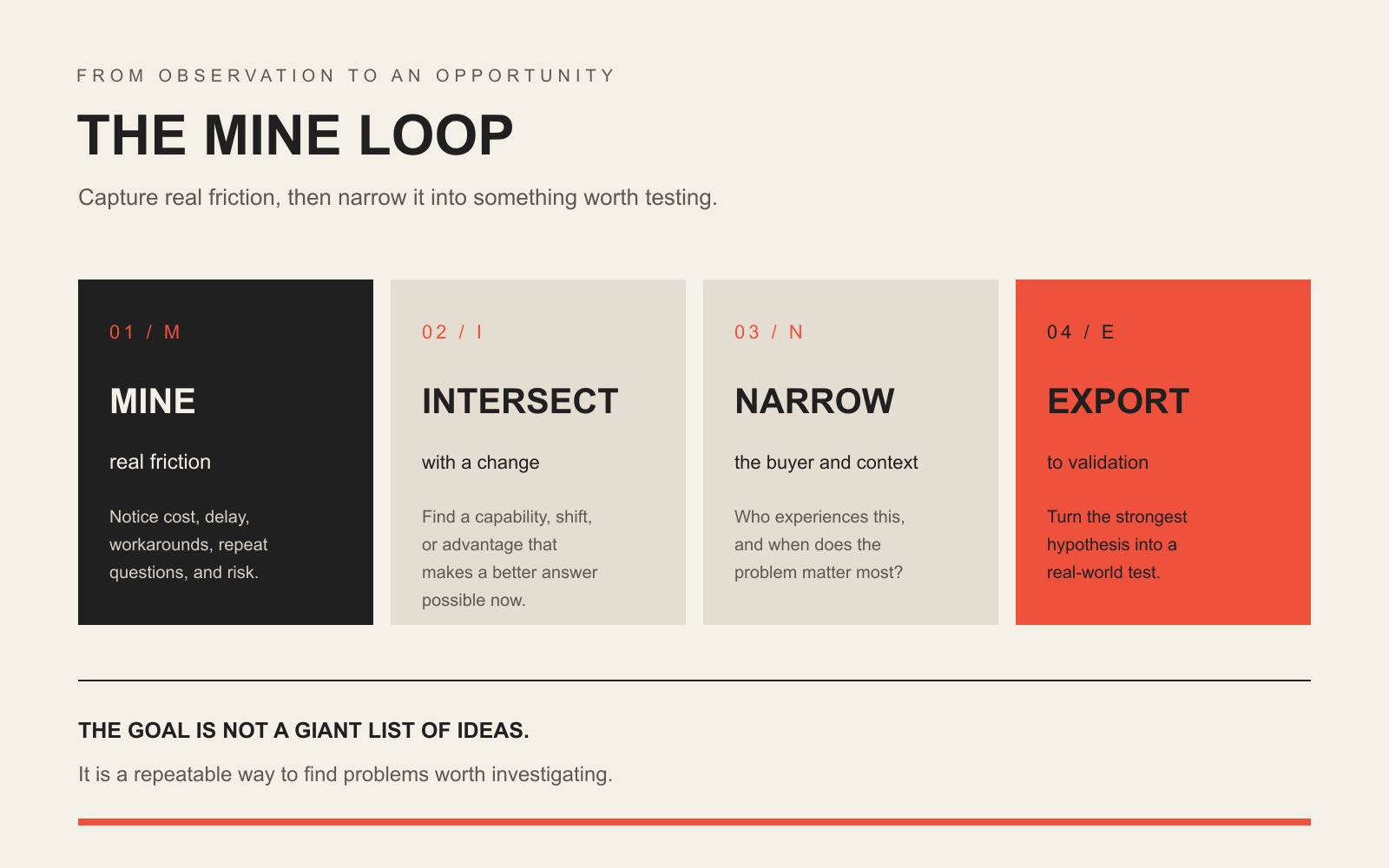
    The MINE Loop: Mine real friction, Intersect it with a change or advantage, Narrow to a buyer and context, and Export the strongest idea to validation.

    Mine Real Friction

    Start with problems, not products. Collect moments when someone says “Why is this so hard?”, “We do this manually every week,” “We hate our current software,” or “I wish somebody would just handle this.” Do not rush to solve every observation. Your first job is to capture enough real friction that patterns can emerge.

    Intersect the Problem With Change or Advantage

    A problem may have existed for years without creating a good business opportunity. Ask: why might this be solvable differently now? Look for new technology, lower delivery costs, changing customer behavior, regulation, a new distribution channel, or your own expertise, relationships, data, process, or audience.

    This is one reason we keep old product and service ideas rather than assuming an idea that failed once is permanently bad. Sometimes the original idea was fine and the timing was wrong.

    Narrow to a Buyer and Context

    “Small businesses need better marketing” is too broad to be useful. “Independent dental practices with no marketing staff struggle to turn patient reviews into a consistent local-content system” is much more useful. You can picture the buyer, the problem, the current environment, and the type of solution that might fit.

    Narrowing does not make an idea smaller. It makes it testable.

    Export the Strongest Ideas to Validation

    Generation and validation are different jobs. This article helps you produce better hypotheses. Once a few ideas look promising, test demand, buyer behavior, economics, competition, and your ability to reach the market. Our guide to business opportunity evaluation and idea validation covers that next stage in detail.

    12 Proven Methods to Generate Better Business Ideas

    You do not need to use all 12 methods every week. Pick the ones that expose you to real problems and run them consistently enough to build a useful idea pipeline.

    1. Keep a Friction Log

    For one week, write down anything that feels unnecessarily slow, expensive, confusing, repetitive, or annoying. Include problems in your own work, your customers’ work, your household, your industry, and the businesses you interact with.

    A useful friction-log entry records who experiences the problem, what goes wrong, the current workaround, and the cost in money, time, lost revenue, frustration, or risk. The goal is not to invent a company on the spot. You are building raw material.

    2. Mine Repeated Customer Questions and Complaints

    Repeated questions are often requests for a missing product, clearer service, better onboarding, or simpler process in disguise. Review sales calls, support requests, contact-form questions, project kickoff notes, recurring client confusion, and requests you keep saying “we do not offer that” to.

    Pay special attention when the same issue appears across different customers. At an agency, this is especially valuable because you see problems across multiple businesses. A task that feels like “just another annoying thing we have to do” can become a product opportunity if other companies have the same pain.

    3. Find Expensive Manual Work

    Look for skilled people doing low-leverage work over and over: copying data between systems, building the same report by hand, chasing approvals, reconciling inconsistent records, repeating setup steps, or manually checking something that could be monitored.

    Manual work is not automatically a software opportunity. Sometimes the better first business is a specialized service, managed workflow, or productized service. The opportunity is the outcome, not the technology.

    4. Study Ugly Workarounds

    A workaround is evidence that someone cares enough about a problem to do extra work. Look for giant spreadsheets, copy-and-paste processes, long email chains, shared documents pretending to be databases, multiple disconnected tools, or staff members whose unofficial job is “keeping the system together.”

    Do not mock the workaround. Understand why it exists. It may be doing something the official tools do not do well. That gap between the formal system and the real workflow is fertile territory for business idea generation.

    5. Read Low-Star Reviews and Competitor Complaints

    You do not need to invent a new category to build a useful business. Read negative reviews of products and services in markets you understand. Look for repeated complaints about pricing complexity, slow support, difficult setup, bloated interfaces, missing integrations, buying friction, or a service that works technically but creates operational headaches.

    The strongest pattern is not “this company is bad.” It is “customers consistently value the category but dislike the same part of the experience.”

    6. Trace Lost Deals, Objections, and Support Tickets

    Review why prospects say no, which projects become unprofitable, and which customer requests repeatedly fall outside your normal scope. Ask whether people want a smaller first step, whether they are buying the wrong thing because the real problem is poorly diagnosed, or whether a recurring service gap exists between vendors.

    A business idea can be a product, but it can also be a diagnostic, a smaller entry offer, a managed service, or a better sequence of existing services.

    7. Reopen Old Ideas When Technology or Economics Change

    Keep an idea archive. An idea can be unattractive today because one dependency is too expensive, slow, difficult, or unavailable. Revisit old ideas when those constraints change.

    AI has made this especially relevant. Tasks that once required custom software, large content teams, specialized analysis, or hours of manual categorization may now be possible with a smaller team and a different workflow. The discipline is not “add AI to everything.” It is asking: which old problem now has a newly practical solution?

    8. Go Narrower: Find an Underserved Buyer or Context

    Broad markets hide useful differences. Instead of “project management software,” look at project management for a specific workflow. Instead of “marketing services,” look at one type of company at one stage of growth with one recurring constraint.

    Narrow by industry, company size, geography, role, technology stack, regulatory environment, purchase trigger, business stage, or unusual workflow. For a broader way to think about where a company can win, see our Strategic Advantage & Market Intelligence playbook.

    9. Unbundle Bloated Products or Services

    Large products accumulate features and large service packages accumulate steps. Ask which part customers value most, which part is hardest to buy separately, which part could be delivered faster or more transparently, and which customer only needs a focused slice of the current solution.

    An unbundled offer is not automatically better. But it can create a compelling entry point when the incumbent solution is oversized for a clear customer segment.

    10. Productize Repeated Service Work

    If you perform the same valuable service repeatedly, you may already have the beginnings of a product. Look for work with a consistent input, repeatable method, recognizable output, similar customer questions, predictable handoffs, and opportunities for templates, automation, or software support.

    The first version does not need to become software. A productized service can keep you closer to the customer and produce learning faster. We use this pattern ourselves: when a problem keeps appearing across client work, we ask whether it can become a repeatable system rather than treating every occurrence as a one-off project.

    11. Use Constraints and Forced Change as Prompts

    Constraints create demand because people cannot simply keep doing things the old way. Watch for compliance requirements, platform policy changes, discontinued software, labor shortages, cost increases, supply changes, accessibility or privacy expectations, and customer behavior moving to a new channel.

    Ask: Who has a newly painful job to do because this changed? That keeps the idea grounded in a customer problem rather than a trend headline.

    12. Practice Deliberate Idea Volume—Without Confusing Volume With Evidence

    There is value in forcing yourself to generate multiple ideas. It loosens your attachment to the first concept and makes combinations easier to see. Choose one real problem and generate ten possible ways to solve it by changing the delivery model, buyer, channel, level of service, pricing model, or technology.

    One reporting problem might become a done-for-you service, template library, specialist consultancy, automated dashboard, data-cleanup service, vertical-specific tool, training product, monitoring service, integration, or diagnostic. The value of idea volume is range, not proof. Ten ideas are ten hypotheses.

    Turn Raw Observations Into Business Concepts

    Once your notes start accumulating, convert each promising observation into the same simple structure:

    For [specific buyer] who struggles with [specific problem] when [context/trigger], we could provide [better outcome or mechanism] because [why we may be able to solve it differently now].

    For example: For small professional-service firms that lose track of website leads because inquiries move between forms, email, and spreadsheets, we could provide a managed lead-routing and follow-up system because modern automation can connect the workflow without requiring a full custom CRM implementation.

    That is still not a validated business. But it is specific enough to research. If your concept cannot name a buyer, problem, and context, it is probably still too fuzzy.

    Use a Fast Filter Before You Spend Time Validating

    When you have 20 raw ideas, you do not need to deeply research all 20. Use a light triage filter first.

    1. Pain and frequency: Is the problem important, repeated, or costly enough to matter?
    2. Existing behavior: What do people do today? Is there a workaround, budget, vendor, or internal labor already attached to the problem?
    3. Reachability: Can you identify and reach likely buyers without needing mass-market scale?
    4. Access or advantage: Do you understand the problem, customer, workflow, channel, or technology unusually well?
    5. Cheap path to a test: Can you test the core assumption without building the full business first?

    This is triage, not validation. It helps you decide which ideas deserve the next round of research. If you need a more deliberate pre-validation screen, use our profit-signal and PRICE screening framework. When several opportunities still look plausible, our guide to decision-making frameworks can help you compare them more deliberately.

    AI Can Accelerate Business Idea Generation—But It Is Not Market Evidence

    AI is useful for expanding the surface area of your thinking. It is especially good at helping you organize observations, combine constraints, and generate alternative ways to solve a known problem.

    • cluster a large set of customer complaints into recurring themes;
    • turn meeting notes into a problem inventory;
    • generate alternative customer segments for the same problem;
    • suggest different business models around one known pain point;
    • find combinations between an existing problem and a new capability;
    • challenge an idea by listing assumptions that would need to be true;
    • turn a messy observation into several clearer opportunity statements.

    A useful prompt is: “Here are 30 real problems I have observed. Group them by underlying job, frequency, buyer, current workaround, and likely cost of the problem. Then generate three different business models for the strongest recurring patterns. Do not assume demand is proven.”

    Bad use of AI is asking, “Give me 50 profitable business ideas” and treating the output as market research. An AI model can suggest possibilities. It cannot make a customer have a problem, give that customer a budget, or make the economics work.

    What to Do With Your Best Three Ideas

    Once three ideas survive your first filter, stop generating for a moment and start learning. Investigate who has the problem, how they handle it today, what they already spend in money or labor, what competing options exist, how buyers discover those options, whether you can reach them economically, and which assumption could kill the idea fastest.

    Our guide to self-directed market research gives you practical ways to gather that information. Then use the business opportunity evaluation framework to test the strongest opportunity before you bet significant time or money on it.

    That sequence matters: Generate → narrow → research → validate → build. Not: Generate → fall in love → build → hope.

    Business Idea Generation FAQ

    How Can I Generate a Business Idea?

    Start by collecting real problems rather than trying to invent companies. Track recurring friction in your work, customer conversations, reviews, support requests, manual processes, and industry changes. Then narrow each promising problem to a specific buyer and consider what has changed that might make a better solution possible now.

    What Are Good Sources of Business Ideas?

    Useful sources include your own recurring frustrations, customer questions, manual business processes, competitor reviews, existing workarounds, support tickets, lost sales, changing regulations, new technology, underserved customer segments, and old ideas that have become feasible because a constraint changed.

    Which AI Tool Is Best for Business Idea Generation?

    There is no single “best” tool independent of the job. General-purpose AI assistants are useful for clustering observations, reframing problems, generating alternative business models, and exposing assumptions. The quality of the input matters more than the novelty of the tool: give the model real customer language and real constraints, then verify everything important outside the model.

    Does a Business Idea Have to Be Original?

    No. A business can create value with a better experience, narrower audience, improved delivery model, stronger positioning, lower friction, different channel, or better fit for a specific workflow. Originality is less important than solving a meaningful problem for a reachable customer in a way that can support healthy economics.

    How Do I Know Whether a Business Idea Will Be Profitable?

    You do not know at the idea-generation stage. Profitability depends on willingness to pay, cost to deliver, customer-acquisition cost, retention, market size, competition, and operating complexity. Generation creates the hypothesis; research and validation test it.

    Is Competition a Bad Sign?

    Not automatically. Competition can indicate that buyers already spend money in the category. The important questions are whether customers are well served, whether you can identify a meaningful difference, and whether you can reach the right buyer economically.

    Build an Idea Pipeline, Not a Favorite Idea

    The biggest improvement you can make to business idea generation is to stop treating each idea like a rare object that needs to be protected. Keep a pipeline. Capture problems continuously. Revisit old observations. Combine them with new capabilities. Narrow them until a buyer and context are clear. Then let evidence decide which ideas move forward.

    That is a much stronger operating system than waiting for inspiration—and it makes it easier to abandon a weak idea without feeling like you are starting from zero.

    If you have several possible opportunities but need help figuring out which market, positioning, or offer is worth pursuing, Scope Design can help with strategy, market research, positioning, and the digital systems needed to test the opportunity. Start a conversation with Scope Design and bring the messy version. That is usually where the useful work starts.

  • The Truth About Overnight Success: A Reality-Based Guide to Sustainable Business Growth

    The Truth About Overnight Success: A Reality-Based Guide to Sustainable Business Growth

    The Bottom Line: Overnight Success Is Usually a Visibility Event

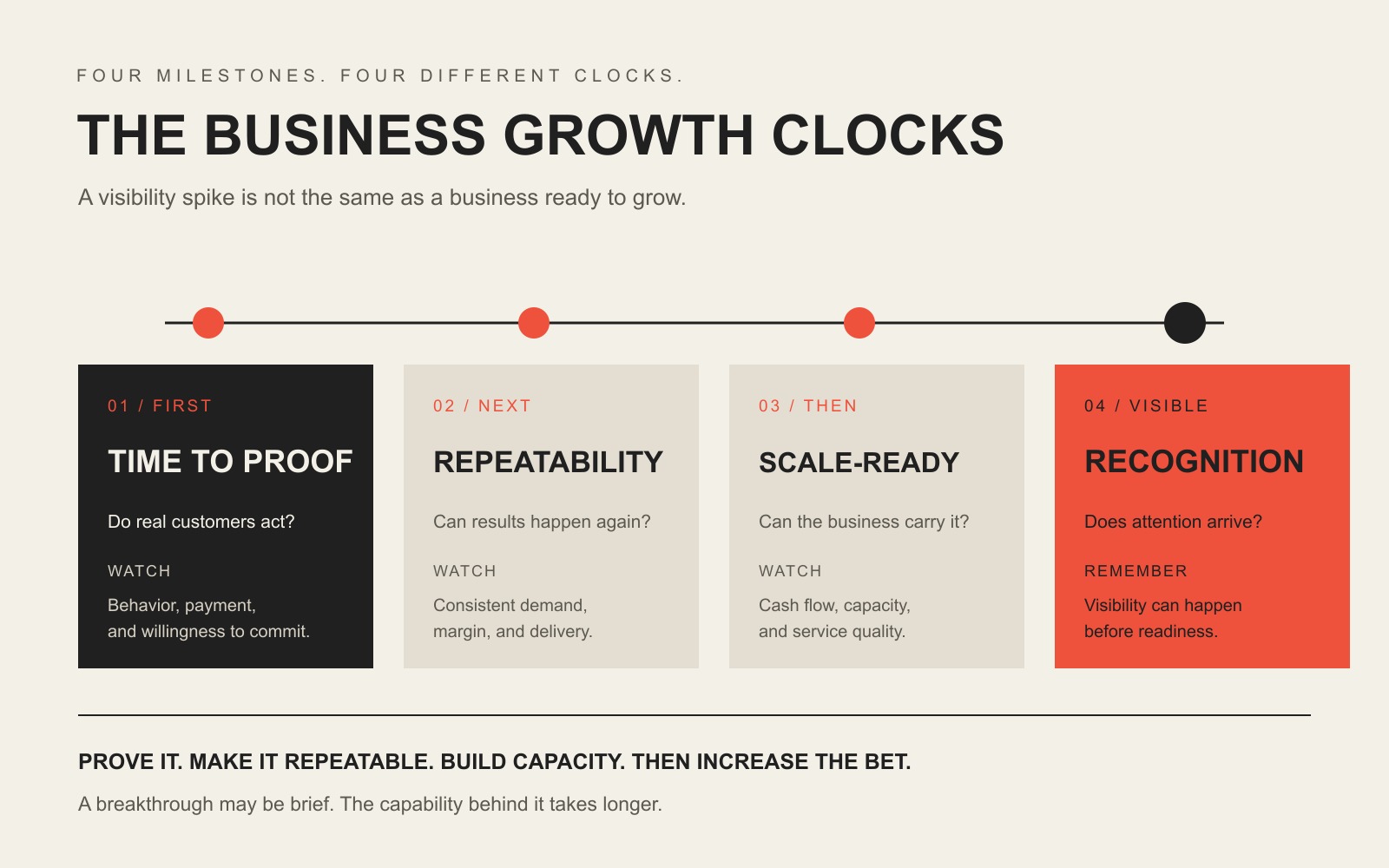
    There is no honest universal number of years it takes a business to become “successful.” A first sale, steady profitability, repeatable demand, scale-readiness, and public recognition are different milestones. They run on different clocks.

    That is the part the overnight-success story usually hides. The breakthrough may happen in a week. The capability that makes the breakthrough useful may have been developing for years. Or the attention may arrive before the business is actually ready for it.

    For this guide, sustainable business growth means growth the company can support without breaking cash flow, margins, delivery quality, customer experience, or owner capacity. We are talking about durable, maintainable growth—not environmental or ESG sustainability.

    The reality is less cinematic than “work hard for exactly seven years.” It is also more useful: prove something, make it repeatable, build the capacity to support it, and only then increase the bet.

    Why Overnight Success Looks Real

    Overnight success feels real because the audience joins the story late. You see the contract, launch, ranking jump, viral post, acquisition, or packed calendar. You usually do not see the failed offers, customer conversations, process changes, skill development, boring systems work, and decisions that came before it.

    There is another problem: visible success gets compressed into a clean story. “One post changed everything” is memorable. “We ran 19 experiments, fixed our offer, changed our follow-up process, improved delivery, and then one post finally had somewhere useful to send people” is harder to fit into a headline.

    The shortcut story can be dangerous because it encourages you to copy the visible event instead of building the underlying conditions. You chase the post instead of the offer, the ad instead of the economics, the redesign instead of the sales problem, or the hiring spree instead of the capacity constraint.

    The Four Business Clocks

    Instead of asking one vague question—“How long until I am successful?”—track four separate clocks.

    Four distinct business milestones: time to proof, repeatability, scale-readiness, and recognition, each with different evidence to watch.

    1. Time to proof

    Will a real customer do something that matters? That might mean paying, booking, replying, requesting a proposal, renewing, or taking another qualified next step. Opinions help you learn, but behavior is stronger evidence.

    If demand is still a theory, start with small-business market research and validate the business idea before you bet the business.

    2. Time to repeatability

    Can you produce the result again without inventing a new process every time? One great month may be a signal. Repeatable lead flow, a sales process people can actually follow, consistent delivery, and customers who return or refer are stronger signs that you have something durable.

    3. Time to scale-readiness

    Can the system survive more volume? This is where growth gets expensive if the answer is no. More demand can expose weak margins, slow fulfillment, founder bottlenecks, poor onboarding, sloppy reporting, or a team that is already operating at the edge.

    Scope Design’s rule is simple: growth is a multiplier, not a cure. If you want the deeper operating check, use our business growth strategy guide before you add more volume.

    4. Time to recognition

    This is when the outside world notices: stronger referrals, bigger contracts, better rankings, industry attention, press, a breakout campaign, or a visible jump in demand. Recognition can lag behind a healthy business. It can also arrive too early and overwhelm a fragile one.

    That gap between the four clocks is what we call the Success Lag. Public attention is not proof that the other clocks are healthy. Lack of public attention is not proof that no progress is happening.

    What Sustainable Business Growth Actually Means

    Sustainable growth is not “revenue went up.” It is closer to this: the company becomes stronger at higher volume rather than merely busier.

    That means growth should improve—or at least protect—the things that keep the business healthy:

    • Economics: the work still produces acceptable margin and cash flow.
    • Demand quality: you are attracting buyers who fit the offer, not just generating activity.
    • Delivery: quality and response times do not collapse as volume rises.
    • Retention and trust: customers stay, return, upgrade, refer, or otherwise confirm the value.
    • Capacity: the company can handle more work without every exception landing back on the owner.

    A business can grow revenue while becoming less scalable. If every sale creates another founder approval, rescue mission, custom exception, or margin leak, the chart may look good while the operating system gets worse.

    The Proof-Before-Scale Check

    Before you treat a quick win as permission to accelerate, look for four kinds of proof.

    Demand proof

    People with the problem can be reached, understand the offer, and take a meaningful action. A burst of traffic is not demand proof if nobody qualified moves forward.

    Economics proof

    The sale works after the real costs are counted. That includes acquisition, fulfillment, support, refunds, rework, commissions, software, and the owner time that quietly subsidizes the process.

    Delivery proof

    The company can consistently produce the promised result. If quality depends on a heroic week from one person, you have a win—not yet a system.

    Capacity proof

    You know what more volume will require. That may mean automation, a documented process, better tooling, a contractor, a hire, a partner, more working capital, or simply saying no to the wrong work.

    When those four proofs are weak, make the next bet smaller. When they strengthen, earn the right to increase it.

    A Quick Note on Scary Startup Statistics

    The previous version of this article repeated several dramatic claims about startup failure and a fixed seven-to-ten-year success timeline. We removed them because the definitions were too loose for the certainty they implied.

    The U.S. Bureau of Labor Statistics is more careful: it reports establishment survival and explicitly notes that survival varies by business cycle, industry, and location. Its one-year figures are commonly around four in five across the table—not “90% fail.” More importantly, survival is not the same thing as profitability, founder wealth, repeatability, or scale-readiness.

    That distinction matters. If you use a survival statistic to answer “How long until my business is successful?” you are pretending several different questions are the same question.

    Quick Wins Are Signals, Not Strategy

    A quick win can be excellent news. The mistake is promoting it to a law of nature.

    • A viral post tells you a message or format earned attention. It does not prove profitable customer acquisition.
    • A large contract tells you one buyer said yes. It does not prove the sales process is repeatable.
    • A strong month tells you the offer can work. It does not prove the next six months will look the same.
    • A burst of referrals tells you trust exists somewhere in the system. It does not tell you whether you can create that demand on purpose.

    Treat the win as new evidence. Ask what caused it, what would have to be true for it to happen again, and what would break if it happened ten times next month.

    What to Measure Instead of “Am I Successful Yet?”

    The better question is: What evidence would make the next decision easier?

    • Customer action: conversations, qualified leads, proposals, purchases, renewals, referrals.
    • Economics: contribution margin, cash generation, payback, rework, support burden.
    • Repeatability: can the same channel, offer, sales process, or delivery system work again?
    • Capacity: utilization, bottlenecks, response times, backlog, owner dependence.
    • Learning velocity: how quickly does a test produce an answer that changes what you do next?

    This is where the old “do the one most important thing every day” advice becomes useful again. Your big rock should not be whatever feels important. It should be the action most likely to reduce the current constraint or resolve the most expensive uncertainty.

    A 30-Day Reality-Based Growth Loop

    You do not need a five-year prophecy to make a good decision this month. Use one short learning cycle.

    1. Name the constraint. Is the problem demand, lead quality, conversion, pricing, delivery, capacity, retention, cash, or something else?
    2. Define the evidence. What observable result would support or weaken your current assumption?
    3. Run the smallest useful test. Limit the budget, audience, channel, scope, or time window so you can learn without betting the company.
    4. Review the result. Keep, modify, or kill the idea based on what happened—not how attached you are to it.
    5. Systemize what survives. Document the process, improve the handoff, automate the boring parts, and decide whether the evidence earns a larger bet.

    If marketing is the current constraint, our 90-day marketing plan uses the same constraint-first logic over a longer operating window.

    When Your Website Becomes the Growth Constraint

    A website can support sustainable growth, but it cannot rescue a business model nobody wants. The useful question is not “Do we need a new website?” It is “What job is the current site failing to do?”

    Common growth constraints include an offer people cannot understand, weak proof, a confusing conversion path, slow manual follow-up, no useful measurement, brittle integrations, or a site that cannot support the way the business now sells and delivers.

    If that is the problem, start with our guide to creating a business website without buying the wrong thing. If the constraint touches positioning, market validation, lead flow, measurement, automation, or the operating process around digital work, Scope Design can help diagnose the problem before recommending a project.

    Frequently Asked Questions About Overnight Success and Sustainable Growth

    How long does it take for a business to become successful?

    There is no responsible universal timeline because “successful” can mean first sale, profitability, stable owner income, repeatable acquisition, a scalable operation, or public recognition. Track those milestones separately. Use evidence from your market, economics, delivery system, and capacity instead of borrowing a generic year count from somebody else’s business.

    Is overnight success real?

    Sudden recognition is real. Sudden capability is much rarer. A business can get a rapid burst of attention, sales, or opportunity, but whether that breakthrough becomes durable depends on the proof, repeatability, economics, and capacity already underneath it.

    What is sustainable business growth?

    In this article, sustainable business growth means growth the company can maintain without degrading cash flow, margins, quality, customer experience, or owner/team capacity. It is growth the system can support, not simply a bigger top-line number.

    How do I know when my business is ready to scale?

    Look for evidence that demand is real, the economics work, delivery is repeatable, and the organization has a credible capacity plan. You do not need perfect certainty, but the size of the next bet should be proportional to what you actually know.

    Build the Business That Can Survive the Breakthrough

    The goal is not to avoid fast growth. It is to avoid confusing speed with strength.

    Build proof. Make the result repeatable. Protect the economics. Remove the capacity constraint. Then scale what survives contact with reality.

    Do that long enough and the outside world may eventually call you an overnight success. You will know better.

  • Email Marketing Laws: Complete 2026 Compliance Guide for Business Owners

    Email Marketing Laws: Complete 2026 Compliance Guide for Business Owners

    Last reviewed: August 18, 2026. Email marketing is still legal and useful, but there is no single global consent rule. For a U.S. business, the federal CAN-SPAM Act generally regulates commercial email as an opt-out system. Canada, the UK, the EU, and privacy laws can change what you need to do depending on who you are emailing, where they are, how you got the address, and what kind of message you are sending.

    The safest way to think about email compliance is not “Do I have a checkbox?” It is “Can I explain why this person is receiving this message, which rules apply, and how I will stop when they ask?”

    This guide is general educational information, not legal advice. Email and privacy laws change, and the right answer can depend on your audience, industry, data practices, and jurisdictions. For a high-risk campaign or a multi-country list, have qualified counsel review your process.

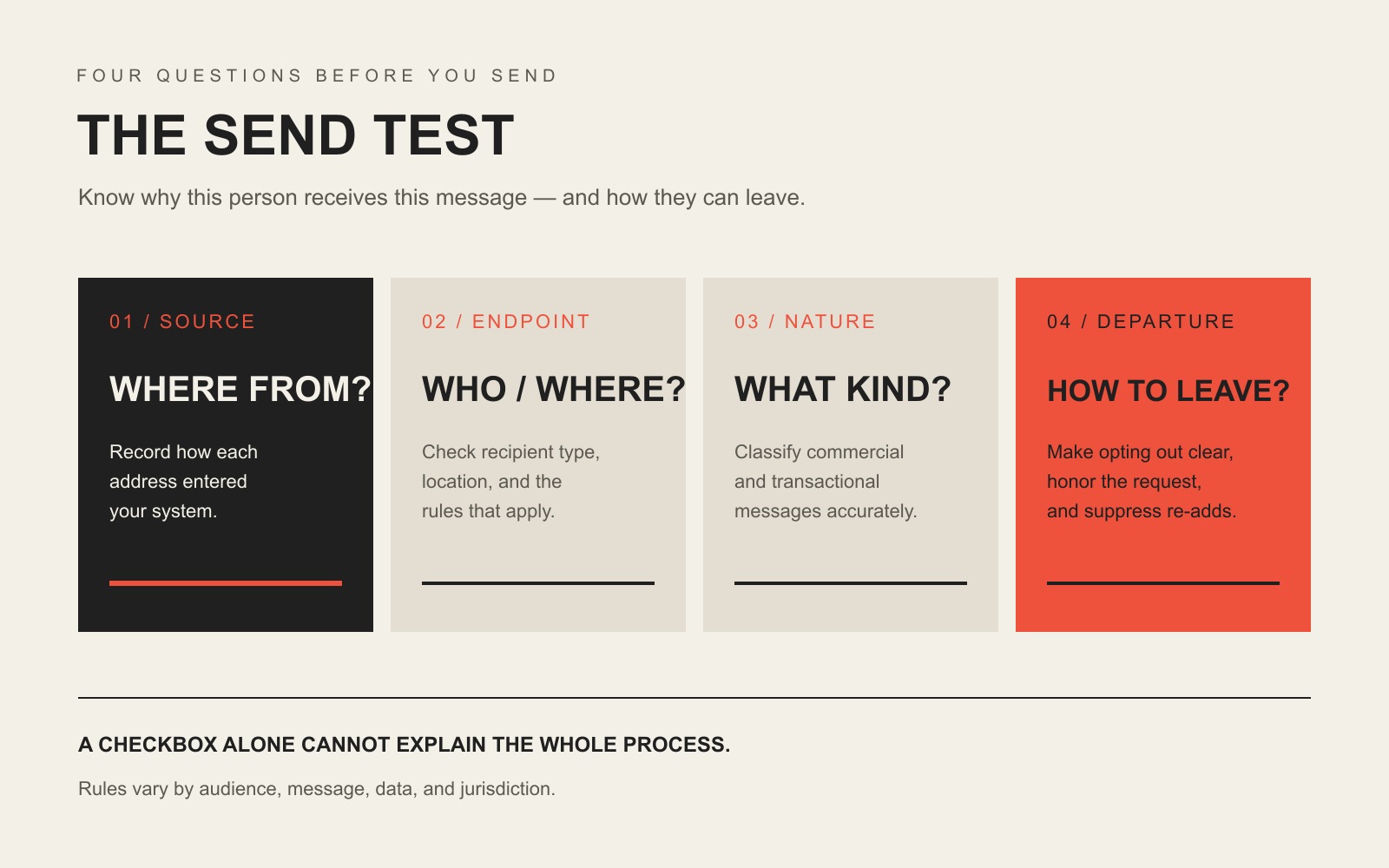
    The Scope Design SEND Test: Four Questions Before You Send

    Compliance gets easier when you treat it as a routing problem. Scope Design’s SEND Test gives a small business four checks to run before every campaign:

    • S = Source. Where did this email address come from? Do you have a signup, purchase, inquiry, event, referral, or list-source record? What permission or lawful basis can you prove?
    • E = Endpoint. Who is receiving the email, where are they, and what kind of subscriber are they? A U.S. business contact, a Canadian consumer, and a UK corporate address may be governed differently.
    • N = Nature. Is the message commercial, transactional or relationship-based, or mixed? The message’s primary purpose can change which rules apply.
    • D = Departure. Can the recipient opt out easily, and will every platform, employee, agency, and automation honor that choice?
    The SEND Test: Source of the contact, Endpoint and jurisdiction, Nature of the message, and Departure through a clear, honored unsubscribe.

    This is the practical mistake we see most often: a business treats the email platform as the compliance system. It is not. Mailchimp, HubSpot, Constant Contact, Klaviyo, or another provider can enforce settings, but your business still needs one source of truth for permission, list provenance, and suppression.

    U.S. Email Marketing Laws: CAN-SPAM Is the Main Federal Rule

    For U.S. businesses, start with the FTC’s CAN-SPAM compliance guide. CAN-SPAM applies to commercial email, including business-to-business email. It is not limited to bulk blasts.

    Generally, no. CAN-SPAM does not create a universal federal requirement to get prior opt-in consent before sending a commercial email. That is one of the most important corrections to older compliance articles. You can still violate CAN-SPAM even when someone signed up, and a message can still comply with CAN-SPAM even if there was no prior opt-in, provided all applicable requirements are met.

    That does not mean buying lists or emailing every address you can find is a smart policy. Other countries can require consent, state privacy rules can affect how personal data is collected or shared, email providers can impose stricter terms, and poor list practices can destroy deliverability. For most small businesses, a permission-first list is still the better operational standard.

    The core CAN-SPAM requirements

    1. Use accurate header information. Your From, To, Reply-To, originating domain, and routing information must accurately identify the sender.
    2. Use truthful subject lines. The subject must reflect the content of the message rather than tricking someone into opening it.
    3. Identify commercial messages as advertising. The FTC says this disclosure must be clear and conspicuous, while giving businesses flexibility in how it is presented.
    4. Include a valid physical postal address. A current street address, a properly registered USPS post office box, or a qualifying commercial mailbox can satisfy this requirement.
    5. Provide a clear way to opt out. People must be able to stop future marketing email from you without paying, providing extra personal information, or navigating a maze.
    6. Keep the opt-out mechanism working for at least 30 days after the send. Do not let a short-lived campaign landing page break the unsubscribe path.
    7. Honor opt-out requests within 10 business days. Faster is better operationally, but 10 business days is the federal maximum stated by the FTC.
    8. Monitor vendors and agencies. Hiring someone else to send your campaign does not let your company contract away CAN-SPAM responsibility.

    The FTC currently states that each separate violating email can be subject to penalties of up to $53,088. That is a ceiling, not a prediction of what a particular enforcement case would cost, but it is enough reason to make compliance a system rather than a footer someone remembers at the last minute.

    Commercial vs. Transactional Email: Classify the Message First

    CAN-SPAM treats commercial messages differently from qualifying transactional or relationship messages. A receipt, account update, warranty notice, or transaction-related message may fall into a transactional category. A newsletter promoting products or a sales announcement is commercial. Mixed messages require more care because the primary purpose matters.

    A common mistake is to remove the unsubscribe link because “they are already a customer.” Customers and members can still opt out of marketing. Before treating a customer email as transactional, make sure the content actually fits the legal category rather than simply being sent to someone who has a relationship with you.

    Where the Rule Gets Stricter: Canada, the UK, the EU, and California

    If your list crosses borders, do not apply CAN-SPAM to everyone and call the job done. The important difference is that several other regimes put more weight on consent, the source of the address, or the handling of personal data.

    Canada’s Anti-Spam Legislation is materially stricter than U.S. CAN-SPAM. The CRTC says commercial electronic messages generally require three things: consent, identification information, and an unsubscribe mechanism. Consent can be express or, in limited circumstances, implied. The sender needs to be able to prove the consent it relies on.

    Practical takeaway: if Canadians are intentionally in your marketing audience, build consent records into your process instead of assuming a U.S.-style cold-email rule will carry over.

    United Kingdom: PECR depends on subscriber type and how you got the address

    The UK Information Commissioner’s Office updated its electronic-mail marketing guidance in 2026. For unsolicited marketing to individual subscribers, you generally need consent or must meet every condition of a valid soft opt-in. Corporate subscribers are treated differently, but you still cannot hide your identity and you must provide a valid opt-out route.

    The products-and-services soft opt-in is not a loophole for purchased lists. It depends on collecting the contact details directly while selling or negotiating a sale, marketing your own similar products or services, and offering an opt-out both when the details are collected and in later messages.

    European Union: email rules and data-protection rules work together

    For EU audiences, email marketing can involve both the GDPR and electronic-communications rules. The European Commission notes that marketing data received from a third party must have been obtained lawfully and that the intended advertising use must be permitted. People also have a strong right to object to processing for direct marketing, and an objection must be respected.

    If you intentionally market to people in the EU or maintain a meaningful EU audience, do not reduce the question to a single “GDPR consent” checkbox. Review both your data-processing basis and the electronic-marketing rules that apply. For a deeper overview, see Scope Design’s GDPR compliance guide for U.S. small businesses.

    California: CCPA is a privacy law, not a universal email opt-in law

    The California Consumer Privacy Act is frequently mixed into email-law articles as though it requires every business to get email consent from every Californian. That is not an accurate shortcut. The California Attorney General describes the CCPA as a privacy law that gives consumers rights over personal information and applies to covered for-profit businesses meeting statutory thresholds.

    For email marketing, CCPA matters when your business is covered and your list-building, segmentation, sharing, sale, or advertising practices involve personal information. It can affect notices, consumer requests, and sale/sharing choices. It does not replace CAN-SPAM with a blanket California email-consent rule.

    Your List Source Matters More Than Most Businesses Realize

    The Source part of the SEND Test is where many preventable problems begin. Before importing any list, make the source visible in your CRM or email platform.

    • Website signup. Keep the form language, date, source page, and the preferences the person selected. Double opt-in is not a universal U.S. legal requirement, but it can provide stronger proof and improve list quality.
    • Customer purchase. A purchase does not automatically turn every later message into transactional email. Keep marketing and transactional logic separate.
    • Inquiry or lead form. Someone asking for a quote has asked for a response. That does not necessarily mean they asked for an indefinite promotional newsletter.
    • Networking or event contact. Record the context instead of dropping business cards into a generic sequence with no explanation.
    • Purchased, rented, scraped, or publicly listed addresses. Treat these as high-risk. Some jurisdictions require consent that a public address does not provide, bought-list consent may not name your organization, and providers may prohibit the practice even where U.S. federal law would not categorically ban a compliant commercial email.

    If you are building a small-business email program, legal compliance should be the floor. Scope Design’s broader email marketing strategy guide explains why permission, segmentation, handoffs, and useful content usually outperform a blast-calendar mindset.

    A working unsubscribe link is necessary, but it is not enough if your systems can accidentally re-add the same person tomorrow. The Departure part of the SEND Test is about suppression discipline.

    • Maintain one authoritative suppression status for each email address.
    • Sync suppression across your email service provider, CRM, sales automation, ecommerce platform, and agency tools.
    • Do not upload an old spreadsheet that silently re-subscribes people.
    • Audit forms and integrations after migrations, platform changes, and agency handoffs.
    • Keep enough evidence to show when and how a person opted out and when the system processed it.
    • Test unsubscribe links as a recipient, including mobile, before major sends.

    Scope Design rule: one business should not have five different versions of “unsubscribed.” Suppression needs a single operational truth.

    A Practical Email Compliance Stack for Small Businesses

    You do not need enterprise compliance software to create a defensible process. You do need clear ownership and a few controls that survive staff changes.

    1. Define audiences. Know which countries, states, and customer types you intentionally market to.
    2. Standardize collection language. Keep approved signup and privacy language for forms, checkout, lead magnets, events, and offline collection.
    3. Record provenance. Store where, when, and how each contact entered the system.
    4. Separate message types. Transactional messages and promotional campaigns should not share sloppy rules just because they use the same email platform.
    5. Centralize suppression. Make opt-out status harder to override than a marketing list import.
    6. Control vendors. Give agencies and contractors written rules for list use, sender identity, approval, and suppression.
    7. Review periodically. Recheck laws, forms, automations, vendor settings, privacy notices, and unsubscribe behavior when your markets or technology change.

    For local businesses, context matters too. A person may willingly hear from a nearby business about genuinely relevant local information and still dislike broad, creepy targeting. Our local email marketing guide covers that operational side of permission and usefulness.

    2026 Email Marketing Compliance Checklist

    Before collecting addresses

    • Identify the jurisdictions and subscriber types you plan to market to.
    • Use clear signup language that matches what you will actually send.
    • Link to an accurate privacy notice when personal-data laws require it.
    • Decide what evidence of consent, permission, or list source you will retain.

    Before each campaign

    • Run the SEND Test: Source, Endpoint, Nature, Departure.
    • Confirm the From name, domain, Reply-To, and subject are accurate.
    • Include required sender identification and a valid postal address.
    • Include a clear unsubscribe path for commercial marketing.
    • Exclude suppressed contacts and validate any new import before it enters an automation.
    • Check whether a stricter consent rule applies to any segment.
    • Test the message and unsubscribe flow on desktop and mobile.

    After sending

    • Process opt-outs promptly and keep the federal 10-business-day maximum in mind for U.S. CAN-SPAM.
    • Investigate spam complaints, unusual bounce patterns, and evidence that list provenance is poor.
    • Keep suppression synchronized across systems and vendors.
    • Record major process changes so the next employee or agency does not recreate an old mistake.

    Common Email Marketing Law Questions

    Not automatically. Federal CAN-SPAM generally does not require prior opt-in consent for commercial email, but the message still has to comply with CAN-SPAM. Other laws, jurisdictions, industry rules, platform terms, or data practices can create stricter obligations.

    Commercial emails covered by CAN-SPAM need a clear and conspicuous way to opt out of future marketing. Purely transactional or relationship messages can be treated differently, so classify the message rather than assuming every email belongs in one bucket.

    How quickly must a U.S. business honor an unsubscribe?

    The FTC says CAN-SPAM opt-out requests must be honored within 10 business days, and the opt-out mechanism must remain capable of processing requests for at least 30 days after the message is sent. Good systems typically suppress much faster.

    Can I cold-email another business?

    CAN-SPAM has no B2B exception, but it also does not create a general federal prior-consent requirement. A U.S. B2B cold email can still be subject to CAN-SPAM’s commercial-message rules. If the recipient is outside the U.S., or personal data was sourced or used in a way covered by another privacy law, the answer can change.

    Can I use a purchased email list?

    Treat purchased lists as high-risk. A seller’s claim that a list is “compliant” does not prove that consent names your business or covers email marketing. UK guidance specifically warns that bought-list consent must validly cover your organization and method, and the soft opt-in does not apply to bought-in lists. Even where a U.S. send could be structured to comply with CAN-SPAM, purchased lists are usually a poor foundation for deliverability and trust.

    If my agency sends the emails, who is responsible?

    The FTC explicitly warns businesses that they cannot contract away CAN-SPAM responsibility. Your agreement should define list-source rules, approvals, sender identity, unsubscribe handling, suppression, access, and evidence retention, but your business still needs to monitor what is being sent on its behalf.

    Compliance Is the Floor. A Useful Email Program Is the Goal.

    The strongest email programs do not look for the minimum legal excuse to send one more message. They make permission obvious, keep data clean, make leaving easy, and send things people have a reason to want.

    That approach improves more than compliance. It gives your sales and marketing team a cleaner audience, reduces accidental re-contact, makes vendor handoffs safer, and creates a system you can explain when someone asks, “Why did I get this?”

    Scope Design is not a law firm, but we can help you turn counsel-approved requirements into forms, CRM fields, email-platform settings, automations, suppression workflows, and a practical marketing process. If your email system has grown into a pile of lists and disconnected tools, contact Scope Design and we can help you straighten out the operational side.


    Primary sources used for this update: Federal Trade Commission CAN-SPAM compliance guide; UK ICO electronic-mail marketing guidance; CRTC CASL guidance; California Attorney General CCPA overview; and European Commission direct-marketing data guidance.

  • How to Achieve Anything in 90 Days: The Ultimate Goal-Setting Framework

    How to Achieve Anything in 90 Days: The Ultimate Goal-Setting Framework

    90 day goals work when you treat the next three months as a bounded execution cycle, not a motivational stunt. Pick one meaningful outcome, decide what evidence will prove progress, turn the outcome into weekly actions, and review the plan often enough to change course before the deadline. You cannot literally achieve anything in 90 days, but you can stop letting a vague annual goal hide behind eleven months of “later.”

    The calendar is not magic. The value of a 90-day cycle is that it is long enough to complete meaningful work and short enough to force decisions. The point is not to worship the quarter. The point is to create a finish line, a weekly operating rhythm, and a rule for what happens when reality punches the plan in the mouth.

    90 Day Goals: The Short Version

    • Choose one primary outcome. Other work can continue, but one result gets priority when capacity conflicts.
    • Define “done” before you start. Use an outcome metric, a small set of leading actions, and guardrails for cost, quality, risk, or capacity.
    • Work in weeks, not vague months. Decide what must happen this week and when it will happen.
    • Review written evidence every week. Keep, change, cut, or rescope based on what actually happened.
    • Use days 30 and 60 as decision points. They are not ceremonial milestones. They are chances to fix a bad tactic before day 90 becomes an autopsy.

    What Are 90 Day Goals?

    A 90-day goal is a specific outcome you intend to achieve, complete, or materially advance during a roughly three-month execution cycle. Good 90 day goals are concrete enough to measure and important enough to deserve a tradeoff. “Improve marketing” is not a useful 90-day goal. “Generate 20 qualified sales conversations from our existing email list without increasing paid-media spend” is much closer.

    Some goals are complete projects: launch the new client portal, document and automate a repeated workflow, finish a certification, publish a defined content asset, or reduce a known operational bottleneck. Other goals are building blocks inside a larger strategy. If the real objective takes a year, the next 90 days should produce the next meaningful proof, capability, or milestone rather than pretending the whole thing belongs in one quarter.

    If you are not sure which outcome deserves the cycle, use a decision process before you use a productivity process. Scope Design’s SCOPE Decision Filter is built for that job: choose the consequential decision first, then build the 90-day plan around it.

    Why Can a 90-Day Goal Cycle Be Useful?

    There is no credible evidence in the sources we reviewed that exactly 90 days is a universal productivity optimum or that quarterly goals automatically beat annual goals. That claim sounds tidy. It is also more certainty than the evidence earns.

    The useful research is about the mechanisms inside a good execution system. A major review by Edwin Locke and Gary Latham summarizes decades of goal-setting research and supports specific, challenging goals under the right conditions, including feedback and commitment, over vague “do your best” instructions. The implication is practical: define an actual result and create a way to see whether your behavior is moving toward it.

    Follow-through matters too. A meta-analysis by Peter Gollwitzer and Paschal Sheeran covering 94 independent tests found that implementation intentions, often expressed as “if X happens, then I will do Y,” improved goal attainment with a medium-to-large effect. Pre-deciding the action reduces the amount of future negotiation required from your tired, distracted, suddenly-very-interested-in-cleaning-the-desk self.

    And progress should be visible. A Psychological Bulletin meta-analysis of 138 studies and 19,951 participants found that interventions increasing progress monitoring promoted goal attainment, with stronger effects when progress was physically recorded or reported. That is a much better reason for a weekly scorecard than “successful people journal on Sundays.”

    So use 90 days as a practical operating constraint: a deadline near enough to expose tradeoffs, paired with clear goals, implementation plans, and recorded progress. The quarter is the container. The behavior inside it does the work.

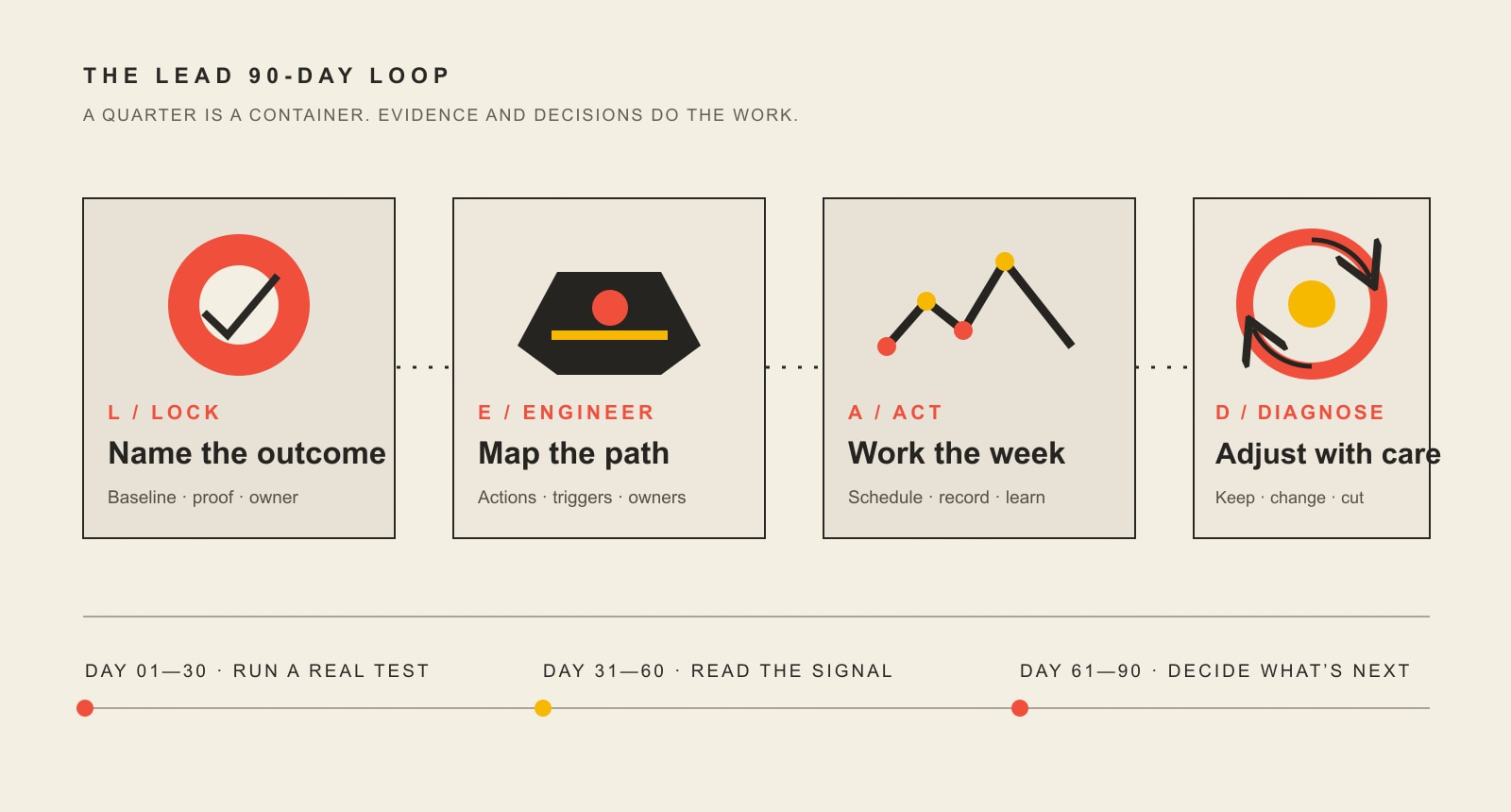
    The LEAD 90-Day Loop

    Scope Design’s framework is the LEAD 90-Day Loop: Lock the outcome, Engineer the path, Act one week at a time, Diagnose and adjust. It is deliberately simple. A goal system that requires a two-day retreat, seventeen dashboards, and a ceremonial leather notebook has already become a new project.

    The LEAD 90-day loop: lock one outcome, engineer the path, act one week at a time, and diagnose and adjust using evidence.

    1. Lock the outcome

    Write one sentence that defines what will be meaningfully different by day 90. Use a result, not a mood. “Feel more organized” is fog. “Reduce average proposal turnaround from five business days to two without increasing revision errors” gives you something to operate.

    • Outcome: What will be true on day 90?
    • Baseline: What is true now?
    • Proof: What evidence will show the outcome actually happened?
    • Owner: Who can make or coordinate the decisions?
    • Stop list: What will not compete for the same capacity during this cycle?

    The stop list is not decorative. A goal is not a priority if every other initiative is also “top priority.” If a new request collides with the 90-day outcome, the team needs a rule for which work moves, waits, shrinks, or dies.

    2. Engineer the path

    Work backward from the outcome and identify the smallest set of controllable actions likely to produce it. Separate dependencies from wishes. If the goal depends on a vendor, customer, employee, or system you do not control, build that uncertainty into the plan rather than pretending the dependency is a task with a due date.

    Then create implementation triggers. Instead of “work on the proposal process twice a week,” write “Tuesday and Thursday at 9:00 a.m., I will review the current queue and remove the oldest blocking step.” If a common obstacle appears, pre-decide the response: “If legal review exceeds two business days, the owner escalates it at the next morning check-in.”

    This is also where systems earn their keep. If repeated work should be automated, documented, delegated, or connected across tools, the broader AI automation for business guide explains how to decide what should become a workflow instead of another recurring reminder.

    3. Act one week at a time

    A 90-day plan becomes real only when it survives contact with Monday morning. Translate the engineered path into weekly commitments small enough to schedule and specific enough to score. “Make progress on automation” is useless. “Map the intake workflow, identify the three manual handoffs, and test one automated routing rule” can be done, reviewed, and learned from.

    Do not turn the quarter into thirteen simultaneous workstreams. Choose the few actions that matter now. Finish or learn something before adding more crap. For a marketing-specific application of that constraint-first idea, see Scope Design’s 90-Day Marketing Acceleration Framework.

    4. Diagnose and adjust

    Every week, compare what you planned with what happened. Do not ask only, “Am I on track?” Ask why the evidence looks the way it does. A missed target can mean at least four different things: the action was not executed, the tactic was weak, the scope was unrealistic, or the environment changed.

    • Keep: What worked well enough to repeat?
    • Change: What should be adjusted because the tactic is underperforming?
    • Cut: What is consuming capacity without improving the outcome?
    • Rescope: Has new evidence changed what a credible day-90 result should be?

    A review is not a motivational ritual. It is a decision loop. Hope is not an analytics strategy, and “we’ll try harder next week” is not a diagnosis.

    What Should You Measure During 90 Day Goals?

    Use three evidence classes together. One metric cannot safely tell the whole story.

    Evidence typeQuestion it answersExample
    Outcome metricDid the business result change?Average proposal turnaround falls from 5 days to 2.
    Leading actionsDid we execute the behaviors expected to influence the outcome?Every new request is routed through one standardized intake within 1 hour.
    GuardrailsDid we improve one number by quietly damaging something else?Revision error rate stays below the current baseline; staff overtime does not increase.

    This distinction matters because outcome metrics often lag. If the result has not moved by week three but the leading actions are being executed cleanly, you may need more time. If the leading actions are not happening, the tactic has not really been tested. If the outcome improves while quality collapses, congratulations: you optimized the wrong thing.

    A Worked 90-Day Business Goal Example

    Suppose a small service business says, “We need to use AI and automation this quarter.” That is not a goal. It is a technology preference wearing a tiny project-management hat.

    A stronger day-90 outcome might be: “Reduce manual lead-intake handling from an average of 18 minutes per inquiry to under 6 minutes, while keeping response accuracy and ownership clear.”

    • Baseline: 18 minutes of manual work per inquiry, inconsistent routing, no single owner for exceptions.
    • Outcome metric: Median manual handling time under 6 minutes by day 90.
    • Leading actions: Standardize intake fields, map decision rules, automate routing for approved cases, review exceptions weekly.
    • Guardrails: No increase in missed inquiries, duplicate records, bad assignments, or response errors.
    • Implementation trigger: If an inquiry cannot be classified automatically, route it to the named owner within 15 minutes rather than letting it disappear into an inbox.
    • Stop list: Do not simultaneously replace the CRM, rebuild the website, launch a chatbot, and redesign the sales process unless one of those is actually required for the outcome.

    Days 1–30 are for baseline, mapping, and the smallest useful test. Days 31–60 are for running the workflow and collecting exception evidence. Days 61–90 are for improving reliability, documenting ownership, and deciding whether to scale. If the business wants help turning that kind of plan into working systems, Scope Design’s Business Automation & AI service is the relevant next step.

    Use 30-, 60-, and 90-Day Checkpoints as Decisions

    Day 30: Do we have a real test?

    By day 30, the goal should be operating, not merely planned. You should have a baseline, visible leading actions, a written scorecard, and enough real-world friction to expose bad assumptions. If the first month was consumed by planning the plan, you do not need more planning. You need a smaller test.

    Day 60: Is the tactic producing credible evidence?

    At day 60, look for repeated patterns. Are the leading actions happening? Is the outcome moving? Which exceptions keep returning? This is the right time to change a tactic that is failing, remove work that is not contributing, or tighten the goal if the original scope was fantasy.

    Day 90: What did we achieve, learn, and decide?

    Do not grade the quarter only as “hit” or “missed.” Record the outcome, the execution rate, the strongest evidence, the biggest wrong assumption, and the next decision. A goal can miss its original number and still produce valuable knowledge. It can also hit the number through unsustainable heroics and be a terrible system. Review both the result and the method.

    Common 90-Day Goal-Setting Mistakes

    • Choosing too many primary goals. Multiple responsibilities are normal. Multiple “number one priorities” are arithmetic cosplay.
    • Measuring only the final outcome. You need leading actions and guardrails to diagnose what is happening before day 90.
    • Using milestones that are just calendar fractions. Being one-third through the quarter does not mean every outcome should be one-third complete.
    • Planning work you do not control as if it were guaranteed. Dependencies need owners, fallback rules, and decision dates.
    • Confusing activity with evidence. Twenty meetings can coexist with zero progress.
    • Never changing the plan. Sticking to a bad tactic is not discipline. It is stubbornness with a spreadsheet.
    • Changing the goal every bad week. A single rough week is not necessarily evidence that the goal is wrong. Look for the cause before rewriting the destination.

    If the goal is primarily about learning a skill, the bottleneck is often different from a business-output goal. Scope Design’s guide to overcoming learning obstacles goes deeper on turning “I don’t know how” into a next action, feedback loop, and practice plan.

    Can AI Help With 90 Day Goals?

    Yes, but give AI a bounded job. It can help brainstorm measurable outcomes, turn a project into candidate weekly actions, identify dependencies, summarize a scorecard, compare planned versus completed work, or generate questions for a weekly review. It should not decide what matters to your business, invent evidence, or quietly replace judgment with confident autocomplete.

    For the AI-specific angle, see AI-Powered Goal Achievement. This article owns the broader 90-day execution framework; the AI article is the better destination when the question becomes how to use AI inside that framework.

    Frequently Asked Questions About 90 Day Goals

    How many 90 day goals should I set?

    For most people or small teams, choose one primary outcome for the cycle and treat other responsibilities as maintenance or supporting work. That is not a scientific law. It is an operating choice that makes tradeoffs visible. If you truly have several independent teams with separate capacity and owners, they can each run their own primary outcome.

    What are good three-month goals?

    Good three-month goals are meaningful, measurable, and controllable enough to execute. Examples include launching a defined service, reducing a measurable process delay, validating a market assumption, finishing a substantial certification, improving a specific conversion bottleneck, or completing one phase of a larger project. Avoid arbitrary outcomes chosen because the number sounds impressive.

    What is the difference between a 90-day goal and a 30/60/90-day plan?

    A 90-day goal system is a general execution cadence for achieving a defined outcome. A 30/60/90-day plan often refers to onboarding or performance expectations for a new employee or manager. The timelines can look similar, but the intent is different. That distinction is why this article targets “90 day goals” rather than chasing the higher-volume but often employment-focused “90 day plan” query.

    Should a 90-day goal be part of a bigger annual goal?

    Often, yes. A quarter is useful for producing the next meaningful result, proof, or capability inside a larger strategy. The annual direction can stay stable while the next 90 days answer a more immediate question: what must be true next for the larger goal to remain credible?

    What if I am behind after 30 days?

    Diagnose before you panic. Check whether the planned actions actually happened, whether the tactic produced the expected signal, whether a dependency failed, and whether the original scope was realistic. Change the cause you can identify. Do not automatically shrink the goal after one bad week or keep a broken tactic just to prove commitment.

    How often should I review a 90-day goal?

    Review the evidence weekly and use deeper checkpoints around days 30 and 60. The weekly review should be short enough to sustain but serious enough to produce a decision. Record the result so next week’s review starts from evidence instead of memory.

    Do 90-day goals work better than annual goals?

    The sources reviewed for this article do not establish that exactly 90 days is universally superior. The stronger evidence supports mechanisms such as specific goals, implementation intentions, feedback, and progress monitoring. A 90-day cycle is a useful way to package those mechanisms into an execution rhythm, not a scientifically proven magic duration.

    When should I change the goal instead of the tactics?

    Change the goal when new evidence shows the outcome is no longer valuable, feasible, ethical, or aligned with the larger strategy. Change the tactic when the outcome still matters but the chosen path is not working. Rescope when the direction is right but the original deadline or capacity assumption was unrealistic.

    Can I start a 90-day goal at any time of year?

    Yes. The system does not require a calendar quarter. Start when a meaningful outcome, owner, baseline, and operating window are clear. January 1 is not a technical dependency.

    Your Next 90 Days Need a Decision, Not More Motivation

    Pick the outcome. Define the evidence. Put the first week on the calendar. Then review what reality tells you.

    If your 90-day goal involves turning a repeated manual process into a reliable workflow, connecting systems, or applying AI where it can remove real operational friction, Scope Design can help with the Business Automation & AI work. The goal is not more tools. It is a system that earns its keep.

  • Raise Your Prices: The Strategic Guide to Business Pricing That Actually Works

    Raise Your Prices: The Strategic Guide to Business Pricing That Actually Works

    How to raise prices: start with the economics, not a percentage. A price increase is justified when the current price no longer funds reliable delivery, required margin, or sensible use of limited capacity—and when you can explain what is changing without pretending a higher number creates value by itself. Calculate the gap, choose who the change applies to, give appropriate notice, implement it deliberately, and measure what happens.

    The goal is not to raise prices with zero customer reaction. That promise is unrealistic. The goal is to avoid preventable surprise, keep the right customers, protect the quality of what you deliver, and learn whether the new price improves the business after customer behavior is included.

    When should you raise prices?

    Raise prices when evidence says the old price is no longer a good business decision. One weak month is not enough. One competitor charging more is not enough. A useful trigger is a mismatch between the economics or capacity of the offer and the price you are asking customers to pay.

    • Your delivery economics changed. Labor, materials, software, subcontractors, support, financing, or overhead increased enough that the old price no longer supports the required contribution.
    • Demand is consistently outrunning capacity. If the team is booked beyond a healthy level and additional volume would reduce quality or extend lead times, price can become one way to allocate scarce capacity.
    • The offer now creates or includes materially more value. Scope, expertise, turnaround, risk reduction, support, warranty, access, or outcomes improved and the price never caught up.
    • Your customer mix changed. The accounts you are attracting require more service, customization, coordination, or risk than the old price assumed.
    • You cannot fund the promise customers already bought. If the price leaves no room for training, quality control, maintenance, reasonable response time, or the operating cushion needed to deliver reliably, keeping the price low can become a customer-experience problem.

    If you are still trying to establish a defensible baseline price rather than raise an existing one, use our PRICE Test for product and service pricing. This guide owns the next decision: what to do when an existing price needs to move.

    Run the math before you choose a percentage

    The most defensible price increase starts with the gap you need to solve. The U.S. Small Business Administration defines break-even as the point where total revenue and total cost are equal, and gives the unit formula as fixed costs divided by price minus variable cost. That is a useful floor calculation, not a complete pricing strategy: a business also needs room for profit, reinvestment, uncertainty, and the actual capacity required to deliver.

    For a service business, a practical version is: add the monthly costs the work must carry, add the operating profit the business needs, then divide by the number of units, projects, retainers, appointments, or genuinely sellable hours available. Do not divide by every hour on the calendar. Selling, admin, training, support, rework, and management consume capacity too.

    Simple example: suppose an offer needs to produce $11,000 per month to cover its share of delivery, overhead, and the operating profit you have deliberately assigned to it. At 20 comparable customer accounts, the required average revenue is $550 per account. If the current average is $500, the gap is $50—not “whatever 10% sounds like” but a number tied to an explicit requirement. If the new price changes retention, service load, or mix, recalculate with the new evidence.

    Competitor prices still matter, but as context. A competitor may have different labor costs, scope, automation, risk, brand strength, purchasing power, or strategic goals. Their number does not know your economics.

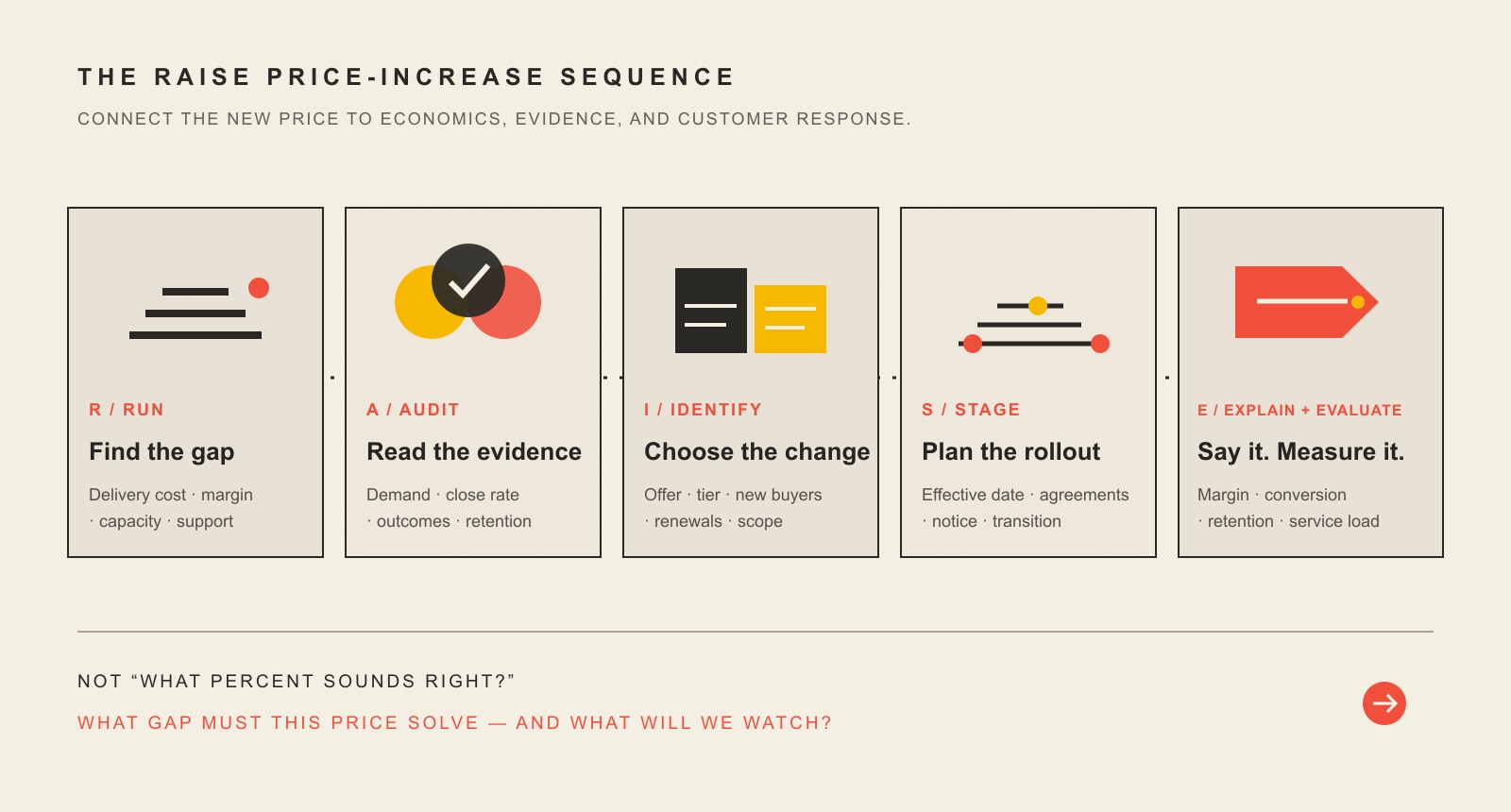
    Use the Scope Design RAISE price-increase sequence

    RAISE is a five-step sequence for turning “we should probably charge more” into a measurable business decision: Run the economics, Audit the evidence, Identify what changes, Stage the increase, then Explain and evaluate.

    The RAISE sequence: run the economics, audit evidence, identify what changes, stage the increase, and explain and evaluate customer and business outcomes.
    The RAISE sequence keeps a price increase connected to economics, evidence, rollout, communication, and measurement.

    R — Run the economics

    Define the business problem the new price must solve. Is the offer below its required margin? Is capacity full? Are delivery costs rising faster than revenue? Does the existing price prevent the staffing or support level customers expect? Write the current economics and the required economics side by side.

    A — Audit the evidence

    Look for repeated evidence rather than one loud opinion. Review demand, close rate, discount requests, customer outcomes, support burden, utilization, repeat purchases or retention where relevant, and credible alternatives in the market. Customer interviews and sales conversations can explain the numbers, especially when buyers value something different from what the team assumes.

    Price is not the same thing as perceived value. A higher price can raise the sacrifice in the buying decision just as easily as it raises expectations. Our guide to building perceived value without faking it goes deeper on evidence, risk, clarity, and experience.

    I — Identify what changes

    Decide whether the new price applies to every offer, one product line, one service tier, new customers, renewals, or a specific customer cohort. Sometimes the cleanest change is not “everything goes up 12%.” It is retiring an underpriced package, removing work that should not be bundled, introducing a higher minimum, or separating optional services that were quietly being given away.

    S — Stage the increase

    Choose an effective date and rollout that match the business. New customers can often receive the new price immediately. Existing customers may need notice, renewal timing, contract review, personal outreach, or a temporary transition. The right notice period depends on the relationship, billing cycle, agreement, and operational risk; there is no universal number that fits every business.

    Citizens Bank’s guide to raising prices follows the same practical sequence: understand margin, research the market, choose timing carefully, and give current customers advance notice with a clear explanation of what is changing and when.

    E — Explain and evaluate

    Tell customers what they actually need to know: the effective date, the new price or pricing method, what remains included, and any action required. Give a concise reason when it is useful and true. Then measure the outcome. The increase is not validated because the email was sent successfully; it is validated by what happens to margin, conversion, retention, service load, and customer fit.

    How much should you raise your prices?

    Raise the price enough to solve a defined economic or capacity problem, then test the assumptions that make the number work. An arbitrary 3%, 5%, 10%, or 20% increase can be accidentally right, but the percentage itself is not evidence.

    • Find the required floor. What price supports delivery, overhead, and the operating profit or contribution the offer needs?
    • Check the market corridor. What alternatives will a reasonable customer compare, and how different is your scope?
    • Model behavior. What happens if volume or retention changes after the increase?
    • Check capacity. If fewer customers at a higher price would improve delivery and total contribution, lower volume may be a feature rather than a failure.
    • Choose a review rule. Decide before rollout what evidence would make you hold, expand, adjust, or reverse the change.

    This is a business bet inside the broader Scope Design Business Strategy and Market Intelligence framework: make the outcome, assumptions, evidence, tradeoffs, resources, and review rule visible before you commit harder.

    How to raise prices without losing customers unnecessarily

    You cannot guarantee that nobody will leave after a price increase, and you should not design the rollout around that impossible goal. You can reduce preventable loss by avoiding surprise, applying the change consistently, explaining the decision clearly, and making sure the offer still earns the new price.

    A good price-increase message is short and specific

    For an existing customer relationship, the message usually needs five things:

    1. the date the new price takes effect;
    2. the new price, range, or pricing method;
    3. what is included and whether scope is changing;
    4. a concise, truthful reason when context helps; and
    5. a real person or process for questions.

    Example: “Beginning November 1, our monthly service will be $650. The scope and response process remain the same. This change lets us maintain the staffing and support level required for the work. Your October invoice is unchanged. If you want to review your plan before the new rate takes effect, reply here and we’ll walk through the options.”

    Do not bury the number under a page of apology. Do not invent a dramatic justification. Do not call the change an “upgrade” when nothing improved. If the new price includes a real scope or service change, explain it. If the reason is simply that the old price no longer supports the work, say that professionally.

    If the harder problem is how the price is displayed, compared, anchored, or explained on a website, that belongs to our separate guide to pricing psychology for clearer online decisions. Communication should make a true decision easier, not disguise the cost.

    Should you raise prices for new customers first?

    Starting with new customers is often a useful way to separate market acceptance from relationship-management risk. New prospects have no legacy price to compare. You can see whether qualified buyers still convert before moving a larger installed base.

    That does not mean existing customers should keep the old price forever. Permanent grandfathering can create a second price system that becomes harder to support every year. If you grandfather customers, define why, who qualifies, and when the exception will be reviewed or end. Honor contractual commitments and any notice requirements that apply to the relationship.

    For high-value or high-complexity accounts, personal outreach before a general notice can be worth the time. The purpose is not to negotiate against yourself. It is to surface scope, contract, and operational issues before the invoice becomes the first conversation.

    What should you measure after a price increase?

    Measure the consequence the increase was supposed to improve, plus the customer behaviors that could erase the gain. Revenue alone is not enough.

    MeasureWhat it tells you
    Contribution or gross profit per sale/accountWhether the economics improved after delivery cost is included.
    Qualified close or conversion rateWhether right-fit buyers still accept the offer.
    Retention, churn, cancellations, or repeat purchaseWhether existing-customer behavior changed where those measures apply.
    Revenue per project, account, or unit of capacityWhether scarce capacity is producing more useful value.
    Delivery time and support burdenWhether the new economics actually improve operations or just raise the invoice.
    Discount requests and objection reasonsWhether the problem is price, value clarity, scope, fit, or sales execution.

    Compare cohorts when possible. New customers quoted the new rate are different from long-term customers receiving an increase. Mixing them together can hide the reason results changed.

    Six price-increase mistakes to avoid

    1. Choosing a tidy percentage before finding the problem. “Let’s raise everything 10%” is a guess until the economics show why 10% matters.
    2. Using competitors as a calculator. Their price can identify a market boundary, but not your required margin or delivery model.
    3. Assuming a higher price automatically creates higher perceived value. A higher sacrifice with weak evidence can make the offer look worse. Fix the offer or proof problem instead.
    4. Apologizing until the decision sounds suspicious. Customers need clarity more than a nervous essay.
    5. Discounting immediately after the first objection. One objection is information, not a referendum. Record patterns before you dismantle the increase.
    6. Grandfathering forever without a reason. Exceptions accumulate operational debt. Give them an owner and a review date.

    Price is also only one part of customer value. If the increase is exposing a deeper experience problem, revisit what customers receive and where friction lives. Our guide to building value by investing in customers covers that side of the relationship.

    What auditing this exact article changed

    We did not preserve the old version just because it already existed. For the 12 complete months from August 21, 2025 through August 20, 2026, the active Scope Design GA4 property recorded one landing session for this URL, with zero engaged sessions and zero configured key events. Google Search Console returned no reportable exact-page query rows. Bing recognized the URL but reported zero clicks and zero impressions in the fresh URL check. Ubersuggest returned no exact-page backlinks.

    That tiny sample does not prove the topic is worthless, that readers disliked the old article, or that this revision will rank. Scope Design’s analytics attribution and key-event configuration also have limitations. It supports a narrower editorial decision: preserve the established URL, remove unsupported statistics and trend claims, give the page one clear job, and make its advice more useful than the legacy copy.

    The previous version leaned on old business-failure percentages, broad pricing-trend claims, sustainability-premium numbers, and the idea that a higher price can function as an automatic quality signal. Those claims are gone. The replacement uses a business-specific economics check, a reusable rollout sequence, current query evidence, direct source support, and explicit limits.

    Frequently asked questions about raising prices

    When should a business raise prices?

    Raise prices when the old price no longer supports the economics, capacity, scope, or reliable delivery of the offer and the change can be tied to evidence rather than fear or imitation. Review the price when meaningful inputs change instead of waiting for a crisis.

    How much should I raise my prices?

    Start with the required economic gap, then model customer behavior and market alternatives. There is no universal “safe” percentage. A smaller increase that leaves the business underfunded is not automatically safer, and a larger increase that changes customer fit must be evaluated with real response data.

    How do I raise prices without losing customers?

    You cannot guarantee zero customer loss. Reduce preventable loss by avoiding surprise, honoring agreements, giving appropriate notice, stating the new price clearly, keeping the reason truthful and concise, and making sure the offer still earns the price. Judge success by total business consequences, not by whether every customer stays.

    Should existing customers be grandfathered at the old price?

    Sometimes, temporarily. Grandfathering can protect a contractual or relationship transition, but indefinite exceptions create operational complexity and can leave the original economics unsolved. Define eligibility, duration, and a review date.

    How often should a business review prices?

    There is no universal cadence, but prices should be reviewed whenever costs, scope, demand, capacity, customer mix, or market alternatives change materially. A regular scheduled review is useful because it prevents years of drift followed by one painful emergency increase.

    Make the price a business decision

    A price increase should solve something real. Run the economics, audit the evidence, identify what changes, stage the rollout, explain it clearly, and evaluate what happened. If the increase improves the business while preserving the customers and delivery model you actually want, you have learned something useful. If it exposes a positioning, offer, capacity, or customer-fit problem, that is useful evidence too.

    If pricing pressure is only one symptom of a broader constraint, start with Scope Design’s Business Strategy and Market Intelligence guide. It is built for the larger question: what decision deserves resources next, what must be true, and what evidence should change your mind.

    Sources and methodology

    • U.S. Small Business Administration: used for the break-even definition and formula.
    • Citizens Bank, Mastering the delicate art of raising prices: used as independent corroboration for margin review, market research, timing, and advance customer notice.
    • Scope Design’s own GA4, Google Search Console, Bing Webmaster Tools, Ubersuggest, and DataForSEO observations: used to audit this exact article’s existing footprint and current search-question shape before revision.
    • Scope Design Content Studio and internal knowledge graph: used to keep this page distinct from the separate owners for baseline pricing, perceived value, pricing psychology, customer value, and broader business strategy.
  • Product Repositioning: Fix the Mismatch Before You Rebrand

    Product Repositioning: Fix the Mismatch Before You Rebrand

    Product repositioning is the deliberate act of changing how a market understands, compares, and chooses an existing product. It makes sense when the product can deliver real value, but the current audience, use case, category, proof, or message is wrong. If the product does not reliably do its job, repositioning is not strategy. It is better packaging around the same problem.

    Weak sales are a symptom. Before you touch the logo, rewrite the website, change the price, or add another feature, figure out what is actually mismatched.

    TL;DR: Reposition only after you diagnose the gap

    • A product gap is not a positioning problem. If customers buy and then cannot get the promised result, fix the product first.
    • Audience, use-case, category, proof, and message gaps can often be tested without rebuilding the product.
    • Change one positioning lever at a time. A full rebrand changes so many variables that you can easily spend a pile of money and learn almost nothing.
    • Use real behavior as evidence. Customer interviews, win/loss notes, activation, repeat use, retention, qualified conversion, and support patterns beat opinions from people who were never going to buy.
    • Repositioning should earn the right to become permanent. Test the hypothesis on a limited audience or page first, then keep it, revise it, rebuild the product, or stop.

    In this guide

    If you need the broader decision system around this, start with Scope Design’s Business Strategy framework. This article owns one narrower decision: what to do when an existing product is underperforming and someone says, “Maybe we just need to reposition it.”

    What is product repositioning?

    Product repositioning changes the place an existing product occupies in a buyer’s mind. That may mean changing the target audience, the main use case, the category buyers compare it against, the value proposition, the proof used to support that value, or the language used to explain it.

    That definition matters because repositioning is often confused with three very different moves: rebranding, product improvement, and product replacement.

    MoveWhat actually changesUse it whenCommon mistake
    Product positioningThe initial market frame for a productYou are defining who it is for, what job it does, and why it is differentWriting a tagline before the market choice is clear
    Product repositioningThe market frame for an existing productEvidence says the product can work, but the current fit is wrongTreating weak sales as proof that messaging is the only problem
    RebrandingBrand identity, expression, or architectureThe brand itself is creating confusion or no longer fits the businessPaying for a new identity before validating a new position
    Product changeFeatures, delivery, quality, workflow, or economicsThe product cannot reliably deliver the promised outcomeTrying to market around a product defect
    RetirementThe decision to stop investingDemand, economics, or strategic fit remain weak after credible testsKeeping a product alive because of sunk cost

    Kellogg’s Alice Tybout makes a useful distinction in her discussion of brand repositioning: a position can become too broad to be supported by the brand’s “reason to believe,” meaning the proof behind the promise. That is a good reminder that a positioning problem can be caused by an overextended claim, not just bad copy.

    Before you reposition, ask the uncomfortable question: does the product deserve to survive?

    The temptation is to assume the product is fine and the market simply misunderstood it. Sometimes that is true. Sometimes the market understood it perfectly and shrugged.

    A product is a poor repositioning candidate when the core problem sits inside the product itself. Watch for patterns such as:

    • customers understand the promise, buy, and still cannot get the expected result;
    • trial or first purchase looks healthy, but activation, repeat use, renewal, or retention is persistently weak;
    • support complaints reveal the same functional failure again and again;
    • the economics only work if you hide real delivery costs or depend on unrealistic volume;
    • the proposed new message would require claims the product cannot substantiate;
    • the only reason to continue is, “We already spent too much to stop now.”

    That last one deserves special suspicion. If the team is defending the past investment instead of evaluating the next investment, run the decision through the SCOPE Decision Filter and check for the cognitive biases that turn sunk cost into strategy.

    If the product works for some real customers and produces a useful outcome, then repositioning becomes much more interesting. Now the question is not “How do we make this sound better?” It is “Where is the mismatch?”

    Use the Product Repositioning Gap Map to diagnose the mismatch

    Most underperforming products do not need a random collection of marketing tactics. They need a diagnosis. Scope Design’s Positioning Gap Map separates six problems that are routinely mashed together under the phrase “bad positioning.”

    Product repositioning diagnostic: first verify the product delivers reliably; if it does, investigate a mismatch in audience, use case, category, proof, or message.

    1. Product gap

    The product cannot reliably deliver the promised job.

    This is the one gap you should not solve with repositioning. If the product is unreliable, incomplete, unsafe, too hard to use, or structurally uneconomic, change the product or stop selling it.

    A prettier promise cannot turn failure into value. It can only increase the number of disappointed customers.

    2. Audience gap

    The product works, but the current audience is a poor fit.

    You may discover that a smaller, more specific segment converts faster, uses the product more deeply, asks fewer support questions, or retains better than the audience you originally targeted.

    Do not immediately declare a new target market because three people said nice things. Use market research to compare behavior, alternatives, willingness to act, and competitive context across segments. The U.S. Small Business Administration recommends market research and competitive analysis to understand customers, demand, alternatives, and market segments.

    3. Use-case gap

    Customers value a different job than the one you built your marketing around.

    A product may have been created for one workflow and become valuable for another. The important evidence is not that people can invent clever uses for it. The important evidence is that a meaningful group already behaves differently and gets value from that behavior.

    Look at what customers actually do, not what a brainstorming session says they might do. Harvard Business School’s Jobs to Be Done interview guidance emphasizes observing and interviewing customers to uncover the job they are actually trying to accomplish.

    4. Category gap

    Buyers do not know what shelf in their brain to put the product on.

    If prospects repeatedly ask “What is this?” or compare the product with something that makes the value look absurd, the category or frame of reference may be wrong.

    A better category does not need to be clever. It needs to help the buyer answer three fast questions: What kind of thing is this? What should I compare it with? Why should I care about the difference?

    5. Proof gap

    The value may be real, but the buyer has no good reason to believe the promise.

    A proof gap can look like a message problem because prospects understand what you are saying but still do not act. The fix may be stronger demonstrations, clearer case evidence, credible reviews, a useful trial, transparent methodology, or narrower claims.

    This is also where repositioning can wander into bullshit. The Federal Trade Commission requires objective advertising claims to have an appropriate factual basis before they are made. Changing the position does not create permission to invent the proof.

    6. Message gap

    The product, audience, use case, category, and proof are basically sound, but the language hides the value.

    This is the gap marketers love because it can be fixed with words. It is also the gap teams diagnose far too early.

    If prospects can explain the product back to you accurately but do not care, you probably do not have a message problem. If qualified prospects consistently misunderstand what it does, who it is for, or why it matters, then the message deserves attention.

    Market saturation matters here too. A claim that worked when it was novel can become invisible when every competitor says the same thing. Scope’s market sophistication framework helps separate a genuinely weak position from a message that has simply become marketing wallpaper.

    Read the evidence as a pattern, not a magic diagnostic

    No single metric proves which gap you have. The patterns below are hypotheses worth testing, not commandments carved into a conference-room wall.

    What you observeLikely gap to investigateFirst useful test
    One customer segment retains or repeats much better than the restAudience or use caseRebuild one landing page and sales pitch for that segment only
    Prospects repeatedly compare you with the wrong alternativeCategoryTest a clearer frame of reference and comparison set
    Prospects understand the value but do not believe the claimProofAdd specific evidence or narrow the claim before changing the whole message
    Qualified visitors engage but routinely misunderstand what the product doesMessageTest a simpler promise, explanation, and example
    People buy or trial, but usage and retention collapseProduct or use caseInterview successful and unsuccessful users, then inspect the actual experience
    Every segment stays weak after repeated credible testsProduct, demand, or economicsStop polishing the position and reconsider the product itself

    The useful question is not “Which metric is bad?” It is “Which explanation best fits several pieces of evidence at once?”

    Use the RESET Repositioning Loop before you pay for the full rebrand

    Once you have a plausible gap, use a controlled loop instead of a dramatic launch. We call it RESET:

    Read the evidence

    Start with what already exists: customer interviews, lost deals, support tickets, reviews, product usage, sales notes, search demand, competitive alternatives, repeat behavior, and margins.

    Do not begin with a workshop where everyone writes adjectives on sticky notes. That can come later, after reality has had a vote.

    Expose the mismatch

    Write the problem as a falsifiable statement.

    Bad: “Our positioning feels stale.”

    Better: “Independent agencies that use the product for client approvals retain longer than the general small-business audience, but our site never presents client approvals as the primary use case.”

    Now you have something you can test.

    Select one positioning lever

    Choose the smallest change that would test the hypothesis:

    • target segment;
    • primary job or use case;
    • category or frame of reference;
    • value proposition;
    • proof;
    • message hierarchy;
    • packaging or offer structure when it materially changes the perceived value.

    If you change the audience, category, pricing, product, name, visual identity, website, and advertising all at once, the launch may look impressive and teach you absolutely nothing.

    Experiment before the rebrand

    Test the new position somewhere reversible. That could be a dedicated landing page, a small paid campaign, a sales deck, a targeted email to a qualified segment, a new onboarding path, or a limited outbound sequence.

    Use enough exposure to observe real behavior, not enough commitment to make the test politically impossible to reverse.

    Track response and decide

    Predefine what would count as stronger evidence. Depending on the business, that might be better qualified conversion, improved activation, shorter sales cycles, fewer “I don’t get it” objections, stronger retention, healthier margins, or a more favorable win/loss pattern.

    Then decide: keep the new position, revise and test again, fix the product, or stop investing.

    This loop fits inside the broader 7 Ps product strategy audit. The 7 Ps help you examine the whole product-marketing system. RESET is for the narrower moment when an existing product is not getting the response you expected.

    Product repositioning is not the same as rebranding

    Repositioning changes the strategic meaning of the product. Rebranding changes how that meaning is expressed through identity, naming, visual language, architecture, or other brand elements.

    Sometimes a new position eventually requires a new brand expression. Sometimes it does not.

    If your test shows that a different audience responds strongly to a different use case, you may be able to update the product page, sales story, examples, and proof without touching the logo. That is usually a lovely discovery because logos are not paid by the hour to solve market fit.

    A rebrand should follow a strategic change when the existing identity or brand architecture genuinely obstructs the new position. It should not be the expensive experiment you use to discover whether the new position works.

    A practical product repositioning example

    Imagine a project-management app originally marketed as “simple productivity for every small business.”

    The broad market performs poorly. Sales calls are long. Prospects compare it with enormous all-in-one platforms and conclude it has fewer features. Generic small businesses sign up but rarely become active users.

    Then the team notices a pattern: small field-service companies use the app heavily for one specific workflow, photo-based job handoffs between office staff and technicians. They activate faster, repeat the workflow every week, and describe the product to colleagues as “the easiest way to prove what happened on site.”

    The product may not need a reinvention. It may have an audience, use-case, and category gap.

    A sensible repositioning test would be:

    1. target field-service teams instead of “every small business”;
    2. lead with the job-handoff use case instead of generic productivity;
    3. compare the product with manual handoff methods and bloated field-service suites, not every project-management platform;
    4. show real workflow proof;
    5. run that position on one landing page and one sales path before rebuilding the brand.

    If the targeted path improves qualified conversion and the customers continue to activate and retain, the repositioning has earned more investment. If they click the new message and then churn because the workflow still breaks, congratulations, you found a product gap before buying new stationery.

    That is the point of diagnosis-first repositioning.

    A sample 30-day product repositioning test

    Thirty days is not a universal law. A complex enterprise sale may need much longer, while a high-volume ecommerce test may produce useful evidence faster. Treat this as a compact test structure, not a promise about timing.

    Days 1 to 5: establish the baseline

    Record the current audience, promise, conversion path, objections, activation or repeat behavior, retention when relevant, margins, and the competing alternatives customers actually consider.

    Interview recent buyers, non-buyers, and lost prospects. Ask about what they did before, what triggered the search, what alternatives they considered, what made them hesitate, and what happened after purchase.

    Days 6 to 10: choose one gap hypothesis

    Write one clear statement about the suspected mismatch. Pick one primary segment or use case. Define the behavior that would make the hypothesis more credible and the behavior that would weaken it.

    Days 11 to 24: run the controlled test

    Change only the positioning elements necessary to test the hypothesis. Keep the existing version available as a baseline when practical. Route a limited, relevant audience through the new version.

    Do not judge the test on likes, compliments, or the enthusiasm of coworkers who now feel emotionally attached to the new headline.

    Days 25 to 30: compare behavior and decide

    Compare the new path with the baseline. Review both numbers and actual customer language. Decide whether the evidence supports a larger rollout, another focused test, a product change, or a stop decision.

    The goal of the pilot is learning. A test that disproves a repositioning hypothesis before a six-month rebrand can be a very profitable failure.

    How should you measure whether product repositioning is working?

    The right metrics depend on where the suspected gap sits in the customer journey.

    Acquisition and qualification

    Look at whether the new position attracts more of the right people, not merely more people. Useful measures may include qualified landing-page conversion, lead quality, demo quality, segment mix, and which alternatives prospects mention.

    Sales friction

    Track objections, win/loss reasons, sales-cycle length, follow-up burden, price confusion, and how often salespeople need to re-explain the product after the marketing supposedly explained it.

    Product behavior

    If the product has an activation or repeat-use cycle, inspect it. Better marketing with worse activation is not progress. Retention, renewal, repeat purchase, usage depth, support burden, and successful completion of the core job help tell you whether the new audience/use case fits the actual product.

    Economics

    A position that raises conversion but attracts an expensive-to-serve segment may still be a bad trade. Include acquisition cost, delivery cost, gross margin, refund or churn patterns, and the operational burden created by the new promise.

    Qualitative evidence

    Capture the words customers use. A strong position often makes sales conversations clearer because buyers can explain the value in their own language. That is not a substitute for behavioral evidence, but it is useful diagnostic material.

    When should you stop repositioning and make a harder decision?

    Repositioning has become avoidance when:

    • every new message produces the same weak behavior;
    • the only segment showing interest is too small or too expensive to serve;
    • the product still fails its core job after the audience and use case are clear;
    • the economics do not work under realistic acquisition and delivery assumptions;
    • a new position would depend on claims you cannot substantiate;
    • the team keeps moving the target because admitting the product is weak feels worse than launching another campaign.

    A failed repositioning test does not automatically mean the product is dead. It does mean you should update the diagnosis instead of protecting the theory.

    That is the same constraint-first principle Scope uses in website strategy: a requested redesign, feature, campaign, or message is not automatically the real problem. Diagnose the binding constraint before optimizing the thing that is easiest to see.

    Product repositioning FAQ

    What is product repositioning?

    Product repositioning is changing how an existing product is understood and compared in the market. The change may involve the target audience, use case, category, value proposition, proof, or message while keeping some or all of the core product intact.

    What is the difference between product positioning and repositioning?

    Positioning establishes the intended market frame for a product. Repositioning changes that frame after the product already has a market history, customer perception, or performance record.

    When should a company reposition a product?

    Reposition when credible evidence suggests the product delivers value but the current audience, use case, category, proof, or message is mismatched. Do not default to repositioning when the product itself cannot deliver the promised result.

    Can you reposition a product without changing the product?

    Yes. An audience, use-case, category, proof, or message reposition can leave the core product largely unchanged. The key is that the new promise must match what the product can actually deliver.

    Does product repositioning require a rebrand?

    No. Repositioning is a strategic change in market meaning; rebranding is a change in brand expression. Test the strategic position first. Rebrand when the existing identity genuinely blocks the validated position.

    What are common product repositioning strategies?

    Common approaches include narrowing or changing the target segment, emphasizing a different use case, changing the competitive frame, clarifying the value proposition, strengthening proof, changing packaging or offer structure, and rewriting the message hierarchy.

    Can you give an example of product repositioning?

    A software product marketed broadly as “productivity for small business” might discover that field-service teams use it heavily for photo-based job handoffs. Repositioning could target that segment, lead with that job, change the comparison set, and add relevant proof without rebuilding the whole product. That is a hypothetical example, but it shows the decision clearly.

    How do you know whether poor sales are a positioning problem or a product problem?

    Look beyond sales. If qualified customers understand the promise, buy, and then fail to activate, repeat, renew, or get the intended result, investigate the product or use case. If the product creates strong outcomes for a specific group but the market attracts the wrong buyers or misunderstands the value, investigate positioning.

    How do you reposition a failed product?

    First determine whether it is actually a failed product. Read customer and product evidence, identify the most plausible gap, select one positioning lever, run a limited test, and compare behavior with the baseline. If the core product fails, fix or retire it instead of disguising the failure.

    What are the biggest risks of product repositioning?

    The main risks are confusing or alienating existing customers, changing too many variables to learn anything, making claims the product cannot support, chasing a tiny or unprofitable segment, and spending heavily on a rebrand before the new position has been validated.

    How long does product repositioning take?

    The strategic test can be quick when traffic and sales cycles are short, or much longer in complex B2B markets. Separate the time required to test the hypothesis from the time required to roll out a validated position across the product, brand, website, sales process, and operations.

    What metrics should you track after repositioning?

    Track metrics tied to the suspected gap: qualified conversion and segment mix for audience/message changes; objections and win/loss reasons for category/proof changes; activation, repeat use, retention, and support burden for product/use-case fit; and margin or acquisition economics for the overall business decision.

    Do not buy a new story before you know what is broken

    Product repositioning can be a smart response to weak demand. It can also become an expensive way to avoid admitting that the product, audience, economics, or evidence is wrong.

    The useful order is simple: diagnose the gap, test the smallest meaningful change, watch qualified behavior, then decide.

    If your team is bouncing between “we need a new website,” “we need better ads,” “we need a rebrand,” and “we need more features,” Scope Design can help separate the requested fix from the actual constraint. Contact Scope Design and we will start with the problem before prescribing the project.

  • How to Outsource Any Project Successfully: A Practical Guide

    How to Outsource Any Project Successfully: A Practical Guide

    Project outsourcing works when you transfer execution without transferring ownership. The outside provider can own the agreed method and production work, but your business should still own the outcome, source-of-truth information, approvals, access decisions, acceptance criteria, and exit path.

    That distinction matters because most outsourcing failures are not really “vendor problems.” They start earlier: a vague brief, nobody internally accountable, quality described as a feeling, uncontrolled access, changes handled in chat, or a handoff nobody planned until the final invoice.

    If you are still deciding whether outside execution is the right operating model, start with our in-house vs. outsourcing decision framework. If you have already decided to outsource a defined project, this guide shows you how to run it without losing control.

    The seven controls of successful project outsourcing

    At Scope Design, we think about outsourced work through seven controls. You do not need a giant procurement department to use them. You need each control to have a clear answer before the project gets too far downstream.

    ControlQuestion you must be able to answerWhat “good” looks like
    1. OutcomeWhat business result are we trying to create?A specific outcome and bounded deliverables
    2. OwnershipWho inside our business remains accountable?One internal owner with decision authority
    3. EvidenceHow will we know each deliverable is acceptable?Observable tests, approvals, files, metrics, or checks
    4. ProviderWhat type of outside partner fits the coordination problem?Relevant proof, capacity, communication fit, and realistic constraints
    5. GuardrailsWhat rules control scope, access, security, payment, and changes?Written expectations and a clear change path
    6. ReviewWhen will we inspect work and make decisions?Early checkpoints tied to real deliverables
    7. TransferWhat must come back to us at the end?Accepted work, source files, documentation, owned accounts, and revoked access

    The framework is deliberately simple. Its job is to expose missing controls before they turn into expensive misunderstandings.

    Before you outsource: make sure the project is ready

    Outsourcing is not a substitute for defining the work. In our own subcontracting and delivery processes, we get better results when the task, skills required, time constraints, budget, communication expectations, and review points are explicit before someone external starts producing.

    A project is usually ready for outside execution when you can describe the desired result, identify the decisions that must stay internal, and give a provider enough context to estimate or propose a sensible approach. You do not need every implementation detail solved in advance. You do need enough definition to distinguish discovery from production.

    If the core problem is still unclear, consider outsourcing a discovery phase first rather than pretending the entire project is fixed. A good discovery engagement can produce the requirements, risks, options, and delivery plan for the next phase. That is more honest—and more governable—than asking multiple vendors to price an undefined outcome.

    If the business priority itself is still unclear, use our broader business strategy framework to clarify the objective, constraint, and evidence before you outsource the execution.

    1. Outcome: write a project brief a provider can actually use

    Your outsourcing brief should explain the business problem before it lists tasks. Providers make better decisions when they understand what the work is supposed to accomplish, not just what files they are supposed to produce.

    Minimum viable outsourcing brief

    • Business goal: What changes if this project succeeds?
    • Deliverables: What specific outputs should exist at the end?
    • Out of scope: What is explicitly not included?
    • Audience or users: Who will use, approve, or be affected by the work?
    • Source of truth: Which data, brand rules, requirements, files, systems, or people are authoritative?
    • Constraints: Deadlines, platforms, compliance needs, dependencies, brand requirements, or technical limits.
    • Milestones: Which intermediate outputs should be reviewable?
    • Acceptance evidence: What must be demonstrated, tested, delivered, or approved for each milestone?
    • Access: Which systems may be required, and what can remain unavailable until needed?
    • Change process: Who can approve a change and how will time, price, and acceptance be updated?
    • Handoff: Which source files, credentials, documentation, training, or account ownership must return to your business?

    For a website project, our website project organization guide goes deeper into gathering content, stakeholders, approvals, and dependencies before production begins.

    2. Ownership: keep one accountable person inside the business

    External execution does not eliminate internal responsibility. Someone on your side still needs to own the business result and have enough authority to answer questions, approve decisions, resolve conflicts, and accept work.

    A useful division of responsibility looks like this:

    The client should retainThe provider can own
    Business outcome and prioritiesRecommended execution method
    Source-of-truth facts and materialsProduction workflow and specialist work
    Access approvalsUse of approved tools and systems
    Decisions that change scope or riskDay-to-day implementation decisions within scope
    Acceptance or rejection against agreed evidenceTesting, correction, and delivery of the agreed work

    This is not about micromanagement. It is about keeping the decisions that only your business can legitimately make. A provider should not have to invent your priorities because nobody internally owns them.

    3. Evidence: define “done” before production starts

    “High quality,” “modern,” “fast,” and “professional” are not acceptance criteria. They are preferences until you turn them into something observable.

    Project Management Institute guidance on managing outsourced projects makes the same buyer-side point: quality becomes governable when it is defined in advance in measurable terms for the deliverables being produced.

    Acceptance evidence depends on the project. It might be a signed-off design, a working import using a provided test file, a page that passes an agreed browser/device checklist, source files in an editable format, a campaign built in the client-owned ad account, or documentation that another qualified person can follow.

    A simple acceptance formula

    For each meaningful deliverable, write:

    1. Deliverable: What is being produced?
    2. Evidence: What proves it works or is complete?
    3. Reviewer: Who can accept it?
    4. Correction path: What happens if it does not pass?

    Doing this before kickoff changes vendor selection too: providers are pricing and planning against the same definition of completion instead of interpreting “quality” differently.

    4. Provider: choose the model that fits the coordination problem

    Do not assume a freelancer is automatically cheaper, an agency is automatically better, or a managed service is automatically safer. Those are different operating models. The best fit depends on how much coordination, specialization, continuity, and internal management the project requires.

    Provider modelOften fits whenWatch for
    Freelancer / independent specialistThe work is narrow, one person can reasonably own delivery, and you can manage coordination internally.Capacity, backup coverage, documentation, and dependence on one person.
    AgencyThe project needs several disciplines, coordinated delivery, or one accountable team across phases.Who will actually do the work, handoffs between sales and delivery, and whether the process fits your project.
    Specialist firmThe project has a deep technical, regulatory, creative, or industry-specific requirement.Narrow expertise that may need coordination with other providers.
    Managed serviceYou want an ongoing outcome or operating function rather than a one-time deliverable.Service levels, account ownership, escalation, data portability, and termination terms.

    If the outsourced project is specifically a website, use our guide to choosing a web design company for the deeper provider-selection questions that do not belong in this general outsourcing guide.

    Vet relevant evidence, not presentation polish

    Ask for proof that reduces the uncertainty your project actually has. A beautiful portfolio can prove design capability but tell you nothing about migrations, documentation, project recovery, security practices, or stakeholder management.

    • Ask for work similar in complexity, constraints, or outcome—not just the same industry.
    • Ask who will do the work and who has final responsibility.
    • Ask the provider to identify assumptions and unknowns in your brief.
    • Ask how changes, delays, dependencies, and rejected deliverables are handled.
    • Ask what you will own at the end and what would make a future provider transition difficult.
    • For technology suppliers, consider formal due diligence proportionate to the access and risk involved. NIST SP 1326 describes supplier due diligence as researching pertinent supplier or product information so acquisition decisions can be informed.

    Use a paid pilot when the uncertainty is testable

    If a project is large but one risky assumption can be isolated, a paid pilot can be more informative than another sales call. Choose a small piece of real work with a clear endpoint and the same kind of constraints the larger engagement will face. Do not use free speculative work as a substitute for due diligence, and do not “pilot” high-risk security or compliance work in a way that creates avoidable exposure.

    5. Guardrails: put scope, access, security, and change rules in writing

    Your agreement does not have to turn a small project into enterprise procurement. It does need to capture the parts most likely to become disputed or risky: deliverables, responsibilities, price or billing method, schedule assumptions, acceptance, changes, confidentiality, intellectual property, termination, and handoff.

    For technology-related suppliers, NIST SP 1305 recommends defining and communicating supplier requirements as part of supply-chain risk management. The practical small-business translation is simple: if a requirement matters, do not leave it trapped in your head.

    Treat vendor access as a lifecycle

    Access is not a one-time setup task. Decide what the provider needs, when they need it, how they should authenticate, what data they may handle, and when access will be removed.

    The Federal Trade Commission’s Start with Security guidance recommends need-to-know access, choosing service providers capable of reasonable security, putting security expectations in writing, and verifying that providers follow those expectations.

    • Create provider-specific accounts where the system supports them rather than sharing a master login.
    • Grant the minimum practical permissions.
    • Keep important domains, hosting, analytics, ad accounts, repositories, payment systems, and other business assets under client-controlled ownership whenever possible.
    • Use your normal secure credential-sharing method instead of putting passwords in project chat.
    • Record what access was granted so you can revoke it deliberately during handoff.

    Security and contract requirements vary by project and jurisdiction. For sensitive data, regulated work, intellectual property, or complex contractor relationships, get qualified legal, tax, or security advice rather than treating a generic checklist as individualized advice.

    Make scope changes visible

    Scope creep is often just unpriced decision-making. A stakeholder asks, “Could we also…?” The provider says yes. Nobody updates the schedule or acceptance criteria. Weeks later, both sides remember a different project.

    PMI guidance on third-party outsourced projects recommends documenting changes and evaluating their impact before they become part of the project. Our practical version is a three-impact check:

    • Cost: Does the change affect price, hours, or another resource?
    • Timing: Does it move a milestone or create a dependency?
    • Evidence: Does it change what must be demonstrated for acceptance?

    If none of those change, the request may be a clarification. If one changes, record the decision.

    6. Review: manage by checkpoints, decisions, and working evidence

    You do not need constant status meetings. You need visibility at the points where feedback is still cheap.

    A useful kickoff confirms the brief, deliverables, client responsibilities, first actions, communication channel, review cadence, and the person on each side who can make decisions. Then schedule reviews around meaningful work: a discovery summary, wireframe, prototype, data sample, draft campaign, staging build, test result, or other inspectable output.

    A lightweight review rhythm

    • Kickoff: confirm scope, assumptions, roles, access, and first milestone.
    • Early checkpoint: inspect direction before too much work accumulates.
    • Milestone reviews: compare actual deliverables with the agreed evidence.
    • Decision log: record changes, approvals, and unresolved choices in one place.
    • Risk/escalation check: surface blocked dependencies or threats while there is still time to act.
    • Final acceptance: do not confuse “delivered” with “accepted.” Test the agreed evidence first.

    For web work, our guide to working effectively with a web design company covers the collaboration responsibilities in more depth.

    7. Transfer: design the handoff before kickoff

    A project is not truly complete if the business cannot operate, maintain, audit, or transfer what it bought. That is why handoff requirements belong in the original brief.

    Depending on the project, final transfer may include:

    • Final deliverables in the agreed formats.
    • Editable/source files where included.
    • Code repositories or exportable project files.
    • Documentation for setup, maintenance, recurring processes, or known limitations.
    • Client-owned account access and ownership confirmation.
    • Licensing information and renewal responsibilities.
    • Training or recorded walkthroughs where included.
    • An open-issues list with accepted exceptions clearly identified.
    • Revocation of provider accounts, temporary credentials, tokens, and unnecessary permissions.
    • A final reconciliation of the delivered work against scope and approved changes.

    Designing for reversibility does not mean you expect the relationship to fail. It means a successful project should leave the client more capable—not more trapped.

    How to measure whether outsourcing actually worked

    Do not reduce success to “Was the outside invoice lower than an internal salary estimate?” A project can look cheaper while creating weeks of rework, management burden, lock-in, or unusable output.

    Measure the things that mattered in your original reason for outsourcing:

    • Outcome: Did the project create the intended business capability or result?
    • Acceptance: How many deliverables passed the agreed evidence without unplanned rework?
    • Delivery: Were milestones met after accounting for approved changes and client-caused dependencies?
    • Change: How much of the final project came from approved changes versus avoidable ambiguity?
    • Internal load: How much management and specialist time did your team still spend?
    • Knowledge transfer: Can your team operate or explain the result after handoff?
    • Reversibility: Could another qualified provider take over without reconstructing your accounts, files, decisions, or process from scratch?

    These metrics do something universal cost-savings percentages cannot: they tell you whether your outsourcing decision actually delivered the value you needed.

    Common outsourcing failure modes—and the control that fixes each one

    Failure modeWhat is usually missingFix
    The provider built the wrong thing wellOutcomeExplain the business result and source-of-truth requirements before tasks.
    Questions sit unanswered for daysOwnershipName one internal owner with decision authority.
    Both sides disagree whether the work is “good enough”EvidenceDefine acceptance tests or observable proof before production.
    A great sales presentation turns into weak deliveryProviderVet the actual team, relevant proof, assumptions, capacity, and process.
    Scope grows in chat without consequencesGuardrailsUse written change decisions that address cost, timing, and evidence.
    Problems appear only at the endReviewInspect early working outputs, not percentages-complete.
    The client cannot change providersTransferPlan account ownership, source files, documentation, and access revocation from kickoff.

    Outsourcing project checklist

    • ☐ We can state the business outcome in plain language.
    • ☐ Deliverables and important exclusions are documented.
    • ☐ One person inside our business owns decisions and acceptance.
    • ☐ Every major deliverable has observable acceptance evidence.
    • ☐ The provider has shown relevant proof for the actual project risk.
    • ☐ Key assumptions and dependencies are written down.
    • ☐ Scope, payment, confidentiality/IP, change handling, and termination expectations are documented appropriately for the engagement.
    • ☐ Access will be granted on a minimum-necessary basis and can be revoked.
    • ☐ Review checkpoints happen before the final delivery.
    • ☐ Changes are evaluated for cost, timing, and acceptance impact.
    • ☐ Source files, documentation, account ownership, and training expectations are defined.
    • ☐ Final acceptance includes access cleanup and a scope reconciliation.

    Project outsourcing FAQ

    How do you outsource a project successfully?

    Define the outcome and deliverables, keep one internal owner, set acceptance evidence, choose a provider based on relevant proof, document scope/access/change guardrails, review real work at early checkpoints, and plan handoff before kickoff. The goal is to outsource execution while keeping business ownership and an exit path.

    What should be included in an outsourcing project brief?

    Include the business goal, deliverables, exclusions, audience, source-of-truth inputs, constraints, milestones, acceptance evidence, expected access, change process, client responsibilities, and handoff requirements. If the work is too uncertain to define, scope a discovery phase instead of pretending the whole project is fixed.

    How do you choose between a freelancer and an agency?

    Choose based on coordination and capability, not the label. A freelancer can be ideal for bounded specialist work when you can manage coordination. An agency can fit multi-discipline work when you want one team to coordinate several roles. In either case, vet the people doing the work, relevant proof, capacity, communication, ownership, and handoff.

    How do you prevent scope creep when outsourcing?

    Document the original scope and acceptance evidence, give change approval to a named person, and record any request that changes cost, timing, or the definition of done. This protects both sides: the provider does not absorb undefined work and the client does not discover hidden changes at the end.

    How much access should an outsourced provider receive?

    Only the access reasonably required for the work, for only as long as it is needed. Prefer provider-specific accounts and client-owned business assets, document what was granted, and revoke unnecessary permissions during handoff. Sensitive or regulated environments may require additional security controls.

    Does calling someone an independent contractor settle their status?

    No. In the United States, IRS educational guidance distinguishes employees and independent contractors based on facts including who controls how work is performed and the nature of the relationship. See the IRS explanation of employees and independent contractors, and get qualified tax or legal advice for your situation.

    Outsource the work—not your responsibility for the result

    The strongest outsourcing relationship is not the one with the most meetings, the longest contract, or the fanciest project dashboard. It is the one where both sides can answer the same basic questions: What are we creating? Who owns each decision? What proves the work is acceptable? What happens when something changes? And what does a clean handoff look like?

    If the project you need to outsource involves website strategy, design, development, marketing, content, or related digital execution, Scope Design can help you turn the business goal into a practical delivery plan and define what should stay under your control.

  • A Business Decision-Making Framework for Choices That Actually Matter

    A Business Decision-Making Framework for Choices That Actually Matter

    A useful business decision-making framework matches the process to the decision. First define the actual problem. Then assess the stakes, reversibility, uncertainty, and people involved. Make cheap, reversible choices quickly. Test uncertain choices when reality can answer faster than another meeting. Slow down for consequential decisions that are difficult to reverse. Record the assumptions, decision owner, safeguards, stop conditions, and review date so a lucky outcome does not get mistaken for brilliant judgment.

    That is the short answer. The even shorter Scope Design version is this: stop giving every decision the same ceremonial bath in meetings, spreadsheets, and executive vibes.

    TL;DR: Use the Scope Design SCOPE Decision Filter: Stakes, Changeability, Options, Proof, and Execution. It helps you determine how much process a choice deserves and which tool fits the job. A weighted matrix compares tradeoffs. A premortem exposes failure modes. An experiment reduces uncertainty. RAPID clarifies who decides. None of them will save you if you are confidently solving the wrong problem.

    In this guide

    What is a business decision-making framework?

    A business decision-making framework is a repeatable structure for defining a choice, evaluating alternatives, managing uncertainty, assigning authority, acting, and reviewing what happened. It turns an opinion contest into an inspectable process.

    The word inspectable matters. A framework should let another competent person see:

    • what problem you believed you were solving;
    • what outcome mattered;
    • which alternatives you considered;
    • what evidence and assumptions shaped the choice;
    • who had authority to decide;
    • what risks you accepted;
    • what would cause you to stop or change course; and
    • when you planned to review the decision.

    If the method produces a colorful canvas but nobody can explain why option B beat option C, you have not created rigor. You have decorated a hunch.

    A framework is also not the same thing as a decision model or decision tool. A model describes a way of thinking about choices. A tool helps with one part of the work, such as comparing weighted criteria or imagining failure. A complete framework connects framing, analysis, authority, execution, and learning.

    Why one framework cannot fit every decision

    Choosing a scheduling tool and signing a ten-year lease are both business decisions. Treating them as if they deserve the same process would be absurd.

    In Amazon’s shareholder letters, Jeff Bezos distinguished consequential, difficult-to-reverse Type 1 decisions from reversible Type 2 decisions. His operational point was not that every company should cosplay as Amazon. It was that one-size-fits-all decision making creates either reckless speed or suffocating bureaucracy. Reversible choices can usually move faster; consequential choices that are hard to unwind deserve more deliberate work. Read Amazon’s first-party explanation of high-velocity decision making.

    Small businesses often make both mistakes at once:

    • They spend three weeks comparing project-management apps that can be canceled next month.
    • They choose a platform, partner, hire, contract, or pricing structure after one persuasive demo and a suspiciously optimistic lunch.

    That is backwards. The amount of process should be proportionate to the consequences, not to how emotionally interesting the decision feels.

    Search results do not help much here. Most pages answer “What frameworks exist?” with a parade of acronyms. The more useful question is “What job must the framework do for this particular decision?”

    Diagnose before you decide

    Many business decisions arrive disguised as requests:

    • “We need a new website.”
    • “We need more traffic.”
    • “We should switch CRMs.”
    • “We need an AI chatbot.”
    • “We should hire a salesperson.”

    Each sentence contains a proposed solution. None proves the underlying diagnosis.

    A redesign request may reveal a messaging problem, an offer problem, a broken form, weak traffic, poor follow-up, or a pile of operational debt hiding behind the interface. A traffic request may come from a business whose existing leads are ignored for two days. A chatbot request may be an expensive way to avoid writing clear service information.

    Before evaluating options, write the decision as a question that does not smuggle in an answer.

    Weak framing: Which company should redesign our website?

    Better framing: What is preventing qualified website visitors from becoming profitable customers, and which intervention is most likely to remove that constraint?

    Weak framing: Which CRM should we buy?

    Better framing: Where is customer and sales information failing to move through the business, and what is the simplest maintainable way to fix it?

    This is where decision making connects to strategy. Our business strategy and market-intelligence playbook explains how Scope Design diagnoses the constraint before prescribing work. If the missing piece is evidence rather than choice, use our small-business market-research process first.

    You cannot choose intelligently among solutions until you have earned the right to believe you understand the problem.

    The SCOPE Decision Filter

    We built the SCOPE Decision Filter as a practical synthesis for small-business decisions. It is not a sacred academic formula, and we are not going to pretend the acronym descended from a mountain on stone tablets. It is a compact way to ask the questions that prevent expensive guessing.

    SCOPE stands for:

    1. Stakes
    2. Changeability
    3. Options
    4. Proof
    5. Execution

    Run all five for important decisions. For low-stakes, reversible choices, the filter may take five minutes. For a major commitment, it may become a written decision record, research effort, premortem, pilot, and formal review.

    1. Stakes: What happens if we are wrong?

    Do not reduce stakes to the price on the proposal. The real exposure may include:

    • implementation time;
    • switching and migration costs;
    • lost sales or delayed revenue;
    • customer harm or confusion;
    • legal, privacy, accessibility, or security exposure;
    • employee frustration and retraining;
    • reputational damage;
    • dependence on a vendor or one internal expert;
    • opportunity cost from work you cannot fund or staff; and
    • the cost of unwinding the decision later.

    Ask three questions:

    1. What is the plausible downside, not merely the most convenient downside?
    2. Who absorbs that downside?
    3. Does the business have the cash, time, trust, and attention to survive it?

    A $99 monthly tool can be a high-stakes choice if it becomes the place where every customer record, workflow, and integration lives. A $5,000 campaign can be relatively contained if its exposure is capped, measurement is sound, and the business can stop it tomorrow.

    2. Changeability: Can we actually reverse it?

    “We can always switch later” is the business equivalent of “future me will handle it.” Future you would like a word.

    Assess reversal honestly:

    • Can the contract be canceled?
    • Can the data be exported in a usable format?
    • Can the old process continue during a pilot?
    • Will customers need to relearn anything?
    • Will search equity, integrations, records, or historical context be lost?
    • Is the knowledge documented, or trapped inside a person or vendor?
    • How long would reversal take?
    • What would reversal cost while normal operations continue?

    Reversibility is a spectrum. A choice may be contractually reversible but operationally miserable. A rebrand can be changed again, but not without confusing the market and paying twice. A bad hire can be ended, but the damage to customers and the team does not vanish with the final paycheck.

    The point is not to fear commitment. It is to stop calling a door reversible when the hinges have been welded shut by data, habits, contracts, and sunk cost.

    3. Options: What else could solve the problem?

    The first option is usually the one someone already wants. That makes it a candidate, not a conclusion.

    Generate credible alternatives that change the shape of the choice:

    • do nothing for now;
    • delay until a dependency is resolved;
    • repair the existing system;
    • reduce the scope;
    • change the process instead of the technology;
    • buy instead of build;
    • build instead of stacking more subscriptions;
    • pilot with one team, service, market, or customer segment;
    • remove the feature or requirement entirely;
    • solve a more upstream constraint; or
    • choose a temporary bridge with an explicit expiration date.

    Chip and Dan Heath call the habit of expanding alternatives “widening your options.” You do not need to adopt every part of their WRAP process to use the principle. A decision between “our favorite idea” and “nothing” is not a rich comparison. It is an ultimatum wearing a spreadsheet.

    Include opportunity cost. Every yes spends money, attention, and execution capacity that cannot be spent elsewhere. The best option may be useful and still lose to a more important constraint.

    4. Proof: What do we know, assume, and need to learn?

    Separate evidence from confidence. They are not the same substance.

    For each important claim, label it:

    • Known: supported by reliable current evidence.
    • Inferred: a reasonable interpretation of incomplete evidence.
    • Assumed: required for the plan to work but not established.
    • Unknown: material and unresolved.

    Then ask:

    • Which assumption could kill the decision?
    • What evidence would change our choice?
    • Can we learn that before committing?
    • Is the information expensive because it is valuable, or because we are avoiding a decision?
    • Are we researching the problem or collecting ammunition for the answer we already prefer?

    Use the simplest tool that reduces the most important uncertainty:

    • A weighted decision matrix makes criteria and tradeoffs explicit.
    • A premortem surfaces failure modes and dissent.
    • A small experiment tests a material assumption.
    • Scenario analysis examines materially different futures.
    • Expected value combines possible outcomes with estimated probabilities when the decision is genuinely probabilistic.
    • An outside review challenges framing, evidence, and conflicts of interest.

    Research is not a virtue when it no longer changes the decision. Define the stopping rule before starting. Otherwise, “we need more data” becomes the respectable phrase for “nobody wants to own the call.”

    5. Execution: Who decides, what happens next, and when do we review?

    A room full of contributors is not a decision owner.

    Execution requires:

    • one named person with decision authority;
    • the people whose input is required;
    • the people who must agree because they carry a legal, financial, or operational obligation;
    • the people responsible for implementation;
    • the first concrete action;
    • safeguards and exposure limits;
    • stop, rollback, or escalation conditions;
    • a review date; and
    • the evidence that would trigger expansion, revision, or termination.

    Bain’s RAPID framework distinguishes Recommend, Agree, Perform, Input, and Decide. That can untangle authority in a team decision, but it does not determine whether the proposal is wise. It is a decision-rights tool, not a substitute for evidence or judgment. See Bain’s RAPID framework.

    The review date is not administrative garnish. It is how the business learns before the story gets rewritten by memory, politics, and whoever spoke loudest in the original meeting.

    Match the process to stakes and reversibility

    Use stakes and changeability as the first sorting mechanism.

    A four-quadrant matrix matches decision effort to the stakes and the difficulty of reversing a choice.
    Match the amount of decision process to the consequences and the real cost of reversal.
    Decision typeHow much process it deservesUseful response
    Low stakes, easy to reverseLightLet an accountable person decide quickly using a rule or checklist. Review only if a pattern develops.
    High stakes, easy to reverseModerate and evidence-seekingCap exposure, run a pilot, define success and stop conditions, then expand only if the evidence holds.
    Low stakes, hard to reverseFocused comparisonCompare alternatives, inspect lock-in, preserve data and exit options, and avoid permanent complexity for a minor benefit.
    High stakes, hard to reverseDeliberateWiden options, gather material evidence, run a premortem, invite independent challenge, document assumptions, assign safeguards, and set a formal review.

    This matrix prevents two common pathologies: committee theater for trivial choices and cowboy confidence for decisions that can kneecap the business.

    Uncertainty changes the method inside each box. If uncertainty is high and a safe test is possible, an experiment may be more valuable than additional analysis. If the choice is difficult to reverse and the unknowns cannot be tested, scenarios, safeguards, staged commitments, and contractual exits matter more.

    Which decision-making tool should you use?

    Do not choose a tool because its acronym looks impressive in a slide deck. Choose it for the job.

    Decision jobBest-fit toolWhat it contributesWhat it does not do
    Make a routine, reversible choiceRule or checklistSpeed and consistencyResolve a novel strategic tradeoff
    Compare several options against explicit criteriaWeighted decision matrixVisible criteria, weights, and tradeoffsTurn subjective scores into objective truth
    Find ways a proposed plan could failPremortemDissent, failure modes, and safeguardsEstimate every probability accurately
    Learn whether an important assumption is truePilot or experimentReal behavior and bounded exposureRescue a vague test without success criteria
    Compare uncertain futuresScenario analysisResilience across different conditionsPredict one future with certainty
    Compare probabilistic payoffsExpected-value analysisA consistent way to combine outcomes and probabilitiesCapture values, tail risks, or ruin by itself
    Clarify who recommends, contributes, approves, and decidesRAPID or DACIDecision rights and accountabilityProve the chosen option is good
    Act and adapt in a changing environmentOODA loopFast observation, orientation, action, and learningReplace a strategic objective or ethical boundary

    Use a weighted decision matrix for explicit tradeoffs

    A weighted matrix is useful when several options must be compared against criteria that do not matter equally. Government procurement guidance uses weighted-attribute methods for exactly that purpose: define criteria, assign relative importance, score options, and calculate a comparison. New Zealand Government Procurement explains weighted evaluation, and the UK Government publishes a full multi-criteria analysis manual.

    A simple version:

    1. Define the decision and viable alternatives.
    2. Choose criteria before scoring the options.
    3. Weight the criteria so the total equals 100 percent.
    4. Define what a low, medium, and high score mean.
    5. Score each option using the same evidence standard.
    6. Multiply each score by its criterion weight.
    7. Compare totals and inspect the reasons, not just the winner.
    8. Change plausible weights to see whether the result is stable.

    That final sensitivity check matters. If moving one weight by five points flips the winner, the matrix has not delivered certainty. It has revealed a close call that deserves judgment.

    Never let a matrix launder bias. Teams can choose criteria that favor the preferred option, assign convenient weights, or score with vibes. Record the evidence behind each score and settle the criteria before the sales demo turns everyone’s head.

    Use a premortem to make dissent useful

    Psychologist Gary Klein’s premortem begins after a team has been briefed on a plan. The team imagines that the plan has failed and generates plausible reasons why. That framing helps knowledgeable people surface threats and reservations before failure makes honesty fashionable. Klein describes the premortem method, and his original management article explains why it creates room for dissent during planning. Read “Performing a Project Premortem”.

    Run one this way:

    1. State the proposed decision and assumptions.
    2. Jump forward to a specific review date.
    3. Announce that the decision failed badly.
    4. Have each person independently write reasons for failure.
    5. Share and group the failure modes.
    6. Identify the most plausible and damaging risks.
    7. Add prevention, detection, mitigation, and ownership.
    8. Decide whether the new information changes the choice.

    Do not turn the premortem into a ritual where the boss’s idea survives untouched and everyone else gets assigned mitigation tasks. If no discovered risk can alter the decision, you are performing psychological safety, not practicing it.

    Use an experiment when the argument is empirical

    If the disagreement is about what customers will do, what a workflow will save, or whether a message will generate qualified demand, reality may be cheaper than consensus.

    A useful business experiment defines:

    • the assumption being tested;
    • the target audience or operating context;
    • the observable behavior or outcome;
    • the baseline;
    • the minimum signal worth acting on;
    • the maximum exposure;
    • the duration or sample condition;
    • the stop conditions; and
    • what happens after a positive, negative, or ambiguous result.

    Do not call ordinary implementation an experiment after the fact. “We launched it and will see” has no learning design, no boundary, and no agreed interpretation. That is not experimentation. That is hope with analytics installed.

    Use scenarios or expected value when uncertainty cannot be removed

    Some decisions depend on uncertain demand, costs, timing, or external conditions. Scenario analysis asks how each option performs under a small set of materially different futures. Expected-value analysis goes further by assigning possible outcomes values and estimated probabilities.

    Both tools require humility. A precise spreadsheet can still contain fictional probabilities. Show ranges, identify assumptions, test sensitivity, and give special attention to outcomes the business cannot survive. A positive average payoff does not make a bet sensible if one plausible outcome causes ruin.

    Use RAPID when the bottleneck is authority

    If everyone keeps revisiting the same choice, the problem may not be analysis. It may be unclear decision rights.

    Use a role framework when you hear:

    • “I thought they were approving it.”
    • “We need everyone to agree.”
    • “Legal gave input, so we assumed it was a veto.”
    • “The team decided, but nobody owns implementation.”
    • “The founder reopened it after the work started.”

    Name the decider. Specify whose agreement is truly required. Invite relevant input without turning every contributor into a co-owner. Then record the call and move.

    Use OODA when speed and adaptation matter

    The OODA loop, Observe, Orient, Decide, Act, is useful where information changes and repeated adaptation matters. It encourages action followed by fresh observation instead of pretending the first decision can settle a dynamic problem permanently.

    It works well for operational response, campaign adjustments, and other repeated decisions. It is less useful when people invoke “move fast” to skip safety, consent, legal obligations, or irreversible consequences. Speed is a competitive advantage only while you remain pointed at something worth reaching.

    A worked business decision example

    Imagine a service company believes its website is failing and is considering three options:

    1. buy a new template and replace the design;
    2. rebuild the site around a new strategy and content architecture; or
    3. repair the conversion path and sales follow-up before changing the whole site.

    The original request is “Which redesign should we buy?” The better decision is “Which intervention is most likely to improve qualified pipeline without creating unnecessary cost or operational debt?”

    Apply SCOPE

    Stakes: The full rebuild costs more, consumes staff time, risks migration errors, and delays other marketing work. Doing too little may preserve the real bottleneck.

    Changeability: A template can be replaced, but content migration and page-builder lock-in may make reversal expensive. A limited conversion repair is easier to reverse. A full custom rebuild is staged but consequential.

    Options: Add the missing third option, diagnose and repair the high-intent path, plus a fourth option, delay the build while fixing lead follow-up and collecting baseline data.

    Proof: Analytics show visitors reaching service pages but abandoning a broken booking step. Sales records show several leads waited more than a day for a reply. No evidence shows that visual design is the binding constraint.

    Execution: The owner approves a 30-day repair and follow-up pilot. The team fixes the booking path, confirms every submission reaches the CRM, sets a response-time standard, records qualified inquiries and held calls, and reviews the result before authorizing a broader rebuild.

    The decision is not “never redesign.” It is “stop spending redesign money before proving the redesign is the next constraint.”

    This diagnostic sequence is explained more fully in our website strategy and conversion optimization playbook.

    What a real discovery process changed

    A long-established specialty-auction business came to Scope Design asking for a new website and new features. A surface-level process could have started with page layouts and a feature wishlist.

    Discovery showed that the website sat in the middle of a much larger operating system: broken forms, disconnected auction and inventory data, legacy software, manual invoicing, email problems, historical records, and processes that could not support the requested features cleanly.

    The useful decision was not “Which homepage design looks best?” It was “What foundation must exist before new features stop multiplying the mess?”

    We mapped the business processes and sequenced the work foundation first, features second. That choice is less glamorous than unveiling a homepage mockup. It is also the reason the work can solve the business problem instead of putting better lipstick on operational debt.

    The complete strategic lesson appears in our business strategy playbook. The client details remain anonymized because expertise does not require turning confidential operations into content confetti.

    Use a decision record, not institutional amnesia

    Important decisions deserve a short written record. Not a 40-page deck. Not meeting notes that end with “great discussion.” A record.

    Use this structure:

    Decision

    What exactly are we choosing, and by what deadline?

    Problem and intended outcome

    What constraint are we trying to remove? What measurable business outcome matters?

    Decision owner

    Who has authority to make the call?

    Stakes and reversibility

    What happens if we are wrong? What would reversal require?

    Alternatives considered

    List credible options, including doing nothing, delaying, reducing scope, or testing.

    Evidence

    What do we know? Link the sources, baseline data, customer evidence, operational facts, and constraints.

    Assumptions and unknowns

    What must be true? Which unknown could materially change the choice?

    Decision and rationale

    What did we choose, and why did it beat the alternatives?

    Safeguards and stop conditions

    How is exposure limited? What result triggers pause, rollback, or escalation?

    Execution owner and next action

    Who implements it, and what happens first?

    Review date and review evidence

    When will the decision be reviewed? Which evidence will determine continue, expand, change, or stop?

    This record is not bureaucracy. It prevents the business from forgetting its assumptions, moving the goalposts, or claiming every favorable result was intentional.

    Judge the decision separately from the outcome

    A good outcome does not prove a good decision. A bad outcome does not automatically prove a bad one.

    Baron and Hershey’s 1988 outcome-bias research held the decision information constant while changing the reported outcome. Across five studies, favorable outcomes led participants to rate the thinking or decision maker more positively. In other words, knowing what happened distorted judgments about the process that came before it. Read the original study, “Outcome Bias in Decision Evaluation”.

    Use this table during a review:

    A four-quadrant matrix separates sound or weak decision process from favorable or unfavorable outcomes.
    A favorable outcome can come from a sound process or a lucky mistake. Review the decision and the result separately.
    Favorable outcomeUnfavorable outcome
    Sound processGood decision plus favorable conditionsGood decision plus an adverse result
    Weak processLucky mistakeBad decision with the bill attached

    Ask two sets of questions.

    Review the process using only what was knowable then

    • Did we frame the real problem?
    • Did we define the outcome and constraints?
    • Did we consider credible alternatives?
    • Did we separate evidence from assumptions?
    • Did we address material risks and reversibility?
    • Did the right person own the decision?
    • Did the rationale follow from the evidence available at the time?

    Review the outcome using what we know now

    • What happened?
    • Which assumptions held or failed?
    • What was predictable?
    • What came from execution quality?
    • What came from external conditions or luck?
    • What should change in the decision process, operating system, or future estimate?

    Do not ignore outcomes. They are new evidence. Just do not let the result travel backward in time and pretend the original process was smarter than it was.

    Common ways businesses screw up decisions

    They accept the proposed solution as the diagnosis

    “We need a redesign” proves dissatisfaction. It does not prove design is the constraint. Reframe the decision around the business outcome before comparing vendors or deliverables.

    They confuse confidence with evidence

    Founder conviction, team enthusiasm, and a competitor’s activity are signals to investigate. They are not validation. When evidence is missing, say so plainly.

    They generate one option and a hostage

    If the choice is “approve my plan or do nothing,” the analysis is rigged. Widen the options, including smaller, staged, or upstream interventions.

    They use a weighted matrix to launder a favorite answer

    Weights and scores are judgments. Define criteria first, document evidence, test sensitivity, and inspect whether the result changes under plausible scoring.

    They demand consensus when they need accountability

    Input is valuable. Universal agreement is often impossible and slow. Clarify the decision owner, required agreements, contributors, and implementation owner.

    They keep researching without a stopping rule

    More information has value only if it could change the decision. Define what you need to know, how much confidence is enough, and when the owner will decide.

    They call a rollout an experiment

    An experiment needs a hypothesis, boundary, measure, baseline, interpretation rule, and next step. Launching the entire thing and hoping the dashboard explains it later is just an unprotected commitment.

    They reward lucky mistakes

    A weak process that happens to work teaches the organization to repeat reckless behavior. Celebrate the result if you like, but repair the process.

    They optimize the proxy and damage the business

    More leads can create less profit. More booked calls can create more no-shows. More conversions can attract worse-fit customers. Tie the decision to the last outcome the work can genuinely influence, then track it through revenue, retention, workload, and trust.

    They use urgency, opacity, or deception to improve the number

    Scope Design will not recommend fake scarcity, invented proof, buried costs, inaccessible interfaces, or coercive consent because a dashboard calls the short-term lift a win. If the tactic looks worse once the customer understands it, it is not clever conversion. It is a trust loan with ugly interest.

    If your team keeps rationalizing the preferred answer, continue with our guide to marketing and business biases that distort judgment.

    Build decision-making into the content cluster

    This article is one part of a larger system:

    That sequence matters. Research without a decision becomes trivia. A decision without strategy becomes motion. Strategy without execution becomes an expensive document nobody opens again.

    Frequently asked questions

    What is a decision-making framework?

    A decision-making framework is a repeatable structure for defining a problem, evaluating alternatives, handling uncertainty, assigning authority, acting, and reviewing the result. A good framework makes the reasoning inspectable and proportionate to the stakes.

    What are the seven steps in the decision-making process?

    A common seven-step sequence is: identify the decision, gather relevant information, generate alternatives, evaluate the evidence, choose an alternative, act, and review the result. The sequence is useful, but it should not imply that every choice deserves the same depth. Stakes, reversibility, uncertainty, and decision ownership determine how much work each step needs.

    What are five common decision-making models?

    Five commonly discussed models are rational analysis, bounded rationality, intuitive decision making, recognition-primed decision making, and creative or collaborative decision making. These describe how decisions may be made; practical tools such as matrices, premortems, experiments, scenarios, and RAPID help with particular parts of the process.

    What is the 5-5-5 rule in decision-making?

    There is no single standardized 5-5-5 rule. The most common decision version asks whether a choice will matter in five minutes, five months, and five years, while other versions use five days or divide 15 minutes among analysis, intuition, and commitment. Treat it as an informal perspective prompt, not a researched business framework. It does not replace evidence, alternatives, risk analysis, or a clear owner.

    What is the 10-10-10 rule in decision-making?

    The 10-10-10 rule, associated with Suzy Welch, asks about the consequences of a choice in ten minutes, ten months, and ten years. It is a perspective tool, not a complete business framework. It is most useful when short-term emotion may be crowding out medium- and long-term consequences.

    What is an example of a business decision-making framework?

    Scope Design’s SCOPE Decision Filter is one example: assess Stakes, Changeability, Options, Proof, and Execution. A company considering a new platform would quantify the downside, inspect real switching costs, compare credible alternatives, identify assumptions and evidence, then name the decision owner, safeguards, next action, and review date.

    How do you make a difficult business decision?

    Define the actual problem and desired outcome, then assess stakes and reversibility. Widen the options, separate evidence from assumptions, identify what would change your mind, and choose the tool that addresses the uncertainty. Assign one decision owner, document the rationale, limit exposure where possible, and schedule a review.

    When should you use a weighted decision matrix?

    Use a weighted matrix when you have several viable options and multiple criteria with different importance. Set the criteria and weights before scoring, document the evidence behind each score, and test whether plausible weight changes alter the result. Do not use the total as a substitute for judgment.

    What is a premortem?

    A premortem is a planning exercise developed by Gary Klein. The team imagines that a proposed plan has already failed, independently lists plausible causes, and then identifies prevention, detection, mitigation, and ownership. It is especially useful for surfacing risks and reservations before commitment.

    How do you know whether a decision is reversible?

    Ask whether you can restore the prior state, how long it would take, what data or trust would be lost, what contracts or dependencies remain, and what reversal would cost while the business continues operating. A cancel button does not make a decision meaningfully reversible if migration, retraining, customer confusion, or lock-in make the exit painful.

    When should a business test instead of analyze?

    Test when the key disagreement is empirical, a bounded experiment is ethical and affordable, and real behavior can reduce uncertainty faster than additional discussion. Analyze more when the downside cannot be safely contained, the choice is difficult to reverse, or the test would expose customers, employees, or the business to unacceptable harm.

    How do you avoid bias in business decisions?

    Bias cannot be deleted by announcing that everyone should be objective. Improve the process: define criteria before seeing favored options, seek disconfirming evidence, widen alternatives, use independent estimates, run a premortem, document assumptions, clarify conflicts, and review the process separately from the outcome.

    How should a team make decisions without endless meetings?

    Name one decision owner, specify whose agreement is genuinely required, gather time-bounded input from relevant people, publish the decision record, and stop reopening the choice unless new evidence meets a defined threshold. RAPID or DACI can clarify roles when authority is the bottleneck.

    What should a decision record include?

    Include the decision question, intended outcome, owner, deadline, stakes, reversibility, alternatives, evidence, assumptions, unknowns, rationale, safeguards, stop conditions, implementation owner, next action, review date, and evidence that would trigger expansion, revision, or termination.

    What is the difference between decision quality and outcome quality?

    Decision quality concerns the framing, evidence, alternatives, reasoning, risk management, and authority available when the choice was made. Outcome quality concerns what happened afterward. A sound decision can produce a bad outcome, and a reckless decision can get lucky. Review both separately, then use the outcome as evidence for future decisions.

    How often should a business review a decision?

    Set the review when making the decision, based on how quickly meaningful evidence can appear and how much exposure can accumulate. A campaign may need weekly checkpoints, a software pilot may need 30 or 90 days, and a strategic investment may need milestone and quarterly reviews. Review sooner when a stop condition or material new fact appears.

    Make the next decision easier to inspect

    If an important choice still cannot be stated clearly after running SCOPE, you probably do not have a decision problem yet. You have a diagnosis or evidence problem.

    That is useful news. It tells you where to work before the business spends money making the wrong thing happen faster.

    Scope Design helps organizations find the real constraint, expose the assumptions, and turn strategy into a system people can actually execute. If the decision involves your website, marketing, operations, or the technology holding them together, start a conversation with Scope Design.

  • How To Change Anyone, Even Yourself

    How To Change Anyone, Even Yourself

    How to change behavior is a harder question than it sounds, because behavior is not a switch you flip with the right argument. You can control your own choices imperfectly. You can influence another adult’s choices. You cannot reliably make someone want, value, or repeat a change they do not endorse.

    Short answer: lasting change is more likely when the desired behavior is specific, the person has a reason that matters to them, the environment makes the new action easier, the next step is concrete, and the result is reviewed without turning every setback into a character judgment.

    That distinction matters at work and at home. If you are trying to change yourself, you have direct access to your environment, routines, and decisions. If you are trying to help an employee, client, partner, or colleague change, your job is different: improve the conditions for change, make expectations clear, listen for real resistance, and leave the other person with agency. This guide is about general adult behavior and workplace application, not clinical treatment, diagnosis, addiction care, or child discipline.

    Can You Really Change Anyone?

    Not in the way the title sounds. You cannot install a new belief or habit in another person. You can influence what happens around a behavior: the situation, what gets attention, how the person interprets the situation, what response is easiest, what gets rewarded, and what happens next.

    That is not just a semantic distinction. A 2020 review by Angela Duckworth and James Gross organizes behavior-change strategies around situations, attention, appraisals, and responses. The authors explicitly include both self-initiated strategies and changes introduced by other people or organizations. The useful business translation is simple: stop treating every repeated behavior as a motivation defect. Sometimes the person needs a better reason. Sometimes the process is badly designed. Sometimes the desired action is too vague. Sometimes the current behavior is simply easier.

    Autonomy also matters. Self-determination research distinguishes between behavior a person experiences as self-endorsed and behavior driven mainly by control or pressure. In a 2020 meta-analysis of 65 tests of self-determination-theory interventions, the average behavior effect was small, not magical, and autonomous motivation and perceived competence helped explain the effect. That is a better reason to respect choice than the usual motivational slogan: the evidence supports autonomy as one part of change, not a universal guarantee.

    How to Change Behavior Without Relying on Willpower

    Willpower is useful for a moment. It is a poor operating system. If the same problem keeps happening in the same setting, inspect the setting before you demand more determination.

    • Make the behavior observable. “Be more proactive” is an opinion. “Flag a blocked project within one business day” is a behavior.
    • Find the trigger. What happens immediately before the old behavior? A meeting ends, an email arrives, the phone lights up, a difficult task appears, or uncertainty goes unresolved.
    • Reduce friction for the new action. Put the tool where it is needed, remove an unnecessary approval, create a template, set a default, or make the first step smaller.
    • Increase friction for the old action. Disable the distracting notification, move the tempting option, require a deliberate confirmation, or change the handoff that keeps producing the same mistake.
    • Decide what happens next. A vague intention becomes more usable when the person knows the cue and the response in advance.

    This is why “try harder” so often fails. The environment keeps presenting the same cue, the same reward, and the same easy path. Changing the person without changing any of that asks motivation to fight the system every day.

    The SHIFT Change Loop

    Scope Design’s SHIFT Change Loop is an evidence-informed synthesis for turning a vague desire to change into a specific experiment. It is not a validated clinical instrument. Think of it as a practical checklist for general self-management, coaching conversations, and workplace behavior.

    1. S — Specify the observable behavior. Describe what someone would actually see or hear. Replace “communicate better” with “send the status update by 3 p.m. Thursday.”
    2. H — Hear the person’s own reason. Ask what gets better if the behavior changes. For self-change, answer the question yourself. For another person, do not supply their motivation for them.
    3. I — Identify the situation and friction. Find the cue, competing reward, ambiguity, missing skill, bad handoff, or environmental obstacle that keeps the old pattern alive.
    4. F — Form an if-then next action. Decide in advance: “If X happens, then I will do Y.” Keep Y small enough to execute under real conditions.
    5. T — Track the result and tune the system. Review what happened. If the behavior did not occur, ask what the evidence says about the cue, friction, capability, priority, or incentive before deciding the person “doesn’t care.”
    The SHIFT behavior-change experiment: Specify the observable behavior, Hear the person reason, Identify context and friction, Form a small if-then action, and Track results to tune the conditions while preserving agency.
    The SHIFT Change Loop turns behavior change into a five-step experiment: specify the behavior, hear the reason, identify the context, form an if-then action, and track what happens.

    S: Specify What Must Change

    Start with evidence, not labels. “He’s unreliable” is an interpretation. “Three client follow-ups were sent more than two days after the agreed deadline” is observable. That difference protects you from designing a solution for the story in your head instead of the behavior in front of you.

    This is especially important when working with customers or prospects. Our guide to buyer psychology uses the same discipline: investigate real decisions, hesitation, alternatives, and language instead of pretending a personality label gives you a secret control panel.

    H: Hear a Reason That Belongs to the Person

    One useful idea from motivational interviewing is to ask and listen instead of winning an argument. But the old version of this article overstated that evidence. Motivational interviewing is not “proven 70% effective” across problems. A large 2018 review of reviews found a lot of low- or very-low-quality evidence and only small short-term benefits in a subset of higher-quality comparisons. The responsible takeaway is narrower: collaborative conversation can be useful, but results depend on the behavior, setting, delivery, and person.

    Try questions such as: “What would be better if this changed?” “What makes the current way useful?” “What worries you about the new approach?” “What would make the next step easier?” The point is not to corner someone into saying what you want. It is to learn whether there is a reason for change that they actually endorse.

    I: Identify What the Environment Is Teaching

    Repeated behavior usually has a context. A team may ignore a new project-management field because nobody uses the data. A founder may keep checking email because uncertain work feels harder than a visible inbox. A client may delay approvals because the review request contains six decisions at once.

    Look for the current lesson embedded in the system: What is easiest? What is rewarded? What creates embarrassment? Where is the handoff unclear? What competing priority wins when time gets tight? If the same “people problem” appears across otherwise capable people, inspect the operating system. Scope Design’s business strategy framework starts with the actual constraint before adding another tool, training session, or initiative.

    F: Form an If-Then Action

    A goal says what you want. An implementation intention says what you will do when a specific situation appears. The classic structure is simple: If X happens, then I will do Y.

    A 2006 meta-analysis of 94 independent tests found that implementation intentions improved goal attainment with a medium-to-large pooled effect. The research does not mean every if-then sentence works automatically. It means that pre-deciding the cue and response can help close the gap between intending and doing.

    • If I finish a client call, then I will enter the next action before opening email.
    • If a project becomes blocked for more than one business day, then I will post the blocker in the project channel.
    • If I feel the urge to abandon my writing session, then I will work for five more minutes before deciding.
    • If a customer asks for a discount, then I will ask what constraint they are trying to solve before changing the price.

    T: Track Behavior, Then Tune

    Track the smallest signal that tells you whether the behavior happened: count, timestamp, completion, handoff, response time, or a brief self-check. Then review the pattern. The purpose is diagnosis, not surveillance theater.

    When the desired behavior fails, ask: Was the cue visible? Was the action too large? Did a stronger reward win? Was there enough skill? Was the expectation understood? Did the process make the wrong behavior easier? A useful change loop treats failure as data before it treats failure as identity.

    How to Change Yourself With SHIFT

    Self-change gives you the most leverage because you can change both your action and much of the environment around it. Pick one behavior, not a new personality.

    Suppose you want to “be less distracted.” That is too broad. SHIFT might turn it into this:

    • Specify: During the first 25 minutes of my morning work block, my phone stays out of reach and I work on the named priority.
    • Hear: Finishing one meaningful task before reacting to messages makes the rest of the day calmer.
    • Identify: The phone is on the desk, notifications are visible, and the priority task has an ambiguous first step.
    • Form: If I sit down with coffee, then I put the phone in another room, open only the needed file, and work until the 25-minute timer ends.
    • Track: Mark whether the block happened for ten workdays. If it fails repeatedly, change the cue or reduce the first step rather than inventing a harsher self-description.

    If the real problem is goal selection, prioritization, or maintaining a larger system around the behavior, go deeper with our goal-achievement guide. This article owns the behavior loop; that guide owns the broader goal system.

    How to Help Someone Else Change Without Manipulation

    The ethical boundary is simple: do not disguise control as empathy. If you already decided the acceptable outcome, say what the expectation is. If the person genuinely has a choice, let the choice be real.

    For an employee, that can sound like: “The role requires client issues to be acknowledged within one business day. I want to understand what is getting in the way and agree on a process that makes that achievable.” That sentence does two things at once: the performance standard is not fake-negotiable, and the method for meeting it can be collaborative.

    For a client: “You do not have to adopt this recommendation. Before you decide, can we look at the constraint it is meant to solve and what concerns you about the change?” You are not trying to trick the client into agreement. You are making the decision easier to inspect.

    For a colleague: “When this handoff is late, my part of the project stops. What is happening on your side, and what change would make the handoff more reliable?” The conversation stays anchored to observable impact instead of motive-reading.

    Your own behavior is part of the environment too. If people hide problems because you become defensive, impatient, or punishing when bad news arrives, telling them to “communicate earlier” will not solve much. Our emotional-intelligence tune-up focuses on the leader behaviors you can actually observe and practice.

    How to Change Behavior at Work

    Workplace change is where bad behavior advice becomes expensive. Leaders often jump from an outcome to a personality judgment: salespeople are not disciplined, the team resists change, managers lack accountability, employees hate the new system.

    Run a behavior-and-system check first:

    1. What exact behavior would indicate the change is working?
    2. Does the person understand the behavior and why it matters to the role or outcome?
    3. Can they perform it with the current skill, authority, time, and tools?
    4. Does the workflow make the desired behavior easier or harder?
    5. What currently happens when someone follows the old pattern?
    6. What feedback arrives soon enough to help them adjust?

    Example: a manager complains that remote employees are not communicating. The behavior might actually be “raise a blocker before the deadline is at risk.” If blockers require a meeting, nobody knows which channel to use, and people get punished for surfacing bad estimates, the system teaches silence. Change the communication contract, make the escalation path obvious, and respond constructively when someone uses it. For distributed teams, our guide to remote-team management goes deeper into expectations, communication rhythms, and trust without digital babysitting.

    What If They Still Won’t Change?

    Then the problem becomes a decision, not a persuasion puzzle.

    If the person has the capability, understands the expectation, has a workable process, sees the consequences, and still chooses not to act, you may need to set a boundary, change responsibilities, enforce a consequence, redesign the agreement, or accept that your preferences do not control them.

    This is one of the most useful limits in behavior change: influence is not ownership. A manager owns the clarity of the role, the quality of the system, fair feedback, and appropriate consequences. The employee still owns their behavior. A business can reduce customer friction, clarify value, and make a decision easier; the customer still owns the decision. You can change your routine; you cannot guarantee your future self will never deviate from it.

    Frequently Asked Questions About Behavior Change

    How can I change my behavior?

    Start with one observable behavior. Identify what triggers the current response, decide why the new response matters, change the environment to make the new action easier, write an if-then plan, and track whether the behavior actually happens. Adjust the system based on the result.

    Can you really change someone else?

    You can influence another adult’s behavior, but you cannot reliably control their motivation or choices. The most defensible approach is to clarify the behavior and consequences, understand their reasons and resistance, improve the conditions for the desired action, and preserve genuine agency where a choice exists.

    What motivates people to change behavior?

    There is no single universal motivator. Reasons can include personally valued outcomes, competence, social expectations, incentives, avoided costs, identity, convenience, or immediate rewards. The practical move is to investigate the actual person and context instead of assuming a generic motivational trigger.

    How long does it take to change a habit?

    Do not use 21 days—or even 66 days—as a personal deadline. In Phillippa Lally and colleagues’ real-world habit study, the modeled time to reach near-asymptotic automaticity ranged from 18 to 254 days. The study also found that missing one opportunity did not materially derail the formation process. The useful lesson is variation: repeat the behavior in a stable context and judge the pattern over time.

    Does motivational interviewing work for behavior change?

    It can help in some contexts, especially when delivered with fidelity, but the evidence is not a universal percentage and should not be casually transferred from health care into every workplace conversation. Borrow the conversational discipline—ask, listen, reflect, avoid pointless argument—without pretending you are providing therapy or using a guaranteed technique.

    Why is it so hard to change behavior?

    Because intentions compete with immediate rewards, familiar cues, environmental defaults, uncertainty, skill gaps, and old routines. The current behavior often wins because it is easier or more immediately rewarding, not because the person lacks character. Changing the situation and the next response can be more effective than repeatedly demanding more motivation.

    Start With One Behavior, Not a New Personality

    If you want to change yourself, choose one behavior you can observe this week. If you want someone else to change, decide whether you are offering a genuine choice or enforcing a legitimate expectation. Then run SHIFT: Specify, Hear, Identify, Form, Track.

    The goal is not to become better at controlling people. It is to become better at designing conditions in which useful behavior is clearer, easier, more self-endorsed, and easier to learn from. That is slower than a persuasion trick—and far more honest.

  • How to Overcome Fear in Business: 7 Proven Strategies That Actually Work

    How to Overcome Fear in Business: 7 Proven Strategies That Actually Work

    If you are trying to learn how to overcome fear in business, do not wait until you feel fearless. Make the fear specific enough to investigate, small enough to manage, and clear enough to act on.

    That matters because fear of failure is not automatically a stop sign. Entrepreneurship research describes it as context-dependent: it can inhibit action in some situations and motivate greater effort in others. The useful question is not “How do I get rid of fear?” It is “What is this fear telling me to check before I move?” Research on fear of failure in entrepreneurship supports that more nuanced view.

    The seven strategies below combine evidence-backed action planning with practical business-risk controls. They cannot guarantee an outcome. They can help you stop treating uncertainty as an emotion problem and start treating it as a decision problem.

    The FEAR Check: Turn Worry Into Decision Requirements

    Before you try to “push through” fear, run it through a simple four-part check. We call it the FEAR Check:

    CheckQuestion to answerWhat you are looking for
    F: FactsWhat do I actually know, and what am I assuming?Evidence that changes the decision
    E: ExposureWhat can I lose, and can the business absorb it?A defined downside, not a vague disaster
    A: AssumptionWhich uncertain assumption would change my choice if it were wrong?The highest-value unknown to test
    R: ReversibilityHow can I shrink, stage, pause, or undo this commitment?A smaller next move that still produces useful evidence

    Fear becomes useful when it exposes a missing fact, unbounded downside, untested assumption, or commitment that is too hard to reverse. If it does none of those things and you keep reopening the same research, fear may be wearing a business-casual disguise and calling itself due diligence.

    How to Overcome Fear in Business: 7 Strategies

    1. Name the Exact Outcome You Are Afraid Of

    “I am afraid this will fail” is emotionally real but strategically useless. Failure can mean losing $2,000, missing payroll, being embarrassed in front of peers, losing a major customer, or spending six months on a product nobody buys. Those are different problems with different responses.

    Finish this sentence:

    If I make this decision, I am afraid that __________ will happen because __________.

    Then make it measurable. “Expansion could ruin us” becomes “If revenue is 25% below our base case for six months, our cash reserve falls below the amount we need to cover payroll and fixed costs.” “Customers may hate the offer” becomes “We may not get enough qualified buyers at the price required for this margin.”

    Once the fear names a failure mechanism, you have something to investigate. Until then, your brain can keep generating increasingly cinematic versions of “what if?” without producing a better decision.

    2. Separate Facts From Assumptions

    Most scary business decisions contain a mixture of known facts and untested beliefs. Put them in separate columns.

    FactsAssumptions
    Three existing customers asked for the service.Enough similar customers will buy it at the required price.
    The company can fund a $5,000 test without touching payroll reserves.The test will generate useful evidence within 60 days.
    A supplier quoted a specific unit cost.The cost will remain stable at higher volume.

    Now ask which assumption is both important and uncertain. Test that first. The U.S. Small Business Administration explicitly recommends market research to help confirm or improve an idea and reduce risk by examining questions such as demand, market size, saturation, and pricing. That does not remove uncertainty, but it helps replace the most expensive guesses with evidence. See the SBA’s current market research guidance.

    If the unknown is customer demand, our guide to self-directed market research gives you practical ways to collect evidence before making a larger commitment.

    3. Bound the Downside Before You Chase the Upside

    Fear gets louder when “the downside” has no boundary. Give it one.

    • What is the maximum cash you are willing to lose?
    • What minimum reserve will you protect?
    • How much owner or team time can the test consume?
    • What customer, legal, compliance, or reputation risks could create lasting damage?
    • At what point will you stop, pause, or redesign the plan?

    The goal is not to prove that nothing bad can happen. It is to determine whether the downside is survivable and proportionate. A $3,000 experiment that can be stopped next month is different from a five-year lease, a personal guarantee, or a hire the business cannot support if sales miss the forecast.

    If the severe-but-plausible downside threatens the core business, fear may be doing its job. Redesign the commitment before proceeding.

    4. Make the Next Move Smaller and More Reversible

    A common mistake is treating a business decision as binary: do the whole thing or do nothing. There is often a third option: make a smaller move that produces real evidence.

    • Pre-sell before building the full offer.
    • Run a 30- or 60-day pilot.
    • Launch to one customer segment before the whole market.
    • Use a contractor before creating a permanent role.
    • Set a capped test budget.
    • Lease or borrow before buying an expensive asset.
    • Negotiate an exit clause before signing a long commitment.

    The best small test is not the one that makes you feel productive. It is the one that tests the assumption most likely to change your decision. That is also why seemingly wild concepts should be validated before you bet the business on them.

    5. Set Decision Rules Before Fear Becomes Endless Research

    Research is useful when it can change a decision. It becomes avoidance when you keep gathering information but never change the criteria for saying yes, no, or “not yet.”

    Define your threshold before the next research round:

    I will proceed if the pilot produces at least X qualified customers, gross margin stays above Y, and the downside case leaves at least Z months of protected operating cash. I will decide by [date].

    After that, more research needs to earn its keep. Ask: What new fact am I trying to learn, and could it realistically change one of those thresholds? If you cannot answer, paralysis may be masquerading as research.

    Once fear has been translated into an actual choice between options, use a structured business decision framework instead of reopening the emotional question from scratch.

    6. Use an If-Then Plan for the Moment Fear Usually Wins

    Knowing what you should do is not the same as doing it. Research on implementation intentions has found that specific if-then plans can help people translate intentions into action across many contexts. The effect is not a guarantee and the research is not specific to business ownership, but the tool is simple and useful here.

    Choose the moment fear usually interrupts you and pre-decide the response:

    • If I reopen research after the agreed decision threshold is met, then I will write down the new fact I expect to learn and which threshold it could change.
    • If there is no decision-changing question, then I will take the next agreed action.
    • If the pilot crosses the stop-loss threshold, then I will pause it without treating the pause as a personal failure.

    This moves the choice out of the most emotionally charged moment. You are not promising to be brave later. You are specifying what “later” will do.

    7. Review Decision Quality, Not Just the Outcome

    A good decision can still produce a bad outcome. A reckless decision can occasionally get lucky. If you judge every decision only by what happened afterward, you train yourself to fear any move that once went badly.

    After the result is known, review the process:

    • Were the important facts accurate?
    • Which assumption turned out to be wrong?
    • Was the exposure within the limit you set?
    • Did the test produce the evidence it was supposed to produce?
    • Did you follow your decision rule or move the goalposts?
    • What should change in the next decision?

    That is how a mistake becomes information instead of a reason to freeze. We go deeper into that process in turning business mistakes into growth opportunities.

    When Fear Is Useful and When It Is Just a Stop Sign

    Fear may be useful when…Fear may be blocking you when…
    It points to a specific failure mechanism.It produces only “something bad might happen.”
    The downside could threaten payroll, solvency, compliance, or a key relationship.The main feared outcome is embarrassment, judgment, or regret.
    A critical assumption has little evidence behind it.You keep researching the same issue without changing decision criteria.
    The commitment is expensive or difficult to reverse.You keep moving the decision deadline because certainty still has not arrived.
    An independent, knowledgeable person identifies the same risk.You ignore the cost of waiting or doing nothing.

    Also remember that fear is not the only thing that can distort a decision. Once you have framed the real business risk, check whether cognitive biases are influencing your judgment in ways the FEAR Check alone will not catch.

    A 15-Minute Fear-to-Action Worksheet

    You can run the whole framework on one page. Do not turn this into a three-day journaling project. The point is to expose the decision structure.

    1. Feared outcomeIf I do this, I am afraid that __________ will happen because __________.
    2. FactsWhat do I know from actual numbers, customers, contracts, or observed behavior?
    3. ExposureWhat is the maximum cash, time, relationship, or operational loss? Can we absorb it?
    4. AssumptionWhich uncertain belief would change the decision if it were wrong?
    5. ReversibilityWhat is the smallest credible test or staged commitment?
    6. Decision thresholdWhat result means proceed, modify, pause, or stop?
    7. DeadlineWhen will I decide?
    8. If-then actionIf fear triggers my usual avoidance behavior, then I will __________.

    If another research task appears after you complete the worksheet, make it pass one test: What could this information change? If the honest answer is “nothing, I just want to feel more certain,” you probably have enough information for the next bounded step.

    Common Business Fears Are Different Problems

    “Fear in business” is not one thing. Different fears point to different work.

    FearWhat to examine
    Fear of failureSeparate a survivable business downside from what the outcome would mean about you personally.
    Fear of losing moneyDefine exposure, reserves, stop-loss limits, and the cheapest useful test.
    Fear of rejectionCollect enough customer evidence that one person’s “no” is data, not a verdict.
    Fear of being judgedDistinguish genuine reputation risk from ordinary discomfort with being visible.
    Fear of the unknownFind the highest-value uncertainty and design a test that can answer it.
    Fear of responsibilityExamine staffing, systems, controls, workload, and review thresholds instead of relying on willpower.

    This article is about ordinary business fear and uncertainty. Persistent or severe anxiety that is disrupting daily life is a different problem and deserves appropriate professional support, not another business checklist.

    Questions Business Owners Ask About Fear

    Why is starting a business so scary?

    Starting a business concentrates uncertainty: demand, pricing, cash flow, your own ability, other people’s opinions, and often personal money are all involved at once. The answer is not to prove the venture cannot fail. It is to separate those unknowns, identify the ones that matter most, and test them without taking more exposure than the opportunity justifies.

    Can fear of failure ever be useful?

    Yes. Fear can prompt preparation, evidence gathering, or a safer design when it identifies a real vulnerability. It becomes less useful when it stays vague, demands certainty, or keeps moving the finish line after your decision criteria have been met.

    How do entrepreneurs overcome fear of failure?

    The practical goal is not to eliminate the feeling. Name the feared outcome, separate facts from assumptions, bound the downside, test the most important uncertainty, make the commitment more reversible, and set a decision rule and deadline. Then act when the rule is met even if your confidence is not perfect.

    How do I know whether a business risk is too high?

    A risk is too high when the severe-but-plausible downside exceeds what the business can responsibly absorb or when the commitment is so irreversible that you cannot learn before major damage is done. Reduce the exposure, add a checkpoint, or redesign the bet before proceeding.

    What if I still feel afraid after doing the analysis?

    If the important facts are known, the downside is bounded, the critical assumption has been tested as far as practical, the next move is survivable, and your decision threshold is met, fear does not get an automatic veto. Take the controlled action you already defined. Confidence often follows evidence and action; it does not have to come first.

    Fear Should Change the Question, Not Run the Business

    You do not need to become fearless to run a business. You need a better way to decide what fear means.

    Run the FEAR Check. Get the facts that matter. Bound the exposure. Test the assumption most likely to change the choice. Make the commitment as reversible as practical. Set the rule. Set the date. Then act.

    The practical answer to how to overcome fear in business is not more motivation. If fear is pointing to a real strategic unknown such as market demand, economics, positioning, or the order of operations, research and strategy should do the work: turn the unclear growth question into evidence, a decision structure, and a concrete next move.