
Category: Business Strategy & Market Intelligence

  • Business Strategy: Make Better Bets Without the Corporate Theater

    Business Strategy: Make Better Bets Without the Corporate Theater

    A business strategy is a set of explicit choices about where to compete, who to serve, what advantage to build, what not to fund, and how evidence will change the plan. It should connect market reality to resource allocation and measurable business consequences. It is not a mission statement, a list of goals, or a 50-page deck that slowly becomes office furniture.

    The Scope Design TL;DR: Every strategy is a wager. Define the decision and outcome. List what must be true. Ground the bet in customer, competitor, market, operational, and financial evidence. Run the smallest responsible test that could actually change your mind. Then assign the resources, owner, evidence threshold, and review date that determine whether you scale, change, pause, or kill it. If the plan contains no tradeoffs and nothing can prove it wrong, congratulations: you have written corporate fan fiction.

    In this business strategy guide

    What is business strategy?

    Business strategy is the logic a company uses to make connected choices under constraint. It defines the customers and problems the business will prioritize, the advantage it intends to create, the capabilities required to deliver that advantage, the resources it will commit, and the evidence it will use to adapt.

    That definition matters because almost anything can be made to sound strategic if the meeting lasts long enough.

    A goal such as “grow revenue” is not a strategy. It names a desired result.

    A tactic such as “launch paid search” is not a strategy. It names an activity.

    A framework such as SWOT is not a strategy. It is a lens for organizing information.

    A business plan is not automatically a strategy. It can document the company, market, operations, and financial model, but the plan still needs choices and tradeoffs.

    Michael Porter’s distinction between strategy and operational effectiveness remains useful: improving speed, quality, and efficiency matters, but doing familiar activities better is not the same as choosing a distinct position and configuring the business around it. The point is not to quote Porter until everyone feels expensive. The point is to stop calling every improvement a strategy.

    Strategy answers five practical questions

    1. Where will we play? Which market, segment, geography, problem, occasion, or channel deserves attention?
    2. Who are we choosing to serve? Which customers fit the business, and which ones do not?
    3. Why should they choose us? What relevant advantage can the business actually deliver and defend?
    4. What must we build or stop? Which capabilities, systems, people, partnerships, and exclusions make the position real?
    5. What evidence will change the decision? What result supports scaling, revising, pausing, or killing the bet?

    If a plan cannot answer those questions, it may still be a useful project list. It just is not much of a strategy.

    Business strategy versus plans, goals, tactics, and operations

    These concepts work together, but giving them the same label creates a lovely fog in which nobody owns the outcome.

    Element The question it answers Useful output Common failure
    Business strategy What choices give us a credible path to a valuable outcome? Position, tradeoffs, resource logic, evidence thresholds A slogan broad enough to offend nobody
    Business plan How will the business be structured, operated, financed, and explained? Operating and financial document Treating the document as proof the assumptions are true
    Goal What result are we trying to change? Specific outcome and time boundary Picking a number because it sounds ambitious
    Tactic What action will we take? Campaign, feature, process, offer, or channel activity Copying an activity without its strategic reason
    Operations How will the business reliably deliver? Process, ownership, standards, capacity, controls Ignoring delivery until sales expose the mess
    Measurement What happened, why might it have happened, and what will we do next? Decision-ready evidence Reporting dashboards that never change a decision

    The U.S. Small Business Administration describes a business plan as a roadmap for structuring, operating, and growing a business. That is useful. But a roadmap is only helpful after somebody chooses the destination, vehicle, constraints, and roads worth avoiding.

    The Scope Design WAGER Strategy Loop

    The WAGER Strategy Loop is Scope Design’s practical method for turning uncertainty into a decision the business can afford to make.
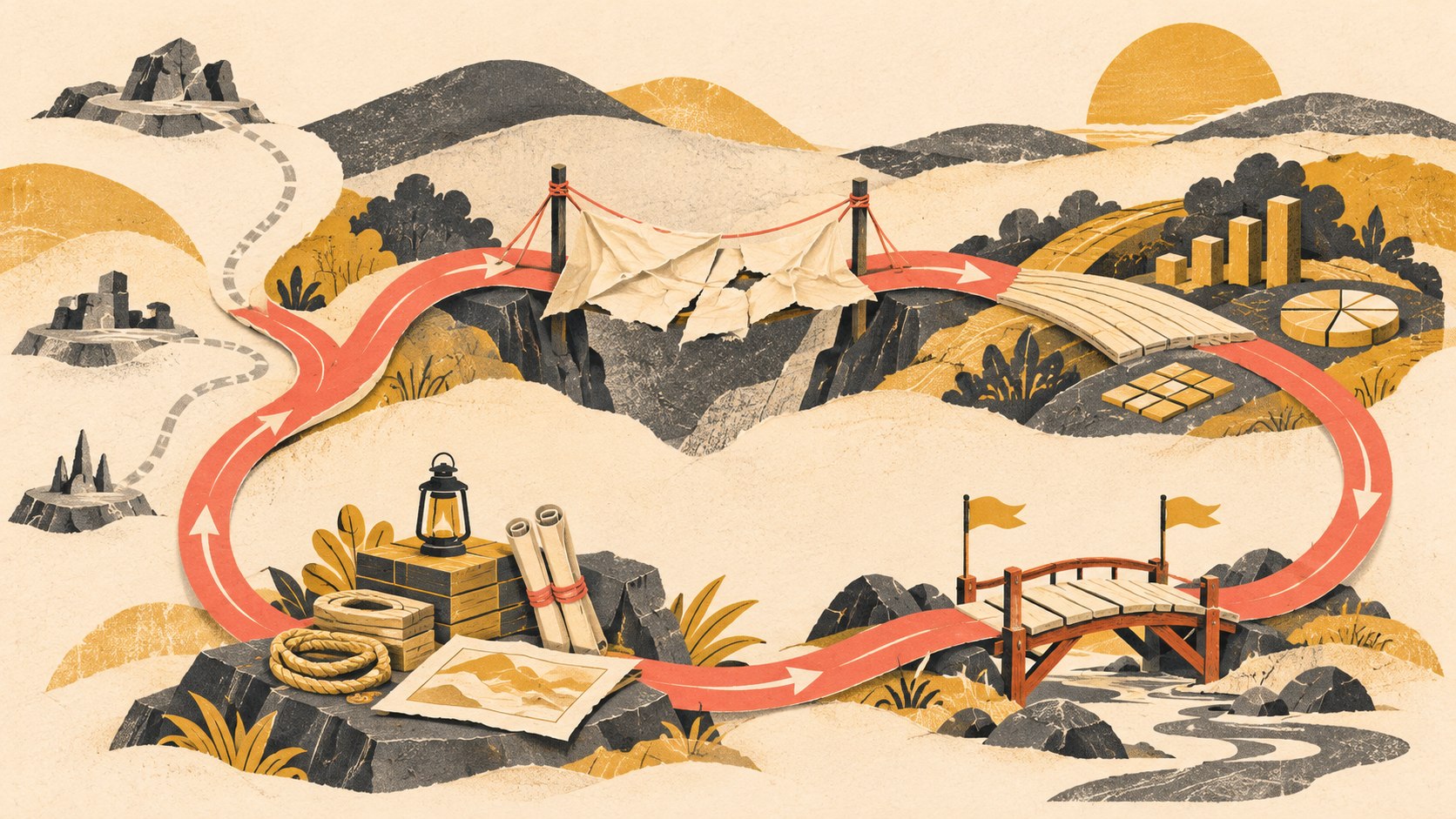
    A coral strategy loop moves from a decision through assumptions, evidence, a small experiment, and a resource review.
    The Scope Design WAGER Strategy Loop makes the bet, evidence, downside, and next decision legible.

    It is not another universal five-box religion. Use it as a decision record and feedback loop:

    1. W: What decision and business outcome?
    2. A: Assumptions that must be true
    3. G: Ground truth
    4. E: Experiment at the smallest decision-changing scale
    5. R: Resource, review, and reallocate

    The loop can guide a new product, market expansion, repositioning, partnership, website investment, pricing change, internal system, or growth initiative. The scale changes. The discipline does not.

    W: What decision and business outcome?

    Start with the decision, not the deliverable somebody already fell in love with.

    “Should we redesign the website?” is often too narrow. The real decision might be whether to invest in lead generation, improve lead quality, repair a broken sales process, modernize an operational system, or change how buyers evaluate the company.

    “Should we enter a new market?” is also incomplete. Which segment, with which offer, through which channel, using which capacity, for what economic outcome?

    Write the decision in a form that makes the alternatives visible:

    We are deciding whether to invest in [option] for [specific audience or operation] to improve [business consequence], compared with [real alternatives], within [time, money, capacity, legal, or risk constraints].

    Then name the outcome closest to money that the decision can reasonably influence.

    Depending on the business, that might be qualified pipeline, contribution margin, retained revenue, fulfilled orders, booked-and-attended appointments, sales-cycle speed, support demand, delivery capacity, or time removed from a manual process.

    Traffic, rankings, clicks, impressions, and raw leads can be useful diagnostics. They are lousy final answers if the business is trying to make money, protect margin, serve customers, or reclaim capacity.

    Create the stop list now

    A strategy needs exclusions before the calendar fills itself.

    Document:

    • customers the business will not chase;
    • channels it will not fund yet;
    • features it will not build;
    • markets it will not enter;
    • work it will stop or defer;
    • standards it will not compromise;
    • risks it will not accept.

    A priority without a stop list is just another task sitting on top of everything else.

    A: Assumptions that must be true

    Every strategy rests on assumptions. The dangerous ones are not the assumptions themselves. They are the assumptions disguised as facts.

    For a new offer, the bet may assume:

    • a specific customer has the problem;
    • the problem is costly or urgent enough to deserve action;
    • the customer can recognize the difference in your approach;
    • the business can reach the customer at a workable acquisition cost;
    • the price supports delivery and margin;
    • the team can fulfill the promise without breaking everything nearby;
    • the buying process fits the customer’s authority and timing;
    • legal, accessibility, privacy, security, or contractual requirements are manageable.

    For a growth initiative, it may assume the current system deserves more volume. That is a hell of an assumption.

    If leads already wait two days for a response, increasing lead volume makes the leak bigger. If the offer attracts low-margin customers, scaling it multiplies the wrong customer. If delivery depends on one exhausted person, more sales may create a service failure rather than growth.

    Rank assumptions by danger

    For each assumption, record:

    • importance: if this is false, does the strategy fail?
    • uncertainty: how weak is the current evidence?
    • cost of being wrong: what money, time, trust, or opportunity is exposed?
    • reversibility: can the business undo the choice without material damage?

    Test assumptions that are important, uncertain, costly, and difficult to reverse before polishing the plan around them.

    This is where our guide to marketing biases that distort business judgment and our business decision-making framework become useful. Founder enthusiasm is evidence that the founder is enthusiastic. It is not market validation.

    G: Ground truth from market and competitive intelligence

    Market intelligence is organized evidence about customers, demand, competitors, substitutes, economics, regulation, technology, and market conditions that could change a business decision. Competitive intelligence is the narrower practice of understanding other ways the customer can solve the problem, including direct competitors, indirect alternatives, internal workarounds, and doing nothing.

    The job is not to collect every available fact. The job is to reduce a decision’s most dangerous uncertainty.

    Start with the customer’s actual decision

    Research:

    • what triggers the search for a solution;
    • what the customer is trying to protect or improve;
    • what alternatives they compare;
    • what prior attempts failed;
    • what evidence they require;
    • who approves, influences, uses, and can block the purchase;
    • what happens if they do nothing;
    • why they choose, delay, negotiate, or walk away.

    Search queries, sales calls, support conversations, proposals, customer interviews, reviews, win-loss notes, and behavior on high-intent pages can all contribute. None is the market by itself.

    Our guide to self-directed market research covers practical ways to gather evidence without pretending every small business needs a research department.

    Examine demand and market conditions

    The SBA’s market research and competitive analysis guidance recommends examining demand, market size, economic indicators, location, market saturation, and pricing when evaluating an opportunity. The U.S. Census Bureau’s Census Business Builder can provide demographic and economic context for a location and industry.

    Use those sources to answer specific questions. Do not paste a national market-size figure into a local business plan and call it opportunity.

    A regional service company needs reachable demand, workable travel or delivery economics, local competition, labor capacity, and a plausible way to win. A giant industry number does not pay a local invoice.

    Study competitors without becoming their unpaid tribute act

    Review competitor positioning, offers, pricing logic, proof, customer complaints, sales process, delivery model, partnerships, hiring, content, and visible constraints.

    Then ask:

    • Which advantage depends on scale, capital, reputation, data, distribution, or systems we do not possess?
    • Which customer do they serve well, and which customer do they neglect?
    • Which promise is repeated so often that buyers may have stopped believing it?
    • Which part of their model would destroy our margin or capacity if copied?
    • What do their dissatisfied customers reveal about the tradeoff they chose?

    This is also where market sophistication matters. A market flooded with the same promise does not necessarily need a louder promise. It may need a more credible mechanism, better evidence, clearer fit, or a different operational choice.

    Inspect the company, not just the market

    An opportunity can be real and still be wrong for the business.

    Examine:

    • delivery capacity and bottlenecks;
    • gross margin and cash exposure;
    • sales and follow-up capability;
    • systems, integrations, and data ownership;
    • legal and contractual obligations;
    • skills and leadership attention;
    • reputation and proof;
    • switching and maintenance cost;
    • what the initiative displaces.

    The last question is routinely skipped. Money spent on one initiative is unavailable for another. So are the owner’s attention, the team’s patience, and the customer’s tolerance for half-finished change.

    E: Experiment at the smallest decision-changing scale

    The smallest useful test is not always the smallest possible activity. It is the smallest responsible test capable of changing the decision.

    A survey of friends may be cheap, but it will not validate willingness to pay. A landing page may test message response, but it cannot prove the team can deliver profitably. A three-customer pilot may expose operational problems, but it may not estimate demand across a market.

    Match the test to the assumption.

    Dangerous assumption Decision-changing test What it cannot prove alone
    Buyers recognize and care about the problem Interviews with recent buyers and lost prospects using real decision examples Market size or willingness to pay
    The message creates qualified interest Small targeted campaign or sales outreach with fit criteria Scalable acquisition economics
    Customers will pay the proposed price Paid pilot, deposit, preorder, or real proposal with delivery boundaries Long-term retention or operational scale
    The service can be delivered profitably Limited paid delivery with time and cost tracking Demand outside the tested segment
    A new market is reachable Narrow geographic or segment test with channel and response measurement Full expansion economics
    A feature solves the operational problem Manual or low-code prototype in the real workflow Reliability and maintenance at production scale

    Define the evidence threshold before the result arrives

    Write down:

    • what result supports the assumption;
    • what result weakens it;
    • what result requires a different test;
    • what cost or harm stops the test;
    • who decides what happens next.

    Otherwise, every ambiguous result becomes permission to continue the founder’s favorite idea.

    Research is complete when another round is unlikely to change the decision enough to justify its cost. That is a Scope Design rule, not a universal formula. High-risk, regulated, irreversible, or capital-intensive decisions deserve more evidence than a reversible marketing test.

    R: Resource, review, and reallocate

    A strategy becomes operational when resources and ownership attach to it.

    For each strategic bet, name:

    • the accountable owner;
    • the people required;
    • the budget and cash timing;
    • the operational capacity;
    • the capabilities or systems needed;
    • the start and review dates;
    • the leading signals;
    • the business consequence;
    • the evidence threshold;
    • the scale, change, pause, or kill options.

    Review the bet at a cadence appropriate to the decision. A weekly campaign test and a multi-year facility expansion do not belong on the same clock.

    The review meeting should answer four questions:

    1. What changed in the evidence?
    2. Which assumption is now stronger or weaker?
    3. What business consequence moved, if any?
    4. What resource decision follows?

    If the meeting produces another dashboard and no resource decision, it was reporting, not strategy review.

    Which business strategy framework should you use?

    Use the framework that clarifies the decision you face. Do not collect frameworks like merit badges.

    Framework or tool Useful for What it does not decide for you
    SWOT Organizing internal strengths and weaknesses with external opportunities and threats Priority, evidence quality, or what deserves funding
    Porter’s Five Forces Examining industry structure, rivalry, entrants, substitutes, buyers, and suppliers Whether your specific offer can win or be delivered profitably
    3Cs Comparing customer needs, competitors, and company capabilities Execution ownership, economics, and evidence thresholds
    Jobs to Be Done Understanding the progress a customer is trying to make in context Market size, channel economics, or your operational advantage
    Business Model Canvas Mapping customers, value, channels, activities, partners, costs, and revenue Whether the assumptions are true
    Scenario planning Preparing for materially different external conditions Which scenario will occur or which current bottleneck matters most
    OKRs Translating direction into objectives and measurable results Whether the direction is strategically sound
    Balanced Scorecard Viewing performance across financial, customer, process, and capability perspectives Which tradeoffs create a defensible position

    The best framework is the one that exposes a decision you were avoiding. The worst is the one that gives weak assumptions an executive-looking border.

    What are the types and levels of business strategy?

    There is no single universal list. Different models categorize strategy by organizational level, competitive position, or growth direction.

    By organizational level

    • Corporate strategy: Which businesses, markets, acquisitions, or portfolios should the organization own or enter?
    • Business strategy: How will a business unit compete and create value in its chosen market?
    • Functional strategy: How will marketing, sales, operations, finance, people, and technology support the business strategy?
    • Operating strategy: How will teams and processes execute reliably day to day?

    By competitive position

    A common interpretation of Porter’s generic strategies separates:

    • cost leadership;
    • differentiation;
    • cost focus;
    • differentiation focus.

    Those labels describe broad positions, not fill-in-the-blank answers. “Differentiate” is useless until the business names the customer, difference, proof, cost, and operating choices required to deliver it.

    By growth direction

    A company might grow by:

    • serving more of the current market;
    • reaching a new segment or geography;
    • creating or acquiring a new offer;
    • adding a channel or partnership;
    • improving retention, expansion, or pricing;
    • building a capability that changes economics or capacity.

    Our business growth and expansion guide owns the deeper growth-choice discussion. Our product-marketing strategy guide and product-repositioning guide handle offer and positioning decisions. Our product-pricing guide owns pricing methods and tests.

    A real Scope Design example: the requested website was not the whole problem

    A long-established specialty auction business approached Scope Design for a new website and new features.

    It would have been easy to jump directly into page designs. The visible site was old, hard to use, and clearly needed work. A redesign proposal would have looked reasonable.

    Discovery exposed a larger system.

    The website sat in the middle of legacy software, disconnected auction and inventory data, broken forms, unreliable commerce, manual invoicing, email-delivery problems, shipping workflows, and years of historical information. The request was “new website.” The strategic decision was how to modernize a business-critical operating system without pretending a prettier interface would repair the foundation beneath it.

    So the sequence changed to foundation first, features second.

    That is what strategy looks like in practice. Not knowing more acronyms. Not winning the workshop. Diagnosing the actual constraint, making the dependencies visible, and refusing to spend the client’s money on the wrong first move.

    The same constraint-first logic applies to website strategy and conversion decisions. A redesign request proves dissatisfaction. It does not prove the website is the binding constraint.

    Build a one-page strategy decision record

    A useful strategy record can fit on one page if the thinking is clear.

    A single strategy sheet links the audience, evidence, central choice, experiment, owner, resources, and review back to a clear decision.
    If the strategic bet cannot fit on one page, the thinking probably is not clear yet.

    Decision

    What exactly are we deciding, and what alternatives are real?

    Business consequence

    What revenue, margin, risk, capacity, retention, sales-cycle, or customer outcome should change?

    Chosen audience and problem

    Whose decision are we trying to improve, and what costly problem or desired progress matters?

    Strategic choice and stop list

    What will we prioritize, and what will we explicitly not do?

    Advantage and required capabilities

    Why can this business deliver a better fit, and what must be true operationally?

    Critical assumptions

    Which beliefs carry the most risk?

    Current evidence

    What do customers, competitors, market data, operations, and economics actually show?

    Smallest decision-changing test

    What test can responsibly reduce the dangerous uncertainty?

    Resources and owner

    Who owns the bet, what does it cost, what does it displace, and what capacity does it require?

    Review rule

    When will the evidence be reviewed, and what result causes scale, change, pause, or termination?

    That record is easier to challenge, update, and use than a giant plan whose assumptions are buried under formatting.

    How should business strategy be measured?

    Measure the business consequence the strategy is meant to change, then use a small set of leading and diagnostic measures to explain movement.

    Strategy Primary consequence Useful leading signals Quality or constraint check
    Enter a new segment Contribution margin or qualified pipeline from the segment Relevant conversations, proposals, win rate Delivery capacity and acquisition cost
    Improve positioning Qualified opportunity rate or sales-cycle movement Message comprehension, comparison behavior, objection change Lead quality and discount pressure
    Raise prices Gross profit and retained revenue Proposal acceptance, mix, expansion behavior Churn, service expectations, delivery margin
    Build an operational system Time, error, throughput, or risk reduction Adoption, completion, exception rate Maintenance burden and failure consequence
    Expand geographically Profitable revenue from the new area Reachable demand, response, booked work Travel, staffing, logistics, and local competition

    Do not let a proxy declare victory while the business loses.

    A campaign can increase leads while lowering close rate. A new service can grow revenue while destroying margin. Automation can save clicks while creating maintenance risk. A feature can attract users who will never become good customers.

    The primary outcome should sit close to money or meaningful operating value. The supporting measures should explain why it moved. The quality gate should prevent the strategy from winning on paper by exporting the cost somewhere else.

    Common business strategy failures

    Starting with the deliverable

    The team chooses a website, campaign, hire, feature, or platform before diagnosing the business constraint. The project may be competently delivered and strategically useless.

    Copying a competitor without copying its economics

    The competitor’s pricing, channel, service level, or content strategy may depend on scale, capital, brand awareness, data, distribution, or a different customer. You see the tactic. You do not see the subsidy.

    Treating enthusiasm as demand

    The founder loves the idea. Friends agree it sounds exciting. Nobody has paid, changed behavior, or accepted a tradeoff. The evidence is emotional, not commercial.

    Confusing a framework with a decision

    The SWOT is complete. The canvas is colorful. The team has not chosen a segment, stopped an initiative, committed resources, or defined what would change its mind.

    Testing something that cannot falsify the plan

    The test measures clicks when willingness to pay is the risk. It asks existing fans when the growth bet depends on a new segment. It gathers opinions without exposing a real choice.

    Ignoring delivery capacity

    The strategy assumes the business can absorb success. Sales increase, service degrades, refunds rise, staff burns out, and the dashboard celebrates the top of the funnel.

    Measuring activity instead of consequence

    The team reports meetings, posts, traffic, leads, tasks, and feature releases. Nobody can show which business decision improved.

    Refusing to kill a bad bet

    Money, identity, and reputation become attached to the plan. Weak results trigger new explanations instead of a resource decision. Our business-mistakes guide goes deeper into learning without turning every failure into motivational wallpaper.

    Waiting for certainty

    The business keeps researching because committing feels risky. More information has stopped changing the choice, but delay still feels more respectable than a bounded experiment.

    Use this business strategy cluster for the next decision

    This pillar is the operating map. Use the supporting owner that matches the uncertainty in front of you:

    These pages will be rebuilt and linked as one deliberate knowledge system. The goal is not to manufacture a content maze. It is to let a business move from the current decision to the next useful piece of evidence without restarting the whole damn research process.

    Frequently asked questions about business strategy

    What is in a business strategy?

    A practical business strategy contains the decision, chosen customer and problem, competitive position, required capabilities, explicit tradeoffs, resource allocation, dangerous assumptions, evidence thresholds, accountable owner, review date, and rules for scaling, changing, pausing, or stopping.

    What are the four types of business strategies?

    There is no universal set of four. One common competitive-position model uses cost leadership, differentiation, cost focus, and differentiation focus. Another classification uses corporate, business, functional, and operating levels. Choose the taxonomy that clarifies the decision rather than forcing the company into a list.

    What are the four pillars of strategy?

    Different authors use different pillars. Scope Design does not treat one four-part list as universal. A useful minimum is a clear choice, grounded evidence, resource and capability alignment, and a review loop tied to business consequences.

    What are the five elements of business strategy?

    In the Scope Design WAGER Loop, the five elements are: What decision and outcome, Assumptions that must be true, Ground truth, Experiment at the smallest decision-changing scale, and Resource, review, and reallocation.

    What is the difference between a business strategy and a business plan?

    Strategy explains the connected choices and tradeoffs that create a path to an outcome. A business plan documents how the business will be structured, operated, financed, and grown. A plan can contain a strategy, but a detailed plan does not prove the strategic assumptions are sound.

    What is the difference between strategy and tactics?

    Strategy explains why a business will prioritize a particular market, customer, position, or capability. Tactics are the actions used to execute that choice. The same tactic can support very different strategies, and a tactic copied without its strategic logic may waste money.

    How do I create a business strategy?

    Define the decision and business consequence, list critical assumptions, gather decision-relevant customer and market evidence, choose explicit tradeoffs, run a bounded test where uncertainty matters, assign resources and ownership, and set a review rule before the result arrives.

    What is a business strategy framework?

    A business strategy framework is a structured lens for analyzing or executing part of a strategic decision. SWOT, Five Forces, 3Cs, Jobs to Be Done, scenario planning, OKRs, and Balanced Scorecard can be useful. None chooses the strategy for you.

    How do I choose a strategy framework?

    Start with the unresolved decision. Use Five Forces for industry structure, Jobs to Be Done for customer progress, scenario planning for materially different futures, OKRs for aligned execution, and Balanced Scorecard for multi-perspective measurement. Use the smallest set that exposes the decision instead of decorating it.

    What is market intelligence in business strategy?

    Market intelligence is organized evidence about customers, demand, competitors, substitutes, economics, regulation, technology, and market conditions that could change a decision. It should reduce uncertainty, not merely increase the size of the research folder.

    What is competitive intelligence?

    Competitive intelligence examines the other ways a customer can solve the problem, including direct competitors, indirect substitutes, internal workarounds, and inaction. It considers positioning, pricing logic, proof, operations, constraints, and customer response without copying tactics blindly.

    How much market research is enough?

    Enough depends on consequence, uncertainty, reversibility, and cost. Scope Design considers research sufficient when another round is unlikely to change the decision enough to justify its cost. Irreversible, regulated, or high-capital choices require a higher evidence threshold than reversible tests.

    What makes a good business strategy measurable?

    A measurable strategy names the business consequence it should change, a few leading signals, a quality or constraint check, the data owner, the review date, and the decision attached to each threshold. Measurement without a decision rule is reporting.

    How often should a business strategy be reviewed?

    Review frequency should match the speed and consequence of the decision. Campaign tests may need weekly review, operating bets may need monthly review, and capital investments may use staged milestones. Review sooner when the market, assumptions, capacity, economics, or risk changes materially.

    Can a small business use corporate strategy frameworks?

    Yes, if the framework clarifies a real decision and is simplified to fit available evidence and capacity. A small business does not need a strategy department cosplay routine. It needs clear choices, honest assumptions, useful evidence, assigned resources, and a review rule.

    How does AI help with business strategy?

    AI can summarize research, cluster customer language, compare scenarios, organize assumptions, and reveal patterns worth checking. It cannot independently verify that the sample represents the market, that a claim is true, that the business can deliver, or that the recommended framework fits the economics. Human judgment, source verification, and ownership remain required.

    What is the biggest business strategy mistake?

    The biggest mistake is accepting the requested solution as the diagnosed problem. When a company starts with “we need a website, campaign, feature, hire, or new market,” it may spend competently on the wrong constraint. Begin with the decision and evidence.

    Make the bet legible before you fund it

    Good strategy does not make uncertainty disappear. It makes the wager understandable.

    The business can see what it is choosing, what it is refusing, what must be true, what evidence matters, what the test costs, who owns it, and what result changes the resource decision.

    That is far more useful than a confident deck built on unchallenged assumptions.

    If your strategy currently looks like a pile of goals, channels, tools, and optimistic percentages, talk to Scope Design. We will help isolate the real decision, map the evidence and constraints, and sequence the work so the first investment does not become the most expensive way to discover the actual problem.


  • Mastering Growth Marketing: Complete Guide to Data-Driven Customer Acquisition and Retention

    Mastering Growth Marketing: Complete Guide to Data-Driven Customer Acquisition and Retention

    Growth marketing is a disciplined system for improving customer acquisition, activation, retention, revenue, and referral by finding the current growth constraint, running the smallest useful experiment, and carrying what you learn into the next decision. It is not a synonym for paid ads, an AI tool stack, or a collection of “growth hacks.”

    The useful question is not, “Which growth tactic should we try?” It is, “What is keeping more of the right customers from reaching value—and what evidence would change our next decision?” That shift matters because a business can improve clicks, leads, or even first-time conversions while quietly making customer fit, margins, retention, support load, or delivery capacity worse.

    Growth marketing in 60 seconds

    • Start with the business constraint, not the channel. Growth marketing should support a real business strategy, not become a substitute for one.
    • Measure the whole customer lifecycle. Acquisition is only useful when enough of those customers activate, stay, buy profitably, and create future value.
    • Run bounded experiments. Define the decision, hypothesis, change, outcome, guardrails, observation window, and next action before launch.
    • Judge downstream quality. A local metric win is not durable growth if it creates worse-fit customers, lower contribution, more churn, more support burden, or less trust.
    • Scale learning, not noise. Widen what survives downstream scrutiny; revise or stop what does not.

    What Is Growth Marketing?

    Growth marketing is an operating approach that uses customer evidence, lifecycle measurement, and controlled experimentation to improve durable business outcomes. It connects the work that attracts a prospect with the work that helps that person experience value, remain a customer, expand the relationship, and advocate for the business.

    That makes growth marketing broader than a campaign and narrower than “everything the company does.” Marketing still has to respect product quality, sales execution, onboarding, service capacity, pricing, and the customer experience. When one of those is the binding constraint, buying more traffic can simply send more people into a broken system faster.

    The defining habit is therefore continuous, decision-oriented learning: identify what appears to limit growth, collect enough evidence to form a useful hypothesis, change something intentionally, observe the response, and decide what deserves more resources.

    Growth Marketing vs. Performance, Digital, Lifecycle, and Product Marketing

    These disciplines overlap, which is why definitions get muddy. The easiest way to separate them is by the job each one is usually trying to own.

    DisciplinePrimary jobCommon evidenceWhere growth marketing overlaps
    Growth marketingImprove durable growth across acquisition, activation, retention, revenue, and referralLifecycle progression, cohort quality, experiment outcomes, economics, guardrailsCoordinates tests across several functions when the growth constraint moves
    Performance marketingProduce measurable outcomes from paid or directly attributable mediaCost, conversion, revenue, return metricsPaid acquisition can be one growth lever, but growth must follow downstream quality too
    Digital marketingReach and persuade customers through digital channelsSearch, email, social, web, advertising, campaign metricsGrowth marketing may use these channels but is defined by the learning system, not the medium
    Lifecycle marketingCommunicate appropriately as customers move through relationship stagesActivation, engagement, retention, reactivation, expansionLifecycle work is often central when activation or retention is the constraint
    Product marketingConnect product value, positioning, market, launch, adoption, and sales enablementMessage fit, adoption, pipeline quality, win/loss evidenceGrowth tests depend on sound positioning and value; they should not invent those in a dashboard

    If your team argues about which label applies, bring the discussion back to the decision. What outcome are you trying to improve? What currently limits it? Who owns the underlying system? A name should clarify work, not create turf.

    Why Growth Marketing Fails: Teams Optimize the Wrong Constraint

    A common growth failure looks successful in the weekly dashboard. Traffic rises. Cost per lead falls. Form submissions climb. Then sales says the leads are poor, onboarding gets overloaded, repeat purchase weakens, refunds rise, or the team discovers the “efficient” channel was attracting people who were never a good fit.

    This happens when a local metric becomes the objective instead of evidence about the objective.

    • If qualified demand is scarce, the constraint may be acquisition.
    • If the right people arrive but do not take the first meaningful action, it may be activation or conversion.
    • If customers buy once and disappear, the constraint may be retention or value delivery.
    • If loyal customers never expand, it may be offer, pricing, or expansion.
    • If happy customers rarely introduce anyone, there may be a referral or advocacy opportunity.
    • If demand already exceeds what the company can deliver well, the constraint may be capacity—and more acquisition may be the wrong goal.

    This is why growth marketing starts with diagnosis. The tactic comes later.

    The Scope Design GROW Loop

    We use a simple growth-specific extension of Scope Design’s constraint-first strategy discipline: GROW. It gives every experiment four jobs.

    G — Ground the bottleneck

    Define the business outcome first. Then identify the stage most likely to constrain that outcome. Use actual evidence: source and cohort data, sales records, support themes, customer interviews, funnel progression, gross margin, renewal or repeat-purchase behavior, and operating capacity.

    Do not pick “improve conversion rate” because it is easy to graph. Ask what a better conversion would change for the business and what could make that improvement misleading.

    R — Reduce uncertainty with a bounded hypothesis

    Turn the diagnosis into a falsifiable expectation: For this audience, changing this one meaningful factor should improve this primary outcome because of this customer or market evidence.

    Predefine the comparison, guardrails, observation window, and what result would cause you to scale, revise, or stop. This is the difference between an experiment and changing six things before declaring the new version “better.” The NIST Engineering Statistics Handbook’s explanation of experimental design makes the underlying logic explicit: deliberately change factors and observe the response.

    O — Observe downstream cohort quality

    Do not stop at the first metric the test moves. Follow the affected cohort far enough to answer the business question. A campaign that lowers cost per lead but produces fewer qualified opportunities is not necessarily a winner. A checkout change that raises orders while increasing refunds may be borrowing from future value.

    Funnel analysis can help teams see where people progress or drop out; Google’s Analytics funnel reporting documentation shows how funnel reports visualize the steps users take and where they succeed or fail. The tool is not the strategy, but it can help locate the question.

    W — Widen, revise, or withdraw

    Once the observation window is sufficient for the decision, choose deliberately:

    • Widen: expose more of the appropriate audience or budget to the change because the primary outcome improved and guardrails held.
    • Revise: keep the question but change the hypothesis because the evidence revealed something useful.
    • Withdraw: stop spending time or money on a weak idea, record what was learned, and move to the next constraint.

    The point is not to win every test. The point is to make uncertainty cheaper and future decisions better.

    Diagnose Growth Across the Customer Lifecycle

    A growth funnel is useful only if each stage represents something meaningful to your business. “Visited page” and “opened email” can be diagnostic signals, but they are rarely the final outcome.

    StageDecision questionUseful outcomeMisleading substituteExample bounded test
    AcquisitionAre enough of the right people entering the system?Qualified demand by source, customer acquisition cost using a defined customerTraffic, impressions, raw leadsTest one audience-message-offer combination against the current acquisition path
    ActivationDo new prospects or customers reach the first meaningful value milestone?Qualified action or time to first agreed valuePage views, logins, generic engagementChange one onboarding step, form requirement, proof element, or call to action
    RetentionDo customers continue because they receive enough value?Renewal, repeat purchase, retained gross profit, cohort retentionEmail opens, account age, “active” without a value definitionTest a value reminder, service handoff, replenishment cue, education sequence, or friction repair
    Revenue / expansionCan the relationship create more profitable value without harming fit?Contribution, expansion revenue, repeat-order economicsAverage order value without margin or return contextTest packaging, cross-sell timing, expansion offer, pricing presentation, or qualification
    ReferralDo satisfied customers create qualified introductions?Qualified referrals and referred-customer qualityShares, generic mentions, testimonial countTest the trigger, timing, ask, incentive, or handoff into a referral or affiliate program

    Notice what this table does not do: it does not tell every business to optimize all five stages simultaneously. The stage that deserves attention depends on the bottleneck and the decision.

    Measure Growth Without Lying to Yourself

    Growth marketing needs enough measurement to make a decision—not a dashboard with 47 tiles and no owner. A useful hierarchy has four layers.

    1. Primary business outcome: the result the experiment is supposed to improve—qualified revenue, retained value, profitable repeat purchase, qualified pipeline, or another named consequence.
    2. Supporting metrics: measures that help explain movement in the primary outcome, such as activation rate, stage progression, source mix, cycle time, or repeat frequency.
    3. Diagnostic metrics: clicks, views, opens, scroll depth, form starts, and similar behaviors used to investigate why an outcome moved.
    4. Guardrails: measures that should not deteriorate while the primary metric improves—margin, refunds, churn, support burden, lead quality, customer complaints, capacity, or brand trust.

    Keep CAC and customer lifetime value definitions explicit

    Customer acquisition cost and customer lifetime value can be useful growth metrics, but they become dangerous when teams silently change the definitions. Does “customer” mean a lead, first purchase, paid subscriber, or retained account? Does lifetime value mean revenue, gross profit, contribution, or forecasted value? Which cohort and time window are included?

    Our dedicated guide to customer lifetime value goes deeper into the calculation and decision discipline. The important rule here is simple: write the definition next to the number. A universal CLV:CAC ratio copied from a benchmark is not a substitute for your economics, cash timing, capacity, and uncertainty.

    Attribution is a model, not a confession from reality

    Multi-touch attribution can organize observed touchpoints, but it should not be treated as proof that every credited channel caused the outcome. Organic search, referrals, brand familiarity, sales conversations, offline exposure, email, and paid media often interact. Use attribution for diagnosis and allocation hypotheses; use controlled experiments or other stronger evidence when the causal question is important enough.

    How to Design a Growth Marketing Experiment

    You do not need a laboratory coat. You do need a written decision rule. Before launching a growth marketing experiment, capture this brief:

    Experiment fieldWhat to write
    DecisionWhat will we do differently if the evidence supports or rejects this idea?
    BottleneckWhich lifecycle constraint are we trying to reduce?
    EvidenceWhat customer, sales, analytics, operational, or market evidence makes this worth testing?
    HypothesisFor this audience, changing X should improve Y because Z.
    ChangeWhat meaningful factor will differ from the current experience?
    Primary outcomeWhich result decides whether the test helped?
    GuardrailsWhat must not get materially worse?
    WindowHow long or how many decision-relevant observations are needed before review?
    ThresholdWhat evidence is strong enough to widen, revise, or withdraw?
    Next actionWhat will we do for each plausible result?

    Google Ads’ official experiments documentation uses control and treatment groups to compare the performance of defined changes. That same discipline—make the change explicit, preserve a comparison, and evaluate the result—is useful even when the experiment happens somewhere other than an ad platform.

    Do not change the base while the test is running

    If the landing page, offer, price, targeting, follow-up process, and sales script all change during the same observation window, you may improve results—but you will learn less about why. Sometimes an emergency repair is more important than experimental purity. Just document the confounding change instead of pretending the test remained clean.

    Growth Experimentation for Low-Traffic Small Businesses

    Small businesses are often told to A/B test everything. That advice ignores arithmetic. If a site or funnel produces only a handful of decision events, splitting the audience can make both groups too small to support a confident conclusion.

    That does not mean you should stop learning. It means you should match the evidence method to the traffic, risk, and decision.

    • Fix known defects without waiting for a test. Broken forms, misleading copy, inaccessible controls, obvious mobile friction, and tracking failures are repairs.
    • Use direct customer evidence. Interviews, sales objections, support tickets, call recordings, lost-deal reasons, and usability observation can expose the bottleneck before a split test is viable.
    • Segment before averaging. Compare source, device, geography, offer, customer type, or cohort when the segment maps to a real business difference.
    • Use bounded before/after or time-block tests carefully. Keep other major conditions stable when possible, define the window in advance, and label the evidence directional when seasonality or other changes could explain the movement.
    • Observe longer when the business outcome is delayed. Retention, repeat purchase, and referrals may need more time than a landing-page click.
    • Do not manufacture significance. A tiny sample with a dramatic percentage change is still a tiny sample.

    This is also why conversion rate optimization is larger than A/B testing. Research, repairs, message clarity, usability, offer work, analytics, and operational fixes can all reduce uncertainty before a statistically powered split test makes sense.

    Choose Channels After You Know the Constraint

    Channels are tools. Growth marketing decides when a tool is relevant.

    If the constraint is…Potential levers to investigateFirst question
    Qualified acquisitionSEO/content, paid search/social, partnerships, referrals, local visibility, outbound, positioningAre we missing reach, relevance, trust, or a compelling offer?
    Activation / conversionLanding-page clarity, proof, forms, onboarding, call handling, sales follow-up, UXWhere does a good-fit prospect fail to reach the first meaningful value step?
    RetentionService delivery, onboarding, education, replenishment, account management, reactivationWhy do customers who looked healthy fail to continue?
    ExpansionPackaging, pricing, cross-sell, upsell, service tiers, customer successWhat additional problem can we solve profitably for the right existing customer?
    ReferralReferral asks, partner systems, reviews, advocacy triggers, communityWhat moment gives a satisfied customer a natural reason to introduce someone?

    If you need ideas after you have a decision to make, our guide to innovative marketing strategies contains experiments worth adapting. The order matters: problem first, tactic second.

    A Practical 90-Day Growth Marketing Strategy

    You do not need a year-long transformation to start practicing growth marketing. You need enough structure to learn without letting the experiment backlog become another abandoned spreadsheet.

    Days 1–14: Baseline the system and choose one bottleneck

    • Define the business outcome and the customer you are trying to create or retain.
    • Map the essential lifecycle stages from first useful contact through realized value.
    • Verify tracking against sales, commerce, CRM, or operational records.
    • Segment enough to expose obvious source or cohort differences.
    • Interview customers or frontline staff where the numbers cannot explain behavior.
    • Choose one constraint and name a primary metric plus guardrails.

    Days 15–30: Run the smallest decision-changing test

    • Write the experiment brief before implementation.
    • Prefer a meaningful change to a dozen microscopic tweaks.
    • Keep the audience and experience stable enough to interpret the result.
    • Record implementation details, dates, and confounding changes.

    Days 31–60: Follow the cohort downstream

    • Check whether the primary outcome changed.
    • Check qualification, margin, retention signals, refunds, support burden, and other guardrails.
    • Compare the affected cohort with the most reasonable baseline.
    • Collect qualitative explanations from sales, support, and customers.

    Days 61–90: Reallocate and document

    • Widen the winner only if downstream evidence is healthy.
    • Revise a promising hypothesis when the mechanism looks wrong but the problem still matters.
    • Withdraw weak ideas without turning sunk cost into a strategy.
    • Record the result, confidence, unresolved questions, and next review date.
    • Revisit the growth constraint; a successful test may move it somewhere else.

    What a Small Growth Team Actually Needs

    Growth marketing is often presented as a shopping list of analytics platforms, automation systems, customer-data platforms, AI agents, personalization engines, and testing tools. That reverses the dependency.

    A small business needs five capabilities before it needs a “growth stack”:

    1. One accountable growth decision owner who can say what constraint is being worked and why.
    2. Trustworthy outcome data connected far enough downstream to distinguish activity from customer value.
    3. Customer evidence from sales, service, interviews, reviews, or behavior—not only dashboards.
    4. Execution capacity to change the relevant part of the website, campaign, offer, onboarding, or workflow.
    5. A review habit that turns results into scale, revise, or stop decisions.

    Software should make one of those capabilities easier. AI can help summarize interviews, draft variants, classify feedback, explore data, or accelerate implementation. It should not be allowed to turn a weak business assumption into 40 automated campaigns before anyone asks whether the assumption is true.

    Common Growth Marketing Mistakes

    1. Treating acquisition as growth

    More traffic and leads can hide a retention, margin, qualification, or capacity problem. Follow enough of the cohort downstream to know whether the acquisition is creating useful customers.

    2. Building composite scores nobody can act on

    A “growth velocity” or “customer health” score can be useful if its inputs, weighting, owner, and response rule are explicit. Otherwise it turns several uncertain metrics into one more-confident-looking uncertain metric. Keep the underlying outcomes visible.

    3. Declaring a winner at the first conversion

    The earliest metric is often the fastest one, not the most important one. Decide in advance how far downstream the cohort must travel before you scale.

    4. Running experiments without a stop rule

    Without a threshold and review date, weak tests linger because nobody wants to admit the result is inconclusive. Precommit the next action for win, loss, and uncertainty.

    5. Testing five variables at once

    You may get a better page or campaign, but you lose learning about the mechanism. Bundle changes only when the business needs the whole repair more than it needs isolated evidence.

    6. Letting AI choose the strategy

    AI can accelerate analysis and production. It does not know your actual constraints, customer promises, margins, sales quality, capacity, or risk tolerance unless you provide trustworthy context—and even then, the business still owns the decision.

    Growth Marketing FAQ

    What is growth marketing in simple terms?

    Growth marketing is a method for improving durable customer and business outcomes through lifecycle measurement and repeated experiments. It starts by identifying the current growth bottleneck, tests a defined change, follows the affected cohort downstream, and uses the result to decide what to scale, revise, or stop.

    How does growth marketing work?

    Start with a business outcome, diagnose whether acquisition, activation, retention, expansion, referral, or capacity is limiting it, form a hypothesis from evidence, run the smallest useful test, measure the primary outcome and guardrails, then reallocate resources based on what you learned.

    What is a growth marketing strategy?

    A growth marketing strategy is the set of choices that connects a growth objective to a specific constraint, target customer, evidence base, experiment sequence, measurement rule, resource owner, and review cadence. “Post more on social media” is a tactic. “Increase qualified pipeline by fixing the mismatch between our highest-intent search traffic and the offer on its landing page” is closer to a strategy.

    What is the difference between growth marketing and performance marketing?

    Performance marketing usually focuses on directly measurable paid-media outcomes such as acquisition, conversion, or revenue. Growth marketing can include performance marketing, but it follows the customer farther through activation, retention, expansion, and referral and can test non-media constraints such as onboarding, offers, product experience, or handoffs.

    What metrics should a growth marketer track?

    Track the metric that answers the current business decision, plus supporting diagnostics and guardrails. Depending on the constraint, that may include qualified acquisition cost, activation to first value, stage conversion, retained gross profit, cohort retention, contribution, repeat purchase, expansion, or qualified referrals. Raw traffic, clicks, opens, and form starts are often diagnostic rather than final outcomes.

    Do small businesses need A/B testing for growth marketing?

    No. A/B testing is one evidence method. Low-volume businesses can learn from direct customer research, usability observation, repairs, segmentation, carefully bounded before/after tests, and longer cohort observation. Use a randomized split test when traffic and conversion volume can support the decision; do not fake statistical certainty when they cannot.

    How much should a small business spend on growth marketing?

    There is no responsible universal percentage. Budget depends on unit economics, cash flow, capacity, the cost of learning, the maturity of the channel, and how quickly the business can observe a meaningful outcome. Fund experiments at the smallest scale that can change a real decision, then widen investment when the economics and downstream guardrails hold.

    Build a Growth System That Learns

    The advantage of growth marketing is not that it gives you more tactics. The internet already has enough tactics. The advantage is that it gives the business a repeatable way to decide which problem deserves attention, what evidence would reduce uncertainty, and when a result is healthy enough to scale.

    Ground the bottleneck. Reduce uncertainty. Observe downstream quality. Widen, revise, or withdraw. Then run the loop again because a solved constraint usually exposes the next one.

    If your marketing produces activity but you cannot tell which constraint is limiting profitable growth, talk with Scope Design. We can help connect the website, analytics, acquisition channels, conversion path, customer evidence, and automation into a growth system that has a reason for every test.

  • Business Transformation Examples: How 4 Companies Turned Ideas Into Measurable Results

    Business Transformation Examples: How 4 Companies Turned Ideas Into Measurable Results

    The strongest business transformation examples do not begin with a dramatic before-and-after story. They begin with a change you can name and an outcome you can inspect. Domino’s changed its core product and how it talked about the problem. Adobe shifted from selling perpetual software licenses toward subscriptions. Microsoft reorganized around a cloud-first strategy. DBS redesigned banking around digital customer behavior and measured the economics of that behavior.

    All four companies reported meaningful business results. But that does not mean every dollar of growth was caused by one transformation initiative. That distinction matters. A useful case study shows the change, the timeframe, the signal that moved, the source, and the limits of what the evidence can prove.

    That is the standard this article uses. The old version of this page included anonymous companies and precise percentages that could not be traced to a defensible evidence chain. Those claims are gone. What follows are four named examples with primary or first-party evidence, plus a practical way to judge transformation ROI without turning correlation into a sales story.

    Four Business Transformation Examples at a Glance

    Company What materially changed Reported outcome What the evidence supports
    Domino’s Core product, brand message, and later the ordering experience U.S. same-store sales rose 14.3% in Q1 2010; by 2019 more than half of global retail sales were digital A major product reset produced an immediate sales response, followed by years of digital-channel investment
    Adobe Perpetual-license software model shifted toward subscriptions and cloud services Subscription revenue reached $6.13B and 84% of total revenue in FY2017 The revenue mix changed structurally toward recurring subscriptions
    Microsoft Strategy and investment moved toward a mobile-first, cloud-first operating model Commercial cloud revenue reached $51.7B in FY2020, up 36% year over year The cloud business reached material scale as the strategic pivot matured
    DBS Banking processes, customer engagement, data, and operations were digitized Digital customers reached 62% in 2023 and generated about 3× the income of traditional customers DBS linked digital adoption to customer economics and ROE, not just app usage

    What “Proven ROI” Should Mean in a Transformation Case Study

    A public case study rarely gives you a laboratory-quality ROI calculation. Companies change pricing, products, teams, technology, distribution, marketing, capital allocation, and market focus at the same time. Competitors move. Economic conditions change. A transformation can be important without being the only cause of the result.

    So when we use the word ROI, we separate three levels of proof:

    • Observed result: a business metric moved after or during the change.
    • Attributed result: the company or evidence explicitly connects part of the result to the transformation.
    • Calculated ROI: attributable economic benefit and transformation cost are both known well enough to calculate a return.

    Most public transformation stories reach the first or second level. That is still useful evidence—as long as you do not quietly upgrade it to the third.

    Use the Scope Design CASE Proof Test

    Before you copy a famous company’s playbook or repeat a case-study number in a proposal, run it through the Scope Design CASE Proof Test. It is a four-part editorial and business check for deciding whether a transformation story is actually decision-useful.

    C — Change: What materially changed?

    A new logo is not automatically a business transformation. A new app is not automatically a digital transformation. Name the structural change: business model, product, pricing, channel, process, customer experience, technology platform, organization, or operating system. If you cannot state the change clearly, you are probably looking at activity rather than transformation.

    This is where broader business strategy matters. The transformation should solve a defined business problem or create a defined advantage—not exist because “transformation” sounds ambitious.

    A — Attribution: What can you responsibly credit?

    Read the source closely. Does the company say the initiative drove the result, contributed to it, coincided with it, or simply happened during the same period? Those are different claims. Also ask what else changed: pricing, acquisitions, market demand, economic conditions, product mix, store count, or distribution.

    S — Signal: What meaningful outcome moved?

    Prefer business signals over applause. Revenue mix, gross profit, recurring revenue, cost-to-serve, retention, same-store sales, qualified conversion, customer lifetime value, return on equity, and productive adoption usually tell you more than impressions, awards, press coverage, or raw traffic.

    E — Evidence: Can a reader inspect the proof?

    Use the strongest source available: annual report, SEC filing, investor release, measured first-party data, or a documented client case you are allowed to discuss. Include a timeframe and baseline where possible. If the claim traces through three agency blogs to an infographic nobody can find, do not treat it as evidence.

    1. Domino’s: Fix the Product, Tell the Truth, Then Keep Improving the Experience

    Domino’s is useful because the transformation was not merely cosmetic. The company changed its core pizza recipe and launched the “Pizza Turnaround” campaign around the problem it was trying to fix. In its first-quarter 2010 financial results, Domino’s reported that U.S. same-store sales grew 14.3%, saying increased store traffic came from the successful introduction of its new pizza. Revenue for the quarter was up 18.4% versus the prior-year period.

    That is unusually direct evidence: Domino’s itself connected the immediate sales lift to the product introduction. It still does not prove the recipe alone caused every point of growth—the campaign, pricing, media attention, and operating execution all mattered—but the evidence chain is inspectable.

    The more important lesson is that Domino’s kept transforming after the reset. By 2019, the company said more than half of global retail sales came through digital channels, with more than 65% of U.S. sales generated digitally. Product quality, brand transparency, ordering technology, loyalty, delivery operations, and digital convenience became part of the same customer system.

    CASE takeaway: the transformation was credible because the change was concrete, the immediate result was measured, and the company continued improving the experience rather than treating one campaign as the finish line.

    2. Adobe: Transform the Business Model, Not Just the Software

    Adobe’s shift toward Creative Cloud and recurring subscriptions is a clearer example of business-model transformation. In its FY2012 10-K, Adobe reported $673.2 million in subscription revenue and said it expected subscription revenue and recurring revenue as a share of the business to increase because of investments in SaaS and subscription models.

    Five years later, the model looked structurally different. Adobe’s FY2017 10-K reported $6.13 billion in subscription revenue, up 34% year over year and equal to 84% of total revenue. Product revenue had fallen to 10% of total revenue. Total company revenue was $7.30 billion for the year.

    The useful metric here is not “Adobe grew.” It is the revenue mix. The company set out to increase recurring subscription revenue, and the filings show that the way Adobe earned money changed substantially. That is stronger transformation evidence than a broad revenue chart with no connection to the intended change.

    CASE takeaway: when the transformation changes the business model, measure whether the economics of the business actually move toward the new model.

    3. Microsoft: Turn a Strategic Pivot Into a Revenue Engine

    Microsoft’s transformation is often reduced to a slogan about “the cloud.” The more useful evidence starts with the company’s stated direction. Microsoft’s 2014 Annual Report described the company as the productivity and platform company for a “mobile-first and cloud-first” world and reported a $4.4 billion commercial-cloud annual run-rate while outlining continued investment in cloud infrastructure and services.

    By FY2020, Microsoft’s Annual Report reported $51.7 billion in commercial cloud revenue, up 36% year over year. Server products and cloud services revenue reached $41.38 billion, compared with $26.13 billion two years earlier.

    Do not read that as “the 2014 strategy caused $51.7 billion.” Microsoft also benefited from market demand, acquisitions, product development, enterprise relationships, datacenter investment, and broader industry migration to cloud computing. The defensible conclusion is narrower and more useful: the strategic pivot became a material operating and revenue reality, not a mission-statement exercise.

    CASE takeaway: a strategic transformation should eventually appear in the business mix. If the strategy changes but resource allocation, customer behavior, and revenue do not, the transformation may exist mostly in presentations.

    4. DBS: Connect Digital Adoption to Customer Economics

    DBS is especially useful because the bank tried to quantify the financial value of digitalization instead of celebrating app downloads. In its 2023 CFO statement, DBS reported that digital customers in its consumer and SME businesses in Singapore and Hong Kong had reached 62% of customers and generated about three times the income of traditional customers on average.

    The same statement reported that for 2022 the overall business generated 37% ROE, with the digital segment at 39% ROE compared with 24% for the traditional segment. DBS also described digital customers as more cost-efficient to serve and tied the broader digital transformation to structural improvements in the franchise.

    This is not a universal banking benchmark. It is DBS’s own segmentation and methodology. That is precisely why it is useful: the company defined what a “digital customer” meant, compared economic behavior, and used the result to manage adoption. The measurement was part of the transformation, not a slide added afterward.

    CASE takeaway: if a transformation is supposed to change customer behavior or operating efficiency, connect adoption to economics. “More users went digital” is weaker than “digital customers generated more income at a different cost structure.”

    What These Four Transformation Success Stories Have in Common

    The companies are different, but the evidence reveals five recurring patterns.

    1. The change was structural. Domino’s changed the product and experience. Adobe changed the revenue model. Microsoft changed strategy and investment priorities. DBS changed how customers interacted with the bank and how the economics were measured.
    2. The result was connected to the intended change. Each case has a metric that logically belongs to the transformation: same-store sales, subscription mix, cloud revenue, or digital-customer economics.
    3. The transformation continued after launch. None of these stories is a one-and-done redesign. The companies kept investing, measuring, and adjusting.
    4. Measurement was part of the operating system. A transformation is easier to manage when the team can see whether the new behavior is actually happening.
    5. The public numbers still require restraint. Revenue growth and ROE are influenced by more than one initiative. Good evidence improves the decision; it does not eliminate uncertainty.

    For a smaller business, the implication is not “copy Microsoft.” It is “copy the discipline.” Before committing to a major change, run enough market research to understand the problem, and use a focused business audit to make sure you are transforming the actual constraint rather than the part of the company that is most fun to redesign.

    How to Calculate Transformation ROI Without Lying to Yourself

    If you have enough information for a literal ROI calculation, use a simple formula:

    Transformation ROI = (attributable incremental economic benefit − transformation cost) ÷ transformation cost × 100

    If a transformation costs $100,000 and you can reasonably attribute $160,000 of incremental gross profit or cost savings to it over the agreed measurement period, the calculated ROI is 60%. But the hard part is not the arithmetic. It is the word attributable.

    Build the measurement plan before the project starts:

    • Baseline: What is the current revenue mix, conversion rate, cost-to-serve, retention rate, cycle time, margin, or adoption level?
    • Transformation cost: Include software, outside help, internal time, training, migration, incentives, and opportunity cost where practical.
    • Leading signal: What new behavior should happen first—subscription adoption, digital transactions, qualified self-service, repeat purchase, or faster completion?
    • Economic outcome: What should eventually improve—gross profit, operating cost, recurring revenue, retention value, or productive capacity?
    • Attribution method: What comparison can you make? Before/after, cohort, location, holdout, phased rollout, or another reasonable baseline?
    • Review window: When is it fair to judge the result, and what evidence would make you stop, revise, or scale?

    Traffic, impressions, awards, press mentions, app-store position, or stock price can be context. They are not transformation ROI by themselves.

    What Auditing This Exact Article Taught Us

    We applied the same evidence rule to this revision. In the 12 complete months from August 20, 2025 through August 19, 2026, this URL recorded only four GA4 landing sessions: three Direct and one Referral. None was an engaged session and the page recorded zero configured key events. The prior comparison period returned no landing-page rows.

    Google Search Console returned no exact-page query rows in either 12-month period and currently reports the URL as Discovered – currently not indexed. Bing recognizes and has crawled the page but reports zero clicks, zero impressions, and zero anchor count for the exact URL. Ubersuggest returned no exact-page ranking keywords.

    That does not prove the topic is bad, that readers disliked the page, or that this rewrite will rank. The sample is too small, and Scope Design’s current analytics setup has known attribution and key-event limitations. It supports a narrower editorial decision: preserve the established URL, remove claims we cannot verify, give the page one defensible job, and make every success story inspectable.

    How to Apply These Examples to Your Own Business

    Do not begin by choosing a transformation category. Begin with a business constraint.

    1. Name the problem. What business outcome is currently limited?
    2. Find the baseline. What evidence describes the current state?
    3. Choose the smallest structural change that could matter. A pricing model, product promise, workflow, channel, customer path, or operating process may matter more than a broad “digital transformation.”
    4. Define the signal before you build. Decide what behavior should change first and what economic outcome should follow.
    5. Test the idea before scaling it. Our guide to validating a business idea before betting the business is the right next step when the transformation itself is still an assumption.
    6. Review the evidence and decide. Scale, revise, or stop based on the signal—not because the project already consumed time and money.

    Once the change is working and the business is genuinely ready to add capacity, markets, people, or offers, move to a broader growth and expansion strategy. Transformation should earn the right to scale.

    Frequently Asked Questions About Business Transformation

    What is business transformation?

    Business transformation is a material change to how a company creates, delivers, or captures value. It can involve the business model, product, customer experience, processes, technology, organization, or operating economics. The useful distinction is structural change versus routine improvement.

    What are examples of business transformation?

    Examples include Adobe moving from perpetual software licenses toward subscriptions, Microsoft building a cloud-first revenue engine, Domino’s resetting its core product and digital ordering experience, and DBS redesigning banking around digital customer behavior and economics. A strong example includes the change, baseline, timeframe, result, and evidence source.

    What is a business transformation project?

    A transformation project is a coordinated effort to change a material part of the business rather than simply maintain it. It should have a defined problem, owner, scope, baseline, target behavior, economic outcome, measurement method, and decision points for continuing, revising, or stopping.

    Why do business transformations fail?

    There is no single defensible universal failure rate. Common failure modes are easier to act on: solving the wrong problem, starting without a baseline, treating technology as the strategy, changing too many variables without a learning plan, failing to create adoption, measuring vanity metrics, and continuing after the evidence says the approach is not working.

    How do you measure transformation ROI?

    Define the transformation cost, the attributable incremental economic benefit, and the measurement period. Then calculate ROI as (benefit minus cost) divided by cost. If you cannot reasonably separate the transformation’s effect from other changes, report the observed business outcome and attribution limits instead of inventing an ROI percentage.

    Is digital transformation worth it?

    Only when digital change solves a real business constraint or creates a valuable capability. Buying software, rebuilding a website, automating a workflow, or launching an app is not automatically valuable. The case for investment should connect the proposed digital behavior to a business outcome and a measurement plan.

    The Real Lesson: Transformation Is a Measured Bet

    Domino’s, Adobe, Microsoft, and DBS did not win because they followed one universal transformation framework. They changed different things for different reasons. What makes the stories useful is that the changes became visible in business metrics that matched the work.

    For a smaller business, that is the transferable advantage. Define the constraint, make a structural bet, measure the right signal, and keep attribution honest. A transformation does not need a billion-dollar outcome to be successful. It needs to create more value than it consumes—and leave behind evidence strong enough to make the next decision better.

  • Cognitive Bias in Decision Making: 8 Business Traps and How to Catch Them

    Cognitive Bias in Decision Making: 8 Business Traps and How to Catch Them

    Cognitive bias in decision making is a predictable distortion in how people notice evidence, interpret it, estimate outcomes, and defend a choice. In business, the expensive part is not having a biased brain. Congratulations, you are human. The expensive part is letting an untested assumption dress up as research, win a budget, and become too politically awkward to question.

    The practical fix is not memorizing 188 bias names or telling everyone to “be objective.” Build friction into the decision process before money, reputation, and staff time are committed. Write the claim. Look for evidence that could kill it. Inspect who produced the data. Compare words with behavior. Set the stop rule before results arrive. Then give someone permission to challenge the favorite answer.

    TL;DR: Scope Design uses the BULL Check before consequential marketing decisions: Baseline the claim, Uncover uncomfortable evidence, Look at the sample and language, and Lock the rules before the result. It does not make the decision for you. It checks whether the evidence feeding that decision is full of it.

    What is cognitive bias in decision making?

    Cognitive bias is a systematic tendency in judgment that can pull a decision away from the conclusion the available evidence warrants. It can affect which facts a team seeks, what it ignores, how it interprets uncertainty, and how confident it feels afterward.

    That does not mean every shortcut is stupid. Business owners regularly decide with incomplete information, limited time, and uneven data. Shortcuts can make action possible. The problem begins when a shortcut becomes invisible and the team confuses speed, familiarity, or confidence with accuracy.

    Marketing makes this especially messy because the evidence is noisy. A campaign can produce more leads but worse prospects. A survey can produce enthusiastic answers and no purchases. A recent customer complaint can feel more important than a year of service data. A higher conversion rate can coexist with lower profit. If the decision process does not specify what counts, almost any outcome can be turned into a victory lap.

    This article focuses on eight biases that commonly distort business and marketing judgment. Six primarily affect how a person or team thinks. Two primarily affect the evidence the team collects. That distinction matters because a better meeting cannot repair a rotten sample, and a larger spreadsheet cannot repair a question designed to flatter the founder.

    Knowing bias names is not a debiasing system

    A list of cognitive biases can help a team recognize patterns. It cannot, by itself, make the team less biased at the moment a favorite project is on the line.

    There is evidence that targeted training can help in some settings. In a field experiment involving 290 graduate students in professional programs, participants who received a one-time debiasing intervention were less likely to choose an inferior, hypothesis-confirming solution in an unannounced business case. The authors described the result as promising evidence of transfer, not proof that a seminar permanently fixes judgment. A broader systematic review of educational interventions later found a small average improvement on targeted bias tasks while warning that real-world transfer remains uncertain. See the field experiment on confirmation-bias training and the systematic review of educational debiasing.

    That nuance leads to a practical rule: teach the concepts, but put the protection inside the workflow. A two-minute requirement at the approval point is often more useful than a two-hour annual lecture everyone forgets when the founder says, “I have a really good feeling about this one.”

    The goal is not a bias-free business. That is fantasy with a clipboard. The goal is a business where a biased argument has a harder time surviving the path from idea to investment.

    The Scope Design BULL Check

    The BULL Check is an evidence gate that comes before the final business decision. It has four parts.

    A team challenges a favored proposal by examining supporting and disconfirming evidence together.
    The Scope Design BULL Check cleans the evidence before it becomes an expensive business decision.
    Step Question Required evidence
    B: Baseline the claim What exactly do we predict, compared with what? A written hypothesis, relevant base rate, current baseline, do-nothing option, and at least one alternative
    U: Uncover uncomfortable evidence What would prove our preferred explanation wrong? Disconfirming evidence, rival explanations, failure conditions, and the strongest case against the proposal
    L: Look at the sample and language Who is represented, who is missing, and how did wording shape the answer? Recruitment method, exclusions, sample limits, equivalent frames, and stated behavior compared with observed behavior
    L: Lock the rules before the result What outcome means continue, change, stop, or investigate? Metric definition, time window, decision threshold, owner, review date, and written stop or change rule

    The BULL Check does not replace judgment. It gives judgment cleaner inputs.

    It also has a firm boundary with our SCOPE business decision-making framework. BULL challenges the evidence and the story surrounding it. SCOPE determines how much process the decision deserves, who owns it, what options exist, how the choice is recorded, and when it will be reviewed.

    Use both for high-stakes or hard-to-reverse choices. For a cheap, reversible experiment, use enough of each to avoid doing something obviously foolish, then learn from the result. Process should match consequences. Nobody needs a twelve-person tribunal to test a headline.

    Six thinking biases that distort business judgment

    These six cognitive biases primarily affect how people interpret evidence, estimate outcomes, and defend choices. They often overlap. The purpose of naming them is not to diagnose a coworker from across the conference table. It is to identify the safeguard the decision needs.

    1. Confirmation bias turns research into a defense attorney

    Confirmation bias is the tendency to seek or interpret evidence in ways that favor an existing belief, expectation, or hypothesis. Raymond Nickerson’s foundational review described the phenomenon across many forms of reasoning and practical contexts. The useful business translation is simple: once a team wants an answer, research can quietly become a hunt for supporting exhibits. Read the original confirmation-bias review.

    Marketing warning signs include:

    • every customer quote supports the proposed message;
    • disappointing results are explained away while favorable results are treated as decisive;
    • the research question begins with “How can we prove…”;
    • dashboards show clicks and leads but omit lead quality, margin, retention, or sales follow-through;
    • the same person proposes the campaign, selects the evidence, and declares it successful.

    The safeguard is not “try to be fair.” Require a disconfirming-evidence section. Ask what observation would make the team abandon its explanation. Assign someone to construct the strongest rival explanation, not a theatrical devil’s advocate who is expected to surrender after two minutes.

    If a team cannot state what would prove its claim wrong, it does not have a testable claim. It has a belief with a marketing budget.

    2. Sunk cost bias makes yesterday invoice tomorrow

    The sunk cost effect is a greater tendency to continue an endeavor after investing money, time, or effort in it. Arkes and Blumer’s original experiments and field study documented the effect, while later work has refined its definition and shown that results can vary by context. The safe claim is not that every continued investment is irrational. It is that past investment can distort whether the next investment is worthwhile. See The Psychology of Sunk Cost.

    Marketing warning signs include:

    • “We already spent too much to stop now.”
    • “The new website has to launch because it is nearly finished,” even though the offer changed six months ago.
    • a failing campaign receives more budget so the original decision does not look wrong;
    • a tool remains in the stack because migration would force someone to admit the purchase was a mistake.

    Use the clean-slate question: If we owned none of this today, would we pay the next dollar, hour, or reputation cost to continue? Then compare future costs and expected benefits with the available alternatives. The original investment belongs in the review of how the mistake happened. It does not get a vote on the next decision.

    This is why the last L in BULL matters. A stop rule written before launch is harder to renegotiate after the team becomes emotionally attached to the work.

    3. Anchoring lets the first number squat in everybody’s head

    Anchoring occurs when an initial value influences a later estimate or judgment, even when the starting point is incomplete or irrelevant. In business, the anchor may be a competitor’s price, an executive’s forecast, last year’s cost per lead, the first agency quote, or the number a vendor conveniently placed on the screen.

    Marketing warning signs include:

    • the first proposed budget defines the “reasonable” range;
    • a legacy price is treated as market truth;
    • a target was inherited from a different channel, audience, or economic period;
    • everyone estimates after hearing the most confident person’s estimate.

    Collect independent estimates before group discussion. Build ranges from multiple relevant reference points. Ask what evidence would justify moving far above or below the first number. If the anchor came from a competitor, determine whether that competitor has the same offer, cost structure, audience, proof, and sales motion. Usually it does not. Copying the number without the business model is spreadsheet cosplay.

    4. Framing changes the reaction without changing the facts

    The framing effect occurs when different presentations of equivalent information produce predictable changes in preference. Tversky and Kahneman demonstrated preference reversals when logically equivalent choice problems were expressed in different ways. Their work does not mean presentation matters more than reality. It means presentation can alter judgment even when the underlying quantities are unchanged. Read The Framing of Decisions and the Psychology of Choice.

    Marketing warning signs include:

    • a proposal presents only gain language or only loss language;
    • percentages are used when absolute counts would look less impressive;
    • the time horizon changes between the cost and benefit sections;
    • “90 percent success” is never restated as “10 percent failure”;
    • the downside is described vaguely while the upside receives precise numbers.

    Present consequential choices in at least two equivalent frames. Show percentages and counts. Show gain and loss. Show the short-term and full-lifecycle view. If the recommendation changes when the facts are reframed, pause. The wording may be driving the choice harder than the evidence.

    Ethical marketers can use framing to make a truthful choice easier to understand. They should not use it to hide material information. Our guide to marketing psychology without manipulation owns that customer-facing boundary.

    5. Availability bias mistakes memorable for representative

    The availability heuristic estimates frequency or probability partly by how easily relevant examples come to mind. Tversky and Kahneman showed that ease of recall can create systematic errors when vividness, recency, or other factors make examples easier to retrieve. See their original paper, Availability: A Heuristic for Judging Frequency and Probability.

    Marketing warning signs include:

    • one angry review triggers a complete service redesign;
    • a viral competitor post becomes the channel strategy;
    • the last sales call outweighs six months of recorded objections;
    • an anecdote from a conference replaces market data;
    • a dramatic success story becomes the expected outcome.

    Ask for the denominator and the base rate. How often did this happen? Over what period? Among which customers? Compared with what normal level? A memorable incident can reveal a real problem, but it should trigger investigation before it triggers strategy.

    The safeguard is a boring little habit with enormous value: keep a structured evidence record. Memory is a fantastic storyteller and a lousy database.

    6. Overconfidence hides uncertainty behind a sharp haircut

    Overconfidence is not one single error. Moore and Healy distinguish overestimation of actual performance, overplacement relative to others, and overprecision in the certainty of a belief. Their experiments found different patterns depending on task difficulty, while overprecision appeared more persistent. Read The Trouble With Overconfidence.

    Marketing warning signs include:

    • one exact revenue forecast with no range;
    • an estimated conversion rate presented without assumptions;
    • “our customers will love it” before behavior is tested;
    • a founder’s success in one category is treated as predictive in another;
    • risks are listed, but none changes the recommendation.

    Require ranges, assumptions, and sensitivity analysis. Record the forecast before launch and compare it with the result later. Track whether “70 percent confident” decisions succeed roughly seven times out of ten across enough decisions to make the comparison meaningful.

    Do not punish honest uncertainty. If the organization rewards fake precision and humiliates people who revise a forecast, it is training everyone to lie with numbers.

    Two evidence biases that can poison the input

    The next two problems are often included in “cognitive bias” lists, but they are more usefully treated as research and response biases. They corrupt the evidence before the decision-maker interprets it.

    That is not pedantry. If a survey excluded the people most likely to disagree, no amount of calm reasoning will make its results representative.

    7. Sampling bias lets the convenient audience impersonate the market

    Sampling bias occurs when the people or observations included in research differ systematically from the population the conclusion is supposed to describe. Friends, existing followers, enthusiastic customers, trade-show visitors, and people willing to complete a survey may be useful sources. They are not automatically the market.

    The American Association for Public Opinion Research recommends defining the population, examining the sampling frame, documenting recruitment and response, and being transparent about how the sample was constructed. It also warns that low response can omit entire types of respondents and bias estimates. Review AAPOR’s survey-research best practices.

    Marketing warning signs include:

    • customer research comes only from the email list;
    • usability testing includes only confident technology users;
    • a national conclusion comes from one local network;
    • survey results report a sample size but not recruitment or exclusions;
    • the team assumes a bigger convenience sample is automatically representative.

    Before using the result, write down the target population, the sample source, who could not be reached, who chose not to respond, and which important characteristics differ. Then limit the conclusion to what the method can support.

    Our guide to market research for small business explains how to combine sources instead of asking one convenient dataset to carry the whole strategy on its back.

    8. Social desirability bias gives you the answer that sounds good

    Social desirability bias is response distortion caused by pressure to give an answer that appears acceptable, admirable, or consistent with the interviewer’s expectations. Research on sensitive survey questions shows that misreporting is often situational and can change with survey design, privacy, question wording, and whether the respondent has something uncomfortable to report. See Tourangeau and Yan’s review, Sensitive Questions in Surveys.

    Marketing warning signs include:

    • respondents praise an environmentally friendly, local, premium, or healthy option but do not buy it;
    • customers agree with a feature after the founder enthusiastically explains it;
    • interviewers ask leading questions and treat politeness as demand;
    • employees endorse a leader’s plan in a room where dissent feels unsafe;
    • “would you buy?” replaces an actual commitment.

    Reduce the pressure. Use neutral wording. Let people answer privately. Ask about past behavior and real alternatives before describing the solution. When feasible, test an actual commitment such as a paid pilot, deposit, preorder, application, or clearly measured next step.

    Stated preference is evidence. Observed behavior is different evidence. Treating them as interchangeable is how a room full of enthusiastic interview notes becomes an empty checkout page.

    How to run a bias-safe marketing decision meeting

    A useful meeting separates advocacy, challenge, and approval. One person can occupy more than one role in a tiny business, but the roles should still happen in order.

    Role Job What this role must not do
    Proposer State the decision, hypothesis, expected outcome, evidence, alternatives, and known limits Hide uncertainty or select only supportive evidence
    Challenger Test the sample, framing, assumptions, base rates, rival explanations, and failure conditions Attack the person, invent objections, or argue merely for sport
    Approver Decide after both cases are visible; assign an owner, threshold, and review date Rewrite the criteria after seeing the result

    Use this agenda:

    1. State the decision in one sentence.
    2. State what problem it is supposed to solve.
    3. Define the outcome the work can genuinely influence.
    4. Record the current baseline and do-nothing alternative.
    5. Present the supporting evidence and its limits.
    6. Present the strongest contrary evidence and rival explanation.
    7. Inspect the sample, exclusions, wording, and behavioral evidence.
    8. Collect independent estimates before open discussion when numbers matter.
    9. Decide, defer for a defined missing fact, or run a bounded test.
    10. Lock the threshold, owner, time window, and review date.

    For the broader mechanics of ownership, reversibility, and post-decision review, use the SCOPE framework for business decisions. For category, buyer, and competitive evidence, use the Business Strategy and Market Intelligence pillar.

    AI can become a high-speed confirmation machine

    AI can widen the evidence set, summarize research, generate rival explanations, and challenge a plan. It can also produce a polished defense of the assumption embedded in the prompt.

    Ask, “Why is our campaign strategy brilliant?” and you have already framed the task. Ask an AI tool to research customers from a biased source collection and it will process the bias faster. Ask it to summarize ten near-identical SEO articles and it may turn repetition into apparent consensus.

    NIST notes that bias is not unique to AI and that automated systems can increase the speed and scale of harmful bias. Its guidance treats bias as a socio-technical problem involving human, systemic, and computational factors, not merely a defective model output. See NIST Special Publication 1270.

    Apply the BULL Check to AI-assisted decisions:

    • give the system the claim and ask for the strongest falsifying evidence;
    • request multiple plausible explanations, not one confident narrative;
    • inspect source diversity, dates, geography, and original evidence;
    • separate cited facts from generated inference;
    • test the answer against primary sources;
    • record where human judgment changed the recommendation;
    • never let the same generated summary become the evidence, analysis, and approval.

    AI is useful for methodic doubt when you prompt for methodic doubt. Otherwise it is perfectly capable of putting a necktie on your confirmation bias.

    What does credible debiasing evidence actually support?

    The evidence does not support one magic checklist that makes every executive rational. It supports a more restrained conclusion: targeted training can help, but decision architecture, testable hypotheses, explicit alternatives, cleaner evidence, and feedback deserve more attention than generic awareness.

    Entrepreneurship research is especially relevant. A randomized trial with 116 Italian startups taught one group to articulate theories, make predictions, and test hypotheses more rigorously. The authors found results consistent with improved precision in deciding which ideas to continue, change, or stop. A later replication across four randomized trials and 759 firms reported that the approach could be taught and affected idea termination and strategic change patterns. Read the original scientific entrepreneurship trial and the large-scale replication.

    Do not turn that into “scientific founders always win.” The studies have contexts, measures, and limits. The useful Scope Design conclusion is narrower: write a theory of the problem, derive predictions, test them honestly, and let evidence alter the plan. That is stronger than intuition pretending to be research.

    Measure the process, not just the lucky outcome

    A sound decision can produce a disappointing outcome because uncertainty is real. A weak decision can produce a favorable outcome because luck is also real. If the business judges only the outcome, it will sometimes reward reckless guesses and punish disciplined work.

    Review both:

    • Was the claim written before the result?
    • Were meaningful alternatives considered?
    • Did the team seek disconfirming evidence?
    • Was the sample appropriate for the conclusion?
    • Were uncertainty and assumptions visible?
    • Did the metric represent a business outcome or a convenient proxy?
    • Were the stop and change rules set in advance?
    • Did the owner review the decision on schedule?
    • What happened, and what should update the next prediction?

    Over time, compare recorded forecasts with actual outcomes. Look for repeated overprecision, chronically optimistic timelines, channels that generate activity without qualified business, and explanations that appear only after failure.

    The purpose is not to create a courtroom for old mistakes. It is to build an evidence trail that improves the next bet. Blame teaches people to hide uncertainty. Review teaches them to price it.

    Frequently asked questions about cognitive bias in business

    What is cognitive bias in decision making?

    Cognitive bias in decision making is a systematic tendency that affects which evidence people notice, how they interpret it, what probability they assign to an outcome, or how they evaluate a choice. In business, it can distort research, forecasts, budgets, positioning, hiring, product, and marketing decisions.

    What are biases in marketing?

    The phrase can mean two different things. It can describe biases that affect customers, such as framing or anchoring, or biases that affect the marketer’s own research and decisions, such as confirmation, sampling, and sunk cost bias. This article focuses on the second problem. Customer psychology belongs in ethical message and experience design, not a manipulation toolkit.

    What are the most important cognitive biases for business owners?

    There is no defensible universal ranking for every business and decision. Confirmation bias, sunk cost effects, anchoring, framing, availability, and overconfidence are highly relevant across many business contexts. Sampling and social desirability bias are especially important when customer research drives the choice.

    What are five signs that cognitive bias may be affecting a decision?

    Five warning signs are a preferred answer before research begins, only supportive evidence in the proposal, one exact forecast without a range, a convenient sample treated as the whole market, and criteria that change after results arrive. None proves bias alone, but together they justify a harder evidence review.

    Can you eliminate cognitive bias?

    No practical process can guarantee bias-free judgment. The realistic goal is to reduce predictable errors and make weak reasoning easier to detect. Structured questions, independent estimates, representative evidence, rival explanations, precommitted thresholds, and feedback can improve the process without pretending people become perfectly objective.

    Is confirmation bias the most common bias?

    Confirmation bias is extensively studied and broadly relevant, but “most common” requires a defined population, task, measure, and comparison set. Treat any universal ranking as a claim that needs evidence. The more useful question is which bias could plausibly distort the decision in front of you.

    How can a business reduce confirmation bias?

    Write what would prove the preferred explanation wrong before reviewing results. Require a competing hypothesis, show negative indicators beside positive ones, separate proposal from challenge, and give the reviewer access to the underlying evidence. Asking “Do you agree?” is not a challenge process.

    What is an example of sunk cost bias in marketing?

    A business continues funding a campaign primarily because it has already spent heavily on creative, setup, or media, even though the expected value of the next investment is poor. The test is whether the business would make the next investment today if the prior spending did not exist.

    How does sampling bias affect market research?

    Sampling bias limits whether findings can be generalized to the intended market. Feedback from followers, loyal customers, friends, one region, or voluntary respondents may exclude people with different needs or objections. Document who was reachable, recruited, excluded, and missing, then state conclusions at the level the sample supports.

    Why do customers say they want something and then not buy it?

    Several mechanisms can produce the gap, including social desirability, weak purchase intent, hypothetical questions, price and convenience tradeoffs, interviewer influence, and a difference between the research setting and the real buying situation. Use neutral questions and compare stated preference with observed behavior or a meaningful commitment.

    How does anchoring affect pricing decisions?

    The first price, quote, salary equivalent, competitor number, or historical rate can shape the range that feels reasonable. Reduce the effect by gathering independent estimates before discussion, using several relevant comparisons, and connecting the price to customer value, delivery economics, positioning, and alternatives.

    How can a team reduce framing bias?

    Present the same material facts in multiple equivalent ways. Show gains and losses, percentages and counts, short-term and full-lifecycle effects, and both action and inaction costs. If the recommendation changes with the frame, investigate which information is driving the change.

    Does AI remove human bias from business decisions?

    No. AI can reproduce bias in data, inherit assumptions from prompts, amplify repeated claims, and produce unjustified confidence. It can also help surface alternatives and contradictory evidence. Treat AI output as analysis to verify, not an independent authority that cleanses the decision.

    When should a business use an independent challenger?

    Use one when the decision is expensive, difficult to reverse, politically sensitive, dependent on a founder’s favorite idea, or based on uncertain evidence. The challenger should inspect the claim and process, not attack the proposer or manufacture objections for theater.

    How often should a business review a major marketing decision?

    Set the review timing before launch based on the buying cycle, data volume, risk, and cost of delay. Review too early and normal variation looks meaningful. Review too late and sunk costs grow. A useful decision record names the date, required sample or evidence threshold, owner, and possible actions in advance.

    Stop asking whether your team is biased

    It is. So is ours. That is not an insult and it is not the interesting business question.

    Ask whether the decision process can expose a weak assumption before the company spends another quarter defending it. Baseline the claim. Uncover uncomfortable evidence. Look at the sample and language. Lock the rules before the result. Then use an appropriate business decision-making framework to choose, own, and review the actual bet.

    If your team cannot tell whether the real constraint is traffic, evidence, messaging, user experience, offer, technology, or sales follow-through, Scope Design’s Impact Consulting can diagnose the system before another deliverable starts decorating the wrong problem.

  • Market Sophistication: The Five Stages Without the Marketing Cosplay

    Market Sophistication: The Five Stages Without the Marketing Cosplay

    Market sophistication is a working estimate of how often a specific audience has encountered claims, promises, and mechanisms like yours, and how much evidence they now require before believing another one. Eugene Schwartz described five broad stages, moving from a new category where a plain claim can work to an exhausted market where familiar promises and mechanisms blur together. The useful business question is not, “What stage is my entire industry?” It is, “What has this audience already heard, what do they distrust, and what can we honestly prove?”

    The Scope Design TL;DR: A fresh audience may need a clear explanation. A crowded market needs specificity. A skeptical market needs a credible mechanism. A mechanism-heavy market needs operational proof. A jaded market needs earned identity, fit, and evidence. Do not use the framework as permission to inflate a claim, invent proprietary fairy dust, or start calling your customers a tribe. Diagnose the noise, match the message to buyer awareness, and say only what the business can support.

    What is market sophistication?

    Market sophistication describes the audience’s accumulated exposure to similar marketing claims and approaches. The more alternatives, promises, mechanisms, and sales tactics they have seen, the less likely another generic claim is to feel new or credible.

    The model is associated with Eugene Schwartz’s 1966 book Breakthrough Advertising. The authorized Breakthrough Advertising site presents the five-stage progression from a new market through claim competition, mechanism competition, and identity-led messaging.

    That does not make the stages a law of physics. They are a strategic lens. The market does not receive a laminated Stage 4 certificate, and buyers do not agree to become equally skeptical on Tuesday.

    A more useful definition is:

    Market sophistication is the level of exposure and skepticism surrounding a particular promise for a particular audience in a particular buying context.

    That last sentence matters. A first-time business owner, an experienced marketing director, a referral from a trusted adviser, and a buyer burned by three agencies can all enter the same website category with radically different expectations. Calling the entire category “Stage 5” smears those differences into useless mush.

    Market sophistication is not buyer awareness

    Market sophistication and buyer awareness answer different questions.

    • Buyer awareness asks: What does this person understand about the problem, available solutions, your product, and the decision?
    • Market sophistication asks: What kinds of promises and persuasion attempts has this audience encountered, and what will they dismiss without stronger evidence?

    Our separate guide to the five stages of market awareness owns the awareness journey from unaware through most aware. This article owns claim exposure and skepticism.

    Dimension Buyer awareness Market sophistication
    Unit of analysis A person or segment at a buying moment A segment’s exposure to a class of claims and mechanisms
    Core question What do they know? What have they heard too many times?
    Main messaging job Supply the missing understanding Earn belief despite familiarity and skepticism
    Evidence source Queries, page behavior, sales questions, research stage Competitor claims, prior attempts, objections, reviews, proof demands
    Common mistake Explaining a solution before the buyer recognizes the problem Repeating a tired promise louder and calling it differentiation

    The two dimensions operate together. A problem-aware buyer in a highly sophisticated market knows the pain but may distrust every familiar solution. A most-aware customer in a less sophisticated niche may need little more than availability, price, and a clear next step. One axis cannot do the other’s job.

    The five stages of market sophistication

    Schwartz’s original progression is often summarized as simple claim, enlarged claim, new mechanism, elaborated mechanism, and identification. That shorthand is useful, but some of the old direct-response language needs a modern evidence check.

    The Federal Trade Commission requires advertisers to possess a reasonable basis before disseminating objective express or implied claims. The FTC Advertising Substantiation Policy does not contain a “but my market was really crowded” exception.

    Here is the Scope Design translation.

    Stage 1: Explain the new category plainly

    At Stage 1, the audience has little exposure to the category or promise. The message does not need a dramatic mechanism because the basic solution is still unfamiliar.

    The job is to explain:

    • what the product or service is;
    • what problem it solves;
    • who it is for;
    • what changes after using it;
    • what the buyer should do next.

    A hypothetical example might be: “Monitor important website pages and get an alert when their content, layout, or destination changes.” The category and outcome are clear without a TED Talk about revolutionary digital observability ecosystems.

    Stage 1 copy fails when a business assumes unfamiliarity means gullibility. A new category still needs a truthful claim, understandable terms, a usable product, and enough proof to reduce risk.

    Stage 2: Make the promise more specific, not merely louder

    At Stage 2, alternatives have arrived and several businesses make a similar top-level promise. The old interpretation says to enlarge the claim. The modern ethical translation is to increase useful specificity.

    Specificity can include:

    • the audience served;
    • the situation addressed;
    • the boundary of the result;
    • the time or process involved, when supportable;
    • the important difference in delivery;
    • the consequence the buyer can evaluate.

    “We build websites” is a category label. “We rebuild business websites around the sales process, operational integrations, accessibility, performance, and long-term ownership” gives a serious buyer something to evaluate.

    Do not turn Stage 2 into an adjective arms race. “Faster, smarter, revolutionary, world-class, game-changing” is not specificity. It is a word landfill with a gradient background.

    Stage 3: Explain the mechanism behind the result

    At Stage 3, the audience has heard the promise repeatedly. The question shifts from “What can I get?” to “Why should I believe your way can produce it?”

    A mechanism is the causal explanation or operating method that connects the offer to the outcome. It may be:

    • a diagnostic process;
    • a technical architecture;
    • a delivery sequence;
    • a proprietary method backed by real components;
    • a constraint the business handles differently;
    • an integration that removes a known failure point.

    Calling an ingredient, framework, or workflow “proprietary” does not make it a mechanism. Neither does giving three ordinary steps an acronym and acting as if the patent office sent flowers.

    The mechanism must survive three questions:

    1. What actually happens?
    2. Why should that affect the promised result?
    3. What evidence supports the connection?

    This is where the new copywriting formulas guide becomes useful. A formula can organize the explanation, but it cannot manufacture the mechanism or the evidence.

    Stage 4: Prove why the mechanism is operationally different

    At Stage 4, competitors are also explaining mechanisms. Every agency has a discovery process. Every software company has AI. Every consultant has a framework with five boxes. The existence of a mechanism no longer separates anyone.

    The message now needs operational distinction and proof:

    • what your process catches that the common process misses;
    • where responsibility sits;
    • what evidence is produced;
    • what tradeoffs you make intentionally;
    • which constraints you refuse to ignore;
    • how the buyer can verify the difference;
    • who is a poor fit.

    Consider a real Scope Design example that we keep anonymized. A long-established specialty auction business approached us about a new website and new features. Discovery showed that prettier pages were not the main constraint. The website sat on top of broken forms, disconnected data, manual invoicing, legacy software, and business processes that could not support the next stage of the company.

    The credible mechanism was not “our award-winning design process.” It was foundation first, features second: map the business system, identify the operational dependencies, then rebuild the web layer around how the company actually works. That difference existed in the work before it existed in the copy.

    This is also where perceived value needs discipline. Presentation can help a buyer recognize value, but it cannot permanently hide a delivery gap.

    Stage 5: Lead with earned identity and clear fit

    At Stage 5, familiar promises and familiar mechanisms have become category wallpaper. Buyers use reputation, identity, affinity, prior experience, and fit to reduce the field.

    This does not mean proof stops mattering. It means proof alone may not create preference when several credible options exist.

    Useful Stage 5 messaging can clarify:

    • what the company believes about the work;
    • which tradeoffs it refuses;
    • how it behaves when the easy answer conflicts with the right one;
    • who it serves exceptionally well;
    • who should choose something else;
    • what customers can expect from the relationship.

    Scope Design’s mildly profane, anti-mediocrity voice is not decoration pasted onto a generic agency. It reflects a real operating position: diagnose before prescribing, tell uncomfortable truths, refuse manipulative conversion tricks, protect long-term ownership, and build for business outcomes. The voice works only because the decisions underneath it are real.

    Our guide to commercially useful differentiation goes deeper into that line between a memorable position and random brand theater.

    Stage 5 is not permission to manufacture belonging. A Slack channel with twelve silent members is not a community. A customer nickname is not an identity. If the business has not earned the values it claims, identity language makes the skepticism problem worse.

    The five-stage messaging table

    Stage Audience signal Primary message job Evidence that helps Common failure
    1: New category “What is this?” Explain the category and outcome plainly Demonstration, clear use case, founder or product explanation Leading with jargon or an elaborate mechanism nobody asked for
    2: Competing claims “Why this one?” Add meaningful specificity and boundaries Comparison, concrete scope, relevant proof Making the same promise louder
    3: Claim fatigue “How can that work?” Explain a credible mechanism Process evidence, technical explanation, demonstration, case evidence Inventing a mechanism or naming ordinary steps
    4: Mechanism fatigue “How is your method actually different?” Show operational distinction and proof Direct comparison, responsibility map, documented outcomes, limitations Framework cosplay and cherry-picked testimonials
    5: Jaded category “Which of these companies do I trust and prefer?” Clarify earned identity, fit, values, and consequences Consistent behavior, reputation, relevant cases, transparent fit Manufactured community, vague purpose language, tribal gimmicks

    The Scope Design NOISE Audit

    Do not assign a stage by vibes. Use the NOISE Audit to examine the actual claim environment.

    A small business team studies familiar claims, customer objections, and tangible evidence to understand what a skeptical market needs.
    The Scope Design NOISE Audit replaces stage-by-vibes nonsense with evidence.

    N: Number and similarity of alternatives

    Count relevant alternatives, not every company with a vaguely similar category label. Examine what buyers truly compare: direct competitors, internal workarounds, do-it-yourself options, delaying the decision, and adjacent services.

    Look for repeated promise structures. If ten competitors all lead with “save time and grow faster,” the category may be crowded even if their products differ technically.

    O: Overused promises and language

    Collect the headlines, ad claims, calls to action, sales phrases, mechanism names, and proof patterns that repeat across the category.

    Search results and ad libraries are useful here, but do not confuse ranking pages with the entire market. Sales conversations, proposals, trade events, review platforms, and customer emails often reveal language that search tools miss.

    Mark phrases that have become empty through repetition. “Results-driven,” “full service,” “seamless,” “innovative,” and “tailored solutions” may be true, but they rarely help a buyer distinguish one provider from the next.

    I: Informed objections and failed prior attempts

    Sophistication becomes visible in objections.

    Listen for:

    • “We tried that before.”
    • “How is this different from the other platform?”
    • “Who actually does the work?”
    • “What happens after launch?”
    • “Does this integrate with our current system?”
    • “Show me a result from a company like ours.”
    • “What is the catch?”

    The Persuasion Knowledge Model explains that people develop knowledge about persuasion agents’ goals and tactics and use it to cope with persuasion attempts. A later open-access review of persuasion knowledge research synthesizes more than one hundred studies and emphasizes that the process is dynamic and context-dependent. That supports a practical point: buyers learn the moves. Repeating the move harder can activate resistance instead of belief.

    S: Skepticism signals in behavior and language

    Use qualitative and quantitative signals together.

    Useful evidence includes:

    • sales-call objections and lost-deal reasons;
    • search queries containing comparisons, reviews, alternatives, problems, scams, or “does it work”;
    • review language about disappointment or sameness;
    • high engagement with proof pages but weak next-step behavior;
    • leads that convert but do not close because the promise and delivery do not align;
    • customers who churn, refund, or create support load after responding to the wrong expectation.

    One metric does not diagnose sophistication. A low conversion rate could mean bad traffic, a broken form, weak follow-up, a poor offer, slow pages, missing proof, or a message mismatch. Diagnose the business before blaming the stage.

    E: Evidence threshold required for belief

    Ask what a reasonable buyer needs before accepting each claim.

    The threshold changes with price, risk, consequence, familiarity, and the type of claim. A low-risk scheduling tool may need a demonstration and transparent pricing. A high-ticket operational system may require technical review, references, implementation detail, security evidence, and a clear ownership model.

    Then compare the required evidence with what the business actually possesses. If the proof does not exist, the answer is not better copy. The answer may be better delivery, a narrower claim, a pilot, a documented process, or more honest positioning.

    How to determine your market sophistication stage

    Use this process to develop a stage hypothesis without pretending the number is revealed scripture.

    1. Define the exact audience and buying moment. “Small businesses” is not a segment. Name the role, situation, stakes, channel, and current decision.
    2. Define the exact promise being evaluated. A market may be exhausted by “more leads” while still being receptive to a specific operational outcome.
    3. Inventory relevant alternatives. Include competitors, internal workarounds, doing nothing, and cheaper substitutes.
    4. Collect repeated claims and mechanisms. Capture the language, not just company names.
    5. Review objections and failed attempts. Sales and service teams usually know where skepticism lives, even when the marketing dashboard does not.
    6. Map the evidence threshold. Identify what the buyer reasonably needs to believe the claim.
    7. Assign a provisional stage by segment. Treat it as a testable hypothesis, not a permanent label.
    8. Map buyer awareness separately. Decide what the person knows before deciding what they distrust.
    9. Test the message against qualified business outcomes. Track lead quality, held conversations, opportunity creation, close rate, sales-cycle movement, retention, refunds, support burden, and revenue contribution where appropriate.

    This is part of the broader market-intelligence discipline covered in our Business Strategy and Market Intelligence pillar. The stage is one input into strategy, not the strategy itself.

    The Market Sophistication x Buyer Awareness Message Map

    The fastest way to avoid a bad diagnosis is to use both axes.

    A buyer moves from first noticing a problem to comparing familiar promises and examining concrete proof before choosing.
    Awareness determines what the buyer understands. Sophistication determines what they are likely to distrust.
    Buyer state Lower sophistication Higher sophistication
    Unaware or early problem awareness Name the situation, cost, or missed outcome in plain language. Educate before presenting the category. Name the problem without repeating tired category promises. Use specific observations and credible evidence that reframes the issue.
    Solution aware Explain the solution category, basic mechanism, fit, and tradeoffs. Compare mechanisms, address failed prior attempts, state limitations, and show why the approach differs operationally.
    Product aware Make the product easy to evaluate with scope, proof, pricing logic, and a clear next step. Put relevant proof beside the point of doubt. Clarify implementation, switching cost, ownership, and who should not buy.
    Most aware Reduce friction around the next action and reinforce the known value. Confirm fit, terms, timing, risk, and continuity. Do not restart the pitch with another grand claim.

    This map also explains why one homepage cannot carry every message equally. Search traffic entering a comparison article has a different job from a referral clicking a case study, an existing customer reading a service page, or a cold prospect seeing an ad.

    How AI changes market sophistication

    AI accelerates the production and imitation of language. It can generate hundreds of headline variations, mechanism names, comparison tables, emails, and ads before lunch. That makes average messaging easier to create and easier to copy.

    It does not create evidence.

    Our DataForSEO AI query illustrated the problem nicely. The answer correctly separated awareness from sophistication and suggested examining competitor claims, objections, reviews, and performance. It also treated sophistication as static, inferred stages too confidently from isolated metrics, and generated health-related mechanisms that would require real substantiation.

    That is why AI belongs in the research and drafting loop, not in charge of truth. Use it to cluster language, identify repeated patterns, generate questions, compare drafts, and expose gaps. Require a human to verify the source, mechanism, claim, example, and business consequence.

    In a market flooded with synthetic sameness, original evidence becomes more valuable:

    • first-party research;
    • documented project decisions;
    • real operational constraints;
    • attributable expert judgment;
    • specific customer questions;
    • transparent failures and tradeoffs;
    • proof that matches the claim.

    The answer to AI-generated sludge is not artisanal sludge. It is evidence.

    Common market sophistication mistakes

    Treating the whole market as one stage

    Different segments, channels, price points, and buying moments can occupy different conditions. Diagnose the audience and claim together.

    Confusing sophistication with awareness

    A buyer can understand the problem and still know nothing about your category. Another buyer can know your product intimately while distrusting the industry’s promises. Use both axes.

    Assuming the stages only move upward

    Exposure generally accumulates, but new segments enter, categories split, technologies change, and a familiar promise can become relevant in a new context. Reassess instead of worshipping a staircase.

    Inventing a unique mechanism

    A mechanism must describe something real in the product, service, process, or delivery model. Naming an ordinary checklist is not innovation.

    Replacing proof with identity

    Identity can create preference, but it cannot rescue a weak product or unsubstantiated claim. Values that vanish during a refund request were never positioning. They were copy.

    Optimizing a proxy instead of the business

    A more dramatic message may increase clicks while lowering lead quality, close rate, retention, or trust. The test is not whether the metric moved. The test is whether the business improved after the costs and downstream consequences are included.

    Copying the current category leader

    Category leaders can rely on recognition that smaller brands do not have. Copying their minimal headline, vague identity language, or stripped-down page can remove the explanation and proof your buyer still needs.

    Frequently asked questions about market sophistication

    What are the five stages of market sophistication?

    The five stages are commonly summarized as a new market with a direct claim, a competitive market with more specific or enlarged claims, a claim-fatigued market that needs a mechanism, a mechanism-fatigued market that needs a better supported distinction, and a jaded market where earned identity and fit influence preference.

    What does market sophistication mean?

    It means the level of exposure and skepticism a particular audience has toward claims and mechanisms like yours. It helps determine how much explanation, differentiation, and proof the message needs.

    Who created the market sophistication framework?

    The framework is associated with copywriter Eugene Schwartz and his 1966 book Breakthrough Advertising.

    What is the difference between market sophistication and market awareness?

    Awareness describes what a buyer knows about the problem, solutions, your product, and the decision. Sophistication describes what that audience has already heard from the market and what it may distrust or ignore.

    Is market sophistication the same as market maturity?

    No. Market maturity often describes category development, growth, competition, adoption, and economics. Market sophistication focuses more narrowly on exposure to claims, mechanisms, and persuasion patterns. The concepts can correlate without being identical.

    How do I identify my market’s sophistication stage?

    Define the audience and promise, inventory relevant alternatives, collect repeated claims and mechanisms, review objections and failed attempts, determine the evidence threshold, and assign a provisional stage to that segment and buying context.

    Can one market contain buyers at different sophistication levels?

    Yes. New entrants, experienced evaluators, burned buyers, loyal customers, referrals, and people arriving through different channels can carry different exposure and skepticism.

    What is a unique mechanism in marketing?

    A unique mechanism is a credible explanation of how an offer produces its result differently. It should describe a real causal process, technical architecture, delivery method, or operating decision and be supported by appropriate evidence.

    Does Stage 2 mean I should make a bigger claim?

    Not automatically. Modern businesses should prefer greater specificity, relevance, and proof over exaggeration. Any objective claim needs a reasonable basis before publication.

    Does Stage 5 mean I should sell only identity?

    No. Identity and fit can create preference when claims and mechanisms are familiar, but the product still needs evidence, delivery, transparency, and a clear reason to trust the business.

    How does market sophistication affect copywriting formulas?

    Sophistication affects what the copy must establish before asking for action. A formula can organize the message, but a skeptical market may require more mechanism, comparison, proof, limitations, and fit than a fresh market.

    How does market sophistication apply to B2B services?

    B2B buyers often compare delivery processes, implementation risk, integrations, governance, ownership, and proof from similar situations. In a crowded service category, operational distinction is usually more credible than another promise to “drive growth.”

    How does market sophistication apply to ecommerce?

    Ecommerce teams can compare repeated category claims, product mechanisms, review objections, return reasons, support questions, and competitor proof. Product copy should match the buyer’s familiarity while keeping claims and endorsements accurate.

    Can search queries reveal market sophistication?

    They can provide clues. Comparison, alternative, review, problem, scam, price, and “does it work” queries may indicate familiarity or skepticism. Search data cannot establish the stage alone because it omits other channels and customer histories.

    How often should I reassess market sophistication?

    Reassess before a major launch, offer change, audience expansion, or messaging overhaul and whenever competitor claims, objections, close reasons, or customer expectations change materially. Stable categories still deserve periodic review.

    Can AI determine my market sophistication stage?

    AI can help cluster competitor language, queries, reviews, objections, and repeated mechanisms. It cannot independently verify whether a claim is true, whether the sample represents the market, or whether the recommended mechanism exists. Human judgment and source verification remain required.

    Stop shouting at a market that has already heard the pitch

    Market sophistication is useful because it forces the business to confront familiarity and skepticism. It becomes useless the moment it turns into a costume: a bigger claim, a fake mechanism, a borrowed identity, and a funnel full of people who clicked for the wrong reason.

    Run the NOISE Audit. Separate sophistication from awareness. Find the promise the audience has heard, the objection it has learned, the proof it reasonably needs, and the operational difference you can demonstrate. Then choose the structure, evidence, and next step that fit the actual decision.

    If your current message sounds like every competitor with the nouns rearranged, talk to Scope Design. We will help diagnose whether the problem is the market, the message, the offer, the proof, or something less glamorous and more expensive hiding underneath it.

  • Market Research for Small Business: Stop Guessing Before It Gets Expensive

    Market Research for Small Business: Stop Guessing Before It Gets Expensive

    Market research for a small business is the disciplined process of gathering enough evidence about customers, competitors, demand, pricing, and buying behavior to make a specific business decision with less guesswork. Start with the decision, combine public data with real customer evidence, look for information that could prove you wrong, and test behavior before committing serious money. A folder full of screenshots is not research. It is a folder full of screenshots.

    The Scope Design TL;DR: Define one expensive decision. Use existing data to understand the market. Talk to people who actually experience the problem. Study what buyers do, not only what they claim they might do. Hunt for evidence against your favorite idea. Then run the smallest ethical test that requires real behavior or commitment. AI can organize the evidence, but it cannot cosplay as your customers and magically validate demand.

    Table of contents

    What is market research for a small business?

    Market research is the collection and analysis of evidence about a market, the people in it, the alternatives they use, and the conditions that shape a buying decision. For a small business, the point is not to produce a handsome 87-page report that nobody reads. The point is to make a better decision before the wrong one becomes expensive.

    The U.S. Small Business Administration’s market research and competitive analysis guidance recommends examining demand, market size, customer location, market saturation, pricing, customer characteristics, direct competitors, indirect competitors, barriers, and opportunities. That is a useful map. It still needs a destination.

    Useful research should answer a decision such as:

    • Should we enter this market?
    • Which customer segment deserves priority?
    • Is the problem painful enough to support a paid solution?
    • What do buyers use now?
    • Which alternatives are we really competing against?
    • Which promise can we support with evidence?
    • What price, package, channel, or feature should we test next?

    “Learn more about our audience” sounds respectable, but it is too vague to control scope. Research expands forever when nobody can say what decision it needs to change.

    That is why this article sits under our broader business strategy framework. Research supplies evidence. Strategy decides what the business will do, what it will not do, and how it will learn whether the choice worked.

    Why most DIY market research goes sideways

    Small-business research usually fails for boring reasons, not because the owner lacks enterprise software.

    The owner starts with a conclusion. They ask people who already like them. They frame questions to invite agreement. They treat search volume as purchase demand. They copy competitors without knowing whether those competitors are profitable. They ask AI to generate a customer persona, interview the persona, summarize the interview, and congratulate them on a breakthrough that never encountered reality.

    The underlying mistake is using research to decorate a decision rather than challenge it.

    A serious process separates four things:

    LayerQuestionTypical evidenceWhat it cannot prove alone
    Market contextWhat conditions exist?Government data, industry reports, location data, search patternsThat a specific buyer will choose you
    Customer realityWhat problem, trigger, constraint, and alternative exist?Interviews, support logs, sales calls, reviews, observationThat stated interest becomes payment
    Competitive choiceWhat else can the buyer do?Competitor offers, pricing, reviews, substitutes, switching storiesThat copying a visible tactic will work for you
    Behavioral validationWill someone act?Signups, quote requests, deposits, pilots, purchases, repeat useThat one small test guarantees a scalable business

    Each layer reduces a different uncertainty. Skipping layers creates false confidence. Collecting all four without connecting them to a decision creates research theater.

    The Scope Design DOUBT Research Loop

    We use DOUBT as the antidote to research designed to flatter the founder.

    D: Define the decision

    State exactly what choice the research must inform, when the decision is due, and what evidence could change it.

    O: Observe what already exists

    Use credible public data, internal business records, search behavior, reviews, competitor material, and prior experiments before bothering people with questions the evidence can already answer.

    U: Uncover buyer reality

    Talk to customers, lost prospects, switchers, non-buyers, and other relevant people. Ask about actual situations, actions, tradeoffs, costs, and constraints.

    B: Break your favorite assumption

    Actively search for disconfirming evidence. If the research cannot make you cancel, narrow, delay, or redesign the idea, it is probably a pep rally.

    T: Test behavior before the big spend

    Run the smallest honest experiment that requires a meaningful action. A click is stronger than praise. A completed application is stronger than a click. A payment is stronger than an application. Retained value is stronger than a one-time payment.

    A founder listens to customers and follows a path from observation and questions toward a focused small experiment.
    The Scope Design DOUBT Research Loop turns research into a decision process instead of a fact-collecting hobby.

    DOUBT does not mean becoming paralyzed or cynical. It means becoming harder to fool, especially by yourself.

    Step 1: Define the decision

    Begin with a one-sentence decision statement.

    Weak:

    We need market research for our new service.

    Better:

    By October 1, we must decide whether to offer a paid website strategy workshop to established service businesses before proposing a full redesign.

    The better statement reveals what the research must investigate:

    • Which businesses recognize the problem?
    • What happens in their current website-buying process?
    • What has made past projects fail?
    • Who controls the decision and budget?
    • Would buyers pay for diagnosis before receiving a build proposal?
    • What output would make the workshop independently useful?
    • Which objections or trust gaps block the purchase?

    Write three additional fields beside the decision:

    1. Current belief: What do we think is true?
    2. Decision threshold: What evidence would justify action?
    3. Stop condition: What evidence would make us pause, narrow, or abandon the idea?

    Without a stop condition, every result can be reinterpreted as encouragement. That is not analysis. That is a hostage negotiation with your own idea.

    Step 2: Observe what already exists

    Secondary research uses data and material that already exist. It is the fastest way to establish context, rule out nonsense, and sharpen the questions you need to ask directly.

    Start with authoritative sources when the question involves population, business counts, employment, income, geography, or industry structure. The Census Business Builder provides demographic, economic, and business data by industry and location. The Library of Congress Small Business Hub routes entrepreneurs toward industry, competitor, consumer, government, association, and research-center sources.

    Then inspect evidence closer to the buying decision:

    • your sales-call notes and recorded objections;
    • won and lost proposals;
    • CRM stages and follow-up time;
    • support requests and repeated questions;
    • website search data and landing-page behavior;
    • customer reviews, including detailed negative and switching reviews;
    • competitor offers, pricing ranges, proof, exclusions, guarantees, and processes;
    • substitute solutions the buyer can use instead of hiring anyone;
    • public job posts, procurement documents, community discussions, and trade publications;
    • search queries, seasonality, and question patterns.

    Search data shows interest expressed through search, not total demand and certainly not willingness to pay. Google explicitly says Google Trends is normalized, sampled, and not scientific polling. Low-volume terms can contain noise, and a spike means people searched, not that they bought.

    Treat every source according to what created it. A trade publication headline was selected by an editor. A review was written by a self-selected customer. A competitor case study was chosen by the competitor. A search query records curiosity. A sales note records what one person said in a commercial conversation. Useful does not mean complete or unbiased.

    Step 3: Uncover buyer reality

    Primary research gathers new evidence from the people, organizations, and situations relevant to the decision. It includes interviews, surveys, observation, diary studies, usability sessions, win-loss conversations, and experiments.

    For a small business, interviews are often the best place to begin because they reveal language, context, alternatives, buying roles, and the sequence surrounding a problem. The goal is not to pitch the participant or collect compliments.

    Ask about a real past event:

    • Tell me about the last time this problem happened.
    • What triggered you to do something about it?
    • What did you try first?
    • What did that cost in money, time, risk, or aggravation?
    • Who else was involved in the decision?
    • Which alternatives did you consider?
    • Why did you reject or choose them?
    • What nearly stopped the decision?
    • What happened after you bought?
    • What would make you switch now?

    Compare that with a weak question:

    Would you use an affordable AI-powered platform that makes this easier?

    That question stacks positive words, supplies the desired answer, and asks someone to predict imaginary behavior. The American Association for Public Opinion Research’s survey best practices recommend specific, simple, neutral questions that address one concept at a time, along with careful sampling, programming, collection, coding, analysis, and disclosure.

    Recruit beyond your fan club. Depending on the decision, useful participants may include:

    • current best-fit customers;
    • recent customers;
    • former customers;
    • prospects who chose a competitor;
    • prospects who did nothing;
    • people who tried a substitute;
    • internal staff who see objections or failures firsthand;
    • channel partners or advisers close to the decision.

    There is no magical universal interview count. For qualitative discovery, begin with a small, deliberately varied group and continue until additional conversations stop changing the decision model in meaningful ways. If the decision requires a population estimate, segment comparison, or defensible percentage, use proper quantitative design rather than pretending twelve interviews are a census.

    Step 4: Break your favorite assumption

    Research becomes valuable when it can make the business uncomfortable early and cheaply.

    Write the assumptions underneath the idea:

    • The problem occurs often enough to matter.
    • The buyer recognizes the problem.
    • The person experiencing the pain can authorize a purchase.
    • The business can reach that buyer economically.
    • Current alternatives are inadequate in a way we can address.
    • Our method can produce a credible result.
    • The result is valuable enough to support the price and delivery cost.
    • The organization can implement what it buys.

    For each assumption, ask:

    • What evidence supports it?
    • What evidence contradicts it?
    • Where did the evidence come from?
    • How recent and relevant is it?
    • What alternative explanation fits the same facts?
    • What test would reduce the uncertainty fastest?

    This is where our guide to marketing biases that distort business judgment becomes useful. Confirmation bias, sunk-cost thinking, authority bias, and framing do not disappear because a spreadsheet has conditional formatting.

    Negative evidence is not sabotage. It is a discount on the cost of being wrong.

    Step 5: Test behavior before the big spend

    Behavioral tests move research from interpretation toward consequence.

    The correct test depends on the uncertainty:

    UncertaintySmall testStronger signalImportant limit
    Does the problem attract attention?Focused content or ad testQualified visits and relevant responsesAttention is not purchase intent
    Will people take a next step?Landing page or invitationCompleted application, booked call, or requestFollow-up quality affects results
    Will buyers pay?Paid workshop, pilot, preorder, or depositCompleted payment from a relevant buyerEarly buyers may not represent the wider market
    Can we deliver the outcome?Manual or limited pilotVerified result within acceptable effort and marginOne success does not prove scalability
    Will value persist?Short paid implementationRepeat use, renewal, referral, or expansionRetention takes time to observe

    Do not fake scarcity, hide material terms, charge people for something you cannot deliver, or call a deceptive checkout test “research.” An experiment does not suspend ethics.

    The strongest practical question is: what is the smallest version that creates real value while testing the riskiest assumption?

    For Scope Design, that may mean a paid diagnostic or strategy workshop before a full build. The workshop must be worth buying on its own. Its job is not to hold the client hostage until they approve the larger project.

    Primary versus secondary market research

    Secondary research tells you what is already known or publicly observable. Primary research collects new evidence for your specific decision. Most useful small-business research combines them.

    TypeExamplesBest forMain weakness
    Secondary researchCensus data, industry reports, competitor sites, reviews, search data, internal analyticsMarket context, trends, vocabulary, visible alternatives, sharper hypothesesMay be old, broad, self-selected, promotional, or disconnected from your exact buyer
    Qualitative primary researchInterviews, observation, usability sessions, win-loss callsProblems, triggers, language, buying process, context, objections, unexpected patternsDoes not estimate population percentages by itself
    Quantitative primary researchStructured surveys, transaction analysis, controlled testsPrevalence, segment comparison, measurable differencesBad sampling and biased questions produce precise-looking garbage
    Behavioral researchPilots, deposits, purchases, workflow observation, retentionActual action, implementation friction, willingness to commitSmall tests can still be context-specific or operationally distorted

    The sequence matters. Review existing evidence first, use qualitative work to understand the system, then use quantitative or behavioral work when the decision requires it. Sending a giant survey before you understand the language and choices usually automates confusion.

    The Scope Design Evidence Ladder

    Not all evidence deserves equal weight. The Scope Design Evidence Ladder helps teams stop reporting weak signals as closed cases.

    A small business owner and customer climb from early observations toward a practical test and evidence of lasting value.
    Evidence becomes more useful as the consequence rises, from opinions and stated intentions to payment and retained value.

    Level 1: Opinions and reactions

    Examples: “That sounds cool,” a social like, or a colleague’s preference. Useful for generating questions. Terrible as proof of demand.

    Level 2: Stated intentions

    Examples: “I would buy,” “I plan to switch,” or a survey selection. More specific than praise, but still hypothetical.

    Level 3: Reported past behavior

    Examples: a buyer describes the last purchase, budget process, failure, or workaround. Memory is imperfect, but past behavior gives the conversation a real event.

    Level 4: Observed behavior

    Examples: search paths, task completion, form abandonment, tool use, or a buying workflow you watched. Observation reduces dependence on recall and self-presentation.

    Level 5: Commitment and payment

    Examples: an application, deposit, signed pilot, purchase, or meaningful transfer of time, access, or organizational effort. Commitment introduces consequence.

    Level 6: Repeat behavior and retained value

    Examples: renewal, repeat purchase, continued use, measurable improvement, referral, or expansion. This level shows that the transaction produced enough value to persist.

    Higher evidence is not always available at the beginning, and lower evidence is not worthless. The rule is simple: label the level honestly. Do not take three enthusiastic comments, put them in a pie chart, and announce product-market fit.

    Seven practical market research methods

    The original article listed tools. This version keeps the useful methods but connects each one to a decision and a limitation.

    1. Internal evidence mining

    Start with what the business already knows but has failed to organize. Review sales calls, proposals, lost opportunities, CRM notes, support tickets, site search, contact-form questions, cancellations, refunds, and follow-up delays.

    This is often the cheapest high-value research because it exposes the gap between the company’s story and the buyer’s actual experience.

    2. Customer and lost-prospect interviews

    Interview people across outcomes, not only happy customers. Ask about the event, trigger, sequence, alternatives, constraints, decision roles, and result. Lost prospects and people who did nothing often reveal more about risk than loyal customers.

    3. Review and community analysis

    Reviews, forums, Reddit discussions, professional communities, and industry groups can reveal recurring language, workarounds, comparisons, and frustrations. Code themes and keep source links so another person can verify the interpretation.

    Do not assume every post is genuine, representative, current, or relevant to your segment. Community mining is question discovery, not a substitute for a sample.

    4. Competitor and substitute research

    Map direct competitors and alternative ways to solve the same problem. Capture offer, audience, promise, process, price visibility, proof, exclusions, onboarding, ongoing commitment, and repeated complaints.

    Our market sophistication guide helps diagnose which claims buyers have heard too often and what evidence they may require. It does not grant permission to copy the loudest competitor.

    5. Public and location data

    Use government, association, regulatory, and credible industry sources to estimate population, business counts, employment, spending context, location characteristics, and structural trends. Record the collection date, geography, definition, and limitations.

    A national statistic may be accurate and useless for a local buying decision. Relevance matters as much as authority.

    6. Search and content intelligence

    Search queries, People Also Ask, search trends, site search, customer emails, and sales questions reveal how people frame a problem. Use them to build interview prompts, answer real questions, and identify changing language.

    Search interest does not prove market size, buying authority, profitability, or fit. It tells you that a search occurred under the measurement system’s rules.

    7. Small paid or operational experiments

    Test a landing page, workshop, manual service, pilot, preorder, narrow package, or revised follow-up sequence. Define the audience, offer, channel, cost, success threshold, and stop condition before launch.

    An experiment can also expose an operational bottleneck. A page may generate qualified inquiries while slow follow-up destroys the result. The honest finding is not “the page failed.” The finding is that the system between interest and response failed.

    How to use AI without inventing customers

    AI is useful for market research when it works on evidence. It becomes dangerous when plausible language is mistaken for market truth.

    Good uses include:

    • turning a decision into a draft research plan;
    • identifying missing assumptions or alternative explanations;
    • improving interview and survey wording;
    • transcribing recorded conversations with consent;
    • clustering review, interview, or support themes;
    • extracting recurring objections while preserving source references;
    • comparing competitor claims across a controlled dataset;
    • generating hypotheses and test ideas;
    • checking whether a conclusion outruns the evidence.

    Bad uses include:

    • asking an AI persona whether it would buy;
    • generating 1,000 synthetic respondents and calling the output a market sample;
    • uploading confidential customer data without authorization or controls;
    • accepting invented citations, quotes, competitors, or statistics;
    • letting the model collapse contradictory evidence into one convenient narrative;
    • treating model confidence as evidence quality.

    The NIST Generative AI Profile identifies risks including confabulation, privacy, harmful bias, information integrity, and human-AI configuration. In plain English: the model can produce convincing bullshit, expose data, reproduce distorted patterns, and encourage humans to trust polished output too quickly.

    Use AI to interrogate your evidence, not replace the people whose behavior the decision depends on. Keep source-level traceability. Remove or protect personal data. Review themes against the raw material. If the model says “customers consistently prefer,” ask which customers, from which records, under what sampling process, and where the contradictory cases went.

    How to turn research into a business decision

    Research is complete when the business can make, defer, narrow, or test a decision. It is not complete when the team runs out of browser tabs.

    Use a one-page decision record:

    FieldWhat to record
    DecisionThe exact choice and deadline
    Current recommendationProceed, narrow, test, delay, or stop
    Strongest evidenceThe most relevant facts and observed behaviors
    Contradictory evidenceFindings that challenge the recommendation
    Important unknownsUncertainty that still matters
    Evidence qualitySource, segment, date, method, and ladder level
    Next testSmallest action that reduces the most dangerous uncertainty
    Owner and review dateWho acts and when the decision returns for review

    This keeps research attached to responsibility. It also preserves what the business believed at the time, which prevents hindsight from rewriting every bad decision as “obvious.”

    A real Scope Design lesson

    A long-established specialty-auction business approached Scope Design for a new website and new features. Discovery showed that the visible site was sitting on top of broken forms, disconnected data, manual invoicing, legacy software, shipping, inventory, email, and decades of historical records.

    If we had accepted “new website” as the diagnosis, we could have researched colors, layouts, and competitor homepages while missing the actual business system. The strategy became foundation first, features second.

    That is market research at its most commercially useful. It does not merely ask what page people like. It investigates the customers, operations, alternatives, constraints, and consequences surrounding the decision.

    A practical 30-day research plan

    This is Scope Design operating guidance, not a universal research law. Adjust the depth to the risk and size of the decision.

    Days 1 through 3: Frame the decision

    • Write the decision, deadline, current belief, threshold, and stop condition.
    • List the five riskiest assumptions.
    • Identify who must use or approve the result.

    Days 4 through 9: Review existing evidence

    • Pull internal sales, support, conversion, and customer evidence.
    • Review SBA, Census, Library of Congress, industry, and regulatory sources.
    • Map direct competitors and substitutes.
    • Mine reviews, questions, and search language.

    Days 10 through 18: Talk to relevant people

    • Recruit a deliberately varied group.
    • Conduct neutral, event-based interviews.
    • Preserve notes, source context, disagreements, and unexpected patterns.
    • Update the assumption map after each small batch.

    Days 19 through 23: Synthesize without sanding off the conflict

    • Separate observations from interpretations.
    • Group evidence by decision question.
    • Score source relevance and evidence level.
    • Document contradictions instead of averaging them into mush.

    Days 24 through 30: Run or design the next test

    • Choose the riskiest unresolved assumption.
    • Define audience, offer, channel, metric, threshold, cost, and stop rule.
    • Run the smallest ethical test possible, or prepare it if the buying cycle is longer.
    • Record the decision and review date.

    Common market research mistakes

    Starting with a method instead of a decision

    “Let’s run a survey” is not a research objective. It is a method looking for a reason to exist.

    Asking friends, followers, and existing fans

    Convenient participants are often unusually supportive and familiar. Include people whose incentives and experiences match the actual decision.

    Leading the witness

    Words like easy, affordable, innovative, faster, and better smuggle the desired conclusion into the question.

    Treating stated intent as demand

    People can honestly intend to buy and still choose differently when price, timing, risk, approval, and competing priorities become real.

    Ignoring substitutes

    Your competitor may be another agency, an employee, a spreadsheet, an old system, delaying the decision, or doing nothing.

    Confusing search demand with business viability

    Volume says people searched. It does not tell you whether you can reach the right buyer, solve the problem profitably, win trust, or retain value.

    Collecting only confirming evidence

    If every result supports the founder’s first idea, inspect the questions, participants, exclusions, and interpretation before celebrating.

    Using AI as a synthetic applause machine

    An AI model can describe a plausible customer. Plausibility is not a purchase history.

    Failing to record the source

    A theme without its source, date, segment, and method becomes a slogan. Traceability lets the team verify and reinterpret the evidence later.

    Never making the decision

    More research is sometimes necessary. Sometimes it is fear wearing glasses. Set the threshold and deadline before collection begins.

    Frequently asked questions

    How do you do market research for a small business?

    Define one decision, review existing public and internal evidence, interview relevant customers and non-buyers, analyze competitors and substitutes, seek evidence against your assumptions, and run a small behavioral test. Record the sources, limitations, decision threshold, and next action.

    What are the main types of market research?

    The broadest distinction is primary versus secondary research. Primary research collects new evidence through interviews, surveys, observation, or experiments. Secondary research analyzes existing sources such as government data, industry material, reviews, competitor information, search data, and internal records. Qualitative, quantitative, and behavioral methods can appear within that distinction.

    Can I do market research myself?

    Yes, especially when the decision is narrow and the owner has access to customers, internal records, public data, and small tests. Get specialist help when the decision requires defensible population estimates, difficult recruitment, regulated data, complex statistical design, or independence from internal politics.

    How much does small-business market research cost?

    It can begin with staff time and free public data, then expand to participant incentives, survey panels, paid datasets, ads, experiments, or specialist support. Budget should follow decision risk. Spending $20,000 to study a reversible $2,000 choice is absurd. Betting $500,000 on compliments and a Google Trends chart is also absurd.

    How long should market research take?

    A narrow decision may need days or weeks. Market entry, product development, or a high-risk investment may require longer research and repeated tests. Set a deadline based on the decision window and cost of delay, then identify what evidence is essential versus merely interesting.

    How many customer interviews are enough?

    There is no universal number. For qualitative discovery, use a deliberately varied sample and continue until new conversations stop changing the decision model in important ways. For population estimates or segment percentages, design a proper quantitative sample based on the population, precision, expected variation, response process, and decision risk.

    What are the five steps of market research?

    Many sources use different five-step labels; there is no single universal standard. Scope Design uses DOUBT: Define the decision, Observe existing evidence, Uncover buyer reality, Break the favorite assumption, and Test behavior before the big spend.

    What are the five Ps of market research?

    There is no universally authoritative “five Ps of market research” framework. The familiar marketing mix usually refers to product, price, place, promotion, with people added in some versions. Those categories can organize questions, but they do not replace a research process, sampling method, evidence assessment, or decision threshold.

    What are seven basic market research questions?

    Ask: What decision are we making? Who experiences the problem most strongly? What triggers action? What do buyers use now? What does the problem cost them? What would stop or enable a purchase? What behavior would demonstrate enough value to proceed?

    Can ChatGPT do market research?

    ChatGPT can help plan questions, summarize supplied material, cluster themes, compare claims, generate hypotheses, and challenge an interpretation. It cannot independently prove what your specific customers think or will buy. Any web research needs source verification, and any customer-data use needs appropriate privacy, permission, and human review.

    Which AI tool is best for market research?

    No single AI tool is best for every method. Choose based on the job, such as transcription, coding, retrieval, survey drafting, analysis, or source discovery. Evaluate privacy, data retention, source traceability, accuracy, exportability, and the ability to review raw evidence. The product name matters less than whether the workflow remains auditable.

    It is useful for relative search interest, seasonality, geography, and language discovery. Google says Trends is normalized and sampled, contains noise at low volume, and is not polling data. Use it as one signal alongside customer, competitor, transaction, and market evidence.

    How do I research competitors?

    Map direct competitors and substitutes, then compare audience, promise, process, pricing visibility, proof, onboarding, exclusions, complaints, and switching reasons. Do not assume a visible tactic works or that a competitor is profitable. Ask customers what they considered and why they chose, rejected, or replaced an option.

    How do I validate a business idea?

    Identify the riskiest conditions the idea depends on, gather evidence from relevant buyers and market sources, then run a small test that requires meaningful behavior. Validation is not one survey result. It is accumulating evidence that the problem, buyer, access, offer, delivery, economics, and retention can work together.

    What is the difference between market research and competitive analysis?

    Market research covers customers, demand, behavior, trends, economics, and the broader environment. Competitive analysis focuses on direct competitors, substitutes, market structure, positioning, strengths, weaknesses, and choice criteria. Competitive analysis is one important part of market research, not the whole job.

    How often should a small business conduct market research?

    Research should be continuous at a lightweight level through sales, support, analytics, reviews, and market monitoring. Run focused research before major decisions and when results, customer behavior, regulation, technology, competition, or economics change enough to challenge current assumptions.

    Stop guessing with expensive materials

    Market research will not remove uncertainty. It gives uncertainty a name, a source, a price, and a next test.

    The goal is not to know everything. The goal is to avoid confidently building the wrong thing, targeting the wrong buyer, measuring the wrong outcome, or polishing a requested deliverable while the actual business problem burns underneath it.

    If you need a broader system for turning this evidence into choices, tradeoffs, ownership, and review, continue with the Scope Design business strategy framework. If you already have the evidence but still cannot choose, use our business decision-making frameworks.

    Need help diagnosing what your website, marketing, or business system actually needs? Start a conversation with Scope Design. We would rather find the real constraint than sell you an expensive answer to the wrong damn question.

  • How to Promote Your Door Installation Business Online: 10 Proven Digital Marketing Strategies

    How to Promote Your Door Installation Business Online: 10 Proven Digital Marketing Strategies

    Door installer marketing works best when you stop treating Google, your website, reviews, ads, social media, and follow-up as separate projects. Build one system that captures local demand, sends people to a convincing next step, assigns every inquiry to a person, and tracks which leads become estimates and booked jobs.

    That distinction matters because ten marketing channels can become ten places to waste money. A door installation company does not need to be everywhere. It needs to be easy to find when the right homeowner is looking, credible enough to make the shortlist, responsive enough to earn the estimate, and disciplined enough to know what produced the job.

    This guide gives you ten practical digital marketing strategies for a door installation business, but the tactics are ordered around a single operating idea: build the path from demand to booked work before you add more traffic.

    The DOOR Lead Loop: a better filter for door installer marketing

    Most marketing lists tell you what channels exist. That is not the same as having a strategy. As we explain in our guide to building an online marketing strategy, tactics get expensive when nobody has defined the buyer trigger, destination, owner, and business result first.

    For a door company, use the DOOR Lead Loop before a channel earns more time or budget:

    • D — Demand: Does this tactic reach a real buyer trigger, such as a homeowner searching for door replacement, comparing entry-door options, or asking a trusted local partner for a recommendation?
    • O — Offer + proof: Does the destination explain the right service, where you work, what happens next, and why someone should trust you?
    • O — Ownership: Who answers the call or form, qualifies the project, schedules the estimate, and follows up if the homeowner is not ready today?
    • R — Revenue evidence: Can you connect the channel to an estimate, a sold job, and enough gross profit to justify doing more of it?
    A coral path links a homeowner search, a door installation, a satisfied customer, and a local referral.
    The DOOR Lead Loop: capture demand, make a credible offer, assign lead ownership, and measure booked work.

    If a channel fails one of those four tests, fix the leak before you add another channel. That is the same constraint-first thinking behind our broader Business Strategy playbook: make the next useful bet, not the biggest-looking one.

    1. Make your Google Business Profile your local front door

    For many door installers, the first useful marketing job is not posting more often. It is making sure Google has an accurate picture of the business that already exists.

    Google’s Search Central guidance on establishing business details says verified owners can provide or edit address, contact information, business type, and photos so local business information can appear across Search and Maps. That makes profile hygiene boring but important.

    • Use the real-world business name rather than stuffing services or cities into it.
    • Choose the most specific categories that truthfully describe the business.
    • Keep hours, phone, website, and service information current.
    • Add recent photos of finished entry doors, patio doors, storm doors, interior doors, commercial doors, or garage doors you actually install.
    • Keep the website’s core business information consistent with the profile.
    • Use the correct address/service-area setup for the way the company operates.

    Door companies that travel to the customer’s property are often service-area businesses. Follow Google’s current Business Profile rules for real-world identity, address or service area, and categories. If customers do not visit the business address, configure the profile as a service-area business rather than presenting the location like a public showroom. Google changes interface details, so verify current profile settings before copying an old checklist.

    2. Build service and service-area pages around real door jobs

    Your Google Business Profile can introduce the business. Your website has to explain the job.

    Start with pages that reflect how customers actually buy your services. Depending on the company, that might mean separate pages for entry-door replacement, storm doors, patio or sliding doors, interior doors, commercial doors, garage doors, or door repair. A useful service page should answer four things quickly: what you install, where you install it, what makes your process credible, and how to request the next step.

    Then create service-area pages only where you can add local usefulness. Do not clone the same paragraph for 40 towns and swap the city name. Google’s spam policies explicitly describe substantially similar regional pages that funnel users to the same destination as potential doorway abuse.

    A legitimate location page can include local project examples, service boundaries, building-stock considerations, permit or code resources where relevant, travel/appointment expectations, testimonials from that area, and the services you actually provide there. If there is nothing meaningfully different to say, one strong service-area explanation is better than a pile of thin pages.

    Where appropriate, add accurate LocalBusiness structured data so search systems have standardized business information to interpret. Schema is a supporting signal, not a substitute for a useful page.

    3. Turn the website into an estimate path, not a digital brochure

    A pretty site cannot rescue a vague offer. The homepage and service pages need to help a homeowner move from “can you do this?” to “I should ask these people for an estimate.” If you are still deciding what the website needs to accomplish, our guide on why a small business needs a website goes deeper into the business case.

    For a door installation company, the core conversion path usually needs:

    • a clear statement of door types and service area near the top of the page;
    • real project photos rather than a wall of manufacturer stock photography;
    • proof that matches the promise: reviews, credentials, warranty/process information, and examples of completed work;
    • a prominent phone option for people ready to talk;
    • a short estimate form that asks only what your team will actually use;
    • a clear expectation for what happens after the form is submitted;
    • mobile layouts that make calls, photos, forms, and service information easy to use.

    Do not make the contact form do the estimator’s entire job. Ask enough to route the lead—project type, location, basic timing, and useful contact information—then let a human conversation qualify the details that actually require judgment.

    4. Build an ethical review and proof engine

    Reviews are not a decorative widget. They are part of how a homeowner reduces risk before letting a contractor change a visible, functional part of the house.

    Build review requests into the completion process. After a finished job, ask the customer for an honest review, provide a direct link to the appropriate platform, and make responding to reviews someone’s responsibility. Then reuse genuine proof where it helps a buyer decide: service pages, project case studies, estimate follow-up, and social posts. Our guides to how customer reviews influence buying decisions and using testimonials without making things up cover that proof layer in more depth.

    There is also a compliance reason to keep the process honest. The FTC’s Consumer Reviews and Testimonials Rule has been in effect since October 21, 2024 and prohibits businesses from conditioning review incentives on positive or negative sentiment. FTC guidance also warns against asking only the customers you expect will leave positive reviews. Ask real customers for real feedback; do not manufacture a five-star conveyor belt.

    5. Buy high-intent demand with Google Ads—and verify LSA eligibility first

    Paid search makes sense when the business can handle additional demand and knows what a qualified lead is worth. It is especially useful for specific, local queries with obvious hiring intent: “door installation near me,” “front door replacement [city],” or a precise service such as commercial door installation.

    The ad should land on a page that matches the query. Someone searching for front-door replacement should not be dropped on a generic homepage and asked to find the relevant service. Use tight location targeting, negative keywords to filter DIY/research traffic where appropriate, and conversion tracking that distinguishes a click from a meaningful inquiry.

    Do not assume every door installer can run Local Services Ads

    This is one place where the old version of this article was too confident. Google says Local Services Ads are available only for eligible service categories and areas. Its current U.S. Local Services Ads page explicitly lists garage door, general contractor, and handyman among eligible home services, but it does not list a generic standalone “door installer” category.

    If your business fits an eligible category, check your actual location and job-type eligibility before planning around LSAs. Google also says businesses must pass screening and verification to participate; the exact checks depend on the category and region. A garage-door company may have a clearer LSA path than a specialty entry-door installer. Treat eligibility as a fact to verify, not a badge you can switch on because a marketing article said so.

    6. Publish content for buying decisions, not for an arbitrary posting calendar

    Door installation content earns its keep when it reduces uncertainty around a purchase. Start with questions your estimator already answers every week.

    • Should I repair or replace this door?
    • What changes when I replace only the slab versus the whole prehung unit?
    • What should I expect during an entry-door replacement?
    • How do steel, fiberglass, wood, glass, storm, patio, and specialty doors differ?
    • What measurements or photos should I have before requesting an estimate?
    • When does a commercial or fire-rated door require a specialist?
    • What can affect installation time or price in older homes?
    • How should I compare two door-installation estimates?

    That content can support search, sales, and follow-up at the same time. A buyer guide can rank for a useful question, give your estimator something credible to send after a call, and become raw material for social posts or videos. One useful asset doing three jobs beats three filler posts created because the calendar had empty boxes.

    7. Use project photos and video as proof, then distribute them

    Door installation is unusually visual. The finished result is visible from the curb, the fit and hardware are easy to inspect, and the installation process can show craftsmanship that text cannot.

    Build a simple capture routine on the job:

    • before photo;
    • one or two installation/process photos;
    • finished exterior and interior views;
    • close-ups of hardware, trim, threshold, weather sealing, or details worth explaining;
    • a short customer quote or review when permission is appropriate;
    • a note about the project type and location you are allowed to publish.

    Then distribute the same evidence where it helps: the relevant service page, Google Business Profile photos, a case study, estimate follow-up, Facebook or Instagram, and your sales materials. Social media is useful here as a proof and distribution layer. It does not need to become a second full-time job.

    8. Build referral loops with customers and adjacent local businesses

    A completed door project can produce more than one job if the experience is worth talking about. Make referrals an operating process rather than a vague hope.

    Start with past customers. At the end of a successful project, explain what other door work you handle and make it easy to refer a neighbor or family member. If you offer a referral reward, keep the terms clear and do not tie it to a positive review.

    Then build a short partner list around businesses that encounter the same homeowner at a different moment: remodelers, builders, property managers, real estate professionals, hardware suppliers, glass companies, painters, security providers, or other trades that do not compete with your core work. The useful question is not “How many partners can I collect?” It is “Which partner regularly encounters a door problem they do not want to solve themselves?”

    9. Make lead ownership and follow-up part of marketing

    Marketing does not end when the form submits. If nobody owns the inquiry, the campaign bought an interruption instead of a lead.

    Define a simple lead-handling standard:

    • Who gets the call, text, or form notification?
    • What happens during business hours?
    • What happens after hours?
    • What information qualifies a project for an estimate?
    • What happens when a prospect does not answer?
    • How many follow-up attempts are reasonable for your sales cycle?
    • Where is the outcome recorded?

    You do not need an elaborate CRM to start. You do need one source of truth. A shared pipeline, a lightweight CRM, or a disciplined job-management system can work if every lead has a source, status, owner, next action, and outcome. Automation can acknowledge an inquiry and remind the team, but it should support human follow-up rather than impersonate it.

    10. Track the path from channel to booked job

    Traffic, impressions, clicks, and followers can help diagnose a channel. They are not the finish line for a local installer.

    At minimum, track:

    • lead source or campaign;
    • project/service type;
    • qualified versus unqualified inquiry;
    • estimate or appointment set;
    • estimate completed;
    • job sold;
    • revenue and, where your records allow it, gross profit;
    • cost tied to that channel.

    This is the Revenue-evidence part of the DOOR Lead Loop. A channel with cheap leads but terrible booked-job economics can be worse than a more expensive channel that produces the right projects. Likewise, a channel may look weak because the website or follow-up process is leaking. Measurement tells you where to investigate before you declare the channel dead.

    If you need a broader structure for connecting channels and measurement, our complete internet marketing plan shows how to turn individual tactics into one operating plan.

    Which door installation marketing strategies should you do first?

    Do not launch all ten at once. Use this order unless your own evidence gives you a better reason:

    Stage Priority What must be true before you scale
    Foundation GBP, service pages, estimate path, review process, lead ownership A local prospect can find accurate information, see proof, contact you, and get a reliable response.
    Capture Google Ads and eligible Local Services Ads You know which services/areas you want, what a qualified lead is worth, and how the landing page and follow-up work.
    Expand Decision content, project photos/video, referrals, selective social distribution The foundation converts well enough that additional awareness has somewhere useful to go.
    Scale Increase spend or production on proven channels You can connect source → estimate → booked job and the economics fit your capacity.

    A practical 30-day rollout for a small door company

    1. Week 1: Audit GBP, service-area settings, website business information, phone/forms, service-page coverage, and current reviews.
    2. Week 2: Fix the highest-intent service page and estimate path; add real project proof; define who owns every lead and where outcomes are recorded.
    3. Week 3: Implement the review request process and capture a reusable set of jobsite photos/video from current projects.
    4. Week 4: If the foundation is working, test one demand channel or one content/referral experiment. Set the success metric before launch.

    That sequence is deliberately smaller than the typical “post every day, launch ads, start a newsletter, make videos, do SEO” checklist. The business should be able to operate the marketing it buys.

    What auditing this exact article changed

    The previous version of this page made a long list of precise percentage claims about home-service growth, profile clicks, LSA conversion rates, PPC conversion rates, review behavior, video, social media, referrals, and call performance. Those numbers looked authoritative, but the article did not provide evidence strong enough to justify them. We removed them.

    We also checked this exact URL before rewriting it. For the 12 complete months ending August 19, 2026, Scope Design’s GA4 property returned no Organic Search landing rows for this path and only four Direct sessions, with no key events recorded. Search Console returned no exact-page performance rows and reported the URL as Discovered – currently not indexed. Bing Webmaster reported zero clicks and zero impressions. Ubersuggest returned no ranking-keyword data and no URL backlink rows.

    That does not prove the topic has no demand. DataForSEO’s U.S. keyword snapshot on August 21, 2026 showed the business-owner phrase “door installer marketing” at only about 10 monthly searches, while customer-intent phrases such as “door installation near me” and “door replacement near me” were orders of magnitude larger. The job of this article is therefore not to chase a huge marketing keyword. It is to help a door installer build a better system for capturing the much larger demand that exists on the customer side.

    We kept the established URL anyway. It is already part of Scope Design’s site history, sitemap, and internal link graph. A long slug or imperfect keyword match is not permission to create a migration when the article can be made clearer in place.

    Door installer marketing FAQ

    What is the best first marketing channel for a door installation company?

    For many local installers, start with Google Business Profile accuracy, the highest-intent service page, visible project/review proof, and a reliable estimate/contact process. That foundation improves what happens when demand arrives from search, referrals, ads, or social media. If you already have that foundation, the next priority depends on lead capacity and economics.

    Are Google Local Services Ads available for door installers?

    Not automatically. Google’s current U.S. LSA list includes garage door services, general contractors, and handymen among eligible categories, but not a generic standalone door-installer category. Eligibility also varies by location and job type. Check Google’s current eligibility flow before building a plan around LSAs.

    Should a door installer focus on local SEO or Google Ads first?

    Local SEO and Google Ads solve different timing problems. Local SEO builds owned visibility and relevance over time; paid search can test or capture demand sooner but charges for traffic. If the website and follow-up are weak, fix those first. Then use paid search when you can define a qualified lead and measure the path to booked work while continuing to improve local organic visibility.

    How many service-area pages should a door company create?

    Create only as many as you can make genuinely useful. A location page should contain meaningful local information, proof, service details, and a real reason to exist. Do not generate dozens of near-duplicate city pages just to swap place names; Google’s spam guidance explicitly warns about doorway-style regional pages.

    What marketing metric matters most?

    For most door installation businesses, the most useful top-level metric is not traffic or raw leads. It is profitable booked work by source. Work backward from sold jobs to estimates, qualified leads, and the channel that created the opportunity. That view lets you see whether the real problem is demand, the offer, follow-up, sales, or economics.

    Build the lead system before you add more channels

    The best door installer marketing plan is not the one with the longest tool list. It is the one your team can run consistently and measure honestly.

    Start with local identity, useful service pages, proof, and a clean estimate path. Add paid demand only when you know what happens after the click. Turn completed projects into reviews, content, social proof, and referrals. Give every lead an owner. Then move budget toward the channels that produce the right booked jobs.

    If you want help finding the biggest leak in that path, Scope Design can audit the website, local visibility, content, paid traffic, and handoff between marketing and follow-up—then help you fix the constraint that is actually costing you opportunities.

  • 7 Powerful Ways to Transform Your New York Window Installation Website for Maximum Lead Generation

    7 Powerful Ways to Transform Your New York Window Installation Website for Maximum Lead Generation

    If you run a window replacement or installation company in New York, your website has a more important job than looking current. A strong window installation website should help the right homeowner decide, quickly, whether you handle the right kind of project, serve the right area, have credible proof, and offer a sensible next step. That is how an owned website contributes to better window replacement leads—not by collecting the highest possible number of form fills, but by creating more qualified conversations.

    That distinction matters because the search results for “window replacement leads” are crowded with companies selling shared or exclusive contacts. Buying leads can be one acquisition channel, but it is rented access to demand. Your website is the conversion surface you control. If you want the broader channel mix, our guide to marketing a door installation business online covers that territory. This article stays focused on the website itself.

    Use the FRAME Website Lead Test before you redesign your window installation website

    At Scope Design, we think a contractor website should frame the buying decision before it asks for a form fill. We use five checks to keep that decision practical:

    • Fit: Can the visitor tell whether you handle their project and location?
    • Reassurance: Can they see honest proof that reduces the risk of contacting you?
    • Action: Is the next step obvious, easy, and appropriate for the stage they are in?
    • Measurement: Can you tell which inquiries become qualified opportunities, appointments, quotes, and won work?
    • Engine: Is the mobile, performance, crawlability, and tracking foundation strong enough to support the other four?
    A continuous scene connects homeowner fit, visible craftsmanship, a clear estimate conversation, and reliable follow-through.

    The point is not to add five more things to a redesign checklist. It is to diagnose where a qualified homeowner is getting stuck. That follows the same principle as our broader lead-generating website framework: a website is a system that moves relevant attention toward an appropriate next step, not a brochure that wins by having more pages.

    1. Define the jobs and service areas you actually want

    Before changing colors, layouts, or calls to action, define what a good lead means for your business. A New York window contractor that wants whole-home replacement projects in a three-county territory needs a different site from a company that also takes small repairs, commercial work, new construction, or projects across several regions.

    Write the fit rules down. At minimum, clarify the project types you want, the customer types you serve, the geography your crews can support, and any practical constraints that routinely make an inquiry a poor fit. This is a business-strategy decision before it is a web-design decision. Our business growth and market-intelligence playbook makes the same case: better execution starts with a better bet about where you will focus.

    Then make your website match the real operating area. Google’s Business Profile API documentation describes service-area businesses as companies that provide service at the customer’s location and represents the area through places the business serves. That technical model reinforces a practical point: geography should be explicit and truthful. Your website does not need to mirror a Business Profile field-by-field, but both should tell the same real story about where you work.

    Practical change: replace vague language such as “serving all of New York” with the actual region you want to sell and service. If you work statewide, explain how coverage works. If you do not, do not make the homeowner guess.

    2. Make the first screen answer “Are you a fit?” before it tries to sell

    The top of the homepage has one high-value job: orient the visitor. A useful first screen usually needs four things—a clear description of what you install, the market or service area, a credible proof cue, and an obvious next step.

    For example, “Replacement windows for homeowners across the Finger Lakes” says more than “Quality You Can Trust.” A supporting line can narrow the fit further: the kinds of projects you handle, whether consultations are in-home or virtual, or what a homeowner should have ready before requesting an estimate. A nearby project photo, review excerpt, credential, or warranty statement can reduce uncertainty without turning the hero into a wall of badges.

    On mobile, the test is even simpler: can someone understand the offer and either call or start an estimate without hunting through a menu? Do not bury the action under a rotating slider, promotional pop-up, or a long brand story. Good website conversion design removes friction from a real decision instead of adding decoration around it.

    3. Turn real New York projects, reviews, and process into proof

    Window replacement is a high-consideration home project. A generic five-star badge does not answer the questions a homeowner actually has: Have you worked on a house like mine? What did the project involve? What did the finished work look like? How did the process go?

    Build a proof stack from real work. A strong project example can name the town or region, project type, number or style of windows when useful, the homeowner’s goal, one meaningful challenge, and the result. Pair that with original photos and, when you have permission, a short customer quote. The more specific the evidence, the less the visitor has to rely on marketing adjectives.

    Reviews matter because they reduce perceived risk, but they also need to be handled honestly. The FTC’s Consumer Reviews and Testimonials Rule guidance addresses fake, false, and deceptive review practices and has been in effect since October 21, 2024. Do not fabricate testimonials, imply an experience that did not happen, or make a curated review section look more independent than it is. For a deeper look at the decision psychology, see our guide to how customer reviews influence buying decisions.

    Video can help here, but treat it as proof rather than a tactic by itself. A 45-second walkthrough of an actual completed project with the installer explaining what changed can be more useful than a polished brand montage with no project detail.

    4. Build useful service-area pages instead of city-name clones

    Local pages can help a window contractor explain where it works and make the site more relevant to location-specific searches. They fail when the only difference is swapping one town name for another.

    A useful service-area page should answer something genuinely local and operational: which communities you cover from that region, which window services are available there, relevant project examples, how estimates are handled, realistic scheduling or travel considerations when they differ, and questions customers in that market frequently ask. If permitting, incentives, historic-district rules, or product requirements vary by location, include them only when you have verified the details and can keep them current.

    This is also where local search and real-world operations should stay aligned. A page cannot rewrite geography, but it can make your services and evidence more understandable. That is very different from generating dozens of thin pages that claim local expertise you cannot demonstrate.

    Practical change: start with the handful of markets where you have the strongest combination of capacity, customer value, and real project proof. Earn the right to expand the page set by making those pages useful first.

    5. Make the estimate path easy to start and smart enough to qualify

    A form should not feel like an application for a mortgage. Ask only for information you will actually use to respond or route the inquiry. For many window contractors, that can mean contact information, project location, project type, an approximate window count or scope, and a timing question. If photos materially improve the first conversation, make upload easy—especially from a phone.

    The qualification should work in both directions. The homeowner is deciding whether you are worth contacting while you are deciding whether the project is worth pursuing. That is why a short explanation next to the form can outperform a bare “Submit” button: tell people what happens after they reach out, who will contact them, and the response window you can consistently honor.

    Also give people another path when a form is not the right interaction. A click-to-call option during staffed hours, a simple scheduling option when your sales process supports it, or a clear “not sure what you need?” route can prevent a rigid form from becoming a dead end. The goal is not fewer questions at any cost; it is the least friction required to begin a useful conversation.

    6. Strengthen the technical engine underneath the lead path

    Fit, proof, and a strong call to action cannot compensate for a site that is slow, unstable, hard to use on a phone, blocked from crawling, or unable to record what visitors do. Treat technical quality as the engine, not the headline.

    Start with the basics: responsive images, restrained third-party scripts, accessible form labels and error messages, tap-friendly phone and CTA controls, HTTPS, crawlable service pages, intentional canonical URLs, and analytics that fire on the actions you care about. Then measure real-user performance. Google’s Core Web Vitals documentation describes loading, responsiveness, and visual stability through LCP, INP, and CLS, with “good” guidance of LCP within 2.5 seconds, INP under 200 milliseconds, and CLS under 0.1.

    Do not turn those thresholds into a redesign religion. They are diagnostics. If the homepage loads quickly but the estimate form fails on iPhones, the form is the problem. If a gallery is a little heavy but produces useful project proof, optimize the media before deleting the evidence. Technical decisions should support the lead path.

    7. Measure qualified-lead yield, not traffic or form fills

    The easiest website report to celebrate is traffic. The second easiest is total leads. Neither tells you whether the site is helping the business if the inquiries are outside your service area, looking for work you do not offer, impossible to reach, or never becoming appointments.

    Define a small funnel that matches your sales process. A practical version is: relevant website visit → inquiry → qualified lead → appointment → quote → won job. Google Analytics’ recommended event guidance distinguishes an initial generate_lead event from close_convert_lead when a qualified lead becomes a customer. Your CRM or quoting system may use different labels, but the principle is the same: keep the initial response separate from the later business outcome.

    Then review ratios that can diagnose a specific bottleneck:

    • Qualified leads ÷ inquiries: is the site attracting and filtering for fit?
    • Appointments ÷ qualified leads: is the response and scheduling process working?
    • Quotes ÷ appointments: are conversations reaching a real sales opportunity?
    • Won jobs ÷ quotes: is the offer, pricing, sales process, and project fit competitive?

    This changes what “improve the website” means. If qualified-lead rate is low, fix fit and messaging. If qualified leads are healthy but appointments are weak, the handoff after the form may be the real issue. If conversion is strong but lead volume is low, that is when broader acquisition work deserves more attention.

    Run the seven changes through FRAME, not a redesign wish list

    You do not need to rebuild everything at once. Start with the first break in the customer path. Can the right homeowner recognize fit? Is there enough local proof to trust you? Is the next step obvious? Can you see what happens after an inquiry? Is the technical engine supporting those answers?

    • If Fit is weak, tighten project and service-area language.
    • If Reassurance is weak, publish better project evidence and authentic customer proof.
    • If Action is weak, simplify the estimate path and set clear response expectations.
    • If Measurement is weak, connect inquiries to qualified leads, appointments, quotes, and wins.
    • If the Engine is weak, fix the mobile, performance, crawlability, accessibility, and data problems that block the path.

    That is the difference between “we need a new website” and “we need more qualified window replacement leads from the website we own.” The second statement gives you something you can diagnose, prioritize, and improve.

    If your New York window company is deciding where to start, Scope Design can help you identify the highest-friction step in that path and turn it into a focused website, SEO, or conversion project. The useful first question is not “What should we redesign?” It is “Where are the right prospects getting stuck?”

  • 8 Essential Reasons Why Your Small Business Needs a Website

    8 Essential Reasons Why Your Small Business Needs a Website

    Most established small businesses benefit from having a website, but not because a website is a magic credibility badge or a guaranteed growth engine. A small business needs a website when the site has useful jobs to own: giving customers a dependable destination for the offer and proof, creating crawlable pages for search, improving marketing handoffs, supporting routine self-service, qualifying demand, measuring meaningful behavior, and connecting marketing to operations.

    That does not mean every new business needs a large custom build on day one. A solo operator validating demand may be fine with referrals and a Google Business Profile for a while. If you are still deciding whether a website is the right tactic at all, our guide on when a business actually needs a website owns that deeper decision.

    Why a small business needs a website: the jobs that matter

    At Scope Design, website work starts as business strategy and market intelligence, not a sitemap. We use a constraint-first sequence: Objective → Constraint → Positioning → Strategy → Tactics → Measurement. A requested website is evidence that something feels wrong; it is not automatically the diagnosis. The site earns its place when it has a defined job, serves a real buyer-intent moment, supplies proof where doubt appears, creates a useful next step, integrates with the business, and can be measured against an outcome it can actually influence.

    • What customer moment does this website own? Discovery, comparison, qualification, booking, buying, support, or something else?
    • What must the visitor learn, believe, or do? The answer determines the content and functionality.
    • What evidence would show the site is helping? Use a qualified inquiry, booking, purchase, application, support deflection, or another meaningful outcome.
    A small business website connects discovery, trust, customer service, measurement, and operations

    1. Own the destination customers can return to

    A website gives your business one durable address for your offer, services, products, policies, proof, FAQs, and next steps. Instead of scattering important information across social profiles, directory listings, PDFs, and inbox threads, you can decide how the canonical destination is organized and what action comes next.

    “Owned” does not mean independent of every vendor. Domains, hosting, software, and connected services still require governance. The advantage is that your business controls the destination and can evolve it as the customer journey changes.

    2. Put proof where buyers can inspect it

    A professional-looking site does not automatically make a business trustworthy. The useful job is reducing uncertainty. Depending on the decision, that can mean relevant work, testimonials, credentials, service areas, process details, policies, pricing context, FAQs, or a clear explanation of what happens after someone contacts you.

    The buyer can inspect that evidence on their schedule and revisit it without asking your team to resend the same material. For a considered purchase, that makes a website more useful than a thin “we exist” profile.

    3. Create crawlable source material for search and Google’s AI features

    A website can create public pages that search engines are able to discover, crawl, and index. Google’s technical requirements say a page can be eligible for indexing when Googlebot is not blocked, the page works, and it contains indexable content. Google also makes the important caveat that eligibility does not guarantee indexing or rankings.

    Google’s 2026 generative-AI Search guidance says its AI features build on the same Search crawling and indexing systems. A website therefore gives you source material that can be eligible for discovery, but it does not guarantee that Google—or any other system—will rank, cite, or recommend it.

    4. Give every marketing channel a better handoff

    Search, social media, email, paid ads, referrals, QR codes, print, events, and word of mouth create attention. A website can turn that attention into a more useful next step: explain the service, show proof, answer the next objection, and present the action that fits the visitor’s intent.

    The handoff should be intentional. Sending every channel to a generic homepage can be as unhelpful as having no destination. Our guide to online marketing channels for small business goes deeper on assigning each channel a specific job.

    5. Let customers handle routine actions without waiting for you

    A website can reduce repetitive handoffs by giving customers self-service paths for tasks that should not require a phone call or custom email. Depending on the business, that can include contact forms, scheduling, purchasing, quote intake, downloads, resource libraries, applications, registrations, account access, or support information.

    The benefit is not that a static page becomes a “24/7 salesperson.” It is that useful information and functioning tools remain available while your team is busy or unavailable, so some customer needs can move forward without synchronous staff time.

    6. Qualify inquiries and route the next step

    More traffic is not always the constraint. Sometimes the wrong people inquire, good prospects do not understand the offer, or every lead arrives with too little context. Clear fit criteria, service areas, process details, budget context where appropriate, FAQs, examples, and a specific call to action can help visitors decide whether to proceed.

    If lead generation is the website’s primary job, build and measure around that job rather than treating the site as a general branding project. Our guide to turning a website into a lead-generating system covers that deeper conversion work.

    7. Measure actions that matter—if tracking is configured

    A website can support strong measurement, but only when the plan is implemented correctly. Google Analytics 4 events measure user interactions on a website or app, and important events can be marked as key events for business reporting.

    At Scope Design, we prefer to measure a website against the last meaningful outcome it can control. For a service business, that may be a qualified inquiry or booked consultation. For ecommerce, it may be a purchase. Rankings, sessions, and engagement can help diagnose the path, but they are not automatically the business result.

    8. Connect marketing to the rest of the business

    The highest-value website jobs are often operational. The site can connect the public customer journey to booking systems, ecommerce, CRM records, email automation, onboarding, payments, support workflows, inventory, member areas, or internal processes.

    That does not mean every small business should automate everything. It means the website can become part of the operating system when a real handoff problem exists. If the broader problem is a fragmented digital stack rather than the website itself, use a small-business digital transformation priority check before buying more technology.

    When a website may not be your first priority

    No, every small business does not need a complex website immediately. A lightweight profile or landing page may be enough while you validate an offer. A marketplace-first seller or referral-only consultant may intentionally keep the buying path somewhere else. And if the business already has more qualified demand than it can serve, fixing capacity or follow-through may matter more than adding acquisition infrastructure.

    Google provides a useful reality check: a verified Google Business Profile can help customers find a business on Search and Maps. So “you cannot exist online without a website” is too absolute. The tradeoff is control and depth: once you need richer proof, broader indexable content, owned lead capture, integrations, or better measurement, the website starts earning a clearer job.

    How much website does a small business need?

    The number of pages is not the decision. The jobs are. A compact service business might need a clear home page, focused service information, proof, and a contact path. A lead-generation site may need distinct pages for services or buyer questions. Ecommerce and client portals have different jobs again.

    Right-size the site to the business constraint instead of buying complexity because “serious companies have big websites.” A small site with a precise job is more strategic than a large site whose pages exist only to fill a sitemap.

    Frequently asked questions

    Does every small business need a website?

    No. Many established businesses benefit from one, but some early-stage, marketplace-first, referral-only, or profile-first businesses can operate without a full website for a period. Decide based on the job the site would own.

    Is a Google Business Profile enough without a website?

    It can be enough for some local businesses to establish a basic Search/Maps presence and contact path. It becomes limiting when you need deeper proof, richer service information, your own lead capture, broader indexable content, custom functionality, or integrations.

    Can social media replace a business website?

    Social media can be the primary discovery or community channel, especially early on. It is not identical to an owned website because the platform controls the interface, feature set, distribution, and rules. A practical setup gives social a clear channel job and uses the website when the buyer needs more context or a more controlled next step. See our guide to making a small business stand out online.

    Will a website help my business rank on Google?

    A website creates pages that can be eligible for crawling and indexing when Google’s technical requirements are met. That is useful infrastructure for organic search, but a website by itself does not guarantee indexing, rankings, traffic, or leads.

    What should I measure after launching a website?

    Start with the last meaningful outcome the site can influence: a qualified inquiry, booked appointment, sale, application, registration, or another business-specific action. Then use visibility, visits, engagement, form starts, clicks, and other diagnostic metrics to understand why that outcome is or is not happening.

    What our audit of this exact article changed

    For the 12 complete months from August 21, 2025 through August 20, 2026, Scope Design’s active GA4 property recorded only 2 landing sessions for this exact URL, both Direct, with 0 engaged sessions and 0 configured key events. The prior comparison returned no exact-page row. Search Console returned no exact-page query rows in either period and currently reports the page as “Crawled – currently not indexed” while crawling, indexing directives, and the established canonical are technically allowed. Bing reports 0 clicks and 0 impressions for the exact URL. Ubersuggest returned no ranking-keyword data and no exact-URL backlinks.

    That tiny sample does not prove the topic is worthless or that this revision will rank. It supports a narrower decision: the old page had no demonstrated search or conversion equity strong enough to justify keeping unsupported statistics. We preserved the established URL, removed claims we could not reproduce, narrowed the article to one defensible job, and rebuilt it around current first-party and authoritative evidence.

    The rule is simple: do not buy a website because a list says you should. Give it a real job, build only what that job requires, and measure the outcome that job can control.

  • In-House vs Outsourcing for Small Business: A Complete Decision Framework

    In-House vs Outsourcing for Small Business: A Complete Decision Framework

    For most small businesses, the right answer to in-house vs outsourcing is not “pick one.” Keep ownership of strategy, customer knowledge, standards, core intellectual property, priorities, and final decisions inside the business. Put execution in-house when the work is continuous, context-heavy, and valuable enough to keep a person or team well utilized. Outsource when the work is specialized, intermittent, clearly specifiable, and reasonably easy to switch or bring back. Use a hybrid model when judgment needs to stay close to the business but the skill or capacity does not justify another permanent full-time role.

    That is the useful version of the decision. Comparing a $55 employee hourly equivalent with a $95 contractor rate and declaring the employee “cheaper” is spreadsheet theater if the employee will be half-utilized, needs expensive tools, requires management time, or lacks the specialist depth the work needs. The reverse is also true: a cheap vendor can be expensive when your team spends hours explaining context, fixing rework, chasing deadlines, or recovering access after the relationship ends.

    The goal is to choose an operating model that gives the business the right combination of control, capability, continuity, capacity, and reversibility at a sensible total cost.

    In-House vs Outsourcing: The 60-Second Answer

    Decision factorIn-house usually fits when…Hybrid usually fits when…Outsourcing usually fits when…
    Strategic ownershipThe work directly shapes your advantage and needs daily internal judgment.An internal owner must set priorities and standards, but specialists can execute.The outcome can be specified without giving away strategic decision rights.
    WorkloadDemand is steady enough to use the capacity most weeks.There is a predictable core workload plus projects, spikes, or specialist needs.Demand is intermittent, project-based, seasonal, or too small for a full role.
    ContextSuccess depends on tacit knowledge, rapid feedback, or constant cross-team coordination.One internal owner can carry the context and translate it to outside specialists.The work can be documented, briefed, reviewed, and accepted with limited coordination.
    CapabilityThe capability is durable, repeatedly needed, and worth developing internally.You need internal judgment plus deeper specialist skills or tools than one hire can cover.You need expertise, tooling, or experience that would be inefficient to build from scratch.
    Risk and reversibilityThe work requires broad access, institutional knowledge, or very low tolerance for external dependency.Access and knowledge can be split so the business retains the critical pieces.The work can be compartmentalized, documented, transferred, and switched without a business crisis.
    EconomicsFull-time capacity will be well used and the capability has long-term value.A small fixed internal cost plus variable specialist capacity matches demand.Buying only the capacity you need beats carrying underused payroll and tools.

    If several columns seem to fit, that is normal. This is a resource-allocation decision, not a personality test. Scope Design’s broader Business Strategy and Market Intelligence framework starts with the objective and constraint before choosing a tactic. The same rule applies here: do not start with “employee or agency?” Start with the business outcome and what must be true for that outcome to happen.

    Start With Ownership, Not Payroll

    The most useful distinction in this entire article is between owning a capability and executing its tasks.

    A small business can outsource website development without outsourcing the decision about what the website should accomplish. It can use an outside marketing team without handing over the definition of a good customer. It can use an external payroll service while retaining internal responsibility for approvals, data accuracy, and employee questions.

    In practical terms, keep these inside the business even when execution is external:

    • the business objective and priorities;
    • customer and market knowledge that changes the decision;
    • core intellectual property and differentiated know-how;
    • quality standards and acceptance criteria;
    • final decision rights;
    • ownership of important accounts, domains, data, credentials, and documentation;
    • responsibility for measuring whether the work produced a business result.

    This is why “never outsource your core competency” is too blunt to be useful. You may choose outside execution around a core capability. What you should be very reluctant to outsource is the judgment that tells you what good looks like and why it matters.

    If the decision itself is fuzzy, use our business decision-making framework before committing to a hire or vendor. An operating model cannot rescue a decision nobody has defined.

    The Six-Test In-House vs Outsourcing Framework

    Run the function through these six tests. Do not score them as if a 37 beats a 34 and the spreadsheet has spoken from the mountain. The point is to expose the tradeoffs that actually change the decision.

    1. Strategic ownership: how close is the work to your advantage?

    Ask what happens if the person doing the work makes a mediocre judgment. If the answer is “we lose the thing customers choose us for,” the business needs strong internal ownership.

    That does not automatically require every task to be performed by employees. It means the business should control the goals, priorities, standards, customer evidence, and final calls. Outside specialists can still research, design, build, analyze, or execute within those boundaries.

    2. Workload continuity: is there enough real work for permanent capacity?

    A full-time hire is not cheaper because the annual salary divided by 2,080 hours looks attractive. The relevant question is how much of that capacity the business can use productively.

    Continuous work that will remain important for years often favors in-house capability. Project work, seasonal demand, bursty production, one-off migrations, occasional specialist analysis, and rapidly changing technical needs often favor outside capacity. A hybrid model fits when there is a stable base load but periodic spikes would otherwise force either overstaffing or chronic backlog.

    3. Context density: how much business knowledge must travel with every task?

    Some work looks simple until every request requires a 30-minute explanation of the customer, product history, edge cases, internal politics, and what happened last time. That is a context cost.

    When success depends on daily tacit knowledge and constant coordination, in-house execution becomes more attractive. When one internal owner can package the context into a clear brief, documented process, acceptance criteria, and review cycle, outside execution becomes much easier. Hybrid works especially well when the business can keep a high-context owner internally and give specialists a clean interface to the work.

    4. Capability depth: do you need a role, or a bench?

    A single employee can be excellent and still not be a designer, developer, SEO strategist, paid-media analyst, copywriter, security specialist, photographer, and systems architect. Small businesses sometimes create impossible job descriptions because payroll feels simpler than buying several specialties.

    Ask whether the work needs one durable capability or access to several deep specialties. In-house is stronger when one role maps well to the recurring work. An outside firm or specialist network is stronger when the work needs a rotating bench of expertise, expensive tools, or experience across many similar situations. Hybrid keeps the business-side owner close while borrowing specialist depth as needed.

    5. Risk and reversibility: what happens if the relationship fails?

    Do not evaluate only the happy path. Ask what happens if the employee leaves, the contractor disappears, the agency relationship deteriorates, the platform changes, or you decide to bring the work back inside.

    For technology suppliers, the National Institute of Standards and Technology recommends establishing supplier-risk processes and defining and communicating requirements for technology products and services. That is a useful operating principle even for a small company: know what access the provider needs, what data it can reach, who owns accounts and assets, what documentation must exist, and how you will transition if the relationship ends. See NIST SP 1305 for its Cybersecurity Framework 2.0 supply-chain guidance.

    Reversibility deserves its own line in the decision. A vendor that is cheap to start but owns the only copy of the documentation, controls the domain, uses a proprietary system you cannot export, or is the only person who understands the workflow can be very expensive to leave.

    6. Total economics: what does each model cost over 12 months?

    Use a full-year model because both hiring and outsourcing hide costs outside the quoted rate. Include the cost of managing the model, not just buying the labor.

    Compare True 12-Month Cost, Not Hourly Rates

    Use these as decision equations, not accounting formulas:

    In-house cost = cash compensation + employer payroll/benefit cost + recruiting/onboarding + equipment/software + training + management time + unused capacity + coverage/turnover risk.

    Outsourced cost = provider fees + sourcing/onboarding + internal owner time + retained software/tools + rework/change orders + coordination + continuity mitigation + transition/switching cost.

    Hybrid cost = internal ownership/core capacity + external specialist fees + coordination/documentation overhead.

    National data illustrates why employee cost is more than wages alone. In March 2026, the U.S. Bureau of Labor Statistics reported that wages and salaries were 69.9% of total private-industry employer compensation and benefits were 30.1%. That is a national average, not a universal “add 30% to salary” rule for your company. Your actual taxes, benefits, equipment, recruiting, training, management, and utilization can differ substantially. The useful lesson is narrower: salary alone is not the full in-house cost. See the BLS Employer Costs for Employee Compensation table.

    The outsourced side deserves the same honesty. A $4,000 monthly provider is not a $48,000 annual solution if three managers collectively spend 15 hours a week briefing, correcting, and chasing it. Internal coordination is part of the cost. So are rework, duplicate tools, weak documentation, and the eventual handoff.

    The model that wins is the one that produces the required capability with the least waste and acceptable risk—not the one with the prettiest hourly rate.

    What Small Businesses Commonly Keep In-House, Outsource, or Run Hybrid

    There is no universal list because the same function can be strategic in one company and commodity-like in another. Use the examples below as starting hypotheses.

    FunctionTypical ownership patternWhy
    Business strategy and prioritiesInternal ownershipOutside advisors can challenge assumptions and add evidence, but the company must own the tradeoffs and decisions.
    Customer knowledge and key relationshipsInternal owner, selective outside supportThis context affects product, sales, service, and positioning. Losing it means losing decision quality.
    Digital marketingOften hybridInternal customer and business context pairs well with specialist channel, analytics, creative, or technical execution. See our deeper in-house vs agency digital marketing comparison.
    Design and creative productionDepends on volume; often hybrid or external for smaller teamsContinuous production can justify internal talent. Variable demand or multiple specialties can favor outside capacity. Our design operating-model guide compares recurring outside support with other options.
    Website development and technical projectsOften external or hybridSpecialist depth, project-based demand, and tooling can make full internal staffing inefficient, but the business should still own goals, accounts, data, and acceptance criteria.
    Payroll administrationInternal or external execution with internal accountabilityThe U.S. Small Business Administration explicitly tells employers to choose an in-house or external payroll service and decide who will manage the system. See the SBA’s hiring and employee-management guidance.
    IT and security operationsFrequently hybrid or managed serviceSpecialist expertise can be valuable, but permissions, supplier requirements, monitoring, ownership, documentation, and exit planning need strong governance.

    Notice the pattern: sensitive or strategic work does not always demand 100% internal execution. It demands clear internal ownership.

    Four Hybrid Models That Are Actually Different

    “Hybrid” is often used as a polite way to say “some employees, some contractors.” That is not a model. These are.

    Internal owner + outside specialist

    An employee or owner sets priorities, carries company context, approves work, and measures outcomes. A specialist executes a defined capability such as development, SEO, paid media, bookkeeping, video, or security assessment. This is usually the simplest hybrid pattern.

    Fractional lead + execution partner

    The business does not yet need a full-time senior leader, so it uses fractional strategic leadership plus internal or external execution. This can work when the missing capability is senior judgment rather than raw labor. It fails when nobody inside the company is willing to make decisions or supply customer context.

    Core team + burst capacity

    A small internal team handles recurring work and retains institutional knowledge. Outside specialists absorb launches, migrations, campaigns, redesigns, seasonal peaks, or temporarily overloaded queues. This avoids staffing permanently for the busiest six weeks of the year.

    Managed service + internal business owner

    An outside provider owns day-to-day execution of a recurring service, while a named internal person owns outcomes, priorities, access decisions, budget, and review. Website management, certain IT functions, payroll administration, and recurring marketing operations can fit this pattern when responsibilities are explicit.

    Document the Work Before You Hire Anyone

    If a function feels chaotic, adding an employee or vendor may simply give the chaos a new email address.

    Before committing to either model, document enough of the work to answer:

    • What outcome is this function responsible for?
    • Who owns that outcome inside the business?
    • What work actually recurs each week, month, quarter, and year?
    • What inputs, approvals, access, and handoffs are required?
    • What does acceptable work look like?
    • Which knowledge currently lives only in somebody’s head?
    • What tools and permissions are required?
    • What must be documented or transferred if the person or provider leaves?
    • How will the business review performance and change the model?

    This exercise often reveals the answer. A supposedly full-time role may turn out to be eight hours of recurring work plus occasional projects. A supposedly easy outsourced process may turn out to require constant business judgment. A messy job description may actually contain three different specialties.

    Red Flags Your Current Operating Model Is Wrong

    • Your specialist is chronically underused. A permanent role spends large chunks of time waiting for work or doing unrelated tasks because the real workload is intermittent.
    • Your vendor needs the business re-explained every week. Coordination cost is swallowing the theoretical efficiency.
    • No one inside owns the result. Tasks are outsourced, and accountability accidentally went with them.
    • The provider owns the keys. Critical accounts, domains, data, documentation, or credentials are inaccessible without the vendor.
    • The founder is the translation layer for everything. Every request has to pass through one person because the process and standards are not documented.
    • Recurring “projects” never end. If the same workload appears every week and is growing, it may be time to build internal capacity.
    • Permanent staff exist mainly for peaks. If most of the role’s value comes from occasional launches or emergencies, a core-plus-burst model may fit better.

    A 30-Minute In-House vs Outsourcing Decision

    1. Write the outcome. One sentence: what must improve, by how much, and for whom?
    2. Mark the ownership boundary. List the decisions, customer knowledge, IP, standards, accounts, and data that must remain controlled by the business.
    3. Map the next 12 months of work. Separate recurring load from projects, spikes, emergencies, and specialist tasks.
    4. Rate the six tests. Strategic ownership, continuity, context, capability, risk/reversibility, and economics. Write the tradeoff that matters for each.
    5. Price three models. Build a full in-house, outsourced, and hybrid 12-month estimate, including internal management and transition costs.
    6. Choose the most reversible sensible test. Define a review date and what evidence would make you keep, change, or reverse the model.

    A reversible test is not the same as avoiding commitment forever. It means learning before making the expensive version of the decision. If the choice has unusually high stakes or several plausible paths, use the broader Scope decision framework to make assumptions, reversibility, and review criteria explicit.

    If You Decide to Outsource, the Work Changes

    This article owns the operating-model decision. Once you have decided that outside execution fits, the next job is different: scope the work, find providers, evaluate fit, structure the agreement, control access, manage the project, review performance, and preserve a clean exit path. Our guide to outsourcing a project successfully covers that execution layer in more detail.

    One US-specific caution: paying an individual as a contractor does not make worker classification a matter of preference. The IRS says the facts around behavioral control, financial control, and the relationship between the parties matter when deciding whether someone is an employee or independent contractor. Review the IRS worker-classification guidance and get qualified advice for your facts when needed.

    In-House vs Outsourcing FAQ

    Is outsourcing cheaper than hiring in-house?

    Sometimes. Outsourcing tends to be economically attractive when demand is intermittent, the work requires several specialties, or you would otherwise carry underused capacity and tools. In-house can be more economical when the workload is continuous, the capability has long-term strategic value, and the business can keep the role productively utilized. Compare complete 12-month costs, including management, coordination, rework, tools, benefits, unused capacity, and transition costs.

    What should a small business never outsource?

    Do not outsource final responsibility for the business outcome. Keep control of strategic priorities, customer knowledge that changes decisions, core intellectual property, quality standards, important accounts and data, and final decision rights. The execution around those things can still be external when the boundaries are clear.

    When should a small business hire in-house?

    Hiring becomes more attractive when the work is continuous, high-context, strategically important, hard to specify cleanly, and substantial enough to keep the role well utilized. It is also stronger when institutional knowledge compounds over time and the capability will remain important for years.

    Is a hybrid team better than outsourcing?

    It can be. Hybrid is especially useful when the company needs an internal owner with business context but does not need every specialist on payroll. It can also handle demand spikes without permanently staffing for peak load. Hybrid still requires clear roles; otherwise it creates duplicate work and extra coordination instead of flexibility.

    How do you keep control when outsourcing?

    Keep an internal owner, define the outcome and acceptance criteria, retain ownership of critical accounts and data, grant only necessary access, require documentation, set a review cadence, and plan the handoff before you need it. Control comes from governance and ownership, not from insisting every task happen on your payroll.

    What is the difference between outsourcing and hiring a contractor?

    Outsourcing describes the operating decision to obtain work from outside the organization. The provider might be an agency, managed-service company, firm, freelancer, or independent contractor. If the provider is an individual, employee-versus-contractor classification has legal and tax implications that depend on the actual relationship, not simply what the agreement calls it.

    Make the Model Fit the Business

    The in-house vs outsourcing question becomes easier when you stop treating payroll as a proxy for control and vendor fees as a proxy for flexibility.

    Own the judgment. Source the execution deliberately. Keep the business’s goals, customer understanding, standards, critical assets, and decision rights where they belong. Then choose the mix of internal capacity, outside specialists, managed services, and automation that fits the workload, context, risk, and economics.

    Scope Design works on both sides of that line: we help small businesses clarify the strategic constraint, and when outside expertise is genuinely the right operating model, we provide specialist website development, management, marketing, SEO, design, and digital execution. We are not going to tell you to outsource something merely because we sell outside expertise. The model should earn its place.

    If you need help diagnosing the constraint before you hire, outsource, or bolt another tool onto the problem, talk to Scope Design.