Blog

  • Why a $500 Website Is Like Building a House With One Hammer

    Why a $500 Website Is Like Building a House With One Hammer

    Direct answer: Website development cost is not the price of “putting some pages online.” It is the price of deciding what the site must accomplish, writing the message, designing the experience, building and testing the technology, handling accessibility and measurement, and keeping the damn thing healthy after launch. A $500 website can be a perfectly sensible small scope. It just cannot honestly be every discipline, every feature, and every future responsibility wearing one suspiciously cheap trench coat.

    TL;DR

    • Website development cost should match the work and responsibility involved; a $500 website is simply a $500 scope.
    • Cheap becomes expensive when strategy, copy, accessibility, analytics, ownership, security, or maintenance are assumed but never assigned.
    • Every omitted task still belongs to someone: you, the builder, a platform, a future vendor, or the risk column.
    • Compare website proposals by deliverables, decisions, ownership, exclusions, definitions of done, and post-launch responsibility—not page count alone.
    • If all you need is a simple online calling card and you bring the copy, brand, photos, plan, and patience, a small budget may be completely reasonable.

    Imagine walking onto an empty lot with coffee in hand.

    “Nothing crazy,” you tell the contractor. “Just a four-bedroom custom house. Slap up some walls, toss on a roof, make it look expensive. Budget is $500.”

    The contractor looks at the single hammer in his hand. Then at you. Then back at the hammer.

    “Where are the blueprints?”

    You shrug. “You’re the builder.”

    “Plumbing plan?”

    “Can’t you figure that out while you’re doing the drywall?”

    “Electrician? Foundation crew? Permits? Drainage?”

    “I thought you hit things with the hammer and the house appeared.”

    Ridiculous, right?

    And yet businesses ask for websites this way every day—not because they are stupid, cheap, or secretly plotting against designers, but because digital work hides the trades. You see the finished screen. You do not see the research, decisions, writing, testing, integrations, compliance work, or maintenance plan holding it up.

    That is where website pricing conversations go sideways.

    Website development cost is really a map of responsibility

    The most useful question is not, “How many pages do I get?”

    It is: Who is responsible for every decision required to make those pages work?

    A quote is a map of responsibility. When an item is not in the quote, the work does not vanish into the digital mist. It moves somewhere else:

    • to your staff,
    • to a generic template,
    • to a plugin with a cheerful sales page,
    • to a future vendor,
    • or to the growing pile labeled “we’ll deal with that when it breaks.”

    That is the unique problem with comparing website prices. Two proposals can both promise a five-page website while describing completely different products.

    One may mean, “We will install a template and place the material you provide.”

    The other may mean, “We will define the business goal, plan the customer journey, write and edit the copy, design responsive components, build the site, configure measurement, test accessibility and performance, manage launch, train your team, and support the thing afterward.”

    Same five pages. Wildly different building.

    If you want the broader numbers, our small-business website cost guide breaks down budget categories. This article is about why those categories exist in the first place.

    The hidden trades behind a professional website

    Eight website responsibilities form one complete system: strategy, content, design, development, search, accessibility, measurement, and ongoing care.

    Nobody needs a parade of specialists for every tiny website. But every professional site still needs these disciplines handled by someone—even if one experienced person covers several roles. Website development cost changes according to how many of these responsibilities the project includes.

    Website discipline The house version What the work actually answers What happens when nobody owns it
    Business strategy and UX Architect and floor plan Who is the site for? What should they do? What information earns the next step? A pretty site with no useful job
    Copy and content Room purpose, signs, and instructions What do we say? What proof supports it? What objections must we answer? Generic mush, missing content, endless delays
    Visual and interface design Materials, finishes, and wayfinding How should the brand feel? What gets attention first? Does it work on every screen? Template soup and confused visitors
    Development Framing, plumbing, and electrical How does everything function, connect, load, and recover from errors? Fragile forms, broken layouts, mystery code
    Search and discoverability Street address and access roads Can search engines crawl, understand, and present the site correctly? A finished building nobody can find
    Accessibility and privacy Accessible entrances and code-aware planning Can people use the site with keyboards, screen readers, captions, and clear forms? Is data collection handled appropriately? Excluded users and preventable business risk
    Analytics and integrations Meters and connected utilities Are leads measured? Do forms reach the right system? Can anyone tell what works? Decisions made by vibes
    Maintenance and security Inspections, repairs, and insurance routines Who updates software, checks backups, monitors problems, and responds when something breaks? Expensive emergency archaeology

    This is also why the difference between a basic website and a professional business website is not simply how polished the homepage looks. The difference is how many business responsibilities the website is prepared to carry.

    A $500 website can be a good decision

    Yes, really. We are not going to clutch our pearls because somebody used a template.

    A $500 website may be completely appropriate when:

    • you need one focused landing page or a very small brochure site;
    • the offer, audience, positioning, copy, logo, brand rules, and images are already finished;
    • you do not need custom integrations or unusual functionality;
    • the builder clearly explains the limits;
    • you own the domain and understand the platform arrangement;
    • you accept that SEO strategy, content creation, legal review, ongoing optimization, and maintenance are separate;
    • the site is a temporary test, not the foundation of a mature sales operation.

    A disciplined template build can be smarter than custom-design theater you do not need. Tools, templates, and AI can reduce production time. They do not erase the business decisions, source material, testing, ownership, or accountability that the project still requires.

    The honest sentence is not “You cannot get a website for $500.”

    It is: You cannot get an undefined amount of professional work for $500.

    That distinction matters.

    Where the missing work becomes real business risk

    Accessibility is not a widget you sprinkle on at launch

    Accessibility work affects headings, color contrast, keyboard navigation, form labels, error messages, alternative text, captions, documents, and testing. Those are design, content, and development decisions—not one last-minute toggle.

    The U.S. Department of Justice’s web accessibility guidance explains that Title III applies to businesses open to the public and that goods and services offered online must be accessible to people with disabilities. The exact legal obligations vary by business and jurisdiction, so this is a planning issue to discuss with qualified counsel—not legal advice from a blog with a hammer joke.

    The litigation numbers are not imaginary. Seyfarth Shaw identified 3,117 federal website-accessibility lawsuits in 2025, a 27% increase from 2,452 in 2024. Its count is based on identified federal cases found through its search and manual-review methodology, not every demand letter or state-court filing.

    And the shortcut can be its own problem. In April 2025, the Federal Trade Commission approved a final order requiring accessibility-widget vendor accessiBe to pay $1 million and barring unsupported claims that its automated products can make any website WCAG-compliant or ensure continued compliance. See the FTC’s final-order announcement.

    Translation: accessibility needs actual ownership. “The plugin says we’re compliant” is not a strategy. Our website accessibility monitoring guide goes deeper into the ongoing work.

    Performance is engineering, not a speed-plugin séance

    Fast pages depend on hosting, media, fonts, scripts, caching, layout stability, and the code shipped to the browser. A bargain build can perform well. An expensive build can be bloated garbage. Price does not automatically produce speed; competent decisions do.

    Google defines Core Web Vitals around loading performance, responsiveness, and visual stability. Its current good-experience targets are LCP within 2.5 seconds, INP under 200 milliseconds, and CLS below 0.1. Google recommends good Core Web Vitals for Search success and user experience, but it does not say that buying a premium theme or installing a cache plugin automatically earns rankings.

    Performance must be measured and maintained. If that matters to the business—and it usually does—put it in the scope. Our website speed optimization guide explains the technical side without pretending there is one magic button.

    Launch is the beginning of ownership, not the end of a project

    WordPress core, themes, plugins, forms, integrations, and third-party services change. Backups need to exist, complete successfully, and be restorable. Somebody must notice when a payment form stops sending notifications.

    WordPress’s own site-maintenance documentation recommends regular maintenance, updates, and backups. That is not upselling. That is owning software connected to the public internet.

    Before launch, decide who owns:

    • software updates;
    • tested backups and restoration;
    • security monitoring;
    • uptime and form checks;
    • license renewals;
    • content changes;
    • analytics review;
    • emergency support.

    If the answer is “nobody, probably,” congratulations: you have hired a future emergency at rush pricing. See our website maintenance guide and website security guide for the unsexy work that keeps a launch from becoming a slow-motion hostage situation.

    The Scope Transfer Test: compare proposals without losing your mind

    Forget comparing page counts for a minute. Put each proposal through these five questions.

    1. What business outcome is the website responsible for?

    “Have a website” is not an outcome. Qualified inquiries, bookings, purchases, applications, reduced support requests, and clearer sales conversations are outcomes.

    If the project has no defined job, nobody can make intelligent decisions about structure, content, features, or measurement. Start with the purpose of the website before arguing about button colors.

    2. What inputs must the client supply—and in what condition?

    “Client provides content” can mean anything from “send us final approved copy in a tidy document” to “email us three old brochures, 47 phone photos, and a voice note recorded inside a moving truck.”

    Ask who supplies and approves:

    • copy;
    • brand guidelines;
    • logos and source files;
    • photography and video;
    • service details and pricing;
    • testimonials and proof;
    • privacy or legal language;
    • account credentials.

    Scope Design’s own proposal systems have long treated client-supplied copy, graphics, and unspecified add-ons as explicit responsibility boundaries. The modern lesson is simple: make those boundaries readable before the project starts, not while everybody is already angry in a comment thread.

    If professional messaging is not included, budget time or money for it. The benefits of hiring a website copywriter have nothing to do with filling boxes and everything to do with making the business understandable.

    3. What is explicitly excluded?

    A professional scope should tell you what it does not cover. That is not evasive; it is useful.

    Look for exclusions around copywriting, SEO campaigns, photography, premium software, e-commerce data entry, accessibility audits, legal review, hosting, email, maintenance, migrations, integrations, and post-launch changes.

    Ambiguity is not generosity. It is an invoice-shaped fog bank.

    4. Who owns the assets and accounts?

    The business should know who controls the domain, hosting, analytics, advertising accounts, source files, licenses, website administrator access, and content. Also ask whether the site can move to another provider and what that process costs.

    A cheap website you cannot take with you may be a rental wearing a fake mustache.

    5. What happens after launch?

    How long is the warranty period? What counts as a defect versus a new request? Who monitors the website? How quickly are urgent issues handled? What does ongoing support cost?

    The answer does not need to be “buy a giant retainer.” It needs to be an answer.

    Turn the proposal into a responsibility receipt

    Here is the practical version of the Scope Transfer Test. For every important promise, write down five things: what is being delivered, what the client must supply, how everyone will know the work is complete, and who owns it after launch. If a row cannot be filled in, that is not automatically a deal-breaker. It is a question that still needs an owner.

    Scope item Included deliverable Client supplies Definition of done Owner after launch
    Strategy and UX Goal, priorities, sitemap, key journeys Business goals, audience knowledge, constraints, approvals Priority audience and action are explicit; page jobs are agreed Business/marketing owner
    Copy and content Writing/editing and content placement as specified Facts, proof, pricing, approvals, source assets Priority pages have complete approved content Named content owner
    Build and integrations Responsive templates, forms, tracking, required connections Accounts, credentials, vendor access, business rules Target devices tested; forms deliver; required events/integrations work Developer or technical owner
    Accessibility and performance QA Defined testing and remediation within the project scope Known legal/industry requirements and third-party constraints Testing is documented; material exceptions are identified rather than hidden Named maintainer
    Maintenance and security Updates, backups, monitoring, recovery, support level Budget, access, renewal decisions Schedule, response expectations, backup/recovery process are documented Care provider or internal owner

    Page count can still matter. It just belongs downstream of this responsibility receipt. A five-page project with finished content and no integrations is not the same product as a five-page project that includes discovery, original copy, custom components, accessibility testing, analytics, migration, training, and managed care.

    Can AI build the website now?

    AI can generate layouts, draft copy, write code, propose images, and accelerate repetitive work. We use AI. We also use keyboards; neither one is the strategy.

    The hard part of a professional website is not producing more pixels or code per minute. It is deciding:

    • what the business should say;
    • what the customer needs to understand;
    • which claims are defensible;
    • which workflow should happen after a form is submitted;
    • what risks matter;
    • what quality is acceptable;
    • who owns the outcome when tools disagree.

    AI can swing the hammer faster. It still needs a blueprint, judgment, and somebody willing to sign their name to the result.

    Four questions to answer before you request a website quote

    If you want useful proposals instead of four unrelated numbers thrown at your head, answer these first:

    1. Strategy: What business problem must the website solve, and how will you know it worked?
    2. Content readiness: Is the copy written, approved, and supported by usable brand assets and photography—or is content creation part of the project?
    3. Requirements and risk: What accessibility, privacy, security, industry, or integration requirements apply to this business?
    4. Long-term ownership: Who will manage updates, backups, monitoring, licenses, analytics, and improvements after launch?

    Then ask each vendor to separate included work, optional work, client responsibilities, assumptions, exclusions, and recurring costs.

    That conversation tells you more than “five pages for $X” ever will. Our guide to choosing a web design company gives you the rest of the questions worth asking.

    The actual bottom line

    A low price is not proof of bad work. A high price is not proof of competence. Clarity is the tell.

    A legitimate $500 website has a narrow job, clean boundaries, known inputs, and realistic expectations. A professional website development cost is higher when the project includes more decisions, more expertise, more original work, more testing, more responsibility, and more support.

    You are not paying for pages on a screen. You are paying for a coordinated system that should make the business easier to understand, easier to trust, easier to find, and easier to buy from.

    If the proposal promises the digital equivalent of a custom house—but budgets for one person, one hammer, and a heroic amount of denial—someone is going to pay for the missing trades later.

    Usually you.

    Before deciding whether a $500 site is a bargain or a future demolition project, define the job with the Constraint-First Website Strategy, then use the Website Fitness Test to evaluate the proposed result. Price makes sense only after the responsibilities and success conditions are visible.

    Ready to define the job before pricing the hammer? Explore Scope Design’s website design and development services or start a project conversation.

    Frequently asked questions about website development cost

    How much should I pay to have a website built?

    Website development cost should reflect the scope your business actually needs. A simple, template-based presence with client-supplied content can cost far less than a custom lead-generation system with strategy, copy, integrations, accessibility work, analytics, and ongoing support. Compare responsibilities and deliverables before comparing totals.

    Is $1,500 a good price for a website?

    It can be. Price alone cannot tell you whether the offer is good. At $1,500, ask what is included, what you must supply, whether you own the site and accounts, how many revision rounds are allowed, what testing occurs, and what happens after launch.

    Is a $500 website worth it for a small business?

    Yes, when the business needs a small, clearly limited online presence and understands the exclusions. It is usually not enough for original strategy, professional copywriting, custom design, complex features, deep SEO work, accessibility auditing, and managed maintenance all at once.

    Is web design still worth it in 2026?

    Yes when the website has an important business job and better design, content, technology, or testing materially improves that job. No when “redesign” is just a prettier coat of paint on an undefined problem. AI and templates make production faster; they make clear strategy and responsible scope more important, not less.

    What is included in professional website design?

    A professional scope may include discovery, sitemap and user-flow planning, copy support, responsive interface design, development, forms and integrations, technical SEO setup, analytics, accessibility-conscious implementation, performance testing, launch support, training, and maintenance. “May” matters: get every inclusion in writing.

    What is a reasonable budget for a small-business website?

    There is no responsible universal number because a small-business brochure site and a custom booking or e-commerce platform are different products. Establish the business goal, required content, functionality, integrations, risk requirements, and ownership plan, then price that scope. Use our website cost guide for planning ranges.

    How much does a website cost per year after launch?

    Ongoing costs can include the domain, hosting, premium software licenses, backups, security monitoring, maintenance, support, content updates, analytics tools, and marketing. The total depends on the platform and service level. Ask for a first-year and recurring-cost schedule before signing.

    What is the cheapest way to have a website?

    The cheapest cash option is usually a DIY builder or a tightly limited template setup. The tradeoff is your time and responsibility for planning, content, setup, troubleshooting, accessibility, search basics, and maintenance. Cheap is fine when those tradeoffs are deliberate.

    Can ChatGPT design a website?

    ChatGPT and other AI tools can help draft layouts, copy, code, and images. They do not automatically know your positioning, validate your claims, interview customers, own legal decisions, test every workflow, or maintain the finished system. AI is a capable tool, not a complete accountable project team.

    Will AI replace web designers and developers?

    AI will replace some repetitive production tasks and change how professionals work. It is less likely to replace the strategy, judgment, communication, validation, risk management, and accountability required for serious business websites. Faster hammering does not eliminate architecture.

    Why are professional websites so expensive?

    Professional websites cost more because the price can include multiple disciplines and ownership of the result: research, strategy, copy, design, development, accessibility, SEO setup, integrations, testing, project management, launch, and support. Ask which of those you need and which the proposal actually includes.

  • Basic Website vs. Professional Business Website: What Separates a Serious Site?

    Basic Website vs. Professional Business Website: What Separates a Serious Site?

    Direct answer: A professional business website is not defined by custom code, a giant page count, or a designer price tag. It is defined by the business responsibility the site carries. A basic website mainly establishes a credible presence and provides essential information. A professional business website is scoped to help the business attract, persuade, qualify, serve, measure, connect, automate, and improve. The difference is the job the website is designed to do—and the consequences if it fails.

    TL;DR: A basic website is usually an online brochure: it explains who you are, what you do, and how to contact you. A serious business website has more responsibility. It supports customer decisions, creates clear conversion paths, connects to business systems, measures meaningful actions, and has an ownership plan for security, backups, maintenance, recovery, and change. A template-based site can be fully professional when that is all the business needs. Custom work should earn its place.

    A basic website and a professional business website can both be good investments. They simply have different jobs.

    Sometimes a business needs a clean, credible place online so people can verify that it is legitimate, understand the services, see proof, and make contact. That is a perfectly reasonable goal. Not every company needs a client portal, a quoting engine, six integrations, and enough automation to make a robot jealous.

    The problem starts when a business buys a digital business card and expects it to behave like a sales team, operations assistant, lead qualifier, customer-service desk, and marketing engine.

    That is not a website problem. That is an expectation problem.

    What Does a Basic Website Include?

    A basic website usually includes a homepage, an About page, service or product information, contact details, and a simple inquiry form. It may also include testimonials, a map, business hours, a gallery, FAQs, or a small blog. It should still look professional, load quickly, work on phones, use clear language, present the brand consistently, be reasonably accessible, and make contacting the business easy. “Basic” is not permission to build something slow, confusing, insecure, or held together with digital duct tape.

    It simply means the scope is focused.

    • Establish a credible online presence.
    • Explain a straightforward set of services.
    • Show hours, location, service area, or contact information.
    • Support referrals who already know the company name.
    • Launch quickly while an offer or market is still being validated.
    • Give customers one dependable place to verify the business.

    If that is the actual job, a well-built basic website may be exactly right. A focused site built from a strong theme, design system, or website builder can still be professional. The platform does not decide whether the work is serious; the fit between the business need and the execution does.

    But if the website is expected to generate qualified leads, support a complicated buying decision, connect to business systems, automate work, serve customers, or create measurable revenue, the project has crossed into different territory.

    Basic Website vs. Professional Business Website: The Difference at a Glance

    Area Basic website Professional business website
    Primary job Establish presence and provide information Improve marketing, sales, service, or operations
    Strategy Organized around pages and supplied content Organized around a business outcome, audience needs, and measurable actions
    Visitor journey Browse, read, contact Arrive with intent, find the right path, build confidence, take the next step
    Functionality Standard pages, forms, maps, galleries Workflows, portals, quoting, booking, ecommerce, search, or gated content when justified
    Integrations Few or none CRM, email, payments, scheduling, analytics, inventory, support, or internal tools
    Content Essential business information Content mapped to customer questions, proof, search intent, and conversion paths
    Measurement Traffic and form notifications Events, lead sources, conversion paths, funnel behavior, and business outcomes
    Ownership after launch Occasional updates Clear responsibility for maintenance, security, backups, monitoring, recovery, and iteration

    The visual design matters in both columns. It just is not the whole damn job.

    1. A Professional Business Website Starts With a Business Outcome

    A basic project often starts with a page list: Home, About, Services, Contact. A serious project starts with better questions.

    • What is the business trying to improve?
    • Who is the right customer?
    • What does that customer need to understand before taking action?
    • Where are leads or customers getting stuck?
    • Which repetitive tasks are wasting staff time?
    • What systems already exist, and where are the handoffs failing?
    • What result would make the project worth doing?
    • Who will own the site, accounts, data, and maintenance after launch?

    Those answers shape architecture, content, features, integrations, measurement, and calls to action. The website is not planned as a stack of pages. It is planned as part of the business.

    That is the core of website strategy: define the business outcome, understand the customer decisions, identify the constraint, and make the site responsible for the parts it can actually improve.

    “We need a new website” may actually mean:

    • Our leads are terrible.
    • Customers do not understand what makes us different.
    • Our sales team answers the same questions all day.
    • Quotes take too long to prepare.
    • We look smaller and less capable online than we are in real life.
    • Staff members are copying information between systems like it is still 2007.

    The website is often the visible part of the project. The thinking behind it is where much of the value lives.

    2. It Is Built Around Customer Decisions, Not a Navigation Menu

    Visitors do not arrive because they are excited to admire your menu structure. They arrive with a problem, a question, a concern, or a decision to make.

    A serious website helps a visitor answer three things quickly:

    1. Can you solve my problem?
    2. Can I trust you?
    3. What should I do next?

    That means the site needs clear positioning, useful proof, relevant service details, realistic expectations, and an obvious next step. Different visitors may need different paths. A first-time buyer may need education. A ready-to-buy prospect may want pricing context or a consultation. An existing client may need support, documents, or a portal.

    Good design makes those paths feel obvious. Good strategy makes sure they exist in the first place. If the site already attracts people but they do not act, the deeper issue may be conversion friction rather than appearance.

    3. It Does More Than Display Information

    A brochure site publishes information. A serious site can participate in the work.

    • Qualifying leads before they reach the sales team.
    • Guiding customers to the correct service or product.
    • Calculating estimates or configuring options.
    • Scheduling appointments or consultations.
    • Accepting payments, deposits, applications, or document uploads.
    • Providing a client, dealer, member, or employee portal.
    • Searching complex inventories, records, resources, or catalogs.
    • Routing inquiries based on location, service, urgency, or value.
    • Triggering follow-up messages and internal tasks.
    • Syncing information with a CRM, accounting system, ecommerce platform, or help desk.

    This is where “just a website” stops being an honest description. The site becomes software with a public face.

    That does not mean every business needs custom development. Standard tools should do the work when they solve the problem cleanly. Custom functionality becomes justified when the required workflow, integration, data model, transaction, or operational risk cannot be handled responsibly with standard patterns. Adding features because they sound impressive is how budgets disappear into a smoking crater. Adding the right feature because it removes friction or creates value is a different story.

    4. It Connects Systems Instead of Creating Another Silo

    Many businesses already have a website, CRM, email platform, scheduling tool, payment processor, accounting system, spreadsheets, and at least one mysterious workflow that only Linda understands.

    A serious website project considers that ecosystem. The public website may sit between customer intent and several business systems: a form creates a lead, a booking reserves time, a payment updates an order, a portal retrieves records, or an application launches an internal review.

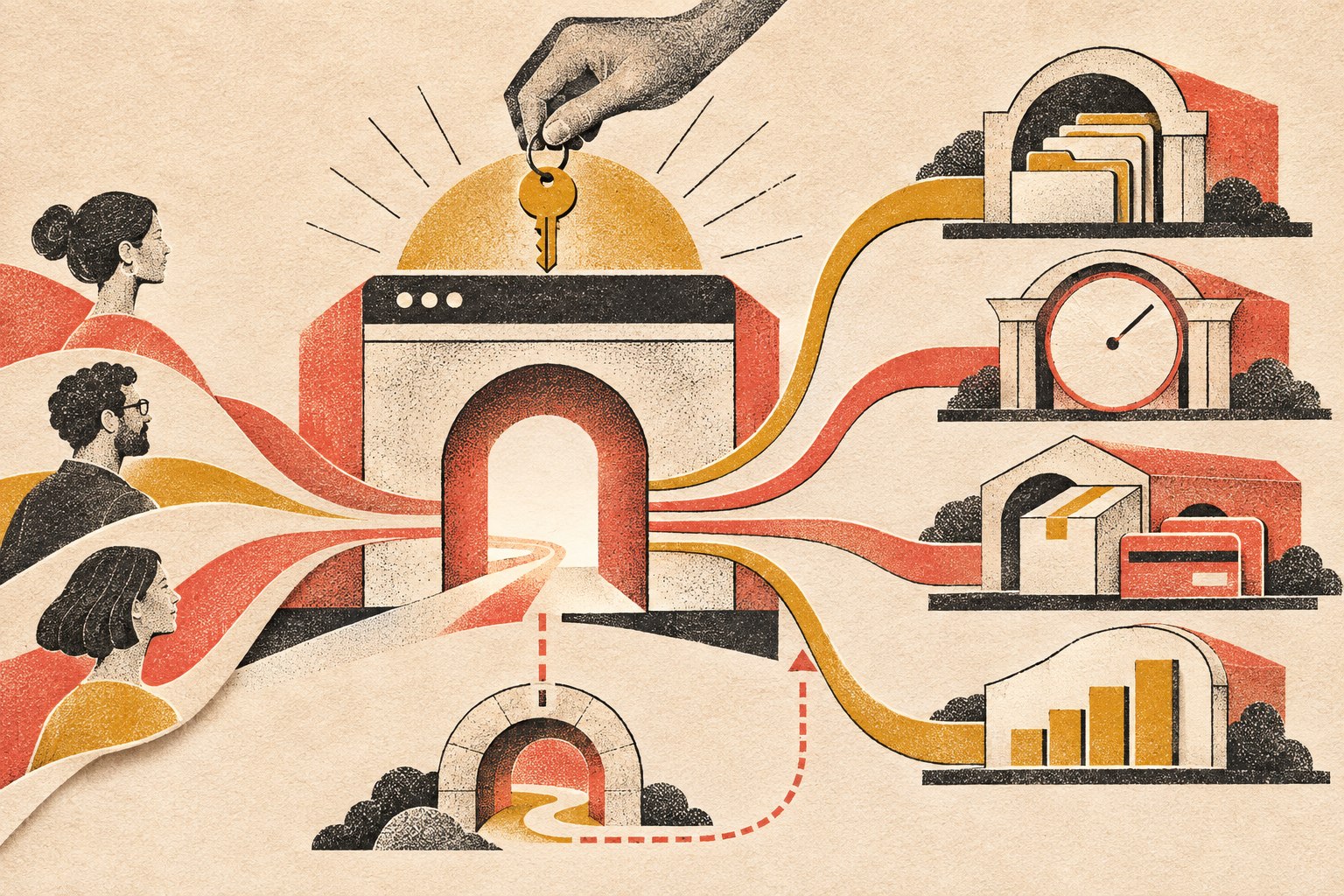
    A considered website gateway routes customer pathways to records, bookings, commerce, and measurement, with a clear fallback path.

    If a form submission still has to be copied into three systems by hand, the website may look modern while the process behind it is wearing a powdered wig. The hard part is not drawing a line between two logos on a flowchart. It is deciding which system owns each piece of information, what should happen when data changes, how errors and duplicates are handled, what staff must approve, and what happens when an external service is unavailable.

    Those are operational decisions. They belong in website planning whenever the site is expected to do real work.

    5. The Content Has a Job

    Serious websites do not treat content as filler poured into a finished design five minutes before launch.

    • The homepage establishes the broad value and main routes.
    • Service pages help a buyer evaluate a specific solution.
    • Comparison pages support commercial research.
    • Case studies and reviews provide proof.
    • Blog articles answer informational questions and build topical depth.
    • FAQs remove friction and handle objections.
    • Contact and booking pages make the next step feel safe and clear.

    This is also where search and AI discoverability begin. The goal is not to repeat one keyword until the page sounds like it was written by a malfunctioning parrot. The goal is to make the answer genuinely useful, structurally clear, easy to crawl, and unambiguous about the question it owns.

    That is why the direct answer appears at the top of this article. Readers should not have to survive 900 words of throat-clearing before learning the point. Scope Design’s guide to front-loading content for AI search explains that approach in more detail.

    6. Technical Quality Is Part of the Product

    A serious website must work when real people use it under real conditions. That includes people on phones, people with slower connections, people using assistive technology, people who mistype information, and people who do things the project team did not expect.

    • Responsive behavior across screen sizes.
    • Performance optimization and sensible asset loading.
    • Accessibility-minded structure, contrast, controls, and content.
    • Secure configuration, updates, backups, and recovery planning.
    • Browser and device testing.
    • Form validation and spam protection.
    • Redirects, canonical URLs, sitemap behavior, and indexation controls.
    • Analytics and event tracking.
    • Clean integrations and documented custom functionality.
    • Staging, deployment, rollback, and post-launch checks.

    None of that is glamorous. Neither is a seatbelt, right up until the moment it matters.

    Google’s current Core Web Vitals guidance defines good field performance as Largest Contentful Paint of 2.5 seconds or less, Interaction to Next Paint of 200 milliseconds or less, and Cumulative Layout Shift of 0.1 or less, measured at the 75th percentile. Performance is not the whole website, but it is one part of whether the experience works well.

    Accessibility deserves the same seriousness. The U.S. Department of Justice explains in its web accessibility and ADA guidance that inaccessible web features can prevent people with disabilities from accessing the goods, services, programs, and activities of covered organizations. The practical point for a business website is simple: accessibility is part of usable design, not a decorative checkbox at the end.

    For more on the performance layer, see Fast & Functional: Web Development & Performance Mastery.

    7. A Serious Website Measures Outcomes

    Page views are interesting. Business outcomes are useful.

    A professional business website should make it possible to understand what is working. The exact measurements depend on the business, but they may include:

    • Qualified contact requests.
    • Phone calls or booked consultations.
    • Quote starts and completions.
    • Ecommerce revenue and checkout completion.
    • Downloads, applications, or registrations.
    • Lead source and campaign performance.
    • Movement through important page sequences.
    • Use of specific tools, searches, calculators, or portal features.

    The point is not to collect every possible event because dashboards are pretty. The point is to connect website behavior to decisions. If nobody can explain what success looks like, the team cannot reliably improve it. They can only rearrange things and hope. Hope is not an analytics strategy.

    8. It Is Built to Change Without Falling Apart

    Businesses evolve. Services change. Teams grow. Marketing campaigns launch. New systems appear. Old systems are finally taken behind the barn.

    • A maintainable content structure.
    • Reusable design patterns.
    • Sensible custom code rather than mystery snippets everywhere.
    • Documentation for important workflows and integrations.
    • A staging environment for safer updates.
    • Clear ownership of domains, hosting, accounts, analytics, code, and source assets.
    • A recovery path if an update, integration, or deployment fails.
    • A plan for extending features without rebuilding the whole thing.

    Scalability does not mean engineering a global platform for a company with twelve customers. It means making smart choices today so tomorrow’s reasonable change does not become a demolition project.

    9. Launch Is a Milestone, Not a Funeral

    Basic sites are often treated as one-time projects: launch it, celebrate, and slowly forget the login.

    Serious business websites need an explicit ownership plan. Software changes. Integrations change. Content changes. Search behavior changes. Security issues appear. Forms break at the worst possible moment because apparently software also enjoys comedy.

    • Updates and compatibility testing.
    • Security monitoring and backups.
    • Uptime and performance monitoring.
    • Broken-link and visual-change checks.
    • Analytics review and conversion improvements.
    • Content updates and search refinement.
    • Testing forms, payments, notifications, and integrations.
    • Recovery procedures and clear account ownership.
    • Planning new features as the business changes.

    A website that matters to the business cannot be treated like a lawn ornament. Ongoing care is part of the system’s reliability.

    10. Cost Follows Responsibility, Complexity, and Risk

    People often compare website prices as if every project is the same object sold in different boxes.

    It is not.

    A focused site using established patterns is not the same project as a site that needs discovery, original positioning, complex content architecture, several audiences, advanced forms, integrations, automation, ecommerce rules, data migration, accessibility work, analytics, testing, and a safe launch plan.

    The higher scope is not payment for extra pixels. It covers more thinking, specialized work, coordination, testing, responsibility, and risk. That still does not mean expensive automatically equals good. A bloated proposal can produce an impressive pile of nonsense. Price is evidence of scope, not proof of quality.

    If you need actual budget ranges and a framework for comparing proposals, use Scope Design’s small business website cost guide. This article’s job is narrower: decide what level of responsibility the website needs to carry before you compare numbers.

    Which Kind of Website Do You Need?

    Choose a focused basic website when:

    • The offer is straightforward.
    • Referrals and existing relationships drive most business.
    • The main goal is credibility and essential information.
    • Standard functionality covers the need.
    • The business is validating an idea or needs to launch quickly.
    • There is no strong business case for deeper integrations or automation yet.

    Consider a more serious website investment when:

    • The site must generate or qualify leads.
    • Buyers need education, proof, or multiple decision paths.
    • The business has complex services, products, audiences, or locations.
    • Staff members are repeating work the website could reduce.
    • Multiple systems need to exchange information.
    • Quoting, booking, ecommerce, search, portal, or workflow features are required.
    • The current site is limiting marketing or operations.
    • Measurement, reliability, ownership, security, and ongoing improvement matter.

    There is no prize for buying more website than you need. There is also no bargain in buying too little for a site that is expected to carry real business risk.

    If you are still deciding what to buy, Scope Design’s business website buyer guide covers the full process from requirements and ownership to budget, provider selection, launch, and maintenance.

    Frequently Asked Questions

    What counts as a professional business website?

    A professional business website is a site whose strategy, content, design, technical quality, measurement, and ownership match the business job it is expected to do. It should clearly explain the offer, help the right visitor decide, provide an obvious next step, work reliably, and have a plan for what happens after launch.

    Is a basic website unprofessional?

    No. A focused website can be professional, useful, fast, accessible, and well designed. It becomes a problem only when its limited scope does not match what the business expects it to accomplish.

    Does a professional website have to be custom-coded?

    No. Templates, design systems, WordPress builders, and hosted website platforms can all produce professional results when their capabilities fit the business need. Custom development makes sense when the required workflow, data, integration, transaction, or product behavior cannot be handled responsibly with standard tools.

    When has a business outgrown a basic website?

    A business has probably outgrown a basic site when the website is limiting lead generation, customer service, marketing, ecommerce, internal workflows, integrations, measurement, or the ability to clearly explain a more complex offer.

    What’s the best website for a small business?

    The best website is the smallest responsible solution that can do the job the business actually needs. A simple service company may need a focused site with excellent messaging and contact paths. A revenue-critical operation may need ecommerce, portals, integrations, automation, advanced search, or custom workflows. Start with the business outcome, not the software brand.

    How much does a professional website cost?

    There is no useful universal number because “professional website” can describe very different scopes. Cost should follow the amount of strategy, content, design, functionality, integration, testing, migration, risk, and ongoing responsibility involved. Compare what the website must accomplish and what the proposal includes before comparing totals.

    Is Wix a professional website platform?

    It can be. Wix and other hosted builders can be a professional fit when their standard design, content, ecommerce, booking, and marketing tools cover the need. The question is not whether the platform is “professional.” The question is whether its limits interfere with the business requirements, ownership, integrations, performance, accessibility, or future change.

    Can WordPress handle a serious business website?

    Yes. WordPress can support brochure sites, ecommerce, memberships, portals, structured content, advanced search, integrations, and custom workflows when it is architected and maintained properly. The platform is only one part of the system; implementation and ownership matter more than the logo on the admin screen.

    What should a business website measure?

    Measure actions tied to business value: qualified inquiries, bookings, calls, quote requests, applications, sales, lead sources, conversion paths, and use of important tools or workflows. Traffic can provide context, but it does not tell you by itself whether the site is doing its job.

    What happens after a serious website launches?

    The site should be monitored, maintained, backed up, secured, tested, measured, and improved. Important accounts and assets should have clear owners, and the team should know how to recover when something breaks. Launch is the beginning of real-world use, not the moment everyone walks away and hopes the plugins behave forever.

    Stop Asking Your Website to Coast

    If all you need is a clean online presence, build that well and do not apologize for it.

    But if the website is supposed to help the business sell, operate, serve customers, and grow, stop treating it like a decorative expense. Treat it like the business system it is.

    Before choosing a scope, use the Website Fitness Test to judge whether the result will actually be good, check the Buyer Decision File for the information it must contain, and audit the full path with the seven-link conversion checklist. Then explore Scope Design’s website development services or contact Scope Design to talk about what your website actually needs to accomplish.

  • Website Change Monitoring: Catch What Uptime Checks Miss

    Website Change Monitoring: Catch What Uptime Checks Miss

    Website change monitoring repeatedly captures selected web pages, compares each new version with a trusted baseline, and alerts you when the content, layout, structure, or destination changes. Uptime monitoring asks whether a page answered. Change monitoring asks whether it is still the page you intended to publish. A website can return a cheerful 200 OK while its checkout button is missing, its pricing is wrong, or a spam redirect is escorting customers somewhere deeply unhelpful.

    The short version: use uptime monitoring to learn whether the site is reachable, and website change monitoring to learn whether important pages are still correct. Monitor the pages closest to revenue, trust, compliance, and customer action. Set the scan interval according to business risk, suppress predictable noise, retain before-and-after evidence, and assign a human owner who can act on the alert. Otherwise, you have not built monitoring. You have built a notification hobby.

    What is website change monitoring?

    Website change monitoring is an automated process that captures a baseline version of a web page, checks the page again on a schedule, compares the new state with the previous state, and reports meaningful differences. Depending on the system, it can compare visible text, rendered screenshots, page structure, links, status codes, redirects, or several of those signals together.

    The useful part is not merely discovering that something changed. Modern pages change constantly. Cookie banners appear, timestamps tick, carousels rotate, inventory moves, recommendations personalize themselves, and third-party widgets do whatever third-party widgets feel like doing that day. The useful part is separating expected motion from a change that deserves attention.

    That creates a five-step monitoring loop:

    1. Capture a known-good baseline.
    2. Revisit the selected URL on a defined schedule.
    3. Compare the current page with the baseline or previous version.
    4. classify the difference and suppress expected noise.
    5. Alert the right person with enough evidence to decide what happens next.

    The baseline matters more than most product pages admit. If the first captured version is already broken, the monitor can faithfully protect the wrong thing forever. Establish the baseline after a deliberate review, not because Tuesday at 2:17 p.m. happened to be convenient.

    Uptime monitoring and change monitoring answer different questions

    Uptime monitoring and website change monitoring belong in the same operating system, but they are not interchangeable.

    Monitoring layer Question it answers Typical evidence What it can miss
    Uptime monitoring Can the server or page be reached? Status code, response time, timeout Broken layout, changed copy, missing CTA, altered price, defacement that still returns 200
    Content monitoring Did visible text or selected data change? Added and removed words, numbers, links, or fields CSS breakage and visual changes with identical text
    Visual monitoring Does the rendered page look different? Before-and-after screenshots and highlighted regions A subtle data change, the reason for a change, or an interaction that no longer works
    Structural monitoring Did the page composition change? DOM, elements, attributes, scripts, links, or metadata Whether the new structure is intentional or harmful
    Redirect monitoring Is the request being sent somewhere different? Status, redirect chain, destination URL or host The cause of the redirect

    The HTTP standard defines 200 OK as a successful response for the request. It does not certify that your page is attractive, accurate, secure, or capable of making money. It is a protocol status, not a Yelp review. The same standard defines redirect responses including 301, 302, 307, and 308, which is why a serious monitoring setup should record where a URL went rather than blindly following it and pretending nothing happened. See RFC 9110, HTTP Semantics for the underlying status-code and redirect definitions.

    Google also treats server-side redirects as important signals when URLs move and recommends avoiding unnecessarily long redirect chains. That makes unexpected destination changes relevant to both security and search operations. See Google Search Central’s redirect guidance.

    The practical answer is not to choose one layer. Use uptime checks to catch outages and change monitoring to catch pages that are available but wrong.

    What kinds of website changes can monitoring catch?

    Content changes

    Content monitoring can detect additions, deletions, and edits to visible text or selected page elements. Common targets include:

    • product prices and availability;
    • policy, legal, and disclosure language;
    • headlines, offers, and calls to action;
    • contact information and business hours;
    • navigation labels and links;
    • product descriptions and specifications;
    • competitor pages you are permitted to monitor.

    A text comparison is excellent at spotting a changed number that barely affects the page visually. It is less useful when the words remain intact but CSS stacks the page into modern art.

    Visual changes

    Visual monitoring compares rendered screenshots. It can reveal missing sections, broken grids, swapped images, unexpected overlays, typography changes, design regressions, or obvious defacement.

    The weakness is noise. Ads, animations, consent banners, lazy-loaded images, location, personalization, and A/B tests can all alter pixels without creating a business problem. A useful visual monitor needs region controls, tolerance, stable rendering, and evidence that shows where the page changed. A naked percentage such as “14% different” is technically information, but so is a smoke alarm that only emails “something somewhere may be warm.”

    Structural changes

    Structural monitoring looks beneath the screenshot. It can identify removed elements, changed page sections, altered links, injected scripts, missing forms, modified metadata, or changes to the page’s document structure.

    This layer matters because text can stay identical while the page composition breaks. It also matters for malicious injections that may be hidden from an ordinary visual glance. Structural change does not prove compromise, but it gives the response team a better place to start.

    Redirect and destination changes

    A URL can appear “up” while redirecting visitors to the wrong page or an external domain. Redirect monitoring should ideally preserve the original URL, response status, destination, and chain. That evidence helps distinguish an intentional migration from a broken rule or suspicious redirect.

    Website defacement signals

    Website change monitoring can surface public-facing symptoms of defacement: replaced content, spam links, injected scripts, changed forms, altered images, or unexpected redirects. It is one detection layer inside a broader website security program.

    It is not a malware scanner, forensic investigation, firewall, backup, or incident-response team. A change alert can establish that the monitored representation changed. It usually cannot prove who caused the change, whether the CMS was compromised, or how the attacker got in. Honest boundaries make the tool more useful, not less.

    The Scope Design SIGNAL framework for website monitoring

    Buying a monitoring tool before defining the monitoring policy is classic software-shopping behavior: select a dashboard, admire the charts, and postpone the difficult decisions until the first alert storm. We use the SIGNAL framework to turn the tool into an operating process.

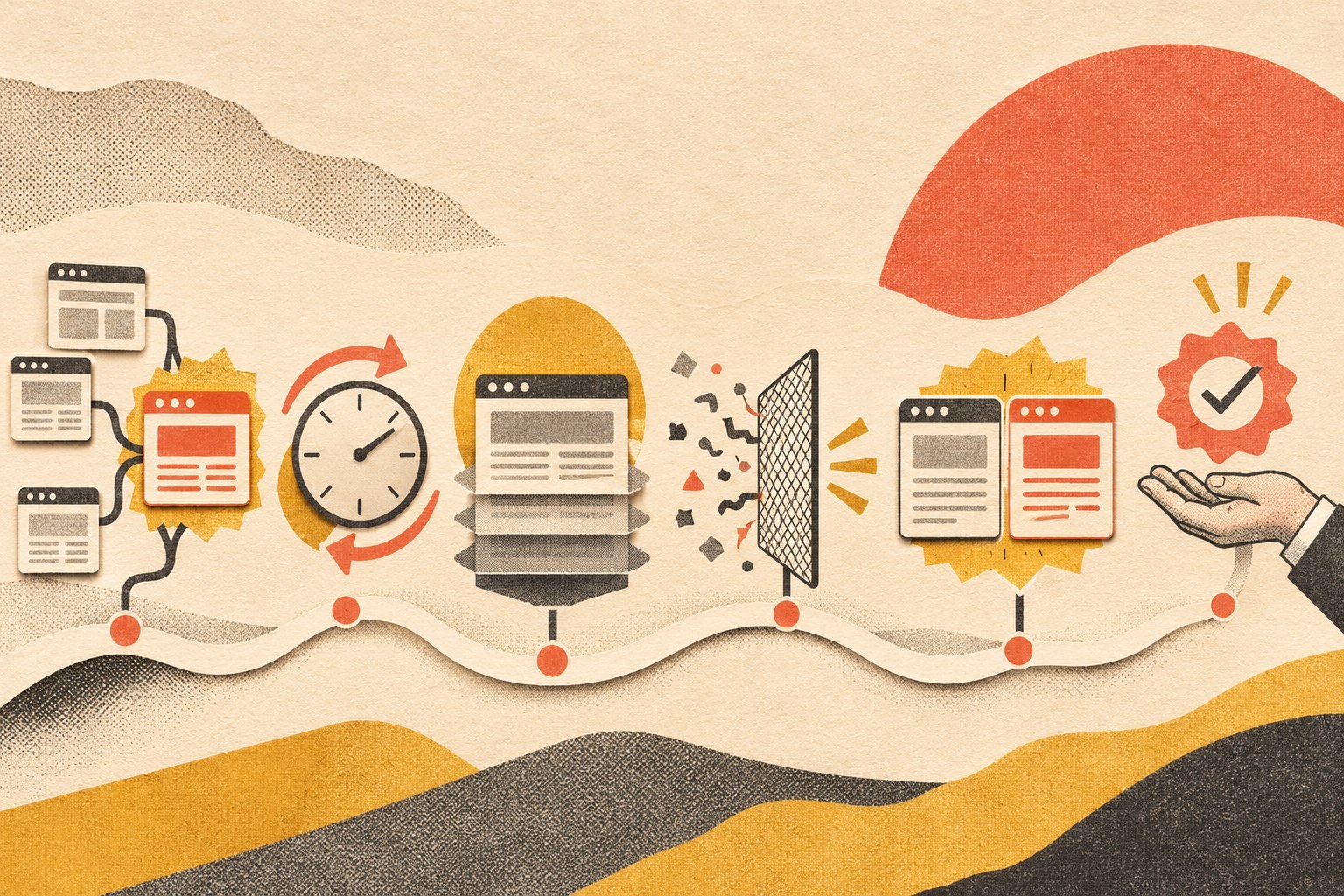
    A six-step visual flow shows selected pages, scan intervals, trusted baselines, noise filtering, before-and-after evidence, and an accountable owner.
    The SIGNAL framework turns website change monitoring into an owned business process: Select, Interval, Ground truth, Noise, Actionable evidence, and Link to an owner.

    S: Select pages by business risk

    Do not begin by importing every URL because the plan says you can. Begin with pages where an unnoticed change would affect revenue, trust, compliance, search visibility, or a critical customer task.

    Good first candidates include the homepage, primary service pages, pricing, checkout, login, lead forms, contact details, policy pages, high-traffic landing pages, and high-value organic search pages.

    I: Interval follows acceptable delay

    Choose the scan frequency according to how long the business can safely remain unaware of a change. A checkout page may justify a short interval. A static policy archive may not.

    Scheduled polling creates a detection window. If a page is checked hourly, a change that occurs immediately after one scan may wait almost an hour for detection. Faster checks reduce that window but consume more scans and can produce more noise. “Real time” should be a measurable interval, not marketing incense.

    G: Ground truth needs a trusted baseline

    Approve the initial version. Record what the page should contain, where it should lead, and which dynamic regions are expected to change. Refresh the baseline after confirmed legitimate edits.

    The baseline is the answer key. If nobody reviewed it, the monitor is grading from a photocopy it found on the floor.

    N: Noise needs rules

    Exclude or normalize timestamps, rotating banners, personalization, advertisements, stock counters, session values, and other predictable movement. Use selected regions or element-level checks when the whole page is too volatile.

    Conditions and thresholds can reduce meaningless alerts. Distill’s documentation, for example, explains how conditions can trigger alerts only when specified criteria are met, rather than whenever any change occurs. See Distill’s alert-condition documentation.

    A: Alerts need actionable evidence

    Every alert should answer four questions quickly:

    1. Which URL changed?
    2. What changed?
    3. When was the difference detected?
    4. What evidence should the reviewer inspect?

    Before-and-after screenshots, text differences, structural findings, status information, and a plain-language summary beat “page changed” by a country mile. A durable history also makes later diagnosis and client reporting far less dependent on memory. Distill’s product documentation provides a concrete example of retaining and highlighting prior changes in a change history.

    L: Link every alert to an owner and response

    Name the person or team responsible for reviewing each class of alert. Define escalation, maintenance windows, false-positive handling, and what happens when a scan fails.

    Security guidance from OWASP emphasizes that logging and monitoring should support detection and response, not merely exist. The same operational principle applies here: an alert with no owner is just a tiny automated scream into the void. See the OWASP guidance on security logging and monitoring.

    How often should you monitor a website for changes?

    There is no universal “best” frequency. Use the shortest acceptable detection delay that the page’s risk, change pattern, noise, and budget justify.

    Page type Starting cadence Why
    Checkout, login, or high-value transaction page Frequent, based on risk A broken or redirected flow can affect revenue quickly
    Homepage and primary lead pages Hourly to daily High visibility and commercial importance
    Pricing and product pages Hourly to daily Incorrect information can create sales and trust problems
    High-value organic landing pages Daily Protect important copy, links, metadata, and layout
    Legal and policy pages Daily to weekly Preserve awareness and history without pretending monitoring creates legal compliance
    Stable reference pages Weekly to monthly Lower change frequency and lower immediate impact
    Competitor pages Based on decision use Check only as often as the information can change an actual decision

    These are starting points, not commandments carved into a server rack. Adjust them using observed change frequency and the cost of delayed detection.

    For WordPress sites, a scheduled baseline is only part of the answer. Run checks before and after controlled updates. Our WordPress plugin update guide explains why updating one component, testing, and preserving rollback evidence is safer than clicking “update all” and discovering your experimental phase on the live homepage.

    How do you reduce false alerts?

    False positives are not a minor usability issue. They train people to ignore the system. Once every rotating testimonial generates an emergency email, the real checkout failure arrives disguised as Tuesday.

    Reduce noise with a layered approach:

    • Monitor the right scope. Select a stable section or element instead of the entire page when possible.
    • Exclude known dynamic regions. Ignore ads, clocks, carousels, recommendations, and other expected movement.
    • Wait for stable rendering. Modern pages often need JavaScript, fonts, images, and lazy-loaded assets to settle.
    • Use thresholds carefully. A small pixel difference may be harmless, but a one-character price change may matter.
    • Compare more than one signal. Visual, content, and structural evidence together provide better context than one metric alone.
    • Classify before escalating. Separate no change, minor update, content update, layout change, potential breakage, and security concern.
    • Confirm legitimate changes. Refresh the baseline after a planned edit so the system does not keep reporting yesterday’s news.
    • Suppress alerts during maintenance. Planned work should not trigger a fake incident, but monitoring should resume automatically.

    AI can help classify higher-signal changes and create a readable summary. It should not be treated as an oracle. Keep the raw before-and-after evidence, let people review consequential alerts, and measure false positives and missed changes over time. That is the same human-ownership principle we apply in our AI automation framework: automate the repetitive work, preserve evidence, and keep humans responsible for consequential decisions.

    What should a website change alert contain?

    A useful alert is a decision packet, not a panic button. At minimum, it should include:

    • the monitored URL and page label;
    • the scan timestamp and configured frequency;
    • the previous and current state;
    • highlighted visual or content differences;
    • structural or redirect evidence when relevant;
    • a severity or classification with plain-language reasoning;
    • a link to history;
    • the assigned owner or response route;
    • enough context to acknowledge, dismiss, escalate, or refresh the baseline.

    The history should distinguish detection from attribution. A monitoring record may prove that the public page changed between two scans. It does not necessarily prove which editor, deployment, plugin, attacker, CDN rule, or third-party widget caused it. Connect monitoring with CMS activity, deployment logs, security telemetry, and team records when attribution matters.

    What website change monitoring cannot do

    Every useful technology gets ruined eventually by a marketing page claiming it does everything. Let us skip that phase.

    Website change monitoring has real limitations:

    • It samples pages on a schedule. A brief change can occur entirely between scans.
    • A cloud scanner may receive a different page than a customer because of geography, cookies, authentication, personalization, user agent, CDN behavior, or feature flags.
    • Public-page monitoring does not automatically test authenticated dashboards.
    • A screenshot can prove pixels changed, not why they changed.
    • A text comparison can miss a visually broken layout.
    • Detection does not repair the site, remove malware, restore a backup, or roll back a deployment unless a separate response system is integrated.
    • A captured baseline can already be wrong.
    • Bot protection, rate limits, CAPTCHAs, and blocked scanner addresses can prevent or distort scans.
    • A page can look correct while its form, search, checkout, or login interaction is broken.

    That final boundary matters. Change monitoring asks whether the page’s observed state changed. Cross-browser testing and synthetic journey testing ask whether people can still complete critical tasks. Good operations use the right test for the right failure instead of forcing one tool to cosplay as an entire QA department.

    How PageSentinel approaches website change monitoring

    PageSentinel is Scope Design’s website change monitoring product for agencies, site owners, ecommerce teams, and other organizations that cannot afford to learn about broken pages from customers.

    The current product monitors selected URLs on demand or on a schedule, captures visual, content, and structural signals, and retains before-and-after evidence. When a change is significant, AI-assisted review helps classify the result and produce a human-readable summary. The goal is not “AI everywhere.” The goal is fewer useless alerts and faster triage when a change actually deserves a human.

    The operating flow is deliberately simple:

    1. Add the pages you care about.
    2. Choose the scan frequency allowed by your plan.
    3. Run a scan or let the schedule do it.
    4. Review the change evidence and alert history.

    PageSentinel uses scan credits because frequency is the real cost driver. Ten URLs checked every few minutes consume far more monitoring work than ten URLs checked weekly. Plans therefore provide a scan budget and make faster cadences available by tier. You can set a domain-level default and override important URLs, so the homepage does not have to share a schedule with a dusty terms page.

    Email alerts are included. Other alert channels are available as add-ons. Retention varies by plan. The live PageSentinel pricing and feature page is the source of truth for current limits because embedding a price table in an evergreen article is how stale promises are born.

    Watch PageSentinel in action

    The demo shows the add-URL, scan, alert, comparison, and history flow.

    Practical website monitoring use cases

    Agencies managing client websites

    Monitor important client pages after plugin, theme, content, or deployment changes. Keep evidence of when a page changed and what the monitor observed. This supports proactive maintenance and far better client conversations than “it looked fine when we checked last month.”

    Website monitoring belongs inside the broader ownership and recovery process described in our website maintenance guide.

    Ecommerce teams

    Watch product pages, pricing, availability messages, shipping policies, checkout steps, and revenue-critical landing pages. Monitoring can also track public competitor pages when that information supports a legitimate pricing, merchandising, or market decision.

    Marketing and SEO teams

    Protect high-value landing pages from accidental copy deletion, changed calls to action, missing sections, altered links, unexpected redirects, and design regressions. The broader business website development pillar explains why reliable operations belong to the technical foundation, not the launch-day victory lap.

    Compliance and reputation teams

    Retain timestamped evidence that a public policy, disclosure, or claims page changed. This history may support review and investigation, but it does not automatically satisfy a regulation or identify who made the edit. Have legal and compliance professionals define the actual obligation.

    Website owners worried about defacement

    Monitor high-visibility pages for unexpected public changes, spam content, injected links, or redirects. Pair this with access control, supported software, backups, security monitoring, and an incident-response plan. One alerting layer is useful. Calling it a complete security program would be bullshit.

    Website change monitoring buying checklist

    Before choosing a monitoring tool, ask it to demonstrate five deliberately different events:

    1. A one-word text change.
    2. A CSS or layout change with identical text.
    3. A structural change with little visual difference.
    4. An unexpected external redirect.
    5. A dynamic element that should not create an alert.

    Then evaluate the evidence, classification, alert, and history for each event.

    Use this checklist during the demonstration:

    Buying question What a credible answer includes
    What does the tool compare? Clear explanation of visual, content, structural, status, and redirect signals
    Does it render JavaScript? A browser-based capture process for modern sites, with stated limitations
    Can I target or exclude regions? Page, element, selector, region, or ignore controls
    How are false positives reduced? Stable rendering, thresholds, exclusions, conditions, classification, or confirmation
    Can frequency vary by URL? Per-page schedules or overrides tied to risk
    What is the detection window? A measurable interval, not vague “real-time” language
    What evidence is retained? Before and after states, diffs, timestamps, status, destination, and history
    How long is evidence retained? A clear retention period and export policy
    What happens when a scan fails? Failure alerts, retry behavior, and visible status
    Does it support authenticated pages? Explicit support and secure session handling, or an honest no
    How is monitored data protected? Clear storage, access, credential, and deletion practices
    Who handles the alert? Routing, acknowledgment, suppression, escalation, and integrations
    Does detection include remediation? A precise boundary between detection, diagnosis, and recovery

    The best tool is not the one that reports the most changes. It is the one that finds consequential changes with enough evidence for your team to act, without conditioning everyone to ignore it.

    Frequently asked questions about website change monitoring

    Can I monitor a website for changes?

    Yes. A website change monitoring service can revisit selected URLs on a schedule, compare each page with a prior version or baseline, and alert you when monitored content, visuals, structure, status, or redirects change.

    How can I monitor changes on a website?

    Choose the important URL, establish a reviewed baseline, select the scan frequency, configure dynamic-content exclusions, run a test change, and route alerts to an owner. Review the first alerts closely and tune the monitor before expanding to more pages.

    What is the difference between website monitoring and website change monitoring?

    “Website monitoring” is a broad category that can include uptime, performance, transactions, security, and change detection. Website change monitoring specifically compares page states to identify what changed in content, presentation, structure, or destination.

    What is the difference between uptime monitoring and website change monitoring?

    Uptime monitoring asks whether a site or endpoint is reachable and responding. Website change monitoring asks whether the returned page is still correct. A page can return 200 OK while its layout, copy, form, price, or redirect behavior is wrong.

    Can I see when a website was changed?

    A change monitor can show when it first observed a difference between scheduled scans and preserve before-and-after evidence. It cannot necessarily reveal the exact edit time or who made the change unless it is connected to CMS, deployment, identity, or security logs.

    Can website monitoring detect defacement?

    Change monitoring can detect public symptoms such as replaced text or images, injected links, altered forms, structural changes, or unexpected redirects. It does not by itself prove compromise or replace malware scanning, access controls, backups, and incident response.

    Can website change monitoring detect broken layouts?

    Visual monitoring can detect rendered differences such as missing sections, broken grids, swapped images, overlays, and other layout changes. Test at the viewport sizes that matter and combine monitoring with functional and cross-browser testing for critical user journeys.

    How often should a website be checked?

    Set the interval according to business risk and acceptable detection delay. Revenue-critical and security-sensitive pages may need frequent checks, while stable reference pages may only need weekly or monthly scans. Faster is not automatically better if it creates noise nobody reviews.

    Can I monitor competitor website changes?

    Yes, for public pages and legitimate business purposes. Common targets include pricing, product listings, policies, and positioning. Respect applicable laws, site terms, access controls, and reasonable request rates. Monitor only information tied to a real decision, or you are paying to collect trivia.

    How do I stop false website change alerts?

    Target stable elements, exclude dynamic regions, wait for the page to render, normalize predictable values, set appropriate thresholds, classify changes, and refresh the baseline after approved edits. Review alert quality continuously rather than assuming the default configuration understands your business.

    Is website change monitoring the same as a backup?

    No. Monitoring detects observed differences and preserves evidence. A backup preserves recoverable site data and files. You need monitoring to learn that something changed and tested backups to restore the system when recovery is required.

    Does website change monitoring prove who changed a page?

    Usually not. It can establish what the monitor observed and when. Attribution requires records from the CMS, hosting platform, deployment pipeline, identity provider, CDN, firewall, or other systems involved in the change.

    Stop waiting for a customer to become your monitoring system

    A serious business website should not rely on memory, occasional manual checks, or the hope that customers will politely report damage before leaving. Monitor the pages that carry revenue and trust, set the cadence by risk, keep the evidence, and give every alert an owner.

    If you want to see the process before committing to a plan, start a PageSentinel trial and run a monitored URL through its first baseline and comparison. Two minutes of setup is cheaper than the next “hey, did you know your homepage is broken?” email.

  • Why Smart Businesses Use Design Firms on Retainer (ROI + Cost Analysis)

    Why Smart Businesses Use Design Firms on Retainer (ROI + Cost Analysis)

    A graphic design retainer is not automatically cheaper than project work, a freelancer, or an in-house designer. Its economic value comes from buying a dependable slice of capacity: priority access, accumulated brand and business context, a known request-and-approval path, and less time spent repeatedly quoting, briefing, and restarting work.

    That is why we think of a retainer as a capacity contract, not a bulk-discount coupon. The right question is not “What percentage can I save?” It is: Will the operating value of reserved capacity exceed the cost of unused capacity, overages, and the best alternative?

    What does a graphic design retainer actually buy?

    A graphic design retainer is a recurring agreement that reserves an agreed amount of a designer’s or design firm’s capacity for ongoing work. The unit might be hours, requests, deliverables, a defined service scope, or a hybrid. What matters is that both sides know what capacity is being reserved and how requests move through it.

    • Reserved capacity: you are not starting from zero every time a brochure, ad, landing-page asset, presentation, email graphic, or website update appears.
    • Accumulated context: the team can retain knowledge about your brand, audience, approvals, systems, and recurring work instead of relearning them for every project.
    • A predictable operating path: requests, priority, feedback, approvals, files, and handoffs have a defined route.
    • Capability access: a firm may cover a wider mix of creative, web, copy, production, or technical needs than one full-time role can economically cover.

    Those benefits can be worth real money. They can also be worth nothing if demand is sporadic, the agreement is vague, or you consistently leave paid capacity unused. That is why a cost analysis has to include how the work actually operates.

    The biggest design-retainer cost mistake: comparing invoice to invoice

    Businesses often compare a monthly retainer fee with a freelancer’s hourly rate or an employee’s salary and call the lower number the winner. When you compare a graphic design retainer with another model, that misses the costs surrounding the work.

    For an in-house benchmark, the U.S. Bureau of Labor Statistics reports that the median annual wage for graphic designers was $61,300 in May 2024. That is wage data, not an employer’s all-in cost. In a separate economy-wide measure, BLS reported that private-industry employers in March 2026 averaged $32.60 per hour in wages and salaries plus $14.01 per hour in benefit costs, for $46.61 in total compensation.

    Those two BLS datasets cover different populations, so you should not apply the private-industry benefit ratio as a universal markup to a graphic designer’s median wage. The useful point is narrower: salary alone is not the same as total employment cost. Recruiting, management, software, equipment, benefits, payroll costs, unused capacity, and specialist gaps can all matter in a real hiring decision.

    Use the Scope Design Retainer ROI Ledger

    Instead of asking whether retainers are “usually cheaper,” compare the total operating cost of the realistic alternatives. Our Retainer ROI Ledger separates the value created or cost avoided from the leakage a monthly commitment can introduce.

    Value created or cost avoided

    • Coordination time avoided: less time sourcing vendors, requesting quotes, briefing from scratch, chasing status, moving files, and repeating approvals.
    • Delay cost avoided: the value of getting an important campaign, sales asset, website change, or correction into market sooner.
    • Context and rework avoided: less repeated explanation and fewer resets caused by a provider who does not know the brand, workflow, or technical environment.
    • Capability access: the value of having several relevant skills available without keeping every specialty on payroll full time.

    Costs and leakage

    • Unused capacity: paid hours, requests, or deliverables that expire or sit idle.
    • Overage and rush costs: charges or operational pain when demand repeatedly exceeds the reserved lane.
    • Internal coordination that remains: a retainer does not eliminate the need for a capable owner, brief, feedback, or approval.
    • Switching and exit cost: documentation, file cleanup, transfer of credentials/assets, and replacement-provider onboarding.

    The break-even question is simple even when the inputs are not:

    Retainer advantage = coordination time avoided + delay cost avoided + rework/context resets avoided + capability value − unused capacity − overages/rush − switching/exit cost.

    Compare that result with the total cost of the best alternative, not with a hand-picked hourly rate.

    A simple illustrative break-even example

    This is a worked example, not a market benchmark. Replace every number with your own.

    Monthly cost inputAd hoc exampleRetainer example
    Vendor/retainer fee$3,600$3,400
    Internal coordination time$480$240
    Rush/rework or unused-capacity reserve$350$250
    Modeled monthly total$4,430$3,890

    In that illustration, the retainer is $540 lower for the month. But the result can flip quickly. If coordination does not fall, unused capacity rises, or overages become routine, the retainer may cost more. The model is useful because it forces the assumptions into the open.

    When does a graphic design retainer beat ad hoc project work?

    A graphic design retainer becomes more attractive when the work is recurring enough that repeatedly rebuilding the operating context is wasteful. Good signals include:

    • a real backlog of recurring design, campaign, sales, web, or content-production requests;
    • frequent small-to-medium requests that are awkward to quote individually;
    • work where waiting for availability creates a meaningful business cost;
    • brand or technical context that compounds in value when the same team stays involved;
    • a need for multiple capabilities, but not enough steady work to justify several specialized hires;
    • a team that can actually feed the reserved capacity with clear requests and timely approvals.

    If the recurring work is specifically a website, the commercial-model question becomes more specialized. Our website redesign project-vs-retainer pricing guide explains when a defined rebuild, ongoing capacity, or a hybrid arrangement makes more sense. This article owns the broader design-retainer economics.

    When is a project, freelancer, subscription, or in-house designer better?

    A smart retainer article should tell you when not to buy one. No operating model wins every workload.

    ModelOften fits whenMain economic risk to watch
    Project-based firmYou have a defined outcome, stable scope, and a natural finish line.Repeated quoting, queues, and re-onboarding if “one project” becomes constant change.
    Freelancer or small studioThe work is focused and one person or a small team can cover most needs.Availability, backup coverage, breadth limits, and handoff if that person is unavailable.
    Design subscriptionYou have a steady queue of standardized production work and can work within the provider’s request rules.Parallel-task limits, variable strategic depth, and paying for a process that may not fit complex work.
    Design-firm retainerYou need recurring cross-channel capacity, continuity, and a broader capability mix.Unused capacity, vague scope, overages, or a long commitment that outlives the workload.
    In-house designerDesign demand is continuous enough to use a role deeply every week and close daily collaboration matters.Fixed employment cost, unused capacity, management burden, and specialist gaps outside the hire’s strengths.

    Choose the smallest responsible model that can handle the actual work and risk. If you are also deciding who should own the work, our guide to choosing a web design company without getting trapped compares freelancer, agency, managed-service, and specialist-team responsibilities in more depth.

    Size a retainer from 90 days of real work, not optimism

    The easiest way to overbuy a graphic design retainer is to estimate future demand during a week when everything feels urgent. Use your last 90 days instead.

    1. Inventory every design request. Include finished work, delayed work, abandoned work, and work your team did internally because no provider was available.
    2. Group requests by type. Separate predictable production work from strategic, web, copy, campaign, presentation, and emergency work.
    3. Estimate real effort. Include briefing, revisions, approvals, export/production, meetings, file management, and implementation—not just the visible design time.
    4. Mark the cost of waiting. Which requests could wait a week? Which blocked a campaign, proposal, event, sales conversation, or important fix?
    5. Find the recurring baseline. Reserve capacity around the stable center of demand, not the biggest spike.
    6. Keep a buffer strategy. Decide in advance what happens when work is below or above the reserved amount.

    This “90-day capacity test” prevents two opposite mistakes: buying too little and living in overages, or buying too much and manufacturing work just to use what you already paid for.

    The graphic design retainer terms that decide whether the economics work

    For a graphic design retainer, the monthly price is only one part of the agreement. Before signing, make these operating rules explicit:

    • Scope: which services and deliverables are included, and which are not?
    • Capacity unit: hours, requests, deliverables, service scope, or another measure?
    • Turnaround and priority: what does “priority” actually mean, and when does the clock start?
    • Rollover or expiration: what happens to unused capacity?
    • Overages: what happens when work exceeds the reserved amount?
    • Rush work: what qualifies as urgent, and does it change price or queue order?
    • Request channel: where must new work be submitted so it does not disappear across email, texts, chat, and meetings?
    • Feedback and approval: who consolidates comments, who approves, and how many rounds are included?
    • Files and ownership: what files, licenses, working documents, credentials, and exports do you receive?
    • Cancellation and exit: notice period, minimum commitment, final handoff, and what survives termination.

    Feedback mechanics deserve special attention because a poor approval process can burn capacity without improving the work. Our guide to working effectively with a web design company covers preparation, decision ownership, and consolidated feedback in more detail.

    At Scope Design, this is the part we would rather make boring and explicit. A retainer should define the rules for scope, turnaround, rollover, overage, rush work, communication, cancellation, and exclusions before the recurring work becomes routine. Ambiguity is not flexibility; it is deferred conflict.

    How should you measure graphic design retainer ROI after 90 days?

    Do not judge the agreement only by how many deliverables appeared. Measure whether the operating system improved.

    • Capacity utilization: how much of the reserved lane did you actually use?
    • Cycle time: how long did important requests take from ready brief to usable deliverable?
    • Internal coordination hours: did your team spend less time quoting, explaining, chasing, and moving work?
    • Rework: did repeated brand/context corrections fall, stay flat, or rise?
    • Backlog age: are important requests clearing faster, or is work simply accumulating inside a new queue?
    • Overage/rush frequency: is the reserved level sized correctly?
    • Capability coverage: did the agreement reduce the number of times you needed a separate specialist?

    For revenue or lead-generation impact, be stricter. A new sales deck or landing-page asset may contribute to a result, but the retainer should not take credit for every dollar that happened afterward. Track operating measures directly, then connect individual creative work to business outcomes only where attribution is defensible.

    A quick graphic design retainer fit test

    A design retainer is worth serious consideration if you can answer yes to most of these:

    • Do we have recurring design demand, not just occasional projects?
    • Does waiting for provider availability regularly slow important work?
    • Does brand, audience, system, or technical context become more valuable when retained over time?
    • Would we benefit from several capabilities without employing every specialty full time?
    • Can our team supply clear requests and timely approvals consistently?
    • Can the agreement explain unused capacity, overages, turnaround, ownership, and exit in plain English?
    • Can we measure utilization, cycle time, coordination, and backlog after 90 days?

    If most answers are no, a project or smaller on-demand relationship is probably the cleaner buy. If most are yes, model the total cost with your real workload and negotiate the agreement around the risks you found.

    Frequently asked questions about design retainers

    How much should a graphic design retainer cost?

    There is no responsible universal price because retainers can reserve very different things: a few production hours, a request queue, cross-disciplinary agency capacity, strategic direction, web work, copy support, or a defined package of deliverables. Ask for the capacity unit, included services, turnaround, overage rules, and commitment length. Then compare total operating cost with your real alternatives instead of shopping a single monthly number.

    Is a design retainer cheaper than hiring an in-house designer?

    Not automatically. An in-house designer can be the better economic choice when you have enough continuous work to use the role deeply and need daily integration. A retainer can be stronger when demand is recurring but below full-time utilization, when you need multiple specialties, or when reserved external capacity reduces coordination and delay. Compare all-in employment cost and utilization with the retainer’s fee, unused capacity, overages, and management time.

    What are the disadvantages of a retainer fee?

    The main risks are paying for unused capacity, unclear scope, poor rollover rules, overage surprises, a commitment that outlives the workload, and assuming “priority” means something the agreement never defines. A retainer can also hide a weak process: if your team cannot brief or approve work, reserved capacity will not fix that.

    What happens to unused design-retainer hours?

    It depends entirely on the agreement. They may expire, roll over for a limited period, convert to another type of work, or be governed by a deliverable/request model instead of hours. Do not assume. Unused-capacity rules are part of the economics and should be clear before you sign.

    What is the difference between a design retainer and a design subscription?

    The labels overlap in the market, so read the operating rules. A subscription often standardizes intake, queue order, turnaround, and how many requests can be active at once. A firm retainer may reserve hours, deliverables, access to a broader team, or a defined service scope. Neither label tells you enough by itself; compare capacity, expertise, process, ownership, and exit terms.

    Can you start with a project and move to a retainer later?

    Yes, and that can be a sensible way to reduce uncertainty. A defined project lets both sides test communication, quality, decision-making, and technical fit. If the work reveals a recurring backlog after launch, you can size ongoing capacity from real evidence instead of guessing before the relationship begins.

    The smartest retainer is the one your workload can prove

    A graphic design retainer does not make a business smarter by itself. The smart move is choosing an operating model that matches the workload.

    If recurring creative work is constantly waiting, context keeps getting rebuilt, and one-off coordination is consuming more time than anyone admits, reserved capacity can be a strong investment. If demand is genuinely occasional, a retainer can simply turn variable cost into unused fixed capacity.

    Start with the last 90 days. Calculate the real operating cost. Define the agreement’s boundaries. Then measure the next 90 days against the same ledger. That gives you an ROI answer you can defend.

    If you have recurring brand, marketing-collateral, web, or design work and want help deciding what should be project-based versus ongoing, see Scope Design’s marketing collateral capabilities and bring us the workload—not a made-up monthly package. We can start with the actual jobs your team is trying to move.

  • Why Is My Website Not Converting? Diagnose the UX Before Redesigning It

    Why Is My Website Not Converting? Diagnose the UX Before Redesigning It

    Why is my website not converting? Often, the right visitor cannot quickly recognize that the page is for them, understand the offer, trust the evidence, choose a sensible next step, complete it without unnecessary effort, or recover when something goes wrong. That is a user-experience failure. But bad traffic, a weak offer, broken technology, missing measurement, and lousy follow-up can produce the same symptom. Diagnose the system before buying another redesign. Pretty pixels cannot rescue the wrong diagnosis.

    TL;DR: Why is your website not converting?

    • Confirm that enough of the right people are reaching the page. Forty random visits do not constitute a conversion crisis; they constitute forty visits.
    • Test the experience as a decision path: Recognize, Understand, Trust, Choose, Act, and Recover.
    • Treat accessibility as a condition across the whole path, not a compliance garnish sprinkled on at launch.
    • Remove accidental friction. Keep intentional friction when it protects qualification, safety, privacy, informed consent, or the quality of the next conversation.
    • Observe real people attempting real tasks. Analytics show where behavior changed; they rarely explain why.
    • Fix the earliest broken step. A button-color test is a particularly silly response when nobody understands the offer.
    • Measure the last meaningful outcome the website can influence, then follow it downstream to lead quality, sales, service, retention, or another business result.

    What UX design actually means for a business website

    User experience design is the discipline of making an experience effective, efficient, understandable, accessible, and satisfying for the people who must use it in a specific context. In plain English: decide who needs to accomplish what, then make that outcome possible without needless confusion or obstruction.

    That is broader than the interface. Our UI versus UX guide for business websites explains that boundary. It includes research, information architecture, content, interaction, forms, navigation, accessibility, performance, feedback, error recovery, and the operational handoff after somebody acts. The W3C explains that accessibility, usability, and inclusion overlap, while still requiring distinct attention. A technically compliant interface can remain frustrating. A generally usable interface can still exclude people with disabilities. Good UX has to deal with both realities.

    UX is not the tasteful coat of paint applied after everybody has already made the important decisions. It is the decision discipline that asks what the experience is for, who must succeed, and what evidence will show that they did.

    This is where some design conversations wander into the decorative wilderness. The client wants a giant looping video because it feels premium. The designer wants tiny gray type because restraint. The visitor wants to know whether the company can solve the problem before lunch. Guess which person the website actually needs to work for.

    Taste still matters. Distinctive visual character can improve recognition, memory, credibility, and brand preference. It just does not get veto power over comprehension, accessibility, or completion. A gorgeous interface that hides the answer is not sophisticated. It is expensive camouflage.

    Why is my website not converting? Confirm UX is actually the problem

    “The website is not converting” is a symptom, not a diagnosis. The failure can sit before the page, on the page, after the page, or inside the measurement pretending to describe the page.

    Use this sequence before prescribing UX work:

    Possible constraint What it looks like What to check before redesigning
    Measurement People say leads exist, but reporting shows none—or the reverse Submit every form, call every tracked number, inspect event definitions, notifications, consent behavior, CRM routing, and attribution
    Relevant volume Conversion rate swings wildly because only a handful of qualified people arrive Sessions by source and landing-page intent, sample size, seasonality, distribution, and whether the audience can reasonably act
    Traffic quality Visitors arrive for a different problem, geography, price point, or level of intent Queries, ads, referral context, entry pages, audience targeting, and sales feedback
    Messaging People leave early or ask sales what the company actually does Above-the-fold clarity, specificity, audience fit, message match, and the evidence supporting the promise
    UX People understand the offer but get lost, hesitate, fail, or abandon the action Navigation, hierarchy, choices, forms, accessibility, mobile behavior, feedback, errors, and task completion
    Offer Qualified people understand everything and still do not want the trade Price, risk, proof, differentiation, terms, urgency of the problem, and alternatives
    Operations The website produces an action that the business mishandles Response time, ownership, availability, qualification, sales process, onboarding, and service capacity

    Our website strategy guide goes deeper into diagnosing the commercial system. The important point here is simple: do not blame UX for every disappointing dashboard. A perfect booking experience cannot make an irrelevant offer desirable, and it cannot force the sales team to answer the phone.

    Once the evidence points to comprehension, navigation, interaction, access, or completion, UX becomes the right operating lens.

    The Scope Design UX Decision Path

    Most business websites ask a visitor to move through six decisions:

    1. Recognize: Is this page for my situation?
    2. Understand: What is offered, for whom, and why does it matter?
    3. Trust: Does the evidence support the claim?
    4. Choose: Which option or next step fits me?
    5. Act: Can I complete the task with appropriate effort?
    6. Recover: If I hesitate, make a mistake, or hit an exception, can I continue?

    Access is the foundation beneath all six. People using different devices, abilities, input methods, languages, network conditions, and contexts must be able to move through the path.

    A continuous path connects six stages of website experience: orientation, clarity, evidence, choice, action, and recovery, supported by an accessible foundation.

    The framework matters because businesses often optimize the last visible step while the first broken decision sits three screens earlier. They shorten a form when the visitor does not trust the company. They add testimonials when the page is attracting the wrong audience. They change the button from green to orange while the button says “Submit,” which is less a value proposition than an instruction from a parole officer.

    Find the earliest failing decision. Fix that first.

    1. Recognize: make the right person feel oriented

    A visitor arrives with a question, not an obligation to admire your homepage.

    Recognition means the page matches the context that brought the person there. The query, ad, referral, email, or sales conversation created an expectation. The page should continue that conversation instead of abruptly introducing a generic corporate personality disorder.

    Check whether the first useful screen makes these facts clear:

    • what situation or problem the page addresses;
    • who the offer is for;
    • what kind of outcome it supports;
    • whether geography, industry, timing, eligibility, or another constraint matters;
    • where someone with a different need should go.

    Recognition is not the same as cramming the entire company into a hero section. It is orientation. A person should know whether continuing is sensible.

    This is also where traffic and UX meet. If a search result promises a font-size guide and the landing page opens with a sales pitch for branding, the layout is not the main problem. The promise was broken before the visitor started reading.

    2. Understand: explain the offer without making people decode it

    Comprehension is the ability to explain the page’s essential meaning after a short, realistic encounter. It does not require reducing every complex service to three baby words. It requires a clear information hierarchy.

    Put the answer before the autobiography. Use concrete nouns and outcomes. Separate the primary promise from supporting detail. Explain unfamiliar terms when the audience needs them. Use headings that tell the story even when someone scans.

    People do read websites, despite the internet’s fondness for declaring reading dead every six months. They read selectively. They scan to decide what deserves attention, then read the sections that reduce uncertainty. That is why readable typography and useful structure matter. Our website typography guide covers font size, line length, hierarchy, and legibility; our content readability guide focuses on making the message easier to process without sanding off its intelligence.

    Comprehension fails when:

    • the headline could describe 400 competitors;
    • every service is “innovative,” “integrated,” and “tailored” but never explained;
    • internal company structure dictates the navigation;
    • critical conditions are buried in accordions nobody knows to open;
    • visual effects delay or interrupt the answer;
    • a wall of text contains the truth but gives it nowhere to stand.

    The fix is not automatically shorter copy. A considered purchase may require substantial detail. The goal is decision-ready copy: enough information, in the right order, at the moment the visitor needs it.

    3. Trust: put evidence where doubt appears

    Trust is not a logo carousel hiding near the footer like a witness in protective custody. It is the relationship between a claim and the evidence that makes the claim believable.

    Different claims require different proof:

    Claim Useful evidence
    “We understand this problem” Specific diagnosis, process knowledge, useful educational content, and questions that reveal real experience
    “We can do the work” Relevant examples, credentials, demonstrations, deliverables, team capability, and technical detail where appropriate
    “This creates value” Bounded case evidence, measurable outcomes with context, customer references, or a defensible economic explanation
    “Working with us is safe” Clear process, ownership, terms, security/privacy practices, accessibility, realistic expectations, and visible people
    “This is right for you” Fit criteria, limitations, pricing factors, comparisons, and honest wrong-fit guidance

    Generic praise is weak evidence. “Amazing service!” proves that somebody found an exclamation point. Specific proof explains the situation, work, constraint, and result without pretending correlation is magic.

    Trust also grows through candor. Explain price ranges when defensible. Discuss tradeoffs. Name who is not a fit. Do not hide every objection until a sales call and then act surprised when buyers suspect the website is withholding something.

    Place evidence beside the claim it supports. A testimonial about implementation belongs near implementation risk. A security explanation belongs near sensitive data entry. A case example about a specific industry belongs near that industry. Trust should arrive before the demand for commitment.

    4. Choose: make options understandable, not artificially scarce

    Choice architecture helps people compare realistic paths and select the next one. The goal is not always fewer choices. It is clearer consequences.

    A high-intent visitor may need a direct action such as booking, buying, applying, or requesting a quote. Someone earlier in the decision may need pricing factors, a diagnostic, an example, a comparison, or a useful guide. Those are different states, not failures to click the biggest button.

    Good choice design explains:

    • what each option is;
    • who it is for;
    • what happens next;
    • what commitment it requires;
    • what information is needed;
    • what the person can do if none of the options fit.

    Artificial urgency, fake scarcity, trap navigation, and confirm-shaming can move a short-term click metric while setting fire to trust. Scope Design will not call that optimization. If a tactic makes the visitor feel tricked once they understand it, the “lift” is a loan against the brand.

    Intentional friction can be useful here. A budget range on a consultation form may reduce raw submissions while improving fit. A warning before deleting data is good friction. A clear eligibility question can prevent wasted time on both sides. UX is not the cult of fewer clicks. It is the discipline of less uncertainty and appropriate effort.

    5. Act: remove accidental effort from the real task

    The action is where strategy meets fingers, thumbs, keyboards, screen readers, browsers, networks, forms, calendars, carts, and the occasional plugin that chose violence.

    Test the entire task, not the component in isolation:

    • Can the person find the action?
    • Does the label describe what happens?
    • Are requirements explained before work begins?
    • Are fields necessary for this stage?
    • Do labels, instructions, and errors remain available to assistive technology?
    • Does autofill work where appropriate?
    • Can the action be completed by keyboard?
    • Does the interface work at narrow widths and zoomed text sizes?
    • Does it preserve entered information after a correctable error?
    • Does the confirmation explain what happens next?
    • Does the submission actually reach the responsible person or system?

    The W3C’s web-accessibility design guidance calls for identifiable interactive elements, consistent navigation, associated form labels, useful feedback, logical grouping, and support for different viewport sizes. These are not exotic edge-case requests. They are basic conditions for completing work.

    Performance is part of the action because an interface that arrives late or responds unpredictably changes what people can do. Google’s current Core Web Vitals measure loading with Largest Contentful Paint, responsiveness with Interaction to Next Paint, and visual stability with Cumulative Layout Shift. Google recommends evaluating the 75th percentile rather than treating one fast lab run as universal truth. Our web-development and performance pillar owns the deeper technical work.

    Do not turn these metrics into conversion-rate fortune cookies. They are experience signals. Use field data, segment by device where useful, and connect performance changes to task outcomes in your own context.

    6. Recover: design for errors, hesitation, and real life

    People mistype email addresses. Cards fail. Calendars run out of slots. Eligibility gets complicated. Someone needs a human. A good experience does not punish ordinary uncertainty.

    Recovery includes:

    • specific error messages placed where the error occurred;
    • instructions that explain how to fix the problem;
    • preserved form input;
    • undo where the consequence warrants it;
    • visible alternative contact or support paths;
    • empty states that explain what to do;
    • confirmation pages and emails that set expectations;
    • routing when the visitor chose the wrong path;
    • respectful exits from subscriptions, trials, and accounts.

    The classic Nielsen Norman usability heuristics include visible system status, user control, error prevention, recognition over recall, and help recovering from errors. They remain useful because interfaces still need to communicate what happened and what a person can do next. The technology changed. Human uncertainty did not receive a software update.

    Recovery is also operational. A confirmation that promises a reply within one business day becomes bad UX when nobody owns the inbox. The experience does not end at the button.

    Access belongs across the entire path

    Accessibility is not a widget, an overlay, or a legal paragraph. It is whether people with disabilities can perceive, understand, navigate, interact with, and contribute through the experience. The W3C’s introduction to web accessibility emphasizes that barriers can make a site difficult or impossible to use and recommends evaluating accessibility early and throughout development.

    The WCAG 2 standard provides shared technical requirements for accessible content. Standards are essential, but a checklist alone cannot establish that a real task is usable. W3C describes “usable accessibility” as combining standards, usability practices, and involvement from people with disabilities.

    That means accessibility work should influence:

    • research and participant recruitment;
    • information hierarchy and language;
    • color, contrast, typography, spacing, and zoom behavior;
    • keyboard and alternative-input operation;
    • headings, landmarks, labels, names, roles, and states;
    • images, audio, video, animation, and time limits;
    • forms, errors, authentication, and support;
    • testing, content governance, and regression monitoring.

    Our website accessibility guide covers the standards and evaluation process in more detail. The business point is uncomplicated: if a person cannot use the experience, the experience failed them. A conversion dashboard does not get to vote that person out of the audience.

    A real example: the right UX fix was asking for less

    A fleet-services company wanted the intended job-application action measurable. The obvious project could have become a form redesign followed by campaign tracking.

    Discovery showed a more basic problem: the destination asked applicants for information the business did not need at that stage. The experience created unnecessary burden before the company could responsibly judge advertising performance.

    Scope Design simplified what applicants had to provide and instrumented the intended action. The safe, evidence-backed conclusion is not that a prettier form produced a tidy conversion lift. We do not have records supporting that claim. The conclusion is that the correct UX work was reducing unjustified effort and making the task observable before spending more money to send people into it.

    That distinction matters. “Redesign the form” describes a deliverable. “Help the right applicant complete the appropriate step and let the business measure it” describes the job.

    UX, UI, website strategy, CRO, and development are not interchangeable

    These disciplines overlap, but they ask different primary questions:

    Discipline Primary question
    Website strategy What commercial job must the site do, for whom, and how does it fit the business system?
    UX design Can the intended person understand and complete the job effectively in context?
    UI design How should the interface visually and interactively express that experience?
    Content design What information and language help the person decide and act?
    Development How should the experience be implemented, secured, maintained, and made performant?
    Conversion rate optimization Which constraint should be changed and evaluated to improve a defined outcome?

    Our conversion rate optimization guide explains how to diagnose and evaluate improvement work. The website conversion checklist checks the complete chain from intent match through operational follow-through.

    Calling all of this “web design” may be convenient, but it hides responsibility. A polished UI can sit on weak strategy. Excellent code can implement a confusing workflow perfectly. Strong copy can lead to a broken form. The customer experiences the whole system, not your org chart.

    How to diagnose UX on a low-traffic business website

    Most small-business sites cannot run statistically persuasive experiments on button colors, headline punctuation, or sixteen tiny layout variations. Pretending otherwise does not create evidence. It creates a spreadsheet wearing a lab coat.

    Low traffic does not mean you cannot learn. It means you should use methods suited to the decision:

    1. Verify the mechanics. Complete forms, bookings, calls, purchases, downloads, authentication, notifications, and CRM handoffs on real devices and browsers.
    2. Run task-based usability sessions. Give representative people a realistic goal. Ask them to think aloud. Observe where they misinterpret, hesitate, backtrack, or fail. Do not coach them through the interface you are trying to evaluate.
    3. Interview customer-facing staff. Sales, service, reception, recruiting, and support hear confusion the analytics platform never will.
    4. Review search and arrival intent. Compare queries, ads, referrals, and email promises with the landing-page answer.
    5. Inspect behavior by stage. Look at entry, scroll, navigation, CTA use, form starts, errors, completions, and downstream quality. Heatmaps can suggest where to investigate; they do not explain motives.
    6. Audit accessibility. Combine automated checks, keyboard review, screen-reader testing, zoom/reflow checks, and human evaluation. Automation catches only what it can detect.
    7. Use before-and-after task measures. Completion, error rate, time on task, abandonment stage, support burden, qualified outcomes, and participant confidence can be more useful than a sitewide conversion rate with a tiny denominator.
    8. Make larger, meaningful changes. When evidence shows that the value proposition is unclear, test a clearer proposition—not a slightly warmer shade of teal.

    For low-volume considered services, one relevant session can expose a severe failure. That does not prove how common the failure is, but it can prove the failure exists. Fixing a broken required field does not need a six-month controlled trial.

    A practical website UX audit sequence

    1. Define the user, task, and context

    Name the intended person, the job they are trying to complete, what they already know, what may limit them, what creates risk, and what happens afterward. “Everyone” is not a useful research participant.

    2. Map the decision path

    For the primary journey, document what the person must recognize, understand, trust, choose, do, and recover from. Mark where accessibility requirements affect each step—which is generally all of them.

    3. Gather evidence from multiple sources

    Use analytics, search queries, form data, sales feedback, support questions, usability observation, accessibility evaluation, performance field data, and content review. No single dashboard gets custody of the truth.

    4. Identify the earliest broken decision

    If people do not recognize the page as relevant, polishing the checkout is premature. If they understand and trust the offer but cannot submit the form, adding more testimonials is decorative procrastination.

    5. Prioritize by harm, reach, confidence, and effort

    Fix blockers and exclusion first. Then address high-reach confusion, repeated abandonment, and expensive operational failures. Keep a record of the evidence behind each priority so the loudest opinion does not become the roadmap.

    6. Change the smallest coherent part of the experience

    Small does not mean cosmetic. A coherent change may include the headline, comparison information, CTA label, form requirements, confirmation, and CRM routing because together they create one decision. Do not split a working idea into meaningless fragments merely to call it testing.

    7. Verify the complete experience

    Review visual rendering, keyboard operation, assistive-technology behavior, forms, errors, responsive layouts, performance, analytics events, notifications, and downstream ownership. Then observe the task again.

    8. Keep learning after launch

    Content changes. Plugins update. staff changes. Offers evolve. Accessibility regresses. UX is governed, not ceremonially completed and mounted above the conference table.

    What should you fix first?

    Use this order unless evidence gives you a better one:

    1. Broken or inaccessible actions.
    2. Security, privacy, safety, or legal-risk failures.
    3. Wrong traffic or severe arrival-message mismatch.
    4. Unclear offer, audience, or next step.
    5. Missing evidence at major moments of doubt.
    6. Navigation, choice, form, and mobile friction.
    7. Error recovery and operational handoff.
    8. Performance problems affecting real users.
    9. Readability, hierarchy, and visual refinement.
    10. Micro-optimization after enough meaningful evidence exists.

    This order is deliberately unglamorous. Business websites rarely fail because nobody found the secret gradient. They fail because people cannot figure out what is happening, do not believe it, cannot complete it, or receive nothing useful after they do.

    Frequently asked questions about website UX and conversions

    Why is my website getting traffic but no sales?

    Traffic without sales can indicate irrelevant visitors, unclear positioning, weak proof, a poor offer, UX friction, technical failure, or a broken sales handoff. Segment traffic by source and landing-page intent, verify the conversion mechanics, then find the earliest point where qualified visitors stop progressing.

    Why are people clicking but not converting?

    The click may promise something the destination does not deliver. Check message match, page speed, mobile rendering, offer clarity, trust, price expectations, CTA meaning, form requirements, errors, tracking, and what happens after submission. A click proves interest in the link, not acceptance of the entire offer.

    What is UX design for a website?

    Website UX design is the process of helping intended users understand, navigate, access, and complete meaningful tasks effectively in their real context. It includes research, information architecture, content, interaction, accessibility, performance, feedback, testing, and continuous improvement—not only visual styling.

    What is the difference between UX and UI design?

    UX concerns the complete experience and whether the intended person can succeed. UI concerns the visual and interactive interface through which part of that experience occurs. UI is one contributor to UX. A beautiful interface can still support a confusing or inaccessible experience.

    What are the most important UX design principles?

    Start with user and task clarity, visible system status, consistency, recognition over recall, error prevention and recovery, accessible operation, appropriate effort, readable hierarchy, and evidence-based iteration. Scope Design organizes a business website around six visitor decisions: Recognize, Understand, Trust, Choose, Act, and Recover.

    What makes a website user-friendly?

    A user-friendly website helps the intended person find relevant information, understand choices, operate controls, complete tasks, and recover from mistakes across devices and abilities. It is predictable where predictability helps, distinctive where character helps, and clear about what happens next.

    How do I know whether my website has bad UX?

    Watch representative people attempt real tasks. Warning signs include early confusion, repeated backtracking, missed navigation, unexplained hesitation, inaccessible controls, mobile failures, form abandonment, unhelpful errors, support questions the page should answer, and sales calls that begin by re-explaining the website.

    How can I improve my website’s user experience?

    Define the primary user and task, map the decision path, verify mechanics and accessibility, observe task attempts, review analytics and staff feedback, identify the earliest failure, make a coherent change, and test the full experience again. Do not begin with trend shopping.

    Does page speed affect user experience?

    Yes. Loading, responsiveness, and visual stability affect whether people can perceive and operate the page. Use field data where available, not only lab scores. Page speed is one part of UX, however; a fast page can deliver the wrong answer with impressive efficiency.

    How does accessibility affect UX?

    Accessibility determines whether people with disabilities can perceive, understand, navigate, and interact with the experience. It affects content, structure, visuals, input, media, forms, errors, and testing. Accessibility standards and usability evaluation should work together.

    What is a good website conversion rate?

    There is no universal useful rate. The answer depends on the action, traffic intent, price, business model, device, channel, qualification, sales process, measurement, and denominator. Compare equivalent cohorts, attach quality to the conversion, and judge whether the result supports the business economics.

    Can a website redesign fix poor conversions?

    It can fix UX, messaging, accessibility, performance, or technical constraints when those are the actual problem. It will not fix irrelevant traffic, an unwanted offer, missing proof the business does not possess, or slow sales follow-up. Diagnose before redesigning.

    How do I test UX on a low-traffic website?

    Use task-based observation, customer and staff interviews, form and error analysis, accessibility evaluation, technical verification, search-intent review, and meaningful before-and-after task measures. Make larger evidence-backed changes instead of pretending tiny A/B tests have statistical authority.

    Should every form have as few fields as possible?

    No. Every field should earn its place at that stage. Remove data that is unnecessary, premature, unsafe, or available elsewhere. Keep fields that protect qualification, routing, safety, consent, or service quality. The goal is appropriate effort, not the shortest form in captivity.

    Stop asking the redesign to diagnose the business

    A serious UX process does not begin with the assumption that the website needs to look different. It begins with a person, a task, a context, and evidence of where the experience breaks.

    Sometimes the right answer is a clearer page. Sometimes it is a different navigation structure, a faster implementation, accessible controls, better proof, fewer form requirements, a more honest choice, or a useful recovery path. Sometimes the website is fine and the follow-up process is the part quietly setting money on fire.

    If you need help determining whether the constraint is traffic, message, UX, technology, offer, measurement, or operations, talk with Scope Design. We will diagnose the path before prescribing another tasteful pile of pixels.

  • Business Website Development: Build a Technical Foundation That Keeps Working

    Business Website Development: Build a Technical Foundation That Keeps Working

    Business website development is the work of turning strategy, content, and design into a fast, secure, accessible, maintainable system that reliably completes the business journeys it was built to support. A technically sound website does more than load without throwing an error: forms deliver, payments reconcile, search engines can reach the right content, staff can make routine changes, backups can actually restore, and another qualified developer can understand the damn thing later.

    TL;DR: Professional web development should give the business six kinds of proof: the critical journey works, real people can use it, the system holds up under realistic conditions, another developer can change it safely, failure can be recovered from, and the business controls its accounts, data, and ongoing responsibility. If a launch produces a pretty homepage but cannot answer those questions, it produced a demo—not a dependable business asset.

    What business website development actually includes

    Business website development includes requirements, architecture, front-end and back-end implementation, content management, integrations, performance, accessibility, security, technical search foundations, testing, deployment, documentation, ownership, and maintenance. The exact depth changes with the job.

    A five-page credibility site does not need the architecture of a national marketplace. A customer portal that moves private data between three systems should not be treated like a five-page credibility site wearing a login screen. Complexity is not a badge of seriousness. It is a cost that must earn its keep.

    That is why the work starts before anyone argues about WordPress, React, a page builder, a plugin, or whatever framework is currently strutting around LinkedIn. The first technical decision is not the stack. It is what the system must help a user and the business accomplish, what failure would cost, and who will operate it when the launch team leaves.

    This is also the boundary between this technical pillar and our complete business website buying guide. The buying guide helps a business choose the right level of website. This guide explains what the technical foundation must do once that choice reaches implementation.

    Reviewed August 2026. We revisit this guide every six months and whenever the cited standards, search requirements, or Scope Design development practices materially change.

    The Scope Design Technical Foundation Test

    A business website is technically healthy when it can pass six questions with evidence—not vibes, not a proposal adjective, and not a green plugin badge someone screenshotted before lunch.

    Test Direct question Useful proof
    Business job Does the critical journey complete from the user’s first step through the business handoff? Journey test, integration result, delivered email or CRM record, completed payment or booking
    People Can real users, including disabled users and people on small screens or keyboards, succeed? Responsive checks, keyboard test, screen-reader review, accessible forms and errors
    Reliability Does the system hold up under realistic devices, networks, browsers, data, and traffic? Field performance, cross-browser QA, error logging, uptime and integration monitoring
    Change Can another qualified developer modify it safely without digital archaeology? Version history, supported dependencies, reusable components, staging workflow, documentation
    Recovery Can it be restored or rolled back when an update, deployment, account, or integration fails? Tested backup, restore record, rollback plan, incident responsibility
    Ownership Does the business control the accounts, data, credentials, licenses, and decisions needed to operate or move the system? Account register, access transfer, data export, license list, maintenance owner
    Layered website foundations connect the user journey to structure, performance, protection, maintainability, recovery, and ownership.
    Scope Design Technical Foundation Test for business website development

    The six tests are connected. A fast page with a dead lead form fails the business job. A secure portal nobody can use with a keyboard fails people. A backup nobody has restored is an optimistic file, not a recovery plan. Clean code stored in an account the client cannot access still fails ownership.

    Start with the business journey, not the technology stack

    The critical business journey is the smallest end-to-end path the website must complete reliably. It may be:

    • search visit → service understanding → qualified inquiry → CRM assignment;
    • product discovery → checkout → payment confirmation → fulfillment;
    • job listing → accessible application → hiring-team notification;
    • client login → document exchange → staff follow-up;
    • auction listing → registration or purchase → invoicing and shipping handoff.

    Write that journey down before selecting tools. Then define the actors, data, systems, exceptions, and evidence at each handoff.

    Suppose a form says “Thank you.” That proves the browser displayed a thank-you state. It does not prove the email arrived, the CRM created the right record, consent was stored, the correct salesperson was notified, or someone owned the response. A contact form is not a sales process wearing a tiny hat.

    For each critical journey, answer:

    1. Who starts it, and what are they trying to accomplish?
    2. What information must the website collect, display, calculate, or transfer?
    3. Which systems or people receive the result?
    4. What common exception can break the path?
    5. What visible or recorded evidence proves completion?
    6. Who notices and responds when completion fails?

    This is where constraint-first website strategy meets development. Strategy defines the job and the buyer path. Development makes that path observable and dependable under real conditions.

    The seven foundations of professional web development

    1. Requirements and architecture must match the actual job

    Architecture is the set of consequential choices about content, data, integrations, permissions, environments, dependencies, and deployment. It should make the important work easier and the dangerous mistakes harder.

    Useful architecture questions include:

    • Is this mostly content, a transaction system, an application, or a mixture?
    • Which data is authoritative, and where is it allowed to change?
    • Which integrations are critical, and what happens when one is unavailable?
    • What information is public, private, regulated, or contractually sensitive?
    • Which content must staff edit without a developer?
    • Which features are differentiating enough to justify custom work?
    • How much traffic, content, transaction volume, and team change is realistically expected?
    • How difficult would migration be if the vendor, platform, or agency disappeared?

    “Scalable” is not an architecture. It is a future-tense compliment. A sound plan names the expected load, change, failure, ownership, and exit conditions that actually matter.

    2. Performance must be measured around the journey

    Performance includes loading, interactivity, visual stability, server response, third-party behavior, and the time a critical action takes to complete. Google currently defines Core Web Vitals around Largest Contentful Paint, Interaction to Next Paint, and Cumulative Layout Shift, evaluated at the 75th percentile. Those are valuable shared signals, but they are not a substitute for testing the business path.

    A catalogue can show a green homepage score while its filters freeze on older phones. A booking page can render quickly while its third-party scheduler takes eight seconds to become usable. A dashboard may be intentionally heavier than a marketing page but still needs a defensible response target for the work users perform.

    Our website speed optimization guide explains how to diagnose the constraint using field and lab evidence. The principle here is simpler: define performance expectations before launch, test representative templates and journeys, and monitor the parts of the experience that can cost the business money or trust. Our website change monitoring guide explains how to catch content, layout, structural, and redirect regressions after launch.

    3. Accessibility and responsive behavior belong in the build

    Accessibility is not a toolbar, an overlay, or a scan stapled to the site the night before launch. It affects structure, components, keyboard behavior, focus management, forms, errors, contrast, media, content, and testing.

    The World Wide Web Consortium recommends integrating accessibility throughout planning, implementation, evaluation, and ongoing monitoring. It also states that no automated tool alone can determine whether a site meets accessibility standards; knowledgeable human evaluation is required.

    For a standards and legal-scope baseline, use our website accessibility compliance guide. During development, require accessible components, semantic structure, keyboard operation, useful labels and errors, zoom and reflow behavior, and mixed-method testing against the project’s stated target.

    Responsive development also means more than stacking columns on a phone. Navigation, tap targets, tables, forms, media, account workflows, and third-party embeds must remain understandable and operable. The responsive design guide and cross-browser testing guide own those deeper implementation jobs.

    4. Security and recovery must be designed, not wished into existence

    Security requirements depend on the system’s data, users, integrations, and consequences. A public brochure site and a portal containing customer documents do not have the same threat model. Both still need controlled access, supported software, secure configuration, update responsibility, backups, and a response plan.

    The National Institute of Standards and Technology organizes secure software development around preparing the organization, protecting software, producing well-secured software, and responding to vulnerabilities. CISA’s Secure by Demand guidance pushes buyers to ask vendors how security is built into the product and procurement process. The useful business lesson is not that every small website needs enterprise ceremony. It is that security responsibilities and evidence should exist before something goes wrong.

    At minimum, define:

    • who controls administrative access and multifactor authentication;
    • how credentials and secrets are stored;
    • how dependencies, plugins, themes, and server software are updated;
    • what data is collected, where it travels, and how long it remains;
    • how forms, uploads, accounts, APIs, and permissions are protected;
    • how backups are created, retained, protected, and restored;
    • who handles an incident and how quickly;
    • what logging or monitoring can reveal a failure.

    Our website security guide handles the broader protection program. The website maintenance guide and safe WordPress plugin update guide explain the operational side after launch.

    5. Maintainability is a feature the next developer will notice

    Professional development assumes another person will need to change the system under pressure years later. That person should not need the original developer’s memory, an expired account, or a séance.

    Maintainability usually improves when the build uses:

    • supported platforms and dependencies;
    • reusable components with clear purposes;
    • predictable naming and structure;
    • version control for custom code;
    • separate development, staging, and production environments where risk justifies them;
    • documented configuration and integrations;
    • routine content controls that staff can actually use;
    • a controlled release and rollback process;
    • a record of known limitations and deferred work.

    Custom code is not automatically more maintainable, and off-the-shelf software is not automatically safer. A popular plugin can be a sensible, supportable choice. Twelve plugins contorted into a business-critical workflow can become an undocumented application with twelve vendors and no owner.

    6. Search and measurement require technical clarity

    Google’s minimum technical requirements are modest: Googlebot must not be blocked, the page must return a successful response, and it must contain indexable content. Meeting those minimums does not guarantee indexing or ranking. Technical development should also preserve crawlable links, sensible status codes, canonical ownership, redirects, structured content, mobile access, and usable page experience.

    The same clarity helps AI-search systems reach and interpret public content. Google’s current guidance for generative AI search features still rests on ordinary crawlability, indexability, technical structure, semantic clarity, and page experience—not a secret GEO incantation.

    Measurement must be designed around meaningful events. A page view can confirm that a page loaded. It cannot confirm that the visitor became a useful inquiry, that the inquiry arrived, or that staff responded. Define the key event, test it from the browser through the destination system, and assign an owner for the report and the failure.

    7. Ownership and operations must survive the launch

    The business should know who owns and controls:

    • the domain and DNS request path;
    • hosting and infrastructure;
    • source code or platform access covered by the agreement;
    • CMS administrator accounts;
    • analytics, search, email, payment, CRM, and integration accounts;
    • licenses, subscriptions, and renewal dates;
    • customer and operational data;
    • design assets and production files;
    • backups and restore access;
    • ongoing updates, monitoring, support, and incident response.

    Ownership does not mean every password is pasted into one spreadsheet and emailed around like a security-themed party favor. It means the organization has durable administrative control, appropriate access separation, a current register, and a handoff that does not leave its website hostage to one person’s inbox.

    What a professional web development process should produce

    A web development process is useful when each phase reduces a specific uncertainty and leaves evidence behind. The number of phases is not sacred. The decision and proof are what matter.

    Phase Question being resolved Evidence the client should receive
    Discovery What business job, users, constraints, and risks matter? Requirements, critical journeys, scope boundaries, assumptions, success measures
    Architecture How should content, data, permissions, integrations, and environments work? Technical decisions, content/data model, integration map, ownership plan
    Experience design How will people understand and complete the journey? Sitemap, wireframes, components, responsive behavior, content requirements
    Implementation Does the approved system exist in a testable environment? Staging access, working increments, versioned custom work, integration status
    Verification Does it work for real users and business systems under realistic conditions? Functional, accessibility, responsive, browser, performance, security, and journey tests
    Release Can it go live without losing data, traffic, access, or the ability to recover? Launch checklist, backup, redirects, tracking checks, rollback path, authorization
    Handoff and operation Can the business own, maintain, monitor, and change it? Accounts, documentation, training, open issues, support boundaries, maintenance schedule

    This is why website project management matters. A project needs a durable record of what was required, decided, approved, changed, accepted, launched, transferred, and left unresolved. Otherwise the post-launch argument becomes three people reconstructing a six-month project from Slack messages and interpretive dance.

    A real example: when the feature request was not the real problem

    A long-established specialty auction business originally came to Scope Design for a new website and new features. Discovery showed that the visible site was sitting on top of a much larger operational system: broken customer-facing functions, disconnected data, manual invoicing, legacy software, unreliable communication, and processes that could not support where the business needed to go.

    A prettier interface would have hidden the problem for approximately five minutes.

    We mapped the business processes and technical dependencies first, then sequenced the work as foundation before features. This is not a measured-results case, and the client is intentionally anonymized. It is evidence of a recurring implementation truth: the thing someone asks a developer to build is not necessarily the technical constraint the business needs solved.

    How to verify a website before and after launch

    Verification should connect requirements to observable evidence. “QA completed” is too vague to be useful unless someone can explain what was tested, where, with what data, and what remained open.

    Verify the critical journeys end to end

    Test the entire path, including the destination system and human handoff. Submit the form and confirm the record. Complete the payment and reconcile it. Trigger the automation and confirm the right branch. Use realistic permissions and representative data.

    Test real device, browser, and access conditions

    Automated checks catch useful classes of errors. They do not replace keyboard testing, screen-reader judgment, older or smaller devices, slow connections, different browser engines, zoom, reflow, or the delightful chaos of a third-party embed.

    Prove recovery before you need it

    Confirm a current backup can be restored in an appropriate environment. Record what it contains, how long restoration takes, who can authorize it, and what data may be lost between the backup and the incident.

    Monitor business failures, not just server uptime

    A server can return 200 while a form silently fails, an email provider rejects messages, a payment webhook stops, or an API changes. Monitor the journeys and integrations whose failure matters, then route alerts to a person who can act.

    Recheck after consequential change

    Content edits, plugins, dependencies, scripts, integrations, hosting changes, and new campaigns can alter performance, accessibility, tracking, and functionality. Maintenance is controlled change plus verification, not merely clicking update. If the business lacks an internal owner, compare providers using the responsibilities in our WordPress maintenance services guide.

    When custom development is worth it

    Custom development is justified when the process is genuinely differentiating, integrations or data ownership are central, unusual rules create business value, or forcing standard tools to behave like custom software costs more than building the seam deliberately.

    Custom work is usually a weak choice when:

    • the site’s job is modest credibility and lead capture;
    • content and features are stable;
    • an established tool meets the requirement cleanly;
    • the organization cannot fund maintenance;
    • the request exists because a feature looks impressive rather than because it solves a measured constraint;
    • the same outcome can be reached by simplifying a process.

    A template or managed platform can be the professional answer. The standard is not how custom the code is. The standard is whether the chosen system passes the technical foundation test at a cost and ownership level the business can sustain.

    For budget decisions, use the small-business website cost guide. It compares the full three-year responsibility and change picture rather than pretending two proposals with the same page count are the same product.

    Frequently asked questions about business website development

    What is business website development?

    Business website development is the planning, implementation, testing, deployment, and maintenance work that makes a website perform a defined business job. It includes front-end and back-end code where needed, but also architecture, content management, integrations, accessibility, performance, security, search foundations, analytics, ownership, and recovery.

    What are the main stages of the web development process?

    The usual stages are discovery, architecture, experience design, implementation, verification, release, handoff, and ongoing operation. A smaller project may combine stages, while a complex application may repeat them in short cycles. Each stage should resolve a decision and leave reviewable evidence.

    What are the most important web development best practices?

    The most important practices are defining critical journeys, choosing maintainable architecture, building accessibility and security into the work, measuring performance with field and lab evidence, using controlled environments and releases, testing end to end, documenting consequential decisions, transferring ownership, and monitoring after launch.

    What is the difference between web design and web development?

    Web design defines the visual system, content presentation, interaction patterns, and experience. Web development implements the system that delivers those decisions and connects them to data, integrations, infrastructure, security, and operations. Strong projects overlap the disciplines deliberately; tossing a design over a wall to development is how important edge cases become “out of scope.”

    What should a website developer deliver at handoff?

    The developer should deliver the agreed live system, appropriate administrative and infrastructure access, a current backup, documentation, training, integration and license records, analytics and search access, known limitations, unresolved issues, support terms, maintenance responsibility, and any source or design assets included in the contract.

    How much does business website development cost?

    Cost depends on requirements, content, integrations, data, accessibility, security, migration, testing, ownership, and post-launch support—not page count alone. A simple professional site may use a well-chosen template or managed platform. A custom operational system costs more because it includes discovery, architecture, implementation, risk, and ongoing responsibility. Compare normalized scope and three-year cost, not one seductive launch number.

    Is custom web development always better?

    No. Custom development is better only when the business requirement earns the added cost, testing, documentation, and maintenance. An established tool is often safer and cheaper when it meets the job without contortion. Custom code for its own sake is expensive theater.

    Can ChatGPT or another AI build a business website?

    AI can help generate, explain, review, and transform code and content. It can accelerate a competent developer’s work. It does not own the requirements, verify the complete business journey, accept legal or operational responsibility, transfer accounts, monitor failures, or recognize every plausible mistake. Use AI as a reviewable production tool, not as a substitute for accountable technical judgment.

    What is a good website speed target?

    There is no single score that proves every website journey is fast enough. Use current Core Web Vitals as shared field-experience thresholds, then add task-specific targets for important pages, interactions, searches, checkouts, uploads, or integrations. Test representative users, devices, data, and network conditions.

    Which accessibility standard should a business website use?

    WCAG 2.2 is the current W3C Recommendation and a strong technical target, but legal and contractual obligations vary by organization, geography, industry, and procurement context. Define the required conformance target, build it into components and content, and use automated plus knowledgeable human evaluation.

    How do I know whether a website is secure?

    No screenshot or plugin can prove absolute security. Ask for the security requirements, access controls, update process, dependency responsibility, backup and restore evidence, data flow, monitoring, incident process, and known limitations appropriate to the system’s risk. Security is a managed practice, not a one-time badge.

    Who should own the domain, hosting, analytics, and website accounts?

    For the provider decision itself, use our small business web hosting guide to compare account control, workload, recovery, support, migration, and three-year cost.

    The business should retain durable administrative control of its domain, DNS, hosting, analytics, search, marketing, payment, and operational accounts. An agency can manage them with appropriate access, but the client should not lose the ability to change providers, export data, restore service, or authorize critical decisions.

    Does a website need ongoing maintenance after launch?

    Yes. Websites depend on hosting, browsers, integrations, software, content, security practices, search systems, and business processes that change. Ongoing work should include controlled updates, backups and restore checks, monitoring, security response, journey verification, accessibility regression review, performance checks, and clear ownership.

    A website is finished when the business can operate it—not when the homepage looks finished

    The strongest business website development is rarely the work with the largest stack or the most dramatic animation. It is the work that makes the critical journey clear, chooses the smallest supportable system, proves the important behavior, transfers ownership, and leaves a responsible path for change.

    If your website looks fine but the foundation is slow, fragile, inaccessible, unowned, or held together by one person’s memory, Scope Design can help map the system before prescribing the build. Review our website development services or contact Scope Design to start with the business journey and the technical evidence—not a shopping list of features.

    Sources

  • Website Strategy Is Not a Sitemap: A Constraint-First Blueprint

    Website Strategy Is Not a Sitemap: A Constraint-First Blueprint

    A website strategy is the set of business, audience, messaging, evidence, technology, and conversion decisions that determines what a website should do and how it should do it. A sitemap only tells you where the pages live. Strategy determines why those pages exist, who they need to persuade, what proof they require, what systems they must connect to, and how success will be measured.

    Put less politely: a sitemap is an output. Website strategy is the thinking that makes the sitemap inevitable.

    TL;DR: Diagnose the constraint before prescribing the website

    • Do not begin with “How many pages do we need?” Begin with “What business problem is the website responsible for helping solve?”
    • Check technical and measurement integrity before interpreting behavior. A broken form is not a messaging insight.
    • Separate traffic volume from traffic quality. More of the wrong visitor is just a larger analytics bill.
    • Fix unclear messaging before polishing interface details.
    • Treat friction as either accidental or intentional. Some friction hurts conversion; some protects lead quality.
    • Measure the last meaningful outcome the website can reasonably influence, then track it through to revenue.
    • Build features only after the business process underneath them is understood. Otherwise, custom functionality is expensive theater.

    What is a website strategy?

    A website strategy is a commercial and operational blueprint for using a website to create a specific business result. It aligns the audience’s intent with the company’s positioning, proof, website content strategy, conversion paths, technology, measurement, and ability to maintain what gets built.

    That definition matters because plenty of documents get called “strategy” when they are really inventories wearing a blazer.

    A page list is useful. A sitemap is useful. A mood board can be useful. None of them explains:

    • which business constraint the website must address;
    • which audience and buying moment take priority;
    • what the site needs to make believable;
    • how visitors should move from question to evidence to action;
    • which systems and teams own what happens after the click;
    • what success looks like numerically;
    • what the business can realistically maintain after launch.

    Without those decisions, the project may still produce a beautiful website. It just cannot explain what the beauty is supposed to accomplish.

    Website strategy vs. sitemap: what is the difference?

    A sitemap answers A website strategy answers
    What pages will exist? Why does the website exist?
    How are pages grouped? Which audience and intent deserve priority?
    What sits in the navigation? What argument should the site make?
    Where does content live? What proof reduces doubt at each decision point?
    What links to what? Which conversion paths fit each stage of readiness?
    How is the information organized? How does the site connect to marketing, sales, service, and operations?
    What needs to be designed? What should be measured, maintained, improved, or deliberately left out?

    The sitemap is the skeleton. Strategy decides whether you are building a house, a warehouse, or a very expensive place to store decorative pillows.

    The project the client requests is not always the problem they need solved

    A long-established specialty auction business came to Scope Design asking for a new website and new features. Discovery showed that a prettier website was not the real problem.

    The site sat on top of years of broken customer-facing functions, disconnected data, manual processes, legacy software, and systems that could not support where the business needed to go. Treating the engagement as a page-design exercise would have put fresh paint over an operational foundation that was already cracking.

    So we did not begin with mockups. We mapped the business processes, identified the systems involved, clarified how information moved between them, and rebuilt the foundation before piling on more features.

    That is website strategy in the real world: not refusing to design, but earning the right to design the correct thing.

    The Scope Design Constraint-First Website Strategy framework

    A single coral channel passes through a narrowing diagnostic mesh, filtering noise before opening into a clear business handoff.

    When a website is “not working,” diagnose the system in order. Upstream failures distort everything below them, so skipping ahead produces confident nonsense.

    1. Verify measurement and technical integrity

    Before interpreting a bounce, drop-off, or failed conversion, make sure the thing actually works.

    Check forms, notification delivery, phone links, checkout, analytics, consent configuration, mobile layouts, browser behavior, tracking events, redirects, and the pages receiving important traffic. Submit the form yourself and confirm the lead arrives where a human can act on it. This catches an embarrassing number of “marketing” problems.

    Performance belongs here too. Google’s current Core Web Vitals guidance defines good thresholds as LCP of 2.5 seconds or less, INP of 200 milliseconds or less, and CLS of 0.1 or less, evaluated at the 75th percentile. These are useful technical health signals, not a complete business diagnosis. web.dev explains how the thresholds are defined and evaluated.

    Decision: If the path is broken or the measurement is untrustworthy, repair it before drawing strategic conclusions from the data.

    2. Confirm there is enough relevant traffic to diagnose

    A conversion rate built from a handful of visits is trivia, not a trend. Start by isolating intent-bearing traffic: people arriving from relevant searches, referrals, campaigns, sales conversations, or direct navigation with a plausible reason to buy.

    Low traffic with a promising conversion rate points toward an acquisition or distribution problem. High traffic with weak outcomes gives you enough signal to keep diagnosing the site. Low traffic and no conversion data means you need evidence, not a button-color séance.

    Decision: Determine whether you have a website problem or simply too little relevant attention to judge.

    3. Separate traffic quality from traffic quantity

    Segment visitors by source, query, campaign, landing page, geography, and device. Ask whether the people arriving have the problem you solve, the authority to act, and an expectation the page can satisfy.

    If organic visitors want free instructions while the business sells implementation, or an ad promises one thing and the landing page delivers another, rewriting the CTA will not repair the mismatch.

    Decision: Fix targeting and acquisition fit before optimizing a page for visitors who should never have been sent there.

    4. Test messaging clarity

    A visitor should quickly understand what the business does, who it helps, why the offer matters, and what to do next. This is not permission to flatten a complex service into a cute six-word slogan. It means the first screen should orient the reader instead of making them decode agency poetry.

    Good messaging also explains the customer’s problem accurately, states a defensible point of view, and gives the rest of the page a narrative job. A homepage should orient and route mixed-intent visitors, not serve as a storage unit for every sentence the company has ever approved.

    Decision: If qualified visitors arrive and leave before meaningfully engaging, clarify the argument before redesigning the furniture around it.

    5. Find user-experience friction

    Messaging problems usually happen early: people do not understand, so they leave. UX problems often happen later: people understand and engage, but cannot complete the action.

    Look for abandoned forms, mobile-only failures, confusing navigation, inaccessible interactions, unexpected steps, unclear errors, weak information hierarchy, and repeated attempts to click non-interactive elements.

    Accessibility is part of functional quality, not a decorative compliance sticker. WCAG 2.2 organizes accessibility around content and interfaces being perceivable, operable, understandable, and robust. The W3C publishes the complete WCAG 2.2 standard. In the United States, the Department of Justice also explains that businesses open to the public must ensure the goods and services they provide online are accessible, while noting that legal obligations depend on the applicable law and circumstances. Read the DOJ’s website accessibility guidance.

    Decision: Remove accidental effort while preserving the information and qualification steps a serious buyer needs.

    6. Evaluate the offer and positioning

    If the right people arrive, understand the page, find the path usable, and still decline to act, the page may not be the constraint.

    The offer may feel too risky, too generic, too expensive for the perceived outcome, too difficult to implement, or too similar to an easier alternative. The proof may be weak. The business may be attracting buyers it cannot credibly serve. No amount of whitespace can rescue an exchange the market does not want.

    Decision: Strengthen the value, evidence, positioning, terms, or delivery model before buying another aesthetic reset.

    7. Inspect sales and operational follow-through

    The website’s job does not end at the form, but its influence eventually does. What happens after a conversion matters: response time, routing, qualification, scheduling, sales conversations, proposal process, onboarding, delivery capacity, and retention.

    A website that creates qualified inquiries is doing its job even if leads sit unanswered for three days. A high-converting form can also make the business worse if it floods an overloaded team with junk.

    Decision: Assign accountability to the stage that actually failed. Do not redesign the website to hide a sales or operations problem.

    The nine decisions every website strategy should make

    Once the constraint is understood, a serious website strategy should resolve nine connected decisions.

    Purpose and priority

    What is the website’s primary job: create qualified conversations, support purchases, establish credibility, reduce service workload, help sales, or something else? A site can support multiple goals, but one should win when priorities conflict.

    Audience and arrival intent

    Who is arriving, what question is already in their head, how did they get here, and what do they need next? This is more useful than a fictional persona whose defining trait is drinking artisanal coffee.

    Positioning and narrative

    What does the business claim, why should anyone believe it, and why are the alternatives less suitable? Pages become chapters in that argument.

    Evidence strategy

    Which claims require case studies, demonstrations, testimonials, credentials, original research, comparisons, or transparent explanations? Put proof near the doubt it resolves instead of exiling every testimonial to a page nobody visits.

    Conversion architecture

    What action fits each level of readiness? A high-intent visitor may be ready to book. A cautious buyer may need pricing context, a comparison, a diagnostic, or an example first. The site should provide a coherent next step without turning every page into a carnival of buttons.

    Acquisition fit

    How will people arrive—organic search, AI answers, paid campaigns, referrals, social content, email, or a salesperson sending a link? Our landing page optimization guide explains why a page written for a cold ad click has a different job from one used to support a six-month B2B decision.

    Technology and operational integration

    Which systems must exchange data? Who receives the inquiry? What happens if an integration fails? What must connect to the CRM, email platform, payment system, scheduling tool, inventory, support process, or reporting stack?

    Measurement and feedback

    Define one primary outcome tied to the business, plus a small set of diagnostic metrics that explain movement. Traffic, rankings, engagement, and button clicks can be useful signals, but they are not interchangeable with business success.

    Governance and lifecycle

    Who owns the content, integrations, security, updates, testing, and future decisions? Strategy that ignores maintenance capacity produces a beautiful launch followed by slow digital composting.

    Why professionally designed websites still fail to convert

    Visual design can make information easier to understand, increase perceived credibility, reinforce a position, and guide action. It cannot invent a compelling offer, qualify the wrong traffic, repair a broken sales process, or create proof the business does not have.

    Common failures include:

    • The site talks about the company instead of the customer’s decision. Visitors cannot recognize whether their situation fits.
    • The value proposition is vague. “Transforming possibilities through innovation” may sound expensive, but it does not explain a damn thing.
    • The page has no point of view. It looks polished and interchangeable with three competitors.
    • Evidence appears too late or in the wrong place. The claim and the proof are separated when they need to work together.
    • The page asks for too much commitment too soon. Every visitor gets “Book a call,” including people who still need to understand the basics.
    • The design fights comprehension. Low contrast, ornamental motion, clever labels, and oversized images make the answer harder to find.
    • The traffic and page intent do not match. The wrong visitor cannot be converted into the right customer by force of typography.
    • The offer is the problem. The page communicates clearly; the market simply does not consider the exchange worthwhile.

    This is why our UX and conversion guide owns the deeper question of why individual experiences fail to convert, while this strategy pillar focuses on diagnosing which business constraint deserves attention first.

    Friction is not automatically bad

    “Remove friction” is useful advice until it becomes a religion.

    Accidental friction wastes effort: broken forms, unclear labels, surprise requirements, inaccessible controls, irrelevant fields, redundant steps, and errors that do not explain how to recover.

    Intentional friction improves fit: asking about budget before a complex consultation, requiring essential project information, explaining who a service is not for, or making a consequential action deliberately reviewable.

    For a high-ticket service, reducing a form to name and email may increase submissions while destroying lead quality and staff time. The goal is not the largest number above the funnel. The goal is the best business result after quality, workload, no-shows, and close behavior are counted.

    The useful question is not “How do we remove friction?” It is “Which effort is unnecessary, and which effort improves the decision?”

    Ethical conversion optimization: two tests Scope Design uses

    We use two tests before recommending a conversion tactic:

    1. Would the lift survive if the visitor understood why we used the tactic?
    2. Does the lift remain after lead quality, refunds, no-shows, churn, staff time, accessibility, and long-term trust are counted?

    That eliminates manufactured countdown timers, fake scarcity, invented proof, confirmshaming, hidden fees, obstructive cancellation, consent mazes, and proxy metrics that make the report look better while making the business worse.

    The Federal Trade Commission describes dark patterns as design practices that can trick or manipulate people into choices involving money or personal data, including hidden disclosures and difficult cancellation paths. Its staff report documents common patterns and enforcement concerns.

    Persuasion is part of good communication. Deception is not a growth strategy; it is a liability with a temporary conversion bump.

    What outcome should a website strategy optimize?

    Choose the outcome closest to money that the website can meaningfully influence.

    Business model Useful primary website outcome Quality or business check
    E-commerce Completed purchases Margin, refunds, repeat purchases, average order value
    Consultative B2B Qualified opportunities Pipeline value, held meetings, close rate, sales cycle
    Local service Booked and attended appointments Job quality, close rate, source, service area
    Subscription Qualified starts or paid accounts Activation, retention, lifetime value, support burden
    Operational or service-heavy business Successful self-service or automated process completion Staff time saved, error reduction, customer satisfaction
    Content-led business Qualified subscriber or inquiry Downstream engagement, opportunity creation, revenue contribution

    The website cannot close every sale, control service quality, or force the team to follow up. Hold it accountable for the last meaningful outcome it can produce, then track that outcome through the rest of the business so you learn what creates customers rather than merely contacts.

    Sessions, rankings, impressions, scroll depth, and time on page are diagnostic metrics. They can explain a result. They should not be allowed to impersonate one.

    What should a website strategy deliver?

    A strategy does not need to become a 180-page deck that requires its own forklift. It needs to create enough clarity to build, prioritize, and measure responsibly.

    A useful deliverable should include:

    • the primary business problem and desired outcome;
    • the prioritized audiences and arrival intents;
    • the diagnosis of the current constraint;
    • the positioning and core narrative;
    • the evidence available and the proof still needed;
    • the conversion paths for different readiness levels;
    • the acquisition channels each major page must support;
    • the content model, sitemap, and page responsibilities;
    • the required integrations and operational handoffs;
    • accessibility, privacy, security, and technical requirements;
    • the measurement plan and current baseline;
    • ownership, governance, and maintenance expectations;
    • a phased roadmap that separates foundation work from optional features.

    This is also what separates a professional business website from a collection of pages. Our guide to basic websites versus serious business websites explains the broader distinction, while the $500 website and one-hammer contractor analogy shows why strategy, copy, design, development, accessibility, security, and maintenance cannot be collapsed into one mystery task.

    When should you redesign a website?

    Redesign when the evidence shows that the current structure, interface, technology, positioning, or content cannot support the business’s priority outcome without disproportionate repair.

    Do not redesign merely because the site feels old, a competitor launched something shiny, or a stakeholder is bored. Those may begin a useful investigation, but they are not diagnoses.

    Sometimes the correct answer is a new foundation. Sometimes it is three repaired mobile templates, clearer positioning, better proof, faster sales follow-up, or a form that finally sends email to the right inbox. Discovery should be allowed to save the client from buying the project they originally requested.

    If a redesign is justified, Scope Design’s website design and development service begins with the business and conversion requirements instead of treating strategy as the paragraph before the mood board.

    Website strategy FAQ

    What is the main purpose of a website strategy?

    The main purpose of a website strategy is to align the website with a prioritized business outcome and the decisions required to produce it. It gives design, content, development, marketing, sales, and measurement a shared reason for what gets built.

    What is the difference between website strategy and web design?

    Website strategy determines the problem, audience, argument, evidence, conversion paths, requirements, measurement, and priorities. Web design turns those decisions into a usable visual and interactive experience. Design is essential, but it should not be asked to diagnose the business by accident.

    Is a sitemap part of website strategy?

    Yes. A sitemap is one output of website strategy. It organizes pages and relationships after the audience, intent, narrative, evidence, acquisition, and conversion decisions are understood.

    What are the steps in creating a website strategy?

    Start by defining the business outcome, auditing the current evidence, and diagnosing the tightest constraint. Then map audience intent, positioning, proof, conversion paths, acquisition channels, technical integrations, measurement, governance, and the sitemap. Prioritize foundation work before optional features.

    Why am I getting website traffic but no conversions?

    The traffic may be poorly matched, the message may be unclear, the experience may contain friction, the proof may be insufficient, or the offer may not be compelling. Segment traffic by source and landing-page intent, then diagnose messaging, UX, evidence, and offer in that order instead of assuming every visitor has the same problem.

    What is a healthy website conversion rate?

    There is no universal healthy conversion rate. The right baseline depends on the action, traffic source, buying stage, price, business model, and definition of a qualified conversion. Compare like with like, protect lead quality, and measure downstream outcomes rather than chasing a borrowed industry average.

    What is the difference between SEO and conversion rate optimization?

    SEO helps qualified people discover the right page through search. Conversion rate optimization improves how effectively the page helps suitable visitors take a useful action. SEO without conversion creates traffic without enough business value; CRO applied to irrelevant traffic optimizes the wrong audience.

    Does every business need a custom website?

    No. A template or simpler platform can be the correct choice when the needs are standard, the budget is limited, and the operational requirements are straightforward. Custom design or development should earn its cost by solving a real constraint, supporting differentiation, connecting systems, reducing work, or enabling an experience a standard solution cannot provide.

    For local and home-service companies, use the service business website strategy guide to decide whether a template can handle the job or whether the handoffs, integrations, service areas, and operating workflow justify custom work.

    How much does website strategy cost?

    The cost depends on the number of audiences, stakeholders, systems, research requirements, content complexity, legal or technical constraints, and depth of validation. A small service business may need a focused diagnostic; a multi-system organization may need process mapping, analytics work, user research, technical architecture, and a phased implementation plan. The useful comparison is not strategy versus no strategy—it is the cost of diagnosis versus the cost of building the wrong thing.

    Can a website strategy improve AI-search visibility?

    Yes, indirectly. A strong strategy creates clear topic ownership, direct answers, original frameworks, first-hand evidence, useful internal relationships, explicit entities, and authoritative sourcing. Those qualities make the content easier for search engines and AI systems to interpret and potentially cite. No structure or schema can guarantee a citation, despite what the glitter merchants are selling.

    Stop prescribing pages before you understand the problem

    If your website is underperforming, the next step may be a redesign. It may also be clearer positioning, better traffic, repaired infrastructure, stronger proof, a sharper offer, or a sales process that answers the damn phone.

    Put the strategy into practice

    Once the website has a defined job, run the Website Fitness Test to evaluate its purpose, audience, clarity, trust, experience, technical reliability, and business fit. Then use the Buyer Decision File to identify the information a qualified buyer needs and audit the complete path with the seven-link website conversion checklist. Together they test whether the site is fit for its job, contains the truth buyers need, and can turn that truth into a useful business outcome.

    Scope Design can help diagnose the constraint, map the business process, and build the right solution in the right order. Tell us what is not working, and we will start with the problem instead of arriving with a prewritten shopping list.

  • Small Business Marketing Strategy: Fix the System Before Buying More Attention

    Small Business Marketing Strategy: Fix the System Before Buying More Attention

    A small business marketing strategy is the sequence that turns a defined audience and credible offer into qualified business outcomes. Choose channels only after the destination, response process, delivery capacity, and measurement are ready. Otherwise, paid traffic does not fix the system. It exposes the leak faster and sends you the invoice.

    TL;DR: What should a small business marketing strategy include?

    • Start with the business constraint, not the platform you feel guilty about neglecting.
    • Define the audience, buying moment, offer, and proof before creating campaigns. Use buyer psychology to diagnose the motives, risks, and proof needs shaping the decision.
    • Fix the page or experience where attention lands.
    • Assign ownership for every call, form, email, application, and handoff.
    • Confirm the business can fulfill additional demand without making the customer experience worse.
    • Measure qualified outcomes, not just reach, clicks, followers, or raw leads.
    • Choose one to three primary acquisition channels that fit the buyer and the business.
    • Run a bounded test, learn, and improve the system before scaling it.

    If your current marketing plan begins with “we should post more,” congratulations: you have a chore list. Strategy starts by deciding what the business needs to change and what must be true before promotion can help.

    Marketing strategy is not a list of platforms

    A strategy explains what you are trying to change, who must respond, why they should care, how the business will turn that response into value, and what evidence will tell you whether it worked.

    A plan organizes the work. A campaign is a coordinated effort with a particular objective and time frame. A channel is where communication happens. A tactic is a specific action inside the channel.

    Those distinctions matter because businesses routinely mistake activity for direction:

    • “We need to be on TikTok” is a channel preference.
    • “We will publish three videos a week” is an activity plan.
    • “We need more leads” is an aspiration with a noun attached.
    • “We need ten additional qualified commercial-project inquiries per quarter, and our sales team can respond within one working hour” is finally beginning to resemble a business objective.

    The U.S. Small Business Administration’s marketing guidance separates marketing strategy from the action plan and includes target market, competitive advantage, sales process, goals, channels, budget, and measurement. It also makes a point agencies often skip: operations shape the customer’s experience. Marketing does not stop when somebody clicks.

    The Scope Design Attention-to-Outcome Marketing System

    A connected marketing path carries attention through a narrowed filter, a credible offer, response, capacity, measurement, and a bounded channel test.

    Most marketing diagrams make the channel look like the machine. It is not. The channel is the pipe carrying attention into the machine. If the machine is broken, a wider pipe gives you a more expensive puddle.

    The Scope Design Attention-to-Outcome Marketing System has eight parts.

    1. Identify the actual business constraint

    Do not assume the business needs more awareness merely because awareness is easy to buy and pleasant to report.

    The immediate constraint may be:

    • too little qualified demand;
    • plenty of inquiries but poor fit;
    • a confusing offer;
    • weak conversion on a high-intent page;
    • slow or inconsistent lead response;
    • a sales process that loses good opportunities;
    • no delivery capacity for additional work;
    • no measurement connecting marketing to decisions or revenue.

    Each problem implies different work. A business with a full production schedule does not need a cleverer lead magnet. It may need a waitlist, better qualification, higher prices, or operational capacity. A business generating forty form submissions that nobody owns does not need fifty.

    This is the same constraint-first discipline we use in website strategy and conversion optimization: diagnose the binding problem before prescribing a deliverable.

    2. Define the audience and buying moment

    Audience definition also includes what buyers already know. Use the five stages of awareness in marketing to diagnose whether a message should create recognition, improve the problem diagnosis, explain solution choices, differentiate the offer, or simply remove the last bit of friction.

    “Small businesses” is not an audience. Neither is “homeowners,” “moms,” “decision-makers,” or any other label broad enough to include people with wildly different problems and buying authority.

    Define:

    • who has the problem;
    • what event or frustration makes the problem urgent;
    • what the person already knows;
    • what alternatives they are considering;
    • what would make them distrust the offer;
    • what authority and budget they have;
    • what evidence they need before acting.

    This is not an invitation to invent a fictional persona named Marketing Mary who enjoys oat-milk lattes and “values authenticity.” Use customer conversations, sales objections, search queries, service records, lost deals, and actual behavior. The SBA’s market-research guidance recommends combining customer and market evidence to understand demand and competitive advantage.

    The buying moment determines the channel and the message. Someone actively searching for an emergency service is not in the same state as someone idly scrolling through a social feed. Treating both people the same because they fit a demographic checkbox is how campaigns become technically targeted and commercially useless.

    3. Strengthen the offer and the proof

    Advertising cannot rescue an offer that is vague, interchangeable, badly timed, or impossible to believe.

    A usable offer answers:

    • What changes for the buyer?
    • Why is this the appropriate solution?
    • Why should the buyer trust this business?
    • What does the buyer need to do next?
    • What will it cost, or what determines the cost?
    • What are the honest limitations and trade-offs?
    • What happens after the buyer says yes?

    Proof belongs next to the claim it supports. That may include a relevant case example, a demonstrated process, a sample deliverable, a warranty, documented credentials, transparent constraints, or a useful explanation that shows the business understands the problem.

    Do not manufacture urgency, testimonials, “results,” or suspiciously precise percentages because the honest offer feels a little naked. The Federal Trade Commission’s small-business advertising guidance states that advertising must be truthful and non-deceptive, claims need evidence, and material omissions can also mislead. Ethics is not decorative copy under the footer. It is part of the offer.

    4. Fix the destination

    Every campaign sends the audience somewhere: a service page, landing page, application, product page, booking calendar, phone call, store, event, social profile, or inbox.

    That destination must:

    • continue the promise made by the campaign;
    • answer the next reasonable question;
    • work on the device the audience is using;
    • load and function reliably;
    • make the intended action obvious;
    • ask only for information the person can reasonably provide;
    • provide confirmation and explain what happens next;
    • preserve trust through accessibility, privacy, and accurate claims.

    Google Ads recommends matching landing pages to ads and keywords, mirroring the call to action, making the intended action easy, and providing useful information. See Google Ads’ landing-page guidance.

    This does not mean every campaign needs a stripped-down hostage page with no navigation and a glowing button screaming ACT NOW. High-consideration buyers may need pricing context, proof, team information, case examples, and a way to investigate the company. Remove accidental friction, not legitimate evaluation.

    5. Assign response ownership

    What happens after the form submission?

    If the honest answer is “it goes to an inbox,” you have described storage, not a process.

    For every intended action, define:

    • who receives it;
    • how quickly it is acknowledged;
    • what makes it qualified;
    • who owns the next step;
    • what happens if the first person is unavailable;
    • where the status is recorded;
    • when the lead is considered closed, lost, or still active;
    • what feedback returns to marketing.

    Response speed matters, but ownership matters first. A five-minute automated email does not compensate for five days of nobody taking responsibility. For Scope Design’s typical established service-business reader, the useful standard is not instant pressure. It is a clear human handoff during the first working hour whenever practical.

    6. Confirm delivery capacity

    Marketing can work perfectly and still damage the business.

    If added demand produces missed calls, delayed estimates, rushed work, stockouts, poor onboarding, staff burnout, or a three-month backlog nobody disclosed, the campaign did not create healthy growth. It accelerated a capacity problem.

    Before increasing demand, ask:

    • How many additional qualified opportunities can the team handle?
    • How many new customers can operations fulfill well?
    • Which skills, inventory, or approvals limit throughput?
    • What happens when demand arrives unevenly?
    • Should the campaign filter harder rather than reach farther?
    • Would a price, schedule, service-area, or fit change protect the operation?

    Sometimes the right marketing decision is to stop pushing for volume. Improve qualification, raise the threshold, create a waitlist, narrow the offer, or invest in the operation first. “We generated more leads” is not a defense when the business could not serve them.

    7. Define measurement from attention to outcome

    Measurement should follow the business journey, not the dashboard’s most colorful chart.

    Use a hierarchy:

    1. Attention: impressions, reach, rankings, views, and visits show exposure.
    2. Relevant engagement: useful page consumption, ad-to-page message match, replies, and meaningful interactions show the audience did more than pass through.
    3. Intended action: calls, applications, purchases, booked appointments, form submissions, and downloads show a concrete response.
    4. Qualified outcome: fit, budget, authority, need, attendance, opportunity creation, and next-step acceptance show whether the response was useful.
    5. Business result: closed revenue, contribution margin, repeat purchase, retention, sales-cycle movement, capacity gained, or another attributable operational result shows value.

    Google Ads’ conversion-measurement documentation starts with the valuable actions a business chooses to measure, such as purchases, signups, and phone calls. That is a better starting point than installing every available event and hoping the reports develop judgment.

    For an ecommerce business, purchases and contribution margin may be close to the campaign. For a considered B2B service, the website may reasonably be accountable for a qualified conversation, while the sales process owns the close. Track both, but do not blame the landing page for a proposal nobody followed up on.

    For deeper treatment of source, intent, search visibility, and qualified measurement, use our SEO and analytics strategy pillar.

    8. Choose the channel and bound the test

    Only after the first seven decisions should the conversation become “Should we use email, Google Ads, Facebook, partnerships, or something else?”

    Choose the channel by asking:

    • Is the audience actively searching, passively discovering, or already known to us?
    • Can the channel reach the audience with the necessary context?
    • Does the offer require education or support an immediate action?
    • Can the business produce the required creative and maintain the channel?
    • Can the intended action be measured?
    • What is the acceptable cost of learning?
    • What result would cause us to continue, revise, or stop?

    Start with one to three primary acquisition channels. A small business does not earn bonus points for maintaining seven neglected profiles and an email list it contacts twice a year.

    How to choose marketing channels without trying everything

    The right channel is the one that reaches the right buying moment and can be operated consistently enough to learn from.

    ChannelDecision screen
    Search and SEOStrong fit: Buyers actively research the problem or service. Do not lead with it: Demand is absent, the query is irrelevant, or the business cannot wait for compounding work. Measure: Qualified inquiries by query and entry-page intent.
    Paid searchStrong fit: High-intent demand exists and the offer, page, follow-up, and economics are ready. Do not lead with it: The site cannot convert or nobody knows what a qualified lead is worth. Measure: Qualified cost per acquisition, pipeline, and margin.
    Paid socialStrong fit: The audience can be defined and the offer benefits from discovery, demonstration, or retargeting. Do not lead with it: The creative is generic, the destination is weak, or capacity is already constrained. Measure: Qualified actions and downstream value by audience and creative.
    EmailStrong fit: The business has permission, a useful reason to communicate, and an audience relationship worth maintaining. Do not lead with it: The list is purchased, neglected, or treated as a coupon cannon. Measure: Replies, qualified actions, revenue, retention, and disengagement.
    Organic socialStrong fit: Customers, partners, or community members use the platform and the business can participate credibly. Do not lead with it: The platform is chosen from guilt or vanity. Measure: Useful conversations, referrals, assisted actions, and audience quality.
    ContentStrong fit: Buyers need education, comparison, evidence, or decision support. Do not lead with it: Nobody will maintain the content or its distribution. Measure: Search and distribution reach, qualified journeys, sales use, and assisted outcomes.
    Partnerships and local promotionStrong fit: Trust, geography, referrals, events, or adjacent audiences drive buying. Do not lead with it: The relationship has no audience fit or clear mutual value. Measure: Referrals, attended actions, qualified opportunities, and repeatability.

    If your audience is local, pair community and referral work with local marketing strategies and keep the search-specific work in the Local SEO cluster. If Meta is a plausible paid channel, start by understanding Meta campaign objectives rather than boosting whichever post received three thumbs-up reactions.

    Owned, earned, and paid attention all have costs

    Owned channels include the website, email list, and content assets the business substantially controls. Our small-business content marketing system explains how those assets connect buyer questions, original evidence, distribution, and qualified outcomes. Earned attention includes referrals, reviews, mentions, and editorial exposure. Paid attention includes advertising, sponsorships, and other placements purchased for reach.

    Owned does not mean free. The website needs maintenance. Email requires consent, content, deliverability work, and list hygiene. Useful articles require expertise, evidence, editing, and updates. Earned attention also takes work and trust. Paid channels simply make the invoice easier to see.

    A resilient small-business strategy usually develops owned assets while using earned and paid distribution deliberately. The exact mix depends on the buying journey. Do not turn “owned first” into another universal commandment. A new urgent-care service, seasonal event, or time-sensitive offer may need paid reach immediately—but the destination, response, capacity, and measurement still need to exist.

    A real example: fix the application before judging the ads

    A fleet-services company asked Scope Design to make its job application easier to use. The existing form requested a Social Security Number and desired wage before an applicant had entered a hiring conversation, and more fields were required than necessary.

    We removed the Social Security Number and desired-wage fields. Only the fourteen fields explicitly designated as required remained mandatory; the rest became optional.

    When the company later began running Google job-application ads, Scope Design added the requested Google tag to the application page so the intended action could be measured.

    The defensible lesson is straightforward:

    Before arguing about the ads, make sure the destination is usable and the action can actually be measured.

    We are not claiming a conversion lift, hiring improvement, or advertising return because those outcomes have not been documented. The example supports the sequence: simplify the experience, establish the measurement point, and then judge the campaign.

    That sequence is less exciting than announcing a 437% improvement with a rocket emoji. It is also true.

    When more traffic is the wrong goal

    More traffic is the wrong primary goal when:

    • current visitors cannot understand the offer;
    • the traffic source attracts people the business cannot serve;
    • high-intent pages have broken forms or weak calls to action;
    • the business responds too slowly or inconsistently;
    • leads are not qualified or tracked;
    • sales follow-up is the actual leak;
    • capacity is already full;
    • the business cannot identify the intended action;
    • the campaign cannot be connected to a useful outcome.

    Traffic is evidence of attention. Attention may be necessary, but it is not value by itself.

    If the business has a clear offer, a working destination, reliable follow-up, available capacity, and a strong close rate—but too few qualified prospects arrive—then yes, traffic may be the constraint. Buy, earn, or build more of the appropriate attention. Just do not diagnose “traffic problem” because the sessions chart looks lonely.

    A practical 90-day marketing sequence

    This is a decision sequence, not a promise that every business will be transformed before the quarter ends.

    Days 1–15: Diagnose

    • Define the business outcome and the current constraint.
    • Review source, inquiry, qualification, sales, and capacity data.
    • Interview the people handling sales and delivery.
    • Identify the audience, buying moment, objections, and proof.
    • Choose one intended action and document the current handoff.

    Days 16–30: Repair the conversion path

    • Clarify the offer and message.
    • Fix the primary destination and form or booking flow.
    • Confirm mobile use, accessibility, privacy, and confirmation behavior.
    • Assign response ownership and escalation.
    • Configure measurement for the intended action.

    Days 31–60: Strengthen owned and existing channels

    • Improve the website pages buyers already use.
    • Build or clean the appropriate email sequence.
    • Update the one or two social/community channels that have real audience fit.
    • Create the proof or decision content sales repeatedly needs.
    • Ask existing partners and customers where discovery actually happens.

    If a social presence has gone stale, use the dormant social-media recovery guide to decide what deserves revival instead of restarting every account.

    Days 61–90: Run one bounded acquisition test

    • Choose one primary channel and one defined audience.
    • Establish the budget, time frame, offer, destination, and success/stop conditions.
    • Review attention, action, qualification, and business outcomes separately.
    • Record what changed and what the evidence does not prove.
    • Scale only after the system produces a useful result the business can fulfill.

    Frequently asked questions about small business marketing strategy

    What is the best marketing strategy for a small business?

    The best strategy is the one that matches the business’s actual constraint, customer buying behavior, offer, capacity, and economics. For many established small businesses, that means a clear website and offer, reliable lead response, strong referral/local visibility, useful search content, and carefully chosen email or paid acquisition—not every platform at once.

    What is the difference between a marketing strategy and a marketing plan?

    A marketing strategy defines the audience, position, objective, constraints, and choices. A marketing plan turns those choices into campaigns, channels, responsibilities, budgets, dates, and measurements. Strategy explains why and what to prioritize; the plan explains who does what next.

    What are the main types of digital marketing?

    Common types include search/SEO, paid search, paid social, organic social, email, content, display/video advertising, affiliates/partnerships, and local digital promotion. That is a taxonomy, not a recommendation to use all of them.

    What is the 3-3-3 rule in marketing?

    There is no single universally accepted 3-3-3 marketing rule. The label is used for different social-posting, content, and messaging formulas. Treat any version as a prompt or production constraint, not as strategy and certainly not as a law of customer behavior.

    What is the 70/20/10 rule in marketing?

    The 70/20/10 rule commonly allocates most effort to proven work, a smaller share to adjacent experiments, and a final share to higher-risk ideas. It can prevent random experimentation from consuming the budget, but the percentages are arbitrary. A business with weak fundamentals may need nearly all its effort on repair before experimentation deserves a slice.

    What are the seven Ps of marketing?

    The seven Ps are product, price, place, promotion, people, process, and physical evidence. They are a useful review framework because they extend beyond promotion. They do not replace research, constraint diagnosis, ownership, or measurement.

    How many marketing channels should a small business use?

    Most small businesses should concentrate on one to three primary acquisition channels and maintain only the supporting channels they can operate credibly. Add another channel when the current system works, the audience justifies it, and the business has the capacity to learn from it.

    Should every small business use social media?

    No. Use social media when customers, partners, recruits, or community members actually use a platform in a way that supports the buying or relationship journey. A maintained profile may help credibility, but daily posting is not a moral obligation. Our Facebook local marketing guide is useful when Facebook genuinely connects the business to its community.

    When should a small business start paid advertising?

    Start paid advertising when the audience and offer are clear, the destination works, follow-up has an owner, capacity exists, conversion measurement is configured, and the business can afford a bounded learning period. Do not scale because impressions are cheap.

    How much should a small business spend on marketing?

    There is no responsible universal percentage. The budget depends on margins, customer value, sales cycle, current demand, channel costs, capacity, and the amount the business can afford to learn without creating financial distress. Budget from business economics and a defined test, not from a benchmark stripped of context. For the complete decision system, use our small-business marketing budget guide and SPEND Test before buying more attention.

    How should marketing success be measured?

    Start with the last outcome marketing can meaningfully influence, such as a qualified purchase, application, appointment, inquiry, or opportunity. Track attention and engagement as diagnostics, then connect the intended action to qualification, pipeline, revenue, margin, retention, or operational value wherever attribution is credible.

    Can a small-business owner create the strategy without an agency?

    Yes. The owner often has the best raw knowledge of customers, constraints, delivery, and economics. Outside help becomes valuable when the business needs independent diagnosis, research, measurement design, technical implementation, or somebody willing to challenge the solution it already decided to buy.

    Stop buying tactics. Diagnose the system.

    Scope Design helps established businesses determine whether the real constraint is audience, offer, website, conversion path, follow-up, measurement, capacity, or the systems connecting them.

    If you want another list of “ten marketing hacks,” the internet is already drowning in those. If you want to know which part of your system deserves money first, talk with Scope Design.

    Sources and further reading

    Evidence review: August 21, 2026. External factual guidance below links to current SBA, FTC, and Google sources. The fleet-services example above is a documented Scope Design implementation and is intentionally not presented as a causal performance study.

  • Customer Lifecycle Management: Stop Losing Good Leads Between Handoffs

    Customer Lifecycle Management: Stop Losing Good Leads Between Handoffs

    Customer lifecycle management is the operating system that moves a qualified opportunity from first response through sale, onboarding, customer value, retention, recovery, renewal, and referral. Every stage needs a defined outcome, a named owner, a useful record, a response expectation, and an explicit next step. If a lead or customer can sit somewhere with no owner and no deadline, you do not have a lifecycle. You have a database full of people being ignored in an organized fashion.

    TL;DR: Stop treating marketing, sales, delivery, support, and customer success as separate buckets that occasionally throw customers at one another. Qualify for fit. Record what was promised. Give every handoff an owner. Define the first useful outcome before onboarding begins. Watch for stalled progress. Intervene while the relationship can still be repaired. Ask for renewal, expansion, a testimonial, or a referral only after credible value exists. More leads will not fix a process that quietly loses the good ones.

    What is customer lifecycle management?

    Customer lifecycle management is the deliberate coordination of the relationship from qualified interest through purchase, use, continued value, and advocacy. It connects the records, people, decisions, and communication that move a customer forward.

    Salesforce describes customer lifecycle management as managing the stages customers move through while a business acquires, grows, retains, and develops those relationships. That broad definition is useful, but it is easy to make it sound like a software category.

    It is not a software category.

    A CRM can hold the record. An automation can send the message. A dashboard can display the number. None of those tools can decide whether the opportunity is worth pursuing, what was promised, whether the customer has achieved value, or who is responsible when the relationship stalls. Buying a CRM before defining the lifecycle is just purchasing a nicer drawer for the mess.

    A working customer lifecycle answers seven questions at every stage:

    1. Why is this person or organization here?
    2. What outcome are they trying to achieve?
    3. What has the business promised?
    4. What must happen next?
    5. Who owns that next step?
    6. When should it happen?
    7. What evidence shows progress, risk, success, or a clean exit?

    This is why the lifecycle belongs across marketing, sales, operations, support, and customer success. A 2024 study in Industrial Marketing Management found that customer success management depends on alignment among marketing, sales, and IT throughout the customer journey. The researchers developed the COMPLY framework from interviews with matched teams, reinforcing a practical point: post-sale value is not the responsibility of one cheerful person with “success” in a job title. Read the study and its methodology.

    Why good leads disappear between handoffs

    Businesses often ask for more traffic or more leads when the real problem starts after the form submission.

    The website generated an inquiry. The notification went to a shared inbox. Someone assumed someone else replied. The contact was copied into a spreadsheet. A discovery call happened, but the notes stayed in a notebook. The proposal promised a timeline the delivery team never saw. The customer paid, received a generic welcome email, and then waited for somebody to explain what the hell happens next.

    Nothing in that chain is dramatic. That is why it is dangerous. The customer does not need a spectacular failure to leave. A sequence of small uncertainty is enough.

    Common lifecycle leaks include:

    • no named owner for a new inquiry;
    • no response expectation by channel or lead type;
    • no definition of qualified, unqualified, nurture, or referral;
    • incomplete discovery notes;
    • proposals that list deliverables but not the business outcome, assumptions, or exclusions;
    • promises made during sales that never reach delivery;
    • onboarding that starts before access, content, data, payment, or decision-makers are ready;
    • unresolved support issues that never influence renewal planning;
    • customer “health” based on a mysterious score nobody can explain;
    • renewal conversations that begin after the customer has already decided to leave;
    • upsell and referral asks triggered by a calendar instead of customer value.

    This is also why Scope Design uses a constraint-first website strategy. If the actual constraint is slow response, weak qualification, confused ownership, or a broken onboarding process, purchasing more traffic merely exposes the leak to more people.

    The Scope Design CLOSED Loop

    The CLOSED Loop is a six-part test for turning disconnected sales and customer activity into an owned system.

    C: Capture the right opportunity

    Collect enough information to determine fit, urgency, value, authority, constraints, and the correct next step. Do not ask every visitor to complete a mortgage application disguised as a contact form. Do not ask so little that sales has no idea why the person arrived.

    L: Log the real problem and the promise

    Record the customer’s desired outcome, current condition, decision process, scope, assumptions, exclusions, risks, and promises. If a material commitment exists only in a salesperson’s memory, it is not operational information. It is a future argument.

    O: Own every handoff

    Every movement between people or stages needs a sender, receiver, required information, due time, and acceptance. “I forwarded the email” is not a handoff. It is an alibi.

    S: Start value delivery deliberately

    Onboarding should orient the customer, confirm the outcome, collect required inputs, assign responsibilities, and define the first useful milestone. The first objective is not to finish onboarding paperwork. It is to make the relationship capable of producing value.

    E: Evaluate outcomes, risk, and economics

    Track whether the customer is progressing toward the agreed outcome, where friction is increasing, whether the relationship remains economically sensible, and which intervention is appropriate. A satisfaction score without context is a weather report from a different city.

    D: Decide recovery, renewal, expansion, referral, or exit

    Do not let the relationship drift. Decide what the evidence supports. Repair a service failure. Renew a healthy agreement. Expand only when more work creates more value. Ask for advocacy after a win. End a bad-fit relationship cleanly when staying together is harmful to both sides.

    A continuous coral loop surrounds a customer and passes through opportunity, promise, handoff, delivery, evaluation, and next-step decisions.
    The CLOSED Loop connects qualification, promises, ownership, first value, evidence, and the next customer decision.

    The framework is a loop because the later stages improve the earlier ones. Lost reasons refine qualification. Onboarding friction changes proposal language. Support patterns improve the product. Successful outcomes sharpen the ideal customer profile. Referrals reveal which customers understand the value well enough to explain it.

    Customer lifecycle stages and ownership

    There is no sacred number of customer lifecycle stages. Google search results are full of four-stage, five-stage, seven-stage, and twelve-stage models because humans enjoy turning a process into a numbered list. Use the smallest number of stages that makes ownership and decisions clear.

    Lifecycle stage Required outcome Minimum record Primary measure
    Inquiry Acknowledged and routed source, request, contact, owner, due time response completion
    Qualification Fit and next path decided problem, fit, authority, timing, budget signal, disposition qualified opportunity rate
    Discovery Situation and decision understood desired outcome, constraints, stakeholders, evidence, risks discovery-to-proposal rate
    Proposal and decision Mutual commitment or clear loss scope, assumptions, exclusions, investment, decision, loss reason win rate and sales-cycle length
    Onboarding Customer oriented and ready to receive value responsibilities, access, milestones, blockers, first-value definition time to first value
    Delivery and adoption Agreed value is being produced and used progress, usage, open issues, outcome evidence milestone and adoption progress
    Success and retention Value remains visible and risks are addressed health evidence, review notes, interventions, renewal decision retention and outcome attainment
    Advocacy or exit Relationship produces a referral, expansion, learning, or clean close permission, referral, expansion case, exit reason qualified advocacy or documented exit

    Microsoft’s current sales-process guidance uses repeatable stages from lead through qualification, opportunity development, proposal, close, fulfillment, and invoice. It also emphasizes maintaining a complete history for future work and support. Your terminology can differ. The important part is that each stage changes the record and makes a decision possible.

    Capture the right opportunity

    Qualification is not a polite way to ask whether somebody can afford you. It determines whether the problem, buyer, timing, expectations, and delivery model fit.

    For Scope Design, a short inquiry should establish:

    • what service or outcome the prospect thinks they need;
    • the current website, system, or process involved;
    • the primary business problem;
    • a rough budget or investment range when relevant;
    • the desired timing and why it matters;
    • who will decide;
    • what has already been tried;
    • what the prospect expects to contribute.

    Deep strategic homework belongs after plausible fit and commitment. Asking an unqualified prospect to spend two hours filling out a discovery workbook wastes their time and yours. Asking only for a name and email creates the opposite problem: a salesperson must reconstruct the entire situation from scratch.

    The form should route the inquiry into one of a few explicit paths:

    • qualified for a discovery step;
    • needs more information before a decision;
    • appropriate for a smaller self-service offer;
    • better served by a referral partner;
    • not a fit;
    • spam, vendor solicitation, or unrelated.

    Every route needs an owner and a response expectation. There is no universal magic number of minutes that applies to every channel and business model. A high-intent phone inquiry and a downloaded checklist are not the same event. Define the expectation by intent, staffing, operating hours, and customer consequence. Then measure whether the business meets its own promise.

    If the business cannot respond responsibly to the opportunities it already receives, the marketing team should know before launching the next campaign. That is not pessimism. It is refusing to pay for a bigger leak.

    Log the real problem and the promise

    Discovery should make the business situation more precise. It should not become a performance where the seller waits for a pause and fires a rehearsed pitch through it.

    Useful discovery records include:

    • the problem in the customer’s language;
    • the evidence that the problem exists;
    • the desired business outcome;
    • the cost or consequence of leaving it unresolved;
    • decision-makers and influencers;
    • timing constraints and external deadlines;
    • budget reality and approval process;
    • technical, legal, operational, or staffing constraints;
    • current tools and system owners;
    • prior attempts and why they failed;
    • what the customer must provide;
    • how success and failure will be recognized.

    The proposal then converts those findings into a mutual record. It should state the outcome, scope, responsibilities, assumptions, exclusions, timeline, investment, approval path, and change process. A list of deliverables without those boundaries is not clarity. It is a shopping list waiting to become a scope dispute.

    Ethical objection handling belongs here too. An objection may reveal cash-flow limits, uncertainty, timing, trust, missing authority, weak fit, or unclear value. The job is to understand the constraint, not bulldoze the person with a clever comeback.

    Scope Design will not invent proof, hide material costs, manufacture urgency, or promise an outcome the delivery system cannot support. A conversion achieved by misleading the buyer is not a sales win. It is a support ticket with delayed billing.

    Own every handoff

    A sales-to-onboarding handoff should transfer a usable commitment, not a celebratory message that says “great news, we sold something.”

    The handoff record should include:

    Handoff field Why the receiver needs it
    Customer’s desired outcome Keeps delivery focused on the reason for the purchase
    Current condition and baseline Makes progress measurable
    Scope and exclusions Prevents accidental promises and scope drift
    Stakeholders and decision roles Shows who approves, influences, uses, and pays
    Promises and dates Exposes commitments before they become surprises
    Assumptions and dependencies Identifies what must be true for the plan to work
    Known risks and objections Preserves context the customer already shared
    Required customer inputs Turns vague waiting into assigned work
    Communication and escalation path Prevents every issue from becoming an inbox scavenger hunt
    First-value milestone Defines the first useful proof that the relationship is working
    Next owner and due time Makes the handoff operational

    The receiver should acknowledge the handoff and flag missing information. A handoff is complete when the next owner can act, not when the previous owner has sent something.

    This rule applies everywhere:

    • marketing to sales;
    • sales to paid discovery;
    • discovery to proposal;
    • sale to onboarding;
    • onboarding to delivery;
    • delivery to ongoing care;
    • support to customer success;
    • customer success to account management;
    • active relationship to renewal, recovery, referral, or exit.

    Automating these transitions can help after the ownership model exists. The Scope Design OWNED Automation Test is useful here: define the outcome, workflow, named owner, exceptions, and data before making the process faster. Automating a missing handoff creates a more efficient way to lose the customer.

    Start value delivery deliberately

    Onboarding reduces uncertainty and makes value delivery possible.

    For a service business, a practical sequence may be:

    1. Confirm the signed agreement and payment gate.
    2. Send a welcome guide or client-portal invitation.
    3. Reconfirm the business outcome, scope, roles, and timeline.
    4. Collect access, files, content, data, and approvals.
    5. Assign customer-side and provider-side tasks.
    6. Identify blockers before production begins.
    7. Define the first-value milestone.
    8. Schedule the kickoff when the project is ready enough to start.

    The first-value milestone must fit the offer. It might be a completed diagnostic, a working critical path, an approved strategy, a configured account, a migrated dataset, an initial campaign ready for review, or a resolved operational bottleneck.

    Do not confuse activity with value. “We held the kickoff” is not customer value. “The customer can now see which forms are failing and who owns each repair” might be.

    The welcome experience should also explain how communication works, where files live, how feedback is given, when responses are expected, who can approve changes, and how urgent issues are escalated. Customers become anxious when the process disappears behind the curtain. A clear process is not hand-holding. It is delivery infrastructure.

    Customer success, support, and account management

    These jobs may belong to the same person in a small business, but they are not the same job.

    Function Primary job Typical trigger Evidence of success
    Customer support Resolve a question, incident, or problem Customer reports an issue or asks for help issue resolved correctly and accessibly
    Customer success Help the customer achieve the intended outcome and prevent avoidable failure Lifecycle stage, risk signal, adoption gap, or scheduled value review outcome progress, adoption, risk reduction, retained value
    Account management Manage the commercial relationship Renewal window, contract change, stakeholder shift, or expansion case clear agreement, healthy relationship, appropriate renewal or expansion

    Salesforce’s small-business customer-success guide makes the central distinction clearly: support reacts to issues, while customer success proactively helps customers achieve desired outcomes.

    That distinction matters because reactive support cannot see every silent failure. A customer may never open a ticket. They may simply stop using the service, delay approvals, disengage from reviews, or decide the relationship is not producing value.

    Customer success should therefore have an intervention rule. For each meaningful risk signal, define:

    • what changed;
    • why it may matter;
    • who reviews it;
    • when review occurs;
    • what evidence is checked;
    • which action is appropriate;
    • when the issue escalates;
    • how the result is recorded.

    A health score can summarize evidence, but it should not replace judgment. If nobody can explain why the score is red, yellow, or green, the color is dashboard confetti.

    Evaluate outcomes, risk, and economics

    Customer success is not the promise that every customer stays forever. Some customers should leave. Some offers should end. Some relationships consume more support, risk, and attention than they can reasonably return.

    Evaluation should consider three connected layers.

    Customer outcome

    • Is the customer progressing toward the agreed result?
    • Have they reached the first-value milestone?
    • Are they using the delivered system or service?
    • Are blockers inside the provider’s control, the customer’s control, or shared?
    • Is the outcome still relevant?

    Relationship risk

    • Are stakeholders engaged?
    • Are approvals and inputs arriving?
    • Are support issues recurring?
    • Has a decision-maker changed?
    • Are expectations drifting away from the agreement?
    • Is trust improving, stable, or eroding?

    Business economics

    • Is the work within the expected delivery effort?
    • Are support and exception costs growing?
    • Is the customer profitable enough to serve responsibly?
    • Would expansion improve the outcome or merely increase the invoice?
    • Does renewal make sense for both parties, based on actual margin and customer lifetime value rather than wishful arithmetic?

    No single survey answers all three. NPS, CSAT, customer effort, ticket volume, usage, renewal, and revenue each describe part of the relationship. The deeper customer-success metrics guide should own definitions and formulas. The pillar’s rule is simpler: measure the last outcome each team can genuinely influence, then connect it to the business result without pretending correlation proves causation.

    Decide recovery, renewal, expansion, referral, or exit

    Evidence should trigger a decision.

    Recovery

    A refund request, complaint, or service failure needs a visible process for receipt, acknowledgement, assessment, investigation, decision, action, and learning. ISO 10002 provides complaint-handling guidance for organizations of every size, including a small-business annex, and emphasizes an open, accessible, responsive, accountable, and continually improving process.

    The separate Scope Design guide on turning refund requests into service-recovery decisions handles that narrower moment. The goal is not to “save” every refund. It is to understand the cause, meet the agreement, resolve what can be resolved, and learn whether the offer or process needs to change.

    Renewal

    Renewal should begin before the contract deadline with a review of outcomes, unresolved risks, future needs, scope, economics, and responsibilities. A renewal reminder without value evidence is just an invoice wearing a calendar notification. The email customer-retention strategy guide owns the communication mechanics; this lifecycle decides when those messages are useful and who must act on the response.

    Expansion

    An upsell is appropriate when an additional product or service advances a real customer outcome and the current relationship is healthy enough to support it. The ethical upsell guide should answer the tactical question. The lifecycle rule is that expansion follows value and fit. It does not replace them.

    Loyalty

    A loyalty program is one possible mechanism, not the definition of loyalty. Use the customer-loyalty program strategy to test economics, data, ownership, and evidence, then the small-business loyalty-program comparison to choose a model. Do not bolt points onto a low-frequency service and call the resulting administrative pet a retention system.

    Referral and advocacy

    Ask after a credible win, make the request specific, obtain permission for testimonials or case studies, and record any incentive or material relationship. The FTC’s Consumer Reviews and Testimonials Rule Q&A explains that incentives cannot be conditioned on positive or negative sentiment and may require disclosure.

    The customer referral strategy guide should own the referral mechanism. The lifecycle pillar owns the timing: advocacy is earned downstream of value.

    Exit

    A clean exit records why the relationship ended, fulfills remaining obligations, protects data, revokes access appropriately, handles transition, and sends the learning back into qualification, sales, onboarding, or delivery.

    Customer lifecycle metrics that earn their space

    Start with one primary business outcome and a few supporting measures that explain movement.

    Lifecycle question Useful measure Misleading substitute
    Are the right opportunities arriving? qualified opportunities by source raw leads
    Are opportunities being owned? response completion against the defined expectation average response time without intent or operating-hour context
    Is the sales process working? stage conversion, loss reason, cycle length, won value proposals sent
    Is onboarding producing value? time to first agreed value and blocker age tasks completed
    Are customers progressing? outcome milestone and adoption evidence logins without context
    Are problems being resolved? resolution quality, recurrence, effort, and root cause tickets closed
    Are relationships worth continuing? retention, gross margin, lifetime value, and fit renewal count alone
    Is advocacy credible? qualified referrals and permissioned evidence testimonial volume

    Raw volume is easy to celebrate. Quality is where the uncomfortable information lives.

    A business can double leads while producing fewer qualified opportunities. It can improve form conversion while overloading staff. It can close more deals by lowering standards and then lose the gains through refunds, churn, support cost, and unhappy people. It can improve NPS while revenue falls because only the happiest customers answered.

    Use a hierarchy:

    1. Primary outcome closest to money or durable customer value.
    2. Supporting measures that explain where the lifecycle moved.
    3. Diagnostic measures used only when investigating a stage.
    4. Guardrails for trust, accessibility, quality, workload, and economics.

    The metric should help someone decide what to do. If it cannot change a decision, it is probably reporting decoration.

    How small businesses run customer success

    A small business does not need separate marketing, sales, onboarding, support, customer-success, and account-management departments. It needs the jobs to be visible even when one person wears several hats.

    Start with roles, not titles:

    • inquiry owner;
    • qualification owner;
    • sales decision owner;
    • onboarding owner;
    • delivery owner;
    • support owner;
    • customer-outcome owner;
    • renewal and commercial owner;
    • data and system owner.

    One person may hold five of those roles. That is fine. The failure occurs when everybody assumes the role belongs to somebody else.

    Use the simplest sufficient system:

    • one source of truth for customer records;
    • a small number of lifecycle stages;
    • required fields only where they support a decision or handoff;
    • task ownership and due dates;
    • templates for discovery, handoff, onboarding, review, recovery, and exit;
    • a weekly lifecycle review;
    • automation for acknowledgements, reminders, routing, and data hygiene;
    • a human decision for fit, promises, exceptions, risk, and relationship judgment.

    Do not buy a customer-success platform because a diagram told you mature companies have one. If the business has twenty active customers and the owner knows every account, a disciplined CRM view and recurring review may be enough. If thousands of customers, complex implementations, changing stakeholders, or regulated data are involved, the system needs more structure.

    The tool should match the operating reality. The operating reality should not be rewritten to justify the tool somebody already bought.

    A 30-day customer lifecycle implementation plan

    Week 1: Map the truth

    • List every way an inquiry arrives.
    • Follow three recent opportunities from first contact to current state.
    • Follow three customers from sale through onboarding and ongoing work.
    • Mark every point where ownership, information, timing, or expectations became unclear.
    • Collect actual loss, delay, complaint, and churn reasons without polishing them.

    Week 2: Define stages and owners

    • Choose the smallest useful lifecycle.
    • Define entry and exit criteria for every stage.
    • Name the role that owns each stage.
    • Define the response expectation by intent and channel.
    • Decide which information is required before a handoff is accepted.

    Week 3: Build the operating records

    • Create the short inquiry and qualification record.
    • Create the discovery summary.
    • Update proposal fields for outcome, assumptions, exclusions, and responsibilities.
    • Create the sales-to-onboarding handoff.
    • Create the first-value plan.
    • Create the risk, intervention, renewal, and exit records.

    Week 4: Run, review, and remove nonsense

    • Use the system on live work.
    • Review stalled records weekly.
    • Remove fields nobody uses.
    • Fix notifications and routing.
    • Compare what the system says with what customers and staff experience.
    • Automate only stable, owned steps.
    • Set a monthly lifecycle review and a quarterly process review.

    The first version will not be perfect. It needs to be visible enough to improve. A lovingly designed workflow nobody follows is still a failure, just with better typography.

    Customer lifecycle management FAQ

    What are the stages of the customer lifecycle?

    There is no universal number. A practical small-business lifecycle includes inquiry, qualification, discovery, proposal and decision, onboarding, delivery and adoption, customer success and retention, then advocacy or exit. Use fewer stages if ownership remains clear; add stages only when they create a real decision.

    What is the difference between a sales process and a customer lifecycle?

    A sales process covers the repeatable steps that move a lead toward a buying decision. The customer lifecycle includes that process plus onboarding, delivery, use, support, customer success, retention, renewal, advocacy, and exit.

    What is a customer success strategy?

    A customer success strategy defines the outcomes customers should achieve, the onboarding and adoption path, the signals that show progress or risk, the interventions available, the people responsible, and the way success connects to retention and healthy business economics.

    What are the pillars of customer success?

    Lists vary, but the useful foundations are clear outcomes, deliberate onboarding, adoption or delivery evidence, proactive communication, risk detection, owned intervention, value review, and an appropriate renewal or exit decision.

    What is the difference between customer success and customer support?

    Customer support reacts to a question, incident, or problem. Customer success proactively helps the customer achieve the intended outcome and identifies risk before it becomes a support request or cancellation.

    What is the difference between customer success and account management?

    Customer success owns value realization and risk prevention. Account management owns the commercial relationship, including agreements, stakeholders, renewal timing, and appropriate expansion. One person may perform both jobs, but the decisions remain distinct.

    How should sales hand a customer to onboarding?

    Sales should transfer the desired outcome, baseline, scope, exclusions, stakeholders, promises, dates, assumptions, risks, customer responsibilities, communication path, first-value milestone, next owner, and due time. The onboarding owner should acknowledge the record and flag missing information.

    How fast should a business respond to a lead?

    As quickly as the lead’s intent and business consequence reasonably require. Define expectations by channel, operating hours, staffing, urgency, and customer need. Measure whether every qualified inquiry is acknowledged and owned. Do not pretend one universal internet statistic fits a phone call, referral, demo request, and newsletter download equally.

    How do you stop leads from falling through the cracks?

    Use one source of truth, explicit lead statuses, a named owner, due dates, qualification rules, automated acknowledgement, follow-up tasks, loss reasons, and a recurring review of anything stalled or unassigned.

    Is a CRM the same as customer lifecycle management?

    No. A CRM stores and coordinates records, interactions, tasks, and stages. Customer lifecycle management is the operating logic that determines which records matter, what each stage means, who acts, what happens next, and how progress is evaluated.

    Is NPS enough to measure customer success?

    No. NPS captures one kind of stated sentiment from respondents. Customer success also needs evidence of outcome progress, adoption or delivery, unresolved risk, support friction, retention, economics, and the reasons customers renew or leave.

    When should a business ask for an upsell?

    After the customer has received credible value and the additional offer improves a real outcome. Do not use an upsell to distract from an unresolved problem or force more work onto a relationship that is already struggling.

    When should a business ask for a testimonial or referral?

    After a meaningful win the customer can describe honestly. Make the request specific, obtain permission, follow review-platform rules, and disclose incentives or material relationships where required.

    Can a small business do customer success without a dedicated team?

    Yes. Define the customer-success job, assign it to a person, create a review rhythm, track outcome and risk evidence, and document interventions. A dedicated department is optional. Ownership is not.

    What should happen when a customer is a bad fit?

    Confirm the facts, meet contractual obligations, protect customer data and access, communicate clearly, arrange a responsible transition when appropriate, record the exit reason, and feed the learning back into qualification and sales. Retention at any cost is not customer success.

    Close the damn loop

    The customer lifecycle is not a funnel that ends when money arrives. It is a chain of promises, decisions, work, evidence, and ownership.

    If you want more leads before you can explain who owns the ones you already receive, pause. If sales cannot tell onboarding what was promised, fix the handoff. If customer success cannot define the customer’s outcome, fix the strategy. If renewal is a surprise, fix the review rhythm.

    Scope Design maps websites, forms, CRM records, automations, client portals, and delivery workflows around the business process they are supposed to support. Talk with Scope Design when you need the lifecycle diagnosed before another disconnected tool gets purchased and added to the pile.

  • SEO Strategy and Analytics: Turn Search Visibility Into Business Value

    SEO Strategy and Analytics: Turn Search Visibility Into Business Value

    Direct answer: An SEO strategy is the system that connects real customer questions to pages search engines can find, understand, trust, and cite—then measures whether that visibility produces qualified business outcomes. Rankings matter. Traffic matters. But neither pays an invoice. A serious SEO strategy carries attention all the way from demand to action and evidence.

    TL;DR: Search traffic is attention. The business result is the point.

    An effective SEO strategy does seven things:

    1. Finds demand worth serving.
    2. Makes the right pages technically eligible to appear.
    3. Assigns one clear search intent to one primary page.
    4. Publishes useful, original answers grounded in experience and evidence.
    5. Builds authority through internal links, credible sources, mentions, and unmistakable expertise.
    6. Gives the right visitor a sensible next step.
    7. Measures qualified inquiries, opportunities, revenue, or another business outcome—not just rankings and sessions.

    If your SEO report stops at “organic traffic went up,” congratulations: you have measured that more people entered the building. You still do not know whether any of them belonged there.

    What is an SEO strategy?

    An SEO strategy is a prioritized plan for earning relevant visibility in traditional and AI-assisted search, guiding qualified visitors toward a useful next action, and measuring what happened afterward.

    It is not a bag of keywords. It is not installing Rank Math, making every light green, and waiting for Google to shower you with leads. It is not publishing 200 barely differentiated articles because someone sold you an “authority” spreadsheet.

    Google describes SEO as helping search engines understand your content and helping users decide whether to visit it. Its own guidance emphasizes logical site organization, useful content, descriptive titles, links, crawlability, and patience—while explicitly saying there are no secrets that automatically rank a site first. That is less sexy than a loophole. It is also true.

    For an established business, SEO should connect five disciplines that are too often treated as separate chores:

    • customer and market research;
    • content strategy and information architecture;
    • technical SEO and page experience;
    • authority and reputation building; and
    • analytics tied to sales or operational outcomes.

    The Scope Design Search Visibility-to-Value Chain

    A coral path links genuine demand, accessible pages, relevance, useful answers, trust, action, and a measured result.
    The Scope Design Search Visibility-to-Value Chain connects search demand to measurable business evidence.

    Rankings are one stage. Business evidence is the destination.

    1. Demand: Is there a real question worth answering?

    Start with the customer, not the keyword tool. Search data can reveal language, volume, seasonality, related questions, and competitors. It cannot decide whether a query represents a useful customer, a viable offer, or a business priority.

    We look for the overlap among:

    • what qualified buyers actually ask;
    • what the business can answer with genuine expertise;
    • what supports a real service, product, or relationship; and
    • what search results show people are trying to accomplish.

    A high-volume query with lousy commercial fit is not an opportunity. It is a larger bucket of the wrong people.

    2. Eligibility: Can search engines access and use the page?

    Before judging content, confirm that the page is eligible to compete. That means checking indexability, robots directives, canonicals, redirects, status codes, internal discovery, mobile rendering, structured data consistency, and whether important content exists as readable text.

    Technical SEO does not create demand or fix a weak answer. It removes barriers that prevent a good answer from getting a fair shot.

    This is also why technical work should happen before theatrical content rewrites. If a canonical points somewhere else or an old redirect loops, polishing the prose is like repainting a store whose front door is welded shut.

    3. Relevance: Does the right page own the right intent?

    Every important search intent needs a clear primary page. When five articles chase the same question with slightly different titles, they do not become a content fortress. They become five employees answering the same phone and shouting over one another.

    Map each page to a distinct job:

    • a pillar explains the subject and routes readers to deeper answers;
    • a supporting article solves one narrower question;
    • a service page explains the commercial solution;
    • a case study proves the work in context; and
    • a tool, checklist, or FAQ helps the visitor act.

    Clear ownership makes internal linking, updates, consolidation, and measurement far less messy.

    4. Usefulness: Is the answer actually worth finding or citing?

    Useful content answers the question quickly, then earns the right to go deeper. It explains the reasoning, shows first-hand experience, identifies limits, cites primary sources, and gives the reader something more valuable than a rearranged version of the existing search results.

    Google’s people-first guidance asks whether content provides original information, substantial value, clear sourcing, and demonstrable expertise. Those are not decorative “E-E-A-T signals” to sprinkle over generic copy. They are editorial standards.

    For AI-assisted search, the foundation is remarkably similar: clear answers, descriptive headings, explicit entities, verifiable claims, strong internal context, and content that can be extracted without losing its meaning.

    5. Authority: Why should anyone trust this source?

    Authority is built, not toggled on in a plugin.

    It grows through:

    • original experience and named expertise;
    • accurate claims supported by primary sources;
    • relevant internal links that reveal subject depth;
    • external mentions and links earned for something worth referencing;
    • consistent authorship and organization information; and
    • maintaining the content after publication.

    Internal links are not an afterthought. They explain the relationships among your ideas to humans and machines. Our guide to website visibility and SEO fundamentals goes deeper on the underlying mechanics, while the local SEO guide handles the location-driven version of the problem.

    6. Action: What should the right visitor do next?

    Not every informational search should end with “BOOK A CALL” screamed in a contrasting button. But every useful page should offer a logical next step.

    That might be:

    • reading the next supporting article;
    • comparing approaches;
    • using a checklist;
    • seeing a relevant case study;
    • subscribing for future guidance; or
    • discussing a defined business problem with an expert.

    The action must fit the visitor’s intent and the business’s ability to follow through. Generating more inquiries is not a win if they are wildly unqualified or sit unanswered for three days.

    7. Evidence: Did visibility create business value?

    Measurement closes the loop. It shows which queries and pages attract the right people, where they stall, which actions indicate genuine intent, and what ultimately becomes an opportunity or customer.

    Without that loop, SEO becomes a monthly weather report: rankings moved, impressions wiggled, everyone stared at a graph, and no decision improved.

    What SEO metrics actually matter?

    Use three levels of measurement. The lower levels explain what happened; the business level decides whether it mattered.

    Measurement level Useful examples What it tells you
    Search evidence indexation, impressions, query visibility, rankings, click-through rate Whether search engines can find and surface the work
    Visitor quality qualified organic sessions, landing-page intent, engaged visits, meaningful next-page movement Whether the right people found a useful answer
    Business outcomes qualified inquiries by source, booked and held consultations, opportunities, pipeline, purchases, revenue Whether search contributed to something the business values

    Rankings, impressions, clicks, sessions, bounce rate, and engagement time are diagnostic metrics. They become meaningful when connected to intent and outcomes. A ranking for the wrong query is not an asset. A thousand visits from students researching a school paper do not help a firm selling a $20,000 engagement.

    For a deeper breakdown, see our guide to the SEO metrics worth tracking.

    A real measurement plan starts with the business

    A long-established specialty auction company needed a new website, but discovery revealed that the website sat inside a much larger operational system. Auction data, purchases, contact requests, catalogue orders, customer records, shipping, and legacy processes all touched the digital experience.

    Measuring “more traffic” would have been laughably incomplete. The useful plan centered on outcomes the website could influence and the business could verify: completed purchases, qualified contact submissions, catalogue orders, and the paths that produced them.

    That does not mean the implementation magically created a claimed revenue lift; we did not measure and validate such a claim. It means the measurement architecture was designed around the business instead of around whatever numbers happened to be easiest to screenshot.

    How should you handle old SEO content?

    Do not automatically delete old articles or slap a new date on them. Review each URL based on evidence and intent.

    Situation Best action
    It ranks, earns links, or converts Protect it; improve carefully and monitor
    The intent is still useful but facts or examples moved Update it substantially
    Several pages compete for the same intent Consolidate into the strongest page and redirect the rest
    A URL must change but the intent continues Use a permanent redirect and update internal links
    It has no useful intent, traffic, links, conversions, or strategic role Remove it deliberately

    Google warns against changing dates merely to make content look fresh. Real freshness means correcting facts, improving the answer, adding evidence, and making the page materially more useful.

    When a URL changes, our guide to implementing a 301 redirect explains the mechanics. The title still needs its own evergreen cleanup; the redirect guidance remains relevant.

    Does AI search require a separate optimization strategy?

    No. It requires a stronger execution of the same fundamentals, plus disciplined measurement of a changing discovery surface.

    Google says there are no additional technical requirements, special schema types, or AI text files required to appear in its AI search features. A page still needs to be indexed and eligible for a snippet. Google also recommends the familiar work: internal links, useful text, sound page experience, and structured data that matches visible content.

    Bing’s AI Performance reporting is equally useful for avoiding nonsense. Citation counts are not clicks, rankings, authority, or proof of quality. They are observational evidence that a URL was cited in an AI answer. Treat them as one diagnostic signal, then examine the grounding query, cited page, traditional search performance, and downstream behavior.

    In practical terms, pages are easier for humans and answer engines to use when they include:

    • a direct answer near the top;
    • descriptive question-led headings;
    • concise, self-contained explanations;
    • original experience, examples, and data;
    • transparent citations to primary sources;
    • comparison tables or ordered steps where helpful;
    • explicit authorship and organizational context; and
    • accurate Article, Organization, Person, Service, or FAQ markup only where it matches visible content.

    Schema is machine-readable truth, not a magic ranking incantation.

    What belongs in an SEO audit?

    A useful SEO audit should produce decisions, not a 190-page export nobody reads. It should examine:

    1. business objectives and qualified conversion definitions;
    2. analytics and search-console data quality;
    3. indexation, crawlability, canonicals, redirects, and technical integrity;
    4. search intent, keyword demand, and SERP competition;
    5. content quality, overlap, decay, and missing coverage;
    6. internal linking and topic-cluster structure;
    7. authority, citations, backlinks, authorship, and entity clarity;
    8. local or ecommerce requirements where relevant; and
    9. a prioritized roadmap based on impact, effort, risk, and dependency.

    The deliverable should say what to protect, what to fix first, what to create, what to consolidate, how success will be measured, and who owns the work.

    How long does SEO take?

    There is no honest universal deadline. Google says changes may be reflected in hours or may take several months, and recommends waiting a few weeks before judging whether work had a beneficial effect.

    The timeline depends on crawl frequency, competition, site history, technical condition, authority, content quality, implementation speed, and whether the query deserves freshness. Anyone guaranteeing a specific ranking by a specific date is selling certainty they do not control.

    The better question is: what evidence should improve first? Technical fixes can be verified immediately. Indexation and impressions may follow. Rankings and qualified traffic may take longer. Business outcomes take long enough to include the sales cycle.

    Frequently asked questions about SEO strategy

    Is SEO worth it for a small business?

    Yes—when qualified customers search for problems the business solves, the economics support acquisition, and the business can maintain useful pages. SEO is a poor investment when there is no meaningful search demand, no differentiated answer, no operational follow-through, or no way to measure qualified outcomes.

    Can I do SEO myself?

    You can handle many fundamentals yourself: clarify page intent, write useful answers, improve titles, add internal links, maintain business information, and use Search Console. Technical migrations, persistent indexation problems, complex schema, analytics design, and large content consolidations often justify specialist help.

    Can ChatGPT do SEO?

    It can assist with research, outlines, content analysis, coding, and repetitive production. It cannot supply your first-hand expertise, guarantee accuracy, earn trust automatically, or decide what the business should prioritize. Unsupervised AI can help you publish generic mistakes much faster, which is not the competitive advantage people think it is.

    What are the most important SEO KPIs?

    Track indexation and search visibility for diagnosis, qualified organic visits and entry intent for audience quality, and qualified inquiries, opportunities, pipeline, purchases, or revenue for business value. The most important KPI is the last meaningful outcome the website can influence and the business can reliably verify.

    Is an SEO score of 75 good?

    It is only a lint score from a particular tool. It may identify missing fields or common on-page issues, but it does not prove relevance, quality, indexation, rankings, citations, or revenue. Fix legitimate problems; do not vandalize a good page to please a plugin.

    Is SEO dead because of AI search?

    No. Search behavior and result formats are changing, but people and machines still need accessible, relevant, trustworthy information. AI answers increase the importance of original expertise, clear structure, verifiable facts, strong brand entities, and measurement beyond ten blue links.

    How often should an SEO strategy be reviewed?

    Review measurement monthly, technical health and high-value pages at least quarterly, and the broader strategy when offers, customer behavior, competitors, search features, or business priorities change. Do not rewrite pages merely because the calendar flipped.

    Can anyone guarantee Google rankings or AI citations?

    No. Search engines choose what to crawl, index, rank, summarize, and cite. A capable partner can improve eligibility, relevance, usefulness, authority, measurement, and the odds of earning visibility. A guarantee belongs in the same drawer as oceanfront property in Nebraska.

    When rankings or organic traffic move, do not assume the algorithm handed you a diagnosis. Use the Scope Design Search Change Triage for Google algorithm updates to separate measurement, technical eligibility, intent, content value, and business impact before changing pages.

    If an important page is eligible but still underperforms, use the Scope Design Page-One Readiness Stack to diagnose demand, intent, evidence, experience, authority, and business outcome in the right order.

    Stop measuring motion. Build a search system that creates evidence.

    A serious SEO program does not begin with “How many articles can we publish?” It begins with “Which customers are we trying to help, what do they need to know, what can we prove, and what outcome should the website influence?”

    Then it builds the smallest coherent system that can answer those questions, earn trust, guide action, and learn from results.

    If your reporting is full of attractive graphs but nobody can explain which work produced qualified opportunities, take a look at Scope Design’s SEO services or contact us. We will start with the constraint. Because buying more traffic for a broken system is just paying to disappoint people faster.

    Sources