Author: scopedesign

  • How to Build a Winning Business Marketing Strategy Online: Part I

    How to Build a Winning Business Marketing Strategy Online: Part I

    Build the strategy before you pick the channels. A winning online marketing strategy defines five things before you spend money or staff time: the business outcome you actually want, the buyer and problem you need to reach, the reason your offer deserves attention, the resources and conversion path you can realistically support, and the evidence that will tell you what to keep, change, or kill. SEO, Google Ads, social media, email, and content are tools. They are not the strategy.

    If your plan begins with “we need to be on TikTok” or “we should do SEO” but nobody can define a qualified result, an accountable owner, or what happens after a prospect clicks, you have selected a tool before naming the job. That is how marketing turns into expensive busywork.

    TL;DR: Build the foundation before you buy attention

    • F — Finish line: choose one qualified business outcome and record the baseline.
    • R — Real buyer: identify the problem, trigger, buying behavior, and evidence instead of inventing a decorative persona.
    • A — Advantage: clarify the offer, proof, positioning, objections, and next action.
    • M — Means: decide what money, time, capacity, skills, owner, and conversion path you can actually support—and what you will not do.
    • E — Evidence loop: choose channels by job, measure meaningful actions, and revise based on qualified outcomes rather than vanity metrics.

    We call this the FRAME Online Marketing Foundation. It treats marketing as a business strategy problem before it becomes a channel problem.

    Why most online marketing plans fail before the first campaign

    The internet makes tactics dangerously easy to start. You can open an ad account, schedule thirty posts, install an email platform, commission a video, or publish an AI-generated article before lunch. None of those actions proves you have a strategy.

    The failure pattern is usually simple: a business sees a channel working for someone else, copies the visible tactic, and skips the invisible decisions underneath it. The company never defines the buyer’s real trigger, the economics of the offer, the response capacity, the destination, the owner, or the business result that would justify more investment.

    That creates tactical hell: more platforms, more dashboards, more activity, and less certainty about what is actually helping. Open Brain material from Scope Design’s own strategy work has used the same strategic filter for years: before adopting a tactic, ask how it supports the objective and what you will stop doing to make room for it.

    Current search results reinforce the temptation. Google and Bing both surface broad “best strategy” guides that quickly become channel lists. Those lists are useful once the business foundation is clear. They are a lousy place to start when the real question is what should this business be trying to accomplish, for whom, with what constraints?

    How to build an online marketing strategy with FRAME

    The familiar pieces of digital marketing—audience, goals, positioning, content, channels, and measurement—only become a strategy when the earlier decisions constrain the later ones. The graphic below shows those connected parts. FRAME turns them into a decision sequence you can actually use.
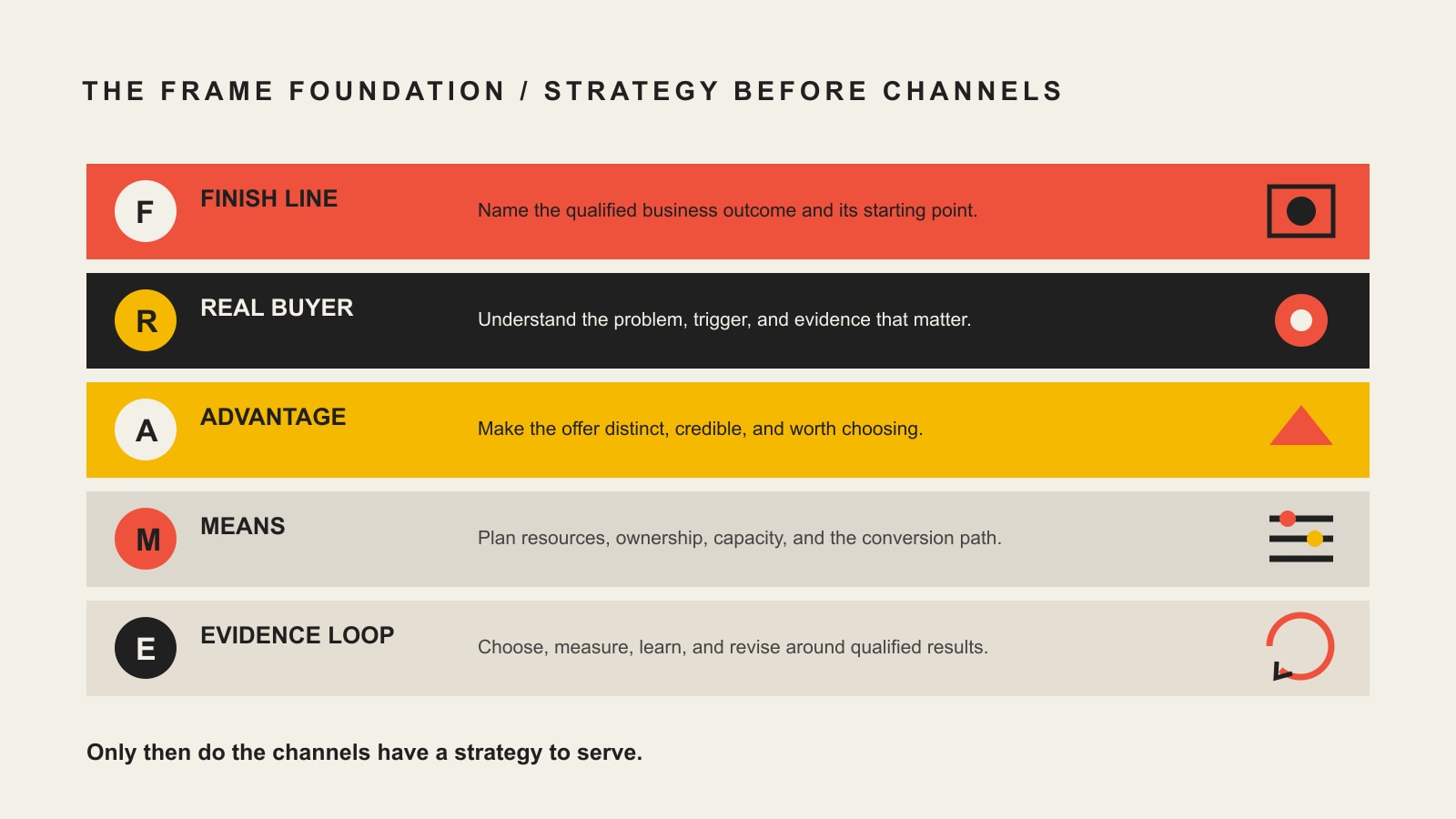
    The FRAME foundation: Finish line, Real buyer, Advantage, Means, and Evidence loop, in a decision sequence that precedes channel selection.

    F — Finish line: define the qualified business outcome

    “Get more traffic” is not a business finish line. Neither is “post consistently,” “rank higher,” “grow followers,” or “send more email.” Those can be useful diagnostic signals, but they do not tell you whether the marketing created value.

    Start with the business outcome. A service company may care about qualified consultation requests, booked appointments, accepted estimates, or profitable projects. An ecommerce company may care about profitable orders, repeat purchases, or retained customers. A membership organization may care about completed registrations or renewals. Pick the result before you choose the channel.

    Then record the baseline. How many qualified inquiries arrive now? From where? What percentage become customers? Is the business able to respond quickly? What is a good customer worth in contribution margin, capacity, or long-term value? You do not need perfect data to begin, but you do need a starting point or every future chart will float without context.

    This is also where you separate diagnostic metrics from qualified outcomes. Rankings, impressions, clicks, sessions, email opens, and engagement can tell you whether a system is moving. Qualified leads, purchases, booked work, retention, or saved staff effort tell you whether the movement matters.

    R — Real buyer: identify the problem, trigger, and evidence

    A target audience is not “women 25–54 who like quality.” That sentence can describe millions of people with completely different problems, budgets, urgency, and buying behavior.

    Define the buyer by the situation that makes your offer relevant. What happened just before they started looking? What problem are they trying to remove? What would make them delay? What alternatives are they comparing? Who else influences the decision? Where do they look for evidence?

    The U.S. Small Business Administration’s market-research guidance recommends examining demand, market size, location, saturation, pricing, and direct customer research. That is much more useful than decorating a persona slide with a stock photo and naming the fictional customer “Marketing Mary.”

    For a deeper audience process, use Scope Design’s TRACE target-audience method: Trigger, Reality, Attributes, Channels, and Evidence. The important part here is that assumptions remain visibly separate from things you have actually observed.

    A — Advantage: make the offer worth choosing

    Marketing cannot rescue an offer nobody understands. Before you amplify the message, make the offer answer five basic questions: What do you do? For whom? What problem does it solve? Why should the buyer believe you? What should they do next?

    Your advantage does not have to be a revolutionary invention. It may be specialization, speed, a better process, stronger proof, easier implementation, local knowledge, a clearer guarantee, better support, more transparent pricing, or simply fewer annoying steps. What matters is that the difference is relevant to the buyer and can survive scrutiny.

    Also list the objections before the campaign starts. Price, trust, timing, switching cost, implementation risk, lack of proof, and fear of making the wrong choice all create friction. If the sales team answers the same concern every week, the marketing should probably answer it before the prospect has to ask.

    M — Means: plan around money, time, capacity, ownership, and the conversion path

    This is the part most “best marketing strategy” lists skip because it is less exciting than naming platforms. It is also the part that keeps the plan from collapsing in real life.

    Define the resources the strategy can consume: cash, staff hours, specialist skills, creative production, sales follow-up, fulfillment capacity, software, and management attention. Assign one person who owns the plan. Shared participation is useful; shared accountability is how tasks quietly become nobody’s job.

    Then choose one primary conversion path for the first test. That might be a service page and contact form, a booking flow, a product page and checkout, a phone call, or a lead magnet followed by email. It does not have to be fancy. It has to be clear, measurable, and owned.

    Finally, make the uncomfortable tradeoff explicit: what are you not doing? A small team cannot usually launch search ads, publish daily video, rebuild the website, start a weekly newsletter, run three social networks, and create an SEO content program at the same quality level at the same time. If the strategy adds a tactic, something else may need to wait.

    If the capacity question turns into a build-versus-buy decision, our in-house vs. outsourcing framework helps separate work you should own from work that earns outside expertise.

    E — Evidence loop: choose, measure, learn, and revise

    Only now do you choose channels. Pick them because of the job they need to do, not because a platform is fashionable or a competitor posted a screenshot of a good month.

    Before launch, define the valuable action you want to measure. Google Ads’ conversion measurement guidance centers measurement on actions that matter to the business, while Google Analytics defines a key event around an action particularly important to business success. The terminology matters less than the discipline: know what action has value before the campaign starts.

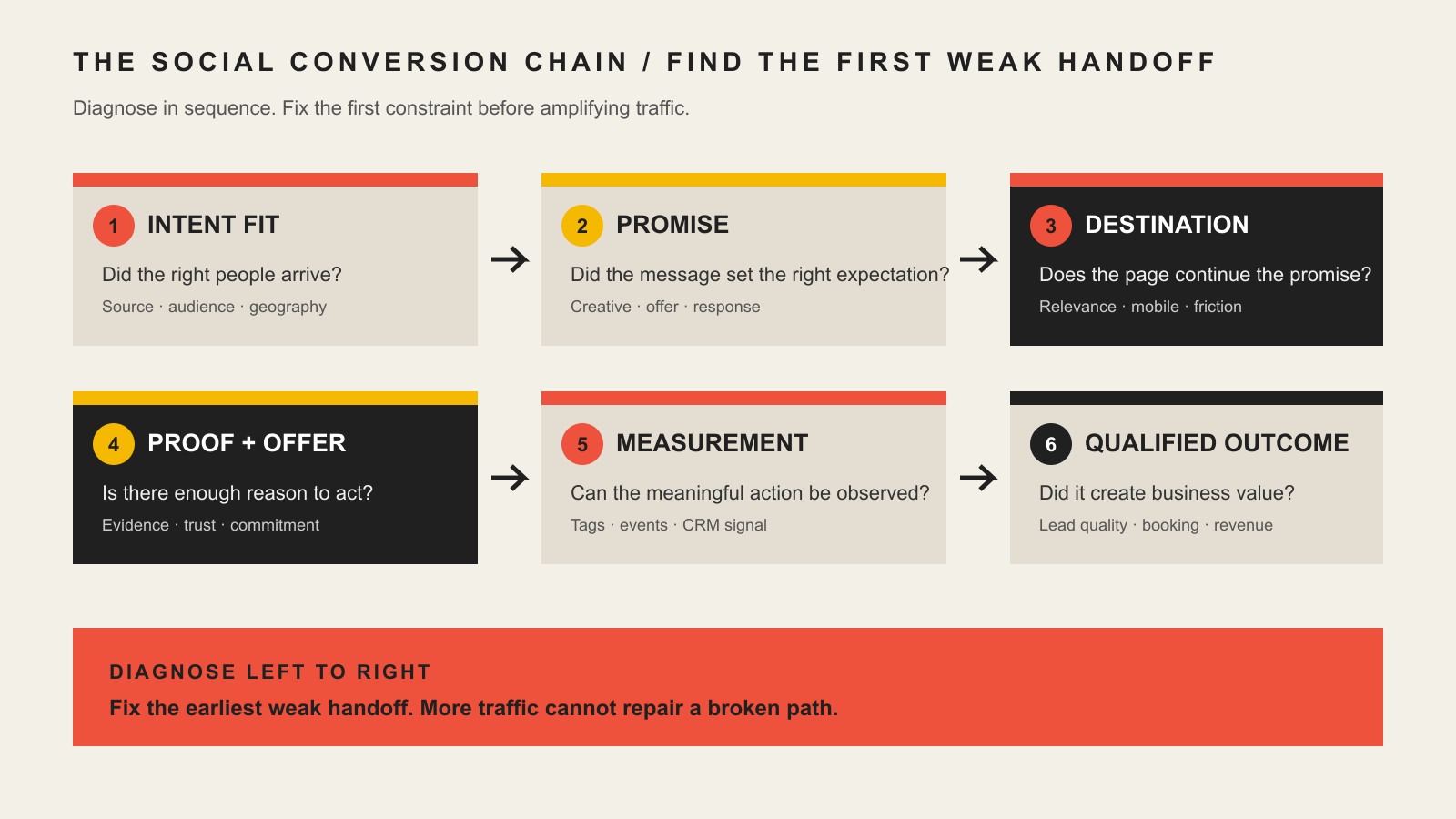
    Then run the smallest useful test that can teach you something. Review the chain, not just the first metric: Was the page accessible and visible? Did the right people arrive? Did they engage with the useful part? Did they take the intended action? Were those actions from people the business can help? Did the outcome produce sales, appointments, retention, or another result you chose at the beginning?

    That is the evidence loop: launch, observe, diagnose, revise. A tactic can earn more budget, a different message, a better destination, more time, or a clean death. Hope is not an analytics strategy.

    FRAME decisionBad shortcutUseful evidenceWhat the evidence changes
    Finish line“More traffic”Qualified leads, sales, appointments, retention, baselineWhat success means
    Real buyerBroad demographicsTriggers, interviews, search behavior, sales conversations, reviewsWho and what the message must address
    Advantage“We offer great service”Proof, objections, alternatives, customer languageOffer and positioning
    Means“Let’s do everything”Budget, staff time, skills, capacity, owner, destinationWhat can actually be executed
    Evidence loopVanity dashboardsChannel diagnostics plus qualified outcomesWhat to keep, change, scale, or stop

    How do you choose marketing channels after the foundation is clear?

    Choose channels by their job in the customer journey and by whether you can execute them well. There is no universally “best” online marketing channel.

    ChannelUseful jobMain tradeoff to plan for
    SEO and organic searchCapture existing questions and search demand with useful, discoverable pagesRequires ongoing technical/content quality and patience; visibility is not the same as a qualified sale
    Paid searchBuy controlled access to people searching for a relevant need nowRequires sound conversion economics, landing-page quality, and disciplined tracking
    Social mediaBuild familiarity, distribute ideas, show proof, and participate where buyers already pay attentionRequires consistent attention and is easy to confuse with popularity
    EmailFollow up with an opted-in audience, nurture decisions, and support retentionDepends on list quality, permission, relevance, and consistent follow-through
    ContentExplain difficult decisions, demonstrate expertise, support search, sales, and other channelsMust solve a real question and be distributed; publishing alone does not create demand

    Our guide to online marketing channels for small business goes deeper on the job each channel can perform. Once those roles are clear, the complete internet marketing plan shows how to connect channels, destinations, follow-up, capacity, and measurement into one operating system.

    How much should a small business spend on online marketing?

    There is no universal percentage that magically becomes correct because it has three numbers and a hyphen. Searchers ask about rules such as 70-20-10 and 40-40-20 because simple allocation formulas are comforting. Treat them as heuristics at most, not laws for your business.

    Your workable budget comes from the business model and the test. Start with what a good customer is worth, the margin or capacity available to acquire one, the number of customers the business can actually serve, the cost of the creative and technology required, the staff time needed to respond, and the amount you can risk learning without harming operations.

    Capacity matters as much as cash. If a campaign generates more inquiries than your team can answer, more traffic can make the customer experience worse. If your average project is valuable but sales follow-up takes three weeks, the bottleneck may not be acquisition at all. Marketing should expose the constraint, not pour gasoline on it.

    A useful starting budget is therefore large enough to run a meaningful test and small enough that you can afford to learn. Increase investment when the complete chain—from attention to qualified outcome—supports it. Reduce or redirect investment when the evidence shows a broken message, audience, destination, response process, or channel fit.

    What our audit of this exact page taught us

    We applied the same evidence rule to this revision instead of protecting old copy because it already existed. The old article had a live URL and several durable ideas, but it also contained fixed budget percentages, fixed channel timelines, an unverified “47%” strategy statistic, an unsupported AI-search projection, and a long channel list that overlapped other pages.

    Signal checkedObservation on August 20, 2026What it actually supports
    GA4, last 12 complete months3 landing sessions, all Direct; 0 engaged sessions; 0 configured key events. The prior 12-month comparison returned no rows.The sample is far too small for behavior or conversion conclusions. There is no measured organic footprint forcing us to preserve unsupported legacy copy.
    Google Search ConsoleNo exact-page query rows in the current or prior 12-month periods. URL Inspection says “Crawled – currently not indexed,” while indexing and robots are allowed and Google/user canonicals match the established URL.The page needs clearer ownership, usefulness, and connections—not a slug migration.
    Bing Webmaster ToolsBing recognizes the URL and retains crawl history; exact-URL traffic reports 0 clicks and 0 impressions.Bing knows the page, but there is no current Bing traffic signal that requires weak claims or structure to survive.
    UbersuggestNo exact-page ranking-keyword data and no URL-level backlinks were returned.Third-party evidence also shows no strong page-level equity that justifies keeping unsupported claims.

    This evidence does not prove the topic is worthless, that visitors disliked the page, or that this revision will rank. Scope Design’s current analytics attribution and configured key-event setup also have known limitations, so zero key events is not proof of zero business impact.

    The conclusion is narrower and more useful: the legacy article did not have a demonstrated search or conversion footprint that required us to defend weak copy, while current query research still shows real demand for online marketing strategy questions. We preserved the established, healthy URL and changed the article’s job instead.

    A practical first 30 days for your online marketing strategy

    Thirty days is enough to build the foundation and launch a bounded learning cycle. It is not a promise that every channel will prove ROI in a month. Long buying cycles, low search demand, complex sales, and organic discovery can require much longer observation.

    Days 1–5: Finish line and baseline

    Choose one primary business outcome, define the valuable action, and document the current baseline. Identify the sales or operational constraint that could make “more leads” useless.

    Days 6–10: Real buyer evidence

    Review search language, customer questions, reviews, sales notes, support conversations, competitor alternatives, and a handful of direct interviews when possible. Write down what you know, what you suspect, and what still needs testing.

    Days 11–15: Advantage and proof

    Clarify the offer, the meaningful difference, the proof you can show, the objections that need answers, and the single next action. Fix obvious message friction before buying traffic.

    Days 16–20: Means, owner, and destination

    Set the test budget and staff-time limit, choose the accountable owner, confirm response capacity, and prepare the primary conversion destination. Name the initiatives that will wait while this test runs.

    Days 21–30: Launch one useful test

    Select the smallest channel mix that reaches the right buyer and can produce evidence. Configure measurement, launch, review the complete response chain, and write down what changed and why. One well-instrumented experiment teaches more than six half-maintained channels fighting for the same Tuesday afternoon.

    Frequently asked questions about online marketing strategy

    What is an online marketing strategy?

    An online marketing strategy is the decision system that connects a business outcome to a defined buyer, offer, resources, digital channels, conversion path, and measurement. A list of SEO, ads, email, social media, and content tactics is not a strategy until those tools have specific jobs and success criteria.

    What is the marketing strategy for a small business?

    A useful small business marketing strategy is intentionally constrained. Define the qualified outcome, the buyer’s real problem, the offer and proof, the budget and staff capacity, the accountable owner, the primary conversion path, and the evidence that will guide the next decision. Then choose the smallest set of channels that can do the required jobs consistently.

    Should I use a 70-20-10 or 40-40-20 marketing rule?

    Use percentage rules only as prompts for discussion, not universal prescriptions. Your allocation should reflect customer value, margins, risk tolerance, staff capacity, channel maturity, and what you need to learn. A neat percentage does not know your sales cycle or whether your team has time to answer the phone.

    Which online marketing channel is best for a small business?

    The best channel is the one that can reach the right buyer at the right moment, perform a useful job in the decision journey, fit your resources, and produce evidence you can act on. Search may fit active demand; social may fit familiarity and proof; email may fit follow-up and retention. The answer depends on the business problem.

    How many marketing channels should I start with?

    Usually fewer than your first brainstorm. Start with the smallest mix that can cover acquisition, conversion, and follow-up without exceeding the team’s capacity. Add a channel when the current system is understood and the new channel has a specific job—not because someone told you every brand needs seven places to post.

    How do I know if my online marketing strategy is working?

    Track the chain from visibility to qualified outcome. Channel metrics such as impressions, clicks, rankings, reach, and email engagement help diagnose what happened. Leads, sales, appointments, retention, and other qualified business outcomes tell you whether the movement was valuable. Compare results with the baseline and revise one known assumption at a time.

    Do I need a website before I start online marketing?

    You need a controlled place where the prospect can understand the offer and take the intended next step. For many service businesses that is a website or focused landing page; for others it may be a product page, booking flow, marketplace listing, or phone call path. The critical requirement is ownership: the destination should explain the offer, provide enough proof, make the next action obvious, and allow you to measure what happened.

    What to do next

    Part I gives you the filter. Part II of the business marketing strategy series turns that foundation into the next layer of planning and execution. If you already have channels running but cannot explain which business decision each one supports, use FRAME first and fix the foundation before adding another tactic.

    If you want an outside partner to help connect strategy, website experience, SEO, content, paid acquisition, measurement, and the ugly operational details between them, Scope Design can help. The goal is not more marketing activity. It is a system that earns the right to keep running.

  • Enterprise Cloud Backup Solutions: A Practical Guide to Business Continuity & Data Protection

    Enterprise Cloud Backup Solutions: A Practical Guide to Business Continuity & Data Protection

    Enterprise cloud backup solutions should be judged by what happens on restore day—not by whether last night’s backup job showed a green checkmark. The right system is the one that can recover the business’s critical workloads within agreed tolerances after deletion, ransomware, administrator error, provider failure, or site loss. That makes cloud backup part technology, part business-continuity planning, and part operational ownership.

    For most organizations, the hard questions are not “Which vendor has the longest feature list?” They are: What must come back first? How much data can we afford to lose? Who controls the backup account and encryption keys? Can an attacker or compromised administrator delete the recovery copies? How long does a real restore take? And has anyone actually tested the full recovery path?

    The short version: choose for recoverability

    • Separate backup from storage and sync. Redundancy keeps systems available; backup gives you a recoverable earlier state.
    • Set RTO and RPO from business impact. Do not borrow arbitrary “mission-critical” numbers from a vendor page.
    • Protect recovery copies from the same failure domain. Identity isolation, deletion protection, immutability, and offline copies can all play a role.
    • Test restores, not just backup jobs. A copy is useful only if applications, permissions, dependencies, and data can be restored when the business needs them.
    • Price the whole recovery system. Storage is only one line item; retention, egress, restore compute, isolated copies, licensing, testing, monitoring, and operator time matter too.
    • Treat compliance as a set of responsibilities. Backup controls can support HIPAA, GDPR, and other obligations, but no backup product makes an organization compliant by itself.

    Cloud backup is not the same as cloud storage, sync, or disaster recovery

    These terms are often sold together, but they solve different problems. Before evaluating enterprise cloud backup solutions, make sure your team agrees on the job each layer is supposed to do. Our primer on cloud storage, sync, and backup fundamentals goes deeper into the storage side of the distinction.

    LayerPrimary jobCommon failure of assumptionsRecovery question
    Cloud storageKeep current data accessible remotelyRedundancy may preserve the same corrupted or unwanted current stateCan I retrieve the version I need?
    SyncPropagate changes across locations and devicesA deletion or encryption event may also propagateCan I roll back before the bad change?
    BackupCreate recoverable copies or recovery pointsA successful copy can still be unusable, inaccessible, or too slow to restoreCan I restore the right data and dependencies within my objective?
    Disaster recoveryRestore service or shift operations after an outageData may exist without an executable plan to restore the full serviceHow does the business resume operations?

    That distinction is why “we already use Microsoft 365,” “the database is replicated,” or “our host snapshots the server” is not a complete backup strategy. Those controls may be useful pieces, but the business still needs point-in-time recovery, ownership, retention, and tested restoration appropriate to its risks.

    Use the RESTORE Test before you compare vendors

    We use a simple framework for turning backup features into recovery evidence. The RESTORE Test forces the architecture conversation to begin with the business outcome rather than a product name.

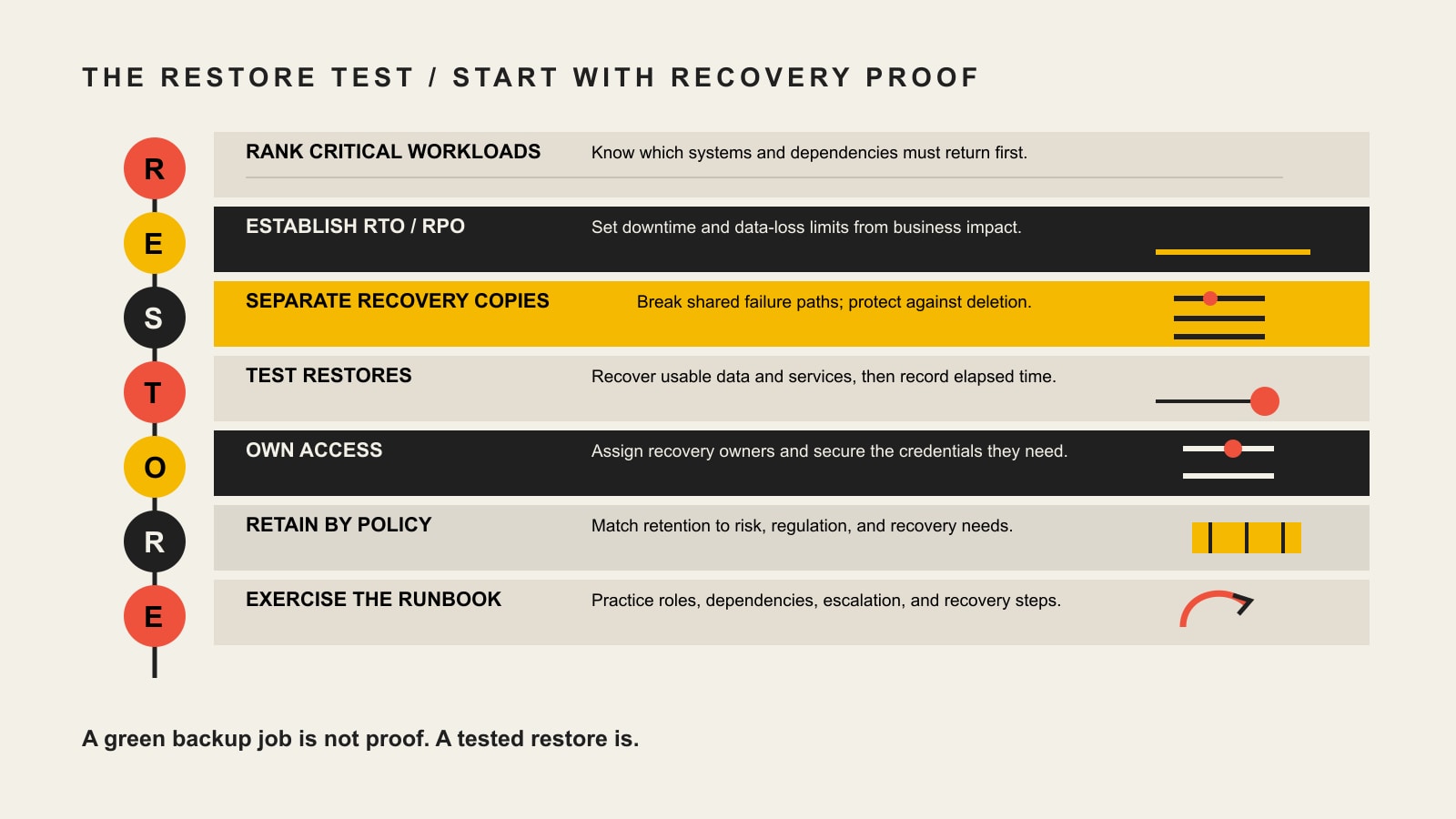
    The RESTORE Test: Rank critical workloads, Establish RTO and RPO, Separate recovery copies, Test restores, Own access, Retain by policy, and Exercise the runbook.
    StepWhat to decideEvidence you should be able to show
    R — Rank critical workloadsWhich systems, data sets, and dependencies matter most?A business-impact inventory with owners and recovery priority
    E — Establish RTO/RPOHow long can each workload be down, and how much recent data can be lost?Approved recovery objectives tied to business consequences
    S — Separate recovery copiesWhat protects backups from the same account, credential, region, device, or ransomware event?Documented copy locations, identity boundaries, and deletion protections
    T — Test restoresCan you recover usable data and applications—not just download an archive?Restore-test results with elapsed time, gaps, and remediation
    O — Own access and exit pathsWho controls accounts, MFA, keys, billing, support escalation, and exports?Named owners plus break-glass and provider-exit procedures
    R — Retain by policyHow many recovery points and how much history are actually required?Retention rules mapped to operational, legal, and contractual needs
    E — Exercise the runbookCan people execute the recovery under pressure?A practiced runbook covering dependencies, communications, and decisions

    The most important shift is the “T”: a successful backup job is evidence that a copy was created; a successful restore test is evidence that recovery may work. Those are not the same thing.

    Set RTO and RPO from business impact, not internet benchmarks

    Recovery Time Objective (RTO) is the maximum target time for restoring a service after disruption. Recovery Point Objective (RPO) describes how much recent data loss the business can tolerate, expressed as time between the incident and the most recent usable recovery point.

    Neither number should be universal. An order-processing database, a public marketing site, a file archive, and a development environment can have completely different tolerances. Setting every workload to “five minutes” may sound safe, but it can dramatically increase cost and complexity without reflecting what the business actually needs.

    Start with consequences. If losing more than 15 minutes of new orders creates unacceptable reconciliation work, that suggests an RPO of 15 minutes or better for that workload. If the customer portal can be unavailable for two hours before the impact becomes unacceptable, a two-hour RTO may be the planning target. Those are examples of the reasoning process, not universal recommendations.

    Then test the complete path. A database might restore in 20 minutes while DNS, application secrets, identity, certificates, queues, object storage, or third-party integrations add another 90. The measured recovery time should include the dependencies required for the service to function, not just the fastest component.

    Design for ransomware recovery, not just ransomware detection

    Ransomware changes the backup question because the attacker may deliberately target recovery infrastructure. CISA’s ransomware guidance recommends maintaining offline, encrypted backups and regularly testing them. The practical goal is to make it difficult for one compromised credential, account, device, or administrative action to destroy both production data and every usable recovery copy.

    Separate the failure domains

    Separation can be physical, logical, geographic, administrative, or a combination. Depending on the workload, that can mean offline media, a different cloud account or subscription, cross-region copies, separate privileged identities, or a backup service whose deletion controls are not governed by the same credentials used for production.

    Use deletion protection and immutability deliberately

    Major cloud platforms now expose strong controls for making recovery points harder to delete or shorten. AWS Backup Vault Lock can prevent recovery-point deletion and retention changes; its compliance mode becomes immutable after the configured grace period. Azure Backup documents immutable vaults and soft-delete protections, with locked immutability designed to be irreversible. Google Cloud Backup and DR backup vaults use isolated storage and enforced retention, with a retention lock that prevents later shortening.

    Those controls are valuable precisely because they can be hard to undo. That is also the risk: an accidental retention policy can become an operational and storage-cost commitment. Define retention before applying irreversible locks, test the lifecycle in a noncritical scope, and document who is authorized to make retention changes.

    Protect identities and recovery credentials

    Use MFA, least-privilege roles, separate administrative identities where appropriate, and monitored break-glass access. Backups should be encrypted in transit and at rest, but encryption alone is not enough: the organization also needs a recoverable key-management process and a plan for what happens if the normal identity provider is unavailable during the incident.

    How to compare enterprise cloud backup approaches

    There is no single “best” enterprise cloud backup solution for every organization. The strongest fit depends on workload coverage, recovery modes, administrative model, existing skills, and how much operational responsibility the business wants to own.

    ApproachOften fits whenWatch carefully
    Cloud-platform nativeMost critical workloads live in one cloud and the team already operates that platformCoverage outside that platform, cross-account design, SaaS/endpoints, provider concentration, and restore orchestration
    Cross-platform data-protection platformThe environment spans multiple clouds, virtual machines, on-premises systems, databases, or SaaS workloadsLicensing model, architecture complexity, workload-specific recovery depth, and operator skills
    Managed backup serviceThe internal team wants another party to operate monitoring, failures, retention, and recovery proceduresWho owns the account, data, keys, escalation path, exports, and transition if the provider relationship ends

    Products such as AWS Backup, Azure Backup, Google Cloud Backup and DR, Veeam, Cohesity, Rubrik, Druva, and Commvault can all appear in enterprise evaluations, but a useful comparison starts with requirements. Ask each candidate to demonstrate the recovery behavior your workloads need rather than accepting a feature checkbox.

    Questions to put in the evaluation worksheet

    • Which workloads are protected: virtual machines, physical servers, databases, containers, endpoints, SaaS, object storage, file shares, and cloud-native services?
    • What recovery granularity is available: full system, application, database, file, item, point-in-time, or alternate-location recovery?
    • Can copies be kept in a separate account, subscription, region, tenant, or offline medium?
    • What prevents a compromised production administrator from deleting or shortening backup retention?
    • How are MFA, privileged roles, service accounts, API keys, and encryption keys handled?
    • What does a clean-room or isolated restore test require?
    • What telemetry shows failed jobs, unusual deletions, retention changes, or unexpected backup-volume changes?
    • How long do representative restores actually take at your data size and network conditions?
    • Which fees appear during normal protection and during a large-scale restore?
    • How do you export data and metadata if the product or provider changes?

    Calculate total recovery cost, not just storage price

    Published per-gigabyte prices age quickly and can hide the expensive parts of a recovery design. A better comparison is a total-cost model for the recovery objective:

    Total backup and recovery cost = retained storage + workload/licensing fees + isolated/cross-region copies + retrieval/egress + restore compute/network + monitoring + recovery testing + operator time.

    Retention has an especially large effect because immutable or locked policies can prevent early deletion by design. A low storage rate paired with unnecessarily long locked retention may cost more than a higher-rate service with a better-matched policy. Likewise, a cheap archive tier may be a poor fit for a short RTO if retrieval takes too long or creates significant restore charges.

    Cost decisions should therefore follow workload classification. Recent recovery points for high-impact systems may justify faster storage and more frequent copies; long-term records may fit colder tiers when retrieval time does not threaten the business objective.

    Compliance: backup supports controls, but it is not compliance in a box

    Regulated organizations need to map backup design to their actual obligations, contracts, risk analysis, and documented procedures. The safest statement is also the most useful: a backup product can support compliance controls; it does not certify the organization as compliant.

    For healthcare organizations, the contingency-plan provisions in 45 CFR § 164.308 require procedures for retrievable exact copies of electronic protected health information, restoration of lost data, continuation of critical business processes in emergency mode, and periodic testing and revision of contingency plans. That means a HIPAA-oriented evaluation needs more than an “encrypted backup” checkbox: roles, procedures, testing, access, applicable business-associate arrangements, and organizational safeguards still matter.

    For organizations subject to the GDPR, Article 32 includes the ability to restore availability and access to personal data in a timely manner after an incident and a process for regularly testing security measures. The official EUR-Lex text addressing Article 32 reinforces why recoverability and testing are operational controls. Retention, deletion, data location, processing agreements, and other GDPR duties still require separate analysis.

    For any regulated environment, involve the organization’s security, legal, privacy, and compliance owners. Backup architecture is part of the evidence trail, not a substitute for it.

    Implementation roadmap: prove one recovery path at a time

    A backup migration is safer when it is treated as a series of tested recovery paths instead of a large “turn it on everywhere” project.

    1. Inventory workloads and dependencies. Include databases, object stores, SaaS data, DNS, identity, secrets, certificates, external integrations, and configuration—not only server disks.
    2. Rank business impact. Identify owners, recovery order, and what happens financially or operationally when each system is unavailable.
    3. Approve RTO/RPO and retention. Make the tradeoffs explicit before selecting expensive frequency, replication, or retention controls.
    4. Design separation and access. Decide account boundaries, privileged roles, MFA, encryption/key ownership, deletion protection, and emergency access.
    5. Pilot representative restores. Restore into an isolated environment where possible and validate data integrity, permissions, application behavior, and dependencies.
    6. Document the runbook and escalation path. A recovery plan should name the people, credentials, providers, communications, decision points, and fallback options needed during the incident.
    7. Monitor and exercise. Alert on backup failures and destructive changes, retest after major system changes, and run recovery exercises on a schedule appropriate to the workload’s risk.

    NIST’s 2026 OT Backup Quick Start Guide describes effective backup management as including regular backup creation and testing, integration with change management, and review during recovery exercises. Although its audience includes operational technology, the operating principle translates well: recovery readiness decays when systems change but tests do not.

    Ownership is part of the backup architecture

    One of the most common continuity gaps is not technical—it is administrative. A backup can exist while the person who knows the account has left, the billing owner is unclear, MFA goes to the wrong phone, the encryption key is not recoverable, or the hosting provider’s responsibility stops earlier than the business assumed.

    This is why hosting ownership and provider responsibility belong in the same conversation. For every protected workload, document who owns the production account, backup account, domain/DNS access, identity administrator role, billing relationship, encryption material, support contract, export path, and recovery decision.

    At Scope Design, our day-to-day Management work includes website backups, security, uptime, maintenance, hosting, and account operations. That gives us a practical perspective on continuity for websites and managed web infrastructure: the useful backup is the one a responsible person can actually locate, access, restore, and verify. We are not positioning a website-management practice as a substitute for an enterprise data-protection team, security program, or compliance auditor. When specialized enterprise storage, regulated systems, or multi-cloud platforms are involved, those responsibilities should be coordinated with the organization’s IT, security, compliance, and platform teams.

    Frequently asked questions about enterprise cloud backup solutions

    What is an enterprise cloud backup solution?

    An enterprise cloud backup solution is a system for creating, retaining, managing, and restoring recovery copies of business data and workloads using cloud infrastructure or a cloud-delivered service. “Enterprise” usually implies broader workload coverage, centralized policy, stronger identity and audit controls, scalable retention, and recovery features suitable for business operations.

    What is the best cloud backup solution for a business?

    The best choice is the one that covers the required workloads and proves it can meet the organization’s recovery objectives under realistic failure conditions. Compare demonstrated restore behavior, isolation/deletion protection, identity model, retention, observability, total recovery cost, and exit path—not only feature count or storage price.

    What are the main cloud backup methods?

    Common designs include direct-to-cloud backup, cloud-native service backup, backup to a separate cloud account or region, cloud-to-cloud/SaaS backup, and hybrid models that keep both local and cloud recovery copies. The right method depends on the workload, connectivity, recovery time, risk of shared credentials, retention needs, and whether a local fast-recovery copy is valuable.

    Is cloud backup safe from ransomware?

    Cloud backup can materially improve ransomware recovery, but it is not automatically ransomware-proof. If an attacker can use the same identity to delete production and backups, if bad data is backed up for too long, or if nobody can restore the dependencies, the organization can still be stuck. Use separation, strong identity controls, deletion protection or immutability where appropriate, monitoring, and tested clean restores.

    How often should backup restores be tested?

    There is no universal interval. Test frequency should reflect workload criticality, rate of change, regulatory or contractual requirements, and the cost of an unproven recovery path. At minimum, retest after material architecture, identity, application, or provider changes, and schedule periodic exercises so the process does not exist only on paper.

    Are immutable backups enough for compliance?

    No. Immutability can be an important security and retention control, but compliance also depends on governance, access, risk analysis, documentation, contracts, testing, privacy duties, incident procedures, and other controls specific to the applicable framework.

    What is the difference between backup and disaster recovery?

    Backup focuses on creating and restoring data or workload copies. Disaster recovery is the broader process of restoring service and business operation after disruption. A DR plan may use backups, replication, standby infrastructure, DNS changes, identity recovery, communications, and manual or automated runbooks.

    Start with the recovery proof

    If you are evaluating enterprise cloud backup solutions, do not begin with a vendor shortlist. Pick one important workload and answer the RESTORE Test: rank it, set its RTO/RPO, separate the recovery copies, test a real restore, document ownership, set retention intentionally, and exercise the runbook. Once that recovery path is proven, product comparisons become much easier—and much less dependent on marketing claims.

    For websites and managed web infrastructure, Scope Design can help you map the backup, hosting, access, DNS, and recovery responsibilities that are easy to discover only after something breaks. The goal is simple: know who owns recovery and prove the path before you need it.

  • Smart Budget Implementation: How to Launch Your Startup Without Breaking the Bank

    Smart Budget Implementation: How to Launch Your Startup Without Breaking the Bank

    A startup budget should do more than tell you where the money went. It should protect cash while helping you prove what deserves more investment. Start by funding what you must have to sell and deliver safely, spend small amounts to test the assumptions that could make or break the business, delay fixed commitments until demand earns them, and keep part of your cash uncommitted for what you learn next.

    That is the difference between being cheap and being capital-efficient. Cheap founders can underfund the things that matter. Smart founders make the cost of being wrong survivable.

    Startup budget TL;DR

    • Set a hard cash ceiling before you start shopping.
    • Separate one-time startup costs from monthly fixed and variable expenses.
    • Pay first for legal, safety, delivery, and revenue-enabling requirements that truly must exist.
    • Use market research and small tests before committing serious money to unproven demand.
    • Prefer reversible, variable-cost options before leases, full-time hires, long contracts, or complicated software.
    • Know your break-even math and review actual cash weekly while the business is still changing quickly.
    • Keep uncommitted cash based on your downside scenario instead of blindly following a universal percentage rule.

    If you are still deciding whether the underlying opportunity is worth pursuing, start with our guide to finding profitable business ideas worth testing. This article assumes you have an idea and now need to launch it without financing the fantasy version of the company.

    What a business startup budget actually needs to do

    A business startup budget is a plan for the cash required before and during launch. It normally includes one-time startup costs, recurring fixed expenses, variable costs that rise with sales or delivery, and the cash you intentionally leave available for uncertainty.

    The U.S. Small Business Administration recommends calculating startup costs before launch and using those numbers to estimate profitability and funding needs. It also treats market research as a way to confirm or improve the business idea and reduce risk. Those two ideas belong together. A budget is not just an accounting exercise. It is a sequence of decisions about what you need to know before you spend more.

    That is why we do not recommend a universal 50/30/20, 70/10/10/10, or any other tidy percentage split for every startup. A home-based consulting firm, a restaurant, a software company, and a regulated medical practice do not have the same pre-sale requirements. The SBA also notes that startup expenses such as wages, rent or property costs, insurance, utilities, licenses, and fees can vary by location. A percentage that feels scientific can still be complete nonsense for your actual constraint.

    Scope Design uses a broader constraint-first business strategy: define the objective, identify what is actually preventing it, then choose the tactic. Your startup budget should follow the same logic. A requested tactic is not automatically a required expense.

    Use the PROVE Before You Pay startup budget framework

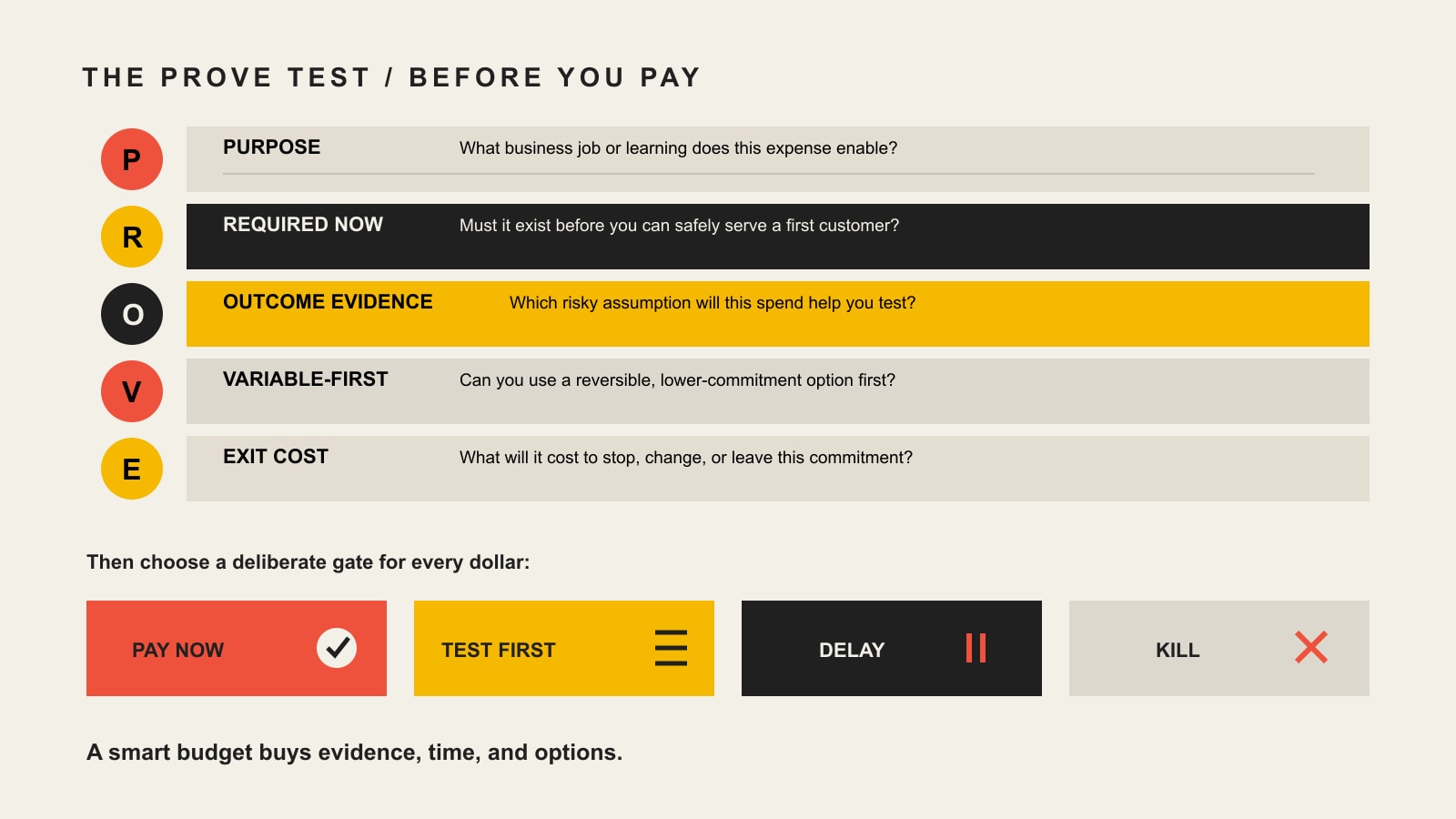
    Before a meaningful expense enters the budget, run it through five questions. We call this PROVE Before You Pay.

    P: Purpose

    What business outcome does this expense enable? “We should have one” is not an outcome. “This license is required before we can legally operate,” “this landing page lets us take deposits,” and “this prototype answers whether customers will pay” are outcomes.

    R: Required now

    Must this exist before you can sell, deliver, stay compliant, protect the customer, or protect the company from a material risk? If the answer is no, the expense may belong later even if it would be nice to have.

    O: Outcome evidence

    What will you learn or measure after spending the money? A good early expense should either enable an essential function or produce evidence that changes the next decision. If you cannot describe the evidence, you may be buying activity instead of progress.

    V: Variable-first

    Can you rent, contract, use a month-to-month plan, perform the process manually, or buy a smaller quantity before creating a fixed commitment? Variable costs are not always cheaper forever. They are often safer while you are still learning.

    E: Exit cost

    What happens if the assumption is wrong? Look beyond the purchase price. Count cancellation fees, unused inventory, implementation time, migration work, training, debt service, severance, lease obligations, and the attention required to unwind the decision.

    The PROVE framework evaluates Purpose, Required now, Outcome evidence, Variable-first options, and Exit cost, then guides decisions to Pay now, Test first, Delay, or Kill.

    The framework produces four useful decisions: Pay Now, Test First, Delay, or Kill. That is far more useful than labeling every item “important” and then wondering why the bank account is empty.

    Put every startup expense into one of four buckets

    Budget bucketUse it whenCommon examplesRelease condition
    Pay NowThe cost is truly required to sell, deliver, operate safely, or meet a material legal or contractual obligation.Required licenses, essential insurance, basic payment processing, must-have delivery equipment.No release gate; verify scope and avoid buying beyond the requirement.
    Test FirstThe expense is meant to prove demand, pricing, acquisition, workflow, or delivery assumptions.Customer interviews, prototype, small ad test, short contractor engagement, simple landing page.Define the result that justifies the next round of spending before the test starts.
    DelayThe expense may become useful, but the current business can operate or learn without it.Office lease, premium software tier, broad rebrand, large inventory order, second vehicle.Move it forward only when capacity, demand, risk, or economics make the need real.
    KillThe cost solves no current constraint, produces no useful evidence, or mainly makes the startup look more established.Vanity subscriptions, duplicate tools, speculative features, “enterprise” upgrades nobody needs.It returns only if a future constraint creates a defensible business case.

    How to build a startup budget in 7 steps

    1. Set the cash ceiling before you build the wish list

    Start with the money you are actually willing and able to put at risk. Do not build the dream launch, total it up, and then reverse-engineer a justification for spending that much. Your cash ceiling forces tradeoffs early, when changing the plan is cheap.

    If outside funding is part of the plan, keep the operating decision separate from the funding source. More available money does not make a weak expense smart. If you need credible funding and support options, our small-business resources guide covers the separate funding question.

    2. List one-time, fixed, and variable startup costs

    Make three lists. One-time costs happen primarily around setup. Fixed costs recur even when sales are zero. Variable costs rise or fall with sales, customers, transactions, or delivery volume.

    • One-time: formation/setup fees, initial equipment, launch deposits, initial design or implementation work.
    • Fixed: rent, base software subscriptions, minimum insurance premiums, salaried payroll, debt payments.
    • Variable: transaction fees, materials, shipping, contractors tied to projects, hourly delivery labor, performance media.

    Do not confuse “monthly” with “necessary.” A recurring subscription is still optional if it solves a problem you do not have.

    3. Identify the true non-negotiables

    Required costs depend on the business. A regulated operation may need professional licensing and specific insurance before opening. A service startup might need little more than the correct business setup, contracts, a way to communicate, a way to accept payment, and the tools required to deliver the work.

    Do not use an internet checklist as legal or tax advice. Confirm requirements with the relevant federal, state, and local authorities and qualified professionals. Your location can materially change fees, wages, insurance, property costs, and licensing obligations.

    4. Spend to validate demand before you spend to scale

    This is where many startup budgets get backward. Founders buy capacity for customers they have not yet proved exist. They commit to inventory, staff, custom software, ad volume, or facilities before the demand assumption has earned that investment.

    Use the smallest credible test that can change your mind. Interview buyers. Ask for the sale. Pre-sell when appropriate. Build a manual version. Run a limited campaign. Deliver the service yourself before automating it. The goal is not to make every experiment microscopic. The goal is to buy enough evidence without making a wrong assumption fatal.

    5. Calculate break-even before calling a budget “affordable”

    A cost is not affordable merely because you can pay the invoice today. You need to understand what the cost requires the business to produce.

    The SBA’s simplified break-even formula in units is fixed costs ÷ (price per unit – variable cost per unit). For example, if monthly fixed costs are $1,800, the average sale is $500, and variable delivery cost is $200, the simplified break-even point is six sales per month: $1,800 ÷ $300 = 6.

    That example is intentionally simple. Real businesses also need to account for taxes, payment timing, owner compensation, debt, mixed products, refunds, and other realities. The important habit is to translate spending into the volume or margin the business must produce.

    The SBA break-even guidance also explains why the calculation is useful for catching missing expenses and setting revenue targets.

    6. Protect uncommitted cash using scenarios, not a magic percentage

    We do not know a universal reserve percentage that is right for every startup, and neither does anyone else without knowing the business model. Build a downside case instead.

    • What if launch takes longer than expected?
    • What if the first acquisition channel does not work?
    • What if the first customers pay later than expected?
    • What if a required cost is 25% higher than quoted?
    • What if you need to change the offer after real customer feedback?

    Then decide how much cash needs to remain uncommitted so those events are inconvenient rather than existential. Runway is not money doing nothing. It buys options.

    7. Give every discretionary expense a release gate

    For every Test First or Delay item, write the condition that unlocks more money. Examples:

    • Increase ad spend after a campaign produces a defined number of qualified leads at an acceptable acquisition cost.
    • Move from a contractor to a full-time hire after consistent workload, margin, and management capacity justify the fixed commitment.
    • Upgrade software when the current process creates a measurable bottleneck that costs more than the upgrade.
    • Lease space when home, shared, mobile, or client-site delivery is materially limiting revenue, compliance, customer experience, or capacity.

    If the evidence does not arrive, the money does not automatically move. Hope is not a release gate.

    A hypothetical $10,000 startup budget example

    Is $10,000 enough to start a business? Sometimes. It can be plenty for a low-overhead service business and nowhere near enough for a business that requires a facility, significant inventory, specialized equipment, heavy regulation, or employees before the first sale.

    Here is a deliberately hypothetical example for a founder launching a simple professional service. It is not a recommended percentage template. It demonstrates sequencing.

    Illustrative useAmountWhy it exists
    Required setup, contracts, licenses/insurance as applicable$1,500Pay Now: satisfy real operating and risk requirements.
    Customer research and offer validation$1,000Test First: prove who buys, why, and at what price.
    Minimum sales infrastructure$1,500Domain, lean website/landing page, email, scheduling/payment tools.
    Delivery tools and first-job materials$1,000Enable actual customer work without buying scale capacity.
    Small marketing experiments$1,000Test a few acquisition assumptions with hard limits and tracking.
    Bookkeeping/admin basics$500Keep records usable from day one.
    Uncommitted cash$3,500Preserve options for slower sales, better opportunities, or corrected assumptions.
    Total$10,000Illustrative only; real requirements come first.

    Notice what is missing: a long office lease, full-time staff, a giant software stack, six months of advertising purchased in advance, and a custom app nobody has asked for. Those expenses may become correct later. They just have to earn their place.

    What should you spend on early, and what can usually wait?

    Legal, insurance, licenses, and safety

    Spend early when the requirement is real. Do not delay a required license, appropriate insurance, safe equipment, or a necessary professional agreement because “lean startup” sounded like permission to wing it. Lean does not mean reckless.

    Research and customer validation

    Usually worth doing early because it can prevent much larger mistakes. Research does not require an enormous study. The job is to reduce uncertainty about customer, problem, alternatives, price, buying process, and demand. Our market research guide goes deeper on methods you can use without turning the project into a six-month academic exercise.

    Website and brand

    Buy enough to sell credibly and complete the job the website needs to do. Do not confuse “minimum” with “bad,” and do not confuse “custom” with “strategic.” A simple site may be exactly right when it clearly explains the offer, provides evidence, supports the sales process, and lets customers take the next step. Our guide to buying the right business website covers that decision in more depth.

    A full identity system, advanced integrations, or custom functionality should earn the extra investment by solving a real positioning, operational, or conversion problem. Otherwise it is expensive theater.

    Marketing

    Start with the channel most consistent with how the customer actually discovers and evaluates the offer. A small paid-search test may make sense when buyers already search for the service. Direct outreach may be better when the market is narrow. Local partnerships may beat broad social content for a local service company.

    Do not set a universal marketing percentage before you know the economics. Once you have evidence about demand and acquisition, use our small-business marketing budget framework to decide how much more investment the channel deserves.

    Software

    Buy software for a proven workflow, not an imagined organization chart. Start with the native or lower-cost capability when it can do the job. Upgrade when time savings, error reduction, customer experience, capacity, security, or reporting creates a measurable business case.

    Office space

    For many service businesses, space can wait. For others, the location is part of the product or a legal requirement. The point is not “never rent an office.” The point is to make the space justify itself through operations, customer experience, compliance, hiring, or revenue rather than status.

    Contractors versus employees

    Flexible capacity can reduce fixed commitments while demand is uncertain, but contractor status is not a magic classification you can choose for convenience. Use the correct legal relationship and weigh cost, control, knowledge, quality, availability, and strategic importance. Our in-house versus outsourcing decision framework covers the broader tradeoff.

    Review cash weekly while the startup is still learning fast

    An early startup changes too quickly for a budget to be a document you admire once a quarter. Run a short weekly cash review:

    1. Cash available today.
    2. Committed payments due before the next review.
    3. Expected receipts and how confident you are in the timing.
    4. Actual spending versus the budget.
    5. New evidence about demand, price, acquisition, delivery, or capacity.
    6. Expenses that should move between Pay Now, Test First, Delay, and Kill.
    7. The single constraint most likely to block the next meaningful business outcome.

    This keeps the budget connected to decisions. If a test disproves the assumption, stop funding it. If customer demand arrives faster than expected, release money into the real bottleneck. If sales are slower, protect runway before adding commitments.

    Common startup budget mistakes

    • Budgeting around the dream org chart. Hiring roles before the workload, margin, and management system exist creates fixed cost faster than capability.
    • Buying annual plans to “save money.” A discount on a tool you do not need is still waste.
    • Treating all marketing as one line item. Separate channel tests so you can tell what earned more investment.
    • Ignoring owner labor. “I will do it myself” may reduce cash expense while still consuming the founder’s most constrained resource.
    • Underestimating implementation cost. Software price is only part of the cost. Setup, migration, training, integration, maintenance, and process change count.
    • Spending the reserve because it is visible. Uncommitted cash is there to preserve options, not to eliminate the discomfort of seeing money sit still.
    • Using optimistic revenue as cash. A proposal, verbal yes, invoice, and cleared payment are four different things.

    Frequently asked questions about startup budgets

    What is a startup budget?

    A startup budget is a plan for the cash needed to get a business operating and survive the early period while revenue is still uncertain. It should separate one-time startup costs, recurring fixed expenses, variable costs, and intentionally uncommitted cash.

    How do I create a budget plan for my startup business?

    Set a cash ceiling, list all one-time and recurring costs, identify true legal and operating requirements, validate demand before scaling capacity, calculate break-even, build a downside scenario, and give discretionary expenses evidence-based release gates. Then compare actual cash to the plan every week during the early launch phase.

    Is $10,000 enough to start a business?

    It can be enough for some low-overhead service businesses, but there is no universal answer. Compare $10,000 with the required pre-sale costs, monthly fixed burn, working-capital needs, regulation, equipment, inventory, and the amount of cash you need to keep uncommitted. If the business requires $40,000 of unavoidable setup before the first customer, motivational budgeting will not turn $10,000 into enough.

    How much cash reserve should a startup keep?

    Use scenario planning instead of a universal percentage. Estimate what happens if launch is delayed, sales ramp more slowly, a required expense rises, or the first acquisition channel fails. Keep enough cash uncommitted that the plausible downside does not force a bad decision immediately.

    Should I hire employees or outsource at launch?

    Keep a capability in-house when it is strategically important, requires constant coordination, depends on deep company context, or has enough steady workload to justify the fixed commitment. Outsourcing can make sense for specialized or variable work while demand is still uncertain. Use the correct legal classification and compare total cost, control, quality, availability, and knowledge retention.

    Should I pay for a website and branding before I have customers?

    Pay for the level needed to sell credibly and complete the buyer’s next step. That may be a focused landing page and simple visual system rather than a large custom build. Add sophistication when evidence shows the current solution is limiting trust, conversion, operations, differentiation, or growth.

    Are startup costs tax deductible?

    Some pre-opening costs receive specific federal tax treatment rather than being handled exactly like ordinary current operating expenses. IRS Publication 583 discusses business startup costs and recordkeeping. Tax treatment depends on the facts, so keep good records and use a qualified tax professional for your situation.

    How often should I update my startup budget?

    Review cash and near-term commitments weekly during a fast-changing launch. Update the underlying assumptions whenever pricing, demand, delivery cost, staffing, regulation, or the sales cycle changes materially. The budget should follow the business, not the calendar.

    A smart startup budget buys evidence and options

    The goal is not to launch with the fewest dollars. The goal is to spend enough on the right things while keeping the cost of a wrong assumption survivable. Pay for genuine requirements. Test the uncertain parts. Delay fixed commitments until demand or capacity earns them. Kill expenses that solve no current constraint.

    That discipline gives you something more valuable than a prettier spreadsheet: the ability to change your mind before a bad decision becomes expensive.

    If the high-leverage question in your plan is what to build, automate, market, or delay, Scope Design can help pressure-test the constraint and implementation path before you commit the budget.

  • Web Designer Lingo: Master Essential Terminology Before Hiring Your Design Team

    Web Designer Lingo: Master Essential Terminology Before Hiring Your Design Team

    Web design terminology is only useful if it helps you understand what you are buying, approving, owning, and verifying. Before you hire a web designer or agency, you do not need to memorize a hundred technical terms. You do need to understand the words that define project scope, design deliverables, technical responsibilities, quality standards, account ownership, and handoff.

    If you are still sorting out what a web designer may actually be responsible for, start with our guide to what website design includes. This article has a narrower job: translating web designer lingo into the decisions a client has to make.

    The web design terminology that matters most before you hire

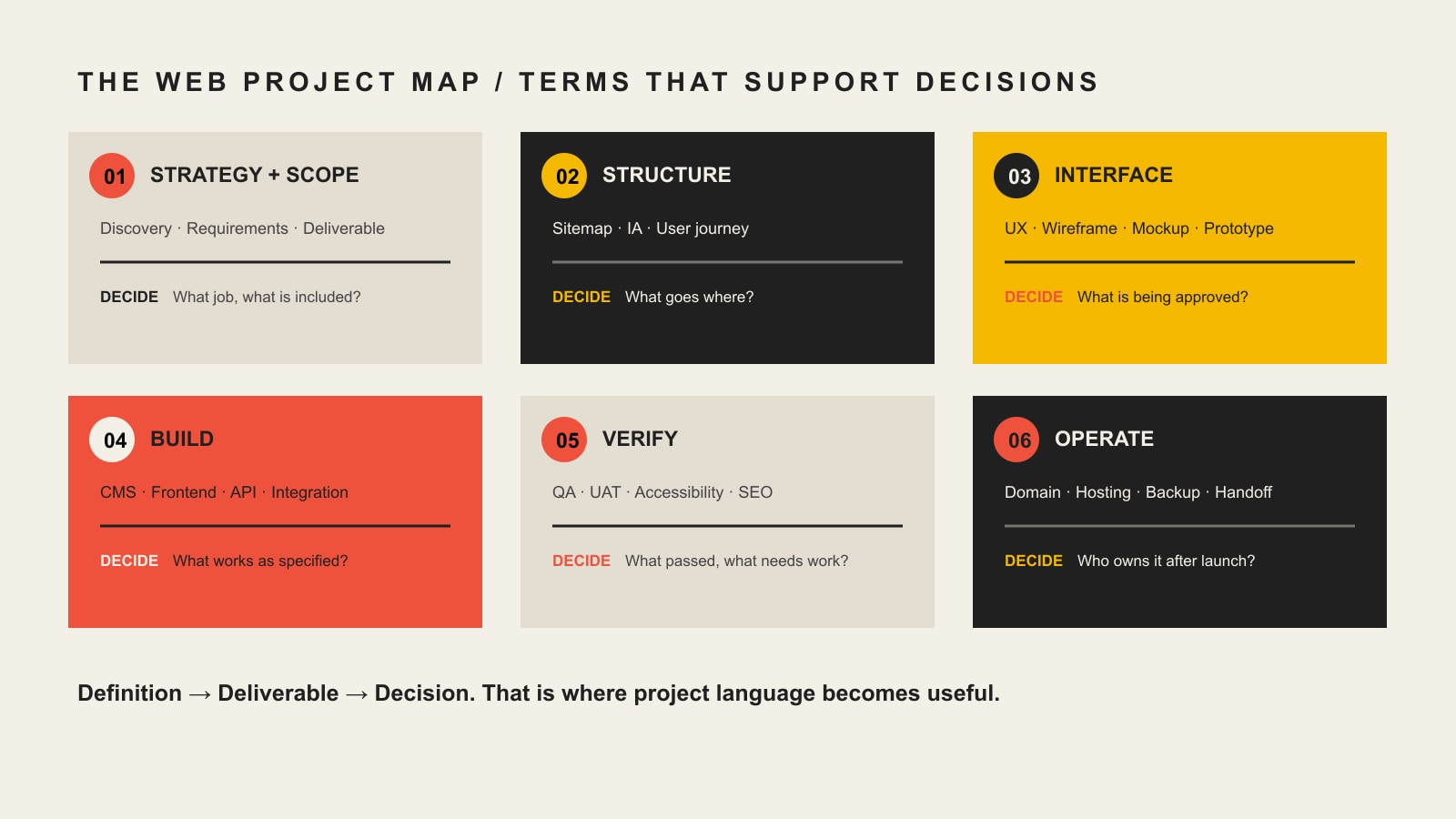
    The most important web design terms fall into six practical stages: strategy, structure, interface, build, verification, and operation. A useful term should tell you something about what the team will produce, how you will review it, what standards apply, or who owns the result.

    That is why terms such as scope, wireframe, responsive design, CMS, API, WCAG, QA, UAT, DNS, and handoff usually matter more to a buyer than the name of a fashionable JavaScript framework.

    Use the Scope Design Definition → Deliverable → Decision test

    When a proposal, designer, or developer uses jargon, run it through three questions:

    • Definition: What does the term mean in plain English?
    • Deliverable: What page, file, behavior, account, test, document, or service proves that it is included?
    • Decision: What do you need to approve, provide, own, budget for, or verify?

    For example, a proposal may say the website will be responsive. The definition is straightforward: the layout should adapt to different screen sizes. The deliverable is not the word “responsive”; it is the implemented page behavior across the agreed range of screens. The decision is what devices, breakpoints, browsers, and acceptance checks are actually in scope.

    The same rule exposes vague promises. “SEO included,” “accessible website,” “optimized performance,” and “ongoing support” sound reassuring, but each phrase is still ambiguous until the provider explains the work, evidence, boundaries, and owner.

    A web project map connects strategy and scope, structure, interface, build, verification, and operation to the client decision at each stage.

    Web design terms at a glance

    Project stageTerms you may hearWhat those terms should clarify
    StrategyDiscovery, requirements, scope, deliverable, dependency, acceptance criteriaWhat problem is being solved and what is included
    StructureSitemap, information architecture, user journey, content hierarchyWhat pages and paths people need
    InterfaceUX, UI, wireframe, mockup, prototype, component, responsive designWhat you are reviewing and approving before or during build
    BuildFrontend, backend, CMS, template, API, integration, stagingWhat system makes the approved experience work
    VerificationWCAG, QA, UAT, cross-browser testing, Core Web Vitals, redirectsHow the team will prove the implementation meets the agreed requirements
    OperationDomain, DNS, hosting, admin account, license, backup, maintenance, handoffWho controls the website and what happens after launch

    Strategy and scope terminology

    Discovery

    Discovery is the work used to understand the business problem, audience, current website, constraints, evidence, content, technology, and success criteria before important design decisions are locked in. Depending on the project, discovery might include stakeholder interviews, analytics review, content inventory, technical review, audience research, competitive context, or workshop sessions.

    Ask: What exactly happens during discovery, who participates, and what decisions or documents come out of it?

    Requirements

    Requirements describe what the website must do or support. “We need a contact page” is a page request. “Qualified prospects must be able to choose a service, submit the correct project information, and route the inquiry to the right team” is closer to a functional requirement.

    Requirements can cover content, functionality, integrations, accessibility, performance, security, reporting, legal constraints, and operational needs. They create a basis for design and acceptance instead of leaving everyone to infer the job from a page count.

    Scope

    Scope is the agreed boundary of the project. It should make the included work, exclusions, assumptions, responsibilities, schedule, and change process understandable. Scope is not the same thing as a feature list. Two “10-page websites” can represent radically different amounts of strategy, copywriting, design, development, migration, testing, training, and support.

    Deliverable

    A deliverable is a concrete output the project is supposed to produce. Examples include a sitemap, copy deck, wireframe, approved design, component library, working form, CMS template, redirect map, training session, or handoff document.

    If a proposal uses a broad term such as “SEO,” “accessibility,” or “optimization,” ask what deliverables or checks are included under that label.

    Dependency

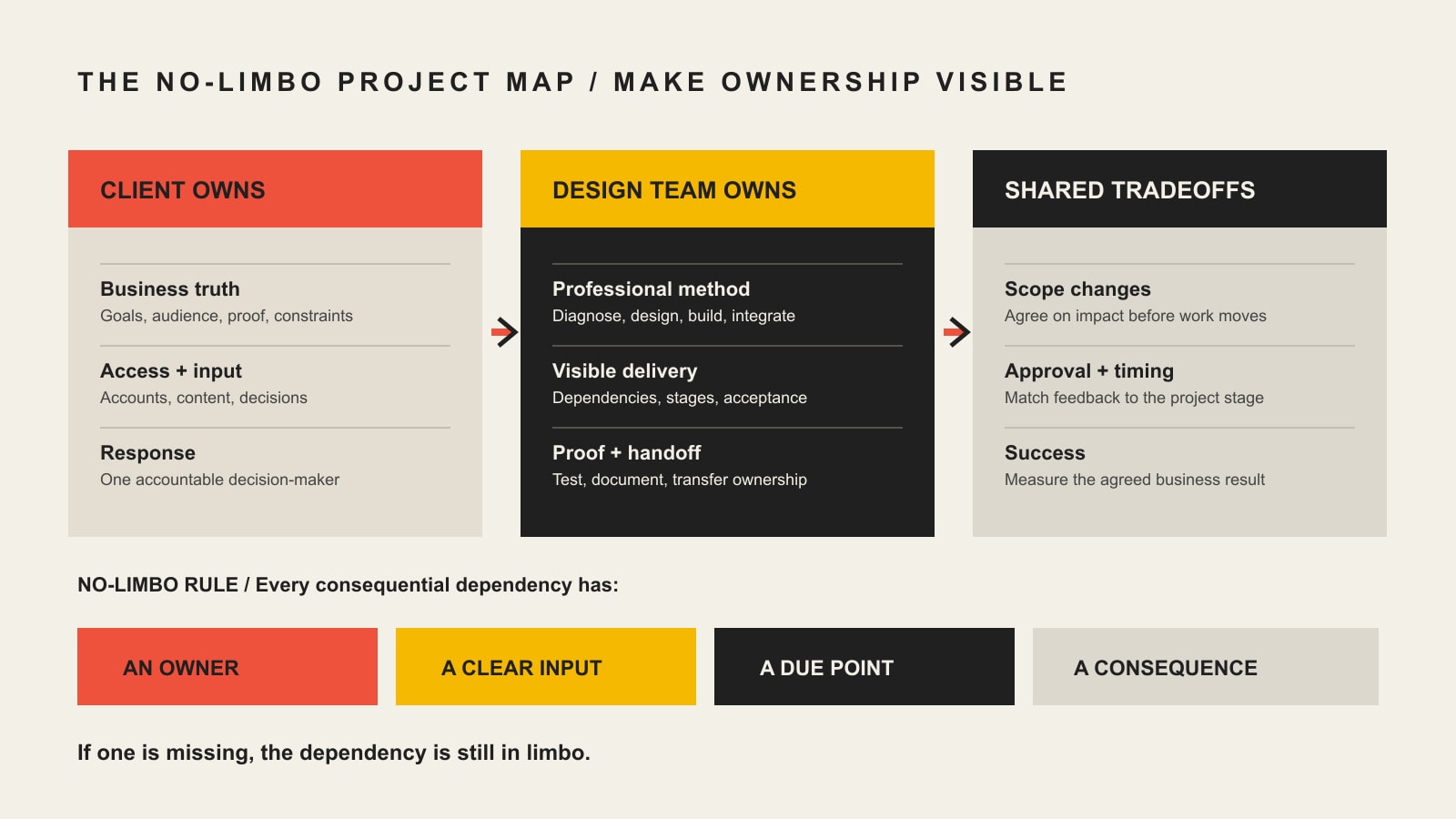
    A dependency is something another task relies on. Final page design may depend on approved copy. A payment integration may depend on credentials from your processor. Launch may depend on DNS access. Naming dependencies early makes schedule discussions more realistic.

    Change request

    A change request is a documented change to agreed scope, requirements, deliverables, or assumptions. It should explain what changed and whether the change affects cost, schedule, testing, or other work. A good change process protects both sides from silently turning a defined project into an unlimited one.

    Acceptance criteria

    Acceptance criteria describe the conditions that must be true for a deliverable or feature to be accepted. “Build a form” is vague. “The form validates required fields, sends the submission to the agreed destination, displays a confirmation, records the event in analytics, and works in the supported browsers” is testable.

    Structure and user-flow terminology

    Sitemap

    A sitemap in the planning sense is a map of the website’s pages and hierarchy. It helps the team decide what content exists, how pages relate, and what belongs in navigation. Do not confuse this planning artifact with an XML sitemap used by search engines.

    Information architecture (IA)

    Information architecture is the way information is organized, labeled, grouped, and connected so people can find and understand it. IA affects navigation, page hierarchy, labels, content relationships, and the paths users take through the site.

    User journey

    A user journey describes the steps a person may take while trying to accomplish a goal. For a service business, one journey might be: understand the service, verify fit, review proof, compare options, ask a question, and submit an inquiry. The point is not to draw a pretty diagram. It is to reveal what a visitor needs at each decision.

    Design and approval terminology

    UX and UI

    UX means user experience. It deals with how understandable, usable, efficient, and appropriate the experience is for the person trying to accomplish a task. UI means user interface. It covers the interface people see and interact with, including controls, visual hierarchy, states, components, spacing, typography, and presentation.

    They overlap, but they are not interchangeable. A beautiful interface can still produce a poor experience if users cannot find the right information or complete an important task. If you need to diagnose those problems, our UX diagnosis guide goes deeper.

    Wireframe

    A wireframe is a simplified representation of page structure and priority. It usually focuses on layout, content hierarchy, and interaction rather than final typography, color, imagery, and polish. Its job is to make structural decisions cheaper to discuss before visual detail distracts everyone.

    Mockup

    A mockup is a more visually complete representation of the intended interface. It may show real typography, colors, imagery, components, spacing, and brand treatment, but it is not necessarily interactive or implemented.

    Prototype

    A prototype simulates some part of the experience so flows and interactions can be evaluated before the full system exists. A prototype can be simple or high fidelity. It is still a model. Approving a prototype or mockup is not the same as accepting a functioning website.

    Design system and component

    A component is a reusable interface element or pattern, such as a button, card, form field, testimonial block, or navigation item. A design system organizes reusable components together with rules, tokens, patterns, and guidance so the interface can stay coherent as it grows.

    Responsive design, mobile-first, and breakpoint

    Responsive web design is an approach that allows layouts and content to adapt across different screen sizes and device conditions. Mobile-first is a way of designing or coding from a smaller-screen baseline and progressively adapting for larger screens. A breakpoint is a condition, commonly based on viewport width, where layout behavior changes.

    MDN’s responsive design guidance treats responsive design as an approach rather than a single device checklist. For a client, the important question is what responsive behavior will be tested and accepted, not whether the proposal contains the phrase “mobile-friendly.”

    Development and technology terminology

    Frontend and backend

    The frontend is the part of the website delivered to and interacted with by the user, including the rendered interface and browser-side behavior. The backend is the server-side or administrative layer that may handle data, business logic, authentication, content, integrations, or other services behind the interface.

    On many business websites, the boundary is less important to a client than the responsibility: who owns the interface, who owns data and integrations, and who fixes a problem when the two do not work together?

    CMS

    A content management system (CMS) is software used to manage website content. WordPress is a CMS. A CMS can make editing easier, but “CMS included” does not tell you how much control you will have, which content types are editable, whether custom fields exist, or how portable the site is.

    Ask: What can our team edit safely? Which roles will we have? Who holds the administrator account? What training and documentation are included?

    Template, theme, and component

    A template controls the structure for a type of page or content. A theme usually refers to a larger presentation layer or package of templates, styles, and behavior, especially in systems such as WordPress. A site can use a theme and still include original design; a theme can also impose real constraints. The useful question is what is custom, what is reusable, and what the licensing or maintenance implications are.

    API and integration

    An API, or application programming interface, is an interface that lets software interact with another system. An integration is the implemented connection that uses an API, webhook, feed, plugin, file exchange, or another method to move data or trigger behavior between systems. MDN describes an API as the interface or contract that exposes features for software interaction.

    An “API integration” line item should identify the systems involved, data or actions exchanged, authentication responsibilities, failure behavior, testing, and who maintains the connection when one platform changes.

    Staging and production

    Staging is a non-public or controlled environment used to review and test work before it affects the live website. Production is the live environment serving real users. Ask how changes move from staging to production, what gets backed up, and what the rollback plan is if a launch causes a problem.

    Domain, DNS, and hosting

    Your domain name is the human-readable address people use to reach the site. DNS is the system of records that directs that domain to services such as the website and email. Hosting is the infrastructure where the website application, files, or services run.

    These are related but separate. A provider can host your website without owning your domain. Your business should know who controls the registrar account, DNS records, hosting account, billing, recovery email, and multi-factor authentication.

    SSL certificate, HTTPS, and TLS

    You will still hear people say SSL certificate, but modern HTTPS uses TLS. HTTPS is HTTP carried over a secure TLS connection, and TLS is used to provide encryption, integrity, and server authentication. For a client, the practical concern is that HTTPS is correctly configured, renewed, monitored, and not broken by mixed content or bad redirects.

    Quality, accessibility, and measurement terminology

    Accessibility and WCAG

    Web accessibility means designing and building digital experiences so people with disabilities can perceive, understand, navigate, and interact with them. WCAG is the Web Content Accessibility Guidelines published by W3C. WCAG 2.2 is a W3C Recommendation and provides testable success criteria.

    If a proposal says “ADA compliant” or “WCAG compliant,” ask what standard and conformance target are being used, what pages or templates will be evaluated, what testing methods are included, who remediates failures, and what remains the client’s responsibility for future content.

    QA and UAT

    Quality assurance (QA) is the team’s process for checking whether the implementation works as intended and meets the agreed requirements. User acceptance testing (UAT) is the client or business-side verification that the system is acceptable for the intended real-world use before final acceptance or launch.

    They should not be treated as synonyms. QA asks whether the team built the thing correctly. UAT asks whether the delivered thing satisfies the agreed business use and acceptance criteria.

    Cross-browser and device testing

    Cross-browser testing checks behavior in the agreed browsers and versions. Device testing checks the experience across the screen sizes, input methods, and device conditions that matter to the project. “Works everywhere” is not a responsible test plan. A scope should state the supported range and how important exceptions are handled.

    Core Web Vitals

    Core Web Vitals are Google’s user-experience metrics for loading performance, responsiveness, and visual stability. The current metrics are Largest Contentful Paint (LCP), Interaction to Next Paint (INP), and Cumulative Layout Shift (CLS), as documented by web.dev.

    If performance is included in a project, ask what will be measured, under what conditions, and whether the promise concerns lab testing, real-user data, or a specific threshold. A score without context can be as misleading as a buzzword.

    SEO foundations

    SEO foundations usually refers to the technical and content setup that helps search engines discover, interpret, and present the site correctly. It can include crawl/index controls, titles and descriptions, canonical URLs, redirects, internal links, structured data, XML sitemaps, and migration checks. It is not the same as an indefinite promise to rank for competitive queries.

    Redirect

    A redirect sends an old URL to another URL. Redirect planning matters during redesigns and migrations because changing paths without a plan can break links, bookmarks, referrals, and search signals. If URLs will change, the proposal should say who inventories old URLs, creates the redirect map, implements it, and verifies the result.

    Analytics, event, and conversion

    Analytics is the measurement system used to understand activity on the website. An event is a recorded interaction or occurrence, such as a form submission, download, purchase, or qualified button click. A conversion is an action the business has decided represents meaningful progress or value.

    “Analytics installed” is not a measurement strategy. Ask which outcomes are being tracked, who owns the account, how consent requirements are handled, and what the team will verify before handoff.

    Ownership and handoff terminology

    This is where apparently small words can turn into expensive surprises. Our guide to working with a web design company covers the broader client-agency responsibility model. At minimum, understand the terms below before the final invoice or launch week.

    Administrator account

    An administrator account has elevated control over a system. Your business should know which systems require administrative access and whether a company-controlled account will exist for the domain registrar, DNS, hosting, CMS, analytics, search tools, payment services, email delivery, and other critical integrations.

    License

    A license grants permission to use software, fonts, images, plugins, themes, code, or other intellectual property under specific terms. “Included” does not always mean “owned forever.” Ask which licenses are recurring, transferable, agency-owned, client-owned, or replaced if the relationship ends.

    Source files and repository

    Source files are the editable originals used to create the delivered work. A repository is a system, commonly Git-based for code, that stores and tracks source changes. Not every simple website needs a client-managed code repository, but every client should understand what files and source materials exist, where they live, and what is transferred at handoff.

    Backup and restore

    A backup is a recoverable copy of website data or files. A restore is the tested process of returning the system to a usable state from that backup. Ask what is backed up, how often, how long copies are retained, where they are stored, and who is responsible for restoration.

    Maintenance and support

    Maintenance is planned work that keeps the website healthy over time, such as updates, backups, security work, compatibility checks, performance monitoring, and content-system care. Support usually refers to help when questions, incidents, or change requests occur. The scope should define what is included, what is billable, response expectations, and who owns urgent issues.

    Handoff

    Handoff is the transfer of the website, accounts, credentials, documentation, training, files, licenses, and operational responsibility at the end of a project or relationship. A good handoff is not “here is the login.” It is a controlled transfer that makes clear what the client now owns and what the provider still manages.

    Five web design terms people commonly confuse

    TermsPlain-English difference
    Wireframe vs. mockup vs. prototypeA wireframe emphasizes structure, a mockup emphasizes visual design, and a prototype simulates interaction or flow.
    Domain vs. DNS vs. hostingThe domain is the address, DNS directs the address to services, and hosting runs the website system.
    Responsive vs. mobile-firstResponsive is the broader adaptive approach; mobile-first starts design or implementation from smaller screens and expands upward.
    UX vs. UIUX concerns the quality of the experience and task flow; UI concerns the interface people see and operate.
    QA vs. UATQA is the delivery team’s quality verification; UAT is business-side acceptance of the delivered system for its intended use.

    Terms that should be defined in the written scope

    Some terminology is too important to leave as sales-call shorthand. When you compare proposals, require the important promises to become written responsibilities. Our full guide to choosing a web design company covers vendor evaluation in detail. For terminology, focus on whether the scope defines these items clearly:

    • Deliverables and exclusions: what is included and what is not.
    • Dependencies: what the client or a third party must provide and by when.
    • Revisions and change requests: how feedback works and when added work changes cost or schedule.
    • Acceptance criteria and UAT: how completion is judged.
    • Browser and device support: what environments are tested.
    • Accessibility target: what standard, conformance level, templates, and testing are included.
    • Performance target: what metrics are measured and under what conditions.
    • SEO and redirects: what migration or technical search work is actually included.
    • Ownership and licensing: who controls accounts, source, content, software licenses, and third-party services.
    • Handoff and training: what is transferred and how your team learns to operate it.
    • Recurring costs and support: what continues after the project and what happens if the relationship ends.

    A proposal does not become sophisticated because it uses sophisticated words. It becomes useful when important terms have enough definition that both sides can tell what will happen next.

    Questions to ask when a designer uses jargon

    • What does that term mean on this project?
    • What deliverable, behavior, account, or test proves it is included?
    • What do you need us to approve or provide?
    • Who owns this after the project ends?
    • How will we verify it before acceptance?
    • What is specifically excluded?
    • If a third-party tool changes or breaks, who is responsible?
    • Does this create a recurring license, hosting, maintenance, or support cost?

    Those questions are more useful than trying to impress a designer by repeating technical vocabulary. Good web professionals should be able to explain a decision without hiding behind terminology.

    Frequently asked questions about web design terminology

    What does web design terminology mean?

    Web design terminology is the vocabulary used to describe website strategy, structure, user experience, interface design, development, performance, testing, hosting, ownership, and maintenance. For a business owner, the useful terms are the ones that clarify what is being purchased, approved, tested, or handed over.

    What web design terms should I know before hiring a designer?

    Start with scope, deliverable, dependency, acceptance criteria, sitemap, information architecture, UX, UI, wireframe, mockup, prototype, responsive design, CMS, API, staging, domain, DNS, hosting, WCAG, QA, UAT, Core Web Vitals, administrator account, license, maintenance, and handoff. You can learn tool-specific vocabulary later if your project actually needs it.

    What is the difference between UX and UI?

    UX focuses on the quality of the user’s experience, including comprehension, navigation, task flow, and usability. UI focuses on the interface people see and interact with, such as controls, typography, spacing, visual hierarchy, and component states. Strong website work usually requires the two to support each other.

    What is the difference between a wireframe, mockup, and prototype?

    A wireframe is mainly about structure and hierarchy. A mockup is a more complete visual representation. A prototype simulates some interaction or flow. None of those automatically proves the final built website works correctly.

    Is a CMS the same thing as hosting?

    No. A CMS is software used to manage content. Hosting is the infrastructure that runs or serves the website. A WordPress website, for example, uses WordPress as its CMS while running on a hosting environment.

    Do I need to know how to code before hiring a web designer?

    No. A client does not need to become a frontend or backend developer. You should understand enough terminology to ask what is included, what is custom, what can be edited, how the work will be tested, what you will own, and what responsibilities continue after launch.

    Does “SSL certificate” still mean the same thing?

    People commonly still say “SSL certificate,” but modern secure web connections use TLS. The practical requirement is a correctly configured HTTPS connection, a valid certificate, reliable renewal, and monitoring for security or redirect problems.

    What is the difference between QA and UAT?

    QA is the delivery team’s process for finding defects and checking the implementation against requirements. UAT is the client or business-side process for confirming that the delivered website is acceptable for its intended use. Both matter, and neither should be replaced by a quick visual review.

    Know enough lingo to make better decisions, not to play designer

    The goal of learning web designer lingo is not to micromanage the people you hire. It is to recognize when an important promise is specific enough to approve and when it still needs a definition.

    Use the Definition → Deliverable → Decision test whenever a proposal or project conversation becomes fuzzy. If a term cannot be connected to a concrete output, behavior, account, test, responsibility, or owner, keep asking questions.

    If you want a web team that explains the work in business language and makes responsibilities explicit, talk with Scope Design about your website project.

  • How to Work With a Web Design Company Without Derailing the Project

    How to Work With a Web Design Company Without Derailing the Project

    Working with a web design company goes well when the client owns the business truth, timely decisions, factual approval, and control of critical accounts while the agency owns discovery, professional recommendations, project leadership, design, development, testing, and a usable handoff. Shared decisions—priorities, tradeoffs, scope changes, and launch readiness—need one named final owner. If “everyone” owns an approval, congratulations: nobody does.

    TL;DR: Do not arrive with a homemade sitemap, a preselected tech stack, and pixel instructions for a problem nobody has diagnosed. Bring the business facts, customer evidence, proof, access, constraints, and a decision-maker. Require the agency to lead the professional method, document responsibilities, explain tradeoffs, and prove what it delivered. Every dependency needs an owner, an input, a due point, and a stated consequence if it moves.

    This guide begins after provider selection. If you are still comparing agencies, use our guide to choosing a web design company without getting trapped. If you are trying to understand the full buying journey, start with how to create a business website without buying the wrong thing.

    Reviewed: August 2026. Conceptual review cadence: annually, or sooner if Scope Design changes its delivery process or standard project documents.

    “Good collaboration” is too vague to run a website project

    Nearly every agency promises collaboration. So do group projects where one person does all the work and four people change the font at the end.

    The problem is not whether people are friendly, responsive, or invited to meetings. The problem is whether the next consequential item has a clear owner. Website projects stall when content is “being worked on,” access is “with IT,” approval is “circulating,” and a new feature is “probably included.” Those phrases are project purgatory wearing business casual.

    A functioning relationship answers more useful questions:

    • Who owns the business decision?
    • Who owns the professional recommendation?
    • What evidence or access is required?
    • Who can approve the answer?
    • When is that decision needed?
    • What changes if it arrives late?
    • How will the team know the work is accepted?

    This is not bureaucracy for its own sake. It is how both parties avoid paying for confusion twice.

    Use the Scope Design No-Limbo Project Map

    The Scope Design No-Limbo Project Map gives every important dependency four fields:

    1. Owner: one primary person accountable for moving it.
    2. Input: the evidence, access, content, or decision required.
    3. Due point: when it must arrive relative to the next dependent task.
    4. Consequence: what changes in scope, schedule, cost, or acceptance if it moves.
    A project map showing what the client owns, what the design team owns, shared tradeoffs, and the owner, input, due point, and consequence needed for each dependency.
    Every consequential dependency needs an owner, an input, a due point, and a consequence.

    The key word is primary. Several people may contribute. One person still needs authority to move the item. W3C’s draft Accessibility Roles and Responsibilities Mapping decision tree uses a similar distinction: one primary owner is accountable while secondary owners and contributors support the task. The guidance is specific to accessibility, but the ownership principle travels well.

    Responsibility lanePrimary ownerSupporting roleAcceptance question
    Business truthClientAgency investigates and challenges assumptionsIs this accurate, authorized, and commercially meaningful?
    Professional methodAgencyClient supplies constraints and contextIs the recommendation defensible and inside the agreed scope?
    Content truth and rightsClient unless production is scopedAgency structures, edits, or produces as contractedIs every claim accurate and every asset permitted for use?
    UX, design, and technical executionAgencyClient provides business and user evidenceDoes the work solve the approved problem and meet the acceptance criteria?
    Accounts and accessClient owns; agency accessesBoth follow security and handoff rulesCan the business operate the asset and replace the provider?
    Tradeoffs and scope changesShared, with one named business approverAgency explains effect on solution, cost, and timingWas the changed decision documented before work continued?
    Launch and handoffAgency proves delivery; client accepts business readinessBoth resolve defects and assign operationsAre ownership, training, documentation, support, and ongoing care explicit?

    The map is deliberately not “client owns the what; agency owns the how” in every situation. That shorthand is useful, but reality has seams. A client owns its pricing and legal claims. An agency should still challenge whether the information is clear. The agency owns the interaction design. The client should still flag that a proposed workflow contradicts how customers actually buy. Shared context does not require shared ambiguity.

    What should the client prepare before kickoff?

    You do not need to do the agency’s job before the agency begins. If you could correctly diagnose the problem, map the experience, write the content, design the interface, select the technology, and test the result alone, hiring the agency would be an oddly expensive social event.

    You do need to bring the things only the business can supply.

    A business result, not merely a page request

    Explain what needs to change in the business and why it matters now. “We need a new homepage” describes a deliverable. “Qualified prospects cannot tell which service fits them, and sales keeps re-explaining the same distinctions” describes a useful problem.

    Bring whatever baseline is available:

    • current inquiries, sales stages, or booked appointments;
    • important entry pages and traffic sources;
    • common customer questions and objections;
    • services or products the business wants to prioritize;
    • operational steps after a visitor acts;
    • known technical, legal, timing, or staffing constraints;
    • what has already been tried and what happened.

    Do not invent precision because the analytics are thin. Five useful sales-call observations can be more honest than a dashboard nobody trusts.

    Our constraint-first website strategy guide explains why the requested deliverable is not automatically the real constraint.

    Business facts and proof

    The agency cannot manufacture the truth of your business. Prepare source material for:

    • services, products, pricing context, and geographic availability;
    • process, timing, limitations, and right-fit or wrong-fit conditions;
    • qualifications, licenses, awards, and affiliations that can be verified;
    • case studies, testimonials, outcomes, and permission to use them;
    • team, location, contact, support, and policy information;
    • existing photography, video, diagrams, documents, and brand assets;
    • legal or compliance requirements identified by qualified advisors.

    The material does not need to be pretty. It needs to be real. A chaotic folder of source documents can be organized. A beautiful claim with no evidence is just well-dressed bullshit.

    An honest inventory of systems and access

    List the systems the website touches: domain registrar, DNS, hosting, CMS, email, forms, CRM, scheduling, payments, analytics, search tools, advertising platforms, product data, inventory, customer portals, or legacy databases.

    For each system, identify:

    • the business owner;
    • the current administrator;
    • whether access still works;
    • what data enters and leaves;
    • whether the system must remain, migrate, or retire;
    • known vendors, renewals, licenses, and dependencies.

    Do not paste a password spreadsheet into ordinary email. Use controlled access, delegated roles, or a secure credential-sharing method appropriate to the system. The client should generally keep ownership of critical accounts while granting the agency the access required to do the work.

    One accountable decision-maker

    Stakeholders can contribute expertise. They do not all need veto power over every heading, color, and form label.

    Choose one person who can:

    • consolidate internal feedback;
    • distinguish mandatory requirements from preferences;
    • resolve contradictory stakeholder requests;
    • approve scope, content, direction, and launch;
    • understand the effect of a late decision.

    The executive who appears for the first time at final review and overturns three months of approved work is not adding strategic oversight. They are becoming an undocumented project dependency with excellent timing.

    Real internal capacity

    Name the people who will attend discovery, locate records, review content, answer specialist questions, test workflows, and approve milestones. Put that work on their calendars.

    The business does not need to be available every hour. It does need to be available when the project reaches a decision only the business can make. A deadline agreed by someone with no internal time is decorative.

    What should the web design company own?

    Client preparation does not excuse agency passivity. “Send us everything and tell us what you want” is not a professional process. It is order-taking with a mood board.

    Diagnose before prescribing

    The agency should turn the business problem into a testable project definition. That means examining the audience, offer, evidence, workflows, content, current performance, technical environment, constraints, and post-launch ownership before locking in the solution.

    It should be willing to say that the requested feature is not the first thing to build. Our strongest real projects have become clearer when discovery exposed operational dependencies beneath the visible website request. That is not scope inflation. Done responsibly, it is the difference between solving the system and decorating the symptom.

    Define deliverables, dependencies, and acceptance

    The agency should state:

    • what is included and excluded;
    • what each phase produces;
    • what the client must supply;
    • which assumptions affect the estimate;
    • how review and approval work;
    • what counts as a revision or scope change;
    • how delays affect the schedule;
    • how the work will be tested;
    • what “accepted” means;
    • what the client receives at handoff;
    • what happens after launch.

    The AIGA Standard Form of Agreement for Design Services is useful professional context because it separates proposal-specific terms, client responsibilities, deliverables, reusable designer tools, intellectual-property options, and discipline-specific terms. It is a starting point, not personalized legal advice. Significant agreements deserve review by qualified counsel.

    Lead the professional method

    The agency should recommend the information structure, user journeys, content approach, visual system, technology, accessibility practices, performance requirements, test plan, and release method appropriate to the approved problem.

    It should explain tradeoffs in business language. “We chose this because users need X and the system must support Y” is useful. “This is the trend now” is not a reason; it is a weather report from Dribbble.

    Run a visible project

    The agency should make the current stage, next decision, open dependencies, and schedule effect understandable. That does not require twenty-seven dashboards. It requires one reliable source of truth and communication people will actually use.

    A reasonable process includes:

    • a kickoff tied to the signed scope;
    • named contacts and decision rights;
    • a shared place for approved files and feedback;
    • milestone presentations with specific review questions;
    • written decisions and changes;
    • early warnings when an input threatens the schedule;
    • a clear route for urgent issues;
    • launch and handoff criteria.

    Prove the work before calling it done

    The agency should test what it built. The exact plan depends on the site, but it commonly includes responsive layouts, key browsers, navigation, forms, email delivery, integrations, accessibility, search controls, analytics, redirects, content accuracy, performance risks, permissions, backups, and rollback readiness.

    W3C’s planning guidance for web accessibility recommends documenting goals, scope, responsibilities, resources, acceptance testing, milestones, and ongoing monitoring. Accessibility is not one line the client can assume the developer “handled.” Its design, content, development, testing, procurement, and ongoing publishing responsibilities need owners.

    How should client and agency decisions work together?

    Some decisions cannot be thrown over the wall in either direction.

    DecisionClient contributionAgency contributionFinal authority
    Business priorityRevenue, operational, customer, and organizational contextDiagnosis, feasibility, dependency, and risk analysisNamed client decision-maker
    Messaging claimFactual truth, proof, permission, and business commitmentClarity, hierarchy, positioning, and user interpretationClient approves truth; agency owns execution if scoped
    UX directionReal customer behavior, exceptions, and operational realityResearch, architecture, interaction design, and validationAgency within scope; client approves material business tradeoffs
    Visual directionBrand truth, audience context, and constraintsVisual system, accessibility, responsive behavior, and craftAgency within approved direction
    TechnologyExisting systems, internal capacity, ownership needs, and budgetArchitecture, integration, security, maintainability, and portability analysisShared business decision after agency recommendation
    Scope changeNew need, changed priority, or newly discovered constraintImpact on solution, cost, schedule, risk, and existing workClient approves change before work proceeds
    LaunchBusiness readiness, staffing, policies, and final factual approvalQA evidence, migration plan, rollback plan, and technical readinessNamed launch owner using agreed criteria

    The agency is not entitled to make unapproved business commitments. The client is not entitled to overrule professional decisions without understanding the consequence. Either party can say no. Both should be able to explain why.

    How to give design feedback without becoming the designer

    Open Brain contains a simple design feedback loop adapted from progressive-design material:

    1. Present the work.
    2. Gather directed feedback.
    3. Interpret what the feedback means.
    4. Decide what to change.
    5. Iterate.

    The crucial distinction is that the client gives business and user feedback. The designer translates that feedback into design decisions.

    Describe the problem you see

    Useful feedback sounds like:

    • “Our highest-margin service feels secondary, but it is the main reason we are investing.”
    • “Customers use these two terms interchangeably, so this label may confuse them.”
    • “The people approving a purchase need the certification before they will contact us.”
    • “Most customers call from the job site; this action needs to work without completing a long form.”

    Less useful feedback sounds like:

    • “Make it pop.”
    • “Can we make the logo bigger?”
    • “I don’t like that blue.”
    • “Move this three pixels left.”
    • “My spouse prefers the competitor’s homepage.”

    Preferences are allowed. Just label them as preferences. A personal reaction should not impersonate user research or a business requirement.

    Match feedback to the stage

    Early concept review should ask whether the team is solving the right problem and exploring the right direction. Wireframe review should focus on hierarchy, content, tasks, and flow. Visual review should evaluate brand fit, clarity, consistency, responsive implications, and accessibility. Functional review should test real tasks and edge cases.

    Reopening the entire strategy during final visual polish is expensive. Arguing about button radius during discovery is merely adorable.

    Consolidate before sending

    The client should resolve internal contradictions before handing feedback to the agency. If sales wants prominent pricing and leadership refuses to discuss price, the designer cannot fix the organizational disagreement with typography.

    Send one review containing:

    • mandatory factual or legal corrections;
    • unmet requirements;
    • user or operational evidence;
    • business-priority concerns;
    • clearly labeled preferences;
    • the final decision where stakeholders disagreed.

    Explain why

    “Change the headline” is an instruction. “The headline implies this is only for enterprise buyers, but most qualified customers are regional owner-led firms” gives the agency a problem it can solve.

    The why protects the project from blindly implementing a symptom.

    Does all website content need to be finished before design starts?

    No. It does need an owner, a production plan, and enough real substance to shape the experience.

    Early discovery and structural work can begin before every sentence is polished. The team still needs to understand:

    • the main claims and offers;
    • the audiences and decisions;
    • the content types and approximate volume;
    • available proof;
    • key actions and workflows;
    • required legal or policy material;
    • who writes, reviews, and approves each item.

    Designing an entire site around lorem ipsum and pouring real content into it at the end is how teams discover that the actual business has inconvenient things such as explanations, tables, exceptions, and customers.

    Content responsibility should be explicit:

    Content taskPossible ownerMust be settled
    Business facts and claimsClientAccuracy, evidence, authorization
    Content strategy and hierarchyAgency if scopedAudience, intent, page job, narrative order
    CopywritingClient, agency, or specialistDeliverables, interviews, revision rounds, approvals
    Photography and videoClient, agency, or specialistShot list, rights, formats, accessibility alternatives
    Product or service dataClientSource of truth, completeness, update method
    Policies and regulated languageClient with qualified advisorRequired language and final approval
    CMS entry and migrationAgency or client as scopedVolume, formatting, cleanup, redirects, QA
    Final proofreadingClient and agency roles defined in scopeFactual, editorial, visual, and functional checks

    The business remains accountable for the truth and rights behind what it publishes even when the agency writes or edits the material.

    Who should own the domain, hosting, CMS, and source files?

    The business should generally control the domain registration and have appropriate ownership or administrative control of hosting, CMS, analytics, search, email, and other critical business accounts. The agency should receive the access needed to perform its work, not become the only human who can reach the fuse box.

    Ownership is more specific than “we paid for the website.” Separate:

    1. Client materials: the client’s existing brand, copy, photographs, data, trademarks, and supplied assets.
    2. Final deliverables: the specific designs, code, content, or configured system the agreement says the client receives.
    3. Reusable agency tools: frameworks, libraries, processes, utilities, and pre-existing components that may remain the agency’s intellectual property.
    4. Third-party materials: fonts, stock media, plugins, themes, software services, and other items governed by separate licenses.
    5. Working or source files: design files, drafts, repositories, raw production assets, and intermediate work that should be named explicitly rather than assumed.

    An AIGA Los Angeles source-file explainer makes the practical point: finished work and source files are not automatically the same deliverable, so expectations should be discussed early and written clearly. Again, this is general business context, not a substitute for legal advice.

    Our small-business website cost guide explains why ownership and exit terms belong in the cost comparison, not in a surprised email three years later.

    What happens when feedback is late or the scope changes?

    First: changes happen. Discovery can uncover a requirement nobody knew existed. The business can change priorities. A vendor can alter an integration. A regulator can ruin everyone’s afternoon. The goal is not to pretend change is a moral failure.

    The goal is to stop pretending change has no effect.

    A late dependency moves dependent work

    If approved content is required before page production, a content delay affects page production. If access is required to investigate an integration, the estimate may remain conditional until access exists. If the only decision-maker disappears for three weeks, the project cannot magically preserve the same delivery sequence by glaring at the calendar.

    The agency should identify the effect promptly. The client should not expect the agency to hide the delay by compressing QA or displacing other committed work.

    A scope change deserves a written decision

    A request may be small to say and large to implement. “Can customers just log in?” can introduce account security, password recovery, permissions, privacy, data, email, support, testing, and maintenance. The number of words in the request is not the unit of scope.

    For a proposed change, document:

    • the new or changed requirement;
    • why it is needed;
    • effect on current work;
    • cost and schedule effect;
    • new dependencies or risks;
    • what is removed, deferred, or added;
    • who approved the change.

    No agency should quietly perform substantial unplanned work and unveil the invoice later. No client should expect consequential added work to materialize from the phrase “while you’re in there.”

    What should you expect during the website project?

    The exact phases vary, but a responsible project usually makes these jobs visible.

    Discovery and definition

    The team defines the business problem, audiences, evidence, current environment, requirements, constraints, ownership, measurement, and acceptance boundary. The output should be a clearer decision—not just meeting notes and a strangely confident sitemap.

    Content and information planning

    The team inventories current material, identifies missing proof, maps user questions and tasks, defines content ownership, and creates an information structure based on the real material.

    UX and visual direction

    The agency develops journeys, wireframes, components, interaction patterns, and a visual system. Reviews use stage-appropriate questions. Approvals are documented before dependent work proceeds.

    Development and integration

    The agency implements the approved system, migrates or enters scoped content, configures integrations, and tests assumptions against real data and workflows. Newly discovered requirements enter change control rather than sneaking into the build under a trench coat.

    Quality assurance and acceptance

    The team tests agreed requirements and critical tasks. The agency resolves implementation defects. The client verifies business facts, permissions, operational fit, and acceptance conditions. Testing is not a final scavenger hunt performed the night before launch.

    Launch and handoff

    The team confirms backups, migration, redirects, forms, notifications, analytics, search controls, accounts, documentation, training, support, and rollback readiness. The client knows who owns post-launch monitoring and maintenance.

    To understand all the disciplines a complete build may include, use our guide to what website design actually includes.

    Website project kickoff checklist

    Use this before work begins. It is a conversation tool, not a substitute for a project-specific scope.

    Business and audience

    • ☐ The business outcome and current constraint are stated in plain language.
    • ☐ Primary audiences, buying context, and critical user tasks are identified.
    • ☐ Existing evidence, analytics, sales feedback, and known limitations are available.
    • ☐ Success and acceptance are defined without invented precision.

    People and decisions

    • ☐ One client decision-maker has final approval authority.
    • ☐ Specialist reviewers and their review stages are named.
    • ☐ Feedback will be consolidated before it reaches the agency.
    • ☐ Review windows and delay consequences are understood.

    Content and proof

    • ☐ Every content type has a writer, source, reviewer, and due point.
    • ☐ Claims, testimonials, case studies, and assets have evidence and permission.
    • ☐ Content volume and migration assumptions are visible.
    • ☐ Legal and regulated material has an appropriate qualified owner.

    Technology and access

    • ☐ Domains, hosting, CMS, email, analytics, integrations, and data sources are inventoried.
    • ☐ The business knows which accounts it owns.
    • ☐ Access can be granted securely and removed after the project.
    • ☐ Existing data, exports, and representative samples are available where needed.

    Scope and delivery

    • ☐ Deliverables, exclusions, assumptions, and dependencies are written.
    • ☐ Revision rounds and change control are defined.
    • ☐ Testing and acceptance responsibilities are clear.
    • ☐ Handoff, training, warranty, support, maintenance, and recurring costs are named.

    If half this list produces blank stares, pause. A kickoff meeting is not holy water. It will not bless missing ownership into existence.

    Frequently asked questions about working with a web design company

    What should I prepare before starting with a web design company?

    Prepare the business outcome, audience context, customer questions, current evidence, services and pricing facts, proof, brand assets, content sources, system inventory, required access, internal stakeholders, one decision-maker, and realistic availability. Do not predesign the solution unless the agency specifically asks for a bounded input.

    Do I need all website copy finished before design starts?

    No. Discovery, content strategy, and structural design can begin before every sentence is final. The team still needs the main claims, proof, content types, approximate volume, required functionality, and a clear writing and approval plan. Detailed page design should not proceed indefinitely against imaginary content.

    Who should write the website content?

    The client, agency, or a specialist can write it. The scope should name who owns strategy, interviews, drafting, editing, SEO research, approvals, CMS entry, and final proofreading. Regardless of who writes, the business must approve factual claims and confirm rights to supplied material.

    How involved should a client be in website design?

    The client should be deeply involved in business truth, customer context, constraints, evidence, tradeoffs, and approvals. The agency should lead UX, visual, content, and technical methods within its scope. Involvement is valuable; directing every pixel is not the same thing.

    How should I give feedback to a web designer?

    Describe the business or user problem, provide evidence or context, distinguish requirements from preferences, explain why the issue matters, and consolidate stakeholder input. Let the designer translate the problem into design changes. Match feedback to the stage instead of reopening strategy during final polish.

    How many people should approve a website design?

    One person should hold final approval authority, even when several specialists contribute. Legal, sales, operations, marketing, accessibility, or executive reviewers may be necessary, but their roles and review stages should be defined. Multiple uncoordinated final approvers create contradictory direction and rework.

    What happens if the client misses a feedback deadline?

    The dependent work and delivery sequence may move. The scope should explain review windows, hold or rescheduling rules, cost consequences, and how work restarts. The agency should communicate the effect promptly rather than silently compressing testing or other obligations.

    What counts as a website scope change?

    A scope change alters agreed deliverables, requirements, content volume, pages or templates, functionality, integrations, revision rounds, acceptance criteria, schedule, or responsibilities. The agency should explain the effect and receive written approval before performing consequential added work.

    Who should own the domain, hosting, CMS, and analytics accounts?

    The business should generally retain ownership or appropriate administrative control of critical accounts. The agency should receive necessary access with sensible security and return or remove that access at handoff. Ownership, billing, renewals, and exit procedures should be documented.

    Does paying for a website mean I own every source file and tool?

    Not automatically. Client materials, final deliverables, reusable agency tools, third-party licensed components, and working/source files can have different ownership or license terms. The agreement should identify what transfers, what is licensed, what remains with the agency, and what third-party rules apply. Obtain legal advice for consequential agreements.

    How many website design revisions are reasonable?

    The right number depends on the project’s complexity, review stages, and how clearly decisions are made. Defined rounds with directed, consolidated feedback are usually more useful than “unlimited revisions,” which often leaves the acceptance boundary undefined. The scope should say what a revision includes and what reopens approved work.

    What should be included in a website handoff?

    Include the deliverables promised in the agreement, account and access status, administrator roles, documentation, training, licenses, third-party dependencies, backups, analytics and search access, source or working files if contracted, known issues, warranty terms, maintenance responsibilities, and a process for removing unnecessary agency access.

    How long does a website project take?

    It depends on the number of unique decisions, content readiness, stakeholders, integrations, data migration, accessibility and compliance requirements, review cycles, testing, and launch risk. Page count alone is a poor schedule model. The useful timeline identifies dependencies and decision points instead of promising a universal number.

    A good web design company should make the relationship clearer

    The client should not outsource accountability for its business, claims, decisions, or accounts. The agency should not outsource professional leadership back to the client.

    The healthy middle is not mushy “collaboration.” It is explicit ownership with useful communication: the client brings truth, evidence, access, and decisions; the agency brings diagnosis, method, execution, testing, and handoff; both document the tradeoffs that change the project.

    That is how you avoid project limbo, committee-designed oatmeal, and the final-week discovery that nobody knows who owns the domain.

    If your website project is still a vague pile of pages, features, and stakeholder opinions, talk with Scope Design. We can help diagnose the actual job, define responsibilities, and turn the work into a project someone can responsibly approve and operate.

  • Social Media Conversions: 15 Strategies to Turn Traffic Into Revenue

    Social Media Conversions: 15 Strategies to Turn Traffic Into Revenue

    Social media conversions improve when the entire path stays aligned: the right person sees a relevant promise, lands in a place that continues that promise, gets enough proof to act, completes a useful next step, and then becomes a qualified business outcome. If one handoff breaks, sending more traffic usually amplifies the waste.

    That is why this guide does not start with a universal “good conversion rate” or a list of platform tricks. A click, form fill, booked call, purchase, and qualified opportunity are different outcomes. They also come from audiences with different intent. The practical job is to find the first weak handoff between social traffic and revenue, fix it, and only then scale what is working.

    What Counts as a Social Media Conversion?

    A social media conversion is a defined action that happens after a social touchpoint and moves someone toward a business objective. Depending on the business, that could be a purchase, qualified inquiry, booked appointment, estimate request, trial signup, lead form, or another meaningful next step.

    The important distinction is that a recorded conversion is not automatically a valuable conversion. A campaign can generate cheap form submissions while sales receives people who are outside the service area, cannot afford the offer, or never respond. It can also generate fewer leads that are much more likely to buy. The dashboard alone cannot tell you which outcome is better.

    Use an outcome ladder instead: social touchpoint → visit or click → on-site action → lead → qualified lead → opportunity or booking → customer or purchase. Measure the earliest steps for diagnosis, but optimize toward the last meaningful business outcome you can reliably observe.

    The Social Conversion Chain: Find the First Broken Handoff

    Scope Design uses a constraint-first approach to conversion work. The broader website strategy and conversion framework starts with the objective, identifies the actual constraint, and only then chooses tactics. For social campaigns, that becomes a six-handoff diagnostic we call the Social Conversion Chain.

    Six social conversion handoffs from audience intent and campaign promise through the destination, proof, measurement, and qualified business outcome.
    HandoffQuestion to AskUseful Evidence
    1. Intent fitDid the right people arrive?Source, campaign, placement, geography, audience, lead quality
    2. Campaign promiseDid the creative attract the intent you wanted?Hook, offer, CTR, comments, search/DM language, audience response
    3. Destination and pathDoes the next page continue the promise and make the task easy?Landing behavior, mobile usability, form errors, abandonment, page relevance
    4. Proof and offerIs there enough reason and trust to act now?Offer clarity, objections, reviews, examples, process, pricing context
    5. Measurement signalCan the important action be observed accurately enough to manage?UTMs, key events, platform events, CRM fields, booking/order records
    6. Qualified outcomeDid the conversion create business value?Qualified leads, opportunities, booked work, customers, revenue, margin

    The order matters. If targeting is attracting the wrong people, changing a button color will not fix the campaign. If the page breaks on mobile, more retargeting just brings people back to the same broken path. If lead volume looks healthy but none of the leads qualify, reducing form friction further may make the business result worse.

    15 Strategies to Improve Social Media Conversions

    1. Define the Business Outcome Before You Pick the Tactic

    Start by naming the business outcome the campaign should influence. “Get more engagement” is not specific enough. “Generate qualified estimate requests from homeowners in our service area” is much more useful because it tells you what traffic, offer, page, fields, follow-up, and measurement actually matter.

    Then identify the last meaningful outcome the campaign and website can influence. For ecommerce, that may be a purchase. For a high-consideration service, it may be a qualified consultation or booked assessment. Revenue still matters, but blaming every upstream channel for every downstream sales variable creates bad optimization decisions.

    2. Verify Tracking Before You Optimize Performance

    If source or conversion tracking is broken, every later diagnosis gets weaker. Use a consistent naming convention for campaign URLs and verify that the important event actually fires. Google Analytics documents manual UTM tagging as a way to populate dimensions such as source, medium, campaign, term, and content. That makes campaign comparisons more useful, but it does not turn attribution into perfect truth.

    Test the full path yourself: click the tagged social link, load the correct destination, complete the conversion, confirm the event appears, and verify the source/campaign data reaches the reporting system you intend to use. For lead generation, also confirm that campaign/source data can survive into the CRM, booking tool, or sales record when that information is important to qualification.

    3. Segment Social Traffic by Source, Campaign, and Intent

    Do not blend all social traffic into one conversion rate. Paid retargeting, cold prospecting, an organic educational post, a creator mention, and a direct-message link can produce completely different intent. Combine them and you can hide both the strong segment and the broken one.

    At minimum, compare source/platform, paid versus organic, campaign, destination, and the downstream quality of the conversion. When volume allows, add audience, placement, creative, geography, or offer. The goal is not to build a beautiful dashboard; it is to discover where intent changes enough that the conversion path should change too.

    4. Match the Campaign Promise to the Destination

    A social ad or post creates a promise before the click. The destination should immediately continue it. If the creative promotes a specific service, pricing idea, checklist, product, or result, the next page should not make the visitor hunt through a generic homepage to find that context again.

    Repeat the important language, preserve the offer, and answer the next logical question. This does not mean duplicating the ad word for word. It means keeping the mental thread intact. If the destination itself needs deeper work, use our guide to landing page conversion optimization for the page-level implementation.

    5. Give Each Destination One Clear Job

    A conversion page can contain navigation, supporting information, and multiple ways to learn more, but the primary task should be obvious. A visitor should be able to answer three questions quickly: “Am I in the right place?”, “What should I do next?”, and “Why is that next step worth doing?”

    For high-intent campaign traffic, a focused service or offer page often works better than a generic destination because it can preserve the campaign context. But there is no rule that every social click needs a standalone landing page. If the homepage or product page genuinely supports the same task and intent, use it. The job determines the page—not a template.

    6. Remove Unnecessary Friction Without Removing Useful Qualification

    Friction is not automatically bad. A confusing form, broken validation, unclear CTA, forced account creation, irrelevant field, or poor mobile input is waste. A field that helps determine service area, project type, timing, budget fit, or another legitimate qualification factor may save everyone time.

    So do not shorten forms just because “fewer fields convert better.” Ask which information is necessary before the next step and which information can wait. The right form is the shortest form that still supports the business process and the visitor’s decision.

    7. Put Proof Where the Visitor Becomes Uncertain

    Proof works best when it resolves a real question. Near a service claim, show an example or result that demonstrates the capability. Near a purchase decision, show relevant reviews, guarantees you can actually honor, delivery details, or product evidence. Near a consultation CTA, explain what happens after submission so the visitor is not stepping into a mystery.

    A wall of logos or testimonials cannot rescue a weak offer by itself. Use genuine evidence, not manufactured scarcity or fake urgency. The goal is to reduce justified uncertainty, not pressure somebody into a conversion they will regret.

    8. Match the Offer to the Traffic Temperature

    Cold social traffic may recognize a problem without being ready to buy. Warm retargeting traffic may already understand the offer. Existing customers may need almost no education. Asking every audience for the same commitment can make a good campaign look broken.

    For lower-intent audiences, the best next step might be a useful comparison, diagnostic, guide, sample, calculator, or low-risk consultation. For high-intent audiences, hiding the purchase, booking, pricing, or estimate path behind unnecessary education can add friction. Match the commitment to the evidence that the visitor already has.

    9. Choose Native Lead Forms Versus Website Conversion Deliberately

    Native platform lead forms can reduce steps because the visitor does not need to leave the social app. A website destination can provide more context, qualification, proof, and control over the experience. Neither is universally better.

    Judge the choice on downstream quality, not raw cost per lead. Compare completion rate, valid contact rate, qualification rate, sales follow-up, booked opportunities, and customer value. A form that produces twice as many names is not a win if the added names never become viable prospects.

    10. Design the Conversion Path for Mobile Reality

    Social traffic frequently arrives in an in-app browser on a phone, so test the actual mobile path—not just the desktop page in a narrow browser window. Check tap targets, sticky elements, form keyboards, autofill behavior, error messages, page speed, cookie notices, payment or booking widgets, and whether the CTA remains understandable after a few swipes.

    Pay special attention to embedded tools. A booking calendar, chat widget, financing application, or form can look fine on the page while creating the real failure point on mobile. Complete the task on a real device and on the same path a social visitor would use.

    11. Measure Lead and Customer Quality After the Form

    A social conversion system becomes much more useful when marketing can see what happened after the form. For lead generation, connect campaign/source data to statuses such as valid lead, qualified lead, booked appointment, proposal, won customer, or disqualified reason. For ecommerce, connect campaign analysis to orders, revenue, returns, repeat purchase, or margin where practical.

    For Meta campaigns, Meta’s Conversions API documentation describes a direct connection between marketing data and Meta’s systems that can include website, app, offline, messaging, and CRM-related events. That can strengthen the signal available for measurement and optimization. It still does not make attribution perfect. For Meta-specific campaign implementation, see our Facebook ads optimization guide.

    If the campaign is creating healthy attention and leads but those people fail to become customers, the bottleneck may have moved downstream. That is the job of the follower-to-customer handoff, not more campaign tweaking.

    12. Judge Channel Economics Beyond CTR and CPC

    CTR and CPC are diagnostic metrics. They can tell you whether a creative is earning attention or whether a click is expensive, but neither tells you whether the campaign earns its keep. A more useful ladder is CTR → CPC → landing-page conversion → cost per lead → qualified lead rate → acquisition cost → revenue or ROAS → margin.

    Use the deepest reliable metric your business can support, and keep its limitations visible. Google Analytics defines attribution as assigning credit to touchpoints using a selected model. Google also documents that some key events may need to be modeled when they cannot be directly observed because of privacy, technical limitations, or cross-device behavior. Reporting is useful, but it is still a model of reality rather than an omniscient ledger.

    That is also why a social campaign should not be judged by one platform screenshot. Our guide to social media ROI problems goes deeper on diagnosing marketing activity that looks busy without producing enough business value.

    13. Retarget Around Unresolved Intent, Not Repetition

    Retargeting works best when the next message answers the reason a qualified visitor did not act. Someone who viewed pricing may need proof or process clarity. Someone who read an educational article may need a lower-commitment next step. Someone who abandoned a cart may need delivery, returns, stock, or payment information.

    Do not simply show the same ad more times and call it a funnel. Build audiences and messages around meaningful behavior where your privacy, consent, and platform settings allow it. Exclude people who already completed the objective when appropriate, and stop spending on repetition when the underlying offer or path is still broken.

    14. Test Bigger Hypotheses When Traffic Is Low

    Low-volume businesses often do not have enough repeated behavior to learn much from tiny page changes. If a campaign produces only a handful of meaningful conversions, a button-color test can run for a long time and still tell you almost nothing.

    Test larger hypotheses instead: a different offer, a clearer promise, a more specific audience, a dedicated destination, a different form commitment, stronger proof, or a new follow-up path. Combine quantitative evidence with sales notes, call questions, form quality, user feedback, and repeated objections. Directional learning is more valuable than fake statistical certainty.

    15. Scale Only When Quality and Economics Hold

    More budget is not the reward for a high conversion rate. Scale when the full system continues to produce the right kind of outcome at economics the business can support. Watch whether incremental spend changes audience quality, acquisition cost, sales capacity, close rate, fulfillment capacity, or margin.

    A rigid rule such as “put 60% of the budget here” ignores the business, market, platform, offer, and current constraint. Increase spend where qualified outcomes remain healthy. Reduce or redirect it when volume rises but quality, acquisition cost, or operational capacity deteriorates.

    A Practical Social Media Conversion Diagnostic

    • Outcome: What business result is this campaign supposed to influence?
    • Intent: Are the people arriving plausibly qualified for that result?
    • Promise: Does the ad or post attract the same intent the offer can satisfy?
    • Destination: Does the next page continue the promise immediately?
    • Friction: Is anything confusing, broken, slow, or needlessly difficult?
    • Proof and offer: Does the visitor have enough reason and evidence to take the next step?
    • Signal: Can you reliably see the source, key action, and downstream status?
    • Quality: Are conversions becoming qualified leads, customers, purchases, or another real business outcome?
    • Economics: Does the outcome justify the acquisition cost and operational burden?
    • Scale: Does performance remain healthy when you add spend or volume?

    Work down that list in order. The first failed handoff is usually a better place to spend your next hour than whatever metric happens to be red in the platform dashboard.

    Frequently Asked Questions About Social Media Conversions

    What is a good social media conversion rate?

    There is no universal rate that makes a social campaign good. The answer changes with the conversion definition, audience intent, platform, paid versus organic traffic, offer, price, sales cycle, and how much qualification happens before the recorded event. Compare like-for-like campaigns and then check whether the conversions become qualified business outcomes.

    How do I calculate a social media conversion rate?

    Use conversion rate = conversions ÷ the chosen eligible traffic count × 100. The denominator might be landing-page sessions, clicks, or another clearly defined audience. State the denominator every time you compare rates. A “5% conversion rate” means very little if one report uses clicks and another uses sessions.

    Why is my social media traffic not converting?

    Check the Social Conversion Chain in order: traffic intent, campaign promise, destination/path, proof and offer, measurement signal, then qualified outcome. Common failures include the wrong audience, a promise-to-page mismatch, unclear next step, avoidable mobile or form friction, weak evidence, an offer that asks for too much commitment, broken tracking, or leads that never qualify.

    How should I track social media conversions?

    Use consistent campaign tagging, configure the important analytics or platform event, test that it fires, and connect the conversion to the downstream system that records business quality. For lead generation, that is often a CRM or booking system. For ecommerce, it may be the order system and revenue data. Attribution will remain imperfect, so use multiple signals rather than pretending one dashboard observes every touchpoint.

    Should social traffic go to my homepage or a landing page?

    Send it to the page that best continues the campaign promise and supports the intended next step. A focused landing or service page is often useful for specific campaigns, but a homepage can be the right destination when it directly supports the visitor’s task. Choose by intent and message continuity, not by a blanket rule.

    When should I A/B test a social conversion page?

    Use controlled A/B testing when you have enough repeated traffic and conversions to learn from a meaningful comparison. At low volume, prioritize larger directional tests and obvious usability fixes. Changing tiny visual details without enough data often produces confidence theater rather than useful learning.

    Turn Social Activity Into a Business System You Can Diagnose

    The best social media conversion strategy is not a bag of tricks. It is a connected system: qualified intent, a credible promise, a relevant destination, useful proof, a proportionate offer, trustworthy-enough measurement, and a clear connection to business quality.

    If your social traffic is producing activity but not enough qualified business, Scope Design can help identify whether the real constraint is acquisition fit, message match, landing experience, offer, measurement, or follow-through before you spend more to amplify the problem.

  • How to Manage a Website Project Without Losing the Plot

    How to Manage a Website Project Without Losing the Plot

    Website project management is the system that keeps scope, decisions, content, approvals, access, testing, and ownership from dissolving into a swamp of meetings and “I thought they had that” emails. A project is organized when someone who missed every meeting can still reconstruct what the business authorized, what the team agreed to build, who approved it, what changed, what remains unresolved, and who owns the result.

    TL;DR: You do not need seventeen dashboards and a ceremonial daily stand-up. You need one reliable source of truth and seven durable records: a project brief, authority map, requirements and acceptance ledger, content and asset register, decision register, change and exception log, and release and handoff package. If an important decision exists only in somebody’s memory or a thumbs-up buried in chat, it is not controlled. It is future archaeology.

    This guide is for business owners, marketing leads, internal project owners, and agency teams managing a serious website build or redesign. If you are still deciding how to choose a provider, start with our web design company selection guide. If you already selected one and need to define how client and agency should work together, read how to work with a web design company without derailing the project. This page handles the next problem: preserving the project’s institutional memory.

    Reviewed August 2026. We revisit this guide annually and whenever the cited standards or Scope Design project process materially changes.

    What is website project management?

    Website project management turns a business requirement into a launched, accepted, and supportable website through controlled scope, accountable ownership, documented decisions, measurable acceptance criteria, planned testing, and a complete handoff.

    That definition is intentionally less sexy than “unlocking agile collaboration.” Sexy language is how ordinary responsibilities disappear into a fog bank.

    A task board tells you what people are doing. Website project governance tells you who had authority to approve the work, what “done” meant, which risks were accepted, and what the business actually received. You need both on a meaningful project, but they are not the same thing.

    The project manager’s job is not to make everyone look busy. It is to keep the decision system legible while the work changes shape.

    A website project is more than page production

    A serious website may involve positioning, information architecture, copy, structured content, design systems, development, integrations, accessibility, analytics, privacy, migration, search, quality assurance, hosting, DNS, training, and ongoing management. That is why website design is a business system rather than a coat of digital paint.

    The project plan must connect those disciplines to business outcomes and acceptance evidence. Otherwise the team can complete every ticket while the business still receives the wrong thing.

    A project-management tool is not a project-management system

    Asana, ClickUp, Notion, Basecamp, Jira, Monday, Trello, spreadsheets, shared drives, client portals, email, and chat can all support a project. None of them can decide what deserves to be recorded.

    Buying software before defining the operating rules usually produces a shinier junk drawer. Now the missing approval is in a card instead of an email. Tremendous progress.

    Choose tools after answering these questions:

    • Where is the approved project baseline?
    • Who can approve business, content, design, technical, legal, and launch decisions?
    • How does a draft become approved?
    • Where are changes assessed and authorized?
    • Which records must survive the project?
    • Who controls the accounts and final assets?
    • What proves the site is accepted and ready to operate?

    One small project might answer those questions with a shared document, a task board, and a password manager. A custom operational platform may need requirements management, code repositories, environment controls, test evidence, release records, and formal risk review. Complexity should follow risk, not somebody’s software subscription.

    Use the Scope Design Project Memory Stack

    The Scope Design Project Memory Stack is a practical website project plan made of seven connected records:

    RecordQuestion it answersMinimum useful evidence
    Project briefWhy are we doing this?job, audience, outcomes, constraints, exclusions
    Authority mapWho may decide?decision area, named approver, delegate, response window
    Requirements and acceptance ledgerWhat are we building, and what proves it works?requirement, owner, acceptance method, status
    Content and asset registerWhat must exist, where did it come from, and may we use it?item, owner, source, rights, status, destination
    Decision registerWhat did we decide and why?decision, rationale, approver, date, affected work
    Change and exception logWhat moved outside the baseline?request or defect, impact, disposition, new baseline or accepted risk
    Release and handoff packageWhat launched, what remains, and who owns operation?test results, authorization, access, assets, training, support path

    The records do not have to be seven separate documents. They can be views in one project hub. Their jobs must remain distinct, though, because “meeting notes” are not an acceptance ledger and a task marked complete is not proof of approval.

    Seven project records: brief, authority map, requirements and acceptance, content and asset register, decision register, change and exception log, and release and handoff package.
    The Scope Design Project Memory Stack: enough project memory to reconstruct the work without preserving every stray conversation.

    The Scope Design Project Memory Stack: enough project memory to reconstruct the work without preserving every stray conversation.

    The reconstruction test is simple:

    Can an independent person trace authority -> requirement -> decision -> approval -> exception -> acceptance -> ownership without interrogating the entire team?

    If not, the project is not organized. It is temporarily remembered.

    1. Write a project brief that controls the job

    A project brief is the commercial and operational baseline. It explains the problem, desired result, audience, scope boundary, constraints, and measurement plan before page production starts.

    At minimum, record:

    • the website’s primary business job;
    • the audiences and important arrival intents;
    • the result the website can reasonably influence;
    • the current constraint or failure being addressed;
    • included deliverables and explicit exclusions;
    • known integrations, data sources, and operational dependencies;
    • legal, accessibility, privacy, security, or procurement requirements that apply;
    • budget and schedule constraints;
    • the post-launch owner and maintenance assumption;
    • the evidence that will count as success.

    The brief should not pretend certainty where discovery is incomplete. Label assumptions and open questions. A false answer in a polished brief is more dangerous than an honest blank.

    Start with the business constraint, not the requested artifact

    A client may request a redesign, landing page, calculator, portal, or ecommerce feature. The request proves dissatisfaction. It does not prove the requested artifact solves the actual problem.

    Our Website Solutions pillar explains how to choose the least complex responsible route. The project brief should preserve that diagnosis so the team does not quietly revert to “make pages until the budget runs out.”

    2. Map authority before the first disagreement

    The authority map identifies who can approve each kind of consequential decision. A stakeholder list is not enough. Fifteen names copied on an email do not create governance; they create an audience.

    Map at least:

    Decision areaTypical business authorityTypical professional lead
    Business priority and budgetsponsor or product owneragency advises on implications
    Factual claims and content truthdesignated client approverstrategist or copy lead shapes expression
    Brand directionbrand ownerdesign lead translates into the system
    UX and interaction methodproduct owner approves material tradeoffsUX/design lead recommends method
    Technical architecturebusiness approves cost, risk, and constraintstechnical lead owns implementation recommendation
    Privacy, security, accessibility, or legal acceptanceauthorized internal owner or qualified adviseragency supplies evidence and flags limits
    Launchnamed launch authorityagency reports readiness and exceptions

    For each area, name one final approver, a delegate, and a response window. “Marketing” cannot approve anything. A department has no inbox anxiety, vacation, or accountability.

    W3C’s current accessibility planning guidance makes the broader principle concrete: assign responsibilities, budget the work, define milestones, monitor findings, and use acceptance testing for agency-delivered websites or components. Accessibility is shared across business, content, design, development, QA, and procurement roles; it is not a magical final scan owned by whoever remembers it at launch. W3C’s planning guidance is accessibility-specific, but the ownership discipline travels well.

    3. Pair every requirement with acceptance evidence

    A requirement says what the system must do. Acceptance criteria say how the parties will know it does that well enough to approve.

    Bad requirement:

    Add a flexible events section.

    Useful requirement:

    An authorized editor can create, update, schedule, and archive events without developer assistance. Each event includes date, time, location, registration link, status, and an accessible public detail page. The client will complete user acceptance testing with two designated editors before launch.

    The second version reveals fields, roles, workflow, access, and the acceptance method. It gives design, development, content, training, and QA something testable.

    For each material requirement, record:

    • unique name or identifier;
    • business reason;
    • owner;
    • priority;
    • dependencies;
    • acceptance criteria;
    • verification method;
    • current status;
    • evidence or link;
    • accepted exceptions.

    Acceptance should match the risk. A brochure-page heading may need content and visual approval. A payment, account, application, search, or data-import workflow needs functional testing with realistic conditions and named acceptance responsibility.

    “Looks good” is not universal acceptance

    Design approval confirms the approved design direction. It does not prove the form delivers email, the data maps correctly, the checkout calculates properly, the page meets agreed accessibility criteria, or the analytics event fires.

    One approval cannot silently swallow five disciplines. Record what the approval covers and what it does not.

    4. Control content and assets like real dependencies

    Content is routinely treated as a decorative substance that will arrive “later.” Then later arrives wearing a launch-day nametag.

    The content and asset register should track:

    • page, component, product, document, image, video, logo, testimonial, or data item;
    • source and current location;
    • content owner;
    • person authorized to approve factual accuracy;
    • rights, license, consent, or attribution status;
    • draft, review, approved, scheduled, migrated, or blocked status;
    • target page or system destination;
    • transformation needed, such as editing, cropping, transcription, migration, or structured import;
    • accessibility needs, such as alternative text, captions, transcripts, or document remediation.

    Do not accept files named homepage-final-v7-USE-THIS-ONE-really.docx as a version-control philosophy. Use a stable item name and explicit status. The system should show which version is approved without interpreting panic punctuation.

    Record ownership and license terms before handoff

    Paying for a website does not automatically answer who owns every piece of source material, working file, licensed font, stock image, plugin, third-party service, code library, or agency tool.

    The U.S. Copyright Office explains that copyright initially belongs to the author unless an applicable work-made-for-hire rule or transfer changes that result, and a transfer of copyright ownership generally requires a signed writing. Its website-registration guidance specifically notes that a hiring party may need a signed agreement to acquire exclusive rights from an independent contractor. Review the Copyright Office’s ownership and transfer rules and website copyright guidance, then have qualified counsel handle the actual agreement when the stakes justify it.

    This is general project-planning information, not legal advice. The useful management move is simple: list the asset categories and write the ownership, license, access, and delivery terms before people start making assumptions.

    5. Maintain a decision register, not a transcript landfill

    Meeting notes record conversation. A decision register records the durable result.

    Each consequential decision should include:

    • the decision;
    • the problem or tradeoff it resolves;
    • options considered when useful;
    • rationale;
    • named approver;
    • date;
    • affected requirements, designs, pages, systems, cost, or schedule;
    • next action;
    • whether it supersedes an earlier decision.

    The register prevents three common failures:

    1. The same debate restarts because nobody remembers the rationale.
    2. A late stakeholder treats an approved direction as an unopened question.
    3. The team implements a decision but forgets which other artifacts must change.

    You do not need to record whether the hero image moved six pixels during exploration. Record decisions that affect meaning, scope, risk, ownership, cost, acceptance, or downstream work.

    Good feedback identifies the audience, business concern, evidence, or failure condition. “I don’t like blue” is a reaction. “This color is too close to the competitor we are trying to differentiate from” is usable context.

    Article 58 covers how to give feedback without trying to become the designer. The decision register preserves the approved outcome after that conversation ends.

    6. Separate changes, defects, and exceptions

    Not every unexpected item is scope creep. Some are defects. Some are clarified requirements. Some are new requests. Some are risks the business knowingly accepts.

    Use four buckets:

    ItemMeaningTypical response
    Defectagreed behavior does not meet the approved requirementcorrect within the applicable responsibility
    Clarificationexisting requirement needs detail without materially changing the obligationupdate the ledger and affected work
    Changenew or altered requirement affects scope, cost, timing, or riskassess impact and obtain authorization before work
    Exceptionknown requirement, risk, or defect will not be resolved before acceptancedocument owner, rationale, consequence, and follow-up

    A change record should state the request, reason, affected work, cost and timing impact, risks, decision, approver, and revised baseline. A chat message saying “can we also” is a request. It is not authorization.

    The same discipline applies to risks. NIST Cybersecurity Framework 2.0 introduced a Govern function that emphasizes roles, responsibilities, authorities, policies, and alignment between cybersecurity risk and organizational obligations. NIST describes the framework as adaptable guidance rather than a prescribed checklist. Use its governance model where relevant; do not claim that every small website must implement the entire framework.

    “We’ll fix it later” needs an owner and a date

    An exception without an owner is not a plan. It is a defect wearing sunglasses.

    For any accepted material exception, record:

    • what remains unresolved;
    • who may accept the risk;
    • why launch may proceed;
    • business or user consequence;
    • mitigation;
    • owner;
    • target date or review trigger;
    • whether customers, staff, or support need to know.

    7. Build a release and handoff package before launch day

    Launch is a controlled transition, not the moment someone gets brave near the Publish button.

    The release and handoff package should include what is proportionate to the project:

    • approved release scope and version;
    • final requirements status;
    • QA and user acceptance results;
    • known defects and accepted exceptions;
    • redirect and migration verification;
    • analytics and conversion-event verification;
    • privacy, security, and accessibility evidence where applicable;
    • backup and rollback plan;
    • launch authorization;
    • domain, DNS, hosting, CMS, analytics, tag manager, search, repository, and vendor account ownership;
    • administrator list and least-privilege access plan;
    • delivered files, documentation, licenses, and credentials;
    • training completed and recordings or guides delivered;
    • warranty, support, maintenance, escalation, and emergency paths;
    • post-launch review date.

    The package does not have to be a 200-page binder nobody opens. It must let the operator run the system without keeping the original agency on psychic retainer.

    Keep sensitive records deliberately, not forever

    Do not turn the project archive into a permanent credential graveyard. Separate durable governance records from secrets and unnecessary personal information.

    FTC guidance recommends inventorying sensitive information, keeping only what the business needs, limiting access, and using a written retention policy that states what is retained, how it is secured, how long it is kept, and how it is disposed of. See the FTC’s Protecting Personal Information guide. The correct retention period depends on legal, contractual, regulatory, operational, and litigation-hold requirements; there is no universal “keep website files for seven years” rule.

    Organize the project around gates, not arbitrary weeks

    The website development process often moves through discovery, strategy, content, design, development, testing, launch, handoff, and ongoing improvement. Scope Design was mapping that full sequence into a visible project system years before every software vendor discovered the word “workflow.”

    The phases can overlap. The gates should remain explicit:

    GateQuestion that must be answered
    Brief approvedDo we agree on the business job, boundary, and success evidence?
    Structure approvedDo the information model, navigation, templates, and user paths support the job?
    Content ready for buildIs enough real, approved content available to validate design and implementation?
    Design direction approvedAre the representative system and material tradeoffs approved for build?
    Build ready for acceptanceDo requirements have testable implementations in the intended environment?
    Launch authorizedAre results, exceptions, ownership, rollback, and support acceptable?
    Handoff acceptedCan the designated operator access, understand, and maintain the delivered system?

    Do not force every website into two-week sprints because a methodology diagram looked authoritative. Agile, iterative, sequential, and hybrid delivery can all work. The useful question is whether dependencies and approvals are visible enough to make the next commitment responsibly.

    A real project taught the difference between pages and a system

    A long-established specialty business approached Scope Design for a new website and new features. Discovery showed that the visible website sat in the middle of legacy software, disconnected data, manual processes, external services, account-access dependencies, content migration, customer-facing failures, and future operational plans.

    The project could not be governed as “design eight pages.” It required a prioritized requirements baseline, data and access inputs from the client, explicit content responsibility, phased deliverables, milestone approvals, functional testing, training, and written handling for unplanned work.

    The lesson is not that every website needs enterprise bureaucracy. It is that the project record must describe the system being changed. A task board full of page names would have hidden the actual work.

    We use this example only in anonymized form. It supports the project-management method, not a performance claim.

    How to measure whether the project is healthy

    Do not measure project health by task volume or meeting attendance. Useful signals include:

    • percentage of material requirements with an owner and acceptance method;
    • decisions waiting beyond their agreed response window;
    • content dependencies blocked by missing source, owner, rights, or approval;
    • unresolved changes without impact decisions;
    • rework caused by superseded or undocumented decisions;
    • defects by requirement and severity;
    • accepted exceptions without owners or review dates;
    • launch requirements without evidence;
    • accounts or assets without confirmed business ownership;
    • handoff items not accepted by the operator.

    These are diagnostic measures, not universal benchmarks. A five-page site and an operational platform should not have identical governance overhead. The useful metric exposes the current constraint instead of generating a handsome dashboard for the meeting.

    Website project management checklist

    Before approving a project plan, confirm that:

    • the website’s primary business job is stated;
    • scope, exclusions, assumptions, and dependencies are visible;
    • one authorized approver exists for each consequential decision area;
    • requirements have owners and acceptance methods;
    • content, data, and assets have sources, rights, statuses, and destinations;
    • important decisions have rationale, approver, date, and affected work;
    • changes cannot quietly enter production without an impact decision;
    • defects, changes, clarifications, and accepted exceptions are distinguished;
    • project phases have meaningful gates rather than decorative dates;
    • testing reflects the actual risk of the feature;
    • launch authorization includes known exceptions and rollback readiness;
    • the business controls critical accounts and receives agreed assets;
    • training, support, maintenance, and escalation are defined;
    • records containing sensitive information follow a retention and access policy;
    • the post-launch operator has accepted the handoff.

    If half of those answers live in somebody’s head, do not buy another tool. Fix the project memory.

    Frequently asked questions about website project management

    What should a website project plan include?

    A useful website project plan includes the business objective, scope and exclusions, audiences, requirements, roles and approval authority, content and data dependencies, milestones, acceptance criteria, testing, change control, launch conditions, account ownership, handoff, maintenance, risks, and measurement. The schedule is one part of the plan, not the whole plan.

    What are the major stages of a website project?

    Most projects move through discovery, structure or information architecture, content, design, development, testing, launch, handoff, and ongoing improvement. The phases may overlap, but each major commitment should have an explicit approval or readiness gate.

    Who should own a website project inside the business?

    One named product or business owner should be accountable for the result and able to resolve internal priorities. Specialists can approve content, brand, legal, privacy, security, accessibility, or technical matters, but a committee should not become the default final authority for every decision.

    What is the difference between a project manager and a product owner?

    The product owner represents the business result and prioritizes what the system must achieve. The project manager keeps scope, dependencies, decisions, timing, records, and delivery moving. One person may perform both jobs on a small project, but the responsibilities should not disappear.

    What are website acceptance criteria?

    Acceptance criteria are observable conditions that prove a requirement is complete enough to approve. They may cover content, user behavior, data, performance, accessibility, integration results, permissions, or operational workflow. “Looks good” is valid only for the visual decision it actually evaluates.

    How many people should approve a website?

    Use one final approver per decision area and consolidate stakeholder input before it reaches the delivery team. More subject-matter reviewers may be necessary, but several people with equal and undefined veto power produce contradictory feedback and delayed decisions.

    What belongs in a website decision log?

    Record consequential decisions affecting scope, meaning, risk, ownership, cost, schedule, acceptance, or downstream work. Include the decision, rationale, approver, date, affected artifacts, next action, and any superseded decision.

    How should website project files be organized?

    Organize files by stable function and status, not by panic-driven filenames. Separate approved baselines from working drafts, use consistent item names, preserve version history, restrict sensitive material, and link files to the requirements or decisions they support. The exact folder structure matters less than making the approved version unmistakable.

    What is a website change request?

    A change request proposes an alteration outside or materially different from the approved baseline. It becomes authorized work only after the team assesses its effect on scope, cost, timing, dependencies, risk, and acceptance, and an authorized person approves the revised baseline.

    What is the difference between a defect and a scope change?

    A defect means the delivered behavior fails an approved requirement. A scope change adds or alters the approved requirement. Calling every defect a change unfairly moves delivery responsibility; calling every new idea a defect quietly expands the project.

    Should a website project use Agile or Waterfall?

    Use the delivery approach that matches uncertainty, dependencies, team capacity, and risk. Iterative design and development often benefit from short feedback loops, while migrations, compliance gates, and launch dependencies may require more sequential control. Most serious website projects are hybrids. Methodology loyalty is not a substitute for clear acceptance and ownership.

    What records should the business keep after launch?

    Keep the executed agreement and changes, approved requirements, material decisions, rights and licenses, release and acceptance record, known exceptions, delivered assets, account ownership, training and operating documentation, and applicable security, privacy, accessibility, or testing evidence. Apply a written retention policy; do not retain unnecessary secrets or personal information forever.

    What should happen when a website project stalls?

    Identify the blocked requirement or decision, its owner, the missing input, the date it became blocked, and the consequence. Escalate through the agreed authority map. If the baseline is no longer realistic, formally replan scope, cost, timing, or priority instead of leaving the project in indefinite “almost there” purgatory.

    Make the project understandable enough to survive the project

    Website project management is not performance art for organized people. It is how a business protects decisions, budget, rights, risk, and operational continuity while a complicated idea becomes a real system.

    The best project record is not the one with the most fields. It is the smallest reliable system that lets the next responsible person understand what happened without summoning the original team for a séance.

    If your website project is a pile of tabs, unowned approvals, mystery files, and launch anxiety, talk with Scope Design. We can diagnose the actual job, establish the project baseline, and build a delivery system that leaves you with a website you can approve, operate, and own.

  • 18 Essential YouTube Tools for Better Content and Smarter Growth

    18 Essential YouTube Tools for Better Content and Smarter Growth

    The best YouTube tool stack is usually smaller than the list of tools you could buy. For most small businesses and creators, the right starting point is YouTube Studio, one thumbnail tool, one editor, and a reliable audio source. Add a specialist only when a repeated bottleneck proves you need it.

    That is the difference between a useful production system and a folder full of subscriptions. A keyword tool cannot rescue a weak topic. A video editor cannot fix an unclear promise. A scheduler cannot create demand. And an AI clipping tool cannot decide which moment actually matters to your customer.

    This guide compares 18 current YouTube tools by the job they perform: research, packaging, recording, editing, audio, captions, publishing, repurposing, and measurement. For each one, the important question is not “Is this popular?” It is “What problem would this remove from my workflow?”

    Which YouTube tools do you actually need?

    If you are starting from scratch, build a minimum viable stack before you shop for advanced features:

    • Plan and measure: YouTube Studio first; Google Trends for directional topic research.
    • Package: Canva or Adobe Express for thumbnails. Pick one unless your team already has a reason to use both.
    • Record: OBS Studio for screen/solo recording, Riverside for remote interviews, or StreamYard for live production.
    • Edit: choose one primary editor—DaVinci Resolve, Premiere Pro, CapCut, or Descript—based on the work you actually do.
    • Audio and captions: start with YouTube Audio Library and YouTube’s native captions; add a paid library or caption service when quality, licensing, or workflow demands it.
    • Distribute and repurpose: use YouTube’s native scheduling unless you truly need cross-platform coordination; add Buffer or OpusClip only for that proven gap.

    If your real problem is getting more qualified views rather than producing videos efficiently, use our dedicated guide on how to get more YouTube views. This article owns the tool decision; that one owns the growth diagnosis.

    Use the Scope Design GEAR Test before adding another tool

    Software decisions get easier when you start with the constraint instead of the feature list. We use a simple four-part test for YouTube tools:

    • G — Gap: What recurring bottleneck does this tool fix?
    • E — Evidence: What metric or workflow result will show that it helped?
    • A — Added overhead: What does it duplicate, cost, or complicate?
    • R — Reversibility: Can you export your media, data, and process and leave cleanly?

    A tool that cannot pass GEAR probably belongs on the “interesting” list, not the company card. This follows the same lean-stack principle we use in our broader small business marketing strategy: fix the system before buying more attention or more software.

    18 YouTube tools worth knowing

    1. YouTube Studio — the native command center

    YouTube Studio should be the first tool in almost every stack because it is the source closest to the platform itself. Current Studio analytics covers reach, engagement, audience, content performance, revenue for eligible channels, and a Trends area for idea discovery. At the video level, Reach helps you inspect impressions and click-through rate while Engagement helps you inspect watch time and retention.

    YouTube also now offers native title and thumbnail A/B testing for eligible content, testing up to three variants and selecting the result using watch-time share. That matters when evaluating third-party “optimization” tools: some jobs you once needed a plugin for may now exist natively.

    Use it when: always. Skip another tool when: Studio already answers the question you are trying to solve.

    2. Google Trends — directional topic research

    Google Trends is useful for comparing topic momentum, seasonality, and related interest before you commit time to production. It is especially useful when you are deciding between two ways of framing the same business problem.

    Do not treat Trends as exact YouTube search volume. Use it as directional evidence, then pair it with what your own audience watches, the questions customers ask, and the search terms visible in YouTube Analytics.

    Use it when: you need a free signal about topic direction. Skip it when: you are looking for channel-specific performance evidence—Studio is better for that.

    3. vidIQ — YouTube-specific research when research is the bottleneck

    vidIQ layers YouTube-specific keyword, trend, competitor, ideation, and optimization tools around the creator workflow. Its current keyword research can surface related terms, questions, rising keywords, and estimated search/competition signals.

    The important limitation is conceptual: an estimated keyword score is not a promise that a video will rank or satisfy viewers. YouTube itself describes search and recommendation as multi-signal systems. Use vidIQ to improve research speed, not to outsource editorial judgment.

    Use it when: topic and search research is repeatedly slow or inconsistent. Skip it when: Studio, customer questions, and a simple research process already give you enough evidence.

    4. TubeBuddy — a browser layer for YouTube workflows

    TubeBuddy is a browser extension that adds tools directly on top of YouTube. It remains useful for creators who want an integrated extension-based workflow around channel management and optimization.

    But compare every paid feature against current YouTube Studio before subscribing. Native Studio now handles more packaging, analytics, scheduling, and experimentation than it once did. If your only reason for buying a third-party tool is title or thumbnail testing, check whether your channel already has YouTube’s native A/B test first.

    Use it when: its extension workflow saves recurring channel-management time. Skip it when: it mostly duplicates Studio or another research tool you already pay for.

    Thumbnail and packaging tools

    5. Canva — fast, repeatable thumbnail production

    Canva is a practical choice when the bottleneck is producing consistent thumbnails without a full design workflow. Templates, reusable brand elements, and simple collaboration make it approachable for a small team.

    The risk is template sameness. A thumbnail is packaging, not decoration. Start from the video promise, then design the image. If the visual looks polished but says nothing specific, the tool did its job and the strategy did not.

    Use it when: speed and consistency matter more than advanced image compositing. Skip it when: your existing design stack already makes thumbnails efficiently.

    6. Adobe Express — a strong alternative for Adobe-oriented teams

    Adobe Express offers a fast template-driven route to YouTube thumbnails and branded social graphics. It is most compelling when your team already lives in Adobe’s ecosystem or prefers its asset workflow.

    You probably do not need both Express and Canva for the same job. Pick the one your team can use quickly, keep the source files organized, and create recognizable packaging with.

    Use it when: it fits your existing Adobe workflow. Skip it when: another design tool already owns thumbnail production.

    Recording and live-production tools

    7. OBS Studio — free screen recording and live production

    OBS Studio is free, open-source software for video recording and live streaming on Windows, macOS, and Linux. It is especially useful for tutorials, demonstrations, screen recordings, webinars, and more technical live setups where you want scene control without a subscription.

    Its strength is also its tradeoff: OBS gives you control, but that means setup. If your only requirement is a simple talking-head recording, a lighter tool may remove more friction.

    Use it when: screen capture, scenes, or live control are recurring needs. Skip it when: setup complexity is larger than the production problem.

    8. Riverside — remote interviews with separate source tracks

    Riverside is built around remote recording for interviews, podcasts, webinars, and video content. Its workflow can capture separate local tracks for participants, which gives an editor more control than relying on a compressed meeting recording.

    That makes it useful when guests are part of the content format. It is unnecessary overhead for a solo creator whose main job is recording a screen or camera locally.

    Use it when: remote guest quality and separate tracks matter. Skip it when: you rarely interview people.

    9. StreamYard — browser-based live shows and interviews

    StreamYard focuses on browser-based live streaming, guest interviews, podcasts, and webinars. It reduces some of the technical setup that comes with a more configurable broadcasting tool.

    Use it when: live or guest-based programming is a recurring format and ease of operation matters. Skip it when: you do not publish live content or already have a reliable OBS workflow.

    Video editing tools

    Editing is where tool overlap gets expensive quickly. Pick one primary editor based on the kind of videos you make. If you routinely export a project from one editor just to perform one minor task in another, that may be a real gap. If you bounce among four editors because each one has an interesting AI button, that is tool sprawl.

    10. DaVinci Resolve — powerful editing with a capable free tier

    DaVinci Resolve combines editing, color, visual effects, motion graphics, and audio post-production in one application. The current free version is substantial enough for many YouTube workflows, while Studio adds advanced capabilities.

    Use it when: you want a serious editor without automatically committing to a recurring editing subscription. Skip it when: your editing needs are simple enough that the learning curve becomes the bottleneck.

    11. Adobe Premiere Pro — mature post-production for Adobe teams

    Adobe Premiere Pro remains a strong choice for teams that already depend on Adobe workflows, hand projects between editors, or need a traditional timeline-based editing environment with a broad professional ecosystem.

    Use it when: the Adobe ecosystem, team compatibility, or advanced post-production work justifies it. Skip it when: you are paying for professional complexity but producing simple cuts that another tool handles faster.

    12. CapCut — fast editing for Shorts and social derivatives

    CapCut is useful when speed matters, particularly for vertical clips, captions, and social-first edits. Current CapCut documentation confirms auto-caption workflows across web, desktop, and mobile, with platform-specific differences.

    Use it when: short-form editing and caption styling are recurring production tasks. Skip it when: your long-form post-production already works cleanly in a primary editor and adding another timeline creates more handoffs than it removes.

    13. Descript — edit spoken video through the transcript

    Descript turns transcription into an editing interface: change the text and the underlying spoken video follows. That can be dramatically faster for interviews, tutorials, podcasts, and talking-head content where the edit is mostly about words, pacing, and cleanup.

    Use it when: transcript-first editing removes time from spoken-content production. Skip it when: your work depends heavily on visual timing, complex motion, or a timeline workflow your editor already knows well.

    Audio, music, and caption tools

    14. YouTube Audio Library — start here for music and sound effects

    The YouTube Audio Library is built into YouTube Studio and provides production music and sound effects that YouTube identifies as copyright-safe for use on the platform. Some Creative Commons tracks require attribution, so check the license details instead of assuming every track has identical terms.

    Use it when: you need a native, low-friction audio source. Skip a paid library when: the Audio Library already covers the sound and licensing job.

    15. Epidemic Sound — a broader paid music and SFX library

    Epidemic Sound is useful when a broader licensed music and sound-effects catalog materially improves production or saves licensing research time. The important part is choosing a plan that actually matches how you publish—including business or client work where applicable—not simply downloading tracks under the assumption that every subscription grants every use.

    Use it when: music selection and licensing are recurring production constraints. Skip it when: native/free audio already meets the job.

    16. Rev — transcription and captions when accuracy is the real requirement

    Rev can fill the gap when you need a dedicated transcription/caption workflow rather than accepting platform-generated text as-is. That may matter for accessibility, customer-facing transcripts, regulated or technical vocabulary, or content you plan to reuse elsewhere.

    Automatic captions are a starting point, not a reason to stop reviewing text. Names, jargon, numbers, and ambiguous audio still deserve human QA regardless of which tool created the first pass.

    Use it when: caption/transcript quality or downstream reuse justifies a specialist workflow. Skip it when: native captions plus a careful manual review already meet the requirement.

    Scheduling and repurposing tools

    17. Buffer — useful when YouTube is part of a multi-platform calendar

    Buffer currently supports planning and scheduling YouTube Shorts alongside other social channels. That can make sense for a team coordinating Shorts, Reels, TikTok, and other derivatives from one content calendar.

    But YouTube Studio can schedule YouTube uploads natively. Do not add a social scheduler just to recreate a button the platform already gives you. Add it when cross-channel coordination is the actual gap.

    Use it when: one team manages multiple social destinations and needs one queue. Skip it when: YouTube is the only destination or native scheduling is sufficient.

    18. OpusClip — turn long recordings into short-form candidates

    OpusClip can identify and reformat portions of a longer video into short-form clips, with automated captioning and reframing. It is useful when the bottleneck is the mechanical work of finding and formatting clip candidates.

    Do not confuse automated clipping with editorial judgment. The most quotable 30 seconds are not automatically the best 30 seconds for your customer, brand, or conversion path. Review every derivative against the promise of the destination channel. Our content repurposing guide explains why strong derivatives should preserve the source idea rather than turn it into generic fragments.

    Use it when: clip extraction/reformatting is a repeated time sink. Skip it when: your clips require enough editorial reconstruction that automation adds another review layer without saving time.

    Four practical YouTube tool stacks

    A lean small-business starter stack

    • YouTube Studio
    • Google Trends
    • Canva or Adobe Express
    • DaVinci Resolve, CapCut, or Descript—pick one primary editor
    • YouTube Audio Library

    This is enough to plan, package, edit, publish, and measure without buying a dozen subscriptions. Add a recording platform only if interviews/live content become part of the format.

    A search-led educational channel

    • YouTube Studio
    • Google Trends
    • vidIQ or TubeBuddy if deeper research is a proven need
    • one thumbnail tool
    • one primary editor

    Do not buy both YouTube SEO tools on day one. Trial one against a real research problem and compare the output to Studio, search terms, customer questions, and your own results.

    An interview or podcast-to-YouTube stack

    • Riverside for remote recording
    • Descript or DaVinci Resolve for post-production
    • Canva or Adobe Express for thumbnails
    • YouTube Audio Library or Epidemic Sound
    • YouTube Studio for publishing and measurement

    A multi-platform content team

    • YouTube Studio as the channel source of truth
    • your established editor
    • Buffer if cross-platform scheduling is genuinely centralized
    • OpusClip if derivative clipping is a high-volume bottleneck
    • a durable source-asset workflow so social clips still point back to useful complete content

    For the last point, our guide to content marketing for small business explains why one complete source asset should come before a publishing treadmill of fragments.

    Measure the bottleneck, not the size of the tool stack

    “Greater exposure” is too vague to manage. A useful YouTube workflow separates at least four questions:

    • Discovery: are the right people seeing the video? Review impressions, traffic sources, search terms, and the topics that actually bring viewers.
    • Packaging: do the right people choose the video? Review title/thumbnail performance in context, not CTR alone.
    • Experience: does the video deliver the promise? Review retention, watch time, and where viewers leave or rewatch.
    • Business continuation: does the viewer have a useful next step? Track the relevant page visit, inquiry, signup, sales conversation, or other outcome your business actually values.

    That last layer is easy to miss. A business channel can get more views and still fail to create business value. Scope Design’s internal YouTube strategy treats video as a client-attraction and trust system: answer a real problem, package it clearly, deliver the answer, and connect the right viewer to a useful next step.

    If you are deciding what role video should play in a larger marketing system, start with our guide to video marketing types and strategy before you choose production software.

    Frequently asked questions about YouTube tools

    What are the best YouTube tools for beginners?

    Start with YouTube Studio, a thumbnail tool such as Canva or Adobe Express, one editor, and YouTube Audio Library. Add a research tool, remote recorder, scheduler, or repurposing app only after you can name a recurring bottleneck it will solve.

    What are the best free YouTube tools?

    YouTube Studio, YouTube Audio Library, Google Trends, OBS Studio, and the free version of DaVinci Resolve can cover a surprising amount of a small-business workflow. Canva, Adobe Express, vidIQ, and other products also offer free entry points, but plan limits change; verify current terms before building a workflow around them.

    Do I need vidIQ or TubeBuddy for YouTube SEO?

    No. They can make research and channel workflows faster, but they are optional. YouTube Studio already provides first-party performance evidence, and YouTube Search is not a simple keyword-density game. Use an SEO tool when research is a real constraint, not because a score promises rankings.

    What is the best video editor for YouTube?

    There is no universal best editor. DaVinci Resolve is strong for a capable all-in-one post-production workflow, Premiere Pro fits Adobe-oriented professional teams, CapCut is fast for social/Shorts work, and Descript is unusually efficient for transcript-heavy spoken content. The best editor is the one that removes the largest editing constraint without creating a larger learning or handoff problem.

    Can YouTube Studio replace third-party tools?

    Sometimes. Studio already covers publishing, scheduling, analytics, research/trend signals, captions, audio resources, and—in eligible cases—title/thumbnail A/B testing. Check the native feature first, then pay for a specialist only when you can identify the missing capability or time savings.

    Should a small business measure YouTube success by views?

    Views are useful, but they are not the whole business result. Measure whether the right audience discovers the video, chooses it, stays long enough to receive the promised value, and has a sensible next step. Then connect YouTube performance to inquiries, leads, sales conversations, or another outcome the business actually values.

    The bottom line

    You do not need 18 YouTube subscriptions. You need a dependable production system and a small set of tools that remove real constraints.

    Start native. Pick one tool per job. Make every addition pass the GEAR Test. Measure the constraint it was supposed to fix. And remember that the software is supporting the content—not substituting for a clear audience, a useful promise, and a reason for the right viewer to continue.

  • How to Seamlessly Return to Business After Vacation: 5 Expert Strategies

    How to Seamlessly Return to Business After Vacation: 5 Expert Strategies

    Going back to work after vacation is easier when you treat the return as an operating-continuity problem, not an inbox problem. For a business owner, the real question is whether work had clear owners, decisions had clear boundaries, and important context survived while you were away.

    There is a good reason to protect the value of time off. A 2009 meta-analysis of seven vacation studies found a small positive effect on health and well-being, but also found that those effects can fade soon after work resumes. That does not mean every owner needs a perfect, stress-free first day. It means a return process that immediately recreates avoidable chaos is working against the break you just took.

    At Scope Design, we think of a planned absence as a practical stress test for the business. The goal is not to prove that nobody needs you. The goal is to learn what truly requires your judgment, what can move without you, and what broke because ownership or information was fuzzy.

    How to get back to work after vacation: the five strategies at a glance

    StrategyWhat it preventsWhat good looks like
    1. Build a usable handoffPeople waiting for context or approvalOne owner, clear outcome, decision rights, deadline, and exception path
    2. Protect continuity with ownership and selective automationRoutine work stopping because you are unavailableRepeatable tasks keep moving; exceptions reach the right human
    3. Protect a re-entry bufferYour first hours becoming a wall of meetings and reactionsTime to learn what changed before committing to new work
    4. Use a three-pass catch-up systemYour inbox becoming your priority systemScan, decide owner-only items, then schedule or delegate the rest
    5. Run the Owner-Absence Stress TestRepeating the same vacation scramble next timeFix one exposed dependency before the next planned absence

    1. Build a vacation handoff the next person can actually use

    A weak handoff says, “Keep an eye on the Acme project while I’m gone.” A usable handoff makes the work executable without requiring the backup person to reverse-engineer your brain.

    For each active item that could matter during your absence, capture:

    • Outcome: What result is the work supposed to produce?
    • Owner: Who is accountable while you are away?
    • Context: Where are the current files, history, client notes, or source data?
    • Already decided: What should not be reopened?
    • Decision rights: What can the backup owner approve, change, spend, or promise without you?
    • Exception path: What genuinely deserves escalation, and how should it reach you or another leader?
    • Deadline and dependency: What happens next, and who is waiting on it?
    • Definition of done: What must be checked before the item is considered complete?

    This mirrors the same discipline we use in our guide to remote-team handoffs and decision rights: vague ownership creates more communication, not more control.

    There is also a useful continuity-planning analogy here. FEMA’s overview of the Continuity Guidance Circular describes continuity capabilities as a way to keep essential functions moving when normal operations are disrupted. A vacation is not an emergency, but the operating principle transfers well: decide in advance who may act, within what boundaries, and when an exception needs escalation. Do not make people guess what they are allowed to decide when the normal decision-maker is unavailable.

    One security note: do not turn the handoff document into a password dump. Use your existing password-management system or account-access process and give the backup person only the access the role actually requires.

    2. Keep critical work moving with ownership and selective automation

    The old version of this article had a long shopping list of apps. That ages quickly and misses the point. Before vacation, start with the work, not the software.

    Sort recurring work into three buckets:

    • Can run automatically: routine reminders, scheduled reports, appointment confirmations, content already approved, recurring data movement, and other low-judgment tasks.
    • Can be delegated: work a trained teammate can own with clear inputs, boundaries, and a quality check.
    • Needs a human exception path: unusual client issues, material spending, legal or security concerns, high-impact changes, or decisions with consequences that are hard to reverse.

    Automation should remove repetitive handling, not automate ambiguity. Our guide to AI automation for business goes deeper on simplifying a workflow and clarifying ownership before automating it.

    For a solo owner, continuity can still be designed. A minimum viable absence might include an out-of-office message with a real emergency path, a temporary booking freeze, scheduled billing or reminders, a short vendor/contact list, and written instructions for the few events that cannot wait. You do not need a large team to stop every routine from depending on your real-time attention.

    3. Protect a re-entry buffer before you fill the calendar

    You do not need a magical weekday for returning to work after vacation. The legacy advice that owners should always return on a Thursday or Friday is too absolute. What matters is creating decision space before external commitments start consuming the day.

    If your schedule allows it, keep the first half-day or first few hours clear of nonessential client calls, sales meetings, presentations, and new-project commitments. If that is unrealistic, protect a smaller block. Even 60–90 minutes of structured review is more useful than opening Slack, email, voicemail, and a calendar meeting at the same time.

    Use that buffer to answer four questions:

    • What materially changed while I was away?
    • What is blocked right now?
    • What deadline or commitment is closest?
    • What decision genuinely requires me rather than simply being addressed to me?

    The distinction matters. A crowded inbox is evidence that messages arrived. It is not evidence that every message deserves equal priority.

    4. Use the three-pass catch-up system: Scan, Decide, Schedule

    Trying to “get caught up” is too vague. Give the return a sequence instead.

    Pass 1: Scan for changes, deadlines, and risk

    Do not start by reading every message from oldest to newest. Scan the systems that reveal consequences: project status, client escalations, financial or operational alerts, deadlines, security issues, team blockers, and anything that changed the plan while you were away.

    A workable default is a short, time-boxed scan. The purpose is orientation, not completion.

    Pass 2: Decide the owner-only items

    Pull out the small set of decisions that truly need your authority, expertise, relationship, or risk tolerance. If the decision is important enough to change direction, use a deliberate business decision-making framework instead of making it while you are still reconstructing context.

    Pass 3: Schedule, delegate, or drop everything else

    Convert the rest into a trusted work system. Give tasks owners and dates. Defer work that is real but not urgent. Decline or drop work that no longer matters. The inbox can remain the communication record without becoming the operating plan.

    Also resist the urge to “pay back” a vacation with sustained extreme hours. WHO and ILO estimates associate working 55 or more hours per week with higher risk of stroke and ischemic heart disease than working 35–40 hours. That finding is about sustained long hours, not one unusually busy afternoon, but it is a good reminder that chronic overwork is not a sound continuity system.

    5. Run the Owner-Absence Stress Test

    Your vacation created a small experiment. Instead of asking only, “How quickly can I catch up?”, ask, “What did my absence reveal about the business?”

    Five return-to-work strategies: create a useful handoff, keep routine work moving, protect re-entry time, scan then decide and schedule, and repair one exposed dependency.

    Five signals are especially useful:

    • Decisions waited for you: decision rights were never explicit.
    • The same questions kept returning: important knowledge still lives in a person instead of a durable home.
    • Client or project work stalled: ownership, context, dependencies, or “done” were fuzzy.
    • Your inbox became the task system: work is invisible until the owner reads it.
    • You returned to an impossible backlog: priorities and capacity were not bounded before the absence.

    The rule is simple: fix one exposed dependency before the next planned absence. Do not create a 40-page operations manual because one vacation was messy. Choose the failure with the highest business consequence and make the smallest durable improvement: define a decision threshold, create a checklist, assign a backup owner, move requests into the project system, or stop a low-value recurring task.

    This is also a useful test of owner capacity. As we explain in our guide to strategic business growth, adding more people to unclear ownership does not automatically create capacity. Sometimes the constraint is the owner still handling every exception.

    When a normal return is actually a business-recovery problem

    Most post-vacation issues are ordinary re-entry problems: messages piled up, priorities changed, a teammate needs a decision, or a handoff was incomplete. Those belong in the process above.

    If you return to a material cash-flow emergency, serious client loss, security incident, legal problem, broken delivery model, or a failure that threatens the business itself, that is different. Use a real business crisis-recovery process rather than labeling a structural problem “vacation catch-up.”

    Frequently asked questions about going back to work after vacation

    Why is it hard to go back to work after vacation?

    You are re-entering a system that kept changing while you were away, so there is an information gap before there is a workload problem. Vacation research also suggests that some health and well-being benefits can fade after work resumes. Operationally, the best response is to reduce uncertainty: learn what changed, identify what is blocked, and avoid treating every message as equally urgent.

    Should I go back to work the day after vacation?

    There is no universal rule. If travel, family logistics, or jet lag make an extra personal day useful and your schedule allows it, take one. If you return directly to work, protect a re-entry block with as few external commitments as possible. The key operational variable is not the weekday; it is whether you have enough space to rebuild context before making consequential decisions.

    How should I handle email on my first day back?

    Do not make “inbox zero” the first objective. Scan for time-sensitive clients, team blockers, deadlines, money, security, and changed commitments. Turn real work into tasks with owners and dates. Archive informational threads once the current decision or status is clear.

    What belongs in a vacation handover?

    At minimum: the desired outcome, accountable backup owner, source files/context, what has already been decided, what still requires a decision, decision limits, escalation rules, deadline/dependencies, and the acceptance check or definition of done.

    What should a business owner automate before vacation?

    Automate repeatable, low-judgment work with clear inputs and safe failure modes. Examples include routine reminders, approved scheduling, recurring reports, and simple data movement. Keep unusual, expensive, irreversible, legal, security, or relationship-sensitive decisions on a human exception path.

    What if I am a solo business owner?

    You can still design for absence. Decide what can pause, what can run automatically, which outside partners can handle true emergencies, what customers need to know, and what information you will need when you return. A solo business may not be able to operate normally without its owner, but it can still avoid preventable confusion.

    Make the next vacation easier before you need it

    The best post-vacation improvement is not answering email faster. It is making one part of the business less dependent on memory, constant availability, or owner-only approval.

    If your time away exposed a decision bottleneck, unclear ownership, or a workflow that only works when you are watching it, start there. Our business strategy approach focuses on finding the real constraint before adding more tools, meetings, or busywork.

    Return with a sequence: learn what changed, decide what only you can decide, put the rest back into the system, then repair one dependency before the next break. That is how going back to work after vacation becomes part of building a more durable business instead of a recurring recovery drill.

  • Business Password Manager Guide: 5 Strong Options and the ACCESS Test

    Business Password Manager Guide: 5 Strong Options and the ACCESS Test

    A business password manager should do more than remember logins. For a company, the real job is to give the right people access, keep credentials out of chat threads and spreadsheets, make stronger authentication easier to use, and let an administrator remove access cleanly when someone leaves. If a tool cannot make that lifecycle boring and repeatable, its encryption-page vocabulary will not rescue the rollout.

    There is no single best business password manager for every team. Based on current documented capabilities, our strongest shortlist is 1Password for polished workforce administration and identity integrations, Bitwarden for open-source flexibility and value, Keeper for high-control enterprise administration and a path toward privileged access management, NordPass for straightforward small-business administration, and Dashlane Omnix Password Management for password/passkey management tied to broader credential-risk controls. The better choice depends on how well each option fits your actual access lifecycle.

    Pricing and product names below were checked on August 21, 2026. Password-manager plans change frequently, so verify the current vendor page before buying. Scope Design did not perform a penetration test or laboratory security audit of these products; this guide compares current documented capabilities against an operational decision framework.

    Quick comparison: five strong business password managers

    OptionStrong fit whenUseful business differentiatorPublished pricing note
    1PasswordYou want a polished cross-platform experience plus identity-provider administrationGroups, provisioning, SSO options, activity controls, and mature workforce administrationBusiness: $8.99/user/month billed annually; Teams Starter: $24.95/month for up to 10 members
    BitwardenYou value open-source software, price transparency, or self-hosting optionsSCIM, directory sync, event logs, SSO options, account recovery, and an Enterprise self-host pathTeams: $4/user/month annually; Enterprise: $6/user/month annually
    KeeperYou need deeper policy, reporting, offboarding, or a future path toward PAMAdministrative policies, reporting, vault transfer, SSO/SCIM on Enterprise, and adjacent PAM toolingEnterprise packaging is configuration and quote dependent
    NordPassYou want an approachable team vault with a clear path from SMB controls to enterprise provisioningShared folders, groups, activity monitoring, password-health/breach tools, and Enterprise SSO/provisioningPricing varies by plan term and package; check the current quote or checkout page
    Dashlane Omnix Password ManagementYou want managed passwords/passkeys plus SSO/SCIM and Dashlane’s wider credential-protection ecosystemAdmin policies, sharing, SSO, SCIM, password/passkey management, and adjacent credential-protection options$8/user/month for Omnix Password Management
    Current first-party plan information checked August 21, 2026. Published prices can change and may exclude taxes, add-ons, minimums, or negotiated enterprise terms.

    If you are choosing between those five, do not start by arguing about which vendor has the fanciest cryptography paragraph. Start with the work your company needs the system to perform.

    Use the Scope Design ACCESS Test before you choose

    We use the ACCESS Test to evaluate a business password manager across the whole credential lifecycle. Each letter is a practical question that can expose a poor fit before you migrate hundreds of logins.

    The ACCESS Test checks administration, credential coverage, controls, exit and recovery, staff friction, and scope and cost.
    The ACCESS Test evaluates the complete business credential lifecycle, not just password storage.
    • A — Administration: Can an owner or administrator provision people, group access by role, audit activity, suspend accounts, and complete offboarding without hunting through individual devices?
    • C — Credential coverage: Does the system handle the passwords, passkeys, secure notes, shared logins, and account types your team actually uses?
    • C — Controls: Can you enforce MFA, role-based access, sharing rules, reporting, SSO, SCIM, or other identity controls required by your environment?
    • E — Exit and recovery: What happens when an employee leaves, an administrator is unavailable, a device is lost, or you decide to leave the vendor? Test recovery, vault transfer, and export before you need them.
    • S — Staff friction: Does autofill work on the browsers, operating systems, and mobile devices your staff uses? Can people share access without copying secrets into Slack, email, or a spreadsheet?
    • S — Scope and cost: Are you buying the right class of tool? A workforce password manager may not be enough for developer secrets or privileged infrastructure access, and an enterprise PAM platform may be overkill for a 12-person office.

    The best score is not the product with the most boxes checked. It is the product that covers your required jobs with the least dangerous workaround. A feature you never use has little value; a missing offboarding control can become an operational liability.

    Set the security baseline before comparing vendors

    A password manager is only one layer of authentication security. The current NIST SP 800-63B-4 authentication guideline, finalized in July 2025, explicitly notes that passwords are not phishing-resistant and identifies WebAuthn/FIDO2 as an example of phishing-resistant authentication. NIST’s document is a federal digital-identity standard, not a private-business law, but it is a useful benchmark for understanding why a password vault should coexist with stronger authentication rather than become an excuse to stop at passwords.

    CISA’s guidance for small and midsize businesses makes the same operational point: strong passwords alone are not enough, and businesses should use MFA, moving toward phishing-resistant methods where practical. For a password-manager deployment, that means protecting administrator and vault accounts with the strongest practical MFA or passkey option and treating recovery methods as security-sensitive assets too.

    1Password: strong workforce administration and identity integration

    1Password is a strong fit when employee usability and identity-provider administration both matter. Its Business product documents group-based access management, account suspension, identity-provider provisioning, and Unlock with SSO. Those capabilities are useful when your password manager needs to fit an existing employee onboarding and offboarding process instead of operating as a separate island.

    As of August 21, 2026, 1Password publishes Business at $8.99 per user per month billed annually. It also publishes Teams Starter at $24.95 per month for up to 10 members, billed annually. That is materially different from the old $2.99 figure previously carried by this article, which is why we now date volatile plan data instead of treating it as evergreen.

    1Password deserves a closer look if you need clean employee-facing apps plus serious administrative plumbing. The tradeoff is cost: a team that only needs a basic shared vault may be paying for capabilities it does not use. During a pilot, test provisioning, suspension, account recovery, shared-vault ownership, and the real browser/device mix rather than evaluating the demo vault alone. See 1Password’s Business administration documentation for current feature boundaries.

    Bitwarden: strong value, open-source transparency, and self-hosting options

    Bitwarden is compelling for organizations that value price transparency, open-source software, or a self-hosting path. Its current business plans separate Teams from Enterprise in a way that makes the upgrade decision relatively easy to inspect.

    Bitwarden currently publishes Teams at $4 per user per month annually and Enterprise at $6. Teams includes secure sharing, event logs, directory integration, and SCIM. Enterprise adds capabilities including SSO options, account recovery, more granular controls, and self-hosting. Confirm the exact plan matrix before purchase because plan packaging can change.

    Self-hosting can preserve control and fit organizations with specific infrastructure requirements, but it should not be marketed as automatically safer. Self-hosting transfers more patching, availability, backup, monitoring, and recovery responsibility to your team. If you choose it, score that operational burden honestly under the second S in ACCESS: scope and cost.

    Keeper: deeper policy and offboarding control with a path toward PAM

    Keeper becomes more interesting as administrative control and privileged-access requirements grow. Keeper’s current Business and Enterprise materials emphasize centralized policies, reporting, organizational records, and vault transfer for offboarding. Enterprise materials also document SSO and SCIM integrations, and Keeper offers privileged access management as an adjacent product family.

    That matters because some organizations eventually outgrow the simple question “Where do employees store passwords?” and start asking “Who may use a privileged credential, under what approval, for how long, and with what audit trail?” A normal workforce password manager and a PAM system are related, but they are not interchangeable.

    Keeper’s enterprise package is best treated as quote and configuration dependent rather than reduced to one evergreen number. Review Keeper Enterprise’s current feature set, then make the vendor demonstrate your exact offboarding, role, reporting, and recovery requirements during the trial.

    NordPass: approachable SMB controls with an enterprise upgrade path

    NordPass is worth shortlisting when a small or midsize team wants straightforward administration without giving up an upgrade path. Current business documentation describes Teams, Business, and Enterprise tiers. Depending on the tier, features include activity monitoring, shared folders, groups, password-health and breach-monitoring tools, and Enterprise SSO/provisioning options with identity providers such as Microsoft Entra ID and Okta.

    NordPass pricing is presented differently depending on term and package, so this guide intentionally does not freeze a promotional checkout number into an evergreen comparison. Review the current NordPass business plans and the vendor’s plan documentation on the day you compare finalists.

    The important question is not whether NordPass, or any competitor, uses a particular cipher name that sounds more modern. The operational question is whether the plan you are buying includes the administration, recovery, identity integration, and sharing controls your team actually needs.

    Dashlane Omnix Password Management: password and passkey management inside a wider credential-security portfolio

    Dashlane changed the product name, not the job. In July 2026, Dashlane announced that Dashlane Business was renamed Omnix Password Management. The company says the plan’s features, settings, pricing, and access remained unchanged through the rename. As checked August 21, 2026, Omnix Password Management is published at $8 per user per month. Dashlane’s current business password-management page describes the plan’s password/passkey, sharing, policy, SSO, and SCIM capabilities.

    The product documentation covers managed passwords and passkeys, secure sharing, administrative policies, SSO, and SCIM. Dashlane also sells broader credential-protection capabilities, which may appeal to organizations that want to address credential exposure beyond the vault itself. Treat those adjacent Omnix capabilities as separate plan decisions unless the current package explicitly includes them.

    Why a business password manager is different from a personal or browser password manager

    A personal password manager answers “How do I store my logins safely?” A business password manager also has to answer “Who owns this credential, who should receive it, how do we prove or review access, and what happens when a person leaves?”

    • Organization-owned sharing: access should belong to a role, team, or business collection instead of living in one employee’s personal vault.
    • Administration: the company needs a supported way to provision, suspend, recover, and deprovision users.
    • Audit and policy: the organization may need activity visibility, sharing rules, MFA policies, or identity-provider controls.
    • Recovery and continuity: one unavailable employee should not become the only route to a critical business account.
    • Exit: you should be able to transfer organizational records, export what you are entitled to export, and leave the vendor without rebuilding account ownership from memory.

    Google Password Manager, Microsoft browser/identity tools, and Apple Passwords can be useful for individual credential storage inside their ecosystems. That does not make them “unsafe,” and a dedicated business password manager is not automatically better. The question is whether your company needs cross-platform shared vaults, independent administrative ownership, richer audit controls, standardized offboarding, or an export/recovery process that your current ecosystem does not provide.

    Do passkeys and SSO make password managers obsolete?

    No. They reduce different parts of the password problem. Passkeys can replace passwords for services that support them and can provide phishing-resistant authentication when implemented with WebAuthn/FIDO2. SSO can centralize authentication for applications integrated with your identity provider. A password manager still has a job wherever passwords remain, shared or legacy accounts exist, secure notes must be controlled, or passkeys themselves need organized cross-device management.

    A healthy direction is fewer memorized passwords and fewer unmanaged shared secrets. That may mean combining an identity provider, passkeys, MFA, and a password manager rather than demanding that one product do everything.

    When a password manager is not the right tool

    Password managers are designed primarily for human-access credentials. Some secrets belong elsewhere.

    • Developer and machine secrets: API keys, service credentials, CI/CD tokens, and application secrets may need a secrets-management platform with automated injection, rotation, and machine identity controls.
    • Privileged infrastructure access: root, database-admin, network-admin, or other high-impact credentials may need PAM with approvals, time-limited access, session controls, or stronger audit requirements.
    • Compliance evidence: buying a password manager does not make a company compliant with SOC 2, GDPR, HIPAA, or another framework. It can support specific controls, but applicability, policy, evidence, contracts, and operating practice still matter. Our GDPR guide for U.S. small businesses explains that broader compliance boundary in more detail.

    A practical rollout and offboarding plan

    The fastest way to ruin a password-manager project is to buy licenses and send everyone a welcome email. Treat deployment as an access-governance change.

    1. Name an accountable owner. Someone must own policies, provisioning, recovery, support, and vendor renewals.
    2. Inventory account categories, not raw passwords. Identify finance, domain/DNS, website, analytics, social, SaaS, banking, vendor, infrastructure, and emergency accounts without creating a new spreadsheet full of secrets.
    3. Write the nonnegotiable requirements. Browser/OS support, mobile access, passkeys, MFA, SSO/SCIM, audit logs, recovery, shared collections, data region, contractual requirements, and export all belong on the list before demos.
    4. Pilot with a representative group. Include an administrator, a normal office user, a mobile-heavy user, and someone who regularly shares team credentials. Use real workflows, not toy records.
    5. Move shared credentials into organization-owned collections. Give access by role or function where possible. Stop using personal vaults as the business continuity plan.
    6. Protect the vault itself. Require MFA or phishing-resistant authentication where available, especially for administrators. Document recovery methods and keep them out of the same single point of failure.
    7. Run an offboarding drill. Suspend or remove a test user, transfer organization-owned records, rotate credentials that still require rotation, revoke sessions where appropriate, check linked recovery factors, and confirm the former user cannot regain access.
    8. Test recovery and export before renewal. A vendor exit plan is not pessimism. It is basic ownership hygiene.

    Emergency access should also fit your wider business-continuity process. A handoff document should not become a password dump. Our guide to keeping work moving when a decision-maker is away covers the ownership side of that problem.

    Measure adoption and control, not made-up ROI

    The previous version of this article claimed precise reductions in helpdesk time, onboarding time, audit findings, and password-related incidents without saved evidence. We removed those numbers. A better measurement plan starts with outcomes your own company can actually observe.

    • Percentage of employees enrolled and actively using the approved system
    • Percentage of known shared business credentials moved under organizational ownership
    • Weak, reused, or exposed credentials remaining where the selected platform reports them
    • Stale user access or failed offboarding checks found during periodic reviews
    • Whether recovery, emergency access, and export drills pass
    • Support friction: where users still copy credentials into chat, email, notes, or personal browsers because the approved workflow is too difficult

    If you want a more formal way to compare two finalists, use a weighted decision with reversible testing instead of a beauty contest. Our business decision-making framework explains how to match the decision method to the stakes and uncertainty.

    What auditing this exact article changed

    This revision was not a calendar update. We checked the page’s current search footprint, crawl status, links, competitive query shape, and source quality before deciding what deserved to survive.

    Signal checkedObservation on August 21, 2026What it changed
    GA4No exact landing-page rows in either the latest or previous 12-month period checkedNo behavior, conversion, or ROI claims can be inferred from this page’s analytics.
    Google Search ConsoleNo exact-page query rows; URL Inspection says “Crawled – currently not indexed,” while fetch, indexing permission, sitemap discovery, and self-canonical are correctImprove usefulness and internal support while preserving the established URL.
    Bing Webmaster ToolsURL recognized with 0 clicks and 0 impressions; site sitemaps report SuccessNo Bing equity requires preserving weak legacy copy.
    UbersuggestNo ranking-keyword data or backlinks returned for the exact page; “business password manager” shows stronger current commercial demand than the old year-stamped phraseRemove the stale year from the visible title and focus the article on the current buyer decision without changing the URL.

    Those observations do not prove nobody has ever read the page, and they do not guarantee this revision will rank. They support a narrower editorial decision: keep the established address, remove claims we cannot substantiate, answer the commercial comparison intent directly, and add something competitors cannot get by copying the same vendor list.

    Frequently asked questions about business password managers

    What is the best business password manager?

    There is no universal winner. For many teams, 1Password is a strong balanced choice for usability plus workforce administration; Bitwarden stands out for open-source flexibility, transparent pricing, and self-hosting options; Keeper fits higher-control environments and teams moving toward PAM; NordPass can fit small and midsize teams that want simpler administration; and Dashlane Omnix Password Management fits organizations that want password/passkey management inside Dashlane’s broader credential-security portfolio. Score finalists against your own ACCESS requirements and pilot the workflows that could fail.

    Is there a free business password manager?

    Free personal tiers exist, but “free” becomes less meaningful once a business needs centralized administration, organizational ownership, event logs, recovery, SCIM, SSO, or predictable offboarding. A very small team may start simply, but compare the cost of the required business controls rather than assuming a consumer plan is equivalent to a managed business deployment.

    Does Microsoft offer a password manager for business?

    Microsoft provides password and authentication capabilities across Edge, Microsoft accounts, and Entra, but that does not make every Microsoft deployment a direct substitute for a dedicated shared business vault. If you need cross-platform team collections, granular credential sharing, independent vault administration, or a particular offboarding/export workflow, test those requirements explicitly rather than choosing by ecosystem name.

    Is Google Password Manager good enough for business?

    It can be useful for individual credential storage in the Google/Chrome ecosystem. A business that needs organization-owned shared credentials, richer audit and policy controls, standardized recovery, or cross-platform offboarding may need a dedicated team product. The correct answer depends on which ACCESS jobs your organization actually has, not on a blanket claim that browser managers are unsafe.

    Do passkeys make business password managers obsolete?

    No. Passkeys can eliminate passwords for supported services and can provide phishing-resistant authentication, but companies still have legacy passwords, shared accounts, secure notes, recovery processes, and mixed platforms. Several business password managers now manage passkeys alongside passwords, so the systems are converging rather than simply replacing one another.

    Which password manager has never been hacked?

    “Never hacked” is a poor buying criterion because public incident history is incomplete and the absence of a known incident cannot guarantee future safety. Evaluate architecture, MFA/passkey support, administrative controls, recovery design, incident-response transparency, independent assurance where relevant, and your own configuration. A system also fails when employees bypass it because the approved workflow is unusable.

    How much does a business password manager cost?

    Current published examples range from Bitwarden Teams at $4 per user per month annually to Dashlane Omnix Password Management at $8 and 1Password Business at $8.99, while NordPass pricing varies by term and some enterprise packages are quote based. Prices change, and add-ons or minimums can matter. Compare the plan that includes your required administration, recovery, SSO/SCIM, support, and reporting features, not the cheapest headline tier.

    Sources and methodology

    This guide uses NIST SP 800-63B-4 and CISA’s small-business MFA guidance for authentication-security context. Vendor-specific features, names, and pricing come from current first-party 1Password, Bitwarden, Keeper, NordPass, and Dashlane documentation and are dated because they can change.

    Scope Design’s GA4, Google Search Console, Bing Webmaster Tools, Ubersuggest, and DataForSEO observations were used to audit this exact URL and the current search-question shape before revision. Content Studio and the internal link graph were used to keep this page focused on password-manager selection and operations instead of absorbing broader compliance, business-continuity, or decision-methodology topics.

    We did not preserve old statistics simply because they sounded precise, and we did not claim hands-on security testing that did not happen. The article’s original contribution is the ACCESS Test and the lifecycle-first way it connects product selection to administration, staff behavior, recovery, and exit.

    The next step: run a real offboarding drill

    Choose two finalists, configure a representative identity, sharing, recovery, and offboarding workflow in each trial, then remove a test user. The winner should make the boring administrative work easier without creating new single points of failure. That is a stronger signal than a vendor’s feature count or a review site’s universal “best” badge.

    If credential sprawl is part of a wider technology-management problem, Scope Design can help you make account ownership, website operations, maintenance, and access less fragile. Start with the system your team can actually operate consistently, then improve the surrounding controls one deliberate step at a time.