Tag: social media strategy

  • How to Elevate Your Social Media Marketing Strategy | Proven Best Practices That Drive Results

    How to Elevate Your Social Media Marketing Strategy | Proven Best Practices That Drive Results

    The bottom line: The highest-impact social media marketing best practices do not begin with a posting schedule, a hashtag count, or the latest algorithm rumor. They begin with a connected system: reach the right people on a channel that has a clear job, publish useful material based on real expertise, create meaningful interaction, route attention to a measurable next step, and learn from qualified business outcomes.

    If you already post consistently but cannot explain what the activity is doing for the business, more content is rarely the first fix. Social media works best as one part of a broader marketing system that connects attention to business value. This guide focuses on improving that system after social media has earned a place in it. If you are still building the plan from scratch, our social media strategy guide owns that broader decision.

    Social Media Marketing Best Practices: What Actually Elevates a Strategy?

    An elevated social media strategy is easier to operate and easier to judge. Every active channel has a reason to exist. Every content type has a job. Every call to action leads somewhere proportionate to the buyer’s intent. Measurement continues beyond platform dashboards. And the team knows what it will change when the evidence is weak.

    Weak habit Elevated practice Evidence that matters
    Be everywhere Choose channels from audience behavior and operating capacity Relevant audience, response quality, cost to operate
    Post because the calendar says so Publish content with a defined job Useful interaction, qualified attention, repeatable production
    Copy the same post everywhere Adapt the idea to the channel’s native behavior Whether the format helps the audience understand or act
    Celebrate reach by itself Connect attention to a measurable handoff Tagged visits, useful DMs, bookings, qualified leads, revenue
    Change five things at once Run one bounded test at a time A result you can interpret and use for the next decision

    The important difference is causality. A viral post may be interesting, but it is not automatically useful. A small post that reaches the right twenty people, answers a buying question, and creates two qualified conversations may be much more valuable. Your social media marketing strategy should make that difference visible.

    The Scope Design ELEVATE Social Media Operating Loop

    We use ELEVATE as an operating loop for improving an existing social program: Evidence, Limit, Expertise, Value, Arrange, Test, Evaluate. It is not an industry standard or an algorithm formula. It is a practical way to keep seven connected decisions from collapsing into “post more.”

    Evidence, channel focus, useful expertise, valuable conversation, handoff, testing, and qualified outcomes form a learning loop

    E — Evidence before platform habits

    Start with the audience behavior and business outcome you can actually observe. “Everyone is on Instagram” is not evidence that your buyers use Instagram for the job you need it to perform. Look at customer interviews, sales questions, referral patterns, website behavior, existing social conversations, and real channel capacity.

    Pew Research Center’s current U.S. social media fact sheet is a useful reminder that platform usage varies across demographic groups. That still does not choose a platform for your business; it tells you why the choice should be evidence-led. For the deeper channel decision, use our guide to choosing the right types of social media for your business.

    L — Limit each channel to one primary job

    A channel can do several things, but your team should know the primary job that earns its operating cost. One network might support local discovery. Another might help demonstrate expertise to a long-consideration B2B buyer. Another may be useful for customer support or recruiting.

    This does not mean a Facebook page can never recruit or a LinkedIn post can never create a lead. It means the channel has a main reason to exist, so the team knows what to produce, what to measure, and what would justify reducing or retiring the work. Two identical feeds with no distinct job are usually duplication, not diversification.

    E — Turn expertise into native content

    Your best source material is usually not a trend calendar. It is what the business already knows: customer questions, demonstrations, before-and-after evidence, objections, comparisons, process decisions, mistakes, field notes, case-study lessons, and subject-matter expertise.

    Then adapt the idea to the channel. The same truth can become a short demonstration, a carousel, a concise point of view, a Q&A, or a longer explanation without becoming five photocopies of the same post. If you need the production system behind that work, our social media content strategy guide owns content planning, source assets, calendars, and repeatable production in more depth.

    V — Create value-bearing conversation

    Engagement is not valuable merely because a dashboard counts it. Ask whether the interaction teaches you something, helps the audience make a decision, exposes a real question, strengthens trust, or moves the conversation toward a useful next step.

    That changes how you respond. A thoughtful question may deserve a useful answer, not a heart emoji. A repeated objection may deserve a new article or video. A customer story may reveal the language future buyers use. Our deeper guide to social media engagement covers the conversation system; this article keeps the focus on how engagement connects to the rest of the marketing loop.

    A — Arrange the handoff

    Social platforms are excellent places to earn attention and interaction, but most businesses eventually need a handoff. That could be a useful page, a booking flow, a product, a store visit, a phone call, a qualified DM, an email signup, or another next step the business can actually observe and serve.

    The handoff should match intent. Someone watching an early-stage educational video may not be ready for “book a sales call.” Someone asking for pricing may not need another awareness post. Scope’s guide to what people often miss about social media marketing goes deeper on why the system needs a destination beyond the feed.

    T — Test one meaningful variable at a time

    Optimization requires interpretable changes. If you change the audience, channel, content format, hook, offer, posting time, landing page, and follow-up process at once, a better result still may not tell you why it improved.

    Choose the weakest link you can defend with evidence and change one meaningful factor. You might test whether demonstrations outperform abstract tips for a particular audience, whether a stronger proof asset improves qualified visits, or whether a lower-friction next step creates better conversations. Keep the rest stable enough that the result can teach you something.

    E — Evaluate qualified outcomes

    The final question is not “Did reach go up?” It is “Did the social system create enough useful business value to justify what it cost to operate?” Reach, views, comments, saves, and shares can help diagnose behavior. They do not prove value by themselves.

    Evaluate outcomes such as qualified conversations, relevant website visits, appointments, lead quality, revenue, retention signals, recruiting quality, or another result tied to the channel’s job. Then make a decision: keep the system, improve a weak link, change the channel’s job, or stop doing work that cannot earn its place.

    Platform-Specific Best Practices Without Algorithm Ghost-Chasing

    Platform differences matter. Native formats, audience expectations, moderation tools, discovery behavior, and shopping or messaging features can all change how an idea should be delivered. But durable social media marketing best practices should survive the next minor product update.

    • Adapt the vehicle, not the truth. Keep the core point consistent while changing the format to fit the channel.
    • Use current platform documentation for mechanics. Dimensions, feature availability, ad requirements, and account capabilities can change.
    • Avoid universal timing rules. Your audience and operating cadence matter more than somebody else’s “best hour.”
    • Avoid fixed hashtag or emoji counts. Use them only when they improve meaning, discovery, or community context for the specific channel.
    • Do not confuse reach with fit. A platform can produce views while producing poor-quality traffic, weak conversations, or expensive operational load.

    Instagram and TikTok make this distinction easy to see. If Instagram already has a valid job, our guide to increasing Instagram engagement without chasing algorithm ghosts goes deeper on that network. If TikTok is still a channel-choice question, use the STOP Before You TikTok test before committing staff time to a new content treadmill.

    Where AI and Automation Help—and Where They Should Stop

    AI can make a social media workflow faster, especially around stable, reviewable tasks. It can help cluster customer questions, summarize research, transform source material into draft variations, prepare captions for human review, flag recurring themes, organize calendars, and generate first-pass performance summaries.

    The best boundary is not “AI or no AI.” It is automation where the work is stable; human judgment where trust is the value. Public replies, sensitive customer issues, crisis communication, factual claims, legal or reputational risk, and nuanced editorial judgment deserve accountable human review. The International Chamber of Commerce’s responsible-AI guidance for marketing similarly emphasizes applying existing standards of transparency and accountability when AI is used.

    A practical rule: never automate a public interaction you would be uncomfortable having attributed directly to the company. Efficiency is useful only when the system still produces truthful, context-aware communication.

    Build a Measurement Ladder From Platform Signals to Business Outcomes

    Among the most useful social media marketing best practices is separating signals by job instead of asking one metric to do every job. Use a measurement ladder. Each level answers a different question, and the lower levels only matter when they help explain movement toward the higher ones.

    Measurement level Question Useful examples
    Operating evidence Can we run this consistently without wasting capacity? Staff time, production cost, approval delay, response load
    Distribution signals Did the right people have a reasonable chance to see it? Relevant reach, qualified views, audience mix
    Interaction signals Did the content create useful behavior? Meaningful replies, questions, saves/shares when relevant, profile visits
    Handoff signals Did attention move to a next step we can observe? Tagged website visits, DMs, calls, form starts, bookings, store actions
    Business outcomes Did the handoff create value? Qualified leads, revenue, retention, recruiting quality, assisted outcomes

    When social traffic leaves a platform for your website, preserve as much context as practical. Use consistent UTM parameters for source, medium, and campaign so the handoff can be analyzed later. Keep the naming convention simple enough that your team will actually follow it; a perfect taxonomy nobody follows is worse than a simple one used consistently.

    Do not overclaim attribution. A social post may influence a later branded search, referral, call, or offline conversation. Platform-reported conversions and last-click analytics are evidence, not omniscience. Combine tagged traffic, CRM or lead-quality data, sales feedback, customer self-reporting, and operating cost when the decision matters.

    Run Focused Optimization Cycles, Not Constant Reinvention

    The point of these social media marketing best practices is not constant reinvention. A social media strategy improves when the team has a repeatable way to decide what deserves another round. Pick an observation window long enough to collect meaningful evidence for your cadence and volume; there is no universal number of days that works for every business.

    1. Name the channel’s primary job. If the team cannot agree, stop and fix that first.
    2. Choose the decision metric. Decide what evidence would make you keep, change, or stop the current approach.
    3. Find the weakest link. Audience fit? Content usefulness? Conversation quality? Handoff? Measurement?
    4. Change one meaningful variable. Keep enough else stable that the result can teach you.
    5. Review qualified outcomes and operating cost. Do not reward a prettier dashboard if the business result got worse.
    6. Record the next decision. Keep, improve, change the job, or retire the work.

    If the same system continues failing after you repair obvious weak links, move from optimization to diagnosis. Our guide to why a social media marketing strategy fails owns that troubleshooting job in more depth.

    What Auditing This Exact Article Taught Us

    We applied the same evidence discipline to this revision instead of preserving old claims because they were already on the page. On August 21, 2026, we checked the exact URL across Scope Design’s configured analytics, search tools, third-party keyword/backlink data, and the internal content graph.

    Signal checked Observation before this revision What it actually supports
    GA4, latest complete 12 months and prior comparison No exact page-path rows returned in either 12-month window Not enough page-level behavior data to make conversion claims; no demonstrated analytics equity forcing weak legacy statistics to survive
    Google Search Console No exact-page query rows; URL Inspection reported “Discovered – currently not indexed” The page needed clearer ownership, usefulness, and internal support; it did not justify a cosmetic URL change
    Bing Webmaster Tools Bing recognized the page and had crawl history, but exact URL traffic was 0 clicks and 0 impressions Crawl history existed, but there was no meaningful Bing traffic footprint to protect
    Ubersuggest 0 estimated exact-page traffic, 0 ranking keywords, 0 backlinks, and 0 referring domains; the query “social media marketing best practices” showed about 170 U.S. monthly searches The topic still has demand, but the page itself had no strong third-party footprint requiring the old angle or unsupported numbers

    That evidence does not prove the old article never helped anyone, that social media does not work, or that this revision will rank. It supports a narrower editorial decision: keep the established URL, remove brittle statistics and platform formulas we could not defend, give the page one distinct job, add original information gain, and connect it to the right specialist owners.

    Frequently Asked Questions About Social Media Marketing Best Practices

    What are five high-impact social media marketing best practices?

    Five high-impact practices are: choose channels from audience evidence; give each channel a clear business job; publish useful material based on real expertise; create a measurable handoff beyond the feed; and evaluate qualified outcomes instead of vanity metrics. Those five are the compressed version of the ELEVATE loop.

    What is the 5-5-5 rule for social media?

    There is no single universal 5-5-5 social media standard. The phrase is used for different posting, engagement, and networking heuristics. Before following one, ask what behavior the rule is trying to improve and whether that behavior matters for your audience and channel job. Use formulas as prompts when they help; do not mistake them for platform-independent laws.

    What are the 7 C’s of social media marketing?

    Different authors use different “7 C” sets, so there is no single authoritative list every business must follow. Scope Design uses ELEVATE instead because it maps the operating chain we want a business to inspect: Evidence, Limit, Expertise, Value, Arrange, Test, and Evaluate. It is our working framework, not an industry standard.

    What is the 5-3-1 rule for social media?

    The 5-3-1 label is another memorable formula that can refer to a content or engagement mix depending on the source. Treat the underlying intent—avoid nonstop self-promotion, participate in the community, and publish useful material—as a hypothesis to test. Your actual mix should follow the channel’s job and the audience response.

    How often should a business post on social media?

    Often enough to perform the channel’s job consistently without sacrificing usefulness or creating an operating burden the team cannot sustain. There is no universal posting frequency that fits every platform, audience, format, and business. Choose a cadence you can run, collect evidence, and adjust from actual response.

    Which social media platform is best for a small business?

    The best platform is the one where the relevant audience exhibits behavior connected to a business job your team can support. A large platform with poor buyer fit or no measurable handoff can be worse than a smaller channel with higher relevance. Start with platform selection based on business fit, then apply the optimization practices in this guide.

    Should AI manage a company’s social media?

    AI can assist with stable tasks such as research organization, draft variations, repurposing, scheduling preparation, and first-pass analysis. Human review should remain accountable for factual claims, sensitive interactions, crisis response, public judgment calls, and anything where context or trust is the value.

    How should a business measure social media success?

    Measure in layers: operating cost, relevant distribution, useful interaction, measurable handoff, and qualified business outcomes. Platform metrics can diagnose what happened in the feed, but tagged traffic, lead quality, sales evidence, customer feedback, and operating cost are usually needed to judge business value.

    Can social media best practices guarantee leads or ROI?

    No. Best practices improve the quality of decisions and make the system easier to evaluate; they cannot guarantee demand, reach, leads, or revenue. Audience fit, offer quality, competition, creative quality, sales follow-up, website experience, budget, and operating capacity all affect the outcome.

    Sources and Methodology

    This revision was completed August 21, 2026. We reviewed the exact article URL in GA4, Google Search Console, Bing Webmaster Tools, and Ubersuggest; compared the topic against the current U.S. SERP and People Also Ask; ran a bounded DataForSEO AI-search observation; inspected Scope Design’s Content Studio link graph and neighboring article ownership; and retrieved relevant Scope Design doctrine from Open Brain. We removed legacy claims that lacked a defensible current source chain rather than preserving them because they sounded precise.

    The most durable social media marketing best practices make the system easier to understand and improve. Social media gets easier to improve when it has one clear job inside the business system. Start with evidence, constrain the work, build from real expertise, connect attention to a useful next step, and keep only what earns another round. That is more durable than memorizing somebody else’s posting formula—and more useful when the platforms change again.


  • Social Media Strategy Guide – What Works and Doesn’t in 2025

    Social Media Strategy Guide – What Works and Doesn’t in 2025

    Bottom line: A social media strategy is not a posting calendar. It is a decision system for choosing where to show up, what job each channel should do, how your team will create and respond, where attention should go next, and what evidence will make you scale, revise, or stop.

    Updated August 2026: This guide revisits the tactics businesses were told would work in 2025 and keeps the parts that still hold up: audience fit, useful content, real conversation, disciplined measurement, and human judgment. It removes brittle rules about exact posting volume, hashtag counts, and “must-use” platform features that change faster than a durable strategy should.

    What Is a Social Media Strategy?

    A social media strategy is the set of decisions that connects social activity to a business outcome. It answers five questions for every active channel: What is this channel supposed to accomplish? Who are we trying to reach? What operating system can we sustain? What happens after someone pays attention? What results would justify continuing?

    That definition matters because a content calendar can be perfectly full while the strategy is empty. You can publish every day, gain followers, and still have no clear path from activity to trust, leads, sales, repeat business, recruiting, referrals, or another result that matters.

    If you need help deciding which networks deserve attention in the first place, start with our deeper guide to choosing social media platforms for your business. This article stays one level higher: it gives you the operating framework for managing whichever channels earn a place in the plan.

    The Five-Part Social Channel Operating Test

    At Scope Design, we use a simple five-part test to turn “we should do more on social” into a strategy someone can actually run. Apply the same test to Facebook, Instagram, LinkedIn, TikTok, YouTube, Reddit, or any new network before you commit time and budget.

    A small team defines a business goal, listens to customers, creates a repeatable content workflow, routes attention to a useful next step, and reviews results to choose what to change.

    1. Job: What business outcome should this channel influence?

    Give each channel one primary job and, at most, a small number of secondary jobs. A local service company might use Facebook to stay visible with homeowners and generate estimate requests. A B2B consultant might use LinkedIn to demonstrate expertise and start qualified conversations. A retailer might use Instagram to support product discovery and move interested shoppers to product pages or email.

    “Grow followers” is not a business job. It is an intermediate signal. The same is true of reach, views, and likes. Those numbers can be useful, but only after you know what they are supposed to lead toward.

    2. Audience: Are the right people here for this decision?

    Choose platforms from audience evidence, not platform hype. Pew Research Center’s 2025 U.S. adult survey is a useful reminder that “popular” does not mean “equally useful for everyone.” For example, 80% of adults ages 18–29 reported using Instagram, compared with 19% of adults 65 and older. Pew’s platform-use data also shows meaningful differences across age, education, gender, and other groups.

    For the narrower question of age-inclusive messaging, channel choice, accessibility, and transaction support, use our guide to marketing to senior customers rather than turning age into a stereotype.

    General demographic data is only a starting point. Your best evidence is closer to the buying decision: customer interviews, referral sources, sales conversations, existing analytics, competitor activity, community behavior, and the questions prospects already ask your team.

    3. System: Can your team publish and respond without quality collapsing?

    A sustainable system beats an impressive calendar nobody can maintain. Define a few repeatable content categories—such as education, proof, product or service usefulness, customer questions, and behind-the-scenes context—then decide how those ideas become platform-native posts. Our social media content strategy guide goes deeper into building that content engine.

    Cadence should follow capacity and evidence. Start with a rhythm your team can execute well, measure what happens, and adjust. If you are stuck between “post constantly” and “only post when it is perfect,” see our guide to quality versus quantity in social media posting.

    4. Handoff: Where does attention go next?

    Social platforms are rented attention. A strategy needs a next step that moves the relationship somewhere more useful: a relevant page, email signup, appointment, product, event registration, quote request, phone call, or qualified direct-message conversation.

    Not every post needs a hard call to action. But the channel as a whole needs a conversion path. If you want the deeper mechanics, our guides to turning social traffic into business results and moving followers toward customers cover that handoff in detail.

    5. Decision: What will make you scale, revise, or stop?

    Every active channel should have a review rule. At a defined interval, ask whether the channel is reaching the intended audience, producing useful engagement, sending qualified traffic or conversations, and contributing to the outcome you assigned in step one.

    If the audience is right but the content is weak, revise the system. If engagement is healthy but the handoff is broken, fix the conversion path. If months of disciplined testing produce activity but no useful downstream signal, reducing effort or leaving the channel may be the strategic choice. More activity is not automatically better strategy.

    How to Build a Social Media Strategy Step by Step

    Step 1: Write one outcome statement

    Start with one sentence: “We use [channel] to help [audience] move from [current state] to [business-relevant next step].” That forces clarity before tactics. “We use LinkedIn to help operations leaders discover our expertise and start qualified sales conversations” is much stronger than “We need to post more on LinkedIn.”

    Step 2: Choose evidence, not assumptions

    Collect enough evidence to justify the channel. Look at current customer behavior, platform demographics, search and site analytics, sales notes, referral sources, competitor presence, and conversations in relevant communities. You do not need perfect certainty; you need a better reason than “everyone says we should be there.”

    Step 3: Define three to five content categories

    Categories prevent every week from becoming a blank-page problem. A service business might rotate among helpful education, proof of work, common objections, process transparency, and people or community stories. A product brand might use education, demonstrations, customer examples, comparisons, and product-use ideas.

    Categories are not rigid quotas. They are a way to make your expertise reusable and your feed more balanced. One strong idea can also become several formats—a short video, carousel, text post, FAQ answer, email, or blog section—when the adaptation fits the platform.

    Step 4: Define the engagement operating procedure

    Decide who watches comments and direct messages, what response time is realistic, when an issue should move out of public comments, who can answer pricing or policy questions, and what gets escalated. Social media is not only publishing; it is a live customer-facing surface.

    For deeper engagement tactics, see our social media engagement strategy guide. The important point here is operational: engagement has to be owned by someone, not left as an afterthought.

    Step 5: Build the handoff and measurement layer

    Decide what you want an interested person to do next and make that step easy. Then label the traffic consistently. Google Analytics supports manual campaign tagging with parameters such as utm_source, utm_medium, and utm_campaign, which lets you identify manually tagged traffic in reporting. Google’s Analytics documentation explains the tagging model.

    UTM tags improve labeling; they do not prove that one social post caused a sale. Use them alongside lead-source questions, CRM notes, platform analytics, assisted-conversion context, and qualitative sales feedback. The goal is a better decision, not a mathematically perfect story about every touchpoint.

    Step 6: Set the first review date before you start

    Choose a review window long enough to run a real experiment but short enough to prevent zombie channels. At review time, compare results with the channel’s assigned job. Keep what is creating useful signals, revise what is plausible but underperforming, and stop what no longer earns its cost.

    What Works in Social Media Strategy Now

    • Fewer channels with clearer jobs. A focused presence makes it easier to learn what your audience responds to and to maintain meaningful interaction.
    • Content built from real expertise. Customer questions, sales objections, examples, processes, original observations, and useful demonstrations create more defensible material than generic trend summaries.
    • Platform-native adaptation. Reuse the underlying idea, not the exact same post everywhere. A good LinkedIn explanation may become a visual Instagram carousel or a concise short-form video.
    • Real conversation. Thoughtful replies, useful direct-message handling, and participation in relevant conversations turn social media from a broadcast feed into a relationship channel.
    • Bounded experiments. Test one meaningful variable at a time—hook, format, topic, offer, landing page, or audience—and decide in advance what you will learn from the result.
    • A visible handoff. Social attention should connect to an owned asset or business process rather than ending at the platform metric.
    • Human-led AI assistance. AI is useful for repurposing source material, generating variants, organizing ideas, summarizing comment themes, and drafting options. Human review should still own claims, nuance, customer-sensitive replies, brand judgment, and reputation risk.

    What Does Not Work—and Why

    Weak approachWhy it failsBetter decision
    Being on every platformSpreads attention before you know where the right audience and business value are.Choose channels that pass the audience and job tests.
    Following an arbitrary posting quotaOptimizes output volume instead of useful learning or business impact.Use a sustainable cadence and review downstream signals.
    Copying every trendMakes the brand reactive and often disconnects content from customer needs.Use trends only when they serve the audience, message, or format.
    Publishing the same post everywhereIgnores platform context and audience expectations.Keep the idea; adapt the execution.
    Judging success by followers and likes aloneVanity metrics can grow without creating qualified traffic, leads, or revenue.Measure a ladder from attention to handoff to outcome.
    Turning AI loose without reviewCreates generic voice, factual risk, awkward replies, and reputation problems.Automate low-risk production; keep humans in judgment-sensitive loops.
    Never defining a stop ruleOld channels stay alive because activity is easier to see than opportunity cost.Set review dates and scale, revise, or stop deliberately.

    If your current program is active but not producing results, our specialist guide on why social media strategies fail to produce ROI provides a deeper diagnostic. If the issue is an abandoned account rather than an active one, use the dormant social media revival guide.

    Measure a Ladder, Not a Single Metric

    Social media measurement gets easier when every metric has a place in a ladder. A top-of-funnel number is not useless; it is simply incomplete until you connect it to the next level.

    1. Attention: reach, impressions, views, profile visits.
    2. Useful engagement: meaningful replies, saves, shares, qualified direct messages, repeat interaction.
    3. Handoff: link clicks, landing-page sessions, calls, email signups, appointment starts, product-page visits.
    4. Business outcome: qualified leads, booked meetings, purchases, revenue, repeat purchases, applicants, event registrations, or another result tied to the channel job.
    5. Efficiency: team time, production cost, paid spend, cost per useful outcome, and opportunity cost versus other channels.

    The ladder prevents two common mistakes. First, it stops you from declaring victory because a post got attention. Second, it stops you from dismissing an awareness channel merely because every person did not convert immediately. Evaluate each channel against the job you assigned it.

    Where AI Belongs in a Social Media Strategy

    AI is most useful when it reduces friction around work your team already understands. It is least useful when it is asked to make brand, legal, customer-service, or reputation decisions without context.

    Risk levelGood AI usesHuman responsibility
    LowerBrainstorming angles, repurposing first-party source material, caption variants, content categorization, draft outlines.Confirm source accuracy, voice, relevance, and final wording.
    MediumSummarizing comment themes, drafting routine replies, identifying recurring questions, comparing content performance.Review context and exceptions before acting.
    HighCrisis responses, complaints, sensitive customer situations, regulated claims, legal statements, public disputes.Human decision and approval should lead.

    The practical rule is simple: automate repetition, not accountability. AI should help your team move faster without making it harder to tell who is responsible for the message.

    Add a Disclosure Checkpoint for Creators and Endorsements

    If your social media strategy includes influencers, affiliates, employees, free products, discounts, sponsorships, or other endorsements, disclosure cannot be an afterthought. The Federal Trade Commission’s current endorsement and influencer guidance explains that material connections should be disclosed clearly and conspicuously.

    Build that requirement into the operating system: who determines whether a material connection exists, what approved disclosure language is available, who reviews higher-risk campaigns, and where documentation lives. A good strategy reduces compliance surprises by making the process routine.

    A 30-Day Social Media Strategy Example

    Imagine a local home-service company that has been posting inconsistently on Facebook and Instagram. Instead of “post more,” the team creates a 30-day learning cycle.

    • Job: build local trust and generate qualified estimate requests.
    • Audience: homeowners inside the service area who regularly ask about cost, timing, quality, and what the process looks like.
    • System: rotate among three content categories—before/after proof, common customer questions, and behind-the-scenes process—with a cadence the team can reliably produce for four weeks.
    • Handoff: relevant posts point to the correct service page or estimate request; profile links use consistent campaign tags.
    • Decision: at day 30, compare useful engagement, qualified site visits, estimate requests, and team effort. Keep the strongest categories, revise weak hooks or handoffs, and reconsider any channel that produces no meaningful signal.

    A local business that specifically wants to connect social activity to store visits or in-person demand can also use our guide to driving local foot traffic with social media.

    The Scale, Revise, or Stop Rule

    What you seeWhat it probably meansNext move
    Right audience + useful handoff + improving outcomesThe channel has strategic fit.Scale carefully: increase proven formats, distribution, or budget while watching efficiency.
    Right audience + engagement, but weak handoffContent may be working while conversion is not.Revise the offer, landing page, CTA, tracking, or follow-up.
    Weak audience fit despite disciplined testingThe channel may be structurally wrong for the job.Stop or reduce effort and reallocate resources.
    Good results but unsustainable team effortThe system is the constraint.Revise workflow, formats, reuse, or production support before adding volume.
    High reach with no meaningful downstream signalAttention is not translating into business value yet.Revise audience, message, or handoff before celebrating the reach.

    Social Media Strategy Checklist

    • Each active channel has a defined business job.
    • You can explain why the intended audience belongs on that platform.
    • Your team has repeatable content categories instead of a blank calendar.
    • Someone owns comments, direct messages, escalations, and sensitive replies.
    • Posts and profiles have a sensible path to an owned next step.
    • Campaign tagging and lead-source capture are consistent enough to support decisions.
    • AI use is bounded by risk and human review.
    • Creator or endorsement campaigns include a disclosure process.
    • A review date and scale/revise/stop rule are set before activity becomes habit.

    Frequently Asked Questions About Social Media Strategy

    How many social media platforms should a small business use?

    Use as many as your evidence and operating capacity justify—no more. For many small teams, one or two well-run channels are more useful than five neglected profiles. Add another platform only when it has a clear audience, job, owner, content system, and measurement plan.

    How often should a business post on social media?

    There is no durable universal posting number. Choose a cadence your team can sustain with useful content and real engagement, then test whether increasing or decreasing frequency improves the signals tied to your goal. Avoid treating a platform-specific recommendation as a permanent law.

    What should a social media strategy include?

    At minimum: the job of each channel, target audience and platform rationale, content categories and production workflow, engagement responsibilities, a next-step or conversion path, measurement rules, and a review process for scaling, revising, or stopping.

    What is the difference between a social media strategy and a content calendar?

    The strategy decides why the channel exists, who it serves, what system will run it, how attention becomes business value, and how success is judged. The calendar schedules the specific posts used to execute that strategy.

    Which social media metrics matter most?

    The most useful metrics are the ones closest to the channel’s assigned job. Track attention and engagement as diagnostic signals, but connect them to handoff metrics such as qualified site visits or conversations and then to business outcomes such as leads, appointments, purchases, or another meaningful result.

    Should AI write all of a company’s social media content?

    No. AI can accelerate ideation, repurposing, drafting, categorization, and analysis, but a person should own accuracy, brand judgment, customer-sensitive replies, claims, exceptions, and reputation risk. Use AI to reduce repetitive work, not to remove accountability.

    Build a Social Media Strategy You Can Actually Run

    The strongest social media strategy is not the one with the most platforms, the most posts, or the newest tool. It is the one that makes good decisions repeatable: choose the right audience and channel, publish useful material your team can sustain, respond like a real business, create a sensible next step, and review evidence often enough to change course.

    If your team has plenty of social activity but no clear operating system, Scope Design can help connect channel strategy, content, measurement, and conversion into a plan that fits the way your business actually sells. Contact Scope Design to start with the business outcome—not another pile of posts.

  • Are Websites Still Relevant? When Your Business Actually Needs One

    Are Websites Still Relevant? When Your Business Actually Needs One

    Are websites still relevant in 2026? Yes—but not every business needs a large or complicated one. The useful question is no longer “website or social media?” It is: Which business jobs require a destination you can control, change, measure, and connect to the rest of your operation?

    A website earns its place when it helps buyers verify your claims, take a useful next step, find durable answers, or complete tasks that a platform profile cannot handle well. If referrals, a Google Business Profile, a marketplace, social profiles, and a phone number already handle those jobs adequately, a profile-first presence—or a very small site—can be a rational choice for now.

    That is a different answer from “every serious business needs a 20-page website.” It is also different from declaring websites dead because discovery increasingly happens in search results, maps, social feeds, marketplaces, and AI-generated answers. Discovery and destination are separate jobs.

    Are websites still relevant in 2026?

    They are relevant when they do work the business actually needs. A website is not strategic merely because it exists. A forgotten brochure site with stale copy, no proof, no clear next step, and no useful connection to sales or operations does not become valuable by surviving another calendar year.

    At the same time, the argument that social media or AI has “replaced” websites confuses where a customer discovers a business with where the business can organize evidence, guide a decision, and complete a transaction or handoff. A buyer may first encounter you in Maps, a TikTok video, a referral text, a marketplace listing, an AI answer, or a search result. The website can still be the place where that scattered discovery becomes a coherent decision.

    Google itself makes the distinction visible. Its Business Profile guidance explains that eligible local businesses can appear in Search and Maps, show hours and contact information, collect reviews, and direct customers to a website, booking link, or other next step. In other words, basic local discovery does not always require a substantial website. That is exactly why the website has to justify its own job.

    Four jobs websites still do well

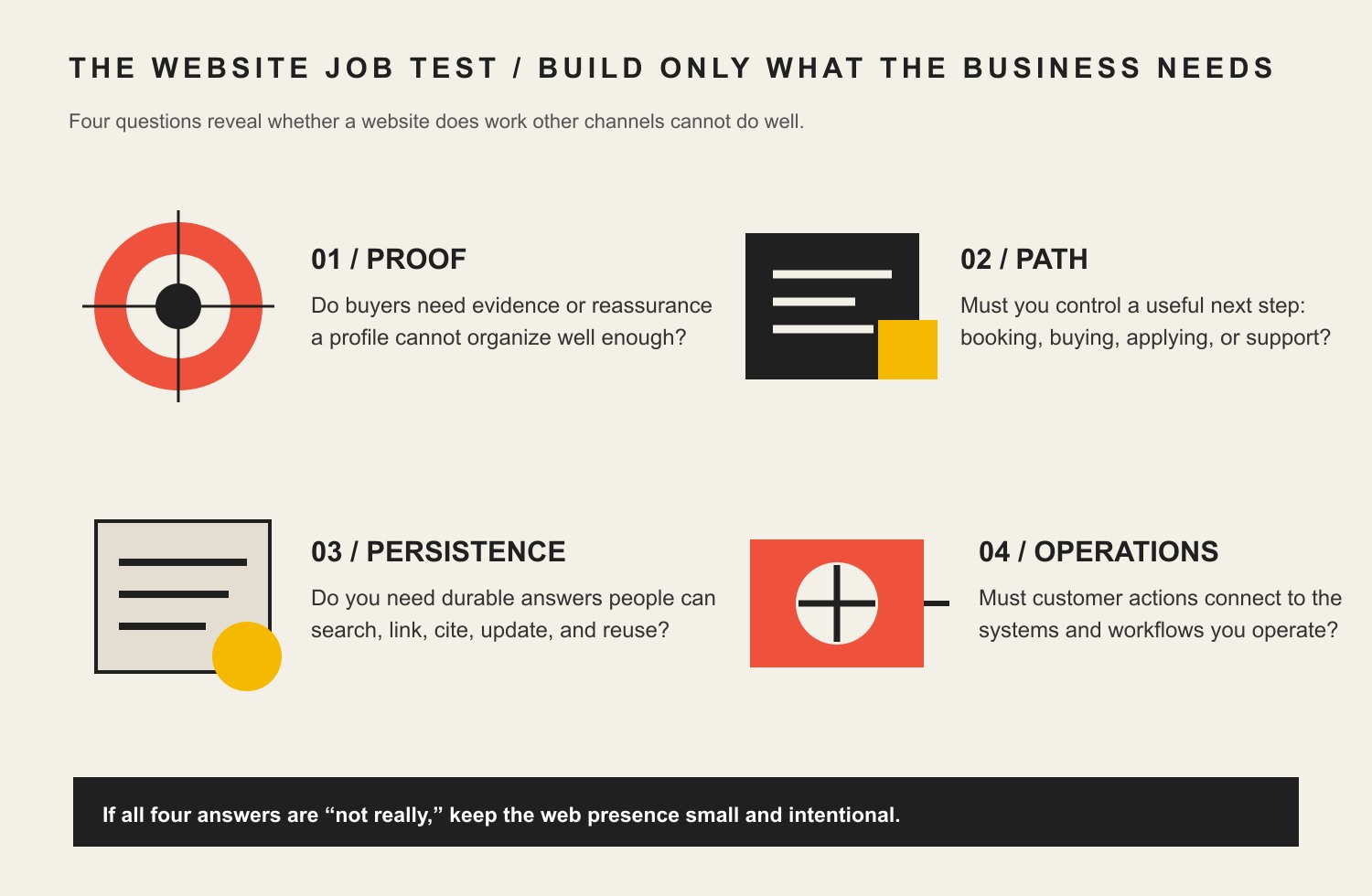
    At Scope Design, we use a simple decision model before talking about pages, templates, features, or redesigns. We call it the Website Job Test. A website becomes more valuable as it takes responsibility for one or more of four jobs.

    Four jobs to test before building a website: proof, a controlled customer path, durable discoverability, and operational integrations.

    1. Proof and authority

    Can a potential customer verify that you are credible, relevant, and capable of doing what you claim? A strong website can organize case studies, work examples, reviews, credentials, people, policies, process, pricing context, service boundaries, and answers to objections in one coherent system.

    Social profiles can provide excellent evidence, but they usually organize it according to the platform’s format and feed logic. A website lets the business decide which proof belongs next to which claim. That matters when the purchase is expensive, risky, technical, unfamiliar, or simply hard to evaluate. Our brand authority framework goes deeper into building a body of proof instead of decorating weak claims.

    2. A controlled conversion path

    Can the right visitor take the right next step without fighting the interface or guessing what happens next? That step might be a purchase, appointment, quote request, assessment, application, download, account login, support task, or detailed inquiry.

    This does not mean “put a form on every page.” It means designing the path around the customer decision and the business’s ability to respond. If your site sends every visitor to the same generic contact form, while nobody owns follow-up, the problem is not a shortage of buttons. If you are still deciding what the site should be accountable for, start with the purpose of the business website before buying more features.

    3. Durable discoverability

    Do customers ask questions that deserve stable, crawlable, linkable answers? A useful website gives those answers a durable address. Search engines can index them, people can bookmark or share them, salespeople can send them, newsletters can point to them, and other sites can cite them.

    That matters even as AI changes how search results are presented. Google’s current guidance for AI experiences in Search still tells site owners to make pages accessible, useful, technically eligible, and easy to use. A website can therefore be a source and a destination in AI-assisted discovery. It is not, however, a guarantee of ranking, indexing, mention, or citation.

    4. Operations and integrations

    Does the customer-facing experience need to connect to booking, ecommerce, CRM, email automation, inventory, support, payments, memberships, portals, documents, calculators, account data, or internal workflow? At that point the website is not merely “marketing.” It is part of how the business operates.

    This job is where the difference between a profile, a simple website, and a custom system becomes obvious. A restaurant that mainly needs hours, directions, a menu, and a reservation link has a different website problem from a manufacturer with specification libraries and distributor workflows, or a service company that must qualify leads across multiple locations and route them to the right team.

    The Website Job Test: do you actually need one?

    Before deciding how much website to buy, answer these questions without assuming the website is the solution.

    1. Proof: Do buyers need evidence, explanation, comparison, policies, or reassurance that a profile cannot organize well enough?
    2. Path: Do you need to control or improve a meaningful next step such as booking, buying, applying, requesting an estimate, or getting support?
    3. Persistence: Do you need durable pages that can be searched, linked, cited, updated, and reused outside a platform feed?
    4. Operations: Do customer actions need to connect reliably to business systems or workflows?

    If the honest answer is “not really” to all four, do not invent a 30-page website project because somebody said every business needs one. If two or three answers are clearly yes, a website is probably doing real work. If all four are essential and the workflows are complex, you are no longer choosing between “a website” and “social media.” You are designing part of the business system.

    This is the same diagnostic discipline behind Scope Design’s constraint-first website strategy: the deliverable somebody requests is evidence of dissatisfaction, not proof that the requested deliverable is the binding constraint.

    How much website do you need?

    Website levelUsually fits whenTypical jobsWarning sign
    Profile-first or minimalDemand is mostly referrals, local/maps, marketplace, or direct contact; offer is simpleBasic legitimacy, contact, location, one destinationYou are hiding real buyer questions because the profile cannot answer them
    Simple business siteBuyers need a clear offer, proof, FAQs, and direct next stepExplain, reassure, route, contactPages multiply without a distinct decision job
    Growth/marketing siteSearch, content, campaigns, lead quality, multiple services, or longer decisions matterDiscovery, evidence, segmentation, conversion, measurementTraffic is blamed for an offer, follow-up, or positioning problem
    Custom or app-like siteTransactions, portals, integrations, data, rules, account flows, or operational logic matterCommerce, self-service, workflow, automation, system integrationCustom development is purchased before the process is understood

    The point is not to graduate every business toward the bottom row. The point is to match the investment to the job. A simple site that does three important things reliably can be more valuable than a custom site full of features nobody uses.

    When a business can rationally start without a big website

    Some businesses can function well for a period with a verified local profile, marketplace presence, social account, direct messaging, phone, email, and a lightweight landing page—or even no substantial site. That can be rational when:

    • the offer is simple and low-risk;
    • most qualified demand already comes through referrals or one dominant marketplace;
    • customers mainly need hours, location, availability, a phone number, or a booking link;
    • the business is validating demand before investing in a larger system;
    • there is little unique information to publish yet; or
    • the operational constraint is somewhere else, such as slow response, capacity, pricing, sales follow-up, or fulfillment.

    The word yet matters. Platform-first can be a stage, not a doctrine. As the business accumulates proof, creates distinct intellectual property, serves more audiences, needs deeper qualification, invests in search/content, or integrates systems, the cost of squeezing everything through a profile often rises.

    Website vs. social media is the wrong comparison

    A website and social media usually solve different parts of the customer journey. Social platforms are excellent for native distribution, conversation, community, discovery, and repeated exposure. A website is better suited to organizing durable information, controlling information architecture, connecting proof to decisions, and integrating with systems.

    Use social media where people already spend attention. Use the website when the buyer needs depth, structure, persistence, or a controlled task. If you are deciding which social channels actually fit the business, our guide to which types of social media can benefit a business owns that platform-selection question.

    Also be precise about “ownership.” A business can usually control its domain, website content, information architecture, conversion paths, and integrations more directly than it can control a platform profile. That is valuable. But it is not absolute ownership of hosting infrastructure, analytics vendors, third-party software, search distribution, or every piece of customer data. Those systems still have contracts, technical dependencies, privacy obligations, and failure modes.

    What AI search changes—and what it does not

    AI answers can resolve simple questions before a person visits any website. That increases the pressure on weak pages whose only purpose was to restate generic information. It does not eliminate the need for original evidence, current facts, detailed proof, transactional destinations, account experiences, or operational tools.

    For website owners, the practical requirement is not a magical “AI SEO” file. Google says the ordinary technical requirements still matter across classic and AI Search experiences: the page needs to work, be accessible to Google, and contain indexable content. Helpful, unique content and a usable page experience still matter too. None of that guarantees an AI citation.

    That is why the safest AI-search strategy is also a sound website strategy: publish things worth finding. Document real expertise. Answer recurring customer questions clearly. Show evidence behind claims. Maintain important facts. Give each page a defined job. Then make sure the system can technically access the page.

    What auditing this exact page taught us

    We applied the same diagnostic rule to this article before rewriting it. The old version made confident claims about “digital dominance,” mixed in trend predictions about progressive apps, voice interfaces, augmented reality, blockchain, and serverless technology, and still did not answer the business decision with enough precision.

    The performance data was even more useful because it kept us from pretending. In the 12 months ending August 19, 2026, the exact URL recorded only 5 GA4 landing sessions, all Direct, with 0 engaged sessions and 0 key events. The prior comparison returned no row. Correct exact-page Search Console filters returned no query rows for either 12-month period, and URL Inspection currently reports the URL as unknown to Google. Bing recognizes the page historically but currently reports 0 clicks and 0 impressions. Ubersuggest found no ranking-keyword data and no discovered backlinks for the exact page.

    Those numbers do not prove nobody cares whether websites are still relevant. They prove this version of this page had almost no measurable search footprint. Separate keyword research still shows modest informational demand around “are websites still relevant” and “do I need a website for my business.” That distinction matters: low page performance is not the same thing as no audience demand.

    So we did not change the long-standing URL just to force the keyword into the slug. We changed the job of the article: direct answer, explicit exceptions, first-party framework, right-sizing guidance, current platform/search evidence, and links to the deeper pages that own website purpose and strategy.

    What should you do next?

    1. Write down the business outcome. What should become easier or more likely because the website exists?
    2. Run the Website Job Test. Identify whether proof, conversion, durable discoverability, or operations actually require a website.
    3. Choose the smallest useful level. Profile-first, simple, growth, or custom is a business decision—not a status symbol.
    4. Assign one leading purpose. If several jobs matter, decide which wins when priorities conflict.
    5. Measure the whole handoff. A form submission nobody answers is not website success.

    If you already have a site, do not assume a redesign is the first move. Use the Website Fitness Test to see whether the current site is actually failing its assigned job. If you are starting from scratch or the diagnosis is unclear, Scope Design can help define the job before pages and features turn into an expensive substitute for strategy.

    Frequently asked questions about whether websites are still relevant

    Do people need websites anymore?

    Not everyone needs a substantial website, but many businesses still benefit from one when buyers need organized proof, a controlled next step, durable searchable information, or integrations that profiles and feeds do not handle well.

    Do I need a website for my business?

    You probably need at least a simple website when customers regularly need more context than a profile provides, when you need to qualify or convert inquiries, when search/content is part of acquisition, or when customer actions connect to business systems. If none of those conditions applies yet, a profile-first approach may be sufficient temporarily.

    Can social media replace a website?

    It can replace some discovery and communication functions, especially for simple offers and early-stage businesses. It is weaker when you need structured proof, durable information architecture, controlled conversion paths, deep search content, or custom integrations. In most mature systems, social media and the website do different jobs.

    Is a Google Business Profile enough without a website?

    For some eligible local businesses, it can cover important basics such as discovery in Search and Maps, hours, location, phone, reviews, photos, and links to booking or other destinations. It becomes limiting when the buying decision needs deeper proof, unique information, qualification, content, or workflows the profile cannot own.

    Are websites obsolete because of AI?

    No. AI can answer more informational questions without a click, which makes generic pages less defensible. But AI systems still depend on sources, businesses still need destinations for proof and transactions, and many customer tasks cannot be completed inside an answer box. A website should contain useful evidence and functionality rather than exist as a ceremonial homepage.

    What is the minimum website a small business needs?

    The minimum is the smallest site that completes the jobs the business cannot reliably handle elsewhere. For one company that may be a single clear page with proof and contact information. For another it may require service pages, FAQs, case studies, booking, ecommerce, or an integrated application. Start with the job, not an arbitrary page count.