Tag: social media marketing

  • Social Media Content Creation: Make Better Posts Without Chasing the Algorithm

    Social Media Content Creation: Make Better Posts Without Chasing the Algorithm

    Social media content creation gets easier when you stop treating every post like an audition for an algorithm. Start with something worth saying, give the post one job, adapt it to the channel, make the next step obvious, and learn from what qualified people actually do. That is a much more durable system than chasing a daily posting quota, a magic engagement ratio, or somebody’s latest theory about what the feed secretly wants.

    TL;DR: Build social content from real evidence, not filler. Before publishing, run the Scope Design FACE Test: Focus, Authority, Channel fit, Exit. Then publish one bounded test, change one meaningful variable at a time, and read the result in three layers: attention, qualified action, and business effect. You cannot guarantee virality, and current first-party platform guidance does not support one universal algorithm formula.

    What social media content creation actually is

    Social media content creation is the work of turning an idea, observation, proof point, question, demonstration, or point of view into a useful asset for a specific social environment. The finished asset might be a text post, carousel, short video, long video, image, thread, document, story, poll, or reply.

    That is different from a social media content strategy. Strategy decides who you are trying to help, what questions matter, which channels deserve attention, who owns the work, and what outcome will tell you the system is useful. Content creation is where one evidence unit becomes one publishable thing.

    The distinction matters because a good strategy can still produce weak posts, and a clever post can still be useless to the business. This article owns the middle: how to improve the quality of the individual asset, adapt it without photocopying it, and learn after it goes live.

    A better social media content creation workflow: evidence to post to learning

    A practical workflow is shorter than most “ultimate guides” make it sound:

    1. Choose one evidence unit. Start with a customer question, a real example, a decision, a comparison, a demonstration, a mistake, a useful source, or a specific point of view.
    2. Name the audience moment. What is the person trying to understand, avoid, compare, decide, or do?
    3. Give the post one job. Teach one thing. Prove one thing. Start one conversation. Route one kind of intent. Do not ask one post to introduce the brand, explain the service, prove the service, answer six objections, and close the sale.
    4. Choose the shape that fits the channel. The same idea may need a visual proof on Instagram, a decision story on LinkedIn, or a demonstration in short-form video.
    5. Run the FACE preflight. Check Focus, Authority, Channel fit, and Exit.
    6. Publish a bounded test. Know what variable changed and what you are watching.
    7. Record the lesson. Keep what you learned about the audience or the creative—not a superstition about “the algorithm.”

    The important thing is the loop. A post is not finished because it was scheduled. It is finished when the team can say what it was trying to do and what the result taught them.

    Use the Scope Design FACE Test before you publish

    The Scope Design FACE Test is a preflight for one social post. It is not a scientific model and it does not predict reach. Its job is simpler: catch weak creative decisions before you spend audience attention on them.

    A social post composition balances one focus, credible evidence, channel fit, and a clear next step
    The Scope Design FACE Test checks one post for Focus, Authority, Channel fit, and Exit before publication.

    F — Focus: what is this post for?

    If you cannot describe the post’s job in one sentence, the audience will probably have an even harder time figuring it out. “Promote our business” is not a useful job. “Help a homeowner recognize the difference between a cosmetic roof stain and a leak warning sign” is.

    Focus also means resisting the urge to cram the entire sales process into one asset. A short post can earn curiosity, demonstrate competence, answer a common question, or route somebody to deeper proof. It usually cannot do all four well at once.

    A — Authority: what proves the point?

    Authority is not a confident adjective. “We are experts” is a claim. A photo of the failure you found, a before-and-after with the mechanism explained, a real customer question, a worked calculation, a source with a traceable link, or a hard recommendation with the tradeoff behind it is evidence.

    This is the same reason a strong social media presence builds authority from evidence rather than from sheer posting volume. The source material should deserve attention before you optimize the wrapper around it.

    C — Channel fit: why this shape here?

    Channel fit does not mean memorizing a universal list of preferred formats. It means understanding how the audience encounters the idea in that environment and rebuilding the doorway accordingly.

    A LinkedIn post might lead with the decision and the tradeoff. An Instagram carousel might lead with the visual contrast. A short video might show the failure first and explain it second. The evidence stays honest; the entry point changes.

    That is also the core of good content repurposing: recast useful evidence for a new context instead of pasting the same thing everywhere and calling it distribution.

    E — Exit: what should happen next?

    Every post needs an exit, but not every exit needs to be “book a call.” The right next step depends on the job. A person may need to save the checklist, compare two options, reply with a detail, watch the full demonstration, visit a durable guide, send a message, or simply understand the issue better.

    The exit is also where measurement starts. If the post is supposed to answer an expensive pre-sale question, useful replies or assisted visits may matter more than broad reach. If it is supposed to demonstrate competence, a qualified profile visit can mean more than a pile of random likes.

    Stop trying to dominate an algorithm

    The old version of this article promised “algorithm domination.” That sounds decisive. It is also the wrong target.

    Current first-party guidance describes recommendation systems as personalized, multi-signal systems. TikTok says interactions such as likes, shares, comments, survey responses, “Not Interested” feedback, and hiding content help shape the For You feed. YouTube’s own recommendation-system explainer says the system does not operate from a fixed “recipe book”; it learns from multiple signals such as clicks, watch time, survey responses, sharing, likes, and dislikes, with signal importance depending on the viewer.

    That does not mean platforms have no preferences. It means “the algorithm” is not one static checklist shared by every platform, audience, format, and account. A rule such as “post four times per day,” “publish in the golden hour,” or “saves always matter more than shares” should not be presented as a universal platform law without current, platform-specific evidence.

    Separately, YouTube’s current Performance FAQ says growth in views across uploads is not correlated with the time between uploads, daily or weekly uploading is not required, and publish time is not known to affect a video’s long-term performance. Sustainable cadence and audience fit beat a made-up quota.

    And if the actual goal is unusual transmission, use a framework built for that question. Scope Design’s guide to going viral without losing the plot treats virality as upside, not a promise you can engineer on demand.

    Build from evidence, not empty originality

    “Be original” is lousy production guidance. A small business does not need to invent a new genre every Tuesday. It needs a reliable supply of real material that competitors cannot copy perfectly.

    Useful evidence units include:

    • a question prospects ask before buying;
    • a mistake you keep finding in audits or service calls;
    • a before-and-after example with the changed mechanism explained;
    • a comparison where the tradeoff matters;
    • a decision your team made and why;
    • a demonstration of how something works;
    • a useful checklist or template;
    • a small first-party observation with the method described;
    • a source you can interpret for your audience instead of merely reposting;
    • a failure, constraint, or exception that makes your advice more credible.

    This has another benefit: evidence makes AI-assisted production safer. A model can help summarize, restructure, compress, expand, or generate variations around a real source. Asking it to manufacture the source material from nothing is where generic claims and fake authority creep in.

    Adapt one idea across channels without photocopying it

    Repurposing works when the idea stays stable and the presentation changes. Copy-paste distribution often fails because the audience context changes even when the evidence does not.

    Evidence unit Possible channel treatment What stays constant
    Customer asks why two quotes differ LinkedIn: decision story about scope tradeoffs The real comparison and the reason
    Before-and-after repair Instagram: visual sequence with annotated change The actual condition and mechanism
    Product demo Short video: show the result first, then the steps The demonstration itself
    Research finding Text post: explain what the number does and does not prove The source, method, and caveat

    The useful rule is: adapt the doorway, not the evidence. If a platform’s format forces you to simplify the claim past the point of accuracy, the format is wrong for that claim.

    Use AI as an assembly layer, not the authority

    AI can remove a lot of tedious production work from social media content creation. It can also help you generate extremely polished nonsense faster.

    Good uses include:

    • turning interview notes into candidate post angles;
    • summarizing a source before a human checks the summary against it;
    • generating several openings for the same evidence unit;
    • converting a long explanation into a carousel outline;
    • suggesting questions a skeptical buyer might ask;
    • reformatting approved copy for different platform constraints;
    • creating a first-pass shot list or visual brief;
    • finding repetitive language and unnecessary throat-clearing.

    Human ownership should stay with claims, evidence, judgment, brand voice, legal or reputational risk, customer nuance, and sensitive audience responses. If the content says “we saw this,” “our customers do this,” or “this will increase your results,” somebody should be able to show where that statement came from.

    Run one-variable social content tests

    A lot of “testing” is really a before-and-after story with six things changed at once. New hook, new visual, new format, new time, new audience, new CTA—and then the team decides the emoji caused the win.

    A cleaner test changes one meaningful variable while keeping the rest reasonably stable. Good variables include:

    • Opening: problem-first versus result-first;
    • Proof: claim alone versus a real example or demonstration;
    • Visual: finished result versus the failure condition;
    • Format: text explanation versus annotated sequence;
    • Exit: broad “learn more” versus a specific next step;
    • Framing: instruction versus decision tradeoff.

    You will never create laboratory conditions inside a social platform. That is fine. The goal is not scientific certainty. The goal is to stop changing everything at once and calling the result an insight.

    Diagnose social media content in three layers

    Do not flatten every result into “engagement.” Read performance in layers.

    Layer 1: Attention

    Did the intended audience notice and consume enough of the asset to understand it? Depending on the platform and format, useful signals might include qualified reach, video starts, retention, completion, carousel progression, or expansion of the post. These are not interchangeable, and none proves business value by itself.

    Layer 2: Qualified action

    Did the right people do something that matches the post’s job? Examples include a substantive reply, save, share to a relevant person, profile visit, direct message, click to deeper proof, assisted website visit, or request for clarification.

    Layer 3: Business effect

    Did the content contribute to a qualified conversation, opportunity, purchase, renewal, referral, or other outcome that matters? Attribution is often imperfect, especially when a buyer sees social content and converts later through search, email, a phone call, or direct traffic. That is why the business layer should be interpreted as evidence, not theater.

    For the deeper measurement system, use Scope Design’s guide to social media ROI and failure diagnosis. This article’s job is narrower: improve the creative and decide what to test next.

    What you observe Likely question Next test
    Intended people barely stop Is the opening clear and relevant? Change the first frame or first sentence
    People consume it but do nothing Is the post useful enough or is the exit vague? Strengthen the evidence or make the next step specific
    Lots of broad engagement, little qualified action Did the content attract the wrong audience? Narrow the problem, proof, or distribution context
    Qualified replies, weak business follow-through Is the handoff broken after social? Fix the destination, response process, or offer
    One format repeatedly works for one topic Is the mechanism format-specific or evidence-specific? Reuse the evidence in a different format before declaring a rule

    Worked example: one proof point, three platform-fit posts

    Imagine a local kitchen remodeler keeps hearing the same question: “Why is your quote higher than the other one?” The weak social post is predictable: a stock photo, “quality matters,” three generic bullets, and a request to call for a free estimate.

    A better evidence unit is a real anonymized scope comparison. One quote includes cabinet removal, wall repair, disposal, electrical corrections, and finish work. The lower quote excludes several of those items.

    LinkedIn treatment: lead with the decision: “A cheaper remodeling quote can be cheaper because it is a different job.” Show three scope differences, explain the tradeoff, and invite contractors or owners to compare scope before comparing totals.

    Instagram carousel treatment: slide one says “These two kitchen quotes are not for the same job.” The next slides annotate the hidden scope differences. The final slide gives a five-item quote-comparison checklist worth saving.

    Short-video treatment: open on the two totals, then reveal excluded work one line at a time. The ending is not “DM us now.” It is “Ask any contractor whether these five items are included before you compare the price.”

    The underlying proof did not change. The doorway did. Each version passes FACE: one focused job, real authority, channel-fit presentation, and a proportionate exit.

    What auditing this exact article changed

    The imported draft looked authoritative because it was full of precise claims. It said Instagram saves outrank shares, Reels outrank carousels, TikTok creators should post one to four times per day, the first three seconds determine distribution, LinkedIn had a “Creator Mode 2.0,” businesses should push a “golden hour,” and Scope Design clients had achieved large percentage gains across engagement, conversion, acquisition cost, and leads.

    Those claims did not have an evidence packet strong enough to defend them. We removed them instead of preserving precision for its own sake.

    We also checked this exact page before rewriting it. Scope Design’s current GA4 property returned no Organic Search sessions for the path in the reviewed prior 12-month window. Google Search Console returned no rows for the exact phrase query we checked. Bing’s synchronized inventory showed 0 clicks and 8 impressions for the URL. That is not enough data to claim the old article succeeded, failed, converted poorly, or had no demand.

    Keyword research did show demand for the subject. In the Ubersuggest US snapshot reviewed August 21, 2026, “social media content creation” showed about 1,900 monthly searches and “social media content” about 1,300, while “social media content optimization” was tiny. Fresh DataForSEO SERP data also showed an AI Overview and People Also Ask questions such as “How do you create content for social media?”

    The editorial decision was therefore simple: preserve the established URL, remove claims we could not support, use the language people actually search, and give the page one defensible job that does not duplicate Scope Design’s existing strategy, presence, virality, repurposing, or ROI owners.

    Sources and methodology

    This article was reviewed and rebuilt on August 21, 2026 using Scope Design’s Content Studio and Open Brain evidence, Ubersuggest keyword and SERP research, a fresh DataForSEO Google SERP/PAA check, one authorized DataForSEO AI keyword-volume request, exact-page GA4/Search Console/Bing baseline checks, and first-party platform documentation.

    • YouTube Blog: On YouTube’s recommendation system, reviewed August 21, 2026.
    • YouTube Help: Performance FAQ & Troubleshooting, reviewed August 21, 2026 for upload-frequency and publish-time guidance.
    • TikTok Newsroom: Discover more of what you love on TikTok, reviewed August 21, 2026. The research fetcher could read the current page, but the Studio link checker could not reliably resolve it, so this source is intentionally not linked.
    • Instagram: Ranking Explained, technically accessible and reviewed for current platform guidance on August 21, 2026.

    Keyword volumes are directional third-party estimates, not guarantees of traffic. Platform behavior changes. The FACE Test and the three-layer diagnosis are Scope Design operating models, not platform documentation or scientific benchmarks.

    Frequently asked questions about social media content creation

    What is social media content creation?

    Social media content creation is the process of turning an idea, evidence unit, question, demonstration, or point of view into a useful asset designed for a specific social environment. It includes deciding the post’s job, choosing the format, creating the asset, publishing it, and learning from the result.

    How do you create content for social media?

    Start with one real evidence unit, identify the audience moment, give the post one job, adapt the idea to the channel, run the FACE Test, publish one bounded experiment, and record what happened. Build the next post from the lesson instead of from a universal posting formula.

    What makes a good social media post?

    A good post is focused enough to understand, authoritative enough to trust, shaped for the environment where it appears, and clear about the next appropriate action. It does not need to be viral. It needs to be useful to the right people and capable of teaching you something.

    What is the 5-5-5 rule for social media?

    Different marketers use “5-5-5” to mean different posting or engagement ratios. Treat any such ratio as a planning heuristic, not a platform law. The fresh Google PAA set for this topic shows people search for formula rules, but current first-party platform guidance supports personalized, multi-signal recommendation systems rather than one universal ratio.

    Should a business post on social media every day?

    Not because a guru says the algorithm requires it. Choose a cadence your team can sustain without lowering evidence quality or abandoning higher-value work. YouTube explicitly says daily or weekly uploads are not required for growth. Other platforms have different systems, so test cadence against your audience and capacity rather than importing one number everywhere.

    Can AI create social media content?

    Yes, but it is better used as an assembly and variation layer than as the source of authority. Let AI summarize approved source material, generate options, restructure formats, or suggest hooks. Keep people responsible for claims, evidence, judgment, tone, risk, and important audience responses.

    How do I know whether a social media post worked?

    Judge it against its job. Start with attention, then look for qualified action, then connect that activity to business effect where the evidence allows. A post can have modest reach and still be valuable if it creates the right conversation. A post can have enormous reach and still be useless if nobody relevant moves.

    Make better posts by learning faster

    Social media content creation does not need another pile of algorithm folklore. It needs a better operating discipline: real evidence, one clear job, a channel-fit presentation, an honest exit, and a feedback loop that distinguishes attention from qualified action and business effect.

    If your team has plenty of things to post but no reliable way to decide what is worth creating, Scope Design can help you turn customer questions, project evidence, expertise, and owned content into a more useful content system. The goal is not to feed the platforms more. It is to make the work teach you something—and make the right people understand why your business is worth paying attention to.


  • How to Elevate Your Social Media Marketing Strategy | Proven Best Practices That Drive Results

    How to Elevate Your Social Media Marketing Strategy | Proven Best Practices That Drive Results

    The bottom line: The highest-impact social media marketing best practices do not begin with a posting schedule, a hashtag count, or the latest algorithm rumor. They begin with a connected system: reach the right people on a channel that has a clear job, publish useful material based on real expertise, create meaningful interaction, route attention to a measurable next step, and learn from qualified business outcomes.

    If you already post consistently but cannot explain what the activity is doing for the business, more content is rarely the first fix. Social media works best as one part of a broader marketing system that connects attention to business value. This guide focuses on improving that system after social media has earned a place in it. If you are still building the plan from scratch, our social media strategy guide owns that broader decision.

    Social Media Marketing Best Practices: What Actually Elevates a Strategy?

    An elevated social media strategy is easier to operate and easier to judge. Every active channel has a reason to exist. Every content type has a job. Every call to action leads somewhere proportionate to the buyer’s intent. Measurement continues beyond platform dashboards. And the team knows what it will change when the evidence is weak.

    Weak habit Elevated practice Evidence that matters
    Be everywhere Choose channels from audience behavior and operating capacity Relevant audience, response quality, cost to operate
    Post because the calendar says so Publish content with a defined job Useful interaction, qualified attention, repeatable production
    Copy the same post everywhere Adapt the idea to the channel’s native behavior Whether the format helps the audience understand or act
    Celebrate reach by itself Connect attention to a measurable handoff Tagged visits, useful DMs, bookings, qualified leads, revenue
    Change five things at once Run one bounded test at a time A result you can interpret and use for the next decision

    The important difference is causality. A viral post may be interesting, but it is not automatically useful. A small post that reaches the right twenty people, answers a buying question, and creates two qualified conversations may be much more valuable. Your social media marketing strategy should make that difference visible.

    The Scope Design ELEVATE Social Media Operating Loop

    We use ELEVATE as an operating loop for improving an existing social program: Evidence, Limit, Expertise, Value, Arrange, Test, Evaluate. It is not an industry standard or an algorithm formula. It is a practical way to keep seven connected decisions from collapsing into “post more.”

    Evidence, channel focus, useful expertise, valuable conversation, handoff, testing, and qualified outcomes form a learning loop

    E — Evidence before platform habits

    Start with the audience behavior and business outcome you can actually observe. “Everyone is on Instagram” is not evidence that your buyers use Instagram for the job you need it to perform. Look at customer interviews, sales questions, referral patterns, website behavior, existing social conversations, and real channel capacity.

    Pew Research Center’s current U.S. social media fact sheet is a useful reminder that platform usage varies across demographic groups. That still does not choose a platform for your business; it tells you why the choice should be evidence-led. For the deeper channel decision, use our guide to choosing the right types of social media for your business.

    L — Limit each channel to one primary job

    A channel can do several things, but your team should know the primary job that earns its operating cost. One network might support local discovery. Another might help demonstrate expertise to a long-consideration B2B buyer. Another may be useful for customer support or recruiting.

    This does not mean a Facebook page can never recruit or a LinkedIn post can never create a lead. It means the channel has a main reason to exist, so the team knows what to produce, what to measure, and what would justify reducing or retiring the work. Two identical feeds with no distinct job are usually duplication, not diversification.

    E — Turn expertise into native content

    Your best source material is usually not a trend calendar. It is what the business already knows: customer questions, demonstrations, before-and-after evidence, objections, comparisons, process decisions, mistakes, field notes, case-study lessons, and subject-matter expertise.

    Then adapt the idea to the channel. The same truth can become a short demonstration, a carousel, a concise point of view, a Q&A, or a longer explanation without becoming five photocopies of the same post. If you need the production system behind that work, our social media content strategy guide owns content planning, source assets, calendars, and repeatable production in more depth.

    V — Create value-bearing conversation

    Engagement is not valuable merely because a dashboard counts it. Ask whether the interaction teaches you something, helps the audience make a decision, exposes a real question, strengthens trust, or moves the conversation toward a useful next step.

    That changes how you respond. A thoughtful question may deserve a useful answer, not a heart emoji. A repeated objection may deserve a new article or video. A customer story may reveal the language future buyers use. Our deeper guide to social media engagement covers the conversation system; this article keeps the focus on how engagement connects to the rest of the marketing loop.

    A — Arrange the handoff

    Social platforms are excellent places to earn attention and interaction, but most businesses eventually need a handoff. That could be a useful page, a booking flow, a product, a store visit, a phone call, a qualified DM, an email signup, or another next step the business can actually observe and serve.

    The handoff should match intent. Someone watching an early-stage educational video may not be ready for “book a sales call.” Someone asking for pricing may not need another awareness post. Scope’s guide to what people often miss about social media marketing goes deeper on why the system needs a destination beyond the feed.

    T — Test one meaningful variable at a time

    Optimization requires interpretable changes. If you change the audience, channel, content format, hook, offer, posting time, landing page, and follow-up process at once, a better result still may not tell you why it improved.

    Choose the weakest link you can defend with evidence and change one meaningful factor. You might test whether demonstrations outperform abstract tips for a particular audience, whether a stronger proof asset improves qualified visits, or whether a lower-friction next step creates better conversations. Keep the rest stable enough that the result can teach you something.

    E — Evaluate qualified outcomes

    The final question is not “Did reach go up?” It is “Did the social system create enough useful business value to justify what it cost to operate?” Reach, views, comments, saves, and shares can help diagnose behavior. They do not prove value by themselves.

    Evaluate outcomes such as qualified conversations, relevant website visits, appointments, lead quality, revenue, retention signals, recruiting quality, or another result tied to the channel’s job. Then make a decision: keep the system, improve a weak link, change the channel’s job, or stop doing work that cannot earn its place.

    Platform-Specific Best Practices Without Algorithm Ghost-Chasing

    Platform differences matter. Native formats, audience expectations, moderation tools, discovery behavior, and shopping or messaging features can all change how an idea should be delivered. But durable social media marketing best practices should survive the next minor product update.

    • Adapt the vehicle, not the truth. Keep the core point consistent while changing the format to fit the channel.
    • Use current platform documentation for mechanics. Dimensions, feature availability, ad requirements, and account capabilities can change.
    • Avoid universal timing rules. Your audience and operating cadence matter more than somebody else’s “best hour.”
    • Avoid fixed hashtag or emoji counts. Use them only when they improve meaning, discovery, or community context for the specific channel.
    • Do not confuse reach with fit. A platform can produce views while producing poor-quality traffic, weak conversations, or expensive operational load.

    Instagram and TikTok make this distinction easy to see. If Instagram already has a valid job, our guide to increasing Instagram engagement without chasing algorithm ghosts goes deeper on that network. If TikTok is still a channel-choice question, use the STOP Before You TikTok test before committing staff time to a new content treadmill.

    Where AI and Automation Help—and Where They Should Stop

    AI can make a social media workflow faster, especially around stable, reviewable tasks. It can help cluster customer questions, summarize research, transform source material into draft variations, prepare captions for human review, flag recurring themes, organize calendars, and generate first-pass performance summaries.

    The best boundary is not “AI or no AI.” It is automation where the work is stable; human judgment where trust is the value. Public replies, sensitive customer issues, crisis communication, factual claims, legal or reputational risk, and nuanced editorial judgment deserve accountable human review. The International Chamber of Commerce’s responsible-AI guidance for marketing similarly emphasizes applying existing standards of transparency and accountability when AI is used.

    A practical rule: never automate a public interaction you would be uncomfortable having attributed directly to the company. Efficiency is useful only when the system still produces truthful, context-aware communication.

    Build a Measurement Ladder From Platform Signals to Business Outcomes

    Among the most useful social media marketing best practices is separating signals by job instead of asking one metric to do every job. Use a measurement ladder. Each level answers a different question, and the lower levels only matter when they help explain movement toward the higher ones.

    Measurement level Question Useful examples
    Operating evidence Can we run this consistently without wasting capacity? Staff time, production cost, approval delay, response load
    Distribution signals Did the right people have a reasonable chance to see it? Relevant reach, qualified views, audience mix
    Interaction signals Did the content create useful behavior? Meaningful replies, questions, saves/shares when relevant, profile visits
    Handoff signals Did attention move to a next step we can observe? Tagged website visits, DMs, calls, form starts, bookings, store actions
    Business outcomes Did the handoff create value? Qualified leads, revenue, retention, recruiting quality, assisted outcomes

    When social traffic leaves a platform for your website, preserve as much context as practical. Use consistent UTM parameters for source, medium, and campaign so the handoff can be analyzed later. Keep the naming convention simple enough that your team will actually follow it; a perfect taxonomy nobody follows is worse than a simple one used consistently.

    Do not overclaim attribution. A social post may influence a later branded search, referral, call, or offline conversation. Platform-reported conversions and last-click analytics are evidence, not omniscience. Combine tagged traffic, CRM or lead-quality data, sales feedback, customer self-reporting, and operating cost when the decision matters.

    Run Focused Optimization Cycles, Not Constant Reinvention

    The point of these social media marketing best practices is not constant reinvention. A social media strategy improves when the team has a repeatable way to decide what deserves another round. Pick an observation window long enough to collect meaningful evidence for your cadence and volume; there is no universal number of days that works for every business.

    1. Name the channel’s primary job. If the team cannot agree, stop and fix that first.
    2. Choose the decision metric. Decide what evidence would make you keep, change, or stop the current approach.
    3. Find the weakest link. Audience fit? Content usefulness? Conversation quality? Handoff? Measurement?
    4. Change one meaningful variable. Keep enough else stable that the result can teach you.
    5. Review qualified outcomes and operating cost. Do not reward a prettier dashboard if the business result got worse.
    6. Record the next decision. Keep, improve, change the job, or retire the work.

    If the same system continues failing after you repair obvious weak links, move from optimization to diagnosis. Our guide to why a social media marketing strategy fails owns that troubleshooting job in more depth.

    What Auditing This Exact Article Taught Us

    We applied the same evidence discipline to this revision instead of preserving old claims because they were already on the page. On August 21, 2026, we checked the exact URL across Scope Design’s configured analytics, search tools, third-party keyword/backlink data, and the internal content graph.

    Signal checked Observation before this revision What it actually supports
    GA4, latest complete 12 months and prior comparison No exact page-path rows returned in either 12-month window Not enough page-level behavior data to make conversion claims; no demonstrated analytics equity forcing weak legacy statistics to survive
    Google Search Console No exact-page query rows; URL Inspection reported “Discovered – currently not indexed” The page needed clearer ownership, usefulness, and internal support; it did not justify a cosmetic URL change
    Bing Webmaster Tools Bing recognized the page and had crawl history, but exact URL traffic was 0 clicks and 0 impressions Crawl history existed, but there was no meaningful Bing traffic footprint to protect
    Ubersuggest 0 estimated exact-page traffic, 0 ranking keywords, 0 backlinks, and 0 referring domains; the query “social media marketing best practices” showed about 170 U.S. monthly searches The topic still has demand, but the page itself had no strong third-party footprint requiring the old angle or unsupported numbers

    That evidence does not prove the old article never helped anyone, that social media does not work, or that this revision will rank. It supports a narrower editorial decision: keep the established URL, remove brittle statistics and platform formulas we could not defend, give the page one distinct job, add original information gain, and connect it to the right specialist owners.

    Frequently Asked Questions About Social Media Marketing Best Practices

    What are five high-impact social media marketing best practices?

    Five high-impact practices are: choose channels from audience evidence; give each channel a clear business job; publish useful material based on real expertise; create a measurable handoff beyond the feed; and evaluate qualified outcomes instead of vanity metrics. Those five are the compressed version of the ELEVATE loop.

    What is the 5-5-5 rule for social media?

    There is no single universal 5-5-5 social media standard. The phrase is used for different posting, engagement, and networking heuristics. Before following one, ask what behavior the rule is trying to improve and whether that behavior matters for your audience and channel job. Use formulas as prompts when they help; do not mistake them for platform-independent laws.

    What are the 7 C’s of social media marketing?

    Different authors use different “7 C” sets, so there is no single authoritative list every business must follow. Scope Design uses ELEVATE instead because it maps the operating chain we want a business to inspect: Evidence, Limit, Expertise, Value, Arrange, Test, and Evaluate. It is our working framework, not an industry standard.

    What is the 5-3-1 rule for social media?

    The 5-3-1 label is another memorable formula that can refer to a content or engagement mix depending on the source. Treat the underlying intent—avoid nonstop self-promotion, participate in the community, and publish useful material—as a hypothesis to test. Your actual mix should follow the channel’s job and the audience response.

    How often should a business post on social media?

    Often enough to perform the channel’s job consistently without sacrificing usefulness or creating an operating burden the team cannot sustain. There is no universal posting frequency that fits every platform, audience, format, and business. Choose a cadence you can run, collect evidence, and adjust from actual response.

    Which social media platform is best for a small business?

    The best platform is the one where the relevant audience exhibits behavior connected to a business job your team can support. A large platform with poor buyer fit or no measurable handoff can be worse than a smaller channel with higher relevance. Start with platform selection based on business fit, then apply the optimization practices in this guide.

    Should AI manage a company’s social media?

    AI can assist with stable tasks such as research organization, draft variations, repurposing, scheduling preparation, and first-pass analysis. Human review should remain accountable for factual claims, sensitive interactions, crisis response, public judgment calls, and anything where context or trust is the value.

    How should a business measure social media success?

    Measure in layers: operating cost, relevant distribution, useful interaction, measurable handoff, and qualified business outcomes. Platform metrics can diagnose what happened in the feed, but tagged traffic, lead quality, sales evidence, customer feedback, and operating cost are usually needed to judge business value.

    Can social media best practices guarantee leads or ROI?

    No. Best practices improve the quality of decisions and make the system easier to evaluate; they cannot guarantee demand, reach, leads, or revenue. Audience fit, offer quality, competition, creative quality, sales follow-up, website experience, budget, and operating capacity all affect the outcome.

    Sources and Methodology

    This revision was completed August 21, 2026. We reviewed the exact article URL in GA4, Google Search Console, Bing Webmaster Tools, and Ubersuggest; compared the topic against the current U.S. SERP and People Also Ask; ran a bounded DataForSEO AI-search observation; inspected Scope Design’s Content Studio link graph and neighboring article ownership; and retrieved relevant Scope Design doctrine from Open Brain. We removed legacy claims that lacked a defensible current source chain rather than preserving them because they sounded precise.

    The most durable social media marketing best practices make the system easier to understand and improve. Social media gets easier to improve when it has one clear job inside the business system. Start with evidence, constrain the work, build from real expertise, connect attention to a useful next step, and keep only what earns another round. That is more durable than memorizing somebody else’s posting formula—and more useful when the platforms change again.

  • Why Your Social Media Marketing Strategy Is Failing: 8 Critical Mistakes Killing Your ROI (+ Proven Solutions)

    Why Your Social Media Marketing Strategy Is Failing: 8 Critical Mistakes Killing Your ROI (+ Proven Solutions)

    If your social media marketing strategy is failing, posting more is probably not the first fix. Activity is not evidence of return. A business can publish constantly, collect likes, and still have no clear connection to qualified conversations, leads, sales, retention, recruiting, or another outcome that matters.

    The useful question is not “What should we post next?” It is “Where does attention stop turning into business value?” Social media is one part of a broader small business marketing strategy. If the audience, offer, destination, response process, capacity, or measurement is weak, more reach can simply send more people into a broken system.

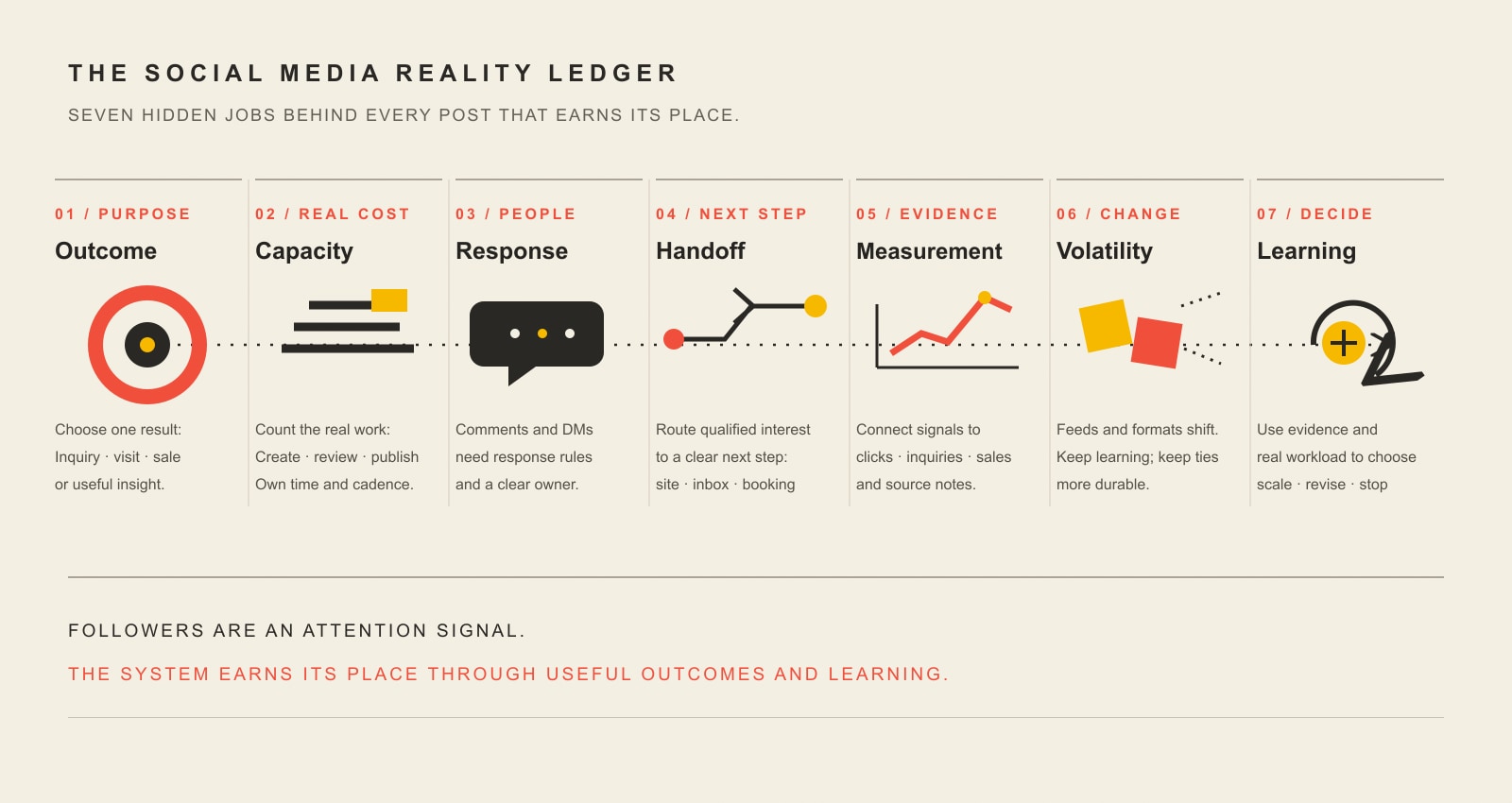
    At Scope Design, we diagnose this with an eight-link model: Job → Audience → Proof → Platform/Format → Capacity → Conversation → Handoff → Outcome/Learning. Your social media ROI can break at any link. The fastest repair is usually to find the first broken link, collect evidence, run the smallest corrective test, and only then add more content or paid distribution.

    The Scope Design Social ROI Chain

    Most social media advice starts with tactics: post consistently, make more video, use a new format, try a trend, boost a post. Those tactics may be useful, but they assume the underlying system is already connected.

    The Social ROI Chain starts earlier. Each link answers a different diagnostic question. If you cannot answer one with evidence, you have found a likely reason your social media marketing is not working.

    LinkDiagnostic questionEvidence to inspect
    1. JobWhat business job is this channel supposed to do?Defined objective, buyer stage, primary action, accountable owner
    2. AudienceAre the right people actually here in the right context?CRM data, customer interviews, qualified lead patterns, platform audience data
    3. ProofDoes the content demonstrate something useful or credible?Real customer questions, objections, examples, process evidence, case material
    4. Platform / FormatDoes this channel and format fit the job?Qualified response by platform, format, topic, and buyer stage
    5. CapacityCan the team sustain quality, replies, and follow-up?Production hours, review lag, unanswered messages, follow-up time
    6. ConversationDoes useful attention become interaction or intent?Questions, replies, saves, qualified DMs, clicks, repeat engagement
    7. HandoffIs there a clear, trackable next step?Tagged links, landing pages, forms, booking, calls, CRM source fields
    8. Outcome / LearningDid the activity create value, and what changes next?Qualified leads, revenue/profit, retention, cost, attribution evidence, decisions

    This model matters because the same symptom can have different causes. Low leads might mean weak content, but it could also mean the wrong audience, a broken landing page, no tracking, slow follow-up, or a platform that is useful for reputation but poor for direct acquisition. Changing the content when the handoff is broken wastes time.

    8 Critical Social Media Marketing Mistakes Killing Your ROI

    Mistake 1: Your social media has no defined business job

    “Build awareness” is not enough to manage a channel. Awareness can be a legitimate goal, but the team still needs to know whose awareness matters, what evidence would show progress, and what the brand expects that attention to make easier later.

    A channel might exist to answer sales objections before a consultation, create qualified conversations with local buyers, recruit employees, keep customers informed, support a community, distribute expert content, or drive registrations for a specific offer. Those jobs require different content, calls to action, response systems, and metrics.

    Symptom: Meetings revolve around how many posts went out, not what behavior the channel is meant to influence.

    Evidence to inspect: Ask whether the team can finish this sentence without using a vanity metric: “We use this channel to help this audience do this useful thing, so we can observe this business-relevant signal.” If nobody can, the first link is broken.

    Smallest corrective test: Give one channel one primary job for the next test period. Define one useful next action and one business-facing measure before creating the next batch of posts.

    Mistake 2: You are targeting an audience you have not actually verified

    A demographic profile is a hypothesis, not proof that your best customers use a particular network in a way that supports buying. A business can correctly identify its target market and still choose the wrong social context.

    Current Pew Research Center social media data shows meaningful differences in U.S. platform use. That is useful background, but population-level usage is still not enough to choose a channel for your business. Your first-party evidence matters more: sales calls, CRM records, referral sources, customer interviews, support questions, website behavior, and the quality of people already responding.

    If you need to compare channel roles more deeply, our guide to the types of social media and how they can benefit a business is the better next step. The point here is simpler: do not confuse “people use this platform” with “our buyers use this platform for this job.”

    Symptom: Reach looks acceptable, but the comments, clicks, leads, or conversations are consistently a poor fit.

    Evidence to inspect: Compare actual customers and qualified leads with the people reached by the channel. Look for recurring industries, roles, locations, problems, purchase stages, and questions—not just age or follower count.

    Smallest corrective test: Pick one verified customer segment and one recurring problem. Build a short series around that problem on the channel most plausibly connected to the buying journey. Judge the test by the quality of response, not raw reach.

    Mistake 3: Your content is a calendar, not proof

    A content calendar is an operations tool. It can prevent missed deadlines and random posting, but it does not make the underlying material useful. A perfectly scheduled month of generic holidays, company announcements, motivational graphics, recycled promotions, and trend-chasing can still produce almost no buyer value.

    Strong social content usually has a source: a real customer question, a sales objection, a process decision, a comparison, a mistake you prevent, an example of the work, a point of view, or evidence that reduces risk. That source can then become several platform-native pieces without becoming empty repetition.

    Our deeper guide to creating social media content that drives useful engagement covers content execution. For this diagnosis, ask whether the post proves, teaches, demonstrates, clarifies, or helps someone make a decision.

    Symptom: The team can tell you what is scheduled for Tuesday but cannot explain why a buyer would care.

    Evidence to inspect: Review your last 20 posts. How many originate from real customer evidence? Which posts led to useful questions, qualified clicks, saves, replies, or conversations? Which could have been published by almost any competitor with the logo swapped?

    Smallest corrective test: Take one recurring buyer question and make three posts from it: one that teaches the core answer, one that demonstrates your process or proof, and one that gives the reader a relevant next step. Adapt each piece to the platform instead of simply resizing it.

    Mistake 4: The platform or format is wrong for the job

    Audience fit and platform fit are related, but they are not identical. Your buyers may use a network every day and still not use it in the context where your business needs to influence them.

    For example, a decision-maker can be active on a visual entertainment platform while doing serious vendor research through search, referrals, LinkedIn, industry communities, or direct conversations. Likewise, a local business may discover that a channel is excellent for staying familiar with existing customers but weak as a direct lead source. That does not automatically make the channel useless; it means the job was misassigned.

    Format can create the same mismatch. A detailed comparison may need a carousel, document, article, webinar clip, or landing page rather than a one-sentence caption. Short video is not automatically better than text, and text is not automatically better than video. The right format is the one that communicates the idea clearly enough for the intended person to take the intended next step.

    Symptom: People see the content, but the channel or format rarely produces the kind of behavior the business needs.

    Evidence to inspect: Compare qualified response by platform, format, topic, and buyer stage. Separate “high distribution” from “high-quality progression.” A small post that creates two valuable conversations can outperform a much larger post that creates none.

    Smallest corrective test: Use the same underlying idea in two intentionally different native formats or channels. Keep the business job and next step consistent, then compare the quality of the handoff rather than impressions alone.

    Mistake 5: Your posting plan exceeds your operating capacity

    Social media is often treated as cheap because the account itself may be free. The operation is not free. Research, writing, design, video, review, rights management, scheduling, comments, direct messages, lead routing, reporting, and follow-up all consume capacity.

    This is where “post every day” advice becomes dangerous. There is no universal cadence that is strategically correct for every business. A schedule that forces weaker content, missed replies, stale links, slow sales follow-up, or exhausted staff can reduce the value of the entire program.

    Symptom: The team can keep the queue full but cannot keep conversations, approvals, tracking, or follow-up healthy.

    Evidence to inspect: Track the real hours required per piece, approval delays, response time, unanswered comments and DMs, missed handoffs, rework, and the number of posts published without a deliberate purpose. Capacity problems often show up outside the social dashboard.

    Smallest corrective test: Reduce cadence temporarily and protect time for customer evidence, stronger source material, substantive replies, and lead follow-up. Compare qualified response per hour of effort before and after the change.

    Mistake 6: You are broadcasting instead of creating useful interaction

    Social media is not valuable just because people can comment. It becomes useful when interaction helps the business learn something, help someone, surface intent, resolve friction, build trust, or move a relevant person toward an appropriate next step.

    That means “engagement” should not be reduced to bait. A poll that produces hundreds of low-value votes can be less useful than one detailed question from a serious buyer. Our social media engagement guide explains different engagement-rate calculations and why the denominator matters. For ROI diagnosis, the more important question is what the interaction reveals or enables.

    Symptom: Posts receive reactions, but there are few substantive questions, conversations, qualified messages, site visits, or next steps.

    Evidence to inspect: Review which posts produce actual questions, thoughtful replies, saves, repeat engagement, direct messages, and qualified clicks. Also review how the business responds. A useful comment left unanswered is a broken conversation process, not a content problem.

    Smallest corrective test: Select five posts and give each a specific conversational purpose. Ask a real question only when the answer would teach you something useful. Reply with substance, and create a clear route for genuine purchase or support intent.

    If creators, employees, customers, or influencers are paid, gifted products, or otherwise have a material connection to the brand, build disclosure into the process. The FTC’s social media endorsement guidance says those connections should be made obvious. Compliance is an execution requirement, not a footnote added after the campaign.

    Mistake 7: Interest has nowhere measurable to go

    A social post can create genuine interest and still produce no measurable business result if the handoff is weak. The bio link is stale. The landing page does not match the promise. The form is broken. The booking tool is confusing. DMs sit unanswered. Calls are not sourced. The CRM has no campaign field. Nobody verified whether the conversion event fires.

    Before blaming the algorithm, test the path.

    • Use a clear destination that matches the post’s promise.
    • Apply consistent campaign naming and tagged URLs when appropriate. Google Analytics documents manual campaign parameters such as utm_source, utm_medium, and utm_campaign.
    • Define the business action you care about—form submission, booking, call, signup, purchase, or another qualified action—and verify the tracking.
    • In GA4, actions that matter to business success can be configured as key events.
    • Carry useful source/campaign information into your CRM or sales process where possible.
    • Create a documented DM, phone, or offline handoff when the buyer journey does not end on the website.

    Symptom: The social dashboard shows clicks or conversations, but the business cannot reliably say what happened after them.

    Evidence to inspect: Click every destination yourself. Test forms and bookings. Use GA4 Realtime/DebugView where appropriate. Confirm CRM fields. Follow a real test lead through the process. Check whether sales or support can identify where a social-originated conversation came from.

    Smallest corrective test: Instrument one campaign, one destination, and one key event correctly before the next promotion. A smaller campaign with a measurable handoff teaches you more than a larger campaign with missing data.

    Mistake 8: You optimize the dashboard instead of the business

    Likes, reach, impressions, follower growth, video completion, and engagement rate can all be useful diagnostic signals. None automatically equals business value.

    A better reporting ladder separates four levels:

    1. Distribution: Did the intended people have a chance to see it?
    2. Response: Did the content earn a useful reaction, question, save, reply, click, or conversation?
    3. Handoff: Did relevant people reach the destination or process that can serve them?
    4. Business value: Did that progression contribute to qualified leads, revenue, gross profit, retention, recruiting, reduced support friction, or another defined outcome?

    This prevents two opposite mistakes. You stop declaring a viral post “successful” when it creates no useful progression, and you stop declaring a modest post “failed” when it creates a small number of high-value conversations.

    Symptom: Reporting contains many numbers but few decisions.

    Evidence to inspect: For each channel, ask what you will continue, change, or stop because of the data. If the dashboard never changes a decision, the learning link is broken.

    Smallest corrective test: End every monthly channel review with one evidence-based decision. Do not add budget merely because reach is available. Paid distribution can amplify a strong message and accelerate testing, but it cannot repair an undefined audience, weak proof, broken destination, or missing measurement plan.

    How to Measure Social Media ROI Without Fooling Yourself

    Social media ROI is not one universal benchmark. The calculation depends on what “return” means for the job you assigned to the channel and whether you can estimate that value responsibly.

    1. Define the return before you calculate it

    If the channel is intended to generate sales, revenue or gross profit may be the relevant value. If it generates leads, you may need qualified-lead value based on your own close rate and economics. If the job is retention, recruiting, customer support, or event registration, the return has to match that job. Do not pretend unlike outcomes are interchangeable just because they fit in a spreadsheet.

    2. Track the real cost of operating the program

    Include more than ad spend. Your cost ledger may include employee time, freelancer or agency fees, design and video production, software, social listening, paid distribution, creator partnerships, landing-page work, analytics implementation, and the operational cost of reviewing and routing responses.

    A useful basic formula is:

    Social media ROI = (business value attributed to social − total social media cost) ÷ total social media cost × 100

    The math is easy. The difficult work is defining value, capturing cost, and deciding how much credit social deserves.

    3. Measure the handoff, not just the platform

    Use platform data to understand distribution and interaction, analytics to understand on-site behavior, and CRM or sales evidence to understand lead quality and business progression. For offline or high-consideration sales, source data may also come from calls, booked appointments, “how did you hear about us?” responses, direct messages, or manually connected opportunities.

    4. Separate attribution from certainty

    Attribution systems assign credit; they do not prove perfect causality. Google Analytics documents different attribution models and conversion paths, which is a reminder that one sale can involve several touchpoints. A person may discover you socially, search your name later, revisit through email, talk to a salesperson, and convert days or weeks after the first post.

    The same caution applies to ad-platform reporting. Meta explains that its Conversions API can improve the connection between business event data and Meta systems for optimization and measurement and can work with the Pixel. Meta also states that the Conversions API is not a way around privacy or data-sharing rules. Better event connectivity improves evidence; it does not make attribution uncertainty disappear.

    For important budget decisions, triangulate. Look at platform reporting, GA4, CRM outcomes, lead quality, sales feedback, offline evidence, and repeat patterns. When practical, controlled tests can tell you more than arguing over which dashboard deserves all the credit.

    A 30-Day Repair Test for a Failing Social Media Strategy

    Thirty days is not a universal proof window. A high-ticket B2B company with a long sales cycle should not expect the same signal volume as a high-frequency retailer. Use this as an operating checkpoint: enough time to repair one link, observe what changes, and decide what deserves a longer test.

    PeriodWhat to doWhat not to do
    Days 1–3Map the eight-link chain for each active platform. List the evidence you actually have.Do not assume every weak number is a content problem.
    Days 4–7Choose the first broken or unsupported link. Define one measurable repair.Do not redesign the entire strategy at once.
    Days 8–24Run the focused test with consistent measurement and follow-up.Do not change five variables every few days.
    Days 25–30Compare the result with the prior baseline and make a continue/change/stop decision.Do not turn a weak test into a permanent program because the content “felt better.”

    Examples of focused repairs:

    • Audience problem: build the test around one customer segment verified through CRM or sales evidence.
    • Proof problem: turn one recurring buyer question into a short evidence-backed content series.
    • Platform problem: move a proven idea into a channel or format better aligned with the buying context.
    • Capacity problem: reduce publishing volume and reserve time for replies, quality control, and follow-up.
    • Handoff problem: use one tagged destination and one verified key event.
    • Outcome problem: add one CRM source label or sales-feedback loop and review lead quality, not just traffic.

    The goal is not to “win social media” in 30 days. The goal is to learn whether repairing one link makes the next link healthier.

    When to Pause or Leave a Social Platform

    Leaving a platform can be a strategic decision. So can keeping a light, monitored presence for reputation, customer service, recruiting, or brand verification even when it is not a major lead source.

    Consider pausing active investment when several of these are true:

    • You cannot find evidence that a relevant audience uses the platform in a context that supports the assigned job.
    • You have run a reasonably controlled test with enough opportunity to observe signal, but qualified progression remains weak.
    • The opportunity cost is materially higher than another channel that reaches the same buyer more effectively.
    • Your team cannot maintain the response, quality, compliance, or follow-up required to operate the channel well.
    • The channel survives mainly because its vanity metrics look impressive, not because it contributes useful business evidence.

    Do not delete an account impulsively because one month was slow. Preserve the handle, history, profile accuracy, and customer-service implications when they matter. If the real question is whether to restart or step away, use our guide to reviving a dormant social media presence—or deciding not to.

    Frequently Asked Questions About a Failing Social Media Marketing Strategy

    Why is my social media marketing strategy not working?

    The most common mistake is treating the symptom instead of finding the first broken link. Check the business job, audience, proof, platform/format, operating capacity, conversation, handoff, and outcome/learning in that order. If the audience is wrong, better tracking will not fix the strategy. If the tracking is broken, weak reported ROI does not prove the content is bad.

    Which social media metrics matter most?

    The right metrics depend on the channel’s job. Report at four levels: distribution, useful response, measurable handoff, and business value. Likes and reach can help diagnose content distribution, but they should not substitute for qualified conversations, leads, sales, retention, or another explicitly defined outcome.

    How do I measure social media ROI?

    Define the business return, track the real operating cost, instrument the handoff, and then calculate ROI using your own economics. Where attribution is uncertain, use multiple evidence sources rather than claiming one platform caused the entire outcome.

    Do I need to post every day?

    No. There is no universal posting cadence that fits every business, platform, audience, and operating team. Use a cadence you can sustain without sacrificing source quality, response time, follow-up, or measurement. Increase frequency when evidence shows additional useful output can be absorbed productively.

    Should my business be on every social platform?

    No. A platform earns active investment when the relevant audience is there in a useful context, the format can support the business job, the team can maintain it, and the handoff can be measured. Broad popularity alone is not a channel strategy.

    Can paid ads fix a weak social media strategy?

    Paid ads can buy distribution and accelerate a well-designed test. They cannot repair an unclear audience, weak offer or proof, poor landing page, missing follow-up, or broken tracking. Fix the first broken link before paying to send more people through it.

    What is the 5-3-2 rule, 5-3-1 rule, or another social media content ratio?

    These ratios are heuristics, not universal laws. They can be prompts when a team needs variety, but they do not know your audience, sales cycle, evidence, capacity, or business objective. A better content mix starts with the channel’s job and real customer questions, then changes based on measured response and handoff quality.

    How long should I test before deciding a platform is not working?

    Long enough to create a fair opportunity for the assigned job and sales cycle to produce a signal. A low-frequency, high-ticket service may need much longer than a frequent-purchase business. Use the 30-day repair test as a disciplined checkpoint, not as statistical proof. If the chain is instrumented and the first broken link improves, keep testing. If the channel repeatedly produces weak qualified progression relative to its cost, reassign or pause it.

    Fix the First Broken Link, Not Everything at Once

    A failing social media marketing strategy does not automatically need more posts, a new platform, a new trend, or a larger ad budget. It needs a diagnosis.

    Start with the business job. Verify the audience. Publish proof rather than filler. Choose a platform and format that fit the job. Protect enough capacity to respond. Turn useful attention into conversation. Build a measurable handoff. Then judge the program against business value and make a decision.

    Once those links are healthy, broader social media marketing best practices become much more useful because you are optimizing a connected system instead of polishing random activity.

    If you want an outside diagnosis, Scope Design can audit the chain from audience and content through tracking, handoff, and measurement, then help build the smallest marketing system that can prove—or disprove—the channel’s value. Contact Scope Design to talk through what is actually breaking your social media ROI.

  • How to Convert Social Media Followers Into Customers: The BRIDGE Method

    How to Convert Social Media Followers Into Customers: The BRIDGE Method

    To convert social media followers into customers, stop treating follower growth as the finish line. Give social activity a business job, recognize real intent, invite one sensible next step, preserve context when a prospect moves between channels, guide the decision with useful proof, and measure whether qualified people actually become customers.

    The missing piece is usually not another posting formula. It is the handoff between “this person paid attention” and “someone in the business knows what should happen next.” Scope Design’s BRIDGE Conversion Chain makes those handoffs visible so you can fix the leak instead of feeding it more traffic.

    TL;DR: followers are attention; conversion is a managed handoff

    • Give social a business job. Decide whether the content should attract, qualify, prove, invite, support, or retain.
    • Recognize intent. A follow is not the same signal as a specific pricing question, booking request, or product inquiry.
    • Invite the smallest useful next step. The right move could be a reply, DM, product page, calculator, booking page, email, or phone call.
    • Protect the handoff. Carry the source, problem, promise, context, owner, and next action with the person.
    • Guide the decision. Use clear scope, pricing context, examples, testimonials, objections, and fit criteria to reduce uncertainty.
    • Measure business outcomes. Track progression into direct conversations, qualified leads, purchases or won opportunities, and downstream customer value—not applause.

    How do you convert social media followers into customers?

    You convert social media followers into customers by designing a path that matches buyer intent and by assigning ownership to every meaningful handoff. Social content earns attention. The conversion system turns the right attention into a direct conversation, qualified opportunity, purchase, or another business outcome.

    That sounds obvious until you audit what actually happens. A business posts useful content, gets comments and DMs, sends everyone to a generic homepage, asks them to fill out a form with no context, and then wonders why “social does not convert.” A contact form is not a sales process wearing a tiny hat.

    If your main problem is campaign traffic, landing pages, or channel-level optimization, our guide to social media conversion tactics owns that job. This guide focuses on what happens to a person after social media creates attention or intent.

    Why followers do not automatically become customers

    A follower count combines people with very different reasons for being there. Some like the topic. Some know the owner. Some are competitors, vendors, students, past customers, future buyers, accidental followers, or people who simply enjoyed one post. Treating all of them as a sales pipeline creates bad expectations and annoying marketing.

    Likes, reach, profile visits, saves, and follows can be useful signals. They tell you something about attention and resonance. They do not, by themselves, tell you that the person has a problem you solve, budget, authority, timing, geographic fit, product need, or willingness to buy.

    The practical question is not “How do we monetize every follower?” It is “When a follower shows relevant intent, can our business recognize it and make the next step easy?” That is a much more useful system to build.

    The BRIDGE Conversion Chain

    The BRIDGE Conversion Chain is Scope Design’s six-part model for moving from social attention to a customer outcome without pretending every buyer follows a straight line:

    Six connected scenes show the BRIDGE chain from business purpose and intent through invitation, handoff, proof, and measured outcome
    BRIDGE stepBusiness questionUseful evidence
    B — Business jobWhat outcome should this social effort support?Audience, offer, content job, desired next step
    R — Recognize intentWhat did this person actually signal?Specific questions, replies, DMs, clicks, repeat engagement, booking or product behavior
    I — Invite the next stepWhat is the smallest useful commitment now?Reply, DM, resource, product page, quote, booking, call
    D — Direct the handoffWhere does context go, and who owns it?Source, campaign, problem, promise, owner, timestamp, next action
    G — Guide the decisionWhat uncertainty prevents a good-fit buyer from deciding?Scope, price context, proof, objections, process, fit criteria
    E — Evaluate outcomesDid qualified attention create a business result?Qualified conversations, leads, opportunities, purchases, retention, customer value

    BRIDGE is an operating sequence for the business, not a claim that humans move through a neat diagram. A buyer can skip a step, pause for three months, buy inside a platform, ask a friend, visit your site from search later, or return through email. The point is to make ownership and evidence clear enough that the business can see what happened.

    B: Give every social effort a business job

    Before you worry about conversion rate, decide what the content is supposed to do. “Get engagement” is usually too vague. Better jobs include:

    • Attract: help a relevant buyer discover the business or problem.
    • Qualify: make clear who an offer is for, who it is not for, and what kind of problem it solves.
    • Prove: show work, expertise, customer evidence, a useful process, or a defensible point of view.
    • Invite: give a person with enough intent a natural next action.
    • Support: answer a question that prevents a current prospect or customer from moving forward.
    • Retain or expand: help existing customers get more value, discover another useful service, or stay engaged.

    A single post can do more than one thing, but it helps to choose a primary job. Otherwise every post ends with the same desperate “BOOK A CALL NOW” instruction whether the reader discovered you 12 seconds ago or has been comparing vendors for two weeks.

    R: Recognize intent before you pitch

    Intent exists on a spectrum. The mistake is treating every visible action as equal.

    Signal levelExamplesWhat it may justify
    AttentionFollow, like, view, profile visitContinue providing useful context; do not assume buying intent
    Problem interestSave, repeat visit, substantive reply, click to a relevant resourceOffer a deeper answer or a low-friction next step
    Commercial intentSpecific DM about fit, price, availability, scope, shipping, timeline, demo, quote, or bookingAnswer directly and route the person to a sales-capable owner or path
    Decision behaviorProposal request, checkout, booking completion, product selection, contract questionRemove decision friction and preserve the context already earned

    These are diagnostic categories, not universal platform rules. A save on one account may mean a lot; on another it may mean almost nothing. Use your own customer behavior to learn which signals tend to precede qualified conversations and purchases.

    I: Invite one sensible next step

    The best CTA is not the loudest one. It is the next action that fits the person’s current level of intent and the amount of friction in the purchase.

    • If someone is learning, offer a useful guide, comparison, calculator, example, or answer.
    • If someone asks a specific question, answer it before throwing a link at them.
    • If a service prospect shows real fit, a short qualification form or fit call may be appropriate.
    • If a product buyer is ready, a specific product or category page—or native checkout when it genuinely reduces friction—may be better than forcing an email signup.
    • If the sale depends on local availability, appointment timing, or a quick operational question, phone, text, directions, or booking may beat a long nurture sequence.

    Do not move people off a social platform just because someone told you that “owned audience” is always superior. Move the relationship when direct contact improves ownership, continuity, qualification, or customer experience. If the native platform gives the buyer the cleanest way to finish a low-friction purchase, let it do its job.

    D: Direct the handoff without losing context

    This is where good social attention often dies. The prospect explains a problem in a DM, gets told to “fill out the form,” and then has to explain the entire thing again to someone who has no idea where the lead came from.

    A useful handoff record does not need to be complicated. Preserve what matters:

    • where the person came from and, when relevant, which campaign or content prompted the action;
    • the problem, product, service, or question they expressed;
    • the promise or CTA they saw before the handoff;
    • known qualification details that are actually useful;
    • who owns the next action;
    • what response or follow-up was promised; and
    • when the handoff occurred.

    This is the same ownership problem we address in customer lifecycle handoffs between sales and customer success. Better marketing cannot compensate indefinitely for a system that loses context every time a person crosses a team, tool, or channel.

    G: Guide the decision with proof and clarity

    A warm follower can still be a long way from a decision. Good conversion content reduces uncertainty instead of applying random pressure.

    • Clarify the offer: what is included, what is not, and what problem it is designed to solve.
    • Give price context when it helps: exact price, starting price, range, or the variables that meaningfully change cost.
    • Show proof: examples, process evidence, case studies, customer outcomes, reviews, or relevant testimonials.
    • State fit: who tends to benefit and who should choose another option.
    • Address objections: timing, implementation, switching cost, support, risk, ownership, maintenance, or internal effort.
    • Make the next step obvious: the buyer should know what happens after they reply, book, request a quote, or purchase.

    If you sell expertise rather than a simple product, our guide to selling services online goes deeper on turning interest into a client decision. For proof specifically, see how to use customer testimonials without making shit up.

    E: Evaluate outcomes, not applause

    A follower-to-customer percentage can be calculated, but it is often too blunt to tell you what to fix. A business with 50,000 broad followers and 25 ideal buyers can look “bad” by that ratio while producing valuable opportunities. A niche business with 800 highly relevant followers may have a completely different baseline.

    Measure the chain close enough to the handoffs that you can diagnose leakage:

    StageUseful measuresQuestion it answers
    AttentionRelevant reach, profile visits, followsAre the right people noticing us?
    IntentSubstantive replies, DMs, relevant clicks, repeat actionsAre people showing a problem or buying signal?
    HandoffTracked site visits, owned contacts, booking starts, direct sales conversationsAre intent-bearing people crossing into a path we can continue?
    QualificationQualified leads or opportunitiesAre the handoffs actually a fit?
    DecisionPurchases, won opportunities, booked workAre qualified prospects becoming customers?
    Customer valueRepeat purchase, retained revenue, expansion, useful success measuresDid we acquire a customer worth acquiring and serving?

    After acquisition, connect the model to the customer success metrics somebody actually owns. Cheap acquisition is not a win if the customers churn, create unprofitable support load, or never reach the outcome that justified the offer.

    What should you measure in a social media conversion funnel?

    Use a social media conversion funnel as a measurement model, not a bedtime story about how buyers behave. Track movement between meaningful stages and compare the drop-offs. If lots of people show intent but almost nobody becomes a qualified lead, the problem is probably not top-of-funnel reach.

    Useful diagnostic ratios can include handoffs per intent-bearing interaction, qualified leads per handoff, customers per qualified lead, and customer value by source or campaign. Define the numerator and denominator before comparing periods; otherwise two dashboards can show different “conversion rates” and both technically be correct.

    When social traffic leaves the platform, use consistent campaign tagging when attribution matters. Google Analytics documents manual UTM tagging for source, medium, campaign, and other traffic-source information. See Google’s traffic-source dimensions guidance.

    UTMs are not magic truth serum. Platform attribution, browser privacy, cross-device behavior, forwarded links, dark social, offline conversations, and later direct visits can all muddy the path. Use campaign data as evidence, then connect it to CRM, booking, order, proposal, or other first-party business records when possible.

    How to use social proof without making claims you cannot support

    Social proof works best when it answers the buyer’s real uncertainty: “Has someone like me trusted this business for this kind of problem, and what happened?” A pile of generic praise is less useful than specific, truthful evidence with enough context to understand it.

    • Use real testimonials and reviews; do not manufacture a cleaner story than the customer gave you.
    • Keep outcome claims within what the evidence actually supports.
    • Ask permission for customer stories and user-generated material when your use requires it.
    • Make material connections clear when an endorsement, influencer relationship, incentive, or review involves one.
    • Do not present an exceptional result as though every customer should expect it.

    The U.S. Federal Trade Commission’s current endorsement, influencer, and review guidance addresses truthful endorsements and disclosure of material connections. This article is practical marketing guidance, not individualized legal advice.

    Common follower-to-customer conversion failures

    • Optimizing the wrong finish line. The team celebrates followers because no one owns qualified pipeline or customer outcomes.
    • Using one CTA for every intent level. New followers get the same sales pitch as people asking for a quote.
    • Sending everyone to the homepage. The prospect has to rediscover the exact thing that created interest.
    • Dropping context at the handoff. The sales or service owner receives a name and email but not the problem, promise, or conversation.
    • Hiding basic buying information. Scope, process, pricing context, fit, timing, and proof stay mysterious until the buyer agrees to a call.
    • Automating before the path works. A chatbot, DM sequence, or CRM can automate confusion with impressive consistency.
    • Over-crediting social. Every sale that touched Instagram, LinkedIn, Facebook, TikTok, or another channel is not automatically “caused” by that platform.
    • Using borrowed proof. Generic industry statistics and other companies’ success stories do not prove your offer works.
    • Ignoring the post-sale result. Acquisition looks great until retention, margin, support burden, or customer success tells a different story.

    A 30-day BRIDGE implementation plan

    Week 1: define the job and map the current path

    • Choose one offer, audience, and business outcome to study.
    • Map what currently happens from a relevant social interaction through purchase or sales disposition.
    • Name the owner at each handoff.
    • List the information that disappears between social, website, booking, inbox, CRM, sales, and fulfillment.
    • Write down your current baseline even if it is incomplete.

    Week 2: repair one or two handoffs

    • Create a next step for early interest and a separate path for high-intent questions.
    • Send prospects to a destination that continues the specific conversation instead of a generic homepage.
    • Preserve source, problem, owner, and promised next action.
    • Add consistent UTM naming to social-to-site links where campaign attribution matters.
    • Put useful proof and decision information where buyers actually hesitate.

    Week 3: create content around real intent

    • Publish answers to recurring objections and buying questions.
    • Show work, process, fit, tradeoffs, and customer evidence rather than only promotional claims.
    • Respond to meaningful comments and DMs like a human business, not an autoresponder with feelings.
    • Record the questions that repeatedly appear before a qualified buyer moves forward.

    Week 4: find the largest leak

    • Compare attention, intent, handoff, qualification, decision, and customer-value evidence.
    • Do not average away obvious failure points.
    • Choose the largest constraint you can realistically improve next month.
    • Keep the parts that produced better-fit movement; revise or stop the parts that produced activity without value.

    The goal of 30 days is not to “solve social media.” It is to learn where your current path breaks and prove that one repaired handoff can produce better business evidence before you add more complexity.

    Frequently asked questions

    How many followers do you need before you can make sales?

    There is no universal follower threshold that unlocks sales. A smaller audience with strong problem fit, trust, a clear offer, and a usable handoff can be more commercially useful than a much larger general audience. Measure qualified intent and customer outcomes against your own baseline.

    What is a good follower-to-customer conversion rate?

    There is no single benchmark that is meaningful across businesses because the denominator, offer, buying cycle, audience quality, price, platform, and definition of “customer” vary. Establish your own stage-level baseline first. If you need a benchmark, compare the same clearly defined stage over time rather than borrowing a tidy percentage from an unrelated business.

    Should I move followers off social media?

    Not automatically. Move the relationship when direct contact gives the buyer a better experience or gives the business needed continuity, ownership, qualification, or follow-up. For some low-friction purchases, native checkout or a platform conversation may be the right path. For consultative sales, email, phone, booking, CRM, or a useful website destination often matters more.

    Is the marketing funnel outdated?

    A perfectly linear buyer journey is a simplification. Funnels are still useful when you treat them as measurement stages and ownership checkpoints. Buyers can loop, skip stages, pause, change channels, and return later. BRIDGE focuses on preserving context and responsibility even when the path is messy.

    What kind of social media content converts followers into customers?

    No content format converts by itself. Useful conversion content tends to do one of a few jobs well: clarify a problem, demonstrate fit, answer a buying question, provide proof, reduce risk, or invite an appropriate next step. Choose the job before choosing the format.

    How do I track customers from social media?

    Use platform and website data for upstream evidence, consistent UTM tags for social-to-site campaigns when useful, and connect that evidence to the system that records the business outcome—such as a CRM, booking platform, ecommerce order, proposal system, or customer record. Expect some attribution uncertainty and avoid claiming precision you do not have.

    How often should I sell on social media?

    There is no magic posting ratio. A useful educational post should not be forced into a sales pitch, and a person asking for price and availability should not be sent through six more weeks of “nurture” because a content calendar says so. Match the invitation to intent and to the business job of the content.

    Can I use testimonials and influencer posts as social proof?

    Yes, when the proof is truthful, relevant, and used with appropriate permission and disclosure. Do not hide a material relationship, inflate what a customer experienced, or imply that an exceptional result is guaranteed. Use proof to reduce uncertainty, not manufacture certainty.

    Turn attention into a system you can own

    Social media can introduce you to the right person. It cannot fix a business that does not know what to do when that person raises a hand.

    Define the business job. Recognize intent. Invite the right next step. Carry context across the handoff. Give good-fit buyers the proof they need. Measure the outcome. Then fix the biggest leak before you decide the answer is “post more.”

    If your business has social attention but you cannot clearly explain what happens after a qualified person replies, clicks, messages, or asks for help, contact Scope Design. We can audit the handoffs, destinations, tracking, and decision friction so your social effort connects to a sales and customer system someone actually owns.

  • Local Social Media Marketing: Avoid Empty Reach, Grow Foot Traffic

    Local Social Media Marketing: Avoid Empty Reach, Grow Foot Traffic

    Local social media marketing works when it turns nearby attention into a specific reason to visit a real place. Start by building an audience within your service area, publish visit-worthy triggers such as events, limited inventory, demos, pickup moments, or timely offers, make location and logistics obvious, and measure store-level actions instead of judging success by reach alone.

    If your social following is large but in-store activity feels flat, the problem is usually not “more content.” It is a broken path between what people see on social and what would make them show up.

    The goal is not to make social media look busy. It is to turn nearby attention into measurable foot traffic.

    In This Guide

    The Social-to-Store Loop

    A local social media marketing plan needs four connected parts:

    1. Signal — reach people who could realistically visit.
    2. Reason — give them a concrete, timely reason to come in.
    3. Route — remove friction between the post and the physical visit.
    4. Receipt — capture evidence that the visit or sale happened.

    Most “good engagement, weak traffic” problems can be traced to one of these four stages. The post may be reaching the wrong people, offering no compelling reason to visit, making the trip unnecessarily hard, or creating visits that the business never measures.

    A four-stage cycle connects local signal, a concrete reason to visit, an easy route to the store, and evidence of the visit.

    How to Use Social Media to Drive Foot Traffic

    1. Build a Local Audience, Not Just a Big Audience

    In local social media marketing, audience quality matters more than raw audience size. If the business depends on people showing up, a follower who lives three states away is not equal to a follower who can stop in this afternoon.

    Prioritize local relevance: reference neighborhoods, landmarks, local events, nearby businesses, weather, traffic patterns, seasonal routines, or community moments your real customers recognize. Keep profile location details accurate and easy to find. If Google Business Profile matters to discovery, make sure your social profiles and local listings agree about essentials like address, hours, and contact details.

    If paid social is part of the plan, use geolocation targeting to keep promotion inside the area the business can actually serve. A smaller nearby audience can be commercially more valuable than a much larger audience with no realistic path to the store.

    2. Give People a Reason to Visit Now

    Strong local social media marketing gives people a real-world reason to act. “We are open” is information. “The first batch comes out at 3:00” is a reason.

    Good visit triggers include:

    • limited inventory or new arrivals
    • a demonstration, class, tasting, or event
    • same-day pickup or availability
    • staff picks or products worth seeing in person
    • a timely offer with a clear window
    • a service tied to a local moment or problem

    The goal is not to manufacture urgency every day. It is to make the value of an in-person visit obvious when there is a real reason to act. A useful post should answer the customer’s quiet question: Why should I go there instead of scrolling past?

    3. Make the Trip Stupidly Easy

    For local social media marketing, logistics are part of the conversion path. Do not make people hunt for basic details. When a post is meant to create visits, the route should be obvious.

    Useful details include:

    • the address or neighborhood
    • today’s hours
    • a parking or transit note when relevant
    • a “show this post” or promo instruction
    • a reservation or pickup link
    • a menu, product, event, or service page that matches the post

    If the post needs five extra taps before someone knows where to go, when to arrive, or what they will find, you have created avoidable drop-off. The route does not need to be sophisticated. It needs to be clear.

    4. Post Local Proof, Not Generic Content

    Local social media marketing has an advantage national brands often lack: a real place, real people, and real moments. Use that.

    Examples include:

    • what is happening today
    • customers using the product or space, with permission
    • behind-the-scenes preparation
    • staff recommendations
    • new inventory
    • event preparation and recaps
    • seasonal changes
    • before-and-after examples for services
    • collaborations with neighboring businesses

    This is a better fit for local discovery than endlessly repackaging broad tips that could come from any account in the country. If consistency is the bottleneck, build a repeatable social media content system. If the audience sees the posts but rarely responds, diagnose social media engagement separately instead of assuming more volume will fix it.

    5. Use Paid Reach to Buy Local Attention, Not Vanity Reach

    Paid local social media marketing can help when organic distribution is too broad, too inconsistent, or too slow for a time-sensitive reason to visit. The point is not to buy the cheapest impressions. It is to buy relevant attention within a geography your business can serve.

    Meta advertising supports location-based audience targeting. For a local campaign, keep the radius or geography commercially realistic and align the creative with the specific in-store action you want.

    A small promotion for an event, launch, or local offer can be more useful than an always-on awareness campaign with no visit mechanism. The ad should still complete the same loop: the right nearby signal, a credible reason to visit, a clear route, and a measurable receipt.

    6. Measure Store Visits and Revenue

    Local social media marketing reporting needs more than reach, impressions, likes, and follower growth when the business goal is foot traffic.

    Track audience-building signals:

    • reach in the target geography
    • profile visits
    • saves and shares
    • engagement from local accounts

    Track visit-creation signals:

    • tracked directions or map actions when available
    • offer redemptions
    • QR scans
    • reservations or pickup actions
    • POS promo codes
    • “How did you hear about us?” responses
    • offline event imports or CRM-matched conversions where the privacy and consent setup allows them

    Tag campaign links with UTM parameters so web activity can be tied back to the social source and campaign. Google Analytics documents campaign URL parameters such as utm_source, utm_medium, and utm_campaign.

    For businesses with the right data setup and consent posture, Meta also documents Conversions API and offline data paths that can help connect advertising activity with events that happen away from the website.

    Social-to-store conversion rate = tracked visits attributed to social ÷ attributable social actions

    This will never be a perfect census of every store visit. That is fine. The goal is a consistent measurement model that tells you which campaigns create more business activity relative to the others. Keep audience-growth reporting separate from store-visit reporting so a larger follower count cannot hide weak commercial results.

    A Simple Weekly Operating Plan

    This local social media marketing operating plan keeps the team focused on one visit mechanism at a time instead of filling a calendar for its own sake.

    Monday: Pick the Visit Reason

    Choose the best real-world reason someone should show up this week: a new arrival, event, limited item, appointment slot, demonstration, seasonal need, or staff recommendation.

    Tuesday: Build the Route

    Make sure the related landing page, menu, service page, event page, pickup information, maps link, hours, and location details are current. If discovery is a problem, confirm your Google Business Profile and other local listings too.

    Wednesday and Thursday: Publish Proof

    Show the reason from multiple angles: a short video, a staff explanation, a customer use case, a behind-the-scenes moment, or a carousel with the practical details.

    If consistency is the constraint, formalize your content system instead of improvising every post.

    Friday or Event Day: Add Urgency Carefully

    Use genuine timing: “today,” “until 6:00,” “last three seats,” or “pickup available this afternoon.” Avoid fake scarcity. Local trust is more valuable than one extra click.

    End of Week: Review Receipts

    Compare local reach, engagement, clicks, reservations, redemptions, scans, POS codes, and any offline conversion data you can reliably capture. Ask which part of the loop improved and which part still leaks.

    Which Social Platform Is Best for Local Social Media Marketing?

    The best platform is the one that combines a reachable local audience with content formats your team can sustain and actions that fit the buying journey. Platform choice should follow the broader social media strategy, not lead it.

    • Facebook can be useful for local events, community-oriented updates, broad local demographics, and geographically targeted promotion.
    • Instagram is a strong fit when visual products, food, retail, hospitality, fitness, places, or behind-the-scenes moments help someone decide to visit.
    • TikTok can work for discovery when the business can consistently make short, useful, entertaining, or locally recognizable video.
    • LinkedIn is more relevant for local B2B businesses, professional services, recruiting, partnerships, and reputation than for casual consumer foot traffic.

    Pick one or two platforms to operate well before trying to maintain every network. If you need a broader comparison, see our guide to choosing social media platforms for your business.

    Common Mistakes That Create Empty Reach

    Local social media marketing can look healthy in a dashboard while doing very little for the store. These are the most common reasons.

    Mistake 1: Optimizing for the Cheapest Reach

    A cheap impression is not a good impression if the person cannot realistically buy from you.

    Mistake 2: Posting Content With No Visit Mechanism

    Educational content can build trust, but if every post ends with passive awareness, people have no reason to change behavior.

    Mistake 3: Hiding the Location

    Do not assume followers remember your address, hours, parking situation, service area, or scheduling process.

    Mistake 4: Treating Every Post Like an Ad

    Local proof and participation matter. If every post is a promotional graphic, the feed becomes easy to ignore.

    Mistake 5: Measuring Likes Instead of Business Outcomes

    Likes can be diagnostic. They are not the same as visits, leads, bookings, or revenue.

    If this problem extends far beyond social, revisit your broader digital marketing strategy and diagnose which channel should do which job.

    A Practical 30-Day Social-to-Store Test

    You do not need a year-long plan to learn whether your local social media marketing can influence foot traffic. Run a four-week test.

    Week 1: Establish a Baseline

    • Capture normal foot traffic, sales, orders, or appointments using the measure that best matches the business.
    • Note current local reach, profile visits, direction actions, and relevant web sessions when available.
    • Choose at least one trackable receipt: a code, QR link, reservation source, pickup event, directions action, or customer-source question.

    Week 2: Create One Clear Visit Reason

    • Publish several posts around one visit-worthy reason instead of unrelated messages.
    • Make the route explicit in every relevant post.
    • Use consistent UTM tags or another tracking method so the campaign can be reviewed as one test.

    Week 3: Add Local Distribution

    • If the economics justify it, put modest paid local support behind the strongest post.
    • Keep the geography realistic.
    • Do not change the offer, audience, and creative all at once. You want a test you can learn from.

    Week 4: Compare Business Activity

    • Which post created the strongest local interaction?
    • Did the intended route action increase?
    • Did redemptions, codes, scans, reservations, directions, visits, or sales move?
    • What created business activity rather than just attention?

    Then repeat the strongest version once more before concluding the channel works or does not work. One post is not a useful experiment.

    Frequently Asked Questions

    How can local social media marketing increase foot traffic?

    A local social media marketing plan should build an audience that is actually close enough to visit, post timely reasons to come in, make the route and logistics obvious, and track visits with tools such as promo codes, QR links, direction actions, reservations, or POS data.

    Can social media ads target local customers?

    Yes. Major social platforms provide location controls for paid audiences. Keep the geography aligned with the real service area rather than maximizing reach, and connect the ad to a specific visit-worthy reason.

    How do you know whether a social post caused a store visit?

    Use trackable “receipts” such as offer redemptions, promo codes, QR scans, unique landing pages with UTM tags, reservation or pickup events, directions actions, customer-source questions, and offline conversion matching when your systems and consent practices support it.

    Do hashtags help local businesses get more foot traffic?

    They can support discovery, especially around local events, neighborhoods, or community topics, but they are not a complete traffic strategy. A strong local offer, clear route, and measurable visit mechanism matter more than piling on hashtags.

    Is Google Business Profile part of social media marketing?

    Google Business Profile is a local discovery and listing channel rather than a conventional social network, but it belongs in the same local customer journey. Keep its location, hours, contact details, photos, and relevant updates aligned with what people see on social so the route from discovery to visit does not break.

    How often should a local business post on social media?

    Post often enough to maintain a useful local presence without turning frequency into the goal. A sustainable cadence built around real visit reasons, local proof, and timely updates is more valuable than forcing daily posts that give customers no new reason to act.

    Turn Local Social Media Marketing Into Store Visits

    Good local social media marketing connects attention to action. If social activity is not creating measurable business activity, do not assume the answer is simply “post more.” Diagnose the broken part of the loop: audience, reason, route, or receipt.

    Scope Design helps small businesses align social media with local discovery, websites, paid campaigns, conversion tracking, and the rest of the digital system so marketing can create outcomes you can see and measure.

    Contact Scope Design to build a local marketing system that connects attention to action.

  • Online Marketing Channels for Small Business: 8 Jobs and When to Use Them

    Online Marketing Channels for Small Business: 8 Jobs and When to Use Them

    The best online marketing channels for a small business are not a universal top-eight list. Start with the few channels that can reach the right buyer at a useful moment, move that attention to a clear next step, and produce evidence you can measure. Most businesses need a small connected system before they need more platforms.

    If you still need to define the goal, audience, offer, proof, and measurement model, start with our broader digital marketing strategy guide. This article owns the narrower decision: which channels deserve a job now, what job should each one do, and when has a channel earned more time or budget?

    TL;DR: Build a Channel Mix, Not a Platform Collection

    • Choose channels around the buyer and business outcome, not around what is trendy.
    • Give every channel one primary job: discovery, education, lead capture, nurture, sale, retention, or referral.
    • Make the handoff obvious. Attention that lands nowhere useful is expensive confetti.
    • Measure qualified progression, cost, capacity, and response quality before expanding.
    • Use AI to improve research, production, and analysis. Do not use it as a substitute for evidence, positioning, or judgment.

    What Counts as an Online Marketing Channel?

    An online marketing channel is a path a business uses to reach, educate, move, or retain an audience through digital touchpoints. Search, email, social media, paid advertising, content distribution, video, referrals, and digital directories can all function as channels.

    A platform is the venue or tool inside a channel. Instagram is a platform inside social media. Google Ads is an advertising platform. An email service provider is infrastructure for an email channel. A destination is where you want attention to go next. Your website, landing page, booking flow, product page, or inbox may be that destination.

    That distinction matters because businesses often buy platforms before deciding what the channel is supposed to accomplish. Scope Design’s broader small-business marketing strategy treats channels as parts of a system, not independent vending machines for leads.

    Why “Use All Eight Channels” Is Bad Strategy

    A list of channels is inventory. Strategy is a choice. The U.S. Small Business Administration says a marketing plan turns strategy into action and should address basics such as the target market and competitive advantage. That is a useful guardrail: decide who you are trying to reach and why they should care before assigning work to channels. SBA guidance for managing and marketing a business backs the planning principle; it does not prescribe one universal channel order.

    Our current search research found exactly the problem you would expect. Results for “online marketing channels” are dominated by definitions and lists. Google’s AI results also tend to rank channels in a fixed sequence. That is tidy, but a local emergency plumber, a B2B software consultant, a specialty retailer, and a company introducing a category buyers do not yet understand have different demand, buying cycles, margins, proof requirements, and response capacity.

    The right first channel is conditional. Hope is not a channel-selection model.

    How to Choose Online Marketing Channels: The ROUTE Channel Fit Test

    Before a channel gets a calendar, subscription, ad budget, or employee attached to it, run it through the ROUTE Channel Fit Test. ROUTE is Scope Design’s five-part check for whether a channel belongs in the current system.

    A winding path narrows many channel choices through audience fit, buyer intent, a useful handoff, and evidence toward a small, deliberate channel mix.
    The ROUTE Channel Fit Test checks reach, outcome, intent, handoff, and evidence before a channel earns more investment.

    R — Reach the Right Audience

    Can the channel reliably put you in front of the buyers you actually want? “Lots of people use this platform” is not enough. Look for evidence that your audience uses the channel in a way relevant to your offer: searching, comparing, learning, asking peers, following experts, reviewing options, or returning to brands they already know.

    O — Own One Business Outcome

    Give the channel one primary job. Search may capture active demand. A webinar may explain a complicated decision. Email may nurture a known lead. A referral partner may transfer trust. One channel can help with several things, but if nobody can state its main job in one sentence, measurement turns into interpretive dance.

    U — User Intent Fits the Buying Moment

    Match the channel to what the buyer is ready to know or do. Someone searching “emergency roof repair near me” is in a different moment from someone watching an educational video about roof lifespan. The channel, message, offer, and next step should respect that difference.

    T — Transfer to a Clear Next Step

    Where does attention go next, and who owns the response? Search traffic may transfer to a service page. A social post may transfer to a useful guide. A webinar may transfer to a consultation or follow-up sequence. If the next step is vague, broken, slow, or unowned, adding traffic just sends more people into the leak.

    E — Economics and Evidence Justify More

    Can you afford the channel in money, staff time, creative capacity, response time, and opportunity cost? More important, what evidence would make you keep, change, pause, or expand it? A channel earns scale through qualified outcomes and operational fit, not because a dashboard has an exciting number in a large font.

    The 8 Online Marketing Channel Jobs

    These eight categories cover most small-business digital channel decisions. The point is not to activate all eight. It is to understand the job each can do so you can choose the few that fit your ROUTE.

    1. Website and Landing Pages: Own the Destination

    A website is technically more destination than acquisition channel, but it belongs in the discussion because nearly every channel needs somewhere credible to transfer attention. Your site should answer who you help, what you do, why the offer is believable, what the next step is, and what happens after the visitor takes it.

    Do not send paid traffic, search visitors, referral prospects, or email subscribers to a homepage that makes them reconstruct the offer from company history and decorative adjectives. The destination should continue the promise that earned the click.

    2. SEO and Search: Capture Existing Intent

    Search is strongest when buyers already express a problem, category, comparison, location, or product need in language a search engine can understand. Google describes SEO as work that helps search engines understand content and helps users find a site and decide whether to visit. It also explicitly warns that there is no secret that automatically ranks a site first. Google’s SEO Starter Guide is refreshingly less magical than most SEO sales pages.

    Use search when meaningful demand exists and you can create a destination that satisfies it. For the deeper system connecting rankings, indexability, search demand, and business outcomes, use our SEO strategy and analytics framework.

    3. Content Marketing: Build Reusable Evidence

    Content is useful when it resolves uncertainty: an article explains a decision, a case study supplies proof, a comparison handles an objection, a checklist makes a task easier, or a guide gives sales something worth sending after a conversation. Publishing for the sake of filling a calendar is not a content strategy.

    A strong content asset can support search, email, social, sales enablement, AI-assisted research, and partner conversations without becoming six unrelated pieces of sludge. Our content marketing system for small businesses goes deeper on building assets instead of a publishing treadmill.

    4. Email: Nurture People You Can Reach Directly

    Email is useful after permission or a legitimate relationship exists. It can welcome a new subscriber, continue education, surface a relevant offer, follow up after a purchase, remind a known buyer about a recurring need, or reconnect a lead who was not ready yet.

    The mistake is treating an email list as a pile of addresses rather than a set of relationships with different contexts. Segment by what the person actually did or asked for when possible. A newsletter, sales follow-up, onboarding sequence, and retention message do not have the same job merely because all four arrive in an inbox.

    5. Social Media and Community: Earn Attention and Conversation

    Social channels can create discovery, demonstrate expertise, reveal personality, gather feedback, distribute proof, and create conversation. They are especially useful when the audience already spends attention there and the business has the capacity to respond like a human.

    Do not select a platform because a demographic chart says your customer exists there. Ask whether your customer uses it in a way that supports the job. A B2B expert may get more value from a small number of thoughtful LinkedIn conversations than from publishing daily everywhere. A visual retailer may have a completely different answer. ROUTE decides; platform fashion does not.

    6. Paid Media: Buy Controlled Access to Demand or Attention

    Paid search, paid social, sponsorships, and other paid placements can accelerate learning because you can control targeting, creative, budget, and timing more directly than with many organic channels. That does not make paid media automatically profitable. It makes it controllable enough to test.

    Define the valuable action before optimizing the campaign. Google Ads describes conversions around actions the business considers valuable, such as purchases, calls, sign-ups, and other key events. Google’s conversion measurement guidance supports measuring the action you actually care about instead of treating clicks as the finish line. Our online advertising strategy guide goes deeper on channel economics, demand, landing-page fit, and budget decisions.

    7. Video and Webinars: Explain What Static Copy Cannot

    Video earns its place when movement, demonstration, personality, transformation, or a complex explanation matters. A short product demonstration, expert walkthrough, objection-handling video, webinar, customer story, or sales video can each do a different job.

    Do not start with “we need video.” Start with the communication problem. Our video marketing types guide maps formats to business jobs so the camera does not become the strategy.

    8. Partnerships, Referrals, Creators, and Directories: Borrow Relevant Trust

    Some of the strongest digital distribution does not look like a conventional media channel. A trade association directory, referral partner, complementary business, creator, marketplace, local listing, professional community, or industry newsletter can put an offer in front of a smaller but much more relevant audience.

    The value is not merely reach. It is context and transferred trust. Evaluate the same things you would in any other channel: audience fit, the job, the handoff, the cost, and what qualified evidence will tell you whether the relationship deserves more investment.

    Which Online Marketing Channels Should You Start With?

    Start with the smallest mix that can create a complete path from attention to a business-relevant next step. The table below is a starting hypothesis, not a universal recipe.

    Business situationLikely starting mixWhy it may fitWhat to watch
    Local service with active demandUseful website + local/search visibility + selective search adsBuyers often express location and problem intent directlySlow response, weak service pages, paying for irrelevant queries
    B2B or professional service with a considered saleWebsite + expert content/search + email or a relevant professional communityBuyers need proof and education before a conversationContent with no point of view, poor follow-up, activity mistaken for pipeline
    Ecommerce or repeat-purchase businessProduct experience + email + one paid or social discovery channelOwned conversion and repeat communication can support paid acquisitionMargins, creative fatigue, retention ignored while acquisition expands
    New category or low existing search demandEducational content/video + partnerships/community + targeted paid discoveryThe market may need the problem explained before it searches for the solutionWaiting for SEO demand that does not exist yet
    Referral-led specialistProof-rich website + referral/partner system + email follow-upTrust already drives discovery, so digital channels can strengthen validation and handoffUntracked introductions and generic “keep in touch” messaging

    Notice what is missing: “every business should start with social” and “every business should start with SEO.” Those claims are easy to remember and wrong often enough to be expensive.

    How to Sequence Channels Without Creating Tactical Hell

    Step 1: Fix the Owned Destination and Measurement

    Before adding attention, make sure the offer, proof, next step, tracking, and response owner exist. This does not require a giant website. It requires a destination that can continue the conversation honestly.

    Step 2: Add One Demand Channel

    Choose one primary way qualified prospects will discover you: search, paid media, social/community, content distribution, partners, directories, or another channel your ROUTE supports. Concentration makes the learning easier to interpret.

    Step 3: Add One Nurture or Follow-Up Mechanism

    Not every buyer is ready immediately. Email, sales follow-up, remarketing, a useful content sequence, or another permissioned follow-up mechanism can continue the relationship without forcing every channel to close the sale on first contact.

    Step 4: Repair the Handoff Before Expanding Reach

    If leads are slow to receive a response, sales cannot see source context, the landing page does not match the ad, or nobody knows what the email sequence is supposed to do, fix that before buying another audience. More reach magnifies good systems and bad ones with impressive fairness.

    Step 5: Add the Next Channel Only When Evidence Supports It

    Review over a window appropriate to the buying cycle and traffic level. A high-volume transaction may produce useful evidence quickly. A low-volume B2B service with a long sales cycle may need months. Do not declare a winner or loser from three clicks because a calendar says the test is over.

    If you need the operating sequence between strategy and execution, the internet marketing plan guide covers research, channel planning, execution, and review in more detail.

    Measure Movement Toward Value, Not Channel Activity

    Channel dashboards naturally emphasize what their systems can count: impressions, clicks, views, followers, opens, watch time, and engagement. Those numbers can diagnose performance, but they are not automatically business outcomes.

    Define a measurement ladder that follows the channel’s actual job:

    • Reach: Did the right audience have a realistic chance to see the message?
    • Attention: Did qualified people engage with or consume enough to understand the offer?
    • Progression: Did they move to the intended next step?
    • Qualified action: Did the channel produce a call, inquiry, sign-up, booking, purchase, application, or other action the business considers valuable?
    • Economics: Does the quality and value of those outcomes justify the cash and operating cost?
    • Capacity: Can the business respond well if the channel works?

    That last question gets ignored constantly. A lead source that overwhelms a small team with low-quality inquiries is not obviously better than a smaller source that produces conversations the team can actually handle.

    Where AI Belongs in Your Channel Strategy

    AI is usually a capability inside the system, not a channel by itself. It can help summarize research, cluster questions, draft content variations, turn transcripts into reusable material, analyze campaign notes, surface patterns, and accelerate production. Those are useful jobs.

    It should not invent customer evidence, fabricate product claims, replace subject-matter judgment, or turn a weak offer into confident-sounding mush. The Federal Trade Commission’s advertising guidance still applies: advertising claims must be truthful, not deceptive or unfair, and supported by evidence when required. FTC advertising and marketing guidance does not contain an “AI wrote it” exception.

    What Our Audit of This Exact Article Taught Us

    We applied the same measurement discipline to this revision instead of protecting old copy because it already existed. The old article contained a long list of precise marketing statistics, fixed channel rankings, and ROI claims that were not backed by a current claim ledger.

    Signal checkedObservation on August 20, 2026What it actually supports
    GA4, last 12 complete months2 landing sessions, both Direct; 0 engaged sessions; 0 configured key events. Prior comparison returned no rows.The sample is too small for behavior or conversion conclusions. There is no measured organic footprint forcing us to preserve unsupported legacy copy.
    Google Search ConsoleNo exact-page query rows in the current or prior 12-month period; URL Inspection says “URL is unknown to Google.”Public existence did not equal demonstrated Google visibility. Improve ownership, usefulness, and internal connections rather than migrate the URL.
    Bing Webmaster ToolsBing recognizes and has crawled the URL; current URL traffic is 0 clicks and 0 impressions.There is crawl history but no meaningful Bing traffic footprint to protect.
    UbersuggestNo ranking keywords and no exact-URL backlinks were returned.Third-party evidence also showed no strong page equity requiring weak claims or structure to survive.

    That evidence does not prove the subject is worthless, readers hated the page, or this revision will rank. Scope’s analytics and configured key-event setup also has known attribution limitations. It supports a narrower editorial decision: keep the established address, remove claims we cannot substantiate, give the page one defensible job, and connect it to the correct marketing cluster.

    Common Channel Mistakes That Waste Time and Budget

    • Being everywhere: A six-platform calendar can hide the fact that none of the channels has a defined job.
    • Confusing reach with demand: A large audience is not the same as an audience ready for your offer.
    • Buying traffic before fixing the destination: More clicks do not repair a weak promise, broken form, slow response, or unclear offer.
    • Letting every channel claim the sale: Attribution models are useful approximations, not omniscient witnesses.
    • Optimizing to the easiest metric: Followers, clicks, and opens are attractive because they update quickly. Qualified business value often takes longer.
    • Scaling past operating capacity: A campaign can succeed at generating demand and still create a lousy customer experience if the team cannot respond.
    • Copying another business’s mix: Their audience, margin, sales cycle, reputation, staff, geography, and existing assets may make the same channel behave differently.

    A Practical First 30 Days

    Use the first month to build a measurable system, not to demand a final ROI verdict from every channel.

    1. Week 1: Map the current ROUTE. List every active channel, its audience, job, buyer moment, destination, response owner, cost, and current evidence. Pause the urge to add anything.
    2. Week 2: Fix the destination and measurement. Clarify the offer and next step, test forms/calls/booking, define qualified actions, and make sure somebody owns follow-up.
    3. Week 3: Concentrate. Choose one primary demand channel and one nurture/follow-up mechanism that fit the business. Stop spending staff time on channels that have no stated job.
    4. Week 4: Review the system. Check relevance, progression, lead quality, cost, response time, and capacity. Decide what to improve next. Do not mistake a tiny sample for statistical wisdom.

    Frequently Asked Questions About Online Marketing Channels

    Which online marketing channel should a small business use first?

    There is no universal first channel. Start with the channel that reaches your actual buyers at a useful moment and can transfer them to a measurable next step. A local service with active search demand may prioritize search. A new category may need education, partners, or community before search can do much.

    How many marketing channels should a small business use at once?

    Use as few as needed to create a complete customer path. For many small teams, one primary demand channel plus an owned destination and a follow-up mechanism is easier to learn from than five simultaneous campaigns. Add channels when the existing system has clear jobs, handoffs, evidence, and operating capacity.

    What is the difference between a marketing channel and a platform?

    A channel is the route used to reach or move an audience, such as social media, email, search, or paid advertising. A platform is a specific venue or tool inside the channel, such as LinkedIn, YouTube, an email service provider, or an ad network.

    Should a small business start with SEO or paid ads?

    Choose based on demand, urgency, economics, destination quality, and how quickly you need feedback. SEO can compound when meaningful search demand exists and you can satisfy it. Paid ads can create faster controlled tests, but the economics and conversion path must work. They can also complement each other rather than compete for a permanent winner.

    Which online marketing channels work best for local businesses?

    Local search visibility, a strong website, reviews, referral relationships, local directories, paid search, email, and selected social channels can all be useful. The right mix depends on whether people actively search for the service, how far they will travel, how urgent the need is, and how much trust is required before contact.

    How long should you test a channel before adding another?

    Use a review window appropriate to the buying cycle and sample size. A high-volume direct purchase can generate evidence faster than a complex B2B sale. Set the decision criteria before launch, then resist declaring victory or failure from a tiny sample just because thirty days elapsed.

    Is a website an online marketing channel?

    Usually a website is better understood as an owned destination and conversion environment rather than an acquisition channel. It still belongs in the channel system because search, ads, social, email, referrals, and partners often transfer attention there.

    How should AI fit into an online marketing channel strategy?

    Use AI to improve research, synthesis, drafts, variations, repurposing, and analysis where a human still owns the claim and decision. Do not treat AI output as proof, let it fabricate customer evidence, or add channels simply because automation makes more output possible.

    Build a ROUTE Before You Add Another Road

    Your business does not win because it has more marketing accounts. It wins when the right people encounter the right evidence, take a useful next step, receive a competent response, and create enough value to justify doing more of what worked.

    If your current marketing stack feels like six logins looking for a strategy, Scope Design can help audit the channel jobs, destinations, handoffs, measurement, and bottlenecks before you buy another tactic. The goal is not more marketing. It is a system that knows what each part is for.

  • How to Become an Influencer: A Practical Social Media Guide

    How to Become an Influencer: A Practical Social Media Guide

    If you want to know how to become an influencer, start by building proof—not by chasing a follower number. Pick a specific audience and promise, choose a platform that fits how you communicate, publish useful work on a schedule you can sustain, talk with the people who respond, and track whether attention turns into trust, clicks, email subscribers, inquiries, sales, or other useful action. Then add monetization only when you can explain the value you create.

    That is the practical difference between “posting on social media” and building an influencer business. The first depends on what a platform gives you today. The second creates a repeatable system that can survive algorithm changes, a quiet month, or a move to a different channel.

    • Choose a narrow promise: know who you help and what they should expect from you.
    • Start with one primary platform: earn a repeatable workflow before adding channels.
    • Build a content system: turn ideas into useful series, not random posts.
    • Earn trust through interaction: comments, replies, questions, and repeated viewers are business signals.
    • Create an owned handoff: give interested people a website, email list, product page, booking page, or other destination you control.
    • Test monetization: sponsorships, affiliates, products, services, subscriptions, and platform programs all have different economics.
    • Measure outcomes: follower count matters far less when it is disconnected from attention quality, audience fit, action, and revenue.

    What does it actually mean to be an influencer?

    An influencer is a creator or subject-matter voice whose audience gives meaningful weight to their recommendations, explanations, taste, expertise, entertainment, or point of view. Influence can show up as a purchase, a signup, a saved post, a repeated question, a referral, an event registration, or simply people coming back because they trust the creator to filter a topic for them.

    There is no universal industry-wide follower threshold that suddenly makes a person an influencer. Some platform programs and marketplaces have their own eligibility requirements, and brands may use internal minimums, but those are program rules—not a definition of influence. A smaller creator with strong audience fit and credible evidence can be commercially useful; a huge account with the wrong audience can be mostly noise.

    This article treats influence as a business capability: can you repeatedly create attention and trust with a defined audience, then help that audience take a useful next step? That definition keeps the goal grounded when platform metrics become distracting.

    How to become an influencer with the CRAFT Creator Business Test

    Scope Design uses a five-part check for the creator side of the equation: the CRAFT Creator Business Test. It is an operating framework, not a scientific scoring model. Its job is to show you which part of the business is weak before you add more posting, more platforms, or more brand deals.

    Five foundations support a sustainable creator business: a clear promise, repeatable production, audience relationship, first-party foothold, and tested economics.
    The CRAFT Creator Business Test checks whether your influence has a clear promise, repeatable production, an audience relationship, a first-party foothold, and tested economics.

    C — Clear promise

    Who is your content for, and what should that person reliably get from following you? “Fitness,” “business,” and “travel” are categories, not promises. “Strength training for first-time lifters over 40” is clearer. So is “plain-English operations advice for independent restaurants.” A narrow promise helps the right people recognize themselves.

    You do not need to be trapped in one subject forever. You do need enough consistency that a new visitor can understand why your account exists.

    R — Repeatable production

    Can you make useful content at a quality and pace you can actually maintain? Count the whole workload: research, scripting, filming, editing, design, captions, publishing, replies, brand coordination, reporting, invoicing, and revisions. If the schedule only works during a perfect week, it is not a system.

    This is one reason our broader guide to social media marketing realities treats capacity as part of strategy rather than an afterthought. Sustainable creators design around the work they can keep doing.

    A — Audience relationship

    Do people respond, return, share, ask questions, correct you, recommend you, or act on your suggestions? A healthy audience relationship is not the same as constant applause. Useful disagreement and specific questions can be stronger evidence than generic likes because they show people are paying attention.

    Look for patterns: the questions that repeat, the examples people request, the posts that generate thoughtful saves or shares, and the language your audience uses to describe its problems. That is raw material for future content and products.

    F — First-party foothold

    Can an interested follower reach you somewhere you control? You do not need a complicated funnel on day one, but you eventually need a destination beyond a social feed: a useful website, an email list, a resource library, a storefront, a booking page, a community you control, or another first-party channel.

    Social platforms are excellent distribution. They are still rented distribution. If your business only works while one platform keeps showing your posts, you have reach but not much resilience. This is the same handoff principle in Scope Design’s broader small business marketing strategy: attention becomes more valuable when the next step belongs to your system.

    T — Tested economics

    Does the work create enough value after you count time, production cost, usage rights, exclusivity, revisions, software, taxes, contractors, and opportunity cost? Revenue alone cannot answer that. A $1,000 project that consumes 30 hours and blocks better work has different economics from a $1,000 project built from a repeatable format you can deliver efficiently.

    CRAFT is strongest when all five checks support one another. A great niche without a sustainable production system burns out. Great reach without an owned handoff stays fragile. Brand deals without tested economics can create revenue and still damage the business.

    Choose a platform based on fit, not hype

    The best platform is the one where the right audience already spends attention and where you can repeatedly make the format well. Do not choose from a popularity chart alone. Platform features, recommendation systems, monetization programs, and audience behavior change too often for a permanent “best platform” ranking to be useful.

    Platform typeUsually useful when…Watch for…
    Short-form videoYou can teach, demonstrate, entertain, react, or tell a compact story visually.Fast production can become an endless production treadmill if every post starts from zero.
    Instagram-style visual/social publishingYour topic benefits from visual proof, personality, community conversation, carousels, or short video.A polished feed is not the same as a qualified audience or a business handoff.
    YouTube / long-form videoYour audience values demonstrations, tutorials, reviews, explanations, interviews, or searchable depth.Production can be heavier; build formats you can repeat before increasing frequency.
    LinkedIn / professional publishingYour value is tied to expertise, business experience, professional education, hiring, or B2B relationships.Generic motivational content can attract attention without attracting the buyers or peers you actually need.
    Email / websiteYou want an owned archive, direct subscriber relationship, search visibility, lead capture, or a commercial destination.It may grow more slowly than feed distribution, but it gives the business continuity.

    A useful starting rule is one primary discovery platform plus one owned destination. Add a second social platform after you know what you can produce consistently and what the audience responds to.

    Build a content system you can sustain

    Consistency is useful because it gives you more chances to learn—not because an algorithm owes you growth for posting on schedule. The goal is a production system that compounds what you learn.

    1. Choose three to five recurring questions or content pillars. Base them on real audience problems, not labels that are so broad they could fit anyone.
    2. Create repeatable formats. Examples: teardown, before/after, three mistakes, field note, myth check, tutorial, case breakdown, weekly answer, behind-the-scenes process.
    3. Start with a source asset. One useful video, article, interview, experiment, or field observation can create several derivatives.
    4. Adapt instead of copy-pasting. A short video hook, email explanation, carousel, and long-form article can share an idea without being identical.
    5. Keep a response queue. Questions from comments, DMs, customer conversations, search, and community discussions become future topics.
    6. Review weekly. Decide what to repeat, improve, stop, or test next.

    If you are reinventing every post, use a deliberate content repurposing workflow to turn one strong idea into multiple useful formats. Repurposing should lower production cost while preserving usefulness—not multiply mediocre filler.

    How to grow from zero without buying followers

    Starting with no audience is normal. Your first job is not to look established; it is to create enough specific evidence that the right people can decide whether you are worth following.

    • Publish useful examples before you ask for attention. A profile with five strong pieces of work is easier to evaluate than an empty profile with a clever bio.
    • Join existing conversations. Make substantive comments, answer questions, contribute examples, and participate where your audience already gathers.
    • Collaborate sideways. Creators near your stage can be better partners than famous accounts because the relationship can be genuinely reciprocal.
    • Make series people can recognize. Repeated formats give viewers a reason to know what is coming next.
    • Invite the next step. Ask for a reply, question, save, email signup, resource download, booking, or other action that matches the content.
    • Do not buy followers. Inflated numbers weaken your own data and can make audience fit harder to evaluate.

    A viral post is not a business model either. Treat unusual reach as a research event: which people arrived, why did the post work, what did they do next, and can you repeat the underlying value without forcing the same gimmick?

    How do influencers make money?

    Influencers can earn money in several ways, and the strongest mix depends on what the audience wants, what the creator can deliver well, and how much operational complexity each stream creates.

    Revenue streamWhat creates valueMain business question
    Sponsored / branded contentAudience fit, creator voice, content production, distribution, and sometimes usage rights.Do the fee and terms cover production, revisions, rights, exclusivity, and risk?
    Affiliate / referralA trusted recommendation tied to measurable action.Would you recommend it without the commission, and can you disclose the relationship clearly?
    ProductsYour expertise, taste, process, tools, or community becomes something people can buy directly.Does demand exist outside social engagement?
    Services / consultingYour audience sees your expertise and hires you for a higher-value outcome.Can you deliver without content work consuming all available capacity?
    Memberships / subscriptionsOngoing access, education, community, entertainment, or specialized resources.Can you deliver recurring value after launch excitement fades?
    Platform monetizationEligible content participates in a platform’s current ad, tip, subscription, or creator program.Are you treating changing program rules as bonus revenue or as the entire business?
    Licensing / speaking / appearancesYour content, expertise, name, voice, or audience access has value outside a normal post.Are rights, scope, duration, and compensation clear?

    There is no responsible universal answer to “How much does an influencer with 10,000 followers make?” Two accounts with the same follower count can have completely different audience fit, geography, niche economics, content quality, engagement, rights packages, conversion evidence, and negotiating leverage. Price the actual work and rights, not a follower-tier legend copied from the internet.

    How to get brand deals before you look “big”

    You do not need to pretend to be larger than you are. You need to make the commercial value easy to evaluate. A useful creator media kit or pitch package can include:

    • your audience promise and the topics you reliably cover;
    • who the audience appears to be, using platform analytics you actually have;
    • examples of strong work and why it performed;
    • meaningful audience signals such as saves, shares, replies, clicks, qualified comments, email signups, or conversions;
    • available deliverables and realistic lead times;
    • what is included in the base fee versus additional usage, exclusivity, whitelisting/paid amplification, revisions, raw files, or rush work;
    • disclosure standards you will follow;
    • a clear contact route and next step.

    Research the brand before pitching. Explain why its product, audience, and your content overlap. Then make a specific proposal instead of sending “Would love to collab.” From the company’s side, the same partnership should be evaluated on audience fit, honest incentives, a useful destination, creator freedom, and evidence. Scope Design’s influencer outreach guide covers that brand-side system.

    For contracts, pay attention to deliverables, deadlines, approval rounds, payment timing, cancellation, exclusivity, usage rights, paid-media rights, name/likeness rights, and any performance claims the brand wants you to make. Those terms can affect the value of a deal as much as the posting fee. Get professional legal or tax advice when the stakes justify it; a marketing guide cannot evaluate your jurisdiction or contract.

    Sponsored content disclosure: the U.S. baseline

    If you endorse products or services to U.S. consumers, disclosure is not an optional “professional touch.” The Federal Trade Commission’s guidance for social media influencers says material connections to a brand should be made obvious. A material connection can include payment, free or discounted products, employment, or personal/family relationships that could affect how people evaluate the endorsement.

    The FTC advises placing the disclosure with the endorsement where it is hard to miss and using simple, understandable language. It specifically warns against relying on disclosures that only appear in a profile, after a “more” click, at the end of a video, or buried among hashtags. The FTC’s endorsement and influencer guidance also reflects the Endorsement Guides revised in 2023.

    Platforms add their own controls. For example, YouTube requires creators to declare applicable paid promotions, TikTok requires its commercial-content disclosure setting for promotional content, and Instagram describes its Paid partnership label for branded content. Use the applicable platform tool, but do not assume the tool automatically satisfies every disclosure obligation. Your jurisdiction, content format, audience, and relationship can create additional requirements.

    Disclosure is also a trust practice: if compensation, gifting, affiliate commission, or another relationship might change how a reasonable viewer interprets the recommendation, make the relationship clear instead of making the audience investigate.

    Measure a creator business beyond follower count

    Follower count is one measurement of potential distribution. It cannot tell you whether people noticed, trusted, moved, bought, stayed, or whether the work was profitable. Use a layered scorecard.

    LayerQuestionUseful signals
    AttentionDid the right people notice?Qualified reach, watch time/completion, saves, shares, search/discovery sources.
    TrustDid they engage in a way that shows attention?Specific comments, repeat viewers, DMs, questions, mentions, referrals.
    HandoffDid attention move somewhere durable?Website visits, email subscribers, resource downloads, bookings, store visits.
    EconomicsDid the work create business value?Revenue by stream, conversion, margin, time spent, contractor/production cost, rights granted.
    ResilienceCould the business survive a platform change?Owned audience growth, direct traffic, repeat customers, diversified discovery and revenue.

    Do not combine every metric into one vanity “creator score.” Keep the layers visible. A post can have weak reach but generate a valuable client. Another can generate enormous reach with no meaningful handoff. Those are different results and should teach you different lessons.

    A realistic first 90 days

    A useful 90-day plan should promise a learning system, not a follower milestone. You cannot responsibly schedule virality or a sponsorship. You can schedule the work that creates evidence.

    PeriodPrimary jobEvidence to collect
    Weeks 1–2Define your audience promise, choose one primary platform, set up a simple owned destination, and publish an initial body of work.Which topics/formats you can produce; baseline audience questions; first response patterns.
    Weeks 3–6Run repeatable content series, join relevant conversations, reply consistently, and document production time.Which formats earn meaningful attention; which questions repeat; what the true workload costs.
    Weeks 7–10Repeat winners, improve weak hooks/explanations, build an email/resource handoff, and test a collaboration.Return viewers, saves/shares, clicks, subscriber growth, collaboration fit.
    Weeks 11–13Test one monetization path or prepare a brand pitch using real evidence.Conversion, qualified interest, objections, delivery cost, effective value per hour, terms that create friction.

    At day 90, ask a harder question than “How many followers did I get?” Ask: What can I now repeat with more confidence? That answer tells you whether to deepen the niche, change a format, improve the offer, adjust the schedule, or add a second channel.

    Common influencer mistakes that look like growth

    • Buying followers or engagement. The number rises while the usefulness of your data falls.
    • Trying to dominate every platform immediately. You multiply production before you have proven a format.
    • Chasing trends that do not fit the audience promise. You may earn reach from people who have no reason to stay.
    • Upgrading gear before fixing the idea. Better lighting cannot rescue an unclear promise.
    • Accepting every brand deal. Misaligned promotions spend audience trust faster than they earn money.
    • Underpricing rights. A brand using your work in paid media for months is a different commercial use from one organic post.
    • Ignoring the owned handoff. You keep renting attention without creating a direct relationship.
    • Treating a viral post as proof of product demand. Reach is evidence of reach; test the next action separately.
    • Hiding sponsorship. Weak disclosure creates legal and trust risk at the same time.
    • Ignoring capacity. Growth that requires an unsustainable workload is a future service problem.

    Frequently asked questions about becoming an influencer

    How many followers do you need to become an influencer?

    There is no universal follower threshold. Brands, marketplaces, and platform monetization programs may set their own requirements, but influence itself is better demonstrated through audience fit, attention, trust, and useful action. Build evidence before worrying about which follower-tier label someone assigns you.

    Can you become an influencer with no followers?

    Yes—in the ordinary sense that every creator starts without an audience. Your first goal is to publish enough specific, useful work that the right people can evaluate you, then participate in communities and conversations where those people already are. Do not try to manufacture the appearance of an established audience.

    Which social media platform is best for new influencers?

    The best starting platform is where your intended audience and your strongest repeatable format overlap. Short-form video is useful if you can explain or entertain visually at a sustainable pace. Long-form video suits depth and demonstration. Professional publishing suits expertise-driven B2B topics. Visual/social platforms suit topics where imagery, personality, and community interaction matter. Start with fit, not popularity.

    Do influencers get paid?

    Some do, through sponsorships, affiliate/referral revenue, products, services, subscriptions, platform monetization, licensing, speaking, or combinations of those. Payment is not guaranteed, and follower count alone does not determine it. The business question is whether you can create and demonstrate value for an audience, customer, brand, or platform.

    How long does it take to become an influencer?

    There is no responsible universal timeline. Niche, starting expertise, production skill, network, platform fit, topic demand, consistency, luck, and the definition of “influencer” all change the answer. Use the first 90 days to build evidence and a repeatable system rather than promising yourself a follower milestone.

    Do you need a website or email list to start?

    No. You can begin publishing before you have either. But an owned destination becomes increasingly valuable as the account grows because it gives your best followers a way to stay connected, find your work, join a list, buy, book, or contact you without depending entirely on one platform.

    What should your first brand pitch include?

    Explain why the brand and audience fit, show examples of relevant work, share the audience and performance evidence you actually have, make a specific proposal, state the type of compensation or relationship you are seeking, identify the next step, and avoid promising results you cannot support. If the relationship moves forward, get deliverables, rights, timing, revisions, disclosure, and payment terms clear.

    Build influence that can leave the feed

    The useful goal is not “be famous on an app.” It is to become reliably valuable to a specific group of people, learn what they respond to, create a production system you can sustain, and build enough first-party connection and economic evidence that the work has options beyond one feed.

    If you are building a creator-led business and need help connecting the brand, website, content, and marketing handoffs into one system, talk with Scope Design. Start with the business problem and the audience you are trying to serve; the channel comes after that.

  • Social Media Strategy Guide – What Works and Doesn’t in 2025

    Social Media Strategy Guide – What Works and Doesn’t in 2025

    Bottom line: A social media strategy is not a posting calendar. It is a decision system for choosing where to show up, what job each channel should do, how your team will create and respond, where attention should go next, and what evidence will make you scale, revise, or stop.

    Updated August 2026: This guide revisits the tactics businesses were told would work in 2025 and keeps the parts that still hold up: audience fit, useful content, real conversation, disciplined measurement, and human judgment. It removes brittle rules about exact posting volume, hashtag counts, and “must-use” platform features that change faster than a durable strategy should.

    What Is a Social Media Strategy?

    A social media strategy is the set of decisions that connects social activity to a business outcome. It answers five questions for every active channel: What is this channel supposed to accomplish? Who are we trying to reach? What operating system can we sustain? What happens after someone pays attention? What results would justify continuing?

    That definition matters because a content calendar can be perfectly full while the strategy is empty. You can publish every day, gain followers, and still have no clear path from activity to trust, leads, sales, repeat business, recruiting, referrals, or another result that matters.

    If you need help deciding which networks deserve attention in the first place, start with our deeper guide to choosing social media platforms for your business. This article stays one level higher: it gives you the operating framework for managing whichever channels earn a place in the plan.

    The Five-Part Social Channel Operating Test

    At Scope Design, we use a simple five-part test to turn “we should do more on social” into a strategy someone can actually run. Apply the same test to Facebook, Instagram, LinkedIn, TikTok, YouTube, Reddit, or any new network before you commit time and budget.

    A small team defines a business goal, listens to customers, creates a repeatable content workflow, routes attention to a useful next step, and reviews results to choose what to change.

    1. Job: What business outcome should this channel influence?

    Give each channel one primary job and, at most, a small number of secondary jobs. A local service company might use Facebook to stay visible with homeowners and generate estimate requests. A B2B consultant might use LinkedIn to demonstrate expertise and start qualified conversations. A retailer might use Instagram to support product discovery and move interested shoppers to product pages or email.

    “Grow followers” is not a business job. It is an intermediate signal. The same is true of reach, views, and likes. Those numbers can be useful, but only after you know what they are supposed to lead toward.

    2. Audience: Are the right people here for this decision?

    Choose platforms from audience evidence, not platform hype. Pew Research Center’s 2025 U.S. adult survey is a useful reminder that “popular” does not mean “equally useful for everyone.” For example, 80% of adults ages 18–29 reported using Instagram, compared with 19% of adults 65 and older. Pew’s platform-use data also shows meaningful differences across age, education, gender, and other groups.

    For the narrower question of age-inclusive messaging, channel choice, accessibility, and transaction support, use our guide to marketing to senior customers rather than turning age into a stereotype.

    General demographic data is only a starting point. Your best evidence is closer to the buying decision: customer interviews, referral sources, sales conversations, existing analytics, competitor activity, community behavior, and the questions prospects already ask your team.

    3. System: Can your team publish and respond without quality collapsing?

    A sustainable system beats an impressive calendar nobody can maintain. Define a few repeatable content categories—such as education, proof, product or service usefulness, customer questions, and behind-the-scenes context—then decide how those ideas become platform-native posts. Our social media content strategy guide goes deeper into building that content engine.

    Cadence should follow capacity and evidence. Start with a rhythm your team can execute well, measure what happens, and adjust. If you are stuck between “post constantly” and “only post when it is perfect,” see our guide to quality versus quantity in social media posting.

    4. Handoff: Where does attention go next?

    Social platforms are rented attention. A strategy needs a next step that moves the relationship somewhere more useful: a relevant page, email signup, appointment, product, event registration, quote request, phone call, or qualified direct-message conversation.

    Not every post needs a hard call to action. But the channel as a whole needs a conversion path. If you want the deeper mechanics, our guides to turning social traffic into business results and moving followers toward customers cover that handoff in detail.

    5. Decision: What will make you scale, revise, or stop?

    Every active channel should have a review rule. At a defined interval, ask whether the channel is reaching the intended audience, producing useful engagement, sending qualified traffic or conversations, and contributing to the outcome you assigned in step one.

    If the audience is right but the content is weak, revise the system. If engagement is healthy but the handoff is broken, fix the conversion path. If months of disciplined testing produce activity but no useful downstream signal, reducing effort or leaving the channel may be the strategic choice. More activity is not automatically better strategy.

    How to Build a Social Media Strategy Step by Step

    Step 1: Write one outcome statement

    Start with one sentence: “We use [channel] to help [audience] move from [current state] to [business-relevant next step].” That forces clarity before tactics. “We use LinkedIn to help operations leaders discover our expertise and start qualified sales conversations” is much stronger than “We need to post more on LinkedIn.”

    Step 2: Choose evidence, not assumptions

    Collect enough evidence to justify the channel. Look at current customer behavior, platform demographics, search and site analytics, sales notes, referral sources, competitor presence, and conversations in relevant communities. You do not need perfect certainty; you need a better reason than “everyone says we should be there.”

    Step 3: Define three to five content categories

    Categories prevent every week from becoming a blank-page problem. A service business might rotate among helpful education, proof of work, common objections, process transparency, and people or community stories. A product brand might use education, demonstrations, customer examples, comparisons, and product-use ideas.

    Categories are not rigid quotas. They are a way to make your expertise reusable and your feed more balanced. One strong idea can also become several formats—a short video, carousel, text post, FAQ answer, email, or blog section—when the adaptation fits the platform.

    Step 4: Define the engagement operating procedure

    Decide who watches comments and direct messages, what response time is realistic, when an issue should move out of public comments, who can answer pricing or policy questions, and what gets escalated. Social media is not only publishing; it is a live customer-facing surface.

    For deeper engagement tactics, see our social media engagement strategy guide. The important point here is operational: engagement has to be owned by someone, not left as an afterthought.

    Step 5: Build the handoff and measurement layer

    Decide what you want an interested person to do next and make that step easy. Then label the traffic consistently. Google Analytics supports manual campaign tagging with parameters such as utm_source, utm_medium, and utm_campaign, which lets you identify manually tagged traffic in reporting. Google’s Analytics documentation explains the tagging model.

    UTM tags improve labeling; they do not prove that one social post caused a sale. Use them alongside lead-source questions, CRM notes, platform analytics, assisted-conversion context, and qualitative sales feedback. The goal is a better decision, not a mathematically perfect story about every touchpoint.

    Step 6: Set the first review date before you start

    Choose a review window long enough to run a real experiment but short enough to prevent zombie channels. At review time, compare results with the channel’s assigned job. Keep what is creating useful signals, revise what is plausible but underperforming, and stop what no longer earns its cost.

    What Works in Social Media Strategy Now

    • Fewer channels with clearer jobs. A focused presence makes it easier to learn what your audience responds to and to maintain meaningful interaction.
    • Content built from real expertise. Customer questions, sales objections, examples, processes, original observations, and useful demonstrations create more defensible material than generic trend summaries.
    • Platform-native adaptation. Reuse the underlying idea, not the exact same post everywhere. A good LinkedIn explanation may become a visual Instagram carousel or a concise short-form video.
    • Real conversation. Thoughtful replies, useful direct-message handling, and participation in relevant conversations turn social media from a broadcast feed into a relationship channel.
    • Bounded experiments. Test one meaningful variable at a time—hook, format, topic, offer, landing page, or audience—and decide in advance what you will learn from the result.
    • A visible handoff. Social attention should connect to an owned asset or business process rather than ending at the platform metric.
    • Human-led AI assistance. AI is useful for repurposing source material, generating variants, organizing ideas, summarizing comment themes, and drafting options. Human review should still own claims, nuance, customer-sensitive replies, brand judgment, and reputation risk.

    What Does Not Work—and Why

    Weak approachWhy it failsBetter decision
    Being on every platformSpreads attention before you know where the right audience and business value are.Choose channels that pass the audience and job tests.
    Following an arbitrary posting quotaOptimizes output volume instead of useful learning or business impact.Use a sustainable cadence and review downstream signals.
    Copying every trendMakes the brand reactive and often disconnects content from customer needs.Use trends only when they serve the audience, message, or format.
    Publishing the same post everywhereIgnores platform context and audience expectations.Keep the idea; adapt the execution.
    Judging success by followers and likes aloneVanity metrics can grow without creating qualified traffic, leads, or revenue.Measure a ladder from attention to handoff to outcome.
    Turning AI loose without reviewCreates generic voice, factual risk, awkward replies, and reputation problems.Automate low-risk production; keep humans in judgment-sensitive loops.
    Never defining a stop ruleOld channels stay alive because activity is easier to see than opportunity cost.Set review dates and scale, revise, or stop deliberately.

    If your current program is active but not producing results, our specialist guide on why social media strategies fail to produce ROI provides a deeper diagnostic. If the issue is an abandoned account rather than an active one, use the dormant social media revival guide.

    Measure a Ladder, Not a Single Metric

    Social media measurement gets easier when every metric has a place in a ladder. A top-of-funnel number is not useless; it is simply incomplete until you connect it to the next level.

    1. Attention: reach, impressions, views, profile visits.
    2. Useful engagement: meaningful replies, saves, shares, qualified direct messages, repeat interaction.
    3. Handoff: link clicks, landing-page sessions, calls, email signups, appointment starts, product-page visits.
    4. Business outcome: qualified leads, booked meetings, purchases, revenue, repeat purchases, applicants, event registrations, or another result tied to the channel job.
    5. Efficiency: team time, production cost, paid spend, cost per useful outcome, and opportunity cost versus other channels.

    The ladder prevents two common mistakes. First, it stops you from declaring victory because a post got attention. Second, it stops you from dismissing an awareness channel merely because every person did not convert immediately. Evaluate each channel against the job you assigned it.

    Where AI Belongs in a Social Media Strategy

    AI is most useful when it reduces friction around work your team already understands. It is least useful when it is asked to make brand, legal, customer-service, or reputation decisions without context.

    Risk levelGood AI usesHuman responsibility
    LowerBrainstorming angles, repurposing first-party source material, caption variants, content categorization, draft outlines.Confirm source accuracy, voice, relevance, and final wording.
    MediumSummarizing comment themes, drafting routine replies, identifying recurring questions, comparing content performance.Review context and exceptions before acting.
    HighCrisis responses, complaints, sensitive customer situations, regulated claims, legal statements, public disputes.Human decision and approval should lead.

    The practical rule is simple: automate repetition, not accountability. AI should help your team move faster without making it harder to tell who is responsible for the message.

    Add a Disclosure Checkpoint for Creators and Endorsements

    If your social media strategy includes influencers, affiliates, employees, free products, discounts, sponsorships, or other endorsements, disclosure cannot be an afterthought. The Federal Trade Commission’s current endorsement and influencer guidance explains that material connections should be disclosed clearly and conspicuously.

    Build that requirement into the operating system: who determines whether a material connection exists, what approved disclosure language is available, who reviews higher-risk campaigns, and where documentation lives. A good strategy reduces compliance surprises by making the process routine.

    A 30-Day Social Media Strategy Example

    Imagine a local home-service company that has been posting inconsistently on Facebook and Instagram. Instead of “post more,” the team creates a 30-day learning cycle.

    • Job: build local trust and generate qualified estimate requests.
    • Audience: homeowners inside the service area who regularly ask about cost, timing, quality, and what the process looks like.
    • System: rotate among three content categories—before/after proof, common customer questions, and behind-the-scenes process—with a cadence the team can reliably produce for four weeks.
    • Handoff: relevant posts point to the correct service page or estimate request; profile links use consistent campaign tags.
    • Decision: at day 30, compare useful engagement, qualified site visits, estimate requests, and team effort. Keep the strongest categories, revise weak hooks or handoffs, and reconsider any channel that produces no meaningful signal.

    A local business that specifically wants to connect social activity to store visits or in-person demand can also use our guide to driving local foot traffic with social media.

    The Scale, Revise, or Stop Rule

    What you seeWhat it probably meansNext move
    Right audience + useful handoff + improving outcomesThe channel has strategic fit.Scale carefully: increase proven formats, distribution, or budget while watching efficiency.
    Right audience + engagement, but weak handoffContent may be working while conversion is not.Revise the offer, landing page, CTA, tracking, or follow-up.
    Weak audience fit despite disciplined testingThe channel may be structurally wrong for the job.Stop or reduce effort and reallocate resources.
    Good results but unsustainable team effortThe system is the constraint.Revise workflow, formats, reuse, or production support before adding volume.
    High reach with no meaningful downstream signalAttention is not translating into business value yet.Revise audience, message, or handoff before celebrating the reach.

    Social Media Strategy Checklist

    • Each active channel has a defined business job.
    • You can explain why the intended audience belongs on that platform.
    • Your team has repeatable content categories instead of a blank calendar.
    • Someone owns comments, direct messages, escalations, and sensitive replies.
    • Posts and profiles have a sensible path to an owned next step.
    • Campaign tagging and lead-source capture are consistent enough to support decisions.
    • AI use is bounded by risk and human review.
    • Creator or endorsement campaigns include a disclosure process.
    • A review date and scale/revise/stop rule are set before activity becomes habit.

    Frequently Asked Questions About Social Media Strategy

    How many social media platforms should a small business use?

    Use as many as your evidence and operating capacity justify—no more. For many small teams, one or two well-run channels are more useful than five neglected profiles. Add another platform only when it has a clear audience, job, owner, content system, and measurement plan.

    How often should a business post on social media?

    There is no durable universal posting number. Choose a cadence your team can sustain with useful content and real engagement, then test whether increasing or decreasing frequency improves the signals tied to your goal. Avoid treating a platform-specific recommendation as a permanent law.

    What should a social media strategy include?

    At minimum: the job of each channel, target audience and platform rationale, content categories and production workflow, engagement responsibilities, a next-step or conversion path, measurement rules, and a review process for scaling, revising, or stopping.

    What is the difference between a social media strategy and a content calendar?

    The strategy decides why the channel exists, who it serves, what system will run it, how attention becomes business value, and how success is judged. The calendar schedules the specific posts used to execute that strategy.

    Which social media metrics matter most?

    The most useful metrics are the ones closest to the channel’s assigned job. Track attention and engagement as diagnostic signals, but connect them to handoff metrics such as qualified site visits or conversations and then to business outcomes such as leads, appointments, purchases, or another meaningful result.

    Should AI write all of a company’s social media content?

    No. AI can accelerate ideation, repurposing, drafting, categorization, and analysis, but a person should own accuracy, brand judgment, customer-sensitive replies, claims, exceptions, and reputation risk. Use AI to reduce repetitive work, not to remove accountability.

    Build a Social Media Strategy You Can Actually Run

    The strongest social media strategy is not the one with the most platforms, the most posts, or the newest tool. It is the one that makes good decisions repeatable: choose the right audience and channel, publish useful material your team can sustain, respond like a real business, create a sensible next step, and review evidence often enough to change course.

    If your team has plenty of social activity but no clear operating system, Scope Design can help connect channel strategy, content, measurement, and conversion into a plan that fits the way your business actually sells. Contact Scope Design to start with the business outcome—not another pile of posts.

  • 7 Things People Don’t Tell You About Social Media Marketing

    7 Things People Don’t Tell You About Social Media Marketing

    Social media marketing for small business is not a posting habit. It is a small operating system. The visible part is the post. The hidden part is choosing a business outcome, producing useful material, responding to people, routing qualified interest, measuring what happened, and deciding what to change next.

    That is why a business can be busy on Facebook, Instagram, LinkedIn, TikTok, or another platform and still have no idea whether the effort is helping. The problem is not always “bad content.” Often, one of the hidden jobs has no owner or no connection to a business result.

    The short version: 7 things people don’t tell you about social media marketing

    1. Followers are an audience state, not a business outcome.
    2. Consistency has an operating cost. Someone must research, create, review, publish, and respond.
    3. Measurement needs an evidence chain. Likes, clicks, inquiries, bookings, and sales are different signals.
    4. Engagement creates work. Comments and DMs need response rules and a handoff owner.
    5. Virality is upside, not a plan. You can design a test; you cannot responsibly promise distribution.
    6. Social needs somewhere useful to send qualified interest. A feed should connect to a website, inbox, booking path, sales conversation, or customer record when the journey calls for it.
    7. Platforms change. Your learning loop and customer relationships should be more durable than one feed, format, or algorithm.

    These seven realities fit inside a larger principle we use in our small business marketing strategy framework: attention is useful only when the business has a clear path from attention to an outcome.

    What social media marketing for small business really requires

    Social media can help a business become easier to discover, give prospects useful evidence, start conversations, support existing customers, recruit employees, or create demand. But not every business needs every platform, and not every social account needs the same job.

    Before worrying about reach or posting frequency, answer one question: What decision or behavior should social media help influence? That might be a qualified inquiry, an appointment, an event registration, a product purchase, a store visit, a repeat purchase, a referral, or simply a useful conversation that teaches you something about the market.

    Once the result is clear, the channel becomes easier to judge. You can choose a message, a cadence, a call to action, and a measurement method that fit the job instead of copying somebody else’s content calendar.

    1. Followers are an audience, not an outcome

    A larger follower count can increase the number of people who might see your work. It does not tell you whether those people are the right people, whether they remember you, or whether they ever take a useful next step.

    That distinction matters because follower growth is easy to celebrate. Business outcomes are harder. A local service company might care more about qualified estimate requests. A professional firm might care about introductions or booked calls. A retailer might care about purchases, repeat customers, or store visits. A school or nonprofit might care about applications, registrations, volunteers, or donors.

    A smaller audience that reliably produces the right conversations can be more valuable than a much larger passive audience. Treat follower count as an attention signal, then look for stronger evidence of intent and business effect.

    2. Consistency has a real operating cost

    People often call organic social media “free.” The account may be free. The operation is not.

    Someone has to find ideas, capture photos or video, write, design, review, obtain approvals or rights when needed, publish, monitor comments, answer DMs, route leads, report results, and follow up. Sometimes one owner does all of that. Sometimes a coordinator, agency, freelancer, salesperson, or subject-matter expert shares the work.

    The important question is not whether you have a large creative team. It is whether the work has an owner and a cadence that the real organization can sustain. A useful weekly rhythm with thoughtful responses can beat an ambitious daily schedule that collapses after three weeks.

    If the production system is the weak link, our deeper guide to building a social media content strategy covers the content workflow in more detail.

    3. Measurement is an evidence chain, not one dashboard

    Platform analytics are useful, but a single dashboard rarely answers the whole business question. Reach and video views describe attention. Saves, replies, profile visits, link clicks, and DMs can indicate stronger intent. Form submissions, bookings, purchases, calls, qualified opportunities, and repeat business live closer to the business result.

    When a social post is supposed to send someone to your website, consistent campaign tagging can make the handoff easier to inspect. Google’s Campaign URL Builder can help create tagged destination URLs; source, medium, and campaign values then give your analytics a clearer way to separate campaign traffic.

    But tagged links do not solve every attribution problem. A customer may see several posts, search for the company later, call from a different device, walk into a store, or ask a friend before buying. That is why practical measurement can also include “How did you hear about us?” fields, sales notes, promo codes where appropriate, call tracking, and the quality of inbound conversations.

    The goal is not perfect attribution. The goal is enough evidence to make the next decision. If your social program is active but you still cannot tell what is working, the social media ROI troubleshooting guide goes deeper into diagnosing the broken link.

    4. Engagement creates response and routing work

    “Get more engagement” sounds like a content goal. In practice, engagement also creates an operations question: what happens when somebody responds?

    A comment may need a simple thank-you. A product question may need a link. A complaint may need support. A pricing question may belong with sales. A DM that says “Can you do this for my business?” may be far more valuable than hundreds of lightweight reactions—but only if someone notices it and knows what to do next.

    Define response ownership before you chase engagement. Decide who monitors the account, what deserves a public reply, what moves to a private conversation, how quickly high-intent inquiries should be routed, and where useful customer feedback is recorded.

    This is the hidden “social” part of social media marketing. Broadcasting is publishing. Social marketing requires listening and response.

    5. Virality is upside, not a plan

    You can plan a clear message, a relevant hook, a useful format, a distribution schedule, and a response path. You cannot responsibly plan the exact amount of reach a platform will give you.

    That is why “go viral” is a poor operating objective for most small businesses. A viral post can be wonderful if the audience is relevant and the business can capture the opportunity. It can also create a pile of low-value attention that produces no qualified demand.

    A better approach is a bounded test. Choose one audience problem, one message, one format, one call to action, and one measurement window. Publish enough to learn something. Then ask what the test taught you about the buyer, the message, the handoff, and the channel. Scale what earns qualified evidence. Revise the weak link. Stop what cannot justify the workload.

    6. Social media needs a handoff beyond the feed

    Not every post needs to push people off-platform. Sometimes the best next action is a comment, share, save, or DM. But when somebody becomes genuinely interested, the business needs a durable next step.

    That might be a service page that answers buying questions, an email signup, a booking calendar, a phone call, a store visit, a sales conversation, or a customer record that supports follow-up. The exact handoff depends on what you sell and how people buy.

    This is also why follower growth should not be the finish line. If your immediate problem is turning an existing audience into customers, see our guide on converting social media followers into paying customers.

    The principle is simple: do not let qualified attention die inside the feed. Decide the next useful step while you are planning the content, not after a promising message arrives.

    7. Platforms change, so your learning loop has to survive

    Social platforms change formats, features, policies, ad products, and distribution systems. That is normal platform risk. The dangerous version is when a business builds a marketing process that only works if one feed behaves exactly as expected.

    You do need to pay attention to platform changes. You do not need to rebuild your strategy around every rumor or “algorithm hack.” Protect the parts of the system that should remain useful: what you know about the customer, the problems you can explain, the evidence you can show, the relationships you have earned, the destination you control, and the measurement process that helps you learn.

    If a format stops working, the question becomes “What did we learn, and where else can we express the same useful idea?” That is a much stronger position than depending on a single trick.

    The Social Media Reality Ledger

    Use this seven-row ledger before you add another platform, raise posting frequency, hire a creator, or increase ad spend. Each row exposes a hidden job that can quietly break the system.

    Seven hidden jobs behind a social post: define the outcome, budget real capacity, respond to people, route qualified interest, measure evidence, account for platform volatility, and learn what to do next.
    RealityQuestion to answerEvidence to collect
    OutcomeWhat business result should social influence?Qualified inquiries, bookings, purchases, visits, referrals, registrations, or another defined result
    CapacityWho creates, reviews, and publishes?Hours, outside cost, content completed, missed work, approval bottlenecks
    ResponseWho handles comments, DMs, and questions?Response time, unresolved questions, qualified conversations, recurring customer issues
    HandoffWhere does qualified interest go next?Website actions, calls, bookings, email signups, sales conversations, store visits
    MeasurementWhat links activity to outcomes?Platform signals, tagged links, CRM or sales notes, “How did you hear about us?” evidence
    VolatilityWhat changes when the platform changes?Dependence on one format, one feed, one source of audience, or one paid tactic
    LearningWhat test decides the next investment?A clear scale, revise, or stop decision based on qualified evidence and workload

    Decision rule: if social produces qualified evidence at a cost and workload you can sustain, keep improving it. If it does not, change the message, handoff, cadence, or channel. Measure the system, not the follower count.

    A practical 30-day social media decision test

    Thirty days is not a magic success deadline. It is simply a useful way to bound a small experiment so it ends with a decision instead of becoming permanent background work.

    1. Name one job for the channel. Example: generate qualified estimate requests, support an event, create product discovery, or reactivate dormant customers.
    2. Pick one audience and one message. Do not test five audiences, six offers, and three new platforms at once.
    3. Set a sustainable production and response rhythm. Track the real hours and outside costs required to keep it running.
    4. Instrument the handoff. Use tagged links when appropriate, define the next action, and record useful customer-source evidence.
    5. Make a decision at the end. Scale, revise, or stop. Write down what you learned so the next test starts smarter.

    If the test succeeds only when the owner works nights, ignores DMs, or skips measurement, the channel has not proven that it scales. It has proven that the workload can be hidden for a month.

    Social media marketing FAQs for small businesses

    How do beginners start social media marketing?

    Start with the customer and the business outcome, not the platform. Choose the one or two places where the people you need to reach actually discover, evaluate, or interact with businesses like yours. Pick one job for the channel, build a sustainable content-and-response routine, and define the next action you want an interested person to take.

    Do small businesses need to post every day?

    No universal cadence is strategically correct for every business. Frequency should match audience behavior, content quality, response capacity, and what you need to learn. A schedule you can sustain and measure is more useful than a daily streak that produces weak posts or unanswered conversations.

    How do I know whether social media marketing is working?

    Define the outcome first, then use a ladder of evidence. Track attention signals such as reach, stronger intent signals such as saves, DMs or link clicks, and business signals such as inquiries, bookings, purchases, visits, referrals, or repeat customers. Add the time and money required to operate the channel so you can compare the value with other marketing options.

    Are social media followers important for a small business?

    They can be useful because they represent potential attention and an audience you may be able to reach again. But follower count is not the same as qualified demand or revenue. Judge the audience by who it contains, how people respond, and whether the account contributes useful business evidence or outcomes.

    Should a small business use paid social advertising?

    Paid social can be useful when the audience and offer are clear, the destination works, someone owns follow-up, conversion measurement exists, and the business can run a bounded learning budget. Paid reach can buy attention and evidence. It cannot repair a confusing offer, broken landing path, or missing follow-up process.

    What does social media marketing for small business cost?

    The platform account may cost nothing, but the operation still consumes labor or budget. Count research, creation, approvals, publishing, response time, lead routing, software, outside help, paid promotion, reporting, and follow-up. Compare that real operating cost with the qualified evidence and outcomes the channel produces.

    The part that matters most

    The hardest part of social media marketing for small business is rarely pressing Publish. It is building the system around the post: knowing why the channel exists, producing work you can sustain, responding when people engage, giving qualified interest somewhere useful to go, and learning enough to make a better next decision.

    If your social channels are active but disconnected from the rest of your marketing, Scope Design can help audit the path from attention to outcome, identify the weak handoff, and build a leaner plan around the capacity you actually have.

  • Influencer Outreach: 11 Ways to Earn Qualified Referral Traffic

    Influencer Outreach: 11 Ways to Earn Qualified Referral Traffic

    Influencer outreach works when you give the right creator a credible reason to send the right people to a destination that deserves the click. Stop treating creators like a mailing list. Match the audience, make the partnership useful, disclose material relationships, give the creator room to sound like themselves, and measure what happens after the referral.

    That is the short version. The harder part is building the system around it. An influencer can lend you attention, but they cannot fix a weak offer, a generic landing page, or tracking that stops at “we got some views.” Borrowed trust is valuable precisely because the creator has spent time earning it. Your job is to make the recommendation worth that risk.

    TL;DR: earn the referral before you ask for it

    • Choose creators by audience and offer fit, not follower count alone.
    • Give the creator and their audience a real reason to care: useful content, an honest product fit, access, data, expertise, or a paid collaboration.
    • Treat gifting and sponsorship as business relationships, not loopholes for “free exposure.”
    • Send traffic to a page that matches the creator’s promise instead of dumping everyone on your homepage.
    • Use campaign links, referral codes, lead or order tracking, and traffic-quality signals so you can tell a useful partnership from a vanity win.
    • Build repeat relationships when the evidence supports them. Do not force a long-term deal because a marketing blog told you twelve months is magically better.

    If influencer outreach is only one piece of your acquisition plan, start with Scope Design’s broader guide to small business marketing strategy. This article owns the narrower job: earning measurable traffic through creator relationships.

    Influencer outreach is borrowed trust, not free distribution

    Creators have something most businesses want and cannot buy directly: an audience that has voluntarily decided to pay attention to them. When a creator recommends your product, resource, event, article, or service, part of that trust gets pointed at you for a moment.

    That is why lazy outreach underperforms. “Hey, love your content, want to collaborate?” gives the creator work without giving them a reason. A free sample they did not ask for is not a strategy. A generic affiliate link is not a relationship. And a giant follower count is not proof that the audience contains anyone who should become your customer.

    The better question is not “How do I get an influencer to promote me?” It is: What can we create or offer that the creator can share without spending credibility on something mediocre?

    Use the BRIDGE Influencer Traffic Test before you send the pitch

    We use a six-part decision check for this: the BRIDGE Influencer Traffic Test. It is a Scope Design operating framework, not a scientific scoring model. Its job is to expose the weak link before you scale the outreach.

    CheckQuestionWhat failure looks like
    B — Brand + audience fitDo the creator, audience, offer, and buyer actually overlap?Big reach, tiny relevance.
    R — Reason to shareWhat is useful, interesting, entertaining, exclusive, or valuable to the creator’s audience?The pitch only explains why the brand wants exposure.
    I — Integrity + incentiveIs the compensation, gifting, access, or other material relationship clear and honest?Hidden strings, vague expectations, or pressure for a positive endorsement.
    D — DestinationDoes the page after the click keep the promise made in the creator’s post?A generic homepage, slow page, unrelated offer, or confusing next step.
    G — Give creators roomCan the creator use their own voice while staying inside factual and brand-safety boundaries?A script that sounds like a press release wearing a baseball cap.
    E — Evidence after the clickCan you tell whether the traffic was qualified and whether it led to a useful action?Reporting ends at views, likes, or follower count.

    If one check fails, fix it before you add more creators. Scaling a bad pitch just creates rejection more efficiently.

    11 influencer outreach methods that can earn qualified traffic

    1. Build familiarity before you ask for anything

    You do not need to spend six months pretending to be someone’s best friend before sending an email. You do need to prove you know who you are contacting.

    Read the creator’s recent work. Notice recurring topics, audience questions, formats, products they actually use, and opinions they have already expressed. Follow when the content is genuinely useful. Comment when you have something to add. Share a post when it deserves sharing. Then make the outreach specific enough that it could not have been mail-merged to 500 people.

    Relationship-first does not mean manipulative pre-engagement. It means showing enough context that the creator does not have to guess whether you chose them deliberately.

    2. Pick creators by audience overlap, not by the size of the number next to their name

    A smaller creator can be the better partner when the audience, geography, buying problem, and content format align. A larger creator can be the better partner when the reach is relevant and the economics work. There is no universal follower-count rule that solves this for you.

    Before outreach, write down the buyer you need to reach, the action you want after the click, and why this creator’s audience is likely to contain that person. If you cannot explain the overlap in two sentences, you are probably buying a number instead of access to a market.

    If your audience definition is still mushy, fix that first with our guide to identifying your target audience and finding them online.

    3. Seed products or services without pretending a gift buys a post

    Product seeding can be useful when the thing itself is relevant and experience matters. Send something because the creator is a plausible user, not because you expect an undeclared positive review in exchange.

    • Explain why you think the product fits their work or audience.
    • State clearly whether there is any posting obligation.
    • Do not demand positive language or hide material terms.
    • Provide accurate product facts and access to someone who can answer questions.
    • Make it easy to decline.

    In the United States, the Federal Trade Commission says material relationships between a brand and an endorser need clear disclosure. That can include payment, free or discounted products, employment, family relationships, and other connections that could affect how an audience evaluates the endorsement. The FTC’s Disclosures 101 for Social Media Influencers is the source to use, not whatever disclosure folklore happens to be circulating on TikTok this week.

    There is nothing impure about a paid creator partnership. If you need a specific video, post, newsletter mention, event appearance, usage right, deadline, or exclusivity term, you are asking for professional work. Budget accordingly.

    Define the deliverable, deadline, usage rights, revision boundaries, required factual claims, prohibited claims, disclosure responsibility, tracking link, and payment terms before production. Do not compensate with “exposure” while simultaneously describing the creator’s audience as valuable enough to transform your business.

    Pricing varies because the work varies. Audience size is only one variable. Platform, format, production effort, usage rights, exclusivity, niche, campaign length, and creator demand can all change the economics.

    5. Give creators original evidence they can use

    One of the strongest ideas in the old version of this article was publishing useful original research. Keep that. Dump the unsupported “only 20% read the full article” statistic and make the idea better.

    Creators need material worth discussing: survey results, benchmark data, a before-and-after process, a useful experiment, a visual comparison, an expert analysis, a calculator, or a strong dataset with a clear methodology. If you have evidence that helps the creator explain something their audience already cares about, the outreach starts with value instead of an ask.

    This works especially well when the research is easy to inspect and quote. Publish methodology. Make charts legible. Give the creator the underlying context so they do not have to choose between oversimplifying the finding and ignoring it.

    6. Co-create something the influencer is proud to put their name on

    Instead of asking for a mention after the content is finished, involve the creator in something that benefits both audiences: a teardown, live Q&A, comparison, expert panel, webinar, field guide, resource library, challenge, workshop, or research commentary.

    Co-creation works when both sides have a real contribution. It fails when “collaboration” means the creator supplies the audience and the brand supplies a logo.

    7. Build a narrow resource that solves a question their audience keeps asking

    Generic “ultimate guides” are easy to ignore. A narrow resource can be useful because it makes the creator’s response to a recurring question faster and better.

    Listen for questions in comments, communities, support tickets, sales calls, search results, and the creator’s own content. Then build the answer: a checklist, template, calculator, comparison table, glossary, dataset, local resource, troubleshooting flow, or concise guide.

    The standard is simple: would the creator send this link even if your logo were smaller? Our FORWARD Test for shareable content goes deeper into that decision.

    8. Use interviews and expert roundups when the expert actually gets to be an expert

    Interview content still works when the questions are worth answering. Ask for a perspective the creator has earned through experience. Edit for clarity without sanding off the opinion. Link to their work. Tell them when it is live. Give them a clean excerpt or graphic if they want to share it.

    What does not work: asking twenty people the same generic question, publishing two sentences from each, and acting surprised when nobody rushes to promote the SEO casserole.

    If you want the content itself to become a long-term acquisition asset rather than a one-day social post, connect the collaboration to a real small-business content marketing system.

    9. Add an affiliate or referral path when the economics and trust make sense

    Some creator relationships are better with a performance component: an affiliate link, referral code, revenue share, lead bounty, or another clearly defined incentive. That can align incentives and improve measurement, but only when the offer is a genuine fit and the compensation is disclosed where required.

    Do not confuse influencer outreach with a customer referral program. They can overlap, but they are different systems. Our guide to customer referral program strategy covers the mechanics of turning existing customer trust into referrals.

    10. Build a multi-channel package around one clear destination

    A creator may have a newsletter, podcast, YouTube channel, Instagram account, TikTok audience, LinkedIn following, community, or live event. A larger partnership can combine channels, but every additional placement should have a job.

    Do not spray five links at the audience. Decide what you want the referral to do. Send people to a product page, event registration, useful resource, lead magnet, comparison, service page, or dedicated landing page that continues the same promise the creator made.

    A dedicated destination also makes measurement cleaner. If every creator sends everyone to the homepage, you are making attribution harder on purpose.

    11. Turn good one-offs into repeat partnerships based on evidence

    Long-term partnerships can become more natural because both sides learn what the audience responds to, what production takes, what claims are safe, and what the business can support. But “long-term” is not automatically better.

    Run a useful pilot. Review the traffic quality, business outcome, creator experience, and internal workload. Continue when the fit is real. Change the offer or destination when the click quality is weak. Stop when the economics or audience fit do not work.

    Creators also see the partnership from the other side. If you want to understand what makes a brand collaboration easier to say yes to, see our guide on building a social media influencer business.

    What should an influencer outreach message actually say?

    A good influencer outreach message is short enough to read, specific enough to prove research, and clear enough that the creator can decide whether the conversation is worth continuing.

    1. Context: why this creator, specifically?
    2. Fit: what audience or content overlap did you notice?
    3. Value: what are you offering the creator or their audience?
    4. Ask: what exactly are you proposing?
    5. Terms: if it is paid, gifted, affiliate, exclusive, or rights-bearing, say enough to avoid bait-and-switch.
    6. Next step: give them one easy action.

    “I’ve been following your breakdowns of independent retail operations, especially your recent post about inventory mistakes. We built a free margin-planning worksheet for small retailers that addresses the same issue. I think it could be genuinely useful to your audience. Would you be open to taking a look? If it fits, we’d also be interested in discussing a paid walkthrough for your newsletter. No obligation to cover it.”

    The exact wording is not sacred. The structure is. Personalization is not adding a first name to a template; it is showing that the proposal makes sense for this person and this audience.

    How to measure influencer referral traffic without fooling yourself

    Views tell you the creator published something. Clicks tell you people moved. Neither tells you whether the traffic was good.

    Google Analytics supports campaign parameters in destination URLs so you can identify referring campaigns. Use a consistent UTM naming convention or another trackable referral structure rather than inventing a new naming scheme every time. Google’s URL builder guidance for campaign data explains the mechanics.

    StageQuestionUseful evidence
    OutreachAre the right creators interested?Qualified responses, decline reasons, time to agreement
    PublicationDid the agreed placement happen?Live URL/post, link, CTA, disclosure, deliverable completion
    TrafficDid people move to your site?Referral sessions, campaign sessions, engaged visits, landing-page behavior
    Business outcomeDid the traffic do something valuable?Qualified leads, signups, orders, revenue, booked calls, or the outcome your business actually tracks
    RelationshipShould you do this again?Total cost, staff time, creator experience, traffic quality, business result, repeatability

    If you use a creator-specific discount or referral code, keep it connected to the same campaign record. If a buyer discovers you through a creator and converts later through search or direct traffic, attribution may be imperfect. Say that. Do not force every sale into a tidy last-click fairy tale.

    For Scope Design, the practical hierarchy is qualified outcome first, traffic quality second, engagement third, reach last. Reach matters, but only because some useful percentage of that audience might eventually do something.

    Influencer outreach mistakes that kill trust before the click

    • Buying follower count instead of audience fit. The wrong 500,000 people are still the wrong people.
    • Automating before you understand the message. Automation can scale research and follow-up. It can also scale a bad pitch into a reputation problem.
    • Assuming a gift creates an obligation. If you need a deliverable, negotiate a deliverable.
    • Hiding compensation or disclosure requirements. The partnership should survive daylight.
    • Sending everyone to the homepage. Keep the creator’s promise on the destination page.
    • Over-scripting the creator. Facts and boundaries are useful. Fake enthusiasm is not.
    • Reporting only views and likes. Measure the movement from attention to traffic to a qualified business action.
    • Making the creator responsible for a broken funnel. A creator can send good traffic to a bad page. That is still a bad campaign.

    Frequently asked questions about influencer outreach

    What is influencer outreach?

    Influencer outreach is the process of identifying creators or subject-matter voices with a relevant audience and contacting them about a potential relationship: product access, gifting, expert participation, affiliate/referral activity, paid content, sponsorship, events, or another collaboration. The goal of this article is narrower than “influencer marketing” in general: earn qualified referral traffic without treating creators like disposable media inventory.

    How do I find influencers to promote my product?

    Start where your buyers already learn, compare, complain, and ask questions. Search the platforms, newsletters, podcasts, communities, events, and publications that repeatedly appear around the problem you solve. Then evaluate audience overlap, content relevance, credibility, geography, format, engagement quality, previous partnerships, and whether your offer naturally fits the creator’s work. Discovery software can speed up the search; it cannot decide fit for you.

    How do you ask an influencer to promote your product?

    Send a specific, respectful proposal that explains why you chose them, why the offer could matter to their audience, what you are asking for, what compensation or access is involved, and the easiest next step. If you need guaranteed content, negotiate a paid or otherwise clearly defined deliverable instead of sending a gift and hoping guilt does the media buying.

    How much does it cost to get an influencer to promote a product?

    There is no responsible universal price. Cost depends on the creator, platform, audience, niche, production requirements, deliverables, campaign length, usage rights, exclusivity, licensing, travel, and other terms. Decide what outcome you can economically support, then compare proposals on fit and deliverable value rather than searching for a mythical rate card that applies to everyone.

    Should I send free products to influencers?

    Yes, when the product is genuinely relevant and you are comfortable with no coverage or an honest opinion you cannot control. If you require a post, video, review, usage right, or deadline, make that a defined partnership instead. In U.S. campaigns, remember that free products can create a material connection that should be disclosed if the creator endorses the product.

    Are micro-influencers always better than larger creators?

    No. Smaller creators can have tighter communities, narrower expertise, or better economics for a specific campaign. Larger creators can provide relevant scale. Neither category is automatically superior. Evaluate the audience, offer, destination, terms, and measured outcome.

    What is the best platform for influencer outreach?

    The best platform is the one where relevant creators already reach the buyers you need. A B2B software company may find stronger creator relationships through LinkedIn, newsletters, podcasts, YouTube, or industry communities. A consumer brand may find the right fit on Instagram, TikTok, YouTube, blogs, or somewhere else entirely. Start with buyer behavior, not a platform popularity chart.

    How long should an influencer partnership last?

    Long enough to prove whether the relationship creates useful outcomes. Start with a pilot sized to the buying cycle and deliverable. If the audience fit, working relationship, traffic quality, and economics are strong, build continuity. If they are weak, fix the cause or stop. There is no magic three-, six-, or twelve-month duration that guarantees ROI.

    Should a small business use an influencer marketing agency?

    An agency can be useful when you need creator sourcing at scale, contract and usage-rights management, complex production, campaign operations, or access to a specialized creator network. A focused small business can also run a limited outreach program directly. The question is not “agency or no agency?” It is whether the workload, expertise, and risk justify the cost.

    Turn borrowed attention into an owned marketing system

    Influencer outreach should not end with a spike in somebody else’s dashboard. The useful version brings qualified people into assets you control: your website, email list, content library, offer, sales process, customer experience, and measurement system.

    That is the bridge. The creator lends attention. Your business has to earn what happens next.

    If you need help connecting content, social promotion, landing pages, SEO, paid media, and measurement into one system instead of another pile of disconnected tactics, talk to Scope Design. We will start with the constraint, not sell you an influencer campaign because this happens to be an article about influencers.