Tag: small business

  • Strategic Business Growth and Expansion: Your Complete Guide to Scaling Success

    Strategic Business Growth and Expansion: Your Complete Guide to Scaling Success

    A business growth strategy should make the company stronger at higher volume—not merely busier. The fastest way to make growth expensive is to scale an unproven market, weak margins, a fragile process, or a business that still depends on the owner to rescue every exception.

    That is why this guide starts before the tactics. If you are deciding how to scale a business, the first question is not “How can we get more?” It is “What will break if we get more tomorrow?”

    Scope Design’s rule is simple: growth is a multiplier, not a cure. Added volume multiplies the parts of the business that already work and the constraints you have been tolerating. The goal is to find the first constraint, prove one expansion path at a small scale, and earn the right to increase the bet.

    If you need the broader process for choosing strategic bets, start with our business strategy guide. This article goes deeper on the specific decision to grow and expand.

    What Is a Business Growth Strategy?

    A business growth strategy is a deliberate plan for increasing the economic value or reach of a business while protecting the conditions that make the business viable. Depending on the company, that may mean serving more of the current market, entering a new segment or geography, launching a new offer, adding a distribution channel, improving retention and expansion, or increasing capacity so the company can handle more demand.

    Three terms are often used as if they mean the same thing, but they are useful to separate:

    • Growth is the outcome: more revenue, customers, profit, market reach, retained value, capacity, or some combination.
    • Expansion is a direction: a new market, location, segment, offer, channel, partnership, or capability.
    • Scaling is the operating challenge: handling more output without costs, complexity, owner involvement, or quality deteriorating at the same rate.

    A company can grow without scaling well. Revenue can rise while margin falls, customer experience gets worse, cash becomes tighter, and the owner becomes more trapped. That is why a useful growth plan measures more than top-line revenue.

    If what you actually want is a menu of acquisition and expansion tactics, our separate guide to small-business growth strategies owns that job. Here, the focus is deciding what deserves to scale.

    Before You Scale: Use the SCALE Readiness Check

    The SCALE Readiness Check is Scope Design’s five-part diagnostic for deciding whether a growth opportunity is ready for a larger commitment. Score each dimension from 0 to 2: 0 means unknown or fragile, 1 means partially proven, and 2 means repeatable enough to support a controlled expansion test.

    Do not obsess over the total score. Your lowest-confidence dimension matters more. A zero in cash can sink a business with excellent demand. A zero in operations can turn successful marketing into missed deadlines and refunds. A zero in evidence can turn enthusiasm into a very expensive guess.

    SCALE dimension0 — Unknown/fragile1 — Partly proven2 — Repeatable enough to test
    S — Stable demandDemand depends on hope, one client, or one unusual spike.Some repeat demand, but channel/segment consistency is unclear.You can identify where qualified demand comes from and why customers buy.
    C — Cash & economicsTrue contribution, acquisition cost, payback, or cash timing is unknown.Economics work at current volume but are sensitive to discounts, overtime, or working capital.Unit economics and cash timing have room for a controlled increase in volume.
    A — Able operationsDelivery lives in people’s heads; bottlenecks surface as emergencies.Core work is repeatable but exceptions, rework, or handoffs still create drag.Key workflows are documented, measurable, and can absorb a defined increment of demand.
    L — Leadership & laborThe owner or one expert is the default answer to most exceptions.Some delegation exists, but a few roles still become chokepoints.Ownership, decision rights, escalation paths, and near-term capacity are clear.
    E — Evidence for expansionThe opportunity is based mainly on enthusiasm or competitor behavior.There is directional evidence but no decision-changing test yet.A bounded test has shown enough demand, economics, and delivery viability to justify the next step.

    S — Stable demand

    Before adding capacity, verify that demand is not a mirage. Look for repeatable evidence: qualified inquiries from a definable source, consistent reasons for buying, retention or repeat purchase where appropriate, and a segment you can actually reach.

    For a new geography or audience, start with market research rather than a lease, a full product build, or a hiring spree. The U.S. Small Business Administration’s market-research guidance specifically recommends checking demand, market size, location, saturation, pricing, and competitive conditions before committing.

    A useful demand question is not “Do people like this?” It is “Can we repeatedly reach people with this problem, and will enough of them take a behavior that matters—book, buy, renew, refer, or pay?”

    C — Cash and contribution economics

    Revenue growth can consume cash before it produces cash. More projects may require payroll before client payments arrive. More inventory may tie up working capital. A new location may add rent, deposits, insurance, equipment, local marketing, and staffing before the first stable month.

    Model the timing, not just the annual total. At minimum, know the contribution created by an additional sale or project, the incremental cost to acquire and serve it, when cash goes out, when cash comes back, and the downside you can absorb if the test underperforms.

    For customer-based businesses, customer lifetime value can be useful—but only if the retention and margin assumptions are real. A big CLV number built from wishful retention is not a license to overspend on acquisition.

    A — Able operations

    A process does not need to be perfect before growth. It does need to be visible enough that you can predict what extra volume will hit.

    Document the work that repeats: lead qualification, quoting, onboarding, fulfillment, QA, handoff, support, billing, and reporting. Then identify the step with the least spare capacity or highest error cost. That bottleneck is often more important than the growth tactic itself.

    For each critical workflow, define at least one capacity signal and one quality signal. Examples include cycle time and rework, utilization and missed deadlines, order volume and return rate, or ticket volume and first-response time. The exact metric depends on the business; the principle is that growth should not hide a deteriorating customer experience.

    L — Leadership and labor capacity

    Hiring is not the only capacity decision. Sometimes the constraint is unclear ownership, slow approvals, or an owner who still handles every exception. Adding people to a confused system can make the system more expensive without making it faster.

    Ask: Who owns the result? Who can decide without the founder? What skills are truly missing? Which role becomes overloaded first if volume rises 20%? What work can be standardized, automated, outsourced, delegated, or stopped before another full-time hire is justified?

    This is also where growth ambition matters. A durable owner-led business and a venture designed for multi-market expansion require different levels of management depth and repeatability. Our guide on business owner vs. entrepreneur operating models covers that distinction in more detail.

    E — Evidence for expansion

    Evidence is what keeps a business growth strategy from becoming a motivational poster. Before a large commitment, define the smallest experiment that could change the decision.

    A good expansion test has five parts:

    1. Decision: what will you do differently if the test passes?
    2. Assumptions: what must be true for the growth path to work?
    3. Test: what is the smallest realistic version of the expansion?
    4. Thresholds: what results would justify scale, revision, pause, or stop?
    5. Review date: when will you make the resource decision instead of letting the test drift forever?

    If the choice is high-stakes or politically messy, use a formal business decision-making framework so the evidence threshold is agreed before the result arrives.

    Choose the Growth Path That Fits the Constraint

    Once the business passes the readiness check—or at least has no unaddressed zero—you can choose a growth direction. The best path is rarely the one with the biggest theoretical market. It is the one your current advantage and operating system can support with the least dangerous assumption.

    Growth pathBest fit whenSmallest useful testWatch for
    1. Go deeper in the current marketYou have a proven offer and reachable customers, but penetration, retention, referrals, or share of wallet is low.One segment, offer, retention initiative, referral motion, or pricing/packaging test.Discount-driven sales, channel saturation, weak retention, margin erosion.
    2. Enter a new segment or geographyThe current model is repeatable and evidence suggests a specific adjacent market has the same urgent problem.One micro-market, one city/region, or one narrowly defined segment with localized messaging and a capped budget.Low response, long sales cycles, regulatory friction, localization costs, owner travel/dependence.
    3. Add a new offerExisting customers have an adjacent problem and you have a credible advantage solving it.Pre-sell a pilot, paid discovery, prototype, or limited service package before building the full operation.Custom-work sprawl, low attach rate, support complexity, cannibalization.
    4. Add a channel or partnershipDemand exists but distribution is the constraint.Pilot with one or two partners, one marketplace, one reseller, or one new acquisition channel.Lead quality, partner dependence, channel conflict, acquisition cost drift.
    5. Expand capacity or economicsDemand is already proven, but throughput, systems, pricing, retention, or management is limiting growth.Improve one bottleneck, automate one repeatable workflow, change one staffing model, or test one pricing/packaging change.More fixed cost without throughput, automation of a bad process, quality loss.

    Mergers and acquisitions can also create growth, but they are a different risk class. They require specialized financial, legal, tax, operational, and integration due diligence. This article does not treat M&A as a normal small-business growth tactic or as a Scope Design consulting service.

    1. Go deeper before you go wider

    The lowest-risk growth often comes from an audience you already understand. Improve conversion, retention, repeat purchase, referrals, cross-sell, or capacity before assuming a new market will solve the problem.

    This path is especially attractive when the business already has strong demand but leaks value after the first sale. It is also the easiest place to get clean evidence because you already know the buyer, the buying process, and the delivery environment.

    2. Enter a new segment or geography

    Expansion into a new market should begin as a hypothesis, not a commitment. Validate who the buyer is, whether the pain is urgent, what alternatives they use, what local or segment-specific friction exists, and whether your current proof transfers.

    For physical expansion, the SBA’s new-location guidance recommends updating the marketing plan, forecasting additional costs and revenue, reviewing the balance sheet and funding capacity, and checking registrations, taxes, licenses, permits, and zoning for the new location. Those are readiness inputs, not paperwork to discover after the lease is signed.

    3. Add a new offer without building a second company by accident

    New offers are seductive because they create a fresh revenue story. They also create new sales scripts, delivery steps, training, support, billing, and exceptions. If the offer cannot reuse an existing advantage, you may be creating a second operating model inside the first.

    Pre-sell or pilot before building the full system. The test should prove not only that customers say they want the offer, but that they will pay enough for it and that you can deliver it without harming the core business.

    4. Add a channel or partnership

    A channel can solve a reach problem without forcing the company to invent a new product. But channel economics deserve the same scrutiny as direct acquisition. A partner that sends lots of low-fit leads is not scale. It is outsourced noise.

    Define what a qualified lead looks like, who owns follow-up, how attribution works, how margin is shared, what happens when a customer needs support, and what would make either side end the experiment.

    5. Expand capacity only after demand is proven

    When the sales problem is solved and delivery is the constraint, capacity becomes the growth strategy. That may mean process redesign, automation, a role change, outsourcing, equipment, software, a pricing change, or hiring.

    The order matters. If you automate chaos, you get faster chaos. If you hire around an undocumented process, you make tribal knowledge harder to see. Standardize the repeatable core first, then add capacity where the evidence says it will change throughput, quality, or owner dependence.

    A Practical 90-Day Business Growth Strategy Plan

    You do not need a five-year forecast to begin a responsible expansion. You need a short plan with a decision at the end. Ninety days is long enough for many small-business experiments to generate useful evidence and short enough to prevent a weak idea from becoming an untouchable initiative.

    Days 1–15: Baseline the business and name the constraint

    • Choose the business outcome you actually want: profit, revenue, retained customers, capacity, market reach, owner time, enterprise value, or another measurable result.
    • Score the five SCALE dimensions from 0 to 2.
    • Write down the first constraint and the evidence behind it.
    • Capture baseline demand, economic, cash, capacity, quality, and owner-dependence metrics.
    • State what you will not change during the test so you can interpret the result.

    Days 16–30: Design one decision-changing test

    • Choose one growth path, not three.
    • Write the riskiest assumptions.
    • Define the smallest version of the market, offer, channel, or capacity change that can produce real customer behavior.
    • Set a budget and downside limit.
    • Set pass, revise, pause, and stop thresholds before launch.
    • Assign one accountable owner and a decision date.

    Days 31–60: Run the test and watch the constraint

    Track leading signals, but resist changing the rules every time one number moves. A test needs enough stability to teach you something. Watch the growth outcome and the constraint at the same time.

    For example, a campaign can produce more qualified leads while delivery cycle time quietly doubles. If you only celebrate lead volume, the experiment is lying to you.

    Days 61–75: Stabilize what worked

    If the test passes, do not immediately multiply the budget by ten. Document what made the result work. Fix handoffs. Update the sales and delivery process. Train the team. Confirm that the economics still hold after real operating costs show up.

    This is the transition from a successful experiment to a repeatable system.

    Days 76–90: Make the resource decision

    Choose one of four actions: scale, change, pause, or kill. Then attach resources to that decision. A growth review that produces another dashboard but no resource change is reporting, not strategy.

    If the next step is larger, repeat the process at the next decision-changing scale. The discipline stays the same even when the dollar amount changes.

    What Should You Measure While Scaling?

    A growth dashboard should tell you whether the business is becoming stronger, not merely larger. Use a compact set of measures across five categories.

    CategoryQuestions to answerPossible measures
    DemandAre the right customers responding and buying?Qualified inquiries, close rate, conversion rate, repeat purchase, retention, referrals, win/loss reasons.
    EconomicsDoes the additional volume create acceptable contribution after real acquisition and delivery cost?Contribution margin, acquisition cost, payback period, average order/project contribution, lifetime value with defensible assumptions.
    Capacity & qualityCan the operating system absorb the work without service deterioration?Cycle time, backlog, utilization, rework, error/return rate, missed deadlines, support load.
    CashCan the company finance the timing of growth?Cash balance, receivable timing, inventory/working-capital needs, deposits/prepayments, payroll or vendor timing.
    ManagementIs the business becoming less or more dependent on a few people?Owner escalations, approval delays, unplanned overtime, decision latency, workload by critical role.

    The exact metrics vary by business model. The pattern does not: pair the desired growth result with at least one economic measure and one constraint/quality measure. That keeps a rising top line from hiding a declining business.

    When Should You Pause or Stop Scaling?

    Stopping a growth initiative is not failure when the test prevented a larger loss. Pause and investigate when you see signals like these:

    • Revenue rises while contribution margin falls because of discounts, overtime, commissions, freight, support, or rework.
    • Receivables, inventory, deposits, or payroll create a cash gap the business cannot comfortably finance.
    • Delivery time, error rates, refunds, complaints, or support load deteriorate faster than volume grows.
    • The owner or one senior person becomes the default escalation path for a larger share of work.
    • The new market requires far more localization, regulatory work, travel, or channel support than the model assumed.
    • Lead volume increases but qualified-lead rate or close rate falls.
    • A new offer wins interest but cannot be delivered at an acceptable contribution.
    • The team is maintaining the experiment through heroics rather than a repeatable process.

    Do not move the threshold after the test because you have already spent money. Decide what evidence would make you stop before sunk cost starts arguing with you.

    Example: Testing a New Geography Without Betting the Company

    Hypothetical example: imagine an eight-person professional-services firm that is profitable in one metro area and wants to enter a neighboring region.

    The tempting move is to hire a salesperson, rebuild the website around two markets, buy ads, and sign a lease. The SCALE approach is smaller.

    1. Stable demand: the firm interviews customers and prospects in the target region, reviews search and competitor evidence, and identifies one segment with a familiar high-value problem.
    2. Cash & economics: it models the incremental acquisition, travel, sales, and delivery cost and defines the maximum affordable test loss.
    3. Able operations: it checks whether the existing team can absorb five additional projects without extending cycle time beyond its service standard.
    4. Leadership & labor: one manager—not the owner—becomes the escalation point for the pilot.
    5. Evidence: the firm launches a region-specific landing page, targeted outreach, and a capped campaign designed to win a small number of paid projects rather than “build awareness.”

    At the review date, the firm compares qualified demand, close rate, project contribution, delivery cycle time, and owner escalations with the thresholds it set beforehand. If the economics work but delivery breaks, the next investment is capacity—not more marketing. If delivery works but demand is weak, the next decision is market/positioning—not hiring. If both work, the company has earned a larger test.

    That is strategic expansion: the test tells you what to fund next.

    Common Business Growth Strategy Mistakes

    Mistake 1: Treating more marketing as the default growth answer

    Marketing only solves a demand constraint. If the real problem is retention, capacity, pricing, delivery quality, or a weak offer, more leads can make the economics worse.

    Mistake 2: Hiring for hoped-for volume

    Hiring can be the right move when a proven bottleneck needs durable capacity. It is much riskier when the new demand has not been tested. Where practical, use a smaller capacity experiment first: changed workflow, contractor, limited hours, temporary support, or a tightly scoped hire tied to a proven workload.

    Mistake 3: Expanding into a market because a competitor did

    A competitor’s move is evidence that the market deserves investigation, not evidence that your economics, positioning, distribution, or operating model will work there.

    Mistake 4: Measuring the opportunity but not the downside

    Every expansion plan needs a downside limit: time, cash, fixed cost, reputation, operational capacity, or all of the above. If you cannot describe the maximum acceptable loss and the stop condition, the plan is not controlled.

    Mistake 5: Confusing a busier owner with a scalable company

    If every new sale creates more founder approvals, exceptions, escalations, and rescue work, the company may be growing while becoming less scalable. Owner dependence is a real constraint, even when the revenue chart looks good.

    If your priority is sustainable progress rather than maximum speed, read our reality-based guide to sustainable business growth.

    Frequently Asked Questions About Business Growth Strategy

    What are the four common business growth strategies?

    A common four-part model groups growth into market penetration (more of the current market), market development (new markets for the current offer), product development (new offers for the current market), and diversification (new offers in new markets). It is a useful taxonomy, but it does not tell you whether your business is operationally or financially ready for the chosen move. Use the SCALE check before selecting the box.

    How do I know if my business is ready to scale?

    You should be able to show repeatable demand, workable contribution economics and cash timing, visible operating capacity, clear leadership/role ownership, and evidence from a bounded test. If one of those is still unknown, treat it as the first constraint rather than averaging it away with strengths elsewhere.

    How much cash should I have before expanding?

    There is no universal cash number. Model the timing and downside of the specific expansion: upfront costs, payroll, inventory or vendor terms, marketing/sales spend, collection timing, contingency, and the point at which the test would stop. For a new location, SBA guidance specifically recommends forecasting added costs and revenue and reviewing the balance sheet to confirm the business can cover expansion costs.

    Should I hire before or after growth?

    Hire when the evidence shows a durable capacity or capability constraint, not merely because you hope demand will appear. If the demand itself is still being tested, prefer a smaller reversible capacity solution where the work allows it. If the current team is already overloaded by proven profitable demand, delaying the right hire can be its own risk.

    Is business growth always the right goal?

    No. A profitable, resilient company that serves customers well and gives the owner acceptable income, control, and risk can be a better business than a larger one. Growth should serve an outcome. It is not an obligation.

    How often should I review a growth strategy?

    Use the cadence of the decision. Fast acquisition tests may need weekly leading-signal reviews. Cash and unit economics may need monthly review. A larger market or location expansion may need milestone-based reviews. The important part is that the review can trigger a resource decision: scale, change, pause, or stop.

    Build Growth Around the Constraint, Not the Hype

    A strong business growth strategy does not begin with a list of tactics. It begins with a constraint you can name and an opportunity you can test.

    Use the SCALE Readiness Check to expose the weak point. Choose one growth direction that fits the business you actually have. Run the smallest test that can change the decision. Protect cash, quality, and owner capacity while the evidence develops. Then scale only what proves it can survive more volume.

    That approach is slower than making a big announcement. It is usually faster than unwinding a bad expansion.

    If your growth decision touches positioning, market validation, website/lead-flow systems, measurement, automation, or the operating process around digital work, Scope Design can help diagnose the constraint and turn the next test into something measurable. We do not replace your attorney, accountant, lender, or M&A adviser; we help make the business and digital decisions legible enough to act on.


  • Business Owner vs Entrepreneur: 6 Differences That Actually Matter

    Business Owner vs Entrepreneur: 6 Differences That Actually Matter

    A business owner and an entrepreneur are not opposite job titles. A business owner owns a business and may also be deeply involved in operating it. An entrepreneur is someone acting entrepreneurially—pursuing an opportunity, assembling resources, testing uncertainty, and trying to create new value. One person can be both, and the same company can move between the two modes over time.

    That is the useful answer to business owner vs entrepreneur. The difference matters less as an identity test and more as an operating-model question: What kind of opportunity are you pursuing, how much uncertainty are you accepting, how dependent is the company on you, and what does success require next?

    At Scope Design, we use a six-axis operating-model test to make that question practical. It compares market novelty, growth ambition, repeatability, founder dependence, capital and uncertainty, and the success horizon. The point is not to earn an “entrepreneur” badge. The point is to make strategy, marketing, systems, hiring, and measurement fit the business you are actually building.

    Business owner vs entrepreneur: the quick comparison

    QuestionOwner-operated emphasisEntrepreneurial emphasis
    What is being described?Ownership, often combined with an operating roleOpportunity-seeking behavior and venture building
    Market approachOften serves a known market with a validated offerOften tests a new offer, category, model, or underserved opportunity
    Growth goalMay prioritize durable profit, control, income, and customer valueMay prioritize scalable reach, rapid learning, market expansion, or enterprise value
    Founder roleThe owner may remain central to delivery and decisionsThe venture often needs systems that can outgrow the founder
    Risk and capitalMay favor bounded risk and cash-flow-funded growthMay accept more uncertainty or outside capital when the opportunity requires it
    Success metricsProfitability, cash flow, retention, owner income, resilienceValidated demand, repeatability, growth, unit economics, distribution, enterprise value
    These are tendencies, not rules. A local service company can innovate aggressively, and a venture-backed startup can become a disciplined operating business.

    The table is deliberately cautious. Plenty of articles turn this comparison into personality theater: entrepreneurs are fearless innovators; business owners are cautious operators. Real companies are messier. A restaurant owner can create a new service model. A software founder can spend years optimizing a mature product. A second-generation family business can enter a new market more entrepreneurially than a startup that is merely copying an existing app.

    Ownership and entrepreneurship are different kinds of labels

    The cleanest way to avoid bad definitions is to separate legal ownership from entrepreneurial action.

    The IRS business-structure guidance lists common forms such as sole proprietorships, partnerships, corporations, S corporations, and limited liability companies. “Entrepreneur” is not a federal entity or tax classification. You do not file paperwork that changes an LLC from “business owner” to “entrepreneur.”

    Definitions of entrepreneurship are also less settled than social-media folklore suggests. The OECD working paper reviewed for this article notes a long history of disagreement over the concept and emphasizes the dynamic, action-oriented nature of entrepreneurship. An OpenStax entrepreneurship text makes the overlap explicit: scholars do not completely agree on the boundary, and a small-business owner can also be an entrepreneur. That is a better fit for real business decisions than pretending two mutually exclusive species of businessperson exist.

    So use the words this way: ownership tells you who has the ownership stake and responsibility; entrepreneurial behavior tells you how someone is pursuing an opportunity under uncertainty.

    The Scope Design six-axis operating-model test

    Instead of asking, “Which label am I?” map the business across six dimensions. None of these dimensions is a virtue score. They expose tradeoffs that affect what the company should do next.

    Scope Design’s six-axis operating-model test maps market novelty, growth ambition, repeatability, founder dependence, capital and uncertainty, and success horizon on a practical continuum.

    1. Market novelty: known demand or a new bet?

    An owner-operated business often begins with a reasonably legible market: customers already buy plumbing, bookkeeping, photography, managed IT, commercial printing, or another known category. The strategic problem may be differentiation, local demand, sales efficiency, retention, or margin.

    An entrepreneurial venture may face more category uncertainty. The offer could combine services in a new way, target an overlooked buyer, use a new delivery model, or ask customers to change behavior. That does not make it better. It makes market research and assumption testing more important because the company has less historical evidence to lean on.

    2. Growth ambition: durable economics or scalable expansion?

    A company can be excellent without trying to become enormous. Many owners want a profitable, resilient business that supports employees, serves customers well, produces dependable income, and gives the owner reasonable control over time and risk.

    Other ventures are intentionally designed for expansion across locations, markets, channels, or users. That model puts more pressure on distribution, repeatable acquisition, management depth, systems, and economics that still work at larger volume. If scaling is genuinely the objective, our business growth and expansion guide covers the next decision in more depth.

    3. Repeatability: expert craft or a system others can reproduce?

    Some businesses create value through highly customized work. A trusted professional may personally diagnose the problem, sell the engagement, and deliver much of the result. That can be a strong model if pricing, capacity, and customer expectations match it.

    A venture seeking scale usually needs to make more of that value repeatable. The company has to turn founder knowledge into processes, product behavior, training, quality controls, data, or technology. Repeatability does not mean robotic sameness. It means growth does not require reinventing the whole business for every additional customer.

    4. Founder dependence: is the owner the engine or the architect?

    Owner dependence is one of the most useful dimensions because it is observable. If sales stall whenever the owner stops networking, delivery slows whenever the owner leaves, and every exception requires the owner’s approval, the company is founder-dependent regardless of what anyone calls it.

    A more scalable model usually tries to convert the founder from the only engine into the architect of a system. That can mean documented processes, delegated authority, stronger managers, productized delivery, better data, or technology that reduces one-person bottlenecks. The transition is gradual, and plenty of healthy businesses intentionally keep the owner close to customers.

    5. Capital and uncertainty: how much must be risked before the model is proven?

    Do not reduce this axis to “entrepreneurs take big risks.” The better question is: What uncertainty must the business resolve, and what resources must be committed before it resolves it?

    A service business may be able to sell before making large capital commitments. A product venture may need development, inventory, regulatory work, infrastructure, or customer acquisition before the economics are clear. Outside capital can accelerate a model that truly benefits from speed, but it also changes expectations, governance, and the definition of a satisfactory outcome. Funding should fit the business model rather than serve as proof that someone is a “real entrepreneur.”

    6. Success horizon: what outcome is the business designed to produce?

    Two businesses can have the same revenue and require completely different decisions because their owners want different outcomes. One may optimize for owner income, customer relationships, resilience, and a sustainable team. Another may prioritize market expansion, transferable enterprise value, network effects, a future acquisition, or a platform that can operate at much larger scale.

    The correct metrics follow the outcome. Measuring a founder-led professional practice primarily by “market disruption” is silly. Measuring an aggressively scaling venture only by current owner take-home pay can be equally misleading.

    Self-employed vs business owner vs entrepreneur

    This three-way comparison appears frequently because the terms answer different questions.

    • Self-employed describes a work/tax relationship in which a person is in business for themselves, such as a sole proprietor or independent contractor.
    • Business owner describes ownership of a business. An owner may work alone, employ a team, own multiple companies, or be relatively removed from daily delivery.
    • Entrepreneur describes opportunity-seeking activity: organizing resources, testing uncertainty, and trying to create or expand value through a venture.

    The categories overlap. The IRS self-employed individuals guidance treats self-employment as a work and tax-status question—for example, carrying on a trade or business as a sole proprietor or independent contractor, being a member of a partnership, or otherwise being in business for yourself. That still does not tell us whether the person is operating conservatively, building for rapid scale, testing a new market, or combining several modes. Work status and entrepreneurial behavior are different variables.

    Where do “founder” and “CEO” fit?

    These titles get mixed into the same conversation, but they describe still different questions. Founder points to origin: who started the company. Owner points to ownership. CEO points to an executive leadership role. Entrepreneur points to the way an opportunity is being pursued. One person can hold all four descriptions, or a company can separate them among different people as it grows.

    That distinction matters when a company changes stage. A founder can remain an owner after hiring a CEO. An owner can become less involved in operations without giving up ownership. A professional CEO can lead an entrepreneurial expansion without being the original founder. The words are useful when they clarify responsibility; they become harmful when they are used as shortcuts for personality, competence, or ambition.

    Use the operating model to diagnose the first constraint

    Once you know the model, do not jump immediately to “we need more marketing.” The next move depends on what is preventing the objective.

    If the constraint is…The next question is…
    Weak demand evidenceHave we validated the customer, problem, alternatives, willingness to pay, and buying trigger?
    Unclear positioningDoes the right buyer understand what we do, why it matters, and why this option is different?
    Founder dependenceWhich decision, relationship, or delivery step can only the founder perform, and why?
    CapacityShould we raise prices, change scope, hire, automate, productize, or intentionally limit growth?
    Unrepeatable acquisitionWhich customer segment and channel produce qualified demand often enough to justify scaling?
    CapitalWhich milestone would actually reduce uncertainty before we commit more resources?

    This is why the business-owner-versus-entrepreneur comparison should end in a decision system, not a personality quiz. The label is useful only if it helps you see the tradeoff more clearly.

    What the distinction changes in practice

    The comparison becomes valuable when it changes a decision. Scope Design’s broader Business Strategy and Market Intelligence framework starts with the objective and the constraint before choosing tactics. A related Scope sequence is Objective → Constraint → Positioning → Strategy → Tactics → Measurement. Your operating model affects every step.

    Market research and validation

    A known local service category may not need to prove that the category exists. It may need to prove which segments are underserved, what buyers dislike about alternatives, which geographic pockets are attractive, or why the company’s offer deserves attention.

    A more novel venture usually has earlier questions: Is this problem painful enough? Who owns the budget? What workaround does the buyer use today? Will behavior change? Which part of the idea is actually valuable? The less proven the market, the more dangerous it is to substitute founder enthusiasm for customer evidence.

    Positioning and marketing

    An established-category business can often benefit from clarity: exact customer, exact service, exact geography or use case, credible proof, useful differentiation, and a frictionless path to buy. Its marketing may be built around capturing existing demand, referrals, local visibility, retention, and reputation.

    A new-category or behavior-changing venture often has an education problem before it has a traffic problem. Marketing may need to explain the problem, establish a new frame, demonstrate the mechanism, reduce perceived switching risk, and learn which segment understands the value fastest. Pouring money into reach before the positioning works merely buys faster confusion.

    Operations and systems

    A deliberately owner-led company should build enough process to protect quality, margins, customer experience, and the owner’s time. It does not need corporate bureaucracy for sport.

    A company pursuing scalable growth needs earlier attention to dependencies: onboarding, documentation, fulfillment, data, customer support, management authority, capacity planning, and technology. The more growth the model asks for, the more expensive hidden founder dependencies become.

    Funding and financial logic

    Stable cash flow can be a strategic advantage. So can patient capital. So can outside investment in the right model. None of those choices is a personality test.

    Ask what the opportunity requires, what milestones reduce uncertainty, how much control the owners want to keep, what the capital costs, and what happens if growth takes longer than expected. Avoid generic startup statistics that flatten wildly different businesses into one average.

    Hiring and leadership

    An owner-operated company may hire to increase capacity, protect service quality, add a missing specialty, or free the owner from work that should no longer consume their time. A scaling venture may hire to create functions the founder cannot personally run—product, sales, operations, finance, customer success, engineering, or management layers.

    Both need role clarity. The difference is the rate at which organizational complexity becomes a constraint.

    Measurement

    For a durable owner-operated business, useful metrics may include contribution margin, cash flow, lead quality, close rate, retention, utilization, customer concentration, service capacity, and owner dependence.

    For a venture attempting to scale, add evidence about repeatability and growth: activation, cohort retention, acquisition efficiency, sales-cycle movement, payback, unit economics, distribution, expansion, and whether added volume improves or breaks the system. Do not worship venture metrics if the business has no venture-shaped objective.

    Three examples: owner-operated, entrepreneurial, and hybrid

    Example 1: the expert local service company

    A two-location specialty contractor has repeat customers, strong referrals, known services, and healthy demand. The owners want reliable profit, a good team, and fewer operational fires—not a national roll-up. Their best strategy may be better lead qualification, stronger local visibility, standardized estimating, delegation, and customer-retention systems. Calling the owners “less entrepreneurial” would add nothing useful.

    Example 2: the new scalable service model

    A founder notices that a recurring back-office task is painful for hundreds of small firms and designs a technology-assisted managed service. The category is not fully understood, pricing is uncertain, and the service has to become repeatable before growth is economical. The strategic work is validation, positioning, productization, acquisition learning, and reducing founder dependence. This is a more entrepreneurial operating mode because more of the model is still being discovered.

    Example 3: the established business making an entrepreneurial move

    A mature regional company launches a new subscription offer for a customer problem it already understands. The core business remains stable and owner-operated, while the new line behaves like a venture: new positioning, uncertain adoption, different economics, rapid testing, and a need for new systems. The company is both at once.

    This is why the binary breaks. Businesses can move between modes by product, market, geography, or stage. Our guide to business adaptation goes deeper into how operating assumptions should change when the environment changes.

    A 10-question self-check

    Answer these about the business today, not the version you hope to describe at a networking event:

    1. Are customers already accustomed to buying this category of solution?
    2. Is the objective durable owner income, aggressive expansion, transferable enterprise value, or some combination?
    3. Can another trained person or system reproduce the core customer result?
    4. What breaks if the owner disappears for four weeks?
    5. Which assumptions about demand, price, delivery, or adoption are still unproven?
    6. How much capital must be committed before those assumptions become clearer?
    7. Does each additional customer improve the economics, preserve them, or strain the operation?
    8. Does marketing mostly capture existing demand or teach buyers a new way to think?
    9. Which metric would make you change strategy rather than merely celebrate activity?
    10. What is the binding constraint right now: demand, positioning, sales, capacity, repeatability, capital, talent, retention, or something else?

    If those questions expose a difficult tradeoff, use our business decision-making framework. If you are still at the beginning, the hard truths about starting a business are a better next read than another motivational list of entrepreneur traits.

    Common myths about business owners and entrepreneurs

    Are all business owners entrepreneurs?

    Not necessarily, because the terms describe different things. Ownership can exist without much entrepreneurial uncertainty; entrepreneurial action can also happen inside an existing company. A useful answer depends on how the business is being built and changed, not just who owns the shares.

    Can someone be both a business owner and an entrepreneur?

    Yes. In practice, that is common. Someone may own a stable company and still behave entrepreneurially when launching a new offer, entering a new market, building a scalable system, or testing a different business model.

    Do entrepreneurs always take more risk?

    No useful strategy follows from that stereotype. Good entrepreneurs often try to reduce uncertainty with small tests before making larger commitments. A business owner can also take enormous risk through debt, concentration in one customer, a major location expansion, or a poorly tested acquisition. Ask what is uncertain, what is reversible, and what evidence would change the bet.

    Do entrepreneurs create markets while business owners only enter existing ones?

    No. Some entrepreneurs create categories; many improve or recombine existing offers. Existing business owners routinely introduce new products, channels, technologies, and market positions. Market novelty is one axis of the operating model, not a membership rule.

    Are business-application numbers the same as new businesses?

    No. The U.S. Census Bureau’s Business Formation Statistics definitions distinguish a business application—based on an EIN application—from the later formation of an employer business. That is why this revision does not use a dramatic monthly “new businesses” number as shorthand for completed company formations.

    Which path is better?

    Neither. “Business owner” and “entrepreneur” are poor rankings of human ambition. A profitable ten-person company that gives its team stable work and its customers excellent service is not a failed startup. A venture designed to solve a problem at much larger scale is not automatically reckless. A hybrid business is not confused merely because it combines both modes.

    The better question is: What are you trying to build, what is preventing it, and what evidence should change your next decision?

    That is the same logic behind Scope Design’s strategy-to-tactics sequence: objective first, constraint second, positioning and strategy next, tactics after that, then measurement. A label can help you describe the situation. It should never be allowed to choose the strategy for you.

    Sources and methodology

    Need to turn the diagnosis into a business decision? Start with Scope Design’s Business Strategy and Market Intelligence framework. It is built for the question underneath the label: where the business is trying to go, what is actually constraining it, and which bet deserves resources next.

  • GDPR Compliance for US Small Businesses: A Practical Guide

    GDPR Compliance for US Small Businesses: A Practical Guide

    Yes, GDPR can apply to a US small business—but an EU resident simply visiting your website does not automatically trigger it. The first question is whether your processing falls within the GDPR’s territorial scope: for a US business without an EU establishment, that usually means intentionally offering goods or services to people in the Union or monitoring their behavior there. GDPR Article 3 sets the rule, and the European Data Protection Board’s territorial-scope guidance makes an important point that many summaries miss: mere website accessibility in Europe is not enough by itself.

    That distinction matters because a lot of small-business GDPR advice starts with the wrong question. It jumps straight to cookie banners, privacy-policy generators, or scary fine numbers before asking whether the activity is actually in scope. That’s backwards. Compliance theater is still theater, even when the button says “Accept All.”

    This guide is general information for US small businesses, not individualized legal advice. Scope Design can help implement website, tracking, security, form, consent, and vendor-control changes. A qualified privacy attorney should decide material legal questions about applicability, lawful basis, representative or DPO obligations, sensitive processing, international-transfer mechanisms, or regulator response.

    GDPR compliance for US small businesses: the short version

    • EU traffic alone is not the test. A random visitor from France does not, by itself, prove that you are targeting the EU.
    • Intentional EU sales or marketing can be the test. EU-directed advertising, EU delivery, Member-State references, EU-focused languages or currencies tied to ordering, and similar signals can show an intention to offer goods or services to people in the Union.
    • Behavior monitoring can also bring a US business into scope. Tracking or profiling people in the Union to analyze or predict behavior can matter under Article 3(2).
    • Small does not mean exempt. Some obligations have narrow exceptions, but there is no blanket “small business exemption” from GDPR.
    • Cookies are not just a GDPR question. GDPR governs personal-data processing, while the ePrivacy rules contain more specific requirements for storing or accessing information on a user’s device.
    • Operational readiness matters more than a badge. You need to know what data you collect, why you collect it, who receives it, how long you keep it, how you secure it, and how you will respond when someone exercises a right or something goes wrong.

    Does GDPR apply to your US company? Use this scenario test

    The GDPR can reach organizations outside Europe. But it does not do so because of citizenship alone, and it does not automatically attach to every US website that can be opened in Europe. The practical starting point is Article 3.

    ScenarioPractical readWhat to inspect
    A person in France lands on your US-only websiteNot enough by itself.Whether you actually target people in the Union or monitor their behavior there.
    You run ads aimed at EU countries, ship there, or build EU-specific offersGDPR may apply.Targeting signals, customer journey, order flow, payment, delivery, and marketing data.
    You profile or track people in the EU for behavioral advertising or predictionGDPR may apply under the monitoring test.Tracker purpose, profiling logic, audience location, vendors, identifiers, and downstream use.
    You have an EU office, branch, or sufficiently stable establishment involved in the processingArticle 3(1) may apply.The relationship between the EU establishment’s activities and the processing.
    You process personal data for an EU client as its vendorProcessor duties and contract terms may apply.Your role, Article 28 terms, instructions, subprocessors, security, transfers, and breach workflow.
    Your customers are only in the UKDo not treat EU GDPR and UK GDPR as identical jurisdictions.UK GDPR and UK-specific guidance rather than assuming the EU analysis answers the UK question.

    The EDPB says that simply making a website accessible in the Union is not enough to demonstrate an intention to offer goods or services there. It looks for evidence of targeting. Its examples include EU-directed marketing, references to Member States or EU customers, delivery to EU countries, and language or currency choices that make sense as part of an EU-facing commercial offer. Context matters, which is exactly why “someone from Germany visited my site” is a lousy compliance test.

    Monitoring is also more specific than “we have analytics installed.” The EDPB discusses tracking people on the internet, including potential profiling used to analyze or predict personal preferences, behaviors, or attitudes. The purpose and actual processing matter. If your marketing stack includes analytics, ad pixels, audience building, retargeting, CRM enrichment, session recording, or personalization, inventory those tools before making a conclusion.

    The TRACE self-audit: make GDPR an operating system, not a banner

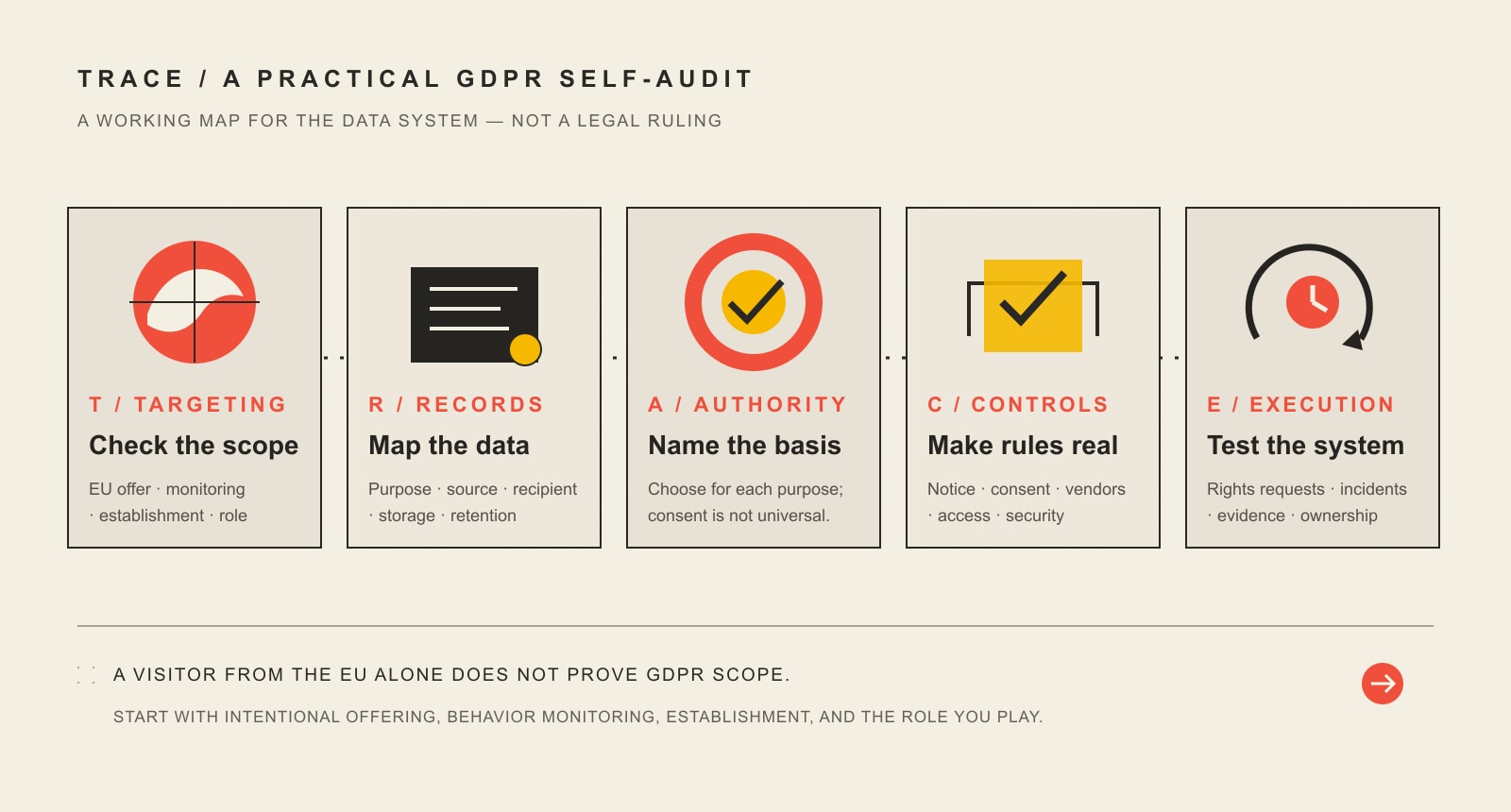
    Scope Design uses a five-part way to organize the implementation conversation: TRACE—Targeting, Records, Authority, Controls, Execution. TRACE is our operating framework, not language from the regulation. Its job is to stop a small business from buying one privacy plugin and pretending the rest of the data system disappeared.

    TRACE self-audit: check targeting, record the data system, identify the lawful basis, make controls real, and test execution.
    TRACE turns the GDPR conversation into five operational checks: Targeting, Records, Authority, Controls, and Execution.

    T — Targeting

    First, establish why GDPR may apply. Are you intentionally selling or marketing to people in the Union? Are you monitoring behavior there? Do you have an EU establishment? Are you acting as a processor for a client whose instructions bring the processing within GDPR? Write the reason down. If nobody can explain why the regulation applies, everything after this step is guesswork.

    R — Records

    Map the data system you actually have. Include contact forms, newsletter signups, ecommerce, analytics, advertising pixels, CRM, payment providers, scheduling tools, help desks, cloud storage, employee systems, backups, embedded video, chat widgets, security logs, and anything else that receives personal data. Record purpose, data type, source, recipient, storage location, retention, deletion method, and international transfers.

    A — Authority

    For each purpose, identify the lawful basis that actually supports the processing. Article 6 includes consent, contract, legal obligation, vital interests, public task, and legitimate interests. Consent is important in the right places, but it is not the universal answer for every data flow. If you rely on consent, the way you collect and withdraw it matters. If you rely on legitimate interests, that is not a magic phrase you paste into a privacy policy; the balancing and context matter.

    C — Controls

    Now make the rules real: privacy notices, cookie behavior, collection fields, retention, access controls, processor agreements, subprocessor visibility, transfer mechanisms, security, backups, and governance. This is where design and development decisions become compliance decisions. A beautiful privacy page cannot fix a Meta Pixel firing before consent, an old CRM export sitting in a shared folder, or five ex-employees who still have admin access.

    E — Execution

    Finally, prove that the system can function under pressure. Who receives a data-rights request? How is identity checked? Who searches the CRM, inboxes, help desk, backups, and vendor systems? Who assesses a breach? Who can contact counsel and the relevant supervisory authority? What evidence do you retain? When is the next vendor and tracker review? A policy that nobody can execute is just formatted optimism.

    What GDPR requirements should a US small business implement when it is in scope?

    1. Minimize the data you collect and document why you need it

    Article 5 includes principles such as purpose limitation, data minimization, accuracy, storage limitation, integrity/confidentiality, and accountability. For a small business, the operational version is simple: stop collecting data because a form template happened to include the field.

    For every collection point, ask: What business purpose does this field serve? What lawful basis supports that purpose? Who needs access? How long do we need it? Can we accomplish the same goal with less data? Removing unnecessary fields reduces privacy risk, breach impact, staff confusion, and future cleanup.

    2. Make the privacy notice match the real system

    Your privacy notice should explain the actual categories of data, purposes, legal bases where required, recipients, transfers, retention logic, rights, and relevant contact information. Do not copy a competitor’s policy and swap the company name. Their stack is not your stack.

    Start from the data map, then write the notice. That order sounds obvious because it is. Somehow, the internet managed to turn it into a downloadable-template industry.

    3. Treat cookies, analytics, and advertising tags as a separate implementation project

    Cookie compliance is commonly explained badly. The EDPB’s cookie guidance notes that GDPR applies when cookies involve personal-data processing, while the ePrivacy Directive supplies more specific rules about storing information or accessing information on a user’s device. Non-essential storage/access generally needs prior consent; technically necessary uses can fall within an exception.

    That means a consent banner should be connected to an inventory of what actually loads. Test analytics, ad pixels, embedded media, chat, session recording, personalization, and third-party scripts before and after each consent choice. The European Commission’s current privacy guidance also emphasizes that rejecting cookies should be as easy as accepting them and warns against manipulative consent interfaces. A dark-pattern banner is not improved because it has rounded corners.

    If email is part of the same funnel, GDPR is only one piece of the compliance picture. Our email marketing laws guide separates GDPR from CAN-SPAM, CASL, UK/EU rules, unsubscribe duties, and the evidence you should retain for your list.

    4. Build a data-subject-rights workflow before the first request arrives

    GDPR gives individuals rights that can include access, rectification, erasure, restriction, portability, objection, and protections around certain automated decisions, depending on the circumstances. Article 12 generally requires action without undue delay and within one month. For complex or numerous requests, that period can be extended by two further months, but the person must be told within the first month and given the reason.

    Create one intake path, one owner, a verification process, a system-search checklist, a decision/escalation step, and response records. Include vendors. If your CRM can delete a person but your email platform, support desk, form database, and cloud exports cannot, you do not yet have an executable process.

    5. Review vendors and Article 28 data-processing terms

    Most small businesses do not process data alone. Hosting providers, email platforms, analytics vendors, CRMs, payment processors, scheduling apps, support desks, cloud storage, and marketing tools may all touch personal data. Article 28 requires a controller to use processors providing sufficient guarantees and to govern processing through a contract or other binding legal act with required terms.

    Maintain a vendor list with purpose, data, role, subprocessor information, security commitments, retention/deletion terms, breach obligations, and transfer mechanism. “We use a famous SaaS company” is not a vendor-risk assessment.

    6. Check international transfers instead of assuming every US vendor is covered

    Moving EU personal data to a recipient in the United States can trigger GDPR Chapter V transfer rules. The European Commission’s current adequacy page lists the United States for commercial organizations participating in the EU-US Data Privacy Framework. That does not mean every US organization or vendor is automatically covered.

    For each relevant transfer, verify the receiving organization and the mechanism being relied on. Depending on the relationship and facts, another recognized safeguard—such as standard contractual clauses—may be part of the analysis. This is one of the places where legal review earns its keep, especially when multiple vendors, subprocessors, sensitive data, or non-adequate destinations are involved.

    7. Make security proportional to the risk—and make response readiness part of security

    Article 32 calls for technical and organizational measures appropriate to the risk. It does not say “install one security plugin and relax.” Access control, supported software, multifactor authentication, encryption where appropriate, logging, monitoring, backups, recovery, vendor security, staff procedures, and evidence all matter in context.

    For the website side, our website security guide uses the LOCKED framework to turn security into owned operations rather than a pile of tools. Credential hygiene is part of that system too; a business password manager can help eliminate shared passwords and unmanaged access, which is why we maintain a separate business password-management guide.

    Breach response also needs nuance. Under Article 33, a controller generally notifies the competent supervisory authority without undue delay and, where feasible, within 72 hours after becoming aware of a personal-data breach unless the breach is unlikely to result in a risk to individuals’ rights and freedoms. Article 34 separately addresses communication to affected people when high risk is likely, subject to specified exceptions. So the real requirement is fast assessment and escalation—not the simplistic slogan “every incident must be reported in 72 hours.”

    8. Do not assume small size removes records, representative, or governance questions

    Three recurring myths deserve their own correction.

    • “We’re under 250 employees, so Article 30 records do not apply.” Not necessarily. Article 30(5) has a narrow carve-out, but it does not remove recordkeeping when processing is not occasional, is likely to risk people’s rights and freedoms, or includes specified special-category or criminal-conviction data.
    • “Every US company under GDPR needs a DPO.” No. Article 37 requires a data protection officer in defined situations, including certain large-scale monitoring or large-scale special-category/criminal-data processing. The criteria matter.
    • “We’re small, so we cannot need an EU representative.” Article 27 is more specific. A non-EU controller or processor subject to Article 3(2) generally must designate a representative in the Union unless a limited exception applies, including requirements around occasional and low-risk processing. See Article 27 and get counsel involved if this question is live for your business.

    A 30-day GDPR implementation plan for a small US business

    If GDPR likely applies, do not try to “finish GDPR” in an afternoon. Use a short implementation cycle that produces evidence and leaves an operating rhythm behind.

    Week 1: prove scope and map the data

    • Document the Article 3 reason the business may be in scope.
    • List every public collection point and major internal system.
    • Inventory trackers, embedded tools, CRM, email, payment, support, storage, HR, and backups.
    • Record vendors, purposes, data categories, recipients, locations, retention, and transfers.
    • Flag sensitive data, children, profiling, large-scale monitoring, or other higher-risk activity for legal review.

    Week 2: match authority, notice, and consent to reality

    • Map each processing purpose to its proposed lawful basis.
    • Update privacy notices from the data map, not from a template.
    • Test cookie/tracker behavior before consent, after accept, after reject, and after preference changes.
    • Fix forms so they collect only what is necessary and use accurate permission language.
    • Review email and marketing consent separately from general website data collection.

    Week 3: fix vendor, transfer, access, and retention controls

    • Collect and review processor agreements for relevant vendors.
    • Verify subprocessor and transfer information.
    • Check Data Privacy Framework participation or other transfer mechanisms where relevant.
    • Remove stale accounts, reduce unnecessary admin access, enable stronger authentication, and document ownership.
    • Set realistic retention and deletion rules instead of keeping data forever because storage is cheap.

    Week 4: test rights and incident response

    • Run a mock access or deletion request across your real systems.
    • Time how long it takes to locate the data and identify gaps.
    • Run a tabletop breach scenario: who is called, what gets preserved, who assesses risk, and who can contact counsel or a regulator?
    • Document the process and evidence.
    • Schedule recurring tracker, vendor, access, retention, and privacy-notice reviews.

    This is the same systems-first thinking we use in broader small-business marketing strategy: channels and tools only work when the underlying audience, conversion, follow-up, capacity, measurement, and ownership system is coherent. Privacy compliance belongs inside that system, not bolted to the footer after launch.

    What are the GDPR penalties for a US small business?

    The maximum numbers are real, but they should not be used as clickbait. Article 83 sets case-specific factors for administrative fines and different maximum tiers. Specified infringements can carry maximums of €10 million or 2% of total worldwide annual turnover, while specified higher-tier infringements can reach €20 million or 4%, with the regulation applying the relevant “whichever is higher” structure for undertakings.

    That does not mean a small business automatically receives a maximum fine for a first mistake. Regulators consider factors such as nature, gravity, duration, intent or negligence, mitigation, responsibility, prior infringements, cooperation, data categories, and how the issue became known. The better business lesson is not “panic about €20 million.” It is “build a system that can show what you knew, what you controlled, what you fixed, and how you responded.”

    Frequently asked questions about GDPR and US small businesses

    Does GDPR apply to US companies?

    It can. A US company may fall within GDPR because of an EU establishment or, for certain non-EU processing, because it intentionally offers goods or services to people in the Union or monitors their behavior there. The company’s US location does not automatically put it outside GDPR.

    Does GDPR apply just because someone in Europe visits my website?

    No—not by that fact alone. EDPB territorial-scope guidance says mere website accessibility in the Union is not enough to demonstrate an intention to offer goods or services there. Look for intentional targeting or relevant behavior monitoring instead.

    Can Google Analytics or advertising pixels make GDPR apply to a US business?

    Potentially, depending on what the processing is doing and where the people are. Article 3(2) includes monitoring behavior in the Union, and EDPB guidance discusses internet tracking and profiling used to analyze or predict behavior. Do not decide based only on the tool’s brand name; inspect purpose, configuration, audience, identifiers, and downstream use.

    Do businesses with fewer than 250 employees need GDPR records?

    They may. Article 30’s under-250 provision is not a blanket exemption. Records can still be required when processing is not occasional, is likely to risk rights and freedoms, or includes specified special-category or criminal-conviction data.

    Does every US business subject to GDPR need a DPO?

    No. Article 37 defines specific circumstances in which a DPO is mandatory. Many small private businesses will not meet those tests, but the decision should be based on the statutory criteria rather than company size alone.

    Does a US business need an EU representative?

    A non-EU controller or processor subject to Article 3(2) generally faces the Article 27 representative requirement unless a limited exception applies. Because the exception is fact-specific, this is a sensible legal-review checkpoint when a US company intentionally serves or monitors people in the EU.

    Do all cookies require GDPR consent?

    No single sentence like that is accurate. GDPR governs personal-data processing, while ePrivacy has more specific storage/access rules. Non-essential cookies and similar technologies generally require prior consent under those rules, while technically necessary uses can be exempt. Inventory the technology and classify purpose before configuring the banner.

    Does every data breach have to be reported within 72 hours?

    No. Article 33 says supervisory-authority notification is required without undue delay and, where feasible, within 72 hours unless the breach is unlikely to result in a risk to rights and freedoms. Notification to affected individuals has its own high-risk test under Article 34. Get legal and incident-response help quickly because the clock and the risk assessment can matter.

    Does the EU-US Data Privacy Framework make every transfer to the United States compliant?

    No. The European Commission’s adequacy finding applies to participating US commercial organizations. Verify participation or another valid transfer mechanism for the receiving organization and relevant processing.

    Is UK GDPR the same thing as EU GDPR for a US company?

    No. They are closely related frameworks, but the UK operates its own post-Brexit data-protection regime and regulator. If your business targets or monitors people in the UK, perform the UK analysis separately instead of assuming an EU conclusion automatically answers it.

    What to do next

    If your US business may fall within GDPR, start with TRACE: document the targeting or monitoring reason, map the data, identify the authority for each purpose, fix the controls, and test execution. That will give your lawyer, developer, marketing team, and vendors something concrete to work from instead of a vague instruction to “make the website GDPR compliant.”

    Scope Design can help with the implementation layer—data-flow and tracker inventory, consent behavior, forms, marketing integrations, privacy-aware UX, access/security controls, and the technical cleanup that turns decisions into a working website. For legal conclusions, use qualified privacy counsel. The useful outcome is not a compliance badge. It is a system you understand, can explain, and can operate when a real request or incident lands on your desk.

  • Raise Your Prices: The Strategic Guide to Business Pricing That Actually Works

    Raise Your Prices: The Strategic Guide to Business Pricing That Actually Works

    How to raise prices: start with the economics, not a percentage. A price increase is justified when the current price no longer funds reliable delivery, required margin, or sensible use of limited capacity—and when you can explain what is changing without pretending a higher number creates value by itself. Calculate the gap, choose who the change applies to, give appropriate notice, implement it deliberately, and measure what happens.

    The goal is not to raise prices with zero customer reaction. That promise is unrealistic. The goal is to avoid preventable surprise, keep the right customers, protect the quality of what you deliver, and learn whether the new price improves the business after customer behavior is included.

    When should you raise prices?

    Raise prices when evidence says the old price is no longer a good business decision. One weak month is not enough. One competitor charging more is not enough. A useful trigger is a mismatch between the economics or capacity of the offer and the price you are asking customers to pay.

    • Your delivery economics changed. Labor, materials, software, subcontractors, support, financing, or overhead increased enough that the old price no longer supports the required contribution.
    • Demand is consistently outrunning capacity. If the team is booked beyond a healthy level and additional volume would reduce quality or extend lead times, price can become one way to allocate scarce capacity.
    • The offer now creates or includes materially more value. Scope, expertise, turnaround, risk reduction, support, warranty, access, or outcomes improved and the price never caught up.
    • Your customer mix changed. The accounts you are attracting require more service, customization, coordination, or risk than the old price assumed.
    • You cannot fund the promise customers already bought. If the price leaves no room for training, quality control, maintenance, reasonable response time, or the operating cushion needed to deliver reliably, keeping the price low can become a customer-experience problem.

    If you are still trying to establish a defensible baseline price rather than raise an existing one, use our PRICE Test for product and service pricing. This guide owns the next decision: what to do when an existing price needs to move.

    Run the math before you choose a percentage

    The most defensible price increase starts with the gap you need to solve. The U.S. Small Business Administration defines break-even as the point where total revenue and total cost are equal, and gives the unit formula as fixed costs divided by price minus variable cost. That is a useful floor calculation, not a complete pricing strategy: a business also needs room for profit, reinvestment, uncertainty, and the actual capacity required to deliver.

    For a service business, a practical version is: add the monthly costs the work must carry, add the operating profit the business needs, then divide by the number of units, projects, retainers, appointments, or genuinely sellable hours available. Do not divide by every hour on the calendar. Selling, admin, training, support, rework, and management consume capacity too.

    Simple example: suppose an offer needs to produce $11,000 per month to cover its share of delivery, overhead, and the operating profit you have deliberately assigned to it. At 20 comparable customer accounts, the required average revenue is $550 per account. If the current average is $500, the gap is $50—not “whatever 10% sounds like” but a number tied to an explicit requirement. If the new price changes retention, service load, or mix, recalculate with the new evidence.

    Competitor prices still matter, but as context. A competitor may have different labor costs, scope, automation, risk, brand strength, purchasing power, or strategic goals. Their number does not know your economics.

    Use the Scope Design RAISE price-increase sequence

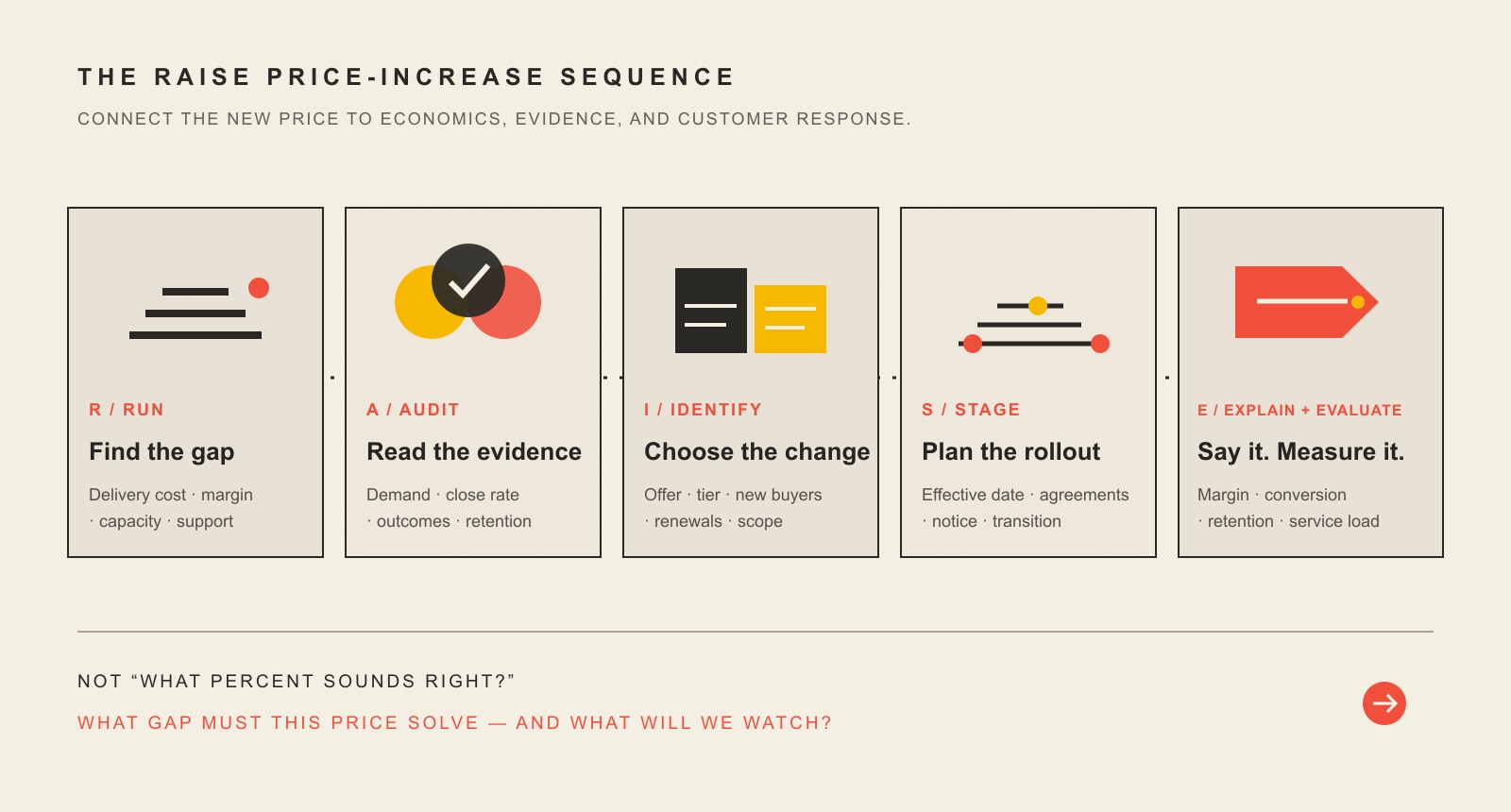
    RAISE is a five-step sequence for turning “we should probably charge more” into a measurable business decision: Run the economics, Audit the evidence, Identify what changes, Stage the increase, then Explain and evaluate.

    The RAISE sequence: run the economics, audit evidence, identify what changes, stage the increase, and explain and evaluate customer and business outcomes.
    The RAISE sequence keeps a price increase connected to economics, evidence, rollout, communication, and measurement.

    R — Run the economics

    Define the business problem the new price must solve. Is the offer below its required margin? Is capacity full? Are delivery costs rising faster than revenue? Does the existing price prevent the staffing or support level customers expect? Write the current economics and the required economics side by side.

    A — Audit the evidence

    Look for repeated evidence rather than one loud opinion. Review demand, close rate, discount requests, customer outcomes, support burden, utilization, repeat purchases or retention where relevant, and credible alternatives in the market. Customer interviews and sales conversations can explain the numbers, especially when buyers value something different from what the team assumes.

    Price is not the same thing as perceived value. A higher price can raise the sacrifice in the buying decision just as easily as it raises expectations. Our guide to building perceived value without faking it goes deeper on evidence, risk, clarity, and experience.

    I — Identify what changes

    Decide whether the new price applies to every offer, one product line, one service tier, new customers, renewals, or a specific customer cohort. Sometimes the cleanest change is not “everything goes up 12%.” It is retiring an underpriced package, removing work that should not be bundled, introducing a higher minimum, or separating optional services that were quietly being given away.

    S — Stage the increase

    Choose an effective date and rollout that match the business. New customers can often receive the new price immediately. Existing customers may need notice, renewal timing, contract review, personal outreach, or a temporary transition. The right notice period depends on the relationship, billing cycle, agreement, and operational risk; there is no universal number that fits every business.

    Citizens Bank’s guide to raising prices follows the same practical sequence: understand margin, research the market, choose timing carefully, and give current customers advance notice with a clear explanation of what is changing and when.

    E — Explain and evaluate

    Tell customers what they actually need to know: the effective date, the new price or pricing method, what remains included, and any action required. Give a concise reason when it is useful and true. Then measure the outcome. The increase is not validated because the email was sent successfully; it is validated by what happens to margin, conversion, retention, service load, and customer fit.

    How much should you raise your prices?

    Raise the price enough to solve a defined economic or capacity problem, then test the assumptions that make the number work. An arbitrary 3%, 5%, 10%, or 20% increase can be accidentally right, but the percentage itself is not evidence.

    • Find the required floor. What price supports delivery, overhead, and the operating profit or contribution the offer needs?
    • Check the market corridor. What alternatives will a reasonable customer compare, and how different is your scope?
    • Model behavior. What happens if volume or retention changes after the increase?
    • Check capacity. If fewer customers at a higher price would improve delivery and total contribution, lower volume may be a feature rather than a failure.
    • Choose a review rule. Decide before rollout what evidence would make you hold, expand, adjust, or reverse the change.

    This is a business bet inside the broader Scope Design Business Strategy and Market Intelligence framework: make the outcome, assumptions, evidence, tradeoffs, resources, and review rule visible before you commit harder.

    How to raise prices without losing customers unnecessarily

    You cannot guarantee that nobody will leave after a price increase, and you should not design the rollout around that impossible goal. You can reduce preventable loss by avoiding surprise, applying the change consistently, explaining the decision clearly, and making sure the offer still earns the new price.

    A good price-increase message is short and specific

    For an existing customer relationship, the message usually needs five things:

    1. the date the new price takes effect;
    2. the new price, range, or pricing method;
    3. what is included and whether scope is changing;
    4. a concise, truthful reason when context helps; and
    5. a real person or process for questions.

    Example: “Beginning November 1, our monthly service will be $650. The scope and response process remain the same. This change lets us maintain the staffing and support level required for the work. Your October invoice is unchanged. If you want to review your plan before the new rate takes effect, reply here and we’ll walk through the options.”

    Do not bury the number under a page of apology. Do not invent a dramatic justification. Do not call the change an “upgrade” when nothing improved. If the new price includes a real scope or service change, explain it. If the reason is simply that the old price no longer supports the work, say that professionally.

    If the harder problem is how the price is displayed, compared, anchored, or explained on a website, that belongs to our separate guide to pricing psychology for clearer online decisions. Communication should make a true decision easier, not disguise the cost.

    Should you raise prices for new customers first?

    Starting with new customers is often a useful way to separate market acceptance from relationship-management risk. New prospects have no legacy price to compare. You can see whether qualified buyers still convert before moving a larger installed base.

    That does not mean existing customers should keep the old price forever. Permanent grandfathering can create a second price system that becomes harder to support every year. If you grandfather customers, define why, who qualifies, and when the exception will be reviewed or end. Honor contractual commitments and any notice requirements that apply to the relationship.

    For high-value or high-complexity accounts, personal outreach before a general notice can be worth the time. The purpose is not to negotiate against yourself. It is to surface scope, contract, and operational issues before the invoice becomes the first conversation.

    What should you measure after a price increase?

    Measure the consequence the increase was supposed to improve, plus the customer behaviors that could erase the gain. Revenue alone is not enough.

    MeasureWhat it tells you
    Contribution or gross profit per sale/accountWhether the economics improved after delivery cost is included.
    Qualified close or conversion rateWhether right-fit buyers still accept the offer.
    Retention, churn, cancellations, or repeat purchaseWhether existing-customer behavior changed where those measures apply.
    Revenue per project, account, or unit of capacityWhether scarce capacity is producing more useful value.
    Delivery time and support burdenWhether the new economics actually improve operations or just raise the invoice.
    Discount requests and objection reasonsWhether the problem is price, value clarity, scope, fit, or sales execution.

    Compare cohorts when possible. New customers quoted the new rate are different from long-term customers receiving an increase. Mixing them together can hide the reason results changed.

    Six price-increase mistakes to avoid

    1. Choosing a tidy percentage before finding the problem. “Let’s raise everything 10%” is a guess until the economics show why 10% matters.
    2. Using competitors as a calculator. Their price can identify a market boundary, but not your required margin or delivery model.
    3. Assuming a higher price automatically creates higher perceived value. A higher sacrifice with weak evidence can make the offer look worse. Fix the offer or proof problem instead.
    4. Apologizing until the decision sounds suspicious. Customers need clarity more than a nervous essay.
    5. Discounting immediately after the first objection. One objection is information, not a referendum. Record patterns before you dismantle the increase.
    6. Grandfathering forever without a reason. Exceptions accumulate operational debt. Give them an owner and a review date.

    Price is also only one part of customer value. If the increase is exposing a deeper experience problem, revisit what customers receive and where friction lives. Our guide to building value by investing in customers covers that side of the relationship.

    What auditing this exact article changed

    We did not preserve the old version just because it already existed. For the 12 complete months from August 21, 2025 through August 20, 2026, the active Scope Design GA4 property recorded one landing session for this URL, with zero engaged sessions and zero configured key events. Google Search Console returned no reportable exact-page query rows. Bing recognized the URL but reported zero clicks and zero impressions in the fresh URL check. Ubersuggest returned no exact-page backlinks.

    That tiny sample does not prove the topic is worthless, that readers disliked the old article, or that this revision will rank. Scope Design’s analytics attribution and key-event configuration also have limitations. It supports a narrower editorial decision: preserve the established URL, remove unsupported statistics and trend claims, give the page one clear job, and make its advice more useful than the legacy copy.

    The previous version leaned on old business-failure percentages, broad pricing-trend claims, sustainability-premium numbers, and the idea that a higher price can function as an automatic quality signal. Those claims are gone. The replacement uses a business-specific economics check, a reusable rollout sequence, current query evidence, direct source support, and explicit limits.

    Frequently asked questions about raising prices

    When should a business raise prices?

    Raise prices when the old price no longer supports the economics, capacity, scope, or reliable delivery of the offer and the change can be tied to evidence rather than fear or imitation. Review the price when meaningful inputs change instead of waiting for a crisis.

    How much should I raise my prices?

    Start with the required economic gap, then model customer behavior and market alternatives. There is no universal “safe” percentage. A smaller increase that leaves the business underfunded is not automatically safer, and a larger increase that changes customer fit must be evaluated with real response data.

    How do I raise prices without losing customers?

    You cannot guarantee zero customer loss. Reduce preventable loss by avoiding surprise, honoring agreements, giving appropriate notice, stating the new price clearly, keeping the reason truthful and concise, and making sure the offer still earns the price. Judge success by total business consequences, not by whether every customer stays.

    Should existing customers be grandfathered at the old price?

    Sometimes, temporarily. Grandfathering can protect a contractual or relationship transition, but indefinite exceptions create operational complexity and can leave the original economics unsolved. Define eligibility, duration, and a review date.

    How often should a business review prices?

    There is no universal cadence, but prices should be reviewed whenever costs, scope, demand, capacity, customer mix, or market alternatives change materially. A regular scheduled review is useful because it prevents years of drift followed by one painful emergency increase.

    Make the price a business decision

    A price increase should solve something real. Run the economics, audit the evidence, identify what changes, stage the rollout, explain it clearly, and evaluate what happened. If the increase improves the business while preserving the customers and delivery model you actually want, you have learned something useful. If it exposes a positioning, offer, capacity, or customer-fit problem, that is useful evidence too.

    If pricing pressure is only one symptom of a broader constraint, start with Scope Design’s Business Strategy and Market Intelligence guide. It is built for the larger question: what decision deserves resources next, what must be true, and what evidence should change your mind.

    Sources and methodology

    • U.S. Small Business Administration: used for the break-even definition and formula.
    • Citizens Bank, Mastering the delicate art of raising prices: used as independent corroboration for margin review, market research, timing, and advance customer notice.
    • Scope Design’s own GA4, Google Search Console, Bing Webmaster Tools, Ubersuggest, and DataForSEO observations: used to audit this exact article’s existing footprint and current search-question shape before revision.
    • Scope Design Content Studio and internal knowledge graph: used to keep this page distinct from the separate owners for baseline pricing, perceived value, pricing psychology, customer value, and broader business strategy.
  • Business Partnership Guide: How to Choose the Right Partner and Structure Your Agreement

    Business Partnership Guide: How to Choose the Right Partner and Structure Your Agreement

    Choosing a business partner is not a chemistry test followed by a contract. It is one high-stakes decision with two parts: who should share ownership with you, and what rules will govern the relationship when workload, cash, risk, or opinions diverge?

    The practical answer is to define why you need a partner, test the candidate on real work before making equity permanent when that is feasible, separate ownership from compensation and control, agree on decision and exit rules, and then have qualified legal and tax professionals convert those decisions into the right governing documents. A business partnership agreement is strongest when it records decisions you have already made deliberately instead of papering over decisions you avoided.

    This guide is general U.S. business information, not individualized legal or tax advice. Entity rules, taxes, fiduciary duties, transfer restrictions, employment rights, and enforceability can vary by state and structure. Use the checklist to prepare better questions, then have a qualified attorney and tax professional review your actual arrangement.

    Before You Choose a Partner, Decide Whether You Need One

    A partner should solve a business constraint that is important enough to justify permanent ownership. Start there. If you cannot name the constraint, you are not ready to negotiate a percentage.

    This is a strategy decision before it is a legal-document decision. Scope Design’s Business Strategy and Market Intelligence framework treats a partnership like any other consequential bet: define the outcome, expose the assumptions, get ground truth, test what can be tested, and only then commit more resources.

    Ask what you actually need:

    • More execution capacity? A hire or contractor may solve it without giving away ownership.
    • A specialized skill? An employee, consultant, advisor, agency, or licensing arrangement may be narrower and easier to unwind.
    • Capital? Debt or an investor may solve a financing problem without turning the funder into an operating partner.
    • Distribution or market access? A reseller, affiliate, channel partnership, joint venture, or project agreement may test the relationship first.
    • An opportunity neither of you has proven? Validate the business before you divide it. Our guide to validating a business idea helps separate enthusiasm from evidence.

    If the uncertainty is customer demand, pricing, competitor behavior, or market size, do the research before you use equity to compensate for uncertainty. Our small-business market research guide is a better next step than inventing a partnership structure around an assumption.

    The point is not that partners are bad. The point is that permanent equity is an expensive answer to a temporary problem. Make sure the problem actually requires a partner.

    Use the Scope Design Partner Fit-to-Terms Map

    Most advice about choosing a business partner ends with qualities such as trust, complementary skills, and communication. Those qualities matter, but they are still too vague to govern a company. The useful question is: what did you observe, and what should that observation change in the agreement?

    The Partner Fit-to-Terms Map turns six things you can observe into six sets of governance questions.

    What to testWhat useful evidence looks likeWhat it should change in the agreement
    Shared outcomeYou agree on what the business is trying to become, what it will not do, and what “success” means.Purpose, scope, non-negotiables, reserved decisions, sale/growth expectations.
    Contribution and capacityThe candidate reliably delivers the work, time, relationships, expertise, or capital they said they would contribute—and the capabilities are genuinely complementary.Roles, time commitments, responsibilities, milestones, contribution obligations.
    Judgment under pressureThey can explain tradeoffs, use evidence, admit uncertainty, and make decisions without hiding risk.Functional authority, spending limits, approval thresholds, escalation rules.
    Conflict behaviorThey can challenge an idea without attacking the person, listen, change their mind, and close a disagreement.Voting, deadlock, mediation/dispute process, decision owner by domain.
    Money behaviorFinancial assumptions are transparent; expenses are documented; risk tolerance and reinvestment expectations are discussed openly.Capital contributions, compensation, distributions, financial controls, reporting.
    Exit expectationsYou can discuss departure, underperformance, disability, death, sale, or a failed relationship without pretending those events are impossible.Transfer restrictions, buy-sell triggers, valuation process, payment mechanics, dissolution.

    This is the central idea of the guide: do not collect compatibility signals and then forget them when the agreement is drafted. The trial is supposed to produce governance evidence.

    Run a Real-Work Trial Before You Split Equity

    If the situation allows it, work together before you become permanent co-owners. A coffee meeting reveals chemistry. A real project reveals operating behavior.

    The trial does not need to be elaborate. It needs enough consequence to create real decisions. Define one useful business outcome, give each person clear ownership, put a deadline on it, include a real customer, budget, vendor, deliverable, or operational constraint when appropriate, and write down the assumptions before you start.

    1. Define the result. What must be true at the end of the trial for the work to count as successful?
    2. Define each person’s contribution. Who owns which deliverables, decisions, relationships, costs, and deadlines?
    3. Create a decision log. When something changes, record who decided, what evidence they used, and what tradeoff they accepted.
    4. Let normal friction happen. Do not manufacture a fight, but do not protect the trial from ambiguity, feedback, missed assumptions, or changing information.
    5. Review behavior, not charisma. Did each person deliver? Surface bad news? Document money? Respect boundaries? Ask for help? Change course when evidence changed?
    6. Convert observations into terms. If one partner is clearly stronger in a domain, does that person need functional authority there? If you repeatedly stall on major decisions, what deadlock process is needed? If time commitments differed from assumptions, should ownership, compensation, or vesting be reconsidered with counsel?

    A partnership is hard to reverse compared with a project. That means it deserves more process than a low-cost experiment. Use the SCOPE business decision-making framework to match the rigor to the stakes, reversibility, options, proof, and execution of the decision.

    How Much Equity Should Each Business Partner Get?

    There is no universal “fair” percentage. The common mistake is trying to make one number answer five different questions.

    LeverThe question it actually answers
    Ownership / equityWho owns what economic interest in the business?
    CompensationHow is each person paid for the work they perform?
    Profit, loss, and distributionsHow are economic results allocated, and when does cash leave the business?
    Capital contributionsWho is putting in cash, property, intellectual property, or other agreed resources now or later?
    Voting and decision controlWho can decide which matters, and what approval is required for high-stakes decisions?

    Those levers may interact, but they are not interchangeable. A partner can contribute more cash without automatically needing more day-to-day authority. Two partners can own equal percentages while receiving different compensation for different workloads if the structure and applicable law allow it. Profit allocations, distributions, and tax consequences need professional review rather than a rule copied from a blog post.

    For U.S. federal income-tax purposes, the IRS explains that partnerships generally file an annual information return and pass profits or losses through to the partners, who report their distributive shares. Form 1065 is the federal information return used to report partnership income, gains, losses, deductions, credits, and related information. That is one reason your economic deal should be reviewed by a qualified tax professional before you finalize it.

    Is a 50/50 partnership a good idea?

    It can be. Equal ownership may fit a relationship where the partners intentionally want equal economics and equal long-term stakes. But 50/50 ownership does not answer what happens when the owners disagree.

    If two people must agree on every material decision, one unresolved disagreement can stop the company. A 50/50 structure therefore needs a deliberate deadlock process: which decisions belong to each functional owner, which require joint approval, what happens after an impasse, and when a buyout or other exit mechanism can be triggered.

    Does a 51/49 split solve the problem?

    Not by itself. A 51% owner may control matters that are decided by a simple majority under the applicable documents and law, but that does not automatically answer who can terminate someone’s employment, remove a manager, force a buyout, dissolve the business, transfer ownership, or decide reserved matters. Those are different rights.

    Do not use 51/49 as a shortcut around governance. Decide the rights first, then have counsel build the structure that actually expresses them.

    What Should a Business Partnership Agreement Cover?

    The exact document depends on the entity and state. An LLC may use an operating agreement; a partnership may use a partnership agreement; other entities have different governing documents. The U.S. Small Business Administration notes that business structure affects taxes, paperwork, fundraising, and personal liability and explains that internal agreements define how decisions are made and what duties, powers, and responsibilities the owners have.

    Use the following as an issues list for your attorney and tax professional, not as a universal fill-in contract.

    1. Purpose and scope. What business are you actually operating together? What is outside the partnership’s scope?
    2. Entity, jurisdiction, and governing documents. What structure are you using, where is it formed, and which documents control?
    3. Initial contributions. What cash, property, intellectual property, relationships, equipment, guarantees, or services is each person expected to contribute, and how are non-cash contributions valued?
    4. Future funding. Can the business require additional capital? What happens if one partner can or will contribute and another cannot?
    5. Ownership. What percentage or interest does each person own, and are there conditions that can change it?
    6. Compensation and economics. How will partners be compensated for work? How will profits, losses, reserves, and cash distributions be handled, subject to tax and entity rules?
    7. Roles and time commitments. Who owns sales, delivery, finance, operations, people, product, marketing, technology, or other functions? Is any minimum involvement expected?
    8. Authority and spending limits. What can each partner sign, spend, borrow, hire, discount, purchase, or commit without additional approval?
    9. Voting and reserved matters. Which decisions are routine, which need a majority, and which require a higher threshold or unanimous approval?
    10. Deadlock. What happens when the required approval cannot be reached? Escalation, mediation, a tie-break process, buy-sell rights, or another mechanism may be appropriate depending on the structure.
    11. Banking, books, records, and reporting. Who has account access? What records must be maintained? What financial information does each owner receive and how often?
    12. Intellectual property, confidentiality, and conflicts. Who owns work created for the company? How are confidential information, outside opportunities, related-party transactions, and conflicts of interest handled?
    13. New owners and transfers. Can an interest be sold, gifted, pledged, or transferred? Do existing owners have approval or purchase rights?
    14. Departure, death, disability, or incapacity. What events trigger a purchase, transfer, continuation, or change in management?
    15. Buy-sell and valuation process. How will a departing interest be valued? Who performs the valuation? What date and method apply? How is the purchase funded and paid?
    16. Removal and cause. What behavior can remove someone from a management or employment role, and what happens to their ownership afterward? These are not necessarily the same event.
    17. Disputes and dissolution. What process applies to disputes, and what happens if the owners decide or are required to wind down the business?

    That list is intentionally broader than “who owns 50%.” A useful agreement is an operating system for decisions, money, information, change, and exit.

    Build Decision Rights Before You Need Them

    Two capable partners can still make a miserable company if nobody knows who gets to decide. “We decide everything together” sounds collaborative until every vendor choice, hire, refund, price exception, or software purchase becomes a board meeting.

    Separate functional authority from reserved matters. The exact thresholds belong in your agreement; the management design should be clear before the drafting starts.

    Decision typeTypical design question
    Routine decisions inside an approved planWhich partner owns this function and can decide without another vote?
    Unbudgeted spending or contractsWhat dollar, duration, or risk threshold requires additional approval?
    Hiring, firing, and compensationWhich roles can a functional owner manage, and which key positions are reserved matters?
    Debt, equity, guarantees, major leases, or acquisitionsWhat approval level is required before the company takes on material new obligations?
    Changing owner compensation or distributionsCan a partner vote on a decision that directly benefits that partner, and what conflict rules apply?
    Admitting a new owner or transferring an interestWho must approve, and what purchase or refusal rights exist?
    Selling substantially all of the business or dissolving itWhat approval threshold and process applies to an irreversible decision?

    The goal is not to build a constitutional convention around a two-person company. It is to keep routine work fast while slowing down the decisions that can permanently change risk, control, or ownership.

    Plan the Exit While You Still Like Each Other

    Exit planning is not pessimism. It is what lets two people discuss a hard future event while neither is currently trying to win it.

    Your lawyer may recommend different mechanisms depending on the entity, state, number of owners, financing, family considerations, taxes, and the business itself. Your job before that meeting is to decide the commercial questions:

    • Can an owner leave voluntarily, and how much notice is required?
    • Can ownership be transferred to a spouse, trust, employee, competitor, outside buyer, or family member?
    • Do the company or remaining owners get the first opportunity to buy?
    • What events create a mandatory or optional buyout?
    • How is value determined: a formula, independent appraisal, agreed process, or another method?
    • What happens if the company cannot pay the purchase price all at once?
    • How are death, disability, incapacity, bankruptcy, misconduct, loss of a required license, or a prolonged failure to participate handled?
    • What happens to customer relationships, intellectual property, confidential information, and unfinished obligations after someone leaves?

    Do not casually copy noncompete, nonsolicitation, forfeiture, or forced-sale language from another company’s agreement. Enforceability and consequences can vary materially. Those are lawyer questions, not template trivia.

    Business Partner Red Flags That Should Pause the Deal

    A red flag is not a diagnosis of someone’s character. It is a reason to slow the decision down and get better evidence.

    • They want equity before responsibilities are defined. Ownership is being negotiated before the job exists.
    • They resist a written agreement because “we trust each other.” Trust is not a substitute for shared memory when money, authority, or circumstances change.
    • Their contribution is impossible to measure. “Connections,” “ideas,” and “strategy” can be valuable, but vague promises are difficult to govern.
    • They hide bad news. A partner who protects the appearance of competence instead of surfacing risk will make every problem more expensive.
    • Conflict becomes personal. If disagreement is treated as disloyalty during a trial, ownership will not improve it.
    • Money conversations stay fuzzy. Undocumented expenses, unclear debt, unexplained commitments, or avoidance around financial controls deserve investigation.
    • Time commitments are assumed, not stated. One person may imagine two full-time operators while the other imagines a strategic side role.
    • One percentage is supposed to solve everything. “You get 51, I get 49” is not a plan for compensation, decision rights, employment, buyouts, or exit.
    • Nobody can describe a clean exit. If the relationship only works while both people want the same future forever, the structure is fragile.

    Business Partner Checklist Before You Sign

    Before permanent equity or a final governing agreement, you should be able to answer the following without hand-waving:

    • What exact constraint requires a partner rather than a narrower alternative?
    • What evidence do we have from working together on something real?
    • What does each person contribute now, and what must each continue contributing?
    • What is the ownership split, and why?
    • How is work compensated separately from ownership?
    • How are profits, losses, reserves, and cash distributions handled?
    • Who can commit the company to spending, contracts, debt, hiring, pricing, or other obligations?
    • Which decisions belong to a functional owner, and which are reserved matters?
    • What happens if the required owners disagree?
    • Who controls bank accounts, books, records, passwords, customer data, and financial reporting?
    • Who owns intellectual property created before and during the partnership?
    • How are conflicts of interest and outside opportunities handled?
    • Can a new owner be admitted or an interest transferred without consent?
    • What triggers a buyout, and how will value and payment be determined?
    • What happens after death, disability, incapacity, misconduct, or prolonged nonperformance?
    • Which qualified attorney and tax professional have reviewed the actual entity, state, economics, and documents?

    If you cannot answer several of those questions, the next step is not to download a more aggressive template. The next step is to finish the decisions.

    Frequently Asked Questions About Business Partnerships

    What makes a good business partner?

    A good partner shares the core outcome and operating principles, contributes something the business genuinely needs, follows through under real constraints, communicates bad news early, can disagree without making the conflict personal, handles money transparently, and is willing to put roles, authority, economics, and exit terms in writing. Complementary skills are useful, but observed operating behavior matters more than a personality checklist.

    Is a 50/50 business partnership a bad idea?

    No. A 50/50 split can be appropriate when equal long-term ownership is intentional. The weakness is not the number itself; it is leaving deadlock unresolved. Equal owners still need clear functional authority, reserved matters, voting thresholds, and a process for an impasse.

    Can I draft my own business partnership agreement?

    You can prepare an issues list or working draft, and doing so can make a professional review more efficient. But entity type, state law, tax treatment, fiduciary duties, transfer restrictions, buyouts, restrictive covenants, and enforceability can vary. A qualified attorney and tax professional should review the actual arrangement rather than assuming a generic template is sufficient.

    What percentage should I give my business partner?

    There is no universal percentage. Start by separating ownership from compensation, profit/loss and distributions, capital contributions, and voting control. Then evaluate what each partner contributes, the risks each is taking, time commitment, existing business value, future obligations, and the governance both parties actually want. Have counsel and a tax professional review the resulting structure.

    Can a 51% owner fire a 49% owner?

    Not automatically. A majority ownership stake can affect matters decided by a simple majority, but employment termination, management removal, ownership cancellation, forced buyout, dissolution, and reserved matters are separate legal and contractual questions. The answer depends on the entity, governing documents, employment arrangements, and applicable law. Get qualified legal advice for the specific situation.

    Is an LLC better than a partnership?

    That question mixes legal structure and tax classification, and the right answer depends on the owners, state, liability exposure, tax goals, financing, management, and future plans. The SBA notes that structure affects taxes, paperwork, fundraising, and personal liability. Choose the structure with qualified legal and tax advice, then use the governing document appropriate to that structure.

    Does a partnership agreement need to be written?

    Requirements vary by entity, state, and issue, so do not rely on a universal rule from a blog post. As a practical matter, key ownership, authority, economic, information, transfer, and exit rules should be documented clearly. SBA guidance describes internal governing agreements as documents that define financial and functional decisions and the owners’ duties, powers, and responsibilities, and notes that such agreements are widely recommended even where a state does not mandate one.

    Make the Partnership Legible Before You Make It Permanent

    The right partner can expand what a business is capable of. The wrong structure can make two good people fight over questions they never agreed to answer.

    Define the problem the partner is supposed to solve. Test the relationship on real work when you can. Separate ownership from pay, profits, capital, and control. Decide who can decide what. Plan for disagreement and exit. Then hand those commercial decisions to qualified legal and tax professionals so the documents match the business you actually intend to run.

    If the unresolved question is strategic—whether the opportunity is real, which market assumptions matter, where the business is constrained, or what evidence should change the decision—Scope Design can help with business strategy and market intelligence. We are not a law firm; the legal agreement belongs with your attorney. The business decision should be clear before it gets there.

  • Small Business Digital Transformation: 15 Priorities That Earn Their Keep

    Small Business Digital Transformation: 15 Priorities That Earn Their Keep

    Small business digital transformation works best when you start with a business constraint, not a software catalog. Pick one costly delay, failure, handoff, customer friction point, or repetitive workload. Map the people and data involved. Secure the foundation. Then test the smallest digital change that can improve the outcome without creating a bigger operating mess.

    That is the difference between transformation and tool collecting. Buying a CRM does not transform sales if nobody owns the pipeline. Adding AI does not transform service if the answers are unreliable. Moving files to the cloud does not transform collaboration if five versions of the truth still circulate by email. Technology earns its place when the work becomes measurably better and the business can still operate it after the launch meeting.

    This guide gives small-business owners a practical 15-priority roadmap plus the Scope Design SHIFT Test for deciding what deserves implementation, what should wait, and what should never be automated without stronger controls.

    TL;DR: transform the work, not the tool pile

    • Start with the constraint. Define the business problem and baseline before choosing a platform.
    • Map the real workflow. Include handoffs, exceptions, approvals, duplicate entry, and the places people quietly work around the official process.
    • Secure the foundation. Identity, updates, backups, recovery, access, and data ownership are part of transformation, not cleanup work for later.
    • Automate stable work before judgment. Repetitive, well-defined, reversible tasks are better candidates than rare or high-stakes decisions.
    • Run bounded pilots. Decide in advance what result would make you scale, revise, or stop.
    • Assign an owner after launch. A system without maintenance, review, and retirement responsibility is future tool debt.

    What small business digital transformation actually means

    For this guide, small business digital transformation means changing how the business creates, moves, protects, and uses information so customers and employees can complete important work with less friction, waste, risk, or delay. The technology matters, but the business process is the unit of change.

    That definition is intentionally less dramatic than the usual “reinvent your company with AI” pitch. A 2024 Small Business Majority study used six surveys and five focus groups over 18 months and found wide variation in how small businesses adopt digital tools. Time, capacity, money, and perceived need all shaped adoption. The useful lesson is not that every owner is behind. It is that the right digital stack depends on the business you actually have.

    The same study reported that 66% of participants used financial accounting software, 57% used electronic point-of-sale systems, 63% had a cybersecurity plan, and 69% used some form of AI technology. Roughly one-third had no website. Those numbers describe that study, not a universal maturity score. They are a reminder that “digital transformation” can mean very different things to a ten-person contractor, a professional-services firm, a retailer, and a manufacturer.

    The goal is not maximum digitization. The goal is a better operating system for the business.

    Use the Scope Design SHIFT Test before buying anything

    Before a proposed platform, integration, automation, or AI workflow earns implementation, make it answer five questions. If one answer is vague, the project needs more diagnosis before more software.

    Five SHIFT questions: strategic outcome, human workflow, integration and data, failure and risk, and testability.
    The Scope Design SHIFT Test turns a technology idea into five operating questions before implementation.
    SHIFT questionWhat to askWhy it matters
    S — Strategic outcomeWhat business result or constraint changes?Prevents “implement a tool” from impersonating a business objective.
    H — Human workflowWho owns the input, exception, approval, and handoff?Exposes hidden labor and the places automation still needs judgment.
    I — Integration & dataWhere is the source of truth, and what must connect?Prevents duplicate records, brittle copy-and-paste work, and conflicting answers.
    F — Failure & riskWhat happens if it is wrong, down, compromised, or abandoned?Forces recovery, security, privacy, vendor, and reputation risk into the design.
    T — TestabilityWhat bounded pilot and metric can prove or reject the investment?Creates a decision instead of an endless rollout.

    Example: “We need AI for customer service” fails the test. “We spend 12 staff-hours a week answering five repetitive pre-sale questions, the approved answers already exist, a person can take over uncertain conversations, and we can compare response time plus qualified handoffs for 30 days” is a project you can evaluate.

    Scope Design rule: a transformation project should make the business easier to operate, not merely more impressive to describe.

    Layer 1: decide what deserves transformation

    1. Name the business constraint before choosing technology

    Start with the most expensive or consequential friction you can describe in plain language. Maybe estimates take three days because information lives in three places. Maybe leads disappear between a website form and the salesperson. Maybe customers call for order status because nobody can see it. Maybe the owner is still the only person who knows how to assemble a quote.

    Write the current baseline before the solution: time, error rate, queue length, response time, rework, missed handoffs, cost, or another decision-relevant measure. Then describe the desired change. “Faster” is weak. “Reduce average quote turnaround from two business days to same-day for standard jobs without increasing pricing errors” gives the project something to prove.

    This is also where digital transformation connects to broader business strategy. If the business has not decided which customer, process, constraint, or capability matters, a technology roadmap will simply automate indecision.

    2. Map the workflow, handoffs, delays, and exceptions

    The official process is rarely the real process. Sit with the people doing the work and map what happens from trigger to finish. Where does information arrive? Who retypes it? Who checks it? Which spreadsheet exists because the main system cannot answer a practical question? Which approval happens in a text message? What happens when the normal case breaks?

    Exceptions matter because automation is easiest when everything follows one clean path, while real businesses are full of partial payments, reschedules, returns, rush jobs, special pricing, missing information, warranty questions, and customers who reply to the wrong email. A workflow is ready for automation when the normal path is understood and the exceptions have named owners.

    Do not optimize a step in isolation if the delay simply moves downstream. A faster lead form that creates twice as much manual cleanup is not an improvement. It is a handoff problem with a nicer interface.

    3. Assign one source of truth and one owner for important data

    Customer records, pricing, inventory, project status, documents, schedules, product information, and financial data need an authoritative home. That does not mean every business needs one giant all-in-one platform. It means people must know which system wins when two copies disagree.

    For each important data set, name the source of truth, owner, who may edit it, which systems receive copies, and how changes synchronize. If a CRM owns the customer record but the accounting system owns invoices, define the boundary. If the website displays product information from another system, decide what happens when the connection fails.

    This is where “cloud-first” advice often becomes lazy. Cloud software can make collaboration and access much easier, but the decision still depends on security, connectivity, workflow, integration, export, cost, and ownership. Choose an architecture because it fits the work, not because a slide deck said modern businesses live in the cloud.

    Layer 2: make the foundation safe and usable

    4. Secure identities, updates, backups, and recovery

    A digital transformation increases the number of systems that can help the business. It can also increase the number of systems that can fail or be abused. Security belongs in the foundation.

    NIST SP 1300 gives small and medium-sized businesses a quick-start path for using Cybersecurity Framework 2.0, while CISA’s small and medium business resources emphasize practical controls such as multi-factor authentication, software updates, backups, phishing awareness, encryption, and logging. You do not need an enterprise security theater production. You do need to know who has access, what gets backed up, how recovery works, and who responds when something goes wrong.

    Make multi-factor authentication the default wherever the service supports it, especially for email, finance, administration, hosting, cloud storage, and customer-data systems. Keep software supported and patched. Test restores instead of assuming “backup enabled” means recoverable. Remove old accounts. Separate normal work from privileged administration where practical. Security is an operating practice, not a checkbox a vendor can permanently complete for you.

    5. Fix the customer-facing home base only where it is a real constraint

    The legacy version of this article treated a sophisticated website as transformation step one for everybody. That is too broad. Your customer-facing home base matters when it is actually part of the problem: customers cannot understand the offer, find reliable information, book, buy, request service, upload what you need, or move into the next step without manual rescue.

    For many small businesses, the website is the durable place to explain the offer, establish credibility, route customers, and connect forms or scheduling to the rest of the operation. Our guide to building an online presence for a small business covers that narrower job in more detail.

    But do not rebuild a perfectly adequate website because “digital transformation” sounds like it should begin with a redesign. If the real constraint is inventory accuracy, quote turnaround, dispatch, collections, or internal approvals, fix that instead. Custom functionality should earn its place. Otherwise it is expensive theater.

    6. Connect the customer, service, finance, and fulfillment handoffs that matter

    The biggest improvements often happen between systems rather than inside one system. A qualified website inquiry should not require manual copying into a CRM. An approved quote should not need to be recreated as an invoice if the data is already structured. A completed service call should update the customer record and trigger the next appropriate step without relying on somebody remembering at 4:55 p.m.

    Start with the handoffs that create duplicated work or customer uncertainty. Define the event, data that moves, destination, owner, failure behavior, and whether the action needs approval. Use APIs, native integrations, middleware, or custom code according to the stakes and complexity. The integration method matters less than whether the business can see when it fails.

    Avoid integrations that silently create two masters. If both systems can overwrite the same field without a rule, you do not have synchronization. You have a future argument between databases.

    Layer 3: digitize and automate work carefully

    7. Digitize repetitive financial and administrative work where it reduces friction

    Standard estimates, invoices, payment reminders, expense capture, appointment confirmations, document assembly, recurring reports, and onboarding checklists are common places to remove repetitive work. The best candidates are frequent, rule-based, and easy to verify.

    Do not turn “paper is bad” into a religion. A paper checklist beside a machine may be safer and faster than making a technician sign into three apps. A digital form is useful when the data needs to be shared, searched, validated, routed, reported, or reused. Digitize because the information becomes more useful, not because paper offended the software budget.

    When replacing a spreadsheet, ask what job the spreadsheet is secretly doing. It may contain approval logic, comments, historical memory, and exception handling that nobody documented. Replacing the file without capturing those jobs is how a shiny new platform becomes an expensive second spreadsheet.

    8. Automate stable, low-judgment work before automating decisions

    Automation should usually begin with boring work: moving approved data, generating first-pass documents from structured inputs, routing notifications, creating tasks, checking for missing fields, scheduling routine follow-ups, and assembling repeatable reports. These tasks can often be tested against clear expected results and handed to a person when something unusual happens.

    Use our deeper guide to AI and business automation when the question shifts from “where does automation belong?” to workflow architecture, governance, custom integrations, and durability.

    Do not automate a process nobody agrees on. The machine will not resolve the disagreement. It will execute one version of it faster. Also avoid automating around a broken data model. If the same customer has four records and three naming conventions, the first transformation may be data cleanup and ownership rather than automation.

    9. Use AI as a bounded copilot with human accountability

    AI can be useful for summarizing notes, drafting variations, extracting structured information, classifying routine inputs, finding repeated questions, assisting with research, preparing first-pass documents, and helping employees work through approved knowledge. The U.S. Small Business Administration describes AI as a tool that can improve efficiency and help save time and costs in appropriate use cases. That is an opportunity, not a guaranteed ROI.

    NIST’s Generative AI Profile provides voluntary risk-management guidance for generative AI. The small-business translation is straightforward: define what the system may do, what data it may use, what must be verified, what requires human approval, what happens when confidence is low, and who owns a bad outcome.

    Keep humans in charge of pricing, contractual commitments, sensitive personnel decisions, legal or compliance judgments, safety-critical actions, and customer situations where context or reputation matters. “Human in the loop” is not a magic phrase. Name the person, trigger, evidence they see, and authority they have.

    Layer 4: turn tools into an operating system

    10. Document procedures, exceptions, approvals, and access

    A transformation that only one employee understands is not resilient. Write the minimum documentation needed to operate the workflow: what starts it, normal path, exception path, source systems, approval rules, access requirements, expected outputs, troubleshooting, support contact, and recovery path.

    Documentation does not need to become a 200-page manual nobody reads. A short operating note, diagram, checklist, and decision table can be enough if they reflect reality. Keep the documentation close to the work and update it when the workflow changes.

    This is particularly important when AI or automation uses business knowledge. An assistant cannot reliably distinguish current policy from an old campaign page unless the business itself knows which source is authoritative. Retrieval makes approved knowledge available. It does not make contradictory documentation good.

    11. Measure the decision, not dashboard decoration

    Before launch, define the measure that tells you whether the constraint improved. Useful metrics might include turnaround time, first-time-right rate, duplicate entry, support contacts per order, invoice age, conversion from a qualified inquiry, manual touches per job, backlog size, rework, missed appointments, or employee time spent on a repeatable task.

    Measure the baseline using the same definition you will use afterward. If the metric changes halfway through the pilot, write down why. Track guardrails too. An automation that saves two staff hours but doubles customer complaints did not earn a victory lap.

    Dashboard activity is not an outcome. Number of automations run, AI messages generated, CRM records created, or app logins can help troubleshoot adoption, but they do not prove the business is better. Measure the work that justified the project.

    12. Train the team on the real workflow, not just the buttons

    The old article was right about one thing: digital transformation succeeds or fails in the hands of the people who must use it. Training should cover more than where to click. Explain why the workflow changed, which system is authoritative, what good input looks like, what must never be entered, how exceptions work, when to escalate, and how people report problems.

    Use real examples, including the ugly ones. Give staff a safe place to practice. Train managers on how to interpret the new data and how not to punish people for surfacing defects in the process. A “digital culture” is not enthusiasm for tools. It is the habit of making the system visible, improving it with evidence, and keeping judgment where judgment belongs.

    If adoption requires constant private workarounds, investigate the design. Employees can resist change, but they can also be the first people to notice that the new workflow is slower, duplicative, or missing a real exception. Do not label useful feedback as resistance because the implementation plan needs better news.

    Layer 5: keep transformation from becoming tool debt

    13. Design for interoperability, export, and an exit path

    Before committing to a platform, ask how you get your data out, which formats are available, whether APIs cover the records you need, how users and permissions are managed, what happens to automations if you leave, and how long you can operate during a migration. Vendor lock-in is not automatically bad; sometimes a tightly integrated platform is worth it. Lock-in you did not understand is the problem.

    Prefer boring, documented interfaces over clever dependencies that only one contractor understands. Record integration credentials, owners, renewal dates, vendor contacts, and custom code. Separate business rules from one vendor’s marketing language so the process can survive a platform change.

    Transformation should reduce trapped knowledge, not relocate it from a spreadsheet to a black box.

    14. Pilot one high-value change before scaling

    A useful pilot is small enough to control and large enough to answer the business question. Choose one workflow, one audience or team, a defined window, a baseline, success threshold, guardrails, and a decision date. Test the exception path, not only the happy path.

    Do not call every trial a “pilot” after launch. Write the decision rule first. What evidence means scale? What evidence means revise? What evidence means stop? If there is no stopping condition, you have already made the purchasing decision and the pilot is theater.

    Stopping a weak pilot is not failure. It is one of the cheapest successful outcomes available. The business learned before multiplying licenses, integrations, training, support, and sunk-cost politics.

    15. Assign maintenance, review, and retirement ownership

    Every important digital system needs an owner after implementation. Who reviews access? Who watches failed integrations? Who tests backups or recovery? Who updates business rules? Who checks vendor changes? Who measures whether the process is still worth operating? Who retires old tools and accounts?

    The maintenance load is part of the buying decision. A $50 monthly tool that needs three hours of senior staff attention every week is not a $50 tool. Include subscriptions, internal labor, support, training, audits, integration upkeep, custom development, and switching costs when comparing options.

    For one common subsystem, our website maintenance and ownership guide shows how updates, backups, security, performance, testing, and responsibility continue after launch. The same principle applies across CRMs, automations, analytics, AI workflows, and internal applications.

    A practical 90-day small business digital transformation roadmap

    You cannot “finish digital transformation” in 90 days, and anyone promising that is selling a calendar trick. You can make one important part of the business materially clearer in 90 days and leave with enough evidence to choose the next move.

    WindowMain jobConcrete outputs
    Days 1-30: Diagnose and baselineChoose the constraint, map the workflow, identify data owners, and close obvious security gaps.Current-state map; baseline metric; SHIFT assessment; access inventory; MFA/update/backup actions; one pilot brief.
    Days 31-60: Implement one bounded changeConfigure or build the smallest workflow that can test the hypothesis.Integration or system configuration; exception path; documentation; staff training; instrumentation; rollback plan.
    Days 61-90: Measure and decideCompare the result with baseline and guardrails.Outcome review; defects and adoption evidence; scale/revise/stop decision; maintenance owner; next constraint if the first change earned expansion.

    This sequence is deliberately boring. Boring is good. It gives the business time to discover that a field is missing, an approval is ambiguous, a vendor API behaves differently than the sales demo, or an employee needs a safer exception path before those problems spread across the whole company.

    What should a small business NOT automate yet?

    Do not automate a task merely because an AI demo or integration can perform it. Delay automation when any of these conditions are true:

    • The process is unstable. People disagree on the normal path or the rules change every week.
    • The data is unreliable. Duplicates, missing fields, conflicting sources, or poor permissions make automated action unsafe.
    • No one owns the exception. When the workflow breaks, the answer is “somebody will notice.”
    • The decision is rare and high-stakes. Legal, safety, employment, pricing exceptions, major refunds, or reputation-critical choices may need qualified human judgment even if AI assists.
    • The output cannot be verified cheaply. If checking every result costs more than doing the task, redesign the workflow before scaling automation.
    • The customer needs empathy or negotiation. Escalations, complaints, grief, unusual hardship, or complex sales conversations may be damaged by a system that optimizes only speed.
    • The business cannot recover from failure. If a vendor outage, bad rule, compromised account, or model error can stop operations, design fallback and recovery first.

    Automation should make a clear process cheaper, faster, more reliable, or easier to scale. It should not make an unclear process harder to see.

    What our audit of this exact article taught us

    We applied the same rule to this revision that we recommend to clients: inspect the system before changing it. The legacy article had a live, self-canonical, index/follow URL and several durable ideas, but it also had unsupported performance percentages, a long technology shopping list, no outgoing internal links, and a UX category assignment that Scope’s own silo map described as the wrong job.

    Signal checkedObservation on August 20, 2026What it actually supports
    GA4, last 12 complete months10 landing sessions total: 9 Direct, 1 Referral; 3 engaged sessions; 0 key events; no Organic Search landing row.The sample is too small for behavior conclusions. There is no measured organic or conversion footprint forcing us to protect unsupported legacy copy.
    Google Search ConsoleNo exact-URL query rows in the current or prior 12-month period; URL Inspection says “Discovered – currently not indexed.”Public accessibility did not equal confirmed Google indexing. The revision needs clearer ownership and usefulness, not a URL migration.
    Bing Webmaster ToolsThe page is recognized and crawled, with 0 clicks and 0 impressions in the URL traffic response.Bing knows the page, but there is no meaningful Bing traffic signal to protect.
    UbersuggestNo ranking-keyword data returned for the exact page and no exact-URL backlink rows.Third-party evidence also showed no strong page equity requiring content preservation.

    Scope’s GA4 attribution and key-event setup has known limitations, so zero key events is not proof of zero business impact. The point is narrower: the old article did not have a demonstrated search or conversion asset strong enough to justify keeping claims we could not support. We preserved the established URL because it already matches the primary query and creates no need for redirect risk. We changed the article’s job instead.

    Frequently asked questions about small business digital transformation

    What should a small business modernize first?

    Modernize the constraint that creates the most meaningful cost, delay, risk, customer friction, or owner dependence and that can be measured. Map the workflow and data first, then choose the technology. If the current problem cannot be described without naming a product, the diagnosis is probably not finished.

    What are the main areas of digital transformation?

    For a small business, five practical areas cover most of the work: strategic priorities, secure digital foundations, workflow digitization and automation, operational adoption and measurement, and lifecycle ownership. Different frameworks use four, five, or seven “pillars.” The count matters less than whether your roadmap covers people, process, data, technology, risk, and outcomes.

    How much should digital transformation cost?

    There is no responsible universal percentage. Cost depends on the business constraint, number of users, data cleanup, integrations, custom functionality, security requirements, migration, training, support, and ongoing ownership. Compare lifecycle cost with the value of the improved process, not with a vendor’s license price alone.

    Should every small business use AI?

    No. AI is useful when it fits a real workflow and the business can manage data, verification, risk, and human accountability. A ten-person company may get more value from fixing its quote process or customer records than from launching a chatbot. Use AI where it earns its keep.

    How long does digital transformation take?

    Transformation is ongoing because processes, customers, staff, vendors, threats, and technology change. A 30- to 90-day pilot can test one meaningful improvement. That is different from claiming the whole business will be “transformed” on a fixed calendar.

    Why do digital transformation projects fail?

    Common failure modes include choosing tools before defining the problem, automating an unstable process, poor data ownership, too many simultaneous changes, weak security or recovery planning, unclear accountability, inadequate training, no baseline, and no decision rule for scaling or stopping.

    Do I need a new website for digital transformation?

    Only if the website is part of the constraint. If customers cannot find, trust, book, buy, or provide the information your operation needs, the site may deserve work. If the site is fine and the real problem is scheduling, inventory, quoting, or internal handoffs, fix the real problem instead.

    What should a small business automate first?

    Start with frequent, repetitive, well-defined, low-risk work whose results are easy to verify: routing information, structured document assembly, reminders, task creation, data validation, and routine reporting are common examples. Keep high-stakes judgment and uncertain exceptions human-owned until the workflow and controls are stronger.

    Build a digital operating system your business can actually run

    Small business digital transformation is not a race to install the most advanced stack. It is the discipline of choosing where digital tools remove real friction, designing the human and data handoffs around them, protecting the business when they fail, and measuring whether the change earned the right to stay.

    Use SHIFT before the purchase. Start with one constraint. Build the smallest useful change. Make ownership explicit. Then scale only what survives contact with reality.

    If you need help diagnosing the constraint, mapping the workflow, connecting the website and business systems, designing an automation, or deciding what should stay human, contact Scope Design. We can help turn a pile of disconnected digital work into a system your team can understand, operate, and improve.

    Sources and further reading