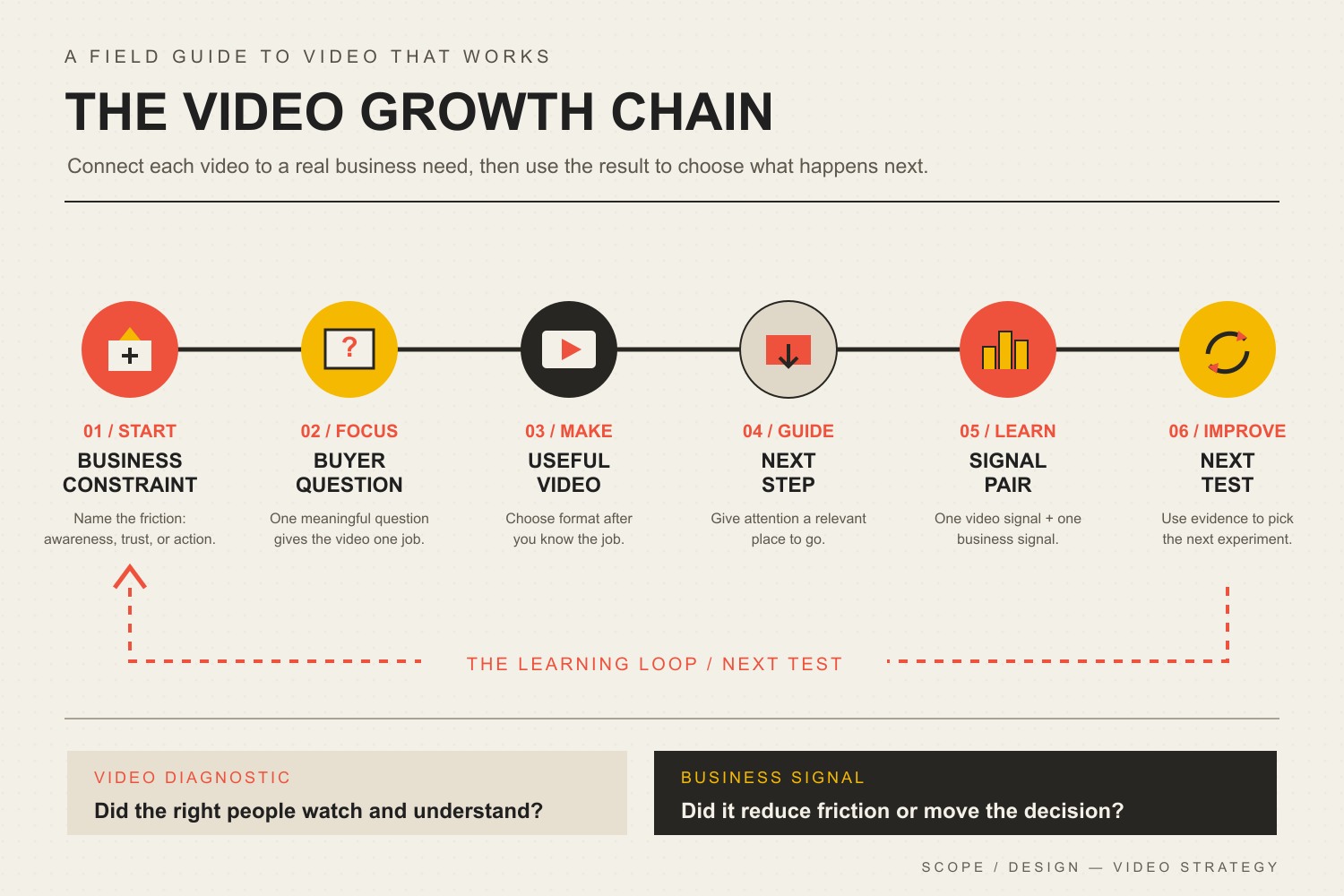
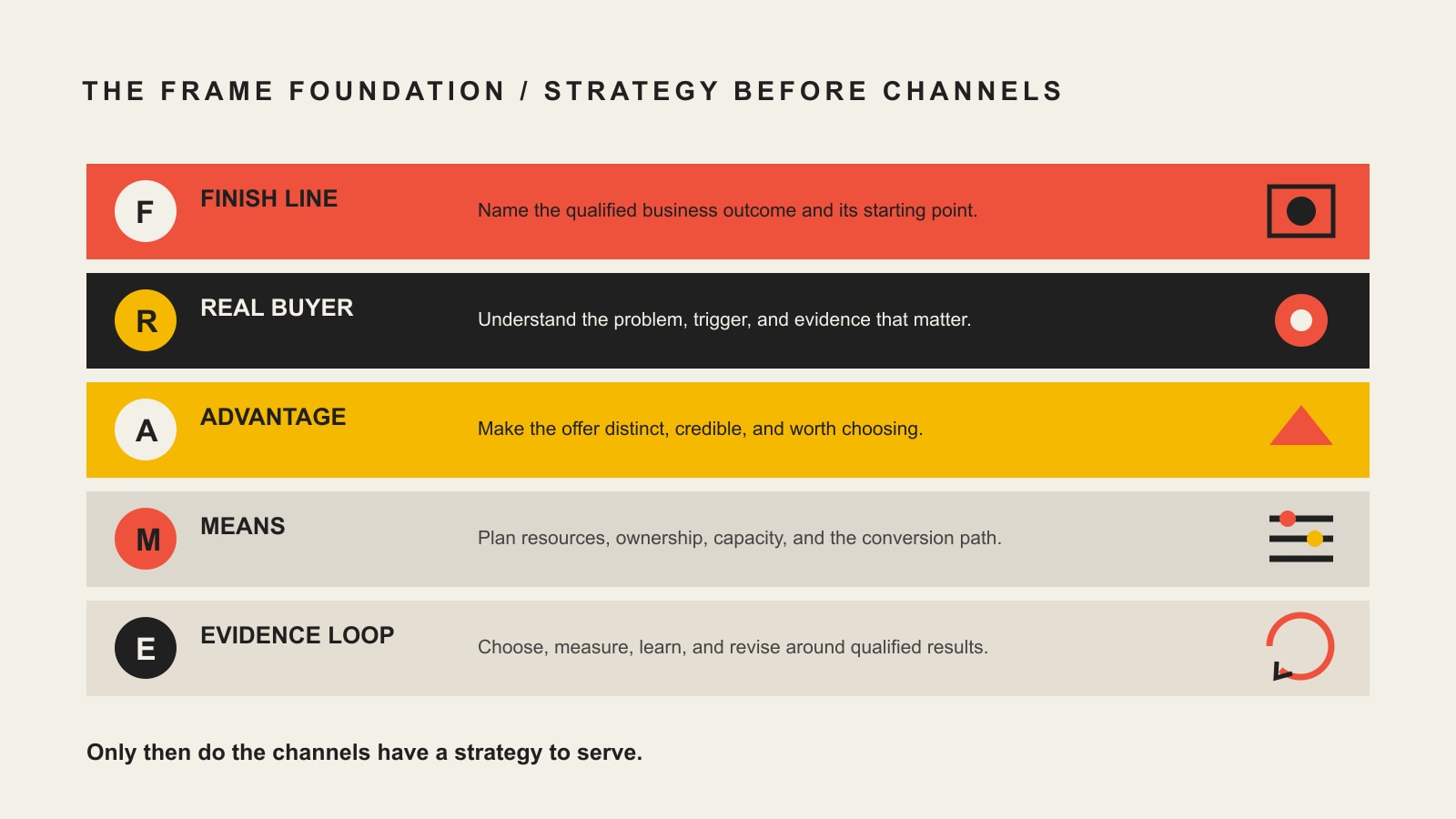
The best local marketing ideas are not the ones getting the most attention this month. They are the ones that solve the bottleneck your business has right now. A local company that is hard to find needs a different marketing test than one that gets plenty of inquiries but weak follow-up. A business with more demand than it can fulfill should not buy even more attention.
That is the filter behind this guide. Instead of treating local marketing as a checklist of channels, use each idea as a bounded experiment: name the problem, choose one bet, decide what qualified business result should change, then scale or stop based on evidence.
If you need the broader system first, start with our small-business marketing strategy. This article has a narrower job: helping you pick the next practical local marketing idea without trying ten things at once.
Social media marketing for small business is not a posting habit. It is a small operating system. The visible part is the post. The hidden part is choosing a business outcome, producing useful material, responding to people, routing qualified interest, measuring what happened, and deciding what to change next.
That is why a business can be busy on Facebook, Instagram, LinkedIn, TikTok, or another platform and still have no idea whether the effort is helping. The problem is not always “bad content.” Often, one of the hidden jobs has no owner or no connection to a business result.
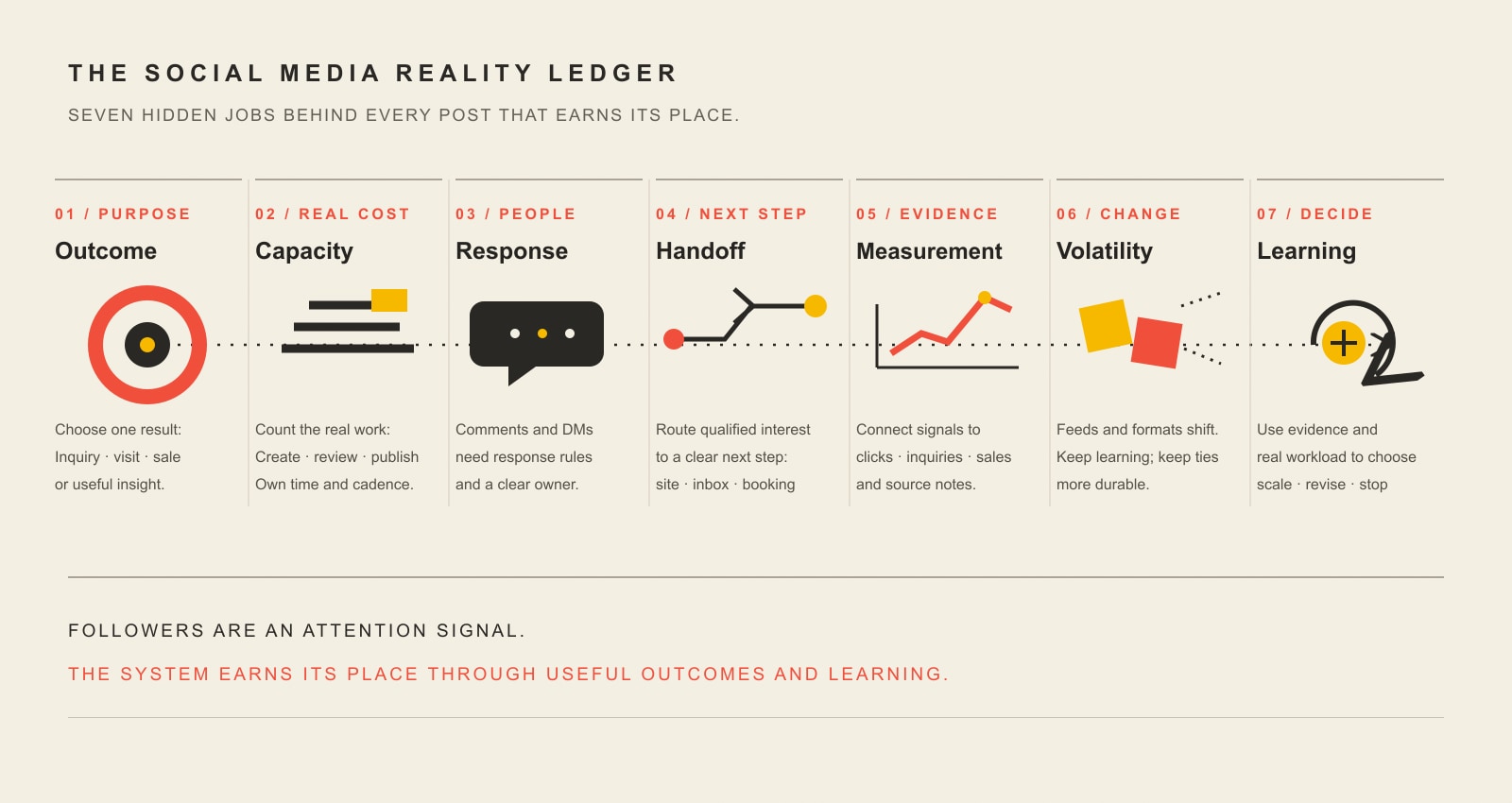
The short version: 7 things people don’t tell you about social media marketing
Followers are an audience state, not a business outcome.
Consistency has an operating cost. Someone must research, create, review, publish, and respond.
Measurement needs an evidence chain. Likes, clicks, inquiries, bookings, and sales are different signals.
Engagement creates work. Comments and DMs need response rules and a handoff owner.
Virality is upside, not a plan. You can design a test; you cannot responsibly promise distribution.
Social needs somewhere useful to send qualified interest. A feed should connect to a website, inbox, booking path, sales conversation, or customer record when the journey calls for it.
Platforms change. Your learning loop and customer relationships should be more durable than one feed, format, or algorithm.
These seven realities fit inside a larger principle we use in our small business marketing strategy framework: attention is useful only when the business has a clear path from attention to an outcome.
What social media marketing for small business really requires
Social media can help a business become easier to discover, give prospects useful evidence, start conversations, support existing customers, recruit employees, or create demand. But not every business needs every platform, and not every social account needs the same job.
Before worrying about reach or posting frequency, answer one question: What decision or behavior should social media help influence? That might be a qualified inquiry, an appointment, an event registration, a product purchase, a store visit, a repeat purchase, a referral, or simply a useful conversation that teaches you something about the market.
Once the result is clear, the channel becomes easier to judge. You can choose a message, a cadence, a call to action, and a measurement method that fit the job instead of copying somebody else’s content calendar.
1. Followers are an audience, not an outcome
A larger follower count can increase the number of people who might see your work. It does not tell you whether those people are the right people, whether they remember you, or whether they ever take a useful next step.
That distinction matters because follower growth is easy to celebrate. Business outcomes are harder. A local service company might care more about qualified estimate requests. A professional firm might care about introductions or booked calls. A retailer might care about purchases, repeat customers, or store visits. A school or nonprofit might care about applications, registrations, volunteers, or donors.
A smaller audience that reliably produces the right conversations can be more valuable than a much larger passive audience. Treat follower count as an attention signal, then look for stronger evidence of intent and business effect.
2. Consistency has a real operating cost
People often call organic social media “free.” The account may be free. The operation is not.
Someone has to find ideas, capture photos or video, write, design, review, obtain approvals or rights when needed, publish, monitor comments, answer DMs, route leads, report results, and follow up. Sometimes one owner does all of that. Sometimes a coordinator, agency, freelancer, salesperson, or subject-matter expert shares the work.
The important question is not whether you have a large creative team. It is whether the work has an owner and a cadence that the real organization can sustain. A useful weekly rhythm with thoughtful responses can beat an ambitious daily schedule that collapses after three weeks.
3. Measurement is an evidence chain, not one dashboard
Platform analytics are useful, but a single dashboard rarely answers the whole business question. Reach and video views describe attention. Saves, replies, profile visits, link clicks, and DMs can indicate stronger intent. Form submissions, bookings, purchases, calls, qualified opportunities, and repeat business live closer to the business result.
When a social post is supposed to send someone to your website, consistent campaign tagging can make the handoff easier to inspect. Google’s Campaign URL Builder can help create tagged destination URLs; source, medium, and campaign values then give your analytics a clearer way to separate campaign traffic.
But tagged links do not solve every attribution problem. A customer may see several posts, search for the company later, call from a different device, walk into a store, or ask a friend before buying. That is why practical measurement can also include “How did you hear about us?” fields, sales notes, promo codes where appropriate, call tracking, and the quality of inbound conversations.
The goal is not perfect attribution. The goal is enough evidence to make the next decision. If your social program is active but you still cannot tell what is working, the social media ROI troubleshooting guide goes deeper into diagnosing the broken link.
4. Engagement creates response and routing work
“Get more engagement” sounds like a content goal. In practice, engagement also creates an operations question: what happens when somebody responds?
A comment may need a simple thank-you. A product question may need a link. A complaint may need support. A pricing question may belong with sales. A DM that says “Can you do this for my business?” may be far more valuable than hundreds of lightweight reactions—but only if someone notices it and knows what to do next.
Define response ownership before you chase engagement. Decide who monitors the account, what deserves a public reply, what moves to a private conversation, how quickly high-intent inquiries should be routed, and where useful customer feedback is recorded.
This is the hidden “social” part of social media marketing. Broadcasting is publishing. Social marketing requires listening and response.
5. Virality is upside, not a plan
You can plan a clear message, a relevant hook, a useful format, a distribution schedule, and a response path. You cannot responsibly plan the exact amount of reach a platform will give you.
That is why “go viral” is a poor operating objective for most small businesses. A viral post can be wonderful if the audience is relevant and the business can capture the opportunity. It can also create a pile of low-value attention that produces no qualified demand.
A better approach is a bounded test. Choose one audience problem, one message, one format, one call to action, and one measurement window. Publish enough to learn something. Then ask what the test taught you about the buyer, the message, the handoff, and the channel. Scale what earns qualified evidence. Revise the weak link. Stop what cannot justify the workload.
6. Social media needs a handoff beyond the feed
Not every post needs to push people off-platform. Sometimes the best next action is a comment, share, save, or DM. But when somebody becomes genuinely interested, the business needs a durable next step.
That might be a service page that answers buying questions, an email signup, a booking calendar, a phone call, a store visit, a sales conversation, or a customer record that supports follow-up. The exact handoff depends on what you sell and how people buy.
The principle is simple: do not let qualified attention die inside the feed. Decide the next useful step while you are planning the content, not after a promising message arrives.
7. Platforms change, so your learning loop has to survive
Social platforms change formats, features, policies, ad products, and distribution systems. That is normal platform risk. The dangerous version is when a business builds a marketing process that only works if one feed behaves exactly as expected.
You do need to pay attention to platform changes. You do not need to rebuild your strategy around every rumor or “algorithm hack.” Protect the parts of the system that should remain useful: what you know about the customer, the problems you can explain, the evidence you can show, the relationships you have earned, the destination you control, and the measurement process that helps you learn.
If a format stops working, the question becomes “What did we learn, and where else can we express the same useful idea?” That is a much stronger position than depending on a single trick.
The Social Media Reality Ledger
Use this seven-row ledger before you add another platform, raise posting frequency, hire a creator, or increase ad spend. Each row exposes a hidden job that can quietly break the system.
Reality
Question to answer
Evidence to collect
Outcome
What business result should social influence?
Qualified inquiries, bookings, purchases, visits, referrals, registrations, or another defined result
Response time, unresolved questions, qualified conversations, recurring customer issues
Handoff
Where does qualified interest go next?
Website actions, calls, bookings, email signups, sales conversations, store visits
Measurement
What links activity to outcomes?
Platform signals, tagged links, CRM or sales notes, “How did you hear about us?” evidence
Volatility
What changes when the platform changes?
Dependence on one format, one feed, one source of audience, or one paid tactic
Learning
What test decides the next investment?
A clear scale, revise, or stop decision based on qualified evidence and workload
Decision rule: if social produces qualified evidence at a cost and workload you can sustain, keep improving it. If it does not, change the message, handoff, cadence, or channel. Measure the system, not the follower count.
A practical 30-day social media decision test
Thirty days is not a magic success deadline. It is simply a useful way to bound a small experiment so it ends with a decision instead of becoming permanent background work.
Name one job for the channel. Example: generate qualified estimate requests, support an event, create product discovery, or reactivate dormant customers.
Pick one audience and one message. Do not test five audiences, six offers, and three new platforms at once.
Set a sustainable production and response rhythm. Track the real hours and outside costs required to keep it running.
Instrument the handoff. Use tagged links when appropriate, define the next action, and record useful customer-source evidence.
Make a decision at the end. Scale, revise, or stop. Write down what you learned so the next test starts smarter.
If the test succeeds only when the owner works nights, ignores DMs, or skips measurement, the channel has not proven that it scales. It has proven that the workload can be hidden for a month.
Social media marketing FAQs for small businesses
How do beginners start social media marketing?
Start with the customer and the business outcome, not the platform. Choose the one or two places where the people you need to reach actually discover, evaluate, or interact with businesses like yours. Pick one job for the channel, build a sustainable content-and-response routine, and define the next action you want an interested person to take.
Do small businesses need to post every day?
No universal cadence is strategically correct for every business. Frequency should match audience behavior, content quality, response capacity, and what you need to learn. A schedule you can sustain and measure is more useful than a daily streak that produces weak posts or unanswered conversations.
How do I know whether social media marketing is working?
Define the outcome first, then use a ladder of evidence. Track attention signals such as reach, stronger intent signals such as saves, DMs or link clicks, and business signals such as inquiries, bookings, purchases, visits, referrals, or repeat customers. Add the time and money required to operate the channel so you can compare the value with other marketing options.
Are social media followers important for a small business?
They can be useful because they represent potential attention and an audience you may be able to reach again. But follower count is not the same as qualified demand or revenue. Judge the audience by who it contains, how people respond, and whether the account contributes useful business evidence or outcomes.
Should a small business use paid social advertising?
Paid social can be useful when the audience and offer are clear, the destination works, someone owns follow-up, conversion measurement exists, and the business can run a bounded learning budget. Paid reach can buy attention and evidence. It cannot repair a confusing offer, broken landing path, or missing follow-up process.
What does social media marketing for small business cost?
The platform account may cost nothing, but the operation still consumes labor or budget. Count research, creation, approvals, publishing, response time, lead routing, software, outside help, paid promotion, reporting, and follow-up. Compare that real operating cost with the qualified evidence and outcomes the channel produces.
The part that matters most
The hardest part of social media marketing for small business is rarely pressing Publish. It is building the system around the post: knowing why the channel exists, producing work you can sustain, responding when people engage, giving qualified interest somewhere useful to go, and learning enough to make a better next decision.
If your social channels are active but disconnected from the rest of your marketing, Scope Design can help audit the path from attention to outcome, identify the weak handoff, and build a leaner plan around the capacity you actually have.
Blogging and podcasting can work together extremely well—but starting both at once is not automatically a better strategy. The right choice is the smallest content system that helps a specific audience solve a real problem, gives your business a useful way to earn trust, and can be maintained without turning every week into a production emergency.
For many small businesses, consultants, and experts, that means starting with one durable source of truth and then adapting it into a blog post, podcast episode, email, video, or social post only when the second format adds something useful. The goal is not “more content.” The goal is more value from the same expertise.
TL;DR: Start with the content job, not the channel
Start with a blog when the answer needs to be searchable, scannable, linked, cited, updated, or used as a durable reference.
Start with a podcast when conversation, interviews, voice, nuance, guest relationships, or listen-while-doing-something-else behavior are central to the value.
Use both when one research and evidence layer can support both formats and the second format improves the audience experience instead of merely multiplying production work.
Own the source. Keep the durable answer, calls to action, analytics, and audience-capture path on channels you control, then use platforms for discovery and distribution.
Measure the business system. Track production cost, discovery, attention, subscriber or inquiry growth, and qualified business outcomes—not traffic or downloads in isolation.
Blogging and podcasting: should you start one or both?
The practical answer is: start with the format that best serves the first audience decision you need to own. Add the second format when it has a distinct job and can share the same research, evidence, and editorial source.
Start here
Strong fit when…
Watch out for…
Blog
People search for the problem; the answer benefits from examples, links, screenshots, comparisons, updates, or reference value.
Publishing pages without a distribution plan, evidence, internal links, or a clear next action.
Podcast
Interviews, conversation, personality, nuance, or access to guests is part of the value; your audience can consume audio naturally.
Launching because podcasts feel prestigious, then discovering that editing, booking, show notes, promotion, and quality control exceed your capacity.
Both
The same source question and evidence can create a useful written answer and a useful audio conversation without duplicating the whole production process.
Turning every episode into a transcript dump or every article into a read-aloud recording and calling that repurposing.
If you are mainly trying to improve your blog, use our small-business blogging guide. If the strategic decision is already made and your problem is the tool stack, our guide to business blogging tools owns that job. This page stays at the program level: how the formats fit together and when they should not.
What auditing this exact article changed
We did not preserve the old version merely because it had been online for years. Before revising it, we checked the exact URL across Scope Design’s analytics, Google Search Console, Bing Webmaster Tools, Ubersuggest, current search results, internal-link ownership, and technical crawl evidence.
Signal checked
Observation before this revision
What it actually supports
GA4, last 12 complete months
No Organic Search landing-page rows; only 2 Direct sessions across all channels, 0 engaged sessions, and 0 configured key events.
The sample is far too small for behavior or conversion conclusions. There is no measured organic footprint forcing unsupported legacy claims to survive.
Google Search Console
No exact-page query/page rows in the current or prior 12-month period. URL Inspection reported “Crawled – currently not indexed,” while fetching, crawling, and indexing were allowed and Google/user canonicals matched.
The page needs stronger ownership and usefulness, not a speculative URL migration.
Bing Webmaster Tools
0 clicks and 0 impressions for the exact URL.
There is crawl history but no Bing traffic signal that justifies protecting weak claims.
Ubersuggest
0 page-ranking keywords, 0 backlinks, and 0 referring domains returned for the URL.
Third-party evidence also shows little page-level equity requiring the old monetization promises or formulas to remain.
That evidence does not prove blogging is dead, podcasting is ineffective, readers disliked the page, or this rewrite will rank. It supports a narrower editorial decision: preserve the established URL, remove claims we cannot defend, give the page one distinct job, and connect it to the right content cluster.
Start with one audience problem and one business job
A channel is not a strategy. Before choosing microphones, themes, podcast hosts, recording software, or publishing calendars, finish this sentence:
For [specific audience] trying to [make a decision or solve a problem], this content should help them [useful outcome], and the business should be able to observe [meaningful signal].
Good starting signals include sales questions, support problems, recurring objections, project lessons, customer language, Search Console queries, People Also Ask questions, and topics where your team has real experience. If you need a repeatable way to expand those signals into angles, use the SPARK blog-ideation process rather than starting from a random “100 profitable niches” list.
This also prevents a common content failure: assigning a separate strategy to every channel. A topic can have one source of truth and several expressions. Your website may hold the durable answer. A podcast can add an interview, disagreement, story, or expert nuance. Email can carry the practical takeaway to people who asked to hear from you. Social can distribute a useful fragment and point back to the deeper source.
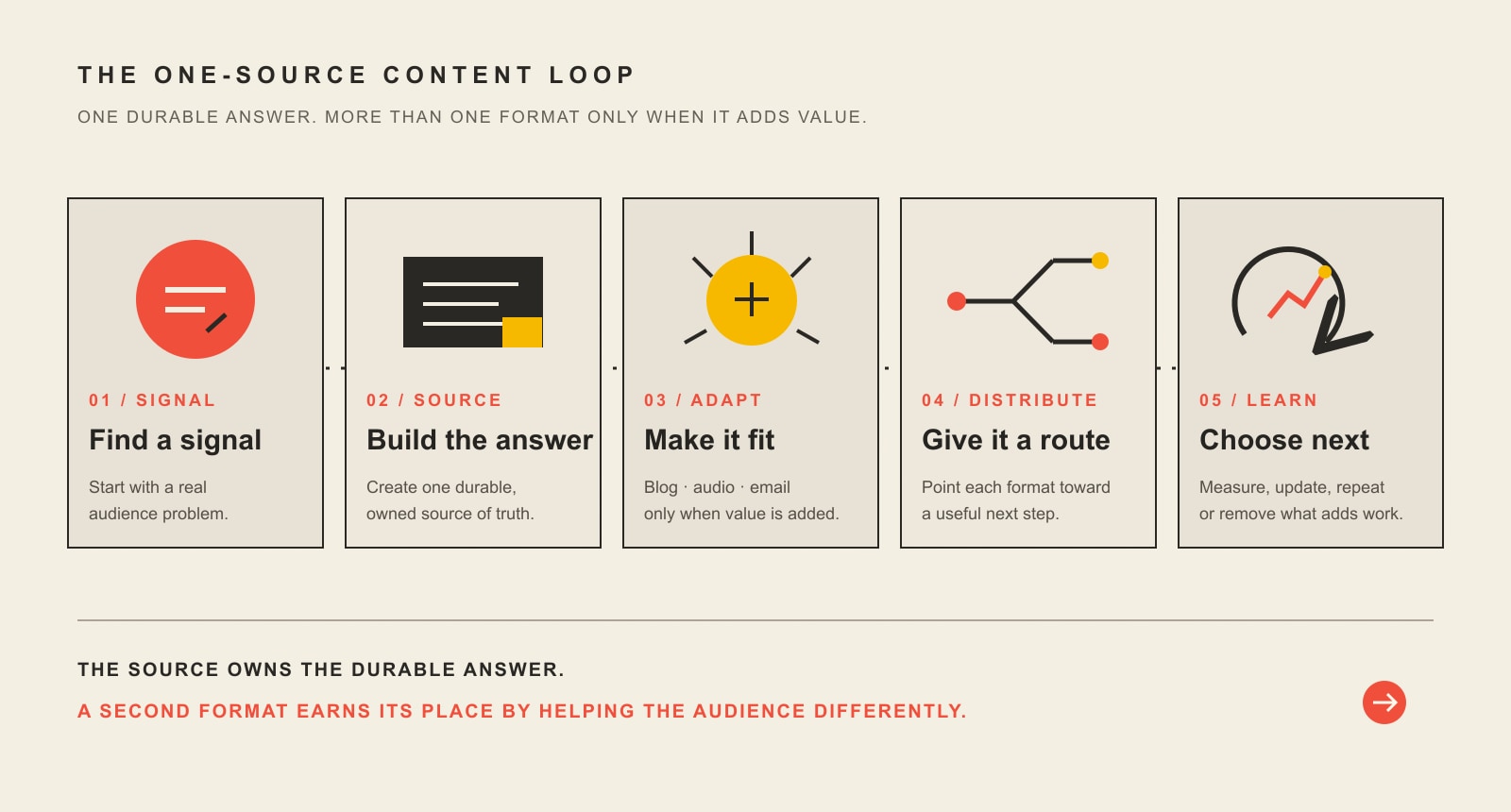
Use the One-Source Content Loop
The One-Source Content Loop is a simple operating model for deciding what deserves to become multiple formats. It is not a rule that every source must become a blog, podcast, video, and social campaign. The operating rule is the opposite: if a second format cannot reuse the source while adding a distinct audience benefit, do not add it yet.
1. Signal: find a question worth owning
Start with evidence that the question matters. Search demand can help, but so can a repeated sales objection, a support issue, a customer interview, a project mistake, or a pattern your team notices after doing the work repeatedly. The source should exist because somebody needs the answer—not because the calendar has an empty Tuesday.
2. Source: build the durable answer
Gather the evidence, examples, caveats, point of view, and next step in one place. For a business with a strong website, the source often belongs on the site because it can be linked, updated, cited, measured, and connected to the rest of the customer journey. Google’s current guidance similarly emphasizes helpful, reliable, people-first content that contributes original information or analysis rather than merely rewriting what already ranks. Google also explicitly says it does not have a preferred word count.
3. Adapt: rebuild the idea for the format
A good adaptation preserves the truth but changes the experience. The article may need the definitive checklist. The podcast may need a guest who can challenge assumptions. The email may need one sharp decision and a link to the source. The short video may need a visual demonstration. Our content repurposing workflow goes deeper on extracting knowledge units and rebuilding them for different audience moments.
4. Distribute: give every format a route
Publishing is a production event; distribution is how the work reaches people. Decide before production is finished which routes make sense: search, an email list, podcast directories, a guest’s audience, partners, social platforms, internal links, or a relevant YouTube channel. If YouTube is part of the plan, use it because video or YouTube discovery adds value—not because every audio file must automatically become a video. Our YouTube tools guide covers the native and paid layers separately.
5. Learn: decide what deserves another cycle
Look at the result in layers. Did the workflow consume more staff time than expected? Did search impressions, email subscribers, listeners, or qualified inquiries move? Did the source answer appear in sales conversations? Did one format attract attention but no useful next action? Use that information to update the source, improve distribution, keep the second format, or remove a step that is not earning its place.
Build the minimum viable setup
You do not need an enormous software stack to begin blogging and podcasting. You need the minimum set of systems that lets you create, publish, distribute, measure, and retain access to your work.
An owned web destination. Use a site you control for durable articles, episode pages, show notes, calls to action, analytics, and the source material you expect to update over time.
A permission-based audience path. Email is useful because a subscriber relationship is not dependent on a platform deciding to show your next post. This is one part of a broader small-business marketing system, not a reason to gate every article behind an email form.
A lean writing and publishing stack. Research, drafting, editing, visuals, publishing, SEO, distribution, and measurement are the jobs. Buy tools only when they remove a proven bottleneck.
Recording and editing you can sustain. A microphone, quiet-enough recording environment, recording software, and an editing process are enough to test the format. Production quality should be understandable and professional; it does not need to imitate a major studio on day one.
A podcast host or feed you can manage. Apple Podcasts documents that RSS-submitted shows can use a third-party-hosted feed or a self-generated feed. Its RSS requirements include required tags, at least one episode, and artwork. Apple also explains the submission and validation process. Treat directories as destinations that must be configured and managed, not as a magical automatic distribution layer.
Measurement from the beginning. Set up analytics, Search Console where relevant, email metrics, and the platform analytics your podcast host or directory provides. Establish the baseline before you interpret movement.
Run one source through multiple useful formats
Imagine a web-design firm keeps hearing the question: “Should I redesign my website before investing in more marketing?” That is the signal.
Source article: build the durable decision guide with diagnostic questions, examples, tradeoffs, internal links, and a clear next step.
Podcast episode: invite a strategist or client-side operator to discuss cases where the answer was “redesign first” and cases where the real constraint was traffic, offer, follow-up, or measurement.
Email: send the simplest diagnostic: “Before buying more traffic, identify the first broken handoff in the customer journey,” then link to the full source.
Social: turn one counterintuitive finding or diagram into a native post, not a chopped-up paragraph with “link in bio” attached.
Sales reuse: give the source to prospects asking the same question, then note which follow-up questions repeatedly appear.
Learn: update the source with the best recurring question and decide whether the podcast format added enough useful nuance to repeat.
That is much more efficient than inventing one blog topic, one unrelated podcast topic, five disconnected social posts, and an email newsletter from scratch every week. The same expertise creates multiple useful entry points while one source remains responsible for the durable answer.
Make podcast content accessible and reusable
A transcript is not automatically a good blog post, but equivalent text is important. W3C’s WCAG 2.2 guidance for prerecorded audio-only content calls for an alternative for time-based media that presents equivalent information. A reviewed transcript or equivalent text gives people who cannot fully hear the audio access to the information.
Text also makes the episode easier to scan, quote internally, turn into show notes, identify follow-up questions from, and adapt into other formats. But do not mistake raw transcription for editorial work. Remove transcription errors, identify speakers, make links understandable, preserve important context, and build headings or summaries that help a reader navigate.
If a transcript contains a strong original explanation, that explanation can feed the next source article. If it is merely a record of casual conversation, it may belong on the episode page as an accessibility resource without becoming a separate “SEO post.”
Plan distribution before production is finished
A strong content system separates source ownership from distribution reach. Your website and permission-based audience give you durable control. Search engines, podcast directories, YouTube, social platforms, guests, and partners can introduce the work to people who do not know you yet.
That does not mean every source belongs on every platform. Choose distribution based on the audience and the job. A technical article may earn search traffic and backlinks over time. An interview can reach the guest’s network. An email can move a known reader back to the most useful source. A social post can test whether a framing resonates. The broader content marketing strategy should connect these routes instead of treating them as independent calendars.
Measure the system, not just traffic and downloads
Downloads can matter. Search traffic can matter. Neither one is the whole business case. Measure the program in layers so a healthy top-of-funnel number does not hide an expensive or unproductive system.
Layer
Examples
Question it answers
Workflow
Research hours, editing time, correction rate, turnaround time, episodes or articles actually completed
Can we sustain this without hidden rework?
Discovery
Search impressions/clicks, directory discovery, referral traffic, email list growth, partner or guest referrals
Are more relevant people finding the source?
Attention
Engaged sessions, return visits, email replies/clicks, listening or viewing signals available from the platform
Are people consuming enough to get value?
Business effect
Qualified inquiries, booked calls, sales-assisted use, attributable purchases where measurement is credible, retained customers, useful subscriber growth
Did the content contribute to a valuable relationship or decision?
Do not declare success after one strong episode or one ranking jump. Establish a baseline, run enough cycles to expose workflow problems, and look for patterns. If the podcast creates useful sales conversations but modest downloads, it may still be doing a valuable job. If an article gets impressions but attracts the wrong inquiries, the traffic chart is not a victory by itself.
Monetize after fit—not before it
A blog or podcast can eventually support services, products, memberships, sponsorships, affiliate relationships, events, or paid content. But “monetize immediately” is a poor universal rule. First prove that the audience problem is real, the content is useful, the production system is sustainable, and the next business step makes sense.
If you recommend products through affiliate relationships or accept sponsorships, treat disclosure as part of the publishing workflow. The Federal Trade Commission says material connections between endorsers and sellers must be disclosed, and advertising claims must be truthful and supportable. A disclosure is not a conversion obstacle to hide; it is part of maintaining the reader’s ability to judge the recommendation.
There is no responsible universal answer to “How much will 10,000 podcast listeners earn?” or “How long until a blog makes $500 per month?” Those outcomes depend on the audience, offer, niche, geography, sponsorship or affiliate economics, pricing, conversion, costs, and what “make” means. Treat any single audience-to-income formula as a scenario, not a promise.
A realistic first 90 days
Days 1–30: prove the source workflow
Choose one audience and one recurring problem worth owning.
Decide whether blog or podcast is the better first expression.
Build the minimum publishing, measurement, and distribution setup.
Create one complete source asset with real evidence and a clear next action.
Record the production time and friction honestly.
Days 31–60: repeat before expanding
Run two or more additional source cycles using the same workflow.
Improve the recurring bottleneck instead of buying tools at random.
Distribute each source through the routes that fit the audience.
If the second format has a clear job and the source can support it, pilot it on one piece.
Compare the second-format value with its actual production cost.
Days 61–90: keep, change, or stop
Review workflow, discovery, attention, and qualified-outcome signals together.
Update the strongest source with questions you learned after release.
Keep the second format if it adds meaningful value; simplify or remove it if it mainly adds work.
Connect the most useful sources more deliberately through internal links, email, sales follow-up, and relevant platform distribution.
Choose the next 90-day constraint to improve. Do not add a new channel just because the calendar has room.
Frequently asked questions about blogging and podcasting
What is the difference between blogging and podcasting?
Blogging is primarily a written, web-based format that is easy to scan, search, link, update, and reference. Podcasting is primarily an audio format that is well suited to conversation, interviews, voice, and listening while doing other activities. The best format depends on the problem, audience behavior, and what the content needs to communicate.
Should a small business start a blog or a podcast first?
Start with the format that best serves the first customer question you need to own and that your team can sustain. A blog is often the stronger first source when searchability, reference value, examples, or updates matter. A podcast can be the stronger first format when interviews, voice, relationships, or conversation are central to the value.
Do I need both a blog and a podcast?
No. Use both when one source of research and expertise can support two genuinely useful experiences without doubling the whole workflow. If the second format does not add a clear audience benefit, keep the system smaller.
Is blogging dead?
No. Written web content still performs useful jobs: answering search questions, explaining complex decisions, documenting expertise, supporting internal links, giving sales teams reference material, and creating an owned source that can be updated. Publishing generic articles without evidence, distribution, ownership, or a business job is the part worth retiring.
How often should I publish?
Use a cadence your real production bottleneck can support. One useful, well-researched source every two weeks can be better for a small expert team than promising three weekly pieces and shipping shallow work. Measure the process, then increase frequency only when quality control and distribution can keep up.
Does a podcast transcript count as a blog post?
Not automatically. A reviewed transcript can be an important accessibility resource and useful source material. A blog post should be structured for a reader’s job: clear answer, useful headings, examples, links, context, and a next step. Adapt the transcript when that creates a better written experience instead of publishing raw speech as an article.
How long does it take for a blog or podcast to make money?
There is no reliable universal timeline. Revenue depends on audience fit, what you sell, the buying cycle, traffic or listener quality, pricing, conversion, distribution, sponsorship or affiliate economics, and costs. Use early months to prove the audience problem and operating system before treating a revenue date as a commitment.
Do I need expensive blogging or podcasting tools?
No. Start with the native or low-cost tools that complete the actual jobs. Pay for a specialist tool when it saves recurring skilled time, provides evidence you cannot reasonably obtain another way, reduces meaningful risk, removes a proven handoff, or otherwise solves a bottleneck you have actually observed.
Build the smallest system that can learn
The best blogging and podcasting program is not the one with the most channels. It is the one that turns real customer questions and real expertise into durable answers, adapts those answers only where the format adds value, reaches people through deliberate distribution, and learns from outcomes that matter to the business.
If your content operation is currently a collection of disconnected tools and calendars, Scope Design can help you map the website, content, search, email, and measurement pieces into a system your team can actually run.
The six local marketing strategies that matter most are the ones that move a nearby prospect through a complete buying path: get found, build trust, answer the questions that delay a decision, create a permission-based follow-up path, borrow credibility from local relationships, and add paid reach only when the rest of the system is ready. The mistake is treating those as six unrelated channels. They work better as connected handoffs.
For a small local business, that distinction matters. More posts, more ads, or more listings do not automatically create more sales. A useful local marketing system helps the right people discover you, understand why you fit, take a next step, and stay connected long enough to buy or refer someone else. If you need the broader framework for choosing channels by buying moment, start with Scope Design’s small business marketing strategy guide. This article focuses on the local handoffs.
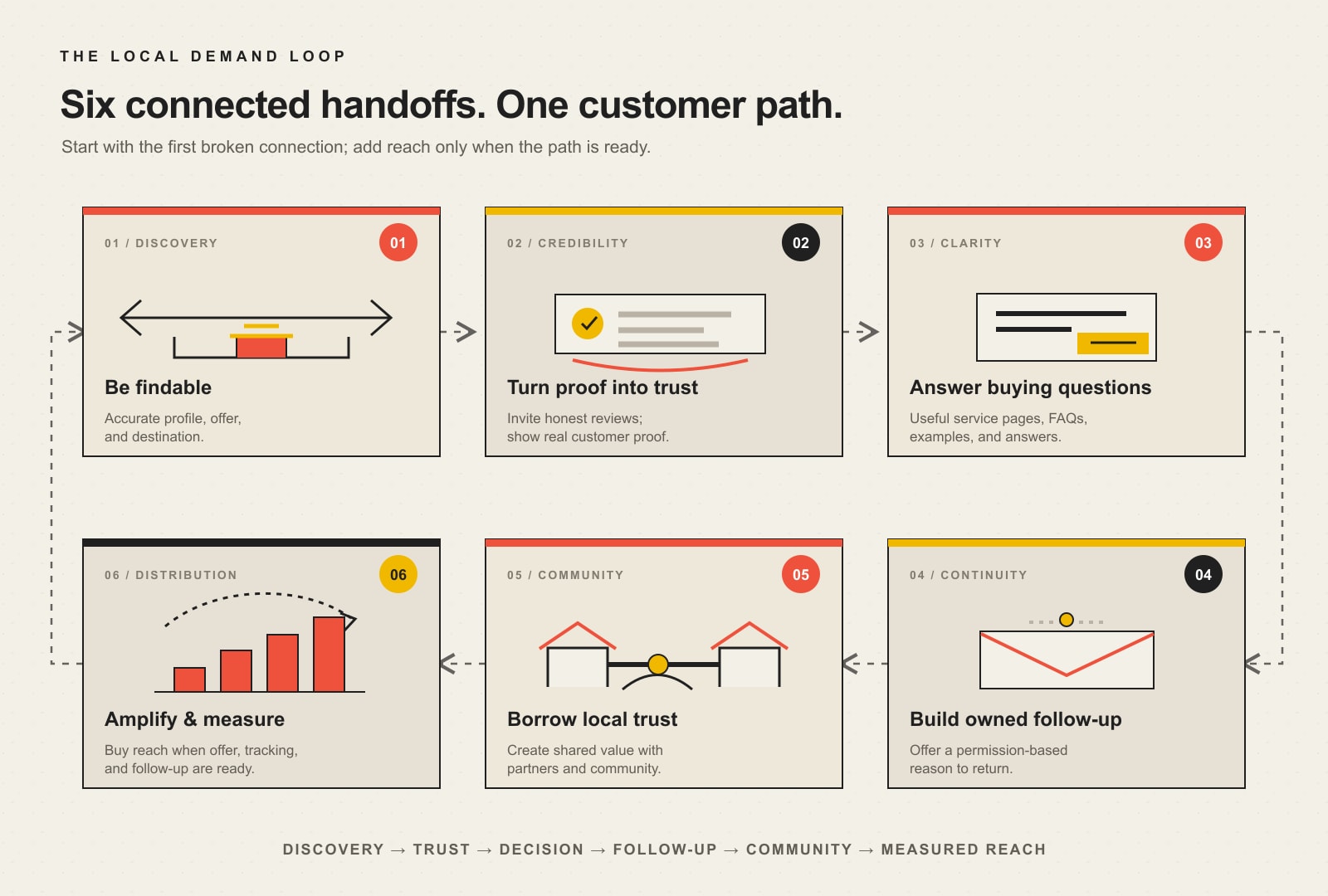
The Local Demand Loop: 6 strategies that work together
Be findable where local intent starts. Keep your Google Business Profile and core business information accurate, complete, and aligned with what your website actually offers.
Turn real customer proof into trust. Build a repeatable, honest review and proof system instead of waiting for testimonials to appear by chance.
Answer local buying questions. Create useful service, location, FAQ, case-study, photo, and video content around real decisions—not a content treadmill.
Build an owned follow-up path. Give prospects and customers a reason to opt into email or another permission-based relationship you control.
Borrow local trust. Create partnerships, referrals, community participation, and cross-promotions with organizations that already have the audience’s attention.
Amplify and measure. Use paid search, paid social, and other local promotion only when the offer, destination, tracking, and follow-up are strong enough to learn from the spend.
If you want a bigger catalog of tactics, Scope Design also maintains a broader guide to 15 local marketing strategies. The job here is different: decide which part of your local demand path is broken first.
What should you fix first?
What you are seeing
Likely broken handoff
Start here
People nearby need what you sell, but few find or contact you
Findability
Business Profile, service area, core facts, website alignment
You appear in searches, but prospects still choose competitors
You have a credible offer but weak local awareness
Borrowed trust
Partnerships, referrals, local groups, events, cross-promotion
Your offer converts, but qualified volume is too low
Distribution
Measured paid search, paid social, sponsorships, or local promotion
The Local Demand Loop works best when you fix the first broken handoff instead of adding another channel by default.
1. Be findable where local intent starts
For many local businesses, the first buying moment is simple: someone searches for a service, product, or place near them. Your job is not to “hack” that moment. It is to make the basic facts about your business easy for customers and platforms to understand.
Google’s current Business Profile guidance says local results are mainly based on relevance, distance, and prominence. Google also says businesses with complete and accurate information are more likely to appear for relevant local searches. That makes a clean foundation more useful than chasing speculative ranking tricks. Review your address or service area, hours, primary category, services, contact information, photos, and the pages you send people to. Make sure the website describes the same business the profile describes. Google’s local ranking guidance is the right source for current platform-specific details.
Do this first: search for your own business the way a new customer would, then compare the profile, website, phone number, hours, service area, and core offer. Fix contradictions before adding more content or promotion.
Measure: calls, website visits, direction requests, bookings, quote requests, and qualified form submissions. Google now documents Business Profile interactions such as calls, website clicks, directions, messages, and bookings as performance data that can be shared with Google Analytics. Those customer actions are more useful than a promise to “rank #1.”
2. Turn real customer proof into trust
Findability earns attention. Proof helps a prospect feel safe choosing you. For a local business, proof can include reviews, before-and-after photos, project examples, recognizable locations, team photos, case studies, and specific answers from people who have actually used the service.
The operational mistake is waiting until you “need more reviews” and then asking everyone at once. Build the request into a real customer moment: after a successful delivery, completed appointment, solved problem, or positive follow-up. Make the request easy, respond to feedback, and reuse genuine customer evidence where you have permission.
Keep the system honest. The Federal Trade Commission’s Consumer Reviews and Testimonials Rule, effective October 21, 2024, addresses fake and deceptive review practices. Among other provisions, it prohibits fake or false reviews and incentives conditioned on a particular positive or negative sentiment. In practical terms: ask for honest feedback, not “five-star reviews,” and do not buy manufactured credibility.
Do this first: choose one legitimate moment in your customer process when a review request makes sense, write a short neutral request, and assign responsibility for sending it.
Measure: review-request completion, new legitimate reviews, response rate, and—more importantly—whether qualified prospects are moving from profile or proof pages into calls, quotes, bookings, or purchases.
3. Answer the local buying questions that slow decisions
Content works best when it removes uncertainty. That is especially true locally, where customers often need answers that generic national content cannot give them: Do you serve my town? Is this right for an older home? What happens after I request a quote? Can I see examples nearby? How long does this usually take? What should I prepare before the appointment?
Turn repeated sales and service questions into durable decision-support assets. A strong service page can explain the offer and next step. A useful location section can clarify a real service area. A case study can show the problem, approach, and result without inventing performance claims. A short video can demonstrate a process. A photo set can make the experience tangible. An FAQ can answer objections before someone calls.
This is also where many businesses waste effort by confusing a format with a strategy. Short-form video, social posts, blogs, and email are containers. Use the container that fits the question and the customer. If you publish on Facebook because your local community is genuinely active there, Scope Design’s Facebook marketing guide for local businesses goes deeper on building community without turning the platform into a content treadmill.
Do this first: write down the five questions customers ask most often before they buy. Turn the highest-friction question into one useful page, section, video, checklist, or case study. Then reuse that answer across the places where customers already encounter you.
Measure: qualified entrances to the content, assisted calls or forms, sales conversations that start with better-informed prospects, and fewer repeated clarification steps when that is meaningful to your process.
4. Build an owned follow-up path
Local marketing gets expensive when every future sale requires rediscovering the same person from scratch. An owned follow-up path gives a prospect or customer a reason to stay connected after the first visit, quote, appointment, or purchase.
Email is usually the most practical example because it is a direct, permission-based relationship that does not depend on a social feed deciding whether to show your next post. But the value is not “having a newsletter.” The value is having a useful reason to follow up: appointment preparation, maintenance reminders, seasonal availability, relevant education, replenishment, event invitations, project planning, or a thoughtful post-purchase sequence.
Scope Design’s email marketing for small business guide treats email as a relationship system rather than a blast calendar. That is the right mental model here: capture permission, segment when it changes relevance, make the next step obvious, and connect the email back to a real business action.
Do this first: identify one moment where a customer would reasonably want future information from you, state what they will receive, collect permission, and create the first useful follow-up message.
Measure: opt-ins, replies, booked appointments, quote restarts, repeat purchases, and other downstream actions you can credibly connect to follow-up. Open rates alone are not the business outcome.
5. Borrow trust through local partnerships and community
Some local audiences are easier to reach through relationships than through algorithms. A complementary business, neighborhood organization, trade group, school, nonprofit, venue, employer, realtor, property manager, or event organizer may already have the trust and attention you are trying to build.
The strongest partnerships are not “please promote me” arrangements. Start with a useful overlap. A landscaper and a nursery can teach a seasonal workshop. A photographer and a wedding venue can build a planning resource. A contractor and a realtor can create a pre-sale home checklist. A restaurant can support an event its customers already care about. A professional service firm can contribute expertise to a local organization without turning every interaction into a pitch.
Community participation also creates better raw material for your digital marketing. Real collaborations produce photos, stories, customer questions, referral paths, and context that generic “local content” cannot manufacture.
Do this first: list five organizations that serve the same people before, after, or adjacent to your purchase. Pick one where you can create value for the shared audience without requiring an immediate sale.
Measure: referral conversations, qualified introductions, event sign-ups, partner-sourced leads, repeat collaborations, and customers—not just logo placements or social impressions.
6. Buy local distribution only after the path can convert
Paid promotion can be the fastest way to increase reach, but it is also the fastest way to pay for a broken handoff. Before increasing a local ad budget, confirm that the offer is clear, the landing destination matches the ad, tracking is working, someone can follow up with leads, and the customer economics leave room for acquisition cost.
That readiness check matters more than declaring one platform universally “best.” Paid search may fit a high-intent service people actively look for. Paid social may fit an offer that needs visual demonstration or audience targeting. Sponsorships may fit a geographic or community trust objective. Retargeting may fit a longer decision cycle. The channel follows the buying moment and the economics.
For the deeper channel-and-math decision, use Scope Design’s online advertising strategy for small businesses. Its core rule applies locally too: choose the channel after you understand intent, signal, follow-up, creative capacity, and customer value.
Do this first: define one offer, one audience, one destination, one conversion action, one follow-up owner, and one budget you can treat as a learning test. If you cannot define those six things yet, fix the earlier handoff before buying more reach.
Measure: use a simple ladder. Start with visibility and interactions, then track the customer action, then qualified leads, then customers, then revenue or customer value where attribution is trustworthy. Google’s Business Profile documentation, for example, recognizes actions such as website clicks, calls, directions, messages, and bookings. Those are better intermediate signals than impressions alone.
A practical 30-day way to use these local marketing strategies
You do not need to launch all six at once. In fact, that usually makes learning harder. Use the system as a sequence.
Week 1: baseline the handoffs. Check local profile accuracy, top customer proof, key decision pages, follow-up, referral sources, and current paid promotion. Write down the qualified actions you care about.
Week 2: fix the first obvious constraint. Correct incomplete business information, create a review request, answer the highest-friction buying question, or repair the conversion path—whichever appears first in the loop.
Week 3: ship one small useful improvement. Do not wait for a “complete marketing campaign.” Publish the page, send the follow-up, activate the partnership, or run the bounded test.
Week 4: review business signals. Did the change create more useful calls, quotes, bookings, conversations, or customers? Did lead quality improve? What did prospects still need? Keep, revise, or stop the change based on what you learned.
This is the same constraint-first logic we use across marketing work: fix the first broken handoff, observe what changes, then decide whether the next layer deserves time or budget. It is more disciplined than adding a channel because a platform is currently fashionable.
Frequently asked questions about local marketing
How do I advertise my small business locally?
Start by making sure people nearby can find accurate information about the business, see trustworthy proof, and reach a clear next step. Then choose promotion based on the buying moment. That might be Google Search, local social media, community sponsorships, referral partnerships, events, direct outreach, or paid ads. Advertising works better when it amplifies a path that already makes sense rather than compensating for an unclear offer or weak landing page.
Which local marketing strategy should I fix first?
Fix the earliest broken handoff. If qualified prospects cannot find you, start with findability. If they find you but do not trust you, improve proof. If they trust you but remain confused, answer the buying questions. If they disappear after first contact, improve follow-up. If the system converts but not enough people enter it, then add partnerships or paid distribution.
When should a local business start paid advertising?
Start when you can define the audience, offer, landing destination, conversion action, follow-up owner, and customer economics well enough to learn from the test. Paid traffic can create volume; it cannot repair a weak offer, confusing destination, or nonexistent follow-up process.
What should a local business measure besides clicks and impressions?
Measure the handoff into business outcomes: calls, direction requests when relevant, quote requests, appointments, bookings, qualified leads, customers, repeat purchases, and revenue or customer value where attribution is credible. Platform metrics are useful diagnostic signals, but they are not the finish line.
What is a safe way to ask customers for reviews?
Ask real customers for honest feedback at a natural point in the relationship, make the process easy, and do not condition a reward on a positive or negative sentiment. Avoid fake reviews, purchased reputation, or internal reviews that hide material connections. For U.S. businesses, review the current FTC rule and platform-specific policies before using incentives or automated review programs.
Build the local system before adding another tactic
The strongest local marketing strategies are not isolated tricks. They connect discovery, credibility, decision support, follow-up, community trust, and measured distribution. When those handoffs reinforce one another, every channel has a clearer job—and it becomes easier to see what is actually producing qualified business.
If you are not sure which handoff is limiting growth, talk with Scope Design. We can help map the local customer path, identify the constraint, and connect search visibility, website conversion, content, follow-up, and promotion into one measurable system.
The biggest small business marketing mistakes are usually not bad Facebook posts, the wrong email subject line, or failing to chase the newest platform. They happen earlier: promoting before you know what the business needs to change, selling an unclear offer, losing people after they respond, measuring the wrong outcome, and spending money without knowing what the result should teach you.
I learned that the expensive way. A mediocre tactic inside a sound system can be improved. A brilliant tactic dropped into a broken system usually buys you faster confusion.
TL;DR: The seven marketing lessons I wish I had learned sooner
Start with the business constraint, not the channel. Decide what actually needs to improve before asking where to advertise.
A weak offer is not a copywriting problem. Better wording cannot rescue something buyers do not understand, trust, or value.
Attention is not the business result. Traffic, reach, and engagement are useful diagnostics; qualified opportunities, sales, value, and operational impact tell you whether marketing helped.
Customer acquisition cost is only half the math. Margin, customer value, payback, retention, capacity, and cash flow determine what you can responsibly spend.
The response path is part of marketing. Slow follow-up, confusing forms, bad sales handoffs, and weak delivery can waste good demand.
More channels can create more failure points. Own a few channels well before adding another source of weekly guilt.
A test is useless if it does not change a decision. Define the question, guardrails, review window, and next move before launch.
If you need the full system behind these lessons, start with our small business marketing strategy guide. This article has a narrower job: the mistakes I would look for first when marketing feels expensive, inconsistent, or weirdly busy without becoming more useful.
The BURN Check for small business marketing mistakes
When a campaign underperforms, the natural reaction is to change the ad, platform, creative, agency, website, budget, or all six before lunch. That can work by accident. I would rather diagnose the system first.
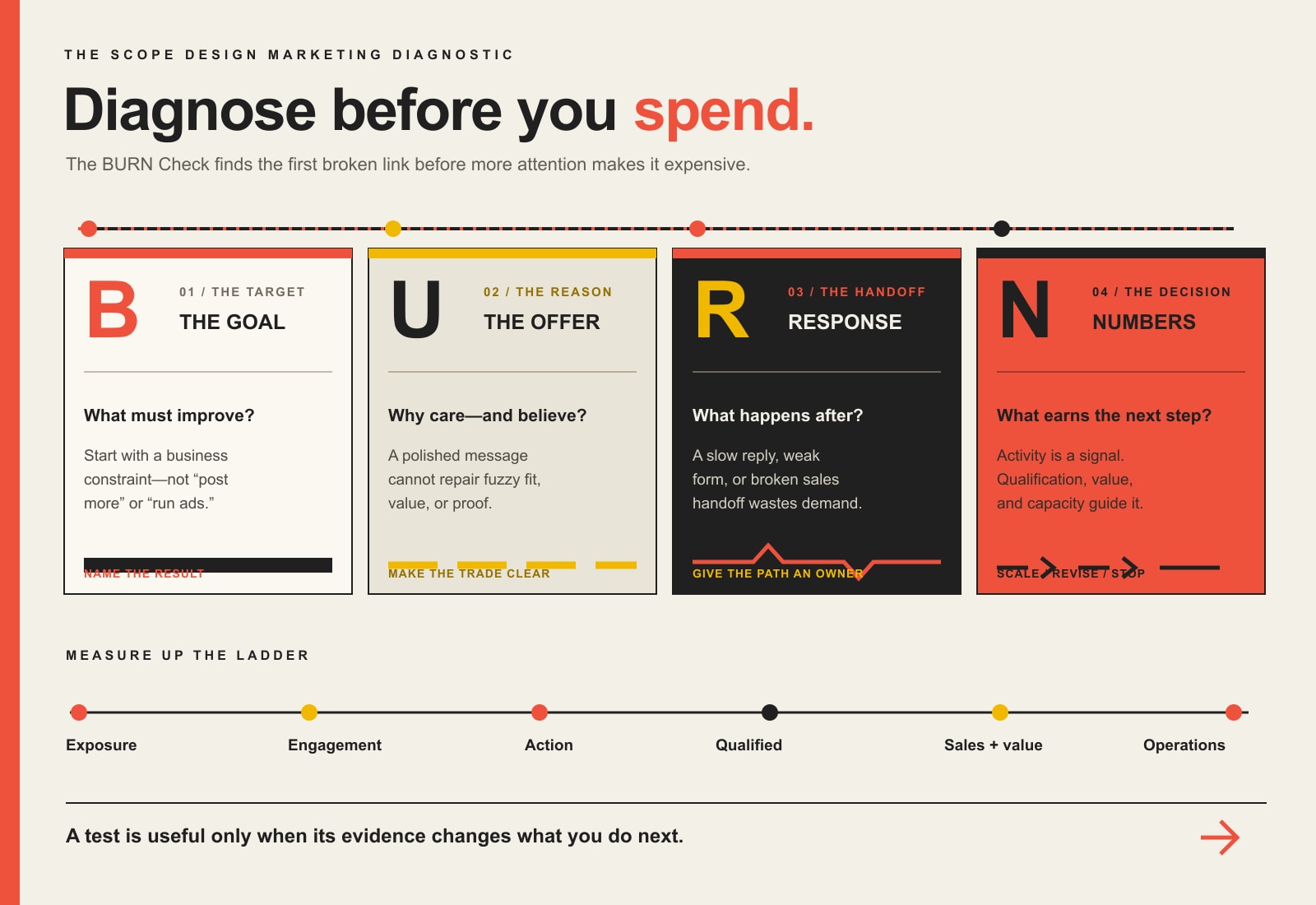
The Scope Design BURN Check is a fast four-part diagnostic:
Check
Question
What failure looks like
B — Business constraint
What must improve for the business?
Marketing starts with “we should post more” or “let’s run ads” instead of a business problem.
U — Useful offer and proof
Why should the right buyer care and believe us?
The message is polished, but the promise, fit, tradeoff, price logic, or evidence is vague.
R — Response path
What happens after attention arrives?
The page, form, phone, sales handoff, follow-up, fulfillment, or customer experience leaks demand.
N — Numbers and next decision
What evidence tells us to scale, revise, or stop?
The dashboard reports activity, but nobody can explain customer value, qualification, economics, or what happens next.
This is not meant to replace a full digital marketing strategy. It is the smoke detector. If one of these four checks is failing, buying more attention can make the weakness more expensive.
Lesson 1: I chose channels before defining the business problem
Platform-first planning feels productive because it creates immediate work. Set up Google Ads. Post three times a week. Start a newsletter. Make a video. Hire someone to “do SEO.” The calendar fills up and everybody can point to activity.
The problem is that channels do different jobs. Search can capture existing demand. Social can distribute evidence and create discovery. Email can continue a relationship with people you already have permission to contact. Paid media can accelerate a defined offer and audience. None of those answers the first question: what needs to change in the business?
If the real constraint is poor lead quality, more traffic can make the sales team busier without making the business healthier. If the constraint is weak follow-up, buying more leads feeds a leak. If the constraint is an offer buyers do not understand, a larger audience just lets more people ignore it.
My rule now is simple: define the business change before the channel job. Demand, fit, conversion, response, close rate, retention, capacity, or learning are all legitimate targets. “We need to be on TikTok” is not one.
Lesson 2: I tried to market offers that had not earned attention
Good copy matters. Design matters. Targeting matters. But none of them can manufacture value that the offer does not have.
An offer needs enough clarity that the right person can quickly understand who it is for, what changes, what it costs or requires, what the tradeoffs are, and why the promise is believable. If those pieces are fuzzy, the marketing team often compensates with adjectives. “Innovative.” “Premier.” “Next-level.” Beige wallpaper with a call-to-action button.
The better question is not “How do we make this sound irresistible?” It is “What would make this decision easier to trust?” That usually means sharper fit, clearer stakes, useful proof, honest boundaries, and language that matches how the buyer actually thinks. Our guide to buyer psychology goes deeper into diagnosing the motives, risks, and evidence needs behind that decision.
One of the old habits I no longer trust is testing cosmetic details before the offer is clear. Button color can be measured. That does not mean it deserves to be the first thing measured. Test the highest-risk assumption first: audience, promise, proof, price logic, eligibility, or next step.
Lesson 3: I confused attention metrics with business results
Marketing dashboards are excellent at producing numbers. They are less excellent at telling you which number should change your decision.
Google Analytics provides separate User acquisition and Traffic acquisition reports, while Google Search Console performance documentation defines search clicks, impressions, click-through rate, position, and dimensions such as queries and pages. Those are useful signals. They are not the same thing as qualified opportunities, sales, contribution, retention, or staff impact.
I think about measurement as a ladder:
Exposure: impressions, reach, rankings, share of voice.
Qualification: valid contacts, fit, held meetings, real opportunities.
Sales and value: close rate, acquisition cost, contribution, retention, lifetime value.
Operational effect: response time, support load, capacity, cycle length, staff time.
The mistake is not tracking the top of the ladder. The mistake is stopping there. A campaign can earn cheap clicks and still create expensive junk. A page can rank and still answer the wrong buyer. A lead form can convert while the sales team quietly hates every submission.
If the goal is a measurable action, our direct response marketing guide goes deeper into connecting that action to acquisition cost, revenue, contribution, and payback.
Lesson 4: I did customer acquisition math with half the equation
Customer acquisition cost is useful, but it is not a magic number you can compare with a universal benchmark and call strategy.
Imagine two companies both pay $300 to acquire a customer. Company A makes $2,000 in contribution from a typical new customer, gets paid quickly, has room to fulfill more work, and keeps a meaningful share of those customers. Company B makes $350 before service costs, waits months for cash, is already over capacity, and rarely gets repeat business. The same CAC means completely different things.
Before scaling acquisition, I want to know enough of the following to make the bet intelligible: contribution or gross margin, first-sale value, repeat purchase or retention, payback period, refund or churn behavior, sales cycle, fulfillment capacity, cash-flow tolerance, and how qualification changes the economics.
You do not need a finance department to start. Use the best honest window you have. If lifetime value is immature, use a shorter observed period and label it that way. What I no longer recommend is inventing certainty with a neat ratio borrowed from a business that has different margins, buying behavior, and risk.
Lesson 5: I treated the response path as somebody else’s problem
Marketing does not stop when somebody clicks “submit.” The next five minutes can matter more than the previous five weeks of campaign work.
A good campaign can be ruined by a confusing landing page, a form nobody monitors, missed phone calls, a generic autoresponder, slow estimates, unclear pricing, awkward scheduling, or a sales conversation that contradicts the promise that earned the lead. Then the marketing channel gets blamed because it is the easiest line item to point at.
The response path should have an owner. For each important action, know who receives it, how quickly they respond, what qualifies the person, what happens next, where the information is stored, and how the eventual outcome gets connected back to the source.
Proof belongs in that path too. Testimonials, reviews, examples, guarantees, and case evidence can reduce risk when they are real and relevant. In the United States, the FTC Consumer Reviews and Testimonials Rule took effect October 21, 2024 and addresses fake or false reviews and testimonials. The practical marketing lesson is simpler than the legal detail: do not fake trust. It is bad strategy with paperwork attached.
Lesson 6: I mistook channel count for marketing maturity
There is a special kind of small-business chaos where the company has Facebook, Instagram, LinkedIn, TikTok, YouTube, email, a blog, Google Ads, a neglected Google Business Profile, and no reliable process for answering the phone.
More channels create more creative requirements, approval work, measurement surfaces, platform changes, account risk, and maintenance. Diversification can be smart. Premature diversification is just multiplying places where the system can decay.
I would rather see one to three primary acquisition channels with clear jobs and credible ownership than seven profiles maintained by guilt. Add another channel when the existing system works, the audience justifies it, the business can support the content or campaign requirement, and you know what the new channel is supposed to teach you.
The shiny-object test is easy: if the argument for a channel begins with “everyone is there,” “the algorithm favors it,” or “our competitor started doing it,” you still need a business case.
Lesson 7: I ran tests without deciding what the evidence would earn
“We tried it” is one of the least useful sentences in marketing.
A real test begins with a question. Can this audience be reached here? Does this promise earn enough relevant attention? Does the page continue the promise? Do qualified buyers take the next step? Can we acquire them inside an acceptable economic range? Can the business absorb more demand?
Then define what happens when the result arrives. Scale, revise, or stop are decisions. “Keep spending because the dashboard has green arrows” is not.
What you observe
Likely question
Next move
Little relevant attention
Was the audience reachable here? Was the promise strong enough?
Revisit targeting, channel job, or message.
Attention but weak action
Did the destination continue the promise? Is the next step appropriate?
Inspect proof, friction, continuity, and CTA.
Actions but poor qualification
Are we attracting the wrong situation or failing to clarify fit?
Tighten message, eligibility, proof, offer, or form.
Qualified opportunities but weak sales
Is acquisition being blamed for pricing, follow-up, or sales-process friction?
Audit the downstream handoff.
Good outcomes inside guardrails
Can the business support more without harming quality or economics?
Scale carefully and keep watching quality.
The review window should match the buying cycle and evidence volume. A local emergency service, a seasonal promotion, and a six-month B2B sale should not be forced into the same arbitrary test period. The point is not to wait forever. It is to decide what would count as enough evidence for the next move.
A practical reset when your marketing feels broken
If I were auditing a small business with limited time and money, I would not start by adding a platform. I would work through this sequence:
Name the constraint. What business outcome is actually weak?
Define the buyer and buying moment. Who is deciding what, and what risk or evidence matters now?
Strengthen the offer and proof. Make fit, value, tradeoffs, and credibility easy to understand.
Walk the response path. Test the page, form, call, follow-up, qualification, sales handoff, and fulfillment experience.
Connect the numbers. Trace attention to action, qualification, sales value, economics, and operational effect as far as the current data allows.
Pick the smallest useful test. Choose the channel and experiment that can answer the most important unresolved question.
Decide what the evidence earns next. Scale, revise, stop, or fix a different part of the system.
Hope is not an analytics strategy. Neither is panic. A useful marketing system should make the next decision clearer, even when the campaign itself does not win.
Frequently asked questions about small business marketing mistakes
What is the biggest mistake small businesses make in marketing?
The biggest mistake is buying or creating attention before the business is ready to turn that attention into qualified value or useful learning. If the constraint, audience, offer, proof, response path, capacity, or measurement is unclear, more traffic can amplify the problem instead of fixing it.
What are some common marketing mistakes?
Common mistakes include choosing channels before strategy, promoting a weak offer, chasing vanity metrics, ignoring acquisition economics, responding slowly to leads, spreading effort across too many platforms, and running tests without a defined decision rule.
What should I fix before spending more money on advertising?
Confirm the audience and offer are clear, the landing experience works, somebody owns follow-up, the business has capacity, conversion measurement is configured, and you can afford a bounded learning period. Do not scale just because impressions or clicks are cheap.
How do I know whether my problem is traffic or the offer?
If the right people rarely reach you, traffic or distribution may be the constraint. If relevant people arrive but show little interest, inspect the offer, promise, proof, fit, and next step. If they convert but rarely become qualified opportunities, the problem may be targeting, qualification, or sales handoff. Diagnose the stage that leaks instead of redesigning everything at once.
How much should a small business spend on marketing?
There is no responsible universal percentage. A useful budget depends on margins, customer value, sales cycle, channel costs, capacity, cash flow, and how much the business can afford to learn without creating financial distress. Budget from economics and a defined test rather than a benchmark stripped of context.
Is organic marketing better than paid marketing?
Neither is automatically better. Organic channels often compound into durable assets but require time and maintenance. Paid channels can accelerate learning and demand capture but expose weak economics quickly. Use the channel that fits the audience, buying moment, offer, capacity, and measurement job.
The lesson behind all seven lessons
The hardest marketing lesson was not a secret tactic. It was learning to stop treating marketing like a vending machine where you insert money, content, or effort and expect leads to fall out.
Marketing is part of a business system. Attention has to meet a useful offer. The offer needs proof. The response path needs ownership. The numbers need context. And every serious test should make the next decision less stupid than the last one.
If your marketing feels busy but not useful, run the BURN Check before adding another campaign. Find the first broken link in the chain and fix that. It is less exciting than chasing the newest tactic. It is also how you stop paying tuition for the same lesson twice.
Customer retention strategies work best when they help customers get more value from what they already bought. For a small business, that usually means improving onboarding and delivery, removing recurring friction, learning from customer evidence, and then creating sensible reasons to renew, reorder, refer, or stay connected. A loyalty program can help in the right business. It cannot rescue an experience people would rather escape.
That is the point of investing in customers: not spending money on random perks, but putting time, systems, attention, and budget into the parts of the relationship that make the customer more successful and the business easier to choose again.
TL;DR: where should a small business invest in customer retention?
Complete the outcome. Make sure customers actually receive the value they bought.
Respond to evidence. Use feedback, support requests, repeat behavior, churn, and customer questions to decide what deserves improvement.
Extend the relationship. Add renewal, reorder, referral, recognition, or loyalty mechanics only when there is a real next value for the customer.
If your marketing plan stops when somebody becomes a customer, it stops too early. Scope Design’s broader small business marketing strategy treats response and customer outcomes as part of the system, not as somebody else’s problem after the sale.
What does “investing in your customers” actually mean?
Investing in customers means improving the customer’s ability to get a useful result from the relationship. Sometimes that investment is money. Often it is operational discipline: a better onboarding email, clearer instructions, a faster handoff, a useful follow-up, a simpler reorder path, better staff authority, or a process for turning recurring customer questions into fixes.
This distinction matters because “customer retention” can turn into a shopping list of tactics. Buy a CRM. Launch points. Send birthday coupons. Add a chatbot. Start a community. None of those is automatically wrong. None is automatically a retention strategy either.
A tactic becomes useful when it solves a real relationship problem. If customers leave because delivery is confusing, a rewards platform is expensive theater. If customers love the service but forget when to reorder, a simple reminder can be more valuable than a complicated membership program.
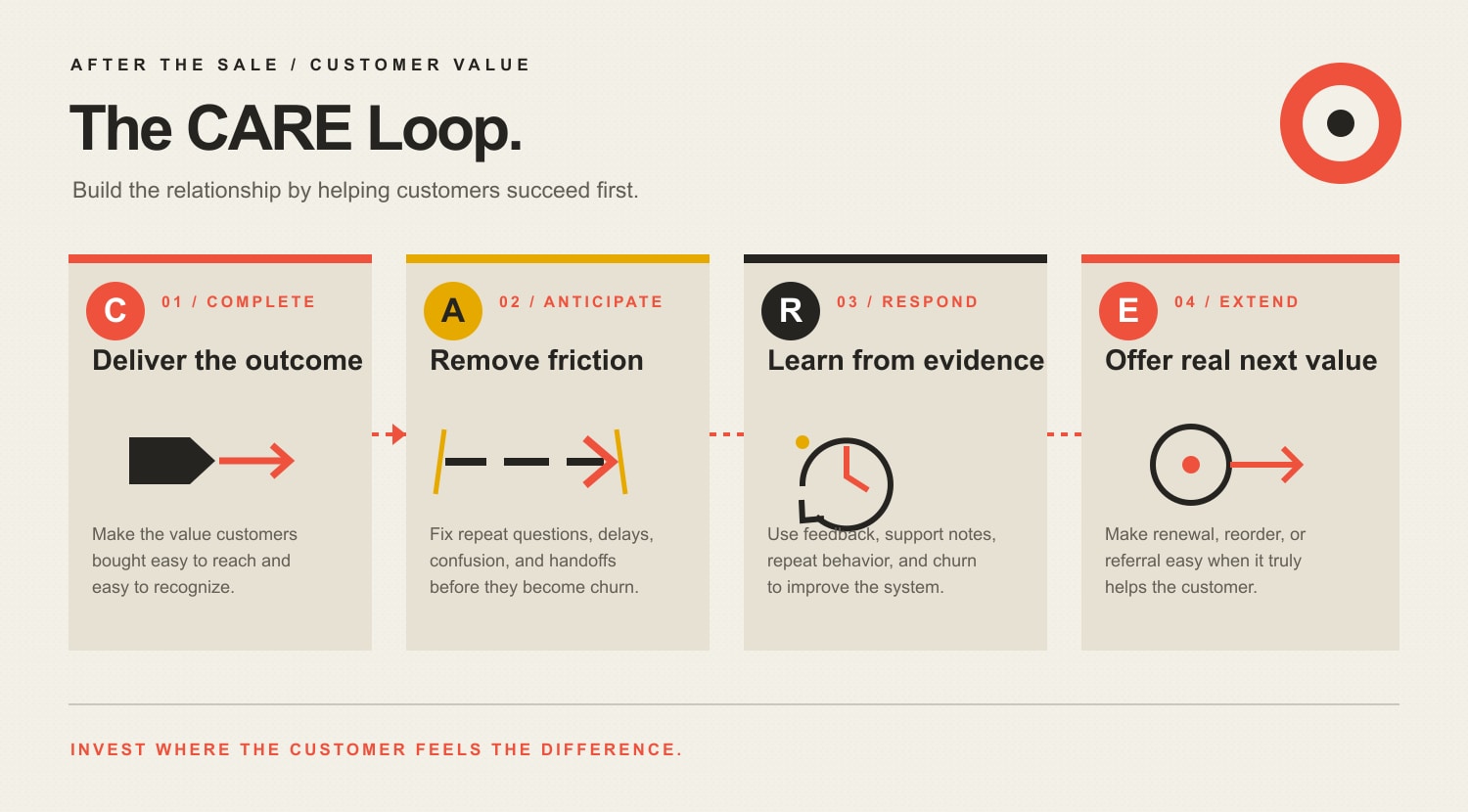
The Scope Design CARE Loop for customer retention strategies
The CARE Loop is a four-part decision sequence for choosing where to invest after the sale: Complete, Anticipate, Respond, Extend. The order matters. You first protect the value the customer expected. Then you remove avoidable friction. Then you use evidence to improve the system. Only after those pieces are healthy do you add mechanisms designed to deepen or continue the relationship.
1. Complete the outcome customers bought
The first retention investment is not retention software. It is delivery.
A customer bought something because they expected an outcome: a repaired furnace, a better website, a cleaner office, an easier tax season, a product that solves a recurring problem. Your first job is to make that outcome easy to reach and easy to recognize.
Look for the gap between “transaction completed” and “customer got the result.” That gap is where many small-business retention problems hide.
Set expectations before the sale so the customer knows what happens next.
Create a clear onboarding or first-use path.
Give customers the instructions, access, contacts, or training they need.
Define who owns the relationship when work passes from sales to delivery or support.
Confirm completion instead of assuming silence means satisfaction.
For service businesses, a short check-in after delivery can be more valuable than a discount. For ecommerce, the equivalent may be setup guidance, care instructions, replenishment timing, or an easy support path. For recurring services, it may be a visible progress update that reminds the customer what is being done and why it matters.
This is also where value and pricing connect. A customer who cannot see or realize the value of the work will eventually question the price. Our guide to strategic pricing and value creation covers that side of the equation in more depth.
2. Anticipate friction before it becomes a complaint
Good customer service responds well. Better customer systems prevent the same avoidable problem from happening 40 times.
Start with recurring friction: the questions your team answers repeatedly, the step customers forget, the form they cannot find, the deadline that surprises them, the delivery status they have to chase, the invoice they do not understand, or the handoff where context disappears.
Then decide whether the right fix is communication, process, product, training, or automation. Technology should remove repetitive work without turning the relationship into a maze of bots and portals.
Use reminders where timing matters. Renewal, reorder, maintenance, appointment, and milestone reminders reduce the customer’s need to remember your process.
Personalize for usefulness. Use known preferences or history when it helps the customer make a better decision, not to perform creepy theatrical intimacy.
Make support ownership obvious. The customer should know where to go and should not have to retell the same story to three people.
Turn repeat explanations into reusable help. A short guide, video, checklist, or email sequence can improve service while reducing staff time.
If email is the right relationship channel, our small-business email marketing guide shows how to build onboarding, educational, reminder, and follow-up communication around a real job rather than a blast calendar.
Useful personalization also creates a data responsibility. The Federal Trade Commission’s business data-security guidance recommends keeping only personal information you have a legitimate business need for and protecting what you retain. “Collect everything because maybe marketing will use it later” is not a customer-experience strategy.
3. Respond to customer evidence, not anecdotes
Retention problems get expensive when the business guesses at them. One loud complaint becomes “customers hate this.” One loyal client becomes “everyone loves our process.” Neither is a useful operating model.
Build a lightweight evidence loop. You do not need an enterprise research department. You do need a repeatable way to notice what customers are telling you through words and behavior.
Ask a short post-project or post-purchase question: What worked? What was confusing? What nearly made this harder than it needed to be?
Tag recurring support questions and complaint themes.
Review cancellations, non-renewals, returns, lost repeat purchases, and dormant accounts for patterns.
Compare what your best-fit customers value with what your marketing emphasizes.
Close the loop when you change something because customers spoke up. “You asked, we fixed it” is more credible than another survey nobody acts on.
The broader digital marketing operating system should include this post-sale evidence. Customer questions can become better FAQs. Successful implementations can become case evidence. Churn reasons can improve fit criteria. Retention is not a separate island from acquisition; it teaches acquisition what “good customer” actually means.
Reviews can be part of that evidence and advocacy system, but incentives need care. The FTC’s Consumer Reviews and Testimonials Rule guidance says businesses cannot condition incentives on a review expressing a particular positive or negative sentiment, and material connections or incentives may require disclosure. Ask for honest feedback, not rented applause.
4. Extend the relationship only where there is real next value
Once the customer experience works, you can deliberately make the relationship easier to continue.
That can mean a reorder path, a maintenance reminder, a renewal conversation, a useful account review, an upgrade that solves a new problem, a referral request, priority access, recognition, or a formal loyalty program. The right mechanism depends on how often customers can reasonably return, the margin available, what they value, and whether your team can operate the promise without staff heroics.
That is why we treat loyalty programs as a fit decision, not a default checkbox. Our small-business loyalty program guide compares models by behavior, frequency, margin, customer value, and operational reality.
Harvard Business Review’s analysis of loyalty-program failure makes a similar practical point: programs underperform when the economics, customer insight, or engagement are weak. Points are not fairy dust. If customers are leaving because the core experience is unreliable, rewarding another purchase is not the first fix.
How should you measure customer-retention investments?
Measure the behavior or outcome your investment was supposed to improve. A retention dashboard with 27 numbers can still avoid the one question that matters: did the customer relationship get healthier in a way the business can sustain?
Customer investment
Useful signal
Question to answer
Onboarding or delivery improvement
Completion, activation, time-to-value, support contacts
Are more customers reaching the outcome with less confusion?
Proactive communication
Fewer repeated questions, missed appointments, late renewals, or status-chasing contacts
Did we remove avoidable customer effort?
Feedback-driven fixes
Recurrence of the issue, satisfaction feedback, cancellation reason trends
Did the problem actually become less common?
Renewal or reorder system
Renewal rate, repeat purchase rate, time between purchases
Are good-fit customers continuing when the next purchase makes sense?
Referral or advocacy effort
Qualified referrals, honest reviews, referred revenue
Are satisfied customers comfortably introducing us to similar buyers?
Loyalty program
Incremental repeat behavior, reward cost, margin, redemption and engagement
Is the program changing useful behavior rather than subsidizing purchases that would happen anyway?
Customer lifetime value can be a useful roll-up metric, but it should not become a fog machine. If CLV rises while support cost, refunds, service strain, or customer fit gets worse, you need the underlying drivers. Track enough to make the next decision, not enough to decorate a dashboard.
When is a loyalty program the wrong first investment?
A loyalty program is probably not your first move when customers cannot repeat the desired behavior often enough, your margins cannot support the reward, fulfillment or service quality is the real problem, customer records are unreliable, or a simple personal follow-up would outperform the software.
For a lower-frequency professional service, excellent onboarding, useful education, reliable communication, proactive support, and an easy referral process may create far more value than points. A business with a broken customer experience should fix the experience before rewarding people for enduring it.
A 30-day customer investment plan for a small business
You do not need to redesign the entire customer journey in a week. Pick one meaningful friction point and run a small operating experiment.
Week 1: Map the post-sale path. From payment or signed agreement through delivery, use, support, renewal, and referral, write down what the customer must do and who owns each handoff.
Week 2: Find one repeated friction point. Review customer questions, support notes, cancellations, reviews, staff complaints, and missed steps. Choose a problem that happens often enough to matter.
Week 3: Make the smallest useful fix. Improve the process, message, instruction, reminder, handoff, or support ownership. Avoid buying a platform before you know the job.
Week 4: Compare the evidence. Did the relevant signal improve? Ask the people who handled the work. Ask a few customers. Keep, revise, or kill the change based on what happened.
Then run the loop again. Retention compounds through better operations, not through one heroic “customer appreciation” week every November.
Frequently asked questions about customer retention strategies
What are customer retention strategies?
Customer retention strategies are deliberate ways a business improves the likelihood that good-fit customers continue the relationship when doing so creates real value. They can include better onboarding, proactive support, useful communication, feedback-driven improvements, easier renewal or reorder paths, referrals, recognition, and loyalty programs.
What are some examples of customer retention strategies for small businesses?
Useful examples include a service follow-up after completion, maintenance reminders, onboarding instructions, a reorder reminder based on normal usage, an account review before renewal, a simple referral process, or a loyalty benefit for a genuinely repeatable behavior. The best example is the one tied to a known customer need or friction point.
What is the best customer retention strategy?
There is no universal best tactic. Start by completing the outcome customers bought and fixing the most common reason a good-fit customer struggles, leaves, or fails to return. Once the experience works reliably, add the simplest mechanism that supports the next useful behavior.
How can a small business improve retention without discounts?
Reduce effort. Communicate clearly. Follow up. Teach customers how to get more value from the product or service. Remember useful preferences. Make repeat business easier. Give staff enough authority to solve ordinary problems. Discounts change price; these investments change the experience.
Should customer service improve before starting a loyalty program?
Usually, yes when service or fulfillment problems are the reason customers do not return. A loyalty program can encourage an already-healthy repeat behavior, but it should not be used to compensate for unreliable delivery, confusing support, or a weak core offer.
How do you know whether a retention strategy is working?
Choose the signal that matches the intervention. If you improved onboarding, measure completion and support friction. If you built renewal reminders, measure timely renewals. If you added a loyalty program, look for incremental repeat behavior after reward cost and margin, not just sign-ups. Compare the result over time and investigate the reason behind the number.
Do customer retention strategies work for B2B companies?
Yes. In B2B, the mechanics are often account reviews, implementation success, stakeholder communication, proactive support, documented value, renewals, expansion, referrals, and reducing risk for the buyer. The principle is the same: help the customer achieve the outcome and make the useful next step easier.
Invest where the customer feels the difference
The strongest customer retention strategies are not the ones with the fanciest software. They are the ones that make a good-fit customer more successful, reduce unnecessary effort, turn real evidence into better operations, and create a sensible next step.
Start with the customer outcome. Work the CARE Loop. If your broader marketing system is generating attention but leaking value after the sale, use our small business marketing strategy framework to diagnose the whole path before you buy more attention.
A strong video marketing strategy does not start with TikTok, YouTube, a camera, or a production budget. It starts with a business problem and a customer decision. The job of the video is to help the right person understand something, trust something, or do something—and then give that person a useful next step.
That is the difference between “making video” and using video to support growth. A clip can earn thousands of views and still do nothing for the business. A modest FAQ, demo, testimonial, or sales video can be valuable with a much smaller audience if it removes friction from a real buying decision.
Start with the constraint: awareness, understanding, trust, conversion, sales friction, onboarding, or retention.
Give each video one job: answer one meaningful buyer question and point to one relevant next step.
Measure two layers: one video diagnostic and one business signal.
Improve the chain: use what you learn to choose the next test instead of blindly producing more.
The Video Growth Chain: How Video Earns Business Value
At Scope Design, we use a simple operating idea for video: Business constraint → Buyer question → Useful video → Next step → Signal → Next test. We call it the Video Growth Chain. Every link matters. If the customer question is vague, the video becomes generic. If the next step is missing, attention has nowhere useful to go. If the signal is wrong, you learn the wrong lesson.
The Video Growth Chain connects a real business constraint to a buyer question, useful video, next step, measurable signal, and informed next test.
This framework also prevents a common planning mistake: treating format choice as the strategy. Format matters, but it comes after the job is clear. If you need help deciding between demos, explainers, testimonials, short-form clips, webinars, and other formats, use our guide to video marketing types and when to use them. This article owns the broader operating system.
15 Video Marketing Moves That Drive Growth
1. Start With a Business Constraint, Not a Platform
“We should do more video” is not a strategy. Name the constraint first. Maybe qualified prospects do not know you exist. Maybe they visit the site but cannot understand the offer. Maybe sales calls stall on the same objection. Maybe new customers keep asking the same onboarding question.
The constraint tells you what the video must change. Awareness work needs qualified attention. Understanding work needs clarity. Trust work needs believable proof. Conversion work needs a clean handoff. This is also consistent with a broader marketing strategy built around the business constraint and conversion path, not a channel chosen in isolation.
2. Give Each Video One Buyer Question
Useful videos usually answer a question the customer is already trying to resolve: “How does this work?” “What will this cost?” “Can I trust this company?” “What happens after I sign?” “Will this work for a business like mine?”
One question creates editorial discipline. It keeps the opening focused, makes examples easier to choose, and helps you know when the video is finished. A five-minute answer to one expensive objection can be more valuable than a broad 20-minute “ultimate guide” that never resolves a decision.
3. Choose the Format After You Know the Job
A testimonial is not automatically better than a demo, and a short-form clip is not automatically better than a webinar. Format should follow the behavior you need to change. Need proof? Customer evidence may fit. Need clarity? A demo or screen recording may fit. Need discovery? Short educational clips may fit.
Do not force one video to carry the whole funnel. A discovery clip can hand off to a deeper explainer. An explainer can hand off to a case study. A case study can hand off to a consultation. That sequence is often more useful than trying to make a single “brand video” do everything.
4. Open With the Useful Part
You do not need a universal “three-second rule” to know that slow openings create friction. Skip the long logo animation, biography, and throat-clearing when the viewer came for an answer. State the problem, show the result, ask the relevant question, or demonstrate the useful thing early.
The right opening depends on the video. A search-driven tutorial can state exactly what it will teach. A product demo can show the outcome before the setup. A testimonial can begin with the customer’s original problem. Optimize for relevance, not a made-up universal timer.
5. Use Enough Production Quality to Protect Trust
“Authentic” does not mean careless. Viewers can forgive a phone camera more easily than muddy audio, unreadable screen recordings, confusing edits, or rambling explanations. Prioritize understandable audio, steady framing, useful lighting, legible visuals, and a clear structure before expensive cinematic polish.
The production level should match the decision. A personalized proposal walkthrough can be intentionally simple. A flagship brand film may justify more polish. The goal is not “low production” or “high production.” The goal is the level of clarity and credibility the situation requires.
6. Design the Next Step Before You Record
Do not wait until the edit is finished to ask what the viewer should do next. Define the handoff first. It might be a related guide, pricing page, product page, assessment, consultation, email signup, demo request, or onboarding step.
Then make sure the destination can finish the job. If the video creates interest but the landing page is confusing, the form is broken, or nobody owns the follow-up, more views simply deliver more people into a weak system. Our website conversion playbook covers that handoff in more depth.
7. Build Captions and Accessibility Into Production
Build caption review into the workflow instead of treating auto-generated captions as automatically finished. Check names, product terms, numbers, punctuation, and timing. If important information appears only visually, consider whether the surrounding page or an appropriate description makes that information accessible too.
8. Adapt the Message to the Channel Context
Republishing can save time, but identical uploads are not a strategy. A prospect watching a search tutorial, scrolling a social feed, reviewing a proposal, or comparing vendors on a landing page has a different level of intent.
Keep the core idea consistent while adapting the opening, framing, crop, captioning, CTA, and depth to the context. If social traffic is part of the plan, our guide to turning social traffic into business outcomes goes deeper on the path from attention to action.
9. Give Important Videos a Useful Home on Your Website
A strategically important video should not exist only as a social post that disappears into a feed. Give evergreen videos a relevant page where the surrounding text, offer, proof, and next step help the viewer act. For search visibility, technical implementation matters too.
Google’s video SEO documentation emphasizes discoverable video on indexable watch pages, stable thumbnails, crawlable video resources, and consistent metadata/structured data. A clever filename is not a substitute for those fundamentals. For the broader search system, see our SEO and analytics growth guide.
10. Repurpose From a Source Idea, Not From Random Clips
Good repurposing starts with a useful source: a customer interview, webinar, demo, founder explanation, FAQ session, or in-depth tutorial. Extract the questions, objections, examples, proof, and decisions inside it. Then adapt those units for the moments where they are useful.
That produces a coherent system instead of a folder full of disconnected snippets. Our content repurposing guide covers the mechanics of turning one source asset into useful derivative content without merely duplicating it.
11. Batch the Repeatable Mechanics, Not the Judgment
Batching works well for outlines, recording setup, thumbnail production, caption cleanup, exports, uploads, and clip extraction. It works poorly when it becomes an excuse to lock in 30 weak topics before you have learned anything.
Create a repeatable production lane, but keep topic choice and next-test decisions responsive. Record several well-chosen videos in one session if that reduces friction. Then let the evidence from those videos shape the next batch.
12. Use AI as a Production Assistant, Not a Source of Truth
AI can accelerate transcript cleanup, rough outlines, clip identification, title variations, caption drafts, shot lists, and editing chores. It can also confidently invent facts, flatten your point of view, or turn a specific customer question into generic marketing language.
Keep human editorial control over claims, examples, customer context, brand voice, and final decisions. Automate the repetitive work around the insight—not the responsibility for whether the insight is true. The same principle applies to broader AI-powered marketing automation.
13. Treat Customer Video as Evidence, Not Decoration
A vague “They were great!” testimonial adds little. Strong customer video describes the starting problem, the decision, what changed, and the result in language a future buyer can recognize. Specificity makes the proof useful.
It also needs to be honest. FTC guidance on endorsements, influencers, and reviews requires advertising claims to be truthful and not misleading, and material connections may need disclosure. Do not script a customer into a result they did not experience. Our guide to customer testimonials and social proof goes deeper on collecting proof that is specific and credible.
14. Measure One Video Signal and One Business Signal
Video platforms provide useful diagnostics: impressions, click-through rate, watch time, average view duration, retention, traffic sources, completion, shares, or saves depending on the channel. Those numbers help diagnose the content. They do not automatically tell you whether the business problem improved.
Pair one diagnostic with one downstream signal. For a demo, that may be watch engagement plus demo requests. For a testimonial, it may be page engagement plus qualified inquiries or sales feedback. For onboarding, it may be completion plus fewer repeated support questions. For a social educational clip, it may be qualified engagement plus visits to the intended resource.
Do not force false precision when attribution is messy. Assisted influence is real, but it is not the same as causal proof. Our marketing ROI framework explains how to separate decision metrics from diagnostic metrics when comparing marketing work.
15. Decide the Next Test Before You Declare a Winner
A video is not “good” because it beat an arbitrary benchmark. Ask what the signal suggests. Did the right people start watching but leave before the useful proof? Did they finish but ignore the CTA? Did qualified prospects mention the video on sales calls? Did a tutorial reduce repeated questions?
Turn that observation into one controlled next test: a clearer opening, tighter example, different proof, better destination, stronger distribution, or different buyer question. If you are paying to amplify content, set a budget and stop rule before the campaign begins. Our content promotion strategy guide covers that distribution layer.
A 30-Day Video Marketing Strategy for a Small Business
You do not need a studio or a 40-video calendar to start. Use one month to build and test the chain.
Week 1 — Find the constraint. Review sales questions, support tickets, search queries, form friction, and customer conversations. Choose one problem worth improving. Write down the business signal you care about.
Week 2 — Build three useful answers. Choose three buyer questions connected to that constraint. Select the simplest format that can answer each well. Define the next step before recording.
Week 3 — Produce and distribute. Record with clear audio and structure. Add reviewed captions. Publish each video where the intended audience can encounter it, and give important evergreen videos an owned-web destination.
Week 4 — Diagnose and choose the next test. Review one content diagnostic and one business signal per video. Do not average unlike jobs together. Choose the single change most worth testing in the next batch.
After 30 days, the goal is not to prove that “video works.” The goal is to know more about which customer questions, proof, handoffs, and distribution choices help your specific business move.
Video Marketing Strategy FAQ
What is the best video marketing strategy?
The best strategy is the one tied to a specific business constraint and customer decision. Start with the bottleneck, identify the buyer question, create the simplest useful video, define a relevant next step, measure a diagnostic plus a business signal, and use the result to choose the next test.
Which video platform should a small business use first?
Choose the audience and job before the platform. Search-driven educational video may fit YouTube or an owned resource page. Social discovery may fit a platform where your customers already spend attention. Personalized sales video may belong in email or proposals. There is no universal first platform.
How long should a marketing video be?
Long enough to complete its job without unnecessary friction. A quick objection answer might take 45 seconds; a technical tutorial may need 12 minutes. Use retention and downstream behavior to diagnose whether the length is serving the task rather than forcing every video into one benchmark.
How do you measure video marketing ROI?
Start by defining the economic outcome the video is meant to influence, then pair it with a video-level diagnostic. Compare the value of qualified actions, pipeline, sales efficiency, support reduction, activation, or other relevant outcomes against production and distribution cost. Avoid pretending that every assisted touch can be attributed with causal precision.
Can AI create a complete video marketing strategy?
AI can help with research organization, outlines, transcripts, clipping, caption drafts, and production speed. It should not replace first-party customer knowledge, factual verification, brand judgment, or the decision about which business constraint matters. Use AI to accelerate the workflow around the strategy, not to invent the strategy for you.
Make Video Part of the Business System
The most durable video marketing strategy is not a list of platform tricks. It is a repeatable way to connect a real buyer problem to a useful explanation, a believable piece of proof, a clear next step, and an outcome you can learn from.
If your business has plenty of content ideas but no clear path from attention to action, Scope Design can help connect the video plan to the offer, website, search strategy, content system, and measurement that make the handoff work.
Marketing strategy and tactics work together only when strategy decides what must change, for whom, and why, while tactics handle the specific actions and channels used to make it happen. Each tactic needs a defined job, a clear handoff to the next step, and measurement tied to a business outcome.
Most small businesses do not have a shortage of marketing tactics. They have a shortage of reasons for choosing them.
SEO, paid search, social media, email, direct mail, events, video, referral programs, and automation can all work. They can also become an expensive collection of chores when nobody can explain what business problem each tactic is supposed to solve, what should happen next, or how success will be judged.
That is the point of using marketing tactics with strategy: fewer disconnected activities, clearer decisions, and a system that can tell you what to keep, change, or stop.
TL;DR: Start with the business objective and the constraint blocking it. Clarify positioning and strategy before choosing tactics. Give each tactic one primary job, define its handoff, and judge the system by business outcomes before platform metrics.
Marketing strategy vs. tactics: the practical difference
The distinction is simple enough to memorize and easy enough to ignore.
Layer
Question it answers
Example
Business objective
What outcome must improve?
Increase qualified sales conversations from established regional manufacturers.
Strategy
How will we create that outcome, and what will we deliberately prioritize?
Win high-intent buyers by making specialized expertise easier to find and easier to trust.
Tactics
What specific actions will execute the strategy?
Search content, paid search, case studies, a focused service page, and follow-up email.
Measurement
How will we know whether the system is working?
Qualified conversations and pipeline, with channel and handoff metrics used to diagnose performance.
The U.S. Chamber of Commerce’s small-business planning guidance makes a similar distinction: strategy sets direction, goals define measurable outcomes, and tactics are the actions tied to those goals and metrics. That hierarchy matters because a tactic can be executed perfectly and still be the wrong move.
A beautiful landing page cannot rescue an offer people do not want. More traffic cannot repair a sales team that never follows up. Posting every day on social media does not solve a discoverability problem if the buyers who matter are searching elsewhere. The tactic may be fine. The diagnosis may be wrong.
The Scope Design strategy-to-tactics sequence
Scope Design uses a constraint-first sequence when deciding what marketing work deserves attention:
Objective: Define the business outcome you actually need.
Constraint: Identify the most important thing currently preventing that outcome.
Positioning: Decide what the right buyer must understand or believe for progress to become possible.
Strategy: Choose the approach that addresses the constraint and creates the required change.
Tactics: Select the channels, campaigns, assets, and actions justified by the strategy.
Measurement: Test whether the system moved the objective, then use supporting metrics to find where it worked or failed.
The operating rule behind the sequence is even shorter: a requested tactic is evidence, not a diagnosis.
When someone says, “We need Facebook ads,” “We need more SEO,” or “We need a newsletter,” that tells you what solution they currently have in mind. It does not prove that the solution matches the constraint. The broader small business marketing strategy should establish the system first. Tactics plug into it after the bottleneck is understood.
Step 1: Diagnose the constraint before choosing a tactic
Start with the business outcome, then ask what is preventing it. That one change in order eliminates a lot of “shiny object” marketing.
What you observe
Possible constraint
What it means for tactics
The right prospects rarely find you.
Awareness, discoverability, targeting, or distribution
SEO, paid search, partnerships, local visibility, or outbound may deserve investigation.
Relevant traffic arrives but few qualified people take the next step.
Message, offer, proof, page experience, or conversion path
Buying more traffic may simply send more people into the same leak.
Qualified leads arrive but do not become opportunities.
Qualification, response time, sales handoff, or follow-up
CRM routing, sales process, nurture, or booking improvements may matter more than lead generation.
Customers buy once and disappear.
Retention, lifecycle communication, service experience, or lack of a next offer
Email, account outreach, customer education, reminders, or loyalty work may be more useful than acquisition.
More than one constraint can exist. The goal is not to pretend the business has one problem forever. It is to identify the first meaningful bottleneck well enough that your next marketing dollar has a reason behind it.
Step 2: Give every tactic one primary job
Once the constraint is clear, assign each tactic a primary job inside the campaign. A channel does not have one universal purpose. Its job depends on the objective and the buyer’s moment.
Search can capture existing intent from people already looking for an answer, product, or provider.
Educational content can reduce uncertainty, answer comparison questions, and give sales teams something useful to send.
Paid media can create controlled access to an audience, test a message, or scale a path that already works.
Email can nurture a lead, reactivate a customer, support onboarding, or trigger a timely next step.
Social media can distribute ideas, create familiarity, surface proof, or keep a brand present in a community.
Local and offline activity can build geographic awareness, credibility, referrals, and reasons for people to search for the brand later.
The same email tool can support lead nurture in one campaign and customer retention in another. The tactic is not the strategy. The job you assign it is what gives it meaning.
If you need the larger operating model for websites, search, content, email, social, paid media, analytics, sales, and lifecycle work, Scope Design’s digital marketing strategy guide goes deeper into assigning distinct channel roles without turning the stack into a tool pile.
Step 3: Design the handoff between tactics
Tactics begin to work in tandem when the output of one becomes a sensible input to the next.
A handoff does not need to be complicated automation. It needs a clear next step and an owner.
Community event → QR or tagged URL → location-specific page → inquiry or email signup → follow-up.
Completed purchase → onboarding message → educational content → service reminder → repeat purchase or renewal.
For each handoff, write down four things: what triggers it, where the person goes, who or what owns the response, and what evidence tells you the handoff worked.
That is often where “channel performance” problems are hiding. The ad generated the right click, but the landing page answered the wrong question. The form worked, but the notification went to an unmonitored inbox. The newsletter earned attention, but every link dumped readers on the homepage. The tactics existed. The path did not.
Step 4: Measure the outcome, then diagnose the signal
Do not confuse the easiest metric to collect with the result the business needed.
Google Ads’ conversion-measurement documentation starts from a useful principle: the advertiser chooses the actions that are valuable to the business—such as a purchase, signup, or phone call—and then measures which campaigns and keywords drive those actions. Your broader marketing measurement should follow the same logic.
Use two levels of measurement:
Business outcome: the deepest result the marketing system can reasonably influence, such as qualified conversations, pipeline value, booked-and-attended appointments, repeat purchases, renewals, or revenue.
Diagnostic signals: the metrics that help explain why the outcome moved or did not move, such as impression share, click-through rate, landing-page conversion, source-to-qualified rate, response time, email engagement, booking completion, or repeat-visit behavior.
An impression can tell you whether something was seen. A click can tell you whether the message earned a response. Neither can tell you by itself whether the business acquired a good customer.
Measurement should also produce a decision. Before a campaign launches, decide what evidence would make you keep, change, or stop a tactic. The threshold may depend on sales cycle, traffic, budget, seasonality, and sample size. There is no honest universal schedule that says every business must make the same decision after seven days or every strategy must be rebuilt every quarter.
Three examples of marketing tactics working in tandem
Example 1: Increase qualified inquiries
Objective: Increase qualified sales conversations for a specialized service.
Constraint: High-intent prospects exist, but they do not find enough relevant evidence or a clear path to start a conversation.
Paid search: capture high-intent demand now.
Service landing page: explain fit, scope, proof, and the next step.
Case study or decision article: reduce uncertainty for buyers who are not ready to contact sales immediately.
Email or CRM follow-up: continue the conversation when the buyer needs more time.
Handoff: Search → service page → proof/decision content → qualified form or booking → sales response.
Outcome: Qualified conversations and pipeline. Click-through rate, landing-page conversion, response time, and source-to-qualified rate are diagnostic signals—not the finish line.
Example 2: Improve customer retention
Objective: Increase repeat business from customers who already received value.
Constraint: Customers do not remember the next service, do not know what else the business can help with, or receive no timely reason to return.
Customer email: deliver reminders and relevant education based on lifecycle timing.
Knowledge-base or FAQ content: answer common post-purchase questions and reduce uncertainty.
Account or service-team outreach: handle high-value situations that deserve a human conversation.
CRM trigger: surface the right customer when a renewal, maintenance interval, or follow-up condition is reached.
Handoff: Customer event → reminder or education → relevant next offer → human outreach when needed.
Outcome: Repeat purchase, renewal, retention, or expansion. Open rate is useful only when it helps diagnose whether the communication is reaching and engaging the customer. For deeper execution guidance, see Scope Design’s email newsletter strategy.
Example 3: Build local awareness that can be measured
Objective: Generate more first-time inquiries or visits from a defined service area.
Constraint: The offer is credible and converts when people find it, but too few local buyers know the business exists.
Community sponsorship or event: create real-world visibility and association.
Organic social: extend the event, people, proof, and story beyond the room.
Location-specific page: give interested people a relevant destination instead of a generic homepage.
Branded or local search support: capture people who search after seeing the business elsewhere.
Handoff: Offline exposure → QR code or tagged URL → relevant page → inquiry, call, booking, or email opt-in.
Outcome: Qualified local inquiries, bookings, or store visits where they can be measured. Google’s GA4 manual-campaign documentation confirms that UTM parameters populate manual campaign dimensions, which makes tagged campaign links useful when you need to distinguish sources and mediums in analytics.
Should you change the strategy, channel, campaign, or tactic?
When results disappoint, do not immediately replace the most visible tactic. Diagnose the level at which the problem exists.
Change the strategy when the audience, positioning, offer, business constraint, or desired outcome is wrong.
Change the channel mix when the mechanism does not match the buyer’s moment, the usable signal is too weak, the economics cannot work, or the team cannot realistically operate the channel.
Change the campaign when the channel is appropriate but the audience, message, creative, offer, destination, sequence, or measurement is wrong.
Change the tactic when the larger decisions are sound and one specific execution element is demonstrably limiting results.
This distinction matters because “the ads aren’t working” can describe four completely different problems. Scope Design’s guide to diagnosing why marketing isn’t working goes deeper into finding the bottleneck before buying another tactic.
A five-question strategy-to-tactics worksheet
Before you add another channel, campaign, or tool, answer these five questions in plain language:
What business outcome are we trying to improve? Use a result the business actually cares about, not a platform metric.
What evidence tells us what is preventing that outcome right now? Separate observation from assumption.
What must the right buyer understand, believe, or be able to do for that constraint to loosen?
Which tactics can we realistically operate, and what single primary job will each one have? Include the next handoff.
What result will make us keep, change, or stop the approach? Name both the business outcome and the diagnostic signals you will use to explain it.
If you cannot answer question two, you are probably not ready to choose a new tactic. If you cannot answer question four, you may be collecting channels rather than designing a marketing system. If you cannot answer question five, you have activity without a learning loop.
Frequently asked questions about marketing strategy and tactics
What is the difference between a marketing strategy and a marketing tactic?
A marketing strategy defines the approach, priorities, audience, positioning, and tradeoffs used to achieve a business objective. A marketing tactic is a specific action, channel, campaign, or execution choice used to carry out that strategy. Strategy explains why this approach; tactics explain what you will do.
Do all of my marketing channels need to work together?
No. Coordination does not mean forcing every channel into every campaign. A channel belongs when it has a useful job, a realistic owner, and a sensible handoff. Sometimes one well-matched channel and a strong follow-up path are better than an “omnichannel” plan nobody can maintain.
How many marketing tactics should a small business use?
There is no universal number. Use as few as necessary to cover the important jobs in the customer path and no more than the team can operate well. Capacity, audience behavior, sales cycle, budget, and the constraint should determine the mix.
Can the same tactic support different strategies?
Yes. Email can nurture a lead, onboard a customer, generate a repeat purchase, or support a referral program. Paid search can capture demand for a core service or test whether a new offer resonates. Define the tactic’s job within the specific campaign so its performance can be interpreted correctly.
How often should I review my marketing strategy?
Review tactics when enough evidence exists to make a responsible decision and review strategy when the underlying objective, constraint, audience, positioning, economics, or market conditions materially change. Operational decisions usually happen more often than strategic changes, but a fixed weekly/monthly/quarterly schedule is not a substitute for sufficient evidence.
What is the biggest warning sign that my tactics are disconnected?
Ask someone to explain what business outcome each tactic supports, what happens after a person responds, and which result would cause the team to change course. If the answers are mostly platform metrics, vague awareness goals, or “because we should be doing it,” the tactics are probably operating without enough strategy.
Stop adding tactics. Start designing the system.
A solid marketing strategy does not make tactics less important. It makes them accountable. It gives every channel a reason to exist, every campaign a place in the customer path, and every metric a decision it is supposed to inform.
If your marketing calendar is full but the answer to “what constraint is this removing?” is fuzzy, do not solve that confusion by buying another tool or channel. Start with the system. Review Scope Design’s small business marketing strategy framework, or talk with Scope Design about a marketing audit and a clearer path from attention to business outcomes.
A marketing campaign strategy is the bounded test inside your larger marketing strategy. It should connect one buyer situation to one message, one destination, one meaningful action, and a rule for what you will do with the result. If you cannot describe those decisions before launch, you do not have a campaign strategy yet. You have activity.
That distinction matters for small businesses because every campaign consumes more than media budget. It consumes attention, production time, sales follow-up, delivery capacity, and management focus. Part III of this series is about turning the customer and market evidence you already have into a campaign you can actually evaluate—without pretending a fictional persona, a pile of clicks, or a dashboard full of green arrows is the same thing as business progress.
What a Marketing Campaign Strategy Actually Decides
A marketing strategy answers the larger questions: which market matters, what you want to be known for, which buyers you can serve well, how you create value, and how attention becomes a business outcome. A campaign is narrower. It is a time-bounded attempt to move a defined audience toward a defined next step.
Layer
Question it answers
Example
Marketing strategy
Where will we compete, for whom, and how will marketing create business value?
Become the preferred commercial cleaning partner for multi-site professional offices in our service area.
Campaign strategy
What specific buyer situation, message, path, action, and learning rule will we test?
Reach facility managers evaluating a vendor change and test a disruption-reduction promise that leads to a site walkthrough request.
Tactic
What execution will carry part of the campaign?
Search ad, email, comparison page, webinar, direct mail piece, or retargeting audience.
The channel is not the strategy. Neither is the ad creative, landing page, email sequence, or keyword list. Those are parts of the path. A useful campaign strategy tells each part what job it has and tells the business what evidence will change the next decision.
Start With Evidence, Not a Fictional Avatar
The legacy version of this article leaned heavily on personas. The useful idea underneath that advice is still worth keeping: your message should reflect a real customer situation. The problem begins when the persona becomes more detailed than the evidence.
Before a campaign, separate what you know from what you assume. Useful evidence can come from sales calls, CRM notes, won-and-lost reasons, customer interviews, support questions, search behavior, form submissions, referral patterns, service-area data, and repeated objections. An assumption can still be worth testing; it just needs to stay labeled as an assumption.
Use a buyer attribute only when it changes a decision. Does it change the promise, offer, eligibility, channel, proof, price sensitivity, buying authority, or follow-up? If not, it may be descriptive trivia rather than campaign intelligence. Our complete guide to identifying your target audience and finding them online owns that research job in more depth.
Campaign rule: never let a polished persona hide a weak evidence base. “Operations Olivia likes podcasts and drives an SUV” is not useful unless one of those facts changes what you will actually do.
Build the Scope Design Campaign Decision Record
Our preferred marketing campaign strategy format is a one-page decision record. It forces the team to connect customer evidence to the campaign path before money or production effort starts flowing.
Field
Write down
Why it matters
1. Evidence source
Where did this insight come from?
Keeps observed behavior separate from assumptions.
2. Buyer situation
What is happening when this buyer becomes relevant?
Situations usually produce better messages than generic demographics.
3. Problem or desired change
What are they trying to fix, avoid, improve, or accomplish?
Gives the campaign a real job.
4. Message hypothesis
What promise, angle, or proof do you believe will matter?
Makes the idea testable.
5. Channel job
Why is this route appropriate for this buyer behavior?
Prevents choosing a platform just because it is fashionable.
6. Destination
Where does the person go next?
Forces continuity between the message and the page or experience.
7. Meaningful conversion action
What online action signals useful progress?
Separates the intended action from vanity activity.
8. Qualification rule
What makes that action a useful business opportunity?
Prevents easy conversions from masquerading as good leads.
9. Guardrail
What budget, margin, service area, response time, capacity, or brand constraint must hold?
A campaign that overwhelms delivery can still be a bad decision.
10. Review and decision rule
When will you review, and what would make you scale, revise, or stop?
Reduces post-hoc storytelling after the results arrive.
The point is not paperwork. The point is to make hidden assumptions visible. A six-person company does not need a 70-slide campaign deck if one page can tell the team what is being tested, how the handoff works, and what result changes the next decision.
A Worked Small-Business Marketing Campaign Example
Consider a hypothetical commercial cleaning company. Its recent sales notes show a recurring pattern: facility managers are less worried about finding any cleaning vendor than they are about changing vendors without disrupting employees, access schedules, or security procedures.
Evidence source
Won/lost notes and sales calls repeatedly mention switching risk, access coordination, and poor response from the current vendor.
Buyer situation
A facility manager is evaluating a vendor change after recurring service or communication problems.
Message hypothesis
“Change cleaning vendors without creating another facilities headache.”
Channel job
Capture or reach people already showing vendor-evaluation behavior. The exact channel should come from audience evidence, not this example.
Destination
A focused page explaining transition planning, access/security coordination, scope, proof, service area, and what happens during a walkthrough.
Meaningful action
Request a site walkthrough.
Qualification rule
Commercial facility in the service area, minimum viable scope, appropriate buyer role, and plausible timing.
Guardrail
The sales/operations team can respond to walkthrough requests promptly and has capacity for additional accounts.
Review rule
Review the message-to-walkthrough path after enough real activity exists to make a business decision; diagnose attention, conversion, qualification, and follow-up separately.
Notice what is missing: invented hobbies, arbitrary age brackets, a universal conversion-rate target, and a promise that one channel always works. The record stays close to evidence and to the actual business decision.
Make the Campaign Message and Destination Agree
A surprisingly common campaign failure happens after the click. The ad, email, post, referral, or event promises one thing, but the destination resets the conversation.
If the campaign says “compare managed IT plans for a 25-person office” and the click lands on a generic homepage that says “innovative solutions for your digital future,” the buyer has to reconstruct the connection themselves. That is not a traffic problem. It is a handoff problem.
The first screen should confirm the reason the person clicked.
The proof should support the specific promise, not merely decorate the page.
The primary action should fit the visitor’s readiness.
The form should collect what the next owner genuinely needs.
The response process should have a real owner.
Our landing page optimization guide owns the deeper page-design and conversion job. If several tactics hand people from one experience to another, our guide to using marketing tactics in tandem explains how to map the trigger, destination, owner, and evidence for each handoff.
Define the Online Conversion and the Qualified Outcome Before Launch
Do not wait until reporting day to decide what success means.
That is useful—but it is only the online action. A form submission does not automatically tell you whether the inquiry fits your service area, has the right need, comes from a decision-maker, meets minimum scope, has workable timing, or ever became a customer.
Do not collapse those layers into one number. A campaign can earn inexpensive clicks and terrible leads. It can produce fewer form submissions and better opportunities. It can also produce strong inquiries that the company mishandles after the form. The diagnosis changes depending on where the chain breaks.
Use the Learning Loop: Scale, Revise, or Stop
The best campaign review question is not “Did the dashboard go up?” It is “What did this test teach us about the buyer, message, path, and business system?”
What you observe
Likely question
Next move to consider
Little relevant attention
Was the audience reachable here? Was the promise strong enough to earn attention?
Revisit targeting, channel job, or message before redesigning everything else.
Relevant attention, weak conversion
Did the destination continue the promise? Is the next step appropriate?
Inspect message-to-page continuity, proof, friction, and CTA.
Conversions, poor qualification
Did the campaign attract the wrong situation, or is the offer/form failing to clarify fit?
Tighten message, eligibility, proof, offer, or qualification.
Qualified opportunities, weak sales outcome
Is marketing being blamed for a follow-up, pricing, capacity, or sales-process problem?
Audit the downstream handoff before changing acquisition.
Qualified outcomes within guardrails
Can the business absorb more demand without degrading service or economics?
Scale carefully while watching quality and capacity.
There is no universal “run every campaign for 30 days” rule. A seasonal retail promotion, a six-month B2B sales cycle, and an emergency local service produce evidence at different speeds. Define a review window that fits the volume and buying cycle, then stop sooner if tracking is broken, the customer experience is misleading, or the campaign creates operational harm.
If the campaign uses paid media, go deeper with our current online advertising strategy for small businesses. That guide owns budget math, platform choice, paid-media economics, and scaling; this Part III stays focused on the campaign decision system that should exist before any channel gets more money.
A 30-Minute Marketing Campaign Strategy Preflight
You do not need an enterprise planning ceremony. Before launch, gather the people who own marketing, the website/destination, sales response, and delivery. Work through this list:
Evidence: What buyer behavior, conversation, objection, or first-party signal makes this campaign worth testing?
Assumptions: What are we still guessing?
Buyer situation: What is happening when the person becomes receptive?
Campaign job: What one change are we trying to create?
Message: What promise or angle will we test?
Channel job: Why is this route appropriate for the behavior we observed?
Destination: Where does the person go, and does it continue the promise?
Action: What meaningful online event counts?
Qualification: What makes that action useful to the business?
Owner: Who responds, and what is the expected response process?
Guardrail: What budget, margin, service-area, capacity, or experience limit must hold?
Decision: What evidence would make us scale, revise, or stop?
If the team cannot answer one of those, that is not a reason to delay forever. It is a reason to label the uncertainty and design the test so you can learn something specific.
Common Marketing Campaign Strategy Failures
Starting with the platform
“We need a TikTok strategy” or “we should run Google Ads” starts with inventory instead of the buyer. Start with the business problem and audience behavior, then give the channel a job.
Trying to accomplish five primary goals
A campaign can create secondary effects, but it needs one primary job. Awareness, lead generation, customer feedback, upsell, event registration, and hiring all produce different messages, paths, and measures.
Measuring the easiest number
Impressions and clicks are useful diagnostics. They are weak finish lines when the business needs qualified inquiries, bookings, purchases, or another meaningful outcome.
Changing everything after a weak week
If you change the audience, offer, ad, page, price, and form at the same time, you may improve the result while learning almost nothing about why. Change the constraint your evidence points to.
Ignoring delivery capacity
A campaign can be “successful” in the dashboard and still hurt the business if response time collapses, sales cannot follow up, inventory is unavailable, or service quality drops. Capacity belongs in campaign planning.
Letting AI invent the evidence
AI can help organize interview notes, generate variants, summarize patterns, or challenge a campaign brief. It should not quietly turn assumptions into customer facts. Keep the source of every important insight visible.
Where Part III Fits in the Series
This article has one job: turn evidence into a campaign you can learn from. It does not need to re-own every adjacent marketing topic.
The result should be a knowledge group, not five articles trying to answer the same question with slightly different headings.
Frequently Asked Questions About Marketing Campaign Strategy
What is a marketing campaign strategy?
A marketing campaign strategy is a bounded plan for moving a specific buyer situation toward a specific outcome. It should define the evidence behind the campaign, the message hypothesis, the channel’s job, the destination, the intended action, the qualification rule, the guardrails, and what result will lead you to scale, revise, or stop.
What is the difference between a marketing strategy and a marketing campaign?
Marketing strategy is the broader system: audience, positioning, offer, channels, customer journey, economics, capacity, and measurement. A marketing campaign is one bounded effort inside that system. A tactic is one execution method inside the campaign.
How do you create a marketing campaign strategy?
Start with a verified buyer situation or clearly labeled hypothesis. Define the campaign’s one primary job, message, channel job, destination, meaningful action, qualification rule, guardrails, review window, and decision criteria. Then build the assets needed to carry that path.
What should a marketing campaign plan include?
At minimum: evidence source, buyer situation, objective, message hypothesis, channel role, destination, conversion action, qualification, budget/capacity guardrails, owners, timeline, instrumentation, and a clear decision rule. A small business can often fit this on one page.
How long should you run a marketing campaign before changing it?
There is no universal number of days. Use a review window that fits your traffic volume, buying cycle, campaign type, and cost of waiting. Do not wait for an arbitrary date if tracking is broken, the campaign is misleading customers, or the business cannot safely handle the demand.
Can a small business build a campaign strategy without expensive software?
Yes. The decision record can live in a document or spreadsheet. You need reliable evidence, clear ownership, a working destination, a way to measure the intended action, and a downstream method for assessing lead or customer quality. Software can make collection easier; it does not replace the decisions.
What is a good small-business marketing campaign example?
A good example is one where the buyer situation, message, path, conversion, and qualification line up. The commercial-cleaning example above starts from repeated switching-risk evidence, tests a disruption-reduction message, sends the buyer to a focused destination, measures walkthrough requests, and separately qualifies whether each request fits the business.
Build the Campaign You Can Explain Before You Launch It
A good marketing campaign strategy makes the team less dependent on optimism after launch. You know what evidence led to the idea, what the message is supposed to change, where the buyer goes next, which action matters, what qualifies as useful business value, and what result changes the plan.
That is a much stronger foundation than “we posted more” or “the campaign got clicks.” If you want help turning customer evidence, website paths, paid/organic channels, and conversion measurement into one practical plan, talk with Scope Design.
Build the strategy before you pick the channels. A winning online marketing strategy defines five things before you spend money or staff time: the business outcome you actually want, the buyer and problem you need to reach, the reason your offer deserves attention, the resources and conversion path you can realistically support, and the evidence that will tell you what to keep, change, or kill. SEO, Google Ads, social media, email, and content are tools. They are not the strategy.
If your plan begins with “we need to be on TikTok” or “we should do SEO” but nobody can define a qualified result, an accountable owner, or what happens after a prospect clicks, you have selected a tool before naming the job. That is how marketing turns into expensive busywork.
TL;DR: Build the foundation before you buy attention
F — Finish line: choose one qualified business outcome and record the baseline.
R — Real buyer: identify the problem, trigger, buying behavior, and evidence instead of inventing a decorative persona.
A — Advantage: clarify the offer, proof, positioning, objections, and next action.
M — Means: decide what money, time, capacity, skills, owner, and conversion path you can actually support—and what you will not do.
E — Evidence loop: choose channels by job, measure meaningful actions, and revise based on qualified outcomes rather than vanity metrics.
We call this the FRAME Online Marketing Foundation. It treats marketing as a business strategy problem before it becomes a channel problem.
Why most online marketing plans fail before the first campaign
The internet makes tactics dangerously easy to start. You can open an ad account, schedule thirty posts, install an email platform, commission a video, or publish an AI-generated article before lunch. None of those actions proves you have a strategy.
The failure pattern is usually simple: a business sees a channel working for someone else, copies the visible tactic, and skips the invisible decisions underneath it. The company never defines the buyer’s real trigger, the economics of the offer, the response capacity, the destination, the owner, or the business result that would justify more investment.
That creates tactical hell: more platforms, more dashboards, more activity, and less certainty about what is actually helping. Open Brain material from Scope Design’s own strategy work has used the same strategic filter for years: before adopting a tactic, ask how it supports the objective and what you will stop doing to make room for it.
Current search results reinforce the temptation. Google and Bing both surface broad “best strategy” guides that quickly become channel lists. Those lists are useful once the business foundation is clear. They are a lousy place to start when the real question is what should this business be trying to accomplish, for whom, with what constraints?
How to build an online marketing strategy with FRAME
The familiar pieces of digital marketing—audience, goals, positioning, content, channels, and measurement—only become a strategy when the earlier decisions constrain the later ones. The graphic below shows those connected parts. FRAME turns them into a decision sequence you can actually use.
F — Finish line: define the qualified business outcome
“Get more traffic” is not a business finish line. Neither is “post consistently,” “rank higher,” “grow followers,” or “send more email.” Those can be useful diagnostic signals, but they do not tell you whether the marketing created value.
Start with the business outcome. A service company may care about qualified consultation requests, booked appointments, accepted estimates, or profitable projects. An ecommerce company may care about profitable orders, repeat purchases, or retained customers. A membership organization may care about completed registrations or renewals. Pick the result before you choose the channel.
Then record the baseline. How many qualified inquiries arrive now? From where? What percentage become customers? Is the business able to respond quickly? What is a good customer worth in contribution margin, capacity, or long-term value? You do not need perfect data to begin, but you do need a starting point or every future chart will float without context.
This is also where you separate diagnostic metrics from qualified outcomes. Rankings, impressions, clicks, sessions, email opens, and engagement can tell you whether a system is moving. Qualified leads, purchases, booked work, retention, or saved staff effort tell you whether the movement matters.
R — Real buyer: identify the problem, trigger, and evidence
A target audience is not “women 25–54 who like quality.” That sentence can describe millions of people with completely different problems, budgets, urgency, and buying behavior.
Define the buyer by the situation that makes your offer relevant. What happened just before they started looking? What problem are they trying to remove? What would make them delay? What alternatives are they comparing? Who else influences the decision? Where do they look for evidence?
The U.S. Small Business Administration’s market-research guidance recommends examining demand, market size, location, saturation, pricing, and direct customer research. That is much more useful than decorating a persona slide with a stock photo and naming the fictional customer “Marketing Mary.”
For a deeper audience process, use Scope Design’s TRACE target-audience method: Trigger, Reality, Attributes, Channels, and Evidence. The important part here is that assumptions remain visibly separate from things you have actually observed.
A — Advantage: make the offer worth choosing
Marketing cannot rescue an offer nobody understands. Before you amplify the message, make the offer answer five basic questions: What do you do? For whom? What problem does it solve? Why should the buyer believe you? What should they do next?
Your advantage does not have to be a revolutionary invention. It may be specialization, speed, a better process, stronger proof, easier implementation, local knowledge, a clearer guarantee, better support, more transparent pricing, or simply fewer annoying steps. What matters is that the difference is relevant to the buyer and can survive scrutiny.
Also list the objections before the campaign starts. Price, trust, timing, switching cost, implementation risk, lack of proof, and fear of making the wrong choice all create friction. If the sales team answers the same concern every week, the marketing should probably answer it before the prospect has to ask.
M — Means: plan around money, time, capacity, ownership, and the conversion path
This is the part most “best marketing strategy” lists skip because it is less exciting than naming platforms. It is also the part that keeps the plan from collapsing in real life.
Define the resources the strategy can consume: cash, staff hours, specialist skills, creative production, sales follow-up, fulfillment capacity, software, and management attention. Assign one person who owns the plan. Shared participation is useful; shared accountability is how tasks quietly become nobody’s job.
Then choose one primary conversion path for the first test. That might be a service page and contact form, a booking flow, a product page and checkout, a phone call, or a lead magnet followed by email. It does not have to be fancy. It has to be clear, measurable, and owned.
Finally, make the uncomfortable tradeoff explicit: what are you not doing? A small team cannot usually launch search ads, publish daily video, rebuild the website, start a weekly newsletter, run three social networks, and create an SEO content program at the same quality level at the same time. If the strategy adds a tactic, something else may need to wait.
If the capacity question turns into a build-versus-buy decision, our in-house vs. outsourcing framework helps separate work you should own from work that earns outside expertise.
E — Evidence loop: choose, measure, learn, and revise
Only now do you choose channels. Pick them because of the job they need to do, not because a platform is fashionable or a competitor posted a screenshot of a good month.
Before launch, define the valuable action you want to measure. Google Ads’ conversion measurement guidance centers measurement on actions that matter to the business, while Google Analytics defines a key event around an action particularly important to business success. The terminology matters less than the discipline: know what action has value before the campaign starts.
Then run the smallest useful test that can teach you something. Review the chain, not just the first metric: Was the page accessible and visible? Did the right people arrive? Did they engage with the useful part? Did they take the intended action? Were those actions from people the business can help? Did the outcome produce sales, appointments, retention, or another result you chose at the beginning?
That is the evidence loop: launch, observe, diagnose, revise. A tactic can earn more budget, a different message, a better destination, more time, or a clean death. Hope is not an analytics strategy.
Proof, objections, alternatives, customer language
Offer and positioning
Means
“Let’s do everything”
Budget, staff time, skills, capacity, owner, destination
What can actually be executed
Evidence loop
Vanity dashboards
Channel diagnostics plus qualified outcomes
What to keep, change, scale, or stop
How do you choose marketing channels after the foundation is clear?
Choose channels by their job in the customer journey and by whether you can execute them well. There is no universally “best” online marketing channel.
Channel
Useful job
Main tradeoff to plan for
SEO and organic search
Capture existing questions and search demand with useful, discoverable pages
Requires ongoing technical/content quality and patience; visibility is not the same as a qualified sale
Paid search
Buy controlled access to people searching for a relevant need now
Requires sound conversion economics, landing-page quality, and disciplined tracking
Social media
Build familiarity, distribute ideas, show proof, and participate where buyers already pay attention
Requires consistent attention and is easy to confuse with popularity
Email
Follow up with an opted-in audience, nurture decisions, and support retention
Depends on list quality, permission, relevance, and consistent follow-through
Content
Explain difficult decisions, demonstrate expertise, support search, sales, and other channels
Must solve a real question and be distributed; publishing alone does not create demand
How much should a small business spend on online marketing?
There is no universal percentage that magically becomes correct because it has three numbers and a hyphen. Searchers ask about rules such as 70-20-10 and 40-40-20 because simple allocation formulas are comforting. Treat them as heuristics at most, not laws for your business.
Your workable budget comes from the business model and the test. Start with what a good customer is worth, the margin or capacity available to acquire one, the number of customers the business can actually serve, the cost of the creative and technology required, the staff time needed to respond, and the amount you can risk learning without harming operations.
Capacity matters as much as cash. If a campaign generates more inquiries than your team can answer, more traffic can make the customer experience worse. If your average project is valuable but sales follow-up takes three weeks, the bottleneck may not be acquisition at all. Marketing should expose the constraint, not pour gasoline on it.
A useful starting budget is therefore large enough to run a meaningful test and small enough that you can afford to learn. Increase investment when the complete chain—from attention to qualified outcome—supports it. Reduce or redirect investment when the evidence shows a broken message, audience, destination, response process, or channel fit.
What our audit of this exact page taught us
We applied the same evidence rule to this revision instead of protecting old copy because it already existed. The old article had a live URL and several durable ideas, but it also contained fixed budget percentages, fixed channel timelines, an unverified “47%” strategy statistic, an unsupported AI-search projection, and a long channel list that overlapped other pages.
Signal checked
Observation on August 20, 2026
What it actually supports
GA4, last 12 complete months
3 landing sessions, all Direct; 0 engaged sessions; 0 configured key events. The prior 12-month comparison returned no rows.
The sample is far too small for behavior or conversion conclusions. There is no measured organic footprint forcing us to preserve unsupported legacy copy.
Google Search Console
No exact-page query rows in the current or prior 12-month periods. URL Inspection says “Crawled – currently not indexed,” while indexing and robots are allowed and Google/user canonicals match the established URL.
The page needs clearer ownership, usefulness, and connections—not a slug migration.
Bing Webmaster Tools
Bing recognizes the URL and retains crawl history; exact-URL traffic reports 0 clicks and 0 impressions.
Bing knows the page, but there is no current Bing traffic signal that requires weak claims or structure to survive.
Ubersuggest
No exact-page ranking-keyword data and no URL-level backlinks were returned.
Third-party evidence also shows no strong page-level equity that justifies keeping unsupported claims.
This evidence does not prove the topic is worthless, that visitors disliked the page, or that this revision will rank. Scope Design’s current analytics attribution and configured key-event setup also have known limitations, so zero key events is not proof of zero business impact.
The conclusion is narrower and more useful: the legacy article did not have a demonstrated search or conversion footprint that required us to defend weak copy, while current query research still shows real demand for online marketing strategy questions. We preserved the established, healthy URL and changed the article’s job instead.
A practical first 30 days for your online marketing strategy
Thirty days is enough to build the foundation and launch a bounded learning cycle. It is not a promise that every channel will prove ROI in a month. Long buying cycles, low search demand, complex sales, and organic discovery can require much longer observation.
Days 1–5: Finish line and baseline
Choose one primary business outcome, define the valuable action, and document the current baseline. Identify the sales or operational constraint that could make “more leads” useless.
Days 6–10: Real buyer evidence
Review search language, customer questions, reviews, sales notes, support conversations, competitor alternatives, and a handful of direct interviews when possible. Write down what you know, what you suspect, and what still needs testing.
Days 11–15: Advantage and proof
Clarify the offer, the meaningful difference, the proof you can show, the objections that need answers, and the single next action. Fix obvious message friction before buying traffic.
Days 16–20: Means, owner, and destination
Set the test budget and staff-time limit, choose the accountable owner, confirm response capacity, and prepare the primary conversion destination. Name the initiatives that will wait while this test runs.
Days 21–30: Launch one useful test
Select the smallest channel mix that reaches the right buyer and can produce evidence. Configure measurement, launch, review the complete response chain, and write down what changed and why. One well-instrumented experiment teaches more than six half-maintained channels fighting for the same Tuesday afternoon.
Frequently asked questions about online marketing strategy
What is an online marketing strategy?
An online marketing strategy is the decision system that connects a business outcome to a defined buyer, offer, resources, digital channels, conversion path, and measurement. A list of SEO, ads, email, social media, and content tactics is not a strategy until those tools have specific jobs and success criteria.
What is the marketing strategy for a small business?
A useful small business marketing strategy is intentionally constrained. Define the qualified outcome, the buyer’s real problem, the offer and proof, the budget and staff capacity, the accountable owner, the primary conversion path, and the evidence that will guide the next decision. Then choose the smallest set of channels that can do the required jobs consistently.
Should I use a 70-20-10 or 40-40-20 marketing rule?
Use percentage rules only as prompts for discussion, not universal prescriptions. Your allocation should reflect customer value, margins, risk tolerance, staff capacity, channel maturity, and what you need to learn. A neat percentage does not know your sales cycle or whether your team has time to answer the phone.
Which online marketing channel is best for a small business?
The best channel is the one that can reach the right buyer at the right moment, perform a useful job in the decision journey, fit your resources, and produce evidence you can act on. Search may fit active demand; social may fit familiarity and proof; email may fit follow-up and retention. The answer depends on the business problem.
How many marketing channels should I start with?
Usually fewer than your first brainstorm. Start with the smallest mix that can cover acquisition, conversion, and follow-up without exceeding the team’s capacity. Add a channel when the current system is understood and the new channel has a specific job—not because someone told you every brand needs seven places to post.
How do I know if my online marketing strategy is working?
Track the chain from visibility to qualified outcome. Channel metrics such as impressions, clicks, rankings, reach, and email engagement help diagnose what happened. Leads, sales, appointments, retention, and other qualified business outcomes tell you whether the movement was valuable. Compare results with the baseline and revise one known assumption at a time.
Do I need a website before I start online marketing?
You need a controlled place where the prospect can understand the offer and take the intended next step. For many service businesses that is a website or focused landing page; for others it may be a product page, booking flow, marketplace listing, or phone call path. The critical requirement is ownership: the destination should explain the offer, provide enough proof, make the next action obvious, and allow you to measure what happened.
What to do next
Part I gives you the filter. Part II of the business marketing strategy series turns that foundation into the next layer of planning and execution. If you already have channels running but cannot explain which business decision each one supports, use FRAME first and fix the foundation before adding another tactic.
If you want an outside partner to help connect strategy, website experience, SEO, content, paid acquisition, measurement, and the ugly operational details between them, Scope Design can help. The goal is not more marketing activity. It is a system that earns the right to keep running.