Tag: search intent

  • SEO Keywords and Word Choice: What Actually Drives Traffic

    SEO Keywords and Word Choice: What Actually Drives Traffic

    SEO keywords help a page earn relevant visibility when they reflect what customers ask, match the decision behind the search, and point to a page that provides a useful answer. “Power words” can make a title or sentence clearer, but they do not create rankings, traffic, or conversions by themselves.

    If the page is irrelevant, unsupported, or aimed at the wrong intent, sprinkling “ultimate,” “secret,” and “skyrocket” across it just makes the nonsense louder.

    TL;DR: How should you use SEO keywords?

    Use this sequence:

    1. Collect the language customers actually use.
    2. Identify the decision or problem behind each query.
    3. Assign one primary search job to one appropriate page.
    4. Gather the expertise, entities, examples, and evidence needed to answer it.
    5. Write an accurate title and search-result promise.
    6. Use the primary topic and related language naturally in the page.
    7. Measure relevant visibility, qualified actions, and business outcomes.

    That is the Scope Design Query-to-Outcome Language Map. The keyword tells us how demand is expressed. The page still has to deserve the visit.

    What are SEO keywords?

    SEO keywords are words and phrases used to describe the topics, questions, products, services, and problems a web page addresses. They help a business understand search demand and help search systems connect a page with relevant queries.

    A keyword is not a magic phrase that must be repeated a prescribed number of times. It is a planning signal.

    • “SEO keywords” asks for a broad explanation.
    • “how to choose SEO keywords” asks for a selection process.
    • “where to put keywords for SEO” asks for implementation.
    • “SEO keyword research service” suggests commercial evaluation.
    • “why did my rankings drop” asks for diagnosis.

    Treating all five as interchangeable creates muddled pages. The words overlap; the jobs do not.

    Google describes SEO as helping search engines understand content and helping people decide whether to visit through search. Its systems use many signals, not a secret phrase-counting slot machine. The practical value of keyword research is that it exposes the language, intent, and relationships a useful page must address.

    Our SEO basics guide explains the larger visibility system. This article focuses on one layer: choosing and using language without turning the page into search-engine fan fiction.

    Language typeActual jobExampleWhat it cannot do alone
    Primary queryDefines the page’s main search jobSEO keywordsGuarantee indexing or rankings
    Supporting queryCovers a closely related sub-questionwhere to put keywords for SEOJustify a disconnected section
    Entity and topical languageClarifies people, products, concepts, places, and relationshipsSearch Console, title link, search intentReplace evidence or expertise
    Customer languageReflects how real buyers describe a problemWhy is nobody finding my website?Supply measured demand by itself
    Power wordAdds emphasis, specificity, urgency, or emotional colorpractical, secure, fast, provenFunction as an independent ranking signal
    Hype wordMakes a claim the page has not earnedguaranteed, secret, revolutionaryManufacture trust without proof

    “Power words” are not inherently bad. “Practical checklist” is more specific than “information.” “Emergency plumbing repair” describes a real service condition. “Documented results” can be useful when the results are actually documented.

    The problem is treating a list of emotionally loaded adjectives as a traffic strategy. Power words are seasoning. If the meal is irrelevant, shouting “ULTIMATE” over it does not improve dinner.

    The Scope Design Query-to-Outcome Language Map

    A connected path from customer language and decision intent through page ownership, evidence, search promise and on-page clarity to a qualified outcome.

    The seven layers below connect search language to a page the business can defend and measure.

    1. Customer language: collect how the problem is actually described

    Start beyond the keyword tool. Useful sources include Search Console queries, sales-call notes, recorded objections, contact forms, support tickets, customer emails, on-site search terms, result pages, People Also Ask questions, and the phrases customers use before they learn the industry’s vocabulary.

    A business may call its service “digital transformation consulting” while customers ask, “Why do we enter the same information into four systems?” The internal label can be accurate and still be useless as the only entry point. Capture both languages: the plain problem helps people recognize themselves; the precise term helps explain the solution.

    Current Ubersuggest data reports roughly 3,600 monthly US searches for “SEO keywords” and about 8,100 for “power words.” But the result pages tell a different story: “SEO keywords” is a definition, tool, and selection-process query, while “power words” sprawls across headline formulas, conversion lists, resumes, vocabulary, and other uses. Bigger volume did not make “power words” the better primary job.

    DataForSEO’s AI query data reinforces that distinction. In July 2026 it reported 702 AI searches for “what are SEO keywords,” 17 for “how to choose SEO keywords,” and 12 for “where to put keywords for SEO.” Those numbers are demand evidence, not a command to stuff every variation into the page.

    That is the first rule: measure demand, then interpret it. Do not salute the largest number and march the article into the wrong result page.

    2. Decision intent: identify what the searcher needs to resolve

    Intent labels such as informational, commercial, navigational, and transactional are useful starting points. They are too broad to finish the brief. Write the decision in plain language: “I need to understand what an SEO keyword is,” “I need to choose a topic for one service page,” or “I need to fix a page that appears for irrelevant queries.”

    In August 2026, the US “SEO keywords” SERP included an AI Overview, People Also Ask, keyword tools, and explanatory guides. That is a strong signal that a useful page should define the concept and help the reader make a selection or implementation decision. By contrast, the “power words” SERP is much broader and more list-driven.

    3. Page ownership: assign one search job to one canonical URL

    Before writing, determine whether an existing page already owns the intent. For every meaningful query cluster, record the canonical page, the decision it resolves, related questions it may support, questions that belong elsewhere, internal links connecting the topics, and whether older content should be updated, consolidated, redirected, or left alone.

    This prevents keyword cannibalization from becoming a content-production hobby.

    Those pages should reinforce one another, not dress up as five versions of “how to get traffic.”

    4. Evidence and entities: gather what the page must explain accurately

    Keywords identify language. They do not supply knowledge. For an article about SEO keywords, that means accurately distinguishing a user’s query from the page’s target topic, query volume from commercial value, a title element from Google’s displayed title link, a meta description from the snippet Google may generate, natural topical language from keyword stuffing, Search Console impressions from clicks and qualified actions, and copywriting persuasion from search relevance.

    Google’s people-first guidance asks whether content offers original information, research, analysis, first-hand expertise, clear sourcing, and value beyond what other results already provide. A keyword gives the article a subject. Evidence gives it a reason to exist.

    5. Search promise: write an accurate title and snippet

    The title should make the page’s topic and value obvious without promising a circus the content cannot deliver. Google recommends descriptive, concise titles, distinct titles for different pages, and avoiding keyword stuffing. It can generate displayed title links from several sources, including the title element, visible page title, headings, and other prominent text.

    • Weak: “Words That Skyrocket Web Traffic”
    • Stuffed: “SEO Keywords, Website Keywords, SEO Words & Power Words”
    • Clear: “SEO Keywords and Word Choice: What Actually Drives Traffic”

    The meta description is a short, page-specific summary and invitation. Google primarily creates snippets from page content and may use the meta description when it better describes the page. Write it to help a person judge relevance, not as a sack for leftover keywords.

    6. On-page clarity: use keywords where they help understanding

    A primary topic commonly belongs in the SEO title, visible H1, opening answer, descriptive headings when relevant, body copy where the subject is genuinely discussed, useful internal-link anchor text, and the meta description. Image alt text should describe the image honestly; it is not a keyword parking lot.

    This is not a checklist requiring an exact-match phrase in every location. Use synonyms, related concepts, and natural pronouns where humans would. Repeat the exact phrase when precision requires it. Stop when it starts sounding like a robot was paid by the occurrence.

    Google explicitly says it does not use the keywords meta tag and identifies excessive, unnatural repetition intended to manipulate rankings as keyword stuffing. There is no published universal keyword-density target. If a plugin wants the phrase one more time but the sentence becomes worse, accept the warning. Plugin scores are lint, not divine judgment.

    7. Qualified outcome: measure whether the language attracted the right action

    Traffic is evidence of attention. It is not proof of business value.

    1. Eligibility: Can the page be crawled and indexed, and is the canonical correct?
    2. Visibility: Does it earn impressions for relevant queries in Google and Bing?
    3. Search choice: Do people click the result, and does the displayed title/snippet match the intended promise?
    4. Engagement: Do visitors use the answer and follow sensible internal paths?
    5. Qualified action: Do the right visitors inquire, book, purchase, subscribe, or use the resource?
    6. Business outcome: Can the organization connect those actions to pipeline, revenue, retention, or staff efficiency?

    Google Search Console defines click-through rate as clicks divided by impressions. That makes CTR a useful observation, not an explanation by itself. A low CTR may reflect the title, intent mismatch, position, result features, brand familiarity, or a query that did not require a click.

    Our SEO metrics guide explains how to avoid reporting attention as revenue while keeping the diagnostic signals useful.

    How do you choose SEO keywords for a page?

    Use a decision screen rather than sorting a spreadsheet by volume. Score each candidate on audience fit, intent fit, service proximity, evidence readiness, page ownership, competitive feasibility, next-step fit, and maintenance fit.

    A modest-volume query that attracts an appropriate buyer and supports a strong answer can be more valuable than a broad phrase that attracts students, job seekers, competitors, and people looking for a list of “50 positive words.”

    Keywords are demand evidence. Qualified demand is the business target.

    Do power words increase traffic or rankings?

    There is no universal evidence that adding a fixed list of power words produces a predictable traffic, CTR, conversion, or ranking increase. The effect depends on audience, context, accuracy, offer, brand, position, competing results, and what happens after the click.

    Specific language can improve communication. “Free” matters when the thing is actually free. “Same-day” matters when the service is reliably available that day. “Beginner’s guide” identifies the intended reader. “Checklist” tells the reader what format to expect. “Documented” strengthens a claim when the documentation is accessible. “Local” matters when location changes the answer.

    Manipulative language creates a different trade. “Guaranteed rankings” promises an outcome the provider does not control. “Secret Google hack” substitutes theater for substance. “Limited time” is deceptive when the deadline resets tomorrow. “Proven” is empty when no proof is shown. “Skyrocket” implies an extraordinary lift with no baseline or timeframe.

    A title may earn more clicks and worse customers. A sensational promise can lift a proxy while damaging trust, lead quality, and conversions. The honest test is not whether the word sounds powerful. It is whether the promise remains accurate after the visitor reaches the page.

    SEO keyword myths worth retiring

    Myth: Every page needs several focus keywords

    Every page needs a coherent job. A small set of closely related phrases can help document that job. A thirty-item focus-keyword field usually describes editorial indecision, not topical authority.

    Myth: Keyword density should hit a specific percentage

    Google publishes no ideal density. Write clearly, cover the topic, and remove unnatural repetition. A percentage cannot tell whether the answer is correct.

    Myth: Meta keywords help Google understand the page

    Google says it does not use the keywords meta tag. Modern SEO plugins may use focus keywords as an internal writing checklist, but that field is not the obsolete meta-keywords tag and the plugin score is not sent to Google as a grade.

    Myth: Exact-match keywords must appear everywhere

    The topic should be clear in prominent, relevant places. Forcing the exact phrase into every heading, link, image description, and sentence produces awkward copy and can become stuffing.

    Myth: Keywords in the domain create a major ranking advantage

    Google says words in a domain name or URL path alone have little ranking effect beyond their possible use in breadcrumbs. Choose a durable brand and descriptive URLs for people, organization, and clarity—not because a domain salesman promised an algorithmic jackpot.

    Myth: Better CTR automatically causes better rankings

    CTR is a performance metric, not a public universal ranking formula. Improve a misleading or weak title because it helps users choose accurately. Measure the result. Do not claim a guaranteed position change.

    Myth: A power-word list can replace customer research

    Calling a guide “epic” does not reveal what customers fear, compare, misunderstand, or need to prove internally. Interviews, queries, sales notes, and observed behavior do.

    What changed in this article—and why

    The former version of this page claimed that power words could drive 300% more traffic and increase engagement by 250%. It presented behavioral metrics as direct ranking inputs, recommended generic psychological triggers, and carried more than thirty focus keywords in Rank Math.

    We found no source that justified those percentages or a universal causal claim. Fresh measurement for the latest complete twelve-month period returned no retrievable Search Console query rows for the exact URL, 15 GA4 sessions (14 Direct and 1 Unassigned) with 1 engaged session, and Bing’s exact-page traffic response returned 0 clicks and 0 impressions while its URL record confirmed a crawl history. Those observations describe this URL’s measured performance; they do not prove the topic lacks demand.

    That performance did not justify deleting the URL, and the subject still belongs in the Analytics and SEO cluster. It justified rebuilding the page around a more useful question.

    We preserved the established URL, removed the year-dependent title, rejected the unsupported claims, reduced the focus-query list, created a distinct job within the silo, and replaced “magic words” with a query-to-outcome framework.

    Frequently asked questions about SEO keywords

    What are SEO keywords?

    SEO keywords are words and phrases used to describe the subject and search job of a web page. They help businesses research demand and organize content around the questions and decisions people express through search.

    How do I choose the best SEO keywords?

    Choose terms that fit the audience, intent, expertise, page type, evidence, competition, and business outcome. Search volume matters, but a smaller, specific query may be more commercially valuable than a broad term attracting the wrong audience.

    Where should SEO keywords be placed?

    Use the primary topic naturally in the SEO title, H1, opening answer, relevant headings, body copy, and meta description. Use descriptive anchors and image alt text when they accurately describe the linked page or image. Do not force an exact match into every location.

    How many keywords should one page target?

    One page should own one coherent search job. It may naturally address several close variants and supporting questions, but unrelated intents should be assigned to different pages rather than piled into one keyword list.

    What keyword density is best for SEO?

    There is no documented universal ideal. Google warns against unnatural repetition and keyword stuffing. Use enough precise language to make the answer clear, then edit for readability and completeness.

    What are long-tail keywords?

    Long-tail keywords are more specific, often lower-volume queries that express a narrower situation or decision. They can be valuable because specificity may reveal stronger intent, but length alone does not make a query useful.

    Do power words improve SEO?

    Power words are copywriting choices, not independent ranking signals. Accurate, specific wording may help a person understand or choose a result, but no standard list guarantees higher rankings, CTR, traffic, or conversions.

    Does Google use the meta keywords tag?

    No. Google says it does not use the keywords meta tag. A focus-keyword field inside an SEO plugin is an editorial diagnostic and should not be confused with a Google ranking input.

    Can ChatGPT choose SEO keywords?

    ChatGPT can help organize customer language, cluster supplied queries, and challenge a page map. Use live keyword, SERP, Search Console, and business evidence for the decision. A language model should not invent demand data or decide commercial relevance without context.

    Choose language that earns the next step

    The right SEO keywords connect a real customer question to the page best qualified to answer it. Good word choice makes that answer easier to understand and the promise easier to evaluate.

    Neither substitutes for expertise, evidence, a functioning website, or an offer worth considering.

    Map the query. Own the intent. Write the truth. Measure the qualified outcome. Leave “secret words that skyrocket traffic” to people selling lists of secret words.

    If your pages target overlapping phrases, attract irrelevant traffic, or carry claims nobody can substantiate, explore Scope Design’s SEO services or contact Scope Design. We will diagnose the page map before prescribing another pile of content.

    Primary sources

  • Google SERP Features in 2026: 11 Search Surfaces Worth Competing For

    Google SERP Features in 2026: 11 Search Surfaces Worth Competing For

    Google SERP features are the different result surfaces Google can assemble for a search—not just the familiar organic text links. In 2026, a results page may include AI Overviews, featured snippets, People Also Ask, local results, images, videos, products, discussions, news, entity information, and standard organic listings. The useful SEO question is no longer simply “How do I rank #1?” It is: Which surface does this query actually produce, can we qualify for it, and would earning visibility there help the business?

    That distinction matters because you can do excellent work on the wrong format. A local contractor can polish a national blog post while the query is dominated by Maps. An ecommerce store can write another 3,000-word guide while Google is showing product results. A service company can obsess over schema while the real problem is that the page is not indexed or does not answer the searcher’s question.

    TL;DR: Page 1 is a portfolio of search surfaces

    • Inspect the live SERP before choosing a tactic. Google says result presentation can vary by query, device, country, and language.
    • Match the surface to intent. Local, product, visual, timely, and explanatory searches often produce very different result layouts.
    • Build eligibility before chasing selection. Indexing, page type, business information, product data, media, structured data, and policy compliance matter differently by surface.
    • Separate inputs from promises. You can improve eligibility and usefulness. Google still chooses what it ranks, summarizes, cites, or displays.
    • Measure the business consequence. A shiny SERP feature that attracts the wrong audience is not a win.

    If you need the bigger system around this decision, start with our SEO strategy and analytics framework. This article owns a narrower job: choosing the right search surface for a query.

    What are Google SERP features?

    SERP means search engine results page. Google SERP features are the visual result types and modules that appear on that page beyond, around, or instead of a plain text listing. Google’s own visual-elements documentation describes text results, rich results, image results, video results, exploration features, and other elements. The exact mix is not fixed.

    That is why “page 1” is a sloppy target by itself. Two people can search different queries and see completely different opportunities. Even the same query can produce a different arrangement based on location, device, language, or what Google believes best serves the search.

    Our August 21, 2026 U.S. desktop research for google SERP features is a good example. The result page included an AI Overview, organic guides, a People Also Ask block, and related searches. Bing interpreted the same literal phrase much more like a Google-brand navigation query. Same words. Different engine. Different job.

    Use the Scope Design SERP Surface Fit Test before you optimize anything

    Most SERP-feature guides become a glossary: here is a map pack, here is a video carousel, here is a snippet. Useful for vocabulary. Not enough for a business decision.

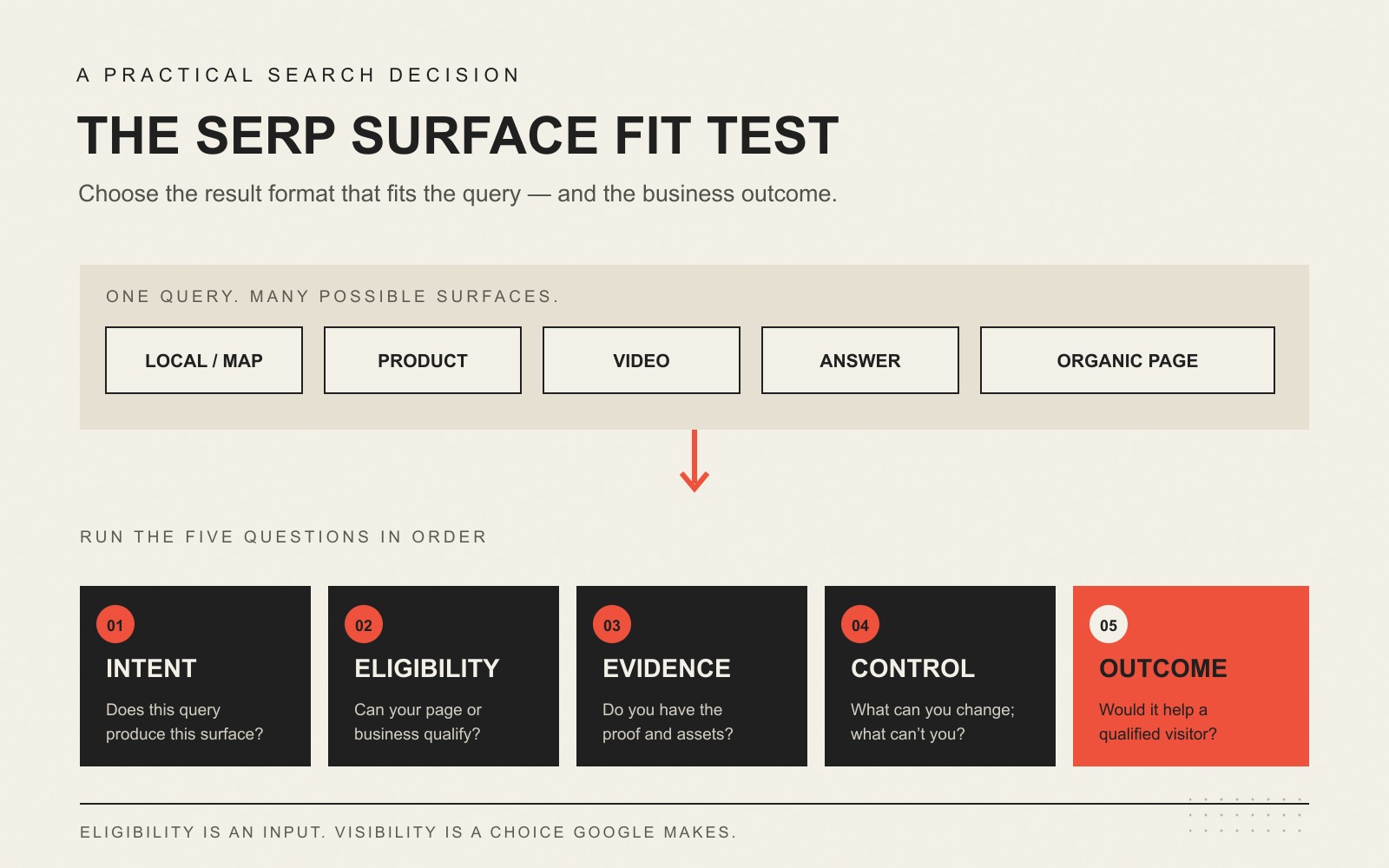
    We use five questions instead. Run them in order for the query you care about:

    1. Intent: Does this query naturally produce this surface?
    2. Eligibility: Can your page, product, business, or content type actually qualify?
    3. Evidence: Do you have the facts, assets, proof, media, or structured data the surface needs?
    4. Control: Which inputs can you improve, and which selection decisions remain Google’s?
    5. Outcome: Would winning this surface help a qualified visitor take the action you care about?
    The SERP Surface Fit Test asks about intent, eligibility, evidence, control, and business outcome before choosing a search result surface.

    The framework keeps you from confusing “Google can show this” with “we should spend time pursuing it.” A plumber does not need a news strategy because Top Stories exists. A manufacturer may care deeply about images and product information even when a blog writer would not. A B2B firm may get more value from one precise organic result than from chasing every decorative module on the page.

    11 Google search surfaces worth understanding in 2026

    These are not eleven boxes every business must check. They are eleven distinct surfaces with different jobs, inputs, and limits.

    1. Organic text results: the durable baseline

    Standard organic results are still the broadest surface because almost any crawlable, indexable page can potentially compete when it matches a query. They are the natural target for service pages, guides, comparisons, category pages, policy pages, and other useful web documents.

    Best fit: queries where the searcher wants a page to read, compare, evaluate, or act on. Eligibility: crawlable/indexable content with a clear canonical, useful visible text, and a page that actually serves the intent. Control: you can improve technical access, relevance, evidence, titles, internal links, and page usefulness; you cannot reserve a position.

    Once you have chosen a normal organic page as the right surface, use the separate Scope Design Page-One Readiness Stack to diagnose why that page is not performing. That is post 3384’s job; this article deliberately does not duplicate it.

    2. Featured snippets: answer a narrow question cleanly

    A featured snippet is a prominent answer extracted from a web page and displayed in the search results. Google is explicit: its systems decide whether a page becomes a featured snippet. There is no “make me the snippet” setting.

    Best fit: queries with a concise definition, ordered process, comparison, calculation, or direct factual question. Evidence: a self-contained answer followed by enough context to make it trustworthy. Control: structure the answer clearly, use descriptive headings, and keep the page useful beyond the extracted sentence. Do not mutilate the whole article into tiny robotic fragments hoping one gets picked.

    DataForSEO measured featured snippet at 480 monthly U.S. searches in the keyword dataset we checked, and the buyer-style AI query “how do I get a featured snippet on Google” showed measurable AI search volume too. Demand exists, but selection remains Google’s.

    3. People Also Ask: cover the adjacent decisions, not FAQ filler

    People Also Ask exposes related questions around the original search. For our SERP-feature research, Google surfaced questions such as “What is SERP on Google?”, “What is SERP vs SEO?”, “What are the key features of a SERP?”, and “How does a SERP work?” Those questions are useful because they reveal what the searcher may need next.

    Best fit: topics with clear follow-up questions, objections, definitions, comparisons, or implementation concerns. Control: answer the genuinely relevant subquestions in visible content. Do not: stuff twenty vaguely related questions onto the bottom of a page or assume FAQ schema creates a ranking boost. Useful coverage comes first; markup must match what visitors can actually see.

    4. AI Overviews and AI Mode: make useful source material eligible

    Google’s guidance for AI Overviews and AI Mode is refreshingly unmagical. The same foundational SEO practices still apply. Supporting pages generally need to be indexed and eligible to appear in Search with a snippet, and Google says there are no additional technical requirements or special AI markup required just to appear in these experiences.

    Best fit: questions where the system needs to synthesize multiple facts, steps, perspectives, or sources. Evidence: explicit entities, original experience, verifiable claims, useful tables, clear explanations, and facts that are easy to retrieve in text. Control: improve source quality and technical eligibility; never promise an AI citation.

    If AI visibility is strategically important, go deeper with our AI search optimization and citation-readiness guide. Same foundation, different presentation and measurement headache.

    5. Local Pack and Maps: win the geographic decision

    Local results are a different contest from a national organic article. Google says local ranking is mainly based on relevance, distance, and prominence, and that businesses cannot pay or request a better local ranking. That should kill a lot of silly “secret local ranking hack” pitches.

    Best fit: searches where someone wants a nearby provider, store, restaurant, professional, or service area. Eligibility: accurate Google Business Profile information, a legitimate business/location model, useful website support, and real-world prominence/proof. Evidence: services, categories, hours, location/service-area facts, photos, reviews, and consistent business details.

    For the deeper system, see our local SEO guide for small businesses. If the query is local, a generic blog-post ranking plan may be solving the wrong problem entirely.

    6. Image results: compete when the answer is visual

    Images can appear in Google Images and in visual modules inside regular Search. Google recommends high-quality images on useful pages, accessible image URLs, descriptive context, and image metadata that helps the system understand what the image depicts.

    Best fit: products, design, before-and-after work, locations, diagrams, inspiration, visual troubleshooting, people, places, and anything where seeing beats reading. Evidence: original relevant media, honest alt text, useful captions/context, and a landing page worth visiting. Control: make the image discoverable and understandable. Do not rename stock photos with keywords and call it an image strategy.

    7. Video results: use motion when motion teaches better

    Google can surface videos in regular Search, Video mode, Images, and other discovery experiences. Video-specific metadata such as accurate VideoObject structured data can help Google understand a video’s details, but the page and video still need to deserve the result.

    Best fit: demonstrations, walkthroughs, repairs, interviews, product use, tours, before-and-after sequences, and explanations that benefit from movement or voice. Evidence: a real watchable video, useful title/description, a strong page around it, and accessible thumbnail/media information.

    If YouTube itself is part of the strategy, our guide to getting more qualified YouTube views covers the platform-specific side without pretending every view is a business result.

    8. Shopping and product results: give Google clean commerce data

    Product searches can produce product snippets, merchant listings, Shopping experiences, and other commerce presentations. Google documents separate requirements for product snippets and merchant listings, and Merchant Center has its own account and product eligibility rules for free listings.

    Best fit: ecommerce and product-led queries. Evidence: accurate price, availability, product identifiers, images, offers, shipping/return information where required, and structured product data that matches the visible page. Control: provide accurate data and maintain eligibility. Structured data creates a chance to qualify; it does not guarantee the feature will appear.

    Stores should treat this as a catalog and architecture problem, not just a paragraph-writing problem. Our ecommerce SEO guide covers categories, products, variants, facets, internal links, and crawl control in more depth.

    9. Discussions and forums: first-hand participation is the asset

    Google supports discussion and forum presentations for genuine community content. Its structured-data documentation includes profile and discussion markup designed to help Search understand real creators and conversations.

    Best fit: questions where lived experience, troubleshooting, opinions, edge cases, or peer comparison matter. Eligibility: an actual community or discussion page with real participants and first-hand contributions. Control: make authorship and conversations understandable. Do not manufacture a fake forum section or slap discussion markup on an agency blog because the SERP contains Reddit.

    10. Top Stories and news: only when you are actually doing news

    Google Search can show a Top Stories carousel and a News tab for timely, newsworthy queries. Google says eligible news content is considered automatically; ranking remains automated and depends on the news context and policies.

    Best fit: organizations with a legitimate publishing/news function, timely original reporting, announcements with real public interest, or subject-matter expertise tied to current events. Bad fit: rewriting press releases or turning routine company updates into “breaking news” because a carousel exists. Most small businesses should spend their effort somewhere else.

    11. Knowledge and entity surfaces: make the business easy to understand

    Some searches are about an entity more than a webpage: a company, person, place, product, or organization. Google may assemble entity information alongside ordinary results. This is not a slot you optimize like position three.

    Best fit: branded and entity-oriented searches. Evidence: consistent organization/person information, accurate official profiles, clear About/contact details, visible authorship, and structured data that truthfully describes the entity. Control: reduce ambiguity and publish reliable facts. Google still decides what entity information to assemble and show.

    Google SERP features compared by business job

    SurfaceBest fitCore eligibility or inputUseful measure
    Organic textReading, comparing, evaluating, actingIndexable page that matches intentRelevant impressions, clicks, qualified actions
    Featured snippetNarrow answer, definition, stepsClear answer on a useful eligible pageSnippet presence plus downstream clicks/actions
    People Also AskRelated questions and objectionsUseful visible answers to real subquestionsQuery coverage and qualified search visibility
    AI Overviews / AI ModeSynthesized, multi-part questionsIndexed, snippet-eligible, useful source materialCitations/mentions, referrals, qualified actions
    Local Pack / MapsNearby service or place intentLegitimate, accurate business/location dataCalls, directions, bookings, local leads
    ImagesVisual research and inspirationDiscoverable original/relevant mediaImage impressions, clicks, assisted actions
    VideoDemonstration and explanationIndexable video/page and accurate metadataVideo visibility, watch quality, next actions
    Shopping / productProduct research and purchaseAccurate product data and merchant eligibilityProduct impressions, clicks, purchases
    Discussions / forumsFirst-hand experience and peer adviceReal creators and genuine conversationRelevant visibility, referral quality
    Top Stories / newsTimely newsworthy topicsOriginal eligible news contentNews visibility and relevant readership
    Knowledge / entityBrand and entity lookupClear, consistent, verifiable entity factsBranded visibility and accurate information

    Five SERP-feature mistakes that waste time

    Trying to optimize for every feature at once

    If the query does not produce videos, a video campaign is not automatically the next SEO priority. If the business is not local, Maps is not the prize. If you do not sell products, Merchant Center is irrelevant. Surface fit comes before execution.

    Treating schema as a magic visibility switch

    Structured data can help Google understand eligible content and can enable supported search appearances. It does not guarantee a rich result, an AI citation, a featured snippet, or a ranking. Schema is machine-readable truth, not bribery written in JSON-LD.

    Copying the current winner’s format without checking your evidence

    A competitor may rank with a calculator, original dataset, community, product feed, or newsroom because they possess the underlying asset. Copying their headings will not manufacture that asset. Ask what evidence or capability makes the surface possible.

    Assuming a ranking drop means the page got worse

    The result page itself may have changed. A query can become more local, visual, product-heavy, discussion-heavy, or AI-heavy. Our Google search-change diagnostic separates demand, eligibility, intent, content value, and business outcome before anyone performs random surgery on a page.

    Calling visibility the business outcome

    An impression is not a lead. A citation is not a sale. A ranking is not automatically qualified traffic. Use our SEO measurement ladder to connect eligibility and visibility to engagement, qualified actions, and business results.

    A 30-minute workflow for choosing the right SERP surface

    1. Pick one commercially meaningful query. Not fifty. Choose a question tied to a service, product, local need, comparison, or buying decision.
    2. Inspect the live results. Record the surfaces actually present. If location matters, check the relevant geography. Note ads too because they change how much visible space remains, even though paid placements are not an organic feature to “rank” in.
    3. Run the SERP Surface Fit Test. Score Intent, Eligibility, Evidence, Control, and Outcome. A surface that fails the first two questions is usually a lousy priority.
    4. Choose one primary and one supporting surface. For example: a service page plus local results; a product page plus shopping; an answer-led guide plus a featured snippet/AI source opportunity; a video page plus video search.
    5. Measure the chain. Track whether the page or entity is eligible, whether it earns visibility, whether the right people engage, and whether they take a qualified action. Improve the weak link rather than adding random content.

    This process sounds less exciting than “11 secrets to dominate Google.” Good. It also gives you a much better chance of working on the actual constraint.

    Frequently asked questions about Google SERP features

    What is a SERP on Google?

    A SERP is a search engine results page. On Google, that page can contain standard organic text results plus modules such as AI Overviews, featured snippets, People Also Ask, local results, images, videos, products, discussions, news, and entity information. The mix varies by query and context.

    What is SERP vs SEO?

    The SERP is the result page the search engine displays. SEO is the work of improving a site’s or entity’s technical eligibility, relevance, usefulness, clarity, authority, and measurement so it has a better opportunity to earn useful search visibility. One is the arena; the other is the work.

    What are the most common Google SERP features?

    Common surfaces include organic text results, featured snippets, People Also Ask, AI Overviews, local/Maps results, image and video results, product/shopping presentations, discussions/forums, news modules, and knowledge/entity information. Not every query shows every surface.

    Can a small business appear in Google AI Overviews?

    Yes, a small-business page can be used as a supporting source when Google’s systems select it. Google says the same foundational SEO practices apply to AI features and that supporting pages generally need to be indexed and eligible to show a snippet. There is no special AI schema that guarantees inclusion.

    Can I optimize directly for a featured snippet?

    You can make a page easier to use by answering the relevant question clearly and structuring the explanation well, but Google chooses featured snippets automatically. No setting or markup can force selection.

    Does schema guarantee rich results?

    No. Correct structured data can make eligible content understandable for supported rich-result features, but Google explicitly does not guarantee that a structured-data feature will appear. Use schema because it truthfully describes visible content, not because a plugin score wants another light to turn green.

    How are local results different from organic results?

    Local results are shaped by geographic intent and Google’s local-ranking systems, which it describes mainly in terms of relevance, distance, and prominence. Organic text results are web pages ranked for the broader query. A local business can appear in both, but the inputs and user actions are different.

    Which SERP features matter most for local businesses and ecommerce stores?

    Local businesses should usually evaluate normal organic results and the Local Pack/Maps first, then images, video, or AI surfaces when the query supports them. Ecommerce stores should usually evaluate product pages, category pages, shopping/product results, images, and video. The right choice still depends on the live query and business outcome.

    Stop trying to “win Google.” Win the right search decision.

    The useful lesson behind modern Google SERP features is not that you need eleven new tactics. It is that search visibility has become more specific. Different questions produce different result surfaces, and each surface rewards a different kind of eligibility, evidence, and business asset.

    Inspect the result page. Choose the surface. Build the thing that deserves to appear there. Measure whether qualified people do something useful afterward. That is a strategy. “Rank #1 everywhere” is a wish wearing an SEO report.

    If you want help turning that into a prioritized plan, use Scope Design’s SEO strategy and measurement system to connect search demand, technical eligibility, content, authority, and analytics to actual business value.

    Sources and methodology

    This article was researched on August 21, 2026 for the United States in English. We compared current Google and Bing result behavior, DataForSEO keyword/SERP/PAA evidence, Ubersuggest keyword and competitor evidence, Scope Design’s Content Studio link graph and Open Brain knowledge, and first-party Google documentation. Search-result layouts change, so treat any individual SERP snapshot as dated evidence rather than a permanent rule.