Tag: sales strategy

  • AI for Sales: 7 Practical Ways to Improve Sales Performance

    AI for Sales: 7 Practical Ways to Improve Sales Performance

    AI for sales works best as a decision-support and workflow layer around a sales team—not as a substitute for human judgment. Used well, it can research accounts, summarize conversations, suggest priorities, draft follow-ups, keep CRM records current, surface pipeline risk, and handle bounded inbound questions. The practical goal is not to make an AI “close deals.” It is to remove friction so people can spend more time diagnosing needs, making good promises, and building trust.

    That distinction matters because AI can scale a bad sales process just as efficiently as a good one. If nobody owns the lead, the CRM is unreliable, qualification rules are vague, or follow-up disappears into memory, adding another AI tool may simply make the mess move faster.

    Current sales platforms reflect this shift. Salesforce’s sales AI and HubSpot Sales Hub now describe features for research, summaries, lead or deal scoring, forecasting, meeting preparation, follow-up, and conversation intelligence. Those capabilities are useful—but the tool should come after the process decision.

    What Is AI for Sales?

    AI for sales is the use of artificial intelligence to help a sales team understand opportunities, reduce repetitive work, preserve customer context, and make better-informed next-step decisions. Depending on the workflow, that may include generative AI for writing and summarization, machine-learning models for scoring or forecasting, conversation intelligence for call analysis, or conversational AI for answering and routing inbound questions.

    The useful question is not, “Where can we add AI?” It is, “Where is the sales process losing time, context, consistency, or opportunities?” Scope Design uses the same constraint-first logic we recommend for broader marketing and growth decisions: diagnose the bottleneck before choosing the tactic.

    Use the Scope Design SCOPE AI Sales Test First

    Before automating a sales task, run it through five questions. We call this the SCOPE AI Sales Test. It is an operating framework, not a promise that every business needs the same software or the same level of automation.

    • S — Sales constraint: What bottleneck are we actually trying to fix?
    • C — Clean context: What data is trustworthy, current, and permitted for the AI to use?
    • O — Owner + override: Who reviews exceptions and can reverse or reject the AI’s recommendation?
    • P — Pipeline proof: Which downstream sales outcome will tell us whether the workflow helped?
    • E — Escalation boundary: When must the AI stop and hand the situation to a person?

    This test keeps the implementation grounded. If the sales constraint is slow follow-up, a sophisticated forecasting model is not the first project. If the CRM contains duplicate companies, stale stages, and missing next steps, feeding that data into AI does not make it clean. And if nobody can explain when the AI should defer to a human, the automation is not ready.

    For the broader workflow-design side of this problem, our guide to AI automation for business goes deeper on when automation earns its place and how to build around the real process instead of the demo.

    7 Practical Ways to Use AI for Sales

    1. Prioritize Leads and Deals Without Letting AI Make the Final Call

    Lead and opportunity prioritization is one of the clearest uses of AI for sales. A system can combine known fit criteria, recent activity, CRM history, stage age, engagement signals, and other approved data to help a rep decide what deserves attention first.

    The important word is prioritize, not reject. A score should help a person inspect the pipeline, not become an invisible rule that automatically discards unusual opportunities. Historical sales data can contain the habits and blind spots of the old process. If yesterday’s team systematically ignored a good segment, a model trained on yesterday may learn to ignore it too.

    • Useful inputs: explicit fit criteria, lifecycle stage, recency, buying signals, account history, and known next steps.
    • Human boundary: require review before disqualifying high-value, unusual, sensitive, or strategically important opportunities.
    • Measure: qualification-to-opportunity movement, false-negative reviews, rep response patterns, and whether good opportunities spend less time unattended.

    2. Research Accounts and Prepare Better Sales Conversations

    Sales research is a strong AI use case because the output is preparation, not the customer-facing promise itself. AI can summarize a prospect’s website, CRM history, prior emails, open support issues, public announcements, and previous meeting notes into a brief that helps the rep enter the conversation with context.

    At Scope Design, our sales notes keep returning to the same principle: educate and listen before trying to close. Better preparation should produce better questions—What made this a priority now? What happens after someone contacts you? What would make this project worth the investment?—not a longer monologue about the seller’s tools.

    A practical AI research brief might contain the company’s apparent business model, relevant services, recent interactions, known stakeholders, unresolved questions, likely risks, and five discovery questions. The rep should verify time-sensitive facts before using them. AI-generated research is a starting point for attention, not a substitute for reading the source.

    • Useful inputs: prospect URL, approved CRM data, previous conversations, proposals, and account notes.
    • Human boundary: verify claims, contacts, pricing, organizational changes, and anything that could materially affect the conversation.
    • Measure: prep time, discovery completeness, useful notes captured, and whether the next step becomes clearer after the call.

    3. Draft More Relevant Outreach and Follow-Up

    AI can draft prospecting emails, recap calls, suggest follow-up language, and adapt a reusable message structure to the actual account context. This is much more useful than “personalization” that merely inserts a first name and a scraped compliment.

    A good follow-up adds something: a clarified next step, an answer, a screenshot, a comparison, a relevant resource, or a reminder tied to the prospect’s stated timing. Scope Design’s working rule is simple: every real opportunity should have a next follow-up date. AI can help create the draft and the task; a person still owns the reason for reaching out.

    Human review is especially important for higher-value outreach. HubSpot’s current AI prospecting agent, for example, includes a review-before-send option. That is a useful design pattern even if you use a different platform: let AI reduce writing friction without giving it unlimited permission to speak for the business.

    Also design the handoff after the response. Our guide to marketing assets and sales handoffs treats routing, qualification questions, CRM ownership, response templates, follow-up rules, and closed-won/closed-lost reasons as part of the same operating system. A polished email does not matter much if the reply has nowhere dependable to go.

    • Useful inputs: the prospect’s stated problem, prior messages, relevant proof, next-step rules, and approved messaging.
    • Human boundary: review pricing, commitments, guarantees, scope, legal claims, and sensitive situations before sending.
    • Measure: qualified replies, meetings held, opportunities advanced, follow-up completion, and opt-outs—not open rate alone.

    4. Automate CRM Cleanup and Sales Admin Without Automating Judgment

    CRM administration is exactly the kind of friction AI should reduce. After a meeting, a sales assistant can summarize the call, identify stakeholders, suggest fields to update, create a follow-up task, attach notes to the right company, and flag missing information. It can also surface records that have no owner or no next action.

    But do not let the automation silently rewrite the meaning of the pipeline. A deal should not move from “discovery” to “proposal” just because a transcript contained the word “budget.” Stage definitions, qualification criteria, and required evidence still belong to the sales process.

    Data permission matters too. The Federal Trade Commission has warned AI companies and businesses to honor privacy and confidentiality commitments, including when customers provide internal or user data. Before connecting email, CRM, call recordings, proposals, or customer records to an AI system, understand what the provider retains, how the data may be used, who can access it, and how it can be removed.

    • Useful inputs: calls, emails, calendar events, contact records, account records, and explicit stage rules.
    • Human boundary: approve stage changes, material record merges, commitments, disqualification, and exceptions.
    • Measure: percentage of active opportunities with an owner and next step, correction rate, overdue follow-ups, and admin time.

    5. Analyze Sales Conversations for Patterns and Coaching

    Conversation intelligence can turn calls and meetings into searchable summaries. A team can use AI to extract questions, objections, commitments, competitors mentioned, follow-up items, and recurring themes across conversations. That creates a useful feedback loop between sales, marketing, service, and product decisions.

    The safest use is evidence retrieval and pattern finding—not pretending a model can read someone’s mind. Treat “sentiment,” “intent,” or personality-style labels as uncertain signals, especially when the model cannot show how it reached them. For recording and transcription, follow applicable consent, employment, privacy, and industry requirements.

    NIST’s Generative AI Profile for the AI Risk Management Framework emphasizes governance practices such as human review, documentation, monitoring, and management oversight where the context warrants them. In a sales workflow, that translates into a practical rule: keep the evidence available, let people inspect the output, and name the person accountable for decisions made from it.

    • Useful inputs: approved recordings/transcripts, CRM outcomes, objection tags, call notes, and coaching criteria.
    • Human boundary: do not treat inferred emotion, sensitive traits, or automated coaching scores as unquestionable truth.
    • Measure: follow-up completeness, recurring objections resolved, coaching actions completed, and whether call notes become more usable downstream.

    6. Forecast Pipeline and Surface Risk Earlier

    AI can help a sales manager inspect the pipeline by highlighting deals with missing next steps, unusual stage age, weak activity, changing stakeholders, unresolved objections, or gaps between the CRM record and recent conversations. It can also summarize why a forecast changed instead of leaving the manager to compare rows manually.

    The mistake is turning a forecast into an oracle. A prediction is only as useful as the stage definitions, historical data, business conditions, and inputs behind it. New offers, seasonal work, a new territory, a major pricing change, or an unusual account can all make historical patterns less informative.

    Use AI to make risk visible and reviewable. Ask it to show the missing evidence, explain the factors behind a flag, and help a manager decide what needs inspection. Keep the actual forecast accountable to a named person.

    • Useful inputs: stage history, next actions, activity recency, amount, close-date changes, stakeholder activity, and outcome history.
    • Human boundary: managers own commit decisions, exceptions, strategic accounts, and any override of the model.
    • Measure: forecast error over time, stale-stage rate, missing-next-step rate, and whether identified risks are acted on.

    7. Qualify Inbound Conversations and Hand Them to the Right Person

    Conversational AI can earn its keep when the job is narrow: answer approved questions, collect the reason for contact, capture basic fit information, schedule a meeting, route the request, and preserve the conversation context for the human who takes over.

    The handoff is the important part. A warm handoff transfers the person, their question, the context already collected, what the AI attempted, and the next expected action. A cold handoff dumps the visitor onto a generic inbox and makes them repeat everything.

    Our AI chatbot guide goes deeper on approved knowledge, permissions, escalation triggers, and human escape paths. The broader customer lifecycle management guide explains why ownership and context must survive the transition from inquiry to qualification, sales, onboarding, and ongoing service.

    • Useful inputs: approved FAQs, service area, fit questions, scheduling rules, contact data, and routing rules.
    • Human boundary: escalate when the customer requests a person, the answer is uncertain, the issue is sensitive, or the requested commitment exceeds the AI’s authority.
    • Measure: qualified handoffs, successful bookings, abandonment, escalation quality, repeated questions, and corrections—not conversation volume alone.

    How to Choose AI Sales Tools Without Buying a Tool Pile

    There is no single “best AI for sales” because sales teams do different jobs with different systems, data, risks, and volumes. Choose the workflow first, then evaluate tools against the job.

    QuestionWhy it matters
    What exact sales job does the tool perform?“AI assistant” is too broad. Name the task: research, note capture, follow-up, scoring, forecasting, routing, or another defined job.
    What data does it need?You need to know which CRM objects, emails, calls, files, calendars, or web sources become inputs.
    Can a person review and override the output?Approval, edit history, confidence signals, and clear exception handling matter when the AI can affect customers or pipeline decisions.
    What happens to your data?Check retention, model-training terms, access controls, permissions, deletion, export, and contractual commitments.
    Does it preserve evidence?A useful system should let you inspect the source, transcript, record, or reasoning context behind important recommendations.
    Does it fit the CRM and workflow you already use?Copying context between disconnected tools can create more work and more data drift.
    How will you measure the result?Decide the baseline, outcome, guardrail, and stop rule before the pilot becomes permanent.

    The product name matters less than whether the workflow remains auditable. That is the same principle we use when evaluating AI for market research: accuracy, traceability, privacy, exportability, and access to the underlying evidence matter more than a flashy demo.

    A 30-Day AI for Sales Pilot

    Do not start by “transforming sales with AI.” Start with one bounded workflow that can produce useful evidence in a month.

    Week 1: Baseline One Sales Constraint

    • Pick one bottleneck: slow follow-up, incomplete CRM notes, inconsistent call preparation, stale deals, weak handoffs, or another observable problem.
    • Document the current process and owner.
    • Choose one primary outcome plus one or two guardrails.
    • Identify which data is allowed and reliable enough to use.

    Week 2: Configure the Smallest Useful Workflow

    • Connect only the systems the use case actually requires.
    • Define what the AI may read, suggest, create, or change.
    • Create the human review and escalation path.
    • Test ordinary cases, edge cases, wrong data, missing data, and ambiguous requests.

    Week 3: Run a Bounded Live Pilot

    • Use a limited group of reps, accounts, lead sources, or activities.
    • Log edits, overrides, failures, and escalations instead of hiding them.
    • Keep the old process available when the new workflow fails.
    • Collect qualitative feedback from the people doing the work.

    Week 4: Compare, Correct, Expand—or Stop

    • Compare the pilot outcome with the baseline.
    • Check downstream effects, not just activity inside the AI tool.
    • Review errors, customer friction, data-quality problems, and staff workarounds.
    • Expand only if the workflow improved the real sales constraint without creating unacceptable risk or hidden work.

    A Worked Example: AI-Assisted Sales for a Service Business

    Consider a hypothetical commercial cleaning company. A facilities manager submits an inquiry because the current vendor has recurring service and communication problems. The company wants to improve response and preparation without letting AI quote complex work or decide whether the prospect is a fit.

    • Inquiry: the website form captures location, facility type, approximate scope, timing, and the reason for considering a change.
    • AI preparation: the system creates the CRM record, summarizes the request, checks approved public account information, and proposes discovery questions.
    • Human qualification: the sales owner reviews service area, scope, timing, operational capacity, and the prospect’s real concern.
    • Follow-up: AI drafts a concise recap around switching risk, access coordination, and next steps; the rep edits and sends it.
    • Next action: the CRM receives an owner, due date, walkthrough task, and the reason the opportunity did or did not advance.
    • Boundary: AI does not invent pricing, promise staffing, guarantee service outcomes, or automatically disqualify an unusual facility.

    The value comes from context moving cleanly through the system. The rep still diagnoses the need and makes the promise. AI helps make sure the research, notes, follow-up, and next action do not disappear between tools.

    How to Measure Whether AI Is Improving Sales

    AI sales ROI should be measured against the bottleneck the pilot was designed to fix. Do not call the project a success because the AI generated more emails, summaries, scores, or chatbot conversations. Activity is useful only when it improves the sales system downstream.

    Metric layerExamplesWhat it tells you
    OperationalTime to first useful response, prep time, admin time, follow-up completionWhether the workflow removes friction
    Data qualityOpportunities with an owner and next step, missing fields, correction rateWhether AI improves or pollutes the system of record
    QualificationQualified-to-opportunity movement, meetings held, disqualification reasonsWhether attention is reaching better-fit work
    Sales outcomeSales cycle, win rate, margin, revenue from affected opportunitiesWhether operational improvements eventually reach business results
    Risk and trustOverrides, escalations, incorrect drafts, complaints, opt-outsWhether automation creates hidden customer or governance costs

    For small sales volumes, do not demand fake statistical certainty. Use a sensible baseline, inspect individual cases, compare affected opportunities where possible, and combine quantitative outcomes with rep and customer evidence. If a workflow saves minutes but creates inaccurate promises, it is not an improvement.

    AI for Sales FAQ

    Can you use AI for sales?

    Yes. AI can support sales research, prioritization, follow-up, CRM administration, call analysis, forecasting, and bounded inbound qualification. The strongest implementations give AI a narrow job, reliable context, a human owner, a measurable outcome, and a clear escalation path.

    Which AI is best for salespeople?

    The best AI depends on the sales job and the systems you already use. A team that needs CRM cleanup should evaluate a different workflow than a team that needs call analysis or account research. Prioritize fit with your CRM, data controls, review/override features, source traceability, exportability, and measurement—not a generic “best AI” ranking.

    Can AI replace sales reps?

    AI can replace pieces of repetitive sales work, but it should not be treated as a universal replacement for discovery, judgment, negotiation, accountability, or relationship management. In complex service sales, the buyer often needs someone who can interpret context, make a responsible promise, handle exceptions, and coordinate the next step.

    What sales task should a small business automate first?

    Start with a frequent, low-risk task tied to an observable bottleneck. Good candidates include call summaries, research briefs, follow-up task creation, CRM field suggestions, meeting recaps, or approved FAQ routing. Avoid starting with autonomous pricing, automatic disqualification, or customer-facing promises.

    What data does AI sales software need?

    It depends on the use case. Common inputs include CRM records, account activity, emails, meetings, transcripts, website or public account information, stage history, and approved knowledge. Use the minimum data needed for the job, check provider retention and training terms, and keep access permissions appropriate to the sensitivity of the information.

    How do you measure AI sales ROI?

    Compare the cost and effort of the workflow with the bottleneck it was designed to improve. Track operational changes such as response time or admin work, then follow the affected opportunities into qualification, sales cycle, win/loss, margin, and revenue where the sample is meaningful. Include correction, escalation, and customer-friction costs so the ROI calculation does not ignore the downside.

    What should you not automate in sales?

    Do not automate judgment merely because a model can produce an answer. High-stakes commitments, unusual exceptions, sensitive decisions, unverified claims, relationship recovery, pricing outside clear rules, or anything with meaningful legal, financial, privacy, or reputational consequences should have an explicit human decision owner.

    Put AI Around the Sales Process—Not in Charge of It

    The most useful AI for sales is often less dramatic than the demo. It prepares the rep. It remembers the next action. It cleans the record. It turns a call into usable context. It spots a stalled opportunity. It hands an inbound conversation to the right person without making the customer start over.

    Start with the sales constraint, not the subscription. Give the AI clean context, a human owner, a downstream metric, and an escalation boundary. Then automate the smallest useful step, measure what happens, and expand only when the evidence earns it.

    If your sales problem crosses the website, forms, CRM, follow-up, automation, and customer handoffs, Scope Design can help map the operating workflow before another disconnected tool gets added to the pile.

  • What NOT to Do When Selling: 7 Fatal Sales Mistakes That Kill Deals

    What NOT to Do When Selling: 7 Fatal Sales Mistakes That Kill Deals

    The sales mistakes that kill otherwise good deals are usually stage mistakes. A seller pitches before understanding the problem, keeps persuading after the buyer has shifted into decision mode, overpromises, argues with objections, dumps features, manufactures urgency, or skips qualification. The fix is not to become timid. It is to make every interaction improve the buyer’s ability to make a confident decision.

    That distinction matters because buyers do not need a salesperson to recite everything the website already says. They need help when context, judgment, risk, fit, and next steps get messy. If the buyer is already convinced and you keep piling on reasons to buy, you can turn useful confidence into a fresh reason to wonder what you are hiding.

    TL;DR: the 7 sales mistakes to stop making

    • Keep selling after the buyer has moved into decision mode. Answer the question they are actually asking instead of restarting the pitch.
    • Pitch the solution before diagnosing the problem. A recommendation without diagnosis feels generic because it usually is.
    • Overpromise or hide the tradeoffs. Confidence is useful; pretending there is no downside is not.
    • Treat objections as something to defeat. An objection may be missing information, missing trust, a real constraint, or a legitimate sign of bad fit.
    • Dump features or proof without connecting it to the buyer’s decision. Evidence should resolve a specific doubt.
    • Manufacture urgency or keep pushing after “no” or “not now.” Your deadline is not automatically the buyer’s business reason to act.
    • Skip qualification and the real decision process. Fit, value, stakeholders, timing, responsibilities, and next steps matter before a proposal deserves oxygen.

    The two sales pitches that talked me out of buying

    I learned the first lesson from the buyer’s side. I was on a teleconference for an opportunity in a hot niche. The presenter had my attention. I was genuinely interested in the information and, for a while, the offer sounded worth considering.

    Then he started selling. And selling. And selling some more.

    If this offer is really this good, why does he need this much convincing to get me to buy it?

    By the time he finally got to the price and sales page, I had gone from interested to suspicious. The pitch did not fail because it lacked enthusiasm. It failed because the extra enthusiasm became new evidence I had to explain away.

    A couple of weeks later, another presenter kept repeating that his system was “as easy as taking candy from a baby.” He said some version of it so many times that the phrase became the entire problem. If it was that easy, why was all this hype necessary?

    The most believable moment came when an assistant briefly described how excited she felt when someone struggled with the business model and then started making sales. Finally, a human sentence. There was difficulty, then progress. The presenter shut that down and went back to the easy-money line. I did not buy that offer either.

    That experience is the reason this article is not a lecture about closing tricks. It is about the point where selling stops helping. When the buyer has enough interest to ask real decision questions, the seller’s job changes.

    Why good sellers become decision support

    Current B2B buyer research supports that shift. In a May 2026 survey of 645 B2B buyers, Gartner reported that 69% prefer to validate AI-generated insights with sales reps. The same research found strong preferences for self-directed and digital buying, while describing the seller’s distinctive value at critical moments as validation, context, risk reduction, and decision support.

    That is not a contradiction. Buyers can want less unnecessary seller involvement and still want human judgment when the decision becomes consequential. In Gartner’s 2025 research, 73% of surveyed B2B buyers said they actively avoid suppliers that send irrelevant outreach, while 69% reported inconsistencies between what a company website says and what its sellers say. More contact is not automatically more value.

    For service businesses, that is a useful reality check. The buyer can usually read your services, reviews, and case studies before talking to you. The sales conversation earns its place by making the decision clearer than the website could on its own. If your broader audience, offer, channel, or handoff system is confused before the call even starts, fix that upstream in your small business marketing strategy instead of asking sales pressure to compensate for a bad system.

    Use the Scope Design STOP Check before you keep pitching

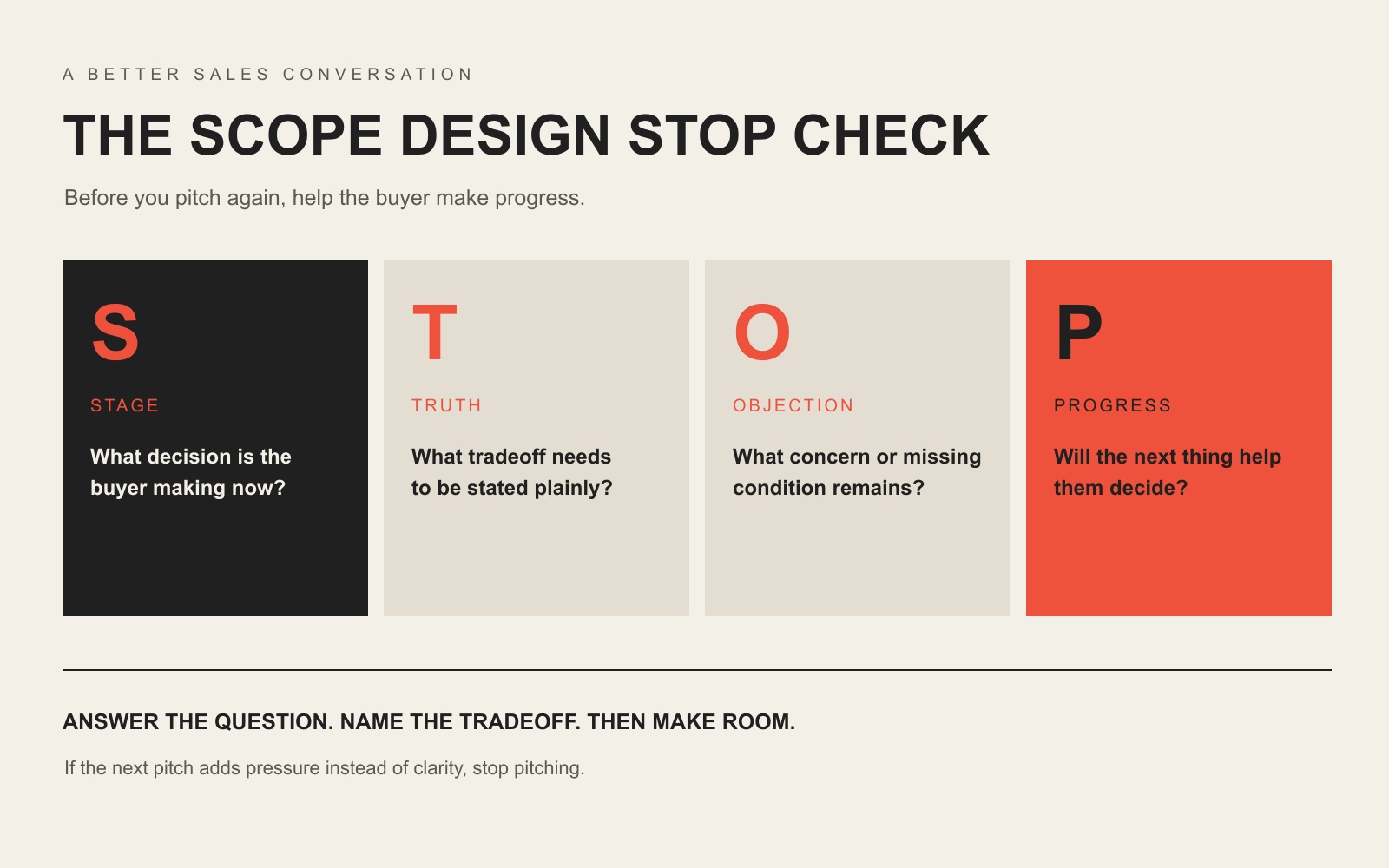
    Before adding one more benefit, testimonial, discount, slide, follow-up, or closing line, run the conversation through four questions. We call it the Scope Design STOP Check.

    The Scope Design STOP Check: Stage, Truth, Objection, and Progress. Ask what decision the buyer is making, what tradeoff to state, what concern remains, and whether your next words help them decide.
    The Scope Design STOP Check: Stage, Truth, Objection, and Progress.
    CheckQuestionWhat a useful answer changes
    StageWhat decision is the buyer actually making now?You match the conversation to exploration, comparison, validation, approval, or implementation instead of replaying the whole pitch.
    TruthWhat limitation, tradeoff, or deadline needs to be stated plainly?You make the recommendation more believable by showing where it fits and where it does not.
    ObjectionWhat concern or missing condition still remains?You learn whether the buyer needs evidence, clarification, another stakeholder, different timing, or a different solution.
    ProgressWill the next thing you say increase buyer confidence or only seller pressure?You choose an answer, proof point, pause, next step, or respectful no instead of reflexively pitching harder.

    The STOP Check is not a script for manipulating people more elegantly. It is a guardrail against doing the wrong sales job at the wrong time. If the next thing you are about to say does not help the buyer make progress, there is a decent chance silence will outperform it.

    7 fatal sales mistakes that kill otherwise good deals

    1. You keep selling after the buyer has moved into decision mode

    One of the clearest sales mistakes is treating every positive signal as permission to restart the pitch. The buyer asks, “What happens next?” and the seller hears, “Please explain the value proposition again.” The buyer asks about onboarding, support, pricing at their scale, contract terms, implementation, references, or who needs to approve the work, and the seller responds with another fifteen minutes of features.

    Those questions are different from early curiosity. They suggest the buyer is trying to picture the decision in the real world. Your job is to answer the specific risk or next-step question in front of you. If they ask how implementation works, explain dependencies, responsibilities, timeline, and what can go wrong. If they ask who should join the next call, help them bring the right people in.

    Better move: when the buyer’s questions change from “why should I care?” to “how would this work here?”, stop broad persuasion and start decision support. Do not manufacture new objections by reopening settled questions.

    2. You pitch the solution before diagnosing the problem

    A fast pitch can feel efficient to the seller because it gets to the offer quickly. To the buyer, it often feels like you were going to recommend the same thing no matter what they said.

    Scope Design’s sales notes use a staged sequence for a reason: qualify, discover, recommend, decide. Discovery should tell you what the business sells, who the best customer is, what blocks the sale, what the current process does, what outcome matters, and whether the problem is valuable enough to fix. Only then should the solution take shape.

    For service businesses, the distinction is especially important. A weak website may be a symptom of poor positioning, low trust, bad lead quality, slow follow-up, or an unclear offer. Selling a redesign before understanding which problem actually matters is just expensive pattern matching. Our positive companion guide to selling services online goes deeper on reducing buyer uncertainty across the whole path.

    Better move: earn the recommendation. Ask enough useful questions to explain why this solution fits this buyer, and be willing to discover that it does not.

    3. You overpromise or hide the tradeoffs

    “Absolutely, we can do that.” “There is basically no downside.” “Results should be fast.” “This is easy.” Those sentences feel comforting until reality shows up with a clipboard.

    Credible selling has edges. A custom website may be the right investment, but it requires decisions, content, approvals, maintenance, and sometimes behavior change inside the business. SEO can create durable visibility, but you do not control Google. Paid campaigns can produce useful data quickly, but money does not rescue a weak offer. The tradeoff is part of the recommendation.

    There is also a basic truthfulness standard here. The FTC’s business guidance says advertising claims must be truthful, non-deceptive or unfair, and evidence-based. Even when a sales conversation is not a formal ad, the operating principle is worth keeping: do not turn uncertainty into certainty because certainty closes faster. If you want the broader Scope Design position, read why marketing lies cost more than truth.

    Better move: say what you know, say what you need to verify, name the downside, and explain what would make the recommendation a bad fit. “I need to check that before I promise it” is often a stronger sales sentence than a confident guess.

    4. You treat objections as something to defeat

    An objection is not automatically a wall between you and the commission. It is information. Price may mean the value is unclear, the budget is real, the timing is wrong, the risk feels too high, or the buyer is comparing you with a cheaper category of solution. “I need to think about it” may mean exactly that, or it may mean a stakeholder is missing, a concern has not been voiced, or the buyer simply does not want the offer.

    If you counter every concern immediately, you teach the buyer that the conversation has only one acceptable outcome: yes. That makes honest discovery harder because every answer becomes ammunition.

    A better diagnostic is: What would need to be true for this to feel like a confident decision? Then listen. If the answer exposes a real fit problem, respect it. The job is not to hypnotize the buyer into ignoring their own constraints. Our buyer psychology guide goes deeper on diagnosing uncertainty instead of labeling every hesitation a closing problem.

    Better move: clarify the concern, test what evidence or condition would resolve it, and accept that sometimes the right outcome is “not this,” “not yet,” or “not us.”

    5. You dump features or proof without connecting it to the buyer’s decision

    Features are not useless. Proof is not useless. They become useless when they are detached from the reason the buyer is evaluating the purchase.

    A hosting feature matters if uptime, support, security, ownership, or speed is part of the buyer’s risk. A case study matters if it resembles the buyer’s situation closely enough to reduce uncertainty. A testimonial matters when it answers a doubt the buyer actually has. Ten random testimonials in a carousel are not automatically stronger than one specific piece of evidence beside the claim it supports.

    That is why our testimonial workflow starts by mapping claims and doubts, then choosing the evidence type that fits. Proof has a job. Give it the job instead of throwing it at the buyer like confetti.

    Better move: connect every feature or proof point to the buyer’s stated outcome, concern, or decision criterion. If you cannot finish the sentence “This matters here because…”, it probably does not belong in that moment.

    6. You manufacture urgency or keep pushing after “no” or “not now”

    Real urgency exists. A seasonal launch date, contract expiration, event, compliance deadline, inventory constraint, staffing window, or known cost increase can create a legitimate decision window. Fake urgency exists too, and buyers can usually smell the difference.

    The key question is whose deadline it is. “We need this signed by Friday because our calendar is filling” can be honest information. “You must decide by Friday or everything falls apart” is a different claim. If the buyer cannot connect the deadline to their own business consequence, you are transferring your pressure to them.

    The same applies to follow-up. Gartner’s 2025 survey found that 73% of B2B buyers actively avoid suppliers that send irrelevant outreach. A useful follow-up adds something: an answer, a clarification, a relevant example, a missing document, a decision recap, or a sensible next step. “Just checking in” five times is not a nurturing strategy. It is a calendar reminder wearing a sales badge.

    Better move: be clear about real timing constraints, add value when you follow up, and respect a clear no. “Not now” can get a future date if the buyer wants one. “No” is not a puzzle you are entitled to solve.

    7. You skip qualification and the real decision process

    Unqualified prospects make every later stage harder. The issue is not only whether the person can pay. A worthwhile opportunity usually has a real problem, meaningful business value, access to the people who decide, a plausible timeline, fit with the way you deliver, willingness to participate, and a clear outcome worth measuring.

    You also need to understand the decision itself. Who else needs to be comfortable? What questions will finance, operations, IT, a partner, or another owner ask? What does the buyer need to compare? What happens if they do nothing? What responsibility belongs to the client after the sale?

    Skipping those questions is how sellers celebrate an enthusiastic contact while the actual buying group quietly kills the deal two weeks later. It is also how agencies write elaborate proposals for people who were never qualified to buy.

    Better move: qualify the opportunity before investing heavily in it, identify the decision process before the proposal, and make every interaction earn the next one.

    A calmer sales sequence: qualify → discover → recommend → decide → hand off

    The opposite of high-pressure selling is not passive selling. You still lead the process. You simply lead it by making the next decision clearer.

    1. Qualify: confirm the problem, value, fit, decision access, timing, responsibilities, and outcome before spending hours on a speculative solution.
    2. Discover: understand the business, customer, market, current path, failed attempts, constraints, and what success would actually change.
    3. Recommend: present the smallest solution that addresses the biggest relevant problem. Explain what it includes, what it does not, the tradeoffs, investment, and assumptions.
    4. Decide: answer the remaining decision questions. Bring in stakeholders. Clarify proof, risk, timing, terms, alternatives, and next steps without reopening the entire sales pitch.
    5. Hand off: once the decision is made, convert promises into a work plan. Confirm scope, responsibilities, access, dates, communication, and the first action.

    That sequence is deliberately boring compared with a bag of closing tricks. Good. A service sale should feel less like a magic act and more like two adults reducing uncertainty until there is enough clarity to move forward or walk away.

    Frequently asked questions about sales mistakes

    What is the biggest mistake in sales?

    The biggest mistake is doing the wrong sales job for the buyer’s current stage. In practice, that often means continuing broad persuasion after the buyer has moved into specific decision questions. Once they are evaluating implementation, risk, stakeholders, terms, proof, or timing, more generic pitching can add friction instead of value.

    What should you not do in sales?

    Do not pitch before diagnosing, overpromise, hide tradeoffs, argue with every objection, dump irrelevant features or proof, invent urgency, chase a clear no, or skip qualification and stakeholder discovery. Those behaviors all share the same flaw: they prioritize seller motion over buyer progress.

    When should a salesperson stop selling?

    Stop broad selling when the buyer has enough context to evaluate the decision and their questions shift to how the purchase would work in reality. Answer implementation, risk, pricing, approval, proof, support, and next-step questions directly. Also stop when the buyer gives a clear no. The right late-stage move may be an answer, a pause, a document, a stakeholder conversation, or nothing at all.

    Does overselling actually lose customers?

    It can, but there is no responsible universal percentage for “deals lost to overselling.” The original version of this article used tidy statistics that did not survive verification, so they are gone. What we can say is that current B2B research shows buyers strongly value relevance, consistency, self-directed research, and seller input that adds context or confidence. My own buyer-side experiences also show how extra hype can create doubt after interest already exists. Treat overselling as a preventable trust risk, not a fake conversion formula.

    How do you handle objections without being pushy?

    Start by naming the concern accurately. Ask what needs to be true for the buyer to feel confident, then determine whether the missing piece is evidence, clarity, timing, budget, stakeholder agreement, risk tolerance, or fit. Resolve what you can honestly resolve. If the condition cannot be met, say so. Objection handling should improve the decision, not erase the buyer’s right to make one.

    What is a good buying signal?

    A useful cue is a change in the buyer’s questions. Early questions tend to explore the problem and your relevance. Later questions tend to simulate ownership: implementation, support, pricing at their scale, contract terms, references, stakeholder approval, integration, onboarding, or what happens next. Treat those cues as a reason to get more specific, not louder.

    How should you follow up without sounding desperate?

    Bring something useful. Recap a decision, answer an unresolved question, send a relevant proof point, clarify a tradeoff, provide the document another stakeholder needs, or propose a sensible date. If you have nothing new to add, a brief respectful check-in can be enough once. Repeated “just checking in” messages mostly advertise that you want an answer.

    Fix the sales stage that is actually broken

    If your marketing is producing the right conversations but deals keep getting weird near the finish line, do not buy more traffic first. Audit the sales stages. Look for premature pitching, weak discovery, promises that delivery cannot keep, objections nobody actually understands, missing stakeholders, or follow-up with no customer job.

    If the problem starts earlier — wrong audience, muddy offer, low trust, weak destination, broken handoff, or no measurement — the sales call cannot rescue the system by trying harder. Start with the broader marketing strategy diagnostic, then make the sales conversation do the smaller job it is supposed to do.

    The rule is simple: help the buyer make progress. When the next pitch no longer does that, stop pitching.

  • 4 Proven Ways to Increase Sales Immediately

    4 Proven Ways to Increase Sales Immediately

    Quick answer: To increase sales without guessing, work on the constraint closest to revenue first. If qualified prospects already reach you but do not buy, improve conversion. If past leads or customers are sitting idle, reactivate them. If your sales rate is healthy but each sale is worth too little, improve pricing or packaging. Only after the sales path converts reliably should you add more qualified demand.

    Those are proven revenue levers, but “immediately” needs an honest definition. You can start the right test today. You cannot guarantee that every business will produce more revenue today, this week, or from the same tactic.

    At Scope Design, the rule is simple: a requested tactic is evidence, not a diagnosis. Our constraint-first order is Objective → Constraint → Positioning → Strategy → Tactics → Measurement. If you need the broader system behind channel and marketing decisions, see our small-business marketing strategy guide.

    The Fastest Sales Lever Is Usually the Closest Revenue Constraint

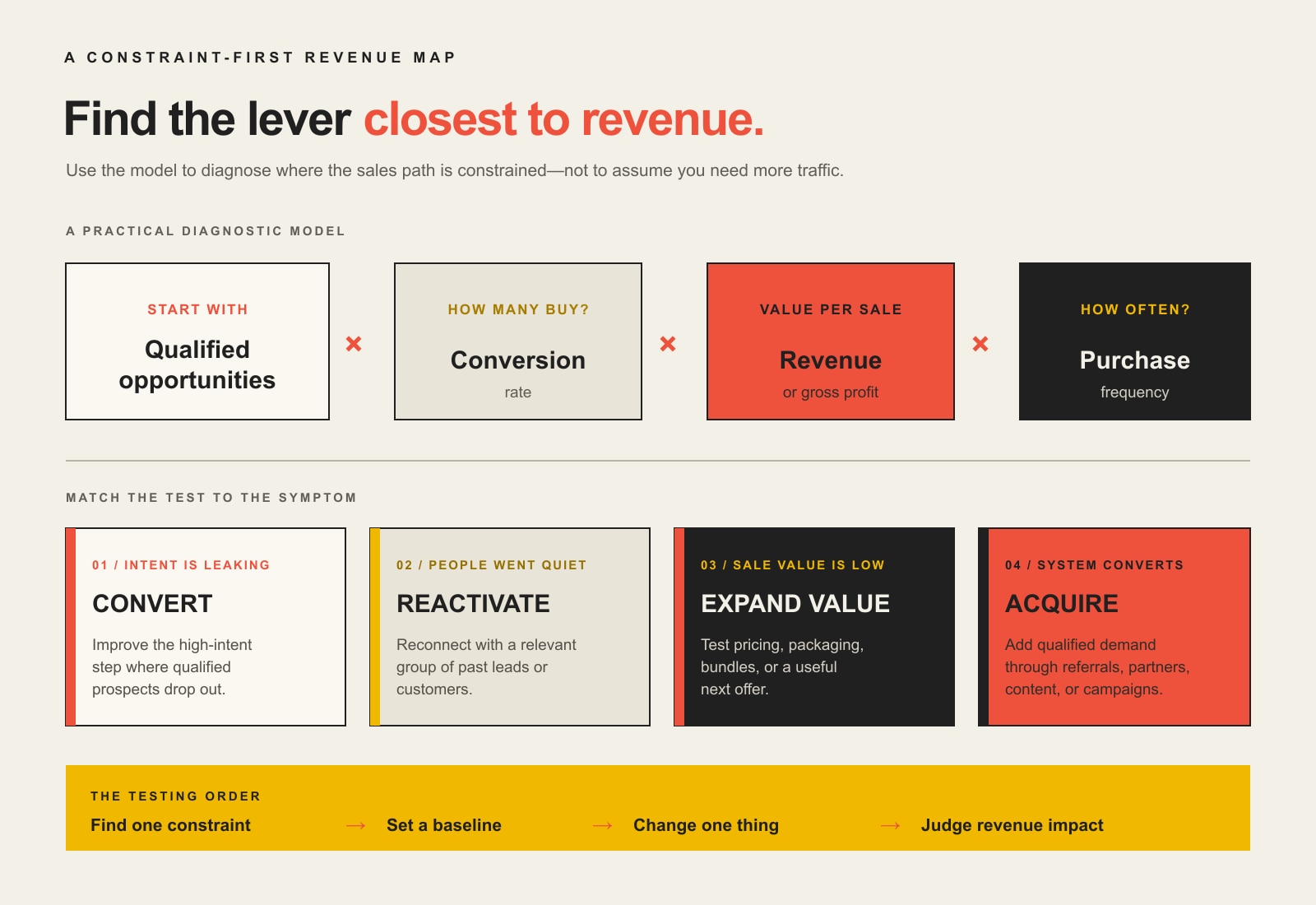
    A useful way to diagnose sales is to model revenue as four connected variables:

    Revenue ≈ qualified opportunities × conversion rate × value per sale × purchase frequency.

    This is a diagnostic model, not an accounting formula for every company. Its value is that it stops you from treating “more traffic” as the default answer. Each part of the model points to a different lever you can test.

    1. Convert: get more qualified prospects who are already in the sales path to take the next meaningful action.
    2. Reactivate: reconnect with leads and customers who already know the business.
    3. Expand value: improve revenue or gross profit per sale through better pricing, packaging, bundles, or appropriate upsells.
    4. Acquire: add new qualified demand through referrals, partnerships, affiliates, content, advertising, or other channels.
    A diagnostic model connects qualified opportunities, conversion rate, value per sale, and purchase frequency to four tests: convert, reactivate, expand value, or acquire; the testing order is find a constraint, set a baseline, change one thing, and judge revenue impact.
    Start with the symptom closest to revenue, establish a baseline, and test one lever at a time.

    If you are unsure which variable is actually constrained, our deeper guide to diagnosing why marketing is not working walks through the bottleneck before adding another tactic.

    1. Convert More of the Qualified Demand You Already Have

    This lever comes first when people are already reaching a high-intent page, requesting information, starting checkout, asking for quotes, or entering the sales process—but too few finish the next meaningful step.

    Do not begin with a sitewide redesign or a dozen simultaneous changes. Find the point where qualified intent is leaking out. Depending on the business, that might be a confusing offer, weak proof, an unclear call to action, unnecessary checkout friction, slow response time, or a sales handoff that leaves the prospect wondering what happens next.

    A bounded conversion test

    • Baseline one meaningful outcome. Use a purchase, qualified inquiry, booked consultation, accepted proposal, or another outcome tied to the sales path—not just pageviews.
    • Choose one high-intent step. Work on the page, form, checkout, quote process, or follow-up where the loss occurs.
    • Change one material thing. Clarify the offer, put proof near the decision, remove an unnecessary field, make the next step explicit, or tighten the handoff.
    • Judge the business outcome. A higher click rate is useful only if it moves more qualified people toward revenue.

    Example: if 100 qualified prospects reach a decision page and two buy, your baseline conversion is 2%. You do not need an industry-average conversion rate to know whether your own controlled change improves that baseline. The right comparison is your business before and after the test, with enough volume and time to avoid overreacting to noise.

    2. Reactivate Leads and Customers Already in Your Orbit

    Before paying to introduce yourself to strangers, look at the people who already raised a hand. Open proposals, older inquiries, previous buyers, renewal candidates, and customers with a logical next need can be closer to revenue than a brand-new visitor.

    The mistake is turning “follow up” into “email everyone more often.” There is no universal send frequency that maximizes every list. A useful cadence depends on why someone joined, what stage they are in, what you have to say, how long the buying cycle is, and whether the audience is responding.

    A better first test is one relevant message to one defined group. For example:

    • Ask stalled prospects whether the original problem still needs to be solved.
    • Show past customers a genuinely complementary service, refill, maintenance option, or next step.
    • Answer the objection that repeatedly stopped a specific class of lead.
    • Invite a segment to a useful resource or offer that matches what they originally asked about.

    Measure replies, qualified conversations, bookings, purchases, or reactivated revenue—not the number of messages sent. For the deeper system behind list ownership, lifecycle, message jobs, and sustainable cadence, use our email marketing roadmap for local business.

    3. Increase Value per Sale Without Pricing by Vibes

    If qualified customers are buying at a healthy rate but revenue or margin per sale is too low, the next lever may be value rather than volume. That can mean a price change, a clearer package, a bundle, a minimum engagement, an add-on, or an upsell that genuinely helps the buyer.

    Do not assume “raise prices” automatically means “make more profit.” Model the economics first. The U.S. Small Business Administration’s break-even guidance defines break-even as the point where total cost equals total revenue and uses fixed cost, selling price, variable cost, and projected unit sales to model the result. That is a better starting point than pricing psychology slogans.

    Use the old pricing example the right way

    Suppose a $29 offer produces seven sales per 100 qualified opportunities. That is $203 in revenue. If a $47 version produces five sales, that is $235. The second scenario generates $32 more revenue per 100 opportunities—but that does not prove the higher price is better. You still need to consider variable costs, acquisition costs, refunds, support load, retention, and what happened to the quality of the customer relationship.

    The point of the math is to show why conversion rate alone is not the business outcome. Price and volume interact. Test them deliberately. If pricing is the real constraint, our strategic guide to raising prices goes deeper into cost, value, positioning, segmentation, testing, and communication.

    4. Add Qualified Demand Through Referrals, Partners, and Affiliates

    Acquisition belongs fourth in this diagnostic—not because new demand is unimportant, but because pouring more people into a weak sales path can make the business busier without making it healthier.

    If the offer is understood, the sales path converts, the economics work, and follow-up is functional, then new qualified demand can become the right constraint to attack. Start with sources that bring context and trust, not just raw traffic.

    Three practical acquisition tests

    • Customer referrals: ask satisfied customers who else has the problem you solve, and make the introduction easy without turning the relationship into pressure.
    • Complementary partners: find businesses that serve the same customer before or after you do, then build a referral or co-marketing path that makes sense for both sides. Our guide to unexpected business partnerships explores that relationship more deeply.
    • Affiliates or creators: recruit a small number of partners whose audience and reputation fit the offer, give them a clear reason to care, and measure qualified sales rather than clicks.

    If compensation or another material relationship is involved in an endorsement, the Federal Trade Commission’s Endorsement Guides say the relationship should be disclosed clearly and conspicuously. Treat disclosure as part of the partnership design, not fine print added later.

    For acquisition, use the same discipline as the other levers: one audience, one offer, one channel, one measurable handoff, and one decision point. Our growth-hacking guide uses the same bounded-experiment idea for customer acquisition.

    How to Choose the First Sales Test This Week

    Use the symptom, not your favorite tactic, to choose the first move:

    • You have enough qualified visits, inquiries, or sales conversations, but too few become customers: test Convert.
    • You have a meaningful pool of past leads or customers who are not receiving relevant follow-up: test Reactivate.
    • Customers buy, but the economics are thin or the average sale leaves obvious value on the table: test Expand Value.
    • The sales path converts reliably and profitably, but there are not enough qualified opportunities entering it: test Acquire.

    Then write down three things before changing anything: your baseline, the single variable you are changing, and the business outcome that determines keep/change/stop. The review window should match the sales cycle. An ecommerce store may see a useful signal quickly; a consultative service with a long proposal cycle may need substantially longer.

    This prevents the most common failure mode in “increase sales” advice: changing the landing page, email schedule, price, ad creative, and partner outreach at the same time, then having no idea which change helped or hurt.

    What “Increase Sales Immediately” Should Actually Mean

    You can increase the quality of your sales process immediately. You can remove friction today. You can send a relevant follow-up today. You can model a pricing change today. You can ask for a referral today. What you should not promise is that any of those actions will create guaranteed same-day revenue.

    The useful definition of “immediate” is the shortest responsible feedback loop you can control. That keeps urgency without replacing judgment with hype.

    Frequently Asked Questions About Increasing Sales

    How can a small business increase sales quickly?

    Start with the closest revenue constraint. Improve conversion if qualified demand already exists, reactivate past leads or customers if you have dormant demand, improve pricing or packaging if value per sale is the problem, and add qualified demand only when the sales path already converts. Pick one lever and one measurable test rather than launching several tactics at once.

    Is more traffic the fastest way to increase sales?

    Not always. More traffic helps when too few qualified opportunities enter a sales system that already converts economically. If the real problem is a confusing offer, weak proof, checkout friction, poor follow-up, or thin pricing, more traffic can simply send more people into the same leak.

    Should I raise or lower prices to increase sales?

    Neither direction is automatically correct. Model contribution and break-even, understand what customers value, and test a controlled price or package change. Watch revenue and profit contribution along with conversion, customer quality, retention, and support cost.

    How often should I email leads and customers?

    There is no universal best frequency. Base cadence on audience expectations, lifecycle stage, buying cycle, the usefulness of what you have to say, and response. A relevant follow-up to a defined segment is a better first test than simply deciding everyone should receive more email.

    What sales metric should I measure first?

    Measure the last meaningful outcome the part of the system can control. For ecommerce that may be a purchase or contribution margin. For a service business it may be a qualified inquiry, booked consultation, accepted proposal, or closed sale. Use traffic, clicks, opens, and form starts as diagnostic metrics—not substitutes for the business outcome.

    Stop Collecting Tactics. Find the Constraint.

    The four ways to increase sales are not four commands every business should run at once. They are four places to look for the next constraint: convert, reactivate, expand value, and acquire. Diagnose the closest leak, run one bounded test, measure the outcome, and earn the right to move to the next lever.

    If the constraint is your website, lead path, marketing system, or measurement—and you want help diagnosing it before buying another tactic—contact Scope Design. We can help map the path from qualified attention to revenue and identify what deserves the next test.