Tag: Productivity

  • How to Achieve Anything in 90 Days: The Ultimate Goal-Setting Framework

    How to Achieve Anything in 90 Days: The Ultimate Goal-Setting Framework

    90 day goals work when you treat the next three months as a bounded execution cycle, not a motivational stunt. Pick one meaningful outcome, decide what evidence will prove progress, turn the outcome into weekly actions, and review the plan often enough to change course before the deadline. You cannot literally achieve anything in 90 days, but you can stop letting a vague annual goal hide behind eleven months of “later.”

    The calendar is not magic. The value of a 90-day cycle is that it is long enough to complete meaningful work and short enough to force decisions. The point is not to worship the quarter. The point is to create a finish line, a weekly operating rhythm, and a rule for what happens when reality punches the plan in the mouth.

    90 Day Goals: The Short Version

    • Choose one primary outcome. Other work can continue, but one result gets priority when capacity conflicts.
    • Define “done” before you start. Use an outcome metric, a small set of leading actions, and guardrails for cost, quality, risk, or capacity.
    • Work in weeks, not vague months. Decide what must happen this week and when it will happen.
    • Review written evidence every week. Keep, change, cut, or rescope based on what actually happened.
    • Use days 30 and 60 as decision points. They are not ceremonial milestones. They are chances to fix a bad tactic before day 90 becomes an autopsy.

    What Are 90 Day Goals?

    A 90-day goal is a specific outcome you intend to achieve, complete, or materially advance during a roughly three-month execution cycle. Good 90 day goals are concrete enough to measure and important enough to deserve a tradeoff. “Improve marketing” is not a useful 90-day goal. “Generate 20 qualified sales conversations from our existing email list without increasing paid-media spend” is much closer.

    Some goals are complete projects: launch the new client portal, document and automate a repeated workflow, finish a certification, publish a defined content asset, or reduce a known operational bottleneck. Other goals are building blocks inside a larger strategy. If the real objective takes a year, the next 90 days should produce the next meaningful proof, capability, or milestone rather than pretending the whole thing belongs in one quarter.

    If you are not sure which outcome deserves the cycle, use a decision process before you use a productivity process. Scope Design’s SCOPE Decision Filter is built for that job: choose the consequential decision first, then build the 90-day plan around it.

    Why Can a 90-Day Goal Cycle Be Useful?

    There is no credible evidence in the sources we reviewed that exactly 90 days is a universal productivity optimum or that quarterly goals automatically beat annual goals. That claim sounds tidy. It is also more certainty than the evidence earns.

    The useful research is about the mechanisms inside a good execution system. A major review by Edwin Locke and Gary Latham summarizes decades of goal-setting research and supports specific, challenging goals under the right conditions, including feedback and commitment, over vague “do your best” instructions. The implication is practical: define an actual result and create a way to see whether your behavior is moving toward it.

    Follow-through matters too. A meta-analysis by Peter Gollwitzer and Paschal Sheeran covering 94 independent tests found that implementation intentions, often expressed as “if X happens, then I will do Y,” improved goal attainment with a medium-to-large effect. Pre-deciding the action reduces the amount of future negotiation required from your tired, distracted, suddenly-very-interested-in-cleaning-the-desk self.

    And progress should be visible. A Psychological Bulletin meta-analysis of 138 studies and 19,951 participants found that interventions increasing progress monitoring promoted goal attainment, with stronger effects when progress was physically recorded or reported. That is a much better reason for a weekly scorecard than “successful people journal on Sundays.”

    So use 90 days as a practical operating constraint: a deadline near enough to expose tradeoffs, paired with clear goals, implementation plans, and recorded progress. The quarter is the container. The behavior inside it does the work.

    The LEAD 90-Day Loop

    Scope Design’s framework is the LEAD 90-Day Loop: Lock the outcome, Engineer the path, Act one week at a time, Diagnose and adjust. It is deliberately simple. A goal system that requires a two-day retreat, seventeen dashboards, and a ceremonial leather notebook has already become a new project.
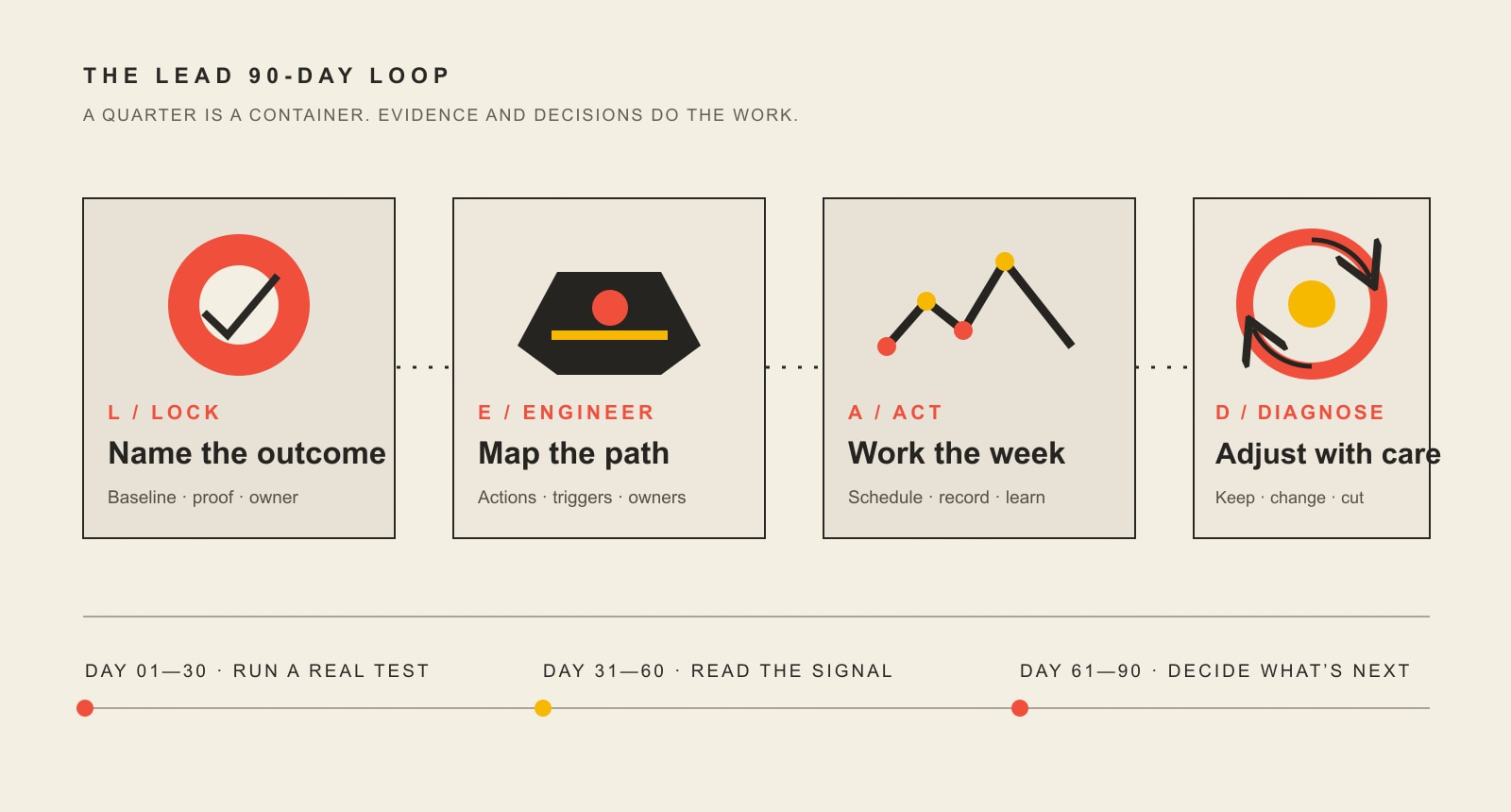
    The LEAD 90-day loop: lock one outcome, engineer the path, act one week at a time, and diagnose and adjust using evidence.

    1. Lock the outcome

    Write one sentence that defines what will be meaningfully different by day 90. Use a result, not a mood. “Feel more organized” is fog. “Reduce average proposal turnaround from five business days to two without increasing revision errors” gives you something to operate.

    • Outcome: What will be true on day 90?
    • Baseline: What is true now?
    • Proof: What evidence will show the outcome actually happened?
    • Owner: Who can make or coordinate the decisions?
    • Stop list: What will not compete for the same capacity during this cycle?

    The stop list is not decorative. A goal is not a priority if every other initiative is also “top priority.” If a new request collides with the 90-day outcome, the team needs a rule for which work moves, waits, shrinks, or dies.

    2. Engineer the path

    Work backward from the outcome and identify the smallest set of controllable actions likely to produce it. Separate dependencies from wishes. If the goal depends on a vendor, customer, employee, or system you do not control, build that uncertainty into the plan rather than pretending the dependency is a task with a due date.

    Then create implementation triggers. Instead of “work on the proposal process twice a week,” write “Tuesday and Thursday at 9:00 a.m., I will review the current queue and remove the oldest blocking step.” If a common obstacle appears, pre-decide the response: “If legal review exceeds two business days, the owner escalates it at the next morning check-in.”

    This is also where systems earn their keep. If repeated work should be automated, documented, delegated, or connected across tools, the broader AI automation for business guide explains how to decide what should become a workflow instead of another recurring reminder.

    3. Act one week at a time

    A 90-day plan becomes real only when it survives contact with Monday morning. Translate the engineered path into weekly commitments small enough to schedule and specific enough to score. “Make progress on automation” is useless. “Map the intake workflow, identify the three manual handoffs, and test one automated routing rule” can be done, reviewed, and learned from.

    Do not turn the quarter into thirteen simultaneous workstreams. Choose the few actions that matter now. Finish or learn something before adding more crap. For a marketing-specific application of that constraint-first idea, see Scope Design’s 90-Day Marketing Acceleration Framework.

    4. Diagnose and adjust

    Every week, compare what you planned with what happened. Do not ask only, “Am I on track?” Ask why the evidence looks the way it does. A missed target can mean at least four different things: the action was not executed, the tactic was weak, the scope was unrealistic, or the environment changed.

    • Keep: What worked well enough to repeat?
    • Change: What should be adjusted because the tactic is underperforming?
    • Cut: What is consuming capacity without improving the outcome?
    • Rescope: Has new evidence changed what a credible day-90 result should be?

    A review is not a motivational ritual. It is a decision loop. Hope is not an analytics strategy, and “we’ll try harder next week” is not a diagnosis.

    What Should You Measure During 90 Day Goals?

    Use three evidence classes together. One metric cannot safely tell the whole story.

    Evidence typeQuestion it answersExample
    Outcome metricDid the business result change?Average proposal turnaround falls from 5 days to 2.
    Leading actionsDid we execute the behaviors expected to influence the outcome?Every new request is routed through one standardized intake within 1 hour.
    GuardrailsDid we improve one number by quietly damaging something else?Revision error rate stays below the current baseline; staff overtime does not increase.

    This distinction matters because outcome metrics often lag. If the result has not moved by week three but the leading actions are being executed cleanly, you may need more time. If the leading actions are not happening, the tactic has not really been tested. If the outcome improves while quality collapses, congratulations: you optimized the wrong thing.

    A Worked 90-Day Business Goal Example

    Suppose a small service business says, “We need to use AI and automation this quarter.” That is not a goal. It is a technology preference wearing a tiny project-management hat.

    A stronger day-90 outcome might be: “Reduce manual lead-intake handling from an average of 18 minutes per inquiry to under 6 minutes, while keeping response accuracy and ownership clear.”

    • Baseline: 18 minutes of manual work per inquiry, inconsistent routing, no single owner for exceptions.
    • Outcome metric: Median manual handling time under 6 minutes by day 90.
    • Leading actions: Standardize intake fields, map decision rules, automate routing for approved cases, review exceptions weekly.
    • Guardrails: No increase in missed inquiries, duplicate records, bad assignments, or response errors.
    • Implementation trigger: If an inquiry cannot be classified automatically, route it to the named owner within 15 minutes rather than letting it disappear into an inbox.
    • Stop list: Do not simultaneously replace the CRM, rebuild the website, launch a chatbot, and redesign the sales process unless one of those is actually required for the outcome.

    Days 1–30 are for baseline, mapping, and the smallest useful test. Days 31–60 are for running the workflow and collecting exception evidence. Days 61–90 are for improving reliability, documenting ownership, and deciding whether to scale. If the business wants help turning that kind of plan into working systems, Scope Design’s Business Automation & AI service is the relevant next step.

    Use 30-, 60-, and 90-Day Checkpoints as Decisions

    Day 30: Do we have a real test?

    By day 30, the goal should be operating, not merely planned. You should have a baseline, visible leading actions, a written scorecard, and enough real-world friction to expose bad assumptions. If the first month was consumed by planning the plan, you do not need more planning. You need a smaller test.

    Day 60: Is the tactic producing credible evidence?

    At day 60, look for repeated patterns. Are the leading actions happening? Is the outcome moving? Which exceptions keep returning? This is the right time to change a tactic that is failing, remove work that is not contributing, or tighten the goal if the original scope was fantasy.

    Day 90: What did we achieve, learn, and decide?

    Do not grade the quarter only as “hit” or “missed.” Record the outcome, the execution rate, the strongest evidence, the biggest wrong assumption, and the next decision. A goal can miss its original number and still produce valuable knowledge. It can also hit the number through unsustainable heroics and be a terrible system. Review both the result and the method.

    Common 90-Day Goal-Setting Mistakes

    • Choosing too many primary goals. Multiple responsibilities are normal. Multiple “number one priorities” are arithmetic cosplay.
    • Measuring only the final outcome. You need leading actions and guardrails to diagnose what is happening before day 90.
    • Using milestones that are just calendar fractions. Being one-third through the quarter does not mean every outcome should be one-third complete.
    • Planning work you do not control as if it were guaranteed. Dependencies need owners, fallback rules, and decision dates.
    • Confusing activity with evidence. Twenty meetings can coexist with zero progress.
    • Never changing the plan. Sticking to a bad tactic is not discipline. It is stubbornness with a spreadsheet.
    • Changing the goal every bad week. A single rough week is not necessarily evidence that the goal is wrong. Look for the cause before rewriting the destination.

    If the goal is primarily about learning a skill, the bottleneck is often different from a business-output goal. Scope Design’s guide to overcoming learning obstacles goes deeper on turning “I don’t know how” into a next action, feedback loop, and practice plan.

    Can AI Help With 90 Day Goals?

    Yes, but give AI a bounded job. It can help brainstorm measurable outcomes, turn a project into candidate weekly actions, identify dependencies, summarize a scorecard, compare planned versus completed work, or generate questions for a weekly review. It should not decide what matters to your business, invent evidence, or quietly replace judgment with confident autocomplete.

    For the AI-specific angle, see AI-Powered Goal Achievement. This article owns the broader 90-day execution framework; the AI article is the better destination when the question becomes how to use AI inside that framework.

    Frequently Asked Questions About 90 Day Goals

    How many 90 day goals should I set?

    For most people or small teams, choose one primary outcome for the cycle and treat other responsibilities as maintenance or supporting work. That is not a scientific law. It is an operating choice that makes tradeoffs visible. If you truly have several independent teams with separate capacity and owners, they can each run their own primary outcome.

    What are good three-month goals?

    Good three-month goals are meaningful, measurable, and controllable enough to execute. Examples include launching a defined service, reducing a measurable process delay, validating a market assumption, finishing a substantial certification, improving a specific conversion bottleneck, or completing one phase of a larger project. Avoid arbitrary outcomes chosen because the number sounds impressive.

    What is the difference between a 90-day goal and a 30/60/90-day plan?

    A 90-day goal system is a general execution cadence for achieving a defined outcome. A 30/60/90-day plan often refers to onboarding or performance expectations for a new employee or manager. The timelines can look similar, but the intent is different. That distinction is why this article targets “90 day goals” rather than chasing the higher-volume but often employment-focused “90 day plan” query.

    Should a 90-day goal be part of a bigger annual goal?

    Often, yes. A quarter is useful for producing the next meaningful result, proof, or capability inside a larger strategy. The annual direction can stay stable while the next 90 days answer a more immediate question: what must be true next for the larger goal to remain credible?

    What if I am behind after 30 days?

    Diagnose before you panic. Check whether the planned actions actually happened, whether the tactic produced the expected signal, whether a dependency failed, and whether the original scope was realistic. Change the cause you can identify. Do not automatically shrink the goal after one bad week or keep a broken tactic just to prove commitment.

    How often should I review a 90-day goal?

    Review the evidence weekly and use deeper checkpoints around days 30 and 60. The weekly review should be short enough to sustain but serious enough to produce a decision. Record the result so next week’s review starts from evidence instead of memory.

    Do 90-day goals work better than annual goals?

    The sources reviewed for this article do not establish that exactly 90 days is universally superior. The stronger evidence supports mechanisms such as specific goals, implementation intentions, feedback, and progress monitoring. A 90-day cycle is a useful way to package those mechanisms into an execution rhythm, not a scientifically proven magic duration.

    When should I change the goal instead of the tactics?

    Change the goal when new evidence shows the outcome is no longer valuable, feasible, ethical, or aligned with the larger strategy. Change the tactic when the outcome still matters but the chosen path is not working. Rescope when the direction is right but the original deadline or capacity assumption was unrealistic.

    Can I start a 90-day goal at any time of year?

    Yes. The system does not require a calendar quarter. Start when a meaningful outcome, owner, baseline, and operating window are clear. January 1 is not a technical dependency.

    Your Next 90 Days Need a Decision, Not More Motivation

    Pick the outcome. Define the evidence. Put the first week on the calendar. Then review what reality tells you.

    If your 90-day goal involves turning a repeated manual process into a reliable workflow, connecting systems, or applying AI where it can remove real operational friction, Scope Design can help with the Business Automation & AI work. The goal is not more tools. It is a system that earns its keep.

  • Overcoming Learning Obstacles: How to Learn a New Skill When You Don’t Know How

    Overcoming Learning Obstacles: How to Learn a New Skill When You Don’t Know How

    How to Learn a New Skill When You Don’t Know How

    If you want to know how to learn a new skill when your brain keeps saying “I don’t know how,” stop waiting for confidence. Define one small useful outcome, make a real attempt, inspect what happened, repair one specific gap, and repeat. Confidence usually becomes more useful after you have evidence that you can make progress.

    That is the core mistake behind a lot of learning frustration. We treat confidence like an admission ticket when it is often a receipt. You do not need to feel ready enough to begin. You need a next action small enough to test.

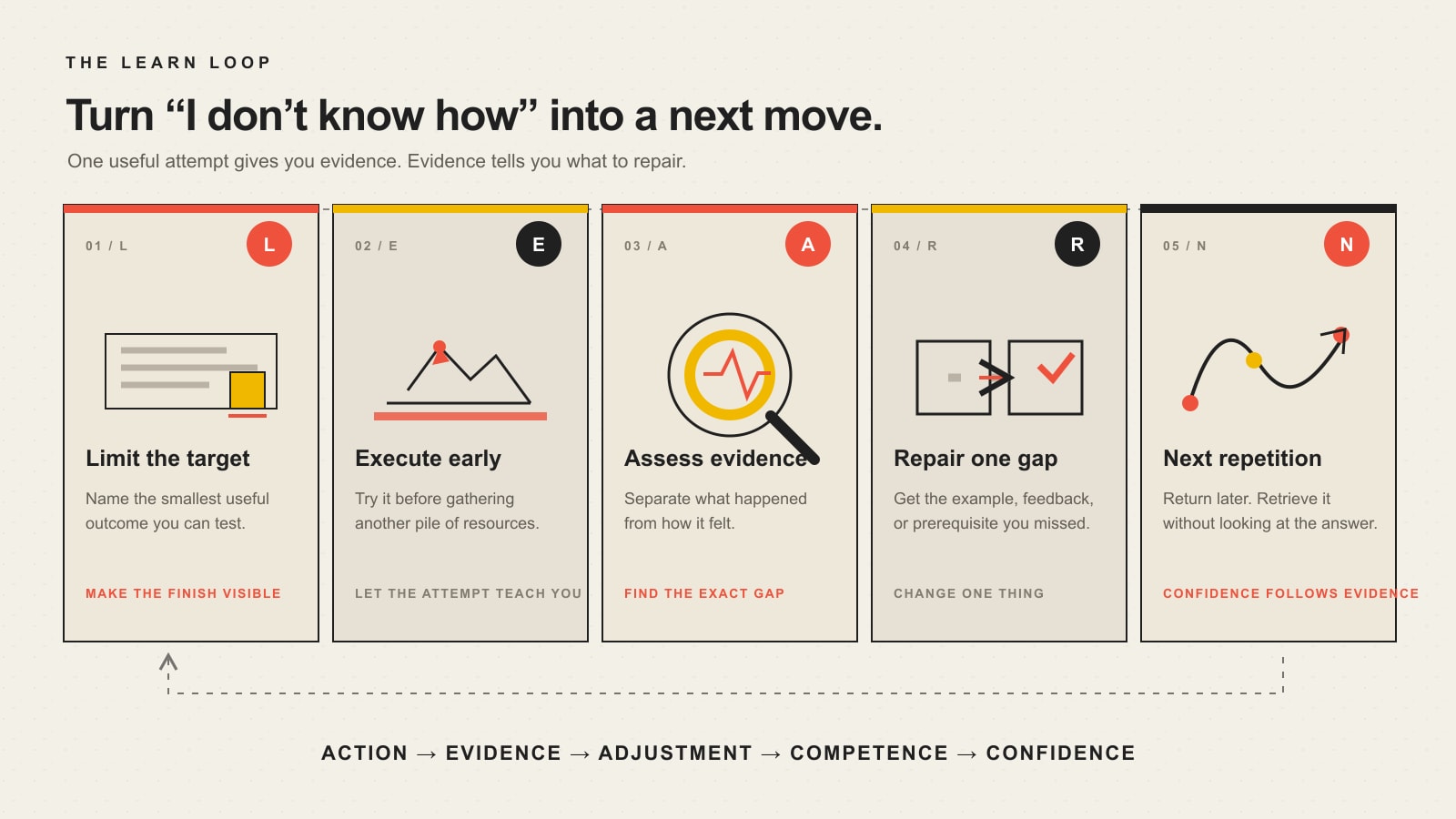
    TL;DR: Use the LEARN Loop

    • Limit the target: define the smallest useful outcome.
    • Execute early: make an attempt before collecting more information.
    • Assess evidence: identify what worked and exactly where the attempt broke.
    • Repair one gap: get feedback, instruction, an example, or a missing prerequisite.
    • Next repetition: retry later, retrieve what you learned from memory, and track what changed.

    This is Scope Design’s LEARN Loop. It turns “I don’t know how” from a verdict into a diagnosis.

    Why “I Don’t Know How” Feels Bigger Than It Is

    “I don’t know how” sounds like one problem. It usually hides several different ones. If you misdiagnose the obstacle, you can spend hours studying without getting any closer to usable skill.

    What it feels likeWhat may actually be wrongBetter next move
    “This is too complicated.”The target is too large.Shrink it to one observable outcome.
    “I keep getting stuck at the same point.”A prerequisite is missing.Identify and learn the missing building block.
    “I practice, but I’m not improving.”The feedback loop is weak.Compare the attempt with a model, coach, test, or measurable result.
    “I’m probably just bad at this.”Discomfort is being treated as a capability verdict.Judge the attempt, not your identity.

    That last distinction matters. A mistake is data about a specific attempt. “I am bad at this” is a story about the person making it. Only one of those gives you something useful to fix.

    The Scope Design LEARN Loop

    Most learning advice becomes a pile of tips: focus harder, believe in yourself, watch a course, find a mentor, practice more. Some of that is useful. The problem is that a pile of advice does not tell you what to do when you are stuck at 2:17 on a Tuesday afternoon. The LEARN Loop is a practical system for how to learn a new skill without turning the process into endless research.

    The five-step LEARN Loop: limit the target, execute early, assess evidence, repair one gap, and take the next repetition; action and evidence lead to competence and confidence.
    The LEARN Loop turns uncertainty into a sequence of small attempts and evidence.

    L — Limit the target

    Do not start with “learn web design,” “learn AI,” “learn sales,” or “learn analytics.” Those are continents.

    Define the smallest useful result you could produce. “Build one responsive landing-page section.” “Create one automation that moves a form submission into a spreadsheet.” “Explain one analytics report well enough to make a marketing decision.”

    A useful target has an observable finish line. If you cannot tell whether you did it, you cannot learn from the attempt.

    E — Execute early

    Information gathering feels productive because nothing can go wrong while you are collecting tabs. Unfortunately, twelve tutorials and three bookmarked courses can coexist with zero skill.

    Learn enough to make the first attempt, then do the thing. The attempt creates information that passive consumption cannot: where you hesitate, what you misunderstand, what breaks, and what you can already do without help.

    Research on practice supports the basic direction here. Repeated practice can improve fluency and reduce the cognitive effort required to perform a practiced task over time. A 2018 review by researchers at Johns Hopkins describes how practice can change speed, skill, habit, and cognitive load.

    A — Assess evidence

    After the attempt, separate evidence from emotion. “That felt awful” can be true and still tell you almost nothing about whether you improved.

    • What worked without help?
    • Where did I stop knowing what to do?
    • What error repeated?
    • What would a correct result look like?
    • What changed between this attempt and the last one?

    This is where a vague learning goal becomes a feedback loop. It is also the bridge between this article and a broader goal-achievement system: outcomes matter, but leading actions and feedback tell you what to change before the final outcome arrives.

    R — Repair one gap

    Do not respond to one failed attempt by restarting the entire subject from chapter one. Repair the narrowest useful gap.

    Maybe you need an example. Maybe you need a coach to point out a bad technique. Maybe the “advanced” thing you keep failing depends on a basic concept you skipped. Maybe you simply need a second attempt with less complexity.

    The point is precision. “I need to get better at coding” is fog. “I do not understand why this function receives an object here instead of a string” is a problem you can actually investigate.

    N — Next repetition

    Learning is not complete because you understood an explanation once. Come back later and try to reproduce the skill or retrieve the knowledge without staring at the answer.

    A 2022 Nature Reviews Psychology review summarizes strong evidence for spacing learning over time and for retrieval practice: actively pulling information from memory instead of only rereading it. Those strategies are useful because they test whether the knowledge is actually available when you need it.

    If the skill matters enough for a longer push, turn the loop into a bounded plan. Scope Design’s 90-day goal framework is useful when you need milestones, leading actions, guardrails, and a review rhythm rather than another inspirational deadline.

    Confidence Is a Lagging Indicator

    The sequence most people want is:

    Confidence → action → competence.

    For a new skill, the more reliable sequence is usually:

    Action → evidence → adjustment → competence → confidence.

    That does not mean emotion is irrelevant. It means you do not give emotion veto power over the first attempt. Confidence based on evidence is sturdier than confidence produced by repeating “you’ve got this” until the phrase files a restraining order.

    What Growth Mindset Can — and Cannot — Do

    A growth-oriented belief can help you interpret difficulty as something that may respond to better strategy, effort, feedback, or instruction instead of proof that ability is fixed. The American Psychological Association’s learning principles connect beliefs about ability with challenge-taking and responses to failure.

    But “have a growth mindset” is not a complete learning system. Context matters. Instruction matters. Prior knowledge matters. Feedback matters. APA’s review of growth-mindset classroom research explicitly notes that the surrounding environment can change how well mindset interventions work.

    Mindset without a useful method is motivational wallpaper. Keep the belief that improvement is possible, then make the next attempt specific enough to produce evidence.

    Practice Matters, but Mastery Is Not a Vending Machine

    Practice matters. Deliberate, structured practice aimed at improving performance matters even more. But there is no honest universal formula where you insert a fixed number of hours and mastery falls out.

    A large meta-analysis published in Psychological Science found that deliberate practice explained meaningful but very different amounts of performance variation across domains. The useful conclusion is not that practice is overrated. It is that performance has multiple causes.

    Your learning plan may also depend on prior experience, quality of instruction, the kind of skill, feedback, available time, physical constraints, tools, and whether the practice resembles the real task. That is why the LEARN Loop keeps asking for evidence instead of worshiping a magic hour count.

    How to Use AI as a Learning Assistant Without Outsourcing Your Brain

    AI can make “I don’t know where to start” dramatically easier to work with. Use it as a tutor, simulator, question generator, explainer, or critique partner. Do not confuse a confident answer with a correct one.

    • Limit: ask AI to break a large skill into prerequisite sub-skills and one beginner outcome.
    • Execute: ask for a practice scenario, then attempt it before requesting the solution.
    • Assess: show your work and ask for a critique against explicit criteria.
    • Repair: ask for one explanation, analogy, or worked example targeted to the exact gap.
    • Next repetition: ask for a fresh problem later and solve it without looking at the previous answer.

    Verify factual or high-stakes material against authoritative sources, and keep a human owner for decisions that affect customers, money, security, privacy, or compliance. That same ownership principle sits at the center of Scope Design’s guide to AI automation for business.

    A Worked Example: Learn Enough Analytics to Make One Decision

    Imagine a business owner who keeps saying, “I need to learn analytics.” That target is too vague to be useful. They probably do not need to become an analyst. They need to answer a business question.

    Suppose the question is: “Is this landing page bringing qualified organic traffic?”

    1. Limit: learn enough to open one landing-page report and identify the traffic source and the page’s basic engagement or conversion evidence.
    2. Execute: pull the report now instead of watching another two-hour analytics course.
    3. Assess: write down what each metric appears to say and which field you cannot interpret.
    4. Repair: learn only the missing concept, such as the difference between a dimension and a metric or how channel attribution works.
    5. Next repetition: run the same review next week without using the tutorial.

    Now the person is not “learning analytics.” They are building a repeatable decision skill. That is a much better target.

    Common Learning Obstacles That Waste Time

    1. Becoming a resource collector

    You do not need the perfect course stack. You need one resource good enough to produce the next attempt. Collecting ten sources before touching the skill is often procrastination with excellent browser organization.

    2. Practicing the whole skill instead of one sub-skill

    “Get better at public speaking” is too large to diagnose. “Deliver the opening without reading,” “answer an objection in 30 seconds,” or “remove filler words from one minute of speech” gives feedback somewhere to land.

    3. Repeating errors without feedback

    Repetition is not automatically improvement. If the same error survives every attempt, you may be rehearsing the mistake. Introduce a model answer, coach, test, instrument, benchmark, or observable result.

    4. Switching methods every time learning feels hard

    Some difficulty is diagnostic. Some is simply the cost of being a beginner. Change the method when evidence says it is failing, not because the third repetition was less entertaining than the first.

    5. Confusing a prerequisite gap with lack of talent

    If the next step depends on something you never learned, brute force may not fix it. Back up one level. Learn the missing foundation. Then retry the real task.

    The 30-Minute “I Don’t Know How” Reset

    When you are stalled, you do not need a new identity. You need thirty useful minutes.

    1. 5 minutes — Limit: write the smallest useful outcome you can complete or test today.
    2. 10 minutes — Execute: attempt it with the resources you already have.
    3. 5 minutes — Assess: write what worked, where you stopped, and the error you can actually name.
    4. 5 minutes — Repair: get one answer, example, hint, or prerequisite explanation.
    5. 5 minutes — Next: retry the hardest part or schedule the next spaced repetition.

    If you finish with one clearer question than you started with, that still counts as progress. A precise question is more valuable than a vague hour of “studying.”

    Frequently Asked Questions About Learning a New Skill

    What is the best way to learn a new skill?

    The best general approach is to define a specific useful outcome, break the skill into smaller components, practice early, get feedback, and repeat over time. Use active retrieval and spaced practice when memory matters. The exact method should match the skill: learning a language, operating software, selling a service, and performing a physical task do not require identical practice.

    How do I overcome learning barriers when I feel completely stuck?

    Diagnose the point of failure before adding effort. Is the target too large? Are you missing a prerequisite? Do you lack feedback? Are you repeating the same error? Shrink the next action until you can produce evidence, then repair the specific gap the attempt reveals.

    Is growth mindset enough to overcome a learning obstacle?

    No. Believing improvement is possible can support persistence, but it does not replace instruction, practice, feedback, prior knowledge, or a workable environment. Treat mindset as support for the system, not the system itself.

    How long does it take to master a new skill?

    There is no universal hour count. The time depends on the definition of mastery, the skill, prior experience, practice quality, feedback, frequency, and the performance standard you need. Define the level you actually need before estimating the time.

    Can AI help me learn a new skill faster?

    AI can reduce the friction of getting explanations, examples, quizzes, practice scenarios, and feedback. It is most useful when you still perform the task and verify important claims. If AI does all the thinking, you may get an output without building the skill you wanted.

    What should I do if I keep making the same mistake?

    Stop repeating the full task. Isolate the exact step that fails, compare it with a correct example or expert feedback, check for a missing prerequisite, and practice the corrected sub-skill before returning to the whole task.

    When should I stop learning and hire someone instead?

    Learn the skill yourself when the knowledge will be used repeatedly, gives you strategic leverage, or helps you make better decisions. Consider hiring when the work is infrequent, high-risk, highly specialized, or more expensive to learn than to delegate. You may still need enough knowledge to define the outcome and judge the result.

    Turn “I Don’t Know How” Into the Next Decision

    The goal is not to become fearless about every unfamiliar skill. The goal is to stop treating unfamiliarity as a dead end.

    Limit the target. Execute early. Assess evidence. Repair one gap. Take the next repetition. If you keep doing that, “I don’t know how” becomes a temporary description instead of a permanent excuse.

    And if the thing blocking your business is a website, marketing system, or automation workflow, you may not need another month of tutorials. Scope Design can help you decide what you should learn, what should become a repeatable system, and what is better handed to a specialist.

  • AI-Powered Goal Achievement: The Science-Backed System That Actually Works

    AI-Powered Goal Achievement: The Science-Backed System That Actually Works

    AI goal setting can be useful, but not because a chatbot can choose the right life or business goal for you. Its best role is narrower: help you turn a human-selected outcome into observable actions, plan for predictable friction, summarize recorded progress, and make review faster. You still own the goal, the tradeoffs, and the decision to keep going, change course, or stop.

    That distinction matters because the strongest research behind an AI goal setting system is not “AI makes people achieve more.” The evidence is about the mechanics of goal pursuit: specific goals, implementation intentions, feedback, and progress monitoring. AI can make those mechanics easier to apply, but it should not be confused with the mechanism itself.

    AI goal setting works when AI has a bounded job

    Most AI goal-setting tools start with generation: type a vague ambition, get a SMART goal, then admire the tidy wording. That solves only the first few minutes of the problem. Goals usually fail later, when the week gets crowded, a constraint appears, the plan stops matching reality, or nobody looks closely at what actually happened.

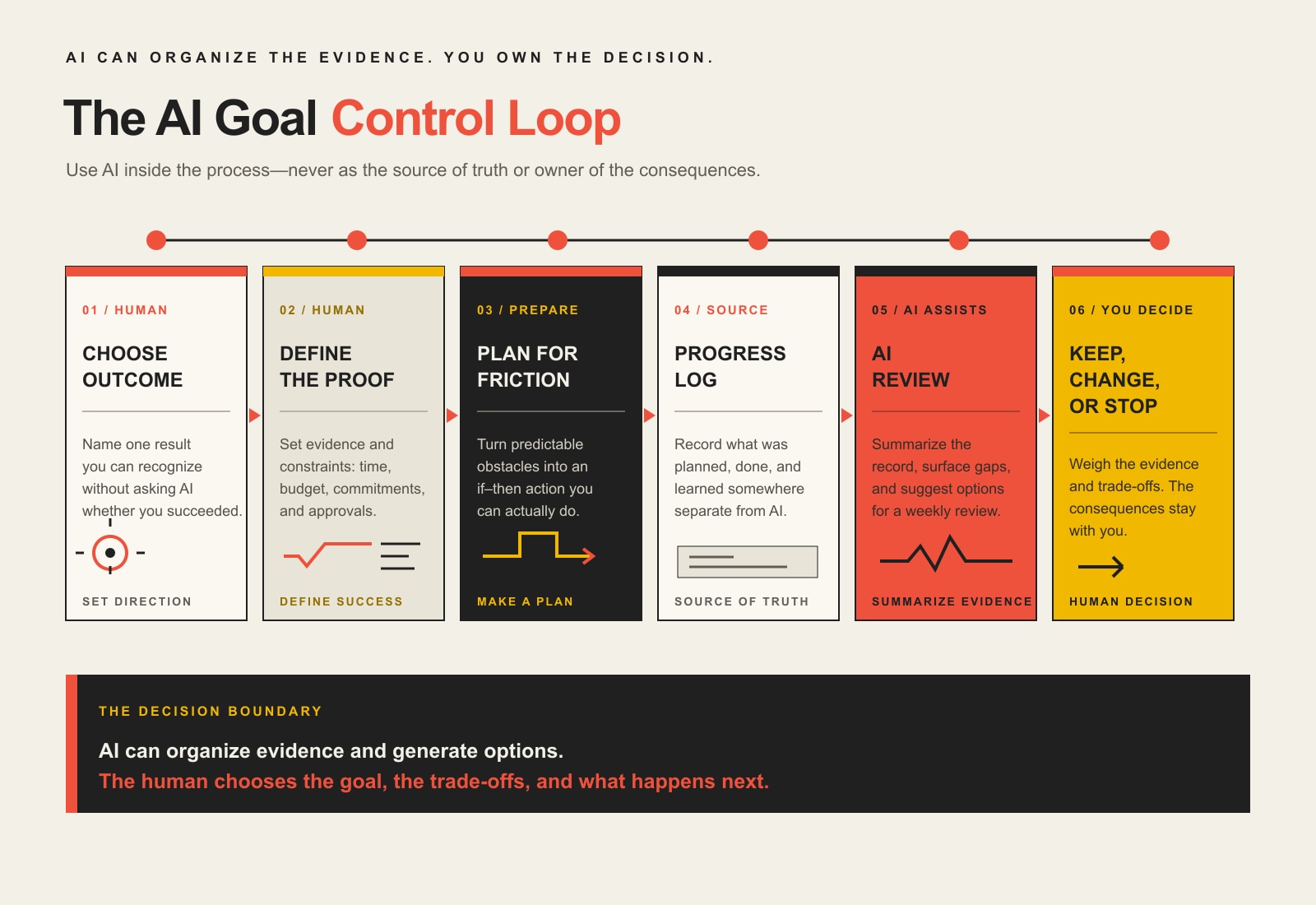
    A more useful model is an AI-assisted goal control loop:

    1. Choose the outcome yourself.
    2. Define the evidence that would prove progress.
    3. Plan for likely obstacles with if-then rules.
    4. Record what actually happened.
    5. Let AI summarize the evidence and surface gaps.
    6. Make the decision yourself: keep, change, or stop.

    AI is useful inside the loop because it is fast at restructuring information, comparing a log against criteria, and generating options. It is weak at owning consequences. That is why the decision boundary stays human.

    The science underneath the system

    Three well-established findings are especially useful for designing an AI goal setting workflow. None requires AI. That is exactly the point: use AI to reduce the effort of applying mechanisms that already have evidence behind them.

    1. A goal needs specificity, challenge, feedback, and commitment

    In their influential review of 35 years of goal-setting research, Edwin Locke and Gary Latham summarized evidence showing why specific, appropriately challenging goals can outperform vague “do your best” instructions under the right conditions. They also emphasized important moderators such as commitment, feedback, ability, and task complexity. In other words, specificity helps, but a goal is not a magic sentence. See the Locke and Latham review in American Psychologist.

    AI can help here by interrogating fuzzy language. If your goal is “grow the business,” ask the model to identify what would be observable at the end of the period: qualified opportunities, recurring revenue, margin, retention, delivery capacity, or another measure that actually matches your objective. You choose which measure matters.

    2. “If X, then I will Y” plans help close the intention-action gap

    Implementation intentions turn a general intention into a pre-decided response: if a specific situation occurs, then I will take a specific action. A 2006 meta-analysis by Peter Gollwitzer and Paschal Sheeran covered 94 independent tests and reported a medium-to-large positive effect on goal attainment (d = .65). Read the implementation-intentions meta-analysis.

    This is a natural job for AI because the model can help you brainstorm likely failure points without pretending it knows the future. For example:

    • If a client emergency takes the morning block, then I will move the goal task to the 2:00 PM recovery block.
    • If I do not have the data needed for a decision by Wednesday, then I will ask the owner directly instead of waiting for another meeting.
    • If a planned action misses twice, then I will review whether the action is unrealistic, underspecified, or no longer relevant.

    The useful output is not the AI’s prose. It is a decision rule you are willing to follow.

    3. Monitoring progress improves goal attainment

    A 2016 meta-analysis led by Benjamin Harkin examined 138 randomized studies with 19,951 participants. Interventions designed to increase progress monitoring improved goal attainment on average (d+ = .40). Effects were larger when outcomes were reported or made public and when progress information was physically recorded. Read the progress-monitoring meta-analysis in Psychological Bulletin.

    This is the strongest reason not to make your chatbot the source of truth. Keep the progress record somewhere explicit: a spreadsheet, project board, CRM, task system, journal, or other log. Then give AI the record to analyze. If the model can invent the history, you no longer have monitoring; you have storytelling.

    The AI goal setting control loop

    Six stages of an AI-assisted goal loop: choose a human-owned outcome, define evidence and constraints, plan for friction, record progress separately, let AI review the record, and keep the decision human.

    Step 1: Choose one observable outcome

    Start with a result you can recognize without asking AI whether you succeeded. “Publish the new service site with the five required pages, functioning forms, analytics, and approved launch checklist by October 15” is observable. “Improve our online presence” is not.

    For AI goal setting to be useful, ask AI to challenge ambiguity, not to pick your values. A useful request is: “List the terms in this goal that could be interpreted two different ways. Ask me questions until the finish line could be verified by another person.”

    Step 2: Define evidence and constraints before generating a plan

    In AI goal setting, tell the model what counts as evidence and what it may not optimize away. Constraints might include budget, available hours, required approvals, legal requirements, brand standards, existing commitments, or a hard deadline.

    This prevents a common AI failure mode: producing a theoretically efficient plan that ignores the environment in which the work has to happen.

    Step 3: Turn predictable friction into implementation intentions

    Now ask AI to identify likely obstacles from the information you provide. For each obstacle, create an if-then response. Keep only the rules that are specific enough to trigger an action and realistic enough that you will use them.

    For a sales goal, “If there are fewer than five qualified opportunities in the pipeline on Friday, then Monday’s first 45 minutes becomes outbound follow-up” is much more useful than “stay consistent with prospecting.”

    Step 4: Record what happened in a separate progress log

    In an AI goal setting system, your progress log can be simple. At minimum, record the date, planned action, completed action, result, blocker, and any evidence that changed your understanding of the goal. The point is not to create a perfect dashboard. The point is to leave a trail that can be reviewed without relying on memory.

    Do not ask AI to “remember” the week unless the underlying record is available in the conversation or connected system. Your review should be grounded in the actual log.

    Step 5: Use AI for the weekly review

    At review time, AI goal setting becomes most useful when the model acts as an analyst. Give it the goal, evidence criteria, constraints, if-then rules, and progress log. Ask it to separate facts from inferences, compare the evidence with the target, identify repeated misses, and suggest a small number of adjustments.

    Limiting the number of recommendations matters. A model can generate twenty plausible ideas in seconds. That is not the same as making the next decision easier.

    Step 6: Keep the decision human

    The review ends with a choice: keep, change, or stop. Keep the current plan when the evidence supports it. Change an action or assumption when the evidence says the plan is not working. Stop when the goal no longer deserves the cost, even if a model can invent a clever way to continue.

    That last category is important. Goal systems become unhealthy when “achievement” is defined as never abandoning a goal. Good judgment includes recognizing when new evidence changes the decision.

    What AI should not decide

    A safe AI goal setting workflow can help structure a decision, but it should not be allowed to quietly become the decision-maker. Keep these responsibilities on the human side of the boundary:

    • Which goal is worth pursuing. A model does not bear the opportunity cost.
    • Which tradeoffs are acceptable. Speed, money, quality, relationships, reputation, and risk are value judgments.
    • Whether the evidence is trustworthy. AI can summarize bad data perfectly.
    • Whether a recommendation is ethical, legal, or appropriate. High-stakes decisions need the right qualified human review.
    • Whether to persist or quit. The model can surface consequences; you own them.

    A useful rule is: AI may propose; evidence must support; a human approves.

    A copyable AI goal setting review prompt

    This AI goal setting prompt is deliberately stricter than “How am I doing?” It forces the model to work from the record instead of rewarding confident improvisation.

    Act as a review analyst, not a goal chooser.
    
    GOAL OUTCOME:
    [Paste the observable outcome.]
    
    EVIDENCE OF SUCCESS:
    [Paste the measures or completion criteria.]
    
    CONSTRAINTS:
    [Paste budget, time, approvals, non-negotiables, and other limits.]
    
    IF-THEN PLANS:
    [Paste the implementation intentions I committed to.]
    
    PROGRESS LOG:
    [Paste this week's actual record.]
    
    Review the material using only the evidence provided.
    1. Summarize what happened in no more than five bullets.
    2. Separate facts from your inferences.
    3. Compare actual progress with the success evidence.
    4. Identify repeated blockers or missed implementation intentions.
    5. Propose no more than three adjustments, each with a tradeoff.
    6. Flag any conclusion that cannot be supported by the log.
    7. End by asking me to choose: keep, change, or stop.
    
    Do not rewrite my goal, invent missing progress, or make the final decision for me.

    If the output is generic, the first thing to improve is usually the input evidence, not the prompt.

    How this fits a 90-day execution system

    An AI goal setting workflow does not need a magical planning horizon. This article intentionally does not turn “90 days” into another scientific claim. A quarter is simply a useful planning container for many business goals: long enough to produce meaningful work, short enough to review before assumptions get stale. If you want the broader planning structure—outcome, milestones, checkpoints, and execution rhythm—use Scope Design’s 90-day goal-setting framework, then use the AI control loop here for planning friction, progress analysis, and review.

    For a business, the same idea can eventually move beyond a personal chat into a repeatable workflow: data comes from the systems where work happens, AI summarizes or routes exceptions, and a person remains accountable for decisions. If that is the stage you are at, see our guide to AI automation for business.

    Frequently asked questions about AI goal setting

    Can AI actually help me achieve my goals?

    AI goal setting can help with parts of goal execution: clarifying an outcome, generating if-then plans, organizing a progress log, comparing evidence with a target, and proposing adjustments. The evidence cited in this article supports those underlying self-regulation practices, not a blanket claim that using AI itself causes goal achievement.

    How do I use ChatGPT for AI goal setting?

    For AI goal setting, use ChatGPT or another capable model as a structured thought partner. Give it one observable goal, the evidence of success, your constraints, likely obstacles, and your actual progress record. Ask it to identify ambiguity, create candidate if-then plans, and perform a weekly evidence review. Do not let it invent the goal or progress history.

    What is the best AI goal setting tool?

    The best AI goal setting tool is the one that fits the workflow; the workflow matters more than a particular brand. A useful tool needs enough context to read your goal criteria and progress log, produce structured output, and fit your privacy and data-handling requirements. If your system only generates motivational language but never reviews evidence, changing models will not fix the design.

    Should I track my goals with AI?

    For AI goal setting, track progress in a durable source of truth, then let AI analyze it. A spreadsheet, project tool, CRM, or journal can hold the record. AI can summarize patterns and exceptions, but the underlying log should remain reviewable without trusting the model’s memory.

    Can AI replace an accountability partner or manager?

    Not completely. AI can make review more consistent and reduce administrative work, but it does not share the consequences of the decision and cannot provide the same social accountability, authority, domain responsibility, or human judgment. Use it to improve the review process, not to erase responsibility.

    The bottom line

    AI goal setting does not make goal achievement scientific. Good goal execution already has a research base: define the outcome clearly, plan responses to predictable situations, monitor real progress, and use feedback to adjust. AI earns its place when it makes those behaviors easier to perform without taking ownership away from the person who has to live with the result.

    Start with one goal. Define what evidence would prove progress. Write two or three if-then rules for the friction you already expect. Keep an honest log. Then use AI once a week to compare the evidence with the target—and make the final decision yourself.