Tag: product marketing

  • Advanced Product Marketing Strategies: 12 Critical Success Factors for Modern Businesses

    Advanced Product Marketing Strategies: 12 Critical Success Factors for Modern Businesses

    Advanced product marketing strategies are not a bigger list of tactics. They are a repeatable way to turn market evidence into decisions, coordinated execution, and learning. When the fundamentals are already in place, the hard part is diagnosing which handoff is failing before you spend more money, add another channel, or rebuild the campaign.

    That is the job of the 12 success factors in this guide. We organize them into the Scope Product Marketing Loop: Signal → Decision → Motion → Learning. The operating rule is simple: diagnose the broken handoff, then scale proof—not activity.

    TL;DR: advanced product marketing in 60 seconds

    • Signal: verify demand, buyer/use-case clarity, and the competitive context.
    • Decision: turn that evidence into positioning, a value/pricing hypothesis, and credible proof.
    • Motion: coordinate launch, sales enablement, and channel/content execution so the decision reaches the market intact.
    • Learning: measure adoption and outcomes, run controlled experiments, and feed what you learn back into the next decision.

    If your customer research, positioning, pricing, or go-to-market fundamentals are still unsettled, start with Scope Design’s complete product marketing strategy guide. This article assumes those basics exist and focuses on the advanced execution choices that come next.

    What makes product marketing “advanced”?

    Advanced product marketing is less about sophisticated software and more about decision quality. A team can have a CRM, automation platform, AI tools, attribution dashboards, and a dozen channels and still have weak product marketing if the evidence does not change the decisions.

    For a small or mid-sized business, advanced usually means four things are true at the same time:

    1. You can distinguish a market signal from a convenient assumption.
    2. You can explain why the product should win for a specific buyer and use case.
    3. Marketing, sales, delivery, and customer feedback reinforce the same promise.
    4. You know which outcome should move next and what you will change if it does not.

    The U.S. Small Business Administration’s market-research guidance is useful here because it separates broad market evidence—demand, market size, saturation, pricing, and competition—from direct customer research such as interviews and surveys. Advanced work needs both: outside context and evidence from the people actually buying, using, rejecting, or leaving the product.

    It also needs to fit the rest of the company. Product marketing is one operating layer inside a broader small-business marketing strategy. If the offer, conversion path, follow-up, capacity, or measurement system is broken, no amount of launch choreography fixes the whole system.

    The Scope Product Marketing Loop: Signal → Decision → Motion → Learning

    Most product-marketing plans read like a checklist: research, personas, content, launch, influencers, analytics. That format hides the part that matters most—the handoffs. Evidence has to become a decision. The decision has to survive execution. Execution has to produce learning. Learning has to change the next signal.

    That is why the Scope Product Marketing Loop groups the 12 critical success factors into four stages instead of treating them as independent tactics.

    Four connected product-marketing scenes show signal, decision, coordinated motion, and customer learning returning to fresh evidence

    Stage 1 — Signal: know what changed and for whom

    1. Demand evidence

    Diagnostic question: What evidence says this problem is important enough for a buyer to act on now?

    A market can be large while your specific offer still solves a low-priority problem. Start with evidence of behavior, not enthusiasm: what buyers search for, ask sales about, compare, abandon, complain about, renew, or pay to solve. Combine broad market research with direct customer evidence.

    Failure signal: campaigns generate attention, but qualified demand, demos, purchases, or serious conversations do not follow. Action: narrow the use case and test the problem before increasing distribution. Watch: qualified response rate, sales-qualified opportunities, product-page-to-action rate, or another metric tied to real buyer intent.

    2. Buyer and use-case clarity

    Diagnostic question: Can everyone on the team name the buyer, situation, desired progress, and trigger for this product without reading a persona deck?

    Personas are only useful when they change a decision. Replace generic descriptors with a use-case statement: When [situation] happens, [buyer] needs to [make progress] without [cost/risk/friction]. That makes targeting, messaging, proof, onboarding, and sales qualification easier to align.

    Buyer knowledge also changes by awareness state. Someone who is merely problem-aware needs different evidence than someone already comparing your product with an alternative. Scope’s guide to the five stages of awareness explains how to match the message to what the buyer already knows.

    Failure signal: copy speaks to everyone, sales hears inconsistent reasons for buying, or traffic is broad but conversion is weak. Action: choose the highest-value use case and write the message for that context first. Watch: conversion by segment/use case, sales qualification rate, and recurring reasons for loss.

    3. Category and competitive context

    Diagnostic question: What will the buyer compare you with—even if it is not a direct competitor?

    Your real competition can be another product, an internal workaround, a spreadsheet, a service provider, or doing nothing. Map the buyer’s alternatives around the decision criteria that matter to them, not a feature grid designed to make your product look good.

    Failure signal: prospects understand the product but cannot explain why it is meaningfully different. Action: define the category, alternative, and tradeoff you are willing to own. Watch: competitor mentions, no-decision losses, win/loss reasons, and how often buyers repeat your differentiation back in their own words.

    Stage 2 — Decision: turn evidence into a choice

    4. Positioning and message hierarchy

    Diagnostic question: If a prospect remembers one idea about the product, is it the idea you most need them to remember?

    Strong positioning makes a choice. It says who the product is for, what problem or job matters, what category or frame helps the buyer understand it, why it is different, and why that difference is credible. A message hierarchy then decides what comes first, what supports it, and what belongs deeper in the buying journey.

    Failure signal: every channel leads with a different benefit or the website lists features without a clear buying reason. Action: force a primary promise, supporting reasons, proof, and objections into one hierarchy. Watch: message recall in customer interviews, page-to-action conversion, and the objections sales hears after prospects consume the core message.

    5. Value and pricing hypothesis

    Diagnostic question: What outcome, avoided cost, saved time, reduced risk, or increased capability makes the price make sense?

    Pricing is not just a finance decision. It changes positioning, qualification, sales motion, packaging, perceived risk, and the proof a buyer needs. Treat value and pricing as a hypothesis that should survive real sales conversations—not as a number selected once and defended forever.

    Failure signal: interest is healthy but deals stall at price, discounting becomes routine, or the cheapest package attracts the wrong customers. Action: test packaging and value framing before changing price alone. Watch: close rate by package, discount frequency, sales-cycle length, margin, and reasons prospects say the price does or does not fit.

    6. Proof and objection architecture

    Diagnostic question: What must a skeptical buyer believe before the next step feels safe?

    Proof should be designed around risk. Build a proof library that connects claims with the best available evidence: demonstrations, customer stories, before/after evidence, process transparency, reviews, guarantees, samples, calculations, or third-party validation. Then map common objections to the proof that actually answers them.

    Failure signal: prospects repeatedly ask questions the website or sales materials should already answer. Action: turn recurring objections into reusable evidence assets. Watch: objection frequency, sales-cycle friction, demo-to-close rate, and which proof assets appear in won deals.

    Stage 3 — Motion: make the choice executable

    7. Launch and go-to-market coordination

    Diagnostic question: Do product, marketing, sales, service, and leadership agree on the audience, promise, timing, next action, and definition of success?

    A launch is a coordination problem before it is a promotion problem. Define the release objective, target segment, message, offer, channel jobs, sales readiness, service capacity, measurement window, and owner for each handoff. A launch that creates demand the business cannot qualify, fulfill, or learn from is not successful coordination.

    Failure signal: channels launch on time but tell different stories, sales is surprised by the campaign, or operations cannot absorb the response. Action: use one launch brief with explicit owners and dependencies. Watch: readiness completion, qualified pipeline or purchases, handoff delays, and capacity constraints.

    8. Sales enablement

    Diagnostic question: Can sales diagnose fit, explain the differentiation, handle the top objections, and prove the promise without inventing its own version of the message?

    Enablement is where product marketing meets live buyer resistance. Give sales concise tools it will actually use: qualification cues, a problem/use-case map, message hierarchy, competitive notes, proof assets, objection responses, demo guidance, and a feedback path back to marketing.

    Failure signal: marketing reports strong engagement while sales says leads “do not get it.” Action: review real calls and lost deals together instead of debating dashboards. Watch: lead-to-opportunity rate, opportunity-to-close rate, sales-cycle length, objection patterns, and content used in successful deals.

    9. Channel and content fit

    Diagnostic question: What specific job does each channel perform in this buying decision?

    Do not ask every channel to create awareness, educate, convert, retain, and prove ROI at the same time. Assign channel jobs. Search may capture existing demand. Email may move known prospects through objections. Social may distribute proof or create familiarity. Paid media may test an offer quickly. Sales may provide high-context diagnosis.

    Failure signal: the team produces a lot of content but cannot explain what decision it is supposed to change. Action: connect each asset to an awareness state, buyer question, next action, and channel job. Watch: assisted conversions, qualified response by channel, next-step rate, and whether content shortens or improves the buying process.

    Stage 4 — Learning: convert outcomes into the next signal

    10. Adoption and customer feedback loop

    Diagnostic question: Did customers receive and use the value you promised—not just complete the purchase?

    Product marketing should not stop at acquisition. Look at onboarding, activation, usage, repeat behavior, support questions, renewals, reviews, and reasons for churn. Customer feedback becomes useful when it is categorized and routed back into product, message, proof, or experience decisions.

    Failure signal: sales look healthy while adoption, repeat use, or retention stays weak. Action: compare the promise that won the customer with the experience they received. Watch: activation, time-to-value, repeat usage, support themes, retention/renewal, and qualitative feedback from new customers.

    11. KPI chain and experiments

    Diagnostic question: Can you connect the leading signal you are optimizing to a business outcome that matters?

    Clicks and impressions can be useful diagnostics, but they are not the objective by default. Build a KPI chain from activity to buyer behavior to business outcome. Then choose the smallest experiment that can reduce uncertainty: message A vs. B, a different proof asset, a narrower audience, a revised package, a new onboarding step, or a different sales handoff.

    Failure signal: reports improve while revenue quality, margin, adoption, or retention does not. Action: identify the missing link between the metric and the outcome. Watch: one leading indicator, one conversion/quality measure, and one lagging business outcome for each major initiative.

    12. Governance and operating cadence

    Diagnostic question: Who owns the evidence, decision, approval, risk, and next review?

    Advanced product marketing creates more data, claims, customer touchpoints, tools, partners, and experiments. That makes governance part of the operating system. Set rules for source quality, customer-data use, claim substantiation, brand consistency, approval, accessibility, and when an experiment should stop.

    The NIST Privacy Framework treats privacy as enterprise risk management rather than a bolt-on compliance task. That is a useful operating principle for product marketers: collect and use only the customer data you can govern responsibly. If the channel mix includes creators or endorsers, the FTC’s endorsement guidance says material brand relationships should be disclosed clearly and conspicuously.

    Failure signal: nobody knows why a claim was approved, where a metric came from, or who should respond when an experiment creates risk. Action: establish a short recurring product-marketing review with explicit owners, evidence, decisions, and next tests. Watch: unresolved decisions, stale claims, data-quality problems, compliance issues, and how quickly customer learning becomes an action.

    Diagnose the bottleneck before adding tactics

    The fastest way to waste product-marketing budget is to fix the wrong stage. Use the symptom to decide what to inspect next.

    What you seeLikely broken handoffCheck next
    Traffic or attention is healthy, but few qualified buyers actSignal → DecisionUse-case clarity, positioning, offer relevance, proof
    Demos or calls happen, but deals stall or discounting risesDecision → MotionValue/pricing hypothesis, objections, sales enablement
    Marketing engagement looks good, but sales rejects the leadsDecision → MotionQualification, message consistency, channel job, handoff definition
    Customers buy, but activation or retention is weakMotion → LearningPromise-to-experience gap, onboarding, adoption evidence
    Dashboards improve, but business outcomes do notLearning → SignalKPI chain, attribution assumptions, experiment design
    Every team has a different explanation for performanceAll stagesOperating cadence, source quality, ownership, shared definitions

    This is also why “do more content” or “run more ads” is often a bad first prescription. More activity increases the volume flowing through the same broken handoff.

    A practical 30-day implementation order

    Week 1: rebuild the signal

    • Review current buyer interviews, sales notes, support questions, search/query evidence, win/loss reasons, and competitor alternatives.
    • Choose one priority buyer/use case.
    • Write the problem, trigger, desired progress, alternatives, and evidence that the problem is urgent enough to act on.

    Week 2: force the decision

    • Write one positioning statement and message hierarchy.
    • State the value/pricing hypothesis explicitly.
    • Build a claim-to-proof and objection-to-proof map.

    Week 3: align the motion

    • Give every channel one primary job.
    • Align the website, launch assets, sales story, proof, and next action.
    • Confirm fulfillment/service capacity before increasing demand.

    Week 4: create the learning loop

    • Choose a leading indicator, quality/conversion measure, and business outcome.
    • Run one bounded experiment against the biggest uncertainty.
    • Schedule the review: what changed, what did we learn, and which decision changes next?

    The goal after 30 days is not a “finished” strategy. It is a product-marketing system that can learn without reinventing itself every month.

    Five advanced product marketing mistakes to avoid

    1. Trend stacking. AI, creators, short-form video, AR, communities, and automation are not strategies by themselves. Use a tactic only when it has a clear job in the loop.
    2. Persona theater. A detailed persona that never changes targeting, message, proof, channel choice, qualification, or product decisions is documentation, not insight.
    3. Dashboard substitution. More reporting does not improve decisions if the metrics are disconnected from buyer behavior and business outcomes.
    4. Launch amnesia. Treating launch day as the finish line discards adoption, sales feedback, objections, support questions, and retention—the evidence that should improve the next cycle.
    5. Consistency without relevance. A consistent message can still be the wrong message. If you need a separate audit of whether Product, Price, Place, Promotion, People, Process, and Physical Evidence reinforce one another, use Scope’s 7 Ps product-strategy audit.

    What auditing this exact article changed

    We applied the same evidence rule to this revision instead of preserving the old list because it already existed. For the exact URL during the 12 complete months ending August 20, 2026, Scope Design’s GA4 property returned no Organic Search landing-page rows. Across all channels it recorded only four Direct sessions, no engaged sessions, and no configured key events. Search Console returned no exact-page query rows in either the current or prior 12-month period and reported the URL as unknown to Google at inspection time. Bing’s exact-URL tools returned no current traffic or URL record; the prior inventory baseline was one impression and zero clicks.

    That is not enough evidence to say the topic is worthless, the old article “did not convert,” or this rewrite will rank. It is enough to avoid pretending unsupported percentages deserve protection. We kept the healthy established URL, removed tidy statistics we could not trace to strong original evidence, clarified what this page owns beside Scope’s other product-marketing content, and replaced the trend list with a diagnostic framework.

    Frequently asked questions about advanced product marketing strategies

    What is a product marketing framework?

    A product marketing framework is a repeatable structure for connecting market and customer evidence to positioning, launch, sales, adoption, and measurement decisions. The useful test is not whether the framework has the “right” number of steps. It is whether the framework makes handoffs, ownership, evidence, and learning explicit.

    What are the most important product marketing success factors?

    The most important factors are the ones protecting the weakest handoff in your current system. In the Scope Product Marketing Loop, those factors are demand evidence; buyer/use-case clarity; competitive context; positioning; value/pricing; proof; GTM coordination; sales enablement; channel fit; adoption feedback; outcome-linked measurement; and governance. Do not optimize all 12 equally at the same time—diagnose the bottleneck first.

    How do you measure product marketing effectiveness?

    Use a KPI chain rather than one universal metric. Pair a leading signal with a buyer-quality/conversion measure and a lagging business outcome. Depending on the job, that could mean qualified response → opportunity rate → revenue quality, or activation → repeat use → retention. The metric should match the stage you are trying to improve.

    How should product marketing and sales work together?

    Product marketing should give sales a usable diagnosis of fit, a shared message hierarchy, proof, competitive context, objection handling, and a feedback path. Sales should return real buyer language, objections, no-decision reasons, win/loss patterns, and proof gaps. The goal is not perfect message compliance; it is a learning loop where live conversations improve the market decision.

    Are the 5 Ps or 7 Ps the same as a product marketing strategy framework?

    No. The Ps are useful lenses for auditing parts of a marketing mix. An operating framework also needs to explain how evidence becomes a decision, how the decision is executed across teams, and how outcomes become learning. Use the 7 Ps when you need a marketing-mix audit; use the Scope Product Marketing Loop when the fundamentals are aligned and you need to diagnose advanced execution.

    Make product marketing easier to run—and easier to learn from

    The best advanced product marketing strategy is not the one with the most channels, tools, dashboards, or launch activities. It is the one that makes the next decision clearer.

    Start with the weakest handoff. Fix the evidence before the positioning. Fix the positioning before scaling the motion. Fix the customer experience before celebrating acquisition. Then feed what you learn back into the next cycle.

    If your team has plenty of activity but cannot tell which part of the system is actually limiting growth, Scope Design can help diagnose the marketing path, sharpen the message, and build a practical execution plan around the constraint that matters most.


  • Product Marketing Strategy: The Complete Guide to Positioning, GTM, and Growth

    Product Marketing Strategy: The Complete Guide to Positioning, GTM, and Growth

    A product marketing strategy is the operating plan that connects what you sell to the people most likely to buy, use, and keep buying it. It turns customer and market evidence into positioning, pricing and packaging decisions, a go-to-market plan, sales enablement, adoption work, and measurable feedback. The important part is the order: diagnose the real constraint before you start throwing tactics at it.

    TL;DR: Build the strategy before you buy more attention

    • Start with the business outcome and the bottleneck. More promotion does not fix weak positioning, the wrong audience, confusing pricing, or poor adoption.
    • Research the market, customer, alternatives, buying triggers, and objections before writing the campaign.
    • Turn that evidence into a clear position, offer, message, route to market, and enablement plan.
    • Treat launch as a milestone, not the finish line. Product marketing continues through onboarding, adoption, retention, expansion, and feedback.
    • Measure the behavior closest to the suspected constraint. Hope is not an analytics strategy.

    What is a product marketing strategy?

    Product marketing sits between the market, the product, sales, and the rest of marketing. Product Marketing Alliance describes the discipline as bringing a product to market and supporting its ongoing success, including market intelligence, positioning and messaging, sales enablement, and launches. That definition matters because it prevents a common mistake: reducing product marketing to “make some launch content and run ads.”

    A strategy answers a more useful set of questions:

    • Who has the problem we are best equipped to solve?
    • What are they doing instead today?
    • Why should they choose this product rather than another option, a workaround, or doing nothing?
    • What value is important enough to justify the price, switching cost, and perceived risk?
    • How will the right buyers discover, understand, evaluate, buy, adopt, and keep using the product?
    • What evidence will tell us where that system is breaking?

    That sequence is why product marketing is not the same thing as promotion. Promotion is one downstream lever. Product marketing decides whether promotion is even the next lever worth pulling.

    For small businesses and lean teams, the job may not belong to somebody with “Product Marketing Manager” on a business card. The founder, marketing lead, sales lead, product owner, or agency partner may share the work. The discipline still exists whether or not the org chart gives it a dedicated box.

    Product marketing also sits inside a broader business-marketing system. If the bigger problem is deciding what marketing should accomplish across channels, offers, and customer stages, start with our small business marketing strategy guide and use this page for the product-specific layer.

    The Scope Design Product Marketing Constraint Loop

    Most weak product marketing plans start with channels: “We need LinkedIn.” “We should run Google Ads.” “Let’s hire an influencer.” That is backwards.

    Scope Design uses a constraint-first approach: find the bottleneck that is limiting growth, then choose the work that addresses that bottleneck. Otherwise you can execute more efficiently and still get nowhere faster.

    The Product Marketing Constraint Loop has five connected stages:

    1. Market evidence: Understand the customer, category, alternatives, buying context, demand, objections, and actual behavior.
    2. Positioning and offer: Decide who the product is for, the problem it owns, the value it creates, how it differs, and how price/package support that story.
    3. Go-to-market: Choose the route, channels, sales motion, launch sequence, enablement, and message distribution that fit the buyer.
    4. Adoption: Make sure customers reach value, keep using the product, and have reasons to remain or expand.
    5. Feedback: Compare expected behavior with what actually happened, identify the next constraint, and repeat the loop.

    This is intentionally a loop rather than a funnel carved into stone. The market changes. Competitors move. Customers find new workarounds. The product evolves. A message that worked at launch can become generic six months later.

    Eight connected scenes show the product marketing strategy from business constraint and market evidence through positioning, offer, go-to-market, enablement, and learning
    Product marketing strategy constraint loop from market evidence through positioning, go-to-market, adoption, and feedback

    An eight-step product marketing framework that works for lean teams

    Frameworks are useful when they improve decisions. They become theater when the team fills in boxes and then does whatever it was already planning to do.

    Use these eight steps as an operating sequence, not a ceremonial worksheet.

    1. Define the business outcome and suspected constraint

    Start with the outcome the business needs: qualified pipeline, first purchases, activation, repeat use, expansion, retention, or entry into a new segment.

    Then ask what is currently limiting that outcome.

    A few examples:

    • Plenty of traffic but weak conversion can point to audience, offer, trust, pricing, or message problems.
    • Strong demos but weak closes can point to positioning, perceived risk, competitive differentiation, or enablement.
    • Healthy sales but poor retention can point to expectation setting, onboarding, product fit, or adoption.
    • Almost no qualified traffic may mean the offer is fine but distribution is genuinely the constraint.

    You do not need perfect certainty before acting. You do need a hypothesis better than “marketing needs more marketing.”

    2. Build market and customer evidence

    Talk to customers. Review sales calls, support tickets, reviews, lost deals, search behavior, product usage, competitor claims, and the workarounds people use when they do not buy anything.

    Our guide to market research for small business goes deeper on practical ways to collect useful evidence without pretending a giant research department is required.

    Look for language and patterns around:

    • the triggering problem;
    • the outcome people actually want;
    • what they tried before;
    • what creates urgency;
    • what causes hesitation;
    • who influences the decision;
    • what “success” means after purchase.

    Do not ask only whether people “like” the idea. Polite approval is cheap. Behavior, tradeoffs, money, time, and switching friction tell you much more.

    Qualtrics’ product marketing guidance likewise treats customer and market research as an input to positioning and go-to-market planning. The useful implication is simple: channel selection comes after you understand the decision you are trying to influence.

    3. Choose the segment you can serve and win

    A product can technically be useful to many people and still need a narrow go-to-market focus.

    Choose the segment where the problem is meaningful, the product is credible, the economics work, and you can realistically reach the buyer. The first target does not have to be the forever target.

    Segmentation is not merely demographic. For many products, behavior, job-to-be-done, sophistication, use case, buying trigger, team size, workflow, urgency, or required integration matters more than age or zip code.

    4. Build positioning around the customer’s decision

    Positioning is not your slogan. It is the strategic context that helps a buyer understand what the product is, who it is for, when it is useful, what it replaces, and why the difference matters.

    The customer is the hero of that story. Your product is the guide or tool that helps them move from the current problem to the desired state.

    This is where buyer psychology becomes practical rather than manipulative: understand what the buyer needs to believe, what risk they perceive, and what proof reduces uncertainty.

    A usable positioning statement should give the team enough clarity to write a landing page, sales deck, demo, onboarding message, and campaign without reinventing the product every time.

    5. Align the offer, pricing, and packaging

    Messaging cannot permanently rescue a bad offer.

    Check whether the package makes the value easy to buy. That includes price, tiers, terms, trial or demo structure, guarantees where appropriate, implementation burden, required add-ons, and the cost of switching.

    The goal is not always “charge less.” Lower price can increase doubt or attract customers who are a worse fit. The job is to make the value, risk, and tradeoff understandable.

    If buyers consistently understand the product but reject the economics, that is not automatically a copywriting problem.

    6. Build the go-to-market plan

    A go-to-market plan turns strategy into coordinated execution. Current Product Marketing Alliance guidance treats GTM as a cross-functional plan involving positioning, pricing, promotion/distribution, and execution across product, marketing, sales, and customer-facing teams.

    Your plan should specify:

    • target segment and use case;
    • positioning and core message;
    • offer, price, and package;
    • buyer journey and sales motion;
    • primary distribution channels;
    • launch or campaign milestones;
    • sales and partner enablement;
    • onboarding and adoption responsibilities;
    • metrics and decision points.

    Do not confuse “omnichannel” with “every channel we can create an account on.” The right mix depends on where the buyer pays attention and how much explanation, trust, and sales assistance the decision requires.

    7. Enable the people who carry the message

    A great campaign can still fail if sales, support, customer success, partners, or front-line staff explain the product differently.

    Enablement can include:

    • message and positioning guides;
    • competitive battlecards;
    • objection handling;
    • discovery questions;
    • demo narratives;
    • case studies and proof;
    • launch FAQs;
    • onboarding scripts;
    • partner materials.

    The point is not to hand everyone a giant PDF nobody opens. Give each team the minimum useful material needed to make the next customer decision easier.

    8. Measure, learn, and find the next constraint

    Choose metrics that reveal whether your hypothesis was right.

    If positioning is the suspected problem, watch qualified conversion, message comprehension, sales objections, competitive loss reasons, and response by segment. If onboarding is the problem, activation and time-to-value matter more than ad impressions. If distribution is the problem, qualified reach and pipeline creation become more useful.

    Then return to the loop. Product marketing is ongoing because the market keeps grading your assumptions.

    Where the 4 Ps, 5 Cs, 5 Ps, and 7 Ps still help

    People keep searching for the “right” number of Ps because tidy frameworks feel reassuring. There is no single magic version that replaces judgment.

    The classic 4 Ps are still useful commercialization prompts:

    • Product: What are we selling and what job does it perform?
    • Price: What does it cost, how is it packaged, and what does that signal?
    • Place: Where and how can the buyer evaluate and purchase it?
    • Promotion: How will the market learn, understand, and remember it?

    The 5 Cs are useful for context:

    • Company
    • Customers
    • Competitors
    • Collaborators
    • Climate or context

    Some models add People to create 5 Ps, while service-marketing models often expand to 7 Ps with People, Process, and Physical Evidence. Those can be useful prompts, especially for services or experience-heavy products.

    The mistake is assuming that completing the framework equals having a strategy. A framework organizes questions. Strategy makes choices.

    If you want to pressure-test the mix itself, use our 7 Ps of marketing audit. That narrower guide checks whether product, price, place, promotion, people, process, and proof are reinforcing one another; this article owns the broader research, positioning, GTM, enablement, and adoption system.

    How to build a go-to-market strategy without creating a channel pile

    A good GTM plan answers three things clearly: who are we pursuing, why should they care, and how will we move them from unaware to successful customer?

    Pick a beachhead segment

    Start where pain, fit, reachability, and economics overlap. A narrowly defined first segment often creates better learning than launching vague messaging at “everyone.”

    Match the message to the buying context

    A buyer replacing an entrenched system needs a different argument than somebody solving a brand-new problem. A high-consideration B2B purchase needs more proof and enablement than a low-risk self-serve product.

    Choose channels after the buyer journey is clear

    Channel selection comes after you understand discovery, evaluation, purchase, and adoption. Search may capture existing demand. Social can create awareness or demonstrate expertise. Email can educate and nurture. Partnerships can borrow trust. Sales outreach can work when the account value justifies the labor.

    Once the upstream strategy is solid, our digital marketing strategy guide covers how downstream channels can work as a system instead of a tool pile.

    Design the launch around learning, not theater

    Not every release needs a confetti cannon and a 47-step launch calendar.

    A small launch to a defined segment may be smarter when you still need to validate positioning, onboarding, or willingness to pay. A larger coordinated launch makes more sense when the product, message, operations, and demand are sufficiently proven.

    Set learning milestones before the launch so the team knows what evidence would cause it to continue, adjust, or stop.

    Product marketing tactics by lifecycle stage

    Tactics become much easier to choose once the constraint and lifecycle stage are clear.

    Discovery and validation tactics

    • customer interviews and observation;
    • win/loss analysis;
    • review mining;
    • competitor demos and message analysis;
    • search and community research;
    • sales/support call review;
    • prototype or landing-page tests;
    • pricing conversations and package tests.

    Positioning and pre-launch tactics

    • message testing;
    • category and competitor comparisons;
    • landing-page development;
    • sales narrative and demo refinement;
    • proof and case-study collection;
    • partner preparation;
    • beta or early-access programs;
    • internal launch training.

    Launch tactics

    • segmented email;
    • search and paid campaigns when demand supports them;
    • webinars or demos for complex products;
    • partner and affiliate activation;
    • customer advocacy;
    • sales outreach;
    • PR where there is a legitimate story;
    • launch content that answers evaluation questions.

    Adoption and growth tactics

    • onboarding sequences;
    • activation nudges;
    • lifecycle email;
    • in-product education;
    • customer education and webinars;
    • use-case content;
    • expansion messaging;
    • retention and win-back programs;
    • referral and advocacy programs.

    Notice what is missing: a rule that every company must do all of them. Channel sprawl is not sophistication.

    What should product marketing measure?

    There is no universal dashboard that fits every product. Measure the parts of the system closest to your business outcome and current constraint.

    Useful measures can include:

    Market and message signals

    • qualitative message comprehension;
    • share of qualified responses by segment;
    • common objections;
    • competitive loss reasons;
    • branded and category demand trends;
    • landing-page conversion by audience or use case.

    Revenue and sales signals

    • qualified pipeline;
    • opportunity-to-win rate;
    • sales-cycle length;
    • average selling price;
    • expansion revenue;
    • reasons for no-decision.

    Product and customer signals

    • activation rate;
    • time to first value;
    • feature or workflow adoption;
    • repeat usage;
    • retention or churn;
    • expansion behavior;
    • support friction tied to expectation gaps.

    Vanity metrics are not useless by definition. Reach and impressions can tell you whether distribution is happening. They become useless when the team treats them as proof that the business problem is solved.

    A practical 90-day product marketing plan

    A lean team does not need to solve the entire market in one quarter. It needs a disciplined learning cycle.

    Days 1–30: Diagnose and learn

    • define the business outcome and suspected constraint;
    • review existing analytics, sales conversations, support issues, reviews, and product behavior;
    • interview customers, prospects, lost deals, or front-line staff where appropriate;
    • map alternatives and competitor positioning;
    • document buying triggers, objections, desired outcomes, and evidence gaps.

    Deliverable: a short evidence brief and a prioritized list of assumptions that need to be true.

    Days 31–60: Position and prepare

    • choose the priority segment and use case;
    • refine positioning and core messages;
    • review pricing/package against value and friction;
    • map the buying journey;
    • select the GTM motion and primary channels;
    • create the minimum useful sales, partner, and onboarding enablement.

    Deliverable: a product marketing plan the team can actually execute, not a strategy deck that dies in Google Drive.

    Days 61–90: Launch, measure, and refine

    • run the launch, campaign, or focused market test;
    • watch the measures tied to the suspected constraint;
    • collect objections and behavioral data;
    • fix obvious message, offer, enablement, or onboarding friction;
    • decide what to scale, what to change, and what to stop.

    Deliverable: a revised constraint hypothesis and the next 90-day priority.

    Common product marketing mistakes

    Starting with tactics

    “We should be on TikTok” is not a product marketing strategy. It is a channel suggestion wearing a strategy nametag.

    Confusing positioning with clever copy

    A memorable headline helps only after the underlying category, audience, value, and differentiation make sense.

    Trying to serve every segment at launch

    Broad relevance often creates weak specificity. Pick a useful first target and learn.

    Treating launch as the finish line

    If customers do not reach value, more launch traffic can simply create a larger leak.

    Creating sales enablement after sales complains

    Front-line teams should understand the message, proof, objections, and competitive context before the campaign creates demand.

    Measuring activity instead of the constraint

    More content, more clicks, and more impressions can coexist with no meaningful business improvement. Measure what would confirm or reject the strategy.

    Product marketing strategy FAQ

    What is a good marketing strategy for a product?

    A good product marketing strategy starts with a defined customer and business outcome, uses market evidence to build positioning and an offer, chooses a realistic route to market, enables the teams carrying the message, and measures adoption and commercial behavior after launch. The “best” strategy depends on the constraint; there is no channel mix that is automatically right for every product.

    What are the 5 Ps of product marketing?

    There are multiple 5P models. One common extension adds People to the classic Product, Price, Place, and Promotion framework. Use it as a checklist for decisions, not as proof that the strategy is complete.

    What are the 7 Ps of marketing?

    The 7P service-marketing model commonly includes Product, Price, Place, Promotion, People, Process, and Physical Evidence. It can be useful when experience, delivery, staff interaction, or tangible proof strongly affects the purchase.

    What is the difference between product marketing strategy and go-to-market strategy?

    Product marketing strategy is the broader operating discipline: it connects market evidence, segmentation, positioning, the offer, enablement, launch, adoption, measurement, and feedback over the product lifecycle. A go-to-market strategy is a major part of that system focused on how a specific product, offer, or market move will reach, persuade, convert, and onboard the intended buyers.

    What is the difference between product marketing and product management?

    Product management typically concentrates on what to build, why, priorities, and the product’s development lifecycle. Product marketing concentrates on the market side: customer insight, positioning, messaging, GTM, enablement, adoption, and commercial feedback. In a small company those responsibilities may overlap heavily.

    Who owns product marketing in a small business?

    Ownership can sit with a founder, marketing lead, product lead, salesperson, or outside partner. What matters is that somebody is responsible for connecting market evidence to product positioning, the offer, GTM execution, adoption, and learning. Shared work is fine; shared accountability with no owner is where things get mushy.

    Does product marketing end after launch?

    No. Launch is one milestone. Product marketing continues by helping customers understand and adopt the product, monitoring market and competitive change, supporting sales/customer teams, improving retention and expansion, and feeding new evidence back into positioning and GTM decisions.

    How do I know whether product marketing is working?

    Define the outcome and suspected constraint before the campaign. Then track the behaviors that should change if the strategy is correct: qualified conversion, win/loss patterns, pipeline quality, activation, time-to-value, adoption, retention, expansion, or other relevant measures. If the metric is disconnected from the hypothesis, it may be interesting without being useful.

    Start with the constraint, not the channel

    Product marketing works best when it prevents the business from solving the wrong problem loudly.

    Do the research. Make the positioning choice. Make the offer understandable. Build a GTM plan that fits the buyer. Enable the people delivering the message. Help customers reach value. Then use the evidence to find the next constraint.

    If your team has plenty of marketing activity but cannot tell whether the real problem is the audience, offer, message, website, channel mix, or conversion path, Scope Design’s Marketing & Advertising team can help diagnose the system before you pour more money into tactics.

  • Product Repositioning: Fix the Mismatch Before You Rebrand

    Product Repositioning: Fix the Mismatch Before You Rebrand

    Product repositioning is the deliberate act of changing how a market understands, compares, and chooses an existing product. It makes sense when the product can deliver real value, but the current audience, use case, category, proof, or message is wrong. If the product does not reliably do its job, repositioning is not strategy. It is better packaging around the same problem.

    Weak sales are a symptom. Before you touch the logo, rewrite the website, change the price, or add another feature, figure out what is actually mismatched.

    TL;DR: Reposition only after you diagnose the gap

    • A product gap is not a positioning problem. If customers buy and then cannot get the promised result, fix the product first.
    • Audience, use-case, category, proof, and message gaps can often be tested without rebuilding the product.
    • Change one positioning lever at a time. A full rebrand changes so many variables that you can easily spend a pile of money and learn almost nothing.
    • Use real behavior as evidence. Customer interviews, win/loss notes, activation, repeat use, retention, qualified conversion, and support patterns beat opinions from people who were never going to buy.
    • Repositioning should earn the right to become permanent. Test the hypothesis on a limited audience or page first, then keep it, revise it, rebuild the product, or stop.

    In this guide

    If you need the broader decision system around this, start with Scope Design’s Business Strategy framework. This article owns one narrower decision: what to do when an existing product is underperforming and someone says, “Maybe we just need to reposition it.”

    What is product repositioning?

    Product repositioning changes the place an existing product occupies in a buyer’s mind. That may mean changing the target audience, the main use case, the category buyers compare it against, the value proposition, the proof used to support that value, or the language used to explain it.

    That definition matters because repositioning is often confused with three very different moves: rebranding, product improvement, and product replacement.

    MoveWhat actually changesUse it whenCommon mistake
    Product positioningThe initial market frame for a productYou are defining who it is for, what job it does, and why it is differentWriting a tagline before the market choice is clear
    Product repositioningThe market frame for an existing productEvidence says the product can work, but the current fit is wrongTreating weak sales as proof that messaging is the only problem
    RebrandingBrand identity, expression, or architectureThe brand itself is creating confusion or no longer fits the businessPaying for a new identity before validating a new position
    Product changeFeatures, delivery, quality, workflow, or economicsThe product cannot reliably deliver the promised outcomeTrying to market around a product defect
    RetirementThe decision to stop investingDemand, economics, or strategic fit remain weak after credible testsKeeping a product alive because of sunk cost

    Kellogg’s Alice Tybout makes a useful distinction in her discussion of brand repositioning: a position can become too broad to be supported by the brand’s “reason to believe,” meaning the proof behind the promise. That is a good reminder that a positioning problem can be caused by an overextended claim, not just bad copy.

    Before you reposition, ask the uncomfortable question: does the product deserve to survive?

    The temptation is to assume the product is fine and the market simply misunderstood it. Sometimes that is true. Sometimes the market understood it perfectly and shrugged.

    A product is a poor repositioning candidate when the core problem sits inside the product itself. Watch for patterns such as:

    • customers understand the promise, buy, and still cannot get the expected result;
    • trial or first purchase looks healthy, but activation, repeat use, renewal, or retention is persistently weak;
    • support complaints reveal the same functional failure again and again;
    • the economics only work if you hide real delivery costs or depend on unrealistic volume;
    • the proposed new message would require claims the product cannot substantiate;
    • the only reason to continue is, “We already spent too much to stop now.”

    That last one deserves special suspicion. If the team is defending the past investment instead of evaluating the next investment, run the decision through the SCOPE Decision Filter and check for the cognitive biases that turn sunk cost into strategy.

    If the product works for some real customers and produces a useful outcome, then repositioning becomes much more interesting. Now the question is not “How do we make this sound better?” It is “Where is the mismatch?”

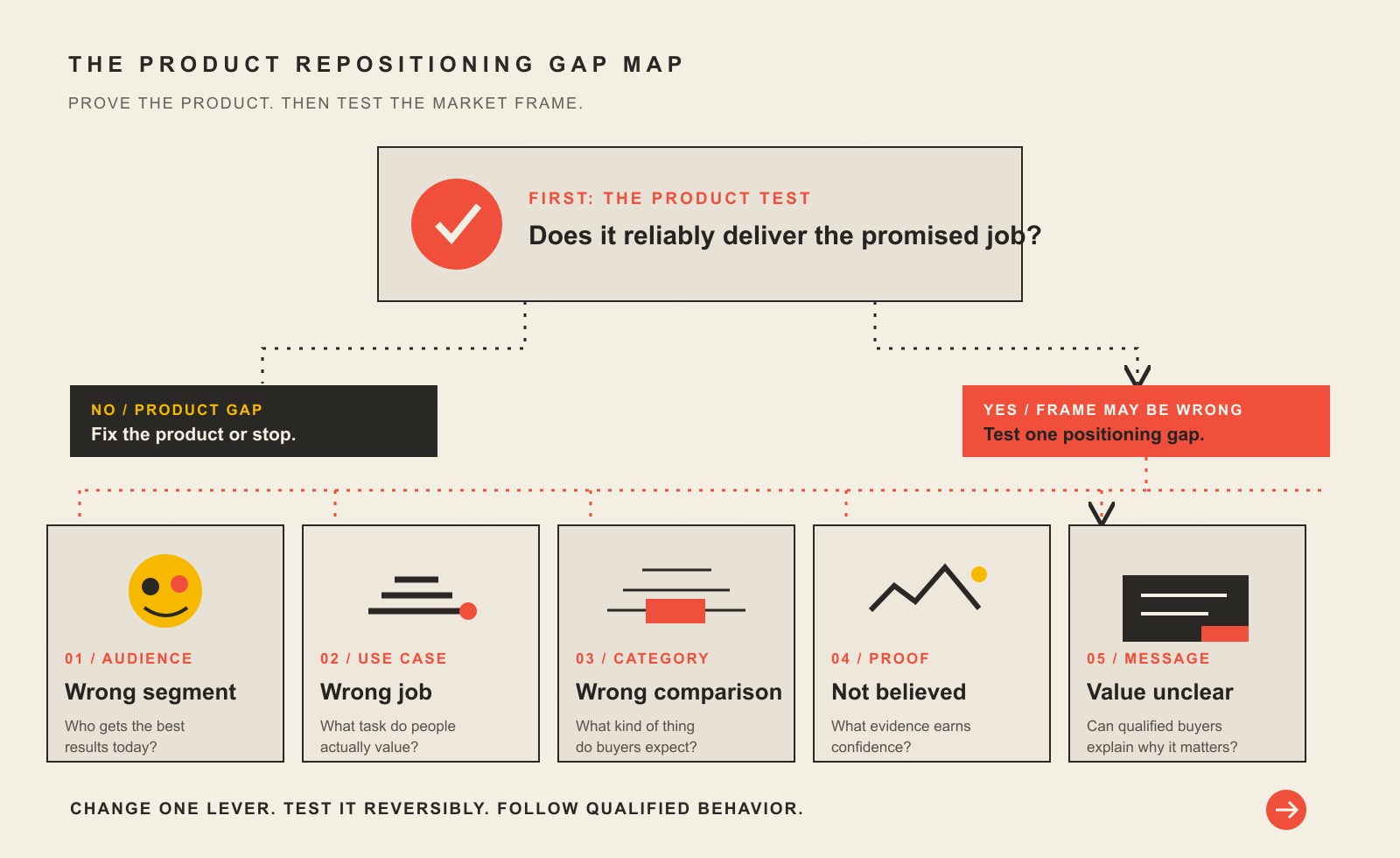
    Use the Product Repositioning Gap Map to diagnose the mismatch

    Most underperforming products do not need a random collection of marketing tactics. They need a diagnosis. Scope Design’s Positioning Gap Map separates six problems that are routinely mashed together under the phrase “bad positioning.”

    Product repositioning diagnostic: first verify the product delivers reliably; if it does, investigate a mismatch in audience, use case, category, proof, or message.

    1. Product gap

    The product cannot reliably deliver the promised job.

    This is the one gap you should not solve with repositioning. If the product is unreliable, incomplete, unsafe, too hard to use, or structurally uneconomic, change the product or stop selling it.

    A prettier promise cannot turn failure into value. It can only increase the number of disappointed customers.

    2. Audience gap

    The product works, but the current audience is a poor fit.

    You may discover that a smaller, more specific segment converts faster, uses the product more deeply, asks fewer support questions, or retains better than the audience you originally targeted.

    Do not immediately declare a new target market because three people said nice things. Use market research to compare behavior, alternatives, willingness to act, and competitive context across segments. The U.S. Small Business Administration recommends market research and competitive analysis to understand customers, demand, alternatives, and market segments.

    3. Use-case gap

    Customers value a different job than the one you built your marketing around.

    A product may have been created for one workflow and become valuable for another. The important evidence is not that people can invent clever uses for it. The important evidence is that a meaningful group already behaves differently and gets value from that behavior.

    Look at what customers actually do, not what a brainstorming session says they might do. Harvard Business School’s Jobs to Be Done interview guidance emphasizes observing and interviewing customers to uncover the job they are actually trying to accomplish.

    4. Category gap

    Buyers do not know what shelf in their brain to put the product on.

    If prospects repeatedly ask “What is this?” or compare the product with something that makes the value look absurd, the category or frame of reference may be wrong.

    A better category does not need to be clever. It needs to help the buyer answer three fast questions: What kind of thing is this? What should I compare it with? Why should I care about the difference?

    5. Proof gap

    The value may be real, but the buyer has no good reason to believe the promise.

    A proof gap can look like a message problem because prospects understand what you are saying but still do not act. The fix may be stronger demonstrations, clearer case evidence, credible reviews, a useful trial, transparent methodology, or narrower claims.

    This is also where repositioning can wander into bullshit. The Federal Trade Commission requires objective advertising claims to have an appropriate factual basis before they are made. Changing the position does not create permission to invent the proof.

    6. Message gap

    The product, audience, use case, category, and proof are basically sound, but the language hides the value.

    This is the gap marketers love because it can be fixed with words. It is also the gap teams diagnose far too early.

    If prospects can explain the product back to you accurately but do not care, you probably do not have a message problem. If qualified prospects consistently misunderstand what it does, who it is for, or why it matters, then the message deserves attention.

    Market saturation matters here too. A claim that worked when it was novel can become invisible when every competitor says the same thing. Scope’s market sophistication framework helps separate a genuinely weak position from a message that has simply become marketing wallpaper.

    Read the evidence as a pattern, not a magic diagnostic

    No single metric proves which gap you have. The patterns below are hypotheses worth testing, not commandments carved into a conference-room wall.

    What you observeLikely gap to investigateFirst useful test
    One customer segment retains or repeats much better than the restAudience or use caseRebuild one landing page and sales pitch for that segment only
    Prospects repeatedly compare you with the wrong alternativeCategoryTest a clearer frame of reference and comparison set
    Prospects understand the value but do not believe the claimProofAdd specific evidence or narrow the claim before changing the whole message
    Qualified visitors engage but routinely misunderstand what the product doesMessageTest a simpler promise, explanation, and example
    People buy or trial, but usage and retention collapseProduct or use caseInterview successful and unsuccessful users, then inspect the actual experience
    Every segment stays weak after repeated credible testsProduct, demand, or economicsStop polishing the position and reconsider the product itself

    The useful question is not “Which metric is bad?” It is “Which explanation best fits several pieces of evidence at once?”

    Use the RESET Repositioning Loop before you pay for the full rebrand

    Once you have a plausible gap, use a controlled loop instead of a dramatic launch. We call it RESET:

    Read the evidence

    Start with what already exists: customer interviews, lost deals, support tickets, reviews, product usage, sales notes, search demand, competitive alternatives, repeat behavior, and margins.

    Do not begin with a workshop where everyone writes adjectives on sticky notes. That can come later, after reality has had a vote.

    Expose the mismatch

    Write the problem as a falsifiable statement.

    Bad: “Our positioning feels stale.”

    Better: “Independent agencies that use the product for client approvals retain longer than the general small-business audience, but our site never presents client approvals as the primary use case.”

    Now you have something you can test.

    Select one positioning lever

    Choose the smallest change that would test the hypothesis:

    • target segment;
    • primary job or use case;
    • category or frame of reference;
    • value proposition;
    • proof;
    • message hierarchy;
    • packaging or offer structure when it materially changes the perceived value.

    If you change the audience, category, pricing, product, name, visual identity, website, and advertising all at once, the launch may look impressive and teach you absolutely nothing.

    Experiment before the rebrand

    Test the new position somewhere reversible. That could be a dedicated landing page, a small paid campaign, a sales deck, a targeted email to a qualified segment, a new onboarding path, or a limited outbound sequence.

    Use enough exposure to observe real behavior, not enough commitment to make the test politically impossible to reverse.

    Track response and decide

    Predefine what would count as stronger evidence. Depending on the business, that might be better qualified conversion, improved activation, shorter sales cycles, fewer “I don’t get it” objections, stronger retention, healthier margins, or a more favorable win/loss pattern.

    Then decide: keep the new position, revise and test again, fix the product, or stop investing.

    This loop fits inside the broader 7 Ps product strategy audit. The 7 Ps help you examine the whole product-marketing system. RESET is for the narrower moment when an existing product is not getting the response you expected.

    Product repositioning is not the same as rebranding

    Repositioning changes the strategic meaning of the product. Rebranding changes how that meaning is expressed through identity, naming, visual language, architecture, or other brand elements.

    Sometimes a new position eventually requires a new brand expression. Sometimes it does not.

    If your test shows that a different audience responds strongly to a different use case, you may be able to update the product page, sales story, examples, and proof without touching the logo. That is usually a lovely discovery because logos are not paid by the hour to solve market fit.

    A rebrand should follow a strategic change when the existing identity or brand architecture genuinely obstructs the new position. It should not be the expensive experiment you use to discover whether the new position works.

    A practical product repositioning example

    Imagine a project-management app originally marketed as “simple productivity for every small business.”

    The broad market performs poorly. Sales calls are long. Prospects compare it with enormous all-in-one platforms and conclude it has fewer features. Generic small businesses sign up but rarely become active users.

    Then the team notices a pattern: small field-service companies use the app heavily for one specific workflow, photo-based job handoffs between office staff and technicians. They activate faster, repeat the workflow every week, and describe the product to colleagues as “the easiest way to prove what happened on site.”

    The product may not need a reinvention. It may have an audience, use-case, and category gap.

    A sensible repositioning test would be:

    1. target field-service teams instead of “every small business”;
    2. lead with the job-handoff use case instead of generic productivity;
    3. compare the product with manual handoff methods and bloated field-service suites, not every project-management platform;
    4. show real workflow proof;
    5. run that position on one landing page and one sales path before rebuilding the brand.

    If the targeted path improves qualified conversion and the customers continue to activate and retain, the repositioning has earned more investment. If they click the new message and then churn because the workflow still breaks, congratulations, you found a product gap before buying new stationery.

    That is the point of diagnosis-first repositioning.

    A sample 30-day product repositioning test

    Thirty days is not a universal law. A complex enterprise sale may need much longer, while a high-volume ecommerce test may produce useful evidence faster. Treat this as a compact test structure, not a promise about timing.

    Days 1 to 5: establish the baseline

    Record the current audience, promise, conversion path, objections, activation or repeat behavior, retention when relevant, margins, and the competing alternatives customers actually consider.

    Interview recent buyers, non-buyers, and lost prospects. Ask about what they did before, what triggered the search, what alternatives they considered, what made them hesitate, and what happened after purchase.

    Days 6 to 10: choose one gap hypothesis

    Write one clear statement about the suspected mismatch. Pick one primary segment or use case. Define the behavior that would make the hypothesis more credible and the behavior that would weaken it.

    Days 11 to 24: run the controlled test

    Change only the positioning elements necessary to test the hypothesis. Keep the existing version available as a baseline when practical. Route a limited, relevant audience through the new version.

    Do not judge the test on likes, compliments, or the enthusiasm of coworkers who now feel emotionally attached to the new headline.

    Days 25 to 30: compare behavior and decide

    Compare the new path with the baseline. Review both numbers and actual customer language. Decide whether the evidence supports a larger rollout, another focused test, a product change, or a stop decision.

    The goal of the pilot is learning. A test that disproves a repositioning hypothesis before a six-month rebrand can be a very profitable failure.

    How should you measure whether product repositioning is working?

    The right metrics depend on where the suspected gap sits in the customer journey.

    Acquisition and qualification

    Look at whether the new position attracts more of the right people, not merely more people. Useful measures may include qualified landing-page conversion, lead quality, demo quality, segment mix, and which alternatives prospects mention.

    Sales friction

    Track objections, win/loss reasons, sales-cycle length, follow-up burden, price confusion, and how often salespeople need to re-explain the product after the marketing supposedly explained it.

    Product behavior

    If the product has an activation or repeat-use cycle, inspect it. Better marketing with worse activation is not progress. Retention, renewal, repeat purchase, usage depth, support burden, and successful completion of the core job help tell you whether the new audience/use case fits the actual product.

    Economics

    A position that raises conversion but attracts an expensive-to-serve segment may still be a bad trade. Include acquisition cost, delivery cost, gross margin, refund or churn patterns, and the operational burden created by the new promise.

    Qualitative evidence

    Capture the words customers use. A strong position often makes sales conversations clearer because buyers can explain the value in their own language. That is not a substitute for behavioral evidence, but it is useful diagnostic material.

    When should you stop repositioning and make a harder decision?

    Repositioning has become avoidance when:

    • every new message produces the same weak behavior;
    • the only segment showing interest is too small or too expensive to serve;
    • the product still fails its core job after the audience and use case are clear;
    • the economics do not work under realistic acquisition and delivery assumptions;
    • a new position would depend on claims you cannot substantiate;
    • the team keeps moving the target because admitting the product is weak feels worse than launching another campaign.

    A failed repositioning test does not automatically mean the product is dead. It does mean you should update the diagnosis instead of protecting the theory.

    That is the same constraint-first principle Scope uses in website strategy: a requested redesign, feature, campaign, or message is not automatically the real problem. Diagnose the binding constraint before optimizing the thing that is easiest to see.

    Product repositioning FAQ

    What is product repositioning?

    Product repositioning is changing how an existing product is understood and compared in the market. The change may involve the target audience, use case, category, value proposition, proof, or message while keeping some or all of the core product intact.

    What is the difference between product positioning and repositioning?

    Positioning establishes the intended market frame for a product. Repositioning changes that frame after the product already has a market history, customer perception, or performance record.

    When should a company reposition a product?

    Reposition when credible evidence suggests the product delivers value but the current audience, use case, category, proof, or message is mismatched. Do not default to repositioning when the product itself cannot deliver the promised result.

    Can you reposition a product without changing the product?

    Yes. An audience, use-case, category, proof, or message reposition can leave the core product largely unchanged. The key is that the new promise must match what the product can actually deliver.

    Does product repositioning require a rebrand?

    No. Repositioning is a strategic change in market meaning; rebranding is a change in brand expression. Test the strategic position first. Rebrand when the existing identity genuinely blocks the validated position.

    What are common product repositioning strategies?

    Common approaches include narrowing or changing the target segment, emphasizing a different use case, changing the competitive frame, clarifying the value proposition, strengthening proof, changing packaging or offer structure, and rewriting the message hierarchy.

    Can you give an example of product repositioning?

    A software product marketed broadly as “productivity for small business” might discover that field-service teams use it heavily for photo-based job handoffs. Repositioning could target that segment, lead with that job, change the comparison set, and add relevant proof without rebuilding the whole product. That is a hypothetical example, but it shows the decision clearly.

    How do you know whether poor sales are a positioning problem or a product problem?

    Look beyond sales. If qualified customers understand the promise, buy, and then fail to activate, repeat, renew, or get the intended result, investigate the product or use case. If the product creates strong outcomes for a specific group but the market attracts the wrong buyers or misunderstands the value, investigate positioning.

    How do you reposition a failed product?

    First determine whether it is actually a failed product. Read customer and product evidence, identify the most plausible gap, select one positioning lever, run a limited test, and compare behavior with the baseline. If the core product fails, fix or retire it instead of disguising the failure.

    What are the biggest risks of product repositioning?

    The main risks are confusing or alienating existing customers, changing too many variables to learn anything, making claims the product cannot support, chasing a tiny or unprofitable segment, and spending heavily on a rebrand before the new position has been validated.

    How long does product repositioning take?

    The strategic test can be quick when traffic and sales cycles are short, or much longer in complex B2B markets. Separate the time required to test the hypothesis from the time required to roll out a validated position across the product, brand, website, sales process, and operations.

    What metrics should you track after repositioning?

    Track metrics tied to the suspected gap: qualified conversion and segment mix for audience/message changes; objections and win/loss reasons for category/proof changes; activation, repeat use, retention, and support burden for product/use-case fit; and margin or acquisition economics for the overall business decision.

    Do not buy a new story before you know what is broken

    Product repositioning can be a smart response to weak demand. It can also become an expensive way to avoid admitting that the product, audience, economics, or evidence is wrong.

    The useful order is simple: diagnose the gap, test the smallest meaningful change, watch qualified behavior, then decide.

    If your team is bouncing between “we need a new website,” “we need better ads,” “we need a rebrand,” and “we need more features,” Scope Design can help separate the requested fix from the actual constraint. Contact Scope Design and we will start with the problem before prescribing the project.