Tag: pricing strategy

  • Raise Your Prices: The Strategic Guide to Business Pricing That Actually Works

    Raise Your Prices: The Strategic Guide to Business Pricing That Actually Works

    How to raise prices: start with the economics, not a percentage. A price increase is justified when the current price no longer funds reliable delivery, required margin, or sensible use of limited capacity—and when you can explain what is changing without pretending a higher number creates value by itself. Calculate the gap, choose who the change applies to, give appropriate notice, implement it deliberately, and measure what happens.

    The goal is not to raise prices with zero customer reaction. That promise is unrealistic. The goal is to avoid preventable surprise, keep the right customers, protect the quality of what you deliver, and learn whether the new price improves the business after customer behavior is included.

    When should you raise prices?

    Raise prices when evidence says the old price is no longer a good business decision. One weak month is not enough. One competitor charging more is not enough. A useful trigger is a mismatch between the economics or capacity of the offer and the price you are asking customers to pay.

    • Your delivery economics changed. Labor, materials, software, subcontractors, support, financing, or overhead increased enough that the old price no longer supports the required contribution.
    • Demand is consistently outrunning capacity. If the team is booked beyond a healthy level and additional volume would reduce quality or extend lead times, price can become one way to allocate scarce capacity.
    • The offer now creates or includes materially more value. Scope, expertise, turnaround, risk reduction, support, warranty, access, or outcomes improved and the price never caught up.
    • Your customer mix changed. The accounts you are attracting require more service, customization, coordination, or risk than the old price assumed.
    • You cannot fund the promise customers already bought. If the price leaves no room for training, quality control, maintenance, reasonable response time, or the operating cushion needed to deliver reliably, keeping the price low can become a customer-experience problem.

    If you are still trying to establish a defensible baseline price rather than raise an existing one, use our PRICE Test for product and service pricing. This guide owns the next decision: what to do when an existing price needs to move.

    Run the math before you choose a percentage

    The most defensible price increase starts with the gap you need to solve. The U.S. Small Business Administration defines break-even as the point where total revenue and total cost are equal, and gives the unit formula as fixed costs divided by price minus variable cost. That is a useful floor calculation, not a complete pricing strategy: a business also needs room for profit, reinvestment, uncertainty, and the actual capacity required to deliver.

    For a service business, a practical version is: add the monthly costs the work must carry, add the operating profit the business needs, then divide by the number of units, projects, retainers, appointments, or genuinely sellable hours available. Do not divide by every hour on the calendar. Selling, admin, training, support, rework, and management consume capacity too.

    Simple example: suppose an offer needs to produce $11,000 per month to cover its share of delivery, overhead, and the operating profit you have deliberately assigned to it. At 20 comparable customer accounts, the required average revenue is $550 per account. If the current average is $500, the gap is $50—not “whatever 10% sounds like” but a number tied to an explicit requirement. If the new price changes retention, service load, or mix, recalculate with the new evidence.

    Competitor prices still matter, but as context. A competitor may have different labor costs, scope, automation, risk, brand strength, purchasing power, or strategic goals. Their number does not know your economics.

    Use the Scope Design RAISE price-increase sequence

    RAISE is a five-step sequence for turning “we should probably charge more” into a measurable business decision: Run the economics, Audit the evidence, Identify what changes, Stage the increase, then Explain and evaluate.
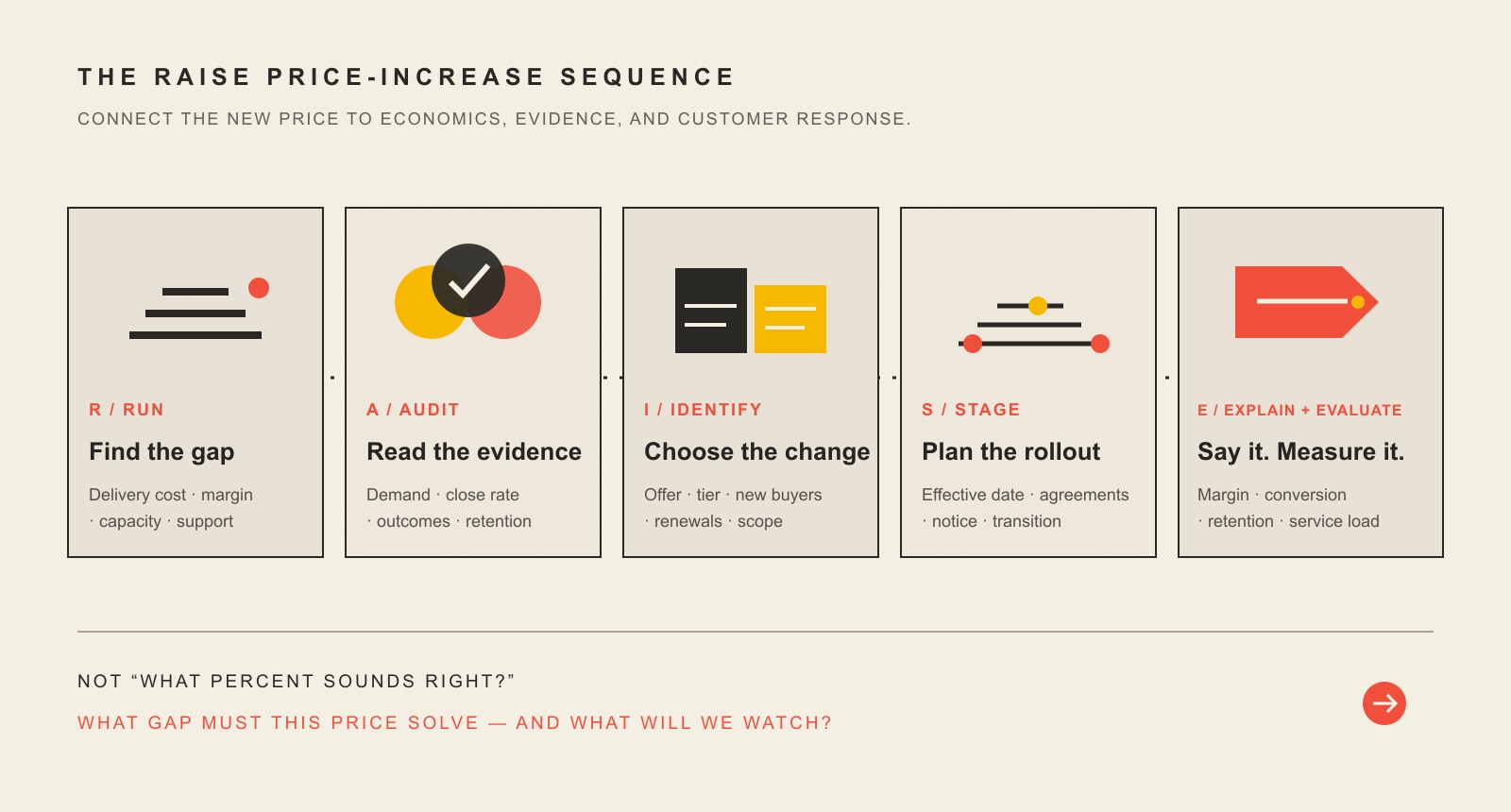
    The RAISE sequence: run the economics, audit evidence, identify what changes, stage the increase, and explain and evaluate customer and business outcomes.
    The RAISE sequence keeps a price increase connected to economics, evidence, rollout, communication, and measurement.

    R — Run the economics

    Define the business problem the new price must solve. Is the offer below its required margin? Is capacity full? Are delivery costs rising faster than revenue? Does the existing price prevent the staffing or support level customers expect? Write the current economics and the required economics side by side.

    A — Audit the evidence

    Look for repeated evidence rather than one loud opinion. Review demand, close rate, discount requests, customer outcomes, support burden, utilization, repeat purchases or retention where relevant, and credible alternatives in the market. Customer interviews and sales conversations can explain the numbers, especially when buyers value something different from what the team assumes.

    Price is not the same thing as perceived value. A higher price can raise the sacrifice in the buying decision just as easily as it raises expectations. Our guide to building perceived value without faking it goes deeper on evidence, risk, clarity, and experience.

    I — Identify what changes

    Decide whether the new price applies to every offer, one product line, one service tier, new customers, renewals, or a specific customer cohort. Sometimes the cleanest change is not “everything goes up 12%.” It is retiring an underpriced package, removing work that should not be bundled, introducing a higher minimum, or separating optional services that were quietly being given away.

    S — Stage the increase

    Choose an effective date and rollout that match the business. New customers can often receive the new price immediately. Existing customers may need notice, renewal timing, contract review, personal outreach, or a temporary transition. The right notice period depends on the relationship, billing cycle, agreement, and operational risk; there is no universal number that fits every business.

    Citizens Bank’s guide to raising prices follows the same practical sequence: understand margin, research the market, choose timing carefully, and give current customers advance notice with a clear explanation of what is changing and when.

    E — Explain and evaluate

    Tell customers what they actually need to know: the effective date, the new price or pricing method, what remains included, and any action required. Give a concise reason when it is useful and true. Then measure the outcome. The increase is not validated because the email was sent successfully; it is validated by what happens to margin, conversion, retention, service load, and customer fit.

    How much should you raise your prices?

    Raise the price enough to solve a defined economic or capacity problem, then test the assumptions that make the number work. An arbitrary 3%, 5%, 10%, or 20% increase can be accidentally right, but the percentage itself is not evidence.

    • Find the required floor. What price supports delivery, overhead, and the operating profit or contribution the offer needs?
    • Check the market corridor. What alternatives will a reasonable customer compare, and how different is your scope?
    • Model behavior. What happens if volume or retention changes after the increase?
    • Check capacity. If fewer customers at a higher price would improve delivery and total contribution, lower volume may be a feature rather than a failure.
    • Choose a review rule. Decide before rollout what evidence would make you hold, expand, adjust, or reverse the change.

    This is a business bet inside the broader Scope Design Business Strategy and Market Intelligence framework: make the outcome, assumptions, evidence, tradeoffs, resources, and review rule visible before you commit harder.

    How to raise prices without losing customers unnecessarily

    You cannot guarantee that nobody will leave after a price increase, and you should not design the rollout around that impossible goal. You can reduce preventable loss by avoiding surprise, applying the change consistently, explaining the decision clearly, and making sure the offer still earns the new price.

    A good price-increase message is short and specific

    For an existing customer relationship, the message usually needs five things:

    1. the date the new price takes effect;
    2. the new price, range, or pricing method;
    3. what is included and whether scope is changing;
    4. a concise, truthful reason when context helps; and
    5. a real person or process for questions.

    Example: “Beginning November 1, our monthly service will be $650. The scope and response process remain the same. This change lets us maintain the staffing and support level required for the work. Your October invoice is unchanged. If you want to review your plan before the new rate takes effect, reply here and we’ll walk through the options.”

    Do not bury the number under a page of apology. Do not invent a dramatic justification. Do not call the change an “upgrade” when nothing improved. If the new price includes a real scope or service change, explain it. If the reason is simply that the old price no longer supports the work, say that professionally.

    If the harder problem is how the price is displayed, compared, anchored, or explained on a website, that belongs to our separate guide to pricing psychology for clearer online decisions. Communication should make a true decision easier, not disguise the cost.

    Should you raise prices for new customers first?

    Starting with new customers is often a useful way to separate market acceptance from relationship-management risk. New prospects have no legacy price to compare. You can see whether qualified buyers still convert before moving a larger installed base.

    That does not mean existing customers should keep the old price forever. Permanent grandfathering can create a second price system that becomes harder to support every year. If you grandfather customers, define why, who qualifies, and when the exception will be reviewed or end. Honor contractual commitments and any notice requirements that apply to the relationship.

    For high-value or high-complexity accounts, personal outreach before a general notice can be worth the time. The purpose is not to negotiate against yourself. It is to surface scope, contract, and operational issues before the invoice becomes the first conversation.

    What should you measure after a price increase?

    Measure the consequence the increase was supposed to improve, plus the customer behaviors that could erase the gain. Revenue alone is not enough.

    MeasureWhat it tells you
    Contribution or gross profit per sale/accountWhether the economics improved after delivery cost is included.
    Qualified close or conversion rateWhether right-fit buyers still accept the offer.
    Retention, churn, cancellations, or repeat purchaseWhether existing-customer behavior changed where those measures apply.
    Revenue per project, account, or unit of capacityWhether scarce capacity is producing more useful value.
    Delivery time and support burdenWhether the new economics actually improve operations or just raise the invoice.
    Discount requests and objection reasonsWhether the problem is price, value clarity, scope, fit, or sales execution.

    Compare cohorts when possible. New customers quoted the new rate are different from long-term customers receiving an increase. Mixing them together can hide the reason results changed.

    Six price-increase mistakes to avoid

    1. Choosing a tidy percentage before finding the problem. “Let’s raise everything 10%” is a guess until the economics show why 10% matters.
    2. Using competitors as a calculator. Their price can identify a market boundary, but not your required margin or delivery model.
    3. Assuming a higher price automatically creates higher perceived value. A higher sacrifice with weak evidence can make the offer look worse. Fix the offer or proof problem instead.
    4. Apologizing until the decision sounds suspicious. Customers need clarity more than a nervous essay.
    5. Discounting immediately after the first objection. One objection is information, not a referendum. Record patterns before you dismantle the increase.
    6. Grandfathering forever without a reason. Exceptions accumulate operational debt. Give them an owner and a review date.

    Price is also only one part of customer value. If the increase is exposing a deeper experience problem, revisit what customers receive and where friction lives. Our guide to building value by investing in customers covers that side of the relationship.

    What auditing this exact article changed

    We did not preserve the old version just because it already existed. For the 12 complete months from August 21, 2025 through August 20, 2026, the active Scope Design GA4 property recorded one landing session for this URL, with zero engaged sessions and zero configured key events. Google Search Console returned no reportable exact-page query rows. Bing recognized the URL but reported zero clicks and zero impressions in the fresh URL check. Ubersuggest returned no exact-page backlinks.

    That tiny sample does not prove the topic is worthless, that readers disliked the old article, or that this revision will rank. Scope Design’s analytics attribution and key-event configuration also have limitations. It supports a narrower editorial decision: preserve the established URL, remove unsupported statistics and trend claims, give the page one clear job, and make its advice more useful than the legacy copy.

    The previous version leaned on old business-failure percentages, broad pricing-trend claims, sustainability-premium numbers, and the idea that a higher price can function as an automatic quality signal. Those claims are gone. The replacement uses a business-specific economics check, a reusable rollout sequence, current query evidence, direct source support, and explicit limits.

    Frequently asked questions about raising prices

    When should a business raise prices?

    Raise prices when the old price no longer supports the economics, capacity, scope, or reliable delivery of the offer and the change can be tied to evidence rather than fear or imitation. Review the price when meaningful inputs change instead of waiting for a crisis.

    How much should I raise my prices?

    Start with the required economic gap, then model customer behavior and market alternatives. There is no universal “safe” percentage. A smaller increase that leaves the business underfunded is not automatically safer, and a larger increase that changes customer fit must be evaluated with real response data.

    How do I raise prices without losing customers?

    You cannot guarantee zero customer loss. Reduce preventable loss by avoiding surprise, honoring agreements, giving appropriate notice, stating the new price clearly, keeping the reason truthful and concise, and making sure the offer still earns the price. Judge success by total business consequences, not by whether every customer stays.

    Should existing customers be grandfathered at the old price?

    Sometimes, temporarily. Grandfathering can protect a contractual or relationship transition, but indefinite exceptions create operational complexity and can leave the original economics unsolved. Define eligibility, duration, and a review date.

    How often should a business review prices?

    There is no universal cadence, but prices should be reviewed whenever costs, scope, demand, capacity, customer mix, or market alternatives change materially. A regular scheduled review is useful because it prevents years of drift followed by one painful emergency increase.

    Make the price a business decision

    A price increase should solve something real. Run the economics, audit the evidence, identify what changes, stage the rollout, explain it clearly, and evaluate what happened. If the increase improves the business while preserving the customers and delivery model you actually want, you have learned something useful. If it exposes a positioning, offer, capacity, or customer-fit problem, that is useful evidence too.

    If pricing pressure is only one symptom of a broader constraint, start with Scope Design’s Business Strategy and Market Intelligence guide. It is built for the larger question: what decision deserves resources next, what must be true, and what evidence should change your mind.

    Sources and methodology

    • U.S. Small Business Administration: used for the break-even definition and formula.
    • Citizens Bank, Mastering the delicate art of raising prices: used as independent corroboration for margin review, market research, timing, and advance customer notice.
    • Scope Design’s own GA4, Google Search Console, Bing Webmaster Tools, Ubersuggest, and DataForSEO observations: used to audit this exact article’s existing footprint and current search-question shape before revision.
    • Scope Design Content Studio and internal knowledge graph: used to keep this page distinct from the separate owners for baseline pricing, perceived value, pricing psychology, customer value, and broader business strategy.

  • 4 Proven Ways to Increase Sales Immediately

    4 Proven Ways to Increase Sales Immediately

    Quick answer: To increase sales without guessing, work on the constraint closest to revenue first. If qualified prospects already reach you but do not buy, improve conversion. If past leads or customers are sitting idle, reactivate them. If your sales rate is healthy but each sale is worth too little, improve pricing or packaging. Only after the sales path converts reliably should you add more qualified demand.

    Those are proven revenue levers, but “immediately” needs an honest definition. You can start the right test today. You cannot guarantee that every business will produce more revenue today, this week, or from the same tactic.

    At Scope Design, the rule is simple: a requested tactic is evidence, not a diagnosis. Our constraint-first order is Objective → Constraint → Positioning → Strategy → Tactics → Measurement. If you need the broader system behind channel and marketing decisions, see our small-business marketing strategy guide.

    The Fastest Sales Lever Is Usually the Closest Revenue Constraint

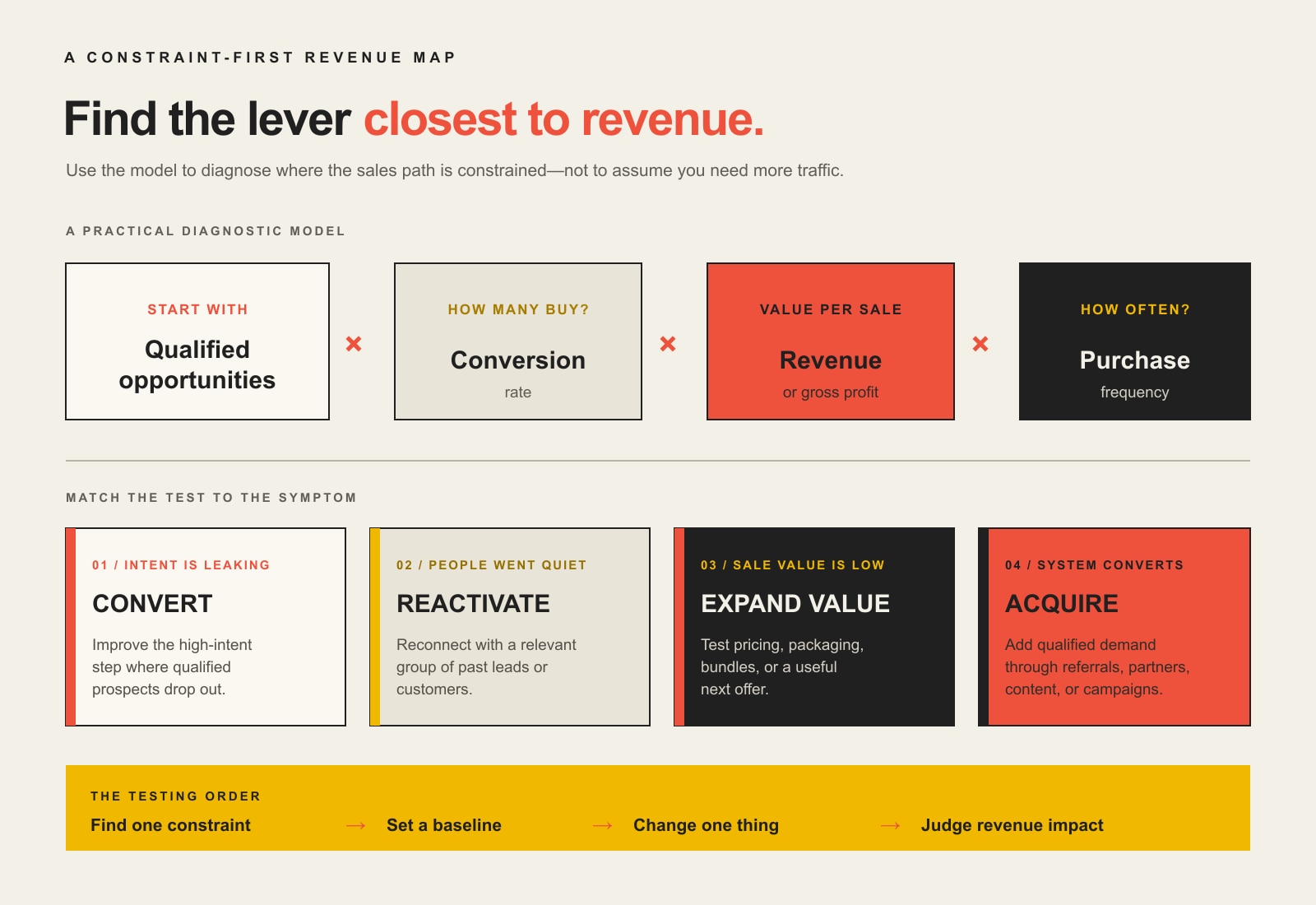
    A useful way to diagnose sales is to model revenue as four connected variables:

    Revenue ≈ qualified opportunities × conversion rate × value per sale × purchase frequency.

    This is a diagnostic model, not an accounting formula for every company. Its value is that it stops you from treating “more traffic” as the default answer. Each part of the model points to a different lever you can test.

    1. Convert: get more qualified prospects who are already in the sales path to take the next meaningful action.
    2. Reactivate: reconnect with leads and customers who already know the business.
    3. Expand value: improve revenue or gross profit per sale through better pricing, packaging, bundles, or appropriate upsells.
    4. Acquire: add new qualified demand through referrals, partnerships, affiliates, content, advertising, or other channels.
    A diagnostic model connects qualified opportunities, conversion rate, value per sale, and purchase frequency to four tests: convert, reactivate, expand value, or acquire; the testing order is find a constraint, set a baseline, change one thing, and judge revenue impact.
    Start with the symptom closest to revenue, establish a baseline, and test one lever at a time.

    If you are unsure which variable is actually constrained, our deeper guide to diagnosing why marketing is not working walks through the bottleneck before adding another tactic.

    1. Convert More of the Qualified Demand You Already Have

    This lever comes first when people are already reaching a high-intent page, requesting information, starting checkout, asking for quotes, or entering the sales process—but too few finish the next meaningful step.

    Do not begin with a sitewide redesign or a dozen simultaneous changes. Find the point where qualified intent is leaking out. Depending on the business, that might be a confusing offer, weak proof, an unclear call to action, unnecessary checkout friction, slow response time, or a sales handoff that leaves the prospect wondering what happens next.

    A bounded conversion test

    • Baseline one meaningful outcome. Use a purchase, qualified inquiry, booked consultation, accepted proposal, or another outcome tied to the sales path—not just pageviews.
    • Choose one high-intent step. Work on the page, form, checkout, quote process, or follow-up where the loss occurs.
    • Change one material thing. Clarify the offer, put proof near the decision, remove an unnecessary field, make the next step explicit, or tighten the handoff.
    • Judge the business outcome. A higher click rate is useful only if it moves more qualified people toward revenue.

    Example: if 100 qualified prospects reach a decision page and two buy, your baseline conversion is 2%. You do not need an industry-average conversion rate to know whether your own controlled change improves that baseline. The right comparison is your business before and after the test, with enough volume and time to avoid overreacting to noise.

    2. Reactivate Leads and Customers Already in Your Orbit

    Before paying to introduce yourself to strangers, look at the people who already raised a hand. Open proposals, older inquiries, previous buyers, renewal candidates, and customers with a logical next need can be closer to revenue than a brand-new visitor.

    The mistake is turning “follow up” into “email everyone more often.” There is no universal send frequency that maximizes every list. A useful cadence depends on why someone joined, what stage they are in, what you have to say, how long the buying cycle is, and whether the audience is responding.

    A better first test is one relevant message to one defined group. For example:

    • Ask stalled prospects whether the original problem still needs to be solved.
    • Show past customers a genuinely complementary service, refill, maintenance option, or next step.
    • Answer the objection that repeatedly stopped a specific class of lead.
    • Invite a segment to a useful resource or offer that matches what they originally asked about.

    Measure replies, qualified conversations, bookings, purchases, or reactivated revenue—not the number of messages sent. For the deeper system behind list ownership, lifecycle, message jobs, and sustainable cadence, use our email marketing roadmap for local business.

    3. Increase Value per Sale Without Pricing by Vibes

    If qualified customers are buying at a healthy rate but revenue or margin per sale is too low, the next lever may be value rather than volume. That can mean a price change, a clearer package, a bundle, a minimum engagement, an add-on, or an upsell that genuinely helps the buyer.

    Do not assume “raise prices” automatically means “make more profit.” Model the economics first. The U.S. Small Business Administration’s break-even guidance defines break-even as the point where total cost equals total revenue and uses fixed cost, selling price, variable cost, and projected unit sales to model the result. That is a better starting point than pricing psychology slogans.

    Use the old pricing example the right way

    Suppose a $29 offer produces seven sales per 100 qualified opportunities. That is $203 in revenue. If a $47 version produces five sales, that is $235. The second scenario generates $32 more revenue per 100 opportunities—but that does not prove the higher price is better. You still need to consider variable costs, acquisition costs, refunds, support load, retention, and what happened to the quality of the customer relationship.

    The point of the math is to show why conversion rate alone is not the business outcome. Price and volume interact. Test them deliberately. If pricing is the real constraint, our strategic guide to raising prices goes deeper into cost, value, positioning, segmentation, testing, and communication.

    4. Add Qualified Demand Through Referrals, Partners, and Affiliates

    Acquisition belongs fourth in this diagnostic—not because new demand is unimportant, but because pouring more people into a weak sales path can make the business busier without making it healthier.

    If the offer is understood, the sales path converts, the economics work, and follow-up is functional, then new qualified demand can become the right constraint to attack. Start with sources that bring context and trust, not just raw traffic.

    Three practical acquisition tests

    • Customer referrals: ask satisfied customers who else has the problem you solve, and make the introduction easy without turning the relationship into pressure.
    • Complementary partners: find businesses that serve the same customer before or after you do, then build a referral or co-marketing path that makes sense for both sides. Our guide to unexpected business partnerships explores that relationship more deeply.
    • Affiliates or creators: recruit a small number of partners whose audience and reputation fit the offer, give them a clear reason to care, and measure qualified sales rather than clicks.

    If compensation or another material relationship is involved in an endorsement, the Federal Trade Commission’s Endorsement Guides say the relationship should be disclosed clearly and conspicuously. Treat disclosure as part of the partnership design, not fine print added later.

    For acquisition, use the same discipline as the other levers: one audience, one offer, one channel, one measurable handoff, and one decision point. Our growth-hacking guide uses the same bounded-experiment idea for customer acquisition.

    How to Choose the First Sales Test This Week

    Use the symptom, not your favorite tactic, to choose the first move:

    • You have enough qualified visits, inquiries, or sales conversations, but too few become customers: test Convert.
    • You have a meaningful pool of past leads or customers who are not receiving relevant follow-up: test Reactivate.
    • Customers buy, but the economics are thin or the average sale leaves obvious value on the table: test Expand Value.
    • The sales path converts reliably and profitably, but there are not enough qualified opportunities entering it: test Acquire.

    Then write down three things before changing anything: your baseline, the single variable you are changing, and the business outcome that determines keep/change/stop. The review window should match the sales cycle. An ecommerce store may see a useful signal quickly; a consultative service with a long proposal cycle may need substantially longer.

    This prevents the most common failure mode in “increase sales” advice: changing the landing page, email schedule, price, ad creative, and partner outreach at the same time, then having no idea which change helped or hurt.

    What “Increase Sales Immediately” Should Actually Mean

    You can increase the quality of your sales process immediately. You can remove friction today. You can send a relevant follow-up today. You can model a pricing change today. You can ask for a referral today. What you should not promise is that any of those actions will create guaranteed same-day revenue.

    The useful definition of “immediate” is the shortest responsible feedback loop you can control. That keeps urgency without replacing judgment with hype.

    Frequently Asked Questions About Increasing Sales

    How can a small business increase sales quickly?

    Start with the closest revenue constraint. Improve conversion if qualified demand already exists, reactivate past leads or customers if you have dormant demand, improve pricing or packaging if value per sale is the problem, and add qualified demand only when the sales path already converts. Pick one lever and one measurable test rather than launching several tactics at once.

    Is more traffic the fastest way to increase sales?

    Not always. More traffic helps when too few qualified opportunities enter a sales system that already converts economically. If the real problem is a confusing offer, weak proof, checkout friction, poor follow-up, or thin pricing, more traffic can simply send more people into the same leak.

    Should I raise or lower prices to increase sales?

    Neither direction is automatically correct. Model contribution and break-even, understand what customers value, and test a controlled price or package change. Watch revenue and profit contribution along with conversion, customer quality, retention, and support cost.

    How often should I email leads and customers?

    There is no universal best frequency. Base cadence on audience expectations, lifecycle stage, buying cycle, the usefulness of what you have to say, and response. A relevant follow-up to a defined segment is a better first test than simply deciding everyone should receive more email.

    What sales metric should I measure first?

    Measure the last meaningful outcome the part of the system can control. For ecommerce that may be a purchase or contribution margin. For a service business it may be a qualified inquiry, booked consultation, accepted proposal, or closed sale. Use traffic, clicks, opens, and form starts as diagnostic metrics—not substitutes for the business outcome.

    Stop Collecting Tactics. Find the Constraint.

    The four ways to increase sales are not four commands every business should run at once. They are four places to look for the next constraint: convert, reactivate, expand value, and acquire. Diagnose the closest leak, run one bounded test, measure the outcome, and earn the right to move to the next lever.

    If the constraint is your website, lead path, marketing system, or measurement—and you want help diagnosing it before buying another tactic—contact Scope Design. We can help map the path from qualified attention to revenue and identify what deserves the next test.

  • How to Price a Product Without Guessing: The PRICE Test

    How to Price a Product Without Guessing: The PRICE Test

    How to price a product without guessing: find a viable range, not one magical number hiding in a spreadsheet. Build a floor from the economics of delivering the product, estimate a ceiling from the value and alternatives the right customer sees, choose a starting price inside that corridor, and test it against real behavior.

    Before changing the number, make sure price is actually the problem. If the product fails, the audience is wrong, the value is unclear, or the proof is weak, a discount is just cheaper disappointment.

    TL;DR: A defensible product price does five jobs

    • It reflects a valuable outcome for a specific customer, not “everyone with a wallet.”
    • It makes sense beside the buyer’s real alternatives, including DIY, doing nothing, substitutes, and competitors.
    • It covers the costs and burdens the sale actually creates, including support, returns, acquisition, risk, and capacity.
    • It is supported by customer evidence instead of a competitor’s price page and a hopeful shrug.
    • It can be tested in a controlled way, then kept, revised, repackaged, or rejected.

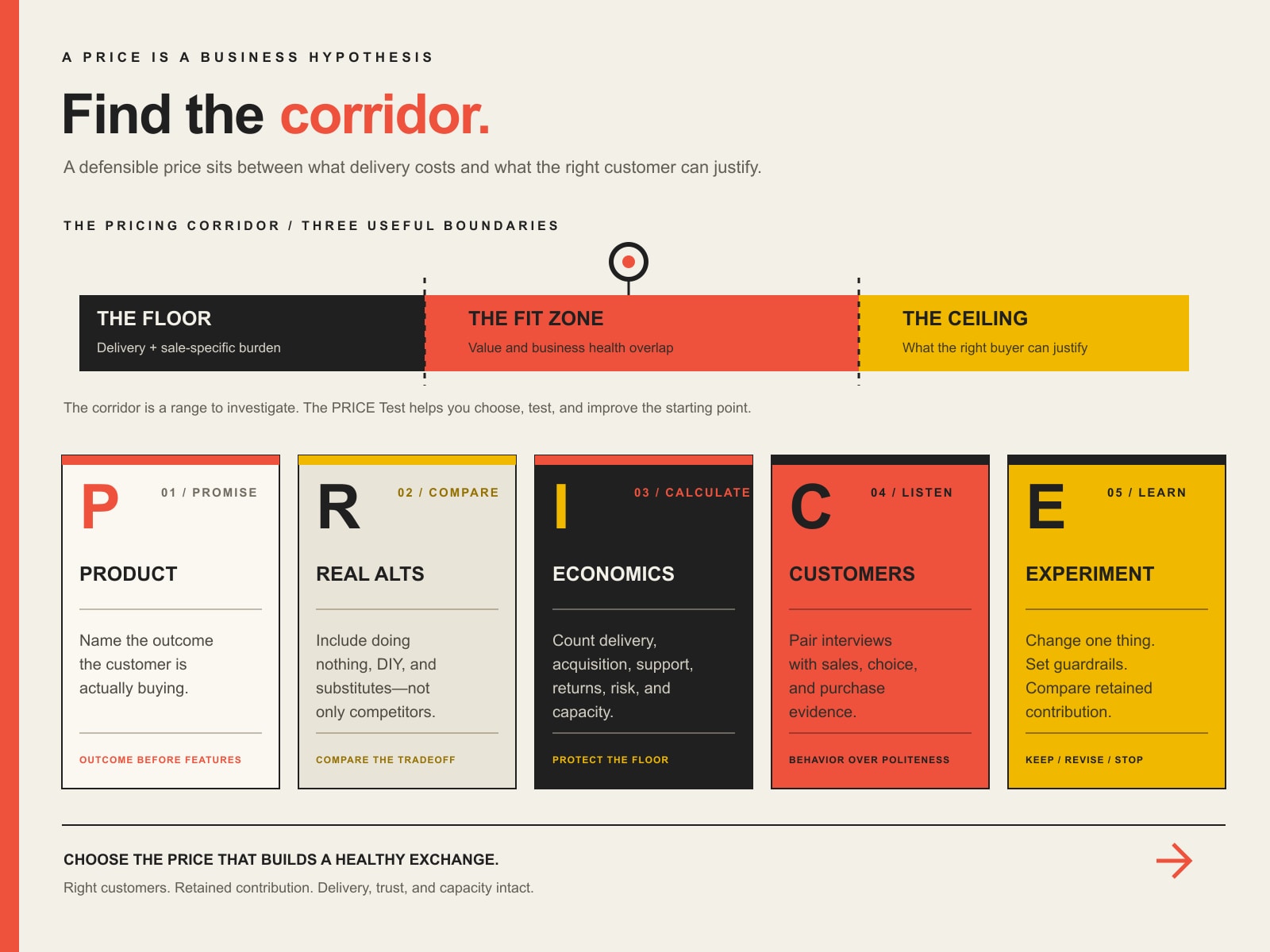
    Scope Design calls this the PRICE Test: Product outcome, Real alternatives, Internal economics, Customer evidence, and Experiment and evolve.

    Pricing is one business bet inside a larger system. If the product, market, or company strategy is still fuzzy, begin with Scope Design’s business strategy framework before polishing the decimal places.

    Pricing is a business hypothesis, not a receipt

    A receipt tells you what happened. A price predicts what might happen.

    It predicts that a specific customer will understand the value, compare it with available alternatives, believe the proof, accept the trade, and produce enough margin for the business to deliver the promise without quietly hating its own product.

    That is why cost alone cannot produce the final answer. Cost helps establish the floor. It does not tell you what the outcome is worth, which segment values it most, what substitutes buyers consider, how much support they will require, or what the price communicates about the offer.

    Competitor prices do not produce the answer either. They reveal part of the comparison set. They do not reveal the competitor’s costs, acquisition efficiency, support load, margins, funding, customer mix, bundling, discounts, or strategic desperation.

    Copying a competitor’s price is setting your thermostat by looking through the neighbor’s window. You can see a number. You cannot see what created it.

    The goal is not the highest price a buyer will tolerate. The goal is a healthy exchange:

    • the right customer receives enough value to choose and keep the product;
    • the business earns enough contribution to deliver, support, improve, and continue offering it;
    • the price reinforces the intended position rather than contradicting it;
    • demand fits the company’s capacity and goals.

    That is a more useful definition of a strong price than “maximum profit,” because profit depends on demand, cost, retention, volume, support, and capacity together. A giant unit margin on a product nobody buys is not a pricing triumph. It is a very tidy shelf ornament.

    Is price actually the problem?

    Weak sales do not automatically mean the price is too high. Strong sales do not automatically mean the price is right.

    Before changing the number, review the whole 7 Ps product strategy audit. Price interacts with the product, promotion, place, people, process, and physical evidence around it.

    Use the following patterns as diagnostic clues, not courtroom verdicts.

    What you observeWhat may actually be wrongFirst useful check
    Few qualified people ever reach the offerDemand, targeting, distribution, or discoverabilityConfirm the target segment and acquisition path before testing price
    Prospects ask what the product does or who it is forCategory, use case, message, or audienceClarify the promise and comparison set
    Prospects understand the promise but do not believe itProof, risk, trust, or claim strengthImprove demonstrations, evidence, guarantees, or claim precision
    Customers buy, then fail to activate, repeat, retain, or get the promised resultProduct or use-case gapFix the experience or diagnose a product or positioning mismatch
    Almost every sale requires a discountPrice, weak proof, wrong segment, sales habit, or discount conditioningReview who buys at full price and why
    Demand is strong but delivery is overloadedCapacity, packaging, or a price that is too low for the current offerRaise price, narrow scope, add capacity, or separate service levels
    One segment buys faster, stays longer, and needs less supportAudience or use-case fitPrice and package for that segment rather than averaging everyone together
    Conversion rises after a price cut, but refunds, support, churn, or low-quality leads rise tooThe lower price attracted less valuable demandCompare contribution and retained value, not conversion alone

    If customers buy and the product still cannot deliver the result, fix the product. If the product works for a real segment but the market attracts the wrong people or compares it with the wrong alternative, fix the position. Price becomes useful after the offer deserves a price.

    The Pricing Corridor sets a sustainable floor, a customer-value ceiling, and a fit zone; the PRICE Test checks product outcome, real alternatives, internal economics, customer evidence, and experiments.

    Use the Pricing Corridor instead of hunting for a perfect number

    There is rarely one objectively correct price. There is a Pricing Corridor with three parts.

    The floor: the lowest price that remains worth delivering

    The floor is not merely the cost of materials or the hours required to produce one unit. It includes the costs and burdens that the sale actually creates.

    Depending on the business, that can include:

    • inventory or production;
    • labor and fulfillment;
    • packaging and shipping;
    • payment and platform fees;
    • sales commissions;
    • customer acquisition;
    • onboarding and implementation;
    • support and account management;
    • expected refunds, replacements, or returns;
    • warranty and compliance risk;
    • revisions, scope creep, and custom handling;
    • the capacity consumed by the work;
    • a reasonable contribution toward fixed costs and future improvement.

    A service business that prices only the visible production hours will eventually discover that meetings, project management, revisions, documentation, training, support, and risk have been working for free. They are rarely grateful.

    A simple floor model is:

    Minimum sustainable price = variable delivery cost + sale-specific burden + required contribution

    The exact allocation of fixed costs depends on volume and the business model, so do not turn this into false precision. The purpose is to expose what the current price must support.

    The ceiling: the value the right customer can justify

    The ceiling is not “the most money we can squeeze out of someone.” It is the upper edge of what a target customer can reasonably justify based on:

    • the outcome they receive;
    • the urgency and cost of the problem;
    • risk reduced;
    • time or labor saved;
    • revenue enabled;
    • convenience or confidence created;
    • status or identity value;
    • expected duration of value;
    • available substitutes;
    • the cost and inconvenience of doing nothing;
    • the credibility of the proof.

    The ceiling changes by segment and use case. A workflow that saves a solo operator thirty minutes a month is not worth the same amount as the same workflow preventing a fifty-person team from losing billable work every week.

    That is why the U.S. Small Business Administration recommends researching demand, market size, saturation, customer location, and what buyers already pay for alternatives. Good pricing begins with a real market, not a fictional average customer.

    The fit zone: where customer value and business health overlap

    The fit zone is the range between the floor and ceiling where the offer can create a healthy exchange.

    A price belongs in the fit zone when it produces an acceptable combination of:

    • qualified conversion;
    • contribution margin;
    • revenue per qualified visitor or opportunity;
    • activation and successful use;
    • repeat purchase or retention;
    • refund and churn patterns;
    • support burden;
    • sales-cycle length;
    • discount rate;
    • delivery capacity;
    • strategic positioning.

    This is where pricing becomes a decision rather than a formula. You are choosing which tradeoffs best support the business and the customer.

    How to price a product with the PRICE Test

    The Pricing Corridor gives you the range. The PRICE Test gives you the decision process.

    P: Define the product outcome

    Start with the progress the customer is buying.

    What changes after they use the product successfully? What risk disappears? What work becomes easier? What opportunity becomes possible? What do they stop doing, waiting for, worrying about, or paying for?

    Do not answer with a feature list.

    “Includes an automated dashboard” is a feature. “Lets an operations manager see overdue work before a customer complains” is an outcome.

    A useful outcome statement names:

    1. the target customer;
    2. the job or problem;
    3. the meaningful result;
    4. the evidence the product can produce it;
    5. the time or conditions required.

    The same product may create different value for different segments. That can justify separate packages, usage levels, implementation options, or service tiers. It does not justify randomly charging people different amounts because an algorithm thinks they look expensive.

    R: Map the real alternatives

    Buyers do not compare your product only with direct competitors. They compare it with whatever they would do instead.

    Real alternatives may include:

    • doing nothing;
    • postponing the decision;
    • using a spreadsheet or manual process;
    • hiring an employee or contractor;
    • buying a smaller substitute;
    • assembling several tools;
    • choosing a direct competitor;
    • living with the current cost or risk.

    For each alternative, record:

    • direct price;
    • setup and switching effort;
    • time required;
    • risk and uncertainty;
    • ongoing support burden;
    • limitations;
    • who owns the work;
    • the result the customer actually receives.

    Then identify the buyer’s frame of reference. A $200 product can seem expensive beside a $20 app and inexpensive beside a $2,000 service. If the buyer compares you with the wrong category, the problem may be positioning rather than price.

    Use competitor prices to understand category expectations and packaging conventions. Do not inherit another company’s economics as if it were open-source software.

    I: Calculate the internal economics

    Now determine what the offer must produce for the business.

    At minimum, calculate:

    • variable cost per sale;
    • gross profit per sale;
    • gross margin;
    • contribution after sale-specific acquisition, support, and fulfillment costs;
    • expected refund or churn burden;
    • capacity consumed;
    • cash timing;
    • break-even volume under realistic assumptions.

    Markup and margin are not the same thing

    This mistake creates a surprising amount of confident nonsense.

    • Markup compares gross profit with cost.
    • Gross margin compares gross profit with selling price.

    If a product costs $40 and sells for $100:

    • gross profit is $60;
    • markup is $60 ÷ $40 = 150%;
    • gross margin is $60 ÷ $100 = 60%.

    A 50% markup does not create a 50% margin. If the product costs $40 and you add a 50% markup, the price is $60 and the gross margin is 33.3%.

    There is no universal “good margin” for every product. A sustainable target depends on inventory risk, volume, acquisition cost, payment timing, support, returns, retention, complexity, and capacity.

    For a subscription product, the first month’s margin tells only part of the story. Acquisition cost, activation, retention, support, expansion, failed payments, and cancellation behavior matter. For a service product, utilization, revisions, meetings, scope boundaries, and opportunity cost matter. For a physical product, landed cost, inventory, damage, shipping, returns, and channel fees matter.

    The number must survive contact with the business that delivers it.

    C: Collect customer evidence

    The fastest way to make pricing research useless is to ask people, “Would you pay $99 for this?” and treat polite optimism as a purchase order.

    Use several kinds of evidence.

    Interview evidence

    Talk with recent buyers, lost prospects, successful customers, poor-fit customers, and people who chose an alternative.

    Ask about behavior and context:

    • What triggered the search?
    • What were they doing before?
    • What alternatives did they consider?
    • What did the current problem cost in time, money, risk, or frustration?
    • Who approved the purchase?
    • What made the decision feel safe or unsafe?
    • What nearly stopped the sale?
    • What happened after purchase?

    Use customer and market research to understand segments and alternatives before reducing the result to a preferred price.

    Transaction and sales evidence

    Review:

    • full-price versus discounted wins;
    • win/loss notes;
    • sales-cycle length;
    • objections;
    • package selection;
    • upgrade and downgrade behavior;
    • refunds and cancellations;
    • repeat purchase;
    • renewal;
    • support usage;
    • retention by segment;
    • which customers get the strongest result.

    A segment that buys at a higher price, succeeds faster, and requires less support may be more valuable than a larger group that converts cheaply and leaves quickly.

    Choice research

    When the offer contains several attributes, ask buyers to make tradeoffs among realistic packages rather than rating every feature as “important.” Original conjoint-measurement research established a way to quantify tradeoffs among attributes such as price, support, speed, limits, and features.

    Treat research as directional unless it is tied to real behavior. A survey can improve a hypothesis. It cannot make the market sign it.

    E: Experiment and evolve

    Choose a starting hypothesis and test it with the smallest change that can produce useful evidence.

    Possible tests include:

    • one dedicated landing page for a defined segment;
    • a new-customer price while existing customers keep their current terms;
    • two clearly different packages rather than arbitrary dollar changes;
    • a sales-deck or proposal test for a qualified B2B segment;
    • a limited geographic or channel rollout;
    • a pilot with explicit scope and success criteria;
    • a checkout test with equivalent audiences and a real purchase opportunity;
    • a tier test that changes service level as well as price, when packaging is the actual hypothesis.

    Do not change price, package, audience, headline, guarantee, sales process, and product at the same time if you expect to learn which change mattered.

    Use the SCOPE Decision Filter to match rigor to stakes and reversibility. A reversible landing-page test does not need the same process as changing pricing for thousands of existing subscribers.

    Before the test, define:

    • the target segment;
    • the exact hypothesis;
    • the baseline;
    • what will change;
    • what will remain constant;
    • primary and guardrail metrics;
    • the minimum exposure or time needed for a useful read;
    • conditions for keeping, revising, or stopping;
    • how existing customers will be treated;
    • operational and legal review requirements.

    The test is not complete when the conversion rate changes. It is complete when you understand whether the new price improves the business and the customer exchange.

    Which product pricing method should you use?

    Pricing methods are inputs. None deserves to become a religion.

    MethodBest useWhat it contributesWhat it misses when used alone
    Cost-plus pricingEstablishing a floor and protecting unit economicsClear relationship between cost, markup, and priceCustomer value, alternatives, demand, positioning, and capacity
    Competitive pricingUnderstanding category expectations and comparison anchorsReal market reference points and package conventionsCompetitors' different costs, segments, funding, support, and strategy
    Value-based pricingOffers with a meaningful, measurable outcome for a defined segmentConnects price with customer value and willingness to actRequires strong research, segmentation, proof, and delivery confidence
    Tiered or packaged pricingDifferent needs, service levels, usage, or risk profilesLets buyers self-select and protects a simpler core offerToo many tiers create confusion and artificial feature fences
    Subscription pricingOngoing value, access, monitoring, service, or replenishmentAligns revenue with continuing use or serviceFails when value is one-time, retention is weak, or ongoing support is underpriced
    Usage-based pricingValue and cost rise with measurable consumptionScales price with actual useCan create bill anxiety, forecasting difficulty, and mismatched value units

    A sensible process often combines methods:

    1. use cost and contribution to establish the floor;
    2. use alternatives to understand the comparison set;
    3. use customer outcomes and evidence to estimate the ceiling;
    4. use packaging to serve meaningful segments;
    5. use controlled tests to choose and revise the starting price.

    “Value-based” does not mean inventing a heroic ROI number and charging a percentage of the fantasy. The claimed value must be credible, relevant, and supported. The Federal Trade Commission’s advertising-substantiation policy is a useful reminder that objective claims need an appropriate basis before they are used to sell.

    How should you test willingness to pay?

    Willingness to pay is not a permanent personality trait. It changes with the segment, use case, urgency, alternatives, proof, package, buying authority, and timing.

    Use a ladder of evidence.

    Weak but useful for discovery

    • open-ended interviews;
    • reactions to a concept;
    • surveys;
    • stated price ranges;
    • “too cheap / reasonable / expensive / too expensive” questions;
    • competitor and category review.

    These help form hypotheses. They are vulnerable to politeness, imagination, framing, and the fact that nobody has to hand over money.

    Stronger for comparison

    • realistic package-choice exercises;
    • conjoint-style tradeoff research;
    • proposal tests with qualified prospects;
    • monadic price research where different respondents see different prices;
    • analysis of historical wins, losses, discounts, upgrades, and downgrades.

    These force tradeoffs and reduce the temptation to call every feature essential.

    Strongest for behavior

    • real purchase decisions;
    • controlled price or package experiments;
    • renewal and retention behavior;
    • repeat purchase;
    • paid pilots;
    • expansion and contraction;
    • refund and cancellation patterns.

    Observed behavior deserves more weight, but it still requires interpretation. A lower price can improve conversion while damaging margin, support quality, or customer fit. A higher price can reduce raw conversion while improving contribution and delivery capacity.

    Measure pricing with a business scorecard, not one green number

    The primary metric depends on the hypothesis, but every test needs guardrails.

    MetricWhat it tells youWhat can fool you
    Qualified conversion rateWhether the right audience accepts the offerCheap or low-quality demand can inflate it
    Revenue per qualified visitor or opportunityCombines price and conversionDoes not include delivery or retention
    Contribution per saleWhat remains after sale-specific costsFixed costs and future support may still matter
    Activation or successful useWhether buyers reach the intended valueA quick activation event may not equal a real outcome
    Repeat purchase or retentionWhether value continuesLong observation windows may be required
    Refund or churn rateWhether the exchange disappoints or attracts poor fitProduct and onboarding changes can confound it
    Support burdenWhether the price funds the service requiredSupport logging may be incomplete
    Sales-cycle lengthWhether the price and proof create frictionSegment and deal complexity affect it
    Discount rateWhether full-price value is credibleSales habits can create the discount problem
    Capacity and lead timeWhether demand fits deliveryOperational bottlenecks may be unrelated to price

    A useful decision rule is:

    Choose the price that improves retained contribution from the right customers without breaking delivery, trust, or strategic positioning.

    That is harder than celebrating a conversion lift. It is also how businesses avoid becoming busier and poorer at the same time.

    Should you raise, lower, or hold the price?

    Consider raising the price when

    • demand consistently exceeds healthy capacity;
    • the current margin cannot support delivery, support, risk, or improvement;
    • the best-fit segment receives substantially more value than the price reflects;
    • customers routinely choose the highest package without meaningful resistance;
    • sales require little discounting and retention remains strong;
    • a very low price makes the offer look implausible or attracts poor-fit demand;
    • the product and proof have materially improved.

    A price increase may also require narrower scope, clearer packages, stronger proof, or better communication. Do not assume the number can carry the entire strategy on its back.

    Consider lowering the price when

    • the product creates real value but the current price sits outside the target segment’s credible alternatives;
    • the economics support a lower price at realistic volume;
    • a simpler package can remove cost and risk rather than merely discounting the same burden;
    • the acquisition or delivery model has genuinely become more efficient;
    • behavioral evidence shows a price barrier after product, audience, message, and proof have been checked.

    Lowering price without changing the cost structure can produce more work at a worse exchange. Sometimes the better move is a smaller package, limited tier, paid pilot, financing option, or different segment.

    Hold the price when

    • the sample is too small;
    • tracking is unreliable;
    • the product, audience, package, or message just changed;
    • demand is seasonal or distorted by a campaign;
    • the team is reacting to one loud prospect;
    • the proposed move is driven by anchoring, sunk cost, or confirmation bias rather than evidence.

    Pricing decisions are especially vulnerable to anchoring and sunk-cost bias. The first number you saw and the money already spent are not entitled to run the next decision.

    Discounts are a pricing decision, not decorative confetti

    Discounts can be useful when they have a clear job:

    • rewarding an economically meaningful commitment;
    • reducing acquisition or service cost;
    • moving seasonal or perishable inventory;
    • encouraging trial for a defined segment;
    • offering a smaller scope or lower service level;
    • supporting a transparent launch or promotion.

    They become dangerous when they train buyers to wait, hide weak value, confuse the reference price, or make full-price customers feel foolish.

    In the United States, former-price and comparable-value advertising is not a place for creative fiction. The federal Guides Against Deceptive Pricing warn against using a fictitious former price to manufacture a bargain. Do not create a permanent “sale,” invent a “was” price, or compare unlike offers without an honest basis. State laws and regulated industries may add requirements, so get qualified legal advice when the stakes justify it.

    A clean discount policy states:

    • who qualifies;
    • why the discount exists;
    • what changes in return;
    • how long it lasts;
    • whether it renews;
    • which price is the normal price;
    • how existing customers are treated.

    Hope is not a discount strategy either.

    Three practical product pricing examples

    Example 1: A physical product with misleading unit economics

    Imagine a product with a $24 manufacturing cost. The owner adds a 50% markup and prices it at $36.

    That looks tidy until the business adds $4 packaging, $5 average shipping subsidy, $2 payment and marketplace fees, $3 expected returns and replacements, and $6 average acquisition cost. The sale now creates roughly $44 in direct and sale-specific burden before contributing to fixed costs or profit.

    The original price was not “competitive.” It was below the real floor.

    The next step is not automatically charging $80. The business should:

    1. calculate the actual floor;
    2. review customer value and alternatives;
    3. decide whether shipping, bundle size, channel, or packaging should change;
    4. choose a viable range;
    5. test the offer with the target segment.

    Example 2: A software product with a positioning problem

    A general workflow app charges $29 a month and struggles to convert. The team proposes cutting the price to $19.

    Research shows that broad small-business prospects compare it with inexpensive task apps. A smaller field-service segment uses it for photo-based job handoffs, avoids disputed work, retains longer, and needs less support. That segment compares it with manual coordination and larger field-service systems.

    The better hypothesis may be a new audience, use case, package, and proof, not a cheaper version of the same generic story. Test the position first. Then test the price inside the new comparison set.

    Example 3: A custom service priced like a commodity

    A business requests a custom website with content migration, ecommerce, integrations, stakeholder reviews, training, and post-launch support. A competitor advertises a much lower “website package,” so the natural impulse is to match it.

    But the packages are not equivalent. One may be a template with strict limits. The other may include strategy, content, technical risk, custom functionality, project management, QA, and ongoing ownership.

    The correct response is not to declare the expensive option superior. Custom work must earn its cost. The provider should separate required outcomes from optional complexity, define scope, calculate delivery economics, show the proof, and offer a simpler path when it solves the problem.

    That is pricing as product strategy rather than proposal theater.

    A practical 30-day pricing test

    Thirty days is an example, not a universal law. A high-volume ecommerce product may produce a useful read faster. A complex B2B sale may need a full sales cycle or longer.

    Days 1 to 5: Diagnose and establish the baseline

    Record:

    • target segment;
    • current package and price;
    • qualified traffic or opportunities;
    • conversion and discount rate;
    • contribution per sale;
    • activation or successful use;
    • refunds, churn, or repeat purchase;
    • support burden;
    • sales-cycle length;
    • current alternatives and objections.

    Confirm that product, audience, use case, message, and proof are credible enough to test price.

    Days 6 to 10: Build the Pricing Corridor

    Calculate the floor. Map the alternatives. Define the customer outcome. Estimate the value ceiling conservatively. Choose a starting price or package hypothesis inside the corridor.

    Write the hypothesis plainly:

    “For independent agencies that need client-approval tracking, a $79 monthly package with unlimited reviewers will improve contribution without materially reducing qualified activation or 90-day retention.”

    Now the team knows what it is testing.

    Days 11 to 25: Run the controlled test

    Expose the change to a relevant audience while keeping the rest of the offer as stable as practical. Protect existing customers when appropriate. Log sales conversations, objections, behavior, support, and operational effects.

    Do not end the test because three people liked the price and one person sent an angry email.

    Days 26 to 30: Compare and decide

    Compare the test with the baseline and review both numbers and customer language.

    Choose one action:

    • keep the new price;
    • revise and test again;
    • change the package;
    • improve proof or positioning;
    • fix the product;
    • target a different segment;
    • restore the old price;
    • stop investing.

    A test that prevents a bad rollout is not a failure. It is cheaper tuition.

    Product pricing FAQ

    What is the best formula for pricing a product?

    There is no single best formula for every product. Use cost and sale-specific burden to establish a floor, then evaluate customer value, alternatives, demand, proof, and capacity to estimate a viable range. Cost-plus pricing can protect unit economics, but it does not reveal what the outcome is worth or whether buyers will choose it. A useful starting model is: minimum sustainable price equals variable delivery cost plus sale-specific burden plus the contribution the business requires. The final price still needs customer and market evidence.

    How do you calculate the selling price from cost?

    For a cost-plus starting point, add the desired markup to cost. If cost is $40 and the desired markup is 50%, the selling price is $60. That creates a 33.3% gross margin, not a 50% margin. To price for a target gross margin, divide cost by one minus the target margin. A $40 cost with a 60% target gross margin produces a $100 price: $40 ÷ (1 – 0.60). This calculation checks economics. It does not prove demand or value.

    What is the difference between markup and profit margin?

    Markup divides gross profit by cost. Gross margin divides gross profit by selling price. With a $40 cost and $100 price, gross profit is $60, markup is 150%, and gross margin is 60%. Confusing the two can cause a business to underprice while believing it has protected its margin. Also remember that gross margin does not automatically include acquisition, support, refunds, overhead, taxes, financing, or other business costs.

    What is a good profit margin for a product?

    A good margin is one that supports the product’s real business model and remains competitive with the value offered. There is no responsible universal target. Physical goods, software, subscriptions, services, marketplaces, regulated products, and high-return categories carry different inventory, acquisition, support, risk, and capital needs. Define the contribution the product must produce, model realistic volume, and compare the result with retention, capacity, and customer value.

    Is value-based pricing better than cost-plus pricing?

    They answer different questions. Cost-plus pricing helps establish whether the offer can be delivered sustainably. Value-based pricing helps connect the number with the outcome a defined customer receives. A strong process normally uses both: cost and contribution establish the floor, while customer value and alternatives help estimate the ceiling. Value-based pricing becomes bullshit when the value claim is imaginary, unproven, or unrelated to what the buyer can actually capture.

    Should I copy competitor pricing?

    No. Use competitor prices to understand the category, packages, reference points, and alternatives buyers see. Do not copy them as the answer. Competitors may have different costs, funding, acquisition efficiency, service levels, support burden, customer segments, margins, and goals. A competitor may also be underpricing, bundling, using a loss leader, or quietly regretting the number. Research the comparison set, then make your own economics and value decision.

    How do I price a new product with no direct competitors?

    Start with the problem and alternatives rather than the category label. What does the customer do now? What does doing nothing cost? Could they use staff time, a spreadsheet, a consultant, several tools, or an adjacent product? Calculate the internal floor, estimate the value created for a specific segment, and test a realistic starting price with interviews, package choices, paid pilots, proposals, or controlled purchase opportunities. No direct competitor does not mean no alternative.

    How do I find out what customers are willing to pay?

    Combine interview, choice, and behavioral evidence. Ask about triggers, alternatives, current costs, decision authority, objections, and prior purchases. Use realistic package comparisons or conjoint-style research when several attributes matter. Review sales, discounts, upgrades, refunds, churn, and retention. Then test a real price with a relevant audience. Treat survey answers as hypotheses. Real choices and retained customers deserve more weight.

    Can I A/B test product prices?

    Yes, when the test is operationally, ethically, and legally appropriate. Use equivalent audiences, a clear hypothesis, stable offer elements, and enough exposure for a useful read. Decide how existing customers will be treated and avoid deceptive reference prices. Track contribution, customer quality, refunds, retention, and support, not only conversion. For low-volume or complex B2B offers, proposal tests, paid pilots, or sequential tests may be more practical than a conventional web A/B test.

    When should I raise my product price?

    Consider a raise when demand consistently exceeds healthy capacity, the current margin cannot fund delivery and support, the product or proof has materially improved, the best-fit customers receive more value than the number reflects, or customers routinely choose the top package without serious resistance. Test the change with a defined segment and communication plan. A higher price should be supported by a credible product and exchange, not a motivational quote about charging your worth.

    When should I lower my product price?

    Lower the price when evidence shows a real value-producing product is outside the target segment’s credible range and the economics support a lower number. First check the product, audience, use case, message, proof, and alternatives. Consider a smaller package, limited tier, financing option, paid pilot, or lower-cost delivery model before discounting the same burden. More sales at a negative or exhausting contribution are not progress.

    Should different customer segments have different prices?

    Different segments can justify different packages, service levels, usage limits, implementation options, contract terms, or volume commitments when the differences are legitimate and transparent. Avoid arbitrary or discriminatory pricing based on sensitive traits. Dynamic or segmented pricing can raise fairness, disclosure, contractual, and legal questions, especially in regulated markets. Use qualified legal guidance when the stakes require it.

    How should I price a subscription product?

    Price the continuing value and continuing burden. Model acquisition, activation, retention, support, payment failures, infrastructure, usage, expansion, downgrades, and cancellations. Choose a value metric that customers understand and that grows reasonably with the benefit or cost created. Test new-customer pricing separately when changing terms for existing subscribers could damage trust or create legal and contractual issues. A subscription is not automatically better merely because recurring revenue looks nice in a spreadsheet.

    Are discounts bad for a brand?

    Not automatically. Discounts can reward commitment, reduce service cost, move seasonal inventory, support a transparent launch, or offer a smaller scope. They damage the exchange when they become permanent, train customers to wait, replace proof, or rely on a fake former price. Define the discount’s job, qualification, duration, renewal treatment, and normal price. Make the reason understandable.

    How often should product pricing be reviewed?

    Review pricing when costs, customer value, alternatives, product quality, capacity, segment mix, acquisition, retention, or strategic goals materially change. Also review it on a planned cadence so the team does not wait for a crisis. The frequency depends on the market and sales cycle. A volatile commodity may need frequent review; a complex B2B offer may need a slower cycle with deeper evidence. Avoid changing price so often that the business cannot learn from it.

    Do not change the number until you know what the number is supposed to fix

    Product pricing should connect customer value, real alternatives, business economics, evidence, and controlled learning. That is more work than adding a markup or copying a competitor. It also produces a price the business can explain, test, and improve.

    If your team is bouncing between “lower the price,” “add more features,” “redo the website,” “offer a discount,” and “target everyone,” the requested fix may not be the actual constraint. Talk with Scope Design and we will start with the business problem before prescribing the project.

  • Pricing Psychology: 15 Strategies That Make Online Prices Easier to Choose

    Pricing Psychology: 15 Strategies That Make Online Prices Easier to Choose

    Pricing psychology is the way price presentation changes how people perceive, compare, and act on an offer. On a website, that includes the reference points you show, how plans are compared, whether the full commitment is clear, where proof appears, and how much work the buyer has to do to understand the decision.

    It is not a substitute for setting a viable price. If you are still deciding what to charge, start with our guide to pricing a product or service without guessing. This article starts one step later: you have a defensible price; now the website has to make that price easier to evaluate.

    That distinction matters because a pricing page can fail in two different ways. The number itself can be wrong, or the presentation can create unnecessary friction. Changing $100 to $99 will not rescue a confusing offer, hidden fees, meaningless packages, or a page that makes buyers hunt for the terms.

    Do not make a bad price look clever. Make a defensible price easier to evaluate.

    The 15 strategies below are built around that rule. Each has a job, a fit condition, and a reason not to use it. Before reaching for any of them, run the page through the CLEAR Pricing Page Test.

    What is pricing psychology?

    Pricing psychology is the study and practical use of how price format, context, comparison, and payment framing influence buyer perception and choice. It can affect what a buyer notices first, which reference price feels relevant, how difficult alternatives are to compare, and how risky the commitment feels.

    It cannot create value that is not there. It cannot repair bad unit economics. It cannot make the wrong audience want the offer. And it should not depend on the buyer misunderstanding the transaction.

    That is why we treat pricing psychology as a branch of conversion design rather than a bag of tricks. The wider principles overlap with ethical psychological marketing, but a pricing page has a narrower job: help a qualified buyer answer What do I get? What will I pay? Which option fits me? What happens next?

    Harvard Business School research commentary on psychological pricing makes a similar point: price presentation helps customers evaluate whether a purchase feels valuable and fair, and transparency can matter as much as the tactic itself. See Harvard Business School Working Knowledge on psychological pricing.

    The ethical line is understanding

    A useful pricing tactic makes a real choice easier to understand. A manipulative one wins because the buyer misses something important. If a crossed-out price never existed, the anchor is not informative. If a “most popular” badge is invented, it is not guidance. If the annual total is hidden behind a small monthly equivalent, the page is not simplifying the decision.

    A good internal test is: Would we still use this presentation if the buyer understood exactly how it works? If the answer is no, do not ship it.

    The CLEAR Pricing Page Test

    Before changing a price ending, adding a badge, or moving a pricing card, inspect the decision itself. CLEAR is Scope Design’s five-part pricing-page diagnostic.

    CLEARQuestionWhat good looks like
    C — ContextDoes the buyer know what the price is for and what makes it meaningful?The offer, buyer, scope, outcome, or useful comparison is obvious before the number has to carry the whole sales argument.
    L — LegibilityCan the buyer understand the full financial commitment?Amount, billing unit, billing timing, meaningful limits, mandatory add-ons, renewal or term, and important price-change triggers are explicit.
    E — EvidenceIs proof placed where price creates doubt?Testimonials, examples, scope, policies, savings math, or performance evidence answer the objection created by the price.
    A — ArchitectureDo the choices map to real buyer decisions?Tiers, anchors, defaults, bundles, and comparisons reflect meaningful differences rather than arbitrary feature withholding.
    R — ReversibilityIs justified risk reduced where the business can support it?Trial, cancellation, downgrade, guarantee, phased engagement, or a clear sales process makes the next step understandable.

    CLEAR is deliberately diagnostic. It does not tell every company to use three tiers, end prices in 9, or add a free trial. It tells you where the uncertainty lives so you can choose the smallest tactic that actually addresses it.

    That follows the same constraint-first logic we use in our broader website strategy and conversion optimization framework: fix the real bottleneck before decorating the page around it.

    Complete price line = amount + billing unit + billing timing + commitment + mandatory add-ons + the condition that changes the price.

    Not every offer needs every field. A $40 one-time product does not need subscription language. A usage-based plan probably does need a unit, reset period, overage rule, and calculator. A custom service may need a starting point or range rather than a fake fixed quote.

    15 pricing psychology strategies for clearer online decisions

    1. Put value context before a naked price

    A price is easier to judge when the buyer knows what the number represents. “$2,500” alone forces the reader to invent a comparison. “Brand identity system for a new multi-location business — starting at $2,500” gives the number a job.

    Use it when: the offer is differentiated by outcome, scope, quality, risk reduction, speed, or expertise. Avoid it when: value copy becomes an excuse to hide a price that buyers are actively looking for.

    Context should precede the number by seconds, not several scrolls. The goal is not to delay price visibility; it is to help buyers understand what they are pricing.

    2. Make the complete price legible

    A visible number is not the same as transparent pricing. Buyers also need to know per what, billed when, committed for how long, and what required charges remain. “$29/month” can mean billed monthly, billed annually at $348, or an introductory rate that changes later.

    Baymard’s ongoing checkout research identifies late extra costs as a major abandonment problem and recommends showing the total or a clear estimate early. See Baymard’s cart and checkout research.

    There is also a narrow U.S. regulatory example worth understanding. The Federal Trade Commission’s Rule on Unfair or Deceptive Fees, effective May 12, 2025, requires upfront total-price presentation for covered live-event tickets and short-term lodging. It is not a universal pricing-page rule for every industry. See the FTC’s official fee-rule FAQ for the actual scope.

    Use it when: always, with the exact fields adapted to the business model. Avoid: mandatory add-ons that look optional, “from” prices that are not realistically available, and a small monthly equivalent that visually buries a larger annual charge.

    3. Use real anchors, not invented list prices

    Buyers rarely evaluate a price in isolation. They compare it with something: the previous price, a competitor, a higher plan, the cost of doing nothing, or the price they expected. That makes anchors useful—but only if the comparison is legitimate.

    Use it when: the reference point is real, relevant, and understandable. Avoid it when: the anchor exists only to manufacture a bargain impression or relies on mismatched scope.

    The best anchor is not always another price. It may be a unit, outcome, or alternative: per user, per location, per project, versus hiring internally, versus buying separate components, or versus a lower-support plan.

    4. Build tiers around different buyer jobs

    Tiered pricing works best when each plan answers a different version of “What kind of buyer is this for?” The differences should map to real usage, support, risk, capacity, or workflow needs.

    There is no scientific rule that every pricing page should have exactly three options. A 2015 meta-analysis of 99 observations (N=7,202) found that choice-overload effects depend on factors including choice-set complexity, decision difficulty, preference uncertainty, and the buyer’s goal. See Chernev, Böckenholt, and Goodman’s choice-overload meta-analysis.

    Use it when: multiple buyer types need materially different versions of the offer. Avoid it when: tiers exist only to fill a three-column layout or buyers need a spreadsheet to discover which plan is safe. The practical target is the fewest choices that cover the meaningful buying decisions.

    5. Recommend a default only when it is truly a best fit

    “Most popular” and “recommended” badges reduce comparison work because they give the buyer a starting point. That is useful if the recommendation is based on something real.

    Use it when: you can state the fit rule in one sentence. If you actually know which plan most customers choose, “Most popular” can be factual. Otherwise use defensible fit language such as “Best for teams of 5–20.” Avoid it when: the badge is simply attached to the plan with the best margin.

    6. Use decoy effects carefully

    The decoy or attraction effect has a long research history. In a classic 1982 Journal of Consumer Research study, Joel Huber, John Payne, and Christopher Puto showed that adding an asymmetrically dominated option could increase the probability of choosing the option that dominated it. See the original decoy-effect research.

    That does not mean your pricing page needs a deliberately bad plan. Use it when: each option has a real customer and the comparison clarifies tradeoffs. Avoid it when: one plan is intentionally absurd or designed solely to push buyers into a target choice.

    Our test: could you confidently sell and support every displayed plan to the right buyer? If not, the architecture needs work.

    7. Treat charm pricing as a test, not a law

    Charm pricing uses just-below numbers such as $9.99, $49, or $199. The mechanism is often explained as a left-digit effect: under certain comparison conditions, $2.99 can be encoded as meaningfully lower than $3.00 because the first digit changes.

    Thomas and Morwitz’s 2005 Journal of Consumer Research paper tested this effect across five experiments. Importantly, the effect was conditional: it was tied to leftmost-digit changes and the numerical or psychological distance between compared prices. See “Penny Wise and Pound Foolish: The Left-Digit Effect in Price Cognition”.

    Use it when: just-below pricing fits the category, brand, and comparison environment. Avoid it when: the brand competes on premium simplicity, procurement buyers expect round budget numbers, or the ending makes the price feel gimmicky.

    8. Show savings math instead of decorative discounts

    If the offer saves money, make the math inspectable. For an annual plan, show the normal monthly total, the annual charge, and the real savings. For a bundle, show the standalone baseline only if those items are actually sold separately at those prices.

    Use it when: the baseline exists and the buyer can reproduce the calculation. Avoid it when: the “regular” price is fictional or the percentage depends on an unrealistic scenario.

    9. Make billing cadence and commitment explicit

    A monthly equivalent and a monthly bill are different financial decisions. If a plan is $20 per month billed annually, the buyer may be charged $240 today. A clearer pattern is: $20/month equivalent — $240 billed annually.

    If the annual plan renews automatically, say when. If the monthly plan has no long-term contract, say that too. If usage resets each month or unused credits expire, put that information where the number is evaluated.

    Use it when: subscriptions, retainers, memberships, usage credits, financing, and any recurring or term-based offer. Avoid: making the smallest mathematical unit look like the payable amount when it is not.

    10. Bundle only when the bundle simplifies a real decision

    Bundles are most useful when buyers already see the components as one job. A website launch package that combines design, development, analytics setup, and launch support may reduce coordination work. The bundle creates value because it removes a decision or operational burden—not because the page can display a bigger crossed-out total.

    Use it when: the components are complementary, commonly bought together, and easier to evaluate as one outcome. Avoid it when: unrelated items are added to inflate perceived value or the bundle makes the core offer harder to compare.

    11. Put relevant proof close to the price

    The pricing area is where broad interest becomes financial doubt. Proof should answer that doubt. A testimonial about “great people” may build warmth but do little to justify a premium plan. A short quote about a reliable launch, fewer support escalations, or a measurable outcome can be more useful if that is what the buyer is worried about.

    Our guide to testimonials that sell goes deeper on matching proof to the claim.

    Use it when: buyers need reassurance about implementation, reliability, support, quality, risk, or the outcome behind the price. Avoid it when: logos imply endorsements you do not have or proof is so far from the price that the buyer has to remember it.

    12. Prevent price surprises at checkout

    A pricing page can be clear and still lose trust one step later. Shipping, taxes, setup charges, processing fees, required add-ons, seat minimums, or trial-to-paid transitions can change the decision after the buyer thinks the math is settled.

    This is where pricing psychology becomes checkout UX. If ecommerce checkout is the actual bottleneck, use our deeper checkout page optimization guide rather than trying to solve the whole problem with pricing-card copy.

    Use it when: there is any step between the displayed price and the final payable amount. Avoid: moving unavoidable charges downstream simply because a smaller first number improves the top-of-funnel click rate. The pricing page and checkout should tell the same financial story.

    13. Reduce justified risk with reversibility

    Sometimes the obstacle is not the amount. It is fear of being stuck. Trials, guarantees, cancellation windows, downgrade paths, pilot engagements, phased projects, or clear change-order rules can make a price easier to accept because they reduce a legitimate risk.

    Use it when: your delivery model can support the promise and the policy reflects how the offer really works. Avoid it when: a guarantee would be misleading, a trial creates expensive implementation work with no realistic recovery, or “cancel anytime” hides notice periods.

    Reversibility does not need to mean “money back.” For a complex service, it may mean a paid diagnostic before a larger project, a milestone-based scope, or an explicit decision point before the next phase.

    14. Segment offers by buyer need, not opaque manipulation

    Different buyers can legitimately need different prices. Usage, service level, geography, support burden, volume, risk, or scope may change the economics. The website should make the segmentation rule understandable enough that a buyer can see why the options differ.

    Use it when: price differences correspond to real cost, value, usage, or service differences. Avoid it when: individualized pricing is secretly based on irrelevant or exploitative signals, or the same offer changes price without an understandable rule.

    15. Test one pricing-page decision at a time

    Pricing pages are high-leverage, which makes them dangerous places to “optimize” five things at once. Start with a hypothesis tied to one friction point.

    • If buyers misunderstand annual commitment, test clearer billing language.
    • If buyers cannot tell which plan fits, test use-case labels before changing prices.
    • If premium buyers doubt implementation quality, test relevant proof near the premium plan.
    • If checkout adds surprise costs, fix cost presentation before testing button copy.

    For sites with enough traffic to experiment, our conversion optimization guide covers how to turn this into a more disciplined testing process.

    Use it when: you can define the change, primary outcome, and guardrail metrics before launch. Avoid: declaring a winner after a handful of visits, changing price and architecture simultaneously without enough traffic to separate the effects, or optimizing CTA clicks while downstream economics get worse.

    How to use pricing psychology for services when there is no fixed price

    Service businesses often use “Contact us for pricing” because every project differs. Sometimes that is unavoidable. Often it is an incomplete answer. The goal is not to invent a fixed price. It is to give the buyer the most specific truthful boundary you can support.

    Standardized service: publish the exact price

    If the deliverable, scope, and process are repeatable, an exact price reduces unnecessary sales friction. Examples include audits, consultations, maintenance plans, workshops, or fixed-scope setup services. Show what is included, the time period, major exclusions, and what triggers extra work.

    Semi-custom service: publish a starting point or range

    If most projects fall into recognizable bands, show a realistic range or “starting at” price and explain what moves the number. A range without price drivers may still leave the buyer guessing whether they are a $5,000 or $50,000 prospect.

    • Starting at $X for one location and one core workflow.
    • Typical projects range from $X–$Y depending on page count, integrations, content migration, and approval complexity.
    • Additional locations or custom integrations are scoped separately.

    Bespoke or enterprise service: publish the decision rule

    Some work genuinely cannot be priced responsibly before discovery. In that case, show the minimum engagement, the variables that affect price, and the quoting process if you can. Instead of “Contact for pricing,” explain what happens next: discovery, diagnostic, requirements review, estimate, proposal, or phased scope.

    This is pricing psychology too. Reducing uncertainty can be more valuable than making a number look smaller.

    A 30-minute pricing-page audit

    You do not need to redesign the page to find the first pricing problem. Run this short audit.

    1. Pick one buyer and one offer. Do not audit the page as a generic visitor.
    2. Trace the full financial path. Follow the price through cart, checkout, sales form, proposal, or signup.
    3. Write down every assumption. Note what the buyer must infer about scope, billing, fees, commitment, fit, support, renewal, cancellation, or next step.
    4. Score CLEAR. Mark Context, Legibility, Evidence, Architecture, and Reversibility as clear, questionable, or missing.
    5. Remove one ambiguity before adding one tactic. Fix a hidden term before adding a badge; fix plan differentiation before testing a decoy.
    6. Choose one measurable hypothesis. State what will change, for whom, and what outcome should improve.

    The audit is intentionally boring. That is a feature. Most pricing-page problems are not solved by finding a cleverer digit; they are solved by making a decision easier.

    What to measure after a pricing-page change

    The right metric depends on the business model. Use the closest downstream outcome you can measure reliably.

    Ecommerce

    Primary outcomes may include completed purchases, revenue per visitor, contribution margin, or purchase conversion rate. Guardrails can include average order value, refund rate, checkout abandonment, support contacts, and discount dependence.

    SaaS or subscriptions

    Primary outcomes may include paid starts, activation, upgrade rate, or revenue per visitor. Guardrails can include trial-to-paid quality, cancellations, downgrades, support burden, and retention.

    Services and B2B

    Primary outcomes may include qualified inquiries, booked calls that meet fit criteria, proposals, wins, or revenue per opportunity. Guardrails can include lead quality, sales-cycle length, close rate, scope mismatch, and delivery margin.

    When recurring revenue matters, connect the experiment to customer quality rather than the first transaction alone. Our guide to customer lifetime value explains why a tactic that wins the first click can still lose the longer business decision.

    If traffic is low, be careful with “winner” language. Use customer questions, sales objections, recordings, checkout behavior, and longer observation windows to find obvious friction, but do not pretend a tiny sample proves a causal lift.

    Business outcome first → buyer-quality guardrails second → page interaction metrics third.

    Clicks, scroll depth, and time on page can help diagnose behavior. They are not the business result.

    Pricing psychology FAQ

    What is pricing psychology?

    Pricing psychology is the study and use of how price format, context, comparisons, and payment framing influence how buyers perceive and choose between offers. On a website, it includes tactics such as anchoring, tiers, charm pricing, billing presentation, proof placement, and risk reduction.

    Does psychological pricing still work online?

    Some underlying effects have research support, but they are conditional. Left-digit research, for example, supports certain just-below comparisons; it does not prove that every price ending in 9 will improve sales. Online performance also depends on the offer, audience, category, page context, trust, and checkout experience. Treat tactics as hypotheses to test, not universal laws.

    Is charm pricing better than round pricing?

    Not universally. Charm pricing may fit categories where buyers expect just-below prices and compare nearby numbers. Round prices can fit premium services, high-consideration B2B purchases, or brands where simplicity matters more. Use the format that fits the decision and test when traffic allows.

    Is decoy pricing unethical?

    The decoy effect describes how choices can shift when an asymmetrically dominated option is added. Ethical use depends on implementation. If every option has a legitimate customer and the comparison clarifies tradeoffs, it can be defensible. If a plan is intentionally useless or misleading solely to push buyers into another plan, it crosses the line we use at Scope Design.

    How many pricing tiers should a page have?

    There is no universal magic number. Use the fewest tiers that cover meaningful buyer needs without forcing distinct customers into the same plan. Three or four can be easy to scan in many layouts, but choice-overload research shows that difficulty depends on context, not simply the count of options.

    Should a service business show prices on its website?

    Show as much pricing information as you can state truthfully. Standardized services can publish exact prices. Semi-custom work can use realistic starting prices or ranges plus the variables that change cost. Bespoke work can publish a minimum engagement, representative range, price drivers, or at least a transparent quoting process.

    Should annual pricing show the full annual total?

    Yes. If a smaller monthly equivalent is useful, show it, but also show the amount actually billed and the commitment. “$20/month equivalent — $240 billed annually” is clearer than a large “$20/mo” with the annual charge hidden in fine print.

    What is the first thing to test on a pricing page?

    Start with the biggest CLEAR failure. If buyers do not understand the offer, improve Context. If they cannot calculate the commitment, fix Legibility. If they doubt the value, add relevant Evidence. If tiers are confusing, fix Architecture. If risk is stopping otherwise-qualified buyers, examine Reversibility. The first test should address the strongest observed friction, not the most fashionable tactic.

    Make the price easier to evaluate before you make it look cheaper

    Pricing psychology works best as decision design. Give buyers a real reference point. Make the complete commitment legible. Let tiers map to actual needs. Put proof where price creates doubt. Reduce legitimate risk. Then test the smallest change that addresses the bottleneck.

    If the page still struggles after that, the problem may not be the pricing card at all. It may be positioning, offer design, proof, checkout UX, lead quality, analytics, or the larger website journey.

    That is the work Scope Design’s website strategy and conversion services are built to diagnose. If you want help figuring out whether pricing presentation is the constraint—or just the visible symptom—contact Scope Design and tell us what you are trying to sell, how buyers currently see the price, and where the decision breaks down.