Tag: paid advertising

  • Webinars vs. Advertising: Pros and Cons

    Webinars vs. Advertising: Pros and Cons

    Webinars and advertising solve different marketing problems. Advertising buys reach: it can put a proven offer in front of more people quickly. Webinars create depth: they give prospects time to learn, ask questions, see expertise in action, and decide whether a more complex offer is worth considering. If your problem is not enough qualified attention, paid advertising may be the better next move. If prospects know you exist but do not yet understand or trust the offer, a webinar may be more useful. If the offer, landing page, proof, or follow-up process is weak, neither channel is the right first investment.

    That is the core of Scope Design’s Reach–Depth Test: diagnose the bottleneck before choosing the tactic.

    Webinars vs. advertising: the short answer

    • Choose paid advertising when you need faster reach, have a defined audience, and already have an offer and destination that convert well enough to justify buying more traffic.
    • Choose a webinar when the sale requires education, trust, demonstration, or objection handling before a qualified prospect is ready for a conversation.
    • Choose both when you have a useful webinar but not enough qualified people know about it. Paid media can distribute the event; the webinar can deepen the relationship and create reusable content.
    • Choose neither yet when the real constraint is a confusing offer, weak proof, a poor landing page, or inconsistent follow-up.

    The useful comparison is not “which channel has the better benchmark?” It is “which channel fixes the problem that is keeping this marketing system from producing qualified opportunities?” That distinction also separates this article from broader advertising, marketing, and branding definitions. Here, we are comparing two possible investments for the next stage of demand generation.

    Use the Reach–Depth Test before you spend

    Most webinar-versus-advertising decisions become simpler when you identify one of three gaps.

    1. Reach Gap: the right people are not seeing the offer

    A Reach Gap exists when the offer is understandable, the destination works, and the business can handle more demand, but too few qualified prospects are arriving. Paid search, paid social, sponsorships, retargeting, and other advertising can help because they purchase distribution. The advantage is speed: you can test audiences, messages, and offers without waiting months for organic reach to grow.

    Advertising is especially useful when buyers already have intent. A person actively searching for a service or solution may not need a 45-minute educational event before taking the next step. In that case, adding a webinar can create unnecessary friction.

    2. Depth Gap: people see the offer but do not understand or trust it yet

    A Depth Gap appears when prospects need more context before they can make a serious decision. This is common with professional services, technical products, unfamiliar solutions, expensive purchases, and anything that requires a buyer to believe your judgment before they buy your work.

    That is where webinars can outperform a short ad interaction. A strong webinar gives the prospect enough time to see how you think, understand the problem, hear useful examples, and ask questions. It can build the kind of evidence that supports real brand authority rather than merely repeating promotional claims.

    3. System Gap: the traffic and attention have nowhere useful to go

    A System Gap is the expensive one to ignore. If the offer is vague, the landing page is confusing, the proof is thin, the sales handoff is inconsistent, or leads receive weak follow-up, adding more traffic simply scales the leak. A webinar can also fail here: registrations are not valuable if the presentation is disconnected from the buyer’s problem or nobody follows up with engaged attendees.

    When the System Gap is the constraint, fix the offer, destination, proof, measurement, and follow-up before spending heavily on either tactic. Our broader small-business marketing strategy guide explains why paid attention works best when the rest of the marketing system can use it.

    Webinars vs. advertising at a glance

    Decision factor Webinar Paid advertising
    Primary strength Education, trust, qualification Reach, demand capture, scale
    Best fit Complex or high-consideration sale Proven offer with a clear conversion path
    Speed Slower to plan and promote Can launch and learn quickly
    Depth of interaction High when the topic and audience fit Usually brief before the click
    Scalability Limited by event, audience, and follow-up capacity Can scale while economics remain healthy
    Reusable asset value High: recording, clips, answers, sales material Creative can be reused, but the interaction itself is usually not an owned knowledge asset
    Main failure mode Registrations without qualified attendance or follow-up Clicks and leads without profitable customers
    Most useful outcome metric Qualified opportunities and revenue influenced by the event Customer acquisition cost and qualified pipeline per dollar spent

    When webinars are the better investment

    Webinars are strongest when the buyer needs to learn before buying. That does not mean every business needs a recurring webinar program. It means the format can be valuable when a live or on-demand educational experience reduces uncertainty that a short ad cannot.

    You sell something that requires explanation

    If prospects regularly ask the same detailed questions before they are comfortable moving forward, a webinar can turn those questions into a structured educational experience. The event can demonstrate expertise, explain tradeoffs, and show how the decision should be made without forcing a sales representative to start from zero every time.

    Trust is a bigger bottleneck than awareness

    A person can see ten ads and still know very little about how you work. A useful webinar gives the buyer more evidence. The speaker can explain a framework, show examples, acknowledge limitations, and answer objections in context. That makes webinars particularly useful for expert-led services and other offers where judgment is part of what the customer is buying.

    You want first-party engagement signals

    A webinar can produce richer signals than a click alone: registration details, attendance, questions, poll responses, resource downloads, CTA activity, and follow-up requests. Those signals are useful only if your CRM and follow-up process actually use them. A long attendee list sitting in a spreadsheet is not a qualification system.

    The session can become more than one asset

    A good webinar can become an on-demand recording, an edited guide, short demonstrations, FAQ answers, email follow-up, sales enablement, and social clips. That is genuine content repurposing when each derivative is rebuilt for a useful job instead of merely reposting the same material everywhere.

    Current vendor benchmark data also shows why marketers value the format’s potential depth. ON24’s 2026 webinar benchmark summary, based on its 2025 platform data, reported a 60% registration-to-attendee rate and 49 minutes of average webinar engagement. Those figures are useful context, not a promise for your business: topic quality, audience fit, promotion, speaker quality, and follow-up can produce very different results. Review ON24’s webinar benchmark guide.

    What are the disadvantages of webinars?

    The main disadvantages are time, production effort, attendance uncertainty, speaker dependence, and limited scale. You need a strong topic, promotion plan, reliable technology, a useful presentation, and a follow-up process. Founder or subject-matter-expert time also belongs in the cost calculation. A webinar is not “free marketing” simply because the media spend is low.

    When paid advertising is the better investment

    Paid advertising is strongest when the business already knows what it wants more of. If the offer converts, the audience is identifiable, the unit economics work, and the business can fulfill additional demand, paid media can create reach faster than most owned channels.

    You can capture existing intent

    Search advertising can be especially efficient when buyers are already looking for the problem you solve. Rather than asking them to attend an event first, the ad can route them directly to the next appropriate action: a quote, consultation, trial, assessment, product page, or other conversion path.

    You need faster market feedback

    Advertising can test messages and audiences quickly. That does not make every result conclusive, but it can expose whether people respond to an offer before the business invests in a larger campaign or content program. The speed advantage is real, as long as you are measuring something closer to business value than impressions alone.

    You know the economics well enough to scale

    The critical advertising question is not “What is a good click-through rate?” It is “What can we afford to pay for a qualified customer?” Work backward from gross profit, acceptable customer acquisition cost, and your lead-to-customer conversion rate. Google Ads’ own ROI guidance emphasizes connecting advertising to conversions and business value rather than judging campaigns on clicks alone. See Google’s ROI guidance.

    What are the disadvantages of paid advertising?

    The largest risk is that paid media can scale the wrong thing. A weak offer, poor targeting, bad creative, a confusing landing page, low lead quality, or broken attribution can consume budget quickly. Ad costs and competition also change over time, and a campaign that works at one spend level may not scale indefinitely. Paid advertising is a distribution system, not proof that the underlying business proposition is good.

    When the best answer is both

    Webinars and advertising are not natural enemies. In many cases, the strongest system uses each for the job it does best:

    1. Create a webinar around a specific buyer problem, not a disguised product pitch.
    2. Invite existing customers, prospects, partners, email subscribers, and relevant organic audiences first.
    3. Use targeted paid advertising to reach additional people who match the ideal customer profile.
    4. Use attendance and engagement to segment follow-up rather than treating every registrant as equally qualified.
    5. Turn the session into on-demand and derivative assets that support later sales and marketing.
    6. Retarget or nurture people based on what they actually did, not merely the fact that they entered an email address.

    This combined model closes both a Reach Gap and a Depth Gap: advertising creates qualified exposure, while the webinar gives that attention somewhere useful to deepen.

    How to measure webinars and ads without lying to yourself

    Both channels create attractive vanity metrics. Webinar registrations can look impressive. So can ad impressions, clicks, and inexpensive leads. None of those metrics tells you whether the activity created profitable customers.

    Use the same downstream measurement chain for both:

    Spend and staff time → leads or registrants → qualified leads → opportunities → customers → gross profit.

    For advertising, add channel metrics such as impressions, reach, click-through rate, cost per click, landing-page conversion rate, cost per qualified lead, and customer acquisition cost. For webinars, add registration rate, attendance rate, engagement, CTA activity, attendee-to-qualified-lead rate, opportunity rate, and revenue influenced by attendees.

    The final comparison should be business-specific: which system creates acceptable customer quality and sustainable acquisition economics? Generic industry averages can provide context, but they should not become your forecast.

    What our audit of this exact page taught us

    We applied the same measurement rule to this revision. For the 12 complete months from August 20, 2025 through August 19, 2026, this URL recorded only five GA4 landing sessions: four Direct and one Organic Search. One session was engaged and the page recorded zero configured key events. The sample is far too small to treat those numbers as proof that webinars, advertising, or this topic does or does not work.

    Google Search Console returned no query rows for the exact URL and currently reports it as “Crawled – currently not indexed.” Indexing is allowed, the page fetch succeeded, robots are allowed, and both Google’s canonical and the user-declared canonical are the established URL. Bing’s saved page baseline was also tiny: zero clicks and three impressions. Ubersuggest found no ranking keywords and no backlinks for the exact page.

    That evidence does not justify a URL change. It supports a more useful editorial decision: preserve the established address, remove unsupported legacy statistics, clarify the article’s comparison job, and give the page a defensible framework that readers can actually use.

    Frequently asked questions

    Are webinars still effective in 2026?

    They can be, especially when the buyer needs education, trust, demonstration, or live objection handling. Effectiveness depends on the audience, topic, offer, promotion, speaker, and follow-up. A webinar is not automatically effective because current benchmark reports show strong aggregate engagement.

    Which is more cost-effective: webinars or advertising?

    There is no universal winner. Count media spend, platform fees, creative work, staff time, speaker time, sales follow-up, and the resulting customers. Compare cost per qualified opportunity and customer acquisition cost, not cost per click versus cost per registration.

    How much does a webinar cost?

    The software can range from free or inexpensive tools to enterprise platforms, but software is only one part of the cost. Planning, subject-matter-expert time, design, rehearsal, promotion, moderation, editing, and follow-up often matter more than the platform fee. Calculate the full cost for your business instead of relying on a generic average.

    How long should a webinar be?

    Long enough to solve the promised problem and no longer. A focused 25-minute session can be better than a padded hour. If audience questions create value, reserve time for Q&A rather than stretching the presentation to hit an arbitrary benchmark.

    Can a small business use paid ads to promote a webinar?

    Yes. That is often the most useful hybrid: use paid media to reach a specific audience, then use the webinar to educate and qualify the people who need more context. Optimize for qualified attendance and downstream opportunities, not the cheapest possible registration.

    What is the biggest webinar marketing mistake?

    Treating registrations as the finish line. The event needs a specific audience, a useful promise, credible content, a commercially relevant next step, and follow-up that reflects what attendees actually did. Without that system, a large registration number can hide a weak business result.

    Choose the bottleneck, then choose the channel

    If you remember one thing from this webinars vs. advertising comparison, make it this: advertising buys reach; webinars create depth. Paid media is powerful when you already have something worth scaling. Webinars are powerful when prospects need education and trust before they can make a serious decision. When the underlying marketing system is broken, neither tactic deserves more budget yet.

    If you are unsure which gap is holding your marketing back, Scope Design can help diagnose the system before you commit more money or staff time to a channel. The goal is not to force webinars or ads into the plan. It is to choose the next investment that fixes the real constraint.


  • Online Marketing Channels for Small Business: 8 Jobs and When to Use Them

    Online Marketing Channels for Small Business: 8 Jobs and When to Use Them

    The best online marketing channels for a small business are not a universal top-eight list. Start with the few channels that can reach the right buyer at a useful moment, move that attention to a clear next step, and produce evidence you can measure. Most businesses need a small connected system before they need more platforms.

    If you still need to define the goal, audience, offer, proof, and measurement model, start with our broader digital marketing strategy guide. This article owns the narrower decision: which channels deserve a job now, what job should each one do, and when has a channel earned more time or budget?

    TL;DR: Build a Channel Mix, Not a Platform Collection

    • Choose channels around the buyer and business outcome, not around what is trendy.
    • Give every channel one primary job: discovery, education, lead capture, nurture, sale, retention, or referral.
    • Make the handoff obvious. Attention that lands nowhere useful is expensive confetti.
    • Measure qualified progression, cost, capacity, and response quality before expanding.
    • Use AI to improve research, production, and analysis. Do not use it as a substitute for evidence, positioning, or judgment.

    What Counts as an Online Marketing Channel?

    An online marketing channel is a path a business uses to reach, educate, move, or retain an audience through digital touchpoints. Search, email, social media, paid advertising, content distribution, video, referrals, and digital directories can all function as channels.

    A platform is the venue or tool inside a channel. Instagram is a platform inside social media. Google Ads is an advertising platform. An email service provider is infrastructure for an email channel. A destination is where you want attention to go next. Your website, landing page, booking flow, product page, or inbox may be that destination.

    That distinction matters because businesses often buy platforms before deciding what the channel is supposed to accomplish. Scope Design’s broader small-business marketing strategy treats channels as parts of a system, not independent vending machines for leads.

    Why “Use All Eight Channels” Is Bad Strategy

    A list of channels is inventory. Strategy is a choice. The U.S. Small Business Administration says a marketing plan turns strategy into action and should address basics such as the target market and competitive advantage. That is a useful guardrail: decide who you are trying to reach and why they should care before assigning work to channels. SBA guidance for managing and marketing a business backs the planning principle; it does not prescribe one universal channel order.

    Our current search research found exactly the problem you would expect. Results for “online marketing channels” are dominated by definitions and lists. Google’s AI results also tend to rank channels in a fixed sequence. That is tidy, but a local emergency plumber, a B2B software consultant, a specialty retailer, and a company introducing a category buyers do not yet understand have different demand, buying cycles, margins, proof requirements, and response capacity.

    The right first channel is conditional. Hope is not a channel-selection model.

    How to Choose Online Marketing Channels: The ROUTE Channel Fit Test

    Before a channel gets a calendar, subscription, ad budget, or employee attached to it, run it through the ROUTE Channel Fit Test. ROUTE is Scope Design’s five-part check for whether a channel belongs in the current system.

    A winding path narrows many channel choices through audience fit, buyer intent, a useful handoff, and evidence toward a small, deliberate channel mix.
    The ROUTE Channel Fit Test checks reach, outcome, intent, handoff, and evidence before a channel earns more investment.

    R — Reach the Right Audience

    Can the channel reliably put you in front of the buyers you actually want? “Lots of people use this platform” is not enough. Look for evidence that your audience uses the channel in a way relevant to your offer: searching, comparing, learning, asking peers, following experts, reviewing options, or returning to brands they already know.

    O — Own One Business Outcome

    Give the channel one primary job. Search may capture active demand. A webinar may explain a complicated decision. Email may nurture a known lead. A referral partner may transfer trust. One channel can help with several things, but if nobody can state its main job in one sentence, measurement turns into interpretive dance.

    U — User Intent Fits the Buying Moment

    Match the channel to what the buyer is ready to know or do. Someone searching “emergency roof repair near me” is in a different moment from someone watching an educational video about roof lifespan. The channel, message, offer, and next step should respect that difference.

    T — Transfer to a Clear Next Step

    Where does attention go next, and who owns the response? Search traffic may transfer to a service page. A social post may transfer to a useful guide. A webinar may transfer to a consultation or follow-up sequence. If the next step is vague, broken, slow, or unowned, adding traffic just sends more people into the leak.

    E — Economics and Evidence Justify More

    Can you afford the channel in money, staff time, creative capacity, response time, and opportunity cost? More important, what evidence would make you keep, change, pause, or expand it? A channel earns scale through qualified outcomes and operational fit, not because a dashboard has an exciting number in a large font.

    The 8 Online Marketing Channel Jobs

    These eight categories cover most small-business digital channel decisions. The point is not to activate all eight. It is to understand the job each can do so you can choose the few that fit your ROUTE.

    1. Website and Landing Pages: Own the Destination

    A website is technically more destination than acquisition channel, but it belongs in the discussion because nearly every channel needs somewhere credible to transfer attention. Your site should answer who you help, what you do, why the offer is believable, what the next step is, and what happens after the visitor takes it.

    Do not send paid traffic, search visitors, referral prospects, or email subscribers to a homepage that makes them reconstruct the offer from company history and decorative adjectives. The destination should continue the promise that earned the click.

    2. SEO and Search: Capture Existing Intent

    Search is strongest when buyers already express a problem, category, comparison, location, or product need in language a search engine can understand. Google describes SEO as work that helps search engines understand content and helps users find a site and decide whether to visit. It also explicitly warns that there is no secret that automatically ranks a site first. Google’s SEO Starter Guide is refreshingly less magical than most SEO sales pages.

    Use search when meaningful demand exists and you can create a destination that satisfies it. For the deeper system connecting rankings, indexability, search demand, and business outcomes, use our SEO strategy and analytics framework.

    3. Content Marketing: Build Reusable Evidence

    Content is useful when it resolves uncertainty: an article explains a decision, a case study supplies proof, a comparison handles an objection, a checklist makes a task easier, or a guide gives sales something worth sending after a conversation. Publishing for the sake of filling a calendar is not a content strategy.

    A strong content asset can support search, email, social, sales enablement, AI-assisted research, and partner conversations without becoming six unrelated pieces of sludge. Our content marketing system for small businesses goes deeper on building assets instead of a publishing treadmill.

    4. Email: Nurture People You Can Reach Directly

    Email is useful after permission or a legitimate relationship exists. It can welcome a new subscriber, continue education, surface a relevant offer, follow up after a purchase, remind a known buyer about a recurring need, or reconnect a lead who was not ready yet.

    The mistake is treating an email list as a pile of addresses rather than a set of relationships with different contexts. Segment by what the person actually did or asked for when possible. A newsletter, sales follow-up, onboarding sequence, and retention message do not have the same job merely because all four arrive in an inbox.

    5. Social Media and Community: Earn Attention and Conversation

    Social channels can create discovery, demonstrate expertise, reveal personality, gather feedback, distribute proof, and create conversation. They are especially useful when the audience already spends attention there and the business has the capacity to respond like a human.

    Do not select a platform because a demographic chart says your customer exists there. Ask whether your customer uses it in a way that supports the job. A B2B expert may get more value from a small number of thoughtful LinkedIn conversations than from publishing daily everywhere. A visual retailer may have a completely different answer. ROUTE decides; platform fashion does not.

    6. Paid Media: Buy Controlled Access to Demand or Attention

    Paid search, paid social, sponsorships, and other paid placements can accelerate learning because you can control targeting, creative, budget, and timing more directly than with many organic channels. That does not make paid media automatically profitable. It makes it controllable enough to test.

    Define the valuable action before optimizing the campaign. Google Ads describes conversions around actions the business considers valuable, such as purchases, calls, sign-ups, and other key events. Google’s conversion measurement guidance supports measuring the action you actually care about instead of treating clicks as the finish line. Our online advertising strategy guide goes deeper on channel economics, demand, landing-page fit, and budget decisions.

    7. Video and Webinars: Explain What Static Copy Cannot

    Video earns its place when movement, demonstration, personality, transformation, or a complex explanation matters. A short product demonstration, expert walkthrough, objection-handling video, webinar, customer story, or sales video can each do a different job.

    Do not start with “we need video.” Start with the communication problem. Our video marketing types guide maps formats to business jobs so the camera does not become the strategy.

    8. Partnerships, Referrals, Creators, and Directories: Borrow Relevant Trust

    Some of the strongest digital distribution does not look like a conventional media channel. A trade association directory, referral partner, complementary business, creator, marketplace, local listing, professional community, or industry newsletter can put an offer in front of a smaller but much more relevant audience.

    The value is not merely reach. It is context and transferred trust. Evaluate the same things you would in any other channel: audience fit, the job, the handoff, the cost, and what qualified evidence will tell you whether the relationship deserves more investment.

    Which Online Marketing Channels Should You Start With?

    Start with the smallest mix that can create a complete path from attention to a business-relevant next step. The table below is a starting hypothesis, not a universal recipe.

    Business situationLikely starting mixWhy it may fitWhat to watch
    Local service with active demandUseful website + local/search visibility + selective search adsBuyers often express location and problem intent directlySlow response, weak service pages, paying for irrelevant queries
    B2B or professional service with a considered saleWebsite + expert content/search + email or a relevant professional communityBuyers need proof and education before a conversationContent with no point of view, poor follow-up, activity mistaken for pipeline
    Ecommerce or repeat-purchase businessProduct experience + email + one paid or social discovery channelOwned conversion and repeat communication can support paid acquisitionMargins, creative fatigue, retention ignored while acquisition expands
    New category or low existing search demandEducational content/video + partnerships/community + targeted paid discoveryThe market may need the problem explained before it searches for the solutionWaiting for SEO demand that does not exist yet
    Referral-led specialistProof-rich website + referral/partner system + email follow-upTrust already drives discovery, so digital channels can strengthen validation and handoffUntracked introductions and generic “keep in touch” messaging

    Notice what is missing: “every business should start with social” and “every business should start with SEO.” Those claims are easy to remember and wrong often enough to be expensive.

    How to Sequence Channels Without Creating Tactical Hell

    Step 1: Fix the Owned Destination and Measurement

    Before adding attention, make sure the offer, proof, next step, tracking, and response owner exist. This does not require a giant website. It requires a destination that can continue the conversation honestly.

    Step 2: Add One Demand Channel

    Choose one primary way qualified prospects will discover you: search, paid media, social/community, content distribution, partners, directories, or another channel your ROUTE supports. Concentration makes the learning easier to interpret.

    Step 3: Add One Nurture or Follow-Up Mechanism

    Not every buyer is ready immediately. Email, sales follow-up, remarketing, a useful content sequence, or another permissioned follow-up mechanism can continue the relationship without forcing every channel to close the sale on first contact.

    Step 4: Repair the Handoff Before Expanding Reach

    If leads are slow to receive a response, sales cannot see source context, the landing page does not match the ad, or nobody knows what the email sequence is supposed to do, fix that before buying another audience. More reach magnifies good systems and bad ones with impressive fairness.

    Step 5: Add the Next Channel Only When Evidence Supports It

    Review over a window appropriate to the buying cycle and traffic level. A high-volume transaction may produce useful evidence quickly. A low-volume B2B service with a long sales cycle may need months. Do not declare a winner or loser from three clicks because a calendar says the test is over.

    If you need the operating sequence between strategy and execution, the internet marketing plan guide covers research, channel planning, execution, and review in more detail.

    Measure Movement Toward Value, Not Channel Activity

    Channel dashboards naturally emphasize what their systems can count: impressions, clicks, views, followers, opens, watch time, and engagement. Those numbers can diagnose performance, but they are not automatically business outcomes.

    Define a measurement ladder that follows the channel’s actual job:

    • Reach: Did the right audience have a realistic chance to see the message?
    • Attention: Did qualified people engage with or consume enough to understand the offer?
    • Progression: Did they move to the intended next step?
    • Qualified action: Did the channel produce a call, inquiry, sign-up, booking, purchase, application, or other action the business considers valuable?
    • Economics: Does the quality and value of those outcomes justify the cash and operating cost?
    • Capacity: Can the business respond well if the channel works?

    That last question gets ignored constantly. A lead source that overwhelms a small team with low-quality inquiries is not obviously better than a smaller source that produces conversations the team can actually handle.

    Where AI Belongs in Your Channel Strategy

    AI is usually a capability inside the system, not a channel by itself. It can help summarize research, cluster questions, draft content variations, turn transcripts into reusable material, analyze campaign notes, surface patterns, and accelerate production. Those are useful jobs.

    It should not invent customer evidence, fabricate product claims, replace subject-matter judgment, or turn a weak offer into confident-sounding mush. The Federal Trade Commission’s advertising guidance still applies: advertising claims must be truthful, not deceptive or unfair, and supported by evidence when required. FTC advertising and marketing guidance does not contain an “AI wrote it” exception.

    What Our Audit of This Exact Article Taught Us

    We applied the same measurement discipline to this revision instead of protecting old copy because it already existed. The old article contained a long list of precise marketing statistics, fixed channel rankings, and ROI claims that were not backed by a current claim ledger.

    Signal checkedObservation on August 20, 2026What it actually supports
    GA4, last 12 complete months2 landing sessions, both Direct; 0 engaged sessions; 0 configured key events. Prior comparison returned no rows.The sample is too small for behavior or conversion conclusions. There is no measured organic footprint forcing us to preserve unsupported legacy copy.
    Google Search ConsoleNo exact-page query rows in the current or prior 12-month period; URL Inspection says “URL is unknown to Google.”Public existence did not equal demonstrated Google visibility. Improve ownership, usefulness, and internal connections rather than migrate the URL.
    Bing Webmaster ToolsBing recognizes and has crawled the URL; current URL traffic is 0 clicks and 0 impressions.There is crawl history but no meaningful Bing traffic footprint to protect.
    UbersuggestNo ranking keywords and no exact-URL backlinks were returned.Third-party evidence also showed no strong page equity requiring weak claims or structure to survive.

    That evidence does not prove the subject is worthless, readers hated the page, or this revision will rank. Scope’s analytics and configured key-event setup also has known attribution limitations. It supports a narrower editorial decision: keep the established address, remove claims we cannot substantiate, give the page one defensible job, and connect it to the correct marketing cluster.

    Common Channel Mistakes That Waste Time and Budget

    • Being everywhere: A six-platform calendar can hide the fact that none of the channels has a defined job.
    • Confusing reach with demand: A large audience is not the same as an audience ready for your offer.
    • Buying traffic before fixing the destination: More clicks do not repair a weak promise, broken form, slow response, or unclear offer.
    • Letting every channel claim the sale: Attribution models are useful approximations, not omniscient witnesses.
    • Optimizing to the easiest metric: Followers, clicks, and opens are attractive because they update quickly. Qualified business value often takes longer.
    • Scaling past operating capacity: A campaign can succeed at generating demand and still create a lousy customer experience if the team cannot respond.
    • Copying another business’s mix: Their audience, margin, sales cycle, reputation, staff, geography, and existing assets may make the same channel behave differently.

    A Practical First 30 Days

    Use the first month to build a measurable system, not to demand a final ROI verdict from every channel.

    1. Week 1: Map the current ROUTE. List every active channel, its audience, job, buyer moment, destination, response owner, cost, and current evidence. Pause the urge to add anything.
    2. Week 2: Fix the destination and measurement. Clarify the offer and next step, test forms/calls/booking, define qualified actions, and make sure somebody owns follow-up.
    3. Week 3: Concentrate. Choose one primary demand channel and one nurture/follow-up mechanism that fit the business. Stop spending staff time on channels that have no stated job.
    4. Week 4: Review the system. Check relevance, progression, lead quality, cost, response time, and capacity. Decide what to improve next. Do not mistake a tiny sample for statistical wisdom.

    Frequently Asked Questions About Online Marketing Channels

    Which online marketing channel should a small business use first?

    There is no universal first channel. Start with the channel that reaches your actual buyers at a useful moment and can transfer them to a measurable next step. A local service with active search demand may prioritize search. A new category may need education, partners, or community before search can do much.

    How many marketing channels should a small business use at once?

    Use as few as needed to create a complete customer path. For many small teams, one primary demand channel plus an owned destination and a follow-up mechanism is easier to learn from than five simultaneous campaigns. Add channels when the existing system has clear jobs, handoffs, evidence, and operating capacity.

    What is the difference between a marketing channel and a platform?

    A channel is the route used to reach or move an audience, such as social media, email, search, or paid advertising. A platform is a specific venue or tool inside the channel, such as LinkedIn, YouTube, an email service provider, or an ad network.

    Should a small business start with SEO or paid ads?

    Choose based on demand, urgency, economics, destination quality, and how quickly you need feedback. SEO can compound when meaningful search demand exists and you can satisfy it. Paid ads can create faster controlled tests, but the economics and conversion path must work. They can also complement each other rather than compete for a permanent winner.

    Which online marketing channels work best for local businesses?

    Local search visibility, a strong website, reviews, referral relationships, local directories, paid search, email, and selected social channels can all be useful. The right mix depends on whether people actively search for the service, how far they will travel, how urgent the need is, and how much trust is required before contact.

    How long should you test a channel before adding another?

    Use a review window appropriate to the buying cycle and sample size. A high-volume direct purchase can generate evidence faster than a complex B2B sale. Set the decision criteria before launch, then resist declaring victory or failure from a tiny sample just because thirty days elapsed.

    Is a website an online marketing channel?

    Usually a website is better understood as an owned destination and conversion environment rather than an acquisition channel. It still belongs in the channel system because search, ads, social, email, referrals, and partners often transfer attention there.

    How should AI fit into an online marketing channel strategy?

    Use AI to improve research, synthesis, drafts, variations, repurposing, and analysis where a human still owns the claim and decision. Do not treat AI output as proof, let it fabricate customer evidence, or add channels simply because automation makes more output possible.

    Build a ROUTE Before You Add Another Road

    Your business does not win because it has more marketing accounts. It wins when the right people encounter the right evidence, take a useful next step, receive a competent response, and create enough value to justify doing more of what worked.

    If your current marketing stack feels like six logins looking for a strategy, Scope Design can help audit the channel jobs, destinations, handoffs, measurement, and bottlenecks before you buy another tactic. The goal is not more marketing. It is a system that knows what each part is for.

  • 6 Proven Local Marketing Strategies to Boost Sales and Drive Business Growth

    6 Proven Local Marketing Strategies to Boost Sales and Drive Business Growth

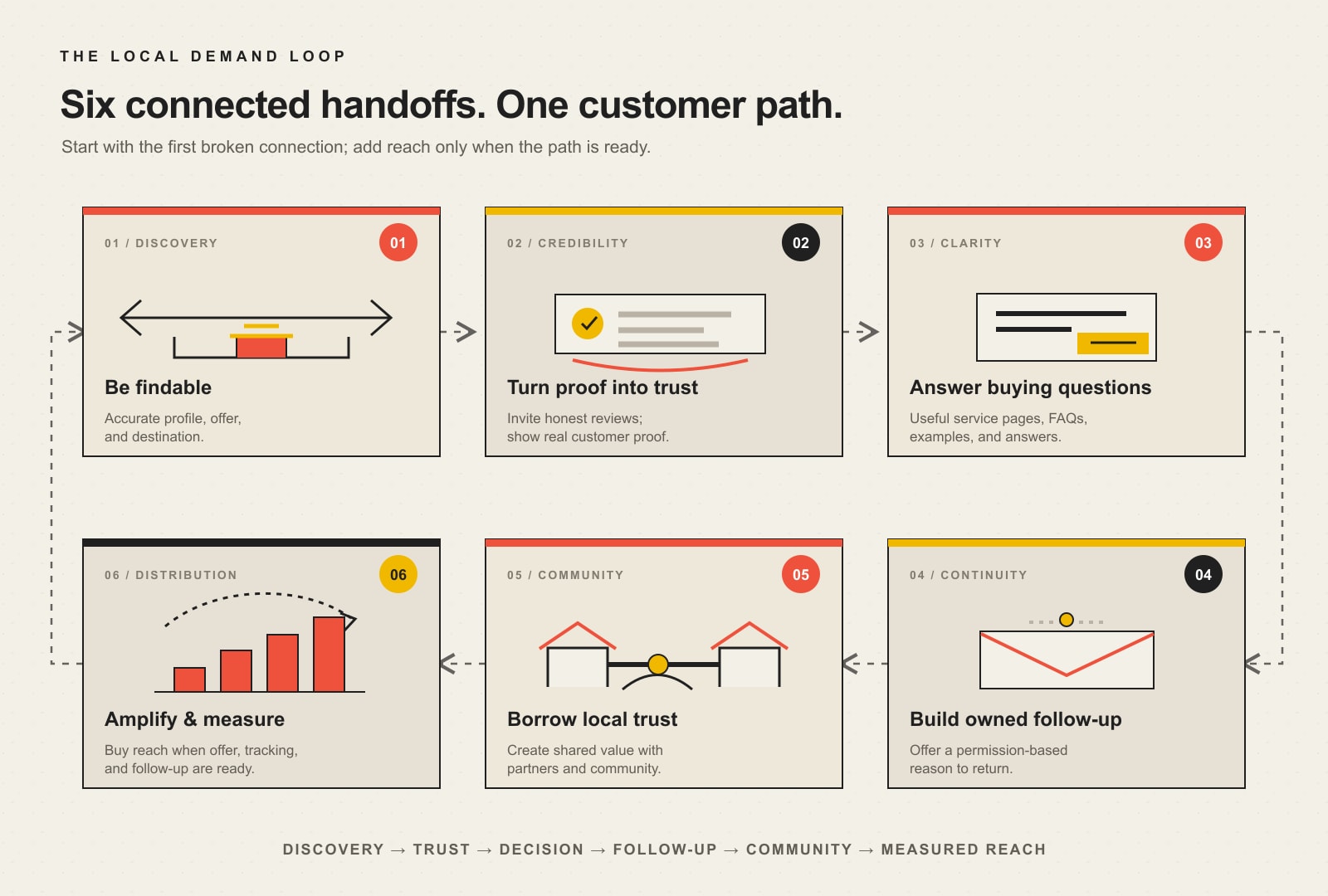
    The six local marketing strategies that matter most are the ones that move a nearby prospect through a complete buying path: get found, build trust, answer the questions that delay a decision, create a permission-based follow-up path, borrow credibility from local relationships, and add paid reach only when the rest of the system is ready. The mistake is treating those as six unrelated channels. They work better as connected handoffs.

    For a small local business, that distinction matters. More posts, more ads, or more listings do not automatically create more sales. A useful local marketing system helps the right people discover you, understand why you fit, take a next step, and stay connected long enough to buy or refer someone else. If you need the broader framework for choosing channels by buying moment, start with Scope Design’s small business marketing strategy guide. This article focuses on the local handoffs.

    The Local Demand Loop: 6 strategies that work together

    1. Be findable where local intent starts. Keep your Google Business Profile and core business information accurate, complete, and aligned with what your website actually offers.
    2. Turn real customer proof into trust. Build a repeatable, honest review and proof system instead of waiting for testimonials to appear by chance.
    3. Answer local buying questions. Create useful service, location, FAQ, case-study, photo, and video content around real decisions—not a content treadmill.
    4. Build an owned follow-up path. Give prospects and customers a reason to opt into email or another permission-based relationship you control.
    5. Borrow local trust. Create partnerships, referrals, community participation, and cross-promotions with organizations that already have the audience’s attention.
    6. Amplify and measure. Use paid search, paid social, and other local promotion only when the offer, destination, tracking, and follow-up are strong enough to learn from the spend.

    If you want a bigger catalog of tactics, Scope Design also maintains a broader guide to 15 local marketing strategies. The job here is different: decide which part of your local demand path is broken first.

    What should you fix first?

    What you are seeingLikely broken handoffStart here
    People nearby need what you sell, but few find or contact youFindabilityBusiness Profile, service area, core facts, website alignment
    You appear in searches, but prospects still choose competitorsProof and trustReview workflow, customer evidence, photos, clear credibility signals
    Prospects keep asking the same fit, price, timing, or process questionsDecision supportService pages, FAQs, case studies, useful local content
    Traffic and inquiries disappear after one visit or conversationOwned follow-upPermission-based email, CRM, useful follow-up sequence
    You have a credible offer but weak local awarenessBorrowed trustPartnerships, referrals, local groups, events, cross-promotion
    Your offer converts, but qualified volume is too lowDistributionMeasured paid search, paid social, sponsorships, or local promotion
    Six connected local marketing steps: be findable, turn customer proof into trust, answer buying questions, build owned follow-up, borrow community trust, and amplify and measure after the customer path is ready.
    The Local Demand Loop works best when you fix the first broken handoff instead of adding another channel by default.

    1. Be findable where local intent starts

    For many local businesses, the first buying moment is simple: someone searches for a service, product, or place near them. Your job is not to “hack” that moment. It is to make the basic facts about your business easy for customers and platforms to understand.

    Google’s current Business Profile guidance says local results are mainly based on relevance, distance, and prominence. Google also says businesses with complete and accurate information are more likely to appear for relevant local searches. That makes a clean foundation more useful than chasing speculative ranking tricks. Review your address or service area, hours, primary category, services, contact information, photos, and the pages you send people to. Make sure the website describes the same business the profile describes. Google’s local ranking guidance is the right source for current platform-specific details.

    Do this first: search for your own business the way a new customer would, then compare the profile, website, phone number, hours, service area, and core offer. Fix contradictions before adding more content or promotion.

    Measure: calls, website visits, direction requests, bookings, quote requests, and qualified form submissions. Google now documents Business Profile interactions such as calls, website clicks, directions, messages, and bookings as performance data that can be shared with Google Analytics. Those customer actions are more useful than a promise to “rank #1.”

    2. Turn real customer proof into trust

    Findability earns attention. Proof helps a prospect feel safe choosing you. For a local business, proof can include reviews, before-and-after photos, project examples, recognizable locations, team photos, case studies, and specific answers from people who have actually used the service.

    The operational mistake is waiting until you “need more reviews” and then asking everyone at once. Build the request into a real customer moment: after a successful delivery, completed appointment, solved problem, or positive follow-up. Make the request easy, respond to feedback, and reuse genuine customer evidence where you have permission.

    Keep the system honest. The Federal Trade Commission’s Consumer Reviews and Testimonials Rule, effective October 21, 2024, addresses fake and deceptive review practices. Among other provisions, it prohibits fake or false reviews and incentives conditioned on a particular positive or negative sentiment. In practical terms: ask for honest feedback, not “five-star reviews,” and do not buy manufactured credibility.

    Do this first: choose one legitimate moment in your customer process when a review request makes sense, write a short neutral request, and assign responsibility for sending it.

    Measure: review-request completion, new legitimate reviews, response rate, and—more importantly—whether qualified prospects are moving from profile or proof pages into calls, quotes, bookings, or purchases.

    3. Answer the local buying questions that slow decisions

    Content works best when it removes uncertainty. That is especially true locally, where customers often need answers that generic national content cannot give them: Do you serve my town? Is this right for an older home? What happens after I request a quote? Can I see examples nearby? How long does this usually take? What should I prepare before the appointment?

    Turn repeated sales and service questions into durable decision-support assets. A strong service page can explain the offer and next step. A useful location section can clarify a real service area. A case study can show the problem, approach, and result without inventing performance claims. A short video can demonstrate a process. A photo set can make the experience tangible. An FAQ can answer objections before someone calls.

    This is also where many businesses waste effort by confusing a format with a strategy. Short-form video, social posts, blogs, and email are containers. Use the container that fits the question and the customer. If you publish on Facebook because your local community is genuinely active there, Scope Design’s Facebook marketing guide for local businesses goes deeper on building community without turning the platform into a content treadmill.

    Do this first: write down the five questions customers ask most often before they buy. Turn the highest-friction question into one useful page, section, video, checklist, or case study. Then reuse that answer across the places where customers already encounter you.

    Measure: qualified entrances to the content, assisted calls or forms, sales conversations that start with better-informed prospects, and fewer repeated clarification steps when that is meaningful to your process.

    4. Build an owned follow-up path

    Local marketing gets expensive when every future sale requires rediscovering the same person from scratch. An owned follow-up path gives a prospect or customer a reason to stay connected after the first visit, quote, appointment, or purchase.

    Email is usually the most practical example because it is a direct, permission-based relationship that does not depend on a social feed deciding whether to show your next post. But the value is not “having a newsletter.” The value is having a useful reason to follow up: appointment preparation, maintenance reminders, seasonal availability, relevant education, replenishment, event invitations, project planning, or a thoughtful post-purchase sequence.

    Scope Design’s email marketing for small business guide treats email as a relationship system rather than a blast calendar. That is the right mental model here: capture permission, segment when it changes relevance, make the next step obvious, and connect the email back to a real business action.

    Do this first: identify one moment where a customer would reasonably want future information from you, state what they will receive, collect permission, and create the first useful follow-up message.

    Measure: opt-ins, replies, booked appointments, quote restarts, repeat purchases, and other downstream actions you can credibly connect to follow-up. Open rates alone are not the business outcome.

    5. Borrow trust through local partnerships and community

    Some local audiences are easier to reach through relationships than through algorithms. A complementary business, neighborhood organization, trade group, school, nonprofit, venue, employer, realtor, property manager, or event organizer may already have the trust and attention you are trying to build.

    The strongest partnerships are not “please promote me” arrangements. Start with a useful overlap. A landscaper and a nursery can teach a seasonal workshop. A photographer and a wedding venue can build a planning resource. A contractor and a realtor can create a pre-sale home checklist. A restaurant can support an event its customers already care about. A professional service firm can contribute expertise to a local organization without turning every interaction into a pitch.

    Community participation also creates better raw material for your digital marketing. Real collaborations produce photos, stories, customer questions, referral paths, and context that generic “local content” cannot manufacture.

    Do this first: list five organizations that serve the same people before, after, or adjacent to your purchase. Pick one where you can create value for the shared audience without requiring an immediate sale.

    Measure: referral conversations, qualified introductions, event sign-ups, partner-sourced leads, repeat collaborations, and customers—not just logo placements or social impressions.

    6. Buy local distribution only after the path can convert

    Paid promotion can be the fastest way to increase reach, but it is also the fastest way to pay for a broken handoff. Before increasing a local ad budget, confirm that the offer is clear, the landing destination matches the ad, tracking is working, someone can follow up with leads, and the customer economics leave room for acquisition cost.

    That readiness check matters more than declaring one platform universally “best.” Paid search may fit a high-intent service people actively look for. Paid social may fit an offer that needs visual demonstration or audience targeting. Sponsorships may fit a geographic or community trust objective. Retargeting may fit a longer decision cycle. The channel follows the buying moment and the economics.

    For the deeper channel-and-math decision, use Scope Design’s online advertising strategy for small businesses. Its core rule applies locally too: choose the channel after you understand intent, signal, follow-up, creative capacity, and customer value.

    Do this first: define one offer, one audience, one destination, one conversion action, one follow-up owner, and one budget you can treat as a learning test. If you cannot define those six things yet, fix the earlier handoff before buying more reach.

    Measure: use a simple ladder. Start with visibility and interactions, then track the customer action, then qualified leads, then customers, then revenue or customer value where attribution is trustworthy. Google’s Business Profile documentation, for example, recognizes actions such as website clicks, calls, directions, messages, and bookings. Those are better intermediate signals than impressions alone.

    A practical 30-day way to use these local marketing strategies

    You do not need to launch all six at once. In fact, that usually makes learning harder. Use the system as a sequence.

    1. Week 1: baseline the handoffs. Check local profile accuracy, top customer proof, key decision pages, follow-up, referral sources, and current paid promotion. Write down the qualified actions you care about.
    2. Week 2: fix the first obvious constraint. Correct incomplete business information, create a review request, answer the highest-friction buying question, or repair the conversion path—whichever appears first in the loop.
    3. Week 3: ship one small useful improvement. Do not wait for a “complete marketing campaign.” Publish the page, send the follow-up, activate the partnership, or run the bounded test.
    4. Week 4: review business signals. Did the change create more useful calls, quotes, bookings, conversations, or customers? Did lead quality improve? What did prospects still need? Keep, revise, or stop the change based on what you learned.

    This is the same constraint-first logic we use across marketing work: fix the first broken handoff, observe what changes, then decide whether the next layer deserves time or budget. It is more disciplined than adding a channel because a platform is currently fashionable.

    Frequently asked questions about local marketing

    How do I advertise my small business locally?

    Start by making sure people nearby can find accurate information about the business, see trustworthy proof, and reach a clear next step. Then choose promotion based on the buying moment. That might be Google Search, local social media, community sponsorships, referral partnerships, events, direct outreach, or paid ads. Advertising works better when it amplifies a path that already makes sense rather than compensating for an unclear offer or weak landing page.

    Which local marketing strategy should I fix first?

    Fix the earliest broken handoff. If qualified prospects cannot find you, start with findability. If they find you but do not trust you, improve proof. If they trust you but remain confused, answer the buying questions. If they disappear after first contact, improve follow-up. If the system converts but not enough people enter it, then add partnerships or paid distribution.

    When should a local business start paid advertising?

    Start when you can define the audience, offer, landing destination, conversion action, follow-up owner, and customer economics well enough to learn from the test. Paid traffic can create volume; it cannot repair a weak offer, confusing destination, or nonexistent follow-up process.

    What should a local business measure besides clicks and impressions?

    Measure the handoff into business outcomes: calls, direction requests when relevant, quote requests, appointments, bookings, qualified leads, customers, repeat purchases, and revenue or customer value where attribution is credible. Platform metrics are useful diagnostic signals, but they are not the finish line.

    What is a safe way to ask customers for reviews?

    Ask real customers for honest feedback at a natural point in the relationship, make the process easy, and do not condition a reward on a positive or negative sentiment. Avoid fake reviews, purchased reputation, or internal reviews that hide material connections. For U.S. businesses, review the current FTC rule and platform-specific policies before using incentives or automated review programs.

    Build the local system before adding another tactic

    The strongest local marketing strategies are not isolated tricks. They connect discovery, credibility, decision support, follow-up, community trust, and measured distribution. When those handoffs reinforce one another, every channel has a clearer job—and it becomes easier to see what is actually producing qualified business.

    If you are not sure which handoff is limiting growth, talk with Scope Design. We can help map the local customer path, identify the constraint, and connect search visibility, website conversion, content, follow-up, and promotion into one measurable system.

  • Paid Advertising Strategy: Test, Measure, and Scale Without Burning Budget

    Paid Advertising Strategy: Test, Measure, and Scale Without Burning Budget

    The best paid advertising strategy is not “pick a platform, turn on automation, and hope the dashboard turns green.” Build a measurable conversion chain, run one bounded experiment, and increase spend only when qualified outcomes—not cheap clicks—justify it. Paid ads can buy attention and evidence quickly. They cannot manufacture a good offer, repair a broken landing page, or make bad measurement tell the truth.

    If you still need to decide whether paid media belongs in the mix at all, start with our broader online advertising strategy guide. This article owns the next decision: how to operate a paid campaign so the first dollars buy useful learning and later dollars scale something worth scaling. For the larger system around it, see our small-business marketing strategy.

    TL;DR: Paid Advertising Should Buy Evidence Before It Buys Scale

    • Prepare the conversion chain before buying traffic: buyer, promise, destination, response owner, and operating capacity.
    • Attach trustworthy outcomes so the platform learns from actions the business actually values, not just whatever event is easiest to count.
    • Isolate a bounded test with one useful hypothesis, a spend boundary, and enough stability to learn.
    • Decide from qualified economics: scale, revise the first weak link, or stop.
    • Use automation to optimize a trustworthy signal. Do not ask an algorithm to infer your definition of a good customer from a pile of unqualified form fills.

    Where Part IV Fits in the Marketing Strategy Series

    Paid advertising belongs downstream of basic market and customer understanding. Part III of this series focuses on evidence about the market and the buyer. Once you have a plausible audience, offer, and channel hypothesis, paid media can become a controlled way to test that thinking.

    This Part IV is deliberately not another tour of Google, Meta, Microsoft, LinkedIn, TikTok, and YouTube. Scope already has dedicated owners for channel selection and platform mechanics. Here, the question is operational: what has to be true before a campaign deserves money, what should the campaign learn, and what evidence earns the next dollar?

    The final part of this series covers organic traffic generation and the longer-term assets that can reduce dependence on rented attention.

    Why Paid Ads Often Fail Before the First Click

    A campaign can be technically competent and still be a business failure because the weak link lives somewhere else. The real chain is longer than ad → click:

    • Buyer: Are you reaching a plausible customer in a relevant moment?
    • Promise: Does the ad make a clear, honest claim that matters to that buyer?
    • Destination: Does the landing page continue the promise instead of making the visitor start over?
    • Action: Is the next step appropriate for the buying stage?
    • Response: Does a person or system actually handle the lead, purchase, call, or booking well?
    • Economics: Is the qualified result valuable enough to justify acquisition cost and operating effort?

    If the ad gets the click but the destination loses the promise, that is a conversion-rate optimization problem before it is a bidding problem. If the campaign generates inquiries but nobody follows up quickly or captures source and qualification data, the failure is in the handoff. Our direct response marketing guide goes deeper on building the measurable action path.

    More traffic magnifies both good systems and bad ones with impressive fairness.

    Build a Paid Advertising Strategy With the PAID Learning Loop

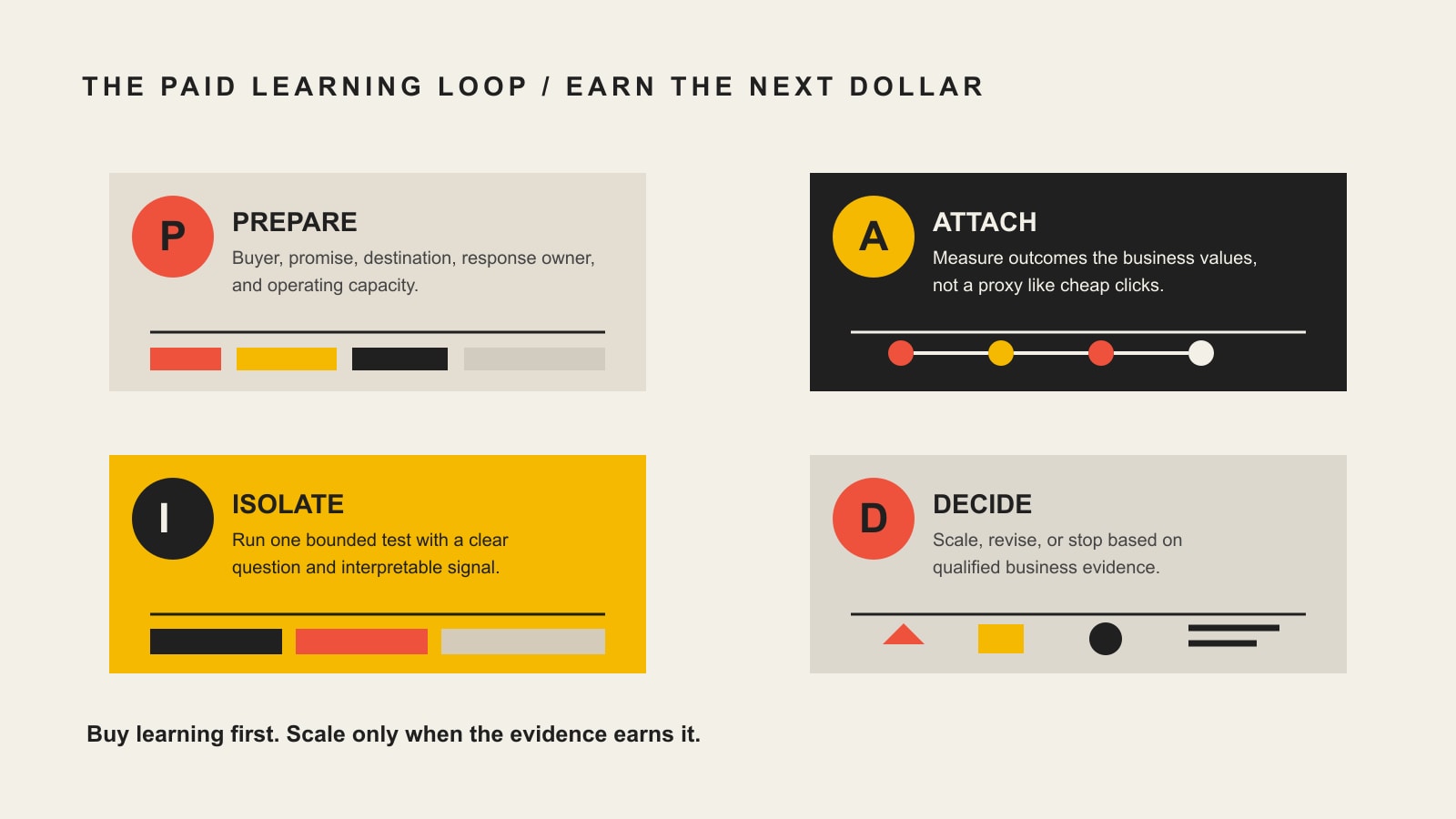
    Scope Design uses the PAID Learning Loop to keep paid media from turning into a subscription to expensive confusion. PAID stands for Prepare, Attach, Isolate, Decide. It is a loop because every meaningful result changes what you know and what should be tested next.

    The PAID Learning Loop: Prepare the conversion chain, Attach trustworthy outcomes, Isolate a bounded test, and Decide to scale, revise, or stop.
    The PAID Learning Loop turns ad spend into a controlled cycle of readiness, measurement, testing, and decision-making.

    P — Prepare the Conversion Chain

    Before launch, write down what the campaign is supposed to connect. Name the buyer, the problem or desire, the offer, the promise, the destination, the desired action, the response owner, and the capacity constraint. If one of those fields is “we’ll figure it out after traffic arrives,” you have found a pre-launch risk.

    The landing page does not need to be a twelve-section conversion cathedral. It needs to continue the ad’s promise, provide enough proof for the decision, make the next step obvious, and work on the devices people actually use. If the destination is weak, fix that before increasing reach.

    Claims also need to survive contact with reality. The Federal Trade Commission’s advertising guidance for small businesses says advertising must be truthful and non-deceptive, objective claims need evidence, and ads cannot be unfair. Fake scarcity, invented savings, and claims you cannot substantiate are not “conversion psychology.” They are liabilities wearing marketing pants.

    Finally, separate the campaign budget from the business’s total marketing budget. If you need to decide how much the company can responsibly devote to acquisition across channels, use our small-business marketing budget guide. The campaign budget is a smaller decision inside that constraint.

    A — Attach Trustworthy Outcomes

    Platforms can optimize only toward the signals they receive. That makes measurement part of campaign design, not cleanup work for Friday afternoon.

    Google Ads describes conversion measurement around actions a business considers valuable, including purchases, sign-ups, calls, and other configured actions. Its conversion tracking guidance is a useful reminder to define the valuable action first and then implement the appropriate measurement. A click is evidence that somebody clicked. It is not automatically evidence of a qualified opportunity, profitable order, or good customer.

    Measurement layerUseful questionExamplesWhat it cannot prove alone
    DeliveryDid the platform serve and attract attention?Impressions, reach, clicks, video viewsThat the traffic was qualified or profitable
    ConversionDid the visitor complete the defined action?Form submit, call, booking, purchase, sign-upThat the action had business value
    QualificationWas the action from a plausible customer?Qualified lead, valid order, sales-accepted opportunityThat the customer will close, retain, or be profitable
    EconomicsDid the outcome justify the spend and operating cost?Gross contribution, qualified acquisition cost, tracked revenue, close ratePerfect attribution across every touchpoint

    For lead generation, connect ad-source data to whatever qualifies the lead downstream when practical. For ecommerce, include cancellations, refunds, margins, and repeat behavior where they materially change the answer. If all conversions are reported to the platform as equally valuable, automation has no magical side channel where it learns which customers your sales team quietly hates.

    I — Isolate a Bounded Test

    A good paid test answers a decision. “Let’s run some ads and see what happens” is not a hypothesis; it is a receipt generator.

    Choose one meaningful uncertainty at a time when possible: buyer segment, offer, message, destination, objective, or another major variable. Define the spend or time boundary you are willing to use for learning, the evidence you need, and the conditions that would make you continue, revise, or stop. Then give the campaign enough stability to produce interpretable evidence instead of changing five settings every morning.

    There is no universal learning budget. A $20-per-day search test can be plenty in one low-cost local auction and nearly useless in a category where a single relevant click is expensive. The correct budget is the smallest amount the business can responsibly risk that still gives the test a realistic chance to produce decision-worthy evidence. If the likely spend required to learn is more than the business can afford to lose, that is a valid reason not to run the test.

    The popular “70-20-10” split can be a planning heuristic in some contexts, but it is not a law of paid advertising and it does not override campaign economics. Do not force 70% of the budget into something merely because a tidy ratio looks strategic in a slide deck.

    When the test gets platform-specific, use the specialist owner rather than treating one article as an encyclopedia. For Google Search, our Google Ads Quality Score guide explains relevance diagnostics without worshipping the score. For Meta, our Meta campaign objectives guide explains how objective and performance-goal choices tell the delivery system what behavior to seek.

    D — Decide to Scale, Revise, or Stop

    A paid campaign is not successful because cost per click fell. It is successful when the campaign’s job is being done at economics the business can support. That may mean profitable purchases, qualified appointments, sales opportunities, calls that turn into booked work, or another clearly defined outcome.

    Evidence patternLikely first diagnosisBetter next move
    Relevant clicks, weak landing-page actionPromise/destination frictionFix the destination before buying more traffic
    Many form fills, poor lead qualityTargeting, message, offer, or qualification mismatchTighten who the campaign invites and what the form qualifies
    Qualified leads, weak close rateSales handoff, response, offer, or downstream fitRepair the sales path before blaming the ad platform
    Good qualified outcomes at workable economicsPromising campaign-system fitScale cautiously and keep watching marginal quality and cost
    Tiny sample with no stable patternInsufficient evidenceKeep the test stable if the learning boundary still makes sense
    Boundary reached with no useful signalBad hypothesis or weak systemStop or redesign the test instead of funding sunk-cost theater

    Scaling is not a victory lap. It is another test. More budget can change auction dynamics, audience quality, creative fatigue, response capacity, and the mix of customers you attract. The economics that worked at one spend level are evidence, not a lifetime guarantee.

    Automation Is Powerful After the Signal Is Worth Optimizing

    Google says Smart Bidding uses Google AI at auction time to optimize toward conversions or conversion value, and Google requires conversion tracking to use Smart Bidding. That is exactly why measurement quality matters. Google’s Smart Bidding guidance describes the machinery; your business still has to decide which result deserves to be fed into it.

    Automation can process more auction signals than a human can and can make bidding adjustments continuously. What it cannot do reliably is invent your business definition of a qualified lead, decide whether an unprofitable customer is strategically valuable, repair a slow sales team, or know that a conversion event fires on the wrong page unless the data exposes the problem.

    Platform language also changes. Google documented a June 2026 transition in how some Target CPA and Target ROAS options are labeled while saying the underlying bidding behavior remains the same. That is a useful operational lesson: learn the business logic behind the setting, not just the screenshot from last year’s tutorial.

    Use the Right Paid Advertising Metrics for the Business Model

    There is no universal “good ROAS” or “good conversion rate.” A 4:1 return on ad spend can be excellent for one business and terrible for another depending on gross margin, fulfillment, refunds, sales labor, repeat purchase, and what the revenue number actually includes.

    Use platform metrics for diagnosis and business metrics for decisions:

    • Search and social delivery: impression share, click-through rate, cost per click, reach, frequency, and engagement can help explain what the system is doing.
    • Lead generation: cost per conversion should be paired with qualified-lead rate, sales acceptance, booked appointments, opportunity value, close rate, and response time where available.
    • Ecommerce: tracked revenue and ROAS should be read alongside margin, average order value, refunds, repeat purchase, and acquisition cost.
    • Long sales cycles: use staged outcomes such as qualified opportunity or pipeline movement rather than pretending every click can be assigned a final sale immediately.
    • Capacity-constrained services: include whether the team can actually respond well to the volume being created.

    The point is not to build a spreadsheet with seventy-seven columns. It is to create a short chain from spend to a business result that somebody owns.

    Common Paid Advertising Mistakes That Waste the Learning Budget

    • Optimizing for the friendliest metric. Cheap clicks are not a consolation prize if the business needs qualified leads or sales.
    • Sending every ad to the homepage. The destination should continue the specific promise that earned the click.
    • Changing too many variables at once. Constant tinkering makes it hard to know what actually improved or damaged the result.
    • Turning on automation before validating the event. Fast optimization toward a bad signal is still bad optimization.
    • Calling every form fill a lead. Qualification belongs in the measurement chain.
    • Using platform-reported revenue as the whole business case. Margin, refunds, sales labor, fulfillment, and repeat behavior can change the economics.
    • Scaling past response capacity. More demand can create a worse customer experience if nobody can answer, quote, fulfill, or follow up.
    • Refusing to stop. A sunk cost is not evidence that the next dollar deserves to join it.

    A Practical 30-Day Paid Advertising Operating Sequence

    Thirty days is not a universal verdict window. Use it as an operating cadence for building the system and making the first disciplined review.

    1. Week 1 — Prepare. Confirm the buyer, offer, promise, destination, action, response owner, capacity, and the maximum learning loss the business is willing to accept.
    2. Week 2 — Attach. Implement and test conversion tracking, source capture, phone/form/booking paths, qualification, and downstream ownership. Confirm the event fires where it should.
    3. Week 3 — Isolate. Launch the bounded test, keep major variables stable long enough to learn, review obvious errors, and avoid panic-editing every morning.
    4. Week 4 — Decide. Compare delivery, conversion, qualification, economics, and capacity. Scale only the part that has earned more exposure; otherwise repair the first weak link or stop the test.

    If the campaign is still too small or the buying cycle too long for a confident economics decision after that period, say so. “Not enough evidence yet” is a legitimate conclusion. Invented certainty is not.

    Frequently Asked Questions About Paid Advertising Strategy

    What is a paid advertising strategy?

    A paid advertising strategy is the system for deciding what outcome paid media should produce, which audience and promise to test, where the attention should go, how results will be measured, what budget can be risked for learning, and what evidence will trigger a scale, revise, or stop decision. The platform setup is part of the strategy, not the whole thing.

    How much should a small business spend testing paid ads?

    There is no universal dollar amount. Set a loss boundary the business can responsibly absorb, then ask whether that amount can realistically generate enough relevant traffic or conversions to test the hypothesis in the chosen auction. If the minimum useful learning budget would strain cash flow, do not pretend the campaign is affordable just because the platform accepts a smaller daily budget.

    Is $20 a day good for Google Ads?

    It can be, but the number by itself says almost nothing. In a low-cost local niche, $20 a day might produce enough relevant activity to learn. In a competitive market with expensive clicks, it may produce too little data to judge the offer or campaign. Work backward from auction cost, realistic conversion volume, business economics, and the decision you need the test to answer.

    What does the 70-20-10 rule mean in advertising?

    Several marketing frameworks use a 70-20-10 split for different purposes, usually to separate proven activity, adjacent experimentation, and more speculative tests. It can be a discussion starter, not a law. A paid-advertising budget should follow the business’s risk tolerance, campaign economics, evidence quality, and opportunity set rather than a fixed ratio copied from somebody else’s deck.

    When should a small business scale a paid advertising campaign?

    Scale after the campaign produces enough qualified outcomes to show that the current economics are workable and the business has capacity to handle more. Increase gradually enough to notice whether lead quality, costs, conversion rate, or fulfillment changes. A campaign that works at one spend level has earned a larger test, not infinite budget.

    What should you track before using automated bidding?

    Track the conversion action the business genuinely wants the system to optimize, validate that it fires correctly, and connect that action to qualification or value when possible. For lead generation, that may mean distinguishing a qualified inquiry from any form submission. For ecommerce, it may mean using purchase value accurately and accounting for outcomes that materially change profitability.

    What is a good ROAS for paid advertising?

    A good ROAS is one that works with your actual gross margin, fulfillment cost, refunds, sales cost, repeat behavior, and growth goals. There is no responsible universal target. Treat ROAS as one ratio inside the economics, not as a magic score that makes an unprofitable customer profitable.

    Should a small business use Google Ads or Meta Ads first?

    Start with buyer behavior and the campaign job. Google Search can be strong when people already express high-intent demand. Meta can be strong when creative, audience signals, and demand creation or discovery matter. Neither platform is universally first. Use the broader channel-fit decision in our online advertising guide, then use the platform-specific objective and measurement guidance once the channel has a reason to exist.

    Buy Learning First. Buy More Attention Only When It Earns It.

    Paid advertising is valuable because it gives a business unusual control over audience, message, destination, timing, and spend. That control makes it a powerful testing system. It also makes it painfully easy to spend faster than you learn.

    Use the PAID Learning Loop: prepare the chain, attach trustworthy outcomes, isolate a bounded test, and decide from qualified economics. If the campaign works, scale carefully. If the first weak link is the landing page, sales handoff, offer, tracking, or qualification, fix that. If the evidence says stop, stop.

    If your paid campaigns are producing activity but nobody can clearly explain what deserves more budget, Scope Design can help audit the offer, destination, tracking, campaign structure, and measurement chain. The goal is not to make the ad account busier. It is to make the next dollar easier to justify.