
Tag: Online Marketing Strategy

  • How to Build A Winning Business Marketing Strategy Online: Part II

    How to Build A Winning Business Marketing Strategy Online: Part II

    A winning business marketing strategy online is not a list of channels. Before you spend money or staff time on campaigns, one real buyer should be able to move from a real problem to a credible promise, a useful next step, a response owner, and a measurable business outcome. If that path is broken, more traffic usually makes the leak more expensive.

    That is the job of Part II. Part I covers the strategy foundation. This article turns those inputs into a buyer path the business is actually ready to operate. Part III then turns that ready path into a bounded campaign you can learn from.

    TL;DR: Build the path before you build the campaign

    • Problem + proof: Know the buyer situation, alternatives, promise, and evidence well enough to say something specific.
    • Action path: Give the buyer one useful destination and a clear next step.
    • Traffic roles: Give each selected channel a job instead of collecting platforms like refrigerator magnets.
    • Handoff + measurement: Decide who responds, how leads are qualified, and which outcome tells you the path is working.

    Scope Design calls this the PATH Readiness Test. PATH is not a replacement for a complete marketing strategy or marketing plan. It is the readiness check between strategy and campaign execution.

    Where Part II fits in your online marketing strategy

    Marketing language gets blended into beige paste, so the boundary matters. Strategy decides where you will focus and what you will deliberately not do. A plan translates those decisions into assets, channels, owners, resources, and measures. A campaign is a bounded execution package inside that plan.

    If you need the complete digital system, use our digital marketing strategy framework. If you need the full planning architecture, our MAPS internet marketing plan owns that job. Part II stays narrower on purpose: it asks whether the specific buyer path you want to promote is ready for traffic.

    That narrowness is useful. A small business can have a sensible strategy and still launch a lousy campaign because the landing page says one thing, the ad promises another, the form asks for too much, the sales team does not know what the lead saw, and the dashboard celebrates clicks. None of those problems are solved by “doing more marketing.”

    Why more traffic cannot fix a broken buyer path

    Traffic is an amplifier. It can amplify a clear offer and a functioning response process. It can also amplify confusion, weak proof, slow follow-up, poor qualification, and a page nobody trusts.

    This is why channel-first planning is dangerous. “We need LinkedIn,” “we should run Google Ads,” or “we need more social content” are not diagnoses. They are proposed delivery mechanisms. Before choosing one, you need to know what it is supposed to deliver people into.

    The U.S. Small Business Administration’s current market-research and competitive-analysis guidance treats direct and indirect competitors, barriers, strengths and weaknesses, and target-market relevance as evidence for finding an advantage. That is a better starting point than copying a competitor’s homepage, posting frequency, or ad format.

    The PATH Test for a business marketing strategy online

    Before a campaign earns budget, run the path through four questions: Problem + proof, Action path, Traffic roles, and Handoff + measurement. A “no” at any stage is not failure. It is a cheaper place to fix the system than after you buy attention.
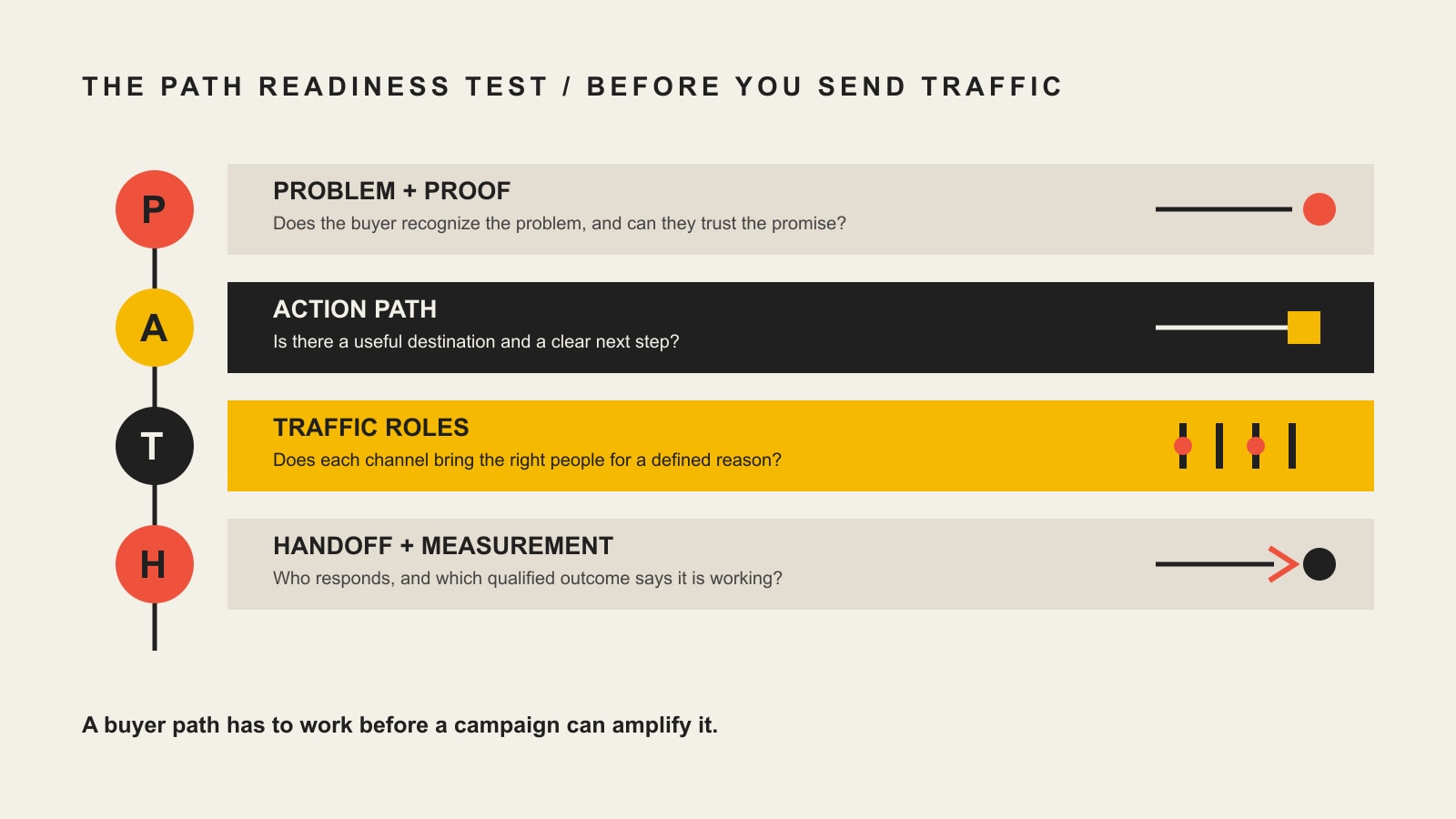
    The PATH readiness test checks Problem plus proof, Action path, Traffic roles, and Handoff plus measurement before a campaign sends traffic.
    The Scope Design PATH Readiness Test checks whether the buyer path is ready before a campaign sends traffic into it.

    P — Problem + proof: are you solving a situation buyers actually recognize?

    Start with the situation that causes someone to look for help. Not an invented demographic. Not “small-business owners who value quality.” What happened? What changed? What are they trying to avoid, compare, fix, or achieve?

    Use actual evidence: sales calls, support questions, search queries, customer interviews, reviews, lost-deal reasons, CRM notes, and market research. Our small-business market research guide goes deeper on collecting that evidence, while the target-audience guide focuses on reconstructing behavior and buying situations rather than decorating a fictional persona.

    Then define the proof you can honestly bring to the situation. Proof may be a relevant case study, a demonstration, process evidence, credentials, a comparison, a clear guarantee boundary, customer testimony, or simply an unusually specific explanation of how the work gets done. The point is not to look impressive. The point is to reduce a real reason for doubt.

    PATH failure signal: your message works only after three paragraphs of explanation, your team cannot agree on the buyer’s problem, or the offer depends on adjectives such as “innovative,” “premium,” and “results-driven” instead of evidence.

    A — Action path: where does the buyer go, and what should happen there?

    A campaign needs somewhere useful to send people. That does not automatically mean a new landing page. It means the destination must match the promise, answer the next decision, show enough proof, and make the next action obvious.

    For one path, define one primary action. Request a quote. Book a consultation. Start a trial. Call the office. Buy the product. Download the specification. The business may have several actions across the whole website, but a single campaign path should not make the visitor solve an escape room to figure out what you want them to do.

    Check the handoff from message to page before you buy traffic:

    • Does the page repeat the promise in the language the visitor just saw?
    • Can the visitor tell who the offer is for and who it is not for?
    • Is the proof relevant to this decision rather than generic company praise?
    • Does the form or next step ask only for information the business can use?
    • Does the experience work on the device and context where the channel will reach people?
    • Can a staff member explain what happens immediately after the action?

    PATH failure signal: the team can describe the ad or post in detail but cannot describe the page, action, confirmation, and follow-up with the same confidence.

    T — Traffic roles: give every channel a specific job

    Channels are not interchangeable pipes. Search can capture existing demand. Email can re-engage people who gave you permission to follow up. Social can distribute proof, build familiarity, or start conversations. Paid media can accelerate a path that already has a plausible economic and operational case. The right mix depends on intent, evidence, capacity, and economics.

    Our online marketing channels guide goes deeper on channel jobs and sequencing. The rule here is simpler: if you cannot finish the sentence “this channel’s job is to ___ for this buyer at this stage,” it does not belong in the path yet.

    You do not need to be everywhere. You need enough coverage to solve the current acquisition problem without creating more work than the team can operate. Add a channel when it closes a real gap, not because a platform rep, competitor, or marketing thread made you nervous.

    PATH failure signal: success is defined as “post more,” “get traffic,” or “grow followers,” with no explanation of what those people should do next.

    H — Handoff + measurement: who owns the lead after the click?

    A conversion is not the finish line if the business still has to qualify, respond, sell, schedule, onboard, or deliver. The handoff is part of the marketing path because marketing can create demand the business then quietly wastes.

    Write down the owner and the rule. Who receives the inquiry? What information do they need? What makes it qualified? What happens if the first response fails? Where is the outcome recorded? Which signal will cause you to keep, repair, or stop the path?

    Google Analytics supports recommended lead-generation events such as generate_lead, qualify_lead, working_lead, and close_convert_lead, and its recommended-events guidance can support measurement deeper than a form submission when your implementation and sales process can provide the data. Google also defines a key event as an action especially important to the success of the business.

    That does not mean every small business needs an elaborate analytics architecture tomorrow. It means the deepest reliable outcome should win over vanity metrics. If you can reliably track qualified inquiries, use them. If you can connect customers or revenue, better. If you only have form fills today, record that limitation instead of pretending the form is the sale.

    PATH failure signal: the marketing dashboard is green while sales says the leads are wrong, slow, unqualified, or never followed up.

    Use this PATH readiness table before you launch

    PATH layerReadiness questionEvidence to haveDo not launch yet if…
    Problem + proofDo we know the buyer situation and why our promise is credible?Customer language, alternatives, proof, objectionsThe message is generic or based on assumptions
    Action pathCan the buyer take one useful next step without guessing?Destination, matching offer, CTA, confirmation, friction checkThe destination contradicts the promise or has no clear next step
    Traffic rolesDoes each channel have a job tied to buyer intent?Channel role, audience context, capacity, economicsThe goal is simply more reach, posts, clicks, or followers
    Handoff + measurementWho responds, qualifies, records, and reviews the outcome?Owner, response rule, qualification definition, meaningful eventNobody owns the lead or the scorecard stops at the click

    A “no” is useful. It tells you where the expensive uncertainty is hiding.

    What our audit of this exact article taught us

    We used the same rule on this revision: inspect the path before adding tactics. The old article had a healthy public URL and a valid self-canonical, but it had become a trend-heavy list with unsupported percentages, a bloated keyword set, almost no internal linking, and no distinctive ownership inside a much stronger marketing cluster.

    The performance evidence was tiny. In the 12 complete months we reviewed, GA4 recorded seven landing sessions, all Direct, with no engaged sessions and no key events. Search Console returned no exact-page query rows and currently reports the URL as “Crawled – currently not indexed.” Bing knows the URL but currently reports no clicks or impressions. Ubersuggest returned no exact-page ranking keywords or backlink rows.

    That does not prove the topic has no value, and Scope Design’s current GA4 attribution and key-event setup has known limitations. It does mean the old copy had no demonstrated search or conversion footprint strong enough to justify keeping claims we could not support. The better move was to preserve the established URL, give the page a defensible job, remove the bullshit numbers, and connect it to the articles that already own the broader topics.

    Common ways a business marketing strategy breaks before the campaign

    Starting with the channel

    “We need TikTok” and “we should run paid search” are proposed tactics. Diagnose the buyer problem and the path first. Sometimes the correct next move is a boring service-page repair, a better proof set, or a follow-up process. Boring is allowed to make money.

    Copying competitors instead of studying alternatives

    Competitor research should reveal expectations, gaps, objections, proof standards, and substitutes. If you copy their headline structure, channel mix, and content calendar, you may simply inherit their assumptions with a fresh coat of paint.

    Sending everyone to the same generic page

    A homepage can be the right destination, but “we already have a website” is not a routing strategy. The destination should answer the next decision created by the message that brought the visitor there.

    Measuring the easiest thing instead of the deepest reliable thing

    Impressions and clicks are useful diagnostics. They are terrible substitutes for qualified demand when the business can measure deeper. Build the scorecard around the best reliable business outcome you can actually observe.

    Leaving response ownership vague

    If a lead goes into a shared inbox nobody owns, the campaign did not magically stop at the form. The path includes the human or system responsible for the next move.

    When PATH is ready, build the campaign

    PATH does not tell you which ad creative wins, what bid to use, or which subject line gets the highest response. It tells you whether the business is ready to learn something from campaign activity instead of merely generating activity.

    Once the path is coherent, Part III of this series shows how to turn the evidence into a campaign decision record: one buyer situation, one message, one destination, one meaningful action, and a rule for what you will do with the result.

    For the complete acquisition system that surrounds these decisions, use the Small Business Marketing Strategy pillar. The goal is a connected knowledge system, not five articles yelling the same answer with different headings.

    Frequently asked questions about business marketing strategy

    What are the main parts of a business marketing strategy?

    A useful strategy defines the business problem, audience and buying situations, positioning and offer, proof, owned assets, channel roles, response process, customer lifecycle, measurement, and governance. Different frameworks group those pieces differently; there is no universal magic numbered list. This article focuses only on the readiness path between the strategy and a campaign.

    What is the difference between a marketing strategy, marketing plan, and campaign?

    Strategy decides where to focus and what tradeoffs to make. A marketing plan turns those choices into assets, channels, owners, resources, actions, and measures. A campaign is one bounded execution package inside the plan. If you need the full planning layer, use the MAPS internet marketing plan.

    How many marketing channels should a small business use?

    There is no responsible universal number. Use the smallest set you can operate well enough to cover the current buyer journey and acquisition problem. A channel earns a place because it has a specific job, not because every competitor appears to be using it.

    What should be ready before launching an online marketing campaign?

    You should be able to state the buyer problem, credible promise and proof, destination, primary action, channel job, response owner, qualification rule, and meaningful outcome. If one of those is still vague, fix it before paying to amplify the uncertainty.

    How do you measure whether an online marketing strategy is working?

    Measure the deepest reliable business outcome each part of the system can influence. Traffic and clicks explain what happened upstream. Qualified leads, customers, revenue, retention, or another business-specific outcome tell you whether the attention moved toward value. Do not pretend a deeper metric is reliable if your tracking or sales process cannot support it yet.

    Do you need competitor analysis before marketing online?

    You need enough competitive and alternative evidence to understand what the buyer compares, what claims are overused, what proof standards exist, and where a credible difference may matter. You do not need a surveillance bunker. The goal is a better decision, not a prettier spreadsheet.

    Ready to fix the path?

    If your marketing keeps generating activity but the path from attention to qualified business feels fuzzy, that is the problem to diagnose first. Scope Design can help audit the buyer path, clarify what each channel is supposed to do, and connect the website, response process, and measurement around a result the business can actually use.

    Talk with Scope Design about your marketing path.

  • How to Build a Winning Business Marketing Strategy Online: Part I

    How to Build a Winning Business Marketing Strategy Online: Part I

    Build the strategy before you pick the channels. A winning online marketing strategy defines five things before you spend money or staff time: the business outcome you actually want, the buyer and problem you need to reach, the reason your offer deserves attention, the resources and conversion path you can realistically support, and the evidence that will tell you what to keep, change, or kill. SEO, Google Ads, social media, email, and content are tools. They are not the strategy.

    If your plan begins with “we need to be on TikTok” or “we should do SEO” but nobody can define a qualified result, an accountable owner, or what happens after a prospect clicks, you have selected a tool before naming the job. That is how marketing turns into expensive busywork.

    TL;DR: Build the foundation before you buy attention

    • F — Finish line: choose one qualified business outcome and record the baseline.
    • R — Real buyer: identify the problem, trigger, buying behavior, and evidence instead of inventing a decorative persona.
    • A — Advantage: clarify the offer, proof, positioning, objections, and next action.
    • M — Means: decide what money, time, capacity, skills, owner, and conversion path you can actually support—and what you will not do.
    • E — Evidence loop: choose channels by job, measure meaningful actions, and revise based on qualified outcomes rather than vanity metrics.

    We call this the FRAME Online Marketing Foundation. It treats marketing as a business strategy problem before it becomes a channel problem.

    Why most online marketing plans fail before the first campaign

    The internet makes tactics dangerously easy to start. You can open an ad account, schedule thirty posts, install an email platform, commission a video, or publish an AI-generated article before lunch. None of those actions proves you have a strategy.

    The failure pattern is usually simple: a business sees a channel working for someone else, copies the visible tactic, and skips the invisible decisions underneath it. The company never defines the buyer’s real trigger, the economics of the offer, the response capacity, the destination, the owner, or the business result that would justify more investment.

    That creates tactical hell: more platforms, more dashboards, more activity, and less certainty about what is actually helping. Open Brain material from Scope Design’s own strategy work has used the same strategic filter for years: before adopting a tactic, ask how it supports the objective and what you will stop doing to make room for it.

    Current search results reinforce the temptation. Google and Bing both surface broad “best strategy” guides that quickly become channel lists. Those lists are useful once the business foundation is clear. They are a lousy place to start when the real question is what should this business be trying to accomplish, for whom, with what constraints?

    How to build an online marketing strategy with FRAME

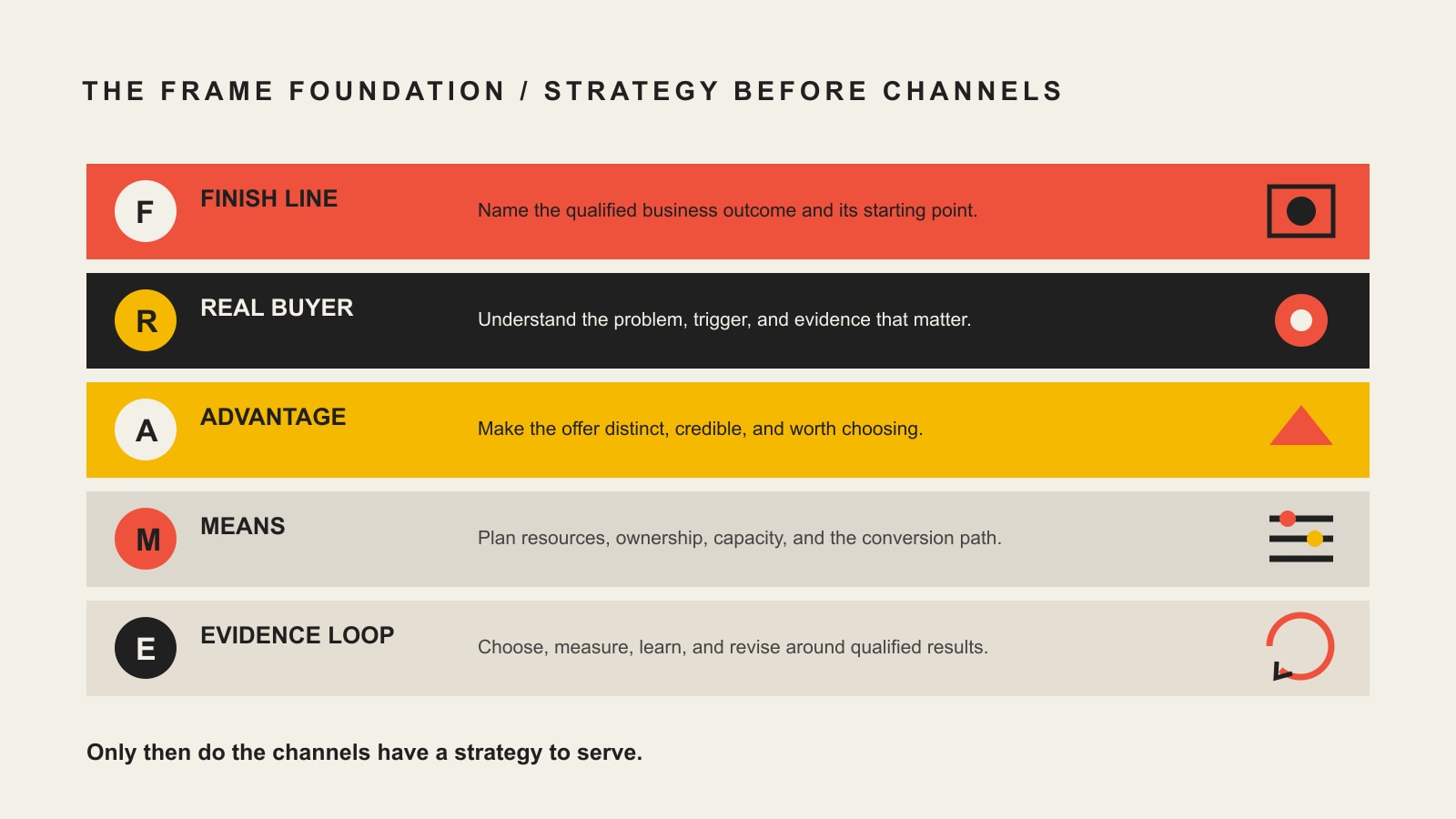
    The familiar pieces of digital marketing—audience, goals, positioning, content, channels, and measurement—only become a strategy when the earlier decisions constrain the later ones. The graphic below shows those connected parts. FRAME turns them into a decision sequence you can actually use.

    The FRAME foundation: Finish line, Real buyer, Advantage, Means, and Evidence loop, in a decision sequence that precedes channel selection.

    F — Finish line: define the qualified business outcome

    “Get more traffic” is not a business finish line. Neither is “post consistently,” “rank higher,” “grow followers,” or “send more email.” Those can be useful diagnostic signals, but they do not tell you whether the marketing created value.

    Start with the business outcome. A service company may care about qualified consultation requests, booked appointments, accepted estimates, or profitable projects. An ecommerce company may care about profitable orders, repeat purchases, or retained customers. A membership organization may care about completed registrations or renewals. Pick the result before you choose the channel.

    Then record the baseline. How many qualified inquiries arrive now? From where? What percentage become customers? Is the business able to respond quickly? What is a good customer worth in contribution margin, capacity, or long-term value? You do not need perfect data to begin, but you do need a starting point or every future chart will float without context.

    This is also where you separate diagnostic metrics from qualified outcomes. Rankings, impressions, clicks, sessions, email opens, and engagement can tell you whether a system is moving. Qualified leads, purchases, booked work, retention, or saved staff effort tell you whether the movement matters.

    R — Real buyer: identify the problem, trigger, and evidence

    A target audience is not “women 25–54 who like quality.” That sentence can describe millions of people with completely different problems, budgets, urgency, and buying behavior.

    Define the buyer by the situation that makes your offer relevant. What happened just before they started looking? What problem are they trying to remove? What would make them delay? What alternatives are they comparing? Who else influences the decision? Where do they look for evidence?

    The U.S. Small Business Administration’s market-research guidance recommends examining demand, market size, location, saturation, pricing, and direct customer research. That is much more useful than decorating a persona slide with a stock photo and naming the fictional customer “Marketing Mary.”

    For a deeper audience process, use Scope Design’s TRACE target-audience method: Trigger, Reality, Attributes, Channels, and Evidence. The important part here is that assumptions remain visibly separate from things you have actually observed.

    A — Advantage: make the offer worth choosing

    Marketing cannot rescue an offer nobody understands. Before you amplify the message, make the offer answer five basic questions: What do you do? For whom? What problem does it solve? Why should the buyer believe you? What should they do next?

    Your advantage does not have to be a revolutionary invention. It may be specialization, speed, a better process, stronger proof, easier implementation, local knowledge, a clearer guarantee, better support, more transparent pricing, or simply fewer annoying steps. What matters is that the difference is relevant to the buyer and can survive scrutiny.

    Also list the objections before the campaign starts. Price, trust, timing, switching cost, implementation risk, lack of proof, and fear of making the wrong choice all create friction. If the sales team answers the same concern every week, the marketing should probably answer it before the prospect has to ask.

    M — Means: plan around money, time, capacity, ownership, and the conversion path

    This is the part most “best marketing strategy” lists skip because it is less exciting than naming platforms. It is also the part that keeps the plan from collapsing in real life.

    Define the resources the strategy can consume: cash, staff hours, specialist skills, creative production, sales follow-up, fulfillment capacity, software, and management attention. Assign one person who owns the plan. Shared participation is useful; shared accountability is how tasks quietly become nobody’s job.

    Then choose one primary conversion path for the first test. That might be a service page and contact form, a booking flow, a product page and checkout, a phone call, or a lead magnet followed by email. It does not have to be fancy. It has to be clear, measurable, and owned.

    Finally, make the uncomfortable tradeoff explicit: what are you not doing? A small team cannot usually launch search ads, publish daily video, rebuild the website, start a weekly newsletter, run three social networks, and create an SEO content program at the same quality level at the same time. If the strategy adds a tactic, something else may need to wait.

    If the capacity question turns into a build-versus-buy decision, our in-house vs. outsourcing framework helps separate work you should own from work that earns outside expertise.

    E — Evidence loop: choose, measure, learn, and revise

    Only now do you choose channels. Pick them because of the job they need to do, not because a platform is fashionable or a competitor posted a screenshot of a good month.

    Before launch, define the valuable action you want to measure. Google Ads’ conversion measurement guidance centers measurement on actions that matter to the business, while Google Analytics defines a key event around an action particularly important to business success. The terminology matters less than the discipline: know what action has value before the campaign starts.

    Then run the smallest useful test that can teach you something. Review the chain, not just the first metric: Was the page accessible and visible? Did the right people arrive? Did they engage with the useful part? Did they take the intended action? Were those actions from people the business can help? Did the outcome produce sales, appointments, retention, or another result you chose at the beginning?

    That is the evidence loop: launch, observe, diagnose, revise. A tactic can earn more budget, a different message, a better destination, more time, or a clean death. Hope is not an analytics strategy.

    FRAME decisionBad shortcutUseful evidenceWhat the evidence changes
    Finish line“More traffic”Qualified leads, sales, appointments, retention, baselineWhat success means
    Real buyerBroad demographicsTriggers, interviews, search behavior, sales conversations, reviewsWho and what the message must address
    Advantage“We offer great service”Proof, objections, alternatives, customer languageOffer and positioning
    Means“Let’s do everything”Budget, staff time, skills, capacity, owner, destinationWhat can actually be executed
    Evidence loopVanity dashboardsChannel diagnostics plus qualified outcomesWhat to keep, change, scale, or stop

    How do you choose marketing channels after the foundation is clear?

    Choose channels by their job in the customer journey and by whether you can execute them well. There is no universally “best” online marketing channel.

    ChannelUseful jobMain tradeoff to plan for
    SEO and organic searchCapture existing questions and search demand with useful, discoverable pagesRequires ongoing technical/content quality and patience; visibility is not the same as a qualified sale
    Paid searchBuy controlled access to people searching for a relevant need nowRequires sound conversion economics, landing-page quality, and disciplined tracking
    Social mediaBuild familiarity, distribute ideas, show proof, and participate where buyers already pay attentionRequires consistent attention and is easy to confuse with popularity
    EmailFollow up with an opted-in audience, nurture decisions, and support retentionDepends on list quality, permission, relevance, and consistent follow-through
    ContentExplain difficult decisions, demonstrate expertise, support search, sales, and other channelsMust solve a real question and be distributed; publishing alone does not create demand

    Our guide to online marketing channels for small business goes deeper on the job each channel can perform. Once those roles are clear, the complete internet marketing plan shows how to connect channels, destinations, follow-up, capacity, and measurement into one operating system.

    How much should a small business spend on online marketing?

    There is no universal percentage that magically becomes correct because it has three numbers and a hyphen. Searchers ask about rules such as 70-20-10 and 40-40-20 because simple allocation formulas are comforting. Treat them as heuristics at most, not laws for your business.

    Your workable budget comes from the business model and the test. Start with what a good customer is worth, the margin or capacity available to acquire one, the number of customers the business can actually serve, the cost of the creative and technology required, the staff time needed to respond, and the amount you can risk learning without harming operations.

    Capacity matters as much as cash. If a campaign generates more inquiries than your team can answer, more traffic can make the customer experience worse. If your average project is valuable but sales follow-up takes three weeks, the bottleneck may not be acquisition at all. Marketing should expose the constraint, not pour gasoline on it.

    A useful starting budget is therefore large enough to run a meaningful test and small enough that you can afford to learn. Increase investment when the complete chain—from attention to qualified outcome—supports it. Reduce or redirect investment when the evidence shows a broken message, audience, destination, response process, or channel fit.

    What our audit of this exact page taught us

    We applied the same evidence rule to this revision instead of protecting old copy because it already existed. The old article had a live URL and several durable ideas, but it also contained fixed budget percentages, fixed channel timelines, an unverified “47%” strategy statistic, an unsupported AI-search projection, and a long channel list that overlapped other pages.

    Signal checkedObservation on August 20, 2026What it actually supports
    GA4, last 12 complete months3 landing sessions, all Direct; 0 engaged sessions; 0 configured key events. The prior 12-month comparison returned no rows.The sample is far too small for behavior or conversion conclusions. There is no measured organic footprint forcing us to preserve unsupported legacy copy.
    Google Search ConsoleNo exact-page query rows in the current or prior 12-month periods. URL Inspection says “Crawled – currently not indexed,” while indexing and robots are allowed and Google/user canonicals match the established URL.The page needs clearer ownership, usefulness, and connections—not a slug migration.
    Bing Webmaster ToolsBing recognizes the URL and retains crawl history; exact-URL traffic reports 0 clicks and 0 impressions.Bing knows the page, but there is no current Bing traffic signal that requires weak claims or structure to survive.
    UbersuggestNo exact-page ranking-keyword data and no URL-level backlinks were returned.Third-party evidence also shows no strong page-level equity that justifies keeping unsupported claims.

    This evidence does not prove the topic is worthless, that visitors disliked the page, or that this revision will rank. Scope Design’s current analytics attribution and configured key-event setup also have known limitations, so zero key events is not proof of zero business impact.

    The conclusion is narrower and more useful: the legacy article did not have a demonstrated search or conversion footprint that required us to defend weak copy, while current query research still shows real demand for online marketing strategy questions. We preserved the established, healthy URL and changed the article’s job instead.

    A practical first 30 days for your online marketing strategy

    Thirty days is enough to build the foundation and launch a bounded learning cycle. It is not a promise that every channel will prove ROI in a month. Long buying cycles, low search demand, complex sales, and organic discovery can require much longer observation.

    Days 1–5: Finish line and baseline

    Choose one primary business outcome, define the valuable action, and document the current baseline. Identify the sales or operational constraint that could make “more leads” useless.

    Days 6–10: Real buyer evidence

    Review search language, customer questions, reviews, sales notes, support conversations, competitor alternatives, and a handful of direct interviews when possible. Write down what you know, what you suspect, and what still needs testing.

    Days 11–15: Advantage and proof

    Clarify the offer, the meaningful difference, the proof you can show, the objections that need answers, and the single next action. Fix obvious message friction before buying traffic.

    Days 16–20: Means, owner, and destination

    Set the test budget and staff-time limit, choose the accountable owner, confirm response capacity, and prepare the primary conversion destination. Name the initiatives that will wait while this test runs.

    Days 21–30: Launch one useful test

    Select the smallest channel mix that reaches the right buyer and can produce evidence. Configure measurement, launch, review the complete response chain, and write down what changed and why. One well-instrumented experiment teaches more than six half-maintained channels fighting for the same Tuesday afternoon.

    Frequently asked questions about online marketing strategy

    What is an online marketing strategy?

    An online marketing strategy is the decision system that connects a business outcome to a defined buyer, offer, resources, digital channels, conversion path, and measurement. A list of SEO, ads, email, social media, and content tactics is not a strategy until those tools have specific jobs and success criteria.

    What is the marketing strategy for a small business?

    A useful small business marketing strategy is intentionally constrained. Define the qualified outcome, the buyer’s real problem, the offer and proof, the budget and staff capacity, the accountable owner, the primary conversion path, and the evidence that will guide the next decision. Then choose the smallest set of channels that can do the required jobs consistently.

    Should I use a 70-20-10 or 40-40-20 marketing rule?

    Use percentage rules only as prompts for discussion, not universal prescriptions. Your allocation should reflect customer value, margins, risk tolerance, staff capacity, channel maturity, and what you need to learn. A neat percentage does not know your sales cycle or whether your team has time to answer the phone.

    Which online marketing channel is best for a small business?

    The best channel is the one that can reach the right buyer at the right moment, perform a useful job in the decision journey, fit your resources, and produce evidence you can act on. Search may fit active demand; social may fit familiarity and proof; email may fit follow-up and retention. The answer depends on the business problem.

    How many marketing channels should I start with?

    Usually fewer than your first brainstorm. Start with the smallest mix that can cover acquisition, conversion, and follow-up without exceeding the team’s capacity. Add a channel when the current system is understood and the new channel has a specific job—not because someone told you every brand needs seven places to post.

    How do I know if my online marketing strategy is working?

    Track the chain from visibility to qualified outcome. Channel metrics such as impressions, clicks, rankings, reach, and email engagement help diagnose what happened. Leads, sales, appointments, retention, and other qualified business outcomes tell you whether the movement was valuable. Compare results with the baseline and revise one known assumption at a time.

    Do I need a website before I start online marketing?

    You need a controlled place where the prospect can understand the offer and take the intended next step. For many service businesses that is a website or focused landing page; for others it may be a product page, booking flow, marketplace listing, or phone call path. The critical requirement is ownership: the destination should explain the offer, provide enough proof, make the next action obvious, and allow you to measure what happened.

    What to do next

    Part I gives you the filter. Part II of the business marketing strategy series turns that foundation into the next layer of planning and execution. If you already have channels running but cannot explain which business decision each one supports, use FRAME first and fix the foundation before adding another tactic.

    If you want an outside partner to help connect strategy, website experience, SEO, content, paid acquisition, measurement, and the ugly operational details between them, Scope Design can help. The goal is not more marketing activity. It is a system that earns the right to keep running.