Tag: Meta Ads

  • 3 Critical Facebook Advertising Mistakes Destroying Your Campaign ROI

    3 Critical Facebook Advertising Mistakes Destroying Your Campaign ROI

    If your Facebook ads ROI is weak, the three most expensive mistakes are usually not a secret targeting trick. They are treating platform-attributed revenue as business profit, teaching Meta to optimize for an easy but low-value signal, and changing so many things at once that the campaign cannot teach you what actually improved the result.

    That is the core of Scope Design’s ROI Leak Test: Reality, Optimization, Isolation. First make sure the economics work. Then make sure Meta is learning from a signal that represents value. Finally, run changes cleanly enough to learn from them. If one of those three links is broken, buying more traffic can make the problem more expensive instead of making the business more profitable.

    TL;DR: The Three Facebook Ads ROI Leaks to Check First

    • Reality: Ads Manager can report attributed revenue or conversions, but business ROI depends on margin, total campaign cost, lead quality, close rate, refunds, fulfillment, and the value of the customers you actually win.
    • Optimization: Meta can optimize only toward the objective, event, and feedback you give it. Cheap clicks and cheap form fills are not automatically profitable customers.
    • Isolation: If you change audience, creative, offer, budget, landing page, and objective at the same time, the new campaign may perform better, but you have learned almost nothing about why.

    If your problem is broader than ROI measurement and you need to diagnose delivery, targeting, creative, landing pages, or follow-up, use our full Facebook ads mistakes diagnostic. This guide has a narrower job: deciding whether the money is actually working.

    Facebook Ads ROI vs. ROAS: Do Not Let Similar Acronyms Make the Decision for You

    ROAS and ROI answer different questions. ROAS usually compares attributed revenue with media spend. Business ROI should go further and compare the profit created with the broader investment required to create it. A platform can report a healthy-looking revenue-to-ad-spend ratio while the campaign is still a lousy business decision after product cost, labor, creative, management, discounts, refunds, and sales effort are considered.

    A useful management model is:

    • ROAS = attributed revenue ÷ media spend
    • Simple campaign ROI = (attributed gross profit − total campaign cost) ÷ total campaign cost

    Those formulas are decision tools, not universal attribution truth. Define what belongs in each number, use the same method from period to period, and keep uncertainty visible. Our measurable internet marketing loop goes deeper on keeping platform metrics attached to business decisions instead of turning dashboards into decorative wallpaper.

    A Simple Facebook Ads ROI Example

    Suppose an ecommerce campaign spends $2,000 on media and $500 on directly attributable creative and management. Ads Manager attributes $10,000 in revenue to the campaign. If the attributed orders represent $4,000 in gross profit after product cost and the attribution is trustworthy enough for the decision, the platform-style ROAS is 5.0. The simple campaign ROI is ($4,000 − $2,500) ÷ $2,500, or 60%.

    The 60% is an arithmetic example, not a Facebook benchmark. Change the gross margin, refunds, labor, attribution assumptions, or customer mix and the answer changes. That is exactly why a universal “good Facebook ads ROI” number is usually less useful than your own break-even economics.

    The Scope Design ROI Leak Test: Reality, Optimization, Isolation

    Before you blame CPM, creative fatigue, or the algorithm, run the campaign through three checks in order. Fix the first leak you can prove. Do not skip to a prettier ad just because creative is more fun than reconciling a CRM.

    Business economics, valuable optimization signals, and controlled testing connect in a diagnostic path
    ROI Leak Test Question Typical failure Useful evidence
    Reality Do the economics work? Platform return looks good, but margin, lead quality, or total cost does not. Gross profit, total campaign cost, qualified lead rate, close rate, CAC, refunds.
    Optimization Is Meta learning from a valuable signal? The system finds cheap clicks or form fills that do not predict valuable customers. Objective, performance goal, event quality, Pixel/CAPI health, CRM feedback.
    Isolation Can the test teach you what changed? Too many simultaneous edits or fragmented ad sets make the result impossible to interpret. Written hypothesis, primary metric, guardrails, spend/time boundary, stopping rule.

    Mistake 1: Treating Ads Manager Return as Business ROI

    Meta’s reporting is useful evidence. It is not your general ledger, sales pipeline, fulfillment system, or profit-and-loss statement wearing a blue hat.

    The first mistake is stopping the analysis at attributed conversions or attributed revenue. For a lead-generation campaign, fifty form fills can look fantastic until the sales team tells you that thirty-five were outside the service area, ten never answered, four were poor fits, and one became a customer. For ecommerce, revenue can look strong while discounts, returns, shipping subsidies, product cost, and repeat-customer mix quietly change the economics.

    For a lead business, add at least three downstream steps to your reporting: qualified lead rate, close rate, and customer acquisition cost. If you spend $2,500 and collect fifty leads, the raw CPL is $50. If only fifteen are qualified, the cost per qualified lead is about $167. If five become customers, the test CAC is $500. You still cannot call the campaign profitable until you know what those customers are worth in gross profit and whether the business can fulfill the work.

    For ecommerce, connect the ad result to gross profit, new-customer economics, refunds or returns, and total campaign cost. A campaign that acquires valuable first-time customers may justify a different target than one that mostly receives credit for purchases from people who were already going to buy. Do not hide that distinction inside one blended return number.

    What to Reconcile Before You Increase the Budget

    • Media spend plus directly attributable creative, management, and campaign costs.
    • Attributed revenue compared with order-system or CRM revenue.
    • Gross profit rather than revenue alone when product or delivery cost matters.
    • Qualified leads, booked appointments, attended appointments, closed customers, or another downstream quality stage.
    • Refunds, cancellations, duplicate leads, existing customers, and obvious attribution mismatches.
    • Sales or service capacity. A profitable-looking lead source can become expensive chaos if nobody responds or the team cannot fulfill the work.

    This is also why the broader marketing system matters before you buy more attention. Paid media can amplify a working path. It cannot repair an offer nobody wants, a form that breaks, or a follow-up process that treats tomorrow as a perfectly acceptable response time.

    Mistake 2: Optimizing the Easiest Signal Instead of the Valuable Outcome

    Meta does not know what you vaguely meant. It knows the objective, performance goal, events, conversion values, and other feedback available to the delivery system. If you ask for traffic, cheap visits can be a successful platform result even when you actually wanted qualified sales conversations. If you optimize lead generation around every form submission but never tell the system which leads become useful opportunities, the cheapest lead can win the auction while your sales team loses the afternoon.

    Our current Meta campaign objectives guide explains the six objective families and how to choose the measurable action closest to the business outcome. The important idea is simple: optimize toward the deepest trustworthy signal you can measure often enough to operate responsibly.

    Meta’s current documentation says the Conversions API can send business event data directly to Meta’s optimization and measurement systems, including website, app, offline, messaging, phone, and other events. For website events, Meta describes it as something businesses can use alongside the Pixel. That does not magically make attribution perfect, and it is not a privacy loophole. It gives the delivery system a better opportunity to learn from the events your business can legitimately observe and send.

    Lead quality is the most obvious example. Meta’s current Advantage+ leads guidance explicitly discusses connecting CRM data through Conversions API so optimization can use downstream lead information. If your team knows which leads are qualified, booked, or sold, that feedback is more useful than pretending every form fill has equal value.

    Build a Signal Ladder Instead of a Vanity-Metric Ladder

    Easy signal Better business signal What to ask
    Link click Qualified visit, lead, purchase, or other meaningful action Does the click predict value, or merely curiosity?
    Raw lead Qualified lead, booked appointment, accepted opportunity Can the CRM feed quality back into campaign decisions?
    Purchase count Purchase value, margin, new-customer value, non-refunded order Are all purchases economically equal?
    Cheap result Profitable or strategically valuable result Are we optimizing cost, or the outcome the business actually wants?

    Audience automation makes signal quality even more important. Meta’s current Advantage+ audience documentation explains that audience inputs can act as suggestions while the system expands beyond them when it expects better performance, subject to hard controls such as location, minimum age, language, and exclusions. That is not proof that broad targeting always wins. It is a reason to stop treating manual interest stacks as the only intelligence in the system. Give the platform a clear outcome and trustworthy feedback before spending three meetings debating whether an audience should contain 730,000 or 1.1 million people.

    Mistake 3: Changing So Much That No Test Can Teach You Anything

    The third mistake is optimization theater: constant activity that produces very little learning. An advertiser sees a bad Tuesday, changes the budget, swaps the audience, rewrites the headline, replaces the image, changes the offer, and rebuilds the landing page. Thursday is better. Great. Which change worked?

    Meta describes the learning phase as a period when delivery is exploring and performance can be less stable. Its current delivery-status guidance also says significant edits can send ads back into preparation. The useful lesson is not “never touch a campaign.” It is that changes have a cost, and you should make them for a reason.

    A good small-business test does not need a lab coat and a statistics department. It does need a written hypothesis:

    • Question: What are we trying to learn?
    • Primary metric: Which business-facing result determines whether the change helped?
    • Diagnostic metrics: Which delivery, click, conversion, quality, or funnel numbers help explain the result?
    • Variable: What meaningful thing are we changing?
    • Boundary: What spend, time, or result threshold is enough to make a practical decision?
    • Stopping rule: What evidence tells us to scale, revise, or stop?

    Creative testing is a perfect example. If the “new image test” also changes the discount, audience, headline, CTA, objective, and landing page, you may discover a better campaign, but you did not prove that the image caused it. Our guide to testing Facebook ad images without learning the wrong lesson shows how to keep creative conclusions attached to the variable you actually tested.

    Fragmentation creates the same problem at account level. Splitting a modest budget across too many nearly identical campaigns and ad sets can leave every test starved for useful evidence. The fix is not a magic audience size or a universal number of conversions. Simplify enough that each test has a job, preserve enough stability to observe it, and use our Facebook ads optimization framework when you need to work through economics, signal, objective, promise, path, and quality in sequence.

    A 15-Minute Facebook Ads ROI Audit Before You Spend More

    You do not need to rebuild the entire account to find the next useful question. Start with this short audit.

    1. Name the business outcome. Profitable purchase, qualified opportunity, booked appointment, retained customer, or another result with actual value.
    2. Write the break-even economics. Know the gross profit or customer value available to support acquisition, then define the maximum sensible CAC or qualified-lead cost for this test.
    3. Reconcile the result. Compare Meta’s attributed conversions or revenue with your order system, CRM, phone records, or other first-party source. Investigate material gaps rather than averaging them away.
    4. Check the optimization signal. Does the campaign objective and event represent the outcome you care about, or merely an easier upstream action?
    5. Check quality feedback. If leads or purchases vary materially in quality, can the campaign learn from qualified, sold, retained, or higher-value outcomes?
    6. Check test isolation. List every material change made during the comparison period. If the list reads like a renovation permit, stop pretending the result proves one tiny tactic.
    7. Make one decision. Scale, revise, hold, or stop based on the earliest proven leak. Do not increase spend just because a dashboard number turned green.

    Which Facebook Ads Metrics Actually Matter?

    The useful metric depends on the campaign job. CTR, CPC, CPM, frequency, and conversion rate can help diagnose delivery and creative performance, but none of them is automatically the business outcome. A cheaper click can be worse if it produces poorer customers.

    Business model Primary business evidence Useful diagnostic metrics Common trap
    Ecommerce Gross profit, CAC, new-customer value, refunds/returns, repeat value ROAS, purchase value, conversion rate, CPC, CPM, CTR Calling revenue-to-ad-spend ratio “profit”
    Lead generation Qualified lead rate, cost per qualified lead, appointment rate, close rate, CAC, customer value CPL, form completion, landing-page conversion, CPC, CTR Optimizing the cheapest raw lead
    Awareness Business-defined reach or brand outcome with a later measurement plan Reach, frequency, video or engagement metrics appropriate to the objective Retroactively demanding direct-response ROI from a campaign not built for it

    Benchmarks can be context. They are not commandments. Your break-even number is usually more useful than somebody else’s average because it reflects your margin, customer value, sales process, geography, offer, competition, and operating capacity.

    Frequently Asked Questions About Facebook Ads ROI

    What is a good ROI for Facebook ads?

    There is no universal good Facebook ads ROI. Start with your own break-even economics. A campaign can support a lower platform ROAS when gross margin, repeat value, or customer lifetime value is strong; another business may need a much higher return because fulfillment, sales labor, or product cost consumes most of the revenue.

    What is the difference between Facebook ads ROI and ROAS?

    ROAS usually compares attributed revenue with ad spend. ROI should evaluate the profit created relative to the broader investment. For management decisions, use gross profit and total campaign cost when those figures are available, and document your attribution assumptions.

    Is $10 a day enough for Facebook ads?

    It can be enough for a tightly bounded learning test in some markets, but $10 is not a magic budget. Ask what the test must learn, what a conversion or qualified lead normally costs, how much opportunity exists, and how long you can run before a practical decision is possible. A tiny budget cannot rescue broken economics or an unobservable outcome.

    Is $1,000 enough for a Facebook ads campaign?

    Maybe. A $1,000 budget is meaningful only relative to expected acquisition cost, audience opportunity, offer, geography, and the question being tested. If one qualified customer normally costs $1,500 to acquire, $1,000 may be a poor basis for declaring the channel dead. If your expected acquisition cost is $50, the same budget can support a very different test.

    Are Facebook ads worth it in 2026?

    They can be when Meta can reach a relevant audience, the offer and destination can convert attention, the business can measure a valuable outcome, and the economics support paid acquisition. They are not automatically worth it because Facebook has a large audience or because another company posts an impressive ROAS screenshot.

    Should I use broad targeting or detailed targeting?

    Do not turn targeting into an ideology. Meta’s Advantage+ audience can expand beyond suggestions while respecting certain hard controls, so manual micro-targeting is no longer the only intelligence in the system. Use the constraints your business genuinely needs, give the platform a valuable measurable signal, and compare actual downstream quality instead of assuming broader or narrower is universally superior.

    Fix the Leak Before You Raise the Budget

    A weak Facebook ads ROI is not one problem. It is a symptom. The return can be weak because the business math never worked, because the campaign is learning from the wrong signal, or because your testing process generates motion instead of evidence.

    Run the ROI Leak Test in order: Reality, Optimization, Isolation. Reconcile the economics. Improve the signal. Preserve enough structure to learn. Then scale what survives the full chain.

    If you want an outside set of eyes on the leak, Scope Design can help audit the campaign, tracking, lead-quality handoff, and surrounding marketing system before you buy another pile of attention. The goal is not a prettier Ads Manager screenshot. It is a decision you can defend with business evidence.


  • Facebook Ads Optimization: Build a Conversion System That Earns Its Spend

    Facebook Ads Optimization: Build a Conversion System That Earns Its Spend

    Facebook ads optimization works when you improve the whole conversion system, not just the ad. Start with the economics, give Meta a trustworthy conversion signal, choose the right objective, make the creative promise match the destination, judge lead or customer quality, and only then scale spend. A clever campaign cannot rescue an offer that loses money or a landing page that breaks the promise.

    TL;DR: Fix the First Weak Link Before You Increase the Budget

    • Know the math first. Define what a qualified lead or customer can cost before you decide whether a campaign is “working.”
    • Optimize for a business outcome you can measure. Cheap clicks are not a business model.
    • Give Meta clean signal data. Pixel, Conversions API, CRM, offline, and first-party data can help when they are implemented honestly and consistently.
    • Keep one promise from ad to action. Creative, offer, landing page, form, checkout, and follow-up should all feel like the same conversation.
    • Measure quality after the conversion. A lead that never answers the phone is not worth celebrating because the cost-per-lead chart is green.
    • Use automation as leverage, not judgment. Advantage+ can automate parts of delivery; it cannot decide whether your economics, offer, or sales process make sense.

    This is the paid-social version of a broader rule we use in website strategy and conversion optimization: do not optimize the easiest metric to see. Find the first constraint that is actually preventing a useful business outcome.

    Facebook Ads Optimization Starts Before Ads Manager

    The first question is not “Which audience should I target?” It is “What can I afford to pay for the result I want?”

    If you sell a $100 product with $25 of contribution margin before advertising, a $40 customer acquisition cost has a very different meaning than it would for a recurring service with strong retention. If you sell a high-ticket service, a lead can look expensive and still be excellent if enough qualified leads become profitable customers. The platform cannot answer that for you. It does not know your payroll, gross margin, close rate, cancellations, refunds, fulfillment cost, or cash-flow tolerance unless you deliberately feed useful business data back into the system.

    That is why “Is $10 a day enough for Facebook ads?” and “Is $1,000 enough?” are incomplete questions. A useful test budget depends on the cost of the event you are trying to learn from, how often that event happens, and how much uncertainty you can afford. Ten dollars might be enough to learn whether a simple local offer earns clicks. It may be nowhere near enough to learn whether a rare, high-value purchase is profitable. A thousand dollars can still be wasted quickly if the tracking is wrong or the offer is weak.

    Before opening Ads Manager, write down four numbers: your average gross profit or contribution margin per sale, your lead-to-sale close rate, your acceptable customer acquisition cost, and the value of a qualified lead. They do not have to be perfect. They do have to be more honest than “we want more sales.”

    The Six-Link Meta Conversion System

    Scope Design uses a six-link model for Facebook ads optimization: Economics → Signal → Objective → Promise → Path → Quality. It is deliberately sequential. If Link 1 is broken, polishing Link 5 will not save the campaign. If Link 2 is unreliable, Meta may be learning from noisy data. If Link 6 is invisible, you can accidentally teach the system to find more low-quality leads because those are the only “successes” it can see.

    Six connected links carry a buyer from economics and signals through offer, destination, and customer quality
    Scope Design’s Six-Link Meta Conversion System. Strengthen the first weak link before increasing spend.

    Link 1: Economics — Decide What a Conversion Is Worth

    Start with a break-even model that connects ad spend to actual business value. You do not need a finance department. You need enough math to know the difference between an expensive customer and an unprofitable one.

    • E-commerce: work from contribution margin, not top-line revenue alone.
    • Lead generation: connect cost per lead to qualification rate and close rate.
    • Recurring services: include retention and payback timing, but do not use optimistic lifetime value to excuse a campaign that creates immediate cash-flow pain.
    • Local services: separate booked jobs, qualified inquiries, spam, price shoppers, and out-of-area leads.

    A platform-reported ROAS can be useful, but it is not the final judge. Your accounting, CRM, order system, and sales outcomes are closer to the business truth. If Meta says the campaign is fantastic and your bank account disagrees, investigate the measurement gap before buying more traffic.

    Link 2: Signal — Make the Conversion Data Trustworthy

    Meta can only optimize toward signals it receives. For website events, that often means the Meta Pixel plus a server-side or platform integration through Meta’s Conversions API. Meta describes Conversions API as a direct connection between marketing data from sources such as servers, website platforms, apps, or CRMs and its systems for measurement and optimization. Meta also recommends using Conversions API alongside the Pixel for website events where appropriate.

    What Conversions API is not is a privacy loophole. Meta explicitly says it is not designed to bypass App Tracking Transparency or other privacy rules. Consent, lawful data handling, platform terms, and data minimization still matter.

    The practical goal is not “install every tracking thing.” The goal is to create a clean event chain that answers questions such as:

    • Did the person reach the intended landing page?
    • Did they complete the lead form, purchase, booking, or other meaningful action?
    • Can duplicate browser and server events be deduplicated correctly?
    • Can a lead be connected later to qualification or revenue?
    • Where does measurement stop because the customer moves into a system you do not control?

    A Real Tracking Boundary We Ran Into

    On one Scope Design project, visitors could browse an auction experience on the client’s website, but registration, account activity, bidding, and payment had to happen on a third-party auction platform. We instrumented the controlled handoff: the outbound click carried the auction and lot context plus campaign-source parameters into analytics. We did not pretend our browser tracking could magically see the downstream transaction inside somebody else’s account system.

    That distinction matters. When your lead or checkout process crosses into a scheduling platform, marketplace, financing portal, call center, franchise CRM, or other third-party system, document the boundary. Track what you control. Integrate downstream outcomes where the vendor provides a supported path. Treat everything else as an attribution limitation, not an invitation to invent certainty.

    Link 3: Objective — Tell Meta What Outcome to Optimize For

    Campaign objectives are not decorative setup fields. They tell the delivery system what kind of outcome you want it to pursue. If you want qualified leads but optimize for cheap traffic because the numbers arrive faster, you may get exactly what you asked for: lots of visitors who were never likely to buy.

    Our separate guide to Meta campaign objectives goes deeper on objective selection. The rule here is simpler: choose the deepest useful outcome you can measure with enough consistency to learn from it. If purchase data is reliable, optimize around purchase value or purchases as appropriate. If sales happen offline, use the strongest supported lead or CRM signal you can feed back. If the signal is too rare or too noisy, fix the measurement architecture instead of pretending a vanity event is equivalent to revenue.

    Meta’s own Ads Manager documentation separates decisions across campaign, ad-set, and ad levels and supports A/B testing. It also warns that its opportunity score and recommendations do not guarantee actual or future performance. That is a useful reminder: recommendations are inputs to judgment, not outsourced judgment.

    Link 4: Promise — Optimize Creative Before You Micromanage Targeting

    Your ad has one job before the click: make a relevant promise to the right kind of person. That promise can be a result, a problem solved, a product demonstrated, a proof point, a useful offer, or a reason to care now. The creative does not need to be cinematic. It needs to earn attention and set an accurate expectation for what happens next.

    Test meaningful creative differences instead of changing the button color and calling it experimentation. A useful creative test might compare:

    • problem-first versus outcome-first framing;
    • product demonstration versus customer story;
    • founder/expert explanation versus polished brand creative;
    • price/value transparency versus curiosity-led messaging;
    • a short direct offer versus a proof-heavy consideration message.

    Proof deserves special attention because an ad can create demand faster than a skeptical buyer can develop trust. Real reviews, demonstrations, guarantees you can actually honor, and specific evidence reduce that gap. Our guide to customer testimonials that sell without making things up covers how to use proof without turning it into marketing theater.

    Competitor research can help you understand the promises already saturating the market. Use it to identify sameness, not to photocopy somebody else’s campaign. If you need that research process, see how to research competitors’ Facebook ads.

    Link 5: Path — Keep the Promise After the Click

    A good ad that lands on a weak page is just an efficient way to buy disappointment. The destination should continue the same promise, answer the next obvious objection, load quickly enough to use, and make the desired action easy to understand.

    For focused campaign pages, the principle is simple: match one promise to one action. Our landing-page optimization guide goes deeper on that job. For broader diagnosis across a site, use the conversion-rate optimization framework instead of changing random page elements because a heatmap looked dramatic.

    Check the entire post-click path, not just the landing page:

    • Does the headline repeat or clarify the ad’s promise?
    • Is the mobile form painful to complete?
    • Does the checkout introduce surprise costs or unnecessary steps?
    • Does the booking flow dump people onto an unfamiliar third-party experience?
    • Does the confirmation page tell the buyer what happens next?
    • Does the sales team follow up fast enough and with enough context to recognize a paid lead?

    Do not blame Facebook for a broken handoff your own process created.

    Link 6: Quality — Measure What Happens After the Conversion

    This is where a lot of “high-converting” campaigns fall apart. The form conversion rate improves. Cost per lead drops. Everyone congratulates the dashboard. Sales says the leads are garbage.

    That is not a media-versus-sales argument. It is a missing feedback loop.

    For lead generation, track at least three stages when your systems allow it: lead → qualified lead → customer. If lead quality varies sharply, send supported first-party signals back through your CRM or Conversions API integration. Meta’s current lead-optimization guidance explicitly supports using CRM and Conversions API data to help optimize around lead quality.

    For e-commerce, connect platform-reported revenue to refunds, margin, repeat purchase behavior, and other costs that matter to the business. For local service businesses, distinguish booked work from form fills. For high-ticket sales, track pipeline progression and closed revenue rather than pretending every consultation request has equal value.

    What Advantage+ Should Automate in Facebook Ads Optimization

    Meta keeps moving more campaign decisions into Advantage+ and other automated systems. That can be useful. Automation can help with placement, delivery, audience expansion, creative variation, and budget allocation. Meta currently recommends Advantage+ placements when they are available, while still providing manual placement options.

    The mistake is treating automation as permission to stop thinking.

    • Automate delivery decisions when the system has a trustworthy outcome signal.
    • Do not automate the business definition of success. Meta cannot decide your acceptable acquisition cost.
    • Do not automate away creative strategy. More variants of a weak promise are still a weak promise.
    • Do not use automation to hide measurement gaps. A model can optimize only around the data it receives.
    • Do not assume “recommended” means guaranteed. Test the recommendation against your business outcome.

    Automation is a force multiplier. Make sure it is multiplying something worth scaling.

    Stop Fragmenting the Learning With Tiny, Duplicate Ad Sets

    One old-school habit is building a pile of nearly identical ad sets so every interest, age bracket, placement, and micro-audience gets its own little budget. That feels controlled. It can also starve each segment of useful learning data.

    Meta’s current ad-set guidance says similar ad sets running at the same time get fewer opportunities to learn and recommends consolidation where appropriate to improve efficiency and stability. That does not mean “one campaign forever” or “never segment.” It means segmentation needs a reason.

    Create separate structures when the economics, geography, offer, funnel stage, legal constraints, inventory, creative strategy, or measurement genuinely differ. Do not create them just because Ads Manager gives you another button.

    Facebook Ads Optimization Tests Should Answer a Business Hypothesis

    A useful test has a sentence behind it: We believe X will improve Y because Z.

    Examples:

    • “We believe showing the product in use will increase qualified product-page visits because buyers cannot understand the benefit from a static pack shot.”
    • “We believe a shorter lead form will increase inquiries, but we will judge success on qualified-lead rate so we do not simply buy more junk.”
    • “We believe consolidating two nearly identical prospecting ad sets will give the system a cleaner learning pool without changing the offer.”

    Meta provides A/B testing tools in Ads Manager. Use controlled tests when they fit the question, and avoid changing creative, targeting, budget, destination, and conversion event simultaneously unless you are intentionally testing a whole new system. Otherwise, you may get a different result without learning why.

    Facebook Ads Optimization Metrics That Actually Tell You Something

    No single metric owns the truth. Use metrics as clues at different links in the chain.

    Metric What it can tell you What it cannot prove
    CPM How expensive it is to buy exposure in the auction That your offer or funnel is good
    CTR / link CTR Whether the ad earns clicks from the delivered audience That those clicks are qualified
    CPC The cost of generating a click That the click creates business value
    Landing-page conversion rate How well the destination turns visits into the tracked action That the resulting lead/customer is profitable
    Cost per lead How much you pay for the tracked lead event That the lead is qualified or will close
    Cost per qualified lead Media efficiency after a quality check That sales will close enough of them
    Customer acquisition cost How much acquisition costs when connected to real customers That the customer has sufficient margin or retention
    ROAS / revenue attribution A useful revenue-to-ad-spend view when the underlying attribution is sound Profit, incrementality, or perfect causal attribution

    The further right you move from impression metrics toward qualified customers and profit, the closer you get to a metric worth scaling around.

    How to Scale Facebook Ads Without Turning a Working Campaign Into an Expensive Experiment

    There is no universal rule that says every good campaign should increase its budget by a fixed percentage every three days. That kind of advice feels satisfyingly specific because it removes judgment. Unfortunately, your conversion volume, audience size, sales cycle, margin, seasonality, inventory, and cash position did not agree to the rule.

    Scale in this order:

    1. Confirm economics. The result is worth buying.
    2. Confirm signal quality. The event is recorded consistently enough to trust.
    3. Confirm customer quality. Leads or purchases survive the downstream business check.
    4. Confirm repeatability. Performance is not one lucky day or one tiny audience pocket.
    5. Increase spend deliberately. Watch the business outcome, not only the platform’s cost-per-result.
    6. Expand creative and reach before the original audience is exhausted. Scaling is a creative and market problem as much as a budget problem.

    If performance changes after a budget increase, diagnose which link changed. Higher spend may reach a broader audience. Creative can fatigue. Lead quality can shift. The sales team may get slower as volume rises. “The algorithm broke” is usually a conclusion reached too early.

    A 30-Day Facebook Ads Optimization Sequence

    If your account has become a pile of campaigns, duplicated ad sets, stale creatives, and mystery conversions, use a controlled month to rebuild the feedback loop.

    Week 1: Rebuild the Measurement Contract

    • Define the primary business outcome and acceptable acquisition cost.
    • Map every conversion event from ad click to qualified lead or customer.
    • Verify Pixel/CAPI/CRM or other supported data connections.
    • Document third-party handoffs and what you can or cannot observe after them.
    • Remove duplicate or meaningless events from decision dashboards.

    Week 2: Simplify the Campaign Structure

    • Confirm each campaign has one clear job.
    • Merge needless duplicate ad sets when they are pursuing the same outcome.
    • Separate genuinely different economics, offers, locations, or funnel stages.
    • Choose an objective that matches the strongest reliable business event.

    Week 3: Test New Promises and Creative Concepts

    • Launch a small set of meaningfully different concepts.
    • Keep the post-click promise consistent with each concept.
    • Use proof you can substantiate.
    • Judge creative on downstream quality as well as CTR or cost per result.

    Week 4: Close the Quality Loop

    • Compare Meta conversions with CRM, sales, order, or booking outcomes.
    • Calculate cost per qualified lead or customer where possible.
    • Identify the first weak link in the six-link system.
    • Decide whether to fix, hold, scale, or stop based on business evidence.

    When the Campaign Is Already Failing, Diagnose Before You Rebuild

    This guide is the system-building owner: it explains what a healthy Facebook ads conversion system needs. If you are staring at an existing campaign and trying to figure out why CPM jumped, CTR collapsed, leads got worse, tracking disappeared, or spend stopped producing sales, use our separate Facebook ads mistakes and troubleshooting guide. It is designed to diagnose failure without turning this article into a duplicate list of everything that can go wrong.

    Facebook Ads Optimization FAQ

    How do I optimize my Facebook ads?

    Start with the first weak link in the conversion system: economics, signal, objective, promise, path, or quality. Do not begin by changing targeting because it is easy. If the campaign is generating cheap leads that never become customers, the next optimization job is lead quality and feedback—not cheaper leads.

    Is $10 a day enough for Facebook ads?

    Sometimes, but there is no universal threshold. Ten dollars a day may generate useful learning for a low-cost local event or offer. It may be too little to learn anything about a rare purchase or expensive qualified lead. Work backward from the expected event cost, the amount of data needed to make a decision, and what the business can afford to test.

    Is $1,000 enough for a Facebook ads campaign?

    It can be enough for a bounded test, but budget size alone does not make the test valid. Define the question first. A thousand dollars spent against broken tracking or an unprofitable offer is still a thousand dollars of expensive confusion.

    What is a good Facebook ads conversion rate?

    A “good” conversion rate is the rate that produces qualified customers at acceptable economics for your business. Raw conversion rate varies with the offer, audience, funnel stage, price, conversion definition, traffic source, and destination. Compare like with like, then connect the rate to lead quality, customer acquisition cost, margin, and payback rather than chasing a generic benchmark.

    Do I need Meta Conversions API?

    If important website or CRM events can be sent through a supported Conversions API implementation, it can strengthen the data connection used for measurement and optimization and can complement the Pixel. Whether you need it depends on your stack, events, privacy obligations, and implementation capacity. It is not a bypass for consent or platform privacy rules.

    Should I use Advantage+ targeting and placements?

    They are worth testing when your objective and signal are trustworthy. Meta currently offers Advantage+ automation across several parts of campaign delivery and recommends Advantage+ placements when available. Treat that as an optimization tool, not a guarantee. Compare business outcomes and keep manual controls when there is a real strategic, legal, geographic, inventory, or measurement reason.

    Why are my Facebook leads cheap but bad?

    The system may be optimizing toward the easiest version of the event you defined. Check the creative promise, form friction, qualification criteria, objective, follow-up process, and whether qualified-lead or customer outcomes can be fed back into your measurement stack. Cheap acquisition of the wrong person is not optimization.

    When should I hire someone to manage Facebook ads?

    Bring in help when the bottleneck is no longer “I need to click the right buttons” but “I need someone to connect campaign structure, tracking, creative, landing pages, CRM quality, and business economics into one operating system.” If you cannot provide a clear offer or sales capacity yet, fixing those constraints may be more valuable than hiring a media buyer.

    Build the System You Want Meta to Amplify

    Facebook ads can distribute a good offer quickly. They can also distribute a bad assumption quickly. The point of Facebook ads optimization is not to make Ads Manager prettier. It is to make the path from spend to profitable customer clearer, more measurable, and more repeatable.

    If you want help figuring out whether the real constraint is tracking, creative, landing-page friction, lead quality, or campaign structure, talk to Scope Design. We would rather fix the first broken link than sell you more traffic to the same problem.

  • Paid Advertising Strategy: Test, Measure, and Scale Without Burning Budget

    Paid Advertising Strategy: Test, Measure, and Scale Without Burning Budget

    The best paid advertising strategy is not “pick a platform, turn on automation, and hope the dashboard turns green.” Build a measurable conversion chain, run one bounded experiment, and increase spend only when qualified outcomes—not cheap clicks—justify it. Paid ads can buy attention and evidence quickly. They cannot manufacture a good offer, repair a broken landing page, or make bad measurement tell the truth.

    If you still need to decide whether paid media belongs in the mix at all, start with our broader online advertising strategy guide. This article owns the next decision: how to operate a paid campaign so the first dollars buy useful learning and later dollars scale something worth scaling. For the larger system around it, see our small-business marketing strategy.

    TL;DR: Paid Advertising Should Buy Evidence Before It Buys Scale

    • Prepare the conversion chain before buying traffic: buyer, promise, destination, response owner, and operating capacity.
    • Attach trustworthy outcomes so the platform learns from actions the business actually values, not just whatever event is easiest to count.
    • Isolate a bounded test with one useful hypothesis, a spend boundary, and enough stability to learn.
    • Decide from qualified economics: scale, revise the first weak link, or stop.
    • Use automation to optimize a trustworthy signal. Do not ask an algorithm to infer your definition of a good customer from a pile of unqualified form fills.

    Where Part IV Fits in the Marketing Strategy Series

    Paid advertising belongs downstream of basic market and customer understanding. Part III of this series focuses on evidence about the market and the buyer. Once you have a plausible audience, offer, and channel hypothesis, paid media can become a controlled way to test that thinking.

    This Part IV is deliberately not another tour of Google, Meta, Microsoft, LinkedIn, TikTok, and YouTube. Scope already has dedicated owners for channel selection and platform mechanics. Here, the question is operational: what has to be true before a campaign deserves money, what should the campaign learn, and what evidence earns the next dollar?

    The final part of this series covers organic traffic generation and the longer-term assets that can reduce dependence on rented attention.

    Why Paid Ads Often Fail Before the First Click

    A campaign can be technically competent and still be a business failure because the weak link lives somewhere else. The real chain is longer than ad → click:

    • Buyer: Are you reaching a plausible customer in a relevant moment?
    • Promise: Does the ad make a clear, honest claim that matters to that buyer?
    • Destination: Does the landing page continue the promise instead of making the visitor start over?
    • Action: Is the next step appropriate for the buying stage?
    • Response: Does a person or system actually handle the lead, purchase, call, or booking well?
    • Economics: Is the qualified result valuable enough to justify acquisition cost and operating effort?

    If the ad gets the click but the destination loses the promise, that is a conversion-rate optimization problem before it is a bidding problem. If the campaign generates inquiries but nobody follows up quickly or captures source and qualification data, the failure is in the handoff. Our direct response marketing guide goes deeper on building the measurable action path.

    More traffic magnifies both good systems and bad ones with impressive fairness.

    Build a Paid Advertising Strategy With the PAID Learning Loop

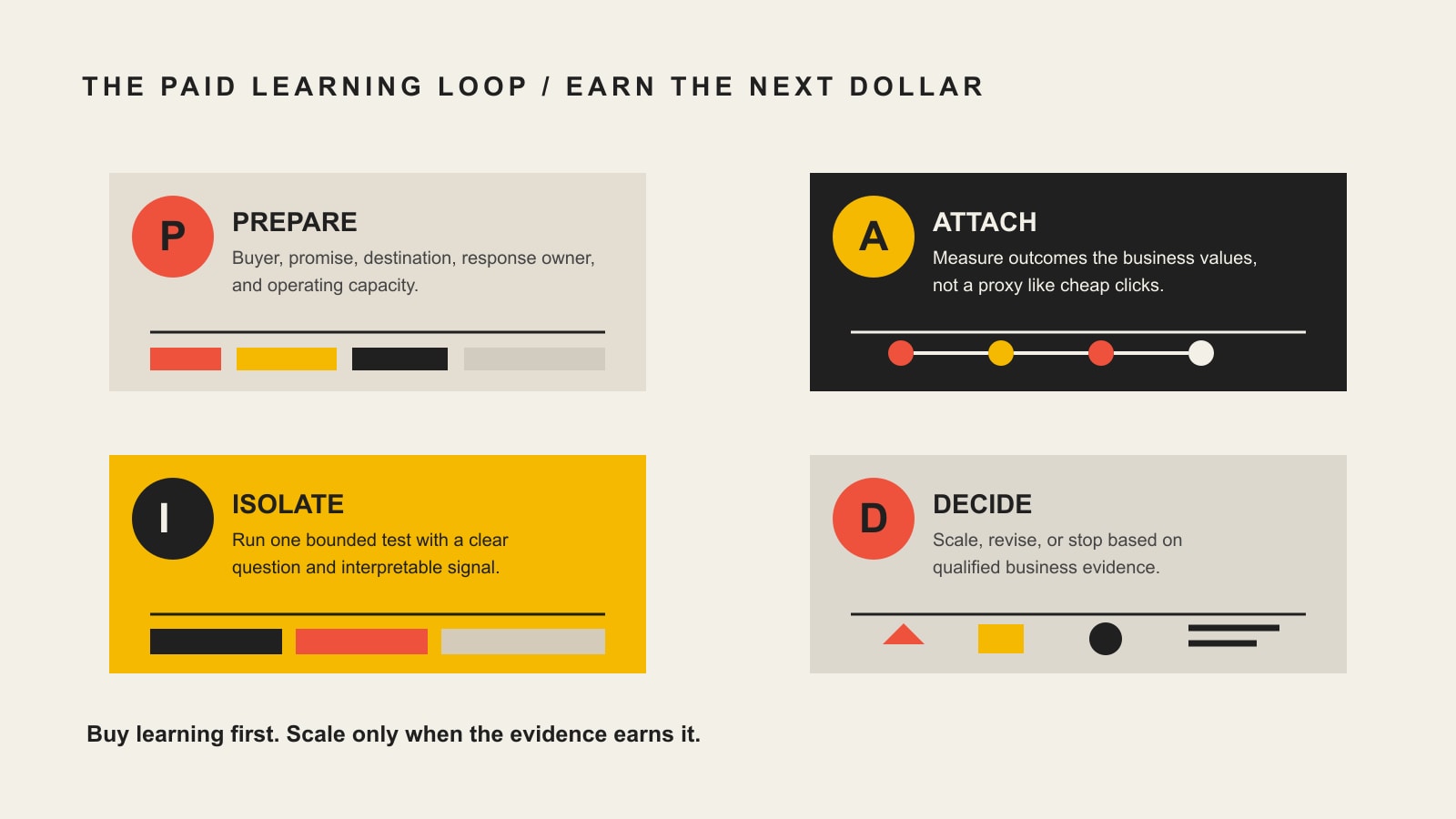
    Scope Design uses the PAID Learning Loop to keep paid media from turning into a subscription to expensive confusion. PAID stands for Prepare, Attach, Isolate, Decide. It is a loop because every meaningful result changes what you know and what should be tested next.

    The PAID Learning Loop: Prepare the conversion chain, Attach trustworthy outcomes, Isolate a bounded test, and Decide to scale, revise, or stop.
    The PAID Learning Loop turns ad spend into a controlled cycle of readiness, measurement, testing, and decision-making.

    P — Prepare the Conversion Chain

    Before launch, write down what the campaign is supposed to connect. Name the buyer, the problem or desire, the offer, the promise, the destination, the desired action, the response owner, and the capacity constraint. If one of those fields is “we’ll figure it out after traffic arrives,” you have found a pre-launch risk.

    The landing page does not need to be a twelve-section conversion cathedral. It needs to continue the ad’s promise, provide enough proof for the decision, make the next step obvious, and work on the devices people actually use. If the destination is weak, fix that before increasing reach.

    Claims also need to survive contact with reality. The Federal Trade Commission’s advertising guidance for small businesses says advertising must be truthful and non-deceptive, objective claims need evidence, and ads cannot be unfair. Fake scarcity, invented savings, and claims you cannot substantiate are not “conversion psychology.” They are liabilities wearing marketing pants.

    Finally, separate the campaign budget from the business’s total marketing budget. If you need to decide how much the company can responsibly devote to acquisition across channels, use our small-business marketing budget guide. The campaign budget is a smaller decision inside that constraint.

    A — Attach Trustworthy Outcomes

    Platforms can optimize only toward the signals they receive. That makes measurement part of campaign design, not cleanup work for Friday afternoon.

    Google Ads describes conversion measurement around actions a business considers valuable, including purchases, sign-ups, calls, and other configured actions. Its conversion tracking guidance is a useful reminder to define the valuable action first and then implement the appropriate measurement. A click is evidence that somebody clicked. It is not automatically evidence of a qualified opportunity, profitable order, or good customer.

    Measurement layerUseful questionExamplesWhat it cannot prove alone
    DeliveryDid the platform serve and attract attention?Impressions, reach, clicks, video viewsThat the traffic was qualified or profitable
    ConversionDid the visitor complete the defined action?Form submit, call, booking, purchase, sign-upThat the action had business value
    QualificationWas the action from a plausible customer?Qualified lead, valid order, sales-accepted opportunityThat the customer will close, retain, or be profitable
    EconomicsDid the outcome justify the spend and operating cost?Gross contribution, qualified acquisition cost, tracked revenue, close ratePerfect attribution across every touchpoint

    For lead generation, connect ad-source data to whatever qualifies the lead downstream when practical. For ecommerce, include cancellations, refunds, margins, and repeat behavior where they materially change the answer. If all conversions are reported to the platform as equally valuable, automation has no magical side channel where it learns which customers your sales team quietly hates.

    I — Isolate a Bounded Test

    A good paid test answers a decision. “Let’s run some ads and see what happens” is not a hypothesis; it is a receipt generator.

    Choose one meaningful uncertainty at a time when possible: buyer segment, offer, message, destination, objective, or another major variable. Define the spend or time boundary you are willing to use for learning, the evidence you need, and the conditions that would make you continue, revise, or stop. Then give the campaign enough stability to produce interpretable evidence instead of changing five settings every morning.

    There is no universal learning budget. A $20-per-day search test can be plenty in one low-cost local auction and nearly useless in a category where a single relevant click is expensive. The correct budget is the smallest amount the business can responsibly risk that still gives the test a realistic chance to produce decision-worthy evidence. If the likely spend required to learn is more than the business can afford to lose, that is a valid reason not to run the test.

    The popular “70-20-10” split can be a planning heuristic in some contexts, but it is not a law of paid advertising and it does not override campaign economics. Do not force 70% of the budget into something merely because a tidy ratio looks strategic in a slide deck.

    When the test gets platform-specific, use the specialist owner rather than treating one article as an encyclopedia. For Google Search, our Google Ads Quality Score guide explains relevance diagnostics without worshipping the score. For Meta, our Meta campaign objectives guide explains how objective and performance-goal choices tell the delivery system what behavior to seek.

    D — Decide to Scale, Revise, or Stop

    A paid campaign is not successful because cost per click fell. It is successful when the campaign’s job is being done at economics the business can support. That may mean profitable purchases, qualified appointments, sales opportunities, calls that turn into booked work, or another clearly defined outcome.

    Evidence patternLikely first diagnosisBetter next move
    Relevant clicks, weak landing-page actionPromise/destination frictionFix the destination before buying more traffic
    Many form fills, poor lead qualityTargeting, message, offer, or qualification mismatchTighten who the campaign invites and what the form qualifies
    Qualified leads, weak close rateSales handoff, response, offer, or downstream fitRepair the sales path before blaming the ad platform
    Good qualified outcomes at workable economicsPromising campaign-system fitScale cautiously and keep watching marginal quality and cost
    Tiny sample with no stable patternInsufficient evidenceKeep the test stable if the learning boundary still makes sense
    Boundary reached with no useful signalBad hypothesis or weak systemStop or redesign the test instead of funding sunk-cost theater

    Scaling is not a victory lap. It is another test. More budget can change auction dynamics, audience quality, creative fatigue, response capacity, and the mix of customers you attract. The economics that worked at one spend level are evidence, not a lifetime guarantee.

    Automation Is Powerful After the Signal Is Worth Optimizing

    Google says Smart Bidding uses Google AI at auction time to optimize toward conversions or conversion value, and Google requires conversion tracking to use Smart Bidding. That is exactly why measurement quality matters. Google’s Smart Bidding guidance describes the machinery; your business still has to decide which result deserves to be fed into it.

    Automation can process more auction signals than a human can and can make bidding adjustments continuously. What it cannot do reliably is invent your business definition of a qualified lead, decide whether an unprofitable customer is strategically valuable, repair a slow sales team, or know that a conversion event fires on the wrong page unless the data exposes the problem.

    Platform language also changes. Google documented a June 2026 transition in how some Target CPA and Target ROAS options are labeled while saying the underlying bidding behavior remains the same. That is a useful operational lesson: learn the business logic behind the setting, not just the screenshot from last year’s tutorial.

    Use the Right Paid Advertising Metrics for the Business Model

    There is no universal “good ROAS” or “good conversion rate.” A 4:1 return on ad spend can be excellent for one business and terrible for another depending on gross margin, fulfillment, refunds, sales labor, repeat purchase, and what the revenue number actually includes.

    Use platform metrics for diagnosis and business metrics for decisions:

    • Search and social delivery: impression share, click-through rate, cost per click, reach, frequency, and engagement can help explain what the system is doing.
    • Lead generation: cost per conversion should be paired with qualified-lead rate, sales acceptance, booked appointments, opportunity value, close rate, and response time where available.
    • Ecommerce: tracked revenue and ROAS should be read alongside margin, average order value, refunds, repeat purchase, and acquisition cost.
    • Long sales cycles: use staged outcomes such as qualified opportunity or pipeline movement rather than pretending every click can be assigned a final sale immediately.
    • Capacity-constrained services: include whether the team can actually respond well to the volume being created.

    The point is not to build a spreadsheet with seventy-seven columns. It is to create a short chain from spend to a business result that somebody owns.

    Common Paid Advertising Mistakes That Waste the Learning Budget

    • Optimizing for the friendliest metric. Cheap clicks are not a consolation prize if the business needs qualified leads or sales.
    • Sending every ad to the homepage. The destination should continue the specific promise that earned the click.
    • Changing too many variables at once. Constant tinkering makes it hard to know what actually improved or damaged the result.
    • Turning on automation before validating the event. Fast optimization toward a bad signal is still bad optimization.
    • Calling every form fill a lead. Qualification belongs in the measurement chain.
    • Using platform-reported revenue as the whole business case. Margin, refunds, sales labor, fulfillment, and repeat behavior can change the economics.
    • Scaling past response capacity. More demand can create a worse customer experience if nobody can answer, quote, fulfill, or follow up.
    • Refusing to stop. A sunk cost is not evidence that the next dollar deserves to join it.

    A Practical 30-Day Paid Advertising Operating Sequence

    Thirty days is not a universal verdict window. Use it as an operating cadence for building the system and making the first disciplined review.

    1. Week 1 — Prepare. Confirm the buyer, offer, promise, destination, action, response owner, capacity, and the maximum learning loss the business is willing to accept.
    2. Week 2 — Attach. Implement and test conversion tracking, source capture, phone/form/booking paths, qualification, and downstream ownership. Confirm the event fires where it should.
    3. Week 3 — Isolate. Launch the bounded test, keep major variables stable long enough to learn, review obvious errors, and avoid panic-editing every morning.
    4. Week 4 — Decide. Compare delivery, conversion, qualification, economics, and capacity. Scale only the part that has earned more exposure; otherwise repair the first weak link or stop the test.

    If the campaign is still too small or the buying cycle too long for a confident economics decision after that period, say so. “Not enough evidence yet” is a legitimate conclusion. Invented certainty is not.

    Frequently Asked Questions About Paid Advertising Strategy

    What is a paid advertising strategy?

    A paid advertising strategy is the system for deciding what outcome paid media should produce, which audience and promise to test, where the attention should go, how results will be measured, what budget can be risked for learning, and what evidence will trigger a scale, revise, or stop decision. The platform setup is part of the strategy, not the whole thing.

    How much should a small business spend testing paid ads?

    There is no universal dollar amount. Set a loss boundary the business can responsibly absorb, then ask whether that amount can realistically generate enough relevant traffic or conversions to test the hypothesis in the chosen auction. If the minimum useful learning budget would strain cash flow, do not pretend the campaign is affordable just because the platform accepts a smaller daily budget.

    Is $20 a day good for Google Ads?

    It can be, but the number by itself says almost nothing. In a low-cost local niche, $20 a day might produce enough relevant activity to learn. In a competitive market with expensive clicks, it may produce too little data to judge the offer or campaign. Work backward from auction cost, realistic conversion volume, business economics, and the decision you need the test to answer.

    What does the 70-20-10 rule mean in advertising?

    Several marketing frameworks use a 70-20-10 split for different purposes, usually to separate proven activity, adjacent experimentation, and more speculative tests. It can be a discussion starter, not a law. A paid-advertising budget should follow the business’s risk tolerance, campaign economics, evidence quality, and opportunity set rather than a fixed ratio copied from somebody else’s deck.

    When should a small business scale a paid advertising campaign?

    Scale after the campaign produces enough qualified outcomes to show that the current economics are workable and the business has capacity to handle more. Increase gradually enough to notice whether lead quality, costs, conversion rate, or fulfillment changes. A campaign that works at one spend level has earned a larger test, not infinite budget.

    What should you track before using automated bidding?

    Track the conversion action the business genuinely wants the system to optimize, validate that it fires correctly, and connect that action to qualification or value when possible. For lead generation, that may mean distinguishing a qualified inquiry from any form submission. For ecommerce, it may mean using purchase value accurately and accounting for outcomes that materially change profitability.

    What is a good ROAS for paid advertising?

    A good ROAS is one that works with your actual gross margin, fulfillment cost, refunds, sales cost, repeat behavior, and growth goals. There is no responsible universal target. Treat ROAS as one ratio inside the economics, not as a magic score that makes an unprofitable customer profitable.

    Should a small business use Google Ads or Meta Ads first?

    Start with buyer behavior and the campaign job. Google Search can be strong when people already express high-intent demand. Meta can be strong when creative, audience signals, and demand creation or discovery matter. Neither platform is universally first. Use the broader channel-fit decision in our online advertising guide, then use the platform-specific objective and measurement guidance once the channel has a reason to exist.

    Buy Learning First. Buy More Attention Only When It Earns It.

    Paid advertising is valuable because it gives a business unusual control over audience, message, destination, timing, and spend. That control makes it a powerful testing system. It also makes it painfully easy to spend faster than you learn.

    Use the PAID Learning Loop: prepare the chain, attach trustworthy outcomes, isolate a bounded test, and decide from qualified economics. If the campaign works, scale carefully. If the first weak link is the landing page, sales handoff, offer, tracking, or qualification, fix that. If the evidence says stop, stop.

    If your paid campaigns are producing activity but nobody can clearly explain what deserves more budget, Scope Design can help audit the offer, destination, tracking, campaign structure, and measurement chain. The goal is not to make the ad account busier. It is to make the next dollar easier to justify.