Tag: Marketing

  • Advertising vs. Marketing vs. Branding: What’s the Difference?

    Advertising vs. Marketing vs. Branding: What’s the Difference?

    Advertising, marketing, and branding are not three names for the same thing. Branding shapes what your business means and why people should choose it. Marketing is the broader system for understanding a market, creating demand, communicating value, converting customers, and learning from results. Advertising is paid distribution inside that marketing system.

    That distinction matters because the wrong diagnosis gets expensive fast. If people do not understand your offer, buying more ad impressions usually gives more people a chance to be confused. If your positioning is clear but nobody finds you, another logo redesign will not fix distribution. The useful question is not simply advertising vs. marketing vs. branding. It is: which problem is actually limiting growth right now?

    TL;DR: Which One Do You Need?

    • Branding / Clarity: Start here when people do not understand what makes you different, do not remember you, or do not have a clear reason to prefer you.
    • Marketing / System: Prioritize this when the offer and position make sense but there is no repeatable path to qualified demand, follow-up, conversion, or retention.
    • Advertising / Scale: Add paid reach when you already have a credible message, a defined audience, a conversion path, and enough capacity to handle more qualified opportunities.

    That is the practical version of Scope Design’s Clarity → System → Scale diagnostic. It is not a rigid sequence; it is a way to identify the current bottleneck before buying a tactic.

    Advertising vs. Marketing vs. Branding at a Glance

    DisciplineCore questionWhat it ownsTypical workUseful signals
    BrandingWhat should people understand, remember, and prefer about us?Positioning, meaning, identity, voice, consistency, reputationBrand strategy, messaging, visual identity, guidelines, customer experienceRecognition, preference, trust, consistency, direct demand
    MarketingHow do we connect the right offer with the right market and move people toward a decision?Market insight, demand generation, customer journey, channels, conversion, retention, measurementResearch, content, SEO, email, social, offers, landing pages, analytics, campaignsQualified traffic, leads, conversion rate, customer acquisition, retention, revenue quality
    AdvertisingWhere should we pay to put a specific message in front of a specific audience?Paid reach, campaign targeting, creative, media buying, testingSearch ads, paid social, display, video, sponsorships, traditional mediaQualified reach, cost per result, conversion quality, return relative to spend

    The American Marketing Association’s marketing-vs.-advertising explanation makes the same essential distinction: marketing is broader, while advertising is a paid practice within that larger business activity. Branding overlaps with marketing, but it answers a different set of questions about identity, positioning, meaning, and memory.

    What Is Branding?

    Branding is the deliberate work of shaping what people expect from your business and why they should care. It includes visual identity, but a brand is not a logo, color palette, or font selection. Those are tools for expressing the brand.

    The deeper work is deciding who you are for, what you want to be known for, what makes your offer meaningfully different, what promise customers should expect you to keep, and how that idea shows up consistently. That is why strong branding influences sales conversations, website copy, hiring, customer service, packaging, content, and advertising creative—not just design.

    In practical terms, branding should make it easier for the right person to answer questions such as:

    • Is this company for someone like me?
    • What does it do differently from the alternatives?
    • What should I expect if I buy?
    • Does the business feel credible and consistent?
    • Why would I remember or recommend it?

    If those answers are fuzzy, the problem is usually deeper than promotion. Scope Design’s brand strategy guide goes further into building a recognizable, usable brand system rather than treating branding as a one-time design project. Kantar’s branding-versus-marketing overview also emphasizes the long-term role branding plays in recognition and distinctiveness.

    One more distinction matters: branding can make a promise recognizable, but recognition is not the same as authority. If the market understands what you claim but still does not believe it, the constraint is proof. Our brand authority guide explains how evidence, useful expertise, experience, reputation, and corroboration earn that belief.

    What Is Marketing?

    Marketing is the system that connects a business, an offer, and a market. It starts before promotion. Good marketing asks what customers need, which segment is worth serving, how the offer should be positioned and priced, where buyers look for answers, what information they need before they act, and how the business will know whether the strategy is working.

    That system can include market research, product and offer strategy, content, search engine optimization, email, social media, events, partnerships, public relations, sales enablement, landing pages, conversion work, customer retention, and measurement. Advertising can be part of the mix, but marketing does not require paid media to exist.

    This is where small businesses often get trapped by tactics. A company says it “needs marketing,” then immediately jumps to “we should post more on Facebook” or “we should run Google Ads.” Those may be useful tactics. They are not a strategy until they are connected to an audience, an offer, a message, a customer journey, a goal, and a way to evaluate the result.

    If budget is tight, that distinction is even more important. Scope’s guide to marketing strategies that do not require media spend is useful when the real problem is building a demand system rather than buying reach immediately.

    What Is Advertising?

    Advertising is the paid placement of a message in front of an audience. Search ads, paid social, display ads, video spots, sponsored placements, radio, print, direct-mail media buys, and billboards can all fit the category.

    Advertising is powerful because it can buy access to attention faster than most organic channels can earn it. It can also create a clean testing environment: define an audience, run an offer and creative, measure what happened, and change the campaign. But paid reach does not repair a weak offer, unclear positioning, a poor landing page, or a sales process that cannot close qualified leads.

    Think of advertising as an amplifier. An amplifier makes a strong signal louder. It also makes a weak signal louder.

    Marketing vs. Advertising: Strategy and System vs. Paid Distribution

    The simplest way to understand marketing vs. advertising is that marketing is the larger system and advertising is one way to distribute a message within that system.

    A marketing decision might be: “Commercial contractors are our most profitable segment, and they need proof that we can respond quickly across multiple job sites.” An advertising decision comes later: “We will use paid search to reach contractors actively looking for that service, send them to a landing page built around response time and coverage, and measure qualified quote requests.”

    You can market without advertising through SEO, referrals, email, partnerships, organic content, events, or direct outreach. You cannot make advertising strategic simply by buying media. The ad still needs a market, offer, message, destination, and measurement plan.

    Branding vs. Marketing: Meaning vs. Bringing That Meaning to Market

    Branding vs. marketing is less about choosing one and more about understanding their jobs. Branding establishes the meaning and expectations you want attached to the business. Marketing turns that position into a system that reaches people, earns attention, creates demand, and helps customers move toward a decision.

    Branding without marketing can become a beautifully defined business nobody discovers. Marketing without brand clarity can produce activity without preference: traffic arrives, but prospects struggle to understand why this company is the right choice.

    Branding vs. Advertising: The Signal vs. the Megaphone

    With branding vs. advertising, the separation is sharper. Branding helps determine what the message should mean. Advertising pays to put a specific version of that message in front of people.

    A company can have memorable ads and still have a weak brand if the promise changes from campaign to campaign or the customer experience contradicts the message. It can also have a strong brand and use little paid advertising if referrals, search demand, partnerships, or repeat business already provide enough qualified opportunity.

    How Branding, Marketing, and Advertising Work Together

    Imagine a local commercial service company that has grown mostly through referrals. The work is good, but prospects describe the company in five different ways and the website lists services without explaining why a buyer should choose them.

    1. Branding: The company clarifies its best-fit customer, the problem it solves unusually well, its positioning, proof, voice, and visual consistency. The message becomes specific enough that employees and customers can repeat it.
    2. Marketing: It builds pages around high-intent services, creates useful content that answers buyer questions, improves local/search visibility, adds follow-up email, and defines how inquiries will be measured and qualified.
    3. Advertising: Once the offer and landing-page path are working, it buys paid search or social reach for the highest-value audience and tests messages against real conversion quality.

    The three disciplines reinforce one another. Branding makes the message more coherent. Marketing gives that message a system and customer journey. Advertising can accelerate qualified exposure. Results from marketing and advertising then create feedback that can sharpen the offer and, occasionally, reveal that the brand position needs to change.

    What Comes First: Branding, Marketing, or Advertising?

    “Branding first, then marketing, then advertising” is a useful teaching shortcut, but it is too rigid for an operating business. A better approach is to diagnose the current constraint. At Scope Design, we can frame that as Clarity → System → Scale.

    1. Clarity: Fix Branding When the Market Does Not Understand or Prefer You

    Start with brand strategy when prospects reach you but still cannot tell what makes you different, your offer attracts the wrong expectations, the sales team describes the company inconsistently, or every campaign needs a new message because there is no stable position underneath it.

    Clarity does not mean spending months polishing a logo before talking to customers. It means getting the promise, audience, differentiation, proof, voice, and identity coherent enough that marketing has something useful to carry into the market.

    2. System: Fix Marketing When There Is No Repeatable Path to Demand

    Prioritize marketing when the brand and offer make sense but customer acquisition is inconsistent. Maybe referrals are the only dependable source of work. Maybe traffic lands on disconnected pages. Maybe content exists without a clear buyer journey, follow-up, conversion path, or measurement plan.

    The goal is not “do more marketing.” It is to build a system: define the audience and problem, choose a channel based on buyer behavior, create the right message and destination, give people an obvious next step, and measure the quality of the resulting opportunities.

    3. Scale: Add Advertising When the Message and Conversion Path Are Proven Enough to Amplify

    Paid media becomes more attractive when you already know who tends to buy, the offer converts at a level the business can support, the sales process can handle more opportunities, and the economics leave room to buy qualified attention.

    That does not mean every campaign must wait for perfect data. Advertising can be used for testing. The important point is that the test should have a hypothesis. If the business has no clear audience, message, offer, or conversion path, “let’s run ads and see what happens” is usually an expensive way to discover several problems at once.

    How Much Should You Spend on Branding, Marketing, and Advertising?

    There is no responsible universal percentage that says every business should spend a fixed amount on branding, another fixed amount on marketing, and another on advertising. The old version of this article gave percentage ranges. We have removed them because a useful budget depends on the business model, growth goal, margins, sales cycle, market, existing assets, capacity, and—most importantly—the current constraint.

    A better budgeting sequence is:

    1. Name the business outcome. More qualified opportunities? Better close rate? A new-market launch? Higher retention? More direct demand?
    2. Find the constraint. Is the main problem clarity, the marketing system, or reach?
    3. Fund the smallest credible intervention. Do enough work to test the diagnosis instead of scattering money across every channel.
    4. Protect the bottleneck downstream. More leads are not useful if fulfillment, sales follow-up, or capacity cannot absorb them.
    5. Measure quality, not just activity. Impressions and clicks can be useful campaign signals, but the business ultimately needs qualified customer behavior.

    This is also why buyer behavior matters. If traffic is healthy but prospects hesitate, the issue may be message, proof, risk, or perceived value rather than distribution. Our guide to buyer psychology and diagnosing why customers say yes or do not can help separate those problems.

    Four Common Business Scenarios

    Scenario 1: “We Just Launched and Need Customers”

    Do enough branding to establish a clear audience, promise, offer, proof, and recognizable identity. Then build the simplest marketing path that can put that offer in front of real prospects and capture learning. Advertising may speed up that learning, but only if the campaign is designed as a test rather than a substitute for strategy.

    Scenario 2: “People Like Us, but Growth Comes Almost Entirely From Referrals”

    This often points to a marketing-system constraint. The brand may already have trust and proof; the missing piece is repeatable discovery and follow-up. Build search visibility, useful content, email capture or nurturing, partnerships, or another channel your buyers actually use before assuming the answer is a rebrand.

    Scenario 3: “Organic and Referral Leads Convert Well, but We Need More Volume”

    This is a stronger advertising case. You have evidence about the audience and offer, so paid search, paid social, sponsorships, or another paid channel can be tested as an acceleration mechanism. Keep comparing paid lead quality with the channels that already work.

    Scenario 4: “Our Ads Are Getting Expensive and Performance Is Falling”

    Do not automatically solve an advertising problem with more advertising. Break the system apart. Has the audience changed? Is the offer less compelling? Is creative fatigued? Does the landing page match the ad? Are competitors changing the economics? Are leads qualified but sales follow-up is weak? Sometimes the fix is campaign execution. Sometimes the ad is merely exposing a positioning, offer, conversion, or capacity problem.

    If you are deciding between an educational demand-generation tactic and paid promotion, our webinars vs. advertising comparison shows how two very different approaches can fit different goals.

    Common Mistakes When Businesses Mix Up Branding, Marketing, and Advertising

    • Using advertising to compensate for weak positioning. More reach cannot make an undifferentiated promise distinctive.
    • Treating branding as a cosmetic refresh. A new visual identity can help expression and consistency, but it cannot replace decisions about audience, position, promise, and proof.
    • Calling a list of channels a marketing strategy. “SEO + Facebook + email” is a media list until it is tied to a customer, outcome, message, journey, and measurement plan.
    • Changing everything at once. If you replace the offer, page, audience, campaign objective, creative, and follow-up simultaneously, even a better result may not tell you what actually worked.
    • Optimizing for cheap activity instead of valuable behavior. A low-cost click from the wrong prospect can be worse than an expensive click from someone likely to become a profitable customer.

    Frequently Asked Questions

    Is advertising part of marketing?

    Yes. Advertising is generally a paid promotional activity within the broader marketing system. Marketing also includes work such as market research, offer strategy, pricing, distribution, content, SEO, email, conversion, retention, and measurement.

    Is branding part of marketing?

    They overlap, but it is more useful to treat branding as a discipline with its own job. Branding shapes the meaning, identity, positioning, and expectations attached to the business. Marketing uses and reinforces that position while connecting the business with its market.

    What comes first, marketing or branding?

    A new business usually needs enough brand clarity to define who it serves, what it promises, and why it is different before scaling promotion. An existing business should diagnose the constraint instead of blindly following a sequence. If the market understands and prefers the offer but demand is inconsistent, marketing may be the priority. If marketing already produces qualified customers and the business needs more reach, advertising may be next.

    Can a business succeed without advertising?

    Yes. Businesses can acquire customers through referrals, SEO, organic content, partnerships, direct outreach, events, email, public relations, repeat business, and other non-paid channels. Advertising is useful when paid reach improves the economics or speed of a proven customer-acquisition system; it is not mandatory for every company.

    Do I need a rebrand before I run ads?

    Not automatically. You need enough clarity that the ad can make a credible, differentiated promise to a defined audience and the destination page can continue that promise. If those pieces already work, a full rebrand may be unnecessary. If prospects routinely misunderstand the offer or the company presents itself inconsistently, brand work may be the higher-leverage fix.

    Start With the Constraint, Not the Tactic

    The practical difference between advertising, marketing, and branding is not academic. Each solves a different class of problem. Branding creates clarity and preference. Marketing builds the system that connects an offer to a market. Advertising buys reach to amplify a message.

    Before you buy another tactic, identify whether your biggest limitation is Clarity, System, or Scale. That one decision can prevent a business from paying to amplify the wrong problem.

    If you want help diagnosing which layer needs work, Scope Design’s Advertising and Marketing and Branding & Graphics services cover both sides of the problem, or you can contact Scope Design and start with the business constraint rather than a preselected channel.

  • Email Subject Lines: Write an Honest Promise, Not Inbox Clickbait

    Email Subject Lines: Write an Honest Promise, Not Inbox Clickbait

    A good email subject line tells the right recipient what the message is about, why it matters now, and what kind of value or action is inside—without lying, shouting, or playing psychological three-card monte. It should earn attention by making a relevant promise the email actually keeps.

    TL;DR: Make the sender recognizable, state the useful point early, match the body exactly, front-load words that survive mobile truncation, and judge the subject by downstream actions—not only opens. Curiosity is fine. Manufactured urgency, fake personalization, and deceptive framing are trust debt wearing marketing pants.

    What Is an Email Subject Line?

    An email subject line is the short inbox headline that identifies the topic or purpose of a message before the recipient opens it. It works beside the sender name, sender address, preview text, timing, and the recipient’s existing relationship with the business.

    That context matters. The subject line does not operate in a laboratory. A precise service notice from a company the customer recognizes can outperform a “power-word” masterpiece from an unfamiliar sender. A relevant appointment reminder does not need curiosity. A promotional email may need a stronger reason to care, but it still does not need to pretend the recipient’s account is on fire.

    The subject line’s real job is to make a trustworthy micro-decision easier: Is this message relevant enough to open now, save for later, or ignore?

    The Scope Design Inbox Promise Test

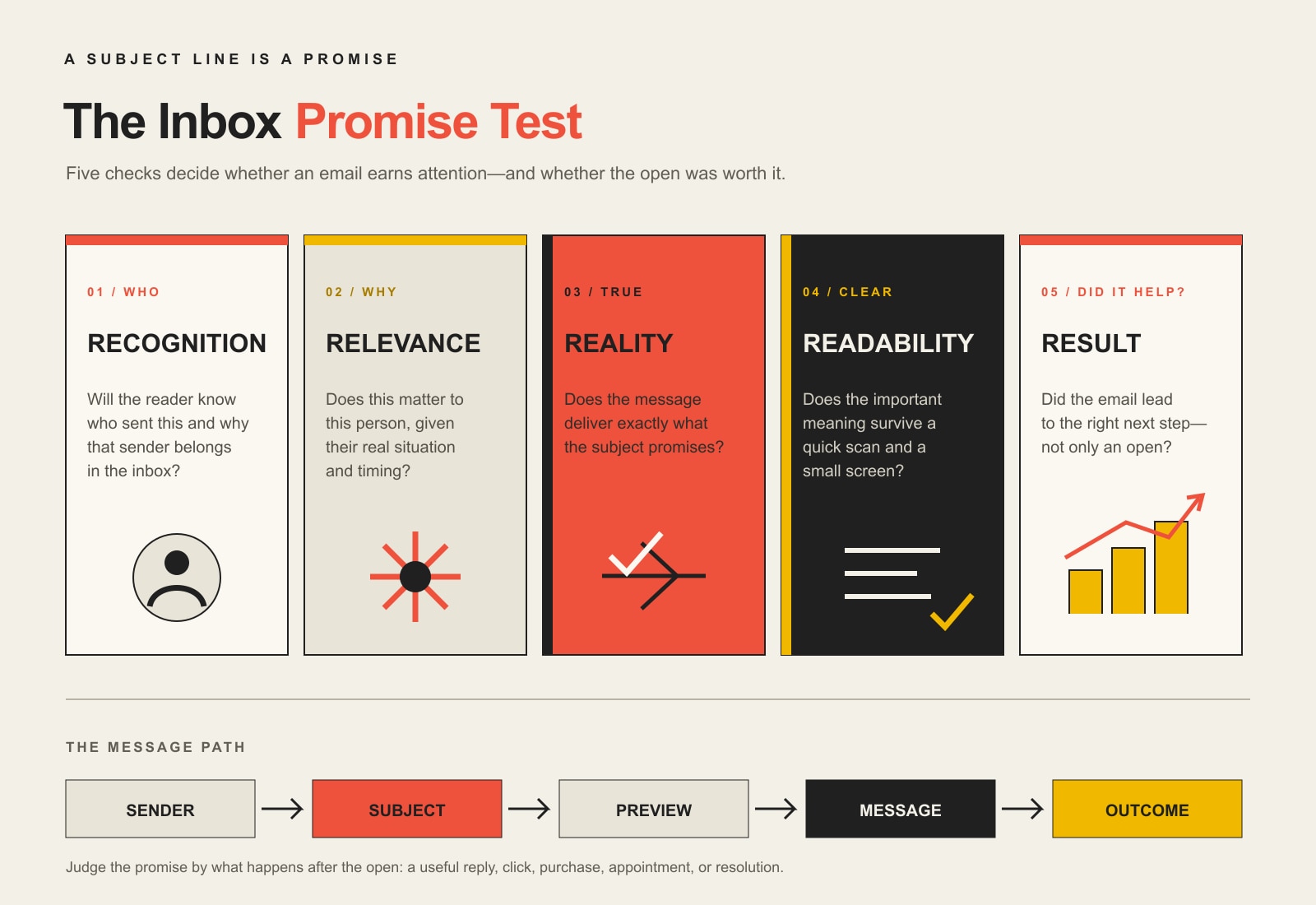
    The Inbox Promise Test checks recognition, relevance, reality, readability, and result, tracing a message from sender through subject, preview, and message to outcome.

    Evaluate every subject line through five connected checks: Recognition, Relevance, Reality, Readability, and Result.

    CheckQuestionFailure signal
    RecognitionWill the recipient understand who this is and why that sender belongs in the inbox?A clever line arrives from an unrecognizable name or reply address
    RelevanceDoes the subject connect to this recipient’s actual situation, preference, purchase, question, or timing?Decorative personalization tries to imitate a relationship
    RealityDoes the body deliver exactly what the subject promises?“Last chance” is followed by three more last chances
    ReadabilityCan the important meaning survive quick scanning, mobile truncation, and ordinary human distraction?The useful noun is buried after a ceremonial preamble
    ResultDid the message help produce the intended reply, click, purchase, appointment, resolution, or other next step?Opens rise while complaints, low-quality clicks, or unsubscribes rise too

    Most advice begins at Readability—shorter words, emojis, punctuation, “power” verbs. Those details can matter, but they are downstream. Recognition, relevance, and reality determine whether the subject deserves to be opened. Result determines whether the open was worth anything.

    1. Start with the Message’s Job

    Write the subject after deciding what the email must help the recipient understand or do. If the team cannot state the message’s job in one sentence, the subject line will probably become vague, inflated, or both.

    Useful jobs include:

    • confirm an order, appointment, payment, or request;
    • explain a change that affects the customer;
    • deliver something the recipient asked for;
    • answer a consequential question;
    • invite a qualified next step;
    • announce a genuine offer, deadline, event, or availability change;
    • support onboarding, service, renewal, or re-engagement;
    • publish a recurring newsletter with a clear editorial promise.

    “Increase engagement” is not a message job. “Help current hosting customers understand the maintenance window and whether they need to do anything” is.

    This fits the broader small-business email marketing strategy: each message needs permission, purpose, a maintained contact record, relevant context, reliable delivery, an accountable handoff, and an observable outcome. A subject line is one promise inside that system, not the system itself.

    2. Put the Useful Meaning First

    Inbox interfaces truncate subject lines differently according to device, app, window width, font settings, and whether preview text is shown. There is no universal character count that guarantees full display everywhere.

    Instead of worshipping an exact length, front-load the information that helps the reader classify the message:

    Weak or delayedClearer front-loaded versionWhy it is better
    A quick update regarding the changes to your upcoming appointmentAppointment moved to 2:30 ThursdayThe decision-changing fact arrives first
    We wanted to let you know about some exciting new store hoursNew Saturday hours begin September 5Specific change before filler
    Don’t miss out on this incredible opportunity before it is too lateRegistration closes Friday at noonReal deadline replaces theatrical urgency
    Here is an important document you requested from our teamYour website audit is readyRequested object and status are immediate
    Following up with some additional information for your reviewRevised estimate: hosting option addedThe revision is identifiable in the inbox

    Short is useful when it removes waste. Short is not automatically clear. “Quick question” is compact but forces the recipient to open the message to discover whether the question is relevant. “Question about the March estimate” is longer and more respectful.

    3. Coordinate the Sender Name, Subject, and Preview Text

    The sender name answers “Who?” The subject answers “What and why now?” The preview text can add context or the next useful detail. Treat them as a small message hierarchy.

    For example:

    • Sender: Scope Design Support
    • Subject: Website maintenance begins at 9 p.m.
    • Preview: No action is required; expected interruption is under five minutes.

    Repeating the same sentence three times wastes the limited inbox surface. Hiding the sender behind an employee name the customer has never seen damages Recognition. Allowing the preview to begin with “View this email in your browser” makes the software—not the customer—the main character.

    Use a monitored reply address when replies are appropriate. “No-reply” may be necessary for some transactional systems, but it should not become the default for relationship-building messages that invite conversation.

    4. Use Personalization Only When It Adds Meaning

    A first name is not relevance. It is a database field wearing a tiny hat.

    Useful personalization reflects a legitimate relationship fact that changes the message:

    • the recipient requested a specific guide or estimate;
    • an appointment, order, account, service, or project has a real status;
    • a product is back in stock for people who requested notice;
    • an event or service applies to the recipient’s location;
    • the person selected a topic or communication preference;
    • a customer action created a useful next step.

    Bad personalization is decorative, inaccurate, overly intimate, or based on data the recipient did not expect the business to use. It can reduce trust faster than a generic subject because it demonstrates that the database knows something without demonstrating that the business understands anything.

    Before using a personalized field, define the fallback, test missing or malformed values, and confirm that the data stays current. “Hi FNAME, your Albany order is ready” is not the unforgettable brand experience anyone ordered.

    5. Curiosity Must Have a Payload

    Curiosity works when the subject reveals enough context to let the right person recognize relevance while leaving a useful question the body answers.

    Responsible curiosity:

    • The form field costing applicants unnecessary time
    • Why the redesign did not fix the lead problem
    • One hosting responsibility most proposals leave vague
    • What changed in your July service report

    Empty curiosity:

    • You won’t believe this
    • This changes everything
    • We need to talk
    • Bad news...

    The first group names a topic and creates a credible information gap. The second group withholds the topic to force an open. That may generate activity, but it also trains recipients to treat the sender like a carnival barker who wandered into Outlook.

    Use the inbox test: Would the subject still feel fair after the message is opened? If the body cannot pay off the curiosity immediately and specifically, rewrite it.

    6. Use Urgency Only When Time Is Actually the Constraint

    Urgency is appropriate for a real appointment, deadline, expiring application, limited capacity, service interruption, inventory condition, or time-bound offer. State the concrete constraint.

    Better urgency:

    • Approve the proof by Tuesday for Friday delivery
    • Two consultation slots remain for September
    • Renewal price changes October 1
    • Store closes at 3 p.m. during road work

    Manipulative urgency:

    • ACT NOW!!!
    • Final warning when nothing bad happens if the reader ignores it;
    • Only three left when inventory is not actually limited;
    • a countdown that resets when the page reloads;
    • “today only” followed by the same sale tomorrow.

    Genuine urgency improves a decision by revealing time. Manufactured urgency steals a decision by faking it. Scope Design will not trade next quarter’s trust for this afternoon’s open rate.

    7. Negative Framing Can Clarify a Problem—Or Manufacture One

    Negative framing is not inherently deceptive. A subject such as Three errors blocking the application form can be useful when those errors are real and the email explains them. A warning can be the most responsible subject when a customer faces a security, billing, service, safety, or deadline issue.

    The problem begins when negative emotion is used as bait:

    • implying an account problem that does not exist;
    • inventing a mistake or threat;
    • using shame or anxiety unrelated to the message;
    • presenting an ordinary promotion as an emergency;
    • claiming a tactic “doesn’t work” only to sell the same tactic inside.

    The old separate Scope Design article on negative subject lines claimed a universal 15–25% open-rate lift and a $1,000-per-email legal risk. Neither belongs in an evergreen recommendation. The lift was unsupported, and Washington changed its commercial email statute effective June 11, 2026. The current law prohibits a subject line that, based on actual knowledge or knowledge fairly implied by objective circumstances, contains false or misleading information. It also changed statutory damages for recipients. Legal rules can move; a tidy old penalty figure should not be left pretending it is immortal.

    The durable recommendation is simpler: use negative framing only for a real, relevant problem; make the claim supportable; match the body; and consider applicable federal, state, industry, and international rules. This is editorial and operational guidance, not individualized legal advice.

    The Federal Trade Commission’s CAN-SPAM compliance guide says commercial email subject lines must accurately reflect the message content. Accurate routing information, a valid postal address, an effective opt-out, and other requirements also apply.

    Washington’s current RCW 19.190.020 separately addresses false or misleading commercial email subject lines in messages sent from a computer in Washington or to an address the sender knows or has reason to know belongs to a Washington resident. Other jurisdictions may impose different requirements.

    Compliance is the floor. A technically defensible subject can still be manipulative, annoying, or corrosive. Ask whether the recipient would feel tricked after opening the email. If the answer is yes, the open is not a win. It is a loan taken against sender trust.

    9. Emojis, Capitals, and Punctuation Are Context—Not Strategy

    An emoji can help label a familiar recurring message, add a small amount of tone, or make a legitimate event easier to scan. It can also render differently across platforms, distract from the meaning, create accessibility friction, or make a professional message look like it escaped from a clearance bin.

    Use symbols only when they add meaning. Do not replace critical words with an icon. Test the subject in the email clients and assistive settings relevant to the audience. The same restraint applies to capitalization and punctuation.

    • Sentence case usually scans naturally.
    • ALL CAPS resembles shouting and can reduce readability.
    • One question mark is usually enough to indicate a question.
    • Repeated exclamation points do not make the offer more true.
    • Brackets such as [Invoice] or [Action required] can help recurring operational email when the label is accurate and consistently used.

    There is no magical “spam word” list that automatically determines delivery. Google’s sender guidelines emphasize authentication, wanted mail, spam rates, alignment, and subscription practices. Subject-line styling is one signal inside a much larger sender relationship.

    10. Test the Promise, Not Just the Trick

    An A/B test should answer a useful question. Test one material difference against a meaningful segment, give the test enough data and time to reduce random noise, and interpret the result according to the message’s business job.

    Useful test questions include:

    • Does a specific outcome outperform a generic announcement?
    • Does front-loading the deadline reduce missed actions?
    • Does the customer’s chosen topic improve qualified clicks?
    • Does a straightforward subject create fewer opens but more replies or purchases?
    • Does an operational label reduce support confusion?

    Open rate is an imperfect signal. Apple Mail Privacy Protection can prevent senders from seeing whether a recipient opened a message and can load remote content privately in the background. Judge tests using the deepest observable result the email can reasonably influence: replies, useful clicks, bookings, purchases, completed steps, service resolution, unsubscribes, complaints, or downstream revenue where traceable.

    Low-volume small businesses should be especially skeptical of tiny subject-line tests. If each version reaches forty people, a difference of three opens is not a universal law. Use the result as a clue, combine it with replies and sales feedback, and prioritize larger problems such as list quality, offer relevance, delivery, and follow-up.

    11. Resend to Non-Openers Carefully

    Automatically resending every campaign to “non-openers” is not an ultimate hack. Open tracking is imperfect, so the group may include people who opened privately. Repeated sends can also increase fatigue, complaints, or unsubscribes.

    A resend can be reasonable when:

    • the message is genuinely important or time-sensitive;
    • the audience expects the communication;
    • the original timing may have buried it;
    • the new subject clarifies rather than manipulates;
    • the resend is limited and monitored;
    • the message stops after the recipient acts.

    Do not turn “in case you missed it” into an automated nagging subscription nobody requested. When the message contains a real deadline, say what it is. When it does not, allow silence to remain a valid response.

    Email Subject Line Examples by Message Job

    Examples should be adapted to the actual facts. Brackets indicate information the business must supply honestly.

    Message jobSubject-line patternExample
    Requested resource[Resource] is readyYour website planning worksheet is ready
    Appointment[Appointment] + [specific change or action]Site review moved to 2:30 Thursday
    Estimate or proposal[Document/status]: [meaningful update]Revised estimate: migration option added
    Service notice[System/service] + [timing or impact]Website maintenance begins at 9 p.m.
    Invoice[Invoice identifier] + [status or due date]Invoice 1042 is due Friday
    Event[Event] + [real deadline or next step]Workshop registration closes Friday at noon
    Newsletter[Useful topic or conclusion]Why the redesign did not fix the lead problem
    Product availability[Product] + [truthful status]The walnut desk is back in stock
    Re-engagement[Preference or relationship question]Still want the monthly website briefing?
    Sales follow-up[Shared context] + [specific next step]Question about the auction-system diagnostic

    For recurring editorial email, the email newsletter guide should govern the format and reader promise. The subject should identify the strongest useful idea, not disguise the newsletter as a personal emergency.

    A Practical Subject-Line Writing Process

    1. Write the message’s primary job in one sentence.
    2. Identify the recipient’s legitimate relationship and why the message matters now.
    3. Draft one plain, specific subject that tells the truth without trying to be clever.
    4. Draft two alternatives that change one meaningful angle: context, outcome, question, or genuine timing.
    5. Apply the Inbox Promise Test: Recognition, Relevance, Reality, Readability, Result.
    6. Coordinate sender name and preview text without repeating the same words.
    7. Test personalization fallbacks, truncation, links, reply handling, and the actual body promise.
    8. Send only to the appropriate permissioned segment.
    9. Review downstream actions, complaints, unsubscribes, and sales or service feedback.
    10. Save useful patterns with their audience and context—not as universal swipe-file commandments.

    Frequently Asked Questions About Email Subject Lines

    What is a good email subject line?

    A good subject line is recognizable, relevant, truthful, easy to scan, and connected to the message’s intended result. It helps the right recipient understand what is inside without forcing an open through ambiguity or pressure.

    What should I write in the subject of an email?

    State the most useful combination of topic, status, timing, and required action. For operational email, specifics such as Invoice 1042 due Friday or Appointment moved to 2:30 Thursday usually beat cleverness.

    What is an example of a professional email subject line?

    Revised project estimate: hosting option added is professional because it names the document, identifies the change, and avoids filler. The best wording depends on the real relationship and message job.

    How long should an email subject line be?

    There is no universal ideal character count because inbox displays vary. Keep it as short as clarity permits and put the decision-changing words first so the meaning survives truncation.

    Do emojis improve email subject lines?

    Sometimes an emoji can help scanning or tone for an audience that expects it. It is not a guaranteed performance lift. Use it only when it adds meaning, never as a substitute for critical words, and test rendering and accessibility.

    Should I put the recipient’s first name in the subject line?

    Only when the personalization is accurate and meaningfully improves relevance. A first name pasted into a generic promotion is not a relationship. Context such as a requested estimate, appointment, order, or chosen topic is often more useful.

    Do urgent subject lines get more opens?

    Genuine urgency can help recipients act on a real deadline or constraint. Manufactured urgency may create an open while damaging trust, complaints, and long-term response. State the concrete deadline rather than shouting.

    Are negative email subject lines effective?

    They can clarify a genuine risk, mistake, or problem, but there is no universal lift. Negative framing should be accurate, relevant, supported by the body, and evaluated beyond opens. Do not invent anxiety to manufacture attention.

    Can I resend an email with a different subject line?

    Yes, selectively. Use resends for genuinely important messages, account for imperfect open tracking, change the subject to improve clarity, limit frequency, stop after action, and monitor complaints and unsubscribes.

    How should I A/B test email subject lines?

    Test one meaningful difference at a time, use a relevant segment, and judge the deepest observable result—not merely opens. For a low-volume list, treat small differences as clues rather than statistical commandments.

    Which words send an email to spam?

    No single universal word list determines inbox placement. Authentication, permission, complaints, reputation, list quality, content, sending patterns, and platform rules all matter. Excessive caps, punctuation, and misleading promotion can still harm trust and complaint rates.

    What email subject lines get the most opens?

    No wording wins across every audience and message. The most dependable starting point is a recognizable sender, specific relevance, an honest promise, and clear meaning. Then measure replies, clicks, conversions, service outcomes, complaints, and unsubscribes in your own context.

    Your Subject Line Is a Promise

    The subject line does not need to win a shouting match against every message in the inbox. It needs to help the right person recognize a useful message from a sender they can trust.

    If email performance is weak across the board, do not spend the next month rearranging punctuation while the list, offer, authentication, segmentation, or follow-up process is broken. Scope Design’s Impact Consulting can identify the actual constraint before another round of “killer subject lines” murders the remaining goodwill.

  • Small Business Marketing Budget: How Much Should You Actually Spend?

    Small Business Marketing Budget: How Much Should You Actually Spend?

    A small business should spend the amount its economics, operating capacity, and evidence can justify—not a random percentage of revenue copied from a company with a billion-dollar balance sheet. Start by identifying the real business constraint. Then calculate what a customer is worth before acquisition, confirm the offer and follow-up path work, set a loss you can tolerate, and run a bounded test with a written stop, continue, or expand rule.

    If you need a single percentage before you have done any of that, you do not have a marketing budget yet. You have a comforting little number wearing a business costume.

    TL;DR: The Responsible Answer

    • Revenue percentages are context, not a prescription.
    • Marketing includes more than ad spend. Count the people, creative, technology, destination, measurement, and follow-up required to make the campaign work.
    • Budget from contribution and cash flow, not revenue alone.
    • Fix a broken offer, website, form, sales response, or fulfillment constraint before paying to expose it to more people.
    • Test one clear hypothesis within a loss boundary you can survive.
    • Judge qualified outcomes and downstream economics—not reach, clicks, followers, or a giant sack of useless leads.

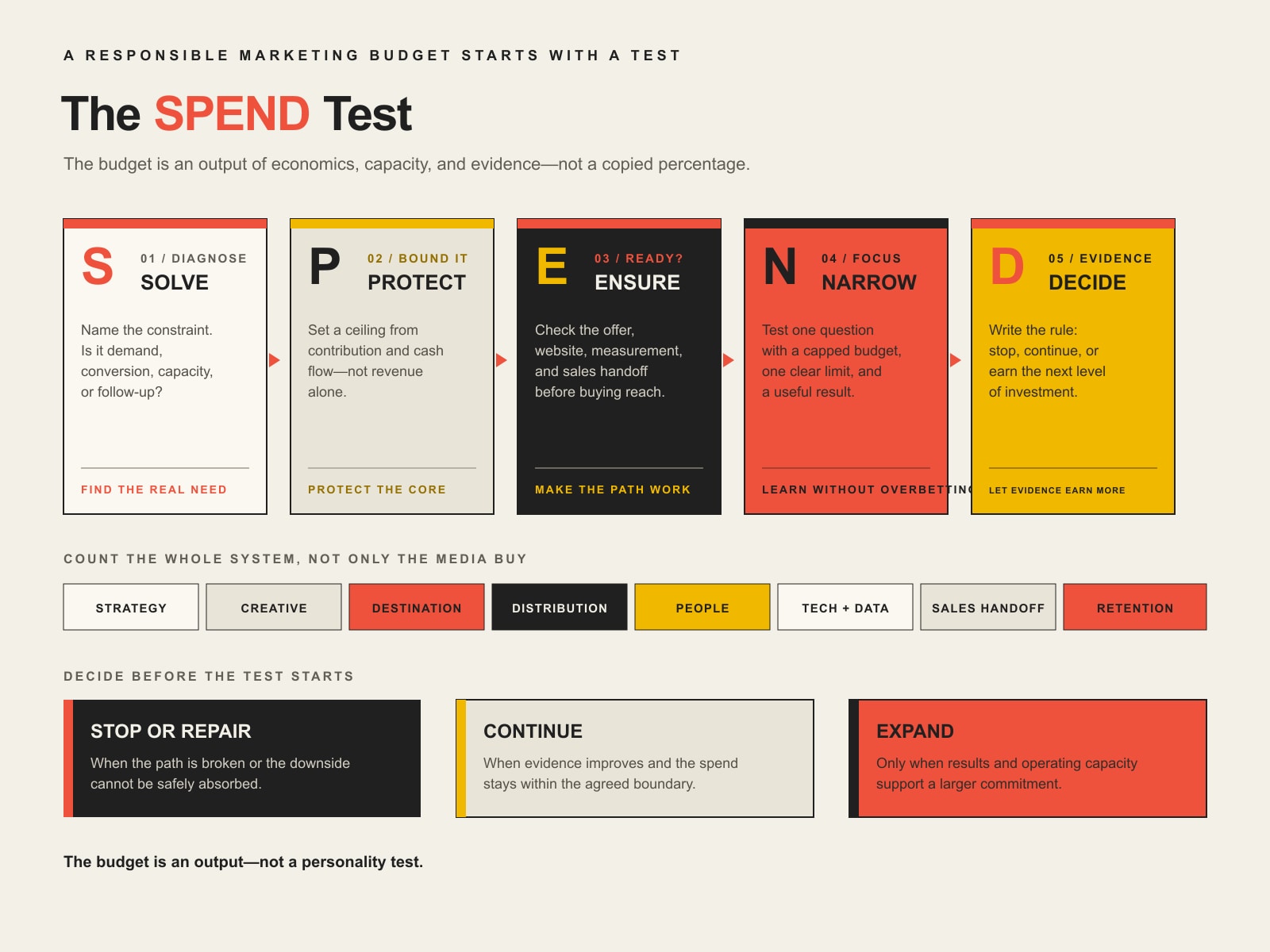
    Use the Scope Design SPEND Test: Solve the right constraint, Protect the economics, Ensure the path works, Narrow the test, and Decide what the evidence earns next.

    In This Guide

    Why Percentage Rules Are Incomplete

    Search for a small business marketing budget and you will find a glorious buffet of percentages. Spend 5%. Spend 8%. Spend 12%. Use 70/20/10. Use 60/40. Apparently the fate of your company can be solved by picking the nicest-looking fraction.

    Benchmarks can be useful. They tell you what a particular group reported spending under particular conditions. They do not tell you whether your next dollar should go to advertising, a broken contact form, a salesperson who answers the phone, customer retention, or nowhere at all.

    For example, Gartner reported that marketing budgets averaged 7.7% of company revenue in its 2025 CMO survey. That is a real result from 402 marketing leaders. It also came from a sample in which the vast majority of respondents represented companies with more than $1 billion in annual revenue. That makes it useful market context and a pretty lousy prescription for a five-person service business. Read Gartner’s survey description.

    Revenue alone leaves out the variables that decide whether spending is sane:

    • gross margin and contribution after delivery costs;
    • average first purchase and realistic customer lifetime value;
    • how many leads become qualified opportunities;
    • how many qualified opportunities become customers;
    • how long cash is tied up before a sale pays back;
    • whether the team can answer, sell, onboard, and deliver;
    • whether the business needs more demand at all.

    Two companies can each generate $1 million in revenue and responsibly choose wildly different budgets. One may have high margins, recurring revenue, strong retention, fast follow-up, and room to serve another hundred customers. The other may have thin margins, a three-month sales cycle, a broken quote form, and a team already drowning in work. Giving both the same percentage is not strategy. It is numerology with a pie chart.

    The U.S. Small Business Administration’s current marketing guidance takes the more useful route: build a complete cost breakdown, keep tracking costs, compare marketing and sales costs with the revenue generated, update the plan, and account for operations. See the SBA marketing-plan guidance. That still does not hand you one universal number—because a responsible answer cannot.

    What Belongs in a Marketing Budget?

    Your marketing budget is not just the money sent to Google, Meta, a printer, or the nice person who promised to make you “go viral.” It is the full cost of creating attention, turning that attention into a useful decision, and learning what happened.

    Depending on the business, include:

    Budget areaExamplesWhy it counts
    Strategy and researchaudience research, positioning, competitive review, campaign planningDecides whom you are trying to reach and why they should care.
    Message and creativecopy, design, photography, video, offers, case studiesGives the audience something credible to understand and evaluate.
    Destinationwebsite, landing page, product page, booking flow, accessibility, performanceConverts attention into a usable next step.
    Distributionads, sponsorships, direct mail, events, partnerships, email toolsPlaces the message in front of the intended audience.
    Peopleemployees, freelancers, agencies, sales-development timeMarketing does not execute itself, despite what the software demo implied.
    TechnologyCRM, email platform, call tracking, analytics, automation, reportingRoutes, records, and measures the response.
    Sales handoffqualification, response time, proposals, booking, follow-upDetermines whether generated interest becomes a real opportunity.
    Retentiononboarding, customer email, review requests, referral systemsProtects and expands the value already acquired.

    This is why marketing budget and advertising budget are not interchangeable. Advertising is paid distribution. Marketing is the larger system that includes the audience, offer, message, experience, measurement, and follow-through. A $2,000 ad buy pointed at a vague offer and a broken mobile form is not a $2,000 marketing test. It is a $2,000 public demonstration of unfinished work.

    If cash is tight, our guide to free marketing strategies that can produce real results covers labor-heavy approaches. “Free” still costs time and attention, but it may be the right trade while the business is proving its message or building the assets a paid campaign will need.

    The Scope Design SPEND Test

    The five-part SPEND Test: solve the real constraint, protect business economics, ensure the path works, narrow the experiment, and decide by evidence.
    The Scope Design SPEND Test turns a marketing budget into a controlled business decision.

    The budget comes after the diagnosis. Use these five gates in order.

    S — Solve the Right Constraint

    Ask what is actually preventing the next stage of healthy growth.

    Is it:

    • too little awareness among the right people;
    • traffic from people who were never likely to buy;
    • an offer that is difficult to understand or compare;
    • a website or booking experience that loses interested visitors;
    • slow or inconsistent sales follow-up;
    • poor close rates after qualified conversations;
    • weak onboarding or retention;
    • insufficient capacity to serve more customers profitably?

    More promotion only helps when a shortage of appropriate demand is the constraint. If the team takes three days to answer inquiries, purchasing more inquiries creates a larger pile of neglected people. If qualified prospects understand the offer but consistently reject the value, a new ad does not fix the offer. If existing customers quietly leave after two months, acquisition can make the revenue chart look busier while the bucket keeps leaking.

    This is the same constraint-first principle behind our website strategy and conversion playbook: the deliverable a business asks for is not necessarily the problem it needs solved.

    P — Protect the Economics

    Revenue is not the amount available to acquire a customer. Delivery has a cost. So do refunds, payment processing, commissions, support, onboarding, and every other inconvenient item that motivational posts tend to misplace.

    Start with a defensible estimate of contribution before acquisition:

    Revenue from the customer minus the variable costs required to sell, deliver, support, and retain that customer before marketing acquisition cost.

    Then decide how much of that contribution the business can use to acquire the customer while still leaving the required profit, overhead coverage, risk allowance, and cash-flow safety.

    That produces an acquisition ceiling, not a target. Spending right up to the ceiling may be technically survivable and strategically stupid. The business still needs margin for uncertainty, fixed costs, delays, and the fact that a spreadsheet has never once answered an angry customer at 4:57 on Friday.

    For a considered service, work backward through the funnel:

    1. What is a new customer worth in contribution, using evidence rather than fantasy lifetime value?
    2. What acquisition cost leaves enough money and cash-flow room?
    3. What percentage of qualified opportunities become customers?
    4. What percentage of valid inquiries become qualified opportunities?
    5. What can the business therefore afford per qualified opportunity and per valid inquiry?

    If those numbers are unknown, do not invent precision. Mark them as assumptions, use conservative ranges, and make learning those numbers part of the test.

    E — Ensure the Path Works

    Before buying attention, walk the entire route a prospective customer must take:

    • Does the message match what the audience is trying to decide?
    • Is the offer clear, credible, and relevant?
    • Does the landing experience work on a real phone over an ordinary connection?
    • Do the form, phone number, calendar, checkout, and confirmation actually work?
    • Is source tracking configured without pretending attribution is perfect?
    • Who owns the first response?
    • How quickly can that person respond during business hours?
    • How is a fit distinguished from a form fill?
    • Can sales answer the objections the campaign creates?
    • Can operations deliver what marketing promises?

    This is not busywork. The SBA explicitly warns that operations shape the customer experience and should not be forgotten in marketing and sales planning. A campaign sits inside a business system, whether the campaign dashboard acknowledges that system or not.

    Our broader small-business marketing strategy guide covers that attention-to-outcome system. The short version: channel choice comes after the offer, destination, response process, capacity, and measurement are ready.

    N — Narrow the Test

    A useful test is not “do some marketing and see what happens.” Define:

    • one primary audience;
    • one meaningful problem or buying moment;
    • one offer;
    • one main destination and action;
    • one primary distribution channel;
    • the total amount you are prepared to lose while learning;
    • a review window appropriate to the buying cycle;
    • the leading and downstream evidence you will inspect;
    • the conditions for stopping, continuing, or expanding.

    The test must be large and long enough to encounter real customer behavior, but there is no universal four-week window or magic minimum number of leads. A same-day local service, a six-month consulting sale, and a subscription product do not accumulate evidence at the same speed.

    Choose the review window from the actual sales cycle and response volume. If the business normally closes a qualified opportunity in 45 days, declaring victory on click-through rate after one week is dashboard cosplay.

    D — Decide What the Evidence Earns Next

    The test earns one of three decisions:

    • Stop when the underlying assumption is contradicted, economics cannot work, the audience is wrong, the path is broken, or continuing would cross the loss boundary without learning anything new.
    • Continue when the signal is promising but the full decision cycle is incomplete, tracking needs repair, or more evidence is required within the original risk boundary.
    • Expand when qualified outcomes repeat, the downstream economics are acceptable, the operation can absorb more volume, and the next increase is still controlled.

    Expansion is not “triple the budget because Tuesday looked good.” Increase exposure in steps, watch lead quality and capacity, and confirm that marginal performance remains acceptable. A channel can perform well at one spend level and deteriorate as the audience broadens or the team becomes slower.

    Calculate What You Can Afford to Learn

    A marketing test has two limits:

    1. the economic ceiling suggested by customer contribution and conversion; and
    2. the loss boundary the business can survive without jeopardizing payroll, taxes, delivery, or necessary reserves.

    The lower practical limit wins.

    Use this planning sequence:

    1. Estimate contribution before acquisition

    For one sale or a conservative initial customer period:

    Customer revenue − variable delivery and service costs − transaction/refund allowances = contribution before acquisition

    Do not use total revenue as though fulfillment happens through positive thinking.

    2. Reserve required contribution

    Decide what must remain for overhead, profit, risk, and reinvestment. The remainder is the maximum available for acquisition—not necessarily what you should spend.

    3. Translate the ceiling upstream

    If the business can responsibly spend up to $600 to acquire one customer and closes 25% of qualified opportunities, the ceiling per qualified opportunity is $150 before considering inquiry-to-qualified conversion. If half of valid inquiries qualify, the theoretical ceiling per valid inquiry is $75.

    Those numbers are planning limits based on assumptions. They are not promises from the universe.

    4. Add the complete campaign cost

    Include creative, landing work, tools, management, media, sales time, and measurement. A campaign with $3,000 in media and $4,000 in required setup costs is a $7,000 decision.

    5. Protect cash flow

    A campaign can look profitable on paper and still create a cash crunch if acquisition costs are paid today while customer contribution arrives over six months. Match the test to the payback period the business can carry.

    For material budgets, validate the model with your financial professional. This article is a decision framework, not individualized accounting or investment advice.

    A Worked Small-Business Example

    Consider a hypothetical specialist service business. These numbers are deliberately simple to show the logic; they are not an industry benchmark.

    • Average initial project revenue: $8,000
    • Variable delivery, commission, and payment costs: $4,400
    • Contribution before acquisition: $3,600
    • Contribution the owner requires for overhead, profit, and risk: $2,400
    • Maximum acquisition ceiling: $1,200 per new customer
    • Historical close rate from genuinely qualified opportunities: 30%
    • Historical qualification rate from valid inquiries: 50%

    Working backward:

    • At a 30% close rate, the theoretical ceiling per qualified opportunity is $360.
    • At a 50% qualification rate, the theoretical ceiling per valid inquiry is $180.

    Now the operational check changes the plan. The company can onboard only three additional projects next quarter. Its form works, but response time varies from two hours to two days because no one owns it.

    The responsible first investment is not maximum lead volume. It is assigning response ownership, improving the qualification path, and then testing enough demand to fill—not overwhelm—the available capacity. A campaign that produces 100 cheap inquiries could be worse than one that produces ten expensive, well-qualified opportunities.

    The budget also needs a loss boundary. If the company can safely risk $4,000 in total campaign costs without touching payroll or delivery reserves, that may define the first test even though the theoretical acquisition math could justify more. The test might allocate part of that amount to the destination and measurement, part to creative, and the remainder to controlled distribution.

    The final decision is made after the normal sales cycle:

    • If inquiries are plentiful but almost none qualify, stop or change the audience/message.
    • If qualified opportunities appear but response is still slow, fix the operating constraint before buying more traffic.
    • If qualified opportunities close within the acquisition ceiling and delivery quality holds, expand carefully.

    That is a budget tied to a business. “Spend 8%” is a number tied to a search result.

    Different Business Stages Need Different Budgets

    A startup without reliable conversion history

    A startup has more assumptions and less evidence. Its first budget should buy learning before scale: audience conversations, offer tests, proof creation, a credible destination, and small distribution experiments. Treat every conversion-rate estimate as a range. Keep the loss boundary tight enough that a wrong hypothesis does not become an existential event.

    The goal is not to look like a mature company’s channel mix. It is to discover who responds, why, what they will pay, and whether the business can deliver profitably.

    An established business with reliable data

    An established business can use actual customer contribution, channel history, close rates, seasonality, retention, and capacity. Its budget can be more confident—but it still should not become automatic. Historical performance can decay, attribution can mislead, and a channel that worked at $5,000 may not behave the same at $25,000.

    Use the baseline to design sharper tests, not to stop asking questions.

    A capacity-constrained business

    When demand already exceeds healthy delivery capacity, the marketing budget may need to shift toward qualification, pricing, onboarding, retention, self-service, and operational efficiency. More top-of-funnel volume may be the dumbest available purchase.

    This does not mean “stop marketing.” It means market for the outcome the business needs: better-fit customers, smoother demand, higher retention, stronger referrals, or fewer support burdens.

    How to Allocate a Test Budget

    Allocation rules such as 70/20/10, 70/30, 60/40, or 40/40/20 can be planning prompts. They are not laws, and different versions assign the numbers to different things—proven versus experimental activity, brand versus activation, audience versus offer versus creative, or acquisition versus retention.

    Before using any rule, ask:

    1. What exactly does each bucket mean in the source using it?
    2. Was the rule built for a company, channel, and buying cycle like yours?
    3. Does it include people, creative, technology, and measurement, or only media?
    4. Does your business have enough evidence to label an activity “proven”?
    5. Would following the split starve the weakest necessary part of the system?

    A more useful small-business allocation starts with required functions:

    FunctionQuestion
    FoundationWhat must be fixed before distribution can produce valid evidence?
    ProductionWhat message, proof, and creative are required for this audience and offer?
    DistributionWhat will it cost to reach enough of the intended audience to learn?
    ResponseWho will answer, qualify, and follow up?
    MeasurementHow will source, action, qualification, sale, and retention be connected?
    ReserveWhat amount remains available for an evidence-earned iteration?

    Only after these functions are funded should the business compare specific channels. Our guide to online advertising strategies helps with paid-channel fit. Do not spray five channels with pocket change just to achieve omnichannel disappointment. One well-formed test usually teaches more than five underfunded guesses.

    Stop, Continue, or Expand

    Write the decision rules before launch, when optimism has not yet started editing the spreadsheet.

    Stop or repair when

    • tracking, forms, checkout, or lead routing fail;
    • the response process misses the promised window;
    • the audience produces volume but not fit;
    • valid opportunities cannot support the acquisition ceiling;
    • delivery problems or no-shows erase the apparent win;
    • the test reaches its loss boundary without changing the decision you can make;
    • the tactic requires misleading claims, fake urgency, or other trust debt.

    Our CLEAN test for ethical marketing psychology is useful here. A conversion that depends on tricking the buyer is not an asset; it is a refund, complaint, or reputation problem with delayed billing.

    Continue when

    • early fit signals are credible but the normal buying cycle is incomplete;
    • the test has exposed a repairable path problem and the remaining boundary can fund the repair;
    • there is enough evidence to refine one variable without changing the entire hypothesis;
    • qualified opportunities exist, but final economics need more time to mature.

    Expand when

    • the same qualified outcome repeats;
    • acquisition and payback remain within the approved range;
    • lead quality does not collapse as volume increases;
    • sales response and delivery capacity remain healthy;
    • the business knows which assumption the next increment is testing.

    Measure the chain, not just the cheapest visible event:

    Attention → engaged visit → valid inquiry → qualified opportunity → held conversation → sale → contribution → retention/referral

    Not every business uses every step, but every business needs a version that reaches something economically meaningful. Cost per click is diagnostic. Cost per qualified opportunity is closer. Contribution after acquisition is closer still.

    Common Marketing-Budget Mistakes

    Starting with a percentage instead of a constraint

    The percentage answers “how much” before the business knows “for what.” Diagnose first.

    Counting media but ignoring the system

    Creative, landing experience, tools, management, sales follow-up, and measurement all consume resources. Ignoring them understates the decision and often underfunds the parts that make media useful.

    Using revenue instead of contribution

    High revenue with thin margins can support less acquisition cost than lower revenue with strong contribution. Revenue is not a wallet.

    Buying leads when the business needs qualification

    More form fills can increase sales workload while reducing close rate. Add intentional friction when it helps serious prospects self-select and protects limited staff time.

    Testing too many things at once

    New audience, new offer, new creative, new channel, new landing page, and new sales process launched together produce a result and very little learning.

    Declaring victory upstream

    Impressions, engagement, clicks, and raw leads can help explain performance. None automatically proves profitable growth.

    Scaling beyond operational capacity

    Marketing can succeed and still damage the business if response slows, quality drops, or fulfillment breaks. Capacity belongs in the budget decision.

    Continuing because money has already been spent

    Sunk cost is not a strategy. If the test has answered the question, act on the answer.

    Frequently Asked Questions

    How much should a small business spend on marketing?

    Spend what the business can justify after calculating customer contribution, conversion, cash-flow exposure, operating capacity, and a bounded test. Percentage benchmarks can provide context, but they cannot replace those inputs. If the business lacks historical data, start with a smaller learning budget that protects essential cash and tests the most important assumption.

    What percentage of revenue should a small business spend on marketing?

    There is no universal responsible percentage. Published figures describe different samples, definitions, industries, margins, and growth stages. Gartner’s 7.7% result, for example, came primarily from very large companies. Use a comparable benchmark as a reasonableness check after building the budget from your economics—not as the foundation.

    What is the 70/20/10 rule for a marketing budget?

    One common version allocates most resources to proven activity, a smaller share to emerging opportunities, and the smallest share to experiments. Other sources define the buckets differently. It can help diversify an established program, but it does not determine the total budget, prove that an activity is actually “proven,” or account for a small business that first needs to repair its foundation.

    What are the 70/30, 60/40, and 40/40/20 marketing rules?

    They are allocation heuristics, not universal standards. Depending on the source, they may divide budget between acquisition and retention, brand and activation, media and production, or audience, offer, and creative. Always define the buckets and check whether the rule fits your business before using it. A ratio without context is just branded arithmetic.

    Is $500 enough for Facebook or other digital ads?

    It can be enough to test a narrow question in some markets and nowhere near enough in others. The answer depends on audience cost, expected response rate, conversion path, sales cycle, and what $500 must include. If the amount is too small to produce evidence, use it to improve the offer, proof, destination, tracking, or customer research instead of forcing an underpowered media test.

    How much does advertising cost for a small business?

    Advertising cost varies by channel, geography, competition, audience, creative needs, and management. Separate the media price from the full campaign cost. A realistic budget may include strategy, creative, landing-page work, tracking, software, management, and follow-up in addition to the ad placement itself.

    What is the difference between a marketing budget and an advertising budget?

    Advertising budget pays for distribution such as search ads, social ads, print, sponsorships, or direct mail. Marketing budget is broader: research, strategy, message, creative, website or landing experience, technology, measurement, people, sales handoff, and retention can all belong in it.

    Should salaries, agency fees, software, and website costs count?

    Count any cost required to plan, produce, distribute, respond to, or measure the program when you need the true investment. A company may track media separately for operational reasons, but the decision model should still show the complete cost. Otherwise, a campaign can look profitable only because half its bill was hidden in other departments.

    How should a startup set a marketing budget without historical data?

    Use conservative ranges, protect essential cash, and budget to learn the highest-risk assumptions: audience, problem, offer, willingness to pay, and delivery. Run focused tests and record what would change the next decision. Do not scale from clicks or enthusiasm; wait for repeatable evidence closer to revenue and contribution.

    How long should a marketing test run?

    Long enough to observe the behavior relevant to the decision, but no longer than the approved risk boundary permits. Use the real buying cycle, response volume, seasonality, and conversion delay. A local emergency service and a complex B2B sale need different windows. There is no honest universal “run it for 30 days” rule.

    What are ROI and ROAS?

    ROAS compares attributed revenue with advertising spend. ROI attempts to compare the broader return with the broader investment. ROAS can help evaluate media, but it can overstate success when it ignores delivery cost, creative, staff, software, refunds, or sales effort. Use the metric whose numerator and denominator match the decision you are making, and state what is included.

    How do I know whether I am spending too much or too little?

    You may be spending too much when acquisition exceeds the approved economic ceiling, payback strains cash, quality falls as volume grows, or operations cannot deliver. You may be spending too little when a well-measured system repeatedly produces profitable qualified outcomes and has unused sales and delivery capacity. “Competitors spend more” is evidence of competitor spending, not evidence of what you should do.

    Should I cut marketing during a slow period?

    Do not cut or increase it reflexively. Identify why the period is slow, which activities produce qualified outcomes, how long their effects take, and what cash the business must protect. Stop waste, preserve assets and relationships that take time to rebuild, and keep tests tied to explicit decisions. An across-the-board cut can remove the only thing creating future demand; automatic spending can burn cash into a broken system.

    The Budget Is an Output, Not a Personality Test

    A small-business marketing budget should tell a coherent story:

    • This is the constraint we intend to solve.
    • This is what a customer is worth before acquisition.
    • This is the amount of risk and payback we can carry.
    • This is the path that turns attention into a qualified outcome.
    • This is the capacity available if the campaign works.
    • This is the bounded test.
    • This is the evidence that will make us stop, continue, or expand.

    If your current plan begins and ends with “the internet said 8%,” it is not a plan. It is a percentage looking for somewhere to happen.

    Scope Design helps businesses diagnose the system before recommending the shiny thing. If you want a marketing and website plan tied to real business constraints, start a conversation with Scope Design. We will ask annoying questions about economics, follow-up, capacity, and measurement before telling you to spend more money. That is the point.

  • Email Marketing for Small Business: Build a Relationship System, Not a Blast Calendar

    Email Marketing for Small Business: Build a Relationship System, Not a Blast Calendar

    Email marketing for a small business should be an owned relationship system that earns permission, sends useful messages at the right lifecycle moment, hands responses to a responsible person, and measures what happens next. It is not a newsletter calendar, an open-rate contest, or a magical machine that turns every dollar into forty-two more because an infographic said so.

    TL;DR: Start with one permissioned, exportable contact record. Define the job of each email. Segment by the customer relationship, authenticate the sending domain, automate only stable moments, assign every reply and sales signal, and measure qualified progress rather than vanity metrics. If those pieces are missing, sending more email merely scales the confusion.

    What Is a Small-Business Email Marketing Strategy?

    A small-business email marketing strategy defines whom the business may contact, why each message exists, what customer moment it supports, how the contact data is maintained, who owns the response, and which business outcome will be observed. The platform is only one component.

    That definition deliberately reaches beyond campaigns. A welcome email can be beautifully written and still fail if the contact source is unknown, the reply goes to an unattended inbox, the sales team cannot see the customer’s question, or nobody knows whether the recipient later booked, bought, renewed, or asked for help.

    Email remains useful because it can continue a direct relationship outside an algorithmic feed. But “owned channel” is often overstated. You do not own Gmail’s inbox, a vendor’s delivery infrastructure, or a person’s attention. You can own the business records, sending domain, permission history, message logic, exports, and operational process. That is the part worth building.

    The Scope Design Email Relationship Chain

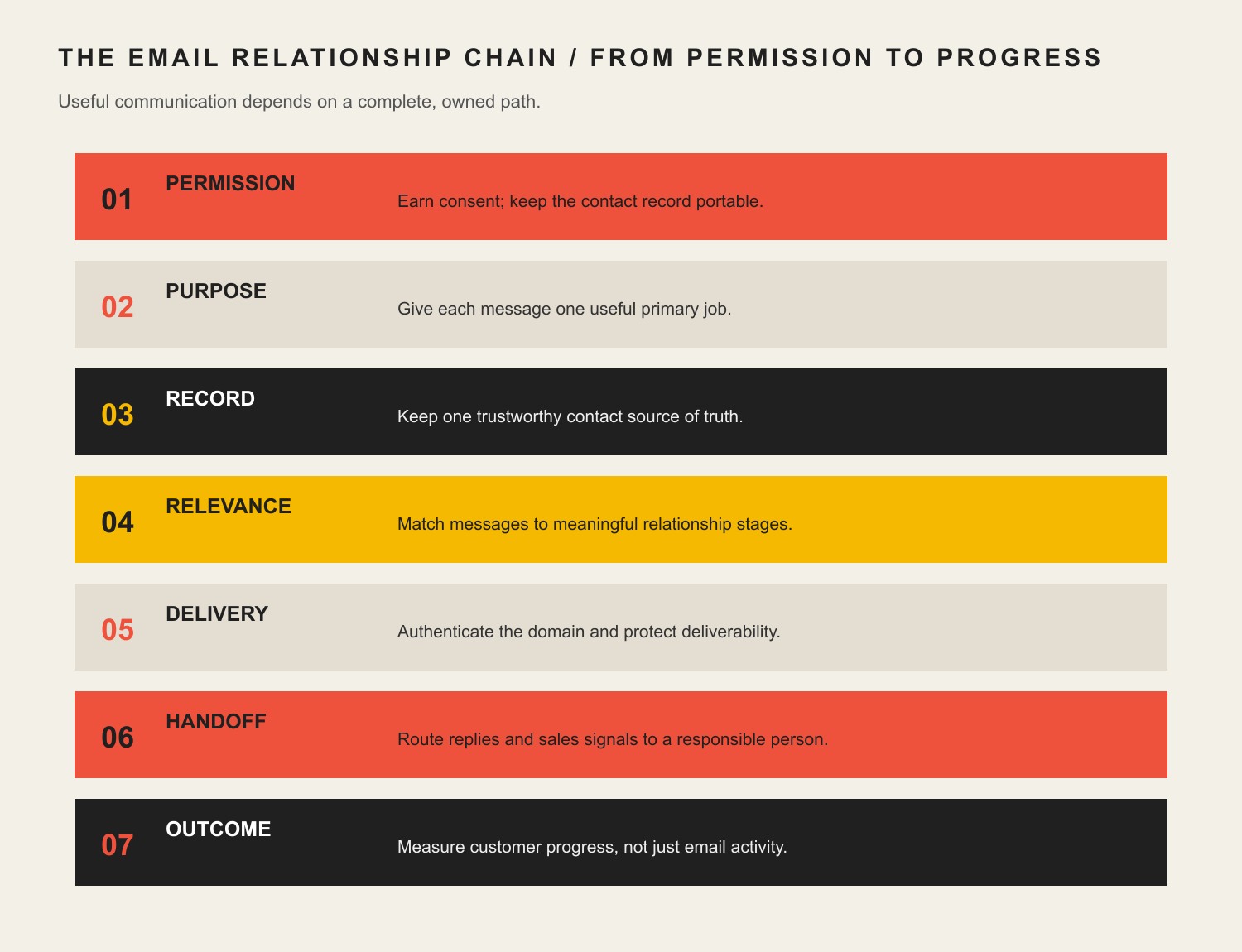
    Seven email relationship stages: permission, purpose, trustworthy record, relevance, delivery, human handoff, and customer outcome.

    Use seven connected parts to plan or audit the system: Permission, Purpose, Record, Relevance, Delivery, Handoff, and Outcome.

    LinkQuestion it must answerTypical failure
    PermissionWhy is this person receiving this type of message?A mystery spreadsheet is treated as a marketing list
    PurposeWhat useful job should this message perform now?“We should send something this week” becomes the strategy
    RecordWhich system preserves source, preference, status, and ownership?Five conflicting lists and no reliable export
    RelevanceWhat relationship fact materially changes the message?Everyone receives the same generic blast
    DeliveryCan authenticated, wanted mail reliably reach and render in the inbox?Copy is polished while the domain looks untrustworthy
    HandoffWho or what owns the reply, purchase signal, service need, or exception?High-intent responses disappear into a shared inbox
    OutcomeWhat observable customer or business transition matters?Opens are celebrated while sales and service remain blind

    Every link affects the next. More relevance cannot rescue bad permission. Better deliverability cannot fix a pointless message. Automation cannot repair an unowned handoff. A dashboard cannot manufacture an outcome the business never defined.

    1. Earn Permission and Keep the List Portable

    Build the list through real customer interactions: a useful subscription, inquiry, purchase, event registration, account preference, resource request, or explicit offline signup. Record the source and date when the platform and process allow it. Tell people what they are choosing rather than hiding a marketing subscription beneath a button with the emotional warmth of a parking ticket.

    Permission is both a trust standard and a deliverability advantage. Google’s current sender guidance recommends that recipients opt in and that senders make subscription and unsubscription easy. The United States’ CAN-SPAM Act is not an opt-in law for ordinary commercial email, but it does establish a federal baseline for accurate sender information, truthful subject lines, a valid postal address, and an effective opt-out. Legal permission and a good reason to occupy somebody’s inbox are not always the same bar.

    List ownership also requires portability. The business should be able to export contacts, consent or source information, preferences, suppression status, and important lifecycle fields in a usable format. The sending domain and vendor accounts should be controlled by the business—not trapped in a former employee’s login or an agency account nobody can recover.

    Never buy a list and call it audience development. Purchased addresses lack relationship context, create complaint and reputation risk, and usually violate the acceptable-use rules of reputable email platforms. You acquired rows, not attention.

    2. Give Every Email One Primary Job

    “Engagement” is too vague to govern a message. Define the customer transition the email is supposed to help.

    Lifecycle momentUseful primary jobSensible next action
    New subscriberConfirm expectations and deliver promised valueChoose preferences, read the promised resource, or reply
    Evaluating prospectAnswer a consequential question or reduce uncertaintyRead evidence, compare options, request a diagnostic, or reply
    New customerExplain what happens next and prevent avoidable anxietyComplete onboarding, supply information, or contact the owner
    Active customerSupport successful use, service, or deliveryUse the service, resolve a problem, or access help
    Lapsed customerTest whether the relationship is still relevantReturn, update preferences, or leave cleanly
    Loyal customerRecognize the relationship and make the next value exchange appropriateRenew, refer, review, or use a relevant benefit

    One message may contain several links, but it should have one primary job. When every email tries to educate, sell, announce, survey, cross-sell, collect a review, and introduce the intern, the reader gets a digital junk drawer.

    This is where the broad strategy separates from an email newsletter. A newsletter is one recurring format. The strategy decides whether that format has a job, which audience should receive it, and what happens when somebody responds.

    Retention mechanics also deserve their own design. A small-business loyalty or rewards program can support repeat behavior, but email should reflect the actual customer relationship rather than spraying the same coupon at subscribers, active customers, and people who already left.

    3. Maintain One Trustworthy Contact Record

    Small businesses rarely begin with one clean database. Contacts live in the email platform, ecommerce system, accounting package, CRM, form plugin, event spreadsheet, support inbox, and somebody’s phone. The answer is not always one gigantic replacement system. It is clear authority for each important fact.

    At minimum, decide where the following information is maintained:

    • email address and customer or account identity;
    • acquisition source and permission basis;
    • subscription preferences and suppression status;
    • lifecycle stage or relationship type;
    • purchases, services, or inquiries that materially affect communication;
    • responsible employee or team;
    • promised next action and deadline;
    • export, backup, and account ownership.

    The email platform may execute sends while the CRM owns lead status and ecommerce owns purchases. That can work. The systems simply need defined synchronization and conflict rules. If three tools disagree about whether someone is a customer, “personalization” becomes a very efficient way to send the wrong message.

    This concern is grounded in Scope Design’s own operating experience. Greg has repeatedly worked to reduce email clutter while preserving searchability, assignment, long-term control, and the ability to delegate. The lesson is not that every business needs a complicated CRM. It is that communication should survive the person who currently remembers where everything is.

    4. Segment by the Relationship, Not Creepy Trivia

    Useful segmentation changes the message because the relationship is genuinely different. A new subscriber, active prospect, current customer, lapsed customer, and service contact should not all receive the same pitch.

    Start with fields the business can maintain and act on:

    • subscription or stated topic preference;
    • lifecycle stage;
    • customer versus prospect status;
    • product, service, or problem involved;
    • recent intentional action such as a purchase, request, reply, or registration;
    • location when it changes availability, regulations, events, or service;
    • engagement only when the signal is reliable enough to change treatment.

    Avoid accumulating demographic or behavioral trivia merely because software can. More data creates more responsibility, more opportunities for error, and more ways to sound unsettling. The minimum useful context usually beats the maximum collectible context.

    Before creating a segment, ask: What will we do differently, and can we keep this field accurate? If there is no operational answer, the segment is decorative complexity.

    5. Authenticate the Domain Before Polishing the Confetti

    Email deliverability begins with identity and reputation, not clever subject lines. Google recommends setting up SPF, DKIM, and DMARC for sending domains. Its requirements for senders delivering more than 5,000 messages per day to personal Gmail accounts include SPF and DKIM, DMARC, aligned sender domains, TLS, a spam rate below 0.3%, and one-click unsubscribe for marketing or subscribed messages. Yahoo’s sender requirements also emphasize timely, relevant email to active audiences.

    In plain English:

    • SPF identifies systems authorized to send for the domain.
    • DKIM adds a cryptographic signature that receiving systems can verify.
    • DMARC tells receivers how the visible sender domain should align with SPF or DKIM and provides reporting and policy controls.

    These records must reflect every legitimate sender: the email platform, business mailbox provider, transactional system, CRM, ecommerce service, or other authorized tool. Randomly pasting DNS records from three vendors can create multiple SPF records or broken alignment. Have somebody inventory the senders and test the result.

    Authentication does not guarantee inbox placement. List quality, complaints, bounces, relevance, sending patterns, and recipient behavior still matter. It does, however, establish that the business took the basic step of proving who is sending. Spending hours on emojis while the domain cannot pass authentication is marketing theater with a technical support sequel.

    Once those foundations are credible, email subject-line strategy can help the recipient understand why the message deserves attention. The subject line’s job is accurate relevance—not emotionally mugging the reader into an open.

    6. Build Automations Around Stable Lifecycle Moments

    Email automation is valuable when the trigger is reliable, the message has a defined job, exceptions are known, and a human can inspect what happened. Start with moments that recur and remain useful without daily improvisation.

    Good first candidates include:

    1. Requested-resource delivery: provide the promised guide, receipt, confirmation, or account information immediately.
    2. Welcome and expectation setting: explain what the subscriber will receive, how often it may arrive, and how to change preferences.
    3. Inquiry acknowledgement and routing: confirm receipt, state what happens next, and alert the responsible person.
    4. Onboarding reminders: request genuinely necessary information and stop when the step is completed.
    5. Post-purchase or post-service follow-up: help the customer succeed, find support, or take the next appropriate action.
    6. Re-engagement or preference check: ask whether the relationship remains wanted before continuing indefinitely.

    Automation should have an owner, review schedule, stop conditions, and failure alerts. A three-year-old sequence can quietly send obsolete pricing, introduce departed employees, link to dead pages, or pitch services the business no longer wants. “Set it and forget it” is usually how digital assets become haunted.

    For broader workflow design, see Scope Design’s business automation and AI services. The technology earns its place only when the process, data, exceptions, and ownership are understood first.

    7. Design the Sales and Service Handoff

    The email did not succeed merely because somebody clicked. Define what happens when a recipient replies, requests pricing, visits a high-intent page, starts a purchase, reports a problem, or asks to stop a particular communication.

    A responsible handoff specifies:

    • the event that creates the handoff;
    • the person or team receiving it;
    • the context they receive;
    • the expected response time;
    • the customer confirmation;
    • the backup when the owner is unavailable;
    • the record that proves completion;
    • the next step when no response occurs.

    The handoff should match capacity. If one owner receives every “hot lead” alert but checks the inbox twice a week, more automation creates faster disappointment. If service replies are mixed with promotional responses, the business may optimize a campaign while overlooking a customer who needs help.

    This is the same constraint-first principle used in the 90-day marketing framework: fix the binding operational problem before adding more activity. More sends are not progress when the response path is broken.

    When email must coordinate with the website, phone, sales, service, or an in-person experience, use the broader omnichannel handoff model to decide which context survives the transition and who owns the next moment.

    8. Measure Customer Progress, Not Just Email Activity

    Open rate is a diagnostic signal, not a business outcome. It is also less dependable than it once appeared. Apple’s Mail Privacy Protection can prevent senders from seeing whether recipients opened a message and may privately load remote content in the background. A neat open-rate trend can therefore reflect technology behavior as well as human attention.

    Use a measurement hierarchy:

    1. Business outcome: qualified inquiries, purchases, renewals, retained customers, completed onboarding, service resolution, or another traceable result.
    2. Lifecycle progression: subscriber to qualified prospect, prospect to conversation, customer to successful onboarding, or lapsed customer to a deliberate return.
    3. Intentional action: reply, useful click, form completion, booking, preference change, or resource use.
    4. System health: delivery, hard bounces, complaints, unsubscribes, authentication, and list growth or decay.
    5. Attention proxy: opens and read-time estimates, interpreted cautiously.

    Choose metrics according to the message’s job. A service notice should not be judged like a promotion. A welcome series may be evaluated by preference completion, replies, and downstream qualification. A newsletter may support return visits and useful conversations. A win-back message may succeed by reactivating a good customer—or by helping uninterested recipients leave cleanly so the list becomes healthier.

    Do not force perfect attribution where it does not exist. Record what can be traced, preserve useful source information, and combine campaign data with sales and service feedback. Hope is not an analytics strategy, but fake precision is not one either.

    9. Choose an Email Platform After Defining the System

    There is no universal “best email marketing platform for small business.” The right tool is the least complicated supported platform that can execute the required permissions, fields, segments, automations, authentication, integrations, exports, and reporting.

    Evaluate platforms against the real operating model:

    • Can contacts, fields, preferences, and suppression records be exported?
    • Can the business control its account, domain authentication, billing, and administrators?
    • Does the platform support the needed lifecycle triggers without brittle workarounds?
    • Can employees see replies and handoffs in the system where work is managed?
    • Does it support accessible templates and usable plain-text alternatives?
    • Can it honor unsubscribes and preference changes consistently across lists?
    • What will it cost at the expected contact and send volume over three years?
    • Can another competent provider maintain it if the current consultant disappears?

    Do not begin with a comparison chart containing seventy features. Start with the jobs and constraints. A simpler platform maintained well is more valuable than an “enterprise” stack nobody trusts.

    10. Use a Sustainable Sending Cadence

    There is no universal best day, hour, or frequency. A local retailer’s event reminders, a professional firm’s educational sequence, an ecommerce replenishment message, and a service company’s onboarding emails have different timing logic.

    Choose cadence from:

    • the promise made when the person subscribed;
    • how often the business has something genuinely relevant to say;
    • the customer lifecycle and buying interval;
    • urgency created by the customer’s action, not manufactured scarcity;
    • staff capacity to handle replies and next steps;
    • segment-level response, complaints, unsubscribes, and downstream results.

    Consistency matters because expectations matter. That does not mean filling every Tuesday because a content calendar has an empty square. If the only available message is “just checking in” wearing a promotional hat, wait until there is a useful reason.

    11. Treat Compliance as the Floor, Not the Personality

    For commercial email in the United States, the Federal Trade Commission’s CAN-SPAM compliance guide requires accurate header information, non-deceptive subject lines, clear identification as advertising when applicable, a valid physical postal address, a clear opt-out mechanism, and honoring opt-out requests within ten business days. The opt-out mechanism must remain available for at least thirty days after sending. A business cannot contract away responsibility simply by hiring a platform or agency.

    Google’s sender FAQ can demand faster and more technical behavior than the legal minimum. It recommends processing one-click unsubscribe requests within 48 hours to protect recipients, reputation, and list health. Follow the stricter operational standard when feasible instead of treating the legal deadline as a service goal.

    CAN-SPAM is only a United States federal baseline. State privacy rules, industry requirements, contracts, and laws in other countries may apply depending on the business and recipient. This article is operational guidance, not individualized legal advice. When the audience or data crosses jurisdictions, get appropriate counsel rather than asking a footer to perform legal magic.

    A Practical Small-Business Email Marketing Plan

    Build the first useful version in this order:

    1. Inventory every contact source, sending tool, domain, list, form, automation, and employee owner.
    2. Decide which records are legitimate, current, exportable, and still useful.
    3. Define the permission, purpose, and primary owner for each communication type.
    4. Choose a small lifecycle model the business can maintain.
    5. Authenticate the domain and test every legitimate sender.
    6. Establish one suppression and preference process across the system.
    7. Build one high-value lifecycle sequence, including replies, handoffs, exceptions, and stop conditions.
    8. Connect the sequence to an observable customer or business outcome.
    9. Test on real devices, inboxes, roles, and failure cases before expanding.
    10. Review the system quarterly and after material offer, staff, platform, or compliance changes.

    Do not launch eight automations because the software offers templates. Build one relationship path that the business can own, observe, and improve. Then earn the complexity of the next one.

    Frequently Asked Questions About Email Marketing for Small Businesses

    Is email marketing worth it for a small business in 2026?

    Yes, when the business has a permissioned audience, a useful recurring reason to communicate, and an operational next step. It is not automatically worthwhile when contacts are poor, the offer is weak, replies are ignored, or nobody can trace what happens after a click.

    What is the best email marketing platform for a small business?

    There is no universal winner. Choose the simplest maintained platform that supports your permission records, segments, automations, domain authentication, integrations, exports, accessibility needs, and three-year budget.

    How should a small business build an email list?

    Collect addresses through real value exchanges and customer interactions: useful subscriptions, purchases, inquiries, events, accounts, resources, or explicit offline signup. State what the person will receive and keep source and preference data when practical.

    Should a small business buy an email list?

    No. A purchased list does not contain permission, relationship context, or demonstrated interest. It also creates deliverability, complaint, platform-policy, and brand-trust risk.

    How often should a small business send marketing emails?

    Send often enough to fulfill the stated promise and support the customer lifecycle, but not merely to fill a calendar. Watch useful clicks, replies, conversions, complaints, unsubscribes, and downstream outcomes by segment instead of following a universal weekly rule.

    What is the 80/20 rule for email marketing?

    It is usually presented as a heuristic suggesting that most content should be useful or relationship-building and a smaller portion directly promotional. It is not a standard or guarantee. The better rule is that every message should have a legitimate customer job, even when that job is selling.

    What is the three-email rule or 3-3-3 rule?

    Several unrelated sales and marketing heuristics use those names. None is a universal email standard. Define the sequence from the customer’s situation, message purpose, buying cycle, urgency, and response instead of forcing every relationship into three messages or three days.

    What are the five Ts of email marketing?

    Different sources assign different words to the mnemonic, commonly including concepts such as targeting, timing, testing, and tracking. Treat it as a memory aid, not governing doctrine. Permission, purpose, ownership, delivery, handoff, and outcomes matter whether they fit a catchy letter.

    Does an LLC need to appear in the sender email address?

    Usually the email address should use a recognizable branded domain and sender identity; the legal suffix does not need to clutter the address itself merely because the company is an LLC. Commercial messages still need accurate sender information and a valid postal address, and the business should use its legal identity where applicable. Ask counsel about entity-specific requirements.

    What is email segmentation?

    Email segmentation divides contacts into groups whose relationship or needs justify different communication. Useful segments may reflect lifecycle stage, customer status, topic preference, service involved, location, or recent intentional actions—not irrelevant personal trivia.

    Which email automation should a small business build first?

    Start with the repeated moment causing the most meaningful friction. Often that is promised-resource delivery, welcome and expectation setting, inquiry acknowledgement and routing, onboarding, or post-purchase support. Include an owner, stop conditions, exception handling, and measurement.

    Which email marketing metrics matter most?

    Start with the business or customer outcome the message supports, then lifecycle progression, intentional actions, and system health. Opens can help diagnose patterns, but privacy features and remote-content handling make them an unreliable primary outcome.

    Build the Relationship Before Scaling the Sends

    The strongest small-business email strategy is not the one with the most campaigns. It is the one the business can explain, maintain, export, authenticate, hand off, and connect to an honest outcome.

    If the list, CRM, forms, automations, website, and staff workflow have become one unowned tangle, Scope Design’s Impact Consulting can diagnose the constraint before another platform or campaign is added. Sometimes the answer is better email. Sometimes it is fixing the system email has been politely exposing for years.