Tag: Marketing ROI

  • Internet Marketing for Beginners: Build Your First Measurable Loop

    Internet Marketing for Beginners: Build Your First Measurable Loop

    Internet marketing for beginners gets easier when you stop trying to “do digital marketing” and build one complete loop instead. Pick one business outcome, one buyer moment, one place to send people, one way to follow up, and one scorecard. Run that loop long enough to learn where it breaks before you add another channel or another tool.

    That is the difference between activity and a system. Posting on five platforms can feel busy while producing no qualified opportunities. A simple search-to-service-page-to-booking path can look boring and still teach you exactly what needs improvement.

    TL;DR: the beginner internet marketing system

    • Start with an outcome, not a platform. Decide what a useful result looks like: a qualified lead, booked appointment, purchase, application, or another business outcome.
    • Choose one buyer moment. Reach a real situation such as “I need a roofer after storm damage,” not a vague audience such as “homeowners age 35–55.”
    • Use one owned next step. Give the buyer a clear page, form, booking flow, phone action, or offer you can improve.
    • Keep the stack small. One discovery source, one destination, one follow-up method, and measurement is enough to start learning.
    • Measure deeper than clicks. Track the path from attention to action to qualified opportunity to customer value.
    • Add complexity only for a diagnosed reason. A second channel should solve a real gap, not cure boredom.

    What internet marketing actually means

    Internet marketing is the use of online channels and connected experiences to create, capture, and develop demand for a business. Search, websites, local listings, social platforms, video, email, paid media, marketplaces, and online communities can all be part of it.

    In normal small-business conversation, internet marketing, online marketing, and digital marketing overlap heavily. Do not spend your first month arguing with the vocabulary. The useful question is: what buyer behavior are we trying to meet, and what should happen next?

    If you need the broader operating-system view, our digital marketing strategy framework connects business goals, audience, offer, channels, response, and measurement. This guide owns the step before that complexity: getting a beginner’s first measurable loop working.

    The beginner mistake: collecting channels before building a loop

    A common beginner setup looks like this: create social accounts, start a blog, install six marketing apps, open an ad account, send a few emails, watch traffic, and hope that something becomes revenue.

    The problem is not that those tactics are bad. The problem is that nobody can explain the path between them. When a lead arrives, you do not know what created it. When leads do not arrive, you do not know whether the problem is targeting, the offer, the page, follow-up, measurement, or simply too little exposure.

    Scope Design’s broader small-business marketing strategy starts with the constraint before buying more attention. The beginner version is even simpler: finish one path from need to outcome. A weak but complete loop teaches you more than a polished isolated tactic because the complete loop reveals the bottleneck.

    The Scope Design FIRST Loop

    Use the FIRST Loop to build your first internet marketing system:

    • F — Fix one outcome.
    • I — Identify one buyer moment.
    • R — Route attention to one owned next step.
    • S — Start with the minimum viable stack.
    • T — Track qualified outcomes and decide what earns more.

    A small business marketing loop shown as connected moments from target and buyer to destination and measurement

    F — Fix one outcome

    Choose one business result that would make the experiment useful. “More awareness” is usually too vague. “Five qualified estimate requests this month” is measurable. So is “booked consultations,” “completed purchases,” “demo requests,” or “applications from people who meet our criteria.”

    The word qualified matters. Ten form submissions from people outside your service area are not automatically better than three real prospects. Write down what makes an opportunity useful before the traffic arrives: geography, budget, project type, product fit, urgency, minimum order, or another condition your business actually uses.

    I — Identify one buyer moment

    Do not begin with “our audience is women 25–54” or “we sell to small businesses.” Identify a moment in which a person has a problem, question, comparison, deadline, trigger, or desire that creates useful intent.

    A local HVAC company might start with “my air conditioner stopped cooling.” A B2B consultant might start with “we need to replace a vendor before renewal.” A specialty retailer might start with “I am comparing two versions of this product.” Our target-audience guide goes deeper on mapping audience behavior to the places where that behavior occurs.

    R — Route attention to one owned next step

    Every first loop needs a destination you can improve. That may be a focused service page, product page, booking page, quote form, lead magnet, or another conversion experience under your control.

    A social post is not the whole route. A Google listing is not the whole route. An ad is not the whole route. Those can create discovery. The owned step is where you answer the next question, provide proof, remove friction, and make the desired action obvious.

    S — Start with the minimum viable stack

    For most beginners, a complete stack needs four jobs: discovery, destination, follow-up, and measurement. You do not need four enterprise platforms. You need those four jobs covered.

    Choose the discovery source based on the buyer moment. Search or local discovery can fit active demand. Social or video can fit discovery and education. Email can fit people who already know you. Paid media can fit situations where the economics, offer, and tracking justify buying faster feedback. Our online marketing channels guide explains the jobs different channels can perform; it does not assume every business needs all of them.

    T — Track qualified outcomes and decide what earns more

    Measurement should tell you what happened at each meaningful stage. Do not make “traffic went up” carry the entire burden of business proof.

    • Attention: Was the message seen?
    • Visit: Did the right people reach the destination?
    • Action: Did they call, book, submit, buy, reply, or take the intended step?
    • Qualified outcome: Was the action useful to the business?
    • Customer value: Did qualified opportunities become revenue, gross profit, retained customers, or another business result?

    Then diagnose the thinnest part of the loop. If the right people see the offer but do not visit, the message or targeting may be weak. If they visit but do not act, inspect the offer and page. If actions arrive but quality is poor, fix qualification or audience fit. If qualified opportunities arrive but sales do not close, more traffic may not be the answer.

    What belongs in a beginner internet-marketing stack?

    Choose tools by job before you choose them by logo. The minimum stack should be boring enough that you understand it.

    Job Minimum requirement Upgrade only when…
    Discovery One channel that matches one buyer moment You can name the audience or demand gap a second channel will solve
    Destination A useful page or flow with one obvious next action Testing requires more segmentation, personalization, or automation
    Lead/customer tracking A reliable record of source, contact, status, and outcome Volume makes a spreadsheet or simple inbox process unreliable
    Follow-up A defined response and nurture process Manual follow-up is slow, inconsistent, or impossible at current volume
    Measurement Site analytics plus source/campaign naming and outcome tracking You have enough data and complexity to justify deeper attribution or BI

    For campaign links, Google’s current Analytics configuration documentation shows how campaign source, medium, and name map to UTM inputs. The important beginner habit is consistency: decide how you name campaigns before five people create five different versions of “Facebook.”

    If you use paid media, do not treat the ad platform as the strategy. Make sure the destination, conversion action, lead handling, and economics exist first. Our paid advertising strategy guide focuses on testing and scaling without burning budget.

    How to measure internet marketing without fooling yourself

    An ROI framework should help you make a decision, not decorate a report. Start with the deepest outcome you can credibly connect to the marketing effort, then keep the upstream numbers because they help diagnose why the outcome changed.

    Use a five-level scorecard

    1. Reach or visibility: impressions, views, search visibility, local visibility.
    2. Visits or engagement: sessions, landing-page visits, meaningful interactions.
    3. Conversions: calls, forms, purchases, bookings, replies, downloads.
    4. Qualified outcomes: sales-qualified leads, viable appointments, accepted applications, good-fit purchases.
    5. Economics: customer acquisition cost, attributed revenue or gross profit, repeat value, and payback.

    Google Search Central’s documentation on Search Console and Google Analytics data distinguishes Google Search impressions, clicks, and queries from on-site sessions and actions. That is the right beginner mental model: keep each source in its lane instead of pretending one dashboard sees the whole customer journey.

    Know the difference between ROAS-style metrics and business ROI

    Ad platforms can report value-to-cost metrics when conversion tracking and meaningful conversion values are configured. Google’s current Ads conversion-reporting documentation lists conversion value, conversion value per cost, and cost per conversion. Those metrics can be useful, but they are not automatically the same as profit after labor, fulfillment, discounts, overhead, refunds, or sales effort.

    For a simple internal decision model, a service business might watch:

    • Cost per qualified lead = campaign cost ÷ qualified leads.
    • Customer acquisition cost for the test = attributable sales and marketing cost ÷ new customers from the test.
    • Simple marketing ROI for the test = (attributed gross profit − marketing cost) ÷ marketing cost.

    Those are management formulas, not universal attribution truth. Define what you include, use the same method from period to period, and keep uncertainty visible.

    Hypothetical example: suppose a 30-day test costs $1,000 including media and directly attributable campaign work. It produces 10 qualified leads, four new customers, and $3,000 in attributed gross profit. The cost per qualified lead is $100, the test CAC is $250, and the simple ROI model above is 200%. Those numbers are an arithmetic example, not a benchmark or promise.

    If you cannot connect marketing to a final sale yet, do not fake precision. Track the deepest trustworthy stage, improve the handoff, and move the measurement boundary closer to revenue over time. Direct response marketing is especially useful when you need a clear, measurable action rather than a vague “engagement” goal.

    A 30-day setup sprint for your first loop

    This is not a complete annual marketing plan. It is a short setup sprint for proving that one loop can be run and measured.

    Days 1–7: outcome, buyer moment, and baseline

    • Define one qualified business outcome.
    • Write down the buyer moment in plain language.
    • Choose the first discovery source that matches that moment.
    • Record your current baseline: inquiries, qualified inquiries, customers, and any existing source information.
    • Decide who owns follow-up and how quickly it should happen.

    Days 8–14: destination and measurement

    • Create or improve the page or conversion flow.
    • Make the primary next action obvious.
    • Add proof that answers the buyer’s risk: examples, process, guarantees where appropriate, credentials, reviews, pricing context, or clear expectations.
    • Verify analytics and conversion tracking.
    • Set a consistent campaign/source naming convention.

    Days 15–21: launch one discovery path

    • Publish or activate the smallest useful campaign.
    • Keep the message aligned with the buyer moment and destination.
    • Check that source data survives the handoff to your lead record.
    • Respond to real inquiries instead of staring at dashboards all day.

    Days 22–30: diagnose before adding

    • Review reach, visits, actions, qualified outcomes, and customer results.
    • Find the biggest leak in the path.
    • Change one important variable at a time when possible.
    • Document what you learned.
    • Decide whether the next move is more volume, a better message, a better page, stronger qualification, faster follow-up, or a different buyer moment.

    Once the first loop exists, a fuller plan becomes useful because you have evidence to plan around rather than guesses. The point is not to remain small forever. The point is to earn complexity.

    Common internet marketing mistakes beginners can avoid

    • Starting on every channel. More channels create more variables before you understand any of them.
    • Buying software before defining the job. A tool cannot clarify an offer or decide what a qualified lead means.
    • Measuring vanity metrics as business results. Followers, impressions, and clicks can be useful signals. They are not automatically customers.
    • Running ads into a weak path. Paid traffic can make a broken offer or page fail faster.
    • Ignoring lead handling. Marketing can create demand that a slow or inconsistent response process wastes.
    • Changing everything at once. Constant resets make learning nearly impossible.
    • Copying a competitor’s channel mix. You can see their public activity; you usually cannot see their margins, lead quality, sales process, attribution, or failed tests.
    • Automating before understanding. Automate repeatable work after the basic process is useful, not as a substitute for figuring it out.

    When should you add another channel or tool?

    Add complexity when you can name the problem it solves. Good reasons include:

    • Your first channel cannot reach an important second buyer moment.
    • You have a repeatable conversion path and need more qualified volume.
    • A manual process is now creating delays or errors at the current volume.
    • Your current channel is saturated within the audience you can profitably serve.
    • You need a second source to reduce concentration risk after the first loop is understood.

    “Everyone says we should be on TikTok” is not a diagnosed reason. Neither is a software sale. Choose the next tool or channel the same way you chose the first one: from the buyer behavior and the business constraint.

    What auditing this exact article taught us

    We applied the same measurement discipline to this revision instead of protecting old copy because it already existed. The legacy article contained numerous precise ROI, market-size, channel-performance, and budget-allocation statistics without a current claim ledger. We checked whether the page had earned enough measurable equity to justify preserving that weak evidence.

    Signal checked Observation before this revision What it actually supports
    GA4, last 12 complete months 2 landing sessions, both Direct; 0 engaged sessions; 0 configured key events. The prior comparison returned no row. The sample is too small for behavior or conversion conclusions. There is no measured organic footprint forcing unsupported claims to survive.
    Google Search Console No exact-page query/page rows in the current or prior 12-month period; URL Inspection reports “URL is unknown to Google.” Public history did not equal demonstrated Google search equity for this address.
    Bing Webmaster Tools Current URL traffic shows 0 clicks and 0 impressions; Bing has historical crawl metadata. There is crawl history but no current Bing traffic footprint requiring the old structure.
    Ubersuggest No exact-page ranking keywords, page traffic, backlinks, or referring domains were returned. Third-party evidence also shows no strong page-level equity requiring the old statistics to remain.
    Current query research “Internet marketing for beginners” is informational and Ubersuggest estimates roughly 110 U.S. monthly searches; Google currently shows an AI Overview, video, and People Also Ask ahead of organic results. The topic still has a real beginner question, but the answer must be immediate, differentiated, and easy to extract.

    This evidence does not prove the topic is worthless, that the old article never helped anyone, or that this revision will rank. Scope Design’s current analytics and configured key-event setup also has attribution limitations. It supports a narrower editorial decision: remove statistics we cannot defend, keep the established slug, give the article one distinct job, and connect it to the correct marketing cluster.

    Frequently asked questions about internet marketing for beginners

    What should a beginner do first in internet marketing?

    Define one qualified business outcome and one buyer moment, then build the smallest complete route from discovery to an owned next step to follow-up and measurement. Do not start by opening accounts on every platform.

    How much money do I need to start internet marketing?

    There is no responsible universal starter budget. You can begin some organic, local, referral, or email work with little direct media spend, but time, website work, creative production, software, and follow-up still have costs. For paid marketing, build the budget from what a meaningful test requires and what a qualified customer is economically worth to your business—not from an internet-average percentage.

    Can I learn digital marketing by myself?

    Yes. A beginner can learn the fundamentals by building a small real loop, reading platform documentation, and measuring actual outcomes. Specialized help becomes more valuable when technical setup, paid-media risk, attribution, content volume, compliance, or opportunity cost exceeds what you can manage reliably.

    Should I start with SEO or paid ads?

    Start with the buyer moment and economics, not a universal ranking. SEO can fit durable active demand when you can create useful pages and wait for discovery. Paid ads can buy faster exposure and feedback when the offer, conversion path, tracking, and customer economics are ready. Sometimes neither is the first constraint.

    How long does internet marketing take to work?

    It depends on the channel, buying cycle, traffic volume, offer, competition, and what “work” means. Paid media can generate exposure quickly but still needs enough qualified outcomes to judge economics. SEO and content often require more time for discovery and compounding. Use leading indicators to diagnose the path, but do not declare success until the business outcome is moving.

    What internet marketing tools does a small business actually need?

    At minimum, cover four jobs: discovery, an owned destination, follow-up/lead tracking, and measurement. The exact products matter less than having a complete path you understand. Add CRM automation, advanced analytics, content suites, or additional ad platforms only when a real bottleneck justifies them.

    Build the loop before you buy the pile

    Internet marketing for beginners does not need to be small forever. It needs to be understandable first. Build one complete loop, measure the qualified outcome, find the constraint, improve it, and then add reach or automation for a reason.

    If your business has marketing activity but no clear path from attention to qualified outcomes, Scope Design can help diagnose the leak and build the system around it. The goal is not more marketing stuff. It is a marketing system you can explain, measure, and improve.


  • Digital Marketing Companies for Small Businesses: When an Agency Is Worth It

    Digital Marketing Companies for Small Businesses: When an Agency Is Worth It

    Digital marketing companies for small businesses can improve marketing ROI, but only when they solve a specific business problem better than the company can solve it internally. An agency is not automatically cheaper, faster, or more effective than an in-house marketer. The advantage appears when outside specialists close a real capability gap, execute consistently, and are measured against qualified leads, customers, gross profit, or another business outcome—not a pile of impressions.

    For many small businesses, the best model is neither “outsource everything” nor “hire a full team.” It is a hybrid: keep customer knowledge, offer decisions, account ownership, and final accountability inside the business; use an agency for selected strategy, creative, channel, technical, or measurement work.

    If you are still deciding what marketing should accomplish before deciding who should execute it, start with our small business marketing strategy framework. This article owns the next decision: when a digital marketing company is actually worth paying for.

    What Our Audit of This Exact Page Changed

    We did not preserve the old version because its numbers sounded persuasive. Before revising the page, we checked the exact URL across Scope Design’s analytics, Google Search Console, Bing Webmaster Tools, Ubersuggest, the current Google results, and our internal content graph.

    Signal checked Observation before this revision What it actually supports
    GA4, current 12 complete months 4 Direct landing sessions, 1 engaged session, 0 configured key events; no Organic Search landing row The sample is too small for behavior or conversion conclusions. There is no measured organic footprint forcing unsupported claims to survive.
    Google Search Console No exact-page query rows in either reviewed 12-month period; URL Inspection reported “URL is unknown to Google” Public history did not equal demonstrated Google visibility for this page.
    Bing Webmaster Tools Bing recognizes and has crawled the URL; current exact-URL traffic was 0 clicks and 0 impressions There is crawl history worth preserving, but no Bing traffic evidence requiring the old copy.
    Ubersuggest No ranking keywords and no exact-URL backlinks returned for the page Third-party data also showed no page-level equity that justified keeping weak statistics.

    That evidence does not prove the topic is worthless, the old article never helped anyone, or this revision will rank. It supports a narrower editorial decision: keep the established URL, remove claims we cannot defend, and give the page one useful job. The old claims about universal $5 returns, fixed 30% agency savings, channel-specific ROI multiples, and a $50 million revenue cutoff for building in-house are gone.

    What Digital Marketing Companies for Small Businesses Should Actually Do

    A useful agency should reduce uncertainty and execution friction. It should not make the business dependent on a vendor’s dashboard or sell every available channel before diagnosing the problem.

    • Diagnose the constraint. Is the business short on qualified demand, converting poorly, following up too slowly, retaining too few customers, or simply unable to execute the marketing plan consistently?
    • Bring capability the business does not efficiently have. That might be paid-search management, technical SEO, analytics implementation, creative production, conversion work, content systems, or cross-channel coordination.
    • Sequence the work. A good partner decides what must happen first instead of launching six channels at once. If you need help deciding which channel owns which job, use our guide to online marketing channels for small business.
    • Make measurement part of the build. The reporting plan should exist before the agency scales spend or production.
    • Turn reporting into decisions. A monthly report should help you decide what to scale, revise, stop, or investigate—not merely show that work happened.
    • Leave the business stronger. Accounts, documentation, learning, creative assets, and measurement history should remain usable if the relationship ends.

    For digital marketing companies for small businesses, the core distinction is simple: you are not buying “marketing.” You are buying a defined combination of expertise, capacity, coordination, and learning speed.

    Use the 5C Agency Fit Test Before You Sign

    At Scope Design, we use a five-part decision check to separate real agency leverage from vague outsourcing optimism. If one of these conditions is weak, narrow the scope or fix the dependency before scaling.

    Five connected checkpoints assess constraint, capability, context, conversion, and capacity before choosing an agency

    1. Constraint: What Business Bottleneck Are You Solving?

    Do not hire an agency because “we need more marketing.” Name the constraint. If qualified buyers do not know you exist, demand generation may be appropriate. If traffic already exists but few visitors inquire, the priority may be the offer, landing page, proof, or conversion path. If leads arrive but sales follow-up is slow, buying more traffic can make the leak more expensive.

    The U.S. Small Business Administration’s market research guidance starts with questions about demand, market size, customer location, competitive saturation, and pricing. That is useful upstream discipline for an agency decision: confirm the market problem before paying someone to amplify a tactic.

    Our broader small business growth strategy guide goes deeper on finding the constraint before choosing a growth bet.

    2. Capability: What Skill or Cadence Is Missing?

    An agency makes more sense when the business needs several specialized skills, needs one specialist it cannot justify hiring full time, or needs a reliable production cadence that keeps slipping internally. The advantage is access—not the word “agency” itself.

    Be specific. “We lack technical SEO and conversion tracking” is a capability gap. “We want someone to do digital” is not. A precise gap makes it easier to compare a specialist firm, a freelancer, a new employee, or a hybrid arrangement on equal terms.

    3. Context: Who Owns Customer and Business Truth?

    No outside team knows your customers, margins, sales objections, delivery constraints, history, and risk tolerance as well as someone inside the business should. The agency can investigate and challenge assumptions, but an internal owner must be able to provide context, make decisions, approve tradeoffs, and connect marketing to operations.

    This is why a hybrid model works so often for small businesses: internal ownership plus external depth. For the broader cross-function decision, see our in-house vs. outsourcing framework for small businesses.

    4. Conversion: Can You Measure a Business-Important Action?

    Before an agency can be judged fairly, the business needs a credible way to connect work to outcomes. Google’s current Analytics developer documentation describes a key event as a significant action within a property. For one company that might be a qualified form submission or booked consultation; for another it may be a purchase, a recurring subscription, or a phone call that reaches a salesperson.

    Clicks, impressions, followers, and raw traffic can be useful leading signals. They are not the final score. A useful agency reporting chain moves from attention to response to qualified opportunity to customer economics.

    5. Capacity: Can the Business Handle the Demand?

    Marketing can succeed and still hurt a small business if calls go unanswered, estimates take two weeks, inventory is unavailable, onboarding breaks, or the owner is already at capacity. An agency should understand the handoff after the lead. Otherwise the business may pay to create demand it cannot serve.

    For a local business, capacity can also change which tactics make sense. Our local marketing strategy guide treats local channels as connected handoffs rather than isolated promotion.

    Agency vs. In-House vs. Hybrid: Choose the Operating Model

    Model Usually strongest when Watch for
    In-house Marketing work is steady enough for dedicated roles; day-to-day company context is critical; collaboration with sales/product/operations is constant. One hire being expected to cover too many specialties; software and production gaps; slow recruiting; underutilized specialists.
    Agency You need specialist depth, multiple capabilities, faster access, or variable capacity without building a full team. Generic packages, weak internal ownership, agency-controlled accounts, output reporting without business outcomes.
    Hybrid An internal owner can hold strategy and context while outside specialists handle selected execution or technical work. Unclear decision rights, duplicate work, slow approvals, or nobody owning the handoff between internal and external teams.

    There is no revenue threshold where the answer suddenly flips. The right model depends on workload, capability, economics, control requirements, and how much coordination the business can support.

    Compare the Real Economics, Not Retainer vs. Salary

    The most common cost comparison is also the weakest: “The agency is $X per month, while an employee salary is $Y.” Those are not equivalent numbers.

    Calculate Fully Loaded In-House Cost

    • Salary or wages
    • Employer taxes and benefits
    • Recruiting, onboarding, and ramp time
    • Software, data, and production tools
    • Equipment and training
    • Management and coordination time
    • Freelancers or specialists the employee still needs

    The U.S. Bureau of Labor Statistics’ Employer Costs for Employee Compensation program measures employer costs for wages, salaries, and employee benefits. That is why salary alone is not the full employment cost. BLS publishes the ECEC data quarterly and separates wages and salaries from benefit costs.

    Calculate Fully Loaded Agency Cost

    • Retainer or project fees
    • Setup or onboarding
    • Media spend, if applicable
    • Creative production or third-party costs not included in the fee
    • Software or data billed separately
    • Internal owner time for briefing, approvals, sales feedback, and review
    • Transition cost if the relationship ends

    Then compare what each option can realistically accomplish over the same period. An agency is not a bargain because its annual fee is below one employee’s salary. It is a bargain only if the combination of output, learning, quality, speed, and business results is worth more than the full cost and alternatives.

    Move the ROI Conversation Below Revenue

    Revenue can hide weak economics. If possible, connect agency performance to qualified opportunities, customers, and gross profit. A simple management view might include:

    • Qualified leads and cost per qualified lead
    • Lead-to-customer close rate
    • New customers and customer acquisition cost
    • Gross profit from acquired customers
    • Payback period
    • Retention or repeat purchase where it materially changes customer value
    • Operational capacity and lead-response speed

    One useful planning equation is marketing ROI = (incremental gross profit associated with the initiative − marketing cost) ÷ marketing cost. Treat the result as a decision estimate, not perfect causal truth. Buyers can encounter several touchpoints before converting, attribution models can assign credit differently, and sales quality can change after the click. Consistency in the measurement method matters more than pretending the dashboard can observe causality perfectly.

    What Should Stay In-House Even When You Hire an Agency?

    Outsourcing execution does not mean outsourcing ownership. A small business should usually retain control of the assets and decisions that would be expensive or disruptive to recover later.

    • Customer truth: real objections, lead quality, win/loss reasons, common questions, and service feedback.
    • Offer and economics: pricing, margins, capacity, product/service priorities, and the tradeoffs the company is willing to make.
    • Final brand decisions: what the company will promise, how it wants to sound, and what claims it can substantiate.
    • Core account ownership: domain, website, analytics property, ad accounts, CRM/customer data, pixels/tags, and major creative/source files should be controlled by the business with appropriate agency access.
    • Sales and operations feedback: whether leads are qualified, whether follow-up is timely, and whether the company can deliver what the campaign is selling.
    • Vendor accountability: someone inside the business must have authority to accept, reject, or redirect work.

    If nobody inside the company owns those things, an agency can become a very expensive substitute for management.

    How to Evaluate Digital Marketing Companies Before You Hire One

    When comparing digital marketing companies for small businesses, do not start with “How many services do you offer?” Start with questions that reveal how the company thinks, measures, and transfers control.

    • What problem do you think we are actually trying to solve? A good answer should reflect your business, not the agency’s favorite channel.
    • What would you need to learn before recommending a channel? Listen for customer evidence, the offer, margins/economics, the sales path, current traffic, historical performance, and constraints.
    • What will you own, and what must we own? Make account access, intellectual property, data, creative files, and offboarding explicit.
    • What is the smallest useful first scope? Strong agencies can narrow the job instead of pushing the largest bundle.
    • Which leading signals matter, and which business outcome decides whether we continue? This separates diagnostic data from the actual score.
    • How will you report lead quality and sales feedback? If the agency only sees forms and clicks, it may optimize for volume that the sales team cannot use.
    • What would make you recommend we stop spending? A partner should have a stopping rule, not just a renewal process.
    • What happens if we leave? You should know what access, data, files, history, and documentation remain with the business.

    Red Flags That Make “Affordable” Marketing Expensive

    • Guaranteed rankings, guaranteed revenue, or universal ROI promises
    • A channel recommendation before the company understands the business problem
    • A package built around activity counts rather than outcomes
    • The agency insists on owning accounts the business should control
    • Reports celebrate impressions while qualified leads or sales quality are unknown
    • No one asks about follow-up, capacity, margins, or customer fit
    • The contract makes it difficult to recover data, creative assets, or access

    Run a Bounded First Engagement Before You Scale

    A small business does not need to decide whether an agency will be its partner “forever.” It needs a scope that can produce useful evidence.

    1. Document the baseline. Current spend, traffic, qualified leads, sales, close rate, lead-response time, and whatever customer economics you can measure reliably.
    2. Choose one business outcome. Examples: more qualified consultations, a lower acquisition cost, more ecommerce gross profit, or a higher conversion rate from an already-healthy traffic source.
    3. Narrow the work. Choose the smallest channel, funnel, geography, offer, or audience scope that can test the idea without starving it of useful data.
    4. Verify measurement before scale. Confirm the important events, lead routing, CRM fields, call tracking, ecommerce events, or offline conversion process you actually need.
    5. Set a test window appropriate to the work. Paid media, conversion changes, local visibility, SEO, and content do not learn on identical timelines. Agree on what you expect to learn—not a fake universal deadline.
    6. Review leading and business signals separately. An early movement in cost per click can be interesting without proving customer acquisition improved.
    7. Scale, revise, or stop. Scale when audience fit, lead quality, economics, follow-up, and capacity hold. Revise when the audience looks right but the offer, path, qualification, or handoff is weak. Stop when the audience is wrong or the economics remain unacceptable after a credible attempt.

    This is the same discipline we recommend when a small business is learning a new marketing channel. If you are at the very beginning, our internet marketing for beginners guide shows how to build a first measurable loop.

    Frequently Asked Questions About Digital Marketing Companies for Small Businesses

    How Much Does Digital Marketing Cost for a Small Business?

    There is no useful universal price because scope changes the economics. A one-channel specialist engagement, a website-plus-acquisition project, and a full-service retainer are different products. Compare the fully loaded cost of the agency option with the fully loaded cost of the realistic alternative, then compare the outcomes each option can produce.

    Which Digital Marketing Company Is Best for a Small Business?

    The best company is the one that fits the actual constraint, has the needed capability, works with an accountable internal owner, can measure a meaningful outcome, and respects the business’s capacity. A famous full-service agency can be a worse fit than a focused specialist if you only have one high-value problem to solve.

    Is Digital Marketing Still Worth It for Small Businesses?

    Digital marketing is worth investing in when it reaches a real audience, supports a credible offer, moves buyers through a working path, and produces economics the business can sustain. The useful question is not whether “digital” works in general. It is which acquisition and retention jobs your business needs done, which channels are suited to those jobs, and what evidence will justify another dollar.

    How Long Should You Give a Digital Marketing Agency to Show Results?

    Long enough to observe the learning cycle of the work you hired it to do. A paid-search campaign can generate response data faster than an SEO or content program can build durable visibility, but speed alone does not make the outcome better. Agree on milestones, leading signals, business outcomes, and a review window before work begins.

    Should a Small Business Hire a Full-Service Agency?

    Only when the business genuinely needs coordinated work across several capabilities. If the constraint is narrow, a specialist may be more efficient. If the business needs ongoing context plus several outside skills, a hybrid model can provide better control. Buy the capability set the problem requires, not the largest menu.

    Will AI Replace Digital Marketing Agencies?

    AI is changing how research, analysis, creative production, coding, and content operations are performed. It does not remove the need to understand the customer, choose tradeoffs, own data, substantiate claims, measure business outcomes, or decide what deserves to scale. Evaluate an agency on how it uses AI with quality control and business context—not on whether it uses AI at all.

    A Digital Marketing Company Should Create Leverage, Not Dependency

    The strongest case for hiring a digital marketing company is not “agencies produce superior ROI.” It is more conditional and more useful: an agency can produce better economics when it solves the right constraint, supplies valuable capability, preserves internal context, measures real outcomes, and sends demand into a business that can handle it.

    Use the 5C test. Compare fully loaded alternatives. Keep your accounts and customer truth. Start with a bounded problem. Then let the evidence decide whether the relationship deserves more scope.

    If you want a second opinion on the constraint, the measurement plan, or whether an agency, an internal hire, or a hybrid model makes the most sense, Scope Design can help you work through the decision before you commit to a bigger marketing system.

  • Offline Lead Generation for Small Business: ROI-Driven Strategies That Convert

    Offline Lead Generation for Small Business: ROI-Driven Strategies That Convert

    Offline lead generation works when the real-world touchpoint has a measurable next step. A referral, postcard, event conversation, sign, workshop, sponsorship, or local partnership is not automatically “high ROI” because it happens offline. It earns more budget when you can connect the response to a qualified lead, follow-up, customer, and business outcome.

    For a small business, that changes the question from “Which offline tactic is best?” to “Which channel reaches the right buyer, gives them a trackable way to respond, and produces acceptable economics?” That is the approach in this guide.

    Measurement is the hard part. Nielsen’s 2025 Annual Marketing Report found that only 32% of surveyed global marketers said they measured media spending holistically across digital and traditional channels. The opportunity is not to pretend offline attribution is perfect. It is to build a trustworthy handoff and measure as close to revenue as your systems can support.

    What Is Offline Lead Generation?

    Offline lead generation is the process of creating potential customer inquiries through real-world channels rather than starting with a digital ad, search result, email, or social post. Common examples include referrals, direct mail, print materials, networking, trade shows, workshops, local partnerships, signage, vehicle graphics, sponsorships, and selected local media.

    The important word is lead. A logo on a banner may create awareness. A postcard may create recognition. A chamber membership may create relationships. Those activities become lead generation when they give the right person a reason and a path to take a measurable next step.

    Offline touchpointTrackable responseUseful downstream outcome
    ReferralReferral source or partner codeQualified introduction or booked appointment
    Direct mailCampaign URL, QR destination, phone number, offer codeQualified inquiry or purchase
    Event or workshopEvent-specific form, code, QR destinationQualified follow-up or sales opportunity
    Signage or vehicle graphicsShort campaign URL, QR code, call-tracking numberTracked call, visit, booking, or inquiry
    Local partnershipPartner source field or referral identifierPartner-sourced qualified lead

    The Scope Design Offline ROI Loop

    Before spending on a channel, run it through five steps: Fit → Tag → Capture → Value → Decide. This keeps offline marketing from turning into a collection of unconnected tactics.

    1. Fit: Start With the Buyer and Trigger

    Choose the audience and situation before the medium. A home-service company may have a strong reason to reach nearby homeowners after completing a visible job. A B2B consultant may get more value from a narrow industry event or complementary referral partner. A retailer may benefit from location-based signage when foot traffic is the constraint.

    This is the same discipline behind a good online advertising strategy: pick a channel after you understand the demand, audience, offer, and economics—not because the channel appears on a “best tactics” list.

    2. Tag: Give the Campaign One Identifiable Response Path

    A physical campaign can still create digital attribution evidence. Give each meaningful test its own campaign URL, QR destination, phone number, offer code, referral identifier, or event source. When the response lands on your website, Google Analytics documents manual UTM tagging with parameters such as utm_source, utm_medium, and utm_campaign for identifying traffic sources and campaigns.

    The goal is not to decorate every business card with a different code. Use identifiers where the distinction will change a decision. If you are comparing two mail routes, two partners, or two events, separate them. If the distinction will never influence budget or follow-up, do not create reporting complexity for its own sake.

    3. Capture: Record Source, Quality, and Follow-Up

    A tracked response is only the start. Your CRM, estimate system, intake form, or even a disciplined spreadsheet should record the source, whether the lead meets your service criteria, the next follow-up, and the eventual sales stage. A phone call that cannot become a customer is not equivalent to a qualified opportunity just because both count as “leads.”

    If your website is part of the handoff, make the destination do its job. Our guide to a lead-generating website explains why qualified inquiries, booked-and-attended appointments, opportunities, and close rate are more useful than raw form volume alone. A campaign-specific page should also follow basic landing page optimization: one clear promise, one relevant action, and enough proof to support the decision.

    4. Value: Connect the Lead to Business Economics

    Count the fully loaded campaign cost, not only postage, booth rent, printing, or sponsorship fees. Include creative, list work, landing-page changes, tracking, sales labor, event time, follow-up, and other directly attributable costs when they are meaningful.

    Then move the measurement boundary downstream. Cost per response can diagnose a campaign. Cost per qualified lead is better. Customer acquisition cost and attributed gross profit are usually closer to the business decision. If you cannot trace a campaign to revenue yet, use the deepest trustworthy stage and improve the handoff instead of inventing precision.

    5. Decide: Scale, Revise, or Stop

    Do not reward a channel for generating activity. Scale when the audience fit, lead quality, follow-up capacity, and economics hold up. Revise when the channel reaches the right people but the offer, response path, qualification, or follow-up is weak. Stop when the test is producing the wrong audience or the economics remain unacceptable after a fair, bounded attempt.

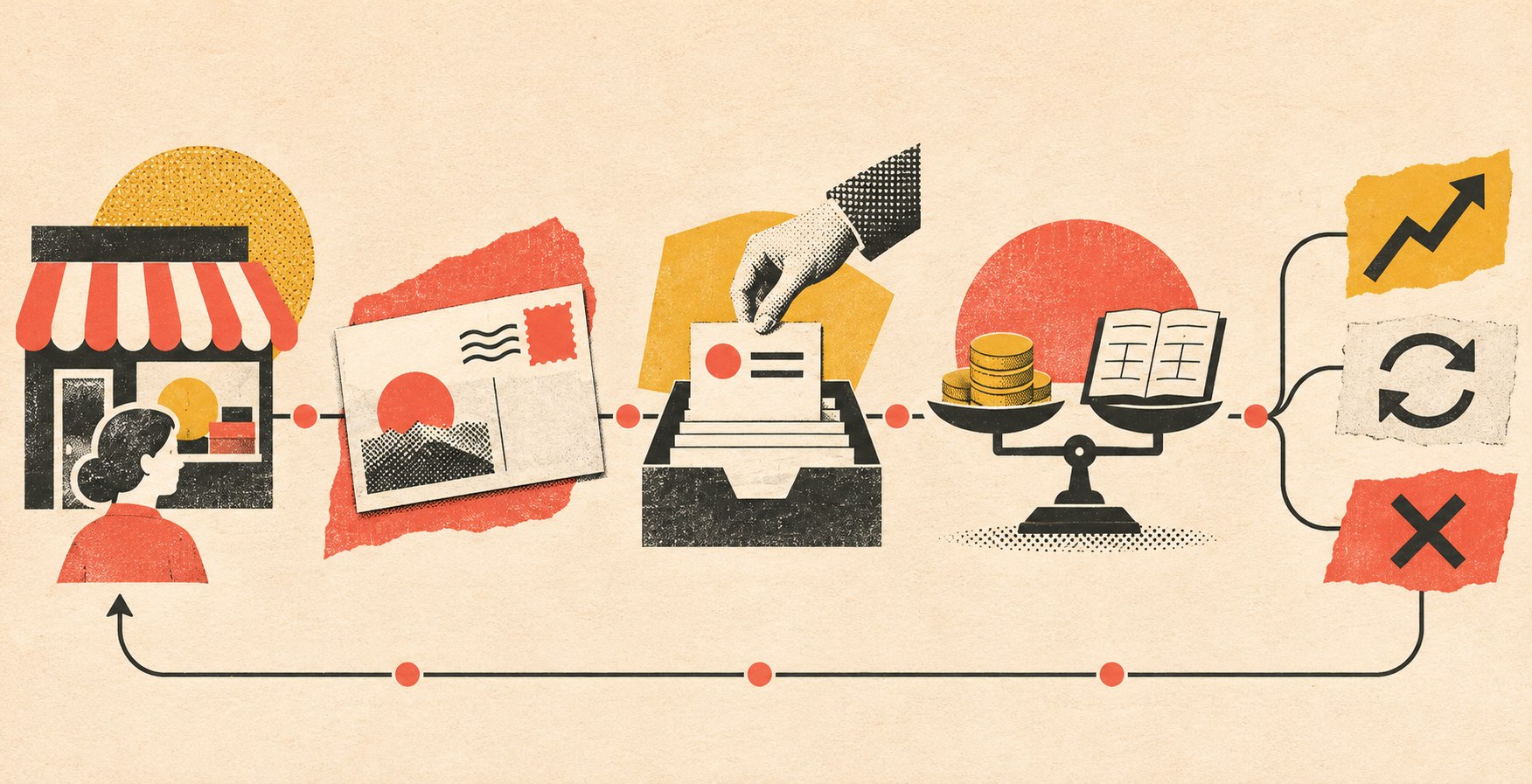
    Five-step illustration: choose a buyer fit, tag the campaign, capture and qualify a lead, measure its business value, then decide whether to scale, revise, or stop.

    Offline Lead Generation Strategies That Are Worth Testing

    There is no universal highest-ROI offline channel. The useful comparison is the condition each tactic needs in order to work and the outcome you can measure. The strategies below are strong starting points for many local and service businesses because each can be bounded, tracked, and evaluated.

    1. Structured Referrals and Warm Introductions

    Referrals are strongest when trust transfer matters and you already have customers, partners, vendors, or community contacts who understand the work. Do not rely on “tell your friends” as a system. Choose the moment to ask, define the type of introduction you want, make the next step easy, and record the source.

    A simple program might ask after a successful project, a repeat purchase, a positive review, or another clear satisfaction signal. If an incentive is involved, confirm that the reward still makes sense after close rate and margin. Our guide to referral marketing versus affiliate marketing goes deeper into when each model fits.

    There is also a compliance boundary. When a rewarded referral becomes a public endorsement or testimonial, the FTC Endorsement Guides say material connections that could affect credibility and are not reasonably expected by the audience should be disclosed clearly and conspicuously. Build disclosure into the program rather than treating it as an afterthought.

    2. Complementary Local Partnerships

    Partnerships work when another trusted business encounters your ideal customer before, during, or after the problem you solve. A realtor and handyman, property manager and HVAC company, accountant and business attorney, wedding venue and photographer, or landscaper and pressure-washing company can create relevant introductions without sharing the same core offer.

    The mistake is collecting business cards without designing the handoff. Give the partner a clear description of the right customer, one frictionless referral path, and a way to identify partner-sourced leads. Review lead quality and closed business by partner. Ten weak “referrals” are not automatically better than two introductions that become profitable customers.

    3. Targeted Direct Mail and Local Print

    Direct mail is worth testing when geography matters, you can define a plausible audience, and the offer is easy to understand from a physical piece. It is especially useful when the buying trigger can be tied to a neighborhood, property, life stage, seasonal need, or known customer profile.

    Targeting can be more disciplined than “mail the whole ZIP code.” The USPS Every Door Direct Mail tool, for example, lets advertisers search routes and neighborhoods and filter route audiences using demographic information such as age, household size, and income. That does not guarantee response; it makes the test boundary clearer.

    Use one offer, one next action, and one campaign identifier. If the piece sends people to a website, use a dedicated landing page or campaign URL instead of the homepage when the offer needs context. Test enough volume to learn something, but keep the downside survivable. There is no evidence-based reason every small business should reserve a fixed percentage of its budget for direct mail.

    4. Events, Workshops, Trade Shows, and Demonstrations

    In-person events work when expertise, trust, demonstration, or concentrated access to a narrow audience matters. A home-maintenance workshop, “ask the expert” session, industry association meeting, local demonstration, or specialized trade show can create conversations that would be expensive to manufacture one at a time.

    Judge the event by qualified conversations and downstream opportunities, not badge scans. Prepare the offer and lead-capture path before the event. Record why a person is relevant, what they need, and what happens next. Follow-up should reference the actual conversation or session instead of dropping everyone into a generic sequence.

    5. Signage, Vehicle Graphics, and Useful Leave-Behinds

    Physical visibility can create demand close to the place or moment of need. Storefront signage can help a retail buyer act. A service vehicle can create neighborhood awareness while crews are visibly working. A maintenance checklist, referral card, magnet, or project leave-behind can remain useful after the transaction.

    The design still needs a job. Our retail signage strategy guide explains how signage functions as a system rather than isolated decoration. For lead generation, add a memorable next step where it makes sense: a short URL, trackable number, QR destination, or simple offer tied to the physical context.

    6. Sponsorships and Selective Local Media

    Sponsorships, community publications, local radio, and other traditional media can make sense when they reach a concentrated audience you cannot reach efficiently another way. They are weaker when you buy them mainly because “people will see our name.”

    Define the job before committing: awareness in a service area, event attendance, a specific offer, referral-partner access, or direct inquiries. Negotiate response opportunities when possible—an event booth, campaign code, speaking slot, dedicated URL, or trackable call path. If the only available metric is “logo exposure,” treat that as an awareness investment rather than pretending it has a precise lead-generation ROI.

    How to Track Offline Marketing Without Pretending Attribution Is Perfect

    Offline attribution is usually a chain of evidence, not a single magic field. One person may see a vehicle, hear your name from a neighbor, search your brand later, and finally submit a website form. Another may scan a postcard QR code and call after visiting three pages. The job is to preserve enough signal to make better decisions without claiming certainty you do not have.

    • Use distinct campaign identifiers when the distinction matters. Campaign URLs, UTMs, phone numbers, QR destinations, offer codes, referral sources, partner IDs, and event IDs can preserve the first measurable handoff.
    • Ask for source information, but do not rely on memory alone. “How did you hear about us?” is useful qualitative evidence; it is not a perfect attribution system.
    • Record qualification. A raw inquiry count hides whether the lead is in your service area, can afford the offer, needs the service, and is ready for the next step.
    • Connect sales outcomes back to the source. Track appointments, proposals, wins, losses, revenue or gross profit where your systems permit.
    • Keep assisted influence visible. Google Analytics explains that attribution models assign credit differently across touchpoints. Your own reporting should be equally explicit about whether it is first-touch, last-touch, source-reported, or another method.

    If your CRM does not yet support perfect source-to-revenue reporting, do not wait for perfection. Start with a consistent source field plus qualification and outcome fields. The measurement system can mature over time.

    How to Calculate Offline Lead Generation ROI

    Marketing ROI is not a universal channel leaderboard. Our broader guide to which marketing channels deserve more budget explains why margins, time horizon, attribution, lead quality, saturation, and the current business constraint can change the winner.

    For an offline test, define the denominator consistently and use the deepest outcome you can verify:

    • Cost per qualified lead = fully loaded campaign cost ÷ qualified leads
    • Test customer acquisition cost = attributable sales and marketing cost ÷ new customers from the test
    • Simple marketing ROI = (attributed gross profit − marketing cost) ÷ marketing cost

    These are management formulas, not universal attribution truth. Define what is included, use the same method from test to test, and keep uncertainty visible.

    A Simple Illustrative Example

    Suppose a local service business runs a hypothetical $1,200 neighborhood campaign after including creative, printing, tracking, and directly attributable setup work. It produces 12 inquiries. Six meet the business’s qualification criteria. Three become new customers, and those first jobs generate $3,000 in attributed gross profit.

    • Cost per qualified lead = $1,200 ÷ 6 = $200
    • Test CAC = $1,200 ÷ 3 = $400
    • Simple ROI = ($3,000 − $1,200) ÷ $1,200 = 150%

    Those numbers are arithmetic, not a benchmark or promise. The test becomes more useful when the business compares the result with its gross profit per customer, capacity, repeat business, close rate, alternative channels, and confidence in attribution.

    How Much Should a Small Business Spend on Offline Lead Generation?

    There is no responsible universal percentage. Budget enough to buy a useful decision while keeping the cost of being wrong survivable. A small test should be large enough to reach a meaningful slice of the intended audience or generate enough relevant opportunities to judge the offer, but it should not become a six-month commitment just because a salesperson sold a package.

    Work backward from your economics:

    • What gross profit does a new customer contribute?
    • What qualification and close rates do you actually see?
    • How much acquisition cost can the offer support?
    • What total cost will the test require, including labor and follow-up?
    • How many qualified outcomes would make the test informative?
    • What result would make you scale, revise, or stop?

    If you cannot answer the economics yet, use the first campaign to improve measurement rather than pretending a borrowed benchmark is your budget strategy.

    A Practical First-Test Checklist

    • Name one audience and one trigger. “Homeowners within our service area after a visible storm” is more useful than “local people.”
    • Give the channel one job. Generate estimates, appointments, store visits, partner introductions, or another measurable action.
    • Choose one clear offer. Do not make the prospect decode a catalog of services.
    • Create one trackable response path. Use a dedicated URL/UTM, QR destination, phone number, source field, or partner/event identifier.
    • Define qualification before launch. Decide what makes an inquiry usable.
    • Assign follow-up ownership. A campaign cannot overcome slow or inconsistent response.
    • Set the cost boundary. Include the significant work required to create and operate the test.
    • Choose the decision rule. Decide what evidence would justify scaling, revision, or stopping.

    Offline Lead Generation FAQ

    What are examples of offline marketing for a small business?

    Examples include referrals, direct mail, print materials, local partnerships, workshops, trade shows, community events, sponsorships, signage, vehicle graphics, leave-behinds, local publications, and selected radio or out-of-home placements. For lead generation, the best examples are the ones that include a measurable response path and a clear business outcome.

    What is the best offline lead generation strategy?

    There is no single best channel for every business. Referrals can be strong when trust transfer matters. Direct mail can fit geographically concentrated demand. Events can work when expertise or demonstrations matter. Partnerships can work when another trusted business reaches the same customer at a complementary stage. The best strategy is the one that produces qualified business outcomes at an acceptable fully loaded cost in your situation.

    Is direct mail worth it for small businesses?

    It can be, especially when you can define a useful geographic audience, present a clear offer, and track the response. Direct mail should be tested against your own lead quality and economics rather than justified with a universal ROI percentage.

    How do I track leads from offline marketing?

    Use campaign URLs with UTMs, QR destinations, call-tracking numbers, referral codes, partner IDs, event codes, CRM source fields, and customer-reported source information where appropriate. Then connect the source to qualification, follow-up, sales stage, and revenue or gross profit as far downstream as your systems reliably permit.

    Should offline and online lead generation be combined?

    Often, yes—but they should not be combined merely to sound “omnichannel.” Offline touchpoints can create trust, visibility, or a local trigger; digital destinations can provide detail, proof, booking, analytics, and follow-up. Combine them when the handoff improves the customer decision and measurement, not because every campaign needs more channels.

    How can I increase sales offline without wasting money?

    Start with a specific buyer and buying trigger, choose one channel that plausibly reaches them, define a measurable offer, track the response, qualify the lead, and connect the outcome to business economics. Avoid committing to multiple channels until one test gives you a useful decision.

    Make Offline Lead Generation Earn Its Next Dollar

    Offline lead generation does not need to compete with digital marketing as an ideology. A referral can become a CRM opportunity. A postcard can send a buyer to a tagged landing page. A workshop can create a qualified follow-up. A sign can create a tracked call. The medium starts the interaction; the measurement system tells you whether it deserves to continue.

    If your offline campaigns produce activity but you cannot tell which ones create qualified customers, talk with Scope Design. We can help connect the audience, offer, website, tracking, and follow-up into a lead-generation system you can actually evaluate.

  • Marketing ROI: Which Channels Deserve More Budget?

    Marketing ROI: Which Channels Deserve More Budget?

    Marketing ROI is not a universal channel leaderboard. The highest-return marketing investment is the one that profitably moves your current business constraint. Email can be exceptional when you already have a permissioned audience. SEO can compound when real search demand exists and you can wait for it. Paid search can win when buyers are actively looking and your margins can support acquisition costs. Short-form video can be powerful when attention and proof are the bottleneck. None of those conditions is true for every business.

    That changes the budgeting question from “Which channel has the highest ROI?” to a more useful one: “Which channel deserves the next dollar based on our economics, measurement, and bottleneck?”

    This guide gives you a practical way to calculate marketing ROI, separate ROI from ROAS, compare channels without fake certainty, and decide what to fund next.

    What Marketing ROI Actually Measures

    At its core, marketing return on investment asks whether the economic value created by marketing exceeded what you spent to create it. Google Ads describes ROI in terms of net profit relative to costs and recommends measuring valuable conversions before judging return.

    A practical formula is:

    Marketing ROI = (profit attributable to marketing − marketing investment) ÷ marketing investment × 100

    The word profit matters. Revenue can make a campaign look healthier than it is. If a campaign produces $10,000 in sales but those sales carry $6,000 in product, fulfillment, discount, and service costs, the business did not create $10,000 of economic value from the campaign.

    For lead-generation businesses, the same principle applies. Do not stop at form fills. Connect leads to qualified opportunities, close rate, average contribution margin, and—when the sales cycle is long enough to matter—eventual customer value.

    ROI vs. ROAS: Similar Acronyms, Different Decisions

    ROAS (return on ad spend) is narrower. It usually compares attributed conversion value with advertising spend. A campaign that attributes $10,000 in revenue to $2,000 in ad spend shows a 5x ROAS. That can be useful for campaign optimization, but it is not automatically the same as business profit.

    The difference becomes more important when you add product margin, sales labor, agency fees, creative production, software, discounts, refunds, and the revenue that may have happened without the campaign. Google’s own Conversion Lift documentation distinguishes ordinary attributed ROAS from incremental ROAS, which asks how much additional value advertising caused compared with a control or baseline.

    A simple rule: use ROAS to diagnose advertising efficiency; use ROI to make business investment decisions.

    Why “Highest-ROI Marketing Channel” Lists Mislead

    Channel benchmarks can be useful context. They become dangerous when they are treated as instructions. A published average cannot know your margins, list quality, local competition, sales cycle, offer strength, existing demand, or measurement gaps.

    • The denominator changes. Some ROI studies count only media spend. Others include people, tools, creative, and production.
    • The time horizon changes. Paid ads may create a signal this month. SEO and content may require a longer window before the economics are visible.
    • Attribution changes the winner. Google Analytics explains that attribution models assign credit differently across touchpoints. A first-touch, last-touch, and data-driven view can tell different stories about the same customer journey.
    • Your constraint changes the value of traffic. Buying more visitors is a poor investment if the real problem is a confusing offer, weak trust, or a broken conversion path.
    • Channel saturation changes returns. The first profitable audience segment or keyword set may not scale at the same cost forever.
    • Conversion quality matters. Ten cheap leads can be worse than three expensive leads if the cheap leads never become customers.

    Measurement itself is still a real problem. Nielsen’s 2025 Annual Marketing Report says only 32% of surveyed global marketers measured media spending holistically across digital and traditional channels. Nielsen also cautions that a channel being easier to measure does not necessarily make it more effective or higher-ROI.

    This is why our broader constraint-first website strategy starts with measurement integrity and the actual business bottleneck before prescribing more traffic or more tactics.

    Marketing Channels That Can Earn Strong ROI—and the Condition Each One Needs

    Instead of ranking channels from “best” to “worst,” compare the condition each channel needs in order to work.

    ChannelStrongest whenWhat to measureCommon ROI trap
    Email / CRMYou already have permissioned prospects or customers and a reason to stay in touch.Qualified replies, repeat purchases, lead-to-sale rate, revenue or margin per recipient.Calling email “free” while ignoring list acquisition, offer quality, deliverability, and labor.
    SEO + contentBuyers search for the problem you solve, organic visibility can compound, and you can tolerate a longer feedback loop.Qualified organic leads, assisted conversions, close rate, contribution margin from search.Optimizing for traffic volume instead of buyer intent and business value.
    Paid searchActive demand exists now and customer economics can support the cost per click and cost per acquisition.Qualified conversion rate, CAC/CPA, close rate, contribution margin, ROAS as a diagnostic.Scaling platform-reported conversions that do not become profitable customers.
    Paid social + short-form videoYou need discovery, attention, repeated proof, or audience creation before buyers search for you.Qualified pipeline, customer acquisition cost, assisted conversions, lift where testable.Confusing cheap reach or engagement with incremental demand.
    Creators / partnerships / referralsTrust transfer matters and the partner has credible access to your market.Partner-sourced qualified leads, close rate, margin, retention, referral velocity.Judging follower count instead of audience fit and customer quality.
    AI + automationThe bottleneck is execution capacity, response speed, repetitive work, or analysis—not lack of demand.Hours saved, cycle time, error rate, output capacity, conversion or retention improvement enabled by the workflow.Treating AI as an acquisition channel instead of an efficiency layer.

    Email and CRM: High Leverage When You Already Own the Relationship

    Email has attractive economics because you can communicate repeatedly with an audience you have already earned permission to contact. But that advantage disappears if the list is cold, the offer is weak, or the business has no useful follow-up system. Judge email by the business outcome it moves—repeat revenue, qualified conversations, recovered opportunities, renewals—not by open rate alone.

    SEO and Content: Strong When Search Demand and Patience Exist

    SEO can become highly efficient because a useful page can keep earning discovery without paying for every click. That does not make every keyword valuable. Our SEO strategy and analytics framework separates visibility from business value: a smaller keyword with buying intent can be worth more than a larger term that produces curiosity traffic.

    Paid Search: Fast Feedback When Demand Is Already Visible

    Paid search is useful when people are already looking for a solution and you need faster evidence than an organic program can provide. The price of that speed is explicit media cost. A paid search campaign deserves more budget only when the downstream economics—qualified lead rate, close rate, margin, and capacity—survive the added spend.

    Social, Video, and Creators: Strong When Attention or Proof Is the Constraint

    Current marketer surveys do show momentum here. HubSpot’s 2026 State of Marketing, based on 1,500+ global marketers, reports that 48.6% ranked short-form video among the media formats producing their biggest ROI. That is useful trend evidence—not a promise that a local contractor, B2B manufacturer, retailer, and software company will all get the same return.

    Video is a format. Social is a distribution environment. Creator partnerships are a trust mechanism. The ROI comes from whether the combination helps a specific audience move toward a profitable outcome.

    AI and Automation: An Efficiency Layer, Not a Standalone Marketing Channel

    AI can improve marketing economics by reducing research time, speeding production, helping teams repurpose useful material, improving follow-up, or making reporting easier to act on. But an AI workflow that produces more low-value output simply scales waste. Our AI automation framework starts with the business workflow and the constraint, then asks whether automation actually earns its keep.

    The Scope Design ROI Decision Loop

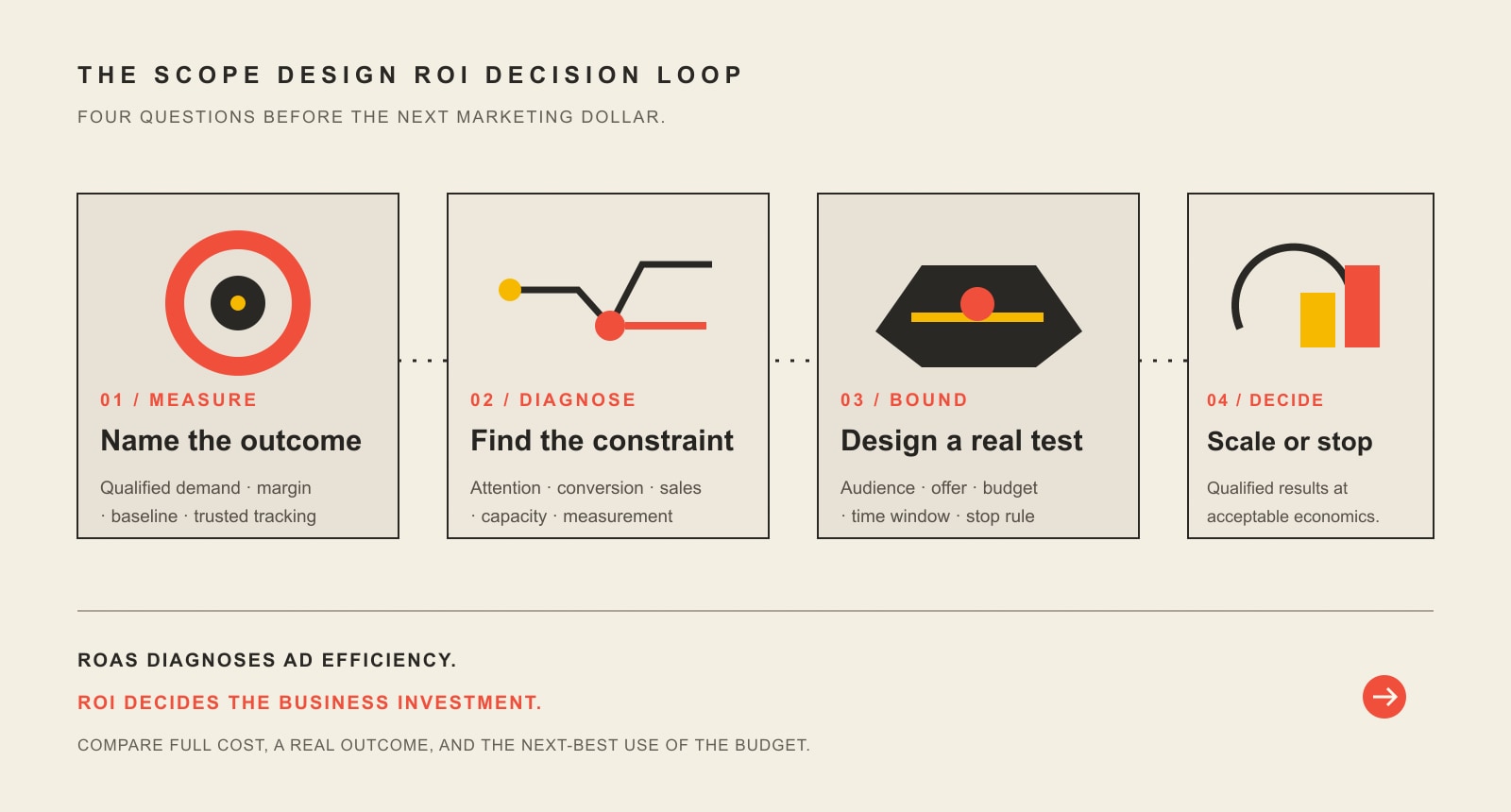
    Before increasing any marketing budget, run the decision through four stages: measure, find the constraint, bound the test, then scale or stop.

    Four-step marketing investment loop: measure the business outcome, find the constraint, bound a test, and scale or stop based on qualified results and acceptable economics.
    The Scope Design ROI Decision Loop turns channel selection into a repeatable investment decision instead of a trend chase.

    1. Measure the Business Outcome

    Define the outcome before choosing the tactic. Is the business trying to create qualified leads, increase contribution margin, recover lost customers, raise repeat purchase rate, or shorten the sales cycle? Confirm the tracking is good enough to observe that result, and define the baseline you are trying to improve.

    2. Find the Constraint

    Ask what is preventing the outcome now. If not enough qualified people know you exist, attention may be the constraint. If traffic is healthy but few people act, the constraint is likely closer to the offer, trust, page experience, or conversion path. If leads arrive but do not close, buying more leads can make the economics worse.

    When traffic exists but results do not, work through the conversion constraint before buying more traffic.

    3. Bound the Test

    A useful test has edges. State the hypothesis, audience, offer, channel, budget, time window, minimum evidence you need, and the condition that will make you stop. “Try social media for a while” is not a test. “Spend a fixed amount to test two proof-led offers against one defined audience and judge qualified opportunity cost” is.

    4. Scale or Stop

    Scale only when the result you care about improves at acceptable economics. If the signal is weak, diagnose why before adding money. The goal is not to defend the tactic. The goal is to buy evidence cheaply, learn what changed, and put the next dollar where it has a better chance of producing business value.

    For the full system around channel selection, offers, conversion, retention, and measurement, see our small business marketing strategy framework.

    Where Should Your Next Marketing Dollar Go?

    You do not need a universal ranking. You need a decision rule.

    • Not enough qualified attention: test paid search when active demand already exists; invest in SEO/content when that demand is durable and you can wait; use social/video/creators when buyers need discovery and repeated proof before they search.
    • Traffic is healthy but leads are weak: fix the offer, page, trust, or conversion path before increasing acquisition spend.
    • Leads arrive but sales are weak: inspect lead quality, qualification, speed-to-lead, sales follow-up, pricing, and offer-market fit. A cheaper lead is not a win if it never closes.
    • Existing customers are underused: email, CRM, retention, referral, and reactivation work may outperform another acquisition campaign because the relationship already exists.
    • The team cannot execute consistently: improve the workflow before adding channels. Automation can create leverage when capacity—not demand—is the constraint.

    What to Measure by Channel

    Platform metrics help you troubleshoot. Business metrics tell you whether to keep spending.

    ChannelUseful diagnostic metricsBudget-decision metrics
    Email / CRMDelivery, opens, clicks, reply rateQualified replies, repeat revenue, margin, retained customers
    SEO / contentImpressions, rankings, organic clicksQualified organic leads, pipeline, closed revenue, contribution margin
    Paid searchCPC, CTR, conversion rateQualified CPA/CAC, close rate, margin, incremental revenue where measurable
    Paid social / videoReach, watch time, CPM, engagementQualified pipeline, CAC, lift, assisted revenue
    Creators / referralsReach, referral traffic, responsePartner-sourced opportunities, close rate, retention, margin
    AI / automationTasks completed, output volumeHours saved, faster cycle time, lower error rate, capacity or conversion improvement

    If a dashboard is full of clicks, views, and engagement but cannot connect them to a qualified outcome, the immediate marketing problem may be measurement—not channel selection.

    Marketing ROI FAQ

    What marketing channel has the highest ROI?

    There is no single highest-ROI channel for every business. Email tends to have favorable economics when you already own a responsive audience. SEO can compound when search demand and conversion quality are strong. Paid search can produce fast, high-intent feedback. Social and short-form video can work well when attention or proof is the bottleneck. The winner is the channel that produces the best qualified business outcome relative to its fully loaded cost in your situation.

    What is a good marketing ROI?

    A good marketing ROI is one that clears your business’s required return after material costs, remains credible after attribution uncertainty, and is strong enough to justify using the money there instead of somewhere else. A universal percentage is less useful than your margin, cash cycle, risk, capacity, and alternative uses of capital.

    What does a 20% marketing ROI mean?

    If the inputs are defined correctly, a 20% ROI means the measured investment produced net return equal to 20% of that investment. Whether 20% is attractive depends on how long it took, how confidently the result can be attributed, the risk involved, and what other investments were available.

    How do I compare SEO ROI with Google Ads ROI?

    Compare them against the same business outcome, not unlike metrics. Include the fully loaded costs of each program, use a time window appropriate to each channel, and follow leads through qualification and sales. Do not compare SEO traffic with ad revenue or compare an ad-platform ROAS number with an organic lead count.

    How long should I wait before judging marketing ROI?

    Set the evaluation window before the test. Paid channels can often produce directional evidence sooner because spend and exposure begin immediately. SEO, content, partnerships, and brand-building usually need longer windows. For long sales cycles, judge leading indicators first but do not call the program profitable until the qualified outcomes have had time to mature.

    Does AI improve marketing ROI?

    It can, when it reduces the cost or time required to produce a valuable outcome. AI does not fix weak demand, bad positioning, poor measurement, or a broken conversion path. Treat it as leverage inside a working system, then measure whether the workflow actually improved cost, speed, quality, conversion, or retention.

    Stop Funding the Channel. Fund the Constraint.

    The most useful marketing trend is not a new platform. It is a stricter standard for deciding what deserves budget.

    Measure the business outcome. Find the constraint. Run a bounded test. Scale only when qualified results justify it. That approach will not produce a tidy universal leaderboard, but it gives you something more valuable: a repeatable way to make the next marketing dollar smarter than the last one.

    If your marketing dashboard shows plenty of activity but you still cannot tell which investment is earning its keep, Scope Design can help you diagnose the measurement, conversion, and channel system before you add more spend.