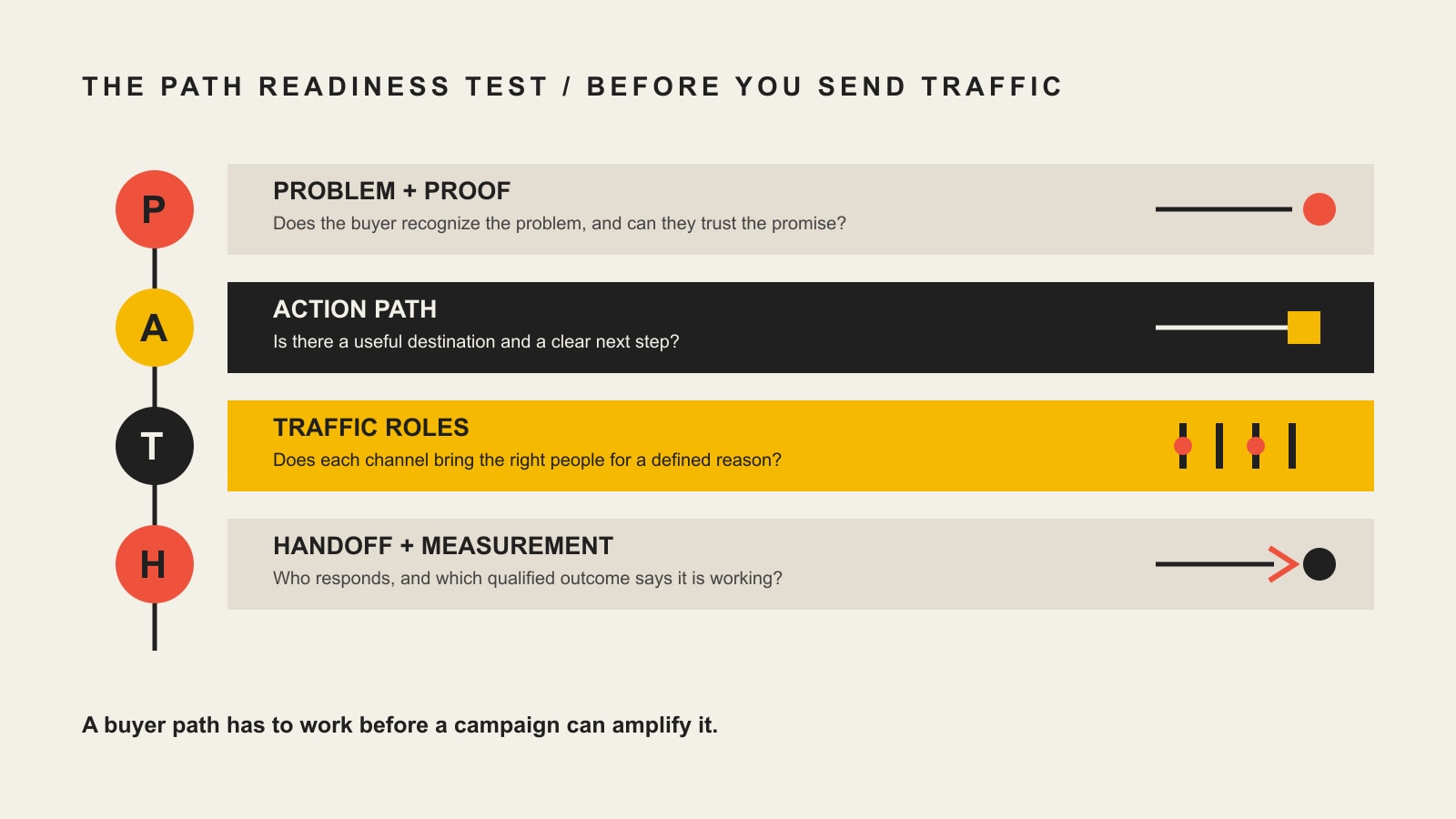
A small business marketing strategy is the sequence that turns a defined audience and credible offer into qualified business outcomes. Choose channels only after the destination, response process, delivery capacity, and measurement are ready. Otherwise, paid traffic does not fix the system. It exposes the leak faster and sends you the invoice.
TL;DR: What should a small business marketing strategy include?
- Start with the business constraint, not the platform you feel guilty about neglecting.
- Define the audience, buying moment, offer, and proof before creating campaigns. Use buyer psychology to diagnose the motives, risks, and proof needs shaping the decision.
- Fix the page or experience where attention lands.
- Assign ownership for every call, form, email, application, and handoff.
- Confirm the business can fulfill additional demand without making the customer experience worse.
- Measure qualified outcomes, not just reach, clicks, followers, or raw leads.
- Choose one to three primary acquisition channels that fit the buyer and the business.
- Run a bounded test, learn, and improve the system before scaling it.
If your current marketing plan begins with “we should post more,” congratulations: you have a chore list. Strategy starts by deciding what the business needs to change and what must be true before promotion can help.
In this guide
Marketing strategy is not a list of platforms
A strategy explains what you are trying to change, who must respond, why they should care, how the business will turn that response into value, and what evidence will tell you whether it worked.
A plan organizes the work. A campaign is a coordinated effort with a particular objective and time frame. A channel is where communication happens. A tactic is a specific action inside the channel.
Those distinctions matter because businesses routinely mistake activity for direction:
- “We need to be on TikTok” is a channel preference.
- “We will publish three videos a week” is an activity plan.
- “We need more leads” is an aspiration with a noun attached.
- “We need ten additional qualified commercial-project inquiries per quarter, and our sales team can respond within one working hour” is finally beginning to resemble a business objective.
The U.S. Small Business Administration’s marketing guidance separates marketing strategy from the action plan and includes target market, competitive advantage, sales process, goals, channels, budget, and measurement. It also makes a point agencies often skip: operations shape the customer’s experience. Marketing does not stop when somebody clicks.
The Scope Design Attention-to-Outcome Marketing System

Most marketing diagrams make the channel look like the machine. It is not. The channel is the pipe carrying attention into the machine. If the machine is broken, a wider pipe gives you a more expensive puddle.
The Scope Design Attention-to-Outcome Marketing System has eight parts.
1. Identify the actual business constraint
Do not assume the business needs more awareness merely because awareness is easy to buy and pleasant to report.
The immediate constraint may be:
- too little qualified demand;
- plenty of inquiries but poor fit;
- a confusing offer;
- weak conversion on a high-intent page;
- slow or inconsistent lead response;
- a sales process that loses good opportunities;
- no delivery capacity for additional work;
- no measurement connecting marketing to decisions or revenue.
Each problem implies different work. A business with a full production schedule does not need a cleverer lead magnet. It may need a waitlist, better qualification, higher prices, or operational capacity. A business generating forty form submissions that nobody owns does not need fifty.
This is the same constraint-first discipline we use in website strategy and conversion optimization: diagnose the binding problem before prescribing a deliverable.
2. Define the audience and buying moment
Audience definition also includes what buyers already know. Use the five stages of awareness in marketing to diagnose whether a message should create recognition, improve the problem diagnosis, explain solution choices, differentiate the offer, or simply remove the last bit of friction.
“Small businesses” is not an audience. Neither is “homeowners,” “moms,” “decision-makers,” or any other label broad enough to include people with wildly different problems and buying authority.
Define:
- who has the problem;
- what event or frustration makes the problem urgent;
- what the person already knows;
- what alternatives they are considering;
- what would make them distrust the offer;
- what authority and budget they have;
- what evidence they need before acting.
This is not an invitation to invent a fictional persona named Marketing Mary who enjoys oat-milk lattes and “values authenticity.” Use customer conversations, sales objections, search queries, service records, lost deals, and actual behavior. The SBA’s market-research guidance recommends combining customer and market evidence to understand demand and competitive advantage.
The buying moment determines the channel and the message. Someone actively searching for an emergency service is not in the same state as someone idly scrolling through a social feed. Treating both people the same because they fit a demographic checkbox is how campaigns become technically targeted and commercially useless.
3. Strengthen the offer and the proof
Advertising cannot rescue an offer that is vague, interchangeable, badly timed, or impossible to believe.
A usable offer answers:
- What changes for the buyer?
- Why is this the appropriate solution?
- Why should the buyer trust this business?
- What does the buyer need to do next?
- What will it cost, or what determines the cost?
- What are the honest limitations and trade-offs?
- What happens after the buyer says yes?
Proof belongs next to the claim it supports. That may include a relevant case example, a demonstrated process, a sample deliverable, a warranty, documented credentials, transparent constraints, or a useful explanation that shows the business understands the problem.
Do not manufacture urgency, testimonials, “results,” or suspiciously precise percentages because the honest offer feels a little naked. The Federal Trade Commission’s small-business advertising guidance states that advertising must be truthful and non-deceptive, claims need evidence, and material omissions can also mislead. Ethics is not decorative copy under the footer. It is part of the offer.
4. Fix the destination
Every campaign sends the audience somewhere: a service page, landing page, application, product page, booking calendar, phone call, store, event, social profile, or inbox.
That destination must:
- continue the promise made by the campaign;
- answer the next reasonable question;
- work on the device the audience is using;
- load and function reliably;
- make the intended action obvious;
- ask only for information the person can reasonably provide;
- provide confirmation and explain what happens next;
- preserve trust through accessibility, privacy, and accurate claims.
Google Ads recommends matching landing pages to ads and keywords, mirroring the call to action, making the intended action easy, and providing useful information. See Google Ads’ landing-page guidance.
This does not mean every campaign needs a stripped-down hostage page with no navigation and a glowing button screaming ACT NOW. High-consideration buyers may need pricing context, proof, team information, case examples, and a way to investigate the company. Remove accidental friction, not legitimate evaluation.
5. Assign response ownership
What happens after the form submission?
If the honest answer is “it goes to an inbox,” you have described storage, not a process.
For every intended action, define:
- who receives it;
- how quickly it is acknowledged;
- what makes it qualified;
- who owns the next step;
- what happens if the first person is unavailable;
- where the status is recorded;
- when the lead is considered closed, lost, or still active;
- what feedback returns to marketing.
Response speed matters, but ownership matters first. A five-minute automated email does not compensate for five days of nobody taking responsibility. For Scope Design’s typical established service-business reader, the useful standard is not instant pressure. It is a clear human handoff during the first working hour whenever practical.
6. Confirm delivery capacity
Marketing can work perfectly and still damage the business.
If added demand produces missed calls, delayed estimates, rushed work, stockouts, poor onboarding, staff burnout, or a three-month backlog nobody disclosed, the campaign did not create healthy growth. It accelerated a capacity problem.
Before increasing demand, ask:
- How many additional qualified opportunities can the team handle?
- How many new customers can operations fulfill well?
- Which skills, inventory, or approvals limit throughput?
- What happens when demand arrives unevenly?
- Should the campaign filter harder rather than reach farther?
- Would a price, schedule, service-area, or fit change protect the operation?
Sometimes the right marketing decision is to stop pushing for volume. Improve qualification, raise the threshold, create a waitlist, narrow the offer, or invest in the operation first. “We generated more leads” is not a defense when the business could not serve them.
7. Define measurement from attention to outcome
Measurement should follow the business journey, not the dashboard’s most colorful chart.
Use a hierarchy:
- Attention: impressions, reach, rankings, views, and visits show exposure.
- Relevant engagement: useful page consumption, ad-to-page message match, replies, and meaningful interactions show the audience did more than pass through.
- Intended action: calls, applications, purchases, booked appointments, form submissions, and downloads show a concrete response.
- Qualified outcome: fit, budget, authority, need, attendance, opportunity creation, and next-step acceptance show whether the response was useful.
- Business result: closed revenue, contribution margin, repeat purchase, retention, sales-cycle movement, capacity gained, or another attributable operational result shows value.
Google Ads’ conversion-measurement documentation starts with the valuable actions a business chooses to measure, such as purchases, signups, and phone calls. That is a better starting point than installing every available event and hoping the reports develop judgment.
For an ecommerce business, purchases and contribution margin may be close to the campaign. For a considered B2B service, the website may reasonably be accountable for a qualified conversation, while the sales process owns the close. Track both, but do not blame the landing page for a proposal nobody followed up on.
For deeper treatment of source, intent, search visibility, and qualified measurement, use our SEO and analytics strategy pillar.
8. Choose the channel and bound the test
Only after the first seven decisions should the conversation become “Should we use email, Google Ads, Facebook, partnerships, or something else?”
Choose the channel by asking:
- Is the audience actively searching, passively discovering, or already known to us?
- Can the channel reach the audience with the necessary context?
- Does the offer require education or support an immediate action?
- Can the business produce the required creative and maintain the channel?
- Can the intended action be measured?
- What is the acceptable cost of learning?
- What result would cause us to continue, revise, or stop?
Start with one to three primary acquisition channels. A small business does not earn bonus points for maintaining seven neglected profiles and an email list it contacts twice a year.
How to choose marketing channels without trying everything
The right channel is the one that reaches the right buying moment and can be operated consistently enough to learn from.
| Channel | Decision screen |
|---|---|
| Search and SEO | Strong fit: Buyers actively research the problem or service. Do not lead with it: Demand is absent, the query is irrelevant, or the business cannot wait for compounding work. Measure: Qualified inquiries by query and entry-page intent. |
| Paid search | Strong fit: High-intent demand exists and the offer, page, follow-up, and economics are ready. Do not lead with it: The site cannot convert or nobody knows what a qualified lead is worth. Measure: Qualified cost per acquisition, pipeline, and margin. |
| Paid social | Strong fit: The audience can be defined and the offer benefits from discovery, demonstration, or retargeting. Do not lead with it: The creative is generic, the destination is weak, or capacity is already constrained. Measure: Qualified actions and downstream value by audience and creative. |
| Strong fit: The business has permission, a useful reason to communicate, and an audience relationship worth maintaining. Do not lead with it: The list is purchased, neglected, or treated as a coupon cannon. Measure: Replies, qualified actions, revenue, retention, and disengagement. | |
| Organic social | Strong fit: Customers, partners, or community members use the platform and the business can participate credibly. Do not lead with it: The platform is chosen from guilt or vanity. Measure: Useful conversations, referrals, assisted actions, and audience quality. |
| Content | Strong fit: Buyers need education, comparison, evidence, or decision support. Do not lead with it: Nobody will maintain the content or its distribution. Measure: Search and distribution reach, qualified journeys, sales use, and assisted outcomes. |
| Partnerships and local promotion | Strong fit: Trust, geography, referrals, events, or adjacent audiences drive buying. Do not lead with it: The relationship has no audience fit or clear mutual value. Measure: Referrals, attended actions, qualified opportunities, and repeatability. |
If your audience is local, pair community and referral work with local marketing strategies and keep the search-specific work in the Local SEO cluster. If Meta is a plausible paid channel, start by understanding Meta campaign objectives rather than boosting whichever post received three thumbs-up reactions.
Owned, earned, and paid attention all have costs
Owned channels include the website, email list, and content assets the business substantially controls. Our small-business content marketing system explains how those assets connect buyer questions, original evidence, distribution, and qualified outcomes. Earned attention includes referrals, reviews, mentions, and editorial exposure. Paid attention includes advertising, sponsorships, and other placements purchased for reach.
Owned does not mean free. The website needs maintenance. Email requires consent, content, deliverability work, and list hygiene. Useful articles require expertise, evidence, editing, and updates. Earned attention also takes work and trust. Paid channels simply make the invoice easier to see.
A resilient small-business strategy usually develops owned assets while using earned and paid distribution deliberately. The exact mix depends on the buying journey. Do not turn “owned first” into another universal commandment. A new urgent-care service, seasonal event, or time-sensitive offer may need paid reach immediately—but the destination, response, capacity, and measurement still need to exist.
A real example: fix the application before judging the ads
A fleet-services company asked Scope Design to make its job application easier to use. The existing form requested a Social Security Number and desired wage before an applicant had entered a hiring conversation, and more fields were required than necessary.
We removed the Social Security Number and desired-wage fields. Only the fourteen fields explicitly designated as required remained mandatory; the rest became optional.
When the company later began running Google job-application ads, Scope Design added the requested Google tag to the application page so the intended action could be measured.
The defensible lesson is straightforward:
Before arguing about the ads, make sure the destination is usable and the action can actually be measured.
We are not claiming a conversion lift, hiring improvement, or advertising return because those outcomes have not been documented. The example supports the sequence: simplify the experience, establish the measurement point, and then judge the campaign.
That sequence is less exciting than announcing a 437% improvement with a rocket emoji. It is also true.
When more traffic is the wrong goal
More traffic is the wrong primary goal when:
- current visitors cannot understand the offer;
- the traffic source attracts people the business cannot serve;
- high-intent pages have broken forms or weak calls to action;
- the business responds too slowly or inconsistently;
- leads are not qualified or tracked;
- sales follow-up is the actual leak;
- capacity is already full;
- the business cannot identify the intended action;
- the campaign cannot be connected to a useful outcome.
Traffic is evidence of attention. Attention may be necessary, but it is not value by itself.
If the business has a clear offer, a working destination, reliable follow-up, available capacity, and a strong close rate—but too few qualified prospects arrive—then yes, traffic may be the constraint. Buy, earn, or build more of the appropriate attention. Just do not diagnose “traffic problem” because the sessions chart looks lonely.
A practical 90-day marketing sequence
This is a decision sequence, not a promise that every business will be transformed before the quarter ends.
Days 1–15: Diagnose
- Define the business outcome and the current constraint.
- Review source, inquiry, qualification, sales, and capacity data.
- Interview the people handling sales and delivery.
- Identify the audience, buying moment, objections, and proof.
- Choose one intended action and document the current handoff.
Days 16–30: Repair the conversion path
- Clarify the offer and message.
- Fix the primary destination and form or booking flow.
- Confirm mobile use, accessibility, privacy, and confirmation behavior.
- Assign response ownership and escalation.
- Configure measurement for the intended action.
Days 31–60: Strengthen owned and existing channels
- Improve the website pages buyers already use.
- Build or clean the appropriate email sequence.
- Update the one or two social/community channels that have real audience fit.
- Create the proof or decision content sales repeatedly needs.
- Ask existing partners and customers where discovery actually happens.
If a social presence has gone stale, use the dormant social-media recovery guide to decide what deserves revival instead of restarting every account.
Days 61–90: Run one bounded acquisition test
- Choose one primary channel and one defined audience.
- Establish the budget, time frame, offer, destination, and success/stop conditions.
- Review attention, action, qualification, and business outcomes separately.
- Record what changed and what the evidence does not prove.
- Scale only after the system produces a useful result the business can fulfill.
Frequently asked questions about small business marketing strategy
What is the best marketing strategy for a small business?
The best strategy is the one that matches the business’s actual constraint, customer buying behavior, offer, capacity, and economics. For many established small businesses, that means a clear website and offer, reliable lead response, strong referral/local visibility, useful search content, and carefully chosen email or paid acquisition—not every platform at once.
What is the difference between a marketing strategy and a marketing plan?
A marketing strategy defines the audience, position, objective, constraints, and choices. A marketing plan turns those choices into campaigns, channels, responsibilities, budgets, dates, and measurements. Strategy explains why and what to prioritize; the plan explains who does what next.
What are the main types of digital marketing?
Common types include search/SEO, paid search, paid social, organic social, email, content, display/video advertising, affiliates/partnerships, and local digital promotion. That is a taxonomy, not a recommendation to use all of them.
What is the 3-3-3 rule in marketing?
There is no single universally accepted 3-3-3 marketing rule. The label is used for different social-posting, content, and messaging formulas. Treat any version as a prompt or production constraint, not as strategy and certainly not as a law of customer behavior.
What is the 70/20/10 rule in marketing?
The 70/20/10 rule commonly allocates most effort to proven work, a smaller share to adjacent experiments, and a final share to higher-risk ideas. It can prevent random experimentation from consuming the budget, but the percentages are arbitrary. A business with weak fundamentals may need nearly all its effort on repair before experimentation deserves a slice.
What are the seven Ps of marketing?
The seven Ps are product, price, place, promotion, people, process, and physical evidence. They are a useful review framework because they extend beyond promotion. They do not replace research, constraint diagnosis, ownership, or measurement.
How many marketing channels should a small business use?
Most small businesses should concentrate on one to three primary acquisition channels and maintain only the supporting channels they can operate credibly. Add another channel when the current system works, the audience justifies it, and the business has the capacity to learn from it.
Should every small business use social media?
No. Use social media when customers, partners, recruits, or community members actually use a platform in a way that supports the buying or relationship journey. A maintained profile may help credibility, but daily posting is not a moral obligation. Our Facebook local marketing guide is useful when Facebook genuinely connects the business to its community.
When should a small business start paid advertising?
Start paid advertising when the audience and offer are clear, the destination works, follow-up has an owner, capacity exists, conversion measurement is configured, and the business can afford a bounded learning period. Do not scale because impressions are cheap.
How much should a small business spend on marketing?
There is no responsible universal percentage. The budget depends on margins, customer value, sales cycle, current demand, channel costs, capacity, and the amount the business can afford to learn without creating financial distress. Budget from business economics and a defined test, not from a benchmark stripped of context. For the complete decision system, use our small-business marketing budget guide and SPEND Test before buying more attention.
How should marketing success be measured?
Start with the last outcome marketing can meaningfully influence, such as a qualified purchase, application, appointment, inquiry, or opportunity. Track attention and engagement as diagnostics, then connect the intended action to qualification, pipeline, revenue, margin, retention, or operational value wherever attribution is credible.
Can a small-business owner create the strategy without an agency?
Yes. The owner often has the best raw knowledge of customers, constraints, delivery, and economics. Outside help becomes valuable when the business needs independent diagnosis, research, measurement design, technical implementation, or somebody willing to challenge the solution it already decided to buy.
Stop buying tactics. Diagnose the system.
Scope Design helps established businesses determine whether the real constraint is audience, offer, website, conversion path, follow-up, measurement, capacity, or the systems connecting them.
If you want another list of “ten marketing hacks,” the internet is already drowning in those. If you want to know which part of your system deserves money first, talk with Scope Design.
Sources and further reading
Evidence review: August 21, 2026. External factual guidance below links to current SBA, FTC, and Google sources. The fleet-services example above is a documented Scope Design implementation and is intentionally not presented as a causal performance study.
- U.S. Small Business Administration: Manage your business — marketing and sales
- U.S. Small Business Administration: Plan your business — market research and competitive analysis
- Google Ads: Optimize your ads and landing pages
- Google Ads: About conversion measurement
- Federal Trade Commission: Advertising FAQs for small business