Tag: Marketing Measurement

  • Small Business Marketing Strategy: Fix the System Before Buying More Attention

    Small Business Marketing Strategy: Fix the System Before Buying More Attention

    A small business marketing strategy is the sequence that turns a defined audience and credible offer into qualified business outcomes. Choose channels only after the destination, response process, delivery capacity, and measurement are ready. Otherwise, paid traffic does not fix the system. It exposes the leak faster and sends you the invoice.

    TL;DR: What should a small business marketing strategy include?

    • Start with the business constraint, not the platform you feel guilty about neglecting.
    • Define the audience, buying moment, offer, and proof before creating campaigns. Use buyer psychology to diagnose the motives, risks, and proof needs shaping the decision.
    • Fix the page or experience where attention lands.
    • Assign ownership for every call, form, email, application, and handoff.
    • Confirm the business can fulfill additional demand without making the customer experience worse.
    • Measure qualified outcomes, not just reach, clicks, followers, or raw leads.
    • Choose one to three primary acquisition channels that fit the buyer and the business.
    • Run a bounded test, learn, and improve the system before scaling it.

    If your current marketing plan begins with “we should post more,” congratulations: you have a chore list. Strategy starts by deciding what the business needs to change and what must be true before promotion can help.

    Marketing strategy is not a list of platforms

    A strategy explains what you are trying to change, who must respond, why they should care, how the business will turn that response into value, and what evidence will tell you whether it worked.

    A plan organizes the work. A campaign is a coordinated effort with a particular objective and time frame. A channel is where communication happens. A tactic is a specific action inside the channel.

    Those distinctions matter because businesses routinely mistake activity for direction:

    • “We need to be on TikTok” is a channel preference.
    • “We will publish three videos a week” is an activity plan.
    • “We need more leads” is an aspiration with a noun attached.
    • “We need ten additional qualified commercial-project inquiries per quarter, and our sales team can respond within one working hour” is finally beginning to resemble a business objective.

    The U.S. Small Business Administration’s marketing guidance separates marketing strategy from the action plan and includes target market, competitive advantage, sales process, goals, channels, budget, and measurement. It also makes a point agencies often skip: operations shape the customer’s experience. Marketing does not stop when somebody clicks.

    The Scope Design Attention-to-Outcome Marketing System

    A connected marketing path carries attention through a narrowed filter, a credible offer, response, capacity, measurement, and a bounded channel test.

    Most marketing diagrams make the channel look like the machine. It is not. The channel is the pipe carrying attention into the machine. If the machine is broken, a wider pipe gives you a more expensive puddle.

    The Scope Design Attention-to-Outcome Marketing System has eight parts.

    1. Identify the actual business constraint

    Do not assume the business needs more awareness merely because awareness is easy to buy and pleasant to report.

    The immediate constraint may be:

    • too little qualified demand;
    • plenty of inquiries but poor fit;
    • a confusing offer;
    • weak conversion on a high-intent page;
    • slow or inconsistent lead response;
    • a sales process that loses good opportunities;
    • no delivery capacity for additional work;
    • no measurement connecting marketing to decisions or revenue.

    Each problem implies different work. A business with a full production schedule does not need a cleverer lead magnet. It may need a waitlist, better qualification, higher prices, or operational capacity. A business generating forty form submissions that nobody owns does not need fifty.

    This is the same constraint-first discipline we use in website strategy and conversion optimization: diagnose the binding problem before prescribing a deliverable.

    2. Define the audience and buying moment

    Audience definition also includes what buyers already know. Use the five stages of awareness in marketing to diagnose whether a message should create recognition, improve the problem diagnosis, explain solution choices, differentiate the offer, or simply remove the last bit of friction.

    “Small businesses” is not an audience. Neither is “homeowners,” “moms,” “decision-makers,” or any other label broad enough to include people with wildly different problems and buying authority.

    Define:

    • who has the problem;
    • what event or frustration makes the problem urgent;
    • what the person already knows;
    • what alternatives they are considering;
    • what would make them distrust the offer;
    • what authority and budget they have;
    • what evidence they need before acting.

    This is not an invitation to invent a fictional persona named Marketing Mary who enjoys oat-milk lattes and “values authenticity.” Use customer conversations, sales objections, search queries, service records, lost deals, and actual behavior. The SBA’s market-research guidance recommends combining customer and market evidence to understand demand and competitive advantage.

    The buying moment determines the channel and the message. Someone actively searching for an emergency service is not in the same state as someone idly scrolling through a social feed. Treating both people the same because they fit a demographic checkbox is how campaigns become technically targeted and commercially useless.

    3. Strengthen the offer and the proof

    Advertising cannot rescue an offer that is vague, interchangeable, badly timed, or impossible to believe.

    A usable offer answers:

    • What changes for the buyer?
    • Why is this the appropriate solution?
    • Why should the buyer trust this business?
    • What does the buyer need to do next?
    • What will it cost, or what determines the cost?
    • What are the honest limitations and trade-offs?
    • What happens after the buyer says yes?

    Proof belongs next to the claim it supports. That may include a relevant case example, a demonstrated process, a sample deliverable, a warranty, documented credentials, transparent constraints, or a useful explanation that shows the business understands the problem.

    Do not manufacture urgency, testimonials, “results,” or suspiciously precise percentages because the honest offer feels a little naked. The Federal Trade Commission’s small-business advertising guidance states that advertising must be truthful and non-deceptive, claims need evidence, and material omissions can also mislead. Ethics is not decorative copy under the footer. It is part of the offer.

    4. Fix the destination

    Every campaign sends the audience somewhere: a service page, landing page, application, product page, booking calendar, phone call, store, event, social profile, or inbox.

    That destination must:

    • continue the promise made by the campaign;
    • answer the next reasonable question;
    • work on the device the audience is using;
    • load and function reliably;
    • make the intended action obvious;
    • ask only for information the person can reasonably provide;
    • provide confirmation and explain what happens next;
    • preserve trust through accessibility, privacy, and accurate claims.

    Google Ads recommends matching landing pages to ads and keywords, mirroring the call to action, making the intended action easy, and providing useful information. See Google Ads’ landing-page guidance.

    This does not mean every campaign needs a stripped-down hostage page with no navigation and a glowing button screaming ACT NOW. High-consideration buyers may need pricing context, proof, team information, case examples, and a way to investigate the company. Remove accidental friction, not legitimate evaluation.

    5. Assign response ownership

    What happens after the form submission?

    If the honest answer is “it goes to an inbox,” you have described storage, not a process.

    For every intended action, define:

    • who receives it;
    • how quickly it is acknowledged;
    • what makes it qualified;
    • who owns the next step;
    • what happens if the first person is unavailable;
    • where the status is recorded;
    • when the lead is considered closed, lost, or still active;
    • what feedback returns to marketing.

    Response speed matters, but ownership matters first. A five-minute automated email does not compensate for five days of nobody taking responsibility. For Scope Design’s typical established service-business reader, the useful standard is not instant pressure. It is a clear human handoff during the first working hour whenever practical.

    6. Confirm delivery capacity

    Marketing can work perfectly and still damage the business.

    If added demand produces missed calls, delayed estimates, rushed work, stockouts, poor onboarding, staff burnout, or a three-month backlog nobody disclosed, the campaign did not create healthy growth. It accelerated a capacity problem.

    Before increasing demand, ask:

    • How many additional qualified opportunities can the team handle?
    • How many new customers can operations fulfill well?
    • Which skills, inventory, or approvals limit throughput?
    • What happens when demand arrives unevenly?
    • Should the campaign filter harder rather than reach farther?
    • Would a price, schedule, service-area, or fit change protect the operation?

    Sometimes the right marketing decision is to stop pushing for volume. Improve qualification, raise the threshold, create a waitlist, narrow the offer, or invest in the operation first. “We generated more leads” is not a defense when the business could not serve them.

    7. Define measurement from attention to outcome

    Measurement should follow the business journey, not the dashboard’s most colorful chart.

    Use a hierarchy:

    1. Attention: impressions, reach, rankings, views, and visits show exposure.
    2. Relevant engagement: useful page consumption, ad-to-page message match, replies, and meaningful interactions show the audience did more than pass through.
    3. Intended action: calls, applications, purchases, booked appointments, form submissions, and downloads show a concrete response.
    4. Qualified outcome: fit, budget, authority, need, attendance, opportunity creation, and next-step acceptance show whether the response was useful.
    5. Business result: closed revenue, contribution margin, repeat purchase, retention, sales-cycle movement, capacity gained, or another attributable operational result shows value.

    Google Ads’ conversion-measurement documentation starts with the valuable actions a business chooses to measure, such as purchases, signups, and phone calls. That is a better starting point than installing every available event and hoping the reports develop judgment.

    For an ecommerce business, purchases and contribution margin may be close to the campaign. For a considered B2B service, the website may reasonably be accountable for a qualified conversation, while the sales process owns the close. Track both, but do not blame the landing page for a proposal nobody followed up on.

    For deeper treatment of source, intent, search visibility, and qualified measurement, use our SEO and analytics strategy pillar.

    8. Choose the channel and bound the test

    Only after the first seven decisions should the conversation become “Should we use email, Google Ads, Facebook, partnerships, or something else?”

    Choose the channel by asking:

    • Is the audience actively searching, passively discovering, or already known to us?
    • Can the channel reach the audience with the necessary context?
    • Does the offer require education or support an immediate action?
    • Can the business produce the required creative and maintain the channel?
    • Can the intended action be measured?
    • What is the acceptable cost of learning?
    • What result would cause us to continue, revise, or stop?

    Start with one to three primary acquisition channels. A small business does not earn bonus points for maintaining seven neglected profiles and an email list it contacts twice a year.

    How to choose marketing channels without trying everything

    The right channel is the one that reaches the right buying moment and can be operated consistently enough to learn from.

    ChannelDecision screen
    Search and SEOStrong fit: Buyers actively research the problem or service. Do not lead with it: Demand is absent, the query is irrelevant, or the business cannot wait for compounding work. Measure: Qualified inquiries by query and entry-page intent.
    Paid searchStrong fit: High-intent demand exists and the offer, page, follow-up, and economics are ready. Do not lead with it: The site cannot convert or nobody knows what a qualified lead is worth. Measure: Qualified cost per acquisition, pipeline, and margin.
    Paid socialStrong fit: The audience can be defined and the offer benefits from discovery, demonstration, or retargeting. Do not lead with it: The creative is generic, the destination is weak, or capacity is already constrained. Measure: Qualified actions and downstream value by audience and creative.
    EmailStrong fit: The business has permission, a useful reason to communicate, and an audience relationship worth maintaining. Do not lead with it: The list is purchased, neglected, or treated as a coupon cannon. Measure: Replies, qualified actions, revenue, retention, and disengagement.
    Organic socialStrong fit: Customers, partners, or community members use the platform and the business can participate credibly. Do not lead with it: The platform is chosen from guilt or vanity. Measure: Useful conversations, referrals, assisted actions, and audience quality.
    ContentStrong fit: Buyers need education, comparison, evidence, or decision support. Do not lead with it: Nobody will maintain the content or its distribution. Measure: Search and distribution reach, qualified journeys, sales use, and assisted outcomes.
    Partnerships and local promotionStrong fit: Trust, geography, referrals, events, or adjacent audiences drive buying. Do not lead with it: The relationship has no audience fit or clear mutual value. Measure: Referrals, attended actions, qualified opportunities, and repeatability.

    If your audience is local, pair community and referral work with local marketing strategies and keep the search-specific work in the Local SEO cluster. If Meta is a plausible paid channel, start by understanding Meta campaign objectives rather than boosting whichever post received three thumbs-up reactions.

    Owned, earned, and paid attention all have costs

    Owned channels include the website, email list, and content assets the business substantially controls. Our small-business content marketing system explains how those assets connect buyer questions, original evidence, distribution, and qualified outcomes. Earned attention includes referrals, reviews, mentions, and editorial exposure. Paid attention includes advertising, sponsorships, and other placements purchased for reach.

    Owned does not mean free. The website needs maintenance. Email requires consent, content, deliverability work, and list hygiene. Useful articles require expertise, evidence, editing, and updates. Earned attention also takes work and trust. Paid channels simply make the invoice easier to see.

    A resilient small-business strategy usually develops owned assets while using earned and paid distribution deliberately. The exact mix depends on the buying journey. Do not turn “owned first” into another universal commandment. A new urgent-care service, seasonal event, or time-sensitive offer may need paid reach immediately—but the destination, response, capacity, and measurement still need to exist.

    A real example: fix the application before judging the ads

    A fleet-services company asked Scope Design to make its job application easier to use. The existing form requested a Social Security Number and desired wage before an applicant had entered a hiring conversation, and more fields were required than necessary.

    We removed the Social Security Number and desired-wage fields. Only the fourteen fields explicitly designated as required remained mandatory; the rest became optional.

    When the company later began running Google job-application ads, Scope Design added the requested Google tag to the application page so the intended action could be measured.

    The defensible lesson is straightforward:

    Before arguing about the ads, make sure the destination is usable and the action can actually be measured.

    We are not claiming a conversion lift, hiring improvement, or advertising return because those outcomes have not been documented. The example supports the sequence: simplify the experience, establish the measurement point, and then judge the campaign.

    That sequence is less exciting than announcing a 437% improvement with a rocket emoji. It is also true.

    When more traffic is the wrong goal

    More traffic is the wrong primary goal when:

    • current visitors cannot understand the offer;
    • the traffic source attracts people the business cannot serve;
    • high-intent pages have broken forms or weak calls to action;
    • the business responds too slowly or inconsistently;
    • leads are not qualified or tracked;
    • sales follow-up is the actual leak;
    • capacity is already full;
    • the business cannot identify the intended action;
    • the campaign cannot be connected to a useful outcome.

    Traffic is evidence of attention. Attention may be necessary, but it is not value by itself.

    If the business has a clear offer, a working destination, reliable follow-up, available capacity, and a strong close rate—but too few qualified prospects arrive—then yes, traffic may be the constraint. Buy, earn, or build more of the appropriate attention. Just do not diagnose “traffic problem” because the sessions chart looks lonely.

    A practical 90-day marketing sequence

    This is a decision sequence, not a promise that every business will be transformed before the quarter ends.

    Days 1–15: Diagnose

    • Define the business outcome and the current constraint.
    • Review source, inquiry, qualification, sales, and capacity data.
    • Interview the people handling sales and delivery.
    • Identify the audience, buying moment, objections, and proof.
    • Choose one intended action and document the current handoff.

    Days 16–30: Repair the conversion path

    • Clarify the offer and message.
    • Fix the primary destination and form or booking flow.
    • Confirm mobile use, accessibility, privacy, and confirmation behavior.
    • Assign response ownership and escalation.
    • Configure measurement for the intended action.

    Days 31–60: Strengthen owned and existing channels

    • Improve the website pages buyers already use.
    • Build or clean the appropriate email sequence.
    • Update the one or two social/community channels that have real audience fit.
    • Create the proof or decision content sales repeatedly needs.
    • Ask existing partners and customers where discovery actually happens.

    If a social presence has gone stale, use the dormant social-media recovery guide to decide what deserves revival instead of restarting every account.

    Days 61–90: Run one bounded acquisition test

    • Choose one primary channel and one defined audience.
    • Establish the budget, time frame, offer, destination, and success/stop conditions.
    • Review attention, action, qualification, and business outcomes separately.
    • Record what changed and what the evidence does not prove.
    • Scale only after the system produces a useful result the business can fulfill.

    Frequently asked questions about small business marketing strategy

    What is the best marketing strategy for a small business?

    The best strategy is the one that matches the business’s actual constraint, customer buying behavior, offer, capacity, and economics. For many established small businesses, that means a clear website and offer, reliable lead response, strong referral/local visibility, useful search content, and carefully chosen email or paid acquisition—not every platform at once.

    What is the difference between a marketing strategy and a marketing plan?

    A marketing strategy defines the audience, position, objective, constraints, and choices. A marketing plan turns those choices into campaigns, channels, responsibilities, budgets, dates, and measurements. Strategy explains why and what to prioritize; the plan explains who does what next.

    What are the main types of digital marketing?

    Common types include search/SEO, paid search, paid social, organic social, email, content, display/video advertising, affiliates/partnerships, and local digital promotion. That is a taxonomy, not a recommendation to use all of them.

    What is the 3-3-3 rule in marketing?

    There is no single universally accepted 3-3-3 marketing rule. The label is used for different social-posting, content, and messaging formulas. Treat any version as a prompt or production constraint, not as strategy and certainly not as a law of customer behavior.

    What is the 70/20/10 rule in marketing?

    The 70/20/10 rule commonly allocates most effort to proven work, a smaller share to adjacent experiments, and a final share to higher-risk ideas. It can prevent random experimentation from consuming the budget, but the percentages are arbitrary. A business with weak fundamentals may need nearly all its effort on repair before experimentation deserves a slice.

    What are the seven Ps of marketing?

    The seven Ps are product, price, place, promotion, people, process, and physical evidence. They are a useful review framework because they extend beyond promotion. They do not replace research, constraint diagnosis, ownership, or measurement.

    How many marketing channels should a small business use?

    Most small businesses should concentrate on one to three primary acquisition channels and maintain only the supporting channels they can operate credibly. Add another channel when the current system works, the audience justifies it, and the business has the capacity to learn from it.

    Should every small business use social media?

    No. Use social media when customers, partners, recruits, or community members actually use a platform in a way that supports the buying or relationship journey. A maintained profile may help credibility, but daily posting is not a moral obligation. Our Facebook local marketing guide is useful when Facebook genuinely connects the business to its community.

    When should a small business start paid advertising?

    Start paid advertising when the audience and offer are clear, the destination works, follow-up has an owner, capacity exists, conversion measurement is configured, and the business can afford a bounded learning period. Do not scale because impressions are cheap.

    How much should a small business spend on marketing?

    There is no responsible universal percentage. The budget depends on margins, customer value, sales cycle, current demand, channel costs, capacity, and the amount the business can afford to learn without creating financial distress. Budget from business economics and a defined test, not from a benchmark stripped of context. For the complete decision system, use our small-business marketing budget guide and SPEND Test before buying more attention.

    How should marketing success be measured?

    Start with the last outcome marketing can meaningfully influence, such as a qualified purchase, application, appointment, inquiry, or opportunity. Track attention and engagement as diagnostics, then connect the intended action to qualification, pipeline, revenue, margin, retention, or operational value wherever attribution is credible.

    Can a small-business owner create the strategy without an agency?

    Yes. The owner often has the best raw knowledge of customers, constraints, delivery, and economics. Outside help becomes valuable when the business needs independent diagnosis, research, measurement design, technical implementation, or somebody willing to challenge the solution it already decided to buy.

    Stop buying tactics. Diagnose the system.

    Scope Design helps established businesses determine whether the real constraint is audience, offer, website, conversion path, follow-up, measurement, capacity, or the systems connecting them.

    If you want another list of “ten marketing hacks,” the internet is already drowning in those. If you want to know which part of your system deserves money first, talk with Scope Design.

    Sources and further reading

    Evidence review: August 21, 2026. External factual guidance below links to current SBA, FTC, and Google sources. The fleet-services example above is a documented Scope Design implementation and is intentionally not presented as a causal performance study.

  • Traffic is NOT the Holy Grail – This Is What Actually Drives Business Growth

    Traffic is NOT the Holy Grail – This Is What Actually Drives Business Growth

    The bottom line: More website traffic is useful only when traffic is actually the constraint. If the wrong people are arriving, the offer is unclear, the conversion path is broken, sales follow-up is weak, acquisition economics do not work, customers do not stay, or the business cannot absorb more demand, extra traffic mostly gives the existing problem more volume.

    That is why the traffic-versus-conversion argument is usually framed too narrowly. Traffic is not the holy grail. Conversion rate is not the holy grail either. The real job is to find the binding constraint—the weakest part of the system that currently limits business growth—and fix that before scaling the next input.

    This article owns that decision. If you need the broader visibility and measurement system, start with our SEO strategy and analytics framework. If you already know the website conversion path is the constraint, our conversion rate optimization guide goes deeper into the CRO process.

    Website Traffic Is an Input, Not a Business Outcome

    A website traffic report tells you how much attention reached a website. It does not tell you whether the attention was relevant, whether a visitor understood the offer, whether a qualified lead was handled well, whether the sale was profitable, whether the customer stayed, or whether the business delivered the work successfully.

    That is why two sites with the same session count can have completely different business results. One may attract people who match the offer and move through a clear sales path. The other may attract curiosity, bots, students, competitors, broad informational searches, or buyers who were never a fit. Raw volume hides that difference.

    The same warning applies to conversion rate. A high conversion rate on low-value or poorly qualified leads can still be a bad business. A lower conversion rate can be perfectly acceptable if the resulting customers are valuable, profitable, and well matched. The right question is not “What is a good conversion rate?” It is “Where does our system lose the most value right now?”

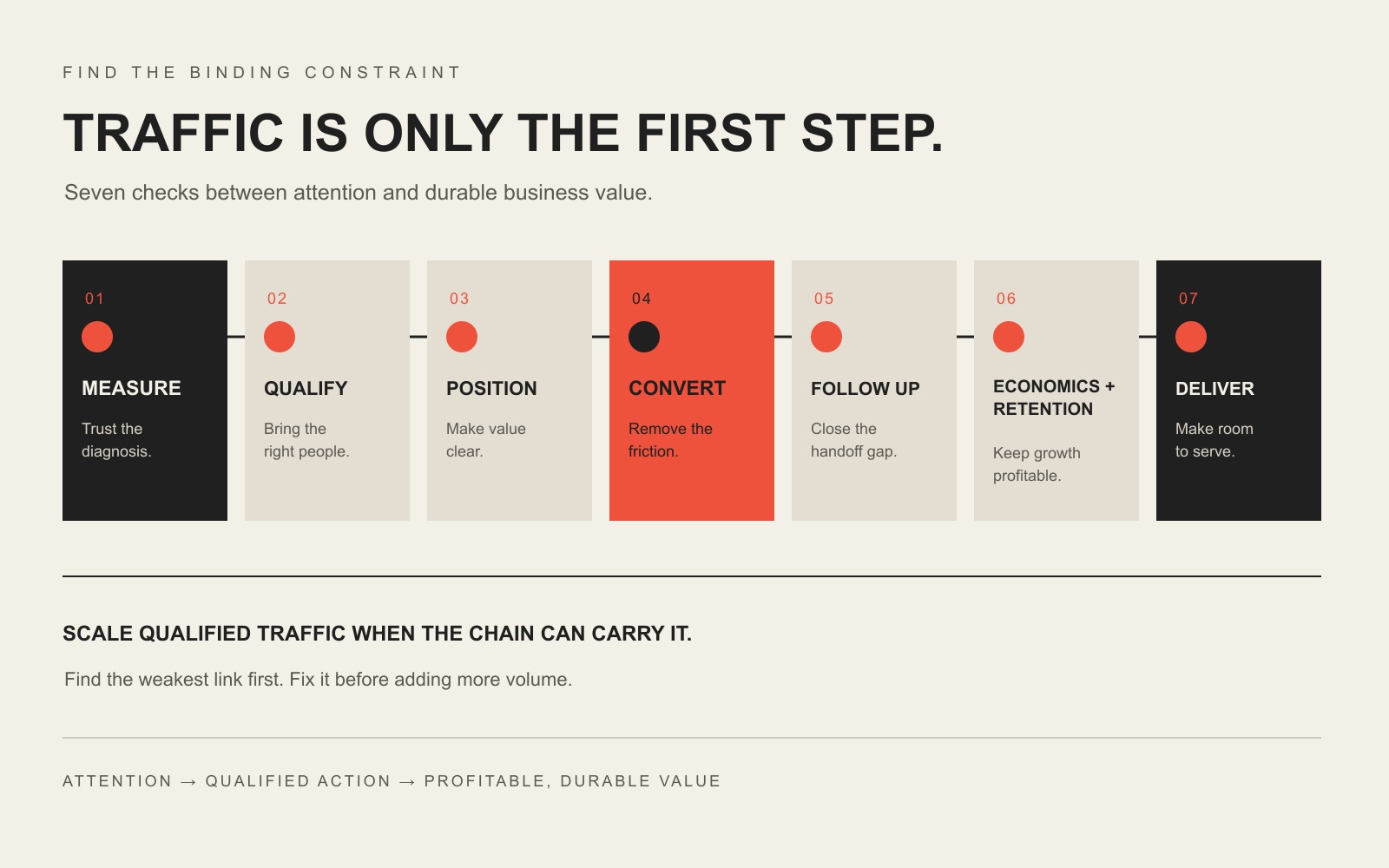
    The Growth System Has Seven Places to Break

    Think of growth as a chain rather than a traffic counter. Qualified attention has to pass through several stages before it becomes durable business value. The first weak stage is usually the next job.

    Seven growth stages: measurement, qualified demand, message and offer, conversion, sales follow-up, economics and retention, and delivery capacity. Fix the weakest link before scaling qualified traffic.

    1. Measurement: Can you trust the diagnosis?

    Before changing traffic or conversion tactics, confirm that meaningful actions can be traced to source, page, campaign, or lead. Google Analytics documentation is one common reference for acquisition and event data, but the measurement design still has to reflect the outcome your business actually cares about. If tracking is incomplete, the first constraint may be measurement itself. You cannot optimize confidently when every channel looks the same or when a “conversion” mixes weak micro-actions with real business outcomes.

    For a deeper measurement ladder—from visibility through business value—see our guide to the SEO metrics that matter.

    2. Qualified demand: Are the right people arriving?

    A site can have “plenty of traffic” and still have a demand problem. Segment by source, campaign, landing page, search intent, geography, device, and whatever else meaningfully distinguishes buyer fit. If high-intent sources behave well while broad sources do not, the answer may be better targeting—not more total sessions and not a site-wide conversion overhaul.

    This is also why content should be built around buyer questions rather than random volume. Our guide to business blog topics that attract buyers instead of random traffic covers that acquisition-side problem in more depth.

    3. Message and offer: Do qualified visitors understand the value?

    If the right people arrive but cannot quickly tell who the offer is for, what problem it solves, why it is different, and what to do next, buying more traffic is buying more confusion. The constraint is positioning, offer design, or message clarity.

    4. Conversion path: Can a qualified visitor act without avoidable friction?

    Once the visitor and offer fit, inspect the path: landing page, navigation, form, checkout, scheduling flow, call-to-action, trust signals, mobile experience, and page performance. Do not change all of them at once. Diagnose the most plausible constraint, make a controlled change, and compare the result against your own baseline.

    5. Sales follow-up: What happens after the website conversion?

    A form submission is not revenue. If good leads wait two days for a reply, receive inconsistent qualification, or disappear between marketing and sales, the website may be doing its job while the handoff is failing. More traffic simply gives the sales leak more opportunities to leak.

    6. Economics and retention: Is growth worth buying?

    Acquisition should be judged against customer value, margin, sales cost, fulfillment cost, and retention—not traffic price in isolation. A channel that looks expensive can be attractive when it produces better customers. A cheap channel can be a waste when it produces one-and-done buyers, low-margin work, refunds, or poor-fit clients.

    If this is the weak link, use real customer economics rather than generic rules of thumb. Our customer lifetime value guide covers how to calculate value without pretending every customer is identical.

    7. Delivery capacity: Can the business absorb more demand?

    Growth can break a business that is already at capacity. If more qualified leads would create missed deadlines, poor onboarding, slower support, stockouts, quality problems, or owner burnout, the marketing system may not be the active constraint. Capacity, process, hiring, inventory, or service design may need to move first.

    The Traffic-or-Constraint Decision Matrix

    Use evidence patterns rather than a universal benchmark. The goal is not to prove traffic “good” or “bad.” It is to identify the next lever with the strongest reason behind it.

    What you observeLikely constraintBest next move
    High volume, weak performance across nearly every sourceOffer, message, path, or measurementDiagnose before increasing acquisition
    Some sources produce strong leads while broad traffic does notTraffic quality / targetingShift budget and content toward qualified demand
    Qualified leads arrive but close poorlySales follow-up or offer economicsFix the handoff and qualification process
    Customers buy but margin or retention is weakEconomics / customer fitImprove value, retention, pricing, or targeting
    Everything downstream is healthy but lead volume is too lowQualified traffic volumeScale the proven acquisition channels
    Demand is strong but fulfillment is strainedCapacityIncrease operational capacity before demand

    When More Website Traffic Is Actually the Right Answer

    Sometimes the constraint really is traffic. The mistake is not scaling acquisition; the mistake is assuming acquisition is always the bottleneck.

    • Your tracking can distinguish meaningful outcomes by source or campaign.
    • The traffic you already receive is relevant to the offer.
    • Qualified visitors complete the intended path at a rate that is stable enough for your business to plan around.
    • Sales follow-up is timely and consistent.
    • Customer economics support the cost of acquiring more demand.
    • Retention and fulfillment quality are not collapsing as volume rises.
    • The business has enough capacity to serve additional customers.

    When those conditions are true, increasing qualified website traffic is not vanity. It is fuel for a system that has already shown it can turn attention into value.

    When More Website Traffic Just Amplifies Waste

    Extra sessions are dangerous when they create the illusion of progress while the business outcome stays flat. A marketing dashboard can look “up and to the right” while the company gets more poor-fit leads, more support load, more sales work, or more low-margin customers.

    If you are not sure where the failure lives, do not jump straight to ads, SEO, a redesign, or A/B tests. Use a full constraint-first marketing audit to separate visibility, fit, offer, conversion, sales, economics, and capacity before selecting the tactic.

    Measure the Chain, Not One Vanity Number

    You do not need a giant analytics stack to start. You need a measurement chain that follows the business logic. At minimum, compare relevant attention, qualified actions, sales outcomes, customer value, retention, and capacity. Break those measures down by source or cohort whenever that changes the decision.

    A useful internal conversion rate can be as simple as meaningful actions ÷ qualified visits. A useful lead-to-sale rate is closed customers ÷ qualified leads. Customer acquisition cost should use the real acquisition spend associated with the customers you are counting. None of those numbers needs a universal “good” threshold to be useful. Compare them with your historical baseline, your strongest sources, and the economics your business actually requires.

    Three Illustrative Scenarios

    Scenario A: Traffic problem. A service company has reliable tracking, a clear offer, good close rates from referrals, healthy margins, and unused delivery capacity—but very few qualified website visitors. The next lever is acquisition. More of the right website traffic is justified.

    Scenario B: Conversion-path problem. A company gets relevant visitors from several sources, but mobile users abandon a long form and phone calls are hard to find. The next lever is the path, not traffic. The company should fix the high-friction step and measure the change before paying to increase volume.

    Scenario C: Capacity problem. A local business already has more qualified inquiries than it can answer promptly. Ads are performing, but response time and fulfillment quality are slipping. The next lever is operations. More website traffic would make marketing look better while making the customer experience worse.

    What We Found Before Rewriting This Exact Page

    We applied the same constraint-first rule to this article. Before rewriting it, we checked the exact page path in our first-party systems rather than assuming the old copy deserved protection because it already existed.

    Signal checkedWhat we observedWhat that supports
    GA4 exact page pathNo exact-path rows returned in the current/prior 12-month comparison we queriedDo not invent behavior or conversion conclusions from sitewide averages
    Google Search Console exact URLNo exact-page query rows in the available comparison windowNo demonstrated Google query footprint required preserving unsupported legacy claims
    Bing Webmaster exact URLRecognized page; 0 clicks and 0 impressions in the URL traffic responseThe URL exists in Bing’s system, but there was no measured Bing traffic to defend

    The sensible revision was not to change the established URL or chase a plugin score. It was to keep the address, remove unsupported benchmarks and absolutes, give the page a clearer job, and make the answer materially more useful.

    Frequently Asked Questions

    Why is my website getting traffic but no conversions?

    Start by separating traffic quality from site performance. If qualified sources convert and broad sources do not, targeting is the likely constraint. If qualified visitors from several sources fail at the same step, investigate the message, offer, path, or tracking.

    Should I increase website traffic or improve conversions first?

    Improve the first weak link. Scale website traffic when measurement, relevance, conversion, sales follow-up, economics, retention, and capacity are healthy enough that more qualified attention can move through the system.

    What is a good website conversion rate?

    There is no universal rate that tells you whether a business is healthy. Define the conversion that matters, segment it by meaningful traffic source or cohort, compare it with your own baseline, and judge it alongside close rate, margin, customer value, and capacity.

    Can more website traffic lower my conversion rate?

    Yes. If new website traffic comes from broader or lower-intent sources, the blended conversion rate can fall even while qualified conversions increase. That is why source-level performance matters more than one site-wide ratio.

    When should I scale paid or organic traffic?

    Scale when you can identify which acquisition sources produce qualified outcomes, customer economics support the acquisition cost, and the business can handle additional demand without degrading the customer experience.

    Stop Asking “How Do We Get More Traffic?” First

    Ask a better question: What is preventing the next unit of attention from becoming profitable, durable business value?

    Sometimes the answer is website traffic. Sometimes it is conversion. Sometimes it is targeting, sales, economics, retention, measurement, or capacity. The advantage comes from diagnosing the system before buying the next tactic.

    If you want help finding the constraint instead of guessing at it, Scope Design can audit the acquisition-to-customer path and identify the smallest high-leverage change worth testing next.

  • Marketing Lessons I Learned the Hard Way: 7 Small Business Marketing Mistakes

    Marketing Lessons I Learned the Hard Way: 7 Small Business Marketing Mistakes

    The biggest small business marketing mistakes are usually not bad Facebook posts, the wrong email subject line, or failing to chase the newest platform. They happen earlier: promoting before you know what the business needs to change, selling an unclear offer, losing people after they respond, measuring the wrong outcome, and spending money without knowing what the result should teach you.

    I learned that the expensive way. A mediocre tactic inside a sound system can be improved. A brilliant tactic dropped into a broken system usually buys you faster confusion.

    TL;DR: The seven marketing lessons I wish I had learned sooner

    • Start with the business constraint, not the channel. Decide what actually needs to improve before asking where to advertise.
    • A weak offer is not a copywriting problem. Better wording cannot rescue something buyers do not understand, trust, or value.
    • Attention is not the business result. Traffic, reach, and engagement are useful diagnostics; qualified opportunities, sales, value, and operational impact tell you whether marketing helped.
    • Customer acquisition cost is only half the math. Margin, customer value, payback, retention, capacity, and cash flow determine what you can responsibly spend.
    • The response path is part of marketing. Slow follow-up, confusing forms, bad sales handoffs, and weak delivery can waste good demand.
    • More channels can create more failure points. Own a few channels well before adding another source of weekly guilt.
    • A test is useless if it does not change a decision. Define the question, guardrails, review window, and next move before launch.

    If you need the full system behind these lessons, start with our small business marketing strategy guide. This article has a narrower job: the mistakes I would look for first when marketing feels expensive, inconsistent, or weirdly busy without becoming more useful.

    The BURN Check for small business marketing mistakes

    When a campaign underperforms, the natural reaction is to change the ad, platform, creative, agency, website, budget, or all six before lunch. That can work by accident. I would rather diagnose the system first.

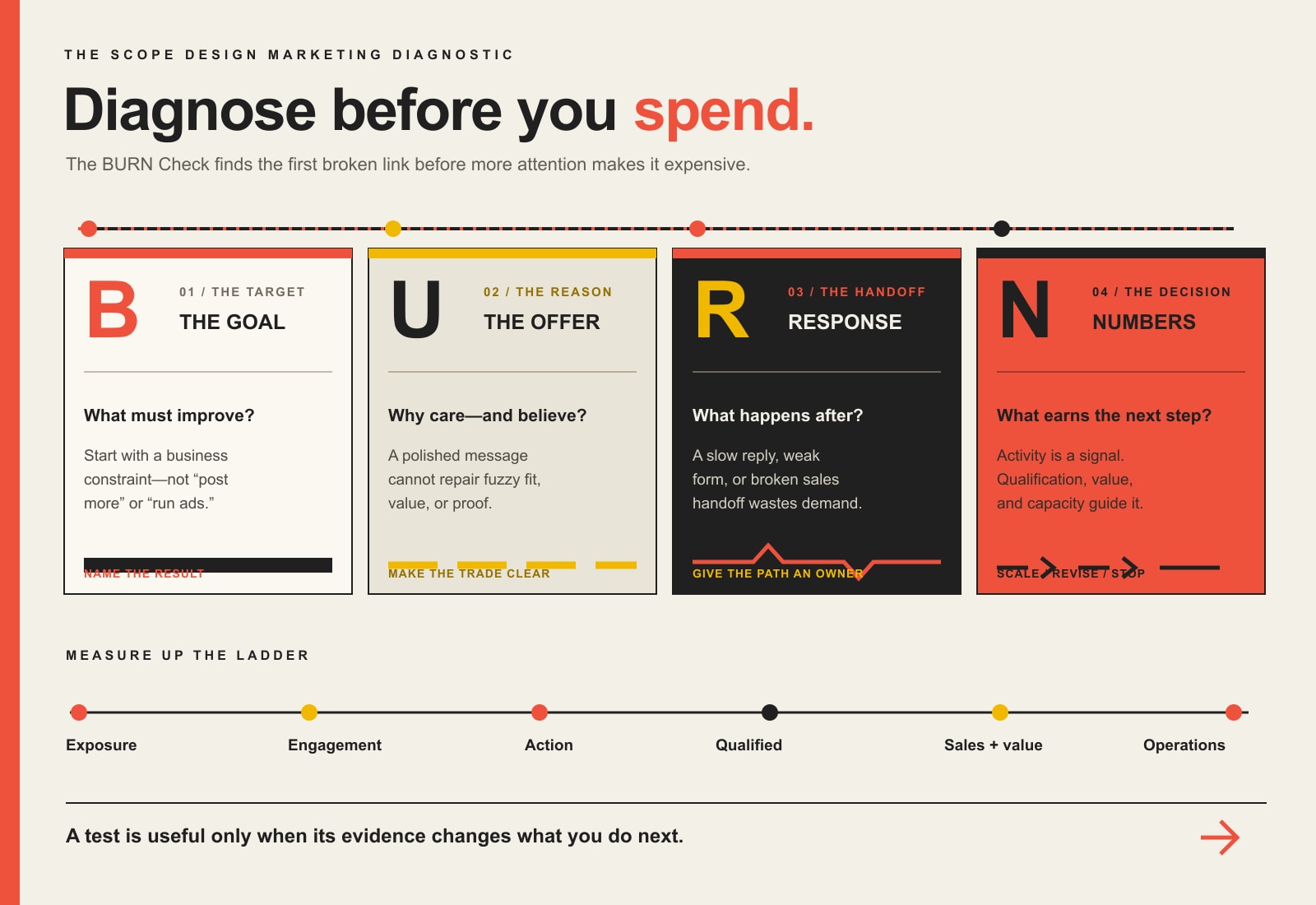
    The Scope Design BURN Check is a fast four-part diagnostic:

    CheckQuestionWhat failure looks like
    B — Business constraintWhat must improve for the business?Marketing starts with “we should post more” or “let’s run ads” instead of a business problem.
    U — Useful offer and proofWhy should the right buyer care and believe us?The message is polished, but the promise, fit, tradeoff, price logic, or evidence is vague.
    R — Response pathWhat happens after attention arrives?The page, form, phone, sales handoff, follow-up, fulfillment, or customer experience leaks demand.
    N — Numbers and next decisionWhat evidence tells us to scale, revise, or stop?The dashboard reports activity, but nobody can explain customer value, qualification, economics, or what happens next.
    The BURN Check asks about the business goal, offer and proof, response path, and numbers that guide the next decision; marketing measurement climbs from exposure and engagement to action, qualified leads, sales value, and operational effect.

    This is not meant to replace a full digital marketing strategy. It is the smoke detector. If one of these four checks is failing, buying more attention can make the weakness more expensive.

    Lesson 1: I chose channels before defining the business problem

    Platform-first planning feels productive because it creates immediate work. Set up Google Ads. Post three times a week. Start a newsletter. Make a video. Hire someone to “do SEO.” The calendar fills up and everybody can point to activity.

    The problem is that channels do different jobs. Search can capture existing demand. Social can distribute evidence and create discovery. Email can continue a relationship with people you already have permission to contact. Paid media can accelerate a defined offer and audience. None of those answers the first question: what needs to change in the business?

    If the real constraint is poor lead quality, more traffic can make the sales team busier without making the business healthier. If the constraint is weak follow-up, buying more leads feeds a leak. If the constraint is an offer buyers do not understand, a larger audience just lets more people ignore it.

    My rule now is simple: define the business change before the channel job. Demand, fit, conversion, response, close rate, retention, capacity, or learning are all legitimate targets. “We need to be on TikTok” is not one.

    Lesson 2: I tried to market offers that had not earned attention

    Good copy matters. Design matters. Targeting matters. But none of them can manufacture value that the offer does not have.

    An offer needs enough clarity that the right person can quickly understand who it is for, what changes, what it costs or requires, what the tradeoffs are, and why the promise is believable. If those pieces are fuzzy, the marketing team often compensates with adjectives. “Innovative.” “Premier.” “Next-level.” Beige wallpaper with a call-to-action button.

    The better question is not “How do we make this sound irresistible?” It is “What would make this decision easier to trust?” That usually means sharper fit, clearer stakes, useful proof, honest boundaries, and language that matches how the buyer actually thinks. Our guide to buyer psychology goes deeper into diagnosing the motives, risks, and evidence needs behind that decision.

    One of the old habits I no longer trust is testing cosmetic details before the offer is clear. Button color can be measured. That does not mean it deserves to be the first thing measured. Test the highest-risk assumption first: audience, promise, proof, price logic, eligibility, or next step.

    Lesson 3: I confused attention metrics with business results

    Marketing dashboards are excellent at producing numbers. They are less excellent at telling you which number should change your decision.

    Google Analytics provides separate User acquisition and Traffic acquisition reports, while Google Search Console performance documentation defines search clicks, impressions, click-through rate, position, and dimensions such as queries and pages. Those are useful signals. They are not the same thing as qualified opportunities, sales, contribution, retention, or staff impact.

    I think about measurement as a ladder:

    1. Exposure: impressions, reach, rankings, share of voice.
    2. Engagement: views, clicks, engaged sessions, replies.
    3. Action: calls, forms, bookings, purchases, applications.
    4. Qualification: valid contacts, fit, held meetings, real opportunities.
    5. Sales and value: close rate, acquisition cost, contribution, retention, lifetime value.
    6. Operational effect: response time, support load, capacity, cycle length, staff time.

    The mistake is not tracking the top of the ladder. The mistake is stopping there. A campaign can earn cheap clicks and still create expensive junk. A page can rank and still answer the wrong buyer. A lead form can convert while the sales team quietly hates every submission.

    If the goal is a measurable action, our direct response marketing guide goes deeper into connecting that action to acquisition cost, revenue, contribution, and payback.

    Lesson 4: I did customer acquisition math with half the equation

    Customer acquisition cost is useful, but it is not a magic number you can compare with a universal benchmark and call strategy.

    Imagine two companies both pay $300 to acquire a customer. Company A makes $2,000 in contribution from a typical new customer, gets paid quickly, has room to fulfill more work, and keeps a meaningful share of those customers. Company B makes $350 before service costs, waits months for cash, is already over capacity, and rarely gets repeat business. The same CAC means completely different things.

    Before scaling acquisition, I want to know enough of the following to make the bet intelligible: contribution or gross margin, first-sale value, repeat purchase or retention, payback period, refund or churn behavior, sales cycle, fulfillment capacity, cash-flow tolerance, and how qualification changes the economics.

    You do not need a finance department to start. Use the best honest window you have. If lifetime value is immature, use a shorter observed period and label it that way. What I no longer recommend is inventing certainty with a neat ratio borrowed from a business that has different margins, buying behavior, and risk.

    Lesson 5: I treated the response path as somebody else’s problem

    Marketing does not stop when somebody clicks “submit.” The next five minutes can matter more than the previous five weeks of campaign work.

    A good campaign can be ruined by a confusing landing page, a form nobody monitors, missed phone calls, a generic autoresponder, slow estimates, unclear pricing, awkward scheduling, or a sales conversation that contradicts the promise that earned the lead. Then the marketing channel gets blamed because it is the easiest line item to point at.

    The response path should have an owner. For each important action, know who receives it, how quickly they respond, what qualifies the person, what happens next, where the information is stored, and how the eventual outcome gets connected back to the source.

    Proof belongs in that path too. Testimonials, reviews, examples, guarantees, and case evidence can reduce risk when they are real and relevant. In the United States, the FTC Consumer Reviews and Testimonials Rule took effect October 21, 2024 and addresses fake or false reviews and testimonials. The practical marketing lesson is simpler than the legal detail: do not fake trust. It is bad strategy with paperwork attached.

    Lesson 6: I mistook channel count for marketing maturity

    There is a special kind of small-business chaos where the company has Facebook, Instagram, LinkedIn, TikTok, YouTube, email, a blog, Google Ads, a neglected Google Business Profile, and no reliable process for answering the phone.

    More channels create more creative requirements, approval work, measurement surfaces, platform changes, account risk, and maintenance. Diversification can be smart. Premature diversification is just multiplying places where the system can decay.

    I would rather see one to three primary acquisition channels with clear jobs and credible ownership than seven profiles maintained by guilt. Add another channel when the existing system works, the audience justifies it, the business can support the content or campaign requirement, and you know what the new channel is supposed to teach you.

    The shiny-object test is easy: if the argument for a channel begins with “everyone is there,” “the algorithm favors it,” or “our competitor started doing it,” you still need a business case.

    Lesson 7: I ran tests without deciding what the evidence would earn

    “We tried it” is one of the least useful sentences in marketing.

    A real test begins with a question. Can this audience be reached here? Does this promise earn enough relevant attention? Does the page continue the promise? Do qualified buyers take the next step? Can we acquire them inside an acceptable economic range? Can the business absorb more demand?

    Then define what happens when the result arrives. Scale, revise, or stop are decisions. “Keep spending because the dashboard has green arrows” is not.

    What you observeLikely questionNext move
    Little relevant attentionWas the audience reachable here? Was the promise strong enough?Revisit targeting, channel job, or message.
    Attention but weak actionDid the destination continue the promise? Is the next step appropriate?Inspect proof, friction, continuity, and CTA.
    Actions but poor qualificationAre we attracting the wrong situation or failing to clarify fit?Tighten message, eligibility, proof, offer, or form.
    Qualified opportunities but weak salesIs acquisition being blamed for pricing, follow-up, or sales-process friction?Audit the downstream handoff.
    Good outcomes inside guardrailsCan the business support more without harming quality or economics?Scale carefully and keep watching quality.

    The review window should match the buying cycle and evidence volume. A local emergency service, a seasonal promotion, and a six-month B2B sale should not be forced into the same arbitrary test period. The point is not to wait forever. It is to decide what would count as enough evidence for the next move.

    A practical reset when your marketing feels broken

    If I were auditing a small business with limited time and money, I would not start by adding a platform. I would work through this sequence:

    1. Name the constraint. What business outcome is actually weak?
    2. Define the buyer and buying moment. Who is deciding what, and what risk or evidence matters now?
    3. Strengthen the offer and proof. Make fit, value, tradeoffs, and credibility easy to understand.
    4. Walk the response path. Test the page, form, call, follow-up, qualification, sales handoff, and fulfillment experience.
    5. Connect the numbers. Trace attention to action, qualification, sales value, economics, and operational effect as far as the current data allows.
    6. Pick the smallest useful test. Choose the channel and experiment that can answer the most important unresolved question.
    7. Decide what the evidence earns next. Scale, revise, stop, or fix a different part of the system.

    Hope is not an analytics strategy. Neither is panic. A useful marketing system should make the next decision clearer, even when the campaign itself does not win.

    Frequently asked questions about small business marketing mistakes

    What is the biggest mistake small businesses make in marketing?

    The biggest mistake is buying or creating attention before the business is ready to turn that attention into qualified value or useful learning. If the constraint, audience, offer, proof, response path, capacity, or measurement is unclear, more traffic can amplify the problem instead of fixing it.

    What are some common marketing mistakes?

    Common mistakes include choosing channels before strategy, promoting a weak offer, chasing vanity metrics, ignoring acquisition economics, responding slowly to leads, spreading effort across too many platforms, and running tests without a defined decision rule.

    What should I fix before spending more money on advertising?

    Confirm the audience and offer are clear, the landing experience works, somebody owns follow-up, the business has capacity, conversion measurement is configured, and you can afford a bounded learning period. Do not scale just because impressions or clicks are cheap.

    How do I know whether my problem is traffic or the offer?

    If the right people rarely reach you, traffic or distribution may be the constraint. If relevant people arrive but show little interest, inspect the offer, promise, proof, fit, and next step. If they convert but rarely become qualified opportunities, the problem may be targeting, qualification, or sales handoff. Diagnose the stage that leaks instead of redesigning everything at once.

    How much should a small business spend on marketing?

    There is no responsible universal percentage. A useful budget depends on margins, customer value, sales cycle, channel costs, capacity, cash flow, and how much the business can afford to learn without creating financial distress. Budget from economics and a defined test rather than a benchmark stripped of context.

    Is organic marketing better than paid marketing?

    Neither is automatically better. Organic channels often compound into durable assets but require time and maintenance. Paid channels can accelerate learning and demand capture but expose weak economics quickly. Use the channel that fits the audience, buying moment, offer, capacity, and measurement job.

    The lesson behind all seven lessons

    The hardest marketing lesson was not a secret tactic. It was learning to stop treating marketing like a vending machine where you insert money, content, or effort and expect leads to fall out.

    Marketing is part of a business system. Attention has to meet a useful offer. The offer needs proof. The response path needs ownership. The numbers need context. And every serious test should make the next decision less stupid than the last one.

    If your marketing feels busy but not useful, run the BURN Check before adding another campaign. Find the first broken link in the chain and fix that. It is less exciting than chasing the newest tactic. It is also how you stop paying tuition for the same lesson twice.

  • Using Marketing Tactics in Tandem with A Solid Strategy

    Using Marketing Tactics in Tandem with A Solid Strategy

    Marketing strategy and tactics work together only when strategy decides what must change, for whom, and why, while tactics handle the specific actions and channels used to make it happen. Each tactic needs a defined job, a clear handoff to the next step, and measurement tied to a business outcome.

    Most small businesses do not have a shortage of marketing tactics. They have a shortage of reasons for choosing them.

    SEO, paid search, social media, email, direct mail, events, video, referral programs, and automation can all work. They can also become an expensive collection of chores when nobody can explain what business problem each tactic is supposed to solve, what should happen next, or how success will be judged.

    That is the point of using marketing tactics with strategy: fewer disconnected activities, clearer decisions, and a system that can tell you what to keep, change, or stop.

    TL;DR: Start with the business objective and the constraint blocking it. Clarify positioning and strategy before choosing tactics. Give each tactic one primary job, define its handoff, and judge the system by business outcomes before platform metrics.

    Marketing strategy vs. tactics: the practical difference

    The distinction is simple enough to memorize and easy enough to ignore.

    LayerQuestion it answersExample
    Business objectiveWhat outcome must improve?Increase qualified sales conversations from established regional manufacturers.
    StrategyHow will we create that outcome, and what will we deliberately prioritize?Win high-intent buyers by making specialized expertise easier to find and easier to trust.
    TacticsWhat specific actions will execute the strategy?Search content, paid search, case studies, a focused service page, and follow-up email.
    MeasurementHow will we know whether the system is working?Qualified conversations and pipeline, with channel and handoff metrics used to diagnose performance.

    The U.S. Chamber of Commerce’s small-business planning guidance makes a similar distinction: strategy sets direction, goals define measurable outcomes, and tactics are the actions tied to those goals and metrics. That hierarchy matters because a tactic can be executed perfectly and still be the wrong move.

    A beautiful landing page cannot rescue an offer people do not want. More traffic cannot repair a sales team that never follows up. Posting every day on social media does not solve a discoverability problem if the buyers who matter are searching elsewhere. The tactic may be fine. The diagnosis may be wrong.

    The Scope Design strategy-to-tactics sequence

    Scope Design uses a constraint-first sequence when deciding what marketing work deserves attention:

    Objective → Constraint → Positioning → Strategy → Tactics → Measurement

    1. Objective: Define the business outcome you actually need.
    2. Constraint: Identify the most important thing currently preventing that outcome.
    3. Positioning: Decide what the right buyer must understand or believe for progress to become possible.
    4. Strategy: Choose the approach that addresses the constraint and creates the required change.
    5. Tactics: Select the channels, campaigns, assets, and actions justified by the strategy.
    6. Measurement: Test whether the system moved the objective, then use supporting metrics to find where it worked or failed.

    The operating rule behind the sequence is even shorter: a requested tactic is evidence, not a diagnosis.

    When someone says, “We need Facebook ads,” “We need more SEO,” or “We need a newsletter,” that tells you what solution they currently have in mind. It does not prove that the solution matches the constraint. The broader small business marketing strategy should establish the system first. Tactics plug into it after the bottleneck is understood.

    Step 1: Diagnose the constraint before choosing a tactic

    Start with the business outcome, then ask what is preventing it. That one change in order eliminates a lot of “shiny object” marketing.

    What you observePossible constraintWhat it means for tactics
    The right prospects rarely find you.Awareness, discoverability, targeting, or distributionSEO, paid search, partnerships, local visibility, or outbound may deserve investigation.
    Relevant traffic arrives but few qualified people take the next step.Message, offer, proof, page experience, or conversion pathBuying more traffic may simply send more people into the same leak.
    Qualified leads arrive but do not become opportunities.Qualification, response time, sales handoff, or follow-upCRM routing, sales process, nurture, or booking improvements may matter more than lead generation.
    Customers buy once and disappear.Retention, lifecycle communication, service experience, or lack of a next offerEmail, account outreach, customer education, reminders, or loyalty work may be more useful than acquisition.

    More than one constraint can exist. The goal is not to pretend the business has one problem forever. It is to identify the first meaningful bottleneck well enough that your next marketing dollar has a reason behind it.

    Step 2: Give every tactic one primary job

    Once the constraint is clear, assign each tactic a primary job inside the campaign. A channel does not have one universal purpose. Its job depends on the objective and the buyer’s moment.

    • Search can capture existing intent from people already looking for an answer, product, or provider.
    • Educational content can reduce uncertainty, answer comparison questions, and give sales teams something useful to send.
    • Paid media can create controlled access to an audience, test a message, or scale a path that already works.
    • Email can nurture a lead, reactivate a customer, support onboarding, or trigger a timely next step.
    • Social media can distribute ideas, create familiarity, surface proof, or keep a brand present in a community.
    • Local and offline activity can build geographic awareness, credibility, referrals, and reasons for people to search for the brand later.

    The same email tool can support lead nurture in one campaign and customer retention in another. The tactic is not the strategy. The job you assign it is what gives it meaning.

    If you need the larger operating model for websites, search, content, email, social, paid media, analytics, sales, and lifecycle work, Scope Design’s digital marketing strategy guide goes deeper into assigning distinct channel roles without turning the stack into a tool pile.

    Step 3: Design the handoff between tactics

    Tactics begin to work in tandem when the output of one becomes a sensible input to the next.

    A handoff does not need to be complicated automation. It needs a clear next step and an owner.

    • Search ad → focused landing page → qualified booking → confirmation → sales response.
    • Problem-solving article → useful worksheet → permission-based email sequence → relevant service page → consultation.
    • Community event → QR or tagged URL → location-specific page → inquiry or email signup → follow-up.
    • Completed purchase → onboarding message → educational content → service reminder → repeat purchase or renewal.

    For each handoff, write down four things: what triggers it, where the person goes, who or what owns the response, and what evidence tells you the handoff worked.

    That is often where “channel performance” problems are hiding. The ad generated the right click, but the landing page answered the wrong question. The form worked, but the notification went to an unmonitored inbox. The newsletter earned attention, but every link dumped readers on the homepage. The tactics existed. The path did not.

    Step 4: Measure the outcome, then diagnose the signal

    Do not confuse the easiest metric to collect with the result the business needed.

    Google Ads’ conversion-measurement documentation starts from a useful principle: the advertiser chooses the actions that are valuable to the business—such as a purchase, signup, or phone call—and then measures which campaigns and keywords drive those actions. Your broader marketing measurement should follow the same logic.

    Use two levels of measurement:

    1. Business outcome: the deepest result the marketing system can reasonably influence, such as qualified conversations, pipeline value, booked-and-attended appointments, repeat purchases, renewals, or revenue.
    2. Diagnostic signals: the metrics that help explain why the outcome moved or did not move, such as impression share, click-through rate, landing-page conversion, source-to-qualified rate, response time, email engagement, booking completion, or repeat-visit behavior.

    An impression can tell you whether something was seen. A click can tell you whether the message earned a response. Neither can tell you by itself whether the business acquired a good customer.

    Measurement should also produce a decision. Before a campaign launches, decide what evidence would make you keep, change, or stop a tactic. The threshold may depend on sales cycle, traffic, budget, seasonality, and sample size. There is no honest universal schedule that says every business must make the same decision after seven days or every strategy must be rebuilt every quarter.

    Three examples of marketing tactics working in tandem

    Example 1: Increase qualified inquiries

    Objective: Increase qualified sales conversations for a specialized service.

    Constraint: High-intent prospects exist, but they do not find enough relevant evidence or a clear path to start a conversation.

    • Paid search: capture high-intent demand now.
    • Service landing page: explain fit, scope, proof, and the next step.
    • Case study or decision article: reduce uncertainty for buyers who are not ready to contact sales immediately.
    • Email or CRM follow-up: continue the conversation when the buyer needs more time.

    Handoff: Search → service page → proof/decision content → qualified form or booking → sales response.

    Outcome: Qualified conversations and pipeline. Click-through rate, landing-page conversion, response time, and source-to-qualified rate are diagnostic signals—not the finish line.

    Example 2: Improve customer retention

    Objective: Increase repeat business from customers who already received value.

    Constraint: Customers do not remember the next service, do not know what else the business can help with, or receive no timely reason to return.

    • Customer email: deliver reminders and relevant education based on lifecycle timing.
    • Knowledge-base or FAQ content: answer common post-purchase questions and reduce uncertainty.
    • Account or service-team outreach: handle high-value situations that deserve a human conversation.
    • CRM trigger: surface the right customer when a renewal, maintenance interval, or follow-up condition is reached.

    Handoff: Customer event → reminder or education → relevant next offer → human outreach when needed.

    Outcome: Repeat purchase, renewal, retention, or expansion. Open rate is useful only when it helps diagnose whether the communication is reaching and engaging the customer. For deeper execution guidance, see Scope Design’s email newsletter strategy.

    Example 3: Build local awareness that can be measured

    Objective: Generate more first-time inquiries or visits from a defined service area.

    Constraint: The offer is credible and converts when people find it, but too few local buyers know the business exists.

    • Community sponsorship or event: create real-world visibility and association.
    • Organic social: extend the event, people, proof, and story beyond the room.
    • Location-specific page: give interested people a relevant destination instead of a generic homepage.
    • Branded or local search support: capture people who search after seeing the business elsewhere.

    Handoff: Offline exposure → QR code or tagged URL → relevant page → inquiry, call, booking, or email opt-in.

    Outcome: Qualified local inquiries, bookings, or store visits where they can be measured. Google’s GA4 manual-campaign documentation confirms that UTM parameters populate manual campaign dimensions, which makes tagged campaign links useful when you need to distinguish sources and mediums in analytics.

    Should you change the strategy, channel, campaign, or tactic?

    When results disappoint, do not immediately replace the most visible tactic. Diagnose the level at which the problem exists.

    • Change the strategy when the audience, positioning, offer, business constraint, or desired outcome is wrong.
    • Change the channel mix when the mechanism does not match the buyer’s moment, the usable signal is too weak, the economics cannot work, or the team cannot realistically operate the channel.
    • Change the campaign when the channel is appropriate but the audience, message, creative, offer, destination, sequence, or measurement is wrong.
    • Change the tactic when the larger decisions are sound and one specific execution element is demonstrably limiting results.

    This distinction matters because “the ads aren’t working” can describe four completely different problems. Scope Design’s guide to diagnosing why marketing isn’t working goes deeper into finding the bottleneck before buying another tactic.

    A five-question strategy-to-tactics worksheet

    Before you add another channel, campaign, or tool, answer these five questions in plain language:

    1. What business outcome are we trying to improve? Use a result the business actually cares about, not a platform metric.
    2. What evidence tells us what is preventing that outcome right now? Separate observation from assumption.
    3. What must the right buyer understand, believe, or be able to do for that constraint to loosen?
    4. Which tactics can we realistically operate, and what single primary job will each one have? Include the next handoff.
    5. What result will make us keep, change, or stop the approach? Name both the business outcome and the diagnostic signals you will use to explain it.

    If you cannot answer question two, you are probably not ready to choose a new tactic. If you cannot answer question four, you may be collecting channels rather than designing a marketing system. If you cannot answer question five, you have activity without a learning loop.

    Frequently asked questions about marketing strategy and tactics

    What is the difference between a marketing strategy and a marketing tactic?

    A marketing strategy defines the approach, priorities, audience, positioning, and tradeoffs used to achieve a business objective. A marketing tactic is a specific action, channel, campaign, or execution choice used to carry out that strategy. Strategy explains why this approach; tactics explain what you will do.

    Do all of my marketing channels need to work together?

    No. Coordination does not mean forcing every channel into every campaign. A channel belongs when it has a useful job, a realistic owner, and a sensible handoff. Sometimes one well-matched channel and a strong follow-up path are better than an “omnichannel” plan nobody can maintain.

    How many marketing tactics should a small business use?

    There is no universal number. Use as few as necessary to cover the important jobs in the customer path and no more than the team can operate well. Capacity, audience behavior, sales cycle, budget, and the constraint should determine the mix.

    Can the same tactic support different strategies?

    Yes. Email can nurture a lead, onboard a customer, generate a repeat purchase, or support a referral program. Paid search can capture demand for a core service or test whether a new offer resonates. Define the tactic’s job within the specific campaign so its performance can be interpreted correctly.

    How often should I review my marketing strategy?

    Review tactics when enough evidence exists to make a responsible decision and review strategy when the underlying objective, constraint, audience, positioning, economics, or market conditions materially change. Operational decisions usually happen more often than strategic changes, but a fixed weekly/monthly/quarterly schedule is not a substitute for sufficient evidence.

    What is the biggest warning sign that my tactics are disconnected?

    Ask someone to explain what business outcome each tactic supports, what happens after a person responds, and which result would cause the team to change course. If the answers are mostly platform metrics, vague awareness goals, or “because we should be doing it,” the tactics are probably operating without enough strategy.

    Stop adding tactics. Start designing the system.

    A solid marketing strategy does not make tactics less important. It makes them accountable. It gives every channel a reason to exist, every campaign a place in the customer path, and every metric a decision it is supposed to inform.

    If your marketing calendar is full but the answer to “what constraint is this removing?” is fuzzy, do not solve that confusion by buying another tool or channel. Start with the system. Review Scope Design’s small business marketing strategy framework, or talk with Scope Design about a marketing audit and a clearer path from attention to business outcomes.

    Sources and further reading