Tag: marketing ethics

  • Why Marketing Lies Cost More Than Truth: The Real Price of Deceptive Advertising

    Why Marketing Lies Cost More Than Truth: The Real Price of Deceptive Advertising

    Deceptive advertising is marketing that is likely to mislead a reasonable buyer about something important to the decision to buy or use a product or service. The problem is bigger than an obviously false sentence. A misleading impression can come from an express claim, an implied claim, a picture, a missing limitation, a buried condition, or proof that does not actually support what the ad suggests.

    For a small business, the cheapest way to handle deceptive advertising is not to become better at disclaimers after the fact. It is to make sure the promise, proof, and delivery agree before the message goes live. When they do not, the business inherits costs that the marketing dashboard usually does not show.

    At Scope Design, we call that downstream burden claim debt: the work and risk created when a marketing promise outruns the evidence or the business’s ability to deliver it. Claim debt is our operational term, not a legal doctrine. It is useful because it forces a better question than “Did this ad convert?” The better question is: What did this promise make the rest of the business responsible for?

    What Counts as Deceptive Advertising?

    The Federal Trade Commission’s Advertising FAQs for Small Business give a practical federal baseline: advertising must be truthful and non-deceptive, advertisers need evidence to back their claims, and advertisements cannot be unfair. The FTC says an ad can be deceptive when a statement or omission is likely to mislead consumers acting reasonably under the circumstances and the issue is material to their decision.

    That definition matters because “technically true” is not the same as “not misleading.” The FTC looks at the overall impression of an ad, including words, phrases, pictures, express claims, implied claims, and important information left out. It also expects advertisers to have a reasonable basis for objective claims before the ad runs, with the type of evidence depending on the claim.

    This article is general U.S. business guidance, not legal advice. Products and industries such as health, finance, credit, children’s advertising, and regulated services can have additional requirements.

    Why Marketing Lies Cost More Than Truth: The Claim Debt Stack

    A deceptive claim can look profitable at the top of a funnel because clicks, inquiries, or initial sales arrive before the downstream costs do. That timing gap is exactly why bad claims survive inside otherwise sensible businesses.

    1. Bad-fit demand enters the system

    An exaggerated promise can attract people who would not have responded to an accurate one. That may raise response volume while lowering customer fit. Sales now has to qualify more aggressively, reset expectations, or close buyers whose expectations already exceed what the offer can deliver.

    2. Sales and support inherit the expectation reset

    If the ad says “effortless,” “guaranteed,” “instant,” “unlimited,” or “done for you,” somebody downstream has to explain the conditions those words failed to carry. The cost is not only support time. It is the awkward moment when the company has to make its sales conversation less attractive than its marketing.

    3. Reversals and rework appear after conversion

    Refunds, credits, chargebacks, make-goods, extra onboarding, rushed fulfillment, and service recovery are all possible forms of claim debt. They are not guaranteed consequences of every weak claim, but they belong in the economics of the campaign when the promise is contributing to them.

    4. Reputation loss arrives with a delay

    A buyer who feels misled does not evaluate the ad in isolation. They evaluate the company. That can show up later in review language, referrals, renewals, repeat purchases, sales objections, and the amount of reassurance future prospects need before saying yes.

    5. Compliance cleanup competes with productive work

    When a claim cannot be supported, the business may need to locate evidence, change ads and landing pages, revise disclosures, retrain staff, correct partner or influencer messaging, preserve records, and in higher-risk situations involve qualified legal counsel. Avoiding that cleanup is one reason proof should live beside the claim from the start.

    6. Measurement gets distorted

    A campaign can “win” on click-through rate or front-end conversion while producing worse customers. If the reporting stops at the form fill or transaction, a misleading promise can be rewarded by the very dashboard that should expose it. Marketing performance needs to connect to qualified demand and delivered outcomes, not just response.
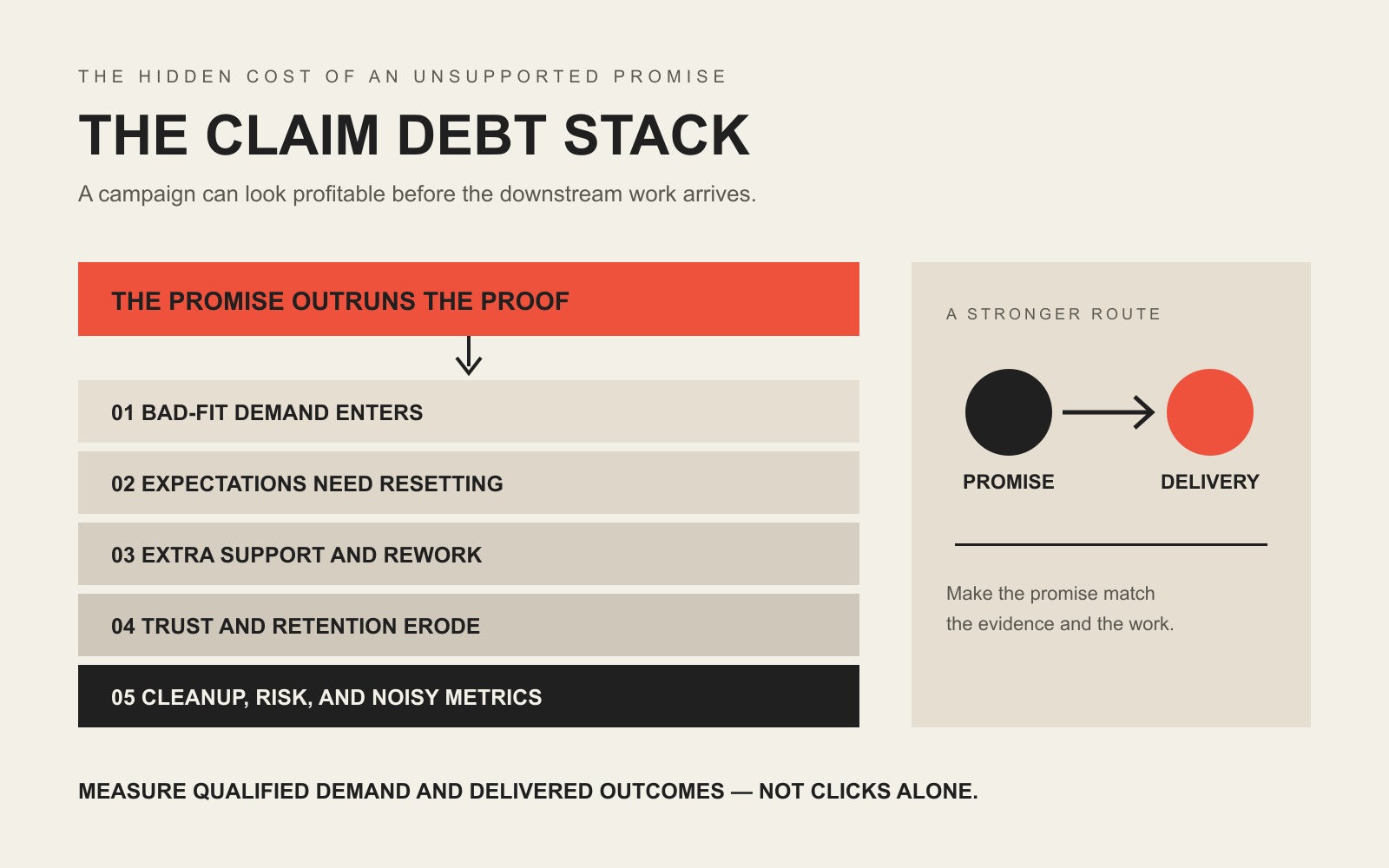
    An unsupported marketing promise creates a cascade of bad-fit demand, expectation resets, extra support and rework, trust loss, and cleanup risk.

    Persuasion Is Not the Same as Deception

    Good marketing is selective. It leads with the most relevant benefit, simplifies complexity, uses emotion, tells stories, and asks people to act. None of that requires deception.

    The line gets crossed when the persuasive framing creates a material impression the business cannot support. A dramatic headline can be honest. A deadline can be real. A testimonial can be accurate. A guarantee can have clear terms. The issue is whether the total message helps a reasonable buyer understand the offer or manufactures certainty, urgency, popularity, or expected results that are not actually there.

    That is also why an ethical review should not flatten good copy into legal-sounding mush. Our guide to ethical marketing psychology goes deeper on using behavioral principles without dark patterns. The job here is narrower: make sure the claim can survive proof and delivery.

    The Scope Design CLAIM Test for Marketing Promises

    Before publishing a consequential claim, run it through five questions. We use the acronym CLAIM to keep the review operational rather than abstract.

    C — Claim: What exactly will a reasonable person think you promised?

    Write the promise in plain language. Include what the words, images, comparison, testimonial, or surrounding context imply—not just the sentence you can defend literally. If your team cannot agree on what the ad is promising, the buyer is being asked to resolve ambiguity you created.

    L — Limits: What conditions or boundaries change the meaning?

    List eligibility requirements, timeframes, exclusions, dependencies, quantities, renewal terms, effort required, or other limitations that matter to the decision. If a limitation is essential to making the headline honest, hiding it in a footnote does not fix the underlying communication problem.

    A — Adequate basis: What evidence exists before publication?

    Link to the actual source. “Everybody knows,” “the vendor told us,” and “we will find the study later” are not evidence files. The evidence must support the claim being made, at the strength it is being made, and the required level of support can vary by claim and industry. This is the point where a simple claim ledger becomes more useful than another round of copy polishing.

    I — Incentives and identity: Who benefits from the endorsement or proof?

    Reviews, testimonials, influencer posts, affiliate recommendations, employee endorsements, awards, and research references can all change how a buyer evaluates a claim. Ask whether the person is real, whether the experience is genuine, whether the example is representative of what the message implies, and whether a material connection needs to be disclosed.

    The FTC’s endorsement guidance says endorsements must be truthful and not misleading and addresses disclosure of material connections. The separate Consumer Reviews and Testimonials Rule, effective October 21, 2024, also covers specific deceptive or unfair review and testimonial practices.

    M — Match operations: Can the business consistently deliver the impression?

    This is the test marketers skip most often. Ask sales, fulfillment, customer service, product, and account management whether they can live with the promise. A claim can be well sourced and still be strategically reckless if normal delivery cannot match the expectation it creates.

    ClaimWhat to verifySafer direction when proof is weak
    “Guaranteed results”Exactly what is guaranteed, under what conditions, and who controls the outcomeDescribe the process, deliverables, conditions, and what the business can actually commit to
    “Only 3 spots left”Real capacity or inventory at the time the claim is shownState the genuine capacity constraint without artificial scarcity
    “Customers typically double results”Data set, methodology, timeframe, selection criteria, and whether the statement reflects typical outcomesUse a documented case example with its context instead of turning one result into a population claim
    “No hidden fees”All mandatory charges, renewals, add-ons, and conditionsShow the total required price structure before the customer commits
    “Best” or comparative performanceWhat is being compared, by what measure, over what market/time periodUse a specific, supportable differentiator rather than an undefined superiority claim

    Five Common Deceptive Advertising Traps for Small Businesses

    1. Turning a possibility into an expected result

    A strong customer outcome can be useful proof. It becomes risky when one exceptional outcome is presented so that readers reasonably infer it is what they should normally expect. Keep the case, but keep the context too: starting point, timeframe, scope, customer contribution, and relevant limitations.

    2. Using urgency that is really theater

    Countdowns that reset, “last chance” messages that run every week, and capacity claims that nobody tracks may lift short-term response while teaching customers not to believe you. If urgency is part of your conversion strategy, our guide to CTA trigger words and urgency covers how truth, inventory, deadlines, and terms should constrain the copy.

    3. Letting the subject line promise more than the destination

    Email creates a small but revealing claim-governance test: does the message deliver what the subject line led the reader to expect? A subject line that gets the open by creating the wrong expectation spends trust to improve a top-of-funnel metric. Our email subject line strategy treats the subject as a promise the email must keep.

    4. Treating disclaimers as a permission slip

    A disclosure can clarify a truthful claim. It should not be used as a hiding place for information that reverses the headline’s main impression. If the “fine print” changes what a reasonable customer would think they are buying, rewrite the main message first.

    5. Publishing AI-assisted claims nobody sourced

    AI can make unsupported specificity sound polished: an invented percentage, a plausible benchmark, a credential that was never checked, or a summary that overstates the source. The solution is not to ban AI from copywriting. The solution is to require provenance for consequential facts before they reach a customer-facing asset.

    A 30-Minute Deceptive Advertising Audit

    You do not need to review every adjective on your website at once. Start with the claims most capable of changing a buying decision.

    1. Inventory the claim surfaces. Check the homepage, top service/product pages, paid ads, landing pages, sales deck, proposal template, email subject lines, social bios/ads, Google Business Profile copy, call scripts, guarantees, pricing, testimonials, and automated follow-up.
    2. Circle decision-changing statements. Prioritize price, savings, results, speed, safety, availability, exclusivity, guarantees, comparisons, credentials, popularity, and customer outcomes.
    3. Run CLAIM. For each important statement, write the claim, limits, evidence source, incentive/disclosure status, and operational owner.
    4. Use red/yellow/green. Green means supported and operationally aligned. Yellow means support or limits need clarification. Red means the claim should not run in its current form.
    5. Fix the first serious red before polishing the rest. One unsupported headline can matter more than twenty minor copy edits.
    6. Assign an evidence owner and review date. Pricing, inventory, competitor comparisons, certifications, results, and regulations change. A once-true claim can become misleading when nobody owns its maintenance.

    This fits the broader marketing system we recommend: the audience, offer, proof, destination, handoff, delivery, and measurement should agree before you buy more attention. Advertising cannot rescue an offer whose promise and proof are fighting each other.

    Measure the Cost of the Promise, Not Just the Conversion

    If you want to know whether claim debt exists, connect marketing data to post-click outcomes. You do not need a universal benchmark. You need a baseline for your own business and a way to see whether a message changes customer quality.

    • Qualified lead rate: What share of inquiries actually fit the offer?
    • Expectation-reset rate: How often do sales or support have to correct something prospects believed from the marketing?
    • Refund, credit, cancellation, and chargeback reasons: Which reversals mention a promise, timeline, feature, price, or result?
    • Delivery rework: How often does the team perform extra work mainly to close the gap between expectation and scope?
    • Review and complaint themes: Do customers repeatedly use words such as “misleading,” “not what I expected,” or “wasn’t clear”?
    • Retention and referral quality: Do customers acquired by one message stay, renew, and refer at the same rate as customers acquired by another?
    • Claim maintenance: Which proof files, terms, pricing facts, certifications, and comparisons are stale or ownerless?

    The point is not to prove that honest copy always wins every immediate A/B test. It may not. The point is to evaluate the full operating result instead of rewarding a promise for generating a click before the bill arrives.

    Deceptive Advertising FAQ

    What are examples of deceptive advertising?

    Examples can include false performance claims, unsupported comparisons, fake scarcity, misleading pricing, important omissions, fabricated or manipulated reviews, undisclosed material connections in endorsements, or a technically true statement presented so that the overall impression is misleading. Context matters, which is why the FTC evaluates the whole ad rather than a single word in isolation.

    Is exaggeration automatically false advertising?

    Not every enthusiastic phrase is treated the same way. The practical business question is whether a reasonable buyer would take the message as an objective, material claim. If the statement concerns measurable performance, price, results, safety, speed, availability, or another buying factor, treat it as a claim that needs support rather than assuming it is harmless hype.

    Can a disclaimer fix a misleading headline?

    A disclosure can supply necessary context, but it is a poor strategy to make a strong misleading impression and hope smaller text reverses it. Write the main claim so it is accurate on its own terms, then use disclosures for conditions and context that genuinely clarify the offer.

    Are fake reviews a deceptive advertising problem?

    They can be. The FTC’s current Consumer Reviews and Testimonials Rule addresses specified deceptive or unfair review and testimonial practices, including fake or false reviews and certain sentiment-conditioned incentives. Treat reviews as evidence supplied by real people, not an inventory of praise to manufacture.

    What if a claim is true but leaves out something important?

    An omission can still contribute to deception when leaving out material information creates a misleading impression. The CLAIM Test’s “Limits” step exists for exactly this reason: ask which condition would materially change how a reasonable buyer interprets the promise.

    How should a small business substantiate marketing claims?

    Identify the objective claim, save the evidence that supports it before publication, make sure the evidence actually matches the strength and scope of the claim, record important limitations, and assign an owner to keep the evidence current. Higher-risk or regulated claims may need specialized evidence and qualified legal review.

    Do truth-in-advertising principles apply online?

    Yes. The FTC maintains specific online advertising and marketing guidance, and its endorsement guidance applies across modern media including online and social channels. Your website, ad, email, influencer post, or landing page does not get a separate definition of truth.

    The Cheapest Marketing Claim Is the One Your Business Can Keep

    Deceptive advertising is expensive because the promise does not stay inside the ad. It moves into sales conversations, customer expectations, fulfillment, support, reviews, reporting, and compliance. That is why truth can be a cost-control strategy as much as an ethical one.

    Before the next campaign goes live, ask five questions: What are we claiming? What limits matter? What evidence exists? Who has an incentive or connection the buyer should understand? Can our operation deliver the impression consistently? If those answers line up, the copy can be persuasive without borrowing trouble from the future.

    If your marketing is generating attention but the sales and delivery teams keep correcting expectations, Scope Design can help trace the gap from message to outcome. Contact Scope Design to review the claim, proof, offer, and customer journey together.

  • Is it Wrong to Promote Products You Don’t Use?

    Is it Wrong to Promote Products You Don’t Use?

    Affiliate marketing ethics starts with a simple distinction: it is not automatically wrong to promote a product you do not personally use. But there is a hard line: do not present yourself as a first-hand user when you are not one, and do not make a recommendation stronger than the evidence behind it.

    That distinction matters for affiliates, agencies, publishers, creators, and businesses. You can explain what a product does, compare it using verifiable criteria, or tell an audience why it may be worth considering without pretending you have personal experience you do not have. The ethical question is not simply, “Did I buy it?” It is, “What am I claiming, what supports that claim, what incentive do I have, and what will a reasonable reader think I experienced?”

    TL;DR: Promoting something you have not personally used can be defensible when you state your experience level, disclose incentives, verify the claims you make, and match your certainty to the evidence. What crosses the line is pretending to have firsthand experience or using disclosure to excuse unsupported claims.

    Promotion and endorsement are not the same thing

    A business can advertise a product without every employee being a customer. An agency can market software its team does not need for its own operations. A publisher can curate tools based on documented features, pricing, demonstrations, customer evidence, and expert analysis.

    The problem starts when marketing language implies personal experience. “This has the features a small accounting firm may need” is a different claim from “I use this every day and love it.” The second statement is a personal endorsement. If you have not used the product, you cannot honestly make it.

    The Federal Trade Commission’s endorsement guidance makes the same basic distinction in legal terms: endorsements must be truthful and not misleading, and endorsers should not describe an experience with a product they have not tried.

    Disclosure is necessary, but it is not a magic shield

    The old version of this article had a simple rule: if you tell people you have not used the product, promoting it is ethical. That was too broad.

    Disclosure solves one problem: it helps the audience understand your relationship to the recommendation. It does not solve every other problem. Saying “I have not used this” does not give you permission to invent benefits, repeat unsupported performance claims, call something “the best” without a defensible basis, or hide the fact that you earn money if someone buys.

    If there is an affiliate commission, free product, client relationship, sponsorship, or another connection that could affect how readers evaluate your recommendation, disclose it clearly and where people will actually see it. The FTC’s Endorsement Guides FAQ is a useful source for the practical details.

    When promoting a product you do not use can be defensible

    There are legitimate situations where first-hand ownership is not the right standard. The better standard is whether your wording matches what you genuinely know.

    • You are not the target customer. A marketing consultant may be qualified to evaluate a CRM for a 50-person sales team without personally needing one.
    • You are curating rather than testifying. A resource guide can identify products that meet documented criteria without claiming the author personally used every option.
    • You have a credible evidence base. Product documentation, live demonstrations, independent testing, customer evidence, pricing, support policies, and verifiable specifications can support limited claims.
    • You are explicit about the limits of your knowledge. “Worth evaluating because…” is very different from “I recommend this from experience.”
    • Your commercial relationship is visible. Readers can tell when you may receive compensation or when the company is a client.

    When it crosses the line

    The issue is not lack of personal use by itself. It is a mismatch between what you know and what your marketing leads people to believe.

    • You imply that you personally used or tested the product when you did not.
    • You repeat a seller’s claims without checking whether there is a reasonable basis for them.
    • You rank products based mainly on commission rather than a reader-centered criterion.
    • You hide or bury an affiliate, sponsorship, client, or free-product relationship.
    • You use certainty words such as “best,” “guaranteed,” or “proven” when your evidence does not justify them.
    • You recommend something you would not be comfortable defending if the reader asked, “What exactly is this recommendation based on?”

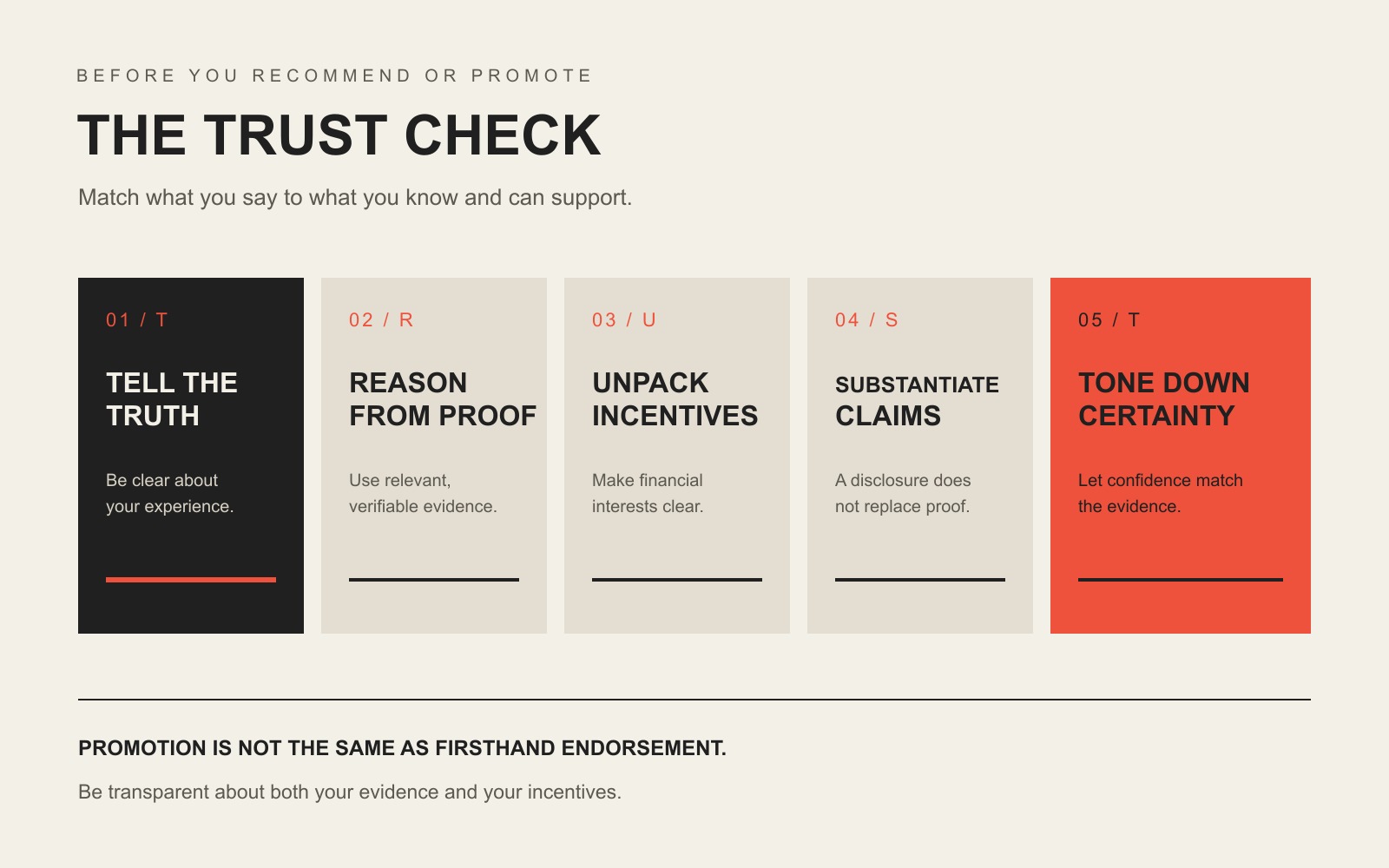
    Use the Scope Design TRUST Check

    Before publishing a promotion for something you do not personally use, run it through five questions.

    The TRUST Check: Tell the truth about experience, Reason from evidence, Unpack incentives, Substantiate claims, and Tone down certainty to match the evidence.

    T: Tell the truth about your experience

    State the real level of contact you have had with the product. Did you buy it, use a trial, watch a live demonstration, inspect the documentation, interview customers, or only read the sales page? Do not let the copy imply a deeper experience than you actually have.

    R: Reason from evidence

    Be able to explain why the product made your list. A useful recommendation has a basis beyond “the commission is good.” Define the criteria that matter to the intended buyer and evaluate against those criteria.

    U: Unpack your incentives

    Tell readers about relationships that could affect how they interpret the recommendation. Compensation does not automatically make a recommendation dishonest. Hidden compensation makes it much harder for the audience to judge your advice fairly.

    S: Substantiate the claims

    Separate facts you can verify from opinions and predictions. If a vendor says its product “doubles conversions,” do not simply inherit that claim. The more consequential the claim, the stronger the evidence should be before you repeat it.

    T: Tone down certainty to match the evidence

    Your language should reflect what you really know. If you have not used the product, “this may be worth considering for X because of Y” is often more accurate than “this is the best tool for X.” Strong certainty requires strong evidence.

    What ethical wording actually sounds like

    Good marketing does not need fake certainty. In fact, precision usually makes a recommendation more useful.

    “I have not used this product in my own business because we do not need this category of software. I included it because its published feature set, pricing, and support model match the criteria we used for this guide. This is an affiliate link, so we may earn a commission if you buy.”

    That statement tells the reader what you did not do, what you did evaluate, and how money enters the picture. It also avoids pretending that research and personal experience are interchangeable.

    Affiliate marketing ethics: what makes a promotion ethical?

    Affiliate marketing is not inherently unethical. The model becomes questionable when the incentive drives the advice more than the reader’s needs, or when the marketer disguises advertising as independent personal experience.

    If you are deciding whether an affiliate model is appropriate in the first place, that is a separate business question. Scope Design’s guide to referral programs versus affiliate marketing deals with that choice. This article is about what happens after you choose to promote: what you can honestly claim and how you should disclose it.

    What about agencies promoting client products?

    An agency does not need every employee to become a customer of every client. That would be impossible in many industries. What the agency does need is enough product knowledge and evidence to create accurate advertising.

    If Scope Design markets a client’s service, the job is not to pretend we personally hired that service as a consumer. The job is to understand the offer, verify the claims we use, understand the intended buyer, and communicate the value without inventing experience. That is consistent with our broader approach to marketing psychology without tricking people: help people make a good decision instead of manufacturing pressure.

    A simple rule for deciding whether to publish

    Before you promote a product you do not use, ask one uncomfortable question: If a buyer challenged every sentence, could I explain exactly what this claim is based on?

    If the answer is yes, your experience is described accurately, your incentives are visible, and the evidence supports the language, the promotion can be both useful and ethical. If the answer depends on the reader assuming you know more than you do, rewrite it.

    That principle fits the larger Marketing & Advertising strategy Scope Design uses across channels: earn attention with a useful message, then give the buyer enough truth and context to decide.

    Frequently asked questions

    Can you recommend a product you have not used?

    You can discuss or recommend a product without owning it, but the strength and wording of the recommendation should match your evidence. Do not imply personal use or experience you do not have.

    Is affiliate marketing ethical?

    It can be. The ethical problems are usually misleading claims, hidden incentives, poor evidence, and recommendations designed around commission rather than audience fit. The payment model alone does not decide the ethics.

    In the United States, a material connection that could affect how people evaluate an endorsement should be disclosed clearly and conspicuously. Put the disclosure where readers can notice and understand it, not in a distant policy page.

    Does saying “I have not used this” make the promotion okay?

    No. That disclosure is useful, but the rest of the message still needs to be truthful and supported. You can be transparent about not using a product and still make a bad or misleading recommendation.

    Can an agency promote a product its team does not personally use?

    Yes, if the agency has enough knowledge to make accurate claims and does not pretend to offer a personal user testimonial. Marketing expertise and consumer experience are different forms of evidence.

    The bottom line

    You do not need to buy every product before you can say anything useful about it. You do need to be disciplined about the line between research, promotion, and personal endorsement.

    Tell people what you actually know. Show the basis for the recommendation. Disclose the incentive. Support the claims. Match your certainty to the evidence. If you can do those five things, you are helping the reader decide instead of asking them to trust a performance.

  • Neuromarketing & AI Personalization: What the Evidence Can Actually Prove

    Neuromarketing & AI Personalization: What the Evidence Can Actually Prove

    Neuromarketing can measure how people respond to marketing stimuli, but it cannot read a customer’s mind or guarantee what that person will buy. Eye tracking can show where someone looked. EEG can record electrical activity associated with a response. Physiological measures can show changes in arousal. AI can find patterns in behavioral data. The hard part is the step between the signal and the business claim.

    That distinction matters because marketing advice often skips directly from “we measured a response” to “we know what customers secretly want.” The evidence does not support that shortcut. A useful neuromarketing or AI-personalization program treats every signal as evidence to interpret, validate, and test against real customer behavior.

    TL;DR: neuromarketing is a research tool, not a mind-reading machine

    • Measure the signal honestly. Gaze, brain activity, physiological response, clicks, and model scores are not purchases.
    • Name the inference. If a researcher calls a signal “attention,” “arousal,” “preference,” or “readiness,” ask how that interpretation was validated.
    • Validate the outcome. A result from one sample, ad, product, or lab does not automatically generalize to your audience.
    • Test the business effect. Measure qualified leads, purchases, retention, refunds, margin, and other outcomes that matter to the business.
    • Protect consent and trust. Neuroscience and AI do not exempt marketers from privacy, substantiation, transparency, or ethical obligations.

    If you want the broader persuasion framework, our guide to ethical marketing psychology owns that topic. This article has a narrower job: deciding what neuroscience-style evidence and AI prediction can actually support.

    What is neuromarketing?

    Neuromarketing, often discussed alongside consumer neuroscience, applies neurological, neurophysiological, physiological, and behavioral measurement to questions about marketing response. Depending on the study, researchers may use EEG, fMRI, eye tracking, electrodermal activity, heart-rate measures, facial-expression analysis, reaction time, or conventional behavior data.

    The useful definition is not “science that discovers the buy button.” It is market research that adds signals people may not be able to report accurately through a survey or interview.

    The Neuromarketing Science & Business Association’s industry code describes neuromarketing research as the systematic collection and interpretation of neurological and neurophysiological insights about individuals using accepted scientific protocols. The same code tells practitioners not to exaggerate what scientifically accepted insights allow them to claim. That second part belongs in the definition too.

    The three layers marketers keep collapsing

    Most bad neuromarketing claims skip at least one layer. Keep these three separate:

    LayerExamplesWhat it tells youWhat it does not automatically tell you
    1. Measured signalGaze location, EEG activity, skin conductance, click sequence, model scoreSomething observable changed under defined conditionsWhy it changed or whether the person will buy
    2. Inferred constructAttention, arousal, preference, memory, hesitation, readinessA tested interpretation of one or more signalsThat the interpretation generalizes to every person or context
    3. Business outcomePurchase, qualified lead, retention, refund, profitWhat happened in the businessWhich psychological mechanism caused it without a valid test

    A pupil change is not a purchase. A click is not a motive. A high model score is not a hidden emotional state. Even a stated preference is not identical to future behavior. Good research builds evidence across those layers instead of pretending they are interchangeable.

    What common neuromarketing methods can actually measure

    Eye tracking: where attention went

    Eye tracking can help researchers see where people look, what they miss, how gaze moves through a page or package, and whether a critical element receives visual attention. That can be extremely useful for design and usability.

    It does not tell you, by itself, whether the person liked what they saw, understood it correctly, trusted it, or intends to buy. If a price receives a long fixation, the person may be interested, confused, skeptical, or simply trying to read small type. The signal needs context.

    EEG: electrical activity with useful timing and real limits

    EEG records electrical activity at the scalp and is widely used in consumer-neuroscience research. It can add information that self-report alone cannot provide, especially when researchers care about the timing of responses to stimuli.

    But “the EEG showed a response” is still not the same as “this campaign will sell.” A systematic review of EEG consumer-neuroscience studies found that EEG can complement traditional experimental methods while also noting that results were not always conclusive or easy to generalize to practical scenarios. A later systematic review of EEG research found some relatively consistent markers but mixed relationships between measures, preference, and purchase behavior.

    fMRI and physiological measures: different windows, different tradeoffs

    Brain imaging and physiological measures can reveal additional patterns under controlled conditions. They can be valuable in specialist research when the decision is important enough to justify the cost, expertise, and study design.

    The danger is reverse inference: seeing activity or arousal and assigning a complicated human meaning that the measurement did not directly establish. A review of neuromarketing and consumer neuroscience warned that commercial explanations of these methods are often overstated. Complex states and purchasing behavior cannot simply be read out of a brain image.

    Behavioral analytics: often the better first instrument

    For most small businesses, the first useful evidence is less glamorous: customer interviews, search behavior, sales objections, form completion, funnel drop-off, support questions, heatmaps, session recordings, and controlled tests. Our small-business market research process is usually a better starting point than renting lab equipment.

    That is not anti-science. It is matching the research method to the decision. If ordinary evidence can answer the question cheaply and directly, adding a brain measure does not automatically make the answer more useful.

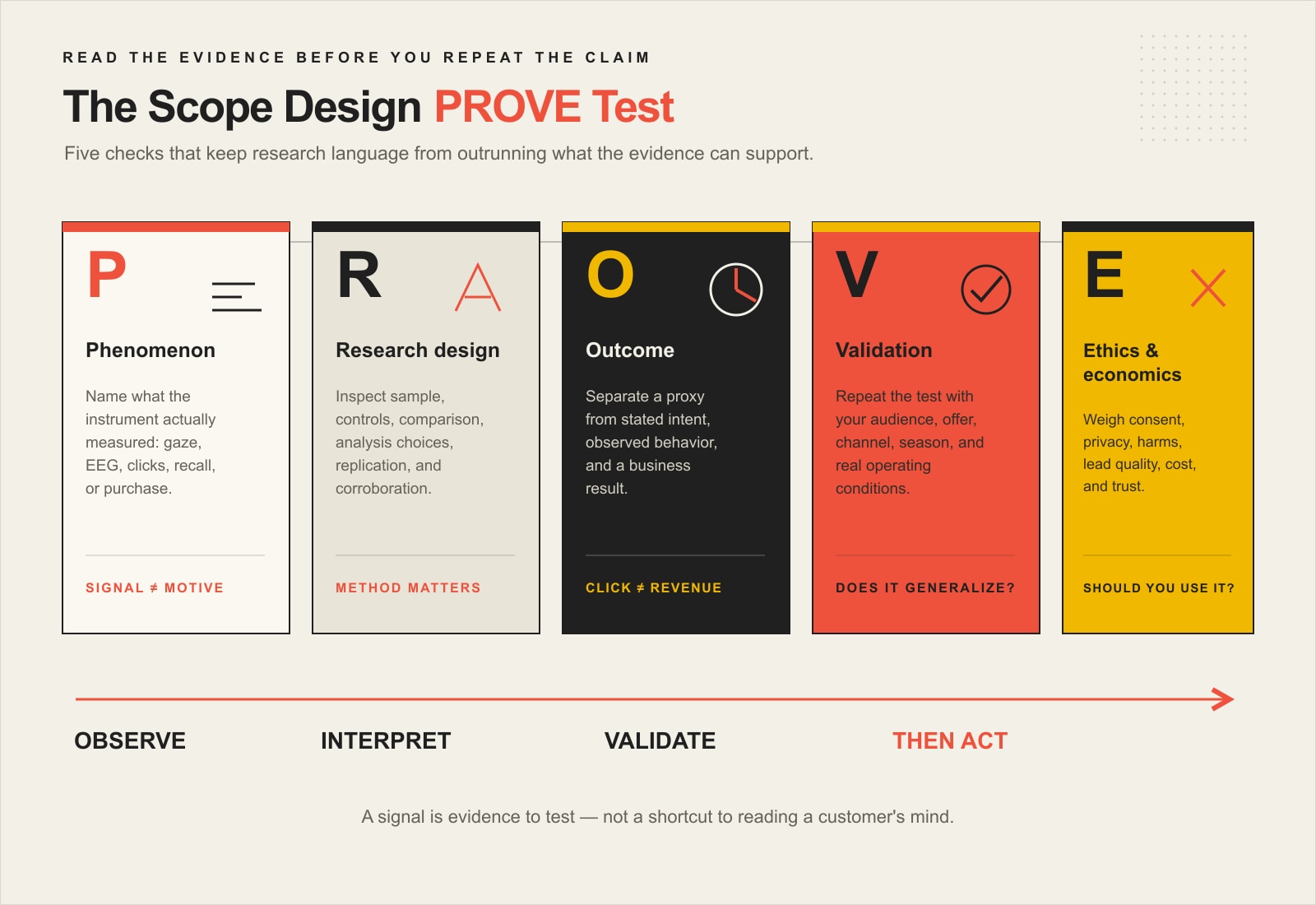
    Use the Scope Design PROVE Test before believing a neuromarketing claim

    We use the PROVE Test to keep research language from getting ahead of the evidence.

    The PROVE Test checks what was measured, how the research was designed, what outcome it supports, whether it validates in the intended context, and whether the ethics and economics justify its use.

    P — Phenomenon: what was actually measured?

    Start with the instrument, the stimulus, and the raw outcome. Was the study measuring gaze, an EEG feature, physiological arousal, stated preference, click behavior, recall, or an actual purchase? “Engagement” and “emotion” are not instruments. Ask what produced the number.

    R — Research design: how trustworthy is the comparison?

    Look at the sample, controls, stimulus, comparison group, preprocessing, model selection, and whether the analysis was decided before or after the interesting pattern appeared. Ask whether the study has been replicated or corroborated. A sophisticated instrument cannot repair a weak design.

    O — Outcome: proxy, intent, behavior, or business result?

    Classify the outcome before you repeat the claim. Attention is a proxy. Purchase intent is stated intent. Clicking “learn more” is behavior. Revenue and retained customers are business outcomes. Each can be useful, but they answer different questions.

    V — Validation: does it reproduce in your context?

    This is where AI and neuromarketing claims often get shaky. A model can perform well on the data it was trained and tested on and still fail when the audience, offer, channel, season, creative, device, or competitive context changes. NIST’s AI Risk Management Framework resources explicitly call for documenting validity, reliability, and limitations on generalizability beyond development conditions.

    E — Ethics & economics: should you use it even if it works?

    Check informed consent, privacy, data handling, accessibility, claim substantiation, customer autonomy, lead quality, downstream service cost, refunds, and trust. A personalization system that produces more clicks but worse customers is not a better marketing system. That is the same constraint-first logic we use in our small-business marketing strategy: optimize the business outcome, not the most flattering intermediate metric.

    Can neuromarketing predict what customers will buy?

    Sometimes a neuromarketing study can improve prediction for a defined task and dataset. That is not the same as reliably predicting what any individual customer will buy.

    Research can combine neural, physiological, and behavioral measures with statistical or machine-learning models. In a well-designed study, those measures may add predictive information beyond a survey or a single behavioral signal. The important phrase is in a well-designed study.

    The systematic reviews above do not support a universal prediction percentage. They show a field with promising signals, methodological variation, mixed findings, and continuing questions about generalization. That is much less exciting than “we can predict buyers with 85% accuracy,” but it is also much more useful because it tells you what must be validated next.

    If a vendor advertises a fixed accuracy number, ask: accuracy at what task, against what baseline, with what class balance, on what test set, using what outcome, and validated on whose customers? An 85% classification result can mean very different things depending on the problem.

    Where AI personalization fits, and where the psychology story goes too far

    AI personalization is not neuromarketing unless it actually uses neurological or neurophysiological research. Most AI personalization systems work from ordinary data: browsing history, purchases, content interactions, product attributes, account information, campaign responses, or other behavioral features.

    Those systems can rank content, recommend products, segment audiences, predict response likelihood, choose a message variant, or allocate attention to options. None of that means the model has discovered a person’s hidden psychological state.

    If a model sees slower scrolling, repeated visits, or a certain click sequence, it may learn that those patterns correlate with an outcome in historical data. Calling the pattern “hesitation,” “confusion,” or “emotional readiness” adds a psychological interpretation that needs independent validation.

    The safest way to use AI personalization is operational: make a bounded prediction, choose a measurable action, compare it against a credible baseline, and monitor business outcomes plus harms. The model does not need to “know the customer’s mind” to be useful.

    Do the cheaper, more direct research first

    Neuromarketing is most valuable when it answers a question that simpler evidence cannot answer well enough. For many small-business decisions, you are not there yet.

    Before specialist neuroscience, ask whether you already know:

    • which customer decision you are trying to improve;
    • what qualified customers say they are uncertain about;
    • where people abandon the current path;
    • whether the offer, proof, price, and next step are understandable;
    • what outcome defines success;
    • whether you can run a clean behavioral test first.

    A pricing page is a good example. You can study attention to the price table, but the business may first need to clarify what each option includes and which buyer each option fits. Our guide to pricing psychology treats presentation as decision design, not a trick for bypassing judgment.

    The same applies to messaging. A neuroscience-sounding claim about a headline or tagline should not outrank direct comprehension, recall, brand linkage, and behavior testing. We use that evidence boundary in our guide to what psychology and neuromarketing can actually prove about messaging.

    A practical small-business neuromarketing and AI test workflow

    1. Define one decision

    Do not begin with “we want to use neuromarketing.” Begin with a decision: Which hero message is understood faster? Which package communicates the intended hierarchy? Does a personalized recommendation improve qualified purchases rather than just clicks?

    2. Build the evidence ladder

    Start with customer language and observable behavior. Add analytics. Run a simple controlled test if possible. Add a specialist measure only when it resolves uncertainty that remains important enough to justify the cost.

    3. Predefine the outcome

    Write down the metric before seeing the result. If the goal is qualified purchases, do not let an interesting attention metric become the victory condition after the fact.

    4. Compare against a baseline

    A score without a comparison is hard to interpret. Compare the new creative, model, or experience against the current version or another credible control. If the system predicts, compare it against a simple baseline model too.

    5. Validate outside the original sample

    Do not tune the solution until it wins only on the same people, data, or creative used to build it. Test again with fresh data or a later cohort. Real marketing changes over time, so validation is a continuing responsibility.

    6. Follow the result downstream

    Watch what happens after the click or conversion. Did lead quality change? Did buyers understand what they purchased? Did refunds, churn, support burden, or sales time change? A personalization engine can improve the top of the funnel while quietly damaging the economics underneath it.

    Neuromarketing ethics: consent, privacy, and claims still matter

    Neuromarketing research involves human participants and potentially sensitive data. The NMSBA Code of Ethics calls for transparency, voluntary participation, informed consent, privacy protections, accepted scientific principles, and clear separation between key findings and interpretation.

    AI personalization adds another layer. NIST’s AI risk-management guidance emphasizes validity, reliability, transparency, accountability, explainability, privacy, and context. For marketing teams, the practical rule is simple: know what data you are using, why you are using it, what the model is allowed to decide, how you test it, and how a person can be affected.

    Claims about the technology matter too. The FTC’s advertising substantiation policy requires advertisers to have a reasonable basis for objective claims. Recent FTC AI enforcement has also challenged advertised accuracy and AI-powered targeting claims that lacked adequate support. “AI-powered” and “neuroscience-backed” are not evidence exemptions.

    When specialist neuromarketing may actually be worth it

    Specialist neuromarketing can make sense when all of these are true:

    • The decision is financially important enough to justify specialist research.
    • The research question is specific, not “tell us what customers really think.”
    • Ordinary interviews, behavioral data, and experiments leave meaningful uncertainty.
    • The chosen method measures a signal relevant to that uncertainty.
    • The provider can explain the study design, interpretation, validation, and limitations.
    • You have a plan to connect the research result to an actual business test.

    If those conditions are not present, neuroscience can become expensive decoration on a question the business has not defined.

    A 30-minute PROVE audit for any “brain-based” or AI marketing claim

    1. Write the claim in one sentence. Remove adjectives like advanced, intelligent, emotional, subconscious, or predictive unless they have a measurable definition.
    2. Name the measured phenomenon. What raw signal, behavior, or outcome produced the result?
    3. Find the comparison. What baseline or control makes the result meaningful?
    4. Classify the outcome. Proxy, stated intent, observed behavior, or business result?
    5. Check validation. Was performance tested on fresh people or data? Does it generalize to your use case?
    6. Check the incentive. Is the person interpreting the study also selling the tool or tactic?
    7. Check consent, privacy, and substantiation. Can you explain the system plainly to the people affected by it?
    8. Choose the next smallest test. Do not buy a bigger research stack when a controlled marketing test can answer the decision directly.

    Frequently asked questions about neuromarketing

    What is an example of neuromarketing?

    A practical example is eye tracking two versions of a landing page to learn whether people actually see the headline, price, proof, and call to action in the intended order. The eye-tracking result can diagnose visual attention. You would still need comprehension and behavior evidence to know whether the better gaze pattern improves the decision or business outcome.

    How does neuromarketing work?

    Researchers expose participants to defined marketing stimuli and collect neurological, physiological, or behavioral signals. They then analyze those measurements and, depending on the study, relate them to constructs such as attention, arousal, memory, preference, or later behavior. The validity of the conclusion depends on the measurement, design, analysis, and validation.

    What is the purpose of neuromarketing?

    The useful purpose is to add evidence about responses that may be difficult to capture through self-report alone. It can supplement interviews, surveys, experiments, and behavioral data. It should not be treated as a replacement for those methods or as a shortcut to a hidden truth about the customer.

    What are the limitations of neuromarketing?

    Important limitations include small or specialized samples, cost, study-design sensitivity, noisy or indirect measures, interpretation risk, mixed generalizability, privacy and consent concerns, and the gap between a laboratory response and a real purchasing decision. The right limitation depends on the method and claim.

    Is neuromarketing scientifically reliable?

    Some neuromarketing methods are established scientific measurement techniques, and peer-reviewed consumer-neuroscience research can produce useful findings. Reliability is not a property of the label “neuromarketing,” however. You have to evaluate the specific method, protocol, sample, analysis, outcome, and validation. Scientific equipment does not make every commercial interpretation scientific.

    Can neuromarketing predict purchases?

    It can contribute predictive information in some defined studies and models. The evidence does not support a universal prediction rate or the idea that a brain signal can reliably tell you what any individual customer will buy. Treat prediction as a model to validate, not a fact about the buyer.

    Is AI personalization the same as neuromarketing?

    No. Most AI personalization uses behavioral, transactional, contextual, or content data rather than brain or physiological measurements. An AI system can predict response likelihood or select a variant without knowing a person’s psychological state. If a vendor describes ordinary clickstream prediction as “neural” insight, ask what neurological data was actually collected.

    Should a small business pay for neuromarketing?

    Usually not as the first research investment. Start with customer interviews, sales and support evidence, analytics, usability observation, and controlled message or experience tests. Consider specialist neuromarketing when the decision is valuable, the question is narrow, ordinary evidence leaves important uncertainty, and the result can be validated against behavior.

    Use psychology to improve the decision, not decorate the pitch

    The useful question is not whether a tactic sounds advanced. It is whether the evidence helps you make a better marketing decision. Scope Design’s work starts with the audience, offer, constraint, measurement, and next useful test. If neuroscience or AI adds real information, use it. If a simpler experiment answers the question better, use the simpler experiment.

    That discipline is what keeps neuromarketing useful. Measure the signal. Name the inference. Validate the outcome. Protect the customer. Then decide whether the result earned another round.

    Sources and methodology

    This article was rebuilt on August 21, 2026 using Scope Design’s Content Studio and Open Brain evidence, Ubersuggest and DataForSEO keyword/SERP research, Google People Also Ask and AI Overview patterns, exact-page GA4/Search Console/Bing baselines, and independent scientific and regulatory sources. Keyword volumes are directional estimates, not traffic promises. The page-history sample is too small to support behavior or conversion conclusions. A controlled ChatGPT-with-search observation timed out and was marked unavailable rather than inferred.