Tag: Marketing Analytics

  • Mastering Growth Marketing: Complete Guide to Data-Driven Customer Acquisition and Retention

    Mastering Growth Marketing: Complete Guide to Data-Driven Customer Acquisition and Retention

    Growth marketing is a disciplined system for improving customer acquisition, activation, retention, revenue, and referral by finding the current growth constraint, running the smallest useful experiment, and carrying what you learn into the next decision. It is not a synonym for paid ads, an AI tool stack, or a collection of “growth hacks.”

    The useful question is not, “Which growth tactic should we try?” It is, “What is keeping more of the right customers from reaching value—and what evidence would change our next decision?” That shift matters because a business can improve clicks, leads, or even first-time conversions while quietly making customer fit, margins, retention, support load, or delivery capacity worse.

    Growth marketing in 60 seconds

    • Start with the business constraint, not the channel. Growth marketing should support a real business strategy, not become a substitute for one.
    • Measure the whole customer lifecycle. Acquisition is only useful when enough of those customers activate, stay, buy profitably, and create future value.
    • Run bounded experiments. Define the decision, hypothesis, change, outcome, guardrails, observation window, and next action before launch.
    • Judge downstream quality. A local metric win is not durable growth if it creates worse-fit customers, lower contribution, more churn, more support burden, or less trust.
    • Scale learning, not noise. Widen what survives downstream scrutiny; revise or stop what does not.

    What Is Growth Marketing?

    Growth marketing is an operating approach that uses customer evidence, lifecycle measurement, and controlled experimentation to improve durable business outcomes. It connects the work that attracts a prospect with the work that helps that person experience value, remain a customer, expand the relationship, and advocate for the business.

    That makes growth marketing broader than a campaign and narrower than “everything the company does.” Marketing still has to respect product quality, sales execution, onboarding, service capacity, pricing, and the customer experience. When one of those is the binding constraint, buying more traffic can simply send more people into a broken system faster.

    The defining habit is therefore continuous, decision-oriented learning: identify what appears to limit growth, collect enough evidence to form a useful hypothesis, change something intentionally, observe the response, and decide what deserves more resources.

    Growth Marketing vs. Performance, Digital, Lifecycle, and Product Marketing

    These disciplines overlap, which is why definitions get muddy. The easiest way to separate them is by the job each one is usually trying to own.

    DisciplinePrimary jobCommon evidenceWhere growth marketing overlaps
    Growth marketingImprove durable growth across acquisition, activation, retention, revenue, and referralLifecycle progression, cohort quality, experiment outcomes, economics, guardrailsCoordinates tests across several functions when the growth constraint moves
    Performance marketingProduce measurable outcomes from paid or directly attributable mediaCost, conversion, revenue, return metricsPaid acquisition can be one growth lever, but growth must follow downstream quality too
    Digital marketingReach and persuade customers through digital channelsSearch, email, social, web, advertising, campaign metricsGrowth marketing may use these channels but is defined by the learning system, not the medium
    Lifecycle marketingCommunicate appropriately as customers move through relationship stagesActivation, engagement, retention, reactivation, expansionLifecycle work is often central when activation or retention is the constraint
    Product marketingConnect product value, positioning, market, launch, adoption, and sales enablementMessage fit, adoption, pipeline quality, win/loss evidenceGrowth tests depend on sound positioning and value; they should not invent those in a dashboard

    If your team argues about which label applies, bring the discussion back to the decision. What outcome are you trying to improve? What currently limits it? Who owns the underlying system? A name should clarify work, not create turf.

    Why Growth Marketing Fails: Teams Optimize the Wrong Constraint

    A common growth failure looks successful in the weekly dashboard. Traffic rises. Cost per lead falls. Form submissions climb. Then sales says the leads are poor, onboarding gets overloaded, repeat purchase weakens, refunds rise, or the team discovers the “efficient” channel was attracting people who were never a good fit.

    This happens when a local metric becomes the objective instead of evidence about the objective.

    • If qualified demand is scarce, the constraint may be acquisition.
    • If the right people arrive but do not take the first meaningful action, it may be activation or conversion.
    • If customers buy once and disappear, the constraint may be retention or value delivery.
    • If loyal customers never expand, it may be offer, pricing, or expansion.
    • If happy customers rarely introduce anyone, there may be a referral or advocacy opportunity.
    • If demand already exceeds what the company can deliver well, the constraint may be capacity—and more acquisition may be the wrong goal.

    This is why growth marketing starts with diagnosis. The tactic comes later.

    The Scope Design GROW Loop

    We use a simple growth-specific extension of Scope Design’s constraint-first strategy discipline: GROW. It gives every experiment four jobs.

    G — Ground the bottleneck

    Define the business outcome first. Then identify the stage most likely to constrain that outcome. Use actual evidence: source and cohort data, sales records, support themes, customer interviews, funnel progression, gross margin, renewal or repeat-purchase behavior, and operating capacity.

    Do not pick “improve conversion rate” because it is easy to graph. Ask what a better conversion would change for the business and what could make that improvement misleading.

    R — Reduce uncertainty with a bounded hypothesis

    Turn the diagnosis into a falsifiable expectation: For this audience, changing this one meaningful factor should improve this primary outcome because of this customer or market evidence.

    Predefine the comparison, guardrails, observation window, and what result would cause you to scale, revise, or stop. This is the difference between an experiment and changing six things before declaring the new version “better.” The NIST Engineering Statistics Handbook’s explanation of experimental design makes the underlying logic explicit: deliberately change factors and observe the response.

    O — Observe downstream cohort quality

    Do not stop at the first metric the test moves. Follow the affected cohort far enough to answer the business question. A campaign that lowers cost per lead but produces fewer qualified opportunities is not necessarily a winner. A checkout change that raises orders while increasing refunds may be borrowing from future value.

    Funnel analysis can help teams see where people progress or drop out; Google’s Analytics funnel reporting documentation shows how funnel reports visualize the steps users take and where they succeed or fail. The tool is not the strategy, but it can help locate the question.

    W — Widen, revise, or withdraw

    Once the observation window is sufficient for the decision, choose deliberately:

    • Widen: expose more of the appropriate audience or budget to the change because the primary outcome improved and guardrails held.
    • Revise: keep the question but change the hypothesis because the evidence revealed something useful.
    • Withdraw: stop spending time or money on a weak idea, record what was learned, and move to the next constraint.

    The point is not to win every test. The point is to make uncertainty cheaper and future decisions better.

    Diagnose Growth Across the Customer Lifecycle

    A growth funnel is useful only if each stage represents something meaningful to your business. “Visited page” and “opened email” can be diagnostic signals, but they are rarely the final outcome.

    StageDecision questionUseful outcomeMisleading substituteExample bounded test
    AcquisitionAre enough of the right people entering the system?Qualified demand by source, customer acquisition cost using a defined customerTraffic, impressions, raw leadsTest one audience-message-offer combination against the current acquisition path
    ActivationDo new prospects or customers reach the first meaningful value milestone?Qualified action or time to first agreed valuePage views, logins, generic engagementChange one onboarding step, form requirement, proof element, or call to action
    RetentionDo customers continue because they receive enough value?Renewal, repeat purchase, retained gross profit, cohort retentionEmail opens, account age, “active” without a value definitionTest a value reminder, service handoff, replenishment cue, education sequence, or friction repair
    Revenue / expansionCan the relationship create more profitable value without harming fit?Contribution, expansion revenue, repeat-order economicsAverage order value without margin or return contextTest packaging, cross-sell timing, expansion offer, pricing presentation, or qualification
    ReferralDo satisfied customers create qualified introductions?Qualified referrals and referred-customer qualityShares, generic mentions, testimonial countTest the trigger, timing, ask, incentive, or handoff into a referral or affiliate program

    Notice what this table does not do: it does not tell every business to optimize all five stages simultaneously. The stage that deserves attention depends on the bottleneck and the decision.

    Measure Growth Without Lying to Yourself

    Growth marketing needs enough measurement to make a decision—not a dashboard with 47 tiles and no owner. A useful hierarchy has four layers.

    1. Primary business outcome: the result the experiment is supposed to improve—qualified revenue, retained value, profitable repeat purchase, qualified pipeline, or another named consequence.
    2. Supporting metrics: measures that help explain movement in the primary outcome, such as activation rate, stage progression, source mix, cycle time, or repeat frequency.
    3. Diagnostic metrics: clicks, views, opens, scroll depth, form starts, and similar behaviors used to investigate why an outcome moved.
    4. Guardrails: measures that should not deteriorate while the primary metric improves—margin, refunds, churn, support burden, lead quality, customer complaints, capacity, or brand trust.

    Keep CAC and customer lifetime value definitions explicit

    Customer acquisition cost and customer lifetime value can be useful growth metrics, but they become dangerous when teams silently change the definitions. Does “customer” mean a lead, first purchase, paid subscriber, or retained account? Does lifetime value mean revenue, gross profit, contribution, or forecasted value? Which cohort and time window are included?

    Our dedicated guide to customer lifetime value goes deeper into the calculation and decision discipline. The important rule here is simple: write the definition next to the number. A universal CLV:CAC ratio copied from a benchmark is not a substitute for your economics, cash timing, capacity, and uncertainty.

    Attribution is a model, not a confession from reality

    Multi-touch attribution can organize observed touchpoints, but it should not be treated as proof that every credited channel caused the outcome. Organic search, referrals, brand familiarity, sales conversations, offline exposure, email, and paid media often interact. Use attribution for diagnosis and allocation hypotheses; use controlled experiments or other stronger evidence when the causal question is important enough.

    How to Design a Growth Marketing Experiment

    You do not need a laboratory coat. You do need a written decision rule. Before launching a growth marketing experiment, capture this brief:

    Experiment fieldWhat to write
    DecisionWhat will we do differently if the evidence supports or rejects this idea?
    BottleneckWhich lifecycle constraint are we trying to reduce?
    EvidenceWhat customer, sales, analytics, operational, or market evidence makes this worth testing?
    HypothesisFor this audience, changing X should improve Y because Z.
    ChangeWhat meaningful factor will differ from the current experience?
    Primary outcomeWhich result decides whether the test helped?
    GuardrailsWhat must not get materially worse?
    WindowHow long or how many decision-relevant observations are needed before review?
    ThresholdWhat evidence is strong enough to widen, revise, or withdraw?
    Next actionWhat will we do for each plausible result?

    Google Ads’ official experiments documentation uses control and treatment groups to compare the performance of defined changes. That same discipline—make the change explicit, preserve a comparison, and evaluate the result—is useful even when the experiment happens somewhere other than an ad platform.

    Do not change the base while the test is running

    If the landing page, offer, price, targeting, follow-up process, and sales script all change during the same observation window, you may improve results—but you will learn less about why. Sometimes an emergency repair is more important than experimental purity. Just document the confounding change instead of pretending the test remained clean.

    Growth Experimentation for Low-Traffic Small Businesses

    Small businesses are often told to A/B test everything. That advice ignores arithmetic. If a site or funnel produces only a handful of decision events, splitting the audience can make both groups too small to support a confident conclusion.

    That does not mean you should stop learning. It means you should match the evidence method to the traffic, risk, and decision.

    • Fix known defects without waiting for a test. Broken forms, misleading copy, inaccessible controls, obvious mobile friction, and tracking failures are repairs.
    • Use direct customer evidence. Interviews, sales objections, support tickets, call recordings, lost-deal reasons, and usability observation can expose the bottleneck before a split test is viable.
    • Segment before averaging. Compare source, device, geography, offer, customer type, or cohort when the segment maps to a real business difference.
    • Use bounded before/after or time-block tests carefully. Keep other major conditions stable when possible, define the window in advance, and label the evidence directional when seasonality or other changes could explain the movement.
    • Observe longer when the business outcome is delayed. Retention, repeat purchase, and referrals may need more time than a landing-page click.
    • Do not manufacture significance. A tiny sample with a dramatic percentage change is still a tiny sample.

    This is also why conversion rate optimization is larger than A/B testing. Research, repairs, message clarity, usability, offer work, analytics, and operational fixes can all reduce uncertainty before a statistically powered split test makes sense.

    Choose Channels After You Know the Constraint

    Channels are tools. Growth marketing decides when a tool is relevant.

    If the constraint is…Potential levers to investigateFirst question
    Qualified acquisitionSEO/content, paid search/social, partnerships, referrals, local visibility, outbound, positioningAre we missing reach, relevance, trust, or a compelling offer?
    Activation / conversionLanding-page clarity, proof, forms, onboarding, call handling, sales follow-up, UXWhere does a good-fit prospect fail to reach the first meaningful value step?
    RetentionService delivery, onboarding, education, replenishment, account management, reactivationWhy do customers who looked healthy fail to continue?
    ExpansionPackaging, pricing, cross-sell, upsell, service tiers, customer successWhat additional problem can we solve profitably for the right existing customer?
    ReferralReferral asks, partner systems, reviews, advocacy triggers, communityWhat moment gives a satisfied customer a natural reason to introduce someone?

    If you need ideas after you have a decision to make, our guide to innovative marketing strategies contains experiments worth adapting. The order matters: problem first, tactic second.

    A Practical 90-Day Growth Marketing Strategy

    You do not need a year-long transformation to start practicing growth marketing. You need enough structure to learn without letting the experiment backlog become another abandoned spreadsheet.

    Days 1–14: Baseline the system and choose one bottleneck

    • Define the business outcome and the customer you are trying to create or retain.
    • Map the essential lifecycle stages from first useful contact through realized value.
    • Verify tracking against sales, commerce, CRM, or operational records.
    • Segment enough to expose obvious source or cohort differences.
    • Interview customers or frontline staff where the numbers cannot explain behavior.
    • Choose one constraint and name a primary metric plus guardrails.

    Days 15–30: Run the smallest decision-changing test

    • Write the experiment brief before implementation.
    • Prefer a meaningful change to a dozen microscopic tweaks.
    • Keep the audience and experience stable enough to interpret the result.
    • Record implementation details, dates, and confounding changes.

    Days 31–60: Follow the cohort downstream

    • Check whether the primary outcome changed.
    • Check qualification, margin, retention signals, refunds, support burden, and other guardrails.
    • Compare the affected cohort with the most reasonable baseline.
    • Collect qualitative explanations from sales, support, and customers.

    Days 61–90: Reallocate and document

    • Widen the winner only if downstream evidence is healthy.
    • Revise a promising hypothesis when the mechanism looks wrong but the problem still matters.
    • Withdraw weak ideas without turning sunk cost into a strategy.
    • Record the result, confidence, unresolved questions, and next review date.
    • Revisit the growth constraint; a successful test may move it somewhere else.

    What a Small Growth Team Actually Needs

    Growth marketing is often presented as a shopping list of analytics platforms, automation systems, customer-data platforms, AI agents, personalization engines, and testing tools. That reverses the dependency.

    A small business needs five capabilities before it needs a “growth stack”:

    1. One accountable growth decision owner who can say what constraint is being worked and why.
    2. Trustworthy outcome data connected far enough downstream to distinguish activity from customer value.
    3. Customer evidence from sales, service, interviews, reviews, or behavior—not only dashboards.
    4. Execution capacity to change the relevant part of the website, campaign, offer, onboarding, or workflow.
    5. A review habit that turns results into scale, revise, or stop decisions.

    Software should make one of those capabilities easier. AI can help summarize interviews, draft variants, classify feedback, explore data, or accelerate implementation. It should not be allowed to turn a weak business assumption into 40 automated campaigns before anyone asks whether the assumption is true.

    Common Growth Marketing Mistakes

    1. Treating acquisition as growth

    More traffic and leads can hide a retention, margin, qualification, or capacity problem. Follow enough of the cohort downstream to know whether the acquisition is creating useful customers.

    2. Building composite scores nobody can act on

    A “growth velocity” or “customer health” score can be useful if its inputs, weighting, owner, and response rule are explicit. Otherwise it turns several uncertain metrics into one more-confident-looking uncertain metric. Keep the underlying outcomes visible.

    3. Declaring a winner at the first conversion

    The earliest metric is often the fastest one, not the most important one. Decide in advance how far downstream the cohort must travel before you scale.

    4. Running experiments without a stop rule

    Without a threshold and review date, weak tests linger because nobody wants to admit the result is inconclusive. Precommit the next action for win, loss, and uncertainty.

    5. Testing five variables at once

    You may get a better page or campaign, but you lose learning about the mechanism. Bundle changes only when the business needs the whole repair more than it needs isolated evidence.

    6. Letting AI choose the strategy

    AI can accelerate analysis and production. It does not know your actual constraints, customer promises, margins, sales quality, capacity, or risk tolerance unless you provide trustworthy context—and even then, the business still owns the decision.

    Growth Marketing FAQ

    What is growth marketing in simple terms?

    Growth marketing is a method for improving durable customer and business outcomes through lifecycle measurement and repeated experiments. It starts by identifying the current growth bottleneck, tests a defined change, follows the affected cohort downstream, and uses the result to decide what to scale, revise, or stop.

    How does growth marketing work?

    Start with a business outcome, diagnose whether acquisition, activation, retention, expansion, referral, or capacity is limiting it, form a hypothesis from evidence, run the smallest useful test, measure the primary outcome and guardrails, then reallocate resources based on what you learned.

    What is a growth marketing strategy?

    A growth marketing strategy is the set of choices that connects a growth objective to a specific constraint, target customer, evidence base, experiment sequence, measurement rule, resource owner, and review cadence. “Post more on social media” is a tactic. “Increase qualified pipeline by fixing the mismatch between our highest-intent search traffic and the offer on its landing page” is closer to a strategy.

    What is the difference between growth marketing and performance marketing?

    Performance marketing usually focuses on directly measurable paid-media outcomes such as acquisition, conversion, or revenue. Growth marketing can include performance marketing, but it follows the customer farther through activation, retention, expansion, and referral and can test non-media constraints such as onboarding, offers, product experience, or handoffs.

    What metrics should a growth marketer track?

    Track the metric that answers the current business decision, plus supporting diagnostics and guardrails. Depending on the constraint, that may include qualified acquisition cost, activation to first value, stage conversion, retained gross profit, cohort retention, contribution, repeat purchase, expansion, or qualified referrals. Raw traffic, clicks, opens, and form starts are often diagnostic rather than final outcomes.

    Do small businesses need A/B testing for growth marketing?

    No. A/B testing is one evidence method. Low-volume businesses can learn from direct customer research, usability observation, repairs, segmentation, carefully bounded before/after tests, and longer cohort observation. Use a randomized split test when traffic and conversion volume can support the decision; do not fake statistical certainty when they cannot.

    How much should a small business spend on growth marketing?

    There is no responsible universal percentage. Budget depends on unit economics, cash flow, capacity, the cost of learning, the maturity of the channel, and how quickly the business can observe a meaningful outcome. Fund experiments at the smallest scale that can change a real decision, then widen investment when the economics and downstream guardrails hold.

    Build a Growth System That Learns

    The advantage of growth marketing is not that it gives you more tactics. The internet already has enough tactics. The advantage is that it gives the business a repeatable way to decide which problem deserves attention, what evidence would reduce uncertainty, and when a result is healthy enough to scale.

    Ground the bottleneck. Reduce uncertainty. Observe downstream quality. Widen, revise, or withdraw. Then run the loop again because a solved constraint usually exposes the next one.

    If your marketing produces activity but you cannot tell which constraint is limiting profitable growth, talk with Scope Design. We can help connect the website, analytics, acquisition channels, conversion path, customer evidence, and automation into a growth system that has a reason for every test.


  • The Complete Internet Marketing Plan: 4 Essential Steps That Drive Real Results

    The Complete Internet Marketing Plan: 4 Essential Steps That Drive Real Results

    An internet marketing plan is a working decision system for turning a specific market opportunity into qualified leads, customers, and revenue. It should tell you who you are trying to reach, where they can take the next step, which channels deserve attention, and how you will decide what to keep, test, or stop. If your “plan” is just SEO + social + email + ads written on a whiteboard, you do not have a plan. You have a shopping list.

    Scope Design uses a simple four-part model for this job: MAPS — Market, Asset, Promotion, Scorecard. The sequence matters. Define the buyer and problem first. Build the conversion path second. Choose channels third. Measure qualified outcomes from the start. That keeps marketing tied to the business instead of turning it into a pile of disconnected tactics.

    TL;DR: The Four Steps of a Useful Internet Marketing Plan

    1. Market: Identify the buyer, the problem that triggers action, the buying moment, and the business outcome worth pursuing.
    2. Asset: Build the owned path that turns attention into action: your offer, page, proof, response mechanism, sales handoff, and tracking.
    3. Promotion: Give a small number of channels distinct jobs based on customer intent, economics, capacity, and evidence — not platform fashion.
    4. Scorecard: Track qualified leads, customers, revenue, acquisition cost, and the diagnostic metrics that explain why results changed. Then keep, test, or stop.

    If you are building your first market-page-channel-measurement loop, start with Internet Marketing for Beginners before implementing the fuller MAPS plan.

    The U.S. Small Business Administration describes a marketing plan as the layer that turns strategy into action, covering areas such as target market, competitive advantage, sales plan, goals, channels and actions, budget, and measurement. That is a useful baseline. The practical problem for a small business is deciding what matters first. The SBA’s marketing-plan guidance is broad by design; MAPS is the operating filter that keeps the plan focused enough to run.

    A Digital Marketing Strategy and a Digital Marketing Plan Are Not the Same Thing

    Strategy decides where you will compete, which customers matter, what you will promise, what you will refuse to do, and how the business will create value. A plan turns those choices into an operating sequence with owners, assets, channels, budgets, measurements, and decisions. A campaign is one coordinated push inside that plan. A channel is simply a place or mechanism through which the plan does a job.

    If you need the larger strategic system, read Digital Marketing Strategy: Build a System, Not a Tool Pile. This article stays narrower on purpose. Its job is to help you build the plan that sits between strategy and execution.

    How the MAPS Internet Marketing Plan Works

    MAPS is a closed loop. Market evidence shapes the Asset. The Asset gives Promotion somewhere useful to send people. Promotion creates behavior and sales evidence. The Scorecard turns that evidence into the next Market, Asset, or Promotion decision. The point is not to “finish marketing.” The point is to make the next decision less stupid than the last one.

    A coral ribbon connects customer listening, shaping an offer, sharing it locally, and learning from outcomes.
    The Scope Design MAPS framework: Market → Asset → Promotion → Scorecard.

    Step 1: Market — Define the Buyer, Problem, and Buying Moment

    Your first step is not choosing a social platform. It is getting painfully clear about whose decision you are trying to influence and what has to be true before they will act. Demographics can help, but they are not the strategy. “Women 35–54” does not tell you why somebody is suddenly comparing contractors, accountants, software, or a new website.

    Answer the Four Customer Questions

    • Where is the customer now? What problem, frustration, risk, or missed opportunity is present?
    • Where do they want to be? What practical outcome would make the problem feel solved?
    • Why does that outcome matter? What business or personal consequence sits underneath it?
    • What can you credibly offer to help them move? What can you deliver, prove, support, and price without hand-waving?

    Those questions are the deeper job owned by our four-question online marketing framework. Use them before you start writing ads or content. Otherwise the copy gets generic because the thinking was generic.

    Replace Assumptions With Evidence

    Useful market evidence can come from customer interviews, sales calls, support tickets, Search Console queries, review language, lost-deal reasons, competitive research, CRM notes, and actual purchase behavior. If you need a practical research process, use the methods in our market research guide.

    Write the result as a one-page market brief, not a fictional biography about “Marketing Mary” who enjoys yoga and oat milk unless those facts actually change the buying decision. A useful brief includes the problem, trigger, desired outcome, objections, proof needed, likely search language, buying participants, geographic constraints, and the next action you want the person to take.

    Define One Commercial Outcome

    Before you pick channels, define the business result the plan is supposed to improve. Examples include qualified estimate requests, booked consultations, ecommerce purchases, recurring subscriptions, renewals, or profitable repeat business. “More awareness” can be a legitimate intermediate goal, but it needs a reason to exist. Awareness that never improves a buying condition is just a chart going up.

    Step 2: Asset — Build the Path That Converts Attention Into Action

    Your Asset is the owned conversion path. For many businesses that means a website or landing page, but the important idea is broader: a prospect needs somewhere to understand the offer, see credible proof, resolve obvious objections, and take the next step. If traffic arrives and the path is confusing, buying more traffic is an expensive way to learn that the page is confusing.

    The Asset Has Five Jobs

    • Clarify: Explain what you do, who it is for, and what problem it solves without making the visitor decode agency poetry.
    • Prove: Show evidence appropriate to the decision — examples, reviews, case studies, credentials, process, guarantees, demonstrations, or transparent limitations.
    • Convert: Make the next step obvious: call, book, request a quote, start a trial, buy, reply, or visit.
    • Hand off: Decide who owns the response, what happens next, and how quickly the business follows up. A contact form is not a sales process wearing a tiny hat.
    • Measure: Track the important action and enough context to know where it came from and whether it became a qualified opportunity or customer.

    Track the Business Action Before You Add More Traffic

    Google Analytics defines a key event as an action that is particularly important to the success of the business. For lead-generation businesses, GA4 also supports recommended events such as generate_lead, qualify_lead, working_lead, and close_convert_lead. That makes it possible to measure more than the form submission itself. The official GA4 recommended-event reference gives you a practical vocabulary for following the lead deeper into the funnel.

    You do not need enterprise attribution theater on day one. You do need a defensible chain from source → action → qualification → sale when the business model allows it. If you cannot tell which leads became customers, optimizing cost per lead can reward the channel that produces the cheapest garbage.

    Step 3: Promotion — Give Each Channel a Specific Job

    Promotion is where most internet marketing plans get bloated. Somebody writes down SEO, Google Ads, Facebook, Instagram, LinkedIn, TikTok, YouTube, email, SMS, webinars, influencers, and “AI,” then the team spends the quarter feeding platforms instead of moving customers.

    Choose channels after you know the buyer, the buying moment, the Asset, and the outcome. A channel earns its place when you can explain its job, what evidence would show that it is doing that job, and whether you have the budget and capacity to operate it well.

    Channel Best job Evidence to watch Common failure
    SEO / helpful content Capture and educate existing demand over time Relevant impressions, qualified organic leads, assisted sales Publishing volume without clear query or page ownership
    Paid search Capture active demand faster Qualified conversions, acquisition cost, revenue or pipeline Sending expensive clicks to a weak offer or page
    Email Nurture known prospects and customers Clicks, replies, qualified actions, sales, retention Treating list size or open rate as the business result
    Social media Distribution, proof, relationships, discovery Qualified traffic, inquiries, saves/shares from the right audience Chasing follower count with no path to action
    Google Business Profile Local discovery and trust Calls, website visits, direction requests, qualified inquiries Incomplete information, stale proof, no review-response process
    Referrals / reviews Transfer trust from existing customers Referral source, conversion quality, repeat business Waiting passively for advocacy instead of building a process

    When organic search earns a defined job in the plan, use the organic traffic generation guide to build compounding discovery without confusing publishing volume with strategy.

    Use Intent to Decide Which Channel Goes First

    If people are already searching for the service, search can be a logical demand-capture layer. Google’s Search Ads overview explains that ads can appear when people search for businesses like yours, which gives paid search a clear demand-capture job when demand exists and the economics work. See Google’s Search Ads overview. That does not make paid search automatically right for every business.

    If you serve a local market, a verified eligible business can use a free Google Business Profile to manage how it appears in Google Search and Maps. If repeat business matters more than constant new acquisition, email, customer-success communication, referrals, and retention may deserve more attention than another top-of-funnel platform.

    Content should also have a job inside the buying process. Our growth marketing guide goes deeper on using content and channels across acquisition and retention rather than treating the funnel as a one-way traffic chute.

    There Is No Responsible Universal Marketing-Budget Percentage

    Budget depends on margin, capacity, sales cycle, cash flow, customer value, channel economics, and how much uncertainty you are buying down. Google Ads allows advertisers to set and adjust campaign budgets around their goals and comfortable spend. That flexibility is more useful than pretending every small business should hand the same percentage of revenue to marketing.

    For a new channel, define the amount you can afford to test without needing the test to “work” emotionally. Then decide in advance what evidence would justify more spend, a better test, or a stop. The plan should protect you from both panic and sunk-cost stubbornness.

    Step 4: Scorecard — Measure Qualified Outcomes, Then Keep, Test, or Stop

    Hope is not an analytics strategy. Your Scorecard should be small enough that somebody actually uses it and strong enough to change a budget decision. Start with the commercial outcome, then add diagnostic metrics only when they help explain that outcome.

    Layer Example metric What it tells you
    Attention Qualified impressions, reach, search visibility Whether the right audience has a chance to see you
    Engagement Clicks, meaningful page actions, replies Whether the message earns the next step
    Lead quality Qualified leads, booked calls, estimates accepted for review Whether the channel attracts people the business can actually serve
    Customer New customers, orders, closed deals Whether marketing activity becomes revenue
    Economics Acquisition cost, gross profit contribution, payback, repeat value Whether the result is financially worth scaling

    Use a Keep / Test / Stop Decision Rule

    • Keep: The channel is producing the right kind of customer at economics the business can support, and the operation can handle more volume.
    • Test: The signal is promising or the failure is diagnosable. Change one meaningful variable — audience, offer, message, page, follow-up, or bid — and define what the next test must prove.
    • Stop: The channel repeatedly fails the agreed economics or audience-quality test after reasonable attempts to repair the obvious constraint, or the business lacks the capacity to operate it responsibly.

    Do not kill SEO because a new article failed to produce customers in a week. Do not keep an ad campaign alive for six months because “the algorithm needs time” while the lead quality is obviously terrible. Match the evaluation window to the channel and sales cycle, then make the decision you agreed to make before the emotions arrived.

    A Simple Monthly Marketing Scorecard

    • Total marketing spend by channel
    • Leads and qualified leads by source
    • New customers or closed deals by source when attribution is possible
    • Revenue or pipeline contribution
    • Customer acquisition cost using a consistent cost definition
    • Sales conversion rate from qualified lead to customer
    • Repeat, renewal, or referral value when the business model depends on it
    • One written decision for each meaningful channel: keep, test, or stop

    The point of the scorecard is not to make your dashboard impressive. It is to make the next dollar less dumb.

    What Our Audit of This Exact Page Taught Us

    This revision is a useful example of why measurement needs context. Before rebuilding the article, we checked the exact URL in GA4, Google Search Console, Bing Webmaster Tools, Ubersuggest, and current search results. GA4 showed only eight Direct landing sessions in the reviewed twelve-month period, no engaged sessions, and zero key events. Search Console returned no page-query rows for the current or previous twelve-month periods and currently reports the URL as Discovered — currently not indexed. Ubersuggest found no exact-page ranking keywords or backlinks. Bing knew the URL and the synchronized inventory preserved an older small visibility baseline, but the current exact-URL traffic response showed no clicks or impressions.

    That does not prove the topic is worthless. It proves the old page was not producing enough measurable evidence to defend weak claims or stale structure. The right response was to clarify the page’s job, preserve the accurate established URL, remove unsupported statistics, strengthen internal ownership, and rebuild the article around a useful framework. Measurement should improve a decision, not merely generate a verdict.

    How to Turn the Plan Into the Next 90 Days

    Once MAPS is defined, the next move is not to activate everything at once. Choose the most important constraint in the path and create a bounded implementation cycle around it. If the Market is fuzzy, research. If the Asset leaks, fix the page and handoff. If the Asset works but nobody sees it, promote. If you have activity but no learning, repair the Scorecard.

    Our 90-Day Marketing Plan is the deeper execution framework for that next phase. It deliberately owns the quarter-by-quarter implementation detail so this article can stay focused on the architecture of the plan itself.

    Common Internet Marketing Plan Mistakes

    Starting With Channels Instead of the Buying Problem

    “We need TikTok” is not a business diagnosis. Start with the buyer, problem, and buying moment. The right channel may become obvious once the job is clear. It may also be something boring that works, which is allowed.

    Driving Traffic Before Fixing the Asset

    More traffic magnifies whatever is already happening. If the message is unclear, proof is weak, the mobile experience is painful, or nobody owns follow-up, more visitors can simply make failure more expensive.

    Confusing Content Volume With Marketing Progress

    A content calendar can keep a team busy while the customer remains confused. Each asset should answer a decision, prove something, capture demand, nurture a relationship, or create a reusable sales tool. If it has no job, do not publish it just because Tuesday arrived.

    Match the depth to the reader’s question instead of a word-count target; our guide to how long a blog post should be for SEO owns that narrower decision.

    Optimizing the Cheapest Lead Instead of the Best Customer

    A $20 lead that never qualifies is more expensive than a $100 lead that reliably becomes a profitable customer. Follow the handoff far enough to see quality, not just form fills.

    Never Writing Down the Stop Rule

    Without a stop rule, every weak campaign becomes a debate. Decide the acceptable economics, minimum evidence, test window, and repair attempts in advance. That makes optimization a process instead of a mood.

    Frequently Asked Questions About Internet Marketing Plans

    What should an internet marketing plan include?

    At minimum, include the target market, problem and buying moment, value proposition, owned conversion path, selected channels and their jobs, budget or capacity constraints, tracking, sales handoff, and the business metrics used to make keep/test/stop decisions. The SBA’s broader guidance also includes competitive advantage, sales plan, goals, actions, budget, and measurement.

    What is the difference between a digital marketing strategy and a digital marketing plan?

    Strategy defines the market, positioning, priorities, tradeoffs, and the system you believe will create value. The plan translates those decisions into assets, channels, owners, budgets, measures, and actions. A campaign is one execution package inside the plan.

    How many marketing channels should a small business use?

    There is no magic number. Use only as many channels as you can give distinct jobs, operate consistently, and measure well. A focused business may need only a few. A larger organization with different audiences and lifecycle stages may need more. Channel count is a capacity and strategy decision, not a maturity badge.

    How much should a small business spend on digital marketing?

    There is no responsible universal percentage. Start with margin, customer value, sales cycle, cash flow, current capacity, and the uncertainty of the channel. Define an affordable test, measure qualified outcomes, and increase spend only when the economics and operation justify it.

    How do you know when to stop funding a marketing channel?

    Stop when the channel repeatedly fails the audience-quality or economic test you defined in advance after reasonable attempts to repair the obvious constraint. Test longer when the sales cycle genuinely requires it or the early signal is useful. Do not confuse patience with refusing to learn.

    How often should you review an internet marketing plan?

    Review the operating scorecard often enough to catch waste and broken handoffs, and conduct a more deliberate strategic review on a regular cycle appropriate to your business. The SBA recommends maintaining the marketing plan at least annually. Faster-moving channels or a changing market may require more frequent operating decisions without rewriting the whole strategy every week.

    Build the Path Before You Buy More Traffic

    A useful internet marketing plan makes four things explicit: the Market you are trying to move, the Asset that earns the next step, the Promotion channels with jobs worth funding, and the Scorecard that tells you what happened. That is the MAPS loop.

    If your current marketing is producing activity but not enough clarity about what to fix next, talk with Scope Design. We can start with the evidence, identify the weak part of the path, and help build the smallest useful system that deserves the next dollar.

  • 3 Critical Facebook Advertising Mistakes Destroying Your Campaign ROI

    3 Critical Facebook Advertising Mistakes Destroying Your Campaign ROI

    If your Facebook ads ROI is weak, the three most expensive mistakes are usually not a secret targeting trick. They are treating platform-attributed revenue as business profit, teaching Meta to optimize for an easy but low-value signal, and changing so many things at once that the campaign cannot teach you what actually improved the result.

    That is the core of Scope Design’s ROI Leak Test: Reality, Optimization, Isolation. First make sure the economics work. Then make sure Meta is learning from a signal that represents value. Finally, run changes cleanly enough to learn from them. If one of those three links is broken, buying more traffic can make the problem more expensive instead of making the business more profitable.

    TL;DR: The Three Facebook Ads ROI Leaks to Check First

    • Reality: Ads Manager can report attributed revenue or conversions, but business ROI depends on margin, total campaign cost, lead quality, close rate, refunds, fulfillment, and the value of the customers you actually win.
    • Optimization: Meta can optimize only toward the objective, event, and feedback you give it. Cheap clicks and cheap form fills are not automatically profitable customers.
    • Isolation: If you change audience, creative, offer, budget, landing page, and objective at the same time, the new campaign may perform better, but you have learned almost nothing about why.

    If your problem is broader than ROI measurement and you need to diagnose delivery, targeting, creative, landing pages, or follow-up, use our full Facebook ads mistakes diagnostic. This guide has a narrower job: deciding whether the money is actually working.

    Facebook Ads ROI vs. ROAS: Do Not Let Similar Acronyms Make the Decision for You

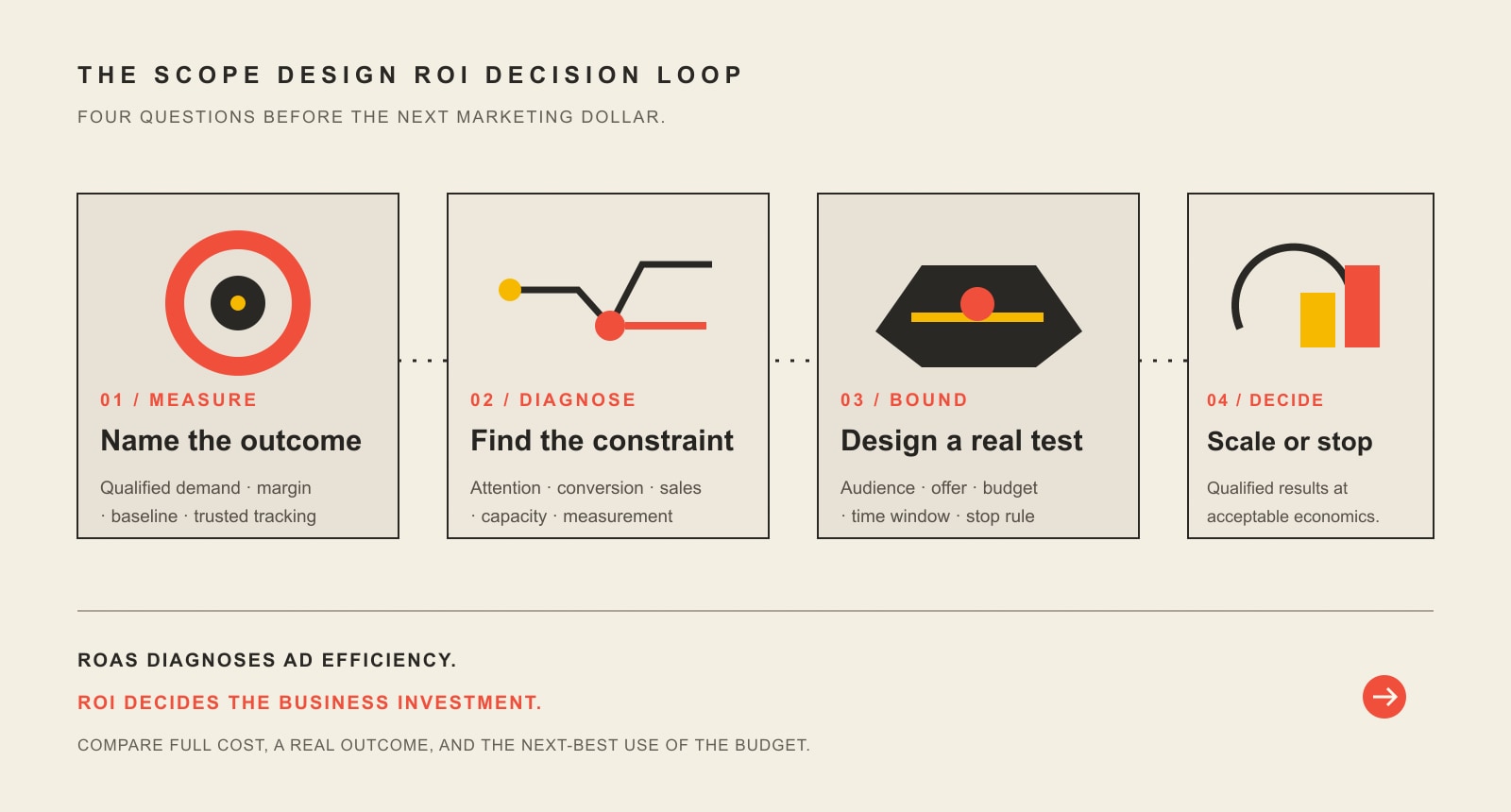
    ROAS and ROI answer different questions. ROAS usually compares attributed revenue with media spend. Business ROI should go further and compare the profit created with the broader investment required to create it. A platform can report a healthy-looking revenue-to-ad-spend ratio while the campaign is still a lousy business decision after product cost, labor, creative, management, discounts, refunds, and sales effort are considered.

    A useful management model is:

    • ROAS = attributed revenue ÷ media spend
    • Simple campaign ROI = (attributed gross profit − total campaign cost) ÷ total campaign cost

    Those formulas are decision tools, not universal attribution truth. Define what belongs in each number, use the same method from period to period, and keep uncertainty visible. Our measurable internet marketing loop goes deeper on keeping platform metrics attached to business decisions instead of turning dashboards into decorative wallpaper.

    A Simple Facebook Ads ROI Example

    Suppose an ecommerce campaign spends $2,000 on media and $500 on directly attributable creative and management. Ads Manager attributes $10,000 in revenue to the campaign. If the attributed orders represent $4,000 in gross profit after product cost and the attribution is trustworthy enough for the decision, the platform-style ROAS is 5.0. The simple campaign ROI is ($4,000 − $2,500) ÷ $2,500, or 60%.

    The 60% is an arithmetic example, not a Facebook benchmark. Change the gross margin, refunds, labor, attribution assumptions, or customer mix and the answer changes. That is exactly why a universal “good Facebook ads ROI” number is usually less useful than your own break-even economics.

    The Scope Design ROI Leak Test: Reality, Optimization, Isolation

    Before you blame CPM, creative fatigue, or the algorithm, run the campaign through three checks in order. Fix the first leak you can prove. Do not skip to a prettier ad just because creative is more fun than reconciling a CRM.

    Business economics, valuable optimization signals, and controlled testing connect in a diagnostic path
    ROI Leak Test Question Typical failure Useful evidence
    Reality Do the economics work? Platform return looks good, but margin, lead quality, or total cost does not. Gross profit, total campaign cost, qualified lead rate, close rate, CAC, refunds.
    Optimization Is Meta learning from a valuable signal? The system finds cheap clicks or form fills that do not predict valuable customers. Objective, performance goal, event quality, Pixel/CAPI health, CRM feedback.
    Isolation Can the test teach you what changed? Too many simultaneous edits or fragmented ad sets make the result impossible to interpret. Written hypothesis, primary metric, guardrails, spend/time boundary, stopping rule.

    Mistake 1: Treating Ads Manager Return as Business ROI

    Meta’s reporting is useful evidence. It is not your general ledger, sales pipeline, fulfillment system, or profit-and-loss statement wearing a blue hat.

    The first mistake is stopping the analysis at attributed conversions or attributed revenue. For a lead-generation campaign, fifty form fills can look fantastic until the sales team tells you that thirty-five were outside the service area, ten never answered, four were poor fits, and one became a customer. For ecommerce, revenue can look strong while discounts, returns, shipping subsidies, product cost, and repeat-customer mix quietly change the economics.

    For a lead business, add at least three downstream steps to your reporting: qualified lead rate, close rate, and customer acquisition cost. If you spend $2,500 and collect fifty leads, the raw CPL is $50. If only fifteen are qualified, the cost per qualified lead is about $167. If five become customers, the test CAC is $500. You still cannot call the campaign profitable until you know what those customers are worth in gross profit and whether the business can fulfill the work.

    For ecommerce, connect the ad result to gross profit, new-customer economics, refunds or returns, and total campaign cost. A campaign that acquires valuable first-time customers may justify a different target than one that mostly receives credit for purchases from people who were already going to buy. Do not hide that distinction inside one blended return number.

    What to Reconcile Before You Increase the Budget

    • Media spend plus directly attributable creative, management, and campaign costs.
    • Attributed revenue compared with order-system or CRM revenue.
    • Gross profit rather than revenue alone when product or delivery cost matters.
    • Qualified leads, booked appointments, attended appointments, closed customers, or another downstream quality stage.
    • Refunds, cancellations, duplicate leads, existing customers, and obvious attribution mismatches.
    • Sales or service capacity. A profitable-looking lead source can become expensive chaos if nobody responds or the team cannot fulfill the work.

    This is also why the broader marketing system matters before you buy more attention. Paid media can amplify a working path. It cannot repair an offer nobody wants, a form that breaks, or a follow-up process that treats tomorrow as a perfectly acceptable response time.

    Mistake 2: Optimizing the Easiest Signal Instead of the Valuable Outcome

    Meta does not know what you vaguely meant. It knows the objective, performance goal, events, conversion values, and other feedback available to the delivery system. If you ask for traffic, cheap visits can be a successful platform result even when you actually wanted qualified sales conversations. If you optimize lead generation around every form submission but never tell the system which leads become useful opportunities, the cheapest lead can win the auction while your sales team loses the afternoon.

    Our current Meta campaign objectives guide explains the six objective families and how to choose the measurable action closest to the business outcome. The important idea is simple: optimize toward the deepest trustworthy signal you can measure often enough to operate responsibly.

    Meta’s current documentation says the Conversions API can send business event data directly to Meta’s optimization and measurement systems, including website, app, offline, messaging, phone, and other events. For website events, Meta describes it as something businesses can use alongside the Pixel. That does not magically make attribution perfect, and it is not a privacy loophole. It gives the delivery system a better opportunity to learn from the events your business can legitimately observe and send.

    Lead quality is the most obvious example. Meta’s current Advantage+ leads guidance explicitly discusses connecting CRM data through Conversions API so optimization can use downstream lead information. If your team knows which leads are qualified, booked, or sold, that feedback is more useful than pretending every form fill has equal value.

    Build a Signal Ladder Instead of a Vanity-Metric Ladder

    Easy signal Better business signal What to ask
    Link click Qualified visit, lead, purchase, or other meaningful action Does the click predict value, or merely curiosity?
    Raw lead Qualified lead, booked appointment, accepted opportunity Can the CRM feed quality back into campaign decisions?
    Purchase count Purchase value, margin, new-customer value, non-refunded order Are all purchases economically equal?
    Cheap result Profitable or strategically valuable result Are we optimizing cost, or the outcome the business actually wants?

    Audience automation makes signal quality even more important. Meta’s current Advantage+ audience documentation explains that audience inputs can act as suggestions while the system expands beyond them when it expects better performance, subject to hard controls such as location, minimum age, language, and exclusions. That is not proof that broad targeting always wins. It is a reason to stop treating manual interest stacks as the only intelligence in the system. Give the platform a clear outcome and trustworthy feedback before spending three meetings debating whether an audience should contain 730,000 or 1.1 million people.

    Mistake 3: Changing So Much That No Test Can Teach You Anything

    The third mistake is optimization theater: constant activity that produces very little learning. An advertiser sees a bad Tuesday, changes the budget, swaps the audience, rewrites the headline, replaces the image, changes the offer, and rebuilds the landing page. Thursday is better. Great. Which change worked?

    Meta describes the learning phase as a period when delivery is exploring and performance can be less stable. Its current delivery-status guidance also says significant edits can send ads back into preparation. The useful lesson is not “never touch a campaign.” It is that changes have a cost, and you should make them for a reason.

    A good small-business test does not need a lab coat and a statistics department. It does need a written hypothesis:

    • Question: What are we trying to learn?
    • Primary metric: Which business-facing result determines whether the change helped?
    • Diagnostic metrics: Which delivery, click, conversion, quality, or funnel numbers help explain the result?
    • Variable: What meaningful thing are we changing?
    • Boundary: What spend, time, or result threshold is enough to make a practical decision?
    • Stopping rule: What evidence tells us to scale, revise, or stop?

    Creative testing is a perfect example. If the “new image test” also changes the discount, audience, headline, CTA, objective, and landing page, you may discover a better campaign, but you did not prove that the image caused it. Our guide to testing Facebook ad images without learning the wrong lesson shows how to keep creative conclusions attached to the variable you actually tested.

    Fragmentation creates the same problem at account level. Splitting a modest budget across too many nearly identical campaigns and ad sets can leave every test starved for useful evidence. The fix is not a magic audience size or a universal number of conversions. Simplify enough that each test has a job, preserve enough stability to observe it, and use our Facebook ads optimization framework when you need to work through economics, signal, objective, promise, path, and quality in sequence.

    A 15-Minute Facebook Ads ROI Audit Before You Spend More

    You do not need to rebuild the entire account to find the next useful question. Start with this short audit.

    1. Name the business outcome. Profitable purchase, qualified opportunity, booked appointment, retained customer, or another result with actual value.
    2. Write the break-even economics. Know the gross profit or customer value available to support acquisition, then define the maximum sensible CAC or qualified-lead cost for this test.
    3. Reconcile the result. Compare Meta’s attributed conversions or revenue with your order system, CRM, phone records, or other first-party source. Investigate material gaps rather than averaging them away.
    4. Check the optimization signal. Does the campaign objective and event represent the outcome you care about, or merely an easier upstream action?
    5. Check quality feedback. If leads or purchases vary materially in quality, can the campaign learn from qualified, sold, retained, or higher-value outcomes?
    6. Check test isolation. List every material change made during the comparison period. If the list reads like a renovation permit, stop pretending the result proves one tiny tactic.
    7. Make one decision. Scale, revise, hold, or stop based on the earliest proven leak. Do not increase spend just because a dashboard number turned green.

    Which Facebook Ads Metrics Actually Matter?

    The useful metric depends on the campaign job. CTR, CPC, CPM, frequency, and conversion rate can help diagnose delivery and creative performance, but none of them is automatically the business outcome. A cheaper click can be worse if it produces poorer customers.

    Business model Primary business evidence Useful diagnostic metrics Common trap
    Ecommerce Gross profit, CAC, new-customer value, refunds/returns, repeat value ROAS, purchase value, conversion rate, CPC, CPM, CTR Calling revenue-to-ad-spend ratio “profit”
    Lead generation Qualified lead rate, cost per qualified lead, appointment rate, close rate, CAC, customer value CPL, form completion, landing-page conversion, CPC, CTR Optimizing the cheapest raw lead
    Awareness Business-defined reach or brand outcome with a later measurement plan Reach, frequency, video or engagement metrics appropriate to the objective Retroactively demanding direct-response ROI from a campaign not built for it

    Benchmarks can be context. They are not commandments. Your break-even number is usually more useful than somebody else’s average because it reflects your margin, customer value, sales process, geography, offer, competition, and operating capacity.

    Frequently Asked Questions About Facebook Ads ROI

    What is a good ROI for Facebook ads?

    There is no universal good Facebook ads ROI. Start with your own break-even economics. A campaign can support a lower platform ROAS when gross margin, repeat value, or customer lifetime value is strong; another business may need a much higher return because fulfillment, sales labor, or product cost consumes most of the revenue.

    What is the difference between Facebook ads ROI and ROAS?

    ROAS usually compares attributed revenue with ad spend. ROI should evaluate the profit created relative to the broader investment. For management decisions, use gross profit and total campaign cost when those figures are available, and document your attribution assumptions.

    Is $10 a day enough for Facebook ads?

    It can be enough for a tightly bounded learning test in some markets, but $10 is not a magic budget. Ask what the test must learn, what a conversion or qualified lead normally costs, how much opportunity exists, and how long you can run before a practical decision is possible. A tiny budget cannot rescue broken economics or an unobservable outcome.

    Is $1,000 enough for a Facebook ads campaign?

    Maybe. A $1,000 budget is meaningful only relative to expected acquisition cost, audience opportunity, offer, geography, and the question being tested. If one qualified customer normally costs $1,500 to acquire, $1,000 may be a poor basis for declaring the channel dead. If your expected acquisition cost is $50, the same budget can support a very different test.

    Are Facebook ads worth it in 2026?

    They can be when Meta can reach a relevant audience, the offer and destination can convert attention, the business can measure a valuable outcome, and the economics support paid acquisition. They are not automatically worth it because Facebook has a large audience or because another company posts an impressive ROAS screenshot.

    Should I use broad targeting or detailed targeting?

    Do not turn targeting into an ideology. Meta’s Advantage+ audience can expand beyond suggestions while respecting certain hard controls, so manual micro-targeting is no longer the only intelligence in the system. Use the constraints your business genuinely needs, give the platform a valuable measurable signal, and compare actual downstream quality instead of assuming broader or narrower is universally superior.

    Fix the Leak Before You Raise the Budget

    A weak Facebook ads ROI is not one problem. It is a symptom. The return can be weak because the business math never worked, because the campaign is learning from the wrong signal, or because your testing process generates motion instead of evidence.

    Run the ROI Leak Test in order: Reality, Optimization, Isolation. Reconcile the economics. Improve the signal. Preserve enough structure to learn. Then scale what survives the full chain.

    If you want an outside set of eyes on the leak, Scope Design can help audit the campaign, tracking, lead-quality handoff, and surrounding marketing system before you buy another pile of attention. The goal is not a prettier Ads Manager screenshot. It is a decision you can defend with business evidence.

  • How to Elevate Your Social Media Marketing Strategy | Proven Best Practices That Drive Results

    How to Elevate Your Social Media Marketing Strategy | Proven Best Practices That Drive Results

    The bottom line: The highest-impact social media marketing best practices do not begin with a posting schedule, a hashtag count, or the latest algorithm rumor. They begin with a connected system: reach the right people on a channel that has a clear job, publish useful material based on real expertise, create meaningful interaction, route attention to a measurable next step, and learn from qualified business outcomes.

    If you already post consistently but cannot explain what the activity is doing for the business, more content is rarely the first fix. Social media works best as one part of a broader marketing system that connects attention to business value. This guide focuses on improving that system after social media has earned a place in it. If you are still building the plan from scratch, our social media strategy guide owns that broader decision.

    Social Media Marketing Best Practices: What Actually Elevates a Strategy?

    An elevated social media strategy is easier to operate and easier to judge. Every active channel has a reason to exist. Every content type has a job. Every call to action leads somewhere proportionate to the buyer’s intent. Measurement continues beyond platform dashboards. And the team knows what it will change when the evidence is weak.

    Weak habit Elevated practice Evidence that matters
    Be everywhere Choose channels from audience behavior and operating capacity Relevant audience, response quality, cost to operate
    Post because the calendar says so Publish content with a defined job Useful interaction, qualified attention, repeatable production
    Copy the same post everywhere Adapt the idea to the channel’s native behavior Whether the format helps the audience understand or act
    Celebrate reach by itself Connect attention to a measurable handoff Tagged visits, useful DMs, bookings, qualified leads, revenue
    Change five things at once Run one bounded test at a time A result you can interpret and use for the next decision

    The important difference is causality. A viral post may be interesting, but it is not automatically useful. A small post that reaches the right twenty people, answers a buying question, and creates two qualified conversations may be much more valuable. Your social media marketing strategy should make that difference visible.

    The Scope Design ELEVATE Social Media Operating Loop

    We use ELEVATE as an operating loop for improving an existing social program: Evidence, Limit, Expertise, Value, Arrange, Test, Evaluate. It is not an industry standard or an algorithm formula. It is a practical way to keep seven connected decisions from collapsing into “post more.”

    Evidence, channel focus, useful expertise, valuable conversation, handoff, testing, and qualified outcomes form a learning loop

    E — Evidence before platform habits

    Start with the audience behavior and business outcome you can actually observe. “Everyone is on Instagram” is not evidence that your buyers use Instagram for the job you need it to perform. Look at customer interviews, sales questions, referral patterns, website behavior, existing social conversations, and real channel capacity.

    Pew Research Center’s current U.S. social media fact sheet is a useful reminder that platform usage varies across demographic groups. That still does not choose a platform for your business; it tells you why the choice should be evidence-led. For the deeper channel decision, use our guide to choosing the right types of social media for your business.

    L — Limit each channel to one primary job

    A channel can do several things, but your team should know the primary job that earns its operating cost. One network might support local discovery. Another might help demonstrate expertise to a long-consideration B2B buyer. Another may be useful for customer support or recruiting.

    This does not mean a Facebook page can never recruit or a LinkedIn post can never create a lead. It means the channel has a main reason to exist, so the team knows what to produce, what to measure, and what would justify reducing or retiring the work. Two identical feeds with no distinct job are usually duplication, not diversification.

    E — Turn expertise into native content

    Your best source material is usually not a trend calendar. It is what the business already knows: customer questions, demonstrations, before-and-after evidence, objections, comparisons, process decisions, mistakes, field notes, case-study lessons, and subject-matter expertise.

    Then adapt the idea to the channel. The same truth can become a short demonstration, a carousel, a concise point of view, a Q&A, or a longer explanation without becoming five photocopies of the same post. If you need the production system behind that work, our social media content strategy guide owns content planning, source assets, calendars, and repeatable production in more depth.

    V — Create value-bearing conversation

    Engagement is not valuable merely because a dashboard counts it. Ask whether the interaction teaches you something, helps the audience make a decision, exposes a real question, strengthens trust, or moves the conversation toward a useful next step.

    That changes how you respond. A thoughtful question may deserve a useful answer, not a heart emoji. A repeated objection may deserve a new article or video. A customer story may reveal the language future buyers use. Our deeper guide to social media engagement covers the conversation system; this article keeps the focus on how engagement connects to the rest of the marketing loop.

    A — Arrange the handoff

    Social platforms are excellent places to earn attention and interaction, but most businesses eventually need a handoff. That could be a useful page, a booking flow, a product, a store visit, a phone call, a qualified DM, an email signup, or another next step the business can actually observe and serve.

    The handoff should match intent. Someone watching an early-stage educational video may not be ready for “book a sales call.” Someone asking for pricing may not need another awareness post. Scope’s guide to what people often miss about social media marketing goes deeper on why the system needs a destination beyond the feed.

    T — Test one meaningful variable at a time

    Optimization requires interpretable changes. If you change the audience, channel, content format, hook, offer, posting time, landing page, and follow-up process at once, a better result still may not tell you why it improved.

    Choose the weakest link you can defend with evidence and change one meaningful factor. You might test whether demonstrations outperform abstract tips for a particular audience, whether a stronger proof asset improves qualified visits, or whether a lower-friction next step creates better conversations. Keep the rest stable enough that the result can teach you something.

    E — Evaluate qualified outcomes

    The final question is not “Did reach go up?” It is “Did the social system create enough useful business value to justify what it cost to operate?” Reach, views, comments, saves, and shares can help diagnose behavior. They do not prove value by themselves.

    Evaluate outcomes such as qualified conversations, relevant website visits, appointments, lead quality, revenue, retention signals, recruiting quality, or another result tied to the channel’s job. Then make a decision: keep the system, improve a weak link, change the channel’s job, or stop doing work that cannot earn its place.

    Platform-Specific Best Practices Without Algorithm Ghost-Chasing

    Platform differences matter. Native formats, audience expectations, moderation tools, discovery behavior, and shopping or messaging features can all change how an idea should be delivered. But durable social media marketing best practices should survive the next minor product update.

    • Adapt the vehicle, not the truth. Keep the core point consistent while changing the format to fit the channel.
    • Use current platform documentation for mechanics. Dimensions, feature availability, ad requirements, and account capabilities can change.
    • Avoid universal timing rules. Your audience and operating cadence matter more than somebody else’s “best hour.”
    • Avoid fixed hashtag or emoji counts. Use them only when they improve meaning, discovery, or community context for the specific channel.
    • Do not confuse reach with fit. A platform can produce views while producing poor-quality traffic, weak conversations, or expensive operational load.

    Instagram and TikTok make this distinction easy to see. If Instagram already has a valid job, our guide to increasing Instagram engagement without chasing algorithm ghosts goes deeper on that network. If TikTok is still a channel-choice question, use the STOP Before You TikTok test before committing staff time to a new content treadmill.

    Where AI and Automation Help—and Where They Should Stop

    AI can make a social media workflow faster, especially around stable, reviewable tasks. It can help cluster customer questions, summarize research, transform source material into draft variations, prepare captions for human review, flag recurring themes, organize calendars, and generate first-pass performance summaries.

    The best boundary is not “AI or no AI.” It is automation where the work is stable; human judgment where trust is the value. Public replies, sensitive customer issues, crisis communication, factual claims, legal or reputational risk, and nuanced editorial judgment deserve accountable human review. The International Chamber of Commerce’s responsible-AI guidance for marketing similarly emphasizes applying existing standards of transparency and accountability when AI is used.

    A practical rule: never automate a public interaction you would be uncomfortable having attributed directly to the company. Efficiency is useful only when the system still produces truthful, context-aware communication.

    Build a Measurement Ladder From Platform Signals to Business Outcomes

    Among the most useful social media marketing best practices is separating signals by job instead of asking one metric to do every job. Use a measurement ladder. Each level answers a different question, and the lower levels only matter when they help explain movement toward the higher ones.

    Measurement level Question Useful examples
    Operating evidence Can we run this consistently without wasting capacity? Staff time, production cost, approval delay, response load
    Distribution signals Did the right people have a reasonable chance to see it? Relevant reach, qualified views, audience mix
    Interaction signals Did the content create useful behavior? Meaningful replies, questions, saves/shares when relevant, profile visits
    Handoff signals Did attention move to a next step we can observe? Tagged website visits, DMs, calls, form starts, bookings, store actions
    Business outcomes Did the handoff create value? Qualified leads, revenue, retention, recruiting quality, assisted outcomes

    When social traffic leaves a platform for your website, preserve as much context as practical. Use consistent UTM parameters for source, medium, and campaign so the handoff can be analyzed later. Keep the naming convention simple enough that your team will actually follow it; a perfect taxonomy nobody follows is worse than a simple one used consistently.

    Do not overclaim attribution. A social post may influence a later branded search, referral, call, or offline conversation. Platform-reported conversions and last-click analytics are evidence, not omniscience. Combine tagged traffic, CRM or lead-quality data, sales feedback, customer self-reporting, and operating cost when the decision matters.

    Run Focused Optimization Cycles, Not Constant Reinvention

    The point of these social media marketing best practices is not constant reinvention. A social media strategy improves when the team has a repeatable way to decide what deserves another round. Pick an observation window long enough to collect meaningful evidence for your cadence and volume; there is no universal number of days that works for every business.

    1. Name the channel’s primary job. If the team cannot agree, stop and fix that first.
    2. Choose the decision metric. Decide what evidence would make you keep, change, or stop the current approach.
    3. Find the weakest link. Audience fit? Content usefulness? Conversation quality? Handoff? Measurement?
    4. Change one meaningful variable. Keep enough else stable that the result can teach you.
    5. Review qualified outcomes and operating cost. Do not reward a prettier dashboard if the business result got worse.
    6. Record the next decision. Keep, improve, change the job, or retire the work.

    If the same system continues failing after you repair obvious weak links, move from optimization to diagnosis. Our guide to why a social media marketing strategy fails owns that troubleshooting job in more depth.

    What Auditing This Exact Article Taught Us

    We applied the same evidence discipline to this revision instead of preserving old claims because they were already on the page. On August 21, 2026, we checked the exact URL across Scope Design’s configured analytics, search tools, third-party keyword/backlink data, and the internal content graph.

    Signal checked Observation before this revision What it actually supports
    GA4, latest complete 12 months and prior comparison No exact page-path rows returned in either 12-month window Not enough page-level behavior data to make conversion claims; no demonstrated analytics equity forcing weak legacy statistics to survive
    Google Search Console No exact-page query rows; URL Inspection reported “Discovered – currently not indexed” The page needed clearer ownership, usefulness, and internal support; it did not justify a cosmetic URL change
    Bing Webmaster Tools Bing recognized the page and had crawl history, but exact URL traffic was 0 clicks and 0 impressions Crawl history existed, but there was no meaningful Bing traffic footprint to protect
    Ubersuggest 0 estimated exact-page traffic, 0 ranking keywords, 0 backlinks, and 0 referring domains; the query “social media marketing best practices” showed about 170 U.S. monthly searches The topic still has demand, but the page itself had no strong third-party footprint requiring the old angle or unsupported numbers

    That evidence does not prove the old article never helped anyone, that social media does not work, or that this revision will rank. It supports a narrower editorial decision: keep the established URL, remove brittle statistics and platform formulas we could not defend, give the page one distinct job, add original information gain, and connect it to the right specialist owners.

    Frequently Asked Questions About Social Media Marketing Best Practices

    What are five high-impact social media marketing best practices?

    Five high-impact practices are: choose channels from audience evidence; give each channel a clear business job; publish useful material based on real expertise; create a measurable handoff beyond the feed; and evaluate qualified outcomes instead of vanity metrics. Those five are the compressed version of the ELEVATE loop.

    What is the 5-5-5 rule for social media?

    There is no single universal 5-5-5 social media standard. The phrase is used for different posting, engagement, and networking heuristics. Before following one, ask what behavior the rule is trying to improve and whether that behavior matters for your audience and channel job. Use formulas as prompts when they help; do not mistake them for platform-independent laws.

    What are the 7 C’s of social media marketing?

    Different authors use different “7 C” sets, so there is no single authoritative list every business must follow. Scope Design uses ELEVATE instead because it maps the operating chain we want a business to inspect: Evidence, Limit, Expertise, Value, Arrange, Test, and Evaluate. It is our working framework, not an industry standard.

    What is the 5-3-1 rule for social media?

    The 5-3-1 label is another memorable formula that can refer to a content or engagement mix depending on the source. Treat the underlying intent—avoid nonstop self-promotion, participate in the community, and publish useful material—as a hypothesis to test. Your actual mix should follow the channel’s job and the audience response.

    How often should a business post on social media?

    Often enough to perform the channel’s job consistently without sacrificing usefulness or creating an operating burden the team cannot sustain. There is no universal posting frequency that fits every platform, audience, format, and business. Choose a cadence you can run, collect evidence, and adjust from actual response.

    Which social media platform is best for a small business?

    The best platform is the one where the relevant audience exhibits behavior connected to a business job your team can support. A large platform with poor buyer fit or no measurable handoff can be worse than a smaller channel with higher relevance. Start with platform selection based on business fit, then apply the optimization practices in this guide.

    Should AI manage a company’s social media?

    AI can assist with stable tasks such as research organization, draft variations, repurposing, scheduling preparation, and first-pass analysis. Human review should remain accountable for factual claims, sensitive interactions, crisis response, public judgment calls, and anything where context or trust is the value.

    How should a business measure social media success?

    Measure in layers: operating cost, relevant distribution, useful interaction, measurable handoff, and qualified business outcomes. Platform metrics can diagnose what happened in the feed, but tagged traffic, lead quality, sales evidence, customer feedback, and operating cost are usually needed to judge business value.

    Can social media best practices guarantee leads or ROI?

    No. Best practices improve the quality of decisions and make the system easier to evaluate; they cannot guarantee demand, reach, leads, or revenue. Audience fit, offer quality, competition, creative quality, sales follow-up, website experience, budget, and operating capacity all affect the outcome.

    Sources and Methodology

    This revision was completed August 21, 2026. We reviewed the exact article URL in GA4, Google Search Console, Bing Webmaster Tools, and Ubersuggest; compared the topic against the current U.S. SERP and People Also Ask; ran a bounded DataForSEO AI-search observation; inspected Scope Design’s Content Studio link graph and neighboring article ownership; and retrieved relevant Scope Design doctrine from Open Brain. We removed legacy claims that lacked a defensible current source chain rather than preserving them because they sounded precise.

    The most durable social media marketing best practices make the system easier to understand and improve. Social media gets easier to improve when it has one clear job inside the business system. Start with evidence, constrain the work, build from real expertise, connect attention to a useful next step, and keep only what earns another round. That is more durable than memorizing somebody else’s posting formula—and more useful when the platforms change again.

  • Why Your Social Media Marketing Strategy Is Failing: 8 Critical Mistakes Killing Your ROI (+ Proven Solutions)

    Why Your Social Media Marketing Strategy Is Failing: 8 Critical Mistakes Killing Your ROI (+ Proven Solutions)

    If your social media marketing strategy is failing, posting more is probably not the first fix. Activity is not evidence of return. A business can publish constantly, collect likes, and still have no clear connection to qualified conversations, leads, sales, retention, recruiting, or another outcome that matters.

    The useful question is not “What should we post next?” It is “Where does attention stop turning into business value?” Social media is one part of a broader small business marketing strategy. If the audience, offer, destination, response process, capacity, or measurement is weak, more reach can simply send more people into a broken system.

    At Scope Design, we diagnose this with an eight-link model: Job → Audience → Proof → Platform/Format → Capacity → Conversation → Handoff → Outcome/Learning. Your social media ROI can break at any link. The fastest repair is usually to find the first broken link, collect evidence, run the smallest corrective test, and only then add more content or paid distribution.

    The Scope Design Social ROI Chain

    Most social media advice starts with tactics: post consistently, make more video, use a new format, try a trend, boost a post. Those tactics may be useful, but they assume the underlying system is already connected.

    The Social ROI Chain starts earlier. Each link answers a different diagnostic question. If you cannot answer one with evidence, you have found a likely reason your social media marketing is not working.

    LinkDiagnostic questionEvidence to inspect
    1. JobWhat business job is this channel supposed to do?Defined objective, buyer stage, primary action, accountable owner
    2. AudienceAre the right people actually here in the right context?CRM data, customer interviews, qualified lead patterns, platform audience data
    3. ProofDoes the content demonstrate something useful or credible?Real customer questions, objections, examples, process evidence, case material
    4. Platform / FormatDoes this channel and format fit the job?Qualified response by platform, format, topic, and buyer stage
    5. CapacityCan the team sustain quality, replies, and follow-up?Production hours, review lag, unanswered messages, follow-up time
    6. ConversationDoes useful attention become interaction or intent?Questions, replies, saves, qualified DMs, clicks, repeat engagement
    7. HandoffIs there a clear, trackable next step?Tagged links, landing pages, forms, booking, calls, CRM source fields
    8. Outcome / LearningDid the activity create value, and what changes next?Qualified leads, revenue/profit, retention, cost, attribution evidence, decisions

    This model matters because the same symptom can have different causes. Low leads might mean weak content, but it could also mean the wrong audience, a broken landing page, no tracking, slow follow-up, or a platform that is useful for reputation but poor for direct acquisition. Changing the content when the handoff is broken wastes time.

    8 Critical Social Media Marketing Mistakes Killing Your ROI

    Mistake 1: Your social media has no defined business job

    “Build awareness” is not enough to manage a channel. Awareness can be a legitimate goal, but the team still needs to know whose awareness matters, what evidence would show progress, and what the brand expects that attention to make easier later.

    A channel might exist to answer sales objections before a consultation, create qualified conversations with local buyers, recruit employees, keep customers informed, support a community, distribute expert content, or drive registrations for a specific offer. Those jobs require different content, calls to action, response systems, and metrics.

    Symptom: Meetings revolve around how many posts went out, not what behavior the channel is meant to influence.

    Evidence to inspect: Ask whether the team can finish this sentence without using a vanity metric: “We use this channel to help this audience do this useful thing, so we can observe this business-relevant signal.” If nobody can, the first link is broken.

    Smallest corrective test: Give one channel one primary job for the next test period. Define one useful next action and one business-facing measure before creating the next batch of posts.

    Mistake 2: You are targeting an audience you have not actually verified

    A demographic profile is a hypothesis, not proof that your best customers use a particular network in a way that supports buying. A business can correctly identify its target market and still choose the wrong social context.

    Current Pew Research Center social media data shows meaningful differences in U.S. platform use. That is useful background, but population-level usage is still not enough to choose a channel for your business. Your first-party evidence matters more: sales calls, CRM records, referral sources, customer interviews, support questions, website behavior, and the quality of people already responding.

    If you need to compare channel roles more deeply, our guide to the types of social media and how they can benefit a business is the better next step. The point here is simpler: do not confuse “people use this platform” with “our buyers use this platform for this job.”

    Symptom: Reach looks acceptable, but the comments, clicks, leads, or conversations are consistently a poor fit.

    Evidence to inspect: Compare actual customers and qualified leads with the people reached by the channel. Look for recurring industries, roles, locations, problems, purchase stages, and questions—not just age or follower count.

    Smallest corrective test: Pick one verified customer segment and one recurring problem. Build a short series around that problem on the channel most plausibly connected to the buying journey. Judge the test by the quality of response, not raw reach.

    Mistake 3: Your content is a calendar, not proof

    A content calendar is an operations tool. It can prevent missed deadlines and random posting, but it does not make the underlying material useful. A perfectly scheduled month of generic holidays, company announcements, motivational graphics, recycled promotions, and trend-chasing can still produce almost no buyer value.

    Strong social content usually has a source: a real customer question, a sales objection, a process decision, a comparison, a mistake you prevent, an example of the work, a point of view, or evidence that reduces risk. That source can then become several platform-native pieces without becoming empty repetition.

    Our deeper guide to creating social media content that drives useful engagement covers content execution. For this diagnosis, ask whether the post proves, teaches, demonstrates, clarifies, or helps someone make a decision.

    Symptom: The team can tell you what is scheduled for Tuesday but cannot explain why a buyer would care.

    Evidence to inspect: Review your last 20 posts. How many originate from real customer evidence? Which posts led to useful questions, qualified clicks, saves, replies, or conversations? Which could have been published by almost any competitor with the logo swapped?

    Smallest corrective test: Take one recurring buyer question and make three posts from it: one that teaches the core answer, one that demonstrates your process or proof, and one that gives the reader a relevant next step. Adapt each piece to the platform instead of simply resizing it.

    Mistake 4: The platform or format is wrong for the job

    Audience fit and platform fit are related, but they are not identical. Your buyers may use a network every day and still not use it in the context where your business needs to influence them.

    For example, a decision-maker can be active on a visual entertainment platform while doing serious vendor research through search, referrals, LinkedIn, industry communities, or direct conversations. Likewise, a local business may discover that a channel is excellent for staying familiar with existing customers but weak as a direct lead source. That does not automatically make the channel useless; it means the job was misassigned.

    Format can create the same mismatch. A detailed comparison may need a carousel, document, article, webinar clip, or landing page rather than a one-sentence caption. Short video is not automatically better than text, and text is not automatically better than video. The right format is the one that communicates the idea clearly enough for the intended person to take the intended next step.

    Symptom: People see the content, but the channel or format rarely produces the kind of behavior the business needs.

    Evidence to inspect: Compare qualified response by platform, format, topic, and buyer stage. Separate “high distribution” from “high-quality progression.” A small post that creates two valuable conversations can outperform a much larger post that creates none.

    Smallest corrective test: Use the same underlying idea in two intentionally different native formats or channels. Keep the business job and next step consistent, then compare the quality of the handoff rather than impressions alone.

    Mistake 5: Your posting plan exceeds your operating capacity

    Social media is often treated as cheap because the account itself may be free. The operation is not free. Research, writing, design, video, review, rights management, scheduling, comments, direct messages, lead routing, reporting, and follow-up all consume capacity.

    This is where “post every day” advice becomes dangerous. There is no universal cadence that is strategically correct for every business. A schedule that forces weaker content, missed replies, stale links, slow sales follow-up, or exhausted staff can reduce the value of the entire program.

    Symptom: The team can keep the queue full but cannot keep conversations, approvals, tracking, or follow-up healthy.

    Evidence to inspect: Track the real hours required per piece, approval delays, response time, unanswered comments and DMs, missed handoffs, rework, and the number of posts published without a deliberate purpose. Capacity problems often show up outside the social dashboard.

    Smallest corrective test: Reduce cadence temporarily and protect time for customer evidence, stronger source material, substantive replies, and lead follow-up. Compare qualified response per hour of effort before and after the change.

    Mistake 6: You are broadcasting instead of creating useful interaction

    Social media is not valuable just because people can comment. It becomes useful when interaction helps the business learn something, help someone, surface intent, resolve friction, build trust, or move a relevant person toward an appropriate next step.

    That means “engagement” should not be reduced to bait. A poll that produces hundreds of low-value votes can be less useful than one detailed question from a serious buyer. Our social media engagement guide explains different engagement-rate calculations and why the denominator matters. For ROI diagnosis, the more important question is what the interaction reveals or enables.

    Symptom: Posts receive reactions, but there are few substantive questions, conversations, qualified messages, site visits, or next steps.

    Evidence to inspect: Review which posts produce actual questions, thoughtful replies, saves, repeat engagement, direct messages, and qualified clicks. Also review how the business responds. A useful comment left unanswered is a broken conversation process, not a content problem.

    Smallest corrective test: Select five posts and give each a specific conversational purpose. Ask a real question only when the answer would teach you something useful. Reply with substance, and create a clear route for genuine purchase or support intent.

    If creators, employees, customers, or influencers are paid, gifted products, or otherwise have a material connection to the brand, build disclosure into the process. The FTC’s social media endorsement guidance says those connections should be made obvious. Compliance is an execution requirement, not a footnote added after the campaign.

    Mistake 7: Interest has nowhere measurable to go

    A social post can create genuine interest and still produce no measurable business result if the handoff is weak. The bio link is stale. The landing page does not match the promise. The form is broken. The booking tool is confusing. DMs sit unanswered. Calls are not sourced. The CRM has no campaign field. Nobody verified whether the conversion event fires.

    Before blaming the algorithm, test the path.

    • Use a clear destination that matches the post’s promise.
    • Apply consistent campaign naming and tagged URLs when appropriate. Google Analytics documents manual campaign parameters such as utm_source, utm_medium, and utm_campaign.
    • Define the business action you care about—form submission, booking, call, signup, purchase, or another qualified action—and verify the tracking.
    • In GA4, actions that matter to business success can be configured as key events.
    • Carry useful source/campaign information into your CRM or sales process where possible.
    • Create a documented DM, phone, or offline handoff when the buyer journey does not end on the website.

    Symptom: The social dashboard shows clicks or conversations, but the business cannot reliably say what happened after them.

    Evidence to inspect: Click every destination yourself. Test forms and bookings. Use GA4 Realtime/DebugView where appropriate. Confirm CRM fields. Follow a real test lead through the process. Check whether sales or support can identify where a social-originated conversation came from.

    Smallest corrective test: Instrument one campaign, one destination, and one key event correctly before the next promotion. A smaller campaign with a measurable handoff teaches you more than a larger campaign with missing data.

    Mistake 8: You optimize the dashboard instead of the business

    Likes, reach, impressions, follower growth, video completion, and engagement rate can all be useful diagnostic signals. None automatically equals business value.

    A better reporting ladder separates four levels:

    1. Distribution: Did the intended people have a chance to see it?
    2. Response: Did the content earn a useful reaction, question, save, reply, click, or conversation?
    3. Handoff: Did relevant people reach the destination or process that can serve them?
    4. Business value: Did that progression contribute to qualified leads, revenue, gross profit, retention, recruiting, reduced support friction, or another defined outcome?

    This prevents two opposite mistakes. You stop declaring a viral post “successful” when it creates no useful progression, and you stop declaring a modest post “failed” when it creates a small number of high-value conversations.

    Symptom: Reporting contains many numbers but few decisions.

    Evidence to inspect: For each channel, ask what you will continue, change, or stop because of the data. If the dashboard never changes a decision, the learning link is broken.

    Smallest corrective test: End every monthly channel review with one evidence-based decision. Do not add budget merely because reach is available. Paid distribution can amplify a strong message and accelerate testing, but it cannot repair an undefined audience, weak proof, broken destination, or missing measurement plan.

    How to Measure Social Media ROI Without Fooling Yourself

    Social media ROI is not one universal benchmark. The calculation depends on what “return” means for the job you assigned to the channel and whether you can estimate that value responsibly.

    1. Define the return before you calculate it

    If the channel is intended to generate sales, revenue or gross profit may be the relevant value. If it generates leads, you may need qualified-lead value based on your own close rate and economics. If the job is retention, recruiting, customer support, or event registration, the return has to match that job. Do not pretend unlike outcomes are interchangeable just because they fit in a spreadsheet.

    2. Track the real cost of operating the program

    Include more than ad spend. Your cost ledger may include employee time, freelancer or agency fees, design and video production, software, social listening, paid distribution, creator partnerships, landing-page work, analytics implementation, and the operational cost of reviewing and routing responses.

    A useful basic formula is:

    Social media ROI = (business value attributed to social − total social media cost) ÷ total social media cost × 100

    The math is easy. The difficult work is defining value, capturing cost, and deciding how much credit social deserves.

    3. Measure the handoff, not just the platform

    Use platform data to understand distribution and interaction, analytics to understand on-site behavior, and CRM or sales evidence to understand lead quality and business progression. For offline or high-consideration sales, source data may also come from calls, booked appointments, “how did you hear about us?” responses, direct messages, or manually connected opportunities.

    4. Separate attribution from certainty

    Attribution systems assign credit; they do not prove perfect causality. Google Analytics documents different attribution models and conversion paths, which is a reminder that one sale can involve several touchpoints. A person may discover you socially, search your name later, revisit through email, talk to a salesperson, and convert days or weeks after the first post.

    The same caution applies to ad-platform reporting. Meta explains that its Conversions API can improve the connection between business event data and Meta systems for optimization and measurement and can work with the Pixel. Meta also states that the Conversions API is not a way around privacy or data-sharing rules. Better event connectivity improves evidence; it does not make attribution uncertainty disappear.

    For important budget decisions, triangulate. Look at platform reporting, GA4, CRM outcomes, lead quality, sales feedback, offline evidence, and repeat patterns. When practical, controlled tests can tell you more than arguing over which dashboard deserves all the credit.

    A 30-Day Repair Test for a Failing Social Media Strategy

    Thirty days is not a universal proof window. A high-ticket B2B company with a long sales cycle should not expect the same signal volume as a high-frequency retailer. Use this as an operating checkpoint: enough time to repair one link, observe what changes, and decide what deserves a longer test.

    PeriodWhat to doWhat not to do
    Days 1–3Map the eight-link chain for each active platform. List the evidence you actually have.Do not assume every weak number is a content problem.
    Days 4–7Choose the first broken or unsupported link. Define one measurable repair.Do not redesign the entire strategy at once.
    Days 8–24Run the focused test with consistent measurement and follow-up.Do not change five variables every few days.
    Days 25–30Compare the result with the prior baseline and make a continue/change/stop decision.Do not turn a weak test into a permanent program because the content “felt better.”

    Examples of focused repairs:

    • Audience problem: build the test around one customer segment verified through CRM or sales evidence.
    • Proof problem: turn one recurring buyer question into a short evidence-backed content series.
    • Platform problem: move a proven idea into a channel or format better aligned with the buying context.
    • Capacity problem: reduce publishing volume and reserve time for replies, quality control, and follow-up.
    • Handoff problem: use one tagged destination and one verified key event.
    • Outcome problem: add one CRM source label or sales-feedback loop and review lead quality, not just traffic.

    The goal is not to “win social media” in 30 days. The goal is to learn whether repairing one link makes the next link healthier.

    When to Pause or Leave a Social Platform

    Leaving a platform can be a strategic decision. So can keeping a light, monitored presence for reputation, customer service, recruiting, or brand verification even when it is not a major lead source.

    Consider pausing active investment when several of these are true:

    • You cannot find evidence that a relevant audience uses the platform in a context that supports the assigned job.
    • You have run a reasonably controlled test with enough opportunity to observe signal, but qualified progression remains weak.
    • The opportunity cost is materially higher than another channel that reaches the same buyer more effectively.
    • Your team cannot maintain the response, quality, compliance, or follow-up required to operate the channel well.
    • The channel survives mainly because its vanity metrics look impressive, not because it contributes useful business evidence.

    Do not delete an account impulsively because one month was slow. Preserve the handle, history, profile accuracy, and customer-service implications when they matter. If the real question is whether to restart or step away, use our guide to reviving a dormant social media presence—or deciding not to.

    Frequently Asked Questions About a Failing Social Media Marketing Strategy

    Why is my social media marketing strategy not working?

    The most common mistake is treating the symptom instead of finding the first broken link. Check the business job, audience, proof, platform/format, operating capacity, conversation, handoff, and outcome/learning in that order. If the audience is wrong, better tracking will not fix the strategy. If the tracking is broken, weak reported ROI does not prove the content is bad.

    Which social media metrics matter most?

    The right metrics depend on the channel’s job. Report at four levels: distribution, useful response, measurable handoff, and business value. Likes and reach can help diagnose content distribution, but they should not substitute for qualified conversations, leads, sales, retention, or another explicitly defined outcome.

    How do I measure social media ROI?

    Define the business return, track the real operating cost, instrument the handoff, and then calculate ROI using your own economics. Where attribution is uncertain, use multiple evidence sources rather than claiming one platform caused the entire outcome.

    Do I need to post every day?

    No. There is no universal posting cadence that fits every business, platform, audience, and operating team. Use a cadence you can sustain without sacrificing source quality, response time, follow-up, or measurement. Increase frequency when evidence shows additional useful output can be absorbed productively.

    Should my business be on every social platform?

    No. A platform earns active investment when the relevant audience is there in a useful context, the format can support the business job, the team can maintain it, and the handoff can be measured. Broad popularity alone is not a channel strategy.

    Can paid ads fix a weak social media strategy?

    Paid ads can buy distribution and accelerate a well-designed test. They cannot repair an unclear audience, weak offer or proof, poor landing page, missing follow-up, or broken tracking. Fix the first broken link before paying to send more people through it.

    What is the 5-3-2 rule, 5-3-1 rule, or another social media content ratio?

    These ratios are heuristics, not universal laws. They can be prompts when a team needs variety, but they do not know your audience, sales cycle, evidence, capacity, or business objective. A better content mix starts with the channel’s job and real customer questions, then changes based on measured response and handoff quality.

    How long should I test before deciding a platform is not working?

    Long enough to create a fair opportunity for the assigned job and sales cycle to produce a signal. A low-frequency, high-ticket service may need much longer than a frequent-purchase business. Use the 30-day repair test as a disciplined checkpoint, not as statistical proof. If the chain is instrumented and the first broken link improves, keep testing. If the channel repeatedly produces weak qualified progression relative to its cost, reassign or pause it.

    Fix the First Broken Link, Not Everything at Once

    A failing social media marketing strategy does not automatically need more posts, a new platform, a new trend, or a larger ad budget. It needs a diagnosis.

    Start with the business job. Verify the audience. Publish proof rather than filler. Choose a platform and format that fit the job. Protect enough capacity to respond. Turn useful attention into conversation. Build a measurable handoff. Then judge the program against business value and make a decision.

    Once those links are healthy, broader social media marketing best practices become much more useful because you are optimizing a connected system instead of polishing random activity.

    If you want an outside diagnosis, Scope Design can audit the chain from audience and content through tracking, handoff, and measurement, then help build the smallest marketing system that can prove—or disprove—the channel’s value. Contact Scope Design to talk through what is actually breaking your social media ROI.

  • Marketing ROI: Which Channels Deserve More Budget?

    Marketing ROI: Which Channels Deserve More Budget?

    Marketing ROI is not a universal channel leaderboard. The highest-return marketing investment is the one that profitably moves your current business constraint. Email can be exceptional when you already have a permissioned audience. SEO can compound when real search demand exists and you can wait for it. Paid search can win when buyers are actively looking and your margins can support acquisition costs. Short-form video can be powerful when attention and proof are the bottleneck. None of those conditions is true for every business.

    That changes the budgeting question from “Which channel has the highest ROI?” to a more useful one: “Which channel deserves the next dollar based on our economics, measurement, and bottleneck?”

    This guide gives you a practical way to calculate marketing ROI, separate ROI from ROAS, compare channels without fake certainty, and decide what to fund next.

    What Marketing ROI Actually Measures

    At its core, marketing return on investment asks whether the economic value created by marketing exceeded what you spent to create it. Google Ads describes ROI in terms of net profit relative to costs and recommends measuring valuable conversions before judging return.

    A practical formula is:

    Marketing ROI = (profit attributable to marketing − marketing investment) ÷ marketing investment × 100

    The word profit matters. Revenue can make a campaign look healthier than it is. If a campaign produces $10,000 in sales but those sales carry $6,000 in product, fulfillment, discount, and service costs, the business did not create $10,000 of economic value from the campaign.

    For lead-generation businesses, the same principle applies. Do not stop at form fills. Connect leads to qualified opportunities, close rate, average contribution margin, and—when the sales cycle is long enough to matter—eventual customer value.

    ROI vs. ROAS: Similar Acronyms, Different Decisions

    ROAS (return on ad spend) is narrower. It usually compares attributed conversion value with advertising spend. A campaign that attributes $10,000 in revenue to $2,000 in ad spend shows a 5x ROAS. That can be useful for campaign optimization, but it is not automatically the same as business profit.

    The difference becomes more important when you add product margin, sales labor, agency fees, creative production, software, discounts, refunds, and the revenue that may have happened without the campaign. Google’s own Conversion Lift documentation distinguishes ordinary attributed ROAS from incremental ROAS, which asks how much additional value advertising caused compared with a control or baseline.

    A simple rule: use ROAS to diagnose advertising efficiency; use ROI to make business investment decisions.

    Why “Highest-ROI Marketing Channel” Lists Mislead

    Channel benchmarks can be useful context. They become dangerous when they are treated as instructions. A published average cannot know your margins, list quality, local competition, sales cycle, offer strength, existing demand, or measurement gaps.

    • The denominator changes. Some ROI studies count only media spend. Others include people, tools, creative, and production.
    • The time horizon changes. Paid ads may create a signal this month. SEO and content may require a longer window before the economics are visible.
    • Attribution changes the winner. Google Analytics explains that attribution models assign credit differently across touchpoints. A first-touch, last-touch, and data-driven view can tell different stories about the same customer journey.
    • Your constraint changes the value of traffic. Buying more visitors is a poor investment if the real problem is a confusing offer, weak trust, or a broken conversion path.
    • Channel saturation changes returns. The first profitable audience segment or keyword set may not scale at the same cost forever.
    • Conversion quality matters. Ten cheap leads can be worse than three expensive leads if the cheap leads never become customers.

    Measurement itself is still a real problem. Nielsen’s 2025 Annual Marketing Report says only 32% of surveyed global marketers measured media spending holistically across digital and traditional channels. Nielsen also cautions that a channel being easier to measure does not necessarily make it more effective or higher-ROI.

    This is why our broader constraint-first website strategy starts with measurement integrity and the actual business bottleneck before prescribing more traffic or more tactics.

    Marketing Channels That Can Earn Strong ROI—and the Condition Each One Needs

    Instead of ranking channels from “best” to “worst,” compare the condition each channel needs in order to work.

    ChannelStrongest whenWhat to measureCommon ROI trap
    Email / CRMYou already have permissioned prospects or customers and a reason to stay in touch.Qualified replies, repeat purchases, lead-to-sale rate, revenue or margin per recipient.Calling email “free” while ignoring list acquisition, offer quality, deliverability, and labor.
    SEO + contentBuyers search for the problem you solve, organic visibility can compound, and you can tolerate a longer feedback loop.Qualified organic leads, assisted conversions, close rate, contribution margin from search.Optimizing for traffic volume instead of buyer intent and business value.
    Paid searchActive demand exists now and customer economics can support the cost per click and cost per acquisition.Qualified conversion rate, CAC/CPA, close rate, contribution margin, ROAS as a diagnostic.Scaling platform-reported conversions that do not become profitable customers.
    Paid social + short-form videoYou need discovery, attention, repeated proof, or audience creation before buyers search for you.Qualified pipeline, customer acquisition cost, assisted conversions, lift where testable.Confusing cheap reach or engagement with incremental demand.
    Creators / partnerships / referralsTrust transfer matters and the partner has credible access to your market.Partner-sourced qualified leads, close rate, margin, retention, referral velocity.Judging follower count instead of audience fit and customer quality.
    AI + automationThe bottleneck is execution capacity, response speed, repetitive work, or analysis—not lack of demand.Hours saved, cycle time, error rate, output capacity, conversion or retention improvement enabled by the workflow.Treating AI as an acquisition channel instead of an efficiency layer.

    Email and CRM: High Leverage When You Already Own the Relationship

    Email has attractive economics because you can communicate repeatedly with an audience you have already earned permission to contact. But that advantage disappears if the list is cold, the offer is weak, or the business has no useful follow-up system. Judge email by the business outcome it moves—repeat revenue, qualified conversations, recovered opportunities, renewals—not by open rate alone.

    SEO and Content: Strong When Search Demand and Patience Exist

    SEO can become highly efficient because a useful page can keep earning discovery without paying for every click. That does not make every keyword valuable. Our SEO strategy and analytics framework separates visibility from business value: a smaller keyword with buying intent can be worth more than a larger term that produces curiosity traffic.

    Paid Search: Fast Feedback When Demand Is Already Visible

    Paid search is useful when people are already looking for a solution and you need faster evidence than an organic program can provide. The price of that speed is explicit media cost. A paid search campaign deserves more budget only when the downstream economics—qualified lead rate, close rate, margin, and capacity—survive the added spend.

    Social, Video, and Creators: Strong When Attention or Proof Is the Constraint

    Current marketer surveys do show momentum here. HubSpot’s 2026 State of Marketing, based on 1,500+ global marketers, reports that 48.6% ranked short-form video among the media formats producing their biggest ROI. That is useful trend evidence—not a promise that a local contractor, B2B manufacturer, retailer, and software company will all get the same return.

    Video is a format. Social is a distribution environment. Creator partnerships are a trust mechanism. The ROI comes from whether the combination helps a specific audience move toward a profitable outcome.

    AI and Automation: An Efficiency Layer, Not a Standalone Marketing Channel

    AI can improve marketing economics by reducing research time, speeding production, helping teams repurpose useful material, improving follow-up, or making reporting easier to act on. But an AI workflow that produces more low-value output simply scales waste. Our AI automation framework starts with the business workflow and the constraint, then asks whether automation actually earns its keep.

    The Scope Design ROI Decision Loop

    Before increasing any marketing budget, run the decision through four stages: measure, find the constraint, bound the test, then scale or stop.

    Four-step marketing investment loop: measure the business outcome, find the constraint, bound a test, and scale or stop based on qualified results and acceptable economics.
    The Scope Design ROI Decision Loop turns channel selection into a repeatable investment decision instead of a trend chase.

    1. Measure the Business Outcome

    Define the outcome before choosing the tactic. Is the business trying to create qualified leads, increase contribution margin, recover lost customers, raise repeat purchase rate, or shorten the sales cycle? Confirm the tracking is good enough to observe that result, and define the baseline you are trying to improve.

    2. Find the Constraint

    Ask what is preventing the outcome now. If not enough qualified people know you exist, attention may be the constraint. If traffic is healthy but few people act, the constraint is likely closer to the offer, trust, page experience, or conversion path. If leads arrive but do not close, buying more leads can make the economics worse.

    When traffic exists but results do not, work through the conversion constraint before buying more traffic.

    3. Bound the Test

    A useful test has edges. State the hypothesis, audience, offer, channel, budget, time window, minimum evidence you need, and the condition that will make you stop. “Try social media for a while” is not a test. “Spend a fixed amount to test two proof-led offers against one defined audience and judge qualified opportunity cost” is.

    4. Scale or Stop

    Scale only when the result you care about improves at acceptable economics. If the signal is weak, diagnose why before adding money. The goal is not to defend the tactic. The goal is to buy evidence cheaply, learn what changed, and put the next dollar where it has a better chance of producing business value.

    For the full system around channel selection, offers, conversion, retention, and measurement, see our small business marketing strategy framework.

    Where Should Your Next Marketing Dollar Go?

    You do not need a universal ranking. You need a decision rule.

    • Not enough qualified attention: test paid search when active demand already exists; invest in SEO/content when that demand is durable and you can wait; use social/video/creators when buyers need discovery and repeated proof before they search.
    • Traffic is healthy but leads are weak: fix the offer, page, trust, or conversion path before increasing acquisition spend.
    • Leads arrive but sales are weak: inspect lead quality, qualification, speed-to-lead, sales follow-up, pricing, and offer-market fit. A cheaper lead is not a win if it never closes.
    • Existing customers are underused: email, CRM, retention, referral, and reactivation work may outperform another acquisition campaign because the relationship already exists.
    • The team cannot execute consistently: improve the workflow before adding channels. Automation can create leverage when capacity—not demand—is the constraint.

    What to Measure by Channel

    Platform metrics help you troubleshoot. Business metrics tell you whether to keep spending.

    ChannelUseful diagnostic metricsBudget-decision metrics
    Email / CRMDelivery, opens, clicks, reply rateQualified replies, repeat revenue, margin, retained customers
    SEO / contentImpressions, rankings, organic clicksQualified organic leads, pipeline, closed revenue, contribution margin
    Paid searchCPC, CTR, conversion rateQualified CPA/CAC, close rate, margin, incremental revenue where measurable
    Paid social / videoReach, watch time, CPM, engagementQualified pipeline, CAC, lift, assisted revenue
    Creators / referralsReach, referral traffic, responsePartner-sourced opportunities, close rate, retention, margin
    AI / automationTasks completed, output volumeHours saved, faster cycle time, lower error rate, capacity or conversion improvement

    If a dashboard is full of clicks, views, and engagement but cannot connect them to a qualified outcome, the immediate marketing problem may be measurement—not channel selection.

    Marketing ROI FAQ

    What marketing channel has the highest ROI?

    There is no single highest-ROI channel for every business. Email tends to have favorable economics when you already own a responsive audience. SEO can compound when search demand and conversion quality are strong. Paid search can produce fast, high-intent feedback. Social and short-form video can work well when attention or proof is the bottleneck. The winner is the channel that produces the best qualified business outcome relative to its fully loaded cost in your situation.

    What is a good marketing ROI?

    A good marketing ROI is one that clears your business’s required return after material costs, remains credible after attribution uncertainty, and is strong enough to justify using the money there instead of somewhere else. A universal percentage is less useful than your margin, cash cycle, risk, capacity, and alternative uses of capital.

    What does a 20% marketing ROI mean?

    If the inputs are defined correctly, a 20% ROI means the measured investment produced net return equal to 20% of that investment. Whether 20% is attractive depends on how long it took, how confidently the result can be attributed, the risk involved, and what other investments were available.

    How do I compare SEO ROI with Google Ads ROI?

    Compare them against the same business outcome, not unlike metrics. Include the fully loaded costs of each program, use a time window appropriate to each channel, and follow leads through qualification and sales. Do not compare SEO traffic with ad revenue or compare an ad-platform ROAS number with an organic lead count.

    How long should I wait before judging marketing ROI?

    Set the evaluation window before the test. Paid channels can often produce directional evidence sooner because spend and exposure begin immediately. SEO, content, partnerships, and brand-building usually need longer windows. For long sales cycles, judge leading indicators first but do not call the program profitable until the qualified outcomes have had time to mature.

    Does AI improve marketing ROI?

    It can, when it reduces the cost or time required to produce a valuable outcome. AI does not fix weak demand, bad positioning, poor measurement, or a broken conversion path. Treat it as leverage inside a working system, then measure whether the workflow actually improved cost, speed, quality, conversion, or retention.

    Stop Funding the Channel. Fund the Constraint.

    The most useful marketing trend is not a new platform. It is a stricter standard for deciding what deserves budget.

    Measure the business outcome. Find the constraint. Run a bounded test. Scale only when qualified results justify it. That approach will not produce a tidy universal leaderboard, but it gives you something more valuable: a repeatable way to make the next marketing dollar smarter than the last one.

    If your marketing dashboard shows plenty of activity but you still cannot tell which investment is earning its keep, Scope Design can help you diagnose the measurement, conversion, and channel system before you add more spend.

  • How to Build A Winning Business Marketing Strategy Online: Part III

    How to Build A Winning Business Marketing Strategy Online: Part III

    A marketing campaign strategy is the bounded test inside your larger marketing strategy. It should connect one buyer situation to one message, one destination, one meaningful action, and a rule for what you will do with the result. If you cannot describe those decisions before launch, you do not have a campaign strategy yet. You have activity.

    That distinction matters for small businesses because every campaign consumes more than media budget. It consumes attention, production time, sales follow-up, delivery capacity, and management focus. Part III of this series is about turning the customer and market evidence you already have into a campaign you can actually evaluate—without pretending a fictional persona, a pile of clicks, or a dashboard full of green arrows is the same thing as business progress.

    If you still need the broader foundation, start with Part I of the business marketing strategy series and Part II. For the complete system around channels, destinations, response processes, capacity, and qualified outcomes, use our small-business marketing strategy guide.

    What a Marketing Campaign Strategy Actually Decides

    A marketing strategy answers the larger questions: which market matters, what you want to be known for, which buyers you can serve well, how you create value, and how attention becomes a business outcome. A campaign is narrower. It is a time-bounded attempt to move a defined audience toward a defined next step.

    LayerQuestion it answersExample
    Marketing strategyWhere will we compete, for whom, and how will marketing create business value?Become the preferred commercial cleaning partner for multi-site professional offices in our service area.
    Campaign strategyWhat specific buyer situation, message, path, action, and learning rule will we test?Reach facility managers evaluating a vendor change and test a disruption-reduction promise that leads to a site walkthrough request.
    TacticWhat execution will carry part of the campaign?Search ad, email, comparison page, webinar, direct mail piece, or retargeting audience.

    The channel is not the strategy. Neither is the ad creative, landing page, email sequence, or keyword list. Those are parts of the path. A useful campaign strategy tells each part what job it has and tells the business what evidence will change the next decision.

    Start With Evidence, Not a Fictional Avatar

    The legacy version of this article leaned heavily on personas. The useful idea underneath that advice is still worth keeping: your message should reflect a real customer situation. The problem begins when the persona becomes more detailed than the evidence.

    Before a campaign, separate what you know from what you assume. Useful evidence can come from sales calls, CRM notes, won-and-lost reasons, customer interviews, support questions, search behavior, form submissions, referral patterns, service-area data, and repeated objections. An assumption can still be worth testing; it just needs to stay labeled as an assumption.

    Use a buyer attribute only when it changes a decision. Does it change the promise, offer, eligibility, channel, proof, price sensitivity, buying authority, or follow-up? If not, it may be descriptive trivia rather than campaign intelligence. Our complete guide to identifying your target audience and finding them online owns that research job in more depth.

    Campaign rule: never let a polished persona hide a weak evidence base. “Operations Olivia likes podcasts and drives an SUV” is not useful unless one of those facts changes what you will actually do.

    Build the Scope Design Campaign Decision Record

    Our preferred marketing campaign strategy format is a one-page decision record. It forces the team to connect customer evidence to the campaign path before money or production effort starts flowing.

    FieldWrite downWhy it matters
    1. Evidence sourceWhere did this insight come from?Keeps observed behavior separate from assumptions.
    2. Buyer situationWhat is happening when this buyer becomes relevant?Situations usually produce better messages than generic demographics.
    3. Problem or desired changeWhat are they trying to fix, avoid, improve, or accomplish?Gives the campaign a real job.
    4. Message hypothesisWhat promise, angle, or proof do you believe will matter?Makes the idea testable.
    5. Channel jobWhy is this route appropriate for this buyer behavior?Prevents choosing a platform just because it is fashionable.
    6. DestinationWhere does the person go next?Forces continuity between the message and the page or experience.
    7. Meaningful conversion actionWhat online action signals useful progress?Separates the intended action from vanity activity.
    8. Qualification ruleWhat makes that action a useful business opportunity?Prevents easy conversions from masquerading as good leads.
    9. GuardrailWhat budget, margin, service area, response time, capacity, or brand constraint must hold?A campaign that overwhelms delivery can still be a bad decision.
    10. Review and decision ruleWhen will you review, and what would make you scale, revise, or stop?Reduces post-hoc storytelling after the results arrive.

    The point is not paperwork. The point is to make hidden assumptions visible. A six-person company does not need a 70-slide campaign deck if one page can tell the team what is being tested, how the handoff works, and what result changes the next decision.

    A Worked Small-Business Marketing Campaign Example

    Consider a hypothetical commercial cleaning company. Its recent sales notes show a recurring pattern: facility managers are less worried about finding any cleaning vendor than they are about changing vendors without disrupting employees, access schedules, or security procedures.

    Evidence sourceWon/lost notes and sales calls repeatedly mention switching risk, access coordination, and poor response from the current vendor.
    Buyer situationA facility manager is evaluating a vendor change after recurring service or communication problems.
    Message hypothesis“Change cleaning vendors without creating another facilities headache.”
    Channel jobCapture or reach people already showing vendor-evaluation behavior. The exact channel should come from audience evidence, not this example.
    DestinationA focused page explaining transition planning, access/security coordination, scope, proof, service area, and what happens during a walkthrough.
    Meaningful actionRequest a site walkthrough.
    Qualification ruleCommercial facility in the service area, minimum viable scope, appropriate buyer role, and plausible timing.
    GuardrailThe sales/operations team can respond to walkthrough requests promptly and has capacity for additional accounts.
    Review ruleReview the message-to-walkthrough path after enough real activity exists to make a business decision; diagnose attention, conversion, qualification, and follow-up separately.

    Notice what is missing: invented hobbies, arbitrary age brackets, a universal conversion-rate target, and a promise that one channel always works. The record stays close to evidence and to the actual business decision.

    Make the Campaign Message and Destination Agree

    A surprisingly common campaign failure happens after the click. The ad, email, post, referral, or event promises one thing, but the destination resets the conversation.

    If the campaign says “compare managed IT plans for a 25-person office” and the click lands on a generic homepage that says “innovative solutions for your digital future,” the buyer has to reconstruct the connection themselves. That is not a traffic problem. It is a handoff problem.

    • The first screen should confirm the reason the person clicked.
    • The proof should support the specific promise, not merely decorate the page.
    • The primary action should fit the visitor’s readiness.
    • The form should collect what the next owner genuinely needs.
    • The response process should have a real owner.

    Our landing page optimization guide owns the deeper page-design and conversion job. If several tactics hand people from one experience to another, our guide to using marketing tactics in tandem explains how to map the trigger, destination, owner, and evidence for each handoff.

    Define the Online Conversion and the Qualified Outcome Before Launch

    Do not wait until reporting day to decide what success means.

    Google Analytics defines a key event as an event that measures an action particularly important to the success of the business. Google also documents how a business can create an event for a specific lead-form submission and mark it as a key event.

    That is useful—but it is only the online action. A form submission does not automatically tell you whether the inquiry fits your service area, has the right need, comes from a decision-maker, meets minimum scope, has workable timing, or ever became a customer.

    Measurement layerExampleQuestion
    DeliveryImpression, delivered email, served adDid the message have a chance to be seen?
    AttentionVisit, click, engaged sessionDid the message earn a next step?
    Online conversionWalkthrough request, booking, purchase, applicationDid the intended website action occur?
    Qualified outcomeRight-fit opportunityWas the action commercially appropriate?
    Business outcomeSale, retained customer, expansion, contributionDid the campaign help create durable value?

    Do not collapse those layers into one number. A campaign can earn inexpensive clicks and terrible leads. It can produce fewer form submissions and better opportunities. It can also produce strong inquiries that the company mishandles after the form. The diagnosis changes depending on where the chain breaks.

    Use the Learning Loop: Scale, Revise, or Stop

    The best campaign review question is not “Did the dashboard go up?” It is “What did this test teach us about the buyer, message, path, and business system?”

    What you observeLikely questionNext move to consider
    Little relevant attentionWas the audience reachable here? Was the promise strong enough to earn attention?Revisit targeting, channel job, or message before redesigning everything else.
    Relevant attention, weak conversionDid the destination continue the promise? Is the next step appropriate?Inspect message-to-page continuity, proof, friction, and CTA.
    Conversions, poor qualificationDid the campaign attract the wrong situation, or is the offer/form failing to clarify fit?Tighten message, eligibility, proof, offer, or qualification.
    Qualified opportunities, weak sales outcomeIs marketing being blamed for a follow-up, pricing, capacity, or sales-process problem?Audit the downstream handoff before changing acquisition.
    Qualified outcomes within guardrailsCan the business absorb more demand without degrading service or economics?Scale carefully while watching quality and capacity.

    There is no universal “run every campaign for 30 days” rule. A seasonal retail promotion, a six-month B2B sales cycle, and an emergency local service produce evidence at different speeds. Define a review window that fits the volume and buying cycle, then stop sooner if tracking is broken, the customer experience is misleading, or the campaign creates operational harm.

    If the campaign uses paid media, go deeper with our current online advertising strategy for small businesses. That guide owns budget math, platform choice, paid-media economics, and scaling; this Part III stays focused on the campaign decision system that should exist before any channel gets more money.

    A 30-Minute Marketing Campaign Strategy Preflight

    You do not need an enterprise planning ceremony. Before launch, gather the people who own marketing, the website/destination, sales response, and delivery. Work through this list:

    • Evidence: What buyer behavior, conversation, objection, or first-party signal makes this campaign worth testing?
    • Assumptions: What are we still guessing?
    • Buyer situation: What is happening when the person becomes receptive?
    • Campaign job: What one change are we trying to create?
    • Message: What promise or angle will we test?
    • Channel job: Why is this route appropriate for the behavior we observed?
    • Destination: Where does the person go, and does it continue the promise?
    • Action: What meaningful online event counts?
    • Qualification: What makes that action useful to the business?
    • Owner: Who responds, and what is the expected response process?
    • Guardrail: What budget, margin, service-area, capacity, or experience limit must hold?
    • Decision: What evidence would make us scale, revise, or stop?

    If the team cannot answer one of those, that is not a reason to delay forever. It is a reason to label the uncertainty and design the test so you can learn something specific.

    Common Marketing Campaign Strategy Failures

    Starting with the platform

    “We need a TikTok strategy” or “we should run Google Ads” starts with inventory instead of the buyer. Start with the business problem and audience behavior, then give the channel a job.

    Trying to accomplish five primary goals

    A campaign can create secondary effects, but it needs one primary job. Awareness, lead generation, customer feedback, upsell, event registration, and hiring all produce different messages, paths, and measures.

    Measuring the easiest number

    Impressions and clicks are useful diagnostics. They are weak finish lines when the business needs qualified inquiries, bookings, purchases, or another meaningful outcome.

    Changing everything after a weak week

    If you change the audience, offer, ad, page, price, and form at the same time, you may improve the result while learning almost nothing about why. Change the constraint your evidence points to.

    Ignoring delivery capacity

    A campaign can be “successful” in the dashboard and still hurt the business if response time collapses, sales cannot follow up, inventory is unavailable, or service quality drops. Capacity belongs in campaign planning.

    Letting AI invent the evidence

    AI can help organize interview notes, generate variants, summarize patterns, or challenge a campaign brief. It should not quietly turn assumptions into customer facts. Keep the source of every important insight visible.

    Where Part III Fits in the Series

    This article has one job: turn evidence into a campaign you can learn from. It does not need to re-own every adjacent marketing topic.

    The result should be a knowledge group, not five articles trying to answer the same question with slightly different headings.

    Frequently Asked Questions About Marketing Campaign Strategy

    What is a marketing campaign strategy?

    A marketing campaign strategy is a bounded plan for moving a specific buyer situation toward a specific outcome. It should define the evidence behind the campaign, the message hypothesis, the channel’s job, the destination, the intended action, the qualification rule, the guardrails, and what result will lead you to scale, revise, or stop.

    What is the difference between a marketing strategy and a marketing campaign?

    Marketing strategy is the broader system: audience, positioning, offer, channels, customer journey, economics, capacity, and measurement. A marketing campaign is one bounded effort inside that system. A tactic is one execution method inside the campaign.

    How do you create a marketing campaign strategy?

    Start with a verified buyer situation or clearly labeled hypothesis. Define the campaign’s one primary job, message, channel job, destination, meaningful action, qualification rule, guardrails, review window, and decision criteria. Then build the assets needed to carry that path.

    What should a marketing campaign plan include?

    At minimum: evidence source, buyer situation, objective, message hypothesis, channel role, destination, conversion action, qualification, budget/capacity guardrails, owners, timeline, instrumentation, and a clear decision rule. A small business can often fit this on one page.

    How long should you run a marketing campaign before changing it?

    There is no universal number of days. Use a review window that fits your traffic volume, buying cycle, campaign type, and cost of waiting. Do not wait for an arbitrary date if tracking is broken, the campaign is misleading customers, or the business cannot safely handle the demand.

    Can a small business build a campaign strategy without expensive software?

    Yes. The decision record can live in a document or spreadsheet. You need reliable evidence, clear ownership, a working destination, a way to measure the intended action, and a downstream method for assessing lead or customer quality. Software can make collection easier; it does not replace the decisions.

    What is a good small-business marketing campaign example?

    A good example is one where the buyer situation, message, path, conversion, and qualification line up. The commercial-cleaning example above starts from repeated switching-risk evidence, tests a disruption-reduction message, sends the buyer to a focused destination, measures walkthrough requests, and separately qualifies whether each request fits the business.

    Build the Campaign You Can Explain Before You Launch It

    A good marketing campaign strategy makes the team less dependent on optimism after launch. You know what evidence led to the idea, what the message is supposed to change, where the buyer goes next, which action matters, what qualifies as useful business value, and what result changes the plan.

    That is a much stronger foundation than “we posted more” or “the campaign got clicks.” If you want help turning customer evidence, website paths, paid/organic channels, and conversion measurement into one practical plan, talk with Scope Design.