Tag: Google Business Profile

  • Complete Digital Marketing Guide for Local Home Improvement Contractors

    Complete Digital Marketing Guide for Local Home Improvement Contractors

    The best digital marketing for contractors is not a pile of channels. It is a lead system. For a local home improvement contractor, the useful order is: decide which jobs and service areas you actually want, make tracking and the estimate path reliable, build local proof, capture demand, follow up consistently, and learn which sources produce qualified estimates and won work.

    That sequence matters because more traffic cannot repair an upstream failure. If a campaign sends the wrong homeowner, the website hides the next step, reviews do not support the promise, or inquiries sit unanswered, spending more on distribution mostly makes the weak stage busier. This is the same system-first idea behind our small business marketing strategy: fix the marketing system before buying more attention.

    This guide to digital marketing for contractors applies that principle specifically to remodelers, roofers, window and door installers, painters, flooring companies, landscapers, electricians, plumbers, HVAC companies, and other local home improvement contractors. It does not assume every contractor needs every platform. The goal is to find the earliest weak stage and improve that first.

    Digital marketing for contractors: what should you fix first?

    Start with the first stage in your lead path that is failing. A contractor with strong local visibility but a confusing estimate form has a conversion-path problem. A contractor getting inquiries from towns it does not serve has a targeting problem. A contractor generating good leads that nobody calls back has a handoff problem. Those businesses do not need the same marketing prescription.

    Before choosing SEO, Google Ads, Local Services Ads, Facebook, email, or content, answer seven questions in order:

    1. Service + Territory: Which jobs, customers, and locations are actually worth pursuing?
    2. Measurement: Can you connect an inquiry to a source and later to a qualified estimate or won job?
    3. Estimate Path: Can the right homeowner quickly understand fit, trust the business, and request the next step?
    4. Proof + Local Discovery: Can nearby buyers find you and see credible evidence?
    5. Demand Capture: Which channel matches an active buying moment?
    6. Handoff + Follow-Up: Do leads reach a person and receive a useful response?
    7. Won-Job Learning: Which sources create good work, not just more forms?

    The Contractor Marketing Dependency Chain

    A red path links contractor planning, homeowner conversations, completed projects, and local community trust.
    Fix the earliest weak stage before you add more traffic.

    The chain is a diagnostic, not a scientific score. Its value is the order. Each later stage depends on earlier information being good enough to trust. If service-area definitions are wrong, campaign targeting can be wrong. If tracking is incomplete, a landing-page test can look better or worse than it is. If the estimate path is weak, paid traffic can increase cost without fixing the customer experience.

    What you see Likely first weakness Fix first Useful measure
    Too many out-of-area or low-fit inquiries Service + Territory Clarify services, geography, qualification, and targeting Qualified lead share
    Relevant traffic but few estimate requests Estimate Path Improve message, proof, mobile usability, and next step Qualified estimate-request rate
    Good inquiries but slow or inconsistent contact Handoff + Follow-Up Fix routing, ownership, response, and follow-up Contact and appointment rate
    Plenty of estimates but weak close rate Offer, proof, sales, or fit Review scoping, expectations, evidence, and sales process Estimate-to-win rate
    Leads and jobs exist, but the work is not attractive Won-Job Learning Compare source with job quality and economics Acquisition cost and job value/margin when available

    1. Define the jobs and territory you actually want

    Local contractor marketing begins with an operating decision, not a keyword. Write down the services you want more of, the services you do not want, the real towns or radius you can serve well, the project sizes that make sense, and any capacity constraints that should limit demand.

    This prevents a common failure: advertising a broad promise to a broad geography and then blaming the channel for low-quality leads. A roofing company trying to fill one crew in a 25-mile service radius has a different market than a multi-location home-services company. A remodeling firm that wants kitchens and additions should not evaluate marketing by the number of handyman inquiries it can generate.

    Use geographic targeting only where geography changes the buying decision or your ability to serve the job. Our guide to targeting local customers with geolocation marketing goes deeper on matching service boundaries, destination pages, proof, and next steps. The key rule here is simple: make the marketing map match the real operating map.

    2. Fix measurement before buying more traffic

    A form submission is not the business outcome. Neither is a click, call, or booked estimate by itself. For a contractor, the useful measurement chain usually looks more like source → inquiry → qualified lead → estimate → won job. If job value or contribution margin is available, connect that too.

    You do not need a complicated attribution model to start. You do need consistent source labels, working forms and calls, and a way for the sales or office team to record what happened next. A simple CRM field is better than a sophisticated dashboard nobody updates.

    Measurement should also distinguish channel failure from process failure. If search ads produce qualified inquiries that are not contacted, the ad platform is not the first problem. If a landing page gets traffic from outside the service area, targeting or service-area definitions may be wrong. If inquiries become estimates but estimates rarely become jobs, look at fit, proof, offer, scoping, and sales before you buy more clicks. Our broader digital marketing strategy guide explains the same principle across channels.

    3. Build a website path that turns interest into estimate requests

    Your website has a specific job in contractor marketing: help the right homeowner decide whether you are a plausible fit and make the next step obvious. It does not need to answer every question, but it should reduce the uncertainty that blocks an estimate request.

    At minimum, make these easy to verify:

    • what services you provide and which projects are a fit;
    • where you actually work;
    • real project photos, case evidence, reviews, credentials, or process details;
    • how estimates or consultations work;
    • a clear phone, form, or booking action that works on mobile;
    • what happens after the homeowner submits the request.

    Service pages should help a buyer understand the work, not exist merely to repeat a location keyword. Location pages should reflect real service-area differences, proof, projects, or customer questions. Thin combinations of every service and every nearby town are not a substitute for useful local information.

    4. Win local discovery with Google Business Profile, local SEO, and reviews

    For many home improvement contractors, local search is a core discovery layer because the homeowner can describe a service, problem, and location. Google says local results are mainly based on relevance, distance, and prominence, and its guidance recommends keeping business information complete and accurate, verifying the profile, responding to reviews, and adding photos and videos. See Google’s local ranking guidance.

    That makes Google Business Profile important, but not magical. Keep the name, phone, website, business type, hours, and service information accurate. Add real project photos. Ask satisfied customers for honest reviews without scripting a fake story. Respond professionally. Make sure the website and profile tell the same truth about what you do and where you work.

    Local SEO extends beyond the profile. The website needs crawlable service information, useful location context, strong internal links, and enough proof for a homeowner to trust the next step. Our local marketing strategy guide covers the surrounding local system without turning this contractor page into a duplicate local-SEO tutorial.

    5. Capture existing demand with search and paid channels

    Once the offer, measurement, destination, proof, and handoff are reliable enough to trust, add channels based on the buying moment.

    SEO and local search

    SEO fits when people are already searching for a service, problem, location, comparison, or answer you can credibly own. Build pages around real services and useful customer questions. Treat rankings as discovery evidence, not the final outcome. The business still needs qualified leads, estimates, and wins.

    Google Ads

    Paid search can be useful when you want controlled demand capture around specific services or markets and you can measure what happens after the click. Start narrower than your ego wants: one meaningful service, a defensible geography, a destination built for that intent, and explicit stop or scale rules. Our guide to online advertising for small business covers the broader paid-media decisions.

    Google Local Services Ads

    Local Services Ads can generate phone or message leads for eligible local service businesses, but they are not available to every category in every market. Google currently lists many contractor categories, including general contractors and several home-service specialties, and says advertisers choose service categories and service areas. Check current eligibility for your category and location rather than treating LSA as universal. Google’s Local Services Ads help page explains the current mechanics.

    The choice between SEO, paid search, and LSA is not philosophical. Ask what constraint you are solving. If qualified local buyers cannot find you, discovery may be the problem. If organic visibility exists but you need a controlled test around one profitable service, paid search may be useful. If you are eligible for LSA and can answer leads reliably, it may deserve a test. If the website or handoff is broken, fix that before adding demand.

    6. Turn completed work into proof, content, social, and referrals

    A contractor creates marketing material every time a real project produces a useful lesson, before-and-after contrast, customer question, installation challenge, material choice, timeline explanation, or result. The mistake is waiting for a blank content calendar and then inventing generic topics.

    Start with field evidence. With permission, capture photos, the problem, the constraints, the decision, and what changed. One good project record can support a case study, a service-page proof block, a Google Business Profile update, a social post, a sales follow-up, a referral request, and a future FAQ. Our guide to content marketing types for local businesses can help choose the right format after the evidence exists.

    Social media is useful when it has a job. Project proof can reinforce trust. Short explanations can reduce uncertainty. Community content can show local presence. Paid social can distribute a useful message to a defined audience. None of that makes social a mandatory primary lead source for every contractor. Use the channel because it solves a problem, not because a platform is popular.

    Referrals deserve the same discipline. Make it easy for a satisfied customer or trade partner to remember what you do, who is a good fit, and how to introduce you. A referral system is stronger when the referred homeowner lands on the same clear services, proof, and next step as every other lead.

    7. Make lead response and follow-up part of marketing

    Marketing does not end when a form is submitted. The lead still has to reach the right person, be qualified, receive a useful response, and know what happens next. If that handoff is inconsistent, campaign reporting can punish good channels for an internal process problem.

    Define ownership. Decide who receives each lead type, what information they need, how unanswered calls are handled, how estimates are scheduled, and when follow-up stops. Use automation for routing and reminders where it reduces dropped work, but keep the message human and relevant.

    Email can support estimate reminders, education, seasonal maintenance, referral prompts, and long-consideration projects when the customer has a legitimate reason to hear from you. The local business email marketing roadmap goes deeper on building that channel. For this contractor system, the important measure is whether follow-up improves qualified progression, not whether the software can send more messages.

    How much should a contractor spend on digital marketing?

    There is no universal percentage that makes a contractor marketing budget correct. A fixed share of revenue ignores capacity, job economics, close rate, seasonality, cash flow, market competition, and whether the lead path is working.

    Build the budget from your own operating numbers instead:

    1. Decide how many additional won jobs you can realistically fulfill in the test period.
    2. Use your own history to estimate how many qualified leads or estimates are usually required to produce those wins.
    3. Choose a maximum acquisition cost per won job that your economics and cash position can support.
    4. Set a bounded test budget and a time window large enough to observe the lead path.
    5. Define stop, fix, and scale rules before the campaign starts.

    A simple planning formula is test budget ceiling = desired incremental won jobs × your chosen maximum acquisition cost per won job. That is not an industry benchmark. It is a way to stop a media budget from floating free of capacity and job economics.

    For example, suppose a contractor has room for four additional jobs during a test and chooses a maximum acquisition cost based on its own margins and cash constraints. The budget should be tied to those four potential wins and the actual lead-to-estimate-to-win history, not to a generic percentage found in a marketing article. If the tracking cannot connect spend to qualified progress, solve measurement before increasing the ceiling.

    A practical 90-day contractor marketing plan

    Days 1-14: make the system measurable

    • Choose priority services, project fit, service territory, and capacity.
    • Test every phone, form, booking, and estimate-request path on mobile.
    • Standardize source and lead-status fields.
    • Inventory real proof: reviews, project photos, credentials, case evidence, and common customer questions.

    Days 15-30: improve local trust and conversion

    • Correct Google Business Profile information and service details.
    • Improve the main service and estimate pages before creating dozens of new pages.
    • Add proof near the claims it supports.
    • Create a consistent process for requesting honest reviews from satisfied customers.

    Days 31-60: test one demand channel deliberately

    • Choose one service and market where capacity exists.
    • Use SEO work, paid search, or eligible LSA based on the actual discovery problem.
    • Send the demand to a relevant destination, not automatically to the homepage.
    • Publish real project proof and answer customer questions that support the same service.

    Days 61-90: review the whole lead chain

    • Compare source, inquiry quality, estimates, wins, and job value where available.
    • Find the earliest weak stage instead of optimizing the loudest metric.
    • Fix the stage, run the next bounded test, and document what changed.
    • Scale only when the business can absorb more of the same kind of work.

    This keeps digital marketing for contractors tied to capacity and qualified outcomes instead of channel activity. If you need a wider view of the surrounding channels, use our local marketing strategies as the map. Keep this contractor plan as the operating sequence.

    What auditing this exact article changed

    Before revising this page on August 21, 2026, Scope Design checked the exact URL in Google Analytics 4, Google Search Console, Bing Webmaster Tools, Ubersuggest, and a live Google results-page analysis. The point was not to manufacture a success story. It was to decide what evidence deserved protection and what should be rebuilt.

    • GA4: the exact page recorded six Direct landing sessions, zero engaged sessions, and zero configured key events in the current 12 complete months. There was no prior-period row. That sample is too small to judge conversion performance.
    • Google Search Console: there were no exact-page query/page rows in either 12-month comparison window, and URL Inspection reported the URL as unknown to Google at the time of research.
    • Bing Webmaster Tools: Bing recognized the exact URL and had crawl history, but reported zero clicks and zero impressions.
    • Ubersuggest: the exact page returned no ranking-keyword data and no backlink rows; the cleaner commercial query opportunity was “digital marketing for contractors.”
    • Live Google SERP: the category was already summarized as a mix of local search, ads, project proof, mobile website experience, Google Business Profile, reviews, and follow-up. That made another generic channel list a weak editorial choice.

    Those findings led to two decisions. First, preserve the established URL because changing it offered little editorial benefit and would create avoidable migration risk. Second, remove unsupported legacy percentages and rebuild the article around a contractor-specific dependency chain, better internal ownership, and traceable claims.

    Contractor digital marketing FAQs

    What is the best digital marketing strategy for a contractor?

    The best strategy is the one that fixes the earliest weak stage in your contractor lead system. Define profitable services and service area, make measurement and the estimate path reliable, build local proof, then choose demand channels and follow-up based on the actual constraint. Do not assume every contractor needs the same channel mix.

    How do I market myself as a contractor?

    Make it easy for the right local customer to understand what work you do, where you work, why they should trust you, and what to do next. Keep Google Business Profile accurate, show real project proof, build useful service pages, earn honest reviews, capture active search demand, ask for referrals, and follow up consistently. Choose channels only after those basics match the jobs you actually want.

    Should a contractor use SEO, Google Ads, or Local Services Ads?

    They solve different jobs. SEO helps build discoverability around services, problems, locations, and questions you can credibly answer. Google Ads can create a controlled paid search test around a specific service and market. Local Services Ads can generate calls or messages for eligible categories and locations. Use the channel that matches the constraint, and make sure the destination and lead response are ready first.

    How much should a home improvement contractor spend on marketing?

    Use your own capacity and job economics instead of a universal percentage. Decide how many additional wins you can fulfill, work backward through your own close rates, choose a maximum acquisition cost the business can support, and run a bounded test with stop and scale rules.

    Is Facebook the best platform for contractor marketing?

    Not universally. Facebook and other social platforms can distribute project proof, education, community content, and paid messages, but search, maps, referrals, email, or another channel may be closer to the buying moment for a particular service. Give each channel a job instead of declaring one platform the winner for every contractor.

    How should contractors measure marketing results?

    Track beyond clicks and form fills. A useful chain is source → inquiry → qualified lead → estimate → won job, with job value or margin when the business can record it reliably. That lets you see whether a problem belongs to targeting, the website, lead handling, sales, or the economics of the work itself. It also keeps digital marketing for contractors tied to business outcomes instead of platform dashboards.

    Need help finding the first weak stage?

    If your contractor marketing has traffic, leads, and tools but no clear explanation for what is working, Scope Design can help diagnose the system before you add another tactic. Contact Scope Design to start with the constraint that matters most.

    Sources and methodology

    Editorial note: Legacy percentage claims about contractor search behavior, review thresholds, video conversion multipliers, platform dominance, and fixed marketing-budget percentages were removed when the revision could not support them with appropriate evidence. The framework above is Scope Design’s practical diagnostic, not an industry benchmark or scientific model.


  • How to Promote Your Door Installation Business Online: 10 Proven Digital Marketing Strategies

    How to Promote Your Door Installation Business Online: 10 Proven Digital Marketing Strategies

    Door installer marketing works best when you stop treating Google, your website, reviews, ads, social media, and follow-up as separate projects. Build one system that captures local demand, sends people to a convincing next step, assigns every inquiry to a person, and tracks which leads become estimates and booked jobs.

    That distinction matters because ten marketing channels can become ten places to waste money. A door installation company does not need to be everywhere. It needs to be easy to find when the right homeowner is looking, credible enough to make the shortlist, responsive enough to earn the estimate, and disciplined enough to know what produced the job.

    This guide gives you ten practical digital marketing strategies for a door installation business, but the tactics are ordered around a single operating idea: build the path from demand to booked work before you add more traffic.

    The DOOR Lead Loop: a better filter for door installer marketing

    Most marketing lists tell you what channels exist. That is not the same as having a strategy. As we explain in our guide to building an online marketing strategy, tactics get expensive when nobody has defined the buyer trigger, destination, owner, and business result first.

    For a door company, use the DOOR Lead Loop before a channel earns more time or budget:

    • D — Demand: Does this tactic reach a real buyer trigger, such as a homeowner searching for door replacement, comparing entry-door options, or asking a trusted local partner for a recommendation?
    • O — Offer + proof: Does the destination explain the right service, where you work, what happens next, and why someone should trust you?
    • O — Ownership: Who answers the call or form, qualifies the project, schedules the estimate, and follows up if the homeowner is not ready today?
    • R — Revenue evidence: Can you connect the channel to an estimate, a sold job, and enough gross profit to justify doing more of it?
    A coral path links a homeowner search, a door installation, a satisfied customer, and a local referral.
    The DOOR Lead Loop: capture demand, make a credible offer, assign lead ownership, and measure booked work.

    If a channel fails one of those four tests, fix the leak before you add another channel. That is the same constraint-first thinking behind our broader Business Strategy playbook: make the next useful bet, not the biggest-looking one.

    1. Make your Google Business Profile your local front door

    For many door installers, the first useful marketing job is not posting more often. It is making sure Google has an accurate picture of the business that already exists.

    Google’s Search Central guidance on establishing business details says verified owners can provide or edit address, contact information, business type, and photos so local business information can appear across Search and Maps. That makes profile hygiene boring but important.

    • Use the real-world business name rather than stuffing services or cities into it.
    • Choose the most specific categories that truthfully describe the business.
    • Keep hours, phone, website, and service information current.
    • Add recent photos of finished entry doors, patio doors, storm doors, interior doors, commercial doors, or garage doors you actually install.
    • Keep the website’s core business information consistent with the profile.
    • Use the correct address/service-area setup for the way the company operates.

    Door companies that travel to the customer’s property are often service-area businesses. Follow Google’s current Business Profile rules for real-world identity, address or service area, and categories. If customers do not visit the business address, configure the profile as a service-area business rather than presenting the location like a public showroom. Google changes interface details, so verify current profile settings before copying an old checklist.

    2. Build service and service-area pages around real door jobs

    Your Google Business Profile can introduce the business. Your website has to explain the job.

    Start with pages that reflect how customers actually buy your services. Depending on the company, that might mean separate pages for entry-door replacement, storm doors, patio or sliding doors, interior doors, commercial doors, garage doors, or door repair. A useful service page should answer four things quickly: what you install, where you install it, what makes your process credible, and how to request the next step.

    Then create service-area pages only where you can add local usefulness. Do not clone the same paragraph for 40 towns and swap the city name. Google’s spam policies explicitly describe substantially similar regional pages that funnel users to the same destination as potential doorway abuse.

    A legitimate location page can include local project examples, service boundaries, building-stock considerations, permit or code resources where relevant, travel/appointment expectations, testimonials from that area, and the services you actually provide there. If there is nothing meaningfully different to say, one strong service-area explanation is better than a pile of thin pages.

    Where appropriate, add accurate LocalBusiness structured data so search systems have standardized business information to interpret. Schema is a supporting signal, not a substitute for a useful page.

    3. Turn the website into an estimate path, not a digital brochure

    A pretty site cannot rescue a vague offer. The homepage and service pages need to help a homeowner move from “can you do this?” to “I should ask these people for an estimate.” If you are still deciding what the website needs to accomplish, our guide on why a small business needs a website goes deeper into the business case.

    For a door installation company, the core conversion path usually needs:

    • a clear statement of door types and service area near the top of the page;
    • real project photos rather than a wall of manufacturer stock photography;
    • proof that matches the promise: reviews, credentials, warranty/process information, and examples of completed work;
    • a prominent phone option for people ready to talk;
    • a short estimate form that asks only what your team will actually use;
    • a clear expectation for what happens after the form is submitted;
    • mobile layouts that make calls, photos, forms, and service information easy to use.

    Do not make the contact form do the estimator’s entire job. Ask enough to route the lead—project type, location, basic timing, and useful contact information—then let a human conversation qualify the details that actually require judgment.

    4. Build an ethical review and proof engine

    Reviews are not a decorative widget. They are part of how a homeowner reduces risk before letting a contractor change a visible, functional part of the house.

    Build review requests into the completion process. After a finished job, ask the customer for an honest review, provide a direct link to the appropriate platform, and make responding to reviews someone’s responsibility. Then reuse genuine proof where it helps a buyer decide: service pages, project case studies, estimate follow-up, and social posts. Our guides to how customer reviews influence buying decisions and using testimonials without making things up cover that proof layer in more depth.

    There is also a compliance reason to keep the process honest. The FTC’s Consumer Reviews and Testimonials Rule has been in effect since October 21, 2024 and prohibits businesses from conditioning review incentives on positive or negative sentiment. FTC guidance also warns against asking only the customers you expect will leave positive reviews. Ask real customers for real feedback; do not manufacture a five-star conveyor belt.

    5. Buy high-intent demand with Google Ads—and verify LSA eligibility first

    Paid search makes sense when the business can handle additional demand and knows what a qualified lead is worth. It is especially useful for specific, local queries with obvious hiring intent: “door installation near me,” “front door replacement [city],” or a precise service such as commercial door installation.

    The ad should land on a page that matches the query. Someone searching for front-door replacement should not be dropped on a generic homepage and asked to find the relevant service. Use tight location targeting, negative keywords to filter DIY/research traffic where appropriate, and conversion tracking that distinguishes a click from a meaningful inquiry.

    Do not assume every door installer can run Local Services Ads

    This is one place where the old version of this article was too confident. Google says Local Services Ads are available only for eligible service categories and areas. Its current U.S. Local Services Ads page explicitly lists garage door, general contractor, and handyman among eligible home services, but it does not list a generic standalone “door installer” category.

    If your business fits an eligible category, check your actual location and job-type eligibility before planning around LSAs. Google also says businesses must pass screening and verification to participate; the exact checks depend on the category and region. A garage-door company may have a clearer LSA path than a specialty entry-door installer. Treat eligibility as a fact to verify, not a badge you can switch on because a marketing article said so.

    6. Publish content for buying decisions, not for an arbitrary posting calendar

    Door installation content earns its keep when it reduces uncertainty around a purchase. Start with questions your estimator already answers every week.

    • Should I repair or replace this door?
    • What changes when I replace only the slab versus the whole prehung unit?
    • What should I expect during an entry-door replacement?
    • How do steel, fiberglass, wood, glass, storm, patio, and specialty doors differ?
    • What measurements or photos should I have before requesting an estimate?
    • When does a commercial or fire-rated door require a specialist?
    • What can affect installation time or price in older homes?
    • How should I compare two door-installation estimates?

    That content can support search, sales, and follow-up at the same time. A buyer guide can rank for a useful question, give your estimator something credible to send after a call, and become raw material for social posts or videos. One useful asset doing three jobs beats three filler posts created because the calendar had empty boxes.

    7. Use project photos and video as proof, then distribute them

    Door installation is unusually visual. The finished result is visible from the curb, the fit and hardware are easy to inspect, and the installation process can show craftsmanship that text cannot.

    Build a simple capture routine on the job:

    • before photo;
    • one or two installation/process photos;
    • finished exterior and interior views;
    • close-ups of hardware, trim, threshold, weather sealing, or details worth explaining;
    • a short customer quote or review when permission is appropriate;
    • a note about the project type and location you are allowed to publish.

    Then distribute the same evidence where it helps: the relevant service page, Google Business Profile photos, a case study, estimate follow-up, Facebook or Instagram, and your sales materials. Social media is useful here as a proof and distribution layer. It does not need to become a second full-time job.

    8. Build referral loops with customers and adjacent local businesses

    A completed door project can produce more than one job if the experience is worth talking about. Make referrals an operating process rather than a vague hope.

    Start with past customers. At the end of a successful project, explain what other door work you handle and make it easy to refer a neighbor or family member. If you offer a referral reward, keep the terms clear and do not tie it to a positive review.

    Then build a short partner list around businesses that encounter the same homeowner at a different moment: remodelers, builders, property managers, real estate professionals, hardware suppliers, glass companies, painters, security providers, or other trades that do not compete with your core work. The useful question is not “How many partners can I collect?” It is “Which partner regularly encounters a door problem they do not want to solve themselves?”

    9. Make lead ownership and follow-up part of marketing

    Marketing does not end when the form submits. If nobody owns the inquiry, the campaign bought an interruption instead of a lead.

    Define a simple lead-handling standard:

    • Who gets the call, text, or form notification?
    • What happens during business hours?
    • What happens after hours?
    • What information qualifies a project for an estimate?
    • What happens when a prospect does not answer?
    • How many follow-up attempts are reasonable for your sales cycle?
    • Where is the outcome recorded?

    You do not need an elaborate CRM to start. You do need one source of truth. A shared pipeline, a lightweight CRM, or a disciplined job-management system can work if every lead has a source, status, owner, next action, and outcome. Automation can acknowledge an inquiry and remind the team, but it should support human follow-up rather than impersonate it.

    10. Track the path from channel to booked job

    Traffic, impressions, clicks, and followers can help diagnose a channel. They are not the finish line for a local installer.

    At minimum, track:

    • lead source or campaign;
    • project/service type;
    • qualified versus unqualified inquiry;
    • estimate or appointment set;
    • estimate completed;
    • job sold;
    • revenue and, where your records allow it, gross profit;
    • cost tied to that channel.

    This is the Revenue-evidence part of the DOOR Lead Loop. A channel with cheap leads but terrible booked-job economics can be worse than a more expensive channel that produces the right projects. Likewise, a channel may look weak because the website or follow-up process is leaking. Measurement tells you where to investigate before you declare the channel dead.

    If you need a broader structure for connecting channels and measurement, our complete internet marketing plan shows how to turn individual tactics into one operating plan.

    Which door installation marketing strategies should you do first?

    Do not launch all ten at once. Use this order unless your own evidence gives you a better reason:

    Stage Priority What must be true before you scale
    Foundation GBP, service pages, estimate path, review process, lead ownership A local prospect can find accurate information, see proof, contact you, and get a reliable response.
    Capture Google Ads and eligible Local Services Ads You know which services/areas you want, what a qualified lead is worth, and how the landing page and follow-up work.
    Expand Decision content, project photos/video, referrals, selective social distribution The foundation converts well enough that additional awareness has somewhere useful to go.
    Scale Increase spend or production on proven channels You can connect source → estimate → booked job and the economics fit your capacity.

    A practical 30-day rollout for a small door company

    1. Week 1: Audit GBP, service-area settings, website business information, phone/forms, service-page coverage, and current reviews.
    2. Week 2: Fix the highest-intent service page and estimate path; add real project proof; define who owns every lead and where outcomes are recorded.
    3. Week 3: Implement the review request process and capture a reusable set of jobsite photos/video from current projects.
    4. Week 4: If the foundation is working, test one demand channel or one content/referral experiment. Set the success metric before launch.

    That sequence is deliberately smaller than the typical “post every day, launch ads, start a newsletter, make videos, do SEO” checklist. The business should be able to operate the marketing it buys.

    What auditing this exact article changed

    The previous version of this page made a long list of precise percentage claims about home-service growth, profile clicks, LSA conversion rates, PPC conversion rates, review behavior, video, social media, referrals, and call performance. Those numbers looked authoritative, but the article did not provide evidence strong enough to justify them. We removed them.

    We also checked this exact URL before rewriting it. For the 12 complete months ending August 19, 2026, Scope Design’s GA4 property returned no Organic Search landing rows for this path and only four Direct sessions, with no key events recorded. Search Console returned no exact-page performance rows and reported the URL as Discovered – currently not indexed. Bing Webmaster reported zero clicks and zero impressions. Ubersuggest returned no ranking-keyword data and no URL backlink rows.

    That does not prove the topic has no demand. DataForSEO’s U.S. keyword snapshot on August 21, 2026 showed the business-owner phrase “door installer marketing” at only about 10 monthly searches, while customer-intent phrases such as “door installation near me” and “door replacement near me” were orders of magnitude larger. The job of this article is therefore not to chase a huge marketing keyword. It is to help a door installer build a better system for capturing the much larger demand that exists on the customer side.

    We kept the established URL anyway. It is already part of Scope Design’s site history, sitemap, and internal link graph. A long slug or imperfect keyword match is not permission to create a migration when the article can be made clearer in place.

    Door installer marketing FAQ

    What is the best first marketing channel for a door installation company?

    For many local installers, start with Google Business Profile accuracy, the highest-intent service page, visible project/review proof, and a reliable estimate/contact process. That foundation improves what happens when demand arrives from search, referrals, ads, or social media. If you already have that foundation, the next priority depends on lead capacity and economics.

    Are Google Local Services Ads available for door installers?

    Not automatically. Google’s current U.S. LSA list includes garage door services, general contractors, and handymen among eligible categories, but not a generic standalone door-installer category. Eligibility also varies by location and job type. Check Google’s current eligibility flow before building a plan around LSAs.

    Should a door installer focus on local SEO or Google Ads first?

    Local SEO and Google Ads solve different timing problems. Local SEO builds owned visibility and relevance over time; paid search can test or capture demand sooner but charges for traffic. If the website and follow-up are weak, fix those first. Then use paid search when you can define a qualified lead and measure the path to booked work while continuing to improve local organic visibility.

    How many service-area pages should a door company create?

    Create only as many as you can make genuinely useful. A location page should contain meaningful local information, proof, service details, and a real reason to exist. Do not generate dozens of near-duplicate city pages just to swap place names; Google’s spam guidance explicitly warns about doorway-style regional pages.

    What marketing metric matters most?

    For most door installation businesses, the most useful top-level metric is not traffic or raw leads. It is profitable booked work by source. Work backward from sold jobs to estimates, qualified leads, and the channel that created the opportunity. That view lets you see whether the real problem is demand, the offer, follow-up, sales, or economics.

    Build the lead system before you add more channels

    The best door installer marketing plan is not the one with the longest tool list. It is the one your team can run consistently and measure honestly.

    Start with local identity, useful service pages, proof, and a clean estimate path. Add paid demand only when you know what happens after the click. Turn completed projects into reviews, content, social proof, and referrals. Give every lead an owner. Then move budget toward the channels that produce the right booked jobs.

    If you want help finding the biggest leak in that path, Scope Design can audit the website, local visibility, content, paid traffic, and handoff between marketing and follow-up—then help you fix the constraint that is actually costing you opportunities.

  • 15 Proven Local Marketing Strategies That Drive Real Results

    15 Proven Local Marketing Strategies That Drive Real Results

    Bottom line: The best local marketing strategies do not work as a 15-item checklist. They work as a sequence. Capture the local demand that already exists, make your business easier to trust and contact, build follow-up and referral systems you own, and only then add paid or borrowed reach. For most small businesses, the useful question is not “Which channel is hottest?” It is “Where is our local buying path leaking, and which strategy fixes that leak?”

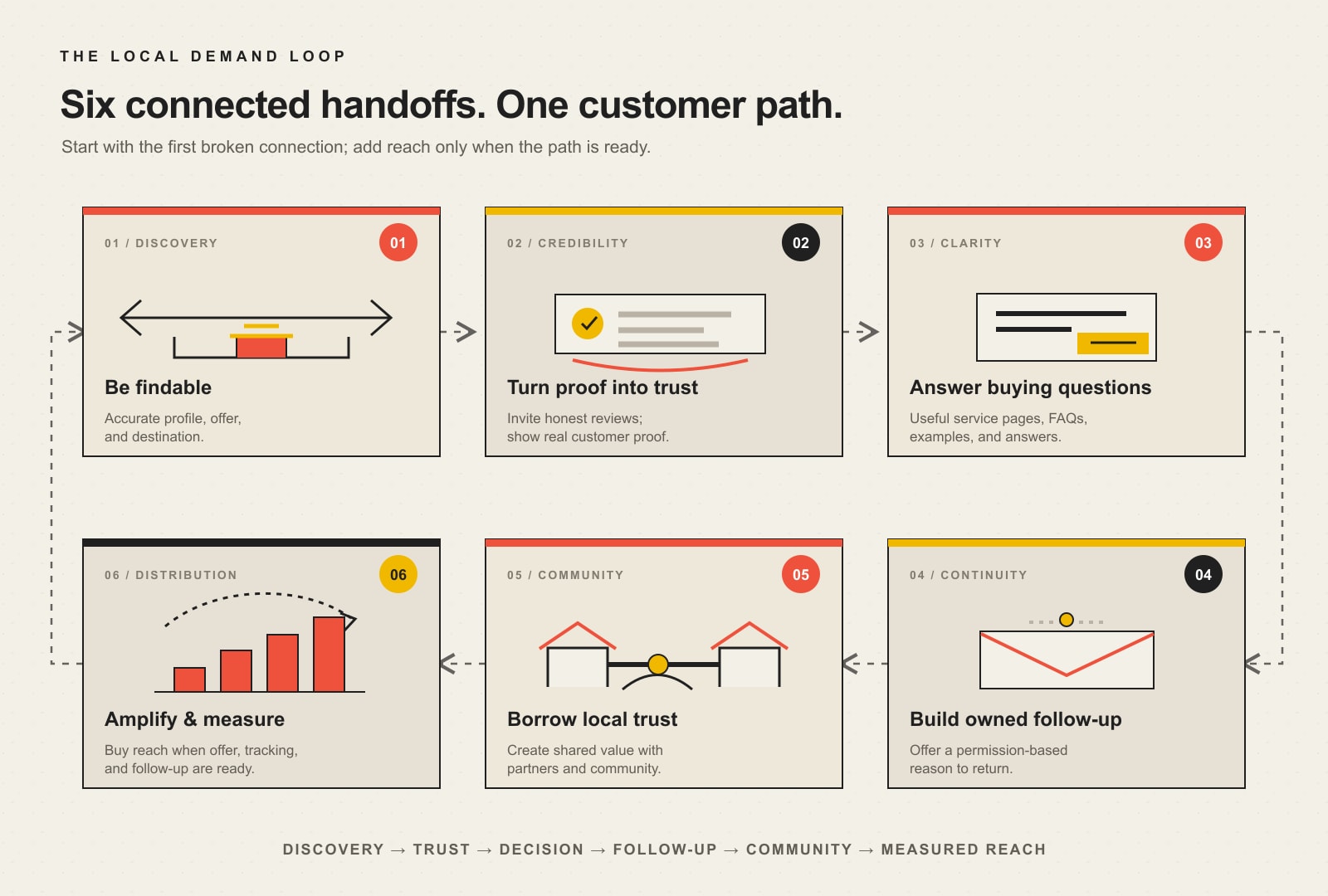
    This guide is the broad strategy catalog. If you need the bigger planning layer, start with our small business marketing strategy. If you want a connected local buying-path model, use our six-step local marketing guide. Here, we will focus on 15 practical local marketing strategies, when each one earns a place in the plan, and the first business result worth measuring.

    How to Choose Local Marketing Strategies Without Doing Everything at Once

    Local marketing is marketing that deliberately reaches, helps, and converts customers in a defined geographic market. The geography might be a town, a group of ZIP codes, a service radius, several neighborhoods, or a drive-time area. The right boundary is the smallest one that actually changes who you serve, what you promise, where you can deliver, or how a customer chooses you.

    Readiness stageWhat you are trying to fixStart withFirst useful metric
    Capture demandPeople need what you sell but do not find or contact youGoogle Business Profile, local SEO, service/location pages, response pathQualified inquiries
    Build trustPeople find you but hesitate or choose someone elseReviews, proof stories, useful local content, videoInquiry-to-booking rate
    Follow up & partnerInterest and past customers disappear after one interactionEmail, referrals, partnerships, eventsRepeat and referral revenue
    Amplify what worksYour offer and follow-up convert, but you need more qualified reachRetargeting, paid media, local creatorsCustomer acquisition cost and profit

    That sequence is a decision rule, not a law. A new emergency-service company may need paid search early because demand is already urgent. An established dentist with a full schedule may care more about retention and referrals. The point is to match the tactic to the bottleneck instead of spreading a small team across every channel.

    Four local marketing stages build from existing demand through trust and owned follow-up to selective amplification of proven work.

    Foundation: Capture the Local Demand That Already Exists

    1. Optimize Your Google Business Profile

    Your Google Business Profile is one of the first places to fix when customers search for a nearby business or service. Keep the business name, category, address or service area, phone number, hours, services, photos, and other relevant fields accurate and complete. Do not stuff keywords into the business name or invent locations you do not actually operate from.

    Google says local results are primarily based on relevance, distance, and prominence, and its Business Profile guidance recommends complete, accurate information, verification, current hours, review responses, and photos. For the broader technical steps to establish business details across Search and Maps, see Google Search Central’s business details guide.

    Use it when: local search or Maps can reasonably start a buying decision. Measure first: qualified calls, booking actions, direction requests that matter to the business, and leads that can be traced back to the profile—not profile views by themselves.

    2. Build a Review Request and Response System

    Reviews are useful because they give buyers recent evidence from people who have already experienced the business. The scalable part is not “get more five-star reviews.” It is building a consistent process: ask eligible customers at a sensible moment, make the review step easy, monitor new reviews, respond professionally, and use recurring feedback to improve the operation.

    Google provides review-link and QR-code workflows for requesting reviews. Keep the request honest. Do not buy fake reviews, screen out unhappy customers before giving them a review path, or condition an incentive on a positive rating. The FTC’s Consumer Reviews and Testimonials Rule Q&A explains current federal restrictions on deceptive review practices, including incentives tied to a particular sentiment.

    Use it when: you have real customers and a repeatable service experience. Measure first: review volume and recency as operating inputs, then whether prospects mention reviews, convert at a higher rate, or arrive with fewer trust objections.

    3. Strengthen the Local SEO Basics

    Local SEO is broader than your Business Profile. Your website still needs clear service pages, understandable location signals, useful titles and headings, accurate business information, crawlable pages, sensible internal links, and content that answers the questions local buyers actually ask. Consistency matters because search engines and customers should be able to connect the website, business profile, and other legitimate local references to the same real company.

    Do not turn “hyperlocal SEO” into hundreds of near-duplicate city pages. A neighborhood, city, or service-area page deserves to exist when the geography changes buyer-relevant information: availability, regulations, travel, service process, examples, staff, pricing context, or proof. For the deeper implementation work, use our local SEO guide.

    Use it when: organic/local search is a realistic acquisition path but your site is unclear, thin, inconsistent, or hard to crawl. Measure first: qualified organic inquiries by service and geography, then landing-page conversion—not rankings in isolation.

    4. Create Service and Location Pages That Help Buyers Decide

    A strong service page answers the questions a local buyer needs before contacting you: what you do, who it is for, what is included, where you provide it, what the process looks like, what proof exists, and what the next step is. A strong location page adds real geographic differences rather than swapping a city name into the same template.

    • Use one clear service or location intent per page.
    • Add local proof when you genuinely have it: projects, photos, testimonials, staff, travel details, service boundaries, or area-specific FAQs.
    • State where you do and do not serve instead of implying a physical presence everywhere.
    • Give the visitor an obvious next step: call, request a quote, schedule, visit, or ask a question.

    Use it when: important services or service areas are currently buried on a generic page. Measure first: qualified inquiries and booking rate from each landing page.

    5. Make the Response Path Fast, Clear, and Trackable

    Marketing fails quietly when a customer finds the business, believes the offer, and then cannot figure out what to do next—or gets no response after doing it. Put the primary response option where the buyer needs it. On a service page that may be “Request a quote.” On a restaurant profile it may be “Get directions.” On an urgent service page it may be “Call now.”

    Then assign ownership. Who answers the phone? Who receives forms? What happens after hours? How quickly should an inquiry receive a real response? How will the team label source, service, qualification, booked outcome, and revenue? More traffic makes a leaky handoff more expensive; it does not repair it.

    Use it when: leads are being lost between click and conversation. Measure first: response rate, response time, qualified-inquiry rate, booked-work rate, and lost-lead reasons.

    Proof and Relevance: Help Local Buyers Choose You

    6. Publish Real Customer Proof Stories

    A generic testimonial says, “Great company.” A useful proof story shows the buyer what happened. Capture the starting problem, what the customer cared about, what you changed, what made the work difficult, and the observable result. For a contractor, that might be a before-and-after project with the homeowner’s constraints. For a B2B service, it might be a short case study showing the decision, process, and outcome.

    Repurpose the same proof carefully: website case study, sales follow-up, Business Profile photo, social post, proposal excerpt, or email. One real example can do more work than five generic “we serve [city]” pages because it gives the prospect something specific to evaluate.

    Use it when: prospects understand the service but still question credibility, fit, quality, or risk. Measure first: assisted inquiries, sales-team use, proof-page engagement from qualified visitors, and which objections disappear in sales conversations.

    7. Create Local Decision Content, Not Just “Local Content”

    Local content deserves to exist when it helps someone make a decision. A family photographer might publish a guide to photo locations because the location changes the service experience. A landscaper might explain plant choices for local soil or deer pressure. An event company might compare venue types in the region because venue rules change cost and logistics.

    Do not publish local news you have no useful connection to just to mention a town name. Build content around real customer questions, real local constraints, and real expertise. The best format is the one that carries the proof or explanation the buyer needs and that your team can maintain consistently.

    Use it when: buyers repeatedly ask the same location-specific questions before purchasing. Measure first: assisted conversions, qualified organic entrances, sales-team usage, and whether the content helps a prospect reach the next step.

    8. Use Short-Form Video to Show the Work and Answer Objections

    Video can make local expertise visible quickly. Instead of chasing trends, record what a buyer would benefit from seeing: a 30-second walkthrough, a quick before-and-after, the difference between two options, a common mistake, a customer question, a shop tour, or a short explanation from the person who actually does the work.

    Keep the production standard appropriate to the brand, but do not confuse polish with usefulness. A clear phone video from the jobsite can outperform an elaborate brand reel when the buyer needs evidence, not entertainment.

    Use it when: your work is visual, demonstrable, personal, or easier to trust after seeing the people/process. Measure first: qualified inquiries and sales conversations influenced by the video—not views alone.

    9. Pick One Local Social Community You Can Actually Serve

    You do not need an equally active presence on every social platform. Choose the community where your customers, referral partners, employees, or local decision-makers already spend attention—and where your team can respond reliably. For many local businesses that may still be Facebook; for others it may be Instagram, LinkedIn, YouTube, TikTok, a neighborhood group, or a niche community.

    The operating standard is more important than the platform name: useful posts, real conversations, customer proof, event participation, thoughtful replies, and a clear handoff when someone shows buying intent. Our Facebook marketing for local businesses guide goes deeper on treating Facebook as a community channel rather than a content treadmill.

    Use it when: a meaningful local audience or referral network is active on the platform. Measure first: qualified conversations, referrals, event participation, inquiries, and attributable sales—not follower count.

    Owned Follow-Up and Relationships: Get More Value From Attention You Already Earned

    10. Build Local Email Follow-Up

    Email is useful in local marketing because you own the permissioned relationship instead of renting every future contact from a search engine or social platform. The geographic segmentation should be only as precise as the message requires. A service-area business might segment by territory or service type. A multi-location business might segment by store. An event-driven business might segment by drive time.

    Good local email can include appointment reminders, seasonal service timing, useful follow-up after a quote, customer education, event invitations, product availability, referral requests, or relevant local updates. Avoid “creepy precision” that tells the recipient you know more about their location than the message needs. See our local email marketing guide for the deeper segmentation and usefulness model.

    Use it when: you already have customers, subscribers, leads, or quote requests worth nurturing. Measure first: repeat bookings, reactivated leads, referral revenue, and revenue per campaign or segment.

    11. Build Referral Loops and Community Partnerships

    A local partnership works when two organizations serve overlapping people without competing for the same purchase. A wedding venue and photographer, veterinarian and trainer, accountant and attorney, gym and physical therapist, or manufacturer and local service provider can create legitimate handoffs.

    • Start with a real customer problem the partnership solves.
    • Define what a good referral looks like and who owns follow-up.
    • Give partners an easy, accurate way to explain your offer.
    • Track the referral source and the resulting business outcome.
    • Reciprocate only when it is genuinely useful to the customer.

    Use it when: another trusted local organization encounters your ideal customer before, during, or after the need you solve. Measure first: qualified referrals, booked work, partner-to-customer conversion, and revenue by partner.

    12. Use Local Events as Bounded Campaigns

    Sponsoring or attending an event is not automatically a marketing strategy. Turn it into one by defining the job. Are you trying to meet referral partners, book appointments, collect permissioned follow-up, demonstrate a product, generate proof content, or support a community relationship that matters to the business?

    Build a before/during/after plan. Before: invite the right people and make the offer clear. During: make the next step easy and capture the source. After: follow up quickly, publish useful proof, and record what happened. If you want smaller experiments rather than a broad portfolio, our local marketing ideas guide shows how to treat tactics as bounded tests.

    Use it when: the event attracts a relevant local audience or strengthens a valuable relationship. Measure first: qualified conversations, permissioned leads, booked work, referrals, and follow-up revenue.

    Selective Amplification: Add Reach After the Offer and Follow-Up Work

    13. Retarget Warm Website Visitors

    Retargeting is most useful when someone has already shown meaningful interest but did not take the next step. Build audiences around buyer intent where the platform, consent choices, and privacy requirements allow it: important service pages, pricing or financing content, booking starts, product categories, or other high-intent behavior.

    The ad should reduce friction, not simply follow the visitor around the internet. Remind them of the service, answer a common objection, show relevant proof, or make the next step easier. Exclude customers or converters when continued ads would be wasteful or annoying.

    Use it when: the site gets enough qualified traffic to form a useful warm audience and the conversion path is already instrumented. Measure first: incremental qualified conversions and cost per booked customer, not click-through rate in isolation.

    14. Run Geo-Targeted Paid Search or Social Ads

    Paid media can accelerate a proven offer. It cannot rescue an unclear offer, a weak landing page, slow follow-up, or poor fulfillment. Define the location, audience, offer, destination, budget, tracking, and success/stop rule before launching. For local service businesses, the tightest useful geography may be a service radius or ZIP set; for a destination business, a wider drive-time market may make sense.

    Separate demand capture from awareness. Paid search can capture people already expressing intent. Paid social can reach people who fit a profile or engage a warm audience. They need different creative, landing experiences, and expectations. Our paid advertising strategy guide covers the deeper channel economics and testing model.

    Use it when: you know what a qualified customer is worth, the offer already converts, and you can handle additional demand. Measure first: cost per qualified lead, cost per booked customer, revenue, gross profit, and payback—not cheap clicks.

    15. Test Local Creators and Influencers for Audience Fit, Not Follower Count

    A local creator can be useful when they have earned attention from the people you actually want to reach. That might be a neighborhood food creator, a home-renovation account, a parenting newsletter, a local sports personality, a business-community host, or a niche expert with a concentrated regional audience.

    Start small. Define the audience, offer, disclosure requirements, content rights, destination, tracking method, and business result before paying for reach. Give the creator enough freedom to remain credible, but do not leave the campaign objective vague. A small relevant audience can be more valuable than a much larger audience with no buying fit.

    Use it when: the creator’s audience strongly overlaps your real market and you have something worth introducing. Measure first: trackable qualified inquiries, redemptions, booked work, revenue, and acquisition cost.

    Measure Local Marketing as a Business System

    Local marketing dashboards often become crowded with things that are easy to count: impressions, followers, likes, video views, profile views, sessions, keyword positions, and email opens. Those can be useful diagnostic signals, but they are not the finish line.

    Use a simple chain for each meaningful tactic:

    1. Cost or effort: money, staff time, production time, sponsorship fee, media spend.
    2. Attention or response: relevant visits, calls, form starts, messages, referrals, event conversations.
    3. Qualification: how many responses match the customer, service, geography, timing, and budget you can actually serve?
    4. Booked outcome: appointments, estimates, projects, transactions, visits, or other meaningful next steps.
    5. Business value: revenue, gross profit, repeat purchase, referral value, acquisition cost, and payback.

    If a tactic creates attention but no qualified responses, change the audience, message, or offer. If it creates qualified responses but no bookings, inspect the handoff and sales process. If it books work but loses money or overloads fulfillment, do not scale it just because the ad dashboard looks good.

    Which Local Marketing Strategy Should You Try First?

    Use the cheapest useful fix for the biggest current leak.

    • People cannot find you: fix Google Business Profile, local SEO, and core service/location pages.
    • People find you but hesitate: strengthen reviews, proof, useful decision content, and the response path.
    • You keep starting from zero: build email follow-up, referral loops, and community relationships.
    • Your offer converts but volume is limited: test retargeting, paid media, or a relevant local creator.
    • You are not sure what the leak is: map the buyer path and instrument the handoffs before adding another channel.

    Pick one primary strategy and one supporting action for a defined test period. Write down the audience, offer, destination, owner, budget or time allowance, success metric, and stop condition. Then review what happened and either scale, revise, or stop. That is more useful than maintaining fifteen half-active channels.

    Local Marketing Strategy FAQ

    What is a local marketing strategy?

    A local marketing strategy is a deliberate plan for reaching and converting customers in a defined geographic market. It connects a real audience, offer, channel, destination, follow-up owner, and measurable business outcome. Simply posting city names or buying geographically targeted impressions is not a strategy by itself.

    How do you market a local business effectively?

    Start with demand you can already capture: accurate Business Profile information, a clear website, local search basics, reviews, and an easy response path. Then add proof, owned follow-up, partnerships, and selective paid reach. The sequence should follow the current bottleneck rather than a universal channel checklist.

    What is an example of local area marketing?

    A residential service company could optimize its Business Profile, publish a real project case study from the service area, send past customers a seasonal reminder, partner with a complementary local contractor, and run paid search only for ZIP codes it can profitably serve. Each action has a geographic reason and a measurable next step.

    How much should a small business spend on local marketing?

    There is no responsible universal percentage for every local business. Start from customer value, gross margin, capacity, and the cost of a bounded test. Set a budget you can afford to learn from, define the maximum acceptable acquisition cost, and do not increase spend until the offer, response path, and tracking are working.

    Is local SEO enough on its own?

    Sometimes search is the dominant acquisition channel, but local SEO still depends on what happens after the visit: proof, a usable website, fast follow-up, and a service experience worth recommending. Businesses with weak search demand, long buying cycles, or relationship-heavy sales may also need email, partnerships, events, social/community work, or paid media.

    Turn the 15 Strategies Into a Local Marketing Plan You Can Run

    The advantage is not having more tactics. It is knowing what each tactic is supposed to do, who owns the next step, and what evidence will tell you whether it worked. Fix local discovery. Make the business easier to trust. Capture permission to follow up. Build relationships that create useful referrals. Then buy or borrow more reach when the economics are ready for it.

    If you want help identifying the highest-leverage leak in your local marketing system, talk with Scope Design. We can help you connect the website, local search, proof, follow-up, content, and paid channels into a plan your team can actually operate and measure.

  • Local SEO Audit: Find the Mistakes Costing You Calls

    Local SEO Audit: Find the Mistakes Costing You Calls

    Local SEO is usually not failing because you skipped three Google Business Profile posts or forgot to wedge another town name into a heading. It is failing because something important is inaccurate, irrelevant, weak, unreachable, or unmeasured.

    A useful local SEO audit checks the system in order: measurement, business eligibility and accuracy, search relevance, geographic reality, prominence and proof, website action, and operational follow-through. That sequence matters. Otherwise, you can spend six months “optimizing” a profile when the real problem is that the business is too far from the searcher, the website never explains the service, or nobody answers the damn phone.

    TL;DR: What should a local SEO audit check first?

    1. Confirm that calls, forms, bookings, and qualified leads are actually tracked.
    2. Verify that the business name, address or service area, hours, category, and services reflect the real business.
    3. Compare the searches you want with the services and language shown on the profile and website.
    4. Separate a relevance problem from a distance problem; optimization cannot teleport the business.
    5. Review genuine customer proof, local mentions, useful links, and competitive prominence.
    6. Test whether a mobile visitor can understand the offer, trust the business, and take action.
    7. Follow the lead past the click so visibility is connected to qualification, sales, and revenue where possible.

    The Scope Design rule is simple: Do not prescribe activity until you know which layer is failing. More posts, more pages, more schema, and more reports are not progress when they are aimed at the wrong constraint.

    What is a local SEO audit?

    A local SEO audit is a structured investigation of whether a business can appear for relevant nearby searches, whether search engines can understand and trust its information, whether customers have enough evidence to choose it, and whether that visibility produces useful business outcomes.

    That is a wider job than checking whether a Google Business Profile is “100% complete.” A completed profile can still underperform because:

    • the primary category does not match the main service;
    • the business information is inconsistent or misleading;
    • the website does not support the services being claimed;
    • the desired search area is unrealistic for the actual location;
    • established competitors have materially stronger proof;
    • the listing earns views but the website loses the buyer;
    • calls and forms are not measured or handled properly;
    • the business is ranking for curiosity rather than commercial intent.

    Google says local results are mainly based on relevance, distance, and prominence. Those are useful categories, but a business owner still needs to know where to look first and what can actually be changed. That is where a diagnostic sequence earns its keep.

    Our complete local SEO guide explains the whole visibility-and-choice system. This article has a narrower job: finding the failure before somebody sells you a bag of activity.

    The Scope Design Local Search Failure Triage

    The seven layers below move from foundational evidence to business outcome. Audit them in order because upstream problems make downstream activity harder to interpret.

    A seven-step diagnostic route checks measurement, eligibility and accuracy, relevance, distance, prominence and proof, website action, and operational outcome.
    Audit layerQuestionEvidence to inspectFix first when…
    MeasurementDo we know what happened after visibility?Profile performance, analytics, call/form tracking, CRM outcomesNobody can distinguish views, actions, qualified leads, and sales
    Eligibility and accuracyIs the business represented truthfully?Profile ownership, name, address/service area, hours, categories, servicesFacts are wrong, duplicated, inconsistent, or policy-risky
    RelevanceDoes the business match the query?Search terms, primary category, service pages, titles, copy, competitor resultsThe right buyer cannot tell that you solve the searched problem
    Distance realityIs the expected geography plausible?Business location, service territory, rank patterns from several locationsRankings weaken mainly as the searcher moves farther away
    Prominence and proofWhy should the market choose or recognize you?Genuine reviews, local mentions, links, project evidence, brand searchesBetter-known competitors have stronger credible evidence
    Website actionCan the visitor understand and act?Mobile page, speed, calls to action, forms, trust, accessibilityPeople reach the site but do not contact or qualify
    Operational outcomeWhat happens to the lead?Response time, qualification, held appointments, close data, revenueMarketing produces contacts that the business loses or cannot serve

    This is not a magic ranking formula. Google does not publish the complete local algorithm, and no agency can honestly guarantee a Maps position. It is a way to stop confusing visible symptoms with the actual business constraint.

    Mistake 1: Auditing rankings before auditing measurement

    The first mistake is declaring that local SEO “doesn’t work” when nobody can say what work was supposed to produce.

    A map-grid report may show that the business appears in several locations. A profile report may show views, calls, or website clicks. Analytics may show sessions. None of those numbers alone proves that the business received an appropriate inquiry, booked a job, or made money.

    Google’s Business Profile Performance documentation defines the “Calls” metric as the number of times users clicked the call button on the profile. That makes it an interaction metric, not proof of an answered call, a qualified lead, or revenue.

    Before changing the profile or website, document the chain:

    1. What query or discovery path brought the person in?
    2. Which profile, page, or listing did they use?
    3. Did they call, submit, book, purchase, or request directions?
    4. Was the inquiry qualified?
    5. Was it answered and followed up?
    6. Did it become a held appointment, opportunity, sale, or another defined outcome?

    Small businesses will not always have perfect attribution. Calls get forwarded. Buyers return through direct traffic. People see a listing and visit later. That does not excuse measuring nothing. It means using the best available evidence and stating the limits honestly.

    Our SEO metrics guide goes deeper into the difference between diagnostic metrics and business outcomes. For this audit, the minimum useful set is profile actions, relevant landing-page traffic, tracked calls and forms, qualified inquiries, and downstream disposition.

    If the tracking is broken, fix that first. Otherwise, every later improvement becomes a taste argument with screenshots.

    Mistake 2: Treating inaccurate business information as an optimization opportunity

    Local search begins with the real business. That sounds painfully obvious, which is why it is impressive how often people manage to screw it up.

    Google’s Business Profile guidelines require businesses to represent themselves as they are consistently recognized in the real world. Addresses and service areas should be accurate. The profile name should not become a storage bin for services, cities, slogans, and desperate keyword fragments.

    Audit these facts:

    • who owns and manages the profile;
    • the real-world business name;
    • the physical address, if customers can legitimately visit it;
    • the service area, if the business travels to customers;
    • the primary and secondary categories;
    • the phone number and website destination;
    • regular and special hours;
    • services, appointment links, and other customer-facing fields;
    • duplicate, old, practitioner, department, or moved profiles;
    • consistency with the website and other authoritative business records.

    Do not create a fake office to rank in another city. Do not keep an old location live because it still appears somewhere. Do not use a virtual mailbox as a costume for a storefront. Those tactics create policy and customer-trust problems; they do not create a durable market position.

    Accuracy is not glamorous, but it is eligibility. If search engines and customers receive conflicting facts, another blog post is not the first fix.

    Mistake 3: Claiming services that the profile and website do not explain

    Relevance is how well the business matches what someone is searching for. Google recommends complete and detailed business information because it helps the system understand that match.

    The profile and website should tell the same truthful story:

    • what the business actually does;
    • which services matter commercially;
    • who those services are for;
    • where and how the business delivers them;
    • what problems or situations create demand;
    • what evidence supports the claim;
    • what the buyer should do next.

    If a contractor wants to appear for emergency roof repair but the website only says “complete exterior solutions,” the relevance gap is not mysterious. If a consultant selects every category remotely adjacent to the business, the profile may become broader without becoming clearer.

    Compare the intended search terms against the primary category, listed services, service-page titles, headings, copy, internal links, and actual sales language. Then compare the pages ranking for those terms. The question is not whether you used a keyword a prescribed number of times. The question is whether a buyer and a search system can confidently connect the query to a real, well-supported service.

    Avoid solving this with 40 interchangeable city pages. Our local content marketing guide explains the Local Proof Map: place, problem, proof, people, practical answer, and path. If a page contains no evidence that could honestly belong to that location, it is a town-name factory, not local expertise.

    Mistake 4: Trying to optimize your way around distance

    Distance is not a defect in your title tag. It is the physical relationship between the business and the searcher.

    Google identifies distance as one of the main local ranking factors. That means an accurate, reputable business may perform well near its real location and weaken farther away. Service-area settings explain where a business works; they do not move the business or guarantee equal visibility across the selected territory.

    Diagnose geography by comparing patterns from several legitimate locations:

    • Does the business fail to appear anywhere for an important service?
    • Does it appear near the business but fade across town?
    • Does performance change by query specificity?
    • Are stronger competitors physically closer to the searcher?
    • Is the desired market actually served operationally and economically?

    If the business ranks near its base but not 40 miles away, the profile may not be broken. The expectation may be broken.

    The fixes available are still useful: improve relevance, earn genuine prominence, create strong regional resources where distinct evidence exists, and build a business people seek by name. But do not promise that page copy can repeal geography. If a market is strategically essential, the business decision may involve a legitimate staffed location, a different acquisition channel, partnerships, or accepting that local-pack visibility is not the only route.

    Mistake 5: Manufacturing reviews instead of building proof

    Prominence is partly about how well-known and well-supported the business appears. Google says information across the web, links, reviews, and positive ratings can contribute to local prominence.

    That makes reviews valuable. It does not make review manipulation clever.

    Google’s Maps content policy prohibits fake engagement, paid or incentivized reviews, selective solicitation of only positive reviews, and efforts to manipulate ratings. Policy violations can result in removed reviews, posting restrictions, hidden ratings, or consumer warnings on the profile.

    A durable review process should:

    • ask real customers after a genuine experience;
    • make the request easy without dictating the rating or wording;
    • invite honest feedback rather than screening out unhappy people;
    • respond appropriately without exposing private information;
    • route operational complaints to someone who can fix the cause;
    • continue consistently instead of producing suspicious bursts;
    • connect review themes to service and website improvements.

    Reviews are only one form of proof. Depending on the business, prominence can also be supported by legitimate local news, associations, suppliers, sponsorships, useful resources, project evidence, partnerships, citations, and links earned through real relationships.

    Do not buy a bundle of directory listings and call it authority. Audit which references are accurate, relevant, maintained, and visible to actual customers. A smaller set of credible signals beats a larger pile of forgotten profiles with the wrong phone number.

    Mistake 6: Optimizing the listing while the website loses the buyer

    A Google Business Profile can earn the click and still hand the prospect to a website that looks abandoned, loads badly, hides the phone number, or explains the company in language only the company understands.

    Test the landing experience on a real phone. Ask:

    • Can a visitor tell what the business does within a few seconds?
    • Does the page match the service or intent that produced the click?
    • Is the phone number tappable and the form usable?
    • Are hours, location, service area, and important promises consistent?
    • Is there useful proof near the claim it supports?
    • Are price expectations, process, timing, or fit addressed where appropriate?
    • Does the page load and respond well enough for a person to use it?
    • Can someone using a keyboard, screen reader, zoom, or other assistive technology complete the next step?
    • Does the form actually deliver the lead to a monitored destination?

    Google’s Core Web Vitals measure loading performance, responsiveness, and visual stability. Google also makes clear that good scores do not guarantee top rankings. Treat performance as part of a usable foundation, not a scoreboard to perfect while the offer remains vague.

    For Bing, Site Scan and URL Inspection can help identify crawl, indexing, markup, and common technical issues. Google Search Console and Bing Webmaster Tools should both be part of the diagnostic kit. A tool report can locate problems; it cannot decide which problem matters most to the business.

    Structured data belongs here too. Accurate LocalBusiness or organization markup can help systems understand business facts and classify the page. It does not create a real location, replace content, manufacture reviews, or guarantee a rich result. Schema is machine-readable truth—not confetti fired at the algorithm.

    Mistake 7: Counting calls while ignoring what happens next

    The final local SEO mistake is stopping the story at the lead.

    If calls ring unanswered, forms sit in an inbox for two days, appointments are never confirmed, or staff cannot explain the service, more local visibility accelerates a broken process. The website can influence the quality and readiness of an inquiry; it cannot close a sale the business refuses to handle.

    Audit the operational handoff:

    • Who owns each inbound channel?
    • How quickly are calls and forms acknowledged?
    • What makes a lead qualified?
    • Are service area, budget, timing, and fit handled consistently?
    • Are missed calls returned?
    • Can the team identify the landing page or source?
    • Are held appointments separated from booked appointments?
    • Are closed, lost, unqualified, and unreachable outcomes recorded?
    • Does capacity exist to serve additional demand?

    The primary outcome should be the last meaningful metric the website and local-search system can influence, usually a qualified conversation, booking, purchase, or store visit. Track it through to revenue when possible so the business learns which visibility produces customers rather than merely contacts.

    Traffic is attention. Rankings are visibility. Calls are actions. None of them automatically equals value.

    Local SEO busywork that looks productive but rarely fixes the root problem

    Some activities can be useful in the right context. They become busywork when prescribed without a diagnosis.

    Posting to Google Business Profile on a rigid schedule

    Posts can communicate offers, events, updates, and useful information to customers. Google does not promise that posting every day or week will overcome weak relevance, distance, or prominence. Publish when there is something useful to say, not because a dashboard wants a streak.

    Stuffing the business name with services and cities

    The profile name should reflect the real-world business name. Keyword stuffing may create policy risk and customer confusion. It is not a substitute for choosing an accurate category and explaining services properly.

    Generating dozens of near-identical location pages

    Separate location or service-area pages make sense when operations, proof, questions, constraints, or decisions genuinely differ. Copying the same page and swapping the municipality creates maintenance debt and very little customer value.

    Purchased signals can be irrelevant, inaccurate, manipulative, or temporary. Build a repeatable request process for genuine reviews and earn references through useful work and legitimate relationships.

    Installing more SEO plugins and chasing every score

    One plugin may flag a missing phrase while another recommends a different count. Use these tools as lint. They do not know whether the service is profitable, the lead is qualified, or the business is lying about its address.

    Adding llms.txt and declaring the AI-search problem solved

    An experimental file is not a replacement for crawlable pages, clear authorship, accurate business facts, original evidence, reputable citations, and content worth retrieving. Nobody can guarantee an AI citation. Build a source that deserves to be used, then monitor what the systems actually surface.

    A 30-minute local SEO triage for business owners

    This is not a complete audit, but it can expose the obvious constraint before a vendor starts selling deliverables.

    Minutes 0–5: Define the business outcome

    Choose one important service, one plausible market, and one desired action. Write down what makes an inquiry qualified. If the goal is “more traffic,” keep going until the goal touches the business.

    Minutes 5–10: Test the profile facts

    Check ownership, name, primary category, address or service area, hours, phone, website, and services against the real business and website. Note discrepancies; do not edit everything impulsively.

    Minutes 10–15: Compare search relevance

    Search for the service and problem language customers use. Review the profile and landing page as if you knew nothing about the company. Can you see the connection without translating corporate fog?

    Minutes 15–20: Separate distance from weakness

    Compare results near the business and farther into the claimed service area. Do not rely on one search from one device as a scientific ranking report. Look for the basic pattern.

    Minutes 20–25: Inspect proof and the mobile path

    Compare genuine reviews, recency, local evidence, and service proof with relevant competitors. Then open the destination on a phone and complete the call or form path yourself.

    Minutes 25–30: Follow one recent lead

    Take a real recent inquiry and trace the source, response, qualification, follow-up, and disposition. If the organization cannot do that, the measurement and operational layers need work before anyone claims the local campaign succeeded or failed.

    For a broader search-competition audit beyond the local pack, use our Google ranking diagnosis. For the full strategy connecting demand, eligibility, authority, action, and measurement, start with our SEO strategy and analytics pillar.

    How local SEO supports AI search without magical thinking

    Local businesses increasingly appear across search results, maps, knowledge panels, assistants, and generated answers. The durable foundation is still understandable and verifiable business information.

    Make the business easier to interpret and cite by:

    • keeping names, locations, services, hours, and contact information consistent;
    • publishing clear service and location relationships;
    • identifying the organization and authors accurately;
    • using structured data that matches visible facts;
    • citing primary sources near factual claims;
    • publishing original local evidence, frameworks, photographs, or data;
    • answering customer questions directly near the top of the page;
    • maintaining stable URLs and updating moved or stale facts;
    • earning legitimate references from relevant organizations;
    • avoiding fake reviews, invented offices, and unsupported statistics.

    For the deeper mechanics of making useful evidence retrievable and citation-worthy, see our AI search optimization guide.

    AI systems do not need another generic list of local SEO tips. They need sources that are clear, specific, trustworthy, and useful enough to retrieve. The same work also helps humans decide whether the business knows what it is doing. Convenient, that.

    Frequently asked questions about local SEO audits

    Why is my local SEO not working?

    The most common causes are broken measurement, inaccurate Business Profile information, weak relevance between the query and your services, unrealistic geographic expectations, limited prominence or proof, a poor mobile website experience, or weak lead follow-up. Diagnose those layers in order instead of assuming the answer is more content or more posts.

    What are the most common local SEO mistakes?

    Common mistakes include using inaccurate profile information, choosing the wrong primary category, expecting a service area to override distance, creating thin city pages, manipulating reviews, failing to support services on the website, ignoring mobile conversion, and measuring rankings without qualified business outcomes.

    What are the main challenges of local SEO?

    The main challenges are matching relevant searches, competing with closer or more prominent businesses, maintaining accurate information across systems, earning genuine customer proof, creating locally useful content, and connecting visibility to sales. Distance and competition create real constraints that no checklist can eliminate.

    Can a service-area business rank everywhere it serves?

    No. Defining a service area does not guarantee equal visibility across it. Google uses distance as a local ranking factor, so performance often changes with the searcher’s location. Improve relevance and prominence, but keep geographic expectations honest.

    Do Google Business Profile posts improve local rankings?

    Google documents posts as a way to share updates, offers, events, photos, videos, and action links. It does not promise a ranking lift based on posting frequency. Use posts to communicate useful information, not as a ritual intended to fix an unrelated ranking problem.

    Do reviews affect local SEO?

    Google states that review count and positive ratings can help local ranking as part of prominence. Reviews also influence whether customers choose the business. Ask real customers for honest reviews without incentives, selective screening, required wording, or rating manipulation.

    What mobile mistakes hurt local results?

    A slow or unstable page, hidden phone number, broken form, mismatched landing page, intrusive overlay, unreadable text, inaccessible controls, and unclear next step can waste local visibility. Mobile usability should be tested by completing the real customer action, not merely by earning a tool score.

    How long does it take to fix local SEO?

    There is no honest universal timeline. Correcting a wrong phone number may be immediate on your website, while profile reviews, recrawling, competitive prominence, and customer behavior can take much longer. The right timeline depends on the failure, platform processing, market, and evidence available. Anyone guaranteeing a specific ranking date is selling confidence they do not control.

    No. Search interfaces are changing, but businesses still need crawlable information, accurate entities, relevant answers, authority, usable destinations, and measurement. Optimizing only for ten blue links is incomplete; declaring that technical and local fundamentals no longer matter is equally silly.

    What is the 80/20 rule in SEO?

    There is no official universal 80/20 rule that identifies the same high-value tasks for every site. The useful interpretation is prioritization: find the small number of constraints most responsible for lost visibility or value, fix those first, and verify the result. The actual priorities must come from evidence, not a motivational fraction.

    Fix the failed layer, not the fashionable one

    A local SEO audit should leave you with a diagnosis, an evidence trail, and an ordered set of fixes. It should not leave you with 72 color-coded recommendations that all appear equally urgent.

    Start with the failed layer. If the business facts are wrong, fix accuracy. If the service is unclear, fix relevance. If geography is unrealistic, reset the strategy. If the business lacks proof, build a legitimate system for earning it. If the website loses people, repair the path. If leads disappear after contact, fix ownership and follow-up.

    Then measure whether the change improved qualified demand.

    Scope Design helps established businesses diagnose the website and search constraint, protect useful search equity, rebuild weak content into intentional clusters, and connect visibility to outcomes that matter. Explore our SEO services or talk with Scope Design if you want an audit that finds the problem before prescribing the invoice.

    Sources

  • 10 Killer Local Marketing Ideas That Actually Drive Results

    10 Killer Local Marketing Ideas That Actually Drive Results

    The best local marketing ideas are not the ones getting the most attention this month. They are the ones that solve the bottleneck your business has right now. A local company that is hard to find needs a different marketing test than one that gets plenty of inquiries but weak follow-up. A business with more demand than it can fulfill should not buy even more attention.

    That is the filter behind this guide. Instead of treating local marketing as a checklist of channels, use each idea as a bounded experiment: name the problem, choose one bet, decide what qualified business result should change, then scale or stop based on evidence.

    If you need the broader system first, start with our small-business marketing strategy. This article has a narrower job: helping you pick the next practical local marketing idea without trying ten things at once.

    (more…)
  • 6 Proven Local Marketing Strategies to Boost Sales and Drive Business Growth

    6 Proven Local Marketing Strategies to Boost Sales and Drive Business Growth

    The six local marketing strategies that matter most are the ones that move a nearby prospect through a complete buying path: get found, build trust, answer the questions that delay a decision, create a permission-based follow-up path, borrow credibility from local relationships, and add paid reach only when the rest of the system is ready. The mistake is treating those as six unrelated channels. They work better as connected handoffs.

    For a small local business, that distinction matters. More posts, more ads, or more listings do not automatically create more sales. A useful local marketing system helps the right people discover you, understand why you fit, take a next step, and stay connected long enough to buy or refer someone else. If you need the broader framework for choosing channels by buying moment, start with Scope Design’s small business marketing strategy guide. This article focuses on the local handoffs.

    The Local Demand Loop: 6 strategies that work together

    1. Be findable where local intent starts. Keep your Google Business Profile and core business information accurate, complete, and aligned with what your website actually offers.
    2. Turn real customer proof into trust. Build a repeatable, honest review and proof system instead of waiting for testimonials to appear by chance.
    3. Answer local buying questions. Create useful service, location, FAQ, case-study, photo, and video content around real decisions—not a content treadmill.
    4. Build an owned follow-up path. Give prospects and customers a reason to opt into email or another permission-based relationship you control.
    5. Borrow local trust. Create partnerships, referrals, community participation, and cross-promotions with organizations that already have the audience’s attention.
    6. Amplify and measure. Use paid search, paid social, and other local promotion only when the offer, destination, tracking, and follow-up are strong enough to learn from the spend.

    If you want a bigger catalog of tactics, Scope Design also maintains a broader guide to 15 local marketing strategies. The job here is different: decide which part of your local demand path is broken first.

    What should you fix first?

    What you are seeingLikely broken handoffStart here
    People nearby need what you sell, but few find or contact youFindabilityBusiness Profile, service area, core facts, website alignment
    You appear in searches, but prospects still choose competitorsProof and trustReview workflow, customer evidence, photos, clear credibility signals
    Prospects keep asking the same fit, price, timing, or process questionsDecision supportService pages, FAQs, case studies, useful local content
    Traffic and inquiries disappear after one visit or conversationOwned follow-upPermission-based email, CRM, useful follow-up sequence
    You have a credible offer but weak local awarenessBorrowed trustPartnerships, referrals, local groups, events, cross-promotion
    Your offer converts, but qualified volume is too lowDistributionMeasured paid search, paid social, sponsorships, or local promotion
    Six connected local marketing steps: be findable, turn customer proof into trust, answer buying questions, build owned follow-up, borrow community trust, and amplify and measure after the customer path is ready.
    The Local Demand Loop works best when you fix the first broken handoff instead of adding another channel by default.

    1. Be findable where local intent starts

    For many local businesses, the first buying moment is simple: someone searches for a service, product, or place near them. Your job is not to “hack” that moment. It is to make the basic facts about your business easy for customers and platforms to understand.

    Google’s current Business Profile guidance says local results are mainly based on relevance, distance, and prominence. Google also says businesses with complete and accurate information are more likely to appear for relevant local searches. That makes a clean foundation more useful than chasing speculative ranking tricks. Review your address or service area, hours, primary category, services, contact information, photos, and the pages you send people to. Make sure the website describes the same business the profile describes. Google’s local ranking guidance is the right source for current platform-specific details.

    Do this first: search for your own business the way a new customer would, then compare the profile, website, phone number, hours, service area, and core offer. Fix contradictions before adding more content or promotion.

    Measure: calls, website visits, direction requests, bookings, quote requests, and qualified form submissions. Google now documents Business Profile interactions such as calls, website clicks, directions, messages, and bookings as performance data that can be shared with Google Analytics. Those customer actions are more useful than a promise to “rank #1.”

    2. Turn real customer proof into trust

    Findability earns attention. Proof helps a prospect feel safe choosing you. For a local business, proof can include reviews, before-and-after photos, project examples, recognizable locations, team photos, case studies, and specific answers from people who have actually used the service.

    The operational mistake is waiting until you “need more reviews” and then asking everyone at once. Build the request into a real customer moment: after a successful delivery, completed appointment, solved problem, or positive follow-up. Make the request easy, respond to feedback, and reuse genuine customer evidence where you have permission.

    Keep the system honest. The Federal Trade Commission’s Consumer Reviews and Testimonials Rule, effective October 21, 2024, addresses fake and deceptive review practices. Among other provisions, it prohibits fake or false reviews and incentives conditioned on a particular positive or negative sentiment. In practical terms: ask for honest feedback, not “five-star reviews,” and do not buy manufactured credibility.

    Do this first: choose one legitimate moment in your customer process when a review request makes sense, write a short neutral request, and assign responsibility for sending it.

    Measure: review-request completion, new legitimate reviews, response rate, and—more importantly—whether qualified prospects are moving from profile or proof pages into calls, quotes, bookings, or purchases.

    3. Answer the local buying questions that slow decisions

    Content works best when it removes uncertainty. That is especially true locally, where customers often need answers that generic national content cannot give them: Do you serve my town? Is this right for an older home? What happens after I request a quote? Can I see examples nearby? How long does this usually take? What should I prepare before the appointment?

    Turn repeated sales and service questions into durable decision-support assets. A strong service page can explain the offer and next step. A useful location section can clarify a real service area. A case study can show the problem, approach, and result without inventing performance claims. A short video can demonstrate a process. A photo set can make the experience tangible. An FAQ can answer objections before someone calls.

    This is also where many businesses waste effort by confusing a format with a strategy. Short-form video, social posts, blogs, and email are containers. Use the container that fits the question and the customer. If you publish on Facebook because your local community is genuinely active there, Scope Design’s Facebook marketing guide for local businesses goes deeper on building community without turning the platform into a content treadmill.

    Do this first: write down the five questions customers ask most often before they buy. Turn the highest-friction question into one useful page, section, video, checklist, or case study. Then reuse that answer across the places where customers already encounter you.

    Measure: qualified entrances to the content, assisted calls or forms, sales conversations that start with better-informed prospects, and fewer repeated clarification steps when that is meaningful to your process.

    4. Build an owned follow-up path

    Local marketing gets expensive when every future sale requires rediscovering the same person from scratch. An owned follow-up path gives a prospect or customer a reason to stay connected after the first visit, quote, appointment, or purchase.

    Email is usually the most practical example because it is a direct, permission-based relationship that does not depend on a social feed deciding whether to show your next post. But the value is not “having a newsletter.” The value is having a useful reason to follow up: appointment preparation, maintenance reminders, seasonal availability, relevant education, replenishment, event invitations, project planning, or a thoughtful post-purchase sequence.

    Scope Design’s email marketing for small business guide treats email as a relationship system rather than a blast calendar. That is the right mental model here: capture permission, segment when it changes relevance, make the next step obvious, and connect the email back to a real business action.

    Do this first: identify one moment where a customer would reasonably want future information from you, state what they will receive, collect permission, and create the first useful follow-up message.

    Measure: opt-ins, replies, booked appointments, quote restarts, repeat purchases, and other downstream actions you can credibly connect to follow-up. Open rates alone are not the business outcome.

    5. Borrow trust through local partnerships and community

    Some local audiences are easier to reach through relationships than through algorithms. A complementary business, neighborhood organization, trade group, school, nonprofit, venue, employer, realtor, property manager, or event organizer may already have the trust and attention you are trying to build.

    The strongest partnerships are not “please promote me” arrangements. Start with a useful overlap. A landscaper and a nursery can teach a seasonal workshop. A photographer and a wedding venue can build a planning resource. A contractor and a realtor can create a pre-sale home checklist. A restaurant can support an event its customers already care about. A professional service firm can contribute expertise to a local organization without turning every interaction into a pitch.

    Community participation also creates better raw material for your digital marketing. Real collaborations produce photos, stories, customer questions, referral paths, and context that generic “local content” cannot manufacture.

    Do this first: list five organizations that serve the same people before, after, or adjacent to your purchase. Pick one where you can create value for the shared audience without requiring an immediate sale.

    Measure: referral conversations, qualified introductions, event sign-ups, partner-sourced leads, repeat collaborations, and customers—not just logo placements or social impressions.

    6. Buy local distribution only after the path can convert

    Paid promotion can be the fastest way to increase reach, but it is also the fastest way to pay for a broken handoff. Before increasing a local ad budget, confirm that the offer is clear, the landing destination matches the ad, tracking is working, someone can follow up with leads, and the customer economics leave room for acquisition cost.

    That readiness check matters more than declaring one platform universally “best.” Paid search may fit a high-intent service people actively look for. Paid social may fit an offer that needs visual demonstration or audience targeting. Sponsorships may fit a geographic or community trust objective. Retargeting may fit a longer decision cycle. The channel follows the buying moment and the economics.

    For the deeper channel-and-math decision, use Scope Design’s online advertising strategy for small businesses. Its core rule applies locally too: choose the channel after you understand intent, signal, follow-up, creative capacity, and customer value.

    Do this first: define one offer, one audience, one destination, one conversion action, one follow-up owner, and one budget you can treat as a learning test. If you cannot define those six things yet, fix the earlier handoff before buying more reach.

    Measure: use a simple ladder. Start with visibility and interactions, then track the customer action, then qualified leads, then customers, then revenue or customer value where attribution is trustworthy. Google’s Business Profile documentation, for example, recognizes actions such as website clicks, calls, directions, messages, and bookings. Those are better intermediate signals than impressions alone.

    A practical 30-day way to use these local marketing strategies

    You do not need to launch all six at once. In fact, that usually makes learning harder. Use the system as a sequence.

    1. Week 1: baseline the handoffs. Check local profile accuracy, top customer proof, key decision pages, follow-up, referral sources, and current paid promotion. Write down the qualified actions you care about.
    2. Week 2: fix the first obvious constraint. Correct incomplete business information, create a review request, answer the highest-friction buying question, or repair the conversion path—whichever appears first in the loop.
    3. Week 3: ship one small useful improvement. Do not wait for a “complete marketing campaign.” Publish the page, send the follow-up, activate the partnership, or run the bounded test.
    4. Week 4: review business signals. Did the change create more useful calls, quotes, bookings, conversations, or customers? Did lead quality improve? What did prospects still need? Keep, revise, or stop the change based on what you learned.

    This is the same constraint-first logic we use across marketing work: fix the first broken handoff, observe what changes, then decide whether the next layer deserves time or budget. It is more disciplined than adding a channel because a platform is currently fashionable.

    Frequently asked questions about local marketing

    How do I advertise my small business locally?

    Start by making sure people nearby can find accurate information about the business, see trustworthy proof, and reach a clear next step. Then choose promotion based on the buying moment. That might be Google Search, local social media, community sponsorships, referral partnerships, events, direct outreach, or paid ads. Advertising works better when it amplifies a path that already makes sense rather than compensating for an unclear offer or weak landing page.

    Which local marketing strategy should I fix first?

    Fix the earliest broken handoff. If qualified prospects cannot find you, start with findability. If they find you but do not trust you, improve proof. If they trust you but remain confused, answer the buying questions. If they disappear after first contact, improve follow-up. If the system converts but not enough people enter it, then add partnerships or paid distribution.

    When should a local business start paid advertising?

    Start when you can define the audience, offer, landing destination, conversion action, follow-up owner, and customer economics well enough to learn from the test. Paid traffic can create volume; it cannot repair a weak offer, confusing destination, or nonexistent follow-up process.

    What should a local business measure besides clicks and impressions?

    Measure the handoff into business outcomes: calls, direction requests when relevant, quote requests, appointments, bookings, qualified leads, customers, repeat purchases, and revenue or customer value where attribution is credible. Platform metrics are useful diagnostic signals, but they are not the finish line.

    What is a safe way to ask customers for reviews?

    Ask real customers for honest feedback at a natural point in the relationship, make the process easy, and do not condition a reward on a positive or negative sentiment. Avoid fake reviews, purchased reputation, or internal reviews that hide material connections. For U.S. businesses, review the current FTC rule and platform-specific policies before using incentives or automated review programs.

    Build the local system before adding another tactic

    The strongest local marketing strategies are not isolated tricks. They connect discovery, credibility, decision support, follow-up, community trust, and measured distribution. When those handoffs reinforce one another, every channel has a clearer job—and it becomes easier to see what is actually producing qualified business.

    If you are not sure which handoff is limiting growth, talk with Scope Design. We can help map the local customer path, identify the constraint, and connect search visibility, website conversion, content, follow-up, and promotion into one measurable system.