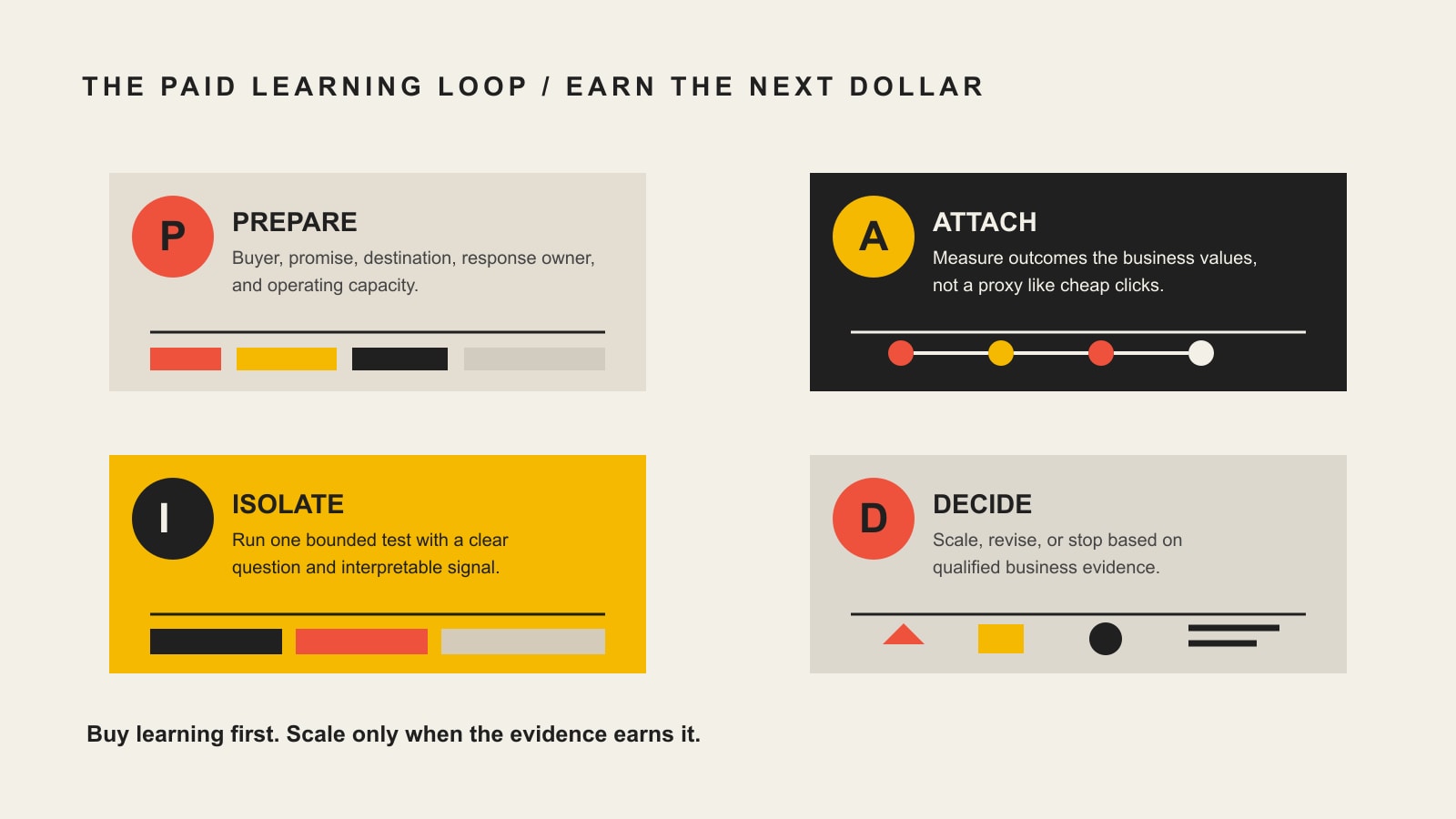
Google Ads cost per click is the amount you pay when someone clicks your ad. Average CPC is total click cost divided by total clicks. You can often lower it by changing bids, targeting less competitive or more relevant searches, excluding waste, improving the ad-to-page experience, and choosing a bidding strategy that matches the real objective.
But lower CPC is not the goal. Profitable customer acquisition is the goal. A $3 click that produces nothing is infinitely expensive. A $30 click can be a bargain when it becomes a qualified, profitable customer. Optimizing CPC without tracking what happens after the click is how a dashboard gets prettier while the bank account remains stubbornly unimpressed.
TL;DR: How do you lower Google Ads CPC without wrecking results?
- Confirm what average CPC measures: total click cost divided by clicks.
- Diagnose whether the apparent problem is auction pressure, poor query fit, aggressive bids, weak relevance, bad conversion tracking, low qualification, or weak sales economics.
- Review actual search terms and exclude irrelevant demand before hunting for cheaper keywords.
- Match bidding to the business goal. Maximize Clicks seeks clicks; conversion and value-based strategies seek different outcomes.
- Strengthen the relevance chain from search intent through ad promise and landing-page answer.
- Measure cost per qualified outcome and cost per customer—not only CPC or raw form submissions.
- Accept a higher CPC when it buys more valuable demand at better overall economics.
- Do not promise a universal percentage reduction. CPC is auction-specific, and the same change can produce different results in different markets.
In this guide
What does cost per click mean in Google Ads?
Cost per click, or CPC, is the price charged when someone clicks an ad. With manual CPC bidding, you may set a maximum CPC—the most you are typically willing to pay for a click. Your actual CPC is the final amount charged, which is often lower than that maximum.
Google defines average CPC with a simple formula:
Average CPC = total cost of clicks ÷ total clicks
If a campaign spends $1,000 and receives 100 clicks, its average CPC is $10. That calculation is exact. Whether $10 is good is an entirely different question.
According to Google’s explanation of actual CPC, the auction typically charges what is minimally required to clear Ad Rank thresholds and beat the Ad Rank of the competitor immediately below. Auction-time ad quality, the bid, thresholds, competition, search context, and the expected impact of assets and formats all contribute to Ad Rank and actual CPC.
That is why there is no single “normal” Google Ads CPC. The price varies by search, industry, location, device, position, competition, objective, and the value advertisers expect from winning that moment.
What is a good Google Ads cost per click?
A good CPC is one that allows the campaign to acquire qualified customers or another valuable outcome at acceptable economics. Industry averages can provide context, but they cannot tell you what your business can afford.
The useful question is not:
Is our CPC below the industry average?
It is:
Does this CPC produce enough qualified value after conversion, sales, fulfillment, and margin are considered?
Imagine two campaigns:
| Campaign | Average CPC | Clicks | Customers | Cost per customer |
|---|---|---|---|---|
| Cheap clicks | $4 | 250 | 1 | $1,000 |
| Expensive clicks | $20 | 50 | 5 | $200 |
Both spend $1,000. The campaign with five-times-higher CPC acquires customers at one-fifth the cost. The numbers are illustrative, but the principle is real: click price without downstream quality is nearly useless.
The Scope Design Click Economics Chain
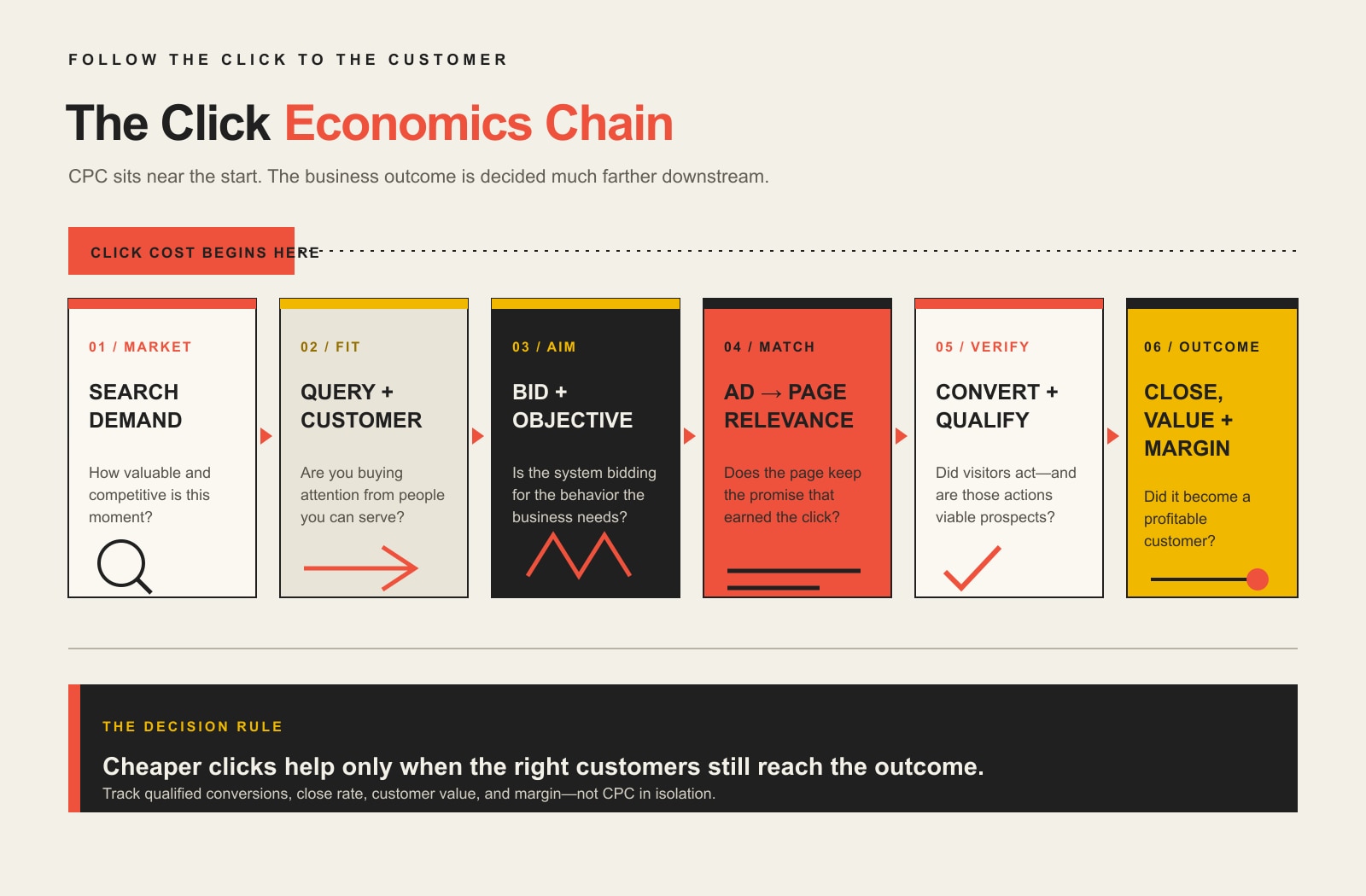
To diagnose CPC without becoming hypnotized by it, trace six connected layers:
- Search demand and auction pressure: How valuable and competitive is the moment?
- Query and customer fit: Are you buying attention from people the business can actually serve?
- Bid and objective: What is the bidding system instructed to pursue?
- Ad-to-page relevance: Does the promise earn the right click and continue coherently on the destination?
- Conversion and qualification: Do visitors take meaningful actions, and are those actions from viable prospects?
- Close rate, value, and margin: Do qualified opportunities become profitable customers?
CPC lives near the top of this chain. Profit lives at the bottom. Cutting cost at the top can damage value below it.
This is the paid-search version of buying bargain lumber for a building and celebrating before anyone checks whether the framing can hold up the roof. Cheap inputs are only useful when the finished system works.
The math that makes CPC useful
You do not need a finance degree, a crystal ball, or an agency report with seventeen gradients. You need a few connected rates.
Cost per website conversion
Cost per conversion = average CPC ÷ landing-page conversion rate
At a $10 CPC and a 5% conversion rate, the expected cost per recorded conversion is $200:
$10 ÷ 0.05 = $200
This assumes one click opportunity per conversion and a stable conversion rate. Real attribution and repeat visits can complicate the picture, so use the formula as a diagnostic model rather than holy scripture.
Cost per qualified outcome
Raw conversions are easy to inflate. Add qualification:
Cost per qualified outcome = average CPC ÷ conversion rate ÷ qualification rate
At a $10 CPC, 5% conversion rate, and 50% qualification rate:
$10 ÷ 0.05 ÷ 0.50 = $400
If a form simplification raises conversion rate to 8% but qualification drops to 20%, cost per qualified outcome becomes $625. The conversion report improves while the business result gets worse. Congratulations on moving the mess into someone else’s calendar.
Cost per acquired customer
Add the close rate:
Cost per customer = average CPC ÷ conversion rate ÷ qualification rate ÷ close rate
Using the previous example and a 25% close rate:
$10 ÷ 0.05 ÷ 0.50 ÷ 0.25 = $1,600
Now compare that acquisition cost with gross profit or contribution margin, not merely top-line revenue. A $2,000 sale with $300 of contribution cannot support a $1,600 acquisition cost merely because the revenue number looked impressive in a slide deck.
Break-even CPC
A simplified break-even model works backward:
Break-even CPC = allowable customer acquisition cost × conversion rate × qualification rate × close rate
If the business can afford $1,000 to acquire a customer, the landing page converts 5%, half the inquiries qualify, and 25% of qualified opportunities close:
$1,000 × 0.05 × 0.50 × 0.25 = $6.25
That does not mean every bid must be capped at $6.25. Automated bidding, assisted conversions, customer lifetime value, refunds, sales labor, and attribution can change the model. It means the business finally has a rational reference point instead of asking whether $6.25 “feels high.”
Expected contribution per click
You can also estimate what a click is worth before media cost:
Expected contribution per click = conversion rate × qualification rate × close rate × contribution per customer
Using a 5% conversion rate, 50% qualification rate, 25% close rate, and $1,000 contribution per customer:
0.05 × 0.50 × 0.25 × $1,000 = $6.25
Subtract average CPC to estimate the contribution remaining after click cost. If the click costs $5, the simplified expected remainder is $1.25. If it costs $8, the path loses $1.75 before fixed overhead and other acquisition costs.
This model becomes more useful when the inputs come from actual CRM, sales, refund, and margin data. It becomes decorative algebra when everyone quietly guesses the rates and then formats the result to two decimal places.
Why is Google Ads CPC so high?
High CPC is a symptom with several possible causes. Diagnose before prescribing.
The auction is genuinely competitive
Some searches carry strong commercial intent and large potential customer value. More advertisers compete, bids rise, and Ad Rank thresholds for prominent positions may be higher. Google notes that actual CPC for ads above search results is often higher than for ads below them because prominent locations carry different thresholds and value.
You cannot optimize away the existence of competitors. You can decide which auctions deserve your money.
Your queries are too broad or poorly matched
Keywords are targeting instructions; search terms are what people actually searched. The distinction matters. A keyword can enter auctions for queries with different intent, urgency, geography, or fit.
Use the Google Ads search terms report to find relevant phrases worth developing and irrelevant searches that may need negative keywords. Do not add negatives blindly. A word that looks wasteful in isolation may appear inside a valuable query.
The bidding objective values the wrong behavior
Maximize Clicks is designed to seek the most clicks within a budget. That can be appropriate when traffic is genuinely the objective. It is not the same as seeking qualified leads, sales, profit, or conversion value.
Google’s bid-strategy guidance separates click, visibility, conversion-volume, and conversion-value goals. If the business needs qualified value but tells the platform to maximize click volume, cheap clicks may be the system working exactly as instructed.
Your ad and landing page are a weak match
Auction-time quality includes expected CTR, ad relevance, and landing-page experience. A weak path can increase the amount required to compete and waste the click after it arrives.
Our guide to Google Ads Quality Score explains the diagnostic in detail. The short version: fix the connection from search intent to keyword, ad promise, landing-page answer, and measured business action. Do not chase the visible 1–10 number as a KPI.
Your targeting enters expensive contexts
Device, location, time, audience, network, match behavior, and other context can change which auctions you enter. Segment performance before assuming an account-wide CPC problem. A high-CPC location may also produce the best customers. A low-CPC device may generate accidental clicks and no qualified action.
Your market or strategy changed
Competition, seasonality, product demand, budgets, bidding targets, creative, landing pages, conversion tracking, and account structure all move. A rising CPC with no obvious manual change does not mean nothing changed. The auction is not a fixed-price vending machine.
How to lower Google Ads CPC responsibly
The safest reductions remove waste or improve relevance without sacrificing qualified demand.
1. Validate conversion tracking first
Test the actual forms, calls, purchases, bookings, and imports. Check for duplicate events, dead notifications, thank-you-page reloads, accidental button-click conversions, and conversions that do not reflect customer value.
Automated bidding uses the signals you provide. Bad tracking is not a harmless reporting inconvenience. It teaches the system to pursue the wrong behavior with machine-speed confidence.
2. Separate raw conversions from qualified outcomes
Define what makes a lead viable: service, geography, budget, authority, timing, problem, or another business-specific criterion. Connect advertising data to CRM status, sales-qualified opportunity, purchase value, or an equivalent downstream result where feasible.
Google’s conversion-value documentation explains how different values can help measure and optimize business impact rather than treating every conversion as identical. A spam form and a $50,000 opportunity should not both receive a cheerful value of one.
3. Read the search terms
Classify actual searches by intent and fit. Look for:
- services or products you do not offer;
- locations you cannot serve;
- job, support, free, DIY, definition, or research intent when it conflicts with the campaign’s job;
- comparison and pricing searches that need a different page;
- valuable queries hidden inside a broad theme;
- repeated language customers use that your ads ignore.
Add negative keywords for demonstrably irrelevant intent. Create new themes when a materially different query needs a different ad, page, offer, or measurement path. Do not build a negative-keyword fortress that blocks every unfamiliar phrase before it has a chance to prove value.
4. Decide which auctions are worth entering
Cheaper demand is not automatically equivalent demand. Evaluate search intent, likely customer value, volume, competitive pressure, and business fit together.
Longer, more specific searches can be less competitive, but “long-tail” is not a coupon code. Some specific legal, medical, software, or industrial queries are expensive precisely because they signal valuable intent. Choose them because the economics work, not because a blog post promised cheap clicks in bulk.
5. Improve the ad-to-page relevance chain
Use clear ads that accurately preview the destination and help bad-fit searchers self-select out. Match the landing-page opening to the search and ad. Answer the questions required for the decision. Include relevant proof. Make the page usable on mobile. Ask for an action appropriate to the buyer’s stage.
Our landing-page optimization guide covers this as an intent contract: known arrival, matched promise, relevant proof, appropriate action, and operational follow-through.
Improved relevance may help auction economics. More importantly, it prevents you from paying for a click and then breaking the promise yourself.
6. Match the bid strategy to the objective
Google Ads offers strategies designed around different goals:
| Business need | Strategy family | What the system is asked to pursue |
|---|---|---|
| Traffic | Maximize Clicks | More clicks within the budget |
| Visibility | Target Impression Share | A chosen level or location of visibility |
| Conversion volume | Maximize Conversions or Target CPA | More conversions or conversions around a target cost |
| Conversion value | Maximize Conversion Value or Target ROAS | More reported value or value around a return target |
Google began changing some Smart Bidding labels in June 2026, while stating that the underlying behavior remains the same. Use the current interface names, but choose based on the business goal—not whichever recommendation card appears most enthusiastic.
Smart Bidding uses auction-time signals to optimize for conversions or conversion value. It can operate without prior campaign data, but Google notes that historical conversion data can improve calibration and that recommendations vary by campaign and strategy. There is no responsible universal rule that every business must switch after exactly 30 conversions.
7. Set targets from economics, not aspiration
A Target CPA lower than the auction and conversion path can sustain may restrict volume or push the system toward lower-value opportunities. A Target ROAS based on inflated or incomplete conversion values optimizes a fiction.
Build targets from allowable acquisition cost, margin, cash flow, sales capacity, conversion delay, repeat value, and the reliability of the signal. Then watch whether the target produces enough volume and quality to matter.
8. Use experiments and bounded changes
Change one coherent part of the diagnosis: search coverage, negatives, ad promise, landing-page path, conversion goal, bid strategy, or target. Document the date and expected effect. Allow for conversion delay and sufficient evidence before judging.
Google advises allowing at least a conversion cycle before evaluating many Smart Bidding changes. Constant target edits can make the business feel busy while making cause and effect impossible to separate.
When a higher CPC is the better result
A rising CPC may be acceptable—or desirable—when it accompanies:
- a higher qualified-lead rate;
- a better lead-to-opportunity or close rate;
- larger or more profitable customers;
- stronger conversion value per click;
- fewer low-value inquiries consuming sales time;
- entry into a valuable new market;
- improved top-of-page eligibility for searches proven to matter;
- lower cost per customer despite higher click cost.
For example, shifting from generic “business software” searches to specific “manufacturing inventory software implementation” searches might increase CPC and dramatically improve fit. The expensive click is doing more work.
Do not use that argument to excuse any high CPC. Use it to insist on complete measurement.
When a lower CPC is a warning
CPC can fall because:
- ads moved into weaker positions;
- search coverage expanded into lower-intent queries;
- targeting shifted to locations or devices that do not convert;
- a traffic-focused strategy found abundant cheap clickers;
- brand traffic diluted more expensive non-brand demand;
- competitors left auctions whose customers you also wanted;
- the ad became click-friendly and qualification-hostile.
Always ask what changed in impressions, search terms, position, conversions, qualification, customer acquisition cost, and value. A cheaper click is a clue, not a standing ovation.
How much daily budget do Google Ads need?
Questions such as “Is $10 or $20 a day enough?” appear frequently in search. The honest answer is: enough for what, in which auction, over what learning period?
A daily budget should be evaluated against expected CPC, available qualified search volume, conversion rate, sales economics, and how much evidence is needed to make a decision.
At a $20 daily budget and $10 average CPC, the campaign may receive roughly two clicks per day on average. If the landing page converts 5% of clicks, the simplified expectation is one conversion per 20 clicks—or about ten days before qualification and sales outcomes are considered. Randomness means actual results will not arrive on schedule like a commuter train.
A small budget can be useful for a narrow market, a bounded learning objective, or a high-margin business willing to wait. It is inadequate when it spreads across too many services, locations, and intentions to produce interpretable evidence.
This article owns click economics, not a universal Google Ads pricing table. A separate cost-and-budget guide should compare campaign goals, market demand, management cost, creative and landing-page work, and the evidence threshold required for a useful test.
A practical CPC audit sequence
Use this order:
- Confirm tracking: Do conversions fire, arrive, and represent useful actions?
- Calculate the chain: CPC, conversion rate, qualification rate, close rate, customer acquisition cost, value, and margin.
- Segment the result: Campaign, search term, keyword/theme, landing page, device, geography, time, and audience where relevant.
- Read actual searches: Identify valuable demand, ambiguity, and demonstrable waste.
- Check the objective and bid strategy: Is the system pursuing clicks, visibility, conversions, or value?
- Inspect relevance: Does the search, ad, page, and action form one coherent promise?
- Find the binding constraint: Auction cost, query fit, bidding, page conversion, qualification, sales follow-up, or offer economics.
- Make one bounded intervention: Define what should change and what would disprove the diagnosis.
- Wait for complete outcomes: Respect conversion delay and sales-cycle length.
- Judge the business result: Keep the change only if qualified economics or useful learning improve.
If the account lacks enough volume for a controlled test, use stronger qualitative evidence: search terms, recorded calls with permission, form details, sales objections, customer interviews, and the difference between won and lost opportunities. Low traffic does not justify guessing with greater confidence.
Frequently asked questions about Google Ads CPC
What is cost per click in Google Ads?
Cost per click is the amount charged when someone clicks an ad. Average CPC equals total click cost divided by total clicks. Actual CPC is the final price of a specific click and is often lower than a manual maximum CPC bid.
What determines actual CPC?
Google says actual CPC reflects what is needed to clear Ad Rank thresholds and compete with the advertiser below. Auction-time ad quality, bids, thresholds, competition, search context, and the expected impact of assets and formats contribute to Ad Rank and price.
What is a good Google Ads CPC?
A good CPC supports an acceptable cost per qualified customer or other valuable outcome. Compare it with conversion rate, qualification, close rate, customer value, and margin. An industry average cannot determine what your business can profitably afford.
Why is my Google Ads CPC so high?
Possible causes include intense competition, commercially valuable searches, aggressive bids or targets, broad or poor-fit query coverage, weak ad-to-page relevance, prominent positions, targeting context, seasonality, and market changes. Segment the account before choosing a fix.
How can I lower CPC in Google Ads?
Remove irrelevant search demand, improve the ad-to-page relevance chain, choose auctions deliberately, match bidding to the correct objective, set economically realistic targets, and improve conversion and value signals. Lower bids can reduce CPC but may also reduce eligibility, position, volume, or value.
Is lower CPC always better?
No. Lower CPC is better only when the downstream outcome remains equal or improves. Cheap clicks that produce unqualified leads or no sales can create a higher customer acquisition cost than expensive, high-intent clicks.
Does Quality Score affect CPC?
The visible 1–10 Quality Score is not an auction input, but related auction-time quality factors can influence Ad Rank and actual CPC. Use Quality Score to diagnose relevance, then judge changes by qualified business outcomes.
Do negative keywords lower CPC?
Negative keywords can prevent ads from entering irrelevant searches, reducing wasted spend and changing the campaign’s average CPC. They do not guarantee cheaper clicks. Their more important job is improving search fit and protecting budget for demand the business wants.
Should I use Manual CPC or Smart Bidding?
Choose based on the objective, tracking quality, available evidence, operational capacity, and need for control. Smart Bidding optimizes at auction time for conversions or value; Manual CPC provides direct bid control. Neither repairs bad measurement or a weak offer.
Can I set a maximum CPC with automated bidding?
Capabilities vary by strategy. Manual CPC uses max CPC bids, and Maximize Clicks can support a maximum CPC limit. Conversion and value-based Smart Bidding strategies use auction-time bids around their objectives and constraints. Check the current strategy settings rather than assuming one account-wide cap applies.
Is $10 or $20 per day enough for Google Ads?
It can be enough for a narrow test or low-cost market, but not by universal rule. Divide the budget by expected CPC, then consider how many clicks are required to observe conversions, qualified outcomes, and sales. A small budget spread across too many variables may never produce useful evidence.
How often should I change Google Ads bids or targets?
Change them when business objectives, economics, or sufficient performance evidence justify it. Account for conversion delay and allow enough time to observe complete outcomes. Constant changes make diagnosis difficult and can move campaigns into different auctions before results mature.
Stop asking whether the click is cheap
Ask whether the click belongs in the campaign, receives an honest and relevant promise, reaches a useful destination, becomes a qualified opportunity, and produces enough value to justify its cost.
That is the actual job.
Use the Scope Design Marketing & Advertising guide to place paid search inside the wider marketing system. Use the Google Ads Quality Score guide when the relevance diagnostic needs deeper investigation. Use the Analytics & SEO measurement guide when traffic and platform metrics are not connected to useful business outcomes.
If your CPC report looks alarming but nobody can explain which searches become profitable customers, talk with Scope Design. We will diagnose the auction, query, ad, page, measurement, and sales path before prescribing cheaper traffic that may be worth even less.