Tag: entrepreneurship

  • Business Owner vs Entrepreneur: 6 Differences That Actually Matter

    Business Owner vs Entrepreneur: 6 Differences That Actually Matter

    A business owner and an entrepreneur are not opposite job titles. A business owner owns a business and may also be deeply involved in operating it. An entrepreneur is someone acting entrepreneurially—pursuing an opportunity, assembling resources, testing uncertainty, and trying to create new value. One person can be both, and the same company can move between the two modes over time.

    That is the useful answer to business owner vs entrepreneur. The difference matters less as an identity test and more as an operating-model question: What kind of opportunity are you pursuing, how much uncertainty are you accepting, how dependent is the company on you, and what does success require next?

    At Scope Design, we use a six-axis operating-model test to make that question practical. It compares market novelty, growth ambition, repeatability, founder dependence, capital and uncertainty, and the success horizon. The point is not to earn an “entrepreneur” badge. The point is to make strategy, marketing, systems, hiring, and measurement fit the business you are actually building.

    Business owner vs entrepreneur: the quick comparison

    QuestionOwner-operated emphasisEntrepreneurial emphasis
    What is being described?Ownership, often combined with an operating roleOpportunity-seeking behavior and venture building
    Market approachOften serves a known market with a validated offerOften tests a new offer, category, model, or underserved opportunity
    Growth goalMay prioritize durable profit, control, income, and customer valueMay prioritize scalable reach, rapid learning, market expansion, or enterprise value
    Founder roleThe owner may remain central to delivery and decisionsThe venture often needs systems that can outgrow the founder
    Risk and capitalMay favor bounded risk and cash-flow-funded growthMay accept more uncertainty or outside capital when the opportunity requires it
    Success metricsProfitability, cash flow, retention, owner income, resilienceValidated demand, repeatability, growth, unit economics, distribution, enterprise value
    These are tendencies, not rules. A local service company can innovate aggressively, and a venture-backed startup can become a disciplined operating business.

    The table is deliberately cautious. Plenty of articles turn this comparison into personality theater: entrepreneurs are fearless innovators; business owners are cautious operators. Real companies are messier. A restaurant owner can create a new service model. A software founder can spend years optimizing a mature product. A second-generation family business can enter a new market more entrepreneurially than a startup that is merely copying an existing app.

    Ownership and entrepreneurship are different kinds of labels

    The cleanest way to avoid bad definitions is to separate legal ownership from entrepreneurial action.

    The IRS business-structure guidance lists common forms such as sole proprietorships, partnerships, corporations, S corporations, and limited liability companies. “Entrepreneur” is not a federal entity or tax classification. You do not file paperwork that changes an LLC from “business owner” to “entrepreneur.”

    Definitions of entrepreneurship are also less settled than social-media folklore suggests. The OECD working paper reviewed for this article notes a long history of disagreement over the concept and emphasizes the dynamic, action-oriented nature of entrepreneurship. An OpenStax entrepreneurship text makes the overlap explicit: scholars do not completely agree on the boundary, and a small-business owner can also be an entrepreneur. That is a better fit for real business decisions than pretending two mutually exclusive species of businessperson exist.

    So use the words this way: ownership tells you who has the ownership stake and responsibility; entrepreneurial behavior tells you how someone is pursuing an opportunity under uncertainty.

    The Scope Design six-axis operating-model test

    Instead of asking, “Which label am I?” map the business across six dimensions. None of these dimensions is a virtue score. They expose tradeoffs that affect what the company should do next.

    Scope Design’s six-axis operating-model test maps market novelty, growth ambition, repeatability, founder dependence, capital and uncertainty, and success horizon on a practical continuum.

    1. Market novelty: known demand or a new bet?

    An owner-operated business often begins with a reasonably legible market: customers already buy plumbing, bookkeeping, photography, managed IT, commercial printing, or another known category. The strategic problem may be differentiation, local demand, sales efficiency, retention, or margin.

    An entrepreneurial venture may face more category uncertainty. The offer could combine services in a new way, target an overlooked buyer, use a new delivery model, or ask customers to change behavior. That does not make it better. It makes market research and assumption testing more important because the company has less historical evidence to lean on.

    2. Growth ambition: durable economics or scalable expansion?

    A company can be excellent without trying to become enormous. Many owners want a profitable, resilient business that supports employees, serves customers well, produces dependable income, and gives the owner reasonable control over time and risk.

    Other ventures are intentionally designed for expansion across locations, markets, channels, or users. That model puts more pressure on distribution, repeatable acquisition, management depth, systems, and economics that still work at larger volume. If scaling is genuinely the objective, our business growth and expansion guide covers the next decision in more depth.

    3. Repeatability: expert craft or a system others can reproduce?

    Some businesses create value through highly customized work. A trusted professional may personally diagnose the problem, sell the engagement, and deliver much of the result. That can be a strong model if pricing, capacity, and customer expectations match it.

    A venture seeking scale usually needs to make more of that value repeatable. The company has to turn founder knowledge into processes, product behavior, training, quality controls, data, or technology. Repeatability does not mean robotic sameness. It means growth does not require reinventing the whole business for every additional customer.

    4. Founder dependence: is the owner the engine or the architect?

    Owner dependence is one of the most useful dimensions because it is observable. If sales stall whenever the owner stops networking, delivery slows whenever the owner leaves, and every exception requires the owner’s approval, the company is founder-dependent regardless of what anyone calls it.

    A more scalable model usually tries to convert the founder from the only engine into the architect of a system. That can mean documented processes, delegated authority, stronger managers, productized delivery, better data, or technology that reduces one-person bottlenecks. The transition is gradual, and plenty of healthy businesses intentionally keep the owner close to customers.

    5. Capital and uncertainty: how much must be risked before the model is proven?

    Do not reduce this axis to “entrepreneurs take big risks.” The better question is: What uncertainty must the business resolve, and what resources must be committed before it resolves it?

    A service business may be able to sell before making large capital commitments. A product venture may need development, inventory, regulatory work, infrastructure, or customer acquisition before the economics are clear. Outside capital can accelerate a model that truly benefits from speed, but it also changes expectations, governance, and the definition of a satisfactory outcome. Funding should fit the business model rather than serve as proof that someone is a “real entrepreneur.”

    6. Success horizon: what outcome is the business designed to produce?

    Two businesses can have the same revenue and require completely different decisions because their owners want different outcomes. One may optimize for owner income, customer relationships, resilience, and a sustainable team. Another may prioritize market expansion, transferable enterprise value, network effects, a future acquisition, or a platform that can operate at much larger scale.

    The correct metrics follow the outcome. Measuring a founder-led professional practice primarily by “market disruption” is silly. Measuring an aggressively scaling venture only by current owner take-home pay can be equally misleading.

    Self-employed vs business owner vs entrepreneur

    This three-way comparison appears frequently because the terms answer different questions.

    • Self-employed describes a work/tax relationship in which a person is in business for themselves, such as a sole proprietor or independent contractor.
    • Business owner describes ownership of a business. An owner may work alone, employ a team, own multiple companies, or be relatively removed from daily delivery.
    • Entrepreneur describes opportunity-seeking activity: organizing resources, testing uncertainty, and trying to create or expand value through a venture.

    The categories overlap. The IRS self-employed individuals guidance treats self-employment as a work and tax-status question—for example, carrying on a trade or business as a sole proprietor or independent contractor, being a member of a partnership, or otherwise being in business for yourself. That still does not tell us whether the person is operating conservatively, building for rapid scale, testing a new market, or combining several modes. Work status and entrepreneurial behavior are different variables.

    Where do “founder” and “CEO” fit?

    These titles get mixed into the same conversation, but they describe still different questions. Founder points to origin: who started the company. Owner points to ownership. CEO points to an executive leadership role. Entrepreneur points to the way an opportunity is being pursued. One person can hold all four descriptions, or a company can separate them among different people as it grows.

    That distinction matters when a company changes stage. A founder can remain an owner after hiring a CEO. An owner can become less involved in operations without giving up ownership. A professional CEO can lead an entrepreneurial expansion without being the original founder. The words are useful when they clarify responsibility; they become harmful when they are used as shortcuts for personality, competence, or ambition.

    Use the operating model to diagnose the first constraint

    Once you know the model, do not jump immediately to “we need more marketing.” The next move depends on what is preventing the objective.

    If the constraint is…The next question is…
    Weak demand evidenceHave we validated the customer, problem, alternatives, willingness to pay, and buying trigger?
    Unclear positioningDoes the right buyer understand what we do, why it matters, and why this option is different?
    Founder dependenceWhich decision, relationship, or delivery step can only the founder perform, and why?
    CapacityShould we raise prices, change scope, hire, automate, productize, or intentionally limit growth?
    Unrepeatable acquisitionWhich customer segment and channel produce qualified demand often enough to justify scaling?
    CapitalWhich milestone would actually reduce uncertainty before we commit more resources?

    This is why the business-owner-versus-entrepreneur comparison should end in a decision system, not a personality quiz. The label is useful only if it helps you see the tradeoff more clearly.

    What the distinction changes in practice

    The comparison becomes valuable when it changes a decision. Scope Design’s broader Business Strategy and Market Intelligence framework starts with the objective and the constraint before choosing tactics. A related Scope sequence is Objective → Constraint → Positioning → Strategy → Tactics → Measurement. Your operating model affects every step.

    Market research and validation

    A known local service category may not need to prove that the category exists. It may need to prove which segments are underserved, what buyers dislike about alternatives, which geographic pockets are attractive, or why the company’s offer deserves attention.

    A more novel venture usually has earlier questions: Is this problem painful enough? Who owns the budget? What workaround does the buyer use today? Will behavior change? Which part of the idea is actually valuable? The less proven the market, the more dangerous it is to substitute founder enthusiasm for customer evidence.

    Positioning and marketing

    An established-category business can often benefit from clarity: exact customer, exact service, exact geography or use case, credible proof, useful differentiation, and a frictionless path to buy. Its marketing may be built around capturing existing demand, referrals, local visibility, retention, and reputation.

    A new-category or behavior-changing venture often has an education problem before it has a traffic problem. Marketing may need to explain the problem, establish a new frame, demonstrate the mechanism, reduce perceived switching risk, and learn which segment understands the value fastest. Pouring money into reach before the positioning works merely buys faster confusion.

    Operations and systems

    A deliberately owner-led company should build enough process to protect quality, margins, customer experience, and the owner’s time. It does not need corporate bureaucracy for sport.

    A company pursuing scalable growth needs earlier attention to dependencies: onboarding, documentation, fulfillment, data, customer support, management authority, capacity planning, and technology. The more growth the model asks for, the more expensive hidden founder dependencies become.

    Funding and financial logic

    Stable cash flow can be a strategic advantage. So can patient capital. So can outside investment in the right model. None of those choices is a personality test.

    Ask what the opportunity requires, what milestones reduce uncertainty, how much control the owners want to keep, what the capital costs, and what happens if growth takes longer than expected. Avoid generic startup statistics that flatten wildly different businesses into one average.

    Hiring and leadership

    An owner-operated company may hire to increase capacity, protect service quality, add a missing specialty, or free the owner from work that should no longer consume their time. A scaling venture may hire to create functions the founder cannot personally run—product, sales, operations, finance, customer success, engineering, or management layers.

    Both need role clarity. The difference is the rate at which organizational complexity becomes a constraint.

    Measurement

    For a durable owner-operated business, useful metrics may include contribution margin, cash flow, lead quality, close rate, retention, utilization, customer concentration, service capacity, and owner dependence.

    For a venture attempting to scale, add evidence about repeatability and growth: activation, cohort retention, acquisition efficiency, sales-cycle movement, payback, unit economics, distribution, expansion, and whether added volume improves or breaks the system. Do not worship venture metrics if the business has no venture-shaped objective.

    Three examples: owner-operated, entrepreneurial, and hybrid

    Example 1: the expert local service company

    A two-location specialty contractor has repeat customers, strong referrals, known services, and healthy demand. The owners want reliable profit, a good team, and fewer operational fires—not a national roll-up. Their best strategy may be better lead qualification, stronger local visibility, standardized estimating, delegation, and customer-retention systems. Calling the owners “less entrepreneurial” would add nothing useful.

    Example 2: the new scalable service model

    A founder notices that a recurring back-office task is painful for hundreds of small firms and designs a technology-assisted managed service. The category is not fully understood, pricing is uncertain, and the service has to become repeatable before growth is economical. The strategic work is validation, positioning, productization, acquisition learning, and reducing founder dependence. This is a more entrepreneurial operating mode because more of the model is still being discovered.

    Example 3: the established business making an entrepreneurial move

    A mature regional company launches a new subscription offer for a customer problem it already understands. The core business remains stable and owner-operated, while the new line behaves like a venture: new positioning, uncertain adoption, different economics, rapid testing, and a need for new systems. The company is both at once.

    This is why the binary breaks. Businesses can move between modes by product, market, geography, or stage. Our guide to business adaptation goes deeper into how operating assumptions should change when the environment changes.

    A 10-question self-check

    Answer these about the business today, not the version you hope to describe at a networking event:

    1. Are customers already accustomed to buying this category of solution?
    2. Is the objective durable owner income, aggressive expansion, transferable enterprise value, or some combination?
    3. Can another trained person or system reproduce the core customer result?
    4. What breaks if the owner disappears for four weeks?
    5. Which assumptions about demand, price, delivery, or adoption are still unproven?
    6. How much capital must be committed before those assumptions become clearer?
    7. Does each additional customer improve the economics, preserve them, or strain the operation?
    8. Does marketing mostly capture existing demand or teach buyers a new way to think?
    9. Which metric would make you change strategy rather than merely celebrate activity?
    10. What is the binding constraint right now: demand, positioning, sales, capacity, repeatability, capital, talent, retention, or something else?

    If those questions expose a difficult tradeoff, use our business decision-making framework. If you are still at the beginning, the hard truths about starting a business are a better next read than another motivational list of entrepreneur traits.

    Common myths about business owners and entrepreneurs

    Are all business owners entrepreneurs?

    Not necessarily, because the terms describe different things. Ownership can exist without much entrepreneurial uncertainty; entrepreneurial action can also happen inside an existing company. A useful answer depends on how the business is being built and changed, not just who owns the shares.

    Can someone be both a business owner and an entrepreneur?

    Yes. In practice, that is common. Someone may own a stable company and still behave entrepreneurially when launching a new offer, entering a new market, building a scalable system, or testing a different business model.

    Do entrepreneurs always take more risk?

    No useful strategy follows from that stereotype. Good entrepreneurs often try to reduce uncertainty with small tests before making larger commitments. A business owner can also take enormous risk through debt, concentration in one customer, a major location expansion, or a poorly tested acquisition. Ask what is uncertain, what is reversible, and what evidence would change the bet.

    Do entrepreneurs create markets while business owners only enter existing ones?

    No. Some entrepreneurs create categories; many improve or recombine existing offers. Existing business owners routinely introduce new products, channels, technologies, and market positions. Market novelty is one axis of the operating model, not a membership rule.

    Are business-application numbers the same as new businesses?

    No. The U.S. Census Bureau’s Business Formation Statistics definitions distinguish a business application—based on an EIN application—from the later formation of an employer business. That is why this revision does not use a dramatic monthly “new businesses” number as shorthand for completed company formations.

    Which path is better?

    Neither. “Business owner” and “entrepreneur” are poor rankings of human ambition. A profitable ten-person company that gives its team stable work and its customers excellent service is not a failed startup. A venture designed to solve a problem at much larger scale is not automatically reckless. A hybrid business is not confused merely because it combines both modes.

    The better question is: What are you trying to build, what is preventing it, and what evidence should change your next decision?

    That is the same logic behind Scope Design’s strategy-to-tactics sequence: objective first, constraint second, positioning and strategy next, tactics after that, then measurement. A label can help you describe the situation. It should never be allowed to choose the strategy for you.

    Sources and methodology

    Need to turn the diagnosis into a business decision? Start with Scope Design’s Business Strategy and Market Intelligence framework. It is built for the question underneath the label: where the business is trying to go, what is actually constraining it, and which bet deserves resources next.

  • How to Validate a Business Idea Before You Bet the Business

    How to Validate a Business Idea Before You Bet the Business

    To validate a business idea, identify the assumption most likely to kill it, run the smallest real-world test that could prove that assumption wrong, and decide in advance what evidence would justify the next commitment. Compliments, survey answers, market-size estimates, and AI scores can help you decide what to investigate. They do not prove that customers will change behavior, approve a budget, pay, stay, or tolerate the real delivery experience.

    The goal is not to prove that the idea will work forever. You cannot. The goal is to make uncertainty cheaper before you make the next expensive or hard-to-reverse bet.

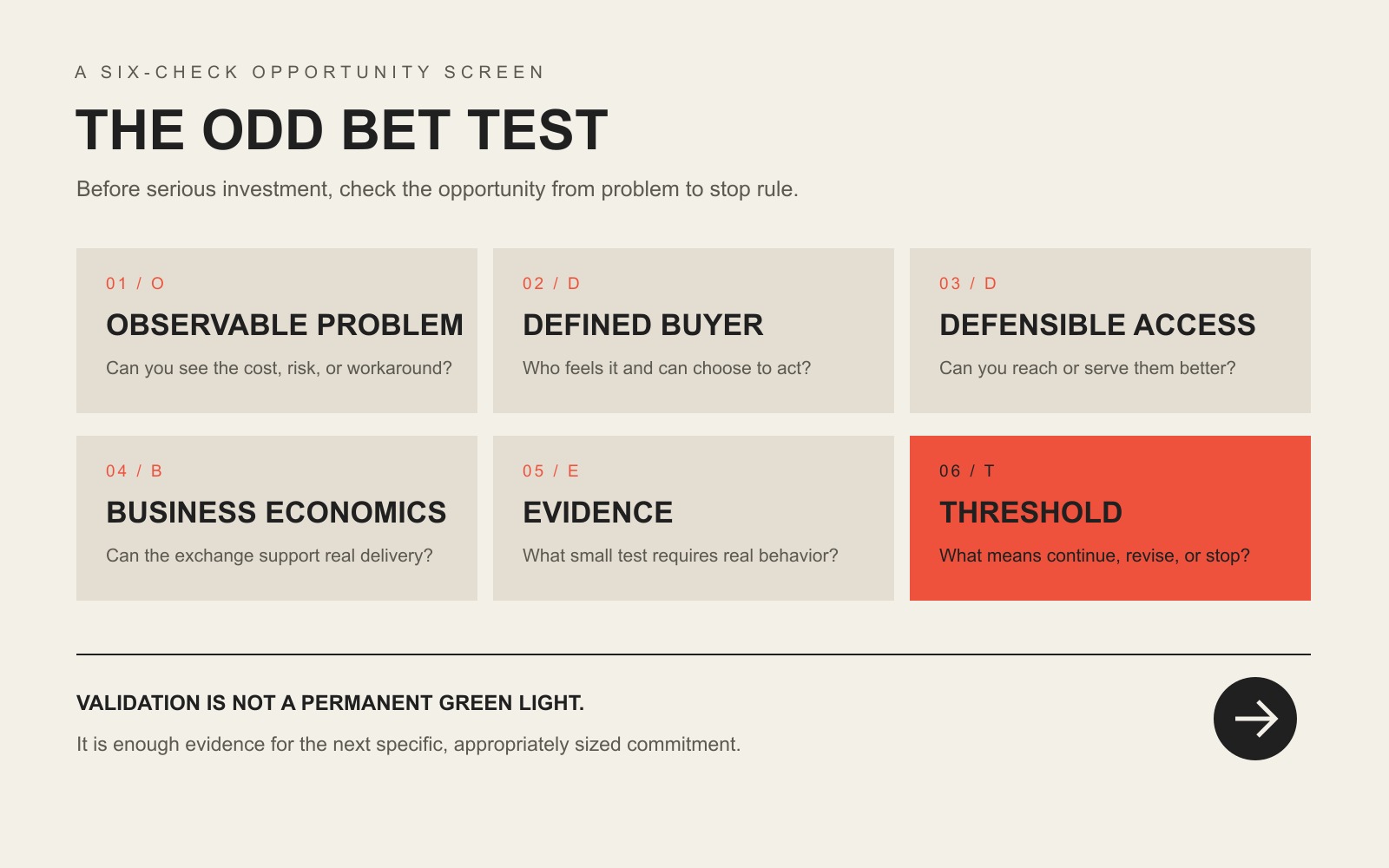
    Scope Design uses the ODD BET Test to diagnose whether an opportunity deserves more time and money:

    • O — Observable problem: Is there a real problem, job, risk, cost, or desire you can observe?
    • D — Defined buyer: Who specifically experiences it and has the ability to act?
    • D — Defensible access or advantage: Can you reach, serve, or solve for that buyer better than realistic alternatives?
    • B — Business economics: Can the exchange plausibly support delivery, acquisition, risk, and continued operation?
    • E — Evidence from the smallest real test: What is the cheapest test that requires meaningful behavior instead of compliments?
    • T — Threshold: What result means continue, revise, pause, or stop before sunk-cost logic takes over?

    If the broader business choices are still fuzzy, start with Scope Design’s business strategy framework. This article goes one level deeper: what evidence is strong enough to justify putting more money, time, reputation, or irreversibility behind one unproven idea?

    What counts as business idea validation?

    Business idea validation is the process of testing the assumptions underneath an idea against evidence that can change a real decision. It is not a confidence exercise and it is not a ceremonial green light.

    A business idea is not validated because your friends like it, competitors exist, an AI tool gives it an 87/100, a survey respondent says they would probably buy, or you have already spent six months building it.

    Useful evidence gets progressively harder to fake. A recurring complaint is better than your own assumption. An observed workaround is better than a complaint. A pilot is stronger than enthusiasm. A deposit, purchase, repeat use, renewal, or expansion can be stronger still because the customer has more at stake.

    Even strong evidence has limits. One purchase does not prove retention. One paid pilot does not prove scalability. A waitlist does not prove profitable demand. Validation means the evidence is good enough for the next specific bet, not that the whole business has been permanently proven.

    Why “foolish” business ideas are the wrong lesson

    The old version of this article focused on apparently ridiculous ideas that became successful businesses. That makes a good story and a lousy decision rule. Looking backward at famous winners hides the huge number of strange ideas that stayed strange and unprofitable.

    The useful question is not, “Does this sound crazy enough to be innovative?” It is: What would have to be true for this opportunity to work, and what evidence can we get before betting heavily on those assumptions?

    Ridicule and enthusiasm are both weak evidence. People can dismiss something valuable. They can also praise something they will never buy. The market does not owe either group a satisfying ending.

    First, separate an idea from an opportunity

    An idea is a proposed way to create value. An opportunity is an idea connected to enough evidence that a specific customer problem, reachable market, workable exchange, and feasible operating model may exist.

    If you are still generating or screening raw ideas, use Scope Design’s business idea generation process and pre-validation profit screen first. Validation becomes useful after you have a specific buyer-problem-solution hypothesis worth testing.

    The ODD BET Test: six checks before serious investment

    The ODD BET Test checks for an Observable problem, Defined buyer, Defensible access, Business economics, Evidence from a real test, and a decision Threshold.

    O: Is there an observable problem?

    Start with reality, not the solution you are already attached to. What is happening today that makes somebody spend money, waste time, accept risk, build a workaround, delay a goal, or tolerate an ugly process?

    The U.S. Small Business Administration’s current planning guidance treats market research as a way to reduce uncertainty while an idea is still being evaluated and points owners toward demand, market size, location, saturation, pricing, and competitors. That is useful groundwork. It does not by itself prove that a specific buyer will act. For a deeper research process, use our small-business market research guide.

    • Look for repeated descriptions of the same frustrating job.
    • Observe spreadsheets, manual workarounds, staff time, hacks, or existing purchases devoted to the problem.
    • Document delays, errors, risk, lost opportunities, or costs buyers can describe concretely.
    • Notice regulations, technology shifts, cost changes, or workflow changes that create new pain.

    If you cannot describe the problem without naming your product, you probably understand the solution better than the opportunity.

    D: Is the buyer defined tightly enough to test?

    “Small businesses,” “busy professionals,” and “people who care about wellness” are not buyers. A useful target is specific enough that you can find people, recognize the purchase context, and distinguish the person with the problem from the person who approves or pays.

    • Who experiences the problem?
    • Who feels the consequence?
    • Who chooses the solution?
    • Who pays or approves the budget?
    • What event creates urgency?
    • What alternatives do they already use?

    A market-size estimate can tell you that a population exists. It cannot tell you how many members feel the problem, trust your solution, have budget, or care right now.

    D: Do you have defensible access or advantage?

    A real problem and buyer still do not guarantee a business opportunity. You need a credible way to enter the exchange.

    • Can you reach the buyer without an acquisition cost the model cannot support?
    • Do you understand the workflow unusually well?
    • Do you have trust, distribution, expertise, relationships, data, or technical capability that matters?
    • Can you deliver faster, more safely, more simply, or in a form customers prefer?
    • Why have obvious alternatives not already solved the problem?

    “Nobody else is doing this” may signal an overlooked opportunity. It may also signal weak demand. “Lots of competitors exist” may mean a crowded category—or that buyers already understand the problem and spend money solving it. Competition is evidence to interpret, not a stop sign or permission slip.

    B: Do the economics work before fantasy volume arrives?

    An idea can create value and still be a terrible business. Model the sale you can deliver now, not the imaginary future version where scale removes every inconvenience.

    • realistic price or price range;
    • direct cost to deliver;
    • sales and acquisition burden;
    • onboarding, support, returns, refunds, rework, or warranty risk;
    • payment timing and working capital;
    • capacity consumed per customer;
    • repeat purchase or retention assumptions where relevant;
    • fixed costs the offer eventually needs to support.

    Use ranges and explicit assumptions. If the opportunity works only when every uncertain number lands in the optimistic column, you have not found a business model. You have built a motivational spreadsheet. For deeper price testing, use Scope Design’s product-pricing framework.

    Use the BET Validation Ladder inside the evidence and threshold stages

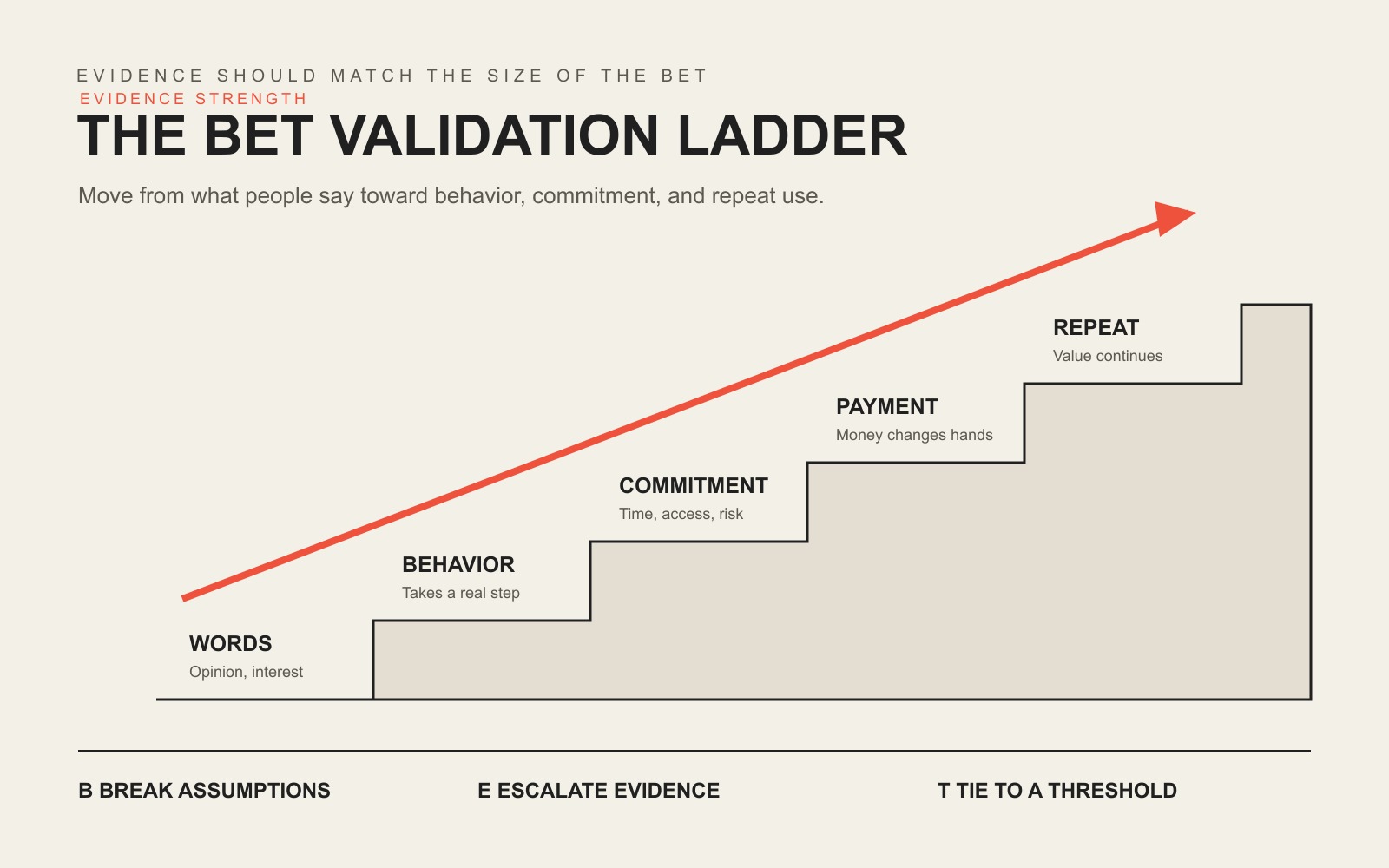
    ODD BET diagnoses the opportunity. The BET Validation Ladder keeps the E and T stages tied to the decision you actually face:

    • B — Break the idea into falsifiable assumptions. Stop evaluating “the idea” as one giant blob. Name what must be true about the problem, buyer, urgency, price, channel, delivery model, and economics.
    • E — Escalate the strength of the evidence. Start cheaply, but do not confuse low-consequence signals with proof. Move from words toward behavior, commitment, payment, and repeat behavior when the decision requires stronger evidence.
    • T — Tie the next bet to a threshold. Decide what result means proceed, pause, pivot, or stop before you see the result. Otherwise enthusiasm moves the goalposts for you.
    The BET Validation Ladder escalates evidence from words to behavior, commitment, payment, and repeat behavior, with the next bet tied to a threshold.

    The ladder matters because “validated idea” is too binary. A few useful interviews may justify a rough prototype. They are usually not enough evidence to justify quitting a stable job, signing a long lease, hiring a full-time team, or spending six figures on custom software. The size and reversibility of the next commitment should influence the evidence burden.

    Break the idea into claims that can fail

    Write the opportunity as a set of claims that could be wrong. For example:

    • The problem is real, recurring, and important enough to change behavior.
    • The person with the problem can influence or control the purchase.
    • Existing alternatives leave a meaningful gap.
    • The buyer will accept a price that can support delivery.
    • You can reach qualified buyers through a viable channel.
    • The solution can be delivered with acceptable cost and operational burden.

    Then rank those assumptions by danger. The highest-risk assumption is not always “will people buy?” In one business it may be customer access. In another it may be regulation, fulfillment, channel economics, behavior change, or retention.

    Escalate evidence without pretending one signal proves everything

    Evidence levelWhat it can tell youWhat it cannot prove
    WordsThe buyer recognizes a problem, story, or conceptThat they will change behavior or pay
    Observed behaviorThe problem already creates workarounds, search, effort, or switching attemptsThat your offer will win
    Meaningful commitmentThe buyer accepts time, access, reputation, setup, or another real frictionThat the economics will scale
    PaymentAt least some buyers will exchange money for the offerRetention, repeatability, or long-term profitability
    Repeat behaviorValue persists enough to drive renewal, reuse, repeat purchase, or expansionThat every acquisition or operating constraint is solved

    No stage is universally “best.” Evidence strength depends on the assumption. A regulatory constraint may need authoritative legal or technical evidence. A willingness-to-pay assumption needs economic behavior. A delivery-risk assumption needs real delivery experience.

    Tie the next bet to a decision threshold set before the result

    Before a test, write three outcomes:

    • Continue: What evidence would justify the next investment?
    • Revise or pivot: What result would support the problem but challenge the buyer, offer, channel, price, or delivery model?
    • Pause or stop: What result would make the core assumption too weak to justify more investment?

    There is no universal pass rate. Use the SCOPE business decision-making framework when you need to match decision rigor to stakes, reversibility, uncertainty, and consequences.

    Run a seven-step business idea validation sprint

    1. Write the next decision in one sentence

    Do not start with “Is this a good idea?” Start with the decision you actually face: build a rough prototype, spend $1,000 testing acquisition, add a second service area, order inventory, sign a lease, hire, or hold.

    2. List what must be true

    Separate demand assumptions from delivery assumptions. Write the buyer, problem, urgency, alternatives, price, reach, fulfillment, margin, and repeat-behavior claims plainly enough that evidence could prove them wrong.

    3. Choose the assumption that could kill the bet fastest

    Do not average away the ugly unknown. Test the assumption whose failure would change the decision most.

    4. Pick the cheapest test that could actually change your mind

    If every possible result leads to “keep going,” you designed reassurance, not validation. Choose a test with a credible failure state.

    5. Set the threshold and stopping rule

    Define success, ambiguity, and failure before the result. Put time, money, sample, or exposure bounds around the experiment so it cannot turn into endless research.

    6. Run the test with people who can create the real outcome

    Friends and friendly peers can improve your wording. They are not substitutes for qualified buyers, budget owners, users, or operators who can generate the behavior you need to observe.

    7. Decide: keep, kill, pivot, or escalate

    A failed small test can be a successful business decision if it saves a larger spend. If the evidence clears the threshold, increase the bet only enough to address the next major uncertainty.

    How much evidence is enough before the next bet?

    The evidence burden should be proportional to the next commitment. Use this as a decision map, not a universal benchmark:

    Next commitmentEvidence that may be proportionateSlow-down signal
    Weekend rough prototypeRecurring problem patterns from qualified customersYou still cannot name the buyer, problem, or current workaround
    Small acquisition budgetA specific offer, audience, conversion action, and pre-set learning thresholdYou are buying traffic before defining what behavior would count as validation
    Custom software buildRepeated workflow evidence, manual delivery that works, and buyers who value the outcomeYou are using software to discover whether the problem exists
    Hire for a new offerRecurring demand, visible workload, workable margin, and a legible delivery processOne unusually large customer is being mistaken for repeatable demand
    Long lease or expensive equipmentLocation-specific demand plus realistic utilization, capacity, and economicsThe evidence comes from a different market or optimistic utilization assumptions
    Quit stable income or make another major personal leapEvidence appropriate to your runway, obligations, demand, economics, and personal risk toleranceA generic article is being used as individualized financial advice

    A business article cannot decide your personal runway, debt capacity, family obligations, financing terms, or risk tolerance. If you are still sorting out startup readiness rather than a specific validation test, read the hard truths about starting a business before escalating the bet.

    Match the validation method to the assumption

    Customer interviews: learn context and past behavior

    Ask about the last time the problem occurred, what triggered it, what the customer did, what alternatives they considered, what it cost, who approved the decision, and what happened afterward. Interviews are discovery evidence. They do not prove payment.

    Market and competitor research: map the reality around the test

    Use research to locate plausible buyers, alternatives, saturation, pricing ranges, channels, and constraints. The SBA’s current planning resources are useful for this boundary: market research can reduce uncertainty and improve an idea, but it is not the same thing as watching a customer make a real commitment.

    Concierge or manual delivery: test the outcome before automation

    For services and software-enabled workflows, manually deliver the result before building a large system. This exposes value, support burden, edge cases, and operational cost while the bet is still reversible.

    Landing page or smoke test: test message and behavior honestly

    A landing page can test whether a defined audience responds to a real proposition. Keep the offer truthful. The Federal Trade Commission’s business guidance says advertising claims should be truthful and non-deceptive; do not invent customers, fake proof, or imply capabilities you do not have simply because the page is “only a test.”

    Paid pilot, deposit, or preorder: add economic friction carefully

    Real economic commitment can be stronger than stated interest, but it still does not prove retention, scale, support burden, or profitable delivery. If you take real online orders for merchandise, promised shipment timing needs a reasonable basis; the FTC’s Mail, Internet, or Telephone Order Merchandise Rule includes delay, consent, and refund obligations. Verify the rules that apply to your offer and jurisdiction before taking money.

    Pricing and choice tests: test the tradeoff, not “what would you pay?”

    Compare realistic packages, observe what buyers already spend, and test paid offers where appropriate. Price is part of the business model, not a detail added after validation.

    Prototype or MVP: test the riskiest experience, not every feature

    A minimum viable product is useful when product experience itself is the uncertainty. It is wasteful when a cheaper manual test could answer the real question first.

    What business idea validation cannot prove

    • Interviews cannot prove that customers will pay.
    • A waitlist cannot prove viable acquisition economics.
    • A paid pilot cannot prove scalable delivery.
    • First sales cannot prove retention or repeatability.
    • Competitors cannot prove that your version will win.
    • A large market cannot prove that you can reach the right slice of it.
    • An AI-generated score cannot prove future customer behavior.

    Validation reduces uncertainty in sequence. It does not eliminate uncertainty.

    What if the idea already exists and sales are weak?

    Then you may no longer have an idea-validation problem. If customers get real value but the audience, use case, category, proof, or message is wrong, use the product repositioning framework. If the opportunity is credible but the product, price, promotion, people, process, or proof system conflicts, audit the 7 Ps of product strategy.

    If people understand the offer and want it but the economics fail, revisit price, packaging, delivery, acquisition, or scope. Validation is useful partly because it tells you which problem you actually have.

    Can AI validate a business idea?

    AI can help with business idea validation. It cannot complete it.

    • map competitors and alternatives;
    • surface assumptions you may have missed;
    • organize public research;
    • draft interview guides;
    • suggest experiments;
    • compare scenarios;
    • simulate objections and challenge your logic.

    AI cannot establish that real customers will change behavior, approve a budget, pay, adopt, renew, refer, or tolerate the actual delivery experience. An AI idea score can be a prompt for investigation. It is not market evidence.

    Business idea validation FAQ

    How do I validate my business idea?

    Define a specific buyer and problem, investigate current behavior and alternatives, estimate whether the economics can work, identify the riskiest assumption, and run the smallest test that requires meaningful behavior. Decide in advance what evidence means continue, revise, or stop.

    How can I validate a product idea before building it?

    Test the assumption most likely to change the build decision with a cheaper substitute first: interviews about past behavior, a manual service, mockup, landing page, proposal, paid pilot, limited batch, or other reversible experiment. Build only enough to answer the question the next commitment requires.

    How do I know if a business idea is viable?

    A viable opportunity normally has evidence of a meaningful problem, a defined and reachable buyer, realistic alternatives you can compete with, feasible delivery, plausible economics, and behavior showing that at least some qualified customers will take the required action. Viability is a range of evidence, not a single score.

    How many customer interviews should I do?

    There is no universal number that validates an idea. Interview enough well-chosen people to identify patterns, contradictions, and meaningful segment differences. When conversations stop producing materially new context, the next useful test should usually become more behavioral.

    Is market research the same as business idea validation?

    No. Market research gathers and interprets evidence about customers, demand, competitors, alternatives, pricing, and behavior. Validation uses research plus real-world tests, economics, and decision thresholds to decide whether the opportunity deserves the next investment.

    Is a preorder proof that the business idea works?

    No. A real preorder is stronger than stated interest because the buyer accepts economic friction. It still does not prove retention, repeat demand, delivery economics, support burden, market scale, or long-term profitability.

    What if the validation results are mixed?

    Do not average contradictory evidence into a vague “maybe.” Identify which assumption the disagreement belongs to. The problem may be real while the buyer is wrong; the buyer may want the outcome while the price or channel fails; the offer may sell while delivery economics break. Mixed results usually mean the next test needs to isolate the uncertainty more cleanly.

    What comes after an idea is validated?

    Move to the next unresolved risk rather than declaring victory. That may be offer design, pricing, product development, acquisition, delivery, positioning, or operational capacity. Validation should reduce uncertainty in sequence, not create a ceremonial “validated” badge.

    Sources and methodology

    This consolidation was reviewed August 21, 2026 using Scope Design Content Studio and Open Brain evidence, live cluster ownership, Google Search Console, GA4, Bing Webmaster Tools, Ubersuggest, DataForSEO research, and authoritative U.S. business guidance. Third-party keyword volumes are treated as directional estimates, not demand facts.

    A good business idea earns the next bet

    The point of business idea validation is not to eliminate uncertainty. Business does not offer that upgrade. The point is to stop paying premium prices for uncertainty you could have reduced cheaply.

    Find the observable problem. Define the buyer. Identify why you can reach or serve them. Test the economics. Break the opportunity into assumptions. Ask the market to do something real. Set the decision threshold before the result. Then make the next bet proportional to what you actually know.

    If your team is arguing about whether an opportunity needs a product, a rebrand, a website, an ad campaign, a different price, or a merciful death, talk with Scope Design. We start by diagnosing the business problem before recommending the project.

  • How to Find Profitable Business Ideas: 10 Signals Worth Testing

    How to Find Profitable Business Ideas: 10 Signals Worth Testing

    If you want to know how to find profitable business ideas, start with a less exciting truth: no one can tell from a brainstorm alone whether a business idea will be profitable. A useful idea is a hypothesis: a specific buyer has a problem that matters, already behaves as if the problem has value, can be reached, and may be served at economics that leave room for a business.

    That changes the question from “What is a guaranteed profitable business?” to “Which ideas show enough evidence to deserve serious research?” This guide gives you 10 practical profit signals plus the Scope Design PRICE pre-screen for answering that second question.

    If you still need raw candidates, start with our guide to business idea generation methods. The job of this article begins one step later: deciding which candidates look economically interesting enough to investigate.

    TL;DR: how to find profitable business ideas without guessing

    • Look for behavior before enthusiasm: existing spending, workarounds, repeated effort, switching, or active searches for alternatives.
    • Favor problems with a clear cost, a specific buyer, and a realistic way to reach that buyer.
    • Check whether a plausible selling price can cover delivery, acquisition, and fixed costs. A spreadsheet is an estimate, not proof.
    • Use your experience, access, trust, or distribution as an edge, but do not confuse founder familiarity with customer demand.
    • Shortlist ideas with the PRICE pre-screen, then move the strongest ones into market research and customer validation.

    How to spot a business idea with real profit potential

    “Profitable business idea” is often treated as a category: cleaning businesses are profitable, SaaS is profitable, consulting is profitable, and so on. That framing skips the variables that actually determine whether one specific business works. Two companies can sell nearly identical services and produce completely different outcomes because their customers, prices, delivery costs, acquisition costs, positioning, and execution are different.

    A better early-stage question is whether the idea has profit signals. These are observable clues that the economics might work. They do not prove the opportunity. They help you decide where to spend the next hour of research instead of treating every brainstormed concept equally.

    The U.S. Small Business Administration’s business-planning guidance points founders toward the same kinds of evidence: demand, market size, where customers can be reached, market saturation, competitive context, and what potential customers already pay for alternatives. Those are more useful than asking whether an idea sounds original.

    Think of the process as three separate jobs:

    1. Generate: create several plausible problem-and-buyer hypotheses.
    2. Pre-screen: look for stronger or weaker opportunity and profit signals.
    3. Validate: test whether real customers behave the way your hypothesis predicts.

    Keeping those jobs separate prevents a common mistake: using brainstorming, research, or an AI answer as if it were customer validation.

    The Scope Design PRICE filter: a pre-validation screen

    We use PRICE as a qualitative screen for deciding which ideas deserve deeper work. It is not a formula and it does not produce a probability of success. For each idea, mark every dimension green when you have concrete evidence, yellow when the case is plausible but unverified, or red when the idea currently depends mostly on assumption.

    PRICE factorQuestion to askEvidence worth looking for
    P — Problem costWhat happens if the buyer does nothing?Lost time, lost revenue, rework, delay, risk, missed opportunity, or repeated frustration that already has a consequence.
    R — ReachabilityCan you identify and reach a specific buyer?Clear job titles, industries, communities, search behavior, directories, partner channels, or existing relationships.
    I — In-market evidenceDo people already behave as if the problem matters?Existing purchases, renewals, workarounds, spreadsheets, consultants, competing tools, switching, or active comparison.
    C — Cost-to-serveCould you deliver the outcome for materially less than a realistic selling price?Supplier quotes, labor estimates, software costs, fulfillment requirements, support burden, customer-acquisition assumptions, and break-even math.
    E — EdgeWhy are you unusually well positioned to solve this problem?Domain knowledge, trust, access, proprietary process, distribution, data, speed, relationships, or a delivery capability others lack.

    Do not total the colors into a fake precision score. One red item can be more important than four green ones. For example, a great problem and strong founder expertise do not rescue an offer that costs more to acquire and serve than customers will plausibly pay. The value of PRICE is that it exposes the next uncertainty you need to resolve.

    10 profit signals that can reveal business ideas worth testing

    1. Customers already spend money and still complain

    Complaints are easy to collect. Spending is harder evidence. When buyers repeatedly pay for an imperfect product, service, employee workaround, freelancer, consultant, or internal process, the problem already has a budget attached to it.

    Look for dissatisfaction inside an active market: recurring subscriptions people resent but keep, services with persistent review complaints, manual work performed because the available software is awkward, or teams paying multiple vendors to produce one outcome. The opportunity is not “people hate this.” It is “people care enough to keep paying or working around it.”

    Question to ask: What is this buyer paying for now, and what specifically remains unsolved after the purchase?

    2. The problem has a measurable cost

    A problem becomes easier to sell against when the buyer can describe the consequence of leaving it alone. That consequence might be wasted labor, delayed revenue, lost capacity, errors, missed deadlines, customer churn, rework, or a personal inconvenience significant enough to motivate a purchase.

    You do not need to invent a dramatic ROI number. Ask the buyer to describe the current process: how often the problem happens, who gets pulled into it, what they stop doing, and what they use to recover. That gives you an evidence trail you can later quantify.

    Watch out for: loud frustrations with no meaningful consequence. A complaint can be real and still be too cheap to ignore.

    3. The need repeats — or the rare event is expensive enough to matter

    Frequency creates learning opportunities. A weekly or monthly problem lets you observe patterns, improve delivery, and potentially earn repeat business. But frequency is not mandatory. Some problems occur rarely and still support good businesses because the event is high-value, urgent, or complicated.

    The useful distinction is not “recurring equals good.” It is whether the economics of the event match its frequency. A low-value problem that appears once every five years is harder to build around than a recurring operational bottleneck. A rare, high-stakes purchase may still work if the buyer is identifiable at the right moment.

    Question to ask: How often does the buying problem occur, and what is one occurrence worth to the buyer?

    4. There is a visible trigger that creates buying intent

    Some needs become much easier to market when a recognizable event turns a general problem into an immediate one. A new hire can trigger onboarding needs. A move can trigger home and business services. A renewal date can trigger vendor comparison. A website launch can trigger copy, analytics, accessibility, hosting, and marketing work.

    A trigger is valuable because it gives you a timing hypothesis. Instead of trying to convince everyone that the category matters, you can look for buyers who just entered the situation where the problem becomes relevant.

    Question to ask: What changes immediately before this buyer starts looking for help?

    5. You can describe and reach the buyer without saying “everyone”

    A huge theoretical market does not help if you cannot find the buyer. Early ideas become more actionable when you can name the type of customer, the context that creates the need, and at least one practical channel for reaching them.

    “Small businesses” is usually too broad for an early hypothesis. “Independent HVAC companies with 5–25 field technicians that still schedule maintenance by phone” is testable. You can build a list, inspect current alternatives, interview owners, and estimate how hard the audience may be to reach.

    Reachability also becomes part of the economics. A buyer can have a painful problem and still be unattractive if reaching one qualified prospect costs more than the opportunity can support. Once the offer is validated, our small business marketing strategy guide explains how to build the acquisition system around the right buyer and offer.

    6. You can reach a first sale before building the full vision

    Ideas are easier to learn from when you can sell a narrow version of the outcome before committing to months of product development. A manual service, paid pilot, limited implementation, concierge version, workshop, audit, or pre-order can expose what customers actually value.

    This does not mean every business should begin as consulting. It means the path to evidence should be proportionate to the uncertainty. If the biggest unknown is whether anyone will pay, spending heavily to automate delivery first solves the wrong problem.

    Question to ask: What is the smallest honest version of the outcome I could sell or test without pretending the unfinished product already exists?

    7. Startup and delivery costs are manageable enough to learn

    An opportunity can be attractive and still be the wrong first bet if it requires expensive equipment, inventory, licenses, facilities, custom software, or a large team before you can learn whether customers care. Capital intensity raises the cost of being wrong.

    List one-time and ongoing costs before you fall in love with the upside. Estimate what must exist before the first sale, what can be rented or done manually, and which costs scale with each customer. Our guide to launching a startup without breaking the bank goes deeper on protecting cash while you learn.

    Signal to look for: you can get meaningful evidence while the cost of a wrong assumption is still survivable.

    8. There is plausible room between price and cost-to-serve

    Revenue is not the same as profit. Before calling an idea “profitable,” build a rough economic model using a realistic selling price, the variable cost of delivering one unit or serving one customer, fixed costs, and an acquisition assumption.

    The SBA’s break-even guidance uses fixed costs, selling price, projected unit sales, and variable cost per unit to estimate when total revenue covers total cost. It also cautions that break-even analysis is an estimate, not a guarantee. That is exactly how to use early economics: as a way to expose impossible assumptions, not certify the business.

    If the only way the model works is with a price no comparable buyer pays, zero acquisition cost, unrealistically low support, or instant scale, mark Cost-to-serve red and investigate before building.

    Question to ask: At a price the buyer can plausibly accept, what must be true about delivery and acquisition for money to remain after the sale?

    9. You have an operator edge that reduces uncertainty or improves delivery

    An edge is not a motivational slogan about “passion.” It is a practical reason you can understand, reach, or serve the buyer better than a generic entrant. That might come from years inside the workflow, trusted relationships, a distribution channel, a repeatable process, specialized data, technical capability, or unusual speed.

    At Scope Design, one recurring pattern is turning agency pain into systems. When the same operational problem keeps showing up across client work, we already understand the workflow, failure modes, and ugly edge cases. That can make the problem a better candidate for a repeatable process or software tool.

    But operator familiarity is still only an edge. It does not prove that enough people share the problem, that they will pay, or that the economics work.

    Question to ask: What do I know, possess, or access that makes this problem cheaper to understand, reach, or solve?

    10. The solution can become repeatable or expand naturally

    One-off custom work can be profitable, but repeatability makes a business easier to learn and improve. Look for a core outcome that can be delivered through a consistent process, reused assets, standardized onboarding, reusable software, productized expertise, or recurring customer behavior.

    Expansion can matter too. A narrow first offer may create adjacent opportunities once trust exists: another workflow for the same buyer, another buyer inside the same organization, a maintenance layer, training, implementation, or a higher-value version of the same result.

    Do not force everything into a subscription. The signal is that each successful delivery teaches you something reusable rather than starting from zero every time.

    Question to ask: If this works for five customers, what becomes easier for customer six?

    How to shortlist business ideas without fooling yourself

    The practical way to learn how to find profitable business ideas is to compare evidence, not excitement. You do not need a 40-tab spreadsheet. You need a short, falsifiable record of what you know and what you are assuming. Use this workflow over a few focused sessions:

    1. Collect 8–12 candidates. If you are stuck, use the MINE-style idea-generation process from our dedicated ideation guide rather than forcing this screening article to do both jobs.
    2. Write one sentence for each idea. Use the structure: “When [specific buyer] experiences [specific problem/trigger], they currently [pay/use workaround/do nothing], and I could help by [outcome].”
    3. Run PRICE. Mark each dimension green, yellow, or red and write one piece of evidence beside the color. “I think so” is not evidence.
    4. Identify the highest-risk unknown. Do not average it away. Ask what evidence would change your mind about the idea.
    5. Research the best two or three. Use direct interviews, competitor evidence, public data, search behavior, reviews, and our self-directed market research methods to replace yellow assumptions with evidence.
    6. Validate behavior, not compliments. Move the strongest candidate into our business idea validation process, where the goal is to observe meaningful customer action before making a larger bet.

    If two ideas remain close after research, use a decision process instead of choosing whichever feels exciting that day. Our guide to better business decision frameworks is designed for that handoff.

    Where AI helps — and where it does not

    AI is useful for expanding a search space, clustering observations, comparing alternatives, finding contradictions in your notes, drafting interview questions, and attacking your assumptions. It is especially helpful when you give it real evidence instead of asking for “10 profitable businesses I can start.”

    AI cannot prove that a customer has a problem, will pay your price, can be acquired at an acceptable cost, or will stay long enough for the economics to work. A confident answer can still be built from generic patterns, stale information, or invented numbers.

    Useful prompt: “Act as a skeptical business analyst. Evaluate this idea using Problem cost, Reachability, In-market evidence, Cost-to-serve, and Edge. Separate facts I supplied from your assumptions. Mark every dimension green, yellow, or red. For every yellow or red item, tell me what real-world evidence would change the rating. Do not invent market size, willingness to pay, conversion rates, or customer-acquisition costs.”

    The point is not to make AI declare the winner. It is to make your unknowns visible faster.

    What to do after you choose a promising idea

    A promising pre-screen is permission to research, not permission to scale. Your next job is to turn the green and yellow PRICE assumptions into evidence.

    • Market: confirm the buyer, demand, alternatives, saturation, reachability, and price context.
    • Customer: observe current behavior, workarounds, buying triggers, objections, and meaningful commitment.
    • Economics: replace guessed delivery costs, selling prices, and acquisition assumptions with real quotes and tests.
    • Decision: write down what evidence would make you proceed, change the offer, narrow the buyer, or stop.

    For the wider strategic context, use our business strategy and market intelligence playbook. Once the buyer and offer have survived validation, then build the positioning, website, brand, sales process, and marketing system around evidence rather than hope.

    Frequently asked questions about finding profitable business ideas

    How do I find a profitable business idea?

    If you are learning how to find profitable business ideas, start by looking for specific buyers who already spend money, time, or effort on an important problem. Then check whether you can reach those buyers, deliver a useful outcome at plausible economics, and bring some execution advantage. That only identifies ideas with profit potential; profitability is learned through research, customer behavior, and operating results.

    What makes a business idea potentially profitable?

    Strong early signals include an important problem, observable spending or workarounds, a specific reachable buyer, a realistic selling price, manageable cost-to-serve, and a reason you can compete. Market size, competition, acquisition cost, repeat purchase, fixed costs, and execution still determine whether the business actually produces profit.

    Does a good business idea need to be original?

    No. Originality can be useful, but an existing market can give you something more valuable: evidence that buyers already understand the category and spend money in it. A differentiated buyer, better experience, narrower use case, new channel, stronger economics, or better execution may be more commercially important than inventing a category from scratch.

    How can I tell whether customers will pay?

    You cannot know from interviews alone. Existing purchases and costly workarounds are useful signals, but the stronger test is meaningful behavior: a paid pilot, deposit, pre-order, signed agreement, real switching action, or another commitment appropriate to the business. Use research to design the test, then validation to observe what happens.

    How many business ideas should I shortlist?

    There is no universal number. In practice, two or three serious candidates are usually enough to compare without turning research into avoidance. Keep weaker ideas in a parking lot. The point is to concentrate learning on the candidates with the strongest evidence and the most important unresolved assumptions.

    Can AI find a profitable business idea for me?

    AI can suggest candidates and help analyze the evidence you provide. It cannot independently prove demand, willingness to pay, acquisition economics, or delivery cost. Treat AI output as hypotheses and questions to investigate, not as market validation.

    What is the difference between idea generation and business idea validation?

    Idea generation creates possible buyer-problem-solution hypotheses. Profit screening compares those hypotheses using evidence such as spending, reachability, economics, and operator advantage. Validation comes after that and tests whether real customers behave as expected. Keeping those stages separate prevents a good story from masquerading as evidence.

    The goal is not a perfect idea. It is a better next bet.

    You do not need certainty before taking the next step. You need enough evidence to choose which uncertainty is worth resolving next. Find problems with real consequences, look for behavior that shows the market already cares, check whether the buyer is reachable and the economics are plausible, and be specific about your edge.

    Then stop screening and start validating. That is the durable answer to how to find profitable business ideas: make better evidence-based bets and let reality keep confirming—or rejecting—the important assumptions.

  • Business Idea Generation: 12 Proven Methods That Actually Work

    Business Idea Generation: 12 Proven Methods That Actually Work

    The most useful business ideas usually do not arrive as lightning bolts. They come from noticing expensive, recurring, frustrating problems and getting disciplined about turning those observations into opportunities.

    That is the point of business idea generation: not to produce a giant list of clever concepts, but to create a repeatable way to find problems worth investigating.

    At Scope Design, we think about it as an opportunity-capture system. Pay attention to friction. Look for the forces that make a better solution possible now. Narrow the opportunity to a real buyer. Then validate the strongest ideas before you invest heavily.

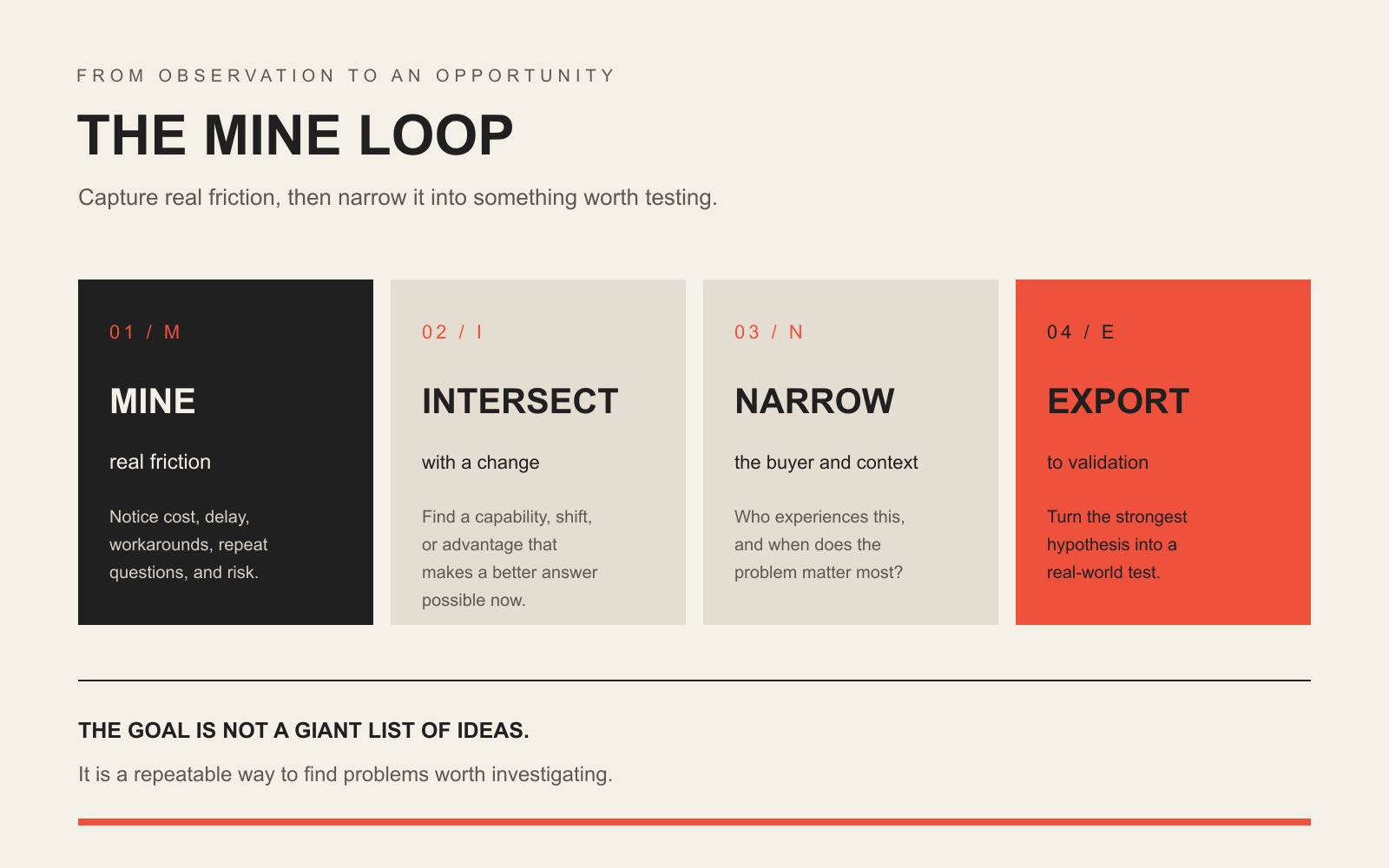
    A simple way to remember the process is our MINE Loop:

    • Mine real friction.
    • Intersect the problem with a capability, change, or advantage.
    • Narrow it to a specific buyer and context.
    • Export the strongest hypothesis to validation.

    The 12 methods below give you practical ways to feed that loop.

    TL;DR: Generate ideas by mining real problems, intersecting them with changed capabilities or advantages, narrowing to a specific buyer, and exporting only the strongest hypotheses to research and validation. Idea volume creates options; evidence earns the next bet.

    What Makes a Business Idea Worth Pursuing?

    A business idea is not profitable because it sounds original. It becomes interesting when there is a believable path from a real problem to a customer who cares enough to act.

    At the idea-generation stage, you are looking for signals such as:

    • the problem happens repeatedly;
    • the problem costs time, money, revenue, attention, or creates meaningful risk;
    • people already use a workaround or pay for an imperfect solution;
    • you can identify who experiences the problem and who makes the buying decision;
    • you have a credible way to reach that buyer;
    • a change in technology, regulation, behavior, cost, or distribution makes a better solution possible;
    • you have experience, access, relationships, skills, or a point of view that could help you solve it unusually well.

    None of those signals guarantees a profitable business. They simply give you a better starting hypothesis than, “This would be a cool app.”

    The U.S. Small Business Administration recommends studying demand, customers, competitors, and pricing as part of market research. Generation gives you a candidate idea; evidence tells you whether it deserves more investment. See the SBA’s market research and competitive analysis guidance for the formal research side of that process.

    The MINE Loop: A Repeatable Business Idea Generation System

    The MINE Loop gives structure to the messy front end of entrepreneurship. You can use it whether you are starting from zero, looking for a second revenue stream, or trying to turn repeated client work into a more scalable offer.

    The MINE Loop: Mine real friction, Intersect it with a change or advantage, Narrow to a buyer and context, and Export the strongest idea to validation.

    Mine Real Friction

    Start with problems, not products. Collect moments when someone says “Why is this so hard?”, “We do this manually every week,” “We hate our current software,” or “I wish somebody would just handle this.” Do not rush to solve every observation. Your first job is to capture enough real friction that patterns can emerge.

    Intersect the Problem With Change or Advantage

    A problem may have existed for years without creating a good business opportunity. Ask: why might this be solvable differently now? Look for new technology, lower delivery costs, changing customer behavior, regulation, a new distribution channel, or your own expertise, relationships, data, process, or audience.

    This is one reason we keep old product and service ideas rather than assuming an idea that failed once is permanently bad. Sometimes the original idea was fine and the timing was wrong.

    Narrow to a Buyer and Context

    “Small businesses need better marketing” is too broad to be useful. “Independent dental practices with no marketing staff struggle to turn patient reviews into a consistent local-content system” is much more useful. You can picture the buyer, the problem, the current environment, and the type of solution that might fit.

    Narrowing does not make an idea smaller. It makes it testable.

    Export the Strongest Ideas to Validation

    Generation and validation are different jobs. This article helps you produce better hypotheses. Once a few ideas look promising, test demand, buyer behavior, economics, competition, and your ability to reach the market. Our guide to business opportunity evaluation and idea validation covers that next stage in detail.

    12 Proven Methods to Generate Better Business Ideas

    You do not need to use all 12 methods every week. Pick the ones that expose you to real problems and run them consistently enough to build a useful idea pipeline.

    1. Keep a Friction Log

    For one week, write down anything that feels unnecessarily slow, expensive, confusing, repetitive, or annoying. Include problems in your own work, your customers’ work, your household, your industry, and the businesses you interact with.

    A useful friction-log entry records who experiences the problem, what goes wrong, the current workaround, and the cost in money, time, lost revenue, frustration, or risk. The goal is not to invent a company on the spot. You are building raw material.

    2. Mine Repeated Customer Questions and Complaints

    Repeated questions are often requests for a missing product, clearer service, better onboarding, or simpler process in disguise. Review sales calls, support requests, contact-form questions, project kickoff notes, recurring client confusion, and requests you keep saying “we do not offer that” to.

    Pay special attention when the same issue appears across different customers. At an agency, this is especially valuable because you see problems across multiple businesses. A task that feels like “just another annoying thing we have to do” can become a product opportunity if other companies have the same pain.

    3. Find Expensive Manual Work

    Look for skilled people doing low-leverage work over and over: copying data between systems, building the same report by hand, chasing approvals, reconciling inconsistent records, repeating setup steps, or manually checking something that could be monitored.

    Manual work is not automatically a software opportunity. Sometimes the better first business is a specialized service, managed workflow, or productized service. The opportunity is the outcome, not the technology.

    4. Study Ugly Workarounds

    A workaround is evidence that someone cares enough about a problem to do extra work. Look for giant spreadsheets, copy-and-paste processes, long email chains, shared documents pretending to be databases, multiple disconnected tools, or staff members whose unofficial job is “keeping the system together.”

    Do not mock the workaround. Understand why it exists. It may be doing something the official tools do not do well. That gap between the formal system and the real workflow is fertile territory for business idea generation.

    5. Read Low-Star Reviews and Competitor Complaints

    You do not need to invent a new category to build a useful business. Read negative reviews of products and services in markets you understand. Look for repeated complaints about pricing complexity, slow support, difficult setup, bloated interfaces, missing integrations, buying friction, or a service that works technically but creates operational headaches.

    The strongest pattern is not “this company is bad.” It is “customers consistently value the category but dislike the same part of the experience.”

    6. Trace Lost Deals, Objections, and Support Tickets

    Review why prospects say no, which projects become unprofitable, and which customer requests repeatedly fall outside your normal scope. Ask whether people want a smaller first step, whether they are buying the wrong thing because the real problem is poorly diagnosed, or whether a recurring service gap exists between vendors.

    A business idea can be a product, but it can also be a diagnostic, a smaller entry offer, a managed service, or a better sequence of existing services.

    7. Reopen Old Ideas When Technology or Economics Change

    Keep an idea archive. An idea can be unattractive today because one dependency is too expensive, slow, difficult, or unavailable. Revisit old ideas when those constraints change.

    AI has made this especially relevant. Tasks that once required custom software, large content teams, specialized analysis, or hours of manual categorization may now be possible with a smaller team and a different workflow. The discipline is not “add AI to everything.” It is asking: which old problem now has a newly practical solution?

    8. Go Narrower: Find an Underserved Buyer or Context

    Broad markets hide useful differences. Instead of “project management software,” look at project management for a specific workflow. Instead of “marketing services,” look at one type of company at one stage of growth with one recurring constraint.

    Narrow by industry, company size, geography, role, technology stack, regulatory environment, purchase trigger, business stage, or unusual workflow. For a broader way to think about where a company can win, see our Strategic Advantage & Market Intelligence playbook.

    9. Unbundle Bloated Products or Services

    Large products accumulate features and large service packages accumulate steps. Ask which part customers value most, which part is hardest to buy separately, which part could be delivered faster or more transparently, and which customer only needs a focused slice of the current solution.

    An unbundled offer is not automatically better. But it can create a compelling entry point when the incumbent solution is oversized for a clear customer segment.

    10. Productize Repeated Service Work

    If you perform the same valuable service repeatedly, you may already have the beginnings of a product. Look for work with a consistent input, repeatable method, recognizable output, similar customer questions, predictable handoffs, and opportunities for templates, automation, or software support.

    The first version does not need to become software. A productized service can keep you closer to the customer and produce learning faster. We use this pattern ourselves: when a problem keeps appearing across client work, we ask whether it can become a repeatable system rather than treating every occurrence as a one-off project.

    11. Use Constraints and Forced Change as Prompts

    Constraints create demand because people cannot simply keep doing things the old way. Watch for compliance requirements, platform policy changes, discontinued software, labor shortages, cost increases, supply changes, accessibility or privacy expectations, and customer behavior moving to a new channel.

    Ask: Who has a newly painful job to do because this changed? That keeps the idea grounded in a customer problem rather than a trend headline.

    12. Practice Deliberate Idea Volume—Without Confusing Volume With Evidence

    There is value in forcing yourself to generate multiple ideas. It loosens your attachment to the first concept and makes combinations easier to see. Choose one real problem and generate ten possible ways to solve it by changing the delivery model, buyer, channel, level of service, pricing model, or technology.

    One reporting problem might become a done-for-you service, template library, specialist consultancy, automated dashboard, data-cleanup service, vertical-specific tool, training product, monitoring service, integration, or diagnostic. The value of idea volume is range, not proof. Ten ideas are ten hypotheses.

    Turn Raw Observations Into Business Concepts

    Once your notes start accumulating, convert each promising observation into the same simple structure:

    For [specific buyer] who struggles with [specific problem] when [context/trigger], we could provide [better outcome or mechanism] because [why we may be able to solve it differently now].

    For example: For small professional-service firms that lose track of website leads because inquiries move between forms, email, and spreadsheets, we could provide a managed lead-routing and follow-up system because modern automation can connect the workflow without requiring a full custom CRM implementation.

    That is still not a validated business. But it is specific enough to research. If your concept cannot name a buyer, problem, and context, it is probably still too fuzzy.

    Use a Fast Filter Before You Spend Time Validating

    When you have 20 raw ideas, you do not need to deeply research all 20. Use a light triage filter first.

    1. Pain and frequency: Is the problem important, repeated, or costly enough to matter?
    2. Existing behavior: What do people do today? Is there a workaround, budget, vendor, or internal labor already attached to the problem?
    3. Reachability: Can you identify and reach likely buyers without needing mass-market scale?
    4. Access or advantage: Do you understand the problem, customer, workflow, channel, or technology unusually well?
    5. Cheap path to a test: Can you test the core assumption without building the full business first?

    This is triage, not validation. It helps you decide which ideas deserve the next round of research. If you need a more deliberate pre-validation screen, use our profit-signal and PRICE screening framework. When several opportunities still look plausible, our guide to decision-making frameworks can help you compare them more deliberately.

    AI Can Accelerate Business Idea Generation—But It Is Not Market Evidence

    AI is useful for expanding the surface area of your thinking. It is especially good at helping you organize observations, combine constraints, and generate alternative ways to solve a known problem.

    • cluster a large set of customer complaints into recurring themes;
    • turn meeting notes into a problem inventory;
    • generate alternative customer segments for the same problem;
    • suggest different business models around one known pain point;
    • find combinations between an existing problem and a new capability;
    • challenge an idea by listing assumptions that would need to be true;
    • turn a messy observation into several clearer opportunity statements.

    A useful prompt is: “Here are 30 real problems I have observed. Group them by underlying job, frequency, buyer, current workaround, and likely cost of the problem. Then generate three different business models for the strongest recurring patterns. Do not assume demand is proven.”

    Bad use of AI is asking, “Give me 50 profitable business ideas” and treating the output as market research. An AI model can suggest possibilities. It cannot make a customer have a problem, give that customer a budget, or make the economics work.

    What to Do With Your Best Three Ideas

    Once three ideas survive your first filter, stop generating for a moment and start learning. Investigate who has the problem, how they handle it today, what they already spend in money or labor, what competing options exist, how buyers discover those options, whether you can reach them economically, and which assumption could kill the idea fastest.

    Our guide to self-directed market research gives you practical ways to gather that information. Then use the business opportunity evaluation framework to test the strongest opportunity before you bet significant time or money on it.

    That sequence matters: Generate → narrow → research → validate → build. Not: Generate → fall in love → build → hope.

    Business Idea Generation FAQ

    How Can I Generate a Business Idea?

    Start by collecting real problems rather than trying to invent companies. Track recurring friction in your work, customer conversations, reviews, support requests, manual processes, and industry changes. Then narrow each promising problem to a specific buyer and consider what has changed that might make a better solution possible now.

    What Are Good Sources of Business Ideas?

    Useful sources include your own recurring frustrations, customer questions, manual business processes, competitor reviews, existing workarounds, support tickets, lost sales, changing regulations, new technology, underserved customer segments, and old ideas that have become feasible because a constraint changed.

    Which AI Tool Is Best for Business Idea Generation?

    There is no single “best” tool independent of the job. General-purpose AI assistants are useful for clustering observations, reframing problems, generating alternative business models, and exposing assumptions. The quality of the input matters more than the novelty of the tool: give the model real customer language and real constraints, then verify everything important outside the model.

    Does a Business Idea Have to Be Original?

    No. A business can create value with a better experience, narrower audience, improved delivery model, stronger positioning, lower friction, different channel, or better fit for a specific workflow. Originality is less important than solving a meaningful problem for a reachable customer in a way that can support healthy economics.

    How Do I Know Whether a Business Idea Will Be Profitable?

    You do not know at the idea-generation stage. Profitability depends on willingness to pay, cost to deliver, customer-acquisition cost, retention, market size, competition, and operating complexity. Generation creates the hypothesis; research and validation test it.

    Is Competition a Bad Sign?

    Not automatically. Competition can indicate that buyers already spend money in the category. The important questions are whether customers are well served, whether you can identify a meaningful difference, and whether you can reach the right buyer economically.

    Build an Idea Pipeline, Not a Favorite Idea

    The biggest improvement you can make to business idea generation is to stop treating each idea like a rare object that needs to be protected. Keep a pipeline. Capture problems continuously. Revisit old observations. Combine them with new capabilities. Narrow them until a buyer and context are clear. Then let evidence decide which ideas move forward.

    That is a much stronger operating system than waiting for inspiration—and it makes it easier to abandon a weak idea without feeling like you are starting from zero.

    If you have several possible opportunities but need help figuring out which market, positioning, or offer is worth pursuing, Scope Design can help with strategy, market research, positioning, and the digital systems needed to test the opportunity. Start a conversation with Scope Design and bring the messy version. That is usually where the useful work starts.

  • The Truth About Overnight Success: A Reality-Based Guide to Sustainable Business Growth

    The Truth About Overnight Success: A Reality-Based Guide to Sustainable Business Growth

    The Bottom Line: Overnight Success Is Usually a Visibility Event

    There is no honest universal number of years it takes a business to become “successful.” A first sale, steady profitability, repeatable demand, scale-readiness, and public recognition are different milestones. They run on different clocks.

    That is the part the overnight-success story usually hides. The breakthrough may happen in a week. The capability that makes the breakthrough useful may have been developing for years. Or the attention may arrive before the business is actually ready for it.

    For this guide, sustainable business growth means growth the company can support without breaking cash flow, margins, delivery quality, customer experience, or owner capacity. We are talking about durable, maintainable growth—not environmental or ESG sustainability.

    The reality is less cinematic than “work hard for exactly seven years.” It is also more useful: prove something, make it repeatable, build the capacity to support it, and only then increase the bet.

    Why Overnight Success Looks Real

    Overnight success feels real because the audience joins the story late. You see the contract, launch, ranking jump, viral post, acquisition, or packed calendar. You usually do not see the failed offers, customer conversations, process changes, skill development, boring systems work, and decisions that came before it.

    There is another problem: visible success gets compressed into a clean story. “One post changed everything” is memorable. “We ran 19 experiments, fixed our offer, changed our follow-up process, improved delivery, and then one post finally had somewhere useful to send people” is harder to fit into a headline.

    The shortcut story can be dangerous because it encourages you to copy the visible event instead of building the underlying conditions. You chase the post instead of the offer, the ad instead of the economics, the redesign instead of the sales problem, or the hiring spree instead of the capacity constraint.

    The Four Business Clocks

    Instead of asking one vague question—“How long until I am successful?”—track four separate clocks.

    Four distinct business milestones: time to proof, repeatability, scale-readiness, and recognition, each with different evidence to watch.

    1. Time to proof

    Will a real customer do something that matters? That might mean paying, booking, replying, requesting a proposal, renewing, or taking another qualified next step. Opinions help you learn, but behavior is stronger evidence.

    If demand is still a theory, start with small-business market research and validate the business idea before you bet the business.

    2. Time to repeatability

    Can you produce the result again without inventing a new process every time? One great month may be a signal. Repeatable lead flow, a sales process people can actually follow, consistent delivery, and customers who return or refer are stronger signs that you have something durable.

    3. Time to scale-readiness

    Can the system survive more volume? This is where growth gets expensive if the answer is no. More demand can expose weak margins, slow fulfillment, founder bottlenecks, poor onboarding, sloppy reporting, or a team that is already operating at the edge.

    Scope Design’s rule is simple: growth is a multiplier, not a cure. If you want the deeper operating check, use our business growth strategy guide before you add more volume.

    4. Time to recognition

    This is when the outside world notices: stronger referrals, bigger contracts, better rankings, industry attention, press, a breakout campaign, or a visible jump in demand. Recognition can lag behind a healthy business. It can also arrive too early and overwhelm a fragile one.

    That gap between the four clocks is what we call the Success Lag. Public attention is not proof that the other clocks are healthy. Lack of public attention is not proof that no progress is happening.

    What Sustainable Business Growth Actually Means

    Sustainable growth is not “revenue went up.” It is closer to this: the company becomes stronger at higher volume rather than merely busier.

    That means growth should improve—or at least protect—the things that keep the business healthy:

    • Economics: the work still produces acceptable margin and cash flow.
    • Demand quality: you are attracting buyers who fit the offer, not just generating activity.
    • Delivery: quality and response times do not collapse as volume rises.
    • Retention and trust: customers stay, return, upgrade, refer, or otherwise confirm the value.
    • Capacity: the company can handle more work without every exception landing back on the owner.

    A business can grow revenue while becoming less scalable. If every sale creates another founder approval, rescue mission, custom exception, or margin leak, the chart may look good while the operating system gets worse.

    The Proof-Before-Scale Check

    Before you treat a quick win as permission to accelerate, look for four kinds of proof.

    Demand proof

    People with the problem can be reached, understand the offer, and take a meaningful action. A burst of traffic is not demand proof if nobody qualified moves forward.

    Economics proof

    The sale works after the real costs are counted. That includes acquisition, fulfillment, support, refunds, rework, commissions, software, and the owner time that quietly subsidizes the process.

    Delivery proof

    The company can consistently produce the promised result. If quality depends on a heroic week from one person, you have a win—not yet a system.

    Capacity proof

    You know what more volume will require. That may mean automation, a documented process, better tooling, a contractor, a hire, a partner, more working capital, or simply saying no to the wrong work.

    When those four proofs are weak, make the next bet smaller. When they strengthen, earn the right to increase it.

    A Quick Note on Scary Startup Statistics

    The previous version of this article repeated several dramatic claims about startup failure and a fixed seven-to-ten-year success timeline. We removed them because the definitions were too loose for the certainty they implied.

    The U.S. Bureau of Labor Statistics is more careful: it reports establishment survival and explicitly notes that survival varies by business cycle, industry, and location. Its one-year figures are commonly around four in five across the table—not “90% fail.” More importantly, survival is not the same thing as profitability, founder wealth, repeatability, or scale-readiness.

    That distinction matters. If you use a survival statistic to answer “How long until my business is successful?” you are pretending several different questions are the same question.

    Quick Wins Are Signals, Not Strategy

    A quick win can be excellent news. The mistake is promoting it to a law of nature.

    • A viral post tells you a message or format earned attention. It does not prove profitable customer acquisition.
    • A large contract tells you one buyer said yes. It does not prove the sales process is repeatable.
    • A strong month tells you the offer can work. It does not prove the next six months will look the same.
    • A burst of referrals tells you trust exists somewhere in the system. It does not tell you whether you can create that demand on purpose.

    Treat the win as new evidence. Ask what caused it, what would have to be true for it to happen again, and what would break if it happened ten times next month.

    What to Measure Instead of “Am I Successful Yet?”

    The better question is: What evidence would make the next decision easier?

    • Customer action: conversations, qualified leads, proposals, purchases, renewals, referrals.
    • Economics: contribution margin, cash generation, payback, rework, support burden.
    • Repeatability: can the same channel, offer, sales process, or delivery system work again?
    • Capacity: utilization, bottlenecks, response times, backlog, owner dependence.
    • Learning velocity: how quickly does a test produce an answer that changes what you do next?

    This is where the old “do the one most important thing every day” advice becomes useful again. Your big rock should not be whatever feels important. It should be the action most likely to reduce the current constraint or resolve the most expensive uncertainty.

    A 30-Day Reality-Based Growth Loop

    You do not need a five-year prophecy to make a good decision this month. Use one short learning cycle.

    1. Name the constraint. Is the problem demand, lead quality, conversion, pricing, delivery, capacity, retention, cash, or something else?
    2. Define the evidence. What observable result would support or weaken your current assumption?
    3. Run the smallest useful test. Limit the budget, audience, channel, scope, or time window so you can learn without betting the company.
    4. Review the result. Keep, modify, or kill the idea based on what happened—not how attached you are to it.
    5. Systemize what survives. Document the process, improve the handoff, automate the boring parts, and decide whether the evidence earns a larger bet.

    If marketing is the current constraint, our 90-day marketing plan uses the same constraint-first logic over a longer operating window.

    When Your Website Becomes the Growth Constraint

    A website can support sustainable growth, but it cannot rescue a business model nobody wants. The useful question is not “Do we need a new website?” It is “What job is the current site failing to do?”

    Common growth constraints include an offer people cannot understand, weak proof, a confusing conversion path, slow manual follow-up, no useful measurement, brittle integrations, or a site that cannot support the way the business now sells and delivers.

    If that is the problem, start with our guide to creating a business website without buying the wrong thing. If the constraint touches positioning, market validation, lead flow, measurement, automation, or the operating process around digital work, Scope Design can help diagnose the problem before recommending a project.

    Frequently Asked Questions About Overnight Success and Sustainable Growth

    How long does it take for a business to become successful?

    There is no responsible universal timeline because “successful” can mean first sale, profitability, stable owner income, repeatable acquisition, a scalable operation, or public recognition. Track those milestones separately. Use evidence from your market, economics, delivery system, and capacity instead of borrowing a generic year count from somebody else’s business.

    Is overnight success real?

    Sudden recognition is real. Sudden capability is much rarer. A business can get a rapid burst of attention, sales, or opportunity, but whether that breakthrough becomes durable depends on the proof, repeatability, economics, and capacity already underneath it.

    What is sustainable business growth?

    In this article, sustainable business growth means growth the company can maintain without degrading cash flow, margins, quality, customer experience, or owner/team capacity. It is growth the system can support, not simply a bigger top-line number.

    How do I know when my business is ready to scale?

    Look for evidence that demand is real, the economics work, delivery is repeatable, and the organization has a credible capacity plan. You do not need perfect certainty, but the size of the next bet should be proportional to what you actually know.

    Build the Business That Can Survive the Breakthrough

    The goal is not to avoid fast growth. It is to avoid confusing speed with strength.

    Build proof. Make the result repeatable. Protect the economics. Remove the capacity constraint. Then scale what survives contact with reality.

    Do that long enough and the outside world may eventually call you an overnight success. You will know better.

  • How to Overcome Fear in Business: 7 Proven Strategies That Actually Work

    How to Overcome Fear in Business: 7 Proven Strategies That Actually Work

    If you are trying to learn how to overcome fear in business, do not wait until you feel fearless. Make the fear specific enough to investigate, small enough to manage, and clear enough to act on.

    That matters because fear of failure is not automatically a stop sign. Entrepreneurship research describes it as context-dependent: it can inhibit action in some situations and motivate greater effort in others. The useful question is not “How do I get rid of fear?” It is “What is this fear telling me to check before I move?” Research on fear of failure in entrepreneurship supports that more nuanced view.

    The seven strategies below combine evidence-backed action planning with practical business-risk controls. They cannot guarantee an outcome. They can help you stop treating uncertainty as an emotion problem and start treating it as a decision problem.

    The FEAR Check: Turn Worry Into Decision Requirements

    Before you try to “push through” fear, run it through a simple four-part check. We call it the FEAR Check:

    CheckQuestion to answerWhat you are looking for
    F: FactsWhat do I actually know, and what am I assuming?Evidence that changes the decision
    E: ExposureWhat can I lose, and can the business absorb it?A defined downside, not a vague disaster
    A: AssumptionWhich uncertain assumption would change my choice if it were wrong?The highest-value unknown to test
    R: ReversibilityHow can I shrink, stage, pause, or undo this commitment?A smaller next move that still produces useful evidence

    Fear becomes useful when it exposes a missing fact, unbounded downside, untested assumption, or commitment that is too hard to reverse. If it does none of those things and you keep reopening the same research, fear may be wearing a business-casual disguise and calling itself due diligence.

    How to Overcome Fear in Business: 7 Strategies

    1. Name the Exact Outcome You Are Afraid Of

    “I am afraid this will fail” is emotionally real but strategically useless. Failure can mean losing $2,000, missing payroll, being embarrassed in front of peers, losing a major customer, or spending six months on a product nobody buys. Those are different problems with different responses.

    Finish this sentence:

    If I make this decision, I am afraid that __________ will happen because __________.

    Then make it measurable. “Expansion could ruin us” becomes “If revenue is 25% below our base case for six months, our cash reserve falls below the amount we need to cover payroll and fixed costs.” “Customers may hate the offer” becomes “We may not get enough qualified buyers at the price required for this margin.”

    Once the fear names a failure mechanism, you have something to investigate. Until then, your brain can keep generating increasingly cinematic versions of “what if?” without producing a better decision.

    2. Separate Facts From Assumptions

    Most scary business decisions contain a mixture of known facts and untested beliefs. Put them in separate columns.

    FactsAssumptions
    Three existing customers asked for the service.Enough similar customers will buy it at the required price.
    The company can fund a $5,000 test without touching payroll reserves.The test will generate useful evidence within 60 days.
    A supplier quoted a specific unit cost.The cost will remain stable at higher volume.

    Now ask which assumption is both important and uncertain. Test that first. The U.S. Small Business Administration explicitly recommends market research to help confirm or improve an idea and reduce risk by examining questions such as demand, market size, saturation, and pricing. That does not remove uncertainty, but it helps replace the most expensive guesses with evidence. See the SBA’s current market research guidance.

    If the unknown is customer demand, our guide to self-directed market research gives you practical ways to collect evidence before making a larger commitment.

    3. Bound the Downside Before You Chase the Upside

    Fear gets louder when “the downside” has no boundary. Give it one.

    • What is the maximum cash you are willing to lose?
    • What minimum reserve will you protect?
    • How much owner or team time can the test consume?
    • What customer, legal, compliance, or reputation risks could create lasting damage?
    • At what point will you stop, pause, or redesign the plan?

    The goal is not to prove that nothing bad can happen. It is to determine whether the downside is survivable and proportionate. A $3,000 experiment that can be stopped next month is different from a five-year lease, a personal guarantee, or a hire the business cannot support if sales miss the forecast.

    If the severe-but-plausible downside threatens the core business, fear may be doing its job. Redesign the commitment before proceeding.

    4. Make the Next Move Smaller and More Reversible

    A common mistake is treating a business decision as binary: do the whole thing or do nothing. There is often a third option: make a smaller move that produces real evidence.

    • Pre-sell before building the full offer.
    • Run a 30- or 60-day pilot.
    • Launch to one customer segment before the whole market.
    • Use a contractor before creating a permanent role.
    • Set a capped test budget.
    • Lease or borrow before buying an expensive asset.
    • Negotiate an exit clause before signing a long commitment.

    The best small test is not the one that makes you feel productive. It is the one that tests the assumption most likely to change your decision. That is also why seemingly wild concepts should be validated before you bet the business on them.

    5. Set Decision Rules Before Fear Becomes Endless Research

    Research is useful when it can change a decision. It becomes avoidance when you keep gathering information but never change the criteria for saying yes, no, or “not yet.”

    Define your threshold before the next research round:

    I will proceed if the pilot produces at least X qualified customers, gross margin stays above Y, and the downside case leaves at least Z months of protected operating cash. I will decide by [date].

    After that, more research needs to earn its keep. Ask: What new fact am I trying to learn, and could it realistically change one of those thresholds? If you cannot answer, paralysis may be masquerading as research.

    Once fear has been translated into an actual choice between options, use a structured business decision framework instead of reopening the emotional question from scratch.

    6. Use an If-Then Plan for the Moment Fear Usually Wins

    Knowing what you should do is not the same as doing it. Research on implementation intentions has found that specific if-then plans can help people translate intentions into action across many contexts. The effect is not a guarantee and the research is not specific to business ownership, but the tool is simple and useful here.

    Choose the moment fear usually interrupts you and pre-decide the response:

    • If I reopen research after the agreed decision threshold is met, then I will write down the new fact I expect to learn and which threshold it could change.
    • If there is no decision-changing question, then I will take the next agreed action.
    • If the pilot crosses the stop-loss threshold, then I will pause it without treating the pause as a personal failure.

    This moves the choice out of the most emotionally charged moment. You are not promising to be brave later. You are specifying what “later” will do.

    7. Review Decision Quality, Not Just the Outcome

    A good decision can still produce a bad outcome. A reckless decision can occasionally get lucky. If you judge every decision only by what happened afterward, you train yourself to fear any move that once went badly.

    After the result is known, review the process:

    • Were the important facts accurate?
    • Which assumption turned out to be wrong?
    • Was the exposure within the limit you set?
    • Did the test produce the evidence it was supposed to produce?
    • Did you follow your decision rule or move the goalposts?
    • What should change in the next decision?

    That is how a mistake becomes information instead of a reason to freeze. We go deeper into that process in turning business mistakes into growth opportunities.

    When Fear Is Useful and When It Is Just a Stop Sign

    Fear may be useful when…Fear may be blocking you when…
    It points to a specific failure mechanism.It produces only “something bad might happen.”
    The downside could threaten payroll, solvency, compliance, or a key relationship.The main feared outcome is embarrassment, judgment, or regret.
    A critical assumption has little evidence behind it.You keep researching the same issue without changing decision criteria.
    The commitment is expensive or difficult to reverse.You keep moving the decision deadline because certainty still has not arrived.
    An independent, knowledgeable person identifies the same risk.You ignore the cost of waiting or doing nothing.

    Also remember that fear is not the only thing that can distort a decision. Once you have framed the real business risk, check whether cognitive biases are influencing your judgment in ways the FEAR Check alone will not catch.

    A 15-Minute Fear-to-Action Worksheet

    You can run the whole framework on one page. Do not turn this into a three-day journaling project. The point is to expose the decision structure.

    1. Feared outcomeIf I do this, I am afraid that __________ will happen because __________.
    2. FactsWhat do I know from actual numbers, customers, contracts, or observed behavior?
    3. ExposureWhat is the maximum cash, time, relationship, or operational loss? Can we absorb it?
    4. AssumptionWhich uncertain belief would change the decision if it were wrong?
    5. ReversibilityWhat is the smallest credible test or staged commitment?
    6. Decision thresholdWhat result means proceed, modify, pause, or stop?
    7. DeadlineWhen will I decide?
    8. If-then actionIf fear triggers my usual avoidance behavior, then I will __________.

    If another research task appears after you complete the worksheet, make it pass one test: What could this information change? If the honest answer is “nothing, I just want to feel more certain,” you probably have enough information for the next bounded step.

    Common Business Fears Are Different Problems

    “Fear in business” is not one thing. Different fears point to different work.

    FearWhat to examine
    Fear of failureSeparate a survivable business downside from what the outcome would mean about you personally.
    Fear of losing moneyDefine exposure, reserves, stop-loss limits, and the cheapest useful test.
    Fear of rejectionCollect enough customer evidence that one person’s “no” is data, not a verdict.
    Fear of being judgedDistinguish genuine reputation risk from ordinary discomfort with being visible.
    Fear of the unknownFind the highest-value uncertainty and design a test that can answer it.
    Fear of responsibilityExamine staffing, systems, controls, workload, and review thresholds instead of relying on willpower.

    This article is about ordinary business fear and uncertainty. Persistent or severe anxiety that is disrupting daily life is a different problem and deserves appropriate professional support, not another business checklist.

    Questions Business Owners Ask About Fear

    Why is starting a business so scary?

    Starting a business concentrates uncertainty: demand, pricing, cash flow, your own ability, other people’s opinions, and often personal money are all involved at once. The answer is not to prove the venture cannot fail. It is to separate those unknowns, identify the ones that matter most, and test them without taking more exposure than the opportunity justifies.

    Can fear of failure ever be useful?

    Yes. Fear can prompt preparation, evidence gathering, or a safer design when it identifies a real vulnerability. It becomes less useful when it stays vague, demands certainty, or keeps moving the finish line after your decision criteria have been met.

    How do entrepreneurs overcome fear of failure?

    The practical goal is not to eliminate the feeling. Name the feared outcome, separate facts from assumptions, bound the downside, test the most important uncertainty, make the commitment more reversible, and set a decision rule and deadline. Then act when the rule is met even if your confidence is not perfect.

    How do I know whether a business risk is too high?

    A risk is too high when the severe-but-plausible downside exceeds what the business can responsibly absorb or when the commitment is so irreversible that you cannot learn before major damage is done. Reduce the exposure, add a checkpoint, or redesign the bet before proceeding.

    What if I still feel afraid after doing the analysis?

    If the important facts are known, the downside is bounded, the critical assumption has been tested as far as practical, the next move is survivable, and your decision threshold is met, fear does not get an automatic veto. Take the controlled action you already defined. Confidence often follows evidence and action; it does not have to come first.

    Fear Should Change the Question, Not Run the Business

    You do not need to become fearless to run a business. You need a better way to decide what fear means.

    Run the FEAR Check. Get the facts that matter. Bound the exposure. Test the assumption most likely to change the choice. Make the commitment as reversible as practical. Set the rule. Set the date. Then act.

    The practical answer to how to overcome fear in business is not more motivation. If fear is pointing to a real strategic unknown such as market demand, economics, positioning, or the order of operations, research and strategy should do the work: turn the unclear growth question into evidence, a decision structure, and a concrete next move.

  • The Hard Truths About Starting a Business: What Every Entrepreneur Must Know

    The Hard Truths About Starting a Business: What Every Entrepreneur Must Know

    The most important things to know before starting a business are not motivational slogans. They are the facts and decisions that keep uncertainty from becoming an expensive, irreversible problem. You do not need perfect certainty before you begin. You do need evidence that a specific customer has a real problem, enough financial runway to test the idea without threatening your essentials, and clear rules for what you will do if the evidence says “not yet.”

    That is the hard truth: entrepreneurship is a sequence of bets. Smart founders make the early bets small, measurable, and reversible. They save the big commitments—quitting income, borrowing, signing a lease, hiring full time, or building expensive systems—for the point when the evidence is strong enough to justify them.

    The hard truth: uncertainty gets expensive when it becomes fixed

    An idea can feel compelling long before it is commercially proven. Friends can love it. A survey can look positive. A logo can feel “real.” None of those things proves that enough customers will buy at a price that supports the business.

    The U.S. Small Business Administration puts market research, competitive analysis, business planning, and startup-cost calculation in the planning stage for a reason. Those activities reduce unknowns before the commitments get harder to unwind.

    This is also why we are not repeating the familiar claim that “90% of startups fail.” The Bureau of Labor Statistics publishes establishment age and survival data, and survival patterns vary by cohort, time period, industry, and economic conditions. A single universal failure percentage is not a useful decision rule for your business.

    Things to know before starting a business: the PAUSE Check

    At Scope Design, a more useful question is not “Am I brave enough to go all in?” It is “What would I need to know before this next commitment is rational?” We use a five-part decision check: PAUSE—Problem proof, Available runway, Unknowns, Skills and support, and Exit cost.

    The PAUSE Check: Problem proof asks whether real customers act or pay; Available runway sets a safe cash ceiling; Unknowns identify the assumption that could break the idea; Skills and support separate founder judgment from specialist risk; Exit cost raises the evidence threshold for hard-to-reverse decisions.
    The PAUSE Check helps separate cheap learning from expensive commitment.

    P — Problem proof

    What evidence shows a specific customer will act or pay? Start with the customer and the problem, not the business name, website, or product polish. Look for evidence with consequence: interviews that reveal an urgent problem, deposits, preorders, paid pilots, booked appointments, signed letters of intent where appropriate, or repeat requests from the same type of buyer.

    Compliments are weak evidence because they cost the customer nothing. If demand is still uncertain, use market research to learn how customers describe the problem, what they use now, what triggers a purchase, and what would make them switch. Then validate the business idea with the smallest test that can prove or disprove the riskiest assumption.

    A — Available runway

    What can the business spend without threatening your personal essentials? Startup money and personal survival money are not the same pool. Before you spend, separate one-time setup costs, recurring business costs, and the household obligations that still exist while revenue is uncertain.

    Set a hard cash ceiling and a stop-loss rule before enthusiasm moves the line. A useful startup budget prioritizes legal, safety, delivery, and revenue-enabling costs first, while delaying expensive polish until demand justifies it.

    U — Unknowns

    Which assumption could break the idea fastest? Most early businesses have unknowns around demand, price, acquisition channel, delivery time, capacity, repeat purchase, or required capital. Write them down. Rank them by how damaging they would be if wrong. Test the dangerous unknowns before the cosmetic ones.

    A fast launch is only useful when it buys learning. Speed that locks you into the wrong lease, wrong hire, wrong software stack, or wrong offer is not momentum. It is an expensive way to avoid a question.

    S — Skills and support

    What judgment must you learn, and where is specialist help safer? Founders should understand the core logic of their business: customer, offer, price, economics, sales process, and delivery. That does not mean doing every job personally.

    Our rule is learn the judgment, buy risk-sensitive expertise, delay polish. Learn enough marketing to judge a message and channel. Learn enough bookkeeping to understand cash and margins. But use qualified legal, tax, accounting, licensing, insurance, or other regulated specialists when the downside of being wrong is materially higher than the cost of expert help. Outsource execution when a specialist can do it faster without hiding the decision logic from you.

    E — Exit cost

    How hard is this decision to reverse? Early-stage uncertainty calls for reversible commitments. Month-to-month tools are safer than long contracts. A pilot is safer than a full rollout. Part-time or contract capacity can be safer than a premature full-time hire. A pop-up or sublease can test location demand before a long lease.

    The more expensive a decision is to undo, the more evidence it should require. If you are wrestling with a high-stakes choice, use a formal business decision-making framework instead of treating urgency as proof.

    What should you prove before the big commitments?

    CommitmentProve firstLower-risk testWhat to postpone
    Quit your jobRepeatable demand, credible delivery capacity, personal runway, and a written stop/go ruleSell during defined side-business hours, run paid pilots, or reduce hours if feasibleTreating one strong month as permanent demand
    Borrow moneyExactly what the money buys and how conservative cash flow could repay itStage spending by milestone; pre-sell where appropriateDebt used mainly to make the business look established
    Sign a leaseLocation-dependent demand and unit economicsPop-up, shared space, appointment model, or short-term subleaseLong fixed occupancy cost before traffic is proven
    Hire full timeRecurring workload, process clarity, and enough margin to support the roleContractor, part-time help, or a documented processHiring because the founder feels busy rather than because a stable constraint exists
    Build custom technologyA repeated workflow bottleneck and clear user demandManual service, spreadsheet, prototype, or low-code processComplex software built to automate a business model that is still changing

    Seven hard truths every entrepreneur should know

    1. Enthusiasm is not demand

    You can be deeply committed to the idea and still be wrong about the buyer, timing, price, or channel. The founder’s job is not to defend the original concept. It is to discover which version customers will actually choose.

    2. Revenue is not the same as runway

    A sale can be encouraging without making the business financially safe. Cash timing, delivery costs, taxes, refunds, inventory, payroll, debt, and owner living expenses all matter. Track the cash that remains available after obligations, not just the top-line number that feels good to report.

    3. Speed matters only when it buys learning

    “Move fast” is good advice when the action produces information. Interviewing five target customers this week can create evidence. Buying a year of software because you plan to need it someday does not. Early speed should shorten the feedback loop, not increase the exit cost.

    4. Doing everything yourself is not automatically frugal

    Founder time is a scarce resource. If you spend twenty hours avoiding a specialist fee while neglecting sales, delivery, or customer learning, the “free” option may be the expensive one. The goal is not maximum DIY. It is retaining judgment while allocating work to the person best equipped to do it.

    5. Fear does not disappear when the decision is right

    You do not need to eliminate fear before acting. Name the feared outcome, separate facts from assumptions, bound the downside, and choose the next reversible test. Our guide to dealing with fear in business goes deeper on making uncertainty actionable without pretending confidence is evidence.

    6. Irreversible decisions deserve a higher evidence threshold

    A $50 experiment and a five-year lease should not require the same confidence. Neither should a weekend test and quitting a stable income source. Raise the evidence threshold as the financial, legal, operational, or personal exit cost rises.

    7. Starting a business changes your responsibilities, not your biology

    Entrepreneurship can change how you spend time, make decisions, and think about risk. It does not make employment psychologically impossible, guarantee a permanent identity shift, or prove that your brain has been “rewired for success.” Those claims are more dramatic than useful. A better question is what operating role you actually want. If that is unclear, compare the practical differences between a business owner and an entrepreneur.

    Learn it, hire it, or postpone it?

    One of the hardest early decisions is deciding what deserves your time. Use this triage:

    If the work…Best defaultWhy
    Shapes customer, offer, price, sales, or delivery judgmentLearn enough to own the decisionYou need to recognize good evidence and make tradeoffs even if someone else executes.
    Carries material legal, tax, accounting, licensing, safety, insurance, or technical riskHire qualified expertiseThe cost of a serious mistake can exceed the cost of professional help.
    Is repeatable execution with clear inputs and outputsDelegate or automate when economics justify itYour time may be more valuable on sales, customer learning, or the current bottleneck.
    Mainly makes an unproven business look polishedPostpone itPolish should follow evidence, not substitute for it.

    A 30-day readiness sprint before you go all in

    Of all the things to know before starting a business, the most useful are the ones you can test before they become fixed costs. If the idea is still mostly assumptions, spend a month buying evidence instead of buying infrastructure. The goal is not to “finish” the business. It is to make the next decision better.

    1. Week 1: define the problem. Write the specific customer, painful situation, current workaround, and trigger that would make someone seek a solution. Interview people who actually fit that description.
    2. Week 2: test the offer. Put a real price and clear outcome in front of the right buyers. Look for consequential behavior—bookings, deposits, pilots, preorders, introductions, or clear rejection reasons—not just positive comments.
    3. Week 3: test delivery and economics. Deliver manually if possible. Record time, direct costs, rework, customer questions, acquisition effort, and what would break if demand doubled.
    4. Week 4: decide with rules you set in advance. Define the evidence that means continue, revise, postpone, or stop. Do not move the threshold after the result simply because you are emotionally attached to the idea.

    If the test exposes a weak assumption, that is useful information—not a personal verdict. Fix the assumption while the cost is still small.

    Frequently asked questions before starting a business

    How much money should I have before starting a business?

    There is no responsible universal number. A home-based service, inventory-heavy retailer, restaurant, and software company have different startup and operating needs. Calculate business setup and recurring costs, personal living obligations, and a downside scenario. Then set a cash ceiling you can afford before revenue becomes dependable. The amount should come from your business model and runway, not a generic internet average.

    Should I quit my job before starting a business?

    Usually the better question is what evidence would make quitting rational. Look for repeatable demand, a believable delivery model, defined personal runway, and a written stop/go rule. If the business can be tested without immediately giving up income, that preserves optionality while you learn.

    Do 90% of startups really fail?

    Do not use that number as a universal planning fact. Official U.S. business-survival data are measured by establishment cohorts and vary across years, industries, and economic conditions. Your decision is better served by testing demand, economics, cash requirements, and reversibility than by applying one dramatic percentage to every kind of new business.

    What should I learn before starting a business?

    Learn enough to judge the customer problem, offer, pricing, sales process, unit economics, cash position, and delivery process. You do not need to become an expert in every supporting discipline. Build the judgment required to supervise specialists and recognize when regulated or high-risk work belongs with a qualified professional.

    How do I know whether my idea has real demand?

    Look for behavior that costs the customer something: time, money, effort, a change in routine, or a commitment to proceed. Interviews can reveal the problem and buying trigger; paid pilots, deposits, preorders, or booked appointments can test willingness to act. The exact test depends on the business, but the principle is consistent: seek evidence stronger than compliments.

    What should I outsource first?

    Start with work where the downside of an error is high or where specialist execution clearly frees you to work on the current constraint. Legal, tax, accounting, licensing, insurance, and specialized technical issues often deserve qualified help. For marketing, design, and operations, retain enough understanding to judge the strategy even when you delegate execution.

    The bottom line

    The hard truths about starting a business are less cinematic than “go all in.” Customers do not owe an idea demand. Cash does not care how confident you feel. Fear can coexist with a good decision. Specialist help can be cheaper than a preventable mistake. And the evidence required should rise with the cost of reversing the decision.

    If you remember one list of things to know before starting a business, make it practical. Before the next major commitment, PAUSE: prove the Problem, protect Available runway, identify the biggest Unknowns, choose the right Skills and support, and measure the Exit cost. If the next step is cheap, reversible, and likely to teach you something important, take it. If it is expensive and hard to undo, make it earn a higher level of proof.

  • How Entrepreneurs Stay Competitive: Mastering Business Adaptation in the Digital Age

    How Entrepreneurs Stay Competitive: Mastering Business Adaptation in the Digital Age

    Business adaptation is the discipline of changing how your business operates when the assumptions underneath it stop matching reality. It is not a race to adopt every new platform, AI tool, sales tactic, or design trend. The goal is simpler: notice meaningful change early, decide whether it affects a real customer or operating constraint, test the smallest useful response, and keep only what improves the business.

    That distinction matters for entrepreneurs because change creates two risks at the same time. Move too slowly and customer expectations, competitors, costs, or technology can pass you. Move too quickly and you can burn time and money modernizing things that were not actually broken. Competitive businesses learn to manage both risks.

    Business adaptation in 60 seconds

    • Adapt to evidence, not novelty. A trend matters when it changes customer behavior, economics, risk, or your ability to deliver.
    • Diagnose before you buy. Find the constraint first; choose the website change, process, automation, offer, or tool second.
    • Protect reversibility early. Small tests are easier to learn from and cheaper to undo than company-wide transformations.
    • Measure an outcome. Activity is not proof. Decide what should become faster, easier, more reliable, more profitable, or more valuable to the customer.
    • Scale selectively. A successful experiment earns a larger commitment; a weak one earns a lesson and a stop decision.

    Why business adaptation is a decision problem, not a technology shopping list

    When business owners hear “adapt,” the conversation often jumps straight to tools: install a CRM, add a chatbot, rebuild the website, automate follow-up, launch another channel, or replace a manual process with AI. Any of those could be useful. None is automatically adaptation.

    The better starting point is an operating question: What changed enough that one of our old assumptions is now costing us? Maybe prospects now expect an answer within hours instead of days. Maybe a once-reliable referral channel has slowed. Maybe staff are spending too much time re-entering the same information. Maybe customers reach the website on mobile and cannot complete the next step. Maybe margins changed enough that an old offer no longer makes sense.

    The U.S. Small Business Administration recommends combining market research and competitive analysis to understand customers and identify competitive advantage. That is useful here because adaptation starts with a signal you can explain—not with the existence of a new tool.

    Once the signal is real, use your business strategy as the filter. The question is no longer “Should we use this technology?” It becomes “Does this capability solve a problem that is important enough to change how we work?”

    The ADAPT Loop: a practical business adaptation framework

    At Scope Design, a useful way to make adaptation concrete is the ADAPT Loop: Acknowledge the signal, Diagnose the constraint, Act with a small bet, Prove with evidence, then Tune, scale, or terminate. The loop is deliberately simple. It keeps the business moving without pretending every change deserves a transformation program.

    The ADAPT Loop: Acknowledge a meaningful signal, Diagnose the real constraint, Act with a small reversible test, Prove the outcome against a baseline and guardrail, then Tune, scale, or terminate.
    The ADAPT Loop turns change into a repeatable decision cycle instead of a series of disconnected upgrades.

    A — Acknowledge the signal

    Start with something observable. A useful signal is a repeated change in customer behavior, demand, economics, regulation, competition, delivery capacity, or available technology. One complaint is a story. A pattern of the same complaint, lost opportunity, delay, workaround, or cost increase is a signal worth investigating.

    Write the signal as a sentence that separates fact from interpretation: “Qualified prospects are waiting two business days for a first response,” or “More customers are asking to book without calling,” is stronger than “We need AI” or “Our website feels old.”

    D — Diagnose the constraint

    Ask where the signal actually hurts. Is the constraint awareness, conversion, delivery, handoff, capacity, trust, margin, or retention? This step prevents a common failure mode: solving a visible symptom in the wrong system.

    For example, a lead problem may not require more marketing if inquiries are already arriving but getting lost between first contact and follow-up. In that case, the better adaptation is likely in the customer lifecycle and handoff process, not another traffic campaign.

    A — Act with the smallest reversible bet

    Make the first move small enough that you can learn without creating a new dependency. Before rebuilding an entire sales system, test a shorter intake flow. Before automating every customer message, automate one repeated handoff. Before expanding an offer, sell the narrow version manually. Before redesigning an entire site, test the page or path where the constraint is happening.

    Reversibility is a strategic advantage. A small bet gives you permission to be wrong cheaply. That is very different from being timid: you are buying information before buying scale.

    P — Prove with outcome evidence

    Decide what success means before the experiment starts. Pair one business outcome with one leading indicator. If the change is supposed to improve lead response, the leading indicator might be median first-response time and the business outcome might be qualified conversations started. If it is supposed to reduce administrative drag, measure time reclaimed and whether error or rework rates stay acceptable.

    The point is not to build a giant dashboard. It is to make the change falsifiable. If nothing meaningful improves, do not manufacture a success story from clicks, logins, generated content, or hours of “activity.”

    T — Tune, scale, or terminate

    After the test, choose one of three moves. Tune when the direction is promising but the implementation needs work. Scale when the benefit is repeatable and your team can support the larger operating load. Terminate when the evidence is weak, the hidden cost is too high, or the change solves a problem customers do not value.

    Stopping is not failure. A disciplined stop protects attention for the next signal and preserves the lesson for future decisions.

    What should entrepreneurs adapt first?

    Prioritize the change closest to a meaningful constraint, not the one with the loudest marketing around it. This table shows how to translate common signals into a testable next move.

    SignalLikely constraintSmallest useful testEvidence to watch
    Prospects repeatedly ask for faster answersLead-response handoffCreate one routed intake path with a response owner and deadlineResponse time and qualified conversations
    Staff copy the same information between toolsOperational frictionAutomate one stable, repetitive handoffTime saved, error rate, exceptions created
    Customers cannot complete an important website action reliablyDigital journey or technical foundationFix and test that path before redesigning everythingSuccessful completions and support friction
    A competitor introduces a feature customers begin requesting from youChanged customer expectationPrototype the minimum version or service equivalentAdoption, willingness to pay, retention or conversion effect
    An offer sells but creates weak margin or delivery strainBusiness-model economicsTest scope, price, packaging, or qualification on a subsetContribution margin and delivery load

    Notice what is missing from the table: “Everyone else is using it.” Competitor behavior is evidence only when it changes the market you actually serve.

    When adaptation becomes digital modernization

    Digital modernization is useful when the diagnosed constraint lives in a digital system. If leads are getting lost because there is no reliable handoff, the answer may involve CRM or automation. If staff repeat predictable work that can be safely standardized, AI automation workflows may be worth testing. If a slow, brittle, or confusing website blocks a customer from taking the next step, the problem may require stronger business website development.

    But modernization is a means, not a goal. A new stack that adds integrations, training, exceptions, security exposure, and maintenance can make the business less adaptable if it does not remove a real constraint.

    Risk belongs in the decision, too. The National Institute of Standards and Technology maintains Cybersecurity Framework 2.0 resources for small businesses to help organizations manage and reduce cybersecurity risk. When an adaptation changes how sensitive data, accounts, integrations, or critical processes work, security and recovery requirements should be part of the test—not an afterthought.

    What should you not change?

    Adaptability does not mean instability. Some parts of the business should stay boring when they are still doing their job. Keep a proven process until there is evidence that it is constraining the business. Keep a clear brand promise until customer or market evidence shows it no longer fits. Keep reliable infrastructure unless a replacement improves an outcome enough to justify migration risk.

    A useful “not now” list protects this discipline. For every adaptation you approve, write down the attractive ideas you are deliberately postponing and why. That makes strategy visible. It also stops the business from reopening the same shiny-object debate every week.

    How to measure whether business adaptation is working

    Measure at three levels so an improvement in one area does not hide damage somewhere else:

    • Customer outcome: Did the experience become easier, faster, clearer, more trustworthy, or more valuable?
    • Operating outcome: Did the change reduce delay, manual effort, rework, failure points, or dependency on one person?
    • Business outcome: Did it improve qualified demand, conversion, retention, margin, capacity, cash flow, or another result that matters to the model?

    You do not need all three to move at once. You do need to know which one the change was designed to affect and which guardrail must not get worse. If customer response becomes faster but errors double, the test is not finished. If automation saves time but creates low-quality customer interactions, the efficiency gain is incomplete.

    For customer-facing changes, define a small set of customer success metrics that someone can actually own. The best metric is not the one that looks sophisticated; it is the one that changes the next decision.

    Five business adaptation mistakes that make change more expensive

    1. Treating novelty as urgency

    A capability can be impressive without being relevant. Ask what customer behavior, economic condition, delivery constraint, or risk changed before you put it on the roadmap.

    2. Buying the system before defining the problem

    Tool selection feels like progress because it produces demos, pricing tables, and implementation tasks. But a vaguely defined constraint turns every product into a plausible answer. Diagnose first so you can reject most options quickly.

    3. Making the first experiment too large

    A company-wide rollout can hide what actually caused the result. Start with the smallest customer segment, workflow, page, or team that can give you useful evidence.

    4. Measuring activity instead of value

    More automations, more posts, more features, more dashboards, and more AI-generated output are not business outcomes. Track the constraint you intended to change.

    5. Scaling faster than the operating system can absorb

    A test can work in a controlled environment and fail at volume. Before scaling, ask what new exceptions, support needs, data dependencies, quality checks, and ownership requirements appear when usage multiplies.

    A 30-day business adaptation sprint

    You do not need a transformation committee to practice business adaptation. A focused month is enough to turn one meaningful signal into evidence.

    Week 1: Capture signals and establish a baseline

    • Collect repeated customer questions, lost-sale reasons, delays, workarounds, cost changes, and competitor moves.
    • Choose one signal tied to a meaningful constraint.
    • Record the current outcome so you have something to compare against.

    Week 2: Design the smallest reversible test

    • Define the one assumption you are testing.
    • Limit the test to one segment, workflow, offer, page, or team when possible.
    • Name the success metric, guardrail, owner, and stop condition in advance.

    Week 3: Run the test and log exceptions

    Do not “optimize” halfway through every uncomfortable result. Let the test run long enough to observe behavior, while recording exceptions, customer confusion, team friction, and edge cases that averages can hide.

    Week 4: Tune, scale, or stop

    Compare the result with the baseline and the guardrail. Then make a decision. If the test worked, document what made it work before expanding. If it did not, record the lesson and close the experiment. A finished “no” is more valuable than a zombie pilot that consumes attention indefinitely.

    When outside help is worth it

    Entrepreneurs should keep the decision close to the business, but implementation does not have to be entirely internal. Outside help is usually worth considering when the constraint crosses specialties, the change is expensive to reverse, security or data risk is material, or the team lacks the capacity to test without disrupting normal operations.

    The useful role of a partner is not to sell “modernization.” It is to help translate the diagnosed constraint into the smallest sensible implementation, identify dependencies, build the test correctly, and leave you with evidence you can act on. If your adaptation decision points to the website, customer journey, automation, analytics, or the systems connecting them, Scope Design can help turn the diagnosis into a scoped plan without treating every new tool as mandatory.

    Frequently asked questions about business adaptation

    What is business adaptation in simple terms?

    Business adaptation means changing an important part of how your company works because the environment around it changed. The change could involve an offer, process, customer experience, technology, pricing, channel, or operating model. The key is that the change responds to evidence, not fashion.

    Why is adaptation important in business?

    Because the assumptions that made a business effective do not stay true forever. Customer expectations move, costs change, competitors improve, regulations evolve, and technology creates new capabilities. Adaptation gives the business a repeatable way to respond without rebuilding everything every time conditions shift.

    What is a good example of business adaptation?

    Imagine a service business notices that qualified prospects increasingly ask to schedule online, but the company still requires a phone call. Instead of launching a full digital transformation, it tests online booking for one service, measures completed bookings and no-show rates, gathers feedback, and then decides whether to expand it. That is adaptation: a changed customer expectation produced a bounded response and a measurable decision.

    Is adopting AI automatically business adaptation?

    No. AI becomes part of business adaptation when it addresses a diagnosed customer or operating constraint and improves a defined outcome within acceptable quality, risk, and maintenance limits. Installing an AI tool because competitors mention AI is technology adoption, not proof of adaptation.

    How often should a small business adapt?

    Continuously scan for meaningful signals, but do not confuse constant observation with constant change. Review customer friction, operating bottlenecks, economics, competitive moves, and new capabilities on a regular cadence that fits your market. Make a change when the evidence shows an assumption is no longer serving the business—not because a calendar says a modernization project is due.

    Staying competitive means getting better at change—not doing more of it

    The most adaptable entrepreneur is not the one with the longest software list or the fastest reaction to every trend. It is the one who can tell the difference between noise and a meaningful signal, connect that signal to a real constraint, make a small move, learn quickly, and commit only when the evidence earns a larger bet.

    That is the practical advantage of the ADAPT Loop: acknowledge, diagnose, act, prove, tune. It turns business adaptation from an occasional panic response into a repeatable management habit—and keeps modernization subordinate to what customers and the business actually need.