Tag: Decision Making

  • How to Overcome Fear in Business: 7 Proven Strategies That Actually Work

    How to Overcome Fear in Business: 7 Proven Strategies That Actually Work

    If you are trying to learn how to overcome fear in business, do not wait until you feel fearless. Make the fear specific enough to investigate, small enough to manage, and clear enough to act on.

    That matters because fear of failure is not automatically a stop sign. Entrepreneurship research describes it as context-dependent: it can inhibit action in some situations and motivate greater effort in others. The useful question is not “How do I get rid of fear?” It is “What is this fear telling me to check before I move?” Research on fear of failure in entrepreneurship supports that more nuanced view.

    The seven strategies below combine evidence-backed action planning with practical business-risk controls. They cannot guarantee an outcome. They can help you stop treating uncertainty as an emotion problem and start treating it as a decision problem.

    The FEAR Check: Turn Worry Into Decision Requirements

    Before you try to “push through” fear, run it through a simple four-part check. We call it the FEAR Check:

    CheckQuestion to answerWhat you are looking for
    F: FactsWhat do I actually know, and what am I assuming?Evidence that changes the decision
    E: ExposureWhat can I lose, and can the business absorb it?A defined downside, not a vague disaster
    A: AssumptionWhich uncertain assumption would change my choice if it were wrong?The highest-value unknown to test
    R: ReversibilityHow can I shrink, stage, pause, or undo this commitment?A smaller next move that still produces useful evidence

    Fear becomes useful when it exposes a missing fact, unbounded downside, untested assumption, or commitment that is too hard to reverse. If it does none of those things and you keep reopening the same research, fear may be wearing a business-casual disguise and calling itself due diligence.

    How to Overcome Fear in Business: 7 Strategies

    1. Name the Exact Outcome You Are Afraid Of

    “I am afraid this will fail” is emotionally real but strategically useless. Failure can mean losing $2,000, missing payroll, being embarrassed in front of peers, losing a major customer, or spending six months on a product nobody buys. Those are different problems with different responses.

    Finish this sentence:

    If I make this decision, I am afraid that __________ will happen because __________.

    Then make it measurable. “Expansion could ruin us” becomes “If revenue is 25% below our base case for six months, our cash reserve falls below the amount we need to cover payroll and fixed costs.” “Customers may hate the offer” becomes “We may not get enough qualified buyers at the price required for this margin.”

    Once the fear names a failure mechanism, you have something to investigate. Until then, your brain can keep generating increasingly cinematic versions of “what if?” without producing a better decision.

    2. Separate Facts From Assumptions

    Most scary business decisions contain a mixture of known facts and untested beliefs. Put them in separate columns.

    FactsAssumptions
    Three existing customers asked for the service.Enough similar customers will buy it at the required price.
    The company can fund a $5,000 test without touching payroll reserves.The test will generate useful evidence within 60 days.
    A supplier quoted a specific unit cost.The cost will remain stable at higher volume.

    Now ask which assumption is both important and uncertain. Test that first. The U.S. Small Business Administration explicitly recommends market research to help confirm or improve an idea and reduce risk by examining questions such as demand, market size, saturation, and pricing. That does not remove uncertainty, but it helps replace the most expensive guesses with evidence. See the SBA’s current market research guidance.

    If the unknown is customer demand, our guide to self-directed market research gives you practical ways to collect evidence before making a larger commitment.

    3. Bound the Downside Before You Chase the Upside

    Fear gets louder when “the downside” has no boundary. Give it one.

    • What is the maximum cash you are willing to lose?
    • What minimum reserve will you protect?
    • How much owner or team time can the test consume?
    • What customer, legal, compliance, or reputation risks could create lasting damage?
    • At what point will you stop, pause, or redesign the plan?

    The goal is not to prove that nothing bad can happen. It is to determine whether the downside is survivable and proportionate. A $3,000 experiment that can be stopped next month is different from a five-year lease, a personal guarantee, or a hire the business cannot support if sales miss the forecast.

    If the severe-but-plausible downside threatens the core business, fear may be doing its job. Redesign the commitment before proceeding.

    4. Make the Next Move Smaller and More Reversible

    A common mistake is treating a business decision as binary: do the whole thing or do nothing. There is often a third option: make a smaller move that produces real evidence.

    • Pre-sell before building the full offer.
    • Run a 30- or 60-day pilot.
    • Launch to one customer segment before the whole market.
    • Use a contractor before creating a permanent role.
    • Set a capped test budget.
    • Lease or borrow before buying an expensive asset.
    • Negotiate an exit clause before signing a long commitment.

    The best small test is not the one that makes you feel productive. It is the one that tests the assumption most likely to change your decision. That is also why seemingly wild concepts should be validated before you bet the business on them.

    5. Set Decision Rules Before Fear Becomes Endless Research

    Research is useful when it can change a decision. It becomes avoidance when you keep gathering information but never change the criteria for saying yes, no, or “not yet.”

    Define your threshold before the next research round:

    I will proceed if the pilot produces at least X qualified customers, gross margin stays above Y, and the downside case leaves at least Z months of protected operating cash. I will decide by [date].

    After that, more research needs to earn its keep. Ask: What new fact am I trying to learn, and could it realistically change one of those thresholds? If you cannot answer, paralysis may be masquerading as research.

    Once fear has been translated into an actual choice between options, use a structured business decision framework instead of reopening the emotional question from scratch.

    6. Use an If-Then Plan for the Moment Fear Usually Wins

    Knowing what you should do is not the same as doing it. Research on implementation intentions has found that specific if-then plans can help people translate intentions into action across many contexts. The effect is not a guarantee and the research is not specific to business ownership, but the tool is simple and useful here.

    Choose the moment fear usually interrupts you and pre-decide the response:

    • If I reopen research after the agreed decision threshold is met, then I will write down the new fact I expect to learn and which threshold it could change.
    • If there is no decision-changing question, then I will take the next agreed action.
    • If the pilot crosses the stop-loss threshold, then I will pause it without treating the pause as a personal failure.

    This moves the choice out of the most emotionally charged moment. You are not promising to be brave later. You are specifying what “later” will do.

    7. Review Decision Quality, Not Just the Outcome

    A good decision can still produce a bad outcome. A reckless decision can occasionally get lucky. If you judge every decision only by what happened afterward, you train yourself to fear any move that once went badly.

    After the result is known, review the process:

    • Were the important facts accurate?
    • Which assumption turned out to be wrong?
    • Was the exposure within the limit you set?
    • Did the test produce the evidence it was supposed to produce?
    • Did you follow your decision rule or move the goalposts?
    • What should change in the next decision?

    That is how a mistake becomes information instead of a reason to freeze. We go deeper into that process in turning business mistakes into growth opportunities.

    When Fear Is Useful and When It Is Just a Stop Sign

    Fear may be useful when…Fear may be blocking you when…
    It points to a specific failure mechanism.It produces only “something bad might happen.”
    The downside could threaten payroll, solvency, compliance, or a key relationship.The main feared outcome is embarrassment, judgment, or regret.
    A critical assumption has little evidence behind it.You keep researching the same issue without changing decision criteria.
    The commitment is expensive or difficult to reverse.You keep moving the decision deadline because certainty still has not arrived.
    An independent, knowledgeable person identifies the same risk.You ignore the cost of waiting or doing nothing.

    Also remember that fear is not the only thing that can distort a decision. Once you have framed the real business risk, check whether cognitive biases are influencing your judgment in ways the FEAR Check alone will not catch.

    A 15-Minute Fear-to-Action Worksheet

    You can run the whole framework on one page. Do not turn this into a three-day journaling project. The point is to expose the decision structure.

    1. Feared outcomeIf I do this, I am afraid that __________ will happen because __________.
    2. FactsWhat do I know from actual numbers, customers, contracts, or observed behavior?
    3. ExposureWhat is the maximum cash, time, relationship, or operational loss? Can we absorb it?
    4. AssumptionWhich uncertain belief would change the decision if it were wrong?
    5. ReversibilityWhat is the smallest credible test or staged commitment?
    6. Decision thresholdWhat result means proceed, modify, pause, or stop?
    7. DeadlineWhen will I decide?
    8. If-then actionIf fear triggers my usual avoidance behavior, then I will __________.

    If another research task appears after you complete the worksheet, make it pass one test: What could this information change? If the honest answer is “nothing, I just want to feel more certain,” you probably have enough information for the next bounded step.

    Common Business Fears Are Different Problems

    “Fear in business” is not one thing. Different fears point to different work.

    FearWhat to examine
    Fear of failureSeparate a survivable business downside from what the outcome would mean about you personally.
    Fear of losing moneyDefine exposure, reserves, stop-loss limits, and the cheapest useful test.
    Fear of rejectionCollect enough customer evidence that one person’s “no” is data, not a verdict.
    Fear of being judgedDistinguish genuine reputation risk from ordinary discomfort with being visible.
    Fear of the unknownFind the highest-value uncertainty and design a test that can answer it.
    Fear of responsibilityExamine staffing, systems, controls, workload, and review thresholds instead of relying on willpower.

    This article is about ordinary business fear and uncertainty. Persistent or severe anxiety that is disrupting daily life is a different problem and deserves appropriate professional support, not another business checklist.

    Questions Business Owners Ask About Fear

    Why is starting a business so scary?

    Starting a business concentrates uncertainty: demand, pricing, cash flow, your own ability, other people’s opinions, and often personal money are all involved at once. The answer is not to prove the venture cannot fail. It is to separate those unknowns, identify the ones that matter most, and test them without taking more exposure than the opportunity justifies.

    Can fear of failure ever be useful?

    Yes. Fear can prompt preparation, evidence gathering, or a safer design when it identifies a real vulnerability. It becomes less useful when it stays vague, demands certainty, or keeps moving the finish line after your decision criteria have been met.

    How do entrepreneurs overcome fear of failure?

    The practical goal is not to eliminate the feeling. Name the feared outcome, separate facts from assumptions, bound the downside, test the most important uncertainty, make the commitment more reversible, and set a decision rule and deadline. Then act when the rule is met even if your confidence is not perfect.

    How do I know whether a business risk is too high?

    A risk is too high when the severe-but-plausible downside exceeds what the business can responsibly absorb or when the commitment is so irreversible that you cannot learn before major damage is done. Reduce the exposure, add a checkpoint, or redesign the bet before proceeding.

    What if I still feel afraid after doing the analysis?

    If the important facts are known, the downside is bounded, the critical assumption has been tested as far as practical, the next move is survivable, and your decision threshold is met, fear does not get an automatic veto. Take the controlled action you already defined. Confidence often follows evidence and action; it does not have to come first.

    Fear Should Change the Question, Not Run the Business

    You do not need to become fearless to run a business. You need a better way to decide what fear means.

    Run the FEAR Check. Get the facts that matter. Bound the exposure. Test the assumption most likely to change the choice. Make the commitment as reversible as practical. Set the rule. Set the date. Then act.

    The practical answer to how to overcome fear in business is not more motivation. If fear is pointing to a real strategic unknown such as market demand, economics, positioning, or the order of operations, research and strategy should do the work: turn the unclear growth question into evidence, a decision structure, and a concrete next move.

  • Business Partnership Guide: How to Choose the Right Partner and Structure Your Agreement

    Business Partnership Guide: How to Choose the Right Partner and Structure Your Agreement

    Choosing a business partner is not a chemistry test followed by a contract. It is one high-stakes decision with two parts: who should share ownership with you, and what rules will govern the relationship when workload, cash, risk, or opinions diverge?

    The practical answer is to define why you need a partner, test the candidate on real work before making equity permanent when that is feasible, separate ownership from compensation and control, agree on decision and exit rules, and then have qualified legal and tax professionals convert those decisions into the right governing documents. A business partnership agreement is strongest when it records decisions you have already made deliberately instead of papering over decisions you avoided.

    This guide is general U.S. business information, not individualized legal or tax advice. Entity rules, taxes, fiduciary duties, transfer restrictions, employment rights, and enforceability can vary by state and structure. Use the checklist to prepare better questions, then have a qualified attorney and tax professional review your actual arrangement.

    Before You Choose a Partner, Decide Whether You Need One

    A partner should solve a business constraint that is important enough to justify permanent ownership. Start there. If you cannot name the constraint, you are not ready to negotiate a percentage.

    This is a strategy decision before it is a legal-document decision. Scope Design’s Business Strategy and Market Intelligence framework treats a partnership like any other consequential bet: define the outcome, expose the assumptions, get ground truth, test what can be tested, and only then commit more resources.

    Ask what you actually need:

    • More execution capacity? A hire or contractor may solve it without giving away ownership.
    • A specialized skill? An employee, consultant, advisor, agency, or licensing arrangement may be narrower and easier to unwind.
    • Capital? Debt or an investor may solve a financing problem without turning the funder into an operating partner.
    • Distribution or market access? A reseller, affiliate, channel partnership, joint venture, or project agreement may test the relationship first.
    • An opportunity neither of you has proven? Validate the business before you divide it. Our guide to validating a business idea helps separate enthusiasm from evidence.

    If the uncertainty is customer demand, pricing, competitor behavior, or market size, do the research before you use equity to compensate for uncertainty. Our small-business market research guide is a better next step than inventing a partnership structure around an assumption.

    The point is not that partners are bad. The point is that permanent equity is an expensive answer to a temporary problem. Make sure the problem actually requires a partner.

    Use the Scope Design Partner Fit-to-Terms Map

    Most advice about choosing a business partner ends with qualities such as trust, complementary skills, and communication. Those qualities matter, but they are still too vague to govern a company. The useful question is: what did you observe, and what should that observation change in the agreement?

    The Partner Fit-to-Terms Map turns six things you can observe into six sets of governance questions.

    What to testWhat useful evidence looks likeWhat it should change in the agreement
    Shared outcomeYou agree on what the business is trying to become, what it will not do, and what “success” means.Purpose, scope, non-negotiables, reserved decisions, sale/growth expectations.
    Contribution and capacityThe candidate reliably delivers the work, time, relationships, expertise, or capital they said they would contribute—and the capabilities are genuinely complementary.Roles, time commitments, responsibilities, milestones, contribution obligations.
    Judgment under pressureThey can explain tradeoffs, use evidence, admit uncertainty, and make decisions without hiding risk.Functional authority, spending limits, approval thresholds, escalation rules.
    Conflict behaviorThey can challenge an idea without attacking the person, listen, change their mind, and close a disagreement.Voting, deadlock, mediation/dispute process, decision owner by domain.
    Money behaviorFinancial assumptions are transparent; expenses are documented; risk tolerance and reinvestment expectations are discussed openly.Capital contributions, compensation, distributions, financial controls, reporting.
    Exit expectationsYou can discuss departure, underperformance, disability, death, sale, or a failed relationship without pretending those events are impossible.Transfer restrictions, buy-sell triggers, valuation process, payment mechanics, dissolution.

    This is the central idea of the guide: do not collect compatibility signals and then forget them when the agreement is drafted. The trial is supposed to produce governance evidence.

    Run a Real-Work Trial Before You Split Equity

    If the situation allows it, work together before you become permanent co-owners. A coffee meeting reveals chemistry. A real project reveals operating behavior.

    The trial does not need to be elaborate. It needs enough consequence to create real decisions. Define one useful business outcome, give each person clear ownership, put a deadline on it, include a real customer, budget, vendor, deliverable, or operational constraint when appropriate, and write down the assumptions before you start.

    1. Define the result. What must be true at the end of the trial for the work to count as successful?
    2. Define each person’s contribution. Who owns which deliverables, decisions, relationships, costs, and deadlines?
    3. Create a decision log. When something changes, record who decided, what evidence they used, and what tradeoff they accepted.
    4. Let normal friction happen. Do not manufacture a fight, but do not protect the trial from ambiguity, feedback, missed assumptions, or changing information.
    5. Review behavior, not charisma. Did each person deliver? Surface bad news? Document money? Respect boundaries? Ask for help? Change course when evidence changed?
    6. Convert observations into terms. If one partner is clearly stronger in a domain, does that person need functional authority there? If you repeatedly stall on major decisions, what deadlock process is needed? If time commitments differed from assumptions, should ownership, compensation, or vesting be reconsidered with counsel?

    A partnership is hard to reverse compared with a project. That means it deserves more process than a low-cost experiment. Use the SCOPE business decision-making framework to match the rigor to the stakes, reversibility, options, proof, and execution of the decision.

    How Much Equity Should Each Business Partner Get?

    There is no universal “fair” percentage. The common mistake is trying to make one number answer five different questions.

    LeverThe question it actually answers
    Ownership / equityWho owns what economic interest in the business?
    CompensationHow is each person paid for the work they perform?
    Profit, loss, and distributionsHow are economic results allocated, and when does cash leave the business?
    Capital contributionsWho is putting in cash, property, intellectual property, or other agreed resources now or later?
    Voting and decision controlWho can decide which matters, and what approval is required for high-stakes decisions?

    Those levers may interact, but they are not interchangeable. A partner can contribute more cash without automatically needing more day-to-day authority. Two partners can own equal percentages while receiving different compensation for different workloads if the structure and applicable law allow it. Profit allocations, distributions, and tax consequences need professional review rather than a rule copied from a blog post.

    For U.S. federal income-tax purposes, the IRS explains that partnerships generally file an annual information return and pass profits or losses through to the partners, who report their distributive shares. Form 1065 is the federal information return used to report partnership income, gains, losses, deductions, credits, and related information. That is one reason your economic deal should be reviewed by a qualified tax professional before you finalize it.

    Is a 50/50 partnership a good idea?

    It can be. Equal ownership may fit a relationship where the partners intentionally want equal economics and equal long-term stakes. But 50/50 ownership does not answer what happens when the owners disagree.

    If two people must agree on every material decision, one unresolved disagreement can stop the company. A 50/50 structure therefore needs a deliberate deadlock process: which decisions belong to each functional owner, which require joint approval, what happens after an impasse, and when a buyout or other exit mechanism can be triggered.

    Does a 51/49 split solve the problem?

    Not by itself. A 51% owner may control matters that are decided by a simple majority under the applicable documents and law, but that does not automatically answer who can terminate someone’s employment, remove a manager, force a buyout, dissolve the business, transfer ownership, or decide reserved matters. Those are different rights.

    Do not use 51/49 as a shortcut around governance. Decide the rights first, then have counsel build the structure that actually expresses them.

    What Should a Business Partnership Agreement Cover?

    The exact document depends on the entity and state. An LLC may use an operating agreement; a partnership may use a partnership agreement; other entities have different governing documents. The U.S. Small Business Administration notes that business structure affects taxes, paperwork, fundraising, and personal liability and explains that internal agreements define how decisions are made and what duties, powers, and responsibilities the owners have.

    Use the following as an issues list for your attorney and tax professional, not as a universal fill-in contract.

    1. Purpose and scope. What business are you actually operating together? What is outside the partnership’s scope?
    2. Entity, jurisdiction, and governing documents. What structure are you using, where is it formed, and which documents control?
    3. Initial contributions. What cash, property, intellectual property, relationships, equipment, guarantees, or services is each person expected to contribute, and how are non-cash contributions valued?
    4. Future funding. Can the business require additional capital? What happens if one partner can or will contribute and another cannot?
    5. Ownership. What percentage or interest does each person own, and are there conditions that can change it?
    6. Compensation and economics. How will partners be compensated for work? How will profits, losses, reserves, and cash distributions be handled, subject to tax and entity rules?
    7. Roles and time commitments. Who owns sales, delivery, finance, operations, people, product, marketing, technology, or other functions? Is any minimum involvement expected?
    8. Authority and spending limits. What can each partner sign, spend, borrow, hire, discount, purchase, or commit without additional approval?
    9. Voting and reserved matters. Which decisions are routine, which need a majority, and which require a higher threshold or unanimous approval?
    10. Deadlock. What happens when the required approval cannot be reached? Escalation, mediation, a tie-break process, buy-sell rights, or another mechanism may be appropriate depending on the structure.
    11. Banking, books, records, and reporting. Who has account access? What records must be maintained? What financial information does each owner receive and how often?
    12. Intellectual property, confidentiality, and conflicts. Who owns work created for the company? How are confidential information, outside opportunities, related-party transactions, and conflicts of interest handled?
    13. New owners and transfers. Can an interest be sold, gifted, pledged, or transferred? Do existing owners have approval or purchase rights?
    14. Departure, death, disability, or incapacity. What events trigger a purchase, transfer, continuation, or change in management?
    15. Buy-sell and valuation process. How will a departing interest be valued? Who performs the valuation? What date and method apply? How is the purchase funded and paid?
    16. Removal and cause. What behavior can remove someone from a management or employment role, and what happens to their ownership afterward? These are not necessarily the same event.
    17. Disputes and dissolution. What process applies to disputes, and what happens if the owners decide or are required to wind down the business?

    That list is intentionally broader than “who owns 50%.” A useful agreement is an operating system for decisions, money, information, change, and exit.

    Build Decision Rights Before You Need Them

    Two capable partners can still make a miserable company if nobody knows who gets to decide. “We decide everything together” sounds collaborative until every vendor choice, hire, refund, price exception, or software purchase becomes a board meeting.

    Separate functional authority from reserved matters. The exact thresholds belong in your agreement; the management design should be clear before the drafting starts.

    Decision typeTypical design question
    Routine decisions inside an approved planWhich partner owns this function and can decide without another vote?
    Unbudgeted spending or contractsWhat dollar, duration, or risk threshold requires additional approval?
    Hiring, firing, and compensationWhich roles can a functional owner manage, and which key positions are reserved matters?
    Debt, equity, guarantees, major leases, or acquisitionsWhat approval level is required before the company takes on material new obligations?
    Changing owner compensation or distributionsCan a partner vote on a decision that directly benefits that partner, and what conflict rules apply?
    Admitting a new owner or transferring an interestWho must approve, and what purchase or refusal rights exist?
    Selling substantially all of the business or dissolving itWhat approval threshold and process applies to an irreversible decision?

    The goal is not to build a constitutional convention around a two-person company. It is to keep routine work fast while slowing down the decisions that can permanently change risk, control, or ownership.

    Plan the Exit While You Still Like Each Other

    Exit planning is not pessimism. It is what lets two people discuss a hard future event while neither is currently trying to win it.

    Your lawyer may recommend different mechanisms depending on the entity, state, number of owners, financing, family considerations, taxes, and the business itself. Your job before that meeting is to decide the commercial questions:

    • Can an owner leave voluntarily, and how much notice is required?
    • Can ownership be transferred to a spouse, trust, employee, competitor, outside buyer, or family member?
    • Do the company or remaining owners get the first opportunity to buy?
    • What events create a mandatory or optional buyout?
    • How is value determined: a formula, independent appraisal, agreed process, or another method?
    • What happens if the company cannot pay the purchase price all at once?
    • How are death, disability, incapacity, bankruptcy, misconduct, loss of a required license, or a prolonged failure to participate handled?
    • What happens to customer relationships, intellectual property, confidential information, and unfinished obligations after someone leaves?

    Do not casually copy noncompete, nonsolicitation, forfeiture, or forced-sale language from another company’s agreement. Enforceability and consequences can vary materially. Those are lawyer questions, not template trivia.

    Business Partner Red Flags That Should Pause the Deal

    A red flag is not a diagnosis of someone’s character. It is a reason to slow the decision down and get better evidence.

    • They want equity before responsibilities are defined. Ownership is being negotiated before the job exists.
    • They resist a written agreement because “we trust each other.” Trust is not a substitute for shared memory when money, authority, or circumstances change.
    • Their contribution is impossible to measure. “Connections,” “ideas,” and “strategy” can be valuable, but vague promises are difficult to govern.
    • They hide bad news. A partner who protects the appearance of competence instead of surfacing risk will make every problem more expensive.
    • Conflict becomes personal. If disagreement is treated as disloyalty during a trial, ownership will not improve it.
    • Money conversations stay fuzzy. Undocumented expenses, unclear debt, unexplained commitments, or avoidance around financial controls deserve investigation.
    • Time commitments are assumed, not stated. One person may imagine two full-time operators while the other imagines a strategic side role.
    • One percentage is supposed to solve everything. “You get 51, I get 49” is not a plan for compensation, decision rights, employment, buyouts, or exit.
    • Nobody can describe a clean exit. If the relationship only works while both people want the same future forever, the structure is fragile.

    Business Partner Checklist Before You Sign

    Before permanent equity or a final governing agreement, you should be able to answer the following without hand-waving:

    • What exact constraint requires a partner rather than a narrower alternative?
    • What evidence do we have from working together on something real?
    • What does each person contribute now, and what must each continue contributing?
    • What is the ownership split, and why?
    • How is work compensated separately from ownership?
    • How are profits, losses, reserves, and cash distributions handled?
    • Who can commit the company to spending, contracts, debt, hiring, pricing, or other obligations?
    • Which decisions belong to a functional owner, and which are reserved matters?
    • What happens if the required owners disagree?
    • Who controls bank accounts, books, records, passwords, customer data, and financial reporting?
    • Who owns intellectual property created before and during the partnership?
    • How are conflicts of interest and outside opportunities handled?
    • Can a new owner be admitted or an interest transferred without consent?
    • What triggers a buyout, and how will value and payment be determined?
    • What happens after death, disability, incapacity, misconduct, or prolonged nonperformance?
    • Which qualified attorney and tax professional have reviewed the actual entity, state, economics, and documents?

    If you cannot answer several of those questions, the next step is not to download a more aggressive template. The next step is to finish the decisions.

    Frequently Asked Questions About Business Partnerships

    What makes a good business partner?

    A good partner shares the core outcome and operating principles, contributes something the business genuinely needs, follows through under real constraints, communicates bad news early, can disagree without making the conflict personal, handles money transparently, and is willing to put roles, authority, economics, and exit terms in writing. Complementary skills are useful, but observed operating behavior matters more than a personality checklist.

    Is a 50/50 business partnership a bad idea?

    No. A 50/50 split can be appropriate when equal long-term ownership is intentional. The weakness is not the number itself; it is leaving deadlock unresolved. Equal owners still need clear functional authority, reserved matters, voting thresholds, and a process for an impasse.

    Can I draft my own business partnership agreement?

    You can prepare an issues list or working draft, and doing so can make a professional review more efficient. But entity type, state law, tax treatment, fiduciary duties, transfer restrictions, buyouts, restrictive covenants, and enforceability can vary. A qualified attorney and tax professional should review the actual arrangement rather than assuming a generic template is sufficient.

    What percentage should I give my business partner?

    There is no universal percentage. Start by separating ownership from compensation, profit/loss and distributions, capital contributions, and voting control. Then evaluate what each partner contributes, the risks each is taking, time commitment, existing business value, future obligations, and the governance both parties actually want. Have counsel and a tax professional review the resulting structure.

    Can a 51% owner fire a 49% owner?

    Not automatically. A majority ownership stake can affect matters decided by a simple majority, but employment termination, management removal, ownership cancellation, forced buyout, dissolution, and reserved matters are separate legal and contractual questions. The answer depends on the entity, governing documents, employment arrangements, and applicable law. Get qualified legal advice for the specific situation.

    Is an LLC better than a partnership?

    That question mixes legal structure and tax classification, and the right answer depends on the owners, state, liability exposure, tax goals, financing, management, and future plans. The SBA notes that structure affects taxes, paperwork, fundraising, and personal liability. Choose the structure with qualified legal and tax advice, then use the governing document appropriate to that structure.

    Does a partnership agreement need to be written?

    Requirements vary by entity, state, and issue, so do not rely on a universal rule from a blog post. As a practical matter, key ownership, authority, economic, information, transfer, and exit rules should be documented clearly. SBA guidance describes internal governing agreements as documents that define financial and functional decisions and the owners’ duties, powers, and responsibilities, and notes that such agreements are widely recommended even where a state does not mandate one.

    Make the Partnership Legible Before You Make It Permanent

    The right partner can expand what a business is capable of. The wrong structure can make two good people fight over questions they never agreed to answer.

    Define the problem the partner is supposed to solve. Test the relationship on real work when you can. Separate ownership from pay, profits, capital, and control. Decide who can decide what. Plan for disagreement and exit. Then hand those commercial decisions to qualified legal and tax professionals so the documents match the business you actually intend to run.

    If the unresolved question is strategic—whether the opportunity is real, which market assumptions matter, where the business is constrained, or what evidence should change the decision—Scope Design can help with business strategy and market intelligence. We are not a law firm; the legal agreement belongs with your attorney. The business decision should be clear before it gets there.

  • How to Turn Business Mistakes Into Growth Opportunities That Drive Success

    How to Turn Business Mistakes Into Growth Opportunities That Drive Success

    Business mistakes do not automatically make a company stronger. A bad hire, failed launch, lost client, pricing error, or expensive assumption only becomes useful when it changes what you do next.

    That is the difference between having experience and learning from experience. The mistake is the event. The growth opportunity is the evidence you extract, the system you change, and the next bounded test you run.

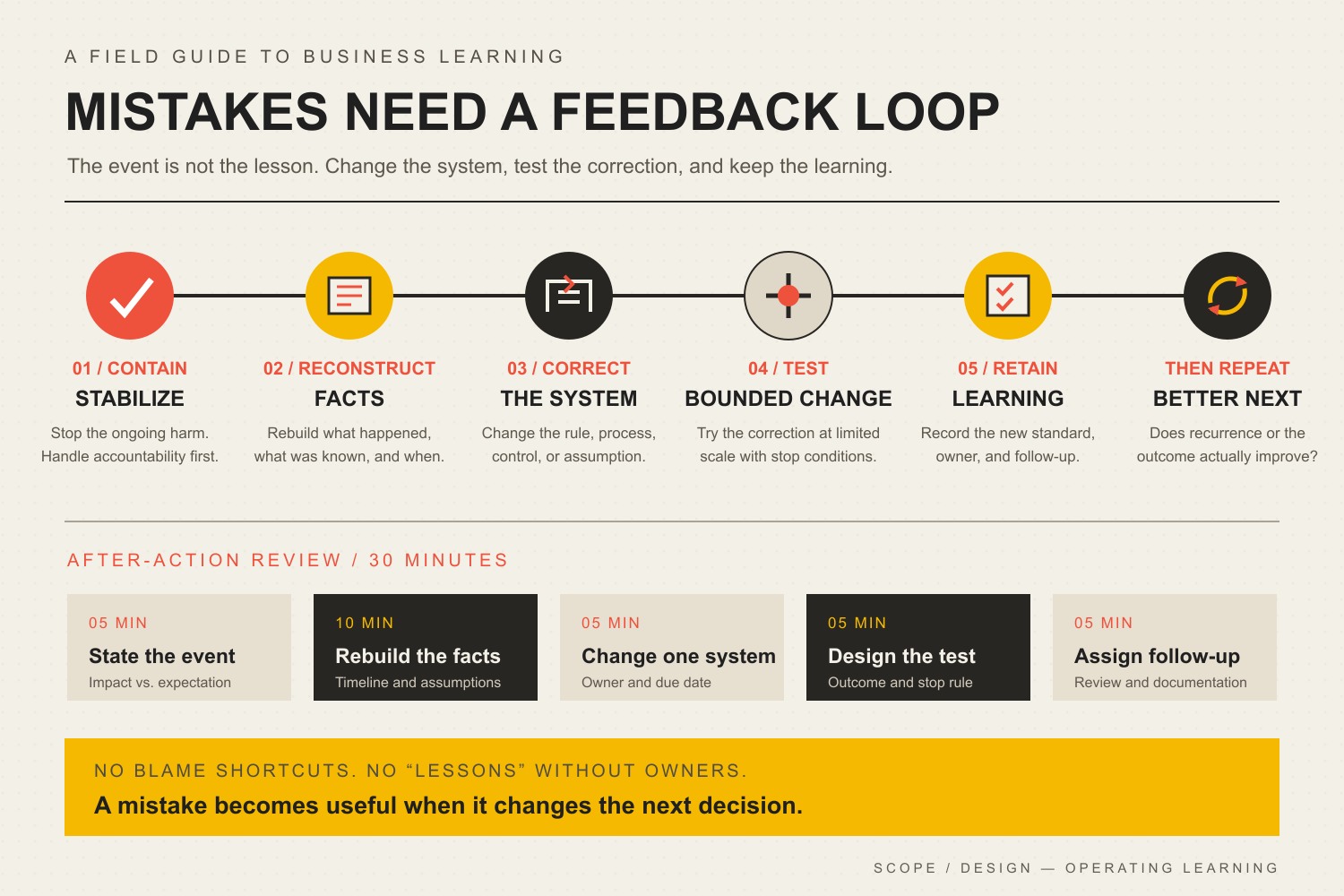
    The short version: stabilize the damage, reconstruct what actually happened, identify the system or assumption that failed, make one concrete change, test that correction, and preserve the lesson so you do not pay tuition for the same mistake twice.

    Mistakes Do Not Create Growth. Feedback Loops Do.

    “Learn from your mistakes” sounds sensible, but it is incomplete advice. Plenty of businesses repeat the same problem with a slightly different customer, employee, campaign, vendor, or quarter.

    The useful question is not, “What lesson should I take from this?” It is, “What will be different in the business because this happened?”

    • If a proposal keeps getting misunderstood, change the proposal or sales process.
    • If a project became unprofitable because scope drift went unnoticed, change the checkpoints, pricing assumptions, or change-order rules.
    • If a product launch missed the mark because the team guessed at demand, change how you validate an idea before making a larger bet.
    • If one person could make an expensive error with no review, change the control—not merely the reminder to “be more careful.”

    This systems-first idea is not limited to business. Google’s SRE postmortem guidance emphasizes concrete, owned, measurable actions after incidents and warns that vague action items are easy to forget. OSHA’s incident-investigation guidance similarly recommends looking beyond immediate blame to underlying causes and corrective actions that reduce recurrence. A small business does not need an enterprise incident-management department to use the same principle: fix the conditions that made the mistake possible.

    The Five-Step Mistake-to-Growth Loop

    Use this loop after a meaningful mistake—something that cost money, trust, time, momentum, or strategic clarity. The goal is not to create paperwork. The goal is to produce three useful outputs: a defensible lesson, a system change, and a next test.

    Five steps for learning from a business mistake: stabilize damage, reconstruct what happened, change the system, run a bounded test, and preserve the learning.

    1. Stabilize the Damage Before You Analyze It

    When a mistake is still causing damage, analysis can wait. Stop the leak first.

    • Pause the campaign that is spending badly.
    • Contact the client whose expectations were missed.
    • Correct the invoice, access setting, price, schedule, or fulfillment problem.
    • Preserve records you will need to understand what happened.
    • Escalate legal, safety, security, tax, or compliance issues to the right professional instead of treating them as an experiment.

    Containment matters because an open problem distorts the review. Everyone becomes focused on defending themselves, pleasing the loudest stakeholder, or stopping the immediate pain. Stabilize first; learn second.

    2. Reconstruct What Actually Happened

    Memory becomes a storyteller very quickly. Reconstruct the mistake from observable facts before deciding what it “means.”

    Write down:

    • What did we expect to happen?
    • What actually happened?
    • What did we know when the decision was made?
    • What did we assume?
    • What signals did we miss, dismiss, or never collect?
    • Where did the outcome first diverge from the plan?
    • What made the problem larger or harder to detect?

    This is where you separate a bad outcome from a bad decision. Sometimes the decision was reasonable and the environment changed. Sometimes the outcome exposed an assumption you never tested. Sometimes execution was sloppy. Those are different failures and require different fixes.

    If the real issue is that your team struggles to make the choice in the first place, use a separate business decision-making framework. This article starts after there is an outcome to learn from.

    3. Change the System, Not Just the Story

    A lesson such as “communicate better,” “plan more,” or “do more research” is not a system change. It is a wish.

    Ask which part of the business needs to change:

    • Decision rule: What condition will make us say yes, no, stop, or escalate next time?
    • Process: What step, review, handoff, or checkpoint was missing?
    • Control: What should require approval, validation, backup, or a second set of eyes?
    • Assumption: What did we believe without enough evidence?
    • Signal: What leading indicator should we watch earlier?
    • Capability: Do we need better training, tooling, expertise, or role clarity?

    The best corrective action changes the environment in which future decisions are made. “Remember not to do that again” depends on memory. A new review step, pricing rule, alert, checklist, data field, contract clause, or validation threshold changes the system.

    4. Run a Bounded Test Instead of Swinging to the Opposite Extreme

    One painful mistake can make a business overcorrect. A bad employee leads to refusing to delegate. One weak campaign kills marketing for a year. One difficult client creates an approval process that punishes every good client.

    Do not let one data point become a permanent doctrine. Turn the correction into a bounded test:

    1. State what you changed.
    2. State what result you expect.
    3. Choose the smallest useful place to test it.
    4. Define what would count as success, failure, or “we still do not know.”
    5. Set a review date.

    This makes the lesson falsifiable. You are not trying to prove that your new idea is right; you are trying to make the next decision with better evidence.

    5. Preserve the Learning So the Company Gets Smarter

    If the insight lives only in the owner’s head, the company has not learned—one person has.

    Keep a simple mistake log or after-action note. It does not need to be a novel. Record the event, evidence, lesson, system change, owner, test, and recheck date. Link it to the process or decision it changed.

    Over time, this creates institutional memory. New team members do not have to rediscover why a rule exists. Repeated failures become visible. And when an old rule stops making sense, you can see the evidence that created it and decide whether the context has changed.

    Classify the Mistake Before You Choose the Lesson

    Not every bad outcome deserves the same response. A quick classification prevents you from solving the wrong problem.

    Type of mistakeWhat it usually meansUseful response
    Execution errorThe plan was sound, but the work broke downClarify ownership, sequence, training, checklist, or quality control
    Process/control failureThe system allowed an avoidable error to pass uncheckedAdd a review, approval, alert, backup, or handoff rule
    Assumption failureYou believed something important without enough evidenceImprove research, validation, or early signal collection
    Strategy errorThe business chose the wrong market, offer, priority, timing, or resource allocationRevisit the decision criteria and run a smaller next bet
    External shockThe environment changed in a way you could not reasonably controlImprove resilience, optionality, detection, or contingency planning

    Classification also protects you from hindsight bias. A reasonable decision that lost because the market changed is not the same as a decision that ignored obvious evidence. The lesson should fit the failure.

    Be Blameless About Causes and Accountable About Actions

    “Blameless” does not mean nobody owns anything. It means the review is designed to understand why the outcome made sense to the people involved at the time, then fix the conditions that should change.

    A productive review can say, “This action was wrong and caused damage,” without stopping at, “Jordan messed up.” Ask why the error was possible, why it was not caught, what information was missing, what pressure existed, and what safeguard failed.

    Then make the follow-up extremely accountable. Every corrective action should have an owner and a verifiable end state. “Improve onboarding” is fog. “Add a pre-launch QA checklist to every new client project and require the project lead to sign it before launch” can actually be completed.

    And if a painful mistake has made you afraid to make another move at all, solve that problem separately. Our guide to overcoming fear in business deals with the uncertainty and avoidance that can follow a setback.

    When a Business Mistake Is Not a “Growth Experiment”

    There is a limit to the “mistakes are opportunities” idea.

    Do not romanticize harm. An ethical breach, safety issue, security incident, discrimination complaint, tax problem, legal violation, or knowingly repeated negligence is not clever experimentation. The first obligations are to stop the harm, make appropriate restitution, preserve evidence, report or disclose what is required, and get qualified help where necessary.

    You can still learn from what happened. But “growth opportunity” should never become an excuse to minimize consequences or dodge accountability.

    Measure Whether the Lesson Actually Changed the Business

    There is no universal benchmark for how quickly a company should learn from a mistake. A two-person service firm, a manufacturer, and a software company have different risks and cycles. Measure improvement against your own baseline and the specific failure you are correcting.

    • Recurrence: Did the same failure happen again?
    • Time to detect: Do you notice the warning signal earlier?
    • Time to correct: Can you contain and fix the issue faster?
    • Corrective-action closeout: Did the agreed changes actually get implemented?
    • Cost of repetition: Is the financial or operational impact falling?
    • Test result: Did the changed process or assumption improve the outcome you cared about?

    Those metrics turn “we learned a lot” into something observable. They also reinforce a broader truth about sustainable business growth: progress usually comes from better decisions compounding, not one dramatic breakthrough.

    A 30-Minute After-Action Review for Small Businesses

    You do not need a retreat, facilitator, or 40-page report. For many mistakes, 30 focused minutes is enough if you leave with decisions.

    1. 5 minutes — State the event. What happened, what was the impact, and what did we expect instead?
    2. 10 minutes — Reconstruct the evidence. Timeline, assumptions, signals, contributing conditions, and what was known at each point.
    3. 5 minutes — Identify the system change. Which rule, process, control, assumption, signal, or capability should change?
    4. 5 minutes — Design the next test. Where will we try the correction, and what result will tell us whether it helped?
    5. 5 minutes — Assign follow-through. Owner, due date, documentation location, and review date.

    One rule makes this review dramatically better: do not end with a lesson that has no owner. Insight without a changed behavior or system is just a good conversation.

    Frequently Asked Questions About Business Mistakes

    How do you recover from a costly business mistake?

    Contain the immediate damage first. Then reconstruct the facts, identify the contributing system or assumption, make one concrete corrective change, test it in a bounded way, and document the result. If customers, employees, partners, or the public were harmed, accountability and appropriate remediation come before reframing the event as a learning opportunity.

    Should you blame the person who made the mistake?

    Hold people accountable for choices and responsibilities, but do not let blame replace diagnosis. Ask what information, incentives, process gaps, training, controls, or pressures made the error possible. A review that only identifies a person often leaves the same conditions in place for the next person.

    How do you stop repeating the same business mistake?

    Convert the lesson into a rule, process, control, signal, or documented standard. Give the corrective action an owner and due date, then track recurrence. If the same problem returns, the original action was incomplete, poorly implemented, or aimed at the wrong cause.

    When should you stop testing and abandon the idea?

    Define stop conditions before the next test. If the correction repeatedly fails to improve the key outcome, the economics no longer work, the risk is unacceptable, or new evidence invalidates the core assumption, continuing is not perseverance—it is refusal to update. Treat the new evidence as input to the next decision.

    What is the best metric for learning from mistakes?

    There is no single universal metric. Start with recurrence and the specific outcome the corrective action is meant to improve. Time to detect, time to correct, corrective-action completion, and cost of repetition can also show whether the business is actually getting better at responding.

    Turn the Mistake Into a Better Next Decision

    The goal is not to become a business that celebrates failure. It is to become a business that wastes less of it.

    When something goes wrong, ask for three outputs: What did the evidence teach us? What changed in the system? What will we test next? If you can answer all three, the mistake has a chance to become an asset instead of a recurring expense.

    For the larger strategic system behind those choices, see our business strategy and market intelligence playbook for a broader framework on market signals, operating constraints, and better bets.