Tag: Customer Reviews

  • 15 Proven Local Marketing Strategies That Drive Real Results

    15 Proven Local Marketing Strategies That Drive Real Results

    Bottom line: The best local marketing strategies do not work as a 15-item checklist. They work as a sequence. Capture the local demand that already exists, make your business easier to trust and contact, build follow-up and referral systems you own, and only then add paid or borrowed reach. For most small businesses, the useful question is not “Which channel is hottest?” It is “Where is our local buying path leaking, and which strategy fixes that leak?”

    This guide is the broad strategy catalog. If you need the bigger planning layer, start with our small business marketing strategy. If you want a connected local buying-path model, use our six-step local marketing guide. Here, we will focus on 15 practical local marketing strategies, when each one earns a place in the plan, and the first business result worth measuring.

    How to Choose Local Marketing Strategies Without Doing Everything at Once

    Local marketing is marketing that deliberately reaches, helps, and converts customers in a defined geographic market. The geography might be a town, a group of ZIP codes, a service radius, several neighborhoods, or a drive-time area. The right boundary is the smallest one that actually changes who you serve, what you promise, where you can deliver, or how a customer chooses you.

    Readiness stageWhat you are trying to fixStart withFirst useful metric
    Capture demandPeople need what you sell but do not find or contact youGoogle Business Profile, local SEO, service/location pages, response pathQualified inquiries
    Build trustPeople find you but hesitate or choose someone elseReviews, proof stories, useful local content, videoInquiry-to-booking rate
    Follow up & partnerInterest and past customers disappear after one interactionEmail, referrals, partnerships, eventsRepeat and referral revenue
    Amplify what worksYour offer and follow-up convert, but you need more qualified reachRetargeting, paid media, local creatorsCustomer acquisition cost and profit

    That sequence is a decision rule, not a law. A new emergency-service company may need paid search early because demand is already urgent. An established dentist with a full schedule may care more about retention and referrals. The point is to match the tactic to the bottleneck instead of spreading a small team across every channel.

    Four local marketing stages build from existing demand through trust and owned follow-up to selective amplification of proven work.

    Foundation: Capture the Local Demand That Already Exists

    1. Optimize Your Google Business Profile

    Your Google Business Profile is one of the first places to fix when customers search for a nearby business or service. Keep the business name, category, address or service area, phone number, hours, services, photos, and other relevant fields accurate and complete. Do not stuff keywords into the business name or invent locations you do not actually operate from.

    Google says local results are primarily based on relevance, distance, and prominence, and its Business Profile guidance recommends complete, accurate information, verification, current hours, review responses, and photos. For the broader technical steps to establish business details across Search and Maps, see Google Search Central’s business details guide.

    Use it when: local search or Maps can reasonably start a buying decision. Measure first: qualified calls, booking actions, direction requests that matter to the business, and leads that can be traced back to the profile—not profile views by themselves.

    2. Build a Review Request and Response System

    Reviews are useful because they give buyers recent evidence from people who have already experienced the business. The scalable part is not “get more five-star reviews.” It is building a consistent process: ask eligible customers at a sensible moment, make the review step easy, monitor new reviews, respond professionally, and use recurring feedback to improve the operation.

    Google provides review-link and QR-code workflows for requesting reviews. Keep the request honest. Do not buy fake reviews, screen out unhappy customers before giving them a review path, or condition an incentive on a positive rating. The FTC’s Consumer Reviews and Testimonials Rule Q&A explains current federal restrictions on deceptive review practices, including incentives tied to a particular sentiment.

    Use it when: you have real customers and a repeatable service experience. Measure first: review volume and recency as operating inputs, then whether prospects mention reviews, convert at a higher rate, or arrive with fewer trust objections.

    3. Strengthen the Local SEO Basics

    Local SEO is broader than your Business Profile. Your website still needs clear service pages, understandable location signals, useful titles and headings, accurate business information, crawlable pages, sensible internal links, and content that answers the questions local buyers actually ask. Consistency matters because search engines and customers should be able to connect the website, business profile, and other legitimate local references to the same real company.

    Do not turn “hyperlocal SEO” into hundreds of near-duplicate city pages. A neighborhood, city, or service-area page deserves to exist when the geography changes buyer-relevant information: availability, regulations, travel, service process, examples, staff, pricing context, or proof. For the deeper implementation work, use our local SEO guide.

    Use it when: organic/local search is a realistic acquisition path but your site is unclear, thin, inconsistent, or hard to crawl. Measure first: qualified organic inquiries by service and geography, then landing-page conversion—not rankings in isolation.

    4. Create Service and Location Pages That Help Buyers Decide

    A strong service page answers the questions a local buyer needs before contacting you: what you do, who it is for, what is included, where you provide it, what the process looks like, what proof exists, and what the next step is. A strong location page adds real geographic differences rather than swapping a city name into the same template.

    • Use one clear service or location intent per page.
    • Add local proof when you genuinely have it: projects, photos, testimonials, staff, travel details, service boundaries, or area-specific FAQs.
    • State where you do and do not serve instead of implying a physical presence everywhere.
    • Give the visitor an obvious next step: call, request a quote, schedule, visit, or ask a question.

    Use it when: important services or service areas are currently buried on a generic page. Measure first: qualified inquiries and booking rate from each landing page.

    5. Make the Response Path Fast, Clear, and Trackable

    Marketing fails quietly when a customer finds the business, believes the offer, and then cannot figure out what to do next—or gets no response after doing it. Put the primary response option where the buyer needs it. On a service page that may be “Request a quote.” On a restaurant profile it may be “Get directions.” On an urgent service page it may be “Call now.”

    Then assign ownership. Who answers the phone? Who receives forms? What happens after hours? How quickly should an inquiry receive a real response? How will the team label source, service, qualification, booked outcome, and revenue? More traffic makes a leaky handoff more expensive; it does not repair it.

    Use it when: leads are being lost between click and conversation. Measure first: response rate, response time, qualified-inquiry rate, booked-work rate, and lost-lead reasons.

    Proof and Relevance: Help Local Buyers Choose You

    6. Publish Real Customer Proof Stories

    A generic testimonial says, “Great company.” A useful proof story shows the buyer what happened. Capture the starting problem, what the customer cared about, what you changed, what made the work difficult, and the observable result. For a contractor, that might be a before-and-after project with the homeowner’s constraints. For a B2B service, it might be a short case study showing the decision, process, and outcome.

    Repurpose the same proof carefully: website case study, sales follow-up, Business Profile photo, social post, proposal excerpt, or email. One real example can do more work than five generic “we serve [city]” pages because it gives the prospect something specific to evaluate.

    Use it when: prospects understand the service but still question credibility, fit, quality, or risk. Measure first: assisted inquiries, sales-team use, proof-page engagement from qualified visitors, and which objections disappear in sales conversations.

    7. Create Local Decision Content, Not Just “Local Content”

    Local content deserves to exist when it helps someone make a decision. A family photographer might publish a guide to photo locations because the location changes the service experience. A landscaper might explain plant choices for local soil or deer pressure. An event company might compare venue types in the region because venue rules change cost and logistics.

    Do not publish local news you have no useful connection to just to mention a town name. Build content around real customer questions, real local constraints, and real expertise. The best format is the one that carries the proof or explanation the buyer needs and that your team can maintain consistently.

    Use it when: buyers repeatedly ask the same location-specific questions before purchasing. Measure first: assisted conversions, qualified organic entrances, sales-team usage, and whether the content helps a prospect reach the next step.

    8. Use Short-Form Video to Show the Work and Answer Objections

    Video can make local expertise visible quickly. Instead of chasing trends, record what a buyer would benefit from seeing: a 30-second walkthrough, a quick before-and-after, the difference between two options, a common mistake, a customer question, a shop tour, or a short explanation from the person who actually does the work.

    Keep the production standard appropriate to the brand, but do not confuse polish with usefulness. A clear phone video from the jobsite can outperform an elaborate brand reel when the buyer needs evidence, not entertainment.

    Use it when: your work is visual, demonstrable, personal, or easier to trust after seeing the people/process. Measure first: qualified inquiries and sales conversations influenced by the video—not views alone.

    9. Pick One Local Social Community You Can Actually Serve

    You do not need an equally active presence on every social platform. Choose the community where your customers, referral partners, employees, or local decision-makers already spend attention—and where your team can respond reliably. For many local businesses that may still be Facebook; for others it may be Instagram, LinkedIn, YouTube, TikTok, a neighborhood group, or a niche community.

    The operating standard is more important than the platform name: useful posts, real conversations, customer proof, event participation, thoughtful replies, and a clear handoff when someone shows buying intent. Our Facebook marketing for local businesses guide goes deeper on treating Facebook as a community channel rather than a content treadmill.

    Use it when: a meaningful local audience or referral network is active on the platform. Measure first: qualified conversations, referrals, event participation, inquiries, and attributable sales—not follower count.

    Owned Follow-Up and Relationships: Get More Value From Attention You Already Earned

    10. Build Local Email Follow-Up

    Email is useful in local marketing because you own the permissioned relationship instead of renting every future contact from a search engine or social platform. The geographic segmentation should be only as precise as the message requires. A service-area business might segment by territory or service type. A multi-location business might segment by store. An event-driven business might segment by drive time.

    Good local email can include appointment reminders, seasonal service timing, useful follow-up after a quote, customer education, event invitations, product availability, referral requests, or relevant local updates. Avoid “creepy precision” that tells the recipient you know more about their location than the message needs. See our local email marketing guide for the deeper segmentation and usefulness model.

    Use it when: you already have customers, subscribers, leads, or quote requests worth nurturing. Measure first: repeat bookings, reactivated leads, referral revenue, and revenue per campaign or segment.

    11. Build Referral Loops and Community Partnerships

    A local partnership works when two organizations serve overlapping people without competing for the same purchase. A wedding venue and photographer, veterinarian and trainer, accountant and attorney, gym and physical therapist, or manufacturer and local service provider can create legitimate handoffs.

    • Start with a real customer problem the partnership solves.
    • Define what a good referral looks like and who owns follow-up.
    • Give partners an easy, accurate way to explain your offer.
    • Track the referral source and the resulting business outcome.
    • Reciprocate only when it is genuinely useful to the customer.

    Use it when: another trusted local organization encounters your ideal customer before, during, or after the need you solve. Measure first: qualified referrals, booked work, partner-to-customer conversion, and revenue by partner.

    12. Use Local Events as Bounded Campaigns

    Sponsoring or attending an event is not automatically a marketing strategy. Turn it into one by defining the job. Are you trying to meet referral partners, book appointments, collect permissioned follow-up, demonstrate a product, generate proof content, or support a community relationship that matters to the business?

    Build a before/during/after plan. Before: invite the right people and make the offer clear. During: make the next step easy and capture the source. After: follow up quickly, publish useful proof, and record what happened. If you want smaller experiments rather than a broad portfolio, our local marketing ideas guide shows how to treat tactics as bounded tests.

    Use it when: the event attracts a relevant local audience or strengthens a valuable relationship. Measure first: qualified conversations, permissioned leads, booked work, referrals, and follow-up revenue.

    Selective Amplification: Add Reach After the Offer and Follow-Up Work

    13. Retarget Warm Website Visitors

    Retargeting is most useful when someone has already shown meaningful interest but did not take the next step. Build audiences around buyer intent where the platform, consent choices, and privacy requirements allow it: important service pages, pricing or financing content, booking starts, product categories, or other high-intent behavior.

    The ad should reduce friction, not simply follow the visitor around the internet. Remind them of the service, answer a common objection, show relevant proof, or make the next step easier. Exclude customers or converters when continued ads would be wasteful or annoying.

    Use it when: the site gets enough qualified traffic to form a useful warm audience and the conversion path is already instrumented. Measure first: incremental qualified conversions and cost per booked customer, not click-through rate in isolation.

    14. Run Geo-Targeted Paid Search or Social Ads

    Paid media can accelerate a proven offer. It cannot rescue an unclear offer, a weak landing page, slow follow-up, or poor fulfillment. Define the location, audience, offer, destination, budget, tracking, and success/stop rule before launching. For local service businesses, the tightest useful geography may be a service radius or ZIP set; for a destination business, a wider drive-time market may make sense.

    Separate demand capture from awareness. Paid search can capture people already expressing intent. Paid social can reach people who fit a profile or engage a warm audience. They need different creative, landing experiences, and expectations. Our paid advertising strategy guide covers the deeper channel economics and testing model.

    Use it when: you know what a qualified customer is worth, the offer already converts, and you can handle additional demand. Measure first: cost per qualified lead, cost per booked customer, revenue, gross profit, and payback—not cheap clicks.

    15. Test Local Creators and Influencers for Audience Fit, Not Follower Count

    A local creator can be useful when they have earned attention from the people you actually want to reach. That might be a neighborhood food creator, a home-renovation account, a parenting newsletter, a local sports personality, a business-community host, or a niche expert with a concentrated regional audience.

    Start small. Define the audience, offer, disclosure requirements, content rights, destination, tracking method, and business result before paying for reach. Give the creator enough freedom to remain credible, but do not leave the campaign objective vague. A small relevant audience can be more valuable than a much larger audience with no buying fit.

    Use it when: the creator’s audience strongly overlaps your real market and you have something worth introducing. Measure first: trackable qualified inquiries, redemptions, booked work, revenue, and acquisition cost.

    Measure Local Marketing as a Business System

    Local marketing dashboards often become crowded with things that are easy to count: impressions, followers, likes, video views, profile views, sessions, keyword positions, and email opens. Those can be useful diagnostic signals, but they are not the finish line.

    Use a simple chain for each meaningful tactic:

    1. Cost or effort: money, staff time, production time, sponsorship fee, media spend.
    2. Attention or response: relevant visits, calls, form starts, messages, referrals, event conversations.
    3. Qualification: how many responses match the customer, service, geography, timing, and budget you can actually serve?
    4. Booked outcome: appointments, estimates, projects, transactions, visits, or other meaningful next steps.
    5. Business value: revenue, gross profit, repeat purchase, referral value, acquisition cost, and payback.

    If a tactic creates attention but no qualified responses, change the audience, message, or offer. If it creates qualified responses but no bookings, inspect the handoff and sales process. If it books work but loses money or overloads fulfillment, do not scale it just because the ad dashboard looks good.

    Which Local Marketing Strategy Should You Try First?

    Use the cheapest useful fix for the biggest current leak.

    • People cannot find you: fix Google Business Profile, local SEO, and core service/location pages.
    • People find you but hesitate: strengthen reviews, proof, useful decision content, and the response path.
    • You keep starting from zero: build email follow-up, referral loops, and community relationships.
    • Your offer converts but volume is limited: test retargeting, paid media, or a relevant local creator.
    • You are not sure what the leak is: map the buyer path and instrument the handoffs before adding another channel.

    Pick one primary strategy and one supporting action for a defined test period. Write down the audience, offer, destination, owner, budget or time allowance, success metric, and stop condition. Then review what happened and either scale, revise, or stop. That is more useful than maintaining fifteen half-active channels.

    Local Marketing Strategy FAQ

    What is a local marketing strategy?

    A local marketing strategy is a deliberate plan for reaching and converting customers in a defined geographic market. It connects a real audience, offer, channel, destination, follow-up owner, and measurable business outcome. Simply posting city names or buying geographically targeted impressions is not a strategy by itself.

    How do you market a local business effectively?

    Start with demand you can already capture: accurate Business Profile information, a clear website, local search basics, reviews, and an easy response path. Then add proof, owned follow-up, partnerships, and selective paid reach. The sequence should follow the current bottleneck rather than a universal channel checklist.

    What is an example of local area marketing?

    A residential service company could optimize its Business Profile, publish a real project case study from the service area, send past customers a seasonal reminder, partner with a complementary local contractor, and run paid search only for ZIP codes it can profitably serve. Each action has a geographic reason and a measurable next step.

    How much should a small business spend on local marketing?

    There is no responsible universal percentage for every local business. Start from customer value, gross margin, capacity, and the cost of a bounded test. Set a budget you can afford to learn from, define the maximum acceptable acquisition cost, and do not increase spend until the offer, response path, and tracking are working.

    Is local SEO enough on its own?

    Sometimes search is the dominant acquisition channel, but local SEO still depends on what happens after the visit: proof, a usable website, fast follow-up, and a service experience worth recommending. Businesses with weak search demand, long buying cycles, or relationship-heavy sales may also need email, partnerships, events, social/community work, or paid media.

    Turn the 15 Strategies Into a Local Marketing Plan You Can Run

    The advantage is not having more tactics. It is knowing what each tactic is supposed to do, who owns the next step, and what evidence will tell you whether it worked. Fix local discovery. Make the business easier to trust. Capture permission to follow up. Build relationships that create useful referrals. Then buy or borrow more reach when the economics are ready for it.

    If you want help identifying the highest-leverage leak in your local marketing system, talk with Scope Design. We can help you connect the website, local search, proof, follow-up, content, and paid channels into a plan your team can actually operate and measure.


  • 10 Killer Local Marketing Ideas That Actually Drive Results

    10 Killer Local Marketing Ideas That Actually Drive Results

    The best local marketing ideas are not the ones getting the most attention this month. They are the ones that solve the bottleneck your business has right now. A local company that is hard to find needs a different marketing test than one that gets plenty of inquiries but weak follow-up. A business with more demand than it can fulfill should not buy even more attention.

    That is the filter behind this guide. Instead of treating local marketing as a checklist of channels, use each idea as a bounded experiment: name the problem, choose one bet, decide what qualified business result should change, then scale or stop based on evidence.

    If you need the broader system first, start with our small-business marketing strategy. This article has a narrower job: helping you pick the next practical local marketing idea without trying ten things at once.

    (more…)
  • 6 Proven Local Marketing Strategies to Boost Sales and Drive Business Growth

    6 Proven Local Marketing Strategies to Boost Sales and Drive Business Growth

    The six local marketing strategies that matter most are the ones that move a nearby prospect through a complete buying path: get found, build trust, answer the questions that delay a decision, create a permission-based follow-up path, borrow credibility from local relationships, and add paid reach only when the rest of the system is ready. The mistake is treating those as six unrelated channels. They work better as connected handoffs.

    For a small local business, that distinction matters. More posts, more ads, or more listings do not automatically create more sales. A useful local marketing system helps the right people discover you, understand why you fit, take a next step, and stay connected long enough to buy or refer someone else. If you need the broader framework for choosing channels by buying moment, start with Scope Design’s small business marketing strategy guide. This article focuses on the local handoffs.

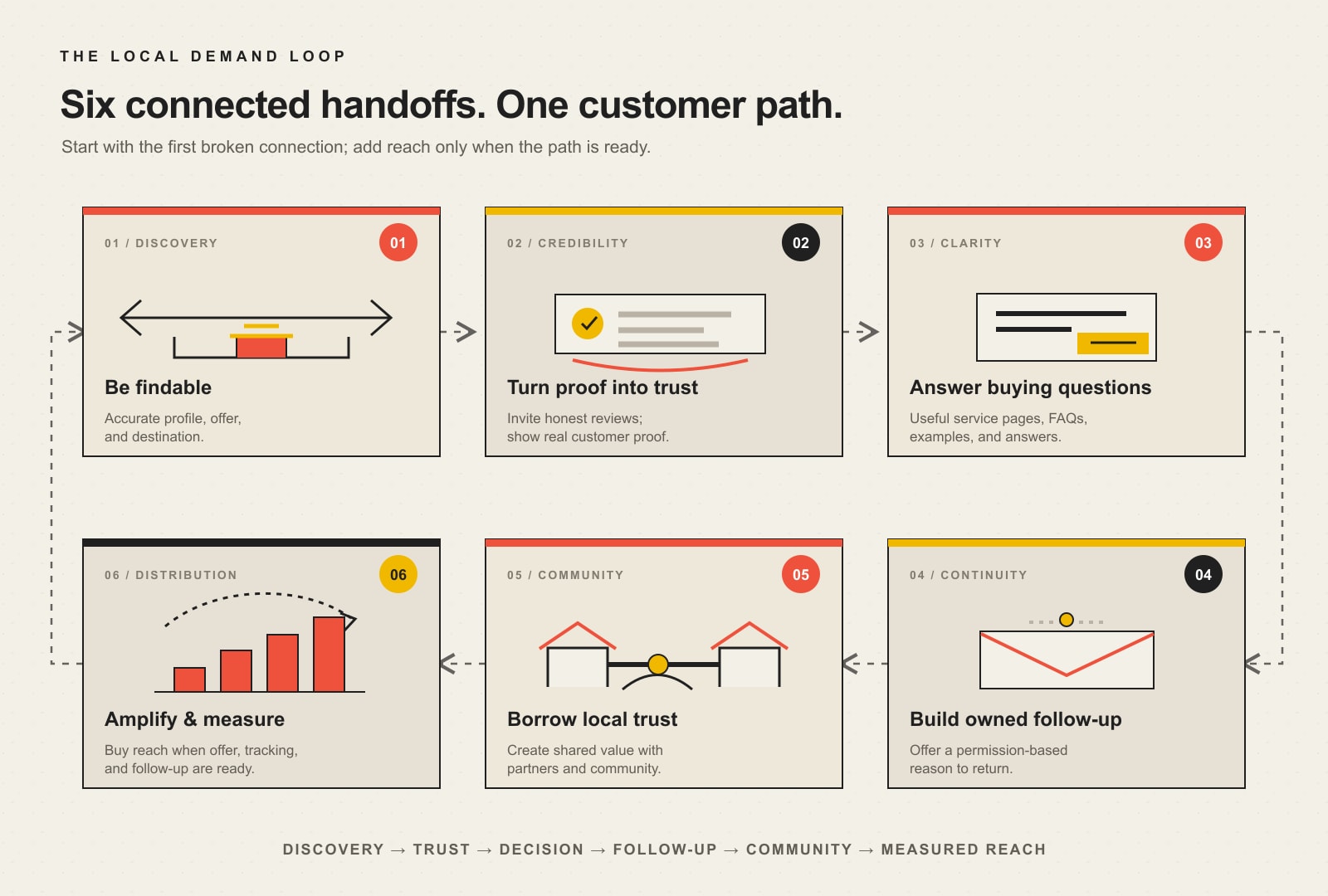
    The Local Demand Loop: 6 strategies that work together

    1. Be findable where local intent starts. Keep your Google Business Profile and core business information accurate, complete, and aligned with what your website actually offers.
    2. Turn real customer proof into trust. Build a repeatable, honest review and proof system instead of waiting for testimonials to appear by chance.
    3. Answer local buying questions. Create useful service, location, FAQ, case-study, photo, and video content around real decisions—not a content treadmill.
    4. Build an owned follow-up path. Give prospects and customers a reason to opt into email or another permission-based relationship you control.
    5. Borrow local trust. Create partnerships, referrals, community participation, and cross-promotions with organizations that already have the audience’s attention.
    6. Amplify and measure. Use paid search, paid social, and other local promotion only when the offer, destination, tracking, and follow-up are strong enough to learn from the spend.

    If you want a bigger catalog of tactics, Scope Design also maintains a broader guide to 15 local marketing strategies. The job here is different: decide which part of your local demand path is broken first.

    What should you fix first?

    What you are seeingLikely broken handoffStart here
    People nearby need what you sell, but few find or contact youFindabilityBusiness Profile, service area, core facts, website alignment
    You appear in searches, but prospects still choose competitorsProof and trustReview workflow, customer evidence, photos, clear credibility signals
    Prospects keep asking the same fit, price, timing, or process questionsDecision supportService pages, FAQs, case studies, useful local content
    Traffic and inquiries disappear after one visit or conversationOwned follow-upPermission-based email, CRM, useful follow-up sequence
    You have a credible offer but weak local awarenessBorrowed trustPartnerships, referrals, local groups, events, cross-promotion
    Your offer converts, but qualified volume is too lowDistributionMeasured paid search, paid social, sponsorships, or local promotion
    Six connected local marketing steps: be findable, turn customer proof into trust, answer buying questions, build owned follow-up, borrow community trust, and amplify and measure after the customer path is ready.
    The Local Demand Loop works best when you fix the first broken handoff instead of adding another channel by default.

    1. Be findable where local intent starts

    For many local businesses, the first buying moment is simple: someone searches for a service, product, or place near them. Your job is not to “hack” that moment. It is to make the basic facts about your business easy for customers and platforms to understand.

    Google’s current Business Profile guidance says local results are mainly based on relevance, distance, and prominence. Google also says businesses with complete and accurate information are more likely to appear for relevant local searches. That makes a clean foundation more useful than chasing speculative ranking tricks. Review your address or service area, hours, primary category, services, contact information, photos, and the pages you send people to. Make sure the website describes the same business the profile describes. Google’s local ranking guidance is the right source for current platform-specific details.

    Do this first: search for your own business the way a new customer would, then compare the profile, website, phone number, hours, service area, and core offer. Fix contradictions before adding more content or promotion.

    Measure: calls, website visits, direction requests, bookings, quote requests, and qualified form submissions. Google now documents Business Profile interactions such as calls, website clicks, directions, messages, and bookings as performance data that can be shared with Google Analytics. Those customer actions are more useful than a promise to “rank #1.”

    2. Turn real customer proof into trust

    Findability earns attention. Proof helps a prospect feel safe choosing you. For a local business, proof can include reviews, before-and-after photos, project examples, recognizable locations, team photos, case studies, and specific answers from people who have actually used the service.

    The operational mistake is waiting until you “need more reviews” and then asking everyone at once. Build the request into a real customer moment: after a successful delivery, completed appointment, solved problem, or positive follow-up. Make the request easy, respond to feedback, and reuse genuine customer evidence where you have permission.

    Keep the system honest. The Federal Trade Commission’s Consumer Reviews and Testimonials Rule, effective October 21, 2024, addresses fake and deceptive review practices. Among other provisions, it prohibits fake or false reviews and incentives conditioned on a particular positive or negative sentiment. In practical terms: ask for honest feedback, not “five-star reviews,” and do not buy manufactured credibility.

    Do this first: choose one legitimate moment in your customer process when a review request makes sense, write a short neutral request, and assign responsibility for sending it.

    Measure: review-request completion, new legitimate reviews, response rate, and—more importantly—whether qualified prospects are moving from profile or proof pages into calls, quotes, bookings, or purchases.

    3. Answer the local buying questions that slow decisions

    Content works best when it removes uncertainty. That is especially true locally, where customers often need answers that generic national content cannot give them: Do you serve my town? Is this right for an older home? What happens after I request a quote? Can I see examples nearby? How long does this usually take? What should I prepare before the appointment?

    Turn repeated sales and service questions into durable decision-support assets. A strong service page can explain the offer and next step. A useful location section can clarify a real service area. A case study can show the problem, approach, and result without inventing performance claims. A short video can demonstrate a process. A photo set can make the experience tangible. An FAQ can answer objections before someone calls.

    This is also where many businesses waste effort by confusing a format with a strategy. Short-form video, social posts, blogs, and email are containers. Use the container that fits the question and the customer. If you publish on Facebook because your local community is genuinely active there, Scope Design’s Facebook marketing guide for local businesses goes deeper on building community without turning the platform into a content treadmill.

    Do this first: write down the five questions customers ask most often before they buy. Turn the highest-friction question into one useful page, section, video, checklist, or case study. Then reuse that answer across the places where customers already encounter you.

    Measure: qualified entrances to the content, assisted calls or forms, sales conversations that start with better-informed prospects, and fewer repeated clarification steps when that is meaningful to your process.

    4. Build an owned follow-up path

    Local marketing gets expensive when every future sale requires rediscovering the same person from scratch. An owned follow-up path gives a prospect or customer a reason to stay connected after the first visit, quote, appointment, or purchase.

    Email is usually the most practical example because it is a direct, permission-based relationship that does not depend on a social feed deciding whether to show your next post. But the value is not “having a newsletter.” The value is having a useful reason to follow up: appointment preparation, maintenance reminders, seasonal availability, relevant education, replenishment, event invitations, project planning, or a thoughtful post-purchase sequence.

    Scope Design’s email marketing for small business guide treats email as a relationship system rather than a blast calendar. That is the right mental model here: capture permission, segment when it changes relevance, make the next step obvious, and connect the email back to a real business action.

    Do this first: identify one moment where a customer would reasonably want future information from you, state what they will receive, collect permission, and create the first useful follow-up message.

    Measure: opt-ins, replies, booked appointments, quote restarts, repeat purchases, and other downstream actions you can credibly connect to follow-up. Open rates alone are not the business outcome.

    5. Borrow trust through local partnerships and community

    Some local audiences are easier to reach through relationships than through algorithms. A complementary business, neighborhood organization, trade group, school, nonprofit, venue, employer, realtor, property manager, or event organizer may already have the trust and attention you are trying to build.

    The strongest partnerships are not “please promote me” arrangements. Start with a useful overlap. A landscaper and a nursery can teach a seasonal workshop. A photographer and a wedding venue can build a planning resource. A contractor and a realtor can create a pre-sale home checklist. A restaurant can support an event its customers already care about. A professional service firm can contribute expertise to a local organization without turning every interaction into a pitch.

    Community participation also creates better raw material for your digital marketing. Real collaborations produce photos, stories, customer questions, referral paths, and context that generic “local content” cannot manufacture.

    Do this first: list five organizations that serve the same people before, after, or adjacent to your purchase. Pick one where you can create value for the shared audience without requiring an immediate sale.

    Measure: referral conversations, qualified introductions, event sign-ups, partner-sourced leads, repeat collaborations, and customers—not just logo placements or social impressions.

    6. Buy local distribution only after the path can convert

    Paid promotion can be the fastest way to increase reach, but it is also the fastest way to pay for a broken handoff. Before increasing a local ad budget, confirm that the offer is clear, the landing destination matches the ad, tracking is working, someone can follow up with leads, and the customer economics leave room for acquisition cost.

    That readiness check matters more than declaring one platform universally “best.” Paid search may fit a high-intent service people actively look for. Paid social may fit an offer that needs visual demonstration or audience targeting. Sponsorships may fit a geographic or community trust objective. Retargeting may fit a longer decision cycle. The channel follows the buying moment and the economics.

    For the deeper channel-and-math decision, use Scope Design’s online advertising strategy for small businesses. Its core rule applies locally too: choose the channel after you understand intent, signal, follow-up, creative capacity, and customer value.

    Do this first: define one offer, one audience, one destination, one conversion action, one follow-up owner, and one budget you can treat as a learning test. If you cannot define those six things yet, fix the earlier handoff before buying more reach.

    Measure: use a simple ladder. Start with visibility and interactions, then track the customer action, then qualified leads, then customers, then revenue or customer value where attribution is trustworthy. Google’s Business Profile documentation, for example, recognizes actions such as website clicks, calls, directions, messages, and bookings. Those are better intermediate signals than impressions alone.

    A practical 30-day way to use these local marketing strategies

    You do not need to launch all six at once. In fact, that usually makes learning harder. Use the system as a sequence.

    1. Week 1: baseline the handoffs. Check local profile accuracy, top customer proof, key decision pages, follow-up, referral sources, and current paid promotion. Write down the qualified actions you care about.
    2. Week 2: fix the first obvious constraint. Correct incomplete business information, create a review request, answer the highest-friction buying question, or repair the conversion path—whichever appears first in the loop.
    3. Week 3: ship one small useful improvement. Do not wait for a “complete marketing campaign.” Publish the page, send the follow-up, activate the partnership, or run the bounded test.
    4. Week 4: review business signals. Did the change create more useful calls, quotes, bookings, conversations, or customers? Did lead quality improve? What did prospects still need? Keep, revise, or stop the change based on what you learned.

    This is the same constraint-first logic we use across marketing work: fix the first broken handoff, observe what changes, then decide whether the next layer deserves time or budget. It is more disciplined than adding a channel because a platform is currently fashionable.

    Frequently asked questions about local marketing

    How do I advertise my small business locally?

    Start by making sure people nearby can find accurate information about the business, see trustworthy proof, and reach a clear next step. Then choose promotion based on the buying moment. That might be Google Search, local social media, community sponsorships, referral partnerships, events, direct outreach, or paid ads. Advertising works better when it amplifies a path that already makes sense rather than compensating for an unclear offer or weak landing page.

    Which local marketing strategy should I fix first?

    Fix the earliest broken handoff. If qualified prospects cannot find you, start with findability. If they find you but do not trust you, improve proof. If they trust you but remain confused, answer the buying questions. If they disappear after first contact, improve follow-up. If the system converts but not enough people enter it, then add partnerships or paid distribution.

    When should a local business start paid advertising?

    Start when you can define the audience, offer, landing destination, conversion action, follow-up owner, and customer economics well enough to learn from the test. Paid traffic can create volume; it cannot repair a weak offer, confusing destination, or nonexistent follow-up process.

    What should a local business measure besides clicks and impressions?

    Measure the handoff into business outcomes: calls, direction requests when relevant, quote requests, appointments, bookings, qualified leads, customers, repeat purchases, and revenue or customer value where attribution is credible. Platform metrics are useful diagnostic signals, but they are not the finish line.

    What is a safe way to ask customers for reviews?

    Ask real customers for honest feedback at a natural point in the relationship, make the process easy, and do not condition a reward on a positive or negative sentiment. Avoid fake reviews, purchased reputation, or internal reviews that hide material connections. For U.S. businesses, review the current FTC rule and platform-specific policies before using incentives or automated review programs.

    Build the local system before adding another tactic

    The strongest local marketing strategies are not isolated tricks. They connect discovery, credibility, decision support, follow-up, community trust, and measured distribution. When those handoffs reinforce one another, every channel has a clearer job—and it becomes easier to see what is actually producing qualified business.

    If you are not sure which handoff is limiting growth, talk with Scope Design. We can help map the local customer path, identify the constraint, and connect search visibility, website conversion, content, follow-up, and promotion into one measurable system.

  • 15+ Advanced Testimonial Strategies That Drive Sales – Video & Social Proof Mastery

    15+ Advanced Testimonial Strategies That Drive Sales – Video & Social Proof Mastery

    Testimonial marketing works when customer proof answers a specific buyer doubt at the moment that doubt matters. It works a lot less well when you dump fifteen glowing quotes on a page, call it “social proof,” and hope the visitor connects the dots.

    The advanced move is to treat testimonials as a routed evidence system: capture a real customer story, verify what it actually proves, match it to the right objection, place it in the right format, and measure what happens next. That is the difference between a testimonial library and a sales asset.

    TL;DR: Stop Collecting Praise. Start Routing Proof.

    • Build a Proof Card for every testimonial so you know the customer, context, claim, evidence, permission/disclosure status, usable formats, best-fit objections, and review date.
    • Put proof near the decision it supports: price proof near pricing, risk proof near forms, implementation proof near process explanations, and outcome proof near calls to action.
    • Create one strong source interview or video, then cut it into the formats each channel actually needs.
    • Keep testimonials truthful, substantiated, properly disclosed, and compliant with the rules of the platform where they appear.
    • Measure qualified downstream behavior—not the number of quotes you managed to publish.

    Testimonial Marketing Works Better as a Proof Routing System

    Most testimonial programs have a collection problem only because nobody designed the system after collection. A happy customer sends a paragraph. Someone crops it into a graphic. Another person drops it on Instagram. Six months later nobody remembers whether the customer approved the edit, what result the quote actually supports, or which page it was supposed to help.

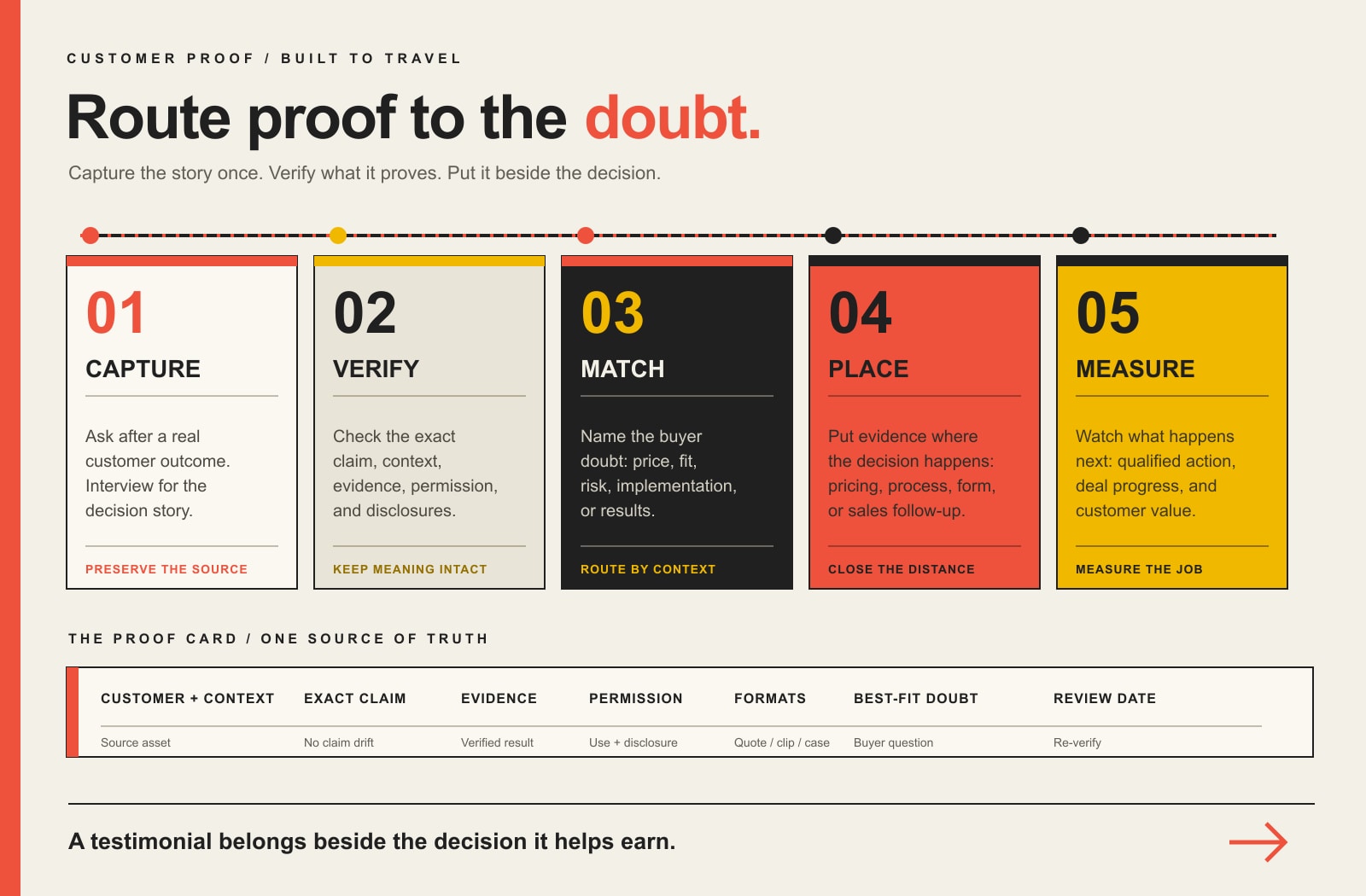
    Scope Design’s Proof Routing System uses five decisions: Capture, Verify, Match, Place, Measure. The point is not bureaucracy. The point is stopping good proof from turning into sloppy claims.

    The proof routing system captures customer stories, verifies claims and permission, matches proof to buyer doubts, places it near the decision, and measures downstream behavior; each Proof Card records context, claim, evidence, usage, formats, best-fit doubts, and review date.

    This also keeps this advanced playbook separate from our foundational guide to customer testimonials that sell without making things up. That article owns the basics of getting credible customer language. This one is about what happens after you have the raw proof.

    Build a Proof Card Before You Reuse Anything

    A Proof Card is a small source-of-truth record attached to each usable customer story. It prevents the classic “we have a great quote somewhere” mess and gives sales, marketing, and web teams the same evidence to work from.

    Proof Card fieldWhat to recordWhy it matters
    Customer + contextWho they are, industry, situation, product/service usedLets a prospect decide whether the story is relevant
    Exact claimWhat the customer is actually saying happenedStops vague praise from becoming an inflated promise
    EvidenceNumbers, dates, screenshots, project records, or clearly labeled opinionSeparates proof from enthusiasm
    Permission + disclosureWhere it may be used, attribution allowed, incentives/material connectionsReduces legal, platform, and relationship risk
    Usable formatsFull video, short clip, quote, case study, email excerpt, sales deckMakes repurposing intentional
    Best-fit doubtsPrice, fit, risk, implementation, service, results, switchingDetermines where the proof belongs
    Review dateWhen to confirm the claim is still current and representativeKeeps old proof from outliving the facts behind it

    17 Advanced Testimonial Strategies

    1. Trigger the Ask After a Meaningful Outcome

    Do not automate the request around an arbitrary calendar date. Ask when the customer has actually experienced something worth describing: a successful launch, a resolved problem, a measurable milestone, a smooth handoff, a renewal, or a moment when the customer says some version of “that made my life easier.” Timing around evidence produces better raw material than timing around “30 days since purchase.”

    2. Interview for Decisions, Not Compliments

    “How was your experience?” invites beige praise. Better questions expose the buying decision: What were you worried about? What did you try before? Why did you choose this approach? What surprised you? What changed afterward? What would you tell somebody with the same hesitation?

    3. Capture One Rich Source Asset

    A recorded customer interview can become a full testimonial video, short clips, written quotes, a case-study section, sales-deck proof, email snippets, and social posts. Capture once at high quality, then derive. Repeatedly asking the same customer for another version of the same story is a good way to make advocacy feel like unpaid employment.

    4. Tag Proof by Situation, Not Just Customer Name

    “Acme testimonial” is a weak retrieval system. Tag proof by industry, company size, service, use case, objection, buying stage, result type, and channel. When sales needs a switching story for a skeptical manufacturer, the right proof should be findable in seconds.

    5. Set a Claim Floor Before Marketing Touches It

    Decide what the source actually proves before turning it into copy. “We launched two weeks earlier than our old process” is not permission to write “cut launch time in half” unless the underlying facts support that calculation. The testimonial is evidence; it is not a coupon for creative arithmetic.

    6. Keep the Original Beside Every Edited Version

    Editing for length and clarity is normal. Meaning drift is not. Preserve the original transcript, email, review, or recording beside the approved derivative so anyone can check whether the short version still reflects the customer’s experience. If a five-word pull quote changes the claim, it is not an edit. It is new copy wearing the customer’s name tag.

    7. Record Permission and Material Connections

    Track where the customer approved use of their name, company, image, voice, metrics, and story. Also record compensation, free products, discounts, employment, ownership, or other connections that could affect how an audience evaluates the endorsement. The operational goal is simple: nobody should have to reconstruct the disclosure story six months later from Slack archaeology.

    8. Map Every Testimonial to One Buyer Doubt

    Instead of asking “Where can we put testimonials?” ask “What doubt is slowing the decision?” Price proof can show why the investment was justified. Implementation proof can show that onboarding did not become a dumpster fire. Service proof can show what happened when something went wrong. Switching proof can explain why a customer left another provider.

    9. Match the Customer Context to the Prospect Context

    A recognizable logo can attract attention, but relevance usually does more work than fame. A local contractor may care more about another contractor’s scheduling problem than a national brand’s broad praise. Use industry, scale, geography, use case, and risk profile to decide which proof earns the slot.

    10. Build an Objection-to-Proof Matrix

    List the five or six doubts you hear most often, then identify the strongest proof asset for each. If one objection has twelve testimonials and another has zero, you do not have a “more testimonials” problem. You have a coverage problem. That gap should influence what you ask future customers to discuss.

    11. Separate Reviews, Testimonials, and Case Studies by Job

    Reviews are broad public feedback. Testimonials are selected advertising messages. Case studies are deeper evidence packages. They can share source material, but they are not interchangeable. If your main problem is generating genuine Google feedback, use a dedicated Google review generation strategy rather than forcing a testimonial workflow to do the wrong job.

    12. Put Proof Beside the Decision, Not in a Testimonial Museum

    A dedicated testimonial page can be useful as an archive, but it should not be the only place proof exists. Place relevant proof near pricing, service explanations, comparisons, forms, product details, implementation steps, and calls to action. Good placement reduces the distance between the buyer’s question and the evidence that answers it.

    13. Build a Video Master, Then Cut by Use

    Do not make a 90-second website video and shove the same file everywhere. Build one strong master interview, then create deliberate cuts for the homepage, service page, social ad, email, sales follow-up, and longer case-study context. Our guide to business video formats and when to use them helps choose the container after you know the communication job.

    14. Let Sales Trigger the Right Proof

    Store proof where sales can actually use it. A CRM field, proposal component, email snippet library, or sales-enablement page can route proof based on objection or deal stage. The goal is not more content in the CRM. It is fewer moments where a salesperson says, “I know we have a customer who talked about this somewhere.”

    15. Feed Proof Back Through the Customer Lifecycle

    The strongest testimonial systems connect delivery, customer success, sales, and marketing. Delivery knows what changed. Customer success knows when the customer recognized value. Sales knows which objections are recurring. Marketing knows which channels need proof. That is the same handoff problem we address in our customer lifecycle management framework: evidence gets stronger when the handoffs stop dropping context.

    16. Instrument the Behavior Around Proof

    Track what a visitor can do after encountering proof: open the video, continue to pricing, start a form, complete an inquiry, book a call, reply to an email, advance in the sales process, or become a qualified opportunity. A testimonial can influence a decision without being the only cause, so avoid fake precision. Measure directionally and compare similar experiences.

    17. Rotate, Retire, and Re-Verify Proof

    Customer proof can age. The product changes. The customer changes roles. The metric stops representing a typical outcome. The company gets acquired. Set a review date, re-check high-stakes claims, and retire proof that no longer fits. Reputation work is easier when monitoring and response are part of the operating system, not a panic button; our online reputation management guide goes deeper on that discipline.

    Video Testimonials: Build One Source Asset, Then Cut by Use

    A useful video testimonial gives the viewer enough context to understand who is speaking, what problem existed, why the customer chose the solution, what changed, and how confident they are in the result. Pretty lighting cannot rescue an empty story.

    There is no magic universal length. Current guidance from testimonial-video producer Wyzowl uses roughly 60–90 seconds for many standard testimonial videos, shorter 30–45 second cuts for social/paid uses, and longer 2–3 minute versions when the story needs more detail or supports a sales presentation. Treat those as production benchmarks, not conversion laws. The right length is the shortest version that preserves the context needed for the placement.

    • Homepage: one clear problem and outcome, with a route to deeper proof.
    • Service page: focus on fit, process, and the objection specific to that service.
    • Social/paid: start at the strongest relevant moment; do not burn ten seconds introducing the company if the viewer needs the customer problem first.
    • Sales follow-up: include enough context to mirror the prospect’s situation.
    • Case study: keep the detail that proves how the result happened, not just the victory lap.

    Audio matters. Captions matter too. WCAG 2.2 Success Criterion 1.2.2 requires captions for prerecorded audio content in synchronized media at Level A when you are conforming to that standard. Captions also make the story usable when sound is unavailable. Keep a transcript in the Proof Card even when the final experience is video-first.

    Testimonial Compliance: Truth, Permission, Disclosures, and Platform Rules

    In the United States, testimonial marketing is advertising. That matters because the customer’s words do not give the advertiser permission to communicate something deceptive.

    The FTC’s Consumer Reviews and Testimonials Rule took effect on October 21, 2024. Among other things, it addresses fake or false reviews and testimonials, incentives conditioned on a required positive or negative sentiment, certain insider reviews, review suppression, and fake indicators of social media influence. The FTC also makes an important distinction: when a business takes a consumer review and features it in advertising or marketing, that content can become a testimonial rather than merely a hosted review.

    The FTC’s Endorsement Guides also say endorsements must be truthful and not misleading, and material connections that could affect how people evaluate an endorsement should be disclosed. If a testimonial communicates an atypical result, advertisers may need to explain what consumers can generally expect; a vague “results may vary” line is not a magic shield.

    Platform rules can be stricter than the federal baseline. Google’s review policies, for example, prohibit incentivized reviews and selective solicitation of positive reviews. So “the FTC allows an incentive if it is not tied to positive sentiment” does not mean “pay people to leave Google reviews.” Check the policy of the platform where the review is being collected or displayed.

    This is general operational guidance, not individualized legal advice. For high-risk claims, regulated industries, unusual incentive programs, or disputes about rights and disclosures, use qualified counsel.

    How to Measure Whether Testimonials Are Actually Helping

    Do not report “we added seven testimonials” as a success metric. That is inventory. The useful question is whether the proof reduced friction around a real decision.

    PlacementUseful behavior to watchWhat not to claim
    Pricing pagePricing-to-inquiry progression, form starts/completions, qualified lead rateThat the testimonial alone caused the lead
    Service pageCTA clicks, deeper service-page engagement, inquiry qualityThat more time on page automatically means more persuasion
    VideoStarts, meaningful watch depth, clicks after viewingThat a view equals trust or purchase intent
    Email or sales follow-upReplies, meetings, stage progression, objection resolutionThat every advanced deal moved because of one proof asset
    Social/paidQualified destination behavior after the ad, not just engagementThat likes are revenue wearing a tiny hat

    Use the same discipline we recommend for customer success metrics: define the behavior, owner, denominator, and decision the metric is supposed to change. If traffic is small, run bounded tests, compare periods carefully, and be modest about causation.

    A 30-Day Testimonial Marketing Rollout

    Week 1: Inventory and Map

    Collect the existing quotes, reviews, videos, emails, case studies, screenshots, and sales stories. Build Proof Cards for the strongest material. List the top buyer doubts and mark which ones have credible proof.

    Week 2: Capture the Gaps

    Choose customers whose situations cover missing objections or segments. Ask decision-based questions. Get explicit usage permission and record any connection or incentive that may require disclosure.

    Week 3: Route and Produce

    Create the master assets, then derive channel-specific cuts. Add the strongest proof to high-intent pages, sales follow-ups, and the specific campaigns where it can answer a known doubt.

    Week 4: Instrument and Review

    Confirm tracking, establish the comparison window, and watch qualified behavior. Record what changed and what did not. Keep the proof that earns its place. Move, rewrite, or retire the rest.

    Frequently Asked Questions About Testimonial Marketing

    What is testimonial marketing?

    Testimonial marketing is the intentional use of customer endorsements or customer-derived proof in advertising, websites, sales material, email, social media, and other marketing. The advanced version does not merely display praise; it matches credible proof to a specific buyer question or objection.

    What are good examples of testimonial marketing?

    Useful examples include an ROI-focused customer quote beside pricing, an implementation story beside a process section, a short video answering a switching objection, a case-study excerpt in a proposal, and a customer clip in a retargeting campaign that mirrors the audience’s use case.

    How long should a video testimonial be?

    There is no universal ideal. A common vendor benchmark is roughly 60–90 seconds for a standard testimonial, shorter cuts for social or paid media, and longer versions for detailed sales or case-study use. Choose the shortest edit that preserves the context needed for the decision you are supporting.

    What is the best software for collecting testimonials?

    The best tool is the one that fits your collection method, consent requirements, video workflow, CRM, publishing stack, and review-platform rules. Do not buy software before defining the Proof Card fields and routing process; otherwise you automate a messy system faster.

    How many testimonials should a website show?

    There is no evidence-based universal number. Show enough relevant proof to answer the important doubts without burying the page in repetitive praise. One specific, well-matched testimonial can be more useful than a carousel of eight generic compliments.

    Can you pay or incentivize people for testimonials?

    Sometimes, but the rules depend on the context. FTC guidance does not categorically ban every incentive, but compensation cannot be conditioned on a required positive or negative sentiment under the Reviews and Testimonials Rule, and material connections may require disclosure. Specific platforms can be stricter: Google prohibits incentivized reviews. Separate testimonial advertising from third-party review-platform policy before designing an incentive.

    Can you edit a customer testimonial?

    Edit for clarity or length only when the edited version remains truthful and does not change what the customer experienced or claimed. Preserve the original, document approval when appropriate, and never turn a qualified statement into a guarantee.

    Are fake testimonials illegal?

    In the United States, the FTC’s Consumer Reviews and Testimonials Rule prohibits specified conduct involving fake or false consumer reviews and testimonials and allows civil penalties for knowing violations. The details are fact-specific, so businesses should use the FTC’s current guidance or qualified counsel for legal decisions.

    Build a Proof System, Not a Wall of Love

    The best testimonial marketing system makes customer evidence easier to trust, easier to find, and harder to misuse. Capture the story. Verify the claim. Match it to a doubt. Place it where the decision happens. Measure what changes.

    If your website, campaigns, and sales process have plenty of happy-customer material but no coherent proof architecture, Scope Design can help map the objections, content, destinations, and measurement into one system. See our Advertising & Marketing services and bring the proof you already have. We can figure out what deserves a bigger job.