Tag: customer retention

  • Mastering Growth Marketing: Complete Guide to Data-Driven Customer Acquisition and Retention

    Mastering Growth Marketing: Complete Guide to Data-Driven Customer Acquisition and Retention

    Growth marketing is a disciplined system for improving customer acquisition, activation, retention, revenue, and referral by finding the current growth constraint, running the smallest useful experiment, and carrying what you learn into the next decision. It is not a synonym for paid ads, an AI tool stack, or a collection of “growth hacks.”

    The useful question is not, “Which growth tactic should we try?” It is, “What is keeping more of the right customers from reaching value—and what evidence would change our next decision?” That shift matters because a business can improve clicks, leads, or even first-time conversions while quietly making customer fit, margins, retention, support load, or delivery capacity worse.

    Growth marketing in 60 seconds

    • Start with the business constraint, not the channel. Growth marketing should support a real business strategy, not become a substitute for one.
    • Measure the whole customer lifecycle. Acquisition is only useful when enough of those customers activate, stay, buy profitably, and create future value.
    • Run bounded experiments. Define the decision, hypothesis, change, outcome, guardrails, observation window, and next action before launch.
    • Judge downstream quality. A local metric win is not durable growth if it creates worse-fit customers, lower contribution, more churn, more support burden, or less trust.
    • Scale learning, not noise. Widen what survives downstream scrutiny; revise or stop what does not.

    What Is Growth Marketing?

    Growth marketing is an operating approach that uses customer evidence, lifecycle measurement, and controlled experimentation to improve durable business outcomes. It connects the work that attracts a prospect with the work that helps that person experience value, remain a customer, expand the relationship, and advocate for the business.

    That makes growth marketing broader than a campaign and narrower than “everything the company does.” Marketing still has to respect product quality, sales execution, onboarding, service capacity, pricing, and the customer experience. When one of those is the binding constraint, buying more traffic can simply send more people into a broken system faster.

    The defining habit is therefore continuous, decision-oriented learning: identify what appears to limit growth, collect enough evidence to form a useful hypothesis, change something intentionally, observe the response, and decide what deserves more resources.

    Growth Marketing vs. Performance, Digital, Lifecycle, and Product Marketing

    These disciplines overlap, which is why definitions get muddy. The easiest way to separate them is by the job each one is usually trying to own.

    DisciplinePrimary jobCommon evidenceWhere growth marketing overlaps
    Growth marketingImprove durable growth across acquisition, activation, retention, revenue, and referralLifecycle progression, cohort quality, experiment outcomes, economics, guardrailsCoordinates tests across several functions when the growth constraint moves
    Performance marketingProduce measurable outcomes from paid or directly attributable mediaCost, conversion, revenue, return metricsPaid acquisition can be one growth lever, but growth must follow downstream quality too
    Digital marketingReach and persuade customers through digital channelsSearch, email, social, web, advertising, campaign metricsGrowth marketing may use these channels but is defined by the learning system, not the medium
    Lifecycle marketingCommunicate appropriately as customers move through relationship stagesActivation, engagement, retention, reactivation, expansionLifecycle work is often central when activation or retention is the constraint
    Product marketingConnect product value, positioning, market, launch, adoption, and sales enablementMessage fit, adoption, pipeline quality, win/loss evidenceGrowth tests depend on sound positioning and value; they should not invent those in a dashboard

    If your team argues about which label applies, bring the discussion back to the decision. What outcome are you trying to improve? What currently limits it? Who owns the underlying system? A name should clarify work, not create turf.

    Why Growth Marketing Fails: Teams Optimize the Wrong Constraint

    A common growth failure looks successful in the weekly dashboard. Traffic rises. Cost per lead falls. Form submissions climb. Then sales says the leads are poor, onboarding gets overloaded, repeat purchase weakens, refunds rise, or the team discovers the “efficient” channel was attracting people who were never a good fit.

    This happens when a local metric becomes the objective instead of evidence about the objective.

    • If qualified demand is scarce, the constraint may be acquisition.
    • If the right people arrive but do not take the first meaningful action, it may be activation or conversion.
    • If customers buy once and disappear, the constraint may be retention or value delivery.
    • If loyal customers never expand, it may be offer, pricing, or expansion.
    • If happy customers rarely introduce anyone, there may be a referral or advocacy opportunity.
    • If demand already exceeds what the company can deliver well, the constraint may be capacity—and more acquisition may be the wrong goal.

    This is why growth marketing starts with diagnosis. The tactic comes later.

    The Scope Design GROW Loop

    We use a simple growth-specific extension of Scope Design’s constraint-first strategy discipline: GROW. It gives every experiment four jobs.

    G — Ground the bottleneck

    Define the business outcome first. Then identify the stage most likely to constrain that outcome. Use actual evidence: source and cohort data, sales records, support themes, customer interviews, funnel progression, gross margin, renewal or repeat-purchase behavior, and operating capacity.

    Do not pick “improve conversion rate” because it is easy to graph. Ask what a better conversion would change for the business and what could make that improvement misleading.

    R — Reduce uncertainty with a bounded hypothesis

    Turn the diagnosis into a falsifiable expectation: For this audience, changing this one meaningful factor should improve this primary outcome because of this customer or market evidence.

    Predefine the comparison, guardrails, observation window, and what result would cause you to scale, revise, or stop. This is the difference between an experiment and changing six things before declaring the new version “better.” The NIST Engineering Statistics Handbook’s explanation of experimental design makes the underlying logic explicit: deliberately change factors and observe the response.

    O — Observe downstream cohort quality

    Do not stop at the first metric the test moves. Follow the affected cohort far enough to answer the business question. A campaign that lowers cost per lead but produces fewer qualified opportunities is not necessarily a winner. A checkout change that raises orders while increasing refunds may be borrowing from future value.

    Funnel analysis can help teams see where people progress or drop out; Google’s Analytics funnel reporting documentation shows how funnel reports visualize the steps users take and where they succeed or fail. The tool is not the strategy, but it can help locate the question.

    W — Widen, revise, or withdraw

    Once the observation window is sufficient for the decision, choose deliberately:

    • Widen: expose more of the appropriate audience or budget to the change because the primary outcome improved and guardrails held.
    • Revise: keep the question but change the hypothesis because the evidence revealed something useful.
    • Withdraw: stop spending time or money on a weak idea, record what was learned, and move to the next constraint.

    The point is not to win every test. The point is to make uncertainty cheaper and future decisions better.

    Diagnose Growth Across the Customer Lifecycle

    A growth funnel is useful only if each stage represents something meaningful to your business. “Visited page” and “opened email” can be diagnostic signals, but they are rarely the final outcome.

    StageDecision questionUseful outcomeMisleading substituteExample bounded test
    AcquisitionAre enough of the right people entering the system?Qualified demand by source, customer acquisition cost using a defined customerTraffic, impressions, raw leadsTest one audience-message-offer combination against the current acquisition path
    ActivationDo new prospects or customers reach the first meaningful value milestone?Qualified action or time to first agreed valuePage views, logins, generic engagementChange one onboarding step, form requirement, proof element, or call to action
    RetentionDo customers continue because they receive enough value?Renewal, repeat purchase, retained gross profit, cohort retentionEmail opens, account age, “active” without a value definitionTest a value reminder, service handoff, replenishment cue, education sequence, or friction repair
    Revenue / expansionCan the relationship create more profitable value without harming fit?Contribution, expansion revenue, repeat-order economicsAverage order value without margin or return contextTest packaging, cross-sell timing, expansion offer, pricing presentation, or qualification
    ReferralDo satisfied customers create qualified introductions?Qualified referrals and referred-customer qualityShares, generic mentions, testimonial countTest the trigger, timing, ask, incentive, or handoff into a referral or affiliate program

    Notice what this table does not do: it does not tell every business to optimize all five stages simultaneously. The stage that deserves attention depends on the bottleneck and the decision.

    Measure Growth Without Lying to Yourself

    Growth marketing needs enough measurement to make a decision—not a dashboard with 47 tiles and no owner. A useful hierarchy has four layers.

    1. Primary business outcome: the result the experiment is supposed to improve—qualified revenue, retained value, profitable repeat purchase, qualified pipeline, or another named consequence.
    2. Supporting metrics: measures that help explain movement in the primary outcome, such as activation rate, stage progression, source mix, cycle time, or repeat frequency.
    3. Diagnostic metrics: clicks, views, opens, scroll depth, form starts, and similar behaviors used to investigate why an outcome moved.
    4. Guardrails: measures that should not deteriorate while the primary metric improves—margin, refunds, churn, support burden, lead quality, customer complaints, capacity, or brand trust.

    Keep CAC and customer lifetime value definitions explicit

    Customer acquisition cost and customer lifetime value can be useful growth metrics, but they become dangerous when teams silently change the definitions. Does “customer” mean a lead, first purchase, paid subscriber, or retained account? Does lifetime value mean revenue, gross profit, contribution, or forecasted value? Which cohort and time window are included?

    Our dedicated guide to customer lifetime value goes deeper into the calculation and decision discipline. The important rule here is simple: write the definition next to the number. A universal CLV:CAC ratio copied from a benchmark is not a substitute for your economics, cash timing, capacity, and uncertainty.

    Attribution is a model, not a confession from reality

    Multi-touch attribution can organize observed touchpoints, but it should not be treated as proof that every credited channel caused the outcome. Organic search, referrals, brand familiarity, sales conversations, offline exposure, email, and paid media often interact. Use attribution for diagnosis and allocation hypotheses; use controlled experiments or other stronger evidence when the causal question is important enough.

    How to Design a Growth Marketing Experiment

    You do not need a laboratory coat. You do need a written decision rule. Before launching a growth marketing experiment, capture this brief:

    Experiment fieldWhat to write
    DecisionWhat will we do differently if the evidence supports or rejects this idea?
    BottleneckWhich lifecycle constraint are we trying to reduce?
    EvidenceWhat customer, sales, analytics, operational, or market evidence makes this worth testing?
    HypothesisFor this audience, changing X should improve Y because Z.
    ChangeWhat meaningful factor will differ from the current experience?
    Primary outcomeWhich result decides whether the test helped?
    GuardrailsWhat must not get materially worse?
    WindowHow long or how many decision-relevant observations are needed before review?
    ThresholdWhat evidence is strong enough to widen, revise, or withdraw?
    Next actionWhat will we do for each plausible result?

    Google Ads’ official experiments documentation uses control and treatment groups to compare the performance of defined changes. That same discipline—make the change explicit, preserve a comparison, and evaluate the result—is useful even when the experiment happens somewhere other than an ad platform.

    Do not change the base while the test is running

    If the landing page, offer, price, targeting, follow-up process, and sales script all change during the same observation window, you may improve results—but you will learn less about why. Sometimes an emergency repair is more important than experimental purity. Just document the confounding change instead of pretending the test remained clean.

    Growth Experimentation for Low-Traffic Small Businesses

    Small businesses are often told to A/B test everything. That advice ignores arithmetic. If a site or funnel produces only a handful of decision events, splitting the audience can make both groups too small to support a confident conclusion.

    That does not mean you should stop learning. It means you should match the evidence method to the traffic, risk, and decision.

    • Fix known defects without waiting for a test. Broken forms, misleading copy, inaccessible controls, obvious mobile friction, and tracking failures are repairs.
    • Use direct customer evidence. Interviews, sales objections, support tickets, call recordings, lost-deal reasons, and usability observation can expose the bottleneck before a split test is viable.
    • Segment before averaging. Compare source, device, geography, offer, customer type, or cohort when the segment maps to a real business difference.
    • Use bounded before/after or time-block tests carefully. Keep other major conditions stable when possible, define the window in advance, and label the evidence directional when seasonality or other changes could explain the movement.
    • Observe longer when the business outcome is delayed. Retention, repeat purchase, and referrals may need more time than a landing-page click.
    • Do not manufacture significance. A tiny sample with a dramatic percentage change is still a tiny sample.

    This is also why conversion rate optimization is larger than A/B testing. Research, repairs, message clarity, usability, offer work, analytics, and operational fixes can all reduce uncertainty before a statistically powered split test makes sense.

    Choose Channels After You Know the Constraint

    Channels are tools. Growth marketing decides when a tool is relevant.

    If the constraint is…Potential levers to investigateFirst question
    Qualified acquisitionSEO/content, paid search/social, partnerships, referrals, local visibility, outbound, positioningAre we missing reach, relevance, trust, or a compelling offer?
    Activation / conversionLanding-page clarity, proof, forms, onboarding, call handling, sales follow-up, UXWhere does a good-fit prospect fail to reach the first meaningful value step?
    RetentionService delivery, onboarding, education, replenishment, account management, reactivationWhy do customers who looked healthy fail to continue?
    ExpansionPackaging, pricing, cross-sell, upsell, service tiers, customer successWhat additional problem can we solve profitably for the right existing customer?
    ReferralReferral asks, partner systems, reviews, advocacy triggers, communityWhat moment gives a satisfied customer a natural reason to introduce someone?

    If you need ideas after you have a decision to make, our guide to innovative marketing strategies contains experiments worth adapting. The order matters: problem first, tactic second.

    A Practical 90-Day Growth Marketing Strategy

    You do not need a year-long transformation to start practicing growth marketing. You need enough structure to learn without letting the experiment backlog become another abandoned spreadsheet.

    Days 1–14: Baseline the system and choose one bottleneck

    • Define the business outcome and the customer you are trying to create or retain.
    • Map the essential lifecycle stages from first useful contact through realized value.
    • Verify tracking against sales, commerce, CRM, or operational records.
    • Segment enough to expose obvious source or cohort differences.
    • Interview customers or frontline staff where the numbers cannot explain behavior.
    • Choose one constraint and name a primary metric plus guardrails.

    Days 15–30: Run the smallest decision-changing test

    • Write the experiment brief before implementation.
    • Prefer a meaningful change to a dozen microscopic tweaks.
    • Keep the audience and experience stable enough to interpret the result.
    • Record implementation details, dates, and confounding changes.

    Days 31–60: Follow the cohort downstream

    • Check whether the primary outcome changed.
    • Check qualification, margin, retention signals, refunds, support burden, and other guardrails.
    • Compare the affected cohort with the most reasonable baseline.
    • Collect qualitative explanations from sales, support, and customers.

    Days 61–90: Reallocate and document

    • Widen the winner only if downstream evidence is healthy.
    • Revise a promising hypothesis when the mechanism looks wrong but the problem still matters.
    • Withdraw weak ideas without turning sunk cost into a strategy.
    • Record the result, confidence, unresolved questions, and next review date.
    • Revisit the growth constraint; a successful test may move it somewhere else.

    What a Small Growth Team Actually Needs

    Growth marketing is often presented as a shopping list of analytics platforms, automation systems, customer-data platforms, AI agents, personalization engines, and testing tools. That reverses the dependency.

    A small business needs five capabilities before it needs a “growth stack”:

    1. One accountable growth decision owner who can say what constraint is being worked and why.
    2. Trustworthy outcome data connected far enough downstream to distinguish activity from customer value.
    3. Customer evidence from sales, service, interviews, reviews, or behavior—not only dashboards.
    4. Execution capacity to change the relevant part of the website, campaign, offer, onboarding, or workflow.
    5. A review habit that turns results into scale, revise, or stop decisions.

    Software should make one of those capabilities easier. AI can help summarize interviews, draft variants, classify feedback, explore data, or accelerate implementation. It should not be allowed to turn a weak business assumption into 40 automated campaigns before anyone asks whether the assumption is true.

    Common Growth Marketing Mistakes

    1. Treating acquisition as growth

    More traffic and leads can hide a retention, margin, qualification, or capacity problem. Follow enough of the cohort downstream to know whether the acquisition is creating useful customers.

    2. Building composite scores nobody can act on

    A “growth velocity” or “customer health” score can be useful if its inputs, weighting, owner, and response rule are explicit. Otherwise it turns several uncertain metrics into one more-confident-looking uncertain metric. Keep the underlying outcomes visible.

    3. Declaring a winner at the first conversion

    The earliest metric is often the fastest one, not the most important one. Decide in advance how far downstream the cohort must travel before you scale.

    4. Running experiments without a stop rule

    Without a threshold and review date, weak tests linger because nobody wants to admit the result is inconclusive. Precommit the next action for win, loss, and uncertainty.

    5. Testing five variables at once

    You may get a better page or campaign, but you lose learning about the mechanism. Bundle changes only when the business needs the whole repair more than it needs isolated evidence.

    6. Letting AI choose the strategy

    AI can accelerate analysis and production. It does not know your actual constraints, customer promises, margins, sales quality, capacity, or risk tolerance unless you provide trustworthy context—and even then, the business still owns the decision.

    Growth Marketing FAQ

    What is growth marketing in simple terms?

    Growth marketing is a method for improving durable customer and business outcomes through lifecycle measurement and repeated experiments. It starts by identifying the current growth bottleneck, tests a defined change, follows the affected cohort downstream, and uses the result to decide what to scale, revise, or stop.

    How does growth marketing work?

    Start with a business outcome, diagnose whether acquisition, activation, retention, expansion, referral, or capacity is limiting it, form a hypothesis from evidence, run the smallest useful test, measure the primary outcome and guardrails, then reallocate resources based on what you learned.

    What is a growth marketing strategy?

    A growth marketing strategy is the set of choices that connects a growth objective to a specific constraint, target customer, evidence base, experiment sequence, measurement rule, resource owner, and review cadence. “Post more on social media” is a tactic. “Increase qualified pipeline by fixing the mismatch between our highest-intent search traffic and the offer on its landing page” is closer to a strategy.

    What is the difference between growth marketing and performance marketing?

    Performance marketing usually focuses on directly measurable paid-media outcomes such as acquisition, conversion, or revenue. Growth marketing can include performance marketing, but it follows the customer farther through activation, retention, expansion, and referral and can test non-media constraints such as onboarding, offers, product experience, or handoffs.

    What metrics should a growth marketer track?

    Track the metric that answers the current business decision, plus supporting diagnostics and guardrails. Depending on the constraint, that may include qualified acquisition cost, activation to first value, stage conversion, retained gross profit, cohort retention, contribution, repeat purchase, expansion, or qualified referrals. Raw traffic, clicks, opens, and form starts are often diagnostic rather than final outcomes.

    Do small businesses need A/B testing for growth marketing?

    No. A/B testing is one evidence method. Low-volume businesses can learn from direct customer research, usability observation, repairs, segmentation, carefully bounded before/after tests, and longer cohort observation. Use a randomized split test when traffic and conversion volume can support the decision; do not fake statistical certainty when they cannot.

    How much should a small business spend on growth marketing?

    There is no responsible universal percentage. Budget depends on unit economics, cash flow, capacity, the cost of learning, the maturity of the channel, and how quickly the business can observe a meaningful outcome. Fund experiments at the smallest scale that can change a real decision, then widen investment when the economics and downstream guardrails hold.

    Build a Growth System That Learns

    The advantage of growth marketing is not that it gives you more tactics. The internet already has enough tactics. The advantage is that it gives the business a repeatable way to decide which problem deserves attention, what evidence would reduce uncertainty, and when a result is healthy enough to scale.

    Ground the bottleneck. Reduce uncertainty. Observe downstream quality. Widen, revise, or withdraw. Then run the loop again because a solved constraint usually exposes the next one.

    If your marketing produces activity but you cannot tell which constraint is limiting profitable growth, talk with Scope Design. We can help connect the website, analytics, acquisition channels, conversion path, customer evidence, and automation into a growth system that has a reason for every test.


  • 12 Proven Small Business Growth Strategies That Actually Work

    12 Proven Small Business Growth Strategies That Actually Work

    The best small business growth strategies are not the ones on the longest checklist. They are the ones that fix the constraint holding your business back right now. If qualified prospects cannot find you, demand generation may be the next move. If people already arrive but do not act, fix the offer and conversion path. If customers buy once and disappear, work on retention and referrals. If demand is strong but delivery is strained, adding more marketing can make the problem worse.

    This guide gives you 12 practical growth levers and, more importantly, a way to choose among them. Scope Design calls that decision process the Bottleneck-to-Bet Growth Loop: diagnose the constraint, match one lever, define the business signal, run a bounded test, then scale or stop based on evidence.

    If what you need is a broader framework for goals, audience, channels, and measurement, start with our small business marketing strategy guide. If you are deciding whether the business is ready to expand into new markets, offers, or capacity, use our separate strategic business growth and expansion guide. This article owns the practical middle: what growth move should you test next?

    Why Small Business Growth Strategies Fail as a Checklist

    Small businesses usually have less time, cash, and management capacity than large companies. That makes prioritization part of the strategy. Running email, paid ads, social media, SEO, partnerships, referral campaigns, video, and automation at the same time can create activity without making the real bottleneck easier to see.

    Start with the business situation. The U.S. Small Business Administration’s market-research guidance recommends understanding demand, market size, customer location, competitive saturation, pricing, and direct customer feedback. Those questions are useful because a tactic only makes sense after you know what problem it is supposed to solve.

    • Not enough qualified demand? Create or capture more relevant attention.
    • Enough traffic, weak response? Improve the offer, proof, page, or follow-up.
    • One-time buyers? Improve onboarding, retention, reactivation, and referrals.
    • Demand exceeds delivery capacity? Fix process and fulfillment before pouring in more leads.
    • You cannot tell what works? Simplify the experiment and repair measurement first.

    The Bottleneck-to-Bet Growth Loop

    Use this five-step loop whenever a new growth idea appears:

    1. Diagnose: Name the constraint in plain language.
    2. Match: Choose one primary lever that directly addresses it.
    3. Define: Pick a leading signal and a business outcome before starting.
    4. Test: Run a bounded experiment long enough to cover a realistic buying cycle.
    5. Scale or stop: Expand what produces qualified, economically useful results; change or stop what does not.
    Editorial diagram of the Bottleneck-to-Bet Growth Loop: diagnose a constraint, choose one lever, define a signal, run a bounded test, and scale, iterate, or stop.
    The Bottleneck-to-Bet Growth Loop: choose the next growth move from the constraint, not from a list of popular tactics.
    Current constraintLikely next betBusiness signal to watch
    Not enough qualified demandLocal/search demand, proof-rich content, partnershipsQualified inquiries from the right audience
    Traffic arrives but few people actOffer clarity, conversion path, lead follow-upQualified-action rate and close rate
    Customers buy once and disappearRetention, reactivation, referralsRepeat customers, referrals, customer value
    Demand is strong but delivery strainsAutomation and process before more promotionResponse time, backlog, quality, margin
    You cannot tell what is workingOne-variable tests and business-event measurementQualified leads or revenue tied to the experiment

    The stop rule matters as much as the growth rule: if capacity or measurement is the binding constraint, adding more attention is not the first move.

    12 Small Business Growth Strategies, Matched to the Bottleneck

    1. Fix the Offer and Conversion Path Before Buying More Traffic

    Use this when: people already visit, inquire, or request information, but too few become qualified leads or customers.

    More traffic magnifies whatever is already happening. If the offer is confusing, proof is weak, the form is frustrating, pricing expectations are unclear, or leads sit unanswered, more visitors can simply create more waste.

    • State who the offer is for, what problem it solves, and what the next step is.
    • Match landing pages to the intent that brought the visitor there.
    • Remove unnecessary form, checkout, or scheduling friction.
    • Put relevant proof near the decision point.
    • Test the full lead journey, including what happens after the form is submitted.

    For a deeper website-specific process, see how to turn a website into a lead-generating system. Measure qualified inquiries, booked calls or purchases, and close rate—not just clicks.

    2. Retain and Reactivate Customers Before Replacing Them

    Use this when: customers are generally satisfied, but repeat business is inconsistent or past customers rarely hear from you.

    Retention is not a coupon program. Start by making the purchased experience better, following up, and giving customers a useful reason to return. A simple reactivation system can include post-purchase check-ins, service reminders, replenishment messages, helpful education, new-use ideas, or a personal note to inactive customers.

    • Identify customers who should logically buy again but have not.
    • Ask what made the first experience useful—and what nearly made it fail.
    • Create a small number of follow-up moments tied to actual customer needs.
    • Track repeat customers, time between purchases, renewal/rebooking, and revenue from reactivated accounts.

    Our guide to building value by investing in customers goes deeper on the customer side of growth.

    3. Build a Referral and Review Engine Around Successful Moments

    Use this when: customers are happy, the outcome is visible, and word of mouth already happens informally.

    Do not wait for referrals to appear by accident. Choose the moment when the customer has clearly received value, ask directly, and make the next action easy. That might mean a referral introduction, an honest review, a testimonial, a case study, or permission to share the result.

    Keep review programs honest. The FTC’s Consumer Reviews and Testimonials Rule Q&A explains that incentives cannot be conditioned on a positive or negative sentiment, and material incentives may need disclosure. Paying specifically for a 5-star review is not a legitimate shortcut.

    Measure: review-request completion, referral introductions, referred leads, close rate of referred leads, and repeat business from the same customer base.

    4. Capture High-Intent Local and Search Demand

    Use this when: prospects already search for the service, product, problem, or location you serve, but your business is hard to find or your search presence does not answer the buying question.

    • Make core service and location pages specific enough to answer real buying questions.
    • Keep business information accurate and consistent where customers discover you.
    • Publish answers to high-intent questions: cost factors, process, timing, fit, alternatives, and what to expect.
    • Build proof around the markets and services you actually want more of.

    For location-driven businesses, our local marketing strategies guide covers the execution layer in more detail. Measure qualified calls, forms, directions/bookings where relevant, and sales—not ranking screenshots by themselves.

    5. Build an Email Follow-Up System That Helps People Decide

    Use this when: you already collect leads or customer contact information, but follow-up depends on memory or one-off campaigns.

    Email is most useful when it has a job. Build short sequences around the moments where a prospect or customer needs help moving forward: new inquiry, quote follow-up, onboarding, education before a purchase, rebooking, replenishment, or reactivation.

    • Give each sequence one purpose and one primary next action.
    • Use the questions people actually ask sales and service staff.
    • Segment only when the difference changes the message or next step.
    • Track replies, qualified actions, booked calls, purchases, and reactivations.

    Do not automate a weak message just because the software allows it. A small, relevant sequence that solves a decision problem is usually more useful than a giant automation map nobody can maintain.

    6. Publish Proof-Rich Content That Helps a Buyer Make a Decision

    Use this when: customers research before buying, your team answers the same questions repeatedly, or prospects need evidence before they trust the offer.

    Good growth content reduces uncertainty. Start with the questions closest to a real decision: what does it cost, who is it for, what can go wrong, how does the process work, what is different about your approach, and what result should a reasonable customer expect?

    Google’s people-first content guidance explicitly asks whether content adds original information, analysis, or substantial value rather than merely rewriting other sources. That is also a useful business test. Your best content should contain evidence, examples, process knowledge, customer questions, or decisions that a generic summary cannot provide.

    Our content marketing guide covers the larger system. For growth purposes, measure qualified traffic, assisted conversions, inquiries, sales conversations influenced by the content, and whether the article reduces repeated sales friction.

    7. Use Social Media as Distribution and Conversation, Not an Obligation

    Use this when: your customers are active on a platform, your business has proof or useful material worth distributing, and someone can consistently respond to conversations that matter.

    You do not need to win every platform. Choose the smallest social footprint that reaches the right audience and can be operated consistently. Repurpose customer questions, before-and-after work, short explanations, case-study lessons, events, and useful content instead of inventing a separate content universe for social media.

    Go deeper with our social media marketing strategy guide. Measure meaningful conversations, qualified visits, inquiries, saves/shares when they indicate buying relevance, and assisted conversions. Followers alone are not a growth outcome.

    8. Add Paid Acquisition When the Funnel Is Ready for More Volume

    Use this when: you have a defined offer, a relevant audience, a working landing/conversion path, reliable follow-up, measurable outcomes, and enough capacity to serve additional customers.

    Paid search and paid social can buy learning and reach quickly, but they can also accelerate a broken funnel. Start with a bounded budget, a narrow audience or query set, and one clear conversion goal. Measure through the sale whenever possible.

    • Define what a qualified lead or sale is worth before spending.
    • Separate acquisition cost from lead volume; cheap leads can still be poor customers.
    • Review the entire path from ad to landing page to follow-up to closed business.
    • Increase spend only when performance remains acceptable as volume rises.

    Hold off when leads are already sitting unanswered, sales cannot qualify them, margins are unclear, or fulfillment is strained.

    9. Form Partnerships With Businesses That Already Reach Your Customer

    Use this when: another credible business serves the same audience without directly replacing what you sell.

    A partnership can borrow distribution instead of buying it. Useful formats include reciprocal referrals, bundled offers, co-created resources, webinars or events, integrations, community partnerships, shared research, and introductions between complementary providers.

    • Start with one customer problem the partnership can solve better together.
    • Define what each party contributes and how leads/customers are handled.
    • Make the value to the customer clearer than the value to the partners.
    • Track referred customers, partner-sourced revenue, quality, retention, and effort required.

    If the partnership only produces vague visibility, it is networking—not yet a growth system.

    10. Automate Repetitive Work With AI—After the Process Makes Sense

    Use this when: a repetitive task is understood, has clear inputs and outputs, and consumes time that could be spent on customer work, selling, or higher-value decisions.

    Good candidates include first-draft follow-up, call summaries, lead routing, appointment reminders, recurring reports, FAQ triage, content repurposing, and internal checklists. Keep human review where the work affects promises, pricing, customer relationships, legal/compliance questions, or brand-critical communication.

    Do not automate confusion. Document the process first, remove unnecessary steps, then automate the stable parts. Measure hours saved, response time, error rate, backlog, and whether quality stays acceptable.

    11. Remove Mobile, Speed, and Response-Time Friction

    Use this when: customers try to act on a phone, key pages are slow or unstable, forms are awkward, contact options are hard to use, or inquiries wait too long for a response.

    Technical optimization should support the customer action, not become a score-chasing project. Google describes Core Web Vitals as real-world measures of loading performance, interaction responsiveness, and visual stability. Those are useful signals, but the growth question is simpler: can the customer understand the offer and complete the next step without unnecessary friction?

    • Test the important journey on an actual phone.
    • Make tap targets, forms, checkout, calling, and scheduling easy to use.
    • Compress oversized media and remove scripts that do not earn their cost.
    • Measure response time after an inquiry, not just website performance before it.

    12. Run Bounded Experiments and Measure Business Outcomes

    Use this always. A growth strategy becomes a system only when you can tell whether it produced a useful result.

    Define the experiment before you launch it. Write down the constraint, the change you are making, the audience, the expected leading signal, the business outcome, the test window, and the condition that would make you scale, revise, or stop.

    Google Analytics calls an event that measures an action particularly important to business success a key event. The same principle works outside analytics: prioritize qualified inquiries, bookings, purchases, renewals, revenue, or another business-relevant action over activity for activity’s sake.

    • Leading signal: did the right people respond?
    • Business signal: did that response become qualified pipeline, customers, revenue, or retained value?
    • Quality signal: were the customers a good fit?
    • Capacity signal: could the business deliver without degrading service or margin?

    How to Choose Your Next Small Business Growth Strategy

    If several strategies look useful, do not choose the one that sounds most exciting. Use these questions in order:

    1. Where is the leak? Demand, conversion, follow-up, retention, capacity, or measurement?
    2. What evidence says that is the leak? Customer conversations, pipeline data, sales notes, service backlog, analytics, or direct observation?
    3. What is the smallest lever that directly addresses it?
    4. Can we operate it consistently for one realistic buying cycle?
    5. What business result would justify more investment?
    6. What would make us stop?

    This is the difference between a growth plan and a marketing to-do list. Consistency matters after you choose the right constraint. Before that, consistent execution can simply make the wrong tactic more expensive.

    A Practical 30/60/90-Day Growth Plan

    Days 1–30: Establish the Baseline and Fix Obvious Friction

    • Define the primary growth constraint and one desired business outcome.
    • Talk with recent customers, lost prospects, or front-line staff to test the diagnosis.
    • Verify that important inquiries, bookings, purchases, or other business actions are measurable.
    • Fix obvious broken forms, slow follow-up, unclear offers, missing proof, or delivery bottlenecks before launching a bigger campaign.

    Days 31–60: Run One Primary Growth Bet

    • Choose one strategy from the 12 above that directly matches the constraint.
    • Keep the audience, offer, and success metric narrow enough to understand.
    • Review leading signals weekly, but avoid changing the test every time a daily metric moves.
    • Collect qualitative evidence too: lead quality, customer questions, sales objections, and delivery issues.

    Days 61–90: Scale, Iterate, or Replace the Bet

    • Scale if the experiment produces qualified business results and the economics/capacity remain healthy.
    • Iterate if the signal is promising but one identifiable part of the path is weak.
    • Replace the bet if the test does not move the constraint or if the customers it attracts are poor fits.
    • Document what worked so the next cycle starts with evidence instead of memory.

    Small Business Growth Strategy FAQs

    What are examples of small business growth strategies?

    Examples include improving conversion, retaining and reactivating customers, building referral/review systems, capturing local or search demand, email follow-up, content marketing, social distribution, paid acquisition, partnerships, automation, mobile/response improvements, and structured experimentation. The right example depends on the constraint you are trying to change.

    Which growth strategy should a small business try first?

    Try the strategy that most directly addresses the current bottleneck. If demand is low, work on qualified reach. If demand exists but response is weak, fix conversion and follow-up. If customers are happy but do not return, focus on retention/referrals. If demand exceeds capacity, improve operations before promotion.

    Should I get more traffic or improve conversions first?

    If current traffic is relevant and sufficient to reveal obvious friction, improve the offer, page, proof, follow-up, or sales process before paying for more of the same traffic. If the conversion path works and you simply lack enough qualified prospects, then adding traffic may be the better test. Diagnose traffic quality and the full customer path before choosing.

    How long should I test a growth strategy?

    Long enough to cover a realistic customer buying cycle and generate enough meaningful observations to make a decision. A walk-in retail offer may reveal signal quickly; a high-consideration B2B service may need much longer. Set the review date before the experiment and avoid declaring victory from one unusually good day.

    What are the stages of small business growth?

    Stage models can help describe how leadership, cash, capacity, and systems change as a business grows, but they answer a different question from this article. If you are deciding whether the business is ready to scale or expand, use our growth and expansion readiness guide. Use this page when you need to choose the next practical growth lever.

    Growth Is a Sequence of Better Decisions

    You do not need all 12 strategies. You need the next useful one.

    Find the bottleneck. Choose the smallest lever that can change it. Define the business signal before you start. Run the test long enough to learn. Then scale what works, fix what is close, and stop what does not create qualified value.

    That approach is less exciting than chasing every new channel, but it gives a small business something more useful: a growth system that can explain why the next investment deserves time and money.

  • Email Marketing Roadmap for Local Business: Build the System in the Right Order

    Email Marketing Roadmap for Local Business: Build the System in the Right Order

    An effective email marketing roadmap for a local business is not “send a newsletter every Tuesday.” Build the relationship in order: earn permission, deliver the promise that caused the signup, install one useful lifecycle flow, connect replies and clicks to a real owner, measure what changes in the business, then add segmentation, re-engagement, and more automation only when the earlier layers work.

    That order matters because email software makes it very easy to automate a mess. A beautifully designed six-email sequence is still a mess if nobody knows why it exists, where a reply goes, when a customer should stop receiving it, or whether it helped produce a booking, sale, renewal, visit, referral, or useful conversation.

    The email marketing roadmap in one sentence

    Permission → promise delivery → one stable lifecycle flow → recurring useful communication → justified segmentation → re-engagement → evidence-based refinement.

    If you need the broader strategy behind audience, lifecycle, list ownership, and message jobs, start with Scope Design’s small-business email marketing strategy. This page owns a narrower question: what should you build first, and what should wait?

    • Start with one customer relationship. “Everyone on our list” is not a relationship.
    • Make permission legible. Know where the address came from and what the person expected.
    • Deliver before you nurture. If the signup promised a guide, discount, appointment confirmation, event update, quote, or account access, complete that job first.
    • Automate repeated friction, not imagination. Build around moments that happen often enough to deserve a system.
    • Measure downstream consequences. Opens are a diagnostic. They are not revenue wearing a tiny hat.

    The Scope Design MAILER Roadmap

    We use six build-order checks to keep an email program from turning into a pile of disconnected campaigns. The sequence is called MAILER: Map, Acquire, Install, Link, Evaluate, Retire.

    Six connected steps for an email program: map the relationship, acquire permission, install one useful flow, link replies to an owner, evaluate outcomes, and retire or refine from evidence.

    M — Map one relationship and outcome

    Start with a real moment in the customer journey. A local contractor might need to acknowledge quote requests and prepare people for an estimate. A dental office might need appointment preparation and follow-up. A retailer might need first-purchase onboarding and useful product updates. A local event might need registration confirmation, reminders, and post-event follow-up.

    Write the outcome before you write the sequence: “The person receives what we promised, knows the next step, and the right staff member can see or act on the response.” That sentence is more useful than “build a five-email nurture flow.”

    A — Acquire permission and source provenance

    Know where the address came from: website form, checkout, appointment request, event registration, in-store signup, existing customer relationship, or another documented source. Then match the message to the permission and expectation created there.

    For a deeper local treatment, Scope Design’s local email marketing guide covers how to use location and customer context without turning personalization into surveillance theater.

    I — Install the smallest useful lifecycle path

    Build the smallest automation that completes a repeated job. For many businesses, that is a welcome or promised-resource flow. For others, it is inquiry acknowledgement, appointment preparation, onboarding, post-purchase education, renewal reminders, or service follow-up.

    If the first automated relationship is a welcome flow, our welcome email series guide goes deeper on what each message should accomplish. The important part here is order: prove one lifecycle path before building six more because your platform has six more templates.

    L — Link responses to a real owner

    What happens when someone replies, clicks “book,” requests a quote, changes a preference, complains, buys, or does nothing? If the answer is “the marketing platform tracks it,” you have described storage, not ownership.

    Decide which system becomes the source of truth and who owns the next action. That might be a CRM, appointment platform, help desk, ecommerce system, shared inbox, or a very boring spreadsheet that the team actually uses. Boring and reliable beats sophisticated and abandoned.

    E — Evaluate business outcomes, not just opens

    Track delivery and engagement, but connect them to a business consequence: qualified replies, booked appointments, completed registrations, first purchases, repeat purchases, renewals, referrals, support deflection, reduced no-shows, or another outcome that matches the job.

    Open data deserves special caution. Apple Mail Privacy Protection can prevent senders from learning whether protected recipients opened a message. Opens can still help diagnose patterns inside your own program, but they are a weak foundation for claiming business value.

    R — Retire, refine, or expand from evidence

    An automation should earn the right to stay. Fix stale copy, broken links, duplicate flows, bad routing, weak triggers, irrelevant segments, and messages that outlived the business process they were built around. Expand only when the current layer has a measurable job and a responsible owner.

    Build email in this order, not all at once

    The roadmap below is intentionally boring. That is a feature. Most local businesses do not need an eleven-branch automation diagram on day one. They need a reliable path from permission to useful communication to a real business outcome.

    Build layerJobReady whenDo not add yet if…
    1. Permission foundationCollect addresses with a clear promise and source recordYou know why each person is on the list and what they reasonably expectYou are importing mystery lists or mixing unrelated audiences
    2. Promise / welcomeDeliver the signup outcome and set expectationsThe promised asset, confirmation, access, or next step works reliablyReplies vanish or delivery is inconsistent
    3. Core lifecycle flowSolve one repeated customer momentTrigger, owner, stop conditions, and outcome are documentedThe underlying business process is still changing weekly
    4. Recurring communicationKeep useful continuity through newsletters or campaignsYou have something worth saying and a realistic production rhythmYou are sending only because the calendar says Tuesday
    5. SegmentationChange the message when context materially changes the decisionDifferent groups genuinely need different content, timing, or offersThe segments exist only because the software can create them
    6. Re-engagementClarify whether a dormant relationship should continueYou can define inactivity using the buying cycle and meaningful behaviorYou are labeling people “inactive” from open data alone
    7. OptimizationImprove the system from evidenceYou can compare the outcome before and after a specific changeYou are testing subject-line punctuation while routing is still broken

    What each email layer is actually for

    Different email assets have different jobs. Shoving every goal into one newsletter is how useful communication turns into a company bulletin nobody requested.

    Welcome emails complete a promise

    A welcome series should deliver what started the relationship, identify the sender, reduce uncertainty, and make the next step clear. It is not required to be three emails, five emails, or seven emails. The right length is the number of messages needed to complete the job without manufacturing filler.

    Newsletters create useful continuity

    A newsletter works when the business repeatedly has useful material worth sending: answers to customer questions, lessons from real work, relevant local updates, useful comparisons, new resources, project evidence, or a clear offer that fits the relationship. Our email newsletter strategy owns that deeper editorial question.

    Campaigns ask for a specific action

    A campaign can promote an event, seasonal service, product launch, appointment opening, deadline, maintenance window, or another real reason to act. The action should be proportionate to the relationship. A useful email can ask for a sale. It does not need to pretend every promotion is education.

    Re-engagement clarifies a fading relationship

    Do not define a dormant subscriber from one arbitrary timer. A weekly retailer and a company that replaces roofs every twenty years have different buying cycles. If inactivity is a real issue, use Scope Design’s re-engagement email framework to decide what evidence should trigger a win-back attempt, preference update, or suppression decision.

    Make local email useful without making it creepy

    “Local” is not a merge tag. A city name jammed into a subject line does not create relevance. Local context earns its place when it changes the message: a service area, store location, event, weather-driven need, appointment availability, local regulation, regional season, pickup option, community partnership, or other real difference.

    Use information the customer knowingly provided or would reasonably expect you to have. A person who selected the Corning store can reasonably receive Corning-specific hours. A person who bought a mower does not need an email announcing that your database knows where they sleep. Personalization should reduce friction, not demonstrate database ownership.

    For multi-location businesses, segment only when location changes availability, service, staffing, event details, inventory, timing, or another meaningful decision. Otherwise you are maintaining extra segments for sport.

    Deliverability and compliance are part of the product

    An email strategy fails if wanted mail cannot reach the inbox or if the business treats compliance like boilerplate added after the campaign is finished.

    For U.S. commercial email, the FTC’s CAN-SPAM guidance requires accurate sender information, non-deceptive subject lines, a valid physical postal address, a clear way to opt out, and honoring opt-out requests within 10 business days. Other countries and use cases can impose stricter requirements, so this article is not individualized legal advice. Scope Design’s email marketing laws guide goes deeper on jurisdiction and message type.

    Mailbox-provider rules matter too. Gmail’s current sender guidance requires authentication and sets additional requirements for senders who reach its bulk-sender threshold, including DMARC and one-click unsubscribe for qualifying marketing and promotional traffic. The practical small-business lesson is simpler than the protocol alphabet soup: authenticate the sending domain, send mail people actually asked for, make leaving easy, watch complaints and bounces, and do not assume your platform vendor owns the responsibility.

    If you are moving beyond ordinary customer campaigns into higher-volume sending, read our guide to sending bulk email without becoming the spam problem.

    Measure what changed in the business

    Hope is not a measurement plan, and an open-rate screenshot is not a sales report. Start with the job of the email, then choose the closest evidence that proves the job happened.

    Email jobUseful operational evidenceBusiness outcome to connect
    Deliver a promised resourceDelivery success, clicks, access completion, repliesCorrect onboarding or next-step completion
    Prepare an appointmentClicks, confirmations, replies, completed formsAttendance, fewer no-shows, staff time saved
    Promote an offerQualified clicks, coupon/code use, repliesOrders, booked work, margin, qualified leads
    Support repeat purchaseClicks, product/service interest, timing responseRepeat revenue, reorder interval, customer retention
    Re-engageClicks, preference changes, replies, unsubscribesRecovered active relationships or a cleaner sending audience

    Campaign metrics still matter. Delivery, bounce, complaint, unsubscribe, click, and reply behavior can expose problems. Use them as diagnostic layers around the business outcome. Do not promote a diagnostic to CEO because it is easier to export.

    Choose software after you know the workflow

    The “best” email marketing platform for a small business is the least complicated system that can reliably support the jobs you actually have. Start with requirements, not logos.

    • Permission and source tracking: Can you preserve how and why a person joined?
    • Authentication and deliverability controls: Can the platform support your domain setup and suppression rules?
    • Automation: Can it trigger the few lifecycle flows you genuinely need?
    • Segmentation: Can it use the customer fields that materially change a message?
    • Integrations: Does it connect cleanly to your CRM, ecommerce, POS, appointment, event, or support system?
    • Replies and handoff: Can a real person see and act on customer intent?
    • Measurement: Can you connect campaign activity to the business event you care about?
    • Portability: Can you export the audience and important history if the platform stops fitting?

    A drag-and-drop editor is convenient. It is not a strategy. If two platforms can do the job, choose the one your team can maintain without needing a part-time archaeologist six months from now.

    What auditing this exact page taught us

    We used the same evidence rule on this revision instead of protecting old copy because it had already survived on the site for a while. The previous version leaned on a long list of tidy percentages: ROI claims, open-rate benchmarks, mobile-open shares, subject-line lifts, universal send times, and revenue projections. Most were not attached to a current claim ledger.

    The page also had almost no demonstrated search or business-performance footprint to protect. For the 12 complete months ending August 19, 2026, GA4 returned no Organic Search landing rows for the exact page. Search Console returned no exact-page performance rows and currently reports Crawled – currently not indexed. Bing reports zero clicks and zero impressions. Ubersuggest returned no exact-page ranking keywords or backlink rows.

    That does not prove the topic is bad, readers disliked the page, or this revision will rank. Scope Design’s current analytics setup also has known attribution and key-event limitations. It supports a narrower decision: keep the established URL, remove numbers we cannot defend, give the article one clear job, connect it to the correct marketing cluster, and make the content more useful than the old benchmark pile.

    The larger channel context belongs in Scope Design’s small-business marketing strategy. Email is an owned relationship channel inside that system, not a magic growth machine operating in a vacuum.

    Frequently asked questions about small-business email marketing

    What is the best email marketing for a small business?

    The best setup is the simplest system that supports your permission model, one or two important lifecycle flows, the integrations your staff actually uses, reliable sending, and measurement tied to a business outcome. Do not choose a platform because a roundup put it at number one. Choose it because it fits the workflow you can maintain.

    Is email marketing still worth it in 2026?

    Yes when your business has a permissioned audience, something useful to communicate, a clear next step, and a way to connect responses to sales or service outcomes. No channel is automatically “worth it.” If the list is poor, the offer is irrelevant, follow-up is broken, or nobody can measure the result, sending more email will mostly scale the problem.

    How often should a local business send marketing email?

    Use the frequency your audience, buying cycle, and content supply can support without manufacturing messages. A restaurant with weekly specials and an annual-service contractor do not need the same cadence. Start with a sustainable rhythm, watch complaints, unsubscribes, clicks, replies, and business outcomes, then adjust.

    What is the 80/20 rule in email marketing?

    It is a rule of thumb, not a law. Depending on who is using the phrase, it may mean “mostly value, occasionally promotion” or a Pareto-style observation about customers and results. Neither interpretation should dictate your calendar. Give each email one honest job. Sometimes the useful job is education. Sometimes it is asking the right customer to buy.

    What is the 3-email rule?

    There is no universal three-email formula that fits every local business. Three messages can be perfect for a short event reminder and inadequate for a complex onboarding process. Sequence length should come from the job, the amount of uncertainty, and the customer’s next steps—not a number that photographs well in a template.

    How much is a 1,000-person email list worth?

    There is no responsible flat-dollar answer. The value depends on how the addresses were acquired, whether people still want the messages, purchase frequency, margin, retention, list concentration, deliverability, and how well email assists real customer outcomes. One thousand relevant customers can be useful. One thousand mystery addresses can be a liability with a CSV extension.

    When should a small business add segmentation?

    Add a segment when the difference changes the message, timing, offer, route, or decision. Examples include location, service type, lifecycle stage, purchase category, appointment status, or a declared preference. Do not create twelve segments to prove your software subscription has features.

    Build the next useful layer, not the biggest stack

    A strong email marketing roadmap is an operating sequence. Map the relationship. Acquire permission. Install one useful path. Link response to ownership. Evaluate the business outcome. Retire what does not earn its keep. Then build the next layer.

    If your local business already has a list but the pieces are scattered across forms, a CRM, an email platform, a booking tool, and somebody’s memory, Scope Design can help turn that pile into a maintainable system. We can audit the current path, clarify the message jobs, write the copy, connect the tools, and build only the automation the business is actually ready to own.

  • 4 Proven Ways to Increase Sales Immediately

    4 Proven Ways to Increase Sales Immediately

    Quick answer: To increase sales without guessing, work on the constraint closest to revenue first. If qualified prospects already reach you but do not buy, improve conversion. If past leads or customers are sitting idle, reactivate them. If your sales rate is healthy but each sale is worth too little, improve pricing or packaging. Only after the sales path converts reliably should you add more qualified demand.

    Those are proven revenue levers, but “immediately” needs an honest definition. You can start the right test today. You cannot guarantee that every business will produce more revenue today, this week, or from the same tactic.

    At Scope Design, the rule is simple: a requested tactic is evidence, not a diagnosis. Our constraint-first order is Objective → Constraint → Positioning → Strategy → Tactics → Measurement. If you need the broader system behind channel and marketing decisions, see our small-business marketing strategy guide.

    The Fastest Sales Lever Is Usually the Closest Revenue Constraint

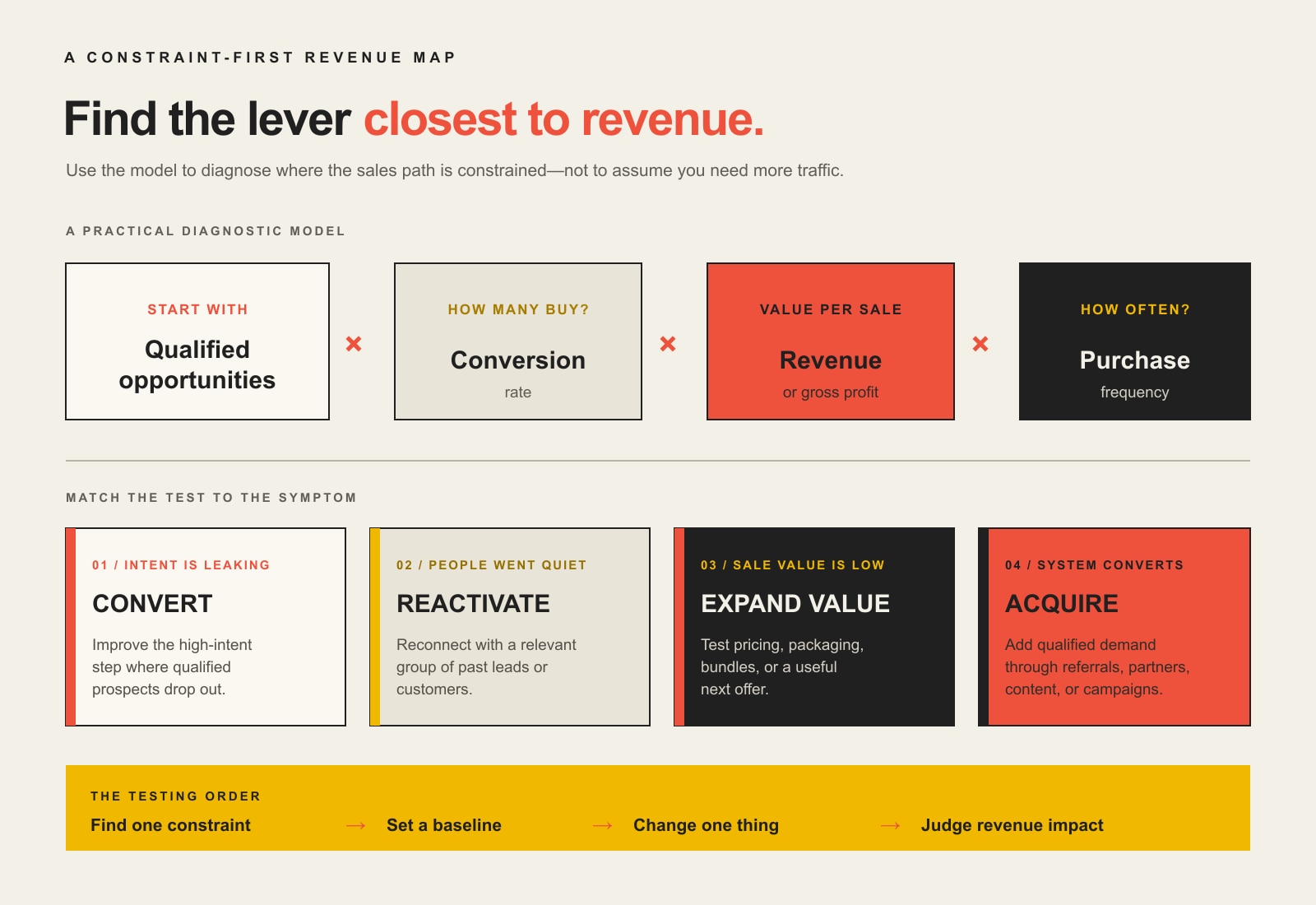
    A useful way to diagnose sales is to model revenue as four connected variables:

    Revenue ≈ qualified opportunities × conversion rate × value per sale × purchase frequency.

    This is a diagnostic model, not an accounting formula for every company. Its value is that it stops you from treating “more traffic” as the default answer. Each part of the model points to a different lever you can test.

    1. Convert: get more qualified prospects who are already in the sales path to take the next meaningful action.
    2. Reactivate: reconnect with leads and customers who already know the business.
    3. Expand value: improve revenue or gross profit per sale through better pricing, packaging, bundles, or appropriate upsells.
    4. Acquire: add new qualified demand through referrals, partnerships, affiliates, content, advertising, or other channels.
    A diagnostic model connects qualified opportunities, conversion rate, value per sale, and purchase frequency to four tests: convert, reactivate, expand value, or acquire; the testing order is find a constraint, set a baseline, change one thing, and judge revenue impact.
    Start with the symptom closest to revenue, establish a baseline, and test one lever at a time.

    If you are unsure which variable is actually constrained, our deeper guide to diagnosing why marketing is not working walks through the bottleneck before adding another tactic.

    1. Convert More of the Qualified Demand You Already Have

    This lever comes first when people are already reaching a high-intent page, requesting information, starting checkout, asking for quotes, or entering the sales process—but too few finish the next meaningful step.

    Do not begin with a sitewide redesign or a dozen simultaneous changes. Find the point where qualified intent is leaking out. Depending on the business, that might be a confusing offer, weak proof, an unclear call to action, unnecessary checkout friction, slow response time, or a sales handoff that leaves the prospect wondering what happens next.

    A bounded conversion test

    • Baseline one meaningful outcome. Use a purchase, qualified inquiry, booked consultation, accepted proposal, or another outcome tied to the sales path—not just pageviews.
    • Choose one high-intent step. Work on the page, form, checkout, quote process, or follow-up where the loss occurs.
    • Change one material thing. Clarify the offer, put proof near the decision, remove an unnecessary field, make the next step explicit, or tighten the handoff.
    • Judge the business outcome. A higher click rate is useful only if it moves more qualified people toward revenue.

    Example: if 100 qualified prospects reach a decision page and two buy, your baseline conversion is 2%. You do not need an industry-average conversion rate to know whether your own controlled change improves that baseline. The right comparison is your business before and after the test, with enough volume and time to avoid overreacting to noise.

    2. Reactivate Leads and Customers Already in Your Orbit

    Before paying to introduce yourself to strangers, look at the people who already raised a hand. Open proposals, older inquiries, previous buyers, renewal candidates, and customers with a logical next need can be closer to revenue than a brand-new visitor.

    The mistake is turning “follow up” into “email everyone more often.” There is no universal send frequency that maximizes every list. A useful cadence depends on why someone joined, what stage they are in, what you have to say, how long the buying cycle is, and whether the audience is responding.

    A better first test is one relevant message to one defined group. For example:

    • Ask stalled prospects whether the original problem still needs to be solved.
    • Show past customers a genuinely complementary service, refill, maintenance option, or next step.
    • Answer the objection that repeatedly stopped a specific class of lead.
    • Invite a segment to a useful resource or offer that matches what they originally asked about.

    Measure replies, qualified conversations, bookings, purchases, or reactivated revenue—not the number of messages sent. For the deeper system behind list ownership, lifecycle, message jobs, and sustainable cadence, use our email marketing roadmap for local business.

    3. Increase Value per Sale Without Pricing by Vibes

    If qualified customers are buying at a healthy rate but revenue or margin per sale is too low, the next lever may be value rather than volume. That can mean a price change, a clearer package, a bundle, a minimum engagement, an add-on, or an upsell that genuinely helps the buyer.

    Do not assume “raise prices” automatically means “make more profit.” Model the economics first. The U.S. Small Business Administration’s break-even guidance defines break-even as the point where total cost equals total revenue and uses fixed cost, selling price, variable cost, and projected unit sales to model the result. That is a better starting point than pricing psychology slogans.

    Use the old pricing example the right way

    Suppose a $29 offer produces seven sales per 100 qualified opportunities. That is $203 in revenue. If a $47 version produces five sales, that is $235. The second scenario generates $32 more revenue per 100 opportunities—but that does not prove the higher price is better. You still need to consider variable costs, acquisition costs, refunds, support load, retention, and what happened to the quality of the customer relationship.

    The point of the math is to show why conversion rate alone is not the business outcome. Price and volume interact. Test them deliberately. If pricing is the real constraint, our strategic guide to raising prices goes deeper into cost, value, positioning, segmentation, testing, and communication.

    4. Add Qualified Demand Through Referrals, Partners, and Affiliates

    Acquisition belongs fourth in this diagnostic—not because new demand is unimportant, but because pouring more people into a weak sales path can make the business busier without making it healthier.

    If the offer is understood, the sales path converts, the economics work, and follow-up is functional, then new qualified demand can become the right constraint to attack. Start with sources that bring context and trust, not just raw traffic.

    Three practical acquisition tests

    • Customer referrals: ask satisfied customers who else has the problem you solve, and make the introduction easy without turning the relationship into pressure.
    • Complementary partners: find businesses that serve the same customer before or after you do, then build a referral or co-marketing path that makes sense for both sides. Our guide to unexpected business partnerships explores that relationship more deeply.
    • Affiliates or creators: recruit a small number of partners whose audience and reputation fit the offer, give them a clear reason to care, and measure qualified sales rather than clicks.

    If compensation or another material relationship is involved in an endorsement, the Federal Trade Commission’s Endorsement Guides say the relationship should be disclosed clearly and conspicuously. Treat disclosure as part of the partnership design, not fine print added later.

    For acquisition, use the same discipline as the other levers: one audience, one offer, one channel, one measurable handoff, and one decision point. Our growth-hacking guide uses the same bounded-experiment idea for customer acquisition.

    How to Choose the First Sales Test This Week

    Use the symptom, not your favorite tactic, to choose the first move:

    • You have enough qualified visits, inquiries, or sales conversations, but too few become customers: test Convert.
    • You have a meaningful pool of past leads or customers who are not receiving relevant follow-up: test Reactivate.
    • Customers buy, but the economics are thin or the average sale leaves obvious value on the table: test Expand Value.
    • The sales path converts reliably and profitably, but there are not enough qualified opportunities entering it: test Acquire.

    Then write down three things before changing anything: your baseline, the single variable you are changing, and the business outcome that determines keep/change/stop. The review window should match the sales cycle. An ecommerce store may see a useful signal quickly; a consultative service with a long proposal cycle may need substantially longer.

    This prevents the most common failure mode in “increase sales” advice: changing the landing page, email schedule, price, ad creative, and partner outreach at the same time, then having no idea which change helped or hurt.

    What “Increase Sales Immediately” Should Actually Mean

    You can increase the quality of your sales process immediately. You can remove friction today. You can send a relevant follow-up today. You can model a pricing change today. You can ask for a referral today. What you should not promise is that any of those actions will create guaranteed same-day revenue.

    The useful definition of “immediate” is the shortest responsible feedback loop you can control. That keeps urgency without replacing judgment with hype.

    Frequently Asked Questions About Increasing Sales

    How can a small business increase sales quickly?

    Start with the closest revenue constraint. Improve conversion if qualified demand already exists, reactivate past leads or customers if you have dormant demand, improve pricing or packaging if value per sale is the problem, and add qualified demand only when the sales path already converts. Pick one lever and one measurable test rather than launching several tactics at once.

    Is more traffic the fastest way to increase sales?

    Not always. More traffic helps when too few qualified opportunities enter a sales system that already converts economically. If the real problem is a confusing offer, weak proof, checkout friction, poor follow-up, or thin pricing, more traffic can simply send more people into the same leak.

    Should I raise or lower prices to increase sales?

    Neither direction is automatically correct. Model contribution and break-even, understand what customers value, and test a controlled price or package change. Watch revenue and profit contribution along with conversion, customer quality, retention, and support cost.

    How often should I email leads and customers?

    There is no universal best frequency. Base cadence on audience expectations, lifecycle stage, buying cycle, the usefulness of what you have to say, and response. A relevant follow-up to a defined segment is a better first test than simply deciding everyone should receive more email.

    What sales metric should I measure first?

    Measure the last meaningful outcome the part of the system can control. For ecommerce that may be a purchase or contribution margin. For a service business it may be a qualified inquiry, booked consultation, accepted proposal, or closed sale. Use traffic, clicks, opens, and form starts as diagnostic metrics—not substitutes for the business outcome.

    Stop Collecting Tactics. Find the Constraint.

    The four ways to increase sales are not four commands every business should run at once. They are four places to look for the next constraint: convert, reactivate, expand value, and acquire. Diagnose the closest leak, run one bounded test, measure the outcome, and earn the right to move to the next lever.

    If the constraint is your website, lead path, marketing system, or measurement—and you want help diagnosing it before buying another tactic—contact Scope Design. We can help map the path from qualified attention to revenue and identify what deserves the next test.

  • 4 Ways to Build Value by Investing in Your Customers

    4 Ways to Build Value by Investing in Your Customers

    Customer retention strategies work best when they help customers get more value from what they already bought. For a small business, that usually means improving onboarding and delivery, removing recurring friction, learning from customer evidence, and then creating sensible reasons to renew, reorder, refer, or stay connected. A loyalty program can help in the right business. It cannot rescue an experience people would rather escape.

    That is the point of investing in customers: not spending money on random perks, but putting time, systems, attention, and budget into the parts of the relationship that make the customer more successful and the business easier to choose again.

    TL;DR: where should a small business invest in customer retention?

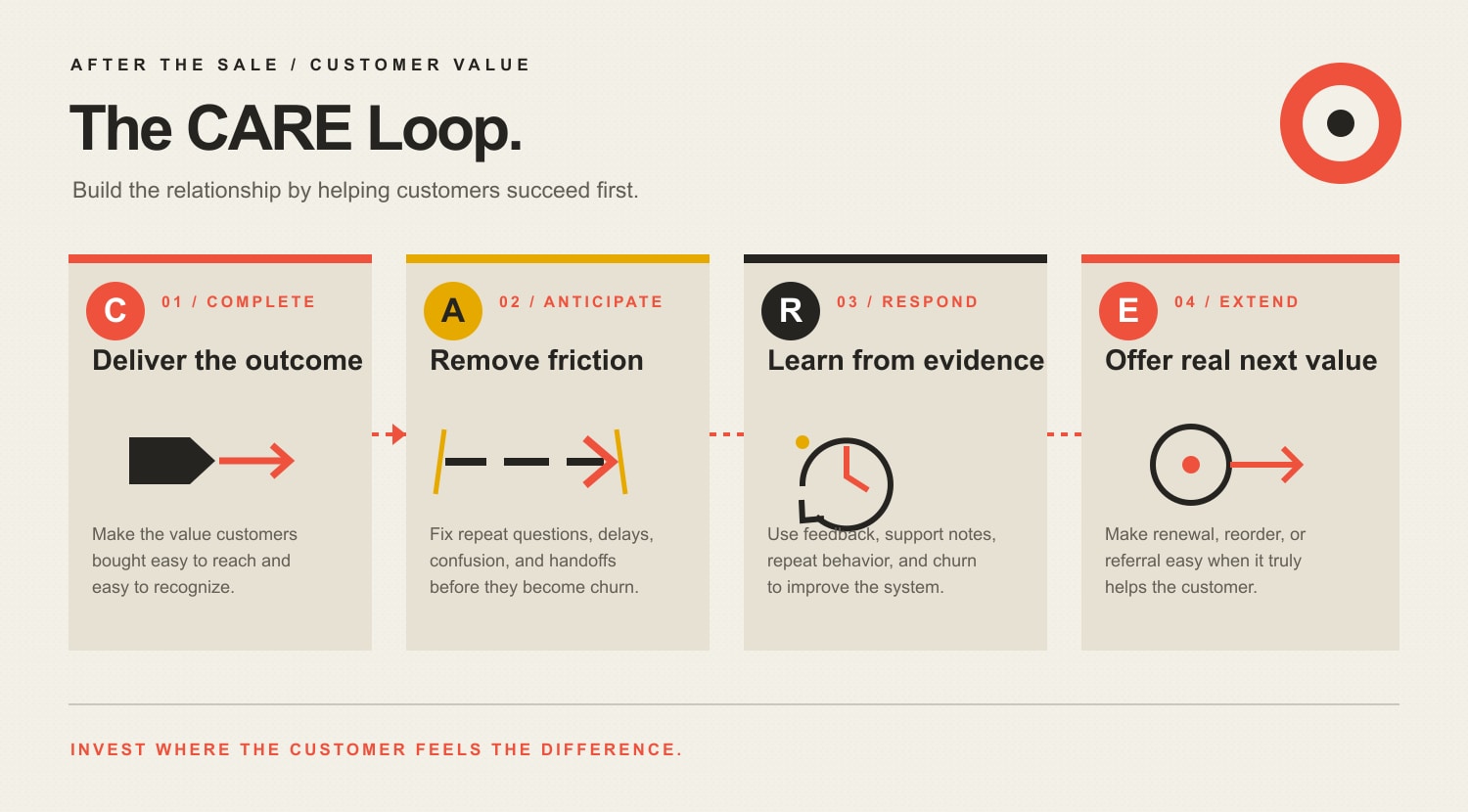
    • Complete the outcome. Make sure customers actually receive the value they bought.
    • Anticipate friction. Fix repeat questions, delays, confusion, handoff problems, and avoidable effort.
    • Respond to evidence. Use feedback, support requests, repeat behavior, churn, and customer questions to decide what deserves improvement.
    • Extend the relationship. Add renewal, reorder, referral, recognition, or loyalty mechanics only when there is a real next value for the customer.

    If your marketing plan stops when somebody becomes a customer, it stops too early. Scope Design’s broader small business marketing strategy treats response and customer outcomes as part of the system, not as somebody else’s problem after the sale.

    What does “investing in your customers” actually mean?

    Investing in customers means improving the customer’s ability to get a useful result from the relationship. Sometimes that investment is money. Often it is operational discipline: a better onboarding email, clearer instructions, a faster handoff, a useful follow-up, a simpler reorder path, better staff authority, or a process for turning recurring customer questions into fixes.

    This distinction matters because “customer retention” can turn into a shopping list of tactics. Buy a CRM. Launch points. Send birthday coupons. Add a chatbot. Start a community. None of those is automatically wrong. None is automatically a retention strategy either.

    A tactic becomes useful when it solves a real relationship problem. If customers leave because delivery is confusing, a rewards platform is expensive theater. If customers love the service but forget when to reorder, a simple reminder can be more valuable than a complicated membership program.

    The Scope Design CARE Loop for customer retention strategies

    The CARE Loop is a four-part decision sequence for choosing where to invest after the sale: Complete, Anticipate, Respond, Extend. The order matters. You first protect the value the customer expected. Then you remove avoidable friction. Then you use evidence to improve the system. Only after those pieces are healthy do you add mechanisms designed to deepen or continue the relationship.

    The CARE Loop: Complete the outcome customers bought, Anticipate and remove recurring friction, Respond to customer evidence by improving operations, and Extend the relationship only when there is genuine next value.

    1. Complete the outcome customers bought

    The first retention investment is not retention software. It is delivery.

    A customer bought something because they expected an outcome: a repaired furnace, a better website, a cleaner office, an easier tax season, a product that solves a recurring problem. Your first job is to make that outcome easy to reach and easy to recognize.

    Look for the gap between “transaction completed” and “customer got the result.” That gap is where many small-business retention problems hide.

    • Set expectations before the sale so the customer knows what happens next.
    • Create a clear onboarding or first-use path.
    • Give customers the instructions, access, contacts, or training they need.
    • Define who owns the relationship when work passes from sales to delivery or support.
    • Confirm completion instead of assuming silence means satisfaction.

    For service businesses, a short check-in after delivery can be more valuable than a discount. For ecommerce, the equivalent may be setup guidance, care instructions, replenishment timing, or an easy support path. For recurring services, it may be a visible progress update that reminds the customer what is being done and why it matters.

    This is also where value and pricing connect. A customer who cannot see or realize the value of the work will eventually question the price. Our guide to strategic pricing and value creation covers that side of the equation in more depth.

    2. Anticipate friction before it becomes a complaint

    Good customer service responds well. Better customer systems prevent the same avoidable problem from happening 40 times.

    Start with recurring friction: the questions your team answers repeatedly, the step customers forget, the form they cannot find, the deadline that surprises them, the delivery status they have to chase, the invoice they do not understand, or the handoff where context disappears.

    Then decide whether the right fix is communication, process, product, training, or automation. Technology should remove repetitive work without turning the relationship into a maze of bots and portals.

    • Use reminders where timing matters. Renewal, reorder, maintenance, appointment, and milestone reminders reduce the customer’s need to remember your process.
    • Personalize for usefulness. Use known preferences or history when it helps the customer make a better decision, not to perform creepy theatrical intimacy.
    • Make support ownership obvious. The customer should know where to go and should not have to retell the same story to three people.
    • Turn repeat explanations into reusable help. A short guide, video, checklist, or email sequence can improve service while reducing staff time.

    If email is the right relationship channel, our small-business email marketing guide shows how to build onboarding, educational, reminder, and follow-up communication around a real job rather than a blast calendar.

    Useful personalization also creates a data responsibility. The Federal Trade Commission’s business data-security guidance recommends keeping only personal information you have a legitimate business need for and protecting what you retain. “Collect everything because maybe marketing will use it later” is not a customer-experience strategy.

    3. Respond to customer evidence, not anecdotes

    Retention problems get expensive when the business guesses at them. One loud complaint becomes “customers hate this.” One loyal client becomes “everyone loves our process.” Neither is a useful operating model.

    Build a lightweight evidence loop. You do not need an enterprise research department. You do need a repeatable way to notice what customers are telling you through words and behavior.

    • Ask a short post-project or post-purchase question: What worked? What was confusing? What nearly made this harder than it needed to be?
    • Tag recurring support questions and complaint themes.
    • Review cancellations, non-renewals, returns, lost repeat purchases, and dormant accounts for patterns.
    • Compare what your best-fit customers value with what your marketing emphasizes.
    • Close the loop when you change something because customers spoke up. “You asked, we fixed it” is more credible than another survey nobody acts on.

    The broader digital marketing operating system should include this post-sale evidence. Customer questions can become better FAQs. Successful implementations can become case evidence. Churn reasons can improve fit criteria. Retention is not a separate island from acquisition; it teaches acquisition what “good customer” actually means.

    Reviews can be part of that evidence and advocacy system, but incentives need care. The FTC’s Consumer Reviews and Testimonials Rule guidance says businesses cannot condition incentives on a review expressing a particular positive or negative sentiment, and material connections or incentives may require disclosure. Ask for honest feedback, not rented applause.

    4. Extend the relationship only where there is real next value

    Once the customer experience works, you can deliberately make the relationship easier to continue.

    That can mean a reorder path, a maintenance reminder, a renewal conversation, a useful account review, an upgrade that solves a new problem, a referral request, priority access, recognition, or a formal loyalty program. The right mechanism depends on how often customers can reasonably return, the margin available, what they value, and whether your team can operate the promise without staff heroics.

    That is why we treat loyalty programs as a fit decision, not a default checkbox. Our small-business loyalty program guide compares models by behavior, frequency, margin, customer value, and operational reality.

    Harvard Business Review’s analysis of loyalty-program failure makes a similar practical point: programs underperform when the economics, customer insight, or engagement are weak. Points are not fairy dust. If customers are leaving because the core experience is unreliable, rewarding another purchase is not the first fix.

    How should you measure customer-retention investments?

    Measure the behavior or outcome your investment was supposed to improve. A retention dashboard with 27 numbers can still avoid the one question that matters: did the customer relationship get healthier in a way the business can sustain?

    Customer investmentUseful signalQuestion to answer
    Onboarding or delivery improvementCompletion, activation, time-to-value, support contactsAre more customers reaching the outcome with less confusion?
    Proactive communicationFewer repeated questions, missed appointments, late renewals, or status-chasing contactsDid we remove avoidable customer effort?
    Feedback-driven fixesRecurrence of the issue, satisfaction feedback, cancellation reason trendsDid the problem actually become less common?
    Renewal or reorder systemRenewal rate, repeat purchase rate, time between purchasesAre good-fit customers continuing when the next purchase makes sense?
    Referral or advocacy effortQualified referrals, honest reviews, referred revenueAre satisfied customers comfortably introducing us to similar buyers?
    Loyalty programIncremental repeat behavior, reward cost, margin, redemption and engagementIs the program changing useful behavior rather than subsidizing purchases that would happen anyway?

    Customer lifetime value can be a useful roll-up metric, but it should not become a fog machine. If CLV rises while support cost, refunds, service strain, or customer fit gets worse, you need the underlying drivers. Track enough to make the next decision, not enough to decorate a dashboard.

    When is a loyalty program the wrong first investment?

    A loyalty program is probably not your first move when customers cannot repeat the desired behavior often enough, your margins cannot support the reward, fulfillment or service quality is the real problem, customer records are unreliable, or a simple personal follow-up would outperform the software.

    For a lower-frequency professional service, excellent onboarding, useful education, reliable communication, proactive support, and an easy referral process may create far more value than points. A business with a broken customer experience should fix the experience before rewarding people for enduring it.

    A 30-day customer investment plan for a small business

    You do not need to redesign the entire customer journey in a week. Pick one meaningful friction point and run a small operating experiment.

    1. Week 1: Map the post-sale path. From payment or signed agreement through delivery, use, support, renewal, and referral, write down what the customer must do and who owns each handoff.
    2. Week 2: Find one repeated friction point. Review customer questions, support notes, cancellations, reviews, staff complaints, and missed steps. Choose a problem that happens often enough to matter.
    3. Week 3: Make the smallest useful fix. Improve the process, message, instruction, reminder, handoff, or support ownership. Avoid buying a platform before you know the job.
    4. Week 4: Compare the evidence. Did the relevant signal improve? Ask the people who handled the work. Ask a few customers. Keep, revise, or kill the change based on what happened.

    Then run the loop again. Retention compounds through better operations, not through one heroic “customer appreciation” week every November.

    Frequently asked questions about customer retention strategies

    What are customer retention strategies?

    Customer retention strategies are deliberate ways a business improves the likelihood that good-fit customers continue the relationship when doing so creates real value. They can include better onboarding, proactive support, useful communication, feedback-driven improvements, easier renewal or reorder paths, referrals, recognition, and loyalty programs.

    What are some examples of customer retention strategies for small businesses?

    Useful examples include a service follow-up after completion, maintenance reminders, onboarding instructions, a reorder reminder based on normal usage, an account review before renewal, a simple referral process, or a loyalty benefit for a genuinely repeatable behavior. The best example is the one tied to a known customer need or friction point.

    What is the best customer retention strategy?

    There is no universal best tactic. Start by completing the outcome customers bought and fixing the most common reason a good-fit customer struggles, leaves, or fails to return. Once the experience works reliably, add the simplest mechanism that supports the next useful behavior.

    How can a small business improve retention without discounts?

    Reduce effort. Communicate clearly. Follow up. Teach customers how to get more value from the product or service. Remember useful preferences. Make repeat business easier. Give staff enough authority to solve ordinary problems. Discounts change price; these investments change the experience.

    Should customer service improve before starting a loyalty program?

    Usually, yes when service or fulfillment problems are the reason customers do not return. A loyalty program can encourage an already-healthy repeat behavior, but it should not be used to compensate for unreliable delivery, confusing support, or a weak core offer.

    How do you know whether a retention strategy is working?

    Choose the signal that matches the intervention. If you improved onboarding, measure completion and support friction. If you built renewal reminders, measure timely renewals. If you added a loyalty program, look for incremental repeat behavior after reward cost and margin, not just sign-ups. Compare the result over time and investigate the reason behind the number.

    Do customer retention strategies work for B2B companies?

    Yes. In B2B, the mechanics are often account reviews, implementation success, stakeholder communication, proactive support, documented value, renewals, expansion, referrals, and reducing risk for the buyer. The principle is the same: help the customer achieve the outcome and make the useful next step easier.

    Invest where the customer feels the difference

    The strongest customer retention strategies are not the ones with the fanciest software. They are the ones that make a good-fit customer more successful, reduce unnecessary effort, turn real evidence into better operations, and create a sensible next step.

    Start with the customer outcome. Work the CARE Loop. If your broader marketing system is generating attention but leaking value after the sale, use our small business marketing strategy framework to diagnose the whole path before you buy more attention.

  • Online Presence for Small Business: 6 Steps to Win and Retain Customers

    Online Presence for Small Business: 6 Steps to Win and Retain Customers

    A strong online presence for small business growth is not a website, a Google Business Profile, a few social accounts, and an email list sitting beside one another. It is a connected system that helps the right people find you, understand you, take the next step, receive a competent response, and have a reason to come back.

    Most advice about an online presence for small business owners stops at the channel list. That distinction matters because customer retention is rarely won by one page or one channel. A site can generate a perfectly good lead and still fail if the form goes nowhere. Search can bring qualified visitors to a confusing offer. Social media can create attention that never reaches an owned audience. A polished redesign can hide the fact that slow follow-up—not design—is the real bottleneck.

    Scope Design’s approach is to treat the web presence as an acquisition-to-retention system and fix the earliest constraint in that system before adding more tactics downstream. We call the model the Presence-to-Repeat Loop: Home Base → Findability → Trust → Handoff → Follow-through → Feedback.

    If you remember one idea from this guide, make it this: build the loop, then improve the first stage that is actually failing. More channels are not automatically more presence, and more traffic is not automatically more business.

    TL;DR: Build the Smallest Complete Online Presence for Small Business Growth

    • Own the home base: keep the website clear, usable, accessible, measurable, and connected to the systems that receive customer actions.
    • Earn relevant discovery: use search, local listings, social, referrals, ads, and other channels only where they reach the right people.
    • Protect the handoff: test what happens after a form, call, booking, order, or signup so customer intent reaches a real owner and receives a useful response.
    • Improve the first constraint: use feedback and business outcomes to fix the earliest failing stage instead of stacking more tactics downstream.

    In This Guide

    Online Presence for Small Business: What It Should Actually Do

    Your online presence is every meaningful digital touchpoint where a prospect or customer can discover, evaluate, contact, buy from, or return to your business. That can include your website, search results, Google Business Profile, social profiles, review sites, marketplace listings, email, booking or ecommerce systems, and customer portals.

    The phrase online presence for small business can sound like a channel checklist. In practice, it is a customer-path problem: discovery only matters when it reaches a useful handoff and a customer experience worth repeating.

    Those touchpoints do not deserve equal strategic weight. Your website is normally the owned hub: the place where you control the message, structure, offers, calls to action, measurement, and integrations. Search, maps, social, directories, ads, and referrals are discovery or distribution surfaces that should send the right people toward that hub—or toward another intentional next step.

    That is why “being everywhere” is a poor goal. The better question is: what job should each channel perform, and what happens after it performs that job? Our broader SEO strategy and analytics framework applies the same logic to search: visibility matters only when it connects to a qualified business outcome.

    A useful web presence should do six jobs in sequence: provide an owned destination, earn relevant discovery, reduce uncertainty, make the next action easy, route that action into a real business process, and feed what you learn back into the system. That sequence is the Presence-to-Repeat Loop.

    The Presence-to-Repeat Loop

    The loop is not a funnel that ends when somebody submits a form. It continues through the operational handoff and customer experience, then brings evidence back to marketing and the website. That is what makes retention part of web strategy instead of an unrelated task owned by somebody else.

    1. Home Base: Own the Destination

    Your home base is the digital property where the business can explain what it does, for whom, why it is credible, and what should happen next. For most small businesses, that is the website. It should be stable enough to trust, easy enough to use, and structured around real customer decisions rather than around whatever pages came with the theme.

    Ownership also means maintainability. Forms need to work. Contact information needs to be current. Important pages need clear owners. Analytics should be installed correctly. Critical third-party dependencies should be understood. Accessibility belongs in this foundation, too: WCAG 2.2 is the current W3C Recommendation with testable, technology-neutral criteria for making web content more accessible, and W3C notes that following the guidance often improves usability more broadly.

    A redesign can help when the home base itself is the constraint, but redesign is not the default diagnosis. Before rebuilding, use a website redesign checklist that proves the need before the rebuild. If the real failure is lead routing, offer clarity, or follow-up, a prettier interface can leave the business problem untouched.

    2. Findability: Help the Right People Discover You

    Findability is not the same as traffic. The goal is relevant discovery from people who have a reasonable chance of becoming customers. Depending on the business, that can come from organic search, local search, paid media, referrals, social content, partnerships, directories, or direct demand created offline.

    Google’s SEO Starter Guide describes SEO as helping search engines understand content and helping users find a site. Google also says it primarily discovers new pages through links from pages it already crawled. In practical terms, useful content, logical internal links, clear page ownership, and crawlable navigation are part of being findable; publishing isolated pages and hoping search figures it out is not a strategy.

    For a local business, your website and your Google Business Profile should reinforce one another. Google says an eligible, verified Business Profile lets a business manage how it appears in Search and Maps, maintain key information, and interact through features such as photos and reviews. Our local SEO guide for small businesses goes deeper on being found and chosen in local search.

    3. Trust: Answer the Questions That Block Action

    Once the right person arrives, the site has to make a clear argument. What problem do you solve? Who is the offer for? What is included? What does the process look like? What proof supports the claim? What happens if the visitor is not ready to buy today?

    Trust is not a pile of badges. It is the reduction of relevant uncertainty. A service business may need strong examples, process clarity, scope boundaries, and credible reviews. A local retailer may need hours, inventory expectations, directions, policies, and real photos. A consultant may need a point of view that shows how decisions are made. Put proof near the doubt it resolves rather than hiding all credibility on a testimonial page.

    Social media can support this stage by showing activity, expertise, community participation, and evidence of work, but it should have a defined role. If social is one of your authority channels, our guide to building a social media presence that actually builds authority covers that specialist job without turning this article into a social-media checklist.

    4. Handoff: Make the Next Step Reach a Real Person or System

    This is the stage most “online presence” guides skip. A conversion is not complete because a form says “Thank you.” The business has to receive the inquiry, know what it means, assign responsibility, and act on it.

    Test the whole path. Submit the form. Call the tracked number. Make a test booking. Use a different email address. Check what reaches the CRM or inbox. Confirm who owns the response. Check mobile notifications. Verify that the customer receives the promised confirmation. If a lead can disappear into a generic mailbox or an integration can fail silently, the web presence has a business-process problem, not merely a page-design problem.

    The best handoff is usually boring: the visitor knows what will happen, the business knows who owns it, the data lands where staff can use it, and exceptions are visible instead of silently falling through the floor.

    5. Follow-through: Continue the Relationship After the Click

    Retention starts with delivering what the web presence promised. That can include prompt lead response, clear onboarding, appointment reminders, order updates, support information, replenishment or rebooking prompts, useful education, customer-only resources, and intentional requests for feedback or reviews.

    Email is useful here because it gives the business a direct channel it can operate intentionally rather than depending entirely on a social algorithm. But the job is not “send more email.” Each message should have a reason to exist and a useful next step. Our email newsletter strategy guide covers how to publish something worth opening.

    For U.S. commercial email, follow the rules as well as the strategy. The FTC’s CAN-SPAM compliance guide requires accurate sender information and subject lines, a valid postal address, a working opt-out method, and prompt honoring of opt-out requests. Retention does not mean trapping customers in a list they cannot leave.

    6. Feedback: Use Customer Evidence to Improve the Loop

    The final stage sends evidence back to the beginning. Search Console can show which queries and pages earn visibility. Analytics can show which landing pages and actions people use. CRM or booking data can show which leads become qualified opportunities. Support notes can expose confusion the website should prevent. Repeat purchases, renewals, referrals, cancellations, and reviews can show where the experience is helping or hurting the relationship.

    The important rule is to measure the last meaningful outcome the web system can control. A website cannot close every sale for a consultative service, but it can influence qualified inquiries, completed bookings, usable lead data, and clear handoffs. Measure those outcomes, then connect them to what happens next without pretending every downstream business result belongs to marketing.

    Find the Earliest Constraint Before Buying Another Tactic

    When performance is weak, small businesses often jump to the visible tactic: redesign the site, post more, run ads, add chat, buy a CRM, install another plugin, or publish more content. Scope Design uses a constraint-first diagnostic order instead. Start at the top and do not move down until the earlier stage is reasonably healthy.

    That makes online presence for small business planning a prioritization problem, not a shopping list. The first failed stage should determine the next investment.

    1. Measurement and technical integrity: Can the important pages load, forms submit, tracking record useful events, and systems pass data reliably?
    2. Sufficient relevant volume: Is there enough qualified discovery to judge what happens after arrival?
    3. Acquisition fit: Are the right people arriving for the right reasons, or are you attracting curiosity that will never become demand?
    4. Messaging clarity: Can a qualified visitor understand the offer, audience, difference, proof, and next step?
    5. UX friction: Is the site making a clear decision unnecessarily difficult through confusing navigation, unreadable layouts, broken mobile behavior, slow interactions, or forms that ask for the wrong things?
    6. Offer and positioning: Is the underlying offer compelling and appropriate for the market, or are you trying to optimize the interface around a weak proposition?
    7. Sales and operational follow-through: Once the site does its job, does the business respond, qualify, onboard, deliver, and follow up consistently?

    This ordering prevents expensive misdiagnoses. If tracking is broken, you cannot confidently diagnose conversion. If qualified traffic is tiny, a conversion-rate argument may be noise. If the right leads arrive but nobody responds for three days, another SEO campaign cannot fix the handoff. The constraint—not the trendiest tactic—should determine the next investment.

    What Should You Measure From First Visit to Repeat Customer?

    For an online presence for small business owners, measurement should follow the same customer path as the strategy. There is no universal dashboard that proves a web presence is working. The useful metric depends on the stage and the business model. A local service company, ecommerce store, professional practice, membership organization, and B2B consultant do not share one conversion definition.

    StagePrimary business signalUseful diagnosticsQuestion if weak
    FindabilityQualified discoveryRelevant impressions, visits, local actions, source/mediumAre enough of the right people finding us?
    TrustQualified next actionsService-page paths, calls to action, proof engagement, assisted pathsDo qualified visitors understand and believe the offer?
    HandoffUsable inquiries, calls, bookings, or ordersForm success, call routing, booking completion, integration errorsCan intent move into a real business process without getting lost?
    Follow-throughQualified opportunities and delivered customer actionsResponse time, appointment completion, onboarding completion, abandoned stepsDoes the business keep the promise made by the website?
    RetentionRepeat purchases, renewals, rebookings, referrals, or expansionCohorts, customer source, cancellation reasons, review themesWhat makes good customers return—or disappear?
    FeedbackBetter next decisionsSearch queries, support questions, lost-lead reasons, review languageWhat evidence should change the next website or marketing decision?

    Traffic still matters as a diagnostic. It simply does not deserve to be mistaken for the outcome. The same is true of rankings, followers, email opens, time on page, and any other intermediate signal. Use them to explain the system, not to replace the business result you actually care about.

    A First-Hand Example: The Website Was Not the First Constraint

    One Scope Design project involved a long-established specialty auction business that understandably wanted website and feature improvements. A superficial response would have started with layouts and a feature list.

    But the discovery work exposed a broader constraint. Important forms were unreliable, business data lived in disconnected places, staff depended on manual processes, and legacy systems shaped what could safely change. A new interface alone would have covered some of that complexity without fixing the operational handoff underneath it.

    So the first job was to map what happened from customer action through the internal process, identify fragile dependencies, repair foundation problems, and decide which changes would genuinely reduce friction. Design still mattered. It simply had to follow the constraint instead of pretending to be the diagnosis.

    That lesson generalizes: a requested deliverable is evidence of dissatisfaction, not proof of the binding problem. If somebody asks for a redesign, SEO, social media, automation, or a CRM, first trace the customer and data path far enough to see where value is actually leaking.

    Common Online-Presence Mistakes That Weaken Retention

    Treating Social Profiles as the Whole Business Presence

    Social networks can be excellent discovery and trust channels, but they are rented distribution. Account rules, reach, formats, and platform priorities can change. Use social where your audience actually participates, then give important prospects and customers an owned place to learn, act, subscribe, book, buy, or return.

    Adding Channels Without Giving Them Jobs

    A neglected TikTok account, a monthly newsletter with no purpose, an unused chat widget, and six directories do not become a strategy because they appear in the marketing plan. Every channel should have a job, an owner, a next step, and a reason to remain in the system.

    Collecting Leads Into a Dead End

    If form submissions land in an inbox nobody owns, booking exceptions are invisible, or sales staff cannot tell where an inquiry came from, the problem is not “conversion optimization.” Test handoffs as carefully as pages.

    Automating a Process You Have Not Defined

    Automation can make a good process faster, but it can also make a bad process fail at scale. Define ownership, required data, exceptions, response expectations, and escalation first. Then automate the repetitive parts that are actually stable.

    Promising an Experience Operations Cannot Deliver

    Marketing and retention separate when the website promises speed, customization, availability, or service quality that the operational system cannot consistently provide. The fix may be a better workflow, a narrower promise, clearer expectations, or more capacity—not a new headline.

    Measuring Activity Instead of Progress

    A rise in followers, traffic, impressions, or email sends can be useful, but those numbers do not tell you whether more suitable prospects became customers or whether good customers returned. Keep intermediate metrics attached to the customer path they are supposed to explain.

    Run a 90-Minute Online Presence for Small Business Audit

    A useful online presence for small business audit follows the customer path, not the marketing org chart. You do not need a three-month consulting engagement to find obvious breaks. In 90 minutes, a business owner or small team can walk the same loop and create a short constraint list. The goal is not to “audit everything.” It is to identify the first plausible failure that deserves deeper investigation.

    1. Minutes 0–15 — Home Base: Open the site on desktop and mobile. Check the main offer, contact details, key pages, primary calls to action, important forms, booking or checkout, security warnings, analytics presence, and obvious accessibility barriers. Write down anything that can stop a qualified visitor from using the site.
    2. Minutes 15–30 — Findability: Search your business name, core services, and local terms that real customers use. Check how your website, Business Profile, reviews, social profiles, directories, and ads represent the same business. Look for missing, stale, contradictory, or irrelevant discovery paths.
    3. Minutes 30–45 — Trust: Pretend you are a careful first-time buyer. Can you understand the audience, offer, process, proof, boundaries, and next step without calling to ask basic questions? Note every uncertainty that could reasonably delay action.
    4. Minutes 45–60 — Handoff: Submit a form, make a test call, or complete a booking. Follow the data. Who gets it? How quickly? What confirmation does the customer receive? What happens if the normal owner is absent? Record every place the inquiry can disappear.
    5. Minutes 60–75 — Follow-through: Map what happens from inquiry to onboarding, delivery, support, rebooking, renewal, review request, or next purchase. Look for promises that rely on memory instead of a defined process.
    6. Minutes 75–90 — Feedback: Pull only the evidence needed to judge the loop: search visibility, qualified actions, lead quality, response or completion data, repeat behavior, cancellations, reviews, and support themes. Choose the earliest stage with credible evidence of failure.

    Finish with one sentence: “The next constraint we need to prove or disprove is ______.” That sentence is more useful than a 40-item tactic list because it tells you what evidence to gather and what not to buy yet.

    Frequently Asked Questions About Online Presence for Small Business Owners

    How do I build my online presence?

    Start with an owned home base that clearly explains what you do and what visitors should do next. Then build the discovery channels your customers actually use, add proof that resolves buying doubts, connect every important action to a real internal owner or system, create intentional follow-up, and measure what happens through the first repeat-customer outcome. Do not launch every channel at once. Build the smallest complete loop first.

    Do small businesses need a website if they already use social media?

    Most established small businesses benefit from an owned website even when social media is important. Social platforms are useful discovery and authority channels, but the platform controls the account environment, reach, formats, and rules. A website gives the business more control over its message, customer paths, integrations, content organization, measurement, and owned conversion points. There are exceptions—especially very small or temporary businesses—but “we have social” is not the same as owning a durable digital hub.

    What should a small business website do after it generates a lead?

    It should hand the lead into a defined process. The inquiry needs to reach the right owner or system with enough context to respond, the prospect should receive a clear confirmation, and the business should have a response expectation plus a way to see failures. The website’s job is not finished at the form submission.

    Can a website redesign improve customer retention?

    Yes, when website friction is part of the retention problem—for example, customers cannot find support information, rebook easily, manage an account, understand next steps, or use the site reliably. But a redesign will not repair weak service delivery, an unclear offer, bad lead routing, or inconsistent follow-up. Diagnose the constraint first.

    Which online channels matter most for a small business?

    The channels that reach your real customers and perform a defined job in the Presence-to-Repeat Loop. A local service business may depend heavily on Google Search, Maps, reviews, its website, and direct follow-up. A B2B specialist may rely more on referrals, search, LinkedIn, email, and strong proof content. A retailer may need local discovery, ecommerce, social, and post-purchase communication. Start with customer behavior and the business model, not a generic platform list.

    How often should I review my online presence?

    Scope Design recommends lightweight monthly health checks for obvious technical, tracking, listing, and handoff problems, plus a deeper quarterly review of the customer journey. Revisit the loop sooner after a major offer change, site launch, system migration, staffing change, or repeated customer complaint. The cadence is a management recommendation, not a universal industry rule.

    Build the Loop, Not the Pile

    The strongest online presence for small business success is not the one with the most accounts, automations, pages, or dashboards. It is the one where discovery, trust, action, handoff, service, and feedback support one another.

    If your business is getting traffic but not good leads, generating leads but losing them after the form, or redesigning the site without knowing what problem the redesign is supposed to solve, start with the constraint. Map the Presence-to-Repeat Loop, identify the first failing stage, and make the next investment answer that evidence.

    That is also how Scope Design approaches website and digital strategy: diagnose the business job first, then choose the site, SEO, content, automation, or operational work that actually addresses it. If you need help mapping the system, Scope Design can start with the evidence instead of another pile of tactics.