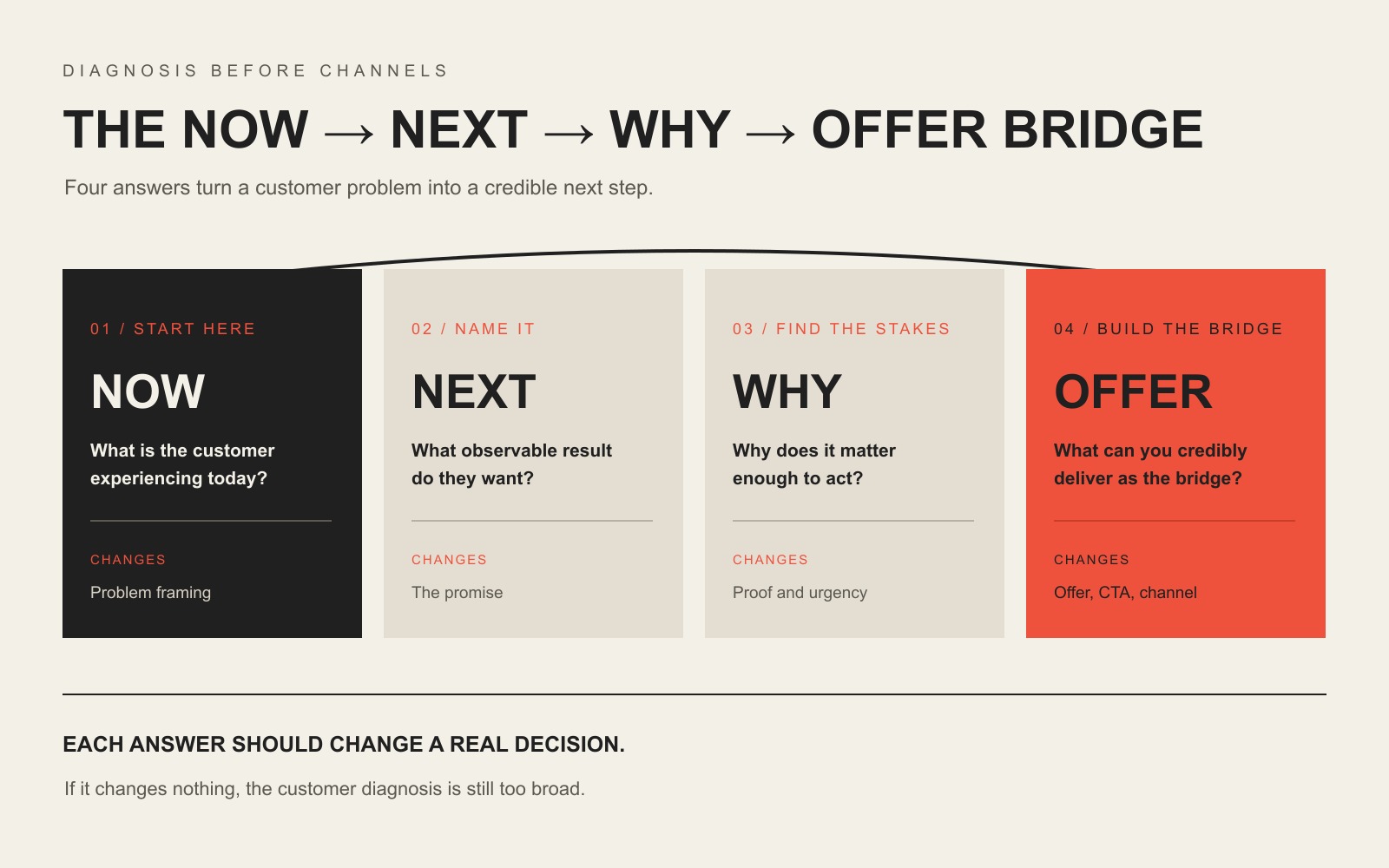
If you want to know how to identify your target audience, start by replacing demographic guesses with evidence. If your target audience is “women ages 25–44 who use Instagram,” you do not have an audience strategy yet. You have a demographic filter. A useful target audience explains who has the problem, what makes it matter now, what affects the buying decision, and where that person shows behavior you can actually observe and reach.
That distinction matters because demographic data can help you form a hypothesis, but it cannot tell you by itself why someone buys, what they tried first, what they distrust, or which message will move them. The best audience definition is not a fictional character you invent once. It is a testable hypothesis that gets sharper as real evidence comes in.
What is a target audience?
A target audience is the specific group of people or organizations you are trying to reach because they have a meaningful reason to care about your offer and are plausible customers for it. A strong definition combines the problem they face, the trigger that creates urgency, relevant constraints, decision criteria, and the places where they search, compare, learn, ask, or return.
For a small business, that is more actionable than a sentence built only from age, gender, income, and interests. Those attributes can still matter. The question is whether they change a real business decision.
- Keep an attribute if it changes your message, offer, eligibility, price sensitivity, serviceability, buying authority, channel, or follow-up.
- Question an attribute if it is merely easy to collect.
- Drop an attribute if knowing it would not change what you do.
The U.S. Small Business Administration makes a similar practical distinction in its market-research guidance: broad sources can help answer general, quantifiable questions about a market, while direct customer research is better suited to questions specific to your business and customers.
How to identify your target audience: use the TRACE method
At Scope Design, a useful audience definition has to survive contact with evidence. We use a simple framework for that: TRACE — Trigger, Reality, Attributes, Channels, Evidence.
T — Trigger: what makes the problem matter now?
Start with the event that turns a general need into an active problem. Someone may “care about cybersecurity” for years but only shop for help after an insurance requirement, a client security questionnaire, an employee mistake, or a near miss. A homeowner may vaguely want a new kitchen until a leak, new baby, home sale, or financing decision creates a deadline.
Triggers are valuable because they expose timing, urgency, language, and search behavior. Ask:
- What happened right before this became important?
- What would make the buyer act this week instead of “someday”?
- What happens if they do nothing?
- Who else becomes involved once the trigger occurs?
R — Reality: reconstruct what people actually did
Do not begin by asking customers what they “would” do. Reconstruct the last real episode. Ask what happened, what they searched for, who they talked to, what alternatives they considered, what they rejected, what nearly stopped them, and why they finally chose one path.
This is where audience research becomes useful marketing intelligence. The phrases customers use to describe the problem can shape your website, SEO, sales conversations, and content. The alternatives they considered reveal the real competitive set—which may include doing nothing, hiring internally, using a spreadsheet, asking a friend, or choosing a cheaper category.
If you want a deeper menu of research techniques, use our guide to self-directed market research. This article stays focused on what evidence you need to define and locate an audience.
A — Attributes: keep only the differences that matter
Now add attributes that explain meaningful differences between buyers. Depending on the business, those might include geography, company size, job role, life stage, technical maturity, purchase frequency, budget authority, urgency, risk tolerance, or previous solution.
Demographics can be useful here, but treat them as clues rather than conclusions. Pew Research Center’s U.S. social-media data, for example, shows that platform adoption differs substantially across age and other demographic groups. That is useful for generating a channel hypothesis. It still does not prove that your best customers use a platform to solve your problem.
C — Channels: find the behavior, not just the person
The question “Where does my audience hang out online?” is often too vague. People use different channels for different jobs. The same owner might search Google for an urgent vendor, watch YouTube to understand a technical problem, ask peers in a private group for recommendations, use LinkedIn for professional discovery, and ignore promotional posts everywhere else.
Map channels to the behavior you need to reach:
| Audience behavior | Places to investigate | Evidence to look for |
|---|---|---|
| Actively searching for a solution | Google, Bing, local search, marketplaces | Search queries, local terms, comparison language, “near me” or problem-specific searches |
| Learning how a problem works | YouTube, search, podcasts, expert newsletters | Repeated questions, tutorials, explainers, terminology gaps |
| Comparing vendors or approaches | Review sites, Reddit, forums, industry groups, search | Objections, alternatives, price questions, trust signals, recommendation threads |
| Professional discovery | LinkedIn, associations, trade publications, webinars | Job roles, industry language, events, peer commentary |
| Visual discovery or inspiration | Instagram, TikTok, Pinterest, YouTube | Saves, shares, creator formats, before/after examples, recurring visual themes |
| Already knows you | Email, CRM, remarketing audiences, direct traffic | Repeat visits, email clicks, prior purchases, form activity, sales-stage behavior |
E — Evidence: confirm or kill the hypothesis
Your first audience definition should be written in a way that can be disproved. For example:
“We believe independent dental practices with 5–20 employees become active website buyers when growth stalls or the site creates trust problems. The owner or practice manager researches options through search, peer recommendations, and vendor examples. They need clear proof of process, local credibility, and ongoing support before they will consider a higher-priced partner.”
That statement gives you something to test. If interviews show the trigger is actually a practice acquisition, if the office manager never participates, or if referrals dominate search, change the definition. Evidence wins.
Target audience vs. target market, ICP, and buyer persona
These terms overlap, but they do different jobs. Keeping them separate prevents the common mistake of treating a detailed persona as proof that the audience is real.
| Term | What it describes | Best use |
|---|---|---|
| Target market | The broader market your business could realistically serve | Market sizing, positioning, business strategy |
| Target audience | The specific people or organizations you want a message, offer, or campaign to reach | Marketing strategy, messaging, channel choice |
| ICP | The type of customer/account that is an especially strong fit | B2B qualification, sales prioritization, account selection |
| Buyer persona/avatar | A human-readable summary of a recurring buyer pattern | Writing, creative direction, sales enablement—after evidence exists |
Once your audience evidence is solid, our guide to writing for different customer avatars can help you turn that evidence into more specific copy. And if you need to go deeper on motivations, risk, objections, and decision patterns, see our buyer psychology guide.
How to research your target audience if you already have customers
If you already have customers, your fastest path is not a new persona workshop. Start with what your business already knows.
1. Rank customers by business value—not familiarity
Pull a simple customer list and mark revenue or project value, repeat purchases, margin if known, fit, retention, sales effort, support burden, referral behavior, and whether the work is the kind you want more of. Your “most memorable” customers are not always your best market.
2. Interview a small mix of wins, losses, and ideal-fit customers
Ask about the last real buying episode. What triggered it? What did they do first? What did they search? What other choices did they consider? Who was involved? What made them skeptical? What evidence mattered? Why did they choose you—or choose someone else?
Five useful conversations can expose language and decision patterns that a spreadsheet cannot. The goal is not statistical certainty; it is to discover hypotheses worth checking across more evidence.
3. Review sales, support, reviews, and search language
Look at contact-form submissions, sales notes, proposals, support tickets, reviews, on-site searches, Search Console queries, and frequently asked questions. These sources often reveal the gap between the words a business uses internally and the words customers use when the problem is real.
4. Use analytics as a clue, not a census
Analytics can show acquisition channels, landing pages, devices, geography, repeat behavior, and conversion paths. But be careful treating any analytics demographic view as a census. Google’s Analytics Data API guidance notes that reports can be subject to data thresholding to prevent identification of individual users based on demographics, interests, or other signals, and rows with small user counts may be excluded. See Google’s reporting data expectations.
If the CRM says your strongest customers are multi-location service businesses but a small GA4 demographic card says most visible users fall into one age bracket, do not rewrite your strategy around the age bracket. Follow the evidence closest to the buying decision.
How to identify a target audience when you are starting from zero
No customers yet? You can still create a useful starting hypothesis. You just need to label assumptions as assumptions.
- Define the painful problem. Be specific enough that a person would recognize the situation.
- List likely triggers. What event would make someone start looking now?
- Map alternatives. Include competitors, DIY, internal workarounds, postponement, and “do nothing.”
- Find real conversations. Read reviews, niche forums, Reddit threads, trade communities, video comments, competitor FAQs, and search suggestions for recurring language and objections.
- Talk to plausible buyers. Do not pitch. Ask about past behavior around the problem.
- Create two or three competing audience hypotheses. Avoid falling in love with the first one.
- Run a small test. A landing page, outreach batch, search campaign, referral experiment, webinar, or content piece can reveal which hypothesis produces qualified action.
This is where broader small-business marketing strategy matters: the audience is one part of the system. A weak offer, confusing page, wrong proof, or poor follow-up can make a good audience look bad. Diagnose the whole path before declaring that “the audience didn’t work.”
How to find your target audience online
Do not ask only, “Which platform has people like my customer?” Ask, “Where does my customer perform the behavior that matters to this decision?”
Search engines: capture active demand
Search is strongest when people can describe the problem, category, location, or desired outcome. Review Google Search Console, keyword research, autocomplete, related searches, local listings, and competitor rankings. Pay attention to the words that signal intent: pricing, comparison, reviews, “best,” “near me,” specific symptoms, or a named solution.
Social platforms: investigate behavior before demographics
Platform demographic studies can tell you whether a hypothesis is plausible. Then inspect the actual community. What does the audience follow? Which formats do they save or share? What questions recur? Which creators, associations, brands, or peers do they trust? Is the platform used for discovery, education, entertainment, professional identity, or purchase research?
The right answer may be “use TikTok for discovery but search for conversion,” or “LinkedIn is good for credibility but referrals drive the actual shortlist.” A channel does not have to perform every job.
Communities and forums: mine objections and language
Reddit, specialist forums, Facebook or LinkedIn groups, Slack communities, trade groups, and association discussions are often better for learning than broadcasting. Search for problem phrases, alternatives, vendor frustrations, and “what would you recommend?” threads. Treat community posts as qualitative evidence, not a representative sample of the whole market.
Your own CRM and email list: study first-party behavior
Existing contacts can reveal which industries, service lines, lead sources, pages, emails, offers, or follow-up sequences correlate with real revenue. A small but verified customer pattern is often more useful than a huge third-party audience estimate.
Use an audience evidence ladder
Not all audience signals deserve equal weight. When sources disagree, prefer evidence closer to the real buying decision.
| Evidence level | Examples | What it can tell you | Main limitation |
|---|---|---|---|
| 1. Transaction / outcome | Purchases, retained clients, qualified leads, won/lost deals | Who actually creates business value | May reflect your current reach, not the whole opportunity |
| 2. Observed behavior | Search queries, page paths, repeat visits, email clicks, sales-stage actions | What people do | Behavior still needs context |
| 3. Direct qualitative evidence | Interviews, sales notes, reviews, support conversations | Triggers, language, alternatives, objections | Small samples can overrepresent strong opinions |
| 4. Market / community evidence | Industry data, competitor reviews, communities, Pew/SBA data | Market plausibility, context, hypotheses | Usually not specific to your customers |
| 5. Assumptions | Brainstorms, persona guesses, stereotypes | A starting hypothesis | Not evidence until tested |
The ladder does not mean a single purchase proves a market. It means verified outcomes deserve more weight than a generic claim such as “people over 50 prefer Facebook” when you are deciding who to pursue and how.
When should you create multiple target audiences?
Most businesses have more than one plausible audience. The mistake is either targeting everyone with one vague message or creating so many segments that no one can act on them.
Create a separate audience when the difference changes at least one meaningful decision:
- the problem or trigger;
- the value proposition;
- the proof required;
- the buying authority or sales process;
- the economics or service model;
- the channel or search behavior;
- the follow-up sequence.
For example, a commercial HVAC company may need separate audiences for facility managers with planned maintenance budgets and property owners facing emergency failures. The company is the same; the trigger, urgency, message, proof, channel mix, and sales path are not.
A 30-day target audience validation sprint
You do not need six months of research before making a decision. You need a controlled loop that creates better evidence.
| Week | Action | Output |
|---|---|---|
| 1 | Write 2–3 TRACE audience hypotheses and gather existing first-party evidence | A one-page hypothesis for each audience, with unknowns clearly marked |
| 2 | Interview 5–8 relevant people across customers, prospects, or plausible buyers | Triggers, language, alternatives, objections, channel clues |
| 3 | Run one small channel/message test per leading hypothesis | Comparable data on qualified response—not just impressions |
| 4 | Score the evidence and decide: scale, revise, or stop | A narrower audience definition and the next test |
Choose a success measure that matches the business: qualified calls, booked consultations, quote requests, trials, purchases, or another real step. Cheap clicks can be useful diagnostic data, but they are not proof of audience fit.
A simple decision rule keeps the test honest:
- Scale when the audience produces qualified behavior and the interviews support the same trigger/message/channel pattern.
- Revise when interest exists but the trigger, message, proof, or channel is wrong.
- Stop when repeated evidence shows weak need, poor economics, low authority, or no reachable path.
Common target audience mistakes
Mistake 1: targeting “everyone”
If everyone is a customer, your message cannot prioritize a problem, trigger, proof point, or channel. Start narrower. You can expand after you learn what works.
Mistake 2: treating demographics as motivation
Two people of the same age and income can have completely different problems, constraints, risk tolerance, authority, and buying triggers. Demographics can sharpen a segment; they should not substitute for behavior and context.
Mistake 3: inventing a persona before collecting evidence
A name, headshot, favorite coffee, and made-up quote make a profile feel specific without making it true. First find recurring evidence. Then summarize it into a persona if that makes the team easier to align.
Mistake 4: choosing a channel because a demographic is there
Being present on a platform is different from using that platform for a buying task. Look for the behavior you need: search, education, comparison, recommendation, discovery, or re-engagement.
Mistake 5: measuring attention instead of qualified outcomes
Impressions, views, and clicks can show whether a message reached people. They do not prove you reached the right people. Connect the test to a qualified next step.
Target audience FAQ
How do I know who my target audience is?
Start with the people or organizations that have the problem you solve, then identify the trigger, real buying behavior, meaningful attributes, and channels. Validate the definition against customers, interviews, first-party data, search/community evidence, and small tests. If the evidence disagrees with the definition, change the definition.
How many target audiences should a business have?
As few as you can use effectively. Create a separate audience when the difference changes message, offer, economics, authority, proof, channel, or follow-up. If nothing operational changes, the extra segment may be unnecessary.
What is the difference between target audience and target market?
Your target market is the broader market you can serve. A target audience is a more specific group you want a particular marketing message, offer, or campaign to reach.
How can I find my target audience on social media?
Use demographic data only as a starting hypothesis. Then inspect the behavior: creators followed, communities joined, questions asked, content saved or shared, recommendation threads, formats used, and whether the platform is part of discovery, education, comparison, or purchase. Confirm with first-party results before scaling.
Can I identify a target audience without existing customers?
Yes. Define the problem and likely triggers, research alternatives and real conversations, interview plausible buyers, create competing hypotheses, and run small tests. Just keep assumptions visibly separate from verified evidence.
Turn audience research into a marketing decision
The goal is not to produce the most detailed customer profile. It is to make better decisions about who you should pursue, what problem you should lead with, what evidence they need, where you can reach them, and what you should test next.
If your marketing feels scattered, Scope Design can help connect audience research to positioning, website strategy, SEO, content, and campaigns. Contact Scope Design to talk through the constraint in your current marketing system and the evidence you need before spending more attention or budget.