
Tag: customer journey

  • How to Build A Winning Business Marketing Strategy Online: Part II

    How to Build A Winning Business Marketing Strategy Online: Part II

    A winning business marketing strategy online is not a list of channels. Before you spend money or staff time on campaigns, one real buyer should be able to move from a real problem to a credible promise, a useful next step, a response owner, and a measurable business outcome. If that path is broken, more traffic usually makes the leak more expensive.

    That is the job of Part II. Part I covers the strategy foundation. This article turns those inputs into a buyer path the business is actually ready to operate. Part III then turns that ready path into a bounded campaign you can learn from.

    TL;DR: Build the path before you build the campaign

    • Problem + proof: Know the buyer situation, alternatives, promise, and evidence well enough to say something specific.
    • Action path: Give the buyer one useful destination and a clear next step.
    • Traffic roles: Give each selected channel a job instead of collecting platforms like refrigerator magnets.
    • Handoff + measurement: Decide who responds, how leads are qualified, and which outcome tells you the path is working.

    Scope Design calls this the PATH Readiness Test. PATH is not a replacement for a complete marketing strategy or marketing plan. It is the readiness check between strategy and campaign execution.

    Where Part II fits in your online marketing strategy

    Marketing language gets blended into beige paste, so the boundary matters. Strategy decides where you will focus and what you will deliberately not do. A plan translates those decisions into assets, channels, owners, resources, and measures. A campaign is a bounded execution package inside that plan.

    If you need the complete digital system, use our digital marketing strategy framework. If you need the full planning architecture, our MAPS internet marketing plan owns that job. Part II stays narrower on purpose: it asks whether the specific buyer path you want to promote is ready for traffic.

    That narrowness is useful. A small business can have a sensible strategy and still launch a lousy campaign because the landing page says one thing, the ad promises another, the form asks for too much, the sales team does not know what the lead saw, and the dashboard celebrates clicks. None of those problems are solved by “doing more marketing.”

    Why more traffic cannot fix a broken buyer path

    Traffic is an amplifier. It can amplify a clear offer and a functioning response process. It can also amplify confusion, weak proof, slow follow-up, poor qualification, and a page nobody trusts.

    This is why channel-first planning is dangerous. “We need LinkedIn,” “we should run Google Ads,” or “we need more social content” are not diagnoses. They are proposed delivery mechanisms. Before choosing one, you need to know what it is supposed to deliver people into.

    The U.S. Small Business Administration’s current market-research and competitive-analysis guidance treats direct and indirect competitors, barriers, strengths and weaknesses, and target-market relevance as evidence for finding an advantage. That is a better starting point than copying a competitor’s homepage, posting frequency, or ad format.

    The PATH Test for a business marketing strategy online

    Before a campaign earns budget, run the path through four questions: Problem + proof, Action path, Traffic roles, and Handoff + measurement. A “no” at any stage is not failure. It is a cheaper place to fix the system than after you buy attention.
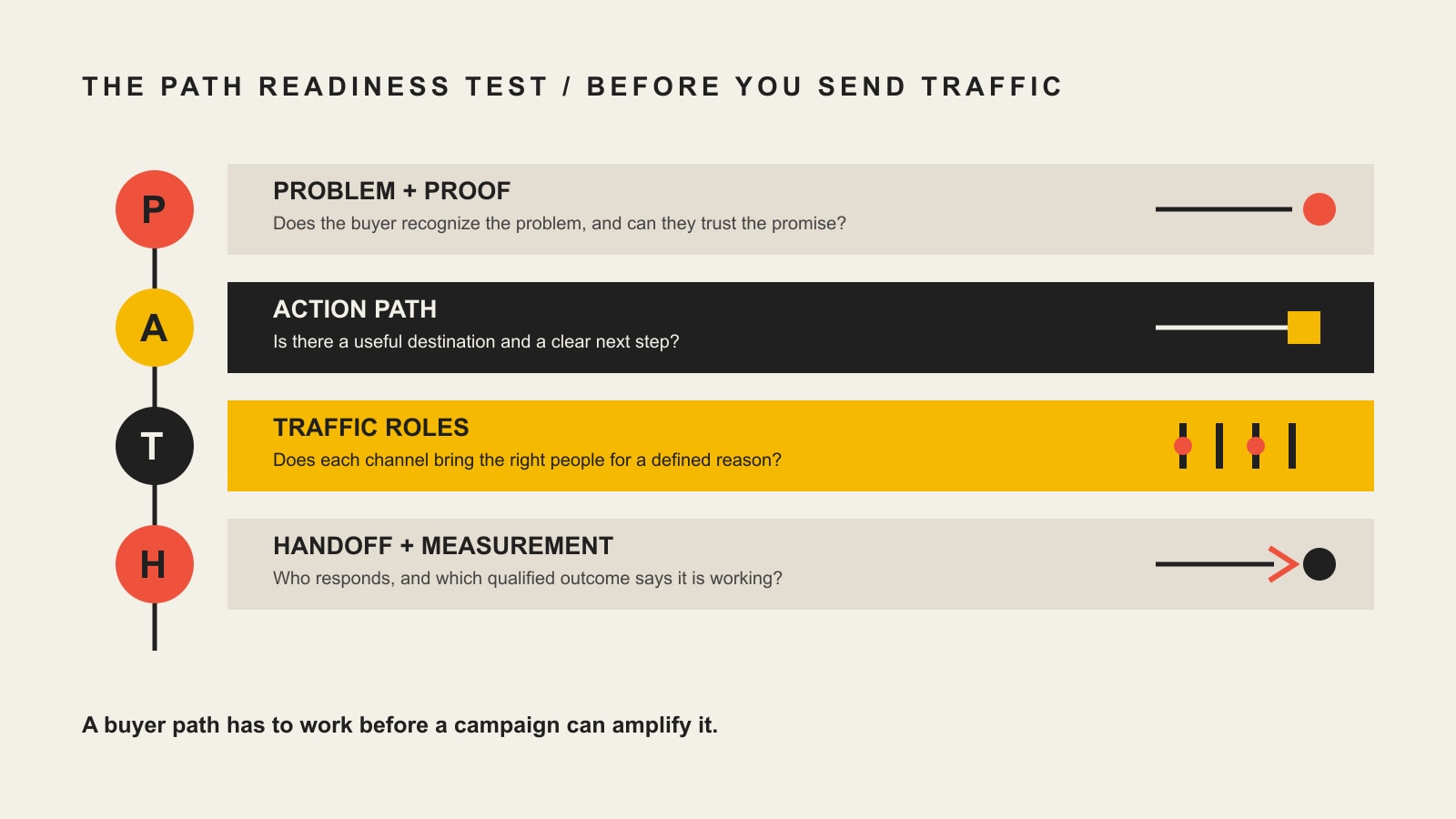
    The PATH readiness test checks Problem plus proof, Action path, Traffic roles, and Handoff plus measurement before a campaign sends traffic.
    The Scope Design PATH Readiness Test checks whether the buyer path is ready before a campaign sends traffic into it.

    P — Problem + proof: are you solving a situation buyers actually recognize?

    Start with the situation that causes someone to look for help. Not an invented demographic. Not “small-business owners who value quality.” What happened? What changed? What are they trying to avoid, compare, fix, or achieve?

    Use actual evidence: sales calls, support questions, search queries, customer interviews, reviews, lost-deal reasons, CRM notes, and market research. Our small-business market research guide goes deeper on collecting that evidence, while the target-audience guide focuses on reconstructing behavior and buying situations rather than decorating a fictional persona.

    Then define the proof you can honestly bring to the situation. Proof may be a relevant case study, a demonstration, process evidence, credentials, a comparison, a clear guarantee boundary, customer testimony, or simply an unusually specific explanation of how the work gets done. The point is not to look impressive. The point is to reduce a real reason for doubt.

    PATH failure signal: your message works only after three paragraphs of explanation, your team cannot agree on the buyer’s problem, or the offer depends on adjectives such as “innovative,” “premium,” and “results-driven” instead of evidence.

    A — Action path: where does the buyer go, and what should happen there?

    A campaign needs somewhere useful to send people. That does not automatically mean a new landing page. It means the destination must match the promise, answer the next decision, show enough proof, and make the next action obvious.

    For one path, define one primary action. Request a quote. Book a consultation. Start a trial. Call the office. Buy the product. Download the specification. The business may have several actions across the whole website, but a single campaign path should not make the visitor solve an escape room to figure out what you want them to do.

    Check the handoff from message to page before you buy traffic:

    • Does the page repeat the promise in the language the visitor just saw?
    • Can the visitor tell who the offer is for and who it is not for?
    • Is the proof relevant to this decision rather than generic company praise?
    • Does the form or next step ask only for information the business can use?
    • Does the experience work on the device and context where the channel will reach people?
    • Can a staff member explain what happens immediately after the action?

    PATH failure signal: the team can describe the ad or post in detail but cannot describe the page, action, confirmation, and follow-up with the same confidence.

    T — Traffic roles: give every channel a specific job

    Channels are not interchangeable pipes. Search can capture existing demand. Email can re-engage people who gave you permission to follow up. Social can distribute proof, build familiarity, or start conversations. Paid media can accelerate a path that already has a plausible economic and operational case. The right mix depends on intent, evidence, capacity, and economics.

    Our online marketing channels guide goes deeper on channel jobs and sequencing. The rule here is simpler: if you cannot finish the sentence “this channel’s job is to ___ for this buyer at this stage,” it does not belong in the path yet.

    You do not need to be everywhere. You need enough coverage to solve the current acquisition problem without creating more work than the team can operate. Add a channel when it closes a real gap, not because a platform rep, competitor, or marketing thread made you nervous.

    PATH failure signal: success is defined as “post more,” “get traffic,” or “grow followers,” with no explanation of what those people should do next.

    H — Handoff + measurement: who owns the lead after the click?

    A conversion is not the finish line if the business still has to qualify, respond, sell, schedule, onboard, or deliver. The handoff is part of the marketing path because marketing can create demand the business then quietly wastes.

    Write down the owner and the rule. Who receives the inquiry? What information do they need? What makes it qualified? What happens if the first response fails? Where is the outcome recorded? Which signal will cause you to keep, repair, or stop the path?

    Google Analytics supports recommended lead-generation events such as generate_lead, qualify_lead, working_lead, and close_convert_lead, and its recommended-events guidance can support measurement deeper than a form submission when your implementation and sales process can provide the data. Google also defines a key event as an action especially important to the success of the business.

    That does not mean every small business needs an elaborate analytics architecture tomorrow. It means the deepest reliable outcome should win over vanity metrics. If you can reliably track qualified inquiries, use them. If you can connect customers or revenue, better. If you only have form fills today, record that limitation instead of pretending the form is the sale.

    PATH failure signal: the marketing dashboard is green while sales says the leads are wrong, slow, unqualified, or never followed up.

    Use this PATH readiness table before you launch

    PATH layerReadiness questionEvidence to haveDo not launch yet if…
    Problem + proofDo we know the buyer situation and why our promise is credible?Customer language, alternatives, proof, objectionsThe message is generic or based on assumptions
    Action pathCan the buyer take one useful next step without guessing?Destination, matching offer, CTA, confirmation, friction checkThe destination contradicts the promise or has no clear next step
    Traffic rolesDoes each channel have a job tied to buyer intent?Channel role, audience context, capacity, economicsThe goal is simply more reach, posts, clicks, or followers
    Handoff + measurementWho responds, qualifies, records, and reviews the outcome?Owner, response rule, qualification definition, meaningful eventNobody owns the lead or the scorecard stops at the click

    A “no” is useful. It tells you where the expensive uncertainty is hiding.

    What our audit of this exact article taught us

    We used the same rule on this revision: inspect the path before adding tactics. The old article had a healthy public URL and a valid self-canonical, but it had become a trend-heavy list with unsupported percentages, a bloated keyword set, almost no internal linking, and no distinctive ownership inside a much stronger marketing cluster.

    The performance evidence was tiny. In the 12 complete months we reviewed, GA4 recorded seven landing sessions, all Direct, with no engaged sessions and no key events. Search Console returned no exact-page query rows and currently reports the URL as “Crawled – currently not indexed.” Bing knows the URL but currently reports no clicks or impressions. Ubersuggest returned no exact-page ranking keywords or backlink rows.

    That does not prove the topic has no value, and Scope Design’s current GA4 attribution and key-event setup has known limitations. It does mean the old copy had no demonstrated search or conversion footprint strong enough to justify keeping claims we could not support. The better move was to preserve the established URL, give the page a defensible job, remove the bullshit numbers, and connect it to the articles that already own the broader topics.

    Common ways a business marketing strategy breaks before the campaign

    Starting with the channel

    “We need TikTok” and “we should run paid search” are proposed tactics. Diagnose the buyer problem and the path first. Sometimes the correct next move is a boring service-page repair, a better proof set, or a follow-up process. Boring is allowed to make money.

    Copying competitors instead of studying alternatives

    Competitor research should reveal expectations, gaps, objections, proof standards, and substitutes. If you copy their headline structure, channel mix, and content calendar, you may simply inherit their assumptions with a fresh coat of paint.

    Sending everyone to the same generic page

    A homepage can be the right destination, but “we already have a website” is not a routing strategy. The destination should answer the next decision created by the message that brought the visitor there.

    Measuring the easiest thing instead of the deepest reliable thing

    Impressions and clicks are useful diagnostics. They are terrible substitutes for qualified demand when the business can measure deeper. Build the scorecard around the best reliable business outcome you can actually observe.

    Leaving response ownership vague

    If a lead goes into a shared inbox nobody owns, the campaign did not magically stop at the form. The path includes the human or system responsible for the next move.

    When PATH is ready, build the campaign

    PATH does not tell you which ad creative wins, what bid to use, or which subject line gets the highest response. It tells you whether the business is ready to learn something from campaign activity instead of merely generating activity.

    Once the path is coherent, Part III of this series shows how to turn the evidence into a campaign decision record: one buyer situation, one message, one destination, one meaningful action, and a rule for what you will do with the result.

    For the complete acquisition system that surrounds these decisions, use the Small Business Marketing Strategy pillar. The goal is a connected knowledge system, not five articles yelling the same answer with different headings.

    Frequently asked questions about business marketing strategy

    What are the main parts of a business marketing strategy?

    A useful strategy defines the business problem, audience and buying situations, positioning and offer, proof, owned assets, channel roles, response process, customer lifecycle, measurement, and governance. Different frameworks group those pieces differently; there is no universal magic numbered list. This article focuses only on the readiness path between the strategy and a campaign.

    What is the difference between a marketing strategy, marketing plan, and campaign?

    Strategy decides where to focus and what tradeoffs to make. A marketing plan turns those choices into assets, channels, owners, resources, actions, and measures. A campaign is one bounded execution package inside the plan. If you need the full planning layer, use the MAPS internet marketing plan.

    How many marketing channels should a small business use?

    There is no responsible universal number. Use the smallest set you can operate well enough to cover the current buyer journey and acquisition problem. A channel earns a place because it has a specific job, not because every competitor appears to be using it.

    What should be ready before launching an online marketing campaign?

    You should be able to state the buyer problem, credible promise and proof, destination, primary action, channel job, response owner, qualification rule, and meaningful outcome. If one of those is still vague, fix it before paying to amplify the uncertainty.

    How do you measure whether an online marketing strategy is working?

    Measure the deepest reliable business outcome each part of the system can influence. Traffic and clicks explain what happened upstream. Qualified leads, customers, revenue, retention, or another business-specific outcome tell you whether the attention moved toward value. Do not pretend a deeper metric is reliable if your tracking or sales process cannot support it yet.

    Do you need competitor analysis before marketing online?

    You need enough competitive and alternative evidence to understand what the buyer compares, what claims are overused, what proof standards exist, and where a credible difference may matter. You do not need a surveillance bunker. The goal is a better decision, not a prettier spreadsheet.

    Ready to fix the path?

    If your marketing keeps generating activity but the path from attention to qualified business feels fuzzy, that is the problem to diagnose first. Scope Design can help audit the buyer path, clarify what each channel is supposed to do, and connect the website, response process, and measurement around a result the business can actually use.

    Talk with Scope Design about your marketing path.

  • Online Presence for Small Business: 6 Steps to Win and Retain Customers

    Online Presence for Small Business: 6 Steps to Win and Retain Customers

    A strong online presence for small business growth is not a website, a Google Business Profile, a few social accounts, and an email list sitting beside one another. It is a connected system that helps the right people find you, understand you, take the next step, receive a competent response, and have a reason to come back.

    Most advice about an online presence for small business owners stops at the channel list. That distinction matters because customer retention is rarely won by one page or one channel. A site can generate a perfectly good lead and still fail if the form goes nowhere. Search can bring qualified visitors to a confusing offer. Social media can create attention that never reaches an owned audience. A polished redesign can hide the fact that slow follow-up—not design—is the real bottleneck.

    Scope Design’s approach is to treat the web presence as an acquisition-to-retention system and fix the earliest constraint in that system before adding more tactics downstream. We call the model the Presence-to-Repeat Loop: Home Base → Findability → Trust → Handoff → Follow-through → Feedback.

    If you remember one idea from this guide, make it this: build the loop, then improve the first stage that is actually failing. More channels are not automatically more presence, and more traffic is not automatically more business.

    TL;DR: Build the Smallest Complete Online Presence for Small Business Growth

    • Own the home base: keep the website clear, usable, accessible, measurable, and connected to the systems that receive customer actions.
    • Earn relevant discovery: use search, local listings, social, referrals, ads, and other channels only where they reach the right people.
    • Protect the handoff: test what happens after a form, call, booking, order, or signup so customer intent reaches a real owner and receives a useful response.
    • Improve the first constraint: use feedback and business outcomes to fix the earliest failing stage instead of stacking more tactics downstream.

    In This Guide

    Online Presence for Small Business: What It Should Actually Do

    Your online presence is every meaningful digital touchpoint where a prospect or customer can discover, evaluate, contact, buy from, or return to your business. That can include your website, search results, Google Business Profile, social profiles, review sites, marketplace listings, email, booking or ecommerce systems, and customer portals.

    The phrase online presence for small business can sound like a channel checklist. In practice, it is a customer-path problem: discovery only matters when it reaches a useful handoff and a customer experience worth repeating.

    Those touchpoints do not deserve equal strategic weight. Your website is normally the owned hub: the place where you control the message, structure, offers, calls to action, measurement, and integrations. Search, maps, social, directories, ads, and referrals are discovery or distribution surfaces that should send the right people toward that hub—or toward another intentional next step.

    That is why “being everywhere” is a poor goal. The better question is: what job should each channel perform, and what happens after it performs that job? Our broader SEO strategy and analytics framework applies the same logic to search: visibility matters only when it connects to a qualified business outcome.

    A useful web presence should do six jobs in sequence: provide an owned destination, earn relevant discovery, reduce uncertainty, make the next action easy, route that action into a real business process, and feed what you learn back into the system. That sequence is the Presence-to-Repeat Loop.

    The Presence-to-Repeat Loop

    The loop is not a funnel that ends when somebody submits a form. It continues through the operational handoff and customer experience, then brings evidence back to marketing and the website. That is what makes retention part of web strategy instead of an unrelated task owned by somebody else.

    1. Home Base: Own the Destination

    Your home base is the digital property where the business can explain what it does, for whom, why it is credible, and what should happen next. For most small businesses, that is the website. It should be stable enough to trust, easy enough to use, and structured around real customer decisions rather than around whatever pages came with the theme.

    Ownership also means maintainability. Forms need to work. Contact information needs to be current. Important pages need clear owners. Analytics should be installed correctly. Critical third-party dependencies should be understood. Accessibility belongs in this foundation, too: WCAG 2.2 is the current W3C Recommendation with testable, technology-neutral criteria for making web content more accessible, and W3C notes that following the guidance often improves usability more broadly.

    A redesign can help when the home base itself is the constraint, but redesign is not the default diagnosis. Before rebuilding, use a website redesign checklist that proves the need before the rebuild. If the real failure is lead routing, offer clarity, or follow-up, a prettier interface can leave the business problem untouched.

    2. Findability: Help the Right People Discover You

    Findability is not the same as traffic. The goal is relevant discovery from people who have a reasonable chance of becoming customers. Depending on the business, that can come from organic search, local search, paid media, referrals, social content, partnerships, directories, or direct demand created offline.

    Google’s SEO Starter Guide describes SEO as helping search engines understand content and helping users find a site. Google also says it primarily discovers new pages through links from pages it already crawled. In practical terms, useful content, logical internal links, clear page ownership, and crawlable navigation are part of being findable; publishing isolated pages and hoping search figures it out is not a strategy.

    For a local business, your website and your Google Business Profile should reinforce one another. Google says an eligible, verified Business Profile lets a business manage how it appears in Search and Maps, maintain key information, and interact through features such as photos and reviews. Our local SEO guide for small businesses goes deeper on being found and chosen in local search.

    3. Trust: Answer the Questions That Block Action

    Once the right person arrives, the site has to make a clear argument. What problem do you solve? Who is the offer for? What is included? What does the process look like? What proof supports the claim? What happens if the visitor is not ready to buy today?

    Trust is not a pile of badges. It is the reduction of relevant uncertainty. A service business may need strong examples, process clarity, scope boundaries, and credible reviews. A local retailer may need hours, inventory expectations, directions, policies, and real photos. A consultant may need a point of view that shows how decisions are made. Put proof near the doubt it resolves rather than hiding all credibility on a testimonial page.

    Social media can support this stage by showing activity, expertise, community participation, and evidence of work, but it should have a defined role. If social is one of your authority channels, our guide to building a social media presence that actually builds authority covers that specialist job without turning this article into a social-media checklist.

    4. Handoff: Make the Next Step Reach a Real Person or System

    This is the stage most “online presence” guides skip. A conversion is not complete because a form says “Thank you.” The business has to receive the inquiry, know what it means, assign responsibility, and act on it.

    Test the whole path. Submit the form. Call the tracked number. Make a test booking. Use a different email address. Check what reaches the CRM or inbox. Confirm who owns the response. Check mobile notifications. Verify that the customer receives the promised confirmation. If a lead can disappear into a generic mailbox or an integration can fail silently, the web presence has a business-process problem, not merely a page-design problem.

    The best handoff is usually boring: the visitor knows what will happen, the business knows who owns it, the data lands where staff can use it, and exceptions are visible instead of silently falling through the floor.

    5. Follow-through: Continue the Relationship After the Click

    Retention starts with delivering what the web presence promised. That can include prompt lead response, clear onboarding, appointment reminders, order updates, support information, replenishment or rebooking prompts, useful education, customer-only resources, and intentional requests for feedback or reviews.

    Email is useful here because it gives the business a direct channel it can operate intentionally rather than depending entirely on a social algorithm. But the job is not “send more email.” Each message should have a reason to exist and a useful next step. Our email newsletter strategy guide covers how to publish something worth opening.

    For U.S. commercial email, follow the rules as well as the strategy. The FTC’s CAN-SPAM compliance guide requires accurate sender information and subject lines, a valid postal address, a working opt-out method, and prompt honoring of opt-out requests. Retention does not mean trapping customers in a list they cannot leave.

    6. Feedback: Use Customer Evidence to Improve the Loop

    The final stage sends evidence back to the beginning. Search Console can show which queries and pages earn visibility. Analytics can show which landing pages and actions people use. CRM or booking data can show which leads become qualified opportunities. Support notes can expose confusion the website should prevent. Repeat purchases, renewals, referrals, cancellations, and reviews can show where the experience is helping or hurting the relationship.

    The important rule is to measure the last meaningful outcome the web system can control. A website cannot close every sale for a consultative service, but it can influence qualified inquiries, completed bookings, usable lead data, and clear handoffs. Measure those outcomes, then connect them to what happens next without pretending every downstream business result belongs to marketing.

    Find the Earliest Constraint Before Buying Another Tactic

    When performance is weak, small businesses often jump to the visible tactic: redesign the site, post more, run ads, add chat, buy a CRM, install another plugin, or publish more content. Scope Design uses a constraint-first diagnostic order instead. Start at the top and do not move down until the earlier stage is reasonably healthy.

    That makes online presence for small business planning a prioritization problem, not a shopping list. The first failed stage should determine the next investment.

    1. Measurement and technical integrity: Can the important pages load, forms submit, tracking record useful events, and systems pass data reliably?
    2. Sufficient relevant volume: Is there enough qualified discovery to judge what happens after arrival?
    3. Acquisition fit: Are the right people arriving for the right reasons, or are you attracting curiosity that will never become demand?
    4. Messaging clarity: Can a qualified visitor understand the offer, audience, difference, proof, and next step?
    5. UX friction: Is the site making a clear decision unnecessarily difficult through confusing navigation, unreadable layouts, broken mobile behavior, slow interactions, or forms that ask for the wrong things?
    6. Offer and positioning: Is the underlying offer compelling and appropriate for the market, or are you trying to optimize the interface around a weak proposition?
    7. Sales and operational follow-through: Once the site does its job, does the business respond, qualify, onboard, deliver, and follow up consistently?

    This ordering prevents expensive misdiagnoses. If tracking is broken, you cannot confidently diagnose conversion. If qualified traffic is tiny, a conversion-rate argument may be noise. If the right leads arrive but nobody responds for three days, another SEO campaign cannot fix the handoff. The constraint—not the trendiest tactic—should determine the next investment.

    What Should You Measure From First Visit to Repeat Customer?

    For an online presence for small business owners, measurement should follow the same customer path as the strategy. There is no universal dashboard that proves a web presence is working. The useful metric depends on the stage and the business model. A local service company, ecommerce store, professional practice, membership organization, and B2B consultant do not share one conversion definition.

    StagePrimary business signalUseful diagnosticsQuestion if weak
    FindabilityQualified discoveryRelevant impressions, visits, local actions, source/mediumAre enough of the right people finding us?
    TrustQualified next actionsService-page paths, calls to action, proof engagement, assisted pathsDo qualified visitors understand and believe the offer?
    HandoffUsable inquiries, calls, bookings, or ordersForm success, call routing, booking completion, integration errorsCan intent move into a real business process without getting lost?
    Follow-throughQualified opportunities and delivered customer actionsResponse time, appointment completion, onboarding completion, abandoned stepsDoes the business keep the promise made by the website?
    RetentionRepeat purchases, renewals, rebookings, referrals, or expansionCohorts, customer source, cancellation reasons, review themesWhat makes good customers return—or disappear?
    FeedbackBetter next decisionsSearch queries, support questions, lost-lead reasons, review languageWhat evidence should change the next website or marketing decision?

    Traffic still matters as a diagnostic. It simply does not deserve to be mistaken for the outcome. The same is true of rankings, followers, email opens, time on page, and any other intermediate signal. Use them to explain the system, not to replace the business result you actually care about.

    A First-Hand Example: The Website Was Not the First Constraint

    One Scope Design project involved a long-established specialty auction business that understandably wanted website and feature improvements. A superficial response would have started with layouts and a feature list.

    But the discovery work exposed a broader constraint. Important forms were unreliable, business data lived in disconnected places, staff depended on manual processes, and legacy systems shaped what could safely change. A new interface alone would have covered some of that complexity without fixing the operational handoff underneath it.

    So the first job was to map what happened from customer action through the internal process, identify fragile dependencies, repair foundation problems, and decide which changes would genuinely reduce friction. Design still mattered. It simply had to follow the constraint instead of pretending to be the diagnosis.

    That lesson generalizes: a requested deliverable is evidence of dissatisfaction, not proof of the binding problem. If somebody asks for a redesign, SEO, social media, automation, or a CRM, first trace the customer and data path far enough to see where value is actually leaking.

    Common Online-Presence Mistakes That Weaken Retention

    Treating Social Profiles as the Whole Business Presence

    Social networks can be excellent discovery and trust channels, but they are rented distribution. Account rules, reach, formats, and platform priorities can change. Use social where your audience actually participates, then give important prospects and customers an owned place to learn, act, subscribe, book, buy, or return.

    Adding Channels Without Giving Them Jobs

    A neglected TikTok account, a monthly newsletter with no purpose, an unused chat widget, and six directories do not become a strategy because they appear in the marketing plan. Every channel should have a job, an owner, a next step, and a reason to remain in the system.

    Collecting Leads Into a Dead End

    If form submissions land in an inbox nobody owns, booking exceptions are invisible, or sales staff cannot tell where an inquiry came from, the problem is not “conversion optimization.” Test handoffs as carefully as pages.

    Automating a Process You Have Not Defined

    Automation can make a good process faster, but it can also make a bad process fail at scale. Define ownership, required data, exceptions, response expectations, and escalation first. Then automate the repetitive parts that are actually stable.

    Promising an Experience Operations Cannot Deliver

    Marketing and retention separate when the website promises speed, customization, availability, or service quality that the operational system cannot consistently provide. The fix may be a better workflow, a narrower promise, clearer expectations, or more capacity—not a new headline.

    Measuring Activity Instead of Progress

    A rise in followers, traffic, impressions, or email sends can be useful, but those numbers do not tell you whether more suitable prospects became customers or whether good customers returned. Keep intermediate metrics attached to the customer path they are supposed to explain.

    Run a 90-Minute Online Presence for Small Business Audit

    A useful online presence for small business audit follows the customer path, not the marketing org chart. You do not need a three-month consulting engagement to find obvious breaks. In 90 minutes, a business owner or small team can walk the same loop and create a short constraint list. The goal is not to “audit everything.” It is to identify the first plausible failure that deserves deeper investigation.

    1. Minutes 0–15 — Home Base: Open the site on desktop and mobile. Check the main offer, contact details, key pages, primary calls to action, important forms, booking or checkout, security warnings, analytics presence, and obvious accessibility barriers. Write down anything that can stop a qualified visitor from using the site.
    2. Minutes 15–30 — Findability: Search your business name, core services, and local terms that real customers use. Check how your website, Business Profile, reviews, social profiles, directories, and ads represent the same business. Look for missing, stale, contradictory, or irrelevant discovery paths.
    3. Minutes 30–45 — Trust: Pretend you are a careful first-time buyer. Can you understand the audience, offer, process, proof, boundaries, and next step without calling to ask basic questions? Note every uncertainty that could reasonably delay action.
    4. Minutes 45–60 — Handoff: Submit a form, make a test call, or complete a booking. Follow the data. Who gets it? How quickly? What confirmation does the customer receive? What happens if the normal owner is absent? Record every place the inquiry can disappear.
    5. Minutes 60–75 — Follow-through: Map what happens from inquiry to onboarding, delivery, support, rebooking, renewal, review request, or next purchase. Look for promises that rely on memory instead of a defined process.
    6. Minutes 75–90 — Feedback: Pull only the evidence needed to judge the loop: search visibility, qualified actions, lead quality, response or completion data, repeat behavior, cancellations, reviews, and support themes. Choose the earliest stage with credible evidence of failure.

    Finish with one sentence: “The next constraint we need to prove or disprove is ______.” That sentence is more useful than a 40-item tactic list because it tells you what evidence to gather and what not to buy yet.

    Frequently Asked Questions About Online Presence for Small Business Owners

    How do I build my online presence?

    Start with an owned home base that clearly explains what you do and what visitors should do next. Then build the discovery channels your customers actually use, add proof that resolves buying doubts, connect every important action to a real internal owner or system, create intentional follow-up, and measure what happens through the first repeat-customer outcome. Do not launch every channel at once. Build the smallest complete loop first.

    Do small businesses need a website if they already use social media?

    Most established small businesses benefit from an owned website even when social media is important. Social platforms are useful discovery and authority channels, but the platform controls the account environment, reach, formats, and rules. A website gives the business more control over its message, customer paths, integrations, content organization, measurement, and owned conversion points. There are exceptions—especially very small or temporary businesses—but “we have social” is not the same as owning a durable digital hub.

    What should a small business website do after it generates a lead?

    It should hand the lead into a defined process. The inquiry needs to reach the right owner or system with enough context to respond, the prospect should receive a clear confirmation, and the business should have a response expectation plus a way to see failures. The website’s job is not finished at the form submission.

    Can a website redesign improve customer retention?

    Yes, when website friction is part of the retention problem—for example, customers cannot find support information, rebook easily, manage an account, understand next steps, or use the site reliably. But a redesign will not repair weak service delivery, an unclear offer, bad lead routing, or inconsistent follow-up. Diagnose the constraint first.

    Which online channels matter most for a small business?

    The channels that reach your real customers and perform a defined job in the Presence-to-Repeat Loop. A local service business may depend heavily on Google Search, Maps, reviews, its website, and direct follow-up. A B2B specialist may rely more on referrals, search, LinkedIn, email, and strong proof content. A retailer may need local discovery, ecommerce, social, and post-purchase communication. Start with customer behavior and the business model, not a generic platform list.

    How often should I review my online presence?

    Scope Design recommends lightweight monthly health checks for obvious technical, tracking, listing, and handoff problems, plus a deeper quarterly review of the customer journey. Revisit the loop sooner after a major offer change, site launch, system migration, staffing change, or repeated customer complaint. The cadence is a management recommendation, not a universal industry rule.

    Build the Loop, Not the Pile

    The strongest online presence for small business success is not the one with the most accounts, automations, pages, or dashboards. It is the one where discovery, trust, action, handoff, service, and feedback support one another.

    If your business is getting traffic but not good leads, generating leads but losing them after the form, or redesigning the site without knowing what problem the redesign is supposed to solve, start with the constraint. Map the Presence-to-Repeat Loop, identify the first failing stage, and make the next investment answer that evidence.

    That is also how Scope Design approaches website and digital strategy: diagnose the business job first, then choose the site, SEO, content, automation, or operational work that actually addresses it. If you need help mapping the system, Scope Design can start with the evidence instead of another pile of tactics.