Tag: customer experience

  • Customer Psychology: 7 Needs Behind Better Conversion Decisions

    Customer Psychology: 7 Needs Behind Better Conversion Decisions

    Customer psychology is the study of the mental, emotional, and behavioral factors that shape how people evaluate, choose, use, and respond to products and services. For a business, the useful question is not “Which psychological trick makes somebody buy?” It is: What need is active, what friction is blocking the decision, what proof resolves that doubt, and what clear choice lets the customer move forward without being cornered?

    That is the Scope Design customer psychology framework: Need → Friction → Proof → Choice. It turns psychology from a bag of persuasion hacks into a practical way to improve messaging, websites, offers, and customer journeys. The goal is to reduce uncertainty, not manufacture insecurity.

    Customer psychology in 60 seconds

    • Customers do not evaluate an offer on features and price alone. They also interpret risk, identity, control, progress, belonging, and the experience of deciding.
    • The seven needs in this guide are a Scope Design practical diagnostic, not a claim that psychology recognizes one universal list of exactly seven needs.
    • Start with the need behind the decision. Then identify the friction preventing progress and the evidence that would actually resolve it.
    • A good conversion path preserves a real choice. Fake urgency, hidden information, and deliberately difficult cancellation are not clever psychology. They are trust debt.
    • Behavioral research can improve your hypotheses. It does not guarantee that a particular headline, button, testimonial, or pricing layout will increase your conversion rate. Measure the real business handoff.

    If the problem is bigger than one page or one decision, start with the broader small business marketing strategy. Customer psychology helps diagnose a decision inside that system; it is not a replacement for a coherent offer, useful traffic, follow-up, or delivery.

    What customer psychology actually means

    Consumer and customer psychology are closely related terms. Academic treatments of consumer psychology examine how perception, beliefs, feelings, motivation, memory, social context, and behavior affect purchasing and consumption. The University of Southern California’s overview of consumer psychology, for example, describes the field as examining consumers’ perceptions, beliefs, feelings, and thoughts when studying purchasing behavior.

    For a working business, “customer psychology” is most useful when it stays attached to a specific decision. Why did the visitor hesitate at the quote form? Why did a buyer understand the service but still feel unsafe choosing it? Why did a comparison page create more confusion instead of less? Why did a perfectly reasonable offer feel like too much commitment?

    Those are better questions than “Which bias should we deploy?” If you want the broader discipline of ethical persuasion and behavioral marketing, our guide to marketing psychology without the bullshit owns that job. If you need to diagnose the motives and objections behind a buyer’s yes or no, our buyer psychology framework goes deeper there. This article owns the bridge between a customer need and the conversion decision in front of them.

    The Scope Design Need → Friction → Proof → Choice framework

    Most conversion advice starts too late. It jumps straight to tactics: add urgency, shorten the form, use testimonials, move the button, highlight the expensive plan, make the headline emotional. Sometimes those changes help. Sometimes they just decorate the wrong diagnosis.

    The framework forces four questions in order.

    A continuous path connects a customer need, an obstacle, trustworthy proof, and a free choice.

    1. Need: What must the customer protect, achieve, feel, or control?

    The need is the human job underneath the transaction. A customer may need to feel safe, competent, respected, connected, independent, capable of growth, or simply confident that the experience will not be miserable. More than one need can be active, but one or two usually matter most at a particular decision point.

    2. Friction: What uncertainty, risk, effort, or confusion blocks the decision?

    Friction is not just “too many form fields.” It can be uncertainty about price, fit, ownership, reversibility, social risk, technical competence, time, implementation, support, or what happens after the click. You cannot reduce decision friction until you know which kind you are dealing with.

    3. Proof: What evidence resolves that specific doubt?

    Proof should match friction. A generic five-star testimonial does not answer a buyer who is worried about data migration. A security badge does not answer a buyer who cannot tell which service package fits. A giant client-logo wall does not explain whether the company will answer the phone after launch.

    Useful proof can include a demonstration, a comparison, a sample deliverable, a clear process, a guarantee you can actually honor, transparent terms, relevant customer evidence, credentials, an implementation plan, or a plain explanation of what the offer does not include.

    4. Choice: What clear next step preserves a real ability to say yes or no?

    The final step is choice, not pressure. The customer should understand the options, consequences, and next action. Sometimes that means a purchase button. Sometimes it means comparing plans, reviewing a sample, requesting a quote, scheduling a call, or deciding the offer is not right for them.

    A conversion that requires the customer to misunderstand the deal is not a good conversion. It is a future complaint with better click-through.

    Seven customer needs you can use as a practical diagnostic

    There is no scientifically universal “seven needs of every buyer” list. We are not going to dress a business framework in a lab coat it did not earn. The model below is a practical synthesis designed to help teams ask better conversion questions.

    It is partly grounded in established motivational research. Self-Determination Theory, for example, identifies autonomy, competence, and relatedness as basic psychological needs. We combine those with recurring business decision concerns around safety, recognition, growth, and experience to create seven useful lenses.

    Customer need Typical friction Useful proof Good next choice
    Safety & trust “What could go wrong?” Clear terms, process, guarantees, credentials, relevant case evidence Review details, ask a risk question, request a scoped next step
    Belonging & connection “Do these people understand someone like me?” Specific customer stories, real community evidence, recognizable language See similar examples, join a useful community, talk to a human
    Status & recognition “Will this choice reflect well on me?” Credible expertise, quality signals, outcomes, professional standards Compare levels of service or evidence
    Progress & competence “Am I making the right choice?” Comparisons, guidance, demonstrations, recommended-fit explanations Choose a recommended option or compare alternatives
    Growth & mastery “Will this help me become more capable?” Learning path, roadmap, support, capability-building examples See what happens after the first milestone
    Autonomy & control “Am I getting trapped?” Transparent scope, ownership, cancellation, customization, reversibility Choose among real options, defer, or decline
    Enjoyment & experience “Is this going to be a pain in the ass?” Demo, preview, onboarding example, service experience Try, preview, or see the process before committing

    1. Safety and trust: “I need to know I will not regret this.”

    Safety is larger than cybersecurity. It includes financial risk, reliability, privacy, delivery risk, reputation risk, and the fear of being stuck with a bad decision. A customer buying professional services may worry about missed deadlines. An ecommerce buyer may worry about returns. A software buyer may worry about migration and support.

    Friction: hidden terms, vague scope, unsupported claims, unclear ownership, no visible recovery path. Proof: clear policies, process steps, realistic guarantees, relevant evidence, direct answers to failure scenarios. Choice: let the customer inspect the risk before asking for commitment.

    Prospect Theory is often flattened into marketing folklore about people “hating losses twice as much as gains.” The original research is more careful: decisions are evaluated relative to reference points, and losses and gains can be valued asymmetrically. That supports a reasonable lesson about risk sensitivity; it does not give marketers a universal numeric multiplier they can paste into a slide deck.

    2. Belonging and connection: “I need to feel understood.”

    Customers use social information partly to judge fit. They look for people, situations, language, and outcomes they recognize. The useful application is not “make everyone fear being left out.” It is showing relevant evidence that says, “Yes, we understand this kind of problem.”

    Friction: generic positioning, examples from the wrong audience, sterile proof, language that sounds like it was written for “businesses” instead of actual people. Proof: specific stories from comparable customers and honest community signals. Choice: let the reader explore examples before forcing a sales conversation.

    That is why good customer testimonials are specific. “Great company!” is pleasant. “They migrated our booking system without losing our customer records, and staff knew what to do on Monday morning” resolves a real doubt.

    3. Status and recognition: “I need this choice to make sense for who I am.”

    Some purchases carry identity and status. That does not mean every business should manufacture prestige. It means the buyer may care about professionalism, standards, craft, taste, leadership, credibility, or whether the decision will be defensible to a boss, partner, board, customer, or peer.

    Friction: the offer feels cheap in the wrong way, undifferentiated, risky to recommend, or disconnected from the customer’s identity. Proof: visible standards, expertise, appropriate credentials, relevant outcomes, quality of process. Choice: make distinctions between levels clear without insulting people who choose the simpler option.

    4. Progress and competence: “I need to feel capable of choosing well.”

    Competence is one of the three basic needs in Self-Determination Theory, and it shows up constantly in business buying. Customers hesitate when the choice makes them feel lost. More options can help an expert and overwhelm a novice; the effect depends on decision difficulty, preference certainty, and context.

    Friction: four similar plans, undefined jargon, feature grids without recommendations, “contact us” as the only explanation. Proof: a comparison that explains who each option is for, a worked example, a recommendation with reasoning. Choice: provide a sensible default while keeping alternatives available.

    5. Growth and mastery: “I need this to improve what I can do next.”

    Some customers are buying capability, not just an object or task. They want a system they can use, a skill they can learn, a process their staff can operate, or an investment that does not become obsolete the minute the vendor leaves.

    Friction: the offer solves today’s symptom but creates dependence, there is no handoff, or the value ends at delivery. Proof: documentation, training, roadmap, support model, examples of how capability grows. Choice: show the next stage, not just the checkout.

    6. Autonomy and control: “I need to know this is still my decision.”

    Autonomy is another core Self-Determination Theory need. In conversion work, it is a useful antidote to manipulative design. Customers want enough control to understand the tradeoff, choose among meaningful options, and reverse or decline where the business model reasonably allows it.

    Friction: hidden cancellation, forced bundles, confusing opt-outs, unclear ownership, unnecessary pressure. Proof: transparent terms, clear ownership, real options, simple cancellation, visible scope boundaries. Choice: a yes that remains a choice is more valuable than a yes extracted from confusion.

    7. Enjoyment and experience: “I need this not to suck.”

    Not every decision is solemn. Customers also value ease, delight, curiosity, momentum, and an experience that feels worth their attention. That can matter in retail, hospitality, software onboarding, professional services, education, and plenty of other contexts.

    Friction: the process looks exhausting, the interface feels hostile, the first step demands too much work, or the value is hard to imagine. Proof: a demo, preview, sample, onboarding walkthrough, or clear picture of the experience. Choice: let the customer see or try enough to understand what they are choosing.

    Customer psychology changes across the “messy middle”

    Google’s “messy middle” research describes purchase behavior as a loop between exploration and evaluation rather than a clean march down a funnel. That matters because the same customer can need different kinds of help at different moments.

    During exploration, the customer is expanding possibilities. Useful content helps them understand the problem, language, categories, and options. During evaluation, the customer is narrowing. Proof, comparisons, tradeoffs, risk information, and fit become more important.

    Do not force evaluation tactics into exploration. A countdown timer on a page where the reader is still trying to understand the category is usually not “conversion optimization.” It is a salesperson yelling “last chance!” while the customer is still reading the menu.

    How to apply customer psychology to a website without turning it into a carnival game

    Copy: name the decision, not just the emotion

    Good copy connects the offer to a real customer job. It can acknowledge fear, aspiration, frustration, identity, or relief, but emotion does not replace fit, evidence, timing, price, or trust. The broad rules of ethical marketing psychology still apply: help the reader understand the decision instead of hiding the parts that might make them hesitate.

    Proof: answer the actual objection

    Proof should be chosen by friction. Use process proof for “what happens next,” outcome proof for “can this work,” fit proof for “is this for me,” and risk proof for “what happens if something goes wrong.” Testimonials, case examples, demonstrations, certifications, documentation, and transparent policies are different tools. Stop treating a row of logos as holy water.

    Pricing and offers: reduce interpretation work

    Price presentation creates reference points, comparison frames, and perceived tradeoffs. Those effects deserve careful treatment, which is why pricing psychology has its own owner in the Scope Design content system. Here the practical rule is simpler: explain what changes between options, who each option fits, and what the customer gives up by choosing the cheaper or more expensive path.

    Forms and calls to action: ask for the smallest sensible commitment

    A CTA is a commitment request. Match its size to the customer’s stage. “Buy now” can be right for a known product. “See a sample,” “compare plans,” or “request a scoped estimate” may be better when uncertainty is still high. A ten-field form can be perfectly reasonable if each field is necessary and expected; a three-field form can still be terrible if nobody knows what happens after they submit it.

    User experience: remove friction that has no business job

    Psychological clarity and interface clarity often reinforce each other. Descriptive navigation, readable comparisons, predictable controls, visible feedback, accessible forms, and responsive layouts help customers feel competent and in control. Our guide to improving website user experience goes deeper into the UX mechanics.

    Cognitive bias is useful evidence, not a conversion vending machine

    Biases describe recurring patterns in judgment. They are not customer needs, and they are not buttons you press to make revenue fall out. Anchoring, social proof, loss sensitivity, default effects, commitment, authority, and scarcity can all matter in the right context. None of them excuses a bad offer or proves a universal lift.

    If you want the deeper catalog of decision traps, use our guide to cognitive bias in decision making. The important distinction here is that Need → Friction → Proof → Choice tells you what problem to solve before you reach for a behavioral principle.

    The same caution applies to choice overload. Research does not support a universal “fewer choices always converts better” rule. A meta-analytic review in the Journal of Consumer Research found no simple overall effect and helped push later research toward the conditions that make a choice difficult. The practical lesson is to reduce unnecessary decision complexity when the customer lacks a clear preference, not to delete options for sport.

    Customer psychology is not permission to manipulate people

    The ethical line is not mysterious. Help the customer understand the choice. Do not intentionally make an unwanted choice harder to see, understand, or refuse.

    The U.S. Federal Trade Commission’s report Bringing Dark Patterns to Light documents design practices that can obscure, subvert, or impair consumer choice. Examples include interfaces that hide important terms, steer people through confusing flows, or make cancellation unnecessarily difficult.

    Useful psychology Manipulative version
    Show honest evidence that reduces risk Invent reviews, popularity, or guarantees
    Use real scarcity when supply or time is actually limited Run a fake countdown that resets for every visitor
    Recommend an option and explain why it fits Preselect the expensive option and hide the alternative
    Make terms and cancellation understandable Bury the commitment and make leaving intentionally difficult
    Use customer language to improve relevance Exploit fear or shame unrelated to the offer’s real value

    A good operating rule is: reduce uncertainty; do not manufacture insecurity.

    How to run a customer psychology audit

    You do not need an EEG headset, a neuromarketing lab, or a suspiciously expensive “persuasion” certification. Start with the decision and the evidence you already have.

    1. Name one decision. “Improve conversions” is too vague. Use “choose a service tier,” “request a quote,” “finish checkout,” “renew,” or another observable decision.
    2. Collect real customer language. Sales calls, support tickets, reviews, form questions, interviews, and lost-deal notes reveal hesitation better than a brainstorm about “pain points.” The deeper buyer psychology article is useful when motives and objections need a fuller diagnosis.
    3. Choose the likely need. Is the customer protecting safety, seeking competence, looking for belonging, defending autonomy, pursuing growth, protecting status, or trying to improve the experience?
    4. Write the friction in the customer’s words. “I don’t know what happens after I pay” is better than “trust issue.” “These plans all look the same” is better than “choice overload.”
    5. Match proof to the friction. Give the customer the evidence that answers that doubt, not whatever proof block happens to be easiest to paste into the page.
    6. Make the next choice clear. State what happens next, what commitment is being requested, and any important tradeoff.
    7. Measure the business handoff. Did the right customer complete the step? Did the inquiry arrive? Was it qualified? Did staff respond? Did the next stage improve, or did you just make one button busier?

    A worked example: a business owner choosing a website redesign

    Imagine a business owner comparing website redesign proposals. The visible purchase is “a website.” The actual decision may involve several needs at once.

    Framework step Worked example
    Need Safety + competence + autonomy. The owner needs confidence the project will work, that they understand the choice, and that the business will retain control.
    Friction Proposals use different scopes, pricing models, ownership terms, and technical language. The owner cannot tell what “done” means or what happens after launch.
    Proof A clear scope comparison, process, ownership statement, relevant examples, maintenance responsibilities, testing expectations, and explicit exclusions.
    Choice Choose a right-sized project, ask a specific unresolved question, or decide not to proceed. The proposal should make each option understandable.

    Notice what is missing: a magic red button, a fake “only two spots left” banner, and a testimonial from somebody whose project has nothing to do with the buyer’s concern. The conversion improvement comes from a better decision environment.

    How to measure whether a psychology-based change actually works

    Behavioral theory should produce a hypothesis you can test. It should not produce a made-up conversion percentage with a footnote shaped like a shrug.

    Start with the business chain: exposure → useful page engagement → intended action → delivered inquiry or transaction → qualified next stage → revenue or retained value when measurable. The right metrics depend on the decision.

    • For a lead page: completed forms, delivered inquiries, qualified inquiries, response time, appointments, and sales outcomes.
    • For ecommerce: product-view-to-cart behavior, checkout completion, returns, support issues, repeat purchase, and margin where available.
    • For a comparison or pricing page: movement to the appropriate next step, plan mix, qualified questions, cancellations, and downstream sales quality.
    • For onboarding: completion, time to first useful outcome, support demand, activation, and retention.

    Hope is not an analytics strategy. Neither is “people love social proof.” Change one meaningful thing when possible, document the hypothesis, and check whether the rest of the customer journey improved.

    What auditing this exact customer psychology article changed

    The prior version of this article had a classic problem: it sounded precise without having a reproducible evidence chain. It claimed universal conversion improvements, large personalization gains, dramatic omnichannel retention differences, mobile-behavior rules, and a fixed catalog of psychological triggers. Those numbers made the article look muscular. They did not make it trustworthy.

    We checked the actual page evidence before rebuilding it. In the most recent reviewed 12-month window, the exact Google Search Console page query returned no rows and URL Inspection reported the URL as unknown to Google. The exact current GA4 landing-page report returned no rows; an older inventory snapshot contained only four organic sessions and no recorded key events. Current Bing exact-URL evidence showed zero clicks and impressions, while an older inventory snapshot showed five clicks and 34 impressions. Ubersuggest returned no ranking-keyword data and no URL-scoped backlinks for the exact page.

    That does not prove the topic has no value. Keyword research still shows modest demand for “customer psychology,” and Google’s current results include an AI Overview and a People Also Ask question for “What is customer psychology?” It does prove that we did not need to protect the old article’s unsupported claims just because they were already published.

    The article had also been consolidated into the broader marketing-psychology owner. We reactivated it only after making the job materially different: 3943 now owns Need → Friction → Proof → Choice and the seven-needs conversion diagnostic. The broader persuasion discipline stays with the marketing-psychology article, and buyer-motive diagnosis stays with buyer psychology. That boundary is what keeps this from becoming three pages saying the same thing with different hats.

    We also kept the established URL. Its current search equity is weak, but changing the slug would not make the article clearer enough to justify another migration dependency. A plugin score is not a reason to teach every old link a new address.

    Frequently asked questions about customer psychology

    What is customer psychology?

    Customer psychology examines the mental and emotional factors that influence how people evaluate and respond to products, services, brands, and buying experiences. For practical business use, connect those factors to a specific customer decision instead of treating psychology as a list of persuasion tricks.

    What are the seven customer needs in this framework?

    The Scope Design diagnostic uses seven lenses: safety and trust, belonging and connection, status and recognition, progress and competence, growth and mastery, autonomy and control, and enjoyment and experience. It is a practical synthesis for business decisions, not a claim that academic psychology recognizes one universal seven-need taxonomy.

    Is customer psychology the same as buyer psychology?

    They overlap, but the editorial jobs are different here. Buyer psychology focuses on motives, objections, and why a buyer says yes or no. This customer-psychology framework focuses on translating a customer need into the friction, proof, and choice required at a particular conversion decision.

    How can customer psychology improve a website?

    Use it to diagnose why a user hesitates. Then change the part of the experience that causes that friction: messaging, comparison structure, proof, pricing explanation, form commitment, navigation, ownership language, guarantees, or another relevant element. The useful change depends on the doubt, not on a universal CRO checklist.

    Is using psychology in marketing manipulative?

    Not inherently. Understanding what customers need can make decisions clearer and more relevant. It becomes manipulative when the business intentionally hides material information, invents pressure or proof, exploits unrelated fear or shame, or makes refusal and cancellation deliberately harder than acceptance.

    Which cognitive biases should a business use?

    Do not start by choosing a bias. Start by diagnosing the customer decision. A behavioral principle is useful only when it helps explain or reduce the actual friction. Biases are evidence about patterns in judgment, not a menu of buttons for making people buy.

    How do you know whether a psychology-based change works?

    Define the intended business outcome before the change, record the hypothesis, and measure the full handoff. A higher button click rate is not automatically a better result if inquiry quality falls, cancellations rise, or staff cannot handle the next step. Behavioral research suggests what to test; your own customer and business data tell you whether the change helped.

    Sources and methodology

    This article was rebuilt through Scope Design’s monitored content workflow on August 21, 2026. We reviewed the existing article and content-cluster ownership, Scope Design’s Open Brain notes, 12 months of exact-page Google Analytics and Search Console evidence, current Bing evidence, U.S. Ubersuggest keyword/SERP/page/backlink data, DataForSEO Google and Bing SERPs, Google People Also Ask, traditional and AI keyword-volume estimates, two authorized ChatGPT web-search observations, and current authoritative behavioral and consumer-protection sources. Third-party search volumes are directional estimates, not traffic guarantees.

    Make the next customer decision easier, not louder

    If customers understand the offer but still hesitate, the problem may not be “more persuasion.” Scope Design can help map the customer journey, identify the decision friction, and connect the right messaging, proof, website experience, and measurement to the business outcome. Talk with Scope Design about the decision your customers are getting stuck on.


  • Marketing to Senior Customers: How to Increase Sales by Understanding Older Adult Preferences

    Marketing to Senior Customers: How to Increase Sales by Understanding Older Adult Preferences

    Marketing to seniors should not begin with a list of things people over 65 supposedly like. It should begin with a simpler question: What is making it harder for this customer to understand, trust, use, or complete the buying process?

    That distinction matters because older adults are not a niche group living outside modern digital behavior. Pew Research Center’s 2025 U.S. data shows that 90% of adults age 65 and older use the internet. Separately, AARP’s 2026 Tech Trends research reports 90% smartphone ownership among adults age 50 and older in 2025. Those are different age groups and different measures, but they point in the same direction: treating older customers as broadly “offline” is a bad starting assumption.

    The better approach is to use age as context, then use evidence to find friction. At Scope Design, we use five checks: Clarity & Readability, Accessibility & Usability, Decision Confidence & Trust, Transaction & Support Choice, and Channel Evidence & Measurement. Fix the problems you can observe. Test the alternatives. Keep what improves the customer experience and business outcome.

    Start With Evidence, Not Age Stereotypes

    The phrase “marketing to seniors” is useful because people search for it. It is less useful as a strategy if it becomes shorthand for assumptions such as “seniors want phone calls,” “seniors do not trust websites,” or “direct mail is the best way to reach them.”

    A 66-year-old online shopper, an 82-year-old caregiver, a 58-year-old business owner, and a 71-year-old first-time smartphone user may share an age bracket in somebody’s spreadsheet while having completely different needs, abilities, motivations, budgets, and buying habits. Good target-audience research uses demographics to describe part of the market, then adds behavior, situation, needs, objections, and evidence from real customers.

    That is especially important online. Pew also reports that 17% of U.S. adults age 65+ were smartphone-dependent in 2025, meaning they had a smartphone but not traditional home broadband. A website that works beautifully on a large office monitor and poorly on a phone can therefore create the exact kind of friction a business might mistakenly blame on “senior tech resistance.”

    Use this rule: age can tell you which questions are worth investigating. It cannot answer those questions for you.

    Use the Scope Design Five Friction Checks

    The Five Friction Checks turn “make our marketing more senior-friendly” into something a team can inspect and improve without building a caricature of the customer.

    Friction checkQuestion to askEvidence to inspectFirst test
    Clarity & ReadabilityCan a customer understand the offer and next step quickly?Repeated questions, misread offers, form errors, support requestsSimplify labels, hierarchy, copy, and key instructions
    Accessibility & UsabilityCan the customer comfortably operate the page or process?Mobile behavior, abandoned forms, usability tests, accessibility checksImprove text, contrast, controls, navigation, forms, and media
    Decision Confidence & TrustCan the customer verify who you are and what happens next?Pre-sale questions, exit feedback, support logs, policy confusionClarify identity, price, fees, policies, proof, and contact options
    Transaction & Support ChoiceIs one forced path blocking people who otherwise want to buy?Checkout abandonment, call reasons, assisted-sale rate, completion rateAdd one useful alternative without weakening the primary path
    Channel Evidence & MeasurementWhere do qualified customers actually respond and convert?Campaign outcomes, source data, interviews, repeat sales, lead qualityShift budget toward measured results, not demographic folklore

    1. Clarity & Readability

    Start with the message before blaming the medium. Can someone tell what you sell, who it is for, what it costs or what affects the cost, and what to do next without decoding jargon?

    Readable design is not the same as “make everything huge.” Use a sensible base font size, strong contrast, clear hierarchy, meaningful headings, descriptive buttons and links, adequate spacing, and instructions placed where the decision happens. If a customer has to pinch-zoom a form, hunt for the phone number, or remember information from three screens ago, the interface is doing unnecessary work.

    2. Accessibility & Usability

    Age-related changes can affect vision, dexterity, hearing, concentration, and short-term memory, but not every older person experiences the same changes. The useful design lesson is broader: accessible experiences remove barriers for many kinds of customers.

    The W3C Web Accessibility Initiative says the web-accessibility needs of older users substantially overlap the needs of people with disabilities, and that existing accessibility standards address most of those needs. That means you usually do not need a special “senior version” of your site. You need a good site: readable and resizable text, sufficient contrast, clear controls, consistent navigation, accessible media, descriptive labels, and forms that explain errors and how to fix them.

    If accessibility is a weak spot, our guide to making a website more accessible and ADA-ready goes deeper into the standards and practical work.

    3. Decision Confidence & Trust

    Trust should not be treated as a personality trait assigned to an age group. It should be designed into the buying process for everyone.

    Make the business easy to verify. Show a real company identity and contact information. Explain price, recurring charges, shipping, returns, guarantees, appointment terms, and data collection before a customer has to commit. Use recognizable payment flows. Avoid countdown pressure, disguised subscriptions, vague fees, and copy that sounds like it is trying to outsmart the reader.

    There is a legitimate reason to take verification seriously without portraying older adults as gullible. The FTC reported $2.4 billion in fraud losses reported by adults 60+ in 2024, while also noting that older adults reported losing money to fraud at a lower rate than younger adults overall. The lesson for a legitimate business is not “seniors are afraid.” It is: make legitimacy easy to confirm.

    This is also where demographic shortcuts can hide the real reason a sale stalls. Our buyer psychology guide looks at the motives, uncertainty, effort, risk, and decision conditions that can matter more than age alone.

    4. Transaction & Support Choice

    Offering choice is useful. Assuming which choice an older customer wants is not.

    If your primary path is online checkout, keep it fast and clear. Then look at the evidence. Are qualified shoppers abandoning at account creation? Do people repeatedly call because they cannot answer a product-fit question? Are customers asking whether they can pay by phone, schedule an appointment, or talk to a person before committing? Those are reasons to test an assisted path.

    A phone number can be valuable. So can chat, email, a callback request, in-person help, a printable summary, or a saved cart. The right alternative depends on the purchase. Do not make customers call for a task they can complete more easily online, and do not force a digital-only path when an assisted option would resolve a real barrier.

    If ecommerce is part of the journey, fix the main transaction first. Our guide to high-converting checkout pages covers the clarity and friction issues that can hurt customers of any age.

    5. Channel Evidence & Measurement

    Email, search, social media, direct mail, phone, events, referrals, and local advertising can all work. None becomes the correct channel merely because a customer is older.

    Use your small business marketing strategy to connect channel decisions to the customer journey and the outcome you actually need. Then compare qualified responses, conversion rate, lead quality, cost per acquired customer, repeat business, and assisted-sale behavior. If a lower-tech channel wins with your audience, keep it because it works—not because a demographic rule told you it should.

    Which Marketing Channels Work Best for Older Adults?

    There is no universal ranking. Start with where your existing customers already pay attention and where the buying decision can be completed with the least unnecessary effort.

    • Email: useful when customers have opted in and the message is easy to scan. Use clear subject lines, readable layouts, descriptive links, and a single obvious next step.
    • Search: strong when the customer is actively researching a problem, service, location, price, or comparison. Make the landing page answer the query rather than forcing a generic homepage.
    • Social media: use the platforms where your real audience participates. Do not choose Facebook—or reject TikTok, YouTube, or another platform—based on a single age chart.
    • Phone: useful for complex, high-consideration, local, appointment-based, or assisted purchases when customers actually use it. Make it an option, not a mandatory detour.
    • Direct mail: worth testing when you have a reachable local or customer list, a message that benefits from a physical reminder, and a way to measure response. Age alone is not a business case.
    • In-person events or consultations: valuable when demonstration, trust, fit, community, or conversation materially improves the decision.

    AARP’s 2026 research is a useful reminder that digital use among adults 50+ is now routine while barriers such as privacy concerns, usability, perceived value, and digital confidence still exist. The practical response is not “go offline.” It is “make the useful channel easier to use and give customers a reasonable way to get help.”

    How to Learn What Your Older Customers Actually Prefer

    If older customers matter to your business, build a small evidence loop instead of another persona based on guesses.

    1. Interview recent buyers and non-buyers. Ask what nearly stopped the purchase, what information was missing, which steps felt unnecessary, and why they chose the channel they used.
    2. Read support and sales notes. Repeated questions reveal unclear pricing, terminology, policies, product fit, account setup, or checkout steps.
    3. Watch the path, not just the traffic. Compare devices, landing pages, form completion, checkout abandonment, call reasons, appointment completion, and other steps relevant to your business.
    4. Segment carefully. If you lawfully and appropriately have age or life-stage data, compare it with behavior rather than using it as a substitute for behavior. Avoid collecting sensitive data you do not need.
    5. Test one friction change at a time. Change the label, simplify the form, add the callback option, clarify the policy, or improve the mobile layout. Then measure whether the intended outcome improved.

    That process produces a more useful customer model than “our seniors prefer X.” It can tell you, for example, that customers completing a certain service purchase want a human confirmation before paying, while the same age group happily self-serves for routine reorders. The buying context can explain more than the birthday.

    A 10-Minute Age-Inclusive Marketing Audit

    Run this quick audit on the page, campaign, or sales process that matters most:

    • Can a first-time visitor explain the offer and next step after a quick scan?
    • Is important text readable without zooming, and can text be resized without the layout breaking?
    • Are links, buttons, form labels, errors, and navigation obvious and consistent?
    • Does the mobile experience make the same tasks easy as the desktop experience?
    • Are price, fees, recurring charges, shipping, returns, guarantees, and appointment terms clear before commitment?
    • Can the customer verify the business identity and reach a real support channel?
    • Is checkout or lead capture shorter than it needs to be?
    • If customers ask for an alternative way to complete the purchase, have you tested one?
    • Do you know why people call, abandon, return, cancel, or fail to complete the next step?
    • Are you choosing channels from measured customer behavior—or from assumptions about an age group?

    You do not need ten “yes” answers before you can market to older adults. You need to identify which “no” is creating the most consequential friction and fix that first.

    Frequently Asked Questions About Marketing to Seniors

    Do seniors prefer phone ordering or online checkout?

    You should not assume either preference from age alone. Online use is mainstream among older U.S. adults, while some purchases still benefit from human assistance. Keep the online path strong, then use call reasons, abandonment data, customer interviews, and assisted-sale outcomes to decide whether a phone or callback option solves a real problem.

    Is direct mail effective for older adults?

    It can be, but “older audience” is not enough evidence to make direct mail the default. Test it when you have a suitable list or geography, an offer that fits a physical reminder, and a measurable response mechanism such as a dedicated URL, code, phone number, or matched lead source.

    Is Facebook the best place to advertise to seniors?

    Not automatically. Platform demographics can tell you whether an audience is plausible; your own customer behavior and campaign economics should decide whether a platform earns budget. Compare qualified leads, sales, cost, and downstream quality—not just clicks or age distribution.

    What makes a website senior-friendly?

    A better term is age-inclusive: readable and resizable text, strong contrast, clear navigation, large enough interactive targets, understandable forms, accessible media, predictable behavior, transparent policies, mobile usability, and more than one sensible support path. Those improvements help many customers, not only older adults.

    Make Buying Easier Without Stereotyping the Buyer

    The goal of marketing to seniors is not to invent a separate version of the internet for people over a certain age. It is to make sure your marketing and sales system is not creating avoidable friction for customers you want to serve.

    Use age to ask better questions. Use accessibility to remove preventable barriers. Use clear trust signals to reduce uncertainty. Offer transaction and support choices when customers show they need them. Choose channels from outcomes. Then repeat the process as the audience, product, and technology change.

    If the friction crosses messaging, website UX, accessibility, checkout, and channel strategy, Scope Design can help you diagnose the system instead of guessing at another campaign. Start by identifying the decision or step where good customers are getting stuck; that is usually more useful than adding another “senior marketing tactic” to the list.

  • Marketing Lessons I Learned the Hard Way: 7 Small Business Marketing Mistakes

    Marketing Lessons I Learned the Hard Way: 7 Small Business Marketing Mistakes

    The biggest small business marketing mistakes are usually not bad Facebook posts, the wrong email subject line, or failing to chase the newest platform. They happen earlier: promoting before you know what the business needs to change, selling an unclear offer, losing people after they respond, measuring the wrong outcome, and spending money without knowing what the result should teach you.

    I learned that the expensive way. A mediocre tactic inside a sound system can be improved. A brilliant tactic dropped into a broken system usually buys you faster confusion.

    TL;DR: The seven marketing lessons I wish I had learned sooner

    • Start with the business constraint, not the channel. Decide what actually needs to improve before asking where to advertise.
    • A weak offer is not a copywriting problem. Better wording cannot rescue something buyers do not understand, trust, or value.
    • Attention is not the business result. Traffic, reach, and engagement are useful diagnostics; qualified opportunities, sales, value, and operational impact tell you whether marketing helped.
    • Customer acquisition cost is only half the math. Margin, customer value, payback, retention, capacity, and cash flow determine what you can responsibly spend.
    • The response path is part of marketing. Slow follow-up, confusing forms, bad sales handoffs, and weak delivery can waste good demand.
    • More channels can create more failure points. Own a few channels well before adding another source of weekly guilt.
    • A test is useless if it does not change a decision. Define the question, guardrails, review window, and next move before launch.

    If you need the full system behind these lessons, start with our small business marketing strategy guide. This article has a narrower job: the mistakes I would look for first when marketing feels expensive, inconsistent, or weirdly busy without becoming more useful.

    The BURN Check for small business marketing mistakes

    When a campaign underperforms, the natural reaction is to change the ad, platform, creative, agency, website, budget, or all six before lunch. That can work by accident. I would rather diagnose the system first.

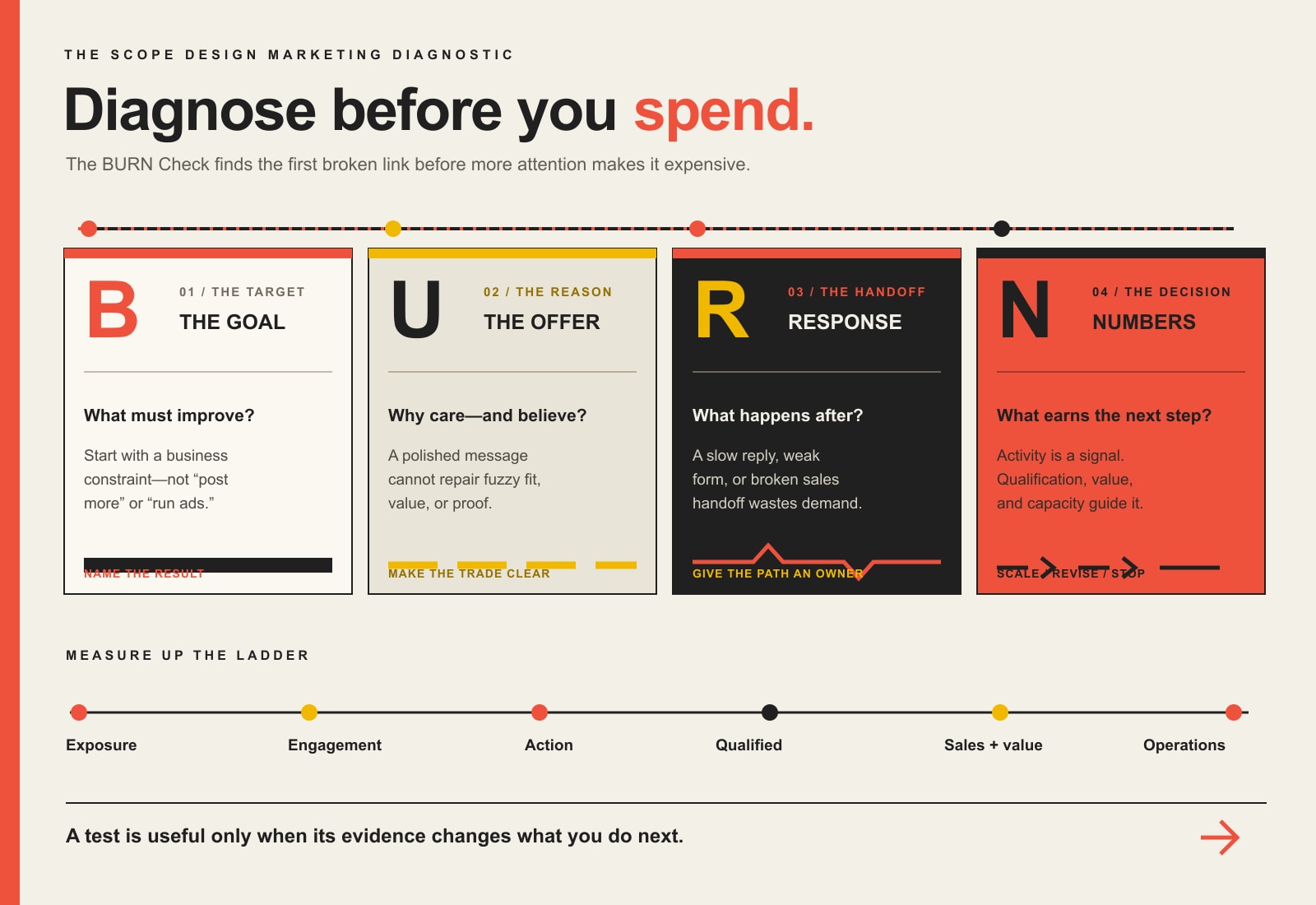
    The Scope Design BURN Check is a fast four-part diagnostic:

    CheckQuestionWhat failure looks like
    B — Business constraintWhat must improve for the business?Marketing starts with “we should post more” or “let’s run ads” instead of a business problem.
    U — Useful offer and proofWhy should the right buyer care and believe us?The message is polished, but the promise, fit, tradeoff, price logic, or evidence is vague.
    R — Response pathWhat happens after attention arrives?The page, form, phone, sales handoff, follow-up, fulfillment, or customer experience leaks demand.
    N — Numbers and next decisionWhat evidence tells us to scale, revise, or stop?The dashboard reports activity, but nobody can explain customer value, qualification, economics, or what happens next.
    The BURN Check asks about the business goal, offer and proof, response path, and numbers that guide the next decision; marketing measurement climbs from exposure and engagement to action, qualified leads, sales value, and operational effect.

    This is not meant to replace a full digital marketing strategy. It is the smoke detector. If one of these four checks is failing, buying more attention can make the weakness more expensive.

    Lesson 1: I chose channels before defining the business problem

    Platform-first planning feels productive because it creates immediate work. Set up Google Ads. Post three times a week. Start a newsletter. Make a video. Hire someone to “do SEO.” The calendar fills up and everybody can point to activity.

    The problem is that channels do different jobs. Search can capture existing demand. Social can distribute evidence and create discovery. Email can continue a relationship with people you already have permission to contact. Paid media can accelerate a defined offer and audience. None of those answers the first question: what needs to change in the business?

    If the real constraint is poor lead quality, more traffic can make the sales team busier without making the business healthier. If the constraint is weak follow-up, buying more leads feeds a leak. If the constraint is an offer buyers do not understand, a larger audience just lets more people ignore it.

    My rule now is simple: define the business change before the channel job. Demand, fit, conversion, response, close rate, retention, capacity, or learning are all legitimate targets. “We need to be on TikTok” is not one.

    Lesson 2: I tried to market offers that had not earned attention

    Good copy matters. Design matters. Targeting matters. But none of them can manufacture value that the offer does not have.

    An offer needs enough clarity that the right person can quickly understand who it is for, what changes, what it costs or requires, what the tradeoffs are, and why the promise is believable. If those pieces are fuzzy, the marketing team often compensates with adjectives. “Innovative.” “Premier.” “Next-level.” Beige wallpaper with a call-to-action button.

    The better question is not “How do we make this sound irresistible?” It is “What would make this decision easier to trust?” That usually means sharper fit, clearer stakes, useful proof, honest boundaries, and language that matches how the buyer actually thinks. Our guide to buyer psychology goes deeper into diagnosing the motives, risks, and evidence needs behind that decision.

    One of the old habits I no longer trust is testing cosmetic details before the offer is clear. Button color can be measured. That does not mean it deserves to be the first thing measured. Test the highest-risk assumption first: audience, promise, proof, price logic, eligibility, or next step.

    Lesson 3: I confused attention metrics with business results

    Marketing dashboards are excellent at producing numbers. They are less excellent at telling you which number should change your decision.

    Google Analytics provides separate User acquisition and Traffic acquisition reports, while Google Search Console performance documentation defines search clicks, impressions, click-through rate, position, and dimensions such as queries and pages. Those are useful signals. They are not the same thing as qualified opportunities, sales, contribution, retention, or staff impact.

    I think about measurement as a ladder:

    1. Exposure: impressions, reach, rankings, share of voice.
    2. Engagement: views, clicks, engaged sessions, replies.
    3. Action: calls, forms, bookings, purchases, applications.
    4. Qualification: valid contacts, fit, held meetings, real opportunities.
    5. Sales and value: close rate, acquisition cost, contribution, retention, lifetime value.
    6. Operational effect: response time, support load, capacity, cycle length, staff time.

    The mistake is not tracking the top of the ladder. The mistake is stopping there. A campaign can earn cheap clicks and still create expensive junk. A page can rank and still answer the wrong buyer. A lead form can convert while the sales team quietly hates every submission.

    If the goal is a measurable action, our direct response marketing guide goes deeper into connecting that action to acquisition cost, revenue, contribution, and payback.

    Lesson 4: I did customer acquisition math with half the equation

    Customer acquisition cost is useful, but it is not a magic number you can compare with a universal benchmark and call strategy.

    Imagine two companies both pay $300 to acquire a customer. Company A makes $2,000 in contribution from a typical new customer, gets paid quickly, has room to fulfill more work, and keeps a meaningful share of those customers. Company B makes $350 before service costs, waits months for cash, is already over capacity, and rarely gets repeat business. The same CAC means completely different things.

    Before scaling acquisition, I want to know enough of the following to make the bet intelligible: contribution or gross margin, first-sale value, repeat purchase or retention, payback period, refund or churn behavior, sales cycle, fulfillment capacity, cash-flow tolerance, and how qualification changes the economics.

    You do not need a finance department to start. Use the best honest window you have. If lifetime value is immature, use a shorter observed period and label it that way. What I no longer recommend is inventing certainty with a neat ratio borrowed from a business that has different margins, buying behavior, and risk.

    Lesson 5: I treated the response path as somebody else’s problem

    Marketing does not stop when somebody clicks “submit.” The next five minutes can matter more than the previous five weeks of campaign work.

    A good campaign can be ruined by a confusing landing page, a form nobody monitors, missed phone calls, a generic autoresponder, slow estimates, unclear pricing, awkward scheduling, or a sales conversation that contradicts the promise that earned the lead. Then the marketing channel gets blamed because it is the easiest line item to point at.

    The response path should have an owner. For each important action, know who receives it, how quickly they respond, what qualifies the person, what happens next, where the information is stored, and how the eventual outcome gets connected back to the source.

    Proof belongs in that path too. Testimonials, reviews, examples, guarantees, and case evidence can reduce risk when they are real and relevant. In the United States, the FTC Consumer Reviews and Testimonials Rule took effect October 21, 2024 and addresses fake or false reviews and testimonials. The practical marketing lesson is simpler than the legal detail: do not fake trust. It is bad strategy with paperwork attached.

    Lesson 6: I mistook channel count for marketing maturity

    There is a special kind of small-business chaos where the company has Facebook, Instagram, LinkedIn, TikTok, YouTube, email, a blog, Google Ads, a neglected Google Business Profile, and no reliable process for answering the phone.

    More channels create more creative requirements, approval work, measurement surfaces, platform changes, account risk, and maintenance. Diversification can be smart. Premature diversification is just multiplying places where the system can decay.

    I would rather see one to three primary acquisition channels with clear jobs and credible ownership than seven profiles maintained by guilt. Add another channel when the existing system works, the audience justifies it, the business can support the content or campaign requirement, and you know what the new channel is supposed to teach you.

    The shiny-object test is easy: if the argument for a channel begins with “everyone is there,” “the algorithm favors it,” or “our competitor started doing it,” you still need a business case.

    Lesson 7: I ran tests without deciding what the evidence would earn

    “We tried it” is one of the least useful sentences in marketing.

    A real test begins with a question. Can this audience be reached here? Does this promise earn enough relevant attention? Does the page continue the promise? Do qualified buyers take the next step? Can we acquire them inside an acceptable economic range? Can the business absorb more demand?

    Then define what happens when the result arrives. Scale, revise, or stop are decisions. “Keep spending because the dashboard has green arrows” is not.

    What you observeLikely questionNext move
    Little relevant attentionWas the audience reachable here? Was the promise strong enough?Revisit targeting, channel job, or message.
    Attention but weak actionDid the destination continue the promise? Is the next step appropriate?Inspect proof, friction, continuity, and CTA.
    Actions but poor qualificationAre we attracting the wrong situation or failing to clarify fit?Tighten message, eligibility, proof, offer, or form.
    Qualified opportunities but weak salesIs acquisition being blamed for pricing, follow-up, or sales-process friction?Audit the downstream handoff.
    Good outcomes inside guardrailsCan the business support more without harming quality or economics?Scale carefully and keep watching quality.

    The review window should match the buying cycle and evidence volume. A local emergency service, a seasonal promotion, and a six-month B2B sale should not be forced into the same arbitrary test period. The point is not to wait forever. It is to decide what would count as enough evidence for the next move.

    A practical reset when your marketing feels broken

    If I were auditing a small business with limited time and money, I would not start by adding a platform. I would work through this sequence:

    1. Name the constraint. What business outcome is actually weak?
    2. Define the buyer and buying moment. Who is deciding what, and what risk or evidence matters now?
    3. Strengthen the offer and proof. Make fit, value, tradeoffs, and credibility easy to understand.
    4. Walk the response path. Test the page, form, call, follow-up, qualification, sales handoff, and fulfillment experience.
    5. Connect the numbers. Trace attention to action, qualification, sales value, economics, and operational effect as far as the current data allows.
    6. Pick the smallest useful test. Choose the channel and experiment that can answer the most important unresolved question.
    7. Decide what the evidence earns next. Scale, revise, stop, or fix a different part of the system.

    Hope is not an analytics strategy. Neither is panic. A useful marketing system should make the next decision clearer, even when the campaign itself does not win.

    Frequently asked questions about small business marketing mistakes

    What is the biggest mistake small businesses make in marketing?

    The biggest mistake is buying or creating attention before the business is ready to turn that attention into qualified value or useful learning. If the constraint, audience, offer, proof, response path, capacity, or measurement is unclear, more traffic can amplify the problem instead of fixing it.

    What are some common marketing mistakes?

    Common mistakes include choosing channels before strategy, promoting a weak offer, chasing vanity metrics, ignoring acquisition economics, responding slowly to leads, spreading effort across too many platforms, and running tests without a defined decision rule.

    What should I fix before spending more money on advertising?

    Confirm the audience and offer are clear, the landing experience works, somebody owns follow-up, the business has capacity, conversion measurement is configured, and you can afford a bounded learning period. Do not scale just because impressions or clicks are cheap.

    How do I know whether my problem is traffic or the offer?

    If the right people rarely reach you, traffic or distribution may be the constraint. If relevant people arrive but show little interest, inspect the offer, promise, proof, fit, and next step. If they convert but rarely become qualified opportunities, the problem may be targeting, qualification, or sales handoff. Diagnose the stage that leaks instead of redesigning everything at once.

    How much should a small business spend on marketing?

    There is no responsible universal percentage. A useful budget depends on margins, customer value, sales cycle, channel costs, capacity, cash flow, and how much the business can afford to learn without creating financial distress. Budget from economics and a defined test rather than a benchmark stripped of context.

    Is organic marketing better than paid marketing?

    Neither is automatically better. Organic channels often compound into durable assets but require time and maintenance. Paid channels can accelerate learning and demand capture but expose weak economics quickly. Use the channel that fits the audience, buying moment, offer, capacity, and measurement job.

    The lesson behind all seven lessons

    The hardest marketing lesson was not a secret tactic. It was learning to stop treating marketing like a vending machine where you insert money, content, or effort and expect leads to fall out.

    Marketing is part of a business system. Attention has to meet a useful offer. The offer needs proof. The response path needs ownership. The numbers need context. And every serious test should make the next decision less stupid than the last one.

    If your marketing feels busy but not useful, run the BURN Check before adding another campaign. Find the first broken link in the chain and fix that. It is less exciting than chasing the newest tactic. It is also how you stop paying tuition for the same lesson twice.

  • 4 Ways to Build Value by Investing in Your Customers

    4 Ways to Build Value by Investing in Your Customers

    Customer retention strategies work best when they help customers get more value from what they already bought. For a small business, that usually means improving onboarding and delivery, removing recurring friction, learning from customer evidence, and then creating sensible reasons to renew, reorder, refer, or stay connected. A loyalty program can help in the right business. It cannot rescue an experience people would rather escape.

    That is the point of investing in customers: not spending money on random perks, but putting time, systems, attention, and budget into the parts of the relationship that make the customer more successful and the business easier to choose again.

    TL;DR: where should a small business invest in customer retention?

    • Complete the outcome. Make sure customers actually receive the value they bought.
    • Anticipate friction. Fix repeat questions, delays, confusion, handoff problems, and avoidable effort.
    • Respond to evidence. Use feedback, support requests, repeat behavior, churn, and customer questions to decide what deserves improvement.
    • Extend the relationship. Add renewal, reorder, referral, recognition, or loyalty mechanics only when there is a real next value for the customer.

    If your marketing plan stops when somebody becomes a customer, it stops too early. Scope Design’s broader small business marketing strategy treats response and customer outcomes as part of the system, not as somebody else’s problem after the sale.

    What does “investing in your customers” actually mean?

    Investing in customers means improving the customer’s ability to get a useful result from the relationship. Sometimes that investment is money. Often it is operational discipline: a better onboarding email, clearer instructions, a faster handoff, a useful follow-up, a simpler reorder path, better staff authority, or a process for turning recurring customer questions into fixes.

    This distinction matters because “customer retention” can turn into a shopping list of tactics. Buy a CRM. Launch points. Send birthday coupons. Add a chatbot. Start a community. None of those is automatically wrong. None is automatically a retention strategy either.

    A tactic becomes useful when it solves a real relationship problem. If customers leave because delivery is confusing, a rewards platform is expensive theater. If customers love the service but forget when to reorder, a simple reminder can be more valuable than a complicated membership program.

    The Scope Design CARE Loop for customer retention strategies

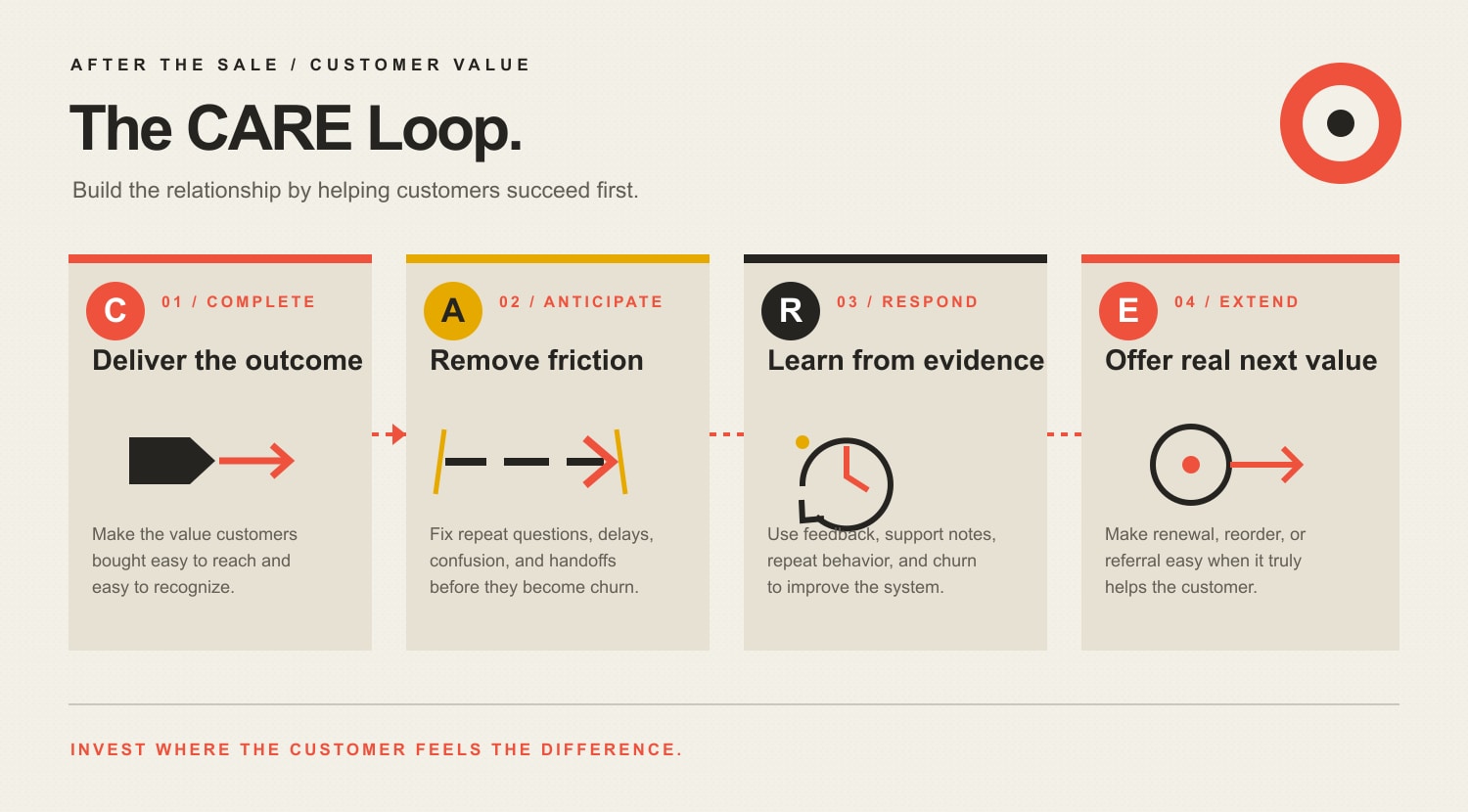
    The CARE Loop is a four-part decision sequence for choosing where to invest after the sale: Complete, Anticipate, Respond, Extend. The order matters. You first protect the value the customer expected. Then you remove avoidable friction. Then you use evidence to improve the system. Only after those pieces are healthy do you add mechanisms designed to deepen or continue the relationship.

    The CARE Loop: Complete the outcome customers bought, Anticipate and remove recurring friction, Respond to customer evidence by improving operations, and Extend the relationship only when there is genuine next value.

    1. Complete the outcome customers bought

    The first retention investment is not retention software. It is delivery.

    A customer bought something because they expected an outcome: a repaired furnace, a better website, a cleaner office, an easier tax season, a product that solves a recurring problem. Your first job is to make that outcome easy to reach and easy to recognize.

    Look for the gap between “transaction completed” and “customer got the result.” That gap is where many small-business retention problems hide.

    • Set expectations before the sale so the customer knows what happens next.
    • Create a clear onboarding or first-use path.
    • Give customers the instructions, access, contacts, or training they need.
    • Define who owns the relationship when work passes from sales to delivery or support.
    • Confirm completion instead of assuming silence means satisfaction.

    For service businesses, a short check-in after delivery can be more valuable than a discount. For ecommerce, the equivalent may be setup guidance, care instructions, replenishment timing, or an easy support path. For recurring services, it may be a visible progress update that reminds the customer what is being done and why it matters.

    This is also where value and pricing connect. A customer who cannot see or realize the value of the work will eventually question the price. Our guide to strategic pricing and value creation covers that side of the equation in more depth.

    2. Anticipate friction before it becomes a complaint

    Good customer service responds well. Better customer systems prevent the same avoidable problem from happening 40 times.

    Start with recurring friction: the questions your team answers repeatedly, the step customers forget, the form they cannot find, the deadline that surprises them, the delivery status they have to chase, the invoice they do not understand, or the handoff where context disappears.

    Then decide whether the right fix is communication, process, product, training, or automation. Technology should remove repetitive work without turning the relationship into a maze of bots and portals.

    • Use reminders where timing matters. Renewal, reorder, maintenance, appointment, and milestone reminders reduce the customer’s need to remember your process.
    • Personalize for usefulness. Use known preferences or history when it helps the customer make a better decision, not to perform creepy theatrical intimacy.
    • Make support ownership obvious. The customer should know where to go and should not have to retell the same story to three people.
    • Turn repeat explanations into reusable help. A short guide, video, checklist, or email sequence can improve service while reducing staff time.

    If email is the right relationship channel, our small-business email marketing guide shows how to build onboarding, educational, reminder, and follow-up communication around a real job rather than a blast calendar.

    Useful personalization also creates a data responsibility. The Federal Trade Commission’s business data-security guidance recommends keeping only personal information you have a legitimate business need for and protecting what you retain. “Collect everything because maybe marketing will use it later” is not a customer-experience strategy.

    3. Respond to customer evidence, not anecdotes

    Retention problems get expensive when the business guesses at them. One loud complaint becomes “customers hate this.” One loyal client becomes “everyone loves our process.” Neither is a useful operating model.

    Build a lightweight evidence loop. You do not need an enterprise research department. You do need a repeatable way to notice what customers are telling you through words and behavior.

    • Ask a short post-project or post-purchase question: What worked? What was confusing? What nearly made this harder than it needed to be?
    • Tag recurring support questions and complaint themes.
    • Review cancellations, non-renewals, returns, lost repeat purchases, and dormant accounts for patterns.
    • Compare what your best-fit customers value with what your marketing emphasizes.
    • Close the loop when you change something because customers spoke up. “You asked, we fixed it” is more credible than another survey nobody acts on.

    The broader digital marketing operating system should include this post-sale evidence. Customer questions can become better FAQs. Successful implementations can become case evidence. Churn reasons can improve fit criteria. Retention is not a separate island from acquisition; it teaches acquisition what “good customer” actually means.

    Reviews can be part of that evidence and advocacy system, but incentives need care. The FTC’s Consumer Reviews and Testimonials Rule guidance says businesses cannot condition incentives on a review expressing a particular positive or negative sentiment, and material connections or incentives may require disclosure. Ask for honest feedback, not rented applause.

    4. Extend the relationship only where there is real next value

    Once the customer experience works, you can deliberately make the relationship easier to continue.

    That can mean a reorder path, a maintenance reminder, a renewal conversation, a useful account review, an upgrade that solves a new problem, a referral request, priority access, recognition, or a formal loyalty program. The right mechanism depends on how often customers can reasonably return, the margin available, what they value, and whether your team can operate the promise without staff heroics.

    That is why we treat loyalty programs as a fit decision, not a default checkbox. Our small-business loyalty program guide compares models by behavior, frequency, margin, customer value, and operational reality.

    Harvard Business Review’s analysis of loyalty-program failure makes a similar practical point: programs underperform when the economics, customer insight, or engagement are weak. Points are not fairy dust. If customers are leaving because the core experience is unreliable, rewarding another purchase is not the first fix.

    How should you measure customer-retention investments?

    Measure the behavior or outcome your investment was supposed to improve. A retention dashboard with 27 numbers can still avoid the one question that matters: did the customer relationship get healthier in a way the business can sustain?

    Customer investmentUseful signalQuestion to answer
    Onboarding or delivery improvementCompletion, activation, time-to-value, support contactsAre more customers reaching the outcome with less confusion?
    Proactive communicationFewer repeated questions, missed appointments, late renewals, or status-chasing contactsDid we remove avoidable customer effort?
    Feedback-driven fixesRecurrence of the issue, satisfaction feedback, cancellation reason trendsDid the problem actually become less common?
    Renewal or reorder systemRenewal rate, repeat purchase rate, time between purchasesAre good-fit customers continuing when the next purchase makes sense?
    Referral or advocacy effortQualified referrals, honest reviews, referred revenueAre satisfied customers comfortably introducing us to similar buyers?
    Loyalty programIncremental repeat behavior, reward cost, margin, redemption and engagementIs the program changing useful behavior rather than subsidizing purchases that would happen anyway?

    Customer lifetime value can be a useful roll-up metric, but it should not become a fog machine. If CLV rises while support cost, refunds, service strain, or customer fit gets worse, you need the underlying drivers. Track enough to make the next decision, not enough to decorate a dashboard.

    When is a loyalty program the wrong first investment?

    A loyalty program is probably not your first move when customers cannot repeat the desired behavior often enough, your margins cannot support the reward, fulfillment or service quality is the real problem, customer records are unreliable, or a simple personal follow-up would outperform the software.

    For a lower-frequency professional service, excellent onboarding, useful education, reliable communication, proactive support, and an easy referral process may create far more value than points. A business with a broken customer experience should fix the experience before rewarding people for enduring it.

    A 30-day customer investment plan for a small business

    You do not need to redesign the entire customer journey in a week. Pick one meaningful friction point and run a small operating experiment.

    1. Week 1: Map the post-sale path. From payment or signed agreement through delivery, use, support, renewal, and referral, write down what the customer must do and who owns each handoff.
    2. Week 2: Find one repeated friction point. Review customer questions, support notes, cancellations, reviews, staff complaints, and missed steps. Choose a problem that happens often enough to matter.
    3. Week 3: Make the smallest useful fix. Improve the process, message, instruction, reminder, handoff, or support ownership. Avoid buying a platform before you know the job.
    4. Week 4: Compare the evidence. Did the relevant signal improve? Ask the people who handled the work. Ask a few customers. Keep, revise, or kill the change based on what happened.

    Then run the loop again. Retention compounds through better operations, not through one heroic “customer appreciation” week every November.

    Frequently asked questions about customer retention strategies

    What are customer retention strategies?

    Customer retention strategies are deliberate ways a business improves the likelihood that good-fit customers continue the relationship when doing so creates real value. They can include better onboarding, proactive support, useful communication, feedback-driven improvements, easier renewal or reorder paths, referrals, recognition, and loyalty programs.

    What are some examples of customer retention strategies for small businesses?

    Useful examples include a service follow-up after completion, maintenance reminders, onboarding instructions, a reorder reminder based on normal usage, an account review before renewal, a simple referral process, or a loyalty benefit for a genuinely repeatable behavior. The best example is the one tied to a known customer need or friction point.

    What is the best customer retention strategy?

    There is no universal best tactic. Start by completing the outcome customers bought and fixing the most common reason a good-fit customer struggles, leaves, or fails to return. Once the experience works reliably, add the simplest mechanism that supports the next useful behavior.

    How can a small business improve retention without discounts?

    Reduce effort. Communicate clearly. Follow up. Teach customers how to get more value from the product or service. Remember useful preferences. Make repeat business easier. Give staff enough authority to solve ordinary problems. Discounts change price; these investments change the experience.

    Should customer service improve before starting a loyalty program?

    Usually, yes when service or fulfillment problems are the reason customers do not return. A loyalty program can encourage an already-healthy repeat behavior, but it should not be used to compensate for unreliable delivery, confusing support, or a weak core offer.

    How do you know whether a retention strategy is working?

    Choose the signal that matches the intervention. If you improved onboarding, measure completion and support friction. If you built renewal reminders, measure timely renewals. If you added a loyalty program, look for incremental repeat behavior after reward cost and margin, not just sign-ups. Compare the result over time and investigate the reason behind the number.

    Do customer retention strategies work for B2B companies?

    Yes. In B2B, the mechanics are often account reviews, implementation success, stakeholder communication, proactive support, documented value, renewals, expansion, referrals, and reducing risk for the buyer. The principle is the same: help the customer achieve the outcome and make the useful next step easier.

    Invest where the customer feels the difference

    The strongest customer retention strategies are not the ones with the fanciest software. They are the ones that make a good-fit customer more successful, reduce unnecessary effort, turn real evidence into better operations, and create a sensible next step.

    Start with the customer outcome. Work the CARE Loop. If your broader marketing system is generating attention but leaking value after the sale, use our small business marketing strategy framework to diagnose the whole path before you buy more attention.