Tag: Copywriting

  • How To Write Fascinating Bullet Points That Will Keep Your Reader’s Eyes Glued To Your Copy

    How To Write Fascinating Bullet Points That Will Keep Your Reader’s Eyes Glued To Your Copy

    If you are figuring out how to write bullet points for marketing copy, the goal is simple: make the page easier to scan without stripping out the information that helps someone decide. Bullets often fail in two opposite ways—they become vague feature dumps that say almost nothing, or miniature clickbait lines that hide the point just to manufacture curiosity.

    Start with a simpler rule: make each bullet useful before you make it clever. A strong bullet gives the reader one clear idea, connects it to something they care about, and gives them enough detail to believe or evaluate the claim. Curiosity can help, but it should come after clarity—not instead of it.

    At Scope Design, we use a five-part editing framework for this: the SCOPE Bullet Test—Specific, Customer-relevant, Observable, Plain-language, and Earned curiosity.

    TL;DR: The simplest answer to how to write bullet points is to make each line specific, relevant to the customer, supportable, and easy to understand on a scan. Use curiosity only after the reader understands the subject and why it matters.

    How to Write Bullet Points That Sell Without Clickbait

    A good marketing bullet is a piece of decision-useful compression. It reduces a bigger idea to one line without stripping away the part the reader needs to understand why it matters.

    That makes bullets useful for genuine sets of information: benefits, included features, qualifications, objections, comparison criteria, deliverables, or other items a reader may want to scan. The W3C’s web accessibility guidance recommends clear, concise content and list formatting where appropriate. Its guidance on content structure also distinguishes unordered lists for items where order does not matter from ordered lists for sequences.

    But formatting text as a list does not magically make it persuasive. The words still have to do useful work.

    • One idea: the reader should not have to untangle three promises stuffed into one bullet.
    • Specific meaning: concrete nouns, actions, outcomes, mechanisms, or constraints beat vague adjectives.
    • Reader relevance: a feature becomes more useful when the reader can see the consequence for them.
    • Believability: meaningful claims should be supported by a mechanism, example, limitation, number, demonstration, or other evidence when appropriate.
    • Scannability: the bullet should be understandable on a quick pass, even if the surrounding copy provides more nuance.

    The Scope Design SCOPE Bullet Test

    Before you reach for a “secret,” “warning,” or “little-known trick,” run the bullet through SCOPE. The framework is deliberately ordered: clarity and substance come first. Curiosity is last because it is optional.

    SCOPE checkQuestion to askCommon failureBetter direction
    SpecificWhat concrete detail can the reader picture or evaluate?Vague adjectives such as “powerful,” “easy,” or “advanced.”Name the action, mechanism, outcome, or constraint that makes the claim meaningful.
    Customer-relevantWhat changes for this reader because of the feature?A feature list that leaves the reader to translate the “so what?”Connect the capability to a consequence the intended customer actually cares about.
    ObservableWhat makes the claim believable or inspectable?An unsupported result, superlative, guarantee, or comparison.Add a mechanism, example, condition, limitation, demonstration, or real evidence when the claim needs support.
    Plain-languageCan the intended reader understand the line on one pass?Jargon, stacked adjectives, or internal terminology that sounds impressive but hides the point.Use the reader’s vocabulary and let the concrete detail carry the authority.
    Earned curiosityDoes the reader already understand the subject and why the answer matters?A cryptic tease that withholds the basic point.Leave the next useful detail unanswered, not the meaning of the bullet itself.

    Use the table from left to right. If a bullet fails Specific, Customer-relevant, Observable, or Plain-language, do not try to rescue it with curiosity. Fix the substance first. The “E” in SCOPE is an optional finishing move, not a substitute for the first four checks.

    S — Specific

    Specific bullets give the reader something they can picture or evaluate. Replace broad words such as powerful, easy, advanced, and better with the concrete thing that makes the claim true.

    Weak: Powerful social media tools.

    Stronger: Approve, schedule, and reuse social posts from one calendar instead of jumping between separate publishing screens.

    The second version does not need an exclamation point. The mechanism gives the reader something to judge.

    C — Customer-Relevant

    A feature is about the product. A benefit explains what changes for the reader. Strong bullets usually connect the two instead of assuming the reader will do that translation on their own.

    Weak: Automated daily backups.

    Stronger: If your service creates automated daily backups, say what that means: your team has a recent restore point when an update or edit goes wrong.

    The important question is not “Does this sound impressive?” It is “Why would this particular reader care?”

    O — Observable

    When a bullet makes a claim that needs belief, give the reader something inspectable. That might be the mechanism, a real number, a limitation, a demonstration, a comparison, a customer result with context, or a clear description of what is included.

    Weak: Get reports faster.

    Stronger: See traffic source and conversion events in the same report, so you can compare which channels are producing leads without stitching together separate exports.

    Do not invent precision because a number looks persuasive. In the United States, the FTC’s advertising guidance says advertising claims should be truthful, non-deceptive, and evidence-based. If you cannot support a result, guarantee, deadline, or comparison, the fix is not better wording. The fix is to change the claim.

    P — Plain-Language

    The reader should understand the bullet on the first pass. Jargon may be appropriate when the audience uses it, but jargon is not proof of expertise. Neither is a stack of adjectives.

    Weak: Leverage our next-generation, best-in-class optimization ecosystem.

    Stronger: Find the slowest pages first, see the files causing the delay, and prioritize the fixes most likely to improve load time.

    Plain language does not mean childish language. It means the sentence is doing more work than the vocabulary is.

    E — Earned Curiosity

    Curiosity is useful when the reader already understands the subject and the promise, but wants the next detail. It is weak when the bullet withholds basic meaning and forces the reader to keep going just to find out what you are talking about.

    Manufactured mystery: The secret website mistake killing your sales.

    Earned curiosity: The checkout step worth testing before you rewrite the whole page—and how it can reveal a pricing problem instead of a copy problem.

    The second line still opens a loop, but the reader already knows the topic, the decision, and why the answer may matter. That is the distinction. Our broader guide to ethical marketing psychology follows the same principle: persuasion should make a decision easier to understand, not exploit confusion.

    How to Turn a Weak Bullet Into a Strong One

    You do not need a giant swipe file to improve most bullet points. Start with the raw fact and work outward.

    1. Write the fact. What does the product, service, process, or idea actually do?
    2. Write the consequence. Why would this reader care about that fact?
    3. Add support. What mechanism, evidence, example, condition, or limitation makes the statement credible?
    4. Cut the second idea. If the line is trying to sell two unrelated benefits, split it.
    5. Decide whether curiosity earns its place. If removing the tease makes the bullet clearer and equally persuasive, remove it.

    For example, start with a vague bullet such as “Powerful analytics.” The raw fact might be that traffic sources and lead events appear in one report. The reader consequence is that they can see which channels produce leads. The mechanism is the combined source and conversion data.

    The finished bullet becomes: “See which channels produce leads by comparing traffic source and conversion events in one report.”

    That is not flashy. It is useful. Useful copy is easier to trust.

    Five Bullet Patterns You Can Adapt

    Patterns are starting points, not persuasion machines. Fill them with true, relevant details. If you need a structure for the larger argument around the bullets, our guide to copywriting formulas covers when different frameworks fit the page and the reader.

    • Capability → outcome: “[Concrete capability], so you can [reader-relevant result].”
    • Outcome → mechanism: “[Desired result] by using [real mechanism or process].”
    • Problem → corrective action: “Avoid [specific problem] by [specific action or safeguard].”
    • How to → credible constraint: “How to [achieve a real outcome] without [a real cost, obstacle, or tradeoff your method addresses].”
    • Decision → context: “Choose [option or action] when [specific condition], and [alternative] when [different condition].”

    Notice what is missing: a requirement to use the words secret, warning, shocking, or guaranteed. Those words are not forbidden. They are simply not substitutes for substance.

    Common Bullet-Point Mistakes

    1. Stacking Vague Adjectives

    “Fast, flexible, powerful, seamless, cutting-edge” sounds energetic and communicates almost nothing. Keep the adjective only if the surrounding detail explains what it means.

    2. Listing Features Without the “So What?”

    Readers may care about technical details, but they still need to know why the detail belongs in the decision. Translate the feature into its consequence without hiding the feature itself.

    3. Cramming Multiple Promises Into One Bullet

    If a bullet promises lower costs, faster delivery, happier employees, stronger security, and world peace, it is not concise. It is a paragraph wearing a dot. Give each meaningful idea room to breathe.

    4. Using Fake Precision

    Numbers create specificity, which is exactly why made-up or context-free numbers are dangerous. Only use a percentage, timeframe, comparison, or customer result you can substantiate and explain.

    5. Withholding the Basic Point

    A curiosity gap should make someone want the next useful detail. It should not make them decode the sentence. “The one weird thing your competitors don’t want you to know” creates a gap by refusing to say anything. That is not the standard to aim for.

    6. Using Bullets When the Information Needs Another Structure

    Bullets are not automatically the best format. A sequence may need a numbered list. A real comparison may be clearer in a table. A nuanced objection may need a paragraph. A page with nothing but bullets can be just as tiring as a wall of text. Our website content strategy guide goes deeper on choosing structures that match what the reader is trying to understand.

    Where Bullet Points Belong on a Landing Page or Website

    Use bullet points when the reader benefits from seeing related items as a set. Common places include:

    • Key benefits under a product or service explanation.
    • What is included in a package, plan, or deliverable.
    • Eligibility requirements or qualifications.
    • Common objections and the specific facts that answer them.
    • Important differences between options when the comparison is simple enough for a list.
    • Supporting proof points beneath a larger claim.

    Do not start by asking, “Where can I add bullets?” Start by asking, “Which information is easier to understand as a set?” The format should follow the information.

    A 10-Minute Bullet-Point Editing Checklist

    When you already have a draft, this pass will improve most bullet lists without rewriting the entire page:

    1. Circle the concrete noun or verb in every bullet. If you cannot find one, the line may be too vague.
    2. Ask “so what?” after every feature and add the reader consequence when it is missing.
    3. Flag every number, guarantee, superlative, and result claim. Confirm you can support it.
    4. Split bullets that contain two unrelated promises.
    5. Remove adjectives that are not explained by a mechanism or example.
    6. Make the grammatical pattern consistent enough that the list scans cleanly.
    7. Use numbered steps when order matters and ordinary bullets when it does not.
    8. Delete curiosity language and reread the line. If the bullet gets stronger, the curiosity was decoration.
    9. Read the list without the paragraph above it. Make sure each bullet still has enough context to be useful.
    10. Put the list back into the full page and confirm it supports the page’s actual argument rather than competing with it.

    Frequently Asked Questions About Writing Bullet Points

    How Long Should a Bullet Point Be?

    There is no useful universal word count. A bullet should usually carry one clear idea and be easy to understand on a scan. If it needs several sentences of explanation, the information may deserve a paragraph or subheading instead.

    Should Bullet Points Be Complete Sentences?

    They can be complete sentences or concise phrases. What matters is clarity and consistency. If one item starts with a verb, the next is a fragment, and the third becomes a mini-essay, the list is harder to scan.

    What Is a Fascination Bullet?

    A fascination bullet is a direct-response copywriting term for a bullet designed to create enough interest or curiosity that the reader wants the next detail. Our version adds an important constraint: the bullet should still communicate a meaningful promise or subject on its own. Curiosity should be earned by the missing detail, not manufactured by hiding the point.

    Should I Use “How To,” “Why,” “Secret,” or “Warning” Bullets?

    Use them when the wording accurately matches the information. “How to” is useful for a real method. “Why” is useful when you will explain a cause. “Warning” is useful when there is a genuine risk. “Secret” should be rare because most things marketed as secrets are simply information. The label should describe the content, not compensate for weak content.

    Can AI Write Effective Marketing Bullet Points?

    AI can generate variants, compress wording, or help turn a long paragraph into candidate bullets. It cannot decide whether your underlying claim is true, whether the proof is adequate, or whether a customer result is being represented with enough context. Give it verified source material, then have a human check the facts, voice, relevance, and level of certainty before publishing.

    Where Should Bullet Points Appear on a Sales Page?

    Put them where related information genuinely benefits from being scanned as a set: benefits, inclusions, proof points, requirements, objections, or simple comparisons. Do not force bullets into every section. If the page’s bigger problem is the offer, traffic, follow-up, or conversion path rather than the wording of a list, start with the broader small-business marketing strategy before polishing individual lines.

    Clarity First. Curiosity Second.

    If you remember one rule for how to write bullet points, make it this: the best bullet points do not keep readers engaged by making them work for basic meaning. They make the next decision easier. Be specific. Connect the detail to the customer. Show what makes the claim believable. Use plain language. Then, if there is a real unanswered detail worth teasing, earn the curiosity.

    If your offer is solid but the page still reads like a feature sheet, Scope Design’s copywriting services can help turn the raw material into clearer website, landing-page, campaign, and sales copy.


  • How to Write for Different Customer Avatars: 7 Proven Strategies That Drive Results

    How to Write for Different Customer Avatars: 7 Proven Strategies That Drive Results

    Customer avatar marketing works when the avatar changes a real buying decision—not when it merely gives the customer a fictional name, stock photo, age, and favorite coffee order. If two customer groups need the same promise, proof, objection handling, and next step, they probably do not need two versions of the copy. If their triggers, risks, decision criteria, authority, or required evidence differ, the message may need to change.

    That is the practical job of writing for different customer avatars: keep the offer and brand truth coherent, then vary only the parts of the message that evidence says matter. This guide shows you how to do that with seven strategies and the Scope Design DELTA Avatar Test: Decision difference, Evidence, Language, Treatment, Assess.

    What is a customer avatar—and what is it actually for?

    A customer avatar, sometimes called a buyer persona, is most useful as a human-readable summary of a recurring buyer pattern. It can help a writer remember the situation, motivations, objections, knowledge, constraints, and decision criteria that repeatedly show up in real customer evidence.

    It is not proof that the pattern exists. A polished persona document can still be a beautifully formatted guess.

    If you are still trying to determine who the audience is, start with our guide to identifying your target audience. If the underlying evidence is weak, use market research before turning assumptions into copy. This article begins one step later: you already have plausible customer patterns, and now you need to decide what the writing should do differently.

    The rule: change the copy only when the decision changes

    A detail belongs in an avatar only if it helps someone make a better marketing, sales, product, service, or content decision. Demographics can matter. So can job titles, channels, company size, technical skill, purchase history, or geography. The question is not whether the attribute is available. The question is whether knowing it changes what you should say or do.

    Observed differenceDoes the copy need to change?Why
    Different age bracket, same problem and buying criteriaUsually noAge alone does not establish a different decision.
    Owner wants business-risk proof; technical lead wants implementation proofProbablyThe evidence required to say yes is different.
    Same buyer is Problem Aware on one visit and Product Aware laterYes, but this is an awareness changeThe person may be the same avatar while needing a different message.
    Two segments use different words for the same underlying problemPossiblyLanguage can change recognition even when the offer stays the same.
    One segment needs a quote; another needs internal approval material firstYesThe next useful action is different.

    This keeps customer avatar marketing from becoming a personalization costume. The goal is not to prove that you know trivia about the customer. The goal is to make the decision easier for the right person.

    Use the Scope Design DELTA Avatar Test before writing variants

    Before you create a second headline, landing page, email sequence, sales deck, or CTA, run the proposed difference through DELTA.

    1. D — Decision difference: What buying decision, risk, objection, authority level, or next step is materially different for this group?
    2. E — Evidence: What customer interviews, sales conversations, CRM patterns, support records, search behavior, lost deals, purchase data, or other observations support that difference?
    3. L — Language: What words, problem descriptions, questions, objections, and proof requests does this group actually use?
    4. T — Treatment: What exactly should change in the copy—problem framing, proof, detail, objection handling, CTA, page route, or something else?
    5. A — Assess: What outcome will tell you to keep, revise, or stop the variation?

    If you cannot answer D or E, do not rush to T. You do not have a personalization brief yet. You have a hypothesis that needs research.

    7 strategies for writing to different customer avatars

    1. Start with evidence, not a fictional biography

    Persona exercises often begin with fields because fields are easy to fill in: age, income, hobbies, personality, preferred platform, maybe a name like “Marketing Mary.” The document feels complete because every box contains something. That does not mean the information changes the copy.

    Start instead with recurring evidence:

    • What event makes the problem urgent?
    • What did good customers try before contacting you?
    • Which reasonable objections repeat in sales conversations?
    • What proof do buyers ask for before committing?
    • Who has authority to approve the purchase?
    • Which constraints disqualify an otherwise interested lead?
    • What language do customers use before they learn your industry’s terminology?
    • What do lost deals reveal about price, trust, timing, fit, or alternatives?

    Use that evidence to build the avatar. Do not use the avatar to manufacture evidence. Scope Design’s buyer psychology guide can help when you need to examine motivations, perceived risk, confidence, and decision friction in more depth.

    2. Choose a primary copy audience by decision value—not an arbitrary majority rule

    The old version of this article recommended choosing an avatar that represents roughly 60–80% of ideal customers. That sounds decisive, but the percentage is not a useful universal rule. Your highest-priority audience may be smaller and still matter more because it is a better service fit, has buying authority, produces healthier economics, or represents the direction the business is intentionally moving.

    Choose the primary audience for a page by asking:

    • Which segment has the strongest evidence of a real problem we solve well?
    • Which segment is serviceable with our current capacity and offer?
    • Who has enough authority and urgency to act?
    • Which customers tend to be a healthy economic fit rather than merely easy to attract?
    • Which segment matches the page’s specific search, campaign, referral, or sales job?
    • Which audience is the business deliberately trying to grow?

    “Primary” means the page needs a clear default reader. It does not mean every other customer is unwelcome. If a secondary buyer can still understand the offer and find the relevant proof or next step, one page may serve both.

    3. Define the message delta before you draft a second version

    The fastest way to create inconsistent multi-avatar copy is to tell a writer or AI tool, “Rewrite this for Persona B.” That invites surface-level changes in tone, vocabulary, and stereotypes without defining what actually differs.

    Create a message-delta sheet first:

    Message elementUsually stays stableMay change by avatar
    Core offerWhat you actually sell and deliverEmphasis on the most relevant use case
    Brand promiseThe truthful value the business stands behindWhich consequence or benefit is foregrounded
    Problem framingThe underlying problem categoryTrigger, urgency, symptoms, language
    ProofOnly evidence you can substantiateWhich case, credential, process detail, or example is most relevant
    ObjectionsTruthful limitations and tradeoffsWhich concern gets addressed first
    DepthAccuracyTechnical detail, context, comparison depth
    CTAA legitimate next stepQuote, demo, consultation, guide, internal-review asset, or another action that fits readiness

    This approach also makes copywriting formulas more useful. A formula can organize an argument, but the avatar evidence should determine which problem, proof, objection, and action belong inside that structure.

    4. Separate awareness level from avatar identity

    A common mistake is treating “unaware,” “problem aware,” “solution aware,” “product aware,” and “most aware” as five customer personas. They are not. Awareness describes what the buyer currently knows about the problem, available solutions, and your offer. The same person can move through several awareness states over time—or arrive already informed because of a referral.

    That gives you two useful axes:

    • Avatar: recurring characteristics of the buyer situation that affect the decision.
    • Awareness: what that buyer currently understands and therefore needs from the message now.

    A third axis can matter too: market sophistication, or what the market has already heard, tried, or learned to distrust. Keep these concepts separate. Otherwise you end up with a persona spreadsheet that mixes identity, funnel stage, category maturity, and channel into one unhelpful blob.

    5. Change proof and objection handling before you reinvent the brand promise

    Different buyers often need different reasons to believe the same truthful promise.

    A business owner evaluating a website project may care first about business risk, timeline, total investment, and whether the project will create a clearer route to qualified inquiries. A marketing manager evaluating the same firm may care first about collaboration, stakeholder approvals, analytics continuity, content migration, and whether their team can maintain the site after launch.

    The service does not need to become two different companies. The evidence sequence changes.

    This is also where restraint matters. In the United States, the FTC’s advertising guidance says advertising claims should be truthful, non-deceptive, and evidence-based. If Persona A would be persuaded by a dramatic performance claim you cannot support, the solution is not to hide the claim from Persona B. The solution is to stop making it.

    6. Split pages only when the decision path materially diverges

    Not every avatar deserves a separate landing page. Creating a page for each persona can produce duplicated copy, thin search intent, messy navigation, extra maintenance, and competing URLs that all sort of answer the same question.

    A separate page becomes easier to justify when several of these are true:

    • The segment has a genuinely different problem or buying trigger.
    • The offer, package, eligibility, implementation, or pricing logic materially differs.
    • The buyer needs different proof or has different regulatory, technical, or operational constraints.
    • The search or campaign intent is distinct enough that one page would confuse both groups.
    • The CTA or conversion path is different.
    • You can maintain enough unique, useful content to make the page worth existing.

    If only one or two message elements differ, layer the information on the same page: a role-specific proof block, a short comparison, an FAQ, a secondary CTA, or a link to deeper detail. The broader small business marketing strategy still needs one coherent handoff from audience to message to destination to measurement.

    7. Test one meaningful difference at a time

    Avatar-based copy becomes unmeasurable when the team changes the headline, hero image, offer, proof, form, CTA, price presentation, traffic source, and follow-up sequence at the same time. If results change, nobody knows why.

    Write a bounded hypothesis instead:

    For this evidence-backed segment, changing this one meaningful message factor should improve this qualified business outcome because this customer evidence suggests the current version is creating friction.

    Then define the comparison, observation window, guardrails, and what would make you keep, revise, or stop the variation. That is consistent with the logic of experimental design described by NIST: deliberately vary factors and observe the response rather than changing everything and reverse-engineering a story afterward. Scope Design’s growth marketing framework covers the broader experiment loop.

    Low traffic changes the method, not the need for evidence. A small business may not have enough volume for a clean conventional A/B test. You can still compare qualified lead rate by source or segment, tag sales opportunities, review call notes, run moderated user tests, compare sequential message periods cautiously, or use interviews to investigate why a version is clearer. Do not manufacture statistical certainty because the dashboard offers a percentage.

    A worked example: two avatars, one website service

    This is a hypothetical example to show the decision process, not a client results case.

    Imagine a web design firm sells the same strategic website engagement to two recurring buyer patterns:

    • Owner-led buyer: the founder is directly responsible for revenue and has lost confidence in the current site.
    • Marketing-led buyer: a marketing manager owns the project internally but needs stakeholder approval and a dependable implementation process.
    DELTA fieldOwner-led buyerMarketing-led buyer
    Decision difference“Is this worth the investment, and will it fix a real business constraint?”“Can I get this approved and delivered without creating another internal mess?”
    EvidenceSales calls repeatedly surface lead quality, cost, risk, and timeline.Discovery calls repeatedly surface migration, approvals, analytics, collaboration, and maintainability.
    LanguageQualified leads, investment, timeline, ownership, business outcome.Stakeholders, migration, handoff, analytics, governance, workflow.
    TreatmentLead with diagnosis, investment logic, business proof, and project risk.Lead with process, collaboration, technical continuity, and internal handoff proof.
    AssessQualified consultation rate and sales acceptance.Qualified consultation rate, stakeholder progression, and sales acceptance.

    The core promise remains truthful and consistent. The page does not suddenly become playful for owners and corporate for marketers because a persona worksheet said so. The copy changes where the buying decision changes.

    Where AI helps with customer avatar copy—and where it does not

    AI can be useful once the evidence and message delta are defined. It can generate headline variations, adapt a proof block to a different decision-maker, shorten or expand technical detail, compare drafts against a brief, or produce channel-specific versions of the same approved message.

    AI should not be asked to invent the customer evidence that justifies the variation. “Create three realistic personas for my plumbing company” can produce tidy fiction. It cannot tell you whether those groups actually differ in urgency, economics, objections, or buying behavior in your market.

    A safer workflow is:

    1. Supply verified segment evidence and mark unknowns.
    2. State the stable offer and claims that may not change.
    3. Define the DELTA fields for each segment.
    4. Ask for variations only within those constraints.
    5. Review every factual, performance, legal, pricing, and proof claim.
    6. Test the useful differences rather than publishing every variation the model can generate.

    That turns AI into a drafting multiplier instead of a stereotype multiplier.

    What should you measure across customer avatars?

    Measure the consequence the business actually cares about, then use intermediate metrics to diagnose the path. Useful measures can include qualified inquiry rate, sales acceptance, booked consultation rate, purchase rate, average order value, renewal or repeat purchase, close rate, or another outcome appropriate to the offer.

    Three cautions matter:

    • Do not compare segments you cannot identify reliably. A made-up dashboard segment creates made-up confidence.
    • Do not confuse channel differences with avatar differences. Search traffic and social traffic may behave differently even when the buyer pattern is similar.
    • Do not promote a proxy into the final business outcome. Time on page, clicks, or scroll depth can help diagnose behavior; they do not prove that the message attracted a better customer.

    When customer value is part of the prioritization decision, define it carefully and avoid turning an optimistic lifetime-value forecast into permission to overspend on acquisition.

    What we learned by auditing this exact article

    We applied the same evidence rule to this revision instead of protecting old copy because it already existed. For the 12 complete months ending July 31, 2026, this URL recorded eight GA4 landing sessions total, including one Organic Search session, and zero key events. Search Console returned no query rows for the URL in the current or prior comparison period and currently reports the URL as unknown to Google. Bing recognizes the page and has crawl history, but its URL traffic report shows zero clicks and zero impressions.

    That tiny sample does not prove the topic is bad, that readers disliked the page, or that this revision will improve rankings. It supports a narrower decision: the legacy article did not have a meaningful search or business-performance footprint that justified preserving unsupported statistics and weak ownership. We kept the established URL because it is live, self-canonical, and index/follow; we changed the content job instead.

    Customer avatar copy implementation checklist

    • Define the business decision this page or campaign must influence.
    • Confirm the avatar is based on recurring evidence, not a completed template.
    • Choose one clear primary reader for the page.
    • Run DELTA for every proposed secondary segment.
    • Write down what stays stable: offer, truthful claims, brand promise, important limitations.
    • Write down what may change: trigger, problem language, proof, objections, depth, CTA, route.
    • Check awareness level separately from avatar identity.
    • Create a separate page only when the decision path is materially different.
    • Use AI only after the evidence and constraints are supplied.
    • Define a qualified outcome and a keep/revise/stop rule before testing.
    • Record what the test actually taught you and update the avatar when evidence changes.

    Frequently asked questions about customer avatar marketing

    What is the difference between a customer avatar and a buyer persona?

    In everyday marketing use, the terms often overlap. Both can describe a recurring customer pattern for writing, creative direction, and sales enablement. The more important distinction is between a persona/avatar and the evidence behind it. A persona is a summary; it is not proof that the segment is real.

    How many customer avatars should a business have?

    There is no universal correct number. Keep only the avatars that change a meaningful decision. If two profiles produce the same offer, message, proof, objections, and CTA, combine them or treat the difference as descriptive rather than strategic. If a segment has a materially different buying path, it may deserve its own avatar and possibly its own page.

    How do I choose my primary customer avatar?

    Choose the default audience for the specific page or campaign based on evidence of problem fit, serviceability, authority, urgency, economics, strategic priority, and the page’s job. The biggest segment is not automatically the best primary segment.

    Should every customer avatar get a separate landing page?

    No. Split the page when the problem, offer, proof, constraints, search intent, or next step diverges enough that one page becomes confusing. If the difference is limited to one proof block, objection, example, or CTA, a layered page is often easier to maintain and clearer for readers.

    Is awareness level the same thing as a customer avatar?

    No. An avatar describes a recurring buyer pattern. Awareness describes what the buyer currently knows about the problem, solution category, and your offer. The same avatar can be Problem Aware today and Product Aware later.

    Can I use AI to write for different customer avatars?

    Yes, but give the model evidence and constraints first. AI is useful for drafting controlled variations; it is not customer research. Require it to preserve approved claims and the stable offer, then vary only the message elements supported by the DELTA brief.

    How do I test avatar-specific copy if my website has low traffic?

    Do not force a high-volume A/B testing model onto a low-volume business. Use the strongest evidence available: qualified inquiry tagging, sales acceptance, call notes, interviews, moderated tests, carefully controlled sequential comparisons, and CRM outcomes. Treat small samples as directional evidence, not statistical certainty.

    Write for the decision, not the persona costume

    Different customer avatars can justify different copy, but the difference needs a reason. Start with evidence. Choose a clear primary reader. Define the message delta. Keep awareness separate from identity. Change proof and objections before reinventing the brand. Split pages only when the buying path splits. Test one meaningful difference at a time.

    If your marketing is trying to speak to several valuable customer types and every revision turns into “make it more personal,” Scope Design can help map the audience, message, page ownership, and conversion path before more copy gets produced. Contact Scope Design to start with the decision the message needs to improve.

  • 88+ Call to Action Words & Phrases: Better CTAs Without the Manipulation

    88+ Call to Action Words & Phrases: Better CTAs Without the Manipulation

    Call to action words work best when they make the next step obvious. Start with a concrete verb such as get, start, book, compare, download, see, reserve, join, buy, or apply. Then make the promise clear, match the commitment to the buyer’s readiness, and use urgency only when the deadline or scarcity is real. No single “trigger word” guarantees a conversion.

    That is less sexy than claiming a magic phrase can triple conversions. It is also much more useful.

    TL;DR: Better CTA Words Do Four Jobs

    • Promise something specific. Tell the reader what they get, learn, compare, reserve, or start.
    • Name the action. “Download the guide” is clearer than “Submit.”
    • Match the commitment. A curious reader may need “See examples,” not “Book a sales call.”
    • Stay truthful. “Limited,” “proven,” “guaranteed,” and countdown language create claims. Use them only when you can support them.

    Scope Design uses the PACT CTA Test—Promise, Action, Commitment, Truth—before polishing button copy. If the traffic, offer, proof, page, or follow-up process is broken, the CTA is probably not the binding constraint. Our broader small business marketing strategy guide explains how those pieces fit together.

    CTA Words Are Not Magic Spells

    Marketers often call words such as free, now, discover, exclusive, proven, and guaranteed “psychological trigger words.” That phrase is useful shorthand, but it can encourage bad thinking. Words do not bypass a buyer’s brain, switch off rational thought, or manufacture desire on command.

    A CTA sits inside a decision. The reader is weighing a problem, an offer, perceived risk, timing, evidence, effort, alternatives, and what happens after the click. Buyer psychology is broader than emotion, and a useful CTA respects that complexity.

    Why the old “332%” claim is gone

    The previous version of this article claimed that urgency words could boost CTA conversions by 332%, alongside several other tidy percentages for personalization, button size, email clicks, social ads, and interactive CTAs. During this revision, we could not trace those numbers to original studies with enough methodological detail to support general claims. So we removed them.

    The Federal Trade Commission’s advertising guidance is a useful standard here: objective advertising claims should be truthful, non-deceptive or unfair, and evidence-based. A muscular percentage without defensible provenance is still a weak claim.

    This article keeps the practical asset—the large CTA word and phrase library—but replaces conversion folklore with a framework you can actually use.

    Use the Scope Design PACT CTA Test Before Choosing a Word

    PACT is a simple preflight for buttons, links, forms, banners, emails, landing pages, and sales prompts. Run the CTA through all four checks before you start swapping synonyms.

    A reader considers a clear destination and a proportionate, honest next step along an open path.

    P — Promise: What does the person get?

    A CTA should name the useful result of acting. “Download” describes a mechanism. “Download the pricing checklist” tells the reader what arrives. “Get a quote” is stronger than “Submit” because the promise is visible before the click.

    The promise must match the destination. If the button says “See pricing” and the next page hides all pricing behind a sales form, the microcopy is not clever. It is inaccurate.

    A — Action: What exactly happens next?

    Use a verb that describes the next step: compare, calculate, book, start, buy, apply, reserve, watch. The goal is not to sound aggressive. The goal is to reduce ambiguity.

    If your whole message needs a structure—not just a button—use a copywriting formula for the argument and let the CTA do the smaller job of naming the next action.

    C — Commitment: Is the ask proportional?

    A CTA can fail because the language asks for too much, too early. “Schedule a 45-minute consultation” is reasonable for a qualified buyer comparing agencies. It is ridiculous as the only option under a beginner article.

    Match commitment to readiness. If you create different CTA variants for different audiences, make sure the difference is based on evidence rather than a made-up persona. Scope Design’s DELTA avatar test is designed for that decision.

    T — Truth: Are the claims and pressure real?

    Words such as proven, guaranteed, limited, last chance, and only are not decorative adjectives. They can create express or implied claims. Use them only when the proof, terms, inventory, capacity, or deadline really exists.

    The FTC’s report Bringing Dark Patterns to Light specifically discusses baseless countdown timers that make people believe an offer is time-limited when it is not. If the timer resets for every visitor, the problem is not weak conversion optimization. The problem is deception.

    96 Call to Action Words and Phrases, Organized by the Job They Do

    Use this list as raw material, not a vending machine. A word belongs only when it accurately describes the next step and the value behind it.

    1. Action verbs: start something

    • Get
    • Start
    • Try
    • Join
    • Download
    • Book
    • Schedule
    • Reserve
    • Buy
    • Order
    • Add
    • Create

    2. Exploration words: learn before committing

    • Learn
    • Discover
    • Explore
    • See
    • View
    • Watch
    • Read
    • Compare
    • Check
    • Find
    • Browse
    • Preview

    3. Outcome words: name the value

    • Save
    • Improve
    • Grow
    • Simplify
    • Protect
    • Build
    • Fix
    • Reduce
    • Plan
    • Calculate
    • Organize
    • Upgrade

    4. Low-risk phrases: reduce unnecessary commitment

    • Free
    • Free trial
    • See the demo
    • Get a sample
    • No obligation
    • No credit card
    • Cancel anytime
    • See pricing
    • See details
    • Check fit
    • Ask a question
    • Get an estimate

    5. Honest urgency and scarcity: use only when true

    • Now
    • Today
    • Ends Friday
    • By [date]
    • Before enrollment closes
    • While spots remain
    • Limited seats
    • Order by [date]
    • Reserve by [date]
    • Apply by [date]
    • This week
    • Last day

    6. Ownership and personalization: make the result feel concrete

    • My
    • Your
    • Get my…
    • Show me…
    • Build my…
    • See my…
    • Calculate my…
    • Find my…
    • Choose my…
    • Start my…
    • Get your…
    • See your…

    7. High-intent conversion phrases: ask for the real transaction

    • Buy now
    • Add to cart
    • Start checkout
    • Book an appointment
    • Schedule a consultation
    • Request a proposal
    • Get a quote
    • Contact sales
    • Apply now
    • Enroll now
    • Reserve your seat
    • Start your trial

    8. Transitional CTAs: help a not-yet-ready buyer move forward

    • Learn more
    • See how it works
    • View examples
    • Compare plans
    • Read the case study
    • Watch the demo
    • Check availability
    • See the process
    • Explore options
    • Get the guide
    • See what’s included
    • Talk to an expert

    Count: 96 words and phrases. Some are single words; others are short CTA constructions. That is intentional. Real buttons and links are phrases, not Scrabble racks.

    Match the CTA to the Commitment Level

    The “best” CTA depends on what you are reasonably asking the reader to do. A high-intent verb on a low-intent page can increase friction; a vague low-intent CTA on a buying page can create hesitation.

    Buyer state Useful CTA job Examples Avoid
    Learning Explore without a sales commitment Learn more; View examples; Get the guide; Watch the demo Book a call as the only option
    Comparing Reduce uncertainty Compare plans; See pricing; Check fit; Read the case study Vague “Click here”
    Qualifying Exchange information for a useful next step Get an estimate; Get a quote; Ask a question; Check availability Pretending a sales form is a free tool
    Ready to talk Create a human handoff Schedule a consultation; Book an appointment; Contact sales Hiding what happens after submission
    Ready to buy Complete the transaction Buy now; Add to cart; Start checkout; Reserve your seat Extra educational detours that block checkout

    This is why “Learn More” is not automatically bad. It is bad when it hides a clearer next step. A visitor who genuinely needs more context may be better served by “See pricing,” “Compare plans,” or “Read the case study.”

    Call to Action Examples: Rewrite the Generic Button

    The fastest way to improve CTA copy is often to stop describing the interface and start describing the reader’s next step.

    Weak or vague Stronger when accurate Why it is better
    Submit Get my estimate Names the promised result
    Click here See pricing Names what the click reveals
    Learn more Compare the plans Fits an evaluation decision
    Contact us Ask a project question Lowers ambiguity and commitment
    Sign up Start the free trial Names the product state and risk boundary
    Download Download the CTA checklist Names the asset
    Buy Add to cart Matches the actual ecommerce action
    Get started Book a 20-minute consultation Sets expectation for the next step
    More info See how the process works Explains why the next page exists
    Join now Reserve your seat by Friday Uses a real deadline when one exists

    These are examples, not universal winners. The better phrase is the one that accurately fits the page, the buyer, and the next step.

    Urgency and Scarcity: Make the Constraint Visible, Not Invented

    Urgency can be useful when time changes the decision. Event registration closes. Inventory is finite. A team has capacity for four onboarding slots. A price changes on a published date. Shipping must happen by a deadline.

    In those cases, say what is true: “Reserve by Friday,” “Enrollment closes August 31,” or “Four September onboarding spots remain.” Specificity is more credible than breathless filler.

    Fake scarcity works differently. It manufactures pressure that disappears when the buyer looks closer. If you are tempted to use a resetting timer, fake “only two left” notice, or permanently expiring offer, read the FTC’s dark-pattern guidance on deceptive countdown timers.

    If your message relies heavily on fear, anger, or shame, this article is no longer the right owner. Use our guide to emotional triggers in marketing without manipulation and decide whether the emotion is already part of the buyer’s real situation or something the copy is trying to manufacture.

    How to Test CTA Copy Without Lying to Yourself

    Testing is useful when you have enough relevant volume and a clear decision to make. It is not a ritual that makes every microcopy change scientific.

    The NIST/SEMATECH design-of-experiments guidance starts with the same basic logic: define the objective, deliberately vary factors, measure responses, and use the results to support valid conclusions. In CTA testing, that means deciding what you are changing and what outcome matters before the test begins.

    1. State the hypothesis. Example: “A CTA that names the estimate will produce more qualified estimate requests than ‘Submit.’”
    2. Change one coherent thing. If you rewrite the CTA, redesign the form, change the offer, and move the section at once, you did not learn which change mattered.
    3. Choose the response metric. Clicks are often diagnostic. Qualified form completions, booked-and-attended calls, purchases, accepted proposals, or revenue may be closer to the business outcome.
    4. Protect quality. A CTA can increase clicks while attracting worse-fit leads, more no-shows, more refunds, or more support load.
    5. Run long enough to learn. Low-volume pages may not support a reliable microcopy test. In that case, use customer evidence and a clearer message rather than pretending five clicks are statistical proof.
    6. Record the decision. Keep, revise, or stop the variation based on the result and the tradeoff.

    This is the same reason direct response marketing is defined by the response architecture, not by a magic channel or phrase. The CTA is one part of a measurable path.

    When Changing CTA Words Is the Wrong Fix

    If your page is getting the wrong traffic, no button can rescue it. If the offer is weak, “Get Started Now” just helps people reject it faster. If the proof is missing, “Proven” becomes a claim instead of evidence. If the form notification is broken, more clicks create more lost leads.

    Scope Design diagnoses conversion problems upstream to downstream: measurement and technical integrity, relevant volume, traffic quality, message clarity, user friction, offer/positioning, then sales and operational follow-through. CTA microcopy belongs inside that system.

    If the page fails upstream, polishing the CTA is theater.

    Before changing another button, ask: Is this actually a language problem? If you cannot explain what the reader misunderstands, fears, or expects after the click, the word swap may be a symptom treatment.

    CTA Implementation Checklist

    • The CTA contains a concrete action or a clearly named next step.
    • The promise matches what happens after the click.
    • The commitment fits the reader’s likely readiness.
    • Urgency or scarcity is real, specific, and verifiable.
    • Claims such as “proven,” “guaranteed,” or numeric results have substantiation.
    • The CTA does not hide fees, conditions, sales contact, or a different destination.
    • The button/link is visually obvious and usable on mobile.
    • The page gives enough proof before asking for the commitment.
    • The tracking captures a meaningful response, not only the click.
    • You have enough volume to learn from a test—or you are using qualitative evidence instead.

    Frequently Asked Questions About Call to Action Words

    What are examples of call to action words?

    Useful CTA words include get, start, try, join, download, book, schedule, compare, see, check, reserve, buy, apply, and explore. The best choice describes the actual next step and the value behind it.

    What are the top 10 call to action phrases?

    There is no universal top 10, but ten broadly useful patterns are: Get the guide, See pricing, Compare plans, Check availability, Get an estimate, Watch the demo, Start the free trial, Book an appointment, Add to cart, and Ask a question. Use the one that fits the buyer’s readiness and your real process.

    How do I create a call to action?

    Use PACT. Define the promise, name the action, right-size the commitment, and verify the truth of every claim or urgency cue. Then place the CTA where the reader has enough context to understand the trade.

    Can you give examples of CTA buttons for a service business?

    Examples include “See Pricing,” “Check Project Fit,” “Get an Estimate,” “View Our Process,” “See Project Examples,” “Ask a Project Question,” and “Schedule a Consultation.” The right choice depends on whether the visitor is learning, comparing, qualifying, or ready to talk.

    Are psychological trigger words manipulative?

    Not automatically. Emotion and salience are part of normal communication. Manipulation starts when the copy hides material information, uses false urgency, makes unsupported claims, or makes refusal meaningfully harder than acceptance. For the broader boundary, see Scope Design’s buyer-psychology and emotional-trigger guides.

    Should I use “Learn More” as a CTA?

    Sometimes. “Learn More” is reasonable when the next page genuinely provides deeper information and the reader is early in the decision. It is weaker when a more specific phrase—such as “See Pricing” or “Compare Plans”—would reduce uncertainty.

    How long should a CTA be?

    Long enough to make the action clear, short enough to scan. Many buttons are a few words, but clarity matters more than an arbitrary word count. “Get my website estimate” can be better than the shorter “Submit.”

    Should I add “now” or “today” to every CTA?

    No. Use time language when time actually matters. “Apply by August 31” communicates a real deadline. “Act now!!!” attached to a permanent offer is noise at best and deceptive at worst.

    What should I measure besides CTA clicks?

    Measure the next meaningful outcome you can observe: qualified form completions, booked-and-attended appointments, purchases, applications, proposal requests, accepted proposals, lead quality, revenue, refunds, no-shows, or support burden. The right metric depends on the business process.

    Can AI write CTA variations?

    Yes, but give it evidence and constraints. Provide the actual offer, audience, destination, commitment, approved claims, objections, and tone. Ask for variations that preserve those facts. Do not ask AI to invent scarcity, testimonials, results, or urgency you cannot substantiate.

    The Next Step: Fix the Decision, Not Just the Button

    Start with one important page. Run its primary CTA through PACT. If the promise, action, commitment, and truth are clear, test a meaningful variation and measure the downstream result.

    If the CTA still feels wrong because the page has no clear offer, weak proof, mismatched traffic, or a broken handoff, stop polishing the button. That is a bigger conversion problem. Scope Design can help diagnose the whole path; ask us about your conversion bottleneck.

  • When to Hire a Copywriter: 5 Situations Where It Makes Sense

    When to Hire a Copywriter: 5 Situations Where It Makes Sense

    If your message is the thing preventing good prospects from understanding, trusting, or acting on your offer, it probably makes sense to hire a copywriter. If the real problem is weak traffic, a weak offer, or a broken user experience, better sentences will not rescue the wrong constraint.

    That distinction matters more now that AI can produce a decent first draft in seconds. The question is no longer, “Can someone write these words?” The better question is, “Does this job require research, message hierarchy, customer perspective, evidence, judgment, and someone willing to own the final message?”

    That is the line this guide is built to find. If you already know you need help and want the companion view on value and process, read our guide to the benefits of hiring a professional copywriter for your website.

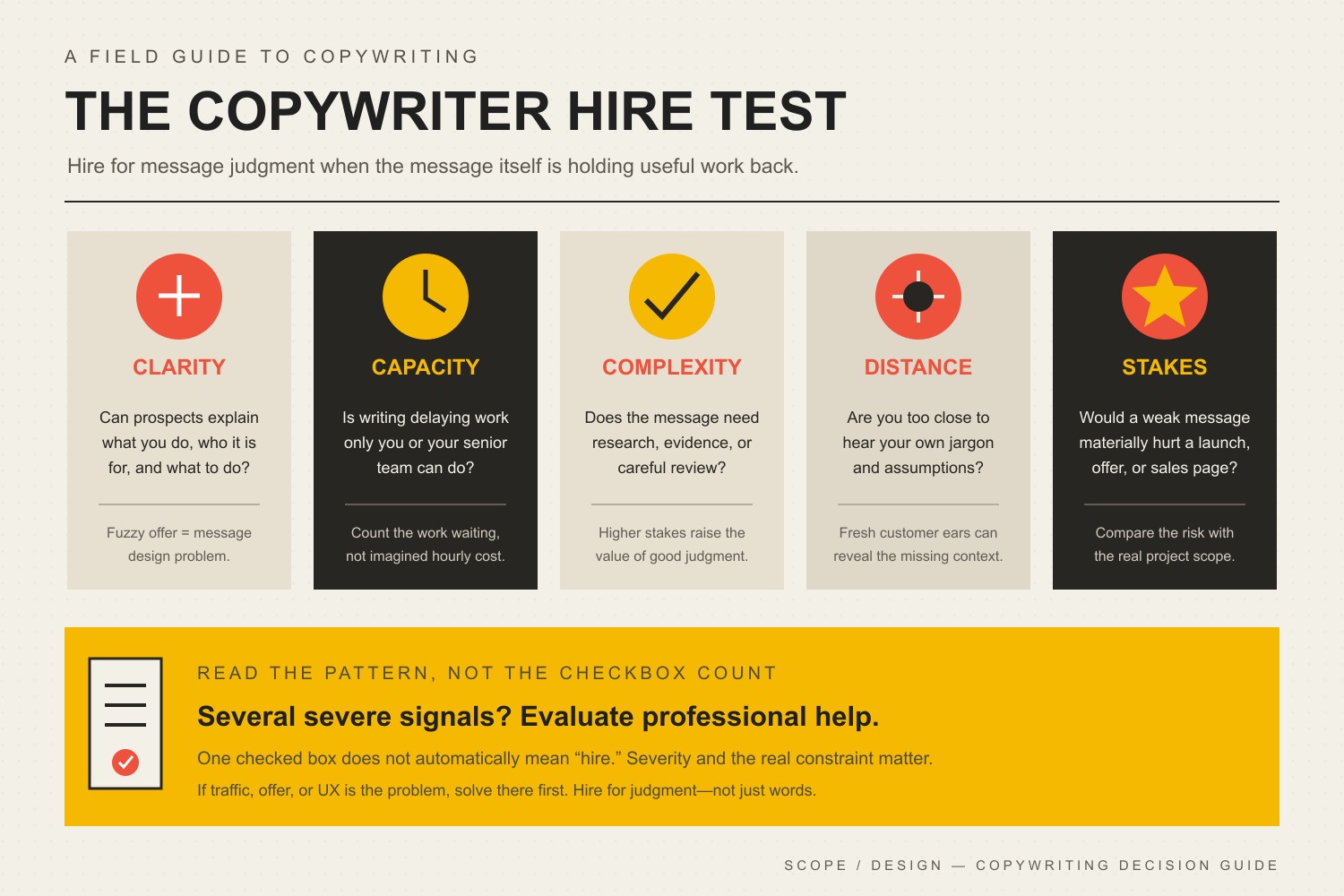
    TL;DR: The Copywriter Hire Test

    • Clarity: Prospects cannot quickly explain what you sell, who it is for, why it matters, or what to do next.
    • Capacity: Writing and rewriting are delaying higher-value work that only you or your senior team can do.
    • Complexity: The message requires customer research, technical accuracy, evidence, multiple reviewers, or careful handling of claims.
    • Distance: You are too close to the business to hear your own jargon, assumptions, and feature-heavy explanations.
    • Stakes: The copy sits on a launch, rebrand, core sales page, or major offer where confusion has a meaningful cost.

    One checked box does not automatically mean “hire someone.” Severity matters. But the more boxes you check, the stronger the case for professional help.

    The Copywriter Hire Test: 5 situations where professional help makes sense

    Five signals for deciding whether to hire a copywriter: Clarity, Capacity, Complexity, Distance, and Stakes. Several severe signals strengthen the case, but a checked box alone does not mean hire.

    1. Clarity: people reach the message but still do not understand the offer

    Clarity problems often hide in plain sight. You know what the company does, so your brain automatically fills in missing context. A new prospect does not have that luxury.

    A simple test is to ask whether a good-fit prospect can answer four questions after a quick read: What is this? Is it for me? Why should I care? What should I do next? If those answers are fuzzy, the problem is not “we need more words.” It is a message-design problem.

    That is where a professional copywriter should start with research rather than adjectives. Customer questions, sales objections, support conversations, competitor language, and actual behavior on the site all provide better raw material than an internal brainstorming session. Current Digital.gov plain-language guidance makes the same audience-first point: learn what users ask and need, then focus the content on what applies to them.

    Hire when: different people on your team explain the offer differently, prospects keep asking basic questions the page should answer, or your copy lists features without creating a clear decision path.

    2. Capacity: writing has become a bottleneck for higher-value work

    Being capable of writing your own copy does not mean you should write every piece of it. The real cost of DIY is not an hourly rate pulled from a calculator. It is what important work stops while the owner, founder, subject-matter expert, or marketing lead goes through another round of “maybe this headline is better.”

    For a low-risk announcement or rough first draft, internal writing or AI may be completely reasonable. But if a website launch is waiting on copy for three weeks, five people are rewriting the same paragraph, or the person with the most valuable expertise is spending half a day fighting a blank page, capacity has become a business constraint.

    Hire when: copy repeatedly misses deadlines, senior people are trapped in revision loops, or getting the message finished is more valuable than proving you can write it yourself.

    3. Complexity: the message needs research, evidence, or careful review

    Some copy is hard because the sentence is hard. More often, it is hard because the business decision behind the sentence is hard.

    Complexity rises when you have a technical offer, several audiences, multiple stakeholders, competing priorities, or claims that need evidence. A copywriter can help translate approved facts into language people can understand, organize the message, and keep reviewers from turning the final page into a committee-written casserole.

    There is an important boundary here: a copywriter is not a substitute for legal, compliance, medical, financial, or other qualified subject-matter review. In the United States, the FTC’s advertising guidance for small businesses says advertising claims must be truthful and non-deceptive and that advertisers need evidence to support express and implied claims. The writer’s job is to make approved truth clear—not invent proof that does not exist.

    Hire when: the work requires interviews, source review, claim substantiation, technical translation, or someone who can keep a complicated review process focused on the reader.

    4. Distance: you are too close to the business to hear your own assumptions

    Business owners usually know too much, not too little. That creates a strange communication problem: you stop noticing what a first-time buyer cannot possibly know.

    Internal shorthand becomes website copy. Features feel self-explanatory. Company history gets more space than the customer’s problem. The page answers the questions your team finds interesting instead of the questions a buyer needs answered.

    A good outside copywriter is useful partly because they are allowed to ask the “obvious” questions: Who is this really for? What changes after they buy? Why should they believe you? What objection is stopping the next step? What does the customer call this problem when nobody from your company is in the room?

    Hire when: your copy sounds accurate to insiders but confusing, generic, or jargon-heavy to everyone else.

    5. Stakes: the downside of a weak message is materially bigger than the cost of getting help

    Not every paragraph deserves a strategy workshop. Your core website, a rebrand, a new offer, a high-value sales page, or a campaign sending meaningful traffic to one decision deserves more care than a routine update.

    High stakes change the economics. If the message will be seen by thousands of prospects, reused across sales materials, or become the language your whole team repeats for the next two years, a cheap first draft can become expensive through repetition. The more durable and consequential the message, the more valuable research, hierarchy, and review become.

    Hire when: the copy will define how the market understands the business, support a major investment in traffic, or sit close to an important buying decision.

    When not to hire a copywriter yet

    This is the part many copywriting pages skip because it is bad for the hard sell and good for the reader: sometimes copy is not the problem.

    What you seeLikely constraintWhat to do first
    Almost no qualified prospects reach the pageTraffic or distributionFix acquisition and targeting before rewriting everything.
    People understand the offer but do not want itOffer or market fitRevisit the product, positioning, price, proof, or audience.
    People want the offer but cannot complete the taskUX or functionalityFix navigation, forms, checkout, mobile issues, or broken flows.
    People arrive, engage, but leave confused about value or next stepMessagingNow copywriting is a credible place to intervene.

    This constraint-first approach is part of our broader small-business marketing strategy: fix the system that is actually limiting growth instead of buying the next fashionable tactic. Our related copywriting guide goes deeper on the message-friction questions to diagnose before you hire.

    AI or a professional copywriter? Split the job, not the ideology

    AI changed the economics of drafting. It did not make every part of copywriting equally automatable.

    TaskAI can helpHuman ownership matters most when…
    Brainstorming angles or headline variantsYesYou need to choose the angle that matches real customer evidence.
    Summarizing approved source materialYes, with verificationAccuracy or nuance is consequential.
    Drafting low-risk routine copyOftenThe draft will represent the brand in an important decision.
    Interviewing customers or subject-matter expertsAssist with prep and synthesisFollow-up questions and interpretation matter.
    Building message hierarchyAssistYou must decide what the reader needs to believe, in what order.
    Choosing and validating proofAssist with organizationClaims require evidence and accountable review.
    Brand-voice governance and final judgmentAssist with consistency checksThe message is durable, high-stakes, or shared across channels.

    Google’s current guidance for generative-AI search makes a useful quality distinction too: it recommends unique, non-commodity content that adds genuine point of view and usefulness, rather than material that simply recycles what a generative model could produce. In practical terms, AI is excellent at accelerating parts of the work. It is a poor excuse for skipping the thinking.

    Formulas can help structure a draft, and AI can generate variations quickly. Our guide to copywriting formulas explains where structure helps and where diagnosis still matters. Use tools. Just do not confuse the tool with the decision-maker.

    What should a professional copywriter do before writing?

    If the process starts with “send me the word count,” you are probably buying typing, not strategic copywriting.

    1. Understand the business and offer. What is being sold, to whom, and what business outcome should the page support?
    2. Learn the audience’s language. Review customer questions, objections, interviews, reviews, support tickets, search behavior, and sales conversations when available.
    3. Decide the job of the page. One page should not try to teach everything, sell everything, and satisfy every stakeholder equally.
    4. Build the message hierarchy. Decide what comes first, what needs proof, what objections need answers, and what can wait.
    5. Gather and validate proof. Testimonials, data, examples, product facts, demonstrations, guarantees, and other evidence should support the claims being made.
    6. Write the full decision path. Headlines, body copy, proof, microcopy, and calls to action should work together rather than as disconnected “clever” lines.
    7. Revise after feedback without losing the reader. Stakeholder comments matter, but the final page still needs one coherent voice and purpose.

    That process is also why project pricing varies so much. The words are the visible output; the research and decisions behind them are most of the job.

    How to hire a copywriter without buying a mystery box

    Portfolios matter, but a polished sample cannot tell you how the work was produced. Before you hire a copywriter, ask questions that expose the process.

    • What do you need from us before you start writing?
    • Will you interview customers, salespeople, founders, or subject-matter experts when the project needs it?
    • How do you identify the main audience, objection, promise, proof, and next step?
    • How do you handle technical or regulated claims and source material?
    • What exactly is included: research, strategy, page copy, SEO considerations, microcopy, revisions, handoff?
    • How many stakeholders can review, and how do you consolidate conflicting feedback?
    • How will you work with the designer, developer, SEO team, or campaign owner?
    • What will we use to judge whether the finished copy is doing its job?

    The strongest answer is usually a process, not a promise that the writer has a secret vocabulary that “converts.”

    How much does it cost to hire a copywriter?

    There is no honest universal rate that tells you what professional copywriting should cost. A five-email sequence with supplied research is a different job from repositioning a technical company, interviewing customers, and rewriting a multi-page website.

    Price usually changes with the depth of research, number and type of deliverables, interviews, strategy work, SEO requirements, evidence and source handling, number of reviewers, revision scope, and how much responsibility the writer owns. Comparing two quotes by “price per word” can make wildly different scopes look falsely equivalent.

    A better comparison is: What thinking, research, deliverables, and revision responsibility am I actually buying? If you want a deeper explanation of that value, see our guide to what a professional website copywriter should actually do.

    Frequently asked questions about hiring a copywriter

    Do people still hire copywriters?

    Yes. The valuable part of the role is shifting away from “someone who can produce words” and toward research, audience understanding, message hierarchy, evidence, brand judgment, editing, and accountability. AI reduces the cost of a first draft; it does not eliminate the need to decide what the message should say or why anyone should believe it.

    Can I use ChatGPT for copywriting?

    Yes. It is useful for brainstorming, outlines, summarizing source material, generating variants, and rough drafts. The higher the stakes, the more important it becomes to verify facts, protect confidential information, validate claims, preserve brand voice, and have a qualified person own the final judgment. Google’s broader people-first content guidance also makes the core point that usefulness, originality, expertise, and trust matter more than whether a tool happened to generate part of the text.

    What exactly does a copywriter do?

    A professional copywriter should do more than write sentences. Depending on the project, the work can include discovery, customer and competitor research, interviews, positioning, message hierarchy, page structure, headlines, body copy, proof, calls to action, microcopy, editing, and revision with stakeholders.

    Is hiring a copywriter worth it?

    It is worth serious consideration when messaging is a meaningful constraint, the project is difficult to produce internally, and the consequence of weak communication is material. If the real bottleneck is traffic, the offer, or broken UX, spend there first.

    What is the 80/20 rule in copywriting?

    People often use “80/20” as shorthand for the idea that a small number of elements—such as the offer, headline, proof, and call to action—can do a disproportionate share of the work. Treat it as a prioritization reminder, not a fixed measurement or guarantee. Which elements matter most depends on the page, audience, and decision.

    When should I not hire a copywriter?

    Do not hire one just because writing is annoying. If almost nobody qualified reaches the page, fix traffic. If buyers understand the offer and still do not want it, fix the offer. If the site is confusing or broken, fix UX. Bring in copywriting when the message itself is a credible reason the right people are not moving forward.

    The decision: hire for judgment, not just words

    The strongest reason to hire a copywriter is not that you dislike writing. It is that the business consequence of a weak message now justifies better research and better judgment.

    Run the five tests: Clarity, Capacity, Complexity, Distance, and Stakes. If several are flashing red, professional help is probably worth evaluating. If none are, keep the work in-house, use AI where it saves time, and spend the budget on the constraint that actually matters.

    If you want help figuring out which problem you have before paying someone to rewrite everything, talk with Scope Design. If copy is the constraint, we can help research, structure, and write it. If it is not, the first useful answer should be to say so.

  • 5 Benefits of Hiring A Professional Copywriter for Your Website

    5 Benefits of Hiring A Professional Copywriter for Your Website

    Hiring a professional copywriter can make your website easier to understand, easier to trust, and easier to act on. The real benefit is not “better words.” It is a clearer path between what your customer needs and what your business can do about it.

    That matters because a website has a job. It needs to explain the problem you solve, show why your approach makes sense, answer the questions standing in the way, and make the next step obvious. A good website copywriter helps turn those jobs into a message a real person can follow.

    Quick answer: a professional copywriter is most useful when the message—not traffic, the offer itself, or site functionality—is slowing a qualified visitor’s path to action. The five practical benefits are clearer positioning, more customer-centered copy, a more consistent brand voice, SEO-aware people-first writing, and clearer next steps.

    There is an important caveat: copy is not magic. If your real constraint is no traffic, a weak offer, a broken checkout, or a slow site, rewriting headlines alone will not fix the business. Professional copywriting is most valuable when unclear messaging is part of the friction.

    Is hiring a professional copywriter worth it?

    It can be—especially when your website is asking prospects to make a meaningful decision. A professional copywriter brings an outside perspective, a repeatable research process, message hierarchy, brand-voice discipline, and experience turning complicated ideas into clear next steps.

    You are not paying someone to sprinkle adjectives over a page. You are paying for the thinking behind the page: Who is this for? What are they trying to accomplish? What is getting in their way? What do they need to understand or believe before they contact you, book, subscribe, or buy?

    1. You get a clearer message before you get clever wording

    Business owners know their companies too well. That expertise is valuable, but it can also make it difficult to see where a new visitor gets lost. Internal shorthand, industry jargon, feature lists, and company history can crowd out the one thing the visitor needs first: a clear explanation of what you can help them do.

    A professional copywriter should pull the message apart before putting sentences together. That means identifying the audience, the problem, the desired outcome, the strongest proof, the objections, and the action the page needs to support. Once those decisions are clear, the writing gets much easier—and usually much shorter.

    This is where outside perspective earns its keep. A copywriter can ask the “obvious” questions your team stopped asking years ago and spot gaps that are invisible from inside the business.

    2. Your website starts with the customer, not the company

    A common website problem is making the company the main character. The page opens with how long the business has existed, how passionate the team is, how many services it offers, and how proud everyone is of the work.

    Those details can matter, but only after the visitor understands why they should care. Strong website copy keeps the customer in the hero role. Your business is the guide: you understand the problem, you have a credible way forward, and you can help the customer reach the outcome they want.

    That shift changes the questions the page answers. Instead of “What do we want to say about ourselves?” the copywriter asks “What does the customer need to know next?” That is a much better organizing principle for a home page, service page, landing page, or sales page.

    3. Your brand sounds consistent from page to page

    Brand voice is not a collection of quirky phrases. It is a consistent way of communicating—how direct you are, how technical you get, how much personality you use, which words fit the brand, and which ones do not.

    Without that discipline, websites often sound like several different companies stitched together. The home page was written by the founder, the service pages by a freelancer, the about page by an employee, and the newest landing page by an AI tool. Each page may be acceptable on its own, but the experience feels uneven.

    A professional copywriter can establish the voice and apply it consistently across the site. Just as important, a useful copy process leaves behind decisions your team can reuse in future emails, proposals, ads, social posts, and sales materials.

    4. SEO and human-readable copy can support each other

    Search optimization and good writing are not competing goals. Google’s guidance emphasizes helpful, reliable, people-first content. That is a useful standard for website copy, too.

    An SEO-aware website copywriter can use search research to understand the language customers use, the questions they ask, and the intent behind a page—then work those ideas into useful copy naturally. The goal is not to repeat a keyword until the page sounds robotic. The goal is to make the page clearer to the person who searched and easier for a search engine to understand.

    That also means knowing when SEO is not the main job. A checkout confirmation page, a short lead form, or a highly targeted campaign landing page may have different priorities than an evergreen service page. Good copy starts with the page’s role instead of forcing the same formula everywhere.

    5. Every page gives visitors a clearer next step

    A website can be informative and still fail to move anyone forward. Visitors finish reading and think, “Okay… now what?” That is often a messaging problem, not a design problem.

    A copywriter should connect the promise of the page to a logical next action. That might be booking a consultation, requesting an estimate, choosing a plan, viewing a case study, subscribing, or buying. The call to action does not have to be loud. It does have to make sense.

    Clear calls to action work best when the rest of the page has done its job: the visitor understands the offer, sees how it connects to their situation, has enough proof to continue, and knows what will happen after the click.

    What should a professional website copywriter actually do?

    A website copywriter’s process should match the stakes and scope of the project, but useful work usually includes more than drafting.

    • Learning about the business, offer, audience, and goals.
    • Reviewing customer language, common objections, competitors, analytics, or sales conversations when those inputs are available.
    • Deciding what job each page needs to do and what information belongs there.
    • Building a message hierarchy so the most important ideas appear in the right order.
    • Writing headlines, body copy, proof, microcopy, and calls to action.
    • Using natural search language when SEO is part of the page’s job.
    • Revising after stakeholder feedback without losing the customer’s perspective.

    If you want to see how Scope approaches that work, our copywriting services cover website copy, landing pages, SEO-aware content, email, product copy, and related messaging.

    When copywriting is not the first problem to fix

    It is possible to have excellent copy on a website that still underperforms. If nobody is reaching the site, traffic may be the constraint. If people understand the offer but do not want it, positioning or the offer itself may be the problem. If interested buyers hit errors, confusing forms, or painfully slow pages, functionality and UX may come first.

    Use the Message Friction Test

    Before you hire a copywriter, ask one question: What is stopping the right visitor from taking the next step? Scope’s Message Friction Test separates four common bottlenecks so copy does not get blamed for the wrong problem.

    What you observeLikely constraintFirst move to investigate
    Qualified prospects are not reaching the page.Traffic or distributionAcquisition channels, targeting, discoverability, or demand.
    Visitors arrive but cannot quickly explain the offer, why it matters, or what to do next.Message clarity or positioningCopywriting, message hierarchy, proof, and calls to action.
    Visitors understand the offer but still do not want it.Offer or market positioningValue proposition, audience fit, proof, pricing, or the offer itself.
    Visitors want to continue but errors, slow pages, forms, or checkout get in the way.UX or functionalityFix the technical path before polishing the message around it.

    This is a diagnostic starting point, not a law of marketing. More than one constraint can exist at the same time. The goal is to find the first meaningful bottleneck instead of buying another tactic because it sounds useful. If the problem is broader than wording, start with our small business marketing strategy framework for diagnosing the system before buying more attention.

    If you are specifically trying to decide whether now is the right time to bring someone in, see our companion guide on five situations where hiring a professional copywriter makes sense.

    What to look for when hiring a copywriter

    Before you hire someone, ask questions that reveal how they think—not just how polished their portfolio looks.

    • How do you research an unfamiliar business or industry?
    • How do you get up to speed on the audience, offer, objections, proof, goals, and desired action?
    • How do you adapt to an existing brand voice?
    • How much SEO work do you include, and how do you avoid writing for an algorithm instead of a person?
    • What happens if your research suggests the page or offer needs a different approach than we assumed?
    • How does the revision process work?

    The answers should help you compare process, judgment, and scope—not just samples. A beautiful portfolio can show writing skill, but it cannot tell you whether the writer will ask the right questions for your business.

    Frequently asked questions about hiring a website copywriter

    What does a website copywriter do?

    A website copywriter researches the audience and offer, decides what each page needs to communicate, organizes the message, and writes the headlines, body copy, proof, microcopy, and calls to action that help a visitor make the next decision. Depending on the project, the work may also include interviews, competitor review, search research, voice guidelines, and revisions with stakeholders.

    Can a copywriter help with SEO?

    Yes, when search is part of the page’s job. An SEO-aware copywriter can use keyword and intent research to understand how people describe a problem and what they expect from the page. That can improve relevance and clarity, but no responsible copywriter can guarantee rankings, traffic, or leads from wording alone.

    How much does website copywriting cost?

    There is no useful universal price for website copywriting. Cost changes with research depth, the number and complexity of pages, interviews, strategy, SEO scope, revision rounds, and the number of stakeholders involved. Compare what the writer will actually research, decide, draft, and revise rather than relying on a generic per-word number.

    Should I use AI for website copy or hire a professional copywriter?

    AI can be useful for brainstorming, summarizing source material, exploring variants, and speeding up low-risk drafting when the inputs are good. A professional copywriter adds interviewing, prioritization, message hierarchy, brand-voice governance, editorial judgment, and accountability for the page’s job. The useful question is not “human or AI?” in the abstract. It is which parts of the work require research, judgment, and ownership—and where automation genuinely helps.

    When should I hire a professional copywriter?

    Hire one when unclear messaging is a meaningful constraint: prospects struggle to understand the offer, the site sounds inconsistent, important objections go unanswered, or pages do not lead naturally to a next step. If the first problem is traffic, the offer itself, or a broken user experience, fix or diagnose that constraint before assuming new copy is the answer.

    The bottom line

    The best reason to hire a professional copywriter is not that you dislike writing. It is that your website’s message has business consequences. Visitors need to understand what you do, why it matters to them, why they should believe you, and what to do next.

    When messaging is the constraint, professional copywriting can bring structure to that decision. It gives your website a clearer job, gives your brand a more consistent voice, and gives the customer a better path forward.

    If your website looks fine but the message still feels muddy, Scope Design can help diagnose whether copy is actually the problem—and, if it is, turn the strategy into words that do some work.