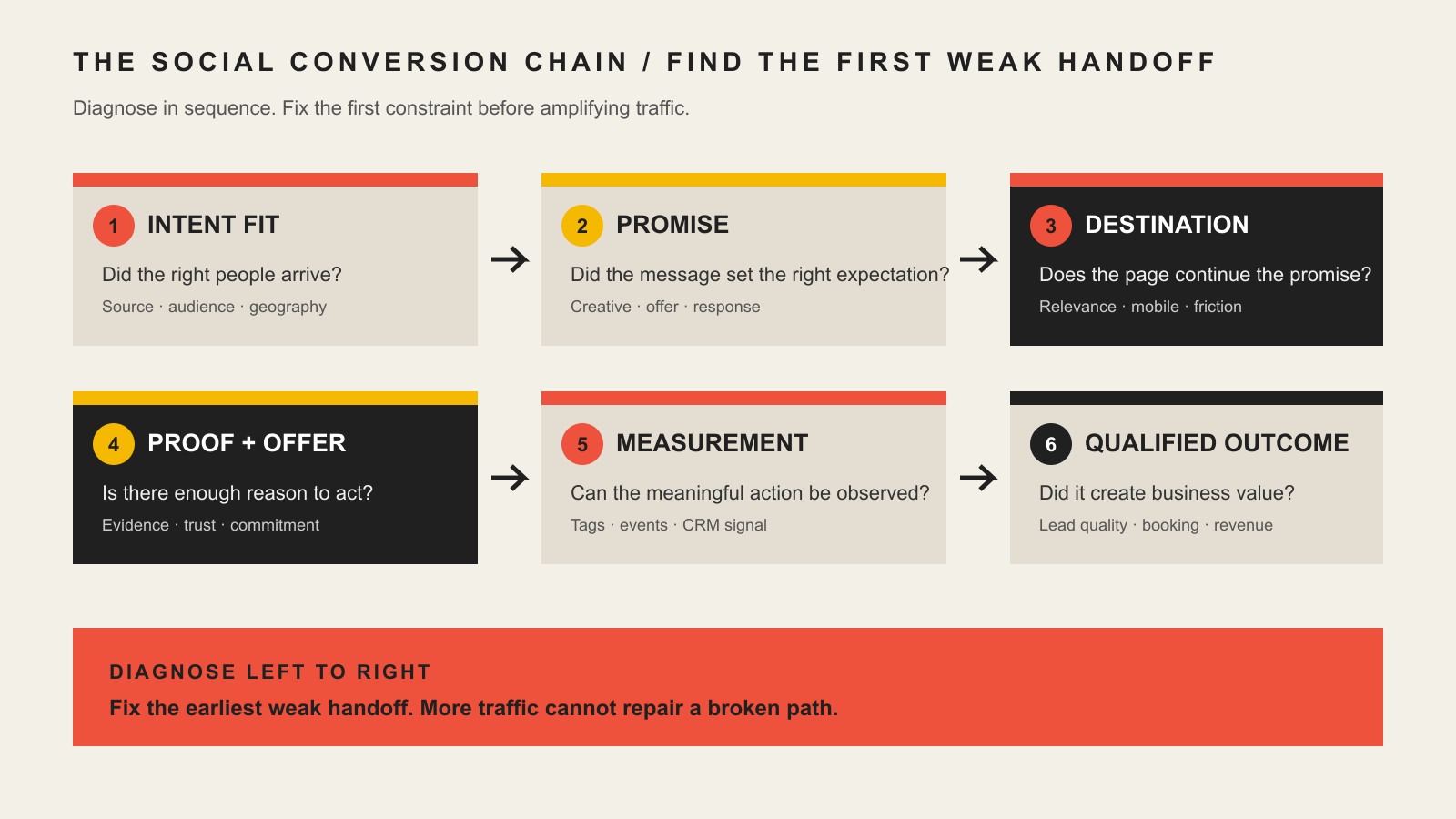
The best paid advertising strategy is not “pick a platform, turn on automation, and hope the dashboard turns green.” Build a measurable conversion chain, run one bounded experiment, and increase spend only when qualified outcomes—not cheap clicks—justify it. Paid ads can buy attention and evidence quickly. They cannot manufacture a good offer, repair a broken landing page, or make bad measurement tell the truth.
If you still need to decide whether paid media belongs in the mix at all, start with our broader online advertising strategy guide. This article owns the next decision: how to operate a paid campaign so the first dollars buy useful learning and later dollars scale something worth scaling. For the larger system around it, see our small-business marketing strategy.
TL;DR: Paid Advertising Should Buy Evidence Before It Buys Scale
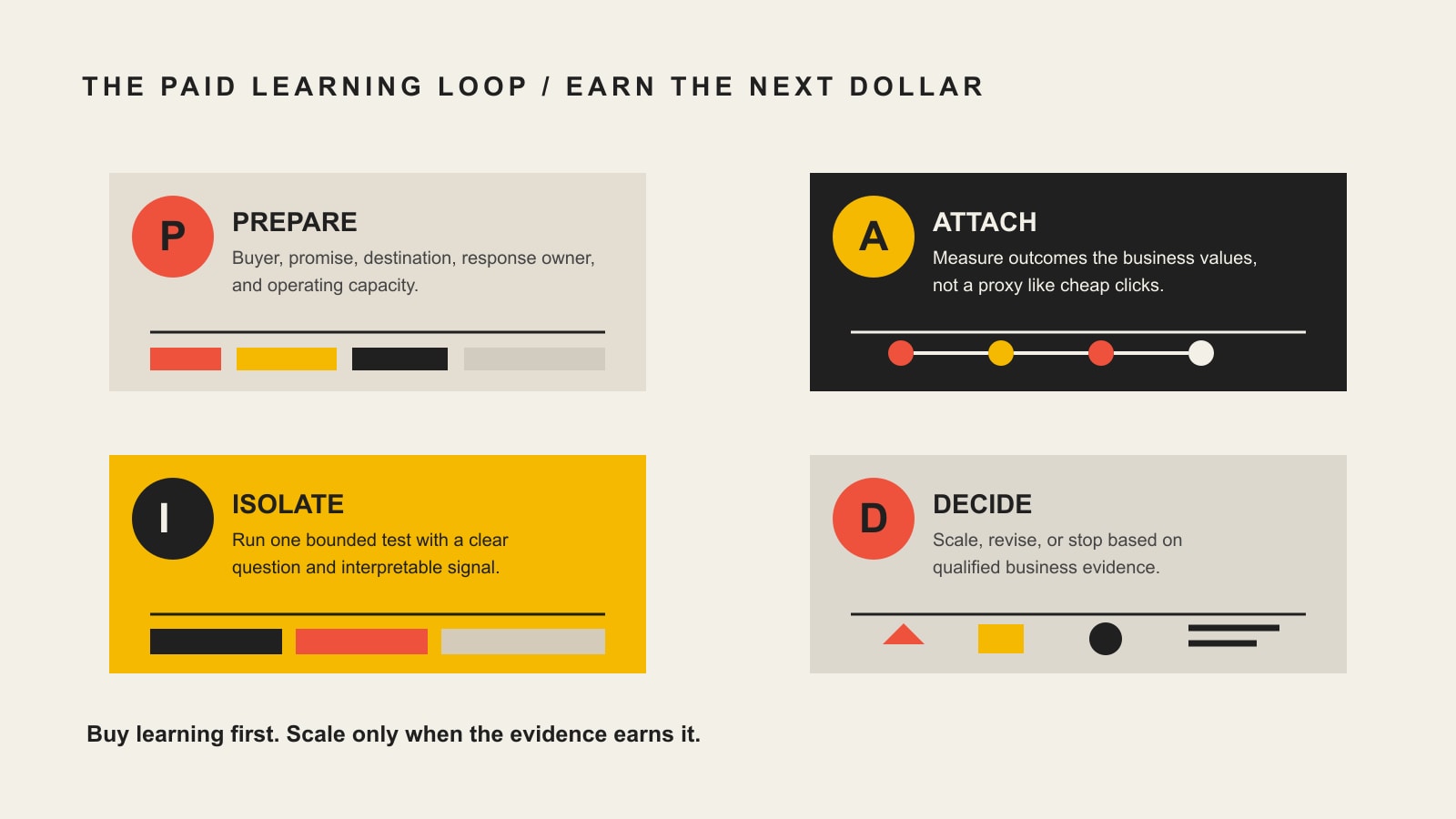
- Prepare the conversion chain before buying traffic: buyer, promise, destination, response owner, and operating capacity.
- Attach trustworthy outcomes so the platform learns from actions the business actually values, not just whatever event is easiest to count.
- Isolate a bounded test with one useful hypothesis, a spend boundary, and enough stability to learn.
- Decide from qualified economics: scale, revise the first weak link, or stop.
- Use automation to optimize a trustworthy signal. Do not ask an algorithm to infer your definition of a good customer from a pile of unqualified form fills.
Where Part IV Fits in the Marketing Strategy Series
Paid advertising belongs downstream of basic market and customer understanding. Part III of this series focuses on evidence about the market and the buyer. Once you have a plausible audience, offer, and channel hypothesis, paid media can become a controlled way to test that thinking.
This Part IV is deliberately not another tour of Google, Meta, Microsoft, LinkedIn, TikTok, and YouTube. Scope already has dedicated owners for channel selection and platform mechanics. Here, the question is operational: what has to be true before a campaign deserves money, what should the campaign learn, and what evidence earns the next dollar?
The final part of this series covers organic traffic generation and the longer-term assets that can reduce dependence on rented attention.
Why Paid Ads Often Fail Before the First Click
A campaign can be technically competent and still be a business failure because the weak link lives somewhere else. The real chain is longer than ad → click:
- Buyer: Are you reaching a plausible customer in a relevant moment?
- Promise: Does the ad make a clear, honest claim that matters to that buyer?
- Destination: Does the landing page continue the promise instead of making the visitor start over?
- Action: Is the next step appropriate for the buying stage?
- Response: Does a person or system actually handle the lead, purchase, call, or booking well?
- Economics: Is the qualified result valuable enough to justify acquisition cost and operating effort?
If the ad gets the click but the destination loses the promise, that is a conversion-rate optimization problem before it is a bidding problem. If the campaign generates inquiries but nobody follows up quickly or captures source and qualification data, the failure is in the handoff. Our direct response marketing guide goes deeper on building the measurable action path.
More traffic magnifies both good systems and bad ones with impressive fairness.
Build a Paid Advertising Strategy With the PAID Learning Loop
Scope Design uses the PAID Learning Loop to keep paid media from turning into a subscription to expensive confusion. PAID stands for Prepare, Attach, Isolate, Decide. It is a loop because every meaningful result changes what you know and what should be tested next.
P — Prepare the Conversion Chain
Before launch, write down what the campaign is supposed to connect. Name the buyer, the problem or desire, the offer, the promise, the destination, the desired action, the response owner, and the capacity constraint. If one of those fields is “we’ll figure it out after traffic arrives,” you have found a pre-launch risk.
The landing page does not need to be a twelve-section conversion cathedral. It needs to continue the ad’s promise, provide enough proof for the decision, make the next step obvious, and work on the devices people actually use. If the destination is weak, fix that before increasing reach.
Claims also need to survive contact with reality. The Federal Trade Commission’s advertising guidance for small businesses says advertising must be truthful and non-deceptive, objective claims need evidence, and ads cannot be unfair. Fake scarcity, invented savings, and claims you cannot substantiate are not “conversion psychology.” They are liabilities wearing marketing pants.
Finally, separate the campaign budget from the business’s total marketing budget. If you need to decide how much the company can responsibly devote to acquisition across channels, use our small-business marketing budget guide. The campaign budget is a smaller decision inside that constraint.
A — Attach Trustworthy Outcomes
Platforms can optimize only toward the signals they receive. That makes measurement part of campaign design, not cleanup work for Friday afternoon.
Google Ads describes conversion measurement around actions a business considers valuable, including purchases, sign-ups, calls, and other configured actions. Its conversion tracking guidance is a useful reminder to define the valuable action first and then implement the appropriate measurement. A click is evidence that somebody clicked. It is not automatically evidence of a qualified opportunity, profitable order, or good customer.
| Measurement layer | Useful question | Examples | What it cannot prove alone |
|---|---|---|---|
| Delivery | Did the platform serve and attract attention? | Impressions, reach, clicks, video views | That the traffic was qualified or profitable |
| Conversion | Did the visitor complete the defined action? | Form submit, call, booking, purchase, sign-up | That the action had business value |
| Qualification | Was the action from a plausible customer? | Qualified lead, valid order, sales-accepted opportunity | That the customer will close, retain, or be profitable |
| Economics | Did the outcome justify the spend and operating cost? | Gross contribution, qualified acquisition cost, tracked revenue, close rate | Perfect attribution across every touchpoint |
For lead generation, connect ad-source data to whatever qualifies the lead downstream when practical. For ecommerce, include cancellations, refunds, margins, and repeat behavior where they materially change the answer. If all conversions are reported to the platform as equally valuable, automation has no magical side channel where it learns which customers your sales team quietly hates.
I — Isolate a Bounded Test
A good paid test answers a decision. “Let’s run some ads and see what happens” is not a hypothesis; it is a receipt generator.
Choose one meaningful uncertainty at a time when possible: buyer segment, offer, message, destination, objective, or another major variable. Define the spend or time boundary you are willing to use for learning, the evidence you need, and the conditions that would make you continue, revise, or stop. Then give the campaign enough stability to produce interpretable evidence instead of changing five settings every morning.
There is no universal learning budget. A $20-per-day search test can be plenty in one low-cost local auction and nearly useless in a category where a single relevant click is expensive. The correct budget is the smallest amount the business can responsibly risk that still gives the test a realistic chance to produce decision-worthy evidence. If the likely spend required to learn is more than the business can afford to lose, that is a valid reason not to run the test.
The popular “70-20-10” split can be a planning heuristic in some contexts, but it is not a law of paid advertising and it does not override campaign economics. Do not force 70% of the budget into something merely because a tidy ratio looks strategic in a slide deck.
When the test gets platform-specific, use the specialist owner rather than treating one article as an encyclopedia. For Google Search, our Google Ads Quality Score guide explains relevance diagnostics without worshipping the score. For Meta, our Meta campaign objectives guide explains how objective and performance-goal choices tell the delivery system what behavior to seek.
D — Decide to Scale, Revise, or Stop
A paid campaign is not successful because cost per click fell. It is successful when the campaign’s job is being done at economics the business can support. That may mean profitable purchases, qualified appointments, sales opportunities, calls that turn into booked work, or another clearly defined outcome.
| Evidence pattern | Likely first diagnosis | Better next move |
|---|---|---|
| Relevant clicks, weak landing-page action | Promise/destination friction | Fix the destination before buying more traffic |
| Many form fills, poor lead quality | Targeting, message, offer, or qualification mismatch | Tighten who the campaign invites and what the form qualifies |
| Qualified leads, weak close rate | Sales handoff, response, offer, or downstream fit | Repair the sales path before blaming the ad platform |
| Good qualified outcomes at workable economics | Promising campaign-system fit | Scale cautiously and keep watching marginal quality and cost |
| Tiny sample with no stable pattern | Insufficient evidence | Keep the test stable if the learning boundary still makes sense |
| Boundary reached with no useful signal | Bad hypothesis or weak system | Stop or redesign the test instead of funding sunk-cost theater |
Scaling is not a victory lap. It is another test. More budget can change auction dynamics, audience quality, creative fatigue, response capacity, and the mix of customers you attract. The economics that worked at one spend level are evidence, not a lifetime guarantee.
Automation Is Powerful After the Signal Is Worth Optimizing
Google says Smart Bidding uses Google AI at auction time to optimize toward conversions or conversion value, and Google requires conversion tracking to use Smart Bidding. That is exactly why measurement quality matters. Google’s Smart Bidding guidance describes the machinery; your business still has to decide which result deserves to be fed into it.
Automation can process more auction signals than a human can and can make bidding adjustments continuously. What it cannot do reliably is invent your business definition of a qualified lead, decide whether an unprofitable customer is strategically valuable, repair a slow sales team, or know that a conversion event fires on the wrong page unless the data exposes the problem.
Platform language also changes. Google documented a June 2026 transition in how some Target CPA and Target ROAS options are labeled while saying the underlying bidding behavior remains the same. That is a useful operational lesson: learn the business logic behind the setting, not just the screenshot from last year’s tutorial.
Use the Right Paid Advertising Metrics for the Business Model
There is no universal “good ROAS” or “good conversion rate.” A 4:1 return on ad spend can be excellent for one business and terrible for another depending on gross margin, fulfillment, refunds, sales labor, repeat purchase, and what the revenue number actually includes.
Use platform metrics for diagnosis and business metrics for decisions:
- Search and social delivery: impression share, click-through rate, cost per click, reach, frequency, and engagement can help explain what the system is doing.
- Lead generation: cost per conversion should be paired with qualified-lead rate, sales acceptance, booked appointments, opportunity value, close rate, and response time where available.
- Ecommerce: tracked revenue and ROAS should be read alongside margin, average order value, refunds, repeat purchase, and acquisition cost.
- Long sales cycles: use staged outcomes such as qualified opportunity or pipeline movement rather than pretending every click can be assigned a final sale immediately.
- Capacity-constrained services: include whether the team can actually respond well to the volume being created.
The point is not to build a spreadsheet with seventy-seven columns. It is to create a short chain from spend to a business result that somebody owns.
Common Paid Advertising Mistakes That Waste the Learning Budget
- Optimizing for the friendliest metric. Cheap clicks are not a consolation prize if the business needs qualified leads or sales.
- Sending every ad to the homepage. The destination should continue the specific promise that earned the click.
- Changing too many variables at once. Constant tinkering makes it hard to know what actually improved or damaged the result.
- Turning on automation before validating the event. Fast optimization toward a bad signal is still bad optimization.
- Calling every form fill a lead. Qualification belongs in the measurement chain.
- Using platform-reported revenue as the whole business case. Margin, refunds, sales labor, fulfillment, and repeat behavior can change the economics.
- Scaling past response capacity. More demand can create a worse customer experience if nobody can answer, quote, fulfill, or follow up.
- Refusing to stop. A sunk cost is not evidence that the next dollar deserves to join it.
A Practical 30-Day Paid Advertising Operating Sequence
Thirty days is not a universal verdict window. Use it as an operating cadence for building the system and making the first disciplined review.
- Week 1 — Prepare. Confirm the buyer, offer, promise, destination, action, response owner, capacity, and the maximum learning loss the business is willing to accept.
- Week 2 — Attach. Implement and test conversion tracking, source capture, phone/form/booking paths, qualification, and downstream ownership. Confirm the event fires where it should.
- Week 3 — Isolate. Launch the bounded test, keep major variables stable long enough to learn, review obvious errors, and avoid panic-editing every morning.
- Week 4 — Decide. Compare delivery, conversion, qualification, economics, and capacity. Scale only the part that has earned more exposure; otherwise repair the first weak link or stop the test.
If the campaign is still too small or the buying cycle too long for a confident economics decision after that period, say so. “Not enough evidence yet” is a legitimate conclusion. Invented certainty is not.
Frequently Asked Questions About Paid Advertising Strategy
What is a paid advertising strategy?
A paid advertising strategy is the system for deciding what outcome paid media should produce, which audience and promise to test, where the attention should go, how results will be measured, what budget can be risked for learning, and what evidence will trigger a scale, revise, or stop decision. The platform setup is part of the strategy, not the whole thing.
How much should a small business spend testing paid ads?
There is no universal dollar amount. Set a loss boundary the business can responsibly absorb, then ask whether that amount can realistically generate enough relevant traffic or conversions to test the hypothesis in the chosen auction. If the minimum useful learning budget would strain cash flow, do not pretend the campaign is affordable just because the platform accepts a smaller daily budget.
Is $20 a day good for Google Ads?
It can be, but the number by itself says almost nothing. In a low-cost local niche, $20 a day might produce enough relevant activity to learn. In a competitive market with expensive clicks, it may produce too little data to judge the offer or campaign. Work backward from auction cost, realistic conversion volume, business economics, and the decision you need the test to answer.
What does the 70-20-10 rule mean in advertising?
Several marketing frameworks use a 70-20-10 split for different purposes, usually to separate proven activity, adjacent experimentation, and more speculative tests. It can be a discussion starter, not a law. A paid-advertising budget should follow the business’s risk tolerance, campaign economics, evidence quality, and opportunity set rather than a fixed ratio copied from somebody else’s deck.
When should a small business scale a paid advertising campaign?
Scale after the campaign produces enough qualified outcomes to show that the current economics are workable and the business has capacity to handle more. Increase gradually enough to notice whether lead quality, costs, conversion rate, or fulfillment changes. A campaign that works at one spend level has earned a larger test, not infinite budget.
What should you track before using automated bidding?
Track the conversion action the business genuinely wants the system to optimize, validate that it fires correctly, and connect that action to qualification or value when possible. For lead generation, that may mean distinguishing a qualified inquiry from any form submission. For ecommerce, it may mean using purchase value accurately and accounting for outcomes that materially change profitability.
What is a good ROAS for paid advertising?
A good ROAS is one that works with your actual gross margin, fulfillment cost, refunds, sales cost, repeat behavior, and growth goals. There is no responsible universal target. Treat ROAS as one ratio inside the economics, not as a magic score that makes an unprofitable customer profitable.
Should a small business use Google Ads or Meta Ads first?
Start with buyer behavior and the campaign job. Google Search can be strong when people already express high-intent demand. Meta can be strong when creative, audience signals, and demand creation or discovery matter. Neither platform is universally first. Use the broader channel-fit decision in our online advertising guide, then use the platform-specific objective and measurement guidance once the channel has a reason to exist.
Buy Learning First. Buy More Attention Only When It Earns It.
Paid advertising is valuable because it gives a business unusual control over audience, message, destination, timing, and spend. That control makes it a powerful testing system. It also makes it painfully easy to spend faster than you learn.
Use the PAID Learning Loop: prepare the chain, attach trustworthy outcomes, isolate a bounded test, and decide from qualified economics. If the campaign works, scale carefully. If the first weak link is the landing page, sales handoff, offer, tracking, or qualification, fix that. If the evidence says stop, stop.
If your paid campaigns are producing activity but nobody can clearly explain what deserves more budget, Scope Design can help audit the offer, destination, tracking, campaign structure, and measurement chain. The goal is not to make the ad account busier. It is to make the next dollar easier to justify.