
Tag: business validation

  • How to Start an Online Business With Less Risk: A Validation-First Guide

    How to Start an Online Business With Less Risk: A Validation-First Guide

    If you want to know how to start an online business with less risk, stop looking for a business that cannot fail. There is no universally safe model, guaranteed income timeline, or “hot” niche that removes uncertainty. A better goal is to make the next decision reversible: cap what you can lose, test one important assumption, and invest more only when real buyer behavior gives you a reason.

    That changes the starting question from “Which online business will make the most money?” to “What is the cheapest credible way to learn whether a specific buyer will pay for this?” If you are still deciding what to sell, start with Scope Design’s guide to generating business ideas. If you already have an idea, this guide helps you decide how much of a bet it has earned.

    What “low risk” actually means for an online business

    Online businesses can avoid some costs that come with a physical location, but “online” does not mean “free.” Your time has value. Domains, software, licenses, professional help, advertising, fulfillment, payment processing, inventory, and customer support can all become real expenses depending on the model.

    The U.S. Small Business Administration recommends calculating startup costs before launch because those costs affect profit estimates and break-even planning. Its startup-cost guidance explicitly includes online businesses and reminds founders to account for expenses such as market research, websites, marketing, licenses, and professional services.

    At Scope Design, we prefer a simpler operating definition: a low-risk launch is one where a failed test teaches you something useful without creating a loss you cannot comfortably absorb.

    Set a Risk Budget before you test

    Risk limitDecide this before launchWhy it matters
    Cash ceilingThe most cash you are willing to spend before reviewing the evidencePrevents a small experiment from turning into an open-ended build
    Time ceilingThe hours or calendar window you will give this version of the testMakes founder time visible instead of pretending it is free
    Dependency ceilingThe platforms, contracts, inventory, tools, or people you are willing to depend onReduces lock-in while the idea is still uncertain
    Decision dateThe date when you will continue, change, or stopStops “just one more month” from becoming the default strategy

    This is not a full startup budget. If you need to model the broader financial plan, use our guide to launching a startup under a constrained budget. The Risk Budget has one job: define how much uncertainty you can afford to buy with the next experiment.

    Choose the model you can validate—not the model someone calls “best”

    Search results are full of “best online business” lists. The problem is that risk moves around. A service may require little inventory but depend heavily on your time. A digital product may have low delivery cost but require substantial creation and audience work before demand is known. Ecommerce may create faster purchase evidence but add product, fulfillment, return, and supplier exposure.

    ModelWhat you can test earlyMain early exposureStronger proof signal
    Service or consultingA narrow paid pilot delivered manuallyYour time and sales accessA qualified buyer pays for a defined outcome
    Digital productA workshop, prototype, paid beta, or small first versionCreation time before demand is clearBuyers pay for the narrow version and use it
    Content / audience / affiliateA focused body of useful content around one buyer problemTime to earn attention and trustQualified traffic takes commercially meaningful actions
    EcommerceA small assortment, pre-order where appropriate, or limited batchInventory, fulfillment, returns, supplier dependenceReal orders with economics you can support

    There is no universal winner in that table. The better starting model is usually the one that lets you reach a specific buyer, make a real offer, and observe meaningful behavior without exceeding your Risk Budget.

    Use an Evidence Ladder instead of collecting compliments

    “That sounds cool” is not the same evidence as “Where do I pay?” Early validation gets stronger as behavior moves closer to an actual exchange of value. You do not need a magic number of interviews, clicks, or preorders. You need evidence strong enough for the size of the next commitment you are considering.

    1. Attention: people search, click, save, watch, or read. Useful for discovering interest, but weak proof of willingness to pay.
    2. Conversation: the right buyers describe the problem in their own words, ask specific questions, or reply to outreach.
    3. Commitment: someone books a call, joins a relevant waitlist, requests a quote, shares requirements, or gives you permission to follow up.
    4. Money-adjacent behavior: a buyer accepts pricing, requests a proposal, agrees to a paid pilot, or takes another action that carries real friction.
    5. Payment and repeat behavior: buyers pay, use the offer, return, refer others, or buy again under economics you can support.

    If you want a deeper pre-screen before you spend, our article on profit signals in business ideas is the better handoff. The key distinction is simple: trends can suggest where to look; behavior tells you whether your specific offer is earning the next bet.

    How to start an online business: the Scope Design Reversible Launch Ladder

    This is the sequence we recommend when an idea looks plausible but has not yet earned a large website, inventory purchase, software build, automation stack, or advertising budget. It turns the question of how to start an online business into a series of smaller decisions that can each be tested before the next commitment grows.
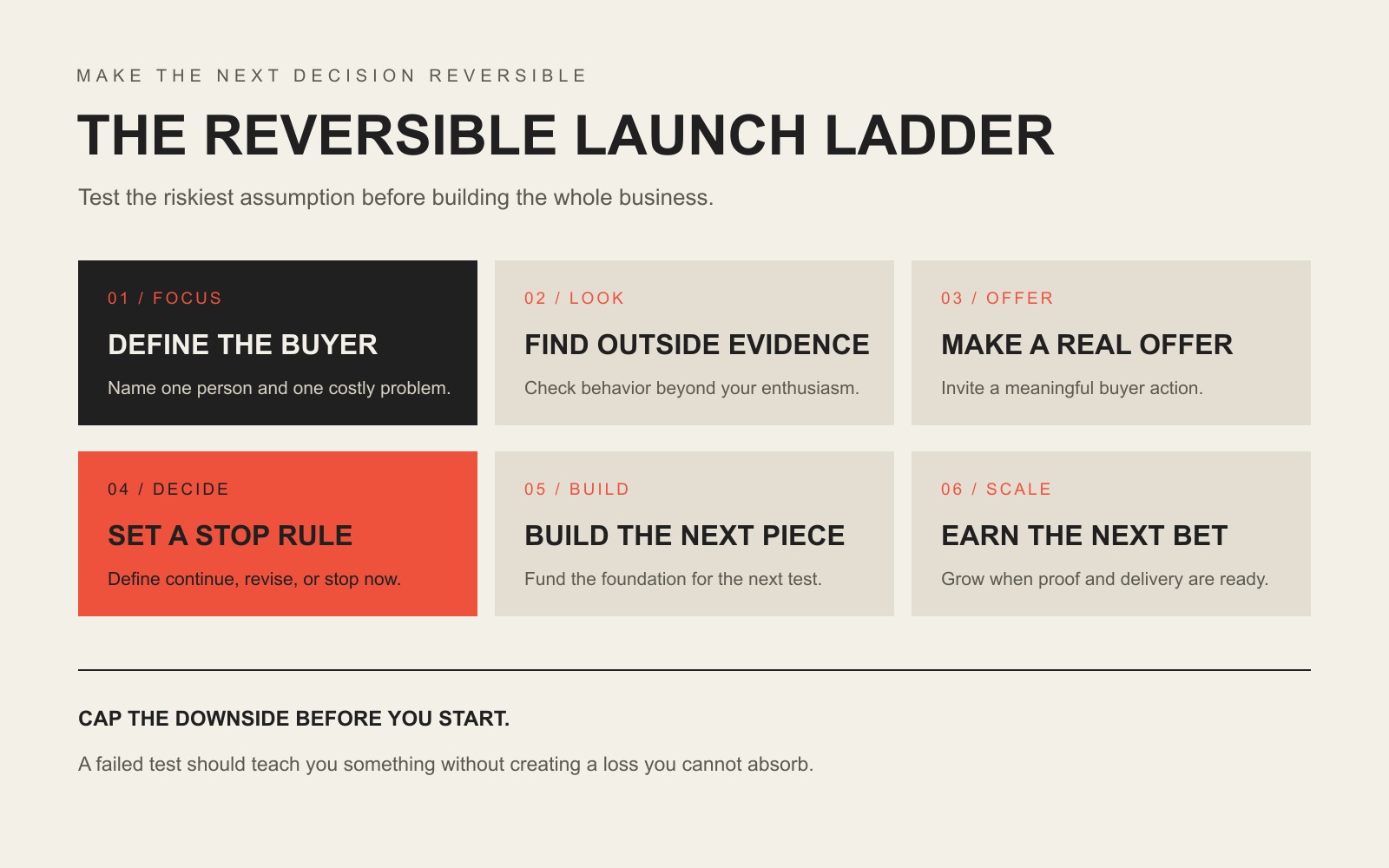
    The Reversible Launch Ladder: define one buyer, find outside evidence, make a real offer, set a stop rule, build only the next piece, and scale when proof supports it.

    1. Define one buyer and one problem

    “Small businesses” is not a buyer definition. “Independent HVAC companies that lose emergency-call leads after hours” is closer. Specificity makes research, outreach, pricing, landing-page copy, and validation less ambiguous.

    2. Look for evidence outside your own enthusiasm

    Look for existing spending, repeated complaints, search behavior, competitor demand, workarounds, active communities, and reachable buyers. The SBA’s current market-research guidance says market research can help confirm or improve an idea and reduce risk before a business launches. It specifically points founders toward questions about demand and market size.

    3. Make the smallest real offer

    Do not build the automated version first if you can test the value manually. Sell the smallest useful outcome. For a service, that may be a paid pilot. For a digital product, it may be a live workshop before a polished course. For ecommerce, it may be a small assortment rather than a warehouse of inventory.

    4. Set the stop/continue rule before results arrive

    Decide what would make you continue, change the offer, change the audience, or stop. Do this before you see results so you are less tempted to reinterpret every weak signal as proof you should keep spending.

    5. Build only the foundation the next test needs

    A simple owned foundation can be valuable: a domain you control, a clear landing page, professional email, a way to capture leads, basic analytics, and a reliable path to buy or contact you. It does not need to be a giant custom build on day one. When the offer has earned a stronger web presence, use our guide to creating a business website without buying the wrong thing.

    6. Earn the right to scale

    More traffic does not fix an offer people do not want. Before you add channels, ask whether the current experiment produced enough qualified demand and workable economics to justify the next cost. When it has, build your first measurable internet-marketing loop; after validation is stronger, move into startup growth experiments that earn the right to scale.

    When should you spend more on a website, automation, inventory, or ads?

    Spend more when the investment removes a constraint you have actually observed. A better website can make sense when qualified prospects need clearer proof, easier booking, stronger checkout, or better measurement. Automation can make sense when a repeatable process is consuming time. More inventory can make sense when proven demand is being constrained by availability. Ads can make sense when you have an offer and conversion path worth putting more people through.

    That is different from buying tools because a successful founder on YouTube uses them. Technology is leverage. Leverage is most useful after you know what deserves to be multiplied.

    If your next constraint is marketing rather than validation, Scope Design’s small-business marketing strategy guide shows how the larger system fits together.

    A seven-day validation sprint that does not promise seven-day profit

    You can learn a lot in a week if you keep the goal narrow. This is a learning sprint, not an income guarantee or a claim that every business can be validated in seven days.

    1. Day 1 — Define: write one buyer, one problem, one outcome, and one reason the problem matters now.
    2. Day 2 — Gather evidence: review search demand, competitor offers, communities, reviews, complaints, and existing spending. Write down what is observed versus what is assumed.
    3. Day 3 — Shape the smallest offer: define a narrow deliverable, price or pricing range, who it is for, and what it does not include.
    4. Day 4 — Create the minimum path: use a simple page, form, booking link, checkout, marketplace listing, or direct outreach script—whatever is sufficient for a credible test.
    5. Days 5–6 — Put it in front of the right people: ask for a real next action, not general feedback. Record objections and questions verbatim.
    6. Day 7 — Review against the stop rule: compare results with the Risk Budget and Evidence Ladder. Continue, change one major assumption, or stop.

    Six mistakes that make an “online” business riskier than it needs to be

    • Treating a booming trend as proof of your market. A trend can be interesting without producing a reachable buyer who wants your offer.
    • Building the finished system before testing the riskiest assumption. A polished website cannot validate a problem that does not matter enough.
    • Depending on one platform you do not control. Marketplaces and social platforms can be useful, but your domain, customer records, email permission, and core assets reduce unnecessary dependency.
    • Automating uncertainty. Automation makes a known process faster. It can also make a bad process fail faster.
    • Confusing attention with economics. Views, likes, and traffic are inputs. A business still needs revenue that can support the real costs of delivery and acquisition.
    • Starting with “passive income” as the operating requirement. Many models become more leveraged over time, but learning the buyer, offer, delivery, support, and acquisition system is active work.

    A note on affiliate and sponsored recommendations

    Affiliate revenue can be one monetization method, but it is not permission to recommend products you cannot stand behind. The Federal Trade Commission says material financial relationships should be disclosed clearly and conspicuously so readers can evaluate the endorsement. Its Endorsement Guides FAQ specifically addresses affiliate marketers who earn commissions through links.

    That is why this revision intentionally removes the old commission ranges, sponsorship-price ranges, subscriber-value claims, and fast-profit promises. Those numbers varied too much by business and lacked a defensible evidence chain for this article.

    Frequently asked questions about how to start an online business

    What is the best online business to start for beginners?

    There is no universal best model. A good beginner option is one where you understand the buyer, can reach them, can deliver the first version without large irreversible costs, and can ask for a meaningful commitment quickly. For some people that is a service; for others it is a product, content business, or small ecommerce test.

    Can I start an online business with no money?

    You may be able to test some service or audience ideas with very little cash, especially if you already own the necessary equipment and can reach buyers directly. But “no money” should not mean “no cost.” Your time, software, transaction fees, legal obligations, taxes, licenses, professional advice, fulfillment, and website needs can create real expenses. Build a Risk Budget instead of relying on a zero-cost promise.

    Do I need a website before I validate an online business idea?

    Not always. You can sometimes test demand through direct outreach, a marketplace, a simple booking page, a basic landing page, or a manual paid pilot. A website becomes more important when you need a durable home for your offer, proof, search visibility, lead capture, measurement, or transactions. The right question is not “website or no website?” It is “what minimum owned foundation does the next credible test require?”

    How do I know whether an online business idea can be profitable?

    Early interest is not proof of profit. You need buyers willing to pay, a price that can cover the real costs of delivery, and a repeatable way to acquire and serve customers without the economics collapsing as volume grows. Track revenue, direct costs, acquisition costs, fulfillment effort, refunds or churn where relevant, and the founder time the model requires.

    How can I make $10,000 a month online?

    Treat $10,000 as a target to model, not a promise. Work backward from price and gross contribution: how many customers, projects, memberships, orders, or transactions would the business need? Then ask whether your reachable market, delivery capacity, acquisition cost, and retention make that volume plausible. If the math depends on unrealistic conversion assumptions, change the model before increasing spend.

    What should I automate first?

    Automate the repeated, stable work you already understand: routine follow-up, scheduling, invoicing, reporting, content distribution, or data movement can be good candidates. Do not automate the part of the business that is still teaching you what customers want. Manual work is often valuable during validation because it exposes the questions, exceptions, and friction an automated system would otherwise hide.

    Start smaller—but make the test more real

    The goal is not to avoid every risk. It is to stop paying large prices for lessons you could have learned more cheaply.

    Define a buyer. Identify the assumption most likely to kill the idea. Set a Risk Budget. Ask for behavior stronger than compliments. Build only what the next proof step needs. Then invest more when the evidence earns it. That is the core of how to start an online business without confusing motion, tools, or trends with proof.

    If your offer has reached that point, Scope Design can help you turn the proven direction into a right-sized website and marketing system—without pretending more technology can substitute for market evidence.

  • The Hard Truths About Starting a Business: What Every Entrepreneur Must Know

    The Hard Truths About Starting a Business: What Every Entrepreneur Must Know

    The most important things to know before starting a business are not motivational slogans. They are the facts and decisions that keep uncertainty from becoming an expensive, irreversible problem. You do not need perfect certainty before you begin. You do need evidence that a specific customer has a real problem, enough financial runway to test the idea without threatening your essentials, and clear rules for what you will do if the evidence says “not yet.”

    That is the hard truth: entrepreneurship is a sequence of bets. Smart founders make the early bets small, measurable, and reversible. They save the big commitments—quitting income, borrowing, signing a lease, hiring full time, or building expensive systems—for the point when the evidence is strong enough to justify them.

    The hard truth: uncertainty gets expensive when it becomes fixed

    An idea can feel compelling long before it is commercially proven. Friends can love it. A survey can look positive. A logo can feel “real.” None of those things proves that enough customers will buy at a price that supports the business.

    The U.S. Small Business Administration puts market research, competitive analysis, business planning, and startup-cost calculation in the planning stage for a reason. Those activities reduce unknowns before the commitments get harder to unwind.

    This is also why we are not repeating the familiar claim that “90% of startups fail.” The Bureau of Labor Statistics publishes establishment age and survival data, and survival patterns vary by cohort, time period, industry, and economic conditions. A single universal failure percentage is not a useful decision rule for your business.

    Things to know before starting a business: the PAUSE Check

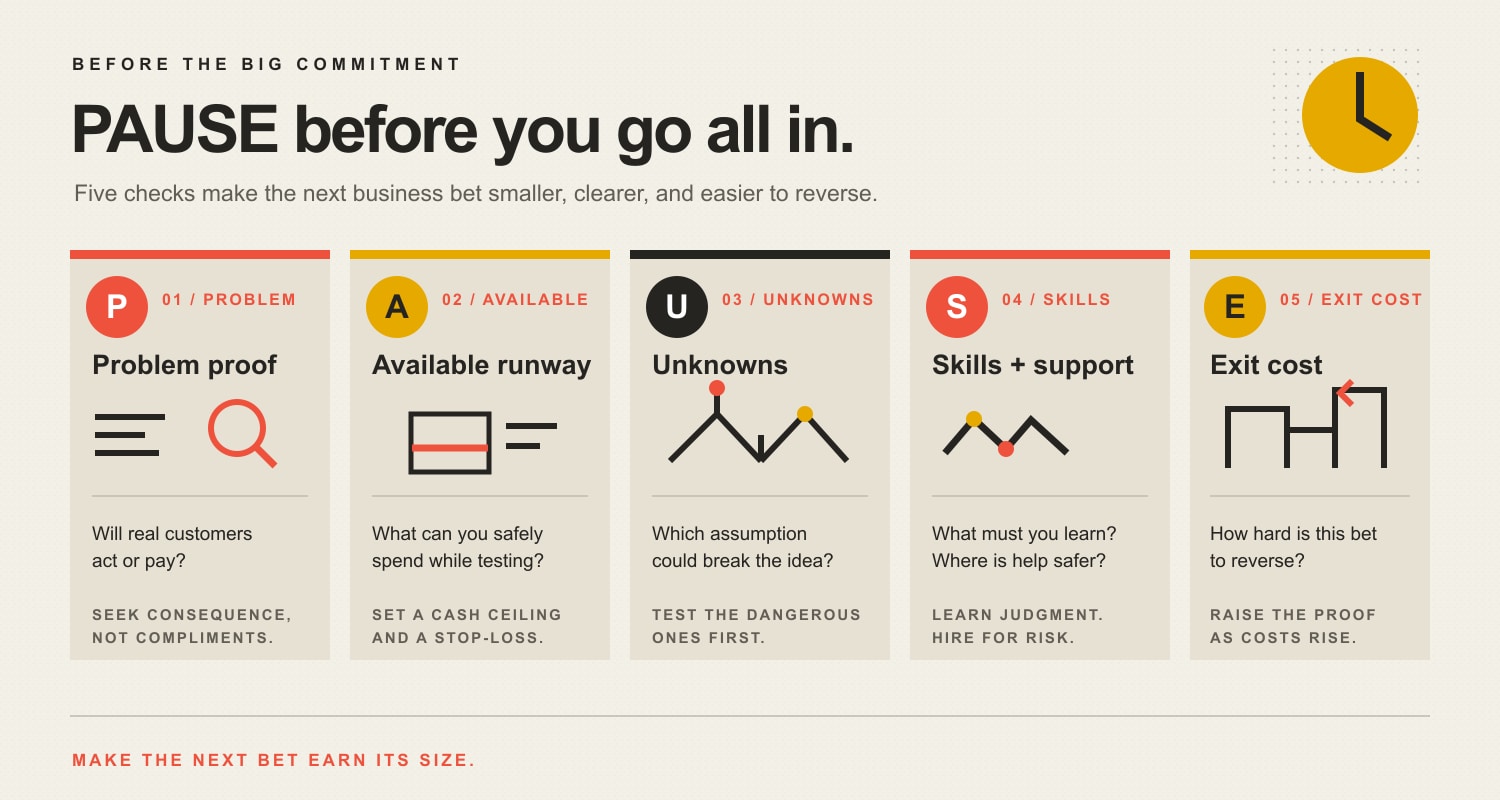
    At Scope Design, a more useful question is not “Am I brave enough to go all in?” It is “What would I need to know before this next commitment is rational?” We use a five-part decision check: PAUSE—Problem proof, Available runway, Unknowns, Skills and support, and Exit cost.

    The PAUSE Check: Problem proof asks whether real customers act or pay; Available runway sets a safe cash ceiling; Unknowns identify the assumption that could break the idea; Skills and support separate founder judgment from specialist risk; Exit cost raises the evidence threshold for hard-to-reverse decisions.
    The PAUSE Check helps separate cheap learning from expensive commitment.

    P — Problem proof

    What evidence shows a specific customer will act or pay? Start with the customer and the problem, not the business name, website, or product polish. Look for evidence with consequence: interviews that reveal an urgent problem, deposits, preorders, paid pilots, booked appointments, signed letters of intent where appropriate, or repeat requests from the same type of buyer.

    Compliments are weak evidence because they cost the customer nothing. If demand is still uncertain, use market research to learn how customers describe the problem, what they use now, what triggers a purchase, and what would make them switch. Then validate the business idea with the smallest test that can prove or disprove the riskiest assumption.

    A — Available runway

    What can the business spend without threatening your personal essentials? Startup money and personal survival money are not the same pool. Before you spend, separate one-time setup costs, recurring business costs, and the household obligations that still exist while revenue is uncertain.

    Set a hard cash ceiling and a stop-loss rule before enthusiasm moves the line. A useful startup budget prioritizes legal, safety, delivery, and revenue-enabling costs first, while delaying expensive polish until demand justifies it.

    U — Unknowns

    Which assumption could break the idea fastest? Most early businesses have unknowns around demand, price, acquisition channel, delivery time, capacity, repeat purchase, or required capital. Write them down. Rank them by how damaging they would be if wrong. Test the dangerous unknowns before the cosmetic ones.

    A fast launch is only useful when it buys learning. Speed that locks you into the wrong lease, wrong hire, wrong software stack, or wrong offer is not momentum. It is an expensive way to avoid a question.

    S — Skills and support

    What judgment must you learn, and where is specialist help safer? Founders should understand the core logic of their business: customer, offer, price, economics, sales process, and delivery. That does not mean doing every job personally.

    Our rule is learn the judgment, buy risk-sensitive expertise, delay polish. Learn enough marketing to judge a message and channel. Learn enough bookkeeping to understand cash and margins. But use qualified legal, tax, accounting, licensing, insurance, or other regulated specialists when the downside of being wrong is materially higher than the cost of expert help. Outsource execution when a specialist can do it faster without hiding the decision logic from you.

    E — Exit cost

    How hard is this decision to reverse? Early-stage uncertainty calls for reversible commitments. Month-to-month tools are safer than long contracts. A pilot is safer than a full rollout. Part-time or contract capacity can be safer than a premature full-time hire. A pop-up or sublease can test location demand before a long lease.

    The more expensive a decision is to undo, the more evidence it should require. If you are wrestling with a high-stakes choice, use a formal business decision-making framework instead of treating urgency as proof.

    What should you prove before the big commitments?

    CommitmentProve firstLower-risk testWhat to postpone
    Quit your jobRepeatable demand, credible delivery capacity, personal runway, and a written stop/go ruleSell during defined side-business hours, run paid pilots, or reduce hours if feasibleTreating one strong month as permanent demand
    Borrow moneyExactly what the money buys and how conservative cash flow could repay itStage spending by milestone; pre-sell where appropriateDebt used mainly to make the business look established
    Sign a leaseLocation-dependent demand and unit economicsPop-up, shared space, appointment model, or short-term subleaseLong fixed occupancy cost before traffic is proven
    Hire full timeRecurring workload, process clarity, and enough margin to support the roleContractor, part-time help, or a documented processHiring because the founder feels busy rather than because a stable constraint exists
    Build custom technologyA repeated workflow bottleneck and clear user demandManual service, spreadsheet, prototype, or low-code processComplex software built to automate a business model that is still changing

    Seven hard truths every entrepreneur should know

    1. Enthusiasm is not demand

    You can be deeply committed to the idea and still be wrong about the buyer, timing, price, or channel. The founder’s job is not to defend the original concept. It is to discover which version customers will actually choose.

    2. Revenue is not the same as runway

    A sale can be encouraging without making the business financially safe. Cash timing, delivery costs, taxes, refunds, inventory, payroll, debt, and owner living expenses all matter. Track the cash that remains available after obligations, not just the top-line number that feels good to report.

    3. Speed matters only when it buys learning

    “Move fast” is good advice when the action produces information. Interviewing five target customers this week can create evidence. Buying a year of software because you plan to need it someday does not. Early speed should shorten the feedback loop, not increase the exit cost.

    4. Doing everything yourself is not automatically frugal

    Founder time is a scarce resource. If you spend twenty hours avoiding a specialist fee while neglecting sales, delivery, or customer learning, the “free” option may be the expensive one. The goal is not maximum DIY. It is retaining judgment while allocating work to the person best equipped to do it.

    5. Fear does not disappear when the decision is right

    You do not need to eliminate fear before acting. Name the feared outcome, separate facts from assumptions, bound the downside, and choose the next reversible test. Our guide to dealing with fear in business goes deeper on making uncertainty actionable without pretending confidence is evidence.

    6. Irreversible decisions deserve a higher evidence threshold

    A $50 experiment and a five-year lease should not require the same confidence. Neither should a weekend test and quitting a stable income source. Raise the evidence threshold as the financial, legal, operational, or personal exit cost rises.

    7. Starting a business changes your responsibilities, not your biology

    Entrepreneurship can change how you spend time, make decisions, and think about risk. It does not make employment psychologically impossible, guarantee a permanent identity shift, or prove that your brain has been “rewired for success.” Those claims are more dramatic than useful. A better question is what operating role you actually want. If that is unclear, compare the practical differences between a business owner and an entrepreneur.

    Learn it, hire it, or postpone it?

    One of the hardest early decisions is deciding what deserves your time. Use this triage:

    If the work…Best defaultWhy
    Shapes customer, offer, price, sales, or delivery judgmentLearn enough to own the decisionYou need to recognize good evidence and make tradeoffs even if someone else executes.
    Carries material legal, tax, accounting, licensing, safety, insurance, or technical riskHire qualified expertiseThe cost of a serious mistake can exceed the cost of professional help.
    Is repeatable execution with clear inputs and outputsDelegate or automate when economics justify itYour time may be more valuable on sales, customer learning, or the current bottleneck.
    Mainly makes an unproven business look polishedPostpone itPolish should follow evidence, not substitute for it.

    A 30-day readiness sprint before you go all in

    Of all the things to know before starting a business, the most useful are the ones you can test before they become fixed costs. If the idea is still mostly assumptions, spend a month buying evidence instead of buying infrastructure. The goal is not to “finish” the business. It is to make the next decision better.

    1. Week 1: define the problem. Write the specific customer, painful situation, current workaround, and trigger that would make someone seek a solution. Interview people who actually fit that description.
    2. Week 2: test the offer. Put a real price and clear outcome in front of the right buyers. Look for consequential behavior—bookings, deposits, pilots, preorders, introductions, or clear rejection reasons—not just positive comments.
    3. Week 3: test delivery and economics. Deliver manually if possible. Record time, direct costs, rework, customer questions, acquisition effort, and what would break if demand doubled.
    4. Week 4: decide with rules you set in advance. Define the evidence that means continue, revise, postpone, or stop. Do not move the threshold after the result simply because you are emotionally attached to the idea.

    If the test exposes a weak assumption, that is useful information—not a personal verdict. Fix the assumption while the cost is still small.

    Frequently asked questions before starting a business

    How much money should I have before starting a business?

    There is no responsible universal number. A home-based service, inventory-heavy retailer, restaurant, and software company have different startup and operating needs. Calculate business setup and recurring costs, personal living obligations, and a downside scenario. Then set a cash ceiling you can afford before revenue becomes dependable. The amount should come from your business model and runway, not a generic internet average.

    Should I quit my job before starting a business?

    Usually the better question is what evidence would make quitting rational. Look for repeatable demand, a believable delivery model, defined personal runway, and a written stop/go rule. If the business can be tested without immediately giving up income, that preserves optionality while you learn.

    Do 90% of startups really fail?

    Do not use that number as a universal planning fact. Official U.S. business-survival data are measured by establishment cohorts and vary across years, industries, and economic conditions. Your decision is better served by testing demand, economics, cash requirements, and reversibility than by applying one dramatic percentage to every kind of new business.

    What should I learn before starting a business?

    Learn enough to judge the customer problem, offer, pricing, sales process, unit economics, cash position, and delivery process. You do not need to become an expert in every supporting discipline. Build the judgment required to supervise specialists and recognize when regulated or high-risk work belongs with a qualified professional.

    How do I know whether my idea has real demand?

    Look for behavior that costs the customer something: time, money, effort, a change in routine, or a commitment to proceed. Interviews can reveal the problem and buying trigger; paid pilots, deposits, preorders, or booked appointments can test willingness to act. The exact test depends on the business, but the principle is consistent: seek evidence stronger than compliments.

    What should I outsource first?

    Start with work where the downside of an error is high or where specialist execution clearly frees you to work on the current constraint. Legal, tax, accounting, licensing, insurance, and specialized technical issues often deserve qualified help. For marketing, design, and operations, retain enough understanding to judge the strategy even when you delegate execution.

    The bottom line

    The hard truths about starting a business are less cinematic than “go all in.” Customers do not owe an idea demand. Cash does not care how confident you feel. Fear can coexist with a good decision. Specialist help can be cheaper than a preventable mistake. And the evidence required should rise with the cost of reversing the decision.

    If you remember one list of things to know before starting a business, make it practical. Before the next major commitment, PAUSE: prove the Problem, protect Available runway, identify the biggest Unknowns, choose the right Skills and support, and measure the Exit cost. If the next step is cheap, reversible, and likely to teach you something important, take it. If it is expensive and hard to undo, make it earn a higher level of proof.