Tag: Business Strategy

  • How Entrepreneurs Stay Competitive: Mastering Business Adaptation in the Digital Age

    How Entrepreneurs Stay Competitive: Mastering Business Adaptation in the Digital Age

    Business adaptation is the discipline of changing how your business operates when the assumptions underneath it stop matching reality. It is not a race to adopt every new platform, AI tool, sales tactic, or design trend. The goal is simpler: notice meaningful change early, decide whether it affects a real customer or operating constraint, test the smallest useful response, and keep only what improves the business.

    That distinction matters for entrepreneurs because change creates two risks at the same time. Move too slowly and customer expectations, competitors, costs, or technology can pass you. Move too quickly and you can burn time and money modernizing things that were not actually broken. Competitive businesses learn to manage both risks.

    Business adaptation in 60 seconds

    • Adapt to evidence, not novelty. A trend matters when it changes customer behavior, economics, risk, or your ability to deliver.
    • Diagnose before you buy. Find the constraint first; choose the website change, process, automation, offer, or tool second.
    • Protect reversibility early. Small tests are easier to learn from and cheaper to undo than company-wide transformations.
    • Measure an outcome. Activity is not proof. Decide what should become faster, easier, more reliable, more profitable, or more valuable to the customer.
    • Scale selectively. A successful experiment earns a larger commitment; a weak one earns a lesson and a stop decision.

    Why business adaptation is a decision problem, not a technology shopping list

    When business owners hear “adapt,” the conversation often jumps straight to tools: install a CRM, add a chatbot, rebuild the website, automate follow-up, launch another channel, or replace a manual process with AI. Any of those could be useful. None is automatically adaptation.

    The better starting point is an operating question: What changed enough that one of our old assumptions is now costing us? Maybe prospects now expect an answer within hours instead of days. Maybe a once-reliable referral channel has slowed. Maybe staff are spending too much time re-entering the same information. Maybe customers reach the website on mobile and cannot complete the next step. Maybe margins changed enough that an old offer no longer makes sense.

    The U.S. Small Business Administration recommends combining market research and competitive analysis to understand customers and identify competitive advantage. That is useful here because adaptation starts with a signal you can explain—not with the existence of a new tool.

    Once the signal is real, use your business strategy as the filter. The question is no longer “Should we use this technology?” It becomes “Does this capability solve a problem that is important enough to change how we work?”

    The ADAPT Loop: a practical business adaptation framework

    At Scope Design, a useful way to make adaptation concrete is the ADAPT Loop: Acknowledge the signal, Diagnose the constraint, Act with a small bet, Prove with evidence, then Tune, scale, or terminate. The loop is deliberately simple. It keeps the business moving without pretending every change deserves a transformation program.
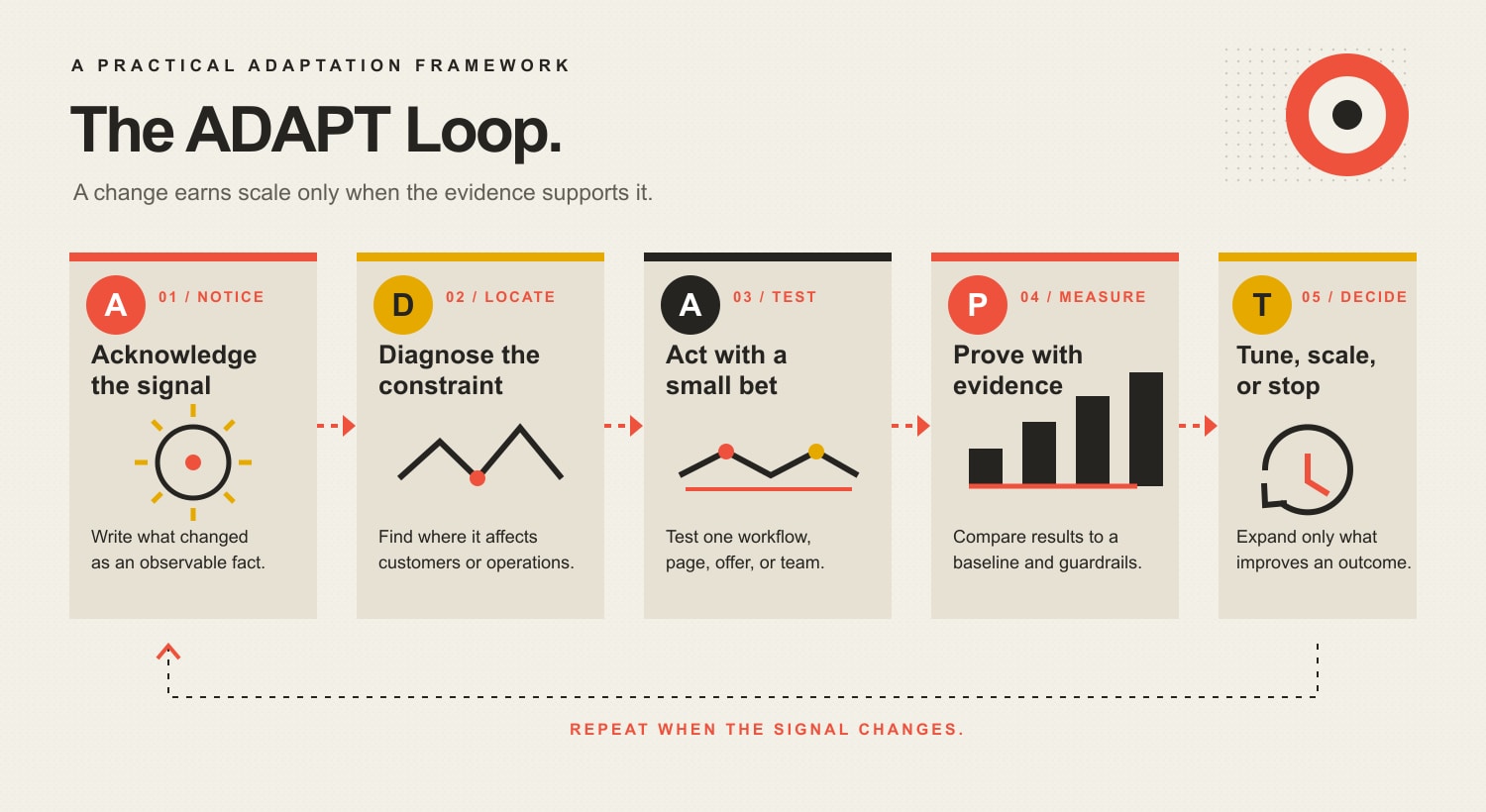
    The ADAPT Loop: Acknowledge a meaningful signal, Diagnose the real constraint, Act with a small reversible test, Prove the outcome against a baseline and guardrail, then Tune, scale, or terminate.
    The ADAPT Loop turns change into a repeatable decision cycle instead of a series of disconnected upgrades.

    A — Acknowledge the signal

    Start with something observable. A useful signal is a repeated change in customer behavior, demand, economics, regulation, competition, delivery capacity, or available technology. One complaint is a story. A pattern of the same complaint, lost opportunity, delay, workaround, or cost increase is a signal worth investigating.

    Write the signal as a sentence that separates fact from interpretation: “Qualified prospects are waiting two business days for a first response,” or “More customers are asking to book without calling,” is stronger than “We need AI” or “Our website feels old.”

    D — Diagnose the constraint

    Ask where the signal actually hurts. Is the constraint awareness, conversion, delivery, handoff, capacity, trust, margin, or retention? This step prevents a common failure mode: solving a visible symptom in the wrong system.

    For example, a lead problem may not require more marketing if inquiries are already arriving but getting lost between first contact and follow-up. In that case, the better adaptation is likely in the customer lifecycle and handoff process, not another traffic campaign.

    A — Act with the smallest reversible bet

    Make the first move small enough that you can learn without creating a new dependency. Before rebuilding an entire sales system, test a shorter intake flow. Before automating every customer message, automate one repeated handoff. Before expanding an offer, sell the narrow version manually. Before redesigning an entire site, test the page or path where the constraint is happening.

    Reversibility is a strategic advantage. A small bet gives you permission to be wrong cheaply. That is very different from being timid: you are buying information before buying scale.

    P — Prove with outcome evidence

    Decide what success means before the experiment starts. Pair one business outcome with one leading indicator. If the change is supposed to improve lead response, the leading indicator might be median first-response time and the business outcome might be qualified conversations started. If it is supposed to reduce administrative drag, measure time reclaimed and whether error or rework rates stay acceptable.

    The point is not to build a giant dashboard. It is to make the change falsifiable. If nothing meaningful improves, do not manufacture a success story from clicks, logins, generated content, or hours of “activity.”

    T — Tune, scale, or terminate

    After the test, choose one of three moves. Tune when the direction is promising but the implementation needs work. Scale when the benefit is repeatable and your team can support the larger operating load. Terminate when the evidence is weak, the hidden cost is too high, or the change solves a problem customers do not value.

    Stopping is not failure. A disciplined stop protects attention for the next signal and preserves the lesson for future decisions.

    What should entrepreneurs adapt first?

    Prioritize the change closest to a meaningful constraint, not the one with the loudest marketing around it. This table shows how to translate common signals into a testable next move.

    SignalLikely constraintSmallest useful testEvidence to watch
    Prospects repeatedly ask for faster answersLead-response handoffCreate one routed intake path with a response owner and deadlineResponse time and qualified conversations
    Staff copy the same information between toolsOperational frictionAutomate one stable, repetitive handoffTime saved, error rate, exceptions created
    Customers cannot complete an important website action reliablyDigital journey or technical foundationFix and test that path before redesigning everythingSuccessful completions and support friction
    A competitor introduces a feature customers begin requesting from youChanged customer expectationPrototype the minimum version or service equivalentAdoption, willingness to pay, retention or conversion effect
    An offer sells but creates weak margin or delivery strainBusiness-model economicsTest scope, price, packaging, or qualification on a subsetContribution margin and delivery load

    Notice what is missing from the table: “Everyone else is using it.” Competitor behavior is evidence only when it changes the market you actually serve.

    When adaptation becomes digital modernization

    Digital modernization is useful when the diagnosed constraint lives in a digital system. If leads are getting lost because there is no reliable handoff, the answer may involve CRM or automation. If staff repeat predictable work that can be safely standardized, AI automation workflows may be worth testing. If a slow, brittle, or confusing website blocks a customer from taking the next step, the problem may require stronger business website development.

    But modernization is a means, not a goal. A new stack that adds integrations, training, exceptions, security exposure, and maintenance can make the business less adaptable if it does not remove a real constraint.

    Risk belongs in the decision, too. The National Institute of Standards and Technology maintains Cybersecurity Framework 2.0 resources for small businesses to help organizations manage and reduce cybersecurity risk. When an adaptation changes how sensitive data, accounts, integrations, or critical processes work, security and recovery requirements should be part of the test—not an afterthought.

    What should you not change?

    Adaptability does not mean instability. Some parts of the business should stay boring when they are still doing their job. Keep a proven process until there is evidence that it is constraining the business. Keep a clear brand promise until customer or market evidence shows it no longer fits. Keep reliable infrastructure unless a replacement improves an outcome enough to justify migration risk.

    A useful “not now” list protects this discipline. For every adaptation you approve, write down the attractive ideas you are deliberately postponing and why. That makes strategy visible. It also stops the business from reopening the same shiny-object debate every week.

    How to measure whether business adaptation is working

    Measure at three levels so an improvement in one area does not hide damage somewhere else:

    • Customer outcome: Did the experience become easier, faster, clearer, more trustworthy, or more valuable?
    • Operating outcome: Did the change reduce delay, manual effort, rework, failure points, or dependency on one person?
    • Business outcome: Did it improve qualified demand, conversion, retention, margin, capacity, cash flow, or another result that matters to the model?

    You do not need all three to move at once. You do need to know which one the change was designed to affect and which guardrail must not get worse. If customer response becomes faster but errors double, the test is not finished. If automation saves time but creates low-quality customer interactions, the efficiency gain is incomplete.

    For customer-facing changes, define a small set of customer success metrics that someone can actually own. The best metric is not the one that looks sophisticated; it is the one that changes the next decision.

    Five business adaptation mistakes that make change more expensive

    1. Treating novelty as urgency

    A capability can be impressive without being relevant. Ask what customer behavior, economic condition, delivery constraint, or risk changed before you put it on the roadmap.

    2. Buying the system before defining the problem

    Tool selection feels like progress because it produces demos, pricing tables, and implementation tasks. But a vaguely defined constraint turns every product into a plausible answer. Diagnose first so you can reject most options quickly.

    3. Making the first experiment too large

    A company-wide rollout can hide what actually caused the result. Start with the smallest customer segment, workflow, page, or team that can give you useful evidence.

    4. Measuring activity instead of value

    More automations, more posts, more features, more dashboards, and more AI-generated output are not business outcomes. Track the constraint you intended to change.

    5. Scaling faster than the operating system can absorb

    A test can work in a controlled environment and fail at volume. Before scaling, ask what new exceptions, support needs, data dependencies, quality checks, and ownership requirements appear when usage multiplies.

    A 30-day business adaptation sprint

    You do not need a transformation committee to practice business adaptation. A focused month is enough to turn one meaningful signal into evidence.

    Week 1: Capture signals and establish a baseline

    • Collect repeated customer questions, lost-sale reasons, delays, workarounds, cost changes, and competitor moves.
    • Choose one signal tied to a meaningful constraint.
    • Record the current outcome so you have something to compare against.

    Week 2: Design the smallest reversible test

    • Define the one assumption you are testing.
    • Limit the test to one segment, workflow, offer, page, or team when possible.
    • Name the success metric, guardrail, owner, and stop condition in advance.

    Week 3: Run the test and log exceptions

    Do not “optimize” halfway through every uncomfortable result. Let the test run long enough to observe behavior, while recording exceptions, customer confusion, team friction, and edge cases that averages can hide.

    Week 4: Tune, scale, or stop

    Compare the result with the baseline and the guardrail. Then make a decision. If the test worked, document what made it work before expanding. If it did not, record the lesson and close the experiment. A finished “no” is more valuable than a zombie pilot that consumes attention indefinitely.

    When outside help is worth it

    Entrepreneurs should keep the decision close to the business, but implementation does not have to be entirely internal. Outside help is usually worth considering when the constraint crosses specialties, the change is expensive to reverse, security or data risk is material, or the team lacks the capacity to test without disrupting normal operations.

    The useful role of a partner is not to sell “modernization.” It is to help translate the diagnosed constraint into the smallest sensible implementation, identify dependencies, build the test correctly, and leave you with evidence you can act on. If your adaptation decision points to the website, customer journey, automation, analytics, or the systems connecting them, Scope Design can help turn the diagnosis into a scoped plan without treating every new tool as mandatory.

    Frequently asked questions about business adaptation

    What is business adaptation in simple terms?

    Business adaptation means changing an important part of how your company works because the environment around it changed. The change could involve an offer, process, customer experience, technology, pricing, channel, or operating model. The key is that the change responds to evidence, not fashion.

    Why is adaptation important in business?

    Because the assumptions that made a business effective do not stay true forever. Customer expectations move, costs change, competitors improve, regulations evolve, and technology creates new capabilities. Adaptation gives the business a repeatable way to respond without rebuilding everything every time conditions shift.

    What is a good example of business adaptation?

    Imagine a service business notices that qualified prospects increasingly ask to schedule online, but the company still requires a phone call. Instead of launching a full digital transformation, it tests online booking for one service, measures completed bookings and no-show rates, gathers feedback, and then decides whether to expand it. That is adaptation: a changed customer expectation produced a bounded response and a measurable decision.

    Is adopting AI automatically business adaptation?

    No. AI becomes part of business adaptation when it addresses a diagnosed customer or operating constraint and improves a defined outcome within acceptable quality, risk, and maintenance limits. Installing an AI tool because competitors mention AI is technology adoption, not proof of adaptation.

    How often should a small business adapt?

    Continuously scan for meaningful signals, but do not confuse constant observation with constant change. Review customer friction, operating bottlenecks, economics, competitive moves, and new capabilities on a regular cadence that fits your market. Make a change when the evidence shows an assumption is no longer serving the business—not because a calendar says a modernization project is due.

    Staying competitive means getting better at change—not doing more of it

    The most adaptable entrepreneur is not the one with the longest software list or the fastest reaction to every trend. It is the one who can tell the difference between noise and a meaningful signal, connect that signal to a real constraint, make a small move, learn quickly, and commit only when the evidence earns a larger bet.

    That is the practical advantage of the ADAPT Loop: acknowledge, diagnose, act, prove, tune. It turns business adaptation from an occasional panic response into a repeatable management habit—and keeps modernization subordinate to what customers and the business actually need.
  • How to Turn Business Mistakes Into Growth Opportunities That Drive Success

    How to Turn Business Mistakes Into Growth Opportunities That Drive Success

    Business mistakes do not automatically make a company stronger. A bad hire, failed launch, lost client, pricing error, or expensive assumption only becomes useful when it changes what you do next.

    That is the difference between having experience and learning from experience. The mistake is the event. The growth opportunity is the evidence you extract, the system you change, and the next bounded test you run.

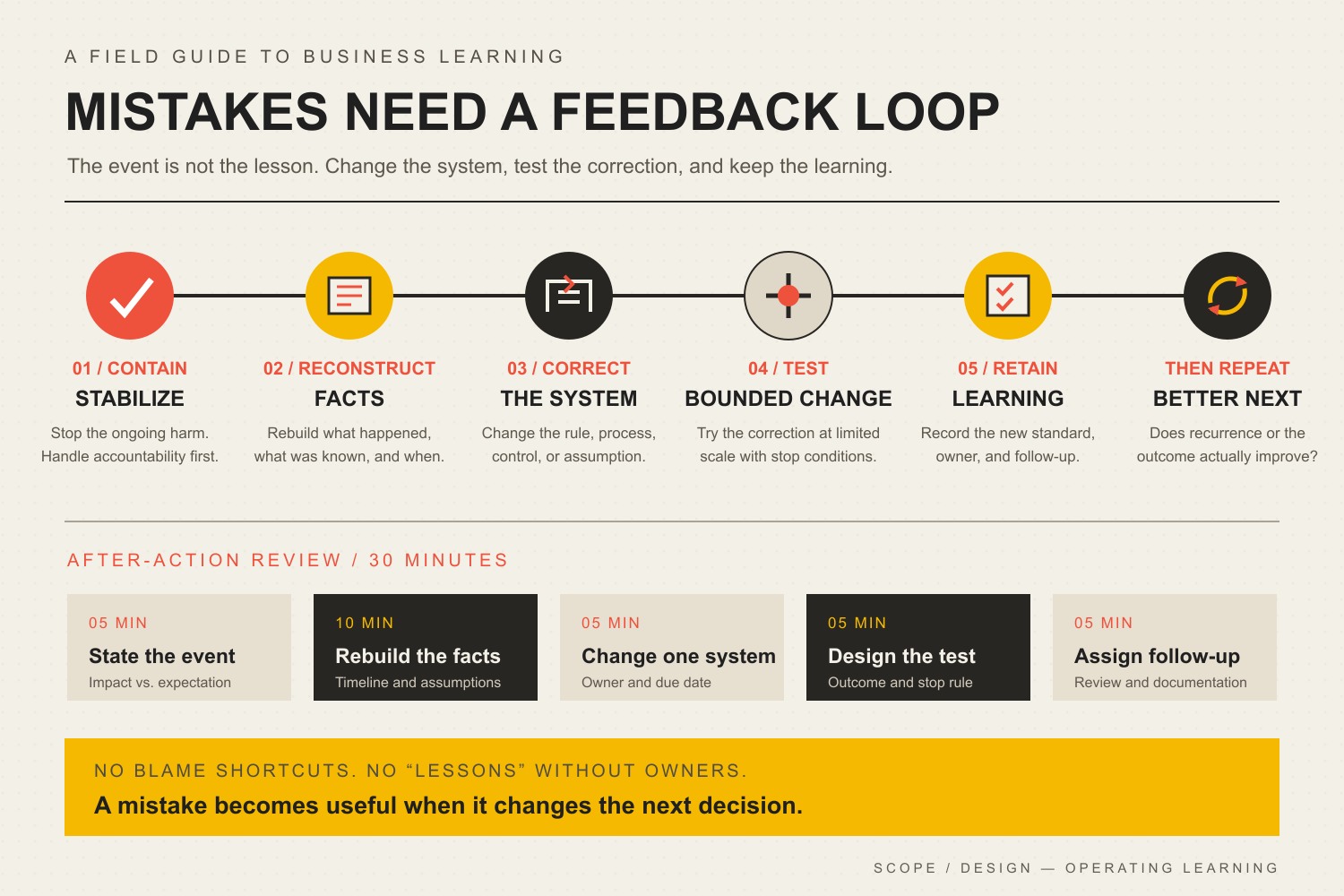
    The short version: stabilize the damage, reconstruct what actually happened, identify the system or assumption that failed, make one concrete change, test that correction, and preserve the lesson so you do not pay tuition for the same mistake twice.

    Mistakes Do Not Create Growth. Feedback Loops Do.

    “Learn from your mistakes” sounds sensible, but it is incomplete advice. Plenty of businesses repeat the same problem with a slightly different customer, employee, campaign, vendor, or quarter.

    The useful question is not, “What lesson should I take from this?” It is, “What will be different in the business because this happened?”

    • If a proposal keeps getting misunderstood, change the proposal or sales process.
    • If a project became unprofitable because scope drift went unnoticed, change the checkpoints, pricing assumptions, or change-order rules.
    • If a product launch missed the mark because the team guessed at demand, change how you validate an idea before making a larger bet.
    • If one person could make an expensive error with no review, change the control—not merely the reminder to “be more careful.”

    This systems-first idea is not limited to business. Google’s SRE postmortem guidance emphasizes concrete, owned, measurable actions after incidents and warns that vague action items are easy to forget. OSHA’s incident-investigation guidance similarly recommends looking beyond immediate blame to underlying causes and corrective actions that reduce recurrence. A small business does not need an enterprise incident-management department to use the same principle: fix the conditions that made the mistake possible.

    The Five-Step Mistake-to-Growth Loop

    Use this loop after a meaningful mistake—something that cost money, trust, time, momentum, or strategic clarity. The goal is not to create paperwork. The goal is to produce three useful outputs: a defensible lesson, a system change, and a next test.

    Five steps for learning from a business mistake: stabilize damage, reconstruct what happened, change the system, run a bounded test, and preserve the learning.

    1. Stabilize the Damage Before You Analyze It

    When a mistake is still causing damage, analysis can wait. Stop the leak first.

    • Pause the campaign that is spending badly.
    • Contact the client whose expectations were missed.
    • Correct the invoice, access setting, price, schedule, or fulfillment problem.
    • Preserve records you will need to understand what happened.
    • Escalate legal, safety, security, tax, or compliance issues to the right professional instead of treating them as an experiment.

    Containment matters because an open problem distorts the review. Everyone becomes focused on defending themselves, pleasing the loudest stakeholder, or stopping the immediate pain. Stabilize first; learn second.

    2. Reconstruct What Actually Happened

    Memory becomes a storyteller very quickly. Reconstruct the mistake from observable facts before deciding what it “means.”

    Write down:

    • What did we expect to happen?
    • What actually happened?
    • What did we know when the decision was made?
    • What did we assume?
    • What signals did we miss, dismiss, or never collect?
    • Where did the outcome first diverge from the plan?
    • What made the problem larger or harder to detect?

    This is where you separate a bad outcome from a bad decision. Sometimes the decision was reasonable and the environment changed. Sometimes the outcome exposed an assumption you never tested. Sometimes execution was sloppy. Those are different failures and require different fixes.

    If the real issue is that your team struggles to make the choice in the first place, use a separate business decision-making framework. This article starts after there is an outcome to learn from.

    3. Change the System, Not Just the Story

    A lesson such as “communicate better,” “plan more,” or “do more research” is not a system change. It is a wish.

    Ask which part of the business needs to change:

    • Decision rule: What condition will make us say yes, no, stop, or escalate next time?
    • Process: What step, review, handoff, or checkpoint was missing?
    • Control: What should require approval, validation, backup, or a second set of eyes?
    • Assumption: What did we believe without enough evidence?
    • Signal: What leading indicator should we watch earlier?
    • Capability: Do we need better training, tooling, expertise, or role clarity?

    The best corrective action changes the environment in which future decisions are made. “Remember not to do that again” depends on memory. A new review step, pricing rule, alert, checklist, data field, contract clause, or validation threshold changes the system.

    4. Run a Bounded Test Instead of Swinging to the Opposite Extreme

    One painful mistake can make a business overcorrect. A bad employee leads to refusing to delegate. One weak campaign kills marketing for a year. One difficult client creates an approval process that punishes every good client.

    Do not let one data point become a permanent doctrine. Turn the correction into a bounded test:

    1. State what you changed.
    2. State what result you expect.
    3. Choose the smallest useful place to test it.
    4. Define what would count as success, failure, or “we still do not know.”
    5. Set a review date.

    This makes the lesson falsifiable. You are not trying to prove that your new idea is right; you are trying to make the next decision with better evidence.

    5. Preserve the Learning So the Company Gets Smarter

    If the insight lives only in the owner’s head, the company has not learned—one person has.

    Keep a simple mistake log or after-action note. It does not need to be a novel. Record the event, evidence, lesson, system change, owner, test, and recheck date. Link it to the process or decision it changed.

    Over time, this creates institutional memory. New team members do not have to rediscover why a rule exists. Repeated failures become visible. And when an old rule stops making sense, you can see the evidence that created it and decide whether the context has changed.

    Classify the Mistake Before You Choose the Lesson

    Not every bad outcome deserves the same response. A quick classification prevents you from solving the wrong problem.

    Type of mistakeWhat it usually meansUseful response
    Execution errorThe plan was sound, but the work broke downClarify ownership, sequence, training, checklist, or quality control
    Process/control failureThe system allowed an avoidable error to pass uncheckedAdd a review, approval, alert, backup, or handoff rule
    Assumption failureYou believed something important without enough evidenceImprove research, validation, or early signal collection
    Strategy errorThe business chose the wrong market, offer, priority, timing, or resource allocationRevisit the decision criteria and run a smaller next bet
    External shockThe environment changed in a way you could not reasonably controlImprove resilience, optionality, detection, or contingency planning

    Classification also protects you from hindsight bias. A reasonable decision that lost because the market changed is not the same as a decision that ignored obvious evidence. The lesson should fit the failure.

    Be Blameless About Causes and Accountable About Actions

    “Blameless” does not mean nobody owns anything. It means the review is designed to understand why the outcome made sense to the people involved at the time, then fix the conditions that should change.

    A productive review can say, “This action was wrong and caused damage,” without stopping at, “Jordan messed up.” Ask why the error was possible, why it was not caught, what information was missing, what pressure existed, and what safeguard failed.

    Then make the follow-up extremely accountable. Every corrective action should have an owner and a verifiable end state. “Improve onboarding” is fog. “Add a pre-launch QA checklist to every new client project and require the project lead to sign it before launch” can actually be completed.

    And if a painful mistake has made you afraid to make another move at all, solve that problem separately. Our guide to overcoming fear in business deals with the uncertainty and avoidance that can follow a setback.

    When a Business Mistake Is Not a “Growth Experiment”

    There is a limit to the “mistakes are opportunities” idea.

    Do not romanticize harm. An ethical breach, safety issue, security incident, discrimination complaint, tax problem, legal violation, or knowingly repeated negligence is not clever experimentation. The first obligations are to stop the harm, make appropriate restitution, preserve evidence, report or disclose what is required, and get qualified help where necessary.

    You can still learn from what happened. But “growth opportunity” should never become an excuse to minimize consequences or dodge accountability.

    Measure Whether the Lesson Actually Changed the Business

    There is no universal benchmark for how quickly a company should learn from a mistake. A two-person service firm, a manufacturer, and a software company have different risks and cycles. Measure improvement against your own baseline and the specific failure you are correcting.

    • Recurrence: Did the same failure happen again?
    • Time to detect: Do you notice the warning signal earlier?
    • Time to correct: Can you contain and fix the issue faster?
    • Corrective-action closeout: Did the agreed changes actually get implemented?
    • Cost of repetition: Is the financial or operational impact falling?
    • Test result: Did the changed process or assumption improve the outcome you cared about?

    Those metrics turn “we learned a lot” into something observable. They also reinforce a broader truth about sustainable business growth: progress usually comes from better decisions compounding, not one dramatic breakthrough.

    A 30-Minute After-Action Review for Small Businesses

    You do not need a retreat, facilitator, or 40-page report. For many mistakes, 30 focused minutes is enough if you leave with decisions.

    1. 5 minutes — State the event. What happened, what was the impact, and what did we expect instead?
    2. 10 minutes — Reconstruct the evidence. Timeline, assumptions, signals, contributing conditions, and what was known at each point.
    3. 5 minutes — Identify the system change. Which rule, process, control, assumption, signal, or capability should change?
    4. 5 minutes — Design the next test. Where will we try the correction, and what result will tell us whether it helped?
    5. 5 minutes — Assign follow-through. Owner, due date, documentation location, and review date.

    One rule makes this review dramatically better: do not end with a lesson that has no owner. Insight without a changed behavior or system is just a good conversation.

    Frequently Asked Questions About Business Mistakes

    How do you recover from a costly business mistake?

    Contain the immediate damage first. Then reconstruct the facts, identify the contributing system or assumption, make one concrete corrective change, test it in a bounded way, and document the result. If customers, employees, partners, or the public were harmed, accountability and appropriate remediation come before reframing the event as a learning opportunity.

    Should you blame the person who made the mistake?

    Hold people accountable for choices and responsibilities, but do not let blame replace diagnosis. Ask what information, incentives, process gaps, training, controls, or pressures made the error possible. A review that only identifies a person often leaves the same conditions in place for the next person.

    How do you stop repeating the same business mistake?

    Convert the lesson into a rule, process, control, signal, or documented standard. Give the corrective action an owner and due date, then track recurrence. If the same problem returns, the original action was incomplete, poorly implemented, or aimed at the wrong cause.

    When should you stop testing and abandon the idea?

    Define stop conditions before the next test. If the correction repeatedly fails to improve the key outcome, the economics no longer work, the risk is unacceptable, or new evidence invalidates the core assumption, continuing is not perseverance—it is refusal to update. Treat the new evidence as input to the next decision.

    What is the best metric for learning from mistakes?

    There is no single universal metric. Start with recurrence and the specific outcome the corrective action is meant to improve. Time to detect, time to correct, corrective-action completion, and cost of repetition can also show whether the business is actually getting better at responding.

    Turn the Mistake Into a Better Next Decision

    The goal is not to become a business that celebrates failure. It is to become a business that wastes less of it.

    When something goes wrong, ask for three outputs: What did the evidence teach us? What changed in the system? What will we test next? If you can answer all three, the mistake has a chance to become an asset instead of a recurring expense.

    For the larger strategic system behind those choices, see our business strategy and market intelligence playbook for a broader framework on market signals, operating constraints, and better bets.

  • How to Build a Winning Business Marketing Strategy Online: Part I

    How to Build a Winning Business Marketing Strategy Online: Part I

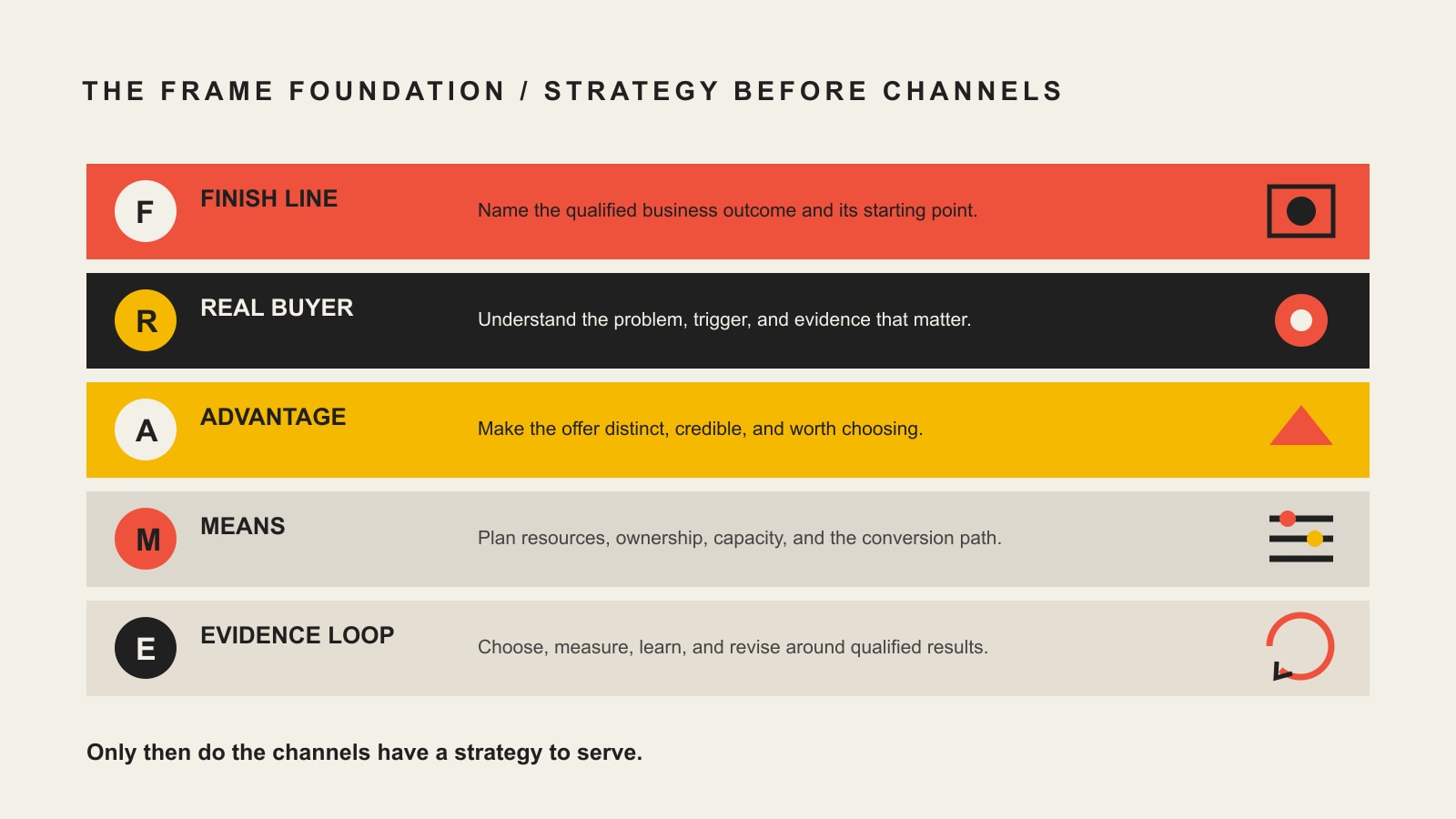
    Build the strategy before you pick the channels. A winning online marketing strategy defines five things before you spend money or staff time: the business outcome you actually want, the buyer and problem you need to reach, the reason your offer deserves attention, the resources and conversion path you can realistically support, and the evidence that will tell you what to keep, change, or kill. SEO, Google Ads, social media, email, and content are tools. They are not the strategy.

    If your plan begins with “we need to be on TikTok” or “we should do SEO” but nobody can define a qualified result, an accountable owner, or what happens after a prospect clicks, you have selected a tool before naming the job. That is how marketing turns into expensive busywork.

    TL;DR: Build the foundation before you buy attention

    • F — Finish line: choose one qualified business outcome and record the baseline.
    • R — Real buyer: identify the problem, trigger, buying behavior, and evidence instead of inventing a decorative persona.
    • A — Advantage: clarify the offer, proof, positioning, objections, and next action.
    • M — Means: decide what money, time, capacity, skills, owner, and conversion path you can actually support—and what you will not do.
    • E — Evidence loop: choose channels by job, measure meaningful actions, and revise based on qualified outcomes rather than vanity metrics.

    We call this the FRAME Online Marketing Foundation. It treats marketing as a business strategy problem before it becomes a channel problem.

    Why most online marketing plans fail before the first campaign

    The internet makes tactics dangerously easy to start. You can open an ad account, schedule thirty posts, install an email platform, commission a video, or publish an AI-generated article before lunch. None of those actions proves you have a strategy.

    The failure pattern is usually simple: a business sees a channel working for someone else, copies the visible tactic, and skips the invisible decisions underneath it. The company never defines the buyer’s real trigger, the economics of the offer, the response capacity, the destination, the owner, or the business result that would justify more investment.

    That creates tactical hell: more platforms, more dashboards, more activity, and less certainty about what is actually helping. Open Brain material from Scope Design’s own strategy work has used the same strategic filter for years: before adopting a tactic, ask how it supports the objective and what you will stop doing to make room for it.

    Current search results reinforce the temptation. Google and Bing both surface broad “best strategy” guides that quickly become channel lists. Those lists are useful once the business foundation is clear. They are a lousy place to start when the real question is what should this business be trying to accomplish, for whom, with what constraints?

    How to build an online marketing strategy with FRAME

    The familiar pieces of digital marketing—audience, goals, positioning, content, channels, and measurement—only become a strategy when the earlier decisions constrain the later ones. The graphic below shows those connected parts. FRAME turns them into a decision sequence you can actually use.

    The FRAME foundation: Finish line, Real buyer, Advantage, Means, and Evidence loop, in a decision sequence that precedes channel selection.

    F — Finish line: define the qualified business outcome

    “Get more traffic” is not a business finish line. Neither is “post consistently,” “rank higher,” “grow followers,” or “send more email.” Those can be useful diagnostic signals, but they do not tell you whether the marketing created value.

    Start with the business outcome. A service company may care about qualified consultation requests, booked appointments, accepted estimates, or profitable projects. An ecommerce company may care about profitable orders, repeat purchases, or retained customers. A membership organization may care about completed registrations or renewals. Pick the result before you choose the channel.

    Then record the baseline. How many qualified inquiries arrive now? From where? What percentage become customers? Is the business able to respond quickly? What is a good customer worth in contribution margin, capacity, or long-term value? You do not need perfect data to begin, but you do need a starting point or every future chart will float without context.

    This is also where you separate diagnostic metrics from qualified outcomes. Rankings, impressions, clicks, sessions, email opens, and engagement can tell you whether a system is moving. Qualified leads, purchases, booked work, retention, or saved staff effort tell you whether the movement matters.

    R — Real buyer: identify the problem, trigger, and evidence

    A target audience is not “women 25–54 who like quality.” That sentence can describe millions of people with completely different problems, budgets, urgency, and buying behavior.

    Define the buyer by the situation that makes your offer relevant. What happened just before they started looking? What problem are they trying to remove? What would make them delay? What alternatives are they comparing? Who else influences the decision? Where do they look for evidence?

    The U.S. Small Business Administration’s market-research guidance recommends examining demand, market size, location, saturation, pricing, and direct customer research. That is much more useful than decorating a persona slide with a stock photo and naming the fictional customer “Marketing Mary.”

    For a deeper audience process, use Scope Design’s TRACE target-audience method: Trigger, Reality, Attributes, Channels, and Evidence. The important part here is that assumptions remain visibly separate from things you have actually observed.

    A — Advantage: make the offer worth choosing

    Marketing cannot rescue an offer nobody understands. Before you amplify the message, make the offer answer five basic questions: What do you do? For whom? What problem does it solve? Why should the buyer believe you? What should they do next?

    Your advantage does not have to be a revolutionary invention. It may be specialization, speed, a better process, stronger proof, easier implementation, local knowledge, a clearer guarantee, better support, more transparent pricing, or simply fewer annoying steps. What matters is that the difference is relevant to the buyer and can survive scrutiny.

    Also list the objections before the campaign starts. Price, trust, timing, switching cost, implementation risk, lack of proof, and fear of making the wrong choice all create friction. If the sales team answers the same concern every week, the marketing should probably answer it before the prospect has to ask.

    M — Means: plan around money, time, capacity, ownership, and the conversion path

    This is the part most “best marketing strategy” lists skip because it is less exciting than naming platforms. It is also the part that keeps the plan from collapsing in real life.

    Define the resources the strategy can consume: cash, staff hours, specialist skills, creative production, sales follow-up, fulfillment capacity, software, and management attention. Assign one person who owns the plan. Shared participation is useful; shared accountability is how tasks quietly become nobody’s job.

    Then choose one primary conversion path for the first test. That might be a service page and contact form, a booking flow, a product page and checkout, a phone call, or a lead magnet followed by email. It does not have to be fancy. It has to be clear, measurable, and owned.

    Finally, make the uncomfortable tradeoff explicit: what are you not doing? A small team cannot usually launch search ads, publish daily video, rebuild the website, start a weekly newsletter, run three social networks, and create an SEO content program at the same quality level at the same time. If the strategy adds a tactic, something else may need to wait.

    If the capacity question turns into a build-versus-buy decision, our in-house vs. outsourcing framework helps separate work you should own from work that earns outside expertise.

    E — Evidence loop: choose, measure, learn, and revise

    Only now do you choose channels. Pick them because of the job they need to do, not because a platform is fashionable or a competitor posted a screenshot of a good month.

    Before launch, define the valuable action you want to measure. Google Ads’ conversion measurement guidance centers measurement on actions that matter to the business, while Google Analytics defines a key event around an action particularly important to business success. The terminology matters less than the discipline: know what action has value before the campaign starts.

    Then run the smallest useful test that can teach you something. Review the chain, not just the first metric: Was the page accessible and visible? Did the right people arrive? Did they engage with the useful part? Did they take the intended action? Were those actions from people the business can help? Did the outcome produce sales, appointments, retention, or another result you chose at the beginning?

    That is the evidence loop: launch, observe, diagnose, revise. A tactic can earn more budget, a different message, a better destination, more time, or a clean death. Hope is not an analytics strategy.

    FRAME decisionBad shortcutUseful evidenceWhat the evidence changes
    Finish line“More traffic”Qualified leads, sales, appointments, retention, baselineWhat success means
    Real buyerBroad demographicsTriggers, interviews, search behavior, sales conversations, reviewsWho and what the message must address
    Advantage“We offer great service”Proof, objections, alternatives, customer languageOffer and positioning
    Means“Let’s do everything”Budget, staff time, skills, capacity, owner, destinationWhat can actually be executed
    Evidence loopVanity dashboardsChannel diagnostics plus qualified outcomesWhat to keep, change, scale, or stop

    How do you choose marketing channels after the foundation is clear?

    Choose channels by their job in the customer journey and by whether you can execute them well. There is no universally “best” online marketing channel.

    ChannelUseful jobMain tradeoff to plan for
    SEO and organic searchCapture existing questions and search demand with useful, discoverable pagesRequires ongoing technical/content quality and patience; visibility is not the same as a qualified sale
    Paid searchBuy controlled access to people searching for a relevant need nowRequires sound conversion economics, landing-page quality, and disciplined tracking
    Social mediaBuild familiarity, distribute ideas, show proof, and participate where buyers already pay attentionRequires consistent attention and is easy to confuse with popularity
    EmailFollow up with an opted-in audience, nurture decisions, and support retentionDepends on list quality, permission, relevance, and consistent follow-through
    ContentExplain difficult decisions, demonstrate expertise, support search, sales, and other channelsMust solve a real question and be distributed; publishing alone does not create demand

    Our guide to online marketing channels for small business goes deeper on the job each channel can perform. Once those roles are clear, the complete internet marketing plan shows how to connect channels, destinations, follow-up, capacity, and measurement into one operating system.

    How much should a small business spend on online marketing?

    There is no universal percentage that magically becomes correct because it has three numbers and a hyphen. Searchers ask about rules such as 70-20-10 and 40-40-20 because simple allocation formulas are comforting. Treat them as heuristics at most, not laws for your business.

    Your workable budget comes from the business model and the test. Start with what a good customer is worth, the margin or capacity available to acquire one, the number of customers the business can actually serve, the cost of the creative and technology required, the staff time needed to respond, and the amount you can risk learning without harming operations.

    Capacity matters as much as cash. If a campaign generates more inquiries than your team can answer, more traffic can make the customer experience worse. If your average project is valuable but sales follow-up takes three weeks, the bottleneck may not be acquisition at all. Marketing should expose the constraint, not pour gasoline on it.

    A useful starting budget is therefore large enough to run a meaningful test and small enough that you can afford to learn. Increase investment when the complete chain—from attention to qualified outcome—supports it. Reduce or redirect investment when the evidence shows a broken message, audience, destination, response process, or channel fit.

    What our audit of this exact page taught us

    We applied the same evidence rule to this revision instead of protecting old copy because it already existed. The old article had a live URL and several durable ideas, but it also contained fixed budget percentages, fixed channel timelines, an unverified “47%” strategy statistic, an unsupported AI-search projection, and a long channel list that overlapped other pages.

    Signal checkedObservation on August 20, 2026What it actually supports
    GA4, last 12 complete months3 landing sessions, all Direct; 0 engaged sessions; 0 configured key events. The prior 12-month comparison returned no rows.The sample is far too small for behavior or conversion conclusions. There is no measured organic footprint forcing us to preserve unsupported legacy copy.
    Google Search ConsoleNo exact-page query rows in the current or prior 12-month periods. URL Inspection says “Crawled – currently not indexed,” while indexing and robots are allowed and Google/user canonicals match the established URL.The page needs clearer ownership, usefulness, and connections—not a slug migration.
    Bing Webmaster ToolsBing recognizes the URL and retains crawl history; exact-URL traffic reports 0 clicks and 0 impressions.Bing knows the page, but there is no current Bing traffic signal that requires weak claims or structure to survive.
    UbersuggestNo exact-page ranking-keyword data and no URL-level backlinks were returned.Third-party evidence also shows no strong page-level equity that justifies keeping unsupported claims.

    This evidence does not prove the topic is worthless, that visitors disliked the page, or that this revision will rank. Scope Design’s current analytics attribution and configured key-event setup also have known limitations, so zero key events is not proof of zero business impact.

    The conclusion is narrower and more useful: the legacy article did not have a demonstrated search or conversion footprint that required us to defend weak copy, while current query research still shows real demand for online marketing strategy questions. We preserved the established, healthy URL and changed the article’s job instead.

    A practical first 30 days for your online marketing strategy

    Thirty days is enough to build the foundation and launch a bounded learning cycle. It is not a promise that every channel will prove ROI in a month. Long buying cycles, low search demand, complex sales, and organic discovery can require much longer observation.

    Days 1–5: Finish line and baseline

    Choose one primary business outcome, define the valuable action, and document the current baseline. Identify the sales or operational constraint that could make “more leads” useless.

    Days 6–10: Real buyer evidence

    Review search language, customer questions, reviews, sales notes, support conversations, competitor alternatives, and a handful of direct interviews when possible. Write down what you know, what you suspect, and what still needs testing.

    Days 11–15: Advantage and proof

    Clarify the offer, the meaningful difference, the proof you can show, the objections that need answers, and the single next action. Fix obvious message friction before buying traffic.

    Days 16–20: Means, owner, and destination

    Set the test budget and staff-time limit, choose the accountable owner, confirm response capacity, and prepare the primary conversion destination. Name the initiatives that will wait while this test runs.

    Days 21–30: Launch one useful test

    Select the smallest channel mix that reaches the right buyer and can produce evidence. Configure measurement, launch, review the complete response chain, and write down what changed and why. One well-instrumented experiment teaches more than six half-maintained channels fighting for the same Tuesday afternoon.

    Frequently asked questions about online marketing strategy

    What is an online marketing strategy?

    An online marketing strategy is the decision system that connects a business outcome to a defined buyer, offer, resources, digital channels, conversion path, and measurement. A list of SEO, ads, email, social media, and content tactics is not a strategy until those tools have specific jobs and success criteria.

    What is the marketing strategy for a small business?

    A useful small business marketing strategy is intentionally constrained. Define the qualified outcome, the buyer’s real problem, the offer and proof, the budget and staff capacity, the accountable owner, the primary conversion path, and the evidence that will guide the next decision. Then choose the smallest set of channels that can do the required jobs consistently.

    Should I use a 70-20-10 or 40-40-20 marketing rule?

    Use percentage rules only as prompts for discussion, not universal prescriptions. Your allocation should reflect customer value, margins, risk tolerance, staff capacity, channel maturity, and what you need to learn. A neat percentage does not know your sales cycle or whether your team has time to answer the phone.

    Which online marketing channel is best for a small business?

    The best channel is the one that can reach the right buyer at the right moment, perform a useful job in the decision journey, fit your resources, and produce evidence you can act on. Search may fit active demand; social may fit familiarity and proof; email may fit follow-up and retention. The answer depends on the business problem.

    How many marketing channels should I start with?

    Usually fewer than your first brainstorm. Start with the smallest mix that can cover acquisition, conversion, and follow-up without exceeding the team’s capacity. Add a channel when the current system is understood and the new channel has a specific job—not because someone told you every brand needs seven places to post.

    How do I know if my online marketing strategy is working?

    Track the chain from visibility to qualified outcome. Channel metrics such as impressions, clicks, rankings, reach, and email engagement help diagnose what happened. Leads, sales, appointments, retention, and other qualified business outcomes tell you whether the movement was valuable. Compare results with the baseline and revise one known assumption at a time.

    Do I need a website before I start online marketing?

    You need a controlled place where the prospect can understand the offer and take the intended next step. For many service businesses that is a website or focused landing page; for others it may be a product page, booking flow, marketplace listing, or phone call path. The critical requirement is ownership: the destination should explain the offer, provide enough proof, make the next action obvious, and allow you to measure what happened.

    What to do next

    Part I gives you the filter. Part II of the business marketing strategy series turns that foundation into the next layer of planning and execution. If you already have channels running but cannot explain which business decision each one supports, use FRAME first and fix the foundation before adding another tactic.

    If you want an outside partner to help connect strategy, website experience, SEO, content, paid acquisition, measurement, and the ugly operational details between them, Scope Design can help. The goal is not more marketing activity. It is a system that earns the right to keep running.

  • Small Business Digital Transformation: 15 Priorities That Earn Their Keep

    Small Business Digital Transformation: 15 Priorities That Earn Their Keep

    Small business digital transformation works best when you start with a business constraint, not a software catalog. Pick one costly delay, failure, handoff, customer friction point, or repetitive workload. Map the people and data involved. Secure the foundation. Then test the smallest digital change that can improve the outcome without creating a bigger operating mess.

    That is the difference between transformation and tool collecting. Buying a CRM does not transform sales if nobody owns the pipeline. Adding AI does not transform service if the answers are unreliable. Moving files to the cloud does not transform collaboration if five versions of the truth still circulate by email. Technology earns its place when the work becomes measurably better and the business can still operate it after the launch meeting.

    This guide gives small-business owners a practical 15-priority roadmap plus the Scope Design SHIFT Test for deciding what deserves implementation, what should wait, and what should never be automated without stronger controls.

    TL;DR: transform the work, not the tool pile

    • Start with the constraint. Define the business problem and baseline before choosing a platform.
    • Map the real workflow. Include handoffs, exceptions, approvals, duplicate entry, and the places people quietly work around the official process.
    • Secure the foundation. Identity, updates, backups, recovery, access, and data ownership are part of transformation, not cleanup work for later.
    • Automate stable work before judgment. Repetitive, well-defined, reversible tasks are better candidates than rare or high-stakes decisions.
    • Run bounded pilots. Decide in advance what result would make you scale, revise, or stop.
    • Assign an owner after launch. A system without maintenance, review, and retirement responsibility is future tool debt.

    What small business digital transformation actually means

    For this guide, small business digital transformation means changing how the business creates, moves, protects, and uses information so customers and employees can complete important work with less friction, waste, risk, or delay. The technology matters, but the business process is the unit of change.

    That definition is intentionally less dramatic than the usual “reinvent your company with AI” pitch. A 2024 Small Business Majority study used six surveys and five focus groups over 18 months and found wide variation in how small businesses adopt digital tools. Time, capacity, money, and perceived need all shaped adoption. The useful lesson is not that every owner is behind. It is that the right digital stack depends on the business you actually have.

    The same study reported that 66% of participants used financial accounting software, 57% used electronic point-of-sale systems, 63% had a cybersecurity plan, and 69% used some form of AI technology. Roughly one-third had no website. Those numbers describe that study, not a universal maturity score. They are a reminder that “digital transformation” can mean very different things to a ten-person contractor, a professional-services firm, a retailer, and a manufacturer.

    The goal is not maximum digitization. The goal is a better operating system for the business.

    Use the Scope Design SHIFT Test before buying anything

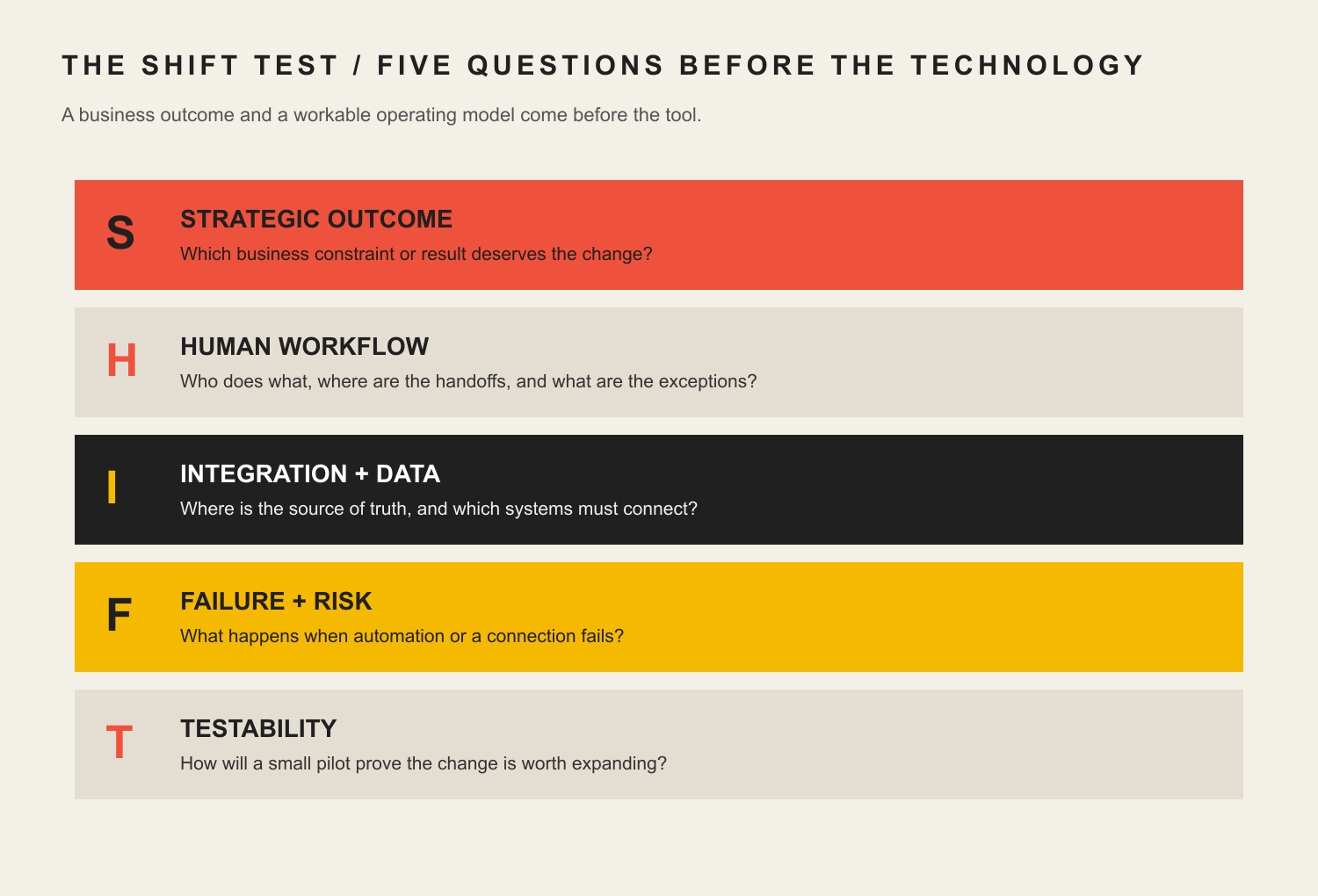
    Before a proposed platform, integration, automation, or AI workflow earns implementation, make it answer five questions. If one answer is vague, the project needs more diagnosis before more software.

    Five SHIFT questions: strategic outcome, human workflow, integration and data, failure and risk, and testability.
    The Scope Design SHIFT Test turns a technology idea into five operating questions before implementation.
    SHIFT questionWhat to askWhy it matters
    S — Strategic outcomeWhat business result or constraint changes?Prevents “implement a tool” from impersonating a business objective.
    H — Human workflowWho owns the input, exception, approval, and handoff?Exposes hidden labor and the places automation still needs judgment.
    I — Integration & dataWhere is the source of truth, and what must connect?Prevents duplicate records, brittle copy-and-paste work, and conflicting answers.
    F — Failure & riskWhat happens if it is wrong, down, compromised, or abandoned?Forces recovery, security, privacy, vendor, and reputation risk into the design.
    T — TestabilityWhat bounded pilot and metric can prove or reject the investment?Creates a decision instead of an endless rollout.

    Example: “We need AI for customer service” fails the test. “We spend 12 staff-hours a week answering five repetitive pre-sale questions, the approved answers already exist, a person can take over uncertain conversations, and we can compare response time plus qualified handoffs for 30 days” is a project you can evaluate.

    Scope Design rule: a transformation project should make the business easier to operate, not merely more impressive to describe.

    Layer 1: decide what deserves transformation

    1. Name the business constraint before choosing technology

    Start with the most expensive or consequential friction you can describe in plain language. Maybe estimates take three days because information lives in three places. Maybe leads disappear between a website form and the salesperson. Maybe customers call for order status because nobody can see it. Maybe the owner is still the only person who knows how to assemble a quote.

    Write the current baseline before the solution: time, error rate, queue length, response time, rework, missed handoffs, cost, or another decision-relevant measure. Then describe the desired change. “Faster” is weak. “Reduce average quote turnaround from two business days to same-day for standard jobs without increasing pricing errors” gives the project something to prove.

    This is also where digital transformation connects to broader business strategy. If the business has not decided which customer, process, constraint, or capability matters, a technology roadmap will simply automate indecision.

    2. Map the workflow, handoffs, delays, and exceptions

    The official process is rarely the real process. Sit with the people doing the work and map what happens from trigger to finish. Where does information arrive? Who retypes it? Who checks it? Which spreadsheet exists because the main system cannot answer a practical question? Which approval happens in a text message? What happens when the normal case breaks?

    Exceptions matter because automation is easiest when everything follows one clean path, while real businesses are full of partial payments, reschedules, returns, rush jobs, special pricing, missing information, warranty questions, and customers who reply to the wrong email. A workflow is ready for automation when the normal path is understood and the exceptions have named owners.

    Do not optimize a step in isolation if the delay simply moves downstream. A faster lead form that creates twice as much manual cleanup is not an improvement. It is a handoff problem with a nicer interface.

    3. Assign one source of truth and one owner for important data

    Customer records, pricing, inventory, project status, documents, schedules, product information, and financial data need an authoritative home. That does not mean every business needs one giant all-in-one platform. It means people must know which system wins when two copies disagree.

    For each important data set, name the source of truth, owner, who may edit it, which systems receive copies, and how changes synchronize. If a CRM owns the customer record but the accounting system owns invoices, define the boundary. If the website displays product information from another system, decide what happens when the connection fails.

    This is where “cloud-first” advice often becomes lazy. Cloud software can make collaboration and access much easier, but the decision still depends on security, connectivity, workflow, integration, export, cost, and ownership. Choose an architecture because it fits the work, not because a slide deck said modern businesses live in the cloud.

    Layer 2: make the foundation safe and usable

    4. Secure identities, updates, backups, and recovery

    A digital transformation increases the number of systems that can help the business. It can also increase the number of systems that can fail or be abused. Security belongs in the foundation.

    NIST SP 1300 gives small and medium-sized businesses a quick-start path for using Cybersecurity Framework 2.0, while CISA’s small and medium business resources emphasize practical controls such as multi-factor authentication, software updates, backups, phishing awareness, encryption, and logging. You do not need an enterprise security theater production. You do need to know who has access, what gets backed up, how recovery works, and who responds when something goes wrong.

    Make multi-factor authentication the default wherever the service supports it, especially for email, finance, administration, hosting, cloud storage, and customer-data systems. Keep software supported and patched. Test restores instead of assuming “backup enabled” means recoverable. Remove old accounts. Separate normal work from privileged administration where practical. Security is an operating practice, not a checkbox a vendor can permanently complete for you.

    5. Fix the customer-facing home base only where it is a real constraint

    The legacy version of this article treated a sophisticated website as transformation step one for everybody. That is too broad. Your customer-facing home base matters when it is actually part of the problem: customers cannot understand the offer, find reliable information, book, buy, request service, upload what you need, or move into the next step without manual rescue.

    For many small businesses, the website is the durable place to explain the offer, establish credibility, route customers, and connect forms or scheduling to the rest of the operation. Our guide to building an online presence for a small business covers that narrower job in more detail.

    But do not rebuild a perfectly adequate website because “digital transformation” sounds like it should begin with a redesign. If the real constraint is inventory accuracy, quote turnaround, dispatch, collections, or internal approvals, fix that instead. Custom functionality should earn its place. Otherwise it is expensive theater.

    6. Connect the customer, service, finance, and fulfillment handoffs that matter

    The biggest improvements often happen between systems rather than inside one system. A qualified website inquiry should not require manual copying into a CRM. An approved quote should not need to be recreated as an invoice if the data is already structured. A completed service call should update the customer record and trigger the next appropriate step without relying on somebody remembering at 4:55 p.m.

    Start with the handoffs that create duplicated work or customer uncertainty. Define the event, data that moves, destination, owner, failure behavior, and whether the action needs approval. Use APIs, native integrations, middleware, or custom code according to the stakes and complexity. The integration method matters less than whether the business can see when it fails.

    Avoid integrations that silently create two masters. If both systems can overwrite the same field without a rule, you do not have synchronization. You have a future argument between databases.

    Layer 3: digitize and automate work carefully

    7. Digitize repetitive financial and administrative work where it reduces friction

    Standard estimates, invoices, payment reminders, expense capture, appointment confirmations, document assembly, recurring reports, and onboarding checklists are common places to remove repetitive work. The best candidates are frequent, rule-based, and easy to verify.

    Do not turn “paper is bad” into a religion. A paper checklist beside a machine may be safer and faster than making a technician sign into three apps. A digital form is useful when the data needs to be shared, searched, validated, routed, reported, or reused. Digitize because the information becomes more useful, not because paper offended the software budget.

    When replacing a spreadsheet, ask what job the spreadsheet is secretly doing. It may contain approval logic, comments, historical memory, and exception handling that nobody documented. Replacing the file without capturing those jobs is how a shiny new platform becomes an expensive second spreadsheet.

    8. Automate stable, low-judgment work before automating decisions

    Automation should usually begin with boring work: moving approved data, generating first-pass documents from structured inputs, routing notifications, creating tasks, checking for missing fields, scheduling routine follow-ups, and assembling repeatable reports. These tasks can often be tested against clear expected results and handed to a person when something unusual happens.

    Use our deeper guide to AI and business automation when the question shifts from “where does automation belong?” to workflow architecture, governance, custom integrations, and durability.

    Do not automate a process nobody agrees on. The machine will not resolve the disagreement. It will execute one version of it faster. Also avoid automating around a broken data model. If the same customer has four records and three naming conventions, the first transformation may be data cleanup and ownership rather than automation.

    9. Use AI as a bounded copilot with human accountability

    AI can be useful for summarizing notes, drafting variations, extracting structured information, classifying routine inputs, finding repeated questions, assisting with research, preparing first-pass documents, and helping employees work through approved knowledge. The U.S. Small Business Administration describes AI as a tool that can improve efficiency and help save time and costs in appropriate use cases. That is an opportunity, not a guaranteed ROI.

    NIST’s Generative AI Profile provides voluntary risk-management guidance for generative AI. The small-business translation is straightforward: define what the system may do, what data it may use, what must be verified, what requires human approval, what happens when confidence is low, and who owns a bad outcome.

    Keep humans in charge of pricing, contractual commitments, sensitive personnel decisions, legal or compliance judgments, safety-critical actions, and customer situations where context or reputation matters. “Human in the loop” is not a magic phrase. Name the person, trigger, evidence they see, and authority they have.

    Layer 4: turn tools into an operating system

    10. Document procedures, exceptions, approvals, and access

    A transformation that only one employee understands is not resilient. Write the minimum documentation needed to operate the workflow: what starts it, normal path, exception path, source systems, approval rules, access requirements, expected outputs, troubleshooting, support contact, and recovery path.

    Documentation does not need to become a 200-page manual nobody reads. A short operating note, diagram, checklist, and decision table can be enough if they reflect reality. Keep the documentation close to the work and update it when the workflow changes.

    This is particularly important when AI or automation uses business knowledge. An assistant cannot reliably distinguish current policy from an old campaign page unless the business itself knows which source is authoritative. Retrieval makes approved knowledge available. It does not make contradictory documentation good.

    11. Measure the decision, not dashboard decoration

    Before launch, define the measure that tells you whether the constraint improved. Useful metrics might include turnaround time, first-time-right rate, duplicate entry, support contacts per order, invoice age, conversion from a qualified inquiry, manual touches per job, backlog size, rework, missed appointments, or employee time spent on a repeatable task.

    Measure the baseline using the same definition you will use afterward. If the metric changes halfway through the pilot, write down why. Track guardrails too. An automation that saves two staff hours but doubles customer complaints did not earn a victory lap.

    Dashboard activity is not an outcome. Number of automations run, AI messages generated, CRM records created, or app logins can help troubleshoot adoption, but they do not prove the business is better. Measure the work that justified the project.

    12. Train the team on the real workflow, not just the buttons

    The old article was right about one thing: digital transformation succeeds or fails in the hands of the people who must use it. Training should cover more than where to click. Explain why the workflow changed, which system is authoritative, what good input looks like, what must never be entered, how exceptions work, when to escalate, and how people report problems.

    Use real examples, including the ugly ones. Give staff a safe place to practice. Train managers on how to interpret the new data and how not to punish people for surfacing defects in the process. A “digital culture” is not enthusiasm for tools. It is the habit of making the system visible, improving it with evidence, and keeping judgment where judgment belongs.

    If adoption requires constant private workarounds, investigate the design. Employees can resist change, but they can also be the first people to notice that the new workflow is slower, duplicative, or missing a real exception. Do not label useful feedback as resistance because the implementation plan needs better news.

    Layer 5: keep transformation from becoming tool debt

    13. Design for interoperability, export, and an exit path

    Before committing to a platform, ask how you get your data out, which formats are available, whether APIs cover the records you need, how users and permissions are managed, what happens to automations if you leave, and how long you can operate during a migration. Vendor lock-in is not automatically bad; sometimes a tightly integrated platform is worth it. Lock-in you did not understand is the problem.

    Prefer boring, documented interfaces over clever dependencies that only one contractor understands. Record integration credentials, owners, renewal dates, vendor contacts, and custom code. Separate business rules from one vendor’s marketing language so the process can survive a platform change.

    Transformation should reduce trapped knowledge, not relocate it from a spreadsheet to a black box.

    14. Pilot one high-value change before scaling

    A useful pilot is small enough to control and large enough to answer the business question. Choose one workflow, one audience or team, a defined window, a baseline, success threshold, guardrails, and a decision date. Test the exception path, not only the happy path.

    Do not call every trial a “pilot” after launch. Write the decision rule first. What evidence means scale? What evidence means revise? What evidence means stop? If there is no stopping condition, you have already made the purchasing decision and the pilot is theater.

    Stopping a weak pilot is not failure. It is one of the cheapest successful outcomes available. The business learned before multiplying licenses, integrations, training, support, and sunk-cost politics.

    15. Assign maintenance, review, and retirement ownership

    Every important digital system needs an owner after implementation. Who reviews access? Who watches failed integrations? Who tests backups or recovery? Who updates business rules? Who checks vendor changes? Who measures whether the process is still worth operating? Who retires old tools and accounts?

    The maintenance load is part of the buying decision. A $50 monthly tool that needs three hours of senior staff attention every week is not a $50 tool. Include subscriptions, internal labor, support, training, audits, integration upkeep, custom development, and switching costs when comparing options.

    For one common subsystem, our website maintenance and ownership guide shows how updates, backups, security, performance, testing, and responsibility continue after launch. The same principle applies across CRMs, automations, analytics, AI workflows, and internal applications.

    A practical 90-day small business digital transformation roadmap

    You cannot “finish digital transformation” in 90 days, and anyone promising that is selling a calendar trick. You can make one important part of the business materially clearer in 90 days and leave with enough evidence to choose the next move.

    WindowMain jobConcrete outputs
    Days 1-30: Diagnose and baselineChoose the constraint, map the workflow, identify data owners, and close obvious security gaps.Current-state map; baseline metric; SHIFT assessment; access inventory; MFA/update/backup actions; one pilot brief.
    Days 31-60: Implement one bounded changeConfigure or build the smallest workflow that can test the hypothesis.Integration or system configuration; exception path; documentation; staff training; instrumentation; rollback plan.
    Days 61-90: Measure and decideCompare the result with baseline and guardrails.Outcome review; defects and adoption evidence; scale/revise/stop decision; maintenance owner; next constraint if the first change earned expansion.

    This sequence is deliberately boring. Boring is good. It gives the business time to discover that a field is missing, an approval is ambiguous, a vendor API behaves differently than the sales demo, or an employee needs a safer exception path before those problems spread across the whole company.

    What should a small business NOT automate yet?

    Do not automate a task merely because an AI demo or integration can perform it. Delay automation when any of these conditions are true:

    • The process is unstable. People disagree on the normal path or the rules change every week.
    • The data is unreliable. Duplicates, missing fields, conflicting sources, or poor permissions make automated action unsafe.
    • No one owns the exception. When the workflow breaks, the answer is “somebody will notice.”
    • The decision is rare and high-stakes. Legal, safety, employment, pricing exceptions, major refunds, or reputation-critical choices may need qualified human judgment even if AI assists.
    • The output cannot be verified cheaply. If checking every result costs more than doing the task, redesign the workflow before scaling automation.
    • The customer needs empathy or negotiation. Escalations, complaints, grief, unusual hardship, or complex sales conversations may be damaged by a system that optimizes only speed.
    • The business cannot recover from failure. If a vendor outage, bad rule, compromised account, or model error can stop operations, design fallback and recovery first.

    Automation should make a clear process cheaper, faster, more reliable, or easier to scale. It should not make an unclear process harder to see.

    What our audit of this exact article taught us

    We applied the same rule to this revision that we recommend to clients: inspect the system before changing it. The legacy article had a live, self-canonical, index/follow URL and several durable ideas, but it also had unsupported performance percentages, a long technology shopping list, no outgoing internal links, and a UX category assignment that Scope’s own silo map described as the wrong job.

    Signal checkedObservation on August 20, 2026What it actually supports
    GA4, last 12 complete months10 landing sessions total: 9 Direct, 1 Referral; 3 engaged sessions; 0 key events; no Organic Search landing row.The sample is too small for behavior conclusions. There is no measured organic or conversion footprint forcing us to protect unsupported legacy copy.
    Google Search ConsoleNo exact-URL query rows in the current or prior 12-month period; URL Inspection says “Discovered – currently not indexed.”Public accessibility did not equal confirmed Google indexing. The revision needs clearer ownership and usefulness, not a URL migration.
    Bing Webmaster ToolsThe page is recognized and crawled, with 0 clicks and 0 impressions in the URL traffic response.Bing knows the page, but there is no meaningful Bing traffic signal to protect.
    UbersuggestNo ranking-keyword data returned for the exact page and no exact-URL backlink rows.Third-party evidence also showed no strong page equity requiring content preservation.

    Scope’s GA4 attribution and key-event setup has known limitations, so zero key events is not proof of zero business impact. The point is narrower: the old article did not have a demonstrated search or conversion asset strong enough to justify keeping claims we could not support. We preserved the established URL because it already matches the primary query and creates no need for redirect risk. We changed the article’s job instead.

    Frequently asked questions about small business digital transformation

    What should a small business modernize first?

    Modernize the constraint that creates the most meaningful cost, delay, risk, customer friction, or owner dependence and that can be measured. Map the workflow and data first, then choose the technology. If the current problem cannot be described without naming a product, the diagnosis is probably not finished.

    What are the main areas of digital transformation?

    For a small business, five practical areas cover most of the work: strategic priorities, secure digital foundations, workflow digitization and automation, operational adoption and measurement, and lifecycle ownership. Different frameworks use four, five, or seven “pillars.” The count matters less than whether your roadmap covers people, process, data, technology, risk, and outcomes.

    How much should digital transformation cost?

    There is no responsible universal percentage. Cost depends on the business constraint, number of users, data cleanup, integrations, custom functionality, security requirements, migration, training, support, and ongoing ownership. Compare lifecycle cost with the value of the improved process, not with a vendor’s license price alone.

    Should every small business use AI?

    No. AI is useful when it fits a real workflow and the business can manage data, verification, risk, and human accountability. A ten-person company may get more value from fixing its quote process or customer records than from launching a chatbot. Use AI where it earns its keep.

    How long does digital transformation take?

    Transformation is ongoing because processes, customers, staff, vendors, threats, and technology change. A 30- to 90-day pilot can test one meaningful improvement. That is different from claiming the whole business will be “transformed” on a fixed calendar.

    Why do digital transformation projects fail?

    Common failure modes include choosing tools before defining the problem, automating an unstable process, poor data ownership, too many simultaneous changes, weak security or recovery planning, unclear accountability, inadequate training, no baseline, and no decision rule for scaling or stopping.

    Do I need a new website for digital transformation?

    Only if the website is part of the constraint. If customers cannot find, trust, book, buy, or provide the information your operation needs, the site may deserve work. If the site is fine and the real problem is scheduling, inventory, quoting, or internal handoffs, fix the real problem instead.

    What should a small business automate first?

    Start with frequent, repetitive, well-defined, low-risk work whose results are easy to verify: routing information, structured document assembly, reminders, task creation, data validation, and routine reporting are common examples. Keep high-stakes judgment and uncertain exceptions human-owned until the workflow and controls are stronger.

    Build a digital operating system your business can actually run

    Small business digital transformation is not a race to install the most advanced stack. It is the discipline of choosing where digital tools remove real friction, designing the human and data handoffs around them, protecting the business when they fail, and measuring whether the change earned the right to stay.

    Use SHIFT before the purchase. Start with one constraint. Build the smallest useful change. Make ownership explicit. Then scale only what survives contact with reality.

    If you need help diagnosing the constraint, mapping the workflow, connecting the website and business systems, designing an automation, or deciding what should stay human, contact Scope Design. We can help turn a pile of disconnected digital work into a system your team can understand, operate, and improve.

    Sources and further reading