Tag: business planning

  • How to Achieve Anything in 90 Days: The Ultimate Goal-Setting Framework

    How to Achieve Anything in 90 Days: The Ultimate Goal-Setting Framework

    90 day goals work when you treat the next three months as a bounded execution cycle, not a motivational stunt. Pick one meaningful outcome, decide what evidence will prove progress, turn the outcome into weekly actions, and review the plan often enough to change course before the deadline. You cannot literally achieve anything in 90 days, but you can stop letting a vague annual goal hide behind eleven months of “later.”

    The calendar is not magic. The value of a 90-day cycle is that it is long enough to complete meaningful work and short enough to force decisions. The point is not to worship the quarter. The point is to create a finish line, a weekly operating rhythm, and a rule for what happens when reality punches the plan in the mouth.

    90 Day Goals: The Short Version

    • Choose one primary outcome. Other work can continue, but one result gets priority when capacity conflicts.
    • Define “done” before you start. Use an outcome metric, a small set of leading actions, and guardrails for cost, quality, risk, or capacity.
    • Work in weeks, not vague months. Decide what must happen this week and when it will happen.
    • Review written evidence every week. Keep, change, cut, or rescope based on what actually happened.
    • Use days 30 and 60 as decision points. They are not ceremonial milestones. They are chances to fix a bad tactic before day 90 becomes an autopsy.

    What Are 90 Day Goals?

    A 90-day goal is a specific outcome you intend to achieve, complete, or materially advance during a roughly three-month execution cycle. Good 90 day goals are concrete enough to measure and important enough to deserve a tradeoff. “Improve marketing” is not a useful 90-day goal. “Generate 20 qualified sales conversations from our existing email list without increasing paid-media spend” is much closer.

    Some goals are complete projects: launch the new client portal, document and automate a repeated workflow, finish a certification, publish a defined content asset, or reduce a known operational bottleneck. Other goals are building blocks inside a larger strategy. If the real objective takes a year, the next 90 days should produce the next meaningful proof, capability, or milestone rather than pretending the whole thing belongs in one quarter.

    If you are not sure which outcome deserves the cycle, use a decision process before you use a productivity process. Scope Design’s SCOPE Decision Filter is built for that job: choose the consequential decision first, then build the 90-day plan around it.

    Why Can a 90-Day Goal Cycle Be Useful?

    There is no credible evidence in the sources we reviewed that exactly 90 days is a universal productivity optimum or that quarterly goals automatically beat annual goals. That claim sounds tidy. It is also more certainty than the evidence earns.

    The useful research is about the mechanisms inside a good execution system. A major review by Edwin Locke and Gary Latham summarizes decades of goal-setting research and supports specific, challenging goals under the right conditions, including feedback and commitment, over vague “do your best” instructions. The implication is practical: define an actual result and create a way to see whether your behavior is moving toward it.

    Follow-through matters too. A meta-analysis by Peter Gollwitzer and Paschal Sheeran covering 94 independent tests found that implementation intentions, often expressed as “if X happens, then I will do Y,” improved goal attainment with a medium-to-large effect. Pre-deciding the action reduces the amount of future negotiation required from your tired, distracted, suddenly-very-interested-in-cleaning-the-desk self.

    And progress should be visible. A Psychological Bulletin meta-analysis of 138 studies and 19,951 participants found that interventions increasing progress monitoring promoted goal attainment, with stronger effects when progress was physically recorded or reported. That is a much better reason for a weekly scorecard than “successful people journal on Sundays.”

    So use 90 days as a practical operating constraint: a deadline near enough to expose tradeoffs, paired with clear goals, implementation plans, and recorded progress. The quarter is the container. The behavior inside it does the work.

    The LEAD 90-Day Loop

    Scope Design’s framework is the LEAD 90-Day Loop: Lock the outcome, Engineer the path, Act one week at a time, Diagnose and adjust. It is deliberately simple. A goal system that requires a two-day retreat, seventeen dashboards, and a ceremonial leather notebook has already become a new project.
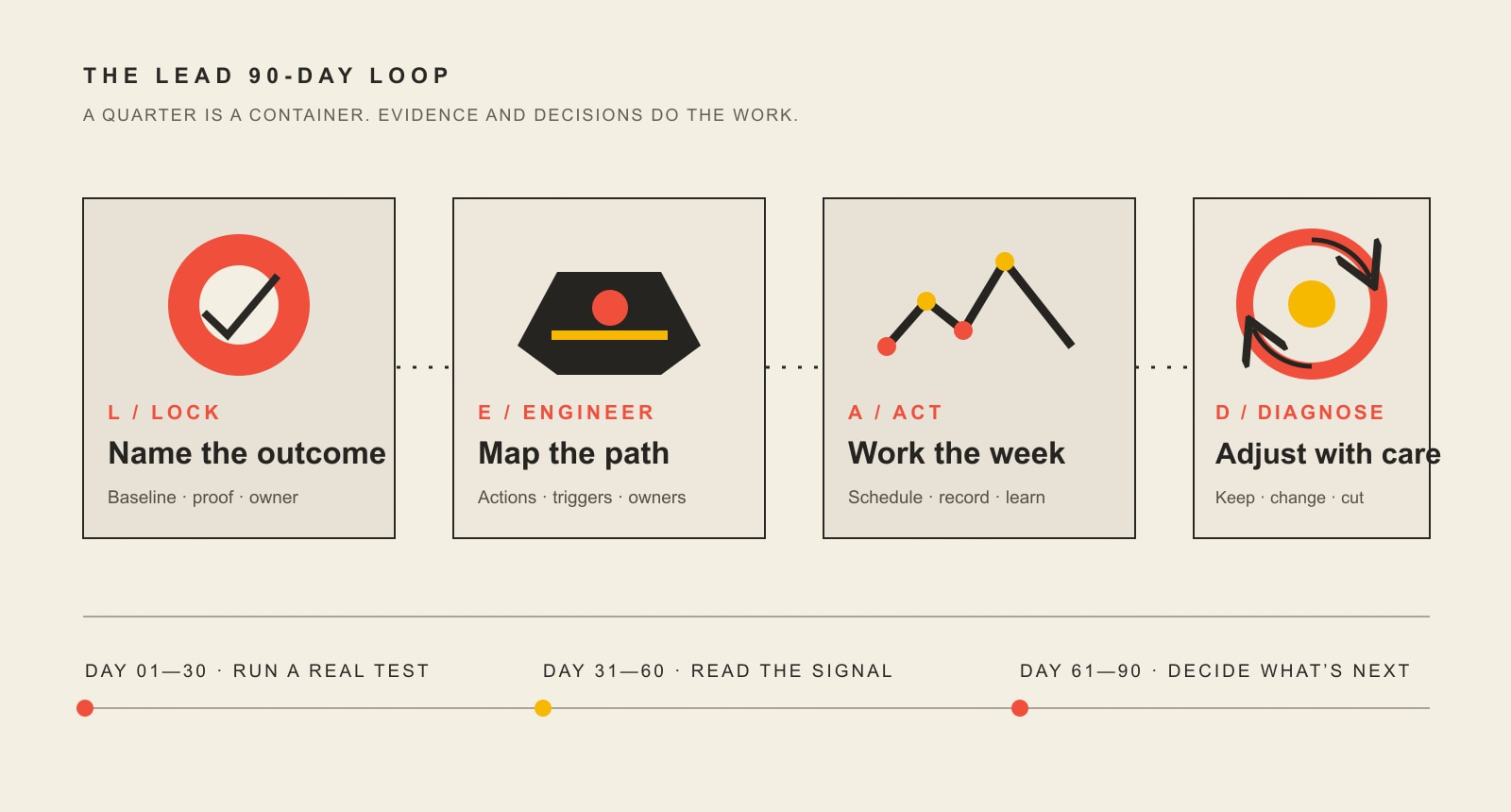
    The LEAD 90-day loop: lock one outcome, engineer the path, act one week at a time, and diagnose and adjust using evidence.

    1. Lock the outcome

    Write one sentence that defines what will be meaningfully different by day 90. Use a result, not a mood. “Feel more organized” is fog. “Reduce average proposal turnaround from five business days to two without increasing revision errors” gives you something to operate.

    • Outcome: What will be true on day 90?
    • Baseline: What is true now?
    • Proof: What evidence will show the outcome actually happened?
    • Owner: Who can make or coordinate the decisions?
    • Stop list: What will not compete for the same capacity during this cycle?

    The stop list is not decorative. A goal is not a priority if every other initiative is also “top priority.” If a new request collides with the 90-day outcome, the team needs a rule for which work moves, waits, shrinks, or dies.

    2. Engineer the path

    Work backward from the outcome and identify the smallest set of controllable actions likely to produce it. Separate dependencies from wishes. If the goal depends on a vendor, customer, employee, or system you do not control, build that uncertainty into the plan rather than pretending the dependency is a task with a due date.

    Then create implementation triggers. Instead of “work on the proposal process twice a week,” write “Tuesday and Thursday at 9:00 a.m., I will review the current queue and remove the oldest blocking step.” If a common obstacle appears, pre-decide the response: “If legal review exceeds two business days, the owner escalates it at the next morning check-in.”

    This is also where systems earn their keep. If repeated work should be automated, documented, delegated, or connected across tools, the broader AI automation for business guide explains how to decide what should become a workflow instead of another recurring reminder.

    3. Act one week at a time

    A 90-day plan becomes real only when it survives contact with Monday morning. Translate the engineered path into weekly commitments small enough to schedule and specific enough to score. “Make progress on automation” is useless. “Map the intake workflow, identify the three manual handoffs, and test one automated routing rule” can be done, reviewed, and learned from.

    Do not turn the quarter into thirteen simultaneous workstreams. Choose the few actions that matter now. Finish or learn something before adding more crap. For a marketing-specific application of that constraint-first idea, see Scope Design’s 90-Day Marketing Acceleration Framework.

    4. Diagnose and adjust

    Every week, compare what you planned with what happened. Do not ask only, “Am I on track?” Ask why the evidence looks the way it does. A missed target can mean at least four different things: the action was not executed, the tactic was weak, the scope was unrealistic, or the environment changed.

    • Keep: What worked well enough to repeat?
    • Change: What should be adjusted because the tactic is underperforming?
    • Cut: What is consuming capacity without improving the outcome?
    • Rescope: Has new evidence changed what a credible day-90 result should be?

    A review is not a motivational ritual. It is a decision loop. Hope is not an analytics strategy, and “we’ll try harder next week” is not a diagnosis.

    What Should You Measure During 90 Day Goals?

    Use three evidence classes together. One metric cannot safely tell the whole story.

    Evidence typeQuestion it answersExample
    Outcome metricDid the business result change?Average proposal turnaround falls from 5 days to 2.
    Leading actionsDid we execute the behaviors expected to influence the outcome?Every new request is routed through one standardized intake within 1 hour.
    GuardrailsDid we improve one number by quietly damaging something else?Revision error rate stays below the current baseline; staff overtime does not increase.

    This distinction matters because outcome metrics often lag. If the result has not moved by week three but the leading actions are being executed cleanly, you may need more time. If the leading actions are not happening, the tactic has not really been tested. If the outcome improves while quality collapses, congratulations: you optimized the wrong thing.

    A Worked 90-Day Business Goal Example

    Suppose a small service business says, “We need to use AI and automation this quarter.” That is not a goal. It is a technology preference wearing a tiny project-management hat.

    A stronger day-90 outcome might be: “Reduce manual lead-intake handling from an average of 18 minutes per inquiry to under 6 minutes, while keeping response accuracy and ownership clear.”

    • Baseline: 18 minutes of manual work per inquiry, inconsistent routing, no single owner for exceptions.
    • Outcome metric: Median manual handling time under 6 minutes by day 90.
    • Leading actions: Standardize intake fields, map decision rules, automate routing for approved cases, review exceptions weekly.
    • Guardrails: No increase in missed inquiries, duplicate records, bad assignments, or response errors.
    • Implementation trigger: If an inquiry cannot be classified automatically, route it to the named owner within 15 minutes rather than letting it disappear into an inbox.
    • Stop list: Do not simultaneously replace the CRM, rebuild the website, launch a chatbot, and redesign the sales process unless one of those is actually required for the outcome.

    Days 1–30 are for baseline, mapping, and the smallest useful test. Days 31–60 are for running the workflow and collecting exception evidence. Days 61–90 are for improving reliability, documenting ownership, and deciding whether to scale. If the business wants help turning that kind of plan into working systems, Scope Design’s Business Automation & AI service is the relevant next step.

    Use 30-, 60-, and 90-Day Checkpoints as Decisions

    Day 30: Do we have a real test?

    By day 30, the goal should be operating, not merely planned. You should have a baseline, visible leading actions, a written scorecard, and enough real-world friction to expose bad assumptions. If the first month was consumed by planning the plan, you do not need more planning. You need a smaller test.

    Day 60: Is the tactic producing credible evidence?

    At day 60, look for repeated patterns. Are the leading actions happening? Is the outcome moving? Which exceptions keep returning? This is the right time to change a tactic that is failing, remove work that is not contributing, or tighten the goal if the original scope was fantasy.

    Day 90: What did we achieve, learn, and decide?

    Do not grade the quarter only as “hit” or “missed.” Record the outcome, the execution rate, the strongest evidence, the biggest wrong assumption, and the next decision. A goal can miss its original number and still produce valuable knowledge. It can also hit the number through unsustainable heroics and be a terrible system. Review both the result and the method.

    Common 90-Day Goal-Setting Mistakes

    • Choosing too many primary goals. Multiple responsibilities are normal. Multiple “number one priorities” are arithmetic cosplay.
    • Measuring only the final outcome. You need leading actions and guardrails to diagnose what is happening before day 90.
    • Using milestones that are just calendar fractions. Being one-third through the quarter does not mean every outcome should be one-third complete.
    • Planning work you do not control as if it were guaranteed. Dependencies need owners, fallback rules, and decision dates.
    • Confusing activity with evidence. Twenty meetings can coexist with zero progress.
    • Never changing the plan. Sticking to a bad tactic is not discipline. It is stubbornness with a spreadsheet.
    • Changing the goal every bad week. A single rough week is not necessarily evidence that the goal is wrong. Look for the cause before rewriting the destination.

    If the goal is primarily about learning a skill, the bottleneck is often different from a business-output goal. Scope Design’s guide to overcoming learning obstacles goes deeper on turning “I don’t know how” into a next action, feedback loop, and practice plan.

    Can AI Help With 90 Day Goals?

    Yes, but give AI a bounded job. It can help brainstorm measurable outcomes, turn a project into candidate weekly actions, identify dependencies, summarize a scorecard, compare planned versus completed work, or generate questions for a weekly review. It should not decide what matters to your business, invent evidence, or quietly replace judgment with confident autocomplete.

    For the AI-specific angle, see AI-Powered Goal Achievement. This article owns the broader 90-day execution framework; the AI article is the better destination when the question becomes how to use AI inside that framework.

    Frequently Asked Questions About 90 Day Goals

    How many 90 day goals should I set?

    For most people or small teams, choose one primary outcome for the cycle and treat other responsibilities as maintenance or supporting work. That is not a scientific law. It is an operating choice that makes tradeoffs visible. If you truly have several independent teams with separate capacity and owners, they can each run their own primary outcome.

    What are good three-month goals?

    Good three-month goals are meaningful, measurable, and controllable enough to execute. Examples include launching a defined service, reducing a measurable process delay, validating a market assumption, finishing a substantial certification, improving a specific conversion bottleneck, or completing one phase of a larger project. Avoid arbitrary outcomes chosen because the number sounds impressive.

    What is the difference between a 90-day goal and a 30/60/90-day plan?

    A 90-day goal system is a general execution cadence for achieving a defined outcome. A 30/60/90-day plan often refers to onboarding or performance expectations for a new employee or manager. The timelines can look similar, but the intent is different. That distinction is why this article targets “90 day goals” rather than chasing the higher-volume but often employment-focused “90 day plan” query.

    Should a 90-day goal be part of a bigger annual goal?

    Often, yes. A quarter is useful for producing the next meaningful result, proof, or capability inside a larger strategy. The annual direction can stay stable while the next 90 days answer a more immediate question: what must be true next for the larger goal to remain credible?

    What if I am behind after 30 days?

    Diagnose before you panic. Check whether the planned actions actually happened, whether the tactic produced the expected signal, whether a dependency failed, and whether the original scope was realistic. Change the cause you can identify. Do not automatically shrink the goal after one bad week or keep a broken tactic just to prove commitment.

    How often should I review a 90-day goal?

    Review the evidence weekly and use deeper checkpoints around days 30 and 60. The weekly review should be short enough to sustain but serious enough to produce a decision. Record the result so next week’s review starts from evidence instead of memory.

    Do 90-day goals work better than annual goals?

    The sources reviewed for this article do not establish that exactly 90 days is universally superior. The stronger evidence supports mechanisms such as specific goals, implementation intentions, feedback, and progress monitoring. A 90-day cycle is a useful way to package those mechanisms into an execution rhythm, not a scientifically proven magic duration.

    When should I change the goal instead of the tactics?

    Change the goal when new evidence shows the outcome is no longer valuable, feasible, ethical, or aligned with the larger strategy. Change the tactic when the outcome still matters but the chosen path is not working. Rescope when the direction is right but the original deadline or capacity assumption was unrealistic.

    Can I start a 90-day goal at any time of year?

    Yes. The system does not require a calendar quarter. Start when a meaningful outcome, owner, baseline, and operating window are clear. January 1 is not a technical dependency.

    Your Next 90 Days Need a Decision, Not More Motivation

    Pick the outcome. Define the evidence. Put the first week on the calendar. Then review what reality tells you.

    If your 90-day goal involves turning a repeated manual process into a reliable workflow, connecting systems, or applying AI where it can remove real operational friction, Scope Design can help with the Business Automation & AI work. The goal is not more tools. It is a system that earns its keep.

  • The Hard Truths About Starting a Business: What Every Entrepreneur Must Know

    The Hard Truths About Starting a Business: What Every Entrepreneur Must Know

    The most important things to know before starting a business are not motivational slogans. They are the facts and decisions that keep uncertainty from becoming an expensive, irreversible problem. You do not need perfect certainty before you begin. You do need evidence that a specific customer has a real problem, enough financial runway to test the idea without threatening your essentials, and clear rules for what you will do if the evidence says “not yet.”

    That is the hard truth: entrepreneurship is a sequence of bets. Smart founders make the early bets small, measurable, and reversible. They save the big commitments—quitting income, borrowing, signing a lease, hiring full time, or building expensive systems—for the point when the evidence is strong enough to justify them.

    The hard truth: uncertainty gets expensive when it becomes fixed

    An idea can feel compelling long before it is commercially proven. Friends can love it. A survey can look positive. A logo can feel “real.” None of those things proves that enough customers will buy at a price that supports the business.

    The U.S. Small Business Administration puts market research, competitive analysis, business planning, and startup-cost calculation in the planning stage for a reason. Those activities reduce unknowns before the commitments get harder to unwind.

    This is also why we are not repeating the familiar claim that “90% of startups fail.” The Bureau of Labor Statistics publishes establishment age and survival data, and survival patterns vary by cohort, time period, industry, and economic conditions. A single universal failure percentage is not a useful decision rule for your business.

    Things to know before starting a business: the PAUSE Check

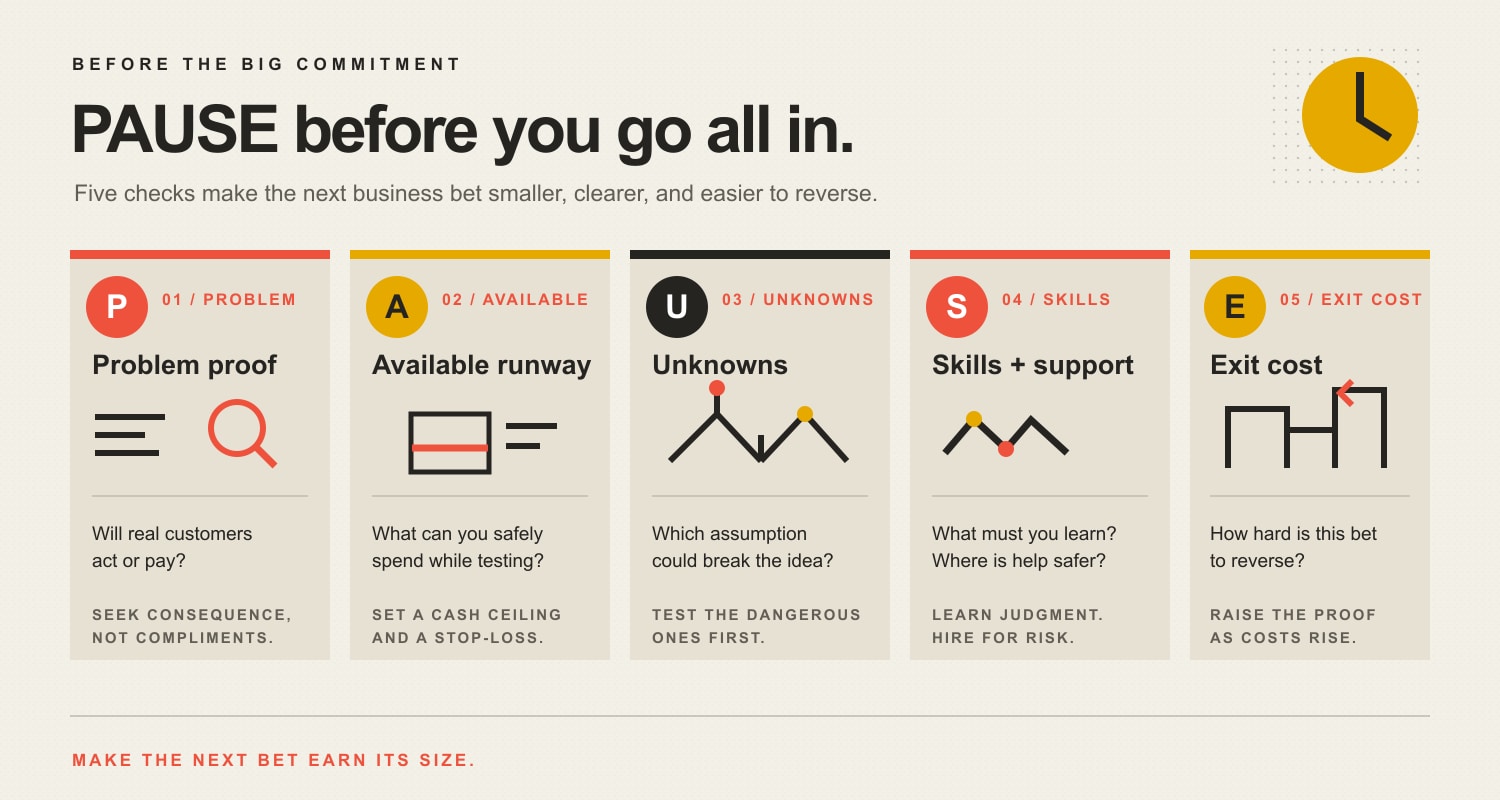
    At Scope Design, a more useful question is not “Am I brave enough to go all in?” It is “What would I need to know before this next commitment is rational?” We use a five-part decision check: PAUSE—Problem proof, Available runway, Unknowns, Skills and support, and Exit cost.

    The PAUSE Check: Problem proof asks whether real customers act or pay; Available runway sets a safe cash ceiling; Unknowns identify the assumption that could break the idea; Skills and support separate founder judgment from specialist risk; Exit cost raises the evidence threshold for hard-to-reverse decisions.
    The PAUSE Check helps separate cheap learning from expensive commitment.

    P — Problem proof

    What evidence shows a specific customer will act or pay? Start with the customer and the problem, not the business name, website, or product polish. Look for evidence with consequence: interviews that reveal an urgent problem, deposits, preorders, paid pilots, booked appointments, signed letters of intent where appropriate, or repeat requests from the same type of buyer.

    Compliments are weak evidence because they cost the customer nothing. If demand is still uncertain, use market research to learn how customers describe the problem, what they use now, what triggers a purchase, and what would make them switch. Then validate the business idea with the smallest test that can prove or disprove the riskiest assumption.

    A — Available runway

    What can the business spend without threatening your personal essentials? Startup money and personal survival money are not the same pool. Before you spend, separate one-time setup costs, recurring business costs, and the household obligations that still exist while revenue is uncertain.

    Set a hard cash ceiling and a stop-loss rule before enthusiasm moves the line. A useful startup budget prioritizes legal, safety, delivery, and revenue-enabling costs first, while delaying expensive polish until demand justifies it.

    U — Unknowns

    Which assumption could break the idea fastest? Most early businesses have unknowns around demand, price, acquisition channel, delivery time, capacity, repeat purchase, or required capital. Write them down. Rank them by how damaging they would be if wrong. Test the dangerous unknowns before the cosmetic ones.

    A fast launch is only useful when it buys learning. Speed that locks you into the wrong lease, wrong hire, wrong software stack, or wrong offer is not momentum. It is an expensive way to avoid a question.

    S — Skills and support

    What judgment must you learn, and where is specialist help safer? Founders should understand the core logic of their business: customer, offer, price, economics, sales process, and delivery. That does not mean doing every job personally.

    Our rule is learn the judgment, buy risk-sensitive expertise, delay polish. Learn enough marketing to judge a message and channel. Learn enough bookkeeping to understand cash and margins. But use qualified legal, tax, accounting, licensing, insurance, or other regulated specialists when the downside of being wrong is materially higher than the cost of expert help. Outsource execution when a specialist can do it faster without hiding the decision logic from you.

    E — Exit cost

    How hard is this decision to reverse? Early-stage uncertainty calls for reversible commitments. Month-to-month tools are safer than long contracts. A pilot is safer than a full rollout. Part-time or contract capacity can be safer than a premature full-time hire. A pop-up or sublease can test location demand before a long lease.

    The more expensive a decision is to undo, the more evidence it should require. If you are wrestling with a high-stakes choice, use a formal business decision-making framework instead of treating urgency as proof.

    What should you prove before the big commitments?

    CommitmentProve firstLower-risk testWhat to postpone
    Quit your jobRepeatable demand, credible delivery capacity, personal runway, and a written stop/go ruleSell during defined side-business hours, run paid pilots, or reduce hours if feasibleTreating one strong month as permanent demand
    Borrow moneyExactly what the money buys and how conservative cash flow could repay itStage spending by milestone; pre-sell where appropriateDebt used mainly to make the business look established
    Sign a leaseLocation-dependent demand and unit economicsPop-up, shared space, appointment model, or short-term subleaseLong fixed occupancy cost before traffic is proven
    Hire full timeRecurring workload, process clarity, and enough margin to support the roleContractor, part-time help, or a documented processHiring because the founder feels busy rather than because a stable constraint exists
    Build custom technologyA repeated workflow bottleneck and clear user demandManual service, spreadsheet, prototype, or low-code processComplex software built to automate a business model that is still changing

    Seven hard truths every entrepreneur should know

    1. Enthusiasm is not demand

    You can be deeply committed to the idea and still be wrong about the buyer, timing, price, or channel. The founder’s job is not to defend the original concept. It is to discover which version customers will actually choose.

    2. Revenue is not the same as runway

    A sale can be encouraging without making the business financially safe. Cash timing, delivery costs, taxes, refunds, inventory, payroll, debt, and owner living expenses all matter. Track the cash that remains available after obligations, not just the top-line number that feels good to report.

    3. Speed matters only when it buys learning

    “Move fast” is good advice when the action produces information. Interviewing five target customers this week can create evidence. Buying a year of software because you plan to need it someday does not. Early speed should shorten the feedback loop, not increase the exit cost.

    4. Doing everything yourself is not automatically frugal

    Founder time is a scarce resource. If you spend twenty hours avoiding a specialist fee while neglecting sales, delivery, or customer learning, the “free” option may be the expensive one. The goal is not maximum DIY. It is retaining judgment while allocating work to the person best equipped to do it.

    5. Fear does not disappear when the decision is right

    You do not need to eliminate fear before acting. Name the feared outcome, separate facts from assumptions, bound the downside, and choose the next reversible test. Our guide to dealing with fear in business goes deeper on making uncertainty actionable without pretending confidence is evidence.

    6. Irreversible decisions deserve a higher evidence threshold

    A $50 experiment and a five-year lease should not require the same confidence. Neither should a weekend test and quitting a stable income source. Raise the evidence threshold as the financial, legal, operational, or personal exit cost rises.

    7. Starting a business changes your responsibilities, not your biology

    Entrepreneurship can change how you spend time, make decisions, and think about risk. It does not make employment psychologically impossible, guarantee a permanent identity shift, or prove that your brain has been “rewired for success.” Those claims are more dramatic than useful. A better question is what operating role you actually want. If that is unclear, compare the practical differences between a business owner and an entrepreneur.

    Learn it, hire it, or postpone it?

    One of the hardest early decisions is deciding what deserves your time. Use this triage:

    If the work…Best defaultWhy
    Shapes customer, offer, price, sales, or delivery judgmentLearn enough to own the decisionYou need to recognize good evidence and make tradeoffs even if someone else executes.
    Carries material legal, tax, accounting, licensing, safety, insurance, or technical riskHire qualified expertiseThe cost of a serious mistake can exceed the cost of professional help.
    Is repeatable execution with clear inputs and outputsDelegate or automate when economics justify itYour time may be more valuable on sales, customer learning, or the current bottleneck.
    Mainly makes an unproven business look polishedPostpone itPolish should follow evidence, not substitute for it.

    A 30-day readiness sprint before you go all in

    Of all the things to know before starting a business, the most useful are the ones you can test before they become fixed costs. If the idea is still mostly assumptions, spend a month buying evidence instead of buying infrastructure. The goal is not to “finish” the business. It is to make the next decision better.

    1. Week 1: define the problem. Write the specific customer, painful situation, current workaround, and trigger that would make someone seek a solution. Interview people who actually fit that description.
    2. Week 2: test the offer. Put a real price and clear outcome in front of the right buyers. Look for consequential behavior—bookings, deposits, pilots, preorders, introductions, or clear rejection reasons—not just positive comments.
    3. Week 3: test delivery and economics. Deliver manually if possible. Record time, direct costs, rework, customer questions, acquisition effort, and what would break if demand doubled.
    4. Week 4: decide with rules you set in advance. Define the evidence that means continue, revise, postpone, or stop. Do not move the threshold after the result simply because you are emotionally attached to the idea.

    If the test exposes a weak assumption, that is useful information—not a personal verdict. Fix the assumption while the cost is still small.

    Frequently asked questions before starting a business

    How much money should I have before starting a business?

    There is no responsible universal number. A home-based service, inventory-heavy retailer, restaurant, and software company have different startup and operating needs. Calculate business setup and recurring costs, personal living obligations, and a downside scenario. Then set a cash ceiling you can afford before revenue becomes dependable. The amount should come from your business model and runway, not a generic internet average.

    Should I quit my job before starting a business?

    Usually the better question is what evidence would make quitting rational. Look for repeatable demand, a believable delivery model, defined personal runway, and a written stop/go rule. If the business can be tested without immediately giving up income, that preserves optionality while you learn.

    Do 90% of startups really fail?

    Do not use that number as a universal planning fact. Official U.S. business-survival data are measured by establishment cohorts and vary across years, industries, and economic conditions. Your decision is better served by testing demand, economics, cash requirements, and reversibility than by applying one dramatic percentage to every kind of new business.

    What should I learn before starting a business?

    Learn enough to judge the customer problem, offer, pricing, sales process, unit economics, cash position, and delivery process. You do not need to become an expert in every supporting discipline. Build the judgment required to supervise specialists and recognize when regulated or high-risk work belongs with a qualified professional.

    How do I know whether my idea has real demand?

    Look for behavior that costs the customer something: time, money, effort, a change in routine, or a commitment to proceed. Interviews can reveal the problem and buying trigger; paid pilots, deposits, preorders, or booked appointments can test willingness to act. The exact test depends on the business, but the principle is consistent: seek evidence stronger than compliments.

    What should I outsource first?

    Start with work where the downside of an error is high or where specialist execution clearly frees you to work on the current constraint. Legal, tax, accounting, licensing, insurance, and specialized technical issues often deserve qualified help. For marketing, design, and operations, retain enough understanding to judge the strategy even when you delegate execution.

    The bottom line

    The hard truths about starting a business are less cinematic than “go all in.” Customers do not owe an idea demand. Cash does not care how confident you feel. Fear can coexist with a good decision. Specialist help can be cheaper than a preventable mistake. And the evidence required should rise with the cost of reversing the decision.

    If you remember one list of things to know before starting a business, make it practical. Before the next major commitment, PAUSE: prove the Problem, protect Available runway, identify the biggest Unknowns, choose the right Skills and support, and measure the Exit cost. If the next step is cheap, reversible, and likely to teach you something important, take it. If it is expensive and hard to undo, make it earn a higher level of proof.

  • Smart Budget Implementation: How to Launch Your Startup Without Breaking the Bank

    Smart Budget Implementation: How to Launch Your Startup Without Breaking the Bank

    A startup budget should do more than tell you where the money went. It should protect cash while helping you prove what deserves more investment. Start by funding what you must have to sell and deliver safely, spend small amounts to test the assumptions that could make or break the business, delay fixed commitments until demand earns them, and keep part of your cash uncommitted for what you learn next.

    That is the difference between being cheap and being capital-efficient. Cheap founders can underfund the things that matter. Smart founders make the cost of being wrong survivable.

    Startup budget TL;DR

    • Set a hard cash ceiling before you start shopping.
    • Separate one-time startup costs from monthly fixed and variable expenses.
    • Pay first for legal, safety, delivery, and revenue-enabling requirements that truly must exist.
    • Use market research and small tests before committing serious money to unproven demand.
    • Prefer reversible, variable-cost options before leases, full-time hires, long contracts, or complicated software.
    • Know your break-even math and review actual cash weekly while the business is still changing quickly.
    • Keep uncommitted cash based on your downside scenario instead of blindly following a universal percentage rule.

    If you are still deciding whether the underlying opportunity is worth pursuing, start with our guide to finding profitable business ideas worth testing. This article assumes you have an idea and now need to launch it without financing the fantasy version of the company.

    What a business startup budget actually needs to do

    A business startup budget is a plan for the cash required before and during launch. It normally includes one-time startup costs, recurring fixed expenses, variable costs that rise with sales or delivery, and the cash you intentionally leave available for uncertainty.

    The U.S. Small Business Administration recommends calculating startup costs before launch and using those numbers to estimate profitability and funding needs. It also treats market research as a way to confirm or improve the business idea and reduce risk. Those two ideas belong together. A budget is not just an accounting exercise. It is a sequence of decisions about what you need to know before you spend more.

    That is why we do not recommend a universal 50/30/20, 70/10/10/10, or any other tidy percentage split for every startup. A home-based consulting firm, a restaurant, a software company, and a regulated medical practice do not have the same pre-sale requirements. The SBA also notes that startup expenses such as wages, rent or property costs, insurance, utilities, licenses, and fees can vary by location. A percentage that feels scientific can still be complete nonsense for your actual constraint.

    Scope Design uses a broader constraint-first business strategy: define the objective, identify what is actually preventing it, then choose the tactic. Your startup budget should follow the same logic. A requested tactic is not automatically a required expense.

    Use the PROVE Before You Pay startup budget framework

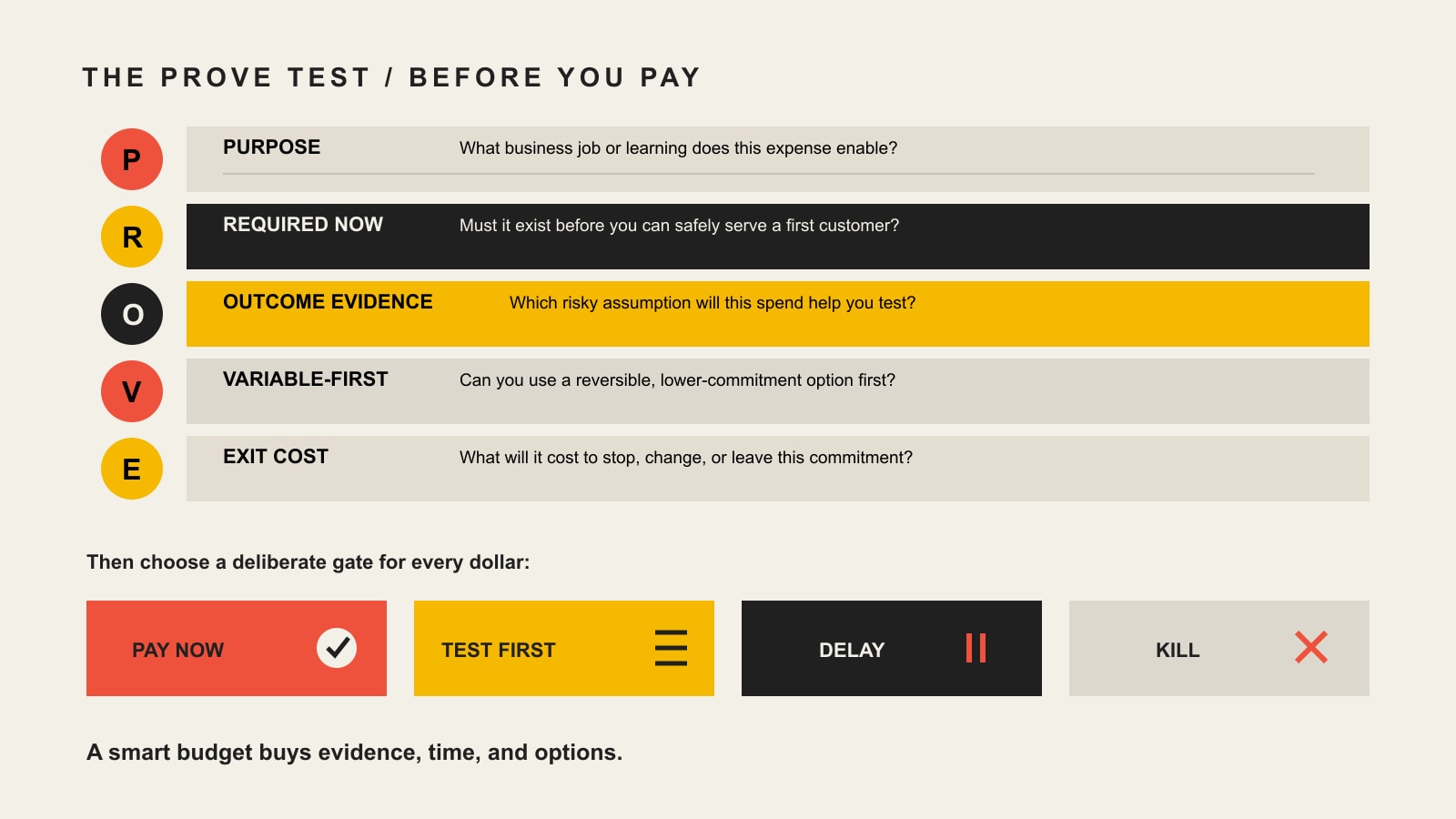
    Before a meaningful expense enters the budget, run it through five questions. We call this PROVE Before You Pay.

    P: Purpose

    What business outcome does this expense enable? “We should have one” is not an outcome. “This license is required before we can legally operate,” “this landing page lets us take deposits,” and “this prototype answers whether customers will pay” are outcomes.

    R: Required now

    Must this exist before you can sell, deliver, stay compliant, protect the customer, or protect the company from a material risk? If the answer is no, the expense may belong later even if it would be nice to have.

    O: Outcome evidence

    What will you learn or measure after spending the money? A good early expense should either enable an essential function or produce evidence that changes the next decision. If you cannot describe the evidence, you may be buying activity instead of progress.

    V: Variable-first

    Can you rent, contract, use a month-to-month plan, perform the process manually, or buy a smaller quantity before creating a fixed commitment? Variable costs are not always cheaper forever. They are often safer while you are still learning.

    E: Exit cost

    What happens if the assumption is wrong? Look beyond the purchase price. Count cancellation fees, unused inventory, implementation time, migration work, training, debt service, severance, lease obligations, and the attention required to unwind the decision.

    The PROVE framework evaluates Purpose, Required now, Outcome evidence, Variable-first options, and Exit cost, then guides decisions to Pay now, Test first, Delay, or Kill.

    The framework produces four useful decisions: Pay Now, Test First, Delay, or Kill. That is far more useful than labeling every item “important” and then wondering why the bank account is empty.

    Put every startup expense into one of four buckets

    Budget bucketUse it whenCommon examplesRelease condition
    Pay NowThe cost is truly required to sell, deliver, operate safely, or meet a material legal or contractual obligation.Required licenses, essential insurance, basic payment processing, must-have delivery equipment.No release gate; verify scope and avoid buying beyond the requirement.
    Test FirstThe expense is meant to prove demand, pricing, acquisition, workflow, or delivery assumptions.Customer interviews, prototype, small ad test, short contractor engagement, simple landing page.Define the result that justifies the next round of spending before the test starts.
    DelayThe expense may become useful, but the current business can operate or learn without it.Office lease, premium software tier, broad rebrand, large inventory order, second vehicle.Move it forward only when capacity, demand, risk, or economics make the need real.
    KillThe cost solves no current constraint, produces no useful evidence, or mainly makes the startup look more established.Vanity subscriptions, duplicate tools, speculative features, “enterprise” upgrades nobody needs.It returns only if a future constraint creates a defensible business case.

    How to build a startup budget in 7 steps

    1. Set the cash ceiling before you build the wish list

    Start with the money you are actually willing and able to put at risk. Do not build the dream launch, total it up, and then reverse-engineer a justification for spending that much. Your cash ceiling forces tradeoffs early, when changing the plan is cheap.

    If outside funding is part of the plan, keep the operating decision separate from the funding source. More available money does not make a weak expense smart. If you need credible funding and support options, our small-business resources guide covers the separate funding question.

    2. List one-time, fixed, and variable startup costs

    Make three lists. One-time costs happen primarily around setup. Fixed costs recur even when sales are zero. Variable costs rise or fall with sales, customers, transactions, or delivery volume.

    • One-time: formation/setup fees, initial equipment, launch deposits, initial design or implementation work.
    • Fixed: rent, base software subscriptions, minimum insurance premiums, salaried payroll, debt payments.
    • Variable: transaction fees, materials, shipping, contractors tied to projects, hourly delivery labor, performance media.

    Do not confuse “monthly” with “necessary.” A recurring subscription is still optional if it solves a problem you do not have.

    3. Identify the true non-negotiables

    Required costs depend on the business. A regulated operation may need professional licensing and specific insurance before opening. A service startup might need little more than the correct business setup, contracts, a way to communicate, a way to accept payment, and the tools required to deliver the work.

    Do not use an internet checklist as legal or tax advice. Confirm requirements with the relevant federal, state, and local authorities and qualified professionals. Your location can materially change fees, wages, insurance, property costs, and licensing obligations.

    4. Spend to validate demand before you spend to scale

    This is where many startup budgets get backward. Founders buy capacity for customers they have not yet proved exist. They commit to inventory, staff, custom software, ad volume, or facilities before the demand assumption has earned that investment.

    Use the smallest credible test that can change your mind. Interview buyers. Ask for the sale. Pre-sell when appropriate. Build a manual version. Run a limited campaign. Deliver the service yourself before automating it. The goal is not to make every experiment microscopic. The goal is to buy enough evidence without making a wrong assumption fatal.

    5. Calculate break-even before calling a budget “affordable”

    A cost is not affordable merely because you can pay the invoice today. You need to understand what the cost requires the business to produce.

    The SBA’s simplified break-even formula in units is fixed costs ÷ (price per unit – variable cost per unit). For example, if monthly fixed costs are $1,800, the average sale is $500, and variable delivery cost is $200, the simplified break-even point is six sales per month: $1,800 ÷ $300 = 6.

    That example is intentionally simple. Real businesses also need to account for taxes, payment timing, owner compensation, debt, mixed products, refunds, and other realities. The important habit is to translate spending into the volume or margin the business must produce.

    The SBA break-even guidance also explains why the calculation is useful for catching missing expenses and setting revenue targets.

    6. Protect uncommitted cash using scenarios, not a magic percentage

    We do not know a universal reserve percentage that is right for every startup, and neither does anyone else without knowing the business model. Build a downside case instead.

    • What if launch takes longer than expected?
    • What if the first acquisition channel does not work?
    • What if the first customers pay later than expected?
    • What if a required cost is 25% higher than quoted?
    • What if you need to change the offer after real customer feedback?

    Then decide how much cash needs to remain uncommitted so those events are inconvenient rather than existential. Runway is not money doing nothing. It buys options.

    7. Give every discretionary expense a release gate

    For every Test First or Delay item, write the condition that unlocks more money. Examples:

    • Increase ad spend after a campaign produces a defined number of qualified leads at an acceptable acquisition cost.
    • Move from a contractor to a full-time hire after consistent workload, margin, and management capacity justify the fixed commitment.
    • Upgrade software when the current process creates a measurable bottleneck that costs more than the upgrade.
    • Lease space when home, shared, mobile, or client-site delivery is materially limiting revenue, compliance, customer experience, or capacity.

    If the evidence does not arrive, the money does not automatically move. Hope is not a release gate.

    A hypothetical $10,000 startup budget example

    Is $10,000 enough to start a business? Sometimes. It can be plenty for a low-overhead service business and nowhere near enough for a business that requires a facility, significant inventory, specialized equipment, heavy regulation, or employees before the first sale.

    Here is a deliberately hypothetical example for a founder launching a simple professional service. It is not a recommended percentage template. It demonstrates sequencing.

    Illustrative useAmountWhy it exists
    Required setup, contracts, licenses/insurance as applicable$1,500Pay Now: satisfy real operating and risk requirements.
    Customer research and offer validation$1,000Test First: prove who buys, why, and at what price.
    Minimum sales infrastructure$1,500Domain, lean website/landing page, email, scheduling/payment tools.
    Delivery tools and first-job materials$1,000Enable actual customer work without buying scale capacity.
    Small marketing experiments$1,000Test a few acquisition assumptions with hard limits and tracking.
    Bookkeeping/admin basics$500Keep records usable from day one.
    Uncommitted cash$3,500Preserve options for slower sales, better opportunities, or corrected assumptions.
    Total$10,000Illustrative only; real requirements come first.

    Notice what is missing: a long office lease, full-time staff, a giant software stack, six months of advertising purchased in advance, and a custom app nobody has asked for. Those expenses may become correct later. They just have to earn their place.

    What should you spend on early, and what can usually wait?

    Legal, insurance, licenses, and safety

    Spend early when the requirement is real. Do not delay a required license, appropriate insurance, safe equipment, or a necessary professional agreement because “lean startup” sounded like permission to wing it. Lean does not mean reckless.

    Research and customer validation

    Usually worth doing early because it can prevent much larger mistakes. Research does not require an enormous study. The job is to reduce uncertainty about customer, problem, alternatives, price, buying process, and demand. Our market research guide goes deeper on methods you can use without turning the project into a six-month academic exercise.

    Website and brand

    Buy enough to sell credibly and complete the job the website needs to do. Do not confuse “minimum” with “bad,” and do not confuse “custom” with “strategic.” A simple site may be exactly right when it clearly explains the offer, provides evidence, supports the sales process, and lets customers take the next step. Our guide to buying the right business website covers that decision in more depth.

    A full identity system, advanced integrations, or custom functionality should earn the extra investment by solving a real positioning, operational, or conversion problem. Otherwise it is expensive theater.

    Marketing

    Start with the channel most consistent with how the customer actually discovers and evaluates the offer. A small paid-search test may make sense when buyers already search for the service. Direct outreach may be better when the market is narrow. Local partnerships may beat broad social content for a local service company.

    Do not set a universal marketing percentage before you know the economics. Once you have evidence about demand and acquisition, use our small-business marketing budget framework to decide how much more investment the channel deserves.

    Software

    Buy software for a proven workflow, not an imagined organization chart. Start with the native or lower-cost capability when it can do the job. Upgrade when time savings, error reduction, customer experience, capacity, security, or reporting creates a measurable business case.

    Office space

    For many service businesses, space can wait. For others, the location is part of the product or a legal requirement. The point is not “never rent an office.” The point is to make the space justify itself through operations, customer experience, compliance, hiring, or revenue rather than status.

    Contractors versus employees

    Flexible capacity can reduce fixed commitments while demand is uncertain, but contractor status is not a magic classification you can choose for convenience. Use the correct legal relationship and weigh cost, control, knowledge, quality, availability, and strategic importance. Our in-house versus outsourcing decision framework covers the broader tradeoff.

    Review cash weekly while the startup is still learning fast

    An early startup changes too quickly for a budget to be a document you admire once a quarter. Run a short weekly cash review:

    1. Cash available today.
    2. Committed payments due before the next review.
    3. Expected receipts and how confident you are in the timing.
    4. Actual spending versus the budget.
    5. New evidence about demand, price, acquisition, delivery, or capacity.
    6. Expenses that should move between Pay Now, Test First, Delay, and Kill.
    7. The single constraint most likely to block the next meaningful business outcome.

    This keeps the budget connected to decisions. If a test disproves the assumption, stop funding it. If customer demand arrives faster than expected, release money into the real bottleneck. If sales are slower, protect runway before adding commitments.

    Common startup budget mistakes

    • Budgeting around the dream org chart. Hiring roles before the workload, margin, and management system exist creates fixed cost faster than capability.
    • Buying annual plans to “save money.” A discount on a tool you do not need is still waste.
    • Treating all marketing as one line item. Separate channel tests so you can tell what earned more investment.
    • Ignoring owner labor. “I will do it myself” may reduce cash expense while still consuming the founder’s most constrained resource.
    • Underestimating implementation cost. Software price is only part of the cost. Setup, migration, training, integration, maintenance, and process change count.
    • Spending the reserve because it is visible. Uncommitted cash is there to preserve options, not to eliminate the discomfort of seeing money sit still.
    • Using optimistic revenue as cash. A proposal, verbal yes, invoice, and cleared payment are four different things.

    Frequently asked questions about startup budgets

    What is a startup budget?

    A startup budget is a plan for the cash needed to get a business operating and survive the early period while revenue is still uncertain. It should separate one-time startup costs, recurring fixed expenses, variable costs, and intentionally uncommitted cash.

    How do I create a budget plan for my startup business?

    Set a cash ceiling, list all one-time and recurring costs, identify true legal and operating requirements, validate demand before scaling capacity, calculate break-even, build a downside scenario, and give discretionary expenses evidence-based release gates. Then compare actual cash to the plan every week during the early launch phase.

    Is $10,000 enough to start a business?

    It can be enough for some low-overhead service businesses, but there is no universal answer. Compare $10,000 with the required pre-sale costs, monthly fixed burn, working-capital needs, regulation, equipment, inventory, and the amount of cash you need to keep uncommitted. If the business requires $40,000 of unavoidable setup before the first customer, motivational budgeting will not turn $10,000 into enough.

    How much cash reserve should a startup keep?

    Use scenario planning instead of a universal percentage. Estimate what happens if launch is delayed, sales ramp more slowly, a required expense rises, or the first acquisition channel fails. Keep enough cash uncommitted that the plausible downside does not force a bad decision immediately.

    Should I hire employees or outsource at launch?

    Keep a capability in-house when it is strategically important, requires constant coordination, depends on deep company context, or has enough steady workload to justify the fixed commitment. Outsourcing can make sense for specialized or variable work while demand is still uncertain. Use the correct legal classification and compare total cost, control, quality, availability, and knowledge retention.

    Should I pay for a website and branding before I have customers?

    Pay for the level needed to sell credibly and complete the buyer’s next step. That may be a focused landing page and simple visual system rather than a large custom build. Add sophistication when evidence shows the current solution is limiting trust, conversion, operations, differentiation, or growth.

    Are startup costs tax deductible?

    Some pre-opening costs receive specific federal tax treatment rather than being handled exactly like ordinary current operating expenses. IRS Publication 583 discusses business startup costs and recordkeeping. Tax treatment depends on the facts, so keep good records and use a qualified tax professional for your situation.

    How often should I update my startup budget?

    Review cash and near-term commitments weekly during a fast-changing launch. Update the underlying assumptions whenever pricing, demand, delivery cost, staffing, regulation, or the sales cycle changes materially. The budget should follow the business, not the calendar.

    A smart startup budget buys evidence and options

    The goal is not to launch with the fewest dollars. The goal is to spend enough on the right things while keeping the cost of a wrong assumption survivable. Pay for genuine requirements. Test the uncertain parts. Delay fixed commitments until demand or capacity earns them. Kill expenses that solve no current constraint.

    That discipline gives you something more valuable than a prettier spreadsheet: the ability to change your mind before a bad decision becomes expensive.

    If the high-leverage question in your plan is what to build, automate, market, or delay, Scope Design can help pressure-test the constraint and implementation path before you commit the budget.