Tag: brand strategy

  • Advertising vs. Marketing vs. Branding: What’s the Difference?

    Advertising vs. Marketing vs. Branding: What’s the Difference?

    Advertising, marketing, and branding are not three names for the same thing. Branding shapes what your business means and why people should choose it. Marketing is the broader system for understanding a market, creating demand, communicating value, converting customers, and learning from results. Advertising is paid distribution inside that marketing system.

    That distinction matters because the wrong diagnosis gets expensive fast. If people do not understand your offer, buying more ad impressions usually gives more people a chance to be confused. If your positioning is clear but nobody finds you, another logo redesign will not fix distribution. The useful question is not simply advertising vs. marketing vs. branding. It is: which problem is actually limiting growth right now?

    TL;DR: Which One Do You Need?

    • Branding / Clarity: Start here when people do not understand what makes you different, do not remember you, or do not have a clear reason to prefer you.
    • Marketing / System: Prioritize this when the offer and position make sense but there is no repeatable path to qualified demand, follow-up, conversion, or retention.
    • Advertising / Scale: Add paid reach when you already have a credible message, a defined audience, a conversion path, and enough capacity to handle more qualified opportunities.

    That is the practical version of Scope Design’s Clarity → System → Scale diagnostic. It is not a rigid sequence; it is a way to identify the current bottleneck before buying a tactic.

    Advertising vs. Marketing vs. Branding at a Glance

    DisciplineCore questionWhat it ownsTypical workUseful signals
    BrandingWhat should people understand, remember, and prefer about us?Positioning, meaning, identity, voice, consistency, reputationBrand strategy, messaging, visual identity, guidelines, customer experienceRecognition, preference, trust, consistency, direct demand
    MarketingHow do we connect the right offer with the right market and move people toward a decision?Market insight, demand generation, customer journey, channels, conversion, retention, measurementResearch, content, SEO, email, social, offers, landing pages, analytics, campaignsQualified traffic, leads, conversion rate, customer acquisition, retention, revenue quality
    AdvertisingWhere should we pay to put a specific message in front of a specific audience?Paid reach, campaign targeting, creative, media buying, testingSearch ads, paid social, display, video, sponsorships, traditional mediaQualified reach, cost per result, conversion quality, return relative to spend

    The American Marketing Association’s marketing-vs.-advertising explanation makes the same essential distinction: marketing is broader, while advertising is a paid practice within that larger business activity. Branding overlaps with marketing, but it answers a different set of questions about identity, positioning, meaning, and memory.

    What Is Branding?

    Branding is the deliberate work of shaping what people expect from your business and why they should care. It includes visual identity, but a brand is not a logo, color palette, or font selection. Those are tools for expressing the brand.

    The deeper work is deciding who you are for, what you want to be known for, what makes your offer meaningfully different, what promise customers should expect you to keep, and how that idea shows up consistently. That is why strong branding influences sales conversations, website copy, hiring, customer service, packaging, content, and advertising creative—not just design.

    In practical terms, branding should make it easier for the right person to answer questions such as:

    • Is this company for someone like me?
    • What does it do differently from the alternatives?
    • What should I expect if I buy?
    • Does the business feel credible and consistent?
    • Why would I remember or recommend it?

    If those answers are fuzzy, the problem is usually deeper than promotion. Scope Design’s brand strategy guide goes further into building a recognizable, usable brand system rather than treating branding as a one-time design project. Kantar’s branding-versus-marketing overview also emphasizes the long-term role branding plays in recognition and distinctiveness.

    One more distinction matters: branding can make a promise recognizable, but recognition is not the same as authority. If the market understands what you claim but still does not believe it, the constraint is proof. Our brand authority guide explains how evidence, useful expertise, experience, reputation, and corroboration earn that belief.

    What Is Marketing?

    Marketing is the system that connects a business, an offer, and a market. It starts before promotion. Good marketing asks what customers need, which segment is worth serving, how the offer should be positioned and priced, where buyers look for answers, what information they need before they act, and how the business will know whether the strategy is working.

    That system can include market research, product and offer strategy, content, search engine optimization, email, social media, events, partnerships, public relations, sales enablement, landing pages, conversion work, customer retention, and measurement. Advertising can be part of the mix, but marketing does not require paid media to exist.

    This is where small businesses often get trapped by tactics. A company says it “needs marketing,” then immediately jumps to “we should post more on Facebook” or “we should run Google Ads.” Those may be useful tactics. They are not a strategy until they are connected to an audience, an offer, a message, a customer journey, a goal, and a way to evaluate the result.

    If budget is tight, that distinction is even more important. Scope’s guide to marketing strategies that do not require media spend is useful when the real problem is building a demand system rather than buying reach immediately.

    What Is Advertising?

    Advertising is the paid placement of a message in front of an audience. Search ads, paid social, display ads, video spots, sponsored placements, radio, print, direct-mail media buys, and billboards can all fit the category.

    Advertising is powerful because it can buy access to attention faster than most organic channels can earn it. It can also create a clean testing environment: define an audience, run an offer and creative, measure what happened, and change the campaign. But paid reach does not repair a weak offer, unclear positioning, a poor landing page, or a sales process that cannot close qualified leads.

    Think of advertising as an amplifier. An amplifier makes a strong signal louder. It also makes a weak signal louder.

    Marketing vs. Advertising: Strategy and System vs. Paid Distribution

    The simplest way to understand marketing vs. advertising is that marketing is the larger system and advertising is one way to distribute a message within that system.

    A marketing decision might be: “Commercial contractors are our most profitable segment, and they need proof that we can respond quickly across multiple job sites.” An advertising decision comes later: “We will use paid search to reach contractors actively looking for that service, send them to a landing page built around response time and coverage, and measure qualified quote requests.”

    You can market without advertising through SEO, referrals, email, partnerships, organic content, events, or direct outreach. You cannot make advertising strategic simply by buying media. The ad still needs a market, offer, message, destination, and measurement plan.

    Branding vs. Marketing: Meaning vs. Bringing That Meaning to Market

    Branding vs. marketing is less about choosing one and more about understanding their jobs. Branding establishes the meaning and expectations you want attached to the business. Marketing turns that position into a system that reaches people, earns attention, creates demand, and helps customers move toward a decision.

    Branding without marketing can become a beautifully defined business nobody discovers. Marketing without brand clarity can produce activity without preference: traffic arrives, but prospects struggle to understand why this company is the right choice.

    Branding vs. Advertising: The Signal vs. the Megaphone

    With branding vs. advertising, the separation is sharper. Branding helps determine what the message should mean. Advertising pays to put a specific version of that message in front of people.

    A company can have memorable ads and still have a weak brand if the promise changes from campaign to campaign or the customer experience contradicts the message. It can also have a strong brand and use little paid advertising if referrals, search demand, partnerships, or repeat business already provide enough qualified opportunity.

    How Branding, Marketing, and Advertising Work Together

    Imagine a local commercial service company that has grown mostly through referrals. The work is good, but prospects describe the company in five different ways and the website lists services without explaining why a buyer should choose them.

    1. Branding: The company clarifies its best-fit customer, the problem it solves unusually well, its positioning, proof, voice, and visual consistency. The message becomes specific enough that employees and customers can repeat it.
    2. Marketing: It builds pages around high-intent services, creates useful content that answers buyer questions, improves local/search visibility, adds follow-up email, and defines how inquiries will be measured and qualified.
    3. Advertising: Once the offer and landing-page path are working, it buys paid search or social reach for the highest-value audience and tests messages against real conversion quality.

    The three disciplines reinforce one another. Branding makes the message more coherent. Marketing gives that message a system and customer journey. Advertising can accelerate qualified exposure. Results from marketing and advertising then create feedback that can sharpen the offer and, occasionally, reveal that the brand position needs to change.

    What Comes First: Branding, Marketing, or Advertising?

    “Branding first, then marketing, then advertising” is a useful teaching shortcut, but it is too rigid for an operating business. A better approach is to diagnose the current constraint. At Scope Design, we can frame that as Clarity → System → Scale.

    1. Clarity: Fix Branding When the Market Does Not Understand or Prefer You

    Start with brand strategy when prospects reach you but still cannot tell what makes you different, your offer attracts the wrong expectations, the sales team describes the company inconsistently, or every campaign needs a new message because there is no stable position underneath it.

    Clarity does not mean spending months polishing a logo before talking to customers. It means getting the promise, audience, differentiation, proof, voice, and identity coherent enough that marketing has something useful to carry into the market.

    2. System: Fix Marketing When There Is No Repeatable Path to Demand

    Prioritize marketing when the brand and offer make sense but customer acquisition is inconsistent. Maybe referrals are the only dependable source of work. Maybe traffic lands on disconnected pages. Maybe content exists without a clear buyer journey, follow-up, conversion path, or measurement plan.

    The goal is not “do more marketing.” It is to build a system: define the audience and problem, choose a channel based on buyer behavior, create the right message and destination, give people an obvious next step, and measure the quality of the resulting opportunities.

    3. Scale: Add Advertising When the Message and Conversion Path Are Proven Enough to Amplify

    Paid media becomes more attractive when you already know who tends to buy, the offer converts at a level the business can support, the sales process can handle more opportunities, and the economics leave room to buy qualified attention.

    That does not mean every campaign must wait for perfect data. Advertising can be used for testing. The important point is that the test should have a hypothesis. If the business has no clear audience, message, offer, or conversion path, “let’s run ads and see what happens” is usually an expensive way to discover several problems at once.

    How Much Should You Spend on Branding, Marketing, and Advertising?

    There is no responsible universal percentage that says every business should spend a fixed amount on branding, another fixed amount on marketing, and another on advertising. The old version of this article gave percentage ranges. We have removed them because a useful budget depends on the business model, growth goal, margins, sales cycle, market, existing assets, capacity, and—most importantly—the current constraint.

    A better budgeting sequence is:

    1. Name the business outcome. More qualified opportunities? Better close rate? A new-market launch? Higher retention? More direct demand?
    2. Find the constraint. Is the main problem clarity, the marketing system, or reach?
    3. Fund the smallest credible intervention. Do enough work to test the diagnosis instead of scattering money across every channel.
    4. Protect the bottleneck downstream. More leads are not useful if fulfillment, sales follow-up, or capacity cannot absorb them.
    5. Measure quality, not just activity. Impressions and clicks can be useful campaign signals, but the business ultimately needs qualified customer behavior.

    This is also why buyer behavior matters. If traffic is healthy but prospects hesitate, the issue may be message, proof, risk, or perceived value rather than distribution. Our guide to buyer psychology and diagnosing why customers say yes or do not can help separate those problems.

    Four Common Business Scenarios

    Scenario 1: “We Just Launched and Need Customers”

    Do enough branding to establish a clear audience, promise, offer, proof, and recognizable identity. Then build the simplest marketing path that can put that offer in front of real prospects and capture learning. Advertising may speed up that learning, but only if the campaign is designed as a test rather than a substitute for strategy.

    Scenario 2: “People Like Us, but Growth Comes Almost Entirely From Referrals”

    This often points to a marketing-system constraint. The brand may already have trust and proof; the missing piece is repeatable discovery and follow-up. Build search visibility, useful content, email capture or nurturing, partnerships, or another channel your buyers actually use before assuming the answer is a rebrand.

    Scenario 3: “Organic and Referral Leads Convert Well, but We Need More Volume”

    This is a stronger advertising case. You have evidence about the audience and offer, so paid search, paid social, sponsorships, or another paid channel can be tested as an acceleration mechanism. Keep comparing paid lead quality with the channels that already work.

    Scenario 4: “Our Ads Are Getting Expensive and Performance Is Falling”

    Do not automatically solve an advertising problem with more advertising. Break the system apart. Has the audience changed? Is the offer less compelling? Is creative fatigued? Does the landing page match the ad? Are competitors changing the economics? Are leads qualified but sales follow-up is weak? Sometimes the fix is campaign execution. Sometimes the ad is merely exposing a positioning, offer, conversion, or capacity problem.

    If you are deciding between an educational demand-generation tactic and paid promotion, our webinars vs. advertising comparison shows how two very different approaches can fit different goals.

    Common Mistakes When Businesses Mix Up Branding, Marketing, and Advertising

    • Using advertising to compensate for weak positioning. More reach cannot make an undifferentiated promise distinctive.
    • Treating branding as a cosmetic refresh. A new visual identity can help expression and consistency, but it cannot replace decisions about audience, position, promise, and proof.
    • Calling a list of channels a marketing strategy. “SEO + Facebook + email” is a media list until it is tied to a customer, outcome, message, journey, and measurement plan.
    • Changing everything at once. If you replace the offer, page, audience, campaign objective, creative, and follow-up simultaneously, even a better result may not tell you what actually worked.
    • Optimizing for cheap activity instead of valuable behavior. A low-cost click from the wrong prospect can be worse than an expensive click from someone likely to become a profitable customer.

    Frequently Asked Questions

    Is advertising part of marketing?

    Yes. Advertising is generally a paid promotional activity within the broader marketing system. Marketing also includes work such as market research, offer strategy, pricing, distribution, content, SEO, email, conversion, retention, and measurement.

    Is branding part of marketing?

    They overlap, but it is more useful to treat branding as a discipline with its own job. Branding shapes the meaning, identity, positioning, and expectations attached to the business. Marketing uses and reinforces that position while connecting the business with its market.

    What comes first, marketing or branding?

    A new business usually needs enough brand clarity to define who it serves, what it promises, and why it is different before scaling promotion. An existing business should diagnose the constraint instead of blindly following a sequence. If the market understands and prefers the offer but demand is inconsistent, marketing may be the priority. If marketing already produces qualified customers and the business needs more reach, advertising may be next.

    Can a business succeed without advertising?

    Yes. Businesses can acquire customers through referrals, SEO, organic content, partnerships, direct outreach, events, email, public relations, repeat business, and other non-paid channels. Advertising is useful when paid reach improves the economics or speed of a proven customer-acquisition system; it is not mandatory for every company.

    Do I need a rebrand before I run ads?

    Not automatically. You need enough clarity that the ad can make a credible, differentiated promise to a defined audience and the destination page can continue that promise. If those pieces already work, a full rebrand may be unnecessary. If prospects routinely misunderstand the offer or the company presents itself inconsistently, brand work may be the higher-leverage fix.

    Start With the Constraint, Not the Tactic

    The practical difference between advertising, marketing, and branding is not academic. Each solves a different class of problem. Branding creates clarity and preference. Marketing builds the system that connects an offer to a market. Advertising buys reach to amplify a message.

    Before you buy another tactic, identify whether your biggest limitation is Clarity, System, or Scale. That one decision can prevent a business from paying to amplify the wrong problem.

    If you want help diagnosing which layer needs work, Scope Design’s Advertising and Marketing and Branding & Graphics services cover both sides of the problem, or you can contact Scope Design and start with the business constraint rather than a preselected channel.


  • Branding and Sales: Can Your Brand Really 12X Growth and Reputation?

    Branding and Sales: Can Your Brand Really 12X Growth and Reputation?

    Branding and sales are connected, but there is no credible universal “12X” multiplier. A stronger brand can improve the odds that the right buyer recognizes you, understands the offer, believes the proof, prefers you over an alternative, and remembers the experience well enough to return or refer. The commercial effect depends on the market, the offer, the starting brand, the sales process, and whether delivery makes the promise true.

    That is the useful answer hiding underneath the old hype. Branding is not a revenue button, and reputation is not a graphic-design deliverable. Branding shapes expectations and makes a position recognizable. Sales converts demand into a decision. Reputation is the public pattern left behind by what actually happened.

    • No fixed multiplier exists. Research supports relationships between brand-building and business performance, not a universal percentage that applies to every company.
    • Branding affects specific choke points. Recognition, clarity, proof, preference, conversion, retention, and referrals are separate jobs that can be observed.
    • Reputation must be earned. A polished identity can make a promise easier to notice. It cannot make weak delivery trustworthy.
    • Measure a chain, not a vibe. Track brand signals, buyer behavior, sales economics, and causal evidence separately.

    Does Branding Really Increase Sales?

    Yes, branding can help sales, but the mechanism matters more than the slogan. Kevin Lane Keller’s foundational work on customer-based brand equity explains why brand knowledge matters: what people know, recognize, and associate with a brand can change how they respond to its marketing. That does not mean a logo causes revenue. It means memory and meaning can change the probability of consideration and response.

    The small-business evidence is also more nuanced than the internet’s recycled percentages. A recent systematic review of 63 peer-reviewed SME-branding studies found that brand-building is connected to brand and financial performance, but it also emphasized context: founder behavior, identity, marketing, digital channels, customer relationships, and iterative management all matter. A fashion-SME panel study likewise found a positive association between brand-building efforts and sales performance. Useful evidence, yes. A universal “branding adds 23%” rule, no.

    A 2026 Journal of Business Research synthesis on branding and selling makes the relationship even clearer: branding and selling are interdependent systems. Brand capabilities influence how value is communicated, how trust is created, and how salespeople behave; selling then feeds market information and customer experience back into the brand. That is much closer to how a small business actually works than pretending the brand sits in one department and sales in another.

    If you need the upstream work of choosing the audience, position, promise, and operating rules, use Scope Design’s brand strategy guide. This article owns a narrower question: once a brand system exists, where can it change the sales process, and how do you tell whether it did?

    The Scope Design BRAND Sales Chain

    Scope Design uses the BRAND Sales Chain to keep branding work connected to observable commercial behavior. It is not a law of branding and it is not a score. It is a diagnostic sequence:

    A customer recognizes a distinctive shop, sees the quality of the work, makes a purchase, and returns with a friend.
    The BRAND Sales Chain traces brand work from recognizable cues to buyer behavior, sales economics, and stronger causal evidence.

    B: Be Recognizable

    Can the right buyer identify and retrieve you when the need appears? Recognition begins with consistent, distinctive cues: the name, identity, language, category association, and repeated ideas attached to the business. The goal is not maximum exposure. It is useful memory among people who could actually buy or refer.

    Watch for branded searches, direct visits, repeat visitors, referral mentions, and unaided customer recall. None of those proves a sale was caused by branding. Together, they tell you whether the business is becoming easier to retrieve from memory.

    R: Reduce Confusion

    Recognition is useless if the buyer remembers you but still cannot explain what you do. A functioning brand should reduce the number of translations required between your website, salesperson, proposal, social profile, and customer experience.

    This is where a clear brand messaging system earns its keep. The right buyer should be able to understand who the offer is for, what problem it solves, what is different about the approach, why the claim is believable, and what to do next. If every employee describes the company differently, more advertising usually scales the confusion.

    A: Answer Doubt With Proof

    A brand can make a claim recognizable. Brand authority gives people reasons to believe it. The amount and type of proof should match the risk of the decision. A low-cost impulse purchase and a five-figure professional engagement do not require the same evidence.

    Useful proof can include relevant cases, specific reviews, testimonials, demonstrations, process transparency, credentials, samples, before-and-after evidence, independent references, or simply clear disclosure of what the offer does and does not include. “Trusted,” “premium,” and “results-driven” are not proof. They are adjectives looking for witnesses.

    N: Nudge Preference and Action

    Once a buyer recognizes the business, understands the offer, and believes enough of the proof, the brand can make the right option easier to choose. That can show up as fewer basic objections, less category confusion, more shortlist inclusion, better-fit inquiries, or a cleaner transition from marketing into the sales conversation.

    This is not the same as saying “branding lets you charge more.” Price resistance is part of a broader perceived-value judgment that includes benefits, price, effort, delay, risk, proof, process, and alternatives. Branding can make value easier to recognize, but it cannot rescue an offer whose economics or delivery do not make sense.

    D: Deliver Consistently

    The sale is not the finish line. The customer experience updates the brand after purchase. Communication, reliability, ownership, quality, problem-solving, support, billing, onboarding, and follow-through either confirm the promise or expose it.

    That accumulated public pattern is reputation. It can reinforce future sales through repeat business, referrals, reviews, lower perceived risk, and stronger word of mouth. If you need the operational work of tracking reviews, mentions, listings, complaints, responses, and branded search results, use Scope Design’s online reputation management guide. This article is about the sales connection, not the monitoring system.

    Branding, Marketing, Sales, Authority, Perceived Value, and Reputation Are Different Jobs

    Businesses waste money when they collapse all of these ideas into “marketing.” Scope Design’s broader guide to branding, marketing, and advertising separates the disciplines. For this article, the commercial handoffs are the important part:

    Job Core question Sales connection What it cannot prove
    Brand strategy What should we mean, to whom, and why? Gives sales a stable position and promise. That buyers understand or believe it.
    Branding How should that position be expressed and recognized? Creates consistent cues and expectations across touchpoints. That the promise has been earned.
    Marketing How do we create and capture relevant demand? Brings the offer to the right market and creates paths to action. That the sales process will close good-fit demand.
    Sales How do we help a qualified buyer make a decision? Turns demand into a commercial commitment. That delivery will satisfy the promise.
    Authority Why should anyone give our judgment weight? Reduces evidence gaps in higher-risk decisions. That every offer or claim is correct.
    Perceived value Are the expected benefits worth the total sacrifice? Shapes preference, price resistance, and willingness to proceed. That real delivery will match expectations.
    Reputation What pattern do people believe about our conduct and results? Changes future trust, referrals, retention, and risk perception. That the business owns a distinctive position.

    The point is not taxonomy for its own sake. It is diagnosis. If qualified prospects do not understand the offer, fix clarity. If they understand it but do not believe it, strengthen proof. If they believe it but do not see enough value, examine the offer, risk, price, and alternatives. If they buy and then leave, the problem is delivery or fit. A redesign cannot solve all four.

    Where Branding Changes the Sales Process

    Before the Buyer Is Ready

    Branding creates memory before there is a lead. A buyer may see a vehicle, review, article, social post, referral, event, or search result weeks before a need becomes urgent. That earlier exposure rarely receives a neat last-click trophy. Yet it can make the later search easier because the business is already familiar.

    At the First Serious Evaluation

    The website, proposal, storefront, salesperson, and reviews should tell compatible versions of the same story. When those touchpoints disagree, the buyer has to resolve the inconsistency. That creates cognitive work and risk precisely when the business should be making the decision easier.

    During the Sales Conversation

    A strong brand system gives salespeople better raw material: a defined best-fit customer, a clear position, repeatable language, relevant proof, known non-fit conditions, and a shared expectation of what delivery should look like. The 2026 branding-and-selling synthesis is useful here because it treats sales as part of the brand system, not a downstream department that inherits a logo file.

    At the Price and Risk Decision

    When buyers cannot tell the difference between options, price often becomes disproportionately visible. Differentiation can reduce that problem, but only when the difference is relevant and believable. A distinctive color palette is not a commercial moat. A clearly expressed, well-proven way of solving an expensive problem can be.

    After the Sale

    Delivery determines whether the brand promise becomes a reputation asset or a liability. Reviews, referrals, renewals, repeat purchases, complaints, cancellations, and service recovery all feed the next buyer’s risk assessment. This is why “brand consistency” should include behavior, not only visual standards.

    How to Measure Brand Impact on Sales Without Making Up a Number

    Do not start with the question “What is our brand ROI?” Start with a specific hypothesis: If we improve one brand constraint, which buyer behavior should change, and what economic outcome should follow?

    Measure four layers separately:

    Layer Useful signals Question it answers
    Brand signals Unaided awareness, recognition, branded search, direct visits, message association, consideration Is something changing in buyer memory or perception?
    Buyer behavior Qualified inquiries, return visits, referral mentions, shortlist inclusion, objection patterns, lead-to-conversation rate Is that perception changing what people do?
    Sales economics Close rate, sales-cycle length, discount pressure, CAC, gross margin, retention, repeat purchase, referral rate Is the behavioral change commercially useful?
    Causal evidence Phased rollout, holdout group, comparable market, cohort comparison, controlled lift study What would likely have happened without the change?

    The fourth layer is the one most branding case studies skip. A before-and-after chart shows sequence, not causation. Google’s lift measurement overview makes the distinction explicit: experiments and lift approaches are designed to separate incremental impact from conversions that would have happened anyway.

    Small businesses will not always have enough volume for a formal experiment. You can still improve the evidence. Establish a stable baseline that covers a normal sales cycle. Avoid changing five major variables at the same time. Roll a new message, identity system, or proof package into one segment before another when practical. Compare like with like. Record sales notes and win/loss reasons. Ask new customers what they remembered and what reduced uncertainty. Then look for the change to persist.

    A simple approximation is:

    Estimated incremental effect = change in the treated group − change in a comparable control group.

    That is still not magic. It is simply better than saying, “Revenue rose after the rebrand, therefore the rebrand caused all of it.” Seasonality, pricing, promotions, inventory, staff changes, new channels, sales follow-up, market demand, and plain luck are all capable of impersonating brand lift.

    When Branding Hurts Sales Instead of Helping

    • The brand is clearer but wrong. A polished position aimed at the wrong buyer makes rejection more efficient.
    • Marketing promises what operations cannot deliver. Short-term conversion may rise while complaints, refunds, churn, and reputation get worse.
    • A rebrand destroys useful recognition. Replacing distinctive cues without a business reason can make an established company harder to retrieve from memory.
    • The team cannot use the system. A 90-page brand book nobody opens is not a system. Salespeople will improvise the missing parts.
    • Consistency becomes repetition. Repeating the same sentence everywhere is not the same as expressing one coherent position in context.
    • The business measures attention instead of economics. More followers, prettier creative, or higher engagement can coexist with worse lead quality and margin.
    • The company copies a category leader’s minimalism. Large brands can omit context because people already know them. A smaller business may remove the exact explanation a new buyer needs.

    The rule is simple: brand work should remove a diagnosed constraint, not create a prettier version of the same confusion.

    A 30-Minute Branding and Sales Audit

    You do not need a six-month rebrand to learn whether the brand is part of the sales problem. Take one real offer and walk it through five questions:

    1. Recognition: Ask five recent customers or prospects how they would describe your company to someone else. Do they use any of the ideas you intentionally want to own?
    2. Clarity: Compare the homepage, salesperson’s opening explanation, proposal introduction, and Google Business Profile. Are they making the same core argument?
    3. Proof: List the three claims most important to the sale. Can you point to evidence for each one that a skeptical buyer could inspect?
    4. Preference: Pull ten recent won and lost opportunities. What alternatives were buyers comparing, and why did they choose or reject you?
    5. Delivery: Review recent reviews, complaints, renewals, cancellations, and referrals. Which parts of the public reputation confirm or contradict the intended promise?

    Then identify the first broken link in the chain. Do not redesign the logo if the real problem is a weak offer. Do not buy more traffic if the message attracts the wrong people. Do not add testimonials if the repeated complaint is slow follow-up. The Objective → Constraint → Positioning → Strategy → Tactics → Measurement order is deliberately boring. That is why it works.

    Branding and Sales FAQ

    Does branding increase sales?

    It can. Branding can improve recognition, clarity, trust, differentiation, and consistency, which may change consideration, conversion, retention, and referral behavior. Research supports associations between brand-building and business performance, but there is no universal sales percentage that applies to every company.

    How long does branding take to affect sales?

    There is no universal timeline. Some changes, such as clearer sales language or stronger proof, can affect a buyer conversation quickly. Recognition and reputation usually require repeated exposure and delivered outcomes over time. Judge the timing against your existing awareness, buying cycle, market complexity, and the specific link in the BRAND Sales Chain you are trying to change.

    What is the 3-7-27 rule of branding?

    It is not a universally accepted law of branding, and Scope Design would not use it as a planning assumption. Different businesses, channels, buyers, and purchase risks require very different exposure patterns. Track actual recognition, consideration, qualified demand, and sales behavior instead of pretending a catchy sequence is a natural law.

    Is brand reputation the same as branding?

    No. Branding is the deliberate system used to express and reinforce a position and expectation. Reputation is the broader pattern people believe about the company’s conduct and results after experiences, reviews, referrals, complaints, commentary, and response history accumulate.

    Should a small business invest in branding before advertising?

    Fix enough brand clarity first that paid reach has a useful message to amplify. That does not require perfect visual polish. It does require a defined audience, offer, position, proof, message, and conversion path. If those are already working, advertising can accelerate exposure. If they are not, advertising can accelerate confusion.

    Can branding support higher prices?

    It can support a buyer’s willingness to consider a higher price when the brand makes relevant value, proof, differentiation, reliability, and lower risk easier to understand. The price still has to make sense relative to the outcome and alternatives. Branding is not a license to add margin to an undifferentiated offer.

    How do I know whether branding is the actual sales constraint?

    Look for specific symptoms: prospects cannot explain what makes you different, the sales team uses inconsistent language, the business attracts wrong-fit expectations, every campaign needs a new message, good proof is scattered or invisible, or delivery does not match the promise. If the real problem is insufficient qualified traffic, weak follow-up, bad pricing, poor delivery, or limited capacity, fix that constraint instead.

    Fix the Sales Constraint, Not Just the Logo

    The useful version of “branding can 12X sales and reputation” is not a multiplier. It is a system. A business becomes easier to buy from when the right people can recognize it, understand it, believe it, prefer it, and then experience the promise consistently enough to remember and recommend it.

    That gives you a better question than “How much revenue does branding create?” Ask: Which link in our brand-to-sales chain is weak, what evidence would show improvement, and what business outcome should move if we fix it?

    If you are not sure whether the real constraint is branding, positioning, proof, traffic, conversion, the offer, or sales follow-through, Scope Design’s Impact Consulting is built for that diagnosis. Fix the system that is actually limiting growth before spending money decorating the symptom.

  • How to Choose a Domain Name for Your Business: The CORE Test

    How to Choose a Domain Name for Your Business: The CORE Test

    If you are wondering how to choose a domain name for your business, start with this rule: the right domain is not the one with the most keywords. It is the shortest, clearest name that your business can safely use, grow into, and control. Before you register anything, run the name through four checks: Clarity, Ownership, Reach, and Execution. We call that the CORE Domain Test.

    A domain is more than a web address. It becomes part of your brand, your email, your links, your advertising, your analytics history, and the technical path customers use to reach you. That is why a clever name can still be a bad decision if it creates trademark risk, boxes the business into one service or city, or lives in an account the business does not control.

    This guide is for U.S. small-business owners choosing a new domain or deciding whether an existing one is worth changing. It is practical business guidance, not individualized trademark or legal advice.

    What makes a good domain name?

    A good domain is easy for a person to recognize, say, type, and remember; distinct enough to support your brand; broad enough to survive reasonable growth; and registered in a way that leaves the business in control.

    There is no universal “15 characters or fewer” rule. Shorter often helps because there is less to remember and mistype, but character count is a weak substitute for clarity. NorthStarDental.com can be a better business name than a shorter string that nobody can pronounce. The useful test is human: say the domain out loud once, ask someone to type it, and see where they hesitate.

    Likewise, do not force a keyword into the domain because you expect an SEO shortcut. Google’s current SEO Starter Guide says keywords in a domain name or URL path alone have hardly any ranking effect beyond their possible appearance in breadcrumbs. Our guide to keywords and search traffic reaches the same practical conclusion: choose words for people and positioning, not because someone promised an algorithmic jackpot.

    How to choose a domain name: use the CORE Domain Test

    The CORE Domain Test separates four decisions that generic “top 10 domain tips” lists usually blend together. A candidate can be strong in one area and still fail overall.

    Four domain-name checks cover clarity, safe ownership, room to reach future markets, and business control of registration and access.

    C — Clarity: can people use the name without coaching?

    Clarity is the human-factors test. A domain should be easy to hear, read, type, and repeat. That does not mean every domain must be tiny or literal. It means the friction should be intentional.

    • Say it: Can a customer hear the domain once and type it correctly?
    • Spell it: Does it depend on an unusual spelling that you will have to explain forever?
    • Separate the words: When the words run together, do they create an unintended reading?
    • Test numbers and hyphens: Will people wonder whether you said “5” or “five,” or forget the dash?
    • Match the brand: Does the domain sound like the business you want people to remember?

    A domain is one piece of a larger identity system. If the business name itself is still unsettled, solve the positioning and naming problem before optimizing the URL. Our brand strategy guide covers that broader work.

    O — Ownership: can you safely use the name?

    Ownership is a veto check. A memorable name is not a good domain if it creates an obvious rights conflict or carries history you did not investigate.

    Start with the USPTO’s current federal trademark search, but do not treat a database search as a complete legal clearance. USPTO notes that a proper clearance search can be complex and should consider marks that look, sound, mean, or create a commercial impression similar to yours, along with related goods and services. Its trademark process guidance also makes an important distinction: registering a domain name does not give you trademark rights, and a domain can still create infringement problems.

    Then investigate the name beyond trademarks. Search the web for the exact name and close variants. Check major social platforms if handle consistency matters to your launch. If the domain was previously registered, review historical snapshots in the Wayback Machine and inspect what the old site appears to have been used for. A clean-looking registration page today does not tell you the whole history.

    If the name is strategically important or the search turns up a close competitor or existing mark, involve a qualified trademark attorney before you build the brand around it.

    R — Reach: will the name still fit the market you want?

    Reach asks whether the domain communicates enough without narrowing the business unnecessarily. A city, product, or niche word can help people understand what you do, but it can also become a constraint later.

    For example, a service business that genuinely intends to stay local may be comfortable with a city in the domain. A firm planning to expand across a region should be more cautious. The same applies to product-specific names: a domain built around one offer can become awkward after the offer changes.

    The extension belongs in this decision too. .com is often a practical choice when the natural .com is available and matches what your audience expects, but it is not an SEO requirement. Google says the top-level domain generally does not matter to Search; country-code domains can act as a usually low-impact signal when you are specifically targeting users in that country. Choose the extension because it fits the business and market, not because you think Google rewards the letters after the dot.

    E — Execution: does the business control the infrastructure?

    Execution is the second veto check. The best domain name in the world is fragile if the registrar account, DNS, recovery email, renewal method, or transfer controls are outside the business’s reach.

    ICANN defines the registrant as the individual or entity that registers the domain and manages it through the registrar. In practical terms, the business should know which account controls the registration, who can recover that account, how renewals are paid, and how the DNS can be changed if a vendor relationship ends.

    ICANN’s security guidance recommends keeping the registrar account secure and recoverable, enabling multifactor authentication when the registrar supports it, and using a registrar lock as another layer against unauthorized changes or transfers. It also warns against casually listing a web designer or hosting provider as the registrant. Scope Design takes the same position in our business website ownership guide: a vendor can manage the domain, but the business should not become a tenant in somebody else’s account.

    This is also why domain and hosting are related but not the same thing. If those pieces are still blurry, our explainer on how domains, DNS, hosting, and websites work together shows which control belongs where.

    Does putting a keyword in your domain help SEO?

    Not enough to choose the domain around it. A descriptive word can help a human understand the business, but Google says the keyword in the domain itself has hardly any ranking effect. That makes “plumber,” “lawyer,” “design,” or a city name a branding choice first—not a ranking strategy.

    If two candidate domains are equally clear and ownable, a descriptive term can be useful. But do not accept a clumsy, limiting, or legally risky name because it contains a search phrase. The stronger SEO work happens on the website: useful content, clear page topics, crawlable architecture, credible evidence, links, local relevance where appropriate, and a site that satisfies the query.

    Should you always choose a .com domain?

    No. Choose .com when it is the cleanest version of your brand, not because it gets a ranking bonus. If the exact .com is held by another active business, buying an awkward spelling just to keep .com can create more confusion than choosing a clear alternative extension.

    Evaluate the whole name and extension together. Ask whether customers will remember it, whether the extension fits the audience, whether the corresponding .com creates material confusion, and whether the extension has registration rules or renewal pricing you are comfortable with. Country-code domains deserve extra attention because eligibility and policy can vary by registry.

    The pre-registration domain checklist

    Run every serious candidate through the same checklist so you do not fall in love with the first available name.

    CheckQuestionWhat a failure means
    Say/spell testCan someone type it after hearing it once?Expect avoidable word-of-mouth and email friction.
    Brand fitDoes it sound like the company you want to build?The domain may preserve an old positioning problem.
    Trademark screenAre there confusingly similar marks in related goods/services?Veto until resolved.
    Web and social searchWho already uses the name or close variants?Potential confusion, reputation, or handle conflicts.
    Domain historyWhat did archived versions of the domain contain?Investigate reputation and legacy-link risk before buying.
    ReachDoes a city, product, or niche word unnecessarily limit growth?You may need a rebrand just when the business expands.
    TLD fitWill customers understand and remember the full address?Extension friction can erase the benefit of the shorter name.
    Price termsWhat are registration, renewal, transfer, premium, and privacy terms?A cheap first year can hide an expensive long-term choice.
    Registrant/controlIs the business the registrant and account owner?Veto until fixed.
    Recovery/securityAre MFA, registrar lock, recovery contacts, and renewal details set?Veto until the business can recover and retain control.

    ICANN’s registrant rights and responsibilities are useful when comparing registrars because they emphasize accessible information about pricing, management, transfers, renewals, restoration, privacy services, and support. That is a better basis for choosing a registrar than a permanent “best” or “worst” list that will age as products and prices change.

    What if your preferred domain is taken?

    Do not immediately add three keywords, a hyphen, and an extra letter. Treat the taken domain as a constraint and generate a better shortlist.

    1. Try a brand modifier that people already associate with the company. A service category, product family, or simple verb can work when it still sounds natural.
    2. Consider a different TLD. Compare the full address against the existing .com so you understand potential confusion.
    3. Consider acquisition only when the domain is genuinely strategic. Verify the seller, rights, transfer process, history, and total cost before money changes hands.
    4. Rename early if the clean alternatives all feel compromised. Changing a young brand before launch is usually easier than migrating an established website and email system later.

    Should you buy multiple domain names?

    Sometimes. Buy extra domains to solve a specific problem, not because every typo or TLD feels scary. Useful cases can include a genuinely confusing variant, an old domain retained during a migration, or a campaign name with a clear purpose. Point alternatives to one primary home with deliberate redirects rather than maintaining duplicate sites.

    Every extra domain also creates another renewal, security, DNS, and inventory obligation. A “protect everything” portfolio can become the thing that causes the important domain to expire unnoticed.

    Should an established business change its domain name?

    Usually not for cosmetic reasons or a keyword upgrade. Once a domain is established, the decision changes. You are no longer comparing two names in a vacuum; you are comparing the benefit of the new name with the cost of moving links, email, analytics history, customer habits, ads, profiles, DNS, and search signals.

    Google treats a domain change as a site move with URL changes. Its current guidance calls for mapping old URLs to new ones, using server-side permanent redirects, updating canonicals and internal links, submitting the appropriate Search Console Change of Address, monitoring the move, and keeping redirects generally for at least a year. Google also says temporary ranking fluctuations can happen while it recrawls and reprocesses the move.

    A domain change can still be worth it when the old name creates a real problem: a legal conflict, a merger or major rebrand, a name that materially misrepresents the business, or a history/reputation problem that cannot reasonably be separated from the domain. But “the new URL has a better keyword” is not a sufficient business case.

    A real example: why this article still has “2025” in its URL

    This article is a useful test of our own rule. Its established permalink ends in /choosing-right-domain-name-2025/, even though the guidance has now been rebuilt to be evergreen.

    We checked the evidence before touching the URL. In the most recent 12-month GA4 window, the page had 11 landing sessions, all Direct, with one engaged session and zero configured key events. Search Console returned no exact-page query rows in either of the two 12-month comparison periods and currently reports the URL as “Crawled – currently not indexed,” while also confirming a successful fetch and a matching self-canonical. Bing reports zero clicks and zero impressions, and Ubersuggest found no exact-page ranking keywords or backlinks.

    Those numbers do not show valuable search equity. We still kept the URL because removing the year would not solve a user problem, while it would create a redirect and another migration dependency. The visible title and article can become current without making every old link learn a new address. This is the larger lesson: change a domain or URL because the benefit clears the migration cost—not because a scorecard dislikes the slug.

    Frequently asked questions about choosing a domain name

    How long should a domain name be?

    There is no magic character limit. Make it as short as practical without sacrificing clarity, pronunciation, spelling, or brand fit. The voice test is more useful than chasing an arbitrary number.

    Is a keyword in the domain good for SEO?

    A keyword can help a person understand the business, but Google says the keyword in the domain alone has hardly any ranking effect. Choose it for clarity or positioning, not as a ranking hack.

    What is the best domain extension for a business?

    There is no universal winner. .com is often practical when the natural version is available and familiar to your audience. Other generic TLDs can work when the full address is clear. Country-code TLDs can make sense for a country-specific market. Google does not give .com a general ranking advantage.

    Should I put LLC in my domain name?

    Usually only if “LLC” is genuinely part of the public-facing brand. A domain is a customer-facing identifier, not a substitute for your legal entity records. If customers know the company without the suffix, adding it can create unnecessary typing and recall friction.

    Who should own the business domain?

    The domain should be registered and recoverable under business-controlled credentials and contacts, with clear internal responsibility for renewal and security. A designer, developer, or managed provider can administer it, but the business should be able to regain control without needing that vendor’s permission.

    How do I check a domain’s history before buying it?

    Review archived versions in the Wayback Machine, search the web for the exact domain and brand name, inspect obvious legacy backlinks or mentions, and look for prior uses that could create confusion or reputation problems. No single check proves a domain is “clean,” so investigate anything material before acquisition.

    Can I change my domain later?

    Yes, but an established domain change is a migration project, not a simple rename. Plan URL mappings and permanent redirects, update canonicals and internal links, verify analytics and Search Console, update campaigns and profiles, preserve the old domain, and monitor both sides of the move.

    Choose the domain as part of the website strategy

    A domain decision happens early, but its consequences last. The best choice is not “shortest wins,” “.com at any cost,” or “put the keyword in it.” It is the name that passes CORE: clear to humans, safe enough to use, broad enough for the intended market, and controlled by the business.

    That is also why domain selection belongs inside website strategy, not as a five-minute registrar task. If you are choosing a domain because a new website, rebrand, or business launch is coming next, Scope Design can help connect the naming decision to the brand, site structure, technical ownership, SEO, and conversion path before those choices become expensive to unwind.

  • De Beers Marketing Campaign: How “A Diamond Is Forever” Changed Demand

    De Beers Marketing Campaign: How “A Diamond Is Forever” Changed Demand

    The De Beers marketing campaign is often told as a simple story: a diamond company invented engagement rings, wrote one brilliant slogan, and convinced the world that a shiny stone was mandatory for marriage. The real history is more interesting—and more useful to marketers.

    Diamond engagement rings existed centuries before De Beers. What De Beers and its U.S. advertising agency, N.W. Ayer, did far more effectively was turn an existing elite custom into a mass-market expectation. They connected a product to a life ritual, gave the purchase emotional meaning, repeated that meaning through culture and commerce, and defended the idea of lasting value for decades.

    That distinction matters for marketers. The useful lesson is not “manufacture a tradition.” It is how a clear position can become stronger when the product, the moment, the identity, and the proof all reinforce the same idea.

    What De Beers actually changed

    De Beers did not invent engagement rings or even diamond engagement rings. The Gemological Institute of America’s history of engagement rings traces betrothal rings to the Romans and notes a written record of a diamond engagement ring in 1477, when the future Holy Roman Emperor Maximilian was advised to give Mary of Burgundy a ring set with a diamond.

    So the breakthrough was not invention. It was normalization at scale. A diamond ring moved from being one possible luxury symbol to becoming, for many buyers, the expected symbol of engagement. That is a much more interesting marketing achievement because it required changing what people believed the purchase meant.

    The strongest campaigns rarely create desire from nothing. They attach an offer to desires that already exist: love, security, status, belonging, celebration, competence, relief, or progress. De Beers attached diamonds to one of the most emotionally loaded transitions in adult life and then worked to make the association feel natural.

    How the De Beers marketing campaign worked before the slogan

    The famous slogan arrived in 1947, but the demand-building system was already taking shape. GIA’s history of the 4Cs records that it was collaborating with De Beers on advertising to stimulate interest in diamonds by 1940, and that N.W. Ayer represented De Beers in the United States.

    That matters because it corrects another myth: the campaign was never just four magic words. The broader machine included advertising, retailer education, public education, editorial influence, celebrity imagery, and repeated explanations of how to evaluate diamonds. A slogan can crystallize a strategy, but it cannot replace one.

    Modern marketers would recognize the distribution logic. The message becomes more believable when it appears consistently in more than one context. That is not identical to today’s omnichannel marketing, but the principle is familiar: each touchpoint should reinforce the same customer meaning instead of telling a different story.

    Why “A Diamond Is Forever” worked

    The De Beers marketing campaign found its most durable expression in 1947, when N.W. Ayer copywriter Frances Gerety wrote the line “A Diamond Is Forever.” WARC’s campaign history describes the core strategic move: the slogan linked the physical durability of a diamond with the idea of enduring romantic love.

    That is unusually efficient positioning. Four words carried a product attribute, an emotional promise, and a behavior cue at the same time:

    • Product truth: diamonds are physically durable.
    • Emotional analogy: enduring material becomes a symbol for enduring love.
    • Purchase logic: an important, permanent commitment deserves an important, permanent object.
    • Retention logic: “forever” frames the ring as something to keep, not something bought for short-term utility.

    The line did not need to explain mining, gemology, or price. It gave the buyer a simple story for why the product belonged in the moment.

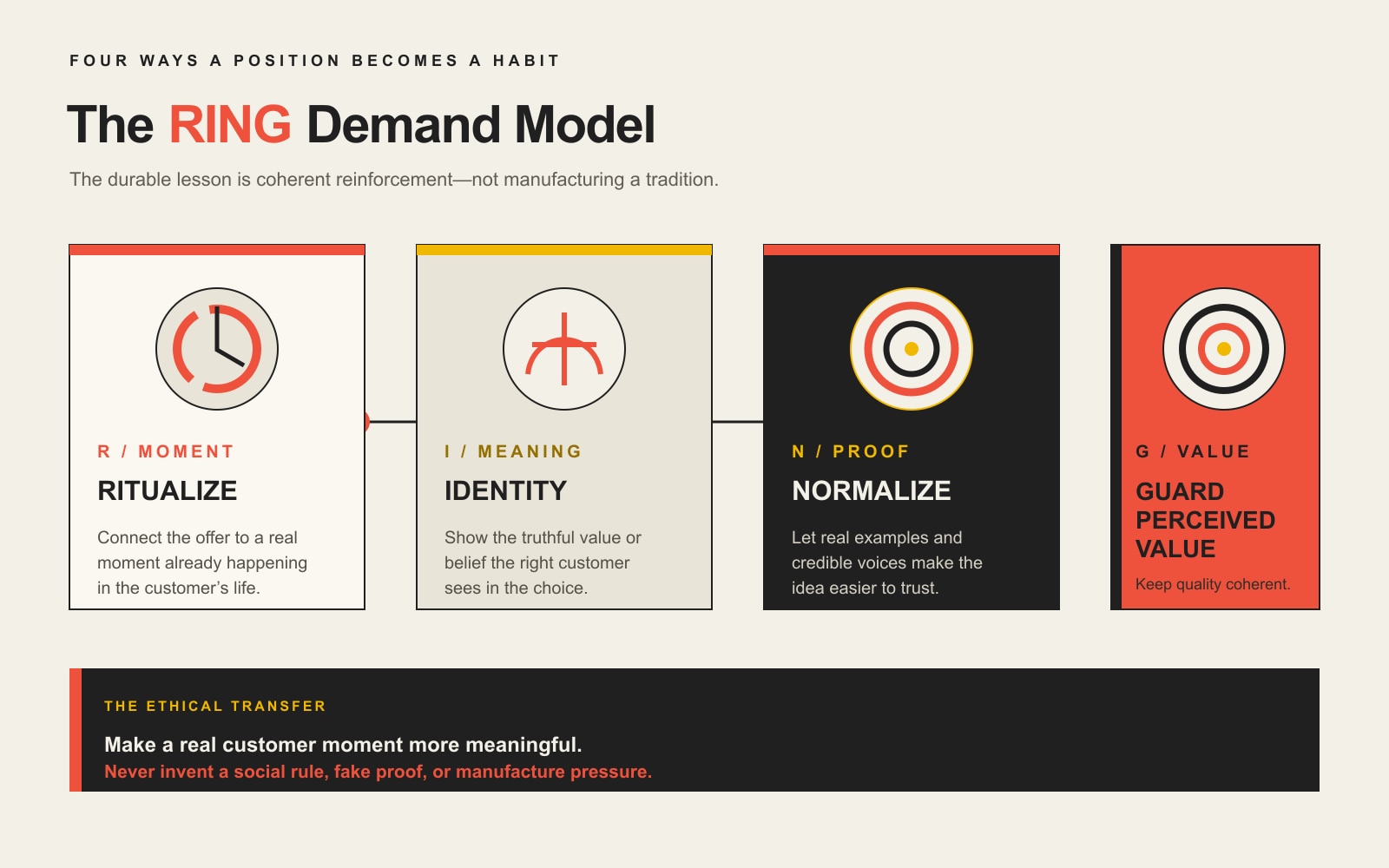
    Scope Design’s RING demand model

    De Beers is an extreme historical case, but the mechanism can be separated from the parts modern businesses should not copy. We use the RING model to describe the durable portion of the strategy: Ritualize, Identity, Normalize, Guard value.

    The RING demand model moves from Ritualize a meaningful moment to Identity, Normalize with credible proof, and Guard perceived value; the ethical note warns against invented social rules, fake proof, and manufactured pressure.

    R — Ritualize a meaningful moment

    A ritual gives a purchase timing. Engagement created a natural “when”: at the proposal or commitment milestone. For a modern business, the ethical version is to understand the real transition your customer is already going through. A new hire needs onboarding. A growing company outgrows a homemade website. A homeowner preparing to sell needs the property ready for market.

    The offer becomes easier to understand when the customer can answer, “This is what people like me do when this moment happens.”

    I — Identity: make the choice mean something

    De Beers did not market only a mineral. The ring signaled commitment, seriousness, taste, and eventually social expectation. Identity compresses complicated value into a recognizable symbol.

    Modern brands can use identity without manipulation. The question is not “How do we make people insecure?” It is “What truthful statement does choosing us let the right customer make about themselves?” Reliability, craftsmanship, independence, local expertise, speed, sustainability, or premium service can all be identity signals when the underlying experience earns them.

    N — Normalize with distributed proof

    An idea feels safer when people encounter it repeatedly from credible places. Advertising can introduce the message, but retailers, educators, press, peers, customer stories, and recognizable examples can make it feel normal.

    The ethical line is crucial: use real proof. Do not invent testimonials, fake scarcity, stage popularity, or pressure customers with a social rule you made up. Our guide to marketing psychology without tricking people goes deeper on helping buyers decide without exploiting them.

    G — Guard perceived value

    Premium positioning collapses when every message trains the buyer to think only about discounts. De Beers spent decades reinforcing durability, symbolism, quality language, and occasion-based meaning. That protected a value story far larger than the stone’s functional utility.

    For an ordinary business, guarding value means consistency and substance: clear positioning, a coherent offer, proof of results, dependable delivery, and pricing that matches the experience. It does not mean copying the historical diamond industry’s market power or manufacturing scarcity.

    De Beers did not invent the 4Cs

    The old version of this article credited De Beers with creating the 4Cs—cut, color, clarity, and carat. That is incorrect.

    GIA identifies its founder, Robert M. Shipley, as the originator of the 4Cs mnemonic in the early 1940s. The more nuanced history is better: De Beers and N.W. Ayer helped spread the framework. GIA notes that Ayer lecturers taught jewelers how to explain the four factors and that De Beers later used the term in national advertising.

    That distinction is itself a marketing lesson. A company does not have to invent every useful framework to benefit from making it easier for customers to understand a category. Education can reduce uncertainty and give buyers a vocabulary for comparison—as long as the information is accurate and the source gets proper credit.

    The two-month salary guideline was advertising, not etiquette

    Another durable piece of diamond folklore is the idea that an engagement ring should cost two months of salary. It is not a timeless social rule or a financial standard.

    JCK’s contemporary trade coverage documented De Beers/Ayer advertising that explained the 4Cs and the two-month salary guideline. In a later JCK retrospective, the publication placed the two-month version in the 1990s and described it explicitly as a De Beers effort to increase the average engagement-ring price.

    For marketers, this is a useful warning about the power of anchors. A suggested budget can become memorable even when it has no independent authority. That is exactly why pricing guidance should help customers make a better decision, not disguise a seller’s preferred spend as a rule everyone is supposed to follow.

    What marketers can copy—and what they should not

    The De Beers case is compelling because the ethical and strategic lessons sit side by side. Separating them makes the case more useful.

    Worth copying

    • Own one clear association. “Forever” gave the product a compact emotional position.
    • Connect the offer to a real moment. A timed need is easier to act on than generic awareness.
    • Teach customers how to evaluate the category. Good education lowers uncertainty and makes expertise visible.
    • Repeat the same meaning across touchpoints. Consistency compounds; scattered messages reset the conversation.
    • Build distinctive memory. A memorable phrase, visual system, or framework can become an asset that works for years.

    Not worth copying

    • Manufactured social pressure. “Everyone expects this” is not ethical proof unless it is actually true and relevant.
    • Artificial urgency or scarcity. A premium should come from real value, not a false constraint.
    • Opaque pricing rules. A seller-created spending norm should not masquerade as independent advice.
    • Market control as strategy. Historical concentration of diamond supply is part of the context, not a playbook for small businesses.

    The difference is simple: strong positioning helps the right customer understand real value. Manipulation tries to manufacture a reason to buy that would collapse if the customer had better information.

    Why the De Beers marketing campaign still matters

    The most telling proof of the slogan’s durability is that De Beers still returns to it. In November 2024, the company announced its “Forever Present” campaign and said it was reviving the “A Diamond Is Forever” tagline for U.S. natural-diamond marketing. That is a primary-source claim from De Beers’ own campaign release, so it tells us what the company chose to reuse—not whether every claim in the campaign should be accepted uncritically.

    Still, the strategic point is hard to miss. A distinctive idea can outlive individual media plans, creative executions, and generations of buyers. The asset is not merely the ad. It is the association the ad keeps reinforcing.

    For a small business, that is the bridge back to the whole marketing system. If positioning is fuzzy, adding more ads usually amplifies the fuzziness. If the message, offer, proof, and customer journey agree, paid attention has something coherent to multiply. Our small business marketing strategy guide covers that broader system.

    Frequently asked questions

    Did De Beers invent diamond engagement rings?

    No. Diamond engagement rings existed centuries before the De Beers campaign; GIA documents a written example from 1477. De Beers’ achievement was helping turn the diamond engagement ring into a much broader cultural expectation through sustained marketing.

    Who wrote “A Diamond Is Forever”?

    N.W. Ayer copywriter Frances Gerety wrote the slogan in 1947 for De Beers. Its power came from connecting diamond durability with the idea of enduring love.

    Did De Beers invent the 4Cs of diamonds?

    No. GIA credits founder Robert M. Shipley with developing the 4Cs mnemonic in the early 1940s. De Beers and N.W. Ayer helped popularize the language through education and advertising.

    Is two months of salary a real rule for buying an engagement ring?

    No. It was an advertising guideline, not a financial or etiquette standard. A couple’s ring budget should be based on their own priorities and finances, not a seller-created formula.

    Why was the De Beers marketing campaign so effective?

    The De Beers marketing campaign aligned one memorable idea with a meaningful life moment, repeated it across many credible touchpoints, educated buyers about the category, and reinforced a consistent value story for decades. The result came from the system around the slogan, not from four words acting alone.

    The real De Beers marketing lesson

    The De Beers marketing campaign is more impressive—and more useful—when we stop repeating the myths around it. The company did not invent diamond engagement rings. It did not invent the 4Cs. And one slogan did not single-handedly create a neatly measurable $350 billion industry.

    What De Beers and N.W. Ayer did was build a remarkably persistent system of meaning around an existing product and an existing ritual. They made the product easier to remember, easier to justify, easier to compare, and harder to separate from the moment it represented.

    That is the part worth studying. Ritualize the right moment. Give the choice truthful identity. Normalize it with real proof. Guard value with consistency and genuine differentiation. If the meaning survives better information, you are building a brand. If it depends on hiding the truth, you are building a trap.

  • Compelling Taglines: What Psychology Actually Says About Memory, Emotion, and Brand Recall

    Compelling Taglines: What Psychology Actually Says About Memory, Emotion, and Brand Recall

    Compelling taglines do not need to “hack the brain.” They need to cue one useful idea, connect that idea to the right brand, survive a delay, and remain believable when a customer encounters the real business.

    That sounds less exciting than promises about subconscious triggers and neurological buy buttons. It is also much closer to what the evidence supports. Research on hundreds of real slogans shows that the wording people like most is not automatically the wording they remember best. Other research shows that repetition can help familiarity and liking, but not without limits. And decades of branding work point to another problem that famous-tagline lists often miss: people can remember the words and forget who said them.

    This guide focuses on the psychology of evaluating a tagline: memory, processing, repetition, brand association, credibility, and the limits of neuromarketing claims. If you need the full ideation and writing process, use our guide to writing memorable slogans and taglines. That page owns the writing craft; this one owns the evidence test.

    What Makes Compelling Taglines Work?

    A useful tagline is a compact brand cue, not a miniature sales page. It cannot explain the entire company, carry weak positioning on its back, or guarantee a sale by choosing the correct adjective.

    At minimum, a strong line should do five things well enough for its intended job:

    • Express one strategically useful idea. People should have a clear association to attach to the company.
    • Remain true. The line should survive contact with the actual product, service, proof, and customer experience.
    • Link to the brand. Remembered words have little value if the audience credits a competitor.
    • Leave useful memory. The goal is not merely immediate applause in a meeting.
    • Process well enough for the context. People must be able to understand, say, scan, or hear the line—but “easier” is not automatically “more memorable.”

    This is why a tagline should sit downstream from a coherent brand messaging system. The tagline compresses one idea from that system. It does not replace the system.

    Psychology Says Liking and Memory Are Different Jobs

    One of the most useful findings in slogan research is also one of the easiest to ignore: likability and memorability can pull in different directions.

    A Journal of Consumer Research study by Brady T. Hodges, Zachary Estes, and Caleb Warren analyzed more than 800 brand slogans and combined that work with laboratory experiments, eye tracking, and a field study. The researchers found a tradeoff between linguistic fluency and memory. Features that made slogans easier to process tended to improve liking while reducing memory; some less-fluent features improved memory at the cost of liking.

    In their data, shorter slogans, familiar words, and omitting the brand name were generally associated with greater liking. Longer slogans, more concrete or less-common words, and including the brand name were more likely to be remembered.

    That is not a recipe for making every tagline long or awkward. It is a warning against optimizing the wrong outcome.

    What the tagline needs to doWhat to testCommon mistake
    Create immediate easeComprehension and naturalnessAssuming the smoothest line will also be remembered
    Build recallDelayed unaided recallJudging memory immediately after exposure
    Strengthen brand linkageCorrect brand attributionCelebrating recall of the words alone
    Clarify the offerWhat people think the company means or doesConfusing cleverness with clarity
    Support a promiseCredibility and available proofChoosing a claim because it sounds powerful

    The practical question is not “What wording do we like best?” It is “What job does this line need to do, and what evidence would show that it is doing it?”

    Repetition Helps, but “More Is Always Better” Is Not Psychology

    Branding depends on repeated exposure. A line that appears once in a brainstorm deck is unlikely to become a durable cue. But the popular version of the mere-exposure effect—“show it enough and people will love it”—is too simple.

    A 2017 Psychological Bulletin re-examination of the mere-exposure effect synthesized 268 exposure-response curves from 81 articles. The results supported positive exposure effects, but also negative quadratic effects and meaningful moderators. In plain English: repeated exposure can increase familiarity and liking, yet the relationship is often curved rather than unlimited.

    For a business, the lesson is operational rather than mystical. Use a tagline consistently enough to build an association, but do not turn repetition into wallpaper. The line should appear where it has a job and alongside the same recognizable identity, promise, and experience. That is part of a larger brand strategy system, not a reason to stamp the same six words onto every available surface.

    Brand Linkage: Remembered Words Are Useless If the Wrong Brand Gets Credit

    Marketers often ask, “Will people remember the tagline?” A better question is, “Will they remember whose tagline it is?”

    In “Got slogan? Guidelines for creating effective slogans”, Chiranjeev Kohli, Lance Leuthesser, and Rajneesh Suri discuss the role slogans can play in recognition, recall, image, and differentiation—and the persistent problem of weak brand-slogan linkage.

    This changes how you evaluate famous taglines. A line may be culturally familiar because the company spent years pairing it with a logo, media budget, packaging, spokespeople, sound, and product experience. Copying its sentence shape does not copy the system that made it famous.

    It also changes the brand-name question. The Journal of Consumer Research work found that including the brand name could improve memory, even though omission tended to improve liking. That does not mean every company should force its name into the line. It means brand attribution is an outcome worth testing.

    Use the Scope Design STAMP Test for Compelling Taglines

    For this guide, we built the Scope Design STAMP Test to translate the evidence into a practical evaluation tool. It is not a neuroscience score. It is a way to stop five different questions from being mashed into one vague reaction like “I like it.”

    S — Strategic idea

    What useful association should this line create?

    The answer cannot be “we want something catchy.” Start with the thing worth remembering: a relevant difference, useful outcome, point of view, category cue, or promise. If the company has not decided why a buyer should choose it, the tagline is being asked to invent a position that does not exist. Our guide to brand differentiation goes deeper on finding a meaningful difference before turning it into language.

    T — Truth

    Can the business prove or consistently deliver what the line implies?

    A tagline can be aspirational without becoming fictional. If it contains a specific performance claim, the standard is higher. The Federal Trade Commission’s advertising guidance for small businesses explains that advertising must be truthful and non-deceptive and that objective claims need an adequate basis. That applies to meaningful implied claims too, not only numbers printed in giant type.

    The strongest brand claims are connected to actual evidence. That same principle is central to building brand authority from proof rather than from costume.

    A — Association

    Do people connect the line to the correct company and the intended idea?

    Ask people what company they think of and what they believe the line means. If the language could belong to ten competitors, you may have produced a pleasant sentence rather than a useful brand asset.

    M — Memory

    What survives after attention moves somewhere else?

    Do not ask people to repeat the line three seconds after reading it and call that brand recall. Add a filler task. Ask again later. If possible, check again the next day. Delayed memory is closer to the commercial job you actually care about: whether the brand can come back to mind when the buying situation appears.

    P — Processing

    Can the audience understand, say, hear, and scan the line in the places where it will actually appear?

    Processing matters, but do not turn fluency into an absolute rule. A line can become so generic and frictionless that there is nothing distinctive left to remember. Use the fewest words that preserve meaning, credibility, brand connection, and rhythm—not the fewest words at any cost.

    How to Test a Tagline Without Pretending Preference Is Proof

    You do not need a brain scanner to learn whether a candidate line is helping. A small business can get useful signal with disciplined message testing. The key is to separate the outcomes instead of asking one lazy question: “Which one do you like?”

    1. Test comprehension

    Show the line in realistic context, then remove it. Ask, “What do you think this company is trying to say?” and, when relevant, “What do you think this company does?” You are looking for the intended meaning, not verbatim repetition.

    2. Test brand linkage

    After exposure, ask which brand the line belongs to. If you are comparing candidates, keep presentation conditions consistent. A line that wins on recall but loses the brand is not a clean win.

    3. Test delayed recall

    Put another task between exposure and recall. For a more realistic check, follow up later rather than immediately. Ask what words or ideas they remember and which company they connect them with.

    4. Test credibility

    Ask, “What would have to be true for you to believe this line?” That question is more useful than “Does this sound trustworthy?” because it exposes the proof the audience expects.

    5. Test context

    A website hero, a trade-show banner, a social profile, a truck door, a podcast read, and a search result create different constraints. Test the line in the places where it will live. A tagline that needs a two-minute explanation beside it has failed at being a short brand cue.

    Avoid fake universal benchmarks such as “70% recall means success.” Compare candidates, look for consistent patterns across relevant people, and use the test to discover why a line succeeds or fails. For the actual writing and elimination process before testing, the ECHO slogan and tagline framework gives you the companion workflow.

    What Neuromarketing Can—and Cannot—Prove About a Tagline

    Neuromarketing is a broad label for using neuroscience, biometric, physiological, or behavioral measurement to study marketing response. Some of those methods can add useful information in a well-designed study. What they do not provide is a universal shortcut from a word choice to a sales percentage.

    If someone claims that a particular tagline structure “activates the reward center,” “bypasses rational thought,” or raises conversions by a fixed percentage, ask five questions:

    1. What study produced that result?
    2. Was the actual audience comparable to mine?
    3. Was the actual wording or message structure tested?
    4. Was the measured outcome attention, liking, memory, purchase intent, or actual behavior?
    5. Has the finding been replicated or corroborated outside the person selling the tactic?

    A change in attention is not automatically a change in preference. Preference is not automatically memory. Memory is not automatically brand attribution. Brand attribution is not automatically purchase. Those are different steps, and collapsing them into a single “neuro” claim is where marketing advice starts sounding scientific without behaving scientifically.

    For most small businesses, ordinary research is a better first investment: clarify the strategic idea, collect real customer language, generate multiple routes, test comprehension and brand linkage, check delayed recall, and verify the promise. Specialist research can come later if the decision is valuable enough to justify it.

    When the Tagline Is Not the Real Problem

    If every tagline option feels vague, the problem may not be copywriting. It may be that the business has not made the strategic choices the line is supposed to compress.

    Before polishing another round of three-word phrases, make sure you can answer:

    • Who is this for?
    • What problem or desired outcome matters most?
    • Why this option instead of the obvious alternatives?
    • What can the business credibly promise?
    • What proof supports that promise?
    • What should a customer remember when the buying situation appears?

    If those answers are fuzzy, return to brand messaging and positioning before you write the final line. A slogan can compress a position. It cannot invent one.

    Psychology is only one constraint. A tagline also has to survive commercial and legal reality.

    If the line contains an objective product or performance claim, make sure the evidence exists before using it in advertising. And if the line is intended to function as a protectable brand identifier, do not assume catchiness equals trademark strength. The U.S. Patent and Trademark Office notes that common phrases or slogans can be refused when consumers would not perceive them as identifying source, and other conflicts can arise from descriptiveness or similarity to existing marks.

    For a high-stakes launch, clearance is a legal task, not a creative-team confidence check. Search the relevant records and involve a qualified trademark attorney when the risk justifies it.

    Frequently Asked Questions About Tagline Psychology

    What makes a tagline memorable?

    Memorability can come from concrete or distinctive wording, meaningful association, brand-name linkage, repeated exposure, and consistent use. Research suggests that the line people like most immediately is not automatically the line they remember best later. Test delayed recall and correct brand attribution instead of relying only on preference.

    Are short taglines always better?

    No. Short lines are easier to place and repeat, but there is no universal ideal word count. The Journal of Consumer Research study described above found that shorter slogans tended to be liked more, while longer slogans were more likely to be remembered. Use the fewest words that preserve the intended meaning, brand connection, credibility, and rhythm.

    Should a tagline include the brand name?

    Sometimes. Including the brand name can strengthen memory and brand linkage, especially for an unfamiliar company, but it can make a line less smooth. The research points to a tradeoff rather than a universal rule. Test whether people remember the correct brand with and without the name.

    Does emotion make a tagline more persuasive?

    Emotion can matter because people respond to outcomes, identity, risk, relief, status, belonging, humor, and other meaningful associations. But there is no single emotional trigger that guarantees persuasion or lets a line bypass rational evaluation. The emotion still has to be relevant to the audience, credible for the brand, and connected to the experience that follows.

    Does repeating a tagline make it more effective?

    Repeated exposure can increase familiarity and liking, and repetition is necessary for building many brand associations. However, research on mere exposure shows that the effect is moderated and can follow an inverted-U pattern. Consistency is useful; unlimited repetition is not a law of psychology.

    Can neuromarketing prove that a tagline will increase conversions?

    Not from a generic principle or a recycled statistic. A specific study can measure specific responses from a specific sample under specific conditions. That does not create a universal conversion guarantee for another company, audience, offer, or channel. Ask what was actually measured before accepting a neuroscience-sounding claim.

    What is the difference between a tagline and a slogan?

    People often use the terms interchangeably. A practical distinction is that a tagline usually represents the enduring brand, while a slogan often supports a campaign, product, or initiative. There is no universally enforced terminology, so the more important question is what job the line needs to do.

    Does every business need a tagline?

    No. A weak tagline can consume space without adding meaning. If the business name, headline, product context, and visual identity already make the important idea clear, a separate line may not be necessary. Use one when it has a defined strategic job.

    The Bottom Line: Build a Useful Association, Not a Brain Hack

    The best psychology lesson for compelling taglines is not a secret word list. It is discipline.

    Decide what deserves to be remembered. Make the line true. Test whether people connect it to the correct brand. Measure memory after a delay. Keep the language easy enough to use without sanding away everything distinctive. Repeat it consistently, but do not confuse repetition with inevitability.

    If the STAMP Test exposes a deeper problem—no clear difference, no credible promise, no proof, or no consistent message—fix that system first. The tagline will get easier once the strategy has something worth compressing.

    Sources